Normal view

There are new articles available, click to refresh the page.
Before yesterdayMain stream

Medium and Message: Oil studies

By: hoakley
17 March 2026 at 20:30

Many of the great Masters are known to have painted preparatory studies prior to starting on full-size finished studio paintings. Unfortunately, most of those studies were either destroyed by the artist in their lifetime, or by their heirs following their death. Seeing studies alongside a finished work tells a great deal about the artist’s intent and methods, and some exhibitions have made a point of including as many studies as possible. This article shows a small selection of some whose images I have been able to gather.

Some of the best surviving studies are the oil sketches made by Peter Paul Rubens, some of which were given to assistants in his studio for completion.

rubensrapehippodamesketch
Peter Paul Rubens (1577–1640), The Rape of Hippodame (sketch) (c 1637-38), oil on panel, 26 × 40 cm, Koninklijke Musea voor Schone Kunsten van België / Musées Royaux des Beaux Arts de Belgique, Brussels, Belgium. Wikimedia Commons.

Towards the end of his life, he painted this brilliant oil sketch of The Rape of Hippodame (c 1637-38). At the right, Eurytus is trying to carry off Hippodame, the bride, with Theseus just about to rescue her from the centaur’s back. At the left, Lapiths are attacking with their weapons, and behind them another centaur is trying to abduct a woman. Rubens typically sketched on small wood panels, here 26 x 40 cm (10 x 16 inches), with wonderfully painterly brushstrokes.

rubensrapehippodame
Peter Paul Rubens (1577–1640), The Rape of Hippodame (Lapiths and Centaurs) (1636-38), oil on canvas, 182 × 290 cm, Museo Nacional del Prado, Madrid, Spain. Wikimedia Commons.

That became this finished painting, The Rape of Hippodame (Lapiths and Centaurs) (1636-38), which remains faithful to the sketch and its composition. Facial expressions, particularly that of the Lapith at the left bearing a sword, are particularly powerful.

Studies were better preserved in the nineteenth century, when tastes changed and some realised worthwhile sums in posthumous sales of the contents of studios.

IF
Jean Louis Théodore Géricault (1791–1824), Study for The Raft of the Medusa (1819), oil on canvas, 36 x 48 cm, Musée du Louvre, Paris. Wikimedia Commons.

Among the most studied are those made by Géricault when he was working up his landmark painting of The Raft of the Medusa. This oil study on canvas was probably made as he was completing his preparations during the autumn of 1818, and reveals some of his compositional thinking, for instance over the size of the ship that rescued the survivors.

gericaultraftofmedusa
Jean Louis Théodore Géricault (1791–1824), The Raft of the Medusa (1818-19), oil on canvas, 491 x 716 cm, Musée du Louvre, Paris. Wikimedia Commons.

The end result is this vast canvas, its figures shown life-sized, which has had huge impact on everyone who has seen it since its completion in 1819. It appears completely authentic, and given the work that Géricault put into making it so, that’s perhaps not surprising. But most gain the impression that the raft was almost square in form, as a result of the tight cropping applied, and that even with those few survivors on board, it was overcrowded. This is because Géricault chose to pack all his figures into one small section of the raft.

I was fortunate enough to visit an exhibition of some of John Constable’s works, in which his studies were shown alongside finished paintings. Here I show just one example. Had Constable lived fifty years later, he might have been persuaded to stop his paintings when they were still late oil studies, rather than take them to their finished conclusions.

constablehadleighcastlesk
John Constable (1776–1837), Hadleigh Castle (sketch) (1828-29), oil on millboard, 20 × 24 cm, Yale Center for British Art, New Haven, CT. Wikimedia Commons.

This early sketch of Hadleigh Castle (1828-29) already contains some surprisingly detailed passages: at the far left, a shepherd, his black dog by his side, with a small flock of sheep grazing near the ruined tower. There’s a brown and white blob on the seaward slope, probably a cow grazing there. Wheeling in wrinkles of impasto above the tower are a few birds resembling small runnels of liquid metal like solder. By this time, many artists were painting their oil studies on cheaper millboard, as Constable did here. Millboard is made by pasting together many sheets of fine paper, so isn’t as durable as cheaper stretched canvas.
constablehadleighcastle
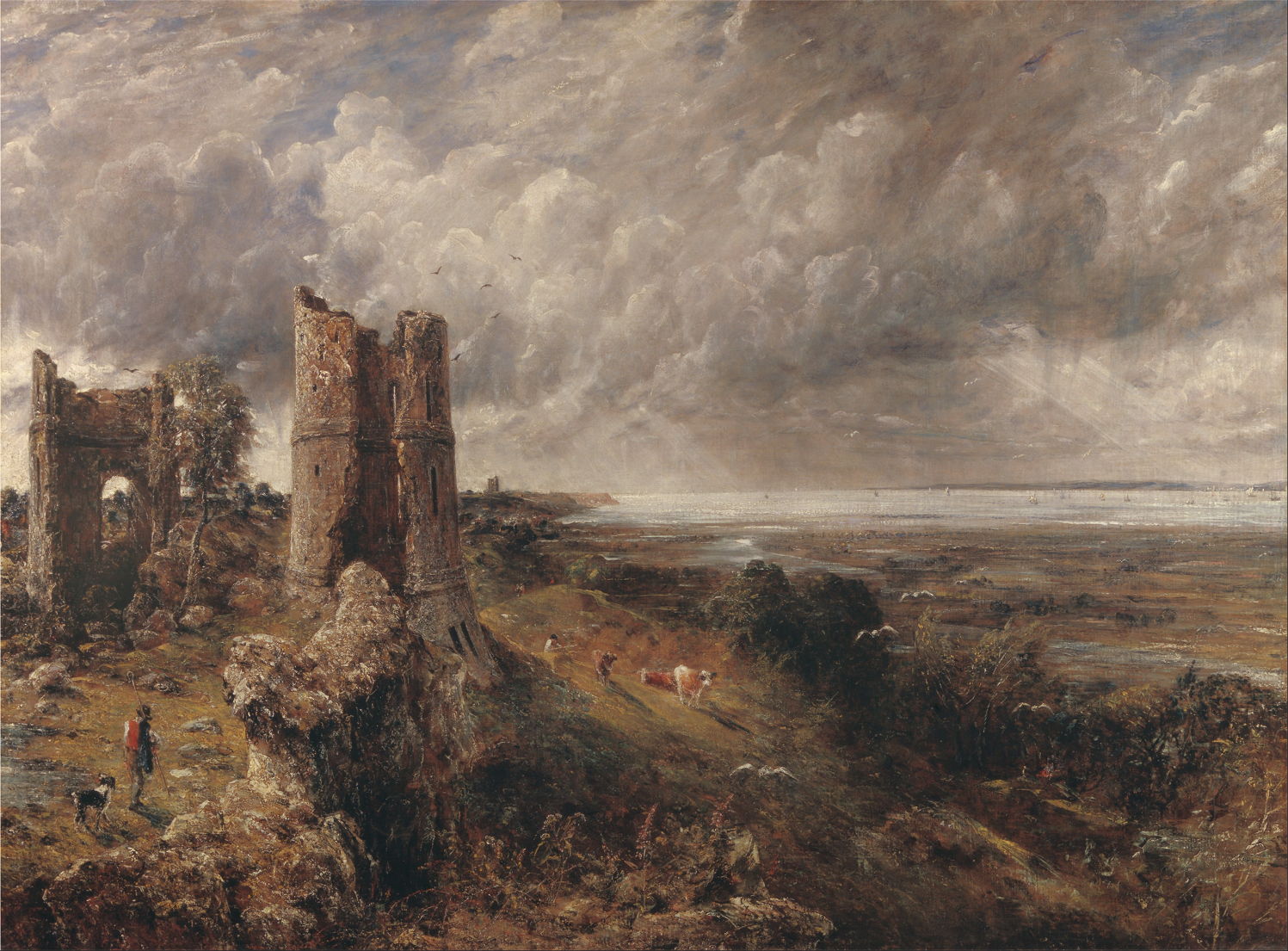
John Constable (1776–1837), Hadleigh Castle, The Mouth of the Thames – Morning after a Stormy Night (1829), oil on canvas, 121.9 x 164.5 cm, Yale Center for British Art, New Haven, CT. Wikimedia Commons.

By the finished work, the splendid Hadleigh Castle, The Mouth of the Thames – Morning after a Stormy Night (1829), the basic disposition of those figures has changed little, but Constable has changed each to suit his image. The shepherd, still carrying his long crook, is separated from his dog, and has lost his sheep, which have become scattered rocks. The single cow on the sloping grass has gained a couple of friends, and a cowherd. Beyond them are another couple of tiny specks of figures, and there are more by the wood in the lower right corner.

frithderbydaystudy
William Powell Frith (1819–1909), Derby Day (study) (before 1857), oil on canvas, 39.4 x 91.1 cm, Private collection. Wikimedia Commons.

William Powell Frith’s late study for Derby Day was probably painted in about 1856, and is very close to the finished work shown below, although covering only about a tenth of its area.

frithderbyday
William Powell Frith (1819–1909), The Derby Day (1856-58), oil on canvas, 140.5 x 264 cm, The Tate Gallery, London. Wikimedia Commons.

Jacob Bell commissioned Frith to paint his finished Derby Day (1856-58) for the huge fee of £1,500, and the artist was paid a further £1,500 for rights to make prints. It was exhibited at the Royal Academy in 1858, and proved so popular that a guard rail had to be installed in front of it to protect the work from the admiring crowds.

Georges Seurat’s preparations are also revealed in his surviving studies, and are very different given his Pointillist technique. Some of the later Divisionists made conventional studies, and there are some experimental examples using larger tiles of colour (see below). Seurat instead rehearsed parts of the overall view when preparing his masterwork.

Georges Seurat, Landscape - the Island of the Grande Jatte (1884), oil on canvas, 69.9 x 85.7 cm, Private collection. WikiArt.
Georges Seurat (1859–1891), Landscape – the Island of the Grande Jatte (1884), oil on canvas, 69.9 x 85.7 cm, Private collection. WikiArt.

Seurat’s first and greatest masterpiece, generally known as La Grande Jatte, uses the technique of optical mixing of colour. Rather than blending pigments on the canvas, it’s constructed of tiny dots that are high in chroma, and allow for optical mixing, one of the fundamental techniques in Seurat’s new scientific painting. His theory was that the mixing of colour would then occur in the retina of the viewer, and he tried this in a pure landscape study (above), and in his huge finished painting (below).

Georges Seurat, Un dimanche après-midi à l'Île de la Grande Jatte (A Sunday Afternoon on the Island of La Grande Jatte) (1884-6), oil on canvas, 207.5 × 308.1 cm, Art Institute of Chicago, Chicago, IL. Wikimedia Commons.
Georges Seurat (1859–1891), Un dimanche après-midi à l’Île de la Grande Jatte (A Sunday Afternoon on the Island of La Grande Jatte) (1884-6), oil on canvas, 207.5 × 308.1 cm, Art Institute of Chicago, Chicago, IL. Wikimedia Commons.

He painted his finished version in three phases. In the first, the dots he applied were mixed from available and fairly conventional pigments, including duller earths. In the second phase, he used a limited number of brighter and higher chroma pigments. In the third and final phase he added coloured borders which are distinctive of his paintings.

By the late nineteenth century oil studies were being supplemented by photographs.

eakinsstudentsatswimminghole
Circle of Thomas Eakins (1844–1916), Eakins’s Students at the “The Swimming Hole” (1884), albumen silver print, 9.3 x 12.1 cm, The Getty Center, J. Paul Getty Museum, Los Angeles, CA. Wikimedia Commons.

Thomas Eakins’ preparatory studies for Swimming (1885) grew from a series of photographs taken by the artist and his friends. But photos never replaced his own sketches: for this work, Eakins made several figure studies, details such as the dog, and different landscape backgrounds, then brought them together in oil sketches.

eakinsstudyswimming
Thomas Eakins (1844–1916), Swimming Hole (sketch) (1884), oil on fiberboard mounted on masonite, 22.1 × 27 cm, The Hirshhorn Museum and Sculpture Garden, Washington, DC. Wikimedia Commons.

Once he was happy, he embarked on his final version. In at least some cases, including his paintings of shad fishing from 1881-82, the figures in his Arcadia (c 1883), and Swimming (1885), he put final photographic images into a ‘magic lantern’ projector, which he then projected at the canvas.

He developed a sophisticated system not only for using the projected image to make a graphite underdrawing, but as the painting progressed, to incise key points and lines of reference in the paint surface. This enabled him to create paintings that were accurately calibrated to his reference images: a great advance on the traditional system of enlargement using grids, and one factor in his detailed realism. This technique was discovered by Mark Tucker and Nica Gutman.

eakinsswimming
Thomas Eakins (1844–1916), Swimming (The Swimming Hole) (1885), oil on canvas, 70.2 × 93 cm, Amon Carter Museum of American Art, Fort Worth, TX. Wikimedia Commons.

Together with other photos and various studies, Eakins then painted Swimming (The Swimming Hole) in 1885.

Albert Bierstadt was more traditional in his preparatory studies for The Last of the Buffalo in 1888.
bierstadtstudylastbuffalo
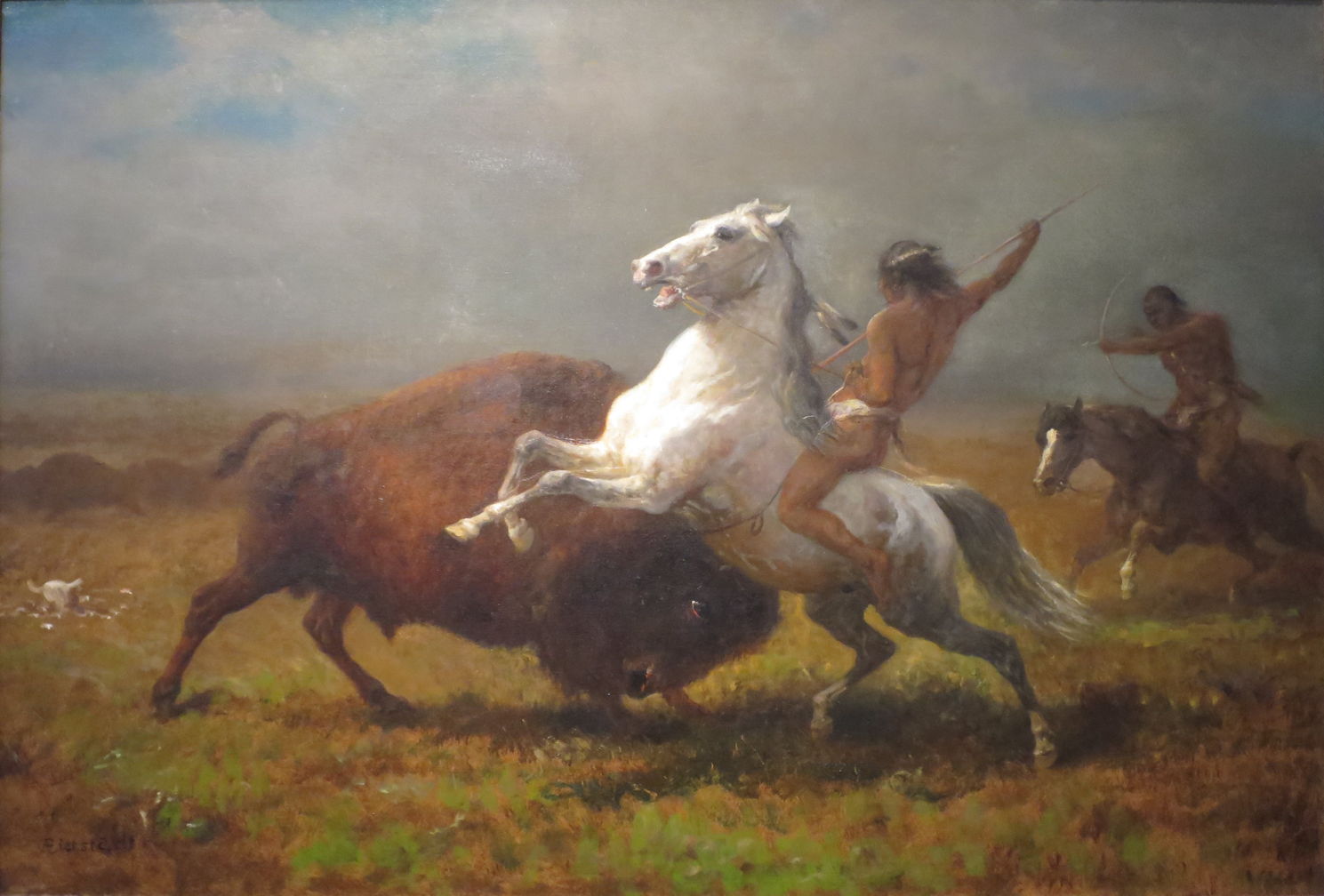
Albert Bierstadt (1830–1902), Study for ‘The Last of the Buffalo’ (c 1888), oil on canvas, 62.9 x 91.1 cm, De Young Museum, San Francisco, CA. Wikimedia Commons.

This late study was painted on canvas, and is 63 x 91 cm (25 x 36 inches). It concentrates on the action to be embedded in a broader landscape.

bierstadtlastbuffalo
Albert Bierstadt (1830–1902), The Last of the Buffalo (c 1888), oil on canvas, 153 x 245.1 cm, Buffalo Bill Center of the West, Cody, WY. Wikimedia Commons.

Bierstadt’s finished painting is larger still, and sets that action in a more characteristic grand panorama, with bleached skulls and dying buffalo in the foreground. In the middle distance are hundreds of animals in the herd, suggesting that extinction was by no means the only outcome.

Finally, a pair of paintings by the less-known Divisionist Henri-Edmond Cross shows an alternative approach to Seurat’s, where his study is built of small daubs of colour, which are then reduced in size for the Pointillism of his final version.

crossclearingprovence
Henri-Edmond Cross (1856–1910), Clearing in Provence (study) (c 1906), oil on paper mounted on canvas, 56.5 x 44 cm, Israel Museum מוזיאון ישראל, Jerusalem, Israel. Wikimedia Commons.

His Clearing in Provence from about 1906 was painted on paper, and has subsequently been mounted on canvas for display in the Israel Museum, Jerusalem.
crossglade
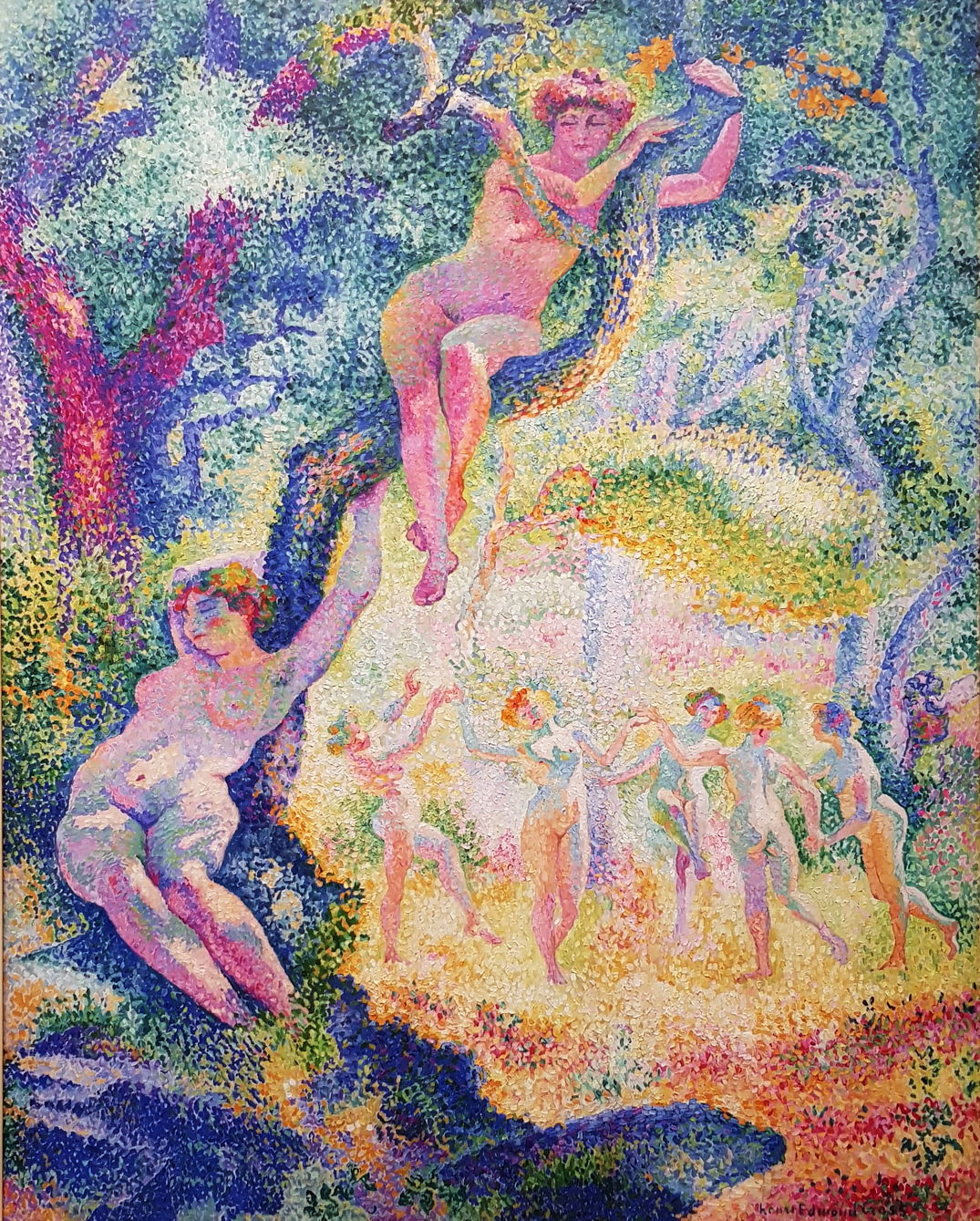
Henri-Edmond Cross (1856–1910), The Glade (1906), oil on canvas, 162 x 130 cm, Wallraf-Richartz-Museum & Fondation Corboud, Cologne, Germany. Image by anagoria, via Wikimedia Commons.

That sketch formed the basis of the woodland setting Cross used in The Glade, painted in oils in 1906. Colour changes are prominent, and the chroma has been considerably enhanced. The size has grown, and it’s on a more permanent support of stretched canvas.

Seen through modern eyes, many of the oil studies of the past deserve to be seen more widely, rather than being kept in storage.

Paintings of Capri: 1828-1879

By: hoakley
14 February 2026 at 20:30

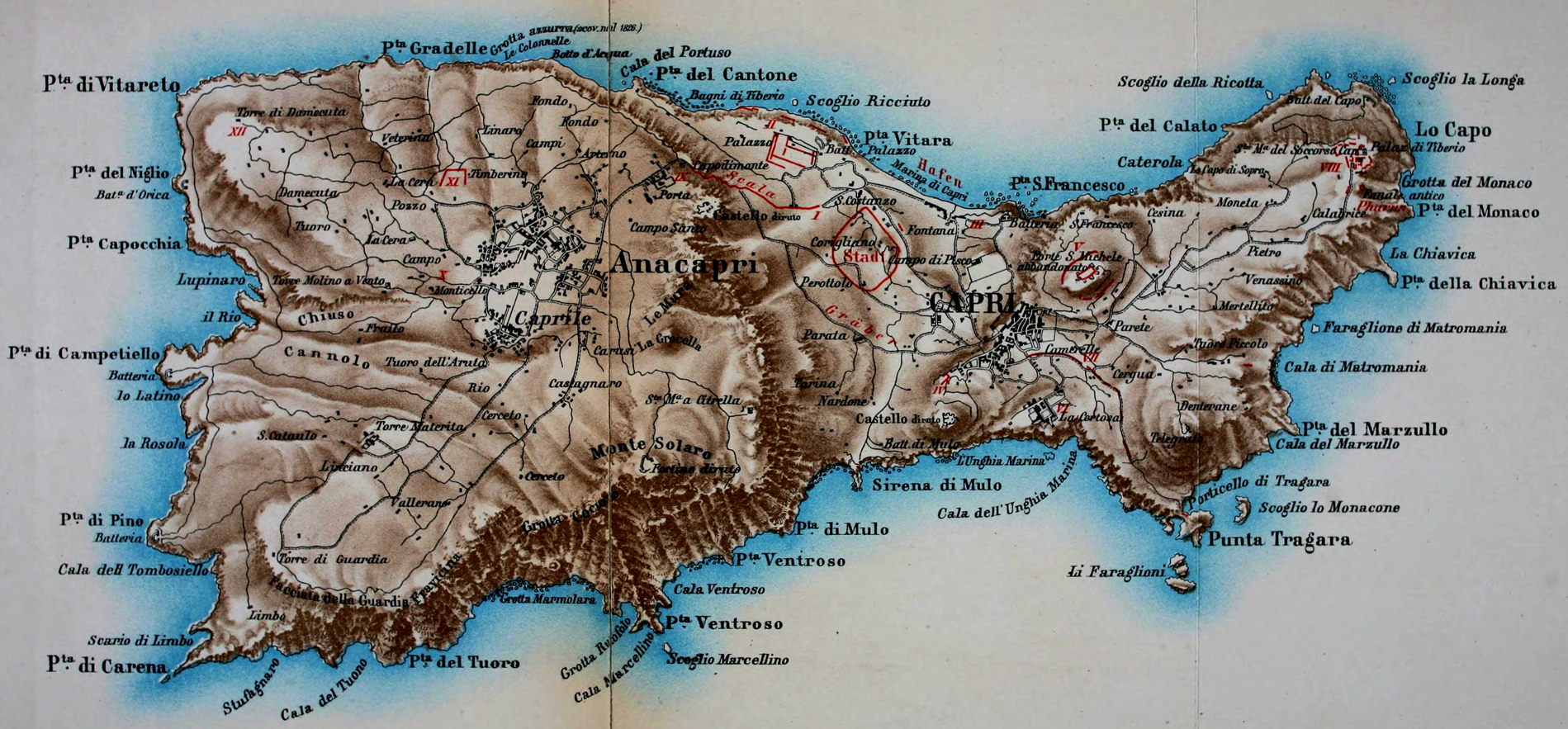
This weekend we’re escaping from the chills of February to travel to Capri, off the coast of southern Italy. From the north coast of this island you can look across the Bay of Naples towards the crowded city to the north. It’s a small island, with two little towns: Capri in the east, spilling down to harbours on the north and south coasts, and Anacapri, nestling in the hills to the west.

Karl Julius Beloch (1854–1929), Map of Capri (1890), from From Karl Julius Beloch: Campanien. Breslau, 1890. Wikimedia Commons.

It’s ruggedly hilly, with spectacular coastal scenery of high sea cliffs, small bays, and plenty of rock. Although only around 6 km (4 miles) long, it rises to nearly 600 metres (2,000 feet) at its highest point, Monte Solaro. It has everything to offer the coastal painter, including a superb climate, and a refuge from the winters of northern Europe.

Among the more famous artists who have stayed on this island are Albert Bierstadt and John Singer Sargent, while Adrian and Marianne Stokes honeymooned there. Although it has been claimed that Capri only became popular with painters in the late nineteenth century, its fame started rather earlier.

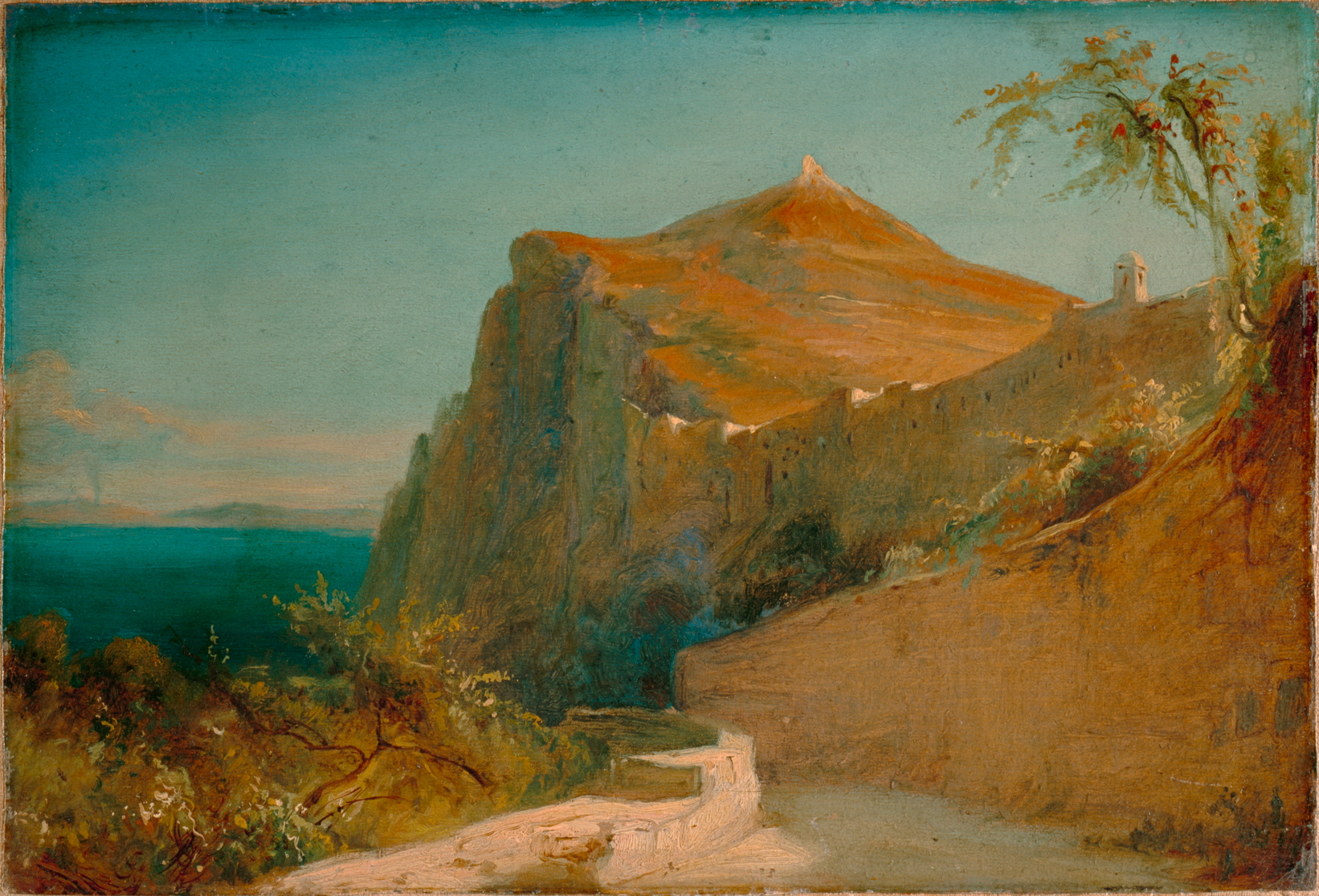
Carl Eduard Ferdinand Blechen, Tiberiusfelsen auf Capri (Tiberius Rocks, Capri) (1828-9), oil on paper mounted on canvas, 20.5 x 30 cm, Lower Saxony State Museum, Hanover. Wikimedia Commons.
Carl Eduard Ferdinand Blechen (1798–1840), Tiberiusfelsen auf Capri (Tiberius Rocks, Capri) (1828-9), oil on paper mounted on canvas, 20.5 x 30 cm, Lower Saxony State Museum, Hanover. Wikimedia Commons.

Carl Blechen visited the island in 1828, made hundreds of sketches there, and developed some into finished paintings when he was back in his Berlin studio. This painting of Tiberius Rocks, Capri (1828-9) seems to have been at least started en plein air, in oils on paper, although he may have finished it after his return. It shows the north coast, looking east to the peak of Monte Tiberio, with the Bay of Naples in the background.

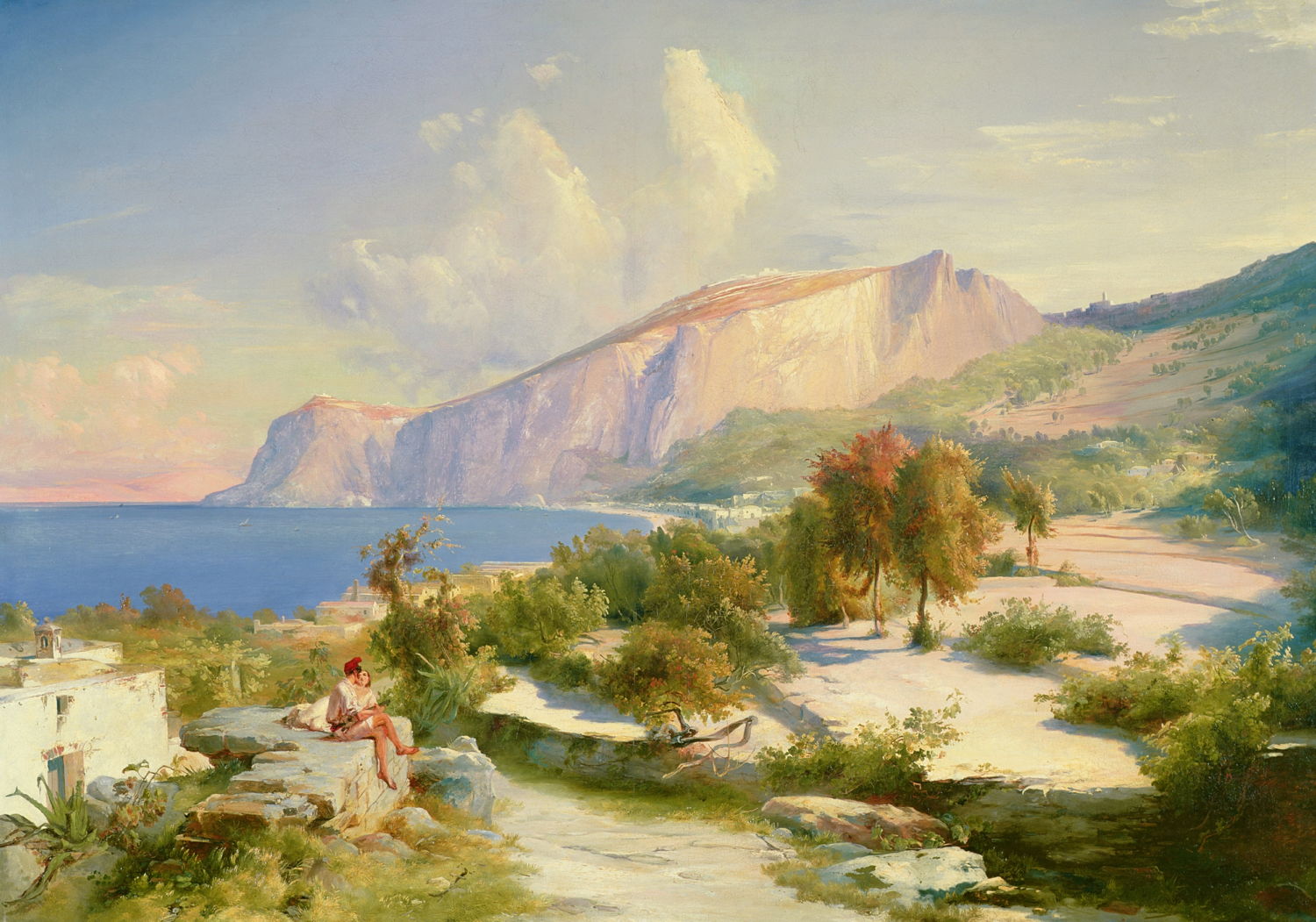
blechenmarinagrande
Carl Eduard Ferdinand Blechen (1798–1840), Marina Grande, Capri (1829), oil on canvas, 90 × 130 cm, Österreichische Galerie Belvedere, Vienna, Austria. Wikimedia Commons.

Blechen’s superb finished painting of Marina Grande, Capri (1829) was made in the studio, though. This shows the north coast again, looking from the west of the Marina Grande towards the east, with the Tiberius Rocks and Monte Tiberio in the distance, and that may well be Vesuvius in the far distance.

friedbluegrotto
Heinrich Jakob Fried (1802-1870), The Blue Grotto, Capri (1835), oil on canvas, 50 × 63 cm, Kunsthalle Bremen, Bremen, Germany. Wikimedia Commons.

Heinrich Jakob Fried’s painting of The Blue Grotto, Capri (1835) shows one of the island’s most famous sights, which has been the motif for many paintings since. This has to be visited by boat, and is at the north-western tip of the island. It features in August Kopisch’s book, published in German in 1838, describing his re-discovery of this cave in 1826, which popularised the island across northern Europe. Fried visited the cave in 1835, and probably painted this in a studio in Naples shortly afterwards, just in time for the book’s publication.

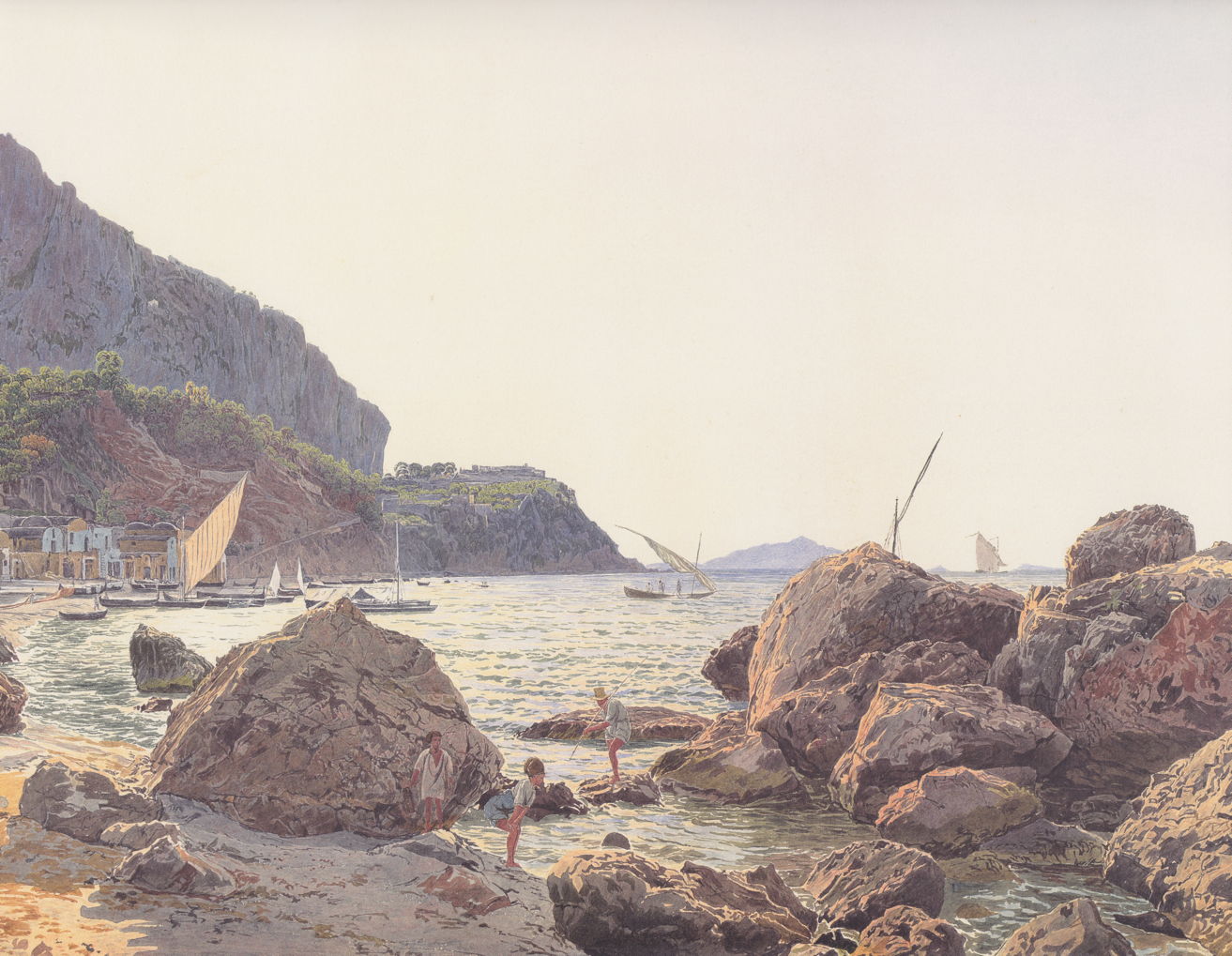
altmarinagrande
Jakob Alt (1789–1872), Marina Grande, Capri (1836), watercolour, 41.1 x 51.7 cm, Albertina, Vienna, Austria. Wikimedia Commons.

Jakob Alt’s view of Marina Grande, Capri (1836) is an extraordinary watercolour with painstaking detail. His view reverses Blechen’s, looking across the harbour from the east to the west, dropping almost to water level. Alt visited Italy in the mid-1830s, during which he too painted the Blue Grotto.

debourbonbrotherschartreuse
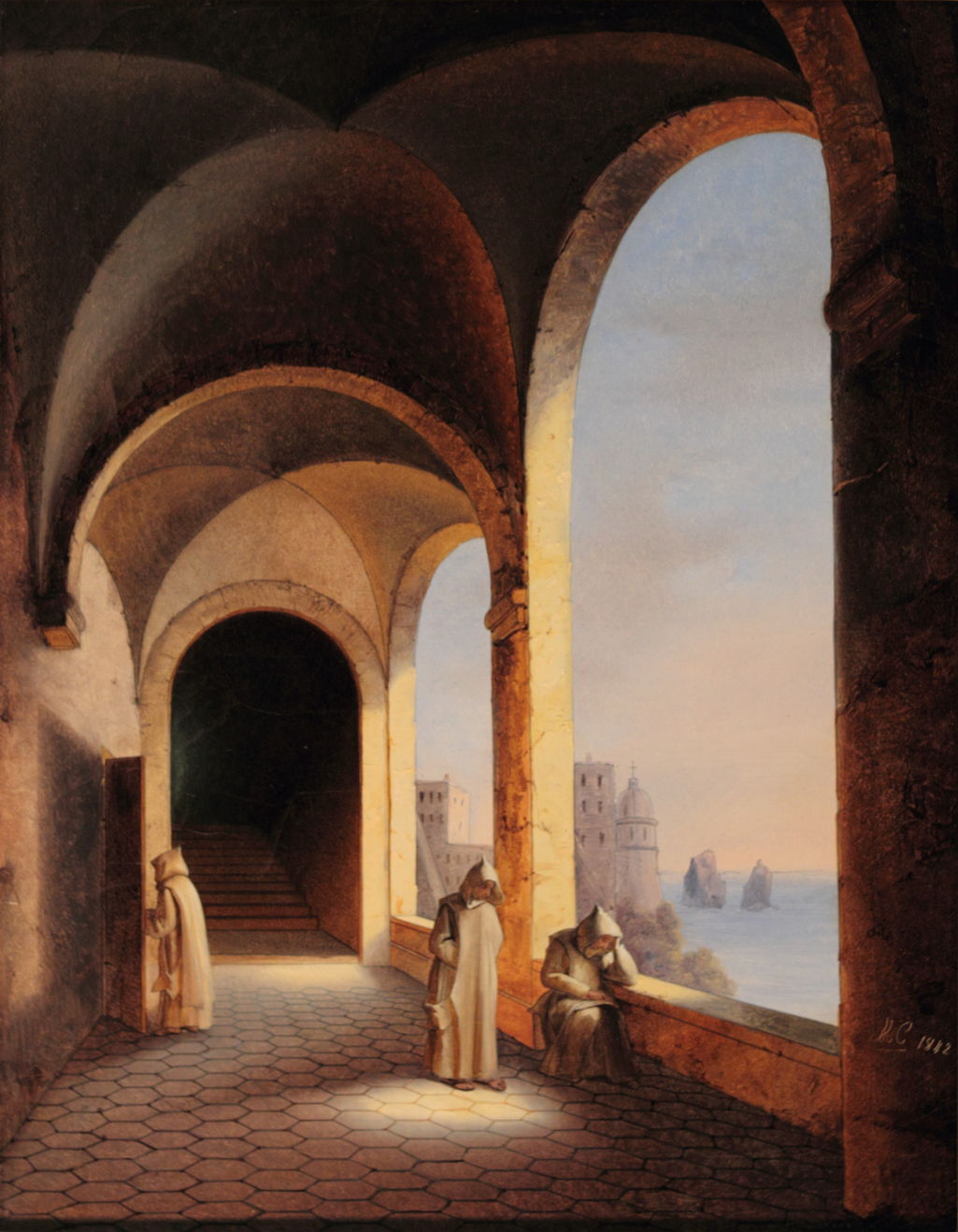
Marie-Caroline de Bourbon (Princess Caroline of Naples and Sicily) (1798–1870), Brothers in the Carthusian Monastery of San Giacomo, Capri (1842), further details not known. Image by PierreSelim, via Wikimedia Commons.

Marie-Caroline de Bourbon, Princess Caroline of Naples and Sicily, was an enthusiastic painter as well as being an avid collector of landscape paintings. The last serious Bourbon pretender to the crown of France, she visited Capri in the early 1840s, after she had been released from imprisonment in the Château of Blaye, and before moving to a palazzo on the Grand Canal in Venice. Her unusual painting of Brothers in the Carthusian Monastery of San Giacomo, Capri (1842) incorporates a vignette landscape view of the coast, almost in the manner of the Renaissance.

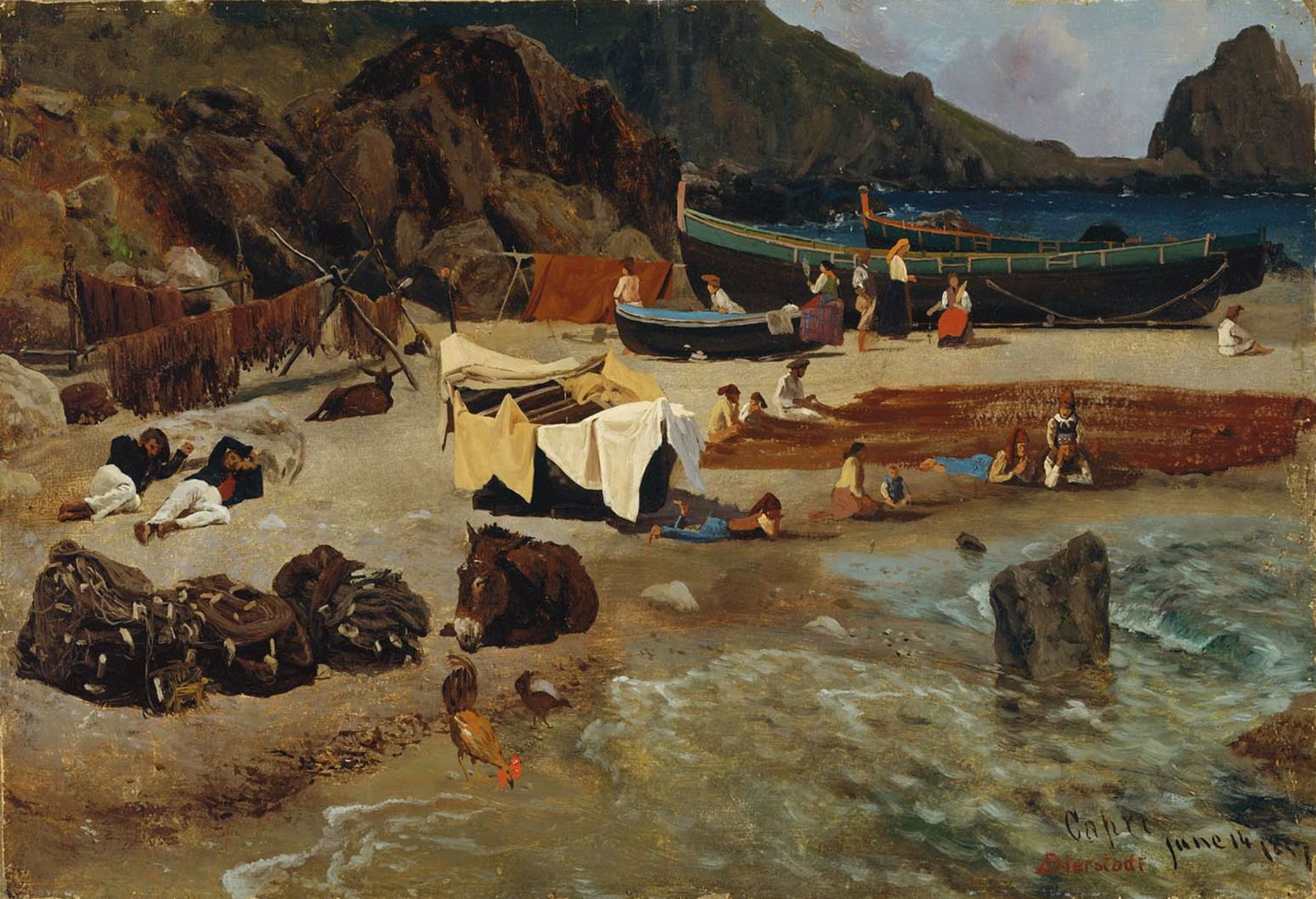
bierstadtfishingboats
Albert Bierstadt (1830–1902), Fishing Boats at Capri (1857), oil on paper mounted on canvas, 34 × 49.9 cm, Museum of Fine Arts Boston, Boston, MA. Wikimedia Commons.

The great American landscape painter Albert Bierstadt visited Capri on his way back to New Bedford in 1857, following his training in Düsseldorf, Germany, only six years after he had started painting in oils. His Fishing Boats at Capri (1857) is painted in oils on paper, suggesting it may well have been started in front of the motif, and is quite unlike his mature style.

bierstadtmarinapiccola
Albert Bierstadt (1830–1902), The Marina Piccola, Capri (1859), oil on canvas, 106.7 × 182.9 cm, Albright-Knox Art Gallery, Buffalo, NY. Wikimedia Commons.

Bierstadt’s The Marina Piccola, Capri was painted on canvas in 1859, when the artist made his first journey westward to sketch American landscapes, and is more typical of the drama of his mature style. This smaller harbour is on the south side of the island, to the south-west of the town of Capri, and this view looks to the east, showing the distant sea stacks of the Faraglioni at the right.

haseltinearconaturale
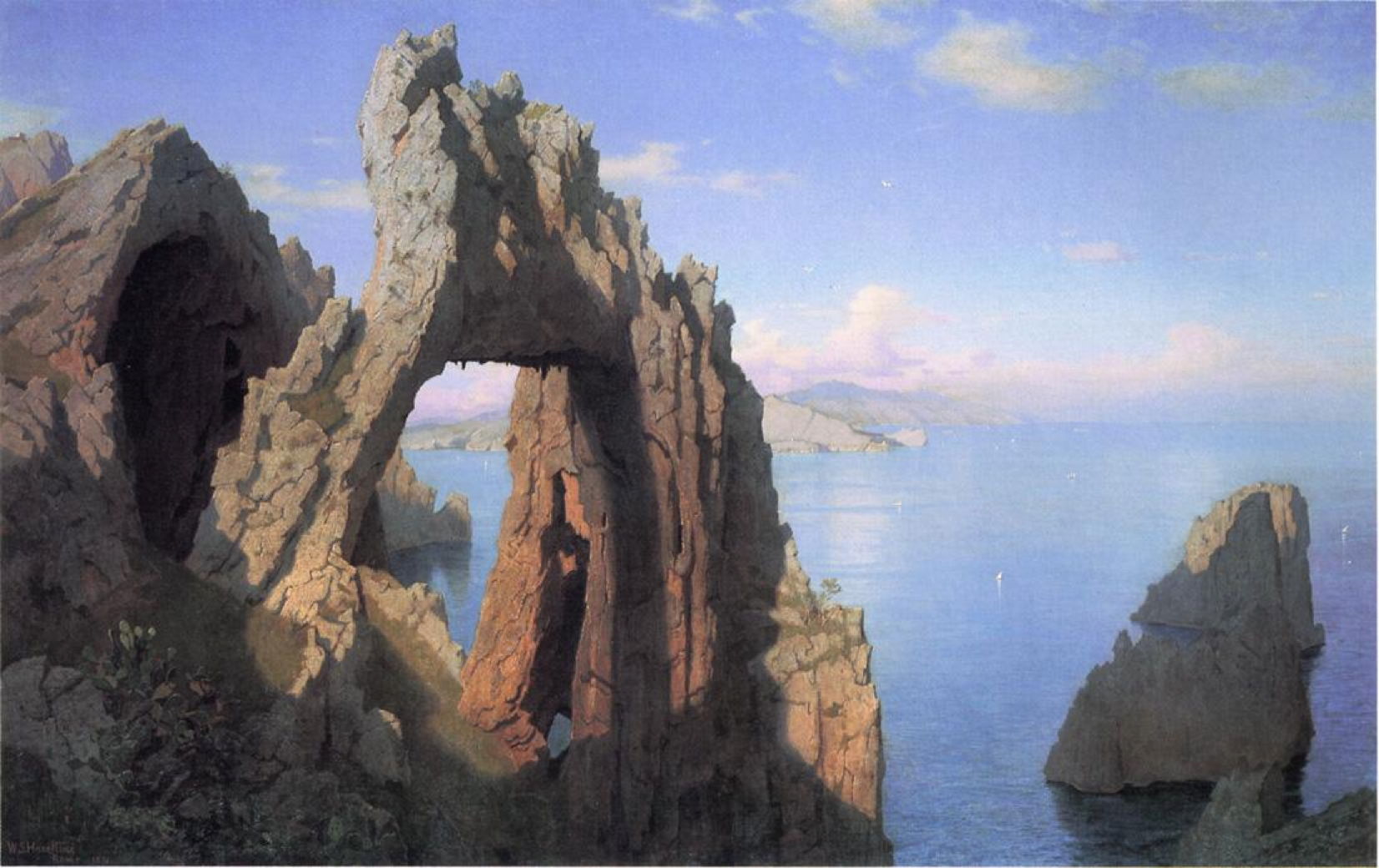
William Stanley Haseltine (1835–1900), Arco Naturale, Capri (c 1870), further details not known. Wikimedia Commons.

William Stanley Haseltine was another great American landscape painter associated with the Hudson River School, and first met Bierstadt in Düsseldorf in the mid 1850s. Haseltine lived in Rome in 1857-58, and drew and painted both the Roman campagna and Capri during that time. Having made his reputation with dramatic depictions of the New England coast, he moved back to Rome in 1867, from where he travelled to paint across Europe. His paintings of Capri from this period proved popular with visiting Americans, and remain among some of the finest realist views of the island. Arco Naturale, Capri from about 1870 shows another of Capri’s famous sights, a natural rock arch on its short eastern coast.

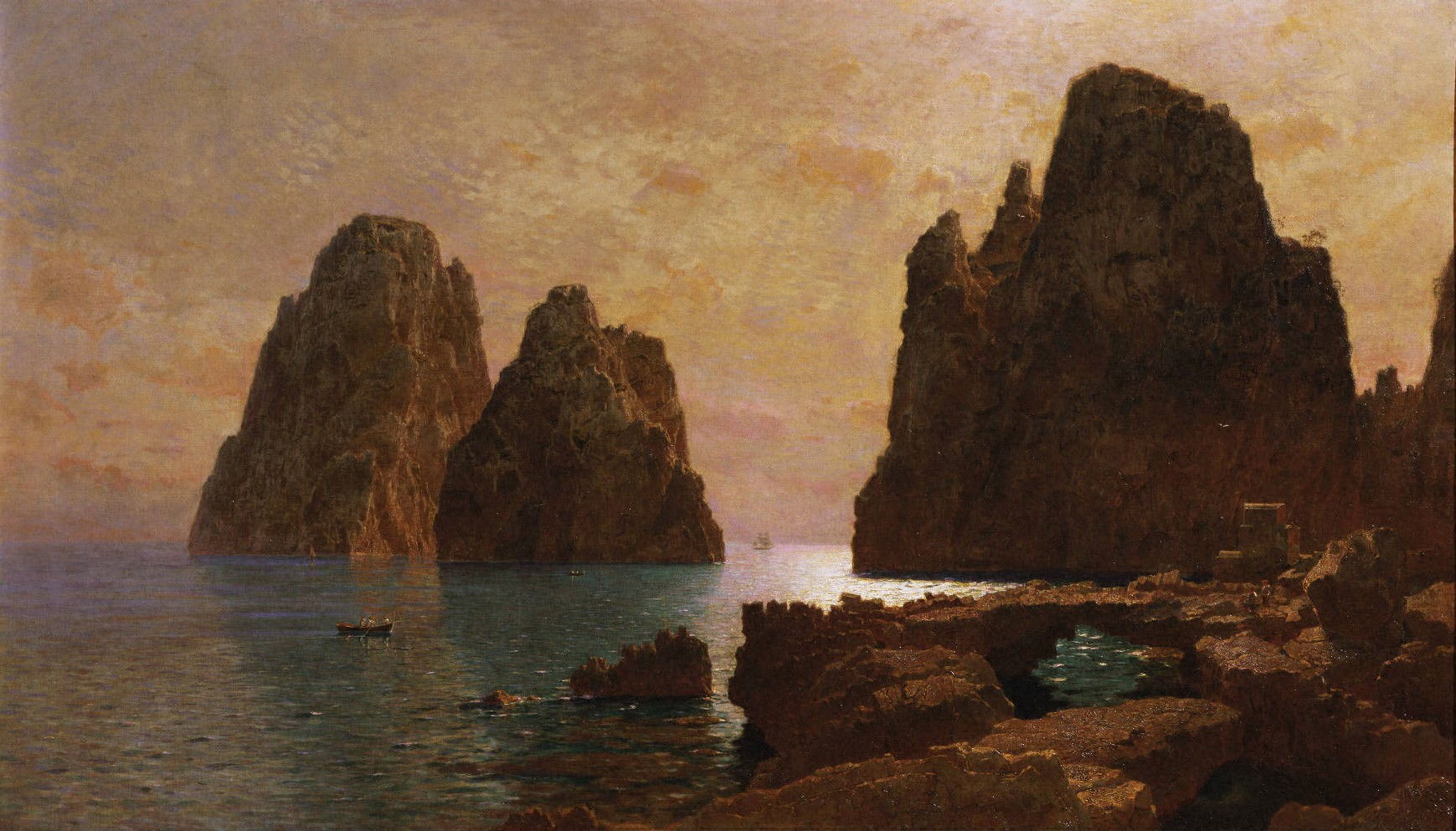
haseltinefaraglioni
William Stanley Haseltine (1835–1900), Isle of Capri: The Faraglioni (1870s), oil on canvas, 83 x 142 cm, Princeton University Art Museum, Princeton, NJ. Wikimedia Commons.

Haseltine’s Isle of Capri: The Faraglioni, from the 1870s, shows these stacks from the north-east, and was probably painted at the Villa Malparte, to the south of the Arco Naturale. He skilfully suggests scale with the tiny boats shown at their foot, although there may be a little exaggeration.

lavolpecapri
Alessandro la Volpe (1820–1887), View of Capri (1875), oil on canvas, 52.5 x 106.5 cm, location not known. Wikimedia Commons.

Alessandro la Volpe was an Italian who was born in, and worked from, Naples. His View of Capri (1875) shows the island in a heat haze, from the hills above Sorrento, to the north-east.

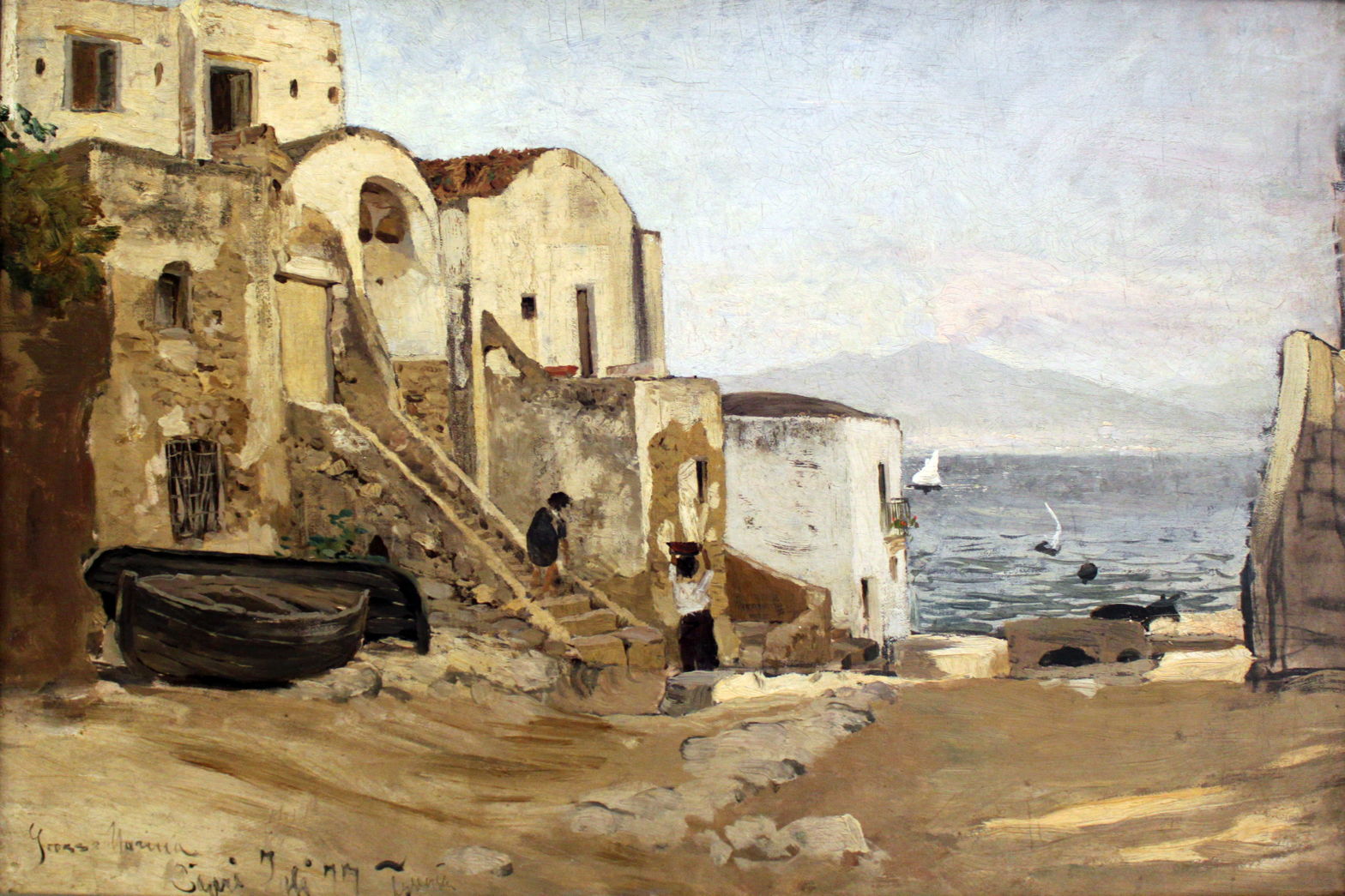
feddersenmarinagrande
Hans Peter Feddersen (1848–1941), Marina Grande, Capri (1877), oil on canvas, dimensions not known, Museumsberg Flensburg, Flensburg, Germany. Image by anagoria, via Wikimedia Commons.

Hans Peter Feddersen was another former student from Düsseldorf, although after Bierstadt and Haseltine. He visited Italy and Capri from April to June 1877, when he painted this view of the Marina Grande, Capri in oils, probably en plein air. Rather than follow early examples, he looks to the north across the harbour, with Vesuvius in the background.

In the summer of 1878, John Singer Sargent had just completed his studies with Carolus-Duran, and had already started to have success at the Salon in Paris. He went off on a working holiday to Capri, staying in the village of Anacapri, as was popular with other artists at the time.

Getting a local model was tricky, because of the warnings that women were given by priests. One local woman, Rosina Ferrara, seemed happy to pose for him, though. She was only 17, and Sargent a mere 22 and just developing his skills in portraiture, following the advice of his teacher Carolus-Duran. Over the course of that summer, Sargent painted at least a dozen works featuring Rosina, who seems to have become an obsession.

sargentdanslesoliviers
John Singer Sargent (1856–1925), Capri Girl (Dans les Oliviers, à Capri) (1878), oil on canvas, 77.5 x 63.5 cm, Private collection. The Athenaeum.

One, Dans les Oliviers, à Capri, he exhibited at the Salon the following year. He sent a near-identical copy back for the annual exhibition of the Society of American Artists in New York, in March 1879.

sargentviewcapri
John Singer Sargent (1856–1925), View of Capri (c 1878), oil on cardboard, 26 x 33.9 cm, Yale University Art Gallery, New Haven, CT. Wikimedia Commons.

Sargent also painted a pair of views of what was probably the roof of his hotel. In View of Capri, above, made on cardboard, Rosina stands looking away, her hands at her hips. In the other, Capri Girl on a Rooftop, below, she dances a tarantella to the beat of a friend’s tambourine.

sargentcaprigirlrooftop
John Singer Sargent (1856–1925), Capri Girl on a Rooftop (1878), oil on canvas, 50.8 x 63.5 cm, Crystal Bridges Museum of American Art, Bentonville, AR. Wikimedia Commons.
hertelviewofcapri
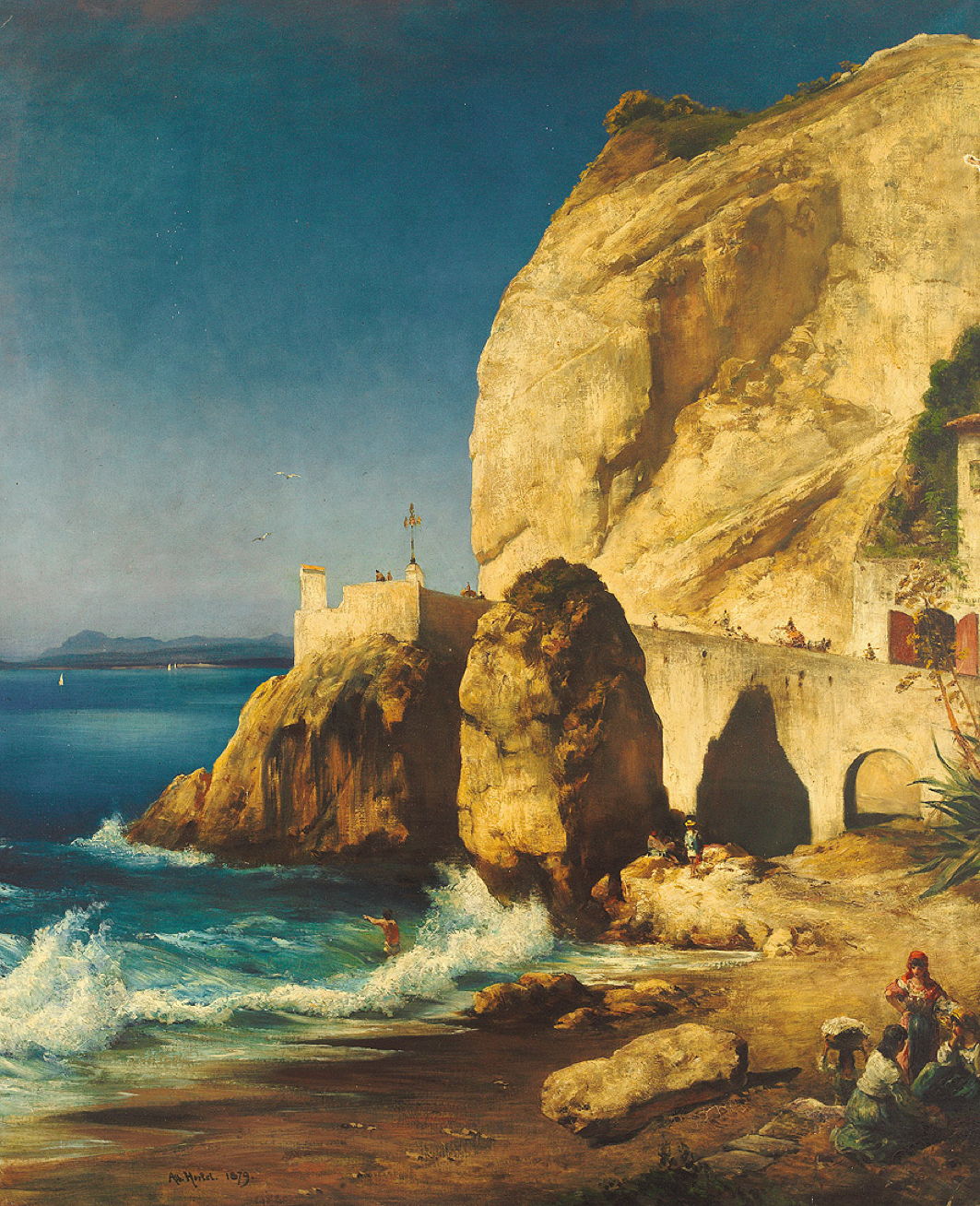
Albert Hertel (1843–1912), View of the Shores of Capri with People (1879), oil on canvas, 173 × 143 cm, location not known. Wikimedia Commons.

Albert Hertel trained in Düsseldorf in 1868-69, prior to which he had lived as a student in Rome for several years. He established himself as a landscape painter in Berlin, from where he seems to have returned to Italy and visited Capri in the late 1870s. His View of the Shores of Capri with People (1879) shows a small bay near Punta Carena, at the south-western tip of the island.

❌
❌