Normal view

There are new articles available, click to refresh the page.
Before yesterdayMain stream

Painting the spirits of water: gods and Naiads

By: hoakley
24 January 2026 at 20:30

Narrative painting of classical myths has many conventions that can appear confusing. This weekend I look at those associated with river gods and their associated nymphs Naiads, and tomorrow more recent relatives Ondines.

In Greek, and subsequently Roman, mythology, the river gods or Potamoi (Greek for rivers) are three thousand sons of Oceanus, the great river encircling the earth, and Tethys, his Titan sister and wife. A river god is both that river and a distinct deity: Achelous is the god of the River Achelous, the largest in Greece, who wrestled unsuccessfully with Hercules for the right to marry Deianira.

Associated with sources and bodies of fresh water are also water nymphs, Naiads or Potamides, often stated to be the daughters of the river gods. In ancient times, there was a weaker distinction between fresh and salt waters, so although nymphs associated with the sea are usually termed Nereids when in Mediterranean waters, or Oceanids, Naiads can also be encountered in what we would consider to be sea.

dititoheliades
Santi di Tito (1536–1603) The Sisters of Phaethon Transformed into Poplars (c 1570), fresco, dimensions not known, Palazzo Vecchio, Musei Civici Fiorentini, Florence. Wikimedia Commons.

The standard depiction for any river god in a classical story is that of an older bearded man lounging by a large earthenware pot from which water pours forth into the river. This is shown well in Santi di Tito’s fresco of The Sisters of Phaethon Transformed into Poplars, from about 1570. Although this story tells how the sisters of Phaeton grieve for him after his death, and are transformed into poplar trees, as it shows a river, there must still be a god of that river.

rubensromulusremus
Peter Paul Rubens (1577–1640), Romulus and Remus (1615-16), oil on canvas, 213 x 212 cm, Musei Capitolini, Rome, Italy. Wikimedia Commons.

Rubens’ delightful painting of Romulus and Remus being discovered by Faustulus, from 1615-16, shows both the river god Tiberinus and his daughter nymph, at the left with the god’s pot.

poussincephalusaurora
Nicolas Poussin (1594–1665), Cephalus and Aurora (1630), oil on canvas, 96.9 x 131.3 cm, The National Gallery, London. Wikimedia Commons.

In Nicolas Poussin’s Cephalus and Aurora from 1630, the river god is again at the left, and looks tired of the whole business, with a mere trickle of water emerging from his pot.
garzialpheusarethusa
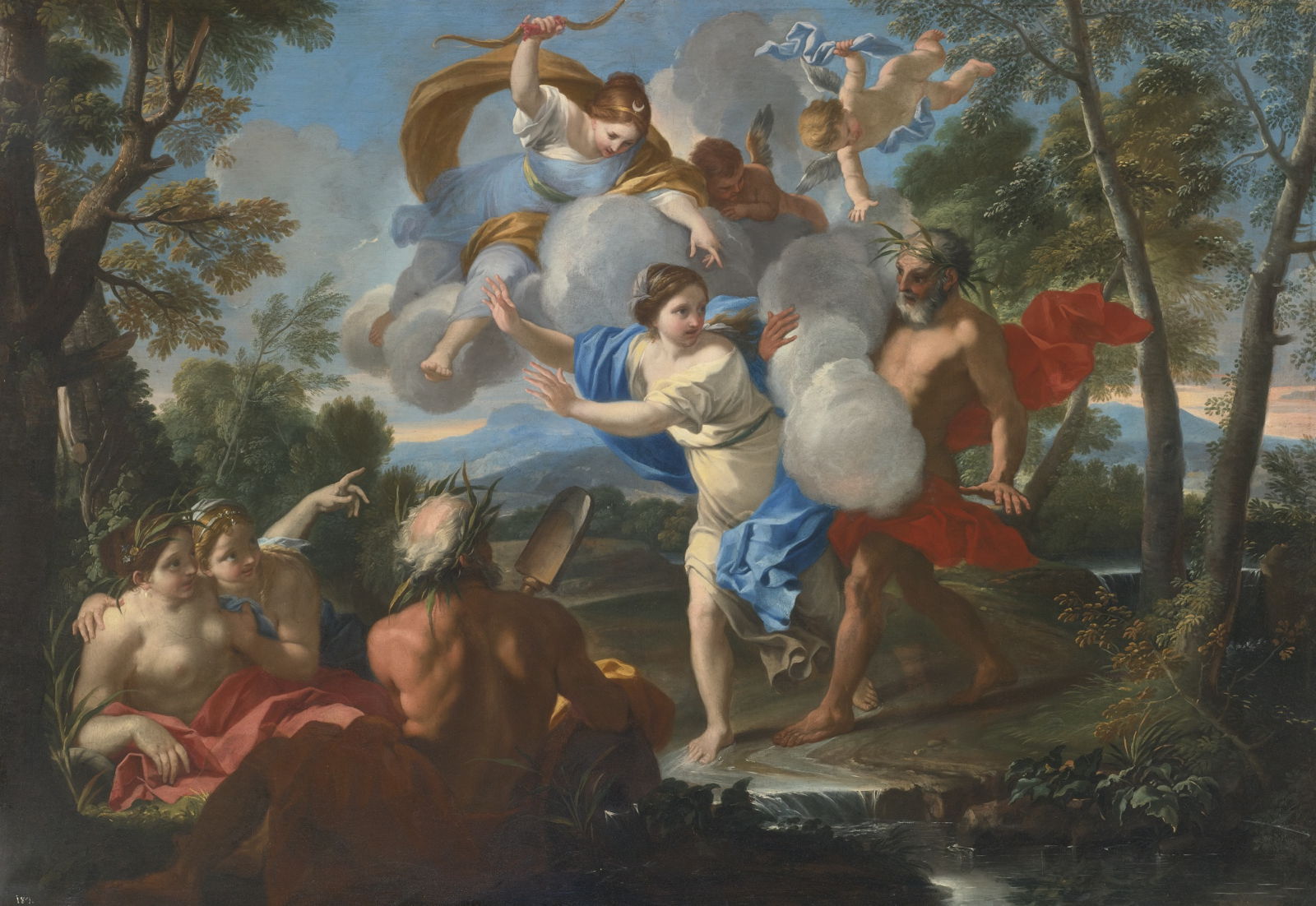
Luigi Garzi (attr) (1638–1721), Alpheus and Arethusa (c 1690), oil on canvas, 120.7 x 171.5 cm, location not known. Wikimedia Commons.

This beautiful painting attributed to Luigi Garzi, of Alpheus and Arethusa from around 1690, shows one river god and two nymphs. The god leans on his pot, and in his left hand holds a small spade, another attribute sometimes seen with them.

coypelalpheuschasingarethusa
Antoine Coypel (1661–1722), Alpheus Chasing Arethusa (c 1710), oil on canvas, dimensions and location not known. Wikimedia Commons.

Antoine Coypel’s version of the same Ovidian myth, Alpheus Chasing Arethusa from about 1710, places the river god at the lower left, and two Naiads separately on the right.

boucherpansyrinx
François Boucher (1703–1770), Pan and Syrinx (1743), oil on canvas, 101 × 133 cm, Private collection. Wikimedia Commons.

So far, the river deities have enjoyed a rather passive life in paintings, but this wasn’t a requirement. In François Boucher’s Pan and Syrinx from 1743, the nymph Syrinx is seeking the help of the river god and Naiad, as she attempts to evade Pan’s attentions. The god’s pot is almost hidden beneath luxuriant red fabric, under his right hand.

tiepoloapollodaphne
Giovanni Battista Tiepolo (1696–1770), Apollo and Daphne (c 1744-45), oil on canvas, 96 x 79 cm, Musée du Louvre, Paris. Wikimedia Commons.

In Tiepolo’s Apollo and Daphne (c 1744-45), the river god is given much of the foreground and lower section of the painting, and holds an oar or paddle, a more unusual but distinctive attribute.

mengsapollomnemosyne
Anton Raphael Mengs (1728–1779), Apollo, Mnemosyne, and the Nine Muses (1761), fresco, 313 × 580 cm, Gallery of the Villa Albani-Torlonia, Rome. Wikimedia Commons.

Sometimes, artists conceal the river god as if challenging the viewer to locate him. This is the case in Anton Raphael Mengs’ fresco of Apollo, Mnemosyne, and the Nine Muses (1761), in which the god’s bearded and hoary figure is tucked away behind Apollo’s legs. There’s also an Orphic tradition in which the River Mnemosyne is the source of water to bring inspiration, and this perhaps alludes to that obscure sub-narrative.

brenetaethrashowingtheseus
Nicolas-Guy Brenet (1728–1792), Aethra Showing her Son Theseus the Place Where his Father had Hidden his Arms (1768), oil on canvas, 50.2 × 59.7 cm, Los Angeles County Museum of Art, Los Angeles, CA. Wikimedia Commons.

In some paintings, river gods seem to be included even when their river is nowhere to be seen. Nicolas-Guy Brenet’s painting of Aethra Showing her Son Theseus the Place Where his Father had Hidden his Arms (1768) tucks this extra into the lower left corner again.

schmidtdanaides
Martin Johann Schmidt (1718–1801), The Labour of the Danaides (1785), oil on copper plate, 54.5 × 77 cm, Narodna galerija Slovenije, Ljubljana, Slovenia. Wikimedia Commons.

Martin Johann Schmidt’s Labour of the Danaides (1785) informs us that the Danaïds were also water-nymphs by placing a river god at the left. They were condemned to keep trying to fill this leaky container with water as their penance in the underworld.

cranenyadsdryads
Walter Crane (1845–1915), Nyads and Dryads (date not known), watercolour on paper, 23.5 × 16.5 cm, location not known. Wikimedia Commons.

Walter Crane shows the association between Naiads and other nymphs in his watercolour of Nyads and Dryads, probably painted between 1880-1900. He melds the Dryads in with their trees, puts the ‘Nyads’ or Naiads in the water, and has a river god watching from the reeds in the distance.
waterhousenaiad
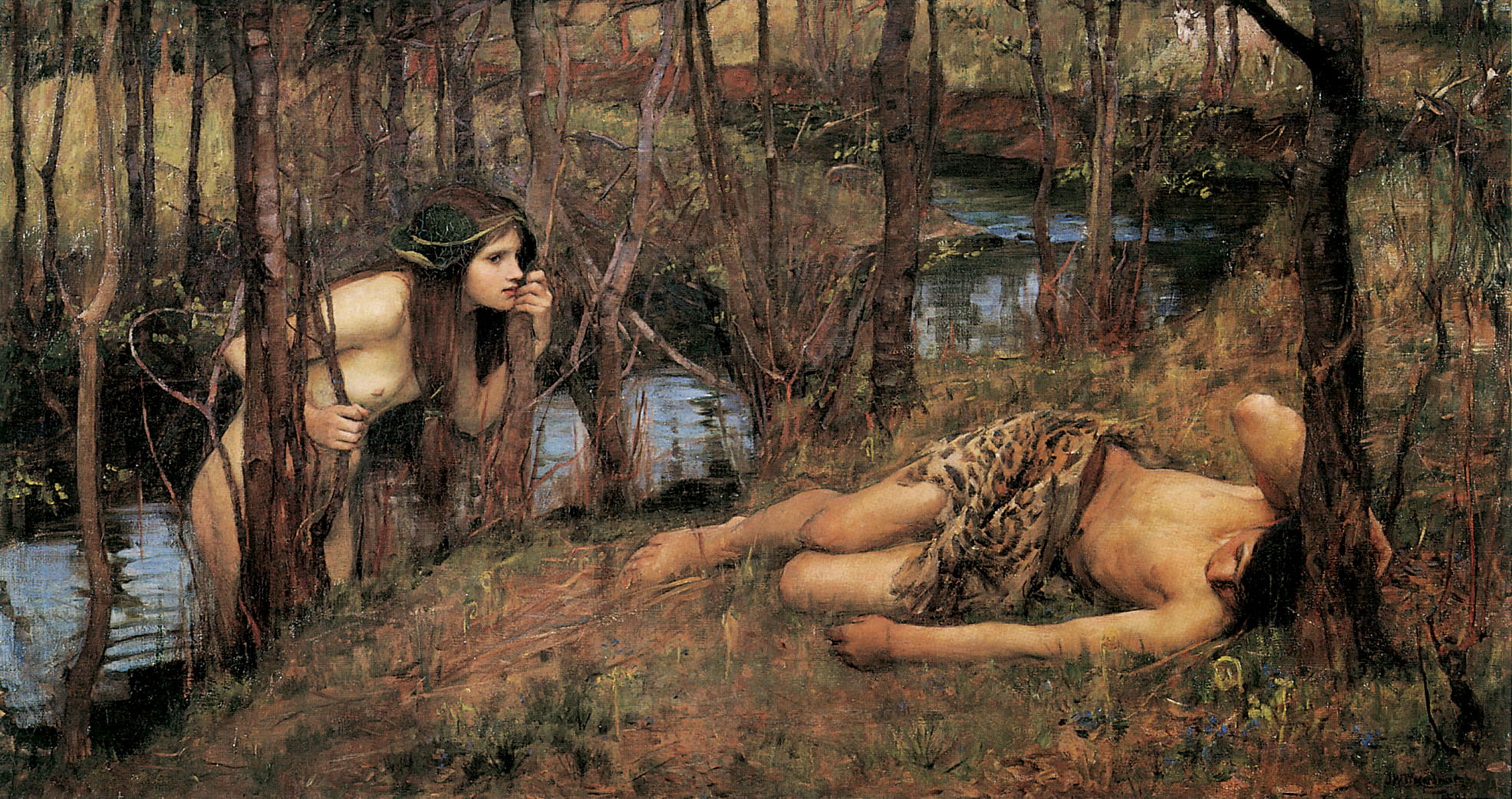
John William Waterhouse (1849–1917), A Naiad, or Hylas with a Nymph (1893), oil on canvas, 66 x 127 cm, Private collection. Wikimedia Commons.

By the end of the nineteenth century, enthusiasm for the tradition of showing river gods was waning, and nude, cavorting Naiads came to the fore. One of their greatest exponents was John William Waterhouse, who led with this first tentative retelling of the myth of Hylas in 1893, in A Naiad, or Hylas with a Nymph.

Hylas was companion and servant to Heracles (Hercules), who accompanied the hero on Jason’s ship Argo. When the Argonauts were ashore in modern Turkey, Hylas approached the spring of Pegae, where the Naiads fell in love with and kidnapped him. He vanished without trace, leading Heracles and Polyphemus to search for him at length. They were delayed in this so long that the Argo sailed without them.

This first version shows one of the Naiads discovering the sleeping Hylas by a small river. There’s no sign of any river god, but there are some goats on the right side of the painting.
waterhousehylasnymphs
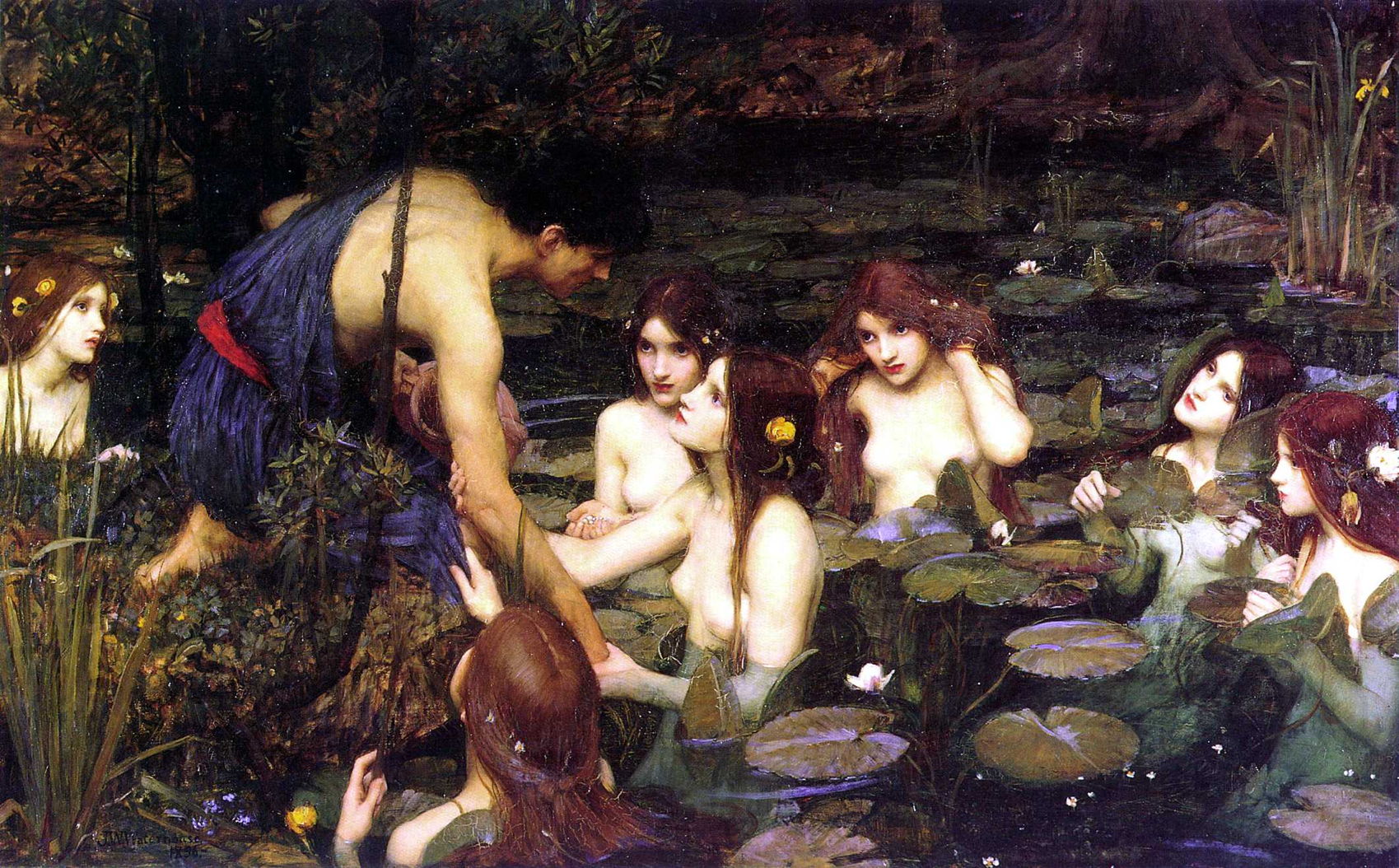
John William Waterhouse (1849–1917), Hylas and the Nymphs (1896), oil on canvas, 132.1 x 197.5 cm, Manchester Art Gallery, Manchester, England. Wikimedia Commons.

Three years later, Waterhouse’s Hylas and the Nymphs (1896) stays closer to the myth. Hylas holds an earthenware pot, almost as if he were about to become the river god.

In January 2018, this well-known painting was removed from exhibition in Manchester, England, and replaced by a notice which explained that a temporary space had been left “to prompt conversations about how we display and interpret artworks in Manchester’s public collection”. The painting soon returned after protests. It’s surprising that more than a century after it was first exhibited, it was still capable of causing such controversy.

raehylaswaternymphs
Henrietta Rae (1859–1928), Hylas and the Water Nymphs (c 1909), oil on canvas, 142.3 × 222.8 cm, Private collection. Wikimedia Commons.

Waterhouse is not the only artist to have courted controversy with this story. Henrietta Rae’s Hylas and the Water Nymphs from about 1909 was exhibited at the Royal Academy in 1910, and is no less fleshly than Waterhouse’s version. Rae was a pioneer in her painting of nudes, at a time when most of society still considered that women shouldn’t be allowed to attend classes learning to draw or paint nude models.

poyntercaveofstormnymphs
Edward Poynter (1836–1919), Cave of the Storm Nymphs (1903), oil on canvas, 145.9 × 110.4 cm, Private collection. Wikimedia Commons.

Edward Poynter’s Cave of the Storm Nymphs (1903) might appear to be still more exploitative of the male appeal of the female nude, but there’s a more complex narrative behind this scene. Its literary reference is most probably to the Naiads of Homer’s Odyssey, book 13, who live in a sea cave, updated to encompass more contemporary references to Wreckers, who lured ships onto the rocks in order to steal their precious cargos: sirens without the socially unacceptable habit of cannibalism.

Painted stories of the Decameron: Brother Philippe’s Geese

By: hoakley
12 January 2026 at 20:30

Boccaccio’s Decameron consists of a hundred stories told ten each day for a total of ten days. But there’s a bonus, the hundred-and-first story buried in Filostrato’s introduction to the fourth day. In some ways, this is the best known of all these stories as it has made its way into the French language, through one of La Fontaine’s fables, and is generally known as Brother Philippe’s Geese. Filostrato, though, claims this isn’t a complete story, only part of one.

Filippo Balducci was a good man, knowledgeable, and deeply in love with his wife, who was equally in love with him. She died tragically young, when their only child, a son, was but two years old. Filippo was broken by this loss, and decided to withdraw from life to devote his remaining years to the service of God.

He therefore gave all his possessions to charity, and went to live in a cave on the slopes of Mount Asinaio with his young son. For many years, he kept his son in the cave, seeing only the walls around him, their meagre possessions, and his father. From time to time, Filippo travelled alone down to the city of Florence, where generous people gave him the small things that he needed to live, but his son always remained in their cave.

When Filippo’s son reached the age of eighteen, and his father was preparing to travel down to Florence again, the son asked his father if he could accompany him. He argued that the time would come when his father was no longer able to undertake the journey, so it was important that the younger man learned what to do. Filippo agreed, and the two went down to the city together.

The son had never seen another living thing apart from his father, and was taken aback when he saw the crowded buildings and bustle of Florence. He repeatedly asked his father about the new things which he saw, and what each was called.

The pair then came across a group of beautiful young ladies who had just been to a wedding. The son asked his father what they were, but Filippo just told him to keep looking at the ground, as they were evil. His son wasn’t content with that, and asked his father again what they were called. At a loss for words, Filippo said that they were goslings.

The son immediately lost interest in everything else in the city, and asked his father to get him one of those goslings. Filippo told him again that they were evil, to which his son said that he couldn’t see any evil in them, and pleaded again for them to take a gosling back so that he could pop things in its bill.

Filippo told his son that their bills are not where the son might think, and that they required a special diet, a very ribald remark that abruptly terminated Filostrato’s story.

La Fontaine’s fable, the first in his second book, is a faithful retelling of this abbreviated story, but omits the double entendre of the punchline, which is perhaps just as well given his readership when it was first published in 1668. As those fables became popular throughout France and Europe, they attracted the attention of artists, and this has been painted at least thrice now.

boucherbrotherphilippesgeese
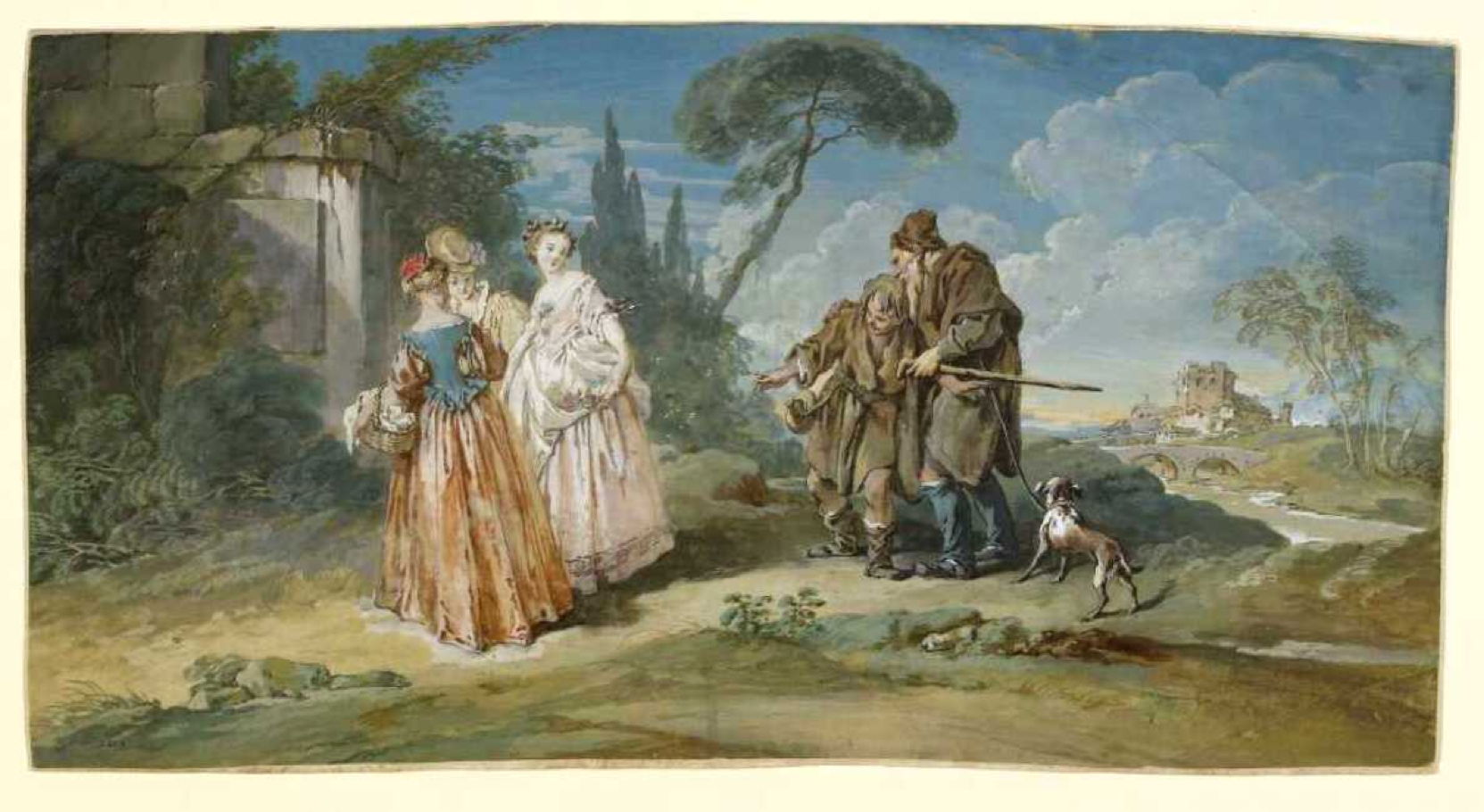
François Boucher (1703-1770), Brother Philippe’s Geese (c 1720-28), gouache, 21 x 42 cm, Musée des Beaux-Arts et d’Archéologie de Besançon, Besançon, France. The Athenaeum.

The first painting is this small gouache by François Boucher from about 1720-28, with its marked contrast in the dress between the reclusive pair and the goslings or geese.

lancretbrotherphilippesgeese
Nicolas Lancret (1690–1743), Brother Philippe’s Geese (c 1736), oil on copper, 27..3 x 35.2 cm, The Metropolitan Museum of Art (Purchase, Walter and Leonore Annenberg and The Annenberg Foundation Gift, 2004), New York, NY. Courtesy of The Metropolitan Museum of Art.

Then in about 1736, Nicolas Lancret painted it in oil on copper, as one of a pair, among a larger group of his paintings of La Fontaine’s fables. The father is shown here dressed as a monk, which is more in keeping with La Fontaine’s account than Boccaccio’s original, but the facial expressions are marvellous, particularly that of the son.

anonafterlancretgeese
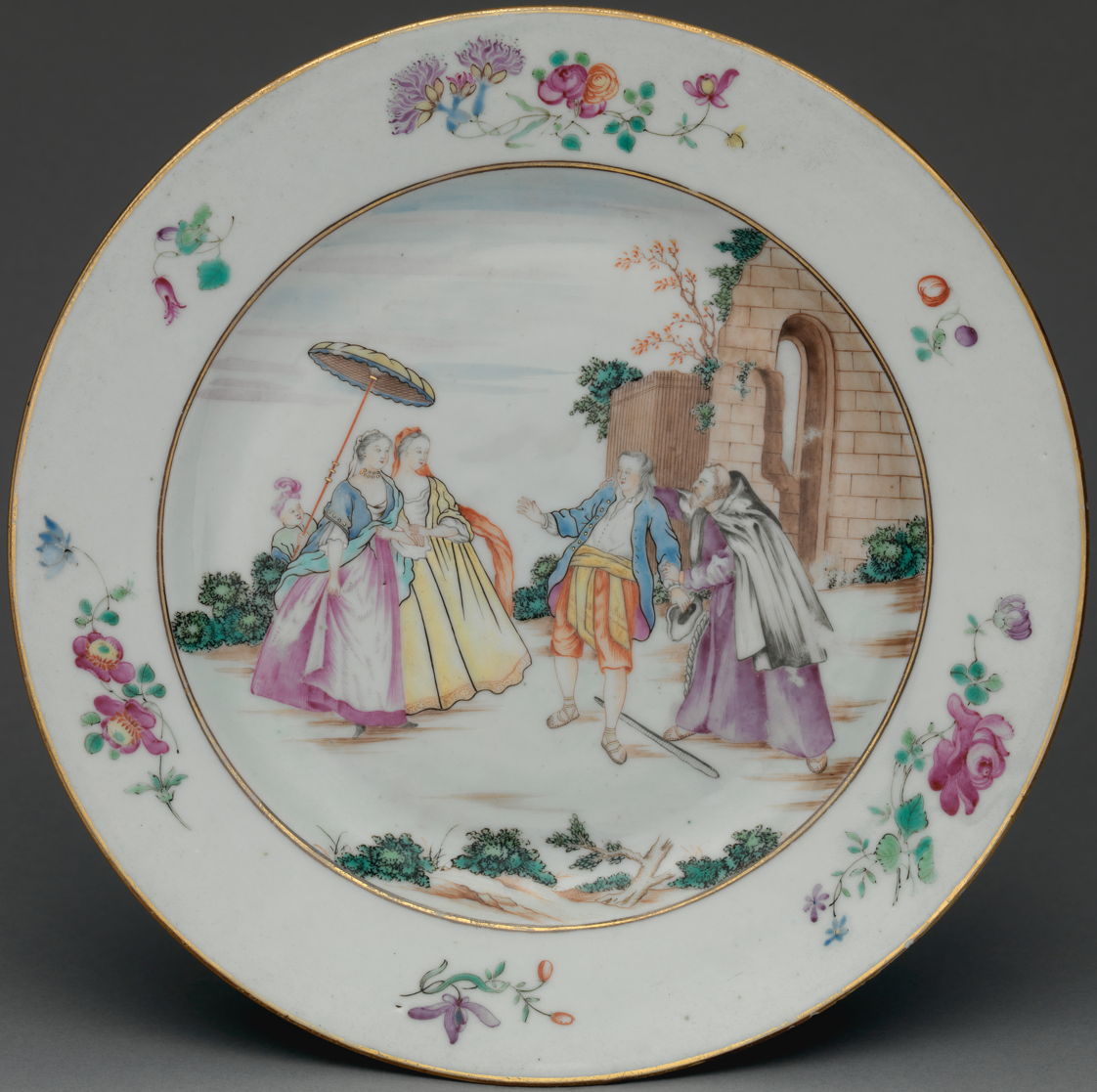
Artist not known, Scene from Brother Philippe’s Geese (1745), Chinese painted porcelain plate, 22.9 cm diam, The Metropolitan Museum of Art (Friends of European Sculpture and Decorative Arts Gifts, 2016), New York, NY. Courtesy of The Metropolitan Museum of Art.

That became so popular that it was reproduced in prints, such as those by Nicolas de Larmessin (1684–1755) in which the image is naturally reversed, but here seen unreversed on a porcelain plate exported from China in 1745.

subleyrasbrothephilippesgeese
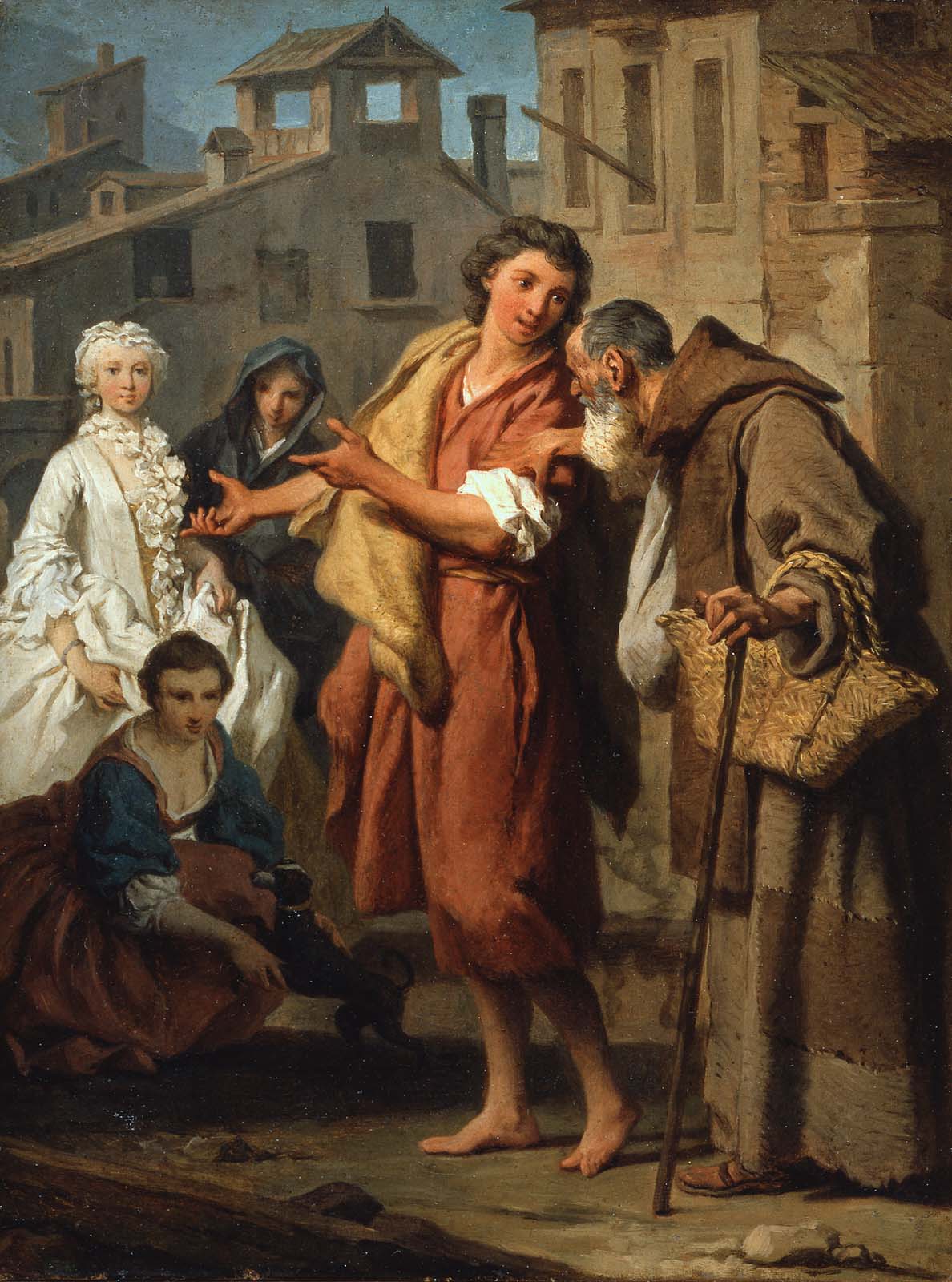
Pierre Hubert Subleyras (1699–1749), Brother Philippe’s Geese (c 1745), oil on canvas, 29.5 x 21.9 cm, The Museum of Fine Arts, Boston, MA. Courtesy of the Museum of Fine Arts, Boston.

At the same time, Pierre Hubert Subleyras painted a different composition telling the story, short of its punchline of course. He restores a thoroughly rustic appearance to the father and son, but surprisingly the young man isn’t staring in wonder at the goslings or geese.

anonbrotherphilippesgeese
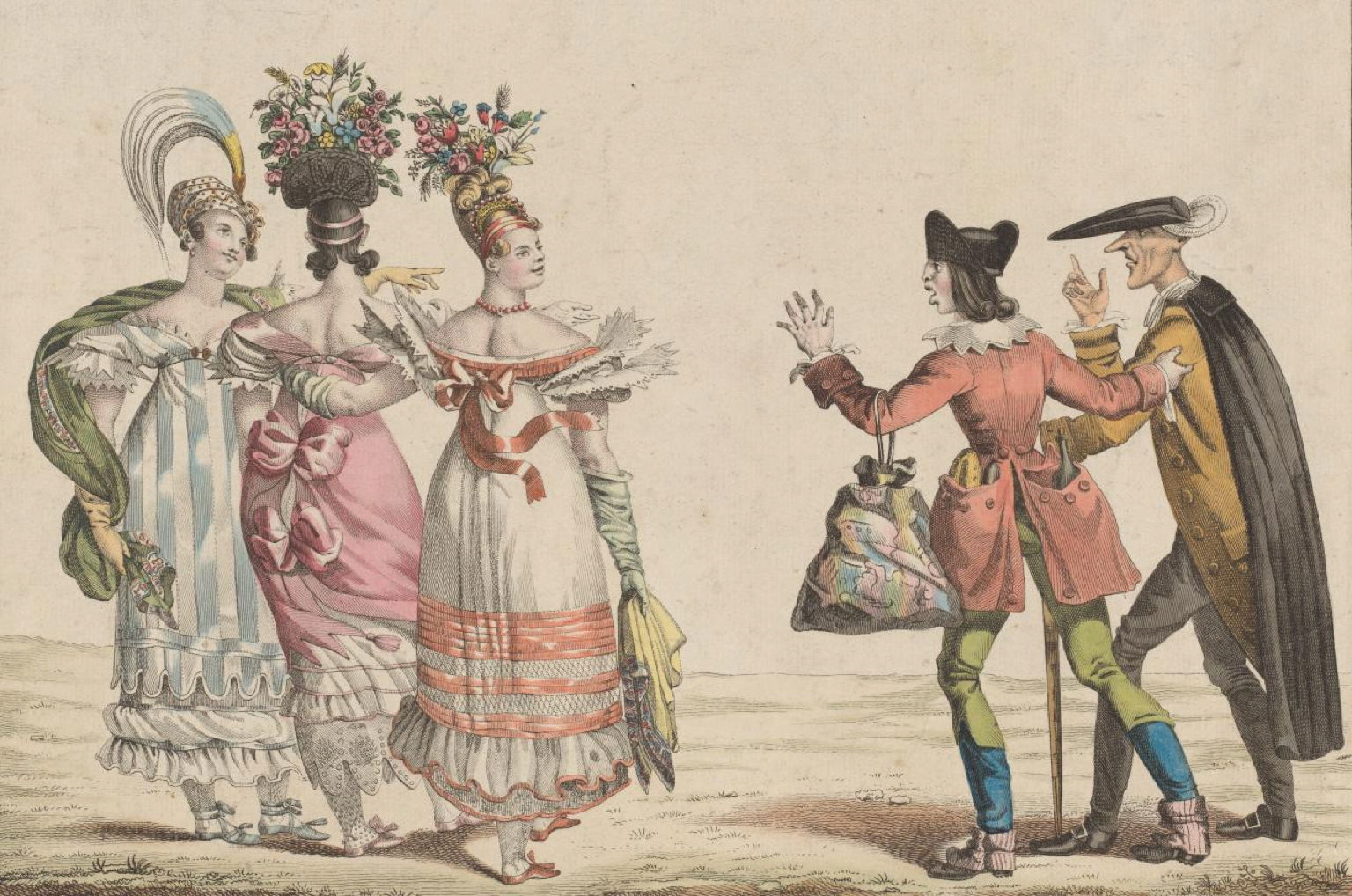
Artist not known, Brother Philippe’s Geese (date not known), hand-coloured etching and engraving, dimensions not known, National Gallery of Victoria, Melbourne, Australia. Courtesy of the National Gallery of Victoria.

And here’s an undated hand-coloured print apparently based on another composition altogether.

The phrase Brother Philippe’s geese, which in modern English might be best rendered as Philip’s birds, then entered French idiom as a reference to young and pretty women. Abbreviated further to geese, its origins have often been misunderstood as being derogatory. It certainly seems to have been well-understood by Paul Gauguin.

When Gauguin stayed at Le Pouldu in Brittany from 1889, he and others were accommodated by Marie Henry in her inn. Gauguin and his colleagues decorated the interior for her with their paintings. In 1893, when Marie Henry rented the building out, she removed as much as possible of the paintings made there by Gauguin and others, but some were left behind. Over the years, they were covered with wallpaper and vanished, until they were rediscovered in 1924.

gauguingoose
Paul Gauguin (1848-1903), The Goose (1889), tempera on plaster, 53 x 72 cm, Musée des Beaux-Arts de Quimper / Kemper, mirdi an Arzoù-Kaer, Quimper, France. Wikimedia Commons.

Among them is this wonderful painting of a goose, intended as a complement to Marie Henry, in its allusion to the fable of La Fontaine, and its original telling as the hundred-and-first story in Boccaccio’s Decameron.

❌
❌