Normal view

There are new articles available, click to refresh the page.
Before yesterdayMain stream

The Dutch Golden Age: How did it happen?

By: hoakley
4 February 2026 at 20:30

The Golden Age of the Dutch Republic developed as a result of a combination of circumstances, some of which are made clear in previous articles in this series. This summary brings those together with a small selection of works to illustrate them.

The Northern Renaissance, that had started in the Flemish countries to the south in the 1420s, had flourished in centres such as Antwerp and Brussels during the sixteenth century. As it matured into the Baroque during the early decades of the Golden Age, it was led by Peter Paul Rubens. This gained from the early adoption and development of oil painting on canvas using realist techniques to depict increasingly secular themes, which became centred in the workshops of Antwerp.

Flanders and Brabant in the south remained part of the Habsburg empire ruled from Spain, with intolerance towards Protestant movements leading to religious conflict. Some artists who trained in those countries migrated to the north, where they accelerated the growth of Dutch Golden Age painting.

peetersmesa
Clara Peeters (c 1594-1640), Mesa (Table) (c 1611), oil on panel, 55 x 73 cm, Museo Nacional del Prado, Madrid. Wikimedia Commons.

Among them was Clara Peeters, who seems to have trained in Antwerp before painting innovative still lifes in the Dutch Republic. By about 1611, when she painted Mesa (Table) above, she was selling her paintings to the Spanish royal family. Some of her works ended up in the Spanish Royal Collection, and today remain in the Prado in Madrid as a result. Dutch painters developed her themes, and settings for meals, particularly that of breakfast, later became a sub-genre.

As a secular confederation of provinces, art in the republic wasn’t dominated by religious themes or the patronage of a royal dynasty. Commissions seldom came from religious organisations, but from guilds and other non-religious groups that were flourishing in the growing cities. Most popular among those were group portraits of occupational guilds.

vanmiereveltanatomylesson
Michiel Jansz. van Mierevelt (1566–1641) and Pieter van Mierevelt (1596–1623), The Anatomy Lesson of Dr. Willem van der Meer (1617), oil on canvas, 146.5 x 202 cm, Museum Prinsenhof Delft, Delft, The Netherlands. Wikimedia Commons.

Although guilds had been an important part of Renaissance society, few if any appear to have commissioned group portraits, which were largely confined to noble families. In 1617, Michiel van Mierevelt and his son Pieter, specialists in portraiture, painted The Anatomy Lesson of Dr. Willem van der Meer, one of the earliest portraits of a social group from the Dutch Golden Age. These are thought to be members of the Surgeons’ Guild of the city of Delft, who commissioned this work.

Frans Hals (1582/1583–1666), Militia Company of District XI under the Command of Captain Reynier Reael (1633-37), oil on canvas, 209 x 429 cm, Rijksmuseum, Amsterdam, The Netherlands.

Among the groups responsible for many of these portrait commissions was the civil militia. Frans Hals’ Militia Company of District XI under the Command of Captain Reynier Reael (1633-37) shows a group known as the Meagre Company. He was commissioned to paint this in 1633, but three years later it remained unfinished, and the commission was transferred to Codde to complete the right side of the canvas and many of the hands and faces a year later.

Migration and international trade transformed cities like Amsterdam, which rapidly became multicultural at a time when much of Europe was still oppressing minority groups such as Jews.

hobbemahaarlemlock
Meindert Hobbema (1638–1709), The Haarlem Lock, Amsterdam (1663-65), oil on canvas, 77 x 98 cm, The National Gallery, London. Wikimedia Commons.

Meindert Hobbema’s view of The Haarlem Lock, Amsterdam from 1663-65 shows one of the city’s working locks with a raising bridge, with the masts of many ships in the harbour beyond.

avercampwinterlandscapeskaters1608
Hendrick Avercamp (1585–1634), Winter Landscape with Skaters (1608), oil on panel, 77.3 x 131.9 cm, Rijksmuseum Amsterdam, Amsterdam, The Netherlands. Wikimedia Commons.

Avercamp’s Winter Landscape with Skaters from 1608 shows the many who have spilled out from the warmth of buildings to take to the ice.
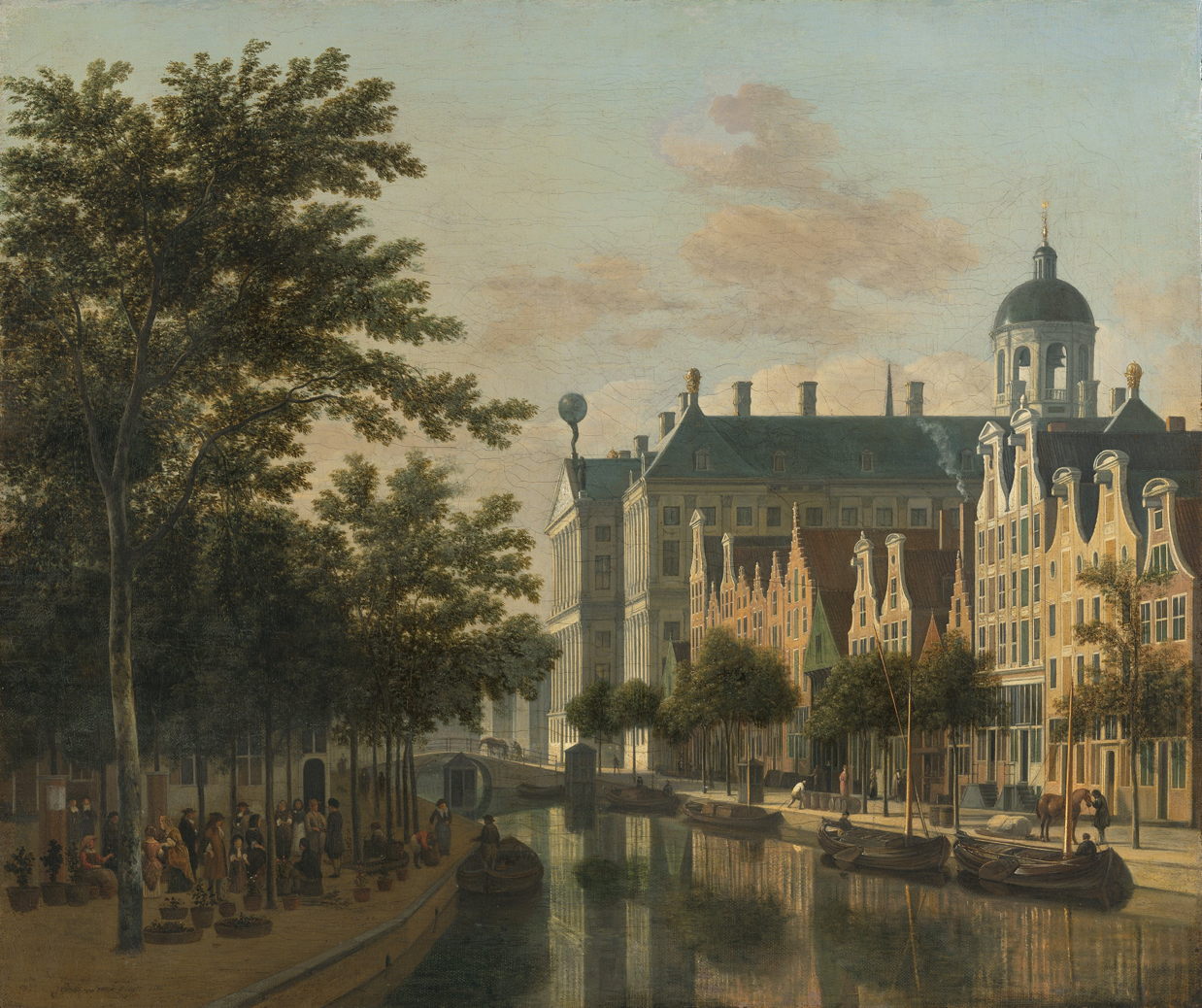
Gerrit Adriaenszoon Berckheyde (1638–1698), The Nieuwezijds Voorburgswal, Amsterdam (1686), oil on canvas, 54 x 64 cm, Museo Nacional Thyssen-Bornemisza, Madrid, Spain. Wikimedia Commons.

Berckheyde’s The Nieuwezijds Voorburgswal, Amsterdam from 1686 shows the canal running at the rear of Amsterdam’s City Hall, built between 1648-65, and featuring the octagonal tower seen at the right. By this time the population of Amsterdam had risen to more than 220,000, many of them immigrants.

With the growth of trade came increasing prosperity, and urban populations who became avid collectors. For some it was household linen or clothing, for others Delft tiles, and for the many who wanted to decorate the walls of their houses, paintings were ideal. Those artists who had achieved recognition could sell through art dealers, some of whom were painters themselves. For smaller and more everyday works, art fairs were held, and collectors flocked to attend them in search of bargains.

Jacob Mathieusen, and his wife, in the background the fleet in the roads of Batavia, by Aelbert Cuyp
Aelbert Cuyp (1620–1691), A Senior Merchant of the Dutch East India Company (1650-59), oil on canvas, 138 x 208 cm, Rijksmuseum Amsterdam, Amsterdam, The Netherlands. Wikimedia Commons.

A Senior Merchant of the Dutch East India Company, painted during 1650-59, is thought to show Jacob Mathieusen and his wife, against a background of the company fleet in Batavia roads. This city in what was then the Dutch East Indies is now the site of Jakarta in Indonesia.

As more secular genres became popular, painters specialised in sub-genres in an effort to appeal to new markets.

beerstraatenoldtownhallamsterdam
Jan Abrahamsz Beerstraaten (1622–1666), The Old Town Hall of Amsterdam on Fire, 7 July 1652 (1652-55), oil on panel, 89 x 121.8 cm, Amsterdam Museum, Amsterdam, The Netherlands. Wikimedia Commons.

In mid 1652, Jan Abrahamsz Beerstraaten seems to have witnessed the destruction by fire of part of the centre of Amsterdam, shown in his studio painting of The Old Town Hall of Amsterdam on Fire, 7 July 1652 (1652-55).

molenaersmell
Jan Miense Molenaer (c 1610–1668), Smell (1637), oil on panel, 19.5 x 24.3 cm, Koninklijk Kabinet van Schilderijen Mauritshuis, The Hague, The Netherlands. Wikimedia Commons.

The sense of Smell, from 1637, is the best of Jan Miense Molenaer visual jokes, a thoroughly secular if not irreverent scene from everyday life.

vanwijnenwitchessabbath
Domenicus van Wijnen (1661–1698), The Witches’ Sabbath by Moonlight (date not known), oil on canvas, 73 x 57.5 cm, location not known. Wikimedia Commons.

The theme of witchcraft was explored in Domenicus van Wijnen’s Witches’ Sabbath by Moonlight, set in a moonlit Italian landscape. This combines many of the now-classical symbols associated with the Dark Arts, and is taking place at an outdoor altar set up at the foot of the gallows, on which a dead body hangs.

With the driving force in painting being removed from a royal family, and professional power resting with local guilds of Saint Luke, the republic avoided adopting a privileged academy system. Painters trained first as apprentices before demonstrating the skills expected of a master, so gaining admission to the guild. These too had originated in Flanders, with the foundation of Antwerp’s by 1382. Amsterdam led in 1579, and several other cities in the Dutch Republic followed from 1609.

Taken together, the main driving forces of Dutch Golden Age painting were a rich diversity in both society and painted themes, and the popularity of paintings among the republic’s citizens. As a result, visual art thrived.

A Painted Weekend in Amsterdam: 1645-1867

By: hoakley
31 January 2026 at 20:30

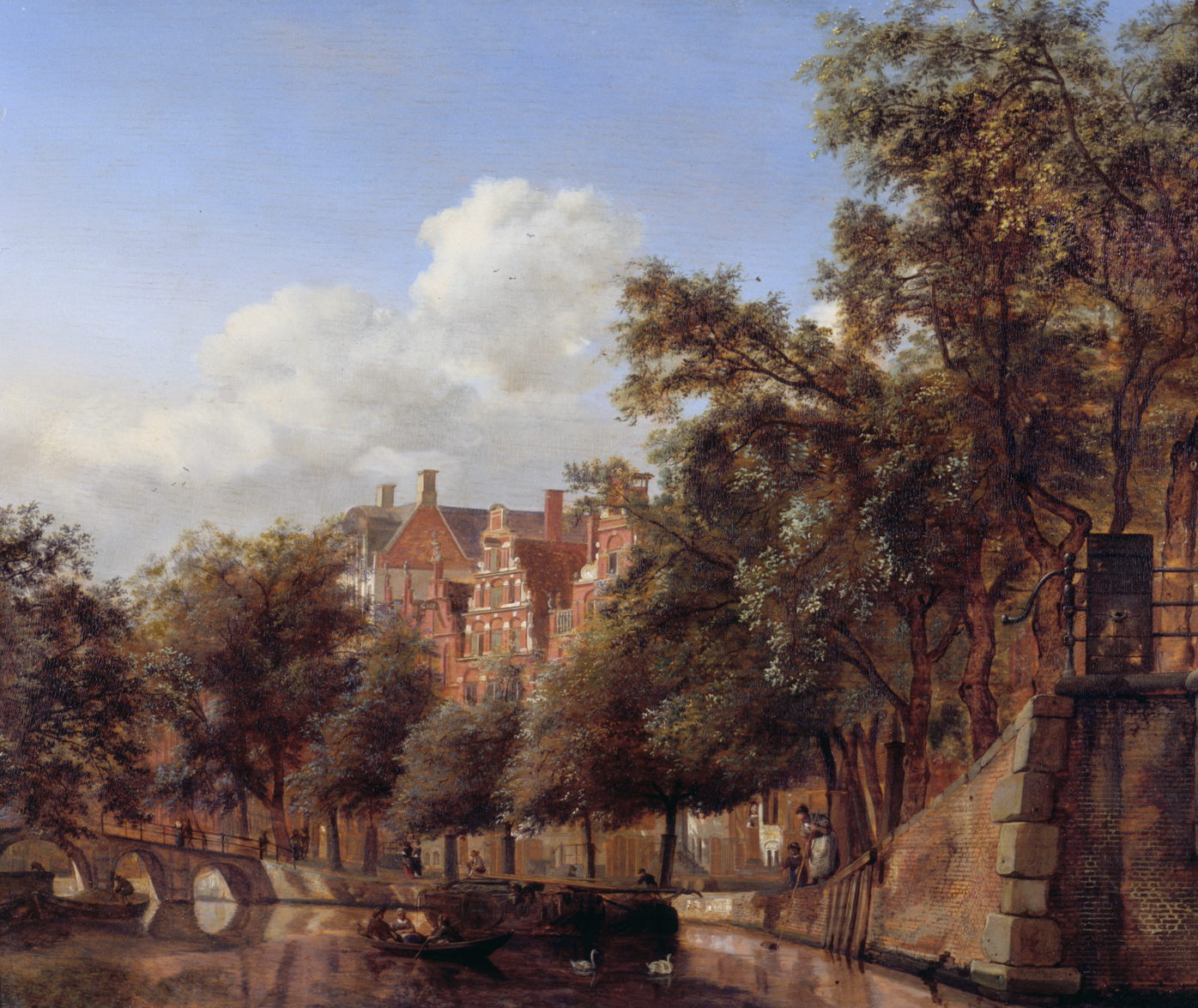
This weekend, as my series on painting in the Dutch Golden Age draws to a close, it’s time to pay a visit to the city of Amsterdam, centre of trade and commerce, and one of the most multicultural cities in Europe since the seventeenth century. At the start of this selection of paintings of its canals and buildings, its population was around 170,000, and by the end of tomorrow’s sequel that had reached over 650,000.

vanderpoelfirenieuwekerk
Egbert van der Poel (1621–1664), The Fire in the Nieuwe Kerk, Amsterdam, in 1645 (c 1645), brush and gray wash and black wash with touches of pen and brown ink, 12.5 × 19.4 cm, location not known. Wikimedia Commons.

Egbert van der Poel established his reputation painting major fires in the Dutch Republic. Although it has been claimed that these were seldom based on his personal observations, this sketch of The Fire in the Nieuwe Kerk, Amsterdam, in 1645, was made in front of the motif using washes with touches of pen and brown ink. Perhaps he was the first ‘ambulance chaser’ who travelled out to sketch fires, from which he painted his famous brandjes in the studio.

Aert van der Neer (c 1604–1677), Fire in Amsterdam by Night (date not known), oil on canvas, 58.8 x 71.7 cm, Statens Museum for Kunst (Den Kongelige Malerisamling), Copenhagen, Denmark. Wikimedia Commons.

At some stage, Aert van der Neer also started painting destructive fires, including this undated Fire in Amsterdam by Night. This shows one of the broader canals in the city, with residents already taking to boats in case they needed to evacuate.

beerstraatenoldtownhallamsterdam
Jan Abrahamsz Beerstraaten (1622–1666), The Old Town Hall of Amsterdam on Fire, 7 July 1652 (1652-55), oil on panel, 89 x 121.8 cm, Amsterdam Museum, Amsterdam, The Netherlands. Wikimedia Commons.

In the summer of 1652, Jan Abrahamsz Beerstraaten seems to have witnessed the destruction by fire of part of the centre of Amsterdam, which formed the basis of his studio painting of The Old Town Hall of Amsterdam on Fire, 7 July 1652 (1652-55). Local inhabitants are walking in orderly queues to boats, in which they escape from the scene.

Gabriel Metsu (1629–1667), The Vegetable Market in Amsterdam (c 1660-61), oil on canvas, 97 x 84 cm, Musée du Louvre, Paris. Image by Shonagon, via Wikimedia Commons.

Gabriel Metsu followed the subjects of his genre paintings beyond the home, here into The Vegetable Market in Amsterdam in about 1660-61. The mistress stands with a metal pail on her arm, detached from the housekeeper to the left of centre, who is bargaining with one of the vendors. Other figures are drawn from a broad range of classes, and there’s produce ranging from cauliflowers to chickens.

hobbemahaarlemlock
Meindert Hobbema (1638–1709), The Haarlem Lock, Amsterdam (1663-65), oil on canvas, 77 x 98 cm, The National Gallery, London. Wikimedia Commons.

Meindert Hobbema’s view of The Haarlem Lock, Amsterdam from 1663-65 shows a working lock with a raising bridge, and the masts of many ships in the harbour beyond. This lock may form the entrance to the Haarlemmertrekvaart, a canal dug in 1631 to facilitate transit by boat between Amsterdam and the city of Haarlem to its east.

Jan van der Heyden (1637–1712), View of the Herengracht, Amsterdam (c 1670), oil on canvas, 33.5 x 39.7 cm, Private collection. Wikimedia Commons.

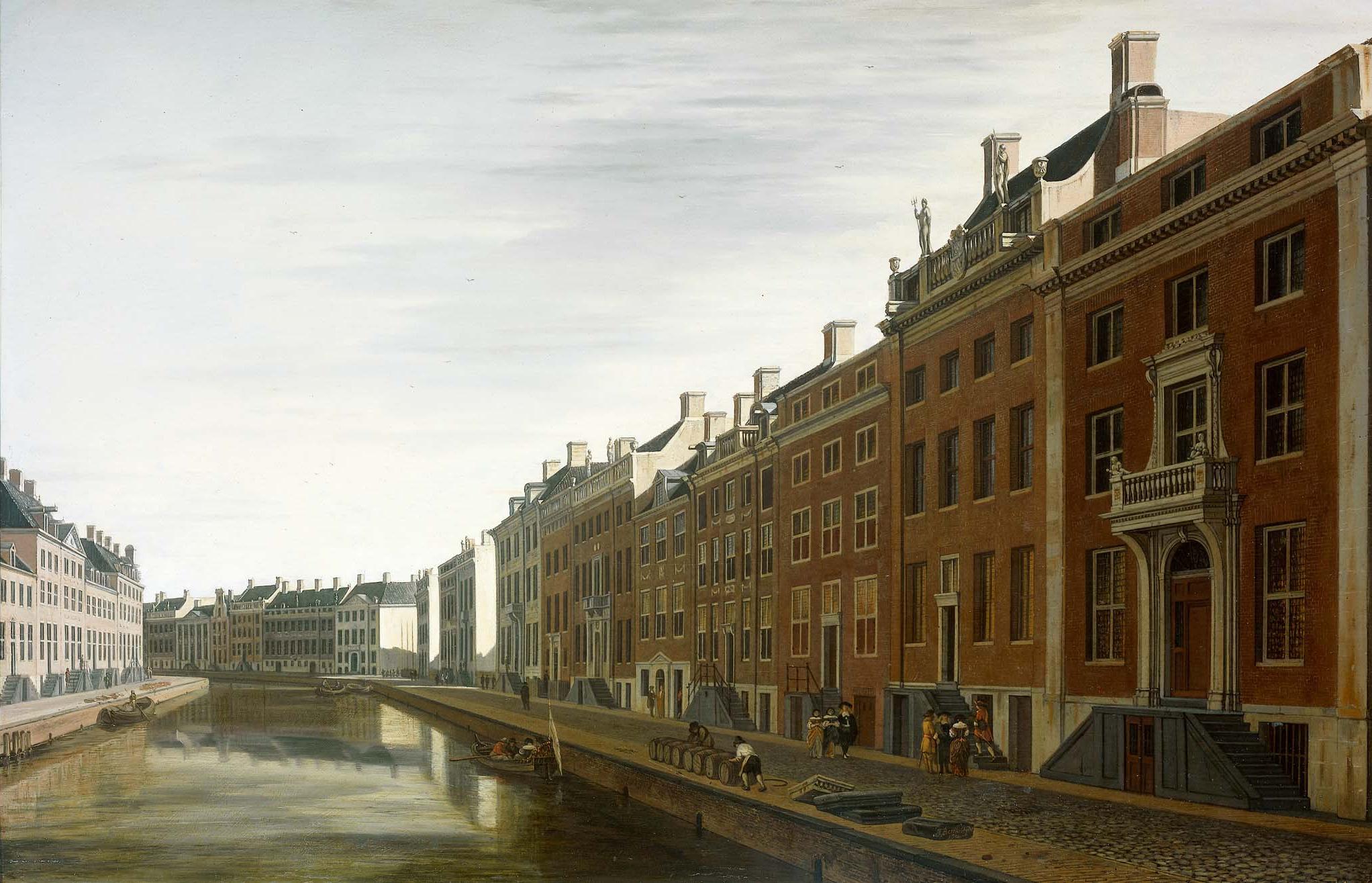
Jan van der Heyden’s View of the Herengracht, Amsterdam from about 1670 shows this canal that has become famous for its large and elegant houses. These were built from 1612, and are finest along this section known as the Golden Bend. Below is a contrasting view from 1672, in Gerrit Adriaensz Berckheyde’s The Bend in the Herengracht near the Nieuwe Spiegelstraat in Amsterdam.

Gerrit Adriaensz Berckheyde, The Bend in the Herengracht near the Nieuwe Spiegelstraat in Amsterdam, 1672, oil on panel, 40.5 x 63 cm, Rijksmuseum, Amsterdam. Wikimedia Commons.
Gerrit Adriaensz Berckheyde (1638–1698), The Bend in the Herengracht near the Nieuwe Spiegelstraat in Amsterdam (1672), oil on panel, 40.5 x 63 cm, Rijksmuseum, Amsterdam. Wikimedia Commons.
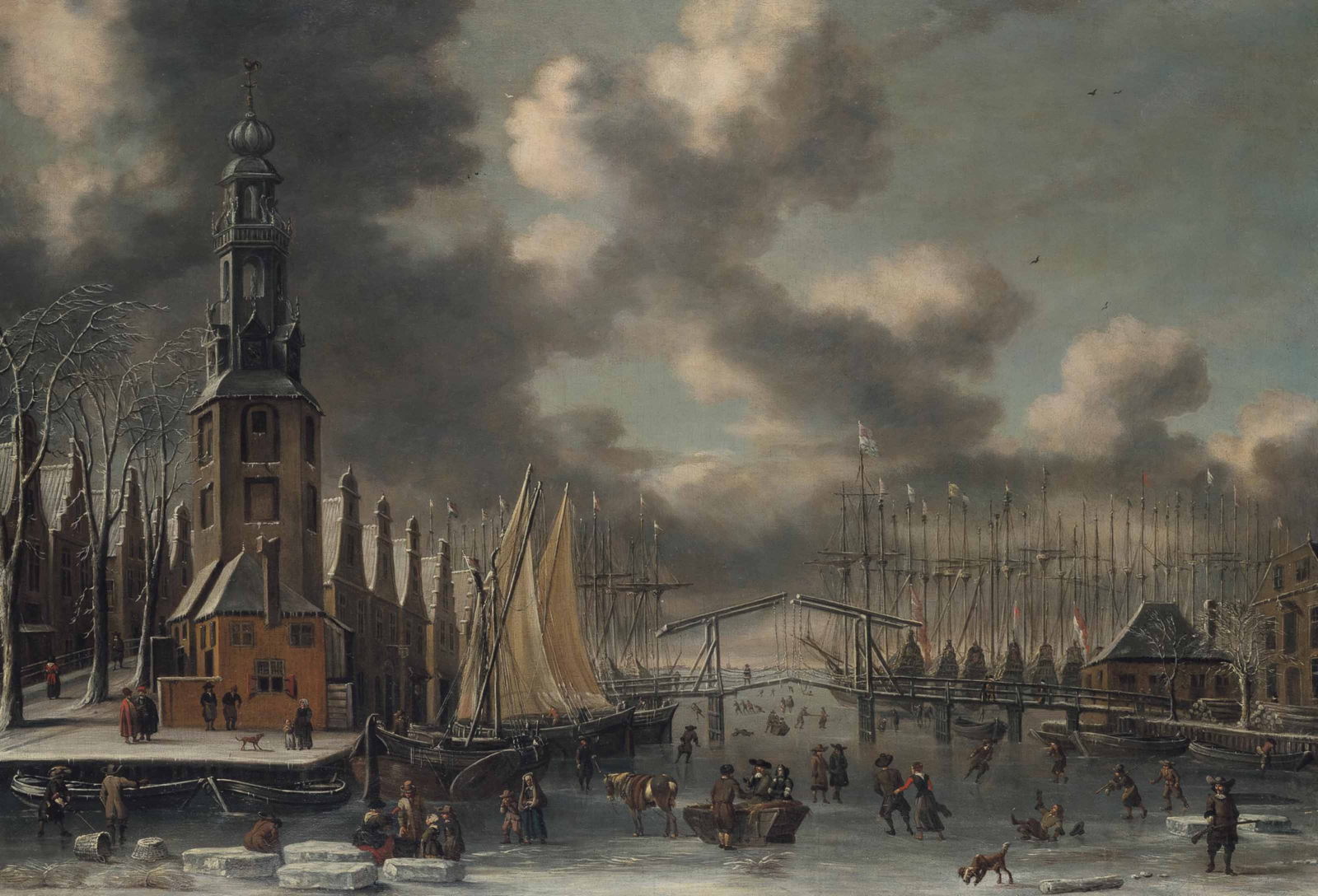
Thomas Heeremans (1641–1694) and Abraham Storck (1644-1708), Winter Landscape with the Montelbaanstoren, Amsterdam (1676), oil on canvas, 76 x 108.5 cm, Private collection. Wikimedia Commons.

In 1676, Thomas Heeremans and Abraham Storck joined forces to paint this Winter Landscape with the Montelbaanstoren, Amsterdam. The Montelbaanstoren is the prominent tower in the left foreground, and the canal seen is the Oudeschans. The tower was built in 1516 as part of the city’s defences, and its upper section was extended in 1606, bringing it to a height of 48 metres (almost 160 feet).

Gerrit Adriaenszoon Berckheyde (1638–1698), The Nieuwezijds Voorburgswal, Amsterdam (1686), oil on canvas, 54 x 64 cm, Museo Nacional Thyssen-Bornemisza, Madrid, Spain. Wikimedia Commons.

Berckheyde’s The Nieuwezijds Voorburgswal, Amsterdam from 1686 shows the canal running at the rear of the City Hall that was covered over two centuries later in 1884 to create a street. The City Hall was built between 1648-65, and features an octagonal tower seen here at the right. Mounted on its roof, at the centre of the painting, is a sculpture by Artus Quellinus of Atlas supporting a celestial sphere. On the opposite bank is a small flower market. By this time the population of Amsterdam had risen to more than 220,000, many of them immigrants.

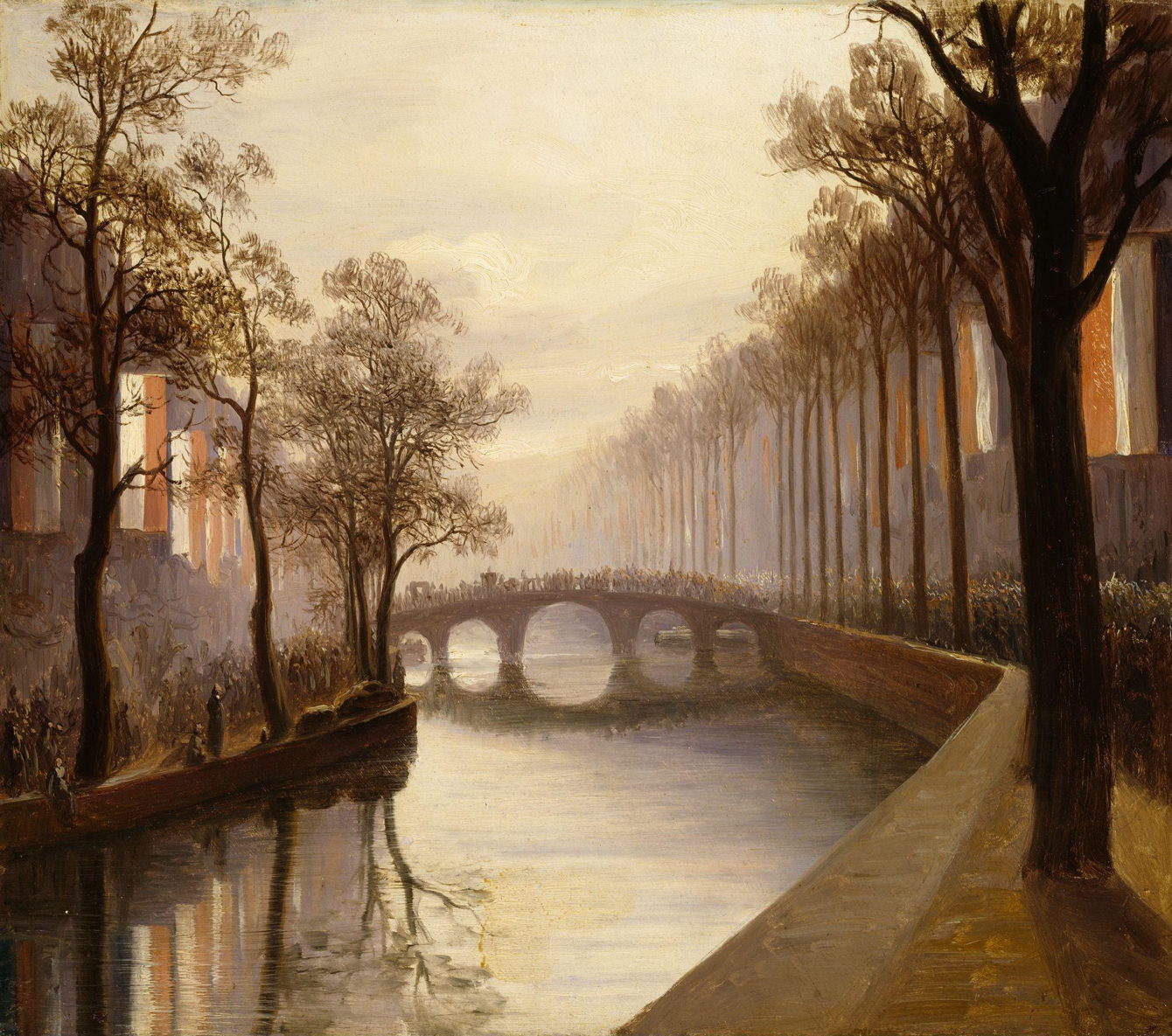
Thomas Fearnley (1802–1842), King William II’s Ceremonial Procession in Amsterdam, 27 November 1840 (1840), oil on paper, 38.5 x 43 cm, Nasjonalmuseet for kunst, arkitektur og design, Oslo, Norway. Wikimedia Commons.

The Norwegian landscape artist Thomas Fearnley appears to have visited the city late in 1840, when he painted King William II’s Ceremonial Procession in Amsterdam, 27 November 1840 in oils on paper. Neither the artist nor the king survived long after this grand event: Fearnley succumbed to typhoid in 1842, and King William II died suddenly in 1849.

leickerturbanlandscape
Charles Leickert (1816–1907), Urban Landscape (1856), oil on canvas, 87 x 119 cm, Hermitage Museum Государственный Эрмитаж, Saint Petersburg, Russia. Wikimedia Commons.

Charles Leickert is better known for his winter landscapes of frozen waterways in the Netherlands, but his Urban Landscape from 1856 shows active trading taking place beside a canal most probably in Amsterdam, where he was a member of the Royal Academy at the time.

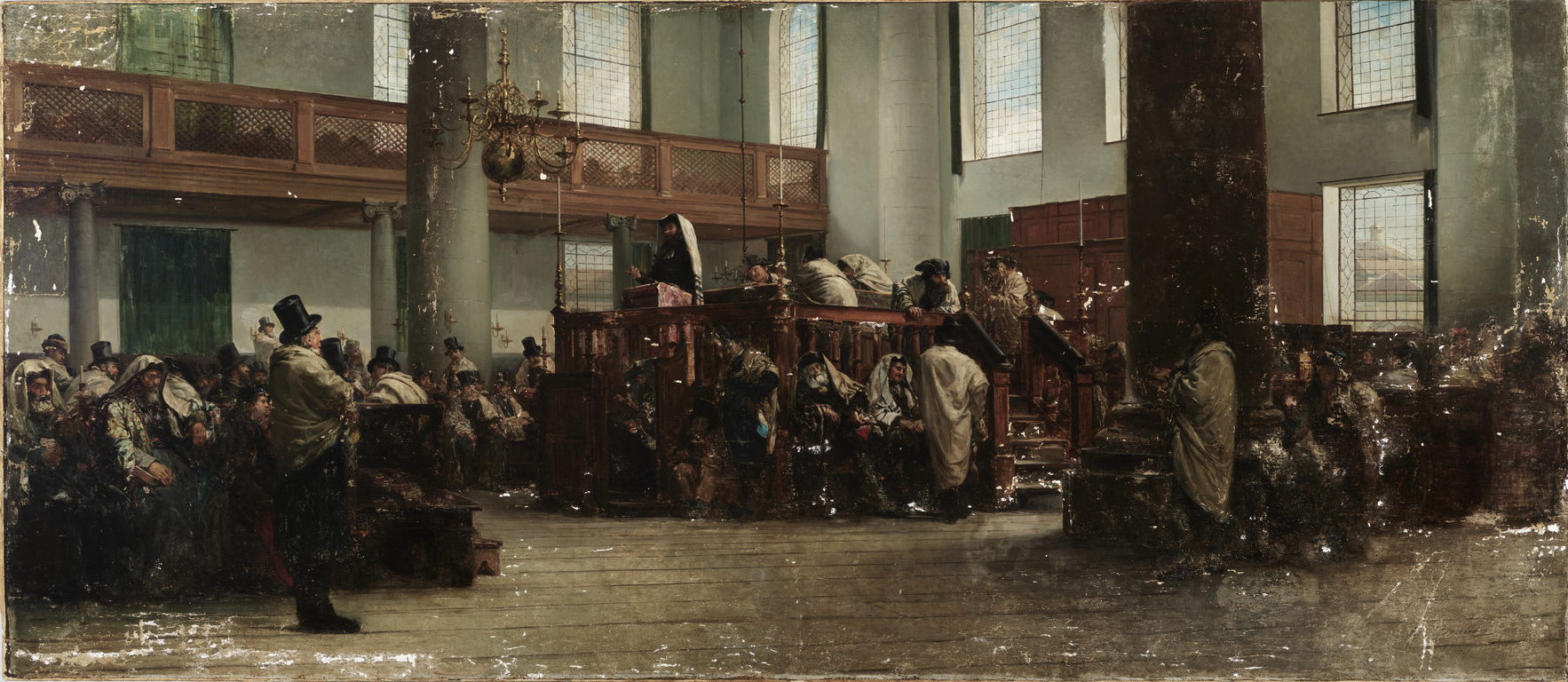
Jacob-Emile-Edouard Brandon (1831-1897), Portuguese Synagogue at Amsterdam 22 July 1866 (1867), oil on canvas, 75.5 x 174.3 cm, Walters Art Museum, Baltimore, MD. Courtesy of Walters Art Museum.

Jacob-Emile-Edouard Brandon is one of the forgotten artists who exhibited at the First Impressionist Exhibition in 1874. One of his few surviving paintings is this Portuguese Synagogue at Amsterdam 22 July 1866 from 1867, which was awarded a medal at the Salon of that year. This was probably Europe’s most famous and picturesque synagogue at the time. The sermon was being delivered by the distinguished Talmudist David de Jahacob Lopez Cardozo (1808-1890), who was appointed ab bet din there in 1839.

The Dutch Golden Age: Historical context 1644-1674

By: hoakley
29 January 2026 at 20:30

This is the second article setting some of the finest paintings of the Golden Age in the context of major events in the history of the Dutch Republic, and resumes the account in 1644, shortly before the end of the Thirty Years’ War.

Fresheneesz, Map of the Low Countries, 1556-1648 (2006). Image by Fresheneesz, via Wikimedia Commons.

Constituents of the Dutch Republic are shown in red, orange and yellow in this map. Its centres of art included The Hague, its de facto capital, Utrecht, Leiden, Delft, Harlem, and Amsterdam. To the south were the lands composing the Spanish Netherlands, notably Flanders and Brabant, including the cities of Antwerp and Brussels.

1644-1659

1648 The Peace of Munster was ratified, ending the Thirty Years’ War and formally establishing the Dutch Republic as an independent country (see below).
1652 The United East India Company started settling Cape Colony, later known as the Cape of Good Hope, in South Africa.
1652-54 The First Anglo-Dutch War, ended with the Treaty of Westminster.

vangoyendordrecht
Jan Josefsz. van Goyen (1596-1656), View of Dordrecht with the Grote Kirk Across the Maas (1644), oil on oakwood, 64.8 x 96.8 cm, Walker Art Gallery, Liverpool, England. Wikimedia Commons.

Dutch landscape artists quickly realised that, even if they had relatively little earth and water to depict, the heavens above could be equally interesting. Horizons fell rapidly down their paintings, as seen in Jan van Goyen’s View of Dordrecht with the Grote Kirk Across the Maas from 1644.

potterbull
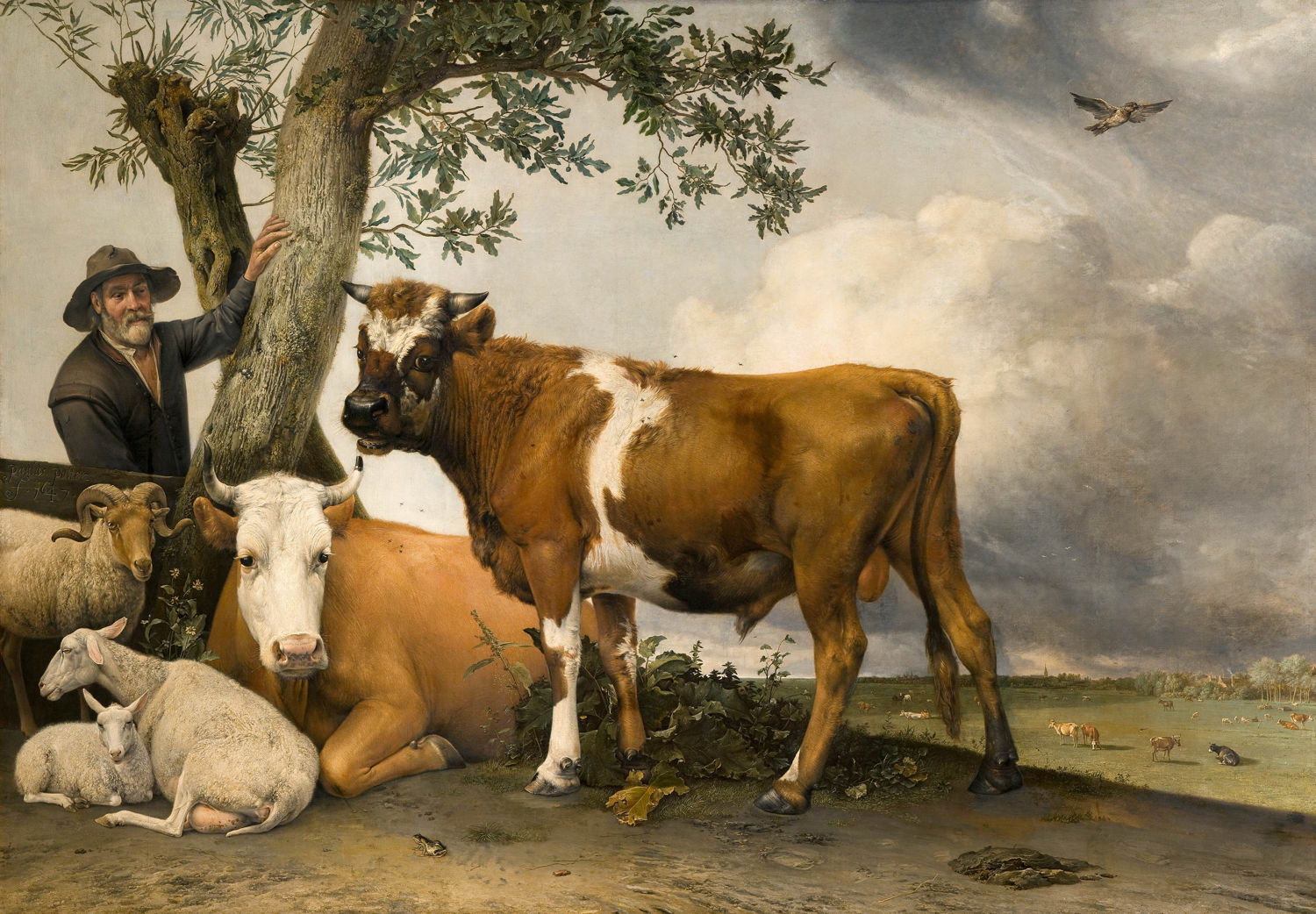
Paulus Potter (1625–1654), The Bull (1647), oil on canvas, 235.5 x 339 cm, Koninklijk Kabinet van Schilderijen Mauritshuis, The Hague. Wikimedia Commons.

Paulus Potter, who became a member of the Guild of Saint Luke in Delft in 1646, founded the new genre of animal painting in 1647 with his almost life-size portrait of The Bull (also widely known as The Young Bull). Originally intended as a portrait of just the central bull, Potter enlarged the canvas to accommodate (from the left) a ram, lamb, ewe, herdsman, cow, and above them a bird of prey, possibly a buzzard. Beyond them are more cattle in the meadows receding to the church of Rijswijk, between Delft and The Hague.

terborchratificationoftreatymunster
Gerard ter Borch (1617–1681), The Ratification of the Treaty of Münster, 15 May 1648 (1648), oil on copper, 45.4 x 58.5 cm, Rijksmuseum Amsterdam, Amsterdam, The Netherlands. Wikimedia Commons.

For the thirty years between 1618-1648, central Europe had been engulfed in a bitter war between the Habsburg states, including the Holy Roman Empire and Spain, and their enemies, including the Dutch Republic. Gerard ter Borch’s magnificent painting of The Ratification of the Treaty of Münster, 15 May 1648 (1648) recorded the moment that the Thirty Years’ War ended, with the ratification of this treaty between the Dutch Republic and Spain.

baillyvanitas
David Bailly (1584–1657), Self-Portrait with Vanitas Symbols (1651), oil on panel, 65 x 97.5 cm, Museum De Lakenhal, Leiden, The Netherlands. Wikimedia Commons.

The son a of Flemish immigrant, David Bailly, who lived and worked in Leiden, painted this Self-Portrait with Vanitas Symbols in 1651, with its multiple portraits referring to the past. The figure shows him as a much younger man, holding the maulstick he used in painting. His actual self-portrait at the time is in the painting he is holding with his left hand. Next to that is a painting of his wife, who had already died, and a ghostly image of her is projected onto the wall behind the wine glass.

terborchglasslemonade
Gerard ter Borch (1617–1681), The Glass of Lemonade (1655-60), oil on canvas transferred from panel, 67 x 54 cm, Hermitage Museum Государственный Эрмитаж, Saint Petersburg, Russia. Wikimedia Commons.

Long before its value in preventing scurvy was realised (in 1747), or it was carbonated even later, still cloudy lemonade had become a popular soft drink. The extensive trade links of the Dutch Republic made the drink available to the middle classes, as celebrated in Gerard ter Borch’s The Glass of Lemonade (1655-60).

Johannes Vermeer, The Milkmaid (c 1658-1661), oil on canvas, 45.5 x 41 cm, The Rijksmuseum, Amsterdam. WikiArt.
Johannes Vermeer (1632-1675), The Milkmaid (c 1658-1661), oil on canvas, 45.5 x 41 cm, The Rijksmuseum, Amsterdam. WikiArt.

In Vermeer’s celebrated The Milkmaid (c 1658-1661) the maid is pouring milk from a jug, beside a tabletop with bread. In the left foreground the bread and pots rest on a folded Dutch octagonal table, covered with a mid-blue cloth. A wicker basket of bread is nearest the viewer, broken and smaller pieces of different types of bread behind and towards the woman, in the centre. Behind the bread is a dark blue studded mug with pewter lid, and just in front of the woman a brown earthenware ‘Dutch oven’ pot into which she is pouring milk.

1660-1672

1664-71 The Second Anglo-Dutch War.
1669 The United East India Company was the largest and richest private company in the world, with more than 150 merchant ships, 40 warships, 50,000 employees, and its own private army of 10,000.
1672 The Third Anglo-Dutch War; the Dutch Republic was invaded by France and others, following which its economy went into decline and the art market collapsed.

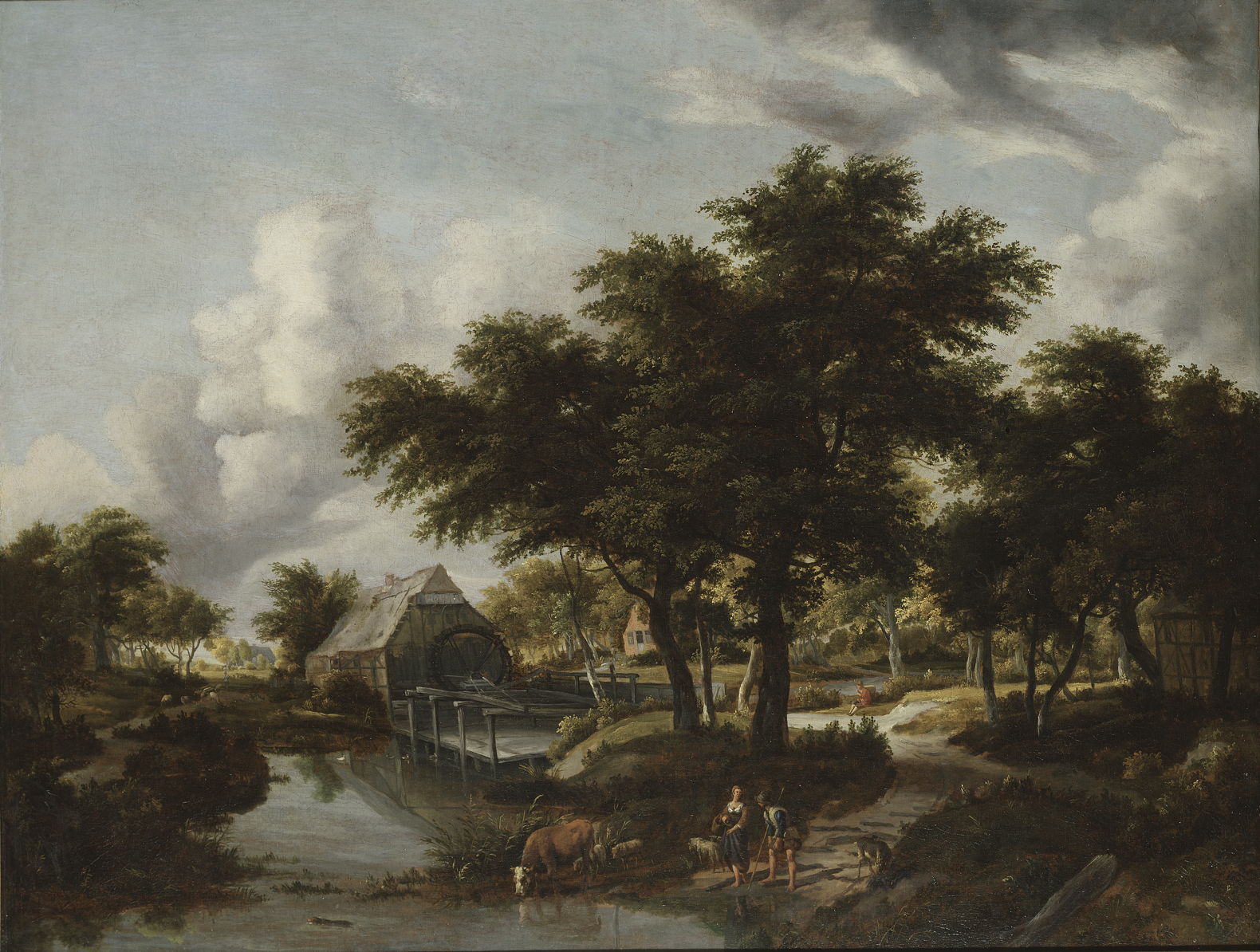
hobbemawatermill
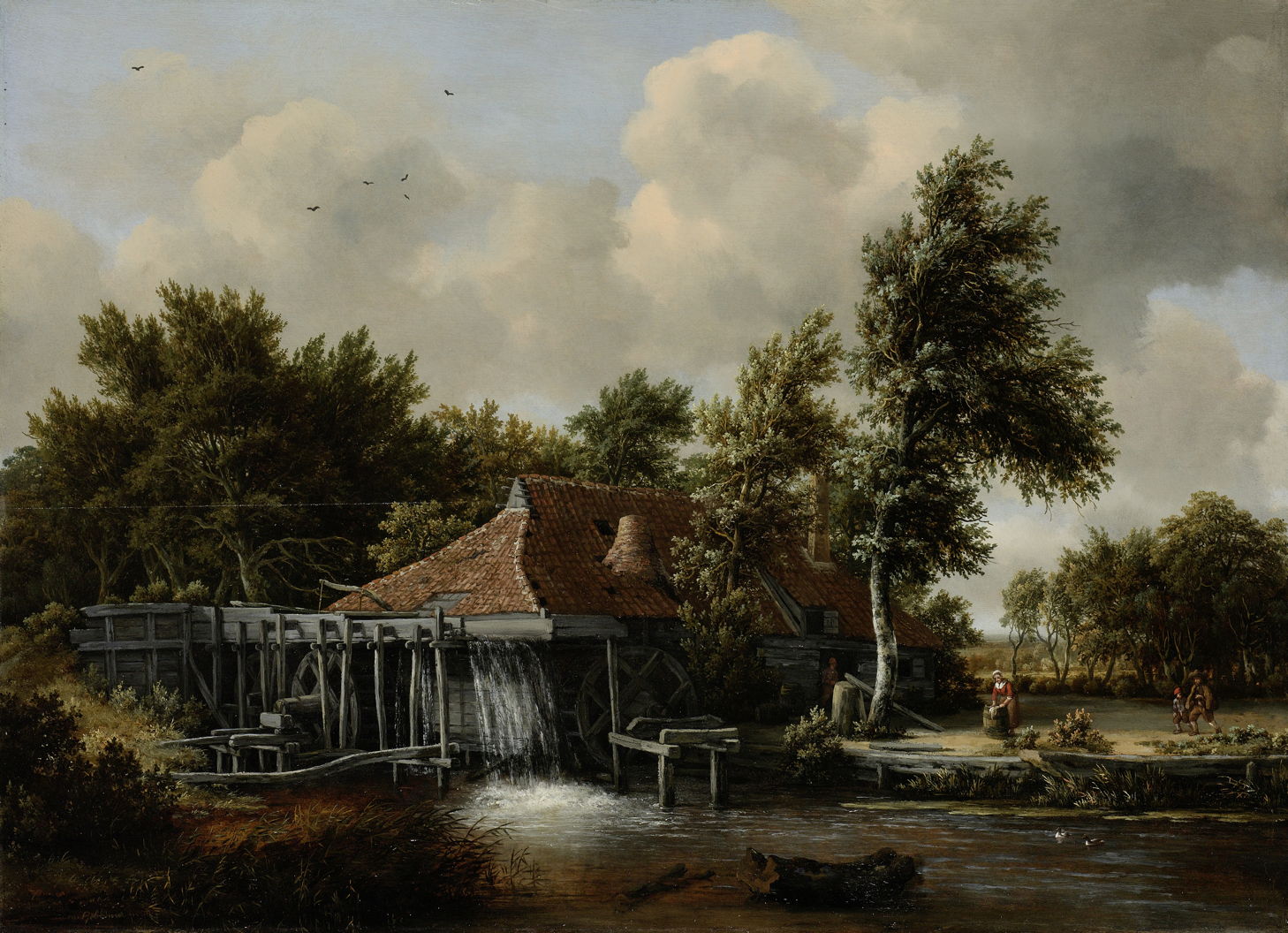
Meindert Hobbema (1638–1709), A Watermill (c 1664), oil on panel, 62 x 85.2 cm, Rijksmuseum Amsterdam, Amsterdam, The Netherlands. Wikimedia Commons.

Meindert Hobbema’s magnificent Watermill from about 1664 accommodates a family: the wife is out doing the washing in a barrel, while the husband and son walk through their garden. It’s also relatively unusual in that the water here is fed through the elevated wooden aqueducts, making this watermill overshot, so capable of generating more power with a lower flow of water, because it uses the weight of water falling against the blades of the waterwheel.

vanruisdaelhaarlembleaching
Jacob van Ruisdael (1628/1629–1682), View of Haarlem with Bleaching Fields (c 1665), oil on canvas, 62.2 x 55.2 cm, Kunsthaus Zürich, Zürich, Switzerland. Wikimedia Commons.

Some painters, including Jacob van Ruisdael, turned their canvases to make portraits of towering clouds, as in his View of Haarlem with Bleaching Fields from about 1665. The distant town of Haarlem with its monumentally large church of Saint Bavo – works of man – is dwarfed by these high cumulus clouds, the works of God. This motif proved so popular that Van Ruisdael painted many variants of the same view, making it now one of the most widespread landscapes across the galleries of Europe.

vermeerartpainting
Johannes Vermeer (1632–1675), The Art of Painting (c 1666-68), oil on canvas, 120 x 100 cm, Kunsthistorisches Museum, Vienna, Austria. Wikimedia Commons.

Johannes Vermeer experimented with optical effects in his late The Art of Painting from about 1666-68, where greatest sharpness is slightly away from the geometrical centre of the canvas, in the woman holding a wind instrument. The high tonal contrast between the marble tiles on the floor is softened in the foreground, and sharpens as they recede deeper into the picture, as would be expected in a depth of field effect.

Rembrandt Harmenszoon van Rijn, The Jewish Bride (c 1667), oil on canvas, 121.5 x 166.5 cm, Rijksmuseum, Amsterdam. Wikimedia Commons.

Rembrandt continued to develop his mark-making right up to his death. It’s often at its most florid when he painted fabrics, such as the clothing of the couple shown in The Jewish Bride of about 1665. The Dutch Republic had long been a safe harbour for Jews fleeing from oppression in other European countries, and Rembrandt had cultivated close relationships with members of the large Jewish community in Amsterdam, some of whom had modelled for his depictions of Old Testament stories.

ruisdaelwindmillwijk
Jacob van Ruisdael (1628/1629–1682), The Windmill at Wijk bij Duurstede (c 1670), oil on canvas, 83 x 101 cm, Rijksmuseum Amsterdam, Amsterdam, The Netherlands. Wikimedia Commons.

One of Jacob van Ruisdael’s best-known paintings of windmills is this view of The Windmill at Wijk bij Duurstede from about 1670. This small town, now a city, is on the bank of the River Rhine, an ideal location for delivering grain by barge, and shipping the resulting flour.

vandeveldethehut
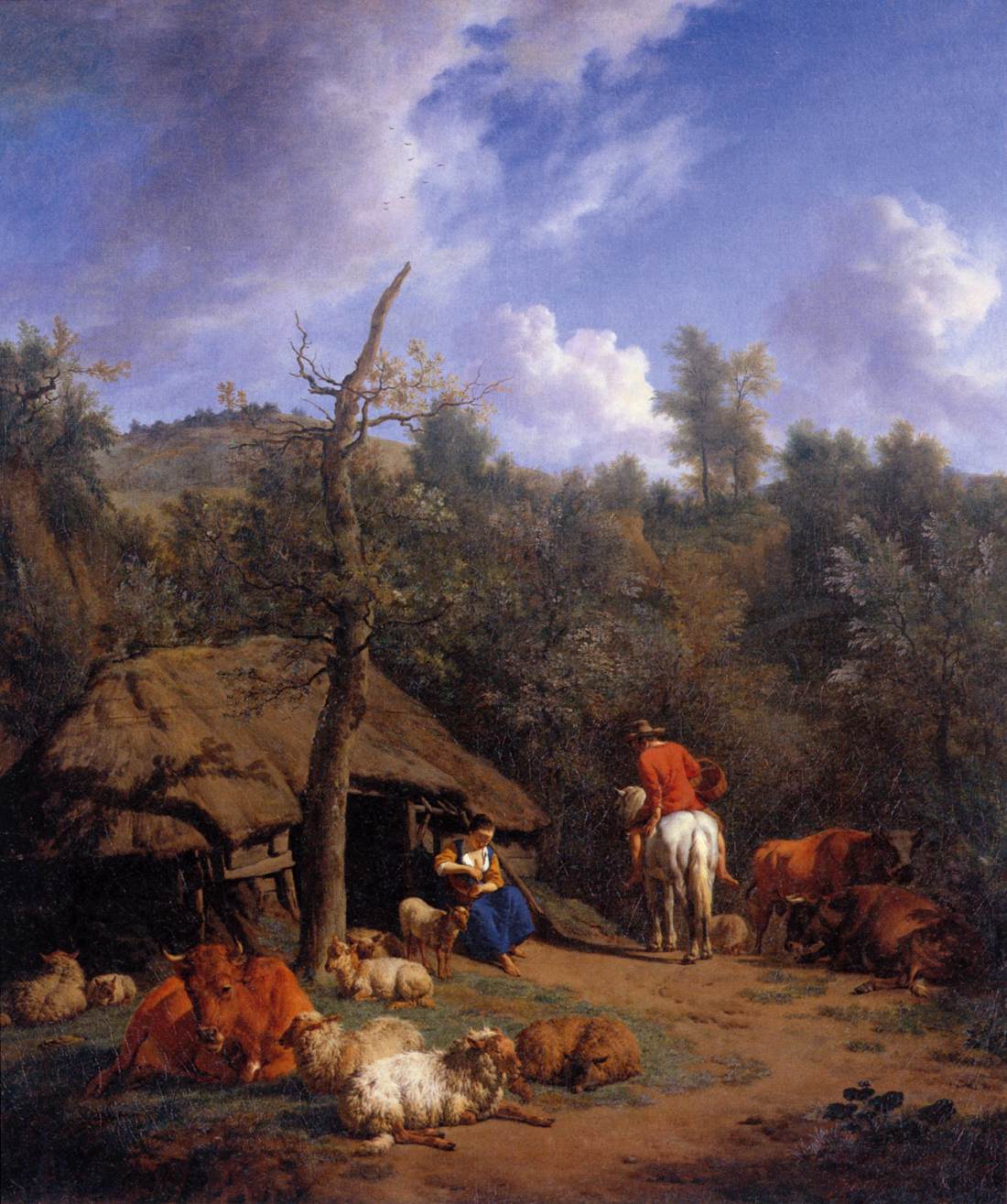
Adriaen van de Velde (1636–1672), The Hut (1671), oil on canvas, 76 x 65 cm, Rijksmuseum Amsterdam, Amsterdam. Wikimedia Commons.

The Hut (1671) was one of Adriaen van de Velde’s last paintings, and has long been esteemed in the Netherlands. It’s one of his most natural compositions, sparkling with bright colour in the clothing and animals. The artist even adds the reality, perhaps as a touch of humour, of some fresh cowpats.

Gerrit Adriaensz Berckheyde, Groote Market in Haarlem, 1673, oil on panel, 42 x 61 cm, Hermitage Museum, St Petersburg. Wikimedia Commons. Shadows give strong depth cues.
Gerrit Adriaensz Berckheyde (1638-1698), Groote Market in Haarlem (1673), oil on panel, 42 x 61 cm, Hermitage Museum, St Petersburg. Wikimedia Commons.

Gerrit Berckheyde’s view of Groote Market in Haarlem from 1673 shows one the largest of the city’s marketplaces at the end of the Golden Age.

The Dutch Golden Age: Mills

By: hoakley
15 January 2026 at 20:30

As in other countries across Europe at the time, industry in the Dutch Republic during the Golden Age was largely dependent on wind and water, forces that were seldom in short supply. Here’s a small selection of what were effectively some of the first paintings of industry long before the industrial revolution.

Both watermills and windmills date back to ancient times, and became widespread in the Middle Ages. By the seventeenth century they were used for grinding grain into flour, processing wool and fabrics, sharpening tools, forging and metalcraft, manufacturing paper, sawing timber, and sundry other purposes.

vanruisdaeltwowatermills
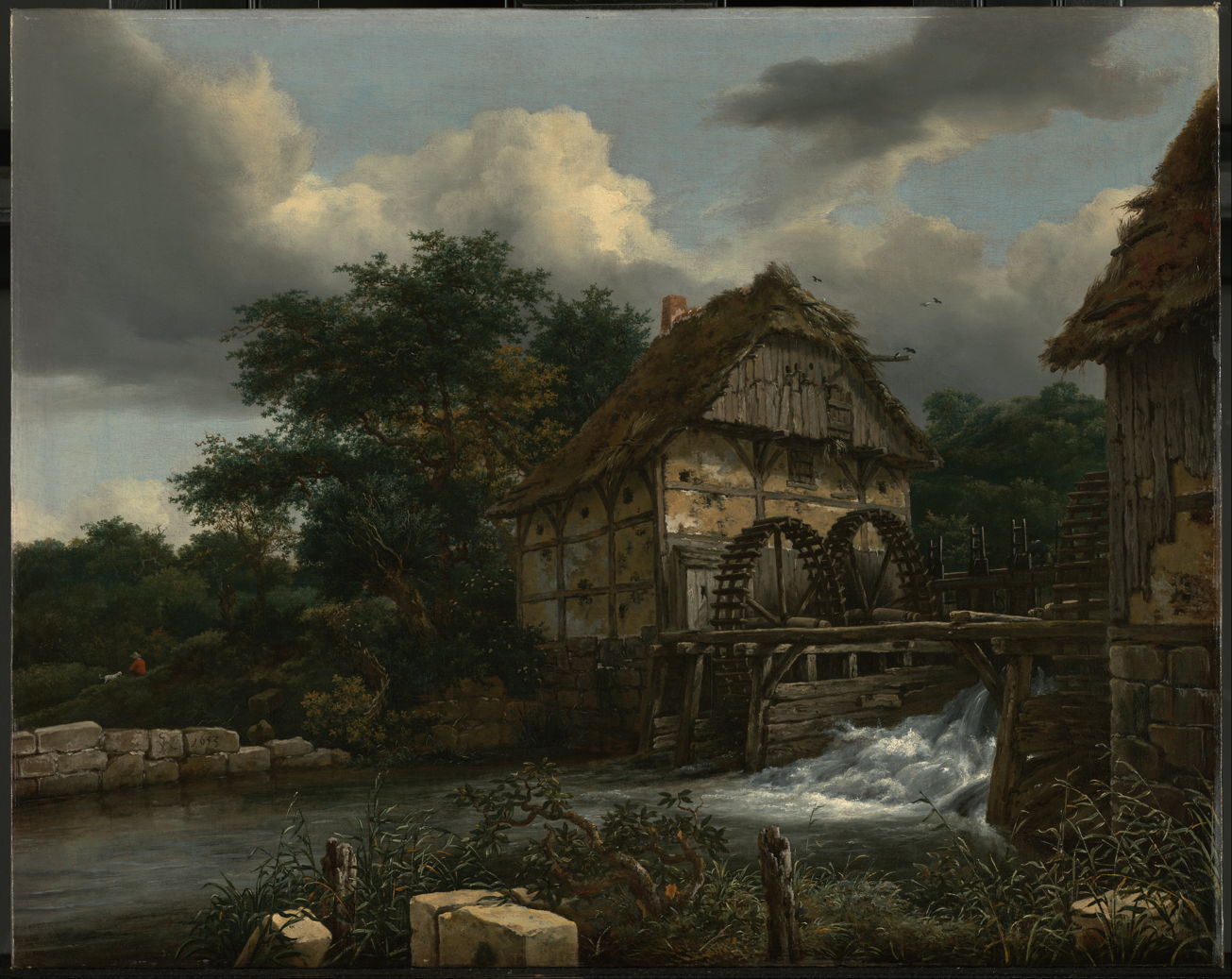
Jacob van Ruisdael (1628/1629–1682), Two Watermills and an Open Sluice (1653), oil on canvas, 66.4 x 84.1 cm, J. Paul Getty Museum, Los Angeles, CA. Wikimedia Commons.

Jacob van Ruisdael’s Two Watermills and an Open Sluice from 1653 is not just a superb landscape painting, but a clear technical account of one of the commonest types of watermill.

Since the Middle Ages in Europe, by far the most common type of waterwheel stands vertically, turning a horizontal axle. The terrain here is fairly flat, so the water supplying the mill comes from only slightly above the level of the outlet. Therefore, the mill is undershot, with only the lowest part of each waterwheel getting wet at any moment. To the right of the twin waterwheels is a sluice gate and overflow to control the level of water in the millpond upstream. Additional sluice gates set upstream of the two wheels give fine control over the water flowing through the mill race or leat, and can be used to stop the wheels from turning when the mill isn’t in use.

vanruisdaelwatermillfarm
Jacob van Ruisdael (1628/1629–1682), Landscape with a Watermill and Men Cutting Reeds (c 1653), oil on oak panel, 37.6 x 44 cm, Museum Boijmans Van Beuningen, Rotterdam, The Netherlands. Wikimedia Commons.

Van Ruisdael’s Landscape with a Watermill and Men Cutting Reeds from about the same year shows a smaller and simpler mill which is also undershot. Although the mill buildings may appear dilapidated, the gear appears better maintained and still in everyday use. There’s even a figure at the door of the millhouse.

vanruisdaellandscapemill-runruins
Jacob Isaakszoon van Ruisdael (1628/9–1682), Landscape with a Mill-run and Ruins (c 1653), oil on canvas, 59.3 x 66.1 cm, Art Gallery of South Australia, Adelaide. Wikimedia Commons.

In another painting from about the same time, van Ruisdael’s Landscape with a Mill-run and Ruins shows what had once been a substantial watermill in an advanced state of decay. The extensive brickwork was used to channel the mill race.

hobbemawoodedlandscapewatermill
Meindert Hobbema (1638–1709), Wooded Landscape with a Watermill (1663), oil on canvas, 99 x 129 cm, Nationalmuseum, Stockholm, Sweden. Wikimedia Commons.

Van Ruisdael’s enthusiasm for painting watermills was passed on to his successor Meindert Hobbema. His Wooded Landscape with a Watermill from 1663 shows another undershot mill in similarly flat and wooded terrain. Hobbema used more staffage than van Ruisdael, though, as shown here in the couple and livestock.

hobbemawatermill
Meindert Hobbema (1638–1709), A Watermill (c 1664), oil on panel, 62 x 85.2 cm, Rijksmuseum Amsterdam, Amsterdam, The Netherlands. Wikimedia Commons.

Van Ruisdael’s watermills are desolate, devoid of people, but Hobbema’s magnificent Watermill from about 1664 accommodates a family: the wife is out doing the washing in a barrel, while the husband and son walk through their garden. It’s also relatively unusual in that the water here is fed through the elevated wooden aqueducts, making this watermill overshot. This could develop more power with a lower flow of water, because it uses the weight of water falling against the blades of the waterwheel rather than just its flow.

The Republic was famous for its numerous windmills, that were almost universally vertical in design, with their sails rotating in a vertical plane. Other parts of Europe, mainly the south and east, often preferred horizontal designs that look very different.

vangoyendordrecht
Jan Josefsz. van Goyen (1596-1656), View of Dordrecht with the Grote Kirk Across the Maas (1644), oil on oakwood, 64.8 x 96.8 cm, Walker Art Gallery, Liverpool, England. Wikimedia Commons.

I can count half a dozen windmills clustered around the port of Dordrecht in Jan van Goyen’s View of Dordrecht with the Grote Kirk Across the Maas from 1644.

rembrandtmill
Rembrandt Harmenszoon van Rijn (1606–1669), The Mill (1645-48), oil on canvas, 87.6 x 105.6 cm, National Gallery of Art, Washington, DC. Wikimedia Commons.

Rembrandt painted few non-narrative landscapes, but among them is this dramatic view of The Mill (1645-48) seen in the rich rays of twilight. This is a classical post mill set on top of a roundhouse, where the whole of the wooden mill structure is built around a central post, and is turned to face into the wind.

ruisdaelwindmillwijk
Jacob van Ruisdael (1628/1629–1682), The Windmill at Wijk bij Duurstede (c 1670), oil on canvas, 83 x 101 cm, Rijksmuseum Amsterdam, Amsterdam, The Netherlands. Wikimedia Commons.

The great masters of Dutch landscape art like Jacob van Ruisdael must have painted many hundreds of windmills, of which one of the best-known is this view of The Windmill at Wijk bij Duurstede from about 1670. This is a more substantial tower mill, where only the cap at the top rotated to catch the wind. This small town, now a city, is on the bank of the River Rhine, an ideal location for delivering grain by barge, and shipping the resulting flour. This should have kept the mill as busy as the wind allowed, and its owner prosperous.

Golden Age paintings of windmills became so well-known that later artists copied them.

constableruisdael
John Constable (1776-1837), Landscape with Windmills near Haarlem, after Jacob van Ruisdael (1830), oil on oak panel, 31.6 x 34 cm, Dulwich Picture Gallery, London. Wikimedia Commons.

This view of a Landscape with Windmills near Haarlem was painted by John Constable in 1830, almost two centuries after the original by Jacob van Ruisdael.

Watermills and windmills remained in widespread use in the Netherlands until the latter half of the nineteenth century, when they were largely replaced by steam power, fuelled by coal imported from the mining areas of Belgium and north-eastern France, and Britain. It wasn’t until the twentieth century that wind turbines started to make use of the forces of nature again.

❌
❌