The panel voted to override Endangered Species Act restrictions on oil and gas activities in the Gulf of Mexico, home to critically endangered whales and other imperiled wildlife.
Over the many centuries before photography, the only way that most folk, including artists, could see paintings was by looking at prints or copies made of the originals. This was recognised early by some including Albrecht Dürer, who made woodcuts and engravings to reach a wider public, and some specialised in painting works that would generate additional income from their prints. Among those are some whose skills included both forms of visual art, including William Hogarth, William Frith, Gustave Doré, and later Mary Cassatt and Nikolai Astrup. This article looks at a few examples of their paintings that were turned into prints.
A largely self-taught painter, Hogarth entered the world of art as a copperplate engraver in 1720. He aspired to greater things, and became a pupil at an academy run by Thornhill in London, even marrying Thornhill’s daughter in 1729. His works in oil were usually strongly narrative, showing moments of climax and sometimes peripeteia in theatrical productions or everyday life in London. Many included social commentary, wit, and some overtly caricatured society. One of his reasons for painting was to provide a supply of original images for engraving, and all his series paintings were seen, from a commercial view at least, as a means to producing lucrative series of prints.
Following his successful narrative series of prints Industry and Idleness, Hogarth moralised again over one of his favourite issues: cruelty to animals. Victorian society was even harsher in its attitudes towards animals than it was towards the ‘lower classes’ of humans, and Hogarth saw the two as being linked.
As with Industry and Idleness, Hogarth wanted to reach the hearts of the ordinary people, and to make his prints as affordable as possible. He admitted to simplifying his drawings in order to put his points across as clearly and accessibly as possible. He stated that “neither minute accuracy of design, nor fine engraving, were deemed necessary”. In a further effort to cut costs, he commissioned them to be turned into woodcuts rather than engraved, but in the end only two of the plates were completed in wood, and Hogarth himself created conventional engravings.
William Hogarth (1697–1764), The First Stage of Cruelty (sketch) (c 1750), graphite and red chalk on medium, slightly textured, cream laid paper, 39.4 x 33.3 cm, Yale Center for British Art, New Haven, CT (Paul Mellon Collection). Courtesy of Yale Center for British Art.
This early sketch in pencil and red chalk gives a good idea of his initial concept for the first in this series.
William Hogarth (1697–1764), The First Stage of Cruelty (1751), red chalk on paper (monochrome image), 35.8 x 30 cm, Pierpont Morgan Library, New York, NY. Scanned from Ayrton & Denvir (1948).
That was progressed to a final drawing in red chalk (above) to be turned into the line engraving below, shown mirrored so that it matches the drawings.
William Hogarth (1697–1764), The First Stage of Cruelty: Children Torturing Animals (mirrored) (1751), line engraving on thick, white, smooth wove paper, 35.6 x 29.8 cm, Yale Center for British Art, New Haven, CT (Gift of Patricia Cornwell). Courtesy of Yale Center for British Art.William Hogarth (1697–1764), The First Stage of Cruelty: Children Torturing Animals (1751), line engraving on thick, white, smooth wove paper, 35.6 x 29.8 cm, Yale Center for British Art, New Haven, CT (Gift of Patricia Cornwell). Courtesy of Yale Center for British Art.
This is the same print as seen by the viewer. Hogarth’s schoolboy Tom Nero is seen, together with many of his peers, in a street in the slum district of St Giles in London. He’s shown in a ragged white coat just below the centre of the image, inserting an arrow into a dog which is plainly in agony. The dog’s owner pleads for mercy, offering Tom a pie, but others help hold the dog for Tom. Just to his left, someone has drawn a hanged man with Tom’s name below, a grim prediction of what is to come.
All around there are vicious acts of cruelty taking place to animals. A cat and dog are fighting, cockfighting is in progress, another dog has a bone tied to its tail, two boys are burning a bird’s eyes out, two cats are suspended by their tails from a vintner’s sign, and a cat has been thrown out of a high window with balloons attached to it.
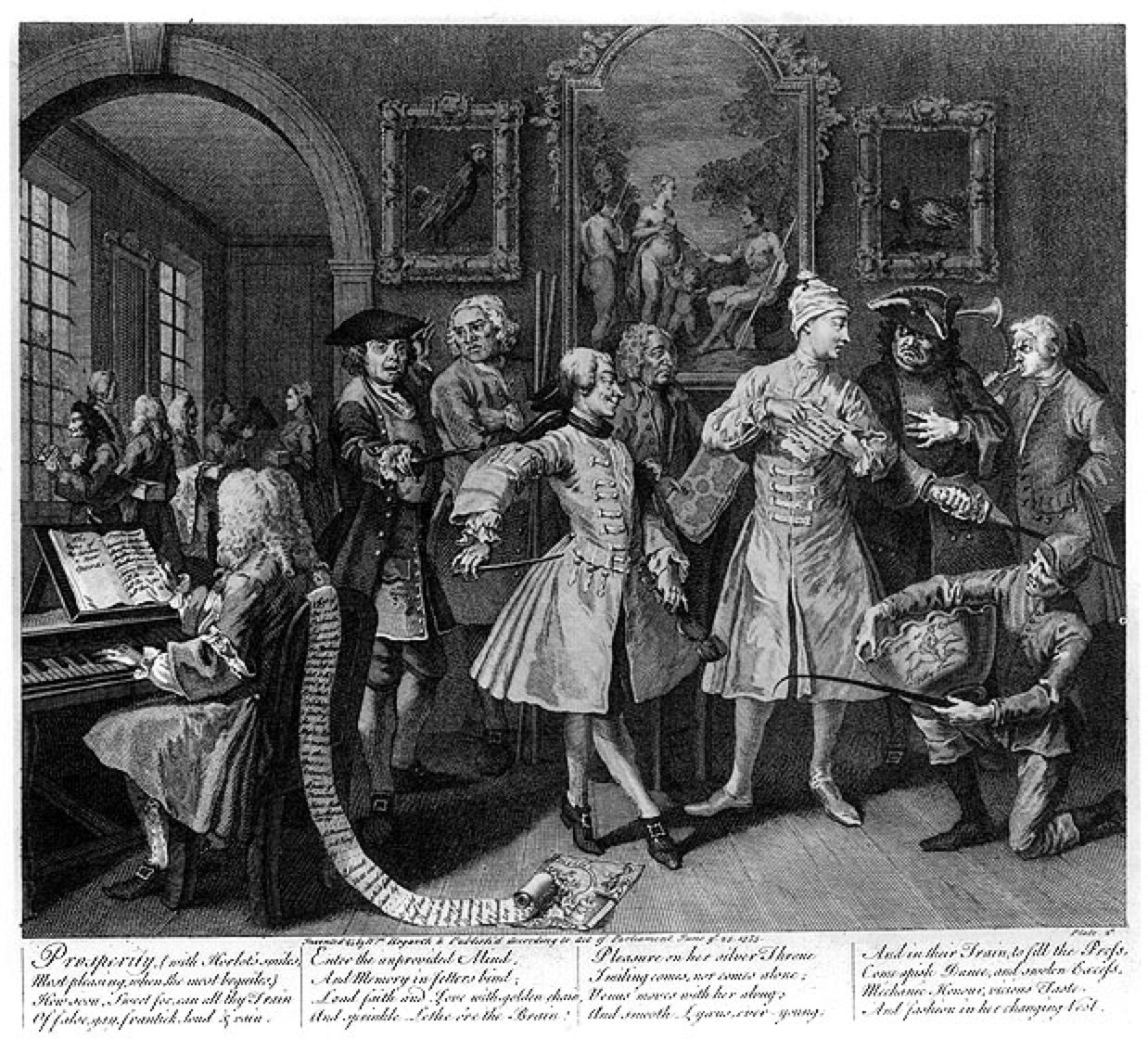
For some of his series, Hogarth worked up a set of full oil paintings in addition to prints. My example is taken from A Rake’s Progress, painted between 1732-5, the successful successor to his A Harlot’s Progress.
William Hogarth (1697–1764), A Rake’s Progress: Surrounded by Artists and Professors (1732-5), oil on canvas, 62.5 × 75 cm, Sir John Soane’s Museum, London. Wikimedia Commons.
In Hogarth’s oil painting, Tom sets out to make a new man of himself with the aid of many tutors and hangers-on. The composer Handel plays the harpsichord, then there is a fencing master, a quarterstaff instructor, a dancing master with violin, Charles Bridgeman, a famous landscape gardener, Tom himself, an ex-soldier acting as bodyguard, a bugler from a foxhunt, and a jockey. In the background are others who are busy spending Tom’s inheritance on worthy causes no doubt.
William Hogarth (1697–1764), A Rake’s Progress, Plate 2: Surrounded by Artists and Professors (1735), engraving, 35.5 × 41 cm, further details not known. Wikimedia Commons.
The print is different in many respects, as if the artist forked the painting and print from a late sketch. Details on the music being played at the left are different, and there’s a long scroll running down from the back of the chair in the print. Some of the facial expressions are altered and exaggerated in the print. Details, including those of clothing and frames of the paintings on the wall, also differ.
Artists like Edgar Degas and his protégé Mary Cassatt made prints for different reasons.
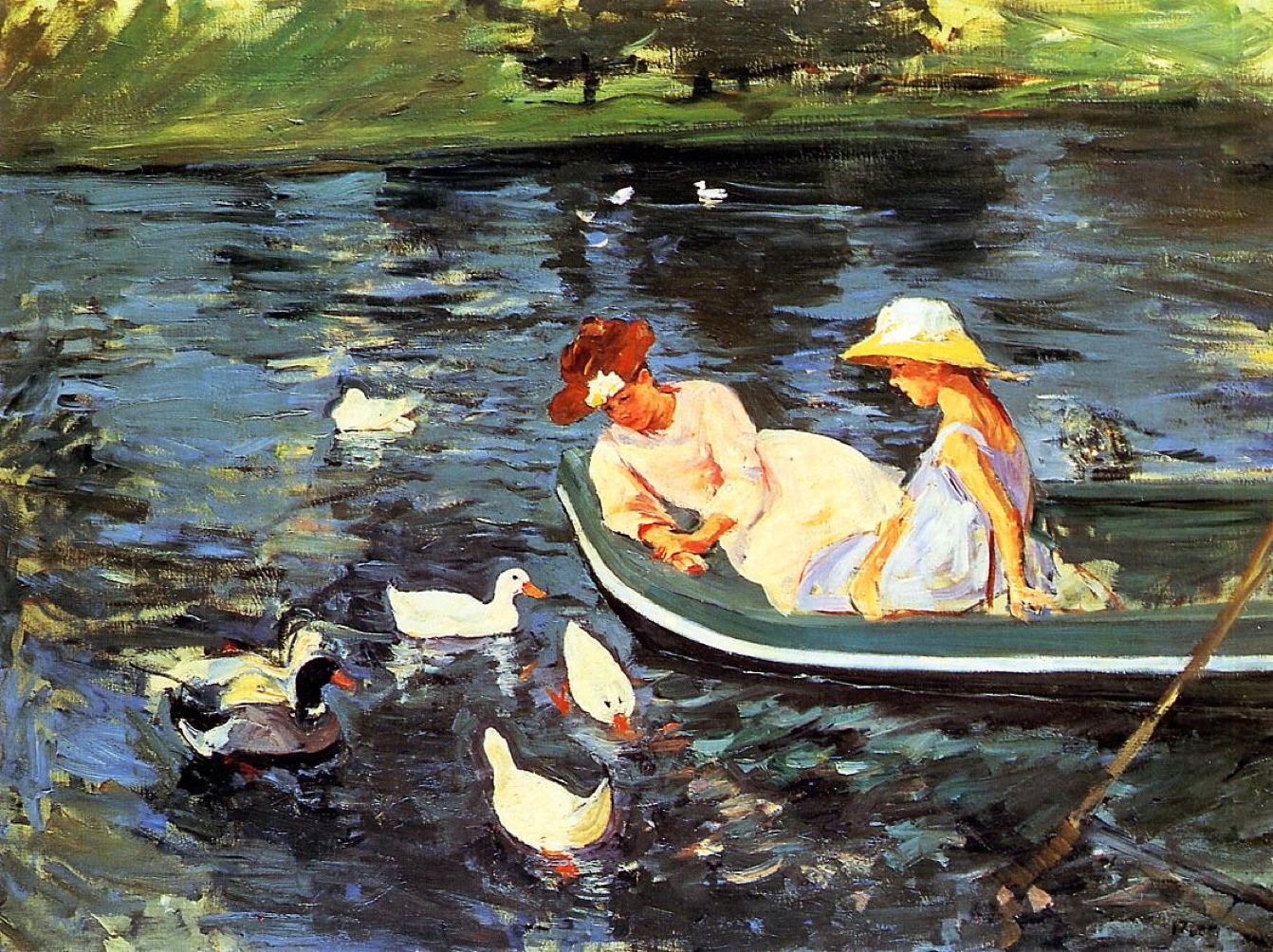
Mary Cassatt (1844–1926), Summertime (1894), oil on canvas, 73.6 x 96.5 cm, Armand Hammer Museum of Art, Los Angeles, CA. The Athenaeum.
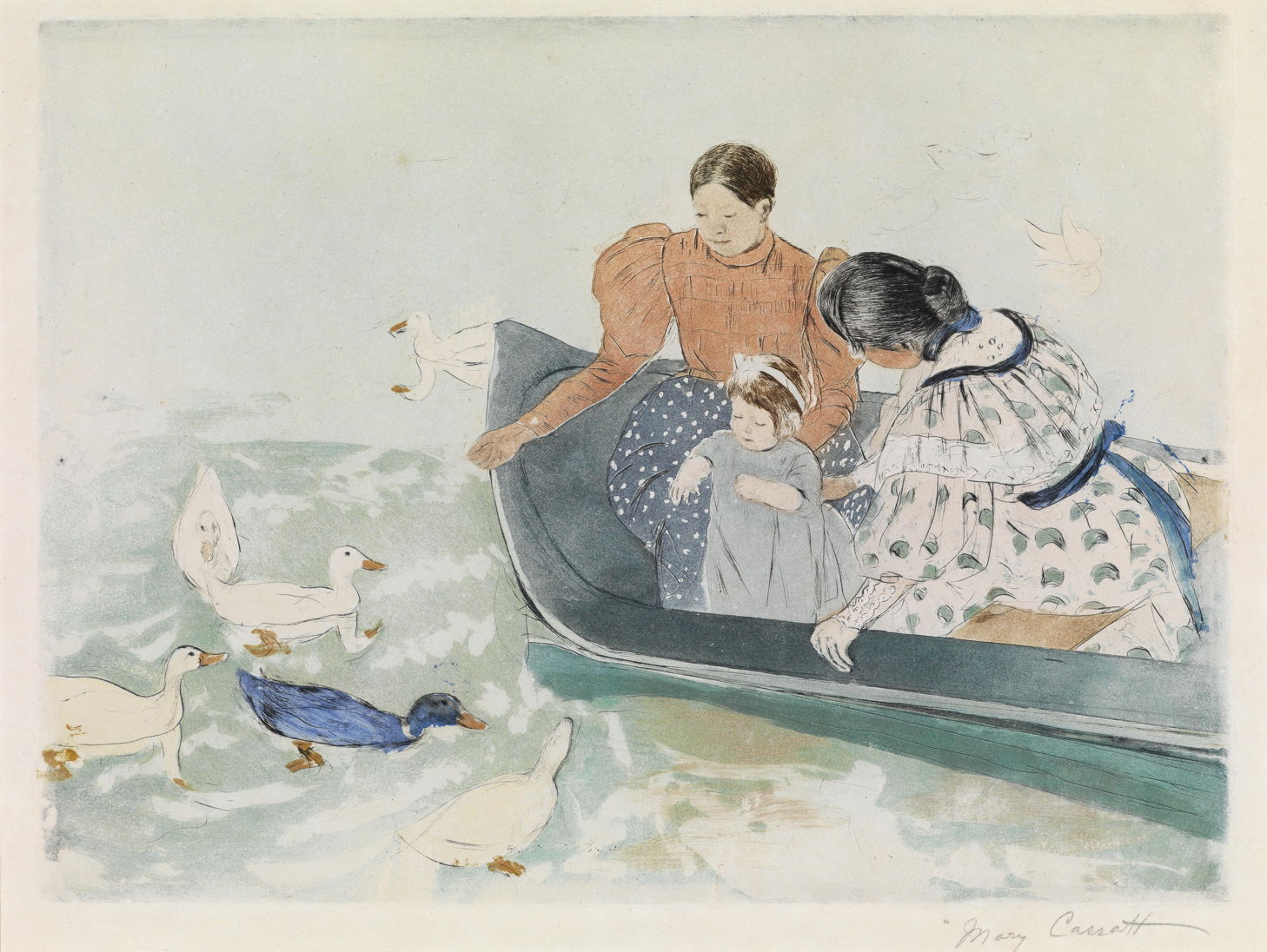
Towards the end of the nineteenth century, Cassatt made this very loose painting of a mother and daughter feeding ducks from a boat in Summertime (1894). I believe this was the source for the sophisticated print, called more appropriately Feeding the Ducks (c 1894), below.
Mary Cassatt (1844–1926), Feeding the Ducks (c 1894), drypoint and aquatint with monotype on handmade paper, 29.5 x 39.5 cm, location not known. Wikimedia Commons.
For this she combined her mature drypoint technique with aquatint, to which she added monotype. In monotype, the artist lays down an image on a plate using printing inks, then makes a single impression of that on the paper. This demands meticulous technique, and usually results in one completed print for each image made in ink. Although second prints can sometimes be made, they’re usually of low quality.
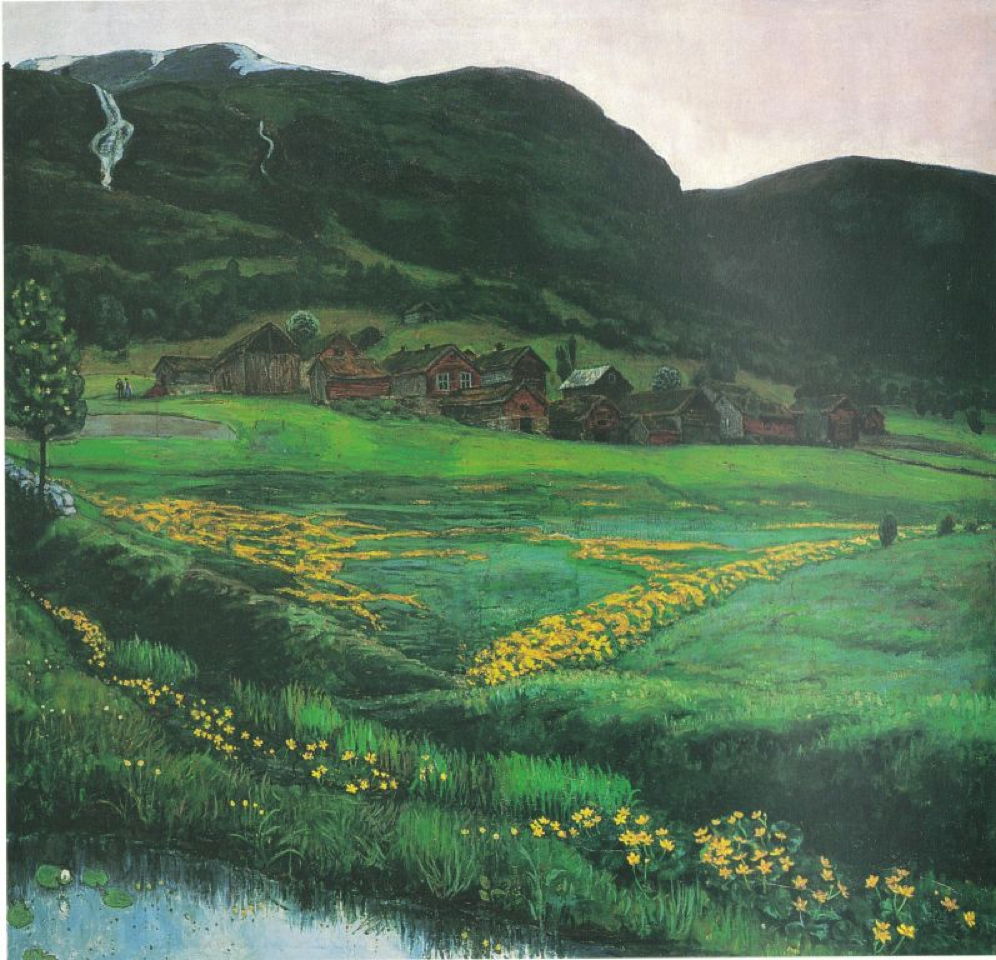
The Norwegian artist Nikolai Astrup was a prolific painter and printmaker, whose paintings informed his prints, and prints informed his paintings.
Nikolai Astrup (1880–1928), A Clear Night in June (1905-07), oil on canvas, 148 x 152 cm, Bergen Kunstmuseum, KODE, Bergen, Norway. Wikimedia Commons.
A Clear Night in June (1905-07), above, and A June Night and Old Jølster Farm (before 1911), below, are two of more than a dozen paintings Astrup made of this farm after about 1902. These were painted early each summer, when in some years there were still the remains of the winter’s snow on the rugged hills behind. The waterfalls cascading down the scarps are still in spate from the melting snow.
Astrup painted this view when the blossom was on the trees, and the meadows were a patchwork of yellow with the first of the summer flowers. Comparing these two paintings reveals a few differences in detail, such as the low fence in the foreground in the lower painting which is omitted in the upper, but by and large Astrup seems to have been consistent, suggesting his paintings were true to nature.
Nikolai Astrup (1880–1928), A June Night and Old Jølster Farm (before 1911), oil on canvas, 88 x 105 cm, Private collection. The Athenaeum.Nikolai Astrup (1880–1928), Marsh Marigold Night (c 1915), colour woodcut on paper, 40.7 x 47 cm, Bergen Kunstmuseum, KODE, Bergen, Norway. Wikimedia Commons.
A few years later, he turned those into prints such as this Marsh Marigold Night (c 1915). By this time his printmaking technique had come a long way, and many of his later prints were extremely painterly, to the point where it can be difficult to distinguish his woodcuts from their painted originals.
Reference
Ayrton M & Denvir B (1948) Hogarth’s Drawings, London Life in the 18th Century, Avalon Press. No ISBN. [This has been my source for images of many of the scans above. The book bears no information about copyright, the press has long since vanished as far as I can tell, and I assume ‘fair use’ of these orphaned images. If you know any different, please contact me.]
回到酒店瘫在床上,KK 教我吹气球呼吸训练,一开始不得要领,练了几次后感觉还是挺有用的。各种因素结合在一起暴饮暴食了一下,九点多还吃了夜宵,因为做过呼吸训练,罪恶感降低了点,断食计划中断一下,点了我平时在家不会吃的螺蛳粉(味道太大)。洗完澡看 MacBook Pro 里蓝光原盘的诺兰版蝙蝠侠第二部,黑暗骑士。看这种画质是种享受。
酒店隔音很差,床头就能传来隔壁很大的电视声音,本来想着要不要去让前台协调让他们降低点音量。KK 帮我按摩头部哄我睡觉加上外出必备的降噪耳机(更加的想要 AirPods Max 第二代),调整好心态和呼吸,居然很快睡着了,这对我来说是个奇迹。
Day 3
在杭州的最后一天了,早上先把要买的中轴搞定,研究了很久,在 YouTube 上听 Jay 的新专辑(全放出来了,都不用买,也确实不值得买)。再把每天要看的 RSS 信息流刷一遍,没带充电器用充电宝应急一下,把小小的酷态科 10 号 mini 榨干了,43w 的充电功率可以补上一点。
烹小齐手工水饺 ⭐️⭐️⭐️
前一晚九点多才结束进食,要等到下午一点后才能吃东西,去了 Sol 推荐的烹小齐手工水饺餐厅,被「缺德地图」坑了一把,地址写的是:拱墅区地铁 3 号线善贤站商业空间 SX-C09 商铺,谁知道这个 SX-C09 是在地下啊。开车找了两遍都没发现,想想不对劲,打开百度地图才发现原来是在地下。
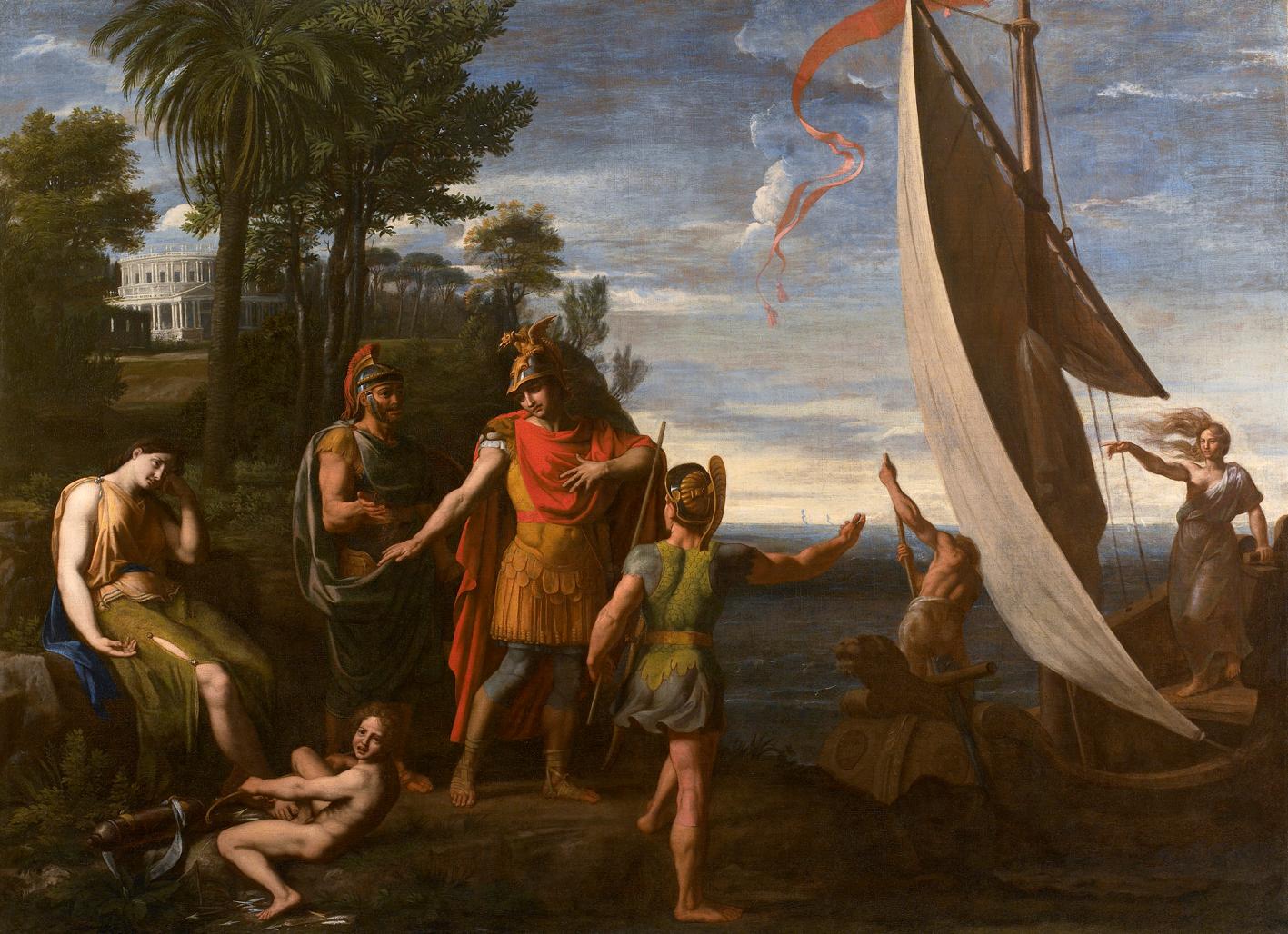
The ‘Saracen’ sorceress Armida had abducted the crusader knight Rinaldo to her enchanted garden on the Fortunate Isles, far to the west out in the Atlantic. A rescue team of the knights Charles and Ubaldo then sailed out in a magic ship piloted by a fair woman. After they had overcome a series of obstacles, Charles and Ubaldo found Rinaldo dressed and behaving as a woman’s dandy, and have the task of restoring his senses as a warrior knight, so they can take him back to rejoin the siege of Jerusalem.
By showing Rinaldo his own image in a highly polished shield, the knight is put to shame and realises what he has become. Ubaldo bids him rejoin the forces of Godfrey of Bouillon, and the holy war. They hasten away, leaving Armida weeping and choking with grief. She runs after them, calling him back. Rinaldo and his two companions wait for her, and the couple stare at one another in silence.
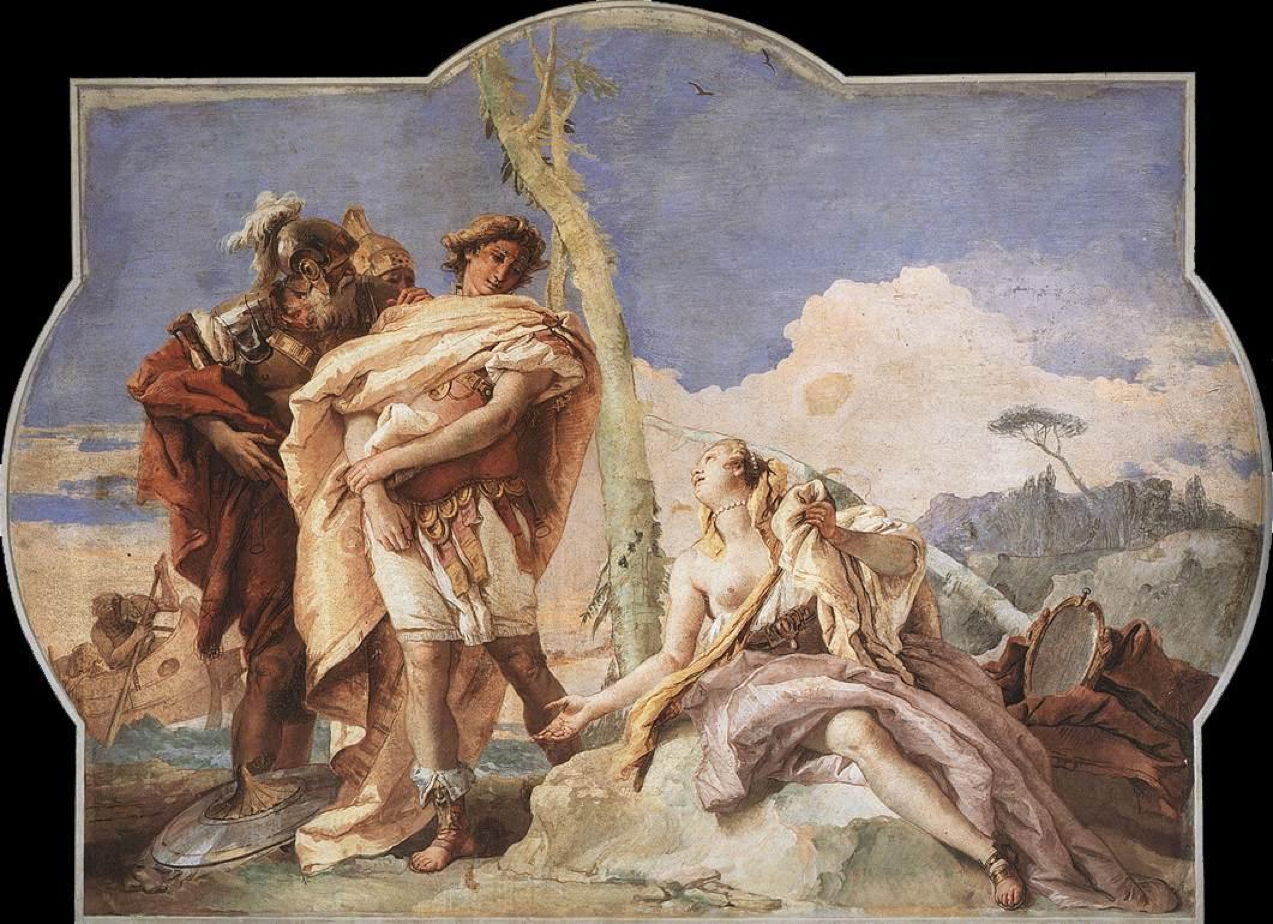
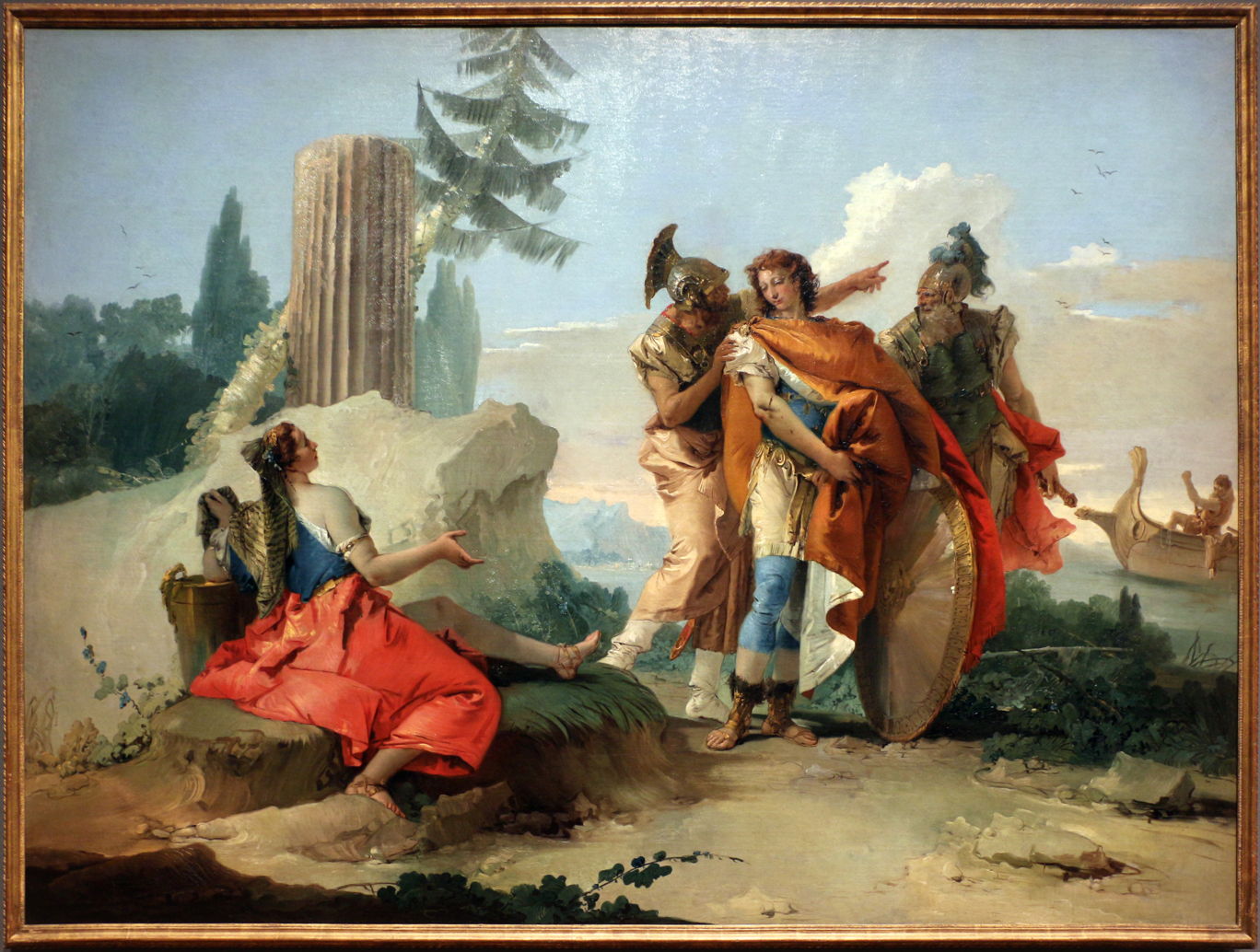
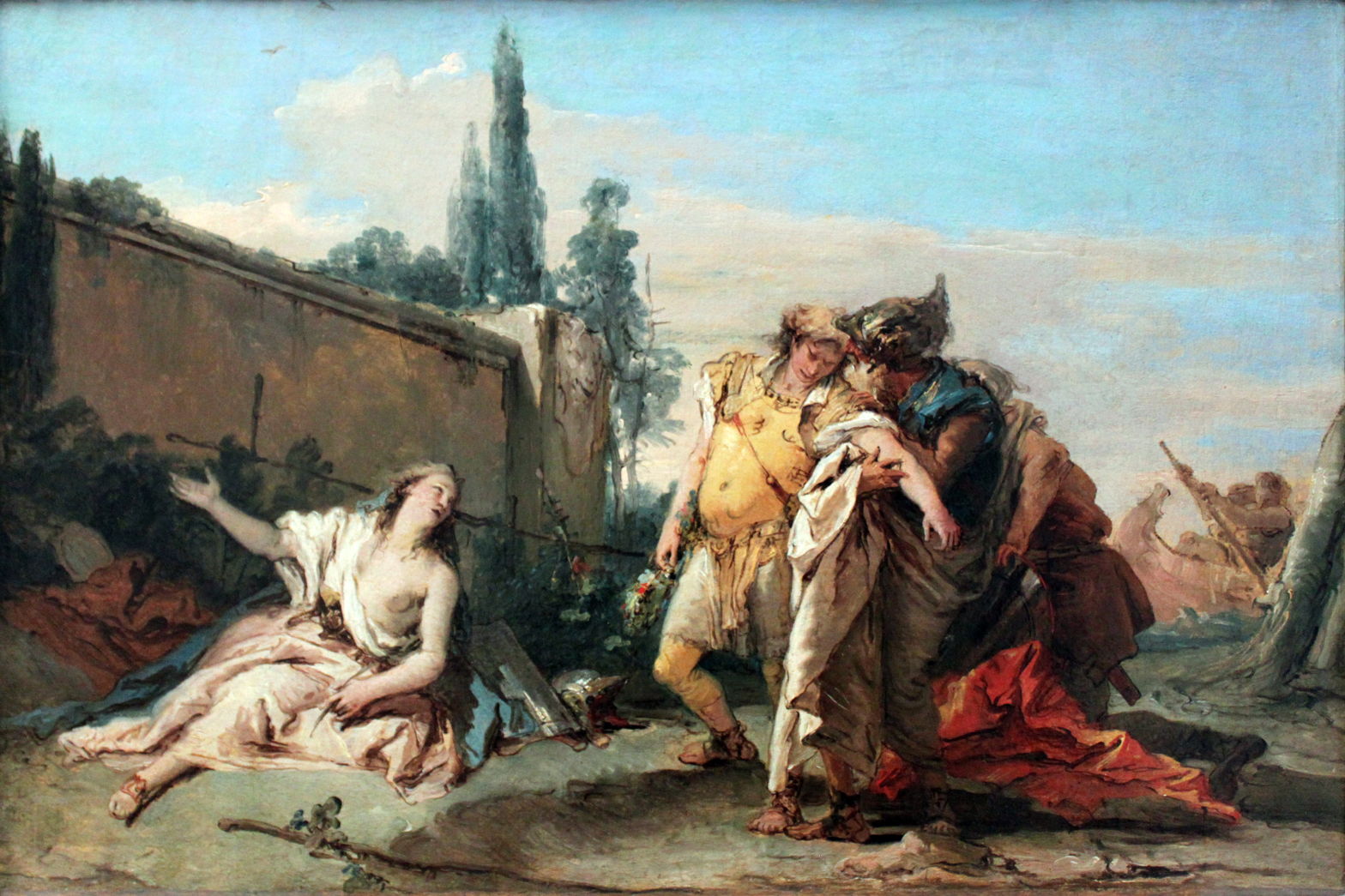
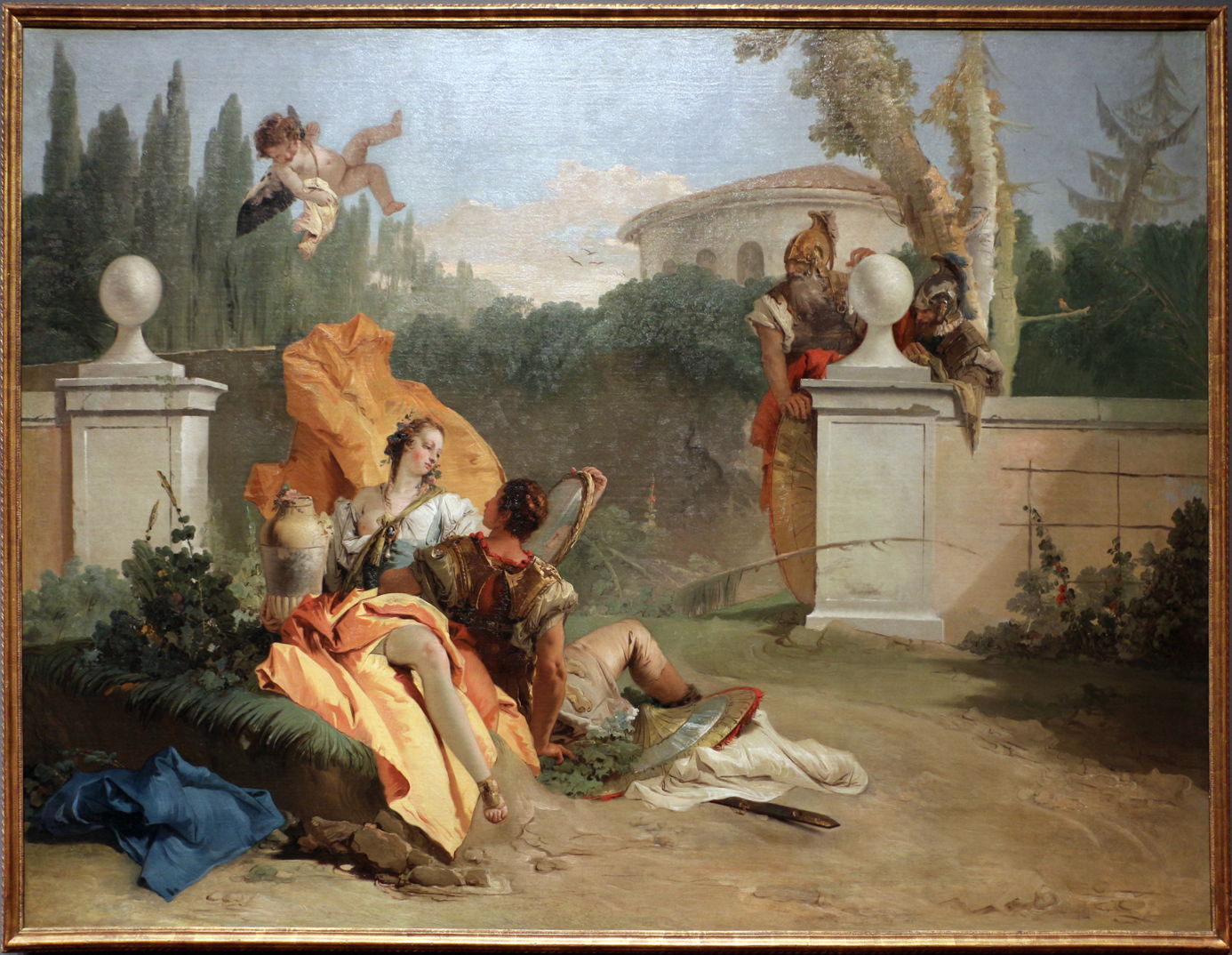
The scene of Armida and Rinaldo separating has proved another of Tasso’s great images for art. Its greatest exponents were the Tiepolos, father and son, who painted a succession of works showing this parting, in the eighteenth century. I show here four examples, each using the compositional device of collapsing Armida’s garden on one side, with the beach and ship on the other, and using that spatial and temporal merging to tell the whole sequence, from Rinaldo’s awakening to their departure by sea.
Giovanni Battista Tiepolo (1696–1770), Armida Abandoning Rinaldo (1742-45), oil on canvas, 186.7 x 259.4 cm, The Art Institute of Chicago, Chicago, IL. Image by Sailko, via Wikimedia Commons.
In this version for the Tasso Room in the palace of the Cormaro Family in Venice, painted in 1742-45, Charles and Ubaldo are stood in full armour, pointing to their ship which is waiting to take Rinaldo away. Armida lies back exposing a lot of leg, trying to persuade Rinaldo to stay with her.
Giovanni Battista Tiepolo (1696–1770), Rinaldo’s Departure from Armida (1755-60), oil on canvas, 39 x 62 cm, Gemäldegalerie der Staatlichen Museen zu Berlin, Berlin, Germany. Image by anagoria, via Wikimedia Commons.
In Tiepolo’s Rinaldo’s Departure from Armida from 1755-60, Rinaldo is still being woken from his enchantment, and Armida bares her breast as she is trying to lure him back.
Giovanni Domenico Tiepolo (1727–1804), Rinaldo Leaving the Garden of Armida (c 1770), fresco, dimensions not known, Ca’ Rezzonico, Venice, Italy. Wikimedia Commons.
His son, Giovanni Domenico, squeezed the three knights in tighter, and omitted Armida from his Rinaldo Leaving the Garden of Armida in about 1770. Rinaldo’s separation from Armida is marked by the hold he has over the blindfolded Cupid in his right arm. This was painted in a fresco in Ca’ Rezzonico in Venice, Italy.
Giovanni Battista Tiepolo (1696–1770), Rinaldo Abandoning Armida (1757), fresco, 220 x 310 cm, Villa Valmarana ai Nani, Vicenza, Italy. Wikimedia Commons.
The father Tiepolo had painted another variation in Rinaldo Abandoning Armida, from 1757, as a fresco in the Villa Valmarana ai Nani, in Vicenza, Italy. In this, the composition is reversed, with the ship at the left, and Armida pleading with Rinaldo at the right. This is perhaps Tiepolo’s most complete account, as it includes both Armida’s crystal mirror at the right, and the polished shield into which Rinaldo looked, at the feet of Charles and Ubaldo.
Tasso’s narrative, developed in this painting, may have a sub-text about looking and its power: for Armida looking in her crystal was a means of strengthening her allure over Rinaldo, but for him looking into the polished shield was a means of restoring his power by showing what he had become in her clutches.
Nicolas Colombel (1644-1717), Rinaldo Abandoning Armida (date not known), oil on canvas, 118.1 x 170.2 cm, Private collection. Wikimedia Commons.
The Tiepolos were by no means the first to merge Armida’s garden with the sea and ship. Nicolas Colombel’s undated painting from the late 1600s showing Rinaldo Abandoning Armida has done much the same.
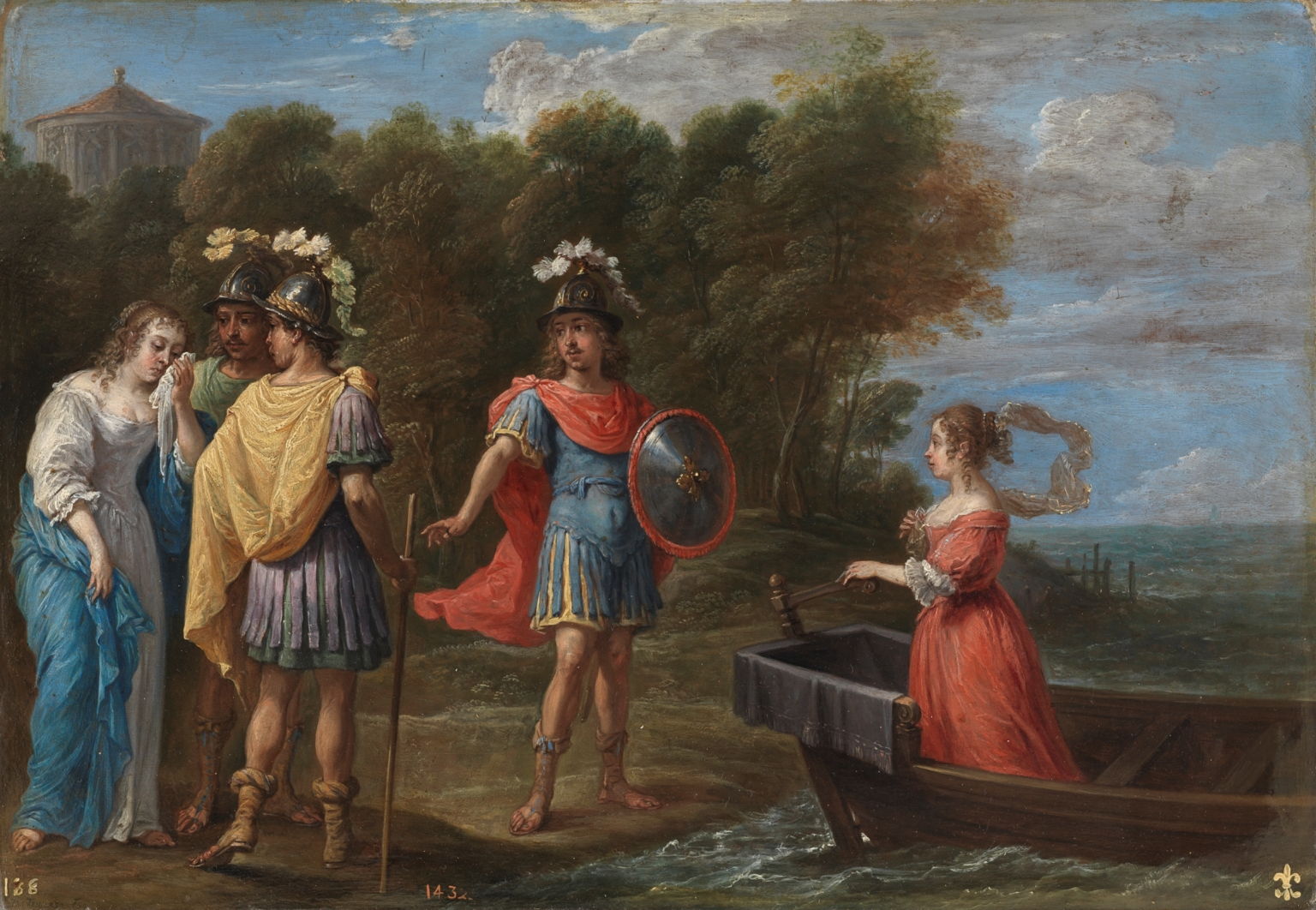
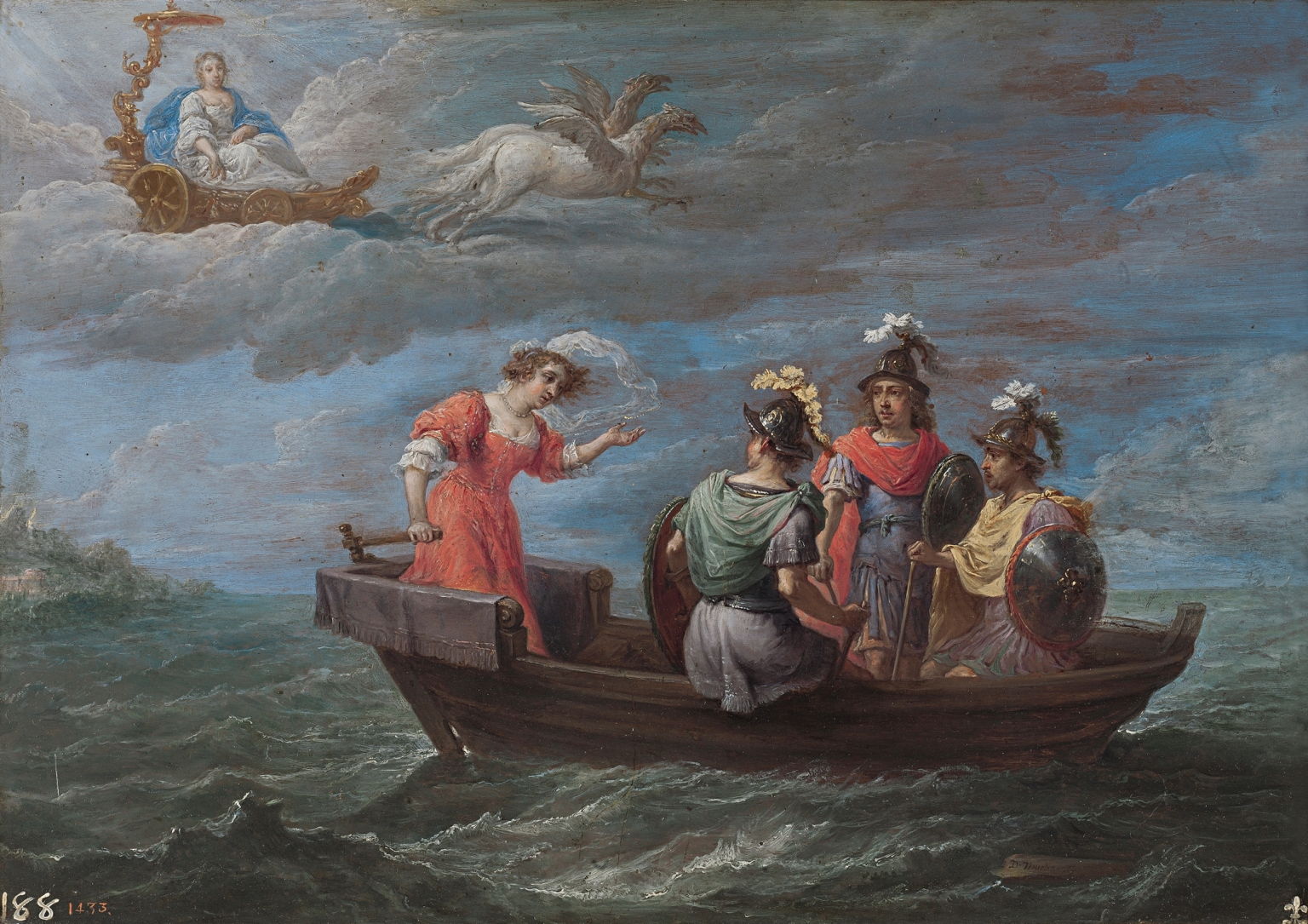
Armida then launches into a speech, asking Rinaldo to let her follow him back, and offering to be his shield. His love has been replaced by compassion for her, and he asks her to remain there in peace. The three knights then sail away on the magic ship, leaving Armida behind on the beach. Her grief now changes to anger at her loss, so she casts evil spells and conjures up her chariot. On that she departs for the battlefield in vengeance.
David Teniers the Younger (1610–1690), Armida and Rinaldo Separated (1628-30), oil on copper, 27 x 39 cm, Museo Nacional del Prado, Madrid, Spain. Wikimedia Commons.
David Teniers the Younger shows this section of the story in two of his small paintings on copper: in his Armida and Rinaldo Separated of 1628-30, Armida is weeping and being comforted by Charles and Ubaldo, as the woman pilot of their ship waits for them to board by its stern.
David Teniers the Younger (1610–1690), Rinaldo Flees from the Fortunate Isles (1628-30), oil on copper, 27 x 39 cm, Museo Nacional del Prado, Madrid, Spain. Wikimedia Commons.
Teniers’ sequel, Rinaldo Flees from the Fortunate Isles, shows the group returning to war, with Armida still looking disconsolate in her chariot above them.
Canto seventeen opens in Gaza, between Egypt and Jerusalem, where the King of Egypt is mustering his army ready to advance towards Godfrey’s forces. He sits on his throne to review his forces, which Tasso lists in procession much as he had done when the crusaders were setting out for Jerusalem at the start of the epic. These start with Egyptians, and progress through those from the coast of Asia, citizens of Cairo, those from the land to the south, men of Barca, those from the coast of Arabia, from the Persian Gulf, and the Indies. At the end, Armida appears riding in her chariot with her own forces who had been mustered in Syria by Hydrotes, together with Circassians and more.
The king then retires to a banquet, where Armida offers her forces in support of the king, and tells of her desire for vengeance against Rinaldo. Adrastus, a ‘Saracen’ leader of Indian troops, offers to rip Rinaldo’s heart out, and make a present of his head to Armida.
Thomas Asbridge (2004) The First Crusade, A New History, Free Press, ISBN 978 0 7432 2084 2.
Anthony M Esolen, translator (2000) Torquato Tasso, Jerusalem Delivered, Gerusalemme Liberata, Johns Hopkins UP. ISBN 978 0 801 863233. A superb modern translation into English verse.
John France (1994) Victory in the East, a Military History of the First Crusade, Cambridge UP. ISBN 978 0 521 589871.
Joanthan Riley-Smith, ed (1995) The Oxford Illustrated History of the Crusades, Oxford UP. ISBN 978 0 192 854285.
Jonathan Riley-Smith (2014) The Crusades, A History, 3rd edn., Bloomsbury. ISBN 978 1 4725 1351 9.
Johathan Unglaub (2006) Poussin and the Poetics of Painting, Pictorial Narrative and the Legacy of Tasso, Cambridge UP. ISBN 978 0 521 833677.
After Alexandre Calame’s views of Lake Geneva painted in the middle of the nineteenth century, the next great artist to devote as much attention to the lake was Ferdinand Hodler, a native of Bern, Switzerland. At the age of eighteen, Hodler had walked across the country to attend the Collège de Genève there, and train as a painter, initially by copying Calame’s paintings.
Daniel Appleton et al., Map of Lake Geneva (1877), p 521 in Appleton’s European Guide Book illustrated, 10th edition, D. Appleton & Co, New York. The British Library, London. Wikimedia Commons.Ferdinand Hodler (1853–1918), Lake Geneva from Chexbres (c 1898), oil on canvas, 100.5 × 130 cm, Private collection. Wikimedia Commons.
Hodler started painting a series of views from the north-eastern shore of Lake Geneva looking south, across to the major peaks of the Chablais Alps. He was to continue this series until his death twenty years later. Lake Geneva from Chexbres from about 1898 shows one of the first of these, painted near the village of Chexbres, between Lausanne and Montreux, in early winter.
Ferdinand Hodler (1853–1918), Lake Geneva from St Prex (1901), oil on canvas, 72 x 107 cm, Private collection. Wikimedia Commons.
Lake Geneva from Saint-Prex (1901) is another view across the lake, from a town to the west of Lausanne, looking south with a closer view of the peaks of the Chablais Alps. This appears to have been painted in the summer, with the trees in full leaf and a rich range of flowers. The clouds over the mountains are starting to become more organised in a regular rhythm, a trend that resulted in some of his most distinctive later landscapes.
Ferdinand Hodler (1853–1918), The Grammont (1905), oil on canvas, 65 x 105.5 cm, Private collection. Wikimedia Commons.
The Grammont (1905) shows this mountain in the Chablais Alps, to the south of the eastern end of Lake Geneva, towards which many of Hodler’s favourite views over that lake were aimed. Again he uses a limited palette; the lake itself reminds me of Gustav Klimt’s wonderful paintings of Attersee from a few years earlier, although Hodler’s darker blue ripples quickly vanish as the lake recedes from the viewer.
Ferdinand Hodler (1853–1918), Landscape at Lake Geneva (c 1906), media not known, 59.8 x 84.5 cm, Neue Pinakothek, Munich, Germany. Image by Rufus46, via Wikimedia Commons.
The following year, he painted Landscape at Lake Geneva.
Ferdinand Hodler (1853–1918), Rhythmic Landscape on Lake Geneva (1908), oil on canvas, 67 x 91 cm, Private collection. Wikimedia Commons.
One of the clearest examples of Hodler’s distinctive Parallelist landscapes is his Rhythmic Landscape on Lake Geneva from 1908. This was a second version of a view he had previously painted in 1905, when he wrote “This is perhaps the landscape in which I applied my compositional principles most felicitously.”
Most of his symmetry and rhythm is obvious; what may not be so apparent are the idiosyncratic reflections seen on the lake’s surface. The gaps in the train of cumulus clouds here become dark blue pillars, which are optically impossible, but are responsible for much of the rhythm in the lower half of the painting.
In the final years of Hodler’s life he painted some of the most sublime landscapes of his career. During the winter of 1917-18, his health deteriorated, but he continued to paint from the window of his room in Geneva, completing more than eighteen views during those final months. Here are three examples.
Ferdinand Hodler (1853–1918), Lake Geneva with Mont Blanc by Morning Light (1918), oil on canvas, 59 × 119.5 cm, Private collection. Wikimedia Commons.
In Lake Geneva with Mont Blanc by Morning Light (1918), one of the more complex paintings of this series, bands represent the lake shore, four different zones of the surface of the lake, the lowlands of the opposite bank, the mountain chains, and two zones of colour in the dawn sky. The lower section of the sky and the foreground shore echo in colour, and contrast in their pale lemon-orange with the blues of the other bands.
Ferdinand Hodler (1853–1918), Lake Geneva with Mont Blanc in the Morning Light (1918), oil on canvas, 65 x 91,5 cm, Kunsthaus Zürich, Zürich, Switzerland. Wikimedia Commons.
Lake Geneva with Mont Blanc in the Morning Light (1918) has a simpler structure, with the water, a band of reflections, the mass of the far shore and mountains merged, and the dawn sky. The dominant colour is the yellow to pale red of the dawn sky and its reflection.
Ferdinand Hodler (1853–1918), Lake Geneva with Mont Blanc in the (Red) Dawn Light (1918), oil on canvas, 74.5 x 150 cm, Private collection. Wikimedia Commons.
Lake Geneva with Mont Blanc in the (Red) Dawn Light (1918) is also simpler in its structure, with the water coloured by the sky, a zone of blue reflections of the far bank, the merged distant shore and mountains, and the sky.
In Hodler’s ultimate and most sublime landscapes, he eliminated the unnecessary detail, stating just the elements of water, earth, air, and the fire of the rising sun, in their natural rhythm. On 19 May 1918, Hodler died in Geneva, at the age of 65.
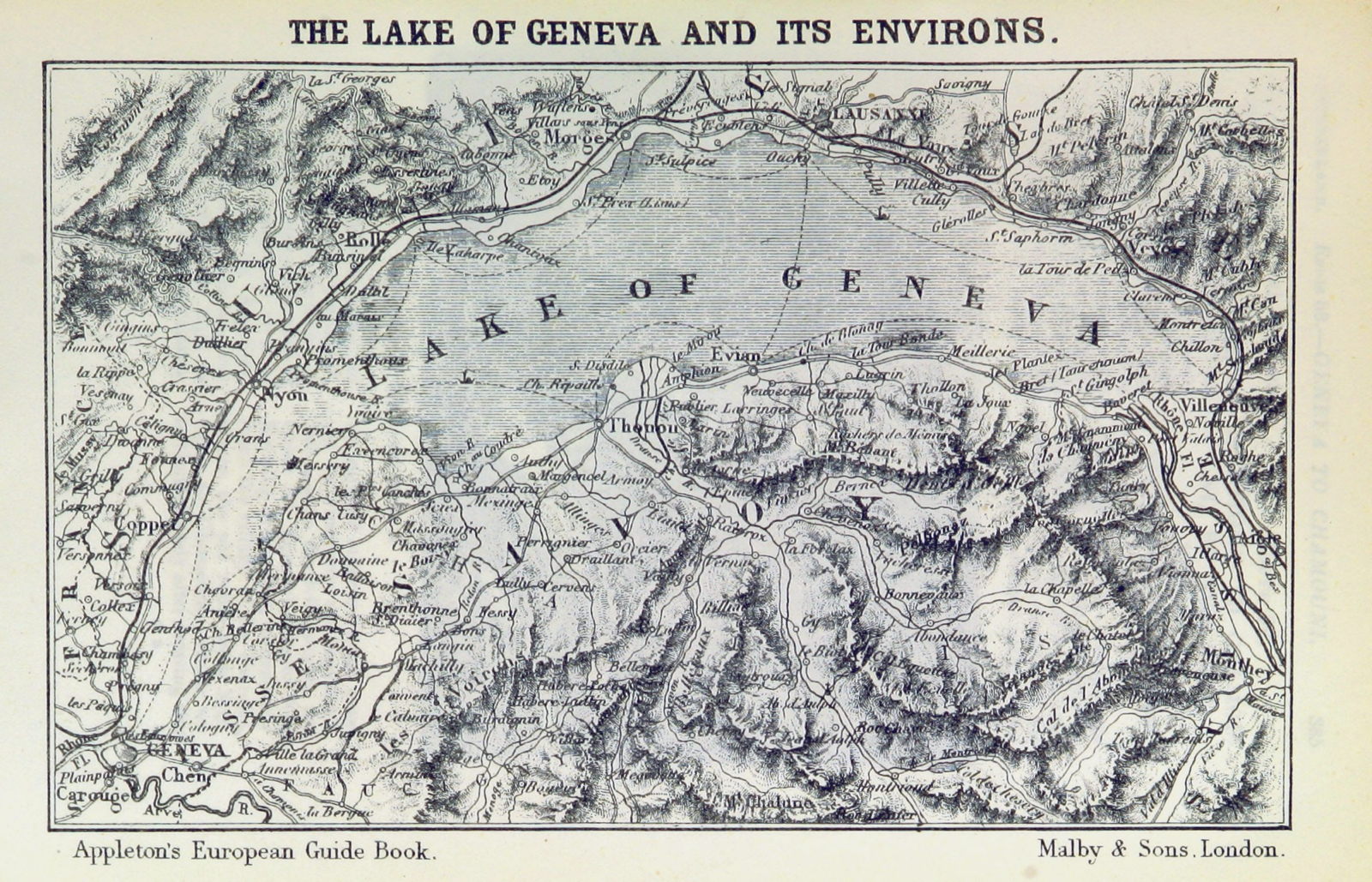
This weekend we’re off to visit Lake Geneva, also known by its French name of Lac Léman, the largest in Switzerland. It’s located in the far south-west of the country, where it forms much of its border with France. It makes a broad arc running north-east from the capital city of Geneva, with some of the highest peaks of the Alps to its south.
Daniel Appleton et al., Map of Lake Geneva (1877), p 521 in Appleton’s European Guide Book illustrated, 10th edition, D. Appleton & Co, New York. The British Library, London. Wikimedia Commons.
Today I start with a selection of paintings almost exclusively from the nineteenth century, when Switzerland was on the itinerary of the Grand Tour undertaken by aspiring young men of the upper class in both Europe and the Americas.
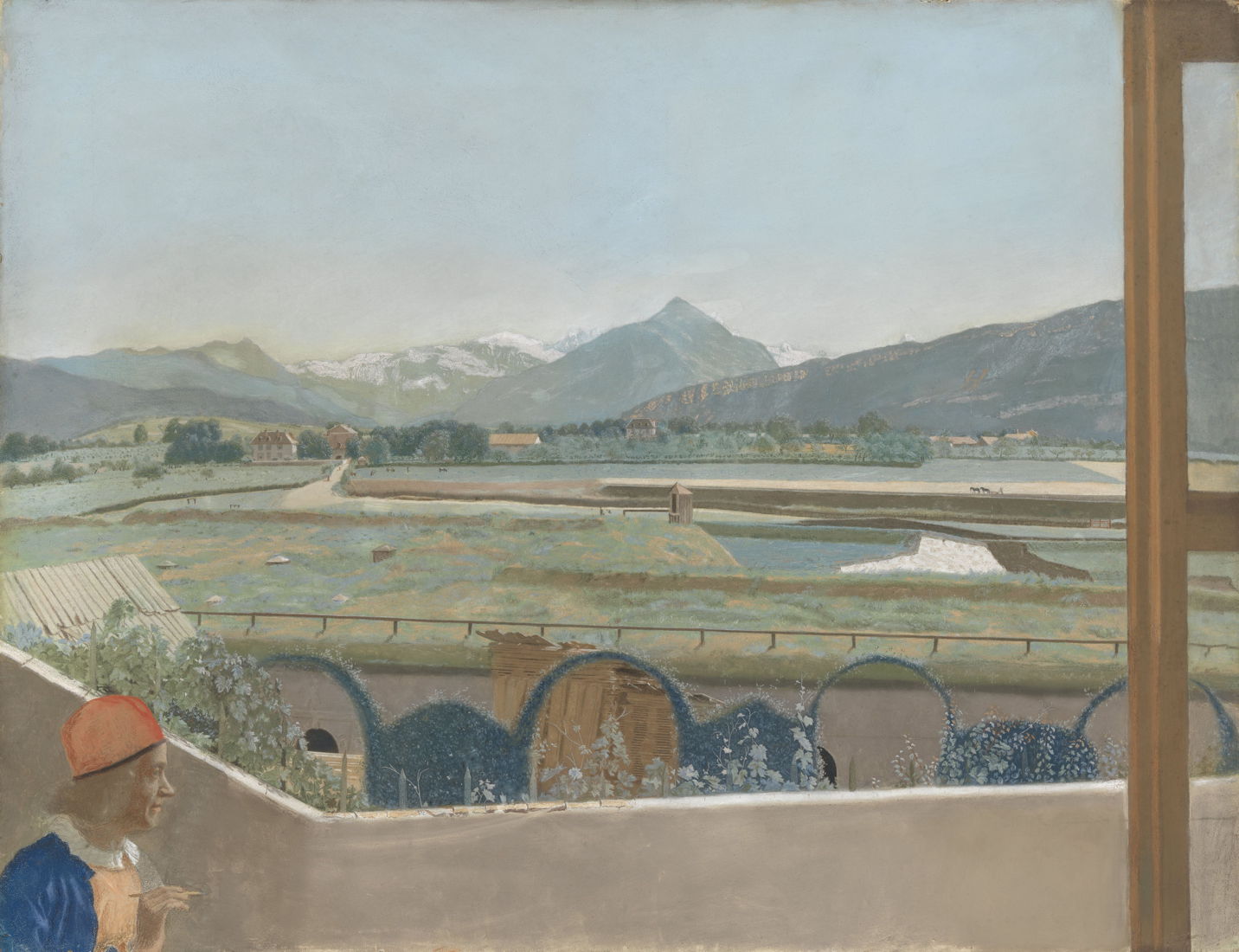
Jean-Étienne Liotard (1702-1789), View of the Mont Blanc Massif from the Artist’s Studio (1765-70), pastel on parchment, 46 x 59.7 cm, location not known. Wikimedia Commons.
The city of Geneva has long attracted artists, and it was here the eccentric pastellist Jean-Étienne Liotard was born and later kept his studio, and where he eventually retired. His View of the Mont Blanc Massif from the Artist’s Studio from 1765-70 reveals only a little of the southern extreme of the lake, with a cameo self-portrait.
Joseph Mallord William Turner (1775–1851), Lake Geneva and Mount Blanc (1802-05), watercolour, 90.5 x 128.6 cm, Yale Center for British Art, New Haven, CT. Wikimedia Commons.
JMW Turner was by no means the first to paint the lake, but his watercolour of Lake Geneva and Mount Blanc from 1802-05 is one of its earliest depictions by a major artist. This view looks south-east over the city of Geneva towards the Mont Blanc massif in the far distance.
Alexandre Calame (1810–1864), View of Bouveret (1833), oil on panel, 35 x 47.5 cm, location not known. Wikimedia Commons.
Alexandre Calame’s View of Bouveret from 1833 shows a grey heron fishing on the shore at the southern end of the lake, close to the border with France.
Alexandre Calame (1810–1864), View of Lake Geneva (Lac Léman) (1849), oil on wood, 67 x 86 cm, Villa Vauban, Musée d’art de la ville de Luxembourg, Luxembourg. Wikimedia Commons.
While Turner had toured the Alps once travel from England had become possible again in the early nineteenth century, Calame pioneered the painting of views like this of the lake, completed in his studio in 1849. It includes some of the distinctive sailing boats of the Swiss lakes, and a small bird in the shallows, but not a heron here.
John Ferguson Weir (1841-1926), Lake Leman (Lake Geneva), Switzerland (1869), oil on paper, 20.3 x 33 cm, Private collection. Wikimedia Commons.
In the middle of the nineteenth century, several major American artists visited Switzerland to develop their skills painting mountain views. Despite its finish, John Ferguson Weir’s Lake Leman (Lake Geneva), Switzerland may have been painted in front of the motif, on 11 June 1869.
Following Gustave Courbet’s release from prison for his involvement in the Paris Commune and destruction of the Vendôme Column in 1871, he was forced to flee to the safety of Switzerland, where he lived his remaining years there, unable to return to France.
Gustave Courbet (1819–1877), Sunset over Lac Leman (1874), oil on canvas, 55 x 65 cm, Musée Jenisch, Vevey, Switzerland. Image by Volpato, via Wikimedia Commons.
Courbet painted some of the finest landscapes of his career during his exile in Switzerland, like this Sunset over Lac Léman from 1874, the year of the First Impressionist Exhibition in Paris.
Gustave Courbet (1819–1877), Chillon Castle (1875), oil on canvas, dimensions not known, Private collection. Wikimedia Commons.
He became particularly obsessed with the island château at the extreme eastern end of Lake Geneva, Chillon Castle, here in 1875. This picturesque château dates back to a Roman outpost, and for much of its recorded history from about 1050 has controlled the road from Burgundy to the Great Saint Bernard Pass, a point of strategic significance. It has since been extensively restored, and is now one of the most visited mediaeval castles in Europe.
Gustave Courbet (1819–1877), Chillon Castle (1874-77), oil on canvas, 73 x 92 cm, location not known. Wikimedia Commons.
Chillon Castle from 1874-77 is another of the views he painted of the castle on the lake.
Gustave Courbet (1819–1877), Sunset on Lake Geneva (c 1876), oil on canvas, 74 x 100 cm, Kunstmuseum St. Gallen, St. Gallen, Switzerland. Wikimedia Commons.
Sunset on Lake Geneva from about 1876 is reminiscent of Courbet’s earlier seascapes with breaking waves, but now the water is calm once more.
In May 1877, the French government informed Courbet that the cost of rebuilding the Vendôme Column would be over 300,000 Francs, which he could pay in instalments of 10,000 Francs each year, starting on 1 January 1878. Courbet died in Switzerland the day before, on 31 December 1877, at the age of only 58.
The great Symbolist painter Gustave Moreau was born almost two centuries ago, on 6 April 1826. To mark his bicentenary early next month, this short series outlines his career in a small selection of his more important paintings. They are at once history, symbolic explorations, as phantasmagoric as the most radical of William Blake or Odilon Redon, and torrents of figures and forms drawn from all human cultures. They’re elaborate, complex, and appear to defy reading.
Moreau was a precocious artist who started copying in the Louvre, in his native Paris, when he was only seventeen. A year later he started attending a private studio run by François-Édouard Picot, to prepare him for the entrance exam for the École des Beaux-Arts. In Picot’s studio, he learned the methods to which he adhered for the rest of his career: each painting started with a series of drawings, which developed both composition and details. The final drawing was squared up on a grid, to enable its transfer to canvas, where he painted conventionally in oils, using layers.
He was admitted to the École des Beaux-Arts in 1846, and decided to be a history painter. He competed twice for the Prix de Rome, which would have taken him to continue his studies in Rome, but was unsuccessful on both occasions. He therefore left the École in 1849, and started making a precarious living with small commissioned works including favourite scenes from the plays of Shakespeare. His work changed markedly in 1851, the year that JMW Turner died, when he befriended Théodore Chassériau, a former pupil of JAD Ingres; Moreau set up his first studio near Chassériau’s, and started painting more ambitious works to submit to the Salon.
Gustave Moreau (1826–1898), The Judgement of Paris (1852), watercolor on paper, 40.7 × 48.3 cm, Private collection. Wikimedia Commons.
The Judgement of Paris (1852) is one of his early watercolours, showing great promise of things to come. At its heart is a fairly faithful representation of this classical myth, in which Paris (right of centre) is deciding which of Hera, Athena, and Aphrodite is the most fair, and should be awarded the golden apple given by Eris from the Garden of the Hesperides.
Gustave Moreau (1826–1898), Apollo and the Nine Muses (1856), oil on canvas, dimensions not known, Private collection. The Athenaeum.
Apollo and the Nine Muses (1856) is another significant step towards his mature work. Apollo, a young and surprisingly androgynous figure, sits in the foreground, his distinctive lyre part-hidden under his right foot. To the right of him is a wild rose, with both white flowers and red hips. The muses cluster on a small mound behind that, equipped for and engaged in their respective arts.
That year, his friend and mentor Chassériau died at the age of only 37. Moreau was devastated, and decided to travel to Italy to complete his education as a painter and resolve his future. From October 1857 to June 1858, he copied Renaissance paintings in Rome, then moved on to Florence, Milan, and Venice. He finally returned to Paris in September 1859, having made about a thousand copies in less than two years. He had also met and made friends with several other artists, including Edgar Degas and James Tissot.
Gustave Moreau (1826–1898), Hesiod and the Muses (1860), oil on canvas, 155 × 236 cm, Musée National Gustave-Moreau, Paris. Wikimedia Commons.
Hesiod and the Muses (1860) is probably the first of Moreau’s novel history paintings, and the first of a series of works showing Hesiod, generally considered to be the first written poet in the Western tradition to exist as a real person, and to play an active role in his poetry. Hesiod is the young man holding a laurel staff in his right hand, to the left of centre.
There are four swans on the ground, and one in flight above Hesiod, a winged Cupid sat on the left wing of Pegasus, and a brilliant white star directly above the winged horse. However, the Cupid and Pegasus were only added in about 1883, when the canvas was extended.
Moreau met his mistress and muse Alexandrine Dureux (whom he never married, both remaining single) that year, and set her up in a nearby flat, where she lived until her death in 1890.
By 1864, he had abandoned three attempts to produce a radical work for the Salon. However, he had been working on something different, that he completed during the winter of 1863-4: Oedipus and the Sphinx (1864)
Gustave Moreau (1826–1898), Oedipus and the Sphinx (1864), oil on canvas, 206.4 x 104.8 cm, The Metropolitan Museum of Art (Bequest of William H. Herriman, 1920), New York, NY. Courtesy of The Metropolitan Museum of Art, via Wikimedia Commons.
This was a bold move. Not only was this painting startlingly original and different, but it visited a motif that had recently resulted in Ingres’ success at the Salon, in 1827. Just as Oedipus is seen to be staring out the fearsome sphinx, so Moreau was visibly challenging his seniors.
This shows a key scene from Sophocles’ tragedy Oedipus the King. The sphinx had effectively put the ancient Greek city of Thebes under siege, by sitting outside and refusing to let anyone pass unless they answered a riddle correctly. Those who failed to do that it killed by strangulation. When Oedipus arrived, intending to enter Thebes, the sphinx asked him “Which creature has one voice and yet becomes four-footed, two-footed, and three-footed?” Oedipus solved this in his answer of humans, who crawl when a baby, walk on two feet as an adult, then walk with a stick when old. The defeated sphinx then threw itself into the sea below, Oedipus entered Thebes, was awarded the throne of Thebes in return for destroying the sphinx, and married its queen Jocasta, who turned out to be his mother.
Gustave Moreau (1826–1898), Oedipus and the Sphinx (detail) (1864), oil on canvas, 206.4 x 104.8 cm, The Metropolitan Museum of Art (Bequest of William H. Herriman, 1920), New York, NY. Courtesy of The Metropolitan Museum of Art, via Wikimedia Commons.
The apparently emotionless faces of Oedipus and the sphinx are not an attempt to reject facial expression as a narrative tool. In fact, they confirm its value. The pair are engaged in staring intently into one another’s eyes, in the way that poker players might, almost eyeball to eyeball. The most plausible moment to be shown here is the brief interval between the sphinx asking its riddle, and Oedipus answering it.
The sphinx has already latched onto the front of what it comfortably assumes is going to be another, rather delectable victim. Its forelegs are ready to reach up and strangle him once he guesses the wrong answer, and its hindlegs are ready to unsheath claws and walk up, burying them in his flesh. The sphinx is ready to prove itself a femme fatale for Oedipus.
Oedipus knows that he cannot falter. A false guess, even a slight quaver in his voice, and this beautiful but lethal beast will be at his throat. His left hand clenches his javelin, knowing that what he is about to say should save his life, and spare the Thebans. He will then no longer be pinned with his back to the rock, and the threat of the sphinx will be gone.
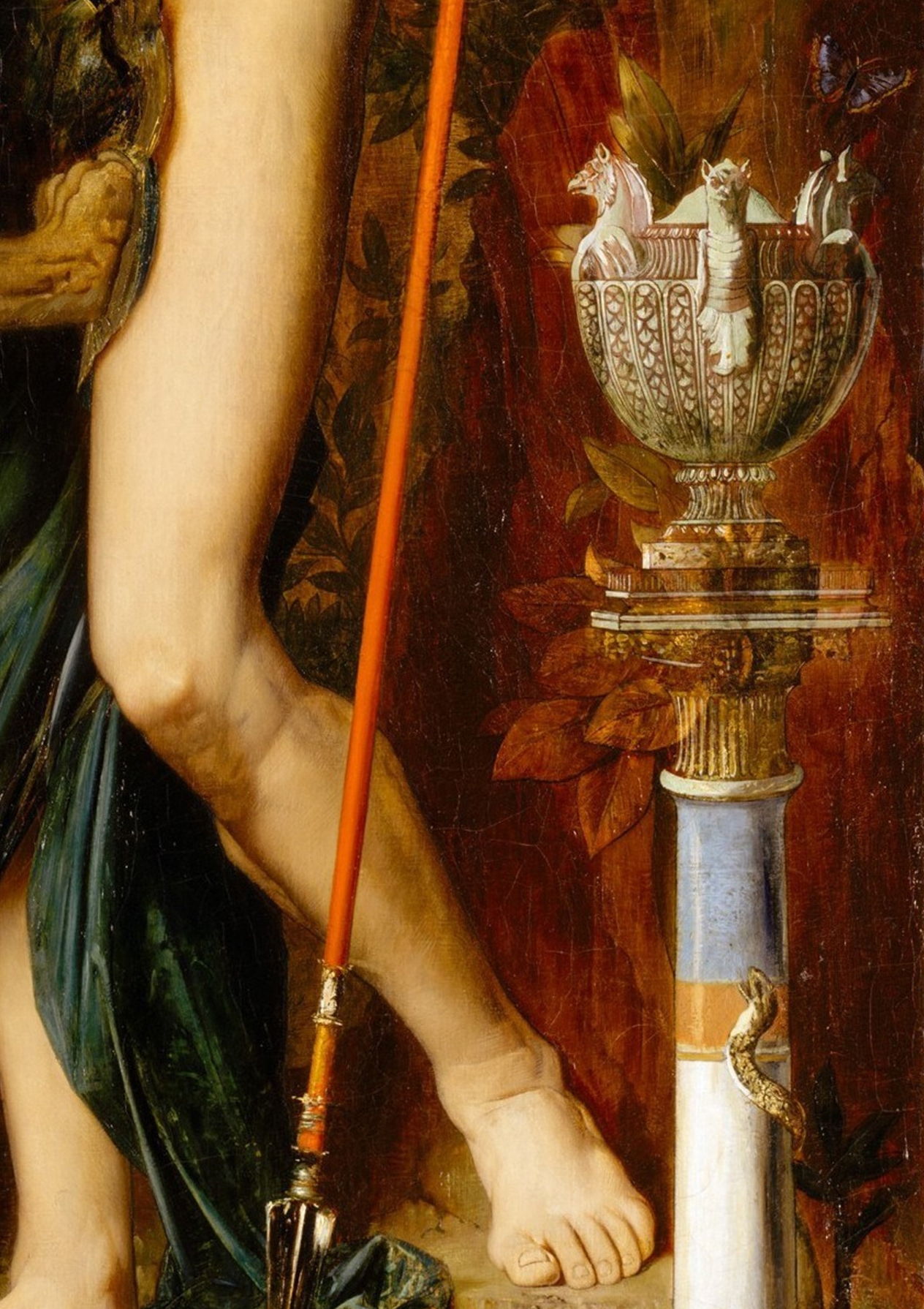
Gustave Moreau (1826–1898), Oedipus and the Sphinx (detail) (1864), oil on canvas, 206.4 x 104.8 cm, The Metropolitan Museum of Art (Bequest of William H. Herriman, 1920), New York, NY. Courtesy of The Metropolitan Museum of Art, via Wikimedia Commons.
Around this central narrative core, Moreau feeds us symbolic morsels to supplement that main course without supplanting it. Behind Oedipus is a bay tree, sacred to Apollo, representing man’s highest achievements; behind the sphinx is a fig tree, a traditional symbol of sin. The small polychrome column at the right is topped by a cinerary urn, symbolising death, and above it is a butterfly, representing the soul. Ascending the column is a snake, again associated with death, and through the biblical serpent, with sin.
Moreau’s bold move worked, as Oedipus and the Sphinx took the Salon of 1864 by storm, winning him a medal. The following year, he tried to consolidate that success with Jason.
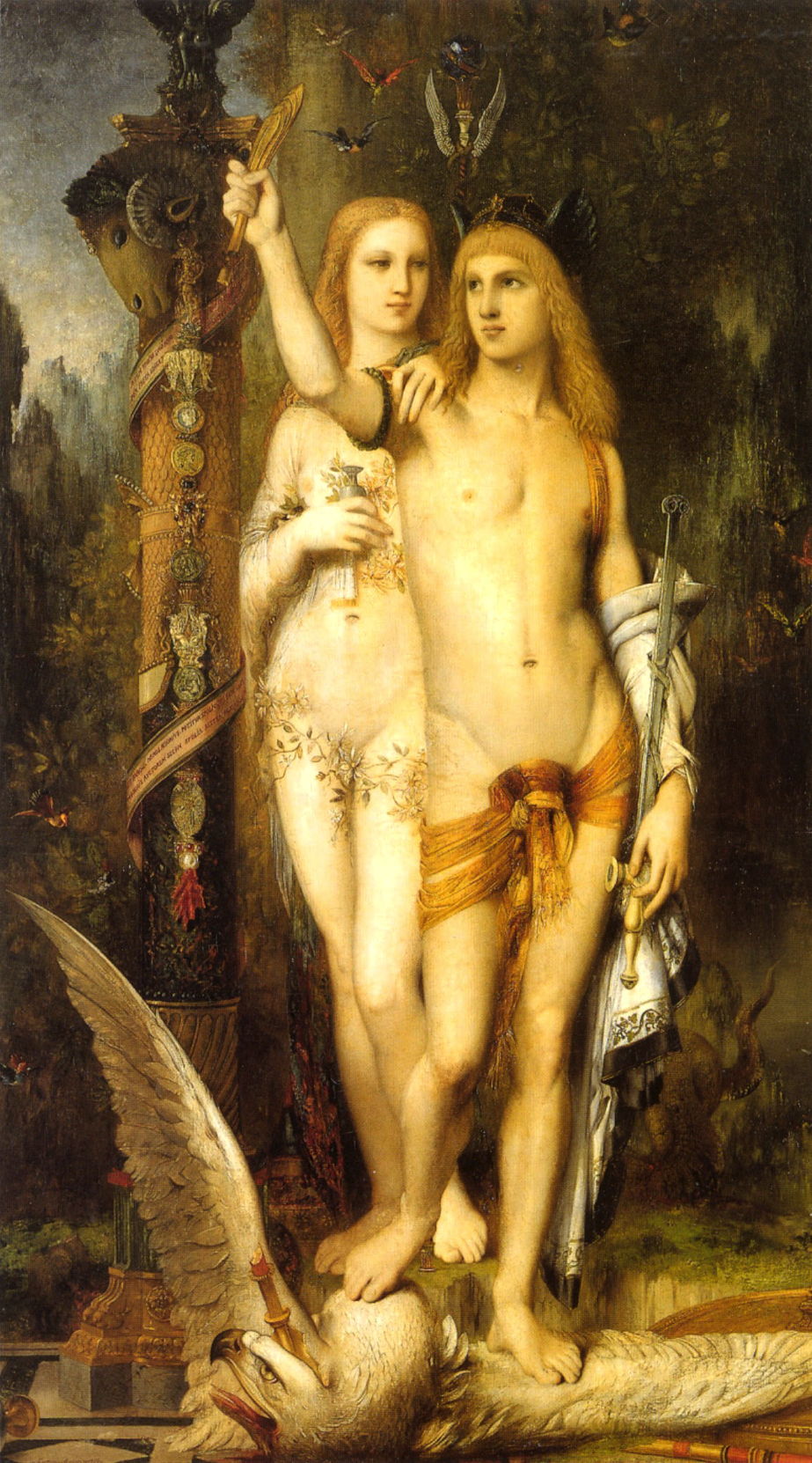
Gustave Moreau (1826–1898), Jason (1865), oil on canvas, 204 × 115 cm, Musée d’Orsay, Paris. Wikimedia Commons.
The name Jason refers, of course, to Jason of Golden Fleece and Argonauts fame, a series of swashbuckling adventures offering ample opportunities for theatrical narrative painting. Moreau avoids them all, and shows us a static Jason, with Medea stood behind him, not a Golden Fleece in sight. Instead of providing narrative, the artist offers us symbols as clues to what might be going on.
The broad outline of Jason’s story is simple. When he reached Colchis, he underwent a series of trials imposed by King Aeëtes, culminating in his victory over the dragon guarding the Golden Fleece. These were accomplished with the help of Medea, the King’s daughter, in return for a promise of marriage.
The almost naked woman behind Jason is Medea, the sorceress who has fallen in love with the hero. The ram’s head at the top of the pillar on the left signifies the Golden Fleece, and the dragon which guarded it is shown as the eagle on which Jason is standing, with the broken tip of his javelin embedded in it. This is the more confusing, as in the original story the dragon was put to sleep by one of Medea’s potions, rather than being killed with a javelin.
Yet Medea holds a vial in her right hand, and her body is swathed with the poisonous hellebore plant, a standard tool of witchcraft. These may allude to Jason’s future rejection of Medea and her poisoning of his replacement bride, but there is a lot of story between this moment and that later episode, so that is speculative and hardly clarified by the painting.
Moreau provided some clues to his intentions in this painting, in the almost illegible inscriptions on the two phylacteries wound around the column. These bear the Latin: nempe tenens quod amo gremioque in Iasonis haerens
per freta longa ferar; nihil illum amplexa timebo
(Nay, holding that which I love, and resting in Jason’s arms, I shall travel over the long reaches of the sea; in his safe embrace I will fear nothing) et auro heros Aesonius potitur spolioque superbus
muneris auctorem secum spolia altera portans
(And the heroic son of Aeson [i.e. Jason] gained the Golden Fleece. Proud of this spoil and bearing with him the giver of his prize, another spoil)
(Cooke, pp 55-56.)
These could be interpreted as suggesting that the painting should be read in terms of the conflict between Jason and Medea: Medea expresses her subjugate trust in him, while Jason considers her to be just another spoil won alongside the Golden Fleece. More puzzling is the spattering of other details, of hummingbirds, the sphinx on top of the pillar, medals decorating the shaft of that pillar, and more. Some appear merely to be decorative, but drawing the line between the decorative and the symbolic is impossible.
The end result in Jason is almost the opposite of Oedipus and the Sphinx: the latter consists of a clear narrative lightly embellished with symbols, the former relies on the interpretation of symbols to construct any narrative; as those symbols conflict with the original narrative, the viewer can readily become bewildered.
The 1865 Salon didn’t provide the consolidation for which Moreau had hoped, although much of that was the result of an accident of history: dominating all discussion that year was another painting, Manet’s Olympia. He needed to do better in 1866 if he wasn’t going to slip back into obscurity.
Gustave Moreau (1826–1898), Orpheus (1865), oil on panel, 154 × 99.5 cm, Musée d’Orsay, Paris. Wikimedia Commons.
In Moreau’s Orpheus (1865) a sombrely-dressed Thracian woman holds Orpheus’ lyre, on which rests his head, blanched in death, as if affixed to the lyre like the head of a hunting trophy. Her eyes are closed in reverie.
One version of the legend of Orpheus’ death holds that his head and lyre were borne by the river Hebrus, which is shown in the background landscape to the right. Again, though, Moreau pursues his own adjusted version of the written narrative, as according to that account (in Ovid’s Metamorphoses, book 11), the head and lyre were washed up on the coast of Lesbos.
Orpheus adopts a unified tonality, colour, form, character, and style that could be viewed as a ‘mode’, as conceived by Nicolas Poussin. The gentle and natural beauty of the Thracian woman, her ornate clothes, flowers, and the strange beauty of Orpheus’ head on the lyre contrast with a harsh and barren landscape, which might have been more appropriate in a Renaissance painting, perhaps by Leonardo da Vinci.
Moreau has carefully avoided elaborate symbols and decoration, although he has left us two further puzzles at the painting’s corners: the three figures, apparently shepherds, on the rocks at the upper left, and a pair of tortoises at the lower right. The figures refer to music, which seems in keeping with Orpheus and his lyre, but the significance of the tortoises is open to speculation.
Gustave Moreau (1826–1898), Orpheus (detail) (1865), oil on panel, 154 × 99.5 cm, Musée d’Orsay, Paris. Wikimedia Commons.
What Moreau lost in the absence of narrative, this painting gained in its remarkable tranquillity. Two faces, eyes closed, (don’t) look at one another. The intricate decoration of the lyre seems unified with the Thracian woman’s clothing, even the coiled braids of her hair. Although one of his most profoundly beautiful and moving paintings, this failed to impress the Salon.
In 1868-9 he turned to one of the most frequently painted stories from Greek mythology, that of the abduction and rape of Europa. She was the mother of King Minos of Crete, and the story of Cretan origin; the bull was the main sacred animal in Crete. Zeus (Jupiter to the Romans), a notorious ravisher of women, lusted after the beautiful Europa. He therefore metamorphosed himself into a white bull, and hid among Europa’s father’s herd in Phoenicia. When Europa and other maidens came to gather flowers near this herd, she saw the white bull, caressed it, and climbed onto its back.
Zeus then ran to the sea and swam with Europa on his back until they reached the shores of Crete. There he revealed himself, and Europa became the first queen of the island. He gave her in return a necklace, Talos (a giant bronze automaton who protected Crete by circling its shores), Laelaps (an unfailing hunting dog), and a javelin that always struck its target.
Almost universally, previous depictions of this myth have shown the start of the abduction, from the pastures of Phoenicia to the bull heading off to sea. Moreau’s white bull, with Europa riding a precarious side-saddle, has just emerged from the sea, so is presumably now on the island of Crete.
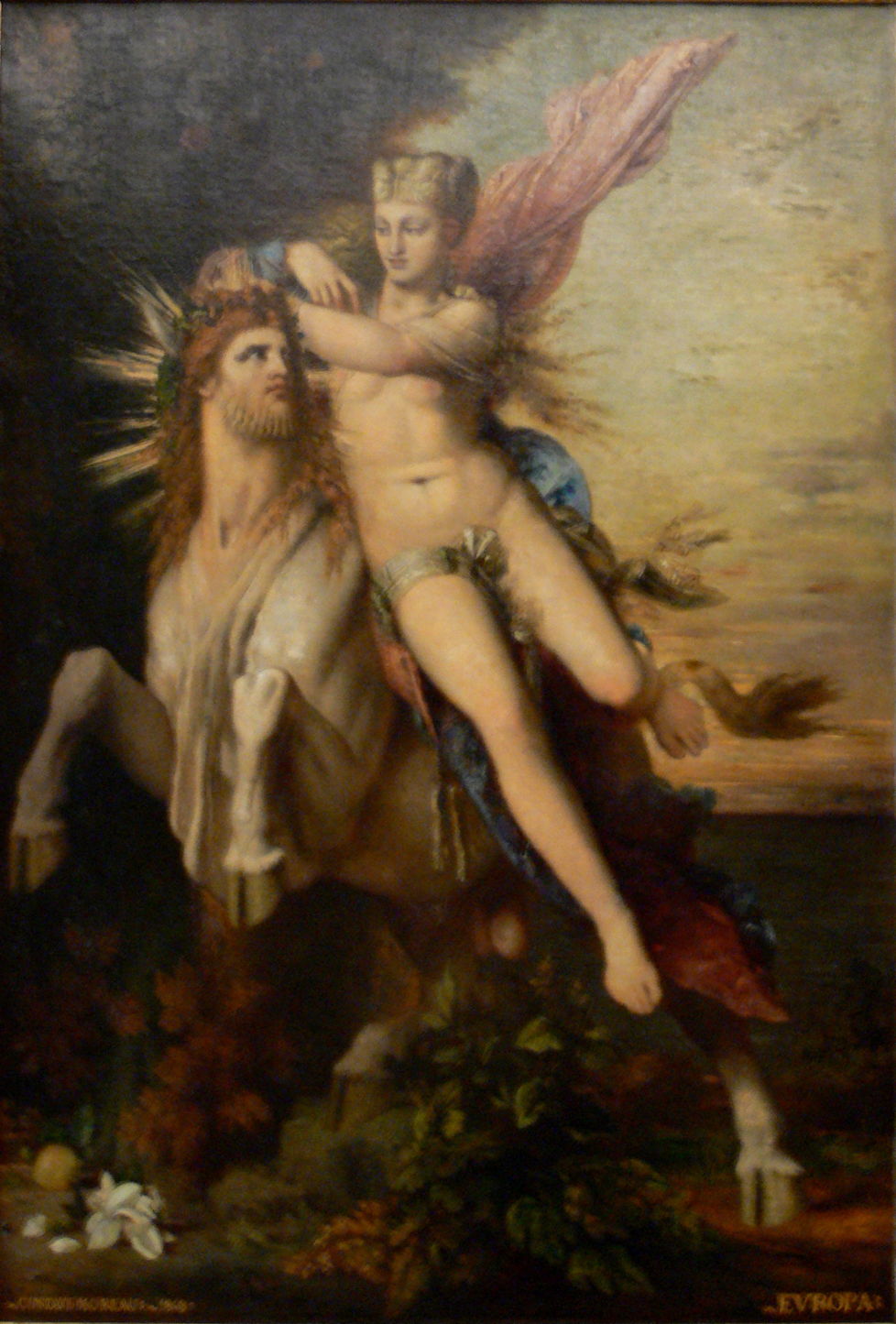
Gustave Moreau (1826–1898), Jupiter and Europa (1868-9), oil on canvas, 175 x 130 cm, Musée National Gustave-Moreau, Paris. Wikimedia Commons.
The finished work, known as Jupiter and Europa (1868-9) (I apologise for the lack of sharpness in this image) but titled Europa, shows the bull with a human head, presumably as Zeus has revealed himself to Europa. The head of Zeus recalls those of sculptures of Assyrian kings.
It’s hard to see what Moreau brought in terms of originality to this well-worn motif, and the critics drew comparison with Veronese rather than Titian. Either way, this seems to be a painting in search of a reason, and the Salon agreed. As there was now a small but dedicated group of collectors who were prepared to purchase his paintings, Moreau decided to withdraw from exhibiting at the annual Salon.
In the Franco-Prussian War, Moreau joined the National Guard, and served in the defence of Paris in the autumn of 1870, besieged there with his mother. Over the winter his left shoulder and arm became immobile because of ‘rheumatism’, but he remained in the city. Finally, during the Commune in the spring of 1871, he defended the paintings he had amassed in his home, and watched his late friend Chassériau’s murals in the Cour des Comptes being destroyed by fire. He spent that summer recovering in the spa at Néris-les-Bains in the Auvergne.
References
Cooke P (2014) Gustave Moreau, History Painting, Spirituality and Symbolism, Yale UP. ISBN 978 0 300 20433 9.
Mathieu P-L (1998, 2010) Gustave Moreau, the Assembler of Dreams, PocheCouleur. ISBN 978 2 867 70194 8.
Although Naturalist painting had originated in the countryside among the rural poor, it soon came to record changing times in science. One of the more prominent painters of science and scientists was Léon Lhermitte, now known almost entirely for his rural paintings.
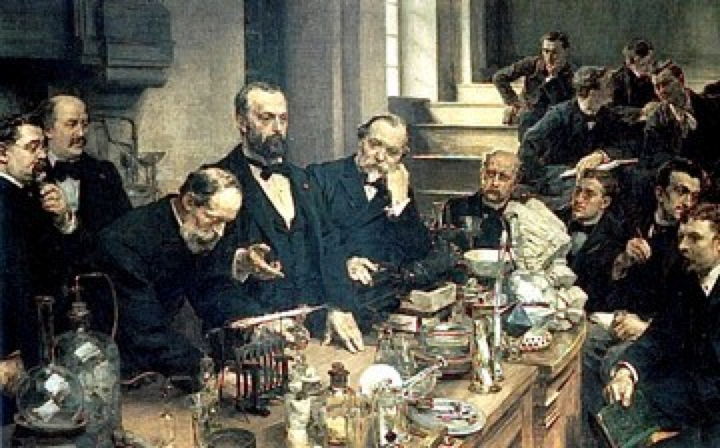
Léon Augustin Lhermitte (1844–1925), Claude Bernard and His Pupils (1889), copy of original by unknown artist, oil on canvas, 86.5 x 112.5 cm, Wellcome Library no. 45530i, London. Courtesy of Wellcome Images, via Wikimedia Commons.
Claude Bernard (1813-1878) was a pioneering physiologist whose writings were of great influence to Naturalists, including Émile Zola. Following Bernard’s death, the Sorbonne (where he had taught) commissioned Lhermitte to paint his portrait in 1886. This is a faithful anonymous copy of Claude Bernard and His Pupils, which was exhibited at the Salon in 1889. This shows Bernard in the midst of performing an experiment on a rabbit, his students discussing its results, and one writing the experimental observations in the laboratory daybook.
Léon Augustin Lhermitte (1844–1925), The Chemist Henri Sainte Claire Deville, Lesson on Aluminium (1890), The Sorbonne, Paris. Wikimedia Commons.
Lhermitte’s painting of The Chemist Henri-Étienne Sainte-Claire Deville, Lesson on Aluminium from the following year was also commissioned by the Sorbonne in Paris; I apologise for the small size of this image. Henri-Étienne Sainte-Claire Deville (1818-1881) was responsible for many significant discoveries in chemistry, the most important being a method for the industrial manufacture of aluminium. He’s shown here surrounded by objects made from this new material, which quickly came to transform manufacturing and to invade every home.
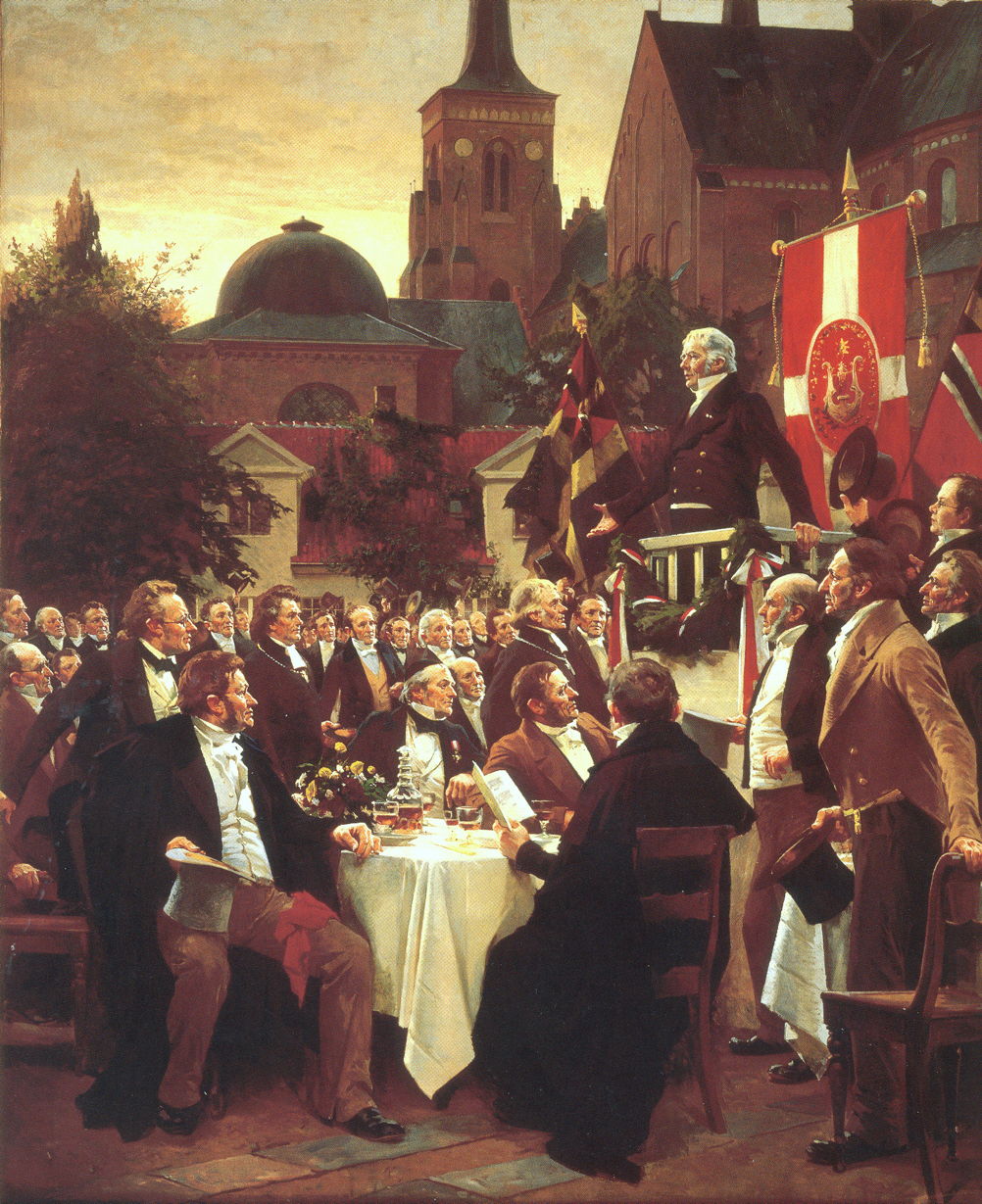
Erik Henningsen (1855–1930), The Nordic Natural Science Research Meeting 14 July 1847 (1895), mural, dimensions not known, Aula, University of Copenhagen, Copenhagen, Denmark. Wikimedia Commons.
Several Naturalist painters were commissioned to paint murals depicting scientific events for universities. Among them is Erik Henningsen’s The Nordic Natural Science Research Meeting 14 July 1847, completed in 1895 for the Aula of the University of Copenhagen. Presiding over this scientific meeting was the great Danish physicist and chemist Hans Christian Ørsted, who was nearly seventy at the time.
Technology was also becoming commonplace at work.
Charles Frederic Ulrich (1858–1908), The Village Printing Shop, Haarlem (1884), oil on panel, 54 × 58.3 cm, Terra Museum of American Art, Chicago, IL. Wikimedia Commons.
Charles Frederic Ulrich painted a young apprentice drinking during a moment’s pause in his work in The Village Printing Shop, Haarlem (1884). In the background is a large and relatively modern printing press.
Jean-Eugène Buland (1852–1926), Un Patron, or The Apprentice’s Lesson (1888), oil on canvas, 102 x 82 cm, Nationalmuseum, Stockholm, Sweden. Image by Erik Cornelius, via Wikimedia Commons.
Another Naturalist artist, Jean-Eugène Buland, in his Un Patron, or The Apprentice’s Lesson from 1888 shows a young boy being trained to make a cogwheel. This was part of the French industrial recovery following its defeat in the Franco-Prussian War.
Louis Muraton (1850–1919), The Photographer (before 1901), further details not known. Wikimedia Commons.
The subject of Louis Muraton’s The Photographer, painted before 1901, is rocking a glass plate in a bath of developer, in his improvised darkroom, another sign of the times.
Major innovations in medical procedures and care were introduced, and duly recorded in Naturalist paintings.
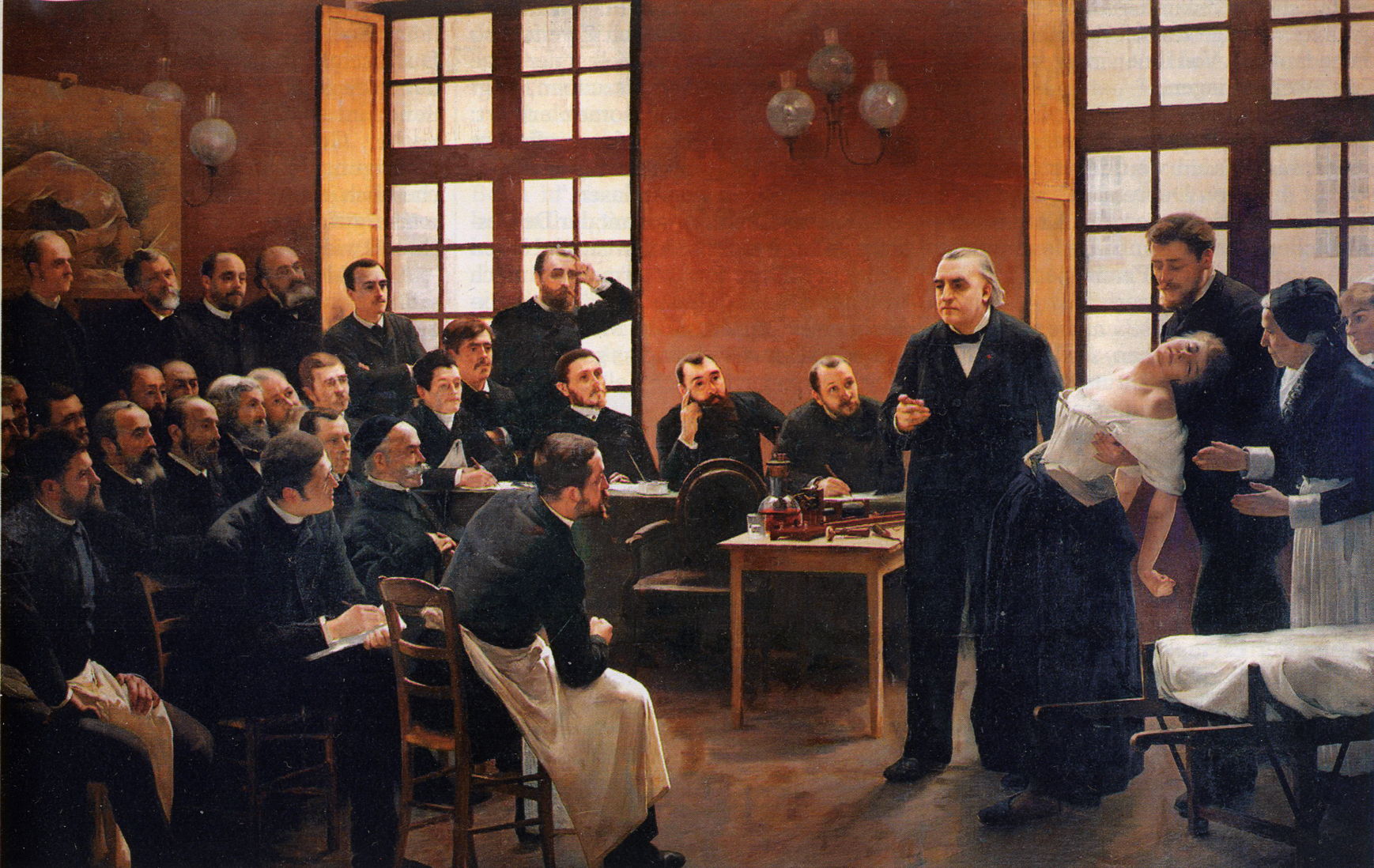
André Brouillet (1857–1914), A Clinical Lesson at The Salpêtrière Hospital (1887), oil, 290 x 430 cm, Paris Descartes University, Paris. Wikimedia Commons.
In André Brouillet’s A Clinical Lesson at the Salpêtrière Hospital (1887), an eminent neurologist Jean-Martin Charcot is demonstrating how he could hypnotise Marie “Blanche” Wittman, the ‘Queen of Hysterics’, into suffering hysterical collapse. Charcot and Wittman were a renowned partnership in this ‘act’, who performed in front of Sigmund Freud when he visited the hospital.
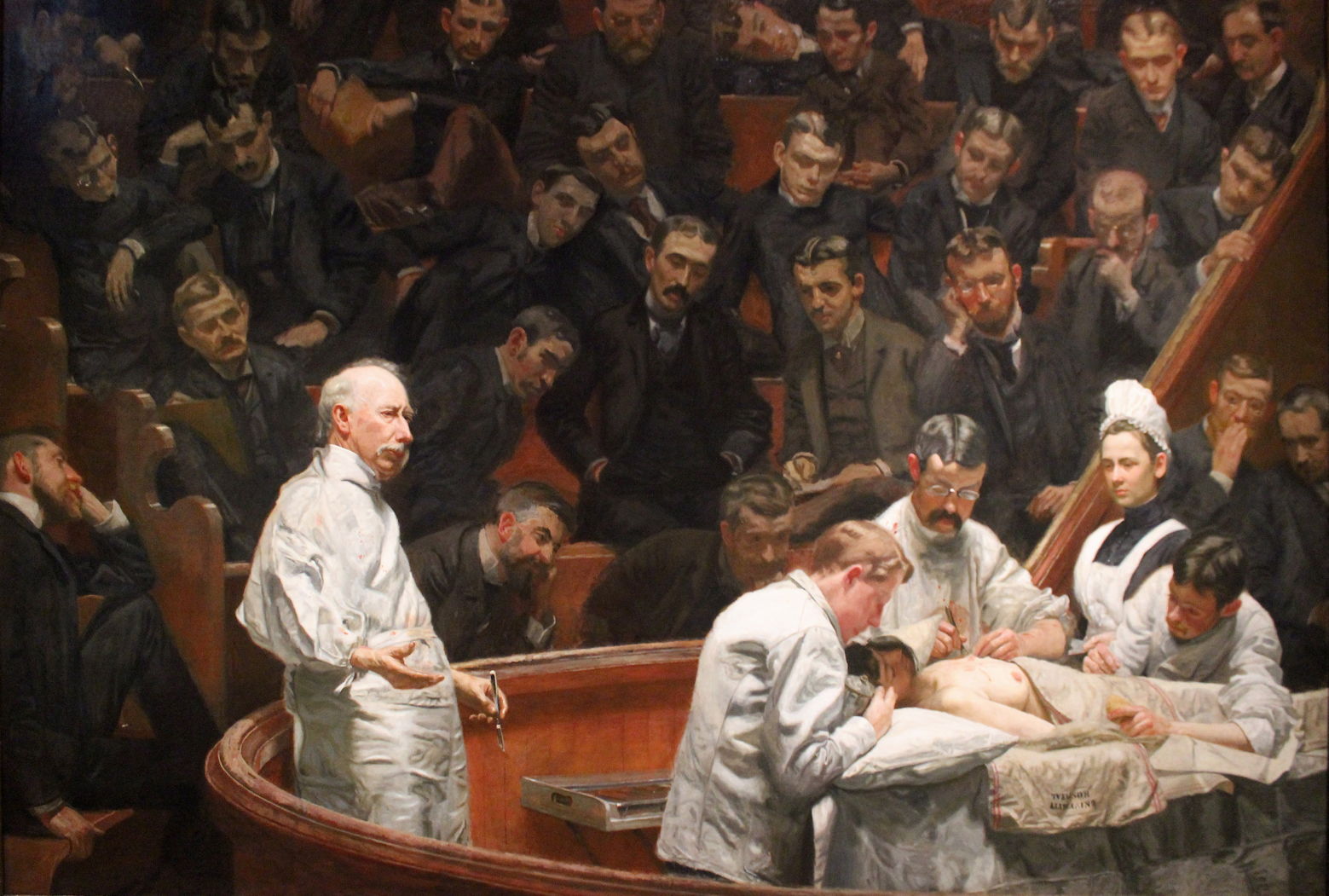
Thomas Eakins (1844–1916), The Agnew Clinic (1889), oil on canvas, 214.2 x 300.1 cm, Philadelphia Museum of Art, Philadelphia, PA. Wikimedia Commons.
In the USA, Thomas Eakins painted the retiring professor of surgery, Dr. David Hayes Agnew, at work in the University of Pennsylvania School of Medicine. The patient is unconscious thanks to a volatile liquid general anaesthetic administered via a mask. Bright surgical lighting puts six figures literally in the limelight, including that of Agnew, holding a scalpel at the left.
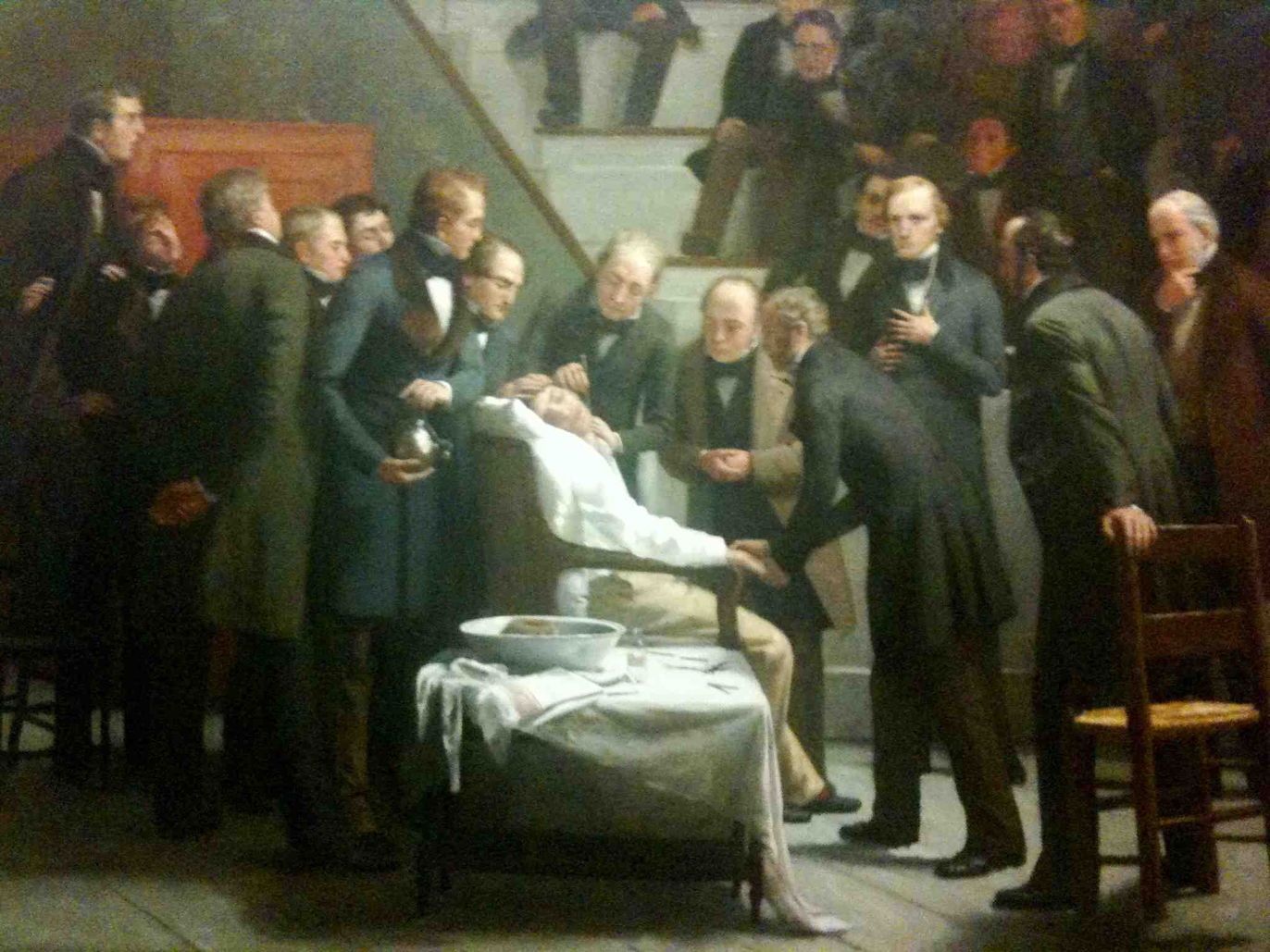
Robert C. Hinckley (1853–1941), Ether Day, or The First Operation with Ether (1882-93), oil on canvas, 243.8 x 292.1 cm, Francis A. Countway Library of Medicine, Harvard University, Cambridge, MA. Wikimedia Commons.
Robert C. Hinckley’s Ether Day, or The First Operation with Ether, painted between 1882-93, recreates the scene on 16 October 1846 in what is now known as the Ether Dome in the Massachusetts General Hospital, Boston, MA. Here John Collins Warren is removing a tumour from the neck of a local printer, Edward G Abbott, who was anaesthetised using ether, in its first recorded use for a general surgical procedure; I apologise for the poor quality of this image.
Anna Sahlstén (1859–1931), Surgery in hospital (c 1893), oil on canvas, dimensions not known, EMMA – Espoon modernin taiteen museo, Espoo, Finland. Wikimedia Commons.
Finally, Anna Sahlstén’s Surgery in Hospital from about 1893 shows the dazzling whiteness of the modern hospital, with a smart professional nurse caring for a child patient in the background. On the wall is a large radiator for the hospital’s modern heating system, which replaced the old stoves seen in so many earlier images of hospital wards.
The original intent of the French Impressionists was to paint quickly in front of the motif so as to capture its impression. Although many Impressionist depictions of reflections aren’t optically faithful, in practice there’s nothing to prevent them from that. This was amply demonstrated by the grandfather of Impressionism, Camille Corot, during his formative years spent developing his skills in Rome.
Jean-Baptiste-Camille Corot (1796-1875), The Island and Bridge of San Bartolomeo (1825/8), oil on paper on canvas, 27 x 43.2 cm, National Gallery of Art, Washington DC. WikiArt.
Corot’s earliest plein air works are truly prodigious in their quality, and his development of the art. By the time that the Impressionists were painting outdoors, after 1841, oil paint was widely available in far more convenient metal tubes. But when Corot was in Italy he enjoyed no such luxuries: paint came in small bladders that were far less portable and messier to work with. Despite that, his view of The Island and Bridge of San Bartolomeo from 1825/8 appears optically accurate.
Jean-Baptiste-Camille Corot (1796-1875), View of Rome: The Bridge and Castel Sant’Angelo with the Cupola of St. Peter’s (1826-7), oil on paper on canvas, 26.7 x 43.2 cm, Fine Arts Museums of San Francisco. WikiArt.
Corot’s View of Rome: The Bridge and Castel Sant’Angelo with the Cupola of St. Peter’s from 1826-7 is another brilliant example painted on paper in front of the motif.
Claude Monet’s reflections are generally shown on broken water, and appear intended to be optically correct.
Claude Monet (1840–1926), The Thames below Westminster (1871), oil on canvas, 47 x 73 cm, The National Gallery, London. Wikimedia Commons.
Monet painted The Thames below Westminster while he was in London in 1871, and returned over thirty years later to paint more radical series of views in different lighting conditions.
Claude Monet (1840–1926), Impression, Sunrise (1872), oil on canvas, 48 x 63 cm, Musée Marmottan Monet, Paris. Wikimedia Commons.
The following year, he painted this view of his home port of Le Havre, which gave rise to the movement’s name, Impression, Sunrise. This appears to be a brisk oil sketch of fog and the rising sun, and is one of his series depicting the port at different times and in varying lights, exhibited in the First Impressionist Exhibition two years later.
Alfred Sisley (1839–1899), The Canal Saint-Martin, Paris (1872), oil on canvas, 38 x 46 cm, Musée d’Orsay, Paris. EHN & DIJ Oakley.
The same year, Alfred Sisley’s view of The Canal Saint-Martin, Paris shows a placid and almost disused stretch of canal near the centre of Paris. This too appears to be optically correct.
Claude Monet (1840-1926), Autumn on the Seine, Argenteuil (1873), oil on canvas, 54.3 × 73.3 cm, High Museum of Art, Atlanta, GA. Wikimedia Commons.
In 1873, Monet painted his masterwork Autumn on the Seine, Argenteuil, a textbook example of a river landscape in autumn painted in high Impressionist style, with high chroma, loose brushstrokes and faithful reflections.
Claude Monet (1840-1926), View of the Church at Vernon (1883), oil on canvas, 65 x 81 cm, Yamagata Museum of Art, Japan. (WikiArt)
Although Monet’s View of the Church at Vernon from 1883 doesn’t appear entirely optically accurate, its intent is clear. The reflection of the large house at the right is extended a little too far to the right, as if there had been a tall tree beside it on the bank, where the original image shows another lower house set further back.
Some of Monet’s later series relied on reflections for their visual effects, although they also take more optical liberties.
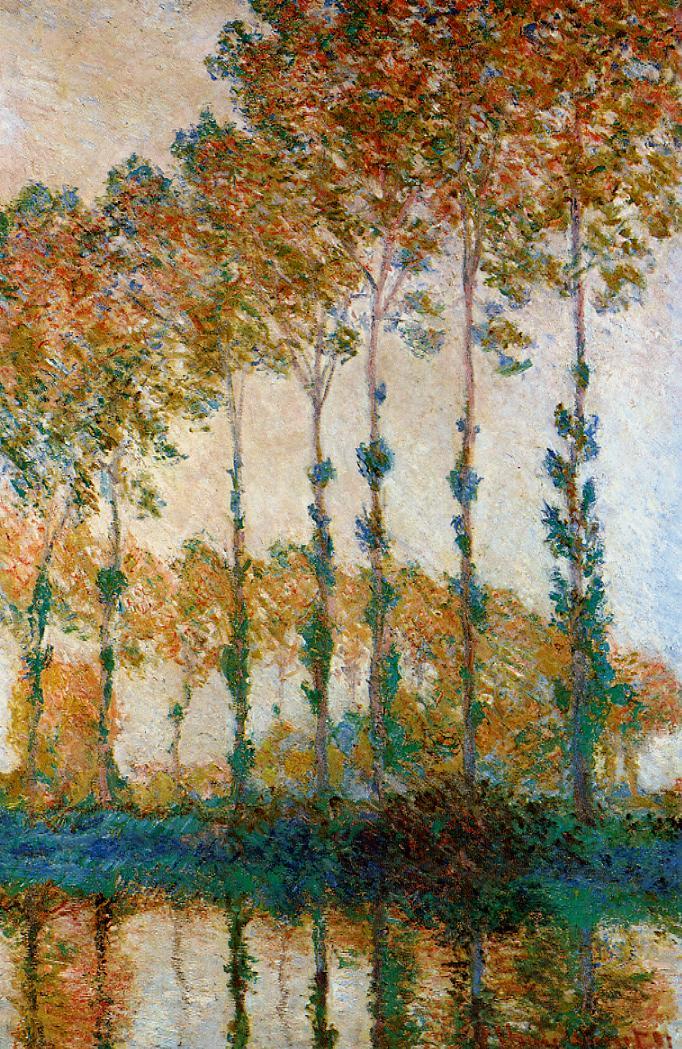
Claude Monet (1840-1926), Poplars on the Bank of the Epte, Autumn (1891) W1297, oil on canvas, 100 x 65 cm, Museum of Fine Arts, Boston. WikiArt.
In 1891, Monet painted his first formal series showing poplars, including Poplars on the Bank of the Epte, Autumn. These articulate the contrasts in form within each tree, with sections of bare trunk, and those of extensive canopy, the colours cast by light and those of the leaves themselves, the rhythmic assembly of the line of trees, their reflections on the water, and the formation of the line of poplars into sweeping curves in depth.
Alfred Sisley (1839–1899), The Bend on the Loing at Moret (1886), oil on canvas, 54 x 74 cm, Private collection. Wikimedia Commons.
The broken water surface in Sisley’s Bend on the Loing at Moret from 1886 remains surprisingly faithful.
Alfred Sisley (1839-1899), Moret Bridge in the Sunlight (1892), oil on canvas, 65 x 81 cm, Private collection. WikiArt.
In Moret Bridge in the Sunlight from 1892, Sisley captures the reflections of the buildings dominating the centre of this small town on the River Loing.
Claude Monet (1840–1926), The Houses of Parliament, Sunset (1903), oil on canvas, 81.3 × 92.5 cm, The National Gallery of Art, Washington, DC. Wikimedia Commons.
Claude Monet’s return to London in 1903 revisits The Houses of Parliament, Sunset fairly faithfully.
Of all the painting media, oils give the artist greatest flexibility to change their mind. Even when relatively ‘dry’, they can be scraped back carefully and overpainted, although in many cases overpainting is all that’s required. When such changes are detected by the viewer, they’re often referred to as a pentimento, appropriately the Italian for repentance, with pentimenti in the plural.
Written accounts of artists’ practices and careful examination of their paintings can reveal much about their methods. Some undertake such extensive preparations that painting the finished work invariably goes according to plan. Others may rework their composition extensively as it develops, and leave copious evidence of how they changed their mind.
Leonardo da Vinci (1452–1519), Madonna with a Flower (Benois Madonna) (c 1481-83), oil on wood transferred to canvas, 49.5 × 31 cm, Hermitage Museum Государственный Эрмитаж, Saint Petersburg, Russia. Wikimedia Commons.
Several of Leonardo da Vinci’s paintings show how he changed his mind as he worked on the finished painting. His Madonna with a Flower, popularly known as the Benois Madonna, is thought to date from 1481-83, and was preceded in the years 1475-80 by numerous sketches and studies of the Madonna, including several that are strongly linked with this composition. Nevertheless, examination of this painting reveals many pentimenti: the infant’s head was originally larger, and the grasses held by the Madonna in her left hand were originally flowers. Those aren’t visible in this image, though.
Pentimenti can be revealed using special techniques, including infra-red reflectography.
Lucas Cranach the Elder (1472–1553), The Martyrdom of Saint Catherine (1504-5), oil on wood, 112 x 95 cm, Dunamelléki Református Egyházkerület Budapest, Kecskemét, Budapest, Hungary. Wikimedia Commons.
There’s no readily visible evidence that Lucas Cranach the Elder made changes during his painting of The Martyrdom of Saint Catherine in 1504-5.
Lucas Cranach the Elder (1472–1553), The Martyrdom of Saint Catherine (infra-red reflectogram, 900-1700 nm) (1504-5), oil on wood, 112 x 95 cm, Dunamelléki Református Egyházkerület Budapest, Kecskemét, Budapest, Hungary. Wikimedia Commons.
Cranach had a reputation for being quite an impulsive and rapid painter, which seems to be borne out by more thorough analysis. His early works, in particular, show evidence of repeated adjustments in form and colour. The infra-red reflectogram of the Martyrdom of Saint Catherine, below, shows how he laid down the figures in detail in the underdrawing, but extemporised the pyrotechnic effects.
Lucas Cranach the Elder (1472–1553), The Martyrdom of Saint Catherine (detail) (1504-5), oil on wood, 112 x 95 cm, Dunamelléki Református Egyházkerület Budapest, Kecskemét, Budapest, Hungary. Wikimedia Commons.Lucas Cranach the Elder (1472–1553), The Martyrdom of Saint Catherine (infra-red reflectogram, 900-1700 nm) (detail) (1504-5), oil on wood, 112 x 95 cm, Dunamelléki Református Egyházkerület Budapest, Kecskemét, Budapest, Hungary. Wikimedia Commons.
Considerable changes were made to the details during the painting process, as seen here in the underdrawing of the executioner, and the figures to the right of his head.
Sometimes the ageing of a painting brings pentimenti to light, although they wouldn’t have been visible at the time they were completed.
Christoffer Wilhelm Eckersberg (1783–1853), Ulysses’ Revenge on Penelope’s Suitors (1814), media not known, 24 x 42.8 cm, Den Hirschsprungske Samling, Copenhagen, Denmark. Wikimedia Commons.
Christoffer Wilhelm Eckersberg’s Ulysses’ Revenge on Penelope’s Suitors from 1814 shows Odysseus and Telemachus at the left as they attack a small group of the suitors. There are abundant pentimenti visible now in the background, suggesting the artist changed his composition quite radically.
In more modern paintings it can be difficult to distinguish pentimenti from what the artist intended. There are many examples of this in the oil paintings of Paul Cézanne.
Paul Cézanne (1839–1906), Paysage des Bords de l’Oise (Landscape on the Banks of the Oise) (1873-4) (R224), oil on canvas, 73.5 x 93 cm, Palais Princier, Monaco. WikiArt.
Landscape on the Banks of the Oise is an Impressionist view from Cézanne’s first campaign along the River Oise, when he painted in company with Pissarro, and shows the northern bank near the hamlet of Valhermeil.
Closer examination of the reflected image of the house with the red roof merits further study of the painting. Cézanne appears to have made pentimenti to its left edge, at least, and possibly at its right edge too. It appears that an earlier attempt to paint the red roof may have shown it extending more to the left, where it would have been displaced less than now appears.
Paul Cézanne (1839–1906), Paysage des Bords de l’Oise (Landscape on the Banks of the Oise) (1873-4) (R224), oil on canvas, 73.5 x 93 cm, Palais Princier, Monaco. WikiArt. Composite image of detail, adjusted to align the original and reflected images.
These can be seen more clearly in the composite image above, in which I have moved the reflected image to the left so that it does align ‘correctly’ with the real image.
Paul Cézanne (1839–1906), Le Bassin du Jas de Bouffan en Hiver (The Pond of the Jas de Bouffan in Winter) (1878) (R350), oil on canvas, 52.5 x 56 cm, Private collection. WikiArt.
In this painting of The Pond of the Jas de Bouffan in Winter, a view Cézanne must have seen almost every day that he went out from his family home, there is evidence of pentimenti in the right side of the reflected image.
Other media are less forgiving. Watercolours can sometimes cope with small changes, but all too often fail completely. Scraping back isn’t normally possible with acrylics, which tend to be overpainted without scraping, as the latter strips the entire paint layer and may also damage the ground.
The crusaders led by Godfrey of Bouillon desperately need Rinaldo back if they are to resume their assault on Jerusalem. Guelph’s party, notably the knights Charles (Carlo) and Ubaldo, have gone in search of him. But Rinaldo has been lured into a trap by the sorceress Armida, who intended to kill him. At the last moment, though, she falls in love with him and abducts him in her chariot.
That flies the couple to the distant, deserted and enchanted Fortunate Isles, where she lives in her garden that is perpetually in Spring. The wizard explains this to Charles and Ubaldo, to aid them in their mission to rescue the knight.
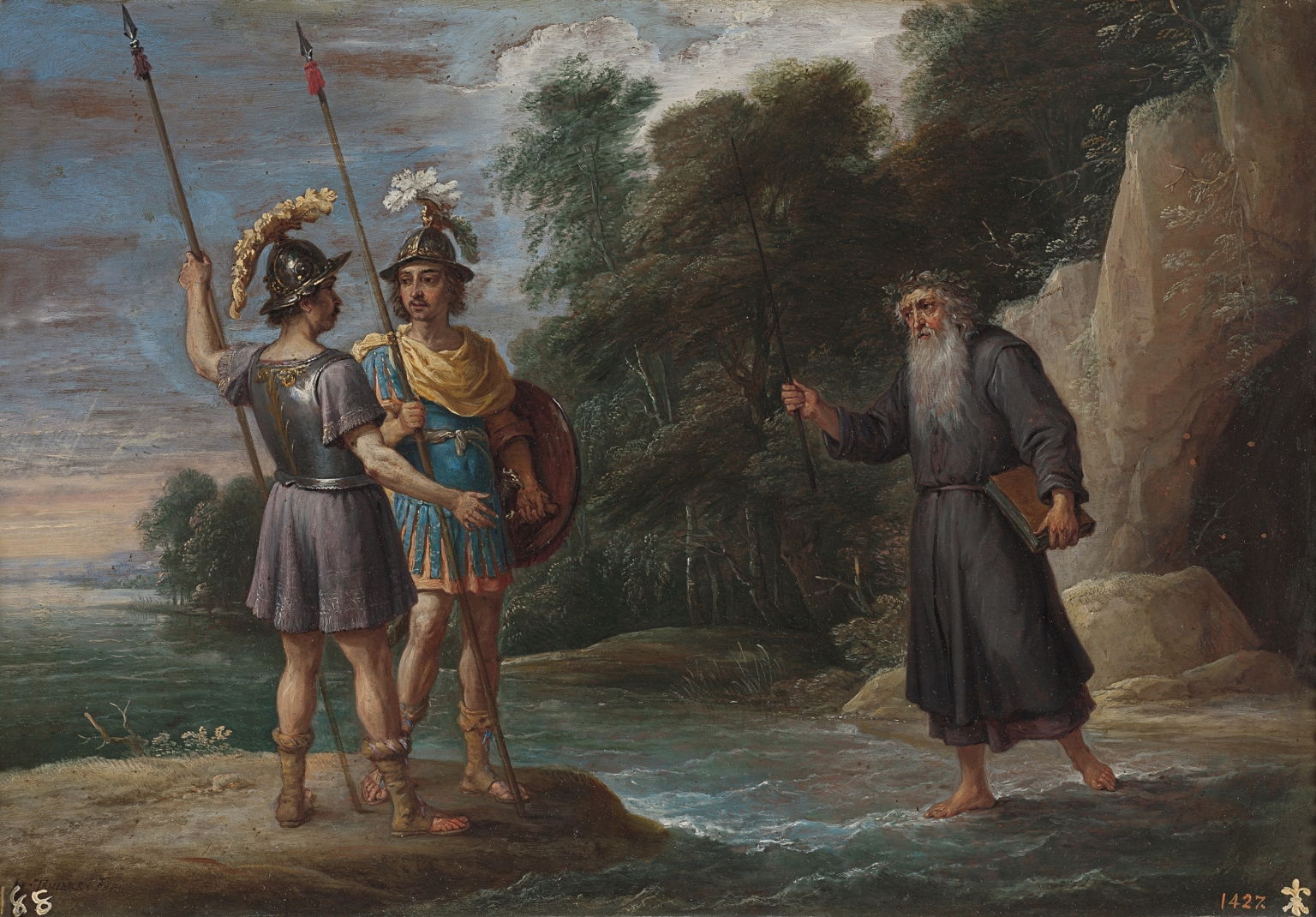
David Teniers the Younger (1610–1690), The Magician Shows Carlos and Ubaldo the Whereabouts of Rinaldo (The search for Rinaldo) (1628-30), oil on copper, 27 x 39 cm , Museo Nacional del Prado, Madrid, Spain. Wikimedia Commons.
David Teniers the Younger’s The Magician Shows Carlos and Ubaldo the Whereabouts of Rinaldo (The search for Rinaldo) from 1628-30 is a small oil on copper painting in his series telling this section of Tasso’s epic. Here the wizard despatches the two knights to the Fortunate Isles.
At the start of canto fifteen, Charles and Ubaldo set off to retrace their steps with the wizard as their guide. The river takes them gently down to the sea, where a ship awaits. They board, and sail at miraculous speed past Ascalon and the mouths of the River Nile, westward through the Mediterranean, and through the Pillars of Hercules into the Atlantic Ocean. They eventually approach the Fortunate Isles, pull into a harbour, and the two knights disembark.
They spend the night at the foot of the mountain they have to climb to reach Armida’s garden with the captive Rinaldo. They set off at dawn, only to encounter their first obstacle: a fearsome dragon blocking their passage up the mountain. Charles draws his sword ready to slay the dragon, but Ubaldo waves a golden wand, a gift of the wizard, which drives it away.
Nicolas Poussin (1594–1665), The Companions of Rinaldo (c 1633-4), oil on canvas, 119 x 101 cm, The Metropolitan Museum of Art, New York, NY. Wikimedia Commons.
Poussin’s The Companions of Rinaldo (c 1633-4) shows the two knights confronting this dragon. Charles stands in the centre with his sword ready, but Ubaldo behind him leaves his weapon in its scabbard and brandishes his golden wand instead. In the background at the left is the magic ship in which they sailed, and standing in its prow is the maiden who steered it.
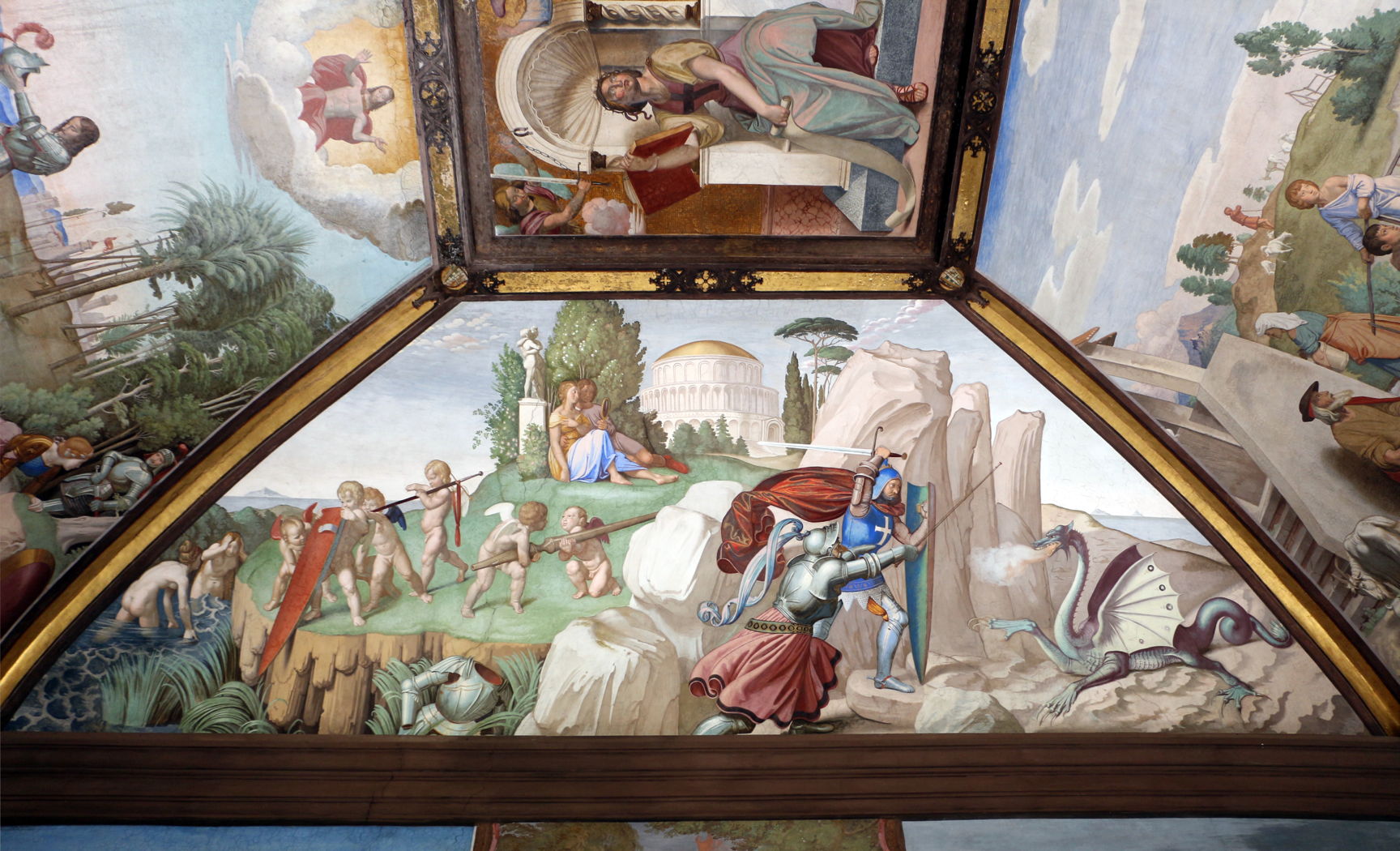
Johann Friedrich Overbeck (1789-1869), Ubaldo and Carlo free Rinaldo from Armida’s Castle (1819-27), fresco, dimensions not known, Casa Massimo, Rome, Italy. Image by Sailko, via Wikimedia Commons.
Johann Friedrich Overbeck’s fresco of Ubaldo and Carlo free Rinaldo from Armida’s Castle from 1819-27, in the Casa Massimo, Rome, shows an interesting composite scene. To the right of centre, Charles and Ubaldo wield their sword and wand, and in the distance are Armida and Rinaldo in the garden on the summit. Amorini are playing with Rinaldo’s weapons, and his empty suit of armour has been cast into the undergrowth.
Next the pair have to face a lion, which is similarly dismissed with a wave of the wand. After that comes an army of animals they disperse readily, and Charles and Ubaldo are on the ascent towards the stretch of snow and ice they must cross before reaching Armida’s eternal Spring. Once up at the top, the two knights pause from their strenuous climb, slaking their thirst in a mountain stream. Grassy banks either side of the stream have a fine banquet laid out on them, and there are two naked young women cavorting in the water.
David Teniers the Younger (1610–1690), Carlos and Ubaldo in The Fortunate Isles (1628-30), oil on copper, 27 x 39 cm, Museo Nacional del Prado, Madrid, Spain. Wikimedia Commons.
David Teniers the Younger’s Carlos and Ubaldo in The Fortunate Isles (1628-30) shows this moment, with the banquet laid out on a clean white tablecloth rather than grass. Surrounded by trees and standing proud on the skyline is Armida’s palace, their destination.
Charles-Alexandre Coëssin de la Fosse (1829–1910), Danish Warriors in the Garden of Armida (1848), others detail unknown, but believed to be oil on canvas and the original in colour. By Salon 1913, via Wikimedia Commons.
I only have this monochrome image of Charles-Alexandre Coëssin de la Fosse’s painting of Danish Warriors in the Garden of Armida from 1848. The two knights are dallying rather longer than their mission had intended.
Once Charles and Ubaldo can tear themselves away from these nymphs, they press on to the circular outer wall of the palace, which opens the sixteenth canto as they enter Armida’s garden.
Édouard Muller (1823-1876), The Garden of Armida (1854), block-printed wallpaper, 386.1 x 335.3 cm, Philadelphia Museum of Art, Philadelphia, PA. Wikimedia Commons.
In the eighteenth and nineteenth centuries, Armida’s garden appeared on all manner of products. This wallpaper designed by Édouard Muller in 1854 is now in the Philadelphia Museum of Art, while smaller images appeared on coffee cups and much else.
Tasso gives a brief description of the garden with its figs, apples and grape vines. Birds sing, and the wind murmurs softly. One bird speaks to the two knights, telling of the chaste and modest rose flower that springs virgin from its green leaves.
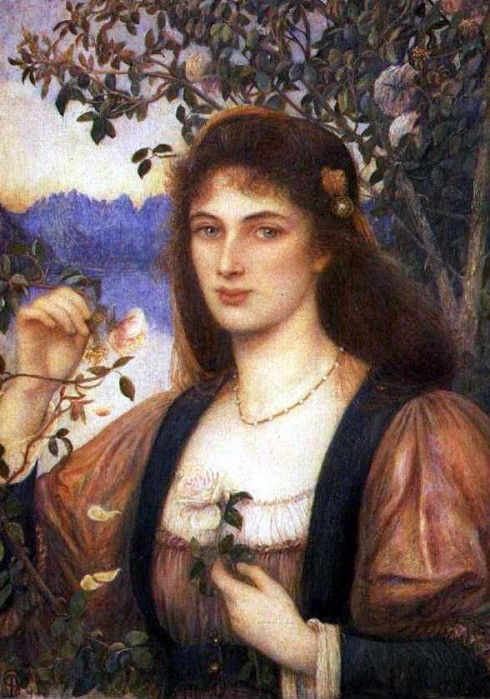
Marie Spartali Stillman (1844–1927), A Rose in Armida’s Garden (1894), watercolour and graphite on paper, 64.8 x 43.2 cm, Private collection. Wikimedia Commons.
This passage about the rose was the inspiration for Marie Spartali Stillman’s exquisite watercolour of A Rose in Armida’s Garden from 1894, given by the artist as a wedding gift to a family friend.
Charles and Ubaldo then peer through the leaves and spot a loving couple, who they presume to be Rinaldo and Armida. The knight’s head rests in Armida’s lap. He then stands up and takes a crystal glass hanging at his side. Armida uses this as a mirror to adjust her hair, telling Rinaldo to keep looking into her eyes.
Giovanni Battista Tiepolo (1696–1770), Rinaldo and Armida in Her Garden (1742-45), oil on canvas, 187 x 260 cm, The Art Institute of Chicago, Chicago, IL. Image by Sailko, via Wikimedia Commons.
Tiepolo paints this clearly in his Rinaldo and Armida in Her Garden from 1742-45, now in The Art Institute of Chicago. It was originally hung in a special room dedicated to Tasso’s epic in the Palazzo Corner a San Polo in Venice, where it belonged to the noble Serbelloni family.
Angelica Kauffman (1741–1807), Rinaldo and Armida (1771), oil on canvas, 130.8 x 153 cm, Yale Center for British Art, New Haven, CT. Wikimedia Commons.
In Angelica Kauffman’s Rinaldo and Armida from 1771, the crystal glass is ready at Armida’s feet, and she is busy distracting him by sprinkling flowers over his head.
Francesco Hayez (1791–1881), Rinaldo and Armida (1812-13), oil on canvas, dimensions not known, Gallerie dell’Accademia, Venice, Italy. Wikimedia Commons.
Francesco Hayez shows a variation in his Rinaldo and Armida from 1812-13. Anticipating the next part of Tasso’s narrative, instead of Rinaldo wearing the crystal glass at his side, his circular shield rests on the ground next to Armida. Charles and Ubaldo are shown peering from behind a tree trunk, safely in the distance.
Armida then kisses Rinaldo goodbye and leaves. Charles and Ubaldo see their opportunity and step out from the bushes, dressed in full armour. Ubaldo holds a highly polished shield up so that Rinaldo can see himself for what he has become, a woman’s dandy, not a warrior knight.
Thomas Asbridge (2004) The First Crusade, A New History, Free Press, ISBN 978 0 7432 2084 2.
Anthony M Esolen, translator (2000) Torquato Tasso, Jerusalem Delivered, Gerusalemme Liberata, Johns Hopkins UP. ISBN 978 0 801 863233. A superb modern translation into English verse.
John France (1994) Victory in the East, a Military History of the First Crusade, Cambridge UP. ISBN 978 0 521 589871.
Joanthan Riley-Smith, ed (1995) The Oxford Illustrated History of the Crusades, Oxford UP. ISBN 978 0 192 854285.
Jonathan Riley-Smith (2014) The Crusades, A History, 3rd edn., Bloomsbury. ISBN 978 1 4725 1351 9.
Johathan Unglaub (2006) Poussin and the Poetics of Painting, Pictorial Narrative and the Legacy of Tasso, Cambridge UP. ISBN 978 0 521 833677.
During the 1880s Bruno Liljefors excelled as a wildlife artist, and was appointed head of the art school in Gothenburg, Sweden, in succession to Carl Larsson. But his personal life was in turmoil, and the 1890s were barren years when he often ran short of money.
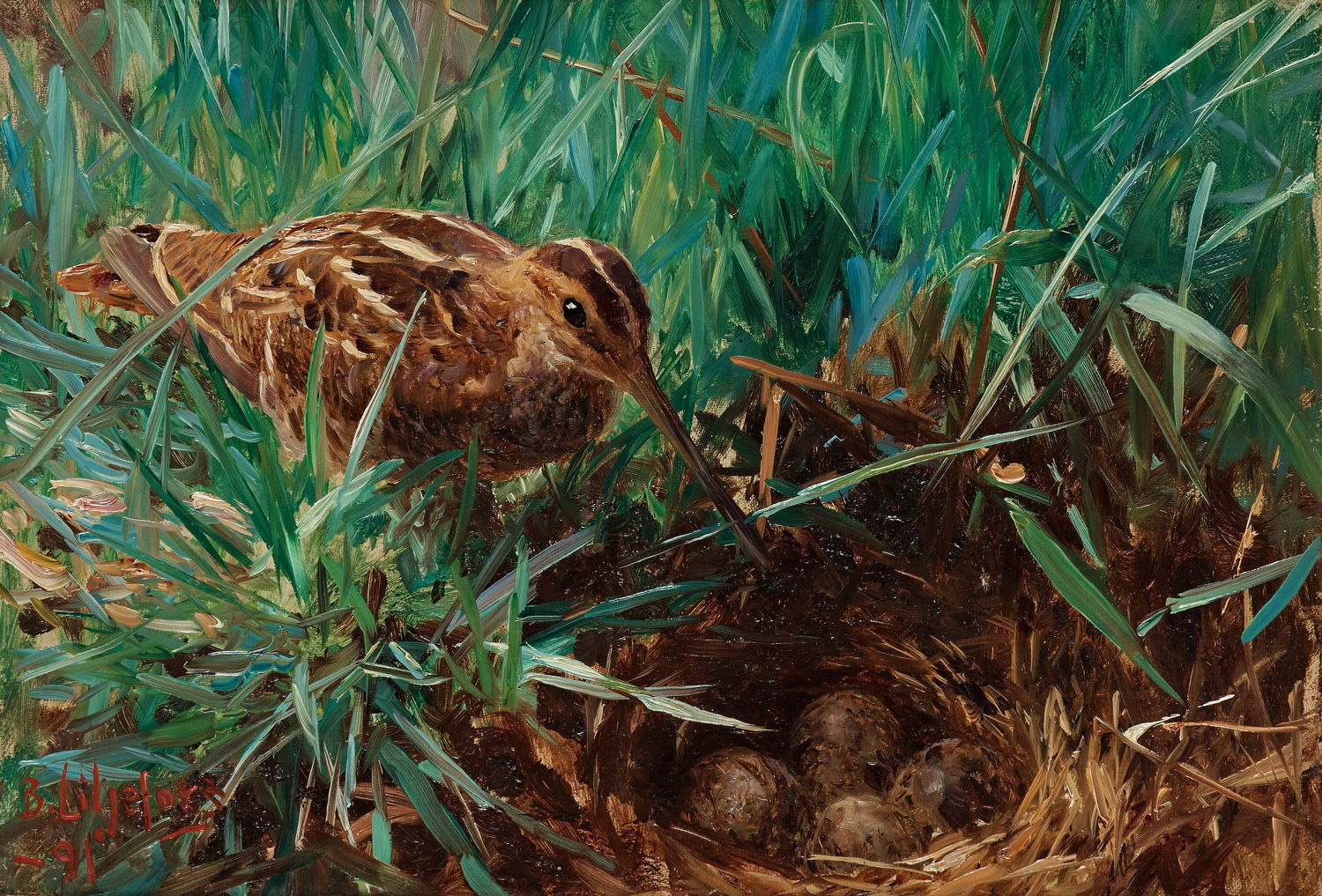
Bruno Liljefors (1860–1939), Common Snipe at its Nest (1891), oil on canvas, 25.5 × 35.5 cm, Private collection. Wikimedia Commons.
His Common Snipe at its Nest from 1891 is a fine painting, but lacks the brilliance of his earlier works, with their loose backgrounds.
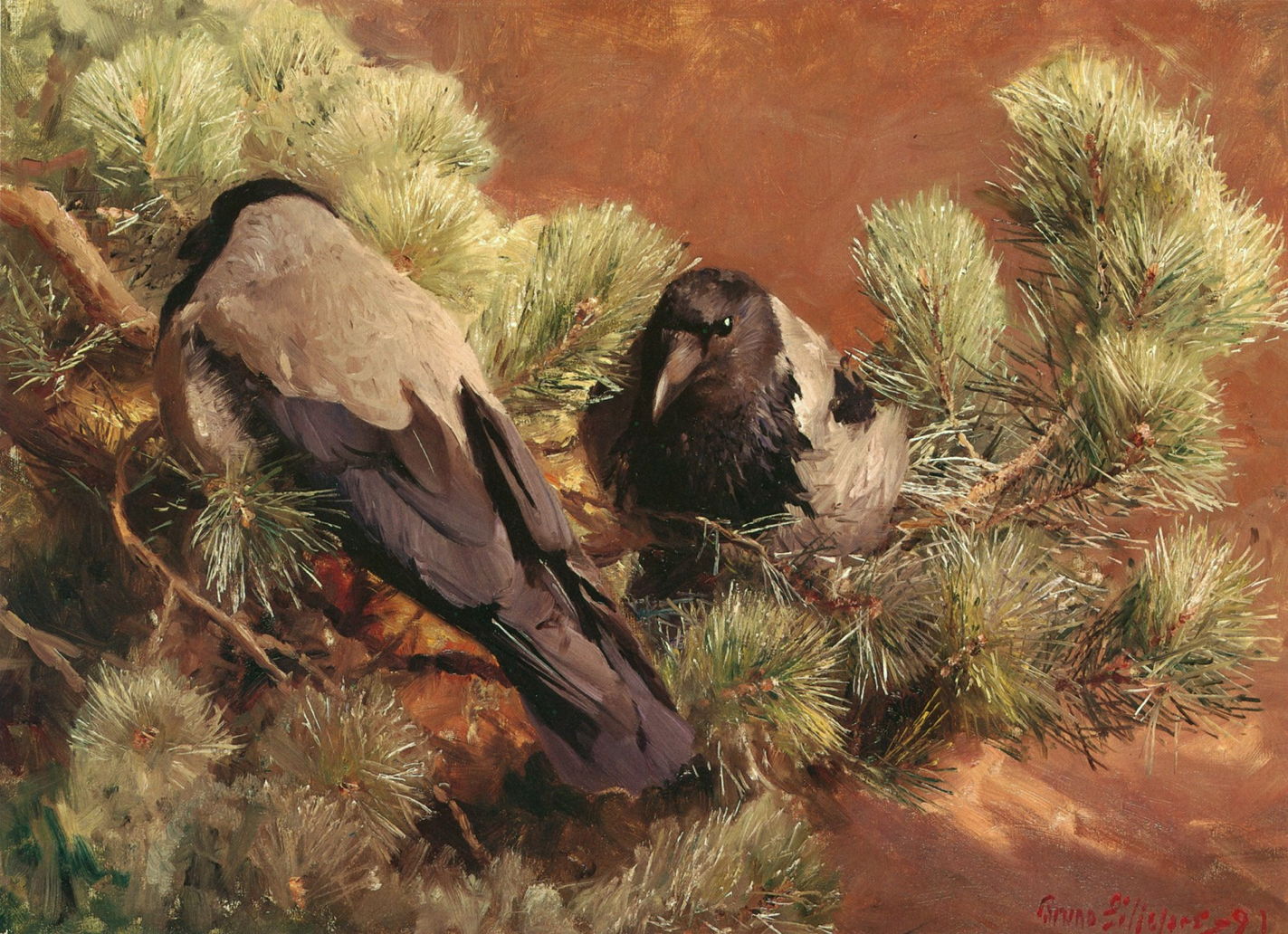
Bruno Liljefors (1860–1939), Hooded Crows (1891), oil on canvas, 52 × 70 cm, Gothenburg Art Museum, Gothenburg, Sweden. Wikimedia Commons.
Hooded Crows (1891) captures these northern members of the crow family well, though.
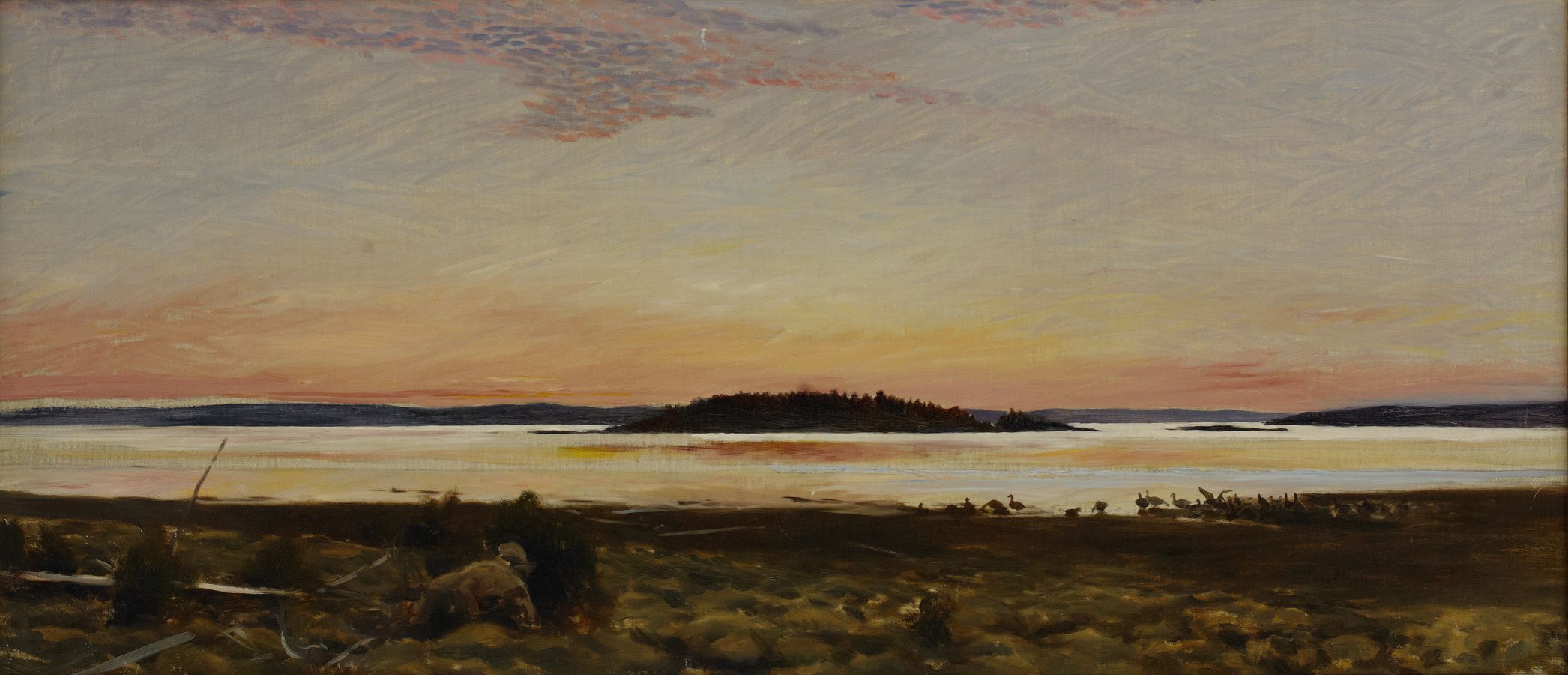
Bruno Liljefors (1860–1939), Hunting Geese (1896), oil on canvas, 61 × 137 cm, location not known. Wikimedia Commons.
Some of his finest paintings from this period are almost pure landscapes, such as his Hunting Geese (1896) with its superb mackerel sky.
Bruno Liljefors (1860–1939), Sea Eagle’s Nest (1907), oil on canvas, 200 × 180 cm, Nationalmuseum, Stockholm, Sweden. Wikimedia Commons.
He seems to have recovered his earlier form in the early twentieth century, as his new family grew around him. Spectacular paintings such as this Sea Eagle’s Nest from 1907 were often set around the fragmented coast of the Baltic. Although photographic technology was advancing rapidly, wildlife photography was still in its infancy: for instance, the National Geographic magazine had only published its first monochrome wildlife photos the previous year.
Bruno Liljefors (1860–1939), Winter Hare (1910), oil on canvas, 92 × 78 cm, Private collection. Wikimedia Commons.
This is one of the many paintings that Liljefors made of a Winter Hare, here from 1910.
Bruno Liljefors (1860–1939), Long-tailed Ducks in the Outer Archipelago (1911), oil on canvas, 65 × 136 cm, location not known. Wikimedia Commons.
His later works include some substantial groups of birds, such as these Long-tailed Ducks in the Outer Archipelago (1911).
Bruno Liljefors (1860–1939), Autumn Landscape with Fox (1918), oil on canvas, 60 × 80 cm, location not known. Wikimedia Commons.
In 1917 Liljefors moved his studio to the village of Österbybruk near Uppsala, but continued to work from hunting lodges when necessary. Some of his landscapes became more post-Impressionist, as seen in this Autumn Landscape with Fox (1918).
Bruno Liljefors (1860–1939), Bean Geese Landing (1921), oil on canvas, 70 × 100 cm, location not known. Wikimedia Commons.
His dedicated wildlife works didn’t weaken, as he concentrated on coastal wetlands, as in these Bean Geese Landing (1921).
Bruno Liljefors (1860–1939), Geese in Wetlands (1921), oil on canvas, 60 × 100 cm, Private collection. Wikimedia Commons.
Some of these late paintings have wonderful dialogues between the sky and water, as in these Geese in Wetlands (1921).
Bruno Liljefors (1860–1939), Sea Eagles Chasing an Eider (1924), oil on canvas, 125 × 160 cm, location not known. Wikimedia Commons.
Liljefors never lost his fascination for the relationship between predators and prey, as seen in his Sea Eagles Chasing an Eider from 1924.
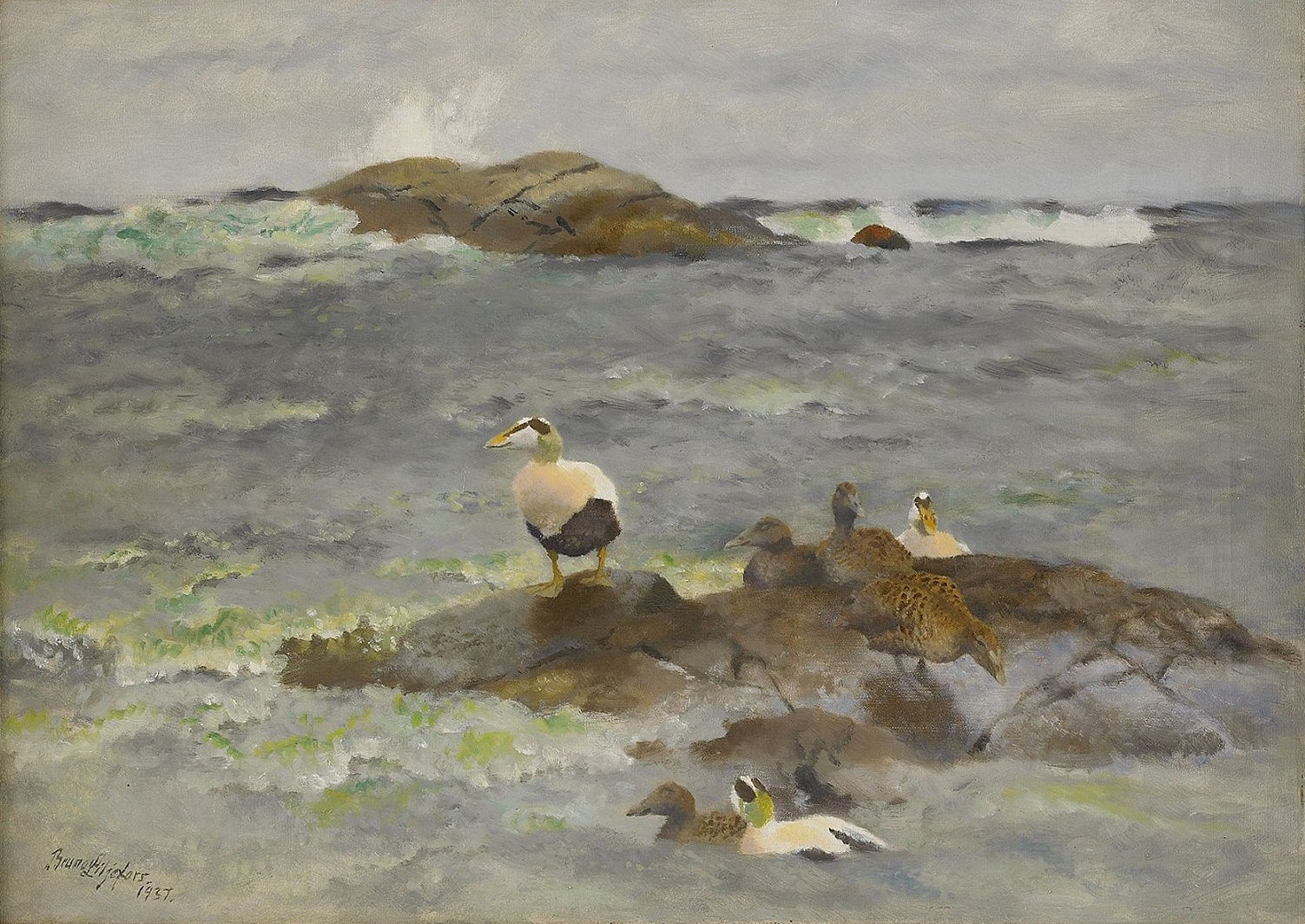
Bruno Liljefors (1860–1939), Eider on the Islet (1937), oil on canvas, 48 × 68 cm, location not known. Wikimedia Commons.
Eider on the Islet, painted in 1937, must be one of his last works from the coast.
Liljefors was also an accomplished gymnast, acrobat, and variety artist. With his two brothers, he formed the Manzodi Brothers, an acrobatic group who entertained Swedish audiences.
He died in Stockholm on 18 December 1939, a few months after the start of the Second World War. He had outlived his contemporary Anders Zorn by almost twenty years.
When the Swedish artist Bruno Liljefors specialised in natural history painting in the late nineteenth century, he wasn’t the first to depict wild creatures and their surroundings.
Albrecht Dürer (1471-1528), Hare (1502), watercolour and bodycolour on paper, 25 x 22.5 cm. Albertina, Vienna (WikiArt).
It was probably Albrecht Dürer who pioneered faithful depictions, first in his meticulously rendered watercolour of this Hare in 1502.
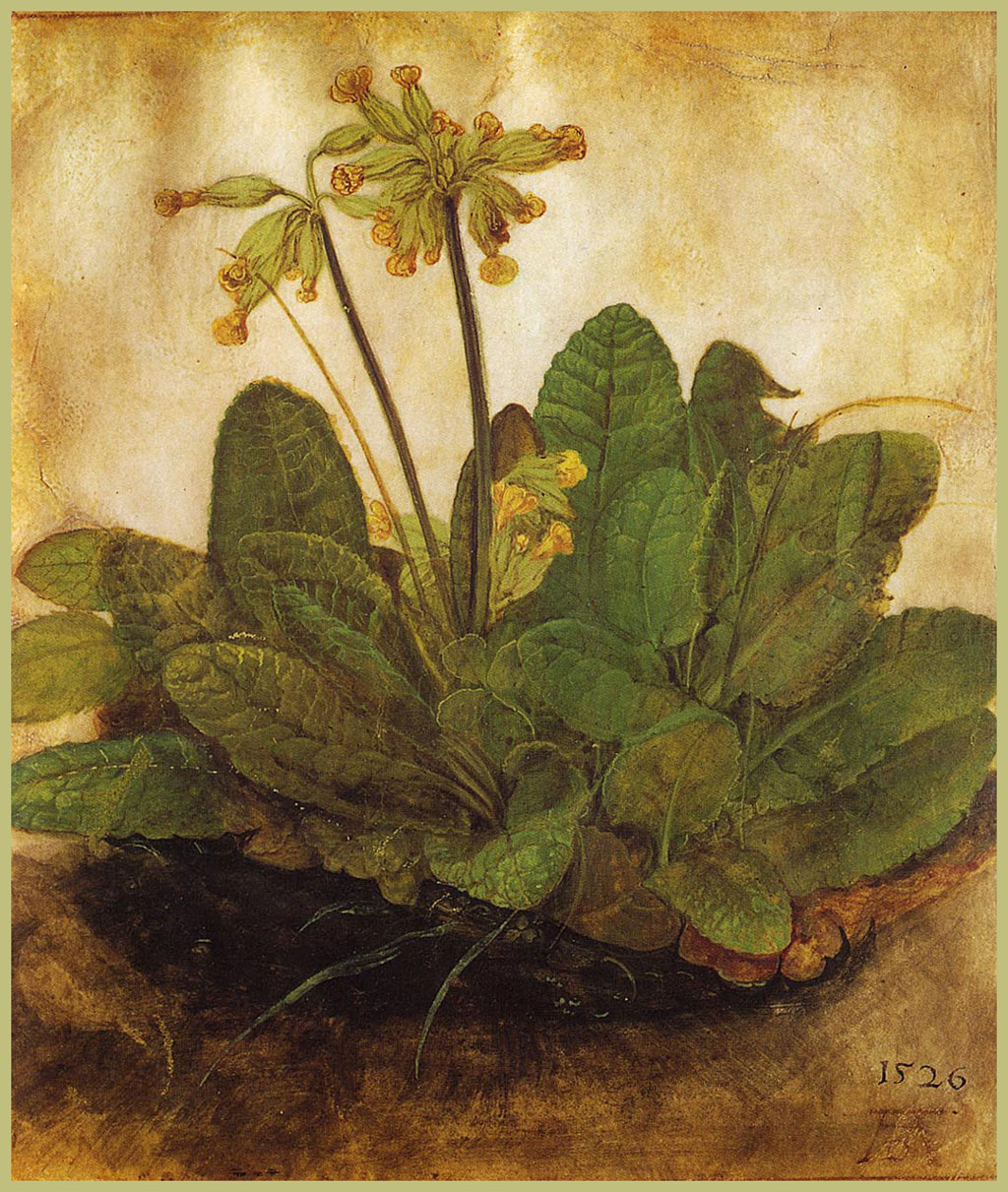
Albrecht Dürer (1471-1528), Primula (1526), watercolour on paper, 19 x 17 cm. National Gallery of Art, Washington DC (WikiArt).
Dürer followed that with some of the earliest botanical watercolours, such as this Primula from 1526. Despite those, few painters showed any interest in the genre.
Albert Eckhout (c 1610–1666), Study of Two Brazilian Tortoises (c 1640), tempera and gouache on paper mounted on panel, 30.5 x 51 cm, Koninklijk Kabinet van Schilderijen Mauritshuis, The Hague, The Netherlands. Wikimedia Commons.
Some of the Dutch artists who travelled to the Republic’s colonies were exceptions. This is Albert Eckhout’s Study of Two Brazilian Tortoises believed to have been painted in Brazil in about 1640.
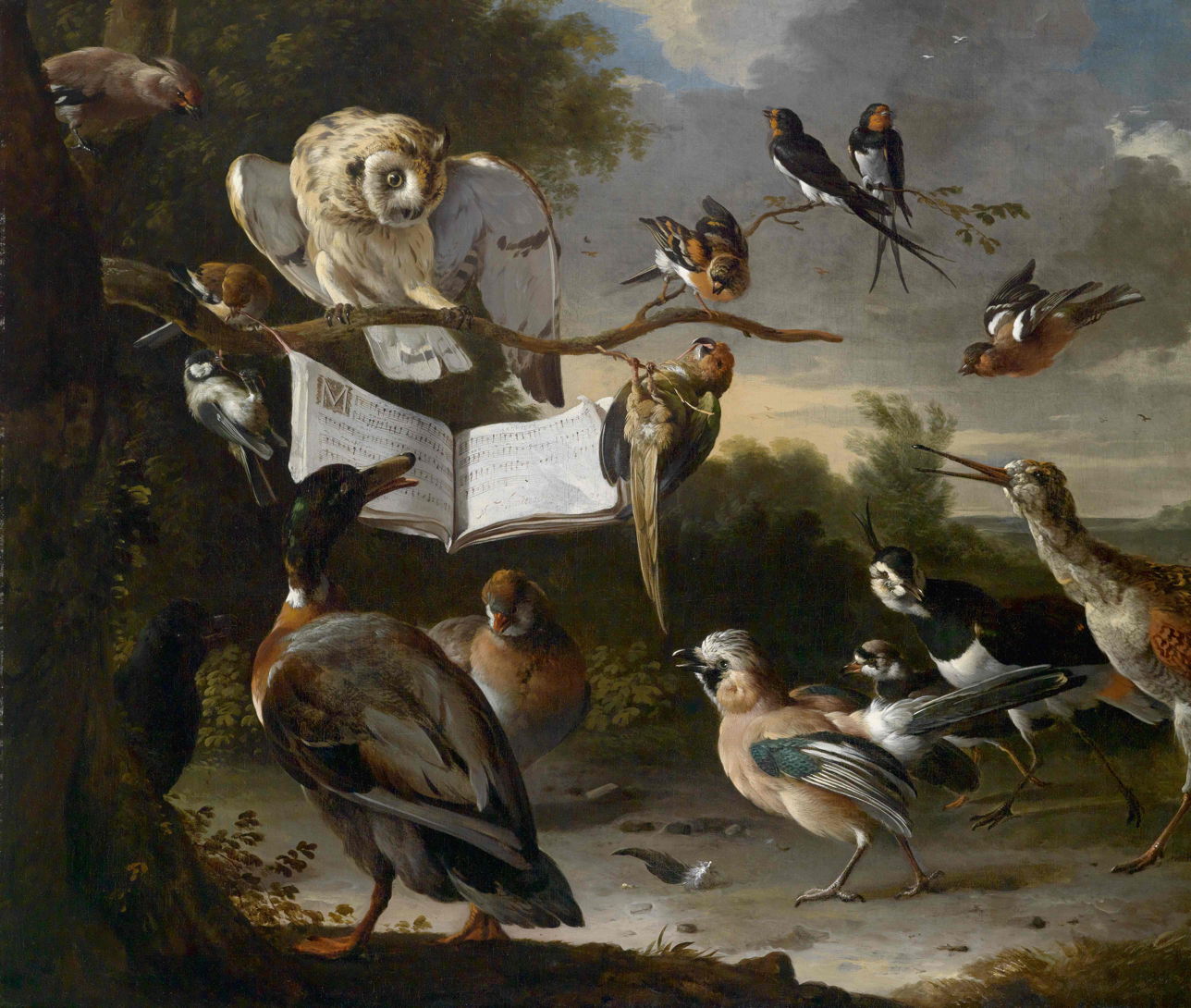
Melchior d’Hondecoeter (1636–1695), Concert of the Birds (1670), oil on canvas, 84 x 99 cm, Private collection. Wikimedia Commons.
Other painters of the Golden Age set faithful images of native species in more entertaining surroundings, as in Melchior d’Hondecoeter’s Concert of the Birds from 1670. But at that time, animal paintings were largely confined to domestic species.
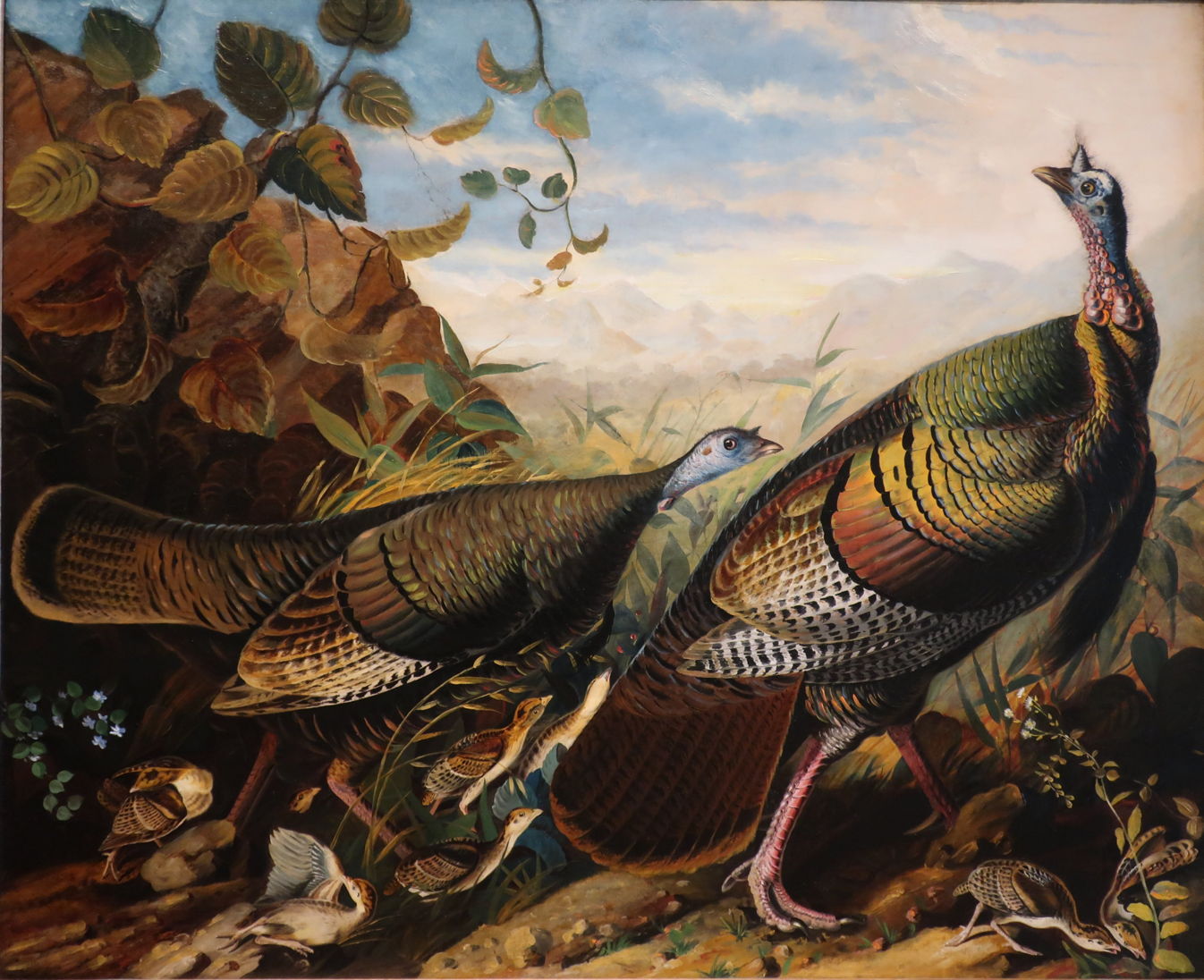
John James Audubon (1785–1851), Wild Turkey Cock, Hen and Young (1826), oil on linen, 120.7 x 151.1 cm, Crystal Bridges Museum of American Art, Bentonville, AR. Wikimedia Commons.
The most famous of the early natural history specialists is John James Audubon, whose paintings of birds were turned into sets of prints. Among his surviving oil paintings is this of a Wild Turkey Cock, Hen and Young (Meleagris gallopavo) from 1826. Although clearly destined for use as an illustration, the setting is intended to appear more natural.
As the century progressed a new, objective style of painting developed in botanical and ornithological work in particular. Artists like Edward Lear illustrated multi-volume scientific publications classifying and describing different species.
Liljefors is one of the pioneers who painted rather than illustrated wildlife, and is revered today as one of the genre’s most influential figures. In this weekend’s two articles I show examples of his paintings that remain some of the finest artistic depictions of wildlife in the history of art.
Bruno Liljefors was born in Uppsala, in the east of Sweden, in the same year as Anders Zorn. He doesn’t appear to have been as precocious a painter, and started his studies at the Royal Swedish Academy of Arts in Stockholm four years later than Zorn, in 1879. He left the Academy after three years, and went to Dusseldorf to learn to paint animals.
In the early years of his career he travelled to Rome, Naples, and Paris, and was particularly inspired by the artists’ colony at Grez-sur-Loing, then dominated by the ideas and style of Jules Bastien-Lepage. Liljefors perfected his plein air painting technique, and became influenced by the Japanese woodcuts that were so popular at the time. He also aligned himself with the ‘Opponents’, a large group of Swedish artists who effectively seceded against the conservatism of the Academy.
Bruno Liljefors (1860–1939), Hawk and Black Grouse (1884), oil on canvas, 143 x 203 cm, Nationalmuseum, Stockholm, Sweden. Wikimedia Commons.
During the early 1880s, Liljefors started to paint wildlife set in natural surroundings. Hawk and Black Grouse is a good example of these from 1884, showing a hawk attacking the gamebirds in a winter landscape. Although he had a deep affinity with his subjects, Liljefors was also a hunter, and many of his paintings explore the predator-prey relationship, as here. His hunting also provided him with dead specimens to use as models.
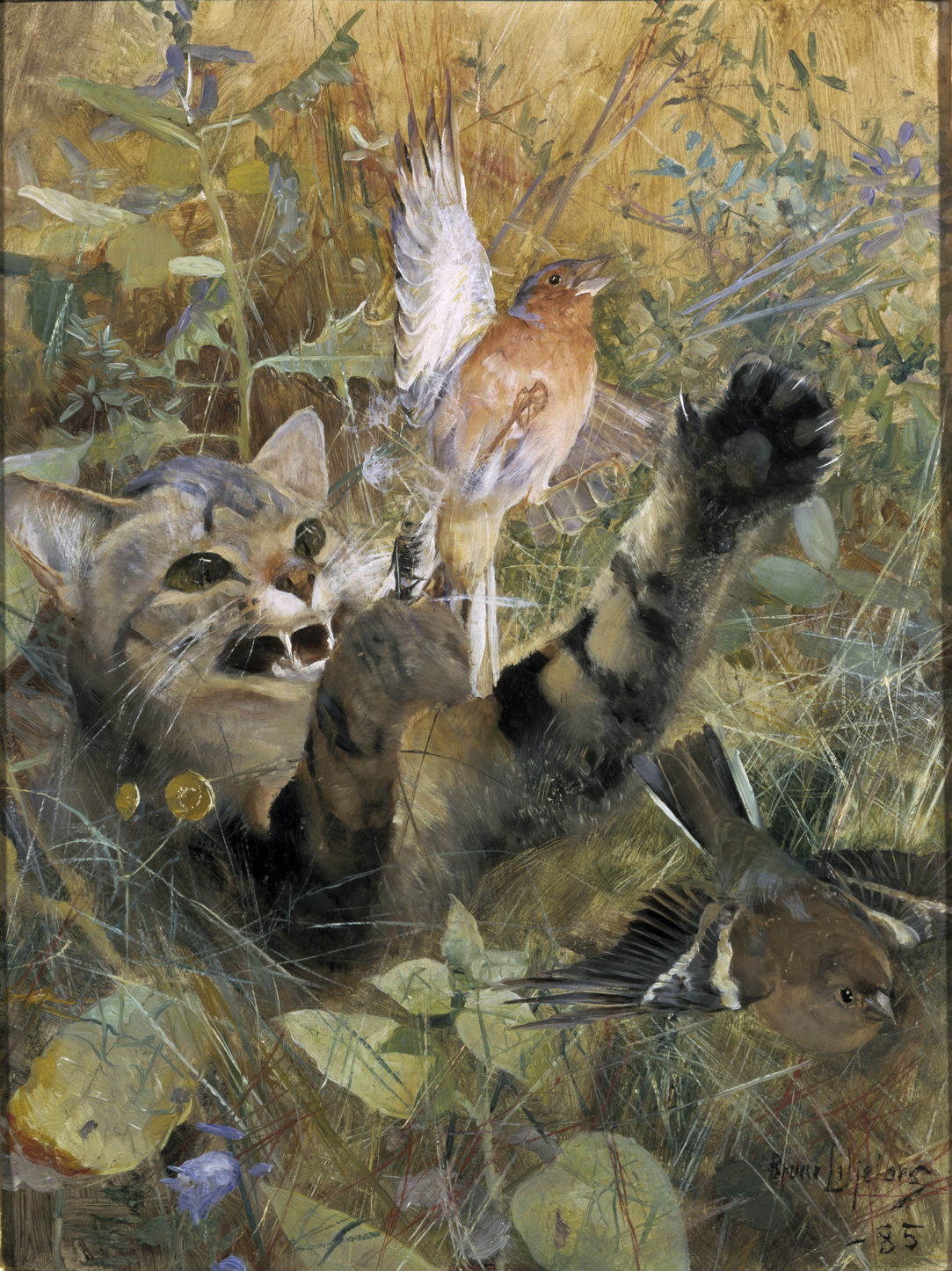
Bruno Liljefors (1860–1939), A Cat with a Young Bird in its Mouth (1885), oil on wood, 26.5 x 16.5 cm, Nationalmuseum, Stockholm, Sweden. Wikimedia Commons.
In 1885 he demonstrated his virtuoso skills in what he described as ‘five studies in a single painting’. Above is A Cat with a Young Bird in its Mouth, and below is A Cat and a Chaffinch. These were assembled from observations of living and dead animals and birds, and sketches, to produce composites that photography couldn’t match for decades, even in monochrome.
Bruno Liljefors (1860–1939), A Cat and a Chaffinch (1885), oil on wood, 35 x 26.5 cm, Nationalmuseum, Stockholm, Sweden. Wikimedia Commons.Bruno Liljefors (1860–1939), Hare Studies (1885), paper, 32 × 24.5 cm, location not known. Wikimedia Commons.
Following the tradition established by Dürer, one of Liljefors’ favourite species was the elusive hare. This page of Hare Studies from 1885 shows a tiny part of the image library he assembled, as well as the spring antics of hares. Liljefors also assembled his own wildlife park, with living and apparently quite tame creatures, including foxes, badgers, hares, squirrels, weasels, an eagle, eagle owl, and others.
Bruno Liljefors (1860–1939), A Fox Family (1886), oil on canvas, 112 x 218 cm, Nationalmuseum, Stockholm, Sweden. Wikimedia Commons.
The fox appears in many of Liljefors’ paintings, here A Fox Family (1886) in their role as predators, as they feast on an unfortunate bird.
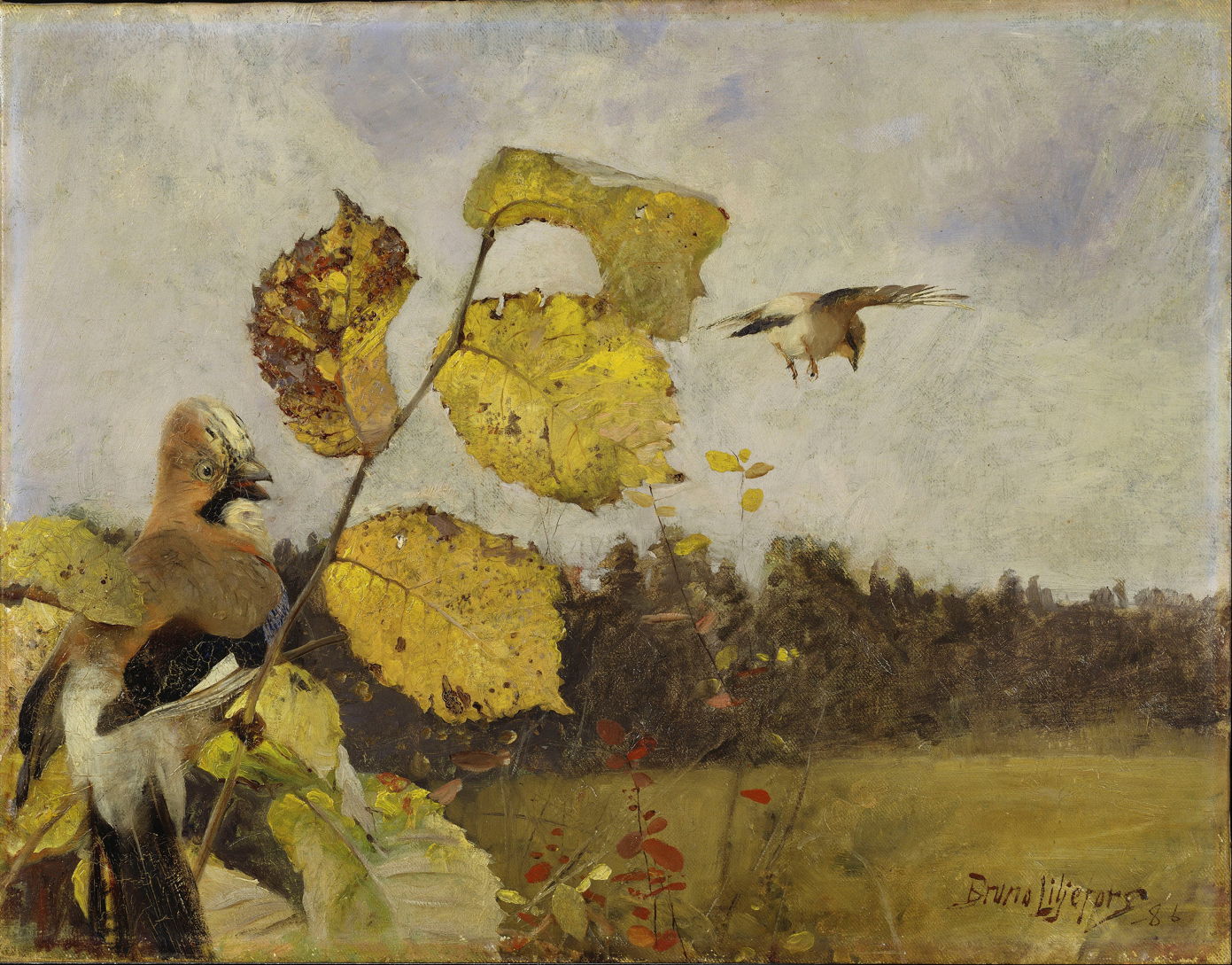
Bruno Liljefors (1860–1939), Jays (1886), oil on canvas, 51 x 66 cm, Nationalmuseum, Stockholm, Sweden. Wikimedia Commons.
Liljefors’ paintings are often painterly, such as in Jays (1886) which gives the impression of having been painted en plein air, in front of the birds and landscape.
Bruno Liljefors (1860–1939), Common Swifts (1886), oil on canvas, 41 × 56 cm, location not known. Wikimedia Commons.
Even for the modern amateur photographer, the fleeting form of Common Swifts (1886) is a great challenge. Set against a riot of flowers, these birds are the product of field observation, museum specimens, and careful studies, to make them look real.
Bruno Liljefors (1860–1939), Red-Backed Shrike Chicks (1887), oil on canvas, dimensions not known, Nationalmuseum, Stockholm, Sweden. Wikimedia Commons.
Liljefors had deep insight into the behaviour of species he painted. The five Red-Backed Shrike Chicks (1887) shown here may not, at first sight, appear in keeping with their popular name, the ‘butcher bird’, but the chick at the left end of the branch is already taking an interest in a passing bee or fly. When a little older, it will catch it and impale the corpse on thorns in its larder.
Critics and the public got their first taste of Naturalist painting in the Salons in the early 1880s, led by the success of Jules Bastien-Lepage. As Paris was the focal point of western painting at that time, this rapidly spread internationally, and ranged wider in its themes.
Literary Naturalism had spread with the translation of the writings of Hippolyte Taine (1828-1893) the critic and historian, Claude Bernard (1813-1878) the physiologist, and the Rougon-Macquart novels of Émile Zola (1840-1902), published between 1871-93. Those became accessible in all the major European languages by 1880, and attracted an intellectual following throughout Europe and North America.
At the time there was a strong Nordic school of painting in France, including Christian Skredsvig (friend of Edvard Munch), Nicolai Ulfsten, Carl Larsson, Karl Nordstrôm, Hans Heyerdahl, Erik Werenskiold, and Christian Krohg.
Christian Krohg (1852–1925), Port Side! (1879), oil on canvas, 99 x 70 cm, Nasjonalgalleriet, Oslo, Norway. The Athenaeum.
Krohg’s Port Side! (1879) is his only painting to be exhibited at the Salon. He started this when he was in Berlin, and completed it when at Skagen in Denmark in the summer of 1879. It didn’t set the Salon of 1882 alight, but was favourably received by some critics.
Hans Heyerdahl (1857–1913), The Dying Child (1881), oil on canvas, 59.5 x 70 cm, Nasjonalgalleriet, Oslo, Norway. Wikimedia Commons.
Hans Heyerdahl’s The Dying Child (1881) was so lauded it was bought from the Salon for the French nation, but has since returned to Norway. Although executed in an older, darker style this motif became popular with Nordic painters including Edvard Munch, and is typical of Naturalism.
Erik Werenskiold (1855–1938), Peasant Burial (1885), oil on canvas, 102.5 x 150.5 cm, Nasjonalgalleriet, Oslo, Norway. Wikimedia Commons.
A little later, Erik Werenskiold painted his rural Norwegian response to Courbet’s Burial at Ornans, in his Peasant Burial of 1885.
Charles Frederic Ulrich (1858–1908), The Glass Blowers (1883), oil on canvas, 47.8 × 58.4 cm, Museo de Arte de Ponce, Ponce, Puerto Rico. Wikimedia Commons.
Charles Frederic Ulrich was born in New York City in 1858, and had travelled to Europe to attend the Royal Academy in Munich, Germany, as did so many other American painters, including William Merritt Chase. Many of his surviving works show different workplaces across Europe: in The Glass Blowers (1883) the work is delicate, in blowing and preparing glass domes, perhaps for use as covers of watches and clocks.
Joan Planella y Rodríguez (1849–1910), The Little Weaver (1882-89), oil on canvas, 67 x 55 cm, Museu d’Història de Catalunya, Barcelona, Spain. Wikimedia Commons.
Joan Planella was a Catalan painter who studied in Italy rather than France. The Little Weaver (1882-89) shown here is a replica of the original completed in 1882. It shows a young girl working at a large and complex loom in Catalonia, as a man lurks in the background, keeping a watch over her.
Léon Augustin Lhermitte (1844–1925), The Harvesters’ Pay (1882), oil on canvas, 215 x 272 cm, Musée d’Orsay, Paris. Wikimedia Commons.
Following the formative social realism of Jean-François Millet, Léon Lhermitte’s masterpiece The Harvesters’ Pay (1882) takes a more objective look at the realities of rural farmworkers. This evolved rapidly through Bastien-Lepage’s paintings of poor waifs and strays, to the grim battle for survival shown below in Fernand Pelez’s Homeless (1883).
Fernand Pelez (1848-1913), Homeless (1883), oil on canvas, 77.5 x 136 cm, location not known. Image by Bastenbas, via Wikimedia Commons.Antonino Gandolfo (1841–1910), Evicted (Let he who is without sin cast the first stone) (1880), oil on canvas, 88 x 63 cm, location not known. Image by Luigi Gandolfo, via Wikimedia Commons.
These were by no means confined to France. The Sicilian Antonino Gandolfo’s Evicted from 1880 raised similar concerns under a very different political regime.
Even more uncomfortable for the French Third Republic and other states was the depiction of industrial unrest as it swept across Europe in the late nineteenth century.
Alfred Philippe Roll (1846–1919), Miners’ Strike (1880), original badly damaged, shown here as reproduction from ‘Le Petit Journal’, 1 October 1892, further details not known. Wikimedia Commons.
A good example is Alfred Roll’s painting of a Miners’ Strike in 1880. This was probably made from life when he visited the strike at Denain in the Nord-Pas de Calais coalfield that year. His large original painting seems to have been exhibited at the Salon in Paris, from where it was purchased by the State. However, the artist had to sell at ‘cost price’ on the understanding that it would be hung in the capital, in the Ministry of Commerce, where it would have substantial impact.
Once the State got its hands on Roll’s painting, it was despatched to a local museum in Valenciennes, where it seems to have been largely forgotten. The original is now badly damaged, and the image shown above is reproduced from Le Petit Journal, where it didn’t appear until 1 October 1892.
By early 1884, Émile Zola had decided to write a novel in his Rougon-Macquart series about a miners’ strike, and in February 1884 the author visited a strike near Valenciennes, where Roll’s painting was on display, for his research. He started writing Germinal on 2 April 1884, and the book was published in serial form from November of that year. Its story centres on a miners’ strike in the Nord-Pas de Calais coalfield very similar to that painted by Roll, and it remains Zola’s most successful work.
The State may have successfully suppressed the immediate impact of Roll’s painting by hiding it away in the provinces, but in this case it had not anticipated its influence on Zola.
Industrial unrest in Belgium came to a head in 1886, with a succession of strikes across the country. These started in Liège as a commemoration of the fifteenth anniversary of the Paris Commune, but spread through industrialised zones to the region around Charleroi and Hainault.
Robert Koehler (1850–1917), The Strike in the Region of Charleroi (1886), oil on canvas, 181.6 × 275.6 cm, Deutsches Historisches Museum, Berlin, Germany. Wikimedia Commons.
Robert Koehler painted his masterpiece of The Strike in the Region of Charleroi that year, with a group of workers standing outside the smart entrance to offices. The top-hatted owner stands on the top step, one of his managers looking anxious beside him. The leader of the workers is at the foot of the steps telling the industrialist of the workers’ demands. The situation is looking increasingly nasty, although there are no signs yet of police or troops, or of violent confrontation.
Christian Krohg (1852–1925), Tired (1885), oil on canvas, 79.5 x 61.5 cm, Nasjonalgalleriet, Oslo, Norway. Wikimedia Commons.
Politics and art were mixing freely in the Nordic countries too. The Norwegian Christian Krohg explored the theme of fatigue and sleep, particularly among mothers. In Tired from 1885, the young woman seen here is no mother, but a seamstress, one of the many thousands who worked at home at that time, toiling for long hours by lamplight for a pittance.
Home work as a seamstress was seen as the beginning of the descent into prostitution, a major theme in Krohg’s painting and writing. The paltry income generated by sewing quickly proved insufficient, and women sought alternatives, which all too often led to them taking to the street.
Christian Krohg (1852–1925), Albertine in the Police Doctor’s Waiting Room (1885-87), oil on canvas, 211 x 326 cm, Nasjonalgalleriet, Oslo, Norway. Wikimedia Commons.
Just before Christmas 1886, Krohg’s first novel Albertine was published by a left-wing publisher. Its central theme is prostitution in Norway at the time, and the police quickly seized all the copies they could find, banning it on the grounds of violating the good morals of the people. Krohg was found guilty of the offence the following March and fined, although the police were only able to seize 439 of the first 1600 copies to go into circulation.
At the same time as he was writing that novel, Krohg had been working on his largest and most complex painting: Albertine in the Police Doctor’s Waiting Room (1885-87). He also painted several other scenes from the book. Curiously, Krohg’s campaigning writing and painting didn’t want prostitution made legal: quite the opposite, he and others wanted it banned.
Naturalist painting also helped promote advances being made by the state in healthcare and education.
Henri Gervex (1852–1929), Before the Operation (1887), oil on canvas, 242 x 188 cm, Musée d’Orsay, Paris. Wikimedia Commons.
The depiction of modern hospitals, medical teaching and research is a feature of Naturalism. Henri Gervex, who rose to fame with a ‘shocking’ painting of a nude courtesan on the morning after, found a little flesh at the Hôpital Saint-Louis, where an eminent doctor is teaching Before the Operation in 1887.
Jean Geoffroy (1853-1924), Primary School Class (1889), oil on canvas, 145 x 220 cm, Ministère de l’Education Nationale, Paris. Wikimedia Commons.
Jean Geoffroy’s Primary School Class from 1889 shows one of the Third Republic’s new lay teachers working diligently in the classroom with her pupils. This was deemed sufficiently positive to the State as to be purchased by the French National Ministry of Education, where it still hangs.
In the late nineteenth century, Realist landscape painters challenged themselves with increasingly difficult reflections, where the water surface isn’t mirror-like, but broken.
Gustave Caillebotte (1848–1894), Rain on the Yerres (1875), oil on canvas, 81 x 59 cm, Indiana University Art Museum, Bloomington IN. WikiArt.
Gustave Caillebotte’s Rain on the Yerres (1875) is an innovative study of a reflective water surface disrupted by circles projected by raindrops.
Martín Rico y Ortega (1833–1908), A Canal in Venice (c 1875), oil on canvas, 50.2 x 67.9 cm, The Metropolitan Museum of Art, New York, NY. Wikimedia Commons.
The broken reflections in Martín Rico’s A Canal in Venice from about the same time may have been painted mostly en plein air, despite their fine detail.
Martín Rico y Ortega (1833–1908), Canal in Venice (date not known), oil on canvas, dimensions not known, The Art Institute of Chicago, Chicago, IL. Wikimedia Commons.
Rico’s Canal in Venice uses more painterly marks in its reflections.
At the same time, Eilert Adelsteen Normann was painting the grander effects seen in the fjords of Norway.
Eilert Adelsteen Normann (1848–1918), From Romsdal Fjord, 1875 (1875), oil on canvas, dimensions not known, Bergen kunstmuseum (Kunstmuseene i Bergen), Bergen, Norway. Wikimedia Commons.
Normann’s From Romsdal Fjord, also from 1875, shows the ninth longest fjord in Norway as it carves its way through this huge mountain gorge. Although much of the water surface is glassy calm, there’s a slight blur of fine ripples, and patches where it’s more disrupted by gentle breeze.
Eilert Adelsteen Normann (1848-1918), The Steamship (date not known), further details not known. Wikimedia Commons.
The unidentified fjord in Normann’s undated The Steamship shows a similar repertoire of subtle optical effects.
Laurits Andersen Ring (1854–1933), Alder Trunks (1893), oil on canvas, 52.9 x 73.5 cm, Collection of Her Majesty the Queen Margrethe II, Copenhagen, Denmark. Wikimedia Commons.
Alder Trunks from 1893 is one of Laurits Andersen Ring’s finest landscapes, and has earned its place in the Danish Royal Collection. He shows these old coppiced alders mainly in reflection. Although their details are quite painterly, the overall effect is that of meticulous realism.
The specialist of this period is the Norwegian Frits Thaulow.
Frits Thaulow (1847–1906), Winter at the River Simoa (1883), oil on canvas, 49.5 x 78.5 cm, Nasjonalgalleriet, Oslo, Norway. Wikimedia Commons.
Thaulow seems to have discovered what was going to be his recurrent theme for much of his career by 1883, when he painted this scene of Winter at the River Simoa. A lone woman, dressed quite lightly for the conditions, is rowing her tiny boat over the quietly flowing river, towards the tumbledowns on the other side. The surface of the river shows the glassy ripples so common on semi-turbulent water, and the effect on reflections is visibly complex. The distant side of the river is also partly frozen, breaking the reflections further.
Frits Thaulow (1847–1906), The Mills at Montreuil-sur-Mer, Normandy (1894), oil on canvas, dimensions not known, Minneapolis Institute of Art, Minneapolis, MN. Wikimedia Commons.
Thaulow later returned to his studies of flowing rivers, for example in The Mills at Montreuil-sur-Mer, Normandy. This painting has been claimed to date from 1891, before the artist moved to Montreuil, but I think that its date reads 1894.
Frits Thaulow (1847–1906), The Adige River at Verona (c 1894), oil on canvas, 81 x 100 cm, Walters Art Museum, Baltimore, MD. Wikimedia Commons.
In 1894, Thaulow travelled across northern Italy to Venice, stopping off to paint The Adige River at Verona. This shows the five arches of the Ponte della Pietra, with wonderfully disrupted reflections describing the river’s turbulent flow.
Frits Thaulow (1847–1906), La Dordogne (1903), oil, further details not known. Wikimedia Commons.
Soon after Thaulow had settled at Beaulieu in central France, he found form with the magnificent river surface and lighting of La Dordogne (1903), whose precise detail in the foreground quickly yields to a more sketchy background.
A few artists rose to the challenge of combined reflected and refracted images, among them Kazimierz Sichulski.
Kazimierz Sichulski (1879–1942), Fish (1908), pastel on paperboard, 63 x 82 cm, Muzeum Narodowe w Poznaniu, Poznań, Poland. Wikimedia Commons.
Sichulski’s Fish (1908) is a startlingly unusual pastel painting, a virtuoso combination of reflections from and views through this water surface. It’s an essay in practical optics.
Several other Naturalist painters achieved acclaim alongside Jules Bastien-Lepage and sustained the movement after his untimely death in 1884. Jean-Eugène Buland (1852–1926) was among them, and continued painting into the twentieth century. He died one hundred years ago today, and this article gives a brief overview of his career with a small selection of his paintings.
Buland trained at the École des Beaux-Arts in Paris under Alexandre Cabanel, and with his teacher’s influence turned first to history painting. In 1878 and 1879 he was second in the contest for the Prix de Rome, but then switched to painting genre scenes of modern life, classical Naturalist motifs inspired by the literary Naturalism of Émile Zola in particular.
His meticulous realism was well-received at the Salon, and after winning a series of medals there, in 1889 he was awarded a silver medal at the Exposition Universelle in Paris.
Buland settled in the village of Charly-sur-Marne, to the east of Paris, and steadfastly refused to become part of the art scene in the capital. He only seems to have ventured into Paris for the annual Salon, and to paint commissions in the Hôtel de Ville (City Hall).
Jean-Eugène Buland (1852–1926), Alms of a Beggar (1880), oil on canvas, 117 × 89 cm, location not known. Wikimedia Commons.
From the outset, Buland took on challenging motifs with equally challenging readings. In Alms of a Beggar (1880), a young woman dressed immaculately in white is sat outside a church seeking charity. Approaching her, a coin in his right hand, is a man who can only be a beggar himself. His clothes are patched on patches, faded and filthy, and he wears battered old wooden shoes, yet he is about to give the young woman what is probably his last coin.
Jean-Eugène Buland (1852–1926), Le Tripot (The Dive) (1883), oil on canvas, 63.5 × 109.2 cm, location not known. Wikimedia Commons.
Le Tripot (The Dive) (1883) is one of my favourite paintings of this period. Set in a seedy, downmarket gambling den, it’s a group portrait of five hardened gamblers at their table. Each is rich in character, and makes you wonder how they came to be there. A little old widow at the left, for example, looks completely out of place, but is resolutely staking her money. Looking over her shoulder is a man, whose face is partially obscured. Is he, perhaps, a son, or a debtor? A young spiv at the far right is down to his last couple of silver coins, and looks about to lose them too. The air is thick with smoke, the walls in need of redecoration, and a pair of young streetwalkers prowl behind them, looking for a winner who will spend some of their cash on them.
Jean-Eugène Buland (1852–1926), Innocent Wedding (1884), oil on canvas, dimensions not known, Musée des Beaux-Arts de Carcassonne, Carcassonne, France. The Athenaeum.
Buland also seems to have painted some unashamedly populist works, including this idyllic Innocent Wedding (1884). With the distant village, blossom, and a young couple arm in arm, it’s deeply romantic, and a far cry from the works above.
Jean-Eugène Buland (1852–1926), Offering to the Virgin the Day After the Wedding (1885), oil on canvas, 144 × 209 cm, Musée des Beaux-Arts de Caen, Caen, France. Wikimedia Commons.
That led to a series of paintings showing events the day after the wedding, including this of the newlywed bride Offering to the Virgin the Day After the Wedding (1885). There’s a crisp formality in these figures, who appear stilted and posed as they go through the rites and processes of life.
Jean-Eugène Buland (1852–1926), Un Patron, or The Apprentice’s Lesson (1888), oil on canvas, 102 x 82 cm, Nationalmuseum, Stockholm, Sweden. Image by Erik Cornelius, via Wikimedia Commons.
Buland went to the factory for Un Patron, or The Apprentice’s Lesson (1888). A young boy is being trained by his foreman to make a cogwheel, when many might have preferred him still to be at school. Buland used photographs extensively in the preparatory work for this painting, to capture its wealth of detail.
This also marks an overt politicisation in his work: the apprentice was part of the nation’s efforts to advance in industry and manufacturing after the disaster of the Franco-Prussian War.
Jean-Eugène Buland (1852–1926), Propaganda Campaign (1889), oil on canvas, 181.8 × 191.4 cm, Musée d’Orsay, Paris. Wikimedia Commons.
Propaganda Campaign (1889) is even more political, and Buland’s stark rendering of its figures makes them pop out, almost like cut-outs. A travelling salesman is in the home of a poor family, selling books and coloured prints to the head of the household. That in his left hand shows the populist politician General Boulanger, and the salesman’s motives combine politics with business. His buttonhole rosette declares his role as a canvasser for the General.
Jean-Eugène Buland (1852–1926), A Stroll in the Park (1891), oil on canvas, 92.5 × 65 cm, location not known. Wikimedia Commons.
A Stroll in the Park (1891) seems a more innocent full-length portrait of a woman, although I have been unable to discover her identity or any reason for the painting.
Jean-Eugène Buland (1852–1926), Municipal Council and Commission of Pierrelaye Organizing a Festival (1891), oil on canvas, 140 × 200 cm, Town Hall, Pierrelaye, France. Wikimedia Commons.
Municipal Council and Commission of Pierrelaye Organizing a Festival (1891) is another fascinating painting with much contemporary relevance, an example of provincial municipal art. It’s a group portrait of the council of this village to the north-west of Paris, clearly commissioned by them to record their great deeds. It has a similar stiff formality to Propaganda Campaign, rather than the more insightful approach of Rembrandt’s group portraits.
Jean-Eugène Buland (1852–1926), Marriage (date not known), painted ceiling, dimensions and location not known (?Hôtel de Ville, Paris). Image by G.Garitan, via Wikimedia Commons.
I suspect that Buland’s romantically painted ceiling of Marriage was one of his commissions for the rebuilt Hôtel de Ville in Paris, and completed in the 1890s.
Jean-Eugène Buland (1852–1926), Parental Happiness (1903), oil on canvas, 97.5 × 129 cm, location not known. Wikimedia Commons.
He returned to poor working families in his Parental Happiness from 1903. A young couple are nursing their first baby, and appear to be living in an agricultural outhouse. The floor is strewn with vegetables and their parings, and the husband is dressed as a labourer, with worn working shoes, and his wife in wooden clogs.
Jean-Eugène Buland (1852–1926), The Tinker (1908), oil on canvas, 112.6 × 145 cm, Private collection. Wikimedia Commons.
Buland’s The Tinker (1908) is busy at his cottage industry, repairing damaged pots, pans, and domestic metal objects. The stone wall at the left glistens with the damp.
Jean-Eugène Buland died in his home village of Charly-sur-Marne on 18 March 1926, at the age of 73.
This century has brought something of a revival for Buland. His first solo retrospective exhibition was held at Carcassonne in 2007-08, and his prices at auction are moving steadily upwards. I hope it doesn’t prove too late to conserve and document what remains of his work.
Reference
Richard Thomson (2012) Art of the Actual, Naturalism and Style in Early Third Republic France, 1880-1900, Yale UP. ISBN 978 0 300 17988 0.
Many of the great Masters are known to have painted preparatory studies prior to starting on full-size finished studio paintings. Unfortunately, most of those studies were either destroyed by the artist in their lifetime, or by their heirs following their death. Seeing studies alongside a finished work tells a great deal about the artist’s intent and methods, and some exhibitions have made a point of including as many studies as possible. This article shows a small selection of some whose images I have been able to gather.
Some of the best surviving studies are the oil sketches made by Peter Paul Rubens, some of which were given to assistants in his studio for completion.
Peter Paul Rubens (1577–1640), The Rape of Hippodame (sketch) (c 1637-38), oil on panel, 26 × 40 cm, Koninklijke Musea voor Schone Kunsten van België / Musées Royaux des Beaux Arts de Belgique, Brussels, Belgium. Wikimedia Commons.
Towards the end of his life, he painted this brilliant oil sketch of The Rape of Hippodame (c 1637-38). At the right, Eurytus is trying to carry off Hippodame, the bride, with Theseus just about to rescue her from the centaur’s back. At the left, Lapiths are attacking with their weapons, and behind them another centaur is trying to abduct a woman. Rubens typically sketched on small wood panels, here 26 x 40 cm (10 x 16 inches), with wonderfully painterly brushstrokes.
Peter Paul Rubens (1577–1640), The Rape of Hippodame (Lapiths and Centaurs) (1636-38), oil on canvas, 182 × 290 cm, Museo Nacional del Prado, Madrid, Spain. Wikimedia Commons.
That became this finished painting, The Rape of Hippodame (Lapiths and Centaurs) (1636-38), which remains faithful to the sketch and its composition. Facial expressions, particularly that of the Lapith at the left bearing a sword, are particularly powerful.
Studies were better preserved in the nineteenth century, when tastes changed and some realised worthwhile sums in posthumous sales of the contents of studios.
Jean Louis Théodore Géricault (1791–1824), Study for The Raft of the Medusa (1819), oil on canvas, 36 x 48 cm, Musée du Louvre, Paris. Wikimedia Commons.
Among the most studied are those made by Géricault when he was working up his landmark painting of The Raft of the Medusa. This oil study on canvas was probably made as he was completing his preparations during the autumn of 1818, and reveals some of his compositional thinking, for instance over the size of the ship that rescued the survivors.
Jean Louis Théodore Géricault (1791–1824), The Raft of the Medusa (1818-19), oil on canvas, 491 x 716 cm, Musée du Louvre, Paris. Wikimedia Commons.
The end result is this vast canvas, its figures shown life-sized, which has had huge impact on everyone who has seen it since its completion in 1819. It appears completely authentic, and given the work that Géricault put into making it so, that’s perhaps not surprising. But most gain the impression that the raft was almost square in form, as a result of the tight cropping applied, and that even with those few survivors on board, it was overcrowded. This is because Géricault chose to pack all his figures into one small section of the raft.
I was fortunate enough to visit an exhibition of some of John Constable’s works, in which his studies were shown alongside finished paintings. Here I show just one example. Had Constable lived fifty years later, he might have been persuaded to stop his paintings when they were still late oil studies, rather than take them to their finished conclusions.
John Constable (1776–1837), Hadleigh Castle (sketch) (1828-29), oil on millboard, 20 × 24 cm, Yale Center for British Art, New Haven, CT. Wikimedia Commons.
This early sketch of Hadleigh Castle (1828-29) already contains some surprisingly detailed passages: at the far left, a shepherd, his black dog by his side, with a small flock of sheep grazing near the ruined tower. There’s a brown and white blob on the seaward slope, probably a cow grazing there. Wheeling in wrinkles of impasto above the tower are a few birds resembling small runnels of liquid metal like solder. By this time, many artists were painting their oil studies on cheaper millboard, as Constable did here. Millboard is made by pasting together many sheets of fine paper, so isn’t as durable as cheaper stretched canvas.
John Constable (1776–1837), Hadleigh Castle, The Mouth of the Thames – Morning after a Stormy Night (1829), oil on canvas, 121.9 x 164.5 cm, Yale Center for British Art, New Haven, CT. Wikimedia Commons.
By the finished work, the splendid Hadleigh Castle, The Mouth of the Thames – Morning after a Stormy Night (1829), the basic disposition of those figures has changed little, but Constable has changed each to suit his image. The shepherd, still carrying his long crook, is separated from his dog, and has lost his sheep, which have become scattered rocks. The single cow on the sloping grass has gained a couple of friends, and a cowherd. Beyond them are another couple of tiny specks of figures, and there are more by the wood in the lower right corner.
William Powell Frith (1819–1909), Derby Day (study) (before 1857), oil on canvas, 39.4 x 91.1 cm, Private collection. Wikimedia Commons.
William Powell Frith’s late study for Derby Day was probably painted in about 1856, and is very close to the finished work shown below, although covering only about a tenth of its area.
William Powell Frith (1819–1909), The Derby Day (1856-58), oil on canvas, 140.5 x 264 cm, The Tate Gallery, London. Wikimedia Commons.
Jacob Bell commissioned Frith to paint his finished Derby Day (1856-58) for the huge fee of £1,500, and the artist was paid a further £1,500 for rights to make prints. It was exhibited at the Royal Academy in 1858, and proved so popular that a guard rail had to be installed in front of it to protect the work from the admiring crowds.
Georges Seurat’s preparations are also revealed in his surviving studies, and are very different given his Pointillist technique. Some of the later Divisionists made conventional studies, and there are some experimental examples using larger tiles of colour (see below). Seurat instead rehearsed parts of the overall view when preparing his masterwork.
Georges Seurat (1859–1891), Landscape – the Island of the Grande Jatte (1884), oil on canvas, 69.9 x 85.7 cm, Private collection. WikiArt.
Seurat’s first and greatest masterpiece, generally known as La Grande Jatte, uses the technique of optical mixing of colour. Rather than blending pigments on the canvas, it’s constructed of tiny dots that are high in chroma, and allow for optical mixing, one of the fundamental techniques in Seurat’s new scientific painting. His theory was that the mixing of colour would then occur in the retina of the viewer, and he tried this in a pure landscape study (above), and in his huge finished painting (below).
Georges Seurat (1859–1891), Un dimanche après-midi à l’Île de la Grande Jatte (A Sunday Afternoon on the Island of La Grande Jatte) (1884-6), oil on canvas, 207.5 × 308.1 cm, Art Institute of Chicago, Chicago, IL. Wikimedia Commons.
He painted his finished version in three phases. In the first, the dots he applied were mixed from available and fairly conventional pigments, including duller earths. In the second phase, he used a limited number of brighter and higher chroma pigments. In the third and final phase he added coloured borders which are distinctive of his paintings.
By the late nineteenth century oil studies were being supplemented by photographs.
Circle of Thomas Eakins (1844–1916), Eakins’s Students at the “The Swimming Hole” (1884), albumen silver print, 9.3 x 12.1 cm, The Getty Center, J. Paul Getty Museum, Los Angeles, CA. Wikimedia Commons.
Thomas Eakins’ preparatory studies for Swimming (1885) grew from a series of photographs taken by the artist and his friends. But photos never replaced his own sketches: for this work, Eakins made several figure studies, details such as the dog, and different landscape backgrounds, then brought them together in oil sketches.
Thomas Eakins (1844–1916), Swimming Hole (sketch) (1884), oil on fiberboard mounted on masonite, 22.1 × 27 cm, The Hirshhorn Museum and Sculpture Garden, Washington, DC. Wikimedia Commons.
Once he was happy, he embarked on his final version. In at least some cases, including his paintings of shad fishing from 1881-82, the figures in his Arcadia (c 1883), and Swimming (1885), he put final photographic images into a ‘magic lantern’ projector, which he then projected at the canvas.
He developed a sophisticated system not only for using the projected image to make a graphite underdrawing, but as the painting progressed, to incise key points and lines of reference in the paint surface. This enabled him to create paintings that were accurately calibrated to his reference images: a great advance on the traditional system of enlargement using grids, and one factor in his detailed realism. This technique was discovered by Mark Tucker and Nica Gutman.
Thomas Eakins (1844–1916), Swimming (The Swimming Hole) (1885), oil on canvas, 70.2 × 93 cm, Amon Carter Museum of American Art, Fort Worth, TX. Wikimedia Commons.
Together with other photos and various studies, Eakins then painted Swimming (The Swimming Hole) in 1885.
Albert Bierstadt was more traditional in his preparatory studies for The Last of the Buffalo in 1888.
Albert Bierstadt (1830–1902), Study for ‘The Last of the Buffalo’ (c 1888), oil on canvas, 62.9 x 91.1 cm, De Young Museum, San Francisco, CA. Wikimedia Commons.
This late study was painted on canvas, and is 63 x 91 cm (25 x 36 inches). It concentrates on the action to be embedded in a broader landscape.
Albert Bierstadt (1830–1902), The Last of the Buffalo (c 1888), oil on canvas, 153 x 245.1 cm, Buffalo Bill Center of the West, Cody, WY. Wikimedia Commons.
Bierstadt’s finished painting is larger still, and sets that action in a more characteristic grand panorama, with bleached skulls and dying buffalo in the foreground. In the middle distance are hundreds of animals in the herd, suggesting that extinction was by no means the only outcome.
Finally, a pair of paintings by the less-known Divisionist Henri-Edmond Cross shows an alternative approach to Seurat’s, where his study is built of small daubs of colour, which are then reduced in size for the Pointillism of his final version.
Henri-Edmond Cross (1856–1910), Clearing in Provence (study) (c 1906), oil on paper mounted on canvas, 56.5 x 44 cm, Israel Museum מוזיאון ישראל, Jerusalem, Israel. Wikimedia Commons.
His Clearing in Provence from about 1906 was painted on paper, and has subsequently been mounted on canvas for display in the Israel Museum, Jerusalem.
Henri-Edmond Cross (1856–1910), The Glade (1906), oil on canvas, 162 x 130 cm, Wallraf-Richartz-Museum & Fondation Corboud, Cologne, Germany. Image by anagoria, via Wikimedia Commons.
That sketch formed the basis of the woodland setting Cross used in The Glade, painted in oils in 1906. Colour changes are prominent, and the chroma has been considerably enhanced. The size has grown, and it’s on a more permanent support of stretched canvas.
Seen through modern eyes, many of the oil studies of the past deserve to be seen more widely, rather than being kept in storage.
In the middle of the night following the crusaders’ first major assault on the city of Jerusalem, Clorinda had burned their siege towers down. Tancred then mortally wounded her in a fight before realising who she was, but baptised her just before she died in his arms.
The wounded Tancred feels disgust at his killing of Clorinda, and the pair are carried back to his tent. In spite of his injuries, he makes his farewell to her corpse. She later appears to him in a dream and his emotions are reconciled following her burial.
Canto thirteen returns to the siege, and the crusaders’ need to replace their wooden towers. Ismen visits the ancient wood that’s the closest source of timber, and casts a spell to prevent any more of its trees from being felled. He then reassures Aladine that he is safe, particularly as he forecasts the weather is set to turn very hot and dry, and advises Aladine he should sit tight in the city rather than try to force an end to the siege as Argante wants.
Godfrey wants to rebuild his siege towers quickly, before the defenders of Jerusalem have had time to repair the damage to the city’s defences. He dispatches men to the woods to cut down the timber required for the new towers, but they’re now repelled by the bewitched trees. Godfrey sends troops on three successive days, but each time they’re driven out by the dire effects of Ismen’s spell.
Finally, Tancred, recovered from his wounds, plucks up courage and enters the enchanted wood. He feels no ill-effects, and makes his way to its centre, where there’s a cryptic inscription written on an ancient tree. The trees then speak to him, claiming to be the spirit of Clorinda and others, warning him not to try cutting any of them down. Tancred reports this to Godfrey, who turns to other plans.
As Ismen had forecast, the weather becomes unrelentingly hot and dry. Even the nights remain hot, and crusaders are dying as a result. The nearby stream of Siloa, which had been a major supply of water, dries up, and there are deaths from dehydration. Morale collapses, with many of the crusaders questioning Godfrey’s inaction. The remaining Greeks desert and start their journey home. Godfrey prays for divine assistance and succeeds with a torrential rainstorm and the return to more comfortable conditions at last.
Canto fourteen opens with nightfall, when at last the cooler conditions enable everyone to sleep properly again. Godfrey has a vision in which he is told to recall Rinaldo from his self-imposed exile, and to absolve him from his error. No sooner does Godfrey awake the following morning than Guelph asks him for Rinaldo’s pardon, in the hope that the knight will be brave enough to overcome Ismen’s spell and cut wood to build their siege towers.
Godfrey agrees, leaving Guelph and a team of volunteers to locate and recover the missing knight. As the group are discussing where to look, Peter the Hermit interrupts and advises them to travel to Ascalon, and to ask the man they meet there.
When they reach Ascalon, a wizard with a white beard, beech crown and wand tells them to follow him as their guide. He takes them into hidden caves beneath a stream, where they see the sources of the great rivers of the world, set in a huge cavern whose walls are speckled with jewels. The wizard tells them this is the womb of the earth. He then reveals what happened to Rinaldo after he had freed the other knights who had been made captive by Armida, and how Rinaldo’s armour came to be made to look as if the knight had been killed.
Armida had been waiting for Rinaldo at the ford on the river Orontes. When he arrived, he found a column with an inscription that enticed him to go further, leaving his esquires behind as he boarded a boat. He then came to an island that appeared deserted, so decided to rest there, and put his helmet down beside him.
A little later, he heard a sound from the river, and spied a beautiful woman emerging naked from the water. She sang a song that lulled Rinaldo to sleep, then came over intending to kill him. But when she saw him breathing gently in his sleep, her anger melted away and she fell in love with him instead. She then put garlands of flowers around his neck, arms and feet that she had bewitched to act as bonds, had him lifted into her chariot, and abducted him.
This remarkable turn of events has been a favourite among painters, and a particular challenge to depict in a single image. As a classical example of what Aristotle in his Poetics refers to as peripeteia, it has led to some superb narrative paintings.
Anthony van Dyck (1599–1641), Rinaldo and Armida (1629), oil on canvas, 235.3 x 228.7 cm, Baltimore Museum of Art, Baltimore, MD. Wikimedia Commons.
In Anthony van Dyck’s Rinaldo and Armida of 1629, the key elements of the couple and attendant symbolic amorino are enriched by a second woman with non-human legs still immersed in the river and clutching a sheet of paper, and additional amorini. Armida appears unarmed but starting to bind him with garlands, and it’s possible the letter represents her commission to murder him, which the woman in the water, perhaps a nymph, is reminding her about.
Nicolas Poussin (1594–1665), Rinaldo and Armida (c 1630), oil on canvas, 82.2 x 109.2 cm, Dulwich Picture Gallery. Wikimedia Commons.
The most brilliant account to date is Nicolas Poussin’s justly famous Rinaldo and Armida from about 1630.
Nicolas Poussin (1594–1665), Rinaldo and Armida (detail) (c 1630), oil on canvas, 82.2 x 109.2 cm, Dulwich Picture Gallery. Wikimedia Commons.
There are two distinctive elements within Poussin’s depiction, Armida’s facial expression, and her posture, particularly the conflict between her arms. Armida’s expression is key to understanding the narrative, as she is perplexed, in a quandary, unsure whether to kill or kiss the young knight. Armida’s right hand represents her original intent, to murder him with her dagger, an action the amorino is trying to stop. Her left hand, though, reaches down to touch his hand in a loving caress. Poussin manages to tell us what she had intended to do in the immediate past, and what she is going to do next in the future: three moments in time conveyed in a single image.
Nicolas Poussin (1594–1665), Rinaldo and Armida (c 1635), oil on canvas, 95 × 133 cm, Pushkin Museum, Moscow. Wikimedia Commons.
Poussin’s Rinaldo and Armida (c 1635) is a later and more explicit version of this same episode, in which Armida is falling in love with Rinaldo. There are many amorini who seem less engaged in the action. A river-god pours his river from a pitcher. In the background, Armida’s chariot is already prepared for the abduction of Rinaldo.
Sebastiano Conca (1680–1764) (attr), Rinaldo and Armida (c 1725), oil on canvas, 99.1 × 135.9 cm, Saint Louis Art Museum, St. Louis, MO. Wikimedia Commons.
Sebastiano Conca’s Rinaldo and Armida from about 1725 is a return to simpler composition, based on a central triangle, and content. Armida is drawing her sword, and looking pensive, as the sole amorino reaches from above to intervene.
Giovanni Battista Tiepolo (1696–1770), Rinaldo Enchanted by Armida (1742-45), oil on canvas, 187.5 x 216.8 cm, Art Institute of Chicago, Chicago, IL. Wikimedia Commons.
Tiepolo’s Rinaldo Enchanted by Armida (1742-45) is another permutation of the elements in Tasso’s story. Armida has already brought her enchanted flying chariot, in which there is another woman, perhaps Venus herself, with an accompanying amorino. Armida is almost undressed and unarmed, and her facial expression is more of unhappy pleading than internal conflict, while her female companion appears cold and unaffected.
Jean-Honoré Fragonard (1732–1806), Rinaldo and Armida (c 1760-65), oil on canvas, 221.5 x 256.5, National Gallery of Armenia, Yerevan, Armenia. Wikimedia Commons.
Fragonard’s Rinaldo and Armida from 1760-65 is another elaborate painting with an abundance of amorini. Armida’s right hand clutches a dagger, and is restrained by two of the amorini, although it’s hard to determine her facial expression.
With Guelph’s party searching for Rinaldo, Armida now whisks him away in her chariot, still fast asleep, and unaware of what’s in store for him.
Thomas Asbridge (2004) The First Crusade, A New History, Free Press, ISBN 978 0 7432 2084 2.
Anthony M Esolen, translator (2000) Torquato Tasso, Jerusalem Delivered, Gerusalemme Liberata, Johns Hopkins UP. ISBN 978 0 801 863233. A superb modern translation into English verse.
John France (1994) Victory in the East, a Military History of the First Crusade, Cambridge UP. ISBN 978 0 521 589871.
Joanthan Riley-Smith, ed (1995) The Oxford Illustrated History of the Crusades, Oxford UP. ISBN 978 0 192 854285.
Jonathan Riley-Smith (2014) The Crusades, A History, 3rd edn., Bloomsbury. ISBN 978 1 4725 1351 9.
Johathan Unglaub (2006) Poussin and the Poetics of Painting, Pictorial Narrative and the Legacy of Tasso, Cambridge UP. ISBN 978 0 521 833677.
In 1904, Misia Natanson, née Godebska, patron and muse of artists in Paris, was in the process of transferring her affection from her first husband Thadée Natanson to Alfred Edwards, the publishing magnate who was providing him with capital in return.
Pierre Bonnard (1867-1947), Misia Natanson and Her Dog (c 1904), oil on panel, 46 x 37 cm, Private collection. The Athenaeum.
Pierre Bonnard sees a completely different figure from those in Renoir’s portraits. In Misia Natanson and Her Dog from about 1904, she’s out in the country with her dog, wearing an ornate white lace hat, more like a character from a nursery rhyme than the mistress of a newspaper magnate.
The following year, Misia married Edwards, and her circle of artists and composers benefited from new patronage with even deeper pockets. Misia and her husband had a yacht, by which I mean a large, crewed vessel, not a dinky little dinghy. In the summer of 1905, they took Bonnard, Maurice Ravel, and others on the yacht’s maiden cruise to Belgium, the Netherlands and Germany.
Pierre-Auguste Renoir (1841–1919), Misia Sert with a Lap Dog (Young Woman with a Lap-Dog) (c 1906), oil on canvas, 92.5 x 73.5 cm, Barnes Foundation, Philadelphia, PA. Wikimedia Commons.
Misia, though, looks no happier in Renoir’s third portrait of Misia Sert with a Lap Dog (Young Woman with a Lap-Dog) from after her second marriage in about 1906. And the dog has changed to a toy breed, probably a Brussels Griffon.
Pierre Bonnard (1867-1947), La Casa de Misia Sert (The House of Misia Sert) (1906), tempera on canvas, 38 x 46 cm, Musée d’Orsay, Paris. The Athenaeum.
Bonnard dedicated his painting of The House of Misia Sert (1906) to the former Misia Natanson, muse, close friend, and patron. This was made using tempera rather than oils.
He continued to keep company with Misia and her husband. Maurice Ravel dedicated two of his most beautiful compositions to her: The Swan from Histoires Naturelles, and The Waltz.
Pierre Bonnard (1867-1947), Pleasure (1906), oil on cardboard, 250 x 300 cm, Private collection. The Athenaeum.
Works created for Misia extended beyond mere portraits. In Pierre Bonnard’s large painting of Pleasure or Games from 1906, one of four panels he made for Misia and Alfred Edwards’ apartment in Paris, decorative edging includes images of birds and monkeys, whose innocent playfulness is seen as being pleasurable.
Pierre Bonnard (1867-1947), Misia (1908), oil on canvas, 145 x 114 cm, Museo Nacional Thyssen-Bornemisza, Madrid, Spain. The Athenaeum.
In 1908, Bonnard painted at least three portraits of Misia. Gone is the illusion of the shepherdess: she now sits in a lavishly-decorated room, with what appear to be Gobelin tapestries behind her.
Pierre Bonnard (1867-1947), Misia with a Pink Corsage (c 1908), oil on canvas, 157.2 x 117.9 cm, Private collection. The Athenaeum.
In Misia with a Pink Corsage, Bonnard closes in for a straight head-and-shoulders.
Pierre Bonnard (1867-1947), Misia with Roses (1908), oil on cardboard, 114 x 146.5 cm, Private collection. The Athenaeum.
In Misia with Roses, she looks down at an almost unseen pet she is stroking beside her.
As could have been expected, Alfred Edwards proved unfaithful to Misia. She divorced him in 1909, by which time she was already in a relationship with the Spanish painter Josep Maria Sert (1874-1945). He had been on the periphery of the Nabis since moving to Paris in 1899.
Pierre Bonnard (1867-1947), Misia Godebska Writing (c 1910), oil on canvas, 64.4 x 50 cm, Private collection. The Athenaeum.
The last portrait that I can find by Bonnard, of Misia Godebska Writing, was painted in about 1910. It’s back to head-and-shoulders, although here the artist has used a little mirror play to reveal her chignon, a feature that Bonnard seemed to like.
Misia didn’t marry Sert until 1920, by which time she was established as the cultural arbiter in Paris, and a close friend of Coco Chanel. Her husband, a friend of Salvador Dalí, specialised in murals, and strangely never appears to have painted her portrait. Instead, he spent over thirty years painting murals in the Vic Cathedral in Barcelona, and having affairs of his own. In 1927, Sert divorced Misia to marry the sculptor Isabelle Roussadana Mdivani (1906-1938), known for short as Roussy, who for a time had lived with the Serts in a ménage à trois.
The Serts had been strong supporters of Sergei Diaghilev’s Ballets Russes, which was based in Paris from 1909. Josep Maria Sert painted sets and designed costumes from 1914 onwards. Misia was also heavily involved, often raising money to save a production from seemingly overwhelming debts.
Léon Bakst had also been painting and designing for Diaghilev and his Ballets Russes. Diaghilev proved highly successful, and commissioned music from Igor Stravinsky, Claude Debussy, Sergei Prokofiev and other major composers of the day. Other painters who produced work for the Ballets included Vasily Kandinsky, Pablo Picasso and Henri Matisse. Coco Chanel also created costume designs.
Léon Bakst (1866–1924), Set design for ballet “Les Orientales” (1908), watercolour, pencil, gouache, 73.2 x 43 cm, scenic design for the Ballets Russes, location not known. Wikimedia Commons.
Misia remained close to Diaghilev, and in August 1929 she comforted him as he died in Venice of diabetes, then paid for his funeral from her own pocket.
Just before the Second World War, Roussy Sert died, and Misia and Josep Maria Sert reconciled, and sort of lived together in separate apartments in Paris. Misia’s reputation remained unblemished during the Nazi occupation of Paris, and she died there on 15 October 1950, at the age of 78.
Without Misia’s influence and support, a great deal of the painting, music, and ballet of the first half of the twentieth century simply wouldn’t have happened.
One of the myths about nineteenth and twentieth century art is that it freed itself from patronage that had bedevilled its past. What did change was that patrons of the arts were seldom royalty or nobility, although their power and influence were just the same. Between about 1895 and the late 1930s, one of the most important patrons in France was a Polish woman, born Maria Zofia Zenajda Godebska in 1872, but subsequently known as Misia Natanson, Edwards, or Sert. Her father was Cyprian Godebski, a major sculptor who was a professor at the Imperial Academy in Saint Petersburg. This weekend I tell a little of her story, with a succession of portraits by her many admirers.
Misia’s mother died shortly after the girl’s birth, so she was sent to her grandparents in Brussels. This took her from sculpture to music, as those grandparents had musical circles including Franz Liszt. She was brought up as a pianist, and when her father moved her to Paris, she studied under Gabriel Fauré.
Misia married for the first time at the age of twenty-one, to her cousin Thadée Natanson, who had socialist ideals and lived in artistic circles. The Natansons entertained Marcel Proust, Stéphane Mallarmé, André Gide and Claude Debussy. But they were closest to their painter friends: Claude Monet, Pierre-Auguste Renoir, Odilon Redon, Paul Signac, and Henri de Toulouse-Lautrec.
Henri de Toulouse-Lautrec (1864–1901), Portrait of Misia Natanson (Sert) (1895), further details not known. Wikimedia Commons.
It was probably Toulouse-Lautrec who first started to draw and paint Misia, as in his Portrait of Misia Natanson of 1895.
Henri de Toulouse-Lautrec (1864–1901), Poster for La revue blanche (1895), further details not known. Wikimedia Commons.
In 1895 he turned that into his Poster for “La revue blanche”, the arts magazine co-founded in 1889 by Misia’s husband, which was the platform that promoted the Nabis, including Pierre Bonnard.
Henri de Toulouse-Lautrec (1864–1901), Misia Natanson (1897), media and dimensions not known, Musée des Beaux-Arts, Berne, Switzerland. Image by J Frey, via Wikimedia Commons.
Toulouse-Lautrec later painted Misia Natanson playing the piano in 1897.
The Nabis themselves painted Misia’s portraits, not just as their main patron, but in informal settings, as more of a friend and muse.
Édouard Vuillard (1868–1940), Vallotton at the Natansons (1897), further details not known. Wikimedia Commons.
Édouard Vuillard’s Vallotton at the Natansons shows Misia watching Félix Vallotton painting in 1897, at the Natanson’s home.
Félix Vallotton (1865–1925), Misia at Her Dressing Table (1898), distemper on cardboard, 36 x 29 cm, Musée d’Orsay, Paris. Wikimedia Commons.
Félix Vallotton provides a glimpse into her private life in his Misia at Her Dressing Table from 1898.
Pierre Bonnard (1867-1947), Misia Natanson at Breakfast (c 1899), oil on wood, 32 x 41 cm, Private collection. The Athenaeum.
In his turn, Pierre Bonnard painted Misia Natanson at Breakfast in about 1899, with one of the family’s maids at work in the background.
Pierre Bonnard (1867-1947), Misia at the Piano (Portrait of Misia Natanson) (c 1902), oil on canvas, 46.2 x 39 cm, Private collection. The Athenaeum.
Bonnard’s Misia at the Piano from about 1902 shows Misia doing what she loved most.
At this time, Thadée Natanson needed more capital to support his publishing and other activities. He found a source in Alfred Edwards, a publishing magnate who had founded and published the major newspaper in Paris at the time, Le Matin. Unfortunately, Edwards and Misia fell in love, and Misia became Edwards’ mistress in 1903. As Natanson wanted his capital, so Edwards wanted Misia, and that became a condition of the deal between them.
Renoir painted this and the next portrait of Misia Sert while this was being settled, in 1904. Of the two, this is the better-known, as it hangs in the National Gallery in London. I can’t help feeling that she appears unhappy here.
Pierre-Auguste Renoir (1841–1919), Portrait of Misia Sert (1904), oil on canvas, 55.5 × 66.5 cm, Tel Aviv Museum of Art, Tel Aviv, Israel. Wikimedia Commons.
In this second of Renoir’s portraits of Misia from 1904, now in Tel Aviv, she is as sumptuously dressed, but her head is buried in a book.
As with many items of clothing, the term hood is applied to a wide range of garments. For the purposes of this selection of paintings, I confine it to a shaped covering for the head that is part of a garment also covering at least part of the upper body. This includes the cowl integrated into the robes of many monks, and the hooded cape known as a chaperon, described below. It would also include the modern hoodie that became popular in the 1970s.
Hoods are commonly worn by figures associated with death, such as the Grim Reaper, where they provide sinister concealment of the face.
Horace Vernet (1789–1863), The Angel of Death (1851), oil on canvas, 146 x 113 cm, The Hermitage Museum, St. Petersburg, Russia. Wikimedia Commons.
In Horace Vernet’s The Angel of Death from 1851, a young man is praying over the side of a bed, kneeling, his hands clasped together. Opposite him, an illuminated Bible is open, above that an icon hangs on the wall, there’s a sprig of flowers, and a flame burns in prayer. But the occupant of the bed, a beautiful young woman, is being lifted out of it. Her right hand is raised, its index finger pointing upwards to heaven. Behind her, the Angel of Death, the outer surface of its wings black, and clad in long black robes, its face concealed beneath a hood, is lifting her out, to raise her body up towards the beam of light shining down from the heavens.
Cowls are a common feature of the robes worn by hermits as well as monks.
Hieronymus Bosch (c 1450–1516), Saint Wilgefortis Triptych (detail) (c 1495-1505), oil on oak panel, left wing 105.2 × 27.5 cm, central panel 105.2 × 62.7 cm, right wing 104.7 × 27.9 cm, Gallerie dell’Accademia, Venice. Photo Rik Klein Gotink and image processing Robert G. Erdmann for the Bosch Research and Conservation Project.
The figure at the foot of the left panel of Hieronymus Bosch’s Saint Wilgefortis Triptych (c 1495-1505) has some visual similarity with Saint Anthony in his Hermit Saints triptych, and appears to be holding a small bell, one of that saint’s attributes.
Richard Dadd (1817–1886), Portrait of a Monk (1857), watercolour over graphite on moderately thick, slightly textured, beige laid paper, 19.1 x 11.8 cm, Yale Center for British Art, Paul Mellon Collection, New Haven, CT. Courtesy of the Yale Center for British Art.
Richard Dadd painted this Portrait of a Monk on 11 April 1857, from memory of his previous travels in the Middle East.
Jakub Schikaneder (1855–1924), Kontemplace, Mnich na mořském břehu (Contemplation, the Monk on the Seashore) (date not known), pastel on paper, further details not known. Wikimedia Commons.
Jakub Schikaneder’s undated Contemplation, the Monk on the Seashore shows a hooded monk on the foreshore, just in front of the water, apparently lost in thought.
Cowls have also been incorporated into other religious dress, where they’re often worn with hats, making them appear vestigial and primarily symbolic.
Raphael (1483–1520), Portrait of a Cardinal (1510-11), oil on panel, 79 x 61 cm, Museo Nacional del Prado, Madrid, Spain. Wikimedia Commons.
Raphael’s magnificent Portrait of a Cardinal from 1510-11 shows the elements of this cardinal’s choir dress: the soft matte surface of the biretta on his head, the subtly patterned sheen of his mozzatta (cape) with its hood, and the luxuriant folds of his white rochet (vestment).
Another uniform that incorporates symbolic hoods is formal academic dress, in which the colours and cut of the hood denote the university and degree.
Jean Béraud (1849–1935), The Thesis of Madeleine Brès (or The Doctoral Jury) (date not known), oil on canvas, 63.5 x 48.3 cm, Private collection. The Athenaeum.
In Jean Béraud’s undated The Thesis of Madeleine Brès (or The Doctoral Jury) he shows us one of the early woman doctoral students defending her thesis before the academic jury, who are wearing what might appear now to be fancy dress hats in addition to their colourful hoods. At the time, this was a major landmark in the improvements in women’s rights, and the archaic headwear serves to emphasise this change.
The chaperon had evolved before 1200 as a hooded short cape, then developed into variants that remained popular until becoming unfashionable in about 1500. In paintings it’s most strongly associated with Dante in accounts of his Divine Comedy.
Eugène Delacroix (1798–1863), The Barque of Dante (Dante and Virgil in Hell) (1822), oil on canvas, 189 x 241 cm, Musée du Louvre, Paris. Wikimedia Commons.
In Eugène Delacroix’s painting of The Barque of Dante from 1822, Dante is inevitably wearing his trademark red chaperon.
Louis Welden Hawkins (1849–1910), A Peasant Woman (c 1880), further details not known. Wikimedia Commons.
The woman’s equivalent of the chaperon persisted until modern times in the hooded cape worn by Louis Welden Hawkins’ Peasant Woman, from about 1880. She is seen near to the rustic village of Grez-sur-Loing, which had become an artist’s colony.
Strangely, the word chaperone (with an added e) is now most commonly used to describe an older woman who accompanies a younger one to ensure that no improper behaviour occurs when in the company of a man.
Before the decline in popularity of hats in the twentieth century, hoods had been relatively uncommon in the general population.
Carl Gustaf Hellqvist (1851–1890), Valdemar Atterdag holding Visby to ransom, 1361 (1882), oil on canvas, 200 × 330 cm, Nationalmuseum, Stockholm. Wikimedia Commons.
Carl Gustaf Hellqvist’s large history painting of Valdemar Atterdag holding Visby to ransom, 1361 from 1882 is an encyclopaedic guide to late medieval dress. Few of its crowd have hoods, and one of those few appears to be a monk, shown in the detail below.
Carl Gustaf Hellqvist (1851–1890), Valdemar Atterdag holding Visby to ransom, 1361 (detail) (1882), oil on canvas, 200 × 330 cm, Nationalmuseum, Stockholm. Wikimedia Commons.
Hoods have also been popular with travellers, and from the nineteenth century were incorporated into popular weatherproof capes.
Ford Madox Brown (1821–1893), The Last of England (1852/55), oil on panel, 82.5 x 75 cm, Birmingham Museum and Art Gallery, Birmingham, England. Wikimedia Commons.
Ford Madox Brown’s The Last of England (1852/55) shows a young couple with their infant emigrating from England. Tucked under the mother’s weatherproof hooded travelling cape is their baby son.
It seems extraordinary that in the twenty-first century hoodies have been banned as inappropriate items of clothing associated with anti-social behaviour. Perhaps there’s a market for reviving chaperons.
Jules Bastien-Lepage’s brilliant protégé was a young woman who started training in Paris in 1877, and who died from tuberculosis seven years later, just three months before him, Marie Bashkirtseff (1858–1884).
She was born and brought up in Havrontsi (Gavrontsi), to the north of Poltava in central Ukraine, between Kyiv and Kharkiv, where she first started to learn to draw and paint. Her affluent parents split up when she was twelve, following which she travelled around Europe with her mother, eventually settling in Paris. She originally hoped to be a singer, but after an illness ruined her voice, she decided to be an artist. She then studied with Robert-Fleury from 1877, and at the Académie Julian.
Marie Bashkirtseff (1858–1884), Self-portrait with Palette (1880), oil on canvas, dimensions not known, Musée des Beaux-Arts Jules Chéret, Nice, France. Wikimedia Commons.
A self-assured painter from the beginning, she set her sights high and had the ability and drive to paint excellently. Her early Self-portrait with Palette (1880) was painted in the same year that she first had a work accepted for exhibition at the Paris Salon, and she was successful again in every subsequent Salon until her death.
Marie Bashkirtseff (1858–1884), In the Studio (1881), oil on canvas, 188 x 154 cm, Dnipro State Art Museum, Dnipro, Ukraine. Wikimedia Commons.
While still studying at the Académie Julien in 1881, she painted In the Studio, which gives good insight into what her training was like. Her class was of course entirely female, and the Académie Julien was one of the few reputable schools that accepted women pupils at that time. The artist is seated in the centre foreground, holding her palette and knife as she looks up at one of her fellow pupils.
Marie Bashkirtseff (1858–1884), The Artist’s Sister (1881), oil on canvas, 92 x 73 cm, Rijksmuseum, Amsterdam. Wikimedia Commons.
Her early portraits are skilful if conventional, as is The Artist’s Sister from 1881. She started establishing herself in the art scene; it has been claimed that she wrote a column for the mysandrist newspaper La Citoyenne under the name of Pauline Orrel, but that appears to be unsupported by the original edited versions of her diaries.
She became a close friend of Jules Bastien-Lepage when visiting Nice in 1882, and he acted as her mentor if not teacher, as she described herself as his pupil. She also formed a close friendship with the writer Guy de Maupassant.
Marie Bashkirtseff (1858–1884), At a Book (c 1882), oil on canvas, 63 × 60.5 cm, Kharkiv Art Museum, Kharkiv, Ukraine. Wikimedia Commons.
As she developed a more distinctive style in her portraits, so her brushwork loosened. She was an astute observer of women’s life, as shown in At a Book (c 1882), with its emphasis on her model’s unusual hair.
Marie Bashkirtseff (1858–1884), Young Russian Girl (c 1882), other details not known. Wikimedia Commons.
Young Russian Girl (c 1882) is another delicate portrait, although I suspect the original isn’t as soft-focus as this image.
Marie Bashkirtseff (1858–1884), In the Mist (1882), oil on canvas, 47 x 55 cm, Österreichische Galerie Belvedere, Vienna, Austria. Wikimedia Commons.
Although Bashkirtseff accepted that her mentor Bastien-Lepage reigned supreme in the countryside, she felt that she was his match when it came to depicting the urban environment of Paris. In the Mist from 1882 is a good demonstration of how well she captures the almost deserted city streets on a foggy day, with a bright plume of flame from a fire in the centre of her canvas.
Marie Bashkirtseff (1858–1884), Autumn (1883), oil on canvas, dimensions not known, State Russian Museum, Saint Petersburg. The Athenaeum.
Autumn, from 1883, is an impressive and Impressionist depiction of a row of trees on the bank of the River Seine in the centre of Paris, but is unusual in being devoid of people. The leaf litter, occasional rubbish, and fallen bench strengthen its feeling of desolation in the midst of the bustling city.
Marie Bashkirtseff (1858–1884), The Umbrella (1883), oil on canvas, 93 × 74 cm, State Russian Museum, Saint Petersburg. Wikimedia Commons.
Bastien’s composite of detailed realism blended with more painterly passages shows in one of her best portraits, The Umbrella (1883). This girl’s tenacious stare at the viewer is quite unnerving. That year she was awarded an honourable mention from the Salon.
Marie Bashkirtseff (1858–1884), A Meeting (1884), oil on canvas, 193 x 177 cm, Musée d’Orsay, Paris. Wikimedia Commons.
A Meeting (1884) finally justified her claim to paint the urban poor, and to match Bastien-Lepage. This painting was a great success when shown at the Salon that year, and is probably her finest work.
Marie Bashkirtseff (1858–1884), Portrait of Madame X (1884), pastel and charcoal, 56 x 46.5 cm, Musée d’Orsay. Wikimedia Commons.
Her pastel Portrait of Madame X (1884), now in the Musée d’Orsay together with A Meeting, was also shown in the Salon that year.
By that summer, Bashkirtseff’s fragile health was deteriorating rapidly because of tuberculosis. She died on 31 October, less than a month before she would have turned twenty-six, and less than three months before her mentor died.
Her ambition was better fulfilled after her death than in life. Her huge mausoleum in Cimitière de Passy, Paris, designed by Bastien’s younger brother Émile, contains her artist’s studio complete with an unfinished painting of Holy Women by the Grave. Three years later, her copious and revelatory diaries were published, and propelled her to international fame.
As landscape painters increasingly came to rely on studies made in front of the motif, and their views came closer to reality, faithful depictions of reflections on water increased. But the fundamental challenges of painting accurate reflections remained. Both John Constable and JMW Turner started their careers drawing, trained in the Royal Academy Schools, and should have had a thorough grounding in 3D projection and reflections, as well as ample experience recording what they saw.
Several of Constable’s major works include reflected passages, painted slowly in the studio following extensive studies made of the motif.
John Constable (1776–1837), Wivenhoe Park, Essex (1816), oil on canvas, 56.1 x 101.2 cm, The National Gallery of Art, Washington, DC. Wikimedia Commons.
Constable’s commissioned painting of the house and estate at Wivenhoe Park, Essex from 1816 is an oddly distant view of Major-General Francis Slater-Rebow’s country seat. Given the expanse of mirror-like lake, he might have been expected to include meticulous reflections. There are obvious anomalies, such as the brick-red reflection of the modest section of the house visible through a break in the trees in the centre of the canvas. The house is sufficiently distant that little or none of it would have been visible in reflection, let alone the two large areas of brick red stretching well over half way across the water. That was in all probability painted for effect.
John Constable (1776–1837), Wivenhoe Park, Essex (detail with reflection) (1816), oil on canvas, 56.1 x 101.2 cm, The National Gallery of Art, Washington, DC. Wikimedia Commons.
Reflections of the pair of swans and boatmen are also out of kilter. Constable may well have neither seen nor sketched them from life, and then struggled to envision their reflections in the studio.
John Constable (1776–1837), Dedham Lock and Mill, 1820, oil on canvas, 53.7 x 76.2 cm, Victoria and Albert Museum, London. WikiArt.
Four years later, this painting of Dedham Lock and Mill (1820) is more familiar territory from the artist’s home ground. His family owned this lock on the River Stour, and he would have worshipped in the village church of Dedham seen in the distance. His reflections here appear accurate throughout.
Joseph Mallord William Turner (1775–1851), Pope’s Villa, at Twickenham (1808), oil on canvas, 120.6 x 92.5 cm, Private Collection. WikiArt.
Turner’s approach to reflections changed over the course of his career. In Pope’s Villa, at Twickenham from 1808, he depicted complex and intricate reflections in careful detail.
I’ve previously considered the relatively small anomalies in another of his early oil paintings, Crossing the Brook from 1815.
Joseph Mallord William Turner (1775-1851), Crossing the Brook (1815), oil on canvas, 193 x 165.1 cm, Tate Britain, London (N00497). EHN & DIJ Oakley.
These could be accounted for by the figures being staffage added in the studio without the benefit of plein air studies.
Joseph Mallord William Turner (1775–1851), Norham Castle, on the River Tweed (1823), watercolour on paper, 15.6 x 21.6 cm, British Museum, London. WikiArt.
Some of his later watercolours, such as Norham Castle, on the River Tweed (1823), have obvious quirks in their reflections: here the reflection appears to show another high point at the left edge of the castle that isn’t matched by an equivalent high point in the real castle.
Joseph Mallord William Turner (1775–1851), Bridge of Sighs, Ducal Palace and Custom-House, Venice: Canaletti Painting (1833), oil on mahogany, 51.1 x 81.6 cm, Tate Britain, London (N00370). Wikimedia Commons. Perpendiculars have been superimposed to show failure in vertical alignment of the unreflected and reflected images.
Some of his paintings show other optical oddities. His Bridge of Sighs, Ducal Palace and Custom-House, Venice: Canaletti Painting (1833), his first oil painting of Venice, places all the buildings leaning to the left, with their reflections leaning in the opposite direction. Had this painting been on a canvas support, there might have been distortion applied by its stretching or subsequent treatment, but unusually Turner painted this on a mahogany panel. I have checked this image matches those from other sources, to ensure this isn’t a photographic artefact.
Joseph Mallord William Turner (1775–1851), The Fighting Temeraire tugged to her last Berth to be broken up (1839), oil on canvas, 90.7 × 121.6 cm, The National Gallery, London. Wikimedia Commons.
Turner’s famous Fighting Temeraire from 1839 breaks most of the optical rules of reflections, most obviously in the extraordinary reflected image of the tug’s prow. The tip of the bowsprit isn’t vertically aligned between original and reflection, and there’s gross vertical exaggeration, as there is in the ghostly reflection of the Temeraire under tow.
Joseph Mallord William Turner (1775–1851), Campo Santo, Venice (1842), oil on canvas, 62.2 x 92.7 cm, Toledo Museum of Art, Toledo. WikiArt.
Several of Turner’s later paintings appear founded in sound optical principles, then exaggerated for artistic effect. While many of the reflections in his Campo Santo, Venice from 1842 appear faithful, he has grossly exaggerated the vertical axis of the reflections of the white sails to the left of centre. But the effect is wonderful.
The Dogano, San Giorgio, Citella, from the Steps of the Europa, from the same year, takes a few gentle liberties with optics without becoming too obviously inaccurate. Again this is mainly in vertical scaling, and Turner has been careful to ensure good vertical alignment throughout.
Joseph Mallord William Turner (1775–1851), War. The Exile and the Rock Limpet (1842), oil on canvas, 79.4 x 79.4 cm, Tate Britain, London (N00529). WikiArt.
I have already pointed out some of the apparently deliberate optical anomalies seen in the reflections in Turner’s late oil painting War. The Exile and the Rock Limpet (1842).
Given Turner’s experience and record, I don’t think those discrepancies are errors, but are devices he has successfully used for their effect.
Every painter wants to create works as good as those of the Masters like Rembrandt and Rubens. Some decide the only way to achieve that is to discover the secrets of their oil paint, how they controlled its viscosity and got it to look just right. A few come to obsess over those secrets and experiment intensively, abandoning all they know about how to paint in that quest. This article looks at two painters who did just that, and the consequences it had on their work.
Sir Joshua Reynolds (1723–1792) was one of the most famous and prolific portrait painters, who completed a conventional training in oil painting with Thomas Hudson (1701-1779), a successful portrait painter who used traditional and conservative methods with roots going back to the late 1600s. This used layers, starting with dead colouring, the laying in of shadows and lights, then blending in transitions of shading and colour wet-on-wet. Highlights were then brought out, and shadows glazed, to produce a series of thin layers, and a smooth, finished paint surface.
Sir Joshua Reynolds (1723–1792), Mrs. Robinson (c 1784), oil on canvas, 88.6 x 68.9 cm, Yale Center for British Art, New Haven, CT. Wikimedia Commons.
Reynolds’ early stages are shown well in this abandoned portrait of Mrs Robinson from about 1784, where much of its paint layer is sufficiently thin as to allow the texture of the canvas to show through.
Sir Joshua Reynolds (1723–1792), Mrs. Robinson (detail) (c 1784), oil on canvas, 88.6 x 68.9 cm, Yale Center for British Art, New Haven, CT. Wikimedia Commons.Sir Joshua Reynolds (1723–1792), Anne Seymour Damer (née Conway) (1773), oil on canvas, 125.7 x 99.1 cm, Yale Center for British Art, New Haven, CT. Wikimedia Commons.
His finished portrait of Anne Seymour Damer (née Conway) (1773) shows this technique working well, with painterly highlights, and textures in the fabrics. Flesh passages have aged well, with limited fine cracking visible.
Sir Joshua Reynolds (1723–1792), Anne Seymour Damer (née Conway) (detail) (1773), oil on canvas, 125.7 x 99.1 cm, Yale Center for British Art, New Haven, CT. Wikimedia Commons.
Reynolds aspired to the greatness of the Masters, and in his quest to achieve that, he experimented, particularly after visiting Italy in 1749-52. Seeing that the works of Masters like Rembrandt had passages with quite thick applications of paint, Reynolds also applied his paint thickly where appropriate. In order to make his paint sufficiently viscous he took to adding mediums that he felt resembled those used by the Masters. He seldom scraped back paint in order to correct or change his paintings, but applied more paint over the top of as many as ten previous layers, some of them thick and viscous. Reynolds himself admitted that his Infant Hercules Strangling Serpents in his Cradle (1788) had “ten pictures under it, some better, some worse.”
His accounts of ‘experiments’ with paint aren’t recorded in sufficient detail to reproduce any of his materials, but refer to the use of:
copaiba balsam, a controversial oleo-resin thickener that can inhibit drying;
wax, which he was convinced was the secret of success of the Masters;
bitumen, which inhibits drying and commonly causes poor structural integrity in paint layers.
His drying oils were linseed, walnut, and poppy seed, with the latter two mainly used for lighter-coloured paints. They were often heat-treated to pre-polymerise and thicken them.
His greatest error, as far as the longevity of his paintings is concerned, was his excessive use of resins. As a result, contemporaries reported that some of his portraits cracked before they had even left his studio.
Reynolds also experimented with the most dangerous medium of all: Megilp. Known by a variety of similar names, he’s the first British artist known to have referred to its use. Megilp is made by heating a drying oil with a lead drier (usually litharge), then adding substantial amounts of resin until it produces a thick paint of buttery consistency. Variants using different kinds of ‘black oil’ were even more likely to compromise the longevity and structural integrity of paintings. Reynolds seems to have become addicted to them.
Sir Joshua Reynolds (1723–1792), Lady Sunderland (1786), oil on canvas, 238.5 x 147.5 cm, Gemäldegalerie der Staatlichen Museen zu Berlin, Berlin. Wikimedia Commons.
His portrait of Lady Sunderland (1786) appears to have survived rather better than many of his paintings.
Sir Joshua Reynolds (1723–1792), Lady Sunderland (detail) (1786), oil on canvas, 238.5 x 147.5 cm, Gemäldegalerie der Staatlichen Museen zu Berlin, Berlin. Wikimedia Commons.
But a more careful look at its background shows where paint, presumably diluted with turpentine to aid its rapid application, has run, although other parts of the same brushstroke still show the marks of the brush, indicating the paint had also been thickened prior to dilution.
Sir Joshua Reynolds (1723–1792), Cupid Untying the Zone of Venus (1788), oil on canvas, 127.5 x 101 cm, Hermitage Museum, Saint Petersburg. Wikimedia Commons.
His Cupid Untying the Zone of Venus (1788) has catastrophic cracking indicating that surface layers of paint have detached from lower layers. In parts, those cracks have become filled with lighter paint that has risen up from a lower layer that was drying more slowly than those more superficial. The detail below also shows the wide variation in thickness of his paint layer: some passages are thin enough to allow the texture of the canvas to show through, while others are so thick that layers have separated.
Sir Joshua Reynolds (1723–1792), Cupid Untying the Zone of Venus (detail) (1788), oil on canvas, 127.5 x 101 cm, Hermitage Museum, Saint Petersburg. Wikimedia Commons.
Sadly, Reynolds wasn’t the first, and by no means the last, painter to compromise their oil paintings from their desire to emulate the Masters. There were also many more who were tempted to use Megilp and its variants, in the same forlorn hope.
Albert Pinkham Ryder (1847–1917) studied in New York at the National Academy of Design during the early 1870s, and travelled to Europe four times, although when there he didn’t apparently undergo any training as such. He was also a close and longstanding friend of Julian Alden Weir, who trained at the École des Beaux-Arts under Jean-Léon Gérôme and was conservative in his technique.
Ryder apparently became obsessed with creating unique optical effects in his oil paintings, in the course of which he abandoned the discipline of craft. He interlayered oil, resin, wax, non-drying oils, and protein-rich materials in his paint layers. Even in his lifetime many suffered disastrous cracking, which he claimed that he didn’t mind.
Few of his paintings are either structurally stable or readable any more, and the best records of the artist’s intent are now old monochrome photographs taken of them before they deteriorated so badly.
Albert Pinkham Ryder (1847–1917), The Waste of Waters is Their Field (c 1883), oil on panel, 28.8 × 30.5 cm, Brooklyn Museum, New York, NY. Wikimedia Commons.
The Waste of Waters is Their Field (c 1883) is a small oil painting that is now almost completely lost, with much of the detail merged into a dark brown mess as its superficial layers have faded, and the deeper layers darkened. The detail below shows that its entire paint layer is dissected by cracks, many of them gaping and oozing lighter wet paint from below.
Albert Pinkham Ryder (1847–1917), The Waste of Waters is Their Field (detail) (c 1883), oil on panel, 28.8 × 30.5 cm, Brooklyn Museum, New York, NY. Wikimedia Commons.Albert Pinkham Ryder (1847–1917), Resurrection (1885), oil on canvas, 17.1 x 14.1 cm, The Phillips Collection, Washington, DC. Wikimedia Commons.
Details can still be made out in his tiny Resurrection (1885), although even this has changed and cracked severely. Many of the cracks are wide and filled with paint that has risen up from lower layers.
Albert Pinkham Ryder (1847–1917), Resurrection (detail) (1885), oil on canvas, 17.1 x 14.1 cm, The Phillips Collection, Washington, DC. Wikimedia Commons.Albert Pinkham Ryder (1847–1917), Macbeth and the Witches (c 1895-1915), oil on canvas, 28.3 x 35.8 cm, The Phillips Collection, Washington, DC. Wikimedia Commons.
Macbeth and the Witches (c 1895-1915) has also become impossible to read, with its almost universal darkening and dense cracking across its paint layer.
Albert Pinkham Ryder (1847–1917), Macbeth and the Witches (detail) (c 1895-1915), oil on canvas, 28.3 x 35.8 cm, The Phillips Collection, Washington, DC. Wikimedia Commons.
Ryder was deemed an important painter whose work was much admired during his lifetime. Collectors invested heavily in his paintings. Tragically their collections are now left with paintings that are nothing like they were originally, whose recovery is technically impossible.
Reynolds’ paintings are now around 250 years old, and Ryder’s are little more than a century. Those of the Masters they tried to emulate are 400 years old, and thankfully in far better health.
Reference
Gent A (2015) Reynolds, Paint and Painting: a Technical Analysis, in Joshua Reynolds, Experiments in Paint, eds. L Davis & M Hallett, The Wallace Collection & Paul Holberton. ISBN 978 0 9007 8575 7.
With Armida creating havoc among the crusaders, and leading ten of their best warriors out on a fool’s errand, Erminia had dressed in Clorinda’s armour, tried to help the wounded Tancred, then became lost in the countryside by the River Jordan. Tancred had left in pursuit of her, thinking she was his love Clorinda, but he too strays and loses her trail in a wood.
It’s dusk by the time Tancred emerges from the wood, and mindful of his battle to complete with Argante in the morning, he turns for home. As he does, a messenger comes galloping towards him, claiming to come from Bohemond. Tancred follows him to a moated castle, where the messenger blows his horn for its drawbridge to be lowered.
Tancred is wary, but as he approaches the castle, a familiar figure appears: Gascon Rambald, one of the ten knights who set off with Armida. But the knight tells Tancred to disarm, and admits to having been ‘turned’ to a ‘pagan’ by Armida. Tasso tells us what Tancred cannot see: Armida is watching and listening to this from a throne high above them in her castle.
Tancred’s only option is to kill Gascon Rambald, who runs out onto the drawbridge. Once Tancred is there with him, the castle and its burning brands vanish into the darkness. Tancred walks on into the black night, steps through a gate, and is sealed in a trap. From behind the dungeon’s bars he recalls his duty to face Argante at dawn.
The following day Argante is getting himself ready before dawn. Godfrey is woken by Argante’s herald blowing fiercely on his horn, only to discover that Tancred and many of his best fighters are missing. His first task is to find a substitute for Tancred to resume the battle with Argante. He draws lots in the end, and pulls out the name of Raymond of Toulouse, who at least has the advantage of a guardian angel.
The contest between Argante and Raymond starts with the former missing his opponent altogether, thanks to the angel’s intervention. With his great experience in combat, Raymond proves a match for the Circassian, and is saved repeatedly by angelic force. However, Argante has already made a pact with the devil, and his guardian intervenes by asking a nearby archer to shoot Raymond in the eye.
The arrow is loosed and strikes Raymond by the belt, its force attenuated by his angel. This breach of the code of chivalry provokes the watching armies into immediate battle: soldiers from the city are forced to defend Argante, as crusaders rush in to kill as many as they can. When the enemy forces are forced to flee, only Argante remains.
Then the hand of God intervenes, as the sky turns black in a terrific storm, with violent wind, torrential rain, thunder and lightning.
At the start of the eighth canto the storm has abated, but there is more bad news for Godfrey. Reinforcements led by Sven, son of the King of Denmark, have been slaughtered by King Soliman’s far larger army before they could reach the main force. Only one hundred survive out of the original two thousand.
Then a foraging party returns and reports they found the headless corpse of Rinaldo, whose armour had been shattered and cut through in battle. Although Godfrey isn’t entirely convinced by their story, it’s sufficient to keep him awake for much of the night. He’s disturbed by sudden insurrection within the camp, led by Argillan, and driven by one of the Furies. The riot is settled, but Godfrey now realises that he must attack Jerusalem soon.
The ninth canto opens with a night attack by Arab forces on the crusaders’ camp, which is initially very successful, and puts French troops to flight. But Godfrey quickly responds and leads his main army in a counter-attack. Jerusalem then becomes aware of the battle, and Clorinda and Argante bring their army out to join in.
Godfrey rallies his men as some turn to run, and leads them into the mêlée. The archangel Michael arrives, and commands the devil’s forces to disengage, as God has ordained that they may not intervene directly. Argante and Clorinda continue to fight, though, claiming many crusaders’ lives. Argillan, freed from prison, joins in, only to be killed by Soliman himself. The tide turns in favour of the crusaders, and the Arab army is put to rout when fifty knights who had followed Armida unexpectedly return. The crusaders pursue the Arabs, slaughtering all they can catch, and Soliman withdraws.
In the tenth canto, Soliman is saved by the sorceror Ismen, who inspires him with the promise of success, and carries him in a magic chariot. They pass over the crusaders, who are now salvaging weapons and armour from the battlefield. They land on a hill, from where they walk, hidden in a cloud, to Mount Sion. There, they enter a cave, and Ismen leads them, invisible, to a meeting of Aladine’s council in the city of Jerusalem. Soliman and Ismen then reveal themselves to the meeting.
Godfrey has paid his fallen warriors their last respects, and then turns his attention to debriefing his knights who had returned from Armida, with the help of Peter the Hermit. They tell him of their journey to Armida’s castle near Sodom, its surrounding swamp in which nothing sinks [possibly a reference to the Dead Sea], and the bewitching meal that Armida served them.
She changed some of them into creatures, like fish, to demonstrate her evil powers, and demanded they became ‘pagans’. They refused, but also saw her take Tancred prisoner. Armida then despatched them to Egypt, but Rinaldo killed their guards and rescued them. In the process, his armour became too damaged to wear, so he discarded it.
Peter the Hermit then has a vision of the future, in which he declares that Rinaldo is still alive, and will survive.
The eleventh canto opens with the crusaders celebrating mass on Mount Olivet, as the citizens of Jerusalem watch first in silence, then break into jeers and blasphemous shouts. Afterwards, Godfrey briefs his commanders to prepare to attack at first light the next day.
As the crusaders ready themselves first thing in the morning, Aladine moves his troops to defend the city’s most vulnerable western wall, where Argante and Clorinda position themselves. She is ready with her bow and a full load of arrows. The crusaders then array themselves, the infantry being covered in the rear by cavalry, with mobile units all around. Siege engines are moved in, and towers made of oak.
Argante, Clorinda, and the city’s defenders rain boulders and arrows on the crusaders, who batter the defences with a ram and climb the towers, to loose arrows and spears at those on the city’s walls. Some of the leaders, including Guelph and Raymond, fall, to the dismay of the crusaders. Argante proclaims “This is not Antioch!” Even Godfrey finds himself pierced by an arrow, but that’s soon removed and his wound dressed.
As night starts to fall, the towers are drawn back for protection, and battle comes to a halt for the day, under the code of chivalry. Godfrey’s engineers work through the night repairing the damage to their siege engines and towers. At the same time, those inside the walls are shoring them up from the damage they have suffered.
Canto twelve opens with Clorinda walking with Argante, asking him to take care of her dearest in the event that she doesn’t survive. The Circassian is taken aback at this, but agrees. The two then put a proposal to Aladine to set fire to the siege towers when everyone has gone to sleep. Ismen offers them incendiary materials to help.
Clorinda’s eunuch then tells of her origins and birth in Ethiopia, as the white daughter of the black Christian queen, and how she was never baptised but raised a ‘pagan’. The eunuch pleads with his mistress to lay down her arms.
Argante and Clorinda then sneak out of the city and set the siege towers alight, burning each to the ground. The pair retreat to the city, where Aladine has the Golden Gate thrown open to receive them. But only Argante makes his way in: Clorinda has wandered off, and by the time she returns the gate is shut with her outside, in the midst of the enemy.
Tancred then appears, and assuming that Clorinda is a man, challenges her to fight. She tries to escape, to find another way back into the city, but can’t refuse his challenge. They fight one another in the darkness of the night, so close they can’t even swing their swords.
Tancred finally asks who she is. She refuses to tell, and they fight on, to the inevitable moment when Tancred sinks his sword deep into her chest. Her legs collapse from under her. In a frail voice she tells him she forgives him, and asks that he baptises her. Tancred runs over to a nearby stream and fills his helmet with water. When he gets back to her, he removes her helmet and sees that it is his love Clorinda dying in his arms. He baptises her, and in her last breath she says that she goes in peace.
One of the most moving moments in the whole of Tasso’s epic, this has proved a challenge to paint: it’s still night, perhaps with the faintest light of dawn to the east, and there’s a complex sequence of events and details.
Louis-Jean-François Lagrenée (1725–1805), Tancred and Clorinda (1761), further details not known. Wikimedia Commons.
Louis-Jean-François Lagrenée’s Tancred and Clorinda from 1761 shows this in daylight, and without reference to Clorinda’s baptism. Tancred’s helmet and bloodied sword lie at the left, and the only slightly bloodied Clorinda swoons away against his left knee. Above them is Cupid, in a pose suggestive of his bow and arrow but actually wiping a tear from his eye. Oddly, Lagrenée balances him against the hindquarters of Tancred’s horse, an unfortunate compositional choice.
Domenico Tintoretto (1560–1635), Tancred Baptizing Clorinda (c 1585), oil on canvas, 168 x 115 cm, Museum of Fine Arts, Houston, TX. Wikimedia Commons.
Jacopo Tintoretto’s son Domenico must have painted his Tancred Baptizing Clorinda in about 1585, just a few years after the epic’s first publication. Although generally rated far below his father, this painting is rather special. It captures the light well, and Tancred’s rushed baptism under the watchful eye of the white dove of the Holy Spirit and two cherubic angels.
Artist not known, The Baptism of Clorinda (c 1625), oil on canvas, dimensions not known, Zamek Królewski w Warszawie, Warsaw, Poland. Wikimedia Commons.
This anonymous painting of The Baptism of Clorinda thought to be from about 1625 tells the story fairly faithfully, and provides a source of water in the distance.
Artist not known, Tancred Baptises Clorinda (c 1650), oil on canvas, 107 x 181 cm, Narodna galerija Slovenije, Ljubljana, Slovenia. Wikimedia Commons.
Another painting by an unidentified artist, Tancred Baptises Clorinda from about 1650, is more faithful to the time of day. The strange red arc at the left is the edging of a circular shield resting on the ground.
Andrey Ivanovich Ivanov (1775–1848), Tancred and Clorinda (c 1798), oil on canvas, 114 x 87.5 cm, Ekaterinburg Museum of Fine Arts Екатеринбургский музей изобразительных искусств, Yekaterinburg, Russia. Wikimedia Commons.
Andrey Ivanovich Ivanov’s Tancred and Clorinda from about 1798 again sets this in daylight, and avoids any trace of blood.
Johann Friedrich Overbeck (1789-1869), The Death of Clorinda (1819-27), fresco, dimensions not known, Casa Massimo, Rome, Italy. Image by Sailko, via Wikimedia Commons.
By far the most fascinating depiction, though, is that of Johann Friedrich Overbeck’s fresco in the Casa Massimo, Rome, painted between 1819-27. The section showing The Death of Clorinda features her baptism in the centre, and places the city of Jerusalem in the distance. It also includes two other scenes involving other characters from the epic, and the unmistakable figure of Christ watching from heaven above.
Thomas Asbridge (2004) The First Crusade, A New History, Free Press, ISBN 978 0 7432 2084 2.
Anthony M Esolen, translator (2000) Torquato Tasso, Jerusalem Delivered, Gerusalemme Liberata, Johns Hopkins UP. ISBN 978 0 801 863233. A superb modern translation into English verse.
John France (1994) Victory in the East, a Military History of the First Crusade, Cambridge UP. ISBN 978 0 521 589871.
Joanthan Riley-Smith, ed (1995) The Oxford Illustrated History of the Crusades, Oxford UP. ISBN 978 0 192 854285.
Jonathan Riley-Smith (2014) The Crusades, A History, 3rd edn., Bloomsbury. ISBN 978 1 4725 1351 9.
Johathan Unglaub (2006) Poussin and the Poetics of Painting, Pictorial Narrative and the Legacy of Tasso, Cambridge UP. ISBN 978 0 521 833677.
By 1910 the streets of Berlin were becoming increasingly crowded with motor taxis, and the Post-Impressionist artist Lesser Ury (1861–1931) was still in search of his perfect motif on those streets.
Lesser Ury (1861–1931), Street Scene at Night, Berlin (Leipziger Straße?) (c 1920), oil on canvas, 78.5 x 60.5 cm, location not known. Wikimedia Commons.
In about 1920, Ury struck gold in this Street Scene at Night, Berlin, believed to show Leipziger Straße. Its nighttime setting brings simplification of the motif by the dark, and it has lost the symmetry that had made his paintings of avenues too formal.
In 1922, there was a major exhibition of Ury’s works in Berlin, but following that he became increasingly reclusive.
Lesser Ury (1861–1931), Berlin Street in Sunshine (1920s), oil on canvas, 36 x 51 cm, location not known. Wikimedia Commons.
In the 1920s, when he painted this view of a Berlin Street in Sunshine, motor taxis and trams had taken the streets over. Berlin had started operating the first electric trams in the world in 1881, and its first elevated lines were opened in 1902, by which time most of the city’s tram network was powered by overhead electric lines. Here Ury introduces patches of unexpected colour in the splashes and pools of yellows and blues on the street.
Lesser Ury (1861–1931), Street in Tiergarten (c 1920s), oil on canvas, 9.2 x 16 cm, Private collection. Wikimedia Commons.
Street in Tiergarten shows the roads becoming crowded with the new motor taxis, in this tiny plein air oil sketch.
Lesser Ury (1861–1931), Unter den Linden with View of The Brandenburger Gate (c 1920s), pastel on paper, 49.5 x 35.3 cm, Private collection. Wikimedia Commons.
These new motor vehicles were more readily simplified almost to silhouettes, as seen in this pastel of Unter den Linden with View of The Brandenburger Gate from the 1920s. This is at the western end of Unter den Linden and shows the edge of the Tiergarten on the far side of the Gate.
Lesser Ury (1861–1931), Boulevard in Paris (1923), oil on canvas, 9 x 15.8 cm, Private collection. Wikimedia Commons.
Boulevard in Paris (1923) is a small oil sketch painted during one of Ury’s visits to France, with even more gestural depiction of its motor taxis.
Lesser Ury (1861–1931), Nollendorfplatz Station at Night (1925), media and dimensions not known, Märkisches Museum, Berlin, Germany. Image by anagoria, via Wikimedia Commons.
Nollendorfplatz Station at Night from 1925 is a masterly oil sketch of this busy railway station to the south of the Tiergarten, in another of Berlin’s shopping districts.
Lesser Ury (1861–1931), London in Fog (1926), oil on canvas, 67 x 97 cm, location not known. Wikimedia Commons.
In this view of London in Fog from 1926, Ury looks across the River Thames with the street lights lit on its multiple bridges. I suspect that this looks south to the Elephant and Castle from the Embankment, on the northern bank of the river.
Lesser Ury (1861–1931), Pariser Platz (c 1930), oil on canvas, 29 x 23 cm, Private collection. Wikimedia Commons.
Among the last of his city views is this of Pariser Platz in Berlin, from about 1930. This is by the Brandenburger Tor at the western end of Unter den Linden, just as the leaves on its lime trees start to turn golden brown with the arrival of autumn.
Lesser Ury died in Berlin on 18 October 1931. Given the rise of Nazism followed by the Second World War, it’s remarkable that any of his paintings have survived.
The turn of the nineteenth to twentieth centuries brought a great change to many cities, as horse-drawn cabs were replaced by motor vehicles. In Stuttgart, Germany, for example, the first motorised taxi was licensed in 1897, electric vehicles followed shortly, and in the 1920s small motorcycle cabs known as a Motax were all the rage in Berlin. This weekend I celebrate this revolution with the oil sketches made on the streets by the German Post-Impressionist Lesser Ury (1861–1931).
Ury was born in what was then Birnbaum in Prussia, and is now Międzychód near Poznań in Poland. He was eleven when his father died and his family moved to Berlin. When he was eighteen, he gained a place at the Academy of Art in Düsseldorf, then travelled around Europe before returning to Berlin in 1887.
Lesser Ury (1861–1931), Unter den Linden After the Rain (1888), further details not known. Wikimedia Commons.
Early in his career, he discovered the theme that was later to bring him fame. In 1888, he painted this work showing Unter den Linden After the Rain. This avenue, lined with lime or linden trees, is probably the most famous street in the heart of Berlin. Ury shows that brown half-light so common in wet autumn weather, with a solid rank of horse-drawn cabs running down the left, to a glimpse of the Brandenburger Tor just above the vanishing point.
Lesser Ury (1861–1931), Leipziger Straße (1889), oil on canvas, dimensions not known, Berlinische Galerie, Berlin, Germany. Wikimedia Commons.
In Leipziger Straße, painted the following year, he tried a similar scene from a nearby street in Berlin, this time at night. The columnar reflections of lights are highly effective, but once again his style and formula didn’t quite reach the sweet spot.
Lesser Ury (1861–1931), Night Lighting (1889), further details not known. Wikimedia Commons.
He tried a different approach that same year in Night Lighting. This finely fractured image has been simplified and eased into more consistent areas of colour. He has dropped much of the detail, bringing strength to the image, but it still isn’t quite right.
Lesser Ury (1861–1931), Tiergarten in Winter (1892), pastel on paper, 50.7 x 35.7 cm, location not known. Wikimedia Commons.
Ury tried some more conventional motifs, such as this beautiful pastel of Tiergarten in Winter from 1892. This shows the large park to the west of the Brandenburger Tor, with its river frozen over and a good covering of snow.
In 1893, he joined the Munich Secession, then in 1901, when he returned to Berlin he joined its Secession.
Lesser Ury (1861–1931), Spring (1903), pastel on cardboard, 51.5 cm x 37 cm, Private collection. Wikimedia Commons.
He continued to paint landscapes, including this fine pastel of Spring from 1903, and his reputation grew steadily, but it wasn’t until he took to the streets again that he found form.
Lesser Ury (1861–1931), Berlin Street Scene with Horse-Drawn Cabs (1900-10), oil on canvas, 50.8 x 35.6 cm, location not known. Wikimedia Commons.
Painted sometime during the first decade of the twentieth century, Ury’s Berlin Street Scene with Horse-Drawn Cabs closes in on his formula for success. Although he retains considerable detail in the trees and horse-drawn cabs, the wet road now looks like a real water surface, with its reflections perfect. The dull daylight makes it hard to simplify the image any further, though.
Lesser Ury (1861–1931), Evening at a Lake with a Pine Forest (Grunewaldsee?) (1909), oil on canvas, 75.5 x 106.5 cm, location not known. Wikimedia Commons.
His other landscapes of this period were also becoming more distinctive and memorable. Evening at a Lake with a Pine Forest is thought to have been painted at the Grunewaldsee in 1909, and is one of his most highly chromatic works.
Lesser Ury (1861–1931), Kurfürstendamm (1910), oil on canvas, 101 x 70.5 cm, location not known. Wikimedia Commons.
Kurfürstendamm, also from 1910, shows what is probably Berlin’s most famous avenue of shops, on the western side of the Tiergarten. It’s a wet winter day, and for once the street is relatively deserted, with just one of the old horse-drawn carriages, and no motor taxis at all.

 Login
Login