Normal view

There are new articles available, click to refresh the page.
Before yesterdayMain stream

Reading Visual Art: 248 Hood

By: hoakley
13 March 2026 at 20:30

As with many items of clothing, the term hood is applied to a wide range of garments. For the purposes of this selection of paintings, I confine it to a shaped covering for the head that is part of a garment also covering at least part of the upper body. This includes the cowl integrated into the robes of many monks, and the hooded cape known as a chaperon, described below. It would also include the modern hoodie that became popular in the 1970s.

Hoods are commonly worn by figures associated with death, such as the Grim Reaper, where they provide sinister concealment of the face.
hvernetangelofdeath
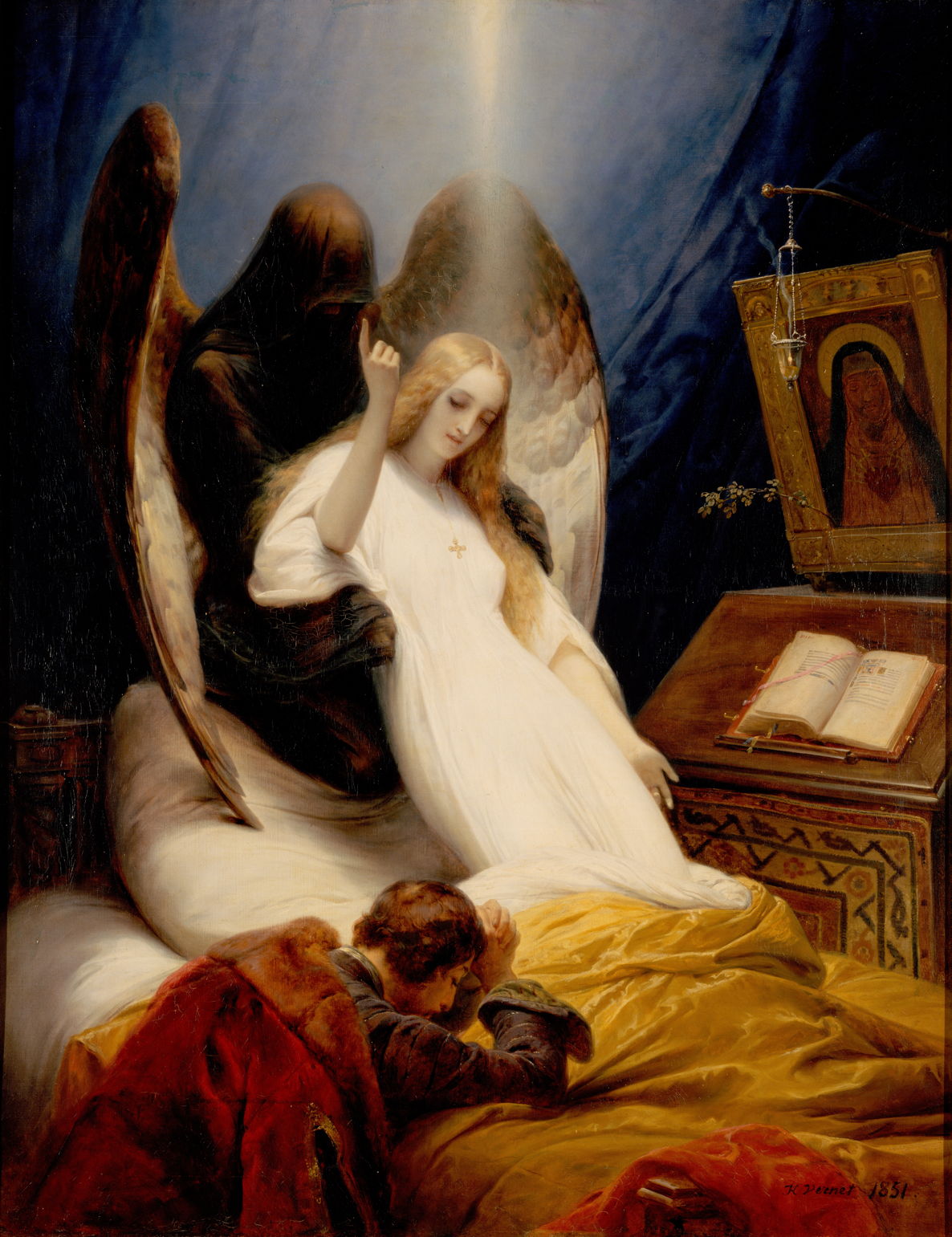
Horace Vernet (1789–1863), The Angel of Death (1851), oil on canvas, 146 x 113 cm, The Hermitage Museum, St. Petersburg, Russia. Wikimedia Commons.

In Horace Vernet’s The Angel of Death from 1851, a young man is praying over the side of a bed, kneeling, his hands clasped together. Opposite him, an illuminated Bible is open, above that an icon hangs on the wall, there’s a sprig of flowers, and a flame burns in prayer. But the occupant of the bed, a beautiful young woman, is being lifted out of it. Her right hand is raised, its index finger pointing upwards to heaven. Behind her, the Angel of Death, the outer surface of its wings black, and clad in long black robes, its face concealed beneath a hood, is lifting her out, to raise her body up towards the beam of light shining down from the heavens.

Cowls are a common feature of the robes worn by hermits as well as monks.
boschstwilgefortisd1
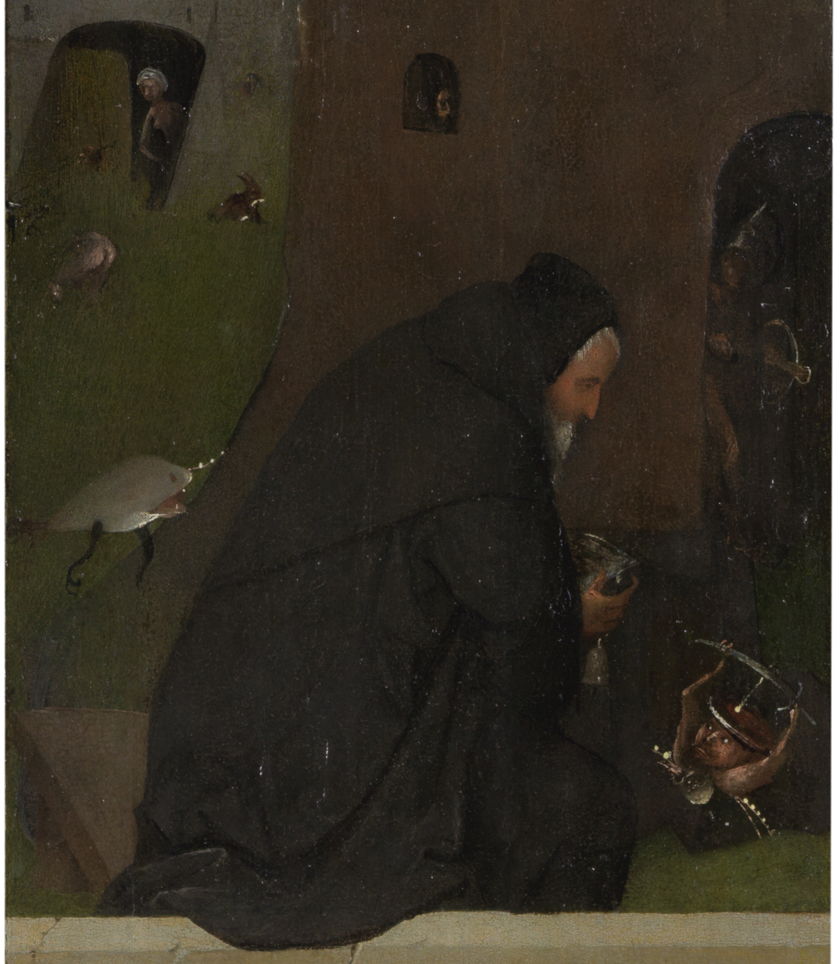
Hieronymus Bosch (c 1450–1516), Saint Wilgefortis Triptych (detail) (c 1495-1505), oil on oak panel, left wing 105.2 × 27.5 cm, central panel 105.2 × 62.7 cm, right wing 104.7 × 27.9 cm, Gallerie dell’Accademia, Venice. Photo Rik Klein Gotink and image processing Robert G. Erdmann for the Bosch Research and Conservation Project.

The figure at the foot of the left panel of Hieronymus Bosch’s Saint Wilgefortis Triptych (c 1495-1505) has some visual similarity with Saint Anthony in his Hermit Saints triptych, and appears to be holding a small bell, one of that saint’s attributes.

daddmonk
Richard Dadd (1817–1886), Portrait of a Monk (1857), watercolour over graphite on moderately thick, slightly textured, beige laid paper, 19.1 x 11.8 cm, Yale Center for British Art, Paul Mellon Collection, New Haven, CT. Courtesy of the Yale Center for British Art.

Richard Dadd painted this Portrait of a Monk on 11 April 1857, from memory of his previous travels in the Middle East.
schikanedercontemplation
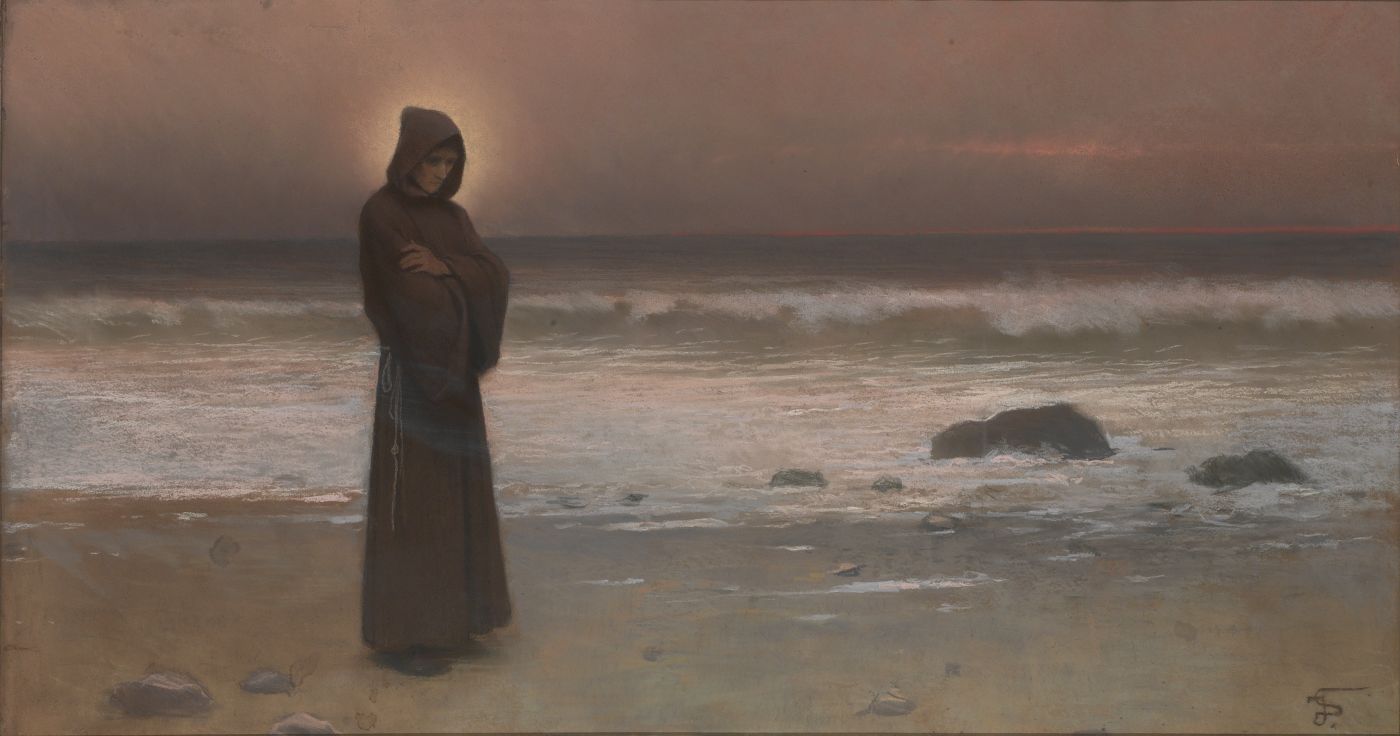
Jakub Schikaneder (1855–1924), Kontemplace, Mnich na mořském břehu (Contemplation, the Monk on the Seashore) (date not known), pastel on paper, further details not known. Wikimedia Commons.

Jakub Schikaneder’s undated Contemplation, the Monk on the Seashore shows a hooded monk on the foreshore, just in front of the water, apparently lost in thought.

Cowls have also been incorporated into other religious dress, where they’re often worn with hats, making them appear vestigial and primarily symbolic.

raphaelportraitcardinal
Raphael (1483–1520), Portrait of a Cardinal (1510-11), oil on panel, 79 x 61 cm, Museo Nacional del Prado, Madrid, Spain. Wikimedia Commons.

Raphael’s magnificent Portrait of a Cardinal from 1510-11 shows the elements of this cardinal’s choir dress: the soft matte surface of the biretta on his head, the subtly patterned sheen of his mozzatta (cape) with its hood, and the luxuriant folds of his white rochet (vestment).

Another uniform that incorporates symbolic hoods is formal academic dress, in which the colours and cut of the hood denote the university and degree.

beraudmadeleinebresthesis
Jean Béraud (1849–1935), The Thesis of Madeleine Brès (or The Doctoral Jury) (date not known), oil on canvas, 63.5 x 48.3 cm, Private collection. The Athenaeum.

In Jean Béraud’s undated The Thesis of Madeleine Brès (or The Doctoral Jury) he shows us one of the early woman doctoral students defending her thesis before the academic jury, who are wearing what might appear now to be fancy dress hats in addition to their colourful hoods. At the time, this was a major landmark in the improvements in women’s rights, and the archaic headwear serves to emphasise this change.

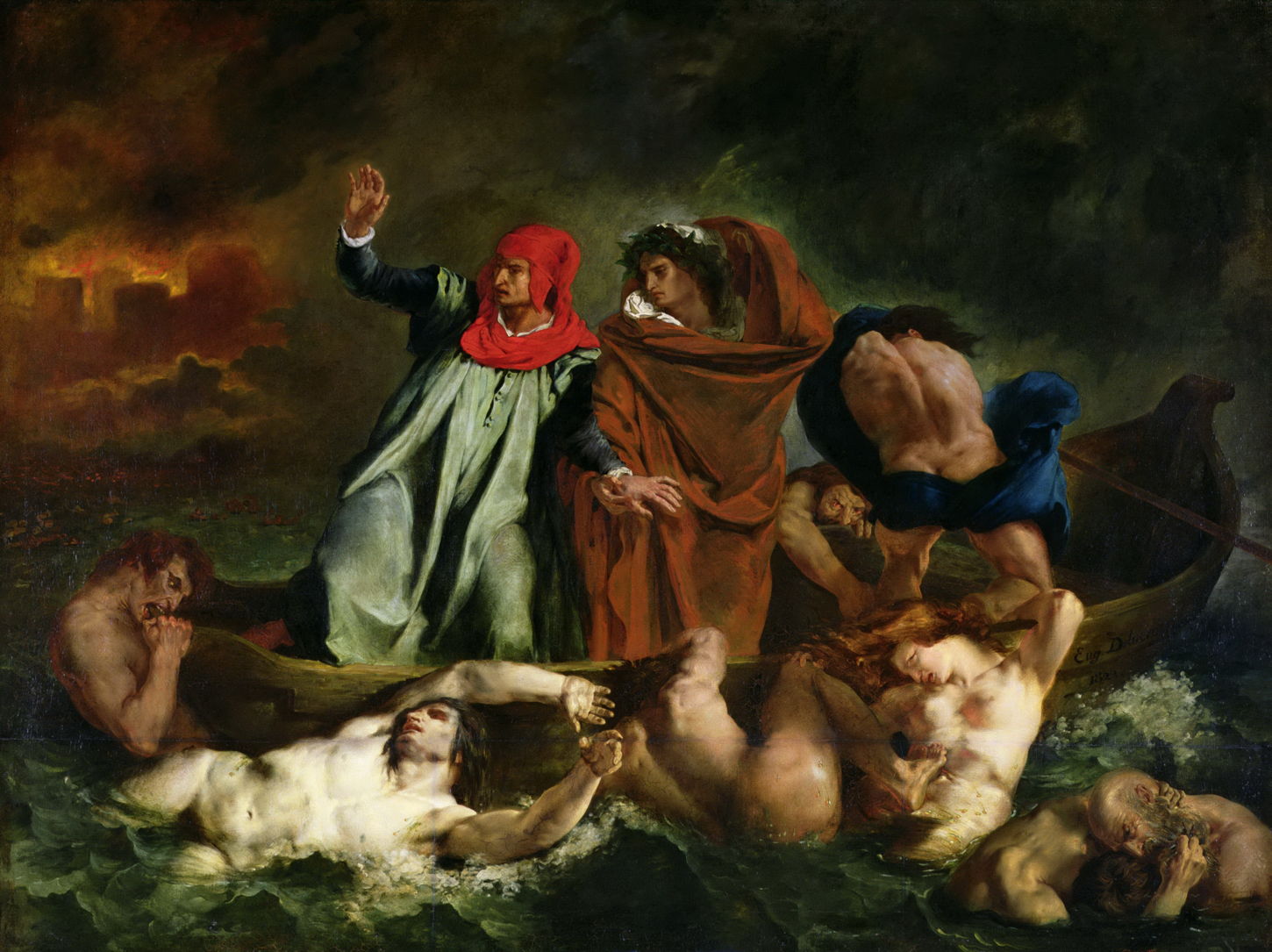
The chaperon had evolved before 1200 as a hooded short cape, then developed into variants that remained popular until becoming unfashionable in about 1500. In paintings it’s most strongly associated with Dante in accounts of his Divine Comedy.
delacroixbarquedante
Eugène Delacroix (1798–1863), The Barque of Dante (Dante and Virgil in Hell) (1822), oil on canvas, 189 x 241 cm, Musée du Louvre, Paris. Wikimedia Commons.

In Eugène Delacroix’s painting of The Barque of Dante from 1822, Dante is inevitably wearing his trademark red chaperon.

hawkinspeasant
Louis Welden Hawkins (1849–1910), A Peasant Woman (c 1880), further details not known. Wikimedia Commons.

The woman’s equivalent of the chaperon persisted until modern times in the hooded cape worn by Louis Welden Hawkins’ Peasant Woman, from about 1880. She is seen near to the rustic village of Grez-sur-Loing, which had become an artist’s colony.

Strangely, the word chaperone (with an added e) is now most commonly used to describe an older woman who accompanies a younger one to ensure that no improper behaviour occurs when in the company of a man.

Before the decline in popularity of hats in the twentieth century, hoods had been relatively uncommon in the general population.

hellqvistvaldemaratterdag
Carl Gustaf Hellqvist (1851–1890), Valdemar Atterdag holding Visby to ransom, 1361 (1882), oil on canvas, 200 × 330 cm, Nationalmuseum, Stockholm. Wikimedia Commons.

Carl Gustaf Hellqvist’s large history painting of Valdemar Atterdag holding Visby to ransom, 1361 from 1882 is an encyclopaedic guide to late medieval dress. Few of its crowd have hoods, and one of those few appears to be a monk, shown in the detail below.

hellqvistvaldemaratterdagdet
Carl Gustaf Hellqvist (1851–1890), Valdemar Atterdag holding Visby to ransom, 1361 (detail) (1882), oil on canvas, 200 × 330 cm, Nationalmuseum, Stockholm. Wikimedia Commons.

Hoods have also been popular with travellers, and from the nineteenth century were incorporated into popular weatherproof capes.

brownlastofenglandoil
Ford Madox Brown (1821–1893), The Last of England (1852/55), oil on panel, 82.5 x 75 cm, Birmingham Museum and Art Gallery, Birmingham, England. Wikimedia Commons.

Ford Madox Brown’s The Last of England (1852/55) shows a young couple with their infant emigrating from England. Tucked under the mother’s weatherproof hooded travelling cape is their baby son.

It seems extraordinary that in the twenty-first century hoodies have been banned as inappropriate items of clothing associated with anti-social behaviour. Perhaps there’s a market for reviving chaperons.

Reading Visual Art: 244 Axe

By: hoakley
6 February 2026 at 20:30

The axe is one of the oldest hand tools used by humans, with stone axes dating back to the dawn of the species and those made from metal being prominent relics of the ancient past. Most consist of a heavy wedged blade mounted at the end of a wooden haft used to swing the blade to cleave wood, or wielded as a weapon. Hafts vary in length from short in compact hatchets to over two metres (six feet) in halberds used to attack cavalry.

Although uncommon in paintings, as in real life, an axe can’t be ignored.

domenicinosacrificeiphigenia
Domenichino (1581–1641), The Sacrifice of Iphigenia (c 1609), fresco, dimensions not known, Palazzo Giustiniani-Odescalchi, Viterbo, Italy. Wikimedia Commons.

Most more recent paintings of the sacrifice of Agamemnon’s daughter Iphigenia at the start of the war against Troy show the use of a ceremonial knife. A notable exception is Domenichino’s fresco in Viterbo, Italy, from about 1609, one of its earliest post-classical depictions. The princess kneels, her wrists bound together, as an axe is about to be swung at her neck. Onlookers at the left are distraught, as her father Agamemnon at the right watches impassively.

anonhoratiuscoclesdefends
Unknown follower of Giovanni Battista Tiepolo, Horatius Cocles Defending Rome Against the Etruscans (date not known), oil on canvas, 137.2 x 208.3 cm, Private collection. Wikimedia Commons.

Much later in the history of classical Rome, an axe is seen being used to demolish the Sublicius bridge as it was defended by the Roman hero, in Horatius Cocles Defending Rome Against the Etruscans, painted by a follower of Giovanni Battista Tiepolo. This bridge is made to look quite flimsy and ad hoc, when in fact it was more substantial at the time.

In Roman times, axes became incorporated in symbols of authority, notably those borne by lictors, bodyguards and attendants to magistrates and all with imperial powers, including the emperor himself.

siemiradzkichristiandirce
Henryk Siemiradzki (1843–1902), Christian Dirce (1897), oil on canvas, 263 x 530 cm, Muzeum Narodowe w Warszawie, Warsaw, Poland. Wikimedia Commons.

Henryk Siemiradzki’s Christian Dirce of 1897 is an account of the killing of a Christian woman in a re-enactment of the death of Dirce, in which a woman’s near-naked body is draped over the body of a bull. This shows the emperor and his entourage, including two lictors holding their fasces, symbolic rods and axes, gazing at the grim aftermath. The word Fascism is derived from those fasces, which are themselves often symbolic of Fascist groups.

sciutiproclamationrepublic
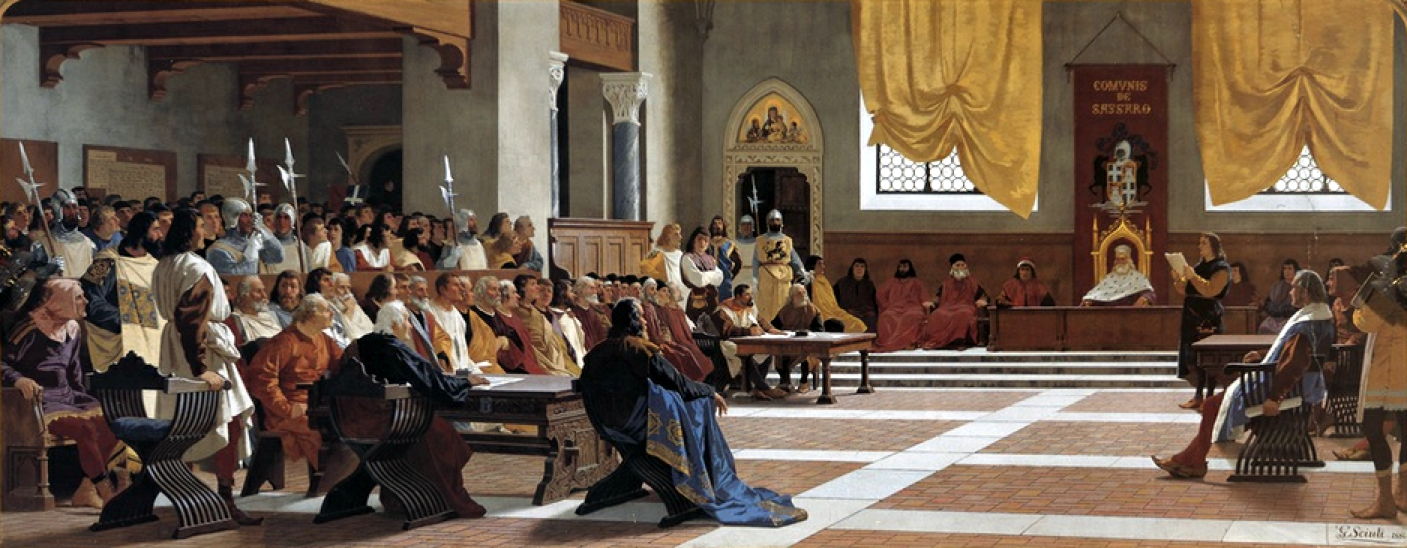
Giuseppe Sciuti (1834–1911), Proclamation of the Republic of Sassari (The Council of the Republic of Sassari) (1880), fresco, dimensions not known, Palazzo della Provincia, Sassari, Italy. Wikimedia Commons.

In 1284, the city of Sassari became the first and only independent city-state of Sardinia, joining more famous city-states such as Florence on the mainland. Proclamation of the Republic of Sassari (The Council of the Republic of Sassari) (1880) is Giuseppe Sciuti’s fresco in the Palazzo della Provincia, Sassari, showing his re-imagining of the moment of creation of that city-state, complete with knights in armour bearing long-hafted halberds.

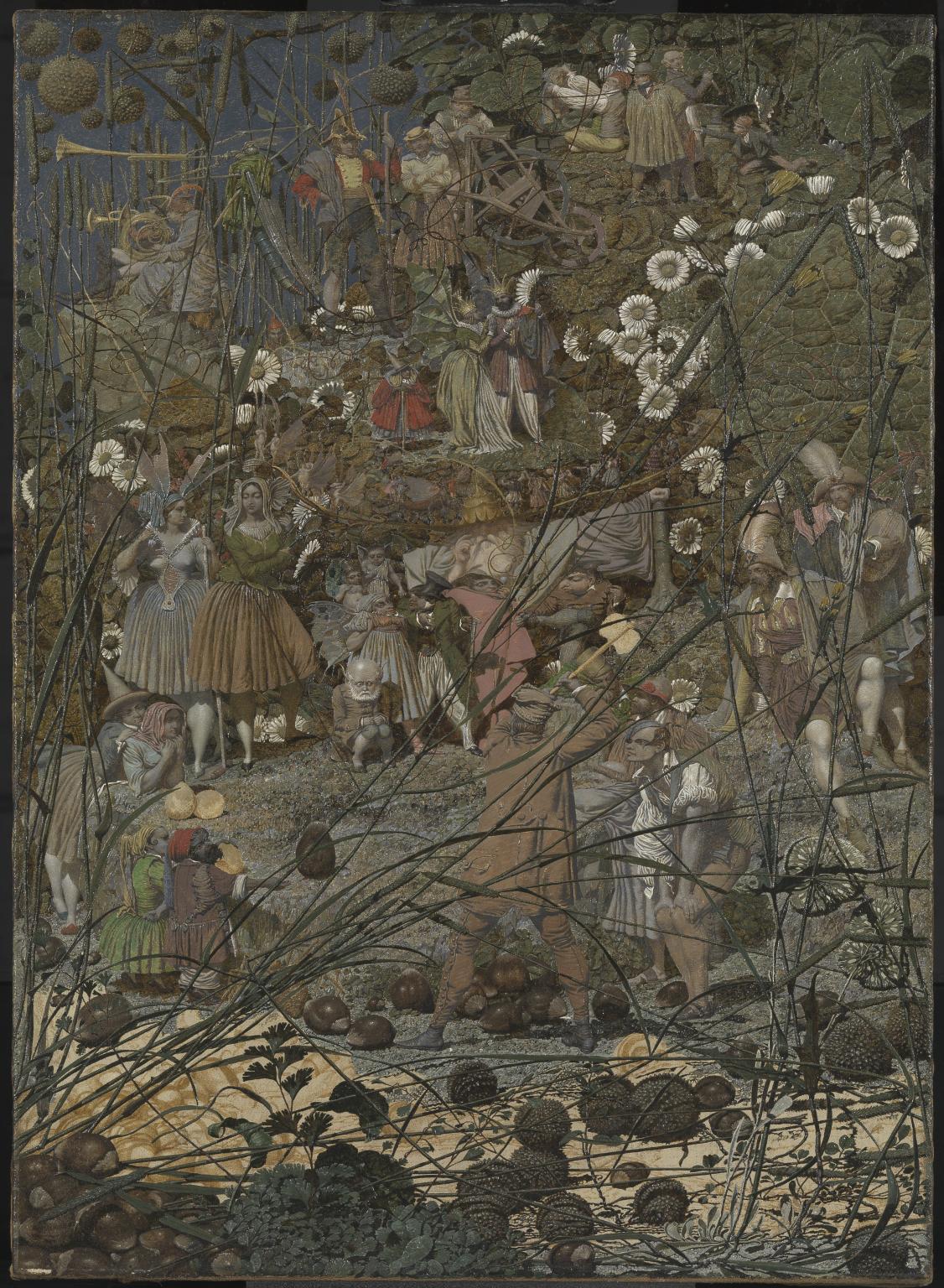
One of the most unusual paintings of an axe being swung is Richard Dadd’s phantasmagoric Fairy Feller’s Master-Stroke, completed over the period 1855-64 during his stay in Bethlem psychiatric hospital.

The Fairy Feller's Master-Stroke 1855-64 by Richard Dadd 1817-1886
Richard Dadd (1817–1886), The Fairy Feller’s Master-Stroke (1855-64), oil on canvas, 54 x 39.4 cm, The Tate Gallery, London (Presented by Siegfried Sassoon in memory of his friend and fellow officer Julian Dadd, a great-nephew of the artist, and of his two brothers who gave their lives in the First World War 1963). Photographic Rights © Tate 2016, CC-BY-NC-ND 3.0 (Unported), http://www.tate.org.uk/art/artworks/dadd-the-fairy-fellers-master-stroke-t00598

This has its origins in Shakespeare’s plays, with inspiration from Mercutio in Romeo and Juliet, and its main content drawn from A Midsummer Night’s Dream. We see Dadd’s scene through fine stalks of Timothy grass, the foreground with scattered hazelnuts and plane tree fruit. Although its perspective is flattened, the figures in the lower half of the painting are stood on a gently rising grassy sward, behind which is a steeper bank and stone walling (prominent at the right). Those in the upper third of the painting appear to be on another level, which rises more steeply towards the top edge.

The scene is set in the night-time, although daisy flowers are still unnaturally open, and there is night sky visible at the upper left. The feller himself, a hewer or fellow, seen at the centre (in the detail below), is about to cleave a hazelnut with his axe to provide a new carriage for Queen Mab (pronounced Maeve, to rhyme with rave), the queen of fairyland.

daddfairyfellersmaster-stroked1
Richard Dadd (1817–1886), The Fairy Feller’s Master-Stroke (detail) (1855-64), oil on canvas, 54 x 39.4 cm, The Tate Gallery, London (Presented by Siegfried Sassoon in memory of his friend and fellow officer Julian Dadd, a great-nephew of the artist, and of his two brothers who gave their lives in the First World War 1963). Photographic Rights © Tate 2016, CC-BY-NC-ND 3.0 (Unported), http://www.tate.org.uk/art/artworks/dadd-the-fairy-fellers-master-stroke-t00598
almatademaeducationchildrenclovis
Lawrence Alma-Tadema (1836–1912), The Education of the Children of Clovis (School of Vengeance, Training of Clotilde’s Sons) (1861), oil on canvas, 127 × 176.8 cm, Private Collection. Wikimedia Commons.

Lawrence Alma-Tadema’s The Education of the Children of Clovis (also known as The School of Vengeance, or The Training of Clotilde’s Sons) (1861) is a scene from Merovingian history, showing Saint Clotilde watching her young sons being taught the royal art of axe-throwing. It’s no wonder that later one of them was to murder two of her grandchildren.

Axe-throwing has recently been revived as a sport, although axes have a more sinister history in their use for executions.

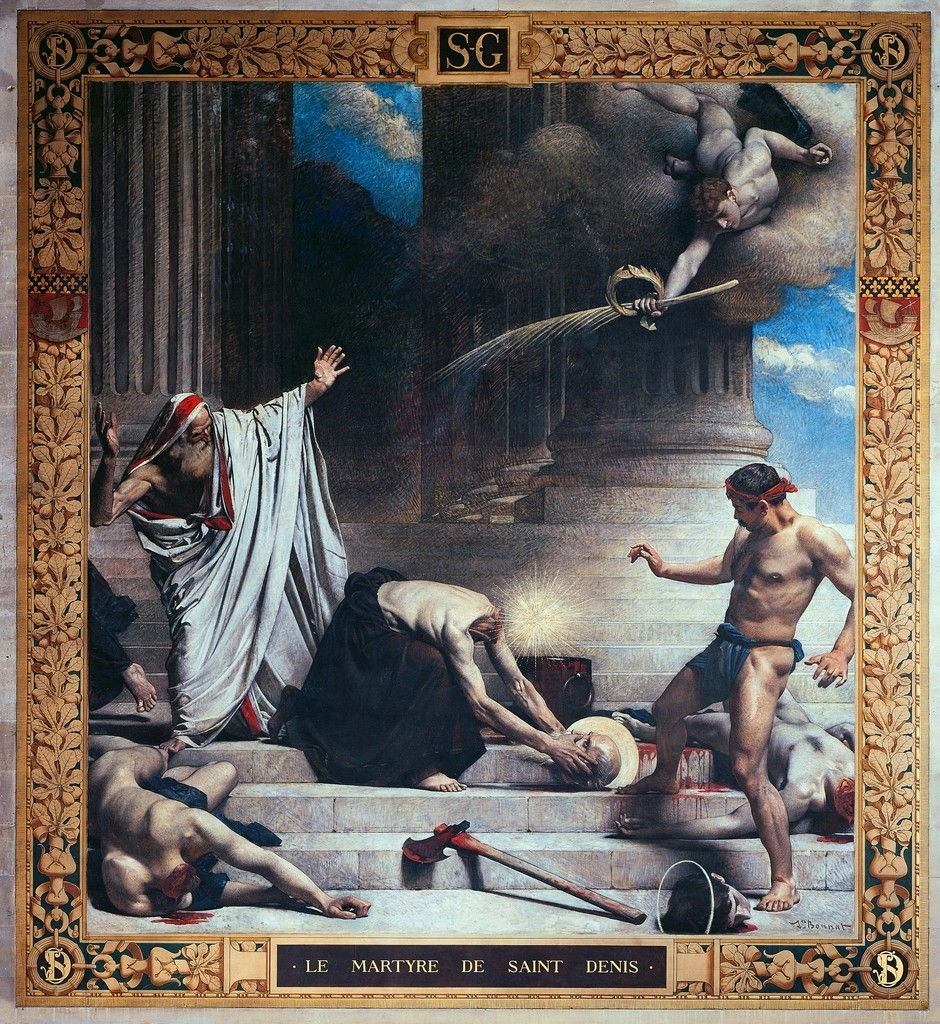
bonnatmartyrdomstdenis
Léon Bonnat (1833–1922), The Martyrdom of Saint Denis (1874-88), oil on canvas marouflée, dimensions not known, The Panthéon, Paris. Wikimedia Commons.

Léon Bonnat’s ornate showpiece in the Panthéon of The Martyrdom of Saint Denis (1874-88) tells this celebrated legend. Saint Denis, patron saint of Paris, was martyred by beheading on Montmartre hill at the edge of the city. It’s claimed that after his head had been cut off, Denis picked it up and walked around preaching a sermon. The legendary location became a place of veneration, then the Saint Denis Basilica, and the burial place for the kings of France.

IF
Paul Delaroche (1797–1856), The Execution of Lady Jane Grey (1833), oil on canvas, 246 x 297 cm, The National Gallery, London. Courtesy of The National Gallery, bequeathed by the Second Lord Cheylesmore, 1902.

Paul Delaroche’s convincing painting of The Execution of Lady Jane Grey (1833) shows the fate of a contender for the crown of England following the early death of King Edward VI at the age of just 15 in 1553. As he had no natural successor, he had drawn up a plan for a cousin, Lady Jane Grey, to become Queen. Her rule started on 10 July 1553, but King Edward’s half sister Mary deposed her on 19 July. She was committed to the Tower of London, convicted of high treason in November 1553, and executed on Tower Green by beheading on 12 February 1554 at the age of just 16 (or 17).

Lady Jane Grey and the Lieutenant of the Tower, Sir John Bridges, take the centre of the canvas. She is blindfolded, the rest of her face almost expressionless. As she can no longer see, the Lieutenant is guiding her towards the executioner’s block, in front of her. Her arms are outstretched, hands with fingers spread in their quest for the block. Under the block, straw has been placed to take up her blood.

At the right, the executioner stands high and coldly detached, his left hand holding the haft of the axe he will shortly use to kill the young woman. Coils of rope hang from his waist, ready to tie his victim down if necessary. At the left, two of Lady Jane Grey’s attendants or family are resigned in their grief.

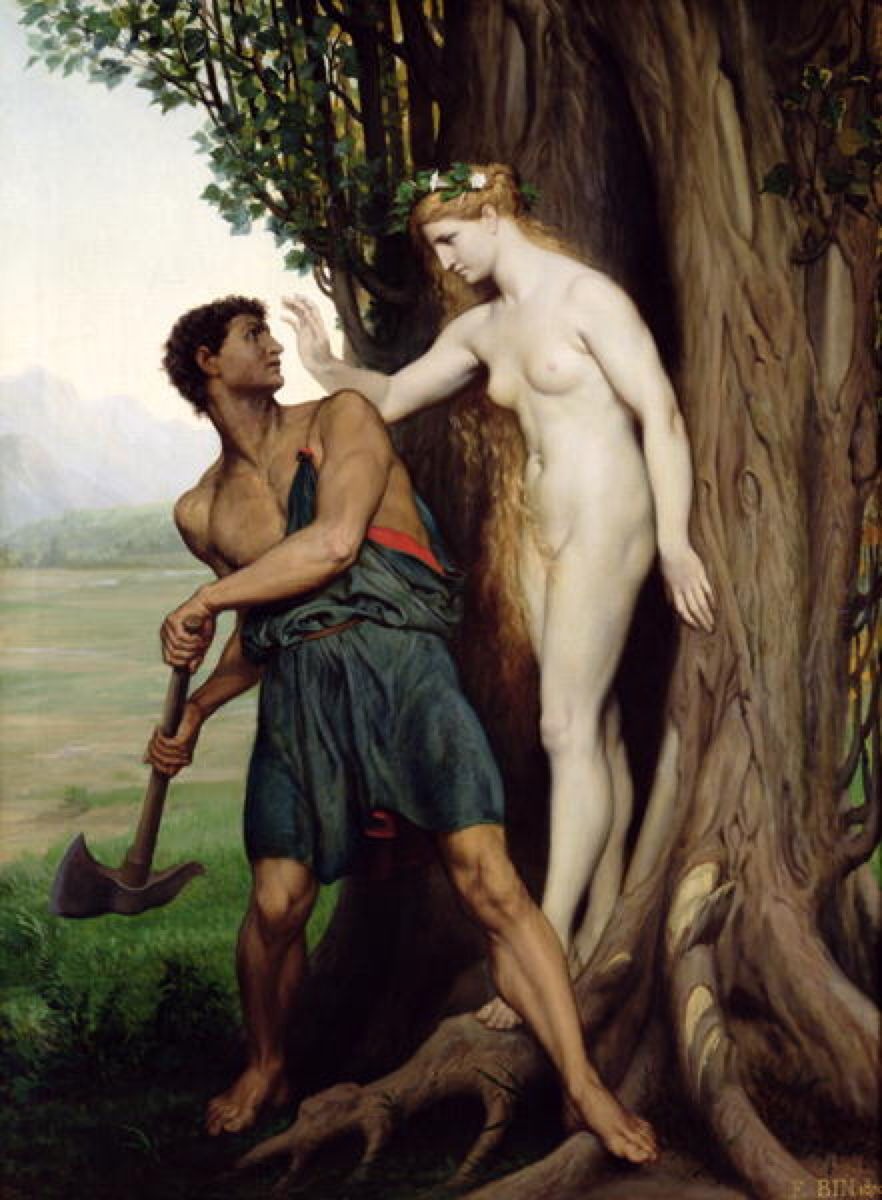
binhamadryad
Émile Bin (1825–1897), The Hamadryad (1870), oil on canvas, Musée Thomas-Henry, Cherbourg-Octeville, France. Wikimedia Commons.

Axes are sometimes shown in their primary role for felling trees, as seen in Émile Bin’s The Hamadryad from 1870, shown in yesterday’s article.

biardmountainrefuge
François-Auguste Biard (1799–1882), In a Mountain Hut (date not known), oil on paper mounted on canvas, 31 × 37 cm, location not known. Wikimedia Commons.

They also make an occasional appearance as a commonplace tool of those who live in wilder surroundings. François-Auguste Biard’s sketchy view In a Mountain Hut may have been made in front of the motif. This has a strong vein of social realism, showing the abject poverty and spartan conditions of many who lived in the more remote areas of France, with an axe beside a well-worn besom in the left foreground.

Medium and Message: Tondo

By: hoakley
20 January 2026 at 20:30

The great majority of paintings are made on rectangular supports, but since ancient times some artists have opted for circular or elliptical shapes instead. These are known as tondo, from the Italian rotondo meaning “round”, with the plural of tondi, or tondos if you really must.

anontriptolemoskore
“Aberdeen Painter”, Triptolemus and Korē (c 470-460 BCE), tondo of a red-figure Attic cup discovered at Vulci, 36 cm diameter, Musée du Louvre, Paris. Image by Jastrow, via Wikimedia Commons.

This tondo of a red-figure Attic cup, now in the Louvre, is typical of classical depictions of Triptolemus and Ceres, and dates from 470-460 BCE. The young deity is sat in Ceres’ special winged chariot, as she provides him with seed to be distributed to the lands around the world.

Fabricating a perfect tondo using wooden panels has remained relatively unusual, probably for practical reasons. The increasing use of fabric stretched on a wooden frame enabled them to become more popular, as they did during the Renaissance.

frabartolomeoadoration1499
Fra Bartolomeo (1472–1517), Adoration of the Child (c 1499), oil on canvas, dimensions not known, Galleria Borghese, Rome. Wikimedia Commons.

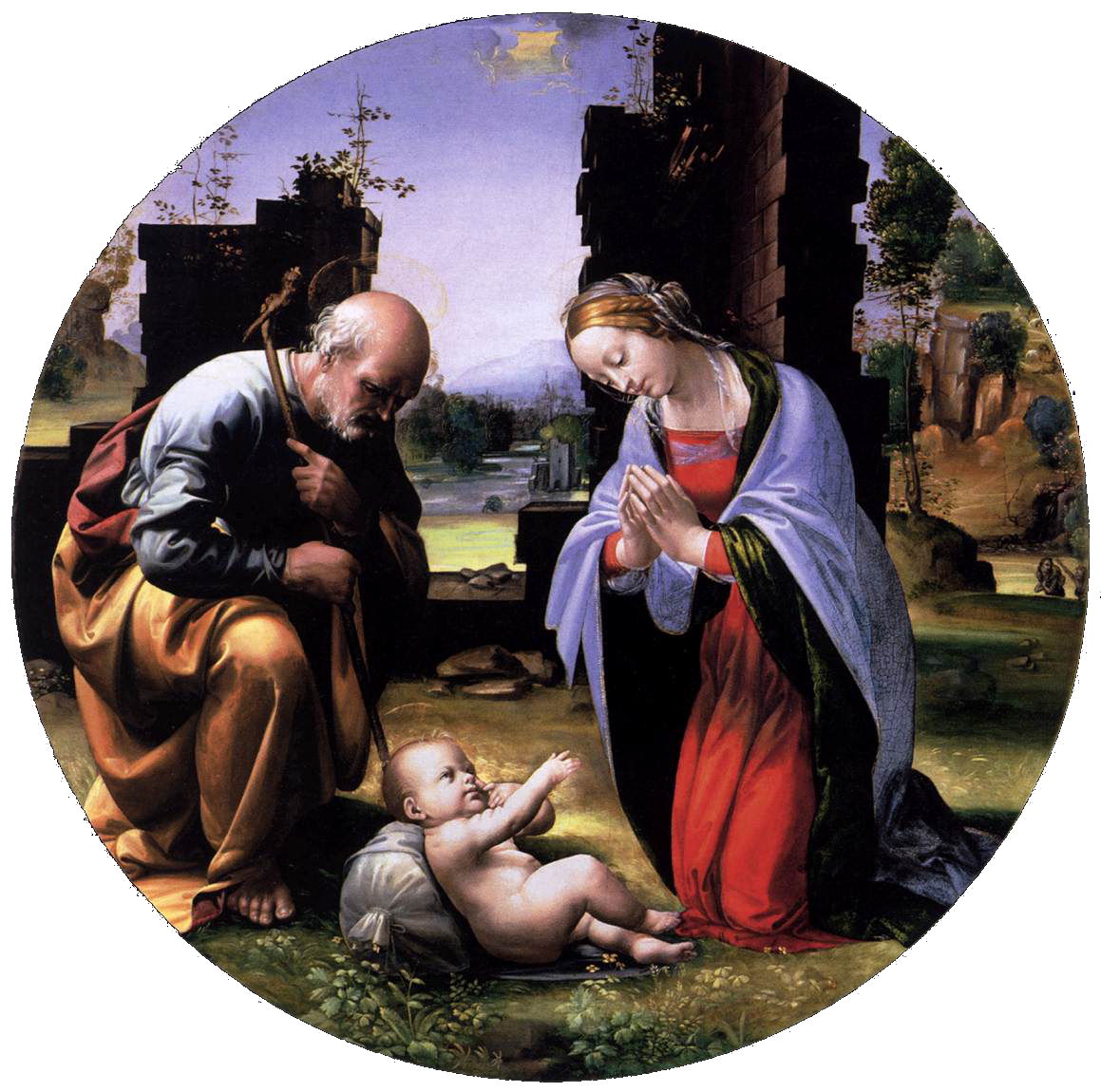
Far Bartolomeo’s tondo of the Adoration of the Child (c 1499) is a fine painting of an enormously popular Christian scene, with Jesus’ parents paying their respects to the baby.

The softer geometry of circles and ellipses makes tondi ideally suited to portraits of the Madonna and child, and for portraits of women more generally. Their use has proved particularly successful in the paintings of Raphael.

raphaelalbamadonna
Raphael (Rafael Sanzio de Urbino) (1483–1520), The Alba Madonna (c 1510), oil on panel mounted on canvas, diameter 94.5 cm, National Gallery of Art, Washington, DC. Wikimedia Commons.

Raphael’s Alba Madonna was probably painted around 1510, and has spawned many replicas. It was commissioned by a bishop for the church of the Olivetans in Nocera dei Pagani, a town on the coastal plain of the south-west of Italy, in the province of Salerno. Its landscape background is also notable.

raphaelmadonnaseggiola
Raphael (Rafael Sanzio de Urbino) (1483–1520), Madonna della Sedia (Seated Madonna with the Child on her Lap and the Young Saint John) (1513-14), oil on panel, diameter 71 cm, Palazzo Pitti, Florence, Italy. Wikimedia Commons.

Of all Raphael’s tondo Madonnas, it’s his Madonna della Sedia (Madonna of the Chair) from 1513-14 which is my favourite. It shows a thoroughly real and natural mother with two infants, every surface texture rendered as in life, in a close-cropped composition matched to its shape.

Tondi have also proved ideal for self-portraits.

anguissolaselfportraittondo
Sofonisba Anguissola (1530–1625), Self-portrait (date not known), oil on panel, diameter 13.2 cm, Private collection. Wikimedia Commons.

This small undated Self-portrait shows Sofonisba Anguissola, the first great female master.

poussintimetruthenvydiscord
Nicolas Poussin (1594–1665), Time Defending Truth against the Attacks of Envy and Discord (1641), oil on canvas, diam 297 cm, Musée du Louvre, Paris. Wikimedia Commons.

Although his best-known paintings were all rectangular, Nicolas Poussin’s later tondo Time Defending Truth against the Attacks of Envy and Discord (1641) puts Father Time at its centre, with a firm grip around Truth’s waist, while Envy and Discord sit below them. On this occasion Time doesn’t have a hand free for an hour-glass. This appears to have been projected for placement in a round ceiling, another good reason for his choice of format.

tiepolodiscoverytruecross
Giovanni Battista Tiepolo (1696–1770), Discovery of the True Cross and Saint Helena (c 1743), oil on canvas, 490 cm diam, Gallerie dell’Accademia, Venice. Wikimedia Commons.

Although Tiepolo’s Discovery of the True Cross and Saint Helena (c 1743) is painted on a flat tondo, it was intended for display from the ceiling of the Capuchin church in Castello, as demonstrated in its projection.

kauffmancymonIphigenia
Angelica Kauffman (1741–1807), Cymon and Iphigenia (c 1780), oil on canvas, diam 62.2 cm, Gibbes Museum of Art, Charleston, SC. Wikimedia Commons.

In about 1780, Angelica Kauffman painted this delightful tondo of Cymon and Iphigenia, a variation on a popular theme.

girodetmllelangedanae
Anne-Louis Girodet de Roussy-Trioson (1767–1824), Portrait of Mlle. Lange as Danae (1799), oil on canvas, 60.3 x 48.6 cm, Minneapolis Institute of Arts, Minneapolis, MN. Wikimedia Commons.

Girodet chose a large elliptical tondo for his ‘revenge’ portrait of Mlle Lange, who had refused his previous portrait of her. As a motif in painting, Danaë had come to be represented as a reclining, beautiful, nude woman, on whom a stream of golden coins was falling, and it was that stream Girodet wanted to exploit. It could have only one reading in this context: that Mlle Lange sold her body in return for money, and Girodet was happy to be even more explicit.

Tondi were also imitated on occasion. Ford Madox Brown’s first painting to establish his interest in more complex storytelling was The Last of England, which he started as his response to the emigration to Australia of the only Pre-Raphaelite sculptor, Thomas Woolner, in 1852.

brownlastofenglandoil
Ford Madox Brown (1821–1893), The Last of England (1852/55), oil on panel, 82.5 x 75 cm, Birmingham Museum and Art Gallery, Birmingham, England. Wikimedia Commons.

Brown’s original oil version is one of his most subtle compositions. Central to its imitation of a circular tondo is a middle-class couple who are not enjoying the fact that their migrant ship is ‘all one class’. They both stare with grim determination at the prospect of sharing the next few weeks with the rowdy working class passengers behind them, eating the same increasingly stale vegetables which are now slung from cords around the ship’s rail in front of them.

This isn’t just a couple, though: look closely at their hands, and the woman’s left hand is clutching the tiny hand of her baby, who is safely swaddled inside her weatherproof hooded travelling cape. Her right hand, wearing a black leather glove, grasps that of her husband, whose left hand is tucked under his heavy coat. Splashes of brilliant colour are supplied by the wind blowing the woman’s ribbons.

daddcontradictionoberontitania
Richard Dadd (1817–1886), Contradiction: Oberon and Titania (1854-8), oil on canvas, 61 x 75.5 cm, Private collection. Wikimedia Commons.

Richard Dadd’s Contradiction: Oberon and Titania from 1854-8 develops his early faerie paintings into a new and unique style, and was painted for the hospital’s first resident Physician-Superintendent, William Charles Hood.

Dadd takes its theme from Shakespeare’s Midsummer Night’s Dream, and there’s hardly a square millimetre of canvas into which he hasn’t squeezed yet another curious detail. Like other great imaginative painters such as Bosch before, his dense details dart about in scale: there are tiny figures next to huge leaves and butterflies, and towards the top these distortions of scale generate an exaggerated feeling of perspective, which his choice of format may have enhanced.

schwabemedusa
Carlos Schwabe (1866–1926), Medusa (1895), watercolour on paper, dimensions not known, Private collection. Wikimedia Commons.

Carlos Schwabe’s watercolour tondo portrait of Medusa from 1895 is one of the most startling paintings in the round.

All good art suppliers continue to do a steady trade in tondi.

❌
❌