One hundred years ago today, on 1 April 1926, Charles Angrand, a leading member of arts circles in Paris in the late nineteenth century and a well-known painter, died. Although his paintings have today almost lapsed into obscurity, his work is represented in many of the world’s leading collections. This article gives an all too brief summary of his career with some of the few of his paintings that remain accessible.
Angrand was born in Normandy, France, in 1854 and went on to train at the provincial academy in Rouen. He was unsuccessful in gaining admission to the École des Beaux-Arts in Paris, but moved to the city in 1882 to teach mathematics. At that time he was living close to the Café Guerbois and other places frequented by artists, and joined their circles.
Charles Angrand (1854–1926), Interior of the Rouen Museum in 1880 (c 1880), oil on canvas, 114 x 154 cm, Musée des Beaux-Arts de Rouen, Rouen, France. Wikimedia Commons.
His early paintings, such as Interior of the Rouen Museum in 1880, appear to have been realist. This shows copyists at work in the Rouen Art Museum. The bored painter in the foreground is his friend Léon-Jules Lemaître (1849-1905), who later painted Angrand’s portrait in looser style.
Charles Angrand (1854–1926), Painter en plein air (1881), oil on canvas, 65 x 54 cm, Private collection. Wikimedia Commons.
The following year, Angrand caught this Painter en plein air (1881) strangely separated from his palette and brushes in a field of green. His style steadily changed, as reflected in the brushstrokes visible in the green field. This painting is currently for sale from Leighton Fine Art Ltd. for £79,500.
In May 1884, he joined with Georges Seurat, Paul Signac, Henri Edmond Cross and others to form the Société des Artistes Indépendents, the core of the new Neo-Impressionist movement. The following year, Camille Pissarro joined them.
Charles Angrand (1854–1926), The Seine, Morning (Saint-Ouen) (1886), oil on canvas, dimensions not known, Van Gogh Museum, Amsterdam, The Netherlands. Wikimedia Commons.
Angrand’s landscapes became more experimental. He painted this unusual view of The Seine, Morning (Saint-Ouen) in 1886, with its thin strip of bank in the distance, and most of the canvas filled by the river. Saint-Ouen is a suburb to the north of Paris.
Charles Angrand (1854–1926), The Western Railway at its Exit from Paris (1886), oil on canvas, 73 x 92 cm, The National Gallery, London. Wikimedia Commons.
The Western Railway at its Exit from Paris, from the same year, shows the railway marshalling yards on the outskirts of the city.
Charles Angrand (1854–1926), Man and Woman in the Street (1887), oil? on canvas, 38.5 x 33.2 cm, Musée d’Orsay, Paris. Wikimedia Commons.
In 1887, Angrand changed from a late Impressionist style to early Divisionism, as seen in this Man and Woman in the Street (1887). His coarse dots are almost monochrome, with just a faint hint of colour.
In 1891 he exhibited alongside Les XX in Brussels.
Charles Angrand (1854–1926), The Harvesters (1892), oil on canvas, 123.5 x 79.1 cm, Museum of Fine Arts, Houston, TX. Wikimedia Commons.
Angrand’s best-known painting today is The Harvesters from 1892, one of a series of rural scenes he appears to have painted in the countryside of Normandy. This is similar to those painted by Pissarro during his Divisionist period.
In the 1890s Angrand painted less and preferred using conté crayons and pastels. In 1896 he moved to Normandy, and became progressively more reclusive.
Charles Angrand (1854–1926), Thatched Cottage in an Orchard (1903), oil on canvas, 50.4 x 65.5 cm, Wallraf-Richartz-Museum & Fondation Corboud, Cologne, Germany. Wikimedia Commons.
He painted Thatched Cottage in an Orchard in 1903. His swirling brushstrokes are reminiscent of Vincent van Gogh’s late paintings, but his strokes here are more broken.
In his later years, Angrand appears to have painted less, and he died in Rouen on 1 April 1926. Although his work was exhibited at the Salon des Indépendents the following year, and he had a solo retrospective at Musée Tavet-Delacour in Pontoise in 2006, I’m disappointed that none appears to have been organised to mark this centenary.
“Stephen G.” is a UPenn graduate who studied East Asian Languages and Civilizations. He was also a Reischauer Scholar through SPICE, Stanford University.
“Humans will be completely freed from work in the end, which might sound good but will actually shake society to its core… you could even say the mark of success for this AI revolution is that it replaces the vast majority of human jobs.” This is the warning given by a DeepSeek spokesperson at the World Internet Conference in Wuzhen 乌镇 in November 2025. He called on AI companies to alert the public regarding which jobs could be eliminated first. While the risk of job loss looms large around the world, China faces unique challenges due to domestic economic headwinds coupled with high expectations for AI.
The Chinese State Council published its ambitious “AI+” initiative in August, aiming to have AI devices, agents, and applications reach a penetration rate above 70 percent across society by 2027 and 90 percent by 2030. Beijing wants AI to serve as a new engine of economic growth and productivity increases. But how will China navigate the challenges of adopting AI while softening its impact on the job market? As China marches toward an AI-powered future, what strategies could policymakers develop to uphold the social contract between the party and the people?
China’s Labor Market
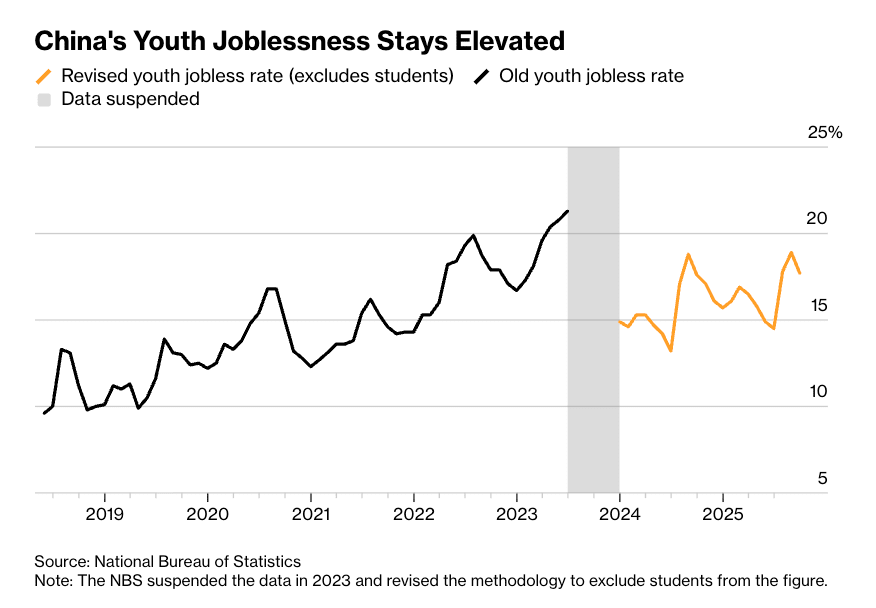
Since the pandemic, China’s youth unemployment rate has stayed high; in mid-2023, it reached a historical high point of 21.3%, nearly double the pre-pandemic rate in 2019, prompting the National Bureau of Statistics to suspend publication of the data. Reporting only resumed several months later using different metrics. However, joblessness data under the new metrics reached another record of 18.9% in August 2025 for “unemployed youth aged 16-24 who are not in school ” — and many believe the true figure to be much higher.
Besides, a vast number of low-skilled workers have lost stable sources of income and now rely on the gig economy. According to RAND, hundreds of millions of rural workers have become unemployed due to the housing-market collapse and the contraction of low-skilled manufacturing. Many of them now drive for ride-hailing or delivery apps, which offer little financial security or potential for upward mobility.
Defending Humans
While UScoverage of AI-displacement often tends toward pessimism rather than workable solutions, the Chinese government has taken action on the issue — to an extent. In a December 2025 employment arbitration case, the Beijing Municipal Bureau of Human Resources and Social Security 北京市人力资源和社会保障局 stated that “AI replacing the job function” is not a legally valid reason for employee termination. The case involves a tech company that eliminated an employee’s position due to AI, framing automation as “a material change in the objective circumstances since the labor contract was signed 劳动合同订立时所依据的客观情况发生重大变化”. Nonetheless, the arbitrator ruled the termination unlawful, noting that a “material change” must be unforeseeable and caused by force majeure events such as natural disasters and policy changes. In contrast, the company’s adoption of AI technology was a voluntary business decision. As a result, the company was ordered to pay ¥791,815 ($113,956) in compensation for unlawful termination.
In China, employment arbitration cases typically reference precedents set by the local high court, the labor arbitration committee, and the Bureau of Human Resources and Social Security. According to a Beijing-based lawyer, this arbitration case will serve as a reference locally and could influence arbitration decisions in other provinces, especially in northern regions.
The Beijing arbitration authority further noted that under such circumstances, employers should first consider contract modifications, retraining programs, or internal transfers to accommodate affected employees. Multiple state media outlets covered the case, describing it as “setting a new benchmark 具有标杆意义” and “giving workers peace of mind 给广大劳动者吃了一颗定心丸.” Against a backdrop of heightened public anxiety over unemployment, Beijing is signaling to private-sector employers that they cannot use AI adoption as a legal justification for layoffs. But even with restrictions on layoffs, firms often circumvent statutory protections through attrition, short-term contracts, and labor dispatch arrangements. The ruling’s practical impact therefore remains uncertain, given the historically questionable enforcement of labor laws in China.
Online commentaries also raised doubts on whether the ruling will meaningfully protect workers going forward. OnZhihu, many users argue that the case is yet another example of companies pursuing layoffs without paying severance. Since most employees would not pursue the tedious arbitration process, in part due to the fear of harming future job prospects once they have an arbitration record, employers face little risk — the worst case would be paying the severances that the employee deserves initially. Multiple follow-up comments lament the absence of more punitive measures for employers in Chinese labor law.
While their implementation may fall short, more laws and regulations on AI automation can be expected. On Jan 27th, 2026, the Ministry of Human Resources and Social Security has announced that China will issue official documents to respond to the impact of AI on employment. The November 2025 issue of Study Times 学习时报, an official newspaper of The Central Party School 中共中央党校 (where elite CCP cadres get trained), also discussed legislation to manage job displacement. It recognizes that the trend of AI automation eliminating jobs has been accelerating, and that China’s current laws and regulations need to catch up.
One can look at previous evidence to gauge how such legislative efforts may unfold. Public opinion on matters regarding labor conditions has swayed the Chinese government’s regulatory response before: In September 2020, an investigative article by Renwu 人物 sparked public outrage for the plight of delivery drivers, which prompted state media to criticize the delivery platforms. Policy response came during the summer of 2021 with two new regulations on algorithms. The first required the platforms to adopt a “moderate algorithm 算法取中” that loosens up time limits on delivery, instead of the “strictest algorithm” that had forced drivers to break traffic rules in order to be “on time”. It also emphasized that drivers’ earnings must not fall below the minimum wage. The second, issued as part of a broader regulation governing internet platforms’ recommendation algorithms, mandated that companies file detailed algorithm disclosures.
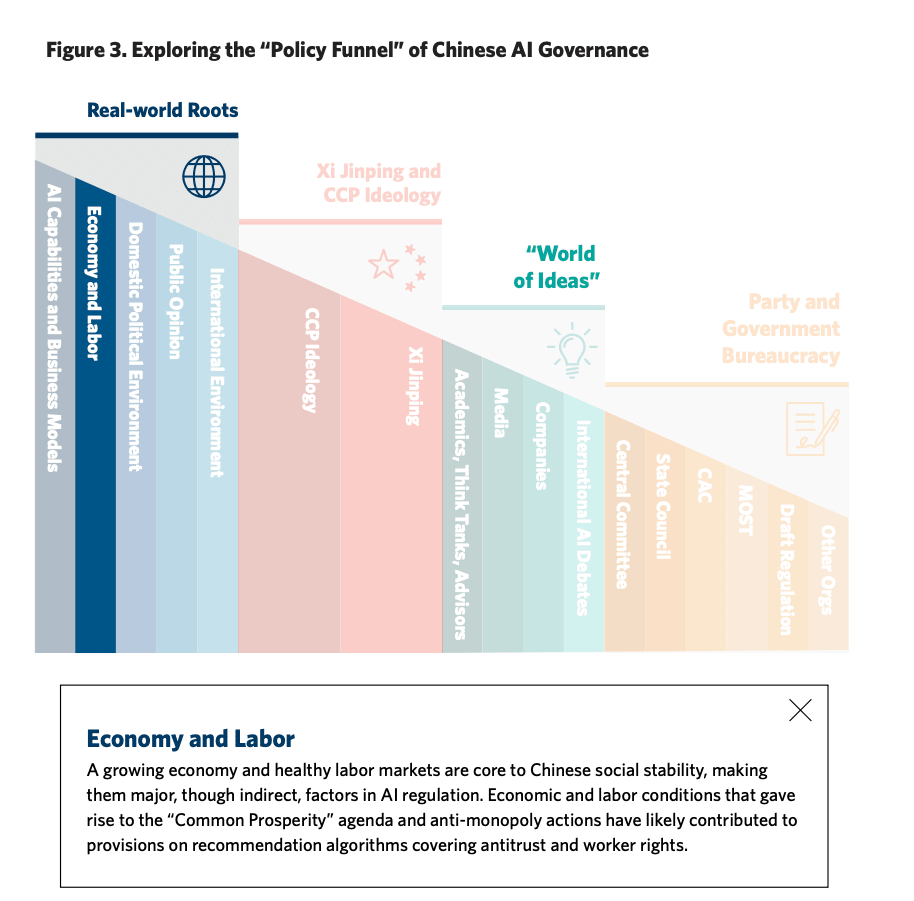
The process through which China produced regulations on AI-systems themselves — including recommendation algorithms, deepfakes, and generative AI-outputs — could also help us predict how the state might respond to AI-led job displacement. Matt Sheehan of the Carnegie Endowment for International Peace reverse-engineers China’s AI regulatory development and outlines a four-layered policy process: real-world conditions; Xi Jinping and CCP ideological framing; the “world of ideas”, consisting of think tank scholars, AI scientists, and corporate lobbyists, etc.; and finally, the party and state bureaucracies. To date, much of the regulatory design has occurred within the latter two layers.
Source: Carnegie Endowment for International Peace
Applying this framework to workforce disruption, expect that labor-market shifts will be framed as a priority issue since they are core to Chinese social stability and common prosperity. Then the issue would command policy debate: journalists may spotlight the plight of workers displaced by automation, while corporate actors emphasize productivity gains and global competitiveness. Sheehan observes that AI-system governance currently allows relatively wide space for policy debates, in part because the field is new and competition among bureaucracies has yet to solidify.
A similar dynamic could shape regulatory responses to AI-induced displacement, allowing for more input from think tanks, media, and businesses. Although China has extensive experience managing unemployment, AI-related disruption may differ in its pace, scale, and breadth of sectors affected. This distinction may prompt policymakers to treat AI-driven job loss not merely as cyclical unemployment, but as a structural governance challenge.
Potential upcoming policy initiatives highlight the state’s plans to protect people’s livelihoods while technology rapidly advances. Study Times emphasizes that industries should adopt new technology in “human-machine coordination 人机协同” and “scientifically adjust the level of automation to materially improve employment stability 科学调节制造业自动化程度.” In the AI+ plan, the term “human-machine coordination人机协同” also appears in the first paragraph. The term has been defined as “the process of humans and intelligent systems (including algorithms, artificial intelligence and robots) completing tasks together”.
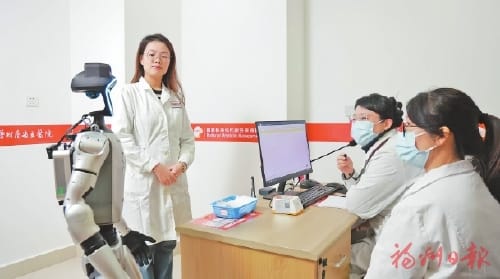
This concept has been further interpreted and is being put into practice. Cai Fang 蔡昉, a prominent Chinese economist and president of the Labor Economics Society 劳动经济学会会长, argues that AI should be guided by policies that prioritize human-machine collaboration over efficiency gains from automation alone. Some current AI applications in China reflect this awareness. For example, robots from Unitree have become “AI Physician Assistants”, making clinical rounds as part of a “human-machine-coordination multidisciplinary team (MDT) 人机协同MDT” at Fuzhou University Affiliated Provincial Hospital 福州大学附属省立医院. Unlike Silicon Valley companies bragging about being “fully AI native”, official directives in China often prominently display human involvement and show a clear intention to manage AI’s threat to the workforce.
Proposals addressing AI-driven labor concerns are abundant in China. During the 2025 Two Sessions meeting, Liu Qingfeng 刘庆峰, the CEO of iFLYTEK 科大讯飞 and an NPC (National People’s Congress, which generally rubber-stamps decisions already made at the highest levels of the CCP) deputy, suggested “AI-specific unemployment insurance AI失业保障专项保险”, a 6-12-month grace period for layoffs, and more job-oriented curriculum at universities and trade schools. For low-income communities, he emphasized that the state should provide free upskilling. He also recommended building a “‘monitor, alert and respond’ system that dynamically tracks employment status 就业监测-预警-响应”全链条监测机制”, with pilot rollouts in the Yangtze and Pearl River Deltas. The platform would require businesses with extensive AI-usage to provide data on job replacement to predict unemployment risks.
During the Two Sessions, Guoquan Lü 吕国泉, the All-China Federation of Trade Unions chief of staff, also highlighted practices in Spain, Korea, and Japan that China could adopt, such as limiting enterprises from replacing more than 30% of workers in a single position, requiring a portion of automation-driven cost savings to be allocated to employee upskilling, and levying additional taxes ranging from 0.5% to 3% to fund unemployment benefits. Chinese authorities could take similar measures in the near future, which would put more pressure on companies already navigating brutal competition, tariff wars, and domestic deflation.
Besides policy proposals, several structural conditions in China may soften the impact of AI-led displacement. First, the relatively low cost of labor reduces firms’ incentives to replace workers, particularly when the technology is immature. A Chinese manufacturer interviewed by Nikkei Asia states that his automated production line equipment is sitting idle due to the high start-up cost of operating them. Instead, he continues to rely on the experienced workers who can “make better clothes than what machines can do now.” Such dynamics create a buffer against rapid job loss that many Western economies do not share.
Some believe that SOEs could absorb both new graduates and workers displaced by technological changes. In China, “employment within the system 体制内工作“ — which includes positions in government agencies, public institutions such as schools and hospitals, and centrally or locally-affiliated SOEs — has long been considered an “iron rice bowl 铁饭碗” that offers exceptional job stability for both employees and society at large. Helen Qiao, a managing director and chief economist for Greater China at Bank of America, told Nikkei in December 2025 that Chinese graduates may face less AI-led disruption than their American counterparts since “SOEs will continue to shoulder some social responsibility, cushioning the impact.”
Indeed, SOEs have helped stabilize employment to an extent. Regarding youth unemployment, many localities have issued policies encouraging SOEs to recruit more college graduates, with some regions requiring that at least half of new hires in SOEs be recent graduates.
Nonetheless, “employment within the system” is unlikely to serve as an effective employment buffer under China’s current fiscal environment. Local governments are under significant financial strain — in China’s fiscal system, they bear primary responsibility for funding government agencies, public services, and local infrastructure. Yet while a large share of China’s tax revenue flows to the central government, local governments have become significantly indebted and are under huge financial pressure. Local civil servants, whose salaries come directly from the local government budget, have seen their wage promises deteriorate from “guarantee six (months of wages annually), try for eight 保六争八” to “ guarantee three, try for six 保三争六”. Similar wage arrears have affected workers ranging from SOE employees to doctors and teachers.
The policy tools for potential AI-driven displacement may no longer be viable in 2026 due to fiscal constraints by analyzing previous reforms that supported displaced coal workers. During 2016-2020, the central government committed ¥100 billion (approximately $14 billion) to support an estimated 1.3 million displaced coal workers through benefits and compensation. In the example of Wuhai 乌海, Inner Mongolia, the central government issued funds to SOEs to provide early-retirement benefits, severance packages, delayed salary payments, and other forms of support.
Local governments were expected to contribute similar sums and also took various measures to help the former coal workers find jobs. In Wuhai, the combined efforts from the central government, the city government, and the SOEs helped prevent social instability, and no petitions were reported. Local authorities also created non-coal-mining jobs by attracting new businesses, including in chemical supply chains like coke and chlor-alkali. As a result, employment in the chemical industry surpassed that in the coal-mining industry by 2020.
Compared to the Wuhai case, the government’s capacity to address AI-driven displacement today is far more constrained. With their coffers already depleted, local governments can provide few incentives to attract industries capable of bringing in new jobs, and in a world of AI disruption, it’s not totally clear what those industries would even be. (Sectors such as manufacturing, digital media, and AI development have reportedly seen the emergence of new job categories leveraging AI, but it’s an open question which positions could provide durable employment at scale.)
Therefore, many of the ambitious proposals for managing AI-led displacement may need to incorporate self-financing mechanisms rather than relying on direct government support. As deputy Lü Guoquan 吕国泉 has suggested, one potential approach would be requiring firms to reinvest a share of automation-driven cost savings into worker upskilling.
Public discourse further reflects concerns about unemployment and the administration’s capability to address it. When I spoke by phone with Wu Hong 吴宏, an advisor to the Neuroscience and Intelligent Media Institute at the Communication University of China 中国传媒大学脑科学与智能媒体研究院顾问, he told me he thinks that “macro-level pressures, rather than isolated technological advances, are stressing the economy and employment today”.
At the implementation level, online discussions expose how labor policies unfold in practice. On Zhihu, one user wrote:
“My company has to hire hundreds of new grads every year, but the business doesn’t need these people at all. Easy peasy — after a year, most either quit on their own or are laid off, and only a small fraction stay.”
Such anecdotal observations align with empirical findings. Research by a group of economists in 2023 found that government subsidies were linked with gains in employment at the time of subsidy receipt, but that these gains reversed one year later. In Ching Kwan Lee’s seminal work on Chinese labor politics, Against the Law: Labor Protests in China’s Rustbelt and Sunbelt, she argues that the violation of labor rights is a structural problem due to the national strategy of decentralized accumulation and legal authoritarianism: While local governments are responsible for developing a pro-business local political economy, the same local officials are also expected to implement labor laws issued by the central government, who sees stability as a legitimation strategy. Such tensions could weaken local government’s effort in managing AI-led job disruption since they are simultaneously incentivized to promote business efficiency.
Human-machine-coordinated Future?
AI-driven workforce disruption carries broader implications for China’s future. The pattern of displacement may differ from that in the West. In China, low-wage workers could be the most vulnerable as robots are already serving food in restaurants, delivering room service in hotels, and guiding shoppers in malls. The country’s 200 million gig workers also face mounting threats from robotaxis and delivery drones.
In contrast, in the US and other developed economies, anxiety about automation has largely centered on white-collar professionals. Major tech firms like Amazon, Microsoft, Salesforce, and IBM have dominated headlines with AI-related layoffs. Meanwhile, growing numbers of young people in the US and UK are opting for skilled trades over college, citing fears of AI replacing knowledge work. Wu Hong told me he thinks that China’s long-standing advantage of having a large pool of skilled manufacturing workers could be challenged if Western economies use AI and robotics to reshore production. He also suggests that with automation, the West may be able to replicate China’s advantage of having a robust talent base of highly skilled tech workers.
These possible trajectories add more complexity to China’s AI transition. Managing workforce adjustment is central to China’s social stability and national prosperity, and China’s proactive stance on the matter may allow it to build a concerted response system to cushion the impact of job loss. Expect stopgap measures such as new legislation and financial incentives to be introduced. Nevertheless, the harsh fiscal reality could stall many initiatives, forcing policymakers to confront difficult trade-offs between employment protection and AI-led efficiency gains.
ChinaTalk is a reader-supported publication. To receive new posts and support my work, consider becoming a free or paid subscriber.
The former chairman of a financial group was brought to China in handcuffs, the latest high-level capture in a widening investigation into organized crime.
Seven pedestrians were seriously hurt when they were struck by a car in Friar Gate in Derby
A man who was charged after a car hit a group of pedestrians in Derby city centre has appeared in court.
Seven people were seriously injured when they were hit by a black Suzuki Swift in Friar Gate at about 21:30 GMT on Saturday.
Sandhu Ponnachan, 36, from Alvaston, who only spoke to confirm his name and address, has been charged with six counts of grievous bodily harm (GBH) with intent and one count of attempted GBH with intent, one count of dangerous driving, and one count of possession of a bladed article.
Ponnachan, who police said was originally from India, appeared at Southern Derbyshire Magistrates' Court on Wednesday, where he was remanded to appear at Derby Crown Court on 29 April.
Derbyshire Police said four men and three women, aged between 36 and 52, suffered serious but non life-threatening injuries during the incident.
Four have since been released from hospital, the force added.
Lurgan town centre was closed on Tuesday after a security alert at the police station
Dissident republican groups still have the capacity, ability and desire to carry out attacks on police despite their small numbers, Northern Ireland's justice minister has said.
It comes after a delivery driver was hijacked and told he would be killed if he did not drive a bomb, which was placed into the boot of his car, to the police station in Lurgan.
The device was found to be a "crude, but viable improvised explosive device", and police believe it is "highly likely" that dissident republicans are behind the attack.
Naomi Long said while there have been no concerns about an uptick in activity, those involved are "wedded" to destruction and violence.
"From our perspective, we take it seriously. I know the PSNI [Police Service of Northern Ireland] work very hard to keep people safe, to suppress the activities of these organisations and where they can do so, bring the people involved to justice.
"But we can't be complacent about the risks."
PA Media
Justice Minister Naomi Long was speaking to Good Morning Ulster
Long said there were "not large numbers" of people still involved in these groups, but the attack in Lurgan is a "demonstration for anyone who has any doubt that these are people who are completely wedded to destruction, to disruption".
"We are talking about people who have been fairly committed to what they're doing over many years, and I think we can see that they remain wedded to violence and they're not in any sense trying to depart from that," she said.
"I think it's more likely that this is some kind of rallying the troops sort of issue ahead of Easter, but no consideration for an innocent person going to deliver pizza and end up being hijacked at gunpoint and forced to drive a bomb through the town."
She continued: "No regard whatsoever for the people who could have been killed had it exploded prematurely and no regard for the delivery driver and the PSNI who then had to deal with the aftermath of this."
The justice minister said while those responsible may try and "dress it up" as an attack on police, the incident is a "reckless attack on the people of Lurgan".
Lurgan attack 'shocking'
Sinn Féin assembly member John O'Dowd said it was a "shocking" incident, particularly for the delivery driver.
He said thousands of people had gathered in Lurgan weeks ago to celebrate St Patrick's Day, and that the "starkness of this event" casts a shadow on the town.
PA Media
John O'Dowd said there is no support for dissident republican groups
When asked about the potential of dissident republicans being involved in the attack, O'Dowd, who represents Upper Bann, said he did not see support for the groups.
"What they class themselves or what they call themselves is a matter for themselves, but I do think and I know that the vast majority of people in Lurgan want to move on and we have seen huge progress over this last 20, 25 years," he told Good Morning Ulster.
"I would appeal to anyone who believes there's going to be a return to the past to think again and to follow the course that has been set out by the people."
Tánaiste (Irish Deputy Prime Minister) Simon Harris said the attempted bomb attack was "deeply chilling".
Speaking to reporters in Dublin on Wednesday morning, Harris said: "The dark history needs to be left just there, and it is a reminder of the fact that we can never ever let our guard down in relation to that.
"We have a peace process on the island of Ireland, an enduring one, an ongoing one, and this chilling event is deeply concerning."
What happened in Lurgan?
At about 22:30 BST on Monday, a delivery driver in a white Audi was stopped by two masked men - one of whom was armed with a pistol - on Deramore Drive in the Kilwilkie estate.
He was threatened at gunpoint and ordered to drive his car to the police station on Church Place in the town.
When he arrived he told security staff there was a bomb in the car, which later triggered a security operation. About 100 homes were evacuated overnight, with residents taking refuge in Lurgan town hall and a number of roads in town centre were closed.
Pacemaker
Assistant Chief Constable Ryan Henderson (left) and District Commander Superintendent Brendan Green spoke to the media on Tuesday
A controlled explosion was also carried out.
At a press conference on Tuesday, police confirmed that the device, while crude, was viable.
Assistant Chief Constable Ryan Henderson said: "As unsophisticated as it was, it posed a significant risk to the terrified delivery driver, our security staff and the local community."
Who are dissident republicans?
The term "dissident republicans" describes a range of individuals who do not accept the Good Friday Agreement - the 1998 peace deal which ended the worst of the Troubles in Northern Ireland.
The Provisional IRA - the main armed republican paramilitary group for most of the Troubles - declared a ceasefire in the run up to the agreement and officially ended its violent campaign in 2005.
Dissident republicanism is made up of various groups which broke away from the Provisional IRA in the 1980s, 1990s and 2000s, including the Continuity IRA and New IRA.
The groups are much smaller than the Provisional IRA, although they have access to high-calibre weapons and have used improvised explosive devices and mortars in attacks and attempted attacks.
Weather looks favourable for Artemis launch despite cloud
Image source, Getty Images
Image caption,
Nasa's Artemis II Space Launch System rocket and Orion spacecraft sits on Launch Pad 39B at the Kennedy Space Center on March 31 in anticipation of lift off
Nasa hopes to launch the first crewed mission around the Moon in more than 50 years, but weather may decide if the Artemis astronauts actually take off.
If the conditions aren't right then the space agency's meteorologists will be the ones to "scrub" or cancel the mission.
The Artemis II rocket contains nearly 750,000 gallons of propellant, so lightning is one of the biggest risks to safety.
So what are the chances of the weather delaying the launch from Cape Canaveral in Florida?
Image source, Getty Images
Image caption,
Thunderstorms like this one hitting the Kennedy Space Center in March 2025 will delay rocket launches due to safety concerns
April showers
With the launch window opening up on 1 April at 18:24 EDT (23:24 BST) and lasting for two hours, a threat of convective - known as cumulus - cloud, showers, strong winds and even solar activity is being closely monitored.
In Florida the spring sunshine is now bringing more heat and warmer days. Meanwhile, high pressure in the western Atlantic is producing an easterly breeze blowing from the ocean, bringing increased moisture to the eastern coast of Florida.
This combination of heat and moisture can lead to lots of cumulus cloud developing. As these grow thicker, they bring the threat of showers and thunderstorms.
Official Nasa forecasts suggest the weather will be 80% favourable for launch within the two hour window.
It is hoped that any clouds or strong winds may stay far enough away to allow the rocket to get airborne and safely through Earth's atmosphere.
If not, 2-6 April are also potential launch days.
Image caption,
There are rules around the type of cloud, lightning and electrical field, weather and temperature around Cape Canaveral that need to be cleared before the weather officer gives a 'go for launch'
Weather forecasts for launches are provided by the 45th Weather Squadron where Mark Burger, primary launch weather officer for Artemis II has been monitoring conditions for months.
"Our job is to ensure, from a meteorological perspective, that it is safe to launch", he said.
Rocket launches can be impacted by different 'weather rules' which need to be met before the launch weather officer on duty can give the 'go' decision on weather.
Historically, almost half of all rocket launches that end up scrubbed have been a result of unsafe weather, said Burger.
The weather rules include atmospheric electricity, types of cloud, specifically cumulus and disturbed weather like rain or strong winds.
Using a percentage chance of a violation of the rules, launch weather officers use a combination of meteorological and climatological data, local knowledge, and experience to forecast this probability.
Lightning is one of the biggest risks, but it is not only the natural lightning from a thunderstorm - or cumulonimbus cloud - that forecasters will be concerned about.
Rocket-induced lightning from an enhanced atmospheric electric field is also a major risk.
"Some types of clouds, even if they're not producing lightning, carry an electrical charge where a rocket passing through them at high speeds with a trail of exhaust can act like a lightning rod and trigger a lightning strike," said Burger.
This rocket-induced lightning can be triggered much more easily than natural lightning.
Other events, external such as heavy rain, strong winds, high or low temperatures or extreme weather can also jeapordise a rocket launch.
Throughout a countdown the launch weather officer must be clear and convinced that none of the weather criteria are violated in order to give the weather 'go' call for launch.
Ahead of the Artemis launch window, the 45th Weather Squadron will not only be looking at conditions at Cape Canaveral but also in other areas such as potential recovery sites in the North Atlantic where "the weather is not particularly favourable at this time of year" in case things go wrong.
With the peak in the solar cycle, they will also be keeping an eye on solar activity and enhanced radiation which could affect the astronauts.
Image source, Department of Defense (DoW)
Image caption,
Launch weather officer for Artemis II, Mark Burger looking at weather data to provide up to date forecasts for launches
"I'm very excited... it is the culmination of a lifelong dream being able to do this and take part in this whole mission," said Burger.
Meteorological planning for the Artemis II launch started many months ago.
"Launching a rocket like Artemis II is much more complicated [compared to other launches]… there are different constraints we need to learn about and now Artemis II is at the pad, it is exposed and vulnerable to weather and so daily forecasting and monitoring has begun".
In February, cold weather disrupted the preparations for the first launch opportunity. Freezing weather meant Nasa had to postpone the first full dress rehearsal as it was too cold to fuel the SLS rocket.
As for the actual launch, the decision to announce 'weather go' can be made right up to the last moments of a countdown.
In August 2025, a Crew-11 launch was scrubbed at T-minus 1 minute due to cloud cover and a small thunderstorm near Cape Canaveral violating weather safety criteria.
The authorities in Wuhan, the site of one of the world’s largest experiments in self-driving cars, cited a “system failure” after widespread reports on Tuesday evening.
President Trump said he expected the U.S. military campaign in Iran to end in two or three weeks, and the White House said he would address the nation about the war on Wednesday.
A group of President Donald Trump’s MAGA allies released a playbook Wednesday to fulfill the largest deportation push in U.S. history. It could very well split Trump’s coalition.
The plan from the Mass Deportation Coalition — an organization led by some prominent Trumpworld veterans, immigration restrictionist groups and hawkish policy experts — rests on one crucial pillar: A major immigration enforcement crackdown on workplaces, modeling the strategy that former President Dwight D. Eisenhower’s administration used to deliver the nation’s largest deportation initiative in history.
“There is no chance for a mass deportation program if worksite enforcement is not the centerpiece,” the playbook, shared first with POLITICO, reads. “Enforcement at scale means focusing on physical areas where illegal aliens are concentrated: worksites.”
That strategy almost certainly promises to alienate some of the Trump administration’s allies in the agriculture, construction and hospitality industries, which all rely heavily on undocumented labor. Farm groups in particular hold significant sway in Trump’s Washington and have already shown prowess in steering the administration away from worksite enforcement when those efforts disrupted the industry.
Worksite raids could also prove deeply unpopular with voters, whose views have turned increasingly negative toward Trump on immigration and seemingly forced the administration to ramp down its deportation push.
The release of the group’s playbook — which also offers recommendations from digitizing the employment verification process to barring unauthorized immigrants from accessing credit — comes as the Trump administration enters a new stage of internal immigration enforcement.
In the months since an immigration surge in Minneapolis left two U.S. citizens dead, the administration pivoted its message on mass deportations while overhauling its leadership at the Department of Homeland Security. Border czar Tom Homan replaced Customs and Border Protection chief Greg Bovino in Minneapolis and drew down the immigration enforcement presence in the city; the president ousted DHS Secretary Kristi Noem and tapped then-Sen. Markwayne Mullin (R-Okla.) to replace her; and a POLITICO review of official administration social media accounts found that references to “mass deportations” sharply decreased in March.
In a statement, White House spokesperson Abigail Jackson denied that the White House has shifted its deportation approach.
“Nobody is changing the Administration’s immigration enforcement agenda,” she said in a statement. “President Trump’s highest priority has always been the deportation of illegal alien criminals who endanger American communities. As the Department of Homeland Security has repeatedly said, approximately 70 percent of deportations to date have been illegal aliens with criminal records.”
Still, the Mass Deportation Coalition is trying to push the White House back toward a more aggressive immigration approach. Its members include Mark Morgan, the former acting commissioner of CBP under Trump; Erik Prince, a Trump ally and former Blackwater CEO who has pitched the White House on privatizing immigration detention operations; and a number of conservative organizations like the Heritage Foundation.
The group commissioned a poll last month by McLaughlin & Associates, one of Trump’s pollsters, that found a majority of likely U.S. voters support deporting all migrants who entered the country illegally. The poll also found that 70 percent of likely voters support “strengthening workplace immigration enforcement to help raise wages for American workers.”
However, those results differ drastically from other recent polling on immigration, like a January POLITICO poll amid the Minneapolis surge which found that nearly half of U.S. adults say Trump’s mass deportation campaign was too aggressive, including 1 in 5 of his 2024 voters.
“Special interests and industry have been able to operate in the shadows, and to lean on lawmakers and administration officials,” said Mike Howell, president of the Oversight Project and a member of the Mass Deportation Coalition. “We're taking that fight public, and we don't think that they're well situated to win that fight, because their arguments don't sell with the American people.”
The group’s stated goal of 1 million deportations in 2026 mirrors a private goal among White House officials, the Washington Post reported last year. It would mark a significant uptick in apprehensions: The Department of Homeland Security said it deported just over 600,000 individuals in 2025, though independent analyses put the number lower.
“The president made clear where he stands on the issue, and made clear how he wants to see the policy enforced,” said John Hollay, president of the National Council of Agricultural Employers. “If [immigration raids] were to occur again on farm operations, that’s going to disrupt the food supply chain, and we’ve made that very clear. We know the president is committed to ensuring our food supply chain is not disrupted and that prices at the grocery store are not raised unnecessarily.”
【404文库】是由中国数字时代运营的一个"因审查而被屏蔽或删除(404 not found)文章"的存档项目。在相当长的一段时间内,中国数字时代通过在标题前加注【404文库】的方式,对大量需要抢救性保存的文章进行了归档、发布。自2021年起,为便于列表化呈现与系统化检索,中国数字时代设立了【404文库】专页。(在专页上,您还可以查看文章的原始链接、发布平台、话题分类、删除时间等信息。)
The justices will consider the constitutionality of President Trump’s executive order ending birthright citizenship for the children of undocumented people and some temporary foreign visitors.
Sandra and Norman Wong, the grandchildren of Wong Kim Ark, whose victory in the 1898 Supreme Court case affirmed automatic citizenship for nearly all children born in the United States.
Israel has issued sweeping evacuation warnings, and pressed some Christian and Druse leaders to expel Shiite Muslims from their towns, the leaders said.

 Login
Login