Normal view

There are new articles available, click to refresh the page.
Before yesterdayMain stream

On Reflection: Selfies

By: hoakley
18 February 2026 at 20:30

Until the middle of the nineteenth century almost every painter painted at least one reflection, that of their own face in a self-portrait. There’s even a gallery specialising in its unique collection, the Uffizi in Florence, Italy, where they go back six hundred years to Taddeo Gaddi in 1440-50 and Filippino Lippi in 1485. This article looks at a few of the more unusual ones that didn’t make it to the Uffizi.

courbetdesperate
Gustave Courbet (1819–1877), The Desperate Man (c 1843), oil on canvas, 45 x 54 cm, Private collection. Wikimedia Commons.

The most radical and impressive of Gustave Courbet’s early paintings is The Desperate Man from about 1843, in which the artist grimaces wildly at his own canvas. Augmented by his signature in bright red, it might as well have been his manifesto.
vanderwerffselfportrait
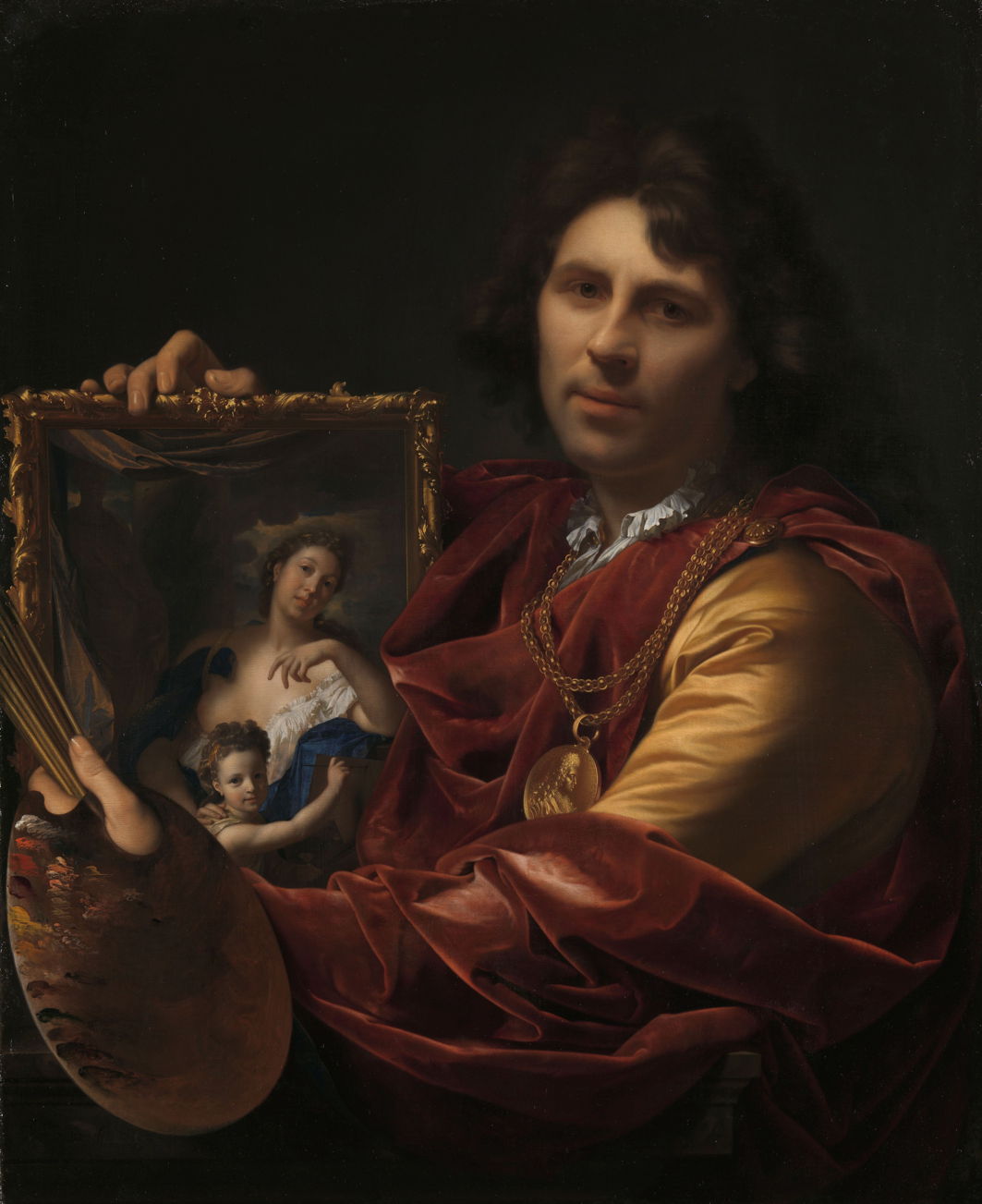
Adriaen van der Werff (1659–1722), Self-portrait with the Portrait of his Wife, Margaretha van Rees, and their Daughter Maria (1699), oil on canvas, 81 x 65.5 cm, Rijksmuseum, Amsterdam, The Netherlands. Wikimedia Commons.

Adriaen van der Werff’s Self-portrait with the Portrait of his Wife, Margaretha van Rees, and their Daughter Maria from 1699 is an ingenious family portrait. He holds his palette and brushes with his left hand, and around his neck is a medallion awarded by his patron, the Elector Palatine. His right hand supports a portrait of his wife Margaretha van Rees (1669-1732) and their daughter Maria (1692-1731).

corinthlastselfportrait
Lovis Corinth (1858–1925), Last Self-Portrait (1925), oil on canvas, 80.5 × 60.5 cm, Kunsthaus Zürich, Zürich. Wikimedia Commons.

Lovis Corinth’s Last Self-Portrait, painted just two months before his death, is unusual in showing him with his reflection in a mirror. He is balding rapidly, his cheeks sunken, and his eyes are bloodshot and tired.

bonnardinterior1905
Pierre Bonnard (1867-1947), Interior (c 1905), oil on canvas, 49.8 x 37.8 cm, Private collection. The Athenaeum.

Pierre Bonnard’s unusual composition in this Interior from about 1905 doesn’t show the woman’s back in the mirror, but a chair placed deliberately in front of the mirror and Bonnard himself, not painting but sat at a table.

Artemisia Gentileschi, Allegory of Painting (c 1638-9), oil on canvas, 98.6 x 75.2 cm, The Queen's Collection, England. Wikimedia Commons.
Artemisia Gentileschi (c 1593-1656), Allegory of Painting (c 1638-9), oil on canvas, 98.6 x 75.2 cm, The Queen’s Collection, England. Wikimedia Commons.

There’s more uncertainty as to whether Artemisia Gentileschi’s brilliant painting of the Allegory of Painting (c 1638-9) is a self-portrait. This striking angle of view can be accounted for if this was a self-portrait composed using two mirrors, one placed above and on the left of the painter, the other directly in front of her, where she is gazing so intently. If so, it was particularly ingenious because the reflection in the second mirror would have normal chirality (left and right would not be reversed).

However, it has been suggested that this isn’t a self-portrait, in which case her choice of view would have been most unusual. It’s believed to have been painted during her stay in London, possibly for King Charles I, as it appears to have passed straight into the Royal Collection, where it has remained ever since.

peetersflowersgoldcups
Clara Peeters (fl 1607-1621), Still Life with Flowers and Gold Cups of Honour (1612), oil on oak, 59.5 x 49 cm, Staatliche Kunsthalle Karlsruhe, Karlsruhe, Germany. Wikimedia Commons.

Clara Peeters’ still life with Flowers and Gold Cups of Honour from 1612 reveals multiple miniature self-portraits reflected in the gold cup at the right. These are shown more clearly in the detail below. To project the image of herself correctly for each of the facets I suspect she must have set up a convex mirror in the same alignment as that facet on the cup.

peetersflowersgoldcupsd1
Clara Peeters (fl 1607-1621), Still Life with Flowers and Gold Cups of Honour (detail) (1612), oil on oak, 59.5 x 49 cm, Staatliche Kunsthalle Karlsruhe, Karlsruhe, Germany. Wikimedia Commons.

The most famous of all these elaborate self-portraits is surely that of Diego Velázquez in Las Meninas from about 1656-57.

velazquezlasmeninas
Diego Velázquez (1599–1660), Las Meninas (The Maids of Honour, Velázquez and the Royal Family) (c 1656-57) [119], oil on canvas, 318 x 276 cm, Museo Nacional del Prado, Madrid, Spain. Wikimedia Commons.

Like many of his mature works, this is a portrait, but unlike any of the others it’s a group portrait of eleven people and a dog in a room in the Alcázar Palace, which is depicted faithfully, according to palace inventories of the time.
velazquezlasmeninasd3
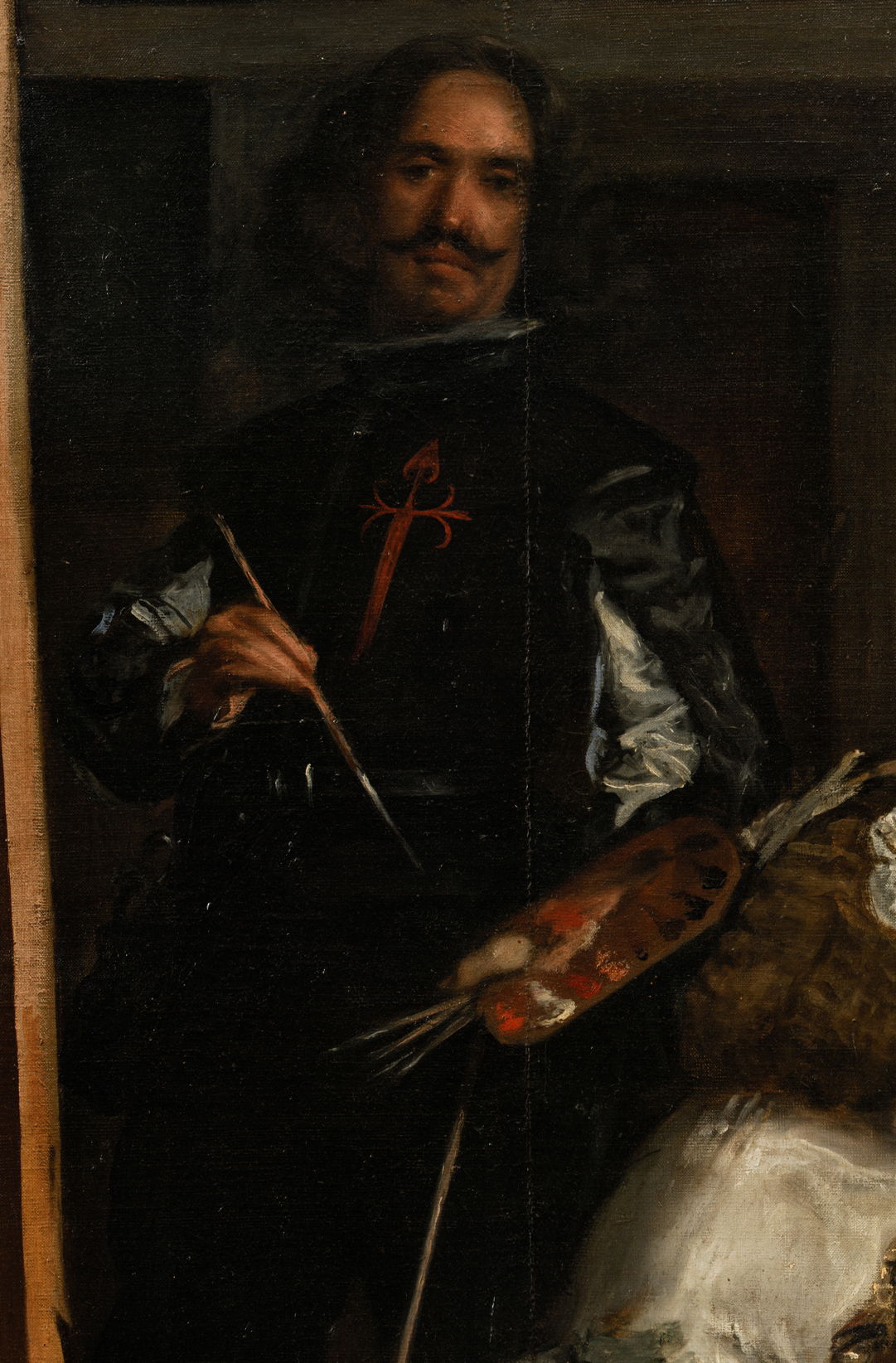
Diego Velázquez (1599–1660), Las Meninas (The Maids of Honour, Velázquez and the Royal Family) (detail) (c 1656-57) [119], oil on canvas, 318 x 276 cm, Museo Nacional del Prado, Madrid, Spain. Wikimedia Commons.

The largest figure, although out of the limelight and over to the left, is that of Velázquez himself. He looks towards the viewer, with a neutral face of concentration. His right hand holds a brush with his paint laid out on a wooden palette held by his left hand, which also clutches a bundle of other brushes. He is at work on the three metre (ten foot) high canvas in front him, which happens to be the same size as that on which he painted this work.
velazquezlasmeninasd4
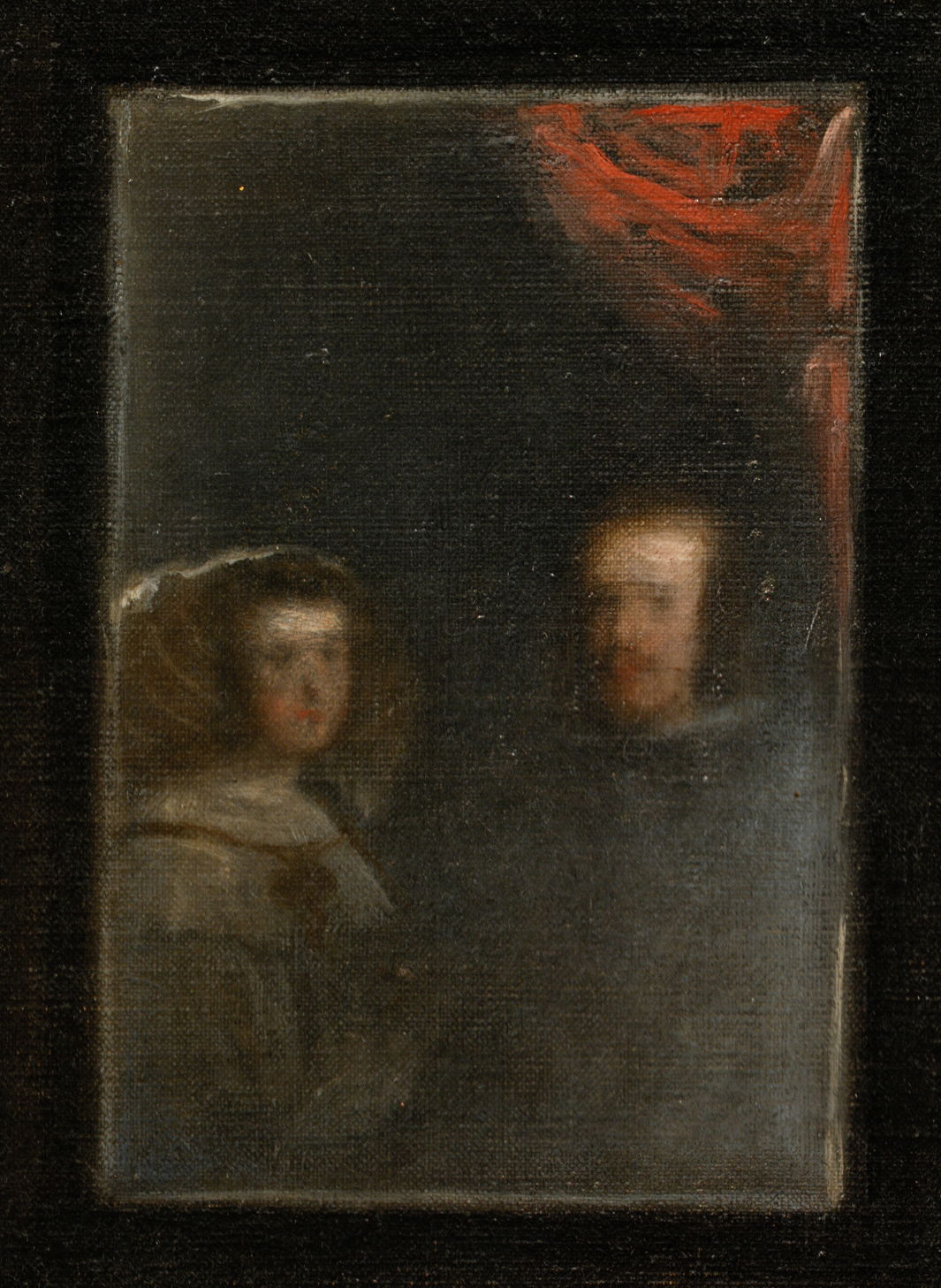
Diego Velázquez (1599–1660), Las Meninas (The Maids of Honour, Velázquez and the Royal Family) (detail) (c 1656-57) [119], oil on canvas, 318 x 276 cm, Museo Nacional del Prado, Madrid, Spain. Wikimedia Commons.

Two figures given a prominent and unusual place are the King and Queen, who are shown reflected in a rectangular plane mirror on the far wall. There has been dispute over whether the reflection shows the couple stood where the viewer is, or the mirror is reflecting their painted images on Velázquez’s canvas.

As the mirror is to the left of the centreline of the painting, it’s hard to see that its image of the royal couple could show them standing where the viewer is, and more likely that what appears there is part of Velázquez’s painting. However, the artist had previously been ‘creative’ in his use of reflections in the Rokeby Venus, and at least part of his body should here be obstructing a clear line of sight between what is on his canvas and the surface of the mirror.

The Dutch Golden Age: Decline and legacy

By: hoakley
21 January 2026 at 20:30

The Golden Age of the Dutch Republic was a period of war and turmoil. It started in the latter half of the Eighty Years War, thrived when that came to an end in 1648, and collapsed following the Disaster Year (Rampjaar) of 1672. That year brought both the Franco-Dutch and Third Anglo-Dutch Wars, invasion, rebellion, economic crisis, and collapse of the art market.

coypellouisxiv
Antoine Coypel (1661–1722), Glory of Louis XIV after the Peace of Nijmegen (1681), oil on canvas, 153 x 185 cm, Musée Fabre, Montpellier, France. Image by Finoskov, via Wikimedia Commons.

When he was just twenty, the French artist Antoine Coypel painted this Glory of Louis XIV after the Peace of Nijmegen (1681), which gained him admission as a full member to the Académie Royale.

The Treaty of Nijmegen brought an end to the Franco-Dutch War of 1672-78, and was one of a series France signed between August 1678 and September of the following year. These were acclaimed a great success for Louis XIV and France, which gained extensive territory in the north and east as a result. Louis was henceforth known as the Sun King. In this elaborate allegorical flattery, the king is being crowned in the upper left, above a gathering of deities including Minerva, who is wearing her distinctive helmet and golden robes.

Painting didn’t stop, of course, and some artists continued into the following century, but the number of masters declined rapidly.

vanwijnentemptationstanthony
Domenicus van Wijnen (1661–after 1690), The Temptation of Saint Anthony (c 1685), media and dimensions not known, The National Gallery of Ireland, Dublin. Wikimedia Commons.

Domenicus van Wijnen continued to paint, for example his radical interpretation of The Temptation of Saint Anthony in about 1685. Although this may have appeared an outlier at the time, its symbols and composition may have inspired the ‘faerie’ paintings that became popular in the middle of the nineteenth century.

vanderwerffjudgementofparis
Adriaen van der Werff (1659–1722), The Judgement of Paris (1716), oil on panel, 63.3 x 45.7 cm, Dulwich Picture Gallery, London. Wikimedia Commons.

Other artists like Adriaen van der Werff reverted to more traditional themes and style, in his Judgement of Paris from 1716.

tenkatesoldiermeninn
Herman Frederik Carel ten Kate (1822–1891), A Soldier and Men in an Inn (date not known), watercolour, white body paint and black chalk on paper, 21.5 x 32.8 cm, location not known. Wikimedia Commons.

The Golden Age was revisited by artists in the nineteenth century, particularly in the period scenes painted by Herman Frederik Carel ten Kate. His Soldier and Men in an Inn shows a scene from the Eighty Years War, with the walls decorated by blue on white Delft tiles. This must have been painted between 1850-80, over two centuries after the end of that war.

israelsseamstress
Jozef Israëls (1824–1911), The Seamstress (1850-88), oil on canvas, 75 × 61 cm, Rijksmuseum Amsterdam, Amsterdam, The Netherlands. Wikimedia Commons.

Early in the career of the Dutch artist Jozef Israëls, he painted The Seamstress (1850-88) as a genre interior from the Golden Age. A young Dutchwoman works with her needle and thread in the light of an unseen window at the left. In the background to the right, there’s a group of Delft tiles on the wall, and there’s a single tulip in a glass vase at the left.

The impact of Golden Age paintings on European art history was broad and deep, with secular themes becoming more popular than the religious and mythological works that had dominated the art of the Renaissance. New genres, like still life, may not have been rated as highly as history painting, but became widespread.

chardinattributesarts
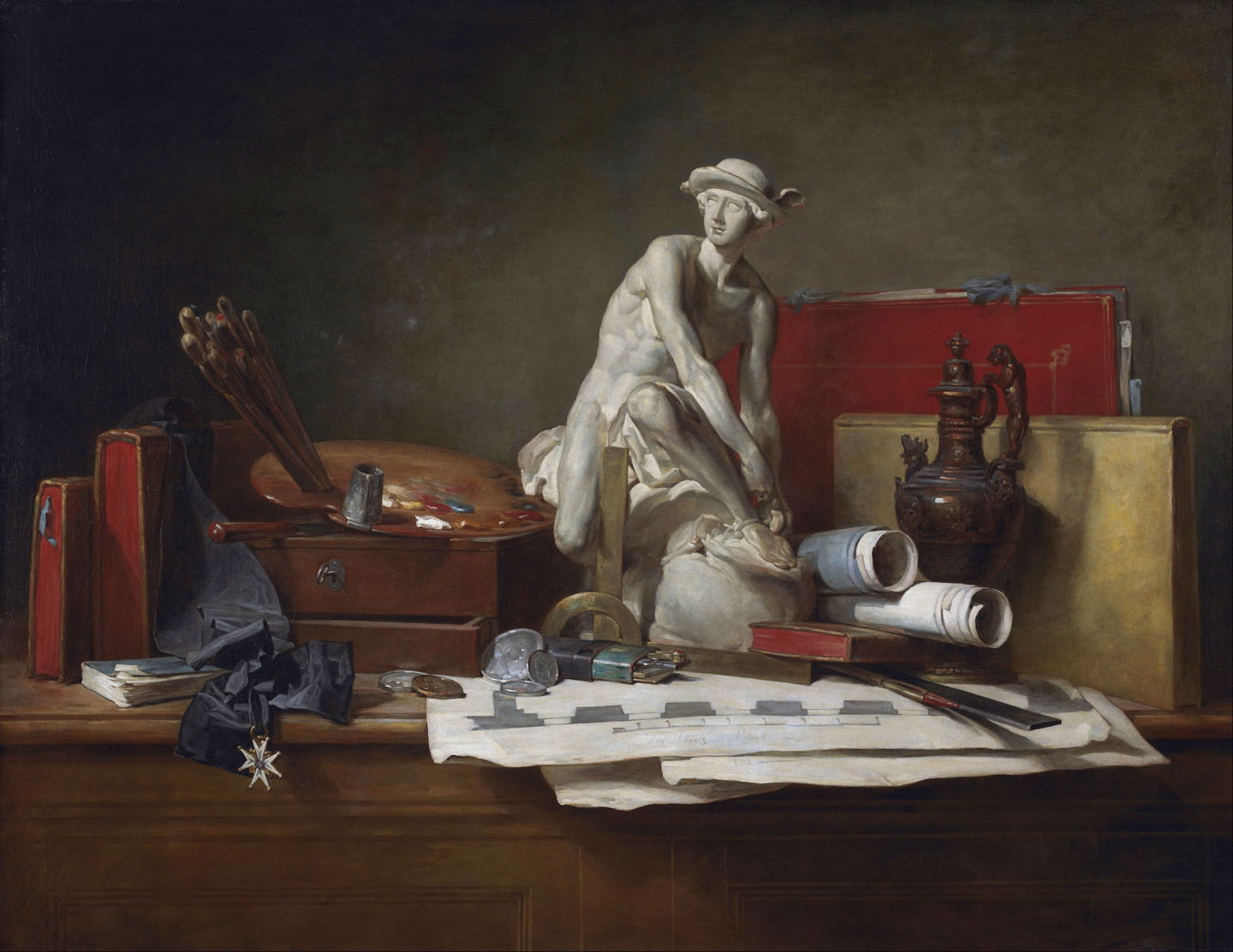
Jean-Baptiste-Siméon Chardin (1699–1779), The Attributes of the Arts and the Rewards Which Are Accorded Them (1766), oil on canvas, 113 x 145 cm, Minneapolis Institute of Art, Minneapolis, MN. Wikimedia Commons.

Late in his career, in 1766, Jean-Baptiste-Siméon Chardin painted The Attributes of the Arts and the Rewards Which Are Accorded Them, in which each object has a clear association. Painting is represented by the brushes and palette on top of a paintbox. Architectural drawings and drawing tools represent architecture. The bronze pitcher at the right refers to the work of the goldsmith. The red portfolio tied with ribbons represents drawing. The plaster model of the figure of Mercury in the centre is a copy of a sculpture by J B Pigalle, a friend of Chardin, who was the first sculptor to win the highest French honour for artists, the Order of Saint Michael, whose cross and ribbon are shown at the left.

Greatest impact was in landscape painting. Prior to the Golden Age, landscapes had primarily been used as accessories to other genres. Most were idealised rather than accurate representations of any real location, and many were mere settings for narratives.

vernetitalianateharbour
Joseph Vernet (1714–1789), Italianate Harbour Scene (1749), oil on canvas, 104.4 x 117.8 cm, Dulwich Picture Gallery, London. Wikimedia Commons.

The Dutch vogue for expressive skies spread steadily across Europe. This is reflected in Joseph Vernet’s Italianate Harbour Scene from 1749. He still retains formal compositional elements, with figures in the foreground, and scenery behind, but delights in showing us these towering cumulus clouds lit so richly.

stanfielddutchbargerotterdam
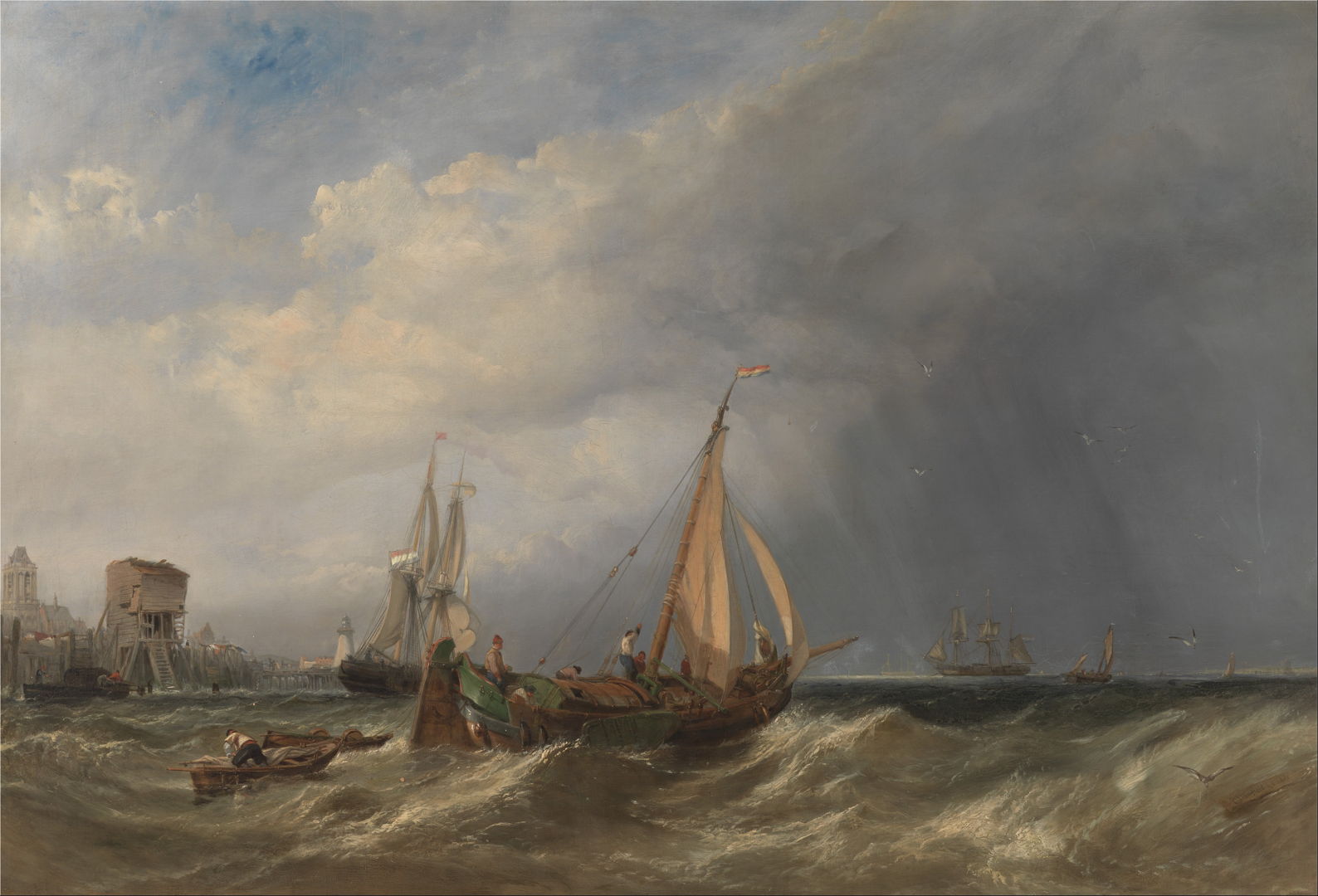
Clarkson Frederick Stanfield (1793–1867), A Dutch Barge and Merchantmen Running out of Rotterdam (1856), oil on canvas, 78.7 x 121.9 cm, Yale Center for British Art, New Haven, CT. Wikimedia Commons.

Marine painting became established as a sub-genre, as shown by the British painter Clarkson Stanfield, whose Dutch Barge and Merchantmen Running out of Rotterdam from 1856 includes rich detail, even down to dilapidated buildings on the waterfront.

John Crome (1768–1821), Landscape with Windmills (date not known), oil on canvas, 51 x 75.5 cm, Muzeum Narodowe w Warszawie, Warsaw, Poland. Wikimedia Commons.

Many of John Crome’s landscapes feature skies inspired by Dutch painters. His Landscape with Windmills is one of his most remarkable, as a signed painting that appears to have been sketched in front of the motif. Others who skied include John Constable and JMW Turner.

Nocturnes were less reliable, as they underwent phases when they were fashionable, then fell into neglect for a while.

whistlernocturnebluegold
James Abbott McNeill Whistler (1834-1903), Nocturne: Blue and Gold — Southampton Water (1872), oil on canvas, 50.5 x 76 cm, Art Institute of Chicago, Chicago, IL. Wikimedia Commons.

James Abbott McNeill Whistler had a penchant for nocturnes, here his Nocturne: Blue and Gold — Southampton Water from 1872. Its vague blue-greys make the pinpoints of light and the rising sun shine out in contrast, a good reason for limiting his palette, while remaining faithful to nature.

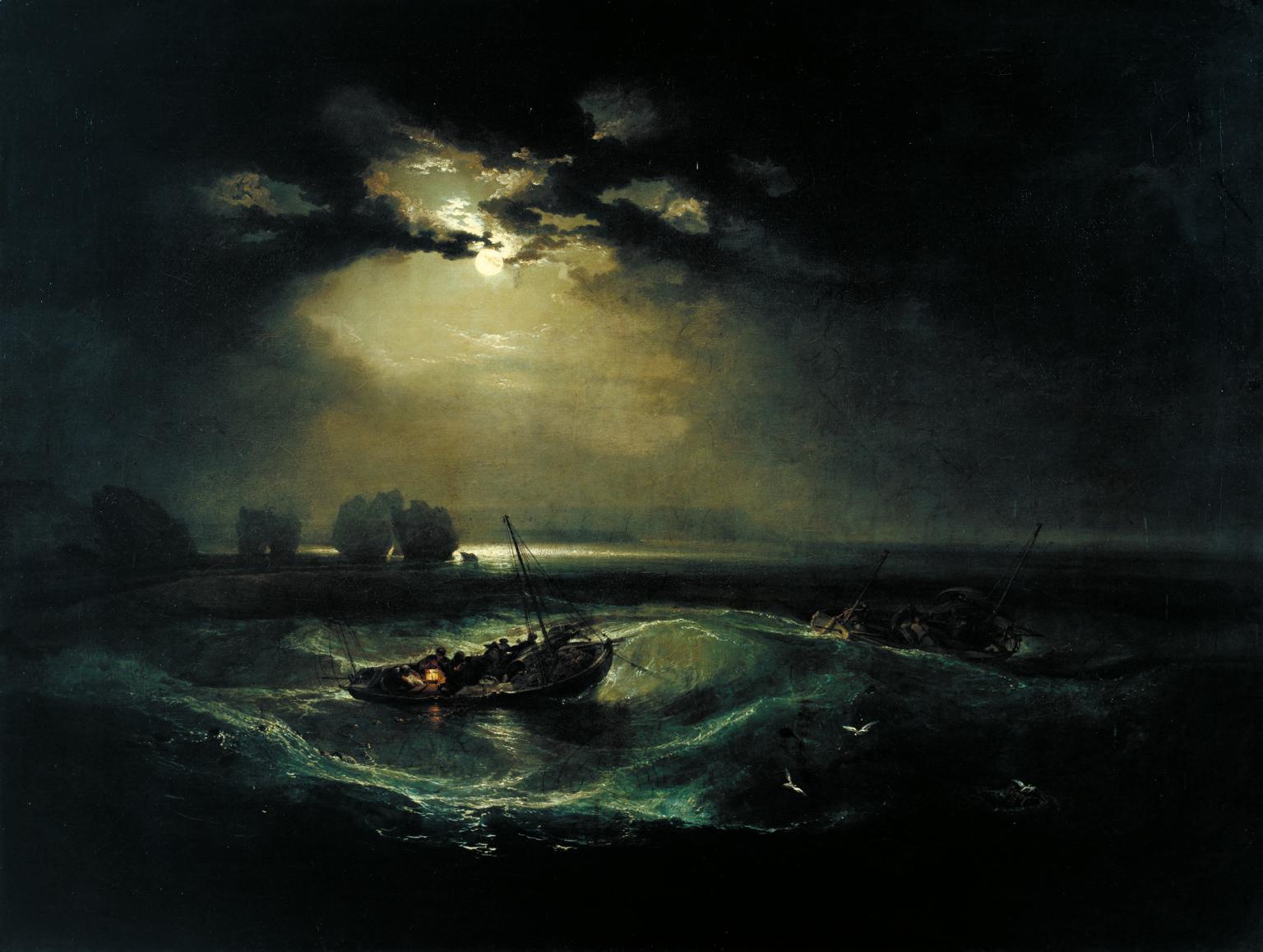
Fishermen at Sea exhibited 1796 by Joseph Mallord William Turner 1775-1851
Joseph Mallord William Turner (1775–1851), Fishermen at Sea (1796), oil on canvas, 91.4 x 122.2 cm, The Tate Gallery (Purchased 1972), London. © The Tate Gallery and Photographic Rights © Tate (2016), CC-BY-NC-ND 3.0 (Unported), http://www.tate.org.uk/art/artworks/turner-fishermen-at-sea-t01585

JMW Turner’s Fishermen at Sea from 1796, showing small fishing boats working in heavy swell off The Needles, on the Isle of Wight, is probably the most famous and successful coastal nocturne of all time. This was Turner’s first oil painting to be exhibited at the Royal Academy, when he was just twenty-one.

Paintings by artists of the Dutch Republic had been sold into collections across Europe, where many remain, influencing today’s artists.

❌
❌