Normal view

There are new articles available, click to refresh the page.
Before yesterdayMain stream

Painting the spirits of water: gods and Naiads

By: hoakley
24 January 2026 at 20:30

Narrative painting of classical myths has many conventions that can appear confusing. This weekend I look at those associated with river gods and their associated nymphs Naiads, and tomorrow more recent relatives Ondines.

In Greek, and subsequently Roman, mythology, the river gods or Potamoi (Greek for rivers) are three thousand sons of Oceanus, the great river encircling the earth, and Tethys, his Titan sister and wife. A river god is both that river and a distinct deity: Achelous is the god of the River Achelous, the largest in Greece, who wrestled unsuccessfully with Hercules for the right to marry Deianira.

Associated with sources and bodies of fresh water are also water nymphs, Naiads or Potamides, often stated to be the daughters of the river gods. In ancient times, there was a weaker distinction between fresh and salt waters, so although nymphs associated with the sea are usually termed Nereids when in Mediterranean waters, or Oceanids, Naiads can also be encountered in what we would consider to be sea.

dititoheliades
Santi di Tito (1536–1603) The Sisters of Phaethon Transformed into Poplars (c 1570), fresco, dimensions not known, Palazzo Vecchio, Musei Civici Fiorentini, Florence. Wikimedia Commons.

The standard depiction for any river god in a classical story is that of an older bearded man lounging by a large earthenware pot from which water pours forth into the river. This is shown well in Santi di Tito’s fresco of The Sisters of Phaethon Transformed into Poplars, from about 1570. Although this story tells how the sisters of Phaeton grieve for him after his death, and are transformed into poplar trees, as it shows a river, there must still be a god of that river.

rubensromulusremus
Peter Paul Rubens (1577–1640), Romulus and Remus (1615-16), oil on canvas, 213 x 212 cm, Musei Capitolini, Rome, Italy. Wikimedia Commons.

Rubens’ delightful painting of Romulus and Remus being discovered by Faustulus, from 1615-16, shows both the river god Tiberinus and his daughter nymph, at the left with the god’s pot.

poussincephalusaurora
Nicolas Poussin (1594–1665), Cephalus and Aurora (1630), oil on canvas, 96.9 x 131.3 cm, The National Gallery, London. Wikimedia Commons.

In Nicolas Poussin’s Cephalus and Aurora from 1630, the river god is again at the left, and looks tired of the whole business, with a mere trickle of water emerging from his pot.
garzialpheusarethusa
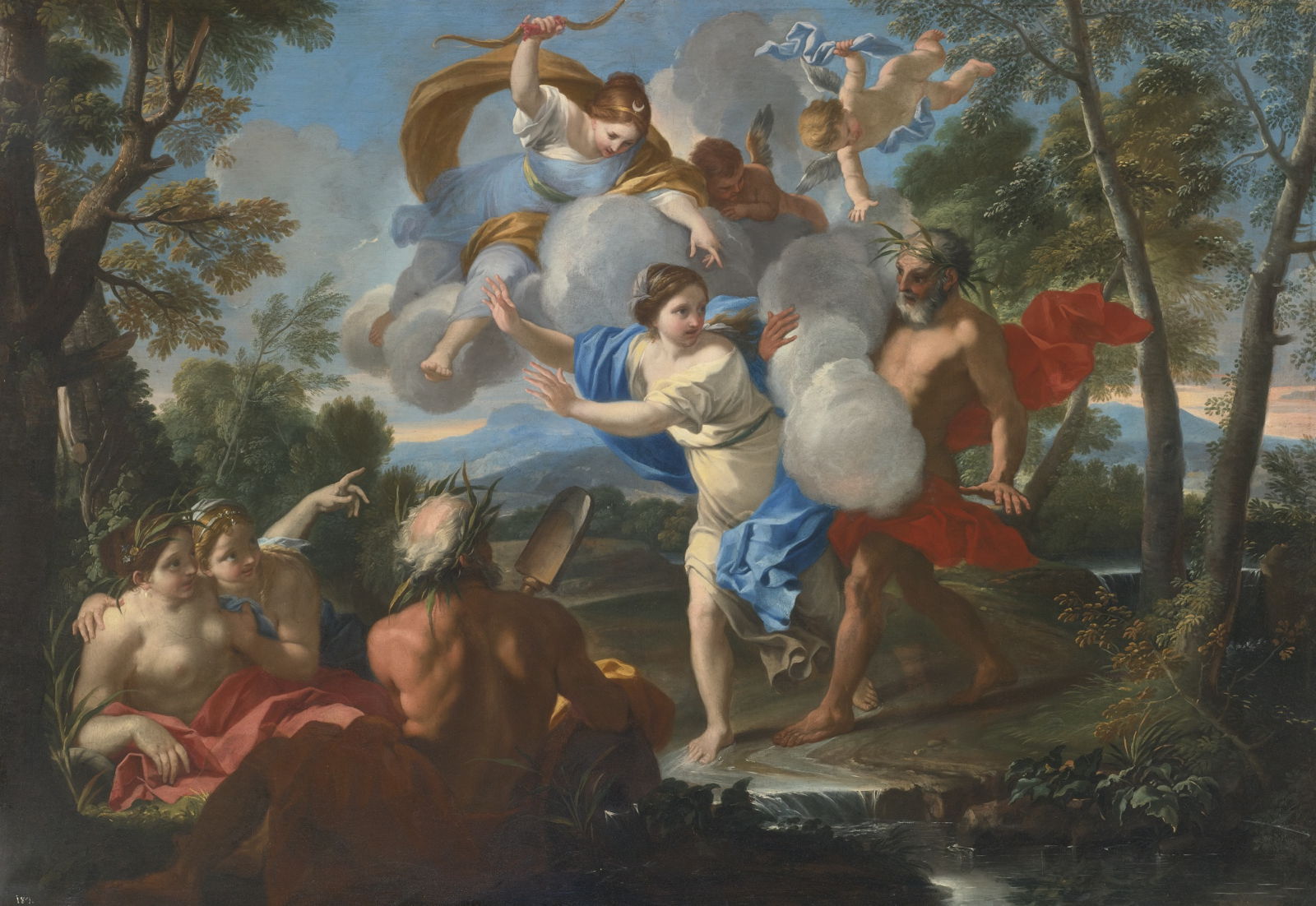
Luigi Garzi (attr) (1638–1721), Alpheus and Arethusa (c 1690), oil on canvas, 120.7 x 171.5 cm, location not known. Wikimedia Commons.

This beautiful painting attributed to Luigi Garzi, of Alpheus and Arethusa from around 1690, shows one river god and two nymphs. The god leans on his pot, and in his left hand holds a small spade, another attribute sometimes seen with them.

coypelalpheuschasingarethusa
Antoine Coypel (1661–1722), Alpheus Chasing Arethusa (c 1710), oil on canvas, dimensions and location not known. Wikimedia Commons.

Antoine Coypel’s version of the same Ovidian myth, Alpheus Chasing Arethusa from about 1710, places the river god at the lower left, and two Naiads separately on the right.

boucherpansyrinx
François Boucher (1703–1770), Pan and Syrinx (1743), oil on canvas, 101 × 133 cm, Private collection. Wikimedia Commons.

So far, the river deities have enjoyed a rather passive life in paintings, but this wasn’t a requirement. In François Boucher’s Pan and Syrinx from 1743, the nymph Syrinx is seeking the help of the river god and Naiad, as she attempts to evade Pan’s attentions. The god’s pot is almost hidden beneath luxuriant red fabric, under his right hand.

tiepoloapollodaphne
Giovanni Battista Tiepolo (1696–1770), Apollo and Daphne (c 1744-45), oil on canvas, 96 x 79 cm, Musée du Louvre, Paris. Wikimedia Commons.

In Tiepolo’s Apollo and Daphne (c 1744-45), the river god is given much of the foreground and lower section of the painting, and holds an oar or paddle, a more unusual but distinctive attribute.

mengsapollomnemosyne
Anton Raphael Mengs (1728–1779), Apollo, Mnemosyne, and the Nine Muses (1761), fresco, 313 × 580 cm, Gallery of the Villa Albani-Torlonia, Rome. Wikimedia Commons.

Sometimes, artists conceal the river god as if challenging the viewer to locate him. This is the case in Anton Raphael Mengs’ fresco of Apollo, Mnemosyne, and the Nine Muses (1761), in which the god’s bearded and hoary figure is tucked away behind Apollo’s legs. There’s also an Orphic tradition in which the River Mnemosyne is the source of water to bring inspiration, and this perhaps alludes to that obscure sub-narrative.

brenetaethrashowingtheseus
Nicolas-Guy Brenet (1728–1792), Aethra Showing her Son Theseus the Place Where his Father had Hidden his Arms (1768), oil on canvas, 50.2 × 59.7 cm, Los Angeles County Museum of Art, Los Angeles, CA. Wikimedia Commons.

In some paintings, river gods seem to be included even when their river is nowhere to be seen. Nicolas-Guy Brenet’s painting of Aethra Showing her Son Theseus the Place Where his Father had Hidden his Arms (1768) tucks this extra into the lower left corner again.

schmidtdanaides
Martin Johann Schmidt (1718–1801), The Labour of the Danaides (1785), oil on copper plate, 54.5 × 77 cm, Narodna galerija Slovenije, Ljubljana, Slovenia. Wikimedia Commons.

Martin Johann Schmidt’s Labour of the Danaides (1785) informs us that the Danaïds were also water-nymphs by placing a river god at the left. They were condemned to keep trying to fill this leaky container with water as their penance in the underworld.

cranenyadsdryads
Walter Crane (1845–1915), Nyads and Dryads (date not known), watercolour on paper, 23.5 × 16.5 cm, location not known. Wikimedia Commons.

Walter Crane shows the association between Naiads and other nymphs in his watercolour of Nyads and Dryads, probably painted between 1880-1900. He melds the Dryads in with their trees, puts the ‘Nyads’ or Naiads in the water, and has a river god watching from the reeds in the distance.
waterhousenaiad
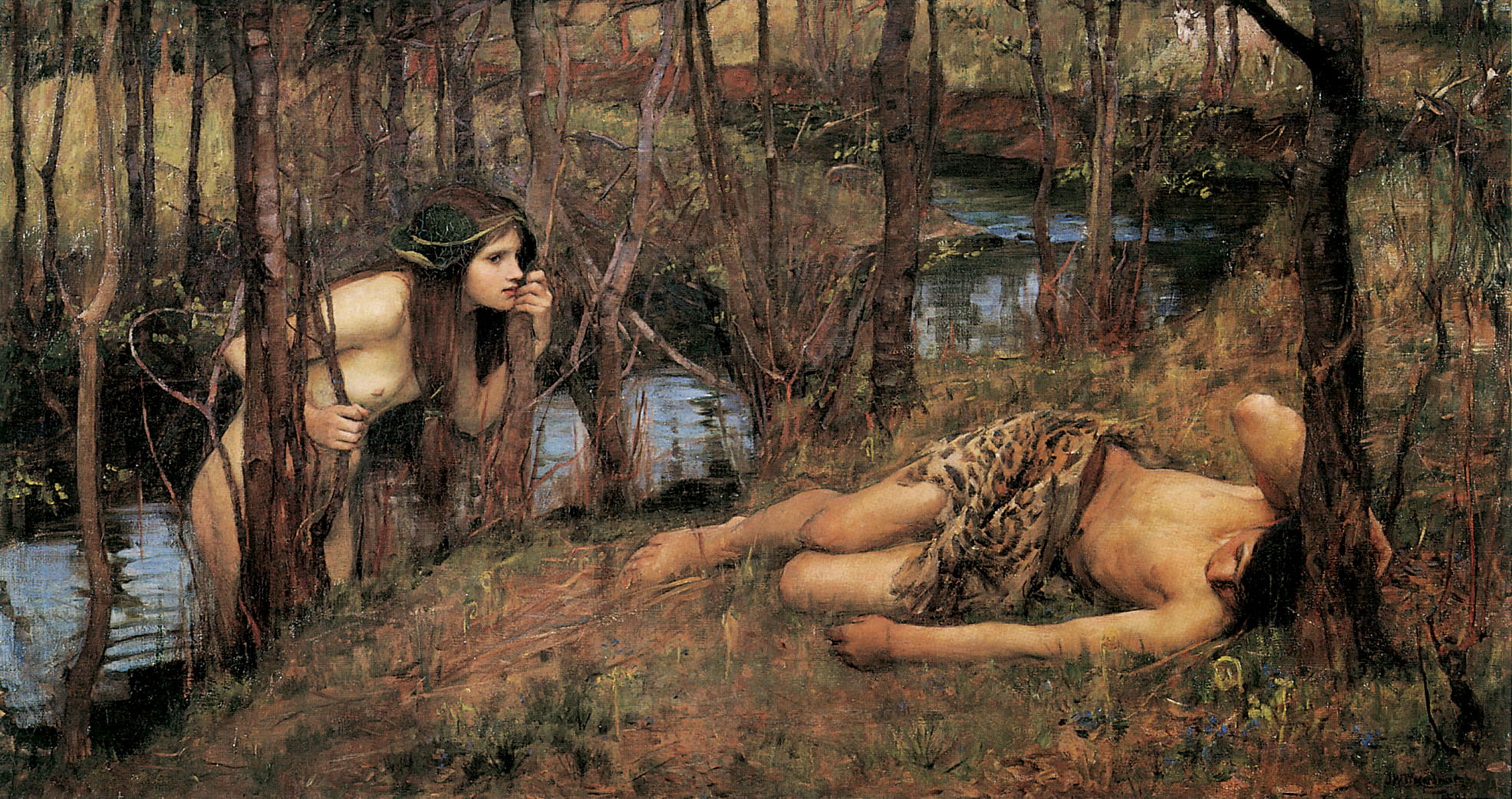
John William Waterhouse (1849–1917), A Naiad, or Hylas with a Nymph (1893), oil on canvas, 66 x 127 cm, Private collection. Wikimedia Commons.

By the end of the nineteenth century, enthusiasm for the tradition of showing river gods was waning, and nude, cavorting Naiads came to the fore. One of their greatest exponents was John William Waterhouse, who led with this first tentative retelling of the myth of Hylas in 1893, in A Naiad, or Hylas with a Nymph.

Hylas was companion and servant to Heracles (Hercules), who accompanied the hero on Jason’s ship Argo. When the Argonauts were ashore in modern Turkey, Hylas approached the spring of Pegae, where the Naiads fell in love with and kidnapped him. He vanished without trace, leading Heracles and Polyphemus to search for him at length. They were delayed in this so long that the Argo sailed without them.

This first version shows one of the Naiads discovering the sleeping Hylas by a small river. There’s no sign of any river god, but there are some goats on the right side of the painting.
waterhousehylasnymphs
John William Waterhouse (1849–1917), Hylas and the Nymphs (1896), oil on canvas, 132.1 x 197.5 cm, Manchester Art Gallery, Manchester, England. Wikimedia Commons.

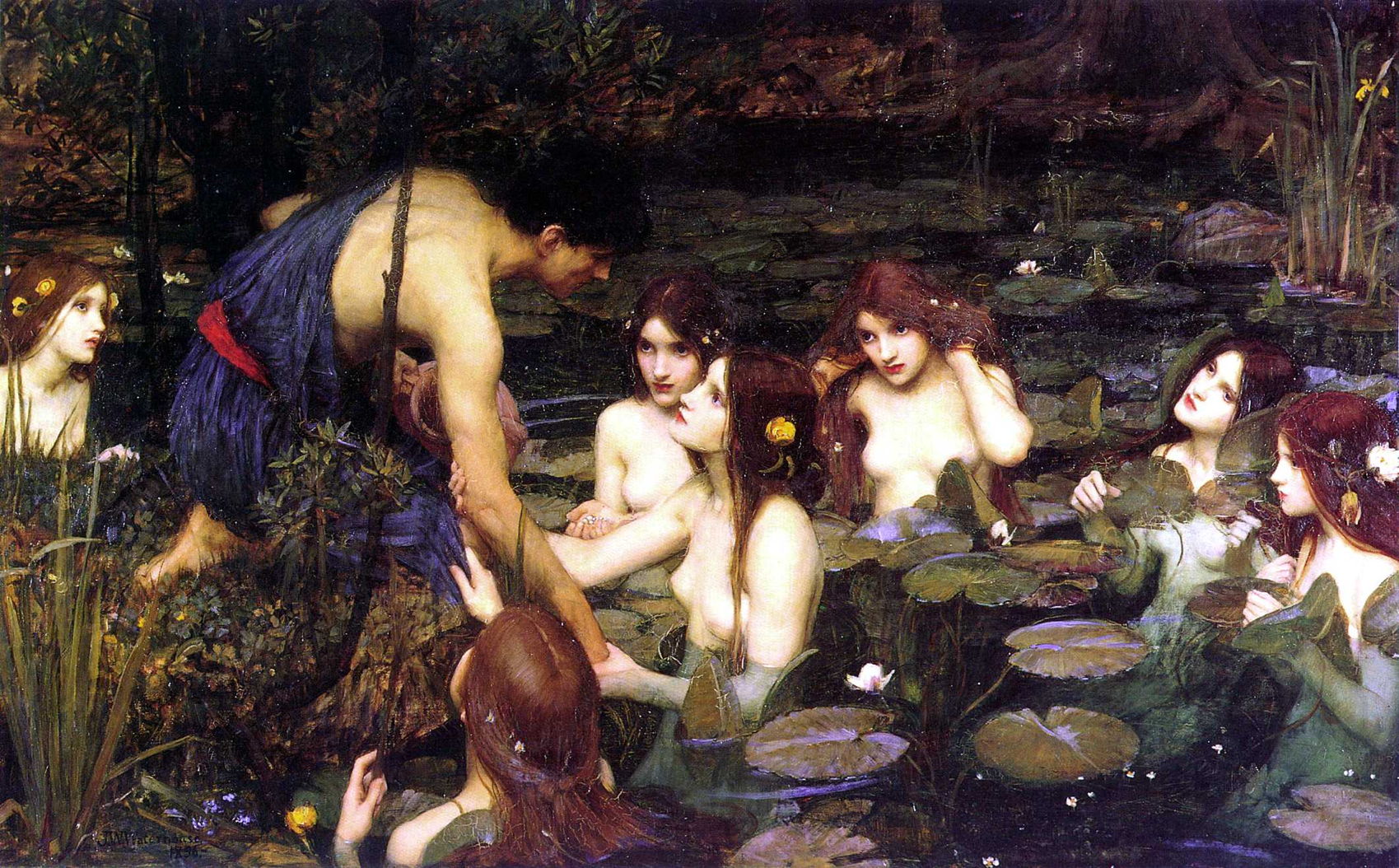
Three years later, Waterhouse’s Hylas and the Nymphs (1896) stays closer to the myth. Hylas holds an earthenware pot, almost as if he were about to become the river god.

In January 2018, this well-known painting was removed from exhibition in Manchester, England, and replaced by a notice which explained that a temporary space had been left “to prompt conversations about how we display and interpret artworks in Manchester’s public collection”. The painting soon returned after protests. It’s surprising that more than a century after it was first exhibited, it was still capable of causing such controversy.

raehylaswaternymphs
Henrietta Rae (1859–1928), Hylas and the Water Nymphs (c 1909), oil on canvas, 142.3 × 222.8 cm, Private collection. Wikimedia Commons.

Waterhouse is not the only artist to have courted controversy with this story. Henrietta Rae’s Hylas and the Water Nymphs from about 1909 was exhibited at the Royal Academy in 1910, and is no less fleshly than Waterhouse’s version. Rae was a pioneer in her painting of nudes, at a time when most of society still considered that women shouldn’t be allowed to attend classes learning to draw or paint nude models.

poyntercaveofstormnymphs
Edward Poynter (1836–1919), Cave of the Storm Nymphs (1903), oil on canvas, 145.9 × 110.4 cm, Private collection. Wikimedia Commons.

Edward Poynter’s Cave of the Storm Nymphs (1903) might appear to be still more exploitative of the male appeal of the female nude, but there’s a more complex narrative behind this scene. Its literary reference is most probably to the Naiads of Homer’s Odyssey, book 13, who live in a sea cave, updated to encompass more contemporary references to Wreckers, who lured ships onto the rocks in order to steal their precious cargos: sirens without the socially unacceptable habit of cannibalism.

The Dutch Golden Age: Decline and legacy

By: hoakley
21 January 2026 at 20:30

The Golden Age of the Dutch Republic was a period of war and turmoil. It started in the latter half of the Eighty Years War, thrived when that came to an end in 1648, and collapsed following the Disaster Year (Rampjaar) of 1672. That year brought both the Franco-Dutch and Third Anglo-Dutch Wars, invasion, rebellion, economic crisis, and collapse of the art market.

coypellouisxiv
Antoine Coypel (1661–1722), Glory of Louis XIV after the Peace of Nijmegen (1681), oil on canvas, 153 x 185 cm, Musée Fabre, Montpellier, France. Image by Finoskov, via Wikimedia Commons.

When he was just twenty, the French artist Antoine Coypel painted this Glory of Louis XIV after the Peace of Nijmegen (1681), which gained him admission as a full member to the Académie Royale.

The Treaty of Nijmegen brought an end to the Franco-Dutch War of 1672-78, and was one of a series France signed between August 1678 and September of the following year. These were acclaimed a great success for Louis XIV and France, which gained extensive territory in the north and east as a result. Louis was henceforth known as the Sun King. In this elaborate allegorical flattery, the king is being crowned in the upper left, above a gathering of deities including Minerva, who is wearing her distinctive helmet and golden robes.

Painting didn’t stop, of course, and some artists continued into the following century, but the number of masters declined rapidly.

vanwijnentemptationstanthony
Domenicus van Wijnen (1661–after 1690), The Temptation of Saint Anthony (c 1685), media and dimensions not known, The National Gallery of Ireland, Dublin. Wikimedia Commons.

Domenicus van Wijnen continued to paint, for example his radical interpretation of The Temptation of Saint Anthony in about 1685. Although this may have appeared an outlier at the time, its symbols and composition may have inspired the ‘faerie’ paintings that became popular in the middle of the nineteenth century.

vanderwerffjudgementofparis
Adriaen van der Werff (1659–1722), The Judgement of Paris (1716), oil on panel, 63.3 x 45.7 cm, Dulwich Picture Gallery, London. Wikimedia Commons.

Other artists like Adriaen van der Werff reverted to more traditional themes and style, in his Judgement of Paris from 1716.

tenkatesoldiermeninn
Herman Frederik Carel ten Kate (1822–1891), A Soldier and Men in an Inn (date not known), watercolour, white body paint and black chalk on paper, 21.5 x 32.8 cm, location not known. Wikimedia Commons.

The Golden Age was revisited by artists in the nineteenth century, particularly in the period scenes painted by Herman Frederik Carel ten Kate. His Soldier and Men in an Inn shows a scene from the Eighty Years War, with the walls decorated by blue on white Delft tiles. This must have been painted between 1850-80, over two centuries after the end of that war.

israelsseamstress
Jozef Israëls (1824–1911), The Seamstress (1850-88), oil on canvas, 75 × 61 cm, Rijksmuseum Amsterdam, Amsterdam, The Netherlands. Wikimedia Commons.

Early in the career of the Dutch artist Jozef Israëls, he painted The Seamstress (1850-88) as a genre interior from the Golden Age. A young Dutchwoman works with her needle and thread in the light of an unseen window at the left. In the background to the right, there’s a group of Delft tiles on the wall, and there’s a single tulip in a glass vase at the left.

The impact of Golden Age paintings on European art history was broad and deep, with secular themes becoming more popular than the religious and mythological works that had dominated the art of the Renaissance. New genres, like still life, may not have been rated as highly as history painting, but became widespread.

chardinattributesarts
Jean-Baptiste-Siméon Chardin (1699–1779), The Attributes of the Arts and the Rewards Which Are Accorded Them (1766), oil on canvas, 113 x 145 cm, Minneapolis Institute of Art, Minneapolis, MN. Wikimedia Commons.

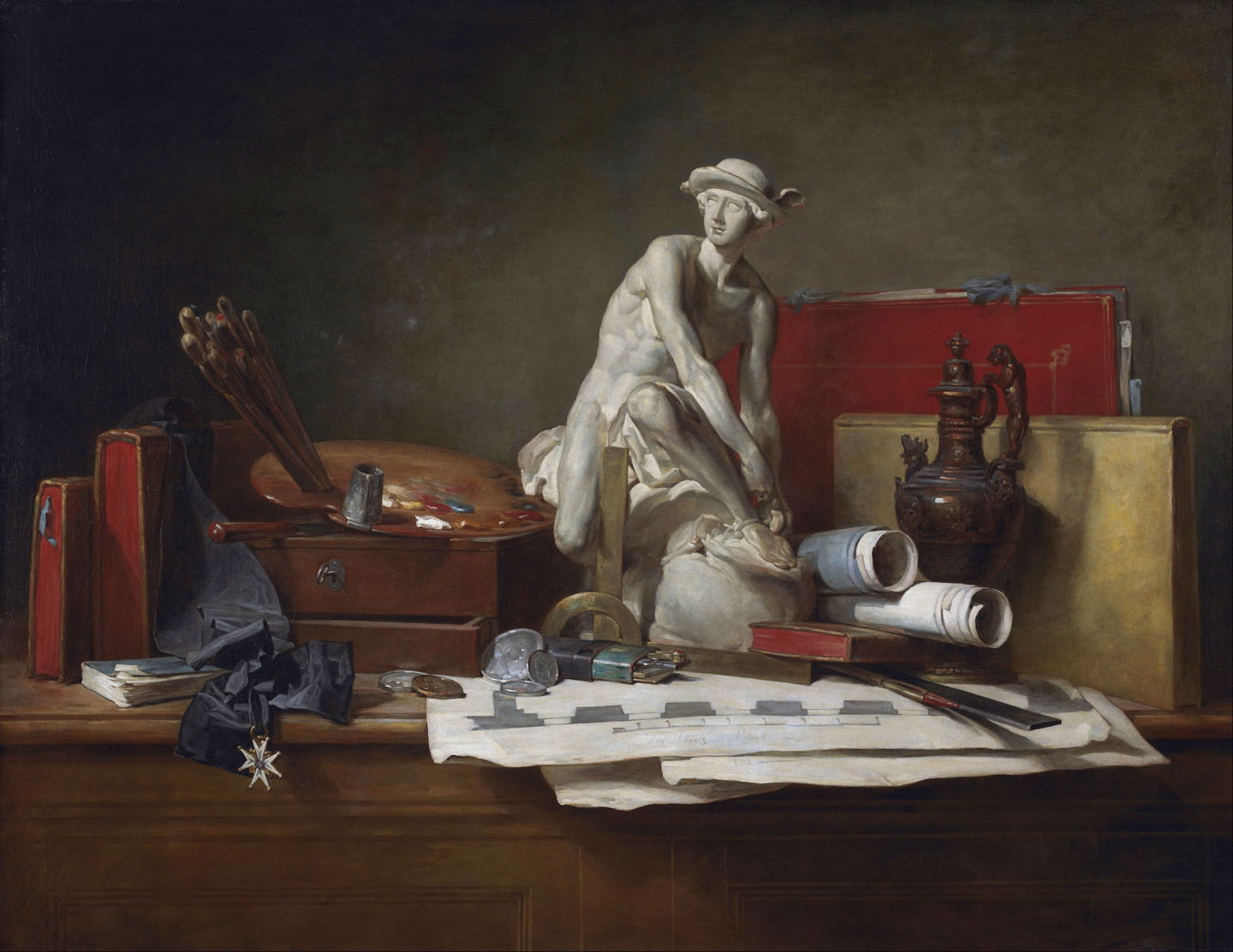
Late in his career, in 1766, Jean-Baptiste-Siméon Chardin painted The Attributes of the Arts and the Rewards Which Are Accorded Them, in which each object has a clear association. Painting is represented by the brushes and palette on top of a paintbox. Architectural drawings and drawing tools represent architecture. The bronze pitcher at the right refers to the work of the goldsmith. The red portfolio tied with ribbons represents drawing. The plaster model of the figure of Mercury in the centre is a copy of a sculpture by J B Pigalle, a friend of Chardin, who was the first sculptor to win the highest French honour for artists, the Order of Saint Michael, whose cross and ribbon are shown at the left.

Greatest impact was in landscape painting. Prior to the Golden Age, landscapes had primarily been used as accessories to other genres. Most were idealised rather than accurate representations of any real location, and many were mere settings for narratives.

vernetitalianateharbour
Joseph Vernet (1714–1789), Italianate Harbour Scene (1749), oil on canvas, 104.4 x 117.8 cm, Dulwich Picture Gallery, London. Wikimedia Commons.

The Dutch vogue for expressive skies spread steadily across Europe. This is reflected in Joseph Vernet’s Italianate Harbour Scene from 1749. He still retains formal compositional elements, with figures in the foreground, and scenery behind, but delights in showing us these towering cumulus clouds lit so richly.

stanfielddutchbargerotterdam
Clarkson Frederick Stanfield (1793–1867), A Dutch Barge and Merchantmen Running out of Rotterdam (1856), oil on canvas, 78.7 x 121.9 cm, Yale Center for British Art, New Haven, CT. Wikimedia Commons.

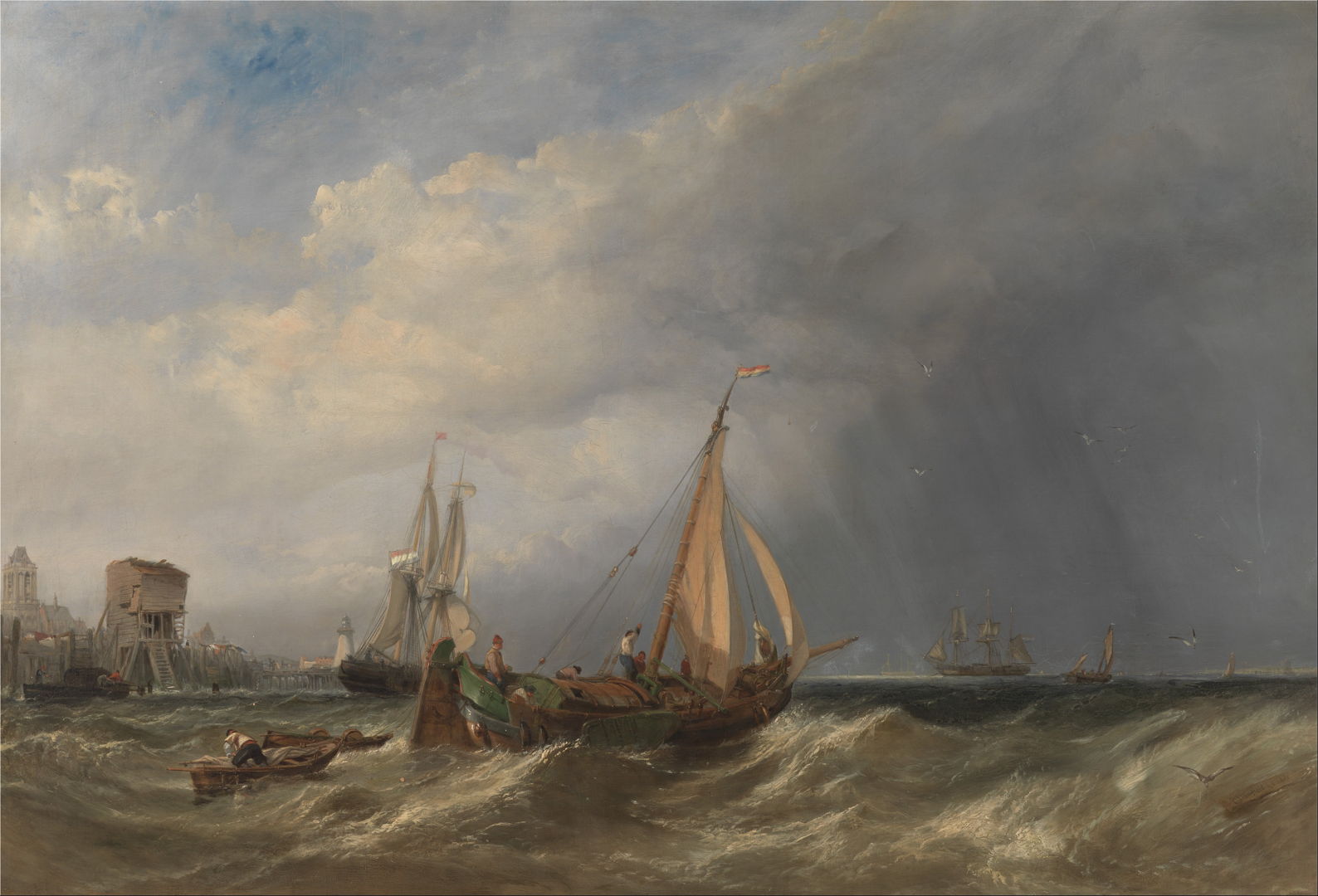
Marine painting became established as a sub-genre, as shown by the British painter Clarkson Stanfield, whose Dutch Barge and Merchantmen Running out of Rotterdam from 1856 includes rich detail, even down to dilapidated buildings on the waterfront.

John Crome (1768–1821), Landscape with Windmills (date not known), oil on canvas, 51 x 75.5 cm, Muzeum Narodowe w Warszawie, Warsaw, Poland. Wikimedia Commons.

Many of John Crome’s landscapes feature skies inspired by Dutch painters. His Landscape with Windmills is one of his most remarkable, as a signed painting that appears to have been sketched in front of the motif. Others who skied include John Constable and JMW Turner.

Nocturnes were less reliable, as they underwent phases when they were fashionable, then fell into neglect for a while.

whistlernocturnebluegold
James Abbott McNeill Whistler (1834-1903), Nocturne: Blue and Gold — Southampton Water (1872), oil on canvas, 50.5 x 76 cm, Art Institute of Chicago, Chicago, IL. Wikimedia Commons.

James Abbott McNeill Whistler had a penchant for nocturnes, here his Nocturne: Blue and Gold — Southampton Water from 1872. Its vague blue-greys make the pinpoints of light and the rising sun shine out in contrast, a good reason for limiting his palette, while remaining faithful to nature.

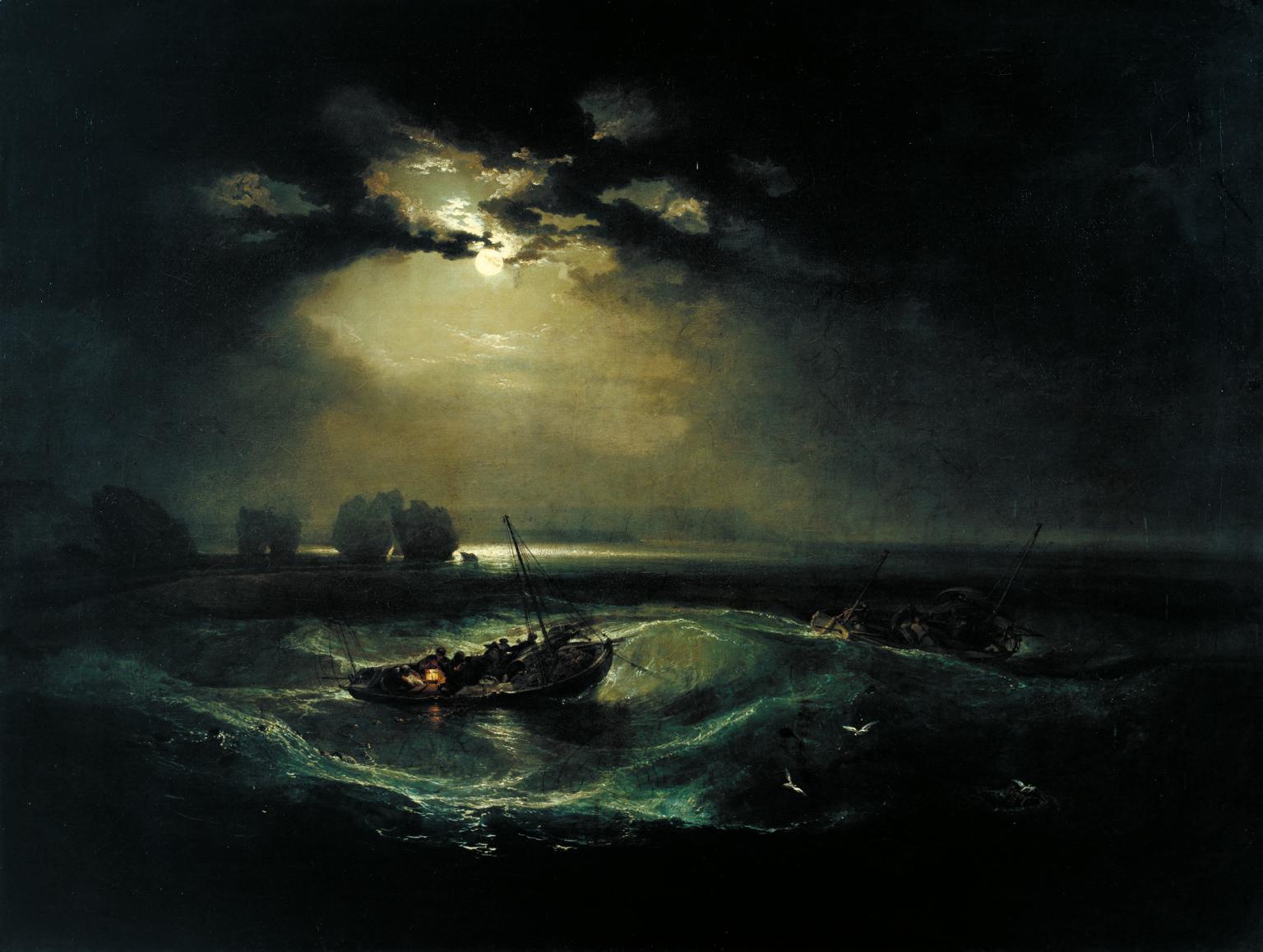
Fishermen at Sea exhibited 1796 by Joseph Mallord William Turner 1775-1851
Joseph Mallord William Turner (1775–1851), Fishermen at Sea (1796), oil on canvas, 91.4 x 122.2 cm, The Tate Gallery (Purchased 1972), London. © The Tate Gallery and Photographic Rights © Tate (2016), CC-BY-NC-ND 3.0 (Unported), http://www.tate.org.uk/art/artworks/turner-fishermen-at-sea-t01585

JMW Turner’s Fishermen at Sea from 1796, showing small fishing boats working in heavy swell off The Needles, on the Isle of Wight, is probably the most famous and successful coastal nocturne of all time. This was Turner’s first oil painting to be exhibited at the Royal Academy, when he was just twenty-one.

Paintings by artists of the Dutch Republic had been sold into collections across Europe, where many remain, influencing today’s artists.

❌
❌