A man takes pictures as the city of Heraklion that is covered in red dust coming from Africa
A man has died near Athens as a storm hits parts of Greece with gale-force winds and flooding, while a Saharan dust storm enveloped the island of Crete.
The man was found under a car in the Nea Makri rural area early on Thursday, according to the fire department.
Storm Erminio has flooded streets, closed some schools and moored ferries. Meanwhile, some flights were disrupted on Crete on Wednesday after dust from an African storm filled the air, turning the sky red-orange.
The weather is expected to be bad on Thursday in most areas of the country "with long-lasting and intense rains and storms and possibly with local hail", according to the national meteorological service.
Stefanos Rapanis/Anadolu via Getty Images
Crete cloaked by a Saharan dust storm on 1 April
A red warning is in place in Crete, mainly in the west and south, from midday until late at night on Thursday.
The fire department received 674 calls for assistance from Wednesday through the early hours of Thursday. The majority were in the Attica region that encompasses Athens, with most calls for fallen trees.
High winds have kept ferries moored in ports, with Greek media reporting some departures may resume on Thursday, weather permitting.
Streets as well as the basement of the local police station in Nea Makri were flooded. A bridge was knocked down on the island of Poros and vehicles have reportedly been swept away. Some schools have also been closed.
Courts in Brazil will be able to determine shared custody arrangements for the pets of separating couples, under new laws.
Lawmakers in the Brazilian Congress on Tuesday viewed the law change as a reflection on the importance people place on their pets.
The legislation means that if a couple separates without reaching an agreement regarding their pet, "a judge will determine the shared custody arrangement and the equitable distribution of the animal's maintenance expenses between the parties".
Currently, the country of 213 million people has about 160 million pets, according to the Instituto Pet Brasil.
For the law to apply to separating couples, the animal must have spent the majority of its life with the pair.
Shared custody will not be granted in cases of prior criminal records or a history or risk of domestic violence.
Members of the congress said there had been an increase in pet custody disputes in courts, while noting the law responds to "changes that have occurred in Brazilian society in recent decades," according to a statement accompanying the law.
The statement added that couples with fewer children tend to have closer relationships with their animals, "often considered true family members".
Currently in the UK, dogs are legally seen as inanimate objects akin to cars, houses or other personal items, meaning custody cases come down to determining who the sole owner is.
In 2014, France changed its law so pets were considered "living and feeling beings" rather than "moveable goods". That change meant couples would be able to fight for shared custody in divorce cases.
Australia currently has no legislation on how the courts should navigate living arrangements for pets after a breakup.
The most recent example of a pet being given joint custody was in Spain in 2021. A judge granted joint custody of a dog to a separated couple who went to court to determine who the pet should live with.
The Madrid court considered that both parties were "jointly responsible" and "co-caretakers" of Panda the dog.
Elon Musk's SpaceX is poised to become one of the most valuable publicly traded companies in the world.
The company, which manufactures rockets, space exploration technology and Starlink satellites, is currently privately held. But on Wednesday it made a confidential filingwith the US Securities and Exchange Commission (SEC) for an initial public offering, which would allow shares to be traded in the stock market.
The value of SpaceX once it goes public is expected to surpass $1tn (£751bn). That would make its eventual stock market debut one of the most financially significant in history.
Musk's own holding in SpaceX would put the billionaire on track to become the world's first trillionaire.
The BBC has contacted SpaceX for comment.
The company is aiming to officially go public sometime in June, according to reports in Bloomberg, Reuters and the New York Times.
A confidential IPO filing with the SEC allows a company to avoid immediately revealing information to the public while it requests feedback from the regulator. The next step will be for company executives to hold "roadshows" - meetings with big investors to convince them to buy shares.
By making shares of SpaceX available for purchase by the public, the company is looking to raise $50bn or more, according to the reports.
Earlier this year, SpaceX took over xAI, Musk's artificial intelligence venture. After that all-stock merger, SpaceX is believed to have become the most valuable private company in the world, with an internal valuation of $1.25tn.
Recently, Musk's various companies have been becoming increasingly intertwined.
Last year, xAI, best known for its chatbot Grok, took over X, the social media platform previously called Twitter that Musk bought in 2022.
This degree of consolidation was a clear sign to investors that SpaceX was preparing to go public.
Emily Zheng, a senior analyst at Pitchbook, earlier told the BBC that by bringing xAI under SpaceX, Musk could show potential investors that he was consolidating costs and able to easily share resources between his companies.
With its large-scale ambitions, SpaceX is in need of a massive cash infusion that going public can provide, Zheng added. The company is racing to keep up with the "sheer cost of compute, infrastructure, and energy" needed to expand, she said.
Earlier this year, Tesla, Musk's electric vehicle company, revealed it had invested more than $2bn in xAI.
The billionaire said a significant share of Tesla's manufacturing would begin to shift toward building robots, which would make use of xAI technology like Grok.
Grok is already included in some Teslas as an AI assistant.
SpaceX would also partner with Tesla and xAI in the massive chipmaking endeavour Musk announced last month, which he is calling Terafab.
"Tesla, xAI and SpaceX have all done amazing things that people did not think could be done before," Musk said in a March presentation discussing Terafab.
Musk started SpaceX in 2002 with the aim of reducing the cost of launching crafts into space, mainly by making rockets that could be launched more than once. It first contracted with Nasa in 2006.
Today, most of SpaceX's work continues to revolve around rockets and the operation of Starlink, a fleet of satellites offering internet connectivity across the globe.
But Musk often discusses grander ambitions for the company, including putting data centers needed for AI in space and building a self-sufficient city on Mars, which many experts have said could be impossible to realise.
Palantir's Louis Mosley says militaries responsible for how AI systems are used
Tech giant Palantir has pushed back against concerns that military use of its AI platforms could lead to unforeseen risks, in an exclusive interview with the BBC, insisting that the way the technology is used is the responsibility of its military customers.
It comes as experts have expressed concern over the use of Palantir's AI-powered defence platform - Maven Smart System - during wartime and its reported use in US attacks on Iran.
Analysts have warned that the military's use of the platform, which helps personnel plan attacks, leaves little time for "meaningful verification" of its output and could lead to incorrect targets being hit.
But the company's UK and Europe head, Louis Mosley, told the BBC in a wide-ranging interview that while AI platforms like Maven have been "instrumental" to the US management of the Iran war, responsibility for how their output is used must always remain "with the military organisation".
"There's always a human in the loop, so there is always a human that makes the ultimate decision. That's the current set-up."
The Maven Smart System was launched by the Pentagon in 2017 and is designed to speed up military targeting decisions by bringing together masses of data, including a range of intelligence, satellite and drone images.
The system analyses this data and can then provide recommendations for targeting. It can also suggest the level of force to use based on the availability of personnel and military hardware, such as aircraft.
But scrutiny has grown over the use of such tools in warfare. In February, the Pentagon announced that it would be phasing out Anthropic's Claude AI system - which helps to power Maven - after the company refused to allow use of its AI in autonomous weapons and surveillance. Palantir says alternatives can replace it.
Since the war with Iran began in February, the US has reportedly used Maven to plan strikes across the country.
Demonstration footage of Palantir's Maven Smart System
Pushed by the BBC on the risk that Maven might suggest incorrect targets - which could include civilians - Mosley insisted that the platform is only meant to serve as a guide to speed up the decision-making process for military personnel and that it should not be seen as an automated targeting system.
"You could think of it as a support tool," Mosley said. "It's allowing them to synthesise vast amounts of information that previously they would have had to do manually one by one."
However, Mosley deferred to individual militaries when challenged by the BBC on the risk of time-pressured commanders ordering their officers to take Maven's output as being rubber-stamped.
"That's really a question for our military customers. They're the ones that decide the policy framework that determines who gets to make what decision," he said. "That's not our role."
Adm Brad Cooper, head of the US military in the Middle East, has hailed AI systems for helping officers "sift through vast amounts of data in seconds, so our leaders can cut through the noise and make smarter decisions faster than the enemy can react".
But some worry AI's involvement in mission planning creates significant risks.
"This prioritisation of speed and scale and the use of force then leaves very little time for meaningful verification of targets to make sure that they don't include civilian targets accidentally," Prof Elke Schwarz of Queen Mary University of London said.
"If there's a risk of killing and you co-opt a lot of your critical thinking to software that will take care of these things for you, then you just become reliant on the software," she added. "It's a race to the bottom."
In recent weeks, Pentagon officials have faced questions as to whether AI tools such as Maven were used to identify targets in the deadly strike on a school in the Iranian town of Minab. Iranian officials said the strike killed 168 people, including around 110 children, on the opening day of the war.
In Congress, a number of senior Democrats have called for increased scrutiny of AI platforms like Maven. Rep Sara Jacobs - a member of the House Armed Services Committee - called for clearly enforced rules and regulations about how and when AI systems are used.
"AI tools aren't 100% reliable — they can fail in subtle ways and yet operators continue to over-trust them," she told NBC News last month.
"We have a responsibility to enforce strict guardrails on the military's use of AI and guarantee a human is in the loop in every decision to use lethal force, because the cost of getting it wrong could be devastating for civilians and the service members carrying out these missions."
But Mosley pushed back against suggestions that the speed of his company's platform is rushing decision making at the Pentagon and potentially creating dangerous situations. He instead argued that the speed at which commanders are now taking action is a "consequence of the increased efficiency" that Maven has enabled.
Citing "operational security", the Pentagon declined to comment when approached by the BBC on how AI systems like Maven will be used in future or who would be held responsible should something go wrong.
But officials in the US appear to be moving forward with plans to further integrate Maven into its systems.
Last week, the Reuters news agency reported that the Pentagon had designated Maven as "an official program of record" - establishing it as a technology to be integrated long-term across the US military.
In a letter obtained by Reuters, deputy Defence Secretary Steve Feinberg said the platform would provide commanders "with the latest tools necessary to detect, deter, and dominate our adversaries in all domains".
The junta is accused of committing "horrific abuses" since Ibrahim Traoré seized power
More than 1,800 civilians have been killed in Burkina Faso since Ibrahim Traoré seized power three years ago in acts amounting to "war crimes and crimes against humanity", a new report says.
Human Rights Watch (HRW) says about 1,837 civilians, including dozens of children, were killed in 57 incidents between January 2023 and August 2025.
It attributes most of the killings - 1,255 - to the military and allied militias, with the rest blamed on Islamist militants.
HRW finds President Traoré and six senior military commanders "may be liable as a matter of command responsibility for grave abuses and should be investigated". It also says five jihadist leaders may be culpable.
The Burkinabé authorities have not yet commented on the report but have dismissed previous accusations that their forces have killed civilians.
One of the reasons the military gave for seizing power was to tackle the jihadist groups linked to al-Qaeda who have been waging an insurgency in Burkina Faso and neighbouring countries for over a decade and control huge parts of the country.
The report is based on analysis of open-source information, including photos, videos and satellite imagery, and interviews with witnesses and survivors.
"All sides are responsible for the war crimes of willful killing, attacks on civilians and civilian objects, pillage and looting, and forced displacement," the report says.
It accuses the junta of committing "horrific abuses" and failing to hold perpetrators to account while blocking reporting to hide the suffering of civilians caught in the violence.
"The scale of atrocities taking place in Burkina Faso is mind-boggling, as is the lack of global attention to this crisis," says Philippe Bolopion, HRW's executive director.
The report cites one of the deadliest incidents in December 2023 in which it says the military and allied militias killed more than 400 civilians in the northern town of Djibo.
A 35-year-old woman told the rights group that her two daughters died on the spot and bullets injured her and her nine-month-old son.
"Make sure no-one is breathing before heading out," she recounted a militia member as saying.
Survivors described the killings as brutal and said they continue to suffer deep psychological trauma.
"Many survivors described the killings as 'butchery' and said they were left with deep psychological wounds," the report notes.
Since the military government seized power, authorities have been accused of carrying out brutal campaigns increasingly targeting civilians in response to attacks by al-Qaeda affiliate JNIM, the biggest jihadist group in the country.
Civilians described to HRW a feeling of being "caught between a rock and a hard place", threatened with death by JNIM while also being targeted by government forces.
The rights group says JNIM has used widespread threats and violence to dominate and punish communities and has targeted civilians refusing to submit to its authority, whom it accuses of supporting the government.
In August 2024, JNIM attackers "shot dead at least 133 people and injured more than 200 in fewer than two hours", it says.
HRW is now urging the International Criminal Court to open a preliminary investigation into the alleged crimes committed by all the parties since September 2022.
It has also called on Burkina Faso's partners and donors to impose sanctions and to refrain from cooperating with the country's army.
Traoré seized power in September 2022 after overthrowing Paul-Henri Sandaogo Damiba, who had taken over only nine months earlier.
Despite his authoritarian reputation, 37-year-old Traoré has gained a huge following across the continent for his pan-Africanist vision and criticism of Western influence.
Burkina Faso, like its neighbours Mali and Niger which are also under military rule, has moved away from working with Western countries, especially France, in its fight against the Islamist groups. All three have instead turned towards Russia for military assistance, however the violence has continued unabated.
Australia has the highest per capita gambling losses in the world
The Australian government has announced long-awaited gambling advertising reforms, after years of public pressure.
The suite of measures will further limit when and where gambling ads can appear, as well as who can star in them - but it stops short of a full ban, which had cross-party support and the backing of a range of community groups.
Restrictions have been fiercely opposed by powerful gambling agencies, as well as media firms and sports organisations who feared a steep revenue hit.
Australians lose more money to gambling, per capita, than anywhere else in the world.
A number of countries - like Italy, Belgium and Spain - have introduced total or near-total bans on gambling advertising, and a parliamentary inquiry weighing up reform in Australia recommended similar more than 1000 days ago.
In a speech to the National Press Club on Thursday, Prime Minister Anthony Albanese said his government was "getting the balance right" with this package.
"Letting adults have a punt if they want to, but making sure our children don't see betting ads everywhere they look."
Under the reforms, from January 1:
TV ads from betting agencies will be capped at three per hour, between 6am and 8:30pm, and banned completely from any live sports broadcasts during those hours
Gambling ads will be banned from radio during school pick-up and drop-off times
Celebrities and sports players will not be permitted to appear in gambling advertising
Gambling ads on online platforms will be banned, unless people have a logged in account, are over 18 and have the option to opt-out
Gambling ads will be outlawed in sports venues and on players' and officials' uniforms
The government will also crack down on illegal, offshore gaming sites, and ban more types of online gambling - like Keno and apps and websites modelled on poker machines.
The measures have already prompted backlash from voices in the gambling industry.
In a statement, Responsible Wagering Australia - the peak body for betting agencies - said the new measures are "draconian" and set a "dangerous precedent".
"Today it's gambling advertising, tomorrow it's alcohol, then it's sugary drinks, fast food, critical minerals and who knows what else comes next," chief executive Kai Cantwell said.
He accused the government of blindsiding a sector that supports 30,000 jobs and "provides critical funding to sport, racing and broadcast industries".
A spokesperson from Sportsbet - one of Australia's biggest agencies - said they were concerned the "overly blunt" restrictions could have "unintended consequences", like driving more Australians towards illegal offshore betting which isn't limited by the same conditions.
"Sportsbet recognises changing community sentiment on gambling advertising and has already taken proactive steps."
Many of those advocating for change were also unhappy, believing theproposed changes don't go far enough.
"Imagine three cigarette ads per hour," Reverend Tim Costello said.
"Australian children deserve to grow up in a country that puts their wellbeing before corporate profits."
His Alliance for Gambling Reform were among groups calling for a full gambling advertising ban on the web and broadcast platforms, and the establishment of a national industry regulator.
Similarly, Australian Medical Association vice-president Julian Rait in a statement declared that "partial bans do not work".
"Anything less than a comprehensive ban will continue to expose Australians - especially children - to relentless gambling promotion," he said in a statement.
A sketch shows alleged Bondi gunman Naveed Akram at a court hearing last month
The alleged Bondi gunman has lost his court bid to suppress the names and addresses of his mother, brother and sister due to fears over their safety.
Lawyers for Naveed Akram - who is facing 59 charges over December's attack on a Jewish festival on Bondi Beach that killed 15 people - argued that his family could be targeted by vigilantes and had already experienced abuse.
Last month, details of Akram's family were suppressed under an interim order but on Thursday, a Sydney court lifted it after several media outlets opposed the move.
The case had attracted "unprecedented" attention in Australia and globally, the judge ruled, and information about the family was already widely available online.
"This case has unprecedented public interest, outrage, anger and grief," Judge Hugh Donnelly told the court.
He said the request for a suppression order lasting 40 years did not meet the exceptional circumstances threshold and would have limited impact as it would only apply in Australia and not social media platforms or international media outlets.
The judge said the case was "exceptional by virtue of the sheer magnitude and intensity of the commentary" on overseas platforms, according to the Australian Broadcasting Corporation (ABC).
Donnelly said it was "unfortunate" that Akram's driver's licence had already been posted online but that his lawyers had not properly explained how an order could be enforced.
He also said he was not critical of an interview that Akram's mother gave to a local outlet but that suppressing her identity would do little, the ABC reported.
On the names and workplaces of Akram's siblings, the court said they were unlikely to be part of any court proceedings as they had "little relevance to the case".
Akram, 24, appeared in court via video link from the high security prison where he is being held.
During a hearing last month, the court heard that people had driven past Akram's family home, shouting abuse and death threats.
Family members also reported receiving threatening texts and phone calls.
"We live in constant fear someone will harm us or set our house on fire. I fear for my life and the lives of my children," Akram's mother wrote in a statement.
Lawyers for the media organisations who opposed the suppression order argued that the details of his family were already widely known and there was no evidence of an imminent risk to them, according to the Guardian Australia.
Watch the moment Artemis II blasts into space on historic mission
Nasa's Artemis II mission thundered away from Florida's coast, taking its four crew members on their historic journey to circle the Moon.
There was a deep rumbling as a sheet of brilliant white flame suddenly erupted, momentarily engulfing the whole launch pad as the mightiest rocket Nasa has ever built rose into the sky.
Nasa's Space Launch System (SLS) majestically crept upwards - slow at first, then gathering pace, riding on two blinding pillars of flame that crackled and roared with increasing volume until the rumbling was almost deafening, a sound we could feel in our bodies as we watched on in amazement, three miles (4.8km) away from the launch pad.
There were small cheers from those in the know as the rocket past the moment of maximum danger - one minute and 10 seconds into the launch. This is where the pressure hits the rocket the hardest, and when engineers know that even a small structural weakness can be disastrous.
There was no weakness, and SLS arced out over the Atlantic like a fiery white angel, leaving a white smoky trail as the sound subsided and the spacecraft disappeared from view, shrinking to a single bright star as it chased the Moon.
Chip Somodevilla/Getty Images
Spectators are kept at a safe distance, but the deep rumbling of the rocket launch can still be physically felt
Afterwards, there was a giddy euphoria among staff at the Kennedy Space Center.
One person told me they felt quite emotional and another said they wanted to cry – no doubt a release of tension built up over the past few months when Artemis II came close to launch, but ended up being scrubbed for various reasons.
Tonight, though, Nasa employees were laughing and clapping - this is the moment that they have spent years working towards. There is still work to do, but for now they are bathing in the moment of triumph.
In the hour before take-off there were issues which threatened the launch.
They concerned the launch abort system, which enables Nasa engineers to eject the astronauts and blow up the rocket if there is a malfunction.
The countdown clock was held at 10 minutes while engineers resolved the problem. They worked quickly, but it was an agonising wait to see if the launch could still go ahead.
Then came the staccato rhythm of the calls by each engineer responsible for the rocket's critical systems: "booster, go", "GNC, go", "range, go" – each reply, a tiny release of tension and a build-up of expectation.
"Artemis II, this is launch director," said Charlie Blackwell-Thompson, the first woman to hold the position at Nasa.
"You are go for launch," she told the crew. "We go for all humanity", Commander Reid Wiseman responded.
Cheesy words in normal circumstances, but that was the moment our spines began to tingle and we knew we were about to witness history.
Gerardo Mora/Getty Images
Many thousands of people gathered at viewing locations around the Kennedy Space Center in Florida to watch the launch
The Kennedy Space Center was built to send astronauts to the Moon, but that hasn't happened since 1972 when Apollo 17 blasted off. Today, the centre was back in business, doing what it was made for.
The press corps headed outside, where clouds that had threatened to cancel the launch had evaporated.
As the countdown clock restarted, the atmosphere turned to electric anticipation.
The four RS 25 engines and twin solid rocket boosters lit up, driving more than 8.8 million pounds of thrust into the Florida evening sky.
"God Speed Artemis II" Blackwell-Thompson said in another echo from the past. The same words were used in a launch from here in 1962 to send John Glenn, the first American to orbit the Earth, on his way.
NASA
On their way to the Moon: Commander Reid Wiseman, pilot Victor J Glover, and mission specialists Christina Koch and Jeremy Hansen
I have been lucky enough to see launches of the Space Shuttle to the International Space Station from the Kennedy Space Center. Those launches are almost as impressive in flight, surging into space with an enormous bang and rising at the speed of a bullet.
But the SLS launch was not only more beautiful, it meant much more: a moment full of emotion for all those who saw it, perhaps because it reminded us of what humanity can do when it comes together, or perhaps because we may be entering a new era of space travel.
In the 1990s, I had the opportunity to speak to Neil Armstrong, who, in 1969, became the first person to ever walk on the moon.
Our discussion came at a time when the dream of human space travel seemed to be over. I asked him whatever happened to that dream? He smiled and said "the reality may have faded but the dream is still there and it will come back in time".
Two walkers find themselves stranded on a remote hillside as night closes in, hundreds of miles from home, after being inspired out into the wilderness by a TikTok video. It might sound like an unusual emergency - but for Mike Park, CEO of Mountain Rescue England and Wales, it's become a familiar story.
"We had two people stuck on a hill at 8pm, no torches. One was in their early 20s and the other was late 30s. It was their first time on a hill. They'd travelled a long way because they'd seen a TikTok route. They set off on their walk at 2pm - too late - wearing shorts, T‑shirts and carrying only a picnic," he recalls.
"They got off‑route, found themselves in unfamiliar ground – but they did the right thing by calling for help."
Park says this recent rescue, just a few days ago in the Lake District, is typical of the kind of callouts many colleagues now see.
Getty Images
Mike Park has spent the past 40 years rescuing people on the hills of the Lake District
His rescue team were able to safely find the pair and walk them off the hill – but the incident perfectly captures some changing behaviours. Their situation was self-inflicted; they weren't prepared and got into trouble, extra layers and some good torches could have seen them rescue themselves - but they were also quick to call for help when they knew something was wrong - a decision Park says saved them from far more severe consequences.
"If we hadn't reached them, they'd have been stuck all night in the dark. By morning, I'm confident they'd be suffering hypothermia - possibly unable to walk."
Over the past few years, mountain rescue teams say there's been a stark rise in the number of people needing to be rescued.
This has ignited a delicate but important debate. Who is responsible for safety on our mountains? And, are increased warning signs and even barriers the answer to saving lives in our most dangerous landscapes, or is risk the price we pay for true adventure?
The rise in callouts
Mountain rescue callouts have been steadily rising for decades. Sport England figures suggest there's been a particular boom in recent years, with the number of us regularly climbing a hill or mountain rising from 2.8m people in 2018 to 3.6m in 2024.
Living an active lifestyle is something the public body estimates could be saving the NHS billions each year, by reducing the number of people developing chronic conditions.
However, it's also contributed to sharp rises in the number of rescues required by the volunteers who make up the UK's so-called "fourth emergency service".
In England and Wales, the number of callouts rescue teams attend has doubled in the past decade, reaching well over 3,000 a year by 2024, according to Mountain Rescue England and Wales.
So what's changed?
One of the key themes rescue teams pick up on is how incidents featuring younger adventurers, aged 18 to 24, have soared in recent years. Callouts for the age group almost doubled in England and Wales between 2019 and 2024, from 166 to 314.
It now makes them the most rescued age group, overtaking walkers in their 50s who had previously needed the most help.
Mike Park has spent the past 40 years on the hills of the Lake District, rescuing those in danger. He has observed a significant shift among younger people in embracing the outdoors - but says he believes better technology and wider social changes in the past few decades have also fed into the overall rise.
"It doesn't matter what age you are - society is more adventurous, more reliant on help, less outdoor‑aware, and less prepared," he says.
"When I first started our team did 10-15 callouts a year. We average around 100 now. The rise hasn't been steady - it's steepened sharply, especially in the last 10 years and after Covid-19."
Park believes part of what makes the mountains of the UK so attractive is that most can be easily accessed for a day-trip - at worst a short weekend break. They are on our doorstep, via the same motorways and service stations we might stop at on our way to a theme park or music gig.
This can breed a sense of overfamiliarity - with some misjudging just how alien and dangerous these environments can be, he suggests.
Corbis via Getty Images
Park believes part of what makes the mountains of the UK so attractive is that most can be easily accessed for a day-trip
Park says decades ago, many people who went into the UK's mountains would have it as their sole major pastime, they were "hillwalkers or mountaineers, that was it". Now, outdoor adventures are easy to pick up alongside the many other work and leisure activities people juggle.
"There's so much to do now, we don't concentrate on any one thing. People might do the outdoor environment one week, swimming the next, holiday the week after," he says.
Rescuers say it should be seen as only good news that millions of people are now inspired each year to venture into the outdoors themselves, encouraged by stories of the physical and mental health benefits - and beautiful images spread across social media.
But the reality of having so many novices is also starting to take its toll on some of the UK's busiest rescue teams, who are increasingly grappling with exhaustion and stretched staffing.
It's important to note that no rescue team we spoke to begrudge doing these kinds of rescues - they are grateful they can help those who need it and avoid the situation getting any worse. It doesn't matter how you got there, just that they can help you get down safely.
But according to Park, the fact people are seemingly more willing to take risks in the first place - and then more willing to pick up the phone when things go wrong - has fundamentally changed what kind of rescues his teams do.
"Ten years ago, 70% of callouts were because someone physically couldn't get off a hill," he says.
"Now, most people haven't physically injured themselves - it's that they're mentally unable to get down, because they weren't prepared for the environment."
In other words, people's bodies are capable of getting them off the mountains, but they lack the experience, confidence or equipment to do it safely.
Online influencers
Many mountain rescuers believe the increase in online influencers is playing a role. There are pictures and videos across sites like TikTok and Instagram encouraging people to venture out to beautiful plateaus and waterfalls.
Seeing people influenced by social media "used to be rare, but now it's constant," explains Martin McMullan, from the Mourne Mountain Rescue Team in Northern Ireland.
"People search out iconic locations made popular by influencers. Some go just to experience it - others are trying to create their own content for their platforms."
BBC/ Getty Images
Martin McMullan says: "People search out iconic locations made popular by influencers"
In some rare cases, McMullan says influencers may even be attempting to get rescued - to create more interesting content for their channels. He became suspicious of one case a few years ago, when his team was called to Northern Ireland's highest peak in "very serious" sub-zero winter conditions.
At the summit McMullan says they found a group of young people who they escorted part of the way down, before calling in a helicopter to evacuate them to safety. It was only days later, when a friend alerted him to it, that McMullan realised the whole thing had been filmed by the group, clutching onto their phones as they were rescued.
"They'd been livestreaming parts of it - even when things became dangerous. We were oblivious to it at the time. They probably thought it made great social media content."
McMullen says although being far from the first time he'd had a rescue filmed by members of the public keen to capture the drama of the job, it was the first time his team suspected a group had gone out with the idea of getting rescued, something they denied.
Hotspots
The vast majority of mountain rescue teams, thankfully, rarely find themselves called out to a death. But the spread is far from even and there are certainly hotspots.
The rescue team covering Yr Wydffa, Snowdon, is far and away the busiest in the UK. The team is often called to fatal incidents and has seen a rise in deaths. Across north Wales, there were 14 fatalities in the mountains back in 2015. Last year there were 23.
Getty Images
The rescue team covering Yr Wydffa, Snowdon, is the busiest in the UK
So-called body recovery callouts can have a significant impact on the rescuers, with a growing importance being placed on welfare checks and support for the teams who regularly battle the elements to retrieve bodies so they can be returned to their loved ones.
There have been suggestions that putting up physical warning signs, or even fencing, on some of the UK's most dangerous ridges and waterfalls could potentially save lives. The National Trust and conservation project, Fix the Fells, recently decided signs were needed to prevent accidents on England's highest mountain, Scafell Pike.
Over eight years, four people died and more than 40 were rescued from the treacherous ravine known as Piers Gill, before a sign and large rocks were placed on the nearby route to encourage people away from the area.
In mid-Wales, one assistant coroner has recommended multiple times that signs be put up around some of the region's impressive waterfalls. Five people have died at the beauty spots in the past few years, which has prompted the assistant coroner for south Wales central, Rachel Knight, to write three Prevention of Future Death Reports - recommending improvements.
In the most recent one, she argued clearer warning signs were needed for walkers who risked falling from the paths above the waterfalls – suggesting without them, many would fail to understand "the significant risks they face" in the area and more people were likely to die.
So could putting up signs work in other remote areas?
Andy Buchan is due to take over Mike Park's role at Mountain Rescue England and Wales in May.
In some of the most extreme areas, like Crib Goch, a notorious knife edge ridge in north Wales with annual fatalities, Buchan says some ideas should be considered.
Andy Buchan, the incoming CEO of England and Wales Mountain Rescue
"I won't call it signposting in terms of actually putting signs up on the mountain, but certainly signposting towards more information could really help."
Buchan suggests that in rescue hotspots such as Crib Goch, which does already have some warnings placed on the route, more could be done to help walkers access weather forecasts and safety information before they get to an area - potentially by placing additional signs or QR codes in car parks hikers are likely to use before heading out.
However, what Buchan and others I speak to really don't want to see - despite some potential benefits - is the same widespread canvassing of signs and fencing witnessed in other countries.
Buchan does not want to see the same widespread canvassing of signs and fencing witnessed in other countries
"There are other parts of the world that I've travelled, like the US, where you can get to remote places and then all of a sudden, when you want to go and have a look at the view over the cliff, there's a big metal barrier around and there's concrete being put in place and it kind of destroys the remoteness of the location that you're in," Buchan explains.
'The mountain isn't going anywhere'
In preparing for the role, Buchan has had plenty of time to think about the current challenges, but is overwhelmingly positive about seeing more people out on the hills.
"We encourage people to get outside for their physical and mental wellbeing," he says. "People recognise the countryside is a cost‑effective way to have great experiences. It's great - but it does come with risk."
Universal Images Group via Getty Images
Buchan suggests that in rescue hotspots more could be done to help walkers access weather forecasts and safety information
The story of Jack Carne is testament to that. Jack and his two best friends had travelled a few hours from their hometown of Barnsley to reach the mountains of Eryri, also known as Snowdonia, in north Wales. Inspired, after the Covid-19 lockdowns, by the freedom the mountains offered them, the trio in their 20s had been out hiking at every possible opportunity. They were committed, fit and experienced - but on this occasion, just "10 metres from the top" of Glyder Fawr, a peak thousands of feet up, everything went wrong.
A rock Jack had grabbed hold of broke away in his hands. His friends could do nothing as they watched him fall. In just an instant he was gone - disappearing out of sight beneath them. Three friends went up the mountain that day. Only two came back.
It was the starkest reminder possible about the unpredictability and the dangers lurking just beneath the surface of the UK's most picturesque landscapes – even for those who come prepared.
Jack Carne (left) and his two best friends Matty and Brandan
At the inquest into Jack's death, the coroner remarked how the young men were all well-equipped and experienced enough for the route they'd chosen.
"It was a scramble - nothing harder than anything we'd done before," Matty Belcher, one of those three friends, told me. "In fact it was easier than a lot of stuff we'd done," added the 27-year-old.
"Mountain Rescue said the boulder that actually took Jack was a freak accident," adds Brandan Smith, 25, the group's third member.
"That rock could have gone in a week's time, a year's time."
One week after Jack's death, Brandan and Matty were back at the same peak - this time making it the additional 10m to the summit, where they had time to reflect alongside Jack's dad, who they'd brought with them.
"Jack's dad wanted to see it - put his mind at ease, instead of guessing what happened," explains Matty.
For Brandan and Matty, it was a key moment - that inspired them to keep adventuring and not give up on the beauty of our landscape, despite the risks.
Brandan says Jack "was probably the best of us at climbing – he was brilliant"
"Jack was the one who absolutely loved it the most out of us," says Brandan. "He was probably the best of us at climbing - he was brilliant - he always pushed me, believed I could do it even when I didn't.
"If we'd stopped going out after he died, Jack would've kicked us for it."
The key thing, both men say, is for those looking to adventure, to always be aware of the risks.
"For us, if someone isn't feeling safe, we turn back. No question. There's always another day," says Brandan. "It's always going to be there - the mountain isn't going anywhere."
BBC InDepth is the home on the website and app for the best analysis, with fresh perspectives that challenge assumptions and deep reporting on the biggest issues of the day. Emma Barnett and John Simpson bring their pick of the most thought-provoking deep reads and analysis, every Saturday.Sign up for the newsletter here
Once Gustave Moreau had recovered from the trauma of the Franco-Prussian War, he started on his next major works. He had been invited to join the select group of artists who were engaged to paint murals in major public buildings, but declined. Despite that, in 1875 he was made a member of the Legion of Honour, which pleased him and his mother deeply. All he needed now was another success at the Salon.
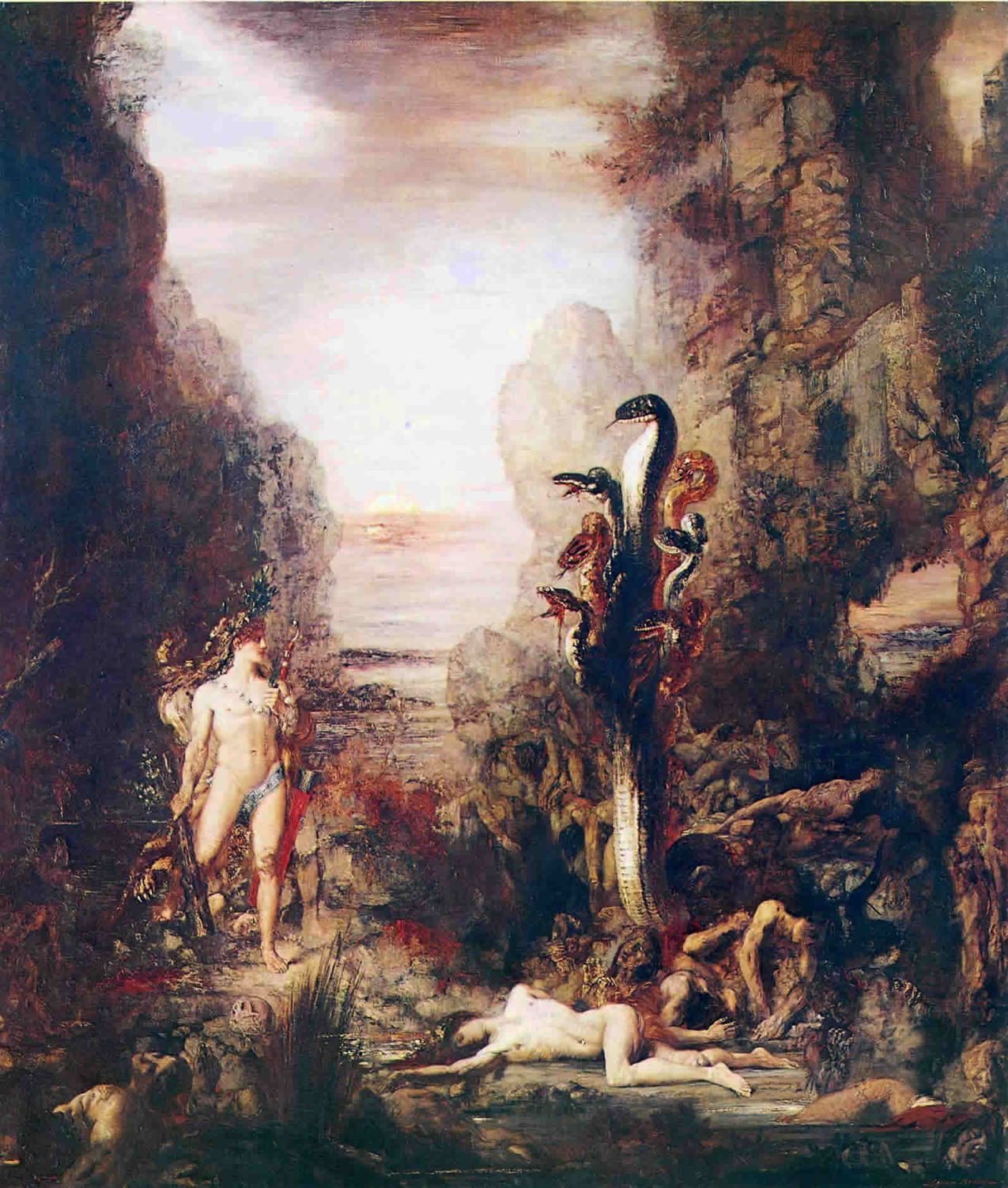
One of his four paintings exhibited at the Salon of 1876 told the second of Hercules’ twelve labours, his battle with the Lernean Hydra.
Gustave Moreau (1826–1898), Hercules and the Lernean Hydra (1876), oil on canvas, 175 × 153 cm, The Art Institute of Chicago, Chicago, IL. Wikimedia Commons.
The Hydra was a poisonous monster with the body of a dog and multiple serpent heads, whose breath alone could kill. According to surviving written accounts, Hercules covered his mouth and nose with a cloth for protection from the deadly fumes, fired flaming arrows into the Hydra’s lair to awaken it, then set about trying to kill it.
When he discovered that cutting off its heads with a sickle or sword only resulted in two more growing back, Hercules enlisted the help of his nephew Iolaus, who cauterised the wounds with a firebrand to prevent regrowth. Hercules then cut off the one immortal head using a golden sword given to him by Athena. He also took some of the Hydra’s blood, which was the poison used on the arrow with which he later killed Nessus.
Moreau puts his canvas into its portrait orientation to emphasise the Hydra towering over Hercules, who is fully armed, with club, bow and arrows, and more. The moment chosen is the initial confrontation, with Hercules staring steely-faced at the Hydra. This is consistent with Moreau’s aversion to a more theatrical treatment.
This was well-received and extensively debated, even generating a long-standing controversy over its possible political connotations. It was suggested at the time that the Hydra represented the forces of anarchy behind the insurgency of the Commune in 1871. Others preferred instead that the Hydra represented Bismarck and the German princes behind the Franco-Prussian War of 1870.
Two of his other paintings shown in 1876 were based on the story of Salome and the execution of Saint John the Baptist. Their underlying narrative is biblical, and straightforward. The unnamed daughter of Herodias (subsequently named as Salome) performed a dance at a birthday feast thrown by King Herod. The dance so pleased Herod that he offered her anything that she wanted, up to half his kingdom. She asked not for riches, but for the head of Saint John the Baptist, the earthly messenger sent to announce the birth and ministry of Jesus Christ. Reluctantly, Herod agreed, John was beheaded in prison, and his head brought to her on a plate; the dancer gave the head to her mother.
This has been a popular story for religious paintings, and by far the most common scene involves John’s head being brought on a plate, or variations around that. Moreau was clearly interested in other parts of the story, and in Salome herself. Moreau’s apparently sudden interest in Salome was sparked by the story, probably mythical, of a woman Communard known as the pétroleuse, who seemingly took delight in setting buildings alight. That suggests it wasn’t until the summer of 1871 that he started work on his paintings of Salome.
Gustave Moreau (1826–1898), Salome (1876), oil on wood, 144 x 103.5 cm, Armand Hammer Museum of Art, Los Angeles, CA. Wikimedia Commons.
The culmination of Moreau’s quest for the right scene to show the story of Salome the dancer is this extraordinary oil painting shown at the 1876 Salon.
The cadaveric King Herod sits on this throne while Salome is almost static on her points, and pointing towards the right. The executioner stands at the foot of the throne, and a couple of other women (including, perhaps, Salome’s mother) are at the left. Salome holds a lotus flower in her right hand, and other flowers are strewn on the floor. John’s head is nowhere to be seen, so we must presume that the moment selected by Moreau is when Salome chooses to receive that as her reward.
The rest of the painting consists of an unprecedented fusion of images, icons, and objects drawn from a diverse range of cultures. Detailed examination has shown these to be associated with the Hagia Sophia in Istanbul, the Alhambra in Granada, the Great Mosque of Cordoba, and several mediaeval cathedrals. Motifs have been identified from Etruscan, Roman, Egyptian, Indian, and Chinese art and culture.
But Moreau wasn’t content to show only that scene from the story. The other painting was to consider Salome with the head of John the Baptist as an apparition, and is now represented in three different versions.
Gustave Moreau (1826–1898), The Apparition (1875), oil on canvas, 142 × 103 cm , Musée National Gustave-Moreau, Paris. Wikimedia Commons.
The Apparition (1875) in the Musée National Gustave-Moreau is one of Moreau’s earliest attempts to express this. It takes the central part of Salome and adds the floating, severed head of John. Salome has now been transformed into the provocative, under-dressed femme fatale shown by subsequent artists. King Herod’s throne has been moved to the left of the painting, and he now looks in the direction of the apparition.
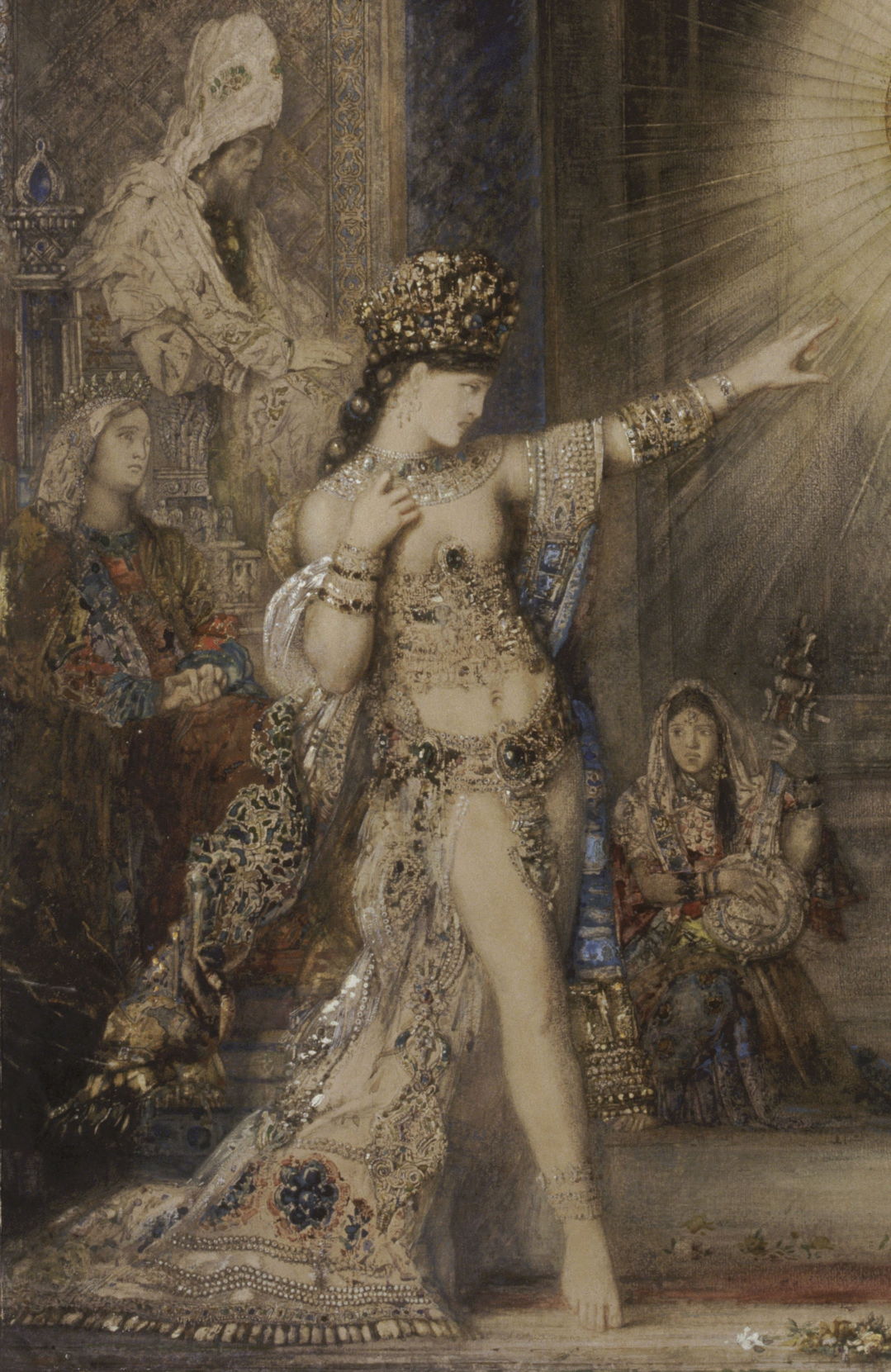
Gustave Moreau (1826–1898), The Apparition (c 1876), watercolour on paper, 106 x 72 cm, Musée d’Orsay, Paris. Wikimedia Commons.
This watercolour painting of The Apparition (c 1876), now in the Musée d’Orsay, was that shown at the Salon, although its colours are far weaker than when it was first exhibited. The cadaveric King Herod sit on his throne, overseeing the scene from the left edge. Herodias, presumably, sits by his feet, and a musician for Salome’s dance is shown further back. At the right edge is the executioner, John’s blood still on his sword.
Salome is now nearly nude, her body decorated with an abundance of strategically-placed jewellery and adornments. She points at the apparition with her left hand, trying to stare it out, her face as blank as everyone else’s. She stands on her points, but there is no sign of movement. The floor isn’t just strewn with flowers, but is now stained with the dripping blood from the severed head.
Gustave Moreau (1826–1898), The Apparition (detail) (c 1876), watercolour on paper, 106 x 72 cm, Musée d’Orsay, Paris. Wikimedia Commons.
Facial expressions are not theatrical as might have been expected in the work of a more conventional history painter of the day.
Gustave Moreau (1826–1898), The Apparition (1876-77), oil on canvas, 55.9 x 46.7 cm, Harvard Art Museums/Fogg Museum (Bequest of Grenville L. Winthrop), Cambridge, MA. Courtesy of Harvard Art Museums.
This slightly later oil version of The Apparition (1876-77), now in the Fogg Museum, gives a better idea of the original effect of Moreau’s watercolour, although the panther has moved across to replace the musician, and the background is quite different.
Moreau hadn’t painted Salome and The Apparition as a pair. Their compositions are individual, and mutually conflicting in details of the palace, the position of Herod’s throne, and more. Salome is one of the most iconographically rich paintings ever made, and it’s not surprising that some critics found it phantasmagoric. The Apparition is dominated by the same eye-to-eye contact that made Moreau’s Oedipus and the Sphinx so compelling, but here it’s between a notorious dancer and the severed head of the holiest man after Christ himself.
In 1877, the year after that Salon, Gustave Flaubert published three short stories, including an extended account of the traditional biblical narrative with Herodias at its centre. The British writer Oscar Wilde was introduced to that by Walter Pater (philosophical leader of Aestheticism), and in 1884 Joris-Karl Huysmans’ À rebours was published, a novel including a description of Moreau’s Salome paintings.
Wilde’s one-act play Salome was first published in French in 1891, and was soon translated into English and German. Banned from public performance in Britain, it received its premier in Paris in 1896, but wasn’t performed in public in England until 1931. At the centre of Wilde’s play is the perversion of lust and desire in Salome, best summarised in her words at the end of the play (he calls John the Baptist Jokanaan): But, wherefore dost thou not look at me Jokanaan? Thine eyes that were so terrible, so full of rage and scorn, are shut now. Wherefore are they shut? Open thine eyes! Lift up thine eyelids, Jokanaan! Wherefore dost thou not look at me? Art thou afraid of me, Jokanaan, that thou wilt not look at me? If thou hadst looked at me thou hadst loved me. Well I know that thou wouldst have loved me, and the mystery of love is greater that the mystery of death.
After seeing Wilde’s play performed in Berlin in 1902, Richard Strauss resolved to turn it into an opera. He started work on that in the summer of the following year, and Salome was completed and premiered in 1905. A year later, the dancer and choreographer Maud Allan produced a show called Vision of Salomé in Vienna, featuring a notorious version of the Dance of the Seven Veils, Wilde’s title for the dance of Salome before Herod, included in Strauss’s opera. The name quickly became a euphemism for a striptease, and the growing popularity of Salome as an erotic figurehead was named Salomania.
In around fifty years, from the appearance of Moreau’s The Apparition at the Salon in Paris, the traditional story of Herodias obtaining her vengeance by exploiting her daughter’s dance before Herod has been all but forgotten. The martyrdom of the second holiest figure in the gospels has been transformed into a perverse confusion of sex and death. The anonymous daughter of a woman who married her divorced husband’s brother has become the ultimate femme fatale: beautiful, sexy, and dangerous to know. Most unusually this change in story was largely triggered and driven by a painting: Moreau’s The Apparition.
Moreau was then concerned with the preparation of other paintings for the Exposition Universelle of 1878 in Paris.
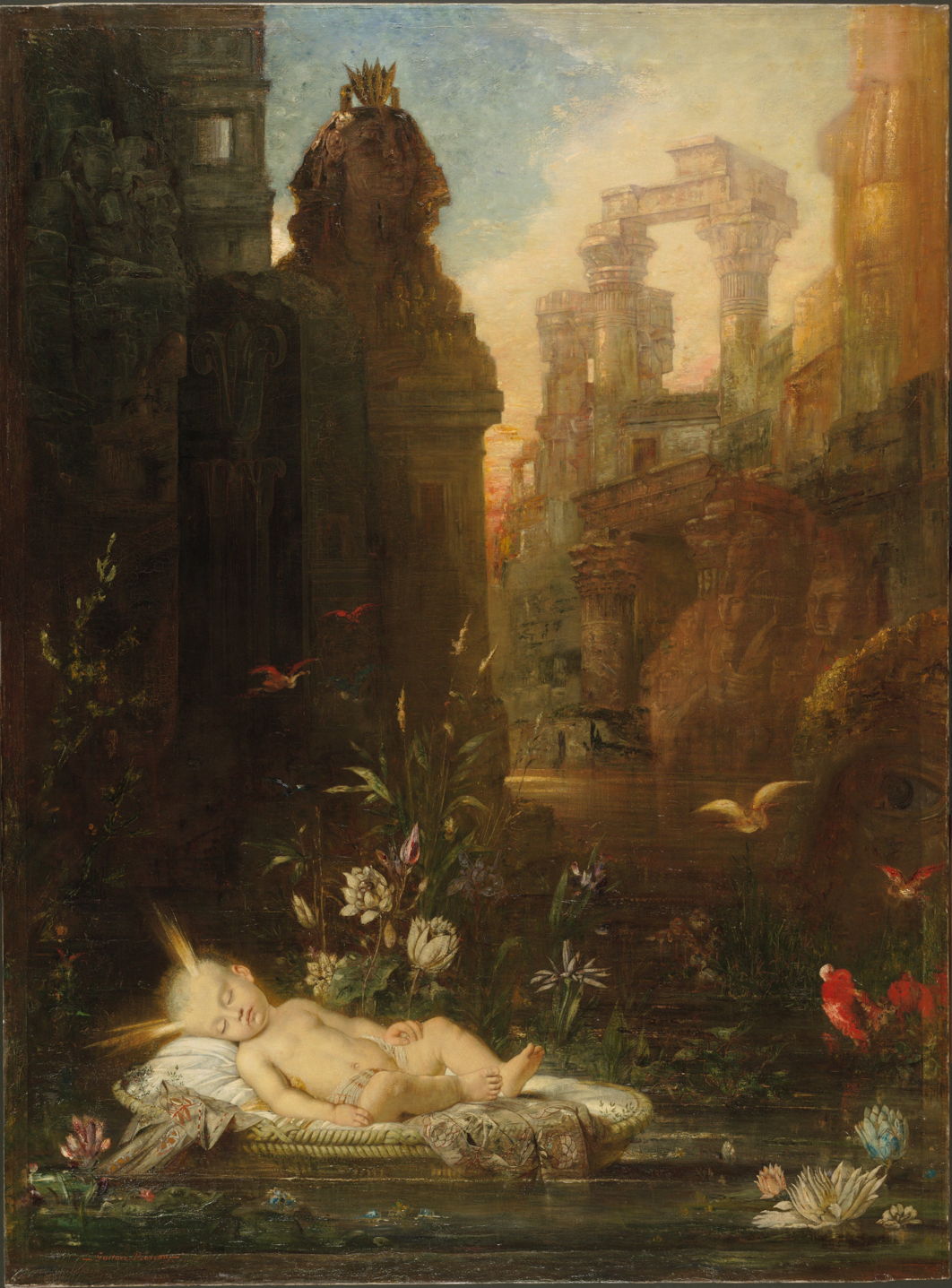
Gustave Moreau (1826–1898), Moïse Exposé sur le Nil (The Infant Moses) (c 1876-78), oil on canvas, 185 x 136.2 cm, Harvard Art Museums/Fogg Museum (Bequest of Grenville L. Winthrop), Cambridge, MA. Courtesy of Harvard Art Museums, via Wikimedia Commons.
Infancy and dawn are themes in Moïse Exposé sur le Nil (The Infant Moses) (c 1876-78), a radiantly beautiful depiction of the infant Moses asleep, prior to his discovery in the bullrushes. Moses is new life, new Judaeo-Christian beliefs, new law, and the new regime. Set against a background derived from photographs of Egyptian ruins symbolising the ancient, pre-Jewish, and decaying, it laid out Moreau’s hope for the French nation.
The baby Moses is marked out as being holy by the rays emanating from his temples, and surrounded by exotic flowers and birds. Most unusually, Moreau doesn’t show the traditional and popular moment of discovery of the infant in the bullrushes, but a static scene beforehand.
Gustave Moreau (1826–1898), Salome in the Garden (1878), watercolour on paper, dimensions not known, Private collection. Wikimedia Commons.
Moreau revisited his new myth of Salome and John the Baptist, in his strange watercolour of Salome in the Garden (1878). A beautiful and decorated figure of Salome is walking in an overgrown garden, carrying the severed head of John the Baptist on a large platter. Her eyes are closed, or perhaps looking down at the head, and John’s eyes are closed. Beside her is a headless statue of a man crawling, which could perhaps be the body of John, and outside is a man, possibly the executioner waving his sword.
References
Cooke P (2014) Gustave Moreau, History Painting, Spirituality and Symbolism, Yale UP. ISBN 978 0 300 20433 9.
Mathieu P-L (1998, 2010) Gustave Moreau, the Assembler of Dreams, PocheCouleur. ISBN 978 2 867 70194 8.
现任北京大学教授的饶毅(音译 Rao Yi ),主持着一个顶尖脑科学研究实验室。2007年回国后,他将在美国积累的经验用于推动中国生命科学的振兴。在《自然》杂志2025年6月的一篇专题报道中,这位神经科学家阐述了美国的犹豫徘徊如何可能为中国提供追赶国际先进水平的契机——甚至有望在十年内使中国在基础研究领域超越美国。当然,这恐怕并非"让美国再次伟大"选民们最关心的议题。
A funeral director has admitted preventing the burials of 30 bodies and stealing donations made to charities by mourners.
Robert Bush, 48, was arrested after police investigated Hull-based Legacy Independent Funeral Directors following a report of "concern for care of the deceased" in March 2024.
Bush, formerly of East Yorkshire and now living in West Yorkshire, pleaded guilty at Hull Crown Court to 30 counts of preventing a lawful and decent burial, and one of theft relating to charitable donations.
He previously admitted presenting families with the ashes of strangers and fraudulently selling funeral plans. He will be sentenced at a later date.
This breaking news story is being updated and more details will be published shortly. Please refresh the page for the fullest version.
You can receive Breaking News on a smartphone or tablet via the BBC News App. You can also follow @BBCBreaking on X to get the latest alerts.
In 2017, Hangzhou-based robotics firm Unitree 宇树科技 launched its first quadruped, Laikago. Laika was the name of the Soviet space dog onboard Sputnik 2, and the American English pronunciation of “go” is similar to that of the Chinese word for dogs, 狗 gǒu. Unitree’s battery-powered tribute to Laika wasn’t fuzzy, but walked on four feet and navigated through basic obstacles.
Unitree founder Wang Xingxing 王兴兴 has long held faith in the potential of robotic canines. Since 2020, when Unitree started gaining media attention, he has insisted in multipleinterviews that humans are drawn to four-legged creatures and will have a natural fondness for their artificial counterparts.
Wang Xingxing with a Laikago in 2017. (Source: Bilibili)
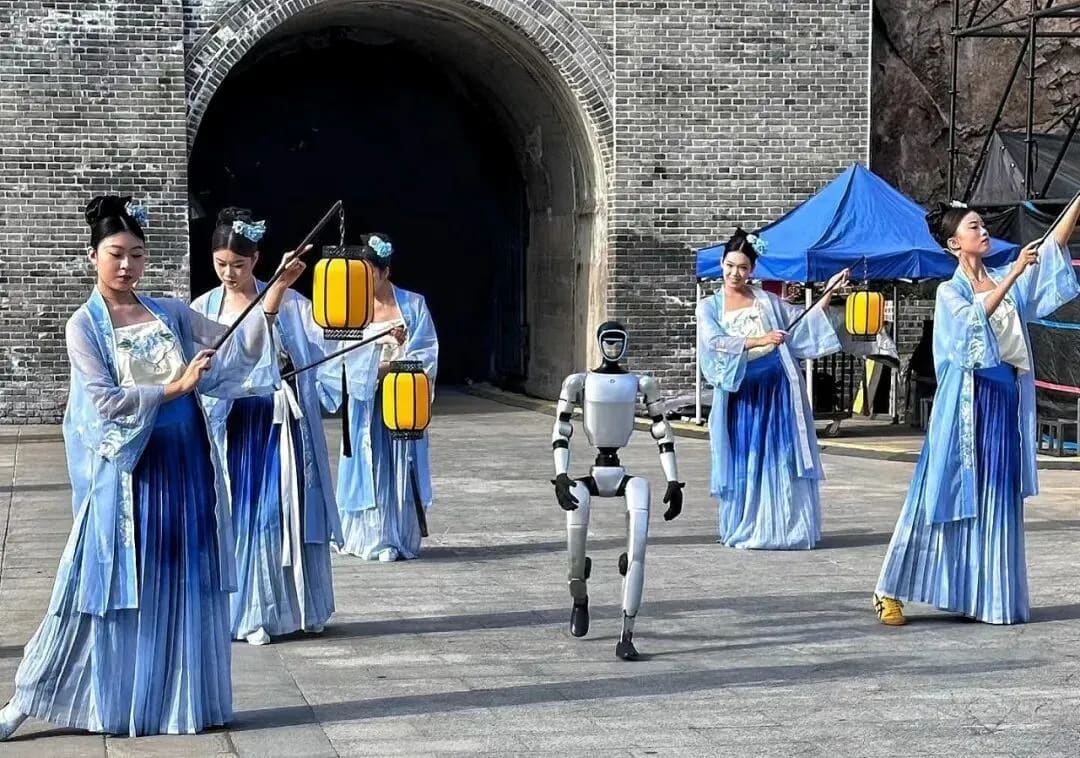
Fast forward to 2026, and Unitree has just filed for a $610-million IPO on the Shanghai Stock Exchange. The company is a household name in China after its humanoid robots performed dances at the CCTV Spring Festival Gala for two consecutive years and counting. Through their IPO disclosures (investor prospectus and response letter to the Shanghai Stock Exchange’s inquiries), we get some answers to important questions about the development of embodied AI.
How is Unitree profitable?
Where is diffusion happening inside China, aside from dancing on TV?
Are Chinese robotics companies content to lead in hardware and applications, or do they also see themselves as pursuing some kind of generalized “frontier”?
And finally, what does this all mean for US-China dynamics in robotics?
What’s the money maker?
One of the most notable things about Unitree is the fact that it actually makes money. Unprofitability is a near-universal challenge because AI robotics, despite massive advances in the past few years, is still an early-stage technology. Mass adoption has not yet arrived; pathways out of bottlenecks like data are uncertain; and important safety standards have not caught up. Even shipping products consistently can be a challenge for some companies in the space, let alone manufacturing at scale and booking reliable customers.
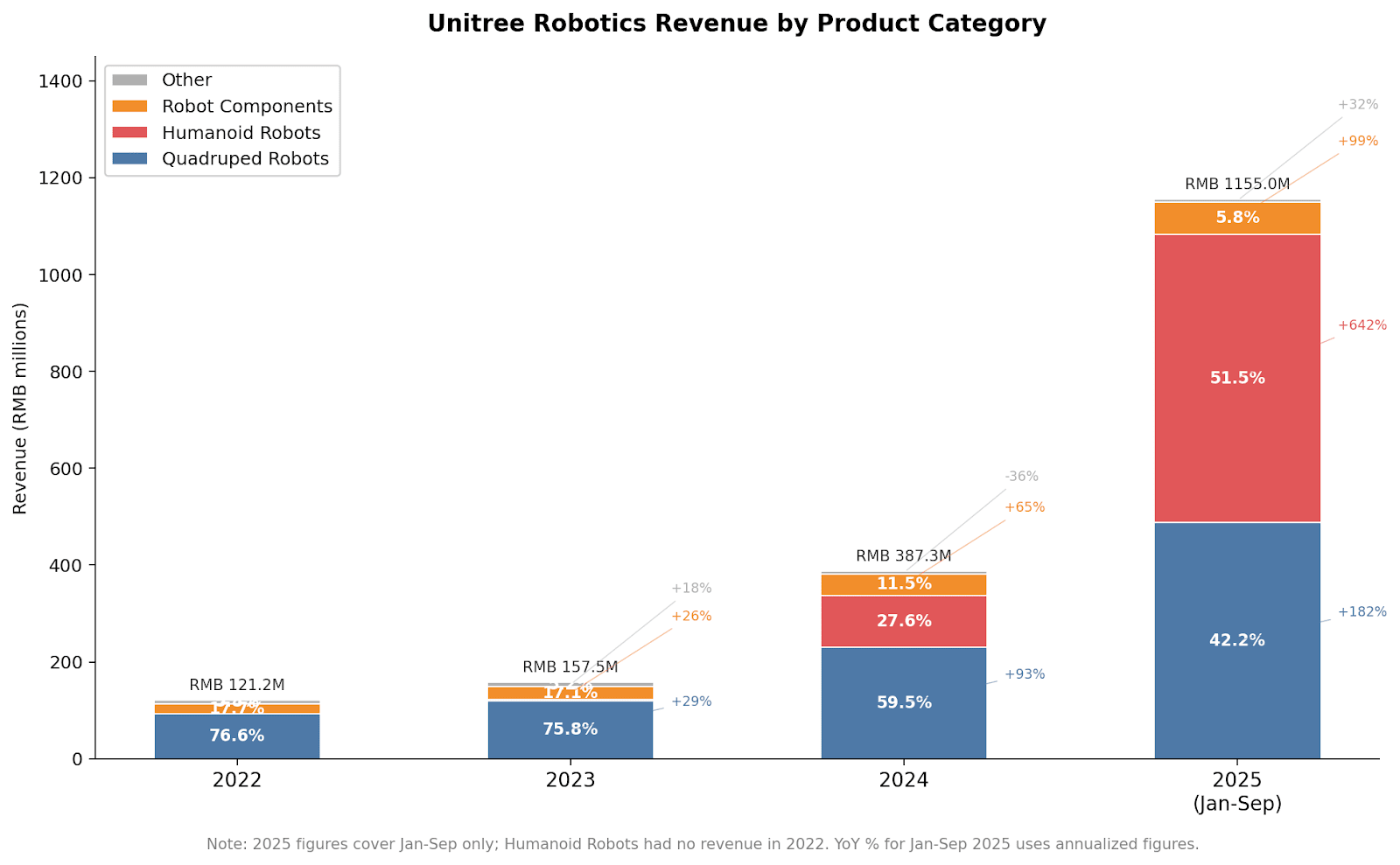
This context is why observers have found Unitree’s ability to turn a profit remarkable. Not only has the company’s net profit been positive since 2024, but from 2024 to 2025, its net profit grew by 204.29%. A look at its growth, broken down by product category, reveals the most significant source of this revenue explosion: humanoids.
It’s perhaps ironic that, despite the company’s longstanding work in quadrupeds, it is humanoids that have catapulted its business model to success. By meeting genuine demand in academia — and staging an especially strong marketing campaign in front of the Chinese public — Unitree has transformed itself into a humanoid frontrunner. Some analyses trace their potent commercialization drive back to Unitree’s origins. Wang Xingxing’s cofounder Chen Li 陈立, who was Wang’s classmate throughout both their undergraduate and Master’s programs, worked in international sales for the Hangzhou-based, partly state-owned surveillance tech giant Hikvision (海康威视) before joining Unitree. Hikvision has been extremely successful at expanding internationally (including in the US before it was added to the Entity List over its involvement in human rights abuses against ethnic and religious minorities in China). Investors have told Chinese media that Chen’s experience is an important asset for Unitree’s global commercialization, driving sales to governments and businesses in particular.
Unitree has earned name recognition in the West, but it is far from the only Chinese robotics company meaningfully shaping the future of embodied AI. In fact, it is part of an increasingly competitive market for AI-powered robots. Among listed peers, UBTECH and Dobot are major competitors named in Unitree’s prospectus. A fellow member of the “Hangzhou Six Dragons,” DEEP Robotics, is betting big on scenario-adapted applications, while AgiBot, by some estimates, shipped even more humanoid units last year than Unitree did.
In their response to the Shanghai Stock Exchange’s inquiry letter, Unitree emphasized in-house development of hardware parts as its key strategy for cutting costs. Unitree designs, builds, and assembles most components (other than commodity components like battery cells, flash storage, and the core computing board) in-house. It does offer outsourced alternatives for add-ons like LiDAR, cameras, and dextrous hands, but has also developed in-house options for all of these.
Where are the robots?
Unitree’s most reliable customers are universities, research institutions, and other companies conducting research into robotics. Its hold on academic customers worldwide is so firm that it’s caused alarm among DC policymakers. In May 2025, the China Select Committee called for Unitree to be designated as a “Chinese military company” and to be added to the Entity List.
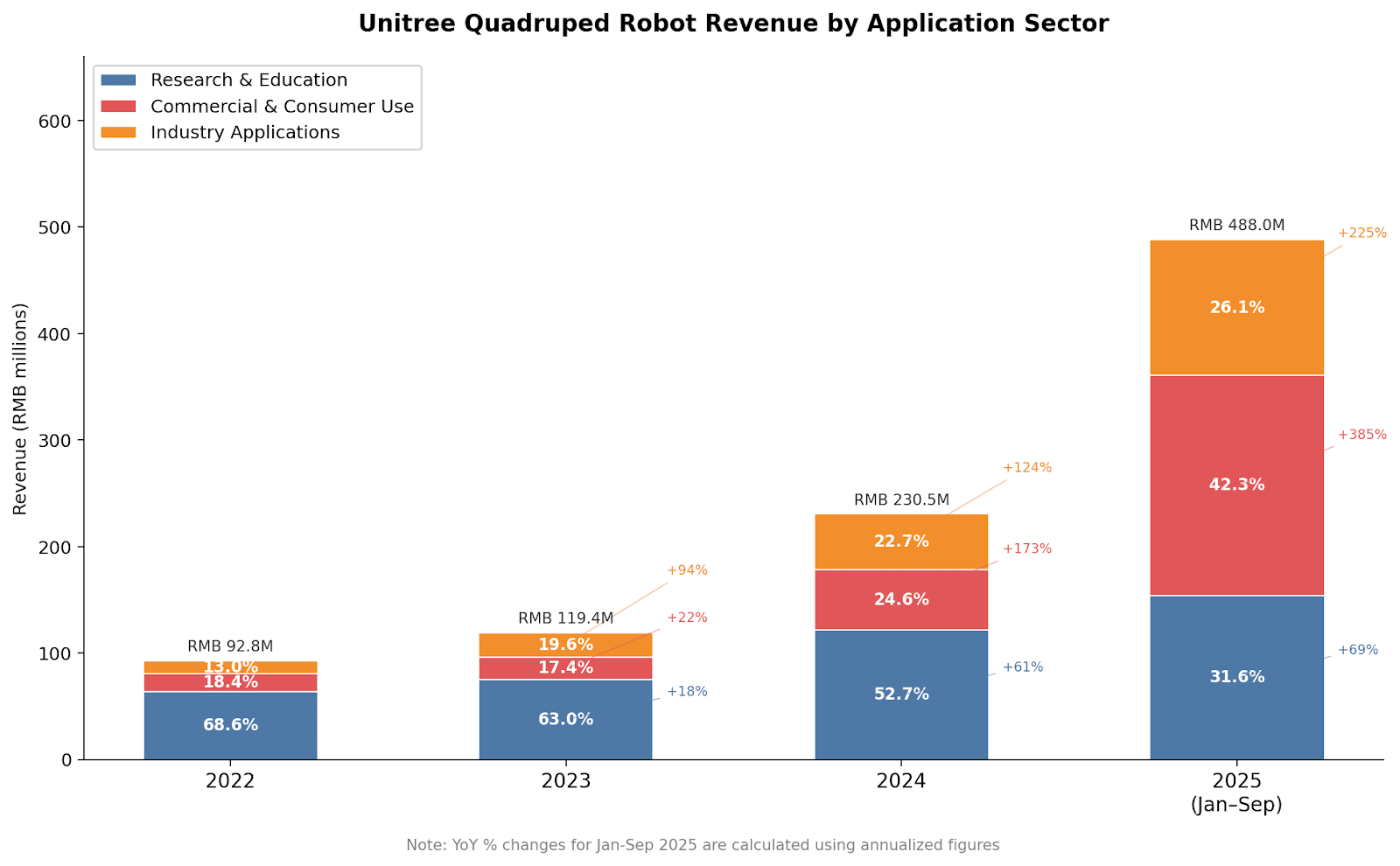
The data Unitree disclosed about its revenue sources, however, paints a more complex picture. For quadrupeds, the research and education sector has been the company’s most reliable source of revenue since at least 2022 (IPOs generally do not require companies to disclose audited financial statements from more than three years ago). But starting in 2024, revenue from both commercial and industry customers more than doubled. Consumer sales revenue nearly quadrupled year-on-year in only the first nine months of 2025.
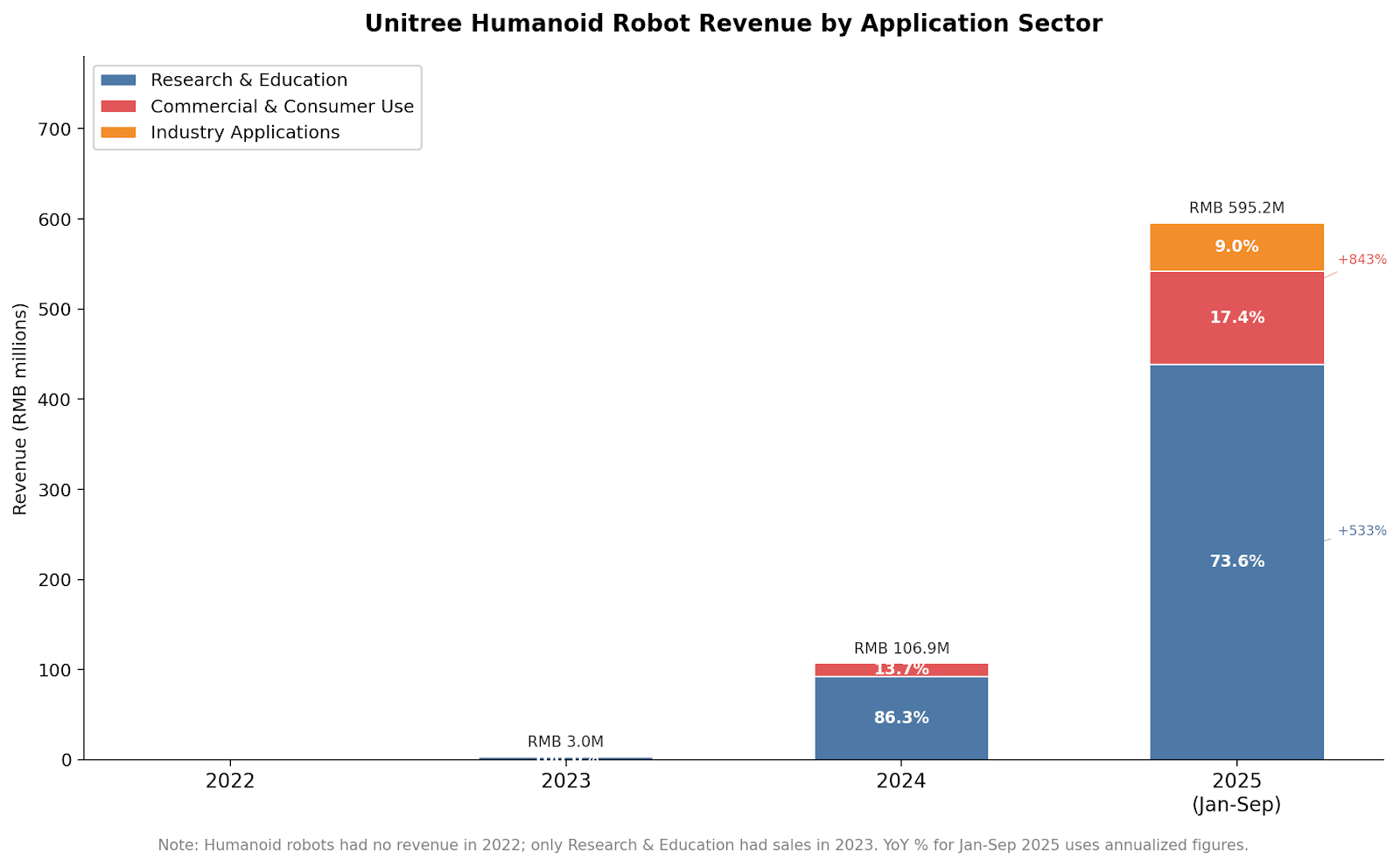
A similar, if more compact, story emerges for humanoids as well. Demand still largely comes from researchers and educational institutions, but commercial and industrial demand has grown from a near-zero starting point on a seemingly exponential trajectory since 2024. Consumers are especially excited about humanoids due to Unitree’s successful marketing of the concept. Industrial applications of humanoids are more limited compared to those of quadrupeds, but are also appearing.
What, exactly, are people doing with these robots? “Research & Education” encompasses sales to researchers, who use Unitree hardware and platforms to conduct their own experiments. The “Commercial & Consumer Use” and “Industry Applications” categories roughly map onto B2C and B2B sales, respectively. According to Unitree, non-academic consumers who buy their robots mostly do so “for show”: they’re deploying these robots as attractive promoters in retail settings, at tourist sites, and in performances and exhibitions. Some use them as novelty companions.
Applications in industry are more interesting. Quadrupeds are deployed as “smart inspectors” in power grids, subway tunnels, and gas pipelines. They can also assist in harsh settings like emergency response and outdoor surveys, and complete manufacturing and logistical tasks. E-commerce firm JD.com is Unitree’s biggest corporate customer. Humanoids, according to Unitree, are being used for inspections and manufacturing as well, though in a more limited capacity because the technology is less mature. Unitree expects consumer demand for humanoids to grow in the medium term, but we will have to wait a while longer for genuinely useful humanoids on the factory floor.
Is Unitree… AGI-Pilled?
Received wisdom in robotics has it that the US leads in software-related research, while China’s strength is in hardware. The implication is that the US is likely to reach “generalized” machine intelligence in the physical world faster than China, but — in the meantime — Chinese companies could get to practical applications faster through quick iterations inside an unparalleled manufacturing ecosystem.
Unitree’s business model is often quoted as direct evidence of this dynamic, and it is indeed true that hardware is the crux of Unitree’s success. But does that mean Unitree, and the Chinese robotics industry writ large, has less interest in generalizability or the intelligence frontier? The IPO disclosures indicate otherwise.
Unitree called on incoming investors to “realize humanity’s ultimate dream — AGI” 实现人类最终极的梦想—AGI with them. Their lawyer-drafted definition of AGI is “a form of intelligence that possesses general cognitive capabilities comparable to those of humans, capable of understanding, learning, and executing intellectual tasks across any domain, and autonomously reasoning, planning, making decisions, and continuously learning in unknown environments.”
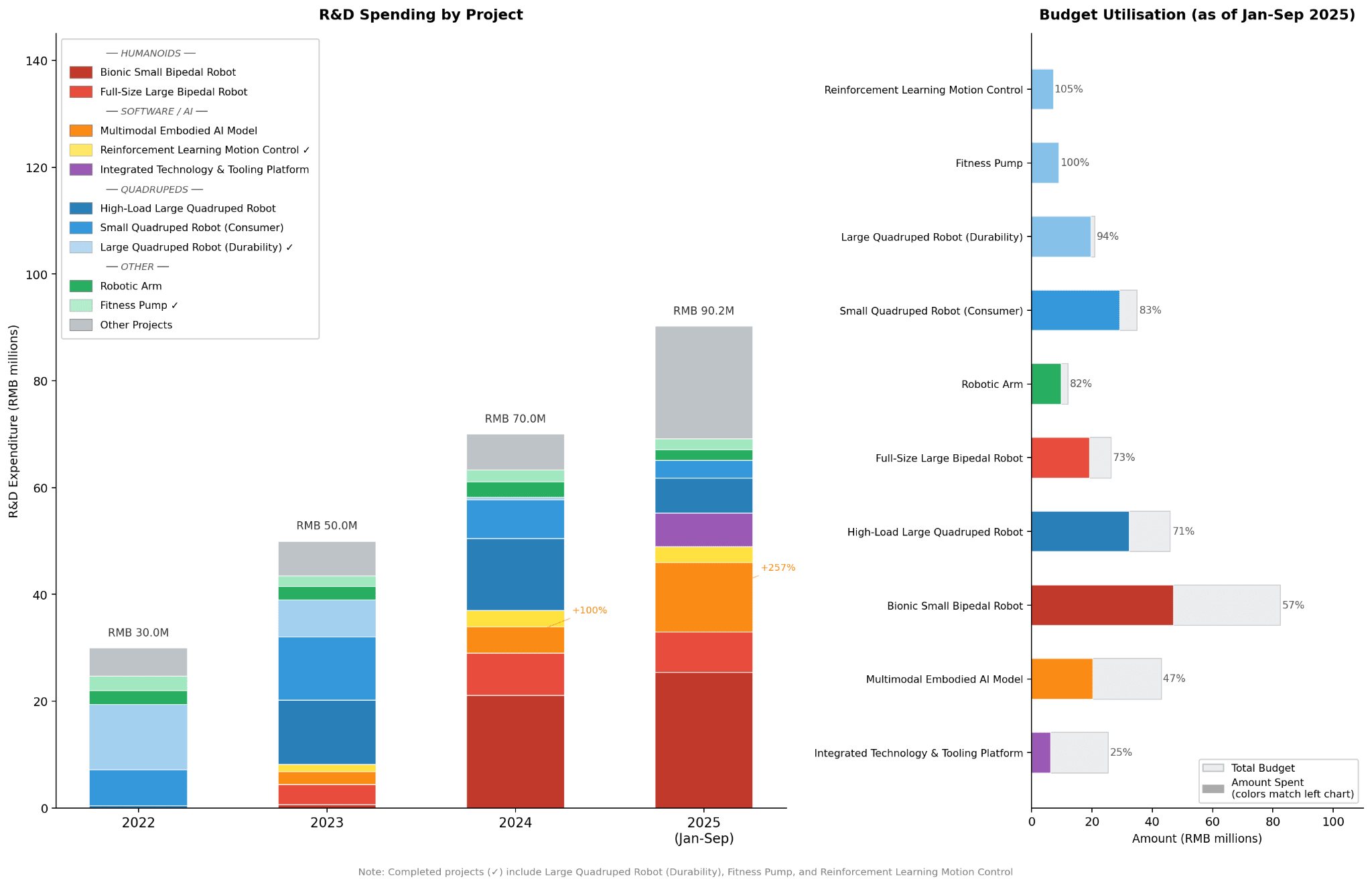
The financial reality tells us that most of Unitree’s R&D budget has gone to hardware. This is clearly downstream of their aforementioned focus on developing as many components in-house as possible to cut costs.
However, it’s important to notice in the chart above that Unitree’s R&D expenditure on “Multimodal Embodied AI Model” — the “big brain” of its robots — increased exponentially between 2024 and 2025, while other areas of R&D have grown at a steadier pace. Unitree is clearly ambitious about developing its models, even if it is known mostly for its hardware business.
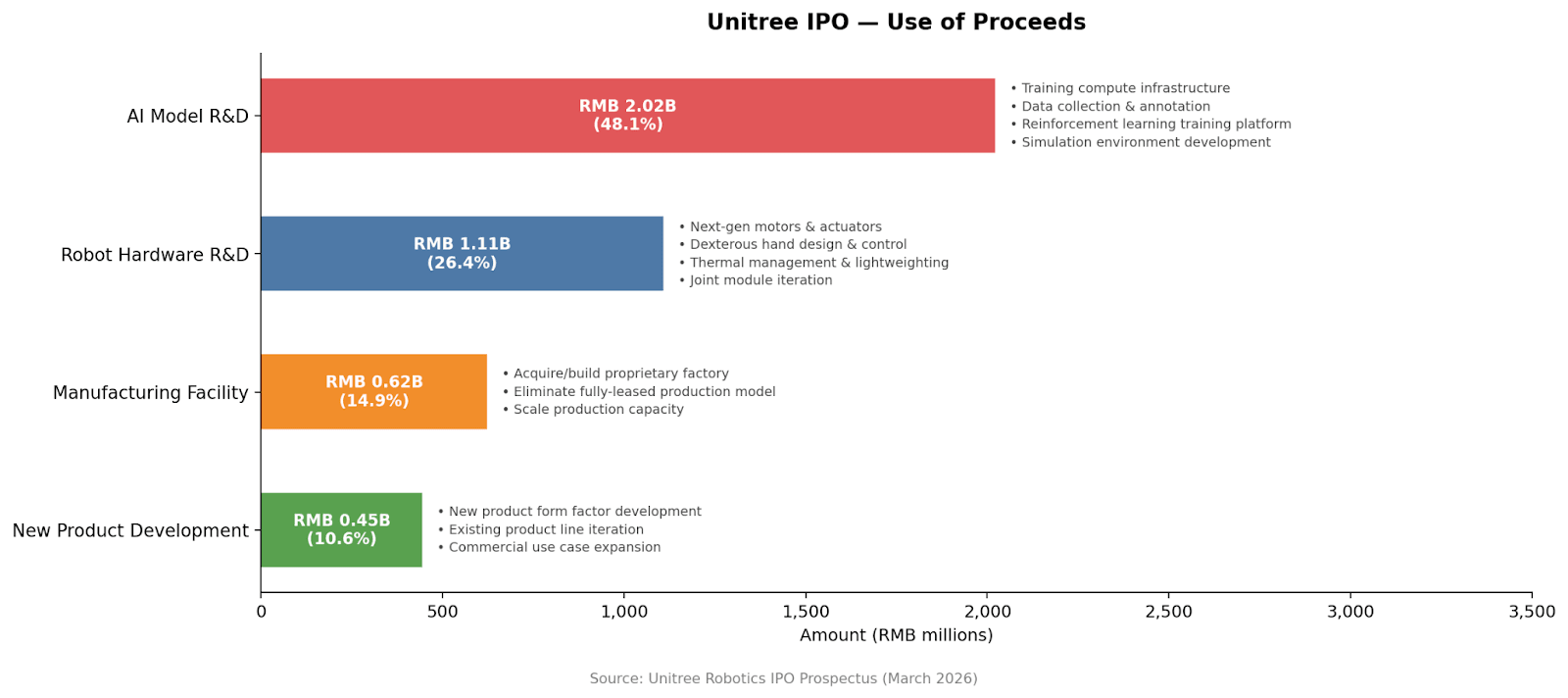
This becomes clearer when we look at Unitree’s plan for using the 4.2 billion RMB (around 607.7 million USD) raised through the IPO. Unitree’s stakeholders approved the following distribution in early 2026:
Nearly half of the IPO’s proceeds will be spent on training AI models over the next three years. That’s around 673 million RMB per year, which is not quite comparable to more well-known model makers (MiniMax, for example, spent around 1.75 billion RMB on R&D last year) but still a significant amount that signals long-term software ambitions.
Unitree currently owns no real estate, but plans to build its own factory with IPO proceeds. Per its disclosures, it has already secured a nod of approval from Hangzhou’s Binjiang District 滨江区 and plans to build there. Transitioning from an all-leased manufacturing model to proprietary manufacturing facilities is in line with their emphasis on in-house development and increasing production efficiency.
What comes next?
These disclosures answer many factual questions about Unitree’s business model, but raise more fundamental questions about the future of automation, US-China competitive dynamics, and both countries’ big bet on AI.
Question one: What will come of Unitree’s “AGI” ambitions? A public company is required to either use proceeds as stated in official disclosures, or publicly justify any changes. (Shareholders can vote to reappropriate funds, but unauthorized deviations could invoke China’s securities law and trigger scrutiny from the Stock Exchange.) Barring major issues, we should expect Unitree to spend handsomely on model training and development for the next three years. The biggest challenge will be making sure that these investments produce consequential returns. This uncertainty is not exclusive to Unitree; no one knows what the next three years will bring. But Unitree has now put itself on a path away from hardware-first and towards a more diversified strategy. This is, of course, risky, but relying on academia’s demand for hardware is no longer secure.
Question two: Will America turn against Unitree? A “Chinese military company” designation, which places companies into the annually-updated 1260H list, would merely exclude Unitree from contracting with the Department of Defense, but being placed on the Entity List would subject it to US export controls. Neither designation would prevent Unitree from selling to American customers outright, but they would hobble the company’s growth. As Unitree’s own prospectus describes:
Throughout the reporting period, revenue from overseas markets consistently exceeded 35% of total revenue. Should the United States continue to intensify trade and tariff policies that materially disadvantage Chinese exporters, or place the company on restricted lists governing procurement partnerships or technology export controls, the company faces the risk of being unable to sustain high growth in overseas sales — and potentially suffering an overall decline in performance. … Given uncertainty in industrial trade policy and the international political environment, any adverse shifts in external supply chain conditions or overseas market controls — compounded by further escalation of US trade restrictions and export control measures — could negatively affect the company’s ability to procure imported materials and maintain technology partnerships.
Policymakers eager to run “Trojan horse tech” out of America have to reckon with the dilemma that, for academic researchers at the forefront of embodied AI, there are few alternatives to Chinese-made hardware and platforms; Unitree is simply the most successful of the lot. Affordability and reliability are the most important factors for nonprofit academic labs. Robotics research is also a rough-and-tumble affair: there is wear and tear, and I’ve had researchers and students show me bruises they’ve sustained on the job from handling heavy humanoids. Unitree’s scale, consistency, and pricing meets academics where they are. Moreover, Unitree has been cultivating its relationships with international researchers long before the reporting periods of these IPO disclosures. The company started shipping internationally in 2018, and some of the earliest buyers of its quadrupeds were university research labs.
Imagine writing code for a dishwasher without dishwashers to test the code on. That’s a massively oversimplified comparison, but it is the same proposition in spirit. If Washington severs this symbiotic relationship, it will almost certainly make it harder for American researchers to maintain their lead in the software side of embodied AI.
Finally, question three: Can Unitree keep its lead inside China? As mentioned earlier, the company has formidable challengers in its own backyard, and has had to continuously trim costs to stay competitive. DEEP Robotics also joined the leagues of profitable companies in 2025. AgiBot’s CEO said at the end of last year that the company’s total sales revenue in 2025 likely exceeded 1 billion RMB. Up until now, Unitree’s success is arguably a case of first-mover advantage. Many more companies are taking up the Unitree playbook, and the future of robotics in China is far from determined.
If you aren’t yet ready to open your home to a robot dog, the company also sells fitness equipment inspired by robotics technology…

 Login
Login