In my account of how Tahoe updates macOS, I had reached the stage when Rosetta and the main update had started downloading from Pallas, Apple’s software update server (see the Appendix at the end for further explanation of terms used).
Download
Currently, the main update download (at least) is compressed using Zip, and is decompressed as a stream during download, so there’s no delay decompressing during the preparation phase later.
In this case, downloading the main update was completed within 8 minutes. The source of the Zip archive was originally given as a path on [https://]updates.cdn-apple.com/2026WinterFCS/patches, and that was written to a local path on /System/Library/AssetsV2/com_apple_MobileAsset_MacSoftwareUpdate/ In my case, though, I have a local Content Caching Server running, and immediately before the download started com.apple.AssetCacheServices substituted a download URL on that server to ensure the update was obtained through the local caching server. At the same time, an Event Report was sent back to Apple, recording the start of download.
Progress was updated every second during the download, and brought the progress bar from 16% to 53.9% over the following 8 minutes, with little other activity taking place.
Preflight
Activity then changed to what is repeatedly referred to as Preflight FDR Recovery, and is the first entry point for the UpdateBrainService, downloaded for MobileSoftwareUpdate rather than softwareupdated.
This runs an Event Recorder and begins to perform preflight checks to “recover FDR SFR”, and to perform a “firmware-only update”. To prepare for that, it retrieves various nonces and their digests for LocalPolicy, RecoveryOS boot policy, and others. Following those is the first of many attempts to determine purgeable space, in preparation for installation of the update. Those are performed by com.apple.cache_delete.
Pallas was then checked to see if there was any more recent version of RecoveryOS UpdateBrain, but there wasn’t. A further check for any newer recoveryOS was also made, before the main macOS update was prepared, at a progress level of 60% as set previously.
Preparation
The first step of the main preparation phase is to purge staged assets with com.apple.cache_delete. With that complete, UpdateBrainService recalculates cryptex size requirement for the update, and the install target prepare size:
cryptex size is 1.2 times the app cryptex size = 60 MB, plus 1.2 times the system cryptex size = 7749 MB, a total of 7809 MB, as previously calculated;
prepare size is the sum of the snapshot installation size of 3785 MB, the cryptex size of 7809 MB, three ‘slack sizes’ for VW, Recovery and Preboot of 2048 + 1024 + 1024 = 4096 MB, the new template size of 991 MB, twice the update partition size totalling 600 MB, less the old template size of 363 MB. The grand total comes to 16,918 MB.
UpdateBrainService then checks volume free sizes, and confirms that they’re sufficient to complete the update. It next creates a ‘stash’, which is protected by keys in the stash keybag, handled by the Secure Enclave Processor. There is then another round of purging with com.apple.cache_delete.
Much of the preparation phase is spent verifying the protection of installation packages, cryptexes, then the contents of /System/Applications and /System/Library. As progress is about 64% complete, System volume preparations are started, and there’s another round of purging by com.apple.cache_delete. There’s surprisingly little log activity as progress passes 70% complete.
With progress reaching 84% complete, UpdateBrainService starts unarchiving files in parallel, taking just under 5 seconds to complete those. Following that, there’s another brief period unarchiving data files in parallel, then working with the contents of /System/Volumes/Update/mnt1/private/var/MobileAsset/PreinstalledAssetsV2 as progress reaches 87% complete.
When there’s 87.5% completed, UpdateBrainService reports it’s creating hard links in parallel, then is searching for new paths and verifying files, such as those in the Ruby framework. The Recovery volume is unmounted, and there’s yet another purge with com.apple.cache_delete. After those, key volume locations are checked.
The high water mark of disk usage during update is prepared. This reveals some of the steps to be undertaken during installation, including:
prepare source package,
patch cryptexes,
patch system volume,
extract to system volume,
install personalised.
There’s a further round of purging with cache_delete before declaring PrepareUpdate as successful, then suspending the update briefly. When update resumes, the Update volume is mounted and prepared, and there’s another round of purging. The System volume is then mounted, checked, and prepared. Progress is now at 98.5% complete, and once 100% is reached, the countdown to restarting the Mac is begun.
Installation
During the download and preparation phases, apart from repeated purging, the log is generally quiet. This changes dramatically once the Mac starts preparing for shutdown and installation. WebKit is cleaned up and shut down, as are many other processes. The ‘stash’ of update components is then committed, and final scans and checks are completed.
The update is then applied, followed by Rosetta, RecoveryOS, UpdateBrain and finally minor documentation. After that period of nearly 20 seconds, this phase is declared complete, and a restart is notified before waiting for the essential reboot.
Reboot
Once rebooting by root has been initiated, the boot chime is muted to ensure the update continues in silence. The last log message is written a few seconds later, and UpdateBrain then runs the update.
Less than 3 minutes later, the system boot is recorded in the log, and kprintf is initialised 5 seconds later. About 3 minutes afterwards softwareupdated is started up, and runs various clean-up routines to complete the update sequence in conjunction with ControllerSetup and a Finite State Machine.
Key points
The main update download is decompressed while streaming, to save preparation time later.
If a local Content Caching Server is connected, AssetCacheServices will substitute its IP address for that of the Pallas server to ensure the download is obtained through the cache.
Following download, extensive preflight checks are performed.
During preparation components are verified, paths checked, and some unarchiving is performed.
Prior to reboot and installation, processes including WebKit are shut down in readiness for reboot and install.
FDR is unknown, but appears associated almost exclusively with a preflight phase.
Pallas is the internal name for Apple’s software update server. This appears throughout log entries, where for example Pallas audience is jargon for the type of user, normally macOS Customer.
RecoveryOS appears to refer to the version of Recovery in the hidden container of the internal SSD, more widely known as Fallback Recovery.
SFR appears to refer to the version of Recovery in the Recovery volume of the active boot volume group, also known as Paired Recovery.
Splat, semi-splat and rollback objects all refer to cryptexes. Splat is the general term, while semi-splat refers to a cryptex-based update that might include rapid security responses (RSR) and background security improvements (BSI) implemented by replacing one or both cryptexes. Rollback objects are older versions of a cryptex that have been saved to allow a newer cryptex to be reverted to that older one, in the event that the newer cryptex causes problems.
UpdateBrain is the executable code supplied as part of an update that prepares and installs that specific update. There’s a separate UpdateBrainService for RecoveryOS.
There are only two ways a painter can depict reflections on water in accordance with optical reality: they can paint exactly what they see when in front of the motif, or they can understand optical principles sufficiently to recreate what they would have seen. This article looks at how those worked out in landscape paintings to the end of the eighteenth century.
Jan van Eyck (c 1390–1441), The Madonna of Chancellor Rolin (detail) (c 1435) oil on panel, 66 x 62 cm. Musée du Louvre, Paris (WikiArt).
Look in the landscape behind Jan van Eyck’s Madonna of Chancellor Rolin (c 1435) and you’ll see one of the earliest examples of the meticulously accurate depiction of reflections on water. These could only have resulted from careful studies made in front of the motif.
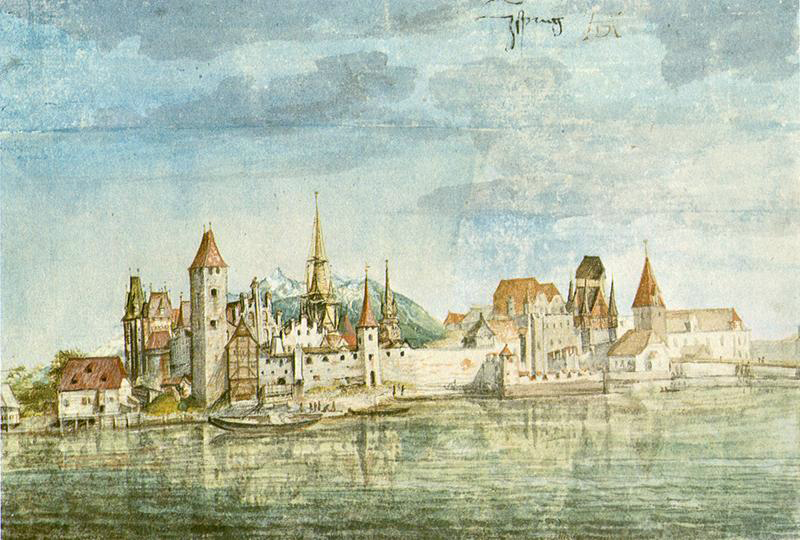
Albrecht Dürer (1471-1528), View of Innsbruck (c 1495), watercolour on paper, 12.7 x 18.7 cm. Albertina, Vienna (WikiArt).
For Albrecht Dürer painting this View of Innsbruck in about 1495, this watercolour is evidence that he both recognised the challenge, and went to the trouble to paint what he actually saw, even though the overall geometry isn’t perfect, with its downward slope to the left.
Following the Northern Renaissance, other landscape painters continued this tradition, into the Dutch Golden Age.
Aelbert Cuyp (1620–1691), View on the Rhine (c 1645), oil on panel, 27.4 x 36.8 cm, Fondation Custodia, Paris. Wikimedia Commons.
Although Aelbert Cuyp’s View on the Rhine from about 1645 isn’t optically perfect and must at least have been finished in the studio, it demonstrates his care in trying to be faithful in its reflections.
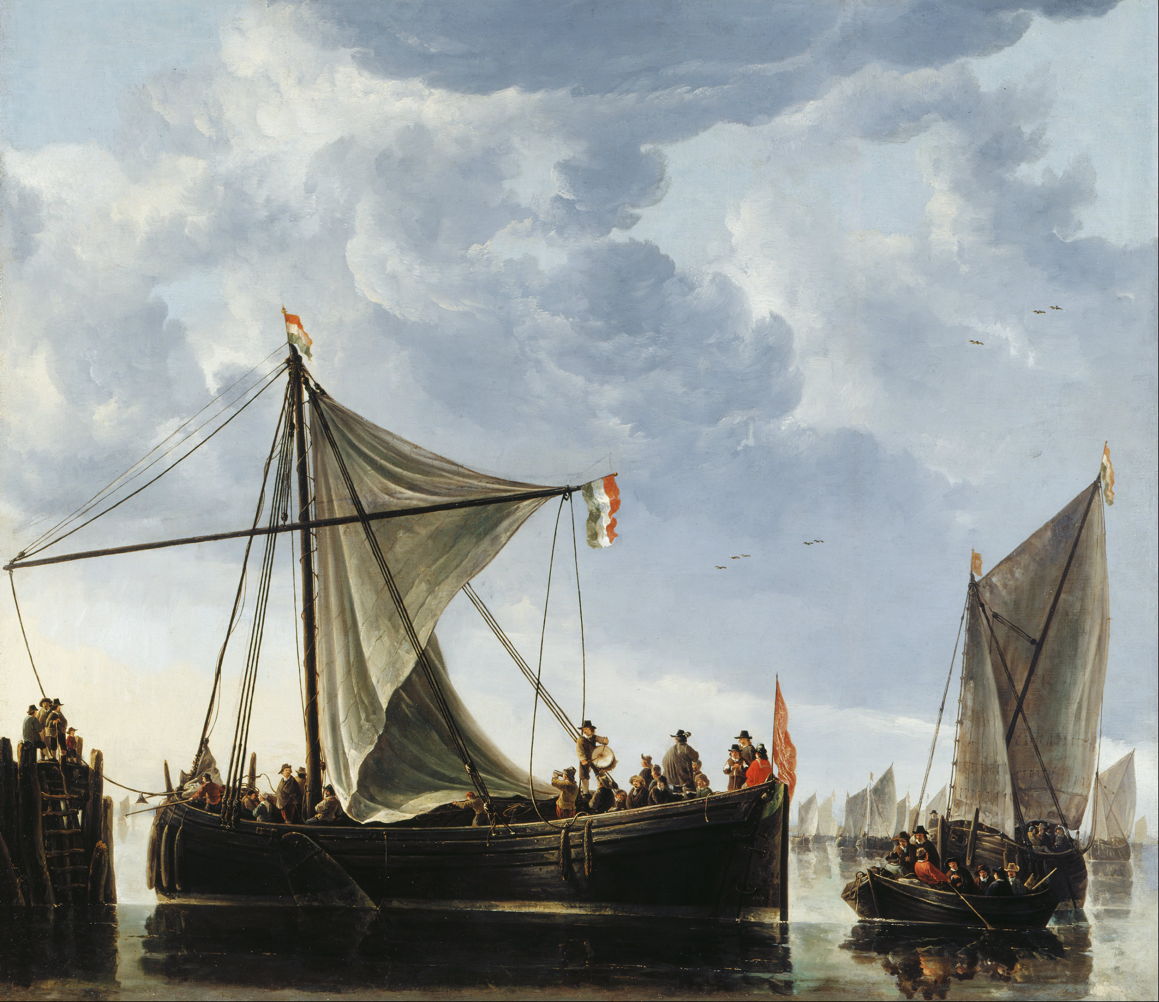
Aelbert Cuyp (1620–1691), The Passage Boat (c 1650), oil on canvas, 124 x 144.4 cm, Royal Collection of the United Kingdom, UK. Wikimedia Commons.
Cuyp’s larger and more detailed painting of The Passage Boat from about 1650 is similarly attentive, implying the use of careful studies made in front of the motif.
Aelbert Cuyp (1620–1691), The Valkhof at Nijmegen (c 1652-54), oil on wood, 48.8 x 73.6 cm, Indianapolis Museum of Art, Indianapolis, IN. Wikimedia Commons.
Cuyp’s grand view of The Valkhof at Nijmegen from about 1652-54 is a fine example from later in his career.
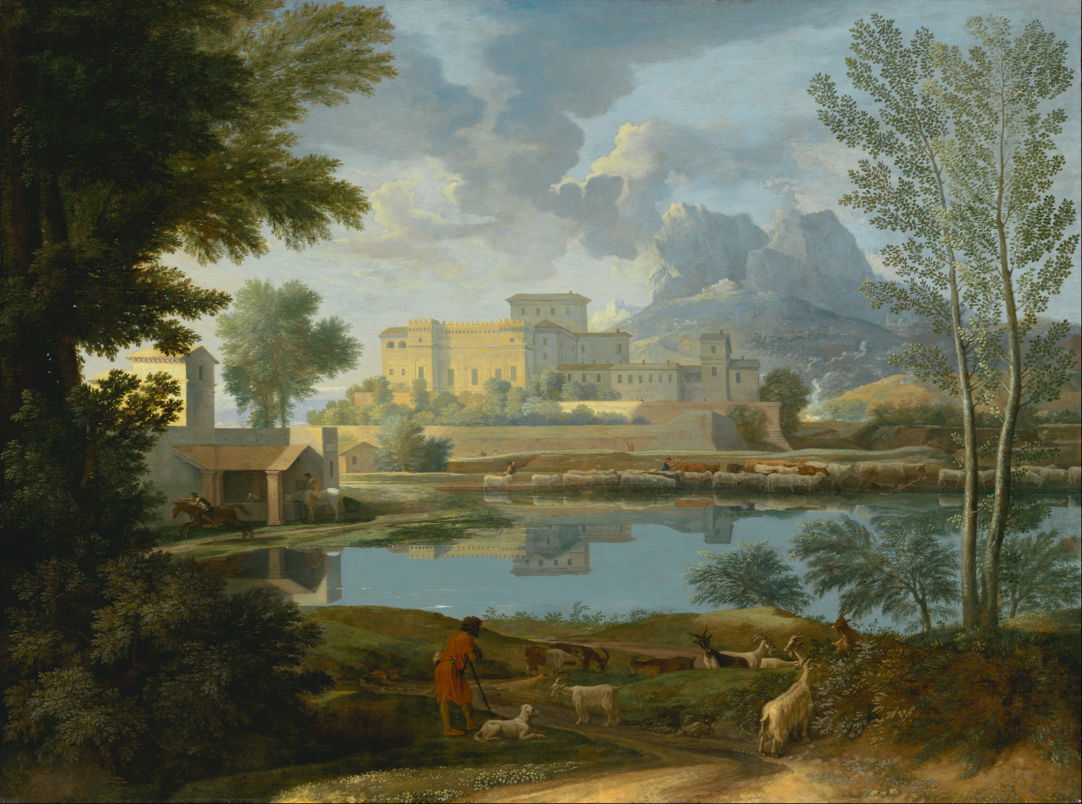
Nicolas Poussin (1694-1665), Landscape with a Calm (c 1651), oil on canvas, 97 x 131 cm, J. Paul Getty Museum, Los Angeles. Digital image courtesy of the Getty’s Open Content Program.
At about the same time, Nicolas Poussin used extensive reflections to augment the placid atmosphere in his idealised Landscape with a Calm (c 1651). The upper parts of the Italianate mansion, together with the livestock on the far bank of the lake, are painstakingly reflected on the lake’s surface, telling the viewer that there isn’t a breath of breeze to bring ripples to disturb those reflections.
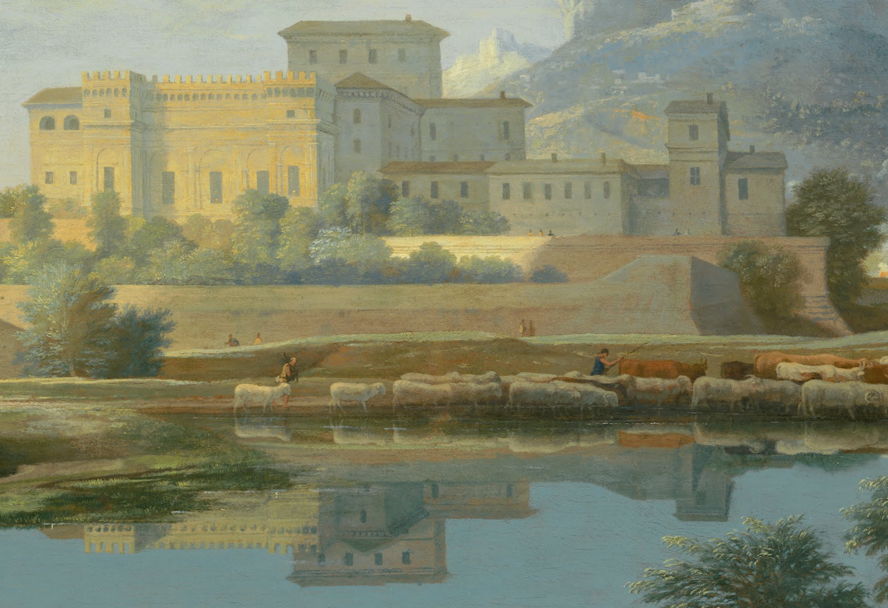
Nicolas Poussin (1594–1665), Landscape with a Calm (detail) (c 1651), oil on canvas, 97 x 131 cm, J. Paul Getty Museum, Los Angeles. Digital image courtesy of the Getty’s Open Content Program.
Closer examination of the reflections reveals small disparities, though. Poussin has broken the rule of depth order in painting the brown reflection of one of the cattle that is well behind the sheep at the edge of the lake, and there are inaccuracies obvious in the reflection of the villa. Those may well be the result of his assembling passages from the original plein air studies he used to build this composite.
Nicolas Poussin (1594–1665), Landscape with a Calm (detail) (c 1651), oil on canvas, 97 x 131 cm, J. Paul Getty Museum, Los Angeles. Digital image courtesy of the Getty’s Open Content Program.
His reflections appear most accurate in the passage showing horsemen at the left end of the lake. These make interesting comparison with Poussin’s contemporary Claude Lorrain, who appears to have avoided tackling the problems posed by reflections.
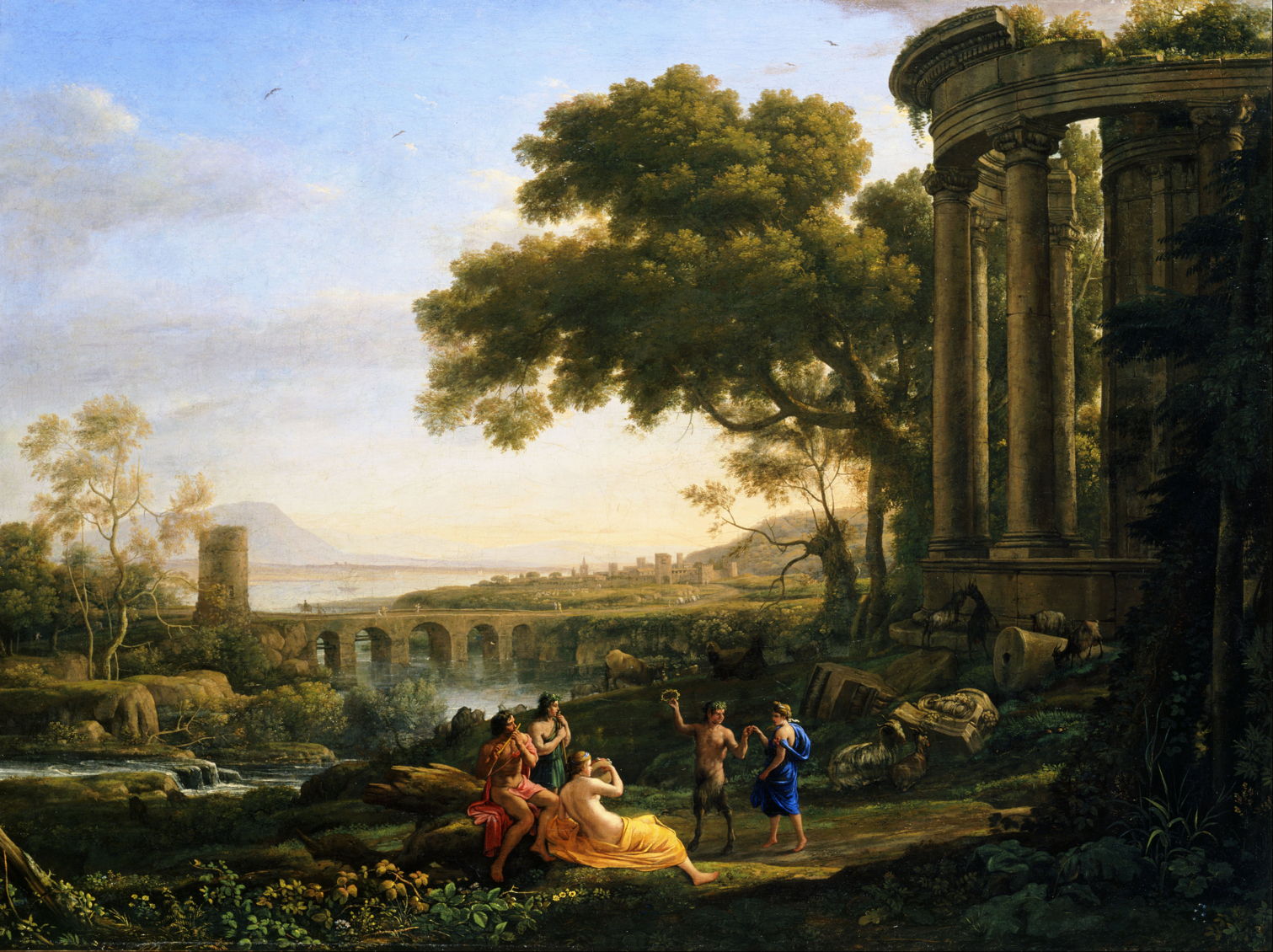
Claude Lorrain (1604/5–1682), Landscape with Nymph and Satyr Dancing (1641), oil on canvas, 99.7 x 133 cm, Toledo Museum of Art, Toledo, OH. Wikimedia Commons.
In Claude’s Landscape with Nymph and Satyr Dancing from 1641, another idealised composite assembled from the artist’s library of sketches, little attempt is made to depict the reflection of the prominent viaduct. What has been shown is unaccountably darker than the original, and vague in form. Most of Claude’s other paintings that could have included reflections show water surfaces sufficiently broken to avoid tackling the problem.
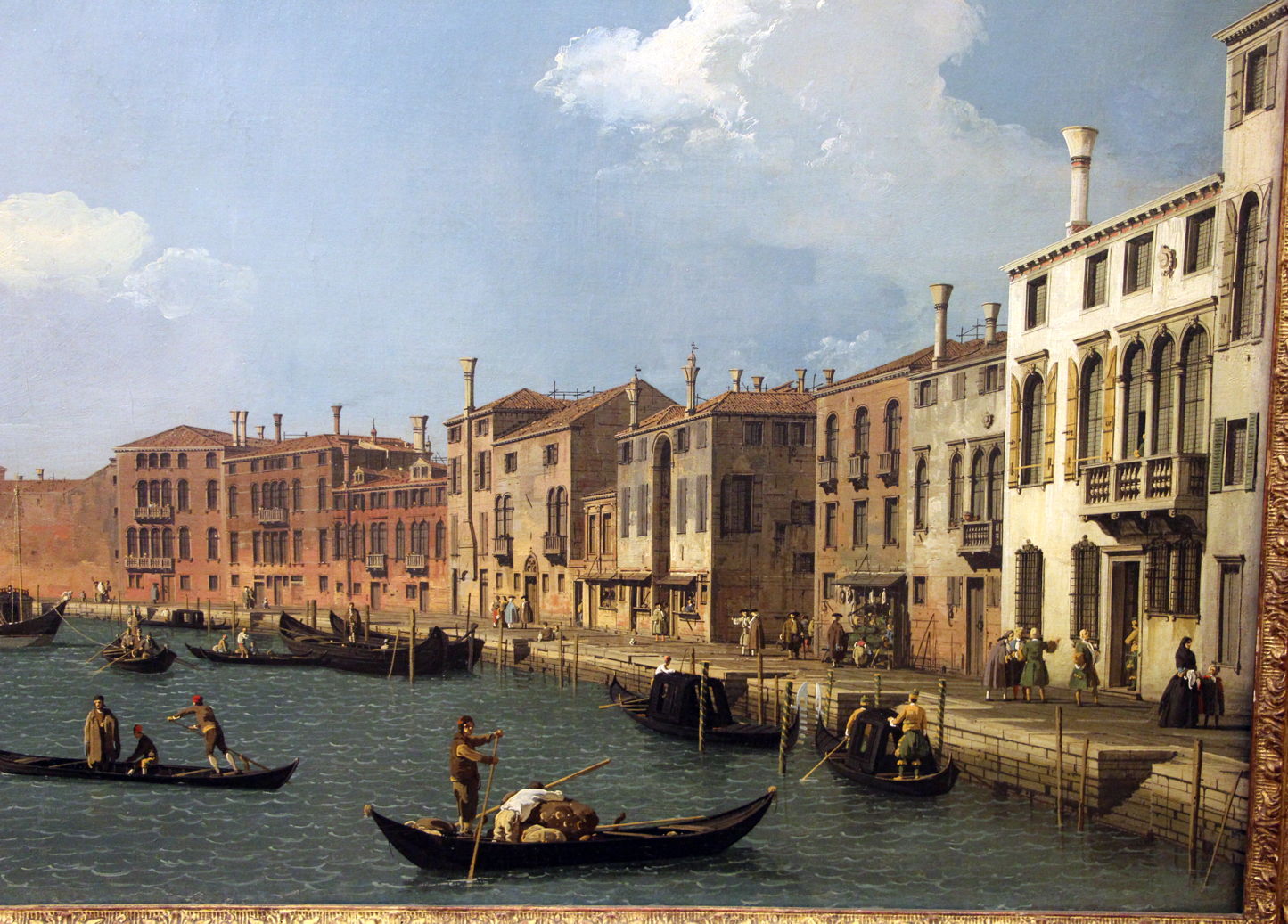
Canaletto (Giovanni Antonio Canal) (1697–1768), Canale di Santa Chiara, Venice (c 1730), oil, dimensions not known, Musée Cognacq-Jay, Paris. Image by Sailko, via Wikimedia Commons.
Paintings of Venice and London by Canaletto in the eighteenth century are also largely devoid of reflections. In his Canale di Santa Chiara, Venice from about 1730 the gondola in the left foreground has no reflection at all, and its three figures are similarly absent from the surface of the water.
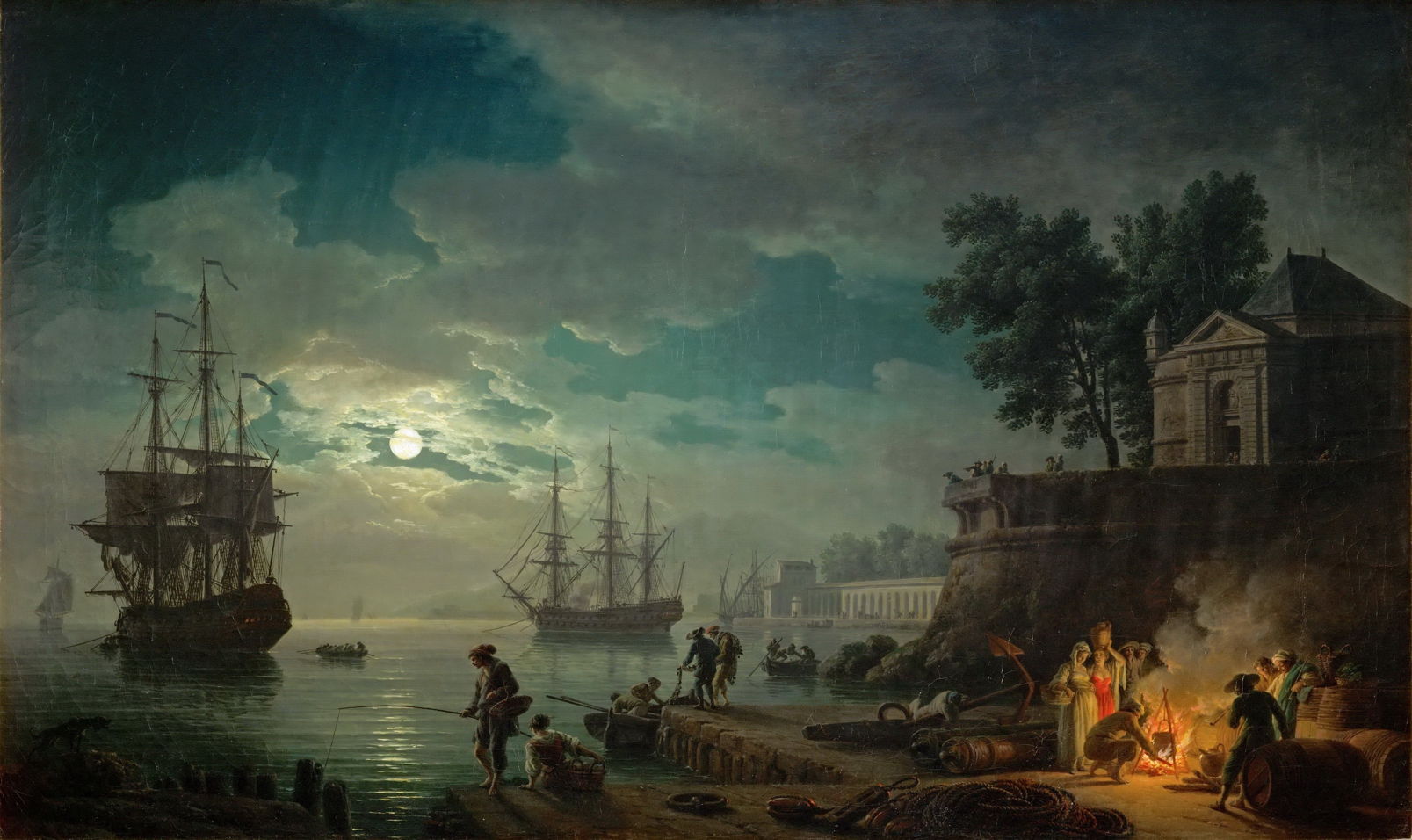
Claude-Joseph Vernet (1714–1789), Seaport by Moonlight (c 1771), oil on canvas, 98 x 164 cm, Musée du Louvre, Paris. Wikimedia Commons.
Reflections return in the studio paintings of those whose sketches made in front of the motif were sufficiently detailed to include them. Among them is Claude-Joseph Vernet, whose Seaport by Moonlight from about 1771 appears faithful. Sadly, none of his preparatory drawings or sketches appear to have survived, although they were a key influence on the next generation of landscape artists.
Landscape painters came to the Alhambra in the Andalucian city of Granada relatively late. But once they started to visit the Prado in Madrid to view and copy its magnificent collection of masters, a steady succession travelled south to paint the Moorish palaces of the Alhambra.
To remind you, this plan from Openstreetmap and its contributors shows the modern site, as of 2013.
Constantin Uhde (1836–1905), Plan of the Nasrid Palaces, Alhambra (1892), illustration, further details not known. Wikimedia Commons.
Constantin Uhde’s plan of 1892 shows the layout of the Nasrid palaces:
Red is the site of the Palace of Comares and the Palaces of the Ambassadors.
Green is the Palace of the Lions.
Yellow is the Mexuar.
Blue is the Garden of Lindajar and later quarters of the Emir.
Edmund Wodick (1816–1886), Granada (1886), oil on canvas, dimensions not known, Kulturhistorisches Museum Magdeburg, Magdeburg, Germany. Wikimedia Commons.
For Edmund Wodick, who must have visited Granada to paint this spectacular landscape in early 1886, it was probably the last work that he completed. Shortly after this, he developed pneumonia and died at the age of 69. He painted this just outside the city walls, looking across at the Alhambra and its towers, down towards the lush green plain and the snow-capped peaks in the far distance.
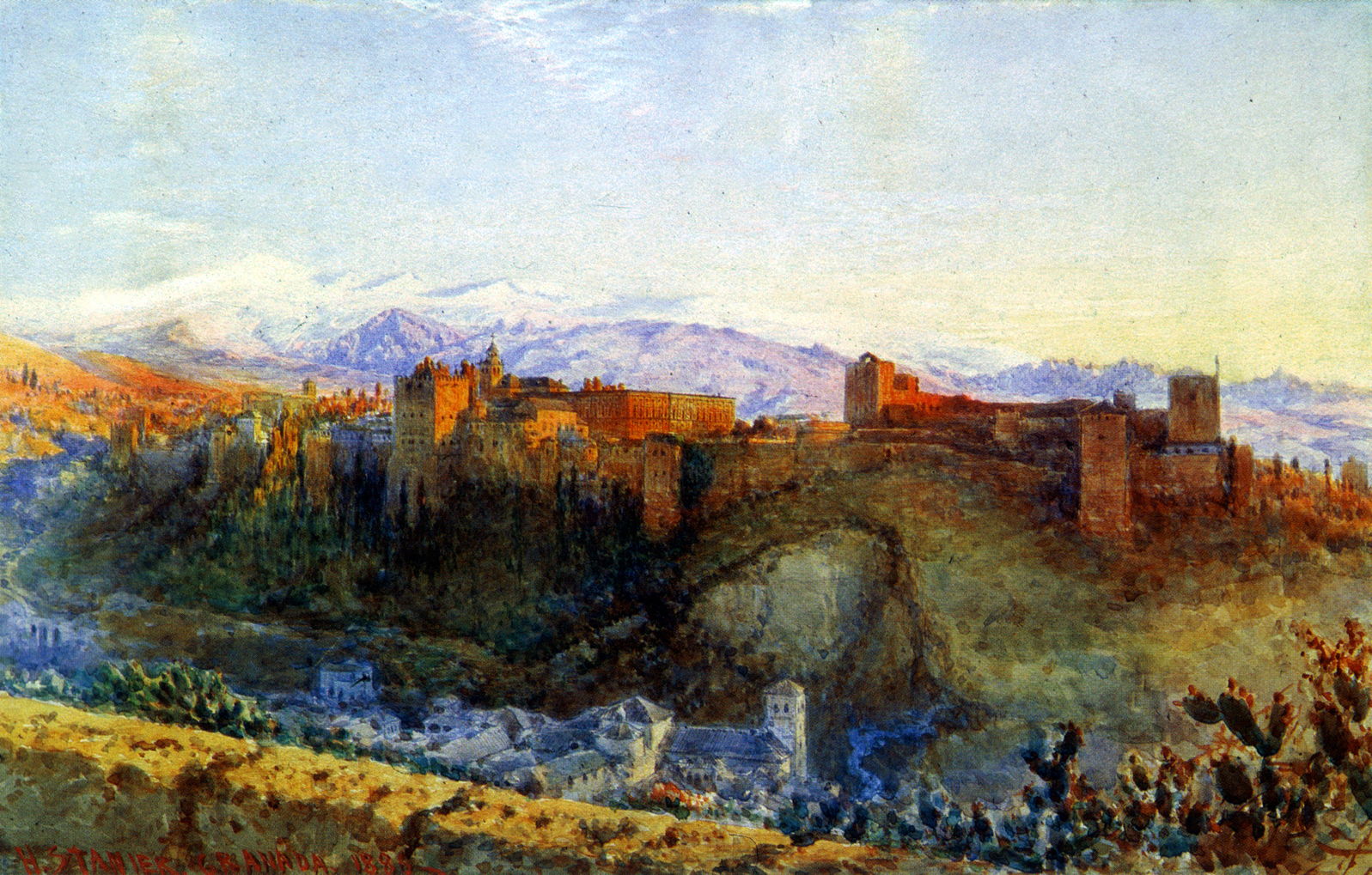
Henry Stanier (1832-1892), Alhambra from San Nicolas (1886), further details not known. Wikimedia Commons.
Long before the brash colours of the Fauves, those who painted the Alhambra in the rich light of dawn or dusk surprised viewers with the intensity of its colours. Henry Stanier’s view of the Alhambra from San Nicolas from 1886 is a good example, and another from late in an artist’s career. Stanier was a topographical draughtsman and sometime Orientalist from the city of Birmingham in England, whose work is now almost forgotten.
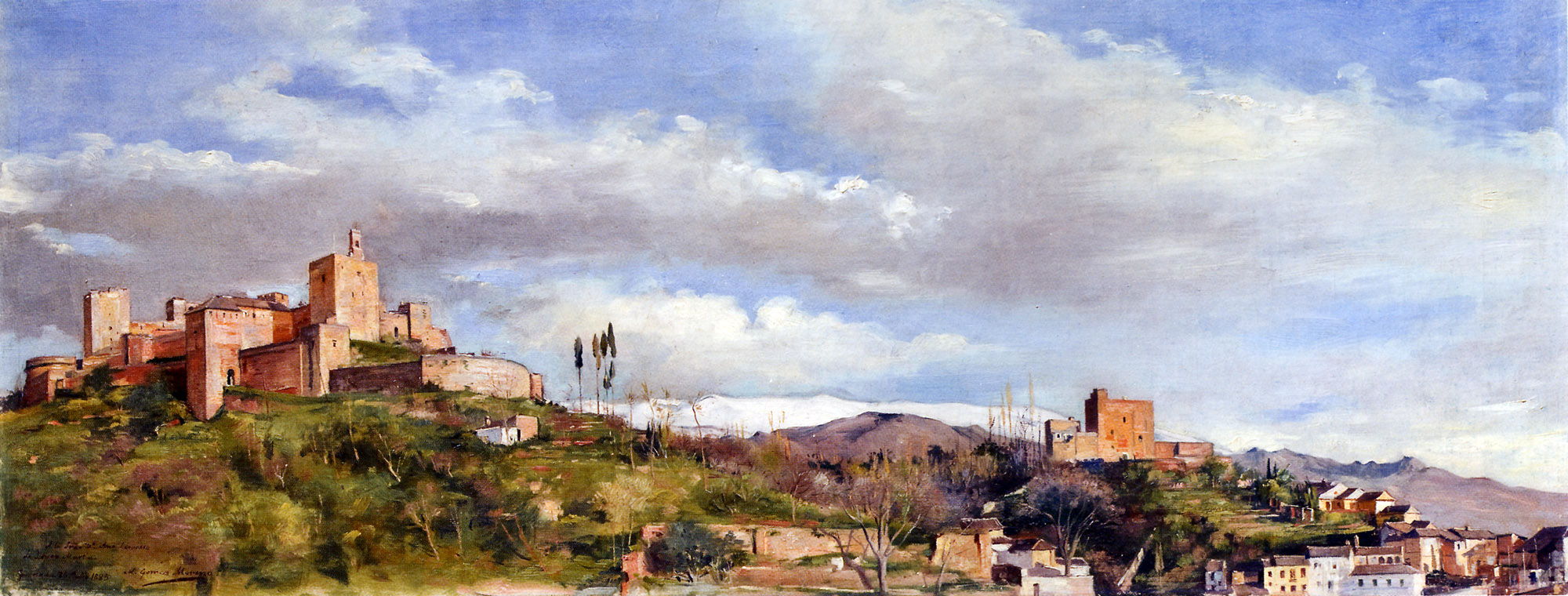
Manuel Gómez-Moreno González (1834–1918), La Alcazaba y Torres Bermejas (The Alhambra and Castle of Torres Bermejas) (c 1887), oil on canvas, 35.5 x 89.5 cm, Casa de los Tiros, Granada, Spain. Wikimedia Commons.
Local painter and amateur archaeologist Manuel Gómez-Moreno González was fascinated by the history of the Alhambra, and the first to compile an account of its depictions in paintings. His own works showing the site include The Alhambra and Castle of Torres Bermejas from about 1887, painted from an unusual viewpoint below its ridge.
The Alhambra dominates the left, with the much smaller castle to the right. The snow-clad peaks of the Sierra Nevada rise to over 3,000 metres (10,000 feet), and resemble a bank of white cloud peeking over the skyline in between.
Hernandez Miguel Vico (1850-1933), Alhambra and Cuesta de los Chinos (date not known), further details not known. Wikimedia Commons.
Hernandez Miguel Vico, another local artist, also favoured a view from below in his undated painting of Alhambra and Cuesta de los Chinos. In 1877, he exhibited an interior of the Alhambra at the Salon in Paris, but I have been unable to locate an image of that.
John Ferguson Weir (1841-1926), The Alhambra, Granada, Spain (c 1901), oil on canvas, 92.1 x 118.1 cm, The Metropolitan Museum of Art (Gift of David T. Owsley, 1964), New York, NY. Courtesy of The Metropolitan Museum of Art.
The founder of the School of Fine Arts at Yale University, John Ferguson Weir, had studied in Europe, and his brother Julian Alden Weir was a student at the École des Beaux-Arts in Paris. Later in his career, John Ferguson Weir returned to Europe on several trips, and in about 1901 painted this fine view of The Alhambra, Granada, Spain.
Laurits Tuxen (1853–1927), View of the Alhambra (1902), oil on canvas, 54 x 72 cm, location not known. Wikimedia Commons.
As far as I can tell, Laurits Tuxen was the first Danish artist to paint a View of the Alhambra, a year after marrying his second wife. He was one of the leading members of the Skagen Painters, ‘Danish Impressionists’, and completed this en plein air on 4 May 1902, in marvellously fine weather.
The early twentieth century brought two of the greatest artists to have painted the Alhambra: Joaquín Sorolla, who seems to have been most active in Granada in 1909, and John Singer Sargent, who visited in 1912 at least.
Sorolla came from Valencia, and is still best-known for his magnificent paintings of people and activities on the beach there. He travelled extensively during his career, but doesn’t seem to have painted in Granada until 1909, when he also spent five months in the USA. These four oil sketches are a marked contrast to the more familiar finished paintings that he exhibited.
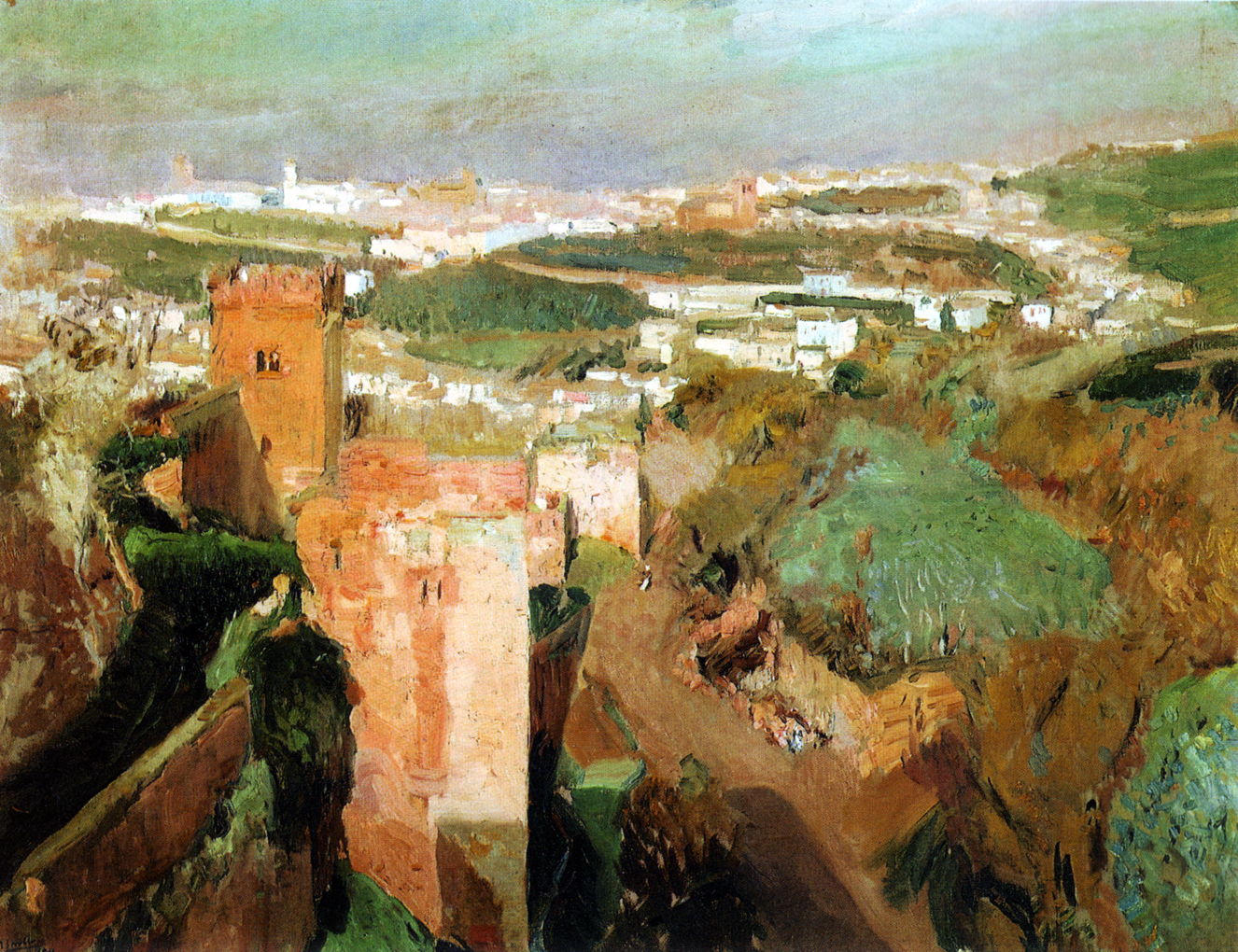
Joaquín Sorolla y Bastida (1863–1923), Los Picos Tower (date not known), further details not known. Wikimedia Commons.
Los Picos Tower is a virtuoso oil sketch looking along the precipitous walls and towers at the edge of the site, and beyond to the dazzling white buildings of the city.
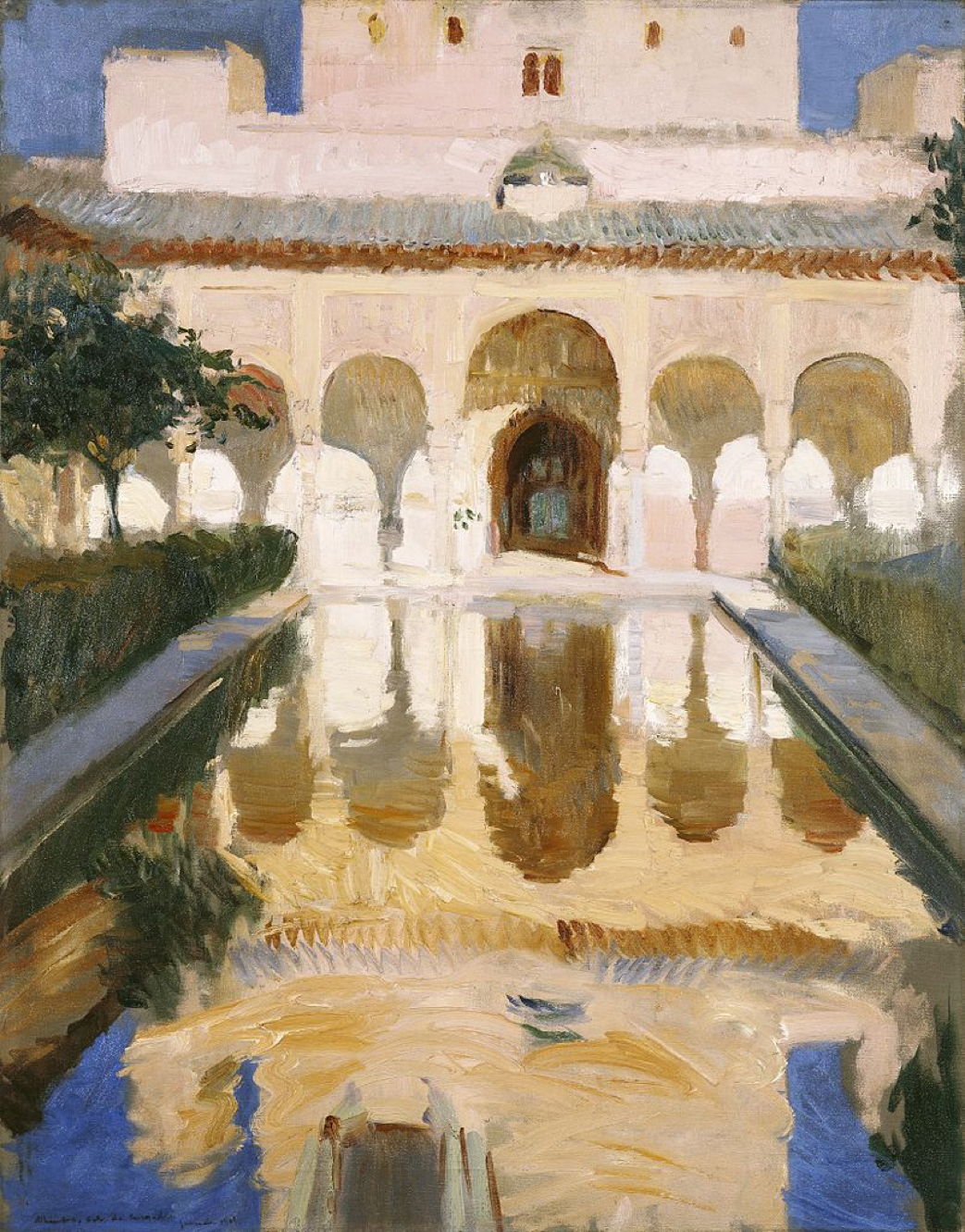
Joaquín Sorolla y Bastida (1863–1923), Hall of the Ambassadors, Alhambra, Granada (1909), oil on canvas, 104.1 x 81.2 cm, J. Paul Getty Museum, Los Angeles, CA. Wikimedia Commons.
Hall of the Ambassadors, Alhambra, Granada (1909) shows this classical view with some of Sorolla’s vigorous brushstrokes texturing the paint.
Joaquín Sorolla y Bastida (1863–1923), Torre de las Infantas de la Alhambra (Tower of the Children) (1909), dimensions not known, Museo Sorolla, Madrid, Spain. Image by Quinok, via Wikimedia Commons.
Tower of the Children (1909) looks past another tower towards the distant mountains, the sunlight filtering through a curtain of trees.
Joaquín Sorolla y Bastida (1863–1923), Albaicin (date not known), further details not known. Wikimedia Commons.
In Sorolla’s Albaicin, he looks down from one of the Alhambra’s towers at the bleached white buildings below.
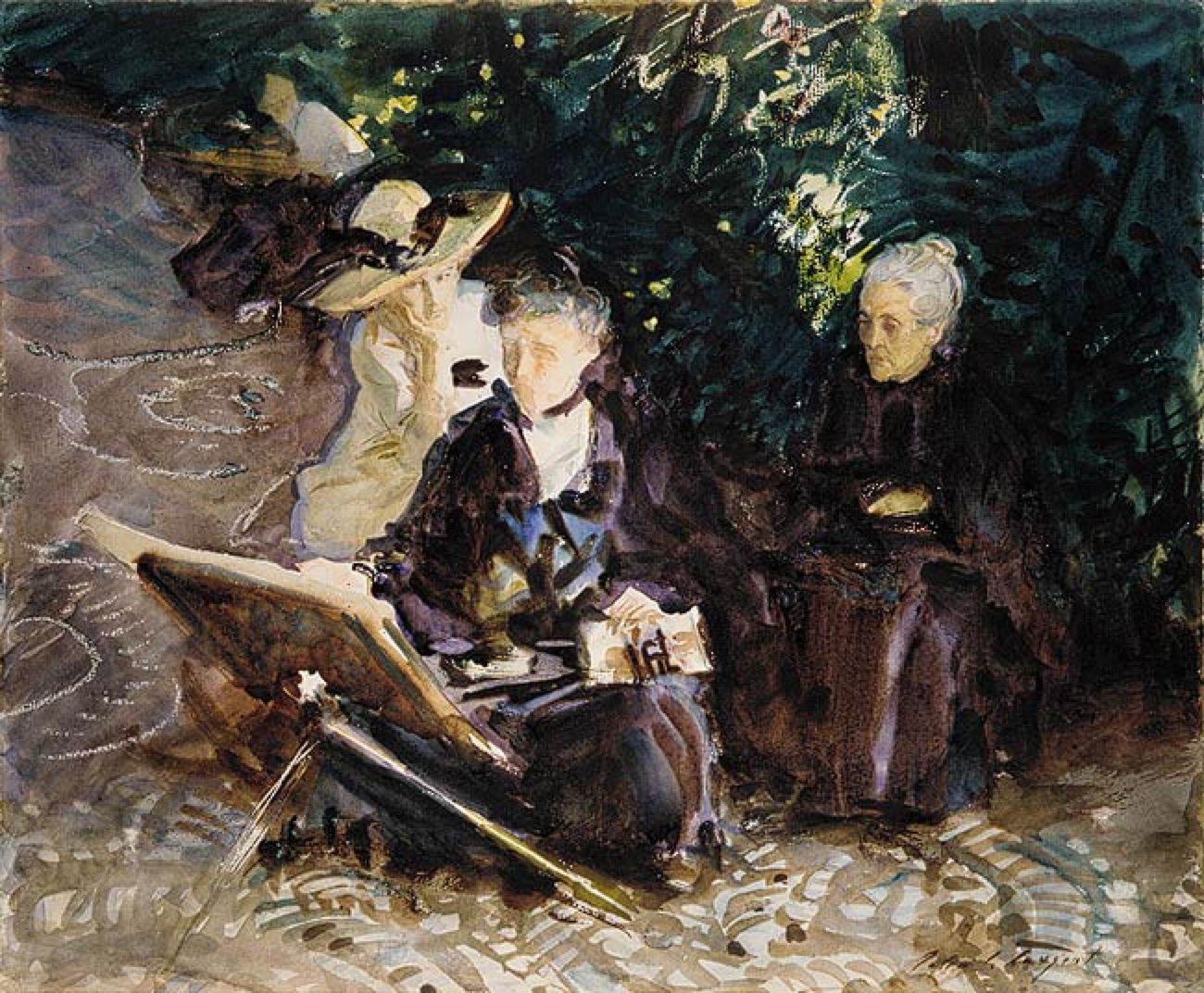
John Singer Sargent (1856–1925), In the Generalife (1912), watercolour and graphite on paper, 37.5 x 45.4 cm, The Metropolitan Museum of Art, New York, NY. Wikimedia Commons.
The only available image of Sargent’s paintings of the Alhambra I have able to find is this watercolour showing his sister Emily, also a keen artist, sketching In the Generalife (1912). Behind her is Jane de Glehn, and to the right is a Spanish friend known only as Dolores. The unusual highlight effect seen in bushes above them, and on parts of the ground, was produced by scribbling with a colourless beeswax crayon, which resists the watercolour paint.
Théo van Rysselberghe, Fountain at the Generalife in Granada (1913), oil on canvas mounted on cardboard, 65.8 x 46 cm, Private collection. WikiArt.
Théo van Rysselberghe had first visited Spain in 1881 or 82, when he too went to the Prado, and travelled on to Morocco. He visited Andalucia in company with John Singer Sargent in the Spring of 1884, but doesn’t appear to have painted the Alhambra until after his retirement to the Côte d’Azur in 1911. He then painted Fountain at the Generalife in Granada in 1913, in his late high-chroma style.
The last two paintings in my selection are both by the eclectic Valencian painter Antonio Muñoz Degrain, and demonstrate his wide range of styles.
Antonio Muñoz Degrain (1840-1924), View of the Alhambra (1914), oil on canvas, 125 x 83 cm, Museo de Málaga. Wikimedia Commons.
Muñoz Degrain’s view of the Alhambra from Albaicin District from 1914 is remarkable for the rhythm established by the poplar trees around its base, which become an integral part of the fortified ridge.
Antonio Muñoz Degrain (1840-1924), View of the Alhambra (date not known), further details not known. Wikimedia Commons.
His View of the Alhambra is one of my favourite paintings of this motif, for its intriguing foreground details, and the poplars lit as white-hot pokers in the fiery light of the sunset.
What better way to end our weekend away from the chill and gloom of winter.
 Login
Login