Scissors, including shears, are hand tools use for cutting by bringing two cutting edges to bear on the sheet or object being cut. Originally they were all shears, effectively hinged at the end further from the blades, when open like a V. They have been largely replaced by scissors that rotate around a pivot between their handles and blades, when open like an X. However, in normal usage terminology is inconsistent, with heavyweight X-based scissors used in gardening and horticulture being referred to as shears. Scissors weren’t made in large numbers until the later half of the eighteenth century, since when they have become widely used.
In this article I will ignore farming and industrial uses of shears, for example to harvest wool from sheep or cut sheet metal (also known as snips), and concentrate more on domestic uses of lightweight shears and scissors. These are most strongly associated with cutting fabrics, yarn and threads, and all forms of fibre craft.
In classical myth, they appear in the weaving contest between Arachne and the goddess Minerva.
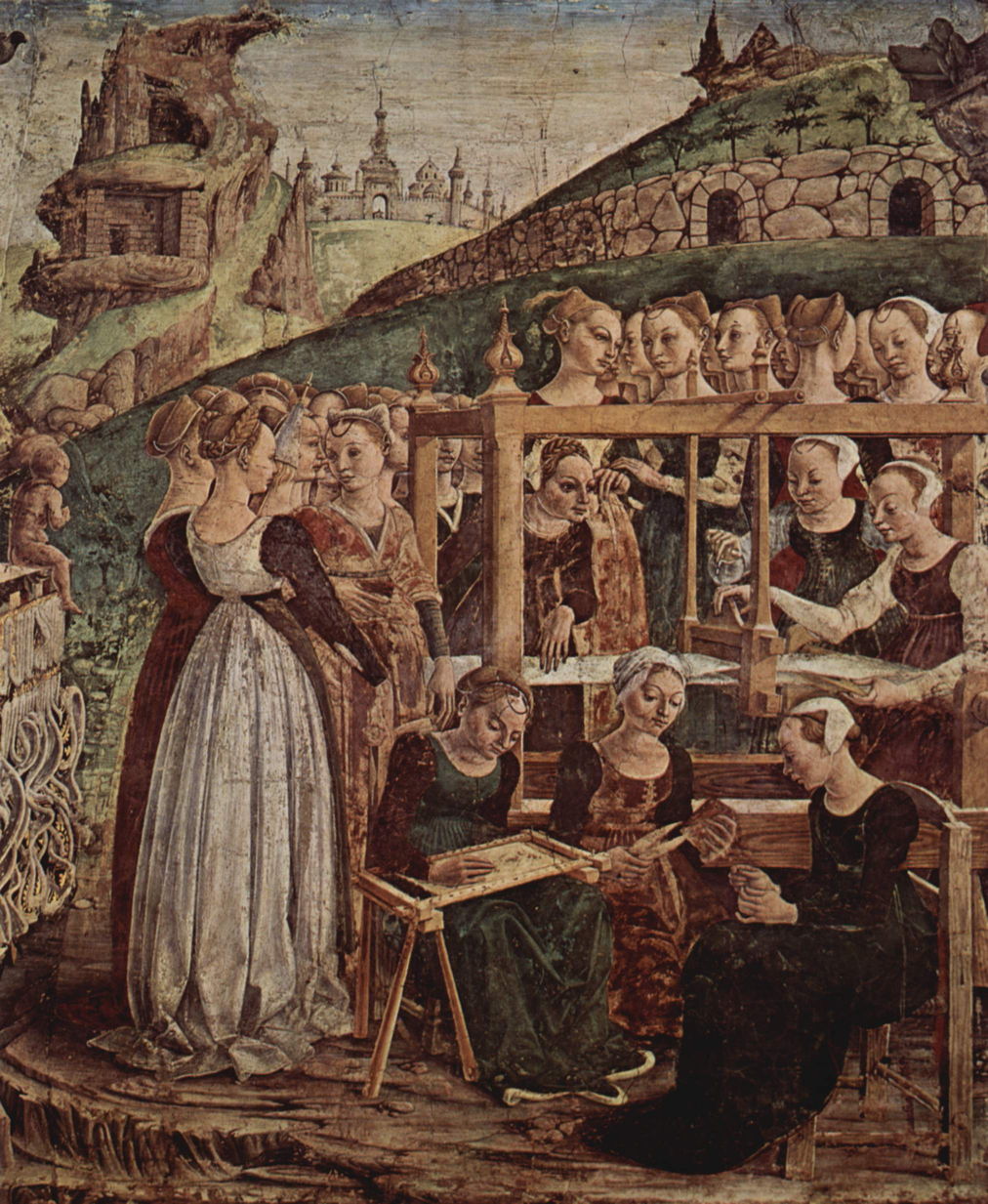
Francesco del Cossa (1436–1487), The Triumph of Minerva, March (1467-70), fresco in the Room of the Months, Palazzo Schifanoia, Ferrara, Italy. Wikimedia Commons.
Several of the surviving paintings of this myth show Arachne and Minerva at their looms, weaving like fury. Francesco del Cossa’s The Triumph of Minerva (1467-70) was chosen for the month of March in his fresco for the Room of the Months in the Palazzo Schifanoia in Ferrara, Italy. The trio of women in the foreground are engaged in allied crafts, including embroidery and sewing, and the middle one is using a pair of shears to cut some fabric. Behind them are the two weavers working at what is shown as a single loom, the traditional boxwood shuttle just being inserted by the left hand of the woman at the right.
The three Fates are often depicted with one of them, traditionally Atropos, cutting the thread of life using shears.
Edward Burne-Jones (1833–1898), The Feast of Peleus (1872-81), oil on canvas, 36.9 x 109.9 cm, Birmingham Museum and Art Gallery, Birmingham, England. Wikimedia Commons.
Edward Burne-Jones’ painting of The Feast of Peleus from 1872-81 uses a composition based on classical representations of the Last Supper. Every head has turned towards Eris (Discord) as she brings her golden apple, apart from that of the centaur behind her right wing. Even the three Fates, seen in the left foreground with the nude Atropos wielding her shears, have for once paused momentarily in their work.
Paul Thumann (1834–1908), The Three Fates (c 1880), oil on canvas, dimensions not known, location not known. Wikimedia Commons.
This Salon-style depiction of the Fates by Paul Thumann from about 1880 became extremely popular throughout Europe, and was often reproduced on mass-produced porcelain. It’s unusual for drawing such marked distinctions between the women: Atropos, on the left, is shown as a morose older woman armed with her shears; Clotho stands to weave, and is young, very pretty, and bare down to the waist; Lachesis is modestly dressed and holding sprigs of vegetation, at the right.
Walter Crane (1845–1915), The Bridge of Life (1884), oil on canvas, dimensions not known, Private collection. Wikimedia Commons.
This transferred into Walter Crane’s unique allegorical narrative The Bridge of Life from 1884. Below the right end of the bridge, Atropos is seen as she is just about to cut the thread of life, so bringing death.
The Old Testament story of Samson depends on him losing his prodigious strength when his hair is cut off by the seductress Delilah.
William Blake (1757–1827), Samson Subdued (c 1800), pen and ink and watercolour over graphite on paper, 39.1 x 35.2 cm, Philadelphia Museum of Art (Gift of Mrs. William Thomas Tonner, 1964), Pennsylvania, PA. Courtesy of Philadelphia Museum of Art.
William Blake’s Samson Subdued is one of the large series of biblical watercolours he painted for Thomas Butts in around 1800-03. It shows the naked figure of Delilah holding a pair of modern scissors in her left hand, having apparently cut Samson’s hair off with them to destroy his strength.
Although by no means universal, they are also used as a sign of the Virgin Mary’s domestic activity at the time of the Annunciation, where X-based scissors might also be a symbol of the Crucifixion to come.
Oleksandr Murashko (1875–1919), Annunciation (1907-08), oil on canvas, 198 x 169 cm, National Art Museum of Ukraine Національний художній музей України, Kyiv, Ukraine. Wikimedia Commons.
Oleksandr Murashko’s breathtaking Annunciation, painted probably in 1907-08 or 1909, captures her at work on a tapestry, with a pair of scissors and thread on the carpet in the right foreground.
Jacek Malczewski (1854–1929), Annunciation (1923), oil on plywood, 61 x 79 cm, Muzeum Narodowe w Warszawie, Warsaw, Poland. Wikimedia Commons.
Jacek Malczewski’s Mary (right) is a modern young woman of 1923, whose thimble and scissors rest on a bare wooden table behind. Gabriel is in the midst of breaking the news to her, his hands held together as he speaks.
Many other paintings include scissors as a reference to their domestic use.
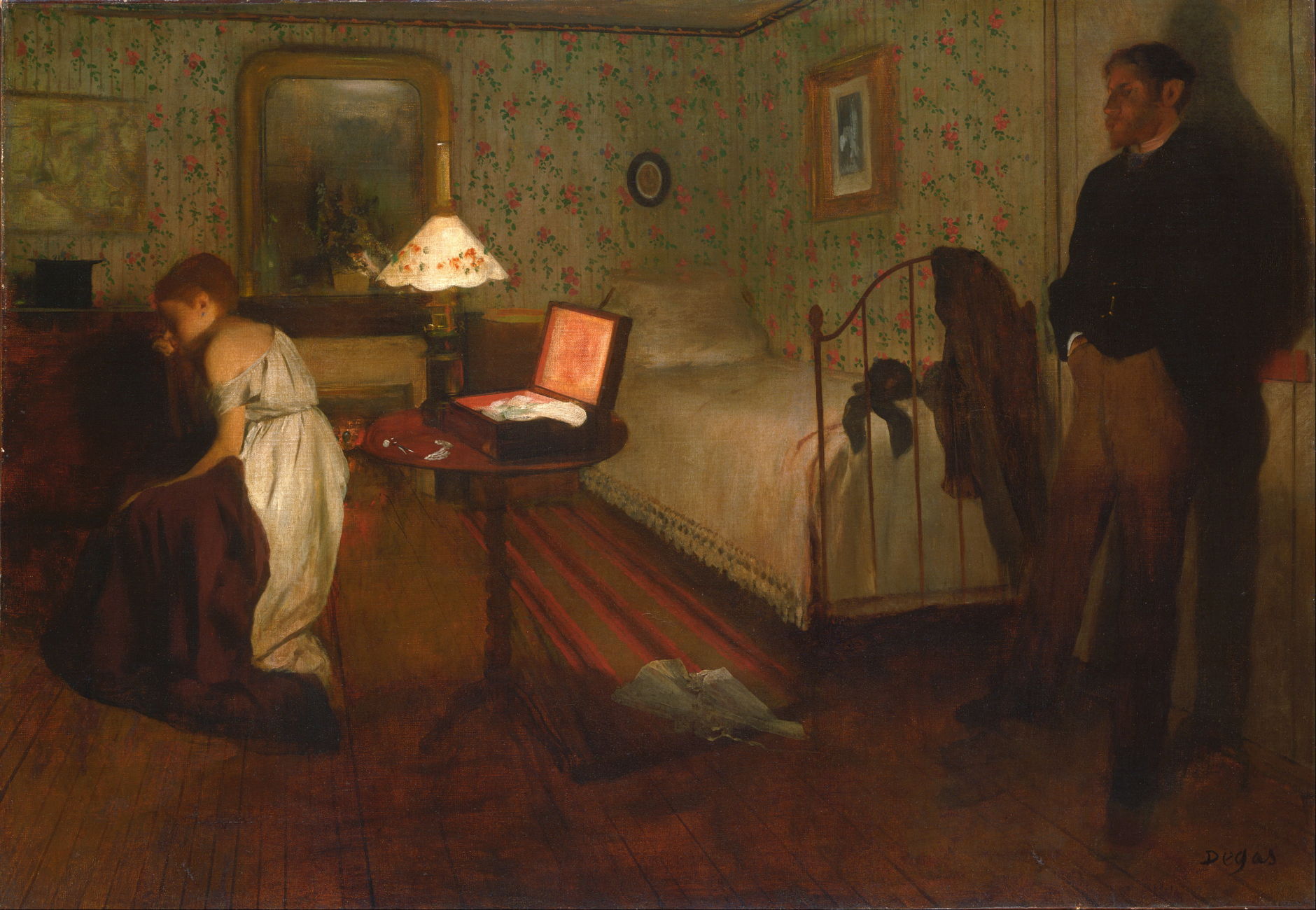
Edgar Degas (1834–1917), Interior (‘The Rape’) (1868-9), oil on canvas, 81.3 x 114.3 cm, Philadelphia Museum of Art, Philadelphia, PA. Wikimedia Commons.
In Edgar Degas’ Interior (1868-9), also known as The Interior and even The Rape, they may be one of the clues to its reading. Between the man and woman, and just behind her, is a small occasional table, on which there’s a table-lamp and a small open suitcase. Some of the contents of the suitcase rest over its edge. In front of it, on the table top, is a pair of scissors and other items that appear to be from a clothing repair kit or ‘housewife’, indicating she has travelled away from her home to this meeting.
James Tissot (1836–1902), The Farewells (1871), oil on canvas, 100.3 x 62 cm, Bristol Museums and Art Gallery, Bristol, England. Wikimedia Commons.
James Tissot painted The Farewells soon after his flight to London in the summer of 1871. This couple, separated by the iron rails of a closed gate, are in late eighteenth century dress. The man stares intently at the woman, his gloved left hand resting on the spikes along the top of the gate, and his ungloved right hand grasps her left. She plays idly with her clothing with her other hand, and looks down, towards their hands. She is plainly dressed with a pair of scissors suspended by string on her left side, implying she may be a governess.
Paul Signac (1863-1935), Les Modistes (Two Milliners in the Rue du Caire, Paris) (Op 127) (1885-86), oil on canvas, 111.8 x 89 cm, Private collection. Wikimedia Commons.
These two young milliners in Paul Signac’s Les Modistes (Two Milliners in the Rue du Caire, Paris), from 1885-86, are busy making fashionable hats. The nearer of the two women is bent down retrieving her scissors as a symbol of her craft.
Christian Krohg (1852–1925), Tired (1885), oil on canvas, 79.5 x 61.5 cm, Nasjonalgalleriet, Oslo, Norway. Wikimedia Commons.
The Norwegian artist Christian Krohg’s Tired from 1885 shows an exhausted seamstress, one of the many thousands working at home at that time, toiling for long hours by lamplight for a pittance. On the table in front of her is a small pair of scissors.
Moritz Stifter (1857–1905), The New Dress (1889), oil on panel, 30.5 x 40 cm, location not known. Wikimedia Commons.
Moritz Stifter’s The New Dress from 1889 shows a scene set in the dressmaker’s, with a pair of scissors resting between fabric on the table at the right.
My last pair of scissors appears as part of the sewing kit on the table of Robert Braithwaite Martineau’s painting of Kit’s Writing Lesson (1852), showing a less than memorable scene from Charles Dickens’ The Old Curiosity Shop, with its elaborately detailed interior.
The art of William Blake (1757–1827) is among the most innovative in Europe, and has had enduring influence. His work not only looks different, but an important part of that is in his unusual media. This article looks at how he created those striking images.
Blake initially trained as an engraver, and throughout his subsequent career returned to commercial engraving work to supplement his income. On completion of that apprenticeship he became a pupil in the newly formed Royal Academy Schools, where he trained as a painter. From the outset he refused to paint in oils, at the time the major medium used by professional painters. That decision condemned his work to relative obscurity during his lifetime.
Instead, Blake painted almost exclusively in watercolour and two media he developed himself and called fresco, although neither bears any resemblance to what is normally meant by that word. Blake was convinced that one of the secrets of success of older paintings was their use of the fresco medium, although as he never left the south-east of England his experience of Italian fresco painting was extremely limited.
Watercolour
Throughout his career, Blake painted using watercolour on paper in relatively conventional methods.
After completing his training he aspired to create a series of paintings showing scenes from British history. One that he worked up into a complete painting, albeit rather later, is The Penance of Jane Shore in St Paul’s Church (c 1793), using watercolour and gouache.
King Edward IV of England had kept many mistresses, among them Elizabeth Shore, known as Jane Shore (c 1445-1527), who had also had affairs with the King’s close associates. Following the King’s death in 1483, Jane Shore was charged with conspiracy and promiscuity. As part of her penance for the latter, she had to stand at Paul’s Cross, by Saint Paul’s Cathedral in London, and it is that penance which Blake shows here: she is seen holding a candle and wrapped in a sheet.
Unfortunately, once he had completed this watercolour Blake broke with convention by applying a glue varnish, which has caused yellowing and masks its subtle colours. Other watercolours have survived better, including the series of studies he made in his final years as illustrations for Dante’s Divine Comedy.
The Punishment of the Thieves, a study made between 1824–27, anticipates figurative painting of a century or more later, and the darker psychological recesses of sex and snakes. This uses mixed media of chalk, ink and watercolour to great effect.
Watercolour monoprints
Blake produced his first works using a process for illuminated printing in 1788, and the following year he published his first major independent works: Tiriel, Songs of Innocence, and The Book of Thel. That process was based on an acid etch leaving the design standing in relief, so is sometimes known as relief etching.
He continued to develop this until it was perfected in 1794 for publication of a series of illuminated books. In 1793, he published For Children: The Gates of Paradise, Visions of the Daughters of Albion, and America: A Prophecy. In 1794, he published Europe: A Prophecy, The First Book of Urizen, and Songs of Experience. Then in 1795 he was ready to use it to produce a limited run of twelve large colour paintings. These formed the first major collection of paintings which he offered for sale: one mark of the importance that he accorded them was his use of the term fresco to describe their medium.
In fact, they were not made using a technique resembling fresco painting in any way. Although there remains some debate as to exactly what he did, the process was probably:
Develop the work using sketches and studies until a design was ready to print. In some cases, these large prints were derived from earlier work, in others (such as Pity), he made fresh sketches.
Draw the finished work onto a sheet of thick millboard, ready to colour.
Produce a wet watercolour, using pigment, binder, and a honey additive, on the millboard.
Print approximately three copies from the millboard ‘plate’.
Touch up each print by hand using pen and ink and watercolour to produce the finished painting.
Although it’s possible he may have used oil-based inks or paints on some, his lifelong aversion to oil paints suggests that he used water-based media throughout, and analyses support that. These ‘large prints’ (also known as his Lambeth Prints, as that is where they were made) are therefore watercolour monoprints that have then been individually retouched and further painted. Given the variation between the different ‘pulls’ or impressions made of each, they are less prints and more print-based paintings.
Neither were they illustrations in the way that the images within his illuminated books may be. They were supplied as individual sheets for mounting and framing as paintings. We don’t know whether Blake intended them to be viewed in pairs, groups, or as a complete set of twelve, and there is uncertainty as to his own title for several. Indeed, some of them appear to have been mistitled following Blake’s death, and that has led to confusion as to what they actually depict.
Elohim Creating Adam (1795, c 1805) is the only surviving impression of this work, which appears to have been listed by Blake as God Creating Adam. It is based on the book of Genesis chapter 2 verse 7: And the Lord God formed man of the dust of the ground, and breathed into his nostrils the breath of life; and man became a living soul.
Blake shows this fairly literally, with Adam’s body still being formed out of the earth, and a large worm (not a serpent) is coiled around his left leg. The worm is also a symbol of mortality.
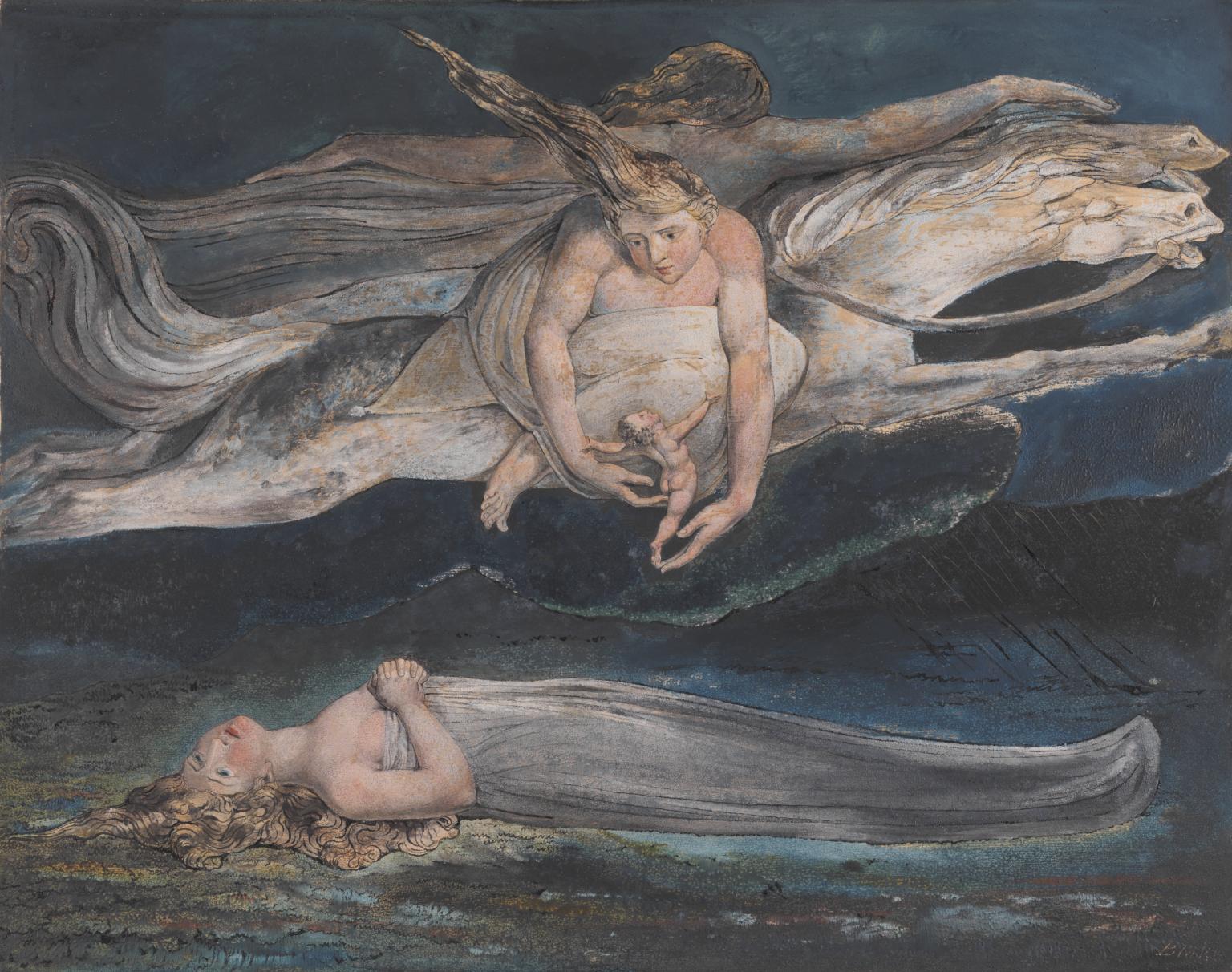
Pity is another remarkable example of this technique from 1795.
Glue tempera
Those experiments in self-publishing weren’t commercially successful. Extraordinary and beautiful as his illuminated books are to us, neither his poetry nor its presentation in that form had achieved any recognition, nor brought in money to keep him and his wife from poverty. This changed in 1799, when he gained Thomas Butts as a patron, and started painting fifty glue tempera works illustrating the Bible for him. These were the first paintings for which Blake used this medium which appears to have been key in his quest for what he termed fresco. As with his illuminated printing methods, he did not document the processes, and certain aspects remain controversial.
His use of glue tempera was not novel – similar methods had been used several centuries earlier, and by some of the great Flemish masters – and a version had been popular at one time in Germany, as tüchlein. However, it had generally been replaced quickly by oil paints.
His technique appears to have consisted of the following:
Preparation of the support (canvas, copper, or even iron) by roughening, then application of glue size.
Application of a bright white priming layer of chalk or gypsum with animal glue, containing a little honey (for flexibility) and possibly plant gum.
Underdrawing using ink or paint.
Sealing with a layer of animal glue, possibly containing a little honey.
Application of layers of colour, in the form of water-based paints using mainly plant gums as binder, with some further layers of animal glue.
Reinforcement of lines using black ink, and enhancement of highlights using impasto chalk-based white paint with animal glue.
A final ‘varnish’ coat of animal glue.
Unfortunately some of his paintings have later been varnished using conventional varnishes. As these inevitably become dirty over time, conservation professionals have been posed the near-impossible task of removing that varnish without destroying the delicate glue layers underneath.
This method of glue tempera painting isn’t in itself unsound, but animal glues are sensitive to the atmosphere: they absorb water when it’s damp, and crack when it’s drier. They’re also prone to take up dust and small particles, which are almost impossible to clean. The tragic result is that many of Blake’s glue tempera paintings are now but shadows of their former selves. When newly completed, they would have been bright, light, and colourful.
Eve Tempted by the Serpent has retained its colours well, and shows the biblical narrative from Genesis chapter 3 verses 1-5, in the light of Milton’s elaboration in his epic Paradise Lost, in book 9, lines 496-500 and 670-677. Blake’s exuberant serpent is almost calligraphic in its coils, and the tree beside them twists in the same sense, then arches over the top of the painting. This uses a copper plate as its support.
The Christ Child Asleep on the Cross, or Our Lady Adoring the Infant Jesus Asleep on the Cross (1799-1800) was painted on a stretched canvas support, and has kept its colours rather better than most.
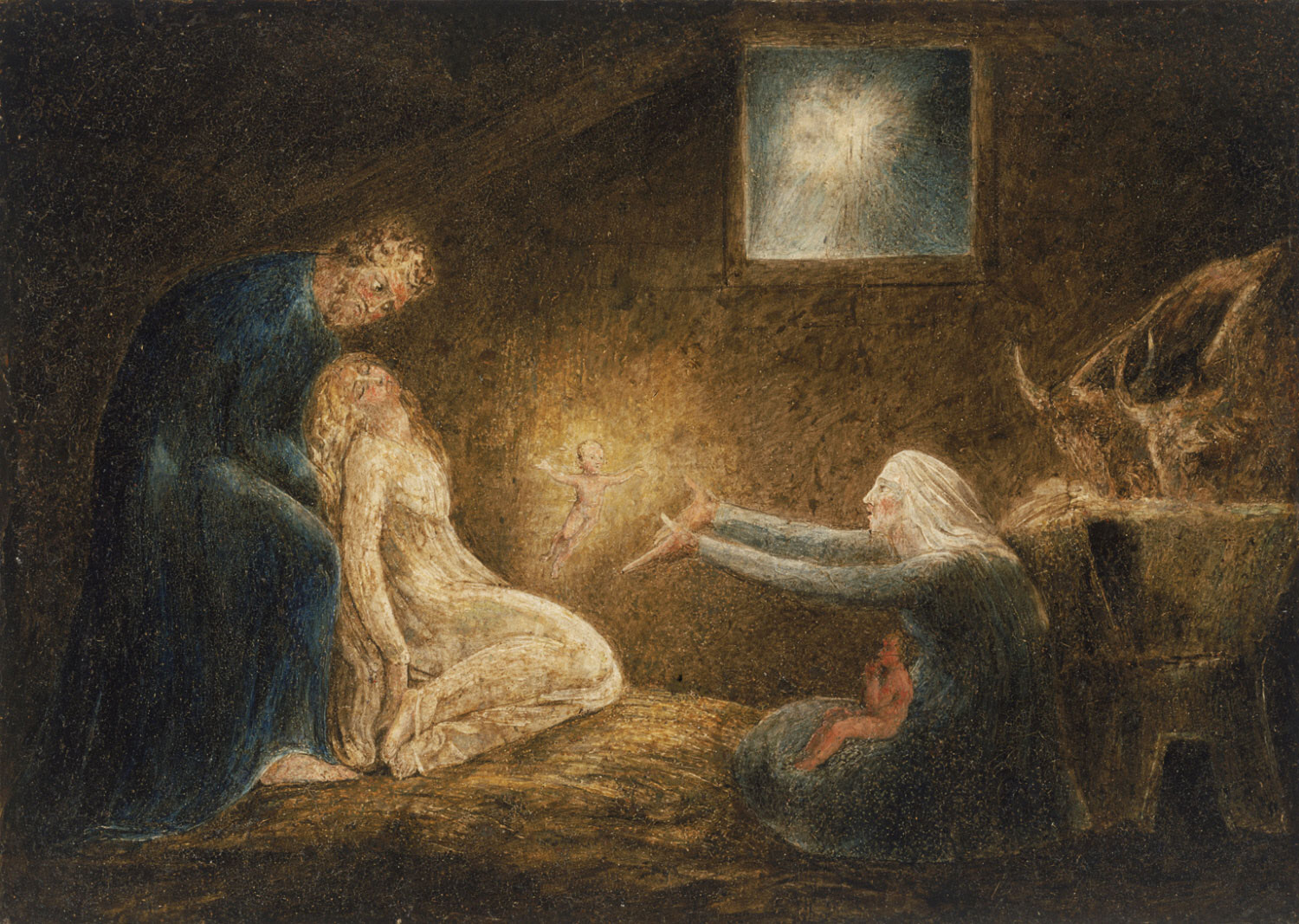
William Blake (1757–1827), The Nativity (1799-1800), tempera on copper, 27.3 x 38.2 cm, Philadelphia Museum of Art (Gift of Mrs. William Thomas Tonner, 1964), Pennsylvania, PA. Courtesy of The Philadelphia Museum of Art.
The Nativity (1799-1800), painted for Thomas Butts on a copper plate, is a unique interpretation of this very popular scene. On the left, Joseph supports the Virgin Mary, who appears to have fainted. Jesus has somehow sprung from her womb, and hovers arms outstretched in mid-air. On the right, Mary’s cousin Elizabeth greets the infant, with her own son, John the Baptist, on her lap.
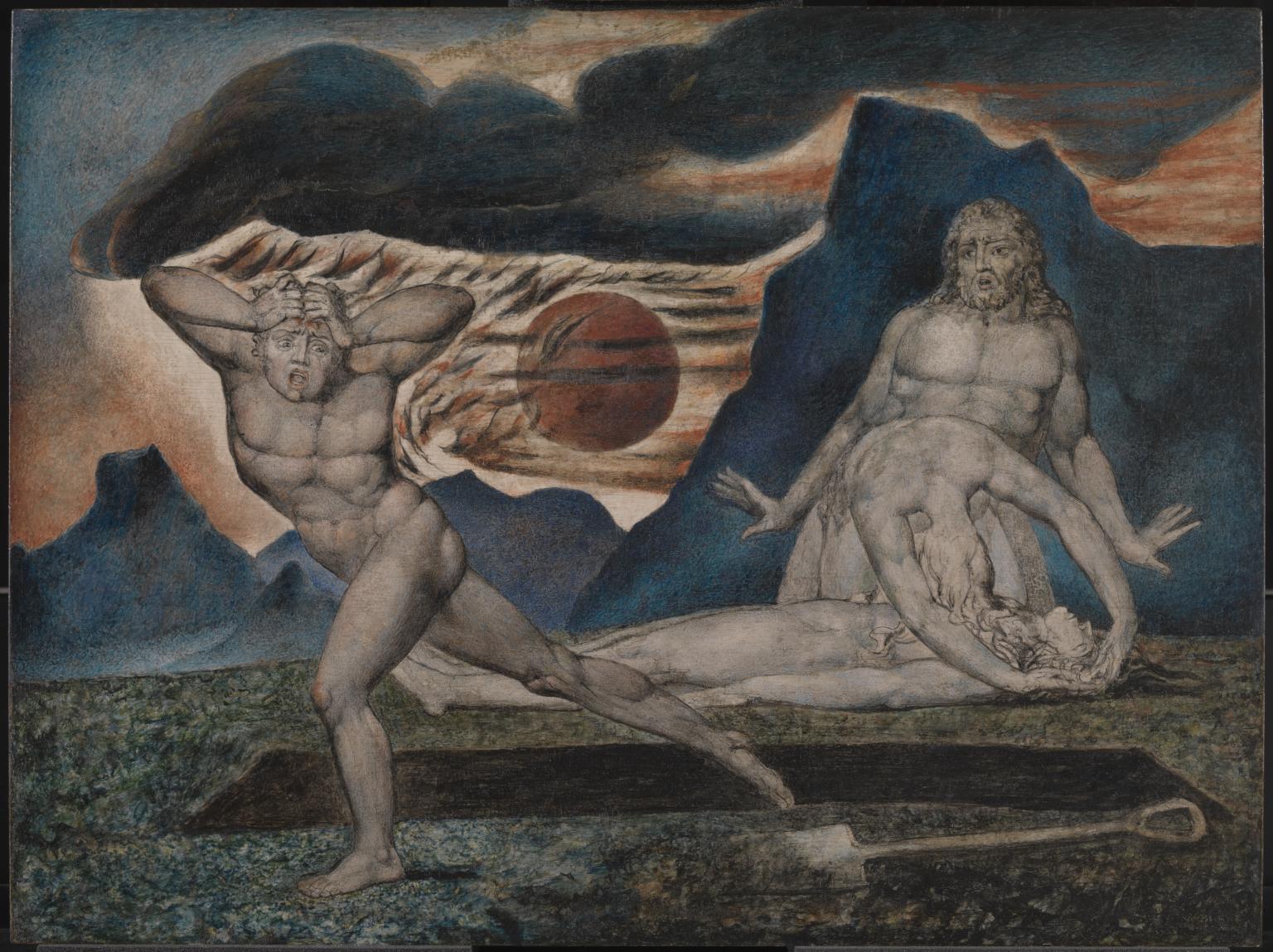
The Body of Abel Found by Adam and Eve (c 1826) was painted using thinner paint films, so has also survived much better. It’s a revised version of a watercolour that Blake had exhibited earlier, and shows Cain with the dead Abel, and his parents, Adam and Eve. The latter couple are shown behind, Eve mourning on Abel’s body, and Adam looking shocked at Cain, as he tries to flee the scene. He had been attempting to bury the body of his brother, after he had murdered him. This has a mahogany panel as its support.
William Blake (1757–1827), Count Ugolino and His Sons in Prison (c 1826), pen, tempera and gold on panel, 32.7 x 43 cm, Fitzwilliam Museum, University of Cambridge, Cambridge, England. The Athenaeum.
One of his last glue tempera paintings, Count Ugolino and His Sons in Prison (c 1826) shows a complex episode from Dante’s Inferno Cantos 32 and 33, of a nobleman accused of treason. Thrown into prison for his alleged crime, Ugolino and his sons were starved to death. This is painted on a wooden panel.
Sadly many of Blake’s other glue tempera paintings have suffered badly, and some are now almost unreadable as a result.
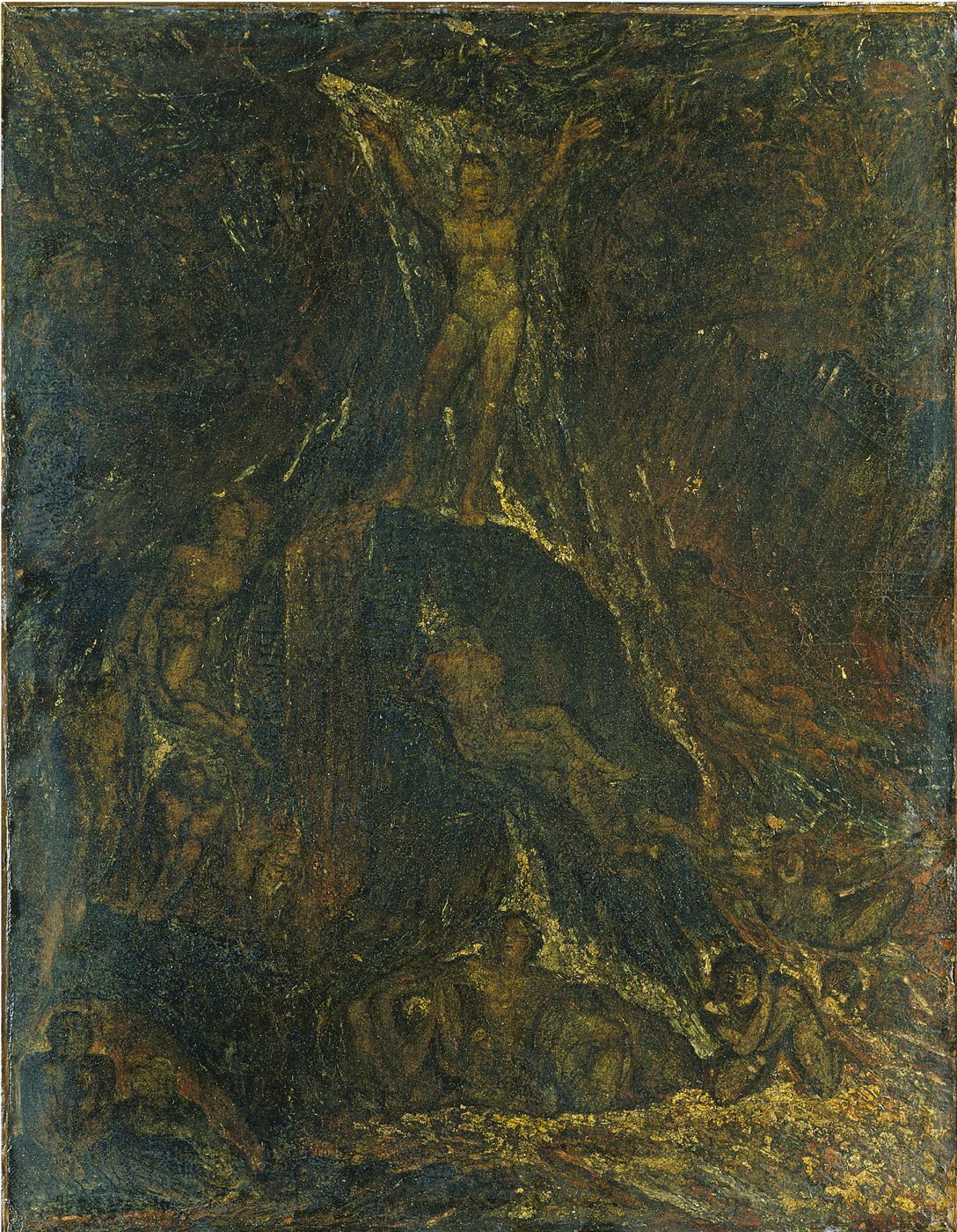
The version of Satan Calling Up His Legions (c 1809) now in the Tate in London is that dubbed by Blake “an experiment picture”, and has not aged at all well.
Many notable painters have also made their own prints, and the two arts have informed one another. We’ve seen this most recently in the paintings of Félix Vallotton, where his late works have become simplified in the way that’s often used when making successful prints. A few artists have gone one step further and produced images that combine both techniques, where their work consists of a painted print.
Most forms of printmaking involve the production of a plate of metal or wood in which cuts or marks are made. The surface is then covered in printing ink, and the paper (or other medium) is then pressed against that to transfer patterns of ink onto it. Monotypes are different in that the plate remains intact, and the image to be printed is formed on its surface before making a single impression from it. As with most types of printmaking, there are many variations.
In 1794, William Blake had perfected his colour illuminated printing process, in publishing a series of illuminated books, and the following year he used it to produce a limited run of twelve large colour paintings. These formed the first major collection of paintings he offered for sale: one mark of the importance that he accorded them was his use of the term fresco to describe their medium.
In fact, they weren’t made using a technique that resembled fresco painting at all. Although there remains some debate as to exactly what he did, the process was probably:
Develop the work using sketches, etc., until a design was ready to print. In some cases, these large prints were derived from earlier work, in others he made fresh sketches.
Draw the finished work onto a sheet of thick millboard, ready to colour.
Produce a wet watercolour, using pigment, binder, and a honey additive, on the millboard.
Print approximately three copies from the millboard ‘plate’.
Touch up each print by hand using pen and ink and watercolour to produce the finished painting.
Although it’s possible he may have used oil-based inks or paints on some, Blake’s lifelong aversion to the use of oil paints suggests that he used water-based media throughout, and analyses support that. These ‘large prints’ (also known as his Lambeth Prints, as that is where they were made) are therefore watercolour monotypes then individually retouched and painted further. Given the variation between the different ‘pulls’ or impressions made of each, they are less prints and more print-based paintings.
Neither were they illustrations in the way that the images within his illuminated books may be. They were supplied as individual sheets for mounting and framing as paintings. We don’t know whether Blake intended them to be viewed in pairs, groups, or as a complete set of twelve, and there’s uncertainty as to his own title for several. Indeed, some of them appear to have been mistitled following Blake’s death, and that has led to confusion as to what they actually depict.
William Blake (1757–1827), Satan Exulting over Eve (c 1795), graphite, pen and black ink, and watercolour over colour print, 42 x 53 cm, J. Paul Getty Museum, Los Angeles, CA. The Athenaeum.
Satan Exulting over Eve (c 1795) is thought to be the first impression of this work, with roots in the story of the Fall in Genesis, and in Milton’s Paradise Lost. In book 5 (lines 28-92), Milton writes a more detailed account of the Fall, in which Eve has a dream of Satan giving her the fateful apple, sweeping her up into the cloud before she sinks down and falls asleep. Blake shows Satan flying low over the sleeping body of Eve; he carries a shield and spear. The serpent has already coiled itself around Eve’s legs and body, and there is an apple by her right hand.
Newton (1795–c 1805), another first impression, is one of Blake’s most famous images. It shows the brilliant mathematician and physicist completely absorbed in a geometrical problem, oblivious to the wondrous rock on which he sits. Its standard interpretation is that Newton’s scientific rationalism was inadequate without imagination and the creativity of the artist, a surprisingly negative view of the man who is still considered a towering genius.
The Night of Enitharmon’s Joy (c 1795) has proved the most enigmatic of all the dozen paintings to read. For a long time, it was believed to show Hecate, as proposed by Dante Gabriel Rossetti. It’s more likely that the woman seen at the front of the figures is from Blake’s own mythology, Enitharmon: partner, twin, and inspiration to Los (and mother of Orc). She represents spiritual beauty, and was modelled on Blake’s wife, Catherine (who may have been the model for her figure here too). In her ‘night of joy’, she establishes her Woman’s World, with a false religion of chastity and vengeance – which was Blake’s view of the 1800 year history of the ‘official’ Christian church.
William Blake (1757–1827), Christ Appearing to His Disciples After the Resurrection (c 1795), color print (monotype), hand-colored with watercolor and tempera, 43.2 x 57.5 cm, The National Gallery of Art (Rosenwald Collection), Washington, DC. Courtesy of The National Gallery of Art.
Blake’s Christ Appearing to His Disciples/Apostles After the Resurrection refers to the gospel of Luke, chapter 24 verses 36-40: And as they thus spake, Jesus himself stood in the midst of them, and saith unto them, “Peace be unto you.” But they were terrified and affrighted, and supposed that they had seen a spirit. And he said unto them, “Why are ye troubled? and why do thoughts arise in your hearts? Behold my hands and my feet, that it is I myself: handle me, and see; for a spirit hath not flesh and bones, as ye see me have.” And when he had thus spoken, he shewed them his hands and his feet.
Edgar Degas’ monotypes are thought to have been more conventional, made on a lightweight aluminium sheet using oil-based printing ink, then extensively retouched and painted, often using soft pastels.
Edgar Degas (1834–1917), Intimacy (c 1877), monotype, 30.2 × 40.9 cm, Statens Museum for Kunst (Den Kongelige Malerisamling), Copenhagen, Denmark. Wikimedia Commons.
During the late 1870s, Degas devoted series of monotypes to women’s ‘toilet’ preparations, of which Intimacy from about 1877 is an example. He appears to have been fascinated at the craft and care used to prepare a woman for public viewing, something a single man who had no known amorous relationships would find quite strange. This print appears to have undergone retouching and modification, but hasn’t been painted using pigment or colours.
Edgar Degas (1834–1917), Ballet at the Paris Opéra (1877), pastel over monotype on cream laid paper, 35.2 x 70.6 cm, Art Institute of Chicago, Chicago, IL. Wikimedia Commons.
The same year Degas applied soft pastel to the print, in the Ballet at the Paris Opéra (1877), which more closely resembles a true painting.
Edgar Degas (1834–1917), Woman Drying Herself after the Bath (c 1885, or 1876-77), pastel over monotype, 43 × 58 cm, Norton Simon Museum, Pasadena, CA. Wikimedia Commons.
Also dating from 1876-77 is his Woman Drying Herself after the Bath, one his first works showing a woman bathing. It’s also one of the few in this series setting the woman in a broader context, here a plain and simple bedroom with a single bed. The woman, wearing only bright red ‘mule’ slippers, stands just behind the shallow metal tub, watching herself in the mirror of her dressing table, as she dries her body with a towel. On its shelf is a small range of cosmetics, with the mandatory mirror behind. This too is the result of applying pastels to a monotype.
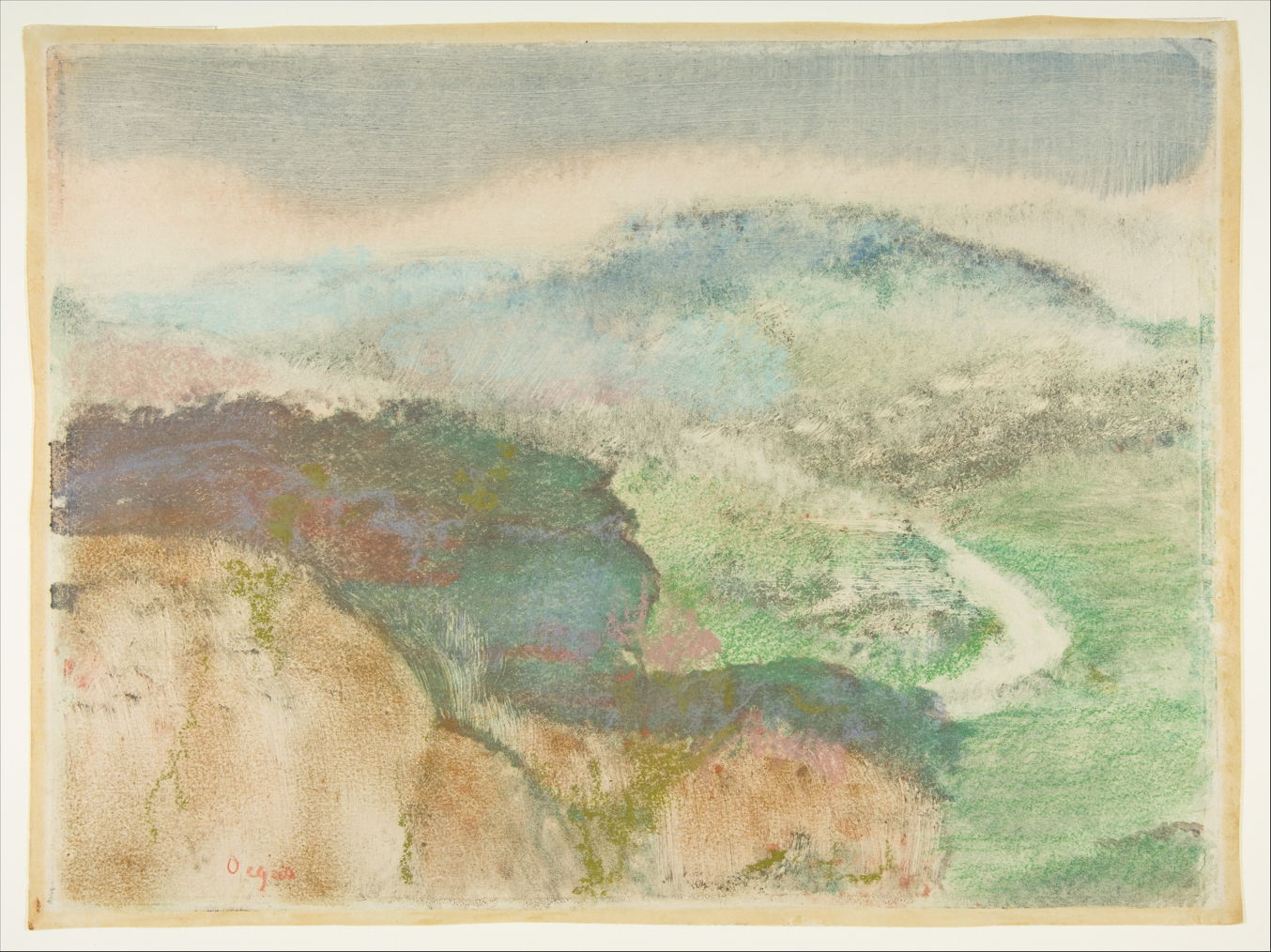
Edgar Degas (1834–1917), Landscape (1892), monotype in oil colours, heightened with pastel, 25.4 x 34 cm, Metropolitan Museum of Art, New York, NY. Wikimedia Commons.
Degas’ late landscapes are based on the same combination of media, as shown in his Landscape above, and Wheat Field and Green Hill below, both from the early 1890s.
Edgar Degas (1834–1917), Wheat Field and Green Hill (c 1890-92), pastel over monotype in oil colours on paper, dimensions not known, Norton Simon Museum, Pasadena, CA. Wikimedia Commons.
The American Impressionist Mary Cassatt learned her printmaking techniques with Degas, so it’s not surprising to see some of her monotypes forming the basis of paintings.
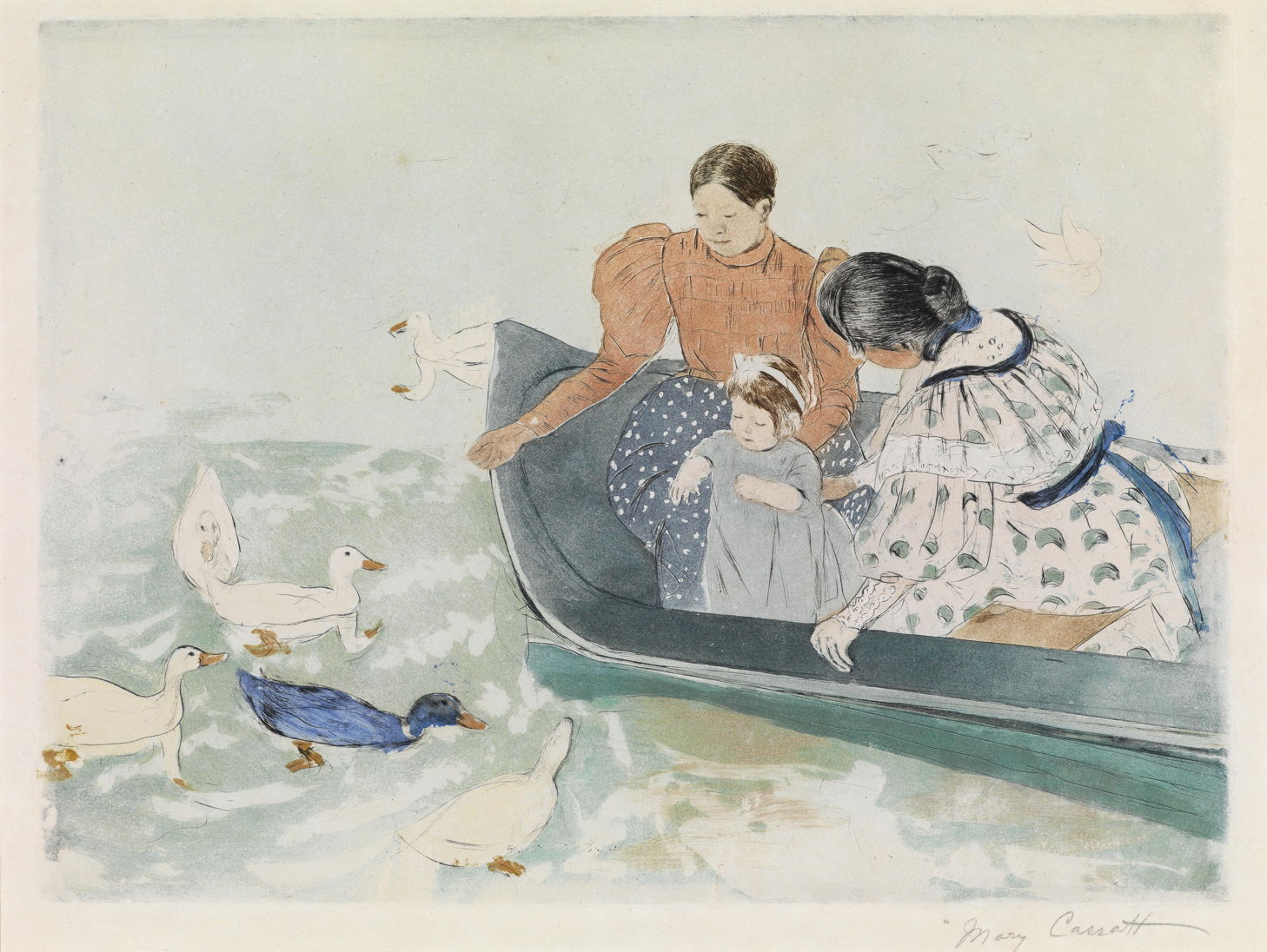
Mary Cassatt (1844–1926), Feeding the Ducks (c 1894), drypoint and aquatint with monotype on handmade paper, 29.5 x 39.5 cm, location not known. Wikimedia Commons.
For her Feeding the Ducks from about 1894 she combined a mature use of drypoint with aquatint, to which she added monotype using oil-based inks. In drypoint, the plate is scratched to form lines with the raised burrs that result. This was most probably produced by applying a fine acid-resistant powder such as rosin to form the ‘ground’, etching it in acid, then applying drypoint lines before printing using oil-based ink.
These techniques were developed further and became more popular in the twentieth century, in the work of artists such as Marc Chagall from the 1960s.

 Login
Login