Normal view

There are new articles available, click to refresh the page.
Before yesterdayMain stream

Reading Visual Art: 248 Hood

By: hoakley
13 March 2026 at 20:30

As with many items of clothing, the term hood is applied to a wide range of garments. For the purposes of this selection of paintings, I confine it to a shaped covering for the head that is part of a garment also covering at least part of the upper body. This includes the cowl integrated into the robes of many monks, and the hooded cape known as a chaperon, described below. It would also include the modern hoodie that became popular in the 1970s.

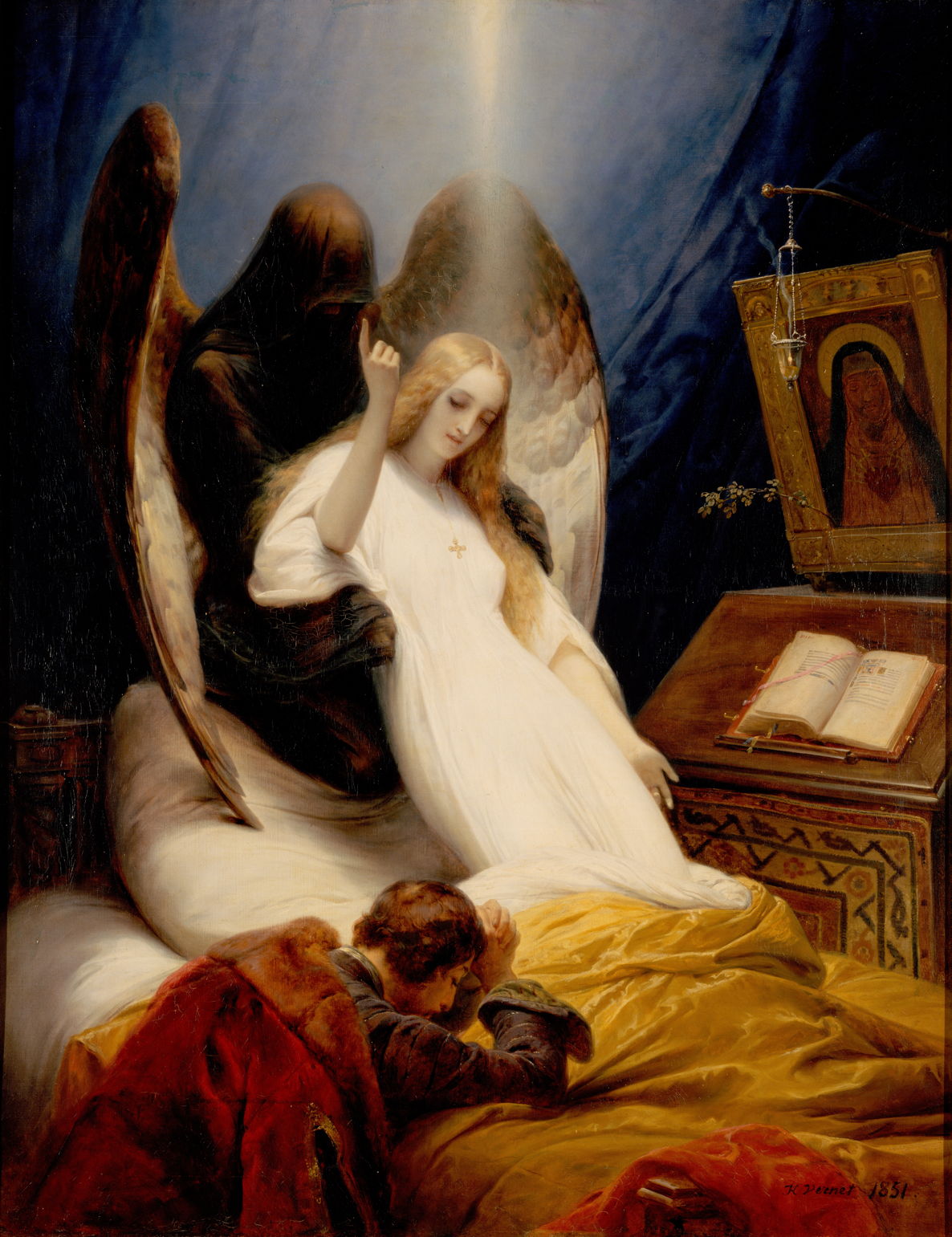
Hoods are commonly worn by figures associated with death, such as the Grim Reaper, where they provide sinister concealment of the face.
hvernetangelofdeath
Horace Vernet (1789–1863), The Angel of Death (1851), oil on canvas, 146 x 113 cm, The Hermitage Museum, St. Petersburg, Russia. Wikimedia Commons.

In Horace Vernet’s The Angel of Death from 1851, a young man is praying over the side of a bed, kneeling, his hands clasped together. Opposite him, an illuminated Bible is open, above that an icon hangs on the wall, there’s a sprig of flowers, and a flame burns in prayer. But the occupant of the bed, a beautiful young woman, is being lifted out of it. Her right hand is raised, its index finger pointing upwards to heaven. Behind her, the Angel of Death, the outer surface of its wings black, and clad in long black robes, its face concealed beneath a hood, is lifting her out, to raise her body up towards the beam of light shining down from the heavens.

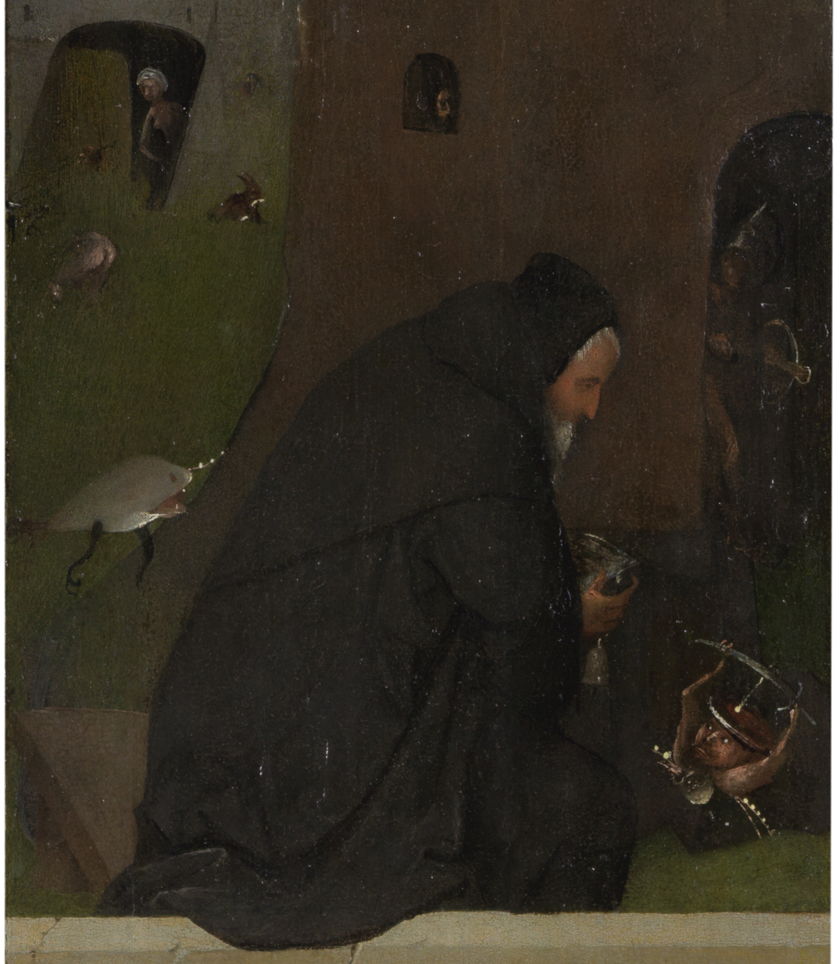
Cowls are a common feature of the robes worn by hermits as well as monks.
boschstwilgefortisd1
Hieronymus Bosch (c 1450–1516), Saint Wilgefortis Triptych (detail) (c 1495-1505), oil on oak panel, left wing 105.2 × 27.5 cm, central panel 105.2 × 62.7 cm, right wing 104.7 × 27.9 cm, Gallerie dell’Accademia, Venice. Photo Rik Klein Gotink and image processing Robert G. Erdmann for the Bosch Research and Conservation Project.

The figure at the foot of the left panel of Hieronymus Bosch’s Saint Wilgefortis Triptych (c 1495-1505) has some visual similarity with Saint Anthony in his Hermit Saints triptych, and appears to be holding a small bell, one of that saint’s attributes.

daddmonk
Richard Dadd (1817–1886), Portrait of a Monk (1857), watercolour over graphite on moderately thick, slightly textured, beige laid paper, 19.1 x 11.8 cm, Yale Center for British Art, Paul Mellon Collection, New Haven, CT. Courtesy of the Yale Center for British Art.

Richard Dadd painted this Portrait of a Monk on 11 April 1857, from memory of his previous travels in the Middle East.
schikanedercontemplation
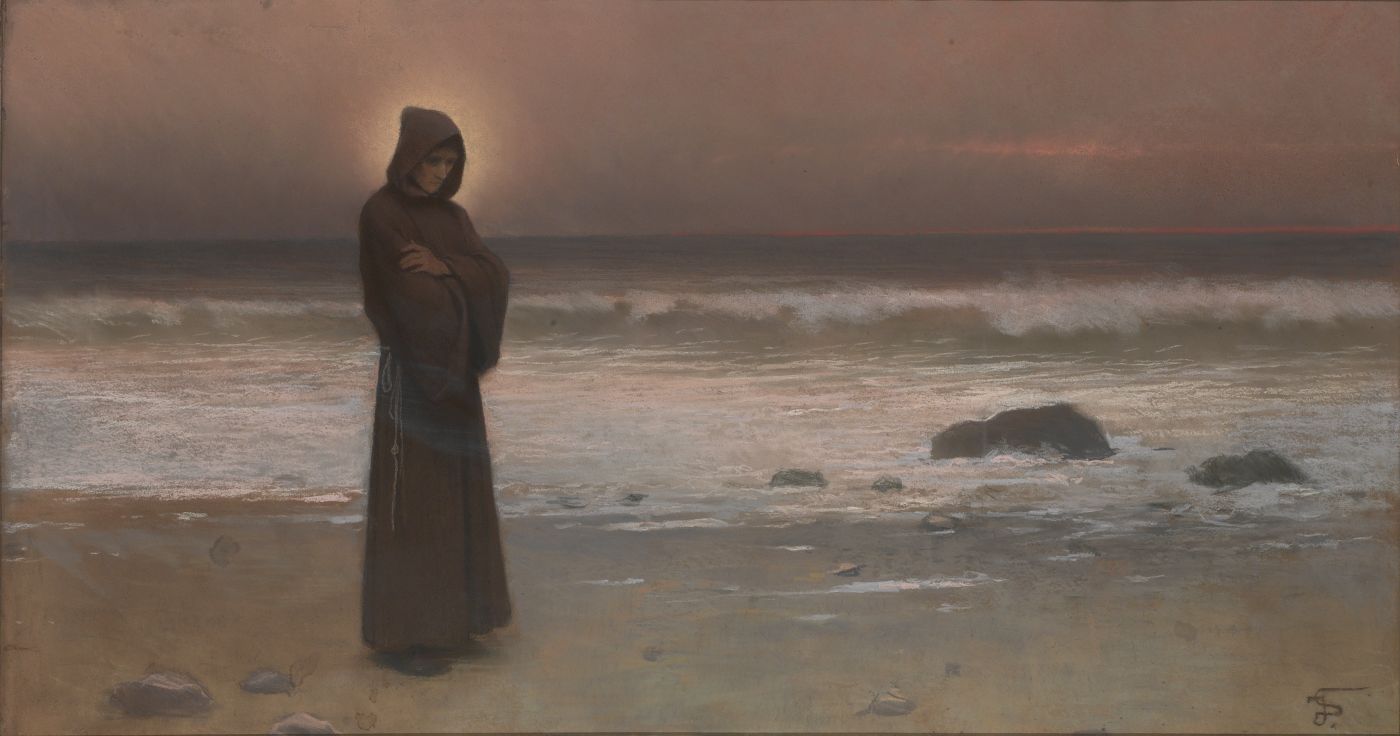
Jakub Schikaneder (1855–1924), Kontemplace, Mnich na mořském břehu (Contemplation, the Monk on the Seashore) (date not known), pastel on paper, further details not known. Wikimedia Commons.

Jakub Schikaneder’s undated Contemplation, the Monk on the Seashore shows a hooded monk on the foreshore, just in front of the water, apparently lost in thought.

Cowls have also been incorporated into other religious dress, where they’re often worn with hats, making them appear vestigial and primarily symbolic.

raphaelportraitcardinal
Raphael (1483–1520), Portrait of a Cardinal (1510-11), oil on panel, 79 x 61 cm, Museo Nacional del Prado, Madrid, Spain. Wikimedia Commons.

Raphael’s magnificent Portrait of a Cardinal from 1510-11 shows the elements of this cardinal’s choir dress: the soft matte surface of the biretta on his head, the subtly patterned sheen of his mozzatta (cape) with its hood, and the luxuriant folds of his white rochet (vestment).

Another uniform that incorporates symbolic hoods is formal academic dress, in which the colours and cut of the hood denote the university and degree.

beraudmadeleinebresthesis
Jean Béraud (1849–1935), The Thesis of Madeleine Brès (or The Doctoral Jury) (date not known), oil on canvas, 63.5 x 48.3 cm, Private collection. The Athenaeum.

In Jean Béraud’s undated The Thesis of Madeleine Brès (or The Doctoral Jury) he shows us one of the early woman doctoral students defending her thesis before the academic jury, who are wearing what might appear now to be fancy dress hats in addition to their colourful hoods. At the time, this was a major landmark in the improvements in women’s rights, and the archaic headwear serves to emphasise this change.

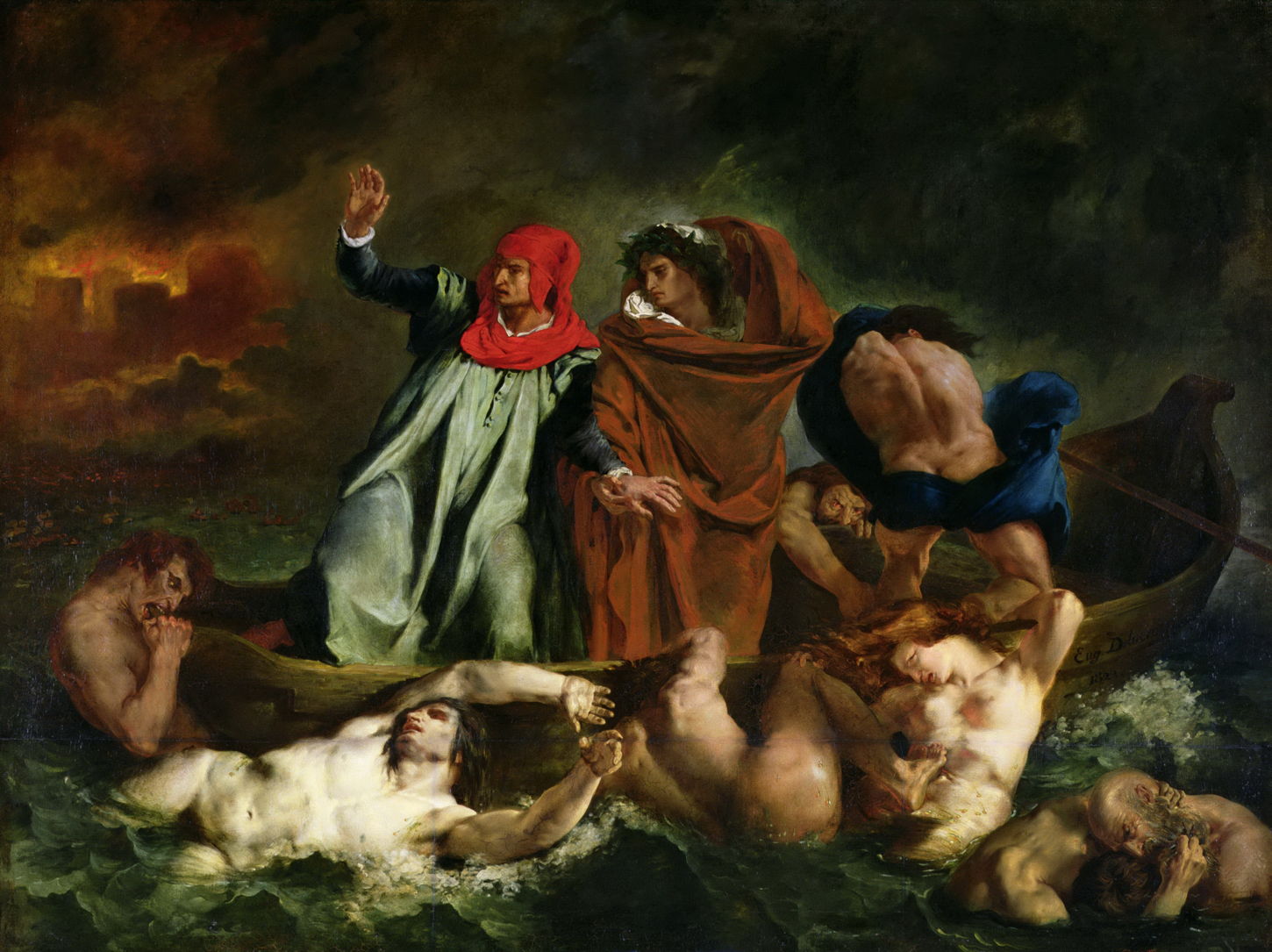
The chaperon had evolved before 1200 as a hooded short cape, then developed into variants that remained popular until becoming unfashionable in about 1500. In paintings it’s most strongly associated with Dante in accounts of his Divine Comedy.
delacroixbarquedante
Eugène Delacroix (1798–1863), The Barque of Dante (Dante and Virgil in Hell) (1822), oil on canvas, 189 x 241 cm, Musée du Louvre, Paris. Wikimedia Commons.

In Eugène Delacroix’s painting of The Barque of Dante from 1822, Dante is inevitably wearing his trademark red chaperon.

hawkinspeasant
Louis Welden Hawkins (1849–1910), A Peasant Woman (c 1880), further details not known. Wikimedia Commons.

The woman’s equivalent of the chaperon persisted until modern times in the hooded cape worn by Louis Welden Hawkins’ Peasant Woman, from about 1880. She is seen near to the rustic village of Grez-sur-Loing, which had become an artist’s colony.

Strangely, the word chaperone (with an added e) is now most commonly used to describe an older woman who accompanies a younger one to ensure that no improper behaviour occurs when in the company of a man.

Before the decline in popularity of hats in the twentieth century, hoods had been relatively uncommon in the general population.

hellqvistvaldemaratterdag
Carl Gustaf Hellqvist (1851–1890), Valdemar Atterdag holding Visby to ransom, 1361 (1882), oil on canvas, 200 × 330 cm, Nationalmuseum, Stockholm. Wikimedia Commons.

Carl Gustaf Hellqvist’s large history painting of Valdemar Atterdag holding Visby to ransom, 1361 from 1882 is an encyclopaedic guide to late medieval dress. Few of its crowd have hoods, and one of those few appears to be a monk, shown in the detail below.

hellqvistvaldemaratterdagdet
Carl Gustaf Hellqvist (1851–1890), Valdemar Atterdag holding Visby to ransom, 1361 (detail) (1882), oil on canvas, 200 × 330 cm, Nationalmuseum, Stockholm. Wikimedia Commons.

Hoods have also been popular with travellers, and from the nineteenth century were incorporated into popular weatherproof capes.

brownlastofenglandoil
Ford Madox Brown (1821–1893), The Last of England (1852/55), oil on panel, 82.5 x 75 cm, Birmingham Museum and Art Gallery, Birmingham, England. Wikimedia Commons.

Ford Madox Brown’s The Last of England (1852/55) shows a young couple with their infant emigrating from England. Tucked under the mother’s weatherproof hooded travelling cape is their baby son.

It seems extraordinary that in the twenty-first century hoodies have been banned as inappropriate items of clothing associated with anti-social behaviour. Perhaps there’s a market for reviving chaperons.

On Reflection: Northern landscapes

By: hoakley
4 March 2026 at 20:30

There are only two ways a painter can depict reflections on water in accordance with optical reality: they can paint exactly what they see when in front of the motif, or they can understand optical principles sufficiently to recreate what they would have seen. This article looks at how those worked out in landscape paintings to the end of the eighteenth century.

Jan van Eyck, The Madonna of Chancellor Rolin (detail) (c 1435) oil on panel, 66 x 62 cm. Musée du Louvre, Paris (WikiArt).
Jan van Eyck (c 1390–1441), The Madonna of Chancellor Rolin (detail) (c 1435) oil on panel, 66 x 62 cm. Musée du Louvre, Paris (WikiArt).

Look in the landscape behind Jan van Eyck’s Madonna of Chancellor Rolin (c 1435) and you’ll see one of the earliest examples of the meticulously accurate depiction of reflections on water. These could only have resulted from careful studies made in front of the motif.

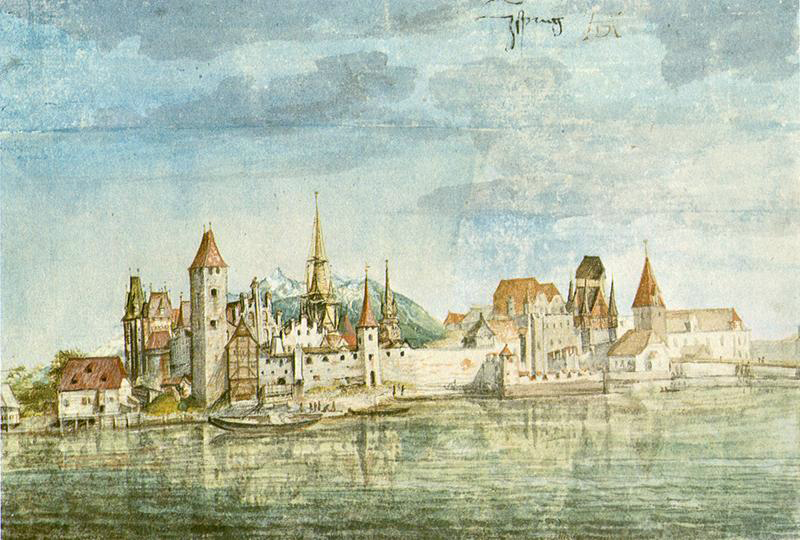
Albrecht Dürer, View of Innsbruck, c 1495, watercolour on paper, 12.7 x 18.7 cm. Albertina, Vienna (WikiArt).
Albrecht Dürer (1471-1528), View of Innsbruck (c 1495), watercolour on paper, 12.7 x 18.7 cm. Albertina, Vienna (WikiArt).

For Albrecht Dürer painting this View of Innsbruck in about 1495, this watercolour is evidence that he both recognised the challenge, and went to the trouble to paint what he actually saw, even though the overall geometry isn’t perfect, with its downward slope to the left.

Following the Northern Renaissance, other landscape painters continued this tradition, into the Dutch Golden Age.

cuyprhine
Aelbert Cuyp (1620–1691), View on the Rhine (c 1645), oil on panel, 27.4 x 36.8 cm, Fondation Custodia, Paris. Wikimedia Commons.

Although Aelbert Cuyp’s View on the Rhine from about 1645 isn’t optically perfect and must at least have been finished in the studio, it demonstrates his care in trying to be faithful in its reflections.

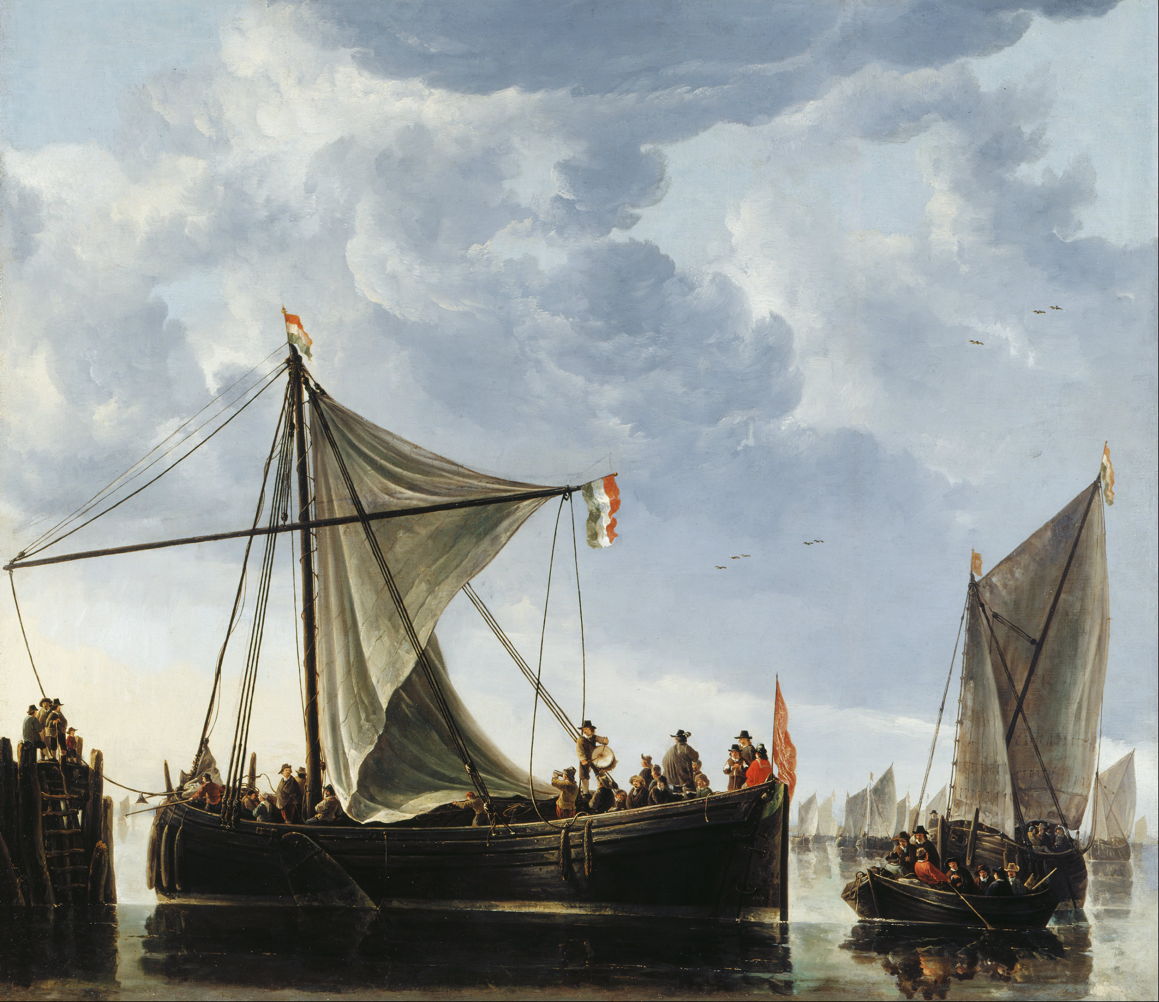
cuyppassageboat
Aelbert Cuyp (1620–1691), The Passage Boat (c 1650), oil on canvas, 124 x 144.4 cm, Royal Collection of the United Kingdom, UK. Wikimedia Commons.

Cuyp’s larger and more detailed painting of The Passage Boat from about 1650 is similarly attentive, implying the use of careful studies made in front of the motif.

cuypvalkhofnijmegen
Aelbert Cuyp (1620–1691), The Valkhof at Nijmegen (c 1652-54), oil on wood, 48.8 x 73.6 cm, Indianapolis Museum of Art, Indianapolis, IN. Wikimedia Commons.

Cuyp’s grand view of The Valkhof at Nijmegen from about 1652-54 is a fine example from later in his career.

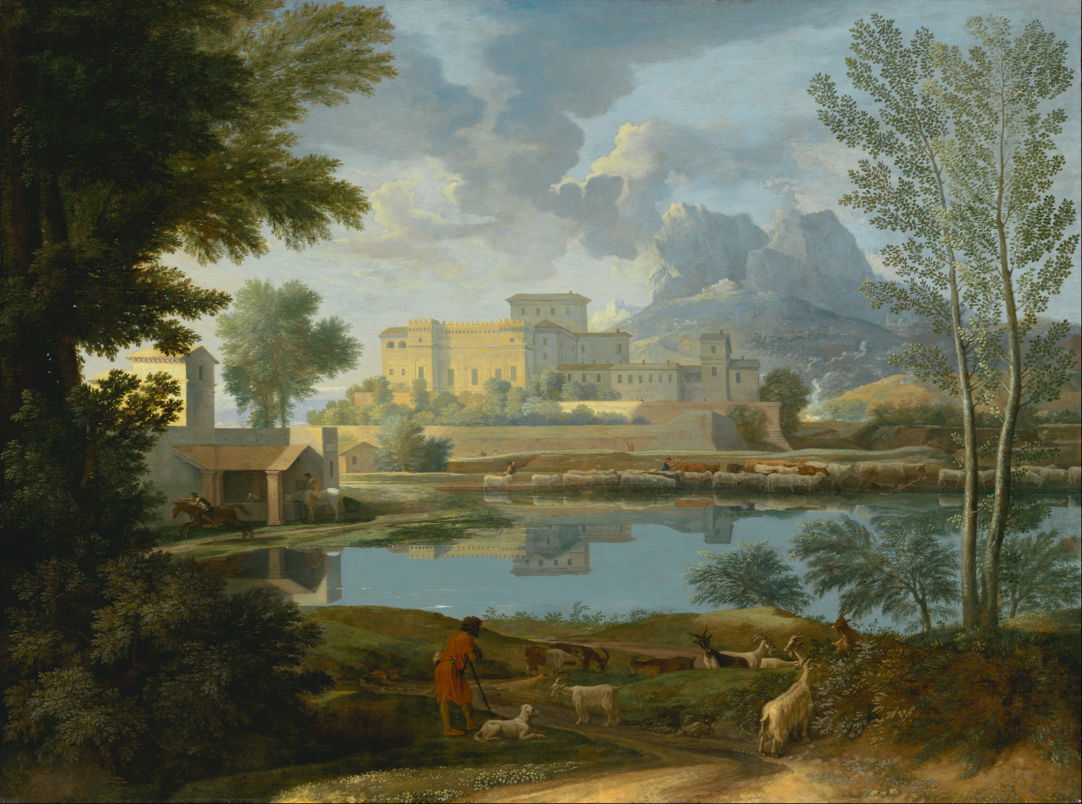
Nicolas Poussin, Landscape with a Calm (c 1651), oil on canvas, 97 x 131 cm, J. Paul Getty Museum, Los Angeles. Digital image courtesy of the Getty's Open Content Program.
Nicolas Poussin (1694-1665), Landscape with a Calm (c 1651), oil on canvas, 97 x 131 cm, J. Paul Getty Museum, Los Angeles. Digital image courtesy of the Getty’s Open Content Program.

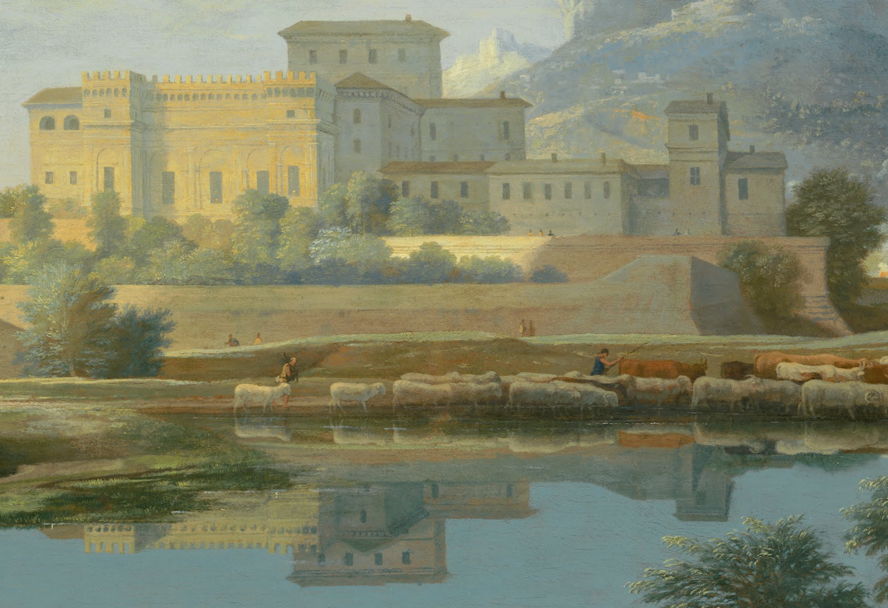
At about the same time, Nicolas Poussin used extensive reflections to augment the placid atmosphere in his idealised Landscape with a Calm (c 1651). The upper parts of the Italianate mansion, together with the livestock on the far bank of the lake, are painstakingly reflected on the lake’s surface, telling the viewer that there isn’t a breath of breeze to bring ripples to disturb those reflections.

Nicolas Poussin, Landscape with a Calm (detail) (c 1651), oil on canvas, 97 x 131 cm, J. Paul Getty Museum, Los Angeles. Digital image courtesy of the Getty's Open Content Program.
Nicolas Poussin (1594–1665), Landscape with a Calm (detail) (c 1651), oil on canvas, 97 x 131 cm, J. Paul Getty Museum, Los Angeles. Digital image courtesy of the Getty’s Open Content Program.

Closer examination of the reflections reveals small disparities, though. Poussin has broken the rule of depth order in painting the brown reflection of one of the cattle that is well behind the sheep at the edge of the lake, and there are inaccuracies obvious in the reflection of the villa. Those may well be the result of his assembling passages from the original plein air studies he used to build this composite.

Nicolas Poussin, Landscape with a Calm (detail) (c 1651), oil on canvas, 97 x 131 cm, J. Paul Getty Museum, Los Angeles. Digital image courtesy of the Getty's Open Content Program.
Nicolas Poussin (1594–1665), Landscape with a Calm (detail) (c 1651), oil on canvas, 97 x 131 cm, J. Paul Getty Museum, Los Angeles. Digital image courtesy of the Getty’s Open Content Program.

His reflections appear most accurate in the passage showing horsemen at the left end of the lake. These make interesting comparison with Poussin’s contemporary Claude Lorrain, who appears to have avoided tackling the problems posed by reflections.

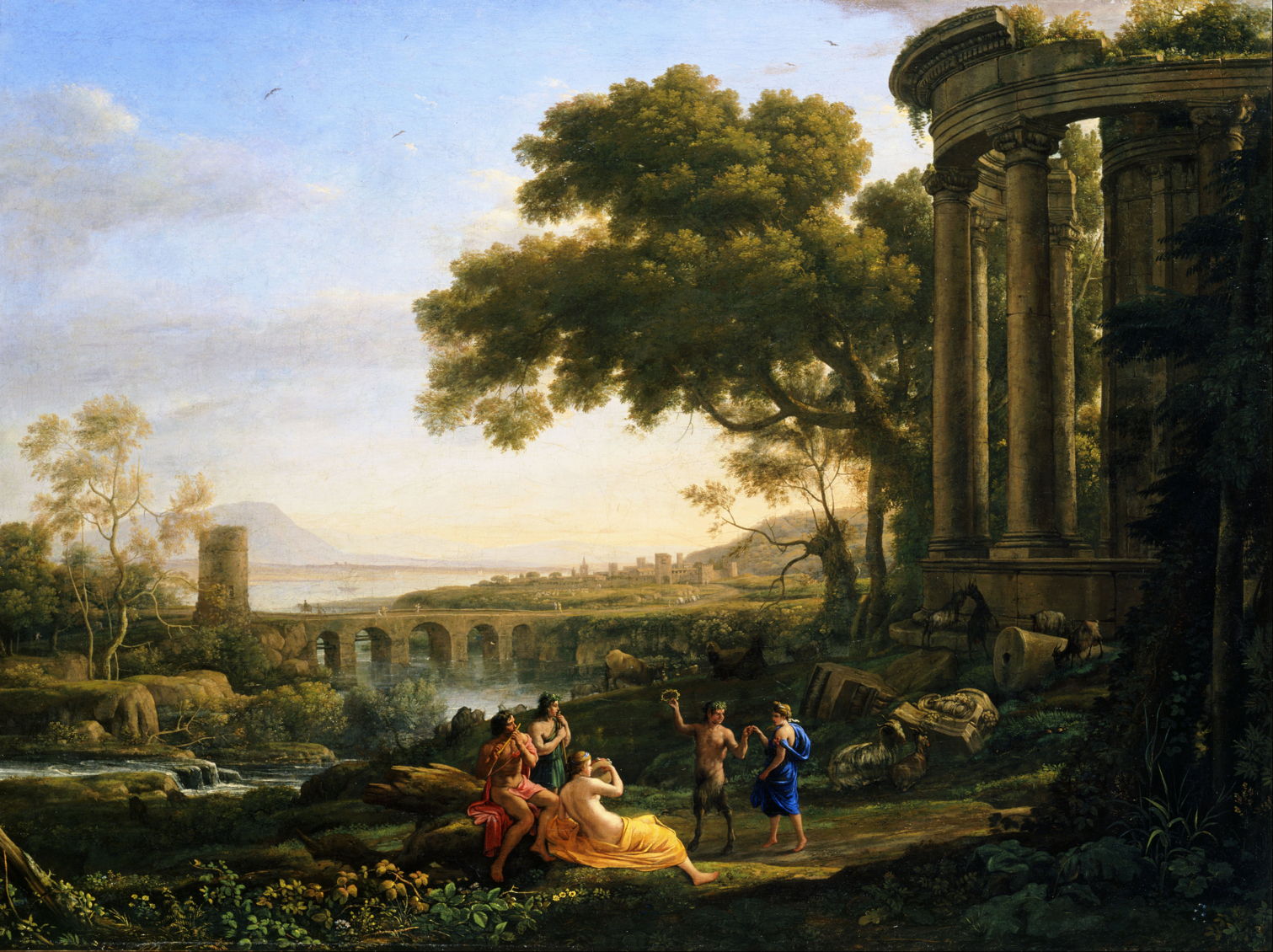
claudenymphsatyrdancing
Claude Lorrain (1604/5–1682), Landscape with Nymph and Satyr Dancing (1641), oil on canvas, 99.7 x 133 cm, Toledo Museum of Art, Toledo, OH. Wikimedia Commons.

In Claude’s Landscape with Nymph and Satyr Dancing from 1641, another idealised composite assembled from the artist’s library of sketches, little attempt is made to depict the reflection of the prominent viaduct. What has been shown is unaccountably darker than the original, and vague in form. Most of Claude’s other paintings that could have included reflections show water surfaces sufficiently broken to avoid tackling the problem.

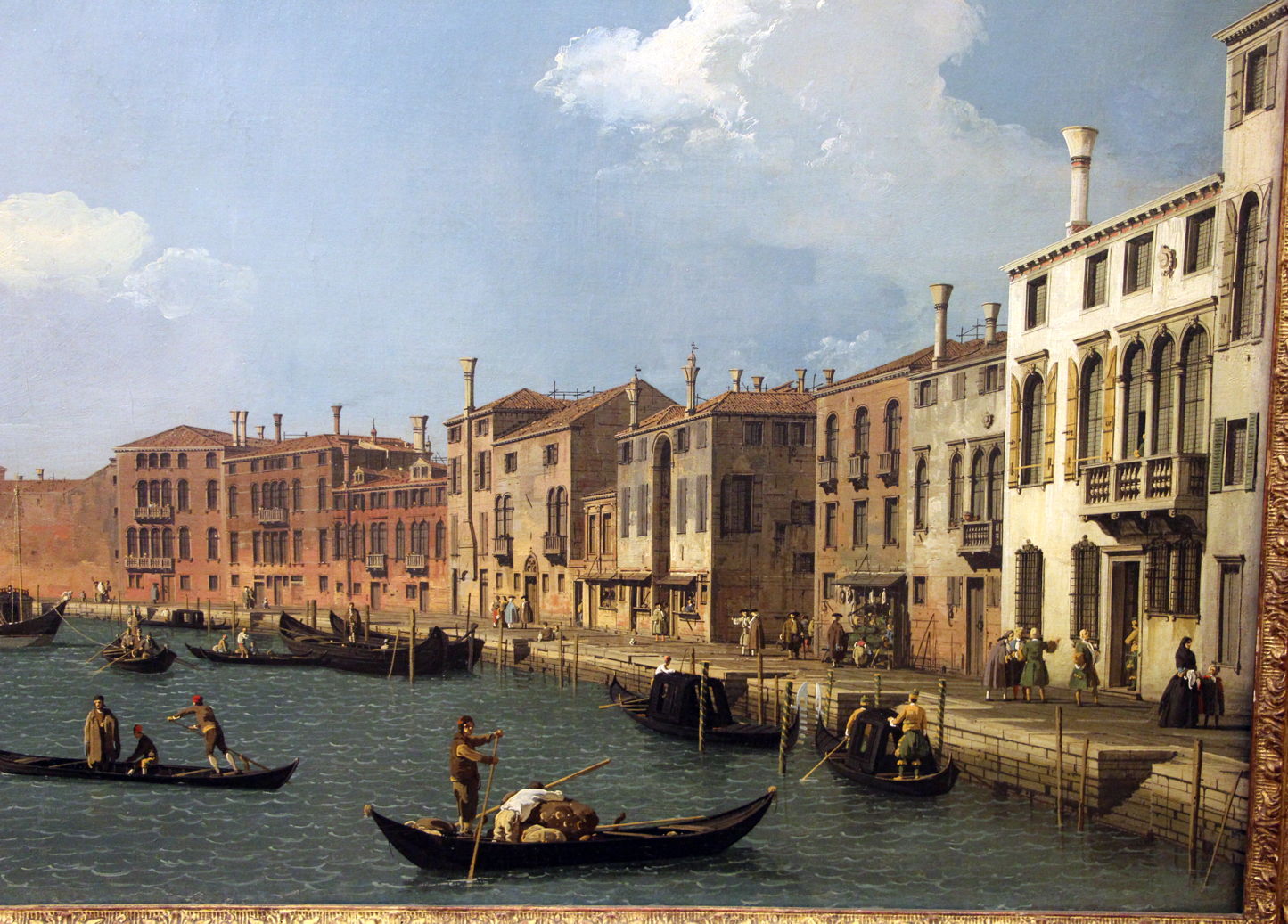
canalettovedutadelcanaledisantachiara
Canaletto (Giovanni Antonio Canal) (1697–1768), Canale di Santa Chiara, Venice (c 1730), oil, dimensions not known, Musée Cognacq-Jay, Paris. Image by Sailko, via Wikimedia Commons.

Paintings of Venice and London by Canaletto in the eighteenth century are also largely devoid of reflections. In his Canale di Santa Chiara, Venice from about 1730 the gondola in the left foreground has no reflection at all, and its three figures are similarly absent from the surface of the water.

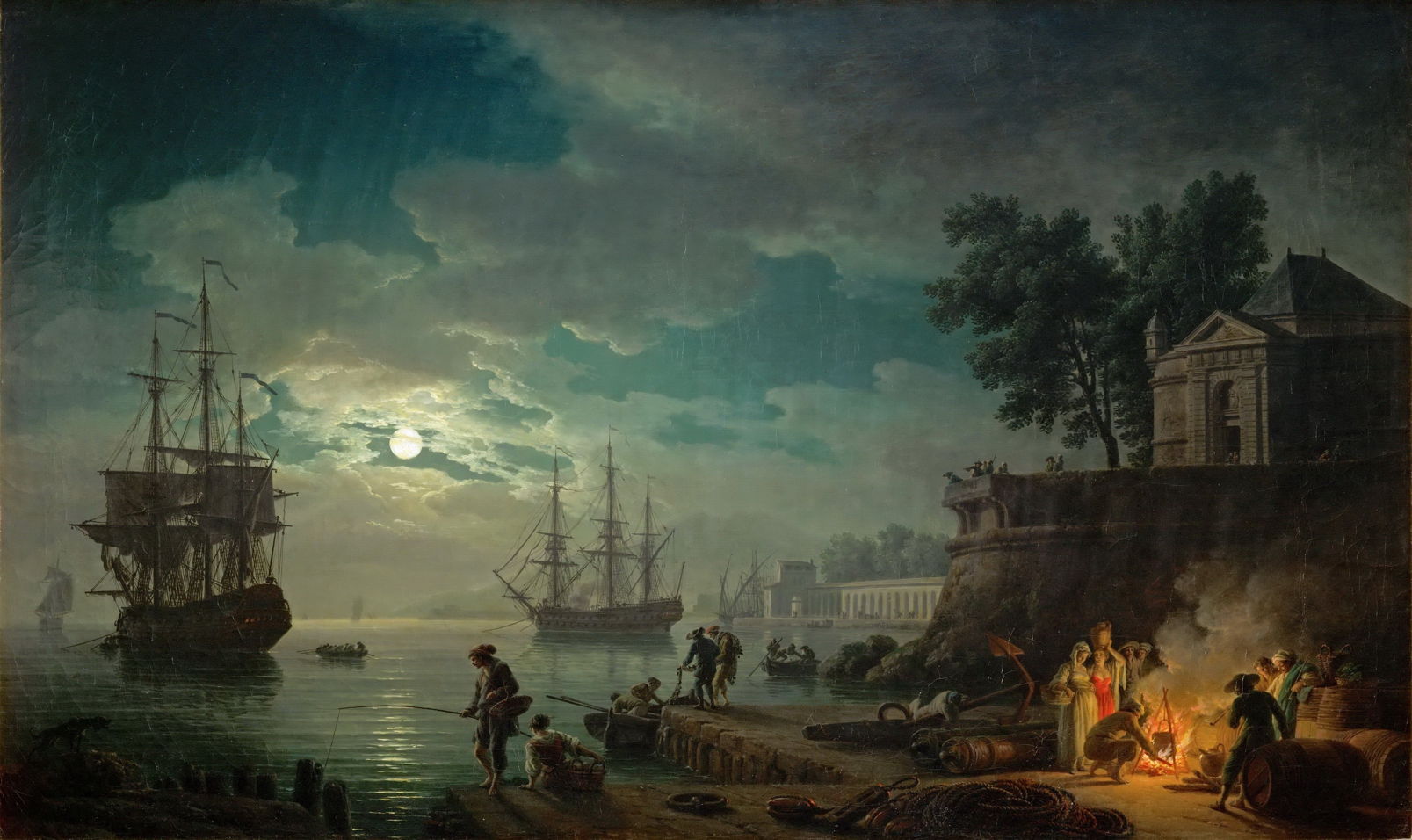
vernetseaportmoonlight
Claude-Joseph Vernet (1714–1789), Seaport by Moonlight (c 1771), oil on canvas, 98 x 164 cm, Musée du Louvre, Paris. Wikimedia Commons.

Reflections return in the studio paintings of those whose sketches made in front of the motif were sufficiently detailed to include them. Among them is Claude-Joseph Vernet, whose Seaport by Moonlight from about 1771 appears faithful. Sadly, none of his preparatory drawings or sketches appear to have survived, although they were a key influence on the next generation of landscape artists.

The Dutch Golden Age: Decline and legacy

By: hoakley
21 January 2026 at 20:30

The Golden Age of the Dutch Republic was a period of war and turmoil. It started in the latter half of the Eighty Years War, thrived when that came to an end in 1648, and collapsed following the Disaster Year (Rampjaar) of 1672. That year brought both the Franco-Dutch and Third Anglo-Dutch Wars, invasion, rebellion, economic crisis, and collapse of the art market.

coypellouisxiv
Antoine Coypel (1661–1722), Glory of Louis XIV after the Peace of Nijmegen (1681), oil on canvas, 153 x 185 cm, Musée Fabre, Montpellier, France. Image by Finoskov, via Wikimedia Commons.

When he was just twenty, the French artist Antoine Coypel painted this Glory of Louis XIV after the Peace of Nijmegen (1681), which gained him admission as a full member to the Académie Royale.

The Treaty of Nijmegen brought an end to the Franco-Dutch War of 1672-78, and was one of a series France signed between August 1678 and September of the following year. These were acclaimed a great success for Louis XIV and France, which gained extensive territory in the north and east as a result. Louis was henceforth known as the Sun King. In this elaborate allegorical flattery, the king is being crowned in the upper left, above a gathering of deities including Minerva, who is wearing her distinctive helmet and golden robes.

Painting didn’t stop, of course, and some artists continued into the following century, but the number of masters declined rapidly.

vanwijnentemptationstanthony
Domenicus van Wijnen (1661–after 1690), The Temptation of Saint Anthony (c 1685), media and dimensions not known, The National Gallery of Ireland, Dublin. Wikimedia Commons.

Domenicus van Wijnen continued to paint, for example his radical interpretation of The Temptation of Saint Anthony in about 1685. Although this may have appeared an outlier at the time, its symbols and composition may have inspired the ‘faerie’ paintings that became popular in the middle of the nineteenth century.

vanderwerffjudgementofparis
Adriaen van der Werff (1659–1722), The Judgement of Paris (1716), oil on panel, 63.3 x 45.7 cm, Dulwich Picture Gallery, London. Wikimedia Commons.

Other artists like Adriaen van der Werff reverted to more traditional themes and style, in his Judgement of Paris from 1716.

tenkatesoldiermeninn
Herman Frederik Carel ten Kate (1822–1891), A Soldier and Men in an Inn (date not known), watercolour, white body paint and black chalk on paper, 21.5 x 32.8 cm, location not known. Wikimedia Commons.

The Golden Age was revisited by artists in the nineteenth century, particularly in the period scenes painted by Herman Frederik Carel ten Kate. His Soldier and Men in an Inn shows a scene from the Eighty Years War, with the walls decorated by blue on white Delft tiles. This must have been painted between 1850-80, over two centuries after the end of that war.

israelsseamstress
Jozef Israëls (1824–1911), The Seamstress (1850-88), oil on canvas, 75 × 61 cm, Rijksmuseum Amsterdam, Amsterdam, The Netherlands. Wikimedia Commons.

Early in the career of the Dutch artist Jozef Israëls, he painted The Seamstress (1850-88) as a genre interior from the Golden Age. A young Dutchwoman works with her needle and thread in the light of an unseen window at the left. In the background to the right, there’s a group of Delft tiles on the wall, and there’s a single tulip in a glass vase at the left.

The impact of Golden Age paintings on European art history was broad and deep, with secular themes becoming more popular than the religious and mythological works that had dominated the art of the Renaissance. New genres, like still life, may not have been rated as highly as history painting, but became widespread.

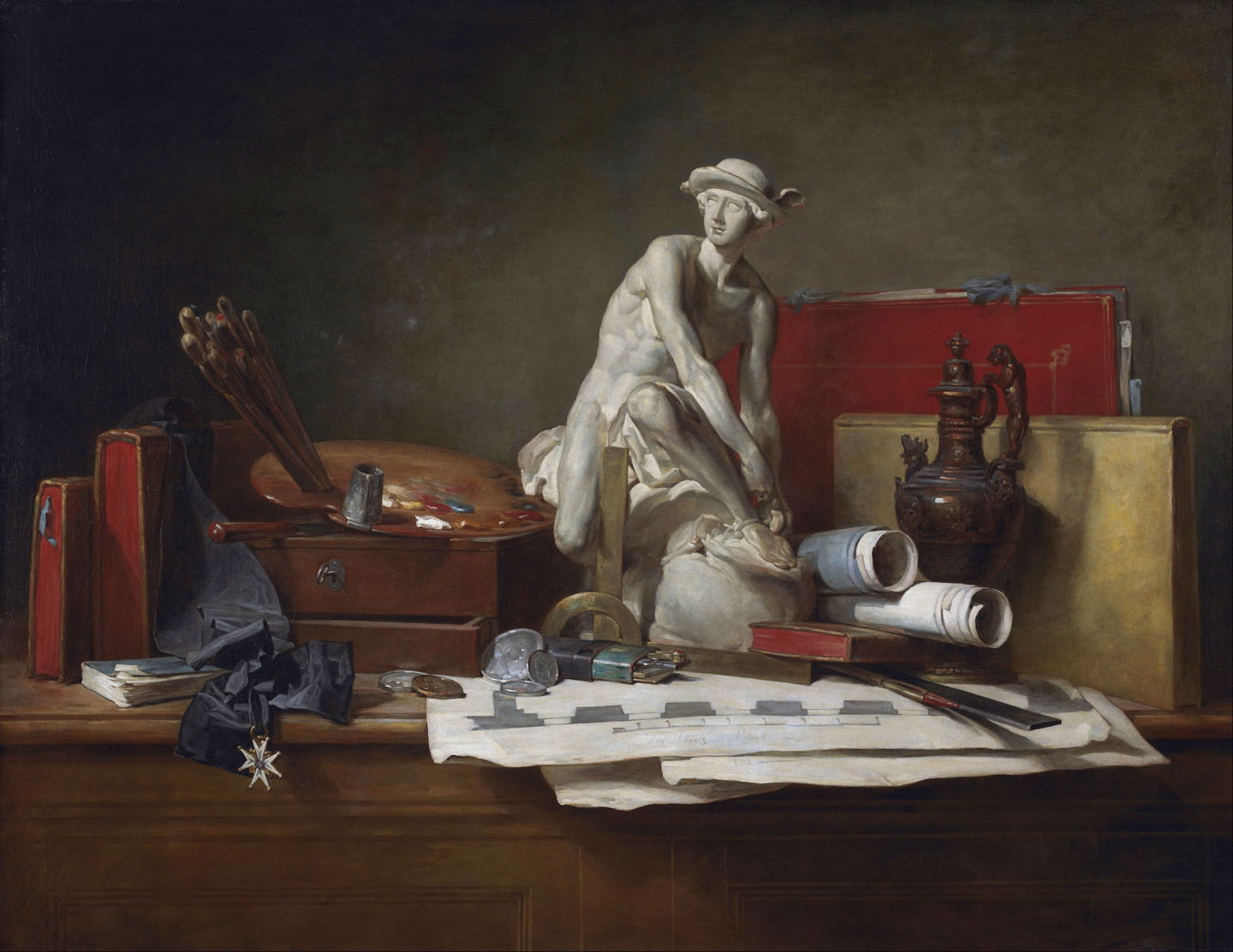
chardinattributesarts
Jean-Baptiste-Siméon Chardin (1699–1779), The Attributes of the Arts and the Rewards Which Are Accorded Them (1766), oil on canvas, 113 x 145 cm, Minneapolis Institute of Art, Minneapolis, MN. Wikimedia Commons.

Late in his career, in 1766, Jean-Baptiste-Siméon Chardin painted The Attributes of the Arts and the Rewards Which Are Accorded Them, in which each object has a clear association. Painting is represented by the brushes and palette on top of a paintbox. Architectural drawings and drawing tools represent architecture. The bronze pitcher at the right refers to the work of the goldsmith. The red portfolio tied with ribbons represents drawing. The plaster model of the figure of Mercury in the centre is a copy of a sculpture by J B Pigalle, a friend of Chardin, who was the first sculptor to win the highest French honour for artists, the Order of Saint Michael, whose cross and ribbon are shown at the left.

Greatest impact was in landscape painting. Prior to the Golden Age, landscapes had primarily been used as accessories to other genres. Most were idealised rather than accurate representations of any real location, and many were mere settings for narratives.

vernetitalianateharbour
Joseph Vernet (1714–1789), Italianate Harbour Scene (1749), oil on canvas, 104.4 x 117.8 cm, Dulwich Picture Gallery, London. Wikimedia Commons.

The Dutch vogue for expressive skies spread steadily across Europe. This is reflected in Joseph Vernet’s Italianate Harbour Scene from 1749. He still retains formal compositional elements, with figures in the foreground, and scenery behind, but delights in showing us these towering cumulus clouds lit so richly.

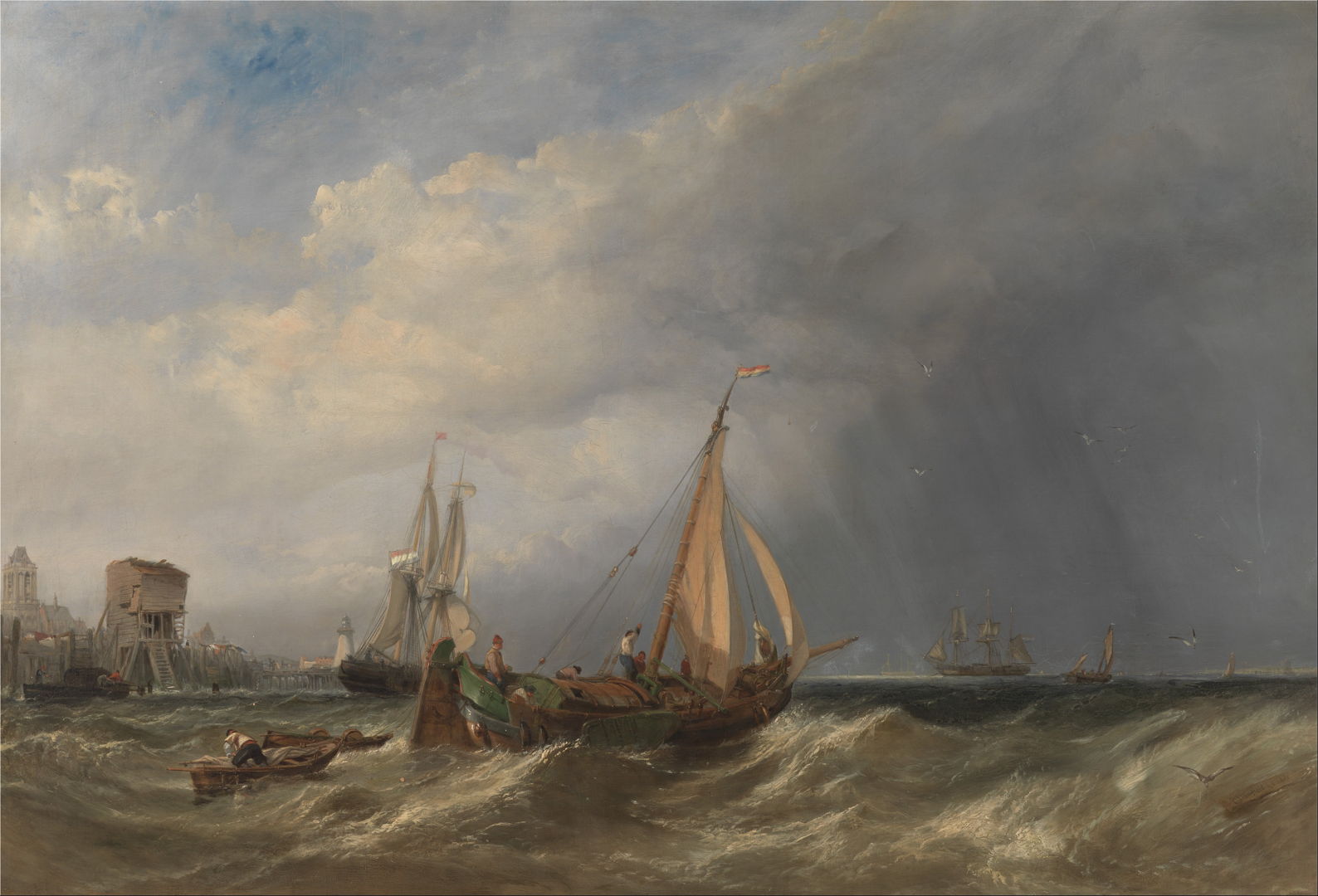
stanfielddutchbargerotterdam
Clarkson Frederick Stanfield (1793–1867), A Dutch Barge and Merchantmen Running out of Rotterdam (1856), oil on canvas, 78.7 x 121.9 cm, Yale Center for British Art, New Haven, CT. Wikimedia Commons.

Marine painting became established as a sub-genre, as shown by the British painter Clarkson Stanfield, whose Dutch Barge and Merchantmen Running out of Rotterdam from 1856 includes rich detail, even down to dilapidated buildings on the waterfront.

John Crome (1768–1821), Landscape with Windmills (date not known), oil on canvas, 51 x 75.5 cm, Muzeum Narodowe w Warszawie, Warsaw, Poland. Wikimedia Commons.

Many of John Crome’s landscapes feature skies inspired by Dutch painters. His Landscape with Windmills is one of his most remarkable, as a signed painting that appears to have been sketched in front of the motif. Others who skied include John Constable and JMW Turner.

Nocturnes were less reliable, as they underwent phases when they were fashionable, then fell into neglect for a while.

whistlernocturnebluegold
James Abbott McNeill Whistler (1834-1903), Nocturne: Blue and Gold — Southampton Water (1872), oil on canvas, 50.5 x 76 cm, Art Institute of Chicago, Chicago, IL. Wikimedia Commons.

James Abbott McNeill Whistler had a penchant for nocturnes, here his Nocturne: Blue and Gold — Southampton Water from 1872. Its vague blue-greys make the pinpoints of light and the rising sun shine out in contrast, a good reason for limiting his palette, while remaining faithful to nature.

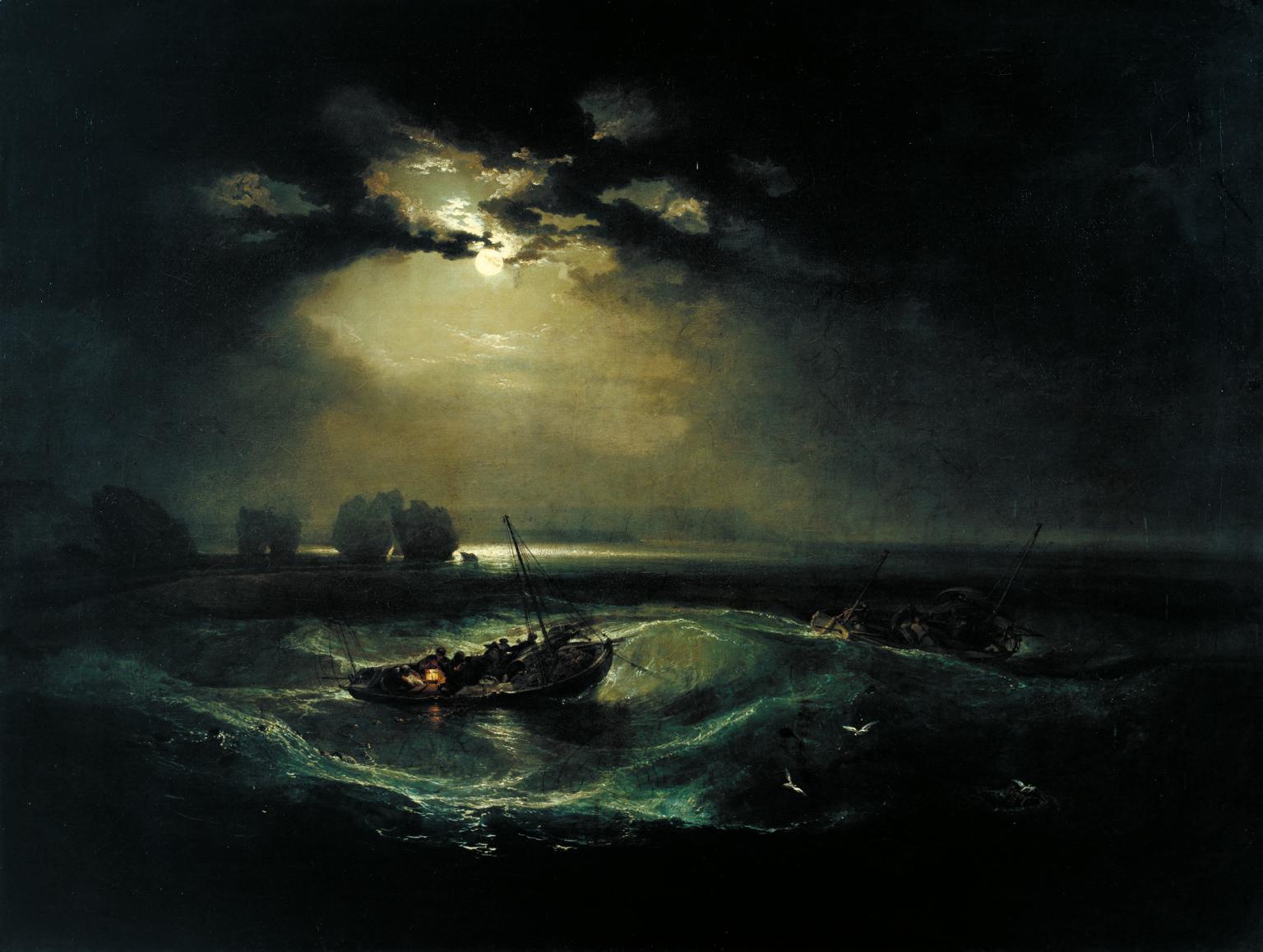
Fishermen at Sea exhibited 1796 by Joseph Mallord William Turner 1775-1851
Joseph Mallord William Turner (1775–1851), Fishermen at Sea (1796), oil on canvas, 91.4 x 122.2 cm, The Tate Gallery (Purchased 1972), London. © The Tate Gallery and Photographic Rights © Tate (2016), CC-BY-NC-ND 3.0 (Unported), http://www.tate.org.uk/art/artworks/turner-fishermen-at-sea-t01585

JMW Turner’s Fishermen at Sea from 1796, showing small fishing boats working in heavy swell off The Needles, on the Isle of Wight, is probably the most famous and successful coastal nocturne of all time. This was Turner’s first oil painting to be exhibited at the Royal Academy, when he was just twenty-one.

Paintings by artists of the Dutch Republic had been sold into collections across Europe, where many remain, influencing today’s artists.

Medium and Message: Oil on copper 1620-1926

By: hoakley
14 January 2026 at 20:30

Painting in oils on copper plates had become relatively popular by 1600, and reached its zenith in the work of Adam Elsheimer, who died in 1610. Although it continued through the seventeenth century, it entered a slow decline as stretched canvas became the norm.

declerckmidas
Hendrick de Clerck (1560/1570–1630), The Contest Between Apollo and Pan (c 1620), oil on copper, 43 x 62 cm, Rijksmuseum Amsterdam, Amsterdam, The Netherlands. Wikimedia Commons.

Copper remained quite popular in the Netherlands. Some artists, such as Hendrick de Clerck, pushed their technique up to larger sizes too, in The Contest Between Apollo and Pan (c 1620). This is a huge 43 by 62 cm (17 by 24.4 inches), dwarfing its predecessors, and providing exquisite detail in the flowers of its foreground.

teniersarmidabeforegodfrey
David Teniers the Younger (1610–1690), Armida before Godfrey of Bouillon (1628-30), oil on copper, 27 x 39 cm, Museo Nacional del Prado, Madrid, Spain. Wikimedia Commons.

To the south, David Teniers the Younger adopted copper for many of his paintings, including Armida before Godfrey of Bouillon (1628-30), significantly smaller than de Clerck’s.

teniersdmonkeyencampment
David Teniers the Younger (1610–1690), A Monkey Encampment (1633), oil on copper, 33 x 41.5 cm, Private collection. Wikimedia Commons.

Teniers even used copper for his singerie of A Monkey Encampment from 1633, showing monkeys in human roles in a camp.

terborchratificationoftreatymunster
Gerard ter Borch (1617–1681), The Ratification of the Treaty of Münster, 15 May 1648 (1648), oil on copper, 45.4 x 58.5 cm, Rijksmuseum Amsterdam, Amsterdam, The Netherlands. Wikimedia Commons.

One of the grandest paintings made in oils on copper is Gerard ter Borch visual record of The Ratification of the Treaty of Münster, 15 May 1648 made in the same year. This recorded the moment that the Thirty Years War ended, with the ratification of this treaty between the Dutch Republic and Spain. It also marked the birth of the Dutch Republic as an independent country. This is 45.4 x 58.5 cm (17.9 by 23 inches), similar to de Clerck’s giant, but far smaller than its equivalent would have been on canvas.

tenierstemptationstanthonyprado
David Teniers the Younger (1610–1690), The Temptation of Saint Anthony (c 1650), oil on copper, 55 × 69 cm, Museo Nacional del Prado, Madrid. Wikimedia Commons.

Teniers appeared to rise to the challenge in The Temptation of Saint Anthony in about 1650: 55 × 69 cm (21.5 by 27 inches).

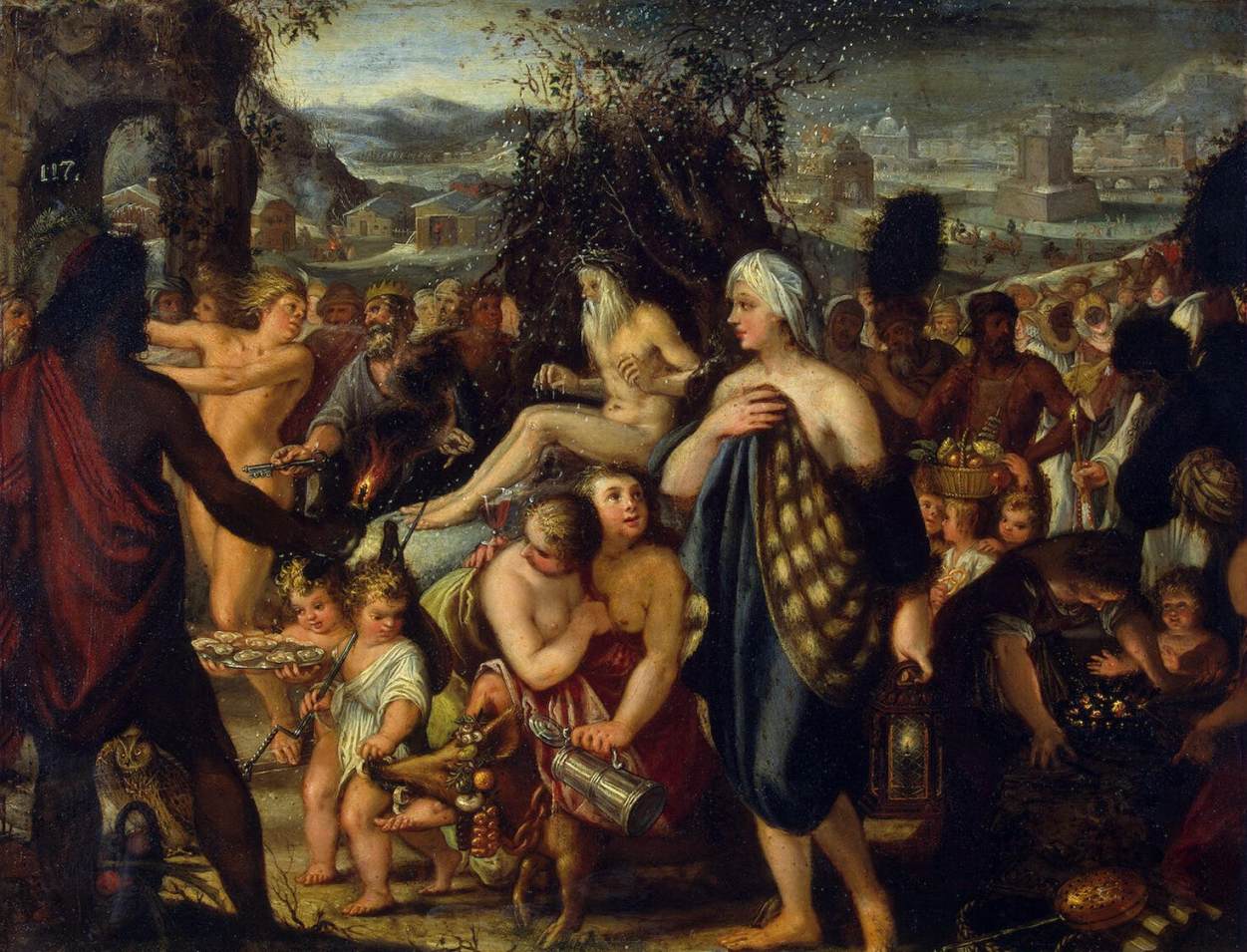
heissallegorywinter
Johann Heiss (1640–1704), Allegory of Winter (1665), oil on copper, 29 x 37 cm, Hermitage Museum Государственный Эрмитаж, Saint Petersburg, Russia. Wikimedia Commons.

Johann Heiss’s Allegory of Winter (1665) depicts fine snowflakes realistically, thanks to its smooth grain-free surface.

By the eighteenth century, the use of copper as a support had become unusual if not exceptional.

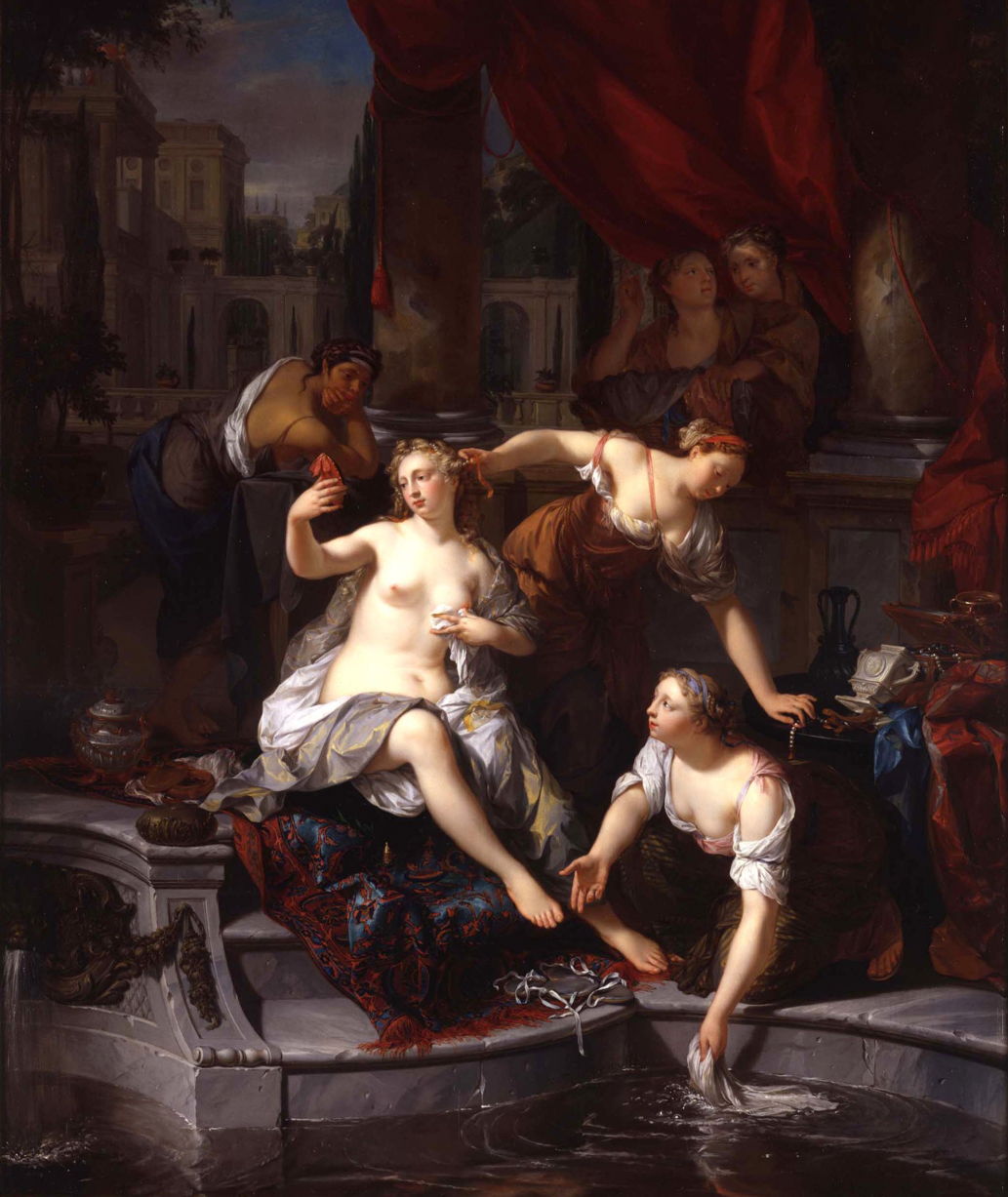
verkoljedavidspyingbathsheba
Nikolaas Verkolje (1673–1746), David Spying on Bathsheba (1716), oil on copper, 62.5 x 52 cm, Private collection. Wikimedia Commons.

Nikolaas Verkolje’s David Spying on Bathsheba from 1716 uses a relatively large sheet for its conventional account of this popular story.

lancretbrotherphilippesgeese
Nicolas Lancret (1690–1743), Brother Philippe’s Geese (c 1736), oil on copper, 27.3 x 35.2 cm, The Metropolitan Museum of Art (Purchase, Walter and Leonore Annenberg and The Annenberg Foundation Gift, 2004), New York, NY. Courtesy of The Metropolitan Museum of Art.

The use of copper has never ceased altogether since the late sixteenth century, and has been continued by a succession of artists with whom it has found favour, such as Nicolas Lancret above, and Johann Georg Platzer below. The latter appears to have painted many works on larger sheets than those used earlier. There’s a delicate balance to be struck, as thinner sheets are less rigid and warp more readily, but are substantially lighter and cheaper.

platzerpaintersstudio
Johann Georg Platzer (1704–1761), The Artist’s Studio (1740-59), oil on copper, 41.9 × 60 cm, Cleveland Museum of Art, Cleveland, OH. Wikimedia Commons.

Platzer’s The Artist’s Studio (1740-59) shows an assistant using a muller, at the far right, to prepare fresh oil paint for the painters at work in this workshop. Sadly, none of the paintings shown appear to have used copper supports.

Since then, copper has reappeared from time to time, usually where it’s least expected.

vernetcjmorning
Claude-Joseph Vernet (1714–1789), The Four Times of Day: Morning (1757), oil on silvered copper, 29.5 x 43.5 cm, Art Gallery of South Australia, Adelaide, Australia. Wikimedia Commons.

Claude-Joseph Vernet used it for his outstanding series The Four Times of Day in 1757. The first, Morning, shows three people busy fishing at the edge of a substantial river, as the sun rises behind a watermill and trees on the left. Making its way slowly towards the viewer is a barge, its sail lofted out by the gentle breeze. Gulls are on the wing, and the day promises to be fine and sunny. These are painted on silvered copper, presumably to give them a lustrous look. Vernet doesn’t appear to have used copper much later in his career.

My final examples come from the underrated Italian-American artist Joseph Stella, who seems to have experimented with large copper supports in the 1920s.

stellaledaswan
Joseph Stella (1877–1946), Leda and the Swan (1922), oil on copper, 108 x 118.1 cm, Private collection. The Athenaeum.

His Leda and the Swan from 1922 is huge by previous standards, although it’s hard to see any advantage gained from the properties of the support.

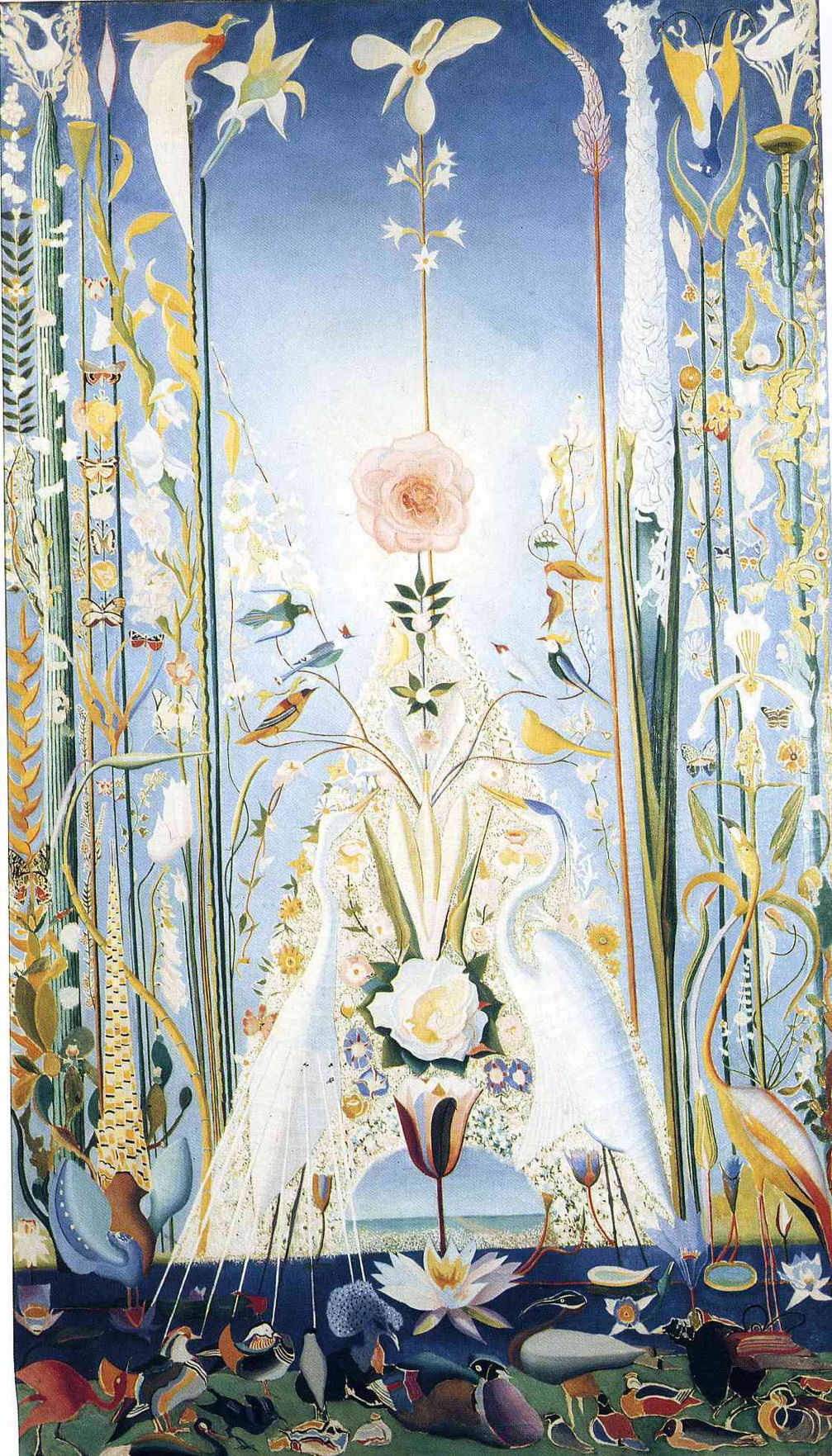
stellaapotheosisrose
Joseph Stella (1877–1946), The Apotheosis of the Rose (1926), oil on copper, 213.4 x 119.4 cm, Private collection. Wikimedia Commons.

The Apotheosis of the Rose from 1926 is the largest work on copper that I have come across, at 213.4 by 119.4 cm (84 by 47 inches). Its fine detail is overwhelming, making it the perfect end to these examples.

The twenty-first century successor to copper plates must be lightweight ‘honeycomb’ alloy and composite panels that have been adopted by some modern painters.

❌
❌