Login
Login
The bicentenary of Gustave Moreau: 1872-78
Once Gustave Moreau had recovered from the trauma of the Franco-Prussian War, he started on his next major works. He had been invited to join the select group of artists who were engaged to paint murals in major public buildings, but declined. Despite that, in 1875 he was made a member of the Legion of Honour, which pleased him and his mother deeply. All he needed now was another success at the Salon.
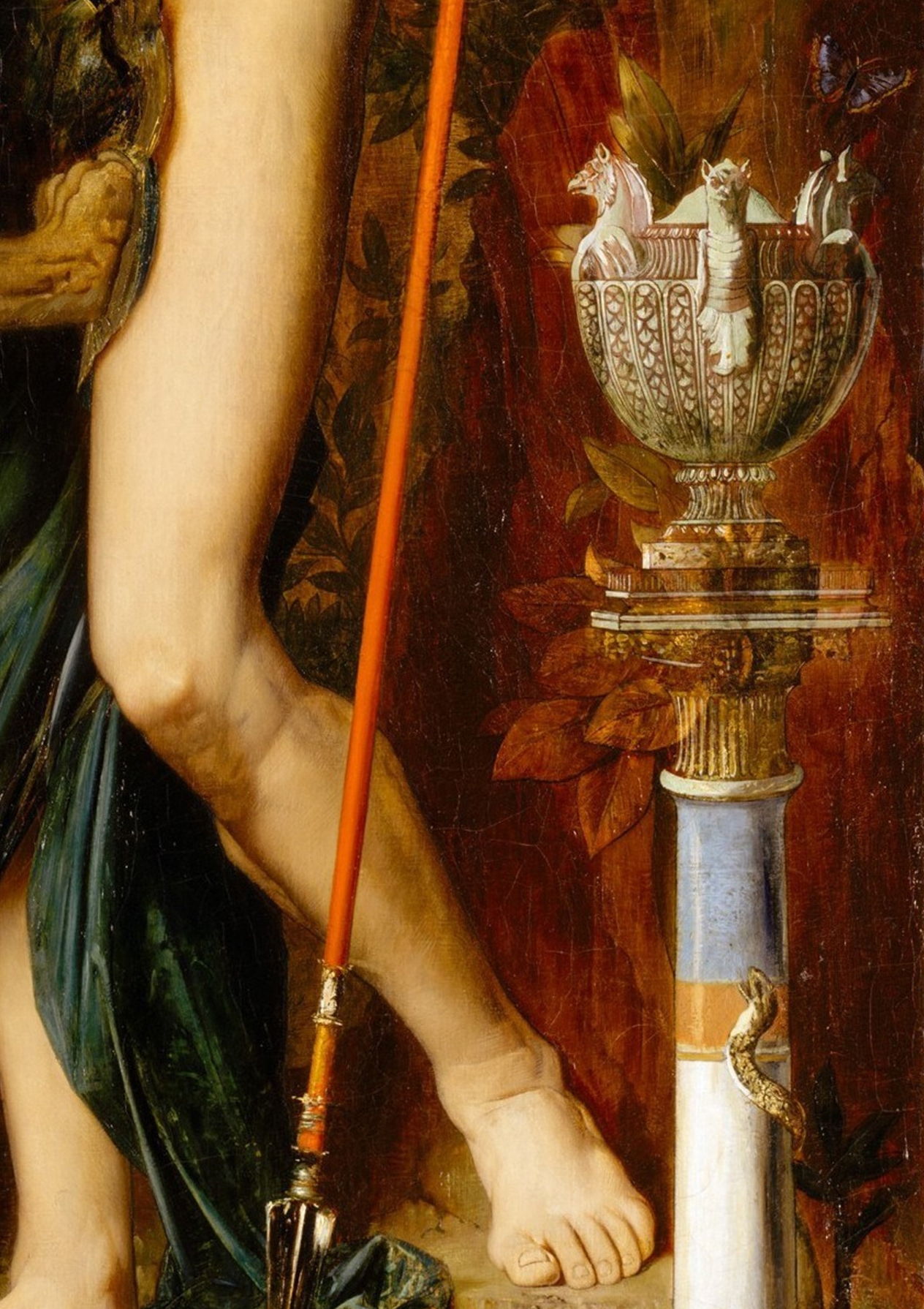
One of his four paintings exhibited at the Salon of 1876 told the second of Hercules’ twelve labours, his battle with the Lernean Hydra.
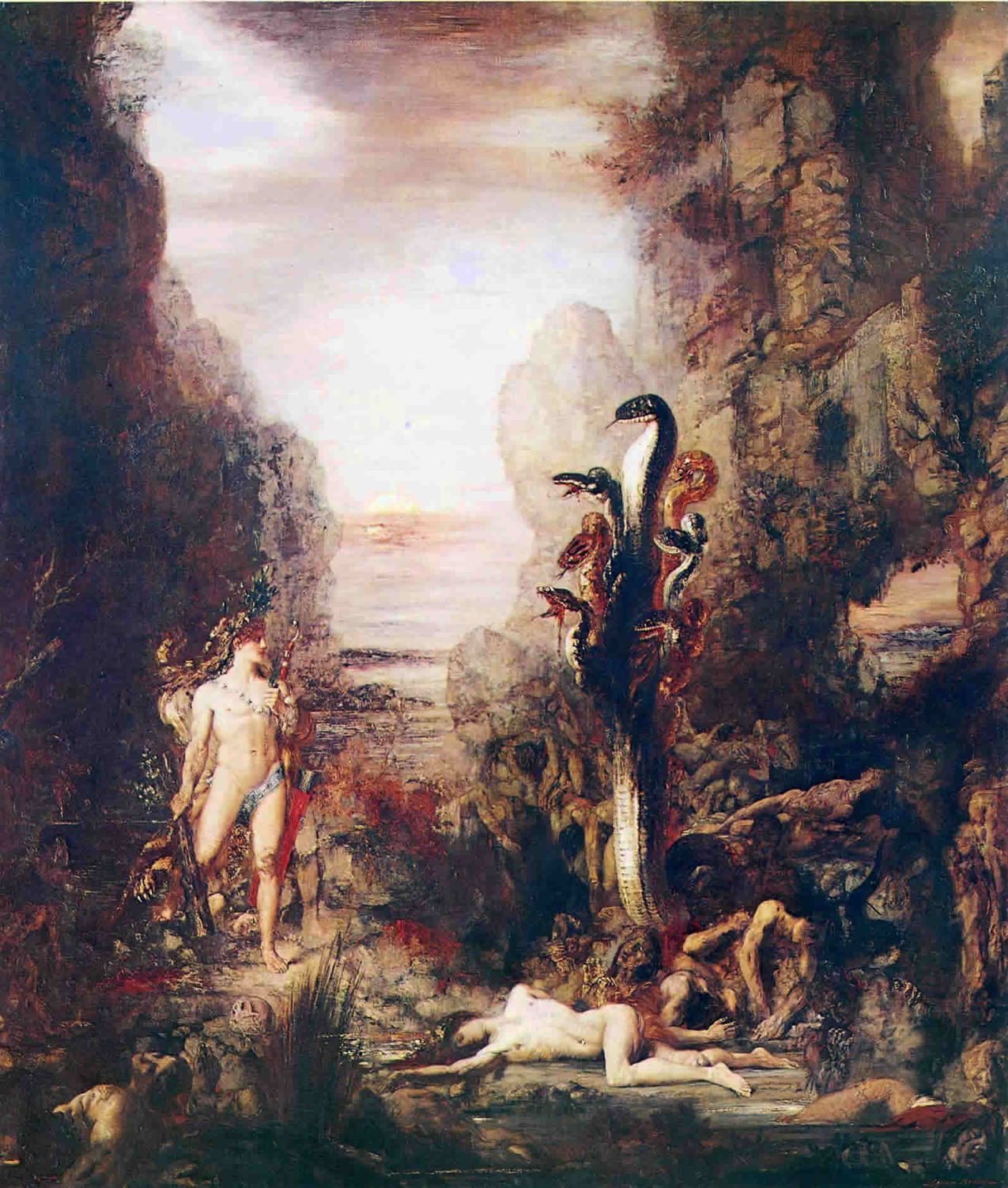
The Hydra was a poisonous monster with the body of a dog and multiple serpent heads, whose breath alone could kill. According to surviving written accounts, Hercules covered his mouth and nose with a cloth for protection from the deadly fumes, fired flaming arrows into the Hydra’s lair to awaken it, then set about trying to kill it.
When he discovered that cutting off its heads with a sickle or sword only resulted in two more growing back, Hercules enlisted the help of his nephew Iolaus, who cauterised the wounds with a firebrand to prevent regrowth. Hercules then cut off the one immortal head using a golden sword given to him by Athena. He also took some of the Hydra’s blood, which was the poison used on the arrow with which he later killed Nessus.
Moreau puts his canvas into its portrait orientation to emphasise the Hydra towering over Hercules, who is fully armed, with club, bow and arrows, and more. The moment chosen is the initial confrontation, with Hercules staring steely-faced at the Hydra. This is consistent with Moreau’s aversion to a more theatrical treatment.
This was well-received and extensively debated, even generating a long-standing controversy over its possible political connotations. It was suggested at the time that the Hydra represented the forces of anarchy behind the insurgency of the Commune in 1871. Others preferred instead that the Hydra represented Bismarck and the German princes behind the Franco-Prussian War of 1870.
Two of his other paintings shown in 1876 were based on the story of Salome and the execution of Saint John the Baptist. Their underlying narrative is biblical, and straightforward. The unnamed daughter of Herodias (subsequently named as Salome) performed a dance at a birthday feast thrown by King Herod. The dance so pleased Herod that he offered her anything that she wanted, up to half his kingdom. She asked not for riches, but for the head of Saint John the Baptist, the earthly messenger sent to announce the birth and ministry of Jesus Christ. Reluctantly, Herod agreed, John was beheaded in prison, and his head brought to her on a plate; the dancer gave the head to her mother.
This has been a popular story for religious paintings, and by far the most common scene involves John’s head being brought on a plate, or variations around that. Moreau was clearly interested in other parts of the story, and in Salome herself. Moreau’s apparently sudden interest in Salome was sparked by the story, probably mythical, of a woman Communard known as the pétroleuse, who seemingly took delight in setting buildings alight. That suggests it wasn’t until the summer of 1871 that he started work on his paintings of Salome.
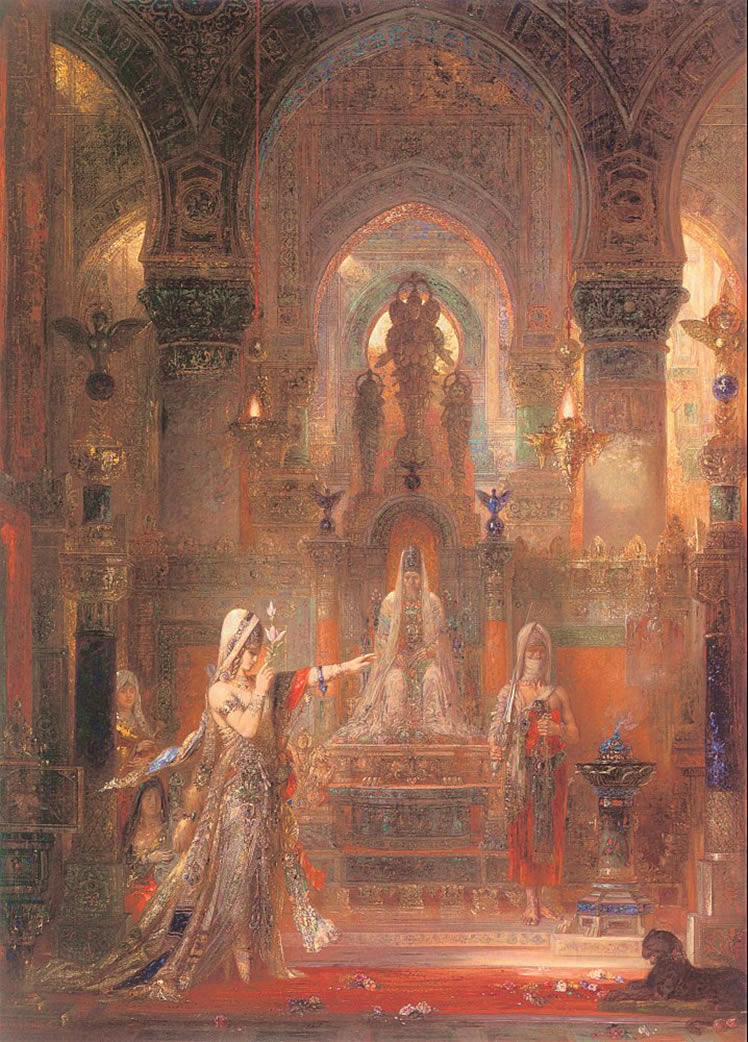
The culmination of Moreau’s quest for the right scene to show the story of Salome the dancer is this extraordinary oil painting shown at the 1876 Salon.
The cadaveric King Herod sits on this throne while Salome is almost static on her points, and pointing towards the right. The executioner stands at the foot of the throne, and a couple of other women (including, perhaps, Salome’s mother) are at the left. Salome holds a lotus flower in her right hand, and other flowers are strewn on the floor. John’s head is nowhere to be seen, so we must presume that the moment selected by Moreau is when Salome chooses to receive that as her reward.
The rest of the painting consists of an unprecedented fusion of images, icons, and objects drawn from a diverse range of cultures. Detailed examination has shown these to be associated with the Hagia Sophia in Istanbul, the Alhambra in Granada, the Great Mosque of Cordoba, and several mediaeval cathedrals. Motifs have been identified from Etruscan, Roman, Egyptian, Indian, and Chinese art and culture.
But Moreau wasn’t content to show only that scene from the story. The other painting was to consider Salome with the head of John the Baptist as an apparition, and is now represented in three different versions.

The Apparition (1875) in the Musée National Gustave-Moreau is one of Moreau’s earliest attempts to express this. It takes the central part of Salome and adds the floating, severed head of John. Salome has now been transformed into the provocative, under-dressed femme fatale shown by subsequent artists. King Herod’s throne has been moved to the left of the painting, and he now looks in the direction of the apparition.

This watercolour painting of The Apparition (c 1876), now in the Musée d’Orsay, was that shown at the Salon, although its colours are far weaker than when it was first exhibited. The cadaveric King Herod sit on his throne, overseeing the scene from the left edge. Herodias, presumably, sits by his feet, and a musician for Salome’s dance is shown further back. At the right edge is the executioner, John’s blood still on his sword.
Salome is now nearly nude, her body decorated with an abundance of strategically-placed jewellery and adornments. She points at the apparition with her left hand, trying to stare it out, her face as blank as everyone else’s. She stands on her points, but there is no sign of movement. The floor isn’t just strewn with flowers, but is now stained with the dripping blood from the severed head.
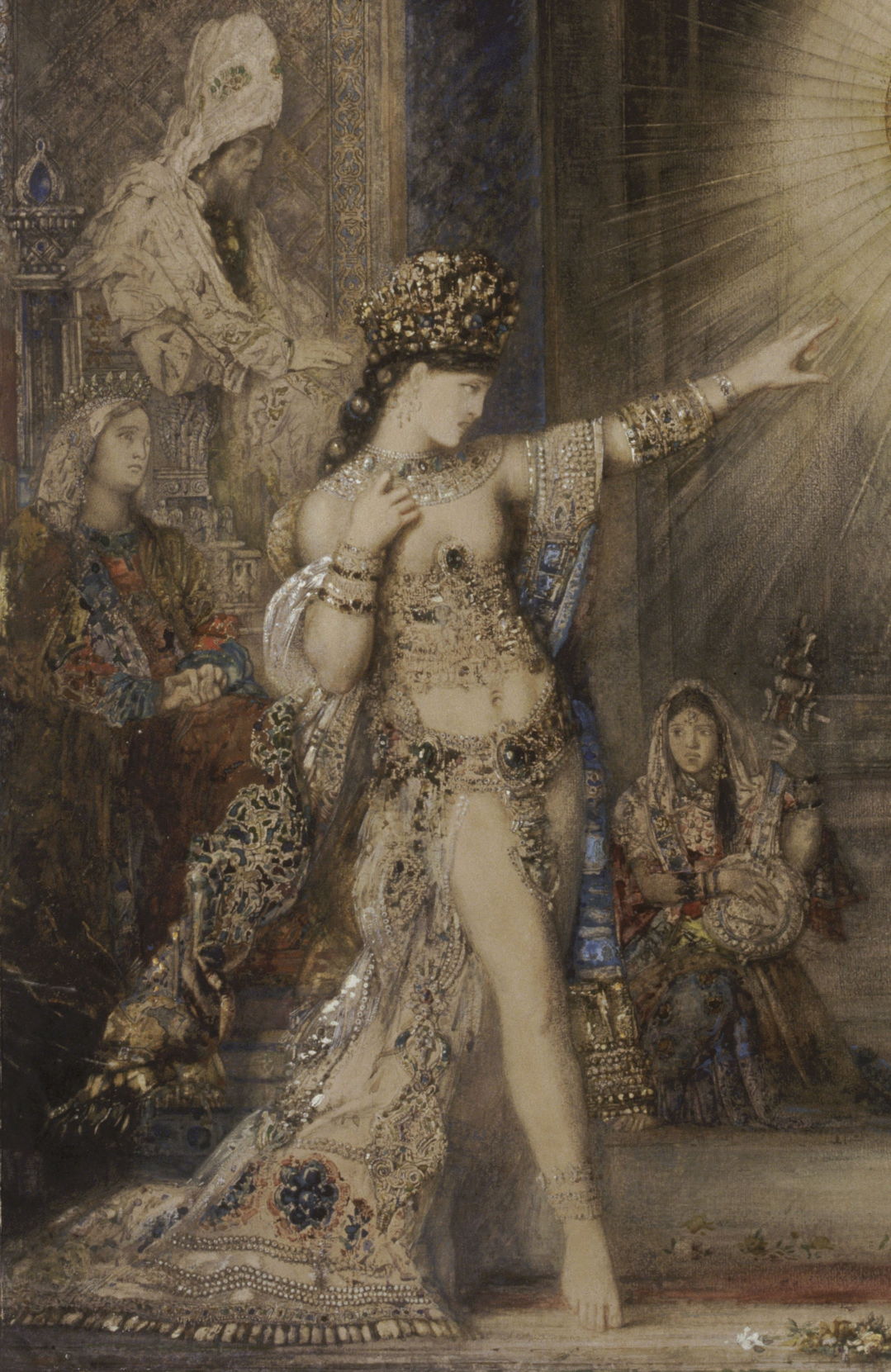
Facial expressions are not theatrical as might have been expected in the work of a more conventional history painter of the day.

This slightly later oil version of The Apparition (1876-77), now in the Fogg Museum, gives a better idea of the original effect of Moreau’s watercolour, although the panther has moved across to replace the musician, and the background is quite different.
Moreau hadn’t painted Salome and The Apparition as a pair. Their compositions are individual, and mutually conflicting in details of the palace, the position of Herod’s throne, and more. Salome is one of the most iconographically rich paintings ever made, and it’s not surprising that some critics found it phantasmagoric. The Apparition is dominated by the same eye-to-eye contact that made Moreau’s Oedipus and the Sphinx so compelling, but here it’s between a notorious dancer and the severed head of the holiest man after Christ himself.
In 1877, the year after that Salon, Gustave Flaubert published three short stories, including an extended account of the traditional biblical narrative with Herodias at its centre. The British writer Oscar Wilde was introduced to that by Walter Pater (philosophical leader of Aestheticism), and in 1884 Joris-Karl Huysmans’ À rebours was published, a novel including a description of Moreau’s Salome paintings.
Wilde’s one-act play Salome was first published in French in 1891, and was soon translated into English and German. Banned from public performance in Britain, it received its premier in Paris in 1896, but wasn’t performed in public in England until 1931. At the centre of Wilde’s play is the perversion of lust and desire in Salome, best summarised in her words at the end of the play (he calls John the Baptist Jokanaan):
But, wherefore dost thou not look at me Jokanaan? Thine eyes that were so terrible, so full of rage and scorn, are shut now. Wherefore are they shut? Open thine eyes! Lift up thine eyelids, Jokanaan! Wherefore dost thou not look at me? Art thou afraid of me, Jokanaan, that thou wilt not look at me?
If thou hadst looked at me thou hadst loved me. Well I know that thou wouldst have loved me, and the mystery of love is greater that the mystery of death.
After seeing Wilde’s play performed in Berlin in 1902, Richard Strauss resolved to turn it into an opera. He started work on that in the summer of the following year, and Salome was completed and premiered in 1905. A year later, the dancer and choreographer Maud Allan produced a show called Vision of Salomé in Vienna, featuring a notorious version of the Dance of the Seven Veils, Wilde’s title for the dance of Salome before Herod, included in Strauss’s opera. The name quickly became a euphemism for a striptease, and the growing popularity of Salome as an erotic figurehead was named Salomania.
In around fifty years, from the appearance of Moreau’s The Apparition at the Salon in Paris, the traditional story of Herodias obtaining her vengeance by exploiting her daughter’s dance before Herod has been all but forgotten. The martyrdom of the second holiest figure in the gospels has been transformed into a perverse confusion of sex and death. The anonymous daughter of a woman who married her divorced husband’s brother has become the ultimate femme fatale: beautiful, sexy, and dangerous to know. Most unusually this change in story was largely triggered and driven by a painting: Moreau’s The Apparition.
Moreau was then concerned with the preparation of other paintings for the Exposition Universelle of 1878 in Paris.
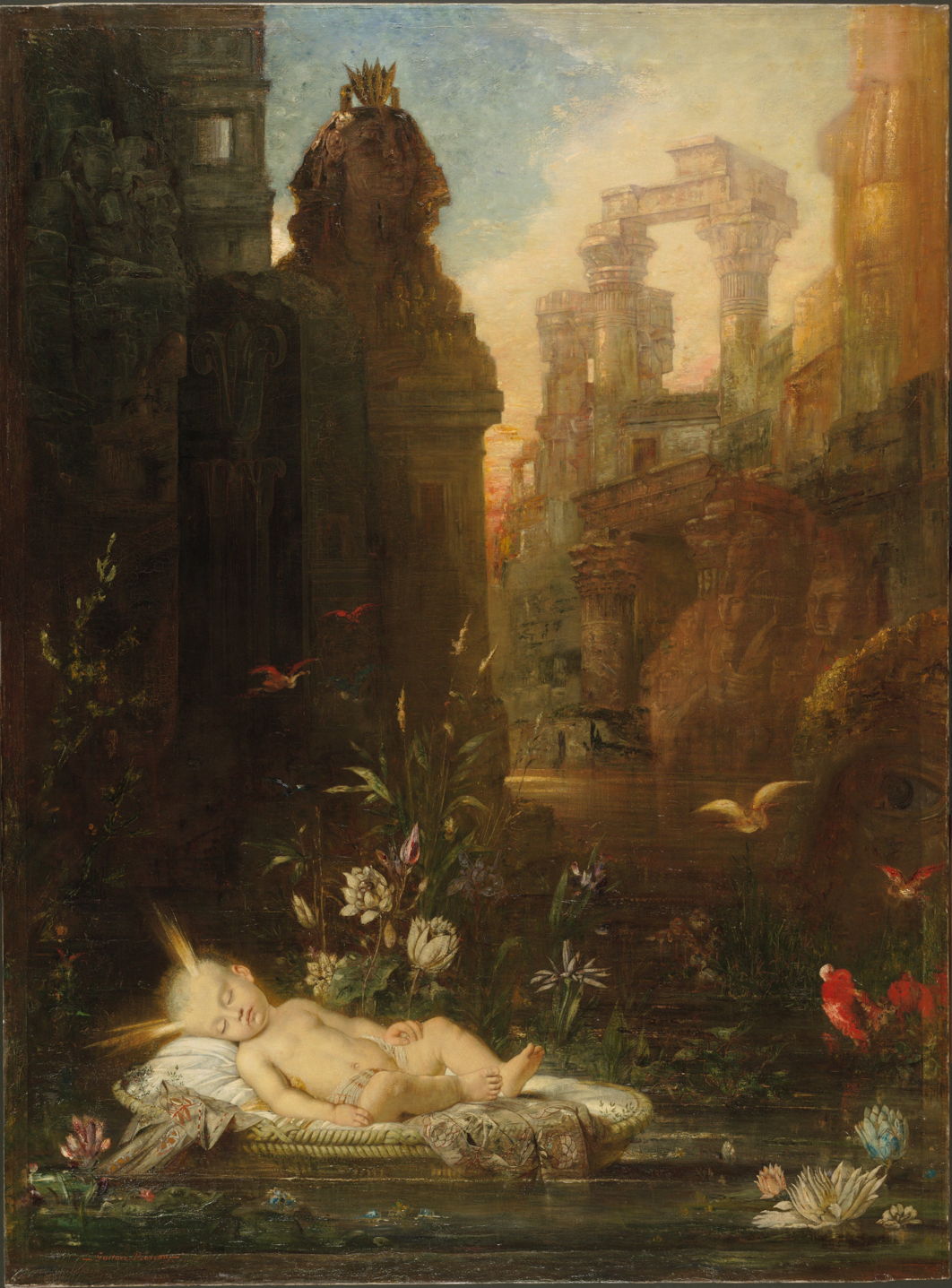
Infancy and dawn are themes in Moïse Exposé sur le Nil (The Infant Moses) (c 1876-78), a radiantly beautiful depiction of the infant Moses asleep, prior to his discovery in the bullrushes. Moses is new life, new Judaeo-Christian beliefs, new law, and the new regime. Set against a background derived from photographs of Egyptian ruins symbolising the ancient, pre-Jewish, and decaying, it laid out Moreau’s hope for the French nation.
The baby Moses is marked out as being holy by the rays emanating from his temples, and surrounded by exotic flowers and birds. Most unusually, Moreau doesn’t show the traditional and popular moment of discovery of the infant in the bullrushes, but a static scene beforehand.
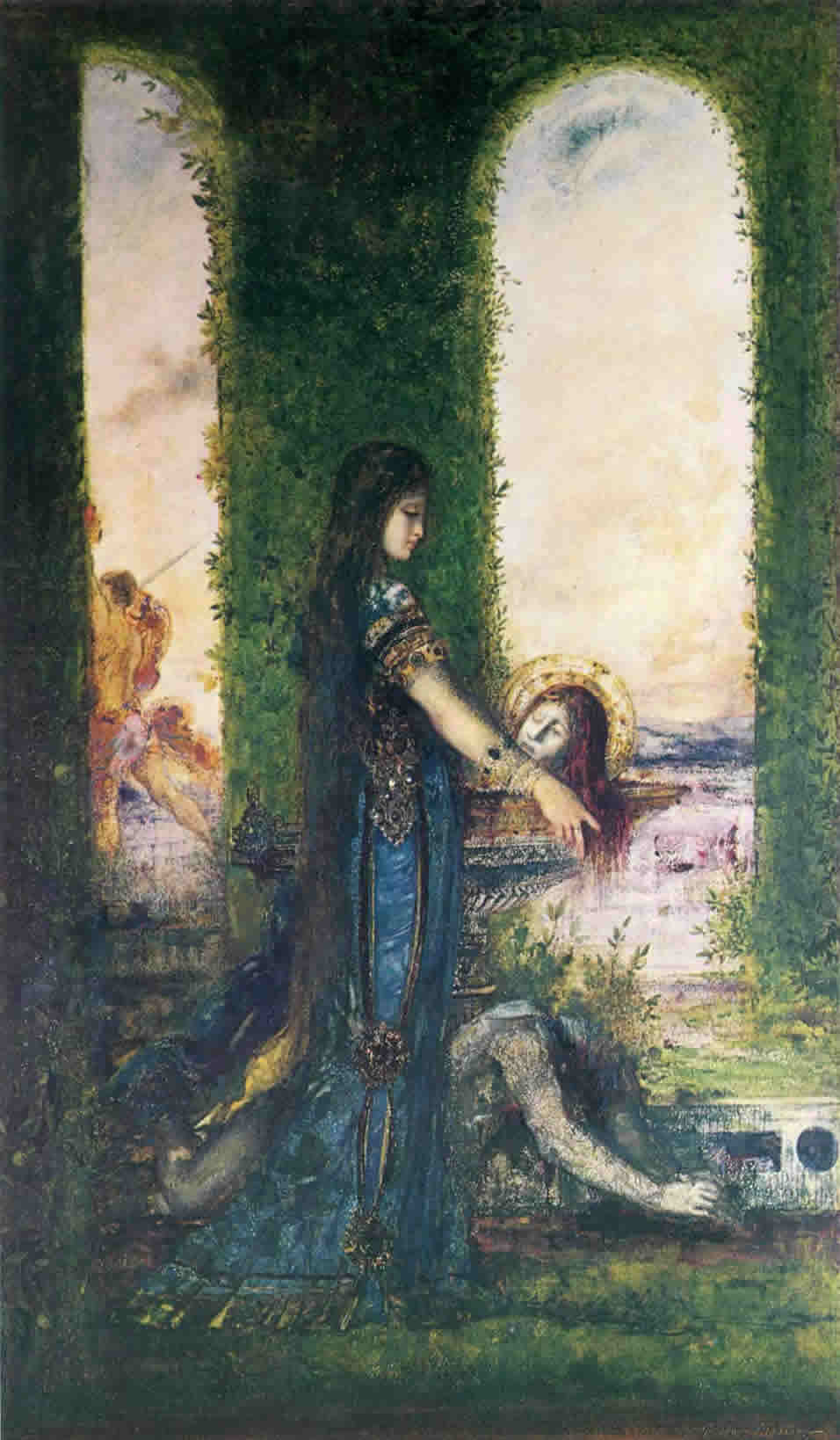
Moreau revisited his new myth of Salome and John the Baptist, in his strange watercolour of Salome in the Garden (1878). A beautiful and decorated figure of Salome is walking in an overgrown garden, carrying the severed head of John the Baptist on a large platter. Her eyes are closed, or perhaps looking down at the head, and John’s eyes are closed. Beside her is a headless statue of a man crawling, which could perhaps be the body of John, and outside is a man, possibly the executioner waving his sword.
References
Cooke P (2014) Gustave Moreau, History Painting, Spirituality and Symbolism, Yale UP. ISBN 978 0 300 20433 9.
Mathieu P-L (1998, 2010) Gustave Moreau, the Assembler of Dreams, PocheCouleur. ISBN 978 2 867 70194 8.