Normal view

There are new articles available, click to refresh the page.
Today — 2 April 2026Main stream

The bicentenary of Gustave Moreau: 1872-78

By: hoakley
2 April 2026 at 19:30

Once Gustave Moreau had recovered from the trauma of the Franco-Prussian War, he started on his next major works. He had been invited to join the select group of artists who were engaged to paint murals in major public buildings, but declined. Despite that, in 1875 he was made a member of the Legion of Honour, which pleased him and his mother deeply. All he needed now was another success at the Salon.

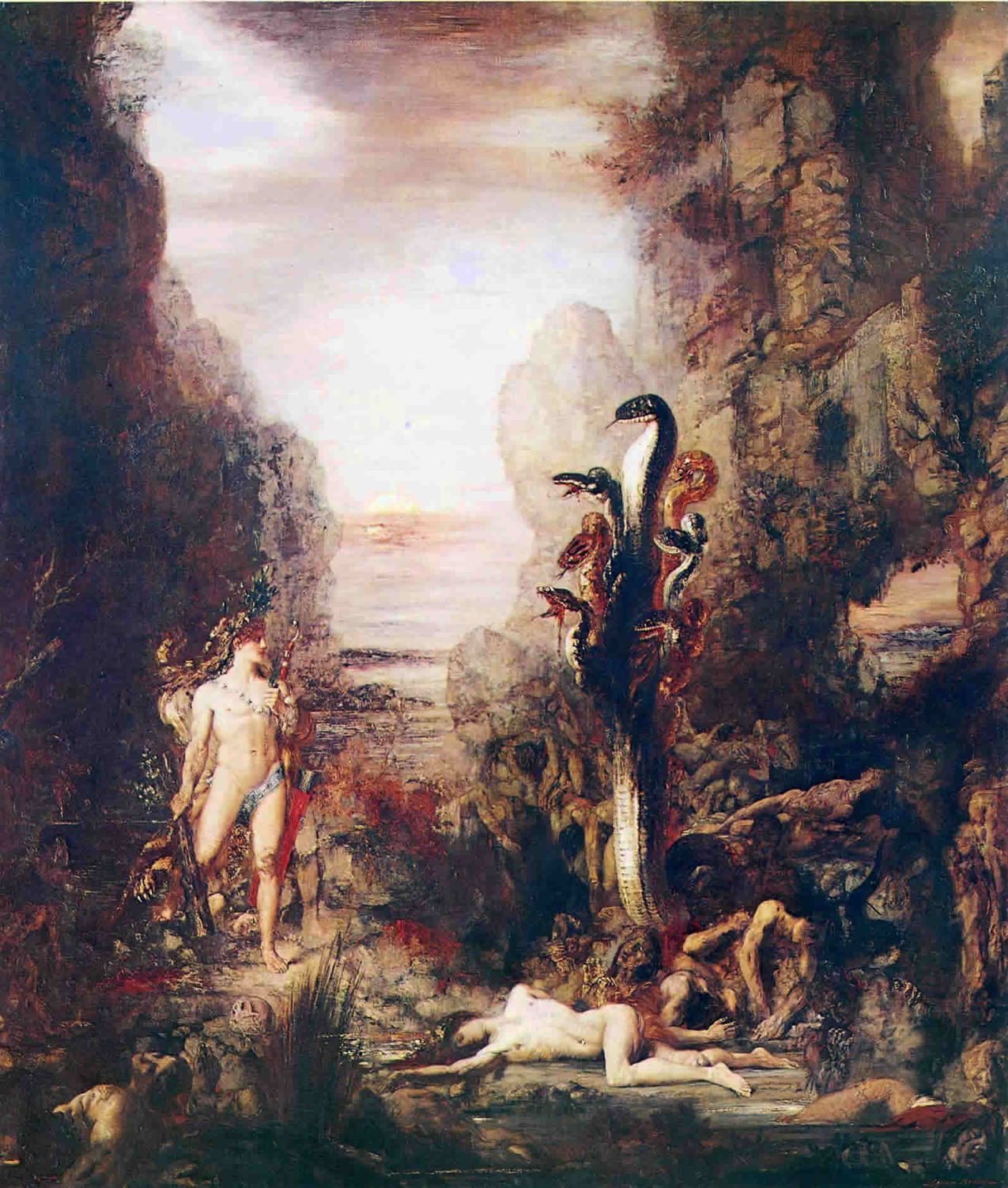
One of his four paintings exhibited at the Salon of 1876 told the second of Hercules’ twelve labours, his battle with the Lernean Hydra.
moreauherculeslerneanhydra
Gustave Moreau (1826–1898), Hercules and the Lernean Hydra (1876), oil on canvas, 175 × 153 cm, The Art Institute of Chicago, Chicago, IL. Wikimedia Commons.

The Hydra was a poisonous monster with the body of a dog and multiple serpent heads, whose breath alone could kill. According to surviving written accounts, Hercules covered his mouth and nose with a cloth for protection from the deadly fumes, fired flaming arrows into the Hydra’s lair to awaken it, then set about trying to kill it.

When he discovered that cutting off its heads with a sickle or sword only resulted in two more growing back, Hercules enlisted the help of his nephew Iolaus, who cauterised the wounds with a firebrand to prevent regrowth. Hercules then cut off the one immortal head using a golden sword given to him by Athena. He also took some of the Hydra’s blood, which was the poison used on the arrow with which he later killed Nessus.

Moreau puts his canvas into its portrait orientation to emphasise the Hydra towering over Hercules, who is fully armed, with club, bow and arrows, and more. The moment chosen is the initial confrontation, with Hercules staring steely-faced at the Hydra. This is consistent with Moreau’s aversion to a more theatrical treatment.

This was well-received and extensively debated, even generating a long-standing controversy over its possible political connotations. It was suggested at the time that the Hydra represented the forces of anarchy behind the insurgency of the Commune in 1871. Others preferred instead that the Hydra represented Bismarck and the German princes behind the Franco-Prussian War of 1870.

Two of his other paintings shown in 1876 were based on the story of Salome and the execution of Saint John the Baptist. Their underlying narrative is biblical, and straightforward. The unnamed daughter of Herodias (subsequently named as Salome) performed a dance at a birthday feast thrown by King Herod. The dance so pleased Herod that he offered her anything that she wanted, up to half his kingdom. She asked not for riches, but for the head of Saint John the Baptist, the earthly messenger sent to announce the birth and ministry of Jesus Christ. Reluctantly, Herod agreed, John was beheaded in prison, and his head brought to her on a plate; the dancer gave the head to her mother.

This has been a popular story for religious paintings, and by far the most common scene involves John’s head being brought on a plate, or variations around that. Moreau was clearly interested in other parts of the story, and in Salome herself. Moreau’s apparently sudden interest in Salome was sparked by the story, probably mythical, of a woman Communard known as the pétroleuse, who seemingly took delight in setting buildings alight. That suggests it wasn’t until the summer of 1871 that he started work on his paintings of Salome.
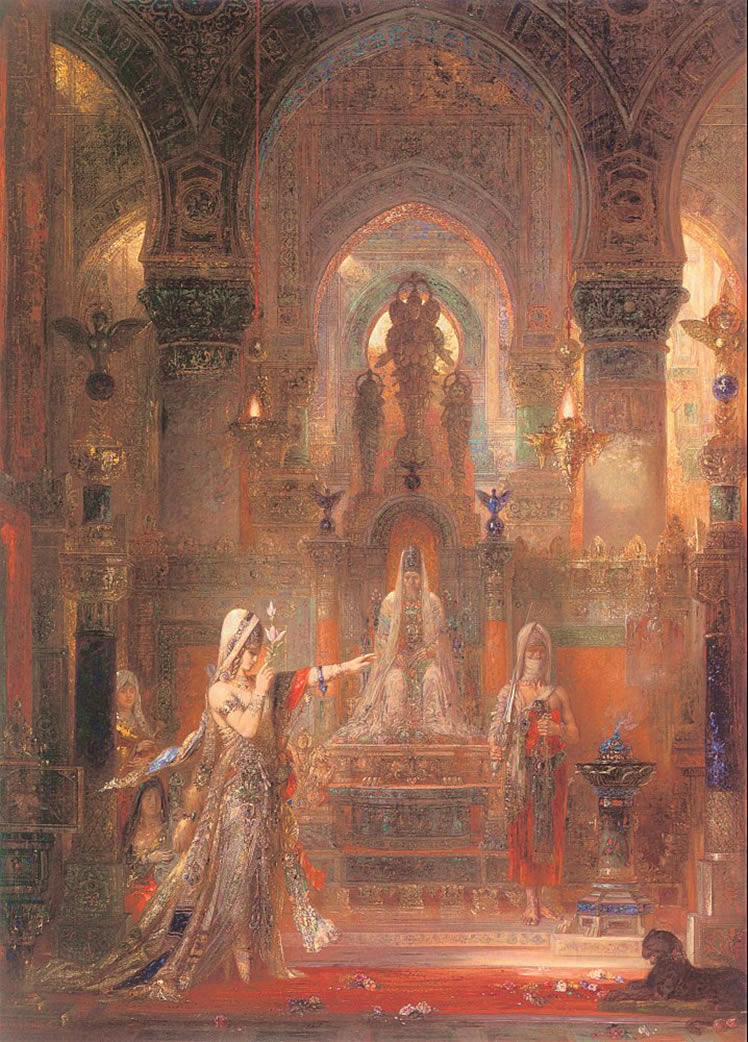
moreausalome
Gustave Moreau (1826–1898), Salome (1876), oil on wood, 144 x 103.5 cm, Armand Hammer Museum of Art, Los Angeles, CA. Wikimedia Commons.

The culmination of Moreau’s quest for the right scene to show the story of Salome the dancer is this extraordinary oil painting shown at the 1876 Salon.

The cadaveric King Herod sits on this throne while Salome is almost static on her points, and pointing towards the right. The executioner stands at the foot of the throne, and a couple of other women (including, perhaps, Salome’s mother) are at the left. Salome holds a lotus flower in her right hand, and other flowers are strewn on the floor. John’s head is nowhere to be seen, so we must presume that the moment selected by Moreau is when Salome chooses to receive that as her reward.

The rest of the painting consists of an unprecedented fusion of images, icons, and objects drawn from a diverse range of cultures. Detailed examination has shown these to be associated with the Hagia Sophia in Istanbul, the Alhambra in Granada, the Great Mosque of Cordoba, and several mediaeval cathedrals. Motifs have been identified from Etruscan, Roman, Egyptian, Indian, and Chinese art and culture.

But Moreau wasn’t content to show only that scene from the story. The other painting was to consider Salome with the head of John the Baptist as an apparition, and is now represented in three different versions.

moreauapparitionmgm
Gustave Moreau (1826–1898), The Apparition (1875), oil on canvas, 142 × 103 cm , Musée National Gustave-Moreau, Paris. Wikimedia Commons.

The Apparition (1875) in the Musée National Gustave-Moreau is one of Moreau’s earliest attempts to express this. It takes the central part of Salome and adds the floating, severed head of John. Salome has now been transformed into the provocative, under-dressed femme fatale shown by subsequent artists. King Herod’s throne has been moved to the left of the painting, and he now looks in the direction of the apparition.

moreauapparitiondorsay
Gustave Moreau (1826–1898), The Apparition (c 1876), watercolour on paper, 106 x 72 cm, Musée d’Orsay, Paris. Wikimedia Commons.

This watercolour painting of The Apparition (c 1876), now in the Musée d’Orsay, was that shown at the Salon, although its colours are far weaker than when it was first exhibited. The cadaveric King Herod sit on his throne, overseeing the scene from the left edge. Herodias, presumably, sits by his feet, and a musician for Salome’s dance is shown further back. At the right edge is the executioner, John’s blood still on his sword.

Salome is now nearly nude, her body decorated with an abundance of strategically-placed jewellery and adornments. She points at the apparition with her left hand, trying to stare it out, her face as blank as everyone else’s. She stands on her points, but there is no sign of movement. The floor isn’t just strewn with flowers, but is now stained with the dripping blood from the severed head.
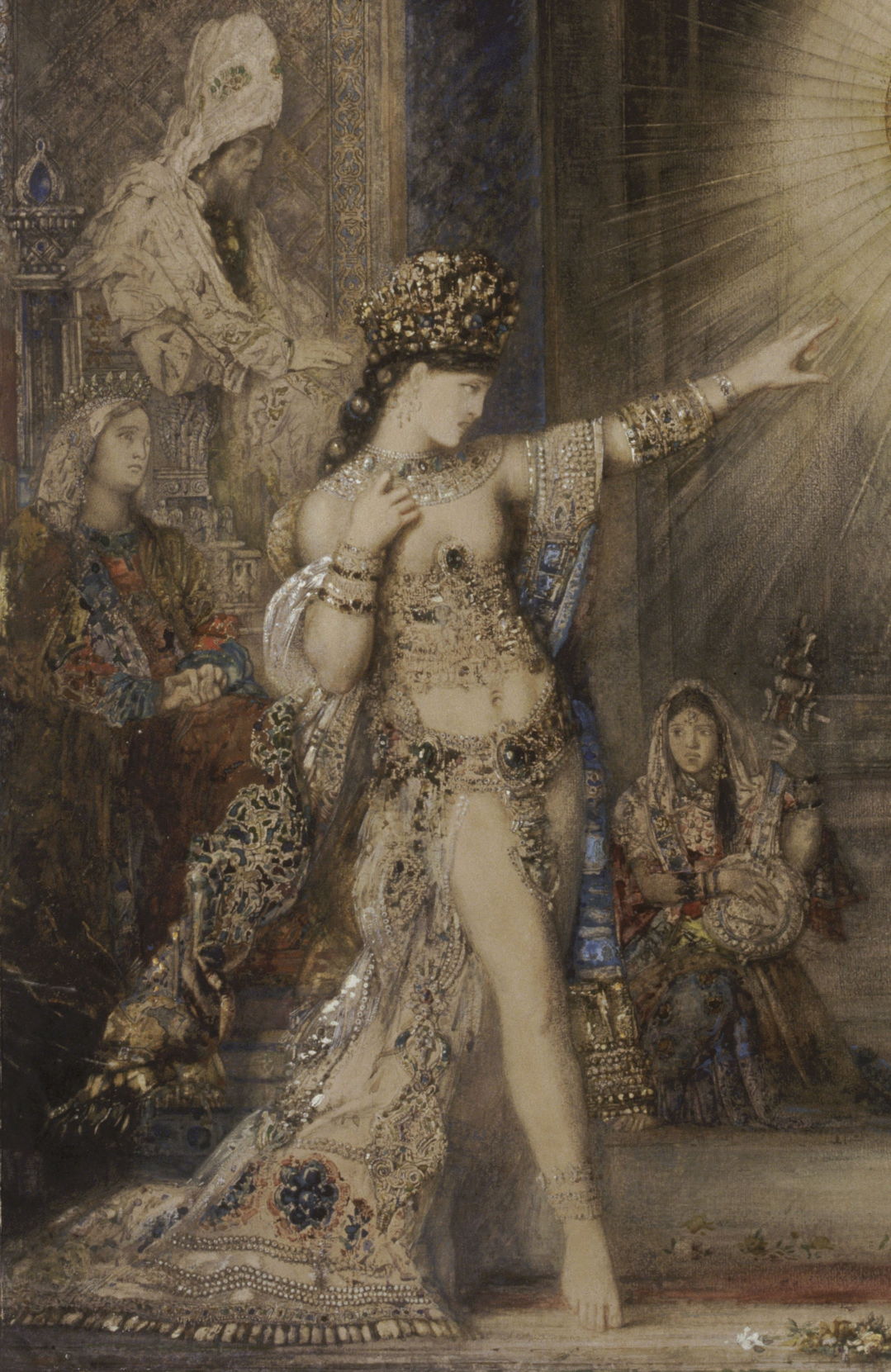
moreauapparitiondorsayd1
Gustave Moreau (1826–1898), The Apparition (detail) (c 1876), watercolour on paper, 106 x 72 cm, Musée d’Orsay, Paris. Wikimedia Commons.

Facial expressions are not theatrical as might have been expected in the work of a more conventional history painter of the day.

moreauapparitionfogg
Gustave Moreau (1826–1898), The Apparition (1876-77), oil on canvas, 55.9 x 46.7 cm, Harvard Art Museums/Fogg Museum (Bequest of Grenville L. Winthrop), Cambridge, MA. Courtesy of Harvard Art Museums.

This slightly later oil version of The Apparition (1876-77), now in the Fogg Museum, gives a better idea of the original effect of Moreau’s watercolour, although the panther has moved across to replace the musician, and the background is quite different.

Moreau hadn’t painted Salome and The Apparition as a pair. Their compositions are individual, and mutually conflicting in details of the palace, the position of Herod’s throne, and more. Salome is one of the most iconographically rich paintings ever made, and it’s not surprising that some critics found it phantasmagoric. The Apparition is dominated by the same eye-to-eye contact that made Moreau’s Oedipus and the Sphinx so compelling, but here it’s between a notorious dancer and the severed head of the holiest man after Christ himself.

In 1877, the year after that Salon, Gustave Flaubert published three short stories, including an extended account of the traditional biblical narrative with Herodias at its centre. The British writer Oscar Wilde was introduced to that by Walter Pater (philosophical leader of Aestheticism), and in 1884 Joris-Karl Huysmans’ À rebours was published, a novel including a description of Moreau’s Salome paintings.

Wilde’s one-act play Salome was first published in French in 1891, and was soon translated into English and German. Banned from public performance in Britain, it received its premier in Paris in 1896, but wasn’t performed in public in England until 1931. At the centre of Wilde’s play is the perversion of lust and desire in Salome, best summarised in her words at the end of the play (he calls John the Baptist Jokanaan):
But, wherefore dost thou not look at me Jokanaan? Thine eyes that were so terrible, so full of rage and scorn, are shut now. Wherefore are they shut? Open thine eyes! Lift up thine eyelids, Jokanaan! Wherefore dost thou not look at me? Art thou afraid of me, Jokanaan, that thou wilt not look at me?
If thou hadst looked at me thou hadst loved me. Well I know that thou wouldst have loved me, and the mystery of love is greater that the mystery of death.

After seeing Wilde’s play performed in Berlin in 1902, Richard Strauss resolved to turn it into an opera. He started work on that in the summer of the following year, and Salome was completed and premiered in 1905. A year later, the dancer and choreographer Maud Allan produced a show called Vision of Salomé in Vienna, featuring a notorious version of the Dance of the Seven Veils, Wilde’s title for the dance of Salome before Herod, included in Strauss’s opera. The name quickly became a euphemism for a striptease, and the growing popularity of Salome as an erotic figurehead was named Salomania.

In around fifty years, from the appearance of Moreau’s The Apparition at the Salon in Paris, the traditional story of Herodias obtaining her vengeance by exploiting her daughter’s dance before Herod has been all but forgotten. The martyrdom of the second holiest figure in the gospels has been transformed into a perverse confusion of sex and death. The anonymous daughter of a woman who married her divorced husband’s brother has become the ultimate femme fatale: beautiful, sexy, and dangerous to know. Most unusually this change in story was largely triggered and driven by a painting: Moreau’s The Apparition.

Moreau was then concerned with the preparation of other paintings for the Exposition Universelle of 1878 in Paris.
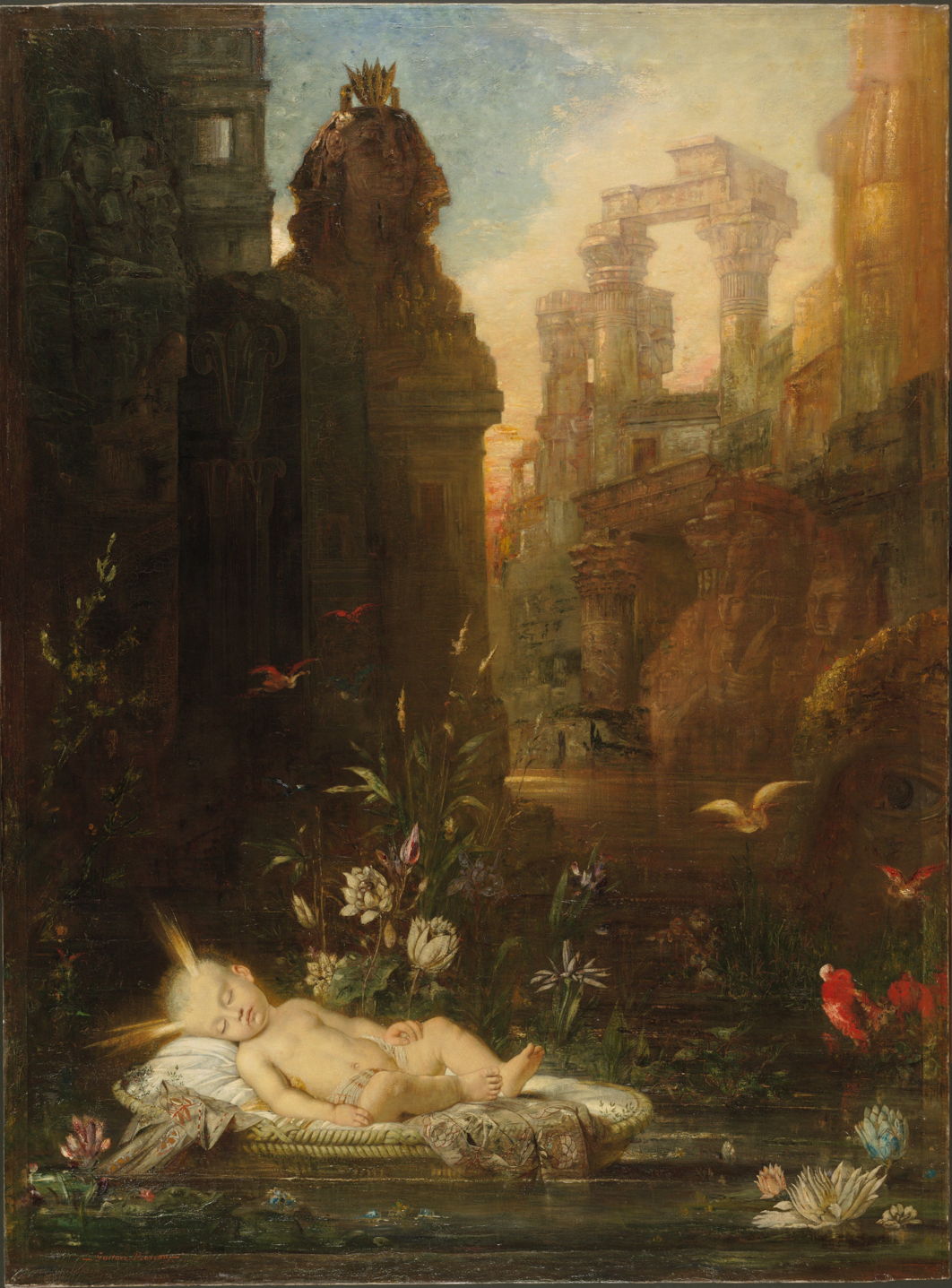
moreauinfantmoses
Gustave Moreau (1826–1898), Moïse Exposé sur le Nil (The Infant Moses) (c 1876-78), oil on canvas, 185 x 136.2 cm, Harvard Art Museums/Fogg Museum (Bequest of Grenville L. Winthrop), Cambridge, MA. Courtesy of Harvard Art Museums, via Wikimedia Commons.

Infancy and dawn are themes in Moïse Exposé sur le Nil (The Infant Moses) (c 1876-78), a radiantly beautiful depiction of the infant Moses asleep, prior to his discovery in the bullrushes. Moses is new life, new Judaeo-Christian beliefs, new law, and the new regime. Set against a background derived from photographs of Egyptian ruins symbolising the ancient, pre-Jewish, and decaying, it laid out Moreau’s hope for the French nation.

The baby Moses is marked out as being holy by the rays emanating from his temples, and surrounded by exotic flowers and birds. Most unusually, Moreau doesn’t show the traditional and popular moment of discovery of the infant in the bullrushes, but a static scene beforehand.
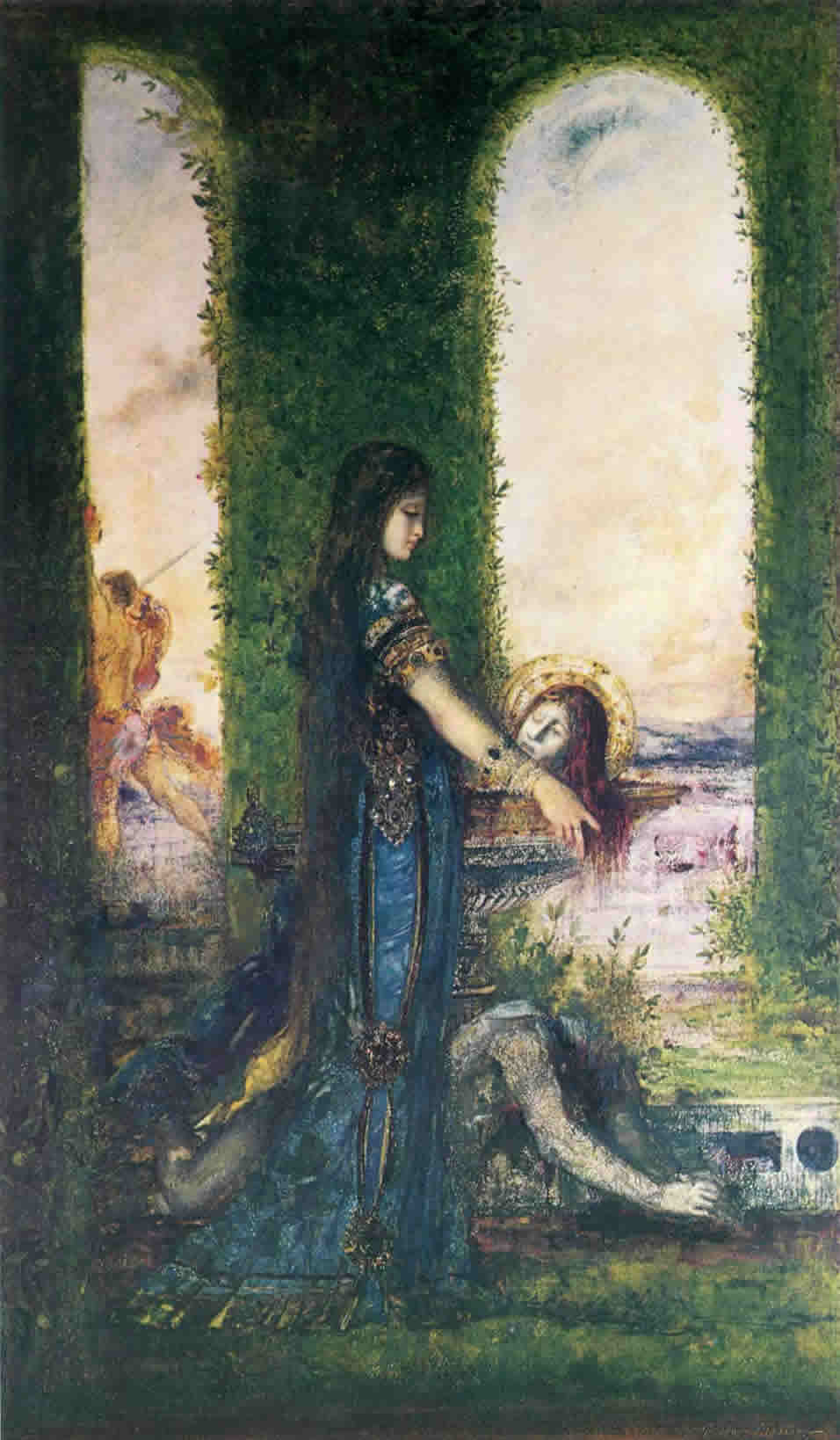
moreausalomeinthegarden
Gustave Moreau (1826–1898), Salome in the Garden (1878), watercolour on paper, dimensions not known, Private collection. Wikimedia Commons.

Moreau revisited his new myth of Salome and John the Baptist, in his strange watercolour of Salome in the Garden (1878). A beautiful and decorated figure of Salome is walking in an overgrown garden, carrying the severed head of John the Baptist on a large platter. Her eyes are closed, or perhaps looking down at the head, and John’s eyes are closed. Beside her is a headless statue of a man crawling, which could perhaps be the body of John, and outside is a man, possibly the executioner waving his sword.

References

Cooke P (2014) Gustave Moreau, History Painting, Spirituality and Symbolism, Yale UP. ISBN 978 0 300 20433 9.
Mathieu P-L (1998, 2010) Gustave Moreau, the Assembler of Dreams, PocheCouleur. ISBN 978 2 867 70194 8.

《观点》专栏:中国正蓄势取代美国,抢占全球科研领导地位 - RFI - 法国国际广播电台

2 April 2026 at 19:15
02/04/2026 - 12:43

法国《观点》周刊专栏作家 Jean-François Bouvet 日前发文表示,倘若“中央帝国”北京在军事上尚未能与美国比肩,但其科研产出却正迈向全球主导地位。自第二次世界大战结束以来,美国始终是全球研究与开发(R&D)投资的最大资助方。然而,根据加州大学圣地亚哥分校“科学与创新政策前沿”项目(FSIP)为《自然指数》所做的分析,中国有望在两到三年内取而代之,夺得这一领导地位。

文章作者表示,这场变革源自于两股力量的叠加:美国公共投资的停滞不前,与中国当局研发支出的持续攀升。

中国有望成为全球科研中心

根据经合组织(OECD)数据,2023年中国公共研发支出达1330亿美元,十年间增幅高达90%。同期,美国研发支出仅增长12%,总额为1550亿美元。此外,中国计划在2030年前每年至少将整体研发支出提高7%,这意味着每年将投入数以十亿计的额外资金——涵盖公共与私人、基础与应用领域的研究。

据澳大利亚独立智库战略政策研究所(ASPI)运营的技术追踪工具显示,在近90%的关键技术领域,中国已处于领先地位,而这些技术被认为能够"显著增强或威胁一国的国家利益"。

特朗普的反复无常或令美国科学地位下滑

在基础研究领域,FSIP项目的研究人员认为,由于参议院对白宫削减预算的要求持反对态度,美国国家科学基金会(NSF)和国立卫生研究院(NIH)等联邦机构今年的整体资助规模将基本保持稳定。然而,对于未来几年国会能否持续抵制特朗普政府大幅削减预算的意图,他们则不那么乐观。

现任北京大学教授的饶毅(音译 Rao Yi ),主持着一个顶尖脑科学研究实验室。2007年回国后,他将在美国积累的经验用于推动中国生命科学的振兴。在《自然》杂志2025年6月的一篇专题报道中,这位神经科学家阐述了美国的犹豫徘徊如何可能为中国提供追赶国际先进水平的契机——甚至有望在十年内使中国在基础研究领域超越美国。当然,这恐怕并非"让美国再次伟大"选民们最关心的议题。

研发:未来实力的核心驱动力

“基础研究处于发展进程的核心,它是十年后创新与发现得以实现的根基。” 研究政策专家、FSIP项目联合负责人罗伯特·康恩如是说。

不过,尽管中国整体上正逼近并有望超越美国的研发水平,在军事领域却仍远未能与之比肩。

目前,美国引以为傲的国防技术佼佼者众多:世界最大航母福特号、B-2隐形轰炸机、F-35隐形战斗机、高能激光武器…… 美军在中东的部署生动展现了其军事力量的强大与多面性。而特朗普还不满足于此。美国国防预算已接近万亿美元——约为法国的十五倍——他还打算明年再提高50%。

在军事投入上,中国与美国仍相差悬殊:预计2026年中国军费约合2750亿美元,不及美国的四分之一。尽管如此,自2016年以来,中国国防预算每年以7%至8%的幅度递增。习近平着眼长远,但在推进重大工程时同样雷厉风行——5万公里高铁网络的破纪录建设速度,以及中国在航天领域的亮眼表现,无不印证了这一点。

文章总结指,中国同样志存高远:2049年,中华人民共和国将迎来建国100周年。尽管人口形势持续下行,这个“中央帝国”——似乎命中注定——志在届时重回世界第一强国的宝座。凭借“一带一路”、庞大的工业产能、强大的军事力量、登峰造极的研发实力…… 以及硬币的另一面:高科技全面监控体系。

Funeral director admits preventing 30 burials and stealing donations

2 April 2026 at 18:17
BBC Breaking NewsBBC

A funeral director has admitted preventing the burials of 30 bodies and stealing donations made to charities by mourners.

Robert Bush, 48, was arrested after police investigated Hull-based Legacy Independent Funeral Directors following a report of "concern for care of the deceased" in March 2024.

Bush, formerly of East Yorkshire and now living in West Yorkshire, pleaded guilty at Hull Crown Court to 30 counts of preventing a lawful and decent burial, and one of theft relating to charitable donations.

He previously admitted presenting families with the ashes of strangers and fraudulently selling funeral plans. He will be sentenced at a later date.

This breaking news story is being updated and more details will be published shortly. Please refresh the page for the fullest version.

You can receive Breaking News on a smartphone or tablet via the BBC News App. You can also follow @BBCBreaking on X to get the latest alerts.

AirPods Max 2 体验:降噪更强声音更饱满,稳定更新的小升级

By: 梁梦麟
2 April 2026 at 18:24

没想到,苹果就这样无声无息地推出了 AirPods Max 2,定价还是 3999 元。

将芯片从 H1 升级到 H2,蓝牙版本、降噪性能提升的同时也加入了自适应音频功能。机身搭载了苹果设计的大动圈单元,配合 H2 芯片在音质上也起了一些变化。

对比之前只是替换成 USB-C 接口的小小「升级」款,AirPods Max 2 算是在一些细微的地方和功能表现上做了一点实际的小调整。

降噪,最大更新点

配置上最大的升级,还是要从换芯说起。

AirPods Max 2 双侧都搭载了 H2 芯片,自身支持的蓝牙版本从上一代的 5.0 升级到 5.3。

连接稳定性表现和之前差别不大,AirPods Max 2 现在连接 MacBook 和 iOS 设备用非官方应用看视频和游戏基本上不会感受到明显延迟,日常使用的无线表现还挺稳定的。

降噪表现也很强,AirPods Max 2 能够压住办公场景、咖啡厅中的常规噪声,像是空调的风噪声、键盘敲击声以及咖啡厅中的背景音乐,戴上耳机之后都基本听不到了。

像我这种工作时会在笔记本下方垫上一个 6 风扇的散热器矩阵的用户,戴上 AirPods Max 2 之后基本听不到风扇的声音。就算是把风扇开到最大然后贴近听,也只是有一点风细微流动的感觉。

而且,AirPods Max 2 降噪切换的响应速度很快。它检测到用户带上就会马上开启,开启会有一个短暂的变化过程,让你感受到降噪开启的过程,不会有「啪」一下瞬间变安静的突兀感。

降噪开启时,耳机内的感觉都很干净和安静,没有很明显的底噪出现,这对于提升声音的听感也有帮助。

除了降噪性能有 1.5 倍提升,AirPods Max 2 比上一代还增加了自适应降噪音频的功能。它能让耳机主动调节降噪级别,根据不同的环境改编降噪力道,从而保证佩戴舒适度。调节也很无感,人戴着走过场也不会有明显感知,增加使用舒适度。

用户可以通过左侧耳机上的按键,自主切换到通透模式。

不得不说,苹果的通透模式还是目前做得最好的一款。通透模式下的声音很自然,风声很顺畅绵滑,键盘敲字的声音很真实,人的讲话声不会有明显的「麦克风录制感」,开启之后跟摘掉耳机的感觉差不太多。

日常在咖啡店使用,只需要简短和别人交流,用这个模式就行。

声音,更甜更饱满

声音方面,AirPods Max 2 搭载苹果设计的动圈单元。和上一代 AirPods Max 相比,二代改用了 H2 芯片,并在耳机上加入了定制的高动态放大器。

机身内置自适应均衡功能,这项功能已针对 H2 芯片进行重新调校。用户佩戴之后,耳机可以根据耳机的佩戴情况(耳垫的贴合度、佩戴形态等要素)对声音输出进行调整,从而输出适配适合当前佩戴状态的声音效果。

连接方式的部分,AirPods Max 2 同样支持 USB-C 连接和蓝牙连接。

手机和 MacBook 以 USB-C 有线连接的时候,耳机会启动成支持无损音频的有线连接模式,在 iOS 和 macOS 的声音菜单会明确标注出来给用户选择。

蓝牙的部分,目前还是只有不支持无损的 AAC。AirPods Max 2 要听到无损,还是只能用 USB-C 有线连接。

听感部分,苹果这次加的高动态放大器可配合定制单元提供更多动态,在声音的低频、人声以及声场表现方面会有所提升。

声音整体比上一代听着更加厚实饱满,鼓点的质感和敲击时力道更强,层次感也比上一代突出。加上,这次苹果调声时提高了整体的清晰度,声效处理更突出,声音的边缘也比之前锐利,提升锐度的同时增加声效的饱满度,会让声音听起来更加扎实丰富,不至于因为提升锐度、清晰度而产生干涩感。

除了声音厚度和质感提升,AirPods Max 2 的声音延展比上一代舒服和顺畅。

特别是在用 USB 播放无损音频的时候,信息量增加、声音精度提升时,AirPods Max 2 的声效边缘更加顺畅,没有明显的棱角,听起来更舒服。乐器的发声过程更加完整,乐器的余韵慢慢消失,这个过程更加真实,听起来数码感也降低不少。

声音精度提升的同时,高频听着也不那么刺激和干涩,声音也能多出一些甜味衍生的高级感。

不过,在 AAC 蓝牙编码的限制下,无线会比有线听着稍稍毛糙一点。如果实在家中或工作桌前面想收音乐,那用有线还是会对音质提升有帮助。

稳定的基本盘

从包装到外观设计,AirPods Max 2 延续了系列的整体风格。

上下层天地盖纯白包装展开之后就是装在智能耳机套里面的 AirPods Max 2,耳机没有折叠结构,头梁加上耳机套刚好能够固定在包装内圈中,可以像手提袋一样提起来。

耳机下侧,附带了一条 USB-C to C 的数据线,可以连接 AirPods Max 2 进行充电和音频传输,剩下的还有一些纸质文件。

AirPods Max 2 的配色和上一代一致,苹果还是提供了午夜色、星光色、蓝色、紫色还有橙色这五个选项。机身外观也没有变化,在还没推出新一代专属的特别配色时,你似乎很难分从外观上分清两代的差异。

机身整体也没有太大的变化,AirPods Max 2 用的还是那个整体覆盖着亲肤材质的网状设计头梁,整体重量是 386.2g,放在旗舰定位的头戴式耳机里面还算是比较重的一款。

基于出色的人体工学设计,头梁和偏松软的网状耳罩能够缓解绝大部分的佩戴压力,AirPods Max 2 在保证稳定的同时,佩戴时没有明显的压力生成点,戴着耳机的头活动起来也挺轻松的,和两百多克的索尼 WH-1000X 系列比起来差别不大。

不过,为了保证佩戴的稳定性,AirPods Max 2 的头梁还是会调得有点紧,部分头围较大的用户佩戴时还是会觉得有些夹头。

我个人的话觉得还好,戴着眼镜使用时,松软的耳罩也可以缓解掉压力,佩戴还算舒服。

有一点要提到的是,AirPods Max 2 耳机上的滑槽要比上一代顺滑舒服。以前想带上头再调整会有些吃力,新版就要舒服很多了。

机身设计一致,续航的差别也不大。根据官方数据,AirPods Max 2 和上一代一样都是在开启降噪下能持续播放 20 小时。

新旧款,怎么选

新推出的 AirPods Max 2,定价还是 3999 元,和上一代一样。

降噪更强,声音更加饱满更有味道,听感在保持苹果原有的理智和平衡时多了一些适应大众口味的味道,让这杯「白开水」变成了有一点原生味道的「矿泉水」,更好入口也在味道上多了一些记忆点。

加上苹果设备的原生态全功能支持,还有优秀的佩戴感和时尚属性,它还是目前最适合 iOS、macOS 设备的旗舰级头戴式无线耳机。

如果你不纠结没有蓝牙无损编码,又或者是没有打算在增加手机 USB-C 接口的负担,那现在直接买这款 AirPods Max 2 也没有问题。

这个定论,对于拥有 Lightning 接口版 AirPods Max 的用户一样。

但如果你已经拥有 USB-C 口的一代 AirPods Max,目前对手上耳机的续航、降噪和声音表现都很满意,那现在也不急着升级,等苹果来更大幅度的升级,又或者是真正推出无损编码的时候再考虑也不晚。

「买吧,不贵。」

#欢迎关注爱范儿官方微信公众号:爱范儿(微信号:ifanr),更多精彩内容第一时间为您奉上。

Unitree Goes Public

2 April 2026 at 18:27

In 2017, Hangzhou-based robotics firm Unitree 宇树科技 launched its first quadruped, Laikago. Laika was the name of the Soviet space dog onboard Sputnik 2, and the American English pronunciation of “go” is similar to that of the Chinese word for dogs, 狗 gǒu. Unitree’s battery-powered tribute to Laika wasn’t fuzzy, but walked on four feet and navigated through basic obstacles.

Unitree founder Wang Xingxing 王兴兴 has long held faith in the potential of robotic canines. Since 2020, when Unitree started gaining media attention, he has insisted in multiple interviews that humans are drawn to four-legged creatures and will have a natural fondness for their artificial counterparts.

Wang Xingxing with a Laikago in 2017. (Source: Bilibili)

Fast forward to 2026, and Unitree has just filed for a $610-million IPO on the Shanghai Stock Exchange. The company is a household name in China after its humanoid robots performed dances at the CCTV Spring Festival Gala for two consecutive years and counting. Through their IPO disclosures (investor prospectus and response letter to the Shanghai Stock Exchange’s inquiries), we get some answers to important questions about the development of embodied AI.

  • How is Unitree profitable?

  • Where is diffusion happening inside China, aside from dancing on TV?

  • Are Chinese robotics companies content to lead in hardware and applications, or do they also see themselves as pursuing some kind of generalized “frontier”?

  • And finally, what does this all mean for US-China dynamics in robotics?

What’s the money maker?

One of the most notable things about Unitree is the fact that it actually makes money. Unprofitability is a near-universal challenge because AI robotics, despite massive advances in the past few years, is still an early-stage technology. Mass adoption has not yet arrived; pathways out of bottlenecks like data are uncertain; and important safety standards have not caught up. Even shipping products consistently can be a challenge for some companies in the space, let alone manufacturing at scale and booking reliable customers.

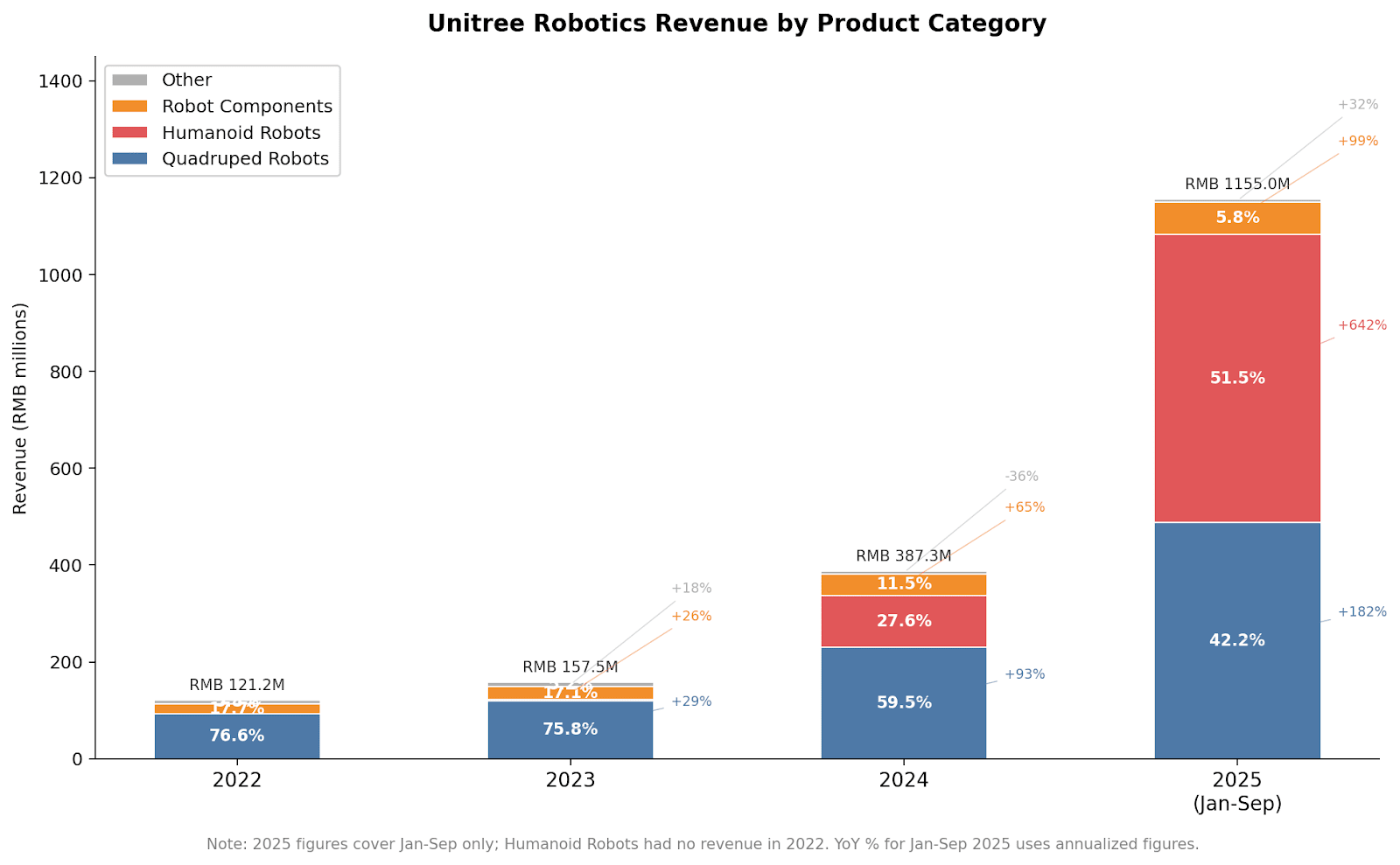
This context is why observers have found Unitree’s ability to turn a profit remarkable. Not only has the company’s net profit been positive since 2024, but from 2024 to 2025, its net profit grew by 204.29%. A look at its growth, broken down by product category, reveals the most significant source of this revenue explosion: humanoids.

It’s perhaps ironic that, despite the company’s longstanding work in quadrupeds, it is humanoids that have catapulted its business model to success. By meeting genuine demand in academia — and staging an especially strong marketing campaign in front of the Chinese public — Unitree has transformed itself into a humanoid frontrunner. Some analyses trace their potent commercialization drive back to Unitree’s origins. Wang Xingxing’s cofounder Chen Li 陈立, who was Wang’s classmate throughout both their undergraduate and Master’s programs, worked in international sales for the Hangzhou-based, partly state-owned surveillance tech giant Hikvision (海康威视) before joining Unitree. Hikvision has been extremely successful at expanding internationally (including in the US before it was added to the Entity List over its involvement in human rights abuses against ethnic and religious minorities in China). Investors have told Chinese media that Chen’s experience is an important asset for Unitree’s global commercialization, driving sales to governments and businesses in particular.

Unitree has earned name recognition in the West, but it is far from the only Chinese robotics company meaningfully shaping the future of embodied AI. In fact, it is part of an increasingly competitive market for AI-powered robots. Among listed peers, UBTECH and Dobot are major competitors named in Unitree’s prospectus. A fellow member of the “Hangzhou Six Dragons,” DEEP Robotics, is betting big on scenario-adapted applications, while AgiBot, by some estimates, shipped even more humanoid units last year than Unitree did.

In their response to the Shanghai Stock Exchange’s inquiry letter, Unitree emphasized in-house development of hardware parts as its key strategy for cutting costs. Unitree designs, builds, and assembles most components (other than commodity components like battery cells, flash storage, and the core computing board) in-house. It does offer outsourced alternatives for add-ons like LiDAR, cameras, and dextrous hands, but has also developed in-house options for all of these.

Where are the robots?

Unitree’s most reliable customers are universities, research institutions, and other companies conducting research into robotics. Its hold on academic customers worldwide is so firm that it’s caused alarm among DC policymakers. In May 2025, the China Select Committee called for Unitree to be designated as a “Chinese military company” and to be added to the Entity List.

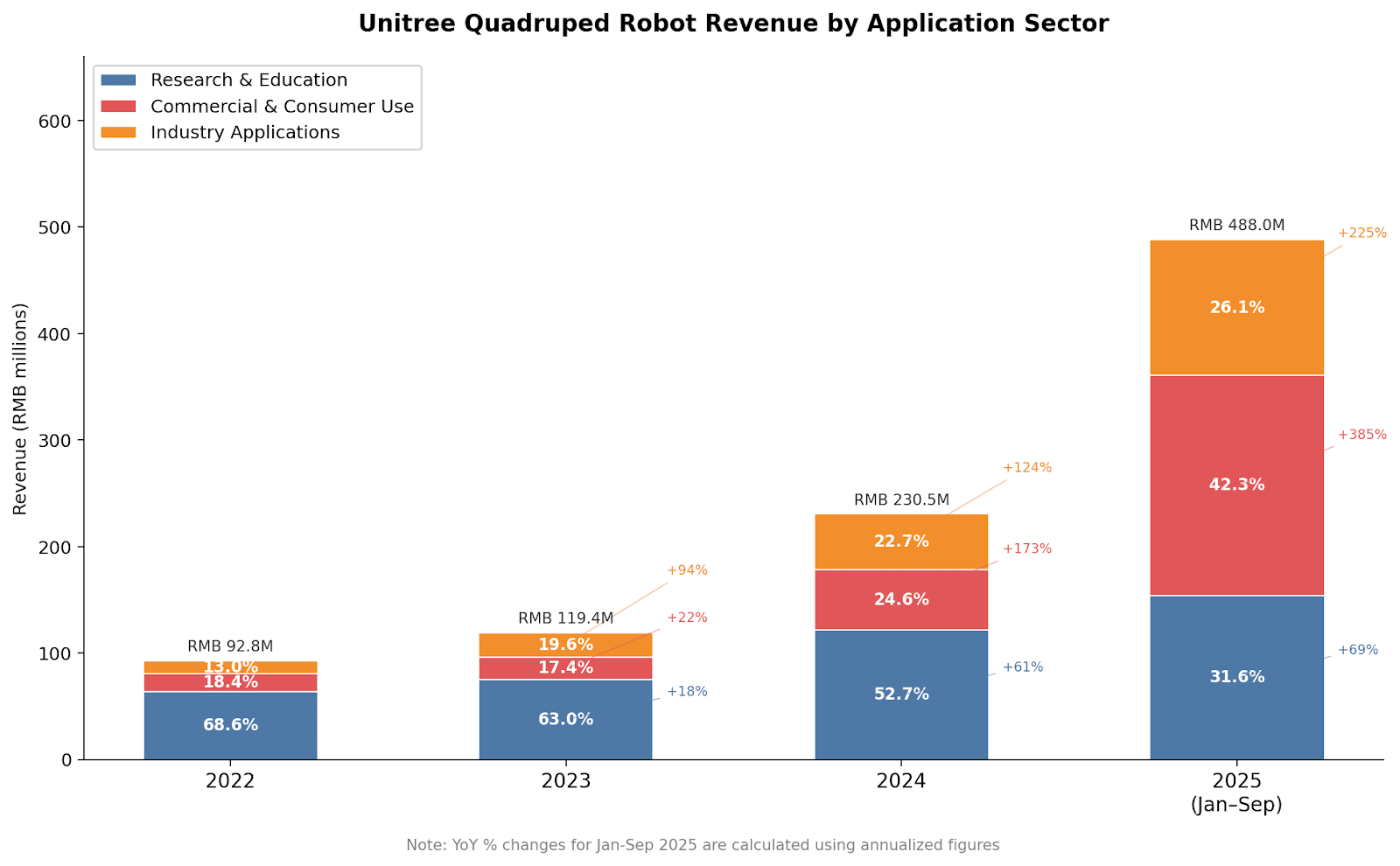
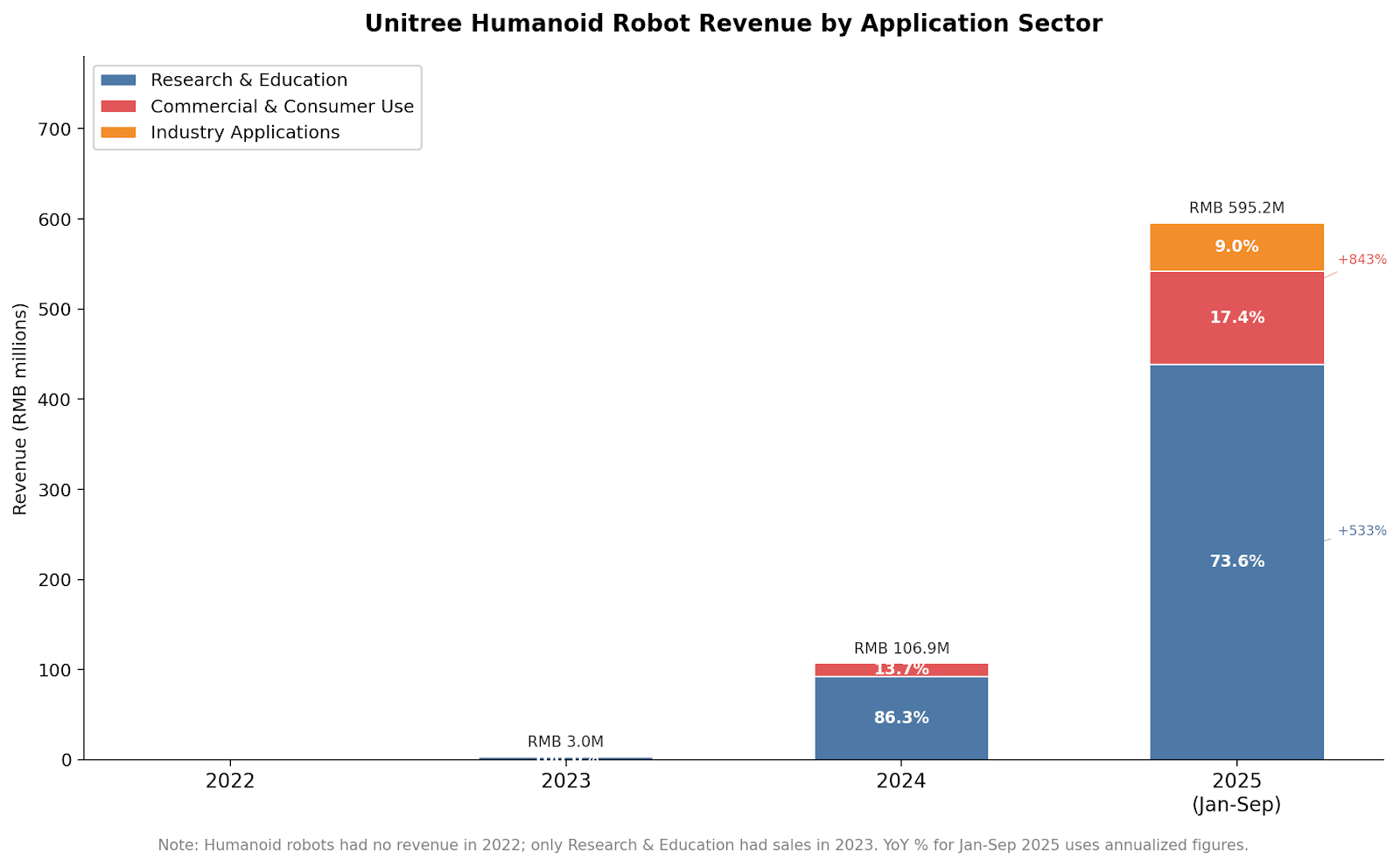
The data Unitree disclosed about its revenue sources, however, paints a more complex picture. For quadrupeds, the research and education sector has been the company’s most reliable source of revenue since at least 2022 (IPOs generally do not require companies to disclose audited financial statements from more than three years ago). But starting in 2024, revenue from both commercial and industry customers more than doubled. Consumer sales revenue nearly quadrupled year-on-year in only the first nine months of 2025.

A similar, if more compact, story emerges for humanoids as well. Demand still largely comes from researchers and educational institutions, but commercial and industrial demand has grown from a near-zero starting point on a seemingly exponential trajectory since 2024. Consumers are especially excited about humanoids due to Unitree’s successful marketing of the concept. Industrial applications of humanoids are more limited compared to those of quadrupeds, but are also appearing.

What, exactly, are people doing with these robots? “Research & Education” encompasses sales to researchers, who use Unitree hardware and platforms to conduct their own experiments. The “Commercial & Consumer Use” and “Industry Applications” categories roughly map onto B2C and B2B sales, respectively. According to Unitree, non-academic consumers who buy their robots mostly do so “for show”: they’re deploying these robots as attractive promoters in retail settings, at tourist sites, and in performances and exhibitions. Some use them as novelty companions.

Applications in industry are more interesting. Quadrupeds are deployed as “smart inspectors” in power grids, subway tunnels, and gas pipelines. They can also assist in harsh settings like emergency response and outdoor surveys, and complete manufacturing and logistical tasks. E-commerce firm JD.com is Unitree’s biggest corporate customer. Humanoids, according to Unitree, are being used for inspections and manufacturing as well, though in a more limited capacity because the technology is less mature. Unitree expects consumer demand for humanoids to grow in the medium term, but we will have to wait a while longer for genuinely useful humanoids on the factory floor.

Is Unitree… AGI-Pilled?

Received wisdom in robotics has it that the US leads in software-related research, while China’s strength is in hardware. The implication is that the US is likely to reach “generalized” machine intelligence in the physical world faster than China, but — in the meantime — Chinese companies could get to practical applications faster through quick iterations inside an unparalleled manufacturing ecosystem.

Unitree’s business model is often quoted as direct evidence of this dynamic, and it is indeed true that hardware is the crux of Unitree’s success. But does that mean Unitree, and the Chinese robotics industry writ large, has less interest in generalizability or the intelligence frontier? The IPO disclosures indicate otherwise.

Unitree called on incoming investors to “realize humanity’s ultimate dream — AGI” 实现人类最终极的梦想—AGI with them. Their lawyer-drafted definition of AGI is “a form of intelligence that possesses general cognitive capabilities comparable to those of humans, capable of understanding, learning, and executing intellectual tasks across any domain, and autonomously reasoning, planning, making decisions, and continuously learning in unknown environments.”

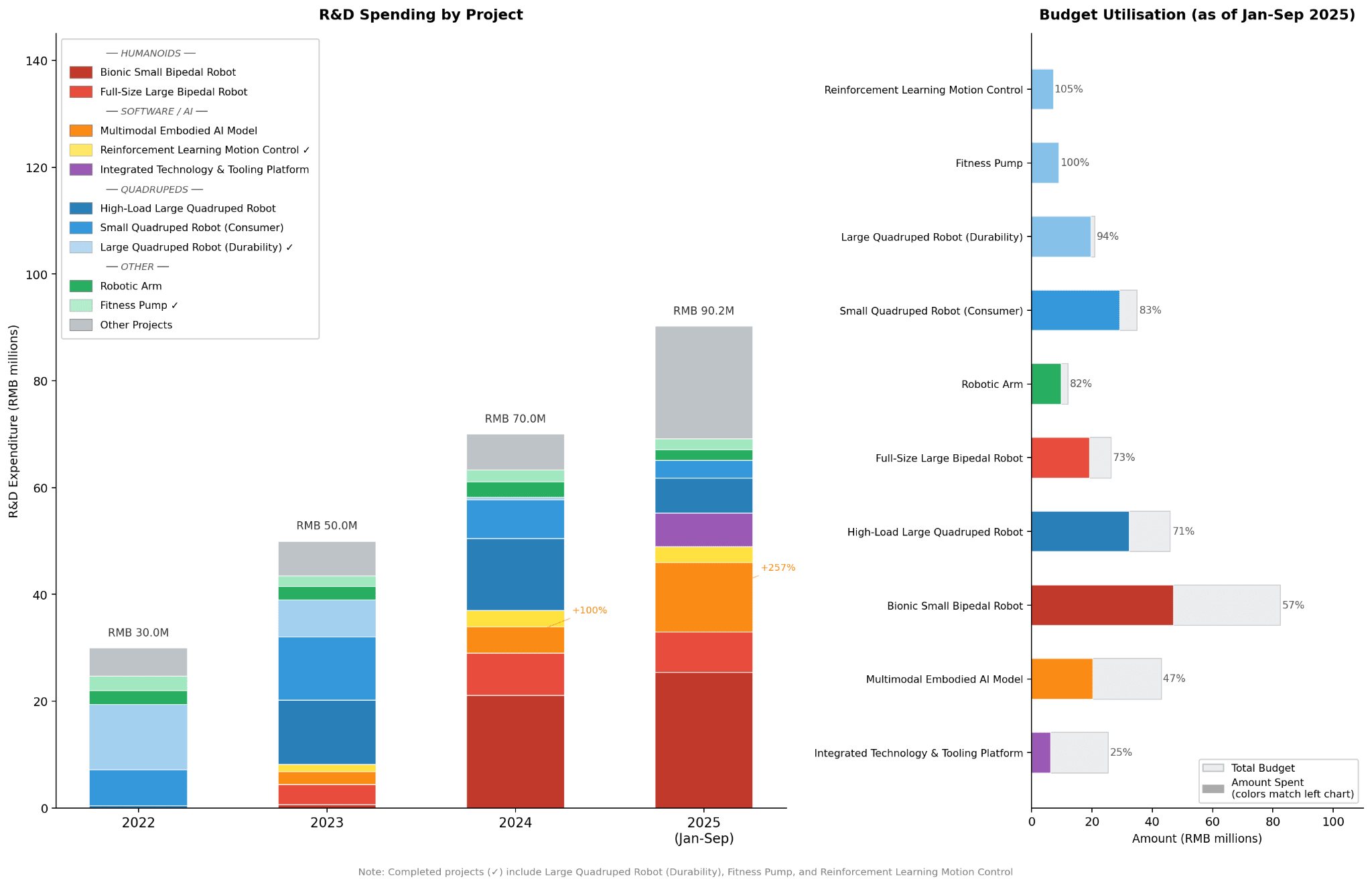
The financial reality tells us that most of Unitree’s R&D budget has gone to hardware. This is clearly downstream of their aforementioned focus on developing as many components in-house as possible to cut costs.

However, it’s important to notice in the chart above that Unitree’s R&D expenditure on “Multimodal Embodied AI Model” — the “big brain” of its robots — increased exponentially between 2024 and 2025, while other areas of R&D have grown at a steadier pace. Unitree is clearly ambitious about developing its models, even if it is known mostly for its hardware business.

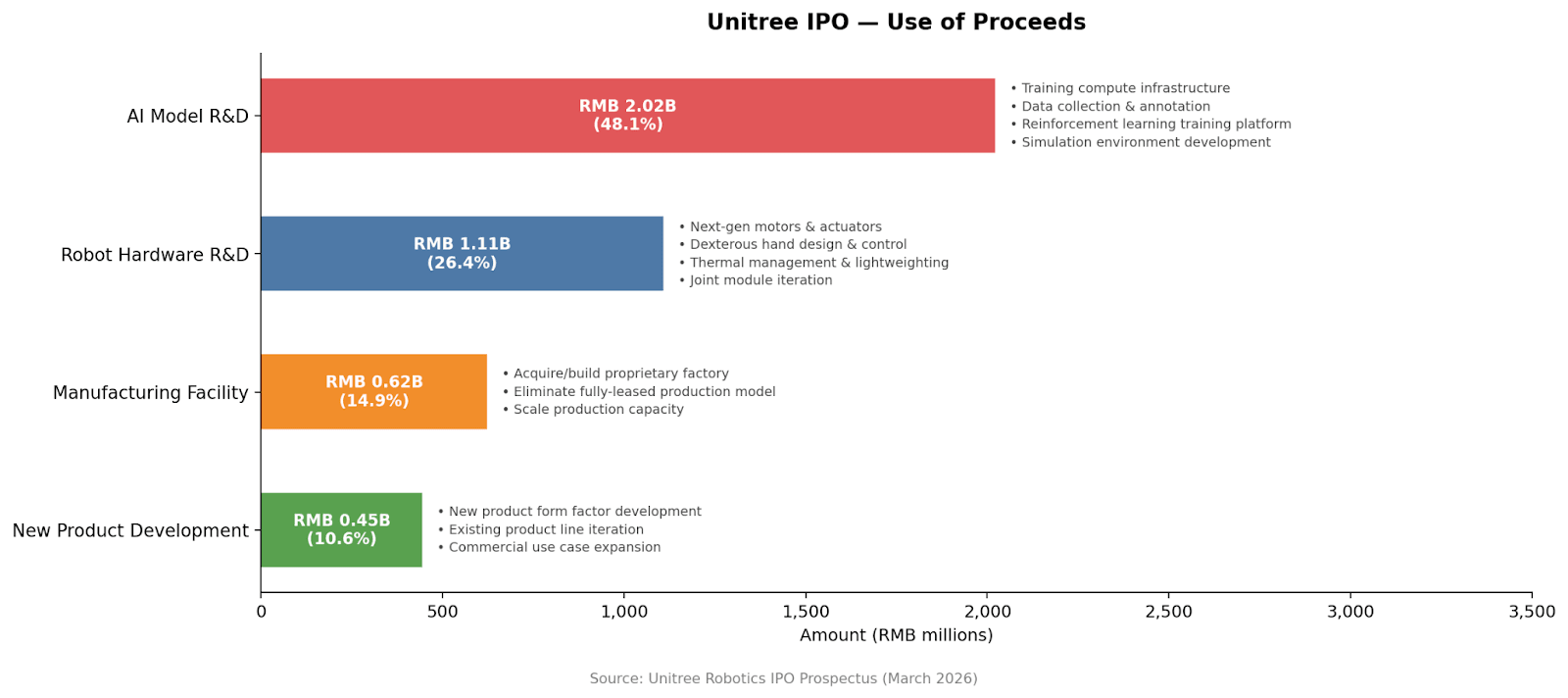
This becomes clearer when we look at Unitree’s plan for using the 4.2 billion RMB (around 607.7 million USD) raised through the IPO. Unitree’s stakeholders approved the following distribution in early 2026:

Nearly half of the IPO’s proceeds will be spent on training AI models over the next three years. That’s around 673 million RMB per year, which is not quite comparable to more well-known model makers (MiniMax, for example, spent around 1.75 billion RMB on R&D last year) but still a significant amount that signals long-term software ambitions.

Unitree currently owns no real estate, but plans to build its own factory with IPO proceeds. Per its disclosures, it has already secured a nod of approval from Hangzhou’s Binjiang District 滨江区 and plans to build there. Transitioning from an all-leased manufacturing model to proprietary manufacturing facilities is in line with their emphasis on in-house development and increasing production efficiency.

What comes next?

These disclosures answer many factual questions about Unitree’s business model, but raise more fundamental questions about the future of automation, US-China competitive dynamics, and both countries’ big bet on AI.

Question one: What will come of Unitree’s “AGI” ambitions? A public company is required to either use proceeds as stated in official disclosures, or publicly justify any changes. (Shareholders can vote to reappropriate funds, but unauthorized deviations could invoke China’s securities law and trigger scrutiny from the Stock Exchange.) Barring major issues, we should expect Unitree to spend handsomely on model training and development for the next three years. The biggest challenge will be making sure that these investments produce consequential returns. This uncertainty is not exclusive to Unitree; no one knows what the next three years will bring. But Unitree has now put itself on a path away from hardware-first and towards a more diversified strategy. This is, of course, risky, but relying on academia’s demand for hardware is no longer secure.

Question two: Will America turn against Unitree? A “Chinese military company” designation, which places companies into the annually-updated 1260H list, would merely exclude Unitree from contracting with the Department of Defense, but being placed on the Entity List would subject it to US export controls. Neither designation would prevent Unitree from selling to American customers outright, but they would hobble the company’s growth. As Unitree’s own prospectus describes:

Throughout the reporting period, revenue from overseas markets consistently exceeded 35% of total revenue. Should the United States continue to intensify trade and tariff policies that materially disadvantage Chinese exporters, or place the company on restricted lists governing procurement partnerships or technology export controls, the company faces the risk of being unable to sustain high growth in overseas sales — and potentially suffering an overall decline in performance. … Given uncertainty in industrial trade policy and the international political environment, any adverse shifts in external supply chain conditions or overseas market controls — compounded by further escalation of US trade restrictions and export control measures — could negatively affect the company’s ability to procure imported materials and maintain technology partnerships.

Policymakers eager to run “Trojan horse tech” out of America have to reckon with the dilemma that, for academic researchers at the forefront of embodied AI, there are few alternatives to Chinese-made hardware and platforms; Unitree is simply the most successful of the lot. Affordability and reliability are the most important factors for nonprofit academic labs. Robotics research is also a rough-and-tumble affair: there is wear and tear, and I’ve had researchers and students show me bruises they’ve sustained on the job from handling heavy humanoids. Unitree’s scale, consistency, and pricing meets academics where they are. Moreover, Unitree has been cultivating its relationships with international researchers long before the reporting periods of these IPO disclosures. The company started shipping internationally in 2018, and some of the earliest buyers of its quadrupeds were university research labs.

Imagine writing code for a dishwasher without dishwashers to test the code on. That’s a massively oversimplified comparison, but it is the same proposition in spirit. If Washington severs this symbiotic relationship, it will almost certainly make it harder for American researchers to maintain their lead in the software side of embodied AI.

Finally, question three: Can Unitree keep its lead inside China? As mentioned earlier, the company has formidable challengers in its own backyard, and has had to continuously trim costs to stay competitive. DEEP Robotics also joined the leagues of profitable companies in 2025. AgiBot’s CEO said at the end of last year that the company’s total sales revenue in 2025 likely exceeded 1 billion RMB. Up until now, Unitree’s success is arguably a case of first-mover advantage. Many more companies are taking up the Unitree playbook, and the future of robotics in China is far from determined.

If you aren’t yet ready to open your home to a robot dog, the company also sells fitness equipment inspired by robotics technology…

Every Trump Threat to Abandon NATO Hollows It Out

2 April 2026 at 17:52
Doubts that the United States would come to the aid of NATO allies increase each time, prompting Europeans to consider an alliance without Washington.

© Daniel Mihailescu/Agence France-Presse — Getty Images

U.S. soldiers in a military exercise with NATO members in Romania in June. The U.S. secretary of state has warned that relations with NATO will need to be re-examined.

ActBlue May Have Misled Congress on Vetting Foreign Donations, Its Lawyers Warned

The Democratic fund-raising group is facing investigations from the Justice Department and congressional Republicans ahead of the midterm elections.

© Todd Heisler/The New York Times

Regina Wallace-Jones, the chief executive of the liberal fund-raising organization ActBlue, at the 2024 Democratic National Convention in Chicago. A 2023 letter from her to Congress later played a role in internal turmoil at ActBlue.

Why Everyone Loves ‘Love on the Spectrum’

2 April 2026 at 17:03
Without exploitation, “Love on the Spectrum” captures the triumphs and travails of dating. It has become one of Netflix’s most popular shows.

© Ryan Pfluger for The New York Times

Madison Marilla and Tyler White, two stars of “Love on the Spectrum.”

Nutrition Will Now Be Required in Medical Schools After RFK Jr. Pressure

As Robert F. Kennedy Jr. calls for medical schools to redesign curriculums, an agency that oversees dozens has deleted diversity standards and added nutrition.

© Pete Marovich for The New York Times

Mr. Kennedy announced in March that more than 50 medical schools would embrace a federal framework for nutrition education.

How A.I. Helped One Man (and His Brother) Build a $1.8 Billion Company

2 April 2026 at 17:02
Who needs more than two employees when artificial intelligence can do so many corporate tasks? It’s super efficient — and a little bit lonely.

© Maggie Shannon for The New York Times

Matthew Gallagher, 41, built his start-up, Medvi, with artificial intelligence and few humans.

Supporters of Household Voting Believe U.S. Would Be Better Off Without Women’s Vote

2 April 2026 at 17:01
Adherents to biblical patriarchy support household voting: One household, one vote — the husband’s. They say the idea is catching on.

© Adriana Zehbrauskas for The New York Times

Sunday church service at King’s Way Church in Prescott, Ariz.

After Sting Operation, Cousin of Bashar al-Assad Convicted in Arms for Drugs Deal

2 April 2026 at 17:03
The cousin, Antoine Kassis, was found guilty of conspiracy to support a terrorist group, after trying to sell weapons from the fallen regime to a Colombian militia.

© David Guttenfelder/The New York Times

A defaced billboard of former Syrian leader Bashar al Assad, in Aleppo, last year.

Meet the ‘Literary King of Tulsa’ (Before He Moves to Seattle)

2 April 2026 at 17:01
In his free time, Jeff Martin mobilized best-selling authors to travel to sold-out events in his hometown. He will soon expand his horizons.

© September Dawn Bottoms for The New York Times

Jeff Martin opened the independent bookstore Magic City Books in Tulsa in 2017. Since then, it’s become a bastion of bibliophilia in the midsize prairie town.

New York Is a Hot Spot for Alpha-Gal. Why Doesn’t the State Track Cases?

2 April 2026 at 15:00
In more than 10 states, laboratories or doctors must notify the state health authorities of each positive test for a marker of the syndrome.

© Johnny Milano for The New York Times

Alpha-gal syndrome, which involves an allergy to red meat, is triggered by the bite of a lone-star tick.
❌
❌