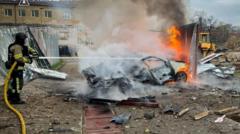
Kharkiv's mayor described the day of strikes on the city as "one of the biggest"
Ukrainian President Volodymyr Zelensky has accused Moscow of choosing "Easter escalation" over an Easter ceasefire after Russia carried out another deadly large-scale drone and missile attack on Ukraine.
Six civilians were killed and 40 others injured as Russia launched hundreds of drones and missiles across the country.
Major daytime attacks, which were once rare, have been increasing.
It's happening as efforts to end the war, led by the US, have stalled since US President Donald Trump and his team shifted focus to the conflict in the Middle East.
Meanwhile, Zelensky agreed with a British intelligence assessment that the situation on the frontline in the east was the "most favourable" for Ukraine in 10 months, as the advance of Russian troops appears to have slowed.
But there has been no let-up in the air raids.
In the Zhytomyr region, west of Ukraine's capital, Kyiv, rescuers had to search for survivors beneath the rubble of their homes as a whole line of houses was destroyed.
In the Kyiv region, a drone was filmed careering towards a block of flats, then slamming into its side, starting a fire.
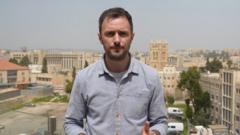
In Kharkiv, in north-eastern Ukraine, a woman was killed and other people were critically injured in a day of strikes the mayor called "one of the biggest" on the city so far.
Reuters
Several houses were destroyed in the town of Korosten, in the Zhytomyr region
Zelensky described the barrage as Russia's response to his proposal of a temporary truce for the holidays: Orthodox Christians celebrate Easter next weekend both in Ukraine and in Russia.
"The Russians have only intensified their strikes, turning what should have been silence in the skies into an Easter escalation," he wrote on X.
In recent days, Ukraine has launched multiple deep strikes of its own, targeting energy facilities on the northern coast of Russia in particular. One port, in Ust-Luga, has been hit by drones multiple times, forcing Russia to suspend exports.
Zelensky said the offer of a holiday truce was still on the table if Moscow agreed, and that message had been passed on in a call to Trump's envoys, Steve Witkoff and Jared Kushner.
Plans for further in-person talks with Russia, mediated by the US, have now been postponed twice. Moscow says they are "on hold".
Zelensky said Trump's team were welcome to come to Kyiv, then shuttle to Moscow, to keep the peace process alive.
But there are doubts over whether Moscow is really looking for a deal as the global context has shifted in its favour.
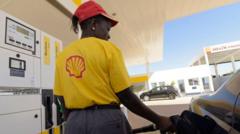
For Ukraine, the potential scarcity of fuel and surge in prices caused by the war on Iran is a worry: its own frontline troops need large amounts of diesel for their tanks and vehicles.
Conversely, it's good news for Russia, which can make more money on energy exports to fund its weapons production and pay for soldiers.
There are also concerns here about a potential shortage of US defensive missiles to shoot down the ballistic missiles that Russia keeps firing at Ukraine, since so many US Patriot systems are now being used in the war with Iran.
"The longer the war in the Middle East continues, the greater the risk that we will receive less weaponry," Zelensky told journalists in Kyiv in recorded messages. "This is extremely difficult – perhaps one of the most challenging tasks."
He did describe the situation on the frontline as "stable", with small territorial gains in places and losses elsewhere, and suggested the threat of a major Russian breakthrough had receded.
Even so, Ukraine's focus appears to be on holding the line now, not major advances of its own.
US President Donald Trump is seeking $152m (£115m) to reopen the infamous Alcatraz prison as part of his proposed budget for the 2027 fiscal year.
Located near San Francisco's Golden Gate Bridge, the site, also known as The Rock, was once regarded as one of America's most notorious prisons, but has served as a tourist attraction in recent years.
The budget request is seeking money "to rebuild Alcatraz as a state-of-the-art secure prison facility", with funds covering the first year of costs.
The plan has been met with scepticism by a number of politicians in California, with questions raised about the final cost of the project and the challenges of running Alcatraz as an active prison.
The maximum security facility was closed in 1963. As a tourist site, it is currently run by the National Park Service.
Former speaker for the US House of Representatives, Nancy Pelosi, said the budget proposal from the Trump administration was "absurd on its face and should be rejected outright".
"Rebuilding Alcatraz into a modern prison is a stupid notion that would be nothing more than a waste of taxpayer dollars and an insult to the intelligence of the American people."
The request will need to be approved by the US Congress.
Previous criticism of Trump's plan has pointed to the lack of running water and sewage on the island, and the fact all supplies are required to be brought in by boat.
By the time Alcatraz closed, it was three times more expensive to operate than any other federal prison, according to the US Bureau of Prisons.
Pelosi also raised a concern echoed by other San Francisco politicians, that turning Alcatraz back into a functioning prison would mean the loss of an iconic landmark.
According to the National Park Service, the facility currently brings in $60m (£45m) in revenue as an attraction.
Money being sought to reopen the prison as an active facility is part of a $1.7bn (£1.3bn) investment into the Bureau of Prisons.
Getty Images
There is no running water or sewage system on the island
Announcing his plans on Truth Social last year, Trump said was directing "the Bureau of Prisons, together with the Department of Justice, FBI, and Homeland Security, to reopen a substantially enlarged and rebuilt ALCATRAZ".
The prison would "house America's most ruthless and violent offenders".
Alcatraz was originally a naval defence fort, before being converted first to a military prison and then to a federal prison in the 1930s after being taken over by the Department of Justice.
Some of its most notable inmates have included notorious gangsters Al Capone, Mickey Cohen and George "Machine Gun" Kelly.
Alcatraz has served as a location in a number of films, notably 1962's Birdman of Alcatraz, starring Burt Lancaster, 1979's Escape from Alcatraz, starring Clint Eastwood, and 1996 film The Rock, starring Sean Connery and Nicolas Cage.
Fans and an ambulance outside Alejandro Villanueva Stadium in Lima, Peru.
An incident ahead of a local football derby in the Peruvian capital Lima has left one fan dead and dozens injured.
Officials are investigating the cause. Initial reports suggested parts of the stadium's wall and structure had collapsed, which has since been disputed.
Confirming the death, Peruvian Health Minister Juan Carlos Velasco Guerrero told media at a Lima hospital that 47 people were hurt - three of which are in a critical condition.
Hundreds had gathered around Alejandro Villanueva Stadium wearing football shirts and waving flags of the home team, Alianza Lima, ahead of a match against local rivals Universitario de Deportes.
Fire Chief Marcos Pajuelo told reporters that the structure of the southern stands appeared to be in good condition.
"There are no collapsed walls or sections fallen into the pit," Pajuelo said.
Saturday night's match will still go ahead as planned, the football league said.
Earlier, the interior ministry published on X that 40 firefighters responded to an emergency at the stadium "involving people trapped in a structure".
However, Alianza Lima later published a statement, also on X, that said: "According to the preliminary information available, the incident is not related to the collapse of walls or structural facilities of the sports complex".
The Peruvian Professional Football League's said in a statement that authorities are investigating the circumstances of the rally and highlighted its "commitment to the safety and well-being of all attendees at sporting events."
The global increase in the price of fuel is putting pressure on the finances of the Senegalese government
Government ministers in Senegal have been banned from all non-essential foreign travel following the rise in the price of oil resulting from the conflict in Iran, the prime minister has announced.
Speaking at a youth rally on Friday, Ousmane Sonko said that the current cost of a barrel of oil was approaching double what had been budgeted for.
Sonko has postponed his own trips to Niger and Spain as part of the restrictions. He said that the mines minister would announce further measures to curb government spending in the coming week.
Senegal's move is the latest response from the continent to the oil price rise, which has seen countries reducing fuel levies and rationing electricity.
In his speech to young people, the prime minister said he did not want to "frighten" his audience or put pressure on them. Instead, he wanted to give them a "sense of this world, which is a difficult world", but added that though things were hard the Senegalese were resilient.
Despite a fledgling oil and gas industry, Senegal relies heavily on importing fuel.
Last year, the International Monetary Fund described the economy as "robust" with a growth rate of almost 8% and low inflation.
But its public debt – standing at more than 130% of the total annual size of the economy - is high. Sonko, installed as prime minister two years ago, blamed the previous government for saddling his administration with the debt, which he said had made the current situation of dealing with the price of oil even more difficult.
Elsewhere on the continent, this week South Africa's government responded to the rising oil price by reducing the tax it charges on petrol in an effort to limit the increase of the cost of fuel at the pumps.
Fuel shortages in Ethiopia have forced some government institutions to send employees on annual leave. South Sudan has started to ration electricity in its capital, Juba, while Zimbabwe is increasing the ethanol content in its petrol.
The effective closure of the Strait of Hormuz in the Persian Gulf as a result of the US-Israeli war on Iran has also led to a restriction of the supply of fertiliser to the rest of the world. An estimated 30% of this essential farming input goes through the Gulf.
Humanitarian organisation the International Rescue Committee warned on Wednesday that this was a "food security timebomb", particularly for East Africa which relies on fertiliser imports from the Middle East.
More on the Iran war's impact on global fuel from the BBC:
The Uffizi Galleries are among the most visited in the world
The Uffizi Galleries in Florence has confirmed they were subject to a cyber-attack - but denied that the security systems protecting its famous works had been compromised.
They stressed that nothing had been either damaged or stolen, after hackers were reported to have infiltrated the museum's IT systems and accessed sensitive security data.
Italian newspaper Corriere della Sera reported that hackers had infiltrated the museums' IT systems, allegedly extracting access codes, internal maps and the locations of CCTV cameras and alarms, before issuing a ransom demand.
But the Uffizi Galleries contested this account, saying its security systems were inaccessible from the outside.
The attackers appeared to have moved through interconnected systems, computers and phones, gradually piecing together a detailed picture of the museum's operations, Corriere reported.
A ransom demand was later sent to museum director Simone Verde's personal phone, the newspaper said, with a threat to sell the data on the dark web.
The Uffizi is home to some of Italy's most celebrated artworks, such as Botticelli's Birth of Venus and Primavera.
Corriere said the cyber-attack occurred between late January and early February, affecting not only the Uffizi but also its separate sites at Palazzo Pitti and the Boboli Gardens.
Ever since the Louvre museum in Paris was raided in broad daylight in October and priceless historic treasures stolen, with the masked gang seemingly able to take advantage of its weak and aging CCTV system, all major museums have had to reassess their security.
The Uffizi said work that was already under way had been accelerated "both before and after the cyber-attack".
Its situation was "nothing like the Louvre", it stressed, with analogue cameras replaced with digital ones, following recommendations made by the police in 2024.
Responding to claims that the hackers had found out the location of surveillance cameras and sensors, it said there was "no evidence whatsoever that the hackers possessed any maps of the security systems".
Anyone walking through the museum could see were the cameras were, as was the case with any public space, it said, so there was little surprise that their location had been found out.
"No passwords were stolen - none whatsoever - because the security systems are entirely internal and closed-circuit," it said, adding that employees' phones had also not been compromised by the hack.
Iguana Press/Getty Image
The Palazzo Pitti ws the summer residence of the Medici family
Two floors of the Palazzo Pitti normally house the "Medici Treasure", so-called because the powerful Renaissance banking family spent their summers there, and Corriere claimed the hack had led to parts of the palace being closed since 3 February and valuable items being temporarily transferred to a vault of the Bank of Italy for safekeeping.
The museum did not deny that the treasures had been taken to a bank vault but insisted the move was part of planned renovation work.
Some doors and emergency exits at the palace had been sealed with bricks and mortar, and staff instructed not to speak publicly about the incident, according to Corriere.
However, the Uffizi attributed the bricked-up doors in part to fire-safety measures.
For decades, there had been no fire safety certification, it pointed out, and only two days ago it had submitted a safety notice to the fire brigade.
Other doors were sealed, it added, "to prevent excessive permeability of the historic building's spaces - structures dating back to the 1500s - considering their changed functions and the evolving international context".
It also reacted to claims that the intruders had stolen the Uffizi's entire digital photographic archive - a decades-long record of artworks and documents - insisting that its photographic server was intact because a back-up was in place.
Although it appeared to acknowledge the server had been taken down, it said that was necessary for the backup to be restored. That was now complete and no data had been lost, it said.
Despite the controversy, the Uffizi, Italy's second-most visited museum after the Vatican, generating around €60m (£52m; $69m) in annual revenue, remains open to visitors, with ticketing and public areas largely unaffected.
Although it’s widely known that Jules Breton had a daughter, Virginie Demont-Breton (1859–1935), who went on to paint, few today realise how successful she was, and how distinctive and delightful her paintings are. As is usual for women artists, lamentably few of her paintings are available as usable images, and little is reported of her career. This article is as much as I know.
She was born and named Virginie Élodie Marie Thérèse to Jules and Élodie Breton, in Courrières, inland from Calais on the north-east coast of France, on 26 July 1859. She was a precocious artist, and had her first work accepted by the Paris Salon in 1879 when she was still nineteen. She married the painter Adrien Demont the following year, after which she signed her paintings as Virginie Demont-Breton.
Virginie Demont-Breton (1859–1935), First Steps (1881-2), oil on canvas, 90.1 x 60.3 cm, Private collection. Wikimedia Commons.
In her early career, she specialised in painting mothers with their young children. Her First Steps (1881-2) was exhibited at the Académie Royale des Beaux-Arts de Bruxelles in 1881, although dated 1882, and was shown in the Salon in 1882. From there it was sold to Goupil, who sold it to the USA, where her paintings did as well as those of her father.
She was awarded a gold medal at the Exposition Universelle in Amsterdam in 1883, although I have been unable to identify which work(s) brought her that distinction.
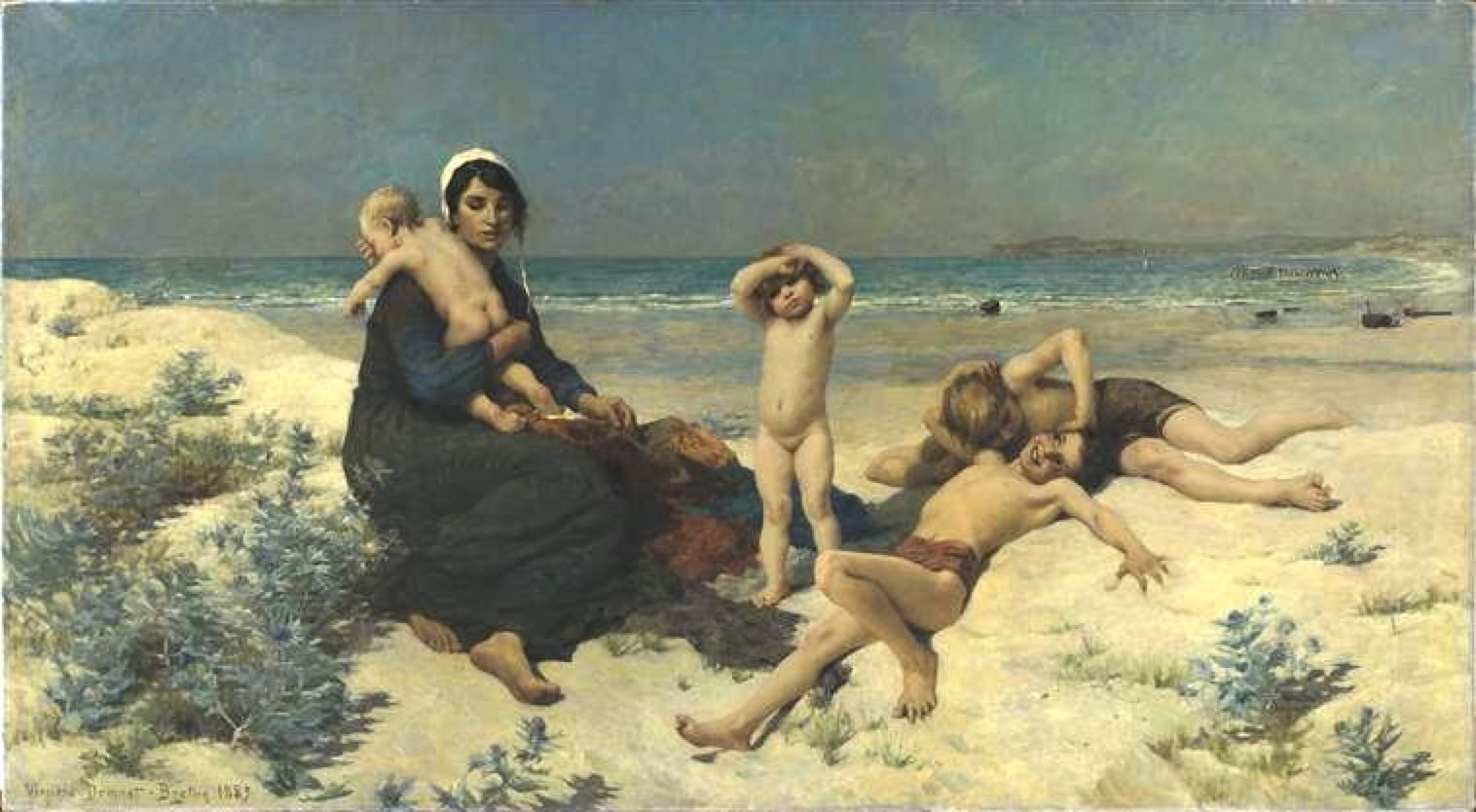
Virginie Demont-Breton (1859–1935), The Beach (1883), oil on canvas, 190 x 348 cm, Musée des Beaux-Arts d’Arras, Arras, France. Wikimedia Commons.
The Beach (1883), painted on the Channel coast, was exhibited at the Salon in 1883, where it earned her ‘hors-concours’ (because of exemplary record, her works didn’t need to be submitted to the jury in future), and was purchased by the state.
That year she joined the French Union of Women Painters and Sculptors, and served as its president from 1895-1901. Among her achievements for the Union was the full admission of women to the École des Beaux-Arts in Paris, and their eligibility for the competition for the prestigious Prix de Rome.
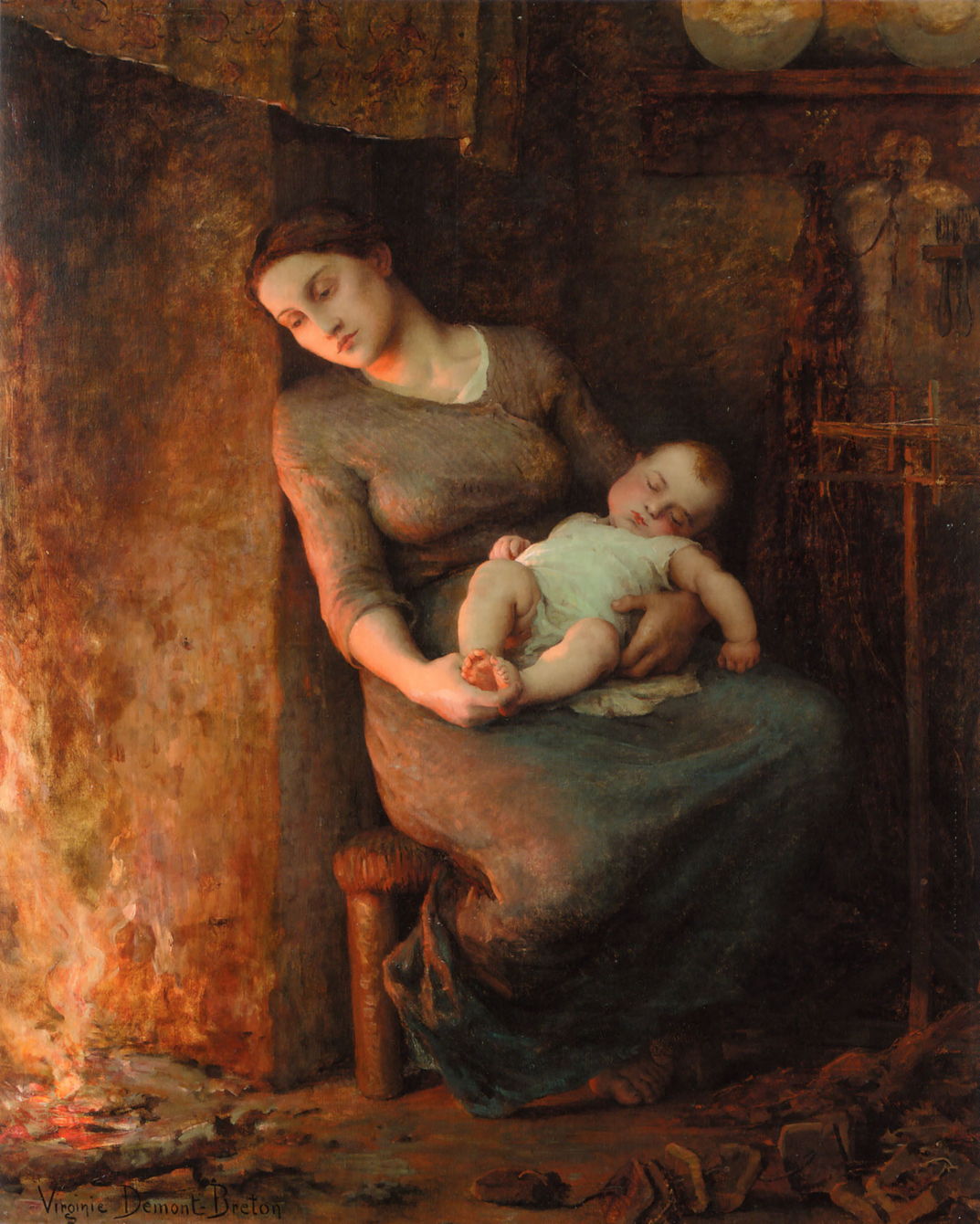
Virginie Demont-Breton (1859–1935), L’homme est en mer (The Man is at Sea) (before 1889), oil on canvas, 161 x 134.5 cm, location not known. Wikimedia Commons.
L’homme est en mer (The Man is at Sea) (1889) is probably her best-known painting, and shows a fisherman’s wife warming herself and her sleeping infant by the fire, while her husband is away fishing at sea. It was exhibited at the Salon in 1889, where it was rapidly engraved for prints.
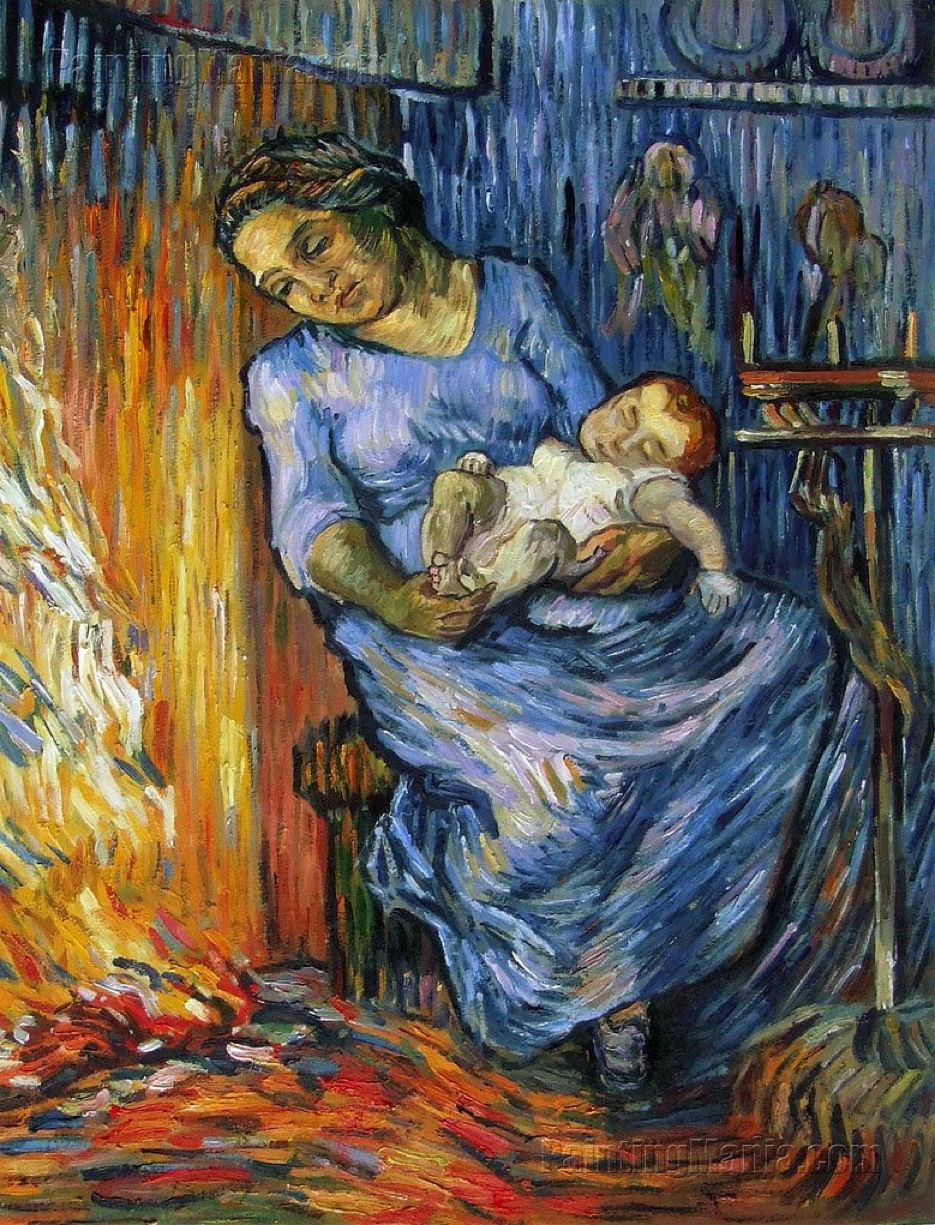
Vincent van Gogh (1853-1890), L’homme est en mer (The Man is at Sea, after Demont-Breton) (1889), oil, dimensions not known, Private collection. Wikimedia Commons.
The reason for the fame of that painting is in part because of Vincent van Gogh’s copy, L’homme est en mer (The Man is at Sea, after Demont-Breton) (1889), painted when he was undergoing treatment in the Saint Paul asylum at Saint-Rémy. Van Gogh based this on a printed reproduction.
In 1890, she and her husband moved to the small fishing village of Wissant, on the Côte d’Opale between the capes of Blanc-Nez and Gris-Nez, between Calais and Boulogne. The following year they started construction on a villa in neo-Egyptian style they named Typhonium, now a preserved historical site.
Their house became the focus of a group of artists known as the Wissant School, which was active until the early twentieth century. Members included Félix Planquette, Fernand Stievenard, Valentine Pépe, Henri and Marie Duhem, and Virginie and her husband Adrien.
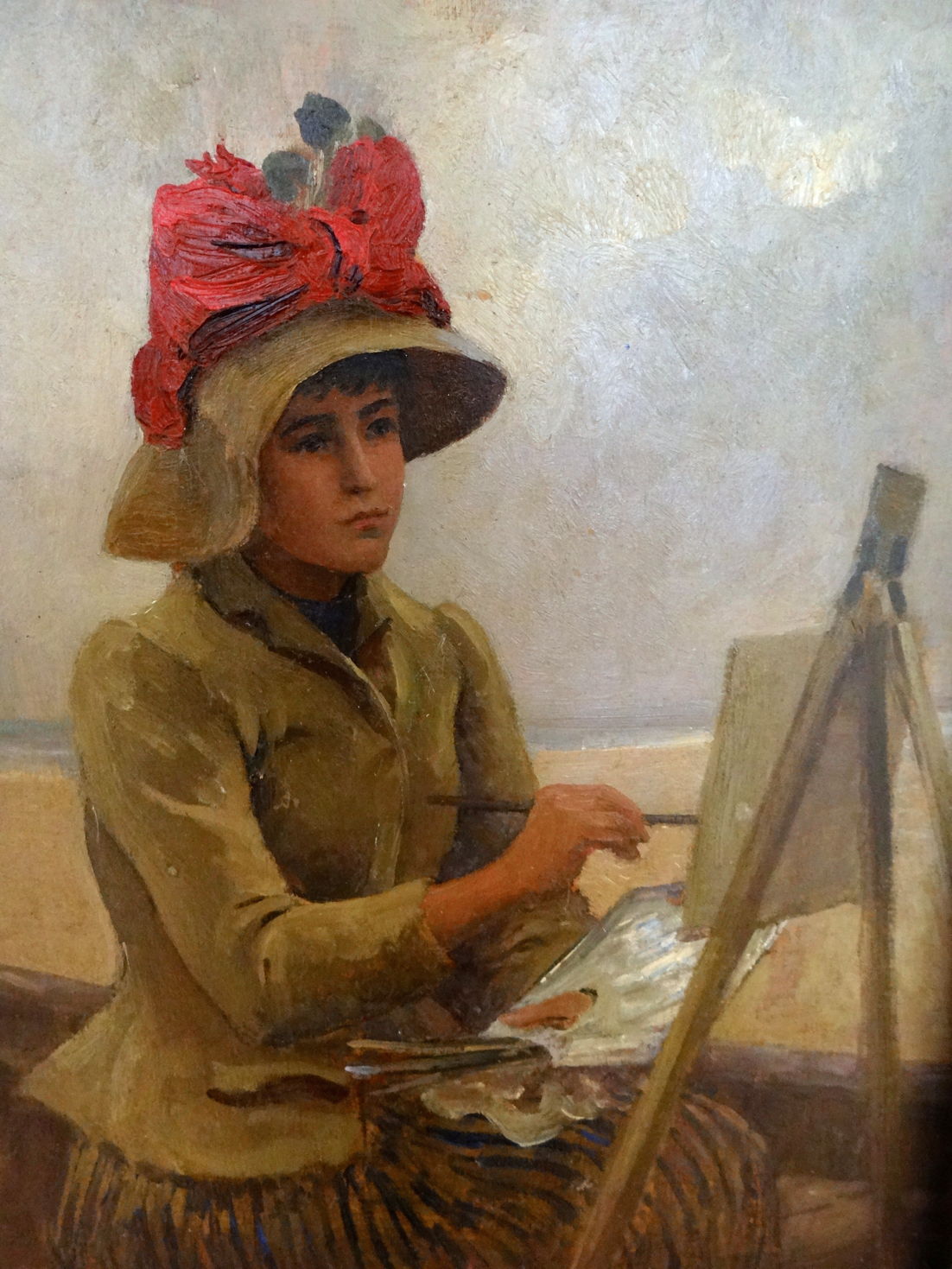
Virginie Demont-Breton (1859–1935), Portrait of Marie Duhem (detail) (1889), oil on panel, dimensions not known, Musée de la Chartreuse de Douai, Douai, France. Wikimedia Commons.
This detail of Virginie’s Portrait of Marie Duhem (1889) shows one of their close friends and colleagues in the Wissant School, at work en plein air on the coast near their house.
In 1893, Virginie was among the French women artists who took part in the Chicago World’s Columbian Exposition, forming its Woman’s Building.
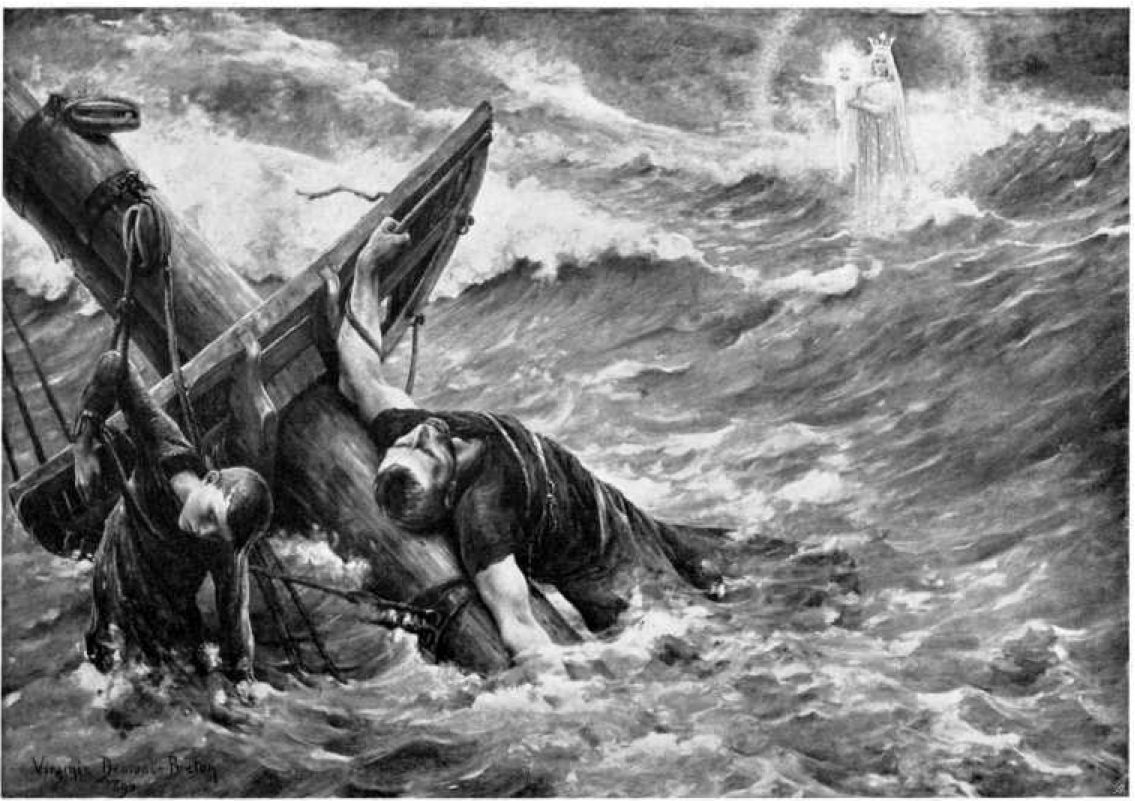
Virginie Demont-Breton (1859–1935), Stella Maris (1894), oil on canvas, dimensions not known, Private collection. Wikimedia Commons.
This monochrome reproduction of Stella Maris (1894) is one of Virginie’s many paintings using maritime motifs, developed after moving to Wissant. Stella Maris is a popular name for Polaris, the Pole Star, which has been used since ancient times for celestial navigation, but the artist’s principal reference here is to its use as a traditional synonym for the Virgin Mary.
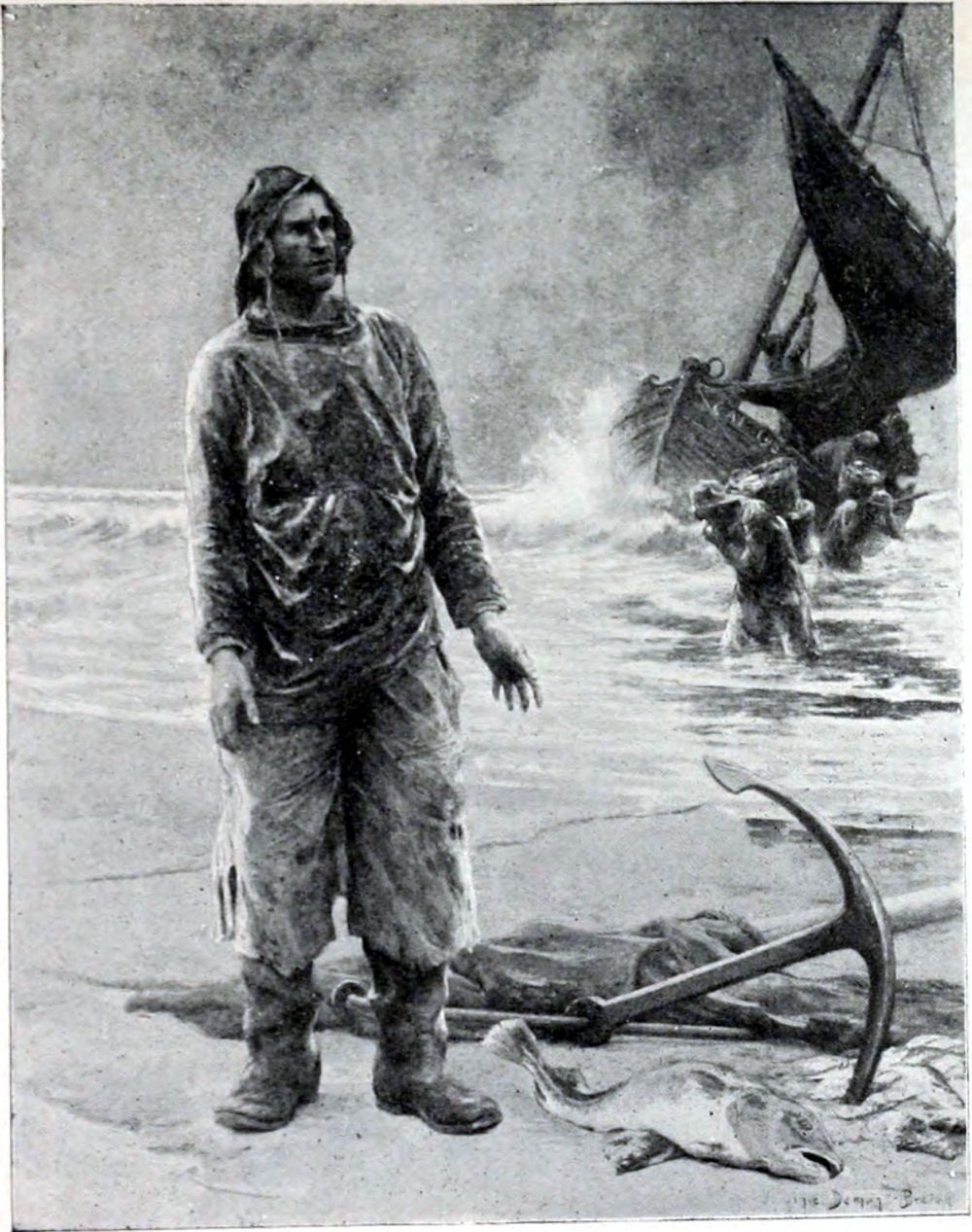
The wrecked mariners clinging on to the rigging have been joined by a vision of the Virgin Mary, who bears the infant Jesus in her arms. This painting was exhibited at the Salon in 1895, and the print comes from a 1905 book on Women Painters of the World.
In 1894, Virginie was admitted to the Legion of Honour, and in 1896 was recognised by the Rosati Society for her achievements.
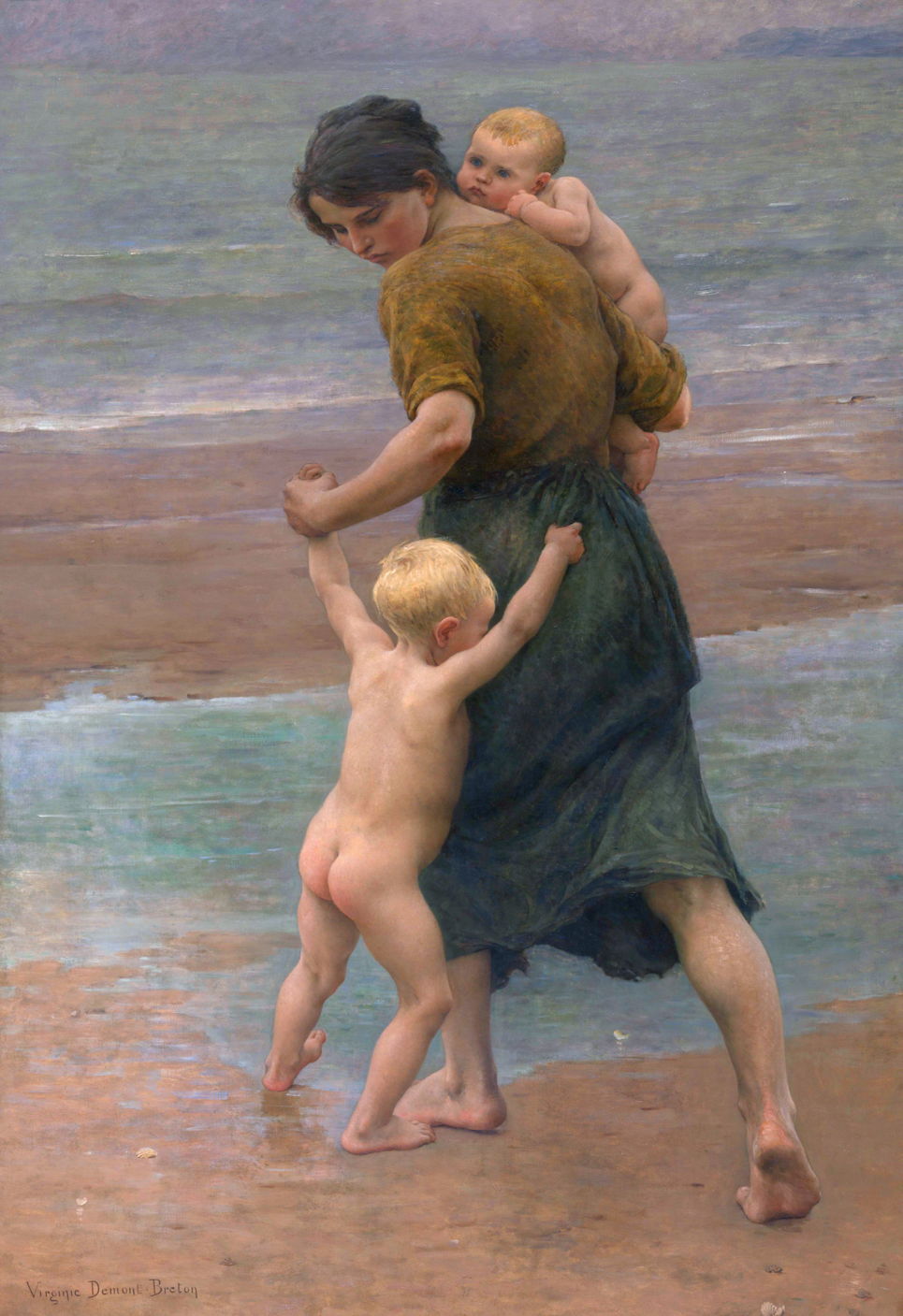
Virginie Demont-Breton (1859–1935), Into the water! (c 1898), oil on canvas, 182.1 x 122.5 cm, Koninklijk Museum voor Schone Kunsten, Antwerp, Belgium. Wikimedia Commons.
She continued painting intimate family scenes around the Channel coast. Into the water! (c 1898) shows a fisherman’s wife taking her young children for what may well have been their only opportunity to bathe properly.
Virginie Demont-Breton (1859–1935), Men of the Sea (1898), oil, dimensions not known, Musée de Picardie à Amiens, Amiens, France. Wikimedia Commons.
Men of the Sea (1898) is another monochrome reproduction of a full-colour original painting, showing the fishermen of Wissant landing their catch on the beach. This compares with her father’s earlier (1879ish) paintings of fisherfolk in Brittany, and Winslow Homer’s famous paintings from 1881 of those at Cullercoats, north-east England.
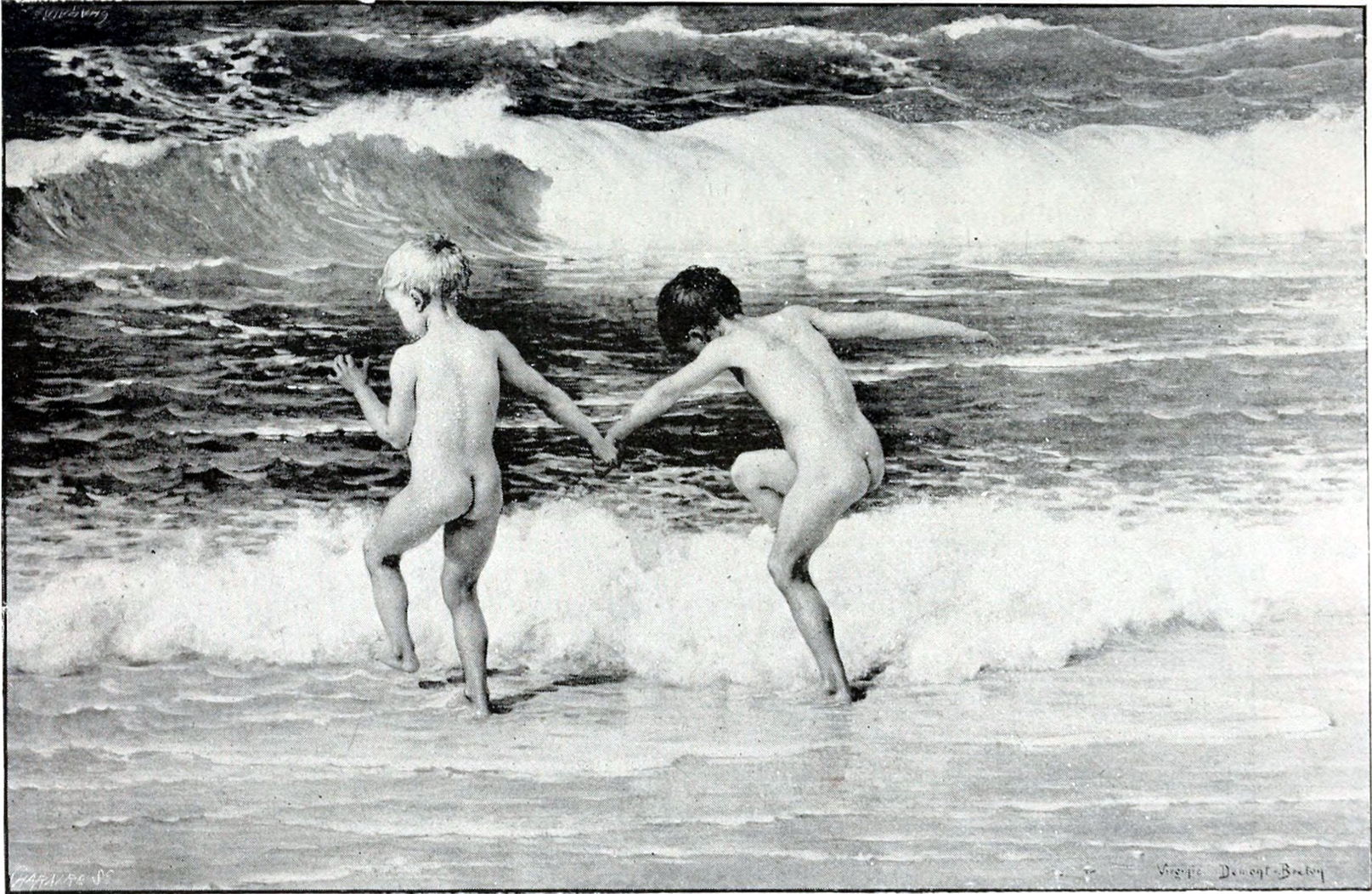
Virginie Demont-Breton (1859–1935), Première audace premier frisson (First dare, first thrill) (1900), oil, further details not known. Wikimedia Commons.
Première audace premier frisson (First dare, first thrill) (1900) is a monochrome reproduction showing two young children entering the water at Wissant. This was exhibited at the Salon in 1900.
Like her father, later in Virginie’s career she turned to writing poetry and prose, which were also successful. Her collected poems were published in 1920, and four volumes of memoires between 1926-1930. She died in Paris on 10 January 1935.
Among her undated works are the following.
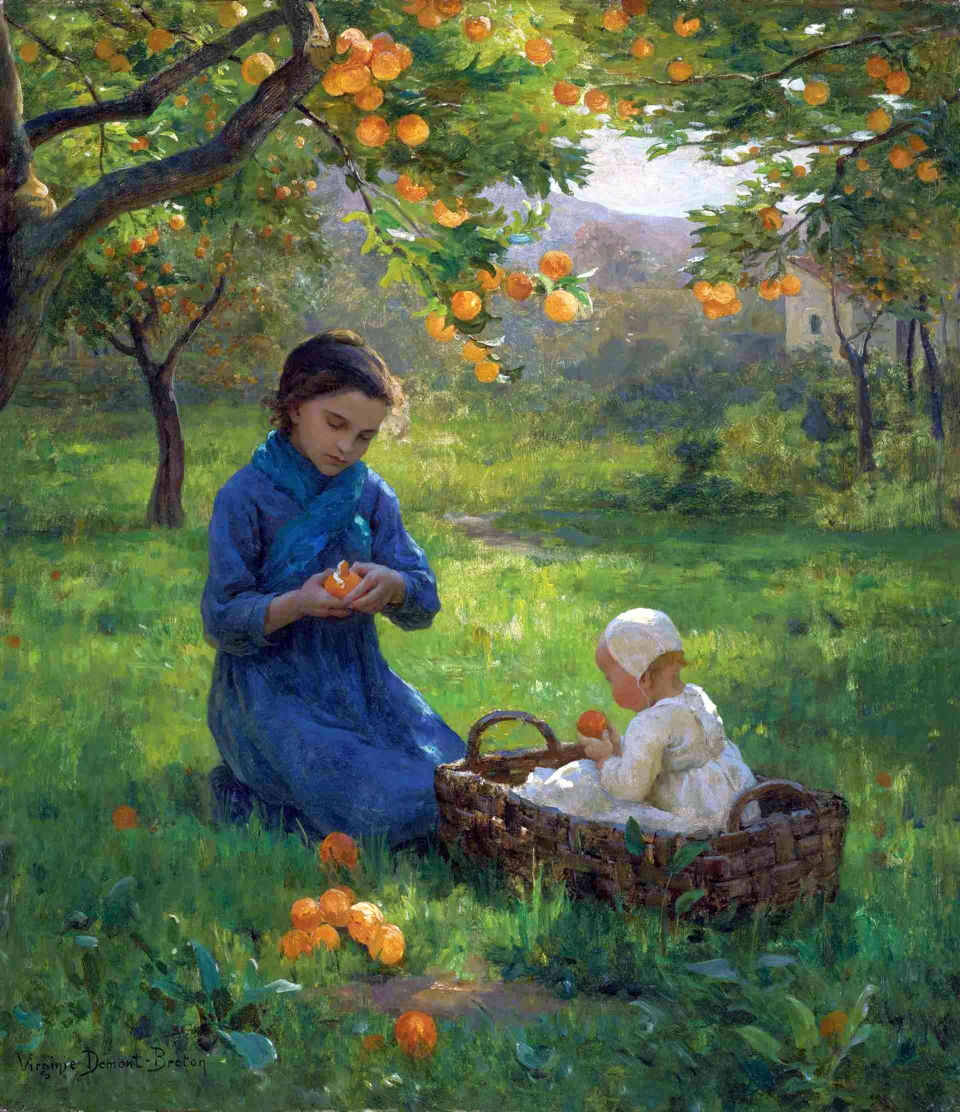
Virginie Demont-Breton (1859–1935), Mother and Child in an Orange Grove (date not known), oil on canvas, 102.2 × 69.8 cm, Private collection. Wikimedia Commons.
Mother and Child in an Orange Grove (above) was probably painted in the south of France, as was Under the Orange Tree (below).
Virginie Demont-Breton (1859–1935), Under the Orange Tree (date not known), oil on canvas, 61.5 x 53.3 cm, location not known. The Athenaeum.Virginie Demont-Breton (1859–1935), Alma Mater (date not known), oil on canvas, 92.5 x 66 cm, location not known. Wikimedia Commons.
Alma Mater is an unusual version of the Nativity, in which the Virgin Mary’s traditional blue has been transferred to the painted plaster behind her, so she can be dressed in white.
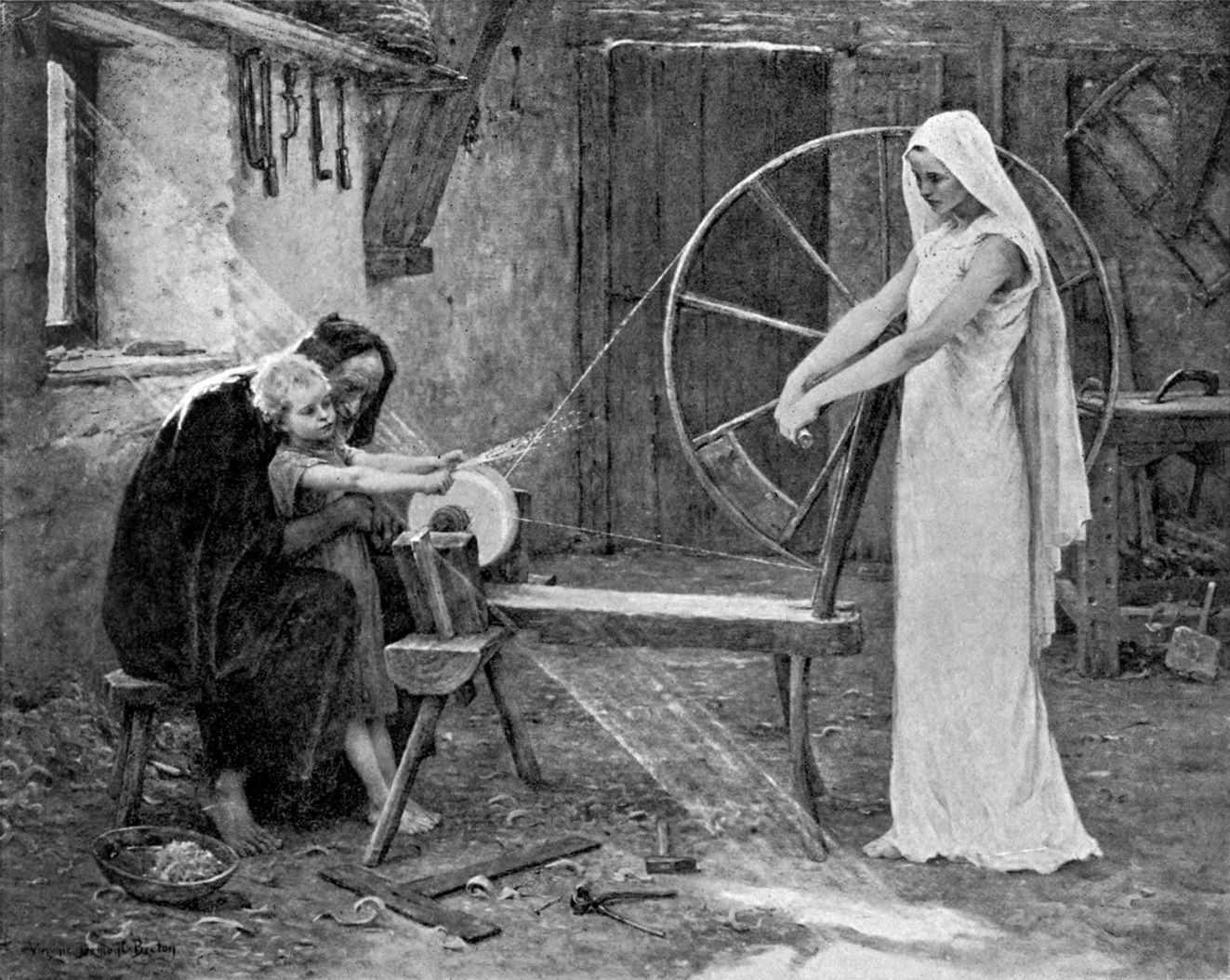
Virginie Demont-Breton (1859–1935) Le Divin Apprenti (The Divine Apprentice) (date not known), oil, further details not known. Wikimedia Commons.
Le Divin Apprenti (The Divine Apprentice) is a monochrome reproduction of a full-colour original. This shows the Holy Family in Joseph’s carpenter’s shop. The elderly Joseph guides Jesus in sharpening a knife on a whetstone turned by his mother Mary. Sunlight cast through the window illuminates the boy’s head.
This compares with John Millais’ famous Christ in the House of His Parents (1849-50).
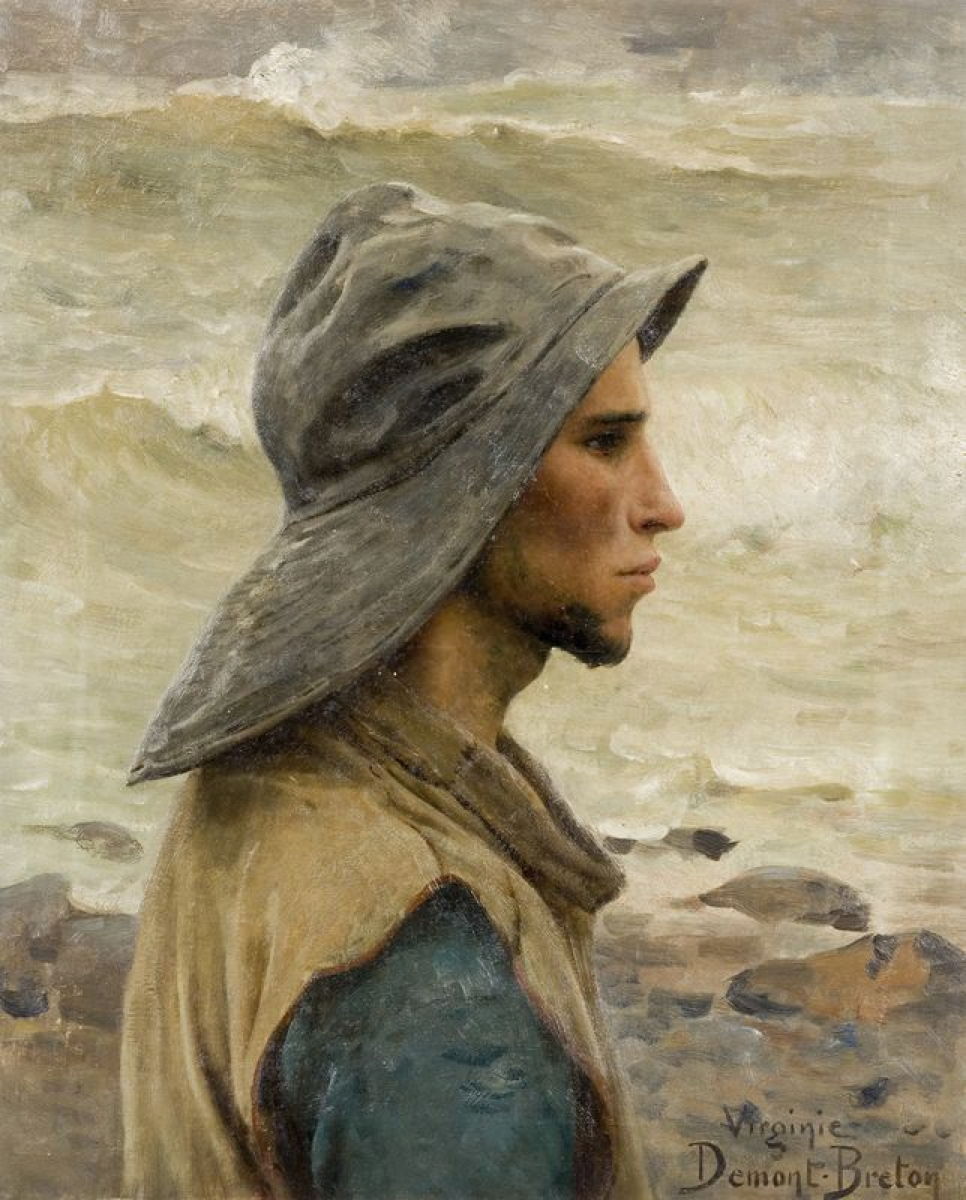
Virginie Demont-Breton (1859–1935), Young Fisherman Watches the Sea (date not known), oil, 61.5 x 50 cm, location not known. Wikimedia Commons.
Young Fisherman Watches the Sea is a thoughtful portrait of a young man whose future depends on his abilities to survive at sea. Note how painterly are the waves and other details in the background, which are also deliberately defocussed.
Although there are no books devoted to her work, as far as I can discover, a catalog raisonné is being prepared, which will be a major step forward in documenting her paintings properly. Not as great a modern Master as her father, perhaps, like the work of the women Impressionists, she broadened the appeal of painting, and was important in opening up art as a career for women. She deserves greater recognition.
US President Donald Trump is seeking $152m (£115m) to reopen the infamous Alcatraz prison as part of his proposed budget for the 2027 fiscal year.
Located near San Francisco's Golden Gate Bridge, the site, also known as The Rock, was once regarded as one of America's most notorious prisons, but has served as a tourist attraction in recent years.
The budget request is seeking money "to rebuild Alcatraz as a state-of-the-art secure prison facility", with funds covering the first year of costs.
The plan has been met with scepticism by a number of politicians in California, with questions raised about the final cost of the project and the challenges of running Alcatraz as an active prison.
The maximum security facility was closed in 1963. As a tourist site, it is currently run by the National Park Service.
Former speaker for the US House of Representatives, Nancy Pelosi, said the budget proposal from the Trump administration was "absurd on its face and should be rejected outright".
"Rebuilding Alcatraz into a modern prison is a stupid notion that would be nothing more than a waste of taxpayer dollars and an insult to the intelligence of the American people."
The request will need to be approved by the US Congress.
Previous criticism of Trump's plan has pointed to the lack of running water and sewage on the island, and the fact all supplies are required to be brought in by boat.
By the time Alcatraz closed, it was three times more expensive to operate than any other federal prison, according to the US Bureau of Prisons.
Pelosi also raised a concern echoed by other San Francisco politicians, that turning Alcatraz back into a functioning prison would mean the loss of an iconic landmark.
According to the National Park Service, the facility currently brings in $60m (£45m) in revenue as an attraction.
Money being sought to reopen the prison as an active facility is part of a $1.7bn (£1.3bn) investment into the Bureau of Prisons.
Getty Images
There is no running water or sewage system on the island
Announcing his plans on Truth Social last year, Trump said was directing "the Bureau of Prisons, together with the Department of Justice, FBI, and Homeland Security, to reopen a substantially enlarged and rebuilt ALCATRAZ".
The prison would "house America's most ruthless and violent offenders".
Alcatraz was originally a naval defence fort, before being converted first to a military prison and then to a federal prison in the 1930s after being taken over by the Department of Justice.
Some of its most notable inmates have included notorious gangsters Al Capone, Mickey Cohen and George "Machine Gun" Kelly.
Alcatraz has served as a location in a number of films, notably 1962's Birdman of Alcatraz, starring Burt Lancaster, 1979's Escape from Alcatraz, starring Clint Eastwood, and 1996 film The Rock, starring Sean Connery and Nicolas Cage.
Women walking by a mural of the Statue of Liberty on the outer wall of the former U.S. embassy in Tehran. In 1979, a group of militant students took over the embassy and kept 52 Americans captive for 444 days.
去年底,特朗普政府宣布了“黄金舰队”计划,其核心是建造新型战列舰。美国海军部长费兰(John C. Phelan)还取消了星座级护卫舰项目——该项目长期以来一直受到威斯康星州造船厂劳动力短缺和持续不断的方案调整的困扰,进展缓慢。取而代之的是,美国海军将采购HII公司英戈尔斯造船厂建造的国家安全巡逻舰的改进型。

 Login
Login