Although it’s widely known that Jules Breton had a daughter, Virginie Demont-Breton (1859–1935), who went on to paint, few today realise how successful she was, and how distinctive and delightful her paintings are. As is usual for women artists, lamentably few of her paintings are available as usable images, and little is reported of her career. This article is as much as I know.
She was born and named Virginie Élodie Marie Thérèse to Jules and Élodie Breton, in Courrières, inland from Calais on the north-east coast of France, on 26 July 1859. She was a precocious artist, and had her first work accepted by the Paris Salon in 1879 when she was still nineteen. She married the painter Adrien Demont the following year, after which she signed her paintings as Virginie Demont-Breton.
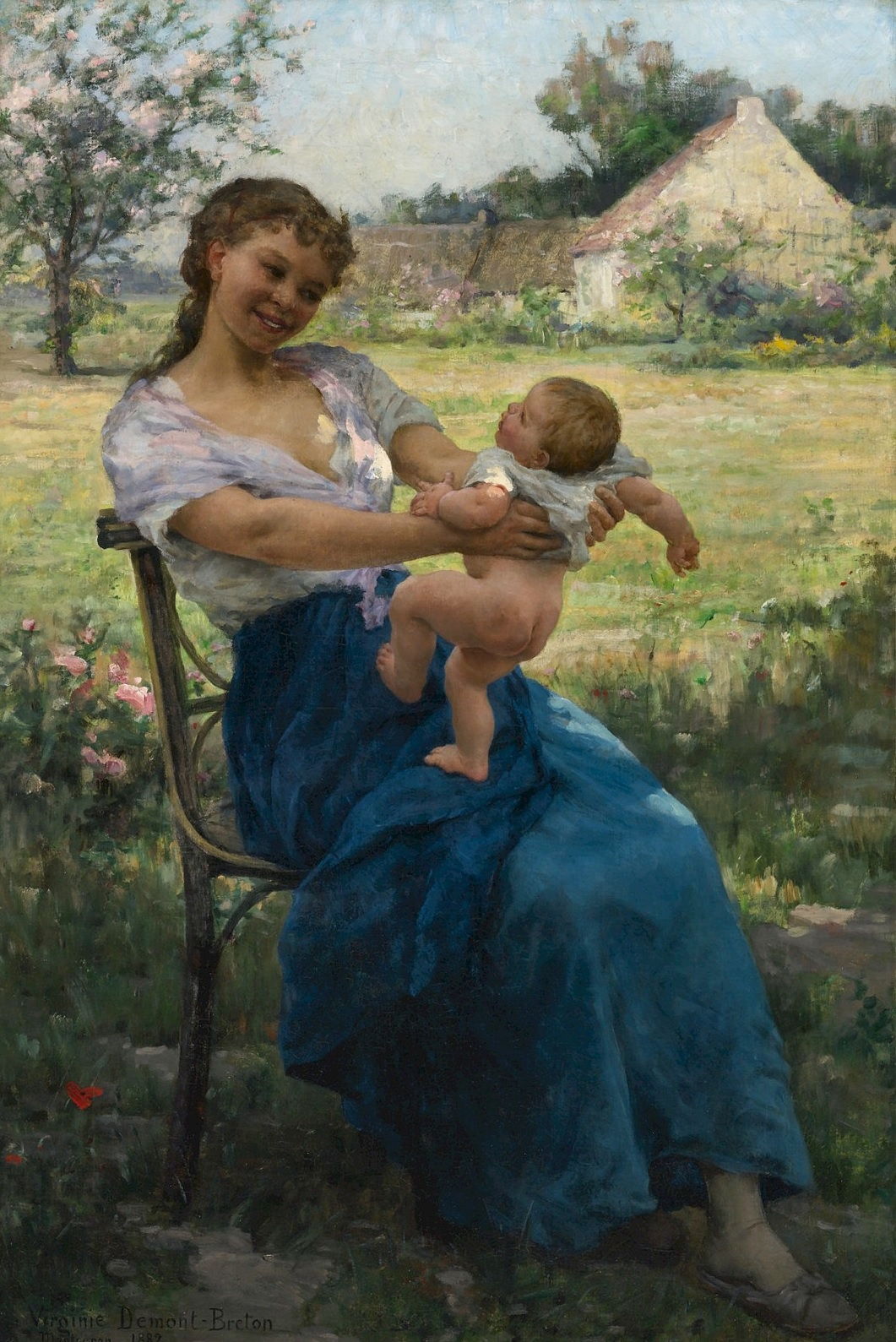
Virginie Demont-Breton (1859–1935), First Steps (1881-2), oil on canvas, 90.1 x 60.3 cm, Private collection. Wikimedia Commons.
In her early career, she specialised in painting mothers with their young children. Her First Steps (1881-2) was exhibited at the Académie Royale des Beaux-Arts de Bruxelles in 1881, although dated 1882, and was shown in the Salon in 1882. From there it was sold to Goupil, who sold it to the USA, where her paintings did as well as those of her father.
She was awarded a gold medal at the Exposition Universelle in Amsterdam in 1883, although I have been unable to identify which work(s) brought her that distinction.
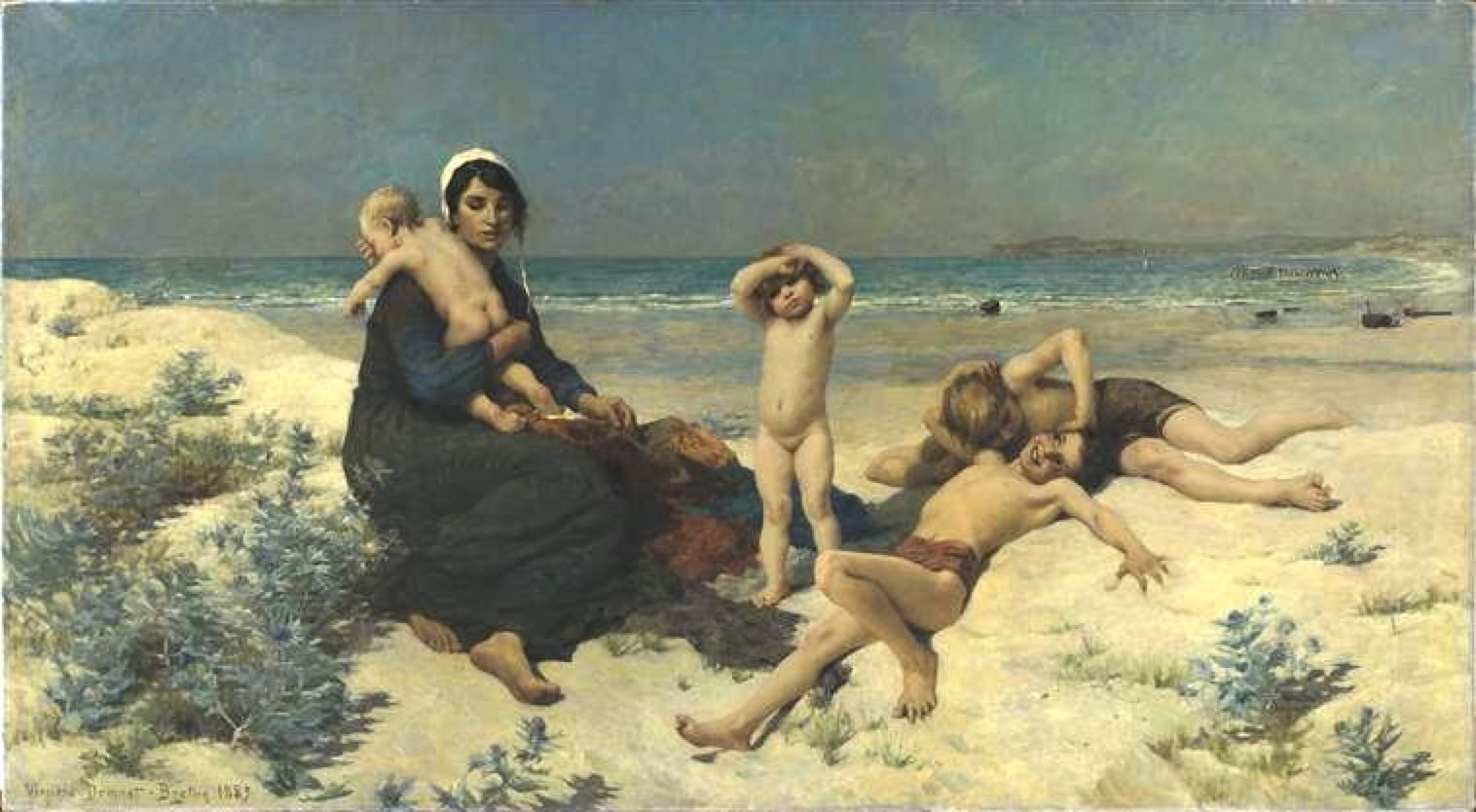
Virginie Demont-Breton (1859–1935), The Beach (1883), oil on canvas, 190 x 348 cm, Musée des Beaux-Arts d’Arras, Arras, France. Wikimedia Commons.
The Beach (1883), painted on the Channel coast, was exhibited at the Salon in 1883, where it earned her ‘hors-concours’ (because of exemplary record, her works didn’t need to be submitted to the jury in future), and was purchased by the state.
That year she joined the French Union of Women Painters and Sculptors, and served as its president from 1895-1901. Among her achievements for the Union was the full admission of women to the École des Beaux-Arts in Paris, and their eligibility for the competition for the prestigious Prix de Rome.
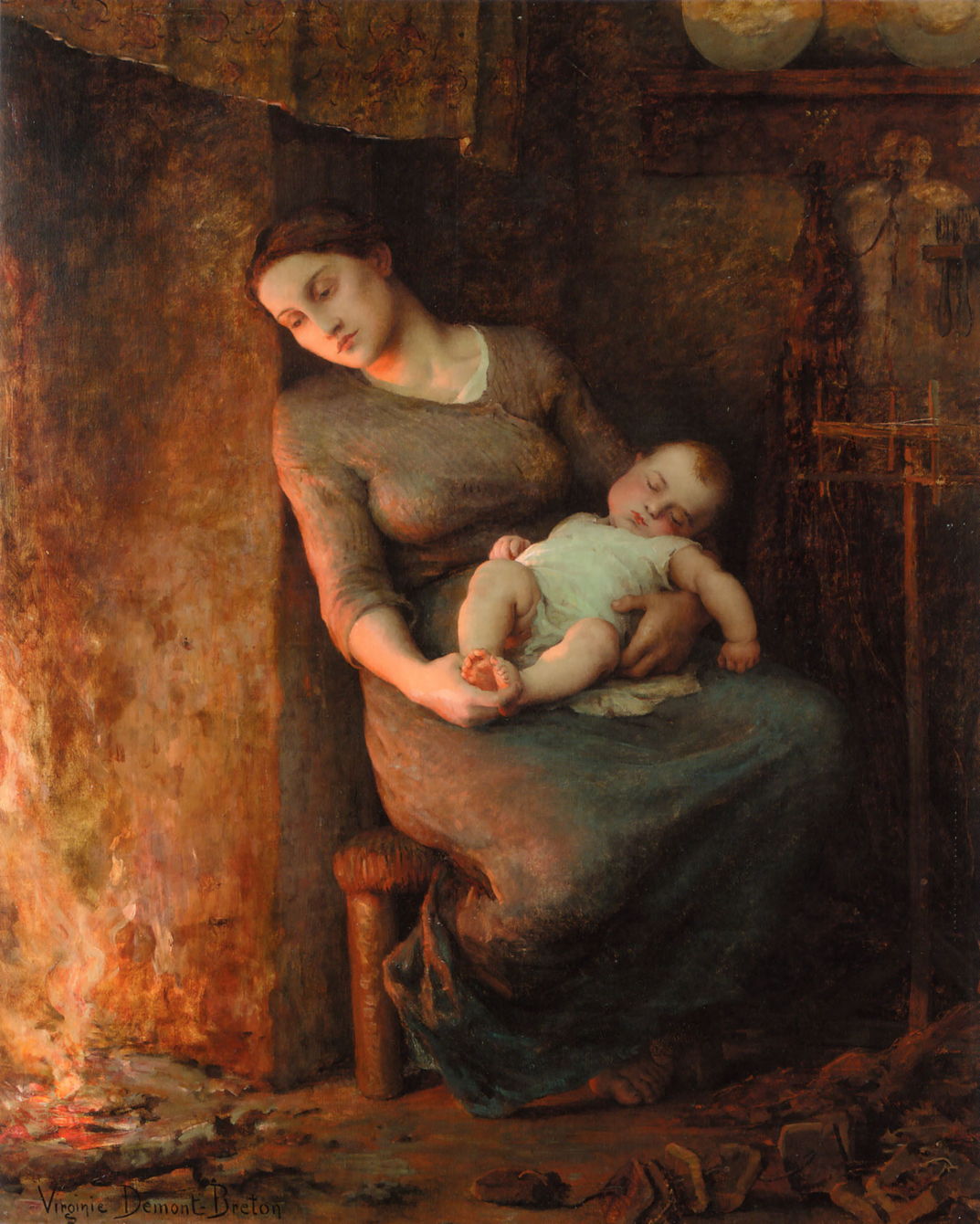
Virginie Demont-Breton (1859–1935), L’homme est en mer (The Man is at Sea) (before 1889), oil on canvas, 161 x 134.5 cm, location not known. Wikimedia Commons.
L’homme est en mer (The Man is at Sea) (1889) is probably her best-known painting, and shows a fisherman’s wife warming herself and her sleeping infant by the fire, while her husband is away fishing at sea. It was exhibited at the Salon in 1889, where it was rapidly engraved for prints.
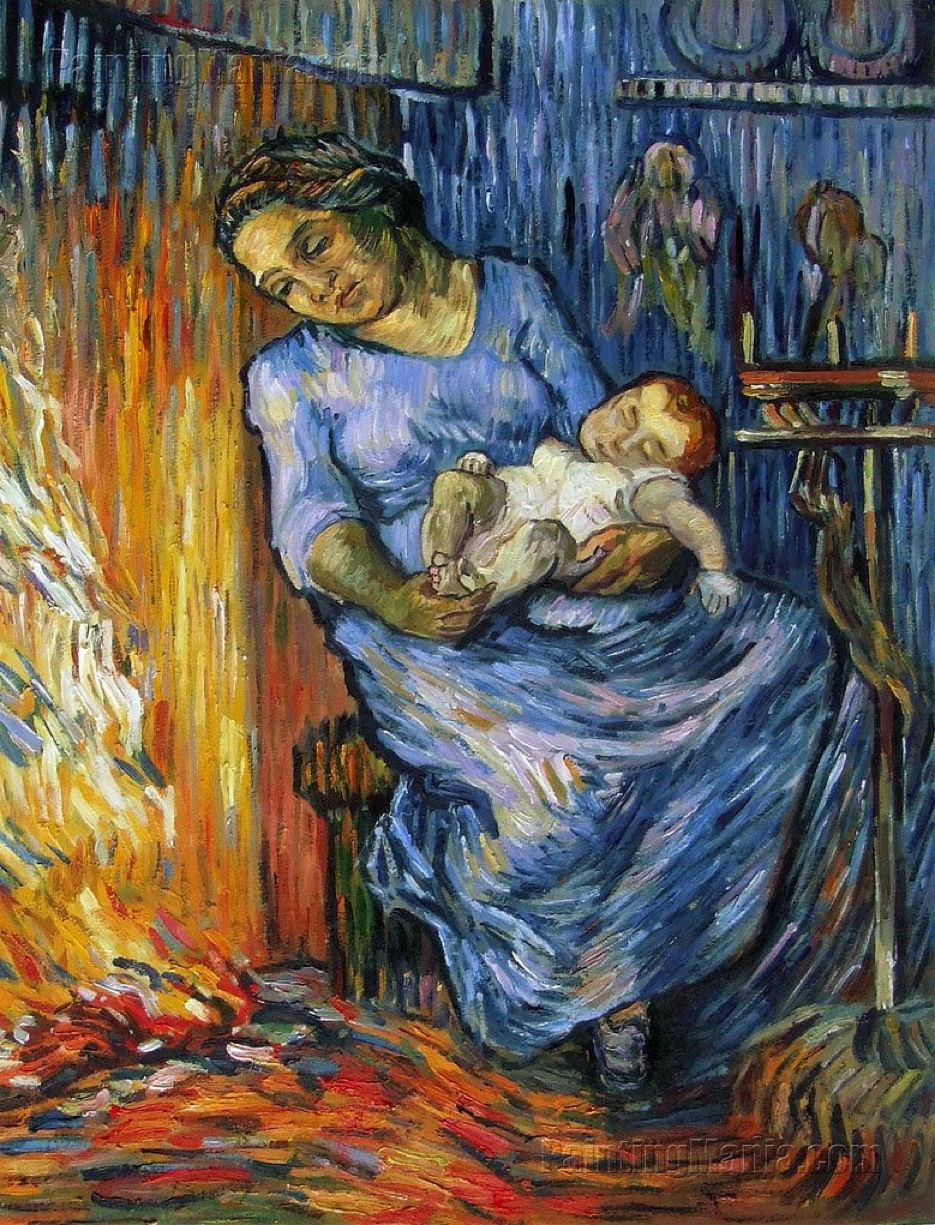
Vincent van Gogh (1853-1890), L’homme est en mer (The Man is at Sea, after Demont-Breton) (1889), oil, dimensions not known, Private collection. Wikimedia Commons.
The reason for the fame of that painting is in part because of Vincent van Gogh’s copy, L’homme est en mer (The Man is at Sea, after Demont-Breton) (1889), painted when he was undergoing treatment in the Saint Paul asylum at Saint-Rémy. Van Gogh based this on a printed reproduction.
In 1890, she and her husband moved to the small fishing village of Wissant, on the Côte d’Opale between the capes of Blanc-Nez and Gris-Nez, between Calais and Boulogne. The following year they started construction on a villa in neo-Egyptian style they named Typhonium, now a preserved historical site.
Their house became the focus of a group of artists known as the Wissant School, which was active until the early twentieth century. Members included Félix Planquette, Fernand Stievenard, Valentine Pépe, Henri and Marie Duhem, and Virginie and her husband Adrien.
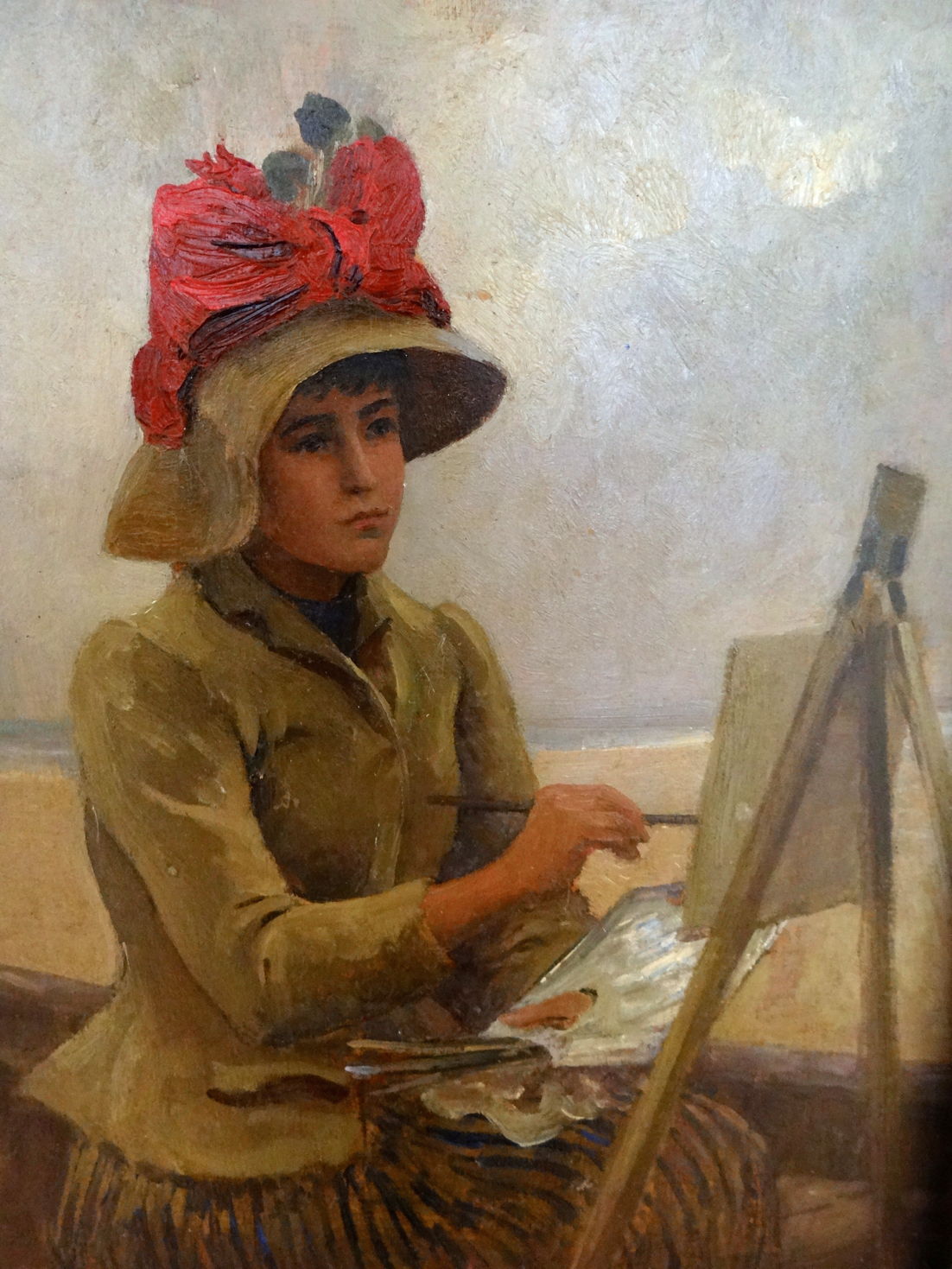
Virginie Demont-Breton (1859–1935), Portrait of Marie Duhem (detail) (1889), oil on panel, dimensions not known, Musée de la Chartreuse de Douai, Douai, France. Wikimedia Commons.
This detail of Virginie’s Portrait of Marie Duhem (1889) shows one of their close friends and colleagues in the Wissant School, at work en plein air on the coast near their house.
In 1893, Virginie was among the French women artists who took part in the Chicago World’s Columbian Exposition, forming its Woman’s Building.
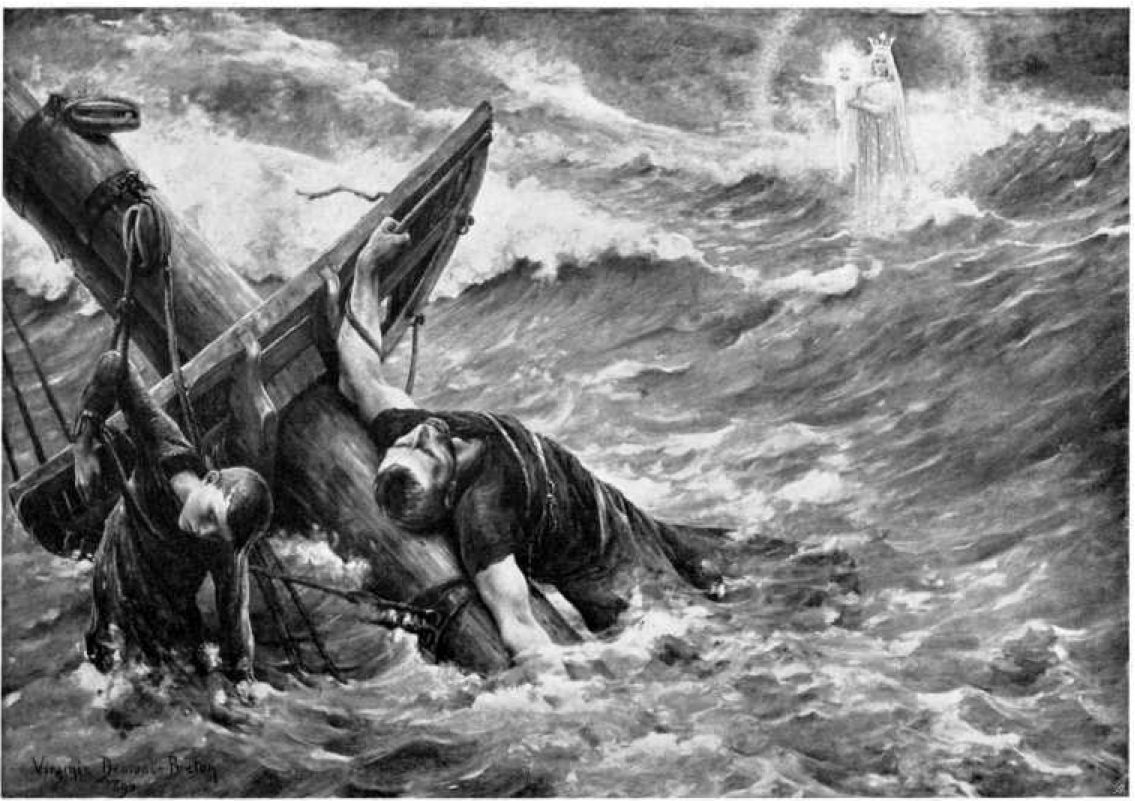
Virginie Demont-Breton (1859–1935), Stella Maris (1894), oil on canvas, dimensions not known, Private collection. Wikimedia Commons.
This monochrome reproduction of Stella Maris (1894) is one of Virginie’s many paintings using maritime motifs, developed after moving to Wissant. Stella Maris is a popular name for Polaris, the Pole Star, which has been used since ancient times for celestial navigation, but the artist’s principal reference here is to its use as a traditional synonym for the Virgin Mary.
The wrecked mariners clinging on to the rigging have been joined by a vision of the Virgin Mary, who bears the infant Jesus in her arms. This painting was exhibited at the Salon in 1895, and the print comes from a 1905 book on Women Painters of the World.
In 1894, Virginie was admitted to the Legion of Honour, and in 1896 was recognised by the Rosati Society for her achievements.
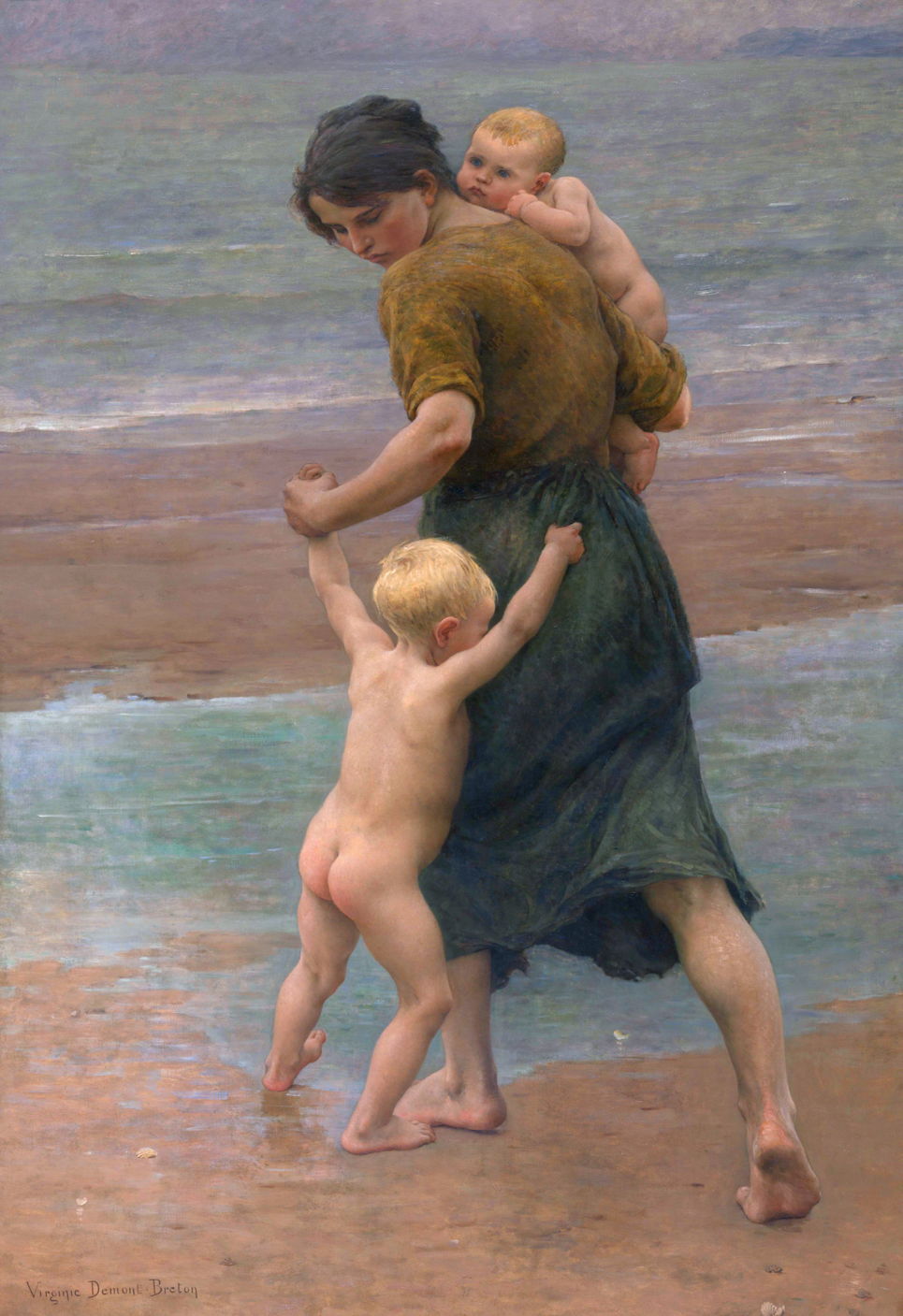
Virginie Demont-Breton (1859–1935), Into the water! (c 1898), oil on canvas, 182.1 x 122.5 cm, Koninklijk Museum voor Schone Kunsten, Antwerp, Belgium. Wikimedia Commons.
She continued painting intimate family scenes around the Channel coast. Into the water! (c 1898) shows a fisherman’s wife taking her young children for what may well have been their only opportunity to bathe properly.
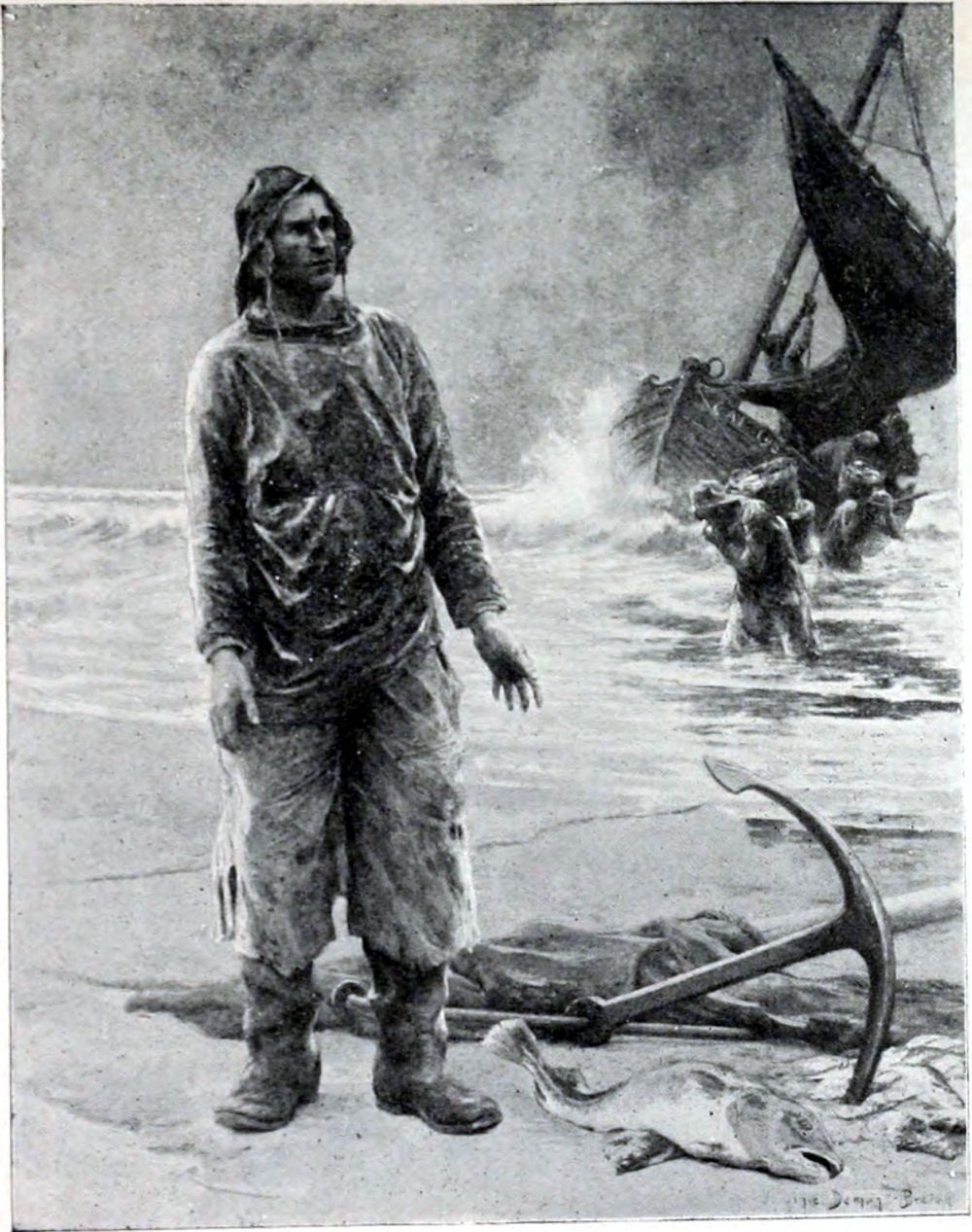
Virginie Demont-Breton (1859–1935), Men of the Sea (1898), oil, dimensions not known, Musée de Picardie à Amiens, Amiens, France. Wikimedia Commons.
Men of the Sea (1898) is another monochrome reproduction of a full-colour original painting, showing the fishermen of Wissant landing their catch on the beach. This compares with her father’s earlier (1879ish) paintings of fisherfolk in Brittany, and Winslow Homer’s famous paintings from 1881 of those at Cullercoats, north-east England.
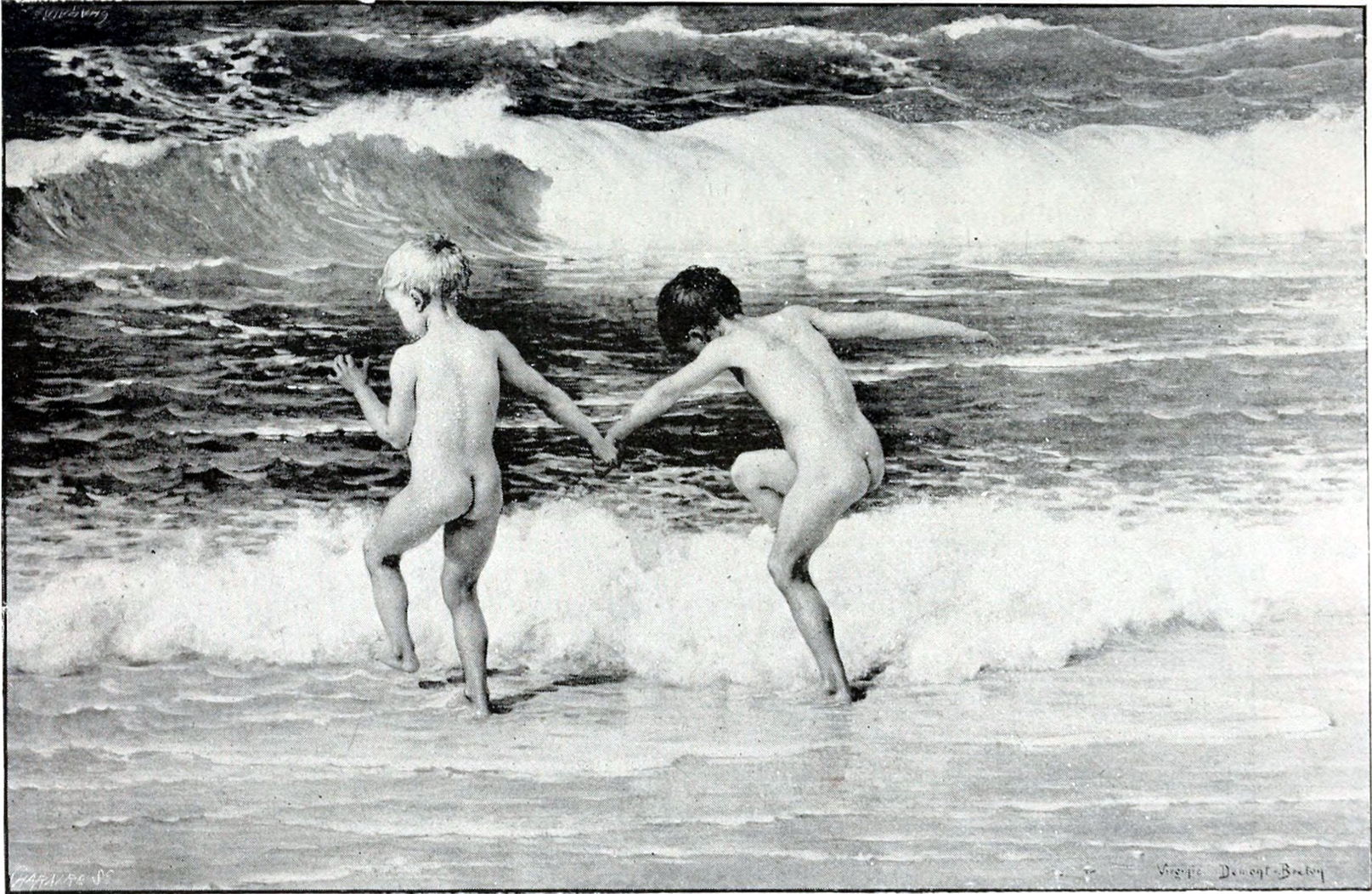
Virginie Demont-Breton (1859–1935), Première audace premier frisson (First dare, first thrill) (1900), oil, further details not known. Wikimedia Commons.
Première audace premier frisson (First dare, first thrill) (1900) is a monochrome reproduction showing two young children entering the water at Wissant. This was exhibited at the Salon in 1900.
Like her father, later in Virginie’s career she turned to writing poetry and prose, which were also successful. Her collected poems were published in 1920, and four volumes of memoires between 1926-1930. She died in Paris on 10 January 1935.
Among her undated works are the following.
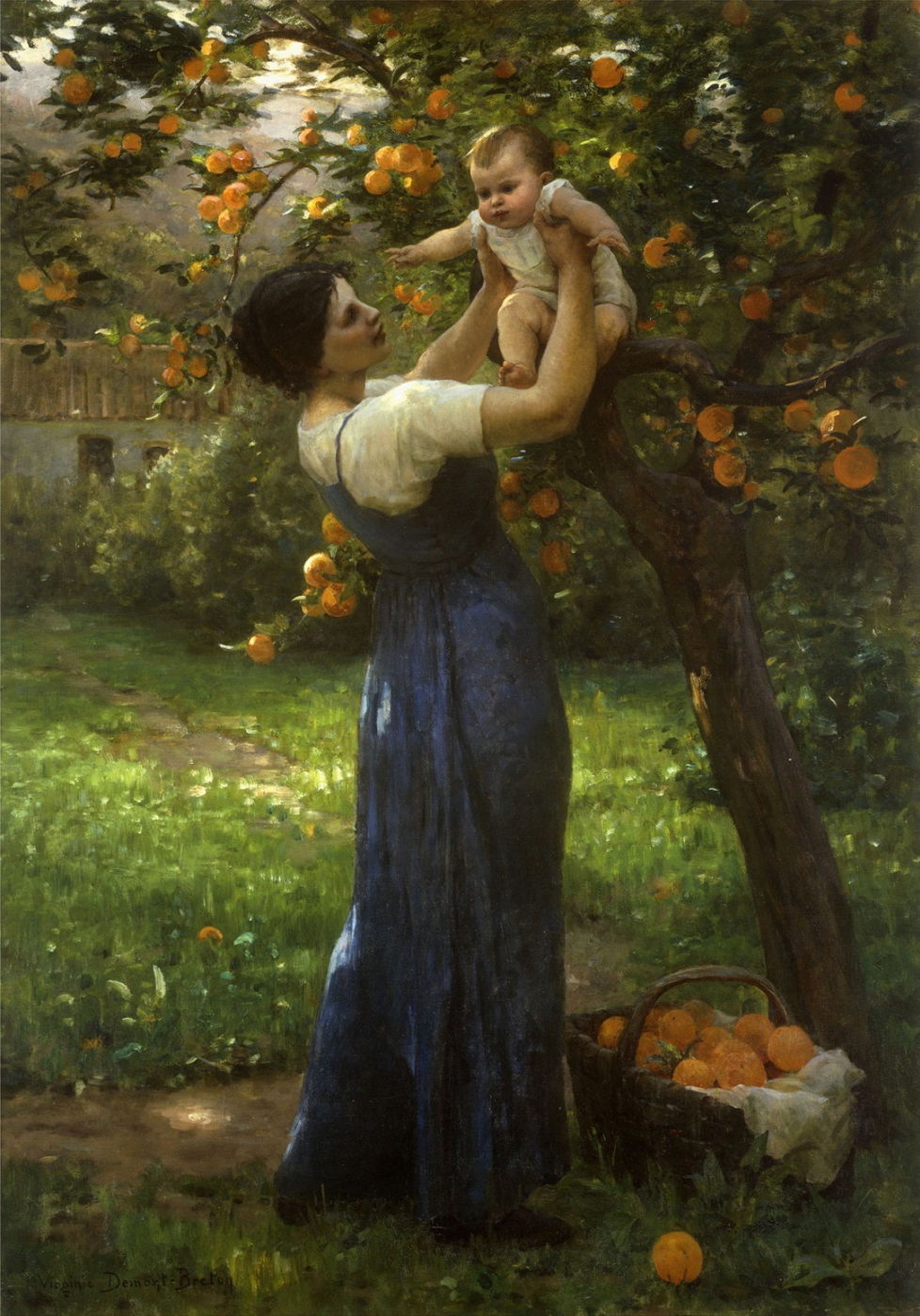
Virginie Demont-Breton (1859–1935), Mother and Child in an Orange Grove (date not known), oil on canvas, 102.2 × 69.8 cm, Private collection. Wikimedia Commons.
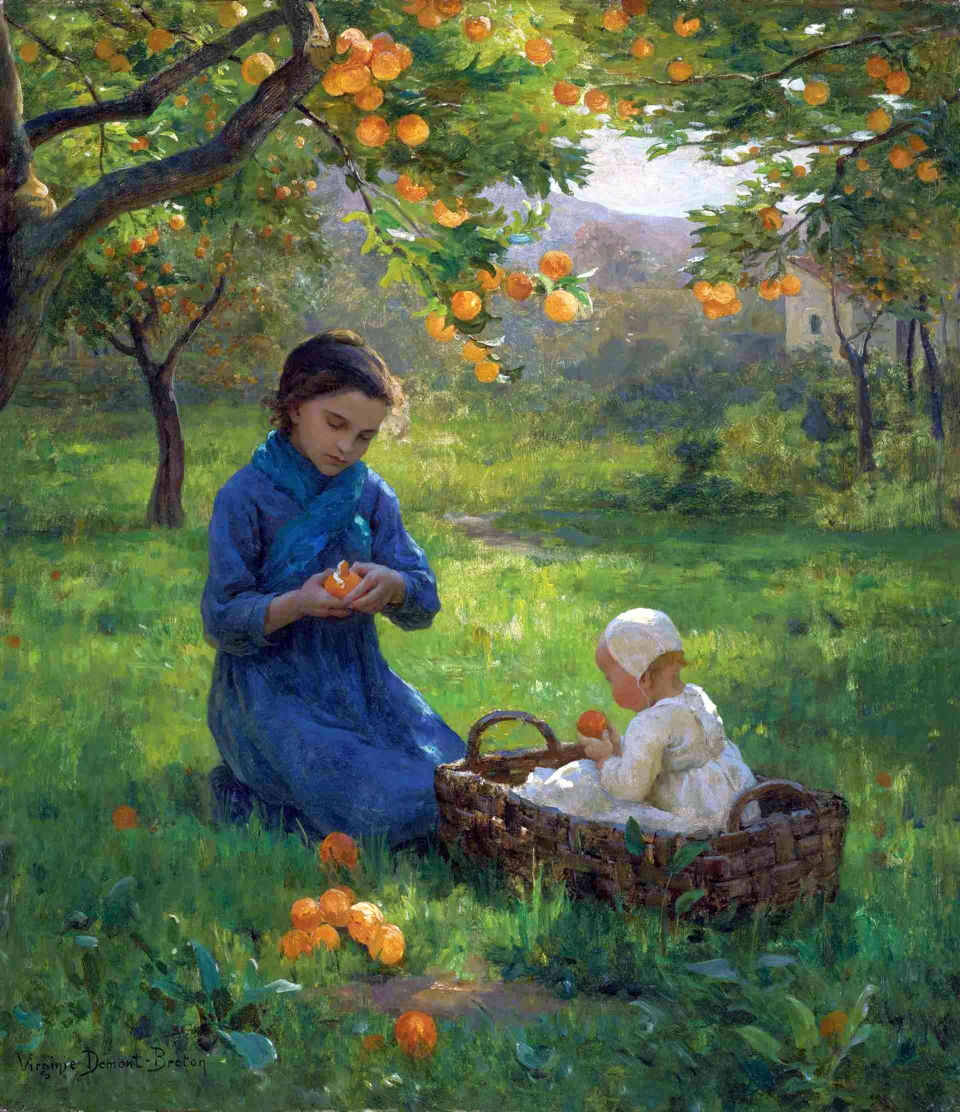
Mother and Child in an Orange Grove (above) was probably painted in the south of France, as was Under the Orange Tree (below).
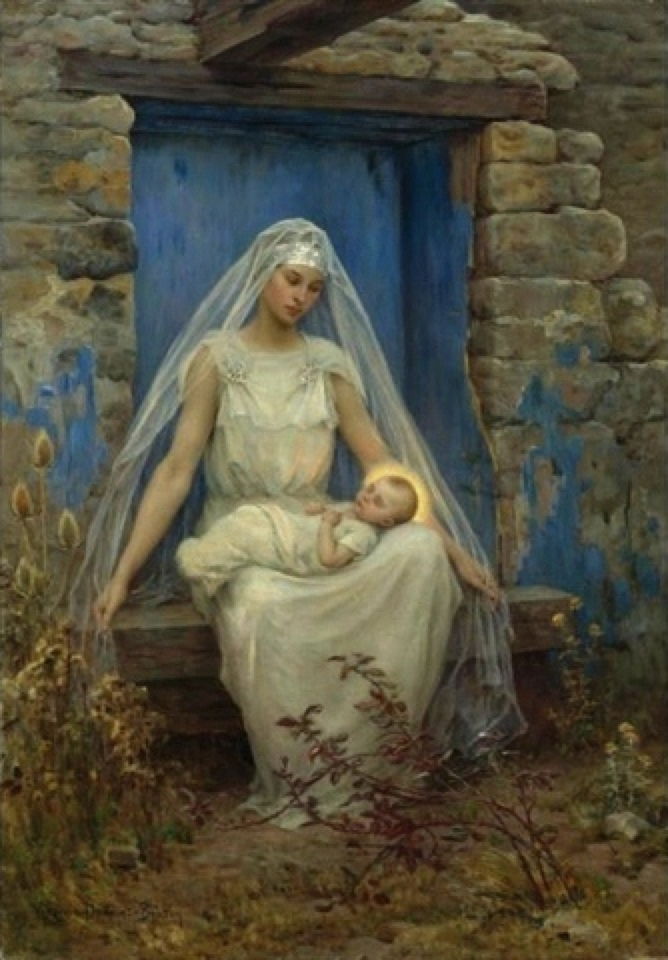
Virginie Demont-Breton (1859–1935), Under the Orange Tree (date not known), oil on canvas, 61.5 x 53.3 cm, location not known. The Athenaeum.Virginie Demont-Breton (1859–1935), Alma Mater (date not known), oil on canvas, 92.5 x 66 cm, location not known. Wikimedia Commons.
Alma Mater is an unusual version of the Nativity, in which the Virgin Mary’s traditional blue has been transferred to the painted plaster behind her, so she can be dressed in white.
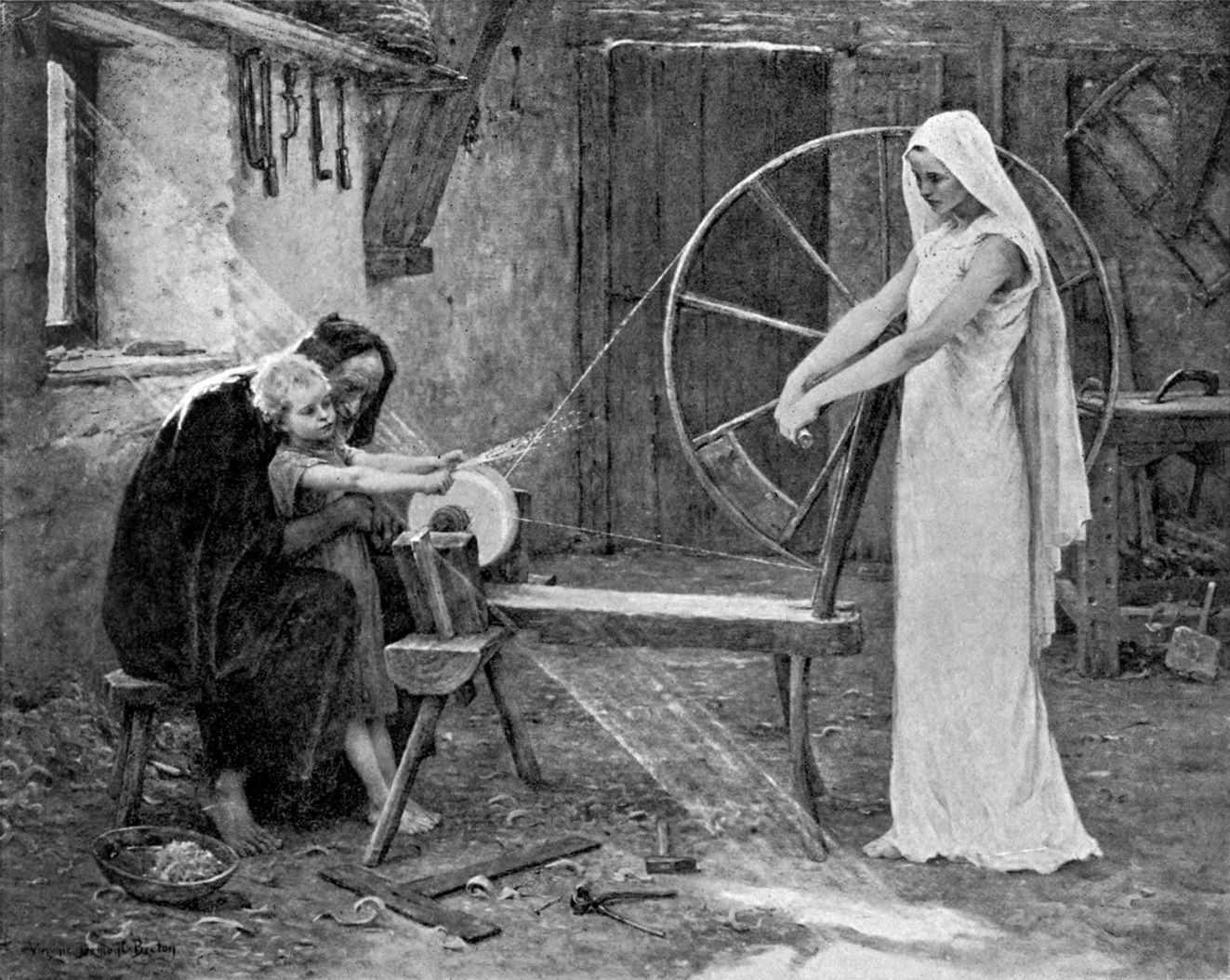
Virginie Demont-Breton (1859–1935) Le Divin Apprenti (The Divine Apprentice) (date not known), oil, further details not known. Wikimedia Commons.
Le Divin Apprenti (The Divine Apprentice) is a monochrome reproduction of a full-colour original. This shows the Holy Family in Joseph’s carpenter’s shop. The elderly Joseph guides Jesus in sharpening a knife on a whetstone turned by his mother Mary. Sunlight cast through the window illuminates the boy’s head.
This compares with John Millais’ famous Christ in the House of His Parents (1849-50).
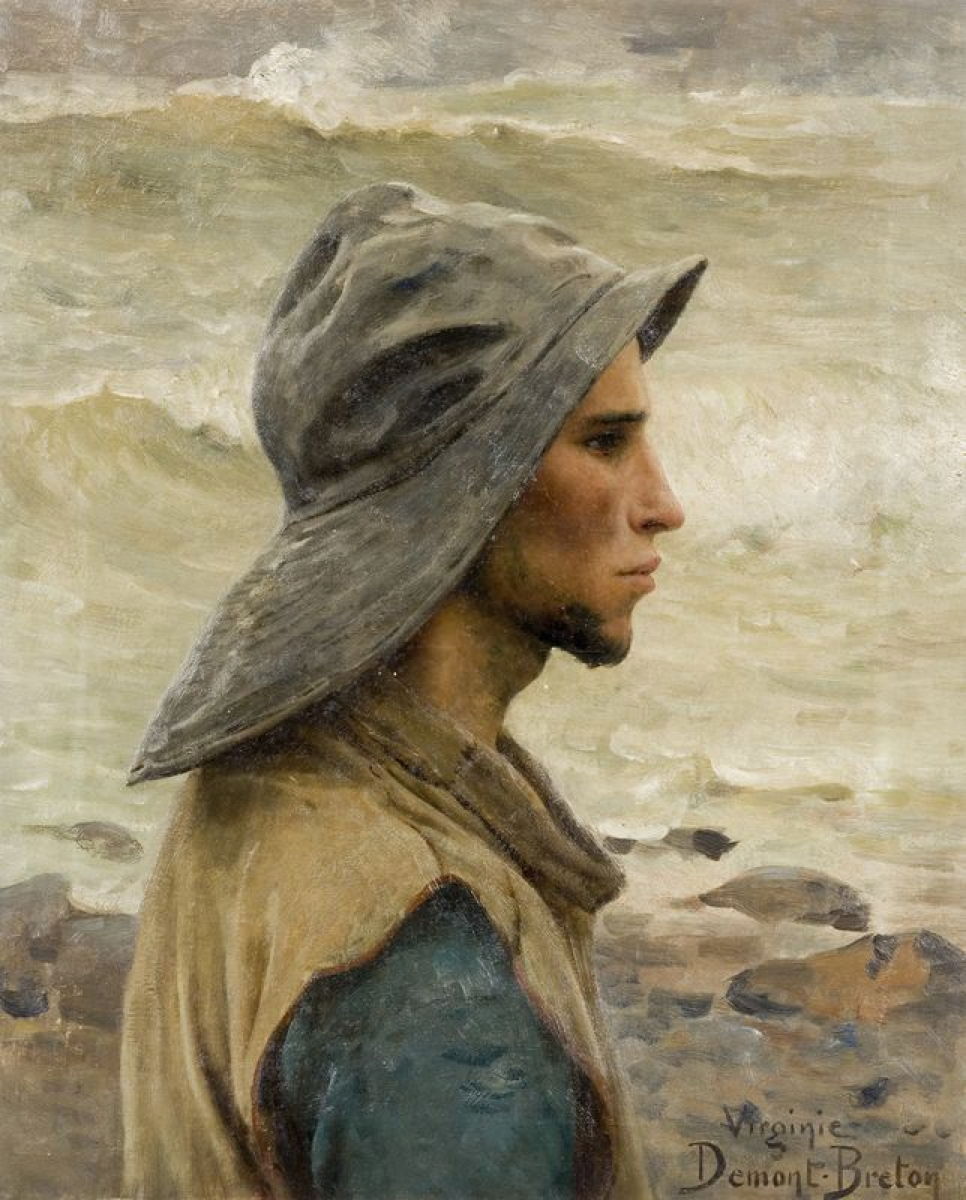
Virginie Demont-Breton (1859–1935), Young Fisherman Watches the Sea (date not known), oil, 61.5 x 50 cm, location not known. Wikimedia Commons.
Young Fisherman Watches the Sea is a thoughtful portrait of a young man whose future depends on his abilities to survive at sea. Note how painterly are the waves and other details in the background, which are also deliberately defocussed.
Although there are no books devoted to her work, as far as I can discover, a catalog raisonné is being prepared, which will be a major step forward in documenting her paintings properly. Not as great a modern Master as her father, perhaps, like the work of the women Impressionists, she broadened the appeal of painting, and was important in opening up art as a career for women. She deserves greater recognition.
Look across a range of third-party apps on your Mac and you’ll see how different their interfaces are. Casting aside those based on cross-platform frameworks like Electron, most of the best either use traditional AppKit, or its more recent successor SwiftUI. This article explains how those have come about, and how they differ.
AppKit is descended from the UI framework in NeXTSTEP, and has been at the core of Mac OS X from the start. For much of the last 26 years, it has provided the interface for the Finder and Apple’s own apps. When Apple designed iOS and iPadOS, they were given equivalents in UIKit, which isn’t as extensive, and hasn’t facilitated cross-platform development.
Although AppKit apps can construct their interface procedurally, most rely on Interface Builder, a GUI tool built into Xcode that separates the design of menus, windows, their views and controls from the largely procedural or imperative code used to drive them. You can often tell apart apps using AppKit by their use of Storyboard files in the Resources folder in their app bundle.
SwiftUI was announced at WWDC in June 2019, and first became available in macOS 10.15 Catalina. One of its primary goals is make it easier for apps to run across multiple Apple operating systems. It adopts a declarative approach, so rather than separating interface design into a graphical editor, its windows, their views and controls are built from data structures as in the example given in the Appendix below. Their code can then be previewed in real-time, but there’s no direct manipulation in those previews, which are developed iteratively in code.
For example, to increase the size of an AppKit text entry box in Interface Builder, the developer can either drag the box to its new size, or adjust its dimensions in a control, and see the result immediately. In SwiftUI, those dimensions are edited in the code defining that box within its view and window, which is then converted into a graphical preview. Although this difference may appear subtle, it’s fundamental. Apps that use SwiftUI without AppKit don’t have Storyboards in the Resources folder in their app bundle.
The two come from different eras in human interfaces.
AppKit presents a more static approach, where the contents of its views are their dynamic, as demonstrated in SilentKnight version 2 below.
SwiftUI is thoroughly dynamic, reconfiguring its look using animations and transitions in layouts that adapt to their purpose, as shown in a prototype for SilentKnight version 3 below. Although AppKit is thoroughly accessible from Swift code, it was developed for Objective-C, while as its name implies, SwiftUI is thoroughly Swift-oriented.
While there are still many fine apps that only use AppKit, SwiftUI remains work in progress, and it’s common for apps still to dip into AppKit to handle tasks that can’t be achieved in SwiftUI alone. Among many examples remaining is the display of PDF documents, which is still only achievable from an AppKit view. This is improving as SwiftUI evolves, but that in turn poses problems with macOS support.
For example, one of the most substantial changes in SwiftUI has been the move from its Observable Object protocol to the Observable macro, which affects the back end of apps. But the Observable macro is only available in apps written for macOS 14 or iOS 17 or later, which explains why so many apps using SwiftUI require a minimum of macOS 14.6, so they can take advantage of this architectural change. It’s not just the more obvious features in new versions of macOS that limit backward compatibility of apps.
Among the archipelago of delights brought in SwiftUI are its List View, and Swift Charts.
AppKit has excellent support for Attributed Strings that are essentially their underlying data for Rich Text. Log entries shown in my AppKit-based log browser Ulbow demonstrate how its NSTextView can handle tens of thousands of lines of Attributed String data representing log entries.
In LogUI, I have replaced that with a SwiftUI List View, which is far more versatile, but doesn’t use Attributed Strings.
Although in recent versions of macOS this readily copes with tens or even hundreds of thousands of lines, it’s still prone to displaying blank areas when scrolling.
Implementing charts in Logistician relies entirely on the capabilities of Swift Charts, but those are only available in macOS 13 and later.
Although it might appear that Mac developers are now spoilt for choice between AppKit and SwiftUI, there are many occasions when they’d prefer taking the best bits of each and building something more coherent and comprehensive, and better tailored to the desktop rather than the device.
Appendix: Example SwiftUI code
structContentView: View{
@Stateprivatevar messageInfo = Logger()
var body: someView {
let_ = messageInfo.getMessages()
if (self.messageInfo.logList.count > 0) {
VStack {
List(self.messageInfo.logList) { line in MessageRow(line: line)
}
}
.frame(minWidth: 900, minHeight: 200, alignment: .center)
} else {
Text("No results returned from the log for your query.")
.font(.largeTitle)
}
}
}
structMessageRow: View{
let line: LogEntryvar body: someView {
HStack {
Text(line.date + " ")
if #available(macOS 14.0, *) {
Text("\(line.type)")
.foregroundStyle(.red)
} else {
Text("\(line.type)")
.foregroundColor(.red)
}
if !line.activityIdentifier.isEmpty {
Text(line.activityIdentifier)
}
// etc. Text(line.composedMessage)
}
}
}
Apple has overnight released its out-of-cycle update to XProtect for macOS prior to Sequoia, bringing it to version 5337. This update has already been released for macOS Sequoia and Tahoe, and this update provides the same version for those Macs still using on the older bundle location.
This version removes the Yara rule for MACOS.SOMA.MAENB, and makes no changes to the Osascript rules in XPScripts.yr.
You can check whether this update has been installed by opening System Information via About This Mac, and selecting the Installations item under Software.
A full listing of security data file versions is given by SilentKnight and SystHist for El Capitan to Tahoe available from their product page. If your Mac hasn’t yet installed this update, you can force it using SilentKnight or at the command line.
If you want to install this as a named update in SilentKnight, its label is XProtectPlistConfigData_10_15-5337
Sequoia and Tahoe systems only
This update has already been released for Sequoia and Tahoe via iCloud. If you want to check it manually, use the Terminal command sudo xprotect check
then enter your admin password. If that returns version 5337 but your Mac still reports an older version is installed, you should be able to force the update using sudo xprotect update
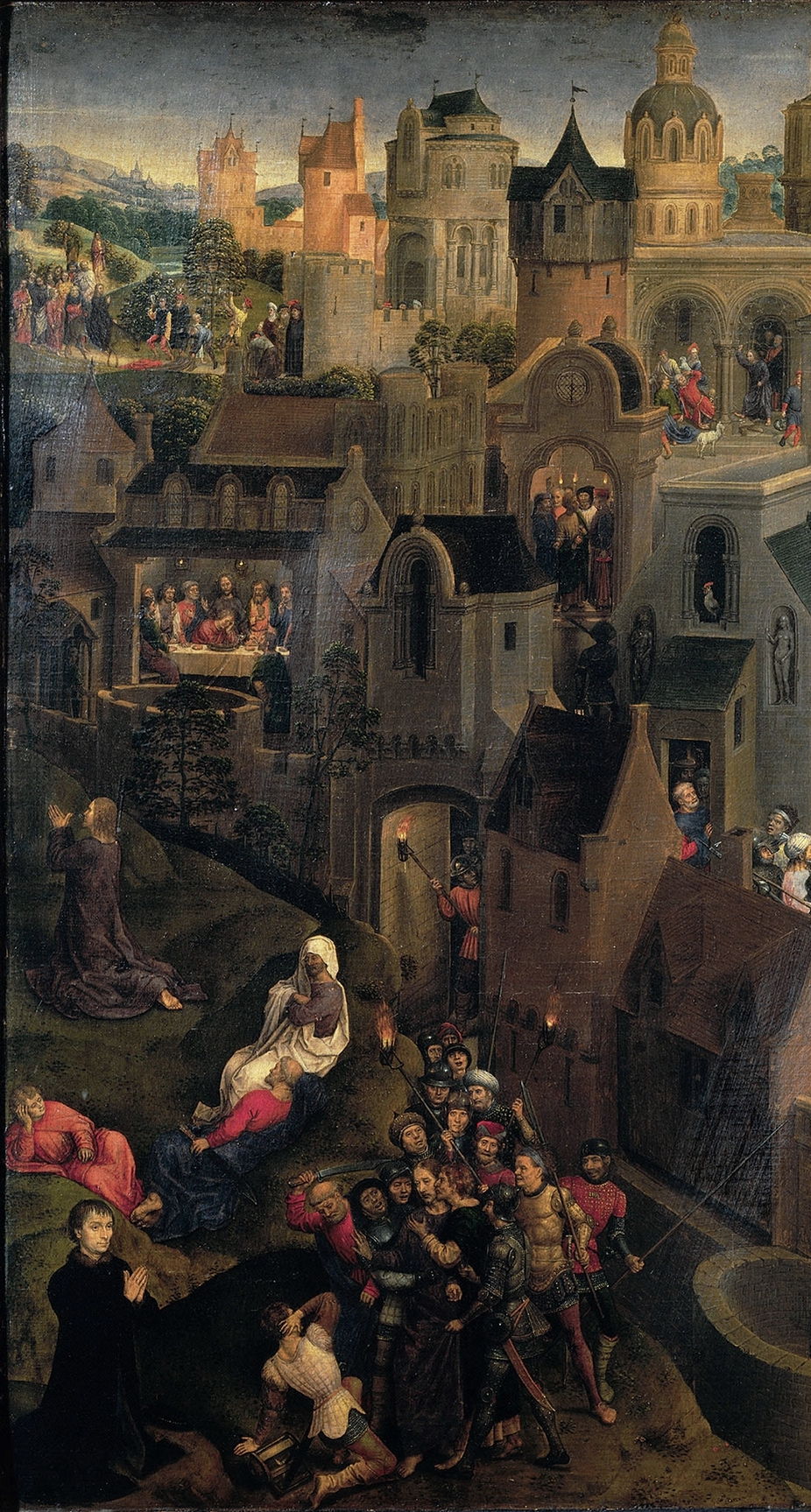
Today is, in most Western Christian churches, the most holy day of the calendar, being Good Friday, the day on which the Crucifixion is marked. Throughout the Renaissance the most popular choice for church altarpieces was a polyptych showing the story of the Crucifixion. The early Netherlandish painter Hans Memling (c 1433–1494) painted many of those, but in about 1470 he created a unique view of the Passion in Scenes from the Passion of Christ. This single panel features no less than twenty-three scenes, starting with the triumphal entry into Jerusalem, and ending with four showing the Resurrection. These are all integrated into a single fictional aerial view of Jerusalem.
Hans Memling (c 1433–1494), Scenes from the Passion of Christ (1470-1), oil on oak panel, 56.7 x 92.2 cm, Sabauda Gallery, Turin, Italy. Wikimedia Commons.
This was commissioned by Tommaso Portinari, an Italian banker based in the Belgian city of Bruges, who as the donor earned himself a place at the lower left corner, with his wife Maria Baroncelli at the lower right. Spread across the rest of this relatively small oak panel are scenes that require the words of six chapters of the Gospel of Saint Luke, each fully integrated into its single visual narrative.
Hans Memling (c 1433–1494), Scenes from the Passion of Christ (marked up) (1470-1), oil on oak panel, 56.7 x 92.2 cm, Sabauda Gallery, Turin, Italy. Wikimedia Commons.
I have marked up each of the scenes and the links between them in this image, and step through them with detail views.
As is characteristic of the period, Memling’s Jerusalem is depicted as a walled mediaeval city, familiar in appearance to those in northern Europe. Some of its towers have an oriental flavour, but nothing the contemporary viewer would find too unusual. The narrative path taken through these buildings starts at the upper left and, with few exceptions, winds its way without crossing its own path and causing any confusion. Its only navigational complexity arises between the ninth and thirteenth scenes. Otherwise it sweeps down from the top to the foreground procession to Calvary and concludes at the upper right.
Hans Memling (c 1433–1494), Scenes from the Passion of Christ (detail) (1470-1), oil on oak panel, 56.7 x 92.2 cm, Sabauda Gallery, Turin, Italy. Wikimedia Commons.
The sequence opens with Jesus’ triumphal entry into Jerusalem, highlighted at the top left. From there, he drives the money-changers from the Temple. Close to that is the betrayal by Judas to the High Priests, which leads down to the Last Supper, also highlighted. Memling adopts a conventional view of the table, with Christ recognisable in the same dark blue robes.
Jesus is obvious as he prays in the Garden of Gethsemane, and again when he is arrested. Judas is seen kissing him, and Peter has severed the ear of Malchus. The narrative path then moves up to find Peter denying Christ, with a cock crowing in the window above him.
Hans Memling (c 1433–1494), Scenes from the Passion of Christ (detail) (1470-1), oil on oak panel, 56.7 x 92.2 cm, Sabauda Gallery, Turin, Italy. Wikimedia Commons.
With Christ now under arrest, the narrative continues inside the city walls, going from Peter to Jesus brought before Pilate, who is sat on his throne. Christ is then stripped and whipped in the centre of the panel; to ensure consistent identification, his dark blue robes are draped on the threshold in front of him.
Here the narrative path becomes more difficult to trace, as it jumps over two later scenes to Pilate’s second interrogation further to the right, before returning to the crowning of thorns, with Christ sat partly dressed in his robe. The other dominant scene in this section follows, as Christ is led out to the crowd in the scene widely known as Ecce Homo, behold the man, in which he is condemned to death by the people.
Hans Memling (c 1433–1494), Scenes from the Passion of Christ (detail) (1470-1), oil on oak panel, 56.7 x 92.2 cm, Sabauda Gallery, Turin, Italy. Wikimedia Commons.
In the yard in front of the scene of the Flagellation, two men are making the cross. Following that the procession leaves the city, Christ having fallen to his knees under the weight of the cross, with Simon of Cyrene helping him bear its weight. Pilate, distinguished by his hat and clothing (matching those seen earlier), is shown behind them, as he’s about to ride out through the city gate. Further to the front of the procession are the two thieves to be crucified on either side of Jesus, their hands tied behind their backs.
Hans Memling (c 1433–1494), Scenes from the Passion of Christ (detail) (1470-1), oil on oak panel, 56.7 x 92.2 cm, Sabauda Gallery, Turin, Italy. Wikimedia Commons.
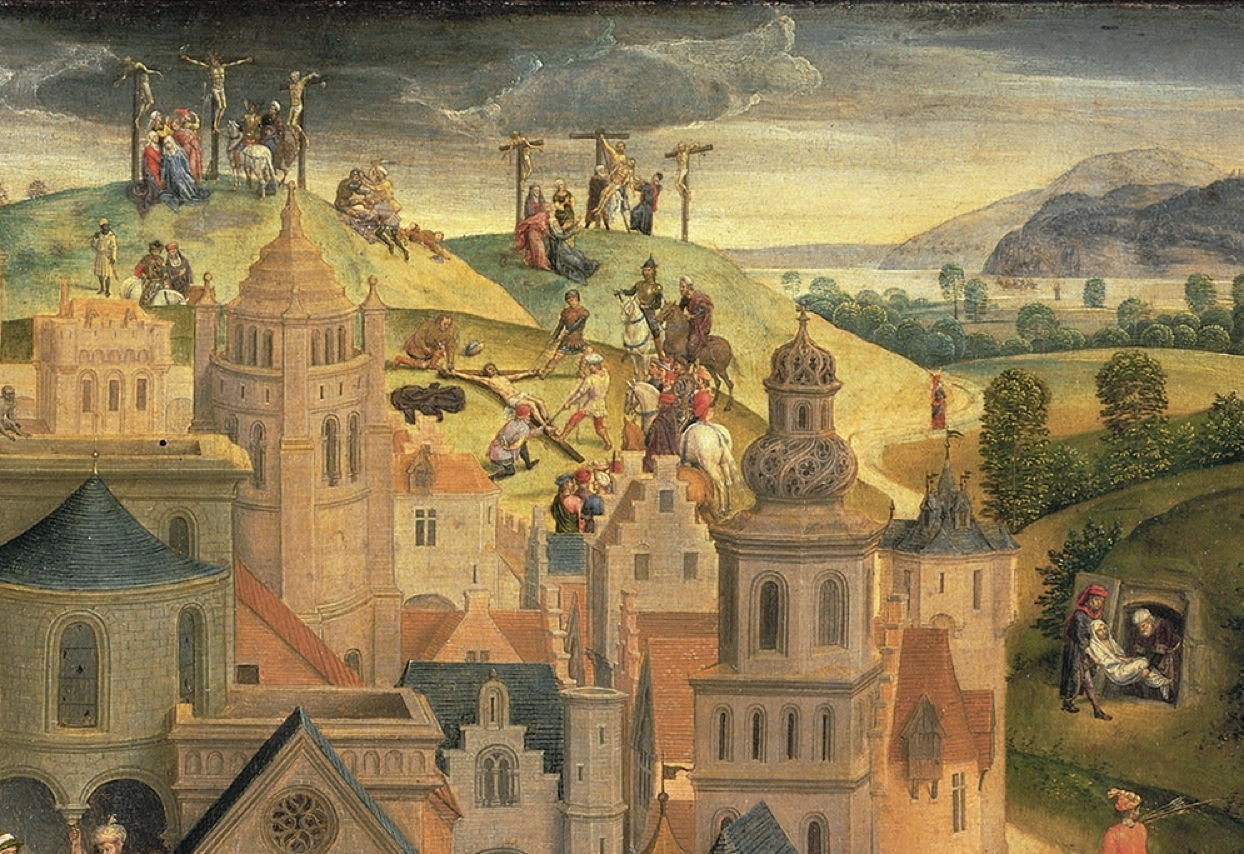
The winding road to the place of execution leads the narrative up to the first of three scenes of the Crucifixion, in which Christ is nailed to the cross as it rests on the ground. The left of the two skyline scenes shows the three dying on their crosses, then to the right is the Descent from the Cross, as Christ’s body is lowered and taken on to the Entombment.
Hans Memling (c 1433–1494), Scenes from the Passion of Christ (detail) (1470-1), oil on oak panel, 56.7 x 92.2 cm, Sabauda Gallery, Turin, Italy. Wikimedia Commons.
When Christ’s body is placed in the tomb, it’s swathed in white, to be replaced by red when he enters Limbo, bearing a staff with a crucifix at the top. Directly above that is the start of the Resurrection series, with Christ (still in red robes) standing by the entrance to the tomb, as the guards are asleep in front of him.
Above that, the resurrected Christ meets Mary Magdalene in the scene known as Noli Me Tangere. He appears again on the road to Emmaus above that, and finally to the Apostles in the far distance, on the shore of the Sea of Galilee.
Memling uses a narrative technique popular during the Renaissance, which I term multiplex, often referred to as continuous narrative elsewhere. It was widely used from classical Roman times to incorporate three sequential scenes into a single image, and in Lucas Cranach the Elder’s The Garden of Eden (1530) reached a peak of six scenes, but Memling’s twenty-three appears to set a record. It works by substituting space for time, so that individual events that occurred in sequence are separated by their location in the image. This might appear alien to the modern mind, so heavily influenced by serial media such as literature and movies, but different approaches to time in the past accommodated it well.
Inevitably, Memling’s Passion was soon imitated by others, with at least one slightly later painting being known by an anonymous artist. Memling also used the same technique about a decade later in his painting for the altar of the Tanners’ guild in Our Lady’s Church in Bruges, perhaps slightly less successfully.
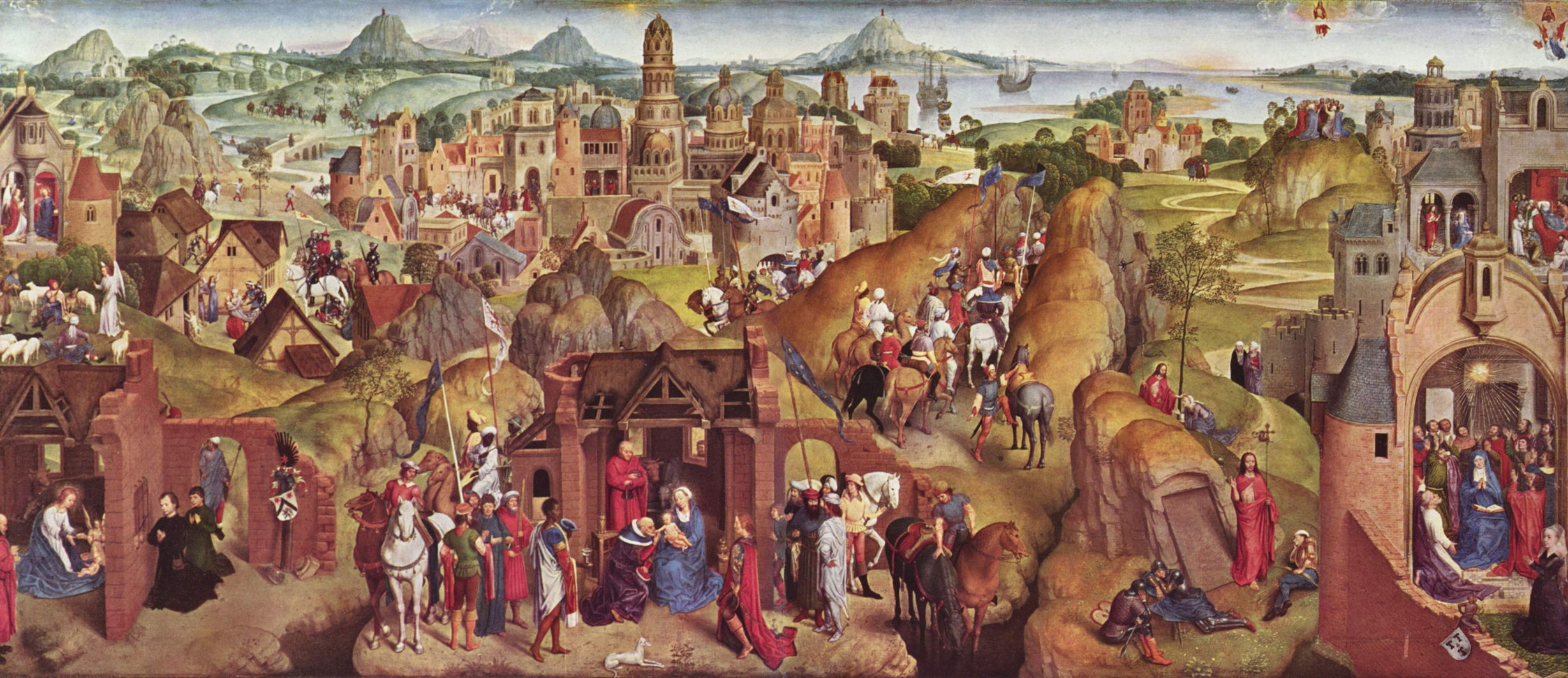
Hans Memling (c 1433–1494), Advent and Triumph of Christ (1480), oil on oak, 81.3 × 189.2 cm, Alte Pinakothek, Munich. Wikimedia Commons.
Memling’s Advent and Triumph of Christ (1480) uses the same technique with twenty-five scenes from the whole life of Christ, starting with the Annunciation at the top left, omitting the Crucifixion itself, and ending with the Assumption of Mary at the lower right. The narrative thread is unfortunately more fragmented than in his Scenes from the Passion of Christ, and this doesn’t appear to have been attempted again after 1500.
Apple has just released an out-of-cycle update to XProtect for macOS Sequoia and Tahoe only, bringing it to version 5337. As usual it doesn’t release information about what security issues this update might address.
This version removes the Yara rule for MACOS.SOMA.MAENB, and makes no changes to the Osascript rules in XPScripts.yr.
You can check whether this update has been installed by opening System Information via About This Mac, and selecting the Installations item under Software.
A full listing of security data file versions is given by SilentKnight and SystHist for El Capitan to Tahoe available from their product page.
Currently this update is only available for Macs running Sequoia or Tahoe. Those running earlier versions of macOS can only update to XProtect version 5336 via softwareupdate.
This update has only been released for Sequoia and Tahoe via iCloud. If you want to check it manually, use the Terminal command sudo xprotect check
then enter your admin password. If that returns version 5337 but your Mac still reports an older version is installed, you should be able to force the update using sudo xprotect update
Easter eggs are part of the tradition of this time of year, and the term applied to concealed features in computer hardware or software. It seems to have originated in early video games, although the first record is in the command make love on DEC PDP-10 mainframes in 1967-68. Macs have had their fair share over the years, although Steve Jobs seems to have disliked them, and is reported to have banned them. Here are a few that I’ve come across in more recent years.
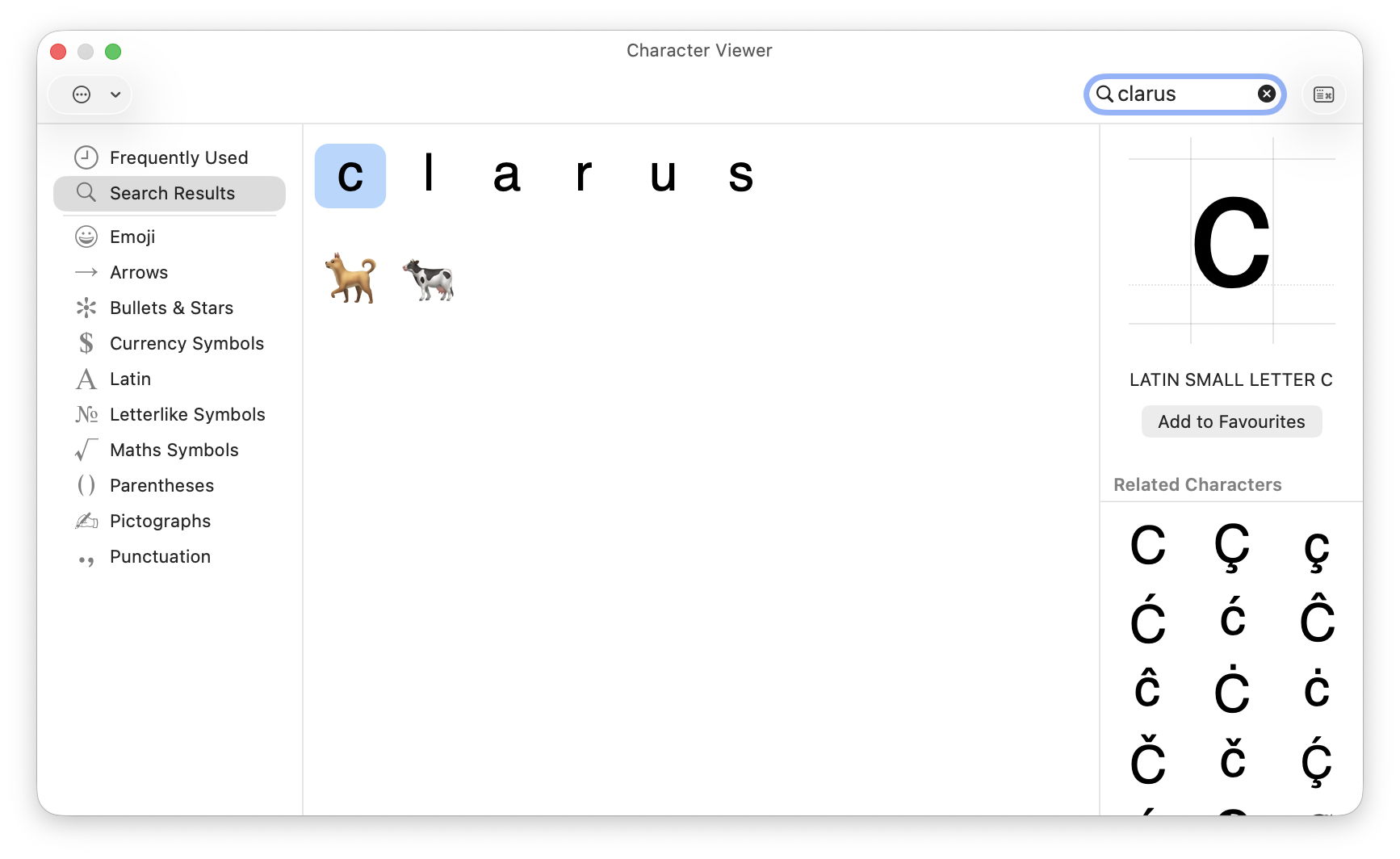
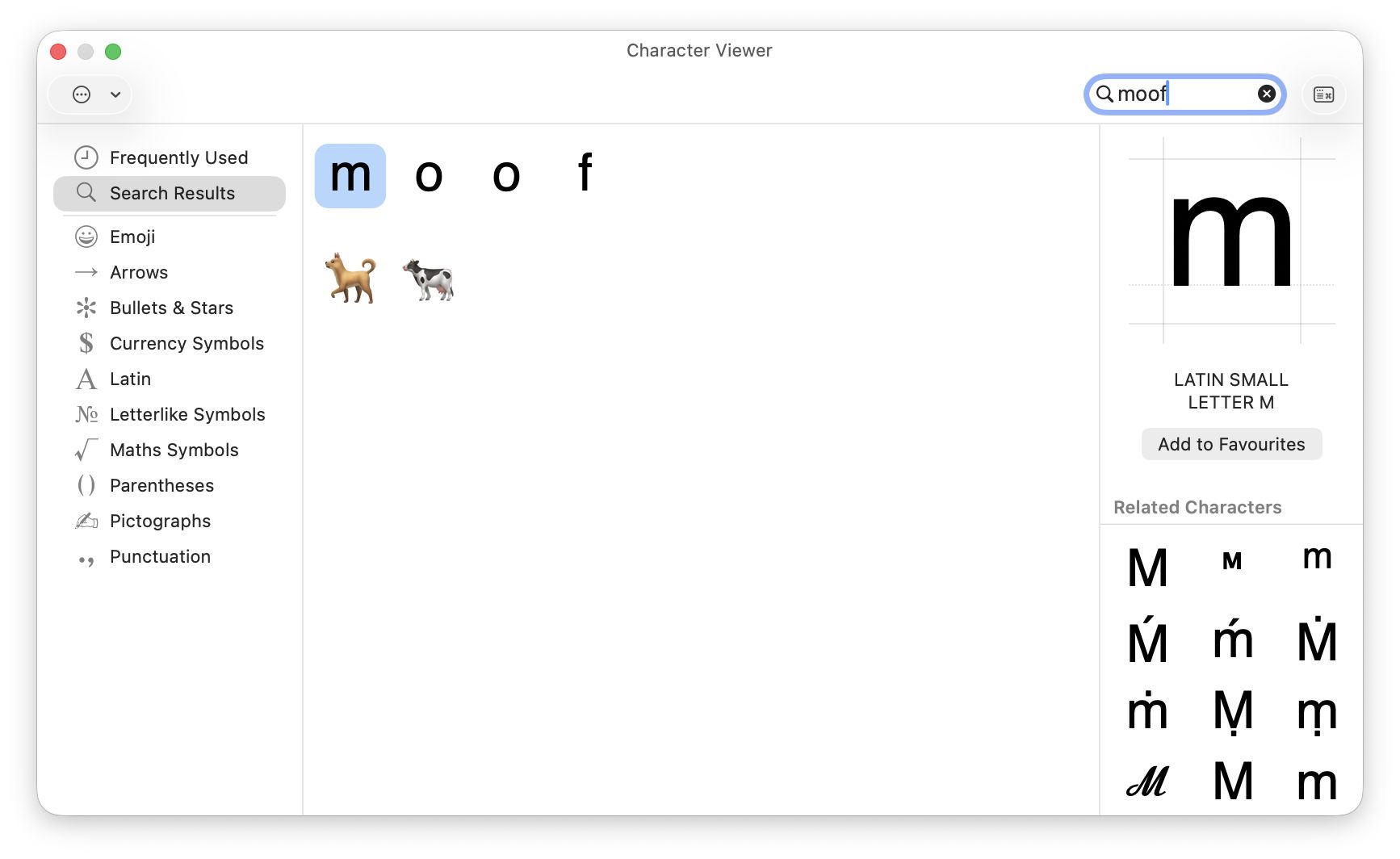
Clarus the Dogcow
This mythical animal from the Mac bestiary has been tucked away as an Easter egg in the Emoji & Symbols viewer for many years. Type the letters clarus or moof (the sound it makes) into the search box of that viewer to see the two emoji figures of a dog and a cow, although neither of them resembles Clarus in appearance, as shown in the Page Setup window in recent macOS.
Marijuana leaves
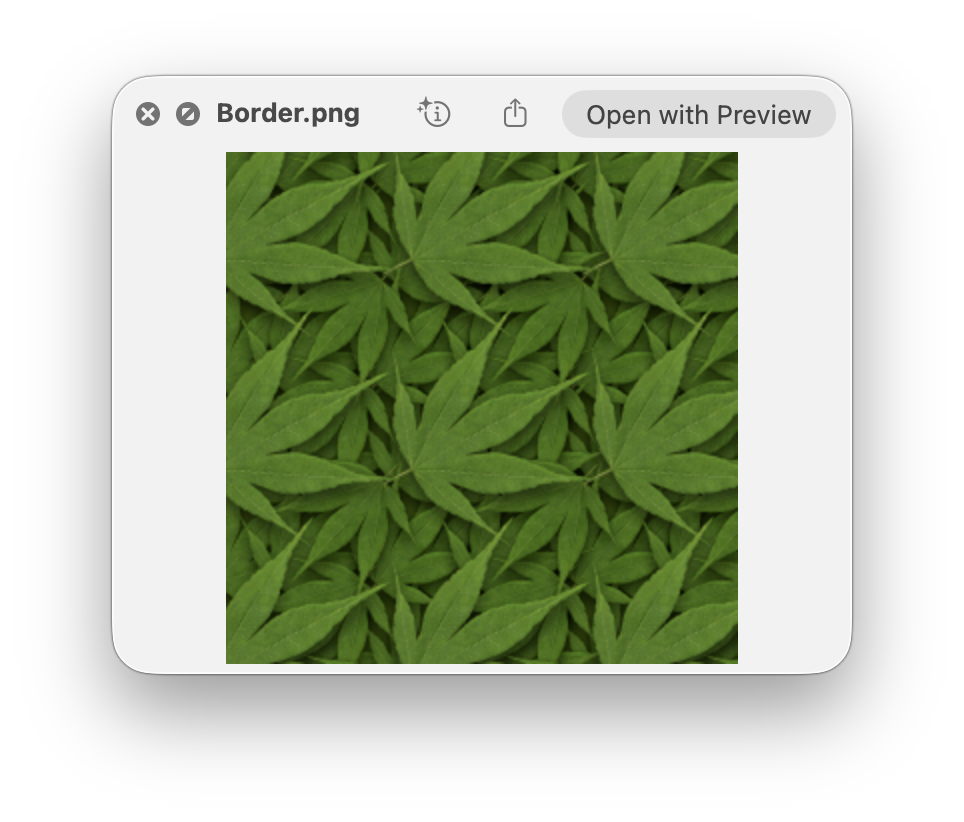
More inaccessible, but apparently present for even longer, is a PNG image showing marijuana leaves embedded inside the Chess app. To see these, select Chess.app, and Show Package Contents. Work through the Contents, Resources and Styles folders and you’ll see two styles Fur and Grass, neither of which is offered in the app’s Settings. In the Grass folder, select Border.png to see a pattern of marijuana leaves.
I’ve been unable to find a way of accessing these as a style for the app, though. Chess also has a unique About window that not only contains the full GNU licence for the app, but offers a button to download the app’s source from Apple’s Open Source Releases page. Perhaps the intention is that you can build your own version of the app giving access to the Grass and Fur styles, making it the most convoluted Easter egg.
MAC wallpaper
According to a recent report in MacWorld, the colour-matched wallpapers provided for MacBook Neos spell out MAC.
Dont Steal Mac OS X
This is a kernel extension named Dont Steal Mac OS X.kext, found in /System/Library/Extensions, whose sole purpose is to contain Apple’s copyright statement, and in its own words “to protect Apple copyrighted materials from unauthorized copying and use.” Oddly, the current version claims copyright over the period 2006-2020 in its Info.plist, but 2006,2009 in its licence resource.
Minimise (defunct)
Until a few years ago, the yellow Minimise button in windows featured a set of Easter eggs that are claimed to have been a favourite of Steve Jobs. Clicking on that button with Control, Shift or Control and Shift keys held ran the animation at widely different speeds, and could be reversed when clicking on the minimised window in the Dock. These are described here, but have been removed since then.
RAM disk (defunct)
According to a relatively recent report in Tom’s Hardware, the ROM of Power Mac G3 models contains an Easter Egg of a hidden file when a RAM disk is created with the name secret ROM image.
Once Gustave Moreau had recovered from the trauma of the Franco-Prussian War, he started on his next major works. He had been invited to join the select group of artists who were engaged to paint murals in major public buildings, but declined. Despite that, in 1875 he was made a member of the Legion of Honour, which pleased him and his mother deeply. All he needed now was another success at the Salon.
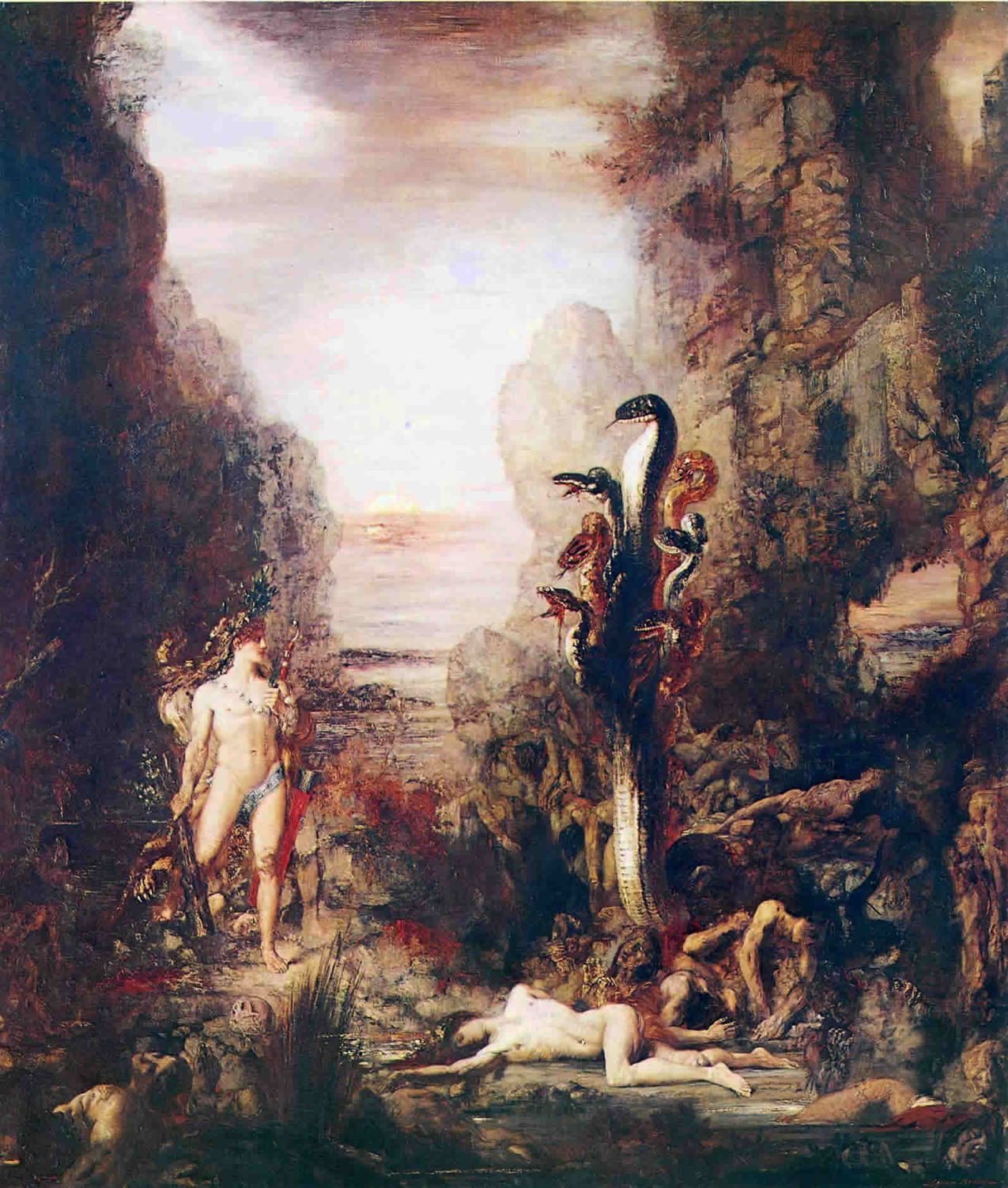
One of his four paintings exhibited at the Salon of 1876 told the second of Hercules’ twelve labours, his battle with the Lernean Hydra.
Gustave Moreau (1826–1898), Hercules and the Lernean Hydra (1876), oil on canvas, 175 × 153 cm, The Art Institute of Chicago, Chicago, IL. Wikimedia Commons.
The Hydra was a poisonous monster with the body of a dog and multiple serpent heads, whose breath alone could kill. According to surviving written accounts, Hercules covered his mouth and nose with a cloth for protection from the deadly fumes, fired flaming arrows into the Hydra’s lair to awaken it, then set about trying to kill it.
When he discovered that cutting off its heads with a sickle or sword only resulted in two more growing back, Hercules enlisted the help of his nephew Iolaus, who cauterised the wounds with a firebrand to prevent regrowth. Hercules then cut off the one immortal head using a golden sword given to him by Athena. He also took some of the Hydra’s blood, which was the poison used on the arrow with which he later killed Nessus.
Moreau puts his canvas into its portrait orientation to emphasise the Hydra towering over Hercules, who is fully armed, with club, bow and arrows, and more. The moment chosen is the initial confrontation, with Hercules staring steely-faced at the Hydra. This is consistent with Moreau’s aversion to a more theatrical treatment.
This was well-received and extensively debated, even generating a long-standing controversy over its possible political connotations. It was suggested at the time that the Hydra represented the forces of anarchy behind the insurgency of the Commune in 1871. Others preferred instead that the Hydra represented Bismarck and the German princes behind the Franco-Prussian War of 1870.
Two of his other paintings shown in 1876 were based on the story of Salome and the execution of Saint John the Baptist. Their underlying narrative is biblical, and straightforward. The unnamed daughter of Herodias (subsequently named as Salome) performed a dance at a birthday feast thrown by King Herod. The dance so pleased Herod that he offered her anything that she wanted, up to half his kingdom. She asked not for riches, but for the head of Saint John the Baptist, the earthly messenger sent to announce the birth and ministry of Jesus Christ. Reluctantly, Herod agreed, John was beheaded in prison, and his head brought to her on a plate; the dancer gave the head to her mother.
This has been a popular story for religious paintings, and by far the most common scene involves John’s head being brought on a plate, or variations around that. Moreau was clearly interested in other parts of the story, and in Salome herself. Moreau’s apparently sudden interest in Salome was sparked by the story, probably mythical, of a woman Communard known as the pétroleuse, who seemingly took delight in setting buildings alight. That suggests it wasn’t until the summer of 1871 that he started work on his paintings of Salome.
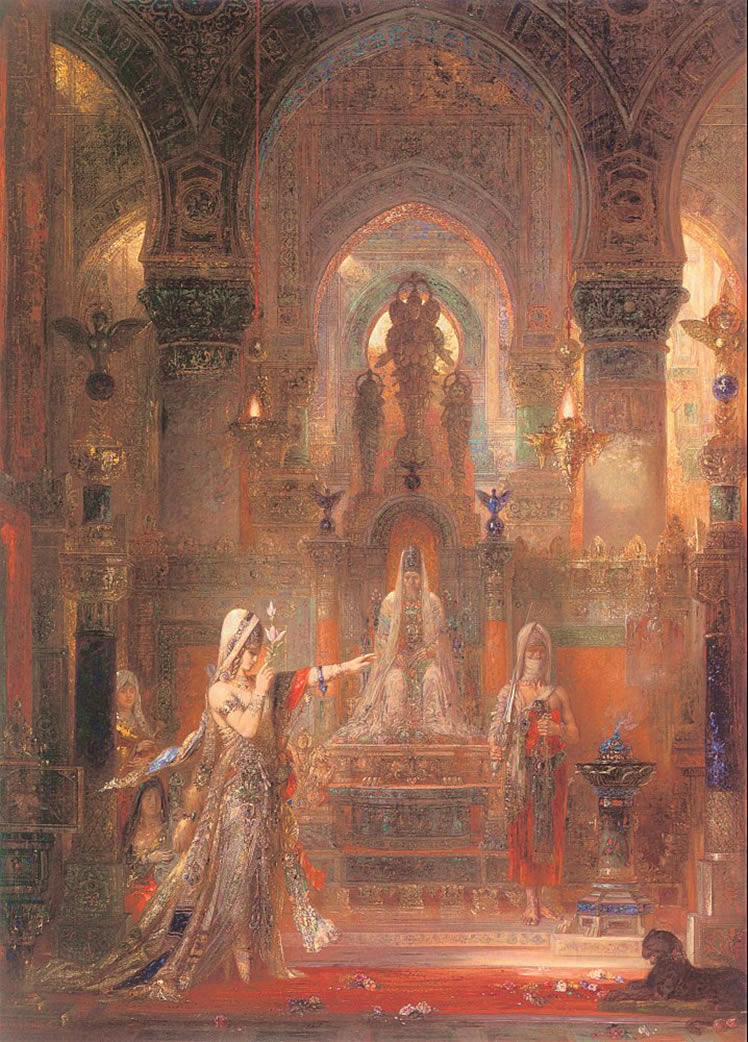
Gustave Moreau (1826–1898), Salome (1876), oil on wood, 144 x 103.5 cm, Armand Hammer Museum of Art, Los Angeles, CA. Wikimedia Commons.
The culmination of Moreau’s quest for the right scene to show the story of Salome the dancer is this extraordinary oil painting shown at the 1876 Salon.
The cadaveric King Herod sits on this throne while Salome is almost static on her points, and pointing towards the right. The executioner stands at the foot of the throne, and a couple of other women (including, perhaps, Salome’s mother) are at the left. Salome holds a lotus flower in her right hand, and other flowers are strewn on the floor. John’s head is nowhere to be seen, so we must presume that the moment selected by Moreau is when Salome chooses to receive that as her reward.
The rest of the painting consists of an unprecedented fusion of images, icons, and objects drawn from a diverse range of cultures. Detailed examination has shown these to be associated with the Hagia Sophia in Istanbul, the Alhambra in Granada, the Great Mosque of Cordoba, and several mediaeval cathedrals. Motifs have been identified from Etruscan, Roman, Egyptian, Indian, and Chinese art and culture.
But Moreau wasn’t content to show only that scene from the story. The other painting was to consider Salome with the head of John the Baptist as an apparition, and is now represented in three different versions.
Gustave Moreau (1826–1898), The Apparition (1875), oil on canvas, 142 × 103 cm , Musée National Gustave-Moreau, Paris. Wikimedia Commons.
The Apparition (1875) in the Musée National Gustave-Moreau is one of Moreau’s earliest attempts to express this. It takes the central part of Salome and adds the floating, severed head of John. Salome has now been transformed into the provocative, under-dressed femme fatale shown by subsequent artists. King Herod’s throne has been moved to the left of the painting, and he now looks in the direction of the apparition.
Gustave Moreau (1826–1898), The Apparition (c 1876), watercolour on paper, 106 x 72 cm, Musée d’Orsay, Paris. Wikimedia Commons.
This watercolour painting of The Apparition (c 1876), now in the Musée d’Orsay, was that shown at the Salon, although its colours are far weaker than when it was first exhibited. The cadaveric King Herod sit on his throne, overseeing the scene from the left edge. Herodias, presumably, sits by his feet, and a musician for Salome’s dance is shown further back. At the right edge is the executioner, John’s blood still on his sword.
Salome is now nearly nude, her body decorated with an abundance of strategically-placed jewellery and adornments. She points at the apparition with her left hand, trying to stare it out, her face as blank as everyone else’s. She stands on her points, but there is no sign of movement. The floor isn’t just strewn with flowers, but is now stained with the dripping blood from the severed head.
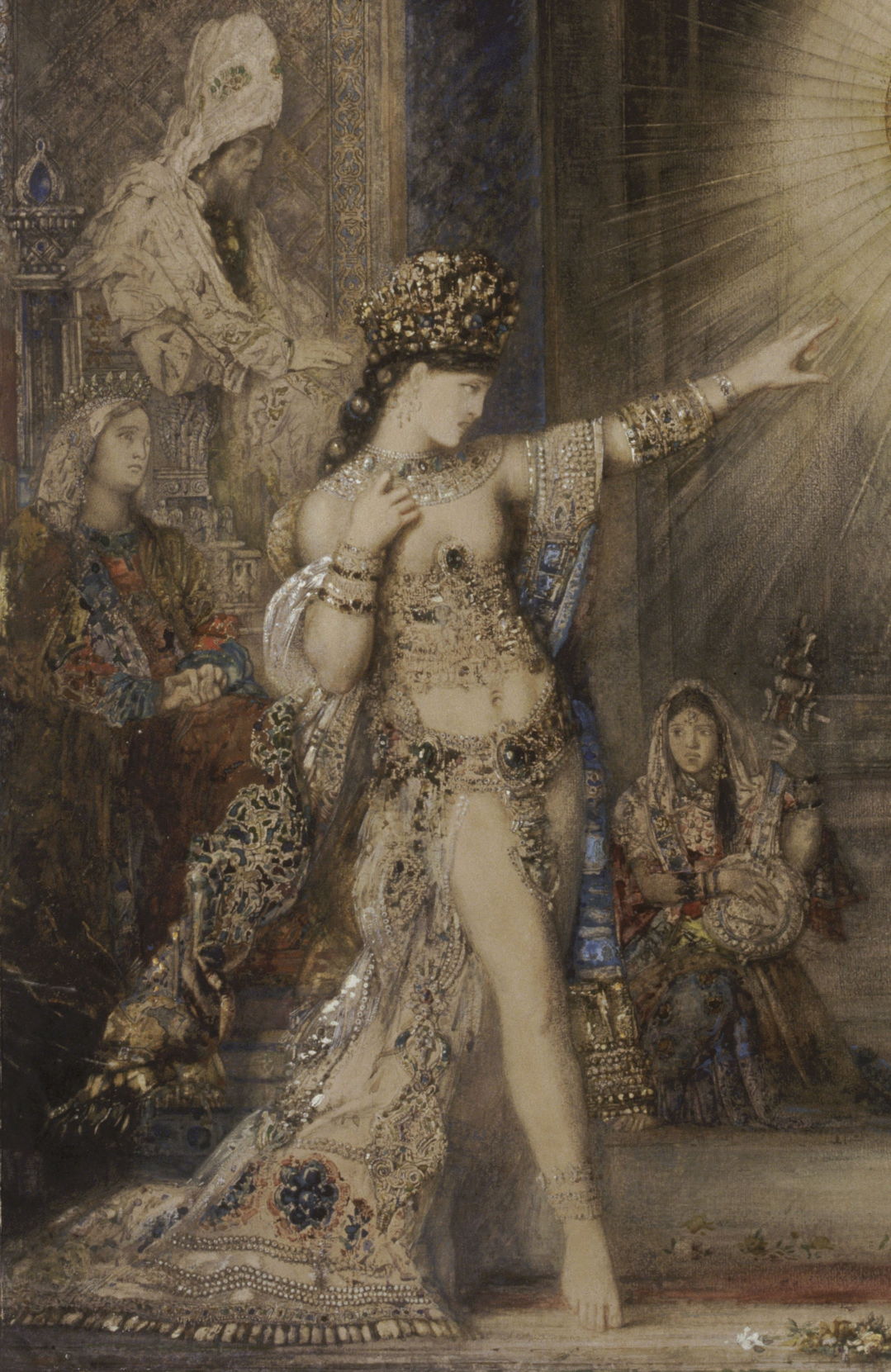
Gustave Moreau (1826–1898), The Apparition (detail) (c 1876), watercolour on paper, 106 x 72 cm, Musée d’Orsay, Paris. Wikimedia Commons.
Facial expressions are not theatrical as might have been expected in the work of a more conventional history painter of the day.
Gustave Moreau (1826–1898), The Apparition (1876-77), oil on canvas, 55.9 x 46.7 cm, Harvard Art Museums/Fogg Museum (Bequest of Grenville L. Winthrop), Cambridge, MA. Courtesy of Harvard Art Museums.
This slightly later oil version of The Apparition (1876-77), now in the Fogg Museum, gives a better idea of the original effect of Moreau’s watercolour, although the panther has moved across to replace the musician, and the background is quite different.
Moreau hadn’t painted Salome and The Apparition as a pair. Their compositions are individual, and mutually conflicting in details of the palace, the position of Herod’s throne, and more. Salome is one of the most iconographically rich paintings ever made, and it’s not surprising that some critics found it phantasmagoric. The Apparition is dominated by the same eye-to-eye contact that made Moreau’s Oedipus and the Sphinx so compelling, but here it’s between a notorious dancer and the severed head of the holiest man after Christ himself.
In 1877, the year after that Salon, Gustave Flaubert published three short stories, including an extended account of the traditional biblical narrative with Herodias at its centre. The British writer Oscar Wilde was introduced to that by Walter Pater (philosophical leader of Aestheticism), and in 1884 Joris-Karl Huysmans’ À rebours was published, a novel including a description of Moreau’s Salome paintings.
Wilde’s one-act play Salome was first published in French in 1891, and was soon translated into English and German. Banned from public performance in Britain, it received its premier in Paris in 1896, but wasn’t performed in public in England until 1931. At the centre of Wilde’s play is the perversion of lust and desire in Salome, best summarised in her words at the end of the play (he calls John the Baptist Jokanaan): But, wherefore dost thou not look at me Jokanaan? Thine eyes that were so terrible, so full of rage and scorn, are shut now. Wherefore are they shut? Open thine eyes! Lift up thine eyelids, Jokanaan! Wherefore dost thou not look at me? Art thou afraid of me, Jokanaan, that thou wilt not look at me? If thou hadst looked at me thou hadst loved me. Well I know that thou wouldst have loved me, and the mystery of love is greater that the mystery of death.
After seeing Wilde’s play performed in Berlin in 1902, Richard Strauss resolved to turn it into an opera. He started work on that in the summer of the following year, and Salome was completed and premiered in 1905. A year later, the dancer and choreographer Maud Allan produced a show called Vision of Salomé in Vienna, featuring a notorious version of the Dance of the Seven Veils, Wilde’s title for the dance of Salome before Herod, included in Strauss’s opera. The name quickly became a euphemism for a striptease, and the growing popularity of Salome as an erotic figurehead was named Salomania.
In around fifty years, from the appearance of Moreau’s The Apparition at the Salon in Paris, the traditional story of Herodias obtaining her vengeance by exploiting her daughter’s dance before Herod has been all but forgotten. The martyrdom of the second holiest figure in the gospels has been transformed into a perverse confusion of sex and death. The anonymous daughter of a woman who married her divorced husband’s brother has become the ultimate femme fatale: beautiful, sexy, and dangerous to know. Most unusually this change in story was largely triggered and driven by a painting: Moreau’s The Apparition.
Moreau was then concerned with the preparation of other paintings for the Exposition Universelle of 1878 in Paris.
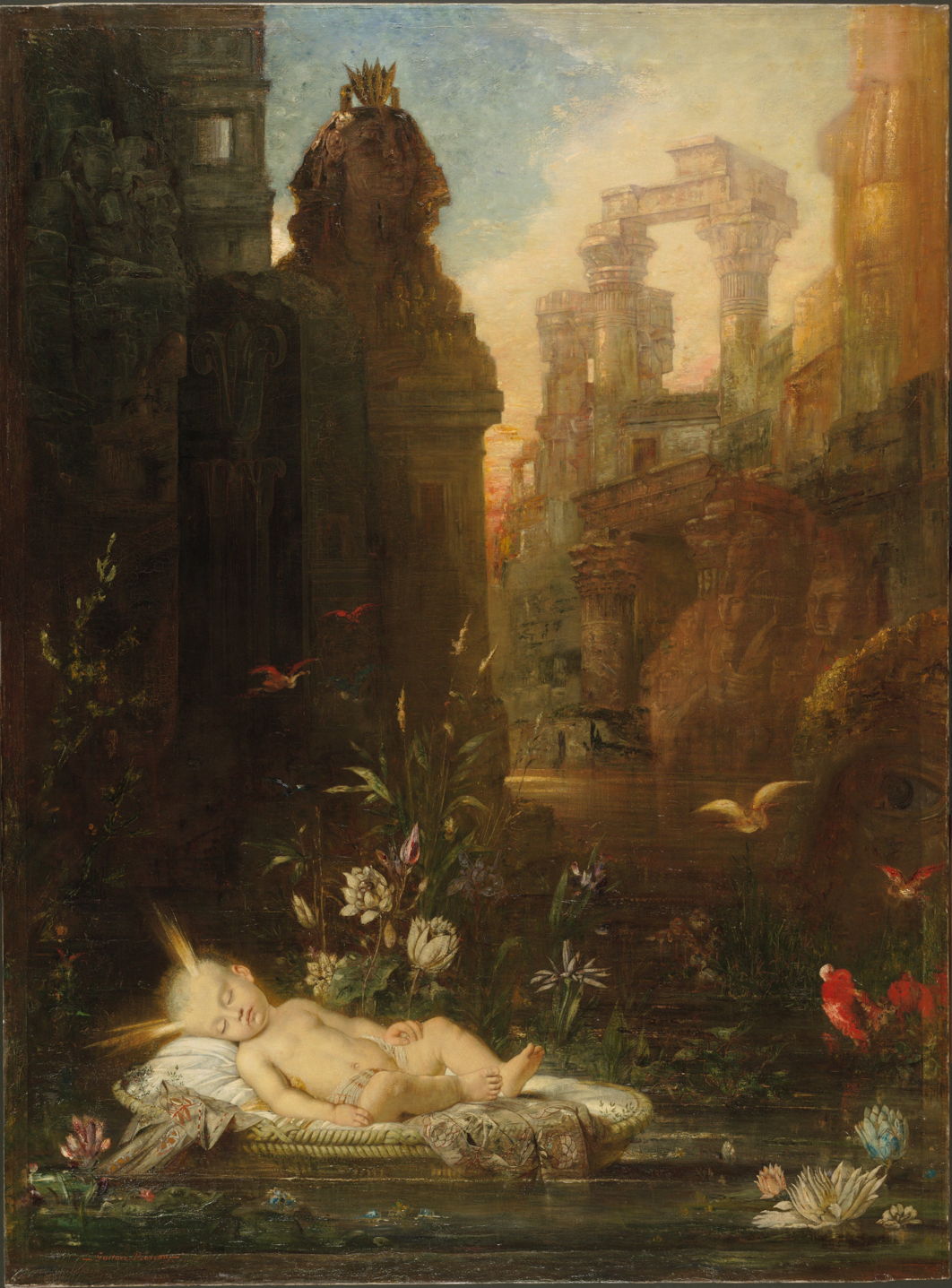
Gustave Moreau (1826–1898), Moïse Exposé sur le Nil (The Infant Moses) (c 1876-78), oil on canvas, 185 x 136.2 cm, Harvard Art Museums/Fogg Museum (Bequest of Grenville L. Winthrop), Cambridge, MA. Courtesy of Harvard Art Museums, via Wikimedia Commons.
Infancy and dawn are themes in Moïse Exposé sur le Nil (The Infant Moses) (c 1876-78), a radiantly beautiful depiction of the infant Moses asleep, prior to his discovery in the bullrushes. Moses is new life, new Judaeo-Christian beliefs, new law, and the new regime. Set against a background derived from photographs of Egyptian ruins symbolising the ancient, pre-Jewish, and decaying, it laid out Moreau’s hope for the French nation.
The baby Moses is marked out as being holy by the rays emanating from his temples, and surrounded by exotic flowers and birds. Most unusually, Moreau doesn’t show the traditional and popular moment of discovery of the infant in the bullrushes, but a static scene beforehand.
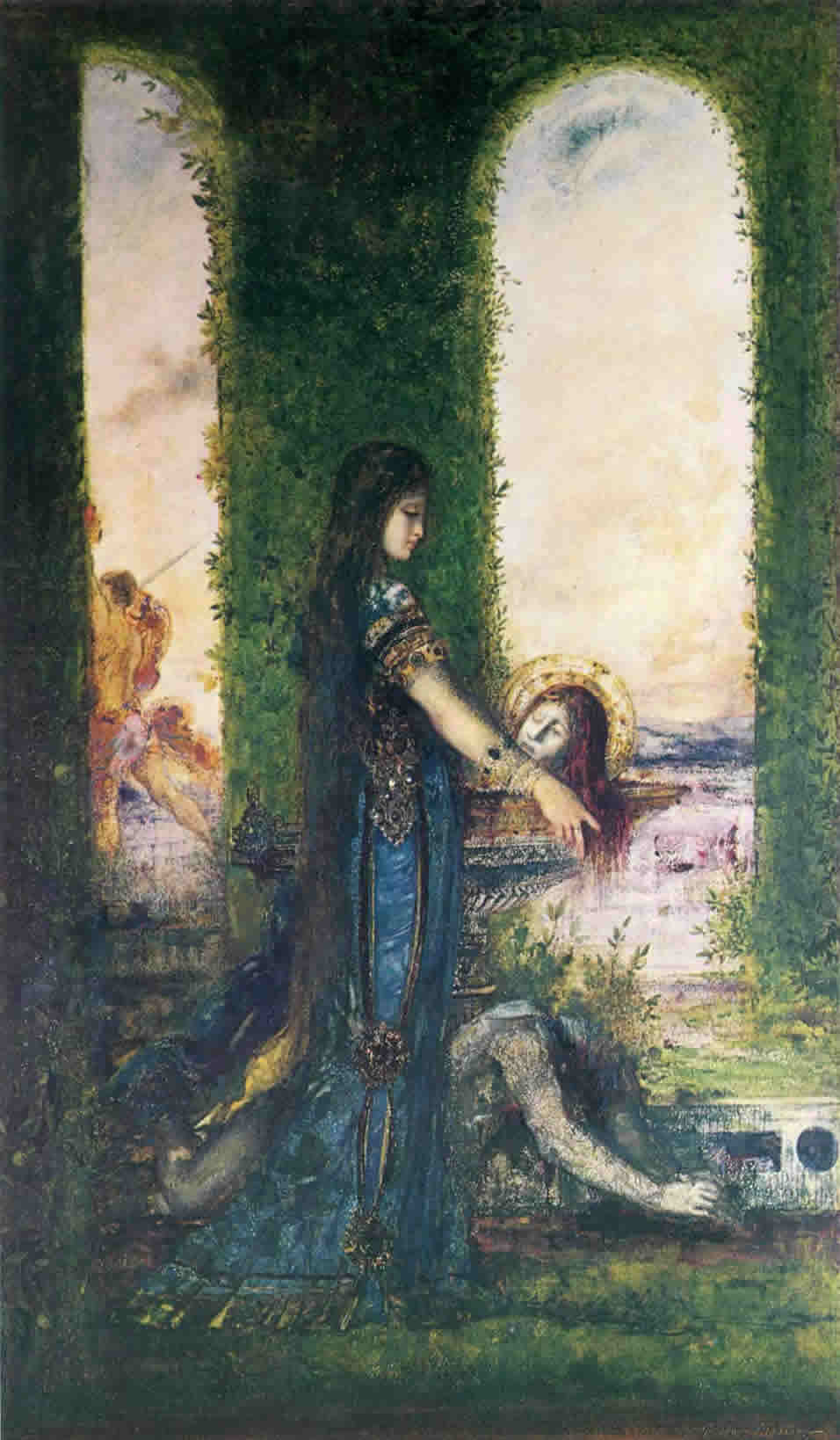
Gustave Moreau (1826–1898), Salome in the Garden (1878), watercolour on paper, dimensions not known, Private collection. Wikimedia Commons.
Moreau revisited his new myth of Salome and John the Baptist, in his strange watercolour of Salome in the Garden (1878). A beautiful and decorated figure of Salome is walking in an overgrown garden, carrying the severed head of John the Baptist on a large platter. Her eyes are closed, or perhaps looking down at the head, and John’s eyes are closed. Beside her is a headless statue of a man crawling, which could perhaps be the body of John, and outside is a man, possibly the executioner waving his sword.
References
Cooke P (2014) Gustave Moreau, History Painting, Spirituality and Symbolism, Yale UP. ISBN 978 0 300 20433 9.
Mathieu P-L (1998, 2010) Gustave Moreau, the Assembler of Dreams, PocheCouleur. ISBN 978 2 867 70194 8.
Macs are well known for their longevity, and are substantially cheaper when purchased used. This is a good time to consider buying a used Mac, as prices for Intel models are continuing to fall, and earlier Apple silicon models are becoming more widely available. However, buying any used computer is higher risk than buying new. This article explains how to reduce that risk.
Official refurbs
If you’re looking for discounted recent models, then the best place is Apple’s refurb store, in your local version of this page. These should be effectively as new, and include relatively recent models, but you’re unlikely to make big savings here. They’re ideal if you enjoy unboxing, as refurbs ship in their standard packaging.
Resellers
Most countries have retailers who specialise in preparing and selling used Macs. Among the best known are:
These are staffed by Apple-trained technicians who check each Mac thoroughly. They offer a wider range of models, many of them at highly affordable prices. Most offer a return period, as well as a one-year warranty, and are subject to local consumer protection law.
Private vendors
My one and only golden rule is never to buy a used Mac without seeing it in the flesh beforehand. That bargain a thousand miles away could turn out to have been stolen, and even if it’s genuine you could still end up with a useless Mac. I’ve never heard of anyone buying a house or car without seeing it for themselves, and a Mac should be no different. I suppose it’s feasible to go through the following checks over FaceTime or Zoom, but there are so many skilled con artists around I wouldn’t risk it.
When you arrive and see the Mac you’re about to purchase, work systematically through the following.
Provenance
Your first and most important question is whether this Mac is the seller’s to start with. The best answer comes in the form of its original proof of purchase, giving its serial number. Check that matches the serial number in Hardware Overview in System Information. If it doesn’t, then thank them politely and leave as quickly as you can. While you’re looking in that section, if the Mac has a T2 or Apple silicon chip, at the foot of that information you’ll see its Activation Lock Status: if that’s enabled, make a careful note, as you’ll need to get that disabled before you take your new Mac away. Intel Macs without T2 chips don’t have that to worry about.
Establishing provenance gets more complicated if that Mac has had more than one previous owner, but the current owner should ideally have a chain of bills of sale to reassure you. If they don’t, then that Mac may well have a murky past that could catch up with you.
Condition
Once you have confidence that you’re dealing with the real owner of the Mac, check it out as thoroughly as you can, without rushing or stripping it down to its logic board. A careful and undistracted visual examination is important, and gives clues through its general cleanliness as to how well it has been cared for.
It would be comforting to run hardware diagnostics just in case, although that’s not a particularly sensitive check for incipient problems. In ideal circumstances you’d want to check wear and any errors on its internal SSD using DriveDx or another SMART utility, but you’re unlikely to get the chance. If you have a friend who is a hardware technician, they could be a real boon to take along, just as you should take a good mechanic when you check out a used car.
AppleCare
If the current owner has AppleCare cover on that Mac, they should in most cases be able to transfer that with its sale. This requires them to sign into My Support for the agreement number and details, and with the original sales receipt for that Mac, to contact Apple Support and give them your details as the new owner. Apple explains this here, with useful onward links.
Haggle
I wish you success in agreeing the best price.
Activation Lock (Intel T2, Apple silicon)
The last hurdle in a successful purchase is the one most often forgotten, and the cause of much buyer remorse. It’s all the fault of Activation Lock and Find My Mac. These ensure that the owner’s Apple ID and password are required before that Mac can be used, erased, or Find My Mac disabled. In effect they make that Mac useless to anyone else until Activation Lock has been disabled.
Macs with T2 or Apple silicon chips running Catalina or later, where the user has 2FA on their Apple ID, are likely to be protected by Activation Lock. There is an additional requirement, depending on their architecture:
Apple silicon Macs must have their security policy set to Full Security;
Intel T2 Macs must have startup security set to Secure Boot, with booting from external drives disallowed.
Activation Lock is most commonly enabled when Find My Mac is turned on, and turning that off also disables Activation Lock. That requires entry of the current user’s Apple ID password, so must be done by the seller before they part with their Mac.
There are other ways to disable it:
It’s automatically disabled when the owner runs Erase All Content and Settings, only available on T2 and Apple silicon models anyway.
Activation lock can be disabled in the owner’s account at www[.]iCloud[.]com/find by removing that Mac from the list of All Devices there.
If you have proof of purchase, you can request Activation Lock to be removed by Apple support, but that’s a last measure and not something you should ever choose.
Never take possession of someone else’s Mac while its Activation Lock is active, as it will only cause you trouble and grief.
Handover
If everything is going well, you should be ready for the Mac to be handed over to your possession, accompanied by a written record of the sale. The conclusion is best seen as a mutual arrangement, as it gives the seller confidence that any data on that Mac is completely erased, and you the confidence that you’re about to gain a Mac you can use.
If it’s an Intel Mac, confirm with one another that it starts up without requiring a firmware password. If it has a T2 or Apple silicon chip, use its Erase All Content and Settings together to ensure that all its old files are made unreadable, and to be certain that Find My Mac and Activation Lock are disabled. Sadly, erasing older Intel Macs without T2 chips is a slower and more complicated process.
Checklist
Inspect the Mac before handing over any money.
Check proof of purchase and serial number, noting Activation Lock status.
One hundred years ago today, on 1 April 1926, Charles Angrand, a leading member of arts circles in Paris in the late nineteenth century and a well-known painter, died. Although his paintings have today almost lapsed into obscurity, his work is represented in many of the world’s leading collections. This article gives an all too brief summary of his career with some of the few of his paintings that remain accessible.
Angrand was born in Normandy, France, in 1854 and went on to train at the provincial academy in Rouen. He was unsuccessful in gaining admission to the École des Beaux-Arts in Paris, but moved to the city in 1882 to teach mathematics. At that time he was living close to the Café Guerbois and other places frequented by artists, and joined their circles.
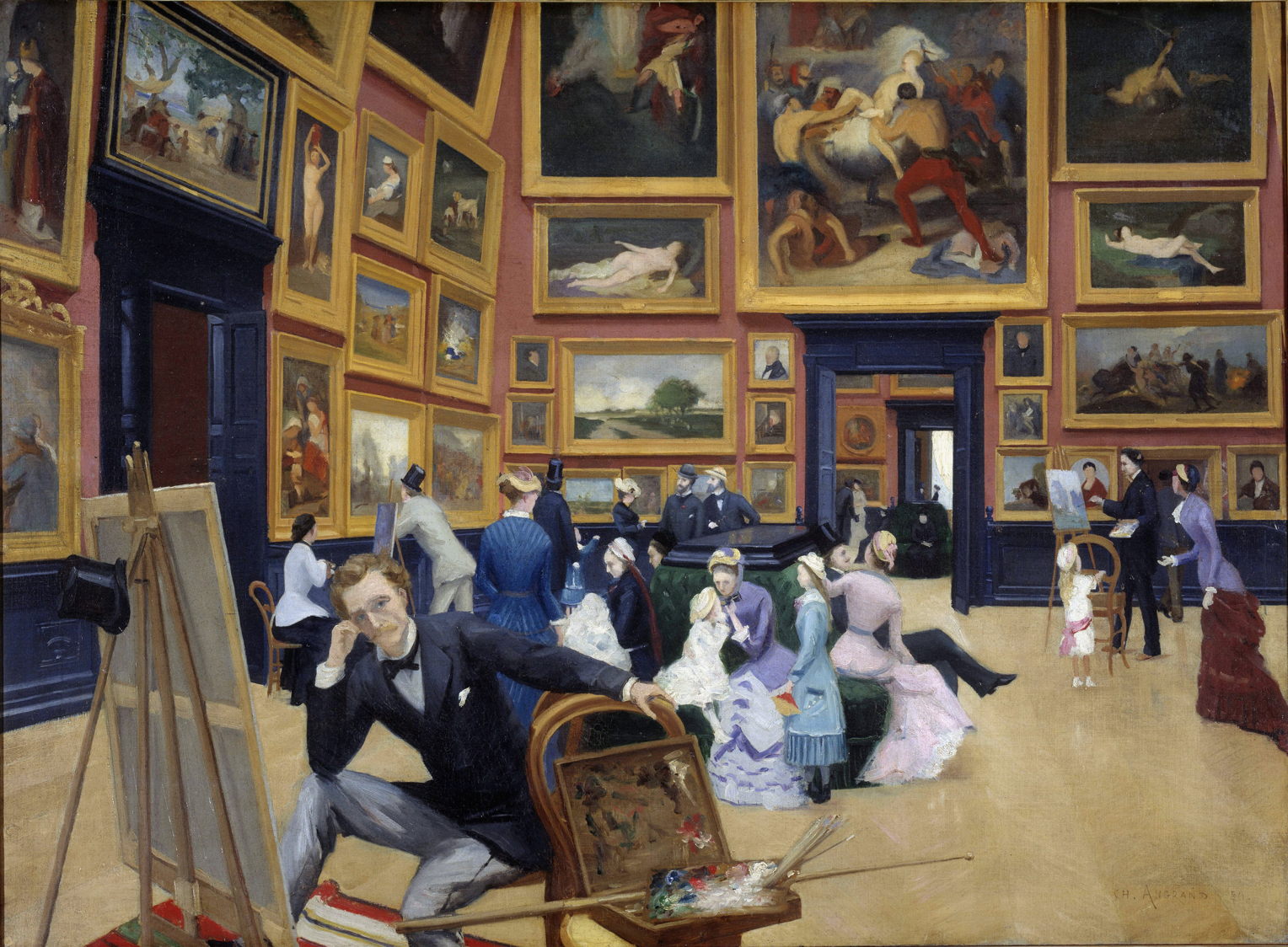
Charles Angrand (1854–1926), Interior of the Rouen Museum in 1880 (c 1880), oil on canvas, 114 x 154 cm, Musée des Beaux-Arts de Rouen, Rouen, France. Wikimedia Commons.
His early paintings, such as Interior of the Rouen Museum in 1880, appear to have been realist. This shows copyists at work in the Rouen Art Museum. The bored painter in the foreground is his friend Léon-Jules Lemaître (1849-1905), who later painted Angrand’s portrait in looser style.
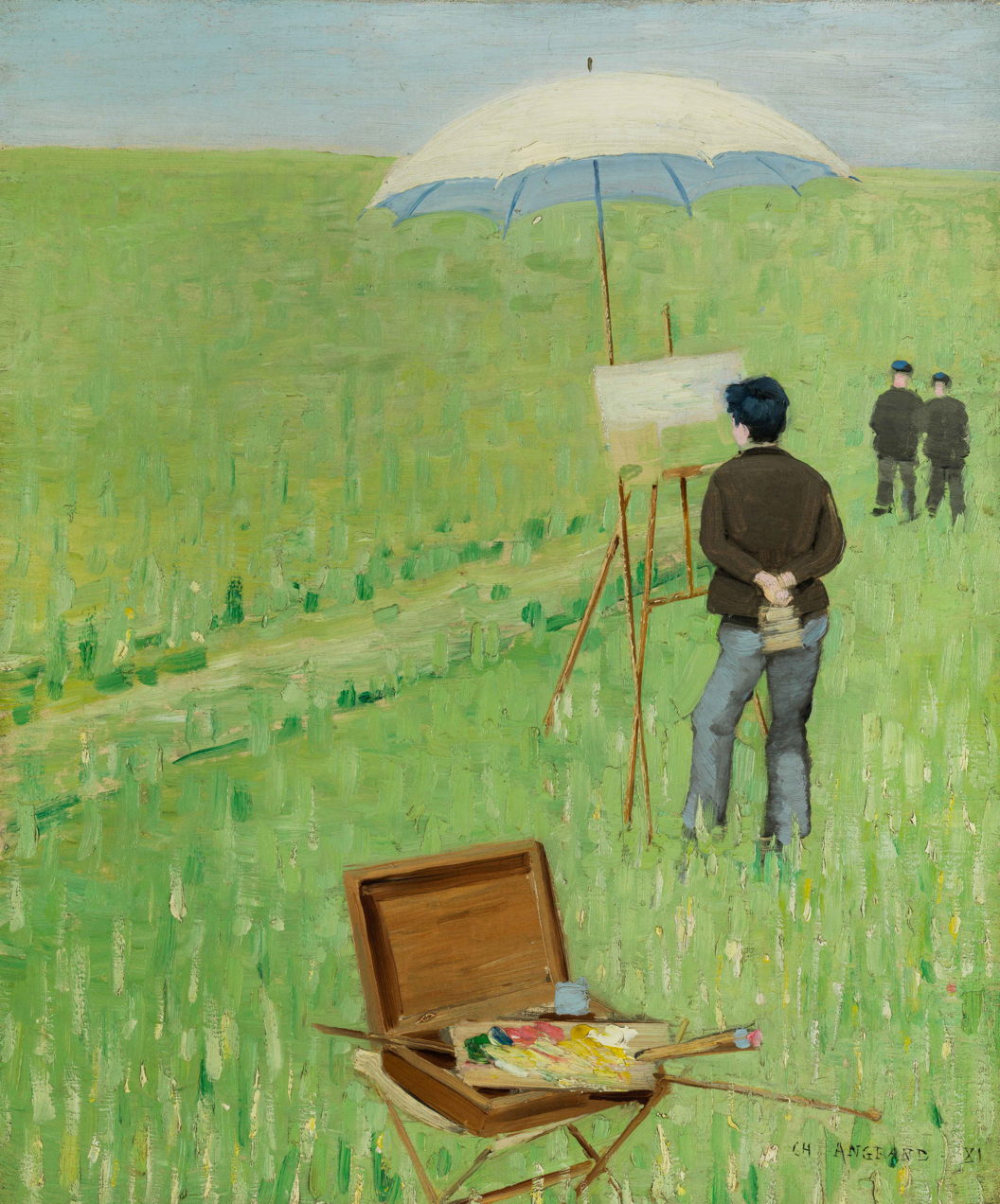
Charles Angrand (1854–1926), Painter en plein air (1881), oil on canvas, 65 x 54 cm, Private collection. Wikimedia Commons.
The following year, Angrand caught this Painter en plein air (1881) strangely separated from his palette and brushes in a field of green. His style steadily changed, as reflected in the brushstrokes visible in the green field. This painting is currently for sale from Leighton Fine Art Ltd. for £79,500.
In May 1884, he joined with Georges Seurat, Paul Signac, Henri Edmond Cross and others to form the Société des Artistes Indépendents, the core of the new Neo-Impressionist movement. The following year, Camille Pissarro joined them.
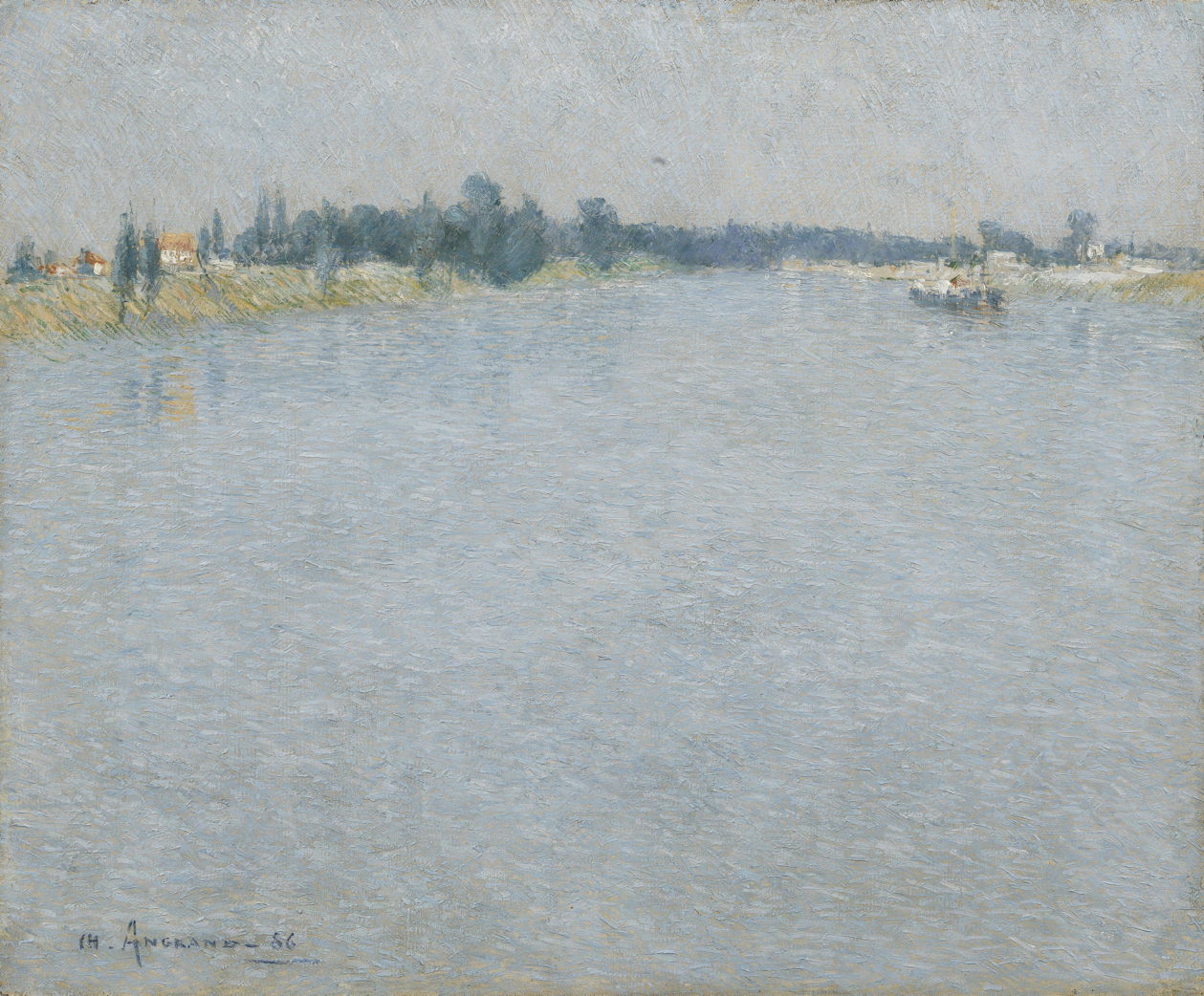
Charles Angrand (1854–1926), The Seine, Morning (Saint-Ouen) (1886), oil on canvas, dimensions not known, Van Gogh Museum, Amsterdam, The Netherlands. Wikimedia Commons.
Angrand’s landscapes became more experimental. He painted this unusual view of The Seine, Morning (Saint-Ouen) in 1886, with its thin strip of bank in the distance, and most of the canvas filled by the river. Saint-Ouen is a suburb to the north of Paris.
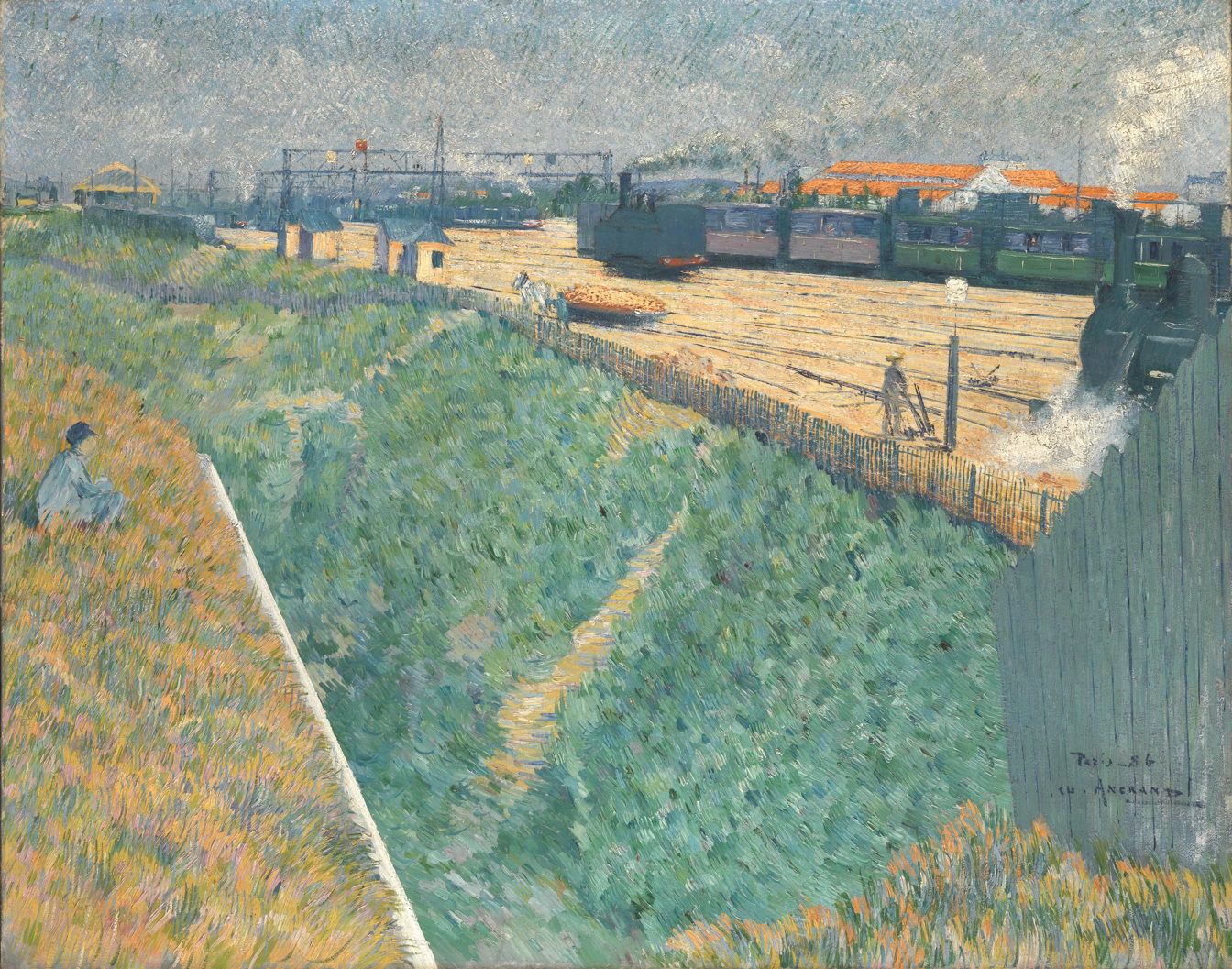
Charles Angrand (1854–1926), The Western Railway at its Exit from Paris (1886), oil on canvas, 73 x 92 cm, The National Gallery, London. Wikimedia Commons.
The Western Railway at its Exit from Paris, from the same year, shows the railway marshalling yards on the outskirts of the city.
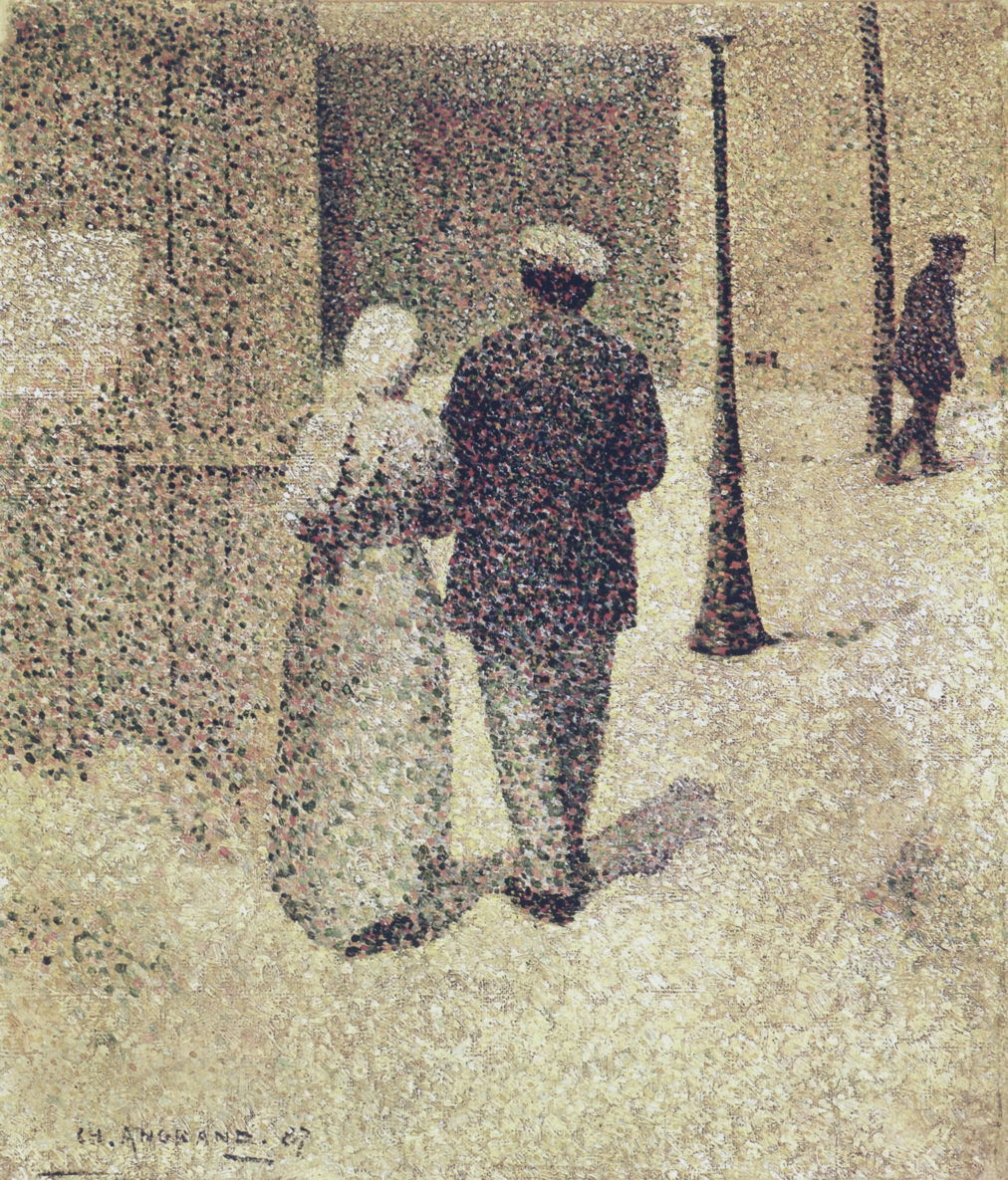
Charles Angrand (1854–1926), Man and Woman in the Street (1887), oil? on canvas, 38.5 x 33.2 cm, Musée d’Orsay, Paris. Wikimedia Commons.
In 1887, Angrand changed from a late Impressionist style to early Divisionism, as seen in this Man and Woman in the Street (1887). His coarse dots are almost monochrome, with just a faint hint of colour.
In 1891 he exhibited alongside Les XX in Brussels.
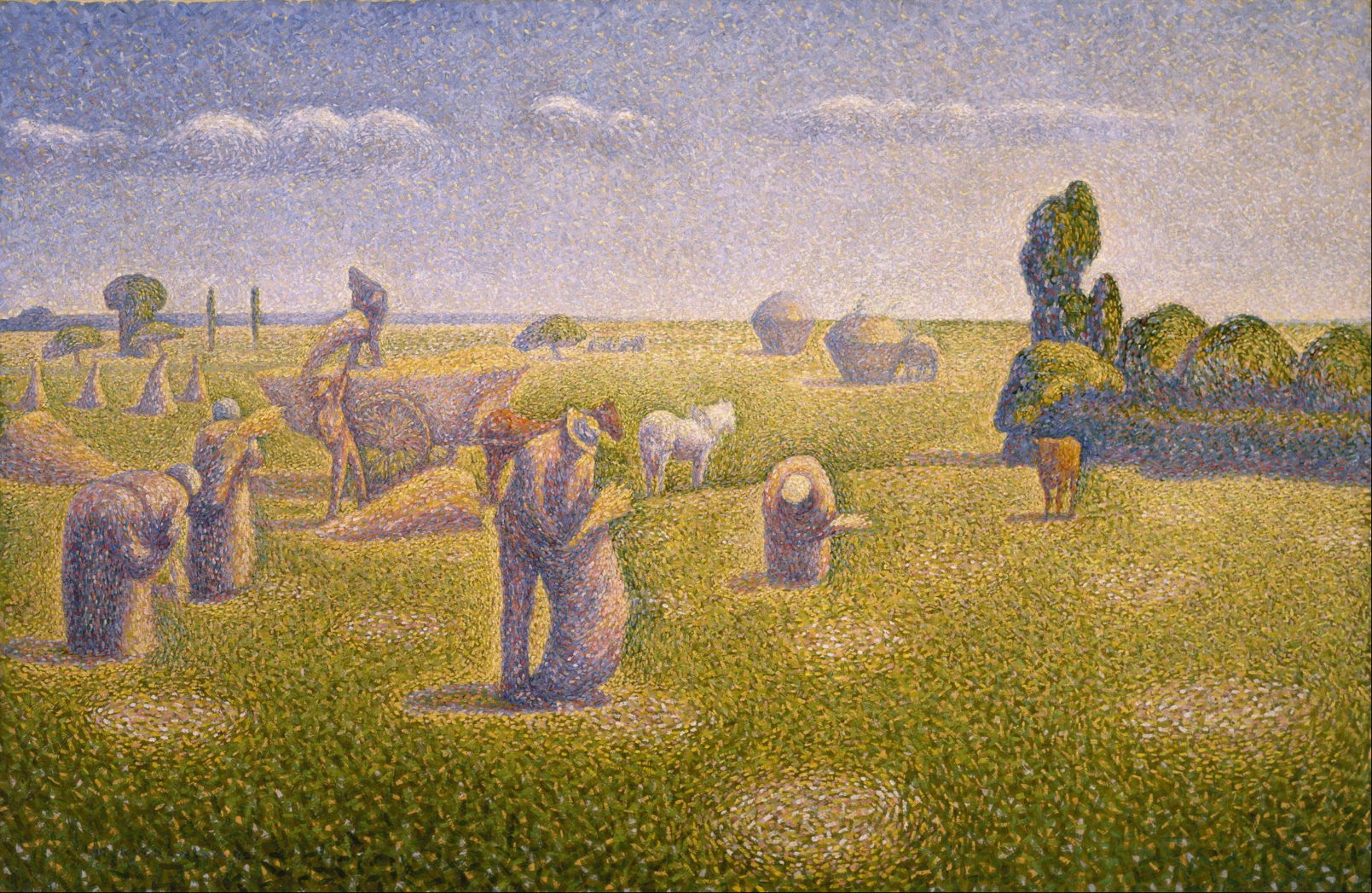
Charles Angrand (1854–1926), The Harvesters (1892), oil on canvas, 123.5 x 79.1 cm, Museum of Fine Arts, Houston, TX. Wikimedia Commons.
Angrand’s best-known painting today is The Harvesters from 1892, one of a series of rural scenes he appears to have painted in the countryside of Normandy. This is similar to those painted by Pissarro during his Divisionist period.
In the 1890s Angrand painted less and preferred using conté crayons and pastels. In 1896 he moved to Normandy, and became progressively more reclusive.
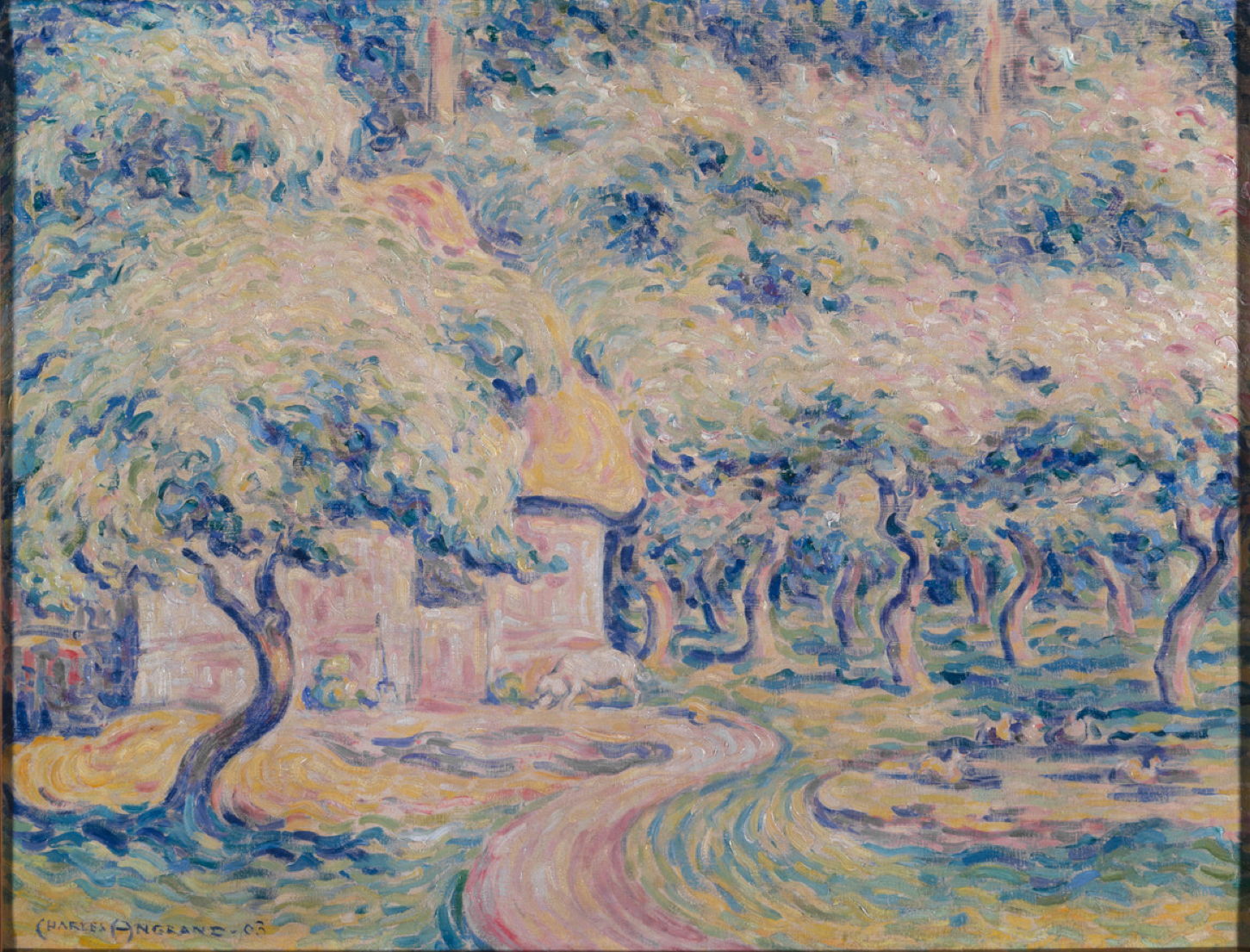
Charles Angrand (1854–1926), Thatched Cottage in an Orchard (1903), oil on canvas, 50.4 x 65.5 cm, Wallraf-Richartz-Museum & Fondation Corboud, Cologne, Germany. Wikimedia Commons.
He painted Thatched Cottage in an Orchard in 1903. His swirling brushstrokes are reminiscent of Vincent van Gogh’s late paintings, but his strokes here are more broken.
In his later years, Angrand appears to have painted less, and he died in Rouen on 1 April 1926. Although his work was exhibited at the Salon des Indépendents the following year, and he had a solo retrospective at Musée Tavet-Delacour in Pontoise in 2006, I’m disappointed that none appears to have been organised to mark this centenary.
With macOS Tahoe already more than half way through its cycle, and Apple’s WWDC announced, now is a good time to plan your Mac’s calendar. This article peeks at what lies ahead for macOS over the next six months.
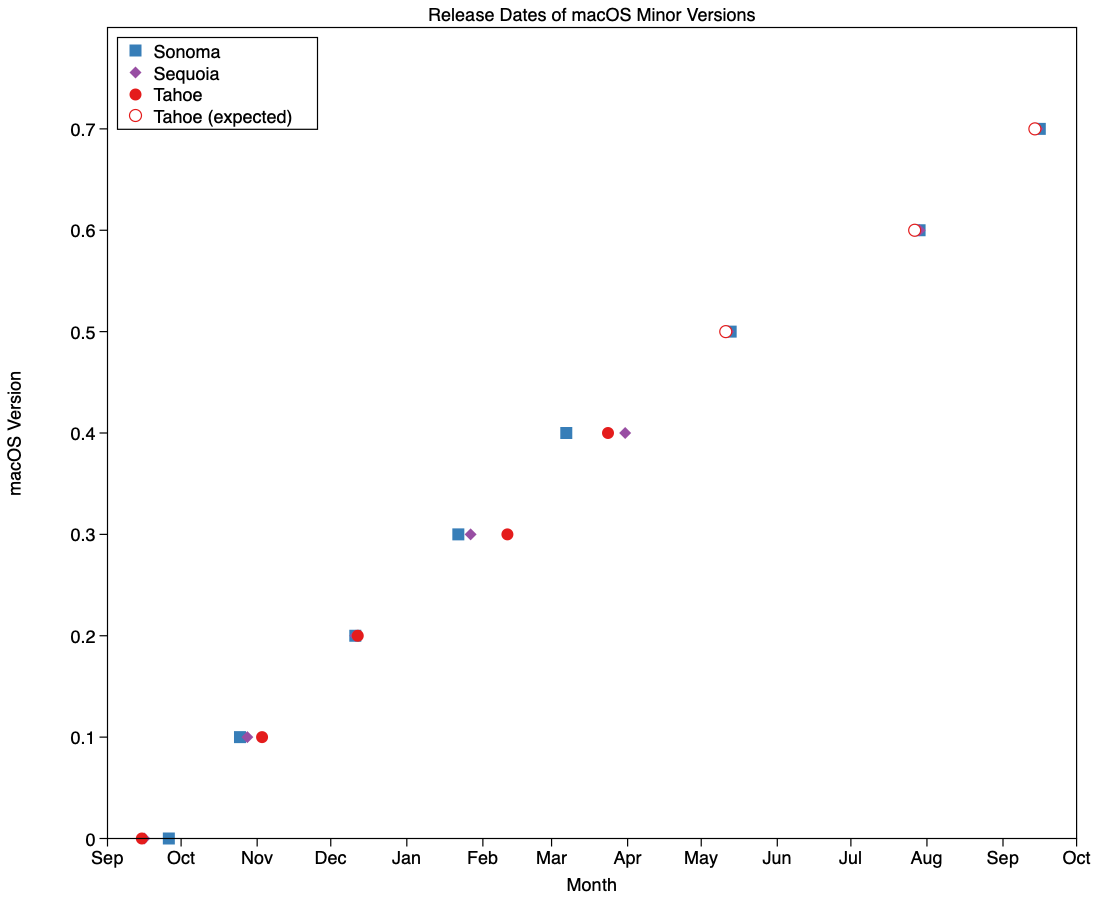
Since the pandemic disruption settled, minor version updates to macOS have become more regular. Looking across Sonoma, Sequoia and Tahoe, greatest variation in their timing has been in their x.3 and x.4 releases, that have varied between 22 Jan – 11 Feb, and 7 – 31 March, respectively. x.5 to x.7 have been more consistent, as they’re more tightly constrained by events including WWDC, the subsequent new beta season, and for some maybe even a vacation.
Those are summarised in the chart above, together with my predictions for the dates we should expect the remaining minor versions of Tahoe. Those should bring its cycle to look like:
26.0 – 15 September 2025
26.1 – 3 November 2025
26.2 – 12 December 2025
26.3 – 11 February 2026
26.4 – 24 March 2026
26.5 – 11 May 2026
26.6 – 27 July 2026
26.7 – 14 September 2026.
Where my forecasts are given in italics. Patch releases, such as 26.3.1, and BSIs occur outside that schedule. While we’re on the topic of BSIs, all indications are that Apple only intends to provide them for the current release of macOS, as it did with RSRs, which means that those Macs staying with Tahoe from 26.7 will no longer get them. It’s unclear how significant a loss that might prove.
WWDC this year is being held between 8-12 June, and will almost certainly bring the first developer beta release of macOS 27.0 (and all Apple’s other OSes). That’s likely to be made available to public beta-testers in early July. This is particularly significant this year, as it will be the first version of macOS to run exclusively on Apple silicon Macs.
For those with Intel Macs, or intending to remain with older versions of macOS, likely dates of release for scheduled security updates to Sonoma and Sequoia are:
15.7.6, 14.8.6 – 11 May 2026
15.7.7, 14.8.7 – 27 July 2026
15.7.8, 14.8.8 – 25 August 2026
15.8 – 14 September 2026.
The date at the end of August is possible, but less likely than the previous two. So far this year, security updates for Sonoma and Sequoia have been keeping reasonably close to those for Tahoe, in terms of vulnerabilities addressed, so the security gap between them has been rather less than in previous cycles.
However, the important message here is that it’s unlikely that Sonoma will receive any further security updates after the end of August this year. If your Mac is capable of being upgraded to Sequoia, now is the time to plan that, or it’ll all too quickly be September and your macOS will have lost its last support.
Similarly, if you’ve been holding back from upgrading to Tahoe in the hope that it will undergo interface improvements, I’m afraid that’s now looking increasingly unlikely. If it’s an Intel Mac capable of running Tahoe, there’s little point in avoiding making that decision any longer. There’s only limited time and scope left for improvement in macOS 26, with most engineers now more focussed on getting macOS 27 ready for WWDC.
Apple has just released its regular weekly update to XProtect, bringing it to version 5336. As usual it doesn’t release information about what security issues this update might address.
This version adds two new rules for MACOS.WANNABEWALLABY.IMA and MACOS.WANNABEWALLABY.STA, amends rules for MACOS.TIMELYTURTLE.DYHEOC, MACOS.SOMA.MAENA, and MACOS.SOMA.MAENB, and changes some rule UUIDs. In the Osascript rules in XPScripts.yr, it amends the rule for MACOS.OSASCRIPT.SYPR.
You can check whether this update has been installed by opening System Information via About This Mac, and selecting the Installations item under Software.
A full listing of security data file versions is given by SilentKnight and SystHist for El Capitan to Tahoe available from their product page. If your Mac hasn’t yet installed this update, you can force it using SilentKnight or at the command line.
If you want to install this as a named update in SilentKnight, its label is XProtectPlistConfigData_10_15-5336
Sequoia and Tahoe systems only
This update hasn’t yet been released for Sequoia and Tahoe via iCloud. If you want to check it manually, use the Terminal command sudo xprotect check
then enter your admin password. If that returns version 5336 but your Mac still reports an older version is installed, you should be able to force the update using sudo xprotect update
Over the many centuries before photography, the only way that most folk, including artists, could see paintings was by looking at prints or copies made of the originals. This was recognised early by some including Albrecht Dürer, who made woodcuts and engravings to reach a wider public, and some specialised in painting works that would generate additional income from their prints. Among those are some whose skills included both forms of visual art, including William Hogarth, William Frith, Gustave Doré, and later Mary Cassatt and Nikolai Astrup. This article looks at a few examples of their paintings that were turned into prints.
A largely self-taught painter, Hogarth entered the world of art as a copperplate engraver in 1720. He aspired to greater things, and became a pupil at an academy run by Thornhill in London, even marrying Thornhill’s daughter in 1729. His works in oil were usually strongly narrative, showing moments of climax and sometimes peripeteia in theatrical productions or everyday life in London. Many included social commentary, wit, and some overtly caricatured society. One of his reasons for painting was to provide a supply of original images for engraving, and all his series paintings were seen, from a commercial view at least, as a means to producing lucrative series of prints.
Following his successful narrative series of prints Industry and Idleness, Hogarth moralised again over one of his favourite issues: cruelty to animals. Victorian society was even harsher in its attitudes towards animals than it was towards the ‘lower classes’ of humans, and Hogarth saw the two as being linked.
As with Industry and Idleness, Hogarth wanted to reach the hearts of the ordinary people, and to make his prints as affordable as possible. He admitted to simplifying his drawings in order to put his points across as clearly and accessibly as possible. He stated that “neither minute accuracy of design, nor fine engraving, were deemed necessary”. In a further effort to cut costs, he commissioned them to be turned into woodcuts rather than engraved, but in the end only two of the plates were completed in wood, and Hogarth himself created conventional engravings.
William Hogarth (1697–1764), The First Stage of Cruelty (sketch) (c 1750), graphite and red chalk on medium, slightly textured, cream laid paper, 39.4 x 33.3 cm, Yale Center for British Art, New Haven, CT (Paul Mellon Collection). Courtesy of Yale Center for British Art.
This early sketch in pencil and red chalk gives a good idea of his initial concept for the first in this series.
William Hogarth (1697–1764), The First Stage of Cruelty (1751), red chalk on paper (monochrome image), 35.8 x 30 cm, Pierpont Morgan Library, New York, NY. Scanned from Ayrton & Denvir (1948).
That was progressed to a final drawing in red chalk (above) to be turned into the line engraving below, shown mirrored so that it matches the drawings.
William Hogarth (1697–1764), The First Stage of Cruelty: Children Torturing Animals (mirrored) (1751), line engraving on thick, white, smooth wove paper, 35.6 x 29.8 cm, Yale Center for British Art, New Haven, CT (Gift of Patricia Cornwell). Courtesy of Yale Center for British Art.William Hogarth (1697–1764), The First Stage of Cruelty: Children Torturing Animals (1751), line engraving on thick, white, smooth wove paper, 35.6 x 29.8 cm, Yale Center for British Art, New Haven, CT (Gift of Patricia Cornwell). Courtesy of Yale Center for British Art.
This is the same print as seen by the viewer. Hogarth’s schoolboy Tom Nero is seen, together with many of his peers, in a street in the slum district of St Giles in London. He’s shown in a ragged white coat just below the centre of the image, inserting an arrow into a dog which is plainly in agony. The dog’s owner pleads for mercy, offering Tom a pie, but others help hold the dog for Tom. Just to his left, someone has drawn a hanged man with Tom’s name below, a grim prediction of what is to come.
All around there are vicious acts of cruelty taking place to animals. A cat and dog are fighting, cockfighting is in progress, another dog has a bone tied to its tail, two boys are burning a bird’s eyes out, two cats are suspended by their tails from a vintner’s sign, and a cat has been thrown out of a high window with balloons attached to it.
For some of his series, Hogarth worked up a set of full oil paintings in addition to prints. My example is taken from A Rake’s Progress, painted between 1732-5, the successful successor to his A Harlot’s Progress.
William Hogarth (1697–1764), A Rake’s Progress: Surrounded by Artists and Professors (1732-5), oil on canvas, 62.5 × 75 cm, Sir John Soane’s Museum, London. Wikimedia Commons.
In Hogarth’s oil painting, Tom sets out to make a new man of himself with the aid of many tutors and hangers-on. The composer Handel plays the harpsichord, then there is a fencing master, a quarterstaff instructor, a dancing master with violin, Charles Bridgeman, a famous landscape gardener, Tom himself, an ex-soldier acting as bodyguard, a bugler from a foxhunt, and a jockey. In the background are others who are busy spending Tom’s inheritance on worthy causes no doubt.
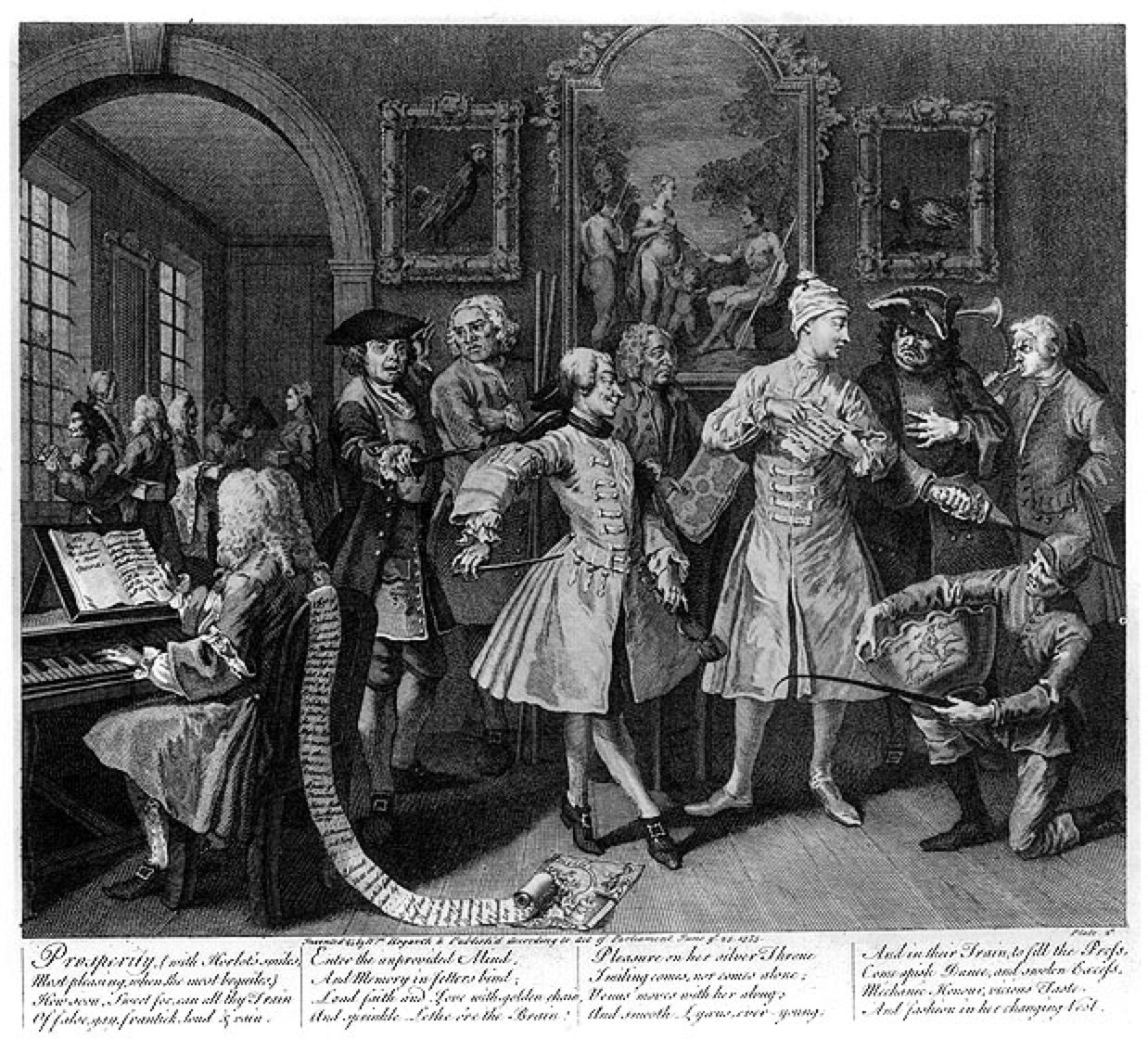
William Hogarth (1697–1764), A Rake’s Progress, Plate 2: Surrounded by Artists and Professors (1735), engraving, 35.5 × 41 cm, further details not known. Wikimedia Commons.
The print is different in many respects, as if the artist forked the painting and print from a late sketch. Details on the music being played at the left are different, and there’s a long scroll running down from the back of the chair in the print. Some of the facial expressions are altered and exaggerated in the print. Details, including those of clothing and frames of the paintings on the wall, also differ.
Artists like Edgar Degas and his protégé Mary Cassatt made prints for different reasons.
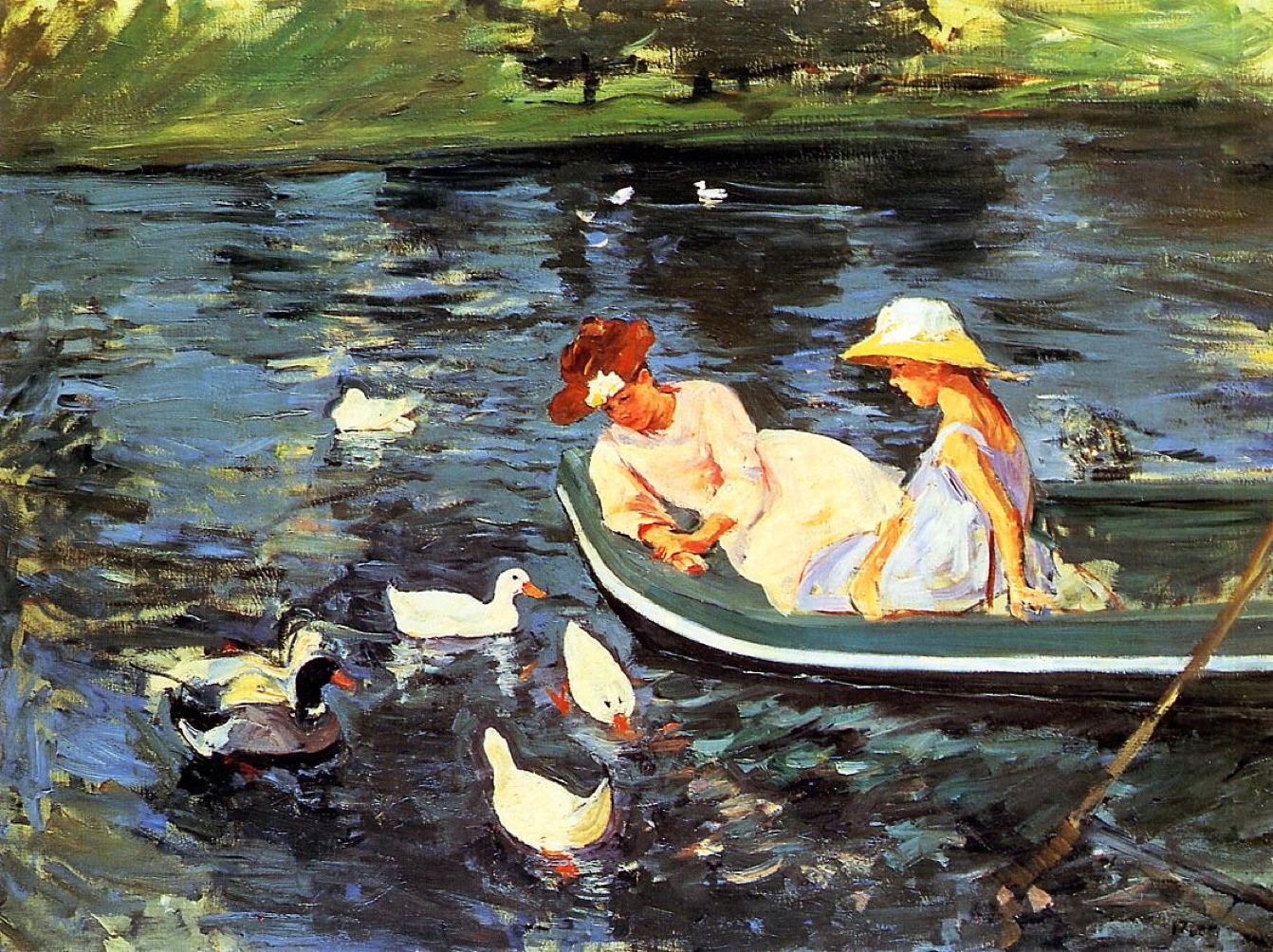
Mary Cassatt (1844–1926), Summertime (1894), oil on canvas, 73.6 x 96.5 cm, Armand Hammer Museum of Art, Los Angeles, CA. The Athenaeum.
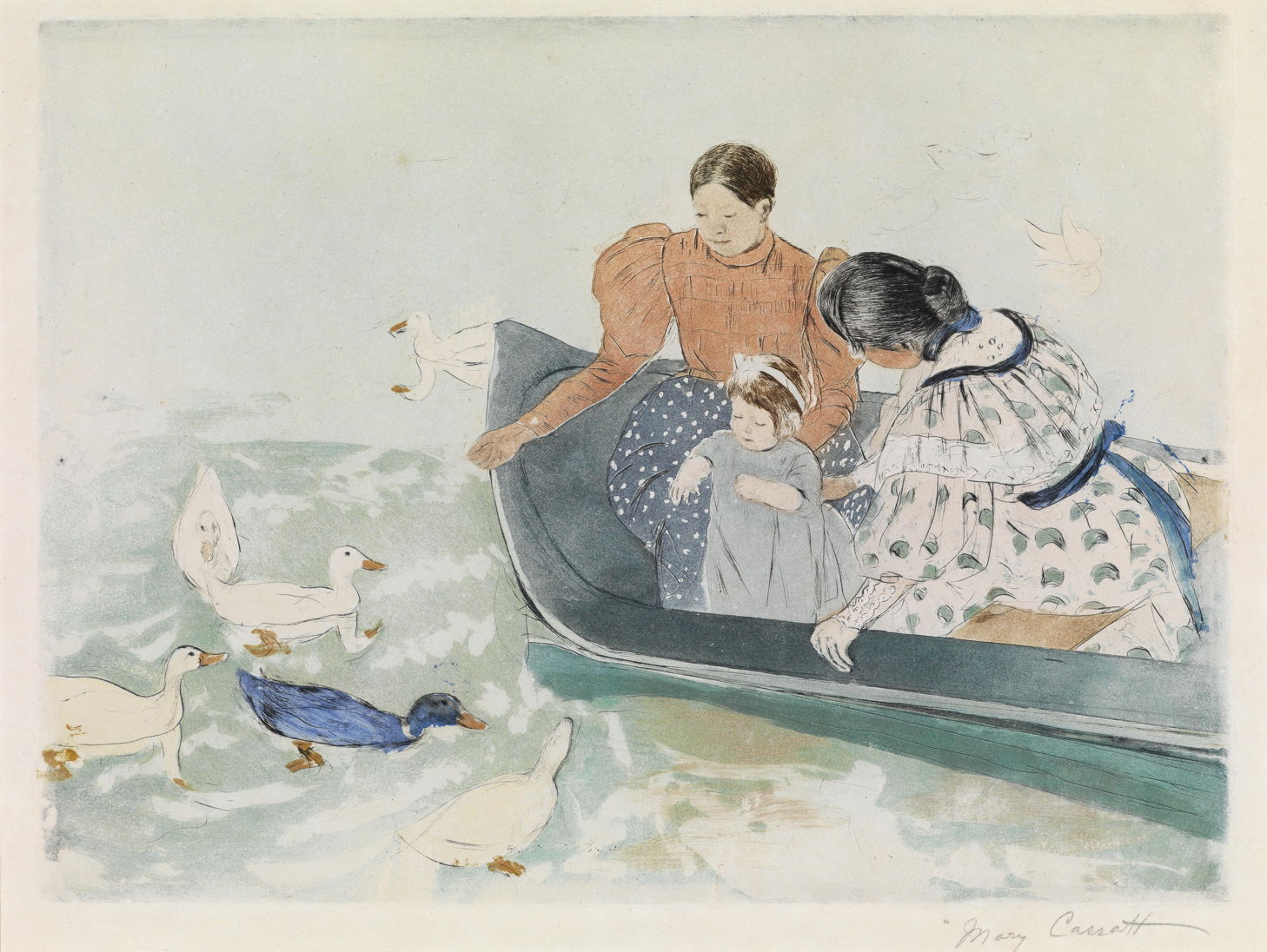
Towards the end of the nineteenth century, Cassatt made this very loose painting of a mother and daughter feeding ducks from a boat in Summertime (1894). I believe this was the source for the sophisticated print, called more appropriately Feeding the Ducks (c 1894), below.
Mary Cassatt (1844–1926), Feeding the Ducks (c 1894), drypoint and aquatint with monotype on handmade paper, 29.5 x 39.5 cm, location not known. Wikimedia Commons.
For this she combined her mature drypoint technique with aquatint, to which she added monotype. In monotype, the artist lays down an image on a plate using printing inks, then makes a single impression of that on the paper. This demands meticulous technique, and usually results in one completed print for each image made in ink. Although second prints can sometimes be made, they’re usually of low quality.
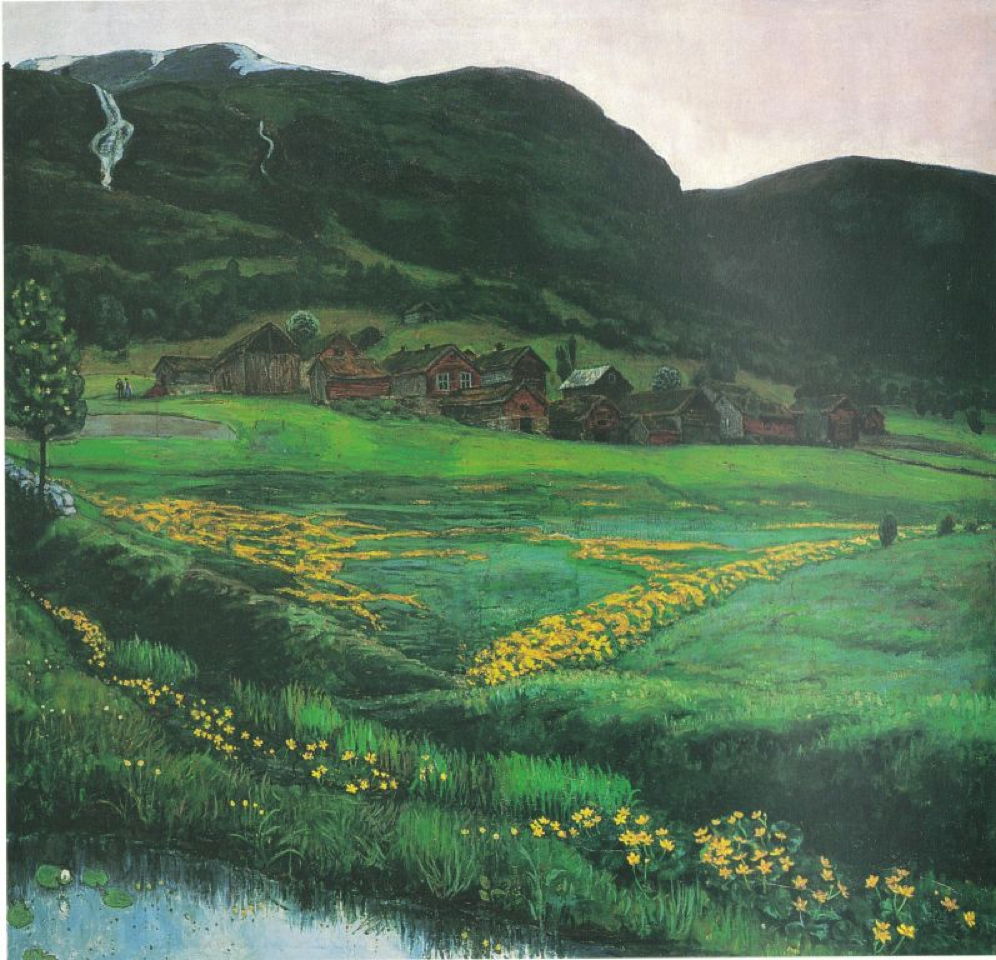
The Norwegian artist Nikolai Astrup was a prolific painter and printmaker, whose paintings informed his prints, and prints informed his paintings.
Nikolai Astrup (1880–1928), A Clear Night in June (1905-07), oil on canvas, 148 x 152 cm, Bergen Kunstmuseum, KODE, Bergen, Norway. Wikimedia Commons.
A Clear Night in June (1905-07), above, and A June Night and Old Jølster Farm (before 1911), below, are two of more than a dozen paintings Astrup made of this farm after about 1902. These were painted early each summer, when in some years there were still the remains of the winter’s snow on the rugged hills behind. The waterfalls cascading down the scarps are still in spate from the melting snow.
Astrup painted this view when the blossom was on the trees, and the meadows were a patchwork of yellow with the first of the summer flowers. Comparing these two paintings reveals a few differences in detail, such as the low fence in the foreground in the lower painting which is omitted in the upper, but by and large Astrup seems to have been consistent, suggesting his paintings were true to nature.
Nikolai Astrup (1880–1928), A June Night and Old Jølster Farm (before 1911), oil on canvas, 88 x 105 cm, Private collection. The Athenaeum.Nikolai Astrup (1880–1928), Marsh Marigold Night (c 1915), colour woodcut on paper, 40.7 x 47 cm, Bergen Kunstmuseum, KODE, Bergen, Norway. Wikimedia Commons.
A few years later, he turned those into prints such as this Marsh Marigold Night (c 1915). By this time his printmaking technique had come a long way, and many of his later prints were extremely painterly, to the point where it can be difficult to distinguish his woodcuts from their painted originals.
Reference
Ayrton M & Denvir B (1948) Hogarth’s Drawings, London Life in the 18th Century, Avalon Press. No ISBN. [This has been my source for images of many of the scans above. The book bears no information about copyright, the press has long since vanished as far as I can tell, and I assume ‘fair use’ of these orphaned images. If you know any different, please contact me.]
For those working with Rich Text without embedded images, my free editor DelightEd offers a suite of unique features. I wrote it when macOS Mojave introduced Dark appearance mode, with the primary purpose of composing Rich Text documents that work independent of appearance. For that it can set styled text on a background that ensures perfect readability in both Light and Dark modes.
Since then it has gained other unique features, including support for creating interlinear text, in which different translations or versions of the same document are interleaved line by line. It will also open PDF documents and automatically extract all their text content.
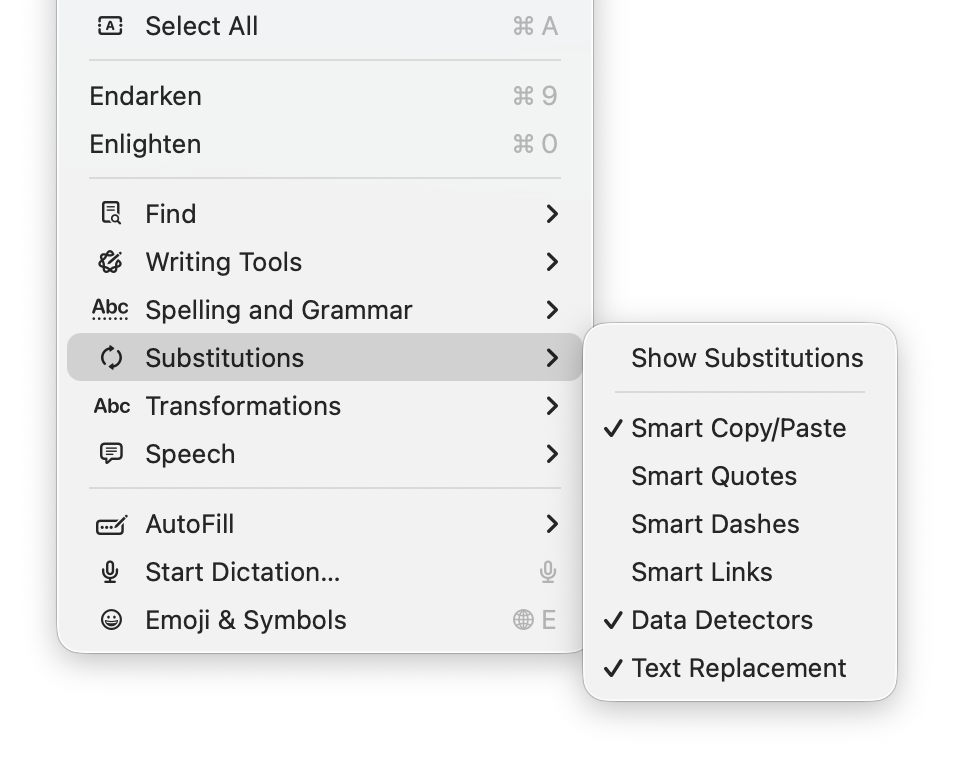
General features supported include Writing Tools (Apple silicon Macs), case transformations, and a full suite of substitutions. However, until this new version of DelightEd, substitution settings haven’t been saved in DelightEd’s app settings. Version 2.5 now puts that right: to set the app’s default substitutions, set them up using the Substitution command in its Edit menu, for instance enabling Smart Links.
Then save those to its settings using the Save Defaults command in the app’s menu. Each time you open DelightEd after that, its substitutions will start from those saved defaults.
DelightEd version 2.5 for macOS 11.5 Big Sur and later, including Tahoe, is now available from here: delighted25
from Downloads above, from its Product Page, and through its auto-update mechanism.
I’m very grateful to Manuel for asking for this to be fixed.
The ‘Saracen’ sorceress Armida had abducted the crusader knight Rinaldo to her enchanted garden on the Fortunate Isles, far to the west out in the Atlantic. A rescue team of the knights Charles and Ubaldo then sailed out in a magic ship piloted by a fair woman. After they had overcome a series of obstacles, Charles and Ubaldo found Rinaldo dressed and behaving as a woman’s dandy, and have the task of restoring his senses as a warrior knight, so they can take him back to rejoin the siege of Jerusalem.
By showing Rinaldo his own image in a highly polished shield, the knight is put to shame and realises what he has become. Ubaldo bids him rejoin the forces of Godfrey of Bouillon, and the holy war. They hasten away, leaving Armida weeping and choking with grief. She runs after them, calling him back. Rinaldo and his two companions wait for her, and the couple stare at one another in silence.
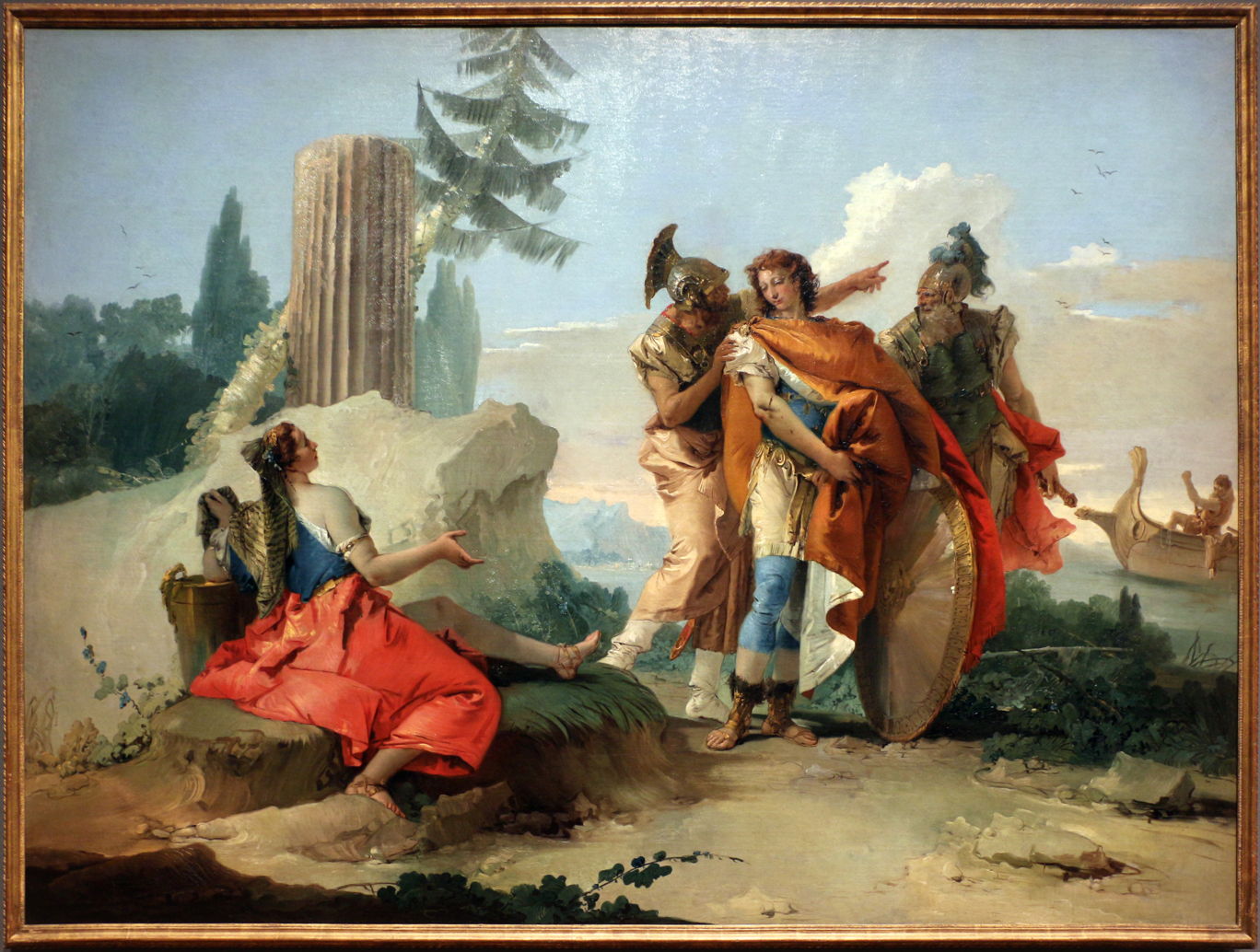
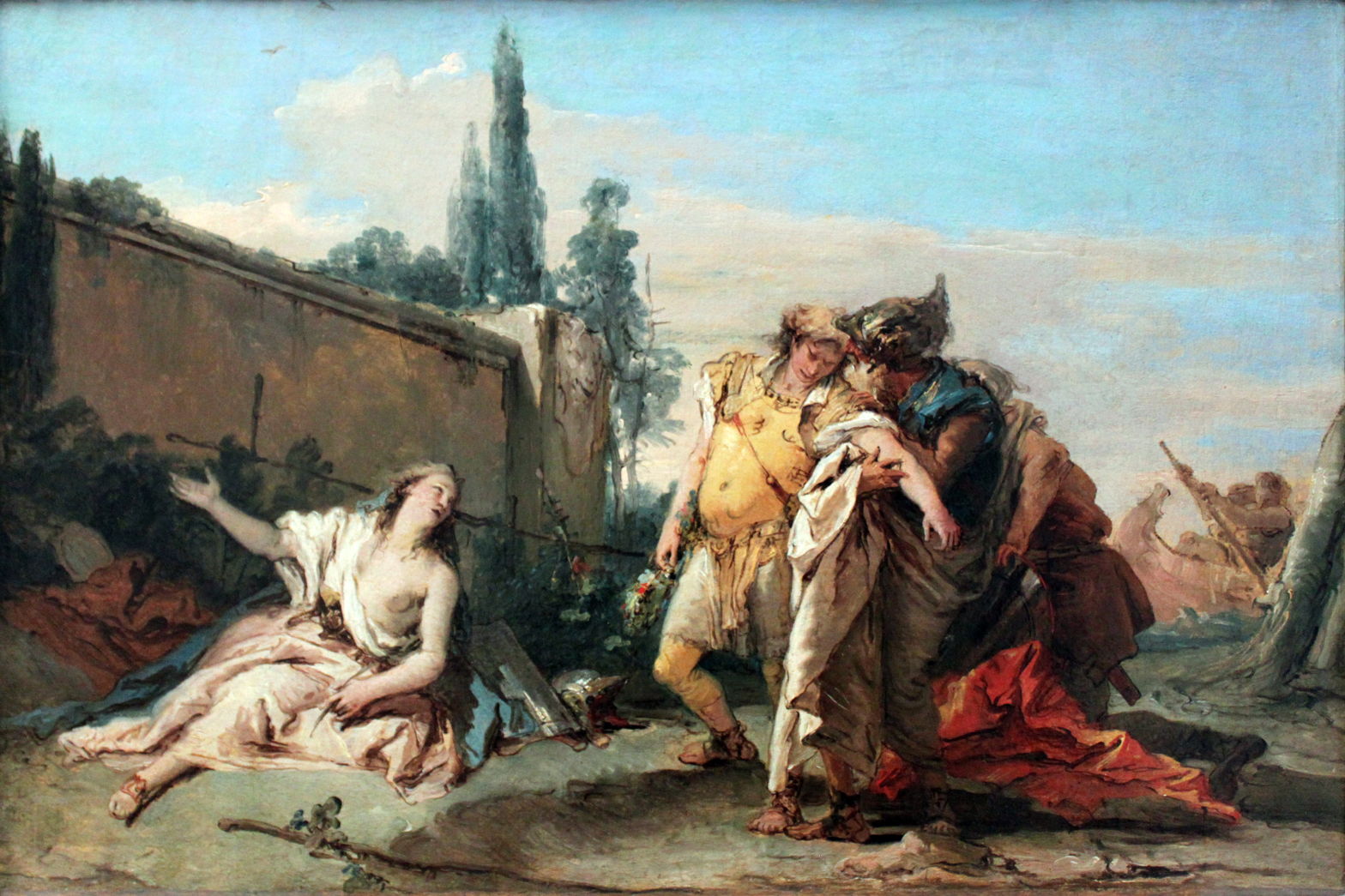
The scene of Armida and Rinaldo separating has proved another of Tasso’s great images for art. Its greatest exponents were the Tiepolos, father and son, who painted a succession of works showing this parting, in the eighteenth century. I show here four examples, each using the compositional device of collapsing Armida’s garden on one side, with the beach and ship on the other, and using that spatial and temporal merging to tell the whole sequence, from Rinaldo’s awakening to their departure by sea.
Giovanni Battista Tiepolo (1696–1770), Armida Abandoning Rinaldo (1742-45), oil on canvas, 186.7 x 259.4 cm, The Art Institute of Chicago, Chicago, IL. Image by Sailko, via Wikimedia Commons.
In this version for the Tasso Room in the palace of the Cormaro Family in Venice, painted in 1742-45, Charles and Ubaldo are stood in full armour, pointing to their ship which is waiting to take Rinaldo away. Armida lies back exposing a lot of leg, trying to persuade Rinaldo to stay with her.
Giovanni Battista Tiepolo (1696–1770), Rinaldo’s Departure from Armida (1755-60), oil on canvas, 39 x 62 cm, Gemäldegalerie der Staatlichen Museen zu Berlin, Berlin, Germany. Image by anagoria, via Wikimedia Commons.
In Tiepolo’s Rinaldo’s Departure from Armida from 1755-60, Rinaldo is still being woken from his enchantment, and Armida bares her breast as she is trying to lure him back.
Giovanni Domenico Tiepolo (1727–1804), Rinaldo Leaving the Garden of Armida (c 1770), fresco, dimensions not known, Ca’ Rezzonico, Venice, Italy. Wikimedia Commons.
His son, Giovanni Domenico, squeezed the three knights in tighter, and omitted Armida from his Rinaldo Leaving the Garden of Armida in about 1770. Rinaldo’s separation from Armida is marked by the hold he has over the blindfolded Cupid in his right arm. This was painted in a fresco in Ca’ Rezzonico in Venice, Italy.
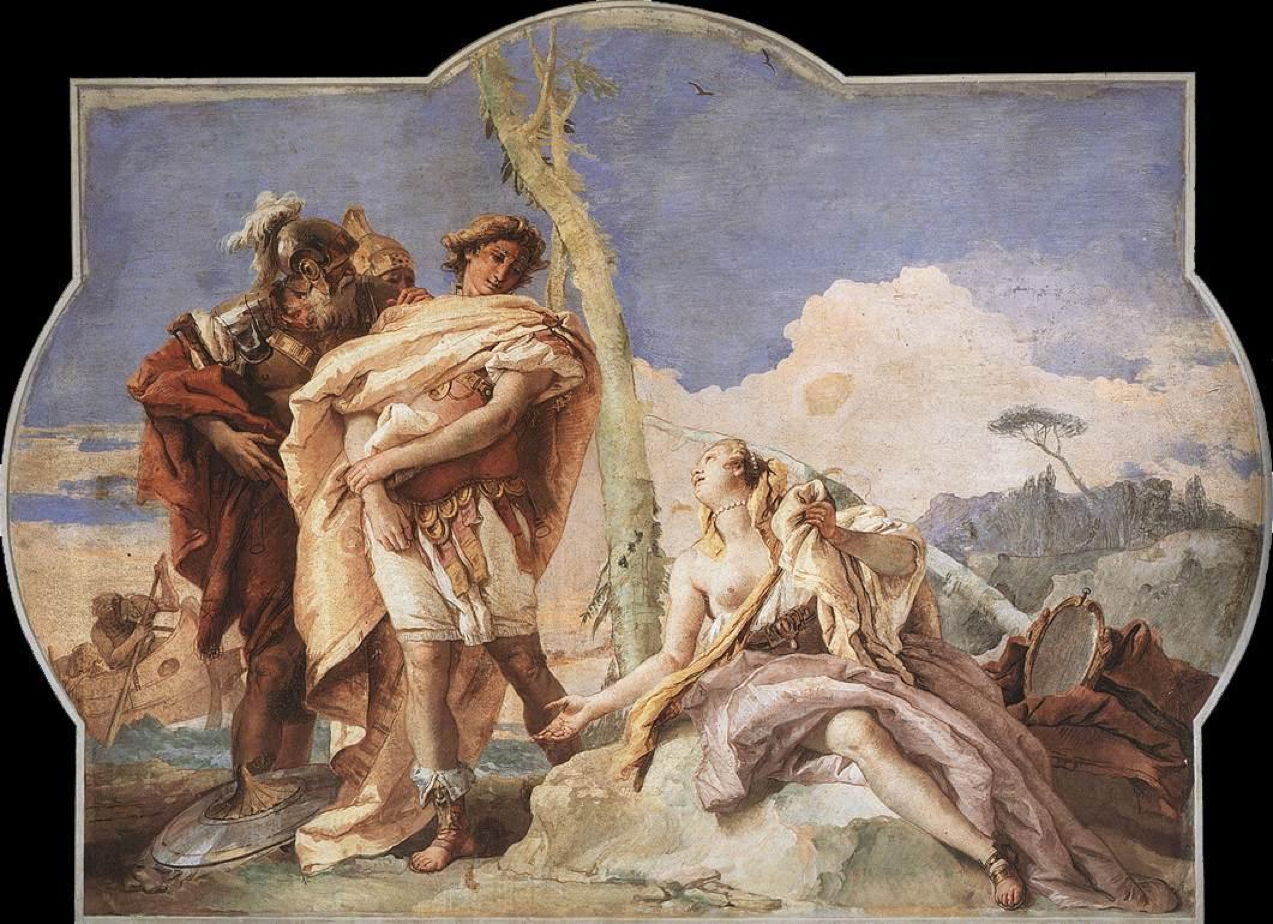
Giovanni Battista Tiepolo (1696–1770), Rinaldo Abandoning Armida (1757), fresco, 220 x 310 cm, Villa Valmarana ai Nani, Vicenza, Italy. Wikimedia Commons.
The father Tiepolo had painted another variation in Rinaldo Abandoning Armida, from 1757, as a fresco in the Villa Valmarana ai Nani, in Vicenza, Italy. In this, the composition is reversed, with the ship at the left, and Armida pleading with Rinaldo at the right. This is perhaps Tiepolo’s most complete account, as it includes both Armida’s crystal mirror at the right, and the polished shield into which Rinaldo looked, at the feet of Charles and Ubaldo.
Tasso’s narrative, developed in this painting, may have a sub-text about looking and its power: for Armida looking in her crystal was a means of strengthening her allure over Rinaldo, but for him looking into the polished shield was a means of restoring his power by showing what he had become in her clutches.
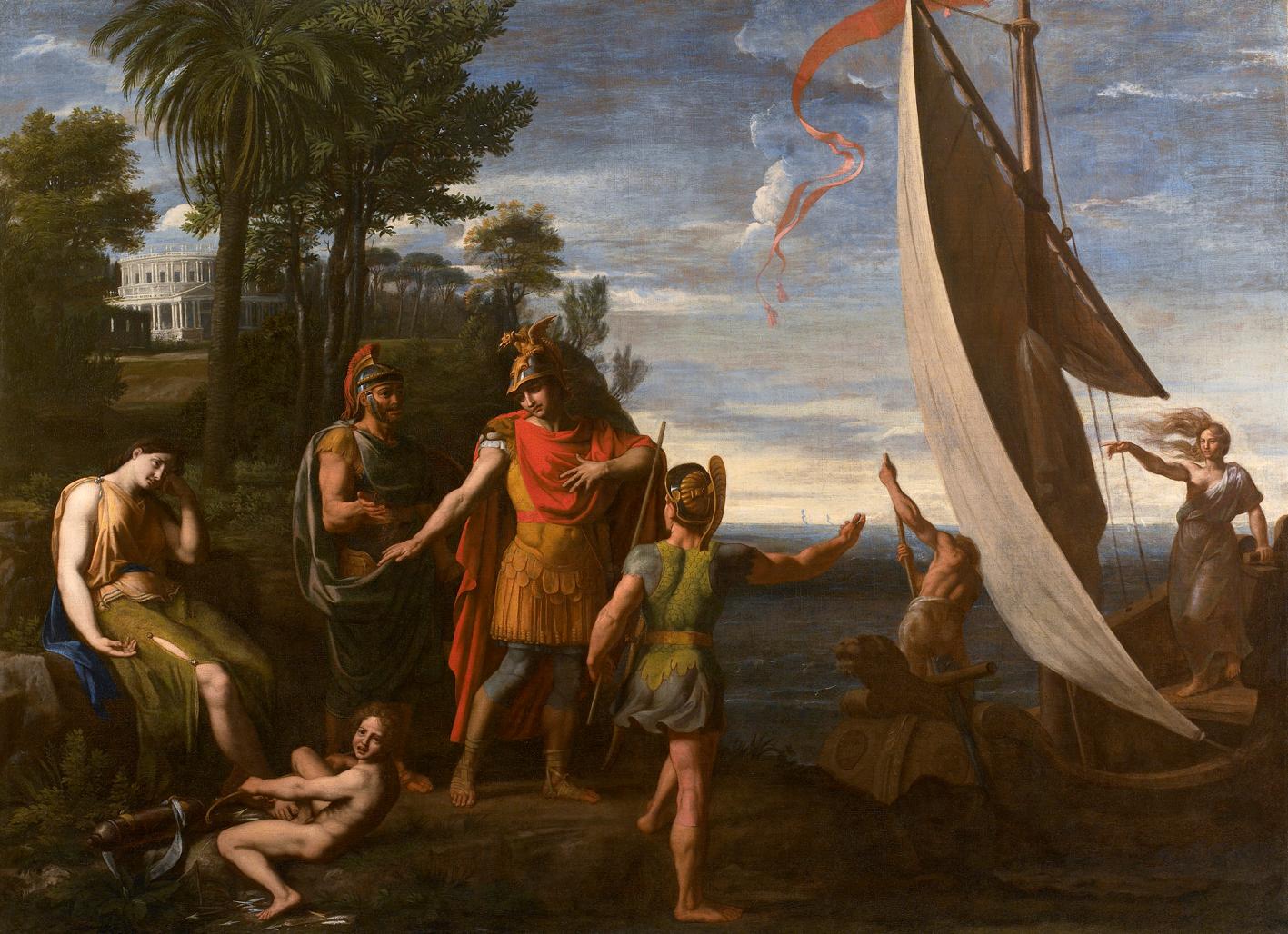
Nicolas Colombel (1644-1717), Rinaldo Abandoning Armida (date not known), oil on canvas, 118.1 x 170.2 cm, Private collection. Wikimedia Commons.
The Tiepolos were by no means the first to merge Armida’s garden with the sea and ship. Nicolas Colombel’s undated painting from the late 1600s showing Rinaldo Abandoning Armida has done much the same.
Armida then launches into a speech, asking Rinaldo to let her follow him back, and offering to be his shield. His love has been replaced by compassion for her, and he asks her to remain there in peace. The three knights then sail away on the magic ship, leaving Armida behind on the beach. Her grief now changes to anger at her loss, so she casts evil spells and conjures up her chariot. On that she departs for the battlefield in vengeance.
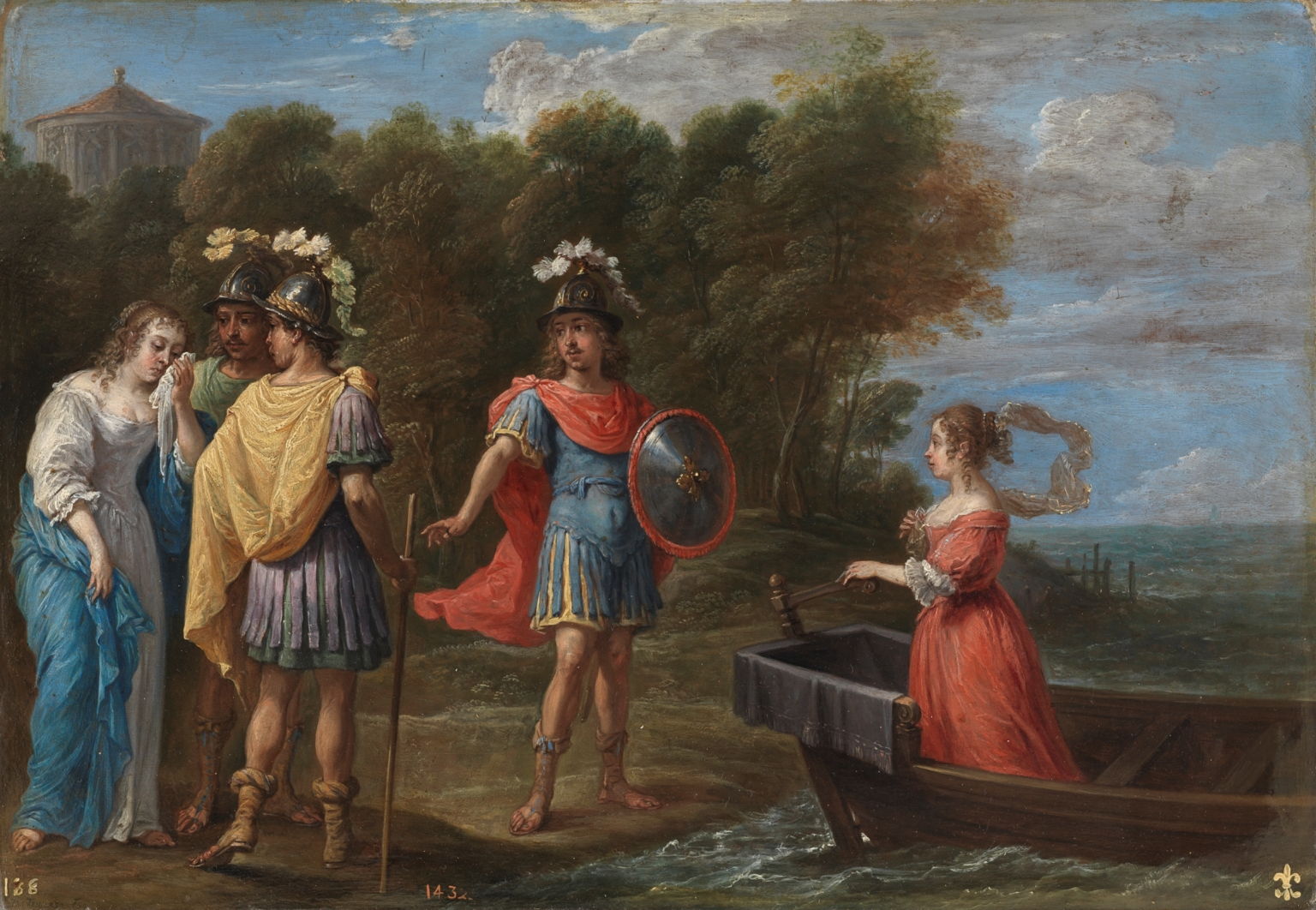
David Teniers the Younger (1610–1690), Armida and Rinaldo Separated (1628-30), oil on copper, 27 x 39 cm, Museo Nacional del Prado, Madrid, Spain. Wikimedia Commons.
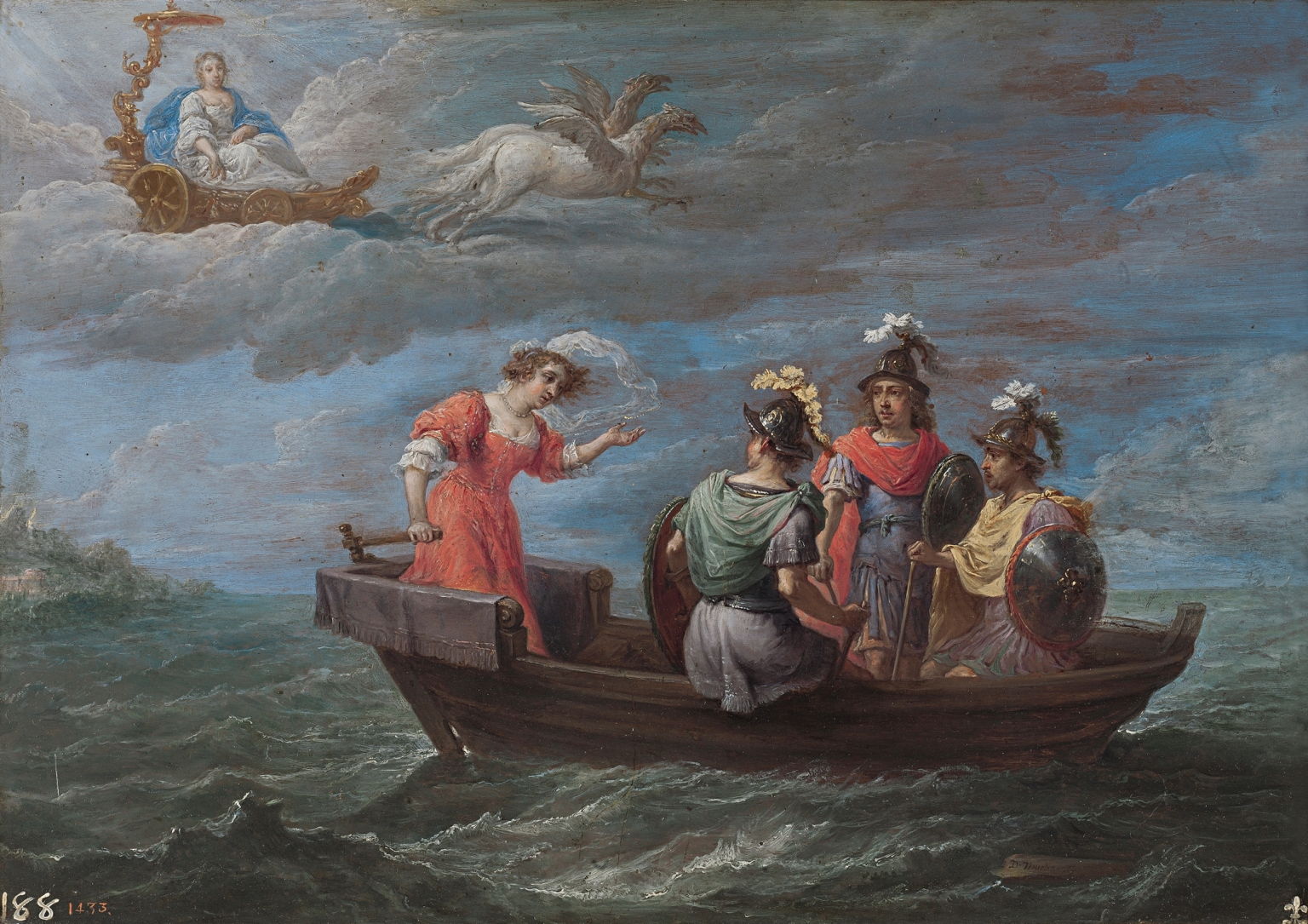
David Teniers the Younger shows this section of the story in two of his small paintings on copper: in his Armida and Rinaldo Separated of 1628-30, Armida is weeping and being comforted by Charles and Ubaldo, as the woman pilot of their ship waits for them to board by its stern.
David Teniers the Younger (1610–1690), Rinaldo Flees from the Fortunate Isles (1628-30), oil on copper, 27 x 39 cm, Museo Nacional del Prado, Madrid, Spain. Wikimedia Commons.
Teniers’ sequel, Rinaldo Flees from the Fortunate Isles, shows the group returning to war, with Armida still looking disconsolate in her chariot above them.
Canto seventeen opens in Gaza, between Egypt and Jerusalem, where the King of Egypt is mustering his army ready to advance towards Godfrey’s forces. He sits on his throne to review his forces, which Tasso lists in procession much as he had done when the crusaders were setting out for Jerusalem at the start of the epic. These start with Egyptians, and progress through those from the coast of Asia, citizens of Cairo, those from the land to the south, men of Barca, those from the coast of Arabia, from the Persian Gulf, and the Indies. At the end, Armida appears riding in her chariot with her own forces who had been mustered in Syria by Hydrotes, together with Circassians and more.
The king then retires to a banquet, where Armida offers her forces in support of the king, and tells of her desire for vengeance against Rinaldo. Adrastus, a ‘Saracen’ leader of Indian troops, offers to rip Rinaldo’s heart out, and make a present of his head to Armida.
Thomas Asbridge (2004) The First Crusade, A New History, Free Press, ISBN 978 0 7432 2084 2.
Anthony M Esolen, translator (2000) Torquato Tasso, Jerusalem Delivered, Gerusalemme Liberata, Johns Hopkins UP. ISBN 978 0 801 863233. A superb modern translation into English verse.
John France (1994) Victory in the East, a Military History of the First Crusade, Cambridge UP. ISBN 978 0 521 589871.
Joanthan Riley-Smith, ed (1995) The Oxford Illustrated History of the Crusades, Oxford UP. ISBN 978 0 192 854285.
Jonathan Riley-Smith (2014) The Crusades, A History, 3rd edn., Bloomsbury. ISBN 978 1 4725 1351 9.
Johathan Unglaub (2006) Poussin and the Poetics of Painting, Pictorial Narrative and the Legacy of Tasso, Cambridge UP. ISBN 978 0 521 833677.
I hope you enjoyed Saturday’s Mac Riddles, episode 353. Here are my solutions to them.
1: The future was here 25 years ago when the fastest land animal arrived.
Click for a solution
Cheetah (Mac OS X 10.0)
The future was here (launched under the tagline of ‘the future is here’) 25 years ago (released on 24 March 2001) when the fastest land animal (a cheetah, despite Mac OS X 10.0 being far from the fastest) arrived.
2: This atelier came with more than a marathon four years ago.
Click for a solution
Mac Studio M1
This atelier (a studio) came with more than a marathon (the first Apple silicon Mac to feature an M1 Ultra chip) four years ago (announced 8 March and released 18 March 2022).
3: Wicked fast at 40 MHz, its special effects impressed 36 years ago.
Click for a solution
Macintosh IIfx
Wicked fast (it was dubbed ‘wicked fast’) at 40 MHz (the clock speed of its 68030 CPU and bus), its special effects (FX) impressed 36 years ago (released 19 March 1990).
The common factor
Click for a solution
They each celebrated their anniversaries this month.
Many discovered how long 5 minutes could last when they updated from macOS 26.3.1 to 26.4. Right at the end of its Preparation phase, Software Update showed there were only 5 minutes remaining for far longer. This article reveals what went wrong with that update.
My observations come from a Mac mini M4 Pro running a vanilla installation of macOS Tahoe, being updated from 26.3.1 (a) with the BSI installed, to 26.4. Times and details are taken from log extracts covering the final 14 minutes of the update, immediately prior to the reboot for its installation.
Preparation
At almost exactly 18:43:00, softwareupdated reported that the PREPARING_UPDATE phase was in progress, with 70% complete on the progress bar, and 20 minutes remaining. Periodic preparation activities were then reported in the log, mainly verifying components to be installed as part of the update. One of the longest of those, /usr/standalone/i386/Firmware.scap, took nearly 6.5 minutes alone, although you might wonder why that’s required on an Apple silicon Mac!
Eleven seconds later, softwareupdated changed the progress bar to display 10 minutes remaining, with 71% completed. Just 1.5 seconds later that changed again to display 5 minutes remaining with 94% complete. Six seconds after that, with 5 minutes still displayed, the log records 98.6% was complete.
The log and progress bar then remained stuck at 5 minutes remaining and 98.6% complete for the next 11 minutes and 47 seconds, before changing to 99.9% complete and no time remaining.
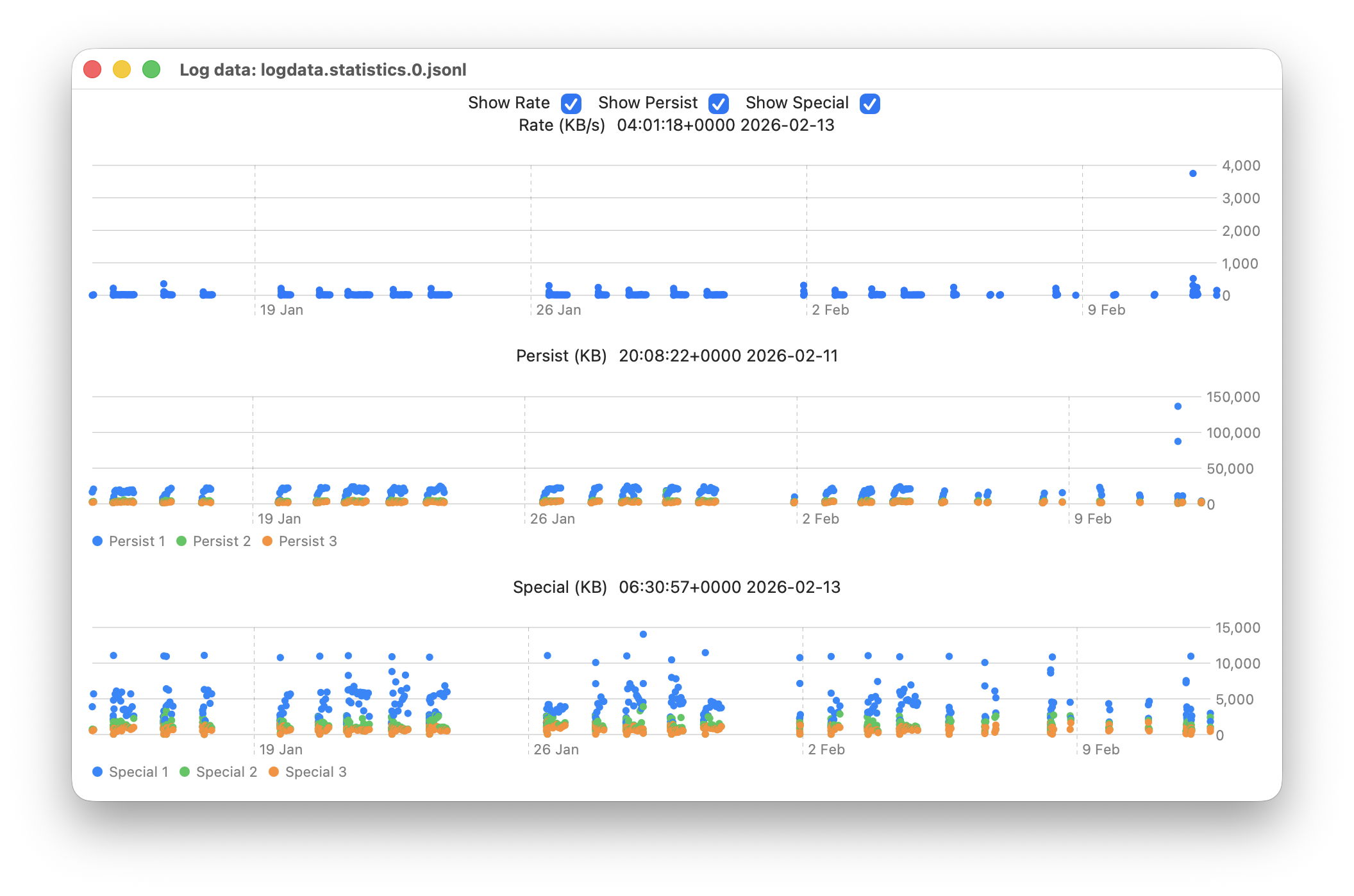
These are plotted in the chart below.
The final 5 minute period started at 18:43:12, and lasted until 18:55:04, as reflected in the long period of 98.6% completion (upper line) and 5 minutes remaining (lower line).
The “5 minutes” remaining actually took 12 minutes and 7 seconds, although log entries make it clear that preparation continued throughout that time, with further verifications and “Preparing system volume…”. Those details were reported as ActionText for progress monitoring, but curiously aren’t accessible to the user at the time.
Log entries record softwareupdated keeping detailed records of progress over this period, though. For example: 18:51:32.924688 softwareupdated PrepareUpdate PROGRESS (Continue) | state:{
ActionText = "Preparing system volume...";
ElapsedTime = 490;
ExpectedTime = 1335505;
PercentBytesComplete = "48.05373989419242";
PercentComplete = "4.701870471432042";
}
But those aren’t reflected in the progress bar.
Once the update had completed that preparation phase, extensive checks were performed to ensure it was correctly configured, and components were moved into place in the ‘stash’ to be used during installation. One second after successful completion, softwareupdated locked the controller state and waited for the reboot to start installation. Rebooting followed less than two minutes later.
What went wrong?
The macOS 26.4 update for Apple silicon Macs was large, and the work required to verify its contents and complete its preparation was incorrectly reported in both percent completion and time remaining. Even in smaller updates, some form of progress needs to be shown in the progress bar during these later stages of preparation, or users may be mislead into thinking the update has frozen or failed, and could for example restart their Mac to try updating again.
What should the user do?
When an update claims there’s only 5 minutes left, that could readily extend to longer, possibly on slower Macs as long as 30 minutes or more. Unless there’s evidence that the update has gone wrong at this stage, you should leave your Mac to complete it, as it almost certainly will. If you’re still in doubt and want to confirm that the update hasn’t frozen, open Activity Monitor and look for around 100% CPU from softwareupdated or related processes, and disk activity.
Unfortunately, there’s nothing the user can do to accelerate macOS updates.
After Alexandre Calame’s views of Lake Geneva painted in the middle of the nineteenth century, the next great artist to devote as much attention to the lake was Ferdinand Hodler, a native of Bern, Switzerland. At the age of eighteen, Hodler had walked across the country to attend the Collège de Genève there, and train as a painter, initially by copying Calame’s paintings.
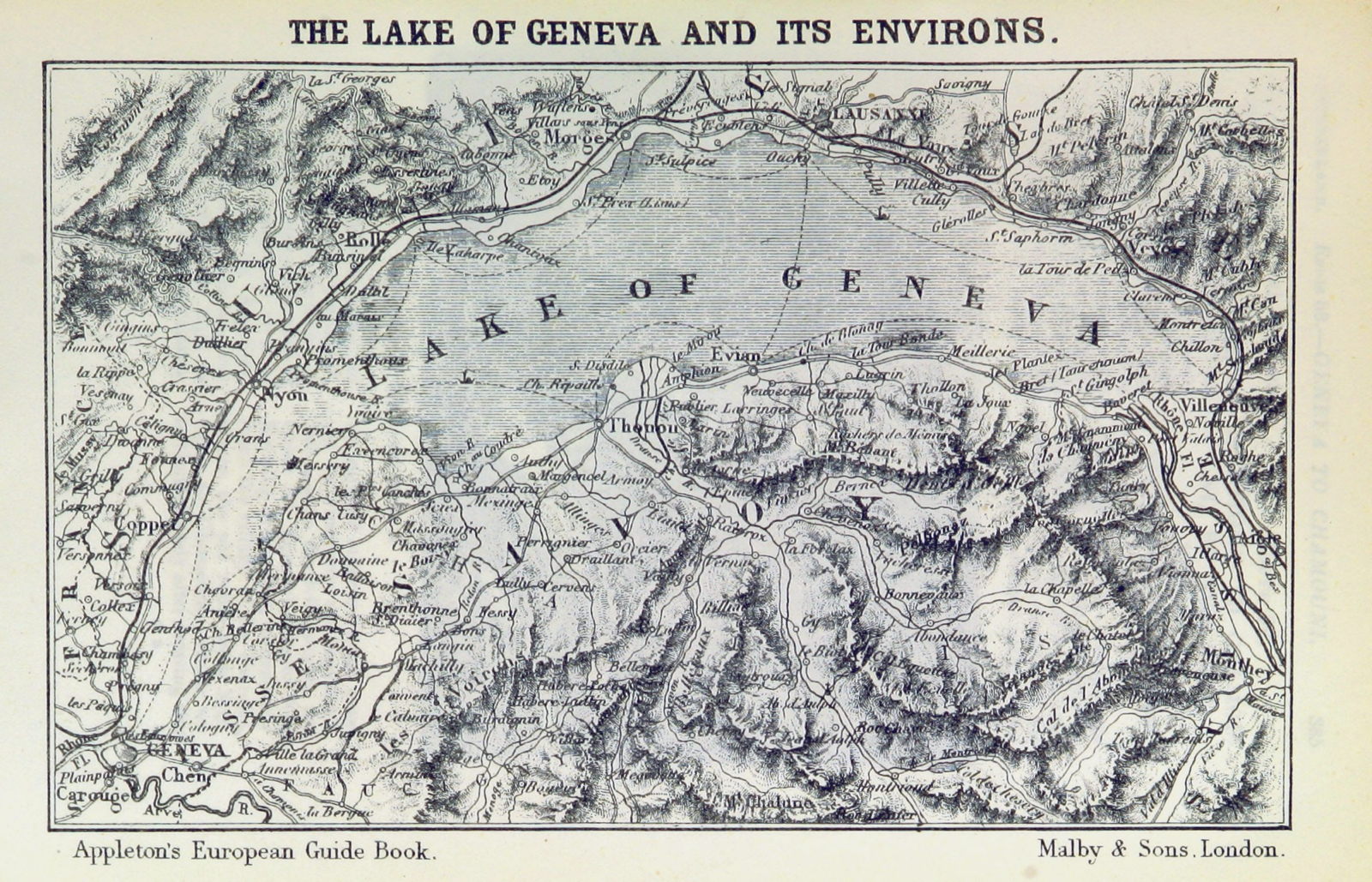
Daniel Appleton et al., Map of Lake Geneva (1877), p 521 in Appleton’s European Guide Book illustrated, 10th edition, D. Appleton & Co, New York. The British Library, London. Wikimedia Commons.Ferdinand Hodler (1853–1918), Lake Geneva from Chexbres (c 1898), oil on canvas, 100.5 × 130 cm, Private collection. Wikimedia Commons.
Hodler started painting a series of views from the north-eastern shore of Lake Geneva looking south, across to the major peaks of the Chablais Alps. He was to continue this series until his death twenty years later. Lake Geneva from Chexbres from about 1898 shows one of the first of these, painted near the village of Chexbres, between Lausanne and Montreux, in early winter.
Ferdinand Hodler (1853–1918), Lake Geneva from St Prex (1901), oil on canvas, 72 x 107 cm, Private collection. Wikimedia Commons.
Lake Geneva from Saint-Prex (1901) is another view across the lake, from a town to the west of Lausanne, looking south with a closer view of the peaks of the Chablais Alps. This appears to have been painted in the summer, with the trees in full leaf and a rich range of flowers. The clouds over the mountains are starting to become more organised in a regular rhythm, a trend that resulted in some of his most distinctive later landscapes.
Ferdinand Hodler (1853–1918), The Grammont (1905), oil on canvas, 65 x 105.5 cm, Private collection. Wikimedia Commons.
The Grammont (1905) shows this mountain in the Chablais Alps, to the south of the eastern end of Lake Geneva, towards which many of Hodler’s favourite views over that lake were aimed. Again he uses a limited palette; the lake itself reminds me of Gustav Klimt’s wonderful paintings of Attersee from a few years earlier, although Hodler’s darker blue ripples quickly vanish as the lake recedes from the viewer.
Ferdinand Hodler (1853–1918), Landscape at Lake Geneva (c 1906), media not known, 59.8 x 84.5 cm, Neue Pinakothek, Munich, Germany. Image by Rufus46, via Wikimedia Commons.
The following year, he painted Landscape at Lake Geneva.
Ferdinand Hodler (1853–1918), Rhythmic Landscape on Lake Geneva (1908), oil on canvas, 67 x 91 cm, Private collection. Wikimedia Commons.
One of the clearest examples of Hodler’s distinctive Parallelist landscapes is his Rhythmic Landscape on Lake Geneva from 1908. This was a second version of a view he had previously painted in 1905, when he wrote “This is perhaps the landscape in which I applied my compositional principles most felicitously.”
Most of his symmetry and rhythm is obvious; what may not be so apparent are the idiosyncratic reflections seen on the lake’s surface. The gaps in the train of cumulus clouds here become dark blue pillars, which are optically impossible, but are responsible for much of the rhythm in the lower half of the painting.
In the final years of Hodler’s life he painted some of the most sublime landscapes of his career. During the winter of 1917-18, his health deteriorated, but he continued to paint from the window of his room in Geneva, completing more than eighteen views during those final months. Here are three examples.
Ferdinand Hodler (1853–1918), Lake Geneva with Mont Blanc by Morning Light (1918), oil on canvas, 59 × 119.5 cm, Private collection. Wikimedia Commons.
In Lake Geneva with Mont Blanc by Morning Light (1918), one of the more complex paintings of this series, bands represent the lake shore, four different zones of the surface of the lake, the lowlands of the opposite bank, the mountain chains, and two zones of colour in the dawn sky. The lower section of the sky and the foreground shore echo in colour, and contrast in their pale lemon-orange with the blues of the other bands.
Ferdinand Hodler (1853–1918), Lake Geneva with Mont Blanc in the Morning Light (1918), oil on canvas, 65 x 91,5 cm, Kunsthaus Zürich, Zürich, Switzerland. Wikimedia Commons.
Lake Geneva with Mont Blanc in the Morning Light (1918) has a simpler structure, with the water, a band of reflections, the mass of the far shore and mountains merged, and the dawn sky. The dominant colour is the yellow to pale red of the dawn sky and its reflection.
Ferdinand Hodler (1853–1918), Lake Geneva with Mont Blanc in the (Red) Dawn Light (1918), oil on canvas, 74.5 x 150 cm, Private collection. Wikimedia Commons.
Lake Geneva with Mont Blanc in the (Red) Dawn Light (1918) is also simpler in its structure, with the water coloured by the sky, a zone of blue reflections of the far bank, the merged distant shore and mountains, and the sky.
In Hodler’s ultimate and most sublime landscapes, he eliminated the unnecessary detail, stating just the elements of water, earth, air, and the fire of the rising sun, in their natural rhythm. On 19 May 1918, Hodler died in Geneva, at the age of 65.
One of the longstanding jokes in computing is how misleading progress indicators can be, and last week most of us had a timely reminder when we updated macOS. However much we might like a perfectly accurate linear indicator for macOS updates, this is one of those situations where the best we can expect is a compromise, as I tried to explain here.
Showing progress
There are two types of progress indicator, determinate and indeterminate, depending on whether the task is quantifiable and progress is measurable. Determinate indicators are always preferred, as they inform the user whether they need only wait only a few moments, or they have time to enjoy a leisurely meal, but that requires quantifiability and measurability.
The simple example is copying a file from one disk to another: although macOS doesn’t know in advance how long that might take, it can quantify the task as the size of the file to be copied, then keep track of how much of that has already been completed. When half the size of the file has been copied, the progress bar can be set to half-way along its total length, so providing an accurate indication of progress.
However, with some copy operations that breaks down: when copying a sparse file between APFS volumes, for example, only the sparse data is copied, not the whole file size. As a result, copying sparse files often results in progress bars that jump from a low point to completion in the twinkling of an eye. This also relies on the quantities involved being linearly proportional to the time required, an assumption that often breaks down when downloading from a remote server.
macOS updates
Updating macOS consists of a series of many tasks (see references at the end), of which only one, downloading, is both quantifiable and has measurable progress, and even that may be far from linear. Apple therefore has a choice of:
Display multiple progress indicators, appropriate to each phase. While that might work well for the download phase, it can’t work for others, including preparation, which is likely to take a period of several minutes at least.
Combine those into a single progress bar, as at present.
Use an indeterminate progress indicator, such as a spinning wheel, which would be reliable but unhelpful.
As downloading is the one task that is quantifiable and its progress is measurable, I’ll start there.
For this, the progress bar starts an an arbitrary 15%, and softwareupdated assumes the total size of that download is the magnitude of that task.
When the download has been completed, the progress bar reaches an arbitrary 55%, and its caption then changes to reporting progress with preparation.
There is a weakness in the assumption that becomes obvious when downloading from a local Content Caching server, as the final 1 GB or so normally isn’t provided from the cache, but has to be freshly downloaded from Apple’s servers. However, that isn’t normally apparent when caching isn’t available and the whole of the download comes from the same remote source.
For the remainder of the progress bar, between 0%-15% and 55%-100%, the task is neither quantifiable nor measurable. Instead, softwareupdated divides it into a series of subtasks, each of which has a fixed progress level. One list of subtasks and levels obtained from the log is given in the Appendix at the end.
The disadvantage of that strategy is that time required by each subtask varies with the update and the Mac being updated. Inevitably, computationally intensive subtasks will proceed more rapidly on newer and faster Macs, while those mainly constrained by disk speed should be more uniform. Large updates should take significantly longer, and that will vary by subtask as well.
The last 5 minutes
A particular problem with some more recent macOS updates, including that from 26.3.1 to 26.4 last week, has been unmarked progress over the final “5 minutes” of preparation. While indeterminate progress indicators continue to move over that period, and reassure the user that the task hasn’t ground to a halt or frozen, the progress bar shown had no intermediate points, making it easy to misinterpret as failure to progress. If this is going to be a feature of future macOS updates, Apple needs to insert some intermediate points to let the user know that the update is still proceeding.
Conclusion
A progress bar that combines different measures of progress, such as download size and substages, can work well, but only if the user is aware of how to read it. As we only update macOS a few times each year, that isn’t sufficient exposure, and how it works needs to be made explicit.
This weekend we’re off to visit Lake Geneva, also known by its French name of Lac Léman, the largest in Switzerland. It’s located in the far south-west of the country, where it forms much of its border with France. It makes a broad arc running north-east from the capital city of Geneva, with some of the highest peaks of the Alps to its south.
Daniel Appleton et al., Map of Lake Geneva (1877), p 521 in Appleton’s European Guide Book illustrated, 10th edition, D. Appleton & Co, New York. The British Library, London. Wikimedia Commons.
Today I start with a selection of paintings almost exclusively from the nineteenth century, when Switzerland was on the itinerary of the Grand Tour undertaken by aspiring young men of the upper class in both Europe and the Americas.
Jean-Étienne Liotard (1702-1789), View of the Mont Blanc Massif from the Artist’s Studio (1765-70), pastel on parchment, 46 x 59.7 cm, location not known. Wikimedia Commons.
The city of Geneva has long attracted artists, and it was here the eccentric pastellist Jean-Étienne Liotard was born and later kept his studio, and where he eventually retired. His View of the Mont Blanc Massif from the Artist’s Studio from 1765-70 reveals only a little of the southern extreme of the lake, with a cameo self-portrait.
Joseph Mallord William Turner (1775–1851), Lake Geneva and Mount Blanc (1802-05), watercolour, 90.5 x 128.6 cm, Yale Center for British Art, New Haven, CT. Wikimedia Commons.
JMW Turner was by no means the first to paint the lake, but his watercolour of Lake Geneva and Mount Blanc from 1802-05 is one of its earliest depictions by a major artist. This view looks south-east over the city of Geneva towards the Mont Blanc massif in the far distance.
Alexandre Calame (1810–1864), View of Bouveret (1833), oil on panel, 35 x 47.5 cm, location not known. Wikimedia Commons.
Alexandre Calame’s View of Bouveret from 1833 shows a grey heron fishing on the shore at the southern end of the lake, close to the border with France.
Alexandre Calame (1810–1864), View of Lake Geneva (Lac Léman) (1849), oil on wood, 67 x 86 cm, Villa Vauban, Musée d’art de la ville de Luxembourg, Luxembourg. Wikimedia Commons.
While Turner had toured the Alps once travel from England had become possible again in the early nineteenth century, Calame pioneered the painting of views like this of the lake, completed in his studio in 1849. It includes some of the distinctive sailing boats of the Swiss lakes, and a small bird in the shallows, but not a heron here.
John Ferguson Weir (1841-1926), Lake Leman (Lake Geneva), Switzerland (1869), oil on paper, 20.3 x 33 cm, Private collection. Wikimedia Commons.
In the middle of the nineteenth century, several major American artists visited Switzerland to develop their skills painting mountain views. Despite its finish, John Ferguson Weir’s Lake Leman (Lake Geneva), Switzerland may have been painted in front of the motif, on 11 June 1869.
Following Gustave Courbet’s release from prison for his involvement in the Paris Commune and destruction of the Vendôme Column in 1871, he was forced to flee to the safety of Switzerland, where he lived his remaining years there, unable to return to France.
Gustave Courbet (1819–1877), Sunset over Lac Leman (1874), oil on canvas, 55 x 65 cm, Musée Jenisch, Vevey, Switzerland. Image by Volpato, via Wikimedia Commons.
Courbet painted some of the finest landscapes of his career during his exile in Switzerland, like this Sunset over Lac Léman from 1874, the year of the First Impressionist Exhibition in Paris.
Gustave Courbet (1819–1877), Chillon Castle (1875), oil on canvas, dimensions not known, Private collection. Wikimedia Commons.
He became particularly obsessed with the island château at the extreme eastern end of Lake Geneva, Chillon Castle, here in 1875. This picturesque château dates back to a Roman outpost, and for much of its recorded history from about 1050 has controlled the road from Burgundy to the Great Saint Bernard Pass, a point of strategic significance. It has since been extensively restored, and is now one of the most visited mediaeval castles in Europe.
Gustave Courbet (1819–1877), Chillon Castle (1874-77), oil on canvas, 73 x 92 cm, location not known. Wikimedia Commons.
Chillon Castle from 1874-77 is another of the views he painted of the castle on the lake.
Gustave Courbet (1819–1877), Sunset on Lake Geneva (c 1876), oil on canvas, 74 x 100 cm, Kunstmuseum St. Gallen, St. Gallen, Switzerland. Wikimedia Commons.
Sunset on Lake Geneva from about 1876 is reminiscent of Courbet’s earlier seascapes with breaking waves, but now the water is calm once more.
In May 1877, the French government informed Courbet that the cost of rebuilding the Vendôme Column would be over 300,000 Francs, which he could pay in instalments of 10,000 Francs each year, starting on 1 January 1878. Courbet died in Switzerland the day before, on 31 December 1877, at the age of only 58.
Input and output have long been key factors in computer performance, and capable of bringing everything to a crawl unless carefully managed. This is most obvious when foreground and background processes contend for common resources such as disk storage. A popular solution has been to impose delays on I/O performed for intensive background tasks, like backing up, so giving more important tasks preferential access to I/O. This policy is known as I/O throttling, and has come to determine hardware choice.
For example, folk wisdom is that there’s little point in wasting a faster drive to store your Time Machine backups, because when those backups are made, their write speed is throttled by macOS.
I/O Throttling
Documentation of I/O policy is in the man page for the getiopolicy_np() call in the Standard C Library, last revised in 2019, and prevailing settings are in sysctl’s debug.lowpri_throttle_* values. Those draw a distinction between I/O to local disks, being “I/O sent to the media without going through a network”, such as I/O “to internal and external hard drives, optical media in internal and external drives, flash drives, floppy disks, ram disks, and mounted disk images which reside on these media”, and those to “remote volumes” “that require network activity to complete the operation”. The latter are “currently only supported for remote volumes mounted by SMB or AFP.”
Inclusion of remote volumes is a relatively recent change, as in the previous version of this man page from 2006, they were explicitly excluded as “remote volumes mounted through networks (AFP, SMB, NFS, etc) or disk images residing on remote volumes.”
Five policy levels are supported for IOPOL_TYPE_DISK:
IOPOL_IMPORTANT, the default, where I/O is critical to system responsiveness.
IOPOL_STANDARD, which may be delayed slightly to allow IOPOL_IMPORTANT to complete quickly, and presumably referred to in sysctl as Tier 1.
IOPOL_UTILITY, for brief background threads that may be throttled to prevent impact on higher policy levels, in Tier 2.
IOPOL_THROTTLE, for “long-running I/O intensive background work, such as backups, search indexing, or file synchronization”, that will be throttled to prevent impact on higher policy levels, in Tier 3.
IOPOL_PASSIVE, for mounting files from disk images, and the like, intended more for server situations so that lower policy levels aren’t slowed by them.
However, the idea that throttled I/O is intentionally slowed at all times isn’t supported by the explanation of how throttling works: “If a throttleable request occurs within a small time window of a request of higher priority, the thread that issued the throttleable I/O is forced to a sleep for a short period. This slows down the thread that issues the throttleable I/O so that higher-priority I/Os can complete with low-latency and receive a greater share of the disk bandwidth.”
Settings in sysctl for Tier 3 give the window duration as 500 milliseconds, and the sleep period as 200 ms, except for SSDs, whose sleep period is considerably shorter at just 25 ms. Those also set a maximum size for I/O at 131,072 bytes. You can view those settings in the debug section of Mints’ sysctl viewer.
Some years ago it was discovered that the user can globally disable IOPOL_THROTTLE and presumably all other IOPOL_TYPE_DISK policy with the command sudo sysctl debug.lowpri_throttle_enabled=0
although that doesn’t persist across restarts, and isn’t documented in the man page for sysctl. This is provided in an option in St. Clair Software’s App Tamer, to “Accelerate Time Machine backups”, for those who’d rather avoid the command line.
Apple silicon Macs
Since the man page for getiopolicy_np() was last revised, Apple silicon Macs have changed I/O. Most is now handled in some way through specialised Arm cores within the chip, and CPU cores come in two (now three) types, Efficiency and Performance (and Super in the M5 family). Background threads such as those performing the work associated with IOPOL_THROTTLE are now most likely to be running on Efficiency (or M5 Performance) CPU cores.
If you wanted to do away with all throttling, you not only have to change the debug.lowpri_throttle_enabled setting, but you’d need to move those background threads to run them on Performance (M5 Super) CPU cores, which isn’t possible unless you have control over the code. There is evidence that macOS may do this anyway when performing the first full Time Machine backup, which achieves significantly faster speeds than subsequent incremental backups.
Dangers
The big disadvantage of completely disabling I/O throttling policy is this can only be applied globally, so including I/O for Spotlight indexing, file synchronisation, and other background tasks, as well as those needing high-priority access to I/O. Leaving the policy disabled in normal circumstances could readily lead to adverse side-effects, allowing Spotlight indexing threads to swamp important user storage access, for example.
Conclusions
Even when Macs were simpler and all CPU cores were the same, disabling I/O throttling was at best experimental, and ran the risk of compromising higher priority I/O. In Apple silicon Macs, relocating threads from E to P cores isn’t possible, except when running them in a virtual machine. Without that, there seems little if any benefit from disabling I/O throttling. However, the claim that there’s no performance benefit to be obtained from faster backup storage media is demonstrably false. Perhaps it’s time to return I/O throttling to the obscurity it deserves.
The great Symbolist painter Gustave Moreau was born almost two centuries ago, on 6 April 1826. To mark his bicentenary early next month, this short series outlines his career in a small selection of his more important paintings. They are at once history, symbolic explorations, as phantasmagoric as the most radical of William Blake or Odilon Redon, and torrents of figures and forms drawn from all human cultures. They’re elaborate, complex, and appear to defy reading.
Moreau was a precocious artist who started copying in the Louvre, in his native Paris, when he was only seventeen. A year later he started attending a private studio run by François-Édouard Picot, to prepare him for the entrance exam for the École des Beaux-Arts. In Picot’s studio, he learned the methods to which he adhered for the rest of his career: each painting started with a series of drawings, which developed both composition and details. The final drawing was squared up on a grid, to enable its transfer to canvas, where he painted conventionally in oils, using layers.
He was admitted to the École des Beaux-Arts in 1846, and decided to be a history painter. He competed twice for the Prix de Rome, which would have taken him to continue his studies in Rome, but was unsuccessful on both occasions. He therefore left the École in 1849, and started making a precarious living with small commissioned works including favourite scenes from the plays of Shakespeare. His work changed markedly in 1851, the year that JMW Turner died, when he befriended Théodore Chassériau, a former pupil of JAD Ingres; Moreau set up his first studio near Chassériau’s, and started painting more ambitious works to submit to the Salon.
Gustave Moreau (1826–1898), The Judgement of Paris (1852), watercolor on paper, 40.7 × 48.3 cm, Private collection. Wikimedia Commons.
The Judgement of Paris (1852) is one of his early watercolours, showing great promise of things to come. At its heart is a fairly faithful representation of this classical myth, in which Paris (right of centre) is deciding which of Hera, Athena, and Aphrodite is the most fair, and should be awarded the golden apple given by Eris from the Garden of the Hesperides.
Gustave Moreau (1826–1898), Apollo and the Nine Muses (1856), oil on canvas, dimensions not known, Private collection. The Athenaeum.
Apollo and the Nine Muses (1856) is another significant step towards his mature work. Apollo, a young and surprisingly androgynous figure, sits in the foreground, his distinctive lyre part-hidden under his right foot. To the right of him is a wild rose, with both white flowers and red hips. The muses cluster on a small mound behind that, equipped for and engaged in their respective arts.
That year, his friend and mentor Chassériau died at the age of only 37. Moreau was devastated, and decided to travel to Italy to complete his education as a painter and resolve his future. From October 1857 to June 1858, he copied Renaissance paintings in Rome, then moved on to Florence, Milan, and Venice. He finally returned to Paris in September 1859, having made about a thousand copies in less than two years. He had also met and made friends with several other artists, including Edgar Degas and James Tissot.
Gustave Moreau (1826–1898), Hesiod and the Muses (1860), oil on canvas, 155 × 236 cm, Musée National Gustave-Moreau, Paris. Wikimedia Commons.
Hesiod and the Muses (1860) is probably the first of Moreau’s novel history paintings, and the first of a series of works showing Hesiod, generally considered to be the first written poet in the Western tradition to exist as a real person, and to play an active role in his poetry. Hesiod is the young man holding a laurel staff in his right hand, to the left of centre.
There are four swans on the ground, and one in flight above Hesiod, a winged Cupid sat on the left wing of Pegasus, and a brilliant white star directly above the winged horse. However, the Cupid and Pegasus were only added in about 1883, when the canvas was extended.
Moreau met his mistress and muse Alexandrine Dureux (whom he never married, both remaining single) that year, and set her up in a nearby flat, where she lived until her death in 1890.
By 1864, he had abandoned three attempts to produce a radical work for the Salon. However, he had been working on something different, that he completed during the winter of 1863-4: Oedipus and the Sphinx (1864)
Gustave Moreau (1826–1898), Oedipus and the Sphinx (1864), oil on canvas, 206.4 x 104.8 cm, The Metropolitan Museum of Art (Bequest of William H. Herriman, 1920), New York, NY. Courtesy of The Metropolitan Museum of Art, via Wikimedia Commons.
This was a bold move. Not only was this painting startlingly original and different, but it visited a motif that had recently resulted in Ingres’ success at the Salon, in 1827. Just as Oedipus is seen to be staring out the fearsome sphinx, so Moreau was visibly challenging his seniors.
This shows a key scene from Sophocles’ tragedy Oedipus the King. The sphinx had effectively put the ancient Greek city of Thebes under siege, by sitting outside and refusing to let anyone pass unless they answered a riddle correctly. Those who failed to do that it killed by strangulation. When Oedipus arrived, intending to enter Thebes, the sphinx asked him “Which creature has one voice and yet becomes four-footed, two-footed, and three-footed?” Oedipus solved this in his answer of humans, who crawl when a baby, walk on two feet as an adult, then walk with a stick when old. The defeated sphinx then threw itself into the sea below, Oedipus entered Thebes, was awarded the throne of Thebes in return for destroying the sphinx, and married its queen Jocasta, who turned out to be his mother.
Gustave Moreau (1826–1898), Oedipus and the Sphinx (detail) (1864), oil on canvas, 206.4 x 104.8 cm, The Metropolitan Museum of Art (Bequest of William H. Herriman, 1920), New York, NY. Courtesy of The Metropolitan Museum of Art, via Wikimedia Commons.
The apparently emotionless faces of Oedipus and the sphinx are not an attempt to reject facial expression as a narrative tool. In fact, they confirm its value. The pair are engaged in staring intently into one another’s eyes, in the way that poker players might, almost eyeball to eyeball. The most plausible moment to be shown here is the brief interval between the sphinx asking its riddle, and Oedipus answering it.
The sphinx has already latched onto the front of what it comfortably assumes is going to be another, rather delectable victim. Its forelegs are ready to reach up and strangle him once he guesses the wrong answer, and its hindlegs are ready to unsheath claws and walk up, burying them in his flesh. The sphinx is ready to prove itself a femme fatale for Oedipus.
Oedipus knows that he cannot falter. A false guess, even a slight quaver in his voice, and this beautiful but lethal beast will be at his throat. His left hand clenches his javelin, knowing that what he is about to say should save his life, and spare the Thebans. He will then no longer be pinned with his back to the rock, and the threat of the sphinx will be gone.
Gustave Moreau (1826–1898), Oedipus and the Sphinx (detail) (1864), oil on canvas, 206.4 x 104.8 cm, The Metropolitan Museum of Art (Bequest of William H. Herriman, 1920), New York, NY. Courtesy of The Metropolitan Museum of Art, via Wikimedia Commons.
Around this central narrative core, Moreau feeds us symbolic morsels to supplement that main course without supplanting it. Behind Oedipus is a bay tree, sacred to Apollo, representing man’s highest achievements; behind the sphinx is a fig tree, a traditional symbol of sin. The small polychrome column at the right is topped by a cinerary urn, symbolising death, and above it is a butterfly, representing the soul. Ascending the column is a snake, again associated with death, and through the biblical serpent, with sin.
Moreau’s bold move worked, as Oedipus and the Sphinx took the Salon of 1864 by storm, winning him a medal. The following year, he tried to consolidate that success with Jason.
Gustave Moreau (1826–1898), Jason (1865), oil on canvas, 204 × 115 cm, Musée d’Orsay, Paris. Wikimedia Commons.
The name Jason refers, of course, to Jason of Golden Fleece and Argonauts fame, a series of swashbuckling adventures offering ample opportunities for theatrical narrative painting. Moreau avoids them all, and shows us a static Jason, with Medea stood behind him, not a Golden Fleece in sight. Instead of providing narrative, the artist offers us symbols as clues to what might be going on.
The broad outline of Jason’s story is simple. When he reached Colchis, he underwent a series of trials imposed by King Aeëtes, culminating in his victory over the dragon guarding the Golden Fleece. These were accomplished with the help of Medea, the King’s daughter, in return for a promise of marriage.
The almost naked woman behind Jason is Medea, the sorceress who has fallen in love with the hero. The ram’s head at the top of the pillar on the left signifies the Golden Fleece, and the dragon which guarded it is shown as the eagle on which Jason is standing, with the broken tip of his javelin embedded in it. This is the more confusing, as in the original story the dragon was put to sleep by one of Medea’s potions, rather than being killed with a javelin.
Yet Medea holds a vial in her right hand, and her body is swathed with the poisonous hellebore plant, a standard tool of witchcraft. These may allude to Jason’s future rejection of Medea and her poisoning of his replacement bride, but there is a lot of story between this moment and that later episode, so that is speculative and hardly clarified by the painting.
Moreau provided some clues to his intentions in this painting, in the almost illegible inscriptions on the two phylacteries wound around the column. These bear the Latin: nempe tenens quod amo gremioque in Iasonis haerens
per freta longa ferar; nihil illum amplexa timebo
(Nay, holding that which I love, and resting in Jason’s arms, I shall travel over the long reaches of the sea; in his safe embrace I will fear nothing) et auro heros Aesonius potitur spolioque superbus
muneris auctorem secum spolia altera portans
(And the heroic son of Aeson [i.e. Jason] gained the Golden Fleece. Proud of this spoil and bearing with him the giver of his prize, another spoil)
(Cooke, pp 55-56.)
These could be interpreted as suggesting that the painting should be read in terms of the conflict between Jason and Medea: Medea expresses her subjugate trust in him, while Jason considers her to be just another spoil won alongside the Golden Fleece. More puzzling is the spattering of other details, of hummingbirds, the sphinx on top of the pillar, medals decorating the shaft of that pillar, and more. Some appear merely to be decorative, but drawing the line between the decorative and the symbolic is impossible.
The end result in Jason is almost the opposite of Oedipus and the Sphinx: the latter consists of a clear narrative lightly embellished with symbols, the former relies on the interpretation of symbols to construct any narrative; as those symbols conflict with the original narrative, the viewer can readily become bewildered.
The 1865 Salon didn’t provide the consolidation for which Moreau had hoped, although much of that was the result of an accident of history: dominating all discussion that year was another painting, Manet’s Olympia. He needed to do better in 1866 if he wasn’t going to slip back into obscurity.
Gustave Moreau (1826–1898), Orpheus (1865), oil on panel, 154 × 99.5 cm, Musée d’Orsay, Paris. Wikimedia Commons.
In Moreau’s Orpheus (1865) a sombrely-dressed Thracian woman holds Orpheus’ lyre, on which rests his head, blanched in death, as if affixed to the lyre like the head of a hunting trophy. Her eyes are closed in reverie.
One version of the legend of Orpheus’ death holds that his head and lyre were borne by the river Hebrus, which is shown in the background landscape to the right. Again, though, Moreau pursues his own adjusted version of the written narrative, as according to that account (in Ovid’s Metamorphoses, book 11), the head and lyre were washed up on the coast of Lesbos.
Orpheus adopts a unified tonality, colour, form, character, and style that could be viewed as a ‘mode’, as conceived by Nicolas Poussin. The gentle and natural beauty of the Thracian woman, her ornate clothes, flowers, and the strange beauty of Orpheus’ head on the lyre contrast with a harsh and barren landscape, which might have been more appropriate in a Renaissance painting, perhaps by Leonardo da Vinci.
Moreau has carefully avoided elaborate symbols and decoration, although he has left us two further puzzles at the painting’s corners: the three figures, apparently shepherds, on the rocks at the upper left, and a pair of tortoises at the lower right. The figures refer to music, which seems in keeping with Orpheus and his lyre, but the significance of the tortoises is open to speculation.
Gustave Moreau (1826–1898), Orpheus (detail) (1865), oil on panel, 154 × 99.5 cm, Musée d’Orsay, Paris. Wikimedia Commons.
What Moreau lost in the absence of narrative, this painting gained in its remarkable tranquillity. Two faces, eyes closed, (don’t) look at one another. The intricate decoration of the lyre seems unified with the Thracian woman’s clothing, even the coiled braids of her hair. Although one of his most profoundly beautiful and moving paintings, this failed to impress the Salon.
In 1868-9 he turned to one of the most frequently painted stories from Greek mythology, that of the abduction and rape of Europa. She was the mother of King Minos of Crete, and the story of Cretan origin; the bull was the main sacred animal in Crete. Zeus (Jupiter to the Romans), a notorious ravisher of women, lusted after the beautiful Europa. He therefore metamorphosed himself into a white bull, and hid among Europa’s father’s herd in Phoenicia. When Europa and other maidens came to gather flowers near this herd, she saw the white bull, caressed it, and climbed onto its back.
Zeus then ran to the sea and swam with Europa on his back until they reached the shores of Crete. There he revealed himself, and Europa became the first queen of the island. He gave her in return a necklace, Talos (a giant bronze automaton who protected Crete by circling its shores), Laelaps (an unfailing hunting dog), and a javelin that always struck its target.
Almost universally, previous depictions of this myth have shown the start of the abduction, from the pastures of Phoenicia to the bull heading off to sea. Moreau’s white bull, with Europa riding a precarious side-saddle, has just emerged from the sea, so is presumably now on the island of Crete.
Gustave Moreau (1826–1898), Jupiter and Europa (1868-9), oil on canvas, 175 x 130 cm, Musée National Gustave-Moreau, Paris. Wikimedia Commons.
The finished work, known as Jupiter and Europa (1868-9) (I apologise for the lack of sharpness in this image) but titled Europa, shows the bull with a human head, presumably as Zeus has revealed himself to Europa. The head of Zeus recalls those of sculptures of Assyrian kings.
It’s hard to see what Moreau brought in terms of originality to this well-worn motif, and the critics drew comparison with Veronese rather than Titian. Either way, this seems to be a painting in search of a reason, and the Salon agreed. As there was now a small but dedicated group of collectors who were prepared to purchase his paintings, Moreau decided to withdraw from exhibiting at the annual Salon.
In the Franco-Prussian War, Moreau joined the National Guard, and served in the defence of Paris in the autumn of 1870, besieged there with his mother. Over the winter his left shoulder and arm became immobile because of ‘rheumatism’, but he remained in the city. Finally, during the Commune in the spring of 1871, he defended the paintings he had amassed in his home, and watched his late friend Chassériau’s murals in the Cour des Comptes being destroyed by fire. He spent that summer recovering in the spa at Néris-les-Bains in the Auvergne.
References
Cooke P (2014) Gustave Moreau, History Painting, Spirituality and Symbolism, Yale UP. ISBN 978 0 300 20433 9.
Mathieu P-L (1998, 2010) Gustave Moreau, the Assembler of Dreams, PocheCouleur. ISBN 978 2 867 70194 8.
In most respects, lightweight virtualisation of macOS on Apple silicon delivers almost the same performance as running code on the host. That’s the result of having direct access to CPU cores and the GPU. However, earlier implementations in Monterey and Ventura performed poorly when accessing the Data volume in the Virtual Machine, with read/write speeds measured at 4.4/0.7 and 5.4/0.7 GB/s respectively, without FileVault or other encryption. In macOS 26.3.1 both RAW and ASIF encrypted disk images show disappointing performance particularly when writing to them. This article therefore re-evaluates VM disk performance to see if that extends to VMs.
Methods
Tests were performed on two freshly made 100 GB VMs in RAW format using the macOS 26.4 IPSW, running on a Mac mini M4 Pro in macOS 26.4. VMs were given 5 CPU cores and 16 GB memory, didn’t connect to an Apple Account, and were built and run in Viable and Vimy, both of which use the standard macOS API for virtualisation.
Performance was measured using Stibium’s ‘Gold Standard’ with 5 rather than 10 test sets, reading and writing a total of 26 GB in 80 files ranging in size between 2 MB and 2 GB. Following an initial write test, the VM was restarted before performing the read test. The first VM was configured with FileVault enabled, and the second with it disabled. In addition to those, standard read/write performance was measured as before on a 100 GB RAW disk image on the host, and on a 100 GB ASIF image, both being encrypted using 256-bit AES.
Results
Measured read/write speeds were:
Native SSD, FileVault on – 6.57/7.66 GB/s
VM, FileVault off – 6.62/5.91 GB/s
VM, FileVault on – 4.66/3.11 GB/s
RAW disk image, 256-bit AES – 2.82/1.59 GB/s
ASIF disk image, 256-bit AES – 2.85/1.76 GB/s.
With FileVault disabled, performance in the VM was surprisingly close to that of the host’s internal SSD, with a small reduction in write speed from 7.66 to 5.91 GB/s. That’s a huge improvement on previous results, with writes being almost ten times faster.
Enabling FileVault did reduce performance significantly, particularly write speed which fell to about half. However, those are still good enough to be acceptable for most purposes.
No significant change was seen in host disk image performance from those measured in 26.3.1, though, which remains substantially slower than the VM with FileVault enabled.
Conclusions
VMs are vulnerable if they don’t have FileVault enabled. Without encryption, sensitive contents would be relatively easy to access if the VM were to fall into the hands of an attacker. Enabling FileVault is thus potentially more important for a VM.
Thankfully, with such great improvements in VM disk performance, those hosted on an Apple silicon Mac’s internal SSD are unlikely to be slowed much by their disk performance.
This makes it the more puzzling that encrypted RAW and ASIF disk images should perform so poorly, and it’s disappointing to see that continues in macOS 26.4. Over the same period that VM disk performance has increased so impressively, that of disk images has headed in the opposite direction.
VMs and BSIs
If you tried installing the recent Background Security Improvement (BSI) in a macOS 26.3.1 VM, you were probably disappointed. In this respect, the VM didn’t work as expected. I was unable to find the BSI in its section in Privacy & Security settings. What did help was downloading it using SilentKnight, although that can’t install BSIs successfully. Instead, I restarted the VM and Privacy & Security offered to install the BSI at last.
Once installed, Privacy & Security offered to remove the BSI, but failed to do so, with SecurityImprovementsExtension reporting: Rollback failed: Error Domain=SUOSUErrorDomain Code=103 "Unable to remove Background Security Improvement" UserInfo={NSLocalizedDescription=Unable to remove Background Security Improvement, NSLocalizedRecoverySuggestion=Use Software Update to install the latest version of macOS.}
For the time being BSIs appear dysfunctional in VMs.
Although Naturalist painting had originated in the countryside among the rural poor, it soon came to record changing times in science. One of the more prominent painters of science and scientists was Léon Lhermitte, now known almost entirely for his rural paintings.
Léon Augustin Lhermitte (1844–1925), Claude Bernard and His Pupils (1889), copy of original by unknown artist, oil on canvas, 86.5 x 112.5 cm, Wellcome Library no. 45530i, London. Courtesy of Wellcome Images, via Wikimedia Commons.
Claude Bernard (1813-1878) was a pioneering physiologist whose writings were of great influence to Naturalists, including Émile Zola. Following Bernard’s death, the Sorbonne (where he had taught) commissioned Lhermitte to paint his portrait in 1886. This is a faithful anonymous copy of Claude Bernard and His Pupils, which was exhibited at the Salon in 1889. This shows Bernard in the midst of performing an experiment on a rabbit, his students discussing its results, and one writing the experimental observations in the laboratory daybook.
Léon Augustin Lhermitte (1844–1925), The Chemist Henri Sainte Claire Deville, Lesson on Aluminium (1890), The Sorbonne, Paris. Wikimedia Commons.
Lhermitte’s painting of The Chemist Henri-Étienne Sainte-Claire Deville, Lesson on Aluminium from the following year was also commissioned by the Sorbonne in Paris; I apologise for the small size of this image. Henri-Étienne Sainte-Claire Deville (1818-1881) was responsible for many significant discoveries in chemistry, the most important being a method for the industrial manufacture of aluminium. He’s shown here surrounded by objects made from this new material, which quickly came to transform manufacturing and to invade every home.
Erik Henningsen (1855–1930), The Nordic Natural Science Research Meeting 14 July 1847 (1895), mural, dimensions not known, Aula, University of Copenhagen, Copenhagen, Denmark. Wikimedia Commons.
Several Naturalist painters were commissioned to paint murals depicting scientific events for universities. Among them is Erik Henningsen’s The Nordic Natural Science Research Meeting 14 July 1847, completed in 1895 for the Aula of the University of Copenhagen. Presiding over this scientific meeting was the great Danish physicist and chemist Hans Christian Ørsted, who was nearly seventy at the time.
Technology was also becoming commonplace at work.
Charles Frederic Ulrich (1858–1908), The Village Printing Shop, Haarlem (1884), oil on panel, 54 × 58.3 cm, Terra Museum of American Art, Chicago, IL. Wikimedia Commons.
Charles Frederic Ulrich painted a young apprentice drinking during a moment’s pause in his work in The Village Printing Shop, Haarlem (1884). In the background is a large and relatively modern printing press.
Jean-Eugène Buland (1852–1926), Un Patron, or The Apprentice’s Lesson (1888), oil on canvas, 102 x 82 cm, Nationalmuseum, Stockholm, Sweden. Image by Erik Cornelius, via Wikimedia Commons.
Another Naturalist artist, Jean-Eugène Buland, in his Un Patron, or The Apprentice’s Lesson from 1888 shows a young boy being trained to make a cogwheel. This was part of the French industrial recovery following its defeat in the Franco-Prussian War.
Louis Muraton (1850–1919), The Photographer (before 1901), further details not known. Wikimedia Commons.
The subject of Louis Muraton’s The Photographer, painted before 1901, is rocking a glass plate in a bath of developer, in his improvised darkroom, another sign of the times.
Major innovations in medical procedures and care were introduced, and duly recorded in Naturalist paintings.
André Brouillet (1857–1914), A Clinical Lesson at The Salpêtrière Hospital (1887), oil, 290 x 430 cm, Paris Descartes University, Paris. Wikimedia Commons.
In André Brouillet’s A Clinical Lesson at the Salpêtrière Hospital (1887), an eminent neurologist Jean-Martin Charcot is demonstrating how he could hypnotise Marie “Blanche” Wittman, the ‘Queen of Hysterics’, into suffering hysterical collapse. Charcot and Wittman were a renowned partnership in this ‘act’, who performed in front of Sigmund Freud when he visited the hospital.
Thomas Eakins (1844–1916), The Agnew Clinic (1889), oil on canvas, 214.2 x 300.1 cm, Philadelphia Museum of Art, Philadelphia, PA. Wikimedia Commons.
In the USA, Thomas Eakins painted the retiring professor of surgery, Dr. David Hayes Agnew, at work in the University of Pennsylvania School of Medicine. The patient is unconscious thanks to a volatile liquid general anaesthetic administered via a mask. Bright surgical lighting puts six figures literally in the limelight, including that of Agnew, holding a scalpel at the left.
Robert C. Hinckley (1853–1941), Ether Day, or The First Operation with Ether (1882-93), oil on canvas, 243.8 x 292.1 cm, Francis A. Countway Library of Medicine, Harvard University, Cambridge, MA. Wikimedia Commons.
Robert C. Hinckley’s Ether Day, or The First Operation with Ether, painted between 1882-93, recreates the scene on 16 October 1846 in what is now known as the Ether Dome in the Massachusetts General Hospital, Boston, MA. Here John Collins Warren is removing a tumour from the neck of a local printer, Edward G Abbott, who was anaesthetised using ether, in its first recorded use for a general surgical procedure; I apologise for the poor quality of this image.
Anna Sahlstén (1859–1931), Surgery in hospital (c 1893), oil on canvas, dimensions not known, EMMA – Espoon modernin taiteen museo, Espoo, Finland. Wikimedia Commons.
Finally, Anna Sahlstén’s Surgery in Hospital from about 1893 shows the dazzling whiteness of the modern hospital, with a smart professional nurse caring for a child patient in the background. On the wall is a large radiator for the hospital’s modern heating system, which replaced the old stoves seen in so many earlier images of hospital wards.
Updating macOS is a far more complex series of processes than it used to be, and the progress bar displayed in Software Update settings is complicated as a result. To capture all the phases that precede installation of an update, the progress bar moves through a series of stages, only one of which is downloading. This article identifies and explains them.
Start
When the Software Update pane offers a macOS update, it has already done a lot of the preliminary work, in fetching the catalogue of updates, checking through them to determine which could be installed, and working out what that would require. This enables it to provide a first estimate of how much needs to be downloaded. Note this is only an estimate at this stage, and may not include additional components such as an update to Rosetta 2.
Once you’ve agreed to install the update now, the progress bar is displayed.
Progress shown here covers many different processes, of which the most substantial are the download and preparation phases. Although progress shown during the download will vary depending on the speed of your Mac’s connection with Pallas, Apple’s software update servers, other sections are determined by the completion of tasks required for the installation, and may proceed in fits and starts.
Before the download can begin, softwareupdated has initial preparations to make, including reloading and downloading the Update Brain responsible for much of the task of installation. Following that are extensive preflight checks, and together those account for the first 15% of the progress bar shown. On a fast Apple silicon Mac, the progress bar may jump straight to that 15%.
Download
This starts at that arbitrary 15%, and is completed when the bar reaches 55%. In between those it should progress according to download speed, but that can be highly non-linear.
This displays a more accurate total size for the download, and the current amount that has already been downloaded. In this case, the bulk of this update is coming over the network from my Content Caching server, so its initial estimate is for a brief period of just 2 minutes. The progress bar then moves in proportion to the amount downloaded, not the time.
Although most of the download can be cached, for Apple silicon Macs the last 1 GB or so has to be obtained for each update from Pallas. As a result, the progress bar suddenly slows as it’s approaching 55%, and the estimated time remaining increases before decreasing again.
Preparing
As soon as the download is complete, there’s another preflight phase lasting from 55%-60%, then the downloads are prepared for installation. This phase doesn’t apparently involve their decompression, which is largely performed on the download stream during the download phase.
Preparations are arbitrarily assigned a period of 30 minutes to complete, but now seldom if ever require that long. As they’re allocated to the last 40% of the progress bar, this phase usually completes much quicker than the times given.
The final 5 minutes are often the slowest, and can take a few minutes longer than that, as the files for installation are gathered into a ‘stash’ ready for the Update Brain to install. Because the progress bar tends to jump straight from 95% complete to 100% this can make it look as if the update has frozen.
Installing
As soon as preparations are complete and reach 100% on the progress bar, the Mac prepares to restart into the installation phase, for which you’re given a 1 minute countdown before the screen goes black and installation happens.
Progress bar key phases
0-15% preparation, preflight; usually brief
15-55% download; on Apple silicon Macs, last 1 GB usually can’t be cached, so slower
55-60% preflight; brief
60-100% preparing; last 5 minutes may be longest.
I hope this helps you make sense of what you see during macOS updates, at least until the screen goes black and the installation starts.
Apple has just released its regular weekly update to XProtect, bringing it to version 5335. As usual it doesn’t release information about what security issues this update might address.
This version adds two new Yara rules for MACOS.TIMELYTURTLE.OBDR and MACOS.SOMA.MAENB, and amends the existing rule for MACOS.SOMA.BYTE.SEQUENCE.B. In the Osascript rules in XPScripts.yr, it relocates those for TABUPA, REBUPA, DUVAST, DUCUHA and DUSTCO.
You can check whether this update has been installed by opening System Information via About This Mac, and selecting the Installations item under Software.
A full listing of security data file versions is given by SilentKnight and SystHist for El Capitan to Tahoe available from their product page. If your Mac hasn’t yet installed this update, you can force it using SilentKnight or at the command line.
If you want to install this as a named update in SilentKnight, its label is XProtectPlistConfigData_10_15-5335
Sequoia and Tahoe systems only
This update has already been released for Sequoia and Tahoe via iCloud. If you want to check it manually, use the Terminal command sudo xprotect check
then enter your admin password. If that returns version 5335 but your Mac still reports an older version is installed, you should be able to force the update using sudo xprotect update
The original intent of the French Impressionists was to paint quickly in front of the motif so as to capture its impression. Although many Impressionist depictions of reflections aren’t optically faithful, in practice there’s nothing to prevent them from that. This was amply demonstrated by the grandfather of Impressionism, Camille Corot, during his formative years spent developing his skills in Rome.
Jean-Baptiste-Camille Corot (1796-1875), The Island and Bridge of San Bartolomeo (1825/8), oil on paper on canvas, 27 x 43.2 cm, National Gallery of Art, Washington DC. WikiArt.
Corot’s earliest plein air works are truly prodigious in their quality, and his development of the art. By the time that the Impressionists were painting outdoors, after 1841, oil paint was widely available in far more convenient metal tubes. But when Corot was in Italy he enjoyed no such luxuries: paint came in small bladders that were far less portable and messier to work with. Despite that, his view of The Island and Bridge of San Bartolomeo from 1825/8 appears optically accurate.
Jean-Baptiste-Camille Corot (1796-1875), View of Rome: The Bridge and Castel Sant’Angelo with the Cupola of St. Peter’s (1826-7), oil on paper on canvas, 26.7 x 43.2 cm, Fine Arts Museums of San Francisco. WikiArt.
Corot’s View of Rome: The Bridge and Castel Sant’Angelo with the Cupola of St. Peter’s from 1826-7 is another brilliant example painted on paper in front of the motif.
Claude Monet’s reflections are generally shown on broken water, and appear intended to be optically correct.
Claude Monet (1840–1926), The Thames below Westminster (1871), oil on canvas, 47 x 73 cm, The National Gallery, London. Wikimedia Commons.
Monet painted The Thames below Westminster while he was in London in 1871, and returned over thirty years later to paint more radical series of views in different lighting conditions.
Claude Monet (1840–1926), Impression, Sunrise (1872), oil on canvas, 48 x 63 cm, Musée Marmottan Monet, Paris. Wikimedia Commons.
The following year, he painted this view of his home port of Le Havre, which gave rise to the movement’s name, Impression, Sunrise. This appears to be a brisk oil sketch of fog and the rising sun, and is one of his series depicting the port at different times and in varying lights, exhibited in the First Impressionist Exhibition two years later.
Alfred Sisley (1839–1899), The Canal Saint-Martin, Paris (1872), oil on canvas, 38 x 46 cm, Musée d’Orsay, Paris. EHN & DIJ Oakley.
The same year, Alfred Sisley’s view of The Canal Saint-Martin, Paris shows a placid and almost disused stretch of canal near the centre of Paris. This too appears to be optically correct.
Claude Monet (1840-1926), Autumn on the Seine, Argenteuil (1873), oil on canvas, 54.3 × 73.3 cm, High Museum of Art, Atlanta, GA. Wikimedia Commons.
In 1873, Monet painted his masterwork Autumn on the Seine, Argenteuil, a textbook example of a river landscape in autumn painted in high Impressionist style, with high chroma, loose brushstrokes and faithful reflections.
Claude Monet (1840-1926), View of the Church at Vernon (1883), oil on canvas, 65 x 81 cm, Yamagata Museum of Art, Japan. (WikiArt)
Although Monet’s View of the Church at Vernon from 1883 doesn’t appear entirely optically accurate, its intent is clear. The reflection of the large house at the right is extended a little too far to the right, as if there had been a tall tree beside it on the bank, where the original image shows another lower house set further back.
Some of Monet’s later series relied on reflections for their visual effects, although they also take more optical liberties.
Claude Monet (1840-1926), Poplars on the Bank of the Epte, Autumn (1891) W1297, oil on canvas, 100 x 65 cm, Museum of Fine Arts, Boston. WikiArt.
In 1891, Monet painted his first formal series showing poplars, including Poplars on the Bank of the Epte, Autumn. These articulate the contrasts in form within each tree, with sections of bare trunk, and those of extensive canopy, the colours cast by light and those of the leaves themselves, the rhythmic assembly of the line of trees, their reflections on the water, and the formation of the line of poplars into sweeping curves in depth.
Alfred Sisley (1839–1899), The Bend on the Loing at Moret (1886), oil on canvas, 54 x 74 cm, Private collection. Wikimedia Commons.
The broken water surface in Sisley’s Bend on the Loing at Moret from 1886 remains surprisingly faithful.
Alfred Sisley (1839-1899), Moret Bridge in the Sunlight (1892), oil on canvas, 65 x 81 cm, Private collection. WikiArt.
In Moret Bridge in the Sunlight from 1892, Sisley captures the reflections of the buildings dominating the centre of this small town on the River Loing.
Claude Monet (1840–1926), The Houses of Parliament, Sunset (1903), oil on canvas, 81.3 × 92.5 cm, The National Gallery of Art, Washington, DC. Wikimedia Commons.
Claude Monet’s return to London in 1903 revisits The Houses of Parliament, Sunset fairly faithfully.
Like any file, a disk image can become corrupt or damaged, and like any mountable disk its file systems can also become corrupt or damaged. Although those should be very infrequent, their results can disastrous, and render the contents of that disk image inaccessible. This article suggests some solutions you can try.
In theory, if the problem is in the image’s file systems, you should be able to mount its volumes and run First Aid in Disk Utility to check and repair them. In practice that seldom works out, as macOS usually refuses to mount the image. Unless you have ready access to a recent backup, all you can do then is resort to Terminal’s command line to attempt a recovery.
Gaining access to the contents of a disk image requires two steps to complete: first the image must be attached as a device, then after probing of the file systems it contains, those can be mounted.
Read-only and compressed disk images have a checksum stored, and this is normally verified against the image file data first. If that proves invalid, then macOS will refuse to go any further.
In the past, records of checksum verifications have been stored in extended attributes such as com.apple.diskimages.recentcksum, and sometimes deleting those, or a record of the file systems being checked using fsck in com.apple.diskimages.fsck, can allow the disk image to mount. More recently those appear to have fallen into disuse.
Next you should try to attach the disk image without verification or mounting. This is best done using a command such as hdiutil attach -nomount -noverify diskImagePath
where diskImagePath is the full path to the disk image file, such as /Users/hoakley/VMs/myImage.dmg
If this succeeds, you’ll be rewarded with a list of the resulting devices, such as /dev/disk4 GUID_partition_scheme
/dev/disk4s1 EFI
/dev/disk4s2 Apple_APFS
/dev/disk5 EF57347C-0000-11AA-AA11-0030654
/dev/disk5s1 41504653-0000-11AA-AA11-0030654
The first is the disk device disk4, and is followed by its two standard partitions disk4s1 and disk4s2. The latter is its APFS container disk5 with its single APFS volume disk5s1. You can now check and repair the last two of those, such as fsck_apfs -y /dev/disk5s1
which should return a blow-by-blow account of the results. If the file system is HFS+ you may also be able to use third-party repair tools such as DiskWarrior.
When you’ve completed the required repairs, detach the disk image with a command like hdiutil detach /dev/disk4
If that fails to make the disk image mountable, some have claimed success by converting the disk image to a different format, using a command like hdiutil convert diskImagePath -format Uxxx -o outImagePath
where diskImagePath is the original disk image, outImagePath is the new image to be created, and Uxxx is the name of a disk image type, as listed in the Appendix.
If none of these gives access to the contents you require, then it’s almost certain that the only way ahead is to find the latest backup of that disk image, and use a copy of that.
Appendix: Supported disk image formats
UDRW – UDIF read/write, sparse file from macOS 12
UDRO – UDIF read-only
UDCO – UDIF ADC-compressed
UDZO – UDIF zlib-compressed
ULFO – UDIF lzfse-compressed (OS X 10.11)
ULMO – UDIF lzma-compressed (macOS 10.15)
UDTO – DVD/CD-R master for export
UDSP – sparse image, grows with content
UDSB – sparse bundle, grows with content, bundle-backed, Mac OS X 10.5
UFBI – UDIF entire image with MD5 checksum.
ASIF – sparse image, grows with content, macOS 15.

 Login
Login