Normal view

There are new articles available, click to refresh the page.
Before yesterdayMain stream

Painting Pandora and her box: 1550-1882

By: hoakley
25 April 2026 at 19:30

Stories are at the centre of our lives, and the focus of many of those is the origin of our species and societies. Ancient myths account for the first men and women, and how the world came to be as we know it. Whatever the scientific truth, we still tell stories about events long before historical records, among them the myth of Pandora and her box containing pain and evils.

Although earliest records of Pandora’s story stretch back to around 750 BCE, in one of the oldest Greek anthologies of myth, they weren’t included in the most popular compilations such as Ovid’s Metamorphoses, so seldom appeared in paintings, although it did enter English usage in the sixteenth century. It wasn’t until the late nineteenth century that Pandora’s box caught on and became a popular theme in images. This weekend I trace Pandora’s history in European paintings.

The story of Pandora and her ‘box’ is told most fully in Hesiod’s Works and Days, where she is the original woman, created by Hephaestus (Vulcan) for Zeus, as punishment for humans receiving the gift of fire that had been stolen by Prometheus. After she was formed from earth by Hephaestus, other gods gave her properties to determine her nature.

Athena dressed her in a silvery gown, and taught her needlecraft and weaving. Aphrodite shed grace on her head, together with cruel longing and cares. Hermes gave her a shameful mind and deceitful nature, together with the power of speech, including the ability to tell lies. Other gifts were provided by Persuasion, the Charities, and the Horae.

Pandora also carried with her a large earthenware jar (in Greek, pithos) containing toil and sickness that bring death to men, diseases, and a myriad of other pains. Zeus gave her as a gift to Epimetheus, brother of Prometheus. She then opened her jar, and released its evils into the earth and sea. The only thing remaining in the jar was Hope, who stayed under its lip.

This marked the beginning of Hesiod’s second age of mankind, its Silver Age, in which people knew birth and death, as humans had become subject to death, and Pandora brought birth too. In later accounts, Epimetheus married Pandora, and the couple had a daughter Pyrrha, who married Deucalion with whom she survived the flood.
cousinevaprimapandora
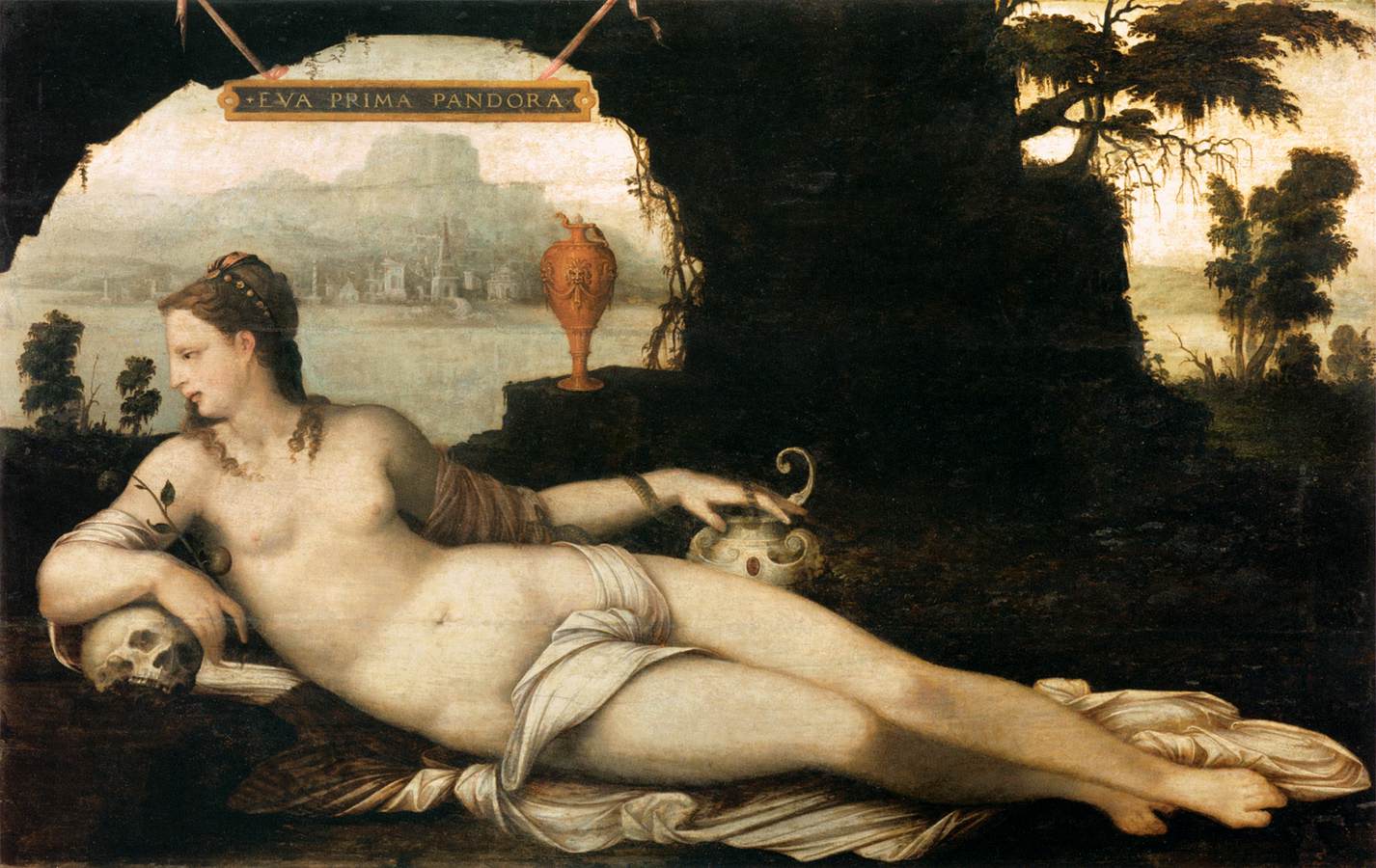
Jean Cousin (1500–1589), Eva Prima Pandora (c 1550), oil on panel, 97 x 150 cm, Musée du Louvre, Paris. Wikimedia Commons.

As with other classical myths, at the time that Jean Cousin painted Eva Prima Pandora, in about 1550, it had been mixed with Christian religious narrative, in this case of Eve and the Fall of Mankind. No longer clothed in Athena’s silvery gown, Eve/Pandora lies naked, propped against a human skull. Her left hand clutches the dreaded jar, which she hasn’t opened yet. Her right hand holds a fruiting sprig of the apple tree, an allusion to the traditional Biblical story of Eve. Coiled around her left arm is a serpent, another reference to the Fall of Mankind.

Pandora seems to have been very seldom if ever painted after that, until the nineteenth century.
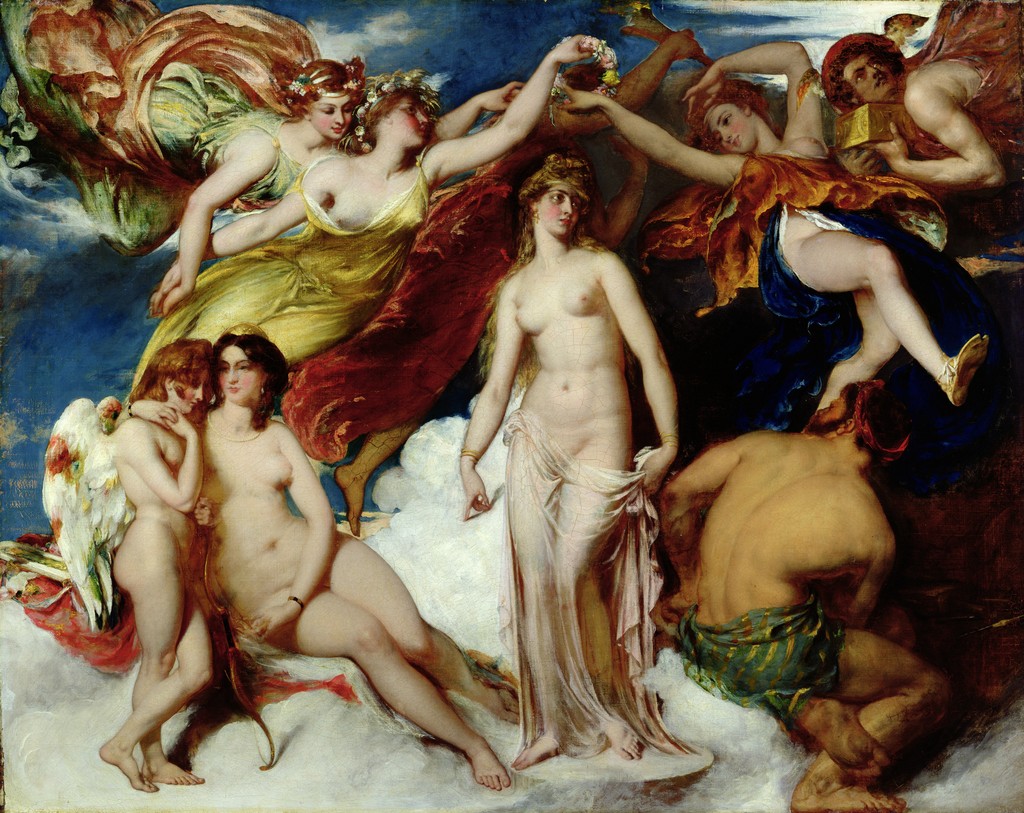
ettypandoracrowned1824
William Etty (1787–1849), Pandora Crowned by the Seasons (1824), oil on canvas, 87.6 × 111.8 cm, Leeds City Art Gallery, Leeds, England. Wikimedia Commons.

When William Etty painted her, in Pandora Crowned by the Seasons in 1824, the significance of the crux of the story, Pandora opening the jar, had become lost in the other detail, and she was just another opportunity to paint a statuesque and almost naked young woman.

howardopeningpandorasvase
Henry Howard (1769-1847), The Opening of Pandora’s Vase (1834), oil on panel, 76.6 x 166.5 cm, Sir John Soane’s Museum, London. The Athenaeum.

It was the now-forgotten Henry Howard who first painted The Opening of Pandora’s Vase in 1834. Pandora, more correctly dressed, crouches to duck the torrent of woe, evil and pain as it streams from the jar, as Epimetheus tries in vain to reseal its lid. This is the story as told by Hesiod in his Works and Days.

The literary story seems to have changed Pandora’s jar into a box as the result of a mistranslation in the sixteenth century, but that transition doesn’t appear to have occurred in paintings until between 1834 and 1860. It also seems more likely that it resulted from confounding of this story with that of Psyche, who had a box she couldn’t open.
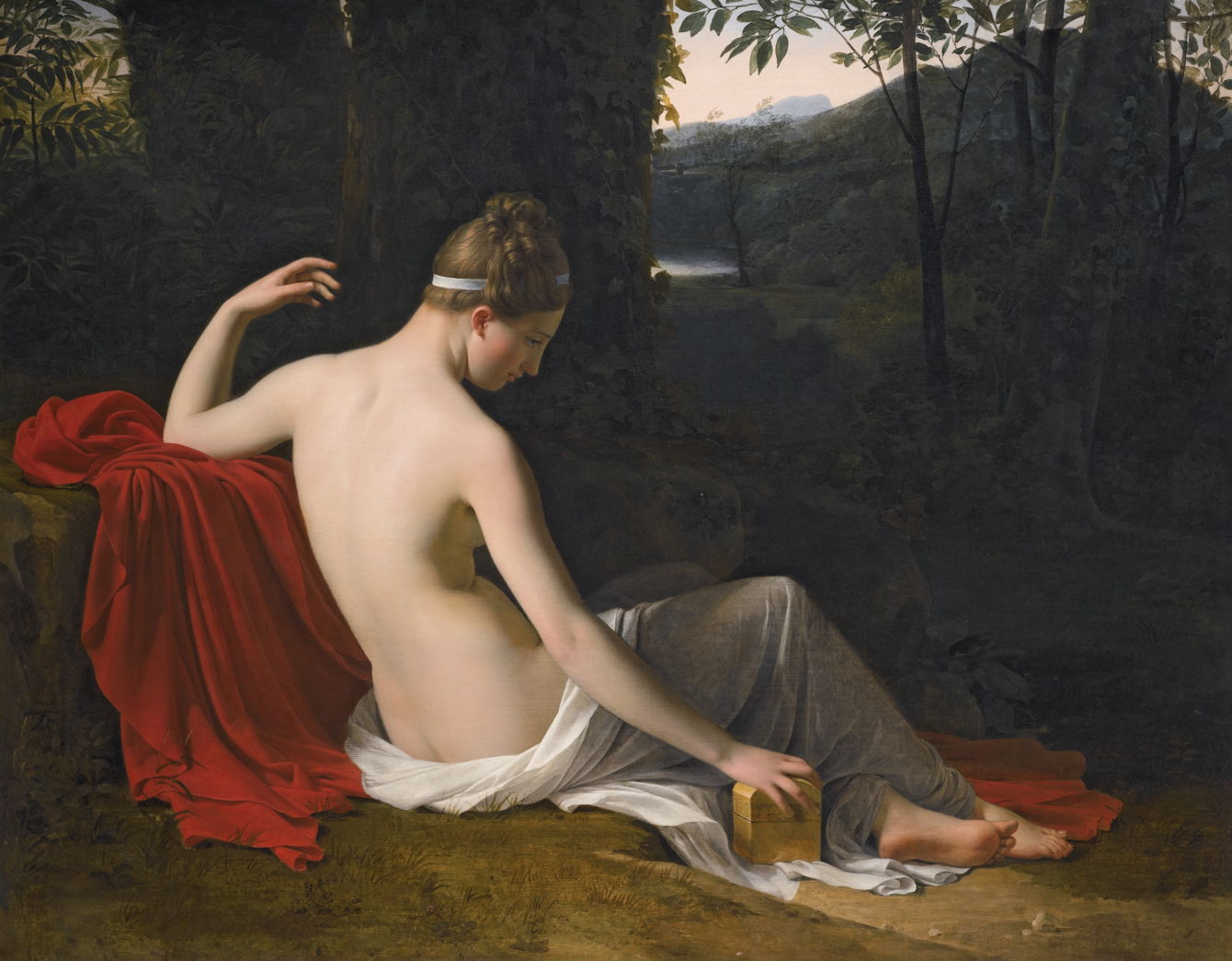
hersentpandorareclining
Louis Hersent (1777–1860) (attr), Pandora Reclining in a Wooded Landscape (date not known), oil on canvas, 138 x 173 cm, Private collection. Wikimedia Commons.

This undated painting attributed to Louis Hersent of Pandora Reclining in a Wooded Landscape gives the revised account, with the box firmly shut in Pandora’s right hand, and the motif an uncommitted combination of landscape, nude figure, and weak narrative.

In the 1870s, this suddenly became one of the most popular subjects for mythological paintings. This doesn’t appear to have been the result of it being told in another creative medium, though.

rossettipandora1871
Dante Gabriel Rossetti (1828–1882), Pandora (1871), oil on canvas, 131 × 79 cm, Private collection. Wikimedia Commons.

Dante Gabriel Rossetti’s first painting of Pandora, completed in 1871, shows a moody, brooding Pandora, modelled by Jane Morris. She has just cracked open the lid of the jewelled casket in her left hand, and it’s emitting a stream of noxious red smoke. As this coils around her head, winged figures appear in the fumes. The inscription on the side of the jewel casket reads “Nascitur ignescitur”, meaning born of flames.

This was one of Rossetti’s earlier paintings of Jane Morris, wife of his friend William Morris, and later to be the subject of Rossetti’s passionate obsession. Rossetti’s source for the story was most probably Lemprière’s dictionary of classical mythology, which erroneously referred to Pandora’s box, not jar. It was commissioned by John Graham for 750 guineas, who was so pleased with the result that he exhibited it, against Rossetti’s wishes, in Glasgow the following year.
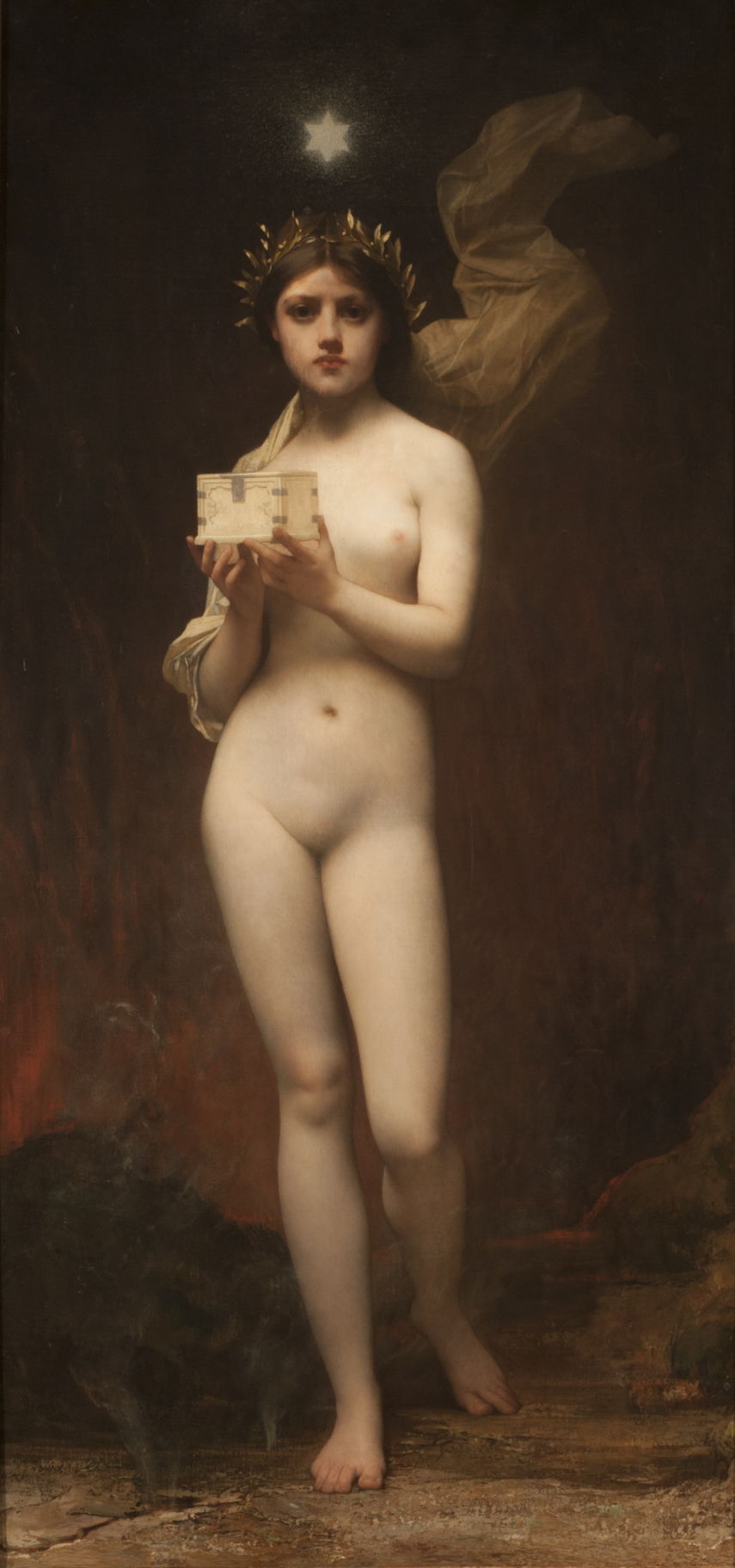
lefebvrepandora1872
Jules Lefebvre (1834–1912), Pandora (1872), oil on canvas, 132 × 63 cm, Museo Nacional de Bellas Artes, Buenos Aires, Argentina. Wikimedia Commons.

Jules Lefebvre was another artist who painted Pandora more than once. This initial version from 1872 shows her walking with the fateful box held in both hands, its lid firmly shut. Ominous smoke rises from a series of fumaroles in the ground around her. She is nude, wears an unusual coronet, and there is a six-pointed star above her head.

cabanelpandora
Alexandre Cabanel (1823–1889), Pandora (1873), oil on canvas, 70.2 x 49.2 cm, Walters Art Museum, Baltimore, MD. Wikimedia Commons.

Next was Alexandre Cabanel’s portrait of the Swedish soprano Christina Nilsson (1843-1921) as Pandora, from 1873. As a portrait rather than a faithful account of the myth, the box is closed, almost concealed, and its significance suppressed.

gariotpandorasbox
Paul Césaire Gariot (1811-1880), Pandora’s Box (1877), oil on panel, 81 × 56.2 cm, Private collection. Wikimedia Commons.

In 1877, the elderly Paul Césaire Gariot’s Pandora’s Box places her in a primeval world of rock, studying the closed box intently, wrestling internally with the desire to open it.

rossettipandora1879
Dante Gabriel Rossetti (1828–1882), Pandora (1878), coloured chalks, 100.8 × 66.7 cm, Lady Lever Art Gallery, Liverpool, England. Wikimedia Commons.

The following year, Dante Gabriel Rossetti made this chalk study for a second painting of Pandora, again using Jane Morris as his model. Her face shows a faint agony this time, as a decorative golden stream emerges from a crack in the lid. Here the inscription reads “Ultima manet spes” – hope remains last, perhaps a candidate for Rossetti’s own epitaph.

almatademapandora
Lawrence Alma-Tadema (1836–1912), Pandora (1881), media and dimensions not known, Private collection. Wikimedia Commons.

Lawrence Alma-Tadema sought a compromise in his Pandora of 1881, in which she holds not a box but a small pot, suitably decorated with a Sphinx. In what appears to be a skilfully painted watercolour, Pandora hasn’t yet given way to the temptation to open the pot.
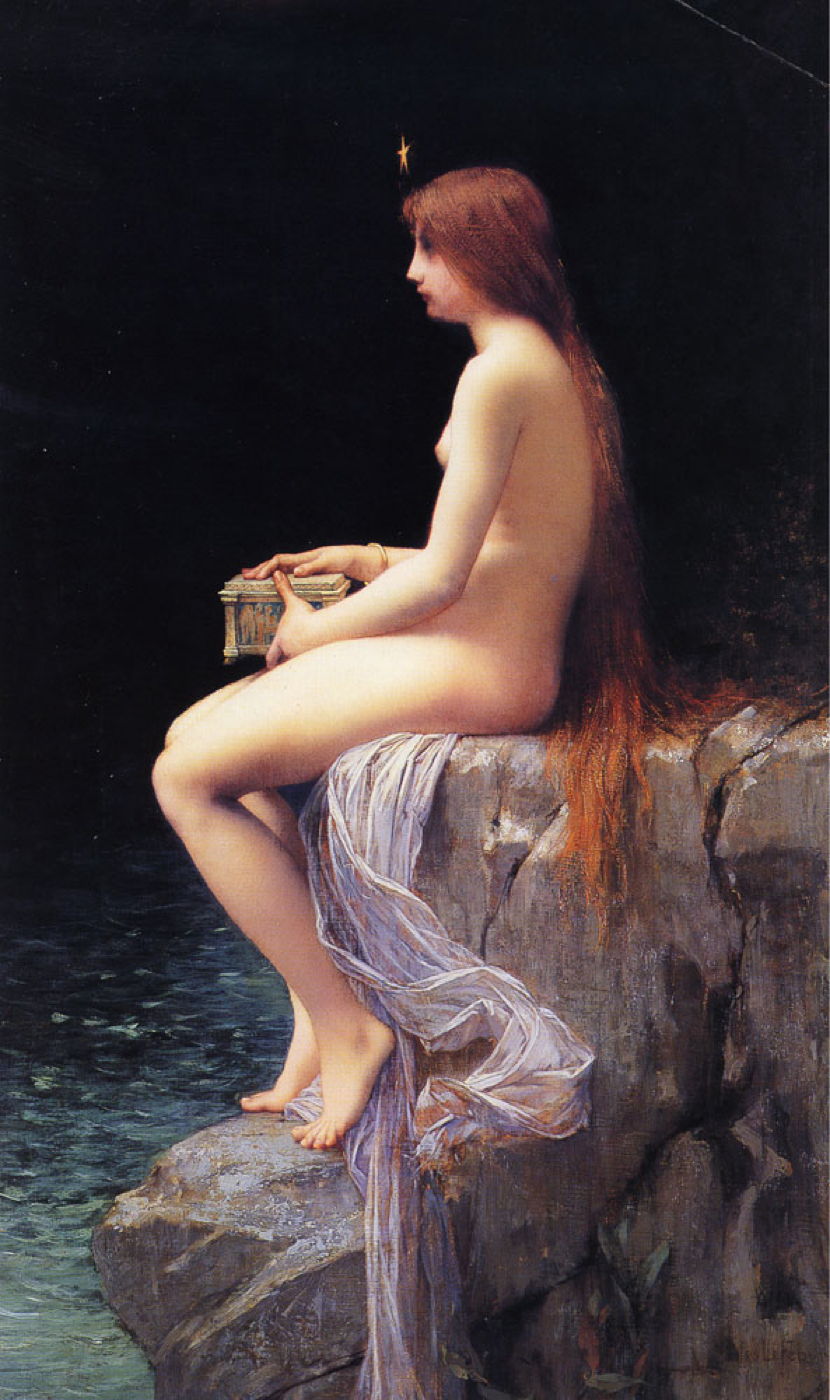
lefebvrepandora1882
Jules Lefebvre (1834–1912), Pandora (1882), oil on canvas, 96.5 × 74.9 cm, Private collection. Wikimedia Commons.

Jules Lefebvre’s second painting of Pandora made in 1882, a decade after his first, places her in profile next to the sea. She has a star just above her forehead, but that has become five-pointed rather than six, perhaps to dodge any Jewish connotations. His previous gentle narrative has all but vanished.

By this time only one artist had attempted to depict the crux of the story, and that had been Henry Howard almost fifty years earlier.

Reference

Wikipedia on the myth of Pandora.

In memoriam Jean-Eugène Buland, painter of the Third Republic

By: hoakley
18 March 2026 at 20:30

Several other Naturalist painters achieved acclaim alongside Jules Bastien-Lepage and sustained the movement after his untimely death in 1884. Jean-Eugène Buland (1852–1926) was among them, and continued painting into the twentieth century. He died one hundred years ago today, and this article gives a brief overview of his career with a small selection of his paintings.

Buland trained at the École des Beaux-Arts in Paris under Alexandre Cabanel, and with his teacher’s influence turned first to history painting. In 1878 and 1879 he was second in the contest for the Prix de Rome, but then switched to painting genre scenes of modern life, classical Naturalist motifs inspired by the literary Naturalism of Émile Zola in particular.

His meticulous realism was well-received at the Salon, and after winning a series of medals there, in 1889 he was awarded a silver medal at the Exposition Universelle in Paris.

Buland settled in the village of Charly-sur-Marne, to the east of Paris, and steadfastly refused to become part of the art scene in the capital. He only seems to have ventured into Paris for the annual Salon, and to paint commissions in the Hôtel de Ville (City Hall).

bulandalmsbeggar
Jean-Eugène Buland (1852–1926), Alms of a Beggar (1880), oil on canvas, 117 × 89 cm, location not known. Wikimedia Commons.

From the outset, Buland took on challenging motifs with equally challenging readings. In Alms of a Beggar (1880), a young woman dressed immaculately in white is sat outside a church seeking charity. Approaching her, a coin in his right hand, is a man who can only be a beggar himself. His clothes are patched on patches, faded and filthy, and he wears battered old wooden shoes, yet he is about to give the young woman what is probably his last coin.

bulandtripot
Jean-Eugène Buland (1852–1926), Le Tripot (The Dive) (1883), oil on canvas, 63.5 × 109.2 cm, location not known. Wikimedia Commons.

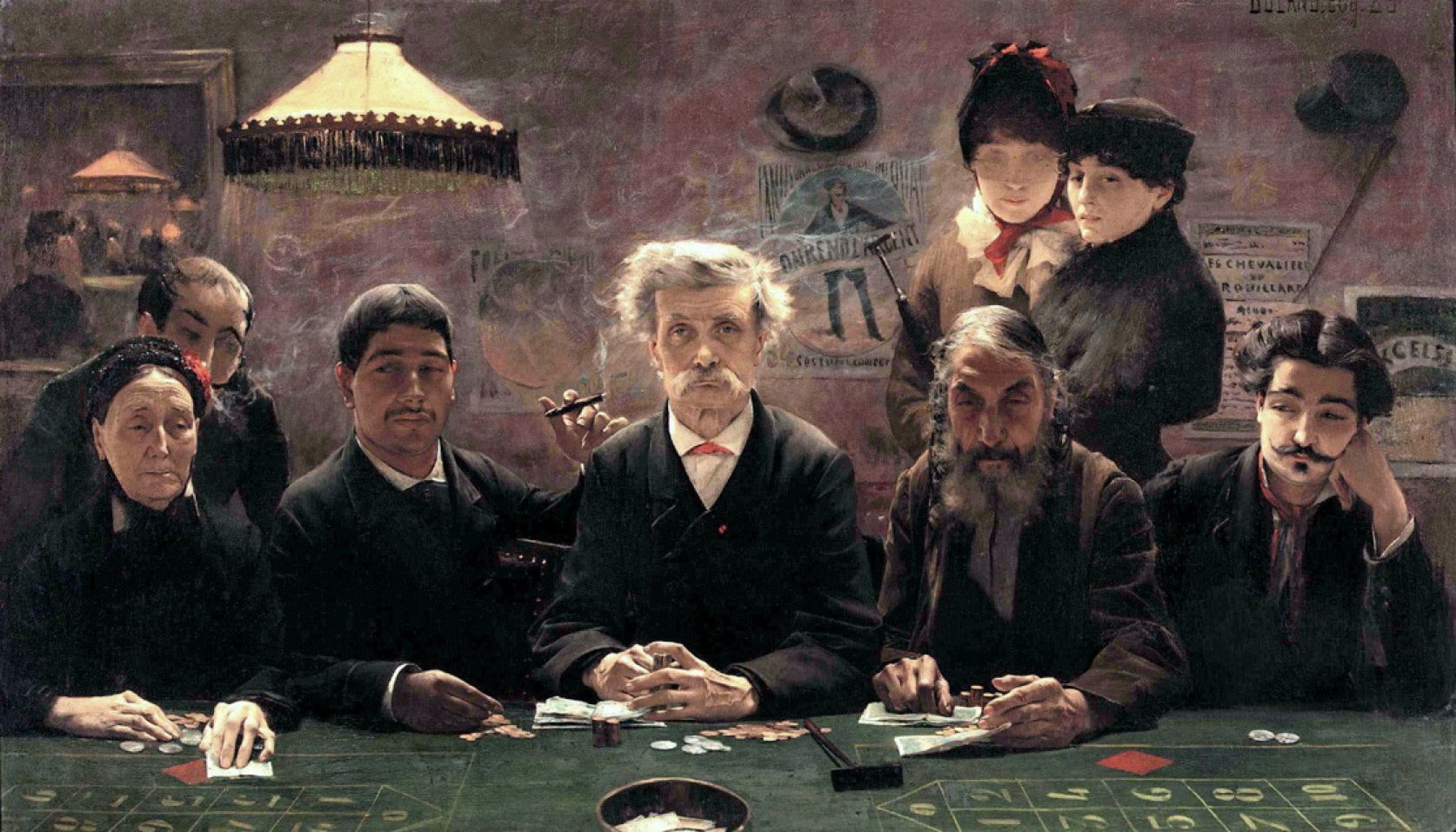
Le Tripot (The Dive) (1883) is one of my favourite paintings of this period. Set in a seedy, downmarket gambling den, it’s a group portrait of five hardened gamblers at their table. Each is rich in character, and makes you wonder how they came to be there. A little old widow at the left, for example, looks completely out of place, but is resolutely staking her money. Looking over her shoulder is a man, whose face is partially obscured. Is he, perhaps, a son, or a debtor? A young spiv at the far right is down to his last couple of silver coins, and looks about to lose them too. The air is thick with smoke, the walls in need of redecoration, and a pair of young streetwalkers prowl behind them, looking for a winner who will spend some of their cash on them.

bulandinnocentwedding
Jean-Eugène Buland (1852–1926), Innocent Wedding (1884), oil on canvas, dimensions not known, Musée des Beaux-Arts de Carcassonne, Carcassonne, France. The Athenaeum.

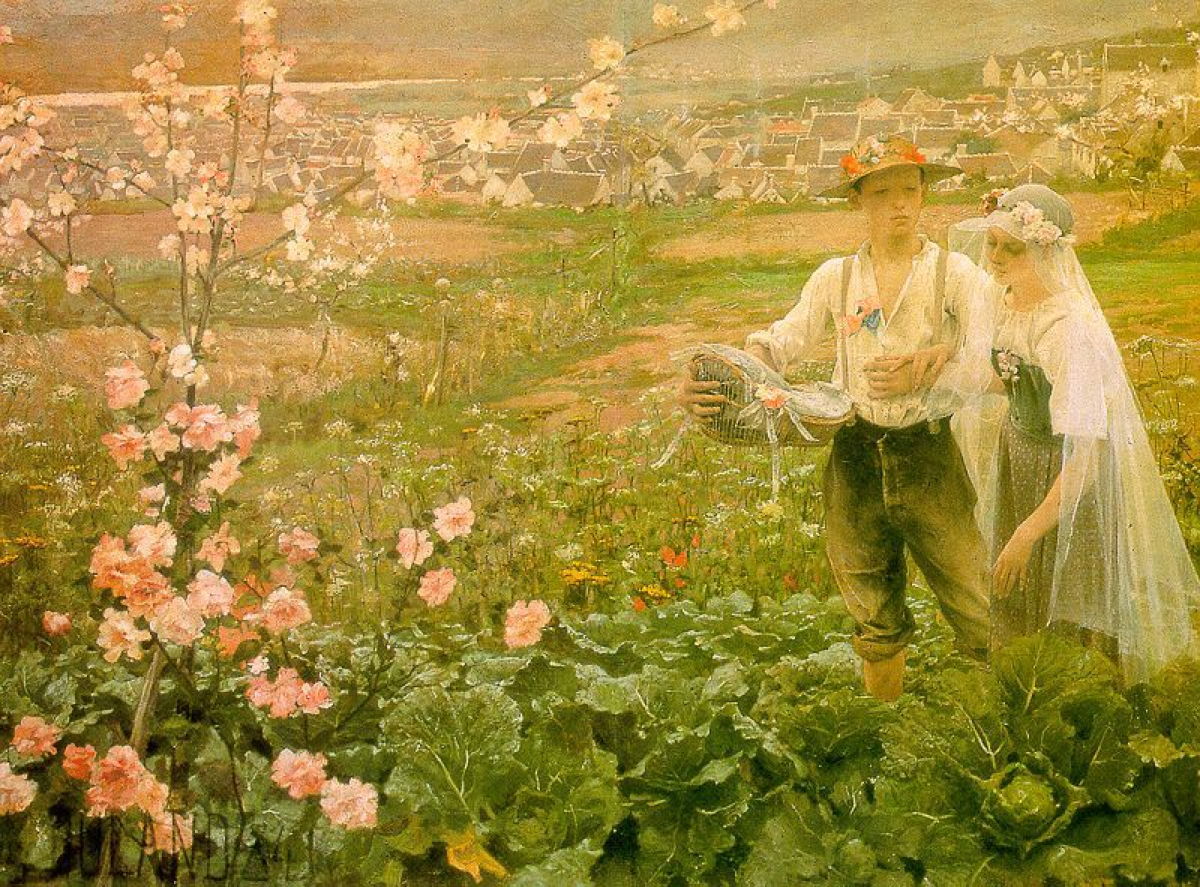
Buland also seems to have painted some unashamedly populist works, including this idyllic Innocent Wedding (1884). With the distant village, blossom, and a young couple arm in arm, it’s deeply romantic, and a far cry from the works above.

bulandofferingvirgin
Jean-Eugène Buland (1852–1926), Offering to the Virgin the Day After the Wedding (1885), oil on canvas, 144 × 209 cm, Musée des Beaux-Arts de Caen, Caen, France. Wikimedia Commons.

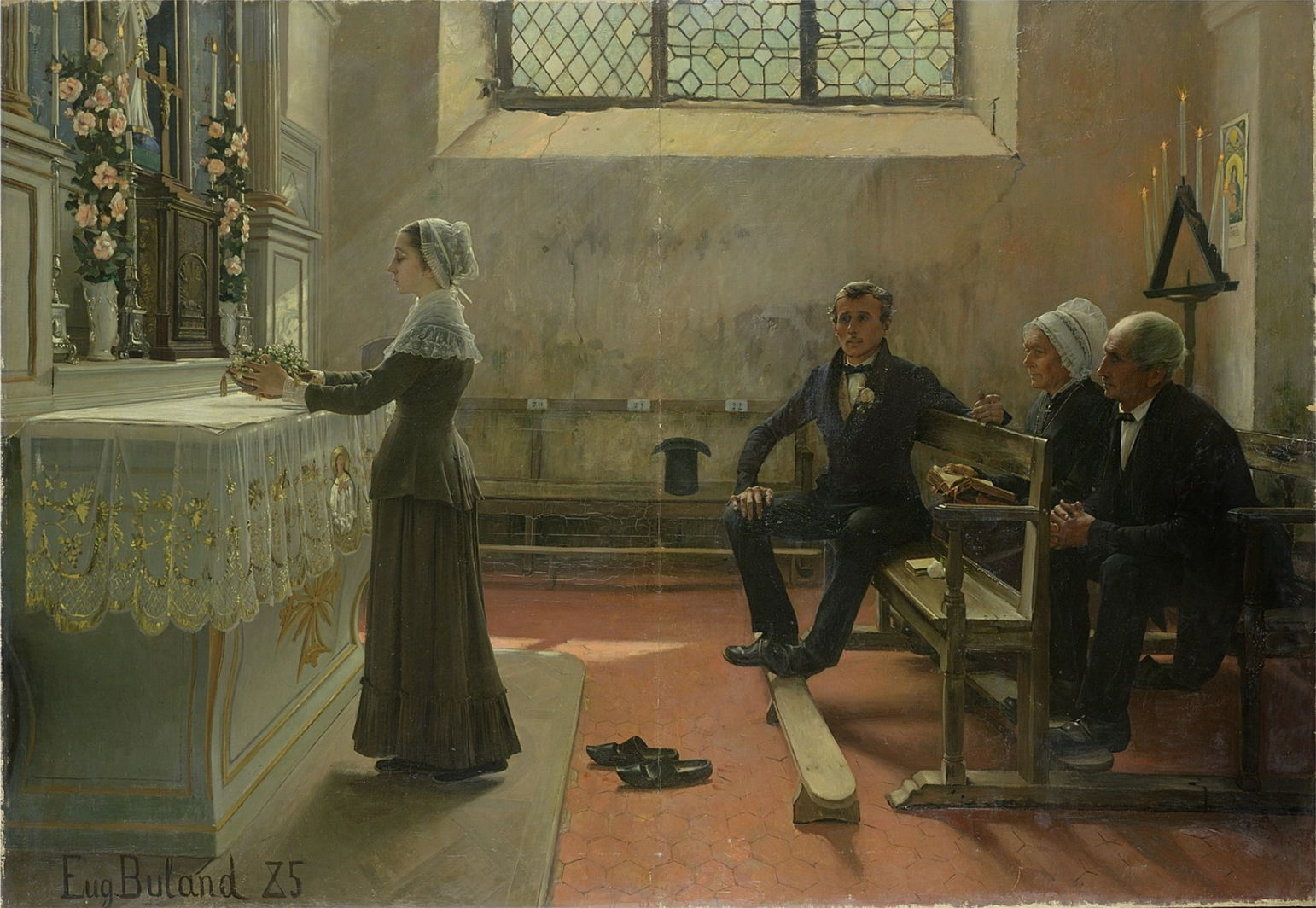
That led to a series of paintings showing events the day after the wedding, including this of the newlywed bride Offering to the Virgin the Day After the Wedding (1885). There’s a crisp formality in these figures, who appear stilted and posed as they go through the rites and processes of life.

bulandlessonapprentice
Jean-Eugène Buland (1852–1926), Un Patron, or The Apprentice’s Lesson (1888), oil on canvas, 102 x 82 cm, Nationalmuseum, Stockholm, Sweden. Image by Erik Cornelius, via Wikimedia Commons.

Buland went to the factory for Un Patron, or The Apprentice’s Lesson (1888). A young boy is being trained by his foreman to make a cogwheel, when many might have preferred him still to be at school. Buland used photographs extensively in the preparatory work for this painting, to capture its wealth of detail.

This also marks an overt politicisation in his work: the apprentice was part of the nation’s efforts to advance in industry and manufacturing after the disaster of the Franco-Prussian War.

bulandpropaganda
Jean-Eugène Buland (1852–1926), Propaganda Campaign (1889), oil on canvas, 181.8 × 191.4 cm, Musée d’Orsay, Paris. Wikimedia Commons.

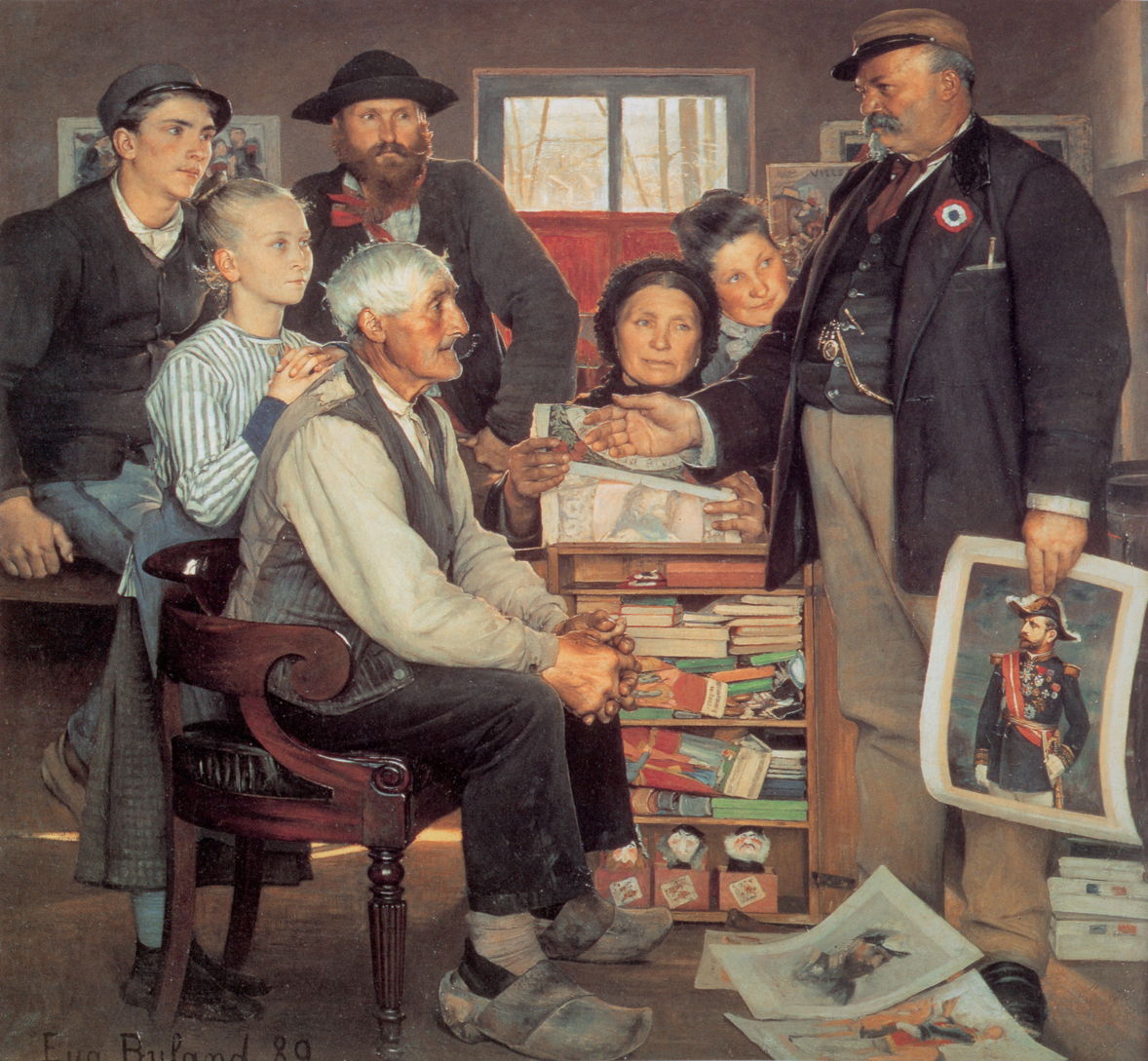
Propaganda Campaign (1889) is even more political, and Buland’s stark rendering of its figures makes them pop out, almost like cut-outs. A travelling salesman is in the home of a poor family, selling books and coloured prints to the head of the household. That in his left hand shows the populist politician General Boulanger, and the salesman’s motives combine politics with business. His buttonhole rosette declares his role as a canvasser for the General.

bulandstrollpark
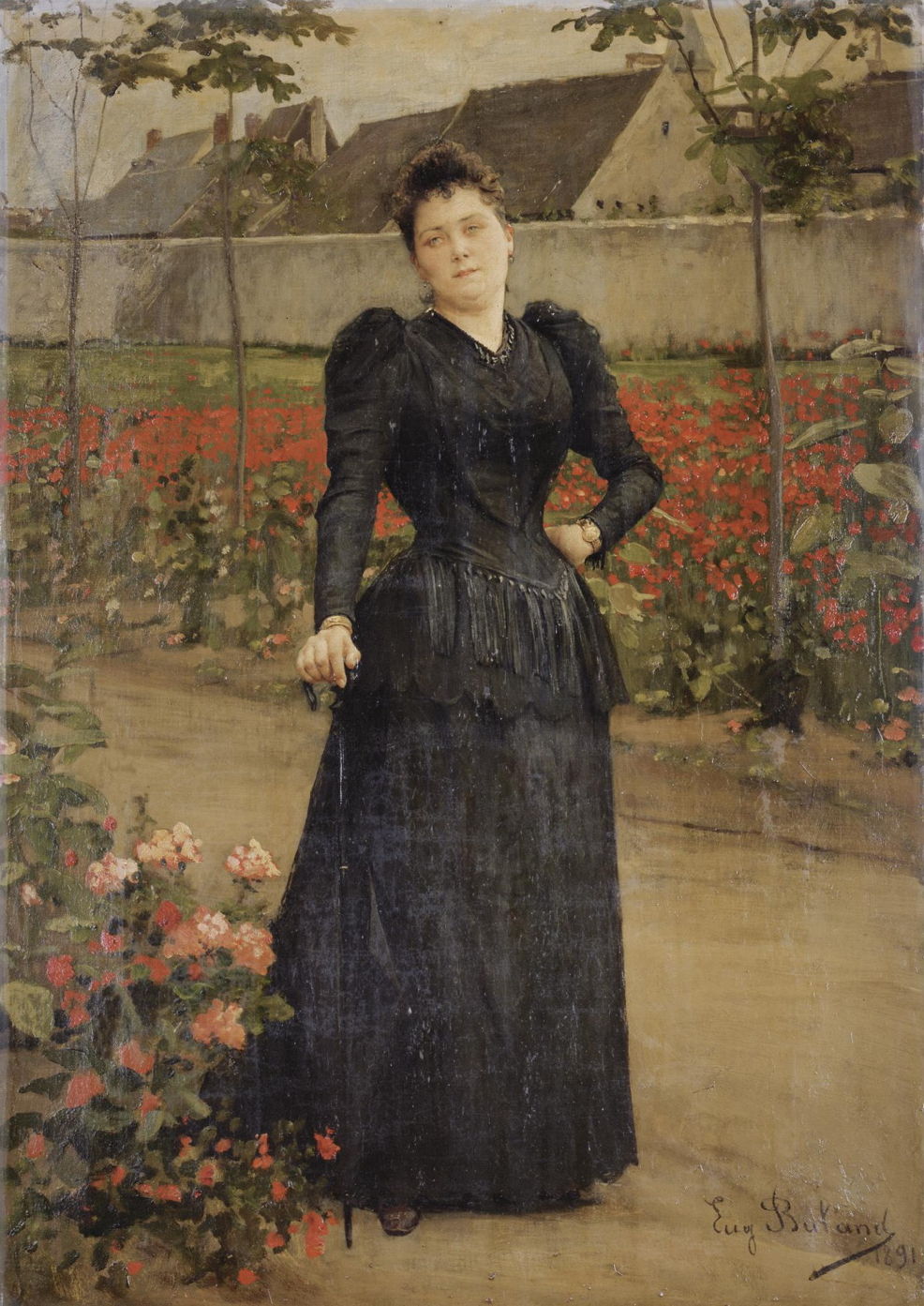
Jean-Eugène Buland (1852–1926), A Stroll in the Park (1891), oil on canvas, 92.5 × 65 cm, location not known. Wikimedia Commons.

A Stroll in the Park (1891) seems a more innocent full-length portrait of a woman, although I have been unable to discover her identity or any reason for the painting.

bulandmunicipalcouncil
Jean-Eugène Buland (1852–1926), Municipal Council and Commission of Pierrelaye Organizing a Festival (1891), oil on canvas, 140 × 200 cm, Town Hall, Pierrelaye, France. Wikimedia Commons.

Municipal Council and Commission of Pierrelaye Organizing a Festival (1891) is another fascinating painting with much contemporary relevance, an example of provincial municipal art. It’s a group portrait of the council of this village to the north-west of Paris, clearly commissioned by them to record their great deeds. It has a similar stiff formality to Propaganda Campaign, rather than the more insightful approach of Rembrandt’s group portraits.

bulandmarriage
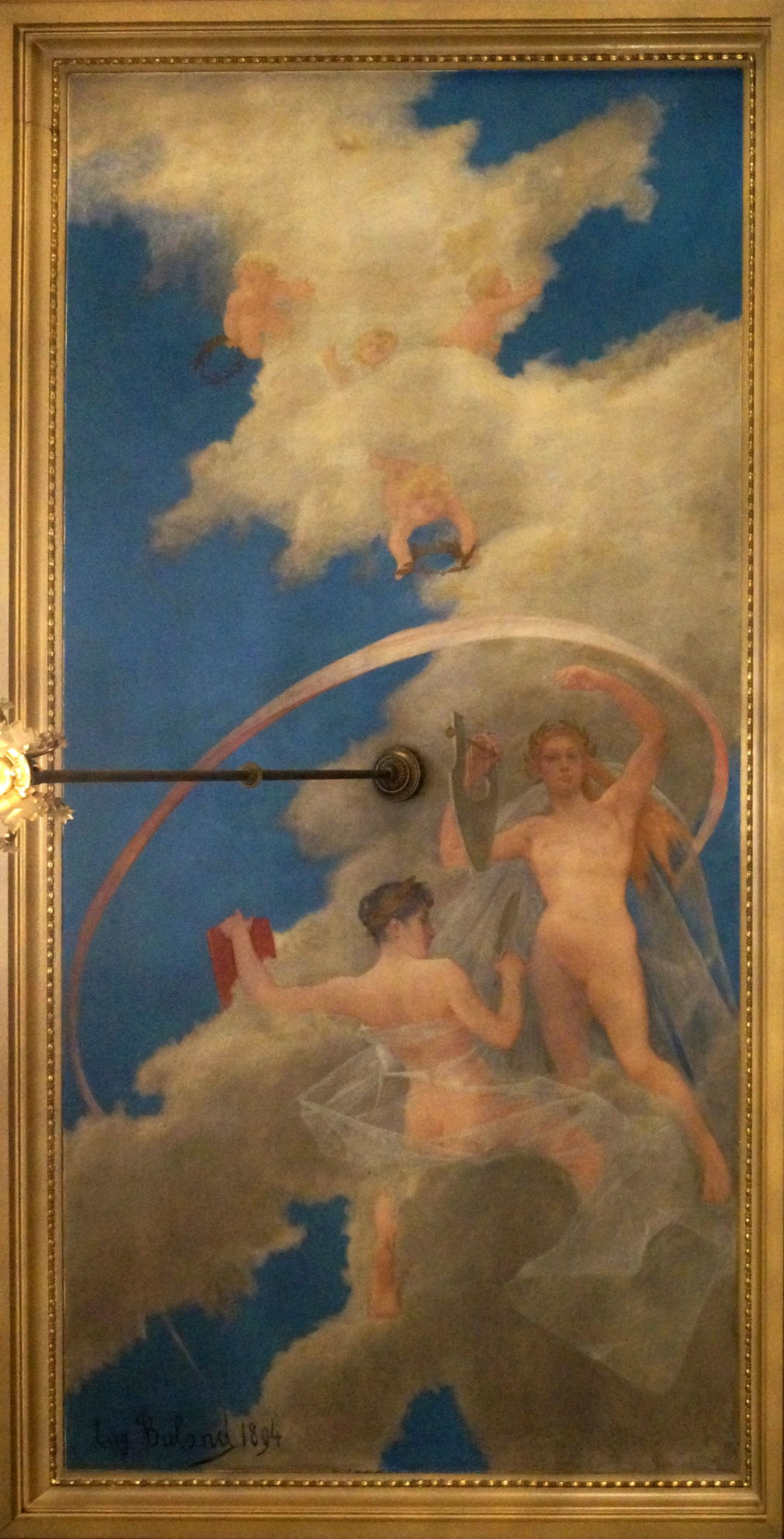
Jean-Eugène Buland (1852–1926), Marriage (date not known), painted ceiling, dimensions and location not known (?Hôtel de Ville, Paris). Image by G.Garitan, via Wikimedia Commons.

I suspect that Buland’s romantically painted ceiling of Marriage was one of his commissions for the rebuilt Hôtel de Ville in Paris, and completed in the 1890s.

bulandparentalhappiness
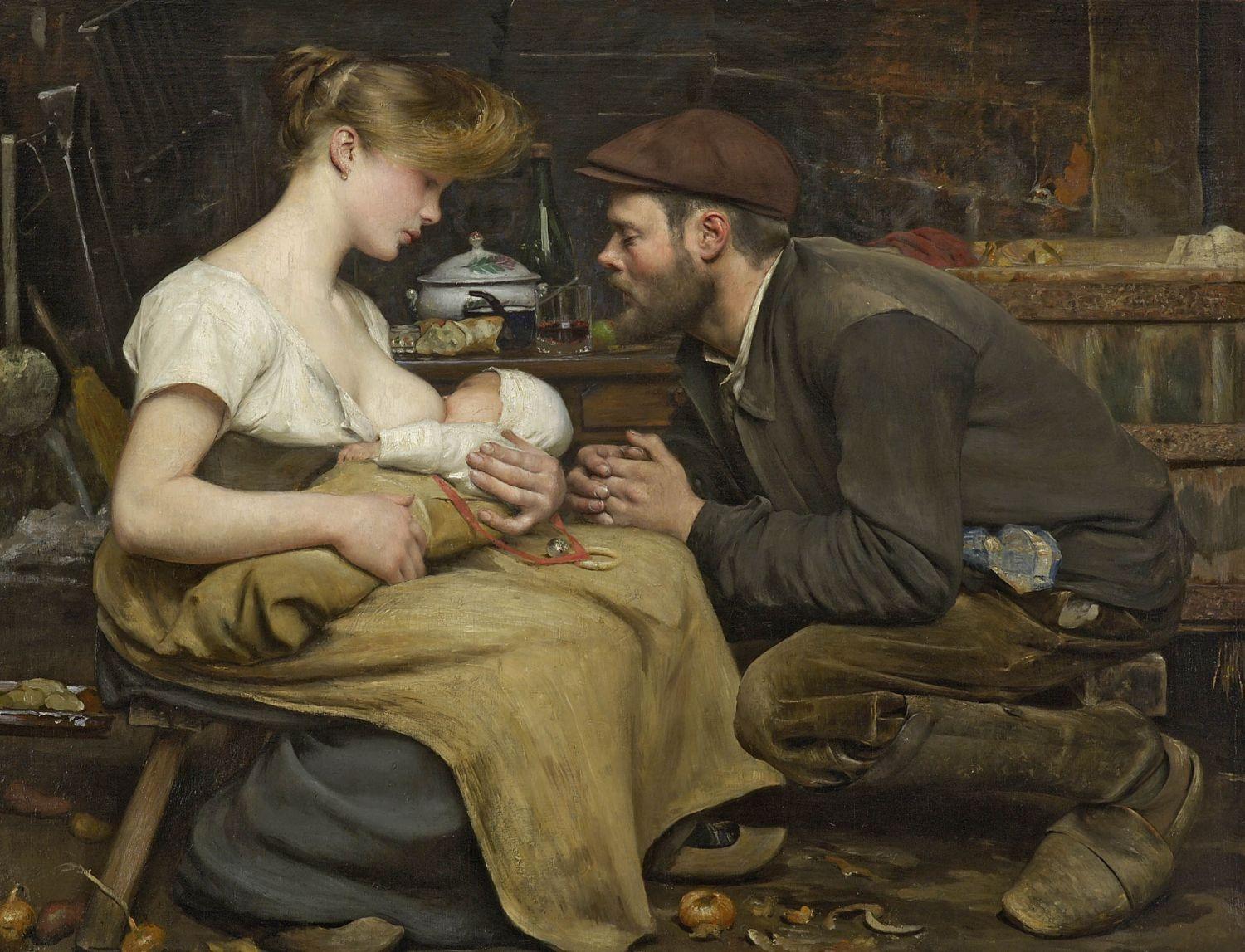
Jean-Eugène Buland (1852–1926), Parental Happiness (1903), oil on canvas, 97.5 × 129 cm, location not known. Wikimedia Commons.

He returned to poor working families in his Parental Happiness from 1903. A young couple are nursing their first baby, and appear to be living in an agricultural outhouse. The floor is strewn with vegetables and their parings, and the husband is dressed as a labourer, with worn working shoes, and his wife in wooden clogs.

bulandtinker
Jean-Eugène Buland (1852–1926), The Tinker (1908), oil on canvas, 112.6 × 145 cm, Private collection. Wikimedia Commons.

Buland’s The Tinker (1908) is busy at his cottage industry, repairing damaged pots, pans, and domestic metal objects. The stone wall at the left glistens with the damp.

Jean-Eugène Buland died in his home village of Charly-sur-Marne on 18 March 1926, at the age of 73.

This century has brought something of a revival for Buland. His first solo retrospective exhibition was held at Carcassonne in 2007-08, and his prices at auction are moving steadily upwards. I hope it doesn’t prove too late to conserve and document what remains of his work.

Reference

Richard Thomson (2012) Art of the Actual, Naturalism and Style in Early Third Republic France, 1880-1900, Yale UP. ISBN 978 0 300 17988 0.

❌
❌