Normal view

There are new articles available, click to refresh the page.
Before yesterdayMain stream

Reading Visual Art: 251 Snakes and staff, caduceus

By: hoakley
22 May 2026 at 19:30

Mythological worlds in classical Mediterranean civilisations often appear confusing and contradictory when stories and beliefs of many centuries and different cultures are merged, as happened in post-classical painting. What might appear to be a single distinctive attribute, such as a snake coiled along the length of a staff, then becomes a muddle.

There are two common combinations of snakes coiled around a rod or staff. Hermes (Roman Mercury) has a caduceus as his attribute, consisting of a rod or staff with a pair of entwined serpents along its length, and sometimes they are shown bearing small wings. This signifies his swiftness as a messenger. The rod of Asclepius (which has several alternative spellings) should have but a single serpent coiled around it, and is associated with healing and medicine, and remains so today long after its divine origins have been forgotten.

Caduceus

blakejudgementofparis
William Blake (1757–1827), The Judgement of Paris (1806-1817), pen and grey ink and watercolour over graphite on paper, 38.5 x 46 cm, The British Museum, London. Courtesy of and © Trustees of the British Museum.

Although not known for his paintings of secular stories, William Blake’s Judgement of Paris (c 1806-17) was one of a pair made for Thomas Butts, the other being Philoctetes and Neoptolemus on Lemnos, a more obscure story leading to the death of Paris.

As with almost every artist before and since, Blake shows the three contestants naked in front of Paris, just at the moment that the golden apple is awarded to Aphrodite. Hera and Athena, standing either side of her, are visibly upset. Above them is the naked figure of Hermes, with his caduceus and its pair of intertwined serpents, and a winged helmet. The demonic figure at the top left is presumably a harbinger of the death and destruction to come in the Trojan War.

renoirjudgementparis
Pierre-Auguste Renoir (1841–1919), The Judgment of Paris (c 1908-10), oil on canvas, 73 x 92.5 cm, Hiroshima Museum of Art, Hiroshima, Japan. Wikimedia Commons.

Renoir’s account of The Judgment of Paris, from about 1908-10 is a carefully composed image of the same moment of peripeteia. Watching on is Hermes, complete with his winged helmet, sandals, and caduceus.

bloemaertmercuryargusio
Abraham Bloemaert (1564–1651), Mercury, Argus and Io (c 1592), oil, 63.5 x 81.3 cm, Centraal Museum, Utrecht, The Netherlands. Wikimedia Commons.

The most popular scene in Ovid’s intertwined stories of the rape of Io and the murder of Argus is that of Hermes lulling Argus to sleep. However, hardly any painters depict Argus having the hundred eyes specified in the Metamorphoses. Abraham Bloemaert is an exception, in his carefully composed Mercury, Argus and Io (c 1592). Hermes is playing his flute at the left, his caduceus at his feet, as Argus falls asleep in front of him, his additional eyes visible over the surface of his head.

rijckaertphilemonbaucis
David Rijckaert (III) (1612–1661), Philemon and Baucis Giving Hospitality to Jupiter and Mercury (date not known), oil on panel, 54 x 80 cm, Private collection. Wikimedia Commons.

David Rijckaert’s undated Philemon and Baucis Giving Hospitality to Jupiter and Mercury gives the most popular account of the elderly couple entertaining the two gods. Hermes (left) and Zeus (left of centre) are seated at the table, with Philemon (behind the table) and Baucis (centre) waiting on their every need. Once again, Hermes is distinguished by his caduceus as well as a more contemporary winged hat.

Rod of Asclepius

ciprianiaesculapius
Giovanni Battista Cipriani (1727–1785), Aesculapius Holding a Staff Encircled by a Snake (date not known), media and dimensions not known, Wellcome Library, London. Courtesy of Wellcome Images images@wellcome.ac.uk http://wellcomeimages.org, via Wikimedia Commons.

In the eighteenth century, Giovanni Battista Cipriani drew Aesculapius Holding a Staff Encircled by a Snake, following the classical tradition.

preyaesculapiusapollohippocrates
Johannes Zacharias Simon Prey (1749-1822), Aesculapius, Apollo and Hippocrates (1791), oil, dimensions not known, Wellcome Library, London. Courtesy of Wellcome Images images@wellcome.ac.uk http://wellcomeimages.org, via Wikimedia Commons.

Johannes Zacharias Simon Prey painted this group of Aesculapius, Apollo and Hippocrates in 1791. Asclepius, holding his distinctive rod, is shown in the centre of the trio, with Hippocrates, the less legendary ‘father of medicine’, to the right, clutching the basal half of a human skull, and Apollo, father of Asclepius, behind. They have entered a contemporary pharmacy, where an assistant uses a large mortar and pestle, and another works the bellows of a furnace.

Inevitably, the distinction between Hermes’ caduceus and the rod of Asclepius has been lost more recently, and many symbolic representations of medicine have erroneously used a caduceus.

Reading Visual Art: 250 Winged sandals

By: hoakley
24 April 2026 at 19:30

When reading a painting of classical myth, the feet and footwear can be very important. Although they’re by no means common, if you see a figure wearing what could be winged sandals, you can narrow them down to one of two: Hermes or Mercury as messenger of the gods, and the hero Theseus. However, their depictions aren’t always consistent, and the absence of winged sandals doesn’t mean you can exclude them, unfortunately.

I start with the god, whose talaria were fashioned from gold by Hephaestus/Vulcan to enable him to fly as fast as any bird.

Sandro Botticelli (Alessandro di Mariano di Vanni Filipepi), Primavera (Spring) (c 1482), tempera on panel, 202 x 314 cm, Galleria degli Uffizi, Florence. Wikimedia Commons.

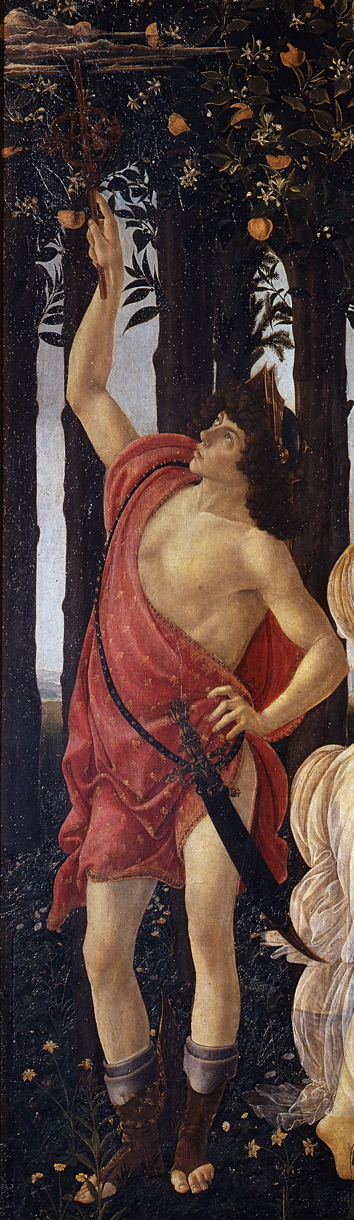
One of the most famous depictions of Hermes, typically in a supporting role, is in Botticelli’s magnificent Primavera from around 1482.

Sandro Botticelli (Alessandro di Mariano di Vanni Filipepi), Primavera (Spring) (detail) (c 1482), tempera on panel, 202 x 314 cm, Galleria degli Uffizi, Florence. Wikimedia Commons.

Hermes’ mother Maia gave her name to the month of May, so is associated with Spring. Botticelli has chosen to give the serpents on his caduceus wings to make them resemble small dragons. The god is also more typically seen with his caduceus in his left hand, rather than his right as shown here, and his winged sandals clearly aren’t made of gold.

mantegnaparnassus
Andrea Mantegna (1431–1506), Parnassus (Mars and Venus) (1496-97), oil on canvas, 159 x 192 cm, Musée du Louvre, Paris. Wikimedia Commons.

Hermes is a frequent figure in paintings of gatherings of deities, including Andrea Mantegna’s Mars and Venus, known better as Parnassus (1496-97), painted for Isabella d’Este. At the right of this complex gathering is Hermes with his winged sandals and caduceus, and Pegasus the winged horse. Apollo is at the far left, making music for the Muses on his lyre.

bayeuolympus
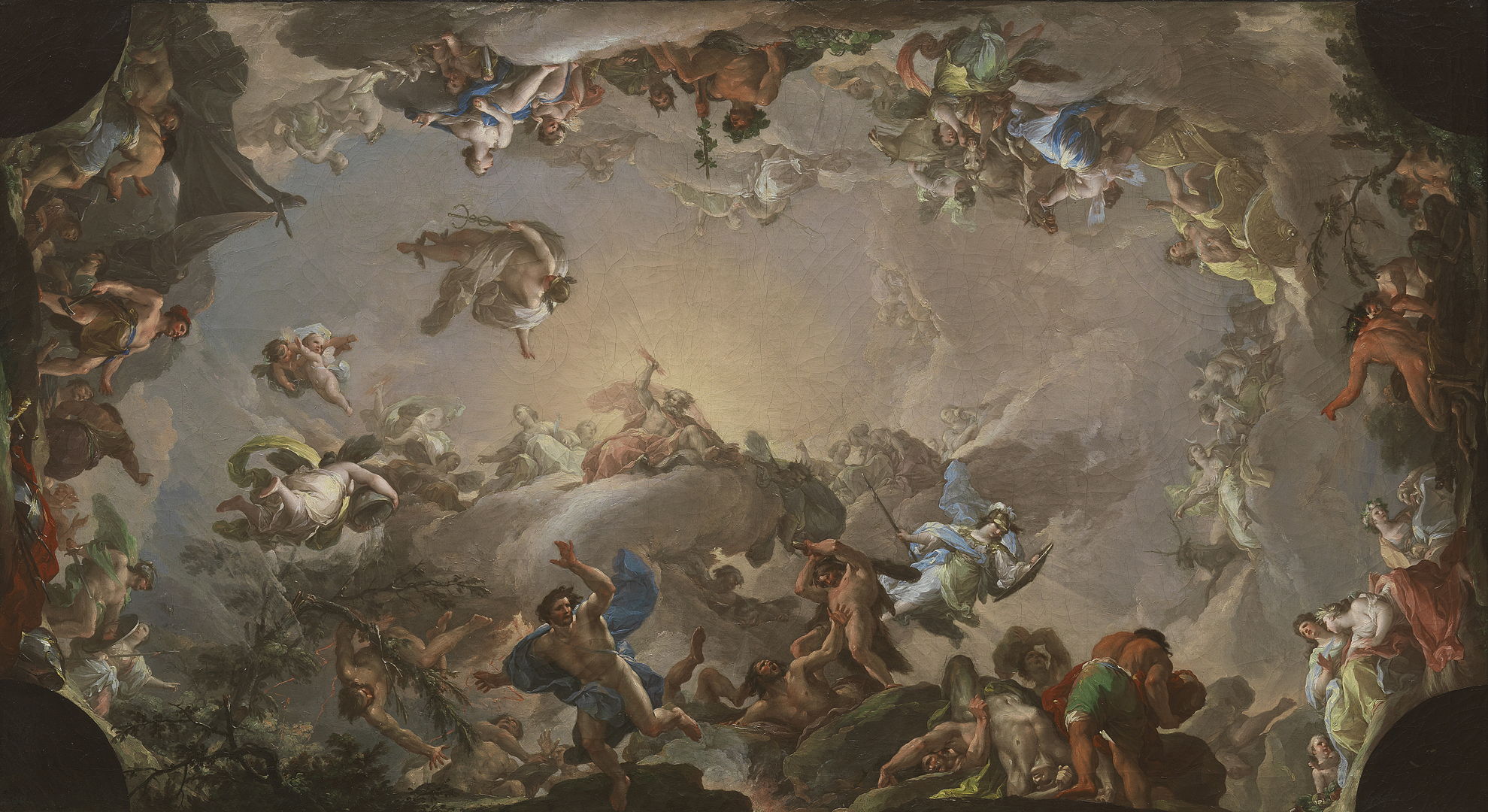
Francisco Bayeu y Subías (1734–1795), Olympus: The Fall of the Giants (1764), oil on canvas, 68 x 123 cm, Museo Nacional del Prado, Madrid, Spain. Wikimedia Commons.

Francisco Bayeu y Subías was Goya’s brother-in-law. His Olympus: The Fall of the Giants from 1764 shows the war between the Titans and Olympian gods, and was presumably hung under a ceiling. Just to the upper left of its centre, holding his caduceus and wearing winged sandals, is Hermes.

renoirjudgementparis
Pierre-Auguste Renoir (1841–1919), The Judgment of Paris (c 1908-10), oil on canvas, 73 x 92.5 cm, Hiroshima Museum of Art, Hiroshima, Japan. Wikimedia Commons.

Auguste Renoir’s account of The Judgment of Paris, from about 1908-10, demonstrates his skill as a narrative painter. After Paris has accepted Aphrodite’s bribe of Helen, he is shown awarding her the golden apple provided by the discordant Eris from the garden of the Hesperides. Watching on is Hermes, complete with his winged helmet and sandals, and caduceus.
Hermes seldom lent out his talaria, but there’s one occasion that has become well known. When Perseus was on his mission to obtain the head of Medusa, he was kitted out with Hermes’ sandals, the cap of Hades for invisibility, and a kibisis or sack in which to conceal the Gorgon’s severed head.

perseusandromedapompeii
Unknown, Perseus Freeing Andromeda (c 50-75 CE), height 122 cm, Casa dei Dioscuri (VI, 9, 6), Pompeii, moved to Museo Archeologico Nazionale di Napoli, Naples. By WolfgangRieger, via Wikimedia Commons.

This Pompeian account of Perseus Freeing Andromeda from about 50-75 CE shows Andromeda still chained to the rock by her left wrist, and partially clad rather than naked as the myth related. Perseus has Medusa’s head tucked behind him, her face shown for ease of recognition. He is wearing his winged sandals, and carrying his sword in his left hand, although there’s no sign of Cetus the sea-monster yet.

rubensperseusandromeda
Peter Paul Rubens (1577–1640), Perseus and Andromeda (c 1622), oil on canvas, 99.5 x 139 cm, Hermitage Museum, Saint Petersburg, Russia. Wikimedia Commons.

Peter Paul Rubens’ Perseus and Andromeda from about 1622 contains most of the cues and clues to the original narrative. Andromeda is almost naked, although unchained at this stage, on the left. Perseus is clearly in the process of claiming her hand as his reward, for which he is being crowned with laurels, as the victor. He wears winged sandals, and holds the polished shield that still reflects Medusa’s face and snake hair. Much of the right of the painting is taken up by Pegasus, and at the lower edge is the dead Cetus, its fearsome mouth wide open.

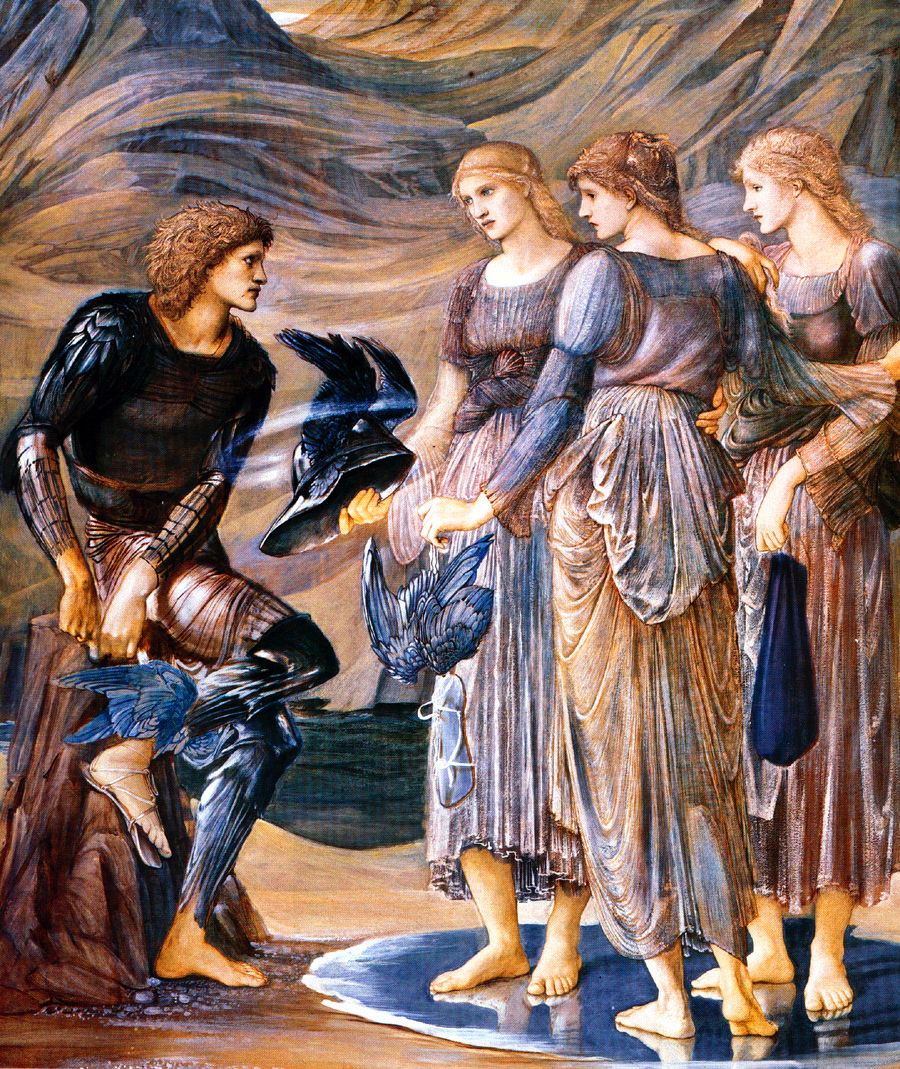
In Edward Burne-Jones’ Perseus Series, the hero’s winged sandals are one of its less consistent features.

burnejonesperseus2
Edward Burne-Jones (1833–1898), The Perseus Series: Perseus and the Sea Nymphs (1877), bodycolour, 152.8 × 126.4 cm, Southampton City Art Gallery, Southampton, England. Wikimedia Commons.

The third painting, Perseus and the Sea Nymphs (1877), shows the Hesperides equipping Perseus with the kibisis at the far right. Burne-Jones combines with that his donning the winged sandals (centre) and Hades’ helmet, as provided by Hermes and Zeus.
burnejonesperseus8b
Edward Burne-Jones (1833–1898), The Perseus Series: The Doom Fulfilled (1888), oil on canvas, 155 × 140.5 cm, Staatsgalerie Stuttgart, Stuttgart. Wikimedia Commons.

Further on in the series, in his finished oil version of The Doom Fulfilled (1888), the sandals are shown clearly as Perseus takes on Cetus.

leightonperseuspegasus
Frederic, Lord Leighton (1830–1896), Perseus On Pegasus Hastening To the Rescue of Andromeda (c 1895-6), oil on canvas, 184 x 189.6 cm, New Walk Museum & Art Gallery, Leicester, England. Wikimedia Commons.

In one of Frederic, Lord Leighton’s last paintings, of Perseus On Pegasus Hastening To the Rescue of Andromeda from about 1895-96, the wings on his sandals are tiny but distinctive.

Naturalists: The modern meal

By: hoakley
10 April 2026 at 19:30

Eating together with family and friends is one of the great social events, and became a popular theme in nineteenth century painting. It was enthusiastically adopted by several of the leading Naturalist painters, as shown below.

manetluncheonongrass
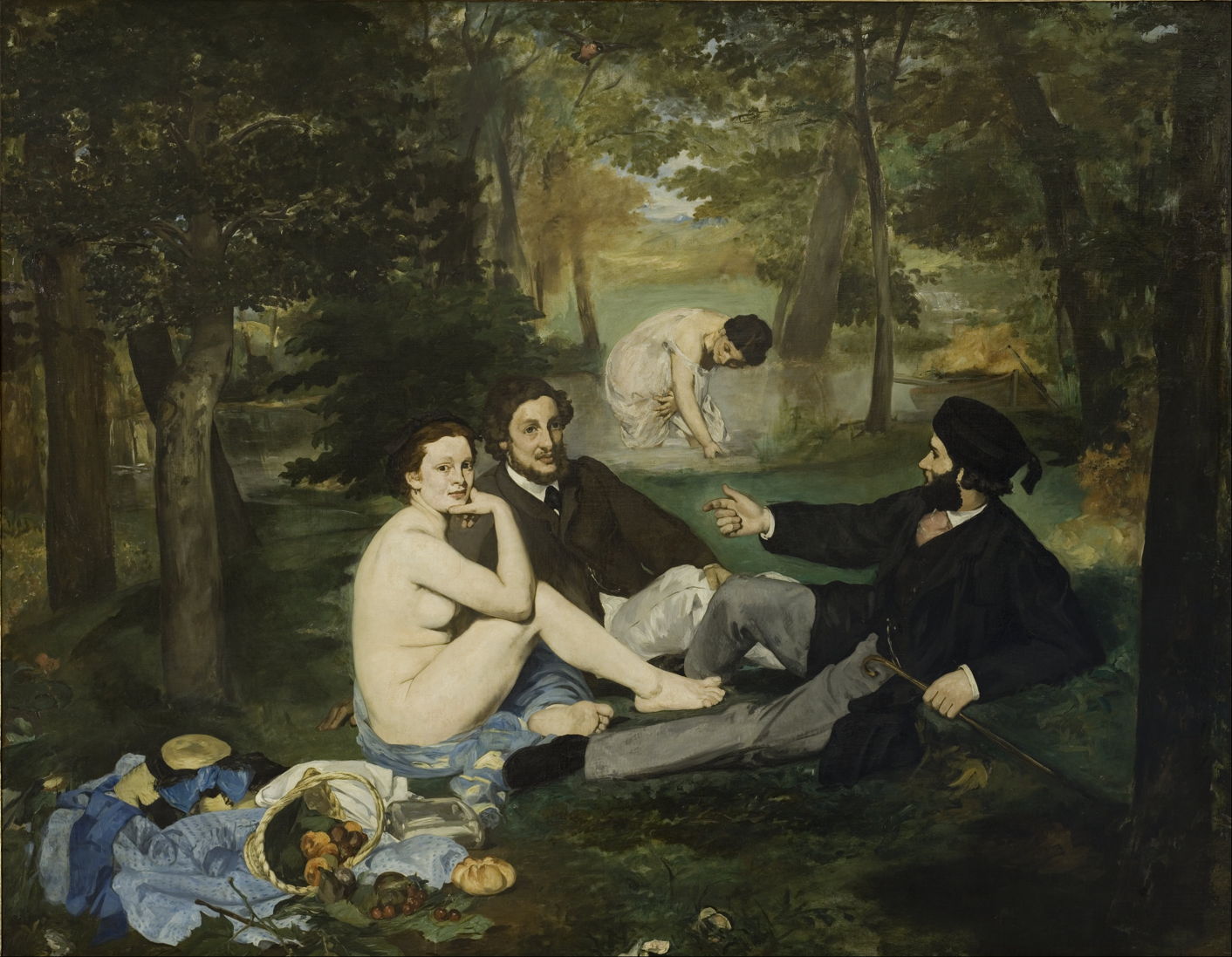
Édouard Manet (1832-1883), Le Déjeuner sur l’herbe (Luncheon on the Grass) (1863), oil on canvas, 208 × 264.5 cm, Musée d’Orsay, Paris. Wikimedia Commons.

Édouard Manet’s Le Déjeuner sur l’herbe from 1863 is one of the best-known if not infamous paintings of a social meal. Two couples are apparently disinterested in the token picnic of fruit and bread that has spilled out from its basket in the left foreground. As the two men talk, fully dressed, a conspicuously naked woman stares unnervingly at the viewer, and the other woman is washing herself in the river behind. This was rejected by the Salon of that year, ensuring its lasting fame and influence.

lepoittevinpicnic
Eugène Lepoittevin (1806-1870), A Picnic (1866), oil on canvas, 43 x 62.5 cm, location not known. Wikimedia Commons.

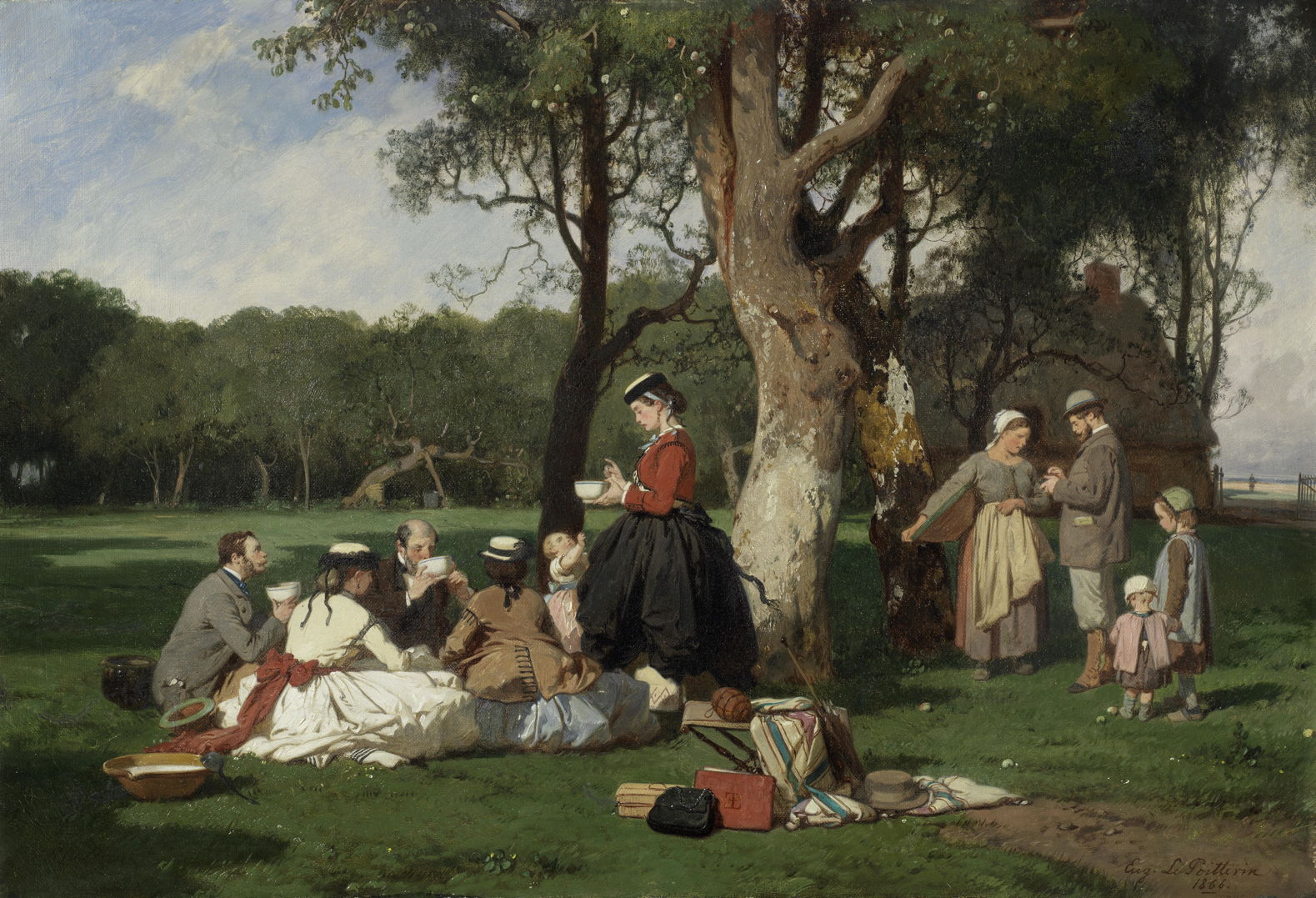
A far cry from Manet’s meal, Eugène Lepoittevin’s Picnic from 1866 captures a picnic’s distinctive combination of the planned and impromptu. This group has lugged crockery, soup and a folding stool for their simple meal sitting on the grass under some trees.

renoirluncheonboatingparty
Pierre-Auguste Renoir (1841–1919), Luncheon of the Boating Party (1880-81), oil on canvas, 130.2 x 175.6 cm, The Phillips Collection, Washington, DC. Wikimedia Commons.

Renoir’s masterpiece Luncheon of the Boating Party (1880-81) is set on the Île de Chatou under the awning of the Restaurant Fournaise. Among his models are his partner and later wife Aline Charigot (left foreground, with affenpinscher dog), the actress Jeanne Samary (upper right), and fellow artist Gustave Caillebotte (seated, lower right). This meal seems all but over, the wineglasses near-empty as the party turns from eating to conversation.

denittisbreakfastingarden
Giuseppe De Nittis (1846–1884), Breakfast in the Garden (c 1883), oil on canvas, 81 x 117 cm, Pinacoteca De Nittis, Barletta, Italy. By LPLT, via Wikimedia Commons.

In summer, breakfast became a favourite meal in your own garden. Just a year before his untimely death in 1884, the Italian peri-Impressionist Giuseppe De Nittis painted this startling Breakfast in the Garden, with its contrast between the detail of the glass soda syphon, covered bowl, glasses, and other reflective materials on the table, and its wonderfully sketchy garden background.

ringboygirllunch
Laurits Andersen Ring (1854–1933), A Boy and a Girl Eating Lunch (1884), oil on canvas, 44 x 56 cm, location not known. Wikimedia Commons.

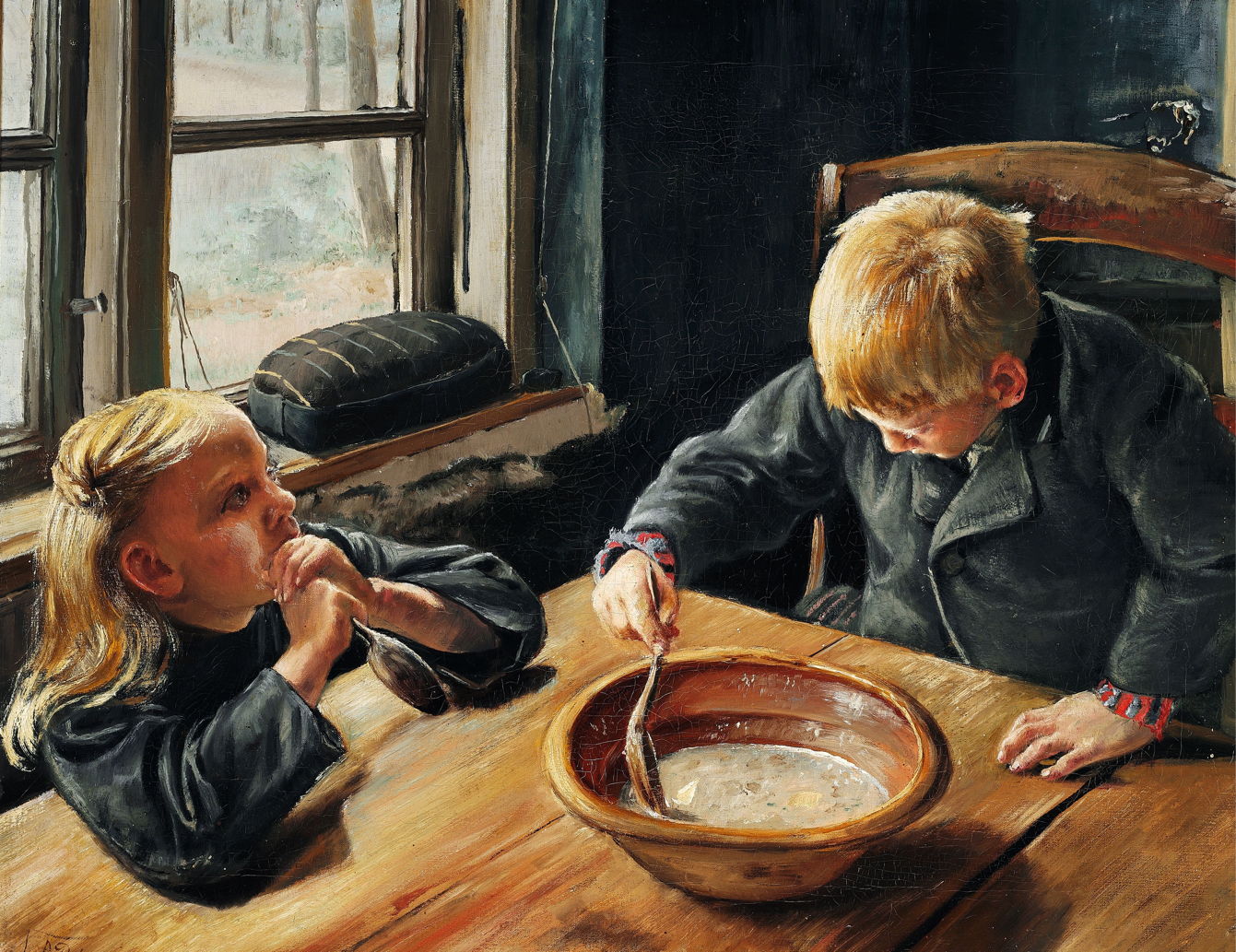
Laurits Andersen Ring was more pointed in his social message in A Boy and a Girl Eating Lunch, from 1884. Paupers’ children, they have a single bowl of broth between them, and there’s not even a hint of wine and fruit. The girl looks up in tears, hoping for a miracle to change their lives, and take them away from this bare wooden table and blackened walls.

MSKG - Het begrafenismaal - Léon Frédéric (1886)
Léon Frédéric (1856–1940), The Funeral Meal (1886), oil on canvas, 125.5 x 177.5 cm, Museum voor Schone Kunsten, Ghent, Belgium. Image by Ophelia2, via Wikimedia Commons.

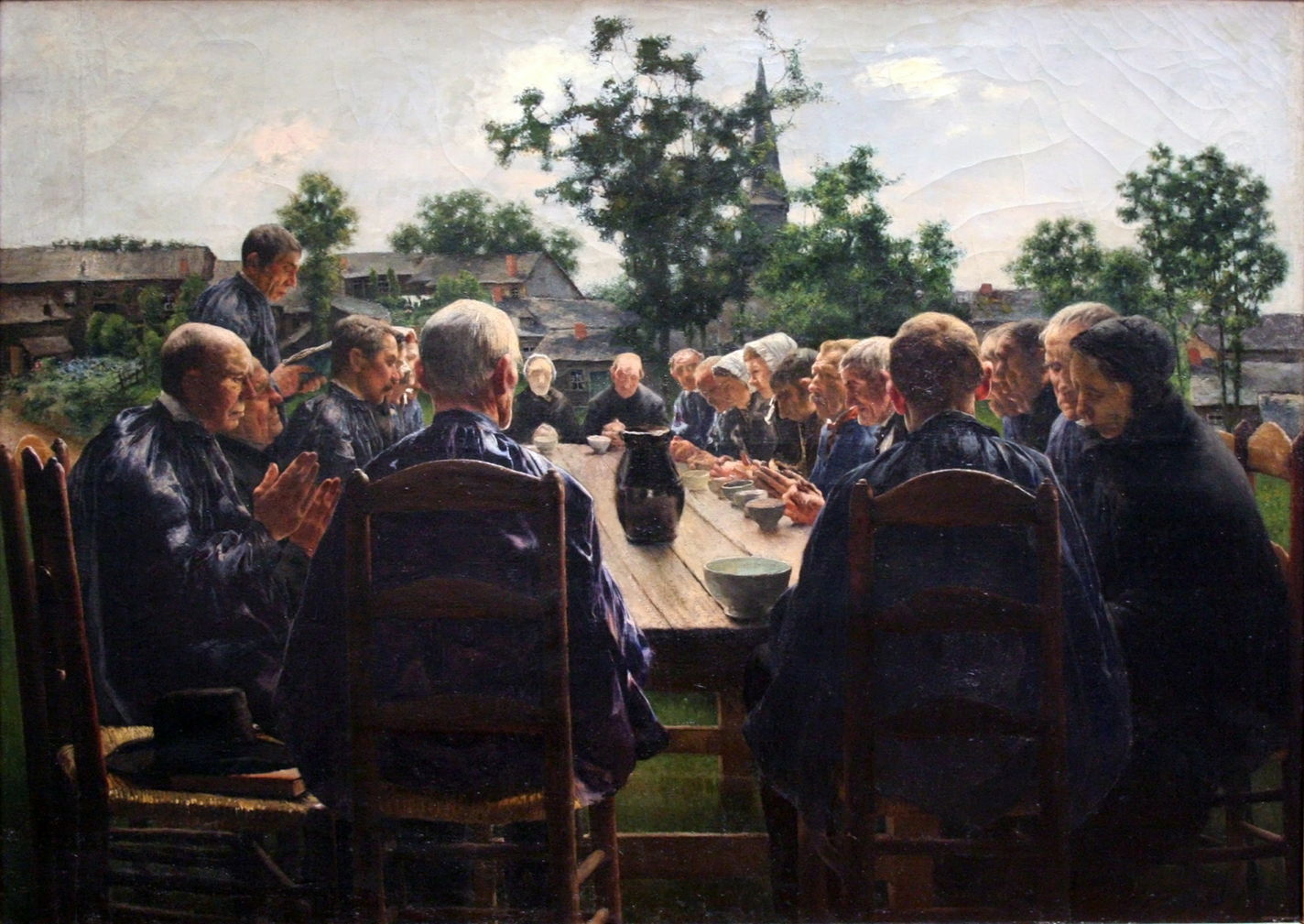
Léon Frédéric’s Funeral Meal from 1886 shows a large group of mourners sitting outside in the summer sunshine to remember the deceased following their funeral. Their meal is simple if not frugal, and there are neither glasses of wine nor mugs of beer. This is the moment that grace, or perhaps a eulogy for the deceased, is being read.

friantcanotiersmeurthe
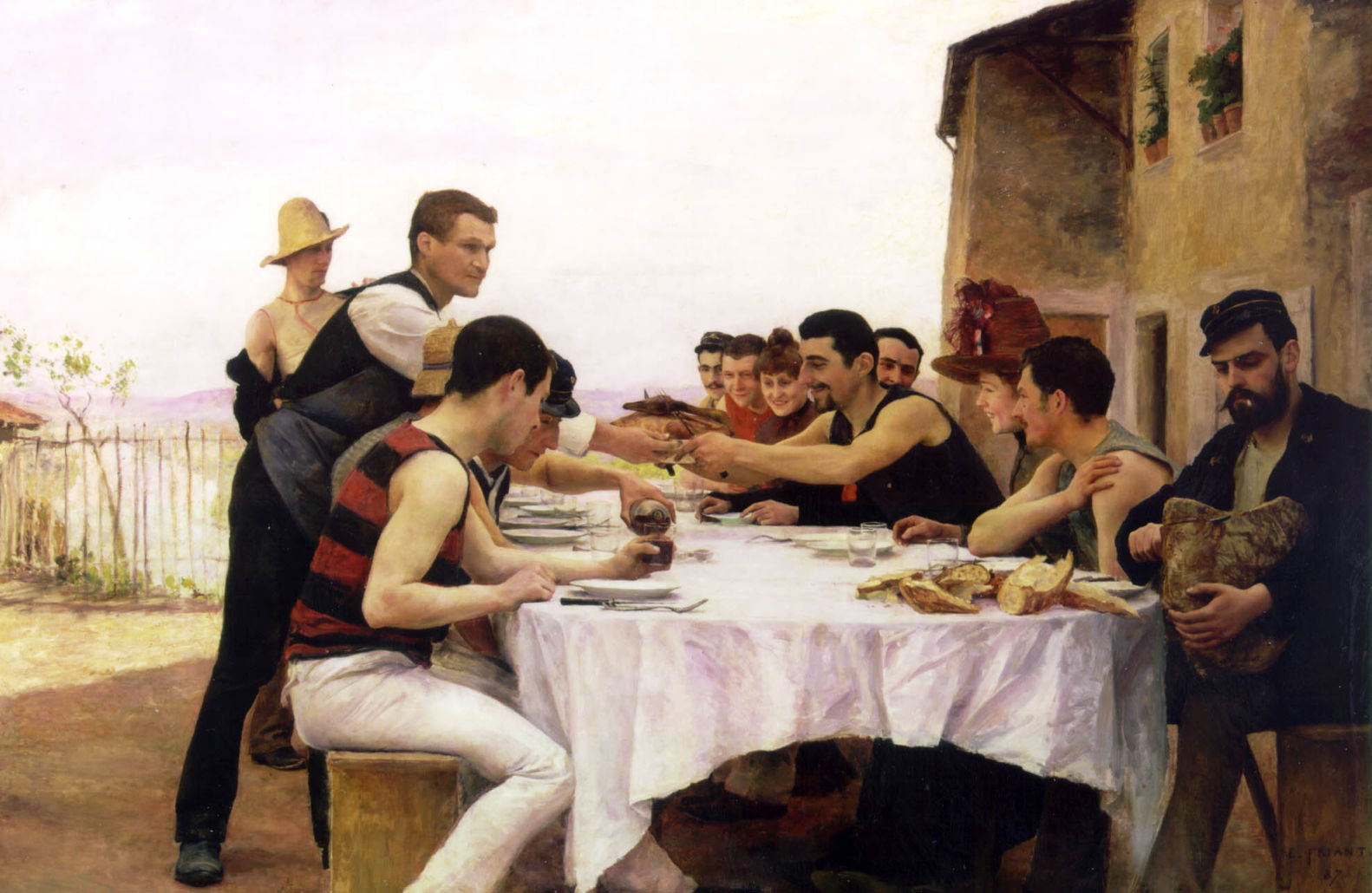
Émile Friant (1863–1932), The Meurthe Boating Party (Reunion of the Meurthe Boating Party) (1887), oil on canvas, 110 x 166 cm, Musée de l’École de Nancy, Nancy, France. Wikimedia Commons.

Now almost forgotten is Émile Friant’s masterpiece The Meurthe Boating Party, also known as Reunion of the Meurthe Boating Party or The Oarsmen of the Meurthe, from 1887. This shows the artist’s watersporting friends eating lunch together on the river Meurthe in Nancy. This can be read as a broad message of well-being and conviviality: healthy, fit young men engaged in team sports; fraternity; and harmony across different classes within society. It was exhibited at the Salon in 1888, and as a result of its success was featured as a full page in the popular magazine Le Monde Illustré, bringing Friant instant fame.

paulibreakfasttime
Hanna Pauli (1864-1940), Breakfast-Time (1887), oil on canvas, 87 x 91 cm, Nationalmuseum, Stockholm, Sweden. Wikimedia Commons.

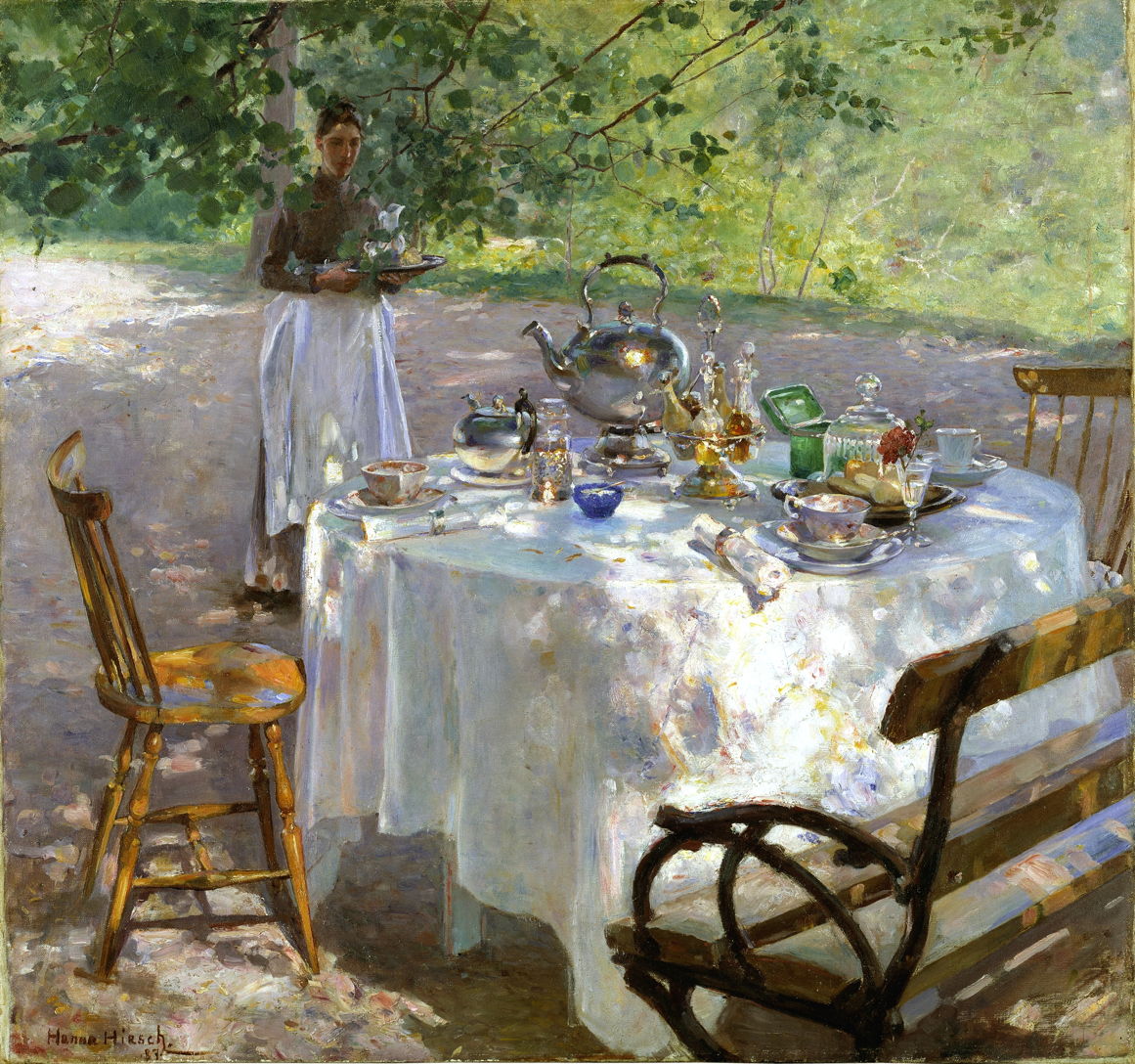
That same year the 23-year-old Swedish painter Hanna Pauli made the meal table the centrepiece of her virtuoso painting of Breakfast-Time (1887). She uses it as a demonstration of her skills in depicting the reflective surfaces of silverware, porcelain and abundant glassware, but its table is now deserted.

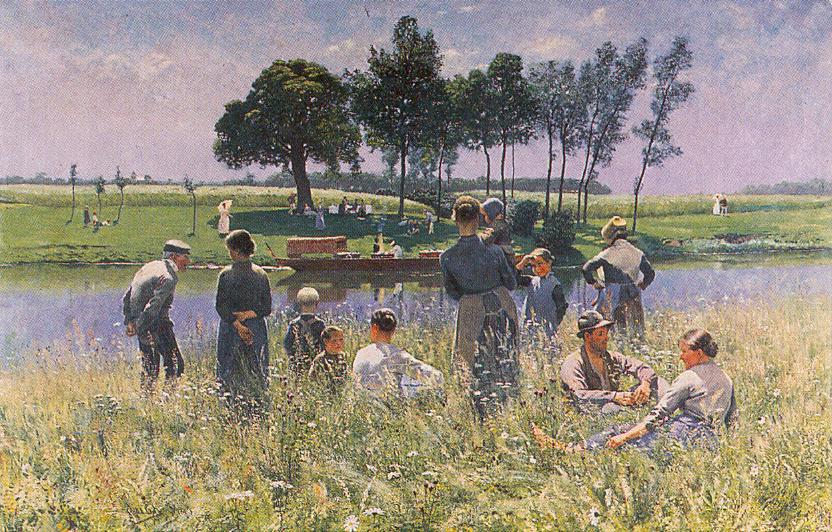
Émile Claus, Pique-nique, paysage la Lys (The Picnic) (1887), oil on canvas, 129 x 198 cm, Institut Royal du Patrimoine artistique, Brussels. WikiArt.
Émile Claus (1849-1924), Pique-nique, paysage la Lys (The Picnic) (1887), oil on canvas, 129 x 198 cm, Institut Royal du Patrimoine artistique, Brussels. WikiArt.

The Belgian artist Émile Claus also painted The Picnic in 1887. It’s set in the French/Belgian countryside around the River Lys, in the area of Ypres, which was devastated during the First World War. The plain clothing worn indicates these are poor farmworkers rather than landowners.

A weekend with Misia: 2

By: hoakley
15 March 2026 at 20:30

In 1904, Misia Natanson, née Godebska, patron and muse of artists in Paris, was in the process of transferring her affection from her first husband Thadée Natanson to Alfred Edwards, the publishing magnate who was providing him with capital in return.

bonnardmisiadog
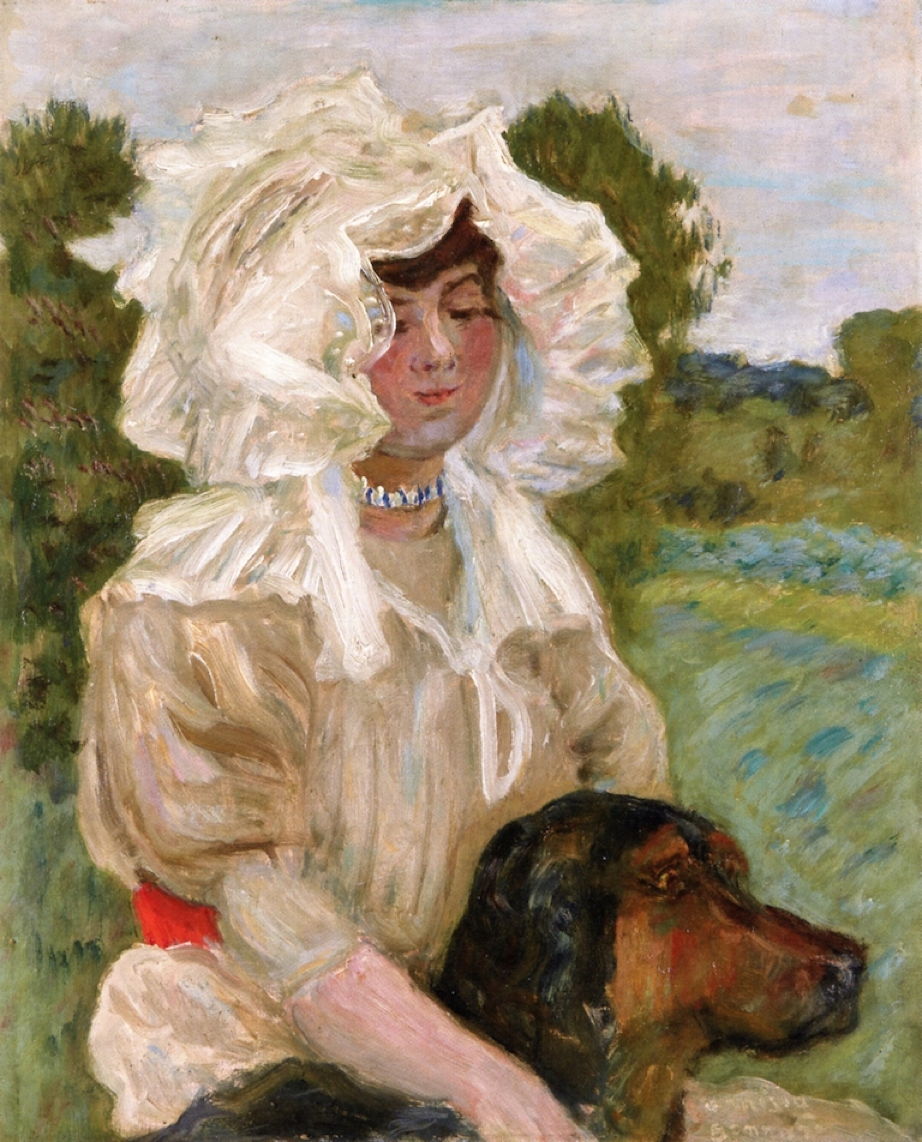
Pierre Bonnard (1867-1947), Misia Natanson and Her Dog (c 1904), oil on panel, 46 x 37 cm, Private collection. The Athenaeum.

Pierre Bonnard sees a completely different figure from those in Renoir’s portraits. In Misia Natanson and Her Dog from about 1904, she’s out in the country with her dog, wearing an ornate white lace hat, more like a character from a nursery rhyme than the mistress of a newspaper magnate.

The following year, Misia married Edwards, and her circle of artists and composers benefited from new patronage with even deeper pockets. Misia and her husband had a yacht, by which I mean a large, crewed vessel, not a dinky little dinghy. In the summer of 1905, they took Bonnard, Maurice Ravel, and others on the yacht’s maiden cruise to Belgium, the Netherlands and Germany.

renoirmisialapdogbarnes1906
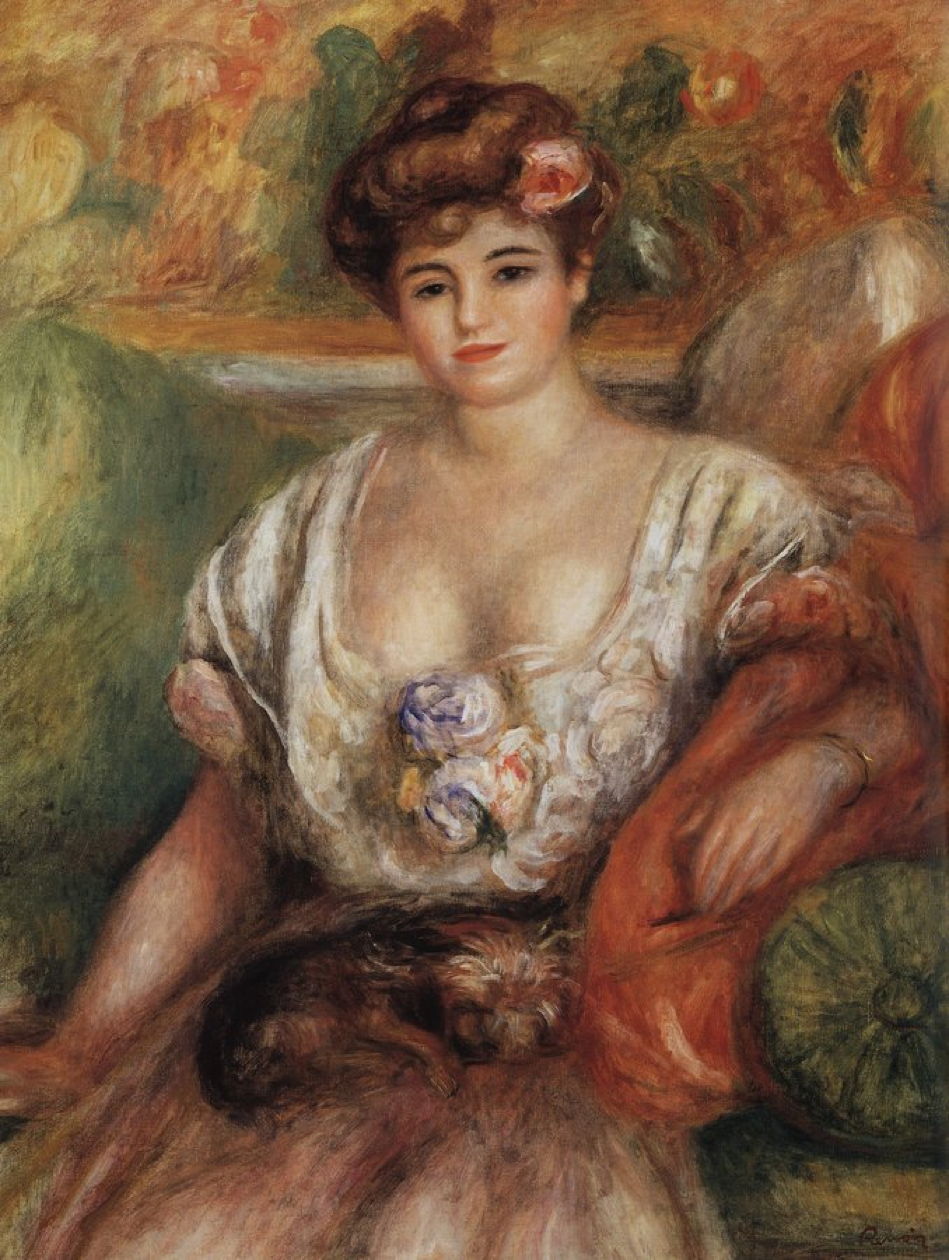
Pierre-Auguste Renoir (1841–1919), Misia Sert with a Lap Dog (Young Woman with a Lap-Dog) (c 1906), oil on canvas, 92.5 x 73.5 cm, Barnes Foundation, Philadelphia, PA. Wikimedia Commons.

Misia, though, looks no happier in Renoir’s third portrait of Misia Sert with a Lap Dog (Young Woman with a Lap-Dog) from after her second marriage in about 1906. And the dog has changed to a toy breed, probably a Brussels Griffon.

bonnardcasamisiasert
Pierre Bonnard (1867-1947), La Casa de Misia Sert (The House of Misia Sert) (1906), tempera on canvas, 38 x 46 cm, Musée d’Orsay, Paris. The Athenaeum.

Bonnard dedicated his painting of The House of Misia Sert (1906) to the former Misia Natanson, muse, close friend, and patron. This was made using tempera rather than oils.

He continued to keep company with Misia and her husband. Maurice Ravel dedicated two of his most beautiful compositions to her: The Swan from Histoires Naturelles, and The Waltz.

bonnardpleasure1906
Pierre Bonnard (1867-1947), Pleasure (1906), oil on cardboard, 250 x 300 cm, Private collection. The Athenaeum.

Works created for Misia extended beyond mere portraits. In Pierre Bonnard’s large painting of Pleasure or Games from 1906, one of four panels he made for Misia and Alfred Edwards’ apartment in Paris, decorative edging includes images of birds and monkeys, whose innocent playfulness is seen as being pleasurable.

bonnardmisia1908
Pierre Bonnard (1867-1947), Misia (1908), oil on canvas, 145 x 114 cm, Museo Nacional Thyssen-Bornemisza, Madrid, Spain. The Athenaeum.

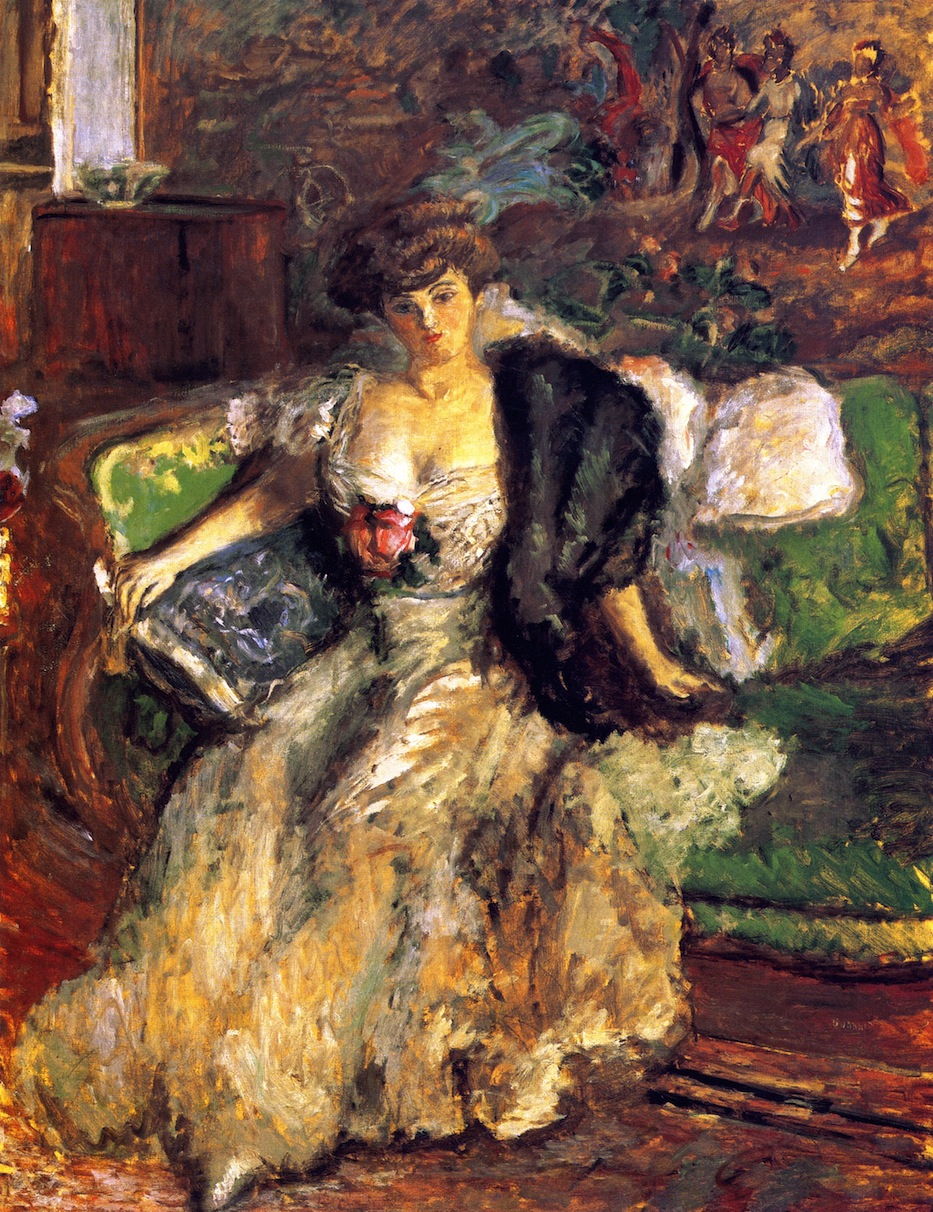
In 1908, Bonnard painted at least three portraits of Misia. Gone is the illusion of the shepherdess: she now sits in a lavishly-decorated room, with what appear to be Gobelin tapestries behind her.

bonnardmisiapinkcorsage
Pierre Bonnard (1867-1947), Misia with a Pink Corsage (c 1908), oil on canvas, 157.2 x 117.9 cm, Private collection. The Athenaeum.

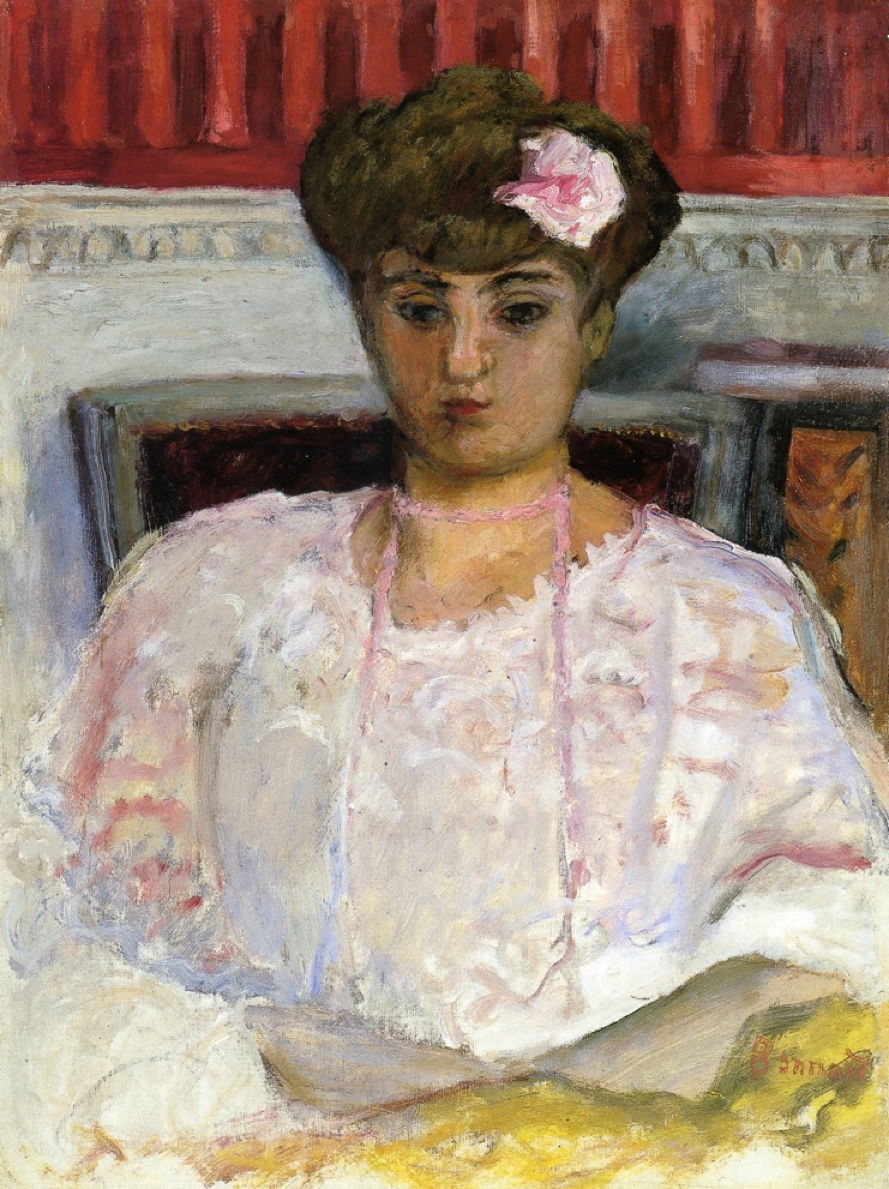
In Misia with a Pink Corsage, Bonnard closes in for a straight head-and-shoulders.

bonnardmisiaroses
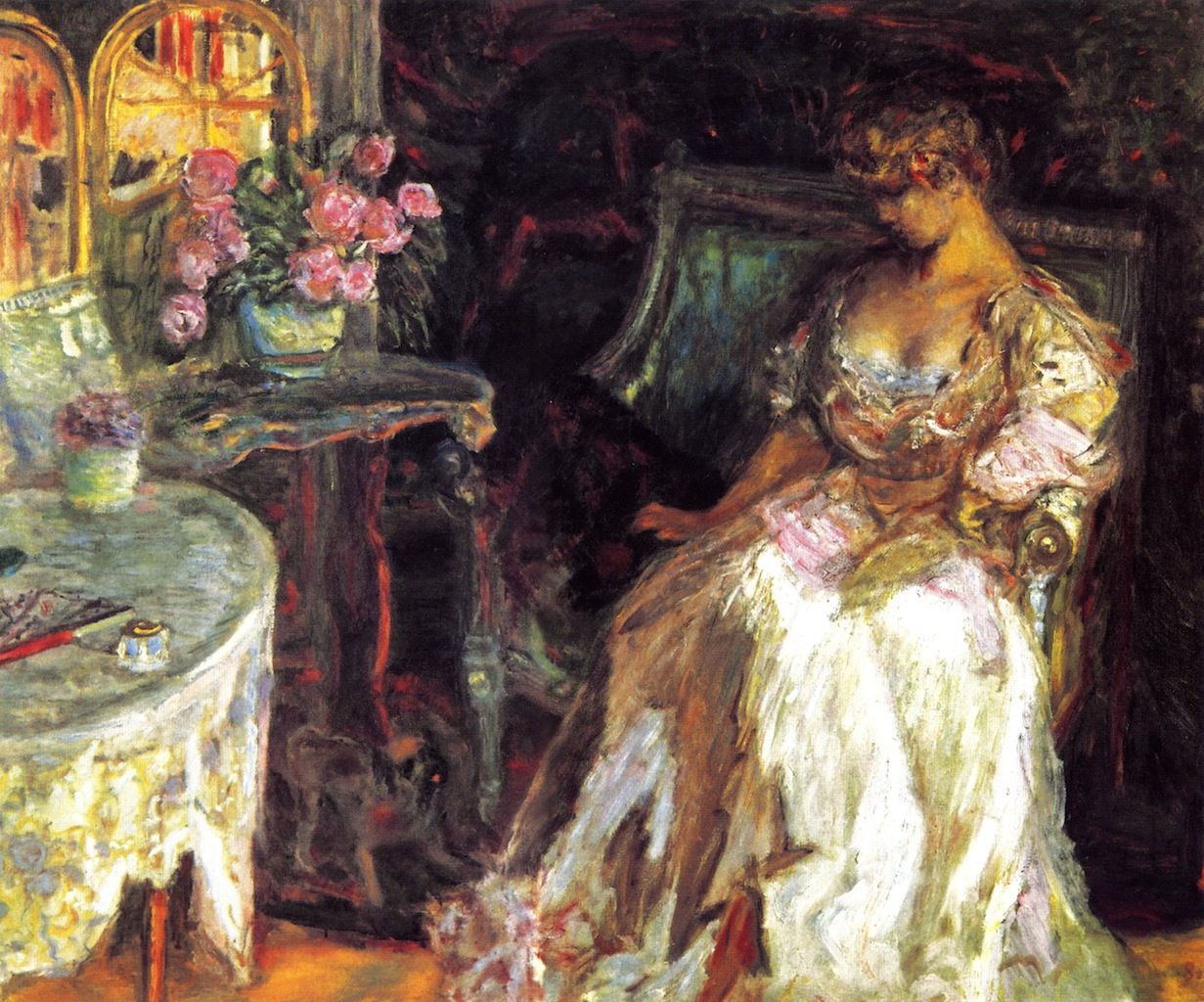
Pierre Bonnard (1867-1947), Misia with Roses (1908), oil on cardboard, 114 x 146.5 cm, Private collection. The Athenaeum.

In Misia with Roses, she looks down at an almost unseen pet she is stroking beside her.

As could have been expected, Alfred Edwards proved unfaithful to Misia. She divorced him in 1909, by which time she was already in a relationship with the Spanish painter Josep Maria Sert (1874-1945). He had been on the periphery of the Nabis since moving to Paris in 1899.

bonnardmisiawriting
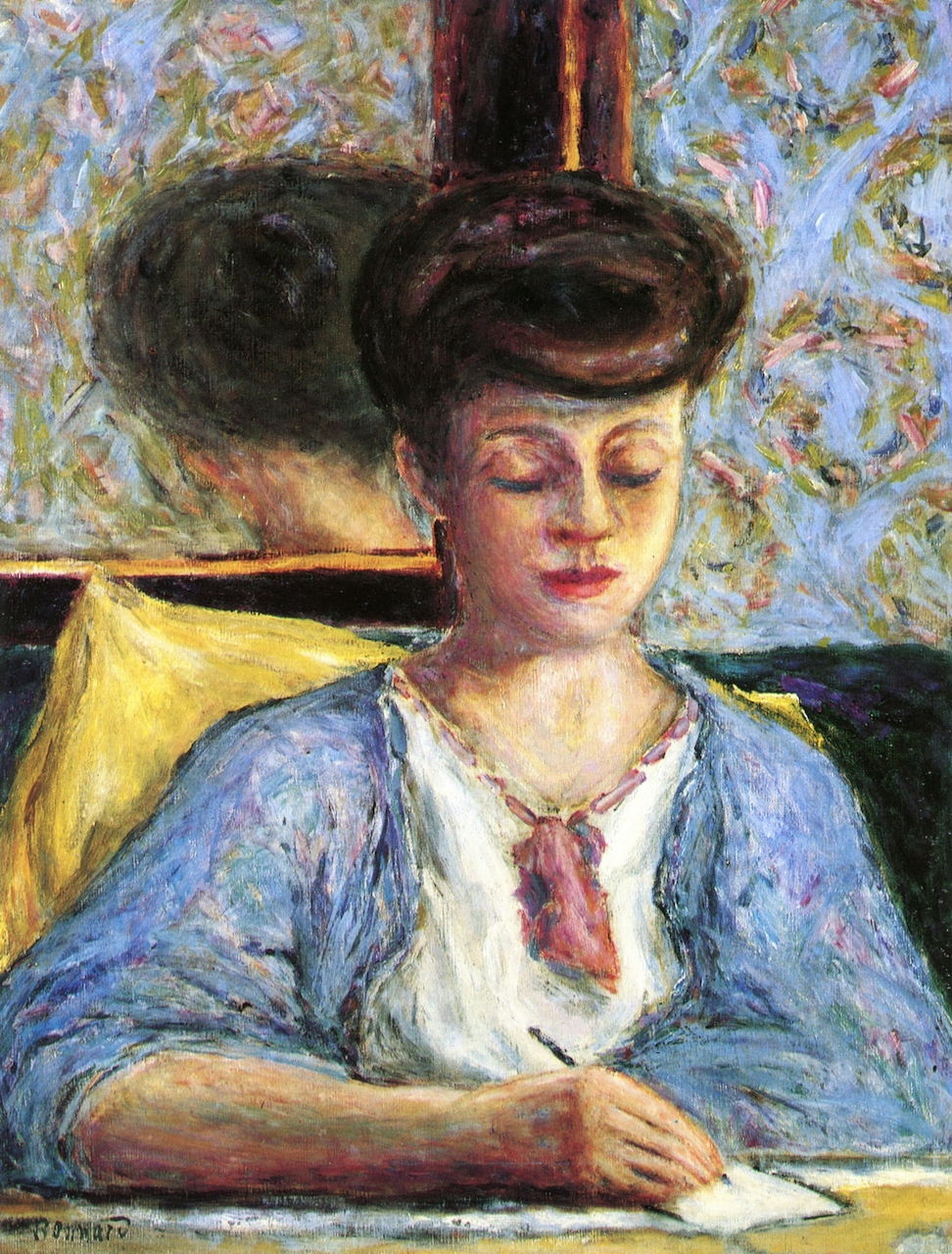
Pierre Bonnard (1867-1947), Misia Godebska Writing (c 1910), oil on canvas, 64.4 x 50 cm, Private collection. The Athenaeum.

The last portrait that I can find by Bonnard, of Misia Godebska Writing, was painted in about 1910. It’s back to head-and-shoulders, although here the artist has used a little mirror play to reveal her chignon, a feature that Bonnard seemed to like.

Misia didn’t marry Sert until 1920, by which time she was established as the cultural arbiter in Paris, and a close friend of Coco Chanel. Her husband, a friend of Salvador Dalí, specialised in murals, and strangely never appears to have painted her portrait. Instead, he spent over thirty years painting murals in the Vic Cathedral in Barcelona, and having affairs of his own. In 1927, Sert divorced Misia to marry the sculptor Isabelle Roussadana Mdivani (1906-1938), known for short as Roussy, who for a time had lived with the Serts in a ménage à trois.

The Serts had been strong supporters of Sergei Diaghilev’s Ballets Russes, which was based in Paris from 1909. Josep Maria Sert painted sets and designed costumes from 1914 onwards. Misia was also heavily involved, often raising money to save a production from seemingly overwhelming debts.

Léon Bakst had also been painting and designing for Diaghilev and his Ballets Russes. Diaghilev proved highly successful, and commissioned music from Igor Stravinsky, Claude Debussy, Sergei Prokofiev and other major composers of the day. Other painters who produced work for the Ballets included Vasily Kandinsky, Pablo Picasso and Henri Matisse. Coco Chanel also created costume designs.

bakstlesorientales
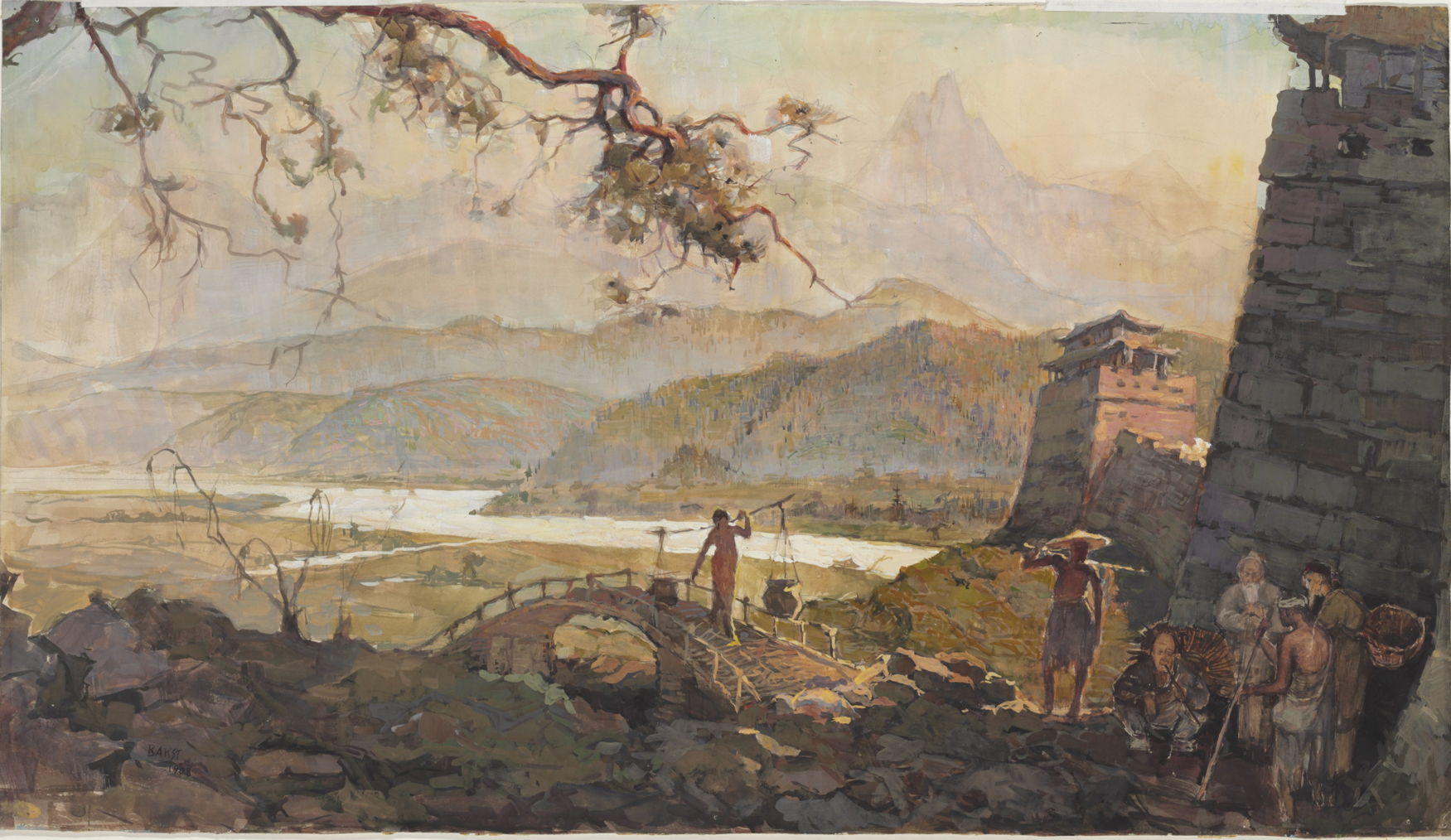
Léon Bakst (1866–1924), Set design for ballet “Les Orientales” (1908), watercolour, pencil, gouache, 73.2 x 43 cm, scenic design for the Ballets Russes, location not known. Wikimedia Commons.

Misia remained close to Diaghilev, and in August 1929 she comforted him as he died in Venice of diabetes, then paid for his funeral from her own pocket.

Just before the Second World War, Roussy Sert died, and Misia and Josep Maria Sert reconciled, and sort of lived together in separate apartments in Paris. Misia’s reputation remained unblemished during the Nazi occupation of Paris, and she died there on 15 October 1950, at the age of 78.

Without Misia’s influence and support, a great deal of the painting, music, and ballet of the first half of the twentieth century simply wouldn’t have happened.

Reference

Wikipedia.

A weekend with Misia: 1

By: hoakley
14 March 2026 at 20:30

One of the myths about nineteenth and twentieth century art is that it freed itself from patronage that had bedevilled its past. What did change was that patrons of the arts were seldom royalty or nobility, although their power and influence were just the same. Between about 1895 and the late 1930s, one of the most important patrons in France was a Polish woman, born Maria Zofia Zenajda Godebska in 1872, but subsequently known as Misia Natanson, Edwards, or Sert. Her father was Cyprian Godebski, a major sculptor who was a professor at the Imperial Academy in Saint Petersburg. This weekend I tell a little of her story, with a succession of portraits by her many admirers.

Misia’s mother died shortly after the girl’s birth, so she was sent to her grandparents in Brussels. This took her from sculpture to music, as those grandparents had musical circles including Franz Liszt. She was brought up as a pianist, and when her father moved her to Paris, she studied under Gabriel Fauré.

Misia married for the first time at the age of twenty-one, to her cousin Thadée Natanson, who had socialist ideals and lived in artistic circles. The Natansons entertained Marcel Proust, Stéphane Mallarmé, André Gide and Claude Debussy. But they were closest to their painter friends: Claude Monet, Pierre-Auguste Renoir, Odilon Redon, Paul Signac, and Henri de Toulouse-Lautrec.

toulouselautrecmisia1895
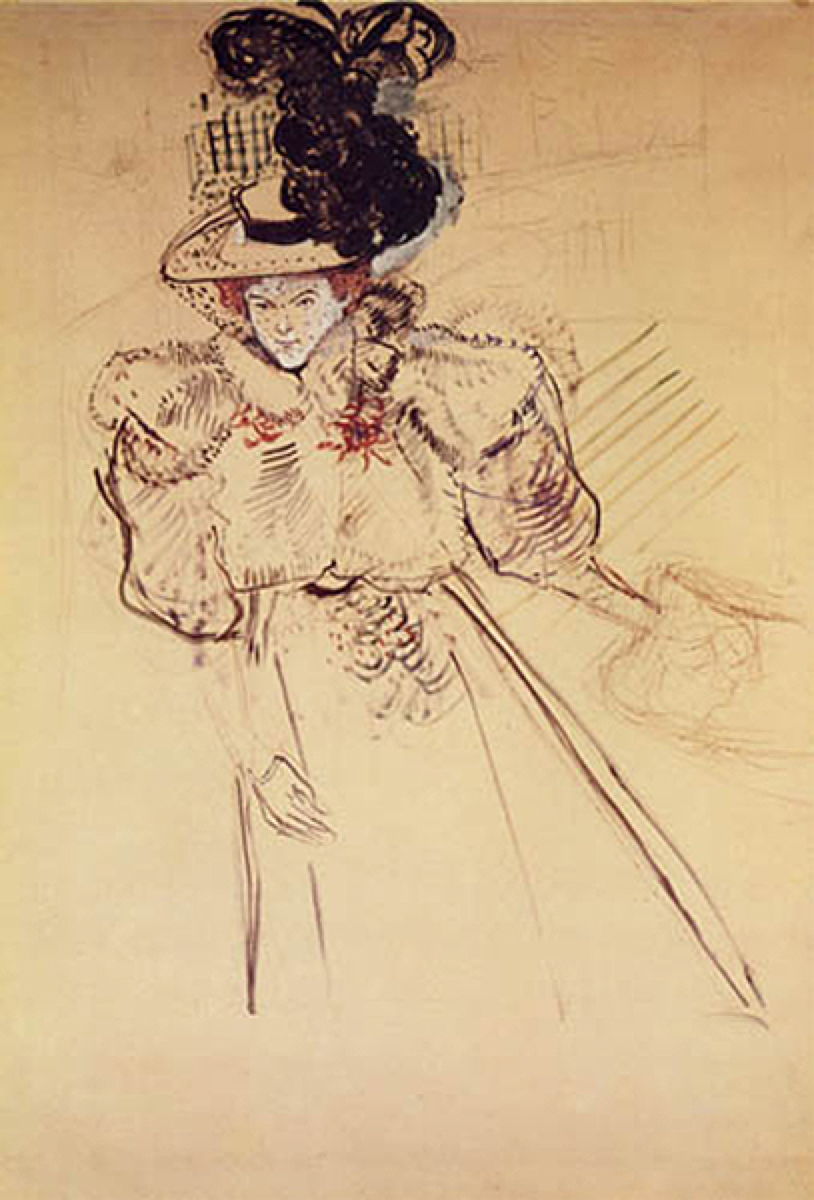
Henri de Toulouse-Lautrec (1864–1901), Portrait of Misia Natanson (Sert) (1895), further details not known. Wikimedia Commons.

It was probably Toulouse-Lautrec who first started to draw and paint Misia, as in his Portrait of Misia Natanson of 1895.

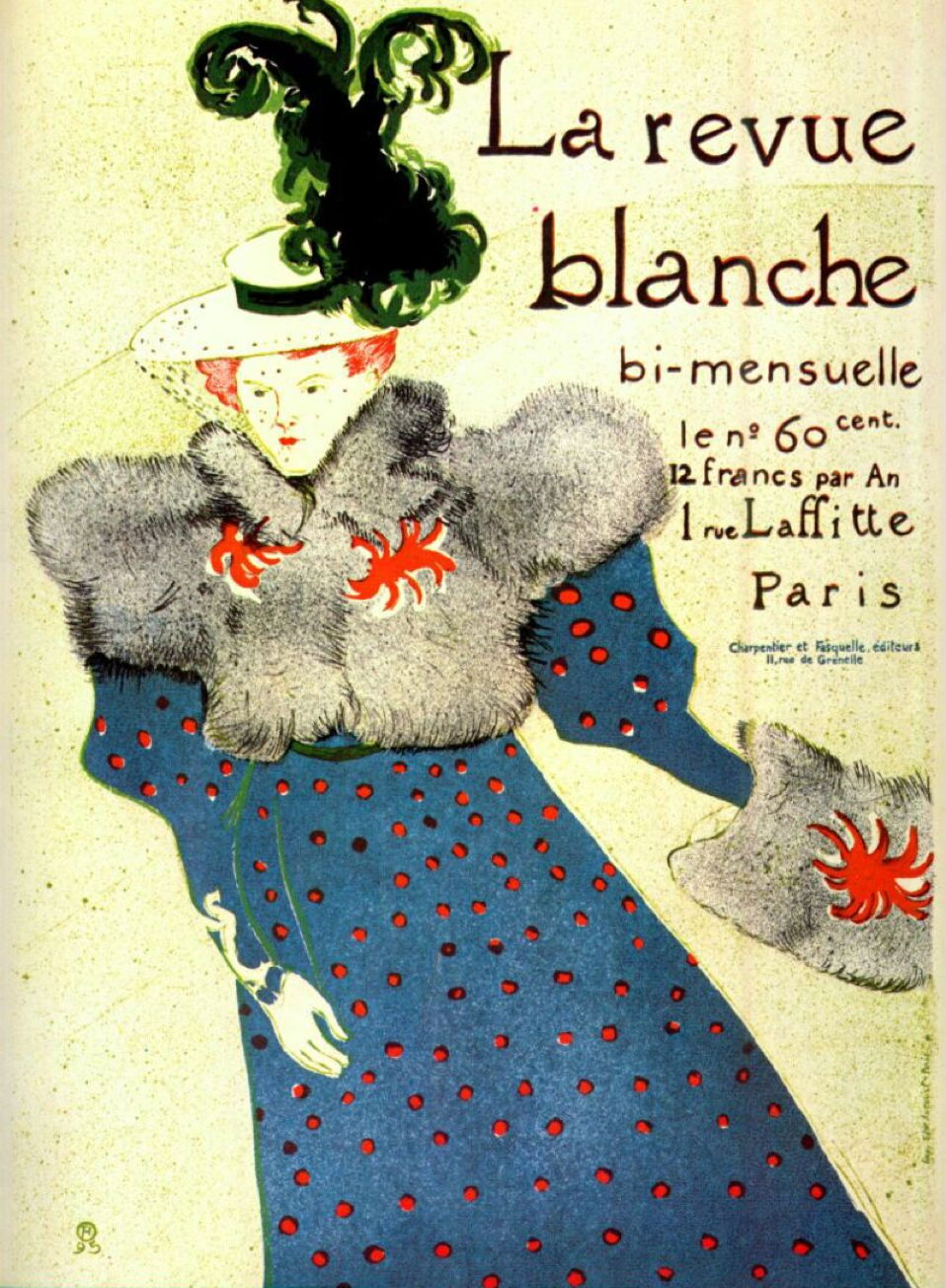
toulouselautrecrevueblanche1895
Henri de Toulouse-Lautrec (1864–1901), Poster for La revue blanche (1895), further details not known. Wikimedia Commons.

In 1895 he turned that into his Poster for “La revue blanche”, the arts magazine co-founded in 1889 by Misia’s husband, which was the platform that promoted the Nabis, including Pierre Bonnard.

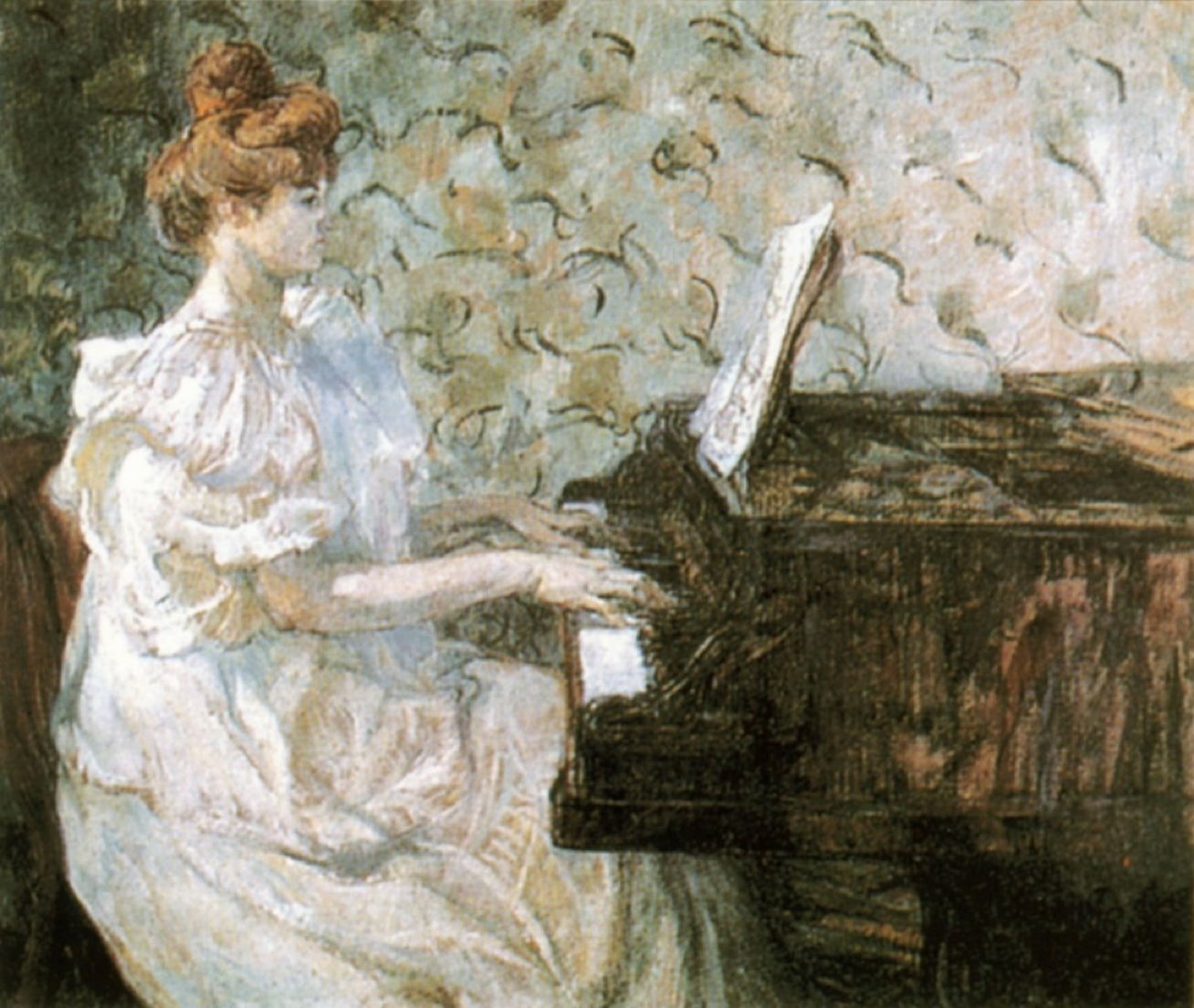
toulouselautrecmisia1897
Henri de Toulouse-Lautrec (1864–1901), Misia Natanson (1897), media and dimensions not known, Musée des Beaux-Arts, Berne, Switzerland. Image by J Frey, via Wikimedia Commons.

Toulouse-Lautrec later painted Misia Natanson playing the piano in 1897.

The Nabis themselves painted Misia’s portraits, not just as their main patron, but in informal settings, as more of a friend and muse.

vuillardvallottonatmisias1897
Édouard Vuillard (1868–1940), Vallotton at the Natansons (1897), further details not known. Wikimedia Commons.

Édouard Vuillard’s Vallotton at the Natansons shows Misia watching Félix Vallotton painting in 1897, at the Natanson’s home.

vallottonmisiadressingtable
Félix Vallotton (1865–1925), Misia at Her Dressing Table (1898), distemper on cardboard, 36 x 29 cm, Musée d’Orsay, Paris. Wikimedia Commons.

Félix Vallotton provides a glimpse into her private life in his Misia at Her Dressing Table from 1898.

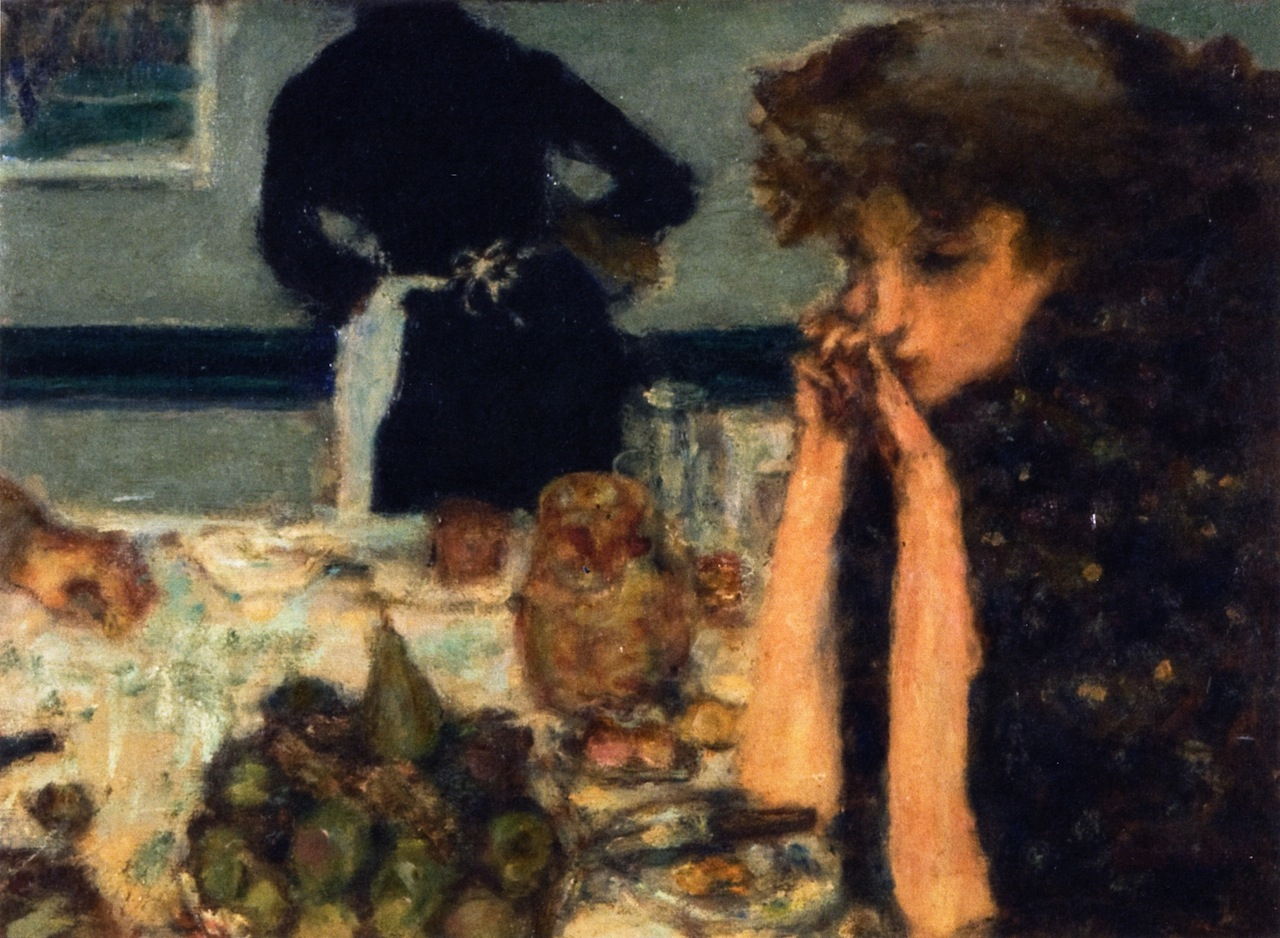
bonnardmisiabreakfast
Pierre Bonnard (1867-1947), Misia Natanson at Breakfast (c 1899), oil on wood, 32 x 41 cm, Private collection. The Athenaeum.

In his turn, Pierre Bonnard painted Misia Natanson at Breakfast in about 1899, with one of the family’s maids at work in the background.

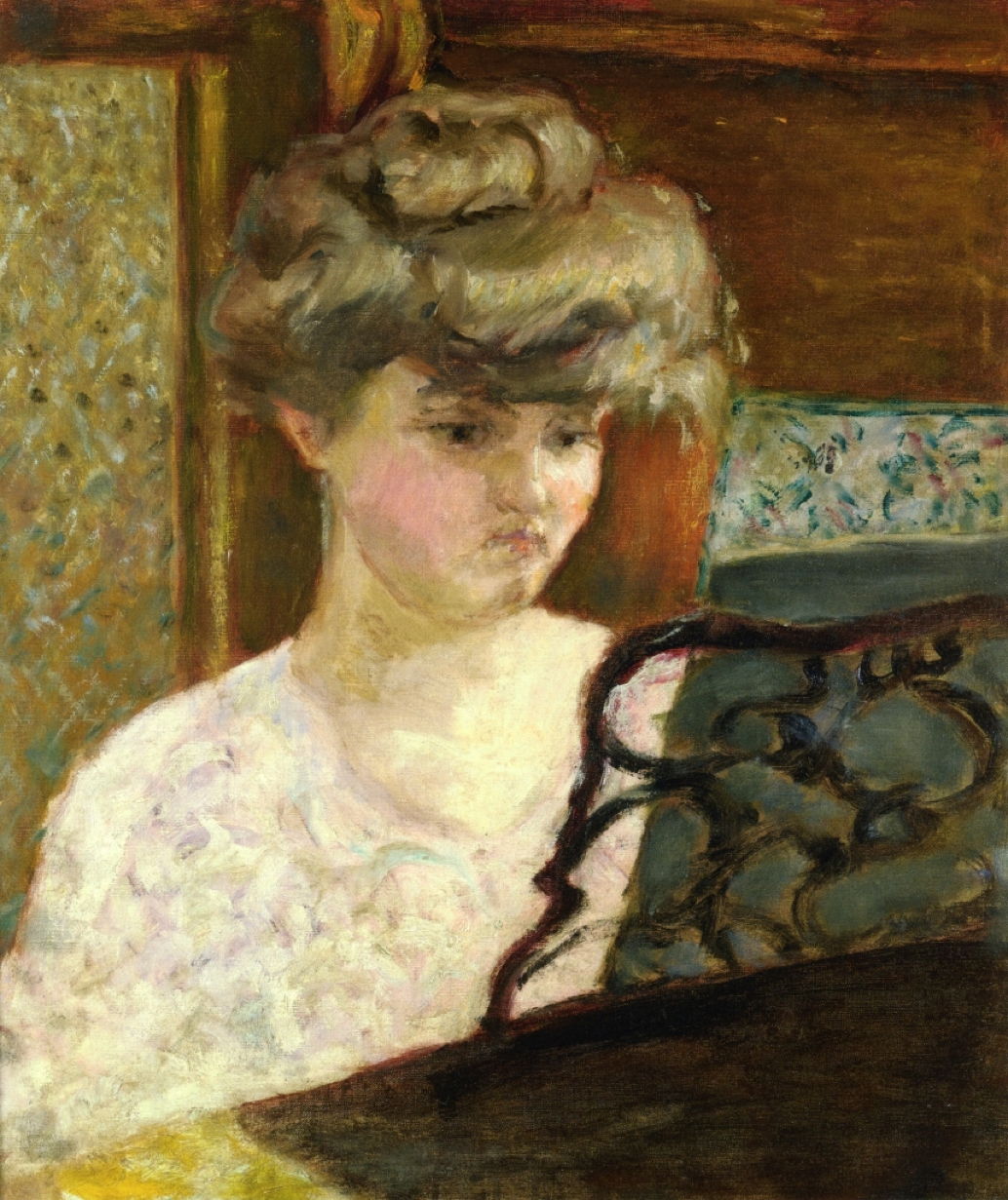
bonnardmisiapiano
Pierre Bonnard (1867-1947), Misia at the Piano (Portrait of Misia Natanson) (c 1902), oil on canvas, 46.2 x 39 cm, Private collection. The Athenaeum.

Bonnard’s Misia at the Piano from about 1902 shows Misia doing what she loved most.

At this time, Thadée Natanson needed more capital to support his publishing and other activities. He found a source in Alfred Edwards, a publishing magnate who had founded and published the major newspaper in Paris at the time, Le Matin. Unfortunately, Edwards and Misia fell in love, and Misia became Edwards’ mistress in 1903. As Natanson wanted his capital, so Edwards wanted Misia, and that became a condition of the deal between them.

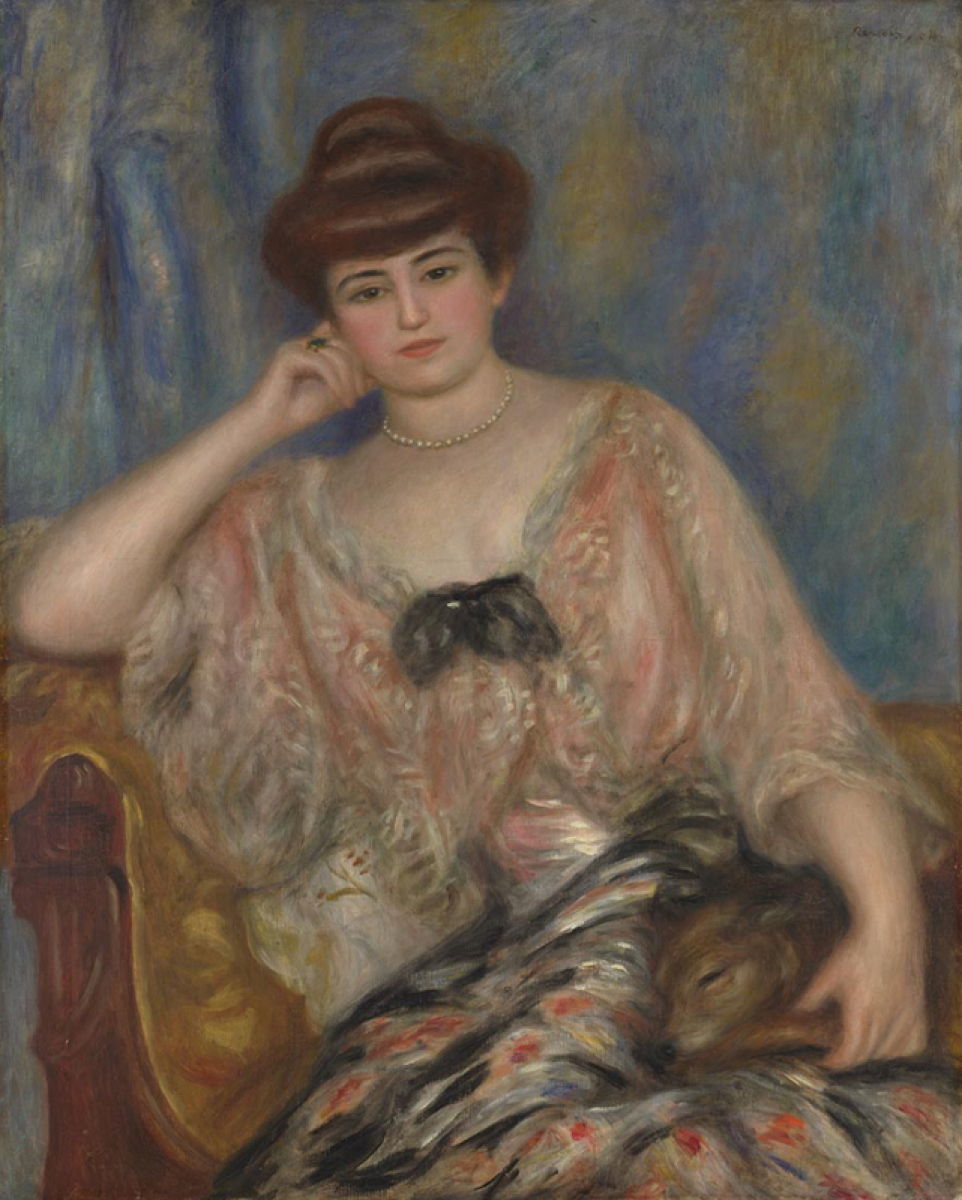
renoirmisiang1904
Pierre-Auguste Renoir (1841-1919), Misia Sert (1904), oil on canvas, 92.1 x 73 cm, The National Gallery (Bought, 1960), London. Courtesy of and © The National Gallery, London.

Renoir painted this and the next portrait of Misia Sert while this was being settled, in 1904. Of the two, this is the better-known, as it hangs in the National Gallery in London. I can’t help feeling that she appears unhappy here.

renoirmisia1904
Pierre-Auguste Renoir (1841–1919), Portrait of Misia Sert (1904), oil on canvas, 55.5 × 66.5 cm, Tel Aviv Museum of Art, Tel Aviv, Israel. Wikimedia Commons.

In this second of Renoir’s portraits of Misia from 1904, now in Tel Aviv, she is as sumptuously dressed, but her head is buried in a book.

Reference

Wikipedia.

❌
❌