One of the main priorities of the Third Republic in France was to secularise the nation, and one of its pillars was the introduction of free and mandatory education. This was accomplished in the Jules Ferry laws of 1881 and 1882, whose changes swept across every part of France, and became an important theme in French Naturalist painting.
Jean-Baptiste Jules Trayer (1824–1909), A Breton Infants School (1882), watercolour over pencil on paper, 68 × 83.8 cm, location not known. Wikimedia Commons.
Jean-Baptiste Jules Trayer’s wonderful watercolour of A Breton Infants School from 1882 predates any celebration of the Republican policy: the crucifix high on the wall at the right confirms this is one of the older Catholic schools. It shows a teacher helping one of her students with writing, in a class wearing only traditional Breton costume. There’s clearly room for improvement, though, as one girl is sleeping on her book, doubtless exhausted from her early morning work on the family farm.
Henri Jules Jean Geoffroy (1853–1924), Snack Time (1882), oil on canvas, 98 x 131 cm, Private collection. The Athenaeum.
By 1882, Jean Geoffroy had entered the schools where he was to be most successful and prolific; he apparently lodged above a school, with a couple of teachers. Snack Time shows the pupils outside their primary school during a break, armed with their lunchboxes and baskets. He tells their stories using subtle hints including their clothes. A well-dressed girl in white is being harassed by a smaller boy into surrendering some of her food. He wears rougher clothes but seems in control of the situation, as others watch on and laugh.
Paul Louis Martin des Amoignes (1858–1925), In the Classroom (1886), oil on canvas, 68.5 × 110.5 cm, location not known. Wikimedia Commons.
Within two years of the early death of Jules Bastien-Lepage, Paul Louis Martin des Amoignes’ In the Classroom (1886) looks as if it may have been painted from photographs. One boy, staring intently at the teacher in front of the class, is caught crisply, pencil poised in his hand. Beyond him the crowd of heads becomes more blurred.
Henri Jules Jean Geoffroy (1853-1924), Primary School Class (1889), oil on canvas, 145 x 220 cm, Ministère de l’Education Nationale, Paris. Wikimedia Commons.
Geoffroy’s Primary School Class from 1889 doesn’t give us the same depth of field effect, but shows one of the Republic’s new lay teachers working diligently in the classroom with her pupils. They’re still a bit of a shower, with the younger ones at the back working on traditional slates, but this is the public face of the modern Republican School.
Henri Jules Jean Geoffroy (1853–1924), Drawing Lesson (1895), further details not known. Wikimedia Commons.
In 1895 Geoffroy shows a Drawing Lesson in a class of older boys, who are following the classical tradition of drawing casts and appear remarkably diligent and well-behaved.
Henri Jules Jean Geoffroy (1853-1924), In School (c 1900), further details not known. Wikimedia Commons.
In his In School from about 1900, another lay teacher in a modern Republican infants class is caring for the French men and women of the future.
Henri Jules Jean Geoffroy (1853–1924), The Nursery (1899), oil on canvas, 166 x 108 cm, Museu de Arte do Rio Grande do Sul Ado Malagoli, Porto Alegre, Brazil. Wikimedia Commons.
The Third Republic believed in catching its future citizens young. In 1899, Geoffroy painted The Nursery, one of very few images to show the state’s approaches to the early rearing of children. Hospitals developed a rigorous almost military approach to nurseries and feeding that endured well into the twentieth century, and separated mothers from their infants for much of the time.
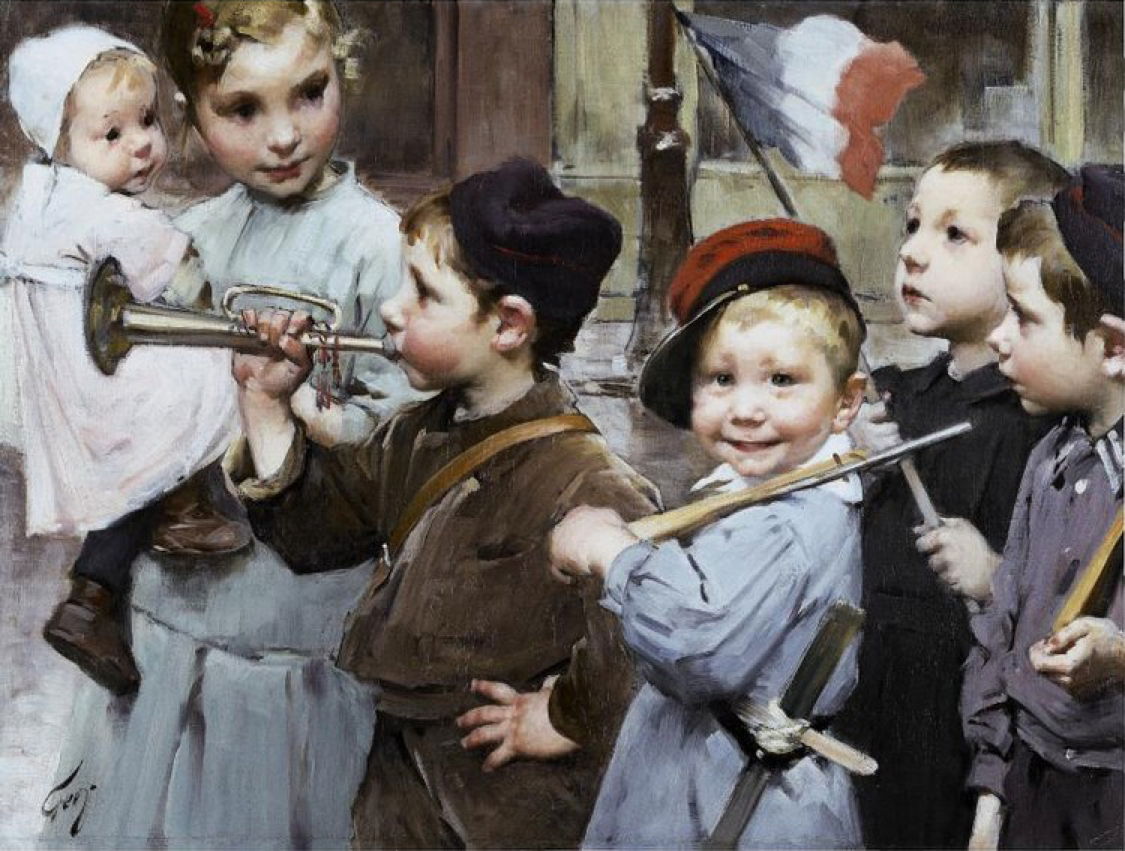
Henri Jules Jean Geoffroy (1853–1924), Bastille Day (c 1900), oil on canvas, 46 x 61 cm, location not known. Wikimedia Commons.
It was only right that those citizens of the future should celebrate the national day of France, Bastille Day, on 14 July, as painted by Geoffroy in about 1900. For young boys in the years before the First World War, this was becoming increasingly militaristic rather than just patriotic.
Henri Jules Jean Geoffroy (1853–1924), Prize-Giving at an Infants School (1904), woodcut (?) by Charles Baude (1853-1935) after a painting by Geoffroy, further details not known. Wikimedia Commons.
I have been unable to locate an image of Geoffroy’s painting from which Charles Baude made this print of Prize-Giving at an Infants School in 1904, but it’s a fine example of the artist’s depictions of the social interactions within groups of young children.
Henri Jules Jean Geoffroy (1853–1924), It’s Hard to Share (date not known), oil on canvas, 60.3 x 49.6 cm, Museu Antônio Parreiras (MAP), Rio de Janeiro, Brazil. Wikimedia Commons.
Geoffroy’s undated painting of It’s Hard to Share shows another of the tribulations of childhood. These young boys have just emerged from a sweet shop, and the child in the centre is reluctant to share the paper cone of sweets he has just bought. His face says it all, as he looks with great suspicion at his less fortunate friend, and a dog also looks up expectantly.
The Third Republic also opened up higher education to French women.
Jean Béraud (1849–1935), The Thesis of Madeleine Brès (or The Doctoral Jury) (date not known), oil on canvas, 63.5 x 48.3 cm, Private collection. The Athenaeum.
In Jean Béraud’s undated The Thesis of Madeleine Brès (or The Doctoral Jury) he shows us one of the early woman doctoral students defending her thesis before the academic jury. At the time, this was a major landmark in the improvements in women’s rights, and their archaic academic dress emphasises this change.
During the nineteenth century social realism depicted poverty in the countryside, but that of the growing cities was seldom depicted until it was tackled by the Naturalists later in the century.
Some earlier attempts were based on deception.
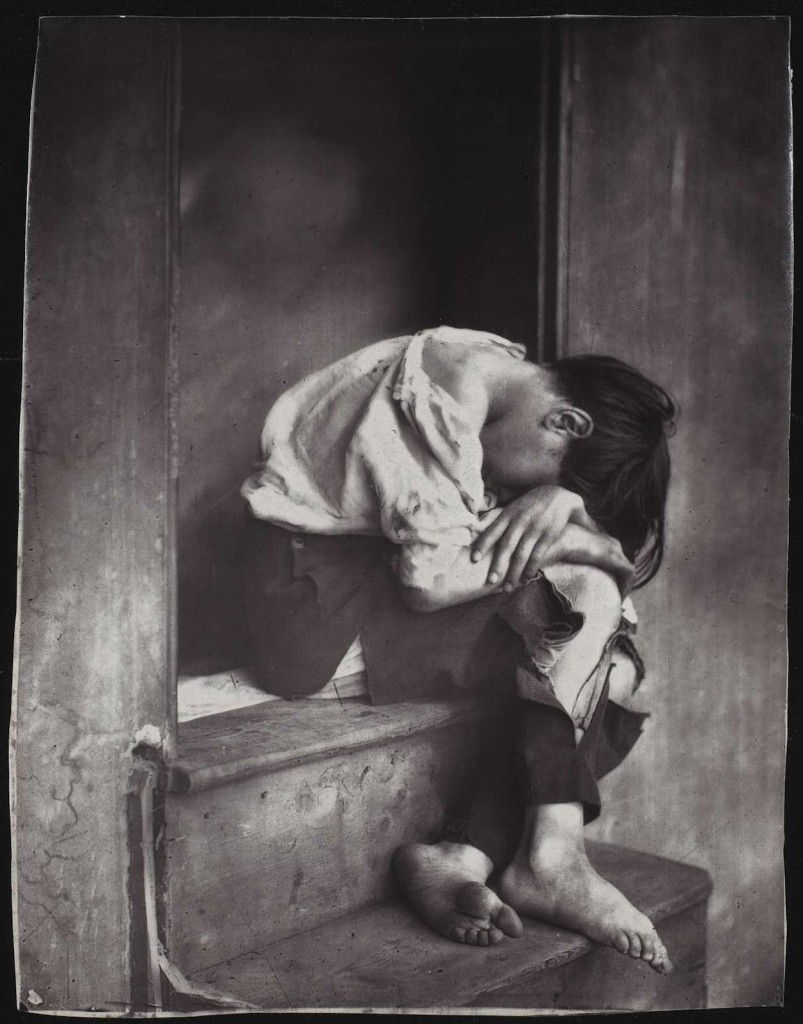
Oscar Gustave Rejlander (1813–1875), Poor Jo (1864), photograph, further details not known. Image by Roger Cicala, via Wikimedia Commons.
Oscar Gustave Rejlander’s photo of Poor Jo from 1864 shows a young streetboy, in a pioneering collection of images of homeless children in England. Being an early photo, it cannot of course lie, but it does. This photo, as with all Rejlander’s other images of poor and vagrant children, was a fiction created in his studio, using props and models, and heavily retouched. We tend to think of such trickery as a modern phenomenon enabled by the likes of Photoshop; although the techniques were different, visual deception is far older.
Augustus Edwin Mulready (1844–1905), Uncared For (1871), oil on canvas, 101 × 76 cm, location not known. Wikimedia Commons.
It was an English writer, Charles Dickens, who was probably the greatest literary influence over Augustus Edwin Mulready, whose reputation was built on paintings of street sellers and vagrants in London, such as his Uncared For from 1871. Mulready’s approach was very different from either Dickens or Millet, in being laden with sentimentalism. Here a young girl with exceptionally large brown eyes stares straight at the viewer as she proffers a tiny bunch of violets.
Both the girl and her brother are sparklingly clean, their hair well cared-for, and their clothes relatively smart. There is nothing to suggest that Mulready used real vagrants as his models.
More convincing, though, are the remains of posters on the brick wall behind them: at the top, The Triumph of Christianity is attributed to the French artist and illustrator Gustave Doré, who illustrated an edition of the Bible in 1866, visited London on several occasions afterwards, and in 1871 produced illustrations for London: A Pilgrimage, published the following year, showing London’s down and outs.
Gustave Doré (1832–1883), A Couple and Two Children Sleeping on a London Bridge (1871), print, 19 × 24.7 cm, Denver Art Museum, Denver, CO. Wikimedia Commons.
When Doré visited London, he was shocked by its large population of vagrants and homeless. His print of A Couple and Two Children Sleeping on a London Bridge (1871) is one of several objective records he made at the time. A selection was included in his illustrated book on London published the following year.
Jean-Eugène Buland (1852–1926), Alms of a Beggar (1880), oil on canvas, 117 × 89 cm, location not known. Wikimedia Commons.
Change continued in this challenging painting by the Naturalist Jean-Eugène Buland, Alms of a Beggar from 1880. A young woman dressed immaculately in white is sat outside a church seeking charity. Approaching her, a coin in his right hand, is a man who can only be a beggar himself. His clothes are patched on patches, faded and filthy, and he wears battered old wooden shoes. Yet he is about to give the young woman what is probably his last coin.
In the early 1880s Fernand Pelez started to paint some of the most moving portraits of the poor, comparable to those of Jules Bastien-Lepage and Marie Bashkirtseff.
Fernand Pelez (1848-1913), Sleeping Laundress (c 1880), media and dimensions not known, Private collection. Wikimedia Commons.
This early portrait of a Sleeping Laundress (c 1880) is one of a group of works showing poor women reclining. Another showed a young woman dead from asphyxiation. For all her obvious poverty, there is a faint smile on her face, as she enjoys a brief rest from her long hours of washing.
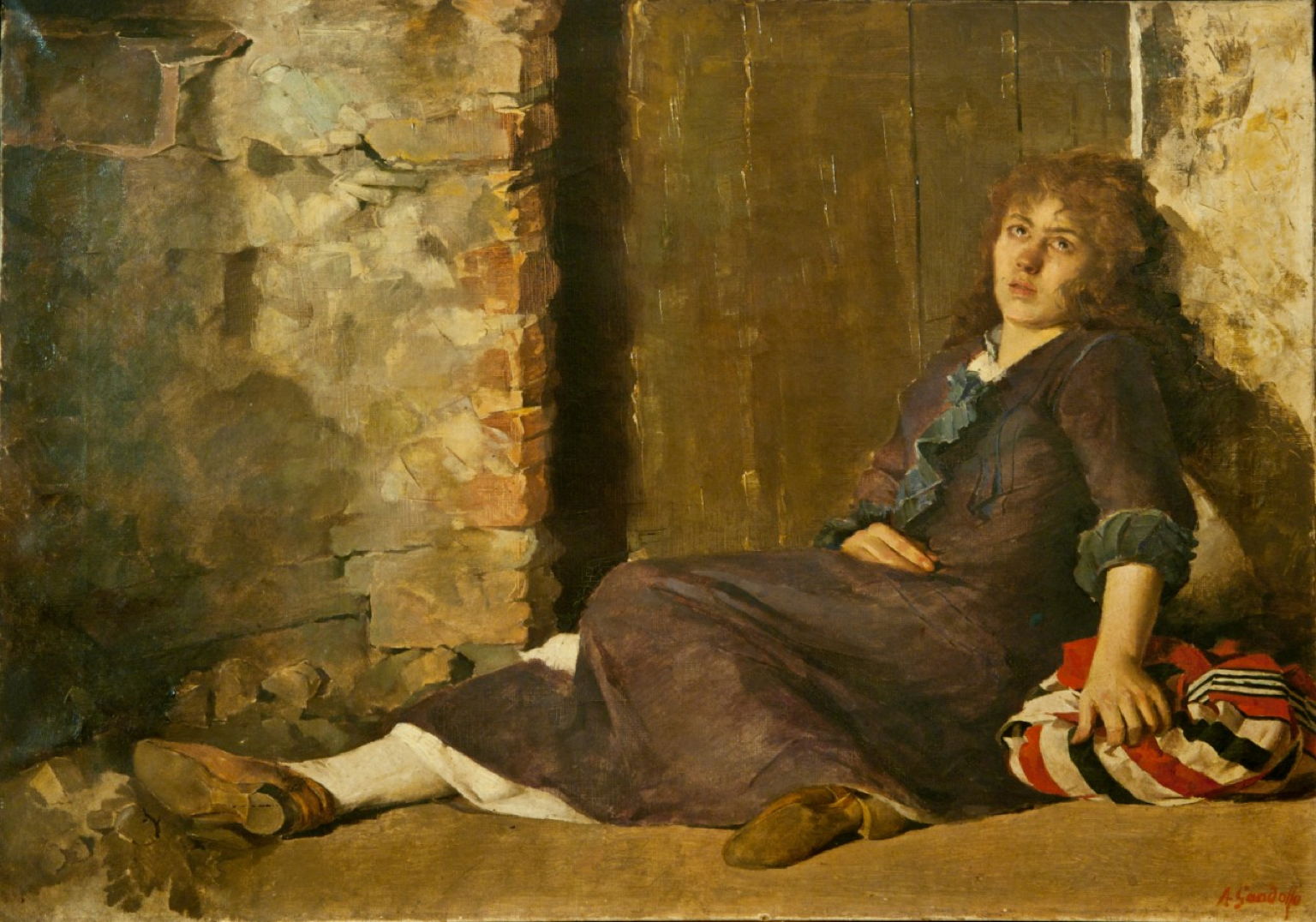
Antonino Gandolfo (1841–1910), Evicted (Let he who is without sin cast the first stone) (1880), oil on canvas, 88 x 63 cm, location not known. Image by Luigi Gandolfo, via Wikimedia Commons.
In Italy it was Antonino Gandolfo who took up the theme in his depictions of urban poverty in the city of Catania on Sicily, just as Naturalism was breaking out in France, between 1880-85. Evicted, which bears the Biblical sub-title of Let he who is without sin cast the first stone, dates from 1880, and shows a woman cast out into the street, her only possessions in the bag under her left hand.
Fernand Pelez (1848-1913), Homeless (1883), oil on canvas, 77.5 x 136 cm, location not known. Image by Bastenbas, via Wikimedia Commons.
Most of Pelez’s paintings of the poor are unsettling if not frankly depressing. His Homeless from 1883 shows a worn and weary mother and her five children living on the street. She stares from sunken eyes straight at the viewer, as her children huddle in filthy blankets and sacking around her. Only the mother and her oldest daughter, who is presumably already at work, wear any shoes.
Fernand Pelez (1848-1913), A Martyr – The Violet Vendor (1885), media and dimensions not known, Petit Palais, Paris. Wikimedia Commons.
A Martyr – The Violet Vendor (1885) shows another child of the street, although here Pelez leaves doubt as to whether we are looking at the boy asleep, or dead. One of the small bunches of violets has fallen from his tray. His eyes are closed, and his mouth agape.
Arturo Michelena (1863–1898), Charity (1888), oil on canvas, 288.8 x 231.7 cm, Galería de Arte Nacional, Caracas, Venezuela. Wikimedia Commons.
Arturo Michelena’s Charity from 1888 shows a pair of charitable bourgeois ladies arriving at the hovel that is home to a young mother and her small child. Beside the woman, on a table under the window, are a couple of bottles of her favourite ‘poison’, most probably absinthe.
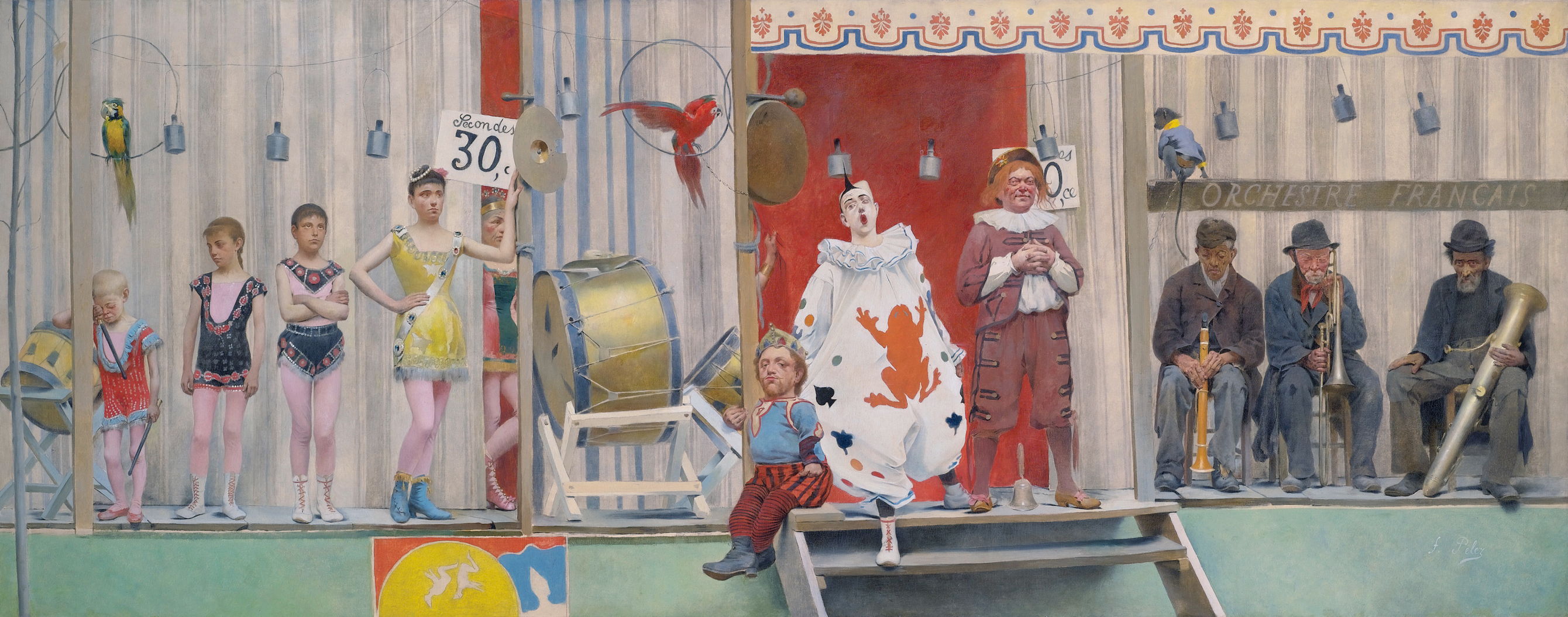
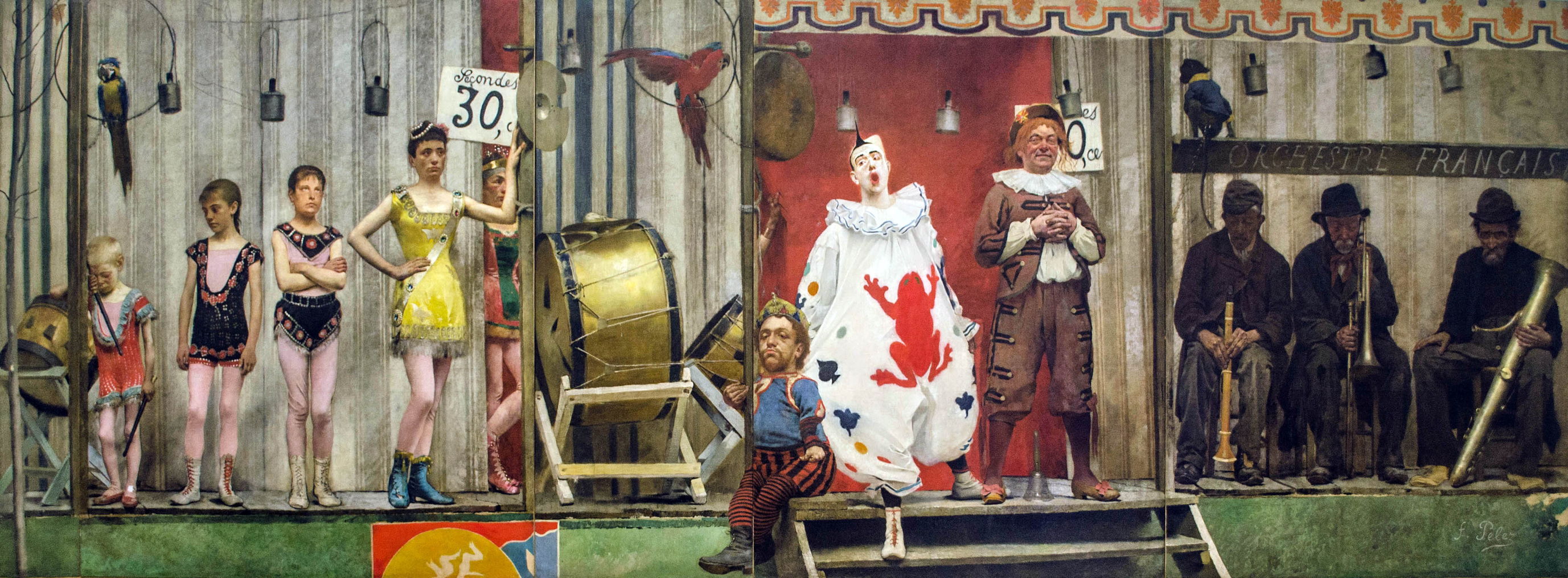
Fernand Pelez (1848-1913), Grimaces et misères: les Saltimbanques (Grimaces and Miseries: the Acrobats) (smaller version) (1888), oil on canvas, 114.6 x 292.7 cm, Private collection. Wikimedia Commons.
In 1888 Pelez progressed to Grimaces and Miseries: the Acrobats, or Les Saltimbanques, shown above in its smaller version, and below in the larger version exhibited to acclaim at the Salon. This follows the pattern of a traditional ‘ages of man’ image, in which the figures increase in stature from the start at the left edge, to the centre, then diminish again with advancing years, to the right.
Les Saltimbanques had been a successful show in the theatre fifty years earlier, and had lived on in entertainments staged in fairs around France. Contemporary performers attested to the faithfulness and accuracy of Pelez’s painting. This was featured and illustrated in the French weekly magazine l’Illustration, which also identified many of the models, who were performers in fairs and circuses.
Fernand Pelez (1848-1913), Grimaces et misères: les Saltimbanques (Grimaces and Miseries: the Acrobats) (larger version) (1888), oil on canvas, 222 x 625 cm, Musée du Petit Palais, Paris. Image by Morburre, via Wikimedia Commons.
Pelez never repeated the success of Les Saltimbanques, and in subsequent Salons faded from public view.
Christian Krohg (1852–1925), The Struggle for Existence (1889), oil on canvas, 300 x 225 cm, Nasjonalgalleriet, Oslo, Norway. Wikimedia Commons.
In the late 1880s the Norwegian artist Christian Krohg had been working on his next major painting, The Struggle for Existence (also translated as The Struggle for Survival) (1889). It shows Karl Johan Street in Oslo in the depths of winter, almost deserted except for a tight-packed crowd of poor women and children queuing for free bread.
Henri Jules Jean Geoffroy (1853–1924), The Night Hostel (or, The Soup Kitchen) (1891), further details not known. Wikimedia Commons.
Better known for his many paintings of schools and children, Henri Jules Jean Geoffroy’s painting of The Night Hostel or The Soup Kitchen (1891) shows homeless women and children being fed in what appears to be almost a prison.
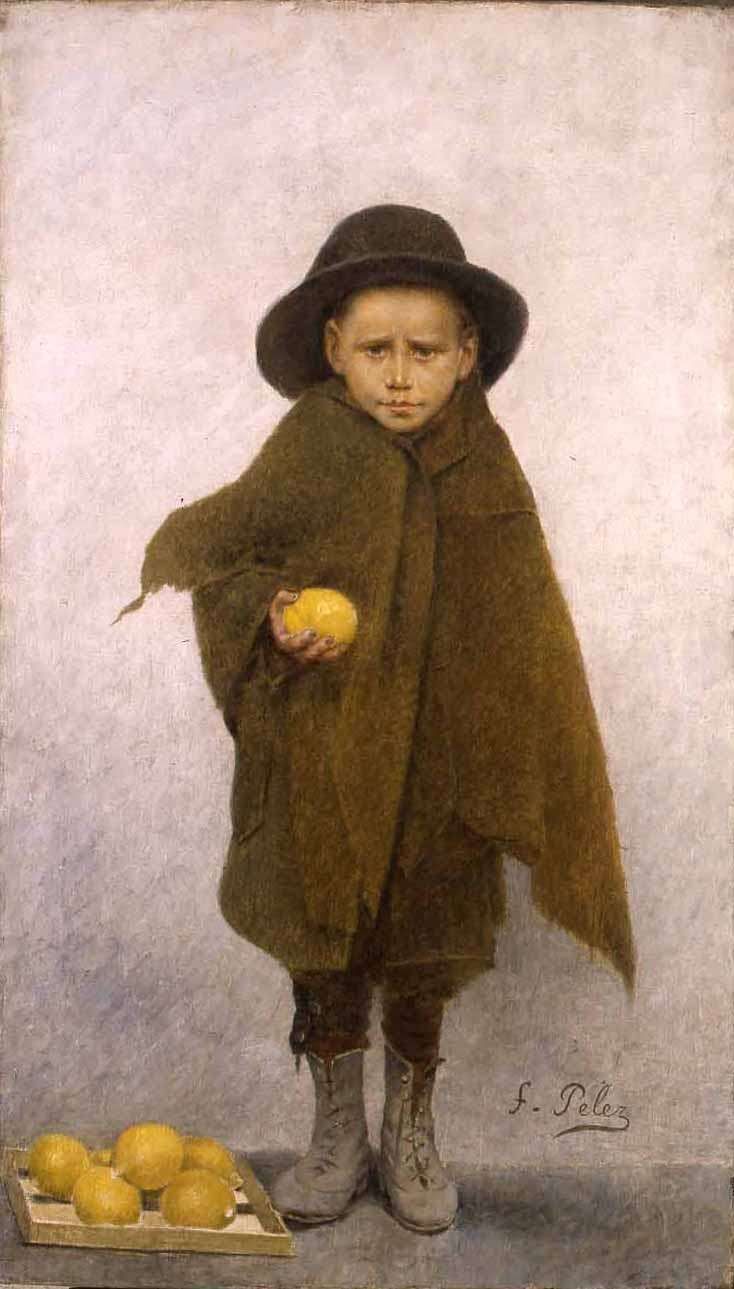
Fernand Pelez (1848-1913), The Little Lemon Vendor (c 1895-97), media and dimensions not known, Musée des Beaux-Arts, Chambéry, France. Wikimedia Commons.
Pelez painted six different versions of The Little Lemon Vendor (c 1895-97), of which this is thought to have been the last. It was never shown in a Salon, despite its compelling imagery.
Fernand Pelez (1848-1913), La Vachalcade (The Cow-valcade) (1896), media and dimensions not known, Musée du Petit Palais, Paris. Wikimedia Commons.
La Vachalcade (The Cow-valcade) (1896) is a reversal of a portrait of an affluent family by way of parody. Thirteen young revellers are taking part in a carnival procession, perhaps one of the Vachalcades that took place in Montmartre at the time. Some wear masks, others have the close-shorn hair characteristic of the poor, a measure against endemic parasites.
At the centre is a boy very similar to The Little Lemon Vendor, wearing an adult’s jacket and a huge hat. Behind him is a Pierrot character, and in the background a banner bearing the word Misère, misery. Dangling on that is a dead rat, a reference to a well-known café on the Place Pigalle. The ‘vache’ (cow) in the title refers to the French phrase manger de la vache enragée, meaning to live in poverty.
Critics and the public got their first taste of Naturalist painting in the Salons in the early 1880s, led by the success of Jules Bastien-Lepage. As Paris was the focal point of western painting at that time, this rapidly spread internationally, and ranged wider in its themes.
Literary Naturalism had spread with the translation of the writings of Hippolyte Taine (1828-1893) the critic and historian, Claude Bernard (1813-1878) the physiologist, and the Rougon-Macquart novels of Émile Zola (1840-1902), published between 1871-93. Those became accessible in all the major European languages by 1880, and attracted an intellectual following throughout Europe and North America.
At the time there was a strong Nordic school of painting in France, including Christian Skredsvig (friend of Edvard Munch), Nicolai Ulfsten, Carl Larsson, Karl Nordstrôm, Hans Heyerdahl, Erik Werenskiold, and Christian Krohg.
Christian Krohg (1852–1925), Port Side! (1879), oil on canvas, 99 x 70 cm, Nasjonalgalleriet, Oslo, Norway. The Athenaeum.
Krohg’s Port Side! (1879) is his only painting to be exhibited at the Salon. He started this when he was in Berlin, and completed it when at Skagen in Denmark in the summer of 1879. It didn’t set the Salon of 1882 alight, but was favourably received by some critics.
Hans Heyerdahl (1857–1913), The Dying Child (1881), oil on canvas, 59.5 x 70 cm, Nasjonalgalleriet, Oslo, Norway. Wikimedia Commons.
Hans Heyerdahl’s The Dying Child (1881) was so lauded it was bought from the Salon for the French nation, but has since returned to Norway. Although executed in an older, darker style this motif became popular with Nordic painters including Edvard Munch, and is typical of Naturalism.
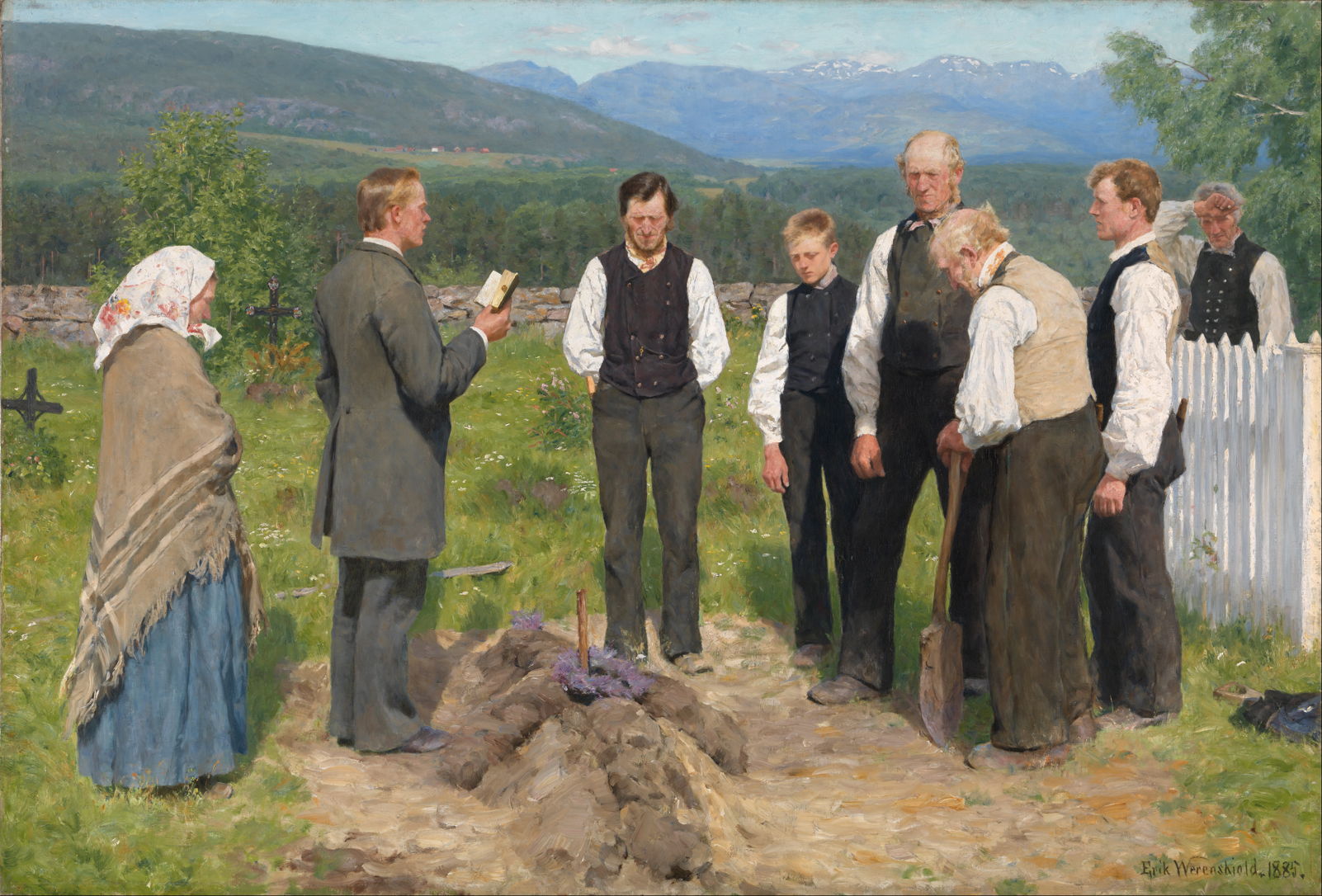
Erik Werenskiold (1855–1938), Peasant Burial (1885), oil on canvas, 102.5 x 150.5 cm, Nasjonalgalleriet, Oslo, Norway. Wikimedia Commons.
A little later, Erik Werenskiold painted his rural Norwegian response to Courbet’s Burial at Ornans, in his Peasant Burial of 1885.
Charles Frederic Ulrich (1858–1908), The Glass Blowers (1883), oil on canvas, 47.8 × 58.4 cm, Museo de Arte de Ponce, Ponce, Puerto Rico. Wikimedia Commons.
Charles Frederic Ulrich was born in New York City in 1858, and had travelled to Europe to attend the Royal Academy in Munich, Germany, as did so many other American painters, including William Merritt Chase. Many of his surviving works show different workplaces across Europe: in The Glass Blowers (1883) the work is delicate, in blowing and preparing glass domes, perhaps for use as covers of watches and clocks.
Joan Planella y Rodríguez (1849–1910), The Little Weaver (1882-89), oil on canvas, 67 x 55 cm, Museu d’Història de Catalunya, Barcelona, Spain. Wikimedia Commons.
Joan Planella was a Catalan painter who studied in Italy rather than France. The Little Weaver (1882-89) shown here is a replica of the original completed in 1882. It shows a young girl working at a large and complex loom in Catalonia, as a man lurks in the background, keeping a watch over her.
Léon Augustin Lhermitte (1844–1925), The Harvesters’ Pay (1882), oil on canvas, 215 x 272 cm, Musée d’Orsay, Paris. Wikimedia Commons.
Following the formative social realism of Jean-François Millet, Léon Lhermitte’s masterpiece The Harvesters’ Pay (1882) takes a more objective look at the realities of rural farmworkers. This evolved rapidly through Bastien-Lepage’s paintings of poor waifs and strays, to the grim battle for survival shown below in Fernand Pelez’s Homeless (1883).
Fernand Pelez (1848-1913), Homeless (1883), oil on canvas, 77.5 x 136 cm, location not known. Image by Bastenbas, via Wikimedia Commons.Antonino Gandolfo (1841–1910), Evicted (Let he who is without sin cast the first stone) (1880), oil on canvas, 88 x 63 cm, location not known. Image by Luigi Gandolfo, via Wikimedia Commons.
These were by no means confined to France. The Sicilian Antonino Gandolfo’s Evicted from 1880 raised similar concerns under a very different political regime.
Even more uncomfortable for the French Third Republic and other states was the depiction of industrial unrest as it swept across Europe in the late nineteenth century.
Alfred Philippe Roll (1846–1919), Miners’ Strike (1880), original badly damaged, shown here as reproduction from ‘Le Petit Journal’, 1 October 1892, further details not known. Wikimedia Commons.
A good example is Alfred Roll’s painting of a Miners’ Strike in 1880. This was probably made from life when he visited the strike at Denain in the Nord-Pas de Calais coalfield that year. His large original painting seems to have been exhibited at the Salon in Paris, from where it was purchased by the State. However, the artist had to sell at ‘cost price’ on the understanding that it would be hung in the capital, in the Ministry of Commerce, where it would have substantial impact.
Once the State got its hands on Roll’s painting, it was despatched to a local museum in Valenciennes, where it seems to have been largely forgotten. The original is now badly damaged, and the image shown above is reproduced from Le Petit Journal, where it didn’t appear until 1 October 1892.
By early 1884, Émile Zola had decided to write a novel in his Rougon-Macquart series about a miners’ strike, and in February 1884 the author visited a strike near Valenciennes, where Roll’s painting was on display, for his research. He started writing Germinal on 2 April 1884, and the book was published in serial form from November of that year. Its story centres on a miners’ strike in the Nord-Pas de Calais coalfield very similar to that painted by Roll, and it remains Zola’s most successful work.
The State may have successfully suppressed the immediate impact of Roll’s painting by hiding it away in the provinces, but in this case it had not anticipated its influence on Zola.
Industrial unrest in Belgium came to a head in 1886, with a succession of strikes across the country. These started in Liège as a commemoration of the fifteenth anniversary of the Paris Commune, but spread through industrialised zones to the region around Charleroi and Hainault.
Robert Koehler (1850–1917), The Strike in the Region of Charleroi (1886), oil on canvas, 181.6 × 275.6 cm, Deutsches Historisches Museum, Berlin, Germany. Wikimedia Commons.
Robert Koehler painted his masterpiece of The Strike in the Region of Charleroi that year, with a group of workers standing outside the smart entrance to offices. The top-hatted owner stands on the top step, one of his managers looking anxious beside him. The leader of the workers is at the foot of the steps telling the industrialist of the workers’ demands. The situation is looking increasingly nasty, although there are no signs yet of police or troops, or of violent confrontation.
Christian Krohg (1852–1925), Tired (1885), oil on canvas, 79.5 x 61.5 cm, Nasjonalgalleriet, Oslo, Norway. Wikimedia Commons.
Politics and art were mixing freely in the Nordic countries too. The Norwegian Christian Krohg explored the theme of fatigue and sleep, particularly among mothers. In Tired from 1885, the young woman seen here is no mother, but a seamstress, one of the many thousands who worked at home at that time, toiling for long hours by lamplight for a pittance.
Home work as a seamstress was seen as the beginning of the descent into prostitution, a major theme in Krohg’s painting and writing. The paltry income generated by sewing quickly proved insufficient, and women sought alternatives, which all too often led to them taking to the street.
Christian Krohg (1852–1925), Albertine in the Police Doctor’s Waiting Room (1885-87), oil on canvas, 211 x 326 cm, Nasjonalgalleriet, Oslo, Norway. Wikimedia Commons.
Just before Christmas 1886, Krohg’s first novel Albertine was published by a left-wing publisher. Its central theme is prostitution in Norway at the time, and the police quickly seized all the copies they could find, banning it on the grounds of violating the good morals of the people. Krohg was found guilty of the offence the following March and fined, although the police were only able to seize 439 of the first 1600 copies to go into circulation.
At the same time as he was writing that novel, Krohg had been working on his largest and most complex painting: Albertine in the Police Doctor’s Waiting Room (1885-87). He also painted several other scenes from the book. Curiously, Krohg’s campaigning writing and painting didn’t want prostitution made legal: quite the opposite, he and others wanted it banned.
Naturalist painting also helped promote advances being made by the state in healthcare and education.
Henri Gervex (1852–1929), Before the Operation (1887), oil on canvas, 242 x 188 cm, Musée d’Orsay, Paris. Wikimedia Commons.
The depiction of modern hospitals, medical teaching and research is a feature of Naturalism. Henri Gervex, who rose to fame with a ‘shocking’ painting of a nude courtesan on the morning after, found a little flesh at the Hôpital Saint-Louis, where an eminent doctor is teaching Before the Operation in 1887.
Jean Geoffroy (1853-1924), Primary School Class (1889), oil on canvas, 145 x 220 cm, Ministère de l’Education Nationale, Paris. Wikimedia Commons.
Jean Geoffroy’s Primary School Class from 1889 shows one of the Third Republic’s new lay teachers working diligently in the classroom with her pupils. This was deemed sufficiently positive to the State as to be purchased by the French National Ministry of Education, where it still hangs.

 Login
Login