
Normal view

There are new articles available, click to refresh the page.
Before yesterdayMain stream

Medium and Message: Mosaic

By: hoakley
14 April 2026 at 19:30

Mosaics, composed of small fragments of coloured stone, glass or ceramic in a matrix of plaster or mortar, have ancient origins in the civilisations of the Fertile Crescent in the Middle East. Although widely viewed as being decorative, some of the best examples transcend that to become fine art.

sanzeno
Unknown, Mosaic of the vault of the chapel of San Zeno (817-824 CE), Santa Prassede, Rome. Image by Livioandronico2013, via Wikimedia Commons.

This breathtaking mosaic in the vault of the chapel of San Zeno, in Santa Prassede, Rome, created in 817-824 CE, goes well beyond mere ceiling decoration.
IF
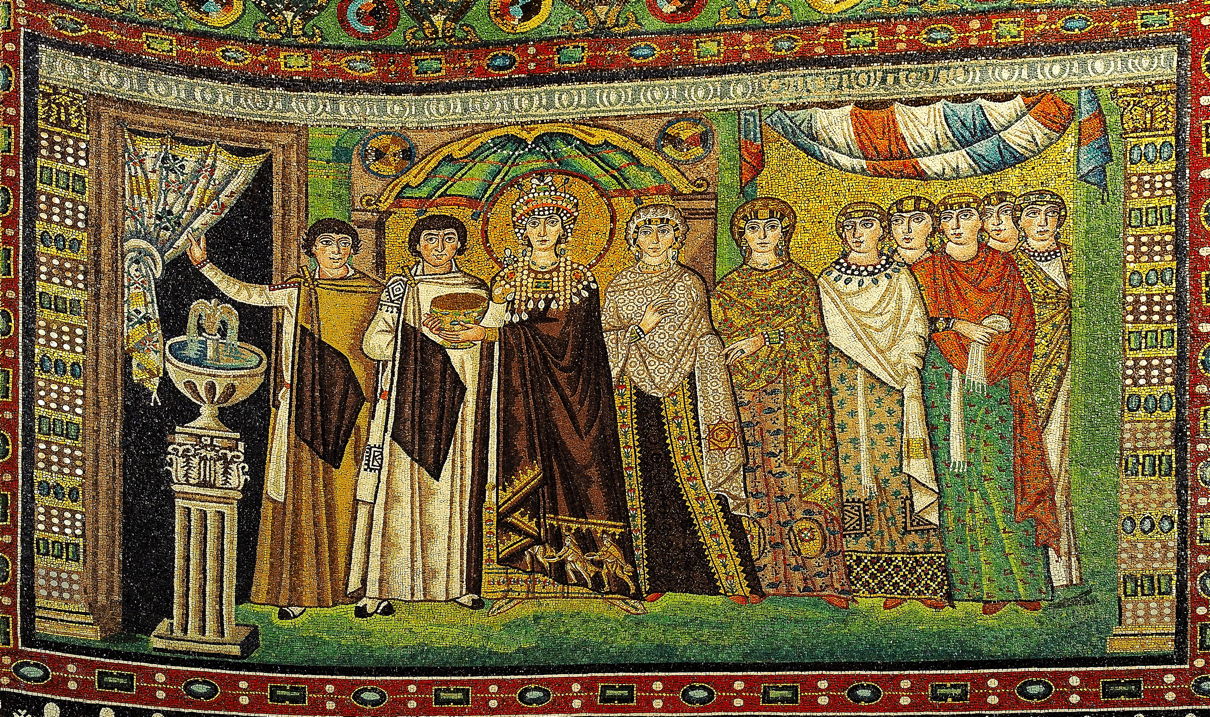
Unknown, Mosaic of Theodora – Basilica of San Vitale (built A.D. 547), Ravenna, Italy. UNESCO World heritage site. Image by Petar Milošević, via Wikimedia Commons.

At the end of 1903, Gustav Klimt visited one of the major collocations of mosaics in Ravenna, Italy, where he saw and was deeply impressed by the spectacular Byzantine mosaics of Justinian I and the Empress Theodora in the Basilica of San Vitale. They inspired a portrait he completed four years later.

klimtadeleblochbauer1
Gustav Klimt (1862–1918), Portrait of Adele Bloch-Bauer I (1907), oil, silver and gold on canvas, 140 x 140 cm, Private collection. Wikimedia Commons.

His first Portrait of Adele Bloch-Bauer (1907) is the most extreme and startling work from Klimt’s Golden Phase. Apart from her bust and arms, which are painted in oils, the rest of his canvas is, like the mosaic of the Empress Theodora, encrusted with gold and silver. Its decorative patterns include symbols of eyes, flowers, whorls, ellipses divided into halves, and rich textures worked into the gold leaf.

A few accomplished painters also created mosaics, usually later in their career.
mersonsacrecoeur
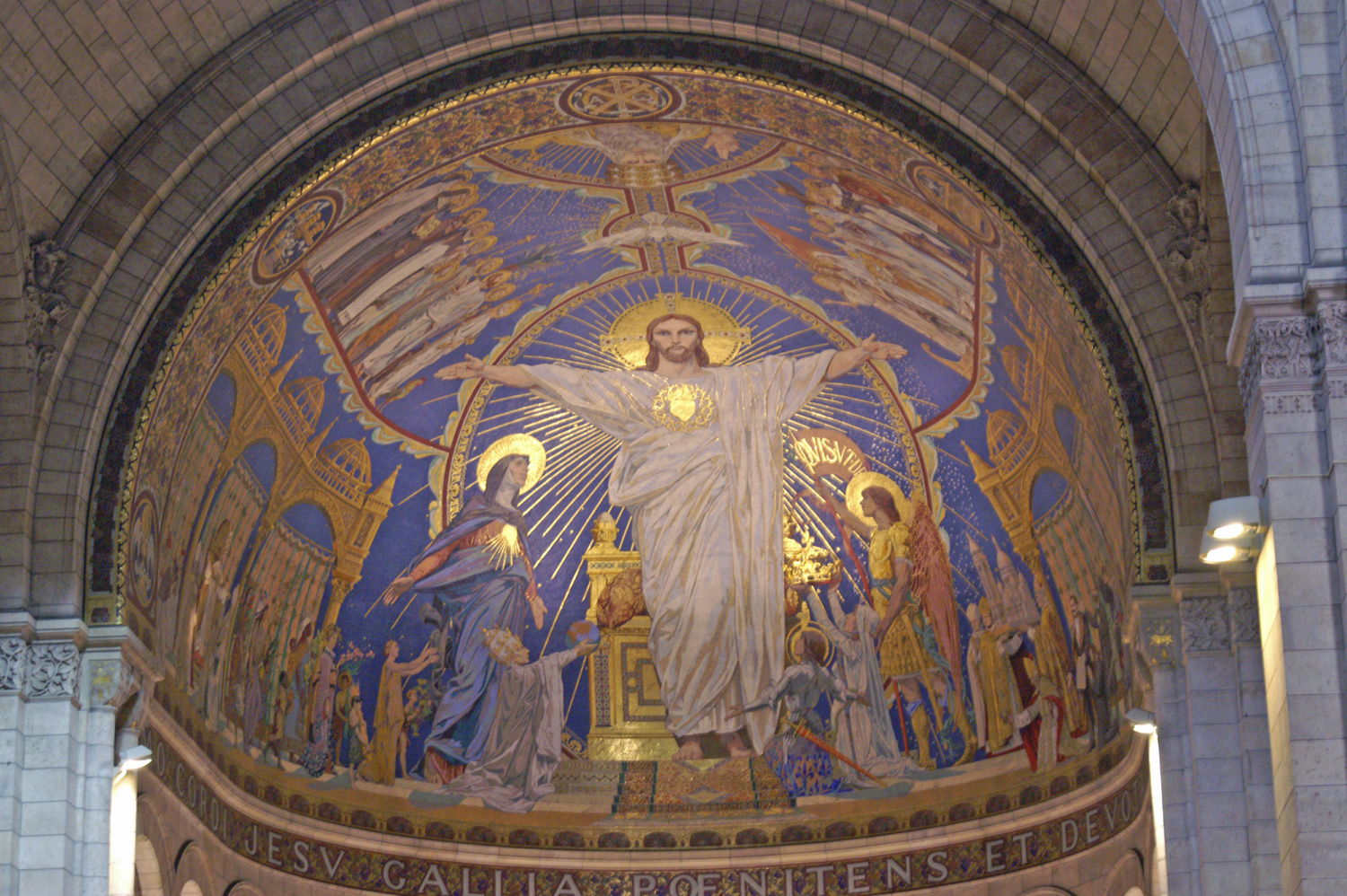
Luc-Olivier Merson (1846–1920), Christ in Majesty (date not known), mosaic, dimensions not known, Basilique du Sacré-Cœur de Montmartre, Paris. Image by Didier B, via Wikimedia Commons.

Between about 1890-1910, the French Naturalist painter Luc-Olivier Merson created this extraordinary mosaic of Christ in Majesty in the apse of the Basilica of the Sacred Heart (Sacré-Cœur) of Paris in Montmartre. This is thought to be one of the largest mosaics in the world.

At about the same time, the American painter Elihu Vedder was creating a mosaic in the central arched panel leading to the Visitor’s Gallery of the Library of Congress, in Washington, DC.
IF
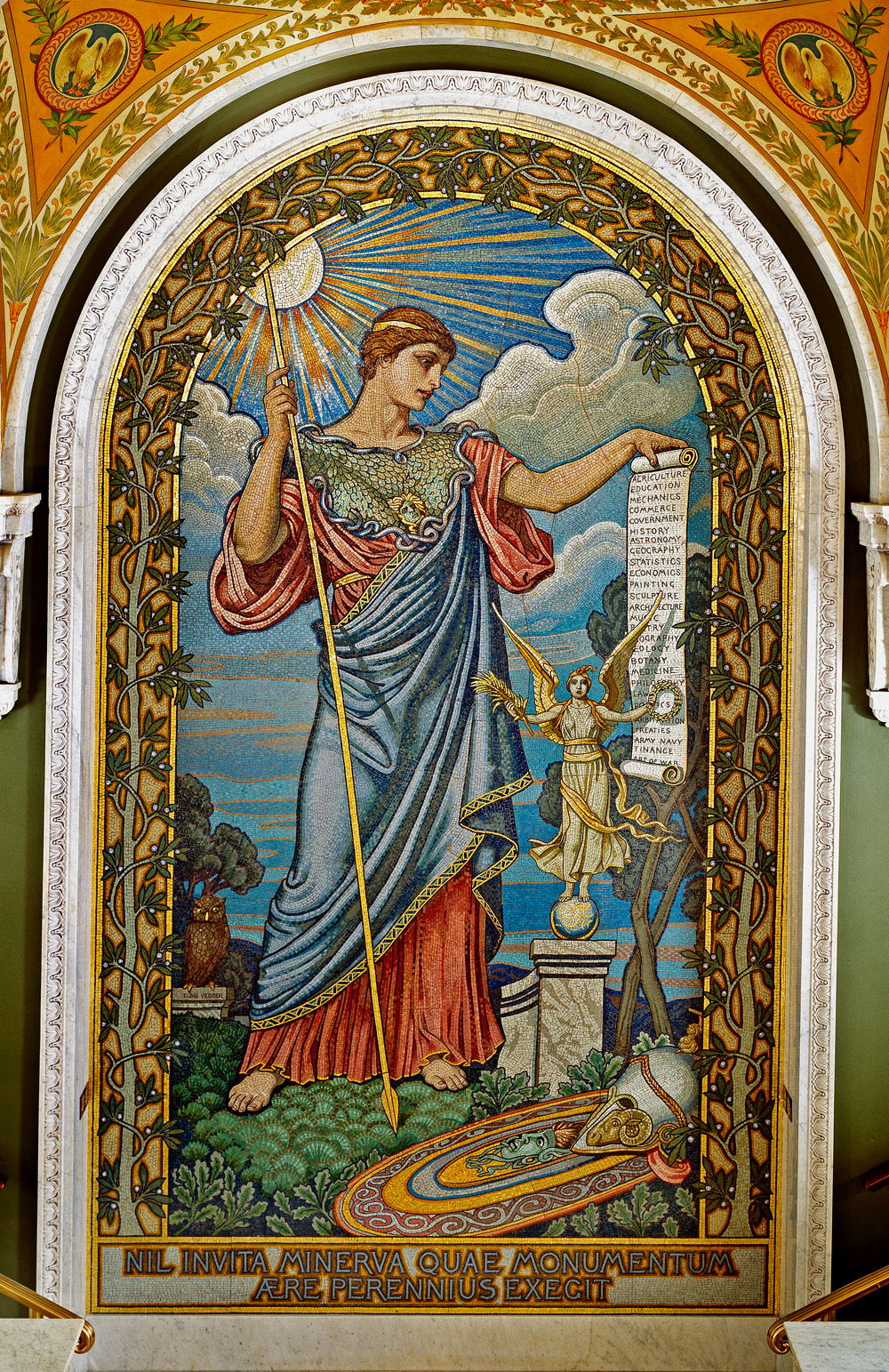
Elihu Vedder (1836–1923), Minerva of Peace (1897), mosaic, dimensions not known, central arched panel leading to the Visitor’s Gallery, Library of Congress Thomas Jefferson Building, Washington, DC. Photographed in 2007 by Carol M. Highsmith (1946–), who explicitly placed the photograph in the public domain, via Wikimedia Commons.

His Minerva of Peace (1897) shows this Roman goddess of wisdom, the guardian of civilisation, and sponsor of arts, trade, and strategy. Vedder stresses that this was attained by warfare, and shows a miniature statue of Nike, the Greek winged goddess of victory, known to the Romans as Victoria. Nike holds the palm frond of peace and the laurel of victory.

Minerva’s helmet and shield rest on the ground, but she remains ever-vigilant in holding a spear in her right hand. Her left hand holds a scroll listing the fields of learning, from Agriculture to Zoology and Finance. These reveal her association with wisdom and knowledge. To the left of Minerva’s right knee is an owl, symbolising wisdom.

The inscription below, Nil invita Minerva, quae monumentum aere perennius exegit, means Not unwilling, Minerva raises a monument more lasting than bronze, and is quoted from Horace’s Ars Poetica.

Other artists painted in the style of mosaics.
sichulskihutsulmadonna
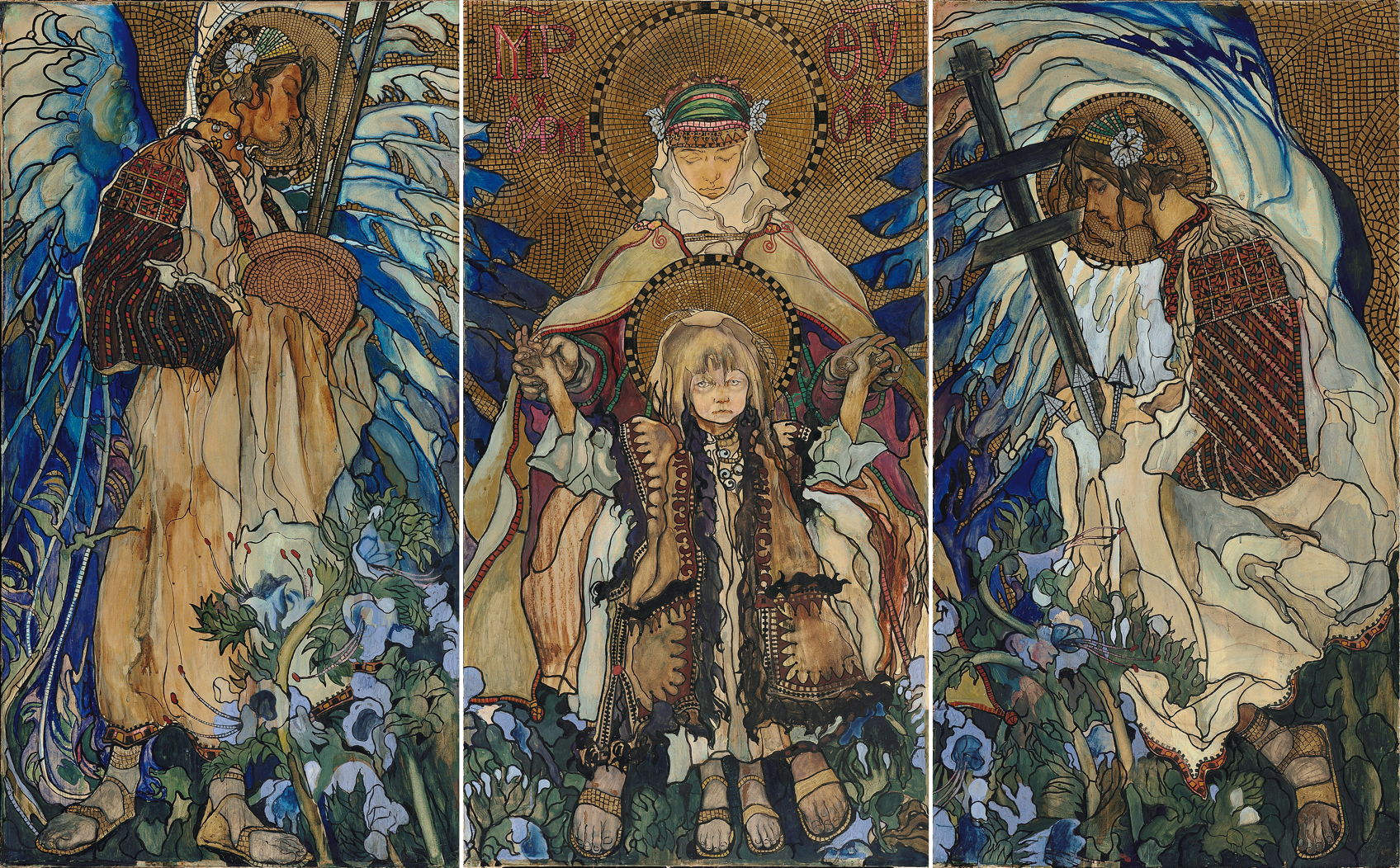
Kazimierz Sichulski (1879–1942), The Hutsul Madonna (1909), tempera and pastel on paper laid on canvas, 167 x 270 cm (overall), Österreichische Galerie Belvedere, Vienna, Austria. Wikimedia Commons.

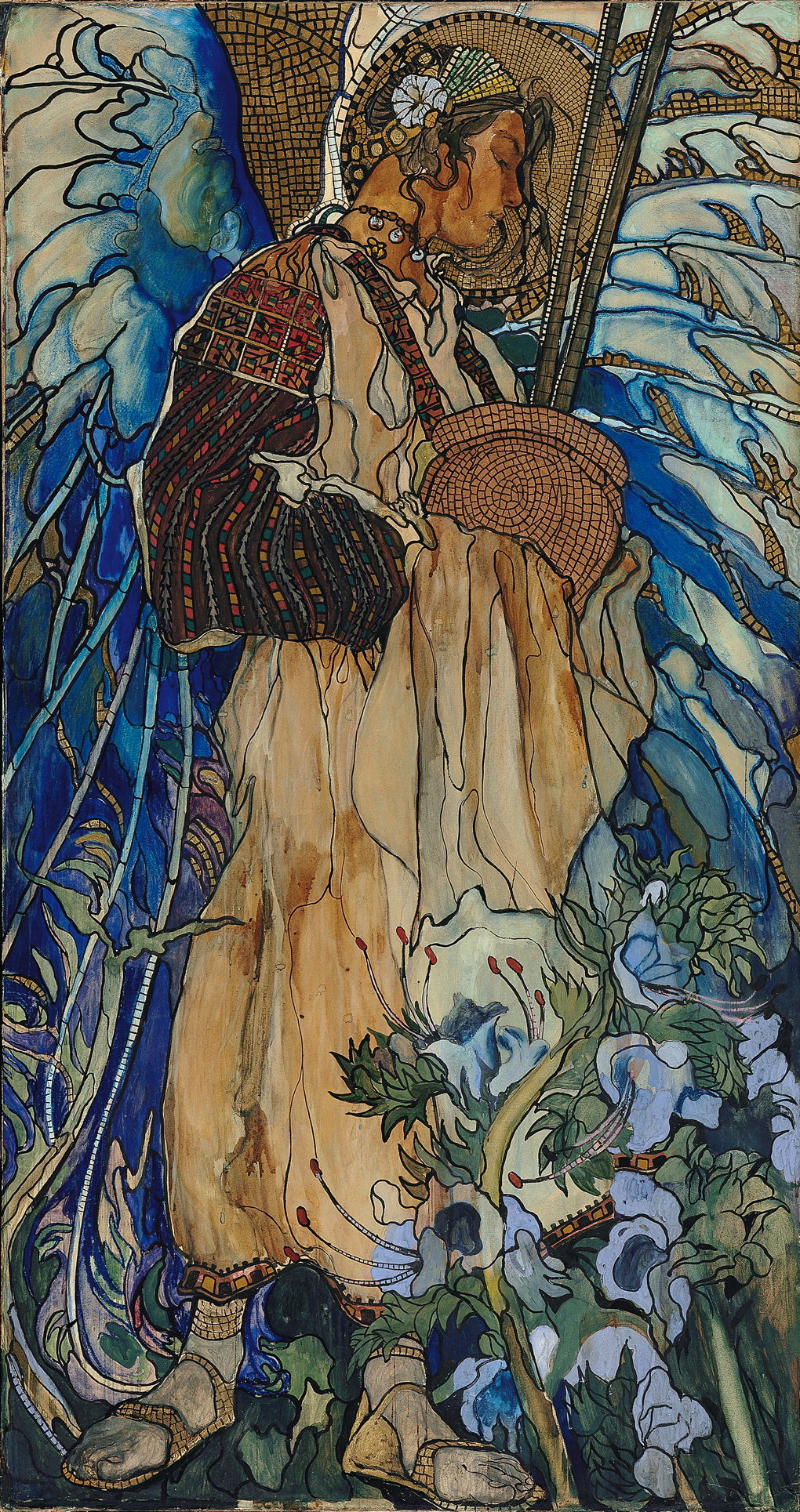
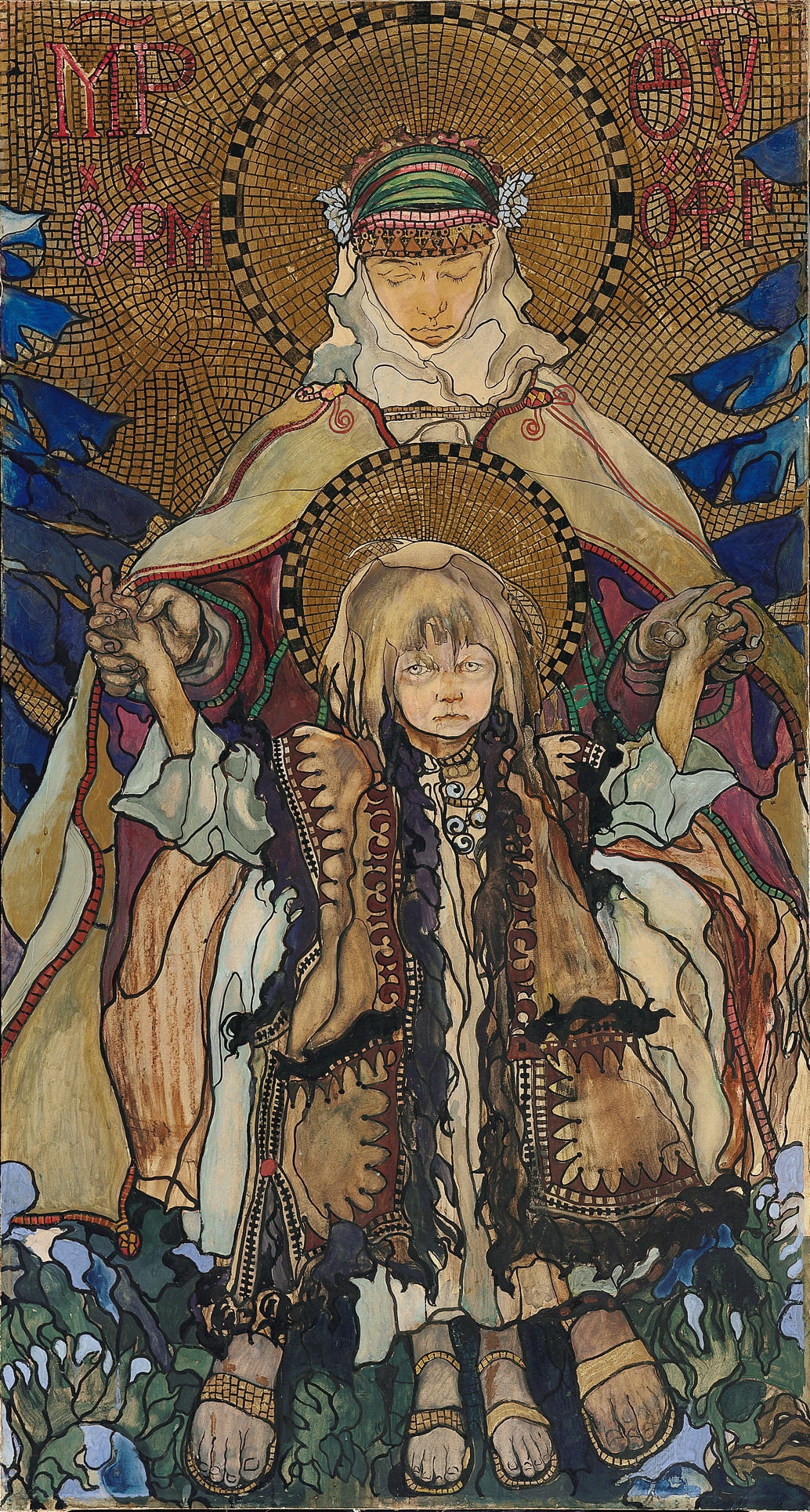
In The Hutsul Madonna from 1909, Kazimierz Sichulski used a combination of tempera and pastel to create passages that appear to be mosaics, while others look more like stained glass, in a luminous Art Nouveau style.
sichulskihutsulmadonna1
Kazimierz Sichulski (1879–1942), The Hutsul Madonna (left panel) (1909), tempera and pastel on paper laid on canvas, 167 x 270 cm (overall), Österreichische Galerie Belvedere, Vienna, Austria. Wikimedia Commons.

Above is the left panel, and below is its centre panel.
sichulskihutsulmadonna2
Kazimierz Sichulski (1879–1942), The Hutsul Madonna (centre panel) (1909), tempera and pastel on paper laid on canvas, 167 x 270 cm (overall), Österreichische Galerie Belvedere, Vienna, Austria. Wikimedia Commons.

Some of the Divisionists, notably Paul Signac, applied their paint in small rectangular patches termed tesserae, the same word for the coloured pieces used to compose mosaics.

signaclighthousegroix568
Paul Signac (1863-1935), Lighthouse at Groix (Cachin 568) (1925), oil on canvas, 74 x 92.4 cm, Metropolitan Museum of Art, New York, NY. Wikimedia Commons.

Signac adopted these by 1905, and continued to use them for the rest of his career. They’re shown above in his painting of The Lighthouse at Groix from 1925, and in the detail below. These are oriented to help form each object.

signaclighthousegroix568d1
Paul Signac (1863-1935), Lighthouse at Groix (Cachin 568) (detail) (1925), oil on canvas, 74 x 92.4 cm, Metropolitan Museum of Art, New York, NY. Wikimedia Commons.

Although these create a distinctive effect, they don’t follow Georges Seurat’s original intention of optical mixing of colours in fine dots, although they’re much quicker to apply, and refer back to the great Byzantine mosaics.

On Reflection: Divisionism

By: hoakley
9 April 2026 at 19:30

Given the technical challenge of painting optically faithful reflections on water, the painstaking and protracted work required for Divisionist techniques resulted in the omission of reflections, or only notional depictions. This article gathers some examples of Divisionist paintings that were taken the extra mile, and tried to do better.

Georges Seurat, Landscape - the Island of the Grande Jatte (1884), oil on canvas, 69.9 x 85.7 cm, Private collection. WikiArt.
Georges Seurat (1859–1891), Landscape – the Island of the Grande Jatte (1884), oil on canvas, 69.9 x 85.7 cm, Private collection. WikiArt.

Seurat’s first and greatest masterpiece, generally known as La Grande Jatte, uses the technique of optical mixing of colour. Rather than blending pigments on the canvas, it’s constructed of tiny high chroma dots to allow for optical mixing. Recognising the difficulty of recreating reflections when he was laboriously applying those dots to the large canvas for his finished painting, Seurat developed them in smaller studies such as that above.

Georges Seurat, Un dimanche après-midi à l'Île de la Grande Jatte (A Sunday Afternoon on the Island of La Grande Jatte) (1884-6), oil on canvas, 207.5 × 308.1 cm, Art Institute of Chicago, Chicago, IL. Wikimedia Commons.
Georges Seurat (1859–1891), Un dimanche après-midi à l’Île de la Grande Jatte (A Sunday Afternoon on the Island of La Grande Jatte) (1884-6), oil on canvas, 207.5 × 308.1 cm, Art Institute of Chicago, Chicago, IL. Wikimedia Commons.

Those are seen quoted in the finished work, which took him almost eighteen months to paint in three stages between 1884-86.

Camille Pissarro, Île Lacruix Rouen, Effect of Fog, 1888, oil on canvas, 44 x 55 cm, private collection. (WikiArt)
Camille Pissarro (1830-1903), The Seine at Rouen, the Île Lacroix, Effect of Fog (1888), oil on canvas, 46.7 x 55.9 cm, Philadelphia Museum of Art, Philadelphia, PA. (WikiArt)

The Seine at Rouen, the Île Lacroix, Effect of Fog from 1888 is one of Camille Pissarro’s best-known Divisionist paintings, and one of the few to depict reflections in detail. This was based on studies he had made during a visit to the city back in 1883, five years before he started work on this finished painting.

signacseineesandelys142
Paul Signac (1863-1935), Les Andelys. Le Quai (The Seine at Les Andelys) (Op 142) (1886), oil on canvas, 46 x 65 cm, Norton Simon Museum, Los Angeles, CA. Wikimedia Commons.

Paul Signac also made use of sketches made in front of the motif, such as this of Les Andelys. Le Quai from 1886, which contains extensive passages of reflections.

signaclesandelyscoôtedaval139
Paul Signac (1863-1935), Les Andelys. Côte d’aval (Op 139) (1886), oil on canvas, 64 x 95 cm, Art Institute of Chicago, Chicago, IL. Wikimedia Commons.

His finished view of Les Andelys. Côte d’aval, completed the same year, completely omits reflections, though.

signaclesandelysberge141
Paul Signac (1863-1935), Les Andelys. La Berge (Op 141) (1886), oil on canvas, 65 x 81 cm, Musée d’Orsay, Paris. Wikimedia Commons.

A different view of the same village, Les Andelys. La Berge, from the same year, includes extensive reflections that appear fairly accurate.

signacsunsetherblay206
Paul Signac (1863-1935), Sunset, Herblay (Op 206) (1889 Sep), oil on canvas, 58.1 x 90.2 cm, Kelvingrove Art Gallery and Museum, Glasgow, Scotland. Wikimedia Commons.

Signac’s Sunset, Herblay, painted in September 1889, is a good attempt but has small disparities. For example, reflected images of the trees seen on the bank at the left don’t tally with their originals in either vertical or horizontal dimension.

signaceveningcalmconcarneau220
Paul Signac (1863-1935), Evening Calm, Concarneau, Opus 220 (Allegro Maestoso) (Op 220) (1891), oil on canvas, 64.8 x 81.3 cm, Metropolitan Museum of Art, New York, NY. Wikimedia Commons.

Evening Calm, Concarneau, Opus 220 (Allegro Maestoso) from 1891 must have been a major challenge that Signac carries off with aplomb. Again there are some small discrepancies: the most prominent boat in the foreground is heeling slightly to the left, but the left side of its reflection if anything leans slightly to the right.

signactartanes240
Paul Signac (1863-1935), Tartanes pavoisées (Sailing Boats in Saint-Tropez Harbour) (Op 240) (1893), oil on canvas, 56 x 46 cm, Von der Heydt Museum, Wuppertal, Germany. Wikimedia Commons.

Reflections are even more complex in Signac’s Tartanes pavoisées, or Fishing Boats Dressed Overall, from 1893. To get its triangular composition right, and inform his rendering of the reflections, he painted three studies for this. Despite that, two years later he traded this painting for a bicycle, but in 1910 it became his first painting to enter a public collection, in Wuppertal, Germany.

Paul Signac, The Port of Saint-Tropez (1901-2), oil on canvas, 131 x 161.5 cm, National Museum of Western Art, Tokyo. WikiArt.
Paul Signac (1863-1935), The Port of Saint-Tropez (1901-2), oil on canvas, 131 x 161.5 cm, National Museum of Western Art, Tokyo. WikiArt.

Another challenging view of The Port of Saint-Tropez from 1901-2 is less precise, but uses reflections to great effect.

signacgiudecca411
Paul Signac (1863-1935), Mouillage de la Giudecca (Giudecca Anchorage, S. Maria della Salute) (Cachin 411) (1904), oil on canvas, 73.5 x 92.5 cm, Neue Pinakothek, Munich, Germany. Image by Ad Meskens, via Wikimedia Commons.

Signac’s later Giudecca Anchorage from 1904 uses coarser tiles of colour, giving him more leeway.

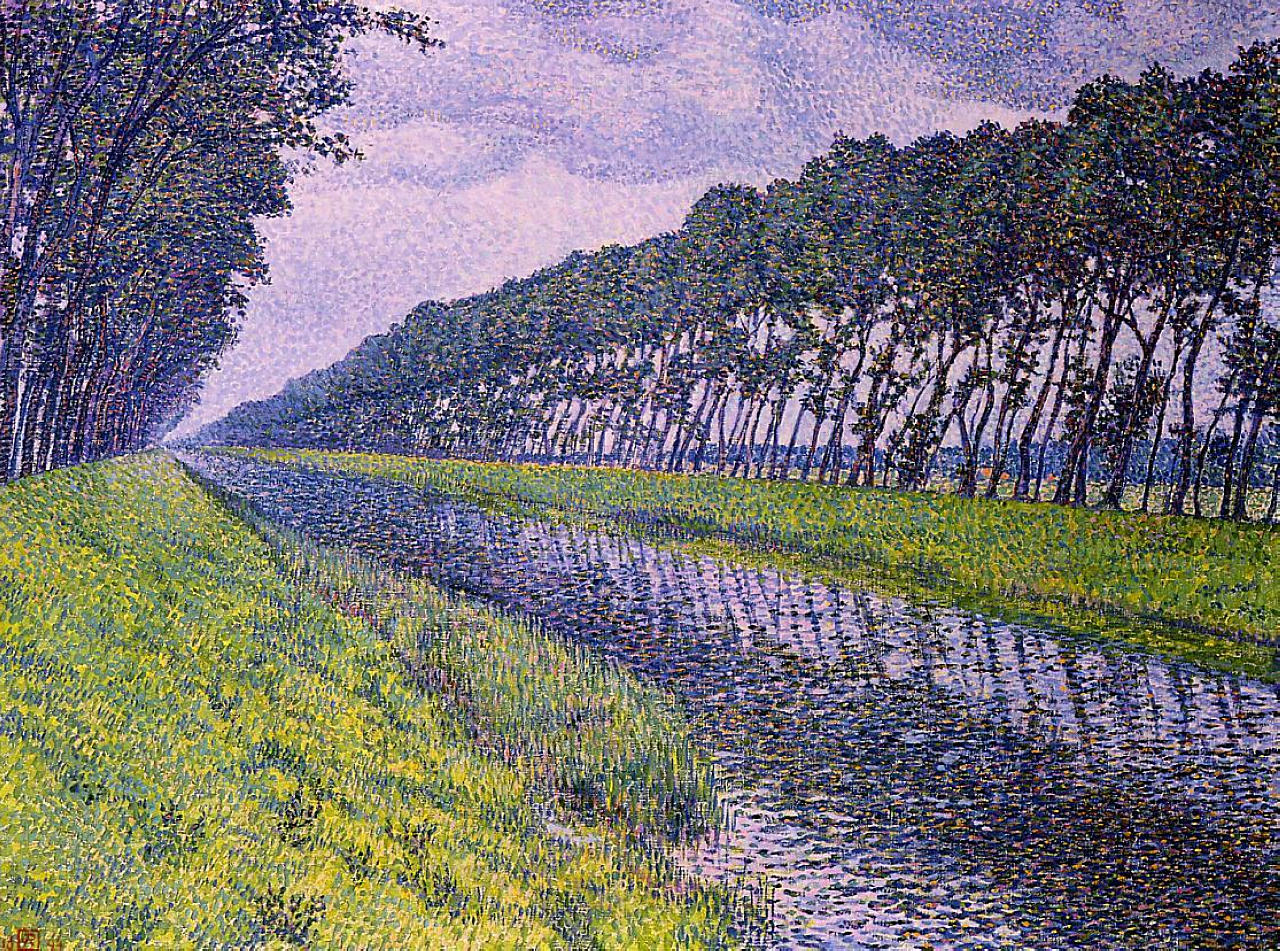
Of all the Neo-Impressionist and Divisionist paintings of reflections, the undisputed champion must be Théo van Rysselberghe’s Canal in Flanders from 1894. This too was preceded by a study, but that almost completely excluded any reflections. The artist then moved his viewpoint to the right, and must have spent months getting its reflections right.

Théo van Rysselberghe (1862-1926), Canal in Flanders (1894), oil on canvas, 152.4 x 203.2 cm, Private collection. WikiArt.

This uniquely combines radical perspective projection, intense rhythm and meticulous reflections. The artist painted few further views with reflections afterwards.

❌
❌