Normal view

There are new articles available, click to refresh the page.
Before yesterdayMain stream

Hero or hooligan: Theseus and Ariadne

By: hoakley
25 May 2026 at 19:30

The classical Greek hero Theseus had travelled overland to be reunited with his father Aegeus, King of Athens, where he narrowly escaped death by Medea’s poison. Following the example of his hero Heracles, he then killed the Marathonian Bull, in preparation for his most famous accomplishment, killing the half-bull, half-human Minotaur living at the centre of the Labyrinth on the island of Crete.

King Minos of Crete had been exacting a tribute of nine young men and nine maidens from Athens every nine years, who were taken to the Labyrinth to die. On the third such call for eighteen of Athens’ finest, its citizens accused Aegeus of being its cause. Although a matter of dispute as to how he accomplished it, Theseus went to Crete as one of those eighteen.

The Minotaur 1885 by George Frederic Watts 1817-1904
George Frederic Watts (1817–1904), The Minotaur (1885), oil on canvas, 118.1 x 94.5 cm, The Tate Gallery (Presented by the artist 1897), London. © The Tate Gallery and Photographic Rights © Tate (2016), CC-BY-NC-ND 3.0 (Unported), http://www.tate.org.uk/art/artworks/watts-the-minotaur-n01634

George Frederic Watts was apparently driven to paint The Minotaur in 1885 as a response to a series of articles in the press revealing the industry of child prostitution in late Victorian Britain. Those referred to the myth of the Minotaur, so early one morning he painted this image of human bestiality and lust. His Minotaur has crushed a small bird in its left hand, and gazes out to sea, awaiting the next shipment of young men and virgin women from Greece.

Because the Athenians knew that their young people weren’t going to return, the ship carrying them to Crete had black sails. On this occasion, though, Theseus gave its crew a white sail, telling Aegeus and the crew that when they returned, if he had been successful in killing the Minotaur, they would set that white sail as a sign.

moreauatheniansdeliveredtominotaur
Gustave Moreau (1826–1898), Athenians Being Delivered to the Minotaur (1855), oil, dimensions not known, Musée de Brou, Bourg-en-Bresse, France. Wikimedia Commons.

Gustave Moreau’s painting of Athenians Being Delivered to the Minotaur (1855) shows the victims as they were preparing to enter the Labyrinth. Wearing laurel wreaths to mark their distinction and sacrifice, the young men and women hold back while Theseus crouches, waiting to do battle with the beast, seen at the right.

Left to his own devices, Theseus’ chances were not good. However, Minos’ daughter Ariadne had fallen in love with him when she saw him compete in the funereal games preceding the act of sacrifice, and promised to assist in return for his hand in marriage afterwards. It was she who provided Theseus with a ball of thread which he deployed as he entered the Labyrinth, enabling him to retrace his steps once he had killed the Minotaur at its centre.

fuseliariadnewatchingtheseus
Henry Fuseli (1741–1825), Ariadne Watching the Struggle of Theseus with the Minotaur (1815-20), brown wash, oil, white gouache, white chalk, gum and graphite on moderately thick, moderately textured, beige wove paper, 61.6 x 50.2 cm, Yale Center for British Art, New Haven, CT. Wikimedia Commons.

In Henry Fuseli’s spirited mixed-media sketch of Ariadne Watching the Struggle of Theseus with the Minotaur (1815-20), Theseus appears almost skeletal as he tries to bring his dagger down to administer the fatal blow, and Ariadne resembles a wraith or spirit.

chaisetheseusvictor
Charles-Édouard Chaise (1759-1798), Theseus, Victor over the Minotaur (c 1791), oil on canvas, dimensions not known, Musée des Beaux-Arts, Strasbourg, France. Image by Rama, via Wikimedia Commons.

Theseus, Victor over the Minotaur (c 1791) is one of only three paintings by Charles-Édouard Chaise known to survive. With its crisp neo-classical style, it shows Theseus standing in triumph over the lifeless corpse of the Minotaur. He is almost being mobbed by the young Athenian women whose lives he has saved. At the left, his thread rests on a wall by an urn, suggesting the young woman by it may be Ariadne; she is being helped by a young man.

There are conflicting stories as to what happened next, but Theseus and Ariadne departed from Crete, ending up on the island of Naxos, where Theseus abandoned her and sailed on. This has been depicted by many painters, although most have naturally concentrated on the jilted Ariadne rather than her betrayer Theseus.

waterhouseariadne
John William Waterhouse (1849–1917), Ariadne (1898), oil on canvas, 151 x 91 cm, Private collection. Wikimedia Commons.

John William Waterhouse paints the moment that Ariadne (1898) starts to wake, as Theseus’ ship has just sailed. As she hasn’t yet realised she has been abandoned, she lies back at ease. On and under the couch are a couple of leopards, a clear reference to the imminent arrival of Dionysus.

borariadne
Paulus Bor (circa 1601–1669), Ariadne (1630-35), oil on canvas, 149 x 106 cm, Muzeum Narodowe w Poznaniu, Poznań, Poland. Wikimedia Commons.

Paulus Bor’s portrait of Ariadne, painted in the period 1630-35, can only show her on Naxos, immediately after she has been abandoned, still clutching the thread by which she thought she had tethered him, now hanging at a loose end. On the wall above her are sketches she has made of her lover. She looks deeply lost in thought and gloom.
corinthariadnenaxos
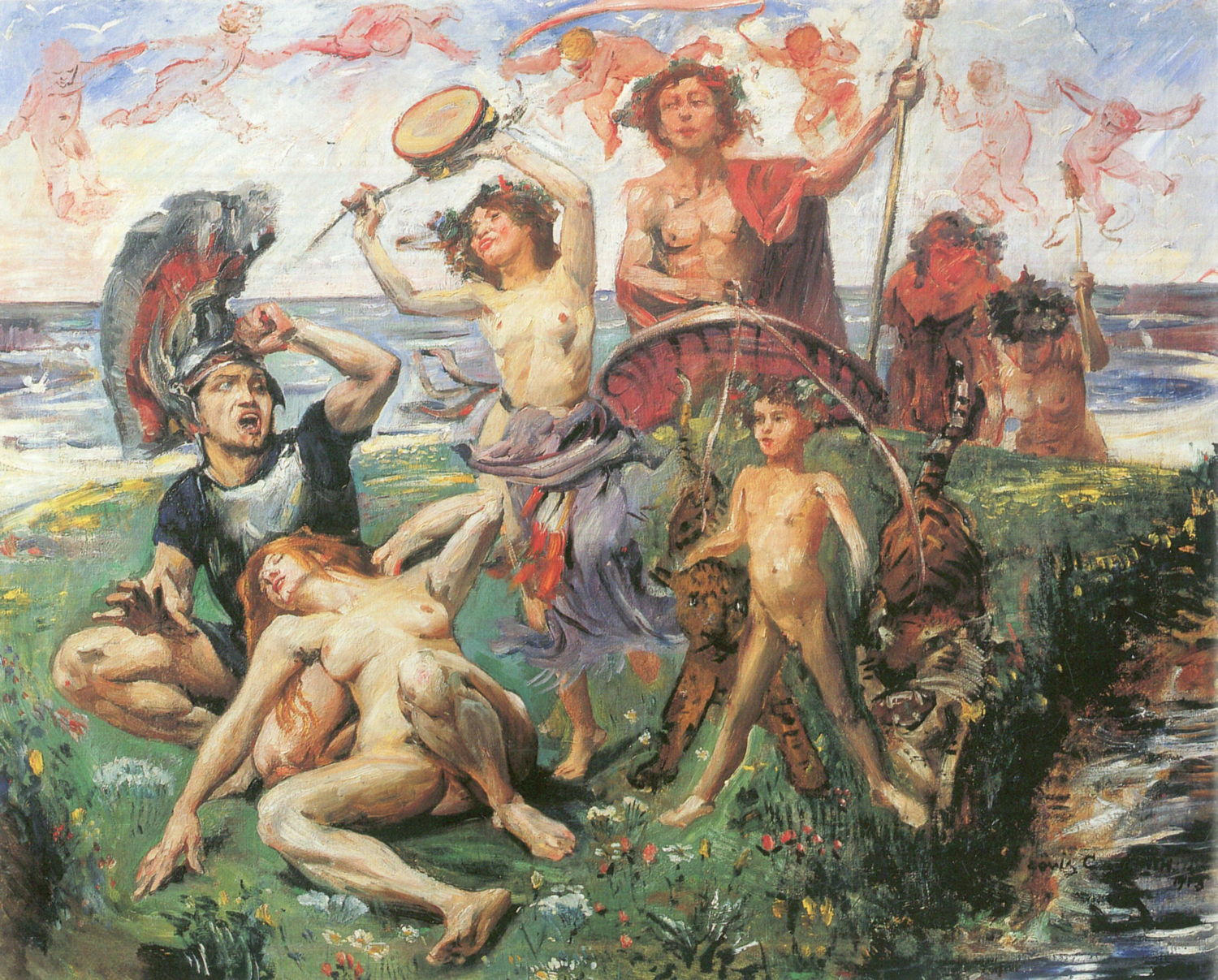
Lovis Corinth (1858–1925) Ariadne on Naxos (1913), oil on canvas, 116 × 147 cm, Private collection. Wikimedia Commons.

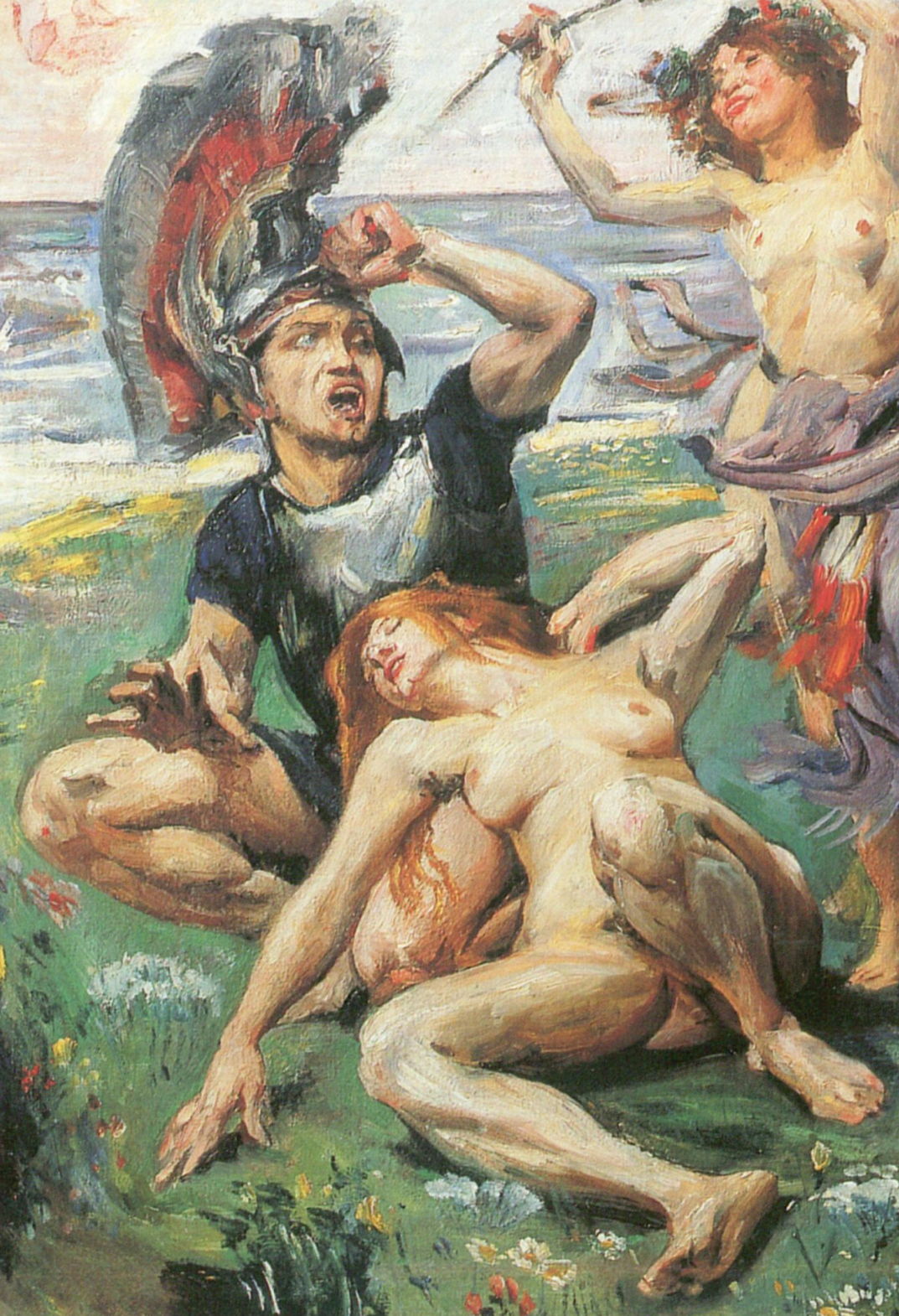
Lovis Corinth’s Ariadne on Naxos (1913) is one of his most sophisticated and masterly mythical paintings, inspired by the first version of Richard Strauss’s opera Ariadne auf Naxos (1912). The left third of the painting (detail below) shows Ariadne lying in erotic langour on Theseus’ left thigh. He wears an exuberant helmet, and appears to be shouting angrily and anxiously towards the other figures to the right.
corinthariadnenaxosdet1
Lovis Corinth (1858–1925) Ariadne on Naxos (detail) (1913), oil on canvas, 116 × 147 cm, Private collection. Wikimedia Commons.

Having called in briefly at Delos, Theseus and his ship returned to Athens. But in their delight and celebration, they forgot to hoist the white sail to indicate the success of their mission. Seeing their ship with its black sail still set, Theseus’ father King Aegeus threw himself from a cliff in despair, and died.

Theseus’ return to Athens thus brought an odd mixture of celebration at his success, and lamentation at the death of his father. Their ship was carefully preserved as a monument to Theseus’ accomplishment, and he set about transforming and growing the city by settling all the citizens of Attica in it. He promised government without a king, by means of democracy, making himself its commander in war and the guardian of its laws. He also had its currency struck into coins, and instituted the Isthmian (Olympic) Games.

Back on the island of Naxos, Ariadne went on to marry Dionysus, the couple had many children, and lived happily ever after.

For Theseus, life wasn’t going to be as simple.

On Reflection: Extending the image

By: hoakley
20 May 2026 at 19:30

Jan van Eyck’s famous double-portrait of the Arnolfini Wedding (1434) introduced mirror-play, but didn’t quite demonstrate its use to extend the scene depicted because of the small size of its reflected image. Surprisingly it appears that four centuries were to pass before reflections became more widely adopted for this purpose, although I’m sure they had already been used for it in interior decoration.

One of the earliest of my examples refers back to the Arnolfini Wedding in its use of a circular and non-planar mirror.

'Take your Son, Sir' ?1851-92 by Ford Madox Brown 1821-1893
Ford Madox Brown (1821–1893), Take your Son, Sir! (1851-52), oil on canvas, 70.5 x 38.1 cm, The Tate Gallery (Presented by Miss Emily Sargent and Mrs Ormond in memory of their brother, John S. Sargent), London. © The Tate Gallery and Photographic Rights © Tate (2016), CC-BY-NC-ND 3.0 (Unported), https://www.tate.org.uk/art/artworks/brown-take-your-son-sir-n04429

The dates and background to Ford Madox Brown’s unfinished painting Take your Son, Sir! remain unclear. It’s thought that Brown started work on this in 1851, although it shows his second wife Emma with their newborn son. Their first son, Oliver, wasn’t born until 1855, and their second, Arthur, in September 1856, suggesting that he didn’t start this until at least 1855. It’s generally held that this shows not Oliver, who lived until 1874, but Arthur, who died aged ten months in July 1857, at which time Brown abandoned the painting. The detail seen reflected in the mirror is of a contemporary living room and a man, presumably a self-portrait.

The Awakening Conscience 1853 by William Holman Hunt 1827-1910
William Holman Hunt (1827-1910), The Awakening Conscience (1851-53), oil on canvas, 76.2 x 55.9 cm, The Tate Gallery (Presented by Sir Colin and Lady Anderson through the Friends of the Tate Gallery 1976), London. © The Tate Gallery and Photographic Rights © Tate (2016), CC-BY-NC-ND 3.0 (Unported), https://www.tate.org.uk/art/artworks/hunt-the-awakening-conscience-t02075

A few years before that, William Holman Hunt’s The Awakening Conscience, painted over the period 1851-53, employs the reflection seen in a much larger mirror to add substantial detail to its unresolved narrative. This places the scene in a small if not cramped house in the leafy suburbs of London, in reality Saint John’s Wood, where this couple are clearly in an extra-marital relationship.

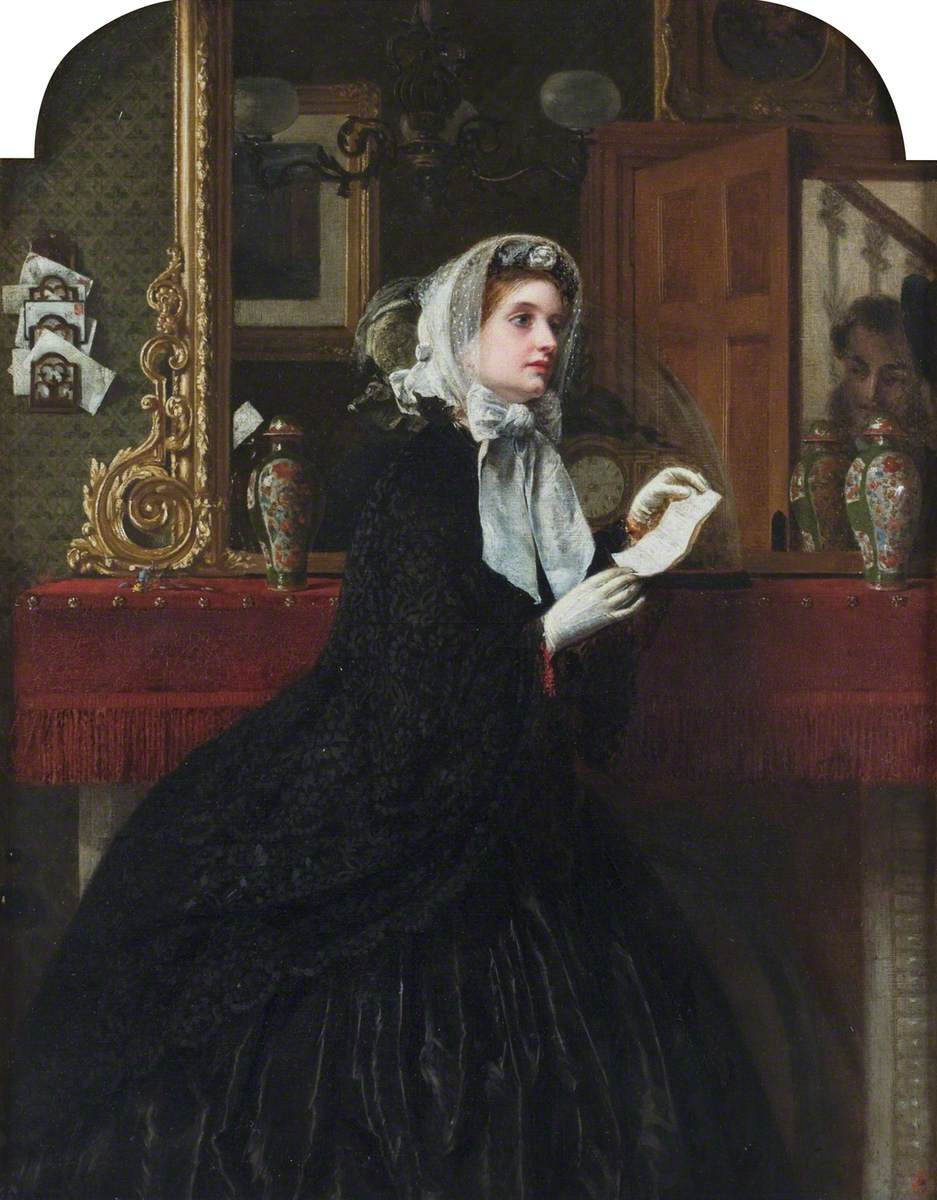
Solomon, Rebecca, 1832-1886; The Appointment
Rebecca Solomon (1832-1886), The Appointment (1861), media and dimensions not known, The Geffrye, Museum of the Home. Wikimedia Commons.

Rebecca Solomon’s Appointment (1861) is another early problem picture, with a deliberately open-ended narrative set in an interior. A beautiful woman stands in front of a mirror, and looks intently at a man, who is only seen in his reflection in the mirror, and stands in a doorway behind the viewer’s right shoulder. The woman is dressed to go out, and is holding a letter in her gloved hands.

stevensjapaneseparisian
Alfred Stevens (1823–1906), The Japanese Parisian (1872), oil on canvas, 105 × 150 cm, Musée d’art moderne et d’art contemporain, Liège. Wikimedia Commons.

In 1872 Alfred Stevens’ The Japanese Parisian filled its canvas with the reflection of the face of his model framed by floating flowers, which must be behind the viewer.

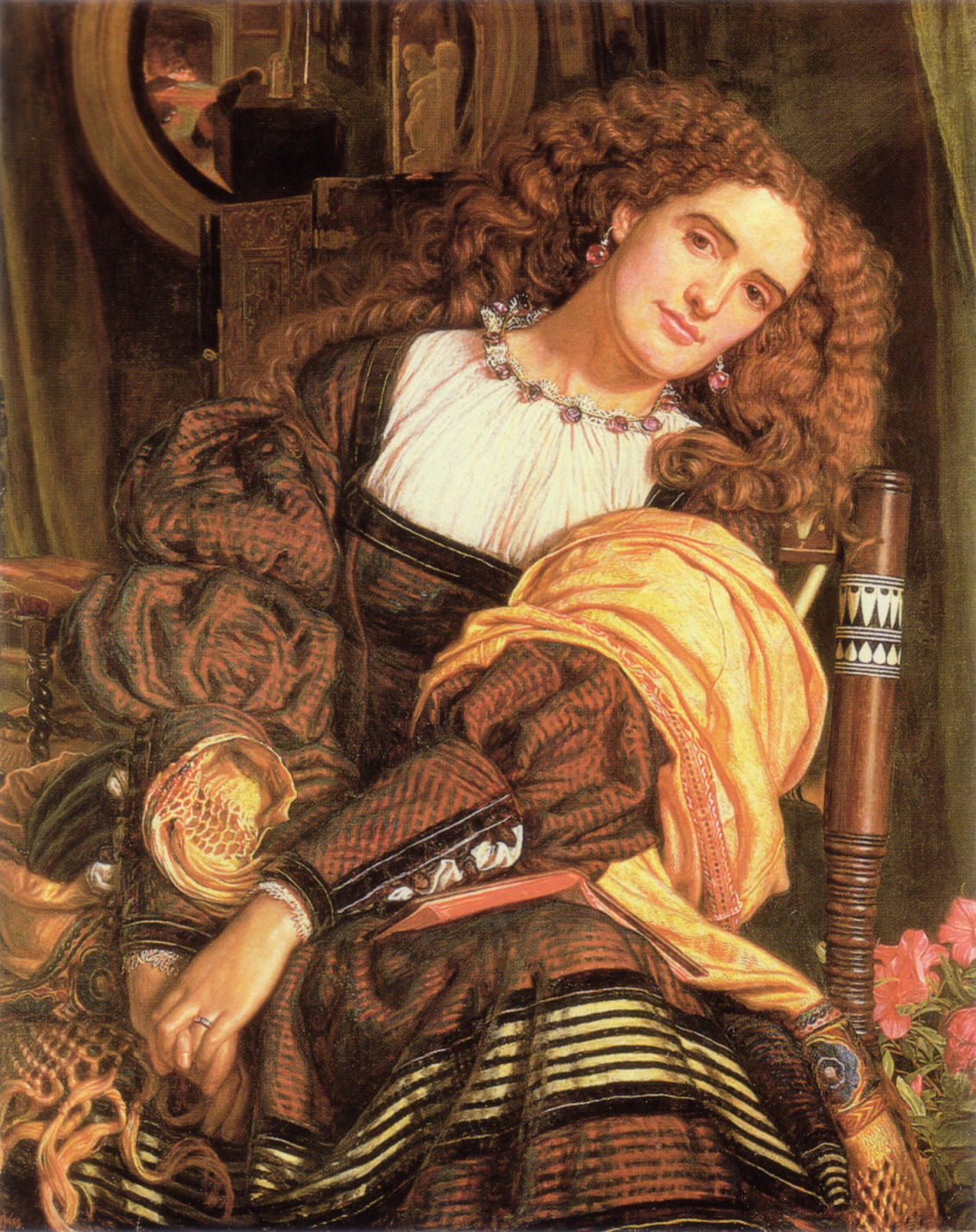
huntdolcefarniente
William Holman Hunt (1827–1910), Dolce Far Niente (1865-75), oil on canvas, 99 × 82.5 cm, Private collection. Wikimedia Commons.

Soon after William Holman Hunt had completed his Awakening Conscience above, he started work on another painting using a smaller circular mirror to extend the scene and its reading, Dolce Far Niente, which may have been started as early as 1859 but wasn’t completed until 1875. The reflection in the mirror above the woman’s head shows this to be a domestic scene, with another figure leaning over a large wooden bureau or a dressing-table, perhaps.

So far, these examples have all appeared to conform to optical principles. It was Édouard Manet who challenged those.

Édouard Manet (1832–1883), A Bar at the Folies-Bergère (1882), oil on canvas, 96 x 130 cm, The Courtauld Gallery, London. Wikimedia Commons.

His Bar at the Folies-Bergère from 1882 poses the problem of resolving the optically impossible, no matter how you try to read it. This forlorn young woman is serving at the bar in front of her, with what is presumed to be a large mirror behind showing a reflection that doesn’t match its original. Arranged on the bar are assorted bottles of beers and spirits, that on the far left bearing the artist’s signature. According to the reflection, the audience at the Folies-Bergère are watching the show under the light of a huge chandelier.

IF
John William Waterhouse (1849–1917), Circe Offering the Cup to Odysseus (1891), oil on canvas, 149 x 92 cm, Gallery Oldham, Manchester, England. Wikimedia Commons.

John William Waterhouse’s Circe Offering the Cup to Odysseus from 1891 develops the circular mirror of the Arnolfini Wedding into a key narrative device. Circe sits on her throne, holding up a krater for Ulysses to drink, with her wand in the other hand. The viewer is Ulysses, seen preparing to draw his sword in the large mirror behind the sorceress. On the left side of the mirror is his ship.

In the closing years of his career, Waterhouse returned with an even larger mirror at the centre of his story.

waterhousehalfsickshadows
John William Waterhouse (1849–1917), “I am Half Sick of Shadows” said the Lady of Shalott (1915), oil on canvas, 100 x 74 cm, Art Gallery of Ontario, Toronto, Canada. Wikimedia Commons.

His “I am Half Sick of Shadows” said the Lady of Shalott (1915) is the third and last of his paintings based on the poem The Lady of Shalott by Alfred Lord Tennyson (1809–1892), published in 1833 and 1842. This recounts part of the Arthurian legends, the tragedy of Elaine of Astolat, as retold in an Italian novella from the 1200s from which it draws its title.

The Lady of Shalott lives in a castle connected to Camelot by a river. She’s subject to a mysterious curse confining her to weaving images on her loom, and mustn’t look directly at the outside world, although she can view it using a mirror. Tennyson calls these reflected images ‘shadows of the world’, and this painting depicts the stanza from the poem:

But in her web she still delights
To weave the mirror’s magic sights,
For often thro’ the silent nights
A funeral, with plumes and lights,
And music, went to Camelot:
Or when the moon was overhead,
Came two young lovers lately wed;
‘I am half sick of shadows,’ said
The Lady of Shalott.

The circular image behind her isn’t a window, but a mirror revealing Camelot with its winding river. Although this includes her loom, the castle can’t be real, but one of “the mirror’s magic sights”.

My last example, painted just before the Second World War by Paul Nash, extends this deeper into the unconscious.

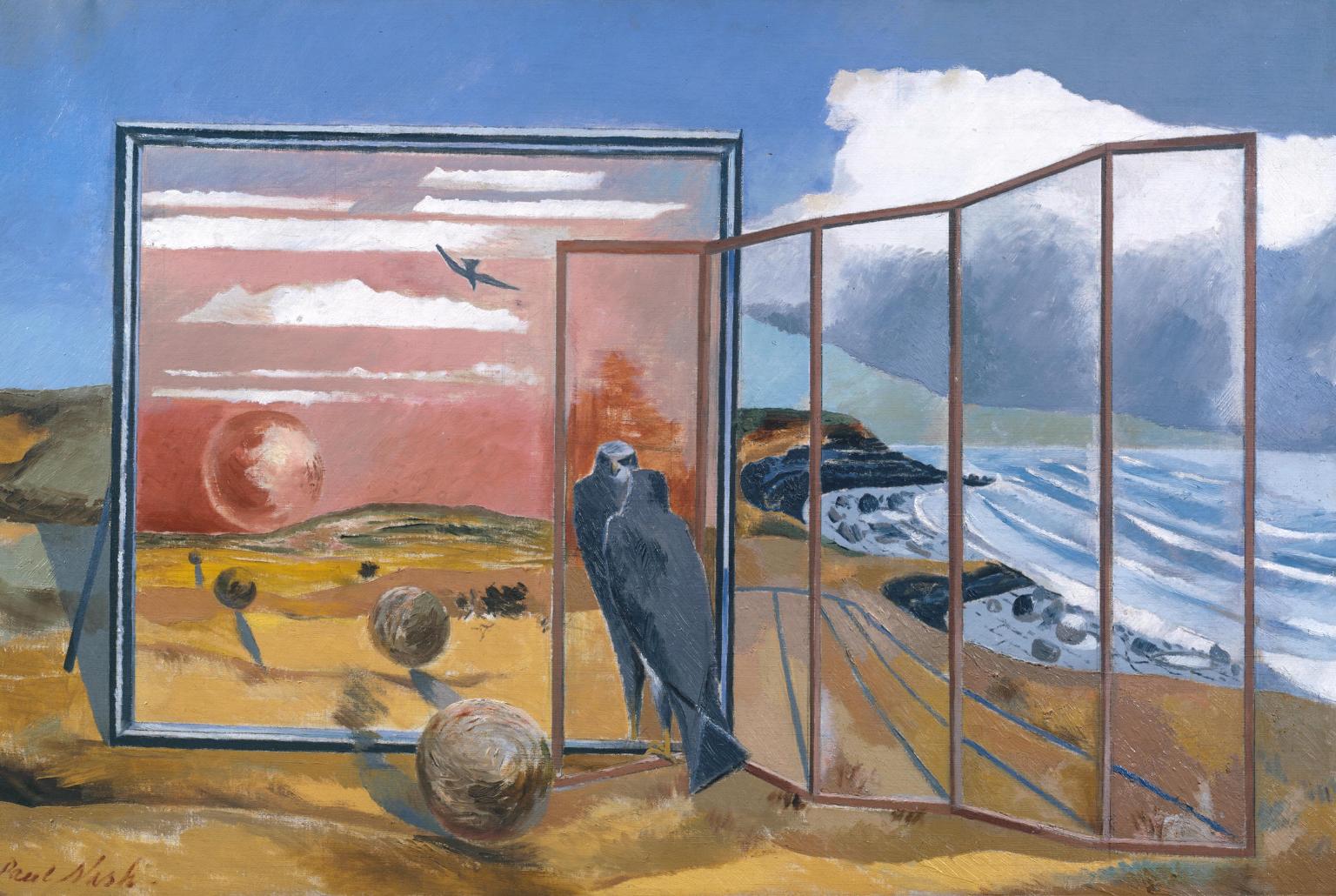
Landscape from a Dream 1936-8 by Paul Nash 1889-1946
Paul Nash (1892–1946), Landscape from a Dream (1936-38), oil on canvas, 67.9 x 101.6 cm, The Tate Gallery (Presented by the Contemporary Art Society 1946), London. © The Tate Gallery and Photographic Rights © Tate (2016), CC-BY-NC-ND 3.0 (Unported), http://www.tate.org.uk/art/artworks/nash-landscape-from-a-dream-n05667

Landscape from a Dream (1936-38) was inspired by Freud’s theories of the significance of dreams as reflections of the unconscious. Nash locates this collection of incongruous objects on the Dorset coast, a landscape he associated with the praeternatural. Dominating the scene is a large framed planar mirror, almost parallel with the picture plane.
Stood at the right end of the mirror is a hawk staring at its own reflection, which Nash explained is a symbol of the material world. To the left, the mirror reflects several floating spheres, referring to the soul. The reflection shows that behind the viewer is a red sun setting in a red sky, with another hawk flying high, away from the scene. To the right of the hawk is a five-panelled screen made of glass, through which the coastal landscape can be seen: it’s a screen which doesn’t screen.
On Reflection: The Venus Effect

By: hoakley
30 April 2026 at 19:30

In 2003, the psychologists Marco Bertamini, Richard Latto and Alice Spooner published a paper in which they described a known phenomenon in the perception of paintings, and named it the Venus Effect. Their definition is: “The Venus effect occurs every time the observer sees both an actor (eg Venus) and a mirror, not placed along the observer’s line of sight, and concludes that Venus is seeing her reflection at the same location in the mirror that the observer is seeing.”

Although they dismissed optical “mistakes” as being of less interest, they were intrigued by “the situations in which we as observers read the scene in a certain way, but the mirror itself is used (deliberately or not) to lead us down the wrong path. More specifically, the mirror shows us something that we accept as the view available to the actor in the scene. However, the actor has a different vantage point
from us and therefore the laws of optics imply that he/she cannot be seeing what we see in the mirror.”

In this article, I explore what I believe to be the artist’s intention in this effect, of revealing the face of the subject of a painting in its reflection rather than in the original, a popular form of mirror play.

florisallegoryofsight
Frans Floris (1519/1520–1570), Allegory of Sight (date not known), oil on panel, 95.8 × 81.3 cm, location not known. Wikimedia Commons.

Frans Floris’s Allegory of Sight was probably painted around 1550, making it an early and quite sophisticated entry to the subject. The face of its figure is shown reflected in the only appropriate optical instrument of the day: a simple mirror, carefully angled to project most of the face. Although only a small feature, that reflection looks fiendishly difficult, given the wildly different angle between the mirror and the picture plane. In this case, what’s shown in the mirror is optically plausible, although the subject is looking at the viewer rather than the reflection.

janssenssight
Abraham Janssens (1567–1632) (attr), Sight (date not known), oil on canvas, 117 × 93 cm, location not known. Wikimedia Commons.

This painting of Sight has been attributed to Abraham Janssens, and could date to any time between about 1590 and 1632. It appears to have been inspired by Floris’s Allegory of Sight, and the reflection of the woman’s face in the mirror doesn’t appear optically correct. She does appear to be looking at her reflection, although that’s optically impossible.

vonaachendavidbathsheba
Hans von Aachen (1552–1615), David and Bathsheba (c 1612-15), oil on canvas, 138 x 105 cm, Kunsthistorisches Museum, Vienna, Austria. Wikimedia Commons.

Hans von Aachen’s David and Bathsheba of about 1612-15 introduces a figure standing behind Bathsheba, holding a mirror in front of her face with his outstretched left arm. A glance at that reflection says that something is seriously amiss: von Aachen has painted a reflection in which Bathsheba is looking to the left, although her face is actually looking to the right. No single plane mirror could ever achieve that optical impossibility.

velazquezvenus
Diego Velázquez (1599–1660), Venus at Her Mirror, The Toilet of Venus (Rokeby Venus) (1644-48) [101], oil on canvas, 122.5 x 177 cm, The National Gallery, London. Image by Diego Delso, via Wikimedia Commons.

Although often illustrated by one of Titian’s paintings of Venus, the canonical example must be Velázquez’ Venus at Her Mirror, also known as The Toilet of Venus or the Rokeby Venus, from 1644-48. It shows the goddess Venus, whose face is blurred in a false reflection in a mirror being held by her son Cupid. The theme was common, seen in paintings by Titian and Rubens, with Venus sat upright. Giorgione and others had posed her reclining and facing the viewer, making her pose here unusual. Most other paintings of Venus set her in a landscape: here she rests on luxurious even sensuous fabrics.

No matter how convincing her face might appear in the mirror, a moment spent placing yourself in the same position confirms that the image in the mirror is wholly imaginary, and optically incorrect. Yet, according to Bertamini and others, the majority of viewers succumb to the Venus Effect and believe that Venus is looking at that image of her face.

waterhousemarianasouth1897
John William Waterhouse (1849–1917), Mariana in the South (c 1897), oil on canvas, 114 × 74 cm, Private collection. Wikimedia Commons.

JW Waterhouse’s Mariana in the South from about 1897 stands her in front of a full-length mirror revealing her face to the viewer, but she too is looking at her own reflection.

lalmatademaknockatdoor
Laura Theresa Alma-Tadema (1852–1909), A Knock at the Door (1897), oil on panel, 63.8 × 44.8 cm, Currier Museum of Art, Manchester, NH. Wikimedia Commons.

Laura Theresa Alma-Tadema’s A Knock at the Door, also from 1897, shows an attractive young woman checking that she is looking at her best in a mirror, before receiving a visitor. Once again it is the reflection that shows her face, and we’re struggling to be sure whether this is optically correct, although in this case the artist has at least brought closer alignment between the two optical axes.

friesekenudeseateddressingtable
Frederick Carl Frieseke (1874–1939), Nude Seated at Her Dressing Table (1909), oil on canvas, 162.3 x 131.1 cm, Smithsonian American Art Museum, Washington, DC. Wikimedia Commons.

Frederick Carl Frieseke’s Nude Seated at Her Dressing Table (1909) also uses closer alignment to appear more optically plausible, as this nude apparently studies herself in the mirror.

cranemirror
Walter Crane (1845–1915) The Mirror, illustration for Arthur Kelly’s The Rosebud and Other Tales (1909), pen, black ink and watercolor, 20.3 × 15.3 cm, Private collection. Wikimedia Commons.

Walter Crane made this watercolour and ink drawing of The Mirror for Arthur Kelly’s The Rosebud and Other Tales, published in 1909. Although there are clear disparities between the alignment of face and chest with their reflection, this too appears plausible.

corinthatthemirror
Lovis Corinth (1858–1925), At the Mirror (1912), oil on canvas, dimensions not known, Worcester Art Museum, Worcester, MA. Wikimedia Commons.

Lovis Corinth’s At the Mirror from 1912 complicates this further by raising the viewer well above the subject and her reflection, and revealing the artist standing behind her.

There are a few paintings where the artist has overtly declined to employ the Venus Effect.

tintorettosusannaelders1555
Jacopo Tintoretto (c 1518-1594), Susannah and the Elders (c 1555) (E&I 64), oil on canvas, 146 x 193.6 cm, Kunsthistorisches Museum, Vienna, Austria. Wikimedia Commons.

Tintoretto’s Susannah and the Elders from about 1555 goes further with mirror play. Susannah has been caught as she is drying her leg after bathing in the small pool beside her, looking at herself in a rectangular mirror, which is propped up against a rosy trellis in a secluded part of her garden. Unlike in other paintings of nudes, neither the image seen in the mirror nor the reflection on the water show anything more of Susannah.

Painting Pandora and her box: 1883-1919

By: hoakley
26 April 2026 at 19:30

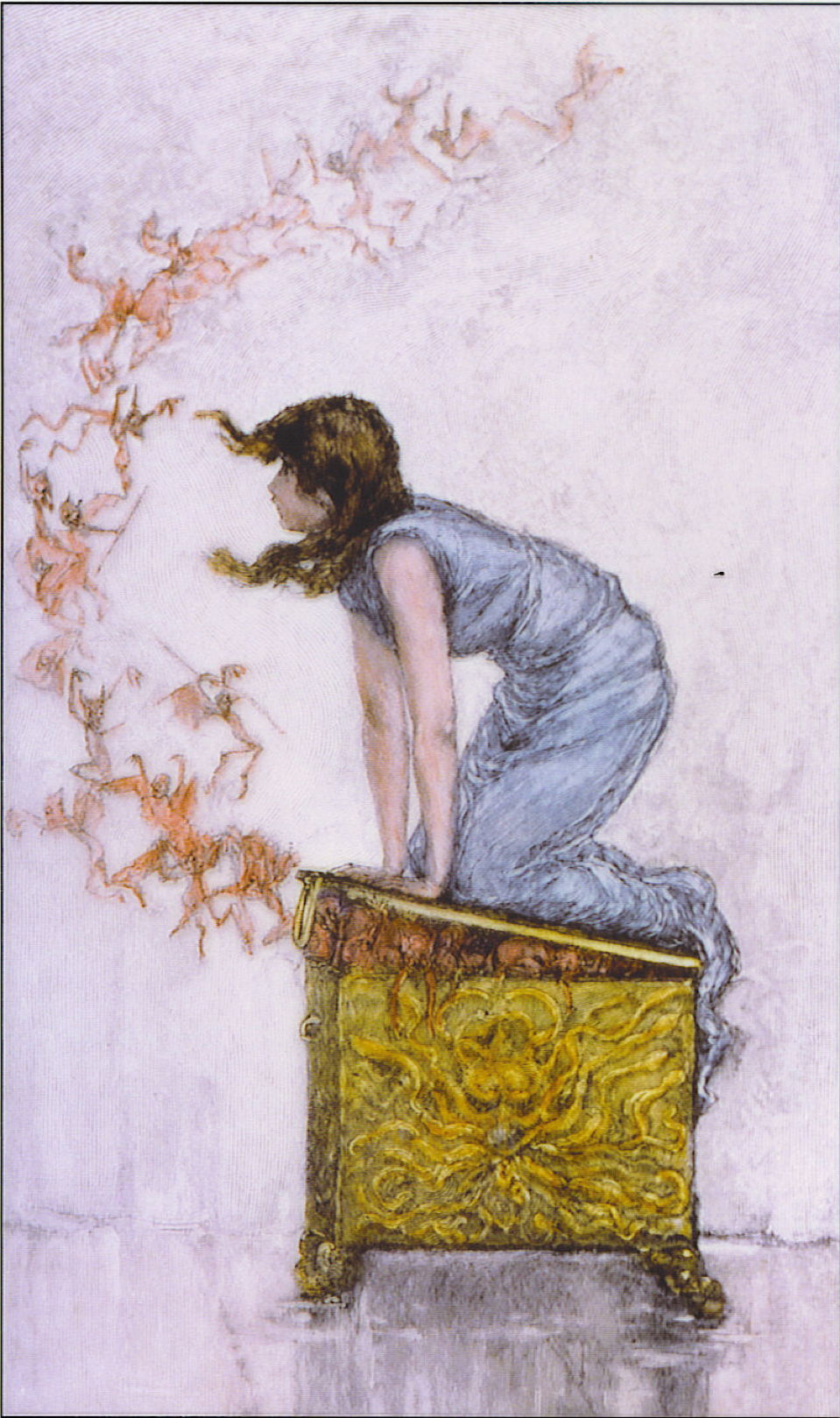
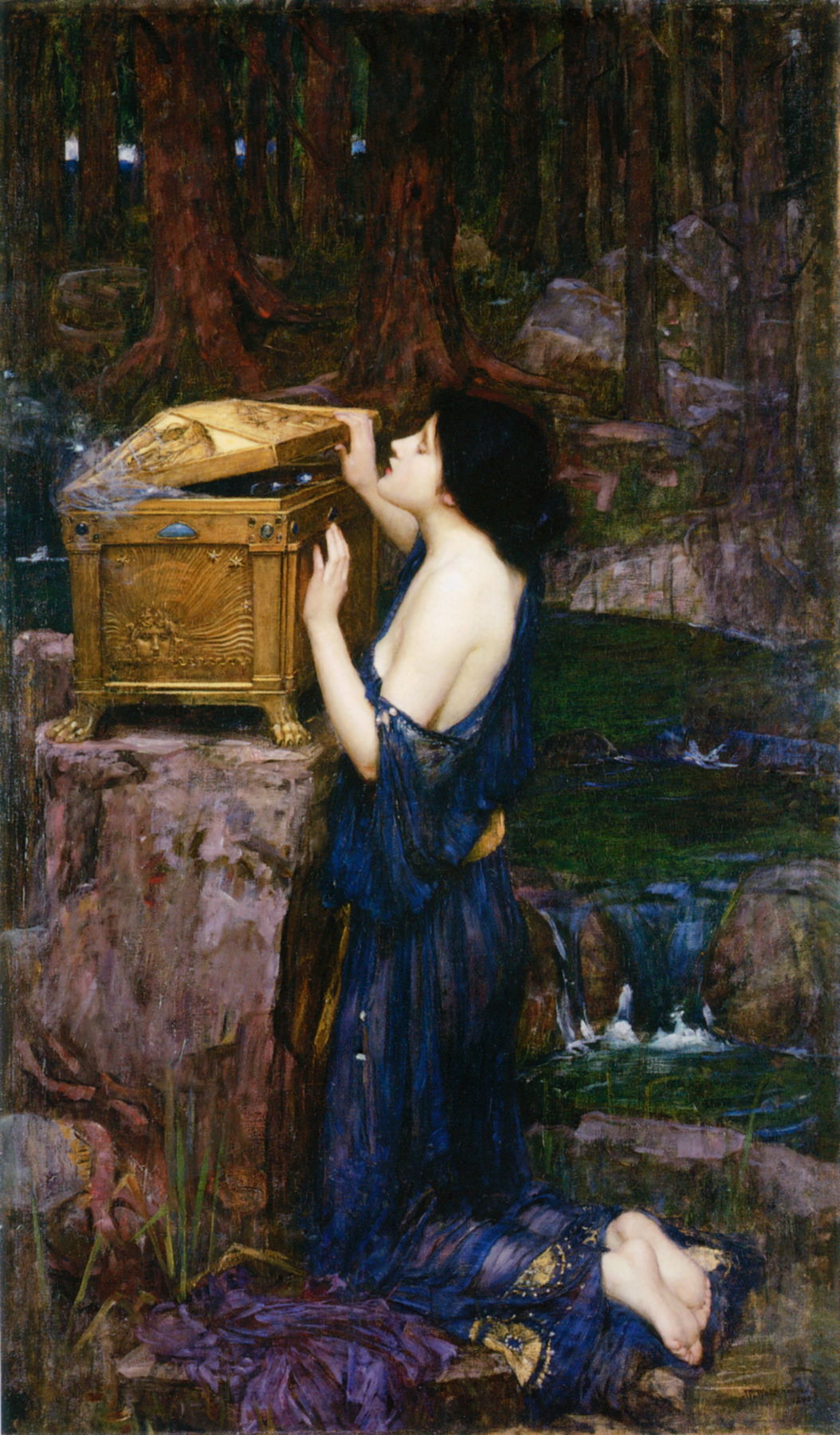
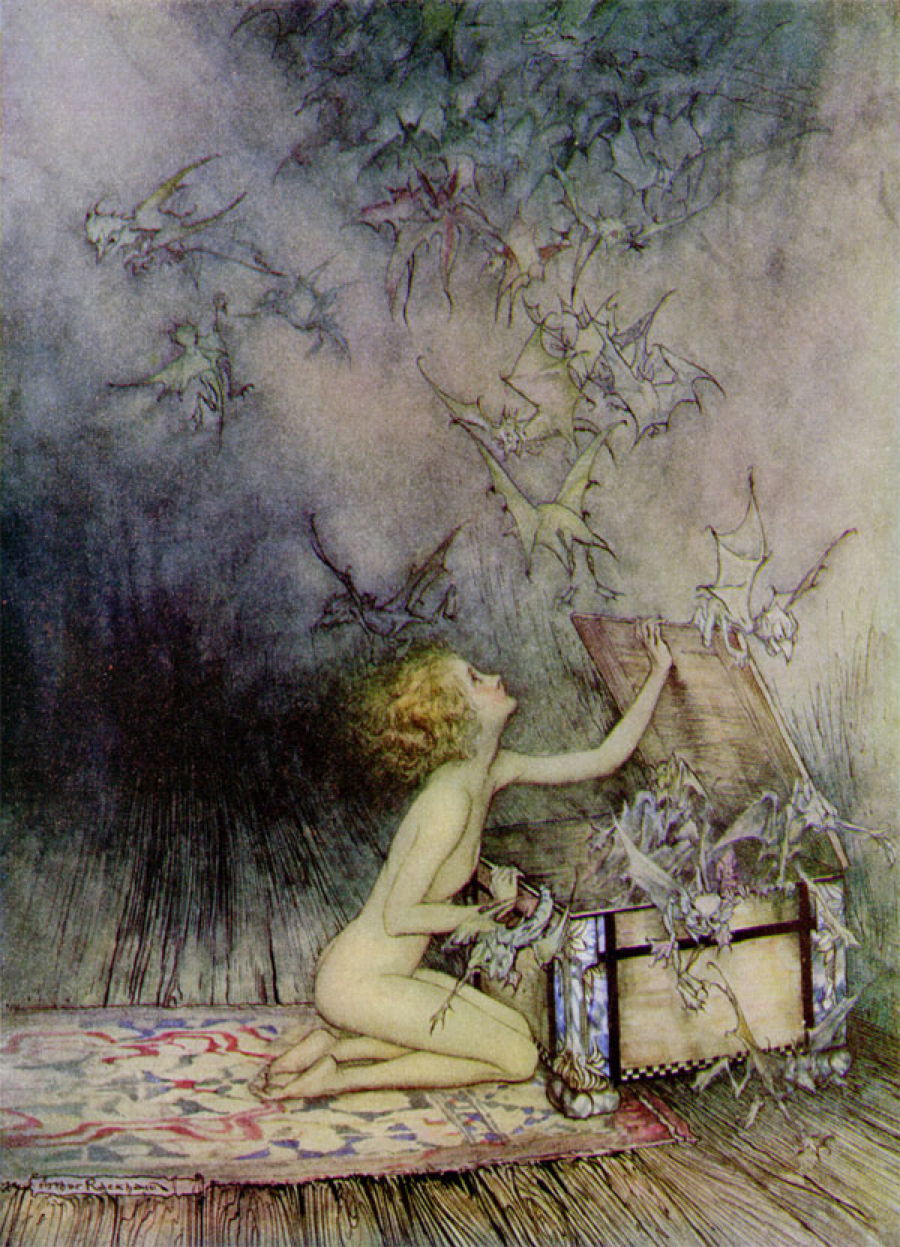
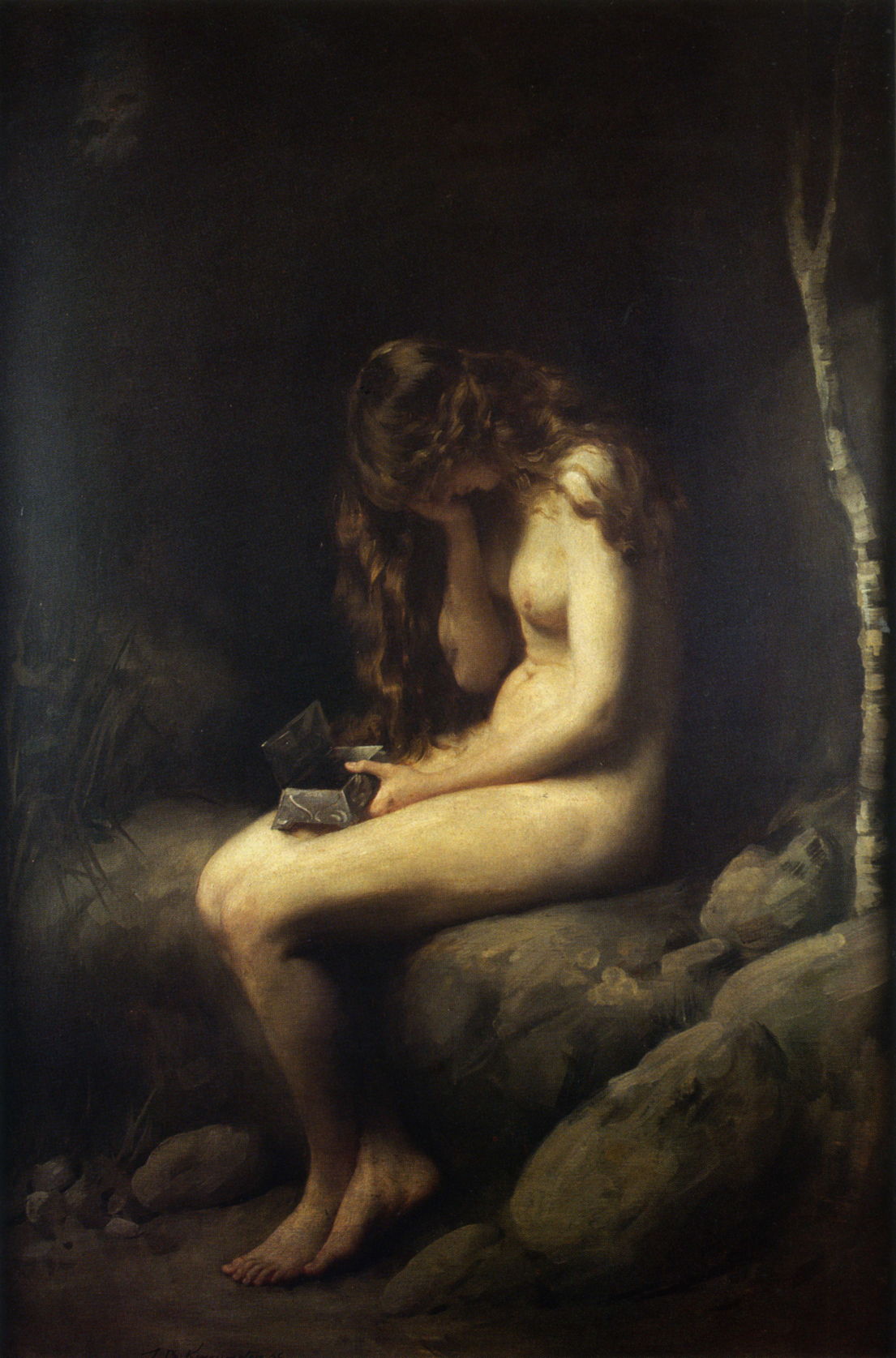
The ancient Greek myth of Pandora had been almost unknown in paintings until the nineteenth century. During the 1870s it suddenly became a popular theme for European paintings, but its narrative had altered from the original in showing the first woman in Greek mythology with a box containing the ills of the world, rather than a large earthenware storage pot, and only one artist had depicted its crux.

churchopenedpandorasbox
Frederick Stuart Church (1842–1924), Pandora (1883), pencil and ink wash on paper, 30.2 x 45.7 cm, Private collection. Wikimedia Commons.

The story broke out of Europe by 1883, when the American painter and illustrator Frederick Stuart Church painted his more illustrative Pandora. Dressed more modestly (presumably for a wider audience), she is shown as an innocent young woman kneeling on a large golden chest as she tries to close its lid and stop the emerging stream of red demons. I suspect this was intended as an illustration for a printed collection of classical myths.

Walter Crane (1845–1915), Pandora (1885), watercolour on paper, 53.3 x 73.6 cm, location not known. Wikimedia Commons.

The following year Walter Crane, a British painter and illustrator, painted Pandora in an unusual interpretation that’s only loosely connected with the original myth. She is here draped in grief over a substantial casket, and on its side panel are the figures of the three Fates. At the corners of the casket are guardian winged sphinxes, each clasping a sphere.

bouguereaupandora
William-Adolphe Bouguereau (1825–1905), Pandora (1890), oil on canvas, 92.5 × 64.5 cm, location not known. Wikimedia Commons.

In his later years, William-Adolphe Bouguereau chose an oddly androgynous model for his depiction of Pandora in 1890, but has rather lost the narrative. Her neutral expression, body language, and the closed box tell little of what is imminent.

waterhousepandora
John William Waterhouse (1849–1917), Pandora (1896), oil on canvas, 152 × 91 cm, Private collection. Wikimedia Commons.

One of his lesser-known paintings, John William Waterhouse’s Pandora from 1896 is a major depiction of this myth, and one of the most complete. Set by a small brook in a dark, primeval forest, her box has become a large gold chest encrusted with precious stones and decorated with mythological motifs. Pandora kneels by its side, peeking inside as she carefully raises its lid, but even this tentative glimpse is sufficient to release its stream of ills, of which she appears unaware.

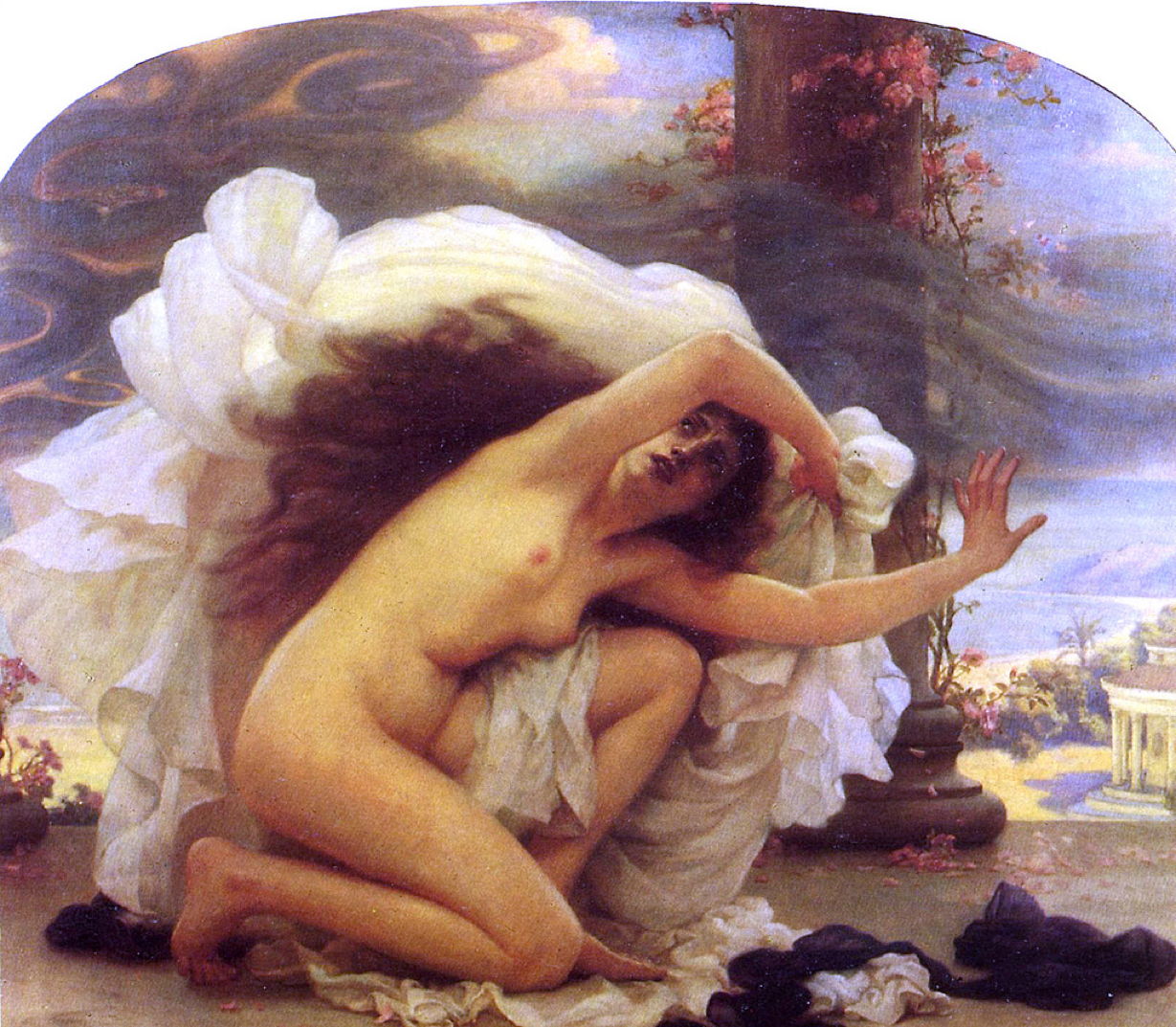
normandpandora
Ernest Normand (1857-1923), Pandora (1899), further details not known. The Athenaeum.

Ernest Normand is one of few painters to show a later moment, in which Pandora (1899) bends low to duck beneath the swirling grey clouds of evils as they spread out into the idyllic world beyond, causing blossom to fall as petals to the ground. Her jar is only hinted at, behind her billowing white robes, almost depriving the viewer of this vital clue to the original story.

rackhampandora
Arthur Rackham (1867–1939), Pandora (date not known), further details not known. Wikimedia Commons.

I have been unable to find a date for this presumed illustration by the great Arthur Rackham of Pandora, but suspect it was made around the turn of the twentieth century, and intended to accompany a British English retelling of this myth. As with Church before, Pandora is young and innocent in her nakedness. She gazes up in awe at the batlike demons as they escape from the open lid of her large wooden chest, seemingly unaware of what she is unleashing in her curiosity.

kenningtonpandora
Thomas Benjamin Kennington (1856–1916), Pandora (1908), oil on canvas, 166.3 × 113 cm, Private collection. Wikimedia Commons.

Thomas Benjamin Kennington shows Pandora (1908) in the final phase of regret and sorrow, after the evils have all been released. Her box, now empty, with no sign of the remaining Hope, rests on her thigh. She hangs her head in shame, resting it on her right hand as she weeps at what she has done. Unfortunately, the released demons shown at the left edge are so dark that they are hard to see.

Over this period, other artists had also been painting the story of the creation of Pandora, a theme I have avoided so far. I will, though, show one of its more unusual depictions, a painting lost for forty years.

battenpandora
John Dixon Batten (1860-1932), The Creation of Pandora (1913), tempera on fresco, 128 x 168 cm, Reading University, Reading, England. Wikimedia Commons.

John Dixon Batten’s The Creation of Pandora was painted anachronistically in egg tempera on a fresco ground by 1913. Batten was one of the late adherents of the Pre-Raphaelite movement, and now almost forgotten. It had been exhibited in a commercial gallery, and was acquired by the University of Reading, England, shortly before the First World War. Deemed unfashionable in 1949, it was put into storage and quietly forgotten until its rediscovery in 1990.

Pandora is at the centre, having just been fashioned out of earth by Hephaestus, who stands at the left, his foot on his anvil. Behind them, other blacksmiths work metal in his forge. At the right, Athena is about to place her gift of a robe about Pandora’s figure, and other gods queue behind her to offer their contributions.

Just before the start of the First World War, Odilon Redon made a series of studies leading to a radically different presentation of Pandora’s story.

redonpandorahouston
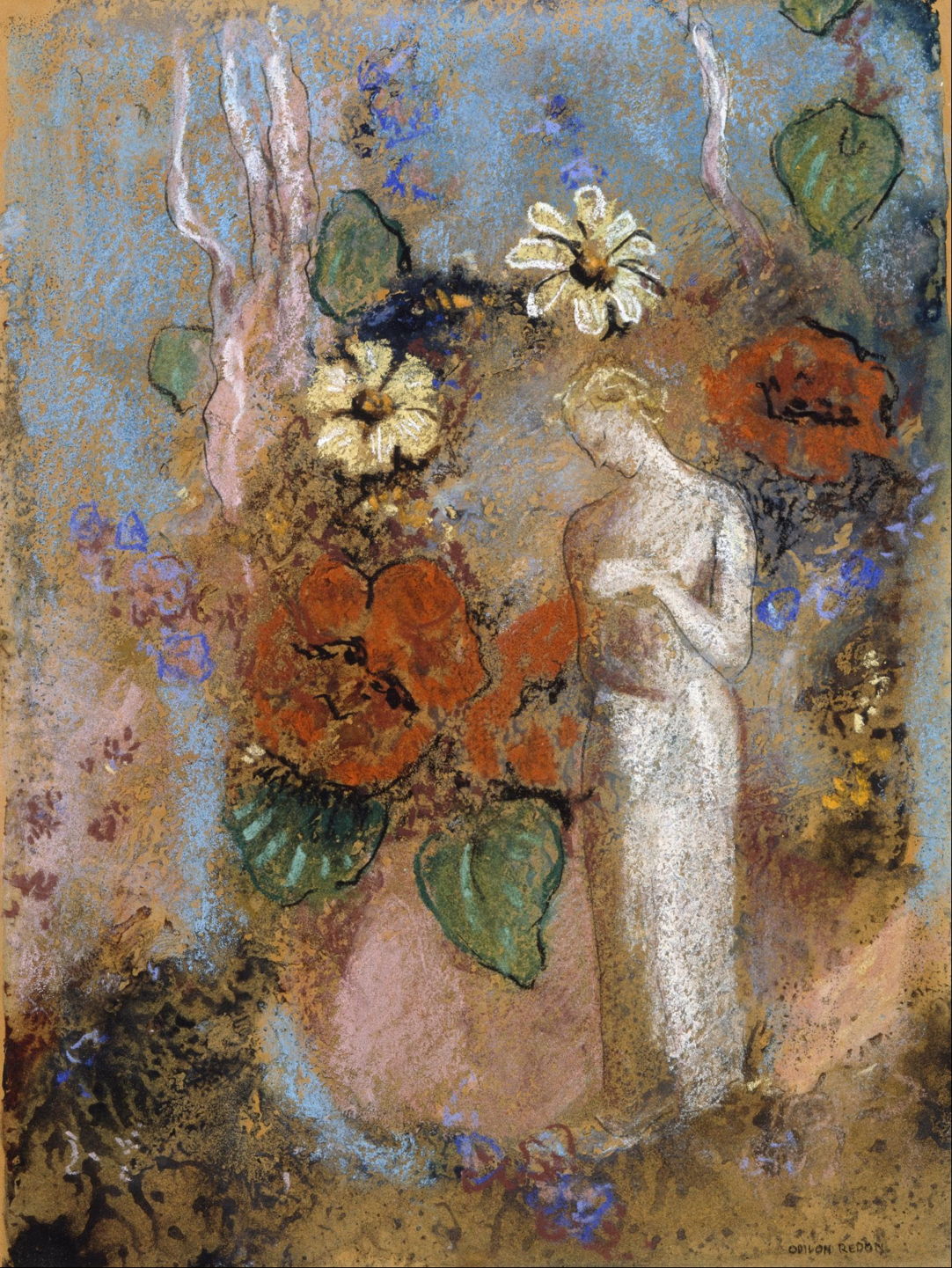
Odilon Redon (1840–1916), Pandora (date not known), pastel and charcoal on board, 22.1 x 29.1 cm, Museum of Fine Arts, Houston, TX. Wikimedia Commons.

Redon’s undated pastel study of Pandora shows her clasping her box close in the midst of huge floral images.

redonpandoramet
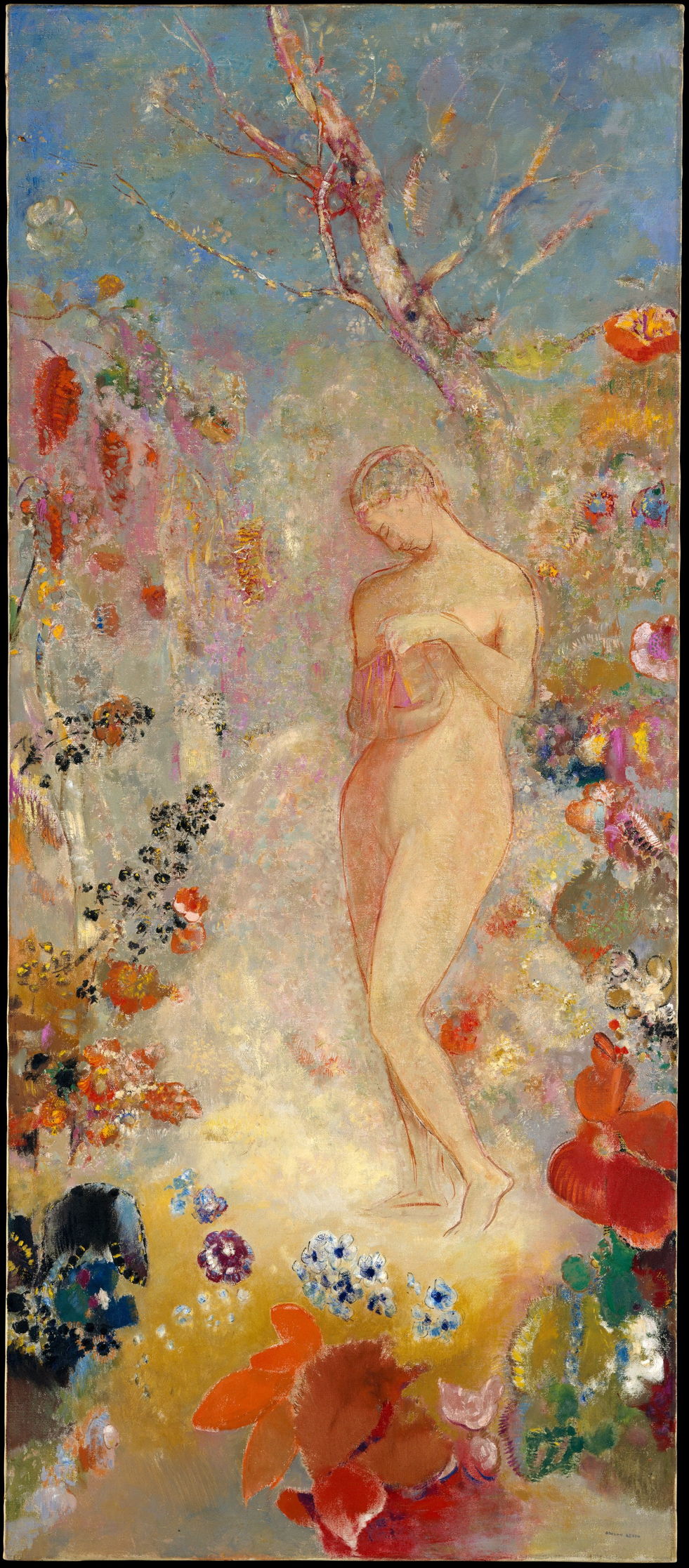
Odilon Redon (1840–1916), Pandora (c 1914), oil on canvas, 143.5 x 62.2 cm, The Metropolitan Museum of Art (Bequest of Alexander M. Bing, 1959), New York, NY. Courtesy of The Metropolitan Museum of Art.

Redon’s finished oil painting of Pandora from about 1914 shows her more clearly, surrounded by a garden of exquisite and exotic blooms, referring to Eve’s Paradise before the Fall. She holds her box to her bosom, as she succumbs to the temptation to open it, but Redon stops just short of showing its evils pouring out.

gregorypandora
Yvonne Gregory (Park) (1889-1970), Pandora (1919), photograph, published in ‘Photograms of the Year’, 1919, further details not known. Wikimedia Commons.

My final representation of the myth of Pandora is a photograph from 1919 by the society portrait photographer Yvonne Gregory (who also worked under her married surname of Park): Pandora. The box lies wide open by her knees, as Pandora is bent double in distress over it, her left arm over her head to shelter her from the demons that have been released, and in grief at what she has done.

Given the disasters that had struck the world in the years immediately preceding this photograph – the mass carnage of the war, and the influenza pandemic which followed it – it must have had great impact when it was published in 1919. Much as these images have today. For despite the story’s underlying misogyny, I can’t help thinking that Pandora’s box has been opened yet again.

Reference

Wikipedia on the myth of Pandora.

Painting Spring blossom 2

By: hoakley
19 April 2026 at 19:30

Following their popularisation in the nineteenth century, paintings of Spring blossom continued to flourish, reinforced perhaps by increasing urbanisation.

allinghambuckspenstreet
Helen Allingham (1848-1926), A Buckinghamshire house at Penstreet (c 1900), watercolour, 36 x 50.5 cm, Private collection. Wikimedia Commons.

Helen Allingham’s Buckinghamshire house at Penstreet (c 1900) shows a house in the hamlet of Penn Street, near the village of Penn, in Buckinghamshire, England. This remains a relatively unspoilt part of the Chilterns to the north-west of London.

metcalfdogwoodblossoms
Willard Metcalf (1858–1925), Dogwood Blossoms (1906), oil on canvas, dimensions not known, Florence Griswold Museum, Old Lyme, CT. Wikimedia Commons.

For Willard Metcalf, Dogwood Blossoms (1906) also provide the opportunity to explore the shimmering effects of dappled light, and how it can break the forms of large boulders.

bonnardearlyspring1908
Pierre Bonnard (1867-1947), Early Spring (1908), oil on canvas, 87.6 x 132.1 cm, The Phillips Collection, Washington, DC. The Athenaeum.

Pierre Bonnard painted Early Spring in 1908, shortly after his return to France from a visit to North Africa. The children are probably the artist’s friends from the Terrasse family, enjoying their garden as it comes into bloom in the improving weather.

bonnardsmallhousespringevening
Pierre Bonnard (1867-1947), The Small House, Spring Evening (1909),oil on canvas, 50.8 x 61.5 cm, Private collection. The Athenaeum.

The Small House, Spring Evening is an unusual landscape painted by Bonnard in 1909. It offsets the rich blossom on the trees at the left against the plain wall of a house, seen in failing light.

ripplsourcherry
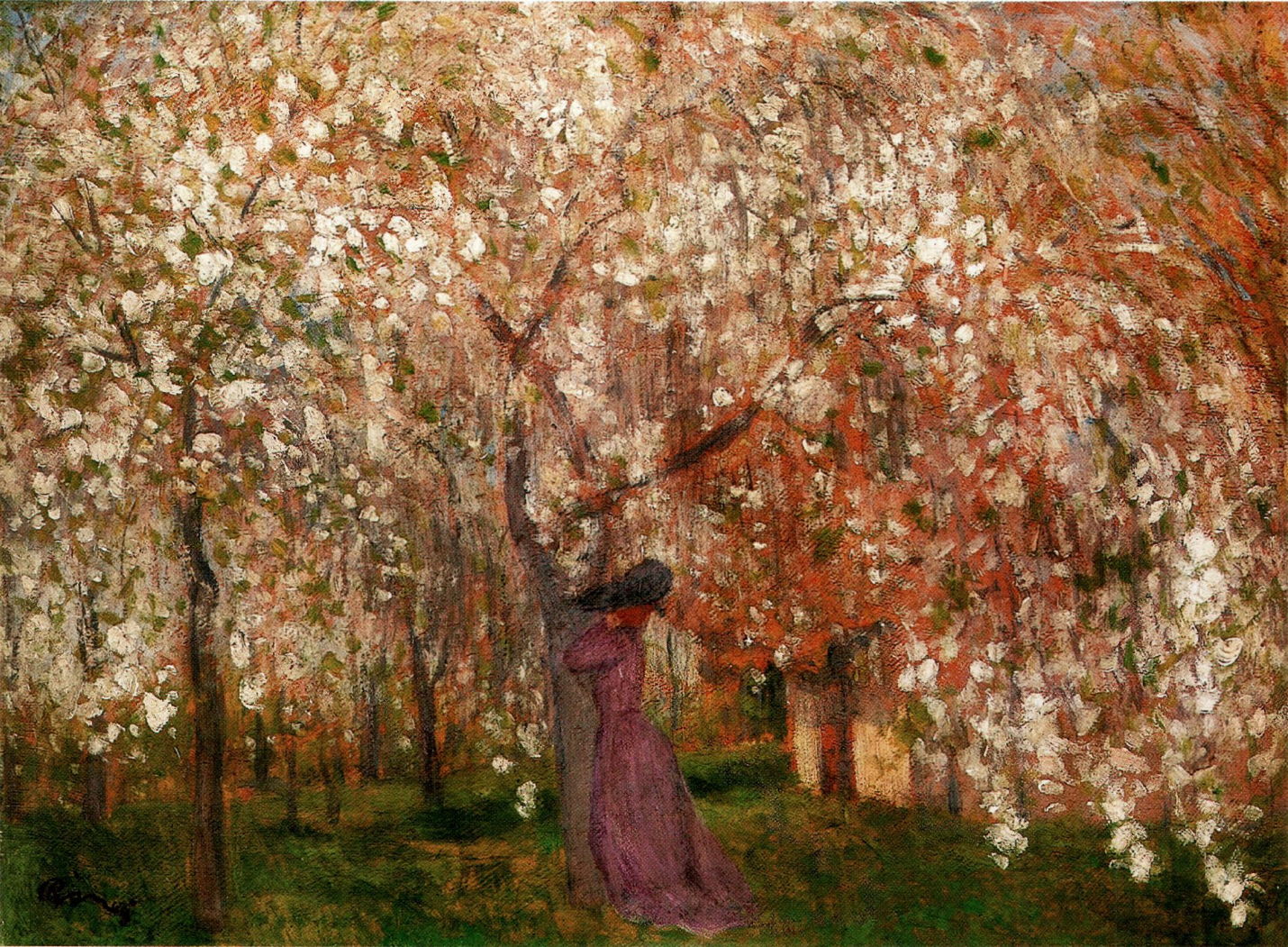
József Rippl-Rónai (1861–1927), Sour Cherry Tree in Blossom (1909), oil on cardboard, 68 x 90 cm, Rippl-Ronai Museum, Kaposvár, Hungary. Wikimedia Commons.

József Rippl-Rónai was the founding father of modern painting in Hungary, and in 1909 painted this Sour Cherry Tree in Blossom, in which the flowers overwhelm the whole painting, just as they had for Samuel Palmer nearly eighty years earlier.

clairinonbalcony
Georges Clairin (1843–1919), On the Balcony (c 1910), oil on canvas, 110.8 × 94.9 cm, location not known. Wikimedia Commons.

One of the eclectic Georges Clairin’s later paintings from about 1910 brings an elegant group out among lush blossoms On the Balcony.

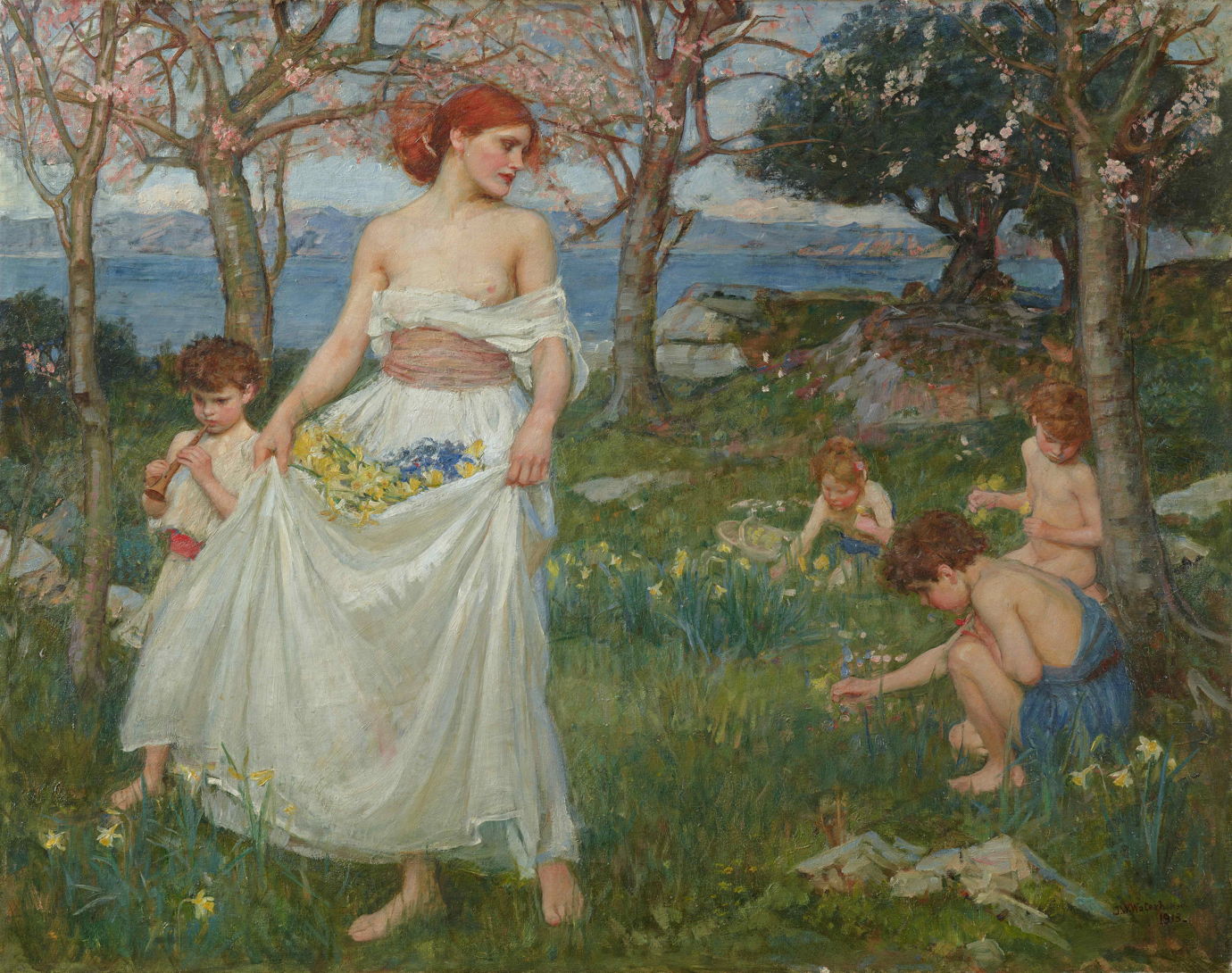
waterhousesongspringtime
John William Waterhouse (1849–1917), A Song of Springtime (1913), oil on canvas, 71.5 x 92.4 cm, Private collection. Wikimedia Commons.

John William Waterhouse’s A Song of Springtime from 1913 has lost much of the narrative from more classical accounts of Flora and the Spring, but still features plenty of cherry blossom. Flora appears with her breasts bared, and a skirtful of daffodils or narcissi, perhaps a cross-reference to Poussin’s figure of Narcissus in his Empire of Flora, and the Graces have been replaced by young children.

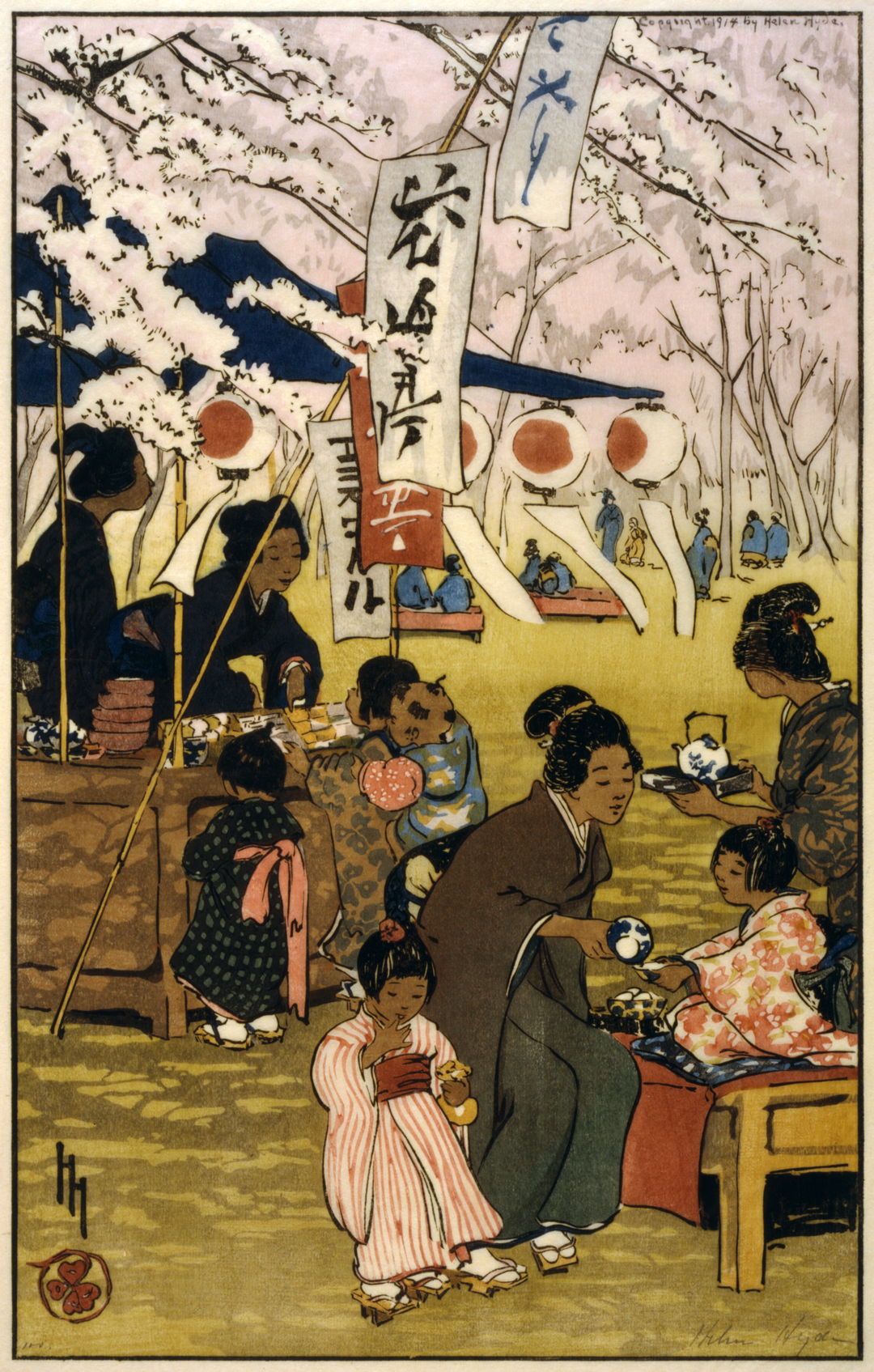
hydeblossomtimetokyo
Helen Hyde (1868–1919), Blossom Time in Tokyo (1914), colour woodcut print, dimensions not known, Library of Congress, Washington, DC. Wikimedia Commons.

By the First World War, Western artists weren’t just collecting and studying the art of south-east Asia, but some went to live in countries such as Japan. Among these was the American printmaker Helen Hyde, who demonstrates her mastery of colour woodcut prints in her Blossom Time in Tokyo, from 1914. This shows the tea ceremony taking place during the Spring viewing of blossom.

IF
Théo van Rysselberghe (1862–1926), Almond Trees in Blossom (Morning) (1918), oil on canvas, 46.5 x 65 cm, Private collection. WikiArt.

By the end of the war, Théo van Rysselberghe’s colours had become as strong as those of the Fauves. In Almond Trees in Blossom (Morning) the more delicate pinks of the flowers pale in comparison with his full reds and blues, even down to the blue horse pulling a plough.

berkosapplebloom
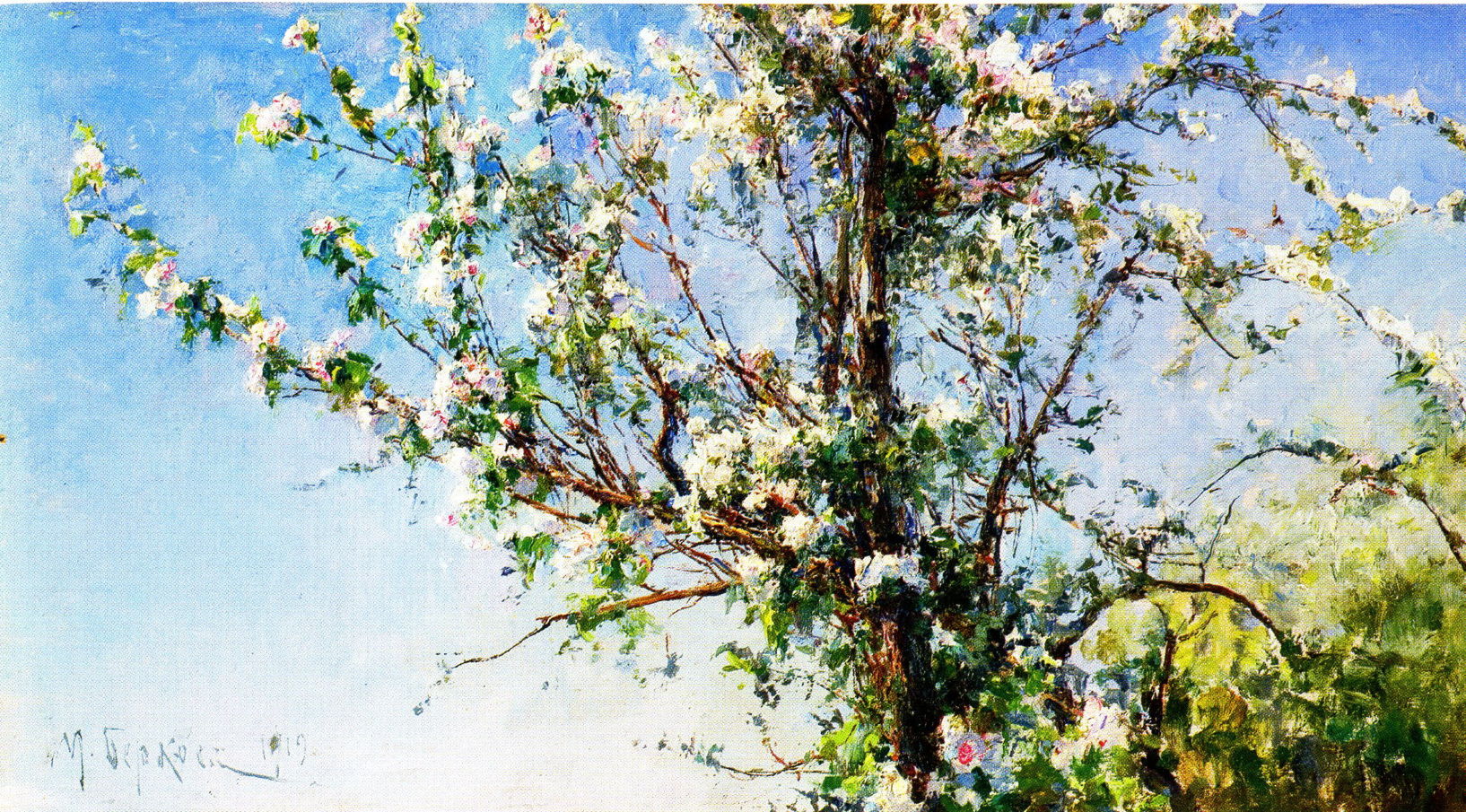
Mykhaylo Berkos (1861–1919), Apple Tree in Blossom (1919), oil on wood, 23.5 x 43.8 cm, location not known. Image by Leonid Kulikov or Mykhailo Kvitka, via Wikimedia Commons.

The Ukrainian artist Mykhaylo Berkos painted this classic Impressionist motif of an Apple Tree in Blossom in 1919. But this was to be his last Spring, as he died of typhus just before Christmas that year, at the age of only 58.

astrupappletreesinbloom
Nikolai Astrup (1880–1928), Apple Trees in Bloom (after 1920), oil on canvas, 54 x 88 cm, Private collection. Wikimedia Commons.

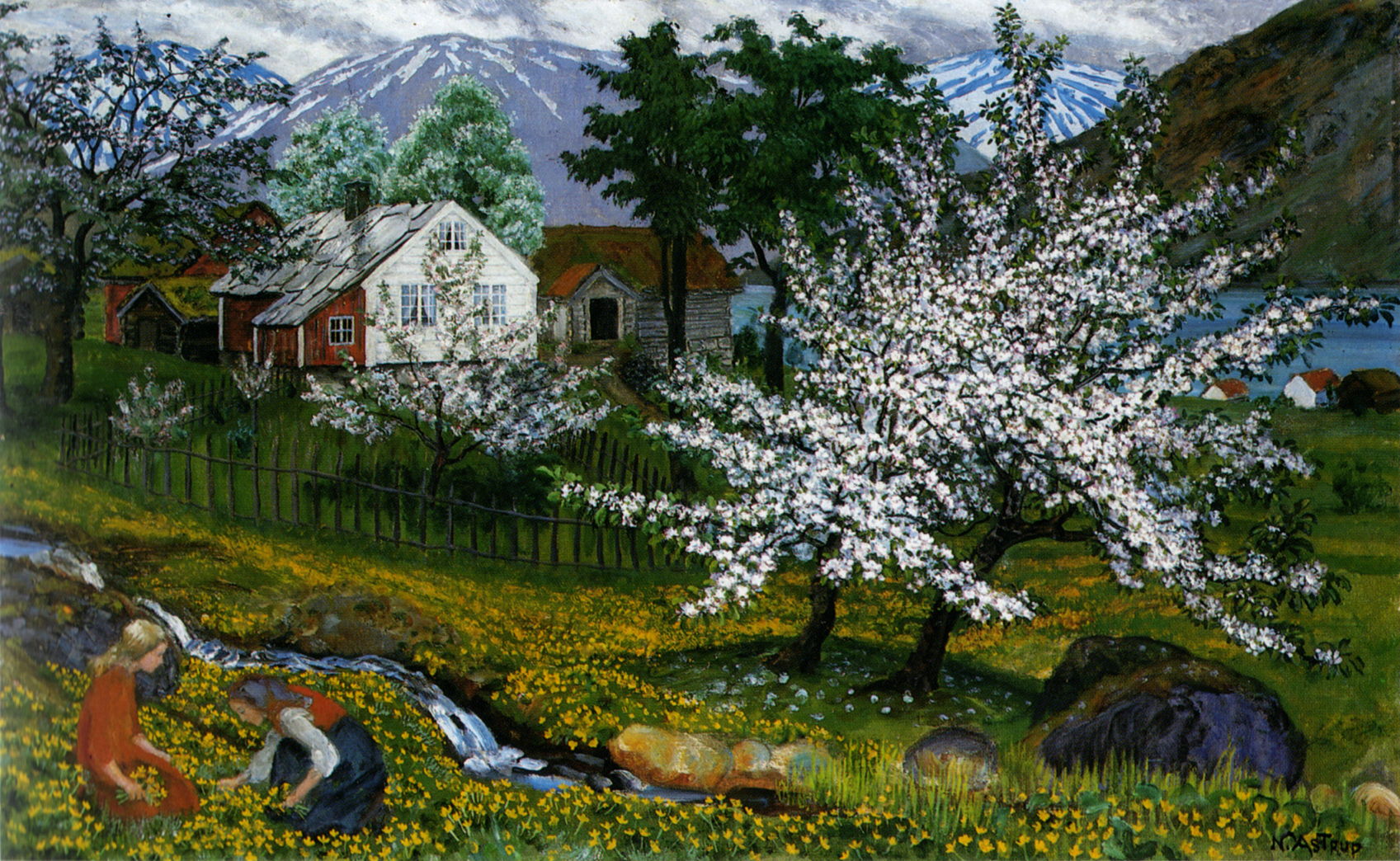
In the far north of Europe, the Norwegian Nikolai Astrup included blossom in many of his paintings of Spring and early summer in the fjords, as in his Apple Trees in Bloom, painted after 1920.

astrupappletreeblossom
Nikolai Astrup (1880–1928), Apple Tree in Bloom (c 1927), oil on canvas, 78 x 100 cm, Bergen Kunstmuseum, KODE, Bergen, Norway. The Athenaeum.

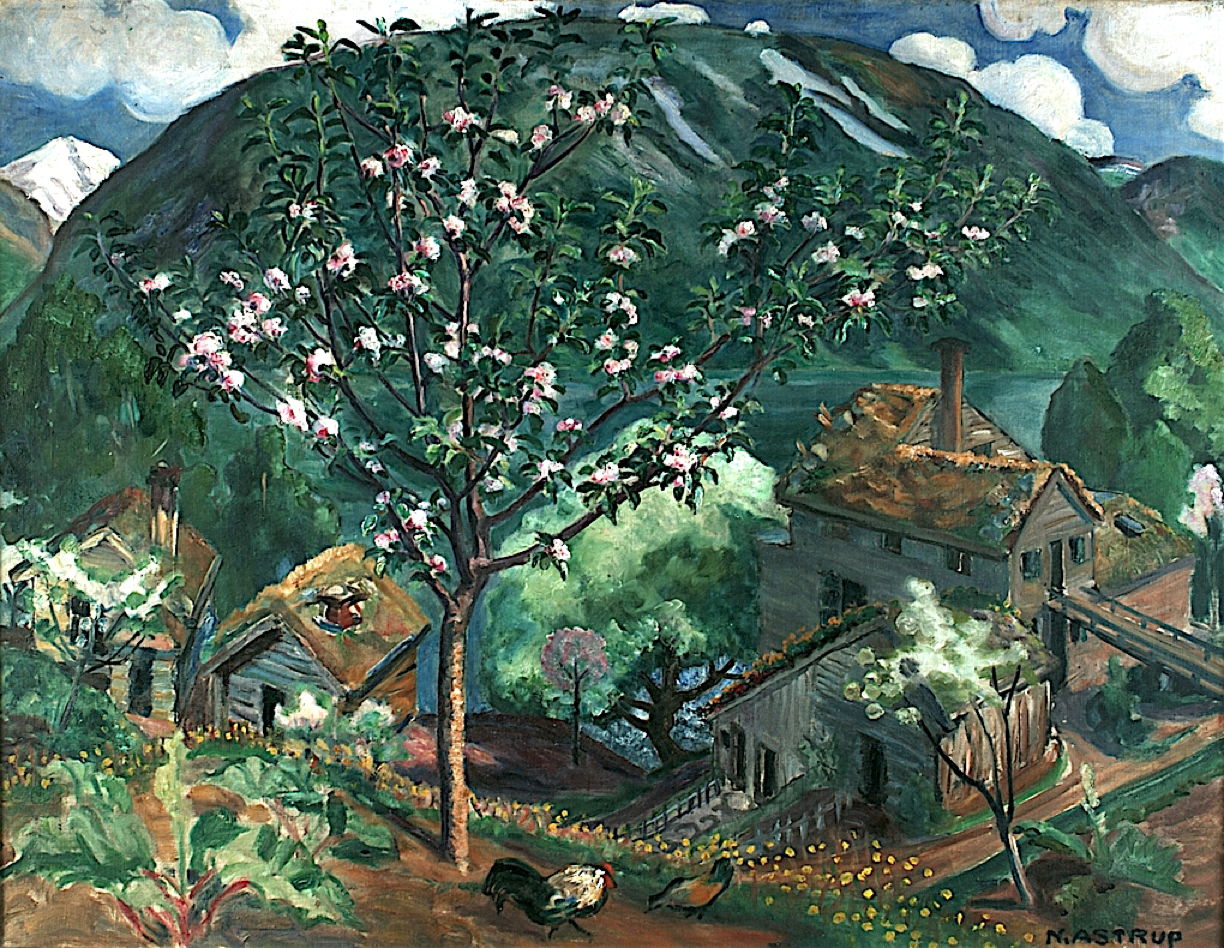
In about 1927, Astrup painted Apple Tree in Bloom showing the trees in full blossom and marsh marigolds in flower.

bonnardopendoor1938
Pierre Bonnard (1867-1947), The Open Door (c 1937), media not known, 126.1 x 71.1 cm, Private collection. The Athenaeum.

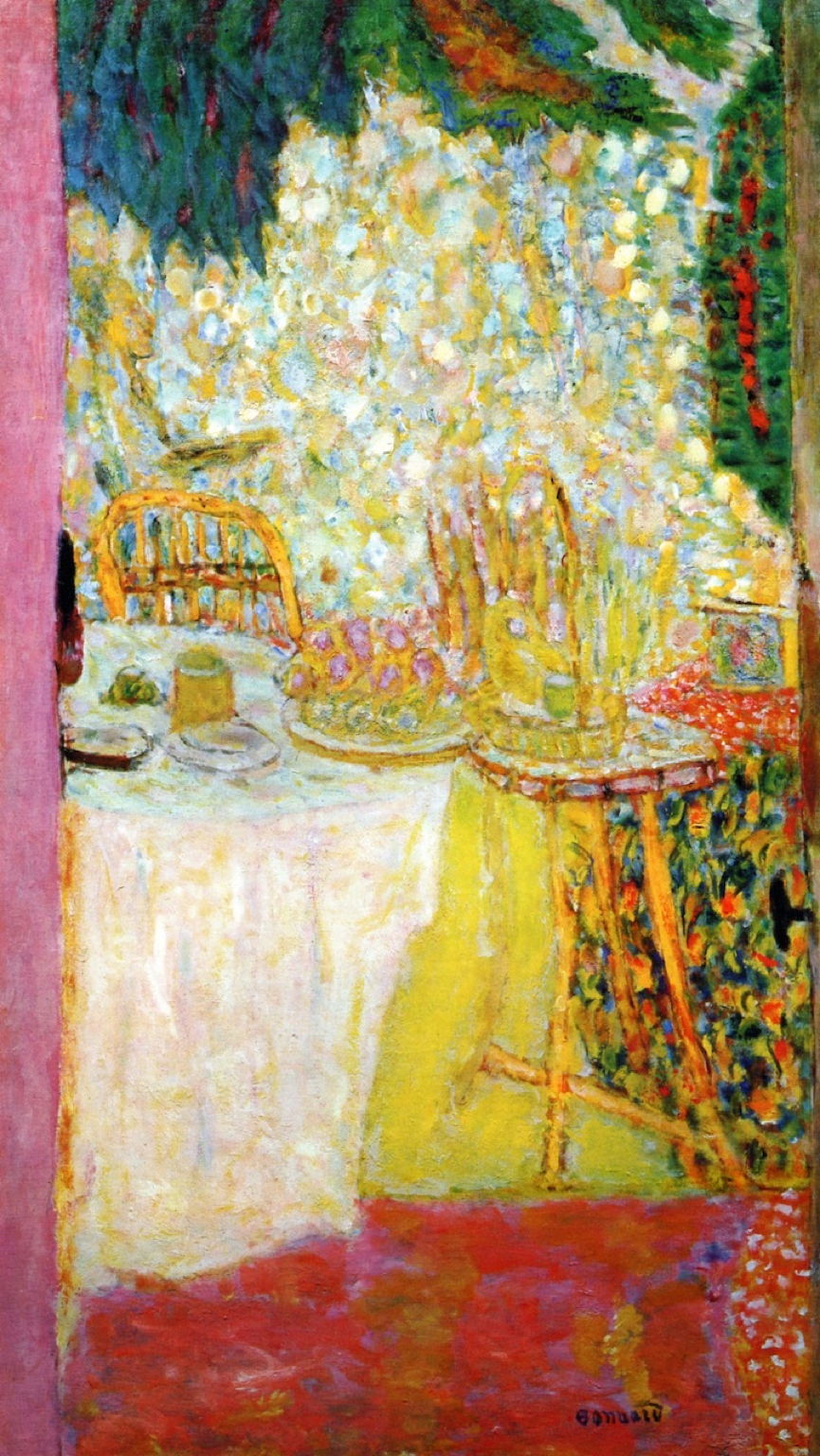
In Pierre Bonnard’s Open Door from about 1937, we look out through the frame of French windows to a table that has escaped into the landscape, and dazzles against brilliant blossom beyond.

I wish you a happy blossom festival, and above all peace.

❌
❌