Dragonflies have suffered a bad press for too long. Commonly known on both sides of the Atlantic as the devil’s darning needles, they’re more widely associated with evil, biting people, or even sewing their eyelids together, all categorically untrue. In reality they should be our friends, as they’re insectivorous, and amazingly effective at consuming biting flies.
Unfortunately, their associations in paintings are as bad as those old wives’ tales, and they have been depicted infrequently.
Ambrosius Bosschaert (1573–1621), Flower Still Life (1614), oil on copper, 30.5 x 38.9 cm, J. Paul Getty Museum, Los Angeles, CA. Wikimedia Commons.
Ambrosius Bosschaert (1573–1621) painted this Flower Still Life in oil on copper in 1614, during the early years of the Dutch Golden Age. At first its eclectic mixture of different flowers and flying insects appears haphazard, but they merit a deeper reading. The flowers include carnation, rose, tulip, forget-me-nots, lilies of the valley, cyclamen, violet and hyacinth, which could never, at that time, have bloomed at the same time. The butterflies, bee and dragonfly are as ephemeral as the flowers around them, confirming that it’s a vanitas painting.
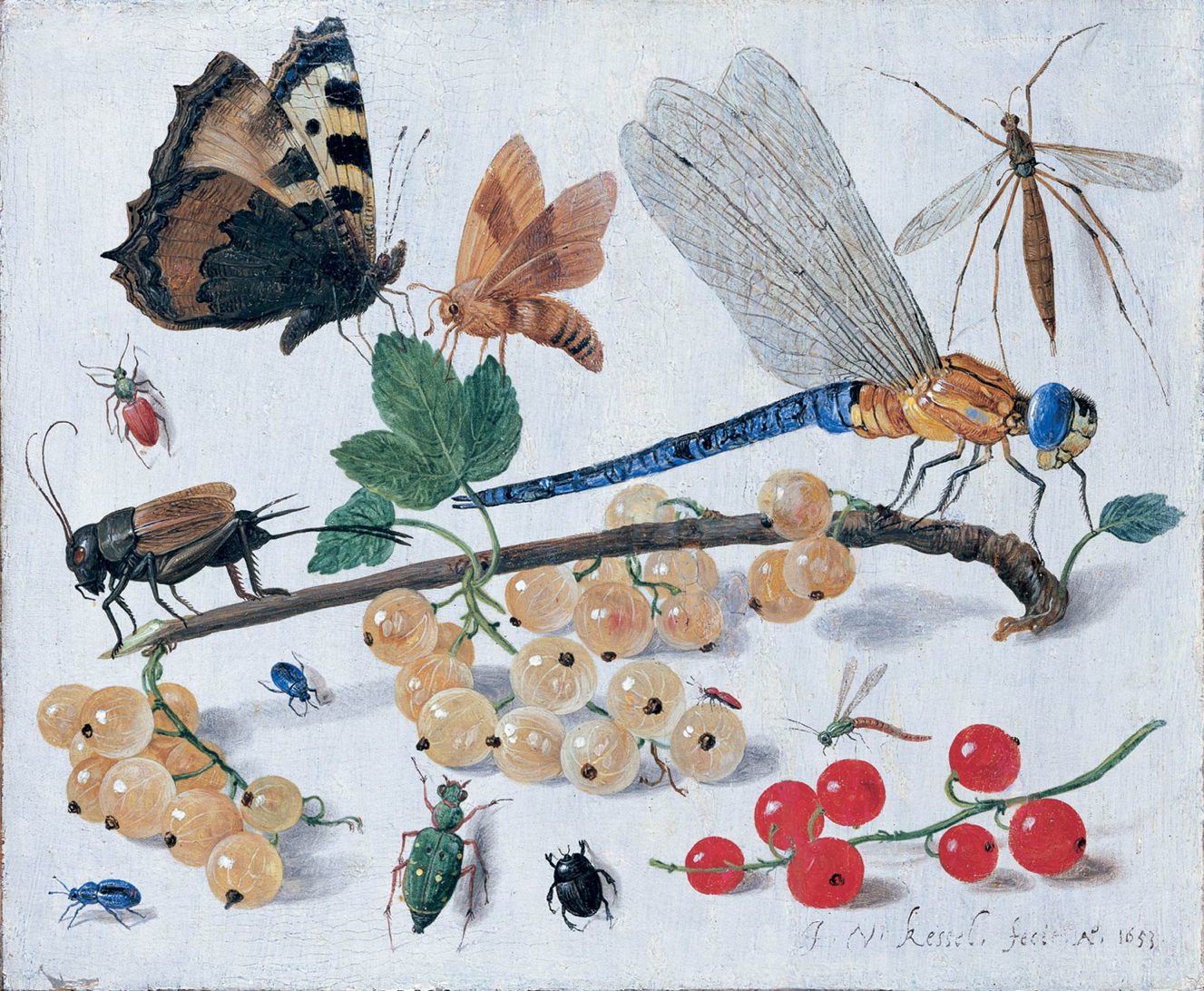
Jan van Kessel the Elder (1626–1679), (title not known) (1653), oil on copper, dimensions not known, Galerie Müllenmeister, Solingen, Germany. Wikimedia Commons.
In 1653, Jan van Kessel the Elder painted this collection of insects and berries in oil on copper. The dragonfly shown appears to be a southern hawker (Aeshna cyanea), one of the most common large species found throughout Europe, although its thorax is unusually pale, suggesting it might be a young adult (teneral), or had discoloured after death.
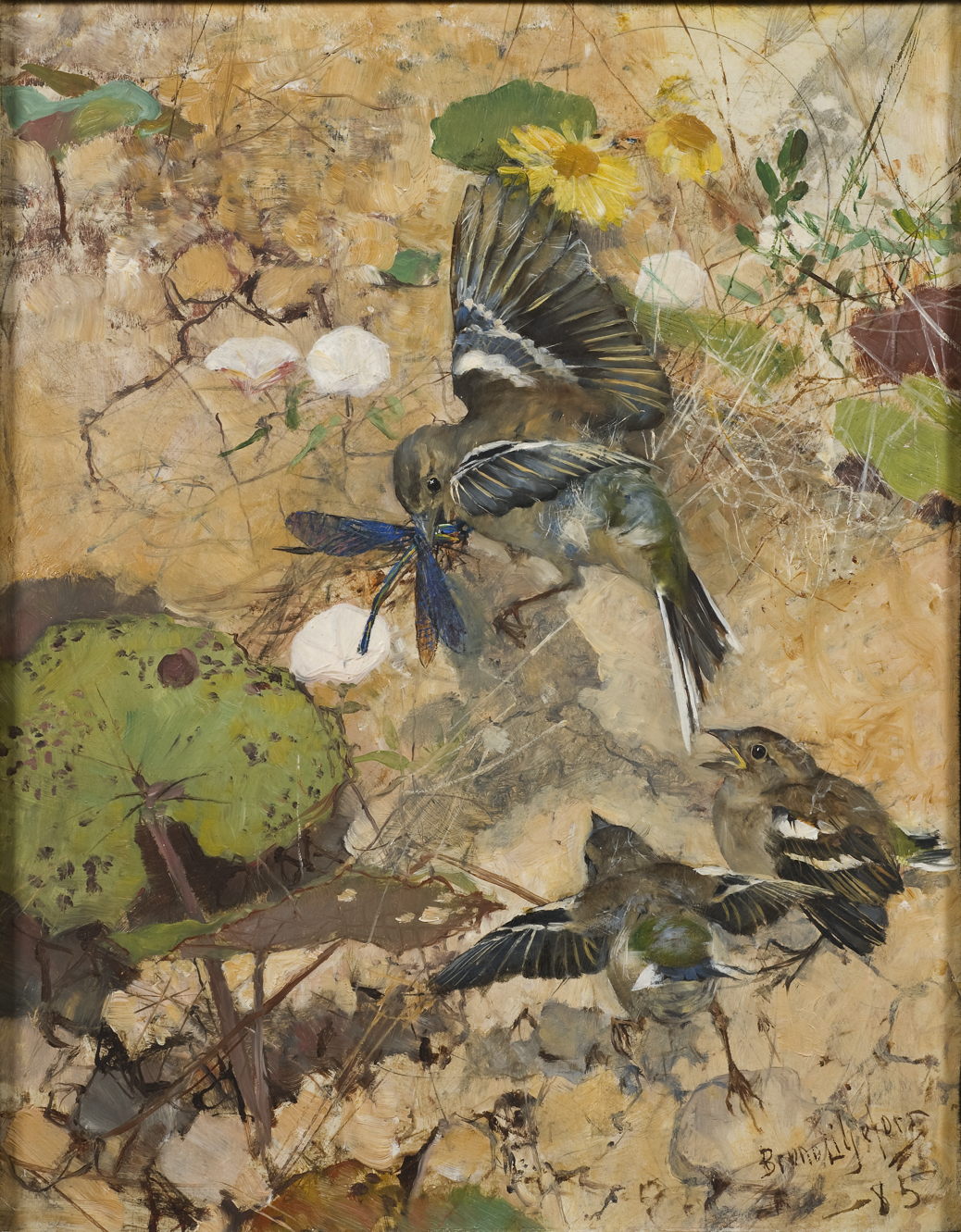
Bruno Liljefors (1860–1939), Chaffinches and Dragonflies. Five studies in one frame (1885), oil on panel, 33 x 25.5 cm, Nationalmuseum, Stockholm, Sweden. Wikimedia Commons.
The large meal seen in the centre of Bruno Liljefors’ Chaffinches and Dragonflies. Five studies in one frame (1885) is another common European species, the beautiful demoiselle (Calopteryx virgo). This is considerably smaller than the hawker seen above, and is more correctly termed a damselfly, as its pairs of wings are of equal length, and when resting are folded back against its body.
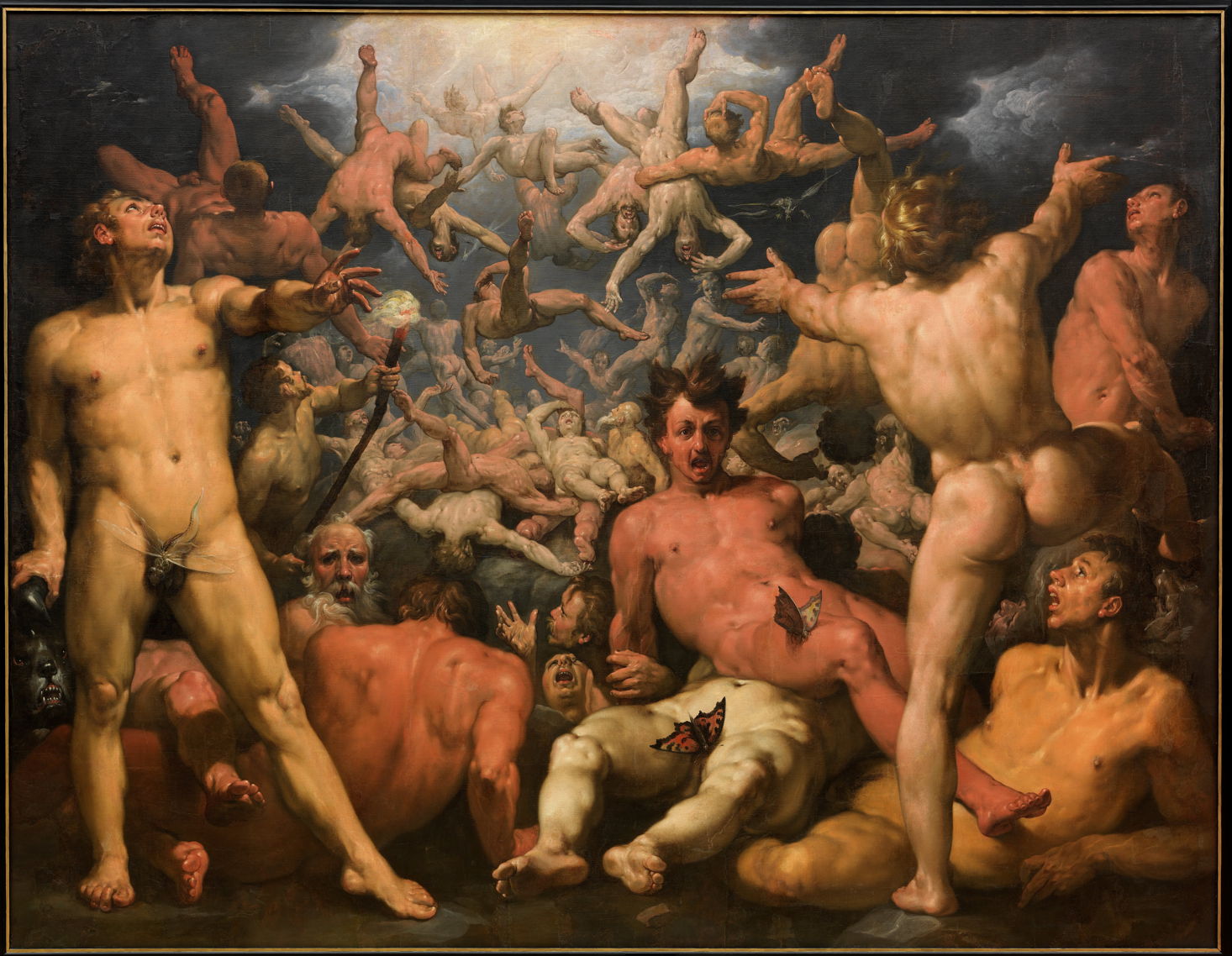
Cornelis van Haarlem (1562–1638), The Fall of the Titans (1588-90), oil on canvas, 239 x 307, Statens Museum for Kunst (Den Kongelige Malerisamling), Copenhagen, Denmark. Wikimedia Commons.
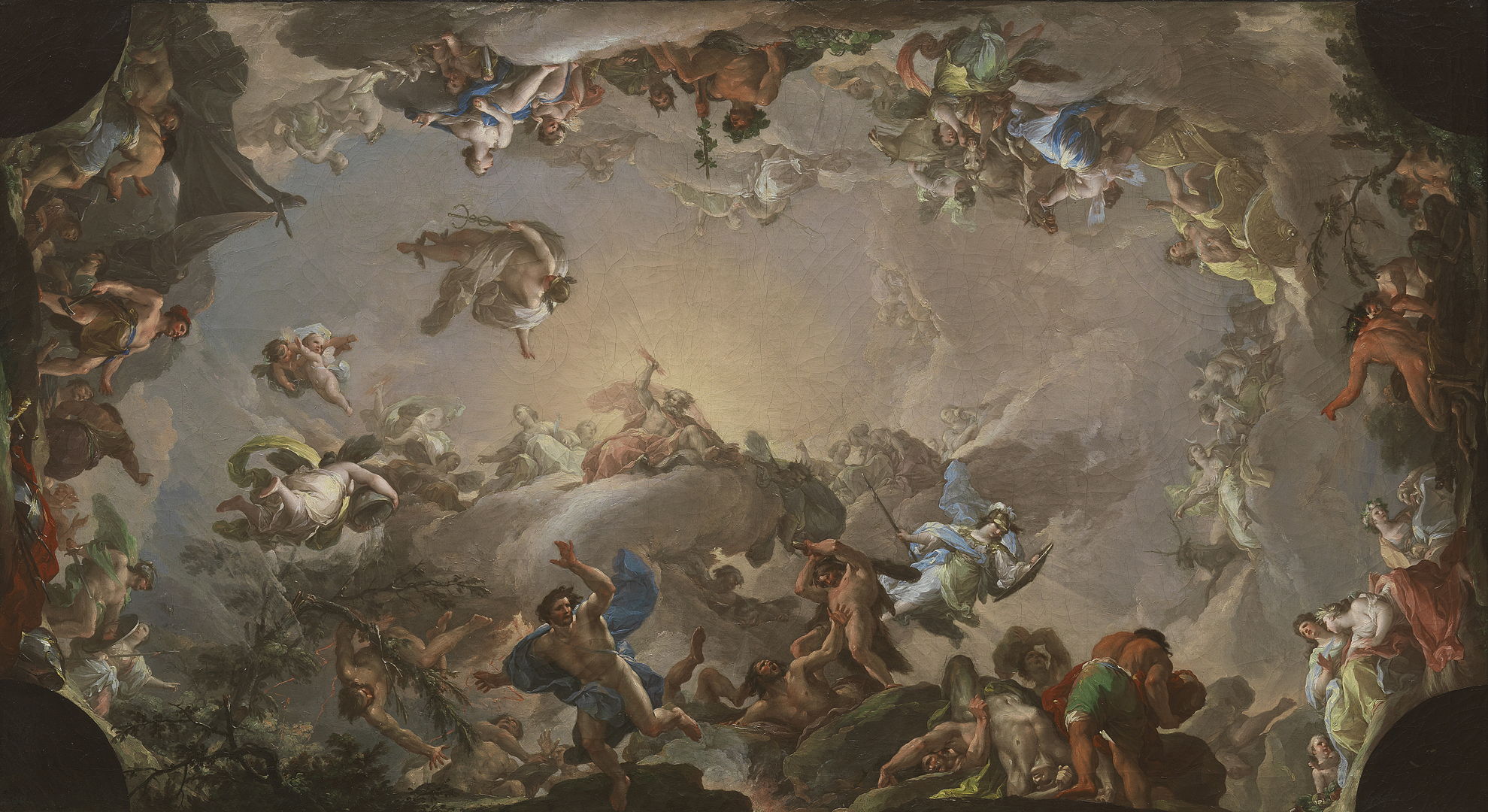
Cornelis van Haarlem’s The Fall of the Titans from 1588-90 might seem a strange painting in which to find flying insects. This shows the classical myth in which the gods have defeated the Titans who preceded them. As a result the Titans fell from the heavens and were imprisoned in Tartarus, or Hell, as shown here. It was claimed that flying insects were associated with the fire of the underworld, although the two butterflies and one dragonfly here appear quite incongruous.
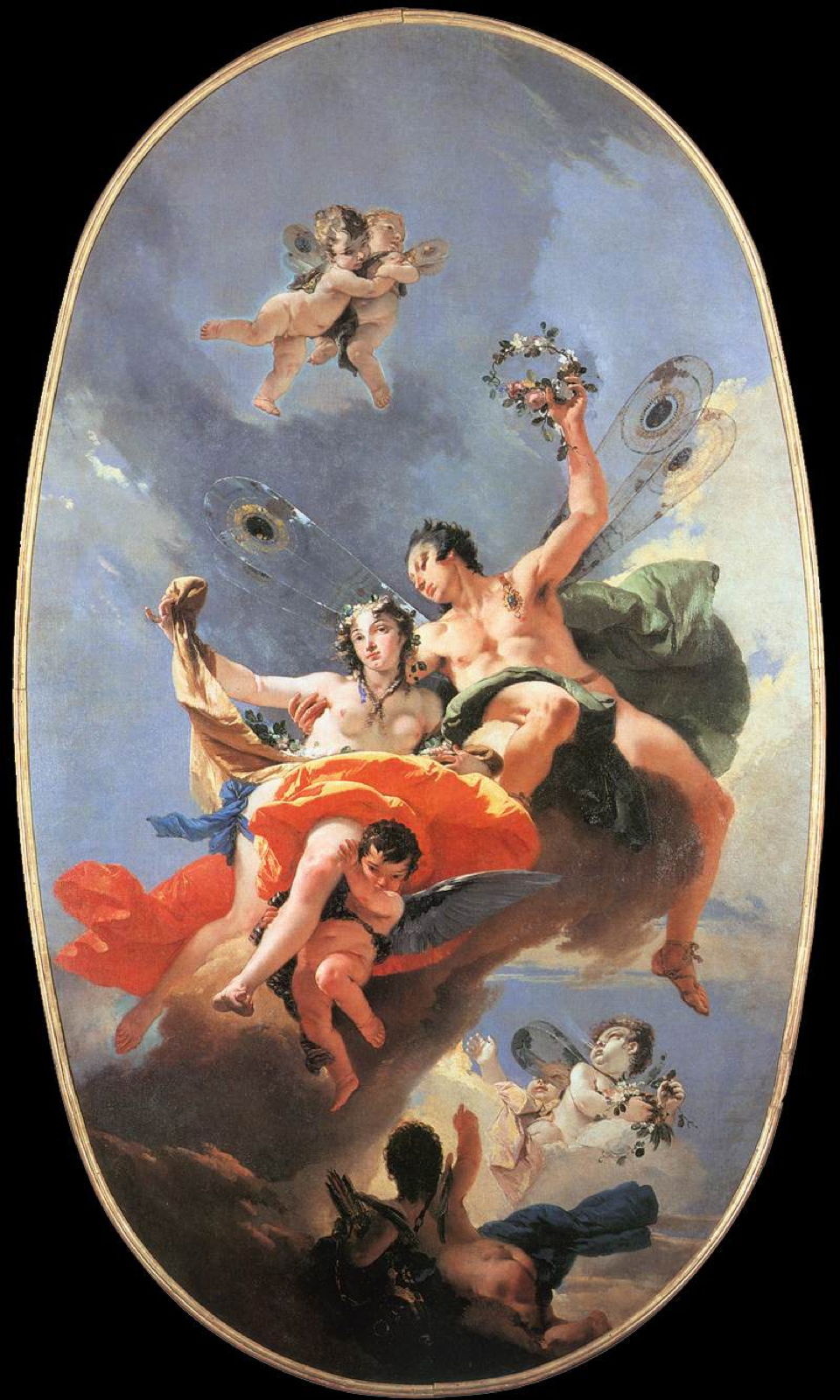
Giovanni Battista Tiepolo (1696–1770), The Triumph of Zephyr and Flora (1734-35), oil on canvas, dimensions not known, Ca’ Rezzonico, Venice, Italy. Wikimedia Commons.
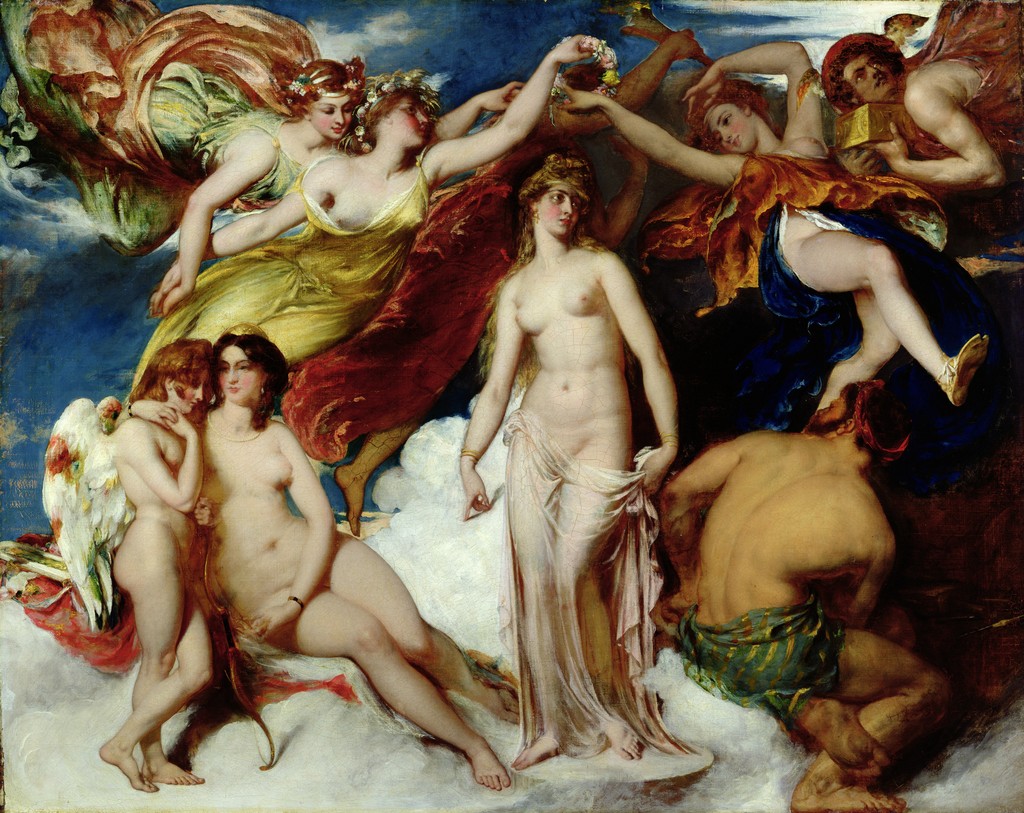
Tiepolo’s The Triumph of Zephyr and Flora from 1734-35 refers to Ovid’s account in his Metamorphoses, and to Botticelli’s Primavera, with Zephyrus in flight with his arm around Flora, just about to crown her with a garland. Unusually, Zephyrus is given the wings of a dragonfly.
Elihu Vedder (1836–1923), Fortuna (date not known), oil on canvas, 55.9 x 40.6 cm, Private collection. The Athenaeum.
In the Roman religion, Fortuna (Greek equivalent Tyche) was the goddess of fortune and luck, both good and bad. More usually depicted as being veiled and/or blind, to indicate the chance involved, she was the embodiment of capriciousness. In this updated portrait of the goddess, Elihu Vedder shows her as a carefree, happy-go-lucky woman, with the wings of a dragonfly, sat next to a sack of gold coins. Vedder first visited Italy in 1858, and lived there from 1906 until his death seventeen years later, so he may well have been referring to Tiepolo’s Zephyrus, which was and remains in Venice.
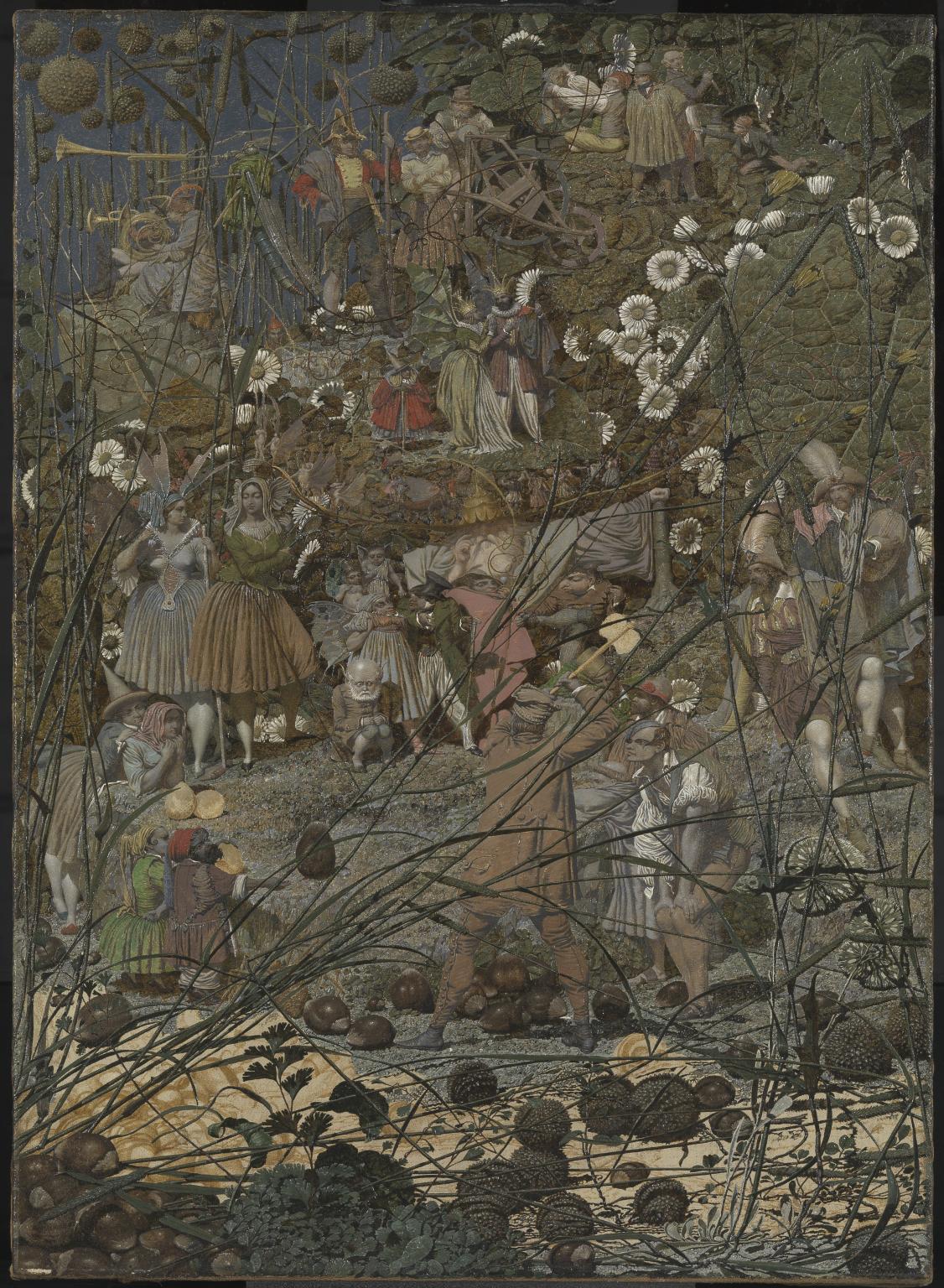
My last painting of a dragonfly is by far the most complex, and was made by Richard Dadd between 1855-64, when he was a patient in the Bethlem and Broadmoor psychiatric hospitals, after he had murdered his father.
Dadd’s The Fairy Feller’s Master-Stroke has its origins in Shakespeare’s plays, with its main content drawn from A Midsummer Night’s Dream. This looks through fine stalks of Timothy grass at a foreground of scattered hazelnuts and plane tree fruit. Although its perspective is flattened, the figures in the lower half of the painting are stood on a gently rising grassy sward, behind which is a steeper bank and stone walling. Those in the upper third of the painting appear to be on another level, which rises more steeply towards the top edge.
The scene is set in the night-time, although daisy flowers are still unnaturally open, and there is night sky visible at the upper left. The feller himself, a hewer or fellow, seen at the centre, is about to cleave a hazelnut with his axe to provide a new carriage for Queen Mab (pronounced Maeve, to rhyme with rave), who replaces Titania as the queen of fairyland.
Even the distant upper section of the painting is rich in its array of characters. Trumpeters at the left include two boys, given as a ‘tatterdemalion’ and a ‘junketer’, and an insect intended to be a dragonfly. To the right of them are the characters from the still-popular child’s counting saying, of tinker, tailor, soldier, sailor, rich man, poor man, beggar man, and thief, although not quite in that order. The dragonfly may have been based on another large species found throughout Europe, the emperor (Anax imperator).
The classical Greek hero Theseus had travelled overland to be reunited with his father Aegeus, King of Athens, where he narrowly escaped death by Medea’s poison. Following the example of his hero Heracles, he then killed the Marathonian Bull, in preparation for his most famous accomplishment, killing the half-bull, half-human Minotaur living at the centre of the Labyrinth on the island of Crete.
King Minos of Crete had been exacting a tribute of nine young men and nine maidens from Athens every nine years, who were taken to the Labyrinth to die. On the third such call for eighteen of Athens’ finest, its citizens accused Aegeus of being its cause. Although a matter of dispute as to how he accomplished it, Theseus went to Crete as one of those eighteen.
George Frederic Watts was apparently driven to paint The Minotaur in 1885 as a response to a series of articles in the press revealing the industry of child prostitution in late Victorian Britain. Those referred to the myth of the Minotaur, so early one morning he painted this image of human bestiality and lust. His Minotaur has crushed a small bird in its left hand, and gazes out to sea, awaiting the next shipment of young men and virgin women from Greece.
Because the Athenians knew that their young people weren’t going to return, the ship carrying them to Crete had black sails. On this occasion, though, Theseus gave its crew a white sail, telling Aegeus and the crew that when they returned, if he had been successful in killing the Minotaur, they would set that white sail as a sign.
Gustave Moreau (1826–1898), Athenians Being Delivered to the Minotaur (1855), oil, dimensions not known, Musée de Brou, Bourg-en-Bresse, France. Wikimedia Commons.
Gustave Moreau’s painting of Athenians Being Delivered to the Minotaur (1855) shows the victims as they were preparing to enter the Labyrinth. Wearing laurel wreaths to mark their distinction and sacrifice, the young men and women hold back while Theseus crouches, waiting to do battle with the beast, seen at the right.
Left to his own devices, Theseus’ chances were not good. However, Minos’ daughter Ariadne had fallen in love with him when she saw him compete in the funereal games preceding the act of sacrifice, and promised to assist in return for his hand in marriage afterwards. It was she who provided Theseus with a ball of thread which he deployed as he entered the Labyrinth, enabling him to retrace his steps once he had killed the Minotaur at its centre.
Henry Fuseli (1741–1825), Ariadne Watching the Struggle of Theseus with the Minotaur (1815-20), brown wash, oil, white gouache, white chalk, gum and graphite on moderately thick, moderately textured, beige wove paper, 61.6 x 50.2 cm, Yale Center for British Art, New Haven, CT. Wikimedia Commons.
In Henry Fuseli’s spirited mixed-media sketch of Ariadne Watching the Struggle of Theseus with the Minotaur (1815-20), Theseus appears almost skeletal as he tries to bring his dagger down to administer the fatal blow, and Ariadne resembles a wraith or spirit.
Charles-Édouard Chaise (1759-1798), Theseus, Victor over the Minotaur (c 1791), oil on canvas, dimensions not known, Musée des Beaux-Arts, Strasbourg, France. Image by Rama, via Wikimedia Commons.
Theseus, Victor over the Minotaur (c 1791) is one of only three paintings by Charles-Édouard Chaise known to survive. With its crisp neo-classical style, it shows Theseus standing in triumph over the lifeless corpse of the Minotaur. He is almost being mobbed by the young Athenian women whose lives he has saved. At the left, his thread rests on a wall by an urn, suggesting the young woman by it may be Ariadne; she is being helped by a young man.
There are conflicting stories as to what happened next, but Theseus and Ariadne departed from Crete, ending up on the island of Naxos, where Theseus abandoned her and sailed on. This has been depicted by many painters, although most have naturally concentrated on the jilted Ariadne rather than her betrayer Theseus.
John William Waterhouse (1849–1917), Ariadne (1898), oil on canvas, 151 x 91 cm, Private collection. Wikimedia Commons.
John William Waterhouse paints the moment that Ariadne (1898) starts to wake, as Theseus’ ship has just sailed. As she hasn’t yet realised she has been abandoned, she lies back at ease. On and under the couch are a couple of leopards, a clear reference to the imminent arrival of Dionysus.
Paulus Bor (circa 1601–1669), Ariadne (1630-35), oil on canvas, 149 x 106 cm, Muzeum Narodowe w Poznaniu, Poznań, Poland. Wikimedia Commons.
Paulus Bor’s portrait of Ariadne, painted in the period 1630-35, can only show her on Naxos, immediately after she has been abandoned, still clutching the thread by which she thought she had tethered him, now hanging at a loose end. On the wall above her are sketches she has made of her lover. She looks deeply lost in thought and gloom.
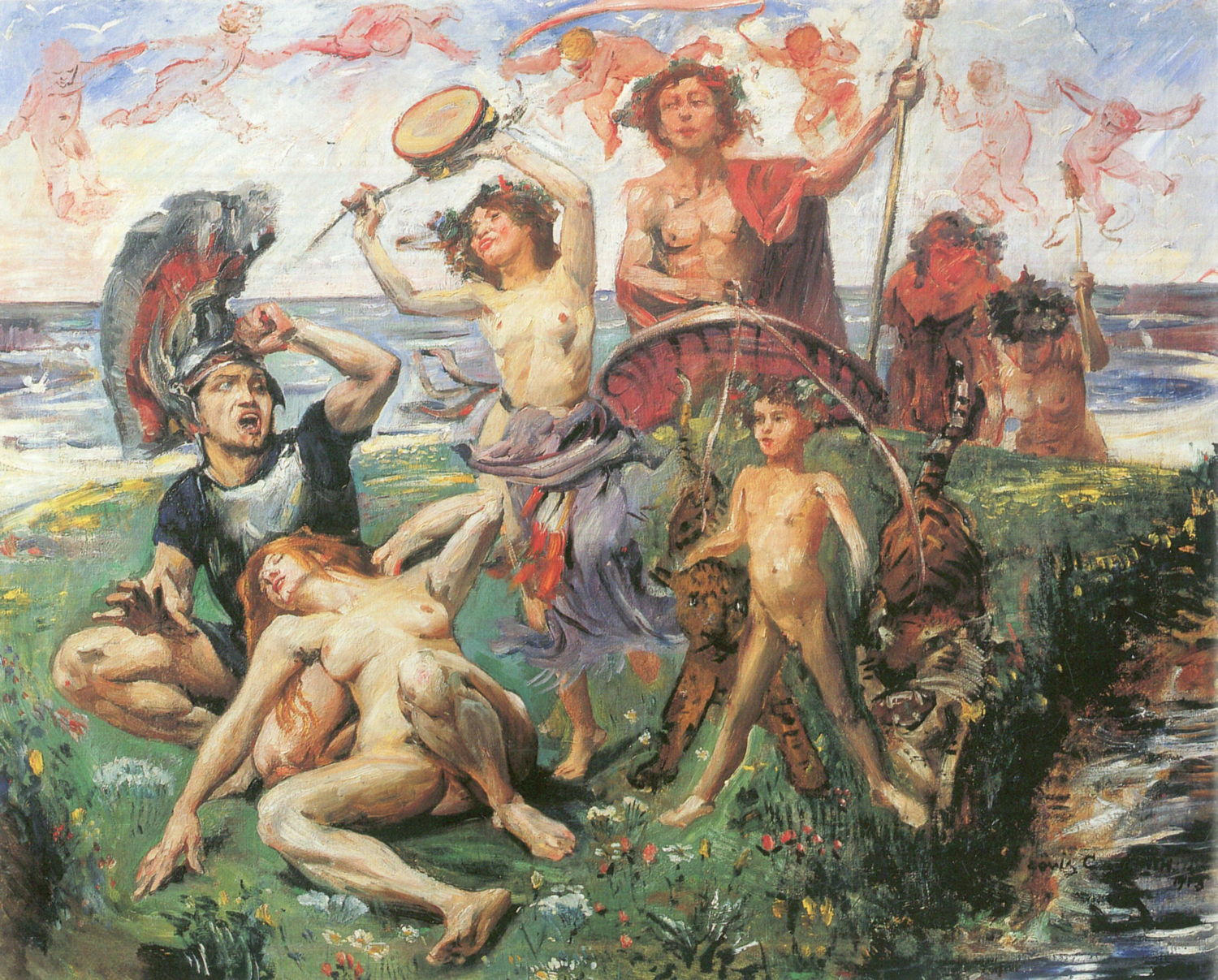
Lovis Corinth (1858–1925) Ariadne on Naxos (1913), oil on canvas, 116 × 147 cm, Private collection. Wikimedia Commons.
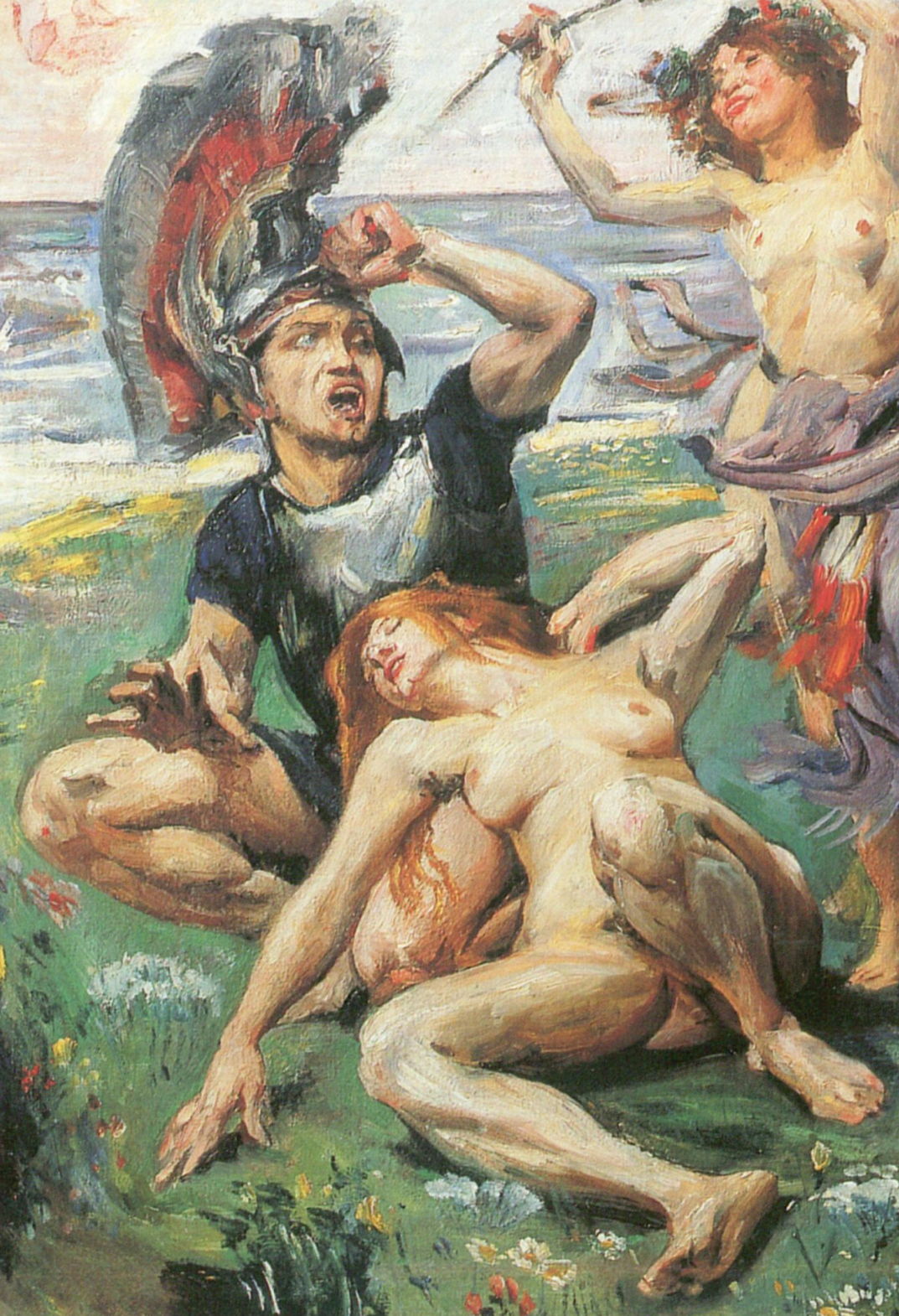
Lovis Corinth’s Ariadne on Naxos (1913) is one of his most sophisticated and masterly mythical paintings, inspired by the first version of Richard Strauss’s opera Ariadne auf Naxos (1912). The left third of the painting (detail below) shows Ariadne lying in erotic langour on Theseus’ left thigh. He wears an exuberant helmet, and appears to be shouting angrily and anxiously towards the other figures to the right.
Lovis Corinth (1858–1925) Ariadne on Naxos (detail) (1913), oil on canvas, 116 × 147 cm, Private collection. Wikimedia Commons.
Having called in briefly at Delos, Theseus and his ship returned to Athens. But in their delight and celebration, they forgot to hoist the white sail to indicate the success of their mission. Seeing their ship with its black sail still set, Theseus’ father King Aegeus threw himself from a cliff in despair, and died.
Theseus’ return to Athens thus brought an odd mixture of celebration at his success, and lamentation at the death of his father. Their ship was carefully preserved as a monument to Theseus’ accomplishment, and he set about transforming and growing the city by settling all the citizens of Attica in it. He promised government without a king, by means of democracy, making himself its commander in war and the guardian of its laws. He also had its currency struck into coins, and instituted the Isthmian (Olympic) Games.
Back on the island of Naxos, Ariadne went on to marry Dionysus, the couple had many children, and lived happily ever after.
Yesterday’s article examined Peter Paul Rubens’ masterwork Peace and War (1629-30), which he gave to King Charles I of England at the end of his diplomatic mission in London. Rubens returned to his busy workshop in Antwerp, and for the remaining decade of his life devoted himself to painting some of his greatest and most personal works.
His personal life changed greatly too: when he returned to Antwerp, he married the sixteen year-old Hélène Fourment, having lost his first wife four years earlier. In 1635, he bought a country estate near Antwerp, the Steen, which was to be his base until his death, and the subject of several of his finest landscape paintings over those years.
With Europe nearing the end of the Thirty Years’ War, Rubens was only too delighted to be commissioned to paint one of his final narrative masterpieces for Ferdinand de’ Medici, then the Grand Duke of Tuscany. Tuscany had been largely uninvolved in the war, and this time Rubens had no diplomatic mission to accomplish. He could afford to be frank in his story, and we are fortunate in having the artist’s own description of the painting as a reference.
Peter Paul Rubens (1577–1640), The Consequences of War (1637-38), oil on canvas, 206 x 342 cm, Palazzo Pitti, Florence, Italy. Wikimedia Commons.
The central figures in The Consequences of War (1637-38) are Venus and Mars. The god of war is advancing forcefully having just rushed from the temple of Janus, moving from left to right, with his sword bloodied and held low. His head is turned back to look at Venus, whose left arm is caught around his right, and who is clearly trying unsuccessfully to restrain him. Standing against the right thigh of Venus is a winged Cupid, child of Mars and Venus.
Drawing Mars forward is Alecto, her hair now looking more like that of a Fury but with few snakes visible, who bears a torch in her right hand. Monsters near her personify pestilence and famine, inseparable partners of war at that time. On the ground below Alecto is a woman with her back towards the viewer: she is Harmony, whose lute has been broken in the discord brought by war.
Nearby, also on the ground, is a mother with her child in her arms, symbolising the effect of war on families and their rearing. At the lower right corner is an architect clutching his instruments, indicating how fine buildings are thrown into ruin by war. Under the right foot of Mars is a book, showing how war tramples over the arts.
On the ground to the left of Cupid is a bundle of arrows or darts: these are not Cupid’s arrows of desire, but when bundled up would form the symbol of Concord; thus war breaks Concord. To their left is the caduceus and an olive branch, attributes of Peace, also cast aside.
The woman at the left in a black gown is the personification of Europe, whose globe, symbolising the Christian world, is carried by a putto behind her. Having endured the ravages of war for so long, her clothing is torn and she has been robbed of her jewels.
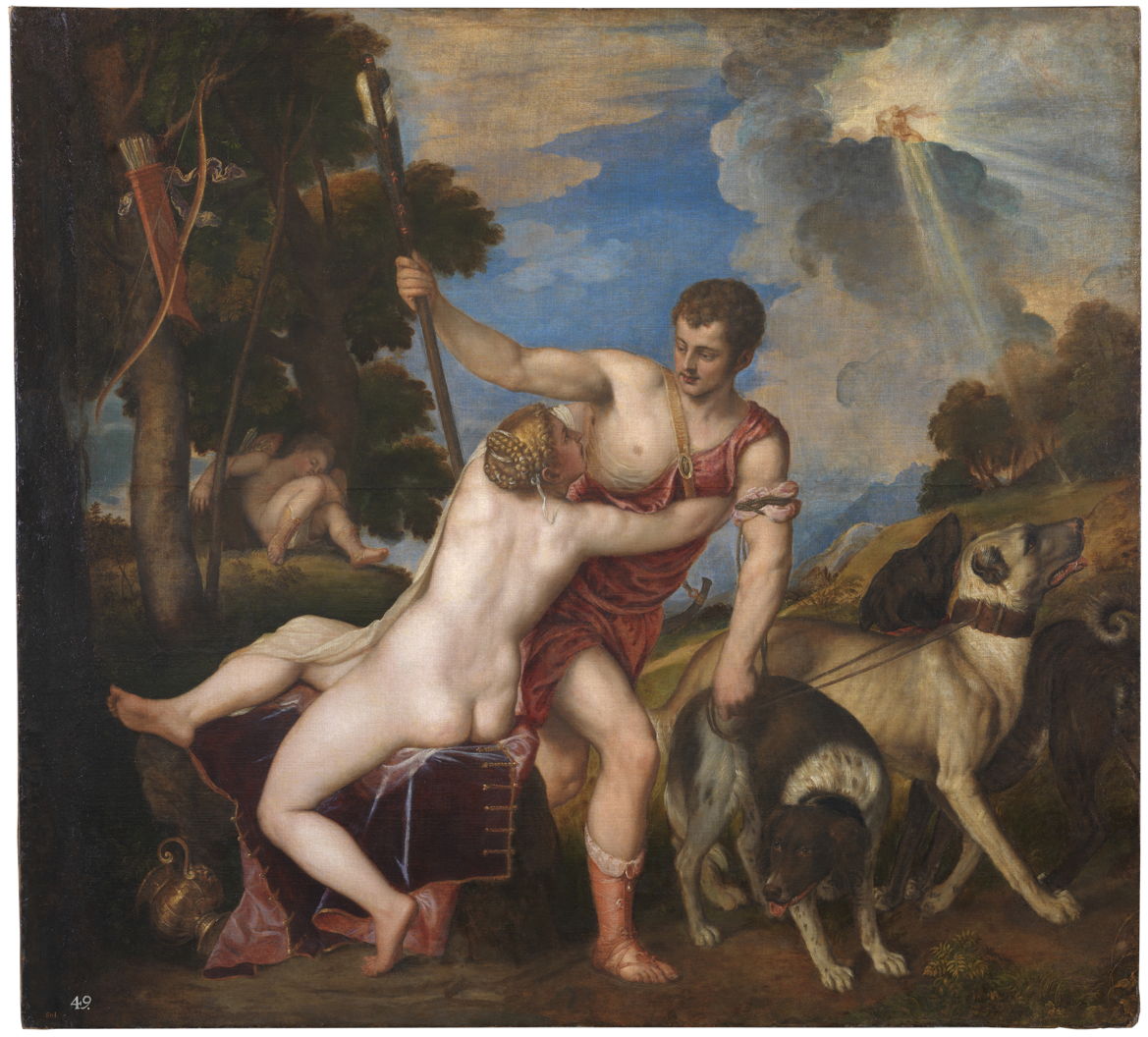
Venus and Mars are, in myth, well-known lovers. Venus is failing to restrain Mars from charging off to war, and in doing so, he is breaking their bond of love. This element of the composition had evolved over a long period, coming originally from Titian, and referring to another of Venus’ lovers, Adonis.
Titian (Tiziano Vecelli) (1490–1576), Venus and Adonis (1554), oil on canvas, 186 x 207 cm, Museo Nacional del Prado, Madrid. Wikimedia Commons.
Titian’s Venus and Adonis from 1554 shows Venus trying, again in vain, to prevent Adonis from going off to hunt, where he was to be killed by a wild boar. This was a favourite motif of Titian’s: no less than seven versions have been attributed to him from the period between 1553 and about 1560.
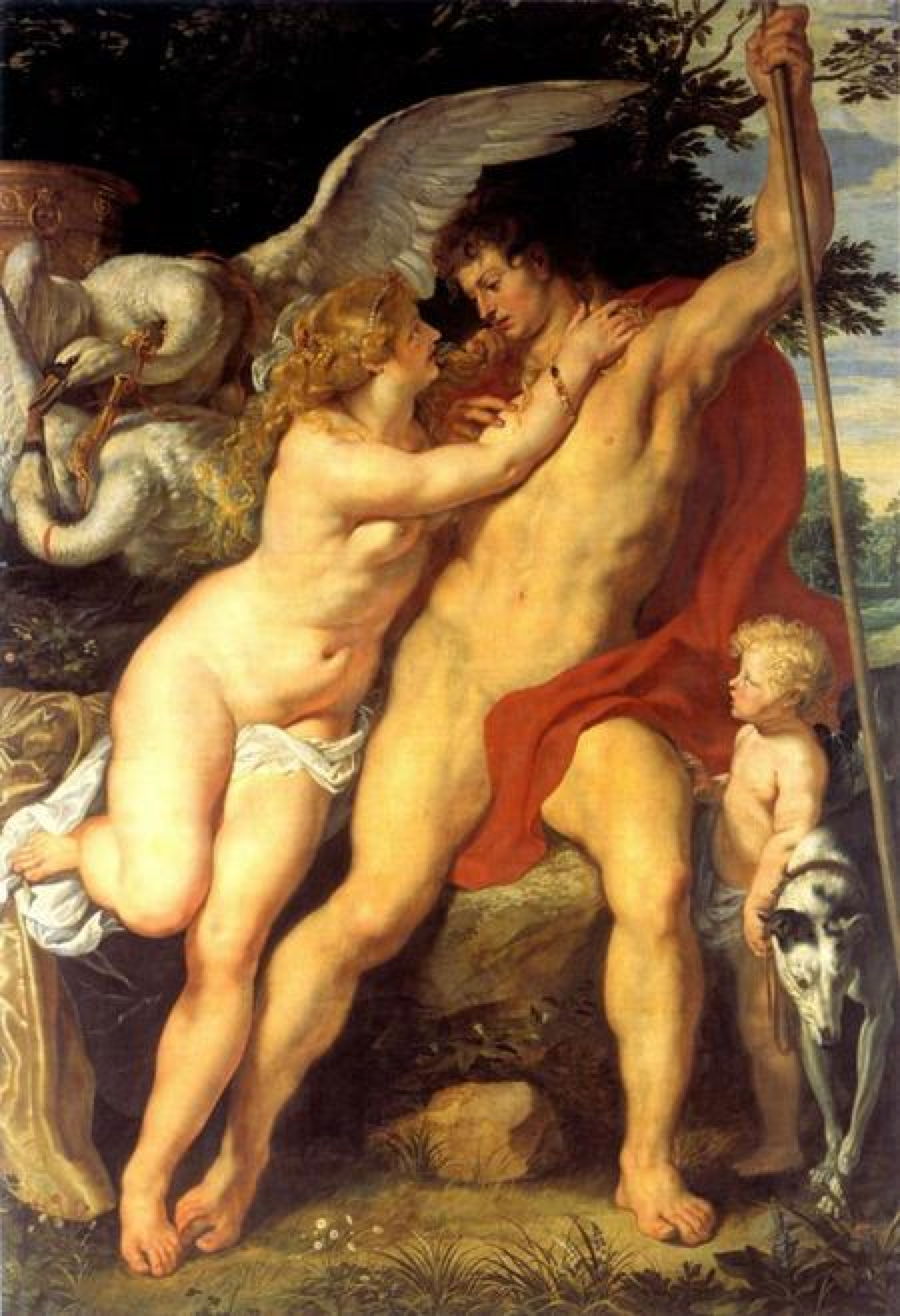
Peter Paul Rubens (1577–1640), Venus and Adonis (c 1610), oil on panel, 276 × 183 cm, Museum Kunstpalast, Düsseldorf, Germany. Wikimedia Commons.
Rubens’ early painting of Venus and Adonis from about 1610, now in Düsseldorf, adopts a similar compositional approach, with Adonis facing the viewer and about to move to the right, but Rubens turns Venus’ body to face the viewer more.
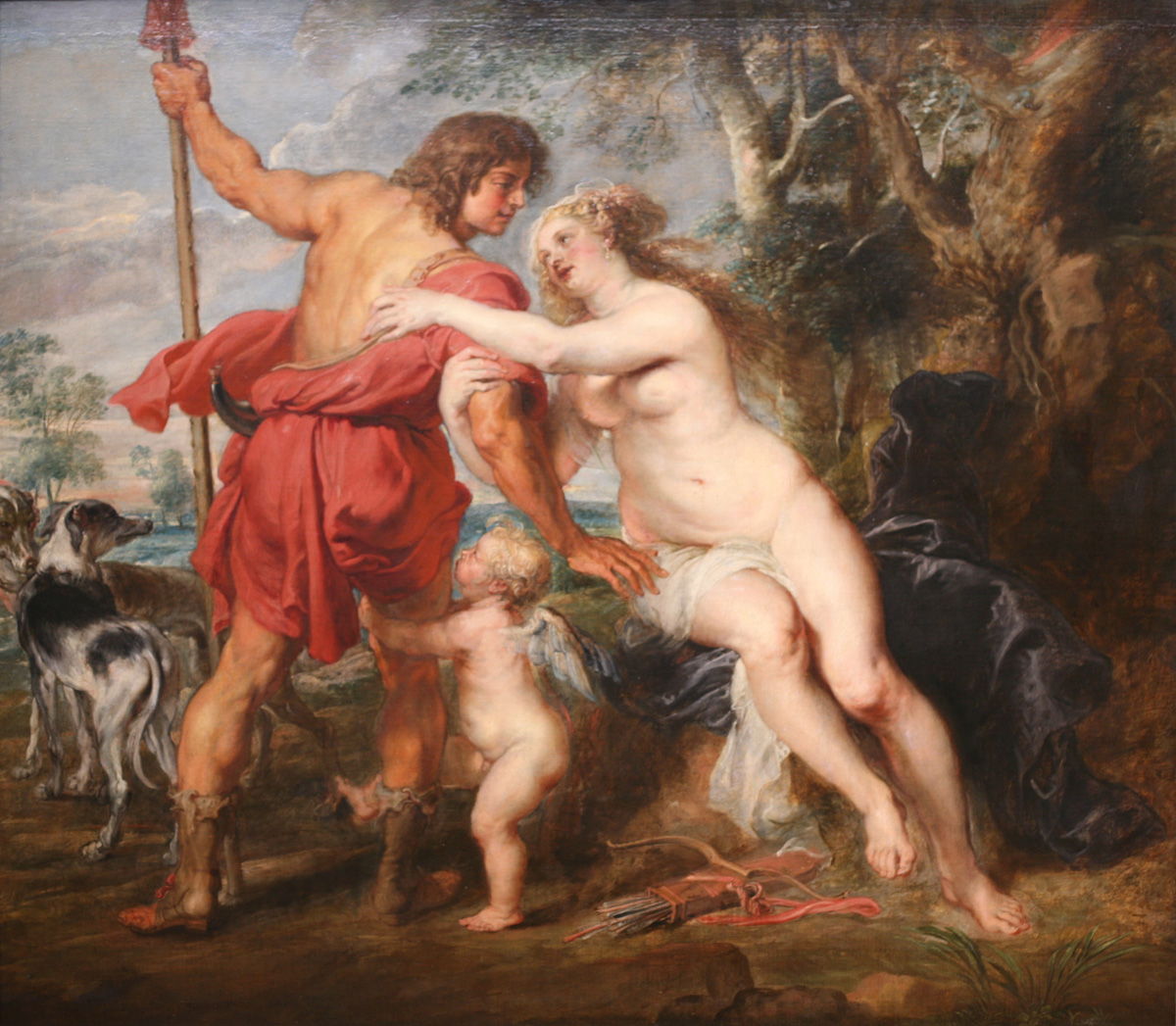
Peter Paul Rubens (1577–1640), Venus and Adonis (c 1635), oil on canvas, 194 × 236 cm, The Metropolitan Museum of Art, New York, NY. Wikimedia Commons.
His much later Venus and Adonis from about 1635, now in the Met in New York, reverses the image as if it had been made from a print, and turns Adonis so that his back is towards the viewer. He is now about to move beyond the picture plane, away from the viewer. For The Consequences of War, Rubens keeps Venus in a similar position, but turns Mars to move straight along to the right in a more forceful and unconstrained action.
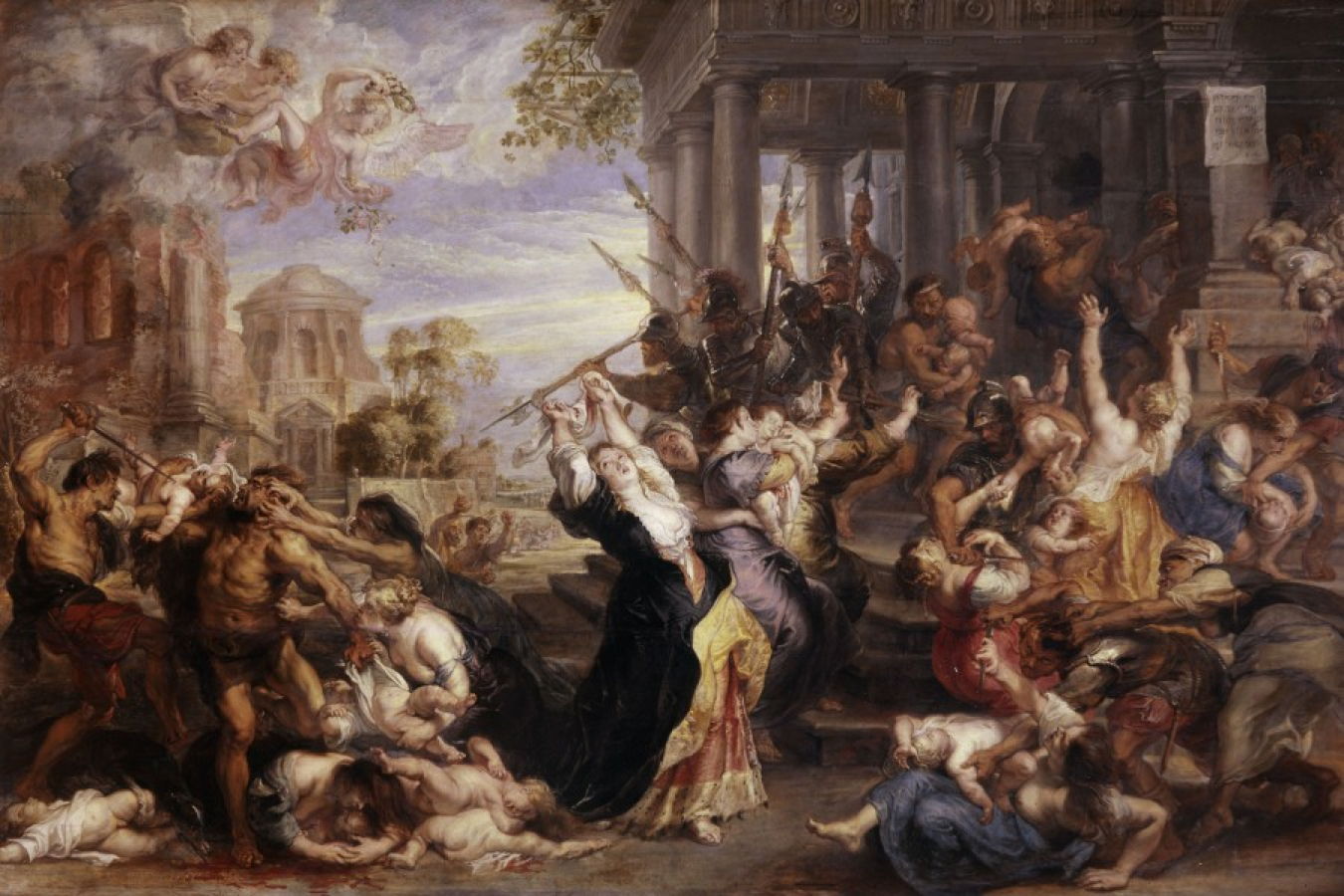
Peter Paul Rubens (1577–1640), The Massacre of the Innocents (c 1638), oil on oak, 198.5 x 302.2 cm, Alte Pinakothek, Munich, Germany. Wikimedia Commons.
The figure of Europe has an even more contemporary reference, to a nearly identical woman in the centre of Rubens’ The Massacre of the Innocents (c 1638). She too is in distress, although here she is not a personification in the way that she is in The Consequences of War.
Perhaps the most telling comparison is with Rubens’ The Triumph of Victory (c 1614), made when he was young and the finest painter in Flanders. The Treaty of Antwerp had been signed in 1609, and the city was flourishing in the Twelve Years’ Truce which ensued.
Peter Paul Rubens (1577–1640), The Triumph of Victory (c 1614), oil on oak panel, 161 x 236 cm, Gemäldegalerie Alte Meister, Kassel, Germany. Wikimedia Commons.
Painted for the Antwerp Guild of St George, its organisation of archers, Mars dominates, his bloody sword resting on the thigh of Victoria, personification of victory. She reaches over to place a wreath of either oak or laurel on Mars, and holds a staff in her left hand. At the right, Mars is being passed the bundle of crossbow bolts that make up the attribute of Concord.
Under the feet of Mars are the bodies of Rebellion, in the foreground, who still holds his torch, and Discord, on whose cheek a snake is crawling. The bound figure resting against the left knee of Mars is Barbarism.
Nearly a quarter of a century later, with the experience that his work as a diplomat had brought, Rubens had expressed a completely different view of war. His Peace and War (1629-30) and The Consequences of War (1637-38) should hang in the office of every head of state, from the White House, to the Kremlin Senate, to 10 Downing Street, and the Ryongsong Residence in North Korea.
Seventeenth century Europe was ravaged by war. Between 1618 and 1648, much of what is now Germany suffered the Thirty Years’ War, with widespread famines, epidemic disease, and the slaughter of battle. This spilled over to the Netherlands and Belgium, and beyond. Warfare at that time used weapons which individually had limited killing power, but wherever there was war, largely mercenary armies stripped the land of food and supplies, laying waste to large tracts of countryside, and bringing infectious diseases to kill many of the local population.
In the midst of that, some of the old Masters managed to flourish, among them Peter Paul Rubens (1577–1640), arguably the greatest narrative painter in Western art, and an accomplished international diplomat.
Rubens was no stranger to the consequences of religious persecution, conflict, and war. His Protestant parents had fled Antwerp for Cologne before his birth, he returned to Antwerp with his widowed mother in 1589 to be raised as a Catholic, and from 1600 he travelled throughout Europe, including Italy, Spain, France, England, and the Low Countries.
In 1629, he returned from a period in Madrid where he had worked with Diego Velázquez, then spent a little time back in his workshop in Antwerp before travelling to London, where he stayed until April the following year. A relatively peaceful country during the war on the European mainland, England’s stable period during Queen Elizabeth I’s reign had ended with her death in 1603; two years later Guy Fawkes and conspirators had tried to blow up the House of Parliament, and the Civil War broke out in 1642.
Rubens was now in his early fifties, internationally successful, and able to choose his own motifs. He had developed his sophisticated visual language of narrative over three decades of painting stories. Acting as envoy to King Philip IV of Spain, he was trying to agree peace between Spain and King Charles I of England. Among his tools was one of his greatest narrative paintings, Minerva Protects Pax from Mars or Peace and War, painted when he had been in England and left there as a gift to its king.
Rubens’ painting, now in the National Gallery in London, is crowded with more than a dozen figures drawn from classical myths. Until you have identified them and understood their roles and meaning, its reading remains elusive.
Its central figures are those of Ceres, here in the role of Pax, personification of peace, and Minerva behind her. In attendance are Mars, Hymen, Plutus, and Alecto, with sundry Bacchantes, a satyr, putti, and the attributes of Bacchus and Mercury. It’s like an away day from Olympus, or part of an index to Ovid.
Ceres and Minerva are at the heart of the painting. Rubens shows Ceres expressing milk from her left breast, which arcs into the mouth of her son Plutus, the god of wealth, who is grasping her left arm.
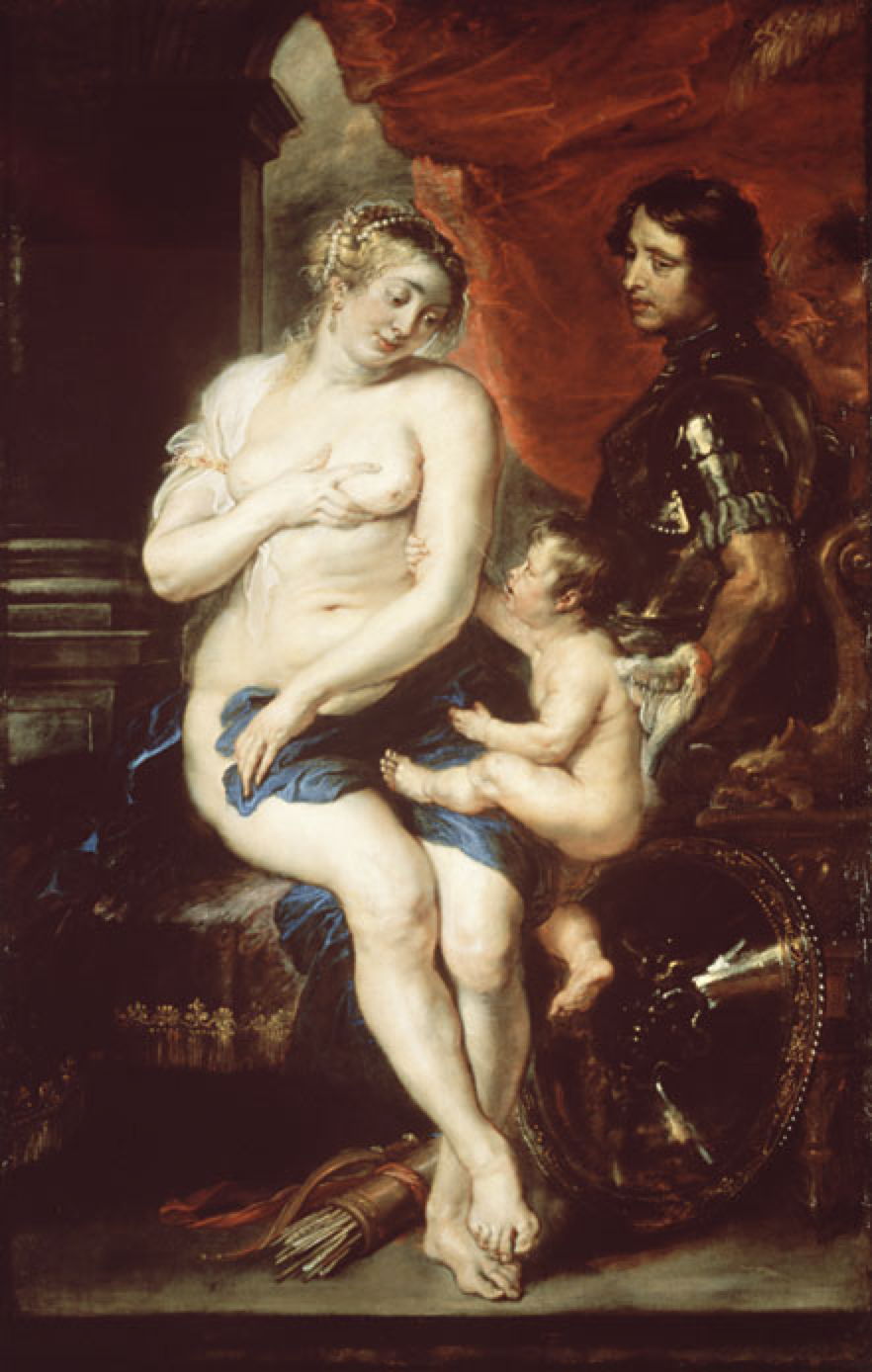
Peter Paul Rubens (1577–1640), Venus, Mars and Cupid, oil on canvas, 195.2 × 133 cm, Dulwich Picture Gallery, London. Wikimedia Commons.
The figures of Ceres and Plutus are almost identical to those of Venus and Cupid in Rubens’ earlier Venus, Mars and Cupid (c 1633), which introduces ambiguity to her figure. However, in this painting Cupid is shown with wings, and his traditional bow and arrows. In Peace and War, the infant is clearly not Cupid as he has neither wings nor bow and arrows: there he is Plutus.
Being the goddess of agriculture, grain crops (hence cereal), and maternal relationships, Ceres stands for values strongly associated with the benefits of peace: bread rather than starvation, fertility rather than barrenness and pestilence. Her son Plutus represents the growth of wealth in times of peace.
Although the figure immediately behind Ceres might be mistaken for a man (Mars, perhaps), her staff and helmet are characteristic of Minerva, the goddess with a curiously mixed portfolio of wisdom, industry, and war, a hangover from her part-Etruscan origins. Immediately above her is a winged putto carrying a caduceus, a short staff with wings at the top and entwined snakes, normally an attribute of Mercury, but also associated with commerce. That putto leans forward to place a laurel wreath, the crown of the victor and a symbol of peace, on Ceres’ head.
Minerva is pushing away the bearded figure of Mars, god of war, who is wearing his characteristic black armour. Rubens painted Mars not infrequently, and was flexible with his age and appearance, which vary according to context. With Venus and Cupid above, he is a young, clean-shaven man.
Peter Paul Rubens (1577–1640), Venus and Mars (1632-35), oil, 133 x 142 cm, Musei di Strada Nuova, Genoa, Italy. Wikimedia Commons.
In Venus and Mars (1632-35) he appears more like an ageing general than a warrior, and Venus is also past the beauty of her youth. Perhaps they had succumbed too often to the temptations of Bacchus, seen behind brandishing an empty glass.
At the far right of Peace and War is Alecto, the Fury responsible for dealing with the moral offences of humans, usually by driving them mad. Rubens refrains from giving her snakes in her hair, but emphasises madness, the madness of war.
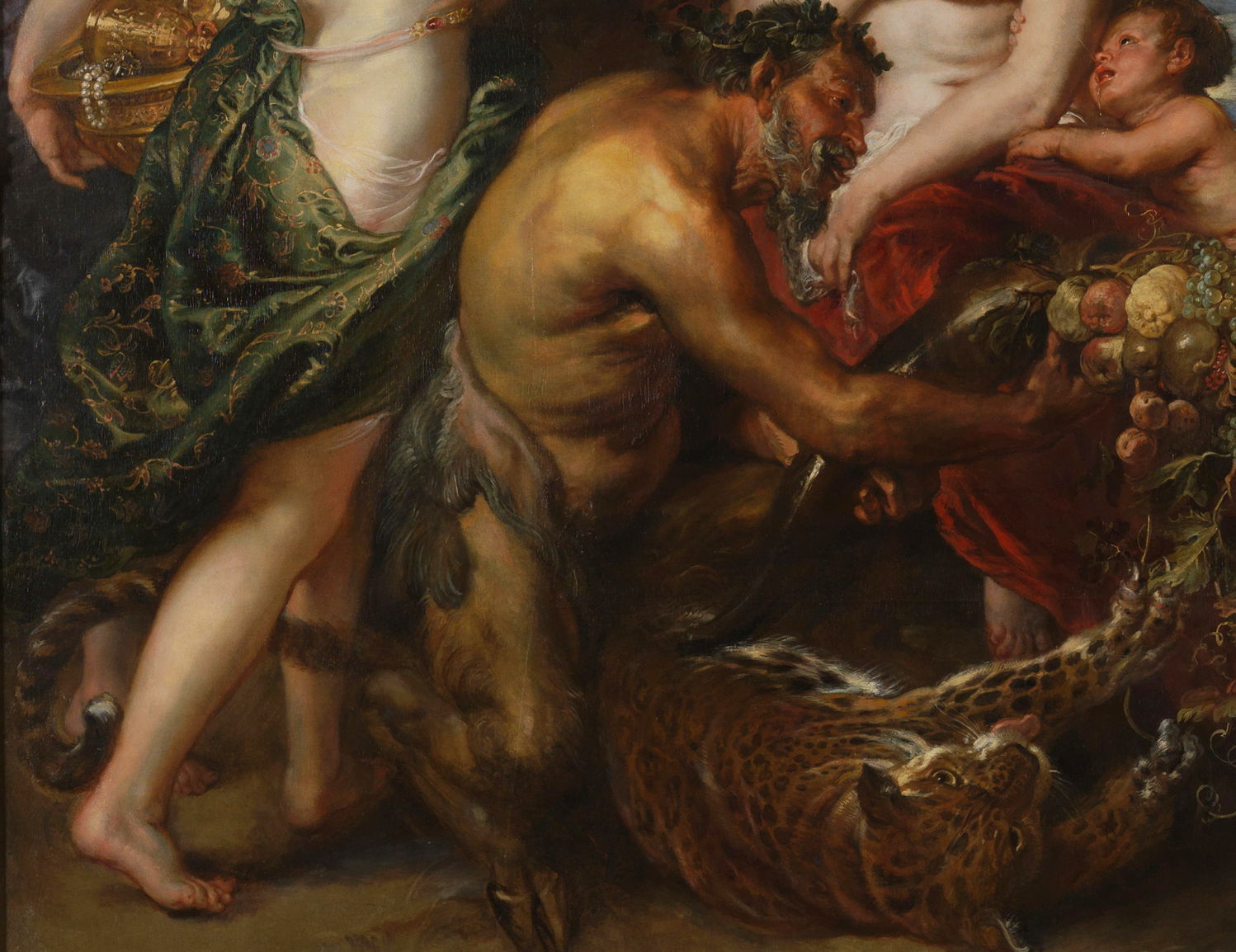
On the opposite (left) side of the painting is a Bacchante holding her tambourine (tympanum) aloft, and another bearing earthly riches at her left side. A satyr crouches low over a leopard, and proffers a cornucopia filled with fruit to the figures at the right.
This group is associated with Bacchus. Although he is not present, his chariot is normally drawn by leopards or similar big cats, and he is accompanied by Bacchantes. This is shown well in Lovis Corinth’s marvellous painting of Ariadne on Naxos (1913) below.
Lovis Corinth (1858–1925) Ariadne on Naxos (1913), oil on canvas, 116 × 147 cm, Private collection. Wikimedia Commons.
Bacchus’ age and appearance are remarkably variable. In Ruben’s later Bacchus (1638-40), he is old and grotesquely obese, but still accompanied by his big cats.
Peter Paul Rubens (1577–1640), Bacchus (1638-40), oil on canvas transferred from panel, 191 × 161.3 cm, Hermitage Museum Государственный Эрмитаж, Saint Petersburg, Russia. Wikimedia Commons.
This painting was completed not long before Rubens’ death from the consequences of gout, and may be the artist’s personal reflection on the result of sustained familiarity with Bacchus.
On the other side of the cornucopia from the Satyr is a small group of children, and a winged putto or Cupid, led by Hymen, who bears his characteristic torch. The god of marriage has led the products of marriage to the fruit of peace and plenty. These figures were painted from the children of one of King Charles’ diplomats, Sir Balthasar Gerbier, who was both an artist and Rubens’ host while he was in England.
Rubens’ story is clear: push war and its associated madness away, and you will enjoy peace, prosperity, and a thriving, well-nourished population.
King Charles made peace with France and Spain, but couldn’t get on with his own parliament; he therefore ruled England without a parliament for the “eleven years’ tyranny”. Collapse of power was inevitable after that: he faced Scottish and Irish rebellions, then in 1642 found himself in a civil war. He was executed on 30 January 1649.
Rubens returned to Antwerp in 1630, where he painted a second masterwork on the subject of peace and war, the centrepiece of tomorrow’s article.
Mythological worlds in classical Mediterranean civilisations often appear confusing and contradictory when stories and beliefs of many centuries and different cultures are merged, as happened in post-classical painting. What might appear to be a single distinctive attribute, such as a snake coiled along the length of a staff, then becomes a muddle.
There are two common combinations of snakes coiled around a rod or staff. Hermes (Roman Mercury) has a caduceus as his attribute, consisting of a rod or staff with a pair of entwined serpents along its length, and sometimes they are shown bearing small wings. This signifies his swiftness as a messenger. The rod of Asclepius (which has several alternative spellings) should have but a single serpent coiled around it, and is associated with healing and medicine, and remains so today long after its divine origins have been forgotten.
Although not known for his paintings of secular stories, William Blake’s Judgement of Paris (c 1806-17) was one of a pair made for Thomas Butts, the other being Philoctetes and Neoptolemus on Lemnos, a more obscure story leading to the death of Paris.
As with almost every artist before and since, Blake shows the three contestants naked in front of Paris, just at the moment that the golden apple is awarded to Aphrodite. Hera and Athena, standing either side of her, are visibly upset. Above them is the naked figure of Hermes, with his caduceus and its pair of intertwined serpents, and a winged helmet. The demonic figure at the top left is presumably a harbinger of the death and destruction to come in the Trojan War.
Pierre-Auguste Renoir (1841–1919), The Judgment of Paris (c 1908-10), oil on canvas, 73 x 92.5 cm, Hiroshima Museum of Art, Hiroshima, Japan. Wikimedia Commons.
Renoir’s account of The Judgment of Paris, from about 1908-10 is a carefully composed image of the same moment of peripeteia. Watching on is Hermes, complete with his winged helmet, sandals, and caduceus.
Abraham Bloemaert (1564–1651), Mercury, Argus and Io (c 1592), oil, 63.5 x 81.3 cm, Centraal Museum, Utrecht, The Netherlands. Wikimedia Commons.
The most popular scene in Ovid’s intertwined stories of the rape of Io and the murder of Argus is that of Hermes lulling Argus to sleep. However, hardly any painters depict Argus having the hundred eyes specified in the Metamorphoses. Abraham Bloemaert is an exception, in his carefully composed Mercury, Argus and Io (c 1592). Hermes is playing his flute at the left, his caduceus at his feet, as Argus falls asleep in front of him, his additional eyes visible over the surface of his head.
David Rijckaert (III) (1612–1661), Philemon and Baucis Giving Hospitality to Jupiter and Mercury (date not known), oil on panel, 54 x 80 cm, Private collection. Wikimedia Commons.
David Rijckaert’s undated Philemon and Baucis Giving Hospitality to Jupiter and Mercury gives the most popular account of the elderly couple entertaining the two gods. Hermes (left) and Zeus (left of centre) are seated at the table, with Philemon (behind the table) and Baucis (centre) waiting on their every need. Once again, Hermes is distinguished by his caduceus as well as a more contemporary winged hat.
Rod of Asclepius
Giovanni Battista Cipriani (1727–1785), Aesculapius Holding a Staff Encircled by a Snake (date not known), media and dimensions not known, Wellcome Library, London. Courtesy of Wellcome Images images@wellcome.ac.ukhttp://wellcomeimages.org, via Wikimedia Commons.
In the eighteenth century, Giovanni Battista Cipriani drew Aesculapius Holding a Staff Encircled by a Snake, following the classical tradition.
Johannes Zacharias Simon Prey (1749-1822), Aesculapius, Apollo and Hippocrates (1791), oil, dimensions not known, Wellcome Library, London. Courtesy of Wellcome Images images@wellcome.ac.ukhttp://wellcomeimages.org, via Wikimedia Commons.
Johannes Zacharias Simon Prey painted this group of Aesculapius, Apollo and Hippocrates in 1791. Asclepius, holding his distinctive rod, is shown in the centre of the trio, with Hippocrates, the less legendary ‘father of medicine’, to the right, clutching the basal half of a human skull, and Apollo, father of Asclepius, behind. They have entered a contemporary pharmacy, where an assistant uses a large mortar and pestle, and another works the bellows of a furnace.
Inevitably, the distinction between Hermes’ caduceus and the rod of Asclepius has been lost more recently, and many symbolic representations of medicine have erroneously used a caduceus.
Although legend held that Theseus was the founder of the city of Athens, it’s probably more accurate to attribute to him its early growth and development. Despite being ranked among the great heroes of classical Greece, he also displayed fundamental flaws. For a long time, the life of Theseus was as celebrated a series of myths as those of Heracles, Jason or Aeneas.
In about 1340-41, Giovanni Boccaccio wrote an epic poem of almost ten thousand lines Teseida, or The Theseid, which in turn inspired The Knight’s Tale in Chaucer’s Canterbury Tales.
Paolo da Visso (1431–1481) Scenes from Boccaccio’s Teseida (date not known), front of a cassone, further details not known. Wikimedia Commons.
Paolo da Visso painted these three scenes from Boccaccio’s epic on the front of a cassone, a visual equivalent of Plutarch’s account of the adventures of Theseus.
Like Perseus, Theseus had complicated origins. His mortal father, Aegeus the king of a far smaller Athens, had been childless, but following the prophecy of the oracle at Delphi, the King of Troezen got him drunk and packed him off to bed with his daughter Aethra. She was instructed in a dream to leave Aegeus asleep, and to go to a nearby island, where she was also impregnated by the god Poseidon. Theseus, who is presumed to have been conceived that night, was thus considered to have double paternity, by god and man, a qualification for the heroes of myth.
After he had buried his sword and sandals under a massive rock, Aegeus returned to Athens. He told Aethra that when his son grew up, she should tell him to move the rock, as a test. If he succeeded, then he should take the sandals and sword as evidence of his paternity.
When Theseus was old enough, his mother Aethra showed him the rock, and told him Aegeus’ instructions. Theseus moved the rock, found the sandals and sword, and then undertook an epic journey overland to his father in Athens.
Laurent de La Hyre (1606–1656), Theseus And His Mother Aethra (1635-36), oil on canvas, 141 × 118.5 cm, Szépművészeti Múzeum, Budapest, Hungary. Wikimedia Commons.
One of the earliest depictions of the young Theseus is Laurent de La Hyre’s Theseus And His Mother Aethra (1635-36). This shows the lad lifting a heavy pillar to reveal a pair of shoes and a sword.
Nicolas Poussin (1594–1665) and Jean Lemaire (1598–1659), Theseus Recovering his Father’s Sword (c 1638), oil on canvas, 98 x 134 cm, Musée Condé, Chantilly, France. Wikimedia Commons.
In one of his rare collaborative paintings, Nicolas Poussin worked with Jean Lemaire to tell this fragment of the story in Theseus Recovering his Father’s Sword, from about 1638. They draw a marked contrast between the two actors: Theseus, destined to be a great hero, looks rough and brutish, while his mother Aethra wouldn’t look out of place standing in for the Madonna.
Nicolas-Guy Brenet (1728–1792), Aethra Showing her Son Theseus the Place Where his Father had Hidden his Arms (1768), oil on canvas, 50.2 × 59.7 cm, Los Angeles County Museum of Art, Los Angeles, CA. Wikimedia Commons.
Nicolas-Guy Brenet’s more sketchy Aethra Showing her Son Theseus the Place Where his Father had Hidden his Arms (1768) adds a river god for good measure, and has Aethra giving Theseus marching orders to go find his father.
Antonio Balestra (1666–1740), Theseus Discovering his Father’s Sword (c 1725), oil on canvas, 287 x 159 cm, Private collection. Wikimedia Commons.
Antonio Balestra’s Theseus Discovering his Father’s Sword (c 1725) makes Theseus look less than enthusiastic to follow his mother’s directions.
Aethra told her son to travel by sea to take the sword and sandals to his father, but inspired by Heracles he chose to travel overland instead.
Like his hero, Theseus had a series of adventures on this journey. He first killed Periphetes, who had wielded a large club at him; impressed by this club, he took it and killed another opponent, Sinis, raped his daughter and made her pregnant. Theseus went out of his way to meet the fearsome Crommyonian Sow, which he also killed. Coming to the borders of Megara, Theseus met Sciron, whom he threw down a cliff to his death, and killed another two people before reaching the city.
Theseus found Athens, and his father’s court, in disarray, with the king cohabiting with the sorceress Medea, who had promised to cure his lack of children. Aegeus remained unaware of Theseus’ true identity, but invited him to a banquet, at which Medea, acting in conspiracy with the king, tried to get Theseus to drink from a goblet laced with the poison aconite.
Luckily for Theseus, just before he was going to drink from the goblet, he drew his father’s sword, making as if to carve the meat with it. Aegeus recognised the sword, realised that his guest who was just about to drink poison was his son, and knocked the goblet from Theseus’ hand to stop his lips from touching it.
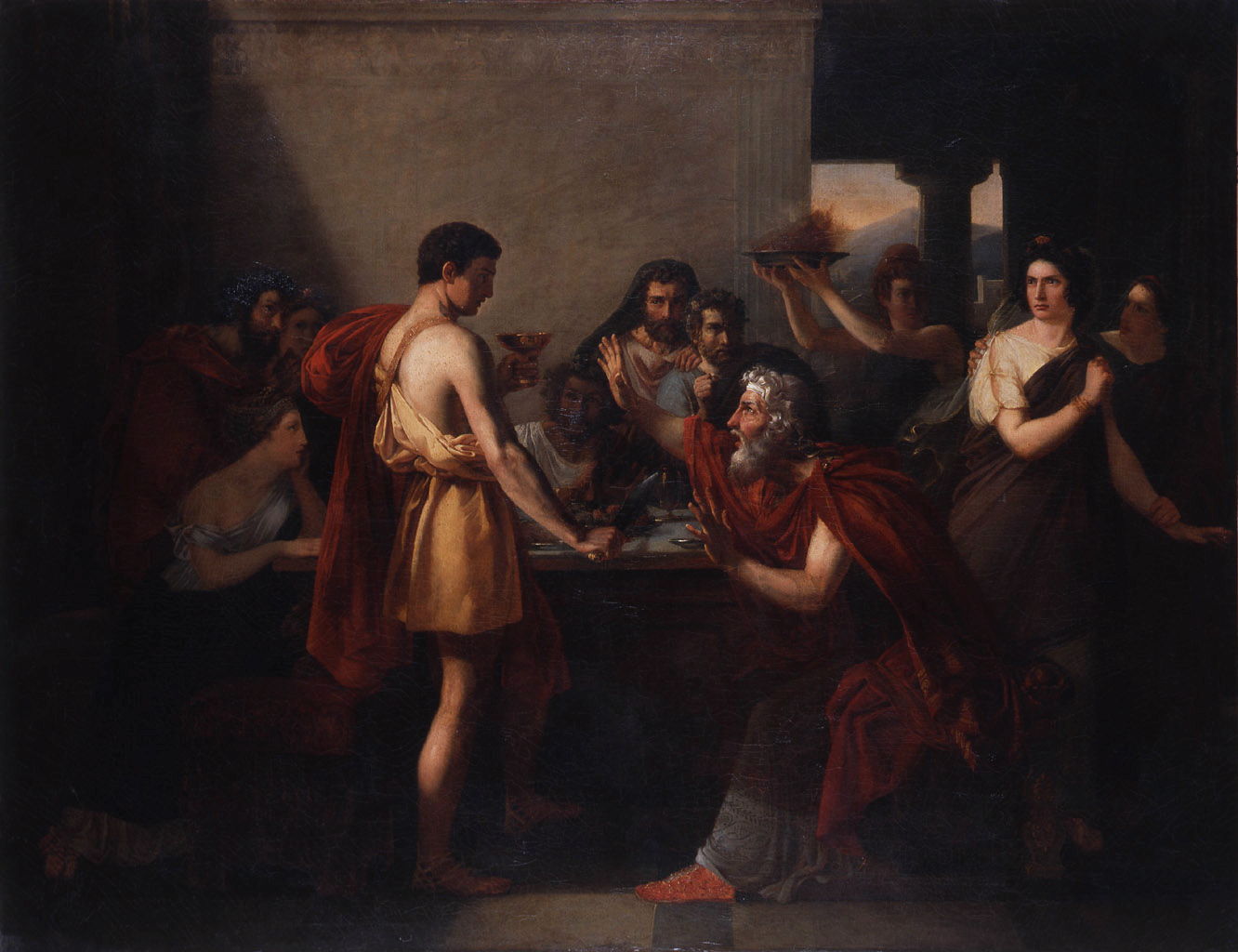
Antoine-Placide Gibert (1806-1875), Theseus Recognised by his Father (1832), oil, dimensions not known, Musée des Beaux-Arts, Bordeaux, France. Image by VladoubidoOo, via Wikimedia Commons.
In Antoine-Placide Gibert’s Theseus Recognised by his Father (1832), the three principal actors are arranged almost linearly across the canvas. Just left of centre, Theseus stands, his head in profile, the fateful cup in his left hand, and his father’s sword in his right. The king is just right of centre, looking Theseus in the eye, and appearing animated if not alarmed. At the far right is Medea, her face like thunder, sensing that her plot to kill Theseus is about to fall apart.
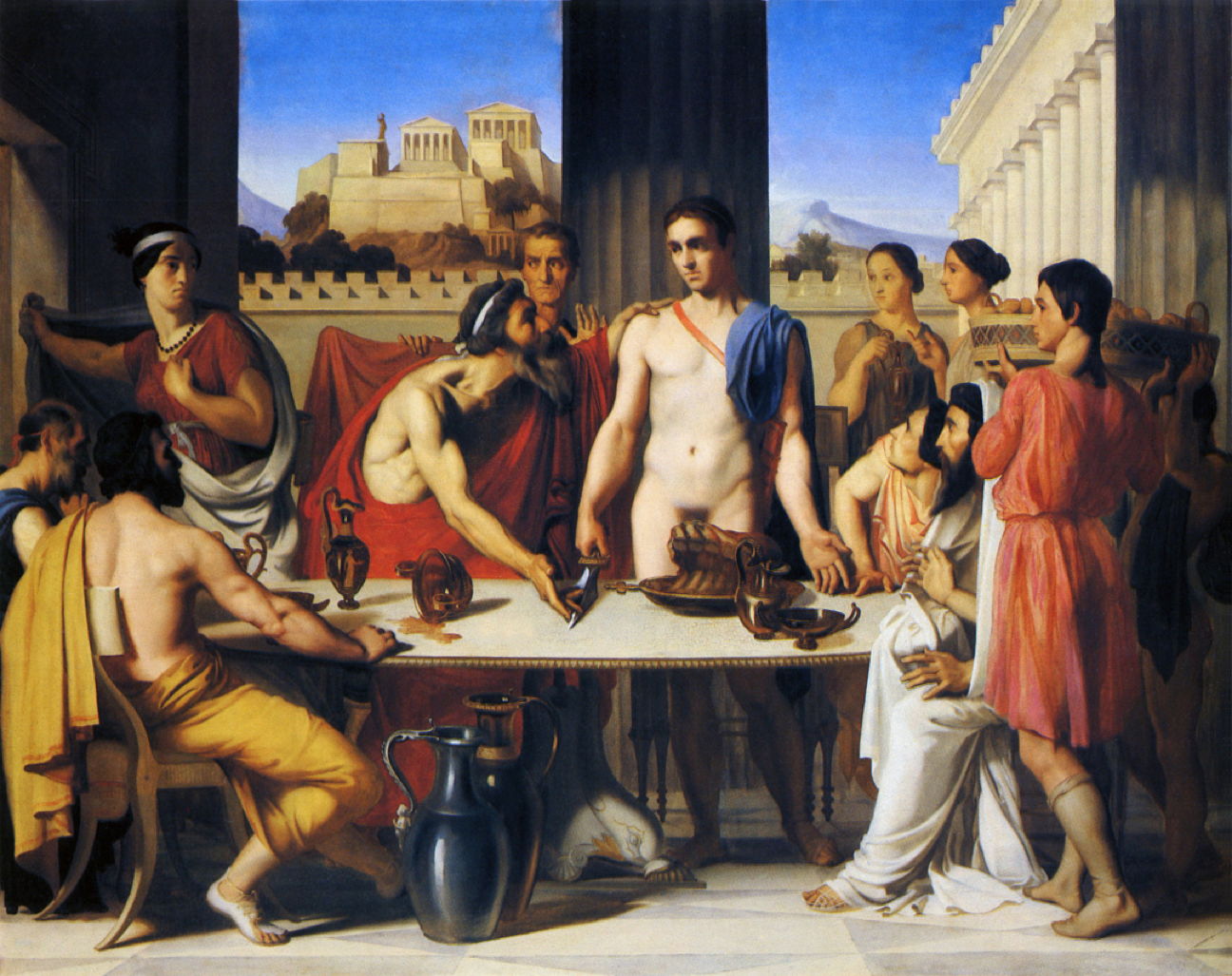
Hippolyte Flandrin (1809–1864), Theseus Recognized by his Father (1832), oil on canvas, 114.9 × 146.1 cm, École nationale supérieure des Beaux-Arts, Paris. Wikimedia Commons.
Hippolyte Flandrin’s Theseus Recognized by his Father beat Gibert’s painting for the Prix de Rome in 1832, and has a more neoclassical look, as if influenced by Jacques-Louis David. With a view of the Acropolis in the background, this shows the moment immediately after Aegeus has recognised his son, and the cup of aconite lies spilt on the table. Theseus, conspicuously naked, stands in the middle of the canvas, his father’s sword held rather limply in his right hand. Aegeus stands to the left of centre, talking emotionally to his son.
Of all the characters shown in this painting, it’s Medea who is the most fascinating. Stood at the far left, she appears to be on her way out. She is po-faced, and looks as if she has come not from Greece, but from central Asia.
Aegeus then declared Theseus to be his heir and successor as King of Athens. This was opposed by the sons of Pallas, who tried to attack the city. Theseus was tipped off by one of their men, surprised his opponents, and killed the lot of them. Like his hero Heracles, Theseus then set out to deal with the problem posed by the Marathonian Bull, captured it, and drove it through the city of Marathon before sacrificing it to Apollo. He then went on to battle with another bull, this time on the island of Crete.
The legendary hero Perseus was the son of Danaë, conceived when Zeus/Jupiter impregnated her in a shower of gold. He had been sent by Polydectes on a mission to bring him the head of Medusa, and on his return with that secured in a kibisis, he stopped off in Ethiopia, where the princess Andromeda was awaiting sacrifice to the sea monster Cetus.
Titian (Tiziano Vecelli) (1490–1576), Perseus and Andromeda (1553-9), oil on canvas, 179 × 197 cm, The Wallace Collection, London. Wikimedia Commons.
Titian’s Perseus and Andromeda (1553-59) shows the height of the action, remaining largely faithful to Ovid’s account of this story. All three actors are present, with Andromeda still shackled and Perseus attacking Cetus from the air using a sword with a curved blade.
Paolo Veronese (1528–1588), Perseus Rescuing Andromeda (1576-78), oil on canvas, 260 × 211 cm, Musée des Beaux-Arts, Rennes, France. Wikimedia Commons.
Paolo Veronese’s Perseus Rescuing Andromeda followed soon afterwards, in 1576-78. His composition is similar to Titian’s, and equally faithful to the text, but his additional attention to the details of Perseus and Cetus brings this to life.
Edward Burne-Jones (1833–1898), The Perseus Series: The Doom Fulfilled (1888), oil on canvas, 155 × 140.5 cm, Staatsgalerie Stuttgart, Stuttgart. Wikimedia Commons.
In the ninth painting in Edward Burne-Jones’ series, The Doom Fulfilled (1888), Perseus is swathed in Cetus’ coils with their almost calligraphic form, brandishing his sword and ready to slaughter the monster and bring its terror to an end.
Félix Edouard Vallotton (1865-1925), Perseus Killing the Dragon (1910), oil on canvas, 160 x 233 cm, Musée d’art et d’histoire de Genève, Geneva. By Codex, via Wikimedia Commons.
In the early twentieth century, the former Nabi artist Félix Edouard Vallotton painted a series of narrative works, including his Perseus Killing the Dragon, from 1910, a thoroughly contemporary interpretation that is exceptionally free with Ovid’s account.
As with most classical myths, several variants of the story have developed over time. All painted accounts that I have seen follow the action-packed version in which Perseus slays Cetus with his sword, but some literary versions report that the sea monster was turned to stone by Medusa’s face, which would have made far duller paintings.
A more recent variant has the hero flying to Andromeda’s aid not with his winged sandals, but on the back of the winged horse Pegasus.
Peter Paul Rubens (1577–1640), Perseus and Andromeda (c 1622), oil on canvas, 99.5 x 139 cm, Hermitage Museum, Saint Petersburg, Russia. Wikimedia Commons.
By the time that Rubens came to paint Perseus and Andromeda in about 1622, the newer revised version including Pegasus seems to have become popular. Andromeda is at the left, unchained from her rock where she had been placed as a delightful morsel for Cetus, which has just been killed by Perseus and now lies at the lower edge with its fearsome mouth wide open. Perseus is in the process of claiming Andromeda’s hand as his reward, for which he is being crowned with laurels. Although he clearly flew in on Pegasus, he is still wearing his winged sandals, and holds the polished shield reflecting Medusa’s face and snake hair.
Piero di Cosimo (1462–1521), Andromeda freed by Perseus (c 1510-15), oil on panel, 70 x 123 cm, Galleria degli Uffizi, Florence. Wikimedia Commons.
Piero di Cosimo uses multiplex narrative to show most of the story in his large Andromeda Freed by Perseus (c 1510-15). Centred on the great bulk of Cetus, Perseus stands on its back and is about to hack at its neck with his curved sword. At the upper right, Perseus is shown a few moments earlier, as he was flying past in his winged sandals. To the left of Cetus, Andromeda is still secured to the rock by red fabric bindings, not chains, and is bare only to her waist.
In the foreground in front of Cetus are Andromeda’s parents stricken in grief. Near them is a group of courtiers with ornate head-dress. But in the right foreground the wedding party is already in full swing, complete with musicians and dancers.
Perseus’ reward for rescuing Andromeda and saving the kingdom of Ethiopia was naturally the hand of the princess in marriage. There was only one obstacle, that she had already been promised to Phineus, who was clearly no match when it came to killing sea monsters. Whether or not Phineus was invited, he and his friends turned up at the wedding of Andromeda and Perseus, and trouble soon broke out. The punch-up turned lethal when the weapons came out, and Perseus decided it was time to show Medusa’s face to the unwelcome guests.
Sebastiano Ricci (1659–1734), Perseus Confronting Phineus with the Head of Medusa (c 1705-10), oil on canvas, 64.1 × 77.2 cm, The J. Paul Getty Museum, Los Angeles, CA. Courtesy of J. Paul Getty Museum.
Sebastiano Ricci’s Perseus Confronting Phineus with the Head of Medusa (c 1705-10) shows the final moments of the battle, as Phineus cowers next to two of his henchmen who have almost completed the process of changing into stone. Although not shown here, Athena herself turned up to make sure that no one got the better of Perseus.
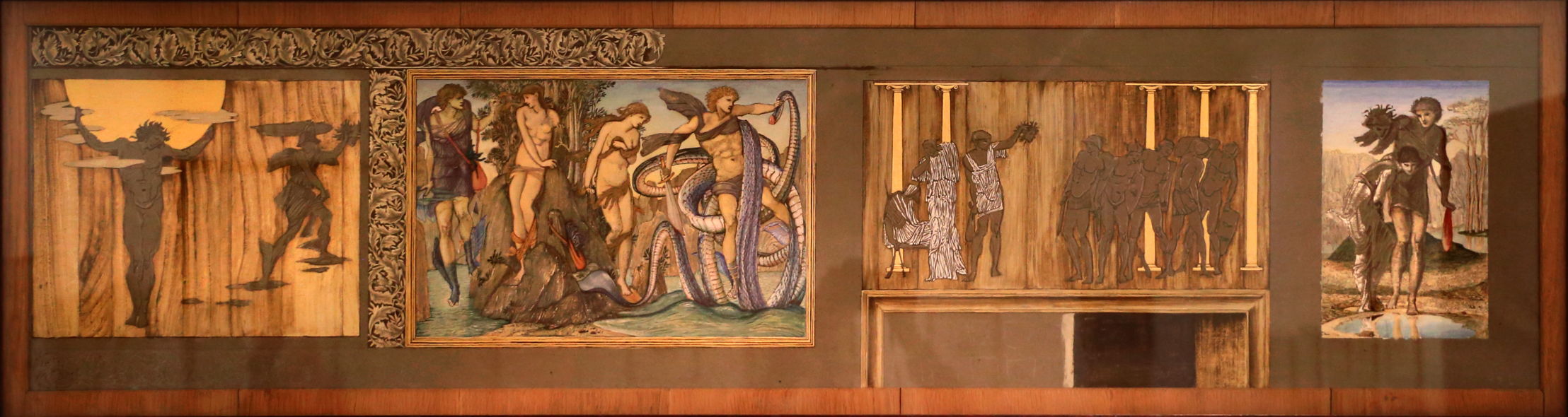
Edward Burne-Jones worked on many sketches and preliminary designs for his series, among which were gouache and gold layouts to show how his paintings would fit into their carved surrounds in his patron’s Music Room.
Edward Burne-Jones (1833–1898), Atlas Turned to Stone; The Rock of Doom and the Doom Fulfilled; The Court of Phineas; The Baleful Head (designs for The Story of Perseus) (1875-76), gouache, gold paint, graphite and chalk on paper, 36.7 x 148.7 cm, The Tate Gallery, London. Image by Sailko, via Wikimedia Commons.
This design shows an outline of the whole series, which had originally been intended to include Phineus and the wedding. The scenes shown are, from the left, Atlas Turned to Stone, The Rock of Doom and the Doom Fulfilled, The Court of Phineas, and The Baleful Head, shown below.
Edward Burne-Jones (1833–1898), The Perseus Series: The Baleful Head (1886-7), oil on canvas, 155 × 130 cm, Staatsgalerie Stuttgart, Stuttgart. Wikimedia Commons.
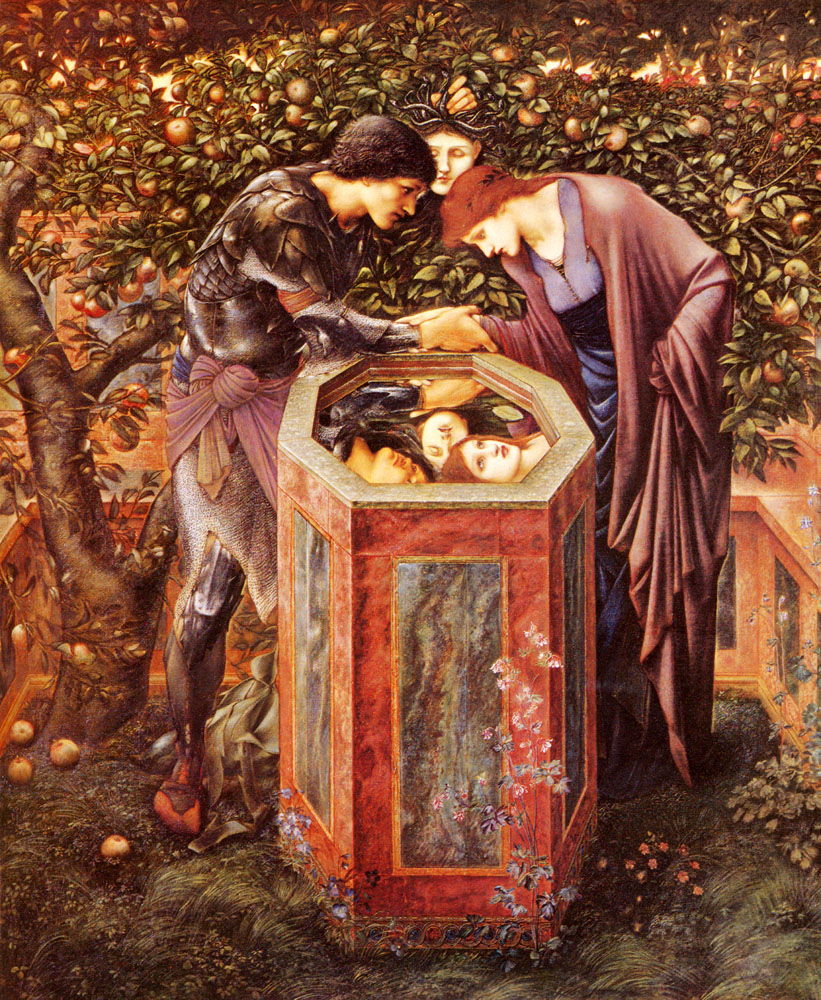
The tenth and final painting in Burne-Jones’ series, The Baleful Head (1885), shows Perseus and Andromeda, their right hands clenching one another’s wrists, looking at the image of Medusa’s face reflected in the surface of a well. This is set in a peaceful garden, with a fruit-laden apple tree behind, and flowers springing up from the grass beneath them.
Literary accounts take the couple on to live at Tiryns in Argos, from where Heracles/Hercules later undertook his Twelve Labours. They had seven sons and two daughters, and among their descendants were Heracles, Castor and Pollux, Clytemnestra, and the Achaemenid Persians.
When Perseus returned to Seriphos, he discovered Polydectes was still trying to seduce his mother Danaë. Perseus therefore used Medusa’s face to turn him to stone, and made Dictys king and his mother’s consort. His mission accomplished, Perseus returned the weapon and equipment loaned by the gods, and gave Athena the head of Medusa, which she then set in her shield as the Gorgoneion, more commonly referred to as the Aegis.
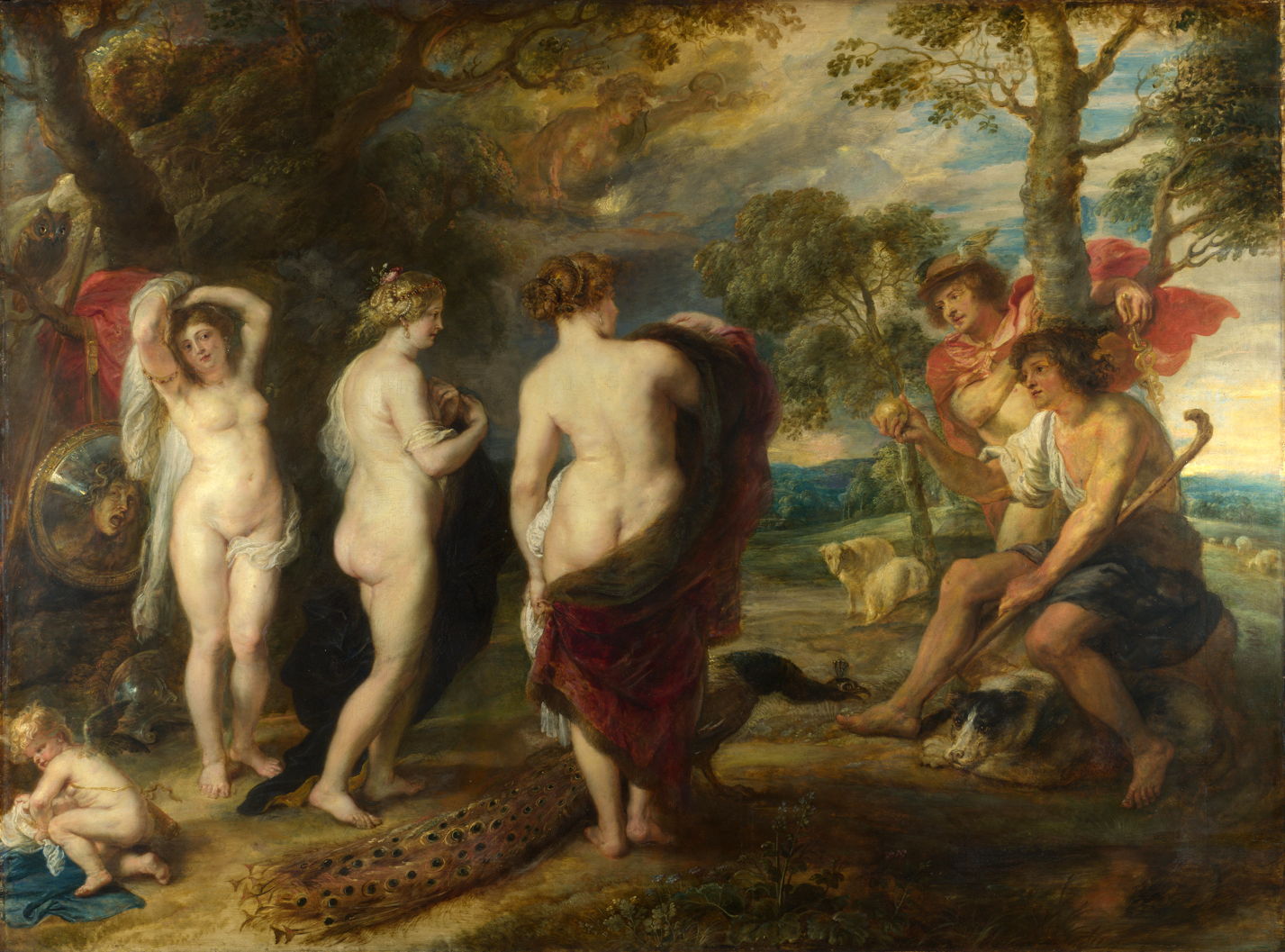
Peter Paul Rubens (1577–1640), The Judgement of Paris (1632-35), oil on oak, 144.8 x 193.7 cm, National Gallery, London. Wikimedia Commons.
Distinguishing the three goddesses taking part in The Judgement of Paris, shown in Rubens’ late account from 1632-35, often relies in part on the aegis. The three goddesses are, from the left, Athena with her shield, Aphrodite, and Hera with her peacock.
There was still one loose end to be tied, though: the prediction that Perseus would kill his father Acrisius. Various accounts are given of this, but consensus is that Perseus threw a quoit or discus that unintentionally struck Acrisius and killed him. Thereafter, he ruled a kingdom until he and Andromeda died. They were both catasterised into their own constellations, where they can still be seen today.
Many of the heroes of the classical world were deeply flawed. Theseus, founder of Athens, treated women appallingly, and Jason of the Argonauts was no better. This new series looks at paintings of the legendary lives of those who could have been villains or hooligans rather than the heroes they were held to be.
Perseus, the greatest slayer of monsters among them, seems to have been faithful to Andromeda, the princess he rescued from the jaws of Cetus, the sea monster. He even killed Polydectes, who was chasing his mother. Like several other classical heroes, Perseus was the result of divine union with a mortal, in this case Zeus/Jupiter with Danaë. She had been imprisoned in a bronze chamber to prevent her from becoming pregnant, as her father Acrisius, King of Argos, had been warned by an oracle that he would be killed by his daughter’s son.
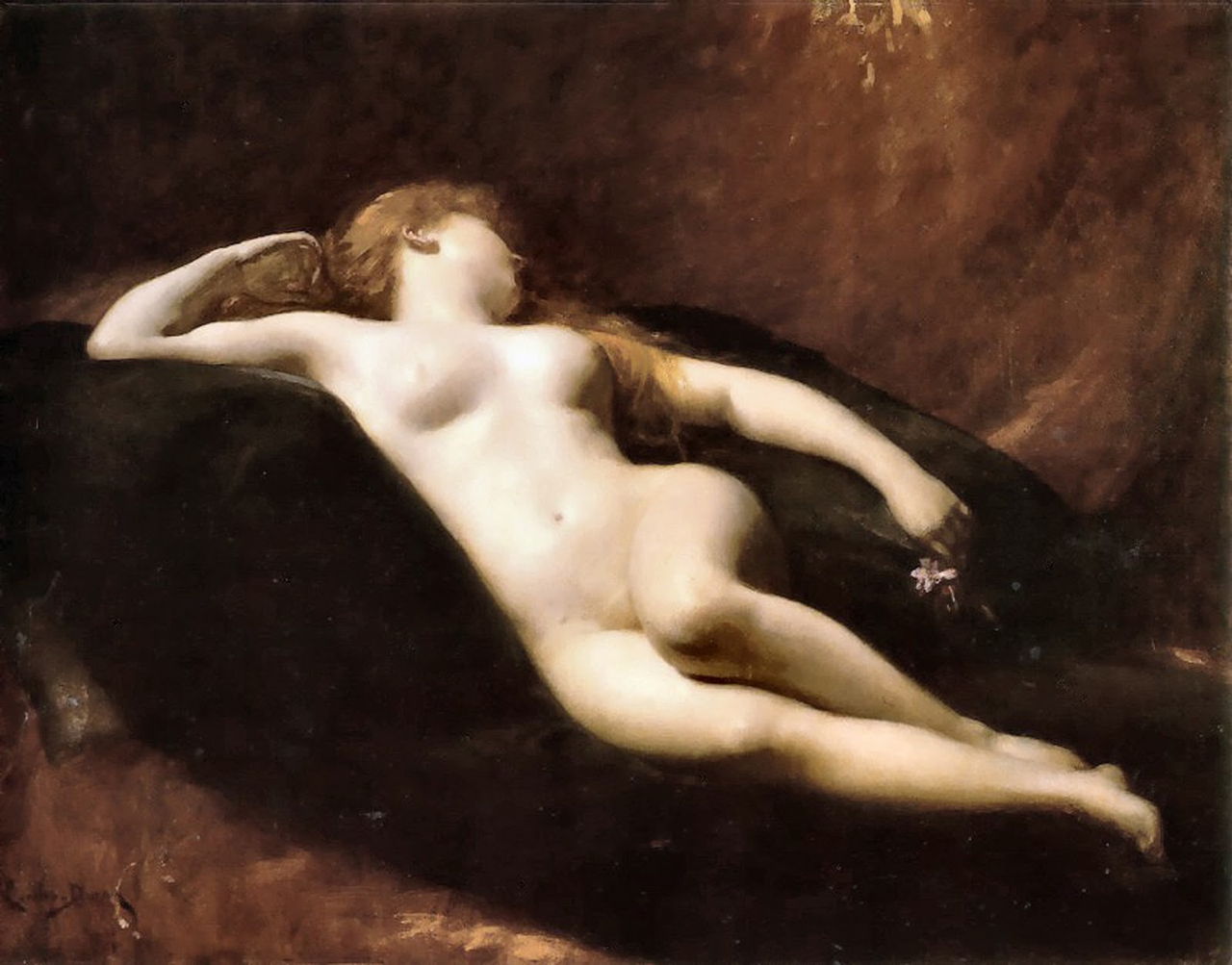
Carolus-Duran (1837–1917), Danae (c 1900), oil on canvas, 100 × 127 cm, Musée des Beaux-Arts, Bordeaux, France. Wikimedia Commons.
With a skylight as the chamber’s only source of light and air, Zeus descended on her in the form of golden rain. Danae (c 1900) is Carolus-Duran’s beautifully simple painting of this story, showing the shower of gold falling from its upper edge.
Gustav Klimt (1862–1918), Danae (1907), oil on canvas, 77 x 83 cm, Private collection. Wikimedia Commons.
Gustav Klimt’s Danaë is curled into a foetal ball, and is usually interpreted as showing arousal. She became pregnant, later giving birth to Perseus. Her father then tried to kill them both by putting them in a wooden chest and casting it into the sea, but they were washed up alive on the island of Seriphos, where Dictys, a fisherman and brother of King Polydectes, raised the boy.
As a young man, Perseus suspected the intentions of Polydectes towards his mother Danaë, and tried to protect her from him. In a bid to get Perseus out of his way, Polydectes called a large banquet for which each guest was expected to bring a gift of a horse. As Perseus had no horse to give, he asked the king to name a substitute, which was the head of the Gorgon Medusa, and the cue for Perseus’ major adventure.
Although the myths of Perseus have long been popular subjects for painters, none has devoted as much attention to them as Edward Burne-Jones, whose uncompleted Perseus series is one of the greatest visual accounts of any classical myth.
Edward Burne-Jones (1833–1898), The Perseus Series: The Call of Perseus (1877), bodycolour, 152.5 × 127 cm, Southampton City Art Gallery, Southampton, England. Wikimedia Commons.
This series starts with The Call of Perseus (1877), showing a double image of Perseus with Athena outside the city. At the left, Athena approaches the pensive Perseus, who is pondering how he can obtain the head of Medusa, staring into a stream. At the right, Athena has transformed herself into her regular and recognisable form, and is giving Perseus her advice, and providing him with the mirror with which he can view Medusa in safety. Although other artists have depicted this mirror as an impressive circular shield, throughout this series Burne-Jones shows it as a far smaller circular hand mirror.
The first call in Perseus’ mission were the sisters of the Gorgons, the Graiae (there are various spellings), who would in turn lead him to the Hesperides, who would provide him with a kibisis, a small bag into which he would put Medusa’s head.
Edward Burne-Jones (1833–1898), Perseus and the Graiae (1875-8), silver and gold leaf, gesso and oil on oak, 170.2 x 153.2 cm, National Museum of Wales, Cardiff, Wales. Wikimedia Commons.
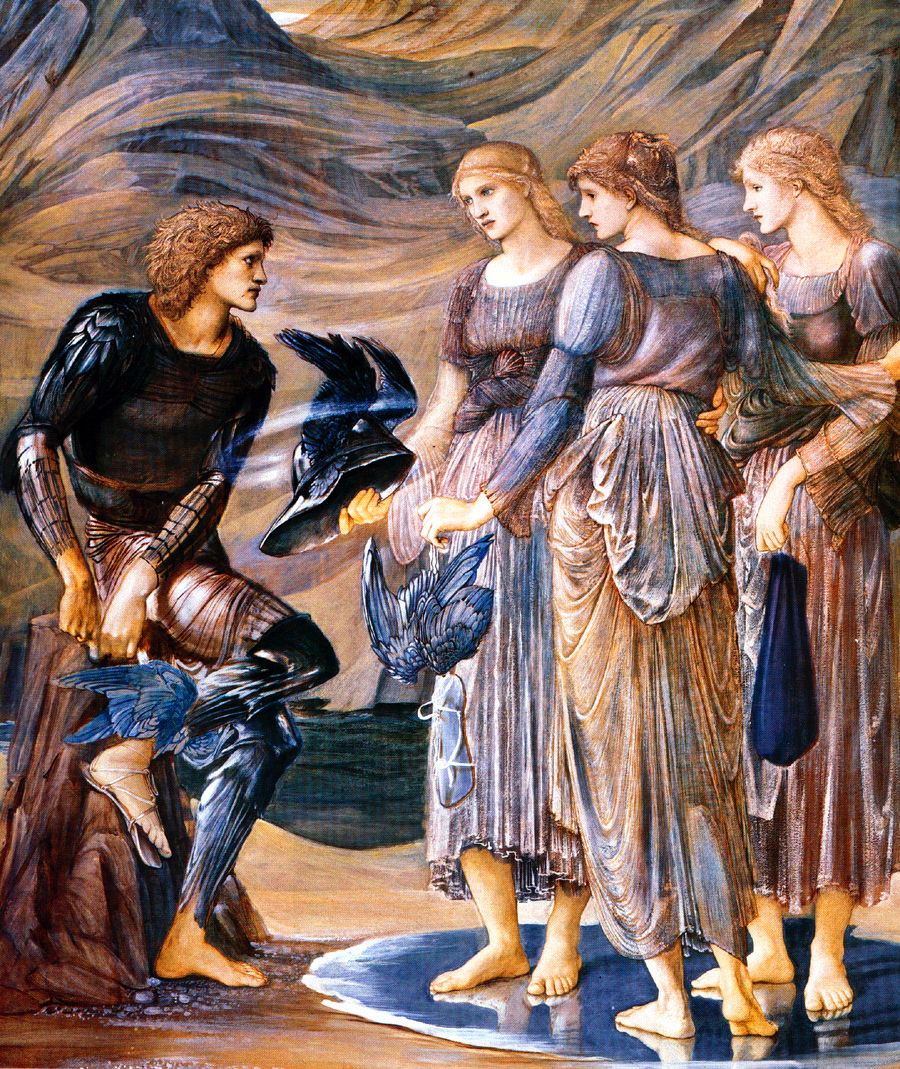
Burne-Jones next shows Perseus with the three Graiae. He has just intercepted and seized their single, shared eye, which he is holding in his right hand, and only returns once they have led him to the Hesperides. The words in the inscription provide a potted summary, in translation: Pallas Athena spurred Perseus to action with her urging, and equipped him with arms. The Graiae revealed to him the remote home of the nymphs. From here he went with wings on his feet and with his head shrouded in darkness, and with his sword he struck the one mortal Gorgon, the others being immortal. Her two sisters arose and pursued him. Next he turned Atlas to stone. The sea serpent was slain and Andromeda rescued, and the comrades of Phineas became lumps of rock. Then Andromeda looked in a mirror with wonder at the dreadful Medusa.
(Modified from Anderson & Cassin.)
Perseus needed four more items for his mission: Zeus gave him an adamantine sword and the helm of darkness from Hades, enabling him to hide invisibly. Hermes lent out his winged sandals so that Perseus could fly like a god, and Athena provided him with a polished shield, so he could avoid looking directly at Medusa’s face, which would have turned him to stone.
Perseus then flew to the cave in which the Gorgons were asleep, and beheaded Medusa. From her severed neck sprung the winged horse Pegasus, and Chrysaor, a sword of gold.
Eugène Romain Thirion (1839–1910), Perseus Victorious Over Medusa (1867), oil, dimensions not known, Private collection. Wikimedia Commons.
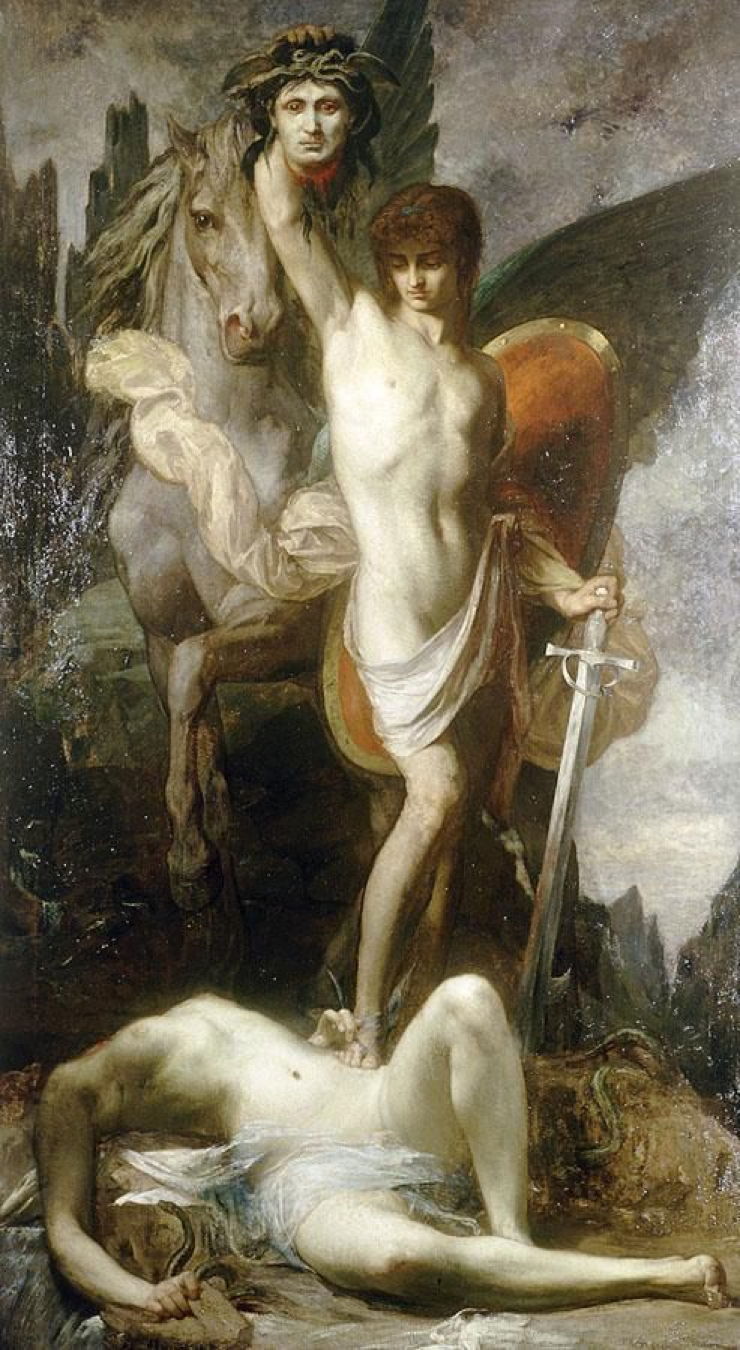
Eugène Romain Thirion’s Perseus Victorious Over Medusa from 1867 respects convention, with the hero triumphantly holding Medusa’s head aloft, facing away from him. He shows Pegasus behind, but not Chrysaor, which is generally omitted from these paintings, and indeed from some verbal accounts.
The two surviving Gorgons tried to pursue Perseus, but he donned the helm of Hades and became invisible to them. He flew over North Africa, and sought rest and accommodation from Atlas there. However, Atlas refused him hospitality, for which Perseus showed him the face of Medusa, turning him to stone.
Edward Burne-Jones (1833–1898), The Perseus Series: Atlas Turned to Stone (1878), bodycolour, 152.5 × 190 cm, Southampton City Art Gallery, Southampton, England. Wikimedia Commons.
The seventh painting in Burne-Jones’ Perseus Series, his Atlas Turned to Stone (1878), shows the aftermath of Atlas’ failure to offer hospitality: he has been turned to stone by the residual power of Medusa’s face, and now stands bearing the cosmos on his shoulders as Perseus flies off to Ethiopia to rescue Andromeda.
Perseus stopped in Ethiopia, which was ruled by King Cepheus and Queen Cassiopeia. She had boasted of the beauty of her daughter Andromeda, and so incurred the wrath of Poseidon, bringing floods and a voracious sea monster named Cetus. The local oracle told the king and queen that the only way to save their people from Cetus was to sacrifice their daughter to the monster. Accordingly, and with great grief, they were forced to comply. Andromeda was therefore fastened to a rock at the edge of the sea to await Cetus.
Frederic, Lord Leighton (1830–1896), Perseus and Andromeda (1891), oil on canvas, 235 × 129.2 cm, Walker Art Gallery, Liverpool, England. Wikimedia Commons.
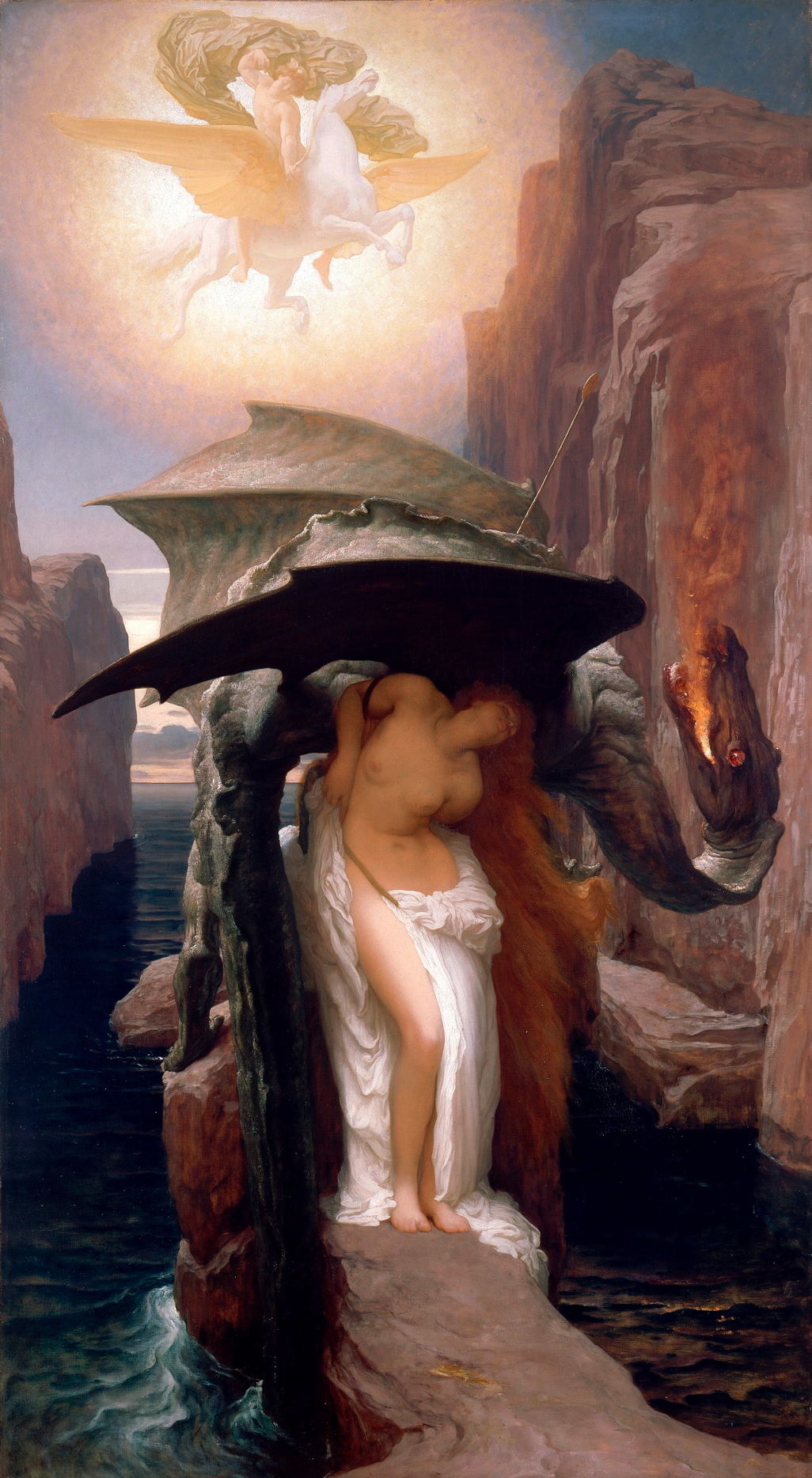
Frederic, Lord Leighton’s Perseus and Andromeda (1891) shows the ‘invisible’ Perseus astride Pegasus shooting arrows into Cetus, while the monster surrounds Andromeda. Cetus is here a conventional fire-breathing dragon, complete with stereotypical wings and a long tail. Andromeda is not naked, as her modesty is preserved by draping a white robe around her waist.
Unknown, Perseus Freeing Andromeda (c 50-75 CE), height 122 cm, Casa dei Dioscuri (VI, 9, 6), Pompeii, moved to Museo Archeologico Nazionale di Napoli, Naples. By WolfgangRieger, via Wikimedia Commons.
This Roman wall painting from the ruins of Pompeii, dated to about 50-75 CE, adopts the approach typical of many later artists, showing a close-up of the couple. Andromeda is still chained to the rock by her left wrist, and is partially clad, nakedness being reserved for the hero and half-god Perseus. He has Medusa’s head tucked behind him, its face shown for ease of recognition, wears his winged sandals, and carries a straight sword in his left hand. There is still no sign of any sea monster.
This article provides a brief overview of the plot and sub-stories of Torquato Tasso’s epic poem Jerusalem Delivered, with links to individual articles, and some of the very best of the paintings.
Jerusalem Delivered is a fictional elaboration of the events at the end of the first Crusade, starting with the departure from Antioch, after its capture, and ending with the full possession of the city of Jerusalem.
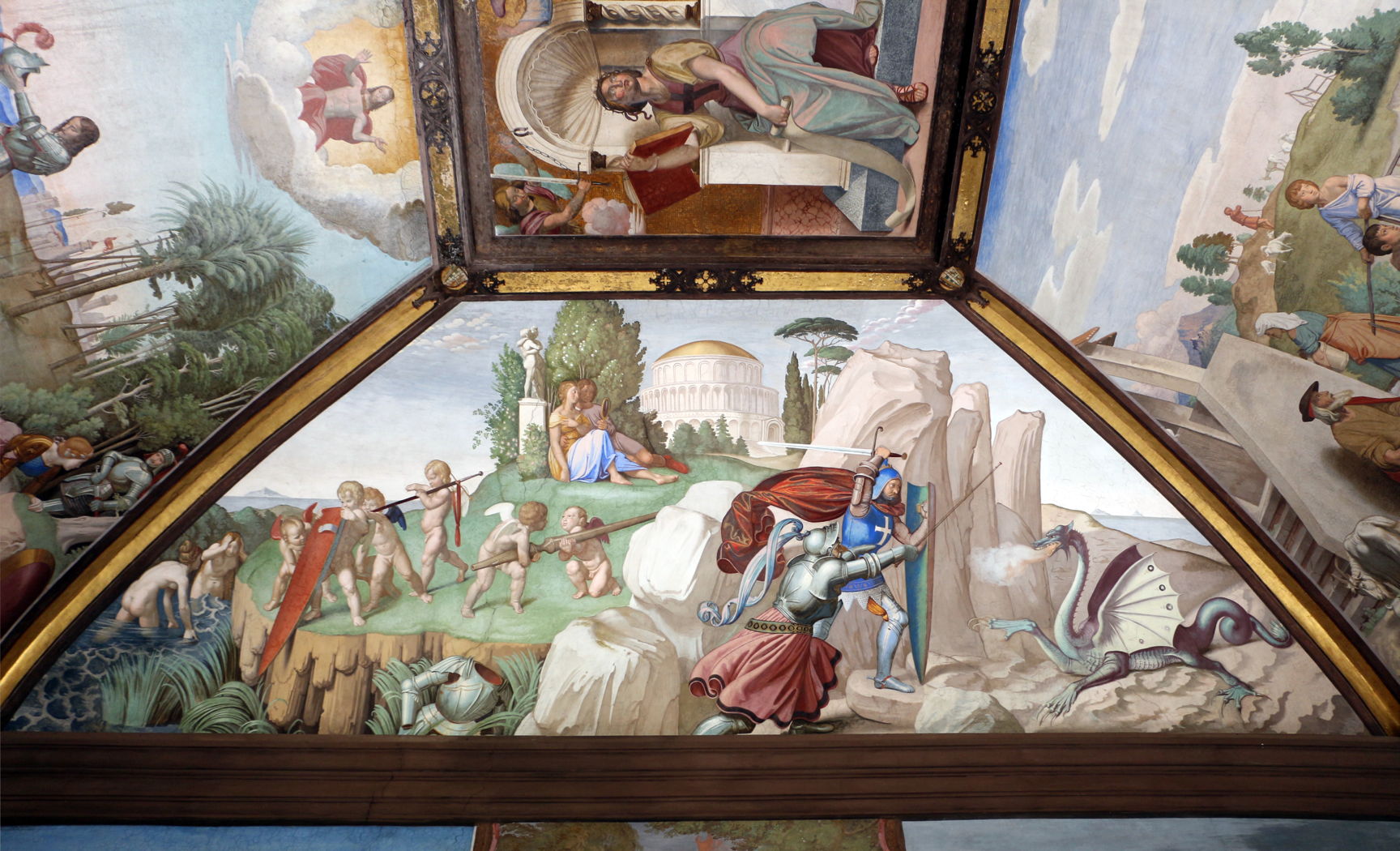
Johann Friedrich Overbeck (1789-1869), The Archangel Gabriel Appears to Godfrey of Bouillon (1819-27), fresco, dimensions not known, Casa Massimo, Rome, Italy. Image by Sailko, via Wikimedia Commons.
The crusaders’ leader, Godfrey of Bouillon, is visited early one morning by the Archangel Gabriel, who spurs the French noble to lead his army south to the Holy City. During their journey, they are provisioned by sea, and meet little opposition.
Aladine, ruler of Jerusalem, hears of their progress and starts preparing to receive them. Ismen, formerly a Christian soothsayer now turned to ‘pagan’ sorceror, arranges a trap to oppress the remaining Christians in the city, by having a sacred icon of the Virgin Mary stolen. Aladine attributes this to a Christian and uses it as an excuse to persecute the Christians.
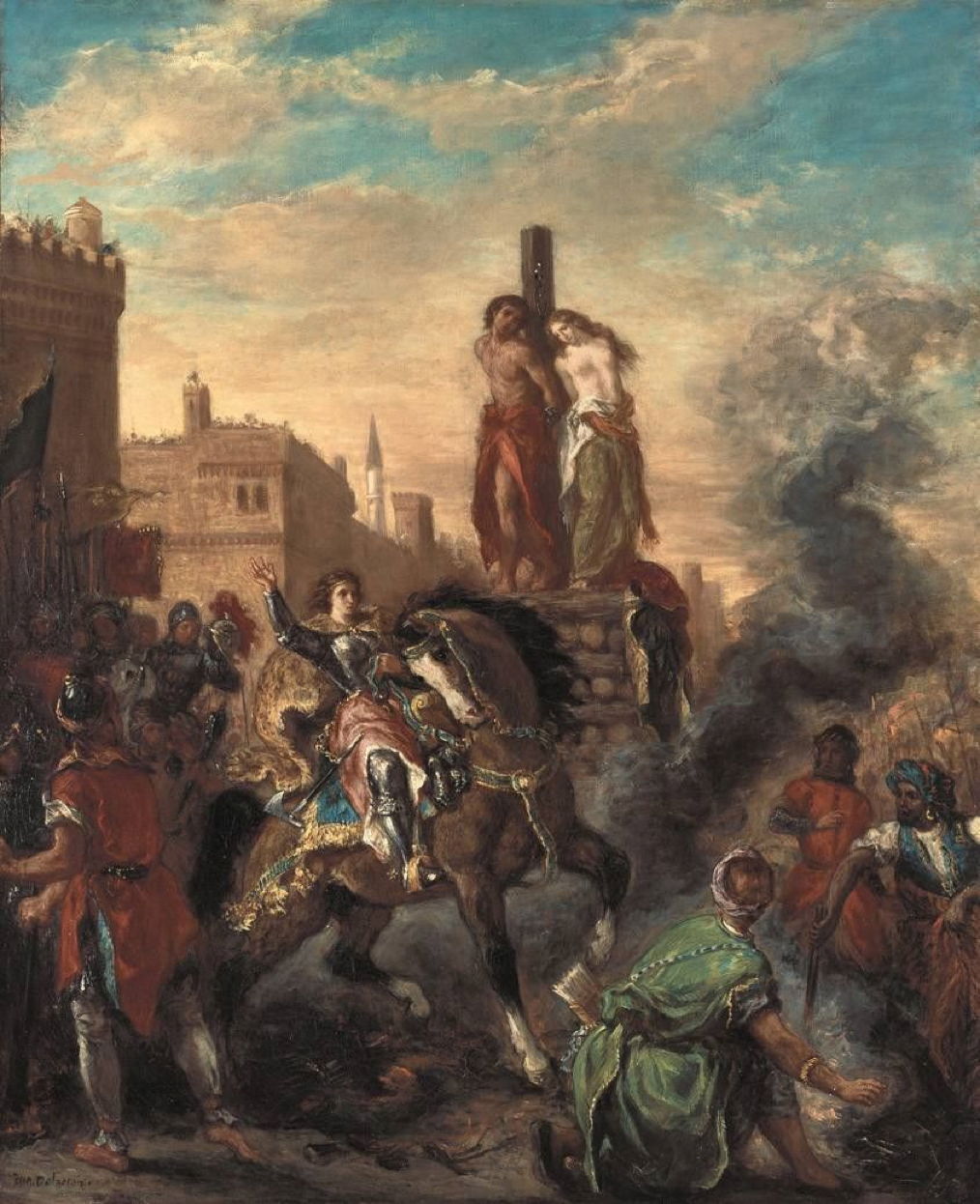
Sophronia, a young Christian woman, tells Aladine she stole the icon, and is condemned to burn at the stake. Her lover Olindo insists that he is the thief, and is tied on the other side of the stake for execution with her. Just as the kindling is about to be lit, the beautiful ‘pagan’ knight Clorinda arrives and intervenes.
Eugène Delacroix (1798–1863), Clorinda Rescues Olindo and Sophronia (1856), oil on canvas, 101 x 82 cm, Neue Pinakothek, Munich, Germany. Wikimedia Commons.
Sophronia and Olindo are spared, but Aladine banishes them and all other able-bodied Christians to beyond the city limits. Most flee to Emmaus, where the crusaders have just arrived.
Godfrey of Bouillon politely rejects overtures from two ambassadors of Egypt, inviting him to abandon his mission to capture Jerusalem. One, the Circassian Argante, warns Godfrey of dire consequences before he heads off to join Aladine in Jerusalem.
Soon after the crusaders arrive at the city, Clorinda leads an initial skirmishing party to size up the French forces. Godfrey sends Tancred to support the French, and when he knocks Clorinda’s helmet off, he falls hopelessly in love with her. Inside Jerusalem Erminia, former princess of Antioch, reveals her love for Rinaldo, another of the crusader knights. Argante shows himself to be a fearsome warrior by claiming the life of Dudon.
Godfrey decides a plan of action, and realises his need for a good supply of timber to build siege towers and engines.
The ‘pagan’ wizard Hydrotes sees his beautiful niece Armida, a sorceress herself, as an essential weapon in the campaign, so directs her to sow chaos inside Godfrey’s camp.
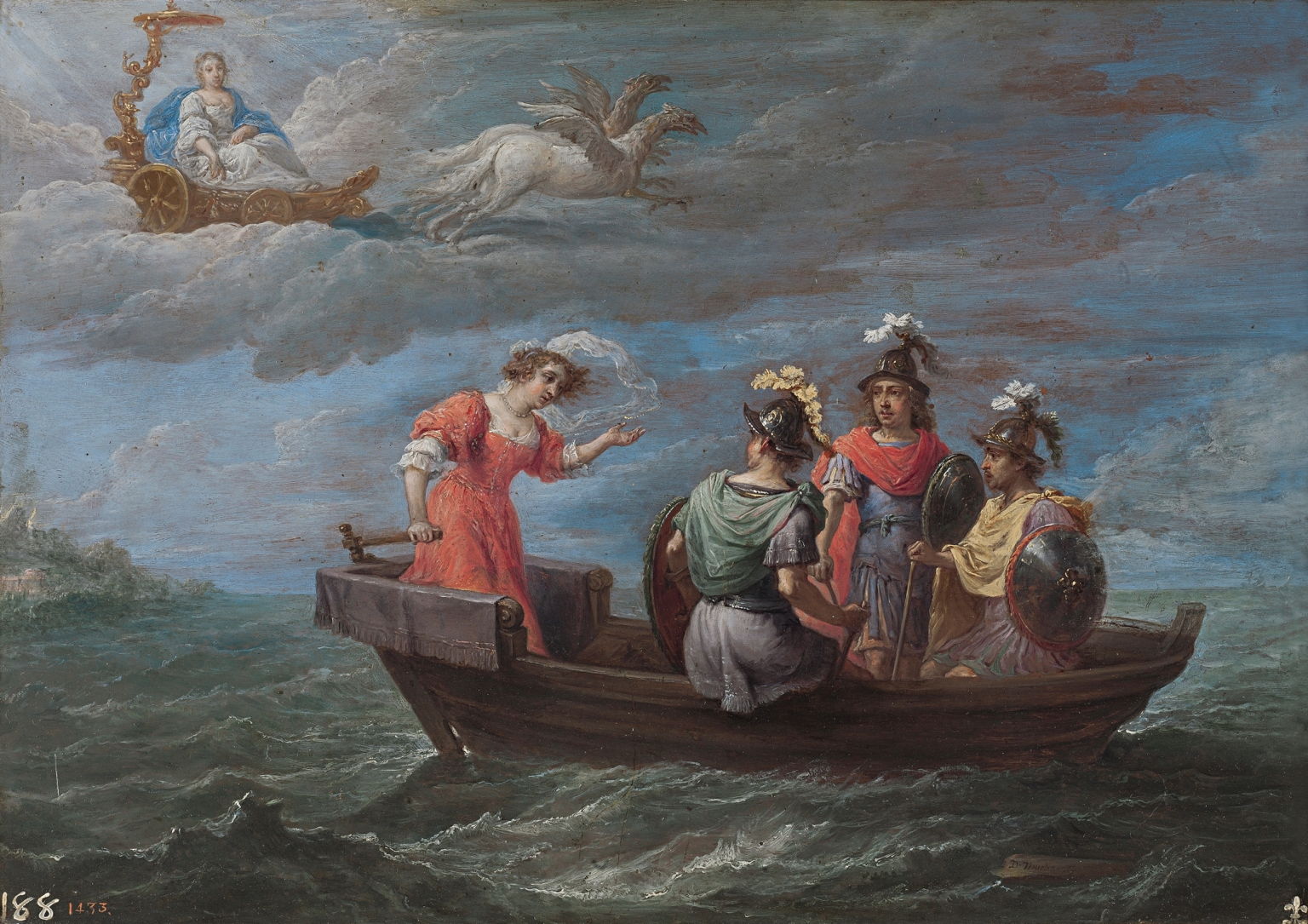
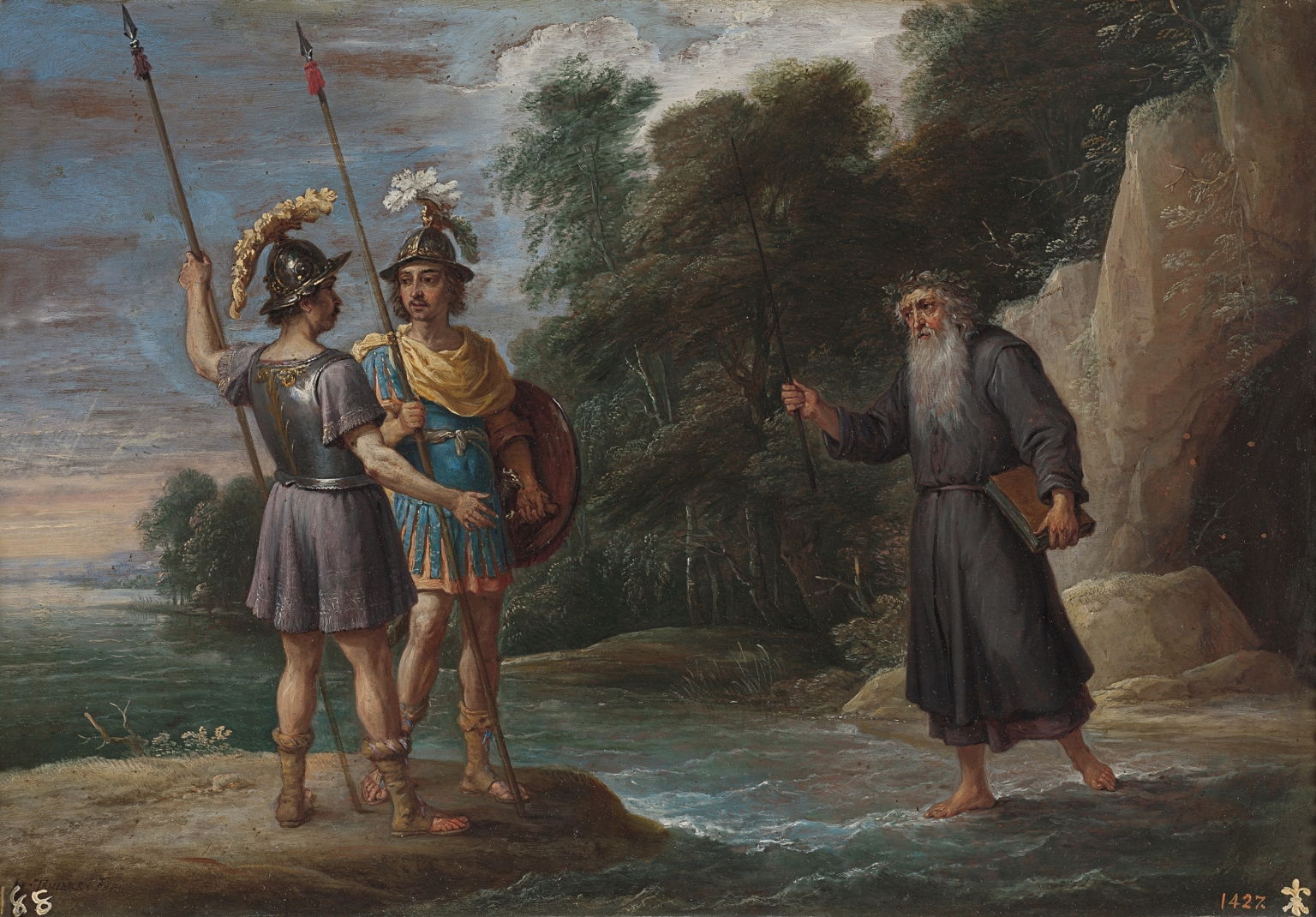
David Teniers the Younger (1610–1690), Armida before Godfrey of Bouillon (1628-30), oil on copper, 27 x 39 cm, Museo Nacional del Prado, Madrid, Spain. Wikimedia Commons.
Armida tells the crusaders a story of woe, and beguiles many of the finest of Godfrey’s knights to follow her on a fool’s errand.
In the midst of the chaos wrought by Armida, Rinaldo accuses Gernando of being a liar; they settle this when Rinaldo kills Gernando in a duel. Godfrey condemns Rinaldo to death, and he storms off from the camp. Armida then leads many other knights away on her diversionary mission.
In an attempt to expedite matters, Argante challenges the crusaders in one-to-one combat. Godfrey approves Tancred as the knight to face the Circassian. They fight viciously, wounding one another, but are brought to a halt by nightfall.
Erminia decides to go and tend Tancred’s wounds, so dresses up in Clorinda’s armour and slips out of the city in the dead of night. However, that makes her appear to be Clorinda to the crusaders, and she is forced to flee in panic. Tancred then rides off in pursuit of her, thinking her to be Clorinda. Overnight, both Erminia and Tancred become lost, and fail to find one another.
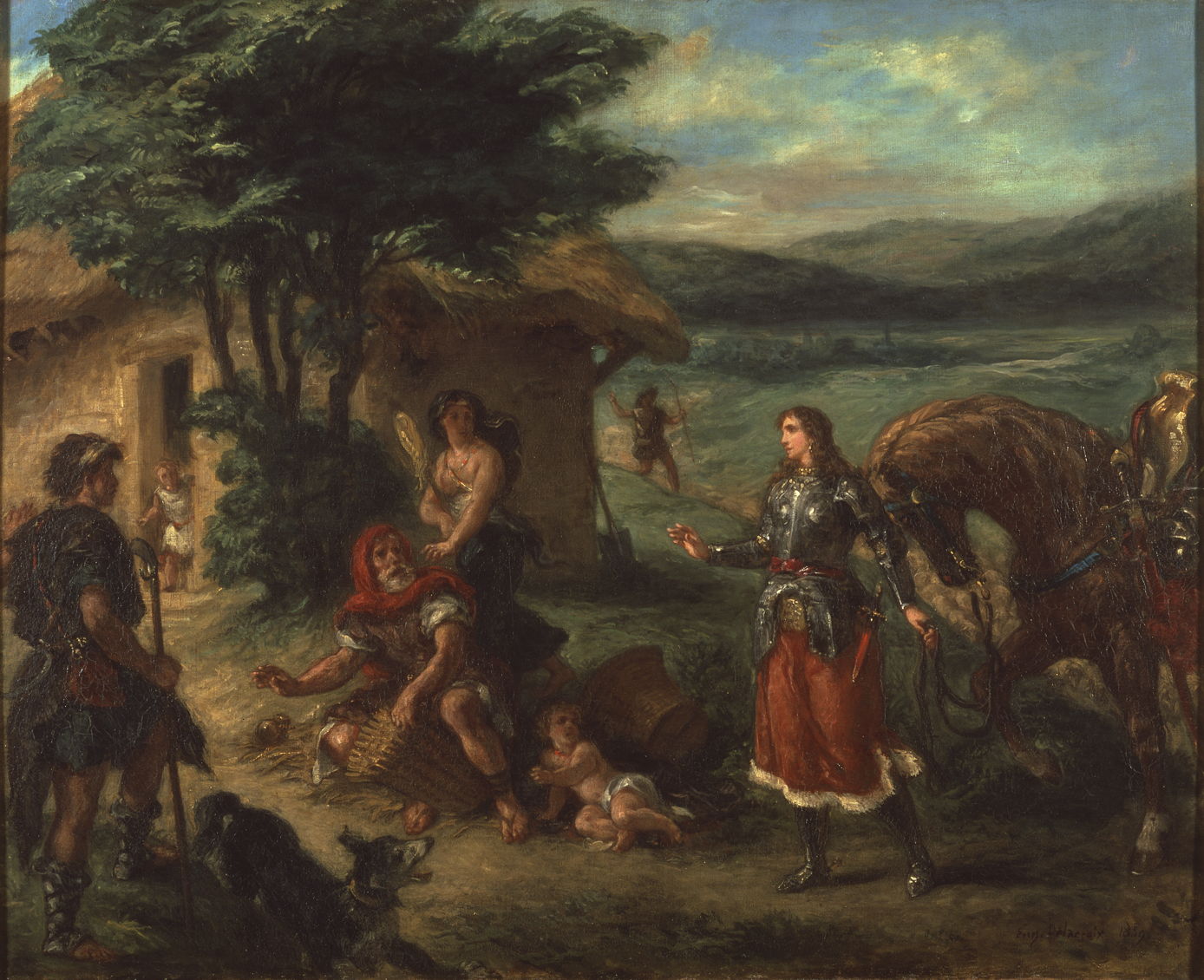
Eugène Delacroix (1798–1863), Erminia and the Shepherds (1859), oil on canvas, 82 x 104.5 cm, Nationalmuseum, Stockholm, Sweden. Wikimedia Commons.
Erminia happens on a small family of shepherds, who console her, and dress her in their country clothes.
Tancred is trapped in Armida’s magic castle, behind the bars of its dungeon. The following morning, with his combat against Argante due to restart soon after dawn, he is nowhere to be found. Raymond of Toulouse is drawn by lot to fight as his substitute, and proves a match. The devil, though, gets a ‘pagan’ archer to loose an arrow that strikes Raymond without wounding him. At this breach of chivalry, the affronted crusaders and defenders of Jerusalem join battle, which turns bloody until the hand of God intervenes with a massive thunderstorm.
Rinaldo and Tancred are still missing, but the crusaders riot in fear that the former has been killed. Godfrey realises he must attack the city soon.
Arab forces then attack the crusaders by night, which develops into more general battle. Knights return from their mission for Armida, reporting that they had been rescued by Rinaldo, who hadn’t been killed after all. They report that Armida has taken Tancred prisoner.
Godfrey prepares for assault on the city, first celebrating mass on Mount Olivet. The following day the crusaders bring up their siege towers and engines to tackle the walls of Jerusalem, but make slow progress against a strong defence. At nightfall the towers are pulled back, but Clorinda sneaks out of the city and sets alight to the towers, burning them to the ground.
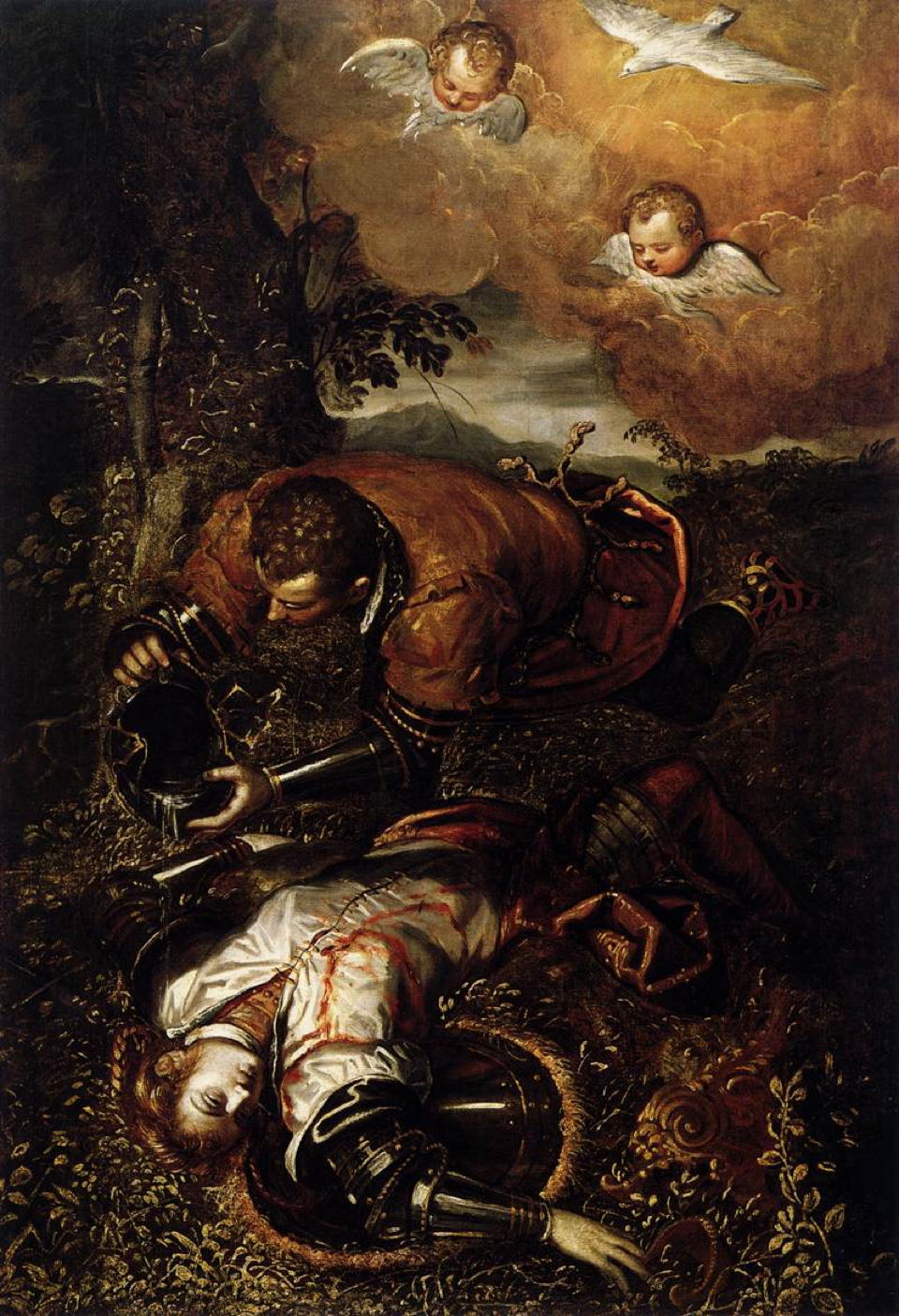
She is caught outside the walls by Tancred, who cannot tell it is her and engages her in combat. Eventually he wounds her mortally, recognises her, and she asks to be baptised before she dies. Tancred does so, and she goes in peace.
Domenico Tintoretto (1560–1635), Tancred Baptizing Clorinda (c 1585), oil on canvas, 168 x 115 cm, Museum of Fine Arts, Houston, TX. Wikimedia Commons.
Ismen enchants the forest which is the crusaders’ only supply of wood, preventing them from cutting replacement timbers for new siege towers. The weather turns oppressively hot and dry, causing crusaders to collapse and die of heat and dehydration. After prayers of the crusaders, the weather breaks and there is heavy rain.
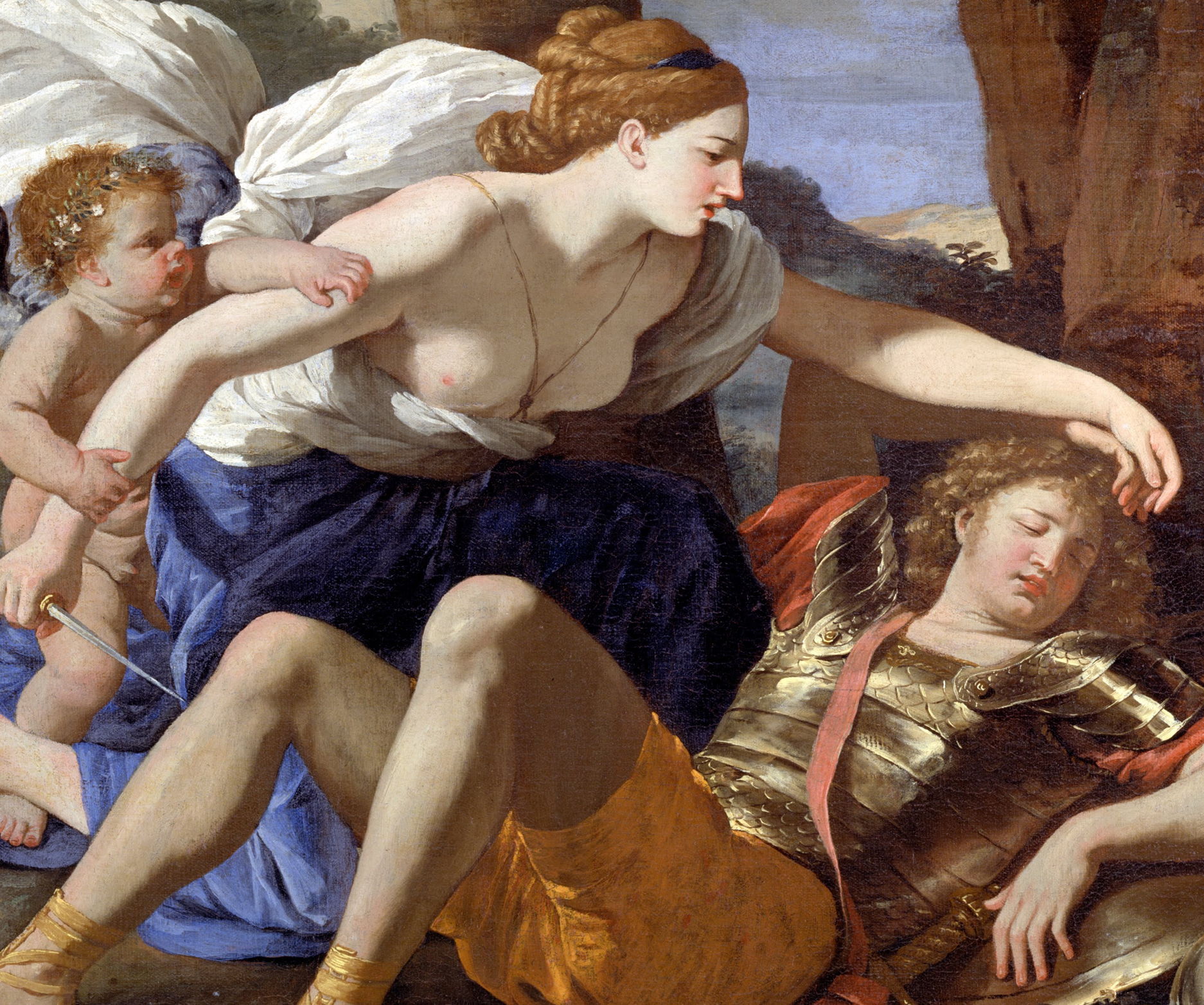
Godfrey has a vision revealing the importance of finding Rinaldo to break the spell so that he can obtain timber again. Charles and Ubaldo leave on a mission to discover Rinaldo. They learn that Armida had originally intended to kill him, but just as she was about to sink her dagger into his sleeping body, she fell in love with him and abducted him instead.
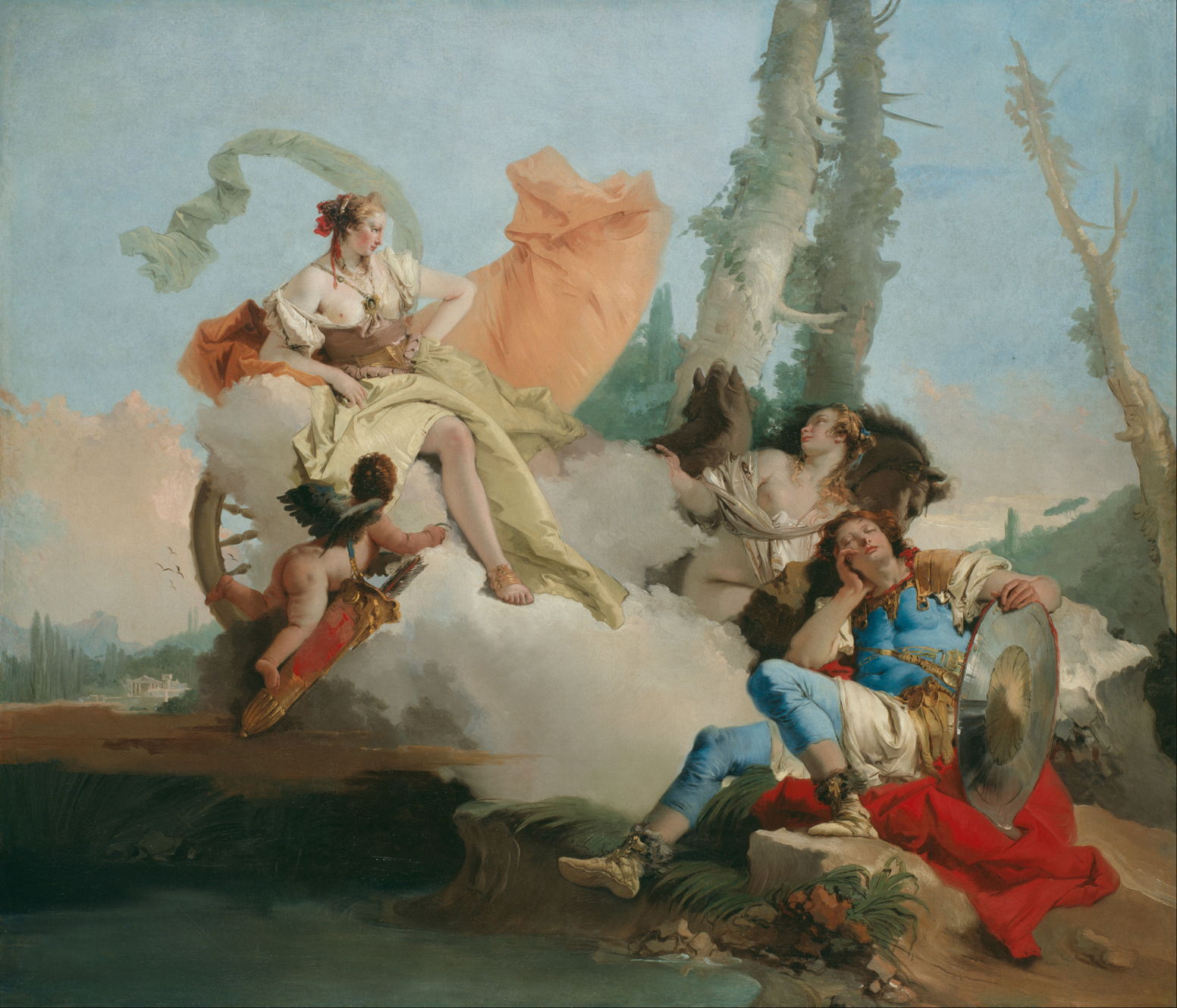
Nicolas Poussin (1594–1665), Rinaldo and Armida (c 1630), oil on canvas, 82.2 x 109.2 cm, Dulwich Picture Gallery. Wikimedia Commons.
With the help of a wizard, Charles and Ubaldo sail in a magic ship to the Fortunate Isles. Overcoming various obstacles, they see the couple together in Armida’s garden, where Rinaldo has clearly become Armida’s dandy, and no warrior knight.
Giovanni Battista Tiepolo (1696–1770), Rinaldo and Armida in Her Garden (1742-45), oil on canvas, 187 x 260 cm, The Art Institute of Chicago, Chicago, IL. Image by Sailko, via Wikimedia Commons.
Showing Rinaldo his image in a polished shield, Charles and Ubaldo get him to see how he has changed, and to return to the siege of Jerusalem with them.
Giovanni Battista Tiepolo (1696–1770), Armida Abandoning Rinaldo (1742-45), oil on canvas, 186.7 x 259.4 cm, The Art Institute of Chicago, Chicago, IL. Image by Sailko, via Wikimedia Commons.
Armida first tries to lure him back, then weeps, and finally departs in rage in her own chariot, to wreak vengeance.
Rinaldo is reunited with Godfrey, who asks him to solve the problem of the enchanted wood. Rinaldo enters the wood and breaks Ismen’s spell, enabling timbers to be felled to build fresh siege towers.
Meanwhile, the King of Egypt is leading a massed army towards the crusaders at Jerusalem. Joining him is Armida with forces provided by her evil uncle. There are several volunteers who promise to kill Rinaldo in return for her hand in marriage. The King of Egypt also plots how he will kill Godfrey using deception. Those plans are discovered by a crusader spy, Vafrine.
With new towers built, Godfrey resumes the assault on Jerusalem before the Egyptian forces are due to arrive. Rinaldo, Tanred, Godfrey and others lead the ascent of the walls, and crusaders enter the city, where they quickly start massacring its ‘pagan’ defenders.
Argante and Tancred agree to conclude their previous combat beyond the city walls. After a bitter fight, in which both men are badly wounded, Tancred finishes the Circassian off, then collapses at dusk.
Vafrine has completed his mission spying on the Egyptian forces when he is recognised by Erminia, who wants to defect to the crusader camp. On their way back, they stumble across Argante’s body, then the wounded Tancred.
Nicolas Poussin (1594–1665), Tancred and Erminia (c 1634), oil on canvas, 75 x 100 cm, Barber Institute of Fine Arts, Birmingham, England. Wikimedia Commons.
Erminia cuts tresses from her hair to make improvised bandages for Tancred’s wounds, and he is taken into Jerusalem for further care. Vafrine goes on to brief Godfrey of the Egyptians’ plans, to help him plan his defence.
The Egyptian army arrives late the following day, but Godfrey won’t be rushed, and battle commences at dawn the next day. Egyptians wearing false colours as crusaders get close to Godfrey but are quickly recognised and killed.
As the battle rages on, Rinaldo sees Armida as an archer in her chariot, but passes her by to continue fighting. She struggles to loose her arrows at him, and those that she does shoot, bounce off ineffectively. With the Egyptian forces in full retreat and their leaders all dead, Armida flees on one of her horses.
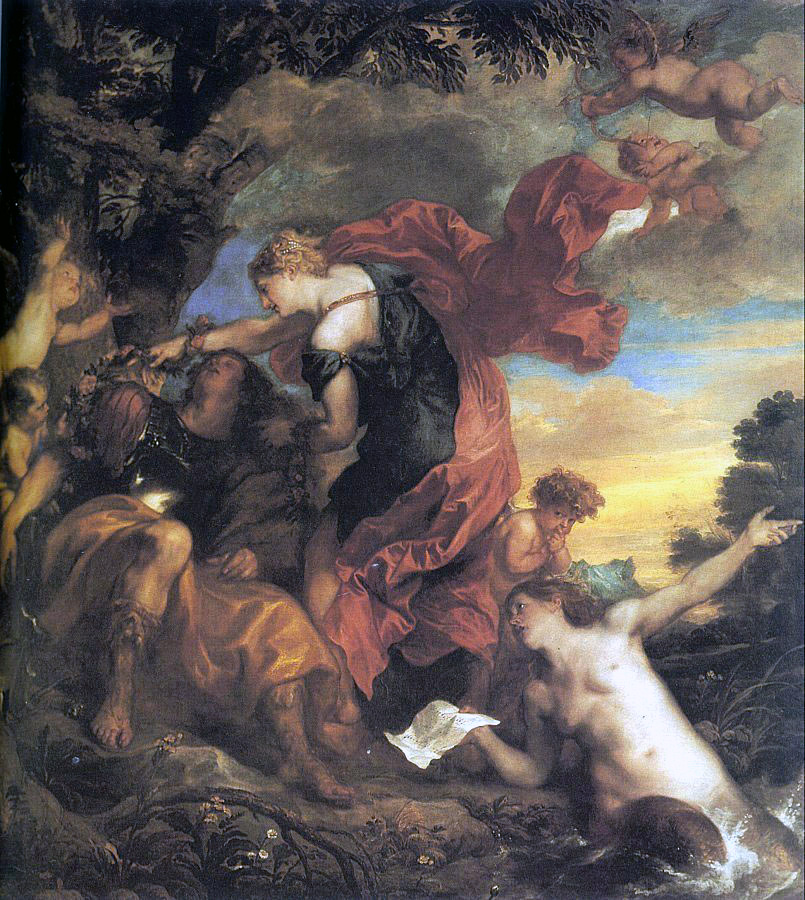
David Teniers the Younger (1610–1690), Reconciliation of Rinaldo and Armida (1628-30), oil on copper, 27 x 39 cm, Museo Nacional del Prado, Madrid, Spain. Wikimedia Commons.
Rinaldo catches her, just as she is about to stab herself with one of her own arrows in a bid to end her life. She swoons into his arms, he cries with pity for her, and Rinaldo promises to be her servant and her champion.
With the ‘pagan’ armies defeated and departed, Godfrey now leads his crusaders into the city as the sun sets. He goes to the Temple, having fulfilled his vow to deliver Jerusalem.
Johann Friedrich Overbeck (1789-1869), Consecration of Godfrey (1819-27), fresco, dimensions not known, Casa Massimo, Rome, Italy. Image by Sailko, via Wikimedia Commons.
Thomas Asbridge (2004) The First Crusade, A New History, Free Press, ISBN 978 0 7432 2084 2.
Anthony M Esolen, translator (2000) Torquato Tasso, Jerusalem Delivered, Gerusalemme Liberata, Johns Hopkins UP. ISBN 978 0 801 863233. A superb modern translation into English verse.
John France (1994) Victory in the East, a Military History of the First Crusade, Cambridge UP. ISBN 978 0 521 589871.
Joanthan Riley-Smith, ed (1995) The Oxford Illustrated History of the Crusades, Oxford UP. ISBN 978 0 192 854285.
Jonathan Riley-Smith (2014) The Crusades, A History, 3rd edn., Bloomsbury. ISBN 978 1 4725 1351 9.
Johathan Unglaub (2006) Poussin and the Poetics of Painting, Pictorial Narrative and the Legacy of Tasso, Cambridge UP. ISBN 978 0 521 833677.
The ancient Greek myth of Pandora had been almost unknown in paintings until the nineteenth century. During the 1870s it suddenly became a popular theme for European paintings, but its narrative had altered from the original in showing the first woman in Greek mythology with a box containing the ills of the world, rather than a large earthenware storage pot, and only one artist had depicted its crux.
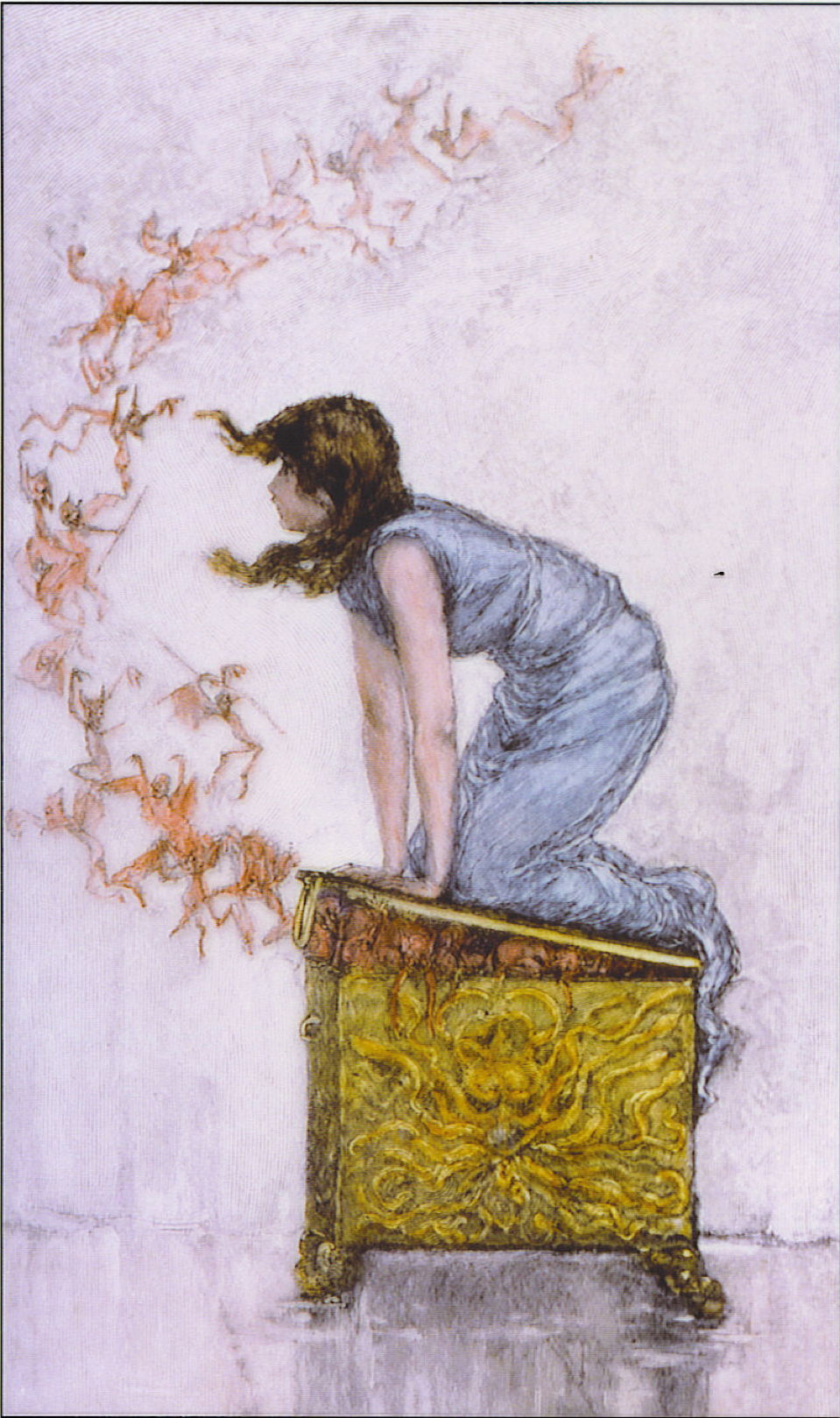
Frederick Stuart Church (1842–1924), Pandora (1883), pencil and ink wash on paper, 30.2 x 45.7 cm, Private collection. Wikimedia Commons.
The story broke out of Europe by 1883, when the American painter and illustrator Frederick Stuart Church painted his more illustrative Pandora. Dressed more modestly (presumably for a wider audience), she is shown as an innocent young woman kneeling on a large golden chest as she tries to close its lid and stop the emerging stream of red demons. I suspect this was intended as an illustration for a printed collection of classical myths.
Walter Crane (1845–1915), Pandora (1885), watercolour on paper, 53.3 x 73.6 cm, location not known. Wikimedia Commons.
The following year Walter Crane, a British painter and illustrator, painted Pandora in an unusual interpretation that’s only loosely connected with the original myth. She is here draped in grief over a substantial casket, and on its side panel are the figures of the three Fates. At the corners of the casket are guardian winged sphinxes, each clasping a sphere.
William-Adolphe Bouguereau (1825–1905), Pandora (1890), oil on canvas, 92.5 × 64.5 cm, location not known. Wikimedia Commons.
In his later years, William-Adolphe Bouguereau chose an oddly androgynous model for his depiction of Pandora in 1890, but has rather lost the narrative. Her neutral expression, body language, and the closed box tell little of what is imminent.
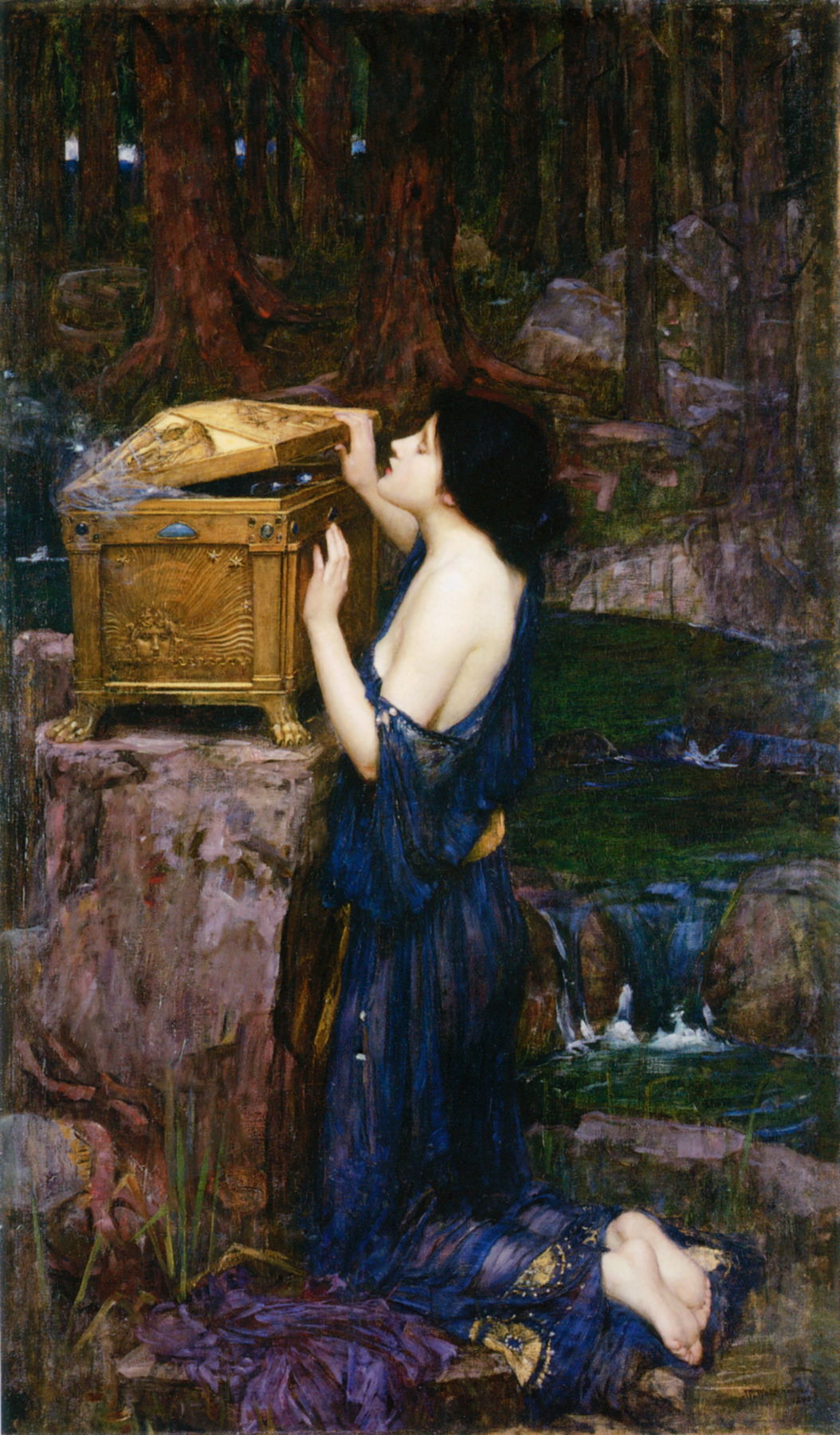
John William Waterhouse (1849–1917), Pandora (1896), oil on canvas, 152 × 91 cm, Private collection. Wikimedia Commons.
One of his lesser-known paintings, John William Waterhouse’s Pandora from 1896 is a major depiction of this myth, and one of the most complete. Set by a small brook in a dark, primeval forest, her box has become a large gold chest encrusted with precious stones and decorated with mythological motifs. Pandora kneels by its side, peeking inside as she carefully raises its lid, but even this tentative glimpse is sufficient to release its stream of ills, of which she appears unaware.
Ernest Normand (1857-1923), Pandora (1899), further details not known. The Athenaeum.
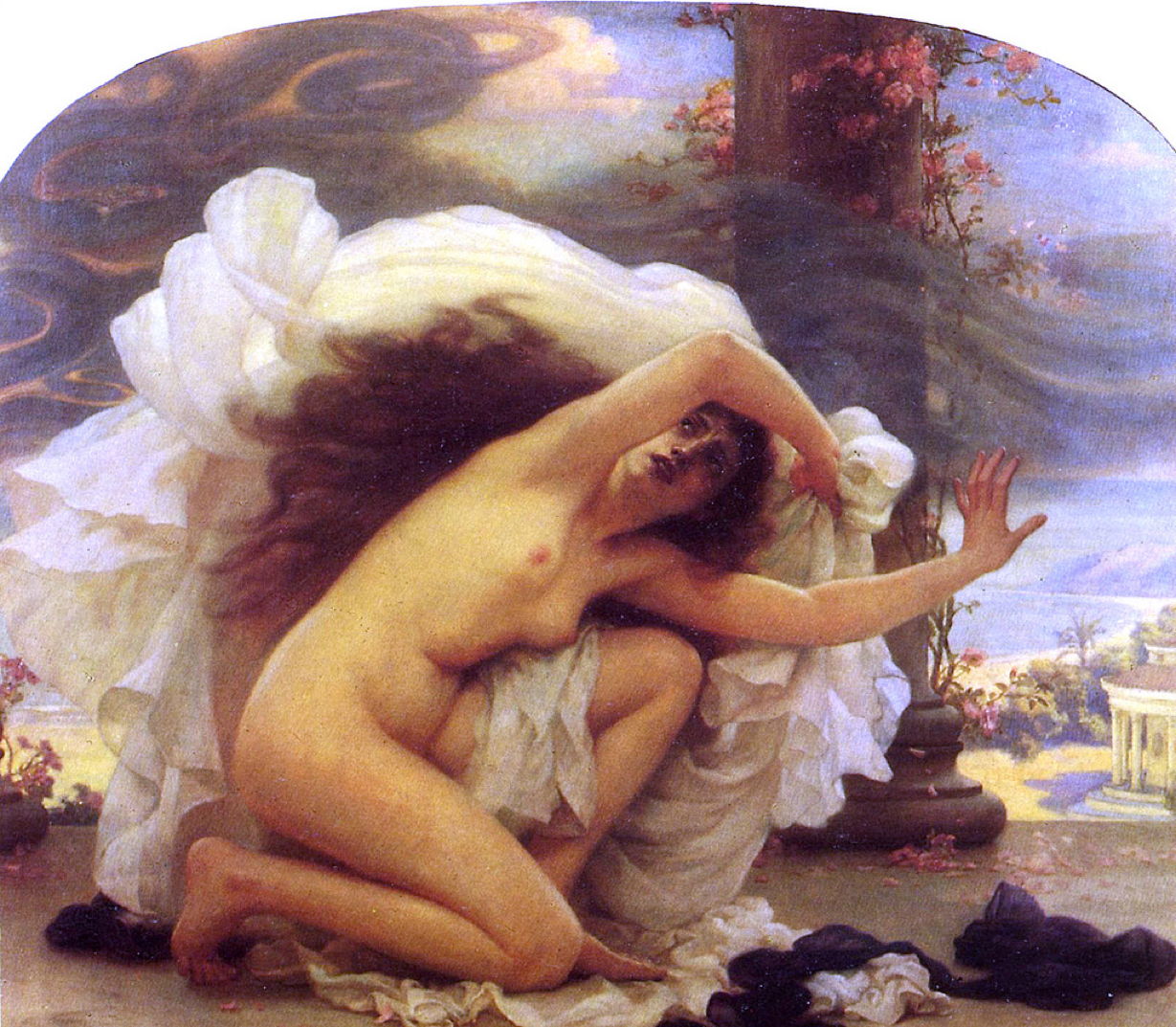
Ernest Normand is one of few painters to show a later moment, in which Pandora (1899) bends low to duck beneath the swirling grey clouds of evils as they spread out into the idyllic world beyond, causing blossom to fall as petals to the ground. Her jar is only hinted at, behind her billowing white robes, almost depriving the viewer of this vital clue to the original story.
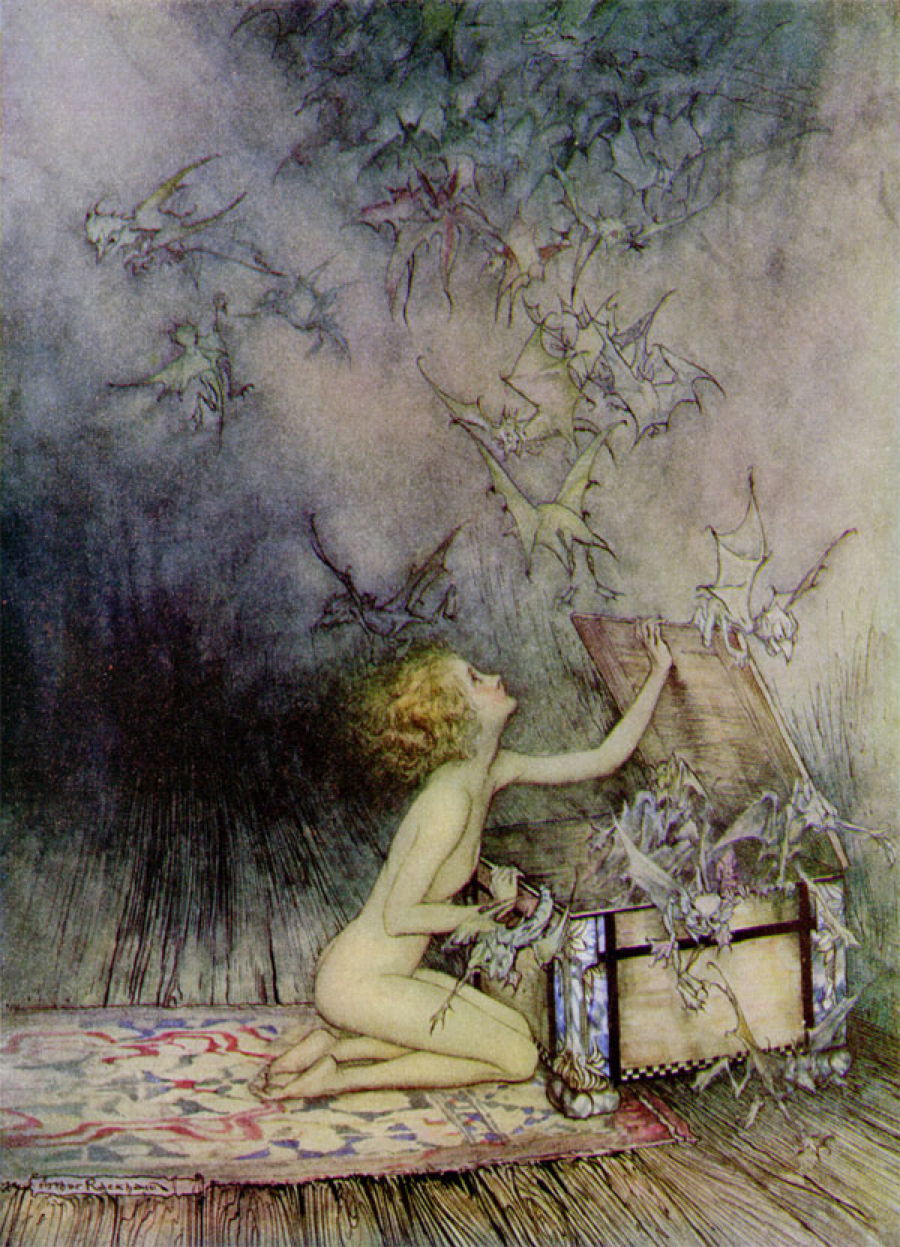
Arthur Rackham (1867–1939), Pandora (date not known), further details not known. Wikimedia Commons.
I have been unable to find a date for this presumed illustration by the great Arthur Rackham of Pandora, but suspect it was made around the turn of the twentieth century, and intended to accompany a British English retelling of this myth. As with Church before, Pandora is young and innocent in her nakedness. She gazes up in awe at the batlike demons as they escape from the open lid of her large wooden chest, seemingly unaware of what she is unleashing in her curiosity.
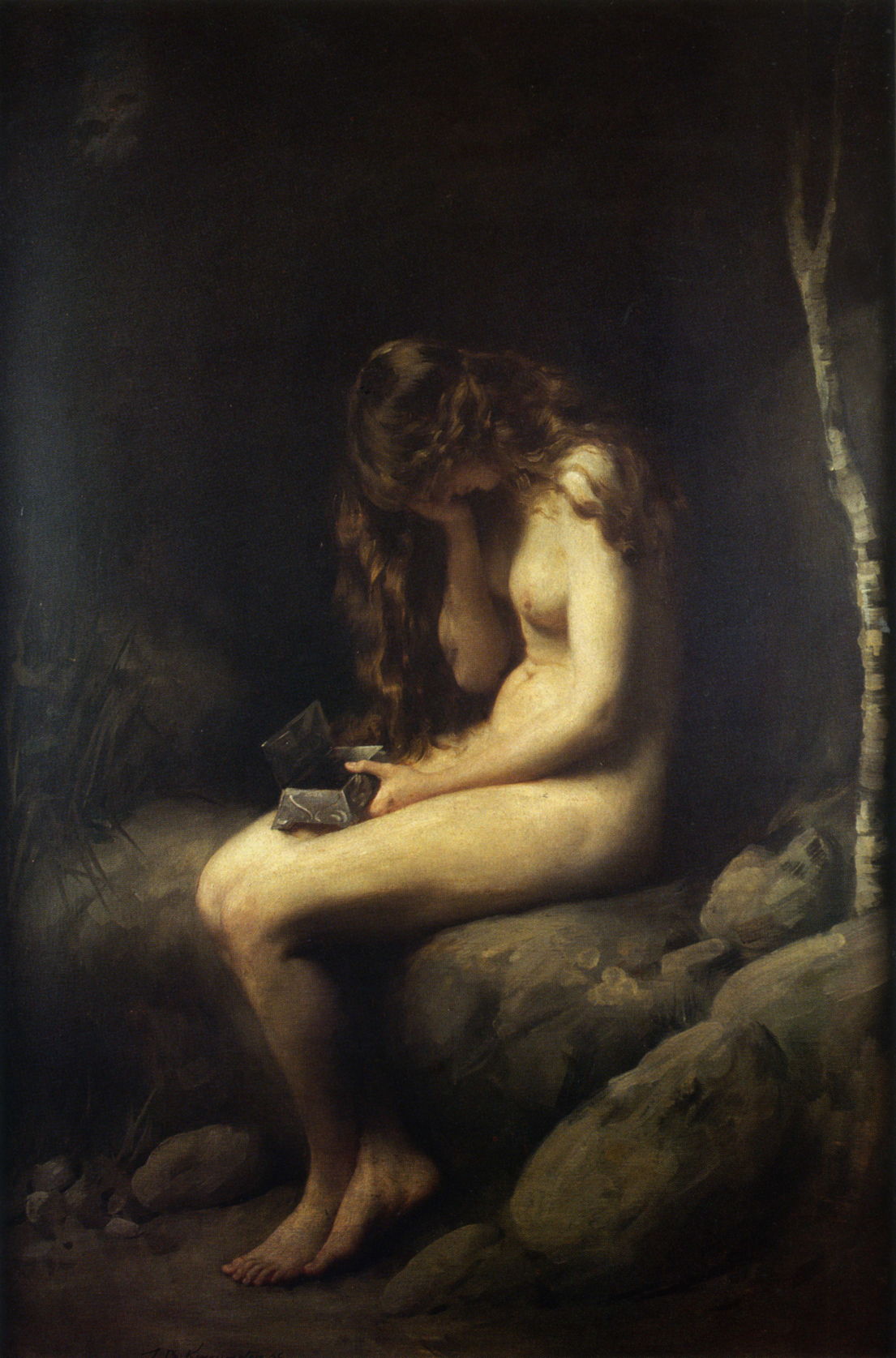
Thomas Benjamin Kennington (1856–1916), Pandora (1908), oil on canvas, 166.3 × 113 cm, Private collection. Wikimedia Commons.
Thomas Benjamin Kennington shows Pandora (1908) in the final phase of regret and sorrow, after the evils have all been released. Her box, now empty, with no sign of the remaining Hope, rests on her thigh. She hangs her head in shame, resting it on her right hand as she weeps at what she has done. Unfortunately, the released demons shown at the left edge are so dark that they are hard to see.
Over this period, other artists had also been painting the story of the creation of Pandora, a theme I have avoided so far. I will, though, show one of its more unusual depictions, a painting lost for forty years.
John Dixon Batten (1860-1932), The Creation of Pandora (1913), tempera on fresco, 128 x 168 cm, Reading University, Reading, England. Wikimedia Commons.
John Dixon Batten’s The Creation of Pandora was painted anachronistically in egg tempera on a fresco ground by 1913. Batten was one of the late adherents of the Pre-Raphaelite movement, and now almost forgotten. It had been exhibited in a commercial gallery, and was acquired by the University of Reading, England, shortly before the First World War. Deemed unfashionable in 1949, it was put into storage and quietly forgotten until its rediscovery in 1990.
Pandora is at the centre, having just been fashioned out of earth by Hephaestus, who stands at the left, his foot on his anvil. Behind them, other blacksmiths work metal in his forge. At the right, Athena is about to place her gift of a robe about Pandora’s figure, and other gods queue behind her to offer their contributions.
Just before the start of the First World War, Odilon Redon made a series of studies leading to a radically different presentation of Pandora’s story.
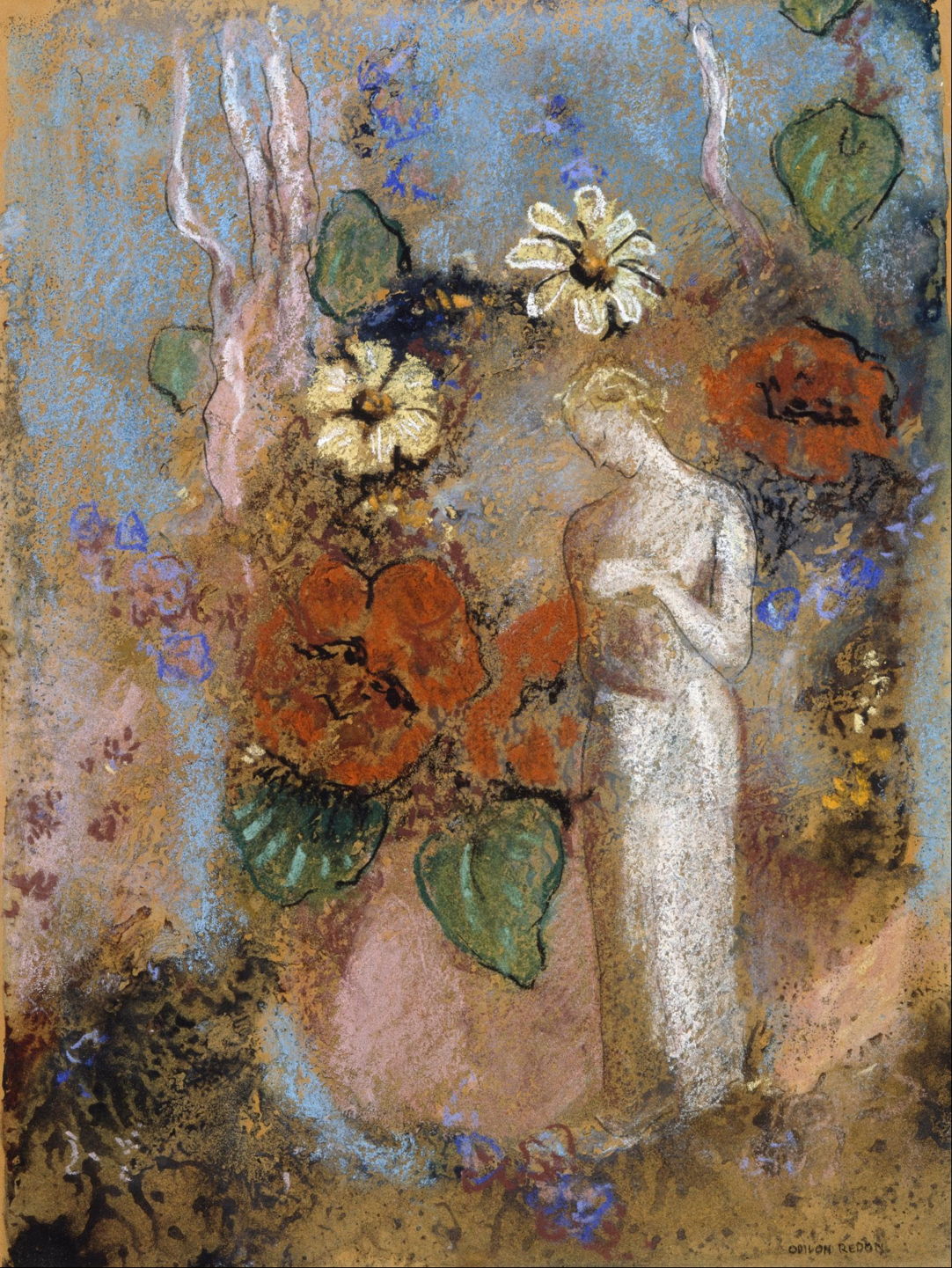
Odilon Redon (1840–1916), Pandora (date not known), pastel and charcoal on board, 22.1 x 29.1 cm, Museum of Fine Arts, Houston, TX. Wikimedia Commons.
Redon’s undated pastel study of Pandora shows her clasping her box close in the midst of huge floral images.
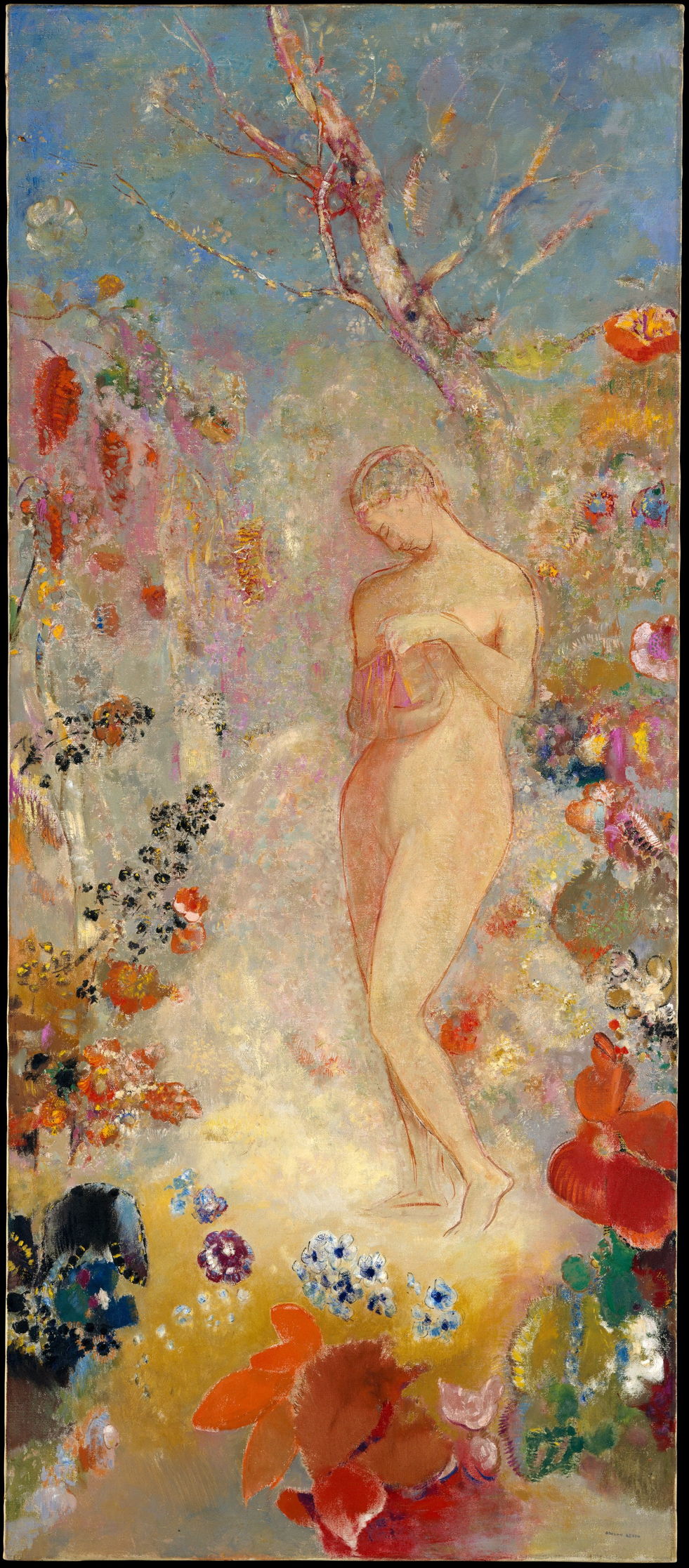
Odilon Redon (1840–1916), Pandora (c 1914), oil on canvas, 143.5 x 62.2 cm, The Metropolitan Museum of Art (Bequest of Alexander M. Bing, 1959), New York, NY. Courtesy of The Metropolitan Museum of Art.
Redon’s finished oil painting of Pandora from about 1914 shows her more clearly, surrounded by a garden of exquisite and exotic blooms, referring to Eve’s Paradise before the Fall. She holds her box to her bosom, as she succumbs to the temptation to open it, but Redon stops just short of showing its evils pouring out.
Yvonne Gregory (Park) (1889-1970), Pandora (1919), photograph, published in ‘Photograms of the Year’, 1919, further details not known. Wikimedia Commons.
My final representation of the myth of Pandora is a photograph from 1919 by the society portrait photographer Yvonne Gregory (who also worked under her married surname of Park): Pandora. The box lies wide open by her knees, as Pandora is bent double in distress over it, her left arm over her head to shelter her from the demons that have been released, and in grief at what she has done.
Given the disasters that had struck the world in the years immediately preceding this photograph – the mass carnage of the war, and the influenza pandemic which followed it – it must have had great impact when it was published in 1919. Much as these images have today. For despite the story’s underlying misogyny, I can’t help thinking that Pandora’s box has been opened yet again.
Stories are at the centre of our lives, and the focus of many of those is the origin of our species and societies. Ancient myths account for the first men and women, and how the world came to be as we know it. Whatever the scientific truth, we still tell stories about events long before historical records, among them the myth of Pandora and her box containing pain and evils.
Although earliest records of Pandora’s story stretch back to around 750 BCE, in one of the oldest Greek anthologies of myth, they weren’t included in the most popular compilations such as Ovid’s Metamorphoses, so seldom appeared in paintings, although it did enter English usage in the sixteenth century. It wasn’t until the late nineteenth century that Pandora’s box caught on and became a popular theme in images. This weekend I trace Pandora’s history in European paintings.
The story of Pandora and her ‘box’ is told most fully in Hesiod’s Works and Days, where she is the original woman, created by Hephaestus (Vulcan) for Zeus, as punishment for humans receiving the gift of fire that had been stolen by Prometheus. After she was formed from earth by Hephaestus, other gods gave her properties to determine her nature.
Athena dressed her in a silvery gown, and taught her needlecraft and weaving. Aphrodite shed grace on her head, together with cruel longing and cares. Hermes gave her a shameful mind and deceitful nature, together with the power of speech, including the ability to tell lies. Other gifts were provided by Persuasion, the Charities, and the Horae.
Pandora also carried with her a large earthenware jar (in Greek, pithos) containing toil and sickness that bring death to men, diseases, and a myriad of other pains. Zeus gave her as a gift to Epimetheus, brother of Prometheus. She then opened her jar, and released its evils into the earth and sea. The only thing remaining in the jar was Hope, who stayed under its lip.
This marked the beginning of Hesiod’s second age of mankind, its Silver Age, in which people knew birth and death, as humans had become subject to death, and Pandora brought birth too. In later accounts, Epimetheus married Pandora, and the couple had a daughter Pyrrha, who married Deucalion with whom she survived the flood.
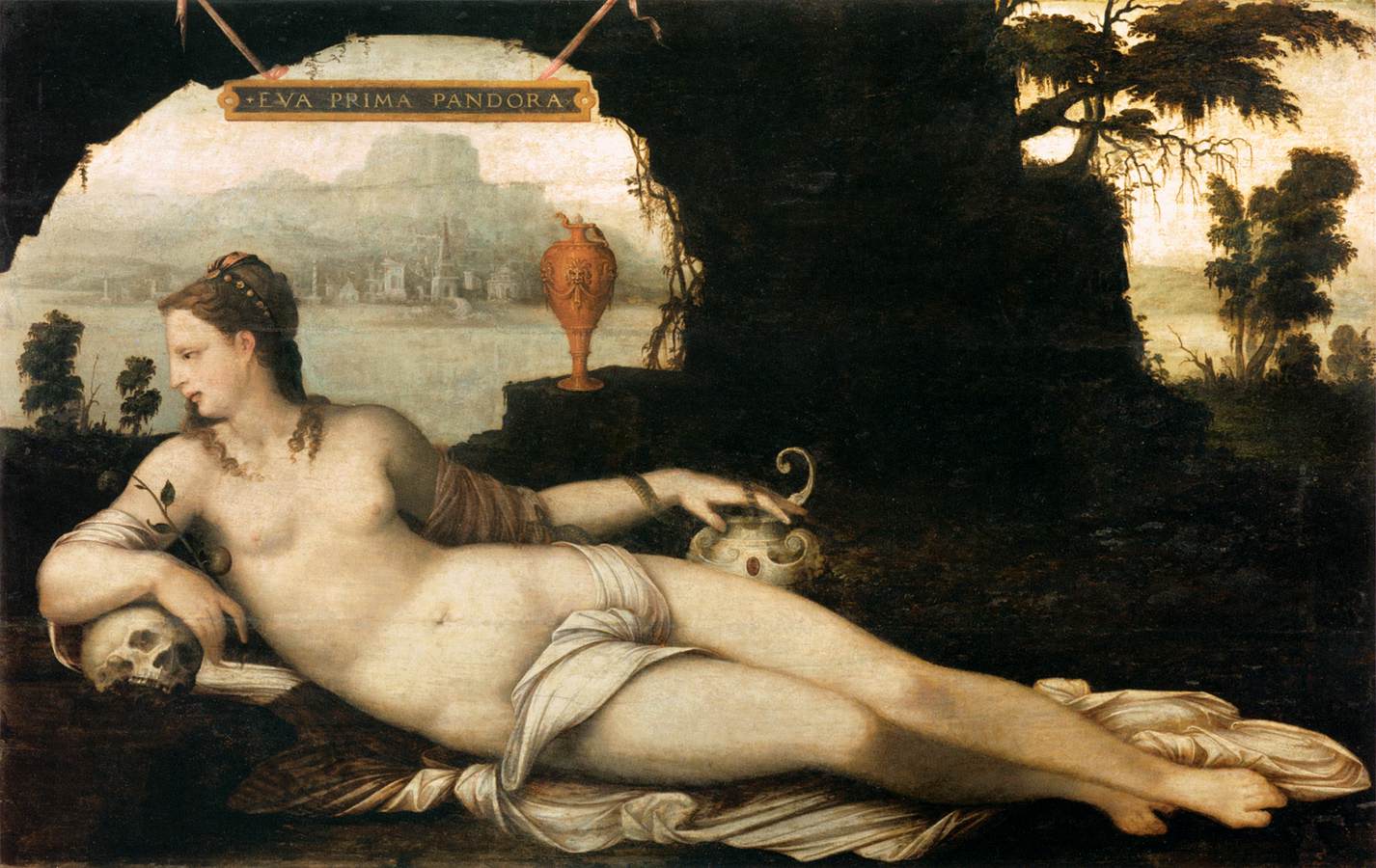
Jean Cousin (1500–1589), Eva Prima Pandora (c 1550), oil on panel, 97 x 150 cm, Musée du Louvre, Paris. Wikimedia Commons.
As with other classical myths, at the time that Jean Cousin painted Eva Prima Pandora, in about 1550, it had been mixed with Christian religious narrative, in this case of Eve and the Fall of Mankind. No longer clothed in Athena’s silvery gown, Eve/Pandora lies naked, propped against a human skull. Her left hand clutches the dreaded jar, which she hasn’t opened yet. Her right hand holds a fruiting sprig of the apple tree, an allusion to the traditional Biblical story of Eve. Coiled around her left arm is a serpent, another reference to the Fall of Mankind.
Pandora seems to have been very seldom if ever painted after that, until the nineteenth century.
William Etty (1787–1849), Pandora Crowned by the Seasons (1824), oil on canvas, 87.6 × 111.8 cm, Leeds City Art Gallery, Leeds, England. Wikimedia Commons.
When William Etty painted her, in Pandora Crowned by the Seasons in 1824, the significance of the crux of the story, Pandora opening the jar, had become lost in the other detail, and she was just another opportunity to paint a statuesque and almost naked young woman.
Henry Howard (1769-1847), The Opening of Pandora’s Vase (1834), oil on panel, 76.6 x 166.5 cm, Sir John Soane’s Museum, London. The Athenaeum.
It was the now-forgotten Henry Howard who first painted The Opening of Pandora’s Vase in 1834. Pandora, more correctly dressed, crouches to duck the torrent of woe, evil and pain as it streams from the jar, as Epimetheus tries in vain to reseal its lid. This is the story as told by Hesiod in his Works and Days.
The literary story seems to have changed Pandora’s jar into a box as the result of a mistranslation in the sixteenth century, but that transition doesn’t appear to have occurred in paintings until between 1834 and 1860. It also seems more likely that it resulted from confounding of this story with that of Psyche, who had a box she couldn’t open.
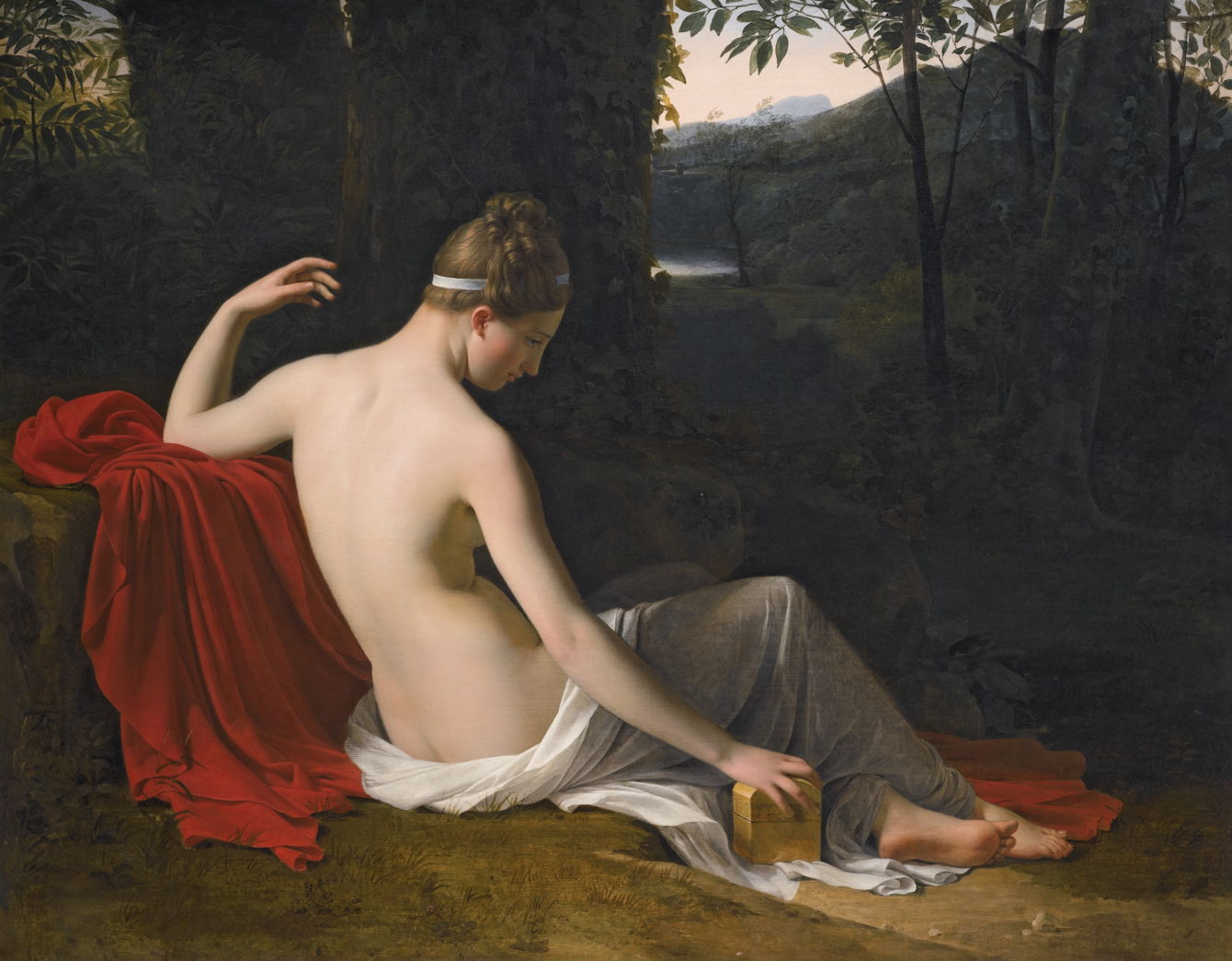
Louis Hersent (1777–1860) (attr), Pandora Reclining in a Wooded Landscape (date not known), oil on canvas, 138 x 173 cm, Private collection. Wikimedia Commons.
This undated painting attributed to Louis Hersent of Pandora Reclining in a Wooded Landscape gives the revised account, with the box firmly shut in Pandora’s right hand, and the motif an uncommitted combination of landscape, nude figure, and weak narrative.
In the 1870s, this suddenly became one of the most popular subjects for mythological paintings. This doesn’t appear to have been the result of it being told in another creative medium, though.
Dante Gabriel Rossetti (1828–1882), Pandora (1871), oil on canvas, 131 × 79 cm, Private collection. Wikimedia Commons.
Dante Gabriel Rossetti’s first painting of Pandora, completed in 1871, shows a moody, brooding Pandora, modelled by Jane Morris. She has just cracked open the lid of the jewelled casket in her left hand, and it’s emitting a stream of noxious red smoke. As this coils around her head, winged figures appear in the fumes. The inscription on the side of the jewel casket reads “Nascitur ignescitur”, meaning born of flames.
This was one of Rossetti’s earlier paintings of Jane Morris, wife of his friend William Morris, and later to be the subject of Rossetti’s passionate obsession. Rossetti’s source for the story was most probably Lemprière’s dictionary of classical mythology, which erroneously referred to Pandora’s box, not jar. It was commissioned by John Graham for 750 guineas, who was so pleased with the result that he exhibited it, against Rossetti’s wishes, in Glasgow the following year.
Jules Lefebvre (1834–1912), Pandora (1872), oil on canvas, 132 × 63 cm, Museo Nacional de Bellas Artes, Buenos Aires, Argentina. Wikimedia Commons.
Jules Lefebvre was another artist who painted Pandora more than once. This initial version from 1872 shows her walking with the fateful box held in both hands, its lid firmly shut. Ominous smoke rises from a series of fumaroles in the ground around her. She is nude, wears an unusual coronet, and there is a six-pointed star above her head.
Alexandre Cabanel (1823–1889), Pandora (1873), oil on canvas, 70.2 x 49.2 cm, Walters Art Museum, Baltimore, MD. Wikimedia Commons.
Next was Alexandre Cabanel’s portrait of the Swedish soprano Christina Nilsson (1843-1921) as Pandora, from 1873. As a portrait rather than a faithful account of the myth, the box is closed, almost concealed, and its significance suppressed.
Paul Césaire Gariot (1811-1880), Pandora’s Box (1877), oil on panel, 81 × 56.2 cm, Private collection. Wikimedia Commons.
In 1877, the elderly Paul Césaire Gariot’s Pandora’s Box places her in a primeval world of rock, studying the closed box intently, wrestling internally with the desire to open it.
Dante Gabriel Rossetti (1828–1882), Pandora (1878), coloured chalks, 100.8 × 66.7 cm, Lady Lever Art Gallery, Liverpool, England. Wikimedia Commons.
The following year, Dante Gabriel Rossetti made this chalk study for a second painting of Pandora, again using Jane Morris as his model. Her face shows a faint agony this time, as a decorative golden stream emerges from a crack in the lid. Here the inscription reads “Ultima manet spes” – hope remains last, perhaps a candidate for Rossetti’s own epitaph.
Lawrence Alma-Tadema (1836–1912), Pandora (1881), media and dimensions not known, Private collection. Wikimedia Commons.
Lawrence Alma-Tadema sought a compromise in his Pandora of 1881, in which she holds not a box but a small pot, suitably decorated with a Sphinx. In what appears to be a skilfully painted watercolour, Pandora hasn’t yet given way to the temptation to open the pot.
Jules Lefebvre (1834–1912), Pandora (1882), oil on canvas, 96.5 × 74.9 cm, Private collection. Wikimedia Commons.
Jules Lefebvre’s second painting of Pandora made in 1882, a decade after his first, places her in profile next to the sea. She has a star just above her forehead, but that has become five-pointed rather than six, perhaps to dodge any Jewish connotations. His previous gentle narrative has all but vanished.
By this time only one artist had attempted to depict the crux of the story, and that had been Henry Howard almost fifty years earlier.
When reading a painting of classical myth, the feet and footwear can be very important. Although they’re by no means common, if you see a figure wearing what could be winged sandals, you can narrow them down to one of two: Hermes or Mercury as messenger of the gods, and the hero Theseus. However, their depictions aren’t always consistent, and the absence of winged sandals doesn’t mean you can exclude them, unfortunately.
I start with the god, whose talaria were fashioned from gold by Hephaestus/Vulcan to enable him to fly as fast as any bird.
Sandro Botticelli (Alessandro di Mariano di Vanni Filipepi), Primavera (Spring) (c 1482), tempera on panel, 202 x 314 cm, Galleria degli Uffizi, Florence. Wikimedia Commons.
One of the most famous depictions of Hermes, typically in a supporting role, is in Botticelli’s magnificent Primavera from around 1482.
Sandro Botticelli (Alessandro di Mariano di Vanni Filipepi), Primavera (Spring) (detail) (c 1482), tempera on panel, 202 x 314 cm, Galleria degli Uffizi, Florence. Wikimedia Commons.
Hermes’ mother Maia gave her name to the month of May, so is associated with Spring. Botticelli has chosen to give the serpents on his caduceus wings to make them resemble small dragons. The god is also more typically seen with his caduceus in his left hand, rather than his right as shown here, and his winged sandals clearly aren’t made of gold.
Andrea Mantegna (1431–1506), Parnassus (Mars and Venus) (1496-97), oil on canvas, 159 x 192 cm, Musée du Louvre, Paris. Wikimedia Commons.
Hermes is a frequent figure in paintings of gatherings of deities, including Andrea Mantegna’s Mars and Venus, known better as Parnassus (1496-97), painted for Isabella d’Este. At the right of this complex gathering is Hermes with his winged sandals and caduceus, and Pegasus the winged horse. Apollo is at the far left, making music for the Muses on his lyre.
Francisco Bayeu y Subías (1734–1795), Olympus: The Fall of the Giants (1764), oil on canvas, 68 x 123 cm, Museo Nacional del Prado, Madrid, Spain. Wikimedia Commons.
Francisco Bayeu y Subías was Goya’s brother-in-law. His Olympus: The Fall of the Giants from 1764 shows the war between the Titans and Olympian gods, and was presumably hung under a ceiling. Just to the upper left of its centre, holding his caduceus and wearing winged sandals, is Hermes.
Pierre-Auguste Renoir (1841–1919), The Judgment of Paris (c 1908-10), oil on canvas, 73 x 92.5 cm, Hiroshima Museum of Art, Hiroshima, Japan. Wikimedia Commons.
Auguste Renoir’s account of The Judgment of Paris, from about 1908-10, demonstrates his skill as a narrative painter. After Paris has accepted Aphrodite’s bribe of Helen, he is shown awarding her the golden apple provided by the discordant Eris from the garden of the Hesperides. Watching on is Hermes, complete with his winged helmet and sandals, and caduceus.
Hermes seldom lent out his talaria, but there’s one occasion that has become well known. When Perseus was on his mission to obtain the head of Medusa, he was kitted out with Hermes’ sandals, the cap of Hades for invisibility, and a kibisis or sack in which to conceal the Gorgon’s severed head.
Unknown, Perseus Freeing Andromeda (c 50-75 CE), height 122 cm, Casa dei Dioscuri (VI, 9, 6), Pompeii, moved to Museo Archeologico Nazionale di Napoli, Naples. By WolfgangRieger, via Wikimedia Commons.
This Pompeian account of Perseus Freeing Andromeda from about 50-75 CE shows Andromeda still chained to the rock by her left wrist, and partially clad rather than naked as the myth related. Perseus has Medusa’s head tucked behind him, her face shown for ease of recognition. He is wearing his winged sandals, and carrying his sword in his left hand, although there’s no sign of Cetus the sea-monster yet.
Peter Paul Rubens (1577–1640), Perseus and Andromeda (c 1622), oil on canvas, 99.5 x 139 cm, Hermitage Museum, Saint Petersburg, Russia. Wikimedia Commons.
Peter Paul Rubens’ Perseus and Andromeda from about 1622 contains most of the cues and clues to the original narrative. Andromeda is almost naked, although unchained at this stage, on the left. Perseus is clearly in the process of claiming her hand as his reward, for which he is being crowned with laurels, as the victor. He wears winged sandals, and holds the polished shield that still reflects Medusa’s face and snake hair. Much of the right of the painting is taken up by Pegasus, and at the lower edge is the dead Cetus, its fearsome mouth wide open.
In Edward Burne-Jones’ Perseus Series, the hero’s winged sandals are one of its less consistent features.
Edward Burne-Jones (1833–1898), The Perseus Series: Perseus and the Sea Nymphs (1877), bodycolour, 152.8 × 126.4 cm, Southampton City Art Gallery, Southampton, England. Wikimedia Commons.
The third painting, Perseus and the Sea Nymphs (1877), shows the Hesperides equipping Perseus with the kibisis at the far right. Burne-Jones combines with that his donning the winged sandals (centre) and Hades’ helmet, as provided by Hermes and Zeus.
Edward Burne-Jones (1833–1898), The Perseus Series: The Doom Fulfilled (1888), oil on canvas, 155 × 140.5 cm, Staatsgalerie Stuttgart, Stuttgart. Wikimedia Commons.
Further on in the series, in his finished oil version of The Doom Fulfilled (1888), the sandals are shown clearly as Perseus takes on Cetus.
Frederic, Lord Leighton (1830–1896), Perseus On Pegasus Hastening To the Rescue of Andromeda (c 1895-6), oil on canvas, 184 x 189.6 cm, New Walk Museum & Art Gallery, Leicester, England. Wikimedia Commons.
In one of Frederic, Lord Leighton’s last paintings, of Perseus On Pegasus Hastening To the Rescue of Andromeda from about 1895-96, the wings on his sandals are tiny but distinctive.
Over the last three months I have illustrated a summary of Torquato Tasso’s epic Jerusalem Delivered, concluding that last week. To draw this to a close, this article considers the stories and fate of its six leading characters.
The three leading men are Godfrey of Bouillon, Prince Tancred, and Rinaldo. The leading women are Clorinda the ‘pagan’ knight, Princess Erminia of Antioch, and Armida the sorceress. One fact is immediately apparent: Tasso’s heroes are all crusaders, but the heroines all ‘pagans’, supposedly their enemies.
Godfrey of Bouillon
According to Tasso, the hero of heroes was Godfrey of Bouillon, who led the crusaders to a remarkable victory. Current historical analysis differs: despite the astonishing success of the crusaders at Jerusalem, at no time did they appear to have a single person in overall command, and much of their success was due to Count Raymond of Toulouse rather than Godfrey.
Johann Friedrich Overbeck (1789-1869), The Archangel Gabriel Appears to Godfrey of Bouillon (1819-27), fresco, dimensions not known, Casa Massimo, Rome, Italy. Image by Sailko, via Wikimedia Commons.
As with Tasso’s poetry, the paintings of Godfrey portray him as a pious warrior, as in this section of Johann Friedrich Overbeck’s magnificent frescoes in the Casa Massimo in Rome. Here The Archangel Gabriel Appears to Godfrey of Bouillon, reminding him of the pressing need to get on with the delivery of the Holy City.
Johann Friedrich Overbeck (1789-1869), Consecration of Godfrey (1819-27), fresco, dimensions not known, Casa Massimo, Rome, Italy. Image by Sailko, via Wikimedia Commons.
This is reiterated in Overbeck’s Consecration of Godfrey, where Peter the Hermit stands holding the crucifix, as Godfrey, still wearing his armour, sinks on bended knee.
As a pious knight and leader, Godfrey never succumbs to the temptations offered by Armida. As far as we’re told, he remains pure and celibate in both body and mind, his sole mission being to deliver the city.
Tancred and Rinaldo are very different, hot-blooded young knights who fight like there’s no tomorrow, and engage in amorous adventures that get about as explicit as you’ll encounter in literature of this period. But their relationships are each unusual.
Tancred and Clorinda
Clorinda, one of two women warriors featured by Tasso (the other being Gildippe, a crusader), is in love at first sight with Tancred.
Johann Friedrich Overbeck (1789-1869), Sophronia and Olindo Saved by Clorinda (1819-27), fresco, dimensions not known, Casa Massimo, Rome, Italy. Image by Sailko, via Wikimedia Commons.
Clorinda is portrayed from her arrival as upholding the standards of chivalry, fighting ferociously but fairly, and being morally sound. She first arrives on her charger and holds up her right hand to tell those about to burn Olindo and Sophronia at the stake to hold fire, and quickly secures their release.
She has a vindictive streak, though, which becomes apparent when she decides to torch the wooden siege towers after the first day’s assault on the city walls. This backfires when she is caught outside those walls by Tancred; knowing it’s him, she forces him to fight, resulting in her death.
Domenico Tintoretto (1560–1635), Tancred Baptizing Clorinda (c 1585), oil on canvas, 168 x 115 cm, Museum of Fine Arts, Houston, TX. Wikimedia Commons.
Predictably perhaps for a Catholic of his age, Tasso ends this part of the story with her baptism in the moments before her death, shown so brilliantly in Domenico Tintoretto’s Tancred Baptizing Clorinda of about 1585. Tasso also provides details of Clorinda’s ‘unfortunate’ upbringing outside the Christian faith of her mother, reinforcing that her sacrifice in battle was to her ultimate benefit in life after death, a thoroughly moralising thread.
Erminia and Tancred
From the outset Erminia is noble, cultured, and in love with Tancred, who had treated her well after the fall of Antioch and the slaughter of the rest of her family. But her love for Tancred isn’t returned: he’s smitten by Clorinda instead.
Mattia Preti (1613–1699), Erminia, Princess of Antioch (date not known), oil on canvas, 98 x 73 cm, location not known. Wikimedia Commons.
Mattia Preti’s undated portrait of Erminia, Princess of Antioch expresses well Tasso’s descriptions of her.
This unfortunate threesome doesn’t unravel until after Clorinda’s death. Before that, following the first round of the duel between Tancred and Argante, it becomes more complex. Seeing Tancred wounded in that battle, Erminia leaves the city of Jerusalem wearing Clorinda’s armour. Although that provides her passport to exit the city, she is recognised as Clorinda by crusaders, and is forced to flee from her bid to tend to her beloved Tancred.
That sets up an almost comical situation, in which Tancred leaves the crusaders’ camp in pursuit of a woman he thinks is Clorinda, whom he loves, who is in fact Erminia (who loves him) wearing Clorinda’s armour.
Eugène Delacroix (1798–1863), Erminia and the Shepherds (detail) (1859), oil on canvas, 82 x 104.5 cm, Nationalmuseum, Stockholm, Sweden. Wikimedia Commons.
Eugène Delacroix shows this in his Erminia and the Shepherds of 1859, a detail of which I show above. Here is Erminia dressed as Clorinda, with Tancred erroneously in pursuit, heading for trouble in Armida’s magic castle.
Tasso doesn’t develop this confusion any further, but picks up the one-sided relationship again when Argante is dead and Tancred badly wounded, outside Jerusalem. Erminia gets her chance to revive the ailing Tancred, sacrificing her tresses to fabricate improvised bandages.
Alessandro Turchi (1578–1649), Erminia Finds the Wounded Tancred (c 1630), oil on canvas, 147 x 233.5 cm, Kunsthistorisches Museum, Vienna, Austria. Wikimedia Commons.
This is shown best in Alessandro Turchi’s Erminia Finds the Wounded Tancred (c 1630). We are left in suspense over the further development, even consummation, of this relationship.
Armida and Rinaldo
By far the most complex of Tasso’s characters is Armida. The niece of a ‘pagan’ ruler and sorceror Hydrotes, her mission is to wreak havoc in the crusader camp, so destroying command, unity and morale, as she does so effectively.
Marie Spartali Stillman (1844–1927), A Rose in Armida’s Garden (1894), watercolour and graphite on paper, 64.8 x 43.2 cm, Private collection. Wikimedia Commons.
But Tasso is ambiguous about Armida, and early on reveals some of the complexity of her character. In a lyrical passage about a rose in her garden, Tasso’s poetry inspired Marie Spartali Stillman’s exquisite watercolour of A Rose in Armida’s Garden from 1894.
Having literally seduced many of the crusaders, led them astray, and sold them into slavery, she gets her hands on Rinaldo, who has stormed off under Godfrey’s over-zealous sentence of death. Although Prince Tancred (whom she also imprisons for a while) is one of the crusaders’ finest knights, Tasso repeatedly shows Rinaldo as the most valiant of all. That’s probably the result of Rinaldo being a fictional ancestor of Tasso’s patron.
Armida’s original plan was to beguile Rinaldo and murder him, but she falls in love and devises a more mutually satisfying fate: she abducts him to her enchanted garden, where he becomes her on-call gigolo.
Francesco Hayez (1791–1881), Rinaldo and Armida (1812-13), oil on canvas, dimensions not known, Gallerie dell’Accademia, Venice, Italy. Wikimedia Commons.
Francesco Hayez in his Rinaldo and Armida from 1812-13 is almost as explicit as Tasso’s lines in depicting their relationship. It’s only Charles and Ubaldo who save Rinaldo from a life of empty pleasure, making love not war, achieved by getting the knight to see himself for what he has become in his self-reflection.
Hell hath no greater fury than Armida spurned: with her lover’s departure, she joins forces with the King of Egypt to exact her vengeance, being promised Rinaldo’s head on a plate, in the manner of John the Baptist’s for Salome (although that reinterpretation didn’t become popular until the late nineteenth century).
The last great battle to secure Jerusalem, which is probably based on the crusaders’ battle at Ascalon, is thus not just between Godfrey and the King of Egypt, representing the forces of God and those of the devil, but a personal feud between Armida and Rinaldo.
David Teniers the Younger (1610–1690), Reconciliation of Rinaldo and Armida (1628-30), oil on copper, 27 x 39 cm, Museo Nacional del Prado, Madrid, Spain. Wikimedia Commons.
That concludes with Armida in despair, trying to take her own life with one of Cupid’s symbolic bolts of love, and her rescue by Rinaldo. He then promises to be her servant and her champion, in the hope that true faith will be revealed and convert her to Christianity.
Armida has often been compared to Circe and other sorceresses who anticipated the more modern concept of the femme fatale. Tasso’s Armida is still more complex, and the fate of her relationship with Rinaldo left open to speculation.
Thomas Asbridge (2004) The First Crusade, A New History, Free Press, ISBN 978 0 7432 2084 2.
Anthony M Esolen, translator (2000) Torquato Tasso, Jerusalem Delivered, Gerusalemme Liberata, Johns Hopkins UP. ISBN 978 0 801 863233. A superb modern translation into English verse.
John France (1994) Victory in the East, a Military History of the First Crusade, Cambridge UP. ISBN 978 0 521 589871.
Joanthan Riley-Smith, ed (1995) The Oxford Illustrated History of the Crusades, Oxford UP. ISBN 978 0 192 854285.
Jonathan Riley-Smith (2014) The Crusades, A History, 3rd edn., Bloomsbury. ISBN 978 1 4725 1351 9.
Johathan Unglaub (2006) Poussin and the Poetics of Painting, Pictorial Narrative and the Legacy of Tasso, Cambridge UP. ISBN 978 0 521 833677.
A mask is a cover worn over part or all of the face. Covering the face more generally has been considered in this previous article. Here I’ll concentrate on masks that represent the face, and those used in the theatre, carnivals and masked balls.
Masks have been associated with acting and the theatre since ancient times, and can be seen as symbolic of drama and the stage.
Georges Rochegrosse (1859–1938), Portrait of Sarah Bernhardt (c 1900), further details not known. Wikimedia Commons.
Georges Rochegrosse painted this Portrait of Sarah Bernhardt in about 1900, including three masks taken from Japanese Noh theatre at the left edge. Bernhardt was one of the most famous actresses of this period.
Some of the most remarkable archaeological discoveries of the late nineteenth century were unearthed at Tanagra in Greece around 1874, and included numerous painted terracotta figurines that Jean-Léon Gérôme featured in several of his paintings.
Jean-Léon Gérôme (1824–1904), Sculpturae Vitam Insufflat Pictura (Painting Breathes Life into Sculpture (1893), oil on canvas, 50.2 x 69.2 cm, Art Gallery of Ontario, Toronto. Wikimedia Commons.
Sculpturae Vitam Insufflat Pictura (Painting Breathes Life into Sculpture) (1893) is a combination of a manifesto for Gérôme’s own polychrome sculpture, and a celebration of those discoveries at Tanagra. In addition to painted figurines, there’s a wooden box of masks in the foreground, and some on the shelves behind.
Jean-Léon Gérôme (1824–1904), Atelier of Tanagra (1893), oil on canvas, 65.1 x 91.1 cm, Private collection. Wikimedia Commons.
Gérôme’s Atelier of Tanagra from the same year includes a wider range of figurines and masks in a similar setting. These are typical of classical masks, where the face with mouth agape stands for tragedy, and the smiling face for comedy.
Jean-Léon Gérôme (1824–1904), The Artist’s Model (1895), oil on canvas, 50.8 x 39.6 cm, Dahesh Museum of Art, New York, NY. Wikimedia Commons.
If his painting of The Artist’s Model from 1895 is to be believed, Gérôme kept several masks as props in his own studio, where he’s working on full-size sculpture of his model Emma.
Emil Orlík (1870–1932), Model (1904), oil on canvas, 195 × 92 cm, Národní galerie v Praze, Prague, The Czech Republic. Image by Ophelia2, via Wikimedia Commons.
Emil Orlík painted this unusual Model in 1904. She appears to have become shy or distressed. Her gown, screen, floor and hanging masks are evidence of the artist’s Japonisme.
Masks worn for balls seldom covered the whole face, and their primary purpose has been to disguise identity, thus to encourage extra-marital relationships, even promiscuity.
Marià Fortuny (1838–1874), Masquerade (1868), brush and watercolor and gouache over black graphite on off-white heavy paper, 44.9 x 62.9 cm, The Metropolitan Museum of Art (Bequest of Mary Livingston Willard, 1926), New York, NY. Wikimedia Commons.
Marià Fortuny’s Masquerade (1868) is a marvellously loose watercolour showing an open-air masked ball, presumably held in Italy in the autumn, which is arousing the interest or bemusement of two swans. Dress is liberal to say the least, with the masked woman in the centre baring her breasts and holding a parasol.
Lovis Corinth (1858–1925), The Witches (1897), oil on canvas, 94 × 120 cm, Private collection. Wikipedia Commons.
Despite its title, Lovis Corinth’s Witches (1897) isn’t a depiction of sensuous rites taking place in a coven. Instead the women are preparing a younger woman to attend a masked ball. Their subject has just got out of the wooden tub in the foreground, has been dried off, and is about to don the fine clothes laid over the chair at the left, including the black mask.
Fernand Pelez (1848-1913), La Vachalcade (The Cow-valcade) (1896), media and dimensions not known, Musée du Petit Palais, Paris. Wikimedia Commons.
Fernand Pelez’s La Vachalcade (The Cow-valcade) from 1896 shows young revellers taking part in a carnival procession, perhaps one of those in Montmartre at the time. Several are wearing full masks.
With the massed Egyptian army approaching Jerusalem, Tancred finished his duel with Argante, leaving the Circassian dead and Tancred seriously wounded. Erminia, in company with Vafrine (who had been spying for the crusaders in the Egyptian camp), stumbled across Tancred, gave him much-needed aid and saw him carried away to recover inside the city.
Night has now fallen. Vafrine goes to Godfrey, and tells him of the Egyptians’ plans to kill him and Rinaldo during their imminent attack. Vafrine’s opinion of the strength of the Egyptian army is encouraging: although large in number, he considers that most of them are of limited value in combat, the exception being one company of Persians. Godfrey and his commanders then discuss their strategy, and agree to change the dress of the day so any Egyptian imposters will be caught out of rig, and to fight them out in the open.
The twentieth and final canto starts with the arrival of the Egyptian army late the following day. Godfrey won’t be rushed, though, and decides to join battle at dawn of the next day. When that time comes, he deploys his forces on the plain by the city, with a rear party remaining inside the walls guarding Jerusalem.
Godfrey’s forces take possession of a mound, around which he disposes his men. He then tours each unit before addressing them en masse. Emiren does the same for his Egyptian troops, then crusader trumpets launch the attack. The first blood is claimed by a crusader woman, Gildippe, who kills the King of Hormuz. She’s joined by her husband, Edward, and the couple have a long string of successes fighting together.
Ormondo, wearing false colours as a crusader, gets close to Godfrey in his bid to kill the leader, but is recognised and dies swiftly under a hail of arrows and other weapons. Rinaldo then enters the battle when enemy forces try doubling back on the crusaders and unleashing their archers.
David Teniers the Younger (1610–1690), Rinaldo’s Feats against the Egyptians (1628-30), oil on copper, 27 x 39 cm, Museo Nacional del Prado, Madrid, Spain. Wikimedia Commons.
David Teniers the Younger’s painting of Rinaldo’s Feats against the Egyptians from 1628-30 captures Rinaldo in action against his Egyptian foe.
Rinaldo then reaches Armida, who is riding in her golden chariot with a heavily-armed escort.
David Teniers the Younger (1610–1690), Armida in the Battle Against the Saracens (1628-30), oil on copper, 27 x 39 cm, Museo Nacional del Prado, Madrid, Spain. Wikimedia Commons.
Teniers shows this in another oil-on-copper painting of Armida in the Battle Against the Saracens from 1628-30. She stands on her chariot in her role as an archer. Rinaldo is at the far left, concentrating on fighting those around her.
Armida recognises her lover Rinaldo, and first turns white, then burns with a passionate mixture of anger and desire. Rinaldo, though, passes her by and carries on fighting, ignoring her. Three times Armida takes aim at Rinaldo with her bow, and three times she cannot loose her arrow at him.
Johann Friedrich Overbeck (1789-1869), Armida as an Archer Aims at Rinaldo (1819-27), fresco, dimensions not known, Casa Massimo, Rome, Italy. Image by Sailko, via Wikimedia Commons.
Finally, as shown in Johann Friedrich Overbeck’s fresco of Armida as an Archer Aims at Rinaldo (1819-27) in the Casa Massimo in Rome, she lets her arrow fly. It bounces off Rinaldo’s armour, so Armida shoots a succession of equally unsuccessful arrows.
Prince Altamor comes up to clear a way through for Armida’s chariot; while he’s attending to that, Rinaldo and Godfrey attack his troops and put them to flight.
Soliman has been watching all this from a tower in Jerusalem, and now decides to join the battle, where he quickly claims the lives of many of the crusaders. The wounded Tancred leaves his bed to rescue Raymond, who has been lying injured, and brings him back to safety.
Soliman is attacked by Gildippe, but he strikes back and mortally wounds her. As her husband Edward comforts her in her final moments, Soliman kills him too; the couple appear in the painting from Overbeck’s series shown above, lying dead in the foreground.
Adrastus, who had promised Armida that he would kill Rinaldo and present her with his head, now challenges Rinaldo, who kills him almost immediately. This exposes Soliman, who senses his death is imminent, and so it proves to be. By now most of the Egyptian forces are in full retreat. Emiren stops their standard-bearer from running away, and persuades him to return to die with honour, as those who remain fighting the crusaders are being slaughtered.
Armida now sits alone in her chariot, her guard of honour dead or deserted. Fearing she will be captured, she mounts one of her horses and rides off. Tissaphernes follows her, but runs into Rinaldo, who quickly kills him. Rinaldo looks around to see where else he might be needed, but the Egyptians are melting away in defeat, and he decides to follow Armida’s tracks.
Those take him to a dark and lonely place, where Armida is nursing her defeat, and has just taken her sharpest arrow with which to kill herself. Rinaldo stops her from doing so. When she turns and sees who it is, she swoons into his arms. He cries tears of pity on her, which wakes her from her faint. She accuses him of being cruel in both his departing and his return, and for stopping her suicide, then she dissolves into floods of tears. Rinaldo promises to be her servant and her champion, and to take her back to the lands of her relatives if she wishes.
Cesare Dandini (1596–1657), Rinaldo and Armida (1635), media and dimensions not known, Galleria degli Uffizi, Florence, Italy. Wikimedia Commons.
This dramatic moment has been surprisingly rarely depicted in paint. This image of Cesare Dandini’s Rinaldo and Armida from 1635 isn’t of high quality, but shows Armida about to impale one of her arrows into herself, and Rinaldo grasping her hand in restraint.
David Teniers the Younger (1610–1690), Reconciliation of Rinaldo and Armida (1628-30), oil on copper, 27 x 39 cm, Museo Nacional del Prado, Madrid, Spain. Wikimedia Commons.
Teniers also paints it in his Reconciliation of Rinaldo and Armida from 1628-30, adhering more literally to Tasso’s words in showing Rinaldo coming from behind.
Godfrey has struck down the standard of the Egyptians. Emiren, their general, makes one last personal attack on Godfrey, who kills him. The leader of the crusaders then takes Altamor captive; the latter promises that he will be ransomed for a great amount of gold and gems. Those Egyptians who have fled to make a last stand at the wall of Jerusalem are finally killed, ending all resistance.
Godfrey finally leads his crusaders back into the city, as the last light of the sun dims in the west. He goes to the temple, where he pays his respects, and fulfils his vow to deliver Jerusalem.
Johann Friedrich Overbeck (1789-1869), Consecration of Godfrey (1819-27), fresco, dimensions not known, Casa Massimo, Rome, Italy. Image by Sailko, via Wikimedia Commons.
I’m not sure whether this scene of the Consecration of Godfrey (1819-27) in Overbeck’s fresco in the Casa Massimo, Rome, painted between 1819-27, is intended to show these closing moments in Tasso’s epic. Peter the Hermit stands holding the crucifix, as Godfrey, still wearing his armour, sinks on bended knee.
Thomas Asbridge (2004) The First Crusade, A New History, Free Press, ISBN 978 0 7432 2084 2.
Anthony M Esolen, translator (2000) Torquato Tasso, Jerusalem Delivered, Gerusalemme Liberata, Johns Hopkins UP. ISBN 978 0 801 863233. A superb modern translation into English verse.
John France (1994) Victory in the East, a Military History of the First Crusade, Cambridge UP. ISBN 978 0 521 589871.
Joanthan Riley-Smith, ed (1995) The Oxford Illustrated History of the Crusades, Oxford UP. ISBN 978 0 192 854285.
Jonathan Riley-Smith (2014) The Crusades, A History, 3rd edn., Bloomsbury. ISBN 978 1 4725 1351 9.
Johathan Unglaub (2006) Poussin and the Poetics of Painting, Pictorial Narrative and the Legacy of Tasso, Cambridge UP. ISBN 978 0 521 833677.
Armida has been abandoned by Rinaldo so he could return to the siege of Jerusalem, and has joined the massed army of the King of Egypt. One of its leaders, Adrastus, has promised to rip Rinaldo’s heart out, and present his head to Armida, to satisfy her lust for vengeance.
Rinaldo, Charles and Ubaldo return in their magic ship, and land on Judea’s shore. Waiting nearby is an old man guarding Rinaldo’s new suit of armour, specially forged and crafted to protect him. His shield bears figures demonstrating its heroic roots, and Rinaldo is presented with the predestined sword that had been owned by Sven, the late Prince of Denmark. The three are then whisked through the night sky in the old man’s chariot to rejoin the crusaders in their camp near Jerusalem.
At the start of Canto eighteen, Rinaldo and Godfrey of Bouillon are re-united: the knight says he is ready to redeem himself, and Godfrey throws his arms around him. The leader then explains to Rinaldo the problem they have with the enchanted wood, which is stopping them from felling trees to replace their siege engines and towers so they can resume their assault on the city.
Rinaldo accepts Godfrey’s challenge and, with the encouragement of Peter the Hermit, he sets off alone for the wood, where all is still and calm. He seeks a place to cross the river, and a bridge of gold appears, sees him across, then vanishes again. In front of him, the trunk of an oak splits open to give birth to a fully-grown nymph resembling Armida.
Rinaldo ignores the nymph’s overtures, draws his sword, and goes to cut down some myrtle. The nymph intervenes, and transforms into a monster with many arms bearing swords. Then there is lightning and thunder, and heavy rain, but Rinaldo persists and cuts through a black walnut tree. This instantly dispels the enchantment, and the wood returns to normal.
Rinaldo goes back to the camp and tells of his success. Crusaders and their expert engineers swarm out to the woods to fell trees and build new siege machines. In no time they build three great towers to place against the city’s walls, replacing those burnt to the ground by Clorinda before her death.
There is frantic work going on inside Jerusalem to repair and reinforce the city’s walls, build their own towers, and create inflammable weapons using mixtures of sulphur and bitumen.
Some French crusaders then spot a messenger pigeon, which is attacked by a hawk. The pigeon lands on Godfrey, who discovers the message it’s carrying. This is from the Egyptian forces expecting to arrive at Jerusalem in four or five days. Godfrey knows how little time he has left to capture the city, and calls on his commanders to prepare to assault its walls.
In their meeting, Raymond nominates his polyglot valet Vafrine to be a spy on the approaching army from Egypt. The valet agrees, and promises to bring back full details of their forces and disposition.
The day before their intended assault they spend in prayer, confession and celebrating Mass. The crusaders then move their siege towers to a well-armed gate to mislead the enemy. Overnight they shift them again to where they intend to use them, catching the defenders of the city off guard.
Soon after dawn, with their host of smaller engines brought into play, the crusaders start their massed assault. The air is filled with arrows tipped with poison, then stones hurled from the walls. The knights and soldiers approach under cover, and Rinaldo has a high ladder placed against the wall so he can lead many others also scaling its heights.
The crusaders swarm up using ladders and the three towers, taking casualties from missiles and heavy objects dropped upon them. Then balls of fire start to rain upon them, as if from hell. As the soldiers try to control fires burning in their wooden towers, the wind suddenly changes and blows the flames back at those defending the city. This sets alight woollen materials they had been using as protection, and the defenders are scorched away.
Ismen takes two of his neophytes out to try to cast spells, but a stone flung from one of the towers kills all three in a single shot.
As Soliman takes to leading the defence, the Archangel Michael appears to Godfrey, and reveals a whole army of angels in support. This inspires Godfrey to challenge Soliman. Rinaldo makes a way for his leader to plant a holy Cross on the top of the city’s wall, bringing cheers from the crusaders, who push onward and upward. Tancred too storms over the wall, raising his banner of the Cross in victory over Argante’s men.
Finally, the nearby gate is opened, and the whole crusader army enters Jerusalem. The wrath of their victory is immediate, and the city’s streets are soon awash with blood and piled high with corpses.
Canto nineteen opens within the conquered city, where only Argante the Circassian fights on. He is met by Tancred, and the two agree to conclude their previous combat alone, outside the city. Argante has no shield, and stands higher by his head against his opponent. They swing their swords at one another, inflicting wounds, but fight on. Taunting one another, they grapple and wrestle so forcefully that both fall to the ground.
Argante is the slower to get up, and they continue slashing through their armour into flesh. But Argante is now bleeding badly from his arm, and Tancred offers to call a halt. The Circassian responds by wounding Tancred viciously in the shoulder and ribs. Argante then falls to the ground, opening up his wounds. Still he won’t give up, and Tancred has to drive his blade into Argante’s skull to finish him off.
Tancred may be the victor, but is himself badly wounded, and struggles to walk. He sits down, trembling, and as night falls he lapses into unconsciousness.
While Argante and Tancred have been engaged in their duel to the death, slaughter has continued in the captured city. Rinaldo will only kill those who remain armed. Many of the citizens are packed into the shelter of the Temple of Solomon, whose doors are quickly battered in, leading to mass murder of the occupants.
Aladine and Soliman find their way to the Tower of David, where they barricade themselves in, armed with a steel mace. When Count Raymond of Toulouse tries to break into them, he is knocked senseless and dragged in as a hostage. Rinaldo is just about to enter when Godfrey sounds the retreat for the night, leaving the storming of the tower for the following morning.
Meanwhile Vafrine has been sizing up the Egyptian forces during the day. He has spoken freely within their camp, gleaned details of strengths and plans, even learning of the soldier who has been designated to kill Godfrey. He found Armida, and her suitors who have vowed to kill Rinaldo for her hand. There he bumps into a beautiful woman who recognises him: it is Erminia, who asks him to take her back with him.
Erminia tells Vafrine how the death of Godfrey has been planned using subterfuge. His killers will be dressed as crusaders, bearing the red cross on white to ensure they can get close to him, with just a small sign on their helmets to distinguish them as ‘pagans’.
By dusk, Erminia and Vafrine are nearing the crusader camp, when they spot Argante’s corpse, and a little beyond it the unconscious Tancred, who at first appears dead. When Erminia, who is in love with Tancred, recognises his faint voice, she leaps from her horse and weeps over him. Vafrine tells her that there is still time to cure his wounds and save his life, and removes Tancred’s armour.
Erminia has nothing to use as bandages to bind Tancred’s wounds, so cuts her hair off and uses that. Tancred regains consciousness, and recognises Vafrine. Others who have been searching for Tancred arrive, and start to carry him back to camp. Tancred insists on two things, though: that Argante is given a proper burial, and that he is carried into the city of Jerusalem to rest.
It is this last section that has been painted most often, and by great masters.
Giovanni Antonio Guardi (1699–1760), Herminia and Vafrino Find the Wounded Tancred (c 1750-55), oil on canvas, 250 x 261 cm, Gallerie dell’Accademia, Venice, Italy. Wikimedia Commons.
Giovanni Antonio Guardi’s Herminia and Vafrine Find the Wounded Tancred from about 1750-55 shows the start of the sequence, just after Erminia has leapt from her horse. The corpse of Argante is in the lower left corner, Tancred’s sword still impaling its head.
Guercino (Giovanni Francesco Barbieri) (1591–1666), Erminia Finding the Wounded Tancred (c 1650), oil on canvas, 244 x 297 cm, National Galleries of Scotland, Edinburgh, Scotland. Wikimedia Commons.
Guercino’s Erminia Finding the Wounded Tancred from about 1650 shows the scene slightly later, as Erminia rushes over to minister to the ailing Tancred, still uncertain whether he is alive or dead. This painting was originally commissioned by the Papal Legate of Bologna, but he let the Duke and Duchess of Mantua buy it from its creator in 1652.
Guercino (Giovanni Francesco Barbieri) (1591–1666), Erminia Finds the Wounded Tancred (1618-19), oil on canvas, 145.5 x 187.5 cm, Galleria Doria Pamphilj, Rome, Italy. Wikimedia Commons.
Much earlier in his career, Guercino had painted a few moments further into the story, in Erminia Finds the Wounded Tancred from 1618-19. Vafrine has now removed Tancred’s armour, and they are trying to work out how to bandage his wounds.
Pier Francesco Mola (1612–1666), Erminia and Vafrino Tending the Wounded Tancred After the Battle with Argante (c 1650-60), oil on canvas, 69 x 91.8 cm, Musée du Louvre, Paris. Wikimedia Commons.
Pier Francesco Mola’s Erminia and Vafrine Tending the Wounded Tancred After the Battle with Argante from about 1650-60 shows a similar scene, with Vafrine cradling the knight’s head and upper body, and the body of Argante at the far left.
There are three great paintings depicting the strange climax, when Erminia cuts her tresses to form bandages.
Alessandro Turchi (1578–1649), Erminia Finds the Wounded Tancred (c 1630), oil on canvas, 147 x 233.5 cm, Kunsthistorisches Museum, Vienna, Austria. Wikimedia Commons.
Alessandro Turchi’s Erminia Finds the Wounded Tancred is thought to have been painted in about 1630. Erminia is using Tancred’s sword to cut her hair, a detail omitted from Tasso’s text. Argante’s body is behind them.
Nicolas Poussin (1594–1665), Tancred and Erminia (c 1631), oil on canvas, 98 x 147 cm, Hermitage Museum Государственный Эрмитаж, Saint Petersburg, Russia. Wikimedia Commons.
At about the same time, Nicolas Poussin was painting this first version of Tancred and Erminia (c 1631), now in the Hermitage. It contains the same elements, even back to Argante’s body, but in a more open composition dominated by Erminia and her white horse.
Nicolas Poussin (1594–1665), Tancred and Erminia (c 1634), oil on canvas, 75 x 100 cm, Barber Institute of Fine Arts, Birmingham, England. Wikimedia Commons.
This slightly later version by Poussin is thought to date from about 1634, and has a more powerful close-in composition. Erminia’s arms are in a similar position, also using Tancred’s sword, but she is now kneeling at Tancred’s side. The love between Erminia and Tancred is also made clear in the pair of cupids, and the two horses are anticipating the arrival of other crusaders to carry Tancred away.
It is now night, and Vafrine has a lot to brief Godfrey about, as the crusaders prepare to complete their conquest of Jerusalem then defend it from the approaching Egyptian army.
Thomas Asbridge (2004) The First Crusade, A New History, Free Press, ISBN 978 0 7432 2084 2.
Anthony M Esolen, translator (2000) Torquato Tasso, Jerusalem Delivered, Gerusalemme Liberata, Johns Hopkins UP. ISBN 978 0 801 863233. A superb modern translation into English verse.
John France (1994) Victory in the East, a Military History of the First Crusade, Cambridge UP. ISBN 978 0 521 589871.
Joanthan Riley-Smith, ed (1995) The Oxford Illustrated History of the Crusades, Oxford UP. ISBN 978 0 192 854285.
Jonathan Riley-Smith (2014) The Crusades, A History, 3rd edn., Bloomsbury. ISBN 978 1 4725 1351 9.
Johathan Unglaub (2006) Poussin and the Poetics of Painting, Pictorial Narrative and the Legacy of Tasso, Cambridge UP. ISBN 978 0 521 833677.
Today is, in most Western Christian churches, the most holy day of the calendar, being Good Friday, the day on which the Crucifixion is marked. Throughout the Renaissance the most popular choice for church altarpieces was a polyptych showing the story of the Crucifixion. The early Netherlandish painter Hans Memling (c 1433–1494) painted many of those, but in about 1470 he created a unique view of the Passion in Scenes from the Passion of Christ. This single panel features no less than twenty-three scenes, starting with the triumphal entry into Jerusalem, and ending with four showing the Resurrection. These are all integrated into a single fictional aerial view of Jerusalem.
Hans Memling (c 1433–1494), Scenes from the Passion of Christ (1470-1), oil on oak panel, 56.7 x 92.2 cm, Sabauda Gallery, Turin, Italy. Wikimedia Commons.
This was commissioned by Tommaso Portinari, an Italian banker based in the Belgian city of Bruges, who as the donor earned himself a place at the lower left corner, with his wife Maria Baroncelli at the lower right. Spread across the rest of this relatively small oak panel are scenes that require the words of six chapters of the Gospel of Saint Luke, each fully integrated into its single visual narrative.
Hans Memling (c 1433–1494), Scenes from the Passion of Christ (marked up) (1470-1), oil on oak panel, 56.7 x 92.2 cm, Sabauda Gallery, Turin, Italy. Wikimedia Commons.
I have marked up each of the scenes and the links between them in this image, and step through them with detail views.
As is characteristic of the period, Memling’s Jerusalem is depicted as a walled mediaeval city, familiar in appearance to those in northern Europe. Some of its towers have an oriental flavour, but nothing the contemporary viewer would find too unusual. The narrative path taken through these buildings starts at the upper left and, with few exceptions, winds its way without crossing its own path and causing any confusion. Its only navigational complexity arises between the ninth and thirteenth scenes. Otherwise it sweeps down from the top to the foreground procession to Calvary and concludes at the upper right.
Hans Memling (c 1433–1494), Scenes from the Passion of Christ (detail) (1470-1), oil on oak panel, 56.7 x 92.2 cm, Sabauda Gallery, Turin, Italy. Wikimedia Commons.
The sequence opens with Jesus’ triumphal entry into Jerusalem, highlighted at the top left. From there, he drives the money-changers from the Temple. Close to that is the betrayal by Judas to the High Priests, which leads down to the Last Supper, also highlighted. Memling adopts a conventional view of the table, with Christ recognisable in the same dark blue robes.
Jesus is obvious as he prays in the Garden of Gethsemane, and again when he is arrested. Judas is seen kissing him, and Peter has severed the ear of Malchus. The narrative path then moves up to find Peter denying Christ, with a cock crowing in the window above him.
Hans Memling (c 1433–1494), Scenes from the Passion of Christ (detail) (1470-1), oil on oak panel, 56.7 x 92.2 cm, Sabauda Gallery, Turin, Italy. Wikimedia Commons.
With Christ now under arrest, the narrative continues inside the city walls, going from Peter to Jesus brought before Pilate, who is sat on his throne. Christ is then stripped and whipped in the centre of the panel; to ensure consistent identification, his dark blue robes are draped on the threshold in front of him.
Here the narrative path becomes more difficult to trace, as it jumps over two later scenes to Pilate’s second interrogation further to the right, before returning to the crowning of thorns, with Christ sat partly dressed in his robe. The other dominant scene in this section follows, as Christ is led out to the crowd in the scene widely known as Ecce Homo, behold the man, in which he is condemned to death by the people.
Hans Memling (c 1433–1494), Scenes from the Passion of Christ (detail) (1470-1), oil on oak panel, 56.7 x 92.2 cm, Sabauda Gallery, Turin, Italy. Wikimedia Commons.
In the yard in front of the scene of the Flagellation, two men are making the cross. Following that the procession leaves the city, Christ having fallen to his knees under the weight of the cross, with Simon of Cyrene helping him bear its weight. Pilate, distinguished by his hat and clothing (matching those seen earlier), is shown behind them, as he’s about to ride out through the city gate. Further to the front of the procession are the two thieves to be crucified on either side of Jesus, their hands tied behind their backs.
Hans Memling (c 1433–1494), Scenes from the Passion of Christ (detail) (1470-1), oil on oak panel, 56.7 x 92.2 cm, Sabauda Gallery, Turin, Italy. Wikimedia Commons.
The winding road to the place of execution leads the narrative up to the first of three scenes of the Crucifixion, in which Christ is nailed to the cross as it rests on the ground. The left of the two skyline scenes shows the three dying on their crosses, then to the right is the Descent from the Cross, as Christ’s body is lowered and taken on to the Entombment.
Hans Memling (c 1433–1494), Scenes from the Passion of Christ (detail) (1470-1), oil on oak panel, 56.7 x 92.2 cm, Sabauda Gallery, Turin, Italy. Wikimedia Commons.
When Christ’s body is placed in the tomb, it’s swathed in white, to be replaced by red when he enters Limbo, bearing a staff with a crucifix at the top. Directly above that is the start of the Resurrection series, with Christ (still in red robes) standing by the entrance to the tomb, as the guards are asleep in front of him.
Above that, the resurrected Christ meets Mary Magdalene in the scene known as Noli Me Tangere. He appears again on the road to Emmaus above that, and finally to the Apostles in the far distance, on the shore of the Sea of Galilee.
Memling uses a narrative technique popular during the Renaissance, which I term multiplex, often referred to as continuous narrative elsewhere. It was widely used from classical Roman times to incorporate three sequential scenes into a single image, and in Lucas Cranach the Elder’s The Garden of Eden (1530) reached a peak of six scenes, but Memling’s twenty-three appears to set a record. It works by substituting space for time, so that individual events that occurred in sequence are separated by their location in the image. This might appear alien to the modern mind, so heavily influenced by serial media such as literature and movies, but different approaches to time in the past accommodated it well.
Inevitably, Memling’s Passion was soon imitated by others, with at least one slightly later painting being known by an anonymous artist. Memling also used the same technique about a decade later in his painting for the altar of the Tanners’ guild in Our Lady’s Church in Bruges, perhaps slightly less successfully.
Hans Memling (c 1433–1494), Advent and Triumph of Christ (1480), oil on oak, 81.3 × 189.2 cm, Alte Pinakothek, Munich. Wikimedia Commons.
Memling’s Advent and Triumph of Christ (1480) uses the same technique with twenty-five scenes from the whole life of Christ, starting with the Annunciation at the top left, omitting the Crucifixion itself, and ending with the Assumption of Mary at the lower right. The narrative thread is unfortunately more fragmented than in his Scenes from the Passion of Christ, and this doesn’t appear to have been attempted again after 1500.
The ‘Saracen’ sorceress Armida had abducted the crusader knight Rinaldo to her enchanted garden on the Fortunate Isles, far to the west out in the Atlantic. A rescue team of the knights Charles and Ubaldo then sailed out in a magic ship piloted by a fair woman. After they had overcome a series of obstacles, Charles and Ubaldo found Rinaldo dressed and behaving as a woman’s dandy, and have the task of restoring his senses as a warrior knight, so they can take him back to rejoin the siege of Jerusalem.
By showing Rinaldo his own image in a highly polished shield, the knight is put to shame and realises what he has become. Ubaldo bids him rejoin the forces of Godfrey of Bouillon, and the holy war. They hasten away, leaving Armida weeping and choking with grief. She runs after them, calling him back. Rinaldo and his two companions wait for her, and the couple stare at one another in silence.
The scene of Armida and Rinaldo separating has proved another of Tasso’s great images for art. Its greatest exponents were the Tiepolos, father and son, who painted a succession of works showing this parting, in the eighteenth century. I show here four examples, each using the compositional device of collapsing Armida’s garden on one side, with the beach and ship on the other, and using that spatial and temporal merging to tell the whole sequence, from Rinaldo’s awakening to their departure by sea.
Giovanni Battista Tiepolo (1696–1770), Armida Abandoning Rinaldo (1742-45), oil on canvas, 186.7 x 259.4 cm, The Art Institute of Chicago, Chicago, IL. Image by Sailko, via Wikimedia Commons.
In this version for the Tasso Room in the palace of the Cormaro Family in Venice, painted in 1742-45, Charles and Ubaldo are stood in full armour, pointing to their ship which is waiting to take Rinaldo away. Armida lies back exposing a lot of leg, trying to persuade Rinaldo to stay with her.
Giovanni Battista Tiepolo (1696–1770), Rinaldo’s Departure from Armida (1755-60), oil on canvas, 39 x 62 cm, Gemäldegalerie der Staatlichen Museen zu Berlin, Berlin, Germany. Image by anagoria, via Wikimedia Commons.
In Tiepolo’s Rinaldo’s Departure from Armida from 1755-60, Rinaldo is still being woken from his enchantment, and Armida bares her breast as she is trying to lure him back.
Giovanni Domenico Tiepolo (1727–1804), Rinaldo Leaving the Garden of Armida (c 1770), fresco, dimensions not known, Ca’ Rezzonico, Venice, Italy. Wikimedia Commons.
His son, Giovanni Domenico, squeezed the three knights in tighter, and omitted Armida from his Rinaldo Leaving the Garden of Armida in about 1770. Rinaldo’s separation from Armida is marked by the hold he has over the blindfolded Cupid in his right arm. This was painted in a fresco in Ca’ Rezzonico in Venice, Italy.
Giovanni Battista Tiepolo (1696–1770), Rinaldo Abandoning Armida (1757), fresco, 220 x 310 cm, Villa Valmarana ai Nani, Vicenza, Italy. Wikimedia Commons.
The father Tiepolo had painted another variation in Rinaldo Abandoning Armida, from 1757, as a fresco in the Villa Valmarana ai Nani, in Vicenza, Italy. In this, the composition is reversed, with the ship at the left, and Armida pleading with Rinaldo at the right. This is perhaps Tiepolo’s most complete account, as it includes both Armida’s crystal mirror at the right, and the polished shield into which Rinaldo looked, at the feet of Charles and Ubaldo.
Tasso’s narrative, developed in this painting, may have a sub-text about looking and its power: for Armida looking in her crystal was a means of strengthening her allure over Rinaldo, but for him looking into the polished shield was a means of restoring his power by showing what he had become in her clutches.
Nicolas Colombel (1644-1717), Rinaldo Abandoning Armida (date not known), oil on canvas, 118.1 x 170.2 cm, Private collection. Wikimedia Commons.
The Tiepolos were by no means the first to merge Armida’s garden with the sea and ship. Nicolas Colombel’s undated painting from the late 1600s showing Rinaldo Abandoning Armida has done much the same.
Armida then launches into a speech, asking Rinaldo to let her follow him back, and offering to be his shield. His love has been replaced by compassion for her, and he asks her to remain there in peace. The three knights then sail away on the magic ship, leaving Armida behind on the beach. Her grief now changes to anger at her loss, so she casts evil spells and conjures up her chariot. On that she departs for the battlefield in vengeance.
David Teniers the Younger (1610–1690), Armida and Rinaldo Separated (1628-30), oil on copper, 27 x 39 cm, Museo Nacional del Prado, Madrid, Spain. Wikimedia Commons.
David Teniers the Younger shows this section of the story in two of his small paintings on copper: in his Armida and Rinaldo Separated of 1628-30, Armida is weeping and being comforted by Charles and Ubaldo, as the woman pilot of their ship waits for them to board by its stern.
David Teniers the Younger (1610–1690), Rinaldo Flees from the Fortunate Isles (1628-30), oil on copper, 27 x 39 cm, Museo Nacional del Prado, Madrid, Spain. Wikimedia Commons.
Teniers’ sequel, Rinaldo Flees from the Fortunate Isles, shows the group returning to war, with Armida still looking disconsolate in her chariot above them.
Canto seventeen opens in Gaza, between Egypt and Jerusalem, where the King of Egypt is mustering his army ready to advance towards Godfrey’s forces. He sits on his throne to review his forces, which Tasso lists in procession much as he had done when the crusaders were setting out for Jerusalem at the start of the epic. These start with Egyptians, and progress through those from the coast of Asia, citizens of Cairo, those from the land to the south, men of Barca, those from the coast of Arabia, from the Persian Gulf, and the Indies. At the end, Armida appears riding in her chariot with her own forces who had been mustered in Syria by Hydrotes, together with Circassians and more.
The king then retires to a banquet, where Armida offers her forces in support of the king, and tells of her desire for vengeance against Rinaldo. Adrastus, a ‘Saracen’ leader of Indian troops, offers to rip Rinaldo’s heart out, and make a present of his head to Armida.
Thomas Asbridge (2004) The First Crusade, A New History, Free Press, ISBN 978 0 7432 2084 2.
Anthony M Esolen, translator (2000) Torquato Tasso, Jerusalem Delivered, Gerusalemme Liberata, Johns Hopkins UP. ISBN 978 0 801 863233. A superb modern translation into English verse.
John France (1994) Victory in the East, a Military History of the First Crusade, Cambridge UP. ISBN 978 0 521 589871.
Joanthan Riley-Smith, ed (1995) The Oxford Illustrated History of the Crusades, Oxford UP. ISBN 978 0 192 854285.
Jonathan Riley-Smith (2014) The Crusades, A History, 3rd edn., Bloomsbury. ISBN 978 1 4725 1351 9.
Johathan Unglaub (2006) Poussin and the Poetics of Painting, Pictorial Narrative and the Legacy of Tasso, Cambridge UP. ISBN 978 0 521 833677.
The great Symbolist painter Gustave Moreau was born almost two centuries ago, on 6 April 1826. To mark his bicentenary early next month, this short series outlines his career in a small selection of his more important paintings. They are at once history, symbolic explorations, as phantasmagoric as the most radical of William Blake or Odilon Redon, and torrents of figures and forms drawn from all human cultures. They’re elaborate, complex, and appear to defy reading.
Moreau was a precocious artist who started copying in the Louvre, in his native Paris, when he was only seventeen. A year later he started attending a private studio run by François-Édouard Picot, to prepare him for the entrance exam for the École des Beaux-Arts. In Picot’s studio, he learned the methods to which he adhered for the rest of his career: each painting started with a series of drawings, which developed both composition and details. The final drawing was squared up on a grid, to enable its transfer to canvas, where he painted conventionally in oils, using layers.
He was admitted to the École des Beaux-Arts in 1846, and decided to be a history painter. He competed twice for the Prix de Rome, which would have taken him to continue his studies in Rome, but was unsuccessful on both occasions. He therefore left the École in 1849, and started making a precarious living with small commissioned works including favourite scenes from the plays of Shakespeare. His work changed markedly in 1851, the year that JMW Turner died, when he befriended Théodore Chassériau, a former pupil of JAD Ingres; Moreau set up his first studio near Chassériau’s, and started painting more ambitious works to submit to the Salon.
Gustave Moreau (1826–1898), The Judgement of Paris (1852), watercolor on paper, 40.7 × 48.3 cm, Private collection. Wikimedia Commons.
The Judgement of Paris (1852) is one of his early watercolours, showing great promise of things to come. At its heart is a fairly faithful representation of this classical myth, in which Paris (right of centre) is deciding which of Hera, Athena, and Aphrodite is the most fair, and should be awarded the golden apple given by Eris from the Garden of the Hesperides.
Gustave Moreau (1826–1898), Apollo and the Nine Muses (1856), oil on canvas, dimensions not known, Private collection. The Athenaeum.
Apollo and the Nine Muses (1856) is another significant step towards his mature work. Apollo, a young and surprisingly androgynous figure, sits in the foreground, his distinctive lyre part-hidden under his right foot. To the right of him is a wild rose, with both white flowers and red hips. The muses cluster on a small mound behind that, equipped for and engaged in their respective arts.
That year, his friend and mentor Chassériau died at the age of only 37. Moreau was devastated, and decided to travel to Italy to complete his education as a painter and resolve his future. From October 1857 to June 1858, he copied Renaissance paintings in Rome, then moved on to Florence, Milan, and Venice. He finally returned to Paris in September 1859, having made about a thousand copies in less than two years. He had also met and made friends with several other artists, including Edgar Degas and James Tissot.
Gustave Moreau (1826–1898), Hesiod and the Muses (1860), oil on canvas, 155 × 236 cm, Musée National Gustave-Moreau, Paris. Wikimedia Commons.
Hesiod and the Muses (1860) is probably the first of Moreau’s novel history paintings, and the first of a series of works showing Hesiod, generally considered to be the first written poet in the Western tradition to exist as a real person, and to play an active role in his poetry. Hesiod is the young man holding a laurel staff in his right hand, to the left of centre.
There are four swans on the ground, and one in flight above Hesiod, a winged Cupid sat on the left wing of Pegasus, and a brilliant white star directly above the winged horse. However, the Cupid and Pegasus were only added in about 1883, when the canvas was extended.
Moreau met his mistress and muse Alexandrine Dureux (whom he never married, both remaining single) that year, and set her up in a nearby flat, where she lived until her death in 1890.
By 1864, he had abandoned three attempts to produce a radical work for the Salon. However, he had been working on something different, that he completed during the winter of 1863-4: Oedipus and the Sphinx (1864)
Gustave Moreau (1826–1898), Oedipus and the Sphinx (1864), oil on canvas, 206.4 x 104.8 cm, The Metropolitan Museum of Art (Bequest of William H. Herriman, 1920), New York, NY. Courtesy of The Metropolitan Museum of Art, via Wikimedia Commons.
This was a bold move. Not only was this painting startlingly original and different, but it visited a motif that had recently resulted in Ingres’ success at the Salon, in 1827. Just as Oedipus is seen to be staring out the fearsome sphinx, so Moreau was visibly challenging his seniors.
This shows a key scene from Sophocles’ tragedy Oedipus the King. The sphinx had effectively put the ancient Greek city of Thebes under siege, by sitting outside and refusing to let anyone pass unless they answered a riddle correctly. Those who failed to do that it killed by strangulation. When Oedipus arrived, intending to enter Thebes, the sphinx asked him “Which creature has one voice and yet becomes four-footed, two-footed, and three-footed?” Oedipus solved this in his answer of humans, who crawl when a baby, walk on two feet as an adult, then walk with a stick when old. The defeated sphinx then threw itself into the sea below, Oedipus entered Thebes, was awarded the throne of Thebes in return for destroying the sphinx, and married its queen Jocasta, who turned out to be his mother.
Gustave Moreau (1826–1898), Oedipus and the Sphinx (detail) (1864), oil on canvas, 206.4 x 104.8 cm, The Metropolitan Museum of Art (Bequest of William H. Herriman, 1920), New York, NY. Courtesy of The Metropolitan Museum of Art, via Wikimedia Commons.
The apparently emotionless faces of Oedipus and the sphinx are not an attempt to reject facial expression as a narrative tool. In fact, they confirm its value. The pair are engaged in staring intently into one another’s eyes, in the way that poker players might, almost eyeball to eyeball. The most plausible moment to be shown here is the brief interval between the sphinx asking its riddle, and Oedipus answering it.
The sphinx has already latched onto the front of what it comfortably assumes is going to be another, rather delectable victim. Its forelegs are ready to reach up and strangle him once he guesses the wrong answer, and its hindlegs are ready to unsheath claws and walk up, burying them in his flesh. The sphinx is ready to prove itself a femme fatale for Oedipus.
Oedipus knows that he cannot falter. A false guess, even a slight quaver in his voice, and this beautiful but lethal beast will be at his throat. His left hand clenches his javelin, knowing that what he is about to say should save his life, and spare the Thebans. He will then no longer be pinned with his back to the rock, and the threat of the sphinx will be gone.
Gustave Moreau (1826–1898), Oedipus and the Sphinx (detail) (1864), oil on canvas, 206.4 x 104.8 cm, The Metropolitan Museum of Art (Bequest of William H. Herriman, 1920), New York, NY. Courtesy of The Metropolitan Museum of Art, via Wikimedia Commons.
Around this central narrative core, Moreau feeds us symbolic morsels to supplement that main course without supplanting it. Behind Oedipus is a bay tree, sacred to Apollo, representing man’s highest achievements; behind the sphinx is a fig tree, a traditional symbol of sin. The small polychrome column at the right is topped by a cinerary urn, symbolising death, and above it is a butterfly, representing the soul. Ascending the column is a snake, again associated with death, and through the biblical serpent, with sin.
Moreau’s bold move worked, as Oedipus and the Sphinx took the Salon of 1864 by storm, winning him a medal. The following year, he tried to consolidate that success with Jason.
Gustave Moreau (1826–1898), Jason (1865), oil on canvas, 204 × 115 cm, Musée d’Orsay, Paris. Wikimedia Commons.
The name Jason refers, of course, to Jason of Golden Fleece and Argonauts fame, a series of swashbuckling adventures offering ample opportunities for theatrical narrative painting. Moreau avoids them all, and shows us a static Jason, with Medea stood behind him, not a Golden Fleece in sight. Instead of providing narrative, the artist offers us symbols as clues to what might be going on.
The broad outline of Jason’s story is simple. When he reached Colchis, he underwent a series of trials imposed by King Aeëtes, culminating in his victory over the dragon guarding the Golden Fleece. These were accomplished with the help of Medea, the King’s daughter, in return for a promise of marriage.
The almost naked woman behind Jason is Medea, the sorceress who has fallen in love with the hero. The ram’s head at the top of the pillar on the left signifies the Golden Fleece, and the dragon which guarded it is shown as the eagle on which Jason is standing, with the broken tip of his javelin embedded in it. This is the more confusing, as in the original story the dragon was put to sleep by one of Medea’s potions, rather than being killed with a javelin.
Yet Medea holds a vial in her right hand, and her body is swathed with the poisonous hellebore plant, a standard tool of witchcraft. These may allude to Jason’s future rejection of Medea and her poisoning of his replacement bride, but there is a lot of story between this moment and that later episode, so that is speculative and hardly clarified by the painting.
Moreau provided some clues to his intentions in this painting, in the almost illegible inscriptions on the two phylacteries wound around the column. These bear the Latin: nempe tenens quod amo gremioque in Iasonis haerens
per freta longa ferar; nihil illum amplexa timebo
(Nay, holding that which I love, and resting in Jason’s arms, I shall travel over the long reaches of the sea; in his safe embrace I will fear nothing) et auro heros Aesonius potitur spolioque superbus
muneris auctorem secum spolia altera portans
(And the heroic son of Aeson [i.e. Jason] gained the Golden Fleece. Proud of this spoil and bearing with him the giver of his prize, another spoil)
(Cooke, pp 55-56.)
These could be interpreted as suggesting that the painting should be read in terms of the conflict between Jason and Medea: Medea expresses her subjugate trust in him, while Jason considers her to be just another spoil won alongside the Golden Fleece. More puzzling is the spattering of other details, of hummingbirds, the sphinx on top of the pillar, medals decorating the shaft of that pillar, and more. Some appear merely to be decorative, but drawing the line between the decorative and the symbolic is impossible.
The end result in Jason is almost the opposite of Oedipus and the Sphinx: the latter consists of a clear narrative lightly embellished with symbols, the former relies on the interpretation of symbols to construct any narrative; as those symbols conflict with the original narrative, the viewer can readily become bewildered.
The 1865 Salon didn’t provide the consolidation for which Moreau had hoped, although much of that was the result of an accident of history: dominating all discussion that year was another painting, Manet’s Olympia. He needed to do better in 1866 if he wasn’t going to slip back into obscurity.
Gustave Moreau (1826–1898), Orpheus (1865), oil on panel, 154 × 99.5 cm, Musée d’Orsay, Paris. Wikimedia Commons.
In Moreau’s Orpheus (1865) a sombrely-dressed Thracian woman holds Orpheus’ lyre, on which rests his head, blanched in death, as if affixed to the lyre like the head of a hunting trophy. Her eyes are closed in reverie.
One version of the legend of Orpheus’ death holds that his head and lyre were borne by the river Hebrus, which is shown in the background landscape to the right. Again, though, Moreau pursues his own adjusted version of the written narrative, as according to that account (in Ovid’s Metamorphoses, book 11), the head and lyre were washed up on the coast of Lesbos.
Orpheus adopts a unified tonality, colour, form, character, and style that could be viewed as a ‘mode’, as conceived by Nicolas Poussin. The gentle and natural beauty of the Thracian woman, her ornate clothes, flowers, and the strange beauty of Orpheus’ head on the lyre contrast with a harsh and barren landscape, which might have been more appropriate in a Renaissance painting, perhaps by Leonardo da Vinci.
Moreau has carefully avoided elaborate symbols and decoration, although he has left us two further puzzles at the painting’s corners: the three figures, apparently shepherds, on the rocks at the upper left, and a pair of tortoises at the lower right. The figures refer to music, which seems in keeping with Orpheus and his lyre, but the significance of the tortoises is open to speculation.
Gustave Moreau (1826–1898), Orpheus (detail) (1865), oil on panel, 154 × 99.5 cm, Musée d’Orsay, Paris. Wikimedia Commons.
What Moreau lost in the absence of narrative, this painting gained in its remarkable tranquillity. Two faces, eyes closed, (don’t) look at one another. The intricate decoration of the lyre seems unified with the Thracian woman’s clothing, even the coiled braids of her hair. Although one of his most profoundly beautiful and moving paintings, this failed to impress the Salon.
In 1868-9 he turned to one of the most frequently painted stories from Greek mythology, that of the abduction and rape of Europa. She was the mother of King Minos of Crete, and the story of Cretan origin; the bull was the main sacred animal in Crete. Zeus (Jupiter to the Romans), a notorious ravisher of women, lusted after the beautiful Europa. He therefore metamorphosed himself into a white bull, and hid among Europa’s father’s herd in Phoenicia. When Europa and other maidens came to gather flowers near this herd, she saw the white bull, caressed it, and climbed onto its back.
Zeus then ran to the sea and swam with Europa on his back until they reached the shores of Crete. There he revealed himself, and Europa became the first queen of the island. He gave her in return a necklace, Talos (a giant bronze automaton who protected Crete by circling its shores), Laelaps (an unfailing hunting dog), and a javelin that always struck its target.
Almost universally, previous depictions of this myth have shown the start of the abduction, from the pastures of Phoenicia to the bull heading off to sea. Moreau’s white bull, with Europa riding a precarious side-saddle, has just emerged from the sea, so is presumably now on the island of Crete.
Gustave Moreau (1826–1898), Jupiter and Europa (1868-9), oil on canvas, 175 x 130 cm, Musée National Gustave-Moreau, Paris. Wikimedia Commons.
The finished work, known as Jupiter and Europa (1868-9) (I apologise for the lack of sharpness in this image) but titled Europa, shows the bull with a human head, presumably as Zeus has revealed himself to Europa. The head of Zeus recalls those of sculptures of Assyrian kings.
It’s hard to see what Moreau brought in terms of originality to this well-worn motif, and the critics drew comparison with Veronese rather than Titian. Either way, this seems to be a painting in search of a reason, and the Salon agreed. As there was now a small but dedicated group of collectors who were prepared to purchase his paintings, Moreau decided to withdraw from exhibiting at the annual Salon.
In the Franco-Prussian War, Moreau joined the National Guard, and served in the defence of Paris in the autumn of 1870, besieged there with his mother. Over the winter his left shoulder and arm became immobile because of ‘rheumatism’, but he remained in the city. Finally, during the Commune in the spring of 1871, he defended the paintings he had amassed in his home, and watched his late friend Chassériau’s murals in the Cour des Comptes being destroyed by fire. He spent that summer recovering in the spa at Néris-les-Bains in the Auvergne.
References
Cooke P (2014) Gustave Moreau, History Painting, Spirituality and Symbolism, Yale UP. ISBN 978 0 300 20433 9.
Mathieu P-L (1998, 2010) Gustave Moreau, the Assembler of Dreams, PocheCouleur. ISBN 978 2 867 70194 8.
The crusaders led by Godfrey of Bouillon desperately need Rinaldo back if they are to resume their assault on Jerusalem. Guelph’s party, notably the knights Charles (Carlo) and Ubaldo, have gone in search of him. But Rinaldo has been lured into a trap by the sorceress Armida, who intended to kill him. At the last moment, though, she falls in love with him and abducts him in her chariot.
That flies the couple to the distant, deserted and enchanted Fortunate Isles, where she lives in her garden that is perpetually in Spring. The wizard explains this to Charles and Ubaldo, to aid them in their mission to rescue the knight.
David Teniers the Younger (1610–1690), The Magician Shows Carlos and Ubaldo the Whereabouts of Rinaldo (The search for Rinaldo) (1628-30), oil on copper, 27 x 39 cm , Museo Nacional del Prado, Madrid, Spain. Wikimedia Commons.
David Teniers the Younger’s The Magician Shows Carlos and Ubaldo the Whereabouts of Rinaldo (The search for Rinaldo) from 1628-30 is a small oil on copper painting in his series telling this section of Tasso’s epic. Here the wizard despatches the two knights to the Fortunate Isles.
At the start of canto fifteen, Charles and Ubaldo set off to retrace their steps with the wizard as their guide. The river takes them gently down to the sea, where a ship awaits. They board, and sail at miraculous speed past Ascalon and the mouths of the River Nile, westward through the Mediterranean, and through the Pillars of Hercules into the Atlantic Ocean. They eventually approach the Fortunate Isles, pull into a harbour, and the two knights disembark.
They spend the night at the foot of the mountain they have to climb to reach Armida’s garden with the captive Rinaldo. They set off at dawn, only to encounter their first obstacle: a fearsome dragon blocking their passage up the mountain. Charles draws his sword ready to slay the dragon, but Ubaldo waves a golden wand, a gift of the wizard, which drives it away.
Nicolas Poussin (1594–1665), The Companions of Rinaldo (c 1633-4), oil on canvas, 119 x 101 cm, The Metropolitan Museum of Art, New York, NY. Wikimedia Commons.
Poussin’s The Companions of Rinaldo (c 1633-4) shows the two knights confronting this dragon. Charles stands in the centre with his sword ready, but Ubaldo behind him leaves his weapon in its scabbard and brandishes his golden wand instead. In the background at the left is the magic ship in which they sailed, and standing in its prow is the maiden who steered it.
Johann Friedrich Overbeck (1789-1869), Ubaldo and Carlo free Rinaldo from Armida’s Castle (1819-27), fresco, dimensions not known, Casa Massimo, Rome, Italy. Image by Sailko, via Wikimedia Commons.
Johann Friedrich Overbeck’s fresco of Ubaldo and Carlo free Rinaldo from Armida’s Castle from 1819-27, in the Casa Massimo, Rome, shows an interesting composite scene. To the right of centre, Charles and Ubaldo wield their sword and wand, and in the distance are Armida and Rinaldo in the garden on the summit. Amorini are playing with Rinaldo’s weapons, and his empty suit of armour has been cast into the undergrowth.
Next the pair have to face a lion, which is similarly dismissed with a wave of the wand. After that comes an army of animals they disperse readily, and Charles and Ubaldo are on the ascent towards the stretch of snow and ice they must cross before reaching Armida’s eternal Spring. Once up at the top, the two knights pause from their strenuous climb, slaking their thirst in a mountain stream. Grassy banks either side of the stream have a fine banquet laid out on them, and there are two naked young women cavorting in the water.
David Teniers the Younger (1610–1690), Carlos and Ubaldo in The Fortunate Isles (1628-30), oil on copper, 27 x 39 cm, Museo Nacional del Prado, Madrid, Spain. Wikimedia Commons.
David Teniers the Younger’s Carlos and Ubaldo in The Fortunate Isles (1628-30) shows this moment, with the banquet laid out on a clean white tablecloth rather than grass. Surrounded by trees and standing proud on the skyline is Armida’s palace, their destination.
Charles-Alexandre Coëssin de la Fosse (1829–1910), Danish Warriors in the Garden of Armida (1848), others detail unknown, but believed to be oil on canvas and the original in colour. By Salon 1913, via Wikimedia Commons.
I only have this monochrome image of Charles-Alexandre Coëssin de la Fosse’s painting of Danish Warriors in the Garden of Armida from 1848. The two knights are dallying rather longer than their mission had intended.
Once Charles and Ubaldo can tear themselves away from these nymphs, they press on to the circular outer wall of the palace, which opens the sixteenth canto as they enter Armida’s garden.
Édouard Muller (1823-1876), The Garden of Armida (1854), block-printed wallpaper, 386.1 x 335.3 cm, Philadelphia Museum of Art, Philadelphia, PA. Wikimedia Commons.
In the eighteenth and nineteenth centuries, Armida’s garden appeared on all manner of products. This wallpaper designed by Édouard Muller in 1854 is now in the Philadelphia Museum of Art, while smaller images appeared on coffee cups and much else.
Tasso gives a brief description of the garden with its figs, apples and grape vines. Birds sing, and the wind murmurs softly. One bird speaks to the two knights, telling of the chaste and modest rose flower that springs virgin from its green leaves.
Marie Spartali Stillman (1844–1927), A Rose in Armida’s Garden (1894), watercolour and graphite on paper, 64.8 x 43.2 cm, Private collection. Wikimedia Commons.
This passage about the rose was the inspiration for Marie Spartali Stillman’s exquisite watercolour of A Rose in Armida’s Garden from 1894, given by the artist as a wedding gift to a family friend.
Charles and Ubaldo then peer through the leaves and spot a loving couple, who they presume to be Rinaldo and Armida. The knight’s head rests in Armida’s lap. He then stands up and takes a crystal glass hanging at his side. Armida uses this as a mirror to adjust her hair, telling Rinaldo to keep looking into her eyes.
Giovanni Battista Tiepolo (1696–1770), Rinaldo and Armida in Her Garden (1742-45), oil on canvas, 187 x 260 cm, The Art Institute of Chicago, Chicago, IL. Image by Sailko, via Wikimedia Commons.
Tiepolo paints this clearly in his Rinaldo and Armida in Her Garden from 1742-45, now in The Art Institute of Chicago. It was originally hung in a special room dedicated to Tasso’s epic in the Palazzo Corner a San Polo in Venice, where it belonged to the noble Serbelloni family.
Angelica Kauffman (1741–1807), Rinaldo and Armida (1771), oil on canvas, 130.8 x 153 cm, Yale Center for British Art, New Haven, CT. Wikimedia Commons.
In Angelica Kauffman’s Rinaldo and Armida from 1771, the crystal glass is ready at Armida’s feet, and she is busy distracting him by sprinkling flowers over his head.
Francesco Hayez (1791–1881), Rinaldo and Armida (1812-13), oil on canvas, dimensions not known, Gallerie dell’Accademia, Venice, Italy. Wikimedia Commons.
Francesco Hayez shows a variation in his Rinaldo and Armida from 1812-13. Anticipating the next part of Tasso’s narrative, instead of Rinaldo wearing the crystal glass at his side, his circular shield rests on the ground next to Armida. Charles and Ubaldo are shown peering from behind a tree trunk, safely in the distance.
Armida then kisses Rinaldo goodbye and leaves. Charles and Ubaldo see their opportunity and step out from the bushes, dressed in full armour. Ubaldo holds a highly polished shield up so that Rinaldo can see himself for what he has become, a woman’s dandy, not a warrior knight.
Thomas Asbridge (2004) The First Crusade, A New History, Free Press, ISBN 978 0 7432 2084 2.
Anthony M Esolen, translator (2000) Torquato Tasso, Jerusalem Delivered, Gerusalemme Liberata, Johns Hopkins UP. ISBN 978 0 801 863233. A superb modern translation into English verse.
John France (1994) Victory in the East, a Military History of the First Crusade, Cambridge UP. ISBN 978 0 521 589871.
Joanthan Riley-Smith, ed (1995) The Oxford Illustrated History of the Crusades, Oxford UP. ISBN 978 0 192 854285.
Jonathan Riley-Smith (2014) The Crusades, A History, 3rd edn., Bloomsbury. ISBN 978 1 4725 1351 9.
Johathan Unglaub (2006) Poussin and the Poetics of Painting, Pictorial Narrative and the Legacy of Tasso, Cambridge UP. ISBN 978 0 521 833677.
In the middle of the night following the crusaders’ first major assault on the city of Jerusalem, Clorinda had burned their siege towers down. Tancred then mortally wounded her in a fight before realising who she was, but baptised her just before she died in his arms.
The wounded Tancred feels disgust at his killing of Clorinda, and the pair are carried back to his tent. In spite of his injuries, he makes his farewell to her corpse. She later appears to him in a dream and his emotions are reconciled following her burial.
Canto thirteen returns to the siege, and the crusaders’ need to replace their wooden towers. Ismen visits the ancient wood that’s the closest source of timber, and casts a spell to prevent any more of its trees from being felled. He then reassures Aladine that he is safe, particularly as he forecasts the weather is set to turn very hot and dry, and advises Aladine he should sit tight in the city rather than try to force an end to the siege as Argante wants.
Godfrey wants to rebuild his siege towers quickly, before the defenders of Jerusalem have had time to repair the damage to the city’s defences. He dispatches men to the woods to cut down the timber required for the new towers, but they’re now repelled by the bewitched trees. Godfrey sends troops on three successive days, but each time they’re driven out by the dire effects of Ismen’s spell.
Finally, Tancred, recovered from his wounds, plucks up courage and enters the enchanted wood. He feels no ill-effects, and makes his way to its centre, where there’s a cryptic inscription written on an ancient tree. The trees then speak to him, claiming to be the spirit of Clorinda and others, warning him not to try cutting any of them down. Tancred reports this to Godfrey, who turns to other plans.
As Ismen had forecast, the weather becomes unrelentingly hot and dry. Even the nights remain hot, and crusaders are dying as a result. The nearby stream of Siloa, which had been a major supply of water, dries up, and there are deaths from dehydration. Morale collapses, with many of the crusaders questioning Godfrey’s inaction. The remaining Greeks desert and start their journey home. Godfrey prays for divine assistance and succeeds with a torrential rainstorm and the return to more comfortable conditions at last.
Canto fourteen opens with nightfall, when at last the cooler conditions enable everyone to sleep properly again. Godfrey has a vision in which he is told to recall Rinaldo from his self-imposed exile, and to absolve him from his error. No sooner does Godfrey awake the following morning than Guelph asks him for Rinaldo’s pardon, in the hope that the knight will be brave enough to overcome Ismen’s spell and cut wood to build their siege towers.
Godfrey agrees, leaving Guelph and a team of volunteers to locate and recover the missing knight. As the group are discussing where to look, Peter the Hermit interrupts and advises them to travel to Ascalon, and to ask the man they meet there.
When they reach Ascalon, a wizard with a white beard, beech crown and wand tells them to follow him as their guide. He takes them into hidden caves beneath a stream, where they see the sources of the great rivers of the world, set in a huge cavern whose walls are speckled with jewels. The wizard tells them this is the womb of the earth. He then reveals what happened to Rinaldo after he had freed the other knights who had been made captive by Armida, and how Rinaldo’s armour came to be made to look as if the knight had been killed.
Armida had been waiting for Rinaldo at the ford on the river Orontes. When he arrived, he found a column with an inscription that enticed him to go further, leaving his esquires behind as he boarded a boat. He then came to an island that appeared deserted, so decided to rest there, and put his helmet down beside him.
A little later, he heard a sound from the river, and spied a beautiful woman emerging naked from the water. She sang a song that lulled Rinaldo to sleep, then came over intending to kill him. But when she saw him breathing gently in his sleep, her anger melted away and she fell in love with him instead. She then put garlands of flowers around his neck, arms and feet that she had bewitched to act as bonds, had him lifted into her chariot, and abducted him.
This remarkable turn of events has been a favourite among painters, and a particular challenge to depict in a single image. As a classical example of what Aristotle in his Poetics refers to as peripeteia, it has led to some superb narrative paintings.
Anthony van Dyck (1599–1641), Rinaldo and Armida (1629), oil on canvas, 235.3 x 228.7 cm, Baltimore Museum of Art, Baltimore, MD. Wikimedia Commons.
In Anthony van Dyck’s Rinaldo and Armida of 1629, the key elements of the couple and attendant symbolic amorino are enriched by a second woman with non-human legs still immersed in the river and clutching a sheet of paper, and additional amorini. Armida appears unarmed but starting to bind him with garlands, and it’s possible the letter represents her commission to murder him, which the woman in the water, perhaps a nymph, is reminding her about.
Nicolas Poussin (1594–1665), Rinaldo and Armida (c 1630), oil on canvas, 82.2 x 109.2 cm, Dulwich Picture Gallery. Wikimedia Commons.
The most brilliant account to date is Nicolas Poussin’s justly famous Rinaldo and Armida from about 1630.
Nicolas Poussin (1594–1665), Rinaldo and Armida (detail) (c 1630), oil on canvas, 82.2 x 109.2 cm, Dulwich Picture Gallery. Wikimedia Commons.
There are two distinctive elements within Poussin’s depiction, Armida’s facial expression, and her posture, particularly the conflict between her arms. Armida’s expression is key to understanding the narrative, as she is perplexed, in a quandary, unsure whether to kill or kiss the young knight. Armida’s right hand represents her original intent, to murder him with her dagger, an action the amorino is trying to stop. Her left hand, though, reaches down to touch his hand in a loving caress. Poussin manages to tell us what she had intended to do in the immediate past, and what she is going to do next in the future: three moments in time conveyed in a single image.
Nicolas Poussin (1594–1665), Rinaldo and Armida (c 1635), oil on canvas, 95 × 133 cm, Pushkin Museum, Moscow. Wikimedia Commons.
Poussin’s Rinaldo and Armida (c 1635) is a later and more explicit version of this same episode, in which Armida is falling in love with Rinaldo. There are many amorini who seem less engaged in the action. A river-god pours his river from a pitcher. In the background, Armida’s chariot is already prepared for the abduction of Rinaldo.
Sebastiano Conca (1680–1764) (attr), Rinaldo and Armida (c 1725), oil on canvas, 99.1 × 135.9 cm, Saint Louis Art Museum, St. Louis, MO. Wikimedia Commons.
Sebastiano Conca’s Rinaldo and Armida from about 1725 is a return to simpler composition, based on a central triangle, and content. Armida is drawing her sword, and looking pensive, as the sole amorino reaches from above to intervene.
Giovanni Battista Tiepolo (1696–1770), Rinaldo Enchanted by Armida (1742-45), oil on canvas, 187.5 x 216.8 cm, Art Institute of Chicago, Chicago, IL. Wikimedia Commons.
Tiepolo’s Rinaldo Enchanted by Armida (1742-45) is another permutation of the elements in Tasso’s story. Armida has already brought her enchanted flying chariot, in which there is another woman, perhaps Venus herself, with an accompanying amorino. Armida is almost undressed and unarmed, and her facial expression is more of unhappy pleading than internal conflict, while her female companion appears cold and unaffected.
Jean-Honoré Fragonard (1732–1806), Rinaldo and Armida (c 1760-65), oil on canvas, 221.5 x 256.5, National Gallery of Armenia, Yerevan, Armenia. Wikimedia Commons.
Fragonard’s Rinaldo and Armida from 1760-65 is another elaborate painting with an abundance of amorini. Armida’s right hand clutches a dagger, and is restrained by two of the amorini, although it’s hard to determine her facial expression.
With Guelph’s party searching for Rinaldo, Armida now whisks him away in her chariot, still fast asleep, and unaware of what’s in store for him.
Thomas Asbridge (2004) The First Crusade, A New History, Free Press, ISBN 978 0 7432 2084 2.
Anthony M Esolen, translator (2000) Torquato Tasso, Jerusalem Delivered, Gerusalemme Liberata, Johns Hopkins UP. ISBN 978 0 801 863233. A superb modern translation into English verse.
John France (1994) Victory in the East, a Military History of the First Crusade, Cambridge UP. ISBN 978 0 521 589871.
Joanthan Riley-Smith, ed (1995) The Oxford Illustrated History of the Crusades, Oxford UP. ISBN 978 0 192 854285.
Jonathan Riley-Smith (2014) The Crusades, A History, 3rd edn., Bloomsbury. ISBN 978 1 4725 1351 9.
Johathan Unglaub (2006) Poussin and the Poetics of Painting, Pictorial Narrative and the Legacy of Tasso, Cambridge UP. ISBN 978 0 521 833677.
As with many items of clothing, the term hood is applied to a wide range of garments. For the purposes of this selection of paintings, I confine it to a shaped covering for the head that is part of a garment also covering at least part of the upper body. This includes the cowl integrated into the robes of many monks, and the hooded cape known as a chaperon, described below. It would also include the modern hoodie that became popular in the 1970s.
Hoods are commonly worn by figures associated with death, such as the Grim Reaper, where they provide sinister concealment of the face.
Horace Vernet (1789–1863), The Angel of Death (1851), oil on canvas, 146 x 113 cm, The Hermitage Museum, St. Petersburg, Russia. Wikimedia Commons.
In Horace Vernet’s The Angel of Death from 1851, a young man is praying over the side of a bed, kneeling, his hands clasped together. Opposite him, an illuminated Bible is open, above that an icon hangs on the wall, there’s a sprig of flowers, and a flame burns in prayer. But the occupant of the bed, a beautiful young woman, is being lifted out of it. Her right hand is raised, its index finger pointing upwards to heaven. Behind her, the Angel of Death, the outer surface of its wings black, and clad in long black robes, its face concealed beneath a hood, is lifting her out, to raise her body up towards the beam of light shining down from the heavens.
Cowls are a common feature of the robes worn by hermits as well as monks.
Hieronymus Bosch (c 1450–1516), Saint Wilgefortis Triptych (detail) (c 1495-1505), oil on oak panel, left wing 105.2 × 27.5 cm, central panel 105.2 × 62.7 cm, right wing 104.7 × 27.9 cm, Gallerie dell’Accademia, Venice. Photo Rik Klein Gotink and image processing Robert G. Erdmann for the Bosch Research and Conservation Project.
The figure at the foot of the left panel of Hieronymus Bosch’s Saint Wilgefortis Triptych (c 1495-1505) has some visual similarity with Saint Anthony in his Hermit Saints triptych, and appears to be holding a small bell, one of that saint’s attributes.
Richard Dadd (1817–1886), Portrait of a Monk (1857), watercolour over graphite on moderately thick, slightly textured, beige laid paper, 19.1 x 11.8 cm, Yale Center for British Art, Paul Mellon Collection, New Haven, CT. Courtesy of the Yale Center for British Art.
Richard Dadd painted this Portrait of a Monk on 11 April 1857, from memory of his previous travels in the Middle East.
Jakub Schikaneder (1855–1924), Kontemplace, Mnich na mořském břehu (Contemplation, the Monk on the Seashore) (date not known), pastel on paper, further details not known. Wikimedia Commons.
Jakub Schikaneder’s undated Contemplation, the Monk on the Seashore shows a hooded monk on the foreshore, just in front of the water, apparently lost in thought.
Cowls have also been incorporated into other religious dress, where they’re often worn with hats, making them appear vestigial and primarily symbolic.
Raphael (1483–1520), Portrait of a Cardinal (1510-11), oil on panel, 79 x 61 cm, Museo Nacional del Prado, Madrid, Spain. Wikimedia Commons.
Raphael’s magnificent Portrait of a Cardinal from 1510-11 shows the elements of this cardinal’s choir dress: the soft matte surface of the biretta on his head, the subtly patterned sheen of his mozzatta (cape) with its hood, and the luxuriant folds of his white rochet (vestment).
Another uniform that incorporates symbolic hoods is formal academic dress, in which the colours and cut of the hood denote the university and degree.
Jean Béraud (1849–1935), The Thesis of Madeleine Brès (or The Doctoral Jury) (date not known), oil on canvas, 63.5 x 48.3 cm, Private collection. The Athenaeum.
In Jean Béraud’s undated The Thesis of Madeleine Brès (or The Doctoral Jury) he shows us one of the early woman doctoral students defending her thesis before the academic jury, who are wearing what might appear now to be fancy dress hats in addition to their colourful hoods. At the time, this was a major landmark in the improvements in women’s rights, and the archaic headwear serves to emphasise this change.
The chaperon had evolved before 1200 as a hooded short cape, then developed into variants that remained popular until becoming unfashionable in about 1500. In paintings it’s most strongly associated with Dante in accounts of his Divine Comedy.
Eugène Delacroix (1798–1863), The Barque of Dante (Dante and Virgil in Hell) (1822), oil on canvas, 189 x 241 cm, Musée du Louvre, Paris. Wikimedia Commons.
In Eugène Delacroix’s painting of The Barque of Dante from 1822, Dante is inevitably wearing his trademark red chaperon.
Louis Welden Hawkins (1849–1910), A Peasant Woman (c 1880), further details not known. Wikimedia Commons.
The woman’s equivalent of the chaperon persisted until modern times in the hooded cape worn by Louis Welden Hawkins’ Peasant Woman, from about 1880. She is seen near to the rustic village of Grez-sur-Loing, which had become an artist’s colony.
Strangely, the word chaperone (with an added e) is now most commonly used to describe an older woman who accompanies a younger one to ensure that no improper behaviour occurs when in the company of a man.
Before the decline in popularity of hats in the twentieth century, hoods had been relatively uncommon in the general population.
Carl Gustaf Hellqvist (1851–1890), Valdemar Atterdag holding Visby to ransom, 1361 (1882), oil on canvas, 200 × 330 cm, Nationalmuseum, Stockholm. Wikimedia Commons.
Carl Gustaf Hellqvist’s large history painting of Valdemar Atterdag holding Visby to ransom, 1361 from 1882 is an encyclopaedic guide to late medieval dress. Few of its crowd have hoods, and one of those few appears to be a monk, shown in the detail below.
Carl Gustaf Hellqvist (1851–1890), Valdemar Atterdag holding Visby to ransom, 1361 (detail) (1882), oil on canvas, 200 × 330 cm, Nationalmuseum, Stockholm. Wikimedia Commons.
Hoods have also been popular with travellers, and from the nineteenth century were incorporated into popular weatherproof capes.
Ford Madox Brown (1821–1893), The Last of England (1852/55), oil on panel, 82.5 x 75 cm, Birmingham Museum and Art Gallery, Birmingham, England. Wikimedia Commons.
Ford Madox Brown’s The Last of England (1852/55) shows a young couple with their infant emigrating from England. Tucked under the mother’s weatherproof hooded travelling cape is their baby son.
It seems extraordinary that in the twenty-first century hoodies have been banned as inappropriate items of clothing associated with anti-social behaviour. Perhaps there’s a market for reviving chaperons.

 Login
Login