This series looks at two contrasting groups of paintings featuring reflections: those of figures seen mostly in planar mirrors arranged vertically, such as that mounted on a dressing table, and those of landscapes seen reflected by a horizontal water surface like a lake. When intended to be faithful to nature, these should all adhere to the same optical principles.
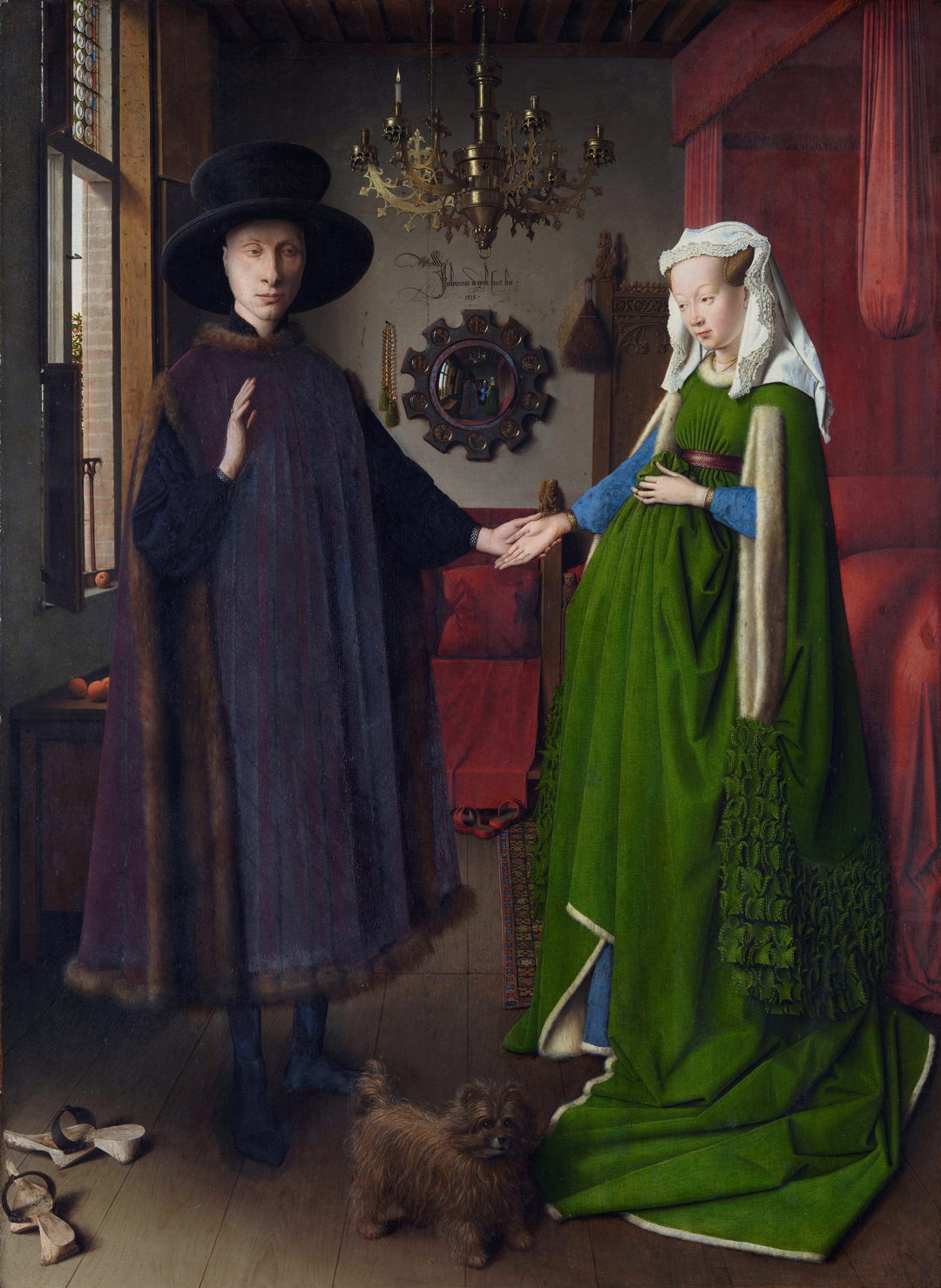
Jan van Eyck (c 1380-1441), Portrait of Giovanni(?) Arnolfini and his Wife (detail) (1434), oil on oak panel, 82.2 x 60 cm. National Gallery, London. WikiArt.
Optical effects as a theme in the Northern Renaissance, as seen in Jan van Eyck’s most famous painting The Arnolfini Wedding, completed in 1434 (above), and in the landscape behind his Madonna of Chancellor Rolin, probably painted the following year (below).
Jan van Eyck (c 1390–1441), The Madonna of Chancellor Rolin (detail) (c 1435) oil on panel, 66 x 62 cm. Musée du Louvre, Paris (WikiArt).
Any faithful depiction of reflections on water should show the following:
a line joining any point on the original with its equivalent on the reflection will be vertical;
an object behind another object in the original will also remain behind that object in the reflection, as reflections preserve depth order;
the further back that an original object is from the water’s edge, the more its reflection will be cropped vertically;
vertical cropping loses the lower section of the original from the reflection, and the upper section remains in the reflection;
the view of each part of the original seen in the reflection will be that as seen from the points of reflection, those being lower than the observer and closer to the original;
what is seen on the (observer’s) left of the original appears on the left of the reflection, and what is seen on the right remains on the right of the reflection;
because the reflection is vertically inverted, what is seen at the top of the original appears at the bottom of the reflection.
Analogous principles apply to reflections in a vertical mirror.
Self-portraits almost invariably rely on painting the reflection seen in a plane mirror.
Clara Peeters (fl 1607-1621), Still Life with Flowers and Gold Cups of Honour (detail) (1612), oil on oak, 59.5 x 49 cm, Staatliche Kunsthalle Karlsruhe, Karlsruhe, Germany. Wikimedia Commons.
Defined by Marco Bertamini, Richard Latto and Alice Spooner as occurring “every time the observer sees both an actor (eg Venus) and a mirror, not placed along the observer’s line of sight, and concludes that Venus is seeing her reflection at the same location in the mirror that the observer is seeing.” They were intrigued by “the situations in which we as observers read the scene in a certain way, but the mirror itself is used (deliberately or not) to lead us down the wrong path. More specifically, the mirror shows us something that we accept as the view available to the actor in the scene. However, the actor has a different vantage point from us and therefore the laws of optics imply that he/she cannot be seeing what we see in the mirror.”
Diego Velázquez (1599–1660), Venus at Her Mirror, The Toilet of Venus (Rokeby Venus) (1644-48) [101], oil on canvas, 122.5 x 177 cm, The National Gallery, London. Image by Diego Delso, via Wikimedia Commons.
Where the artist manipulates a reflected image for an effect, whether or not that image remains faithful to optical principles.
Diego Velázquez (1599–1660), Las Meninas (The Maids of Honour, Velázquez and the Royal Family) (c 1656-57) [119], oil on canvas, 318 x 276 cm, Museo Nacional del Prado, Madrid, Spain. Wikimedia Commons.
Paintings by:
Albrecht Dürer (1471-1528)
Aelbert Cuyp (1620–1691)
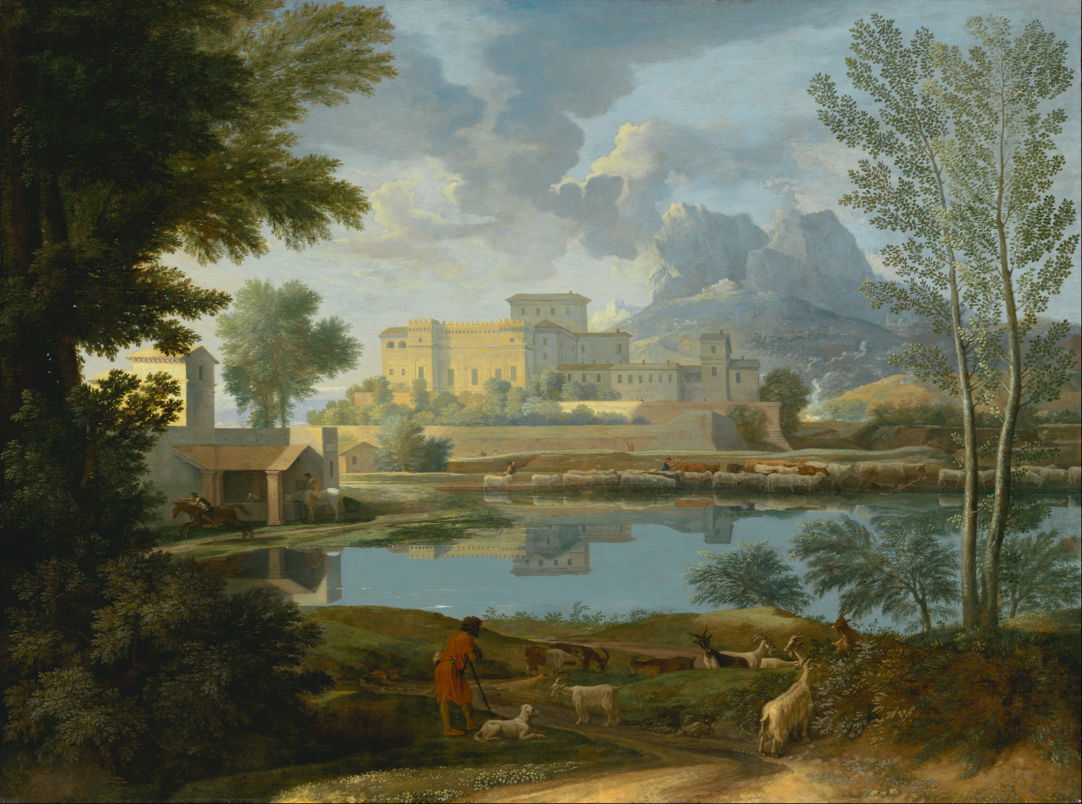
Nicolas Poussin (1694-1665), Landscape with a Calm (c 1651)
Claude Lorrain (1604/5–1682)
Canaletto (1697–1768)
Claude-Joseph Vernet (1714–1789)
Nicolas Poussin (1694-1665), Landscape with a Calm (c 1651), oil on canvas, 97 x 131 cm, J. Paul Getty Museum, Los Angeles. Digital image courtesy of the Getty’s Open Content Program.
Paintings by:
John Constable (1776–1837)
Joseph Mallord William Turner (1775–1851)
Joseph Mallord William Turner (1775–1851), The Fighting Temeraire tugged to her last Berth to be broken up (1839), oil on canvas, 90.7 × 121.6 cm, The National Gallery, London. Wikimedia Commons.
Paintings by:
Gustave Caillebotte (1848–1894)
Martín Rico y Ortega (1833–1908)
Eilert Adelsteen Normann (1848–1918)
Laurits Andersen Ring (1854–1933)
Frits Thaulow (1847–1906)
Kazimierz Sichulski (1879–1942)
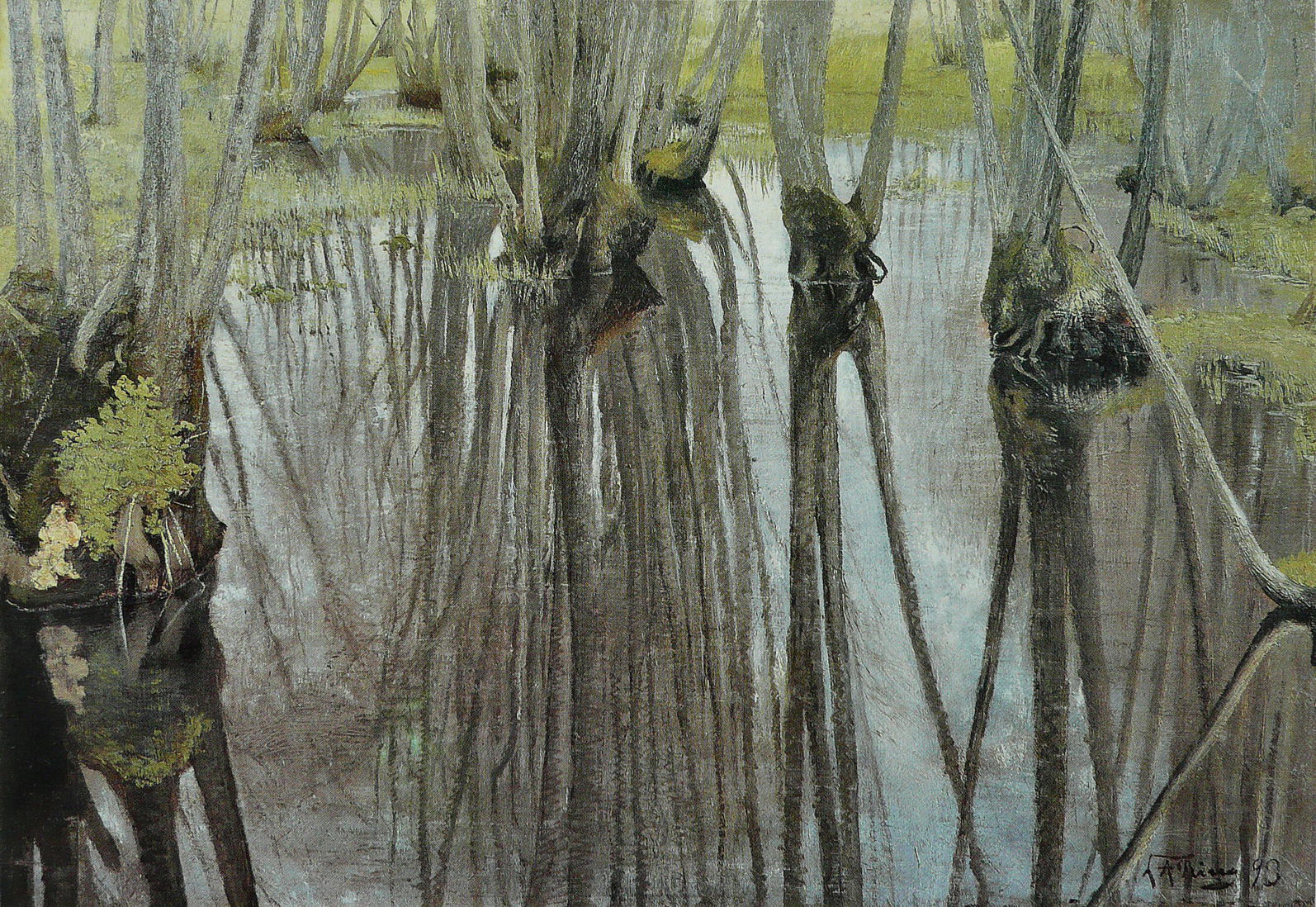
Laurits Andersen Ring (1854–1933), Alder Trunks (1893), oil on canvas, 52.9 x 73.5 cm, Collection of Her Majesty the Queen Margrethe II, Copenhagen, Denmark. Wikimedia Commons.
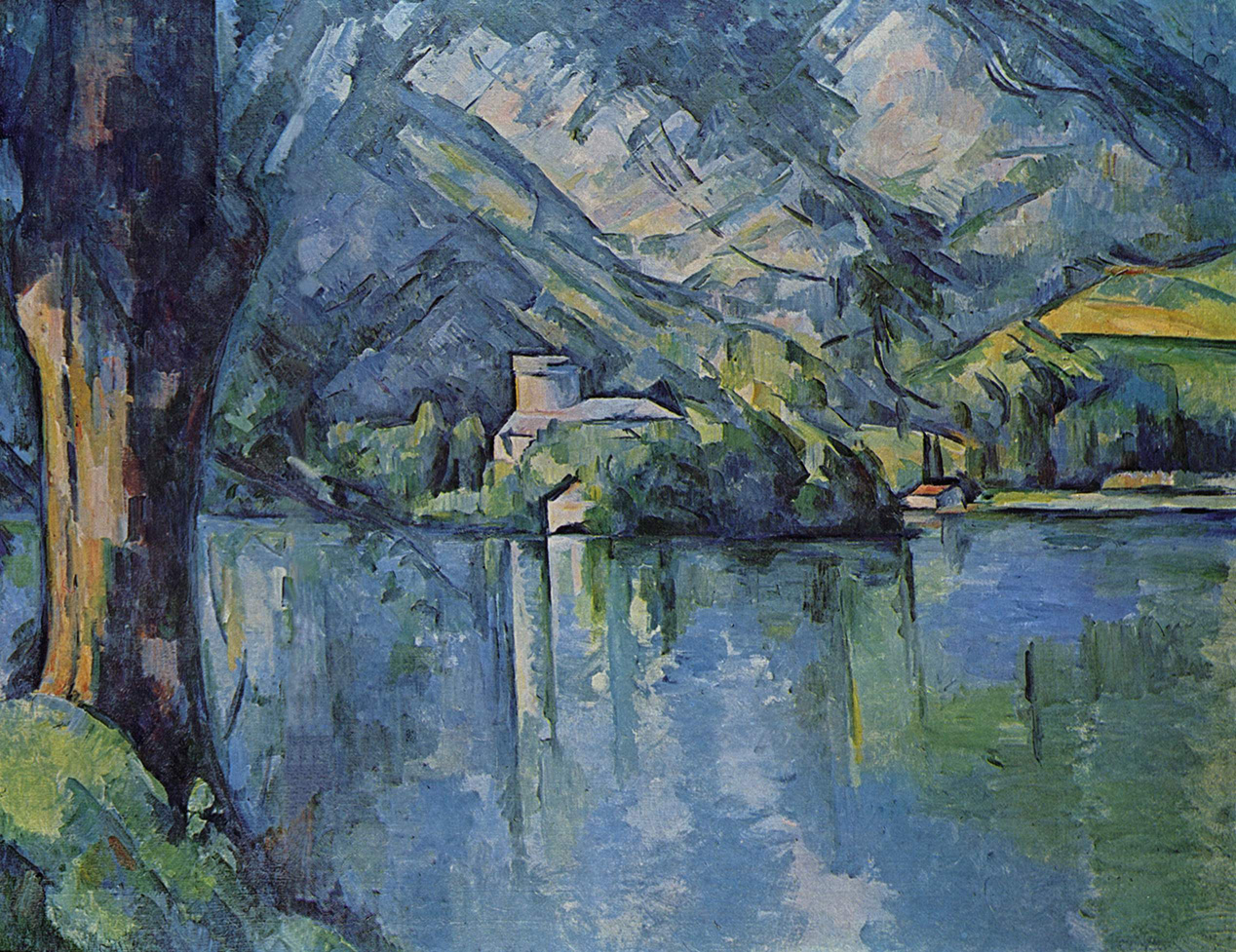
Paul Cézanne, Le Lac d’Annecy (Lake Annecy) (1896) (R805), oil on canvas, 65 x 81 cm, The Courtauld Gallery, London (Samuel Courtauld Trust) (P.1932.SC.60). Wikimedia Commons.
Paintings by:
Ferdinand Hodler (1853–1918)
Gustav Klimt (1862–1918)
Ferdinand Hodler (1853–1918), Rhythmic Landscape on Lake Geneva (1908), oil on canvas, 67 x 91 cm, Private collection. Wikimedia Commons.
References
Brook Taylor (1719) New Principles of Linear Perspective, or the Art of Designing on a Plane the Representations of All Sorts of Objects, in a more General and Simple Method than has been done before, London. (Not available online, and later editions omit much of the material on reflections.)
Cole, Rex Vicat (1921) Perspective, Seeley, Service and Co, London. (Available in various reprints, and Archive.org.)
de Piles, Roger (1708) Cours de Peinture par Principes, Paris. (Available at Archive.org.)
de Valenciennes P-H (1820) Élémens de Perspective Pratique à l’usage des artistes, 2nd edn., Paris.
By the end of the first decade of the twentieth century, Pierre Bonnard was painting several scenes involving mirror play each year.
Pierre Bonnard (1867-1947), Reflection (The Tub) (1909), media not known, 73 x 84.5 cm, Private collection. The Athenaeum.
Among his intimate domestic scenes, Reflection or The Tub (1909) is one of his best pieces of mirror play. He again opts for a view from an elevated position, looking down and into an angled plane mirror in the bathroom. The reflected view almost fills his canvas, with the nude Marthe (most probably) crouching slightly in the upper left corner, as she dries herself after a bath.
The angle of view plays some odd tricks. The washing bowl on the dressing table is brought to overlie the larger shallow bathtub on the floor, for example. Some of the objects on the dressing table are shown directly, others only in the reflected image. And over on the opposite side of the room is a chair, and a coffee tray.
Pierre Bonnard (1867-1947), The Dressing Table with a Bunch of Red and Yellow Flowers (1913), oil on canvas, 125 x 110 cm, Museum of Fine Arts, Houston, TX. The Athenaeum.
The Dressing Table with a Bunch of Red and Yellow Flowers (1913) presents us with another visual riddle that we struggle to resolve. Shown in the mirror above the dressing table is a reflection of what lies behind the artist. There’s a nearly-nude figure sat in the corner, and what appears to be a bath, or a bed on which there is a large black object, possibly a dog. As ever, the artist is nowhere to be seen, unless of course that headless figure is male rather than female.
Pierre Bonnard (1867-1947), The Bathroom Mirror (1914), oil on canvas, 72 x 88.5 cm, The Metropolitan Museum of Art, New York, NY. The Athenaeum.
The following year Bonnard moved back from the dressing table and its mirror, for The Bathroom Mirror (1914). Marthe’s reflection is now but a small image within the image, showing her sat on the side of the bed, with a bedspread matching the red floral pattern of the drapes around the dressing table. The artist has worked his usual vanishing trick for himself, and a vertical mirror at the right adds a curiously dark reflection of the room.
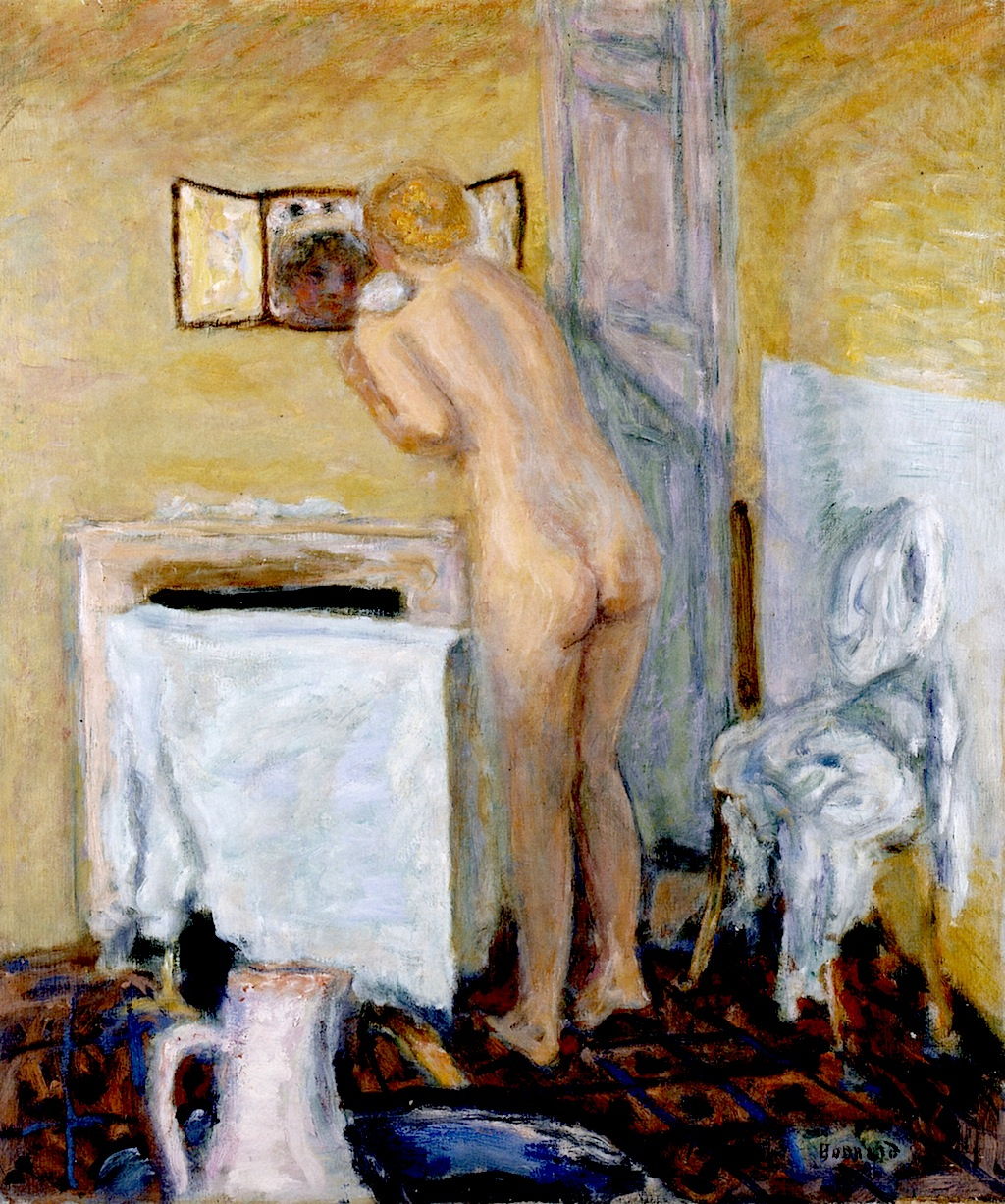
Pierre Bonnard (1867-1947), Nude before the Mirror (Bather) (c 1915), oil on canvas, 59.4 x 50.8 cm, Private collection. The Athenaeum.
In his Nude before the Mirror (Bather) of about 1915, Bonnard inverts his mirror play with a small mirror mounted at head height. Instead of using the reflection as a picture within the picture, to reveal figures behind the position of the painter, the artist is here set well back and his model is close to the mirror, so that it frames her face. This transforms the painting by giving the figure a face, an identity, and a character, rather than just the expanse of flesh of her back.
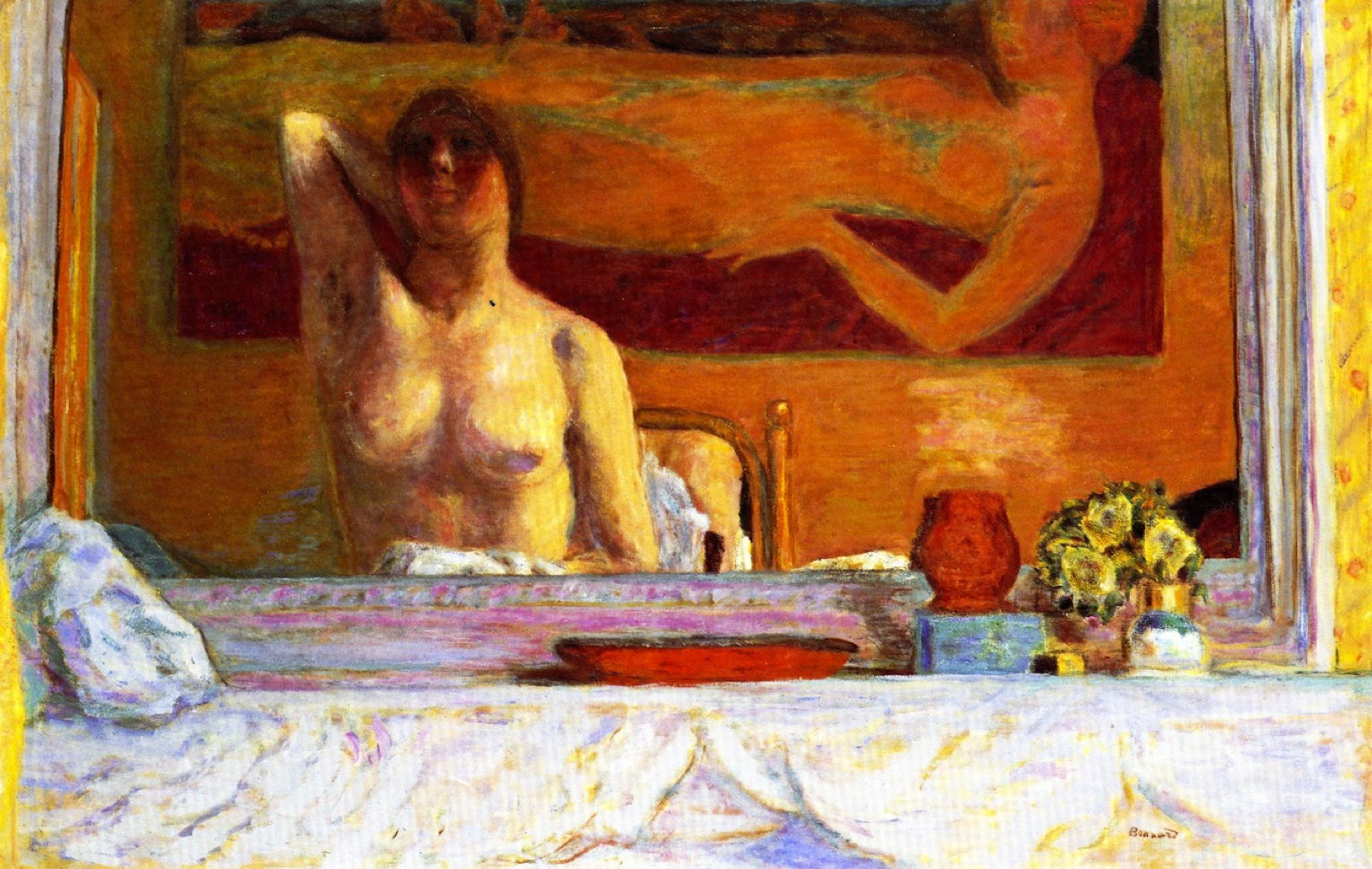
Pierre Bonnard (1867-1947), The Mantlepiece (1916), oil on canvas, 80.7 x 126.7 cm, Private collection. The Athenaeum.
The Mantlepiece (1916) is another complex piece of mirror play. Bonnard has viewed this from an unusually low position, level with the surface of the mantlepiece and looking slightly up. Behind him is his nude model, who appears slightly odd as she is both lit and viewed from below. On the wall behind them is a very long painting of a reclining nude (which certainly doesn’t look like one of Bonnard’s works), below which is a dressing table mirror. In this case, Bonnard appears to have used the reflections to bring together quite disjoint images into a single composite.
He then seems to have painted little if any mirror play for fifteen years.
Pierre Bonnard (1867-1947), The Toilette (Nude at the Mirror) (1931), oil on canvas, 154 x 104.5 cm, Galleria internazionale d’arte moderna di Ca’ Pesaro, Venice, Italy. The Athenaeum.
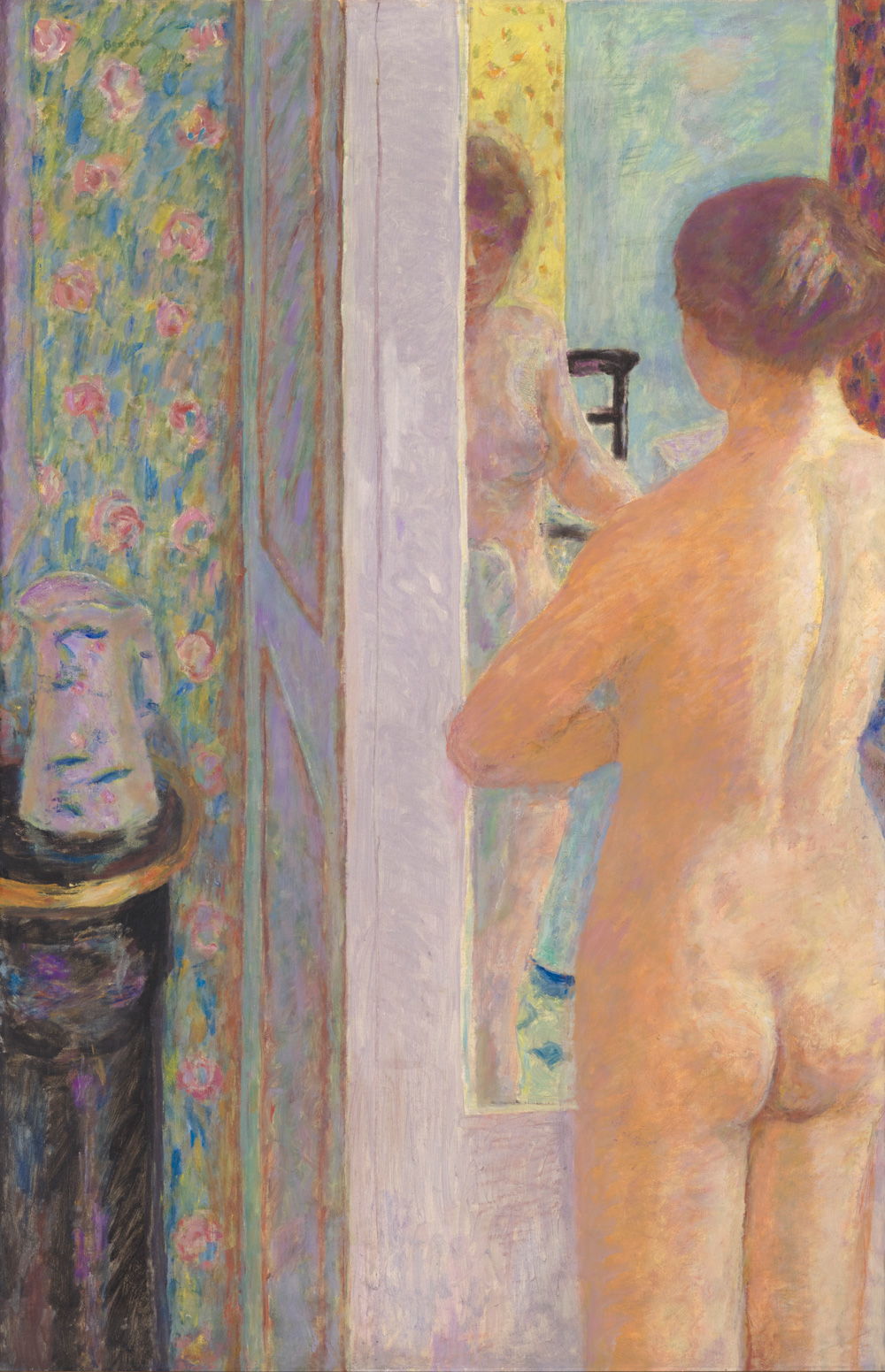
Of his surviving paintings from the 1930s I have been able to locate, intimate domestic scenes and nude figures again predominate. The Toilette (Nude at the Mirror) (1931) marks the return of mirror play different from his earlier practice: the nude stands in front of the mirror, but she isn’t seen in reflection at all, only directly. Instead, the mirror reinforces the verticals of the window and curtain off to the right.
Pierre Bonnard (1867-1947), Nude before a Mirror (c 1933), oil on canvas, 152.1 x 101.9 cm, Galleria internazionale d’arte moderna di Ca’ Pesaro, Venice, Italy. The Athenaeum.
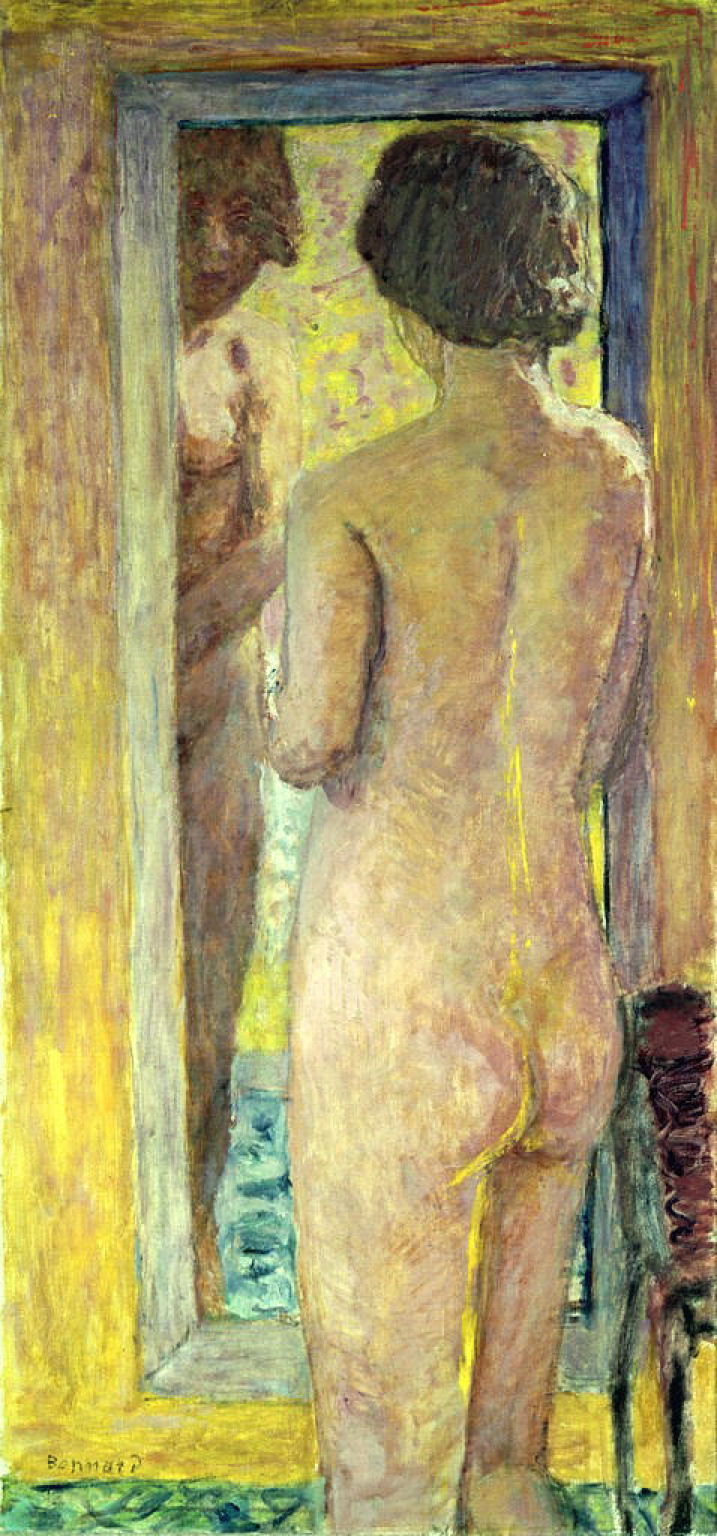
At last, in about 1933, Bonnard returns to his earlier mirror play in his Nude before a Mirror. Marthe (presumably) stands slightly to one side of a full-length mirror, the yellow light catching her back, buttock, and thigh. Instead of her head being cast down, almost obscuring her face, she looks at the mirror, and her reflection looks back at the viewer in a Venus effect.
This is, of course, optically impossible: both Marthe and the viewer are to the right of the midline of the mirror. The viewer could only see Marthe on the left side of the mirror if that mirror were angled so that its plane was parallel to Marthe’s shoulders. What Bonnard shows is really Marthe’s doppelgänger, not her reflection.
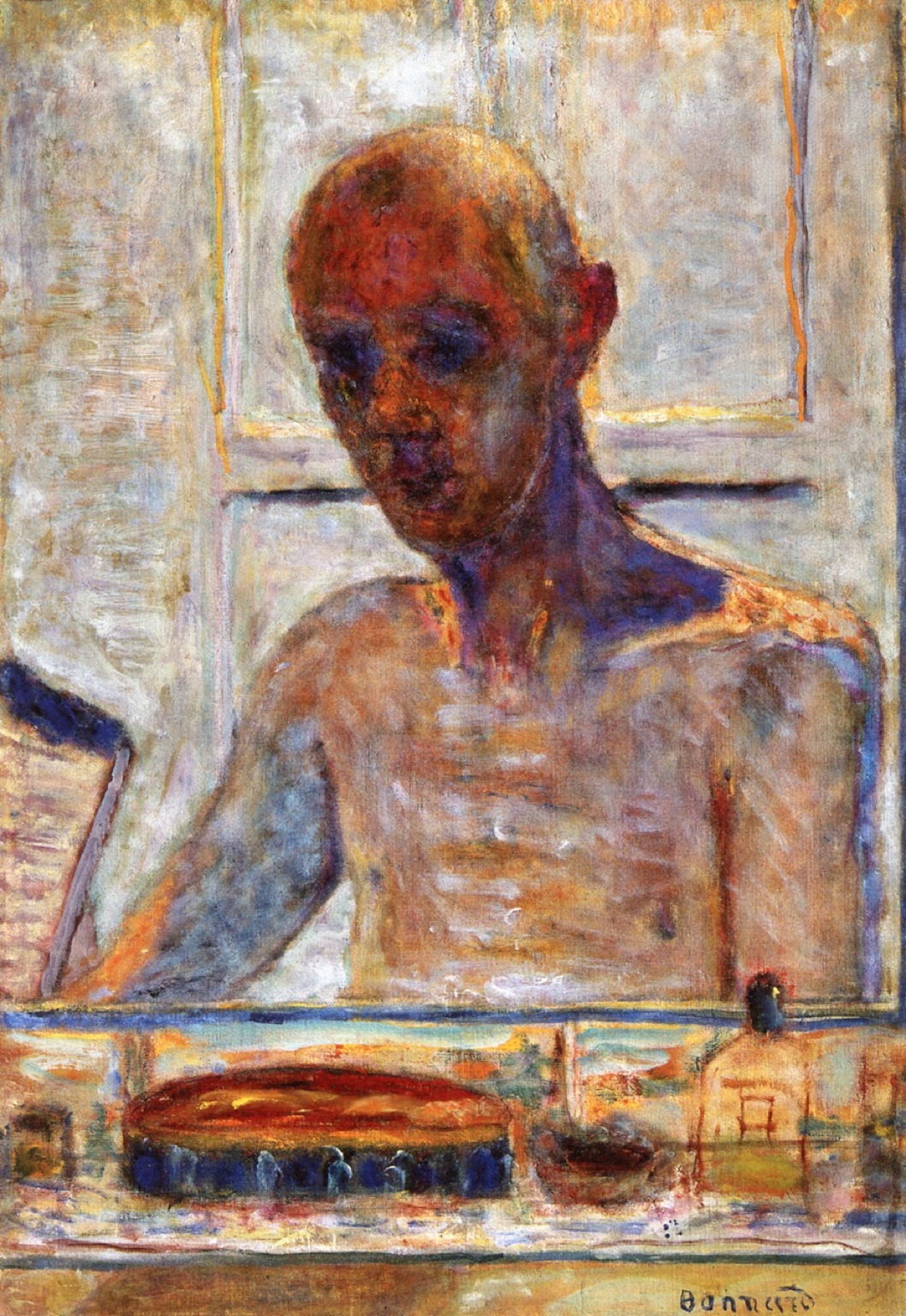
Pierre Bonnard (1867-1947), Portrait of the Artist in the Bathroom Mirror (Self-Portrait) (1939-46), oil on canvas, 73 x 51 cm, Musée National d’Art Moderne de Paris, Paris. The Athenaeum.
Late in his life, after the death of Marthe, Bonnard painted some self-portraits in a mirror, including this Portrait of the Artist in the Bathroom Mirror from between 1939-46, as he is looking increasingly frail. And those appear to be his final reflections.
Mirror play in paintings isn’t uncommon, but there can be few major artists who have returned to it repeatedly over a period of more than forty years, as did Pierre Bonnard. In this article and its sequel tomorrow I show a selection of his work featuring reflections in plane mirrors.
Pierre Bonnard (1867-1947), The Lamp (c 1899), oil on board, 54 x 70.5 cm, Flint Institute of Arts (Michigan), Flint, MI. The Athenaeum.
The Lamp, from about 1899, is one of Bonnard’s earliest paintings featuring a reflection, here a complex world in miniature seen in a spherical glass part of a lamp. The reflection shows two of the lamp’s arms, one of the bottles of wine, and the bowl of fruit on the white tablecloth.
Pierre Bonnard (1867-1947), Ambroise Vollard (c 1904-05), oil on canvas, 74 x 93 cm, Kunsthaus Zurich, Zurich, Switzerland. The Athenaeum.
His portrait of Ambroise Vollard from about 1904-05 is perhaps his first use of a large planar mirror in a figurative painting. It shows some of the art dealer’s collection, including a painting on an easel. Here he uses the reflection to extend the field and scope of the painting.
Pierre Bonnard (1867-1947), Interior (c 1905), oil on canvas, 49.8 x 37.8 cm, Private collection. The Athenaeum.
In the early years of the twentieth century, Bonnard used mirrors and reflections in several paintings, including this Interior from about 1905. It is an unusual composition, with but a little of the woman’s back visible in the mirror; Bonnard instead shows the reflection of a chair placed in front of the mirror, and what appears to be the artist sat at a table.
His purpose in placing the chair in front of the mirror was, I think, to demonstrate that the artist’s eye is in line with the chair and with his own reflection, confirming that it is him who is sat at the table, although he doesn’t have an easel, neither is there any canvas or palette in sight.
Pierre Bonnard (1867-1947), Woman Getting Dressed (1906), oil on canvas, 42 x 58.7 cm, Private collection. The Athenaeum.
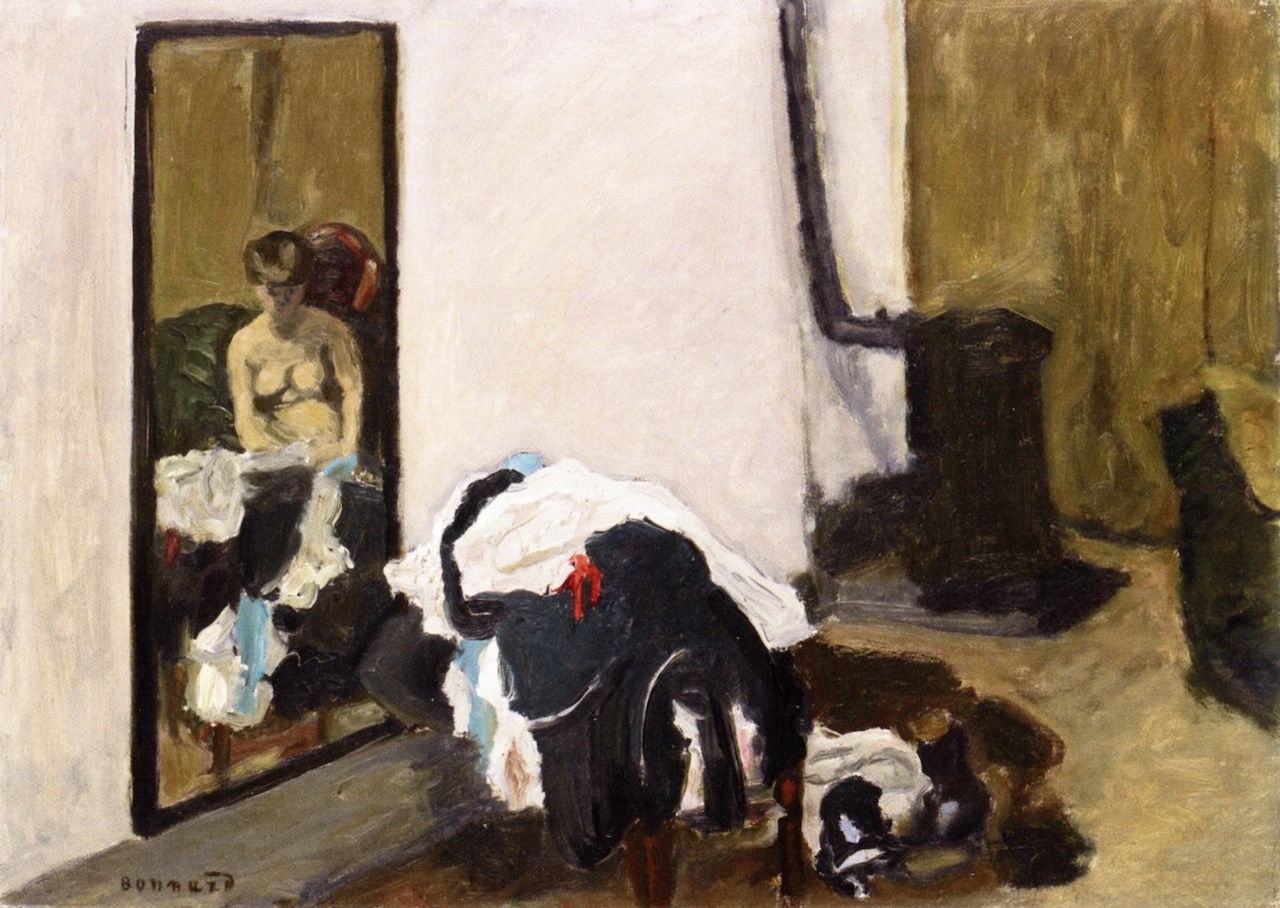
Woman Getting Dressed (1906) is a second example of Bonnard’s optical play with reflections. Dominating the centre of his canvas is a pile of women’s clothing on a low item of furniture, and a heater. A flat mirror at the left reveals the subject, who is sat beyond the right edge of the painting, getting dressed.
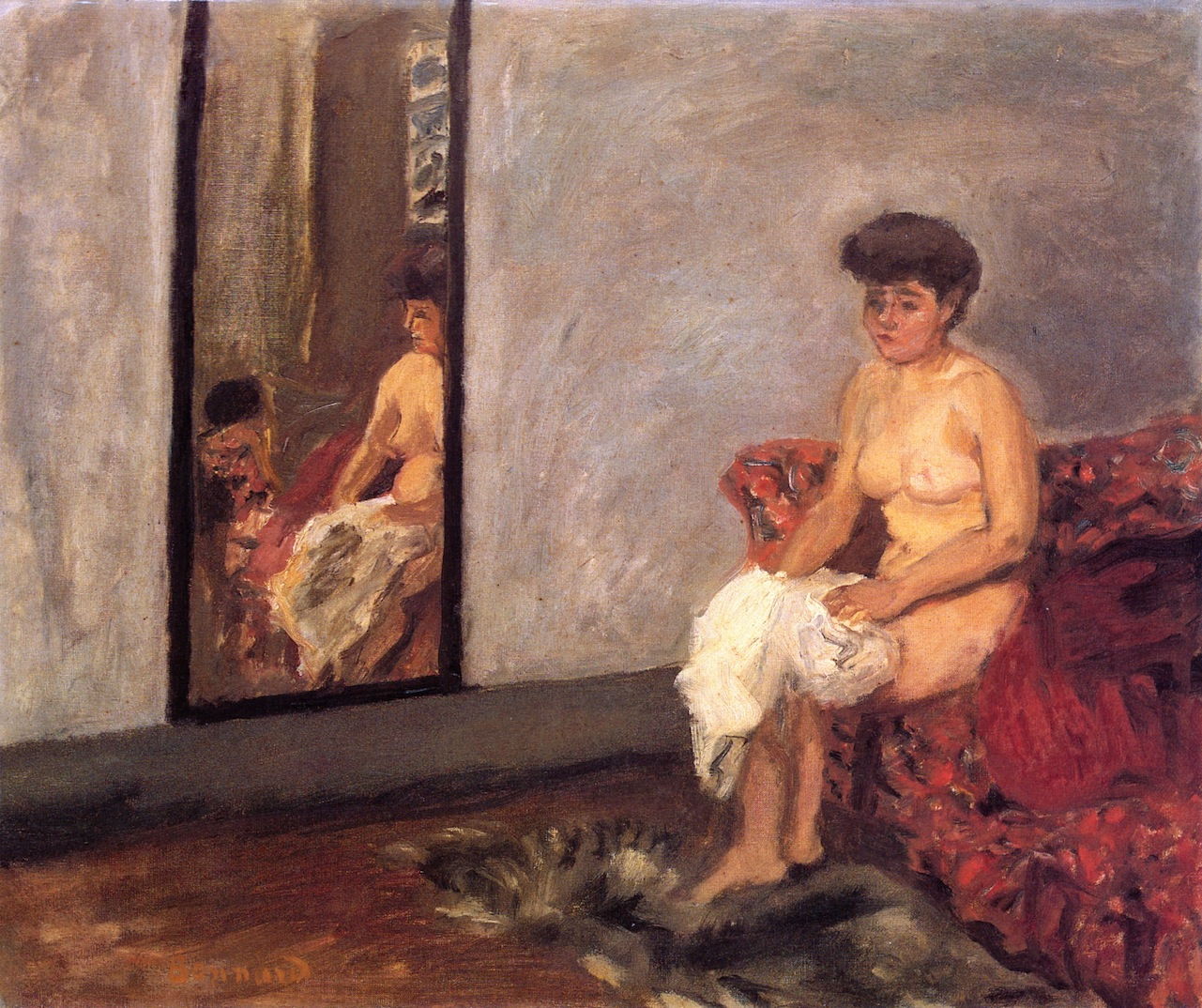
Pierre Bonnard (1867-1947), Nude Seated on a Red Sofa (1908), oil on canvas, 54 x 65 cm, Private collection. The Athenaeum.
Bonnard continued to paint figures from models. Nude Seated on a Red Sofa (1908) engages in gentle mirror-play without the sophisticated compositions of previous years.
Pierre Bonnard (1867-1947), El Tocador (The Dressing Table) (1908), oil on panel, 52 x 45 cm, Musée d’Orsay, Paris. The Athenaeum.
His intimate visual diary of Marthe’s life was becoming the focus of his development and innovation. In El Tocador, which means The Dressing Table (1908), Marthe’s headless torso is seen only in reflection. The direct view is of the large bowl and pitcher which she used to wash herself. This opens a new chapter of scenes shown in the mirror of a dressing table.
Pierre Bonnard (1867-1947), Mirror in the Dressing Room (1908), oil on panel, 120 x 97 cm, The Pushkin State Museum of Fine Arts, Moscow, Russia. The Athenaeum.
Mirror in the Dressing Room (1908) shows a similar dressing table and mirror, but in contrasting blue decor. A woman’s nude back and buttocks now appear in the mirror, as another woman sits at the left drinking a cup of coffee.
Pierre Bonnard (1867-1947), The Toilet (The Toilet in Pink) (c 1908), oil on canvas, 119 x 79 cm, Musée d’Orsay, Paris. The Athenaeum.
In The Toilet, alias The Toilet in Pink, from about 1908, a nude woman stands drying herself in front of a vertical mirror. This painting sets a trend for these intimate domestic scenes to be lighter.
Pierre Bonnard (1867-1947), The Bathroom (The Dressing Room with Pink Sofa) (1908), oil on canvas, 125 x 109 cm, Musées Royaux des Beaux-Arts de Belgique, Brussels, Belgium. The Athenaeum.
Of all these works painted in 1908, my favourite is The Bathroom, or The Dressing Room with Pink Sofa, which anticipates those from later in his career, when he was living in the south of France. Looking at a brightly-lit window from a slightly elevated position, Bonnard’s partner Marthe’s body is seen against that light, and the bright colours of the room. There is still some subtle mirror play, with her headless torso shown in the dressing table mirror, in which the artist is replaced by an empty chair. Its last reflection is that of the window frame in the residual water in the shallow metal bath at the left.
These days, mirror play is something you do with babies and infants, but over the last six centuries or so it has also been a feature of many paintings. It all started in the Northern Renaissance, when leading Flemish painters including the van Eycks became fascinated in depicting optical phenomena including reflections in mirrors.
Jan van Eyck (c 1380/90-1441), Portrait of Giovanni Arnolfini (?) and his Wife (1434), oil on oak panel, 82 x 59.5 cm. The National Gallery, London. Wikimedia Commons.
Jan van Eyck’s most famous painting, known as The Arnolfini Wedding (or similar variations), is a remarkable exploration of optics, featuring distorted reflections in the mirror near the centre of the painting, completed in 1434. Between this newly-wed couple holding hands next to their marital bed, in the midline of the painting, is a prominent circular convex mirror. Its reflection shows a view of the room looking in the opposite direction, past the couple to another two figures, who could be the artist and another, as shown in the detail below.
Jan van Eyck (c 1380-1441), Portrait of Giovanni(?) Arnolfini and his Wife (detail) (1434), oil on oak panel, 82.2 x 60 cm. National Gallery, London. WikiArt.Jacopo Tintoretto (c 1518-1594), Venus and Mars Surprised by Vulcan (c 1545) (E&I 36), oil on canvas, 140 x 197 cm, Alte Pinakothek, Maxvorstadt, Germany. Wikimedia Commons.
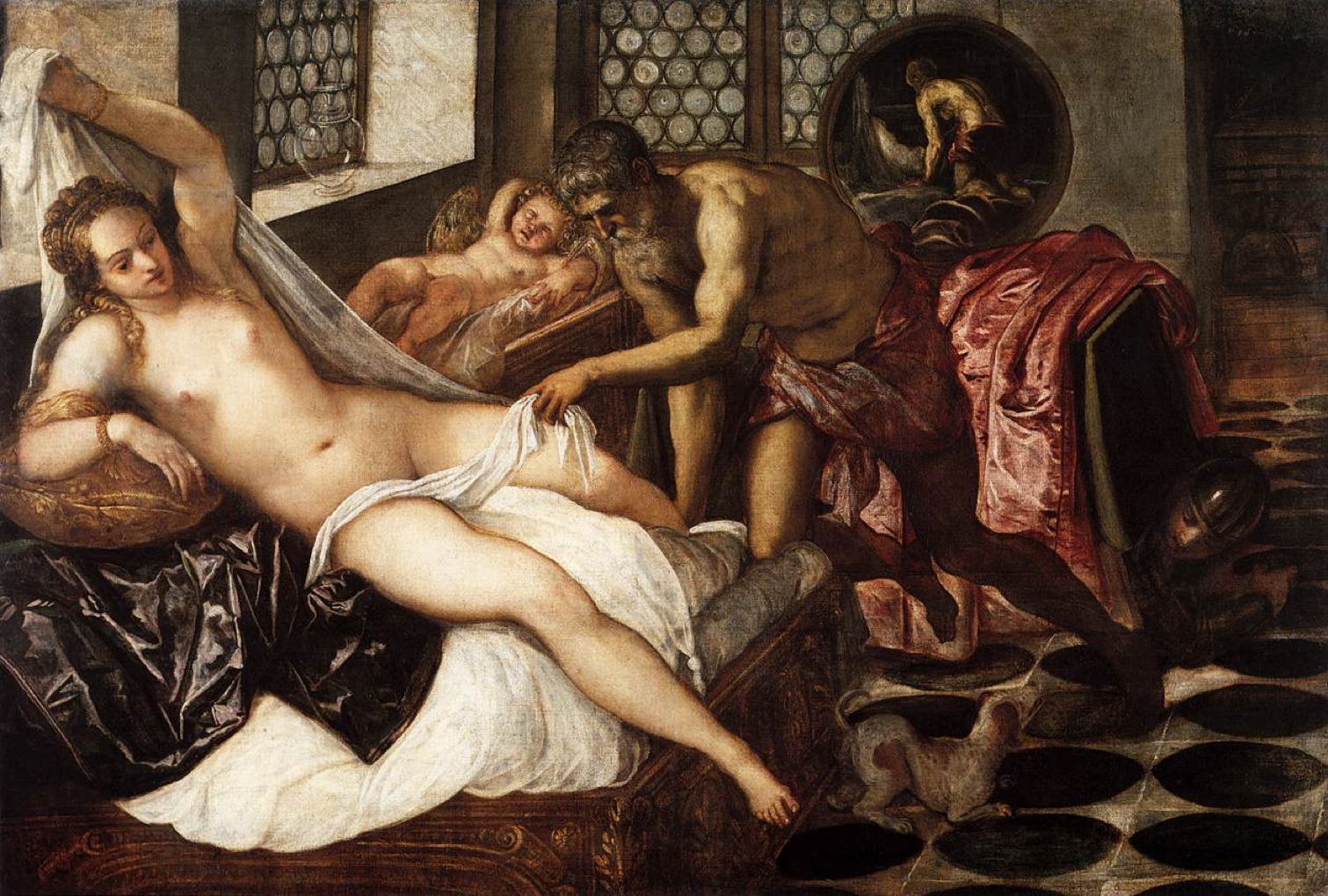
Just over a century later, in about 1545, in Venice, Tintoretto painted Venus and Mars Surprised by Vulcan. In this unusual interpretation, Vulcan is inspecting his wife, as Mars cowers under the bed at the right. A small dog is drawing attention to Mars’ hiding place, and Venus’ child, Cupid, rests in a cradle behind them. The circular mirror behind the bed reflects an image of Vulcan leaning over Venus, seen in the detail below.
Jacopo Tintoretto (c 1518-1594), Venus and Mars Surprised by Vulcan (detail) (c 1545) (E&I 36), oil on canvas, 140 x 197 cm, Alte Pinakothek, Maxvorstadt, Germany. Wikimedia Commons.
For the pioneering still life painter Clara Peeters in the early years of the seventeenth century, reflections showed her self-portrait.
Clara Peeters (fl 1607-1621), Still Life with Flowers and Gold Cups of Honour (1612), oil on oak, 59.5 x 49 cm, Staatliche Kunsthalle Karlsruhe, Karlsruhe, Germany. Wikimedia Commons.
In her still life with Flowers and Gold Cups of Honour (1612) reflections in the gold cup at the right show her in the act of painting, as seen more clearly in the detail below.
Clara Peeters (fl 1607-1621), Still Life with Flowers and Gold Cups of Honour (detail) (1612), oil on oak, 59.5 x 49 cm, Staatliche Kunsthalle Karlsruhe, Karlsruhe, Germany. Wikimedia Commons.
In the middle of that century Diego Velázquez reversed the play in using a reflection to show the subjects of his painting, alongside his self-portrait.
Diego Velázquez (1599–1660), Las Meninas (The Maids of Honour, Velázquez and the Royal Family) (c 1656-57) [119], oil on canvas, 318 x 276 cm, Museo Nacional del Prado, Madrid, Spain. Wikimedia Commons.
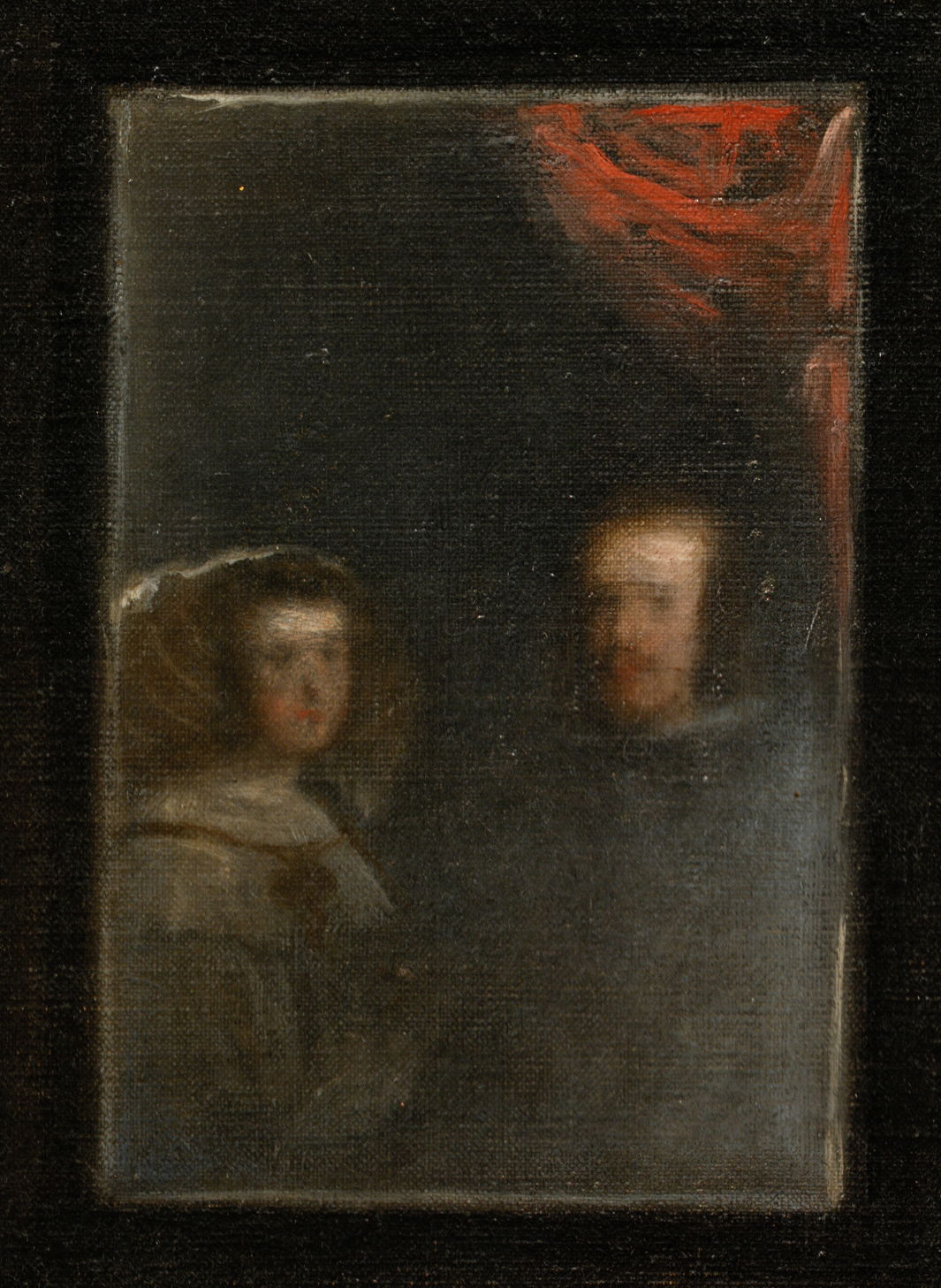
Velázquez’ Las Meninas, translated as The Maids of Honour, from about 1656-57 is a well-known example of a group portrait with mirror play. In what is overtly a depiction of eleven people and a dog in a room in the Alcázar Palace, he uses composition and gaze to tell us more. Much depends on what we believe most of the figures are looking at. Reflected in the rectangular plane mirror on the far wall are King Philip IV and his wife Queen Mariana of Austria, shown in the detail below.
Diego Velázquez (1599–1660), Las Meninas (The Maids of Honour, Velázquez and the Royal Family) (detail) (c 1656-57) [119], oil on canvas, 318 x 276 cm, Museo Nacional del Prado, Madrid, Spain. Wikimedia Commons.
There has been dispute over whether the reflection shows the royal couple stood where the viewer is, or the mirror is reflecting their painted images on Velázquez’s canvas. How their images were generated is probably of secondary importance, as either way the gaze of most of the other figures is clearly directed not at the viewer, but at the King and Queen, who may be getting up to leave after sitting for Velázquez to paint them. In this reading, the most important people not in the painting only appear in reflection and the gaze of others.
Mirror play continued in a few more paintings up to the late nineteenth century.
Domenicus van Wijnen (1661–1698), The Witches’ Sabbath by Moonlight (date not known), oil on canvas, 73 x 57.5 cm, location not known. Wikimedia Commons.
Domenicus van Wijnen’s Witches’ Sabbath by Moonlight is set in a moonlit Italian landscape. This combines many of the now-classical symbols associated with ‘the dark arts’, and is taking place at an outdoor altar set up at the foot of the gallows, on which a dead body hangs. In front of the altar at the right is a soldier in armour, who is looking in a mirror at the image of another.
Alfred Stevens (1823–1906), The Psyché (My Studio) (c 1871), oil on panel, 73.7 x 59.1 cm, Princeton University Art Museum, Princeton, NJ. Wikimedia Commons.
In about 1871, Alfred Stevens introduced a large mirror into The Psyché (My Studio). The French word psyché refers to the full-length mirror seen in this apparently informal view of Stevens’ studio, the name deriving from the legend of Cupid and Psyche. For this painting, Stevens doesn’t actually use a proper psyché, but has mounted a large mirror on his easel, perhaps to suggest that art is a reflection of life. A Japanese silk garment is draped over the mirror to limit its view to the model, breaking up her form in an unnatural way.
In the late nineteenth century mirror play became more popular, particularly in the paintings of Pierre Bonnard.
In 2003, the psychologists Marco Bertamini, Richard Latto and Alice Spooner published a paper in which they described a known phenomenon in the perception of paintings, and named it the Venus Effect. Their definition is: “The Venus effect occurs every time the observer sees both an actor (eg Venus) and a mirror, not placed along the observer’s line of sight, and concludes that Venus is seeing her reflection at the same location in the mirror that the observer is seeing.”
Although they dismissed optical “mistakes” as being of less interest, they were intrigued by “the situations in which we as observers read the scene in a certain way, but the mirror itself is used (deliberately or not) to lead us down the wrong path. More specifically, the mirror shows us something that we accept as the view available to the actor in the scene. However, the actor has a different vantage point
from us and therefore the laws of optics imply that he/she cannot be seeing what we see in the mirror.”
In this article, I explore what I believe to be the artist’s intention in this effect, of revealing the face of the subject of a painting in its reflection rather than in the original, a popular form of mirror play.
Frans Floris (1519/1520–1570), Allegory of Sight (date not known), oil on panel, 95.8 × 81.3 cm, location not known. Wikimedia Commons.
Frans Floris’s Allegory of Sight was probably painted around 1550, making it an early and quite sophisticated entry to the subject. The face of its figure is shown reflected in the only appropriate optical instrument of the day: a simple mirror, carefully angled to project most of the face. Although only a small feature, that reflection looks fiendishly difficult, given the wildly different angle between the mirror and the picture plane. In this case, what’s shown in the mirror is optically plausible, although the subject is looking at the viewer rather than the reflection.
Abraham Janssens (1567–1632) (attr), Sight (date not known), oil on canvas, 117 × 93 cm, location not known. Wikimedia Commons.
This painting of Sight has been attributed to Abraham Janssens, and could date to any time between about 1590 and 1632. It appears to have been inspired by Floris’s Allegory of Sight, and the reflection of the woman’s face in the mirror doesn’t appear optically correct. She does appear to be looking at her reflection, although that’s optically impossible.
Hans von Aachen (1552–1615), David and Bathsheba (c 1612-15), oil on canvas, 138 x 105 cm, Kunsthistorisches Museum, Vienna, Austria. Wikimedia Commons.
Hans von Aachen’s David and Bathsheba of about 1612-15 introduces a figure standing behind Bathsheba, holding a mirror in front of her face with his outstretched left arm. A glance at that reflection says that something is seriously amiss: von Aachen has painted a reflection in which Bathsheba is looking to the left, although her face is actually looking to the right. No single plane mirror could ever achieve that optical impossibility.
Diego Velázquez (1599–1660), Venus at Her Mirror, The Toilet of Venus (Rokeby Venus) (1644-48) [101], oil on canvas, 122.5 x 177 cm, The National Gallery, London. Image by Diego Delso, via Wikimedia Commons.
Although often illustrated by one of Titian’s paintings of Venus, the canonical example must be Velázquez’ Venus at Her Mirror, also known as The Toilet of Venus or the Rokeby Venus, from 1644-48. It shows the goddess Venus, whose face is blurred in a false reflection in a mirror being held by her son Cupid. The theme was common, seen in paintings by Titian and Rubens, with Venus sat upright. Giorgione and others had posed her reclining and facing the viewer, making her pose here unusual. Most other paintings of Venus set her in a landscape: here she rests on luxurious even sensuous fabrics.
No matter how convincing her face might appear in the mirror, a moment spent placing yourself in the same position confirms that the image in the mirror is wholly imaginary, and optically incorrect. Yet, according to Bertamini and others, the majority of viewers succumb to the Venus Effect and believe that Venus is looking at that image of her face.
John William Waterhouse (1849–1917), Mariana in the South (c 1897), oil on canvas, 114 × 74 cm, Private collection. Wikimedia Commons.
JW Waterhouse’s Mariana in the South from about 1897 stands her in front of a full-length mirror revealing her face to the viewer, but she too is looking at her own reflection.
Laura Theresa Alma-Tadema (1852–1909), A Knock at the Door (1897), oil on panel, 63.8 × 44.8 cm, Currier Museum of Art, Manchester, NH. Wikimedia Commons.
Laura Theresa Alma-Tadema’s A Knock at the Door, also from 1897, shows an attractive young woman checking that she is looking at her best in a mirror, before receiving a visitor. Once again it is the reflection that shows her face, and we’re struggling to be sure whether this is optically correct, although in this case the artist has at least brought closer alignment between the two optical axes.
Frederick Carl Frieseke (1874–1939), Nude Seated at Her Dressing Table (1909), oil on canvas, 162.3 x 131.1 cm, Smithsonian American Art Museum, Washington, DC. Wikimedia Commons.
Frederick Carl Frieseke’s Nude Seated at Her Dressing Table (1909) also uses closer alignment to appear more optically plausible, as this nude apparently studies herself in the mirror.
Walter Crane (1845–1915) The Mirror, illustration for Arthur Kelly’s The Rosebud and Other Tales (1909), pen, black ink and watercolor, 20.3 × 15.3 cm, Private collection. Wikimedia Commons.
Walter Crane made this watercolour and ink drawing of The Mirror for Arthur Kelly’s The Rosebud and Other Tales, published in 1909. Although there are clear disparities between the alignment of face and chest with their reflection, this too appears plausible.
Lovis Corinth (1858–1925), At the Mirror (1912), oil on canvas, dimensions not known, Worcester Art Museum, Worcester, MA. Wikimedia Commons.
Lovis Corinth’s At the Mirror from 1912 complicates this further by raising the viewer well above the subject and her reflection, and revealing the artist standing behind her.
There are a few paintings where the artist has overtly declined to employ the Venus Effect.
Jacopo Tintoretto (c 1518-1594), Susannah and the Elders (c 1555) (E&I 64), oil on canvas, 146 x 193.6 cm, Kunsthistorisches Museum, Vienna, Austria. Wikimedia Commons.
Tintoretto’s Susannah and the Elders from about 1555 goes further with mirror play. Susannah has been caught as she is drying her leg after bathing in the small pool beside her, looking at herself in a rectangular mirror, which is propped up against a rosy trellis in a secluded part of her garden. Unlike in other paintings of nudes, neither the image seen in the mirror nor the reflection on the water show anything more of Susannah.
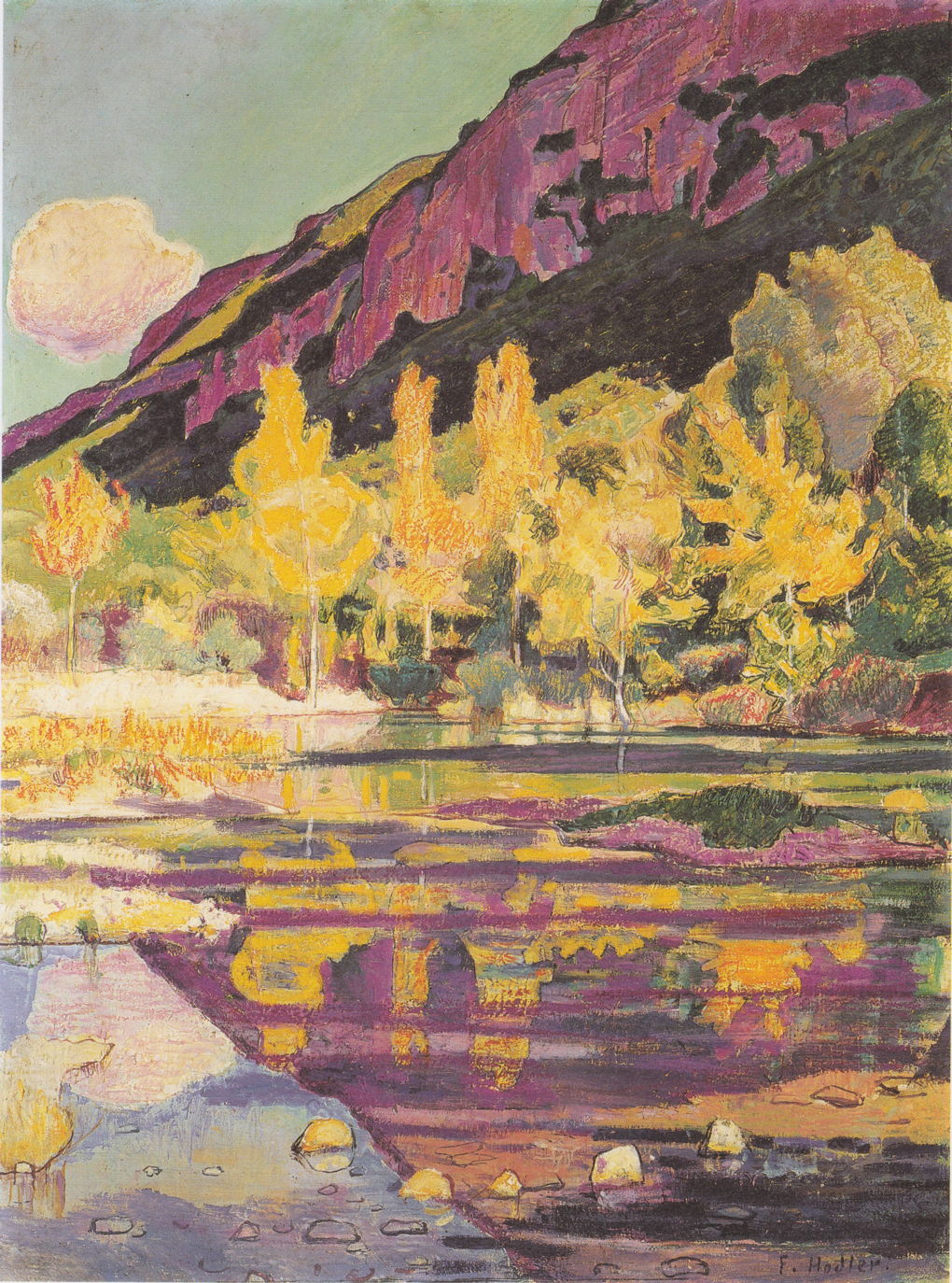
Landscape painting of the early twentieth century included individualists whose approach to the depiction of reflections on water departed from those of the past. This article looks at two very different artists from central Europe: Ferdinand Hodler with his Parallelism, and Gustav Klimt who mainly painted landscapes during his summer holidays.
Ferdinand Hodler (1853–1918), At the Foot of Petit Salève (c 1893), oil on canvas, 65.5 × 49 cm, Kunsthalle Bielefeld, Bielefeld, Germany. Wikimedia Commons.
Hodler often painted the same landscapes repeatedly, although not in the same way as Claude Monet’s formal series. His view At the Foot of Petit Salève from about 1893 breaks up the reflections of the golden trees with bands of black and purple that don’t appear to be correlated with those of the original image above.
Ferdinand Hodler (1853–1918), Lake Thun with Symmetrical Reflection Before Sunrise (1904), oil on canvas, 89 x 100 cm, Private collection. Wikimedia Commons.
In contrast, this view of Lake Thun with Symmetrical Reflection Before Sunrise from 1904 appears to be meticulously faithful to optical principles.
Ferdinand Hodler (1853–1918), Rhythmic Landscape on Lake Geneva (1908), oil on canvas, 67 x 91 cm, Private collection. Wikimedia Commons.
However, in 1908 when he was in pursuit of Parallelist ideals, he painted this Rhythmic Landscape on Lake Geneva. This was a second version of a view he had previously painted three years earlier, when he wrote “This is perhaps the landscape in which I applied my compositional principles most felicitously.” Most of his symmetry and rhythm is obvious; what may not be so apparent are the idiosyncratic reflections seen on the lake’s surface. The gaps in the train of cumulus clouds here become optically impossible dark blue pillars, responsible for much of the rhythm in the lower half of the painting.
Ferdinand Hodler (1853–1918), Lake Geneva with Mont Blanc in the Morning Light (1918), oil on canvas, 65 x 91,5 cm, Kunsthaus Zürich, Zürich, Switzerland. Wikimedia Commons.
In the last few months of his life, Hodler simplified reflections into bands of colour. Lake Geneva with Mont Blanc in the Morning Light (1918) has a much simpler structure, with the water, a band of reflections, the mass of the far shore and mountains merged, and the dawn sky. The dominant colour is the yellow to pale red of the sky and its reflection.
Ferdinand Hodler (1853–1918), Lake Geneva with Mont Blanc in the (Red) Dawn Light (1918), oil on canvas, 74.5 x 150 cm, Private collection. Wikimedia Commons.
Lake Geneva with Mont Blanc in the (Red) Dawn Light (1918) is simplified further to the water coloured by the sky, a zone of blue reflections of the far bank, the merged distant shore and mountains, and the sky.
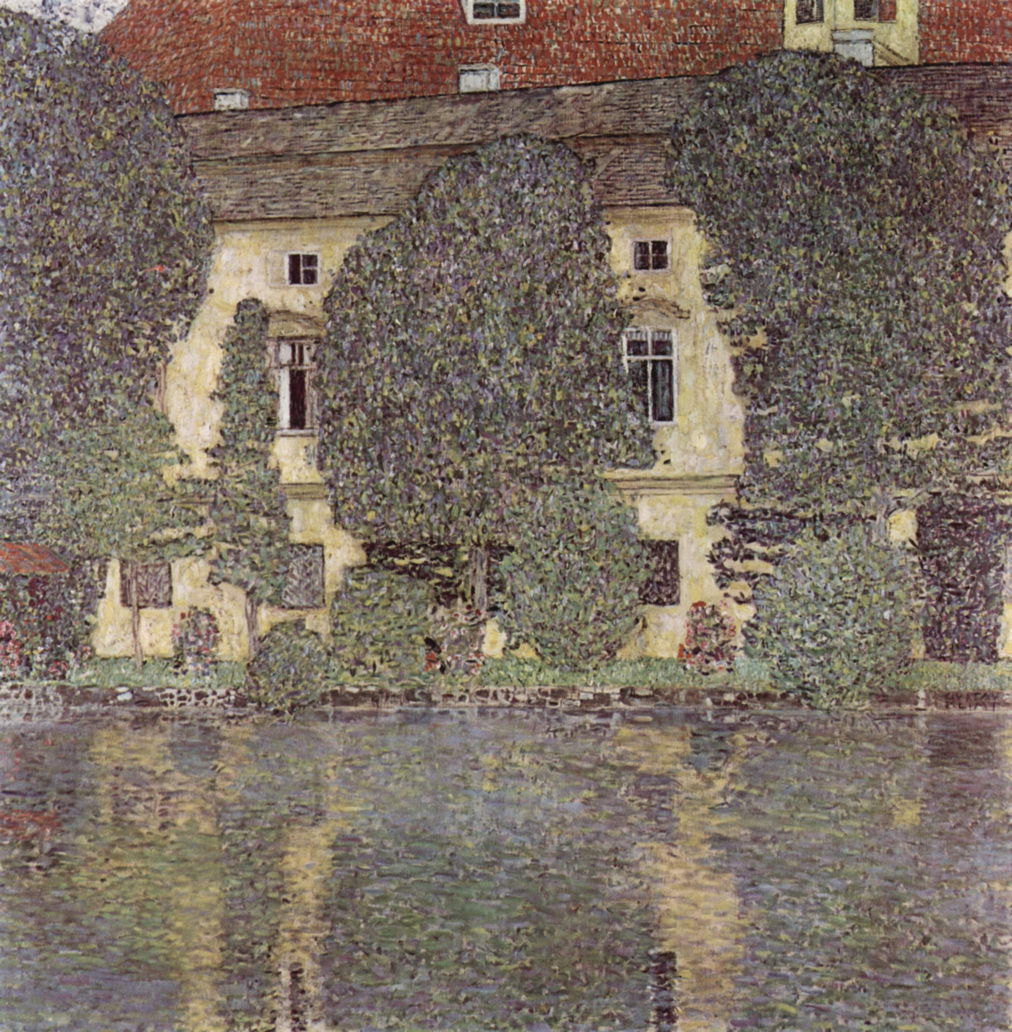
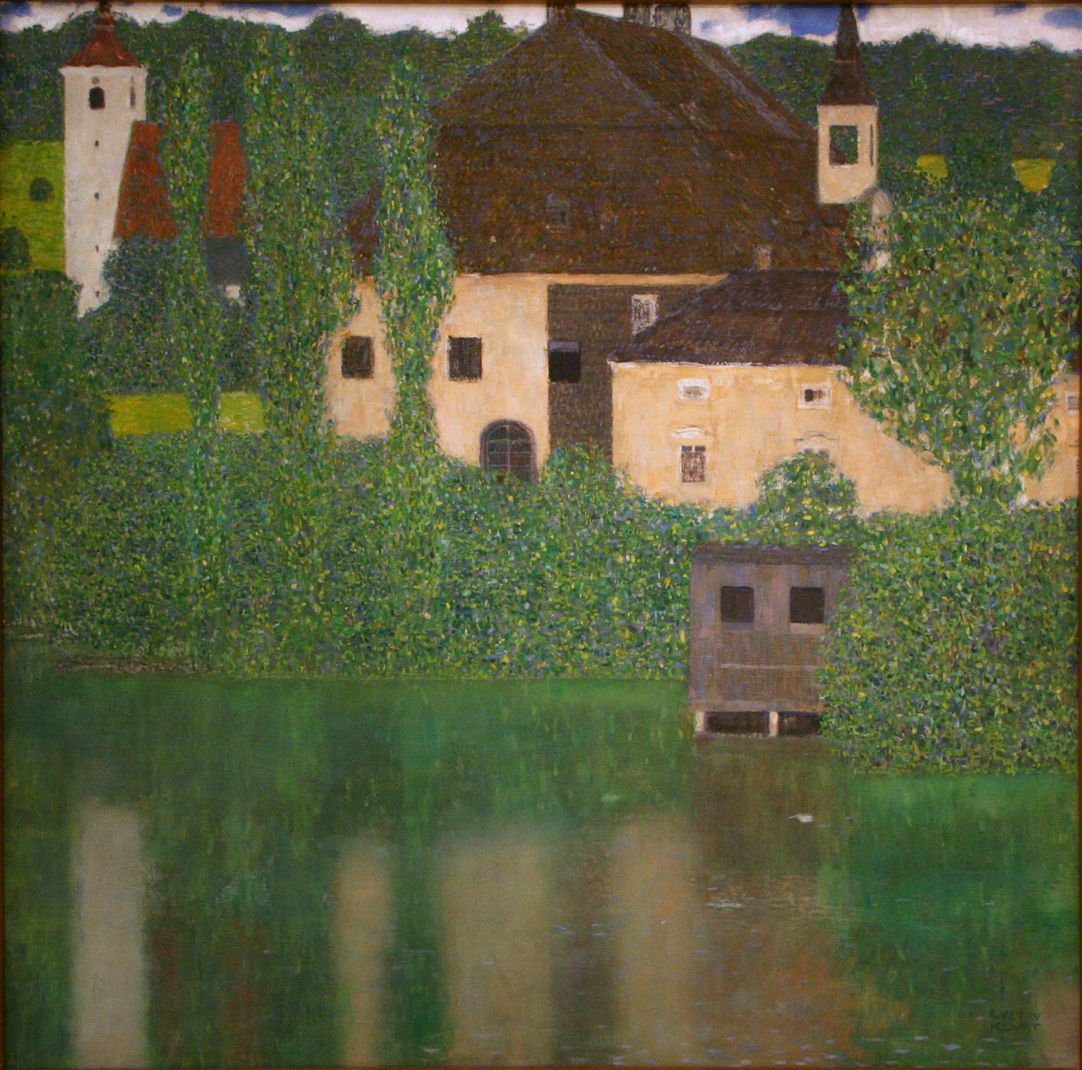
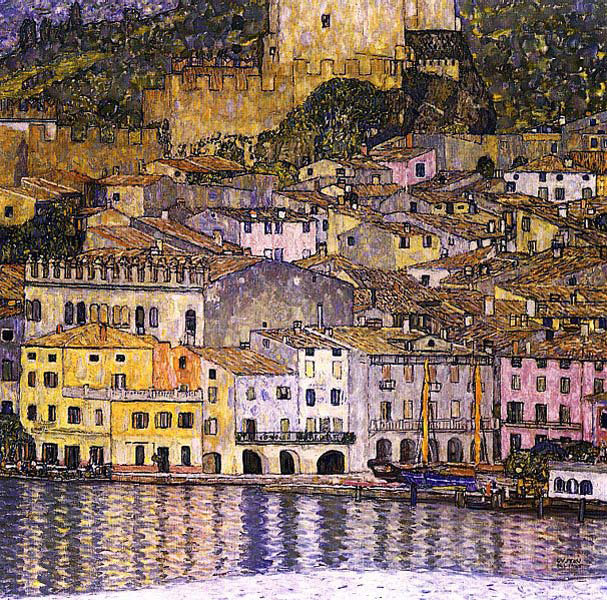
Gustav Klimt developed his approach to reflections during the summers he spent with his partner’s family on Lake Attersee, when he painted extensively using a telescope.
Gustav Klimt (1862–1918), Schloß Kammer at Attersee (1910), oil on canvas, 110 × 110 cm, Österreichische Galerie Belvedere, Vienna, Austria. Wikimedia Commons.
Schloß Kammer at Attersee (1910) is Klimt’s view across the lake of this manor house, with contrasting textures in foliage, walls and roofs. The reflections have lost the granular texture of the original image, giving them a glassy appearance, and appear optically faithful.
Gustav Klimt (1862–1918), Castle with a Moat (Unterach Manor on the Attersee Lake, Austria) (1908-09), oil on canvas, 110 × 110 cm, Národní galerie v Praze, Prague, Czech Republic. Image by Ophelia2, via Wikimedia Commons.
Castle with a Moat shows Unterach Manor on the Attersee Lake, and was probably painted in 1908 or 1909. It incorporates his almost Divisionist dotted foliage with contrasting smooth-textured walls of buildings, again softened in the reflected image. However, there’s some mismatch apparent in the hut on the water’s edge. Given the water between the motif and the artist, this must have been painted through a telescope, or possibly from a boat on the lake.
Gustav Klimt (1862–1918), Malcesine on Lake Garda (1913), oil on canvas, 110 x 110 cm, destroyed by fire in 1945. WikiArt.
The same flattening is seen in his view of Malcesine on Lake Garda from 1913. The terraced properties running to the left of the centre of the painting are shown in a parallel projection, without any nearby vanishing point, which is again characteristic of a view through a telescope or similar optical instrument. However, the reflections owe more to Hodler’s Parallelism than they do to optics.
Of all the artists of the late nineteenth century, Paul Cézanne presents the greatest challenges over his depictions of reflections on water. From the earliest of his surviving paintings, he painted many landscapes featuring reflections, but few are faithful to optical principles.
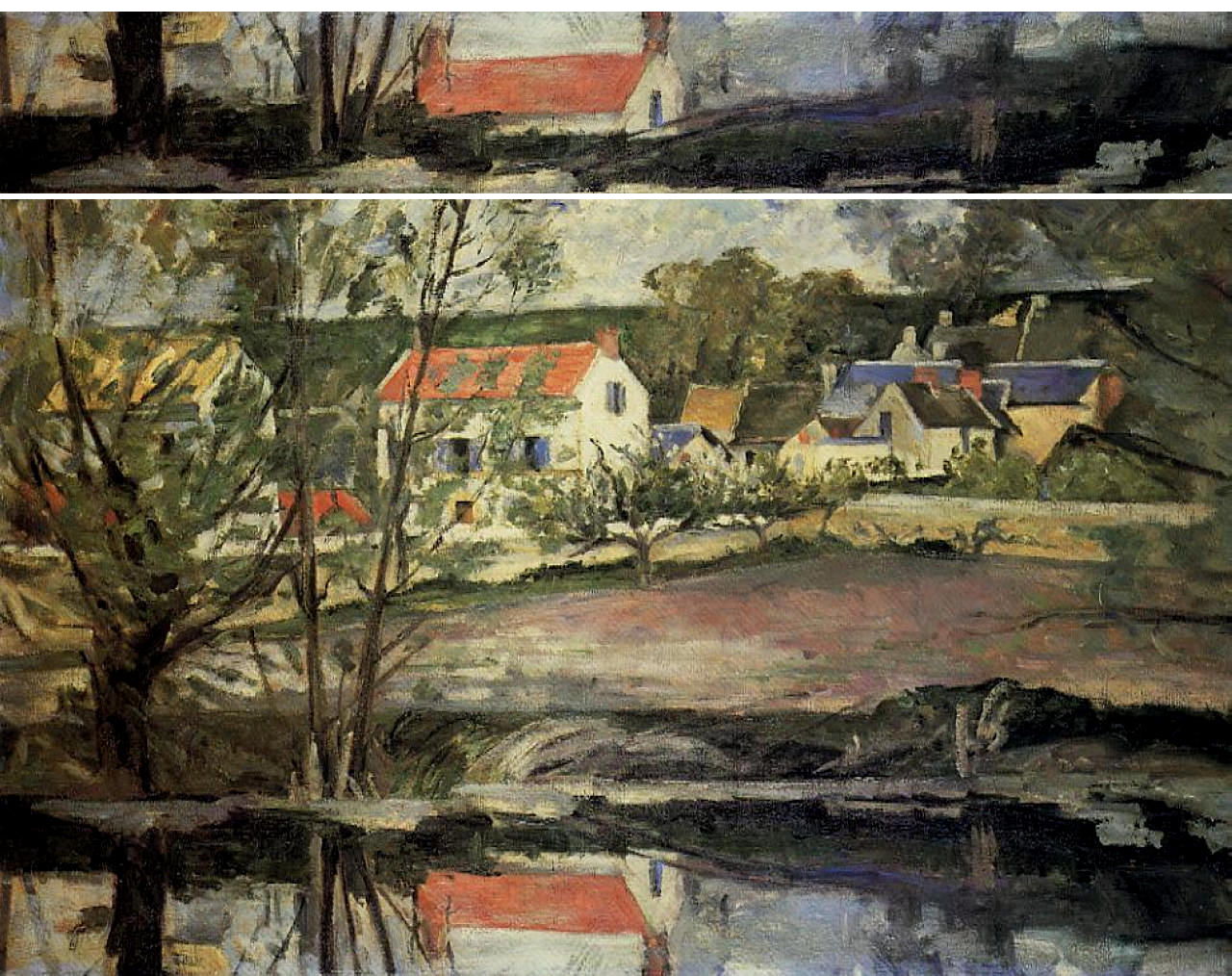
Paul Cézanne, Paysage des Bords de l’Oise (Landscape on the Banks of the Oise) (1873-4) (R224), oil on canvas, 73.5 x 93 cm, Palais Princier, Monaco. WikiArt.
Landscape on the Banks of the Oise is an Impressionist view from Cézanne’s first campaign along the River Oise in 1873, when he painted in company with Pissarro, and shows the northern bank near the hamlet of Valhermeil.
Paul Cézanne, Paysage des Bords de l’Oise (Landscape on the Banks of the Oise) (1873-4) (R224), oil on canvas, 73.5 x 93 cm, Palais Princier, Monaco. WikiArt. Composite image to show discrepancies in reflections.
Although reflections only appear in a narrow band at the foot of the picture, those of the house with a red roof are particularly prominent, and visibly out of alignment with the original. The measured lateral displacement in the reflected image of that house ranges from 27 to 39 mm, depending on which part of the house is assessed. Those represent 2.9% to 4.2% of the total width of the canvas. All those displacements seen are of the reflection to the right of the position expected according to optical principles.
Although the view shown doesn’t make it clear, at this point even in Cézanne’s day the River Oise wasn’t just a few metres wide, but was and remains a wide, navigable waterway. While it’s not impossible that Cézanne painted this view from a boat moored close to the northern shore, there are no records to even suggest that he or Pissarro might have done so.
It’s thus most probable that Cézanne painted this from the southern bank of the Oise, at least 70 m away from the depicted reflections. Measurements made from recent satellite imagery and compared with maps of the time show that the house with the red roof was approximately 70 m and no less than 50 m from the water’s edge. Assuming the bank on which Cézanne placed his easel was about 3 m above water level, and his eye was about 1.5 m above that, basic trigonometry shows that the red roof of the house should also have been about 4.5 m above water level, which wouldn’t be compatible with the view as depicted.
Further analysis shows that the reflections cannot have been painted faithfully from nature, but must have been copied from elsewhere or constructed from Cézanne’s imagination, possibly at a later time when no longer in front of the motif. It’s hard to explain all the anomalies seen, particularly as this was at a time when Cézanne was often painting in company with Pissarro, whose long career included paintings depicting complex reflections that adhere to optical principles.
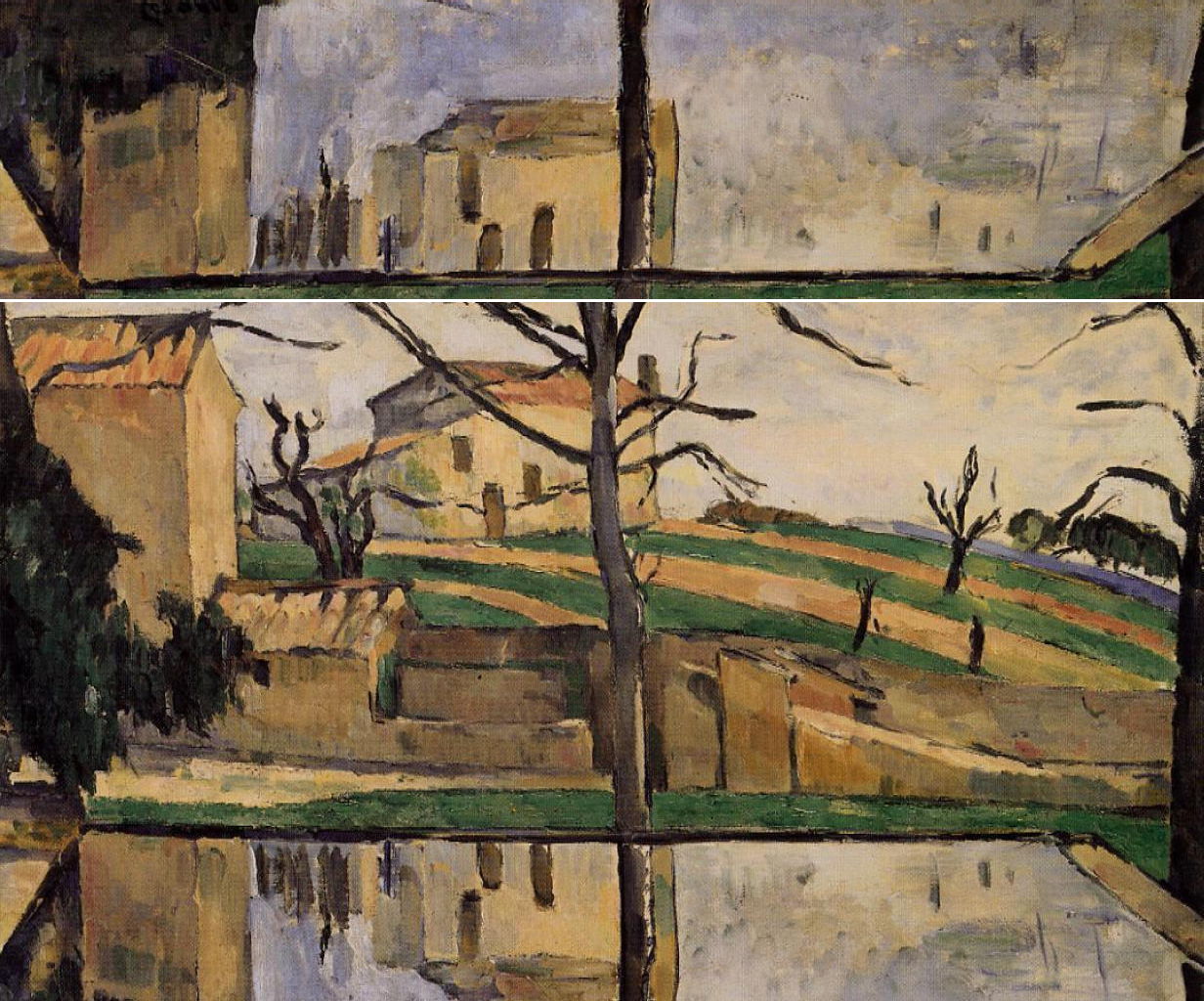
Paul Cézanne, Le Bassin du Jas de Bouffan en Hiver (The Pond of the Jas de Bouffan in Winter) (1878) (R350), oil on canvas, 52.5 x 56 cm, Private collection. WikiArt.
In this painting, a view Cézanne must have seen almost every day he went out from his family home of Jas de Bouffan, there are multiple discrepancies between the original and reflected areas, and evidence of pentimenti in the right side of the reflection.
Looking over the pool, the painting’s midline is marked by a tree, behind which are various buildings. At the left, closest to the viewer, branches of an evergreen tree are seen in front of the nearest large building. From that a series of smaller sheds track across the middle of the painting, culminating in a wall. Behind those are a farmhouse, and a sloping field with light brown and green stripes.
The reflections shown bear little resemblance to the rest of the painting, with disparities obvious in every object seen in the reflections, and apparently large areas of pentimenti on the right side of the reflections, as shown below.
Paul Cézanne, Le Bassin du Jas de Bouffan en Hiver (The Pond of the Jas de Bouffan in Winter) (1878) (R350), oil on canvas, 52.5 x 56 cm, Private collection. WikiArt. Composite image to show discrepancies in reflections.
One potential explanation is that Cézanne tried using a technique sometimes recommended for painting reflections, rotating the canvas by 180˚, and inadvertently as a result painted the reflection of the farmhouse on the wrong side of the pool. On restoring the orientation of the canvas, he then tried to correct the reflection, but didn’t complete its detail. However this doesn’t explain why he painted the distant farmhouse in reflection in the first place.
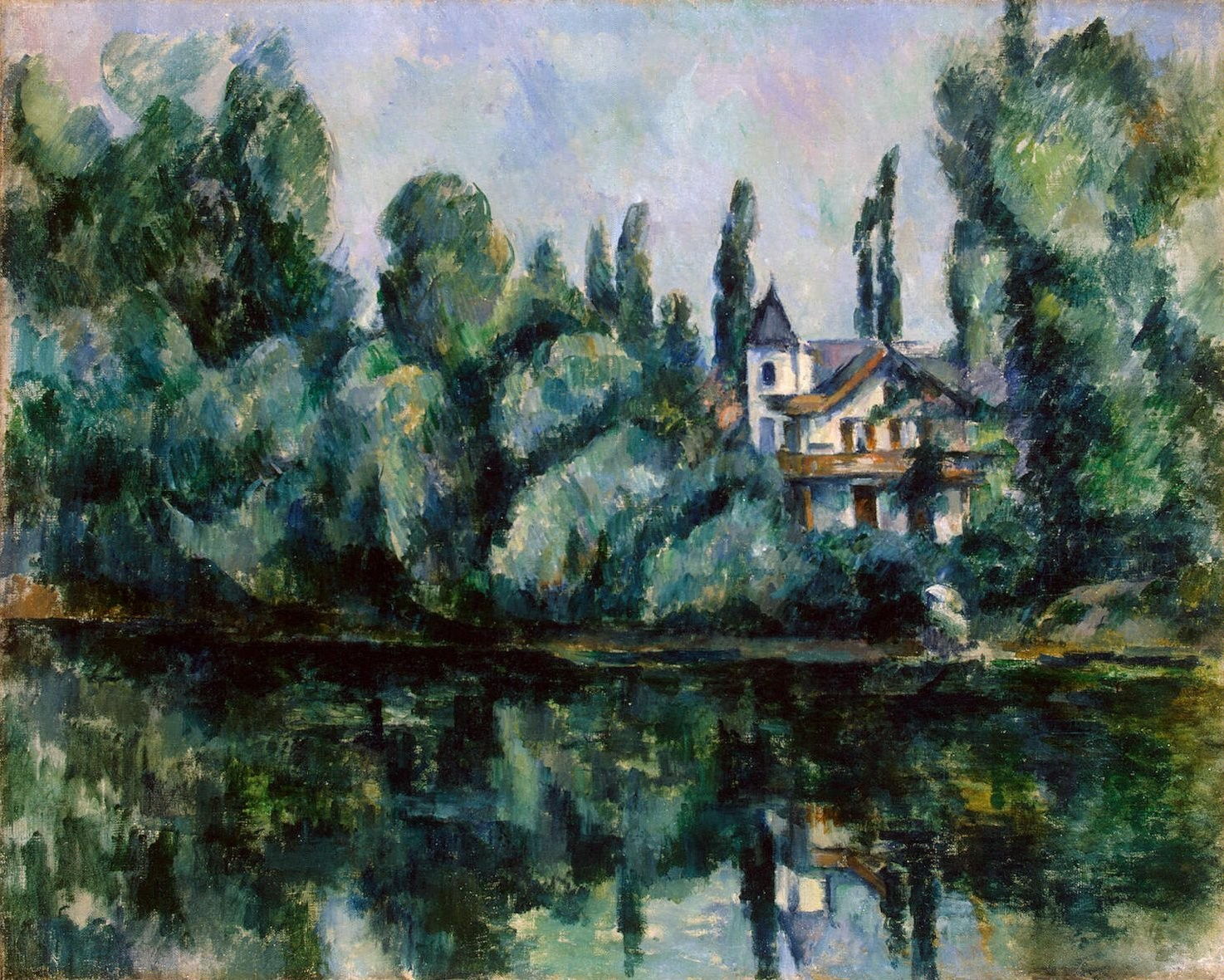
Paul Cézanne, Bords de la Marne I l’Île Machefer à Saint-Maur-des-Fossés (1888-94) R623, oil on canvas, 65 x 81 cm, Hermitage Museum, St Petersburg. Wikimedia Commons.
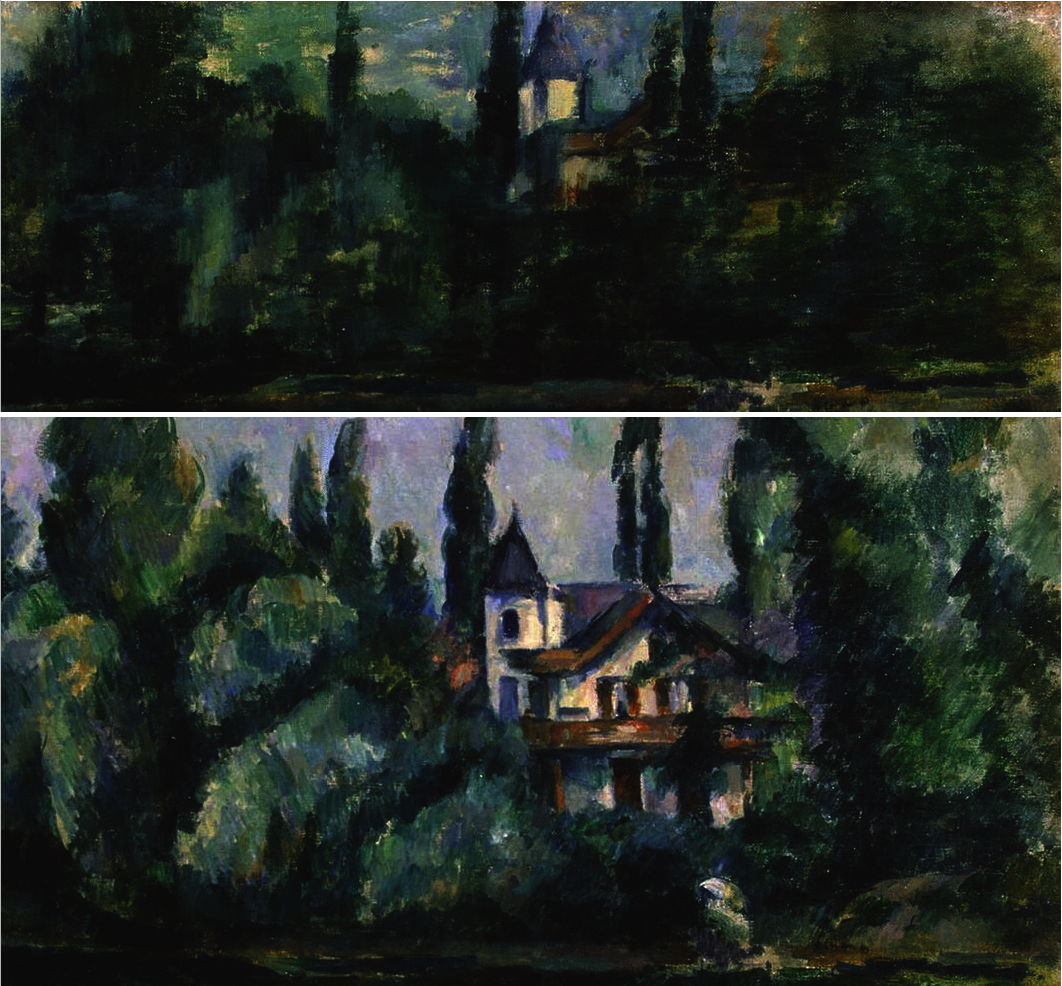
Bords de la Marne I (1888-94) is the second in a series, again showing large lateral displacements in its reflections, as seen in the composite detail below.
Paul Cézanne, Bords de la Marne I l’Île Machefer à Saint-Maur-des-Fossés (detail) (1888-94) R623, oil on canvas, 65 x 81 cm, Hermitage Museum, St Petersburg. Wikimedia Commons. Shown in composite view.
There are also differences in the depth order of the trees and house. In the original image, there is a prominent poplar behind the tower, which appears at the front left of the tower in reflection. The two prominent poplars behind the original image of the main house (in line with its gable) are also shown in the reflection as being in front of the house.
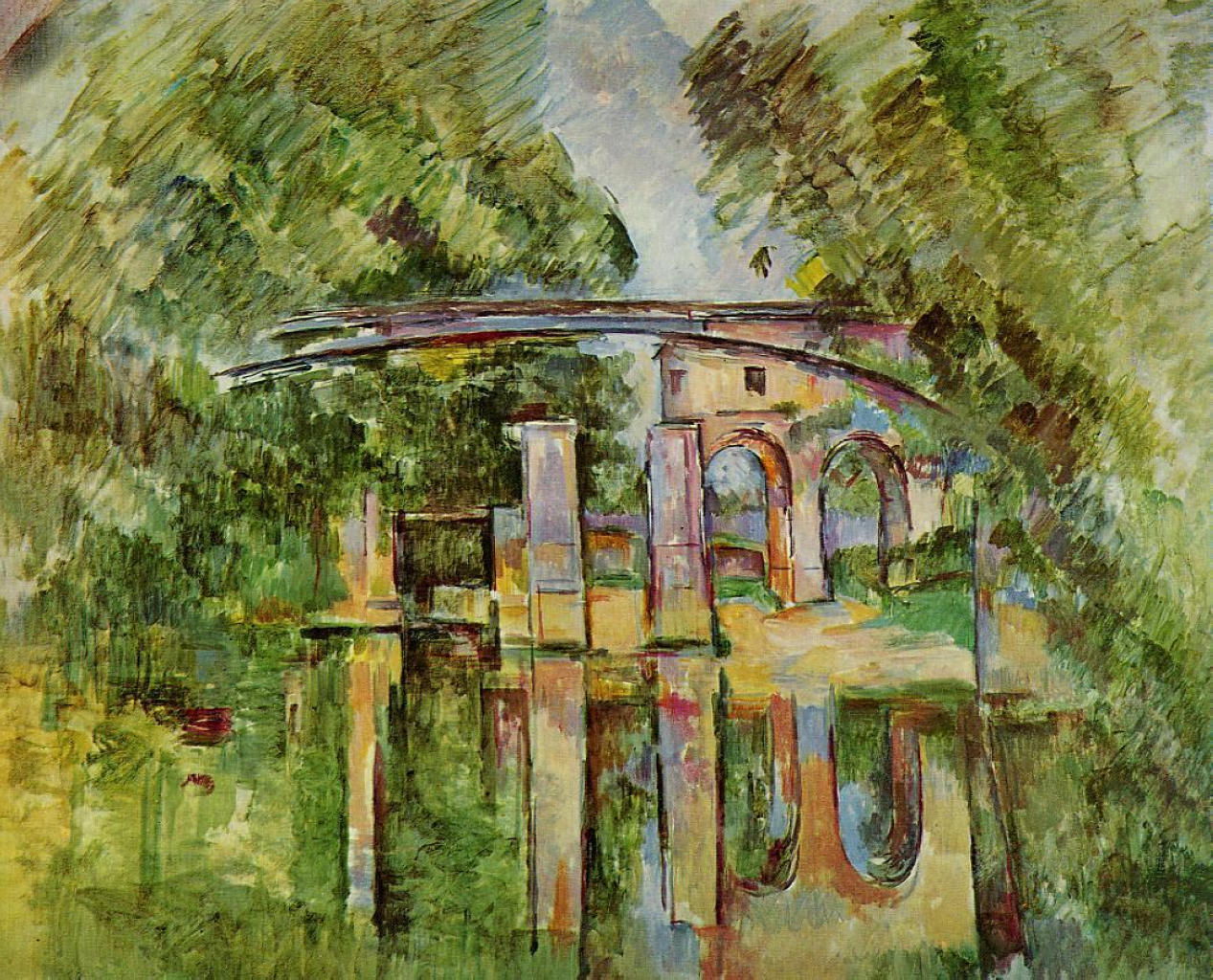
L’aqueduc et l’écluse (1894, or 1895-8) shows a view that has structural similarities to that of Cézanne’s earlier Villa au bord de l’eau (1890), but here appears totally different.
Paul Cézanne, L’aqueduc et l’écluse or Le Moulin brûlé à Maisons-Alfort (1894, or 1895-8) R765, oil on canvas, 73 x 92 cm, Private collection. Wikimedia Commons.
Most distant in Cézanne’s L’aqueduc et l’écluse is a building over two arches, reaching out from the right to the middle of the painting. To the left of it are two low buttresses with a horizontal piece bridging them. In front are two higher buttresses that appear unconnected with other structures. Closest to the viewer is a bridge arching over the water, its pier at the right edge of the canvas.
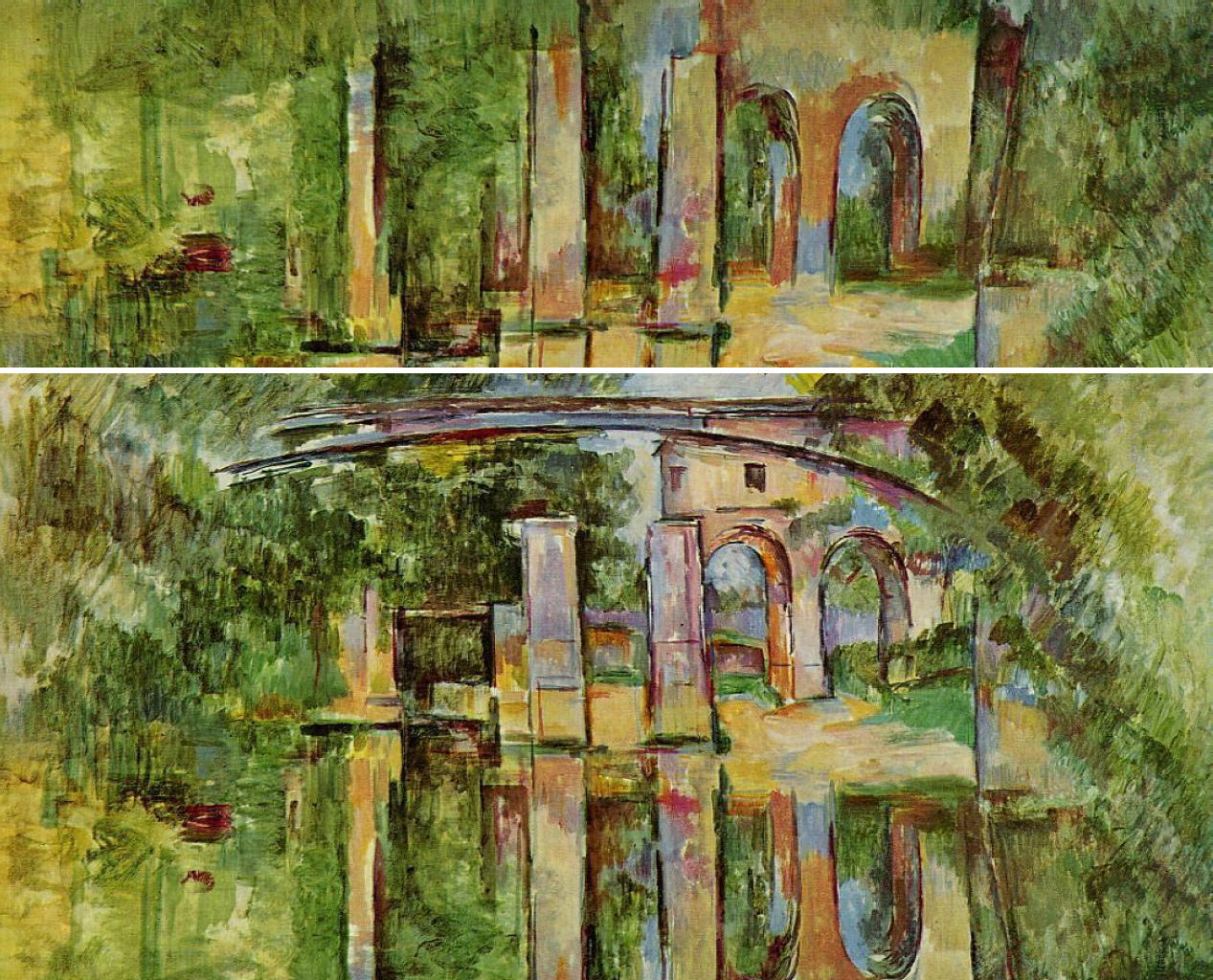
To each side of the view are high trees, rendered using rectangular patches of colour, each composed of a series of brushstrokes mainly laid diagonally in his ‘constructive stroke’. Discrepancies are clear in the composite view below.
Paul Cézanne, L’aqueduc et l’écluse or Le Moulin brûlé à Maisons-Alfort (1894, or 1895-8) R765, oil on canvas, 73 x 92 cm, Private collection. Wikimedia Commons. Shown in composite view.
All the buttresses, piers, and arches are vertically exaggerated in their reflections, and most lean noticeably in the opposite direction to the originals. The leftmost buttress appears quite different in its reflection as compared with the original, its reflection being as high as the pair of isolated buttresses in front, despite its original image reaching to only about two-thirds of their height. In the reflection immediately to the right of that leftmost buttress can be seen evidence of an arch, perhaps part of pentimenti there, which doesn’t correspond to anything in the original, except perhaps the shallow, flat bridge.
Reflections shown for the two isolated buttresses in the middle of the painting start at their foot, although this also appears to be part of the bank rather than water. Similarly reflections of the arches of the building start on the bank and not the water, and those arches aren’t truncated in height to allow for their distance back from the water’s edge. The arches themselves aren’t shown from the low view expected in a reflection: more is seen of the underside of the top of each arch in the original than in its reflection. Not only the arch of the bridge but its right pier are either not shown in the reflection at all, or appear with distorted form and colour.
Thus the reflections shown capture the rhythmic structure of the piers and buttresses, but their forms are so idiosyncratic as to cast doubt as to whether they are reflections on water at all. Even if this painting is far from complete, its reflections make it one of Cézanne’s most enigmatic.
Paul Cézanne, Le Lac d’Annecy (Lake Annecy) (1896) (R805), oil on canvas, 65 x 81 cm, The Courtauld Gallery, London (Samuel Courtauld Trust) (P.1932.SC.60). Wikimedia Commons.
This is one of Cézanne’s best-known paintings, which has been reproduced and discussed extensively. It shows a view across Lake Annecy from Talloires, featuring the distinctive Château de Duingt and the foothills rising behind it. The water surface is shown to cover almost the entire lower half of the painting, within which the reflections of the castle are central and dominant features.
Comparison with views of the actual motif reveals that Cézanne has brought the far shore considerably closer to the viewer than it really is, by enlarging all the objects on that shore. House (2008) states that the château is about one mile away from Cézanne’s viewpoint, but measurement on modern satellite images shows the distance to be 0.76 km or just under half a mile.
Paul Cézanne, Le Lac d’Annecy (Lake Annecy) (1896) (R805), oil on canvas, 65 x 81 cm, The Courtauld Gallery, London (Samuel Courtauld Trust) (P.1932.SC.60). Wikimedia Commons. Composite image to show discrepancies in reflections.
As revealed in the composite image above, immediately to the right of the tree trunk shown marking most of the left in repoussoir, the water surface is depicted as being pale blue, with two light vertical marks which should represent reflections, although the area being reflected is shown much darker in the original image and lacks any object corresponding to the vertical marks.
Moving right across the reflection, there should then be a green area to match the original greenery shown on the left of the château, but the water surface there remains a mid blue. Although the original image of the castle closely resembles photographs, the reflection shown appears to be that of a quite different object, consisting of two tall, slightly slanting, pale cylinders, neither of which is aligned with the edge or tower shown.
Recognising these remarkably distorted reflections, the late Professor John House (2008) commented on them, writing “The reflections in the water are slightly distorted – like the table legs in The Card Players, they are not exactly vertical; and the water surface is implausibly still; Cézanne took no interest in the specific play of reflections that played so central a part in the art of Claude Monet, whose work he nevertheless greatly admired.”
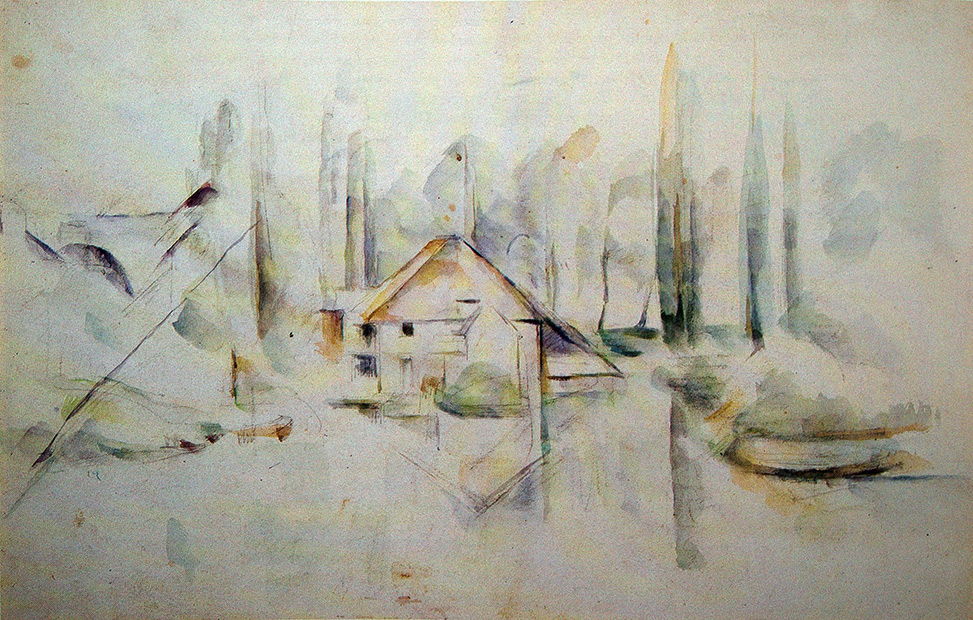
Paul Cézanne, Maison au bord de l’eau (1900-4) RWC540, watercolour and graphite on paper, 29.8 x 46.4 cm, Private collection. Wikimedia Commons.
Maison au bord de l’eau (1900-4) is a late watercolour showing a house surrounded by tall poplar trees, fronting onto a body of water. There are large areas of white ‘reserved’ space and relatively few reflections, but the crisp geometric depiction of the house and its reflection enable assessment of those details shown in the composite view below.
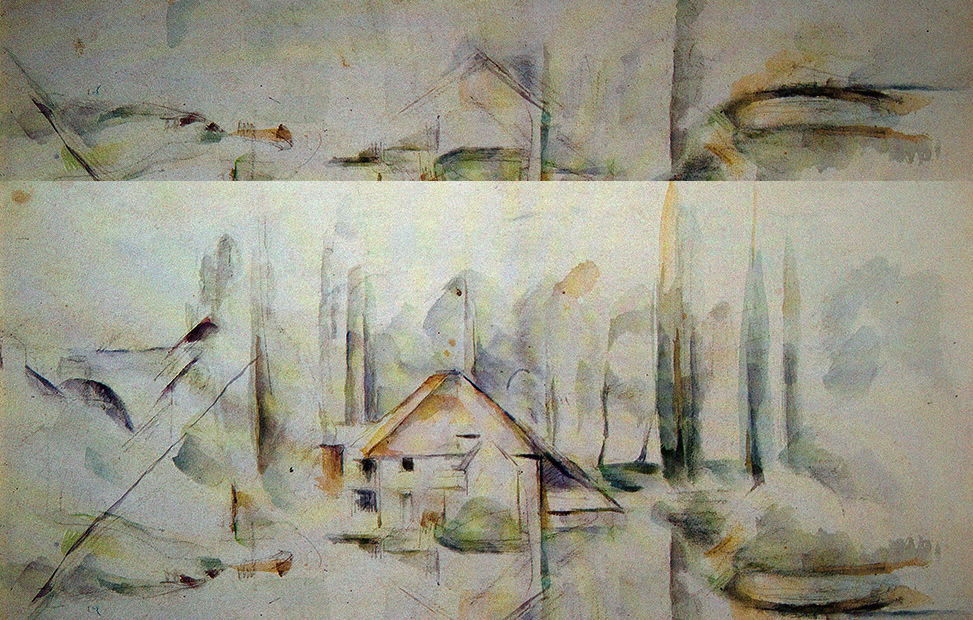
Paul Cézanne, Maison au bord de l’eau (1900-4) RWC540, watercolour and graphite on paper, 29.8 x 46.4 cm, Private collection. Wikimedia Commons. Shown in composite view.
In the original image, the front of the house roof is shown to have a single broadened gable at its apex, but the reflection omits the horizontal section at that gable. As a result the left side of the reflection of the house is markedly asymmetric from the original. This is exacerbated by displacement of the apex of the reflected roof to the right, which in turn makes the reflected roof appear less high than the original.
Possibly recognising the difficulties and asymmetry that had arisen, the left side of the roof reflection is left incomplete, the pencil line indicating its position stopping level with the end of the reflection of the left side of the sloping roof, where it’s clearly too close to the bank. The single poplar tree shown in reflection is also visibly displaced to the right.
I have yet to see any account of Cézanne’s paintings of reflections that is consistent with these images.
Arrouye J (2011) “L’eau, miroir de la peinture”, pp 154-161 in D Coutagne Cézanne et Paris, Rmn-Grand Palais, Paris. Translated as “Water the mirror of painting”, pp 154-161 in D Coutagne Cézanne and Paris, Rmn-Grand Palais, Paris. Coutagne D (2006) “The Jas de Bouffan”, pp 76-121 in P Conisbee and D Coutagne Cézanne in Provence, Yale University Press, New Haven, CT. Coutagne D (2011) P. Cézanne à Paris et en Île-de-France, Éditions Crès. House J (2008) “Le Lac d’Annecy”, pp 102-105 in S Buck et al. The Courtauld Cézannes, Paul Holberton Publishing, London Machotka P (2008) Cézanne, the Eye and the Mind, Éditions Crès, Marseille.
Given the technical challenge of painting optically faithful reflections on water, the painstaking and protracted work required for Divisionist techniques resulted in the omission of reflections, or only notional depictions. This article gathers some examples of Divisionist paintings that were taken the extra mile, and tried to do better.
Georges Seurat (1859–1891), Landscape – the Island of the Grande Jatte (1884), oil on canvas, 69.9 x 85.7 cm, Private collection. WikiArt.
Seurat’s first and greatest masterpiece, generally known as La Grande Jatte, uses the technique of optical mixing of colour. Rather than blending pigments on the canvas, it’s constructed of tiny high chroma dots to allow for optical mixing. Recognising the difficulty of recreating reflections when he was laboriously applying those dots to the large canvas for his finished painting, Seurat developed them in smaller studies such as that above.
Georges Seurat (1859–1891), Un dimanche après-midi à l’Île de la Grande Jatte (A Sunday Afternoon on the Island of La Grande Jatte) (1884-6), oil on canvas, 207.5 × 308.1 cm, Art Institute of Chicago, Chicago, IL. Wikimedia Commons.
Those are seen quoted in the finished work, which took him almost eighteen months to paint in three stages between 1884-86.
Camille Pissarro (1830-1903), The Seine at Rouen, the Île Lacroix, Effect of Fog (1888), oil on canvas, 46.7 x 55.9 cm, Philadelphia Museum of Art, Philadelphia, PA. (WikiArt)
The Seine at Rouen, the Île Lacroix, Effect of Fog from 1888 is one of Camille Pissarro’s best-known Divisionist paintings, and one of the few to depict reflections in detail. This was based on studies he had made during a visit to the city back in 1883, five years before he started work on this finished painting.
Paul Signac (1863-1935), Les Andelys. Le Quai (The Seine at Les Andelys) (Op 142) (1886), oil on canvas, 46 x 65 cm, Norton Simon Museum, Los Angeles, CA. Wikimedia Commons.
Paul Signac also made use of sketches made in front of the motif, such as this of Les Andelys. Le Quai from 1886, which contains extensive passages of reflections.
Paul Signac (1863-1935), Les Andelys. Côte d’aval (Op 139) (1886), oil on canvas, 64 x 95 cm, Art Institute of Chicago, Chicago, IL. Wikimedia Commons.
His finished view of Les Andelys. Côte d’aval, completed the same year, completely omits reflections, though.
Paul Signac (1863-1935), Les Andelys. La Berge (Op 141) (1886), oil on canvas, 65 x 81 cm, Musée d’Orsay, Paris. Wikimedia Commons.
A different view of the same village, Les Andelys. La Berge, from the same year, includes extensive reflections that appear fairly accurate.
Paul Signac (1863-1935), Sunset, Herblay (Op 206) (1889 Sep), oil on canvas, 58.1 x 90.2 cm, Kelvingrove Art Gallery and Museum, Glasgow, Scotland. Wikimedia Commons.
Signac’s Sunset, Herblay, painted in September 1889, is a good attempt but has small disparities. For example, reflected images of the trees seen on the bank at the left don’t tally with their originals in either vertical or horizontal dimension.
Paul Signac (1863-1935), Evening Calm, Concarneau, Opus 220 (Allegro Maestoso) (Op 220) (1891), oil on canvas, 64.8 x 81.3 cm, Metropolitan Museum of Art, New York, NY. Wikimedia Commons.
Evening Calm, Concarneau, Opus 220 (Allegro Maestoso) from 1891 must have been a major challenge that Signac carries off with aplomb. Again there are some small discrepancies: the most prominent boat in the foreground is heeling slightly to the left, but the left side of its reflection if anything leans slightly to the right.
Paul Signac (1863-1935), Tartanes pavoisées (Sailing Boats in Saint-Tropez Harbour) (Op 240) (1893), oil on canvas, 56 x 46 cm, Von der Heydt Museum, Wuppertal, Germany. Wikimedia Commons.
Reflections are even more complex in Signac’s Tartanes pavoisées, or Fishing Boats Dressed Overall, from 1893. To get its triangular composition right, and inform his rendering of the reflections, he painted three studies for this. Despite that, two years later he traded this painting for a bicycle, but in 1910 it became his first painting to enter a public collection, in Wuppertal, Germany.
Paul Signac (1863-1935), The Port of Saint-Tropez (1901-2), oil on canvas, 131 x 161.5 cm, National Museum of Western Art, Tokyo. WikiArt.
Another challenging view of The Port of Saint-Tropez from 1901-2 is less precise, but uses reflections to great effect.
Paul Signac (1863-1935), Mouillage de la Giudecca (Giudecca Anchorage, S. Maria della Salute) (Cachin 411) (1904), oil on canvas, 73.5 x 92.5 cm, Neue Pinakothek, Munich, Germany. Image by Ad Meskens, via Wikimedia Commons.
Signac’s later Giudecca Anchorage from 1904 uses coarser tiles of colour, giving him more leeway.
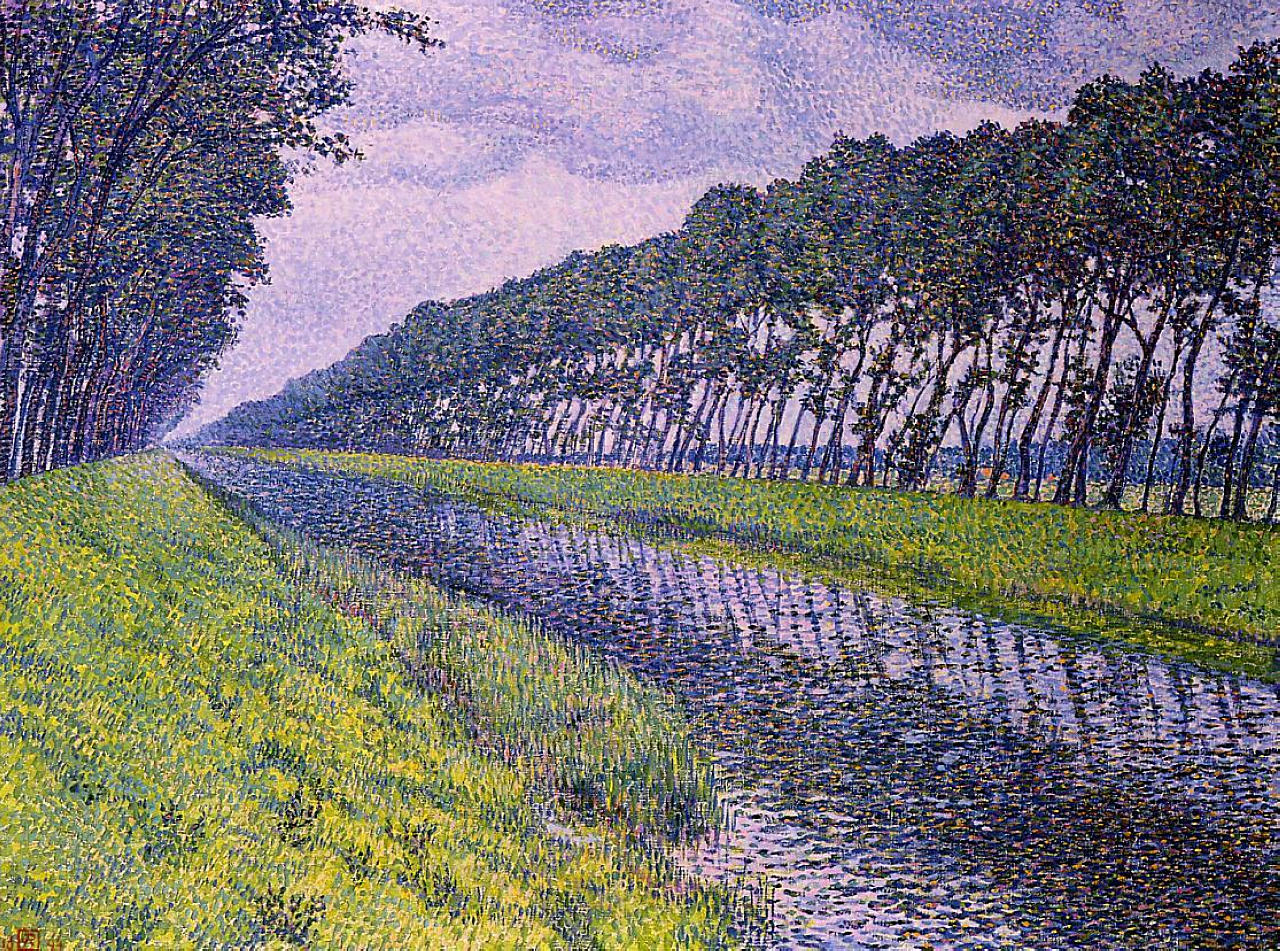
Of all the Neo-Impressionist and Divisionist paintings of reflections, the undisputed champion must be Théo van Rysselberghe’s Canal in Flanders from 1894. This too was preceded by a study, but that almost completely excluded any reflections. The artist then moved his viewpoint to the right, and must have spent months getting its reflections right.
Théo van Rysselberghe (1862-1926), Canal in Flanders (1894), oil on canvas, 152.4 x 203.2 cm, Private collection. WikiArt.
This uniquely combines radical perspective projection, intense rhythm and meticulous reflections. The artist painted few further views with reflections afterwards.
The original intent of the French Impressionists was to paint quickly in front of the motif so as to capture its impression. Although many Impressionist depictions of reflections aren’t optically faithful, in practice there’s nothing to prevent them from that. This was amply demonstrated by the grandfather of Impressionism, Camille Corot, during his formative years spent developing his skills in Rome.
Jean-Baptiste-Camille Corot (1796-1875), The Island and Bridge of San Bartolomeo (1825/8), oil on paper on canvas, 27 x 43.2 cm, National Gallery of Art, Washington DC. WikiArt.
Corot’s earliest plein air works are truly prodigious in their quality, and his development of the art. By the time that the Impressionists were painting outdoors, after 1841, oil paint was widely available in far more convenient metal tubes. But when Corot was in Italy he enjoyed no such luxuries: paint came in small bladders that were far less portable and messier to work with. Despite that, his view of The Island and Bridge of San Bartolomeo from 1825/8 appears optically accurate.
Jean-Baptiste-Camille Corot (1796-1875), View of Rome: The Bridge and Castel Sant’Angelo with the Cupola of St. Peter’s (1826-7), oil on paper on canvas, 26.7 x 43.2 cm, Fine Arts Museums of San Francisco. WikiArt.
Corot’s View of Rome: The Bridge and Castel Sant’Angelo with the Cupola of St. Peter’s from 1826-7 is another brilliant example painted on paper in front of the motif.
Claude Monet’s reflections are generally shown on broken water, and appear intended to be optically correct.
Claude Monet (1840–1926), The Thames below Westminster (1871), oil on canvas, 47 x 73 cm, The National Gallery, London. Wikimedia Commons.
Monet painted The Thames below Westminster while he was in London in 1871, and returned over thirty years later to paint more radical series of views in different lighting conditions.
Claude Monet (1840–1926), Impression, Sunrise (1872), oil on canvas, 48 x 63 cm, Musée Marmottan Monet, Paris. Wikimedia Commons.
The following year, he painted this view of his home port of Le Havre, which gave rise to the movement’s name, Impression, Sunrise. This appears to be a brisk oil sketch of fog and the rising sun, and is one of his series depicting the port at different times and in varying lights, exhibited in the First Impressionist Exhibition two years later.
Alfred Sisley (1839–1899), The Canal Saint-Martin, Paris (1872), oil on canvas, 38 x 46 cm, Musée d’Orsay, Paris. EHN & DIJ Oakley.
The same year, Alfred Sisley’s view of The Canal Saint-Martin, Paris shows a placid and almost disused stretch of canal near the centre of Paris. This too appears to be optically correct.
Claude Monet (1840-1926), Autumn on the Seine, Argenteuil (1873), oil on canvas, 54.3 × 73.3 cm, High Museum of Art, Atlanta, GA. Wikimedia Commons.
In 1873, Monet painted his masterwork Autumn on the Seine, Argenteuil, a textbook example of a river landscape in autumn painted in high Impressionist style, with high chroma, loose brushstrokes and faithful reflections.
Claude Monet (1840-1926), View of the Church at Vernon (1883), oil on canvas, 65 x 81 cm, Yamagata Museum of Art, Japan. (WikiArt)
Although Monet’s View of the Church at Vernon from 1883 doesn’t appear entirely optically accurate, its intent is clear. The reflection of the large house at the right is extended a little too far to the right, as if there had been a tall tree beside it on the bank, where the original image shows another lower house set further back.
Some of Monet’s later series relied on reflections for their visual effects, although they also take more optical liberties.
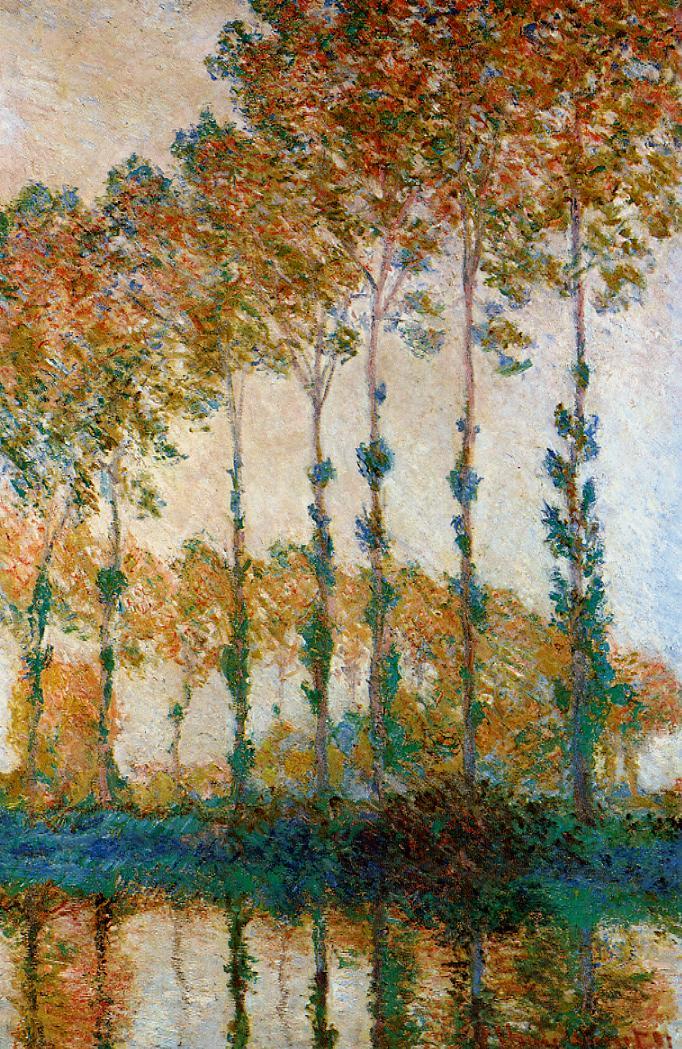
Claude Monet (1840-1926), Poplars on the Bank of the Epte, Autumn (1891) W1297, oil on canvas, 100 x 65 cm, Museum of Fine Arts, Boston. WikiArt.
In 1891, Monet painted his first formal series showing poplars, including Poplars on the Bank of the Epte, Autumn. These articulate the contrasts in form within each tree, with sections of bare trunk, and those of extensive canopy, the colours cast by light and those of the leaves themselves, the rhythmic assembly of the line of trees, their reflections on the water, and the formation of the line of poplars into sweeping curves in depth.
Alfred Sisley (1839–1899), The Bend on the Loing at Moret (1886), oil on canvas, 54 x 74 cm, Private collection. Wikimedia Commons.
The broken water surface in Sisley’s Bend on the Loing at Moret from 1886 remains surprisingly faithful.
Alfred Sisley (1839-1899), Moret Bridge in the Sunlight (1892), oil on canvas, 65 x 81 cm, Private collection. WikiArt.
In Moret Bridge in the Sunlight from 1892, Sisley captures the reflections of the buildings dominating the centre of this small town on the River Loing.
Claude Monet (1840–1926), The Houses of Parliament, Sunset (1903), oil on canvas, 81.3 × 92.5 cm, The National Gallery of Art, Washington, DC. Wikimedia Commons.
Claude Monet’s return to London in 1903 revisits The Houses of Parliament, Sunset fairly faithfully.
In the late nineteenth century, Realist landscape painters challenged themselves with increasingly difficult reflections, where the water surface isn’t mirror-like, but broken.
Gustave Caillebotte (1848–1894), Rain on the Yerres (1875), oil on canvas, 81 x 59 cm, Indiana University Art Museum, Bloomington IN. WikiArt.
Gustave Caillebotte’s Rain on the Yerres (1875) is an innovative study of a reflective water surface disrupted by circles projected by raindrops.
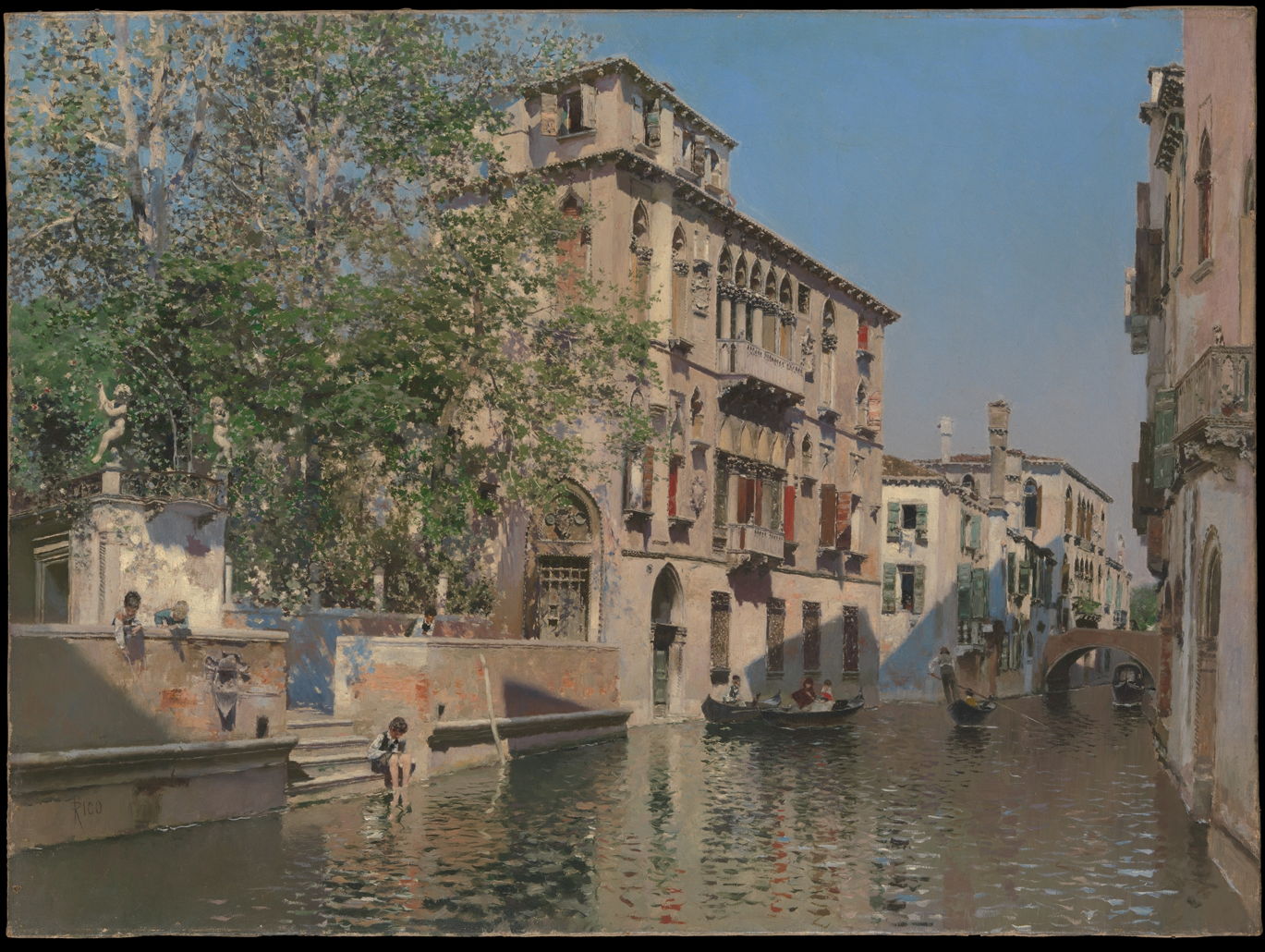
Martín Rico y Ortega (1833–1908), A Canal in Venice (c 1875), oil on canvas, 50.2 x 67.9 cm, The Metropolitan Museum of Art, New York, NY. Wikimedia Commons.
The broken reflections in Martín Rico’s A Canal in Venice from about the same time may have been painted mostly en plein air, despite their fine detail.
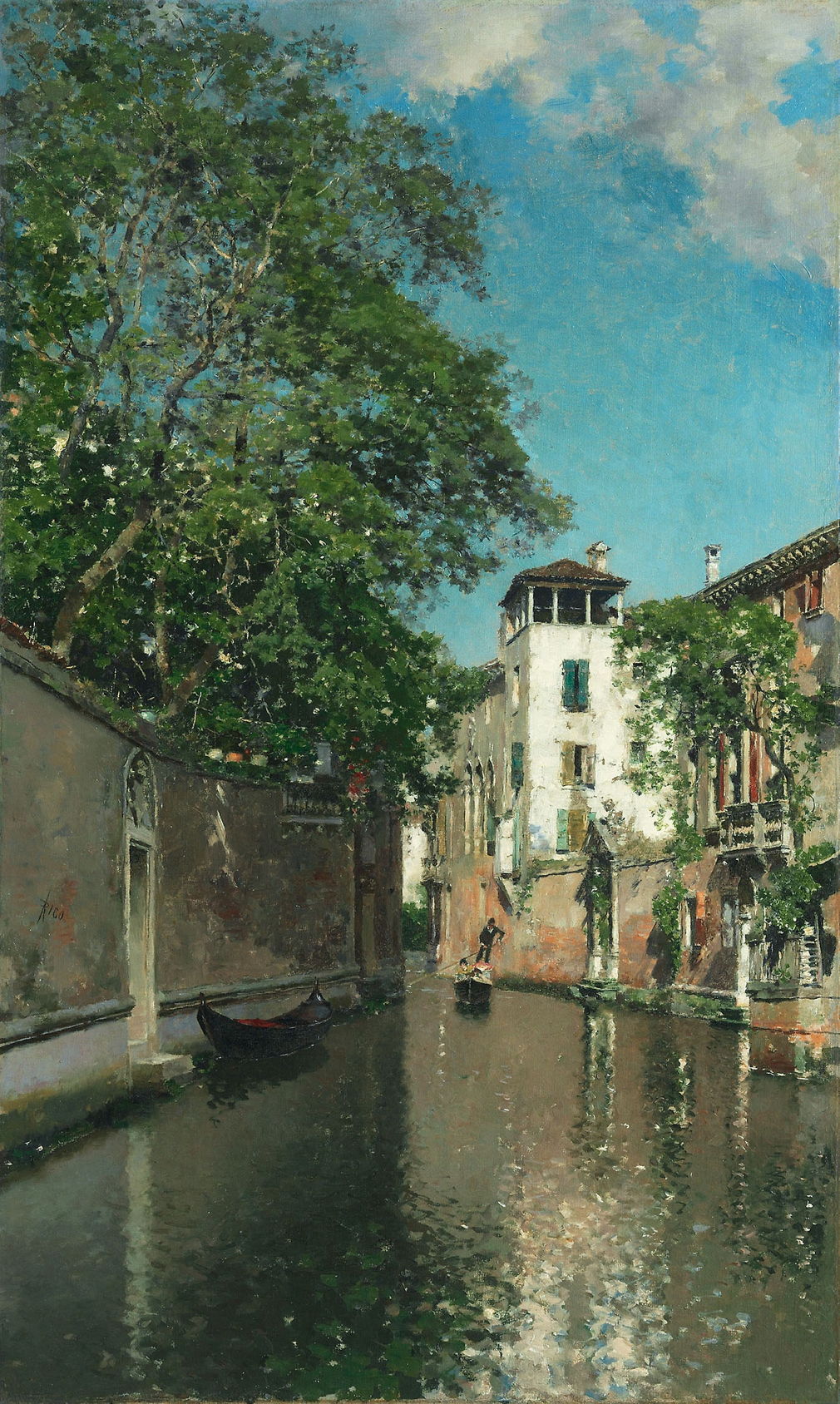
Martín Rico y Ortega (1833–1908), Canal in Venice (date not known), oil on canvas, dimensions not known, The Art Institute of Chicago, Chicago, IL. Wikimedia Commons.
Rico’s Canal in Venice uses more painterly marks in its reflections.
At the same time, Eilert Adelsteen Normann was painting the grander effects seen in the fjords of Norway.
Eilert Adelsteen Normann (1848–1918), From Romsdal Fjord, 1875 (1875), oil on canvas, dimensions not known, Bergen kunstmuseum (Kunstmuseene i Bergen), Bergen, Norway. Wikimedia Commons.
Normann’s From Romsdal Fjord, also from 1875, shows the ninth longest fjord in Norway as it carves its way through this huge mountain gorge. Although much of the water surface is glassy calm, there’s a slight blur of fine ripples, and patches where it’s more disrupted by gentle breeze.
Eilert Adelsteen Normann (1848-1918), The Steamship (date not known), further details not known. Wikimedia Commons.
The unidentified fjord in Normann’s undated The Steamship shows a similar repertoire of subtle optical effects.
Laurits Andersen Ring (1854–1933), Alder Trunks (1893), oil on canvas, 52.9 x 73.5 cm, Collection of Her Majesty the Queen Margrethe II, Copenhagen, Denmark. Wikimedia Commons.
Alder Trunks from 1893 is one of Laurits Andersen Ring’s finest landscapes, and has earned its place in the Danish Royal Collection. He shows these old coppiced alders mainly in reflection. Although their details are quite painterly, the overall effect is that of meticulous realism.
The specialist of this period is the Norwegian Frits Thaulow.
Frits Thaulow (1847–1906), Winter at the River Simoa (1883), oil on canvas, 49.5 x 78.5 cm, Nasjonalgalleriet, Oslo, Norway. Wikimedia Commons.
Thaulow seems to have discovered what was going to be his recurrent theme for much of his career by 1883, when he painted this scene of Winter at the River Simoa. A lone woman, dressed quite lightly for the conditions, is rowing her tiny boat over the quietly flowing river, towards the tumbledowns on the other side. The surface of the river shows the glassy ripples so common on semi-turbulent water, and the effect on reflections is visibly complex. The distant side of the river is also partly frozen, breaking the reflections further.
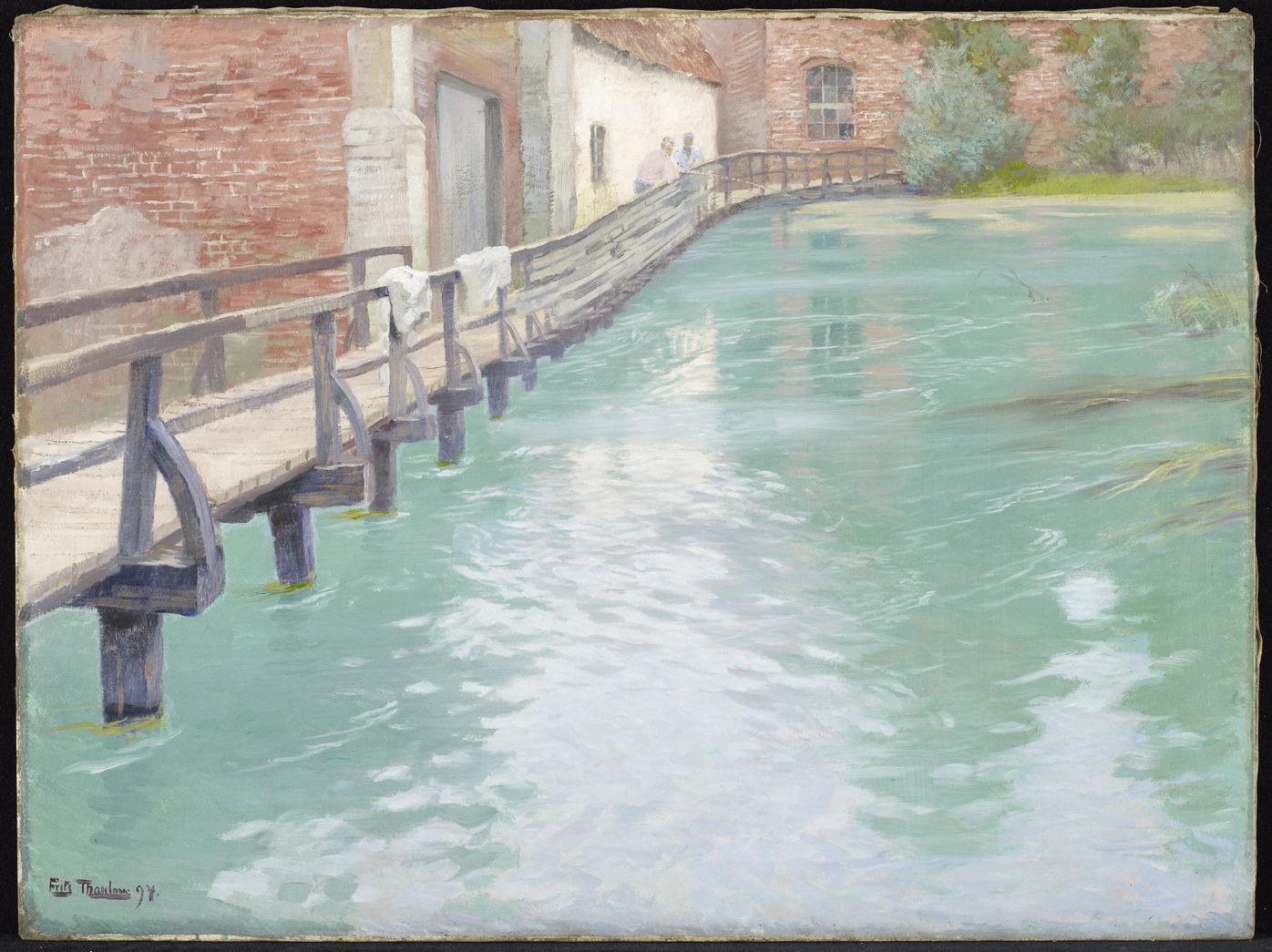
Frits Thaulow (1847–1906), The Mills at Montreuil-sur-Mer, Normandy (1894), oil on canvas, dimensions not known, Minneapolis Institute of Art, Minneapolis, MN. Wikimedia Commons.
Thaulow later returned to his studies of flowing rivers, for example in The Mills at Montreuil-sur-Mer, Normandy. This painting has been claimed to date from 1891, before the artist moved to Montreuil, but I think that its date reads 1894.
Frits Thaulow (1847–1906), The Adige River at Verona (c 1894), oil on canvas, 81 x 100 cm, Walters Art Museum, Baltimore, MD. Wikimedia Commons.
In 1894, Thaulow travelled across northern Italy to Venice, stopping off to paint The Adige River at Verona. This shows the five arches of the Ponte della Pietra, with wonderfully disrupted reflections describing the river’s turbulent flow.
Frits Thaulow (1847–1906), La Dordogne (1903), oil, further details not known. Wikimedia Commons.
Soon after Thaulow had settled at Beaulieu in central France, he found form with the magnificent river surface and lighting of La Dordogne (1903), whose precise detail in the foreground quickly yields to a more sketchy background.
A few artists rose to the challenge of combined reflected and refracted images, among them Kazimierz Sichulski.
Kazimierz Sichulski (1879–1942), Fish (1908), pastel on paperboard, 63 x 82 cm, Muzeum Narodowe w Poznaniu, Poznań, Poland. Wikimedia Commons.
Sichulski’s Fish (1908) is a startlingly unusual pastel painting, a virtuoso combination of reflections from and views through this water surface. It’s an essay in practical optics.
As landscape painters increasingly came to rely on studies made in front of the motif, and their views came closer to reality, faithful depictions of reflections on water increased. But the fundamental challenges of painting accurate reflections remained. Both John Constable and JMW Turner started their careers drawing, trained in the Royal Academy Schools, and should have had a thorough grounding in 3D projection and reflections, as well as ample experience recording what they saw.
Several of Constable’s major works include reflected passages, painted slowly in the studio following extensive studies made of the motif.
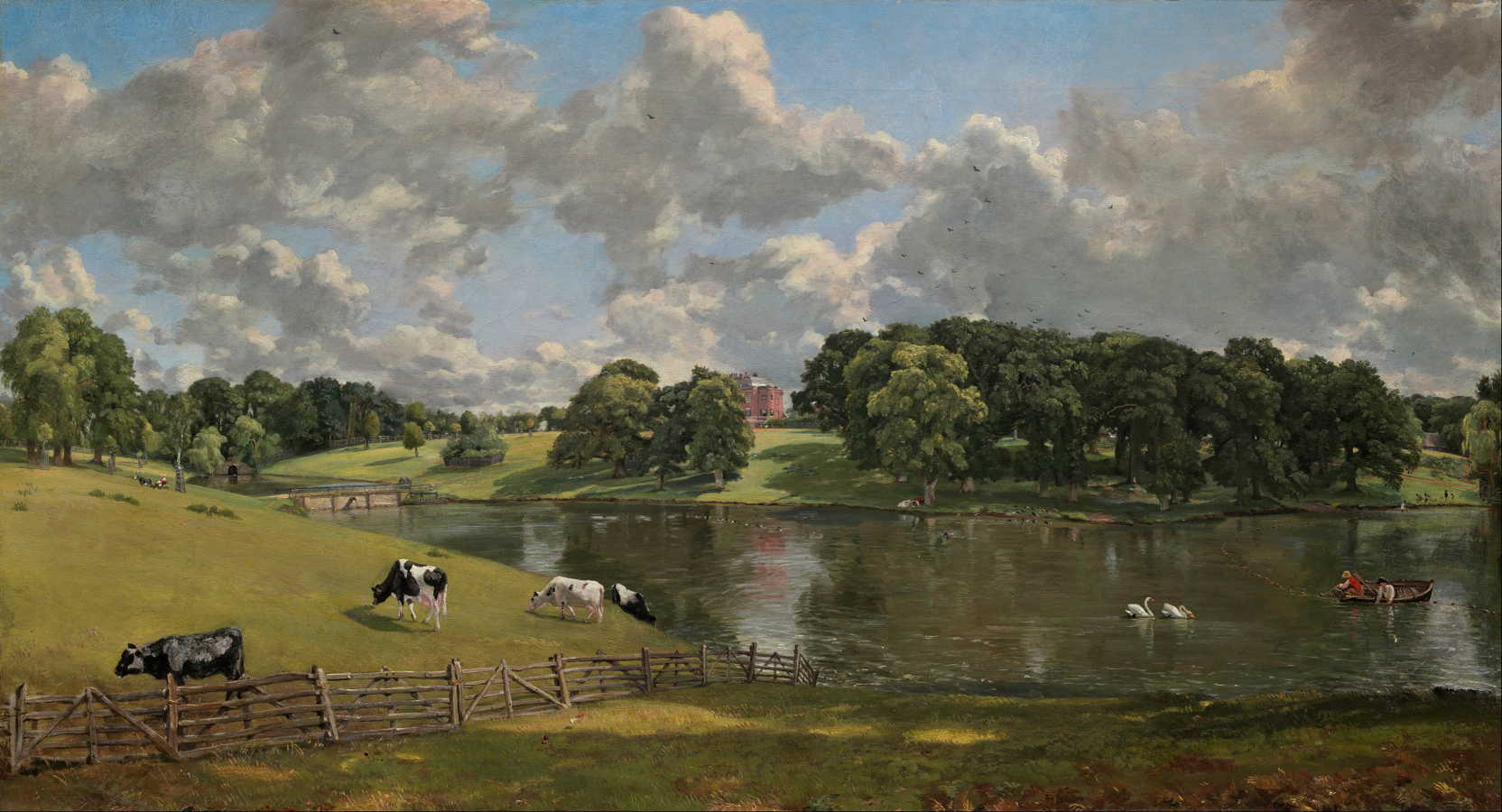
John Constable (1776–1837), Wivenhoe Park, Essex (1816), oil on canvas, 56.1 x 101.2 cm, The National Gallery of Art, Washington, DC. Wikimedia Commons.
Constable’s commissioned painting of the house and estate at Wivenhoe Park, Essex from 1816 is an oddly distant view of Major-General Francis Slater-Rebow’s country seat. Given the expanse of mirror-like lake, he might have been expected to include meticulous reflections. There are obvious anomalies, such as the brick-red reflection of the modest section of the house visible through a break in the trees in the centre of the canvas. The house is sufficiently distant that little or none of it would have been visible in reflection, let alone the two large areas of brick red stretching well over half way across the water. That was in all probability painted for effect.
John Constable (1776–1837), Wivenhoe Park, Essex (detail with reflection) (1816), oil on canvas, 56.1 x 101.2 cm, The National Gallery of Art, Washington, DC. Wikimedia Commons.
Reflections of the pair of swans and boatmen are also out of kilter. Constable may well have neither seen nor sketched them from life, and then struggled to envision their reflections in the studio.
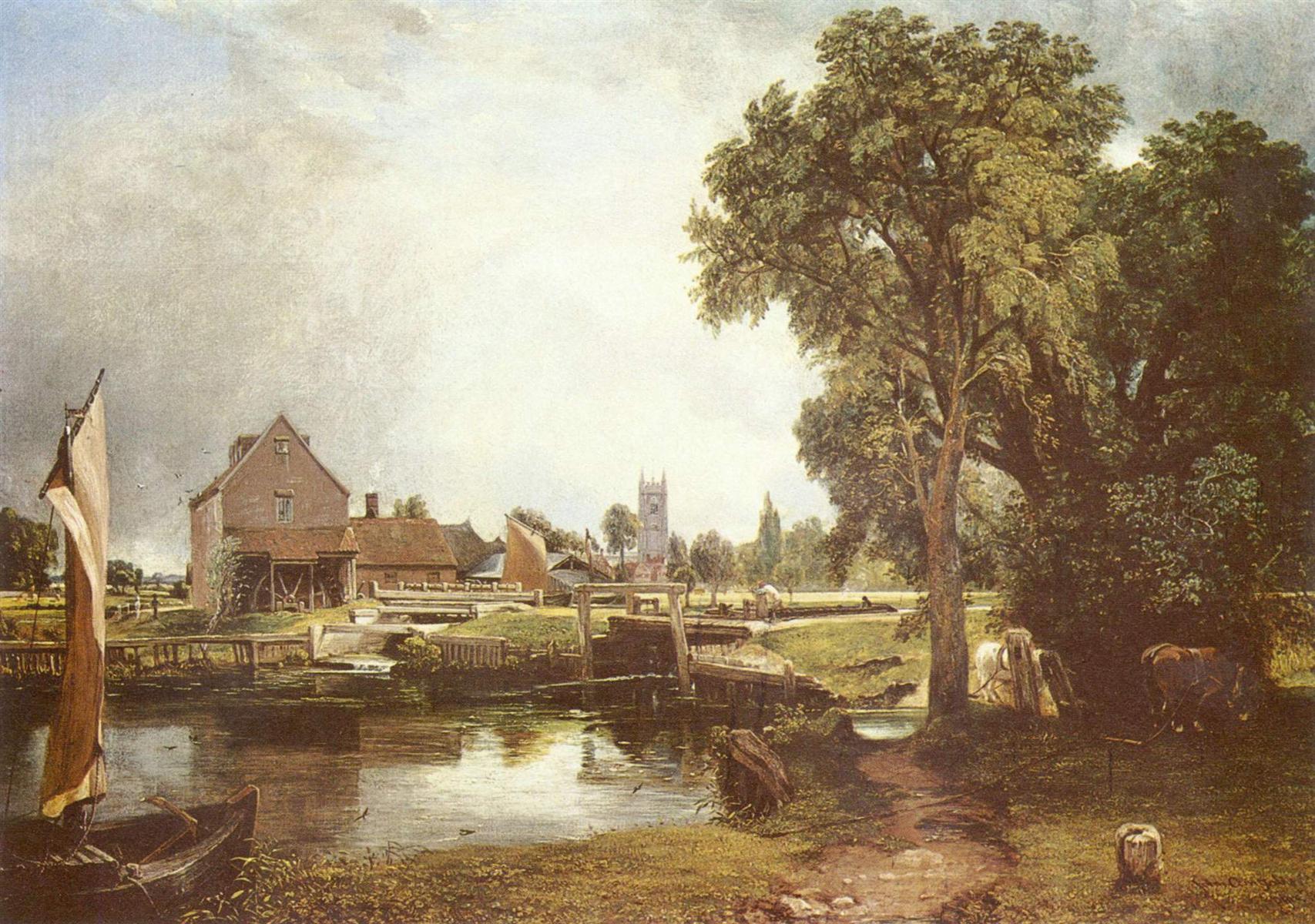
John Constable (1776–1837), Dedham Lock and Mill, 1820, oil on canvas, 53.7 x 76.2 cm, Victoria and Albert Museum, London. WikiArt.
Four years later, this painting of Dedham Lock and Mill (1820) is more familiar territory from the artist’s home ground. His family owned this lock on the River Stour, and he would have worshipped in the village church of Dedham seen in the distance. His reflections here appear accurate throughout.
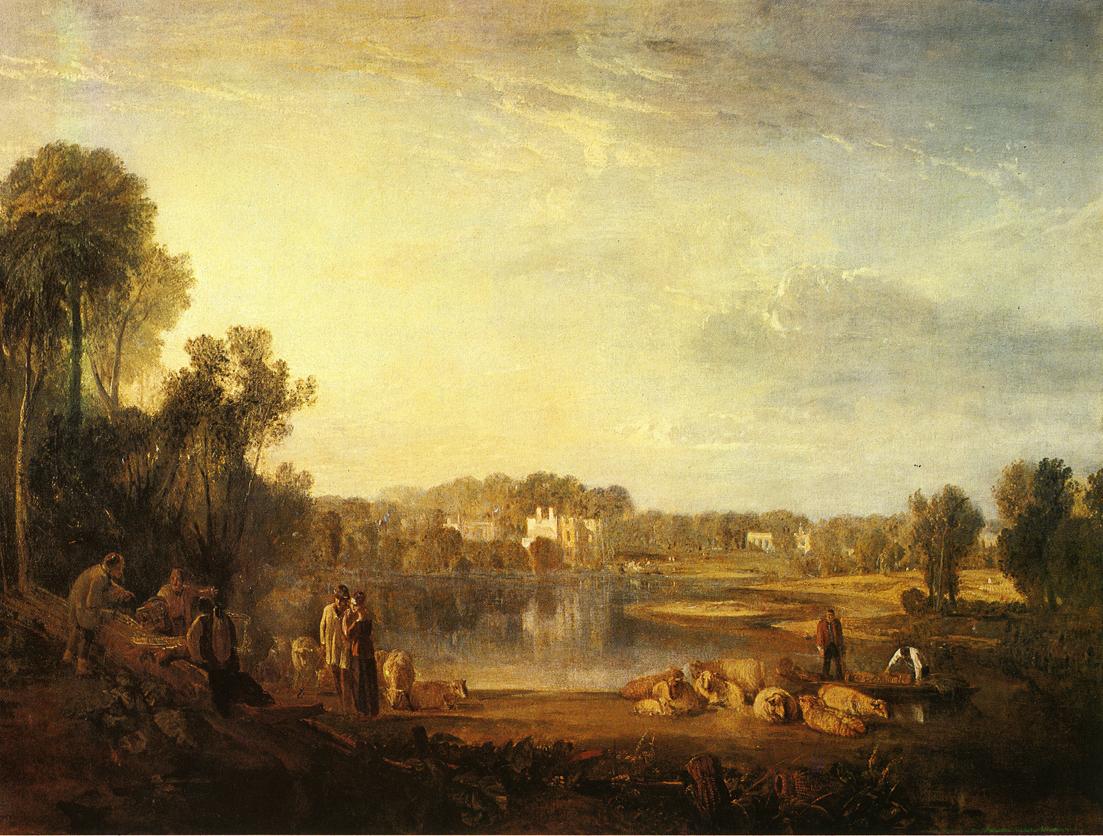
Joseph Mallord William Turner (1775–1851), Pope’s Villa, at Twickenham (1808), oil on canvas, 120.6 x 92.5 cm, Private Collection. WikiArt.
Turner’s approach to reflections changed over the course of his career. In Pope’s Villa, at Twickenham from 1808, he depicted complex and intricate reflections in careful detail.
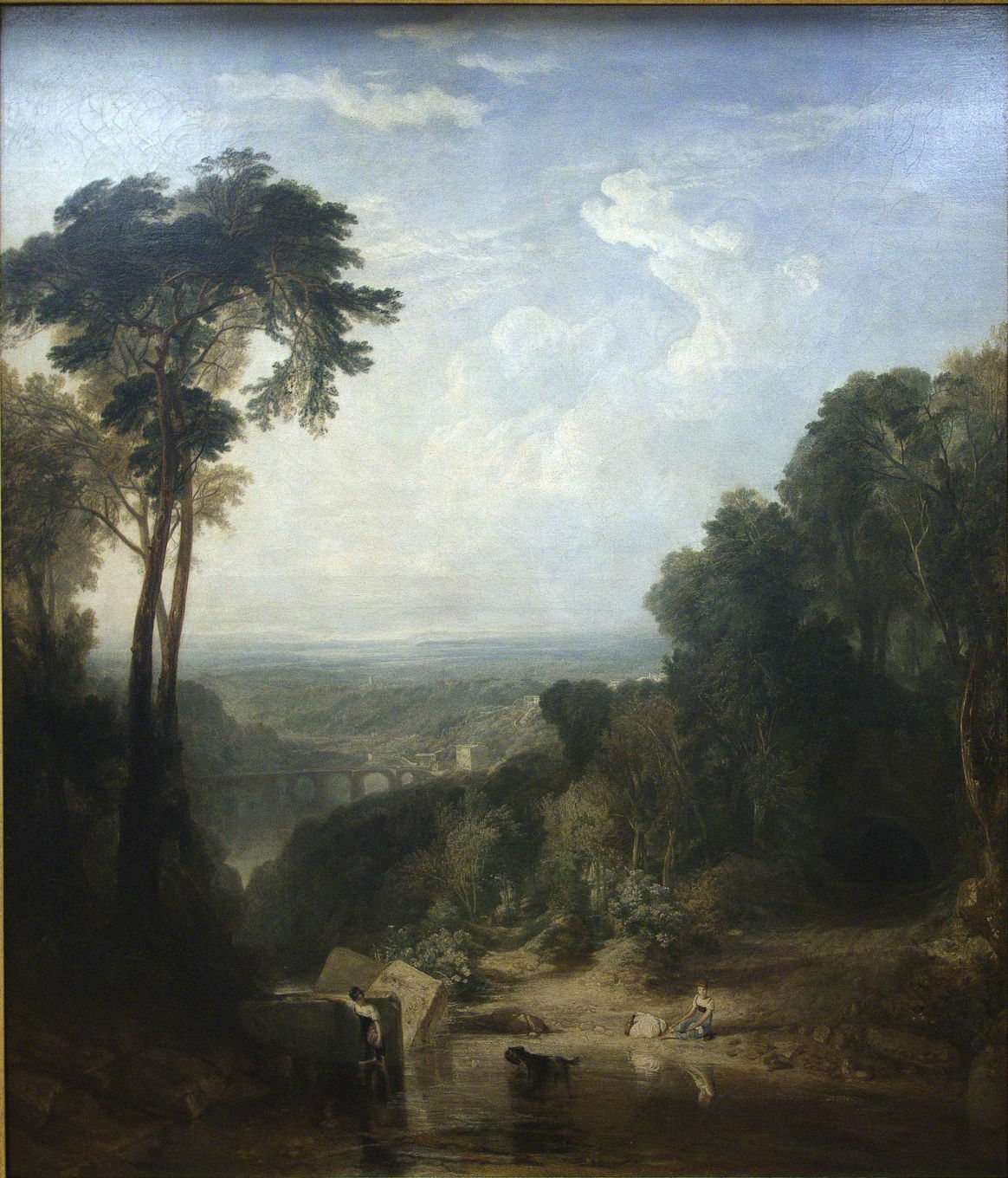
I’ve previously considered the relatively small anomalies in another of his early oil paintings, Crossing the Brook from 1815.
Joseph Mallord William Turner (1775-1851), Crossing the Brook (1815), oil on canvas, 193 x 165.1 cm, Tate Britain, London (N00497). EHN & DIJ Oakley.
These could be accounted for by the figures being staffage added in the studio without the benefit of plein air studies.
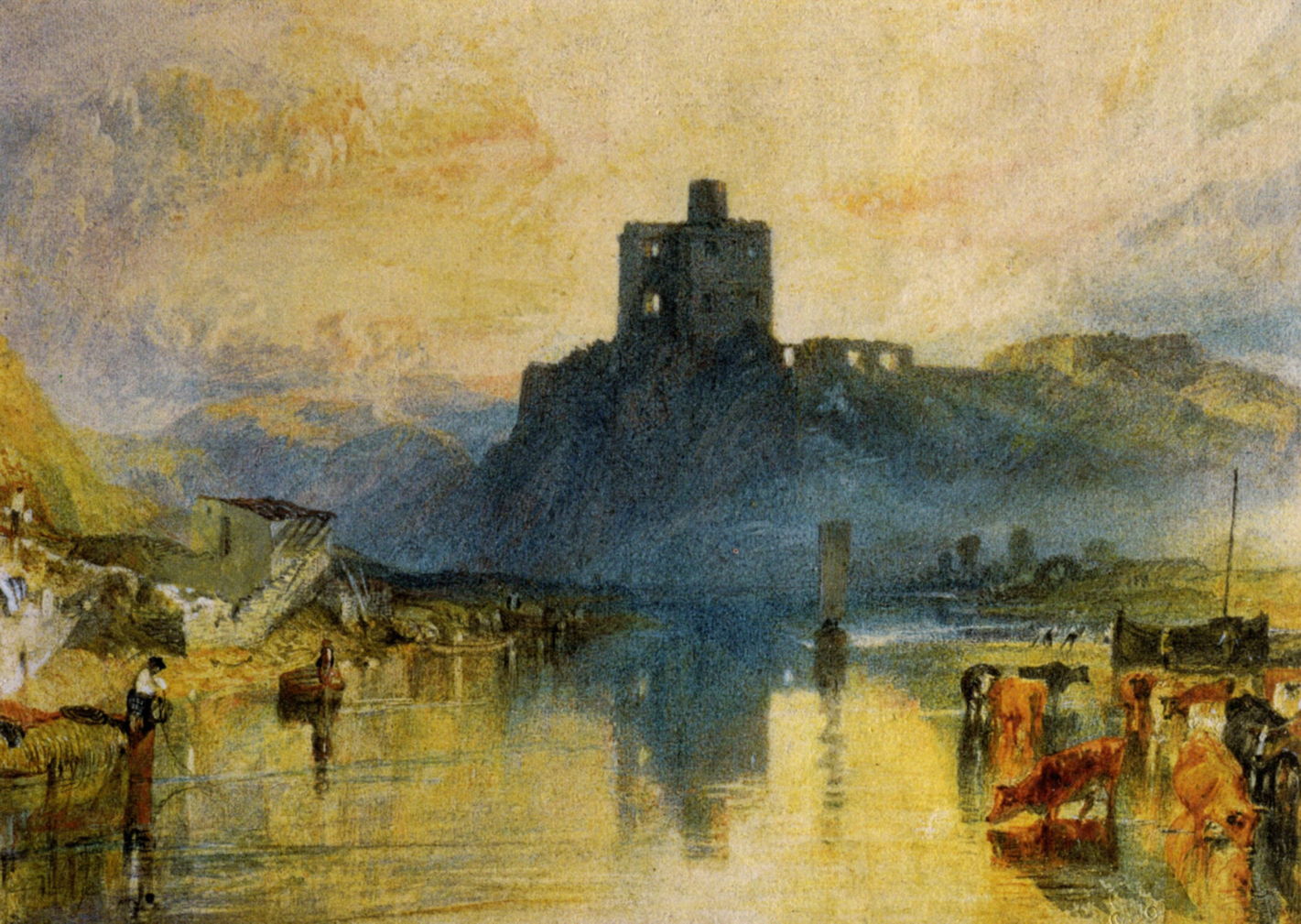
Joseph Mallord William Turner (1775–1851), Norham Castle, on the River Tweed (1823), watercolour on paper, 15.6 x 21.6 cm, British Museum, London. WikiArt.
Some of his later watercolours, such as Norham Castle, on the River Tweed (1823), have obvious quirks in their reflections: here the reflection appears to show another high point at the left edge of the castle that isn’t matched by an equivalent high point in the real castle.
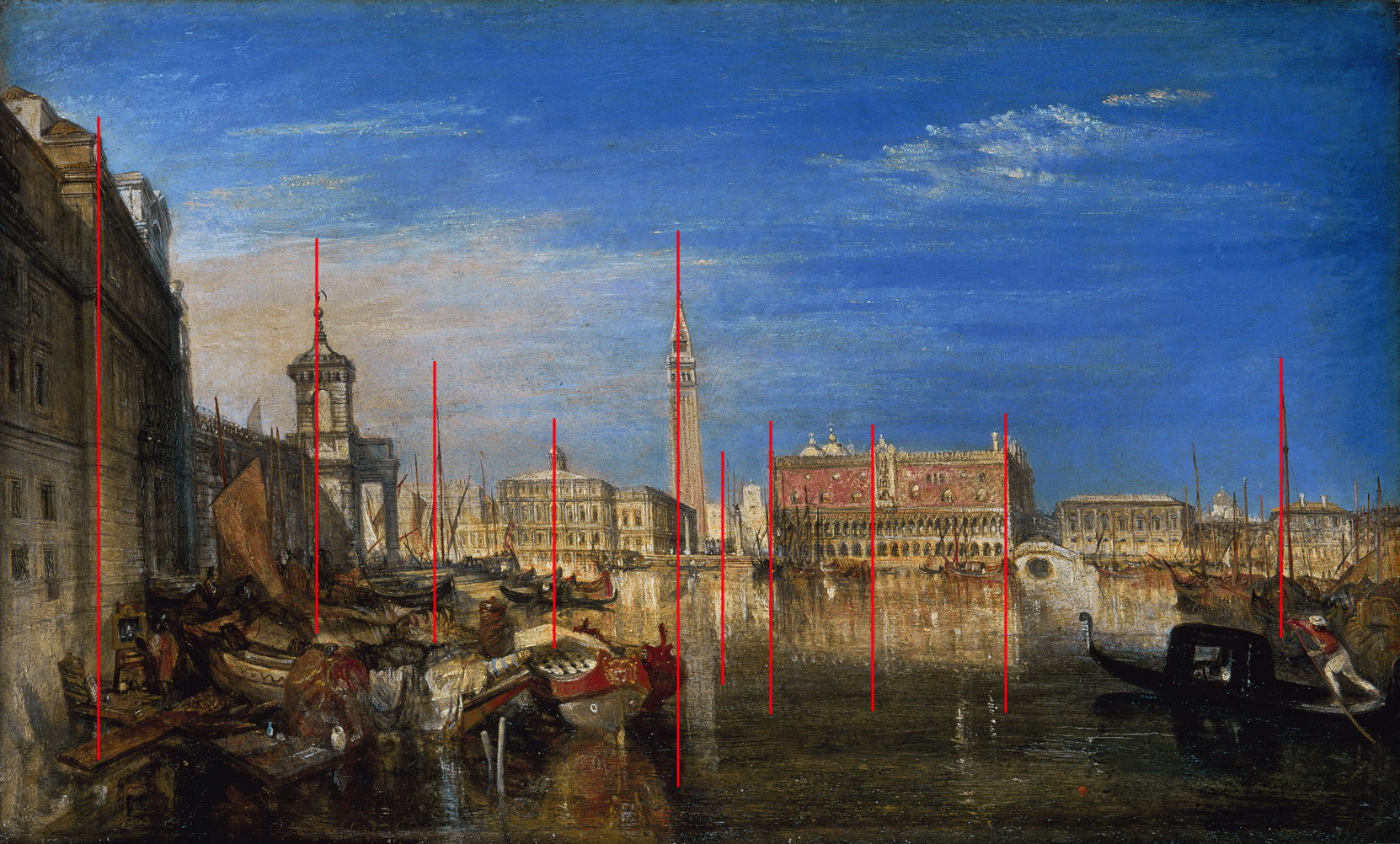
Joseph Mallord William Turner (1775–1851), Bridge of Sighs, Ducal Palace and Custom-House, Venice: Canaletti Painting (1833), oil on mahogany, 51.1 x 81.6 cm, Tate Britain, London (N00370). Wikimedia Commons. Perpendiculars have been superimposed to show failure in vertical alignment of the unreflected and reflected images.
Some of his paintings show other optical oddities. His Bridge of Sighs, Ducal Palace and Custom-House, Venice: Canaletti Painting (1833), his first oil painting of Venice, places all the buildings leaning to the left, with their reflections leaning in the opposite direction. Had this painting been on a canvas support, there might have been distortion applied by its stretching or subsequent treatment, but unusually Turner painted this on a mahogany panel. I have checked this image matches those from other sources, to ensure this isn’t a photographic artefact.
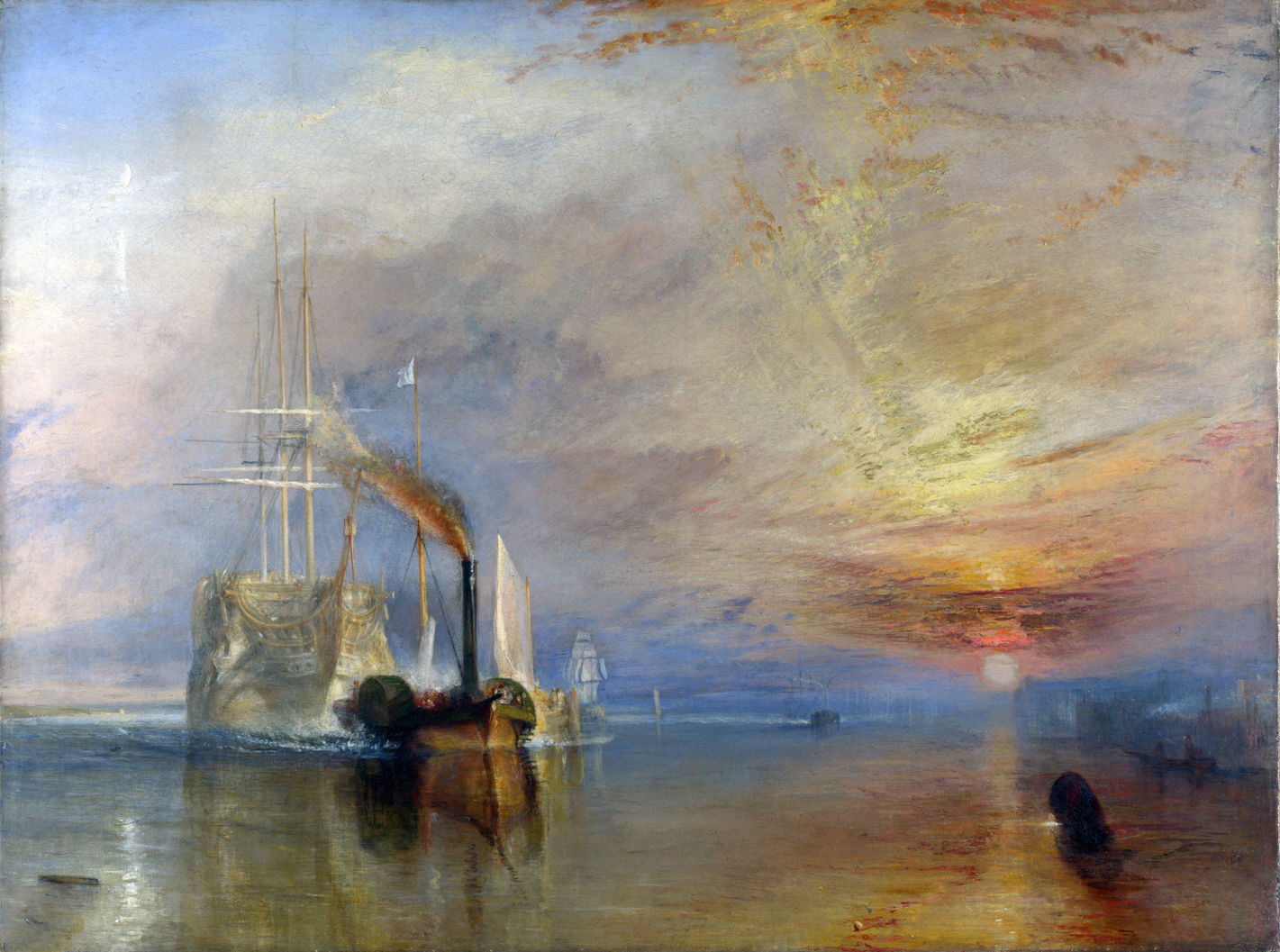
Joseph Mallord William Turner (1775–1851), The Fighting Temeraire tugged to her last Berth to be broken up (1839), oil on canvas, 90.7 × 121.6 cm, The National Gallery, London. Wikimedia Commons.
Turner’s famous Fighting Temeraire from 1839 breaks most of the optical rules of reflections, most obviously in the extraordinary reflected image of the tug’s prow. The tip of the bowsprit isn’t vertically aligned between original and reflection, and there’s gross vertical exaggeration, as there is in the ghostly reflection of the Temeraire under tow.
Joseph Mallord William Turner (1775–1851), Campo Santo, Venice (1842), oil on canvas, 62.2 x 92.7 cm, Toledo Museum of Art, Toledo. WikiArt.
Several of Turner’s later paintings appear founded in sound optical principles, then exaggerated for artistic effect. While many of the reflections in his Campo Santo, Venice from 1842 appear faithful, he has grossly exaggerated the vertical axis of the reflections of the white sails to the left of centre. But the effect is wonderful.
The Dogano, San Giorgio, Citella, from the Steps of the Europa, from the same year, takes a few gentle liberties with optics without becoming too obviously inaccurate. Again this is mainly in vertical scaling, and Turner has been careful to ensure good vertical alignment throughout.
Joseph Mallord William Turner (1775–1851), War. The Exile and the Rock Limpet (1842), oil on canvas, 79.4 x 79.4 cm, Tate Britain, London (N00529). WikiArt.
I have already pointed out some of the apparently deliberate optical anomalies seen in the reflections in Turner’s late oil painting War. The Exile and the Rock Limpet (1842).
Given Turner’s experience and record, I don’t think those discrepancies are errors, but are devices he has successfully used for their effect.

 Login
Login