Normal view

There are new articles available, click to refresh the page.
Before yesterdayMain stream

The bicentenary of Gustave Moreau: 1879-98

By: hoakley
6 April 2026 at 19:30

Much of Moreau’s time from 1879 to 1884 was occupied painting more than sixty watercolours illustrating the fables of La Fontaine for a very rich patron. However, he still found time to exhibit at the Salon in 1880, which turned out to be his last.

For the previous twenty-five years, there had been two women in Moreau’s life: his mother, who in her old age had grown so deaf that the artist wrote her notes explaining each of his paintings, and his partner/mistress/muse Alexandrine Dureux, whose very existence was a close-kept secret. When his mother died in 1884, Moreau’s grief caused him to stop painting altogether for some months, and he became a temporary recluse. Over the next couple of years, his paintings reflected his emotions as he came to terms with that grief. As part of that process, he seems to have revisited some of his previous grand themes, and some of his recurrent motifs. But as time went on, he moved on and painted some of his most remarkable works.

moreausacredelephant
Gustave Moreau (1826–1898), The Sacred Elephant (Péri) (1885-6), watercolour and gouache on paper, 57 x 43.5 cm, National Museum of Western Art 国立西洋美術館 (Kokuritsu seiyō bijutsukan), Tokyo, Japan. Wikimedia Commons.

The Sacred Elephant (Péri) (1885-6) is a magnificent watercolour showing Moreau’s best-developed painting of a thoroughly Indian motif. The Indian elephant has a long history as a sacred animal, at the heart of Hindu cosmology in supporting and guarding the earth (echoed by Terry Pratchett’s cosmic model of his Discworld).

Traditionally, the elephant is the mount (vāhana) for Lakshmi, Indra, Indrani (Shachi), and Brihaspati – goddesses, apart from the last who is a sage. Indra’s mount is a white elephant named Airavata, and Indrani is the goddess of wrath and jealousy, so I suspect that Moreau intends the figure mounted on the elephant to represent Lakshmi, the Hindu goddess of wealth, fortune, and prosperity, and wife of Vishnu.

The elephant itself represents wisdom, divine knowledge, and royal power. It is walking in a shallow lake which is rich in exotic vegetation, including lotus and lilies, as the sun is setting. Surrounding the mounted figure are four winged angelic creatures.
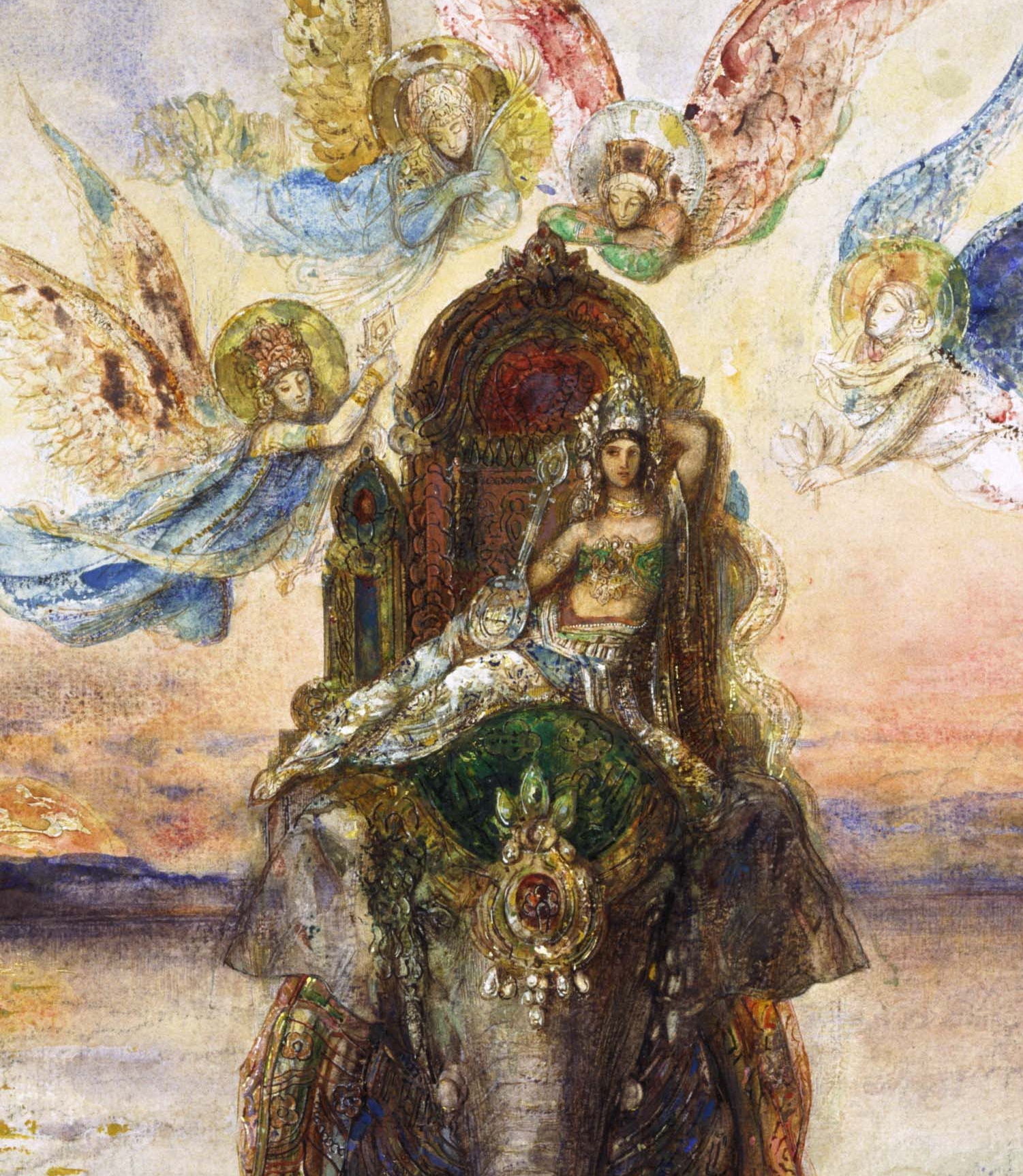
moreausacredelephantd1
Gustave Moreau (1826–1898), The Sacred Elephant (Péri) (detail) (1885-6), watercolour and gouache on paper, 57 x 43.5 cm, National Museum of Western Art 国立西洋美術館 (Kokuritsu seiyō bijutsukan), Tokyo, Japan. Wikimedia Commons.

The mounted goddess holds a stringed instrument, probably a sitar or close relative, and is elaborately decorated. Although at first sight the angels might appear European, they too are drawn from the Indian sub-continent, and are richly embellished, apparently paying tribute to the goddess with flowers and a musical instrument.

moreaulifeofhumanity
Gustave Moreau (1826–1898), La vie de l’humanité (The Life of Humanity) (1879-86), oil on panel, nine panels each 33.5 x 22.5 cm, lunette 37 x 94 cm, Musée National Gustave-Moreau, Paris. Wikimedia Commons.

In 1886, Moreau completed his greatest single work of art, La vie de l’humanité (The Life of Humanity), a large polyptych he had started more than five years previously.

The uppermost lunette shows the figure of Christ, arms outstretched as if still crucified. The uppermost tier of paintings shows the Golden Age of Adam, symbolising childhood. From the left these show morning prayer in the garden of Eden, ecstasy at midday, and repose and sleep in the evening.

The middle tier, from the left, shows the Silver Age of youth in the form of Orpheus and Hesiod: the morning is spent with Hesiod and the muse of inspiration, Orpheus appears at midday with music, then Hesiod returns for the evening, with tears.

The lowest tier, from the left, shows the Age of Fire, with Cain symbolising maturity. The morning shows work, the midday break, and death in the night.

Moreau wrote that these phases of humanity were also phases of life, passing from the purity and innocence of childhood, through the poetic aspirations and sadnesses of youth, to the pain and suffering of adult life, and death, with the redemption of Christ over all. This idiosyncratic combination of Christian symbols with those of myth (Orpheus) and the classical world (Hesiod) gives an important insight into much of his art.

moreautriumphofalexander
Gustave Moreau (1826–1898), The Triumph of Alexander the Great (c 1873-90), oil on canvas, 155 x 155 cm, Musée National Gustave-Moreau, Paris. Wikimedia Commons.

The Triumph of Alexander the Great (c 1873-90) is a magnificent oil painting showing Alexander, dressed in white, sat high on his throne in the foreground. Around him is an extraordinary imagined landscape with imposing buildings forming a gorge, and a stack of grand buildings, towers, and other monumental structures further back. These are set at the foot of a massive rock pinnacle.

Having conquered the Persian (Achaemenid) Empire, in the late spring of 327 BCE, Alexander the Great set his sights on the Indian subcontinent. When he crossed the River Indus and started to campaign in the Punjab, he met determined opposition in the army of King Raja Purushottama, known in the classical literature as King Poros (or Porus).

Alexander fought his last major battle against Poros on the Hydaspes (Jhelum) River, near Bhera, and his own horse Bucephalus was killed during the intense fighting in the summer of 326 BCE. King Poros so impressed Alexander that he made him an ally. Afterwards, Alexander founded Alexandria Nikaia (meaning victory), and his army later revolted near the Ganges River, stopping any further advance into India. Three years later, Alexander the Great died.

Moreau drew on a wide variety of sources for this most elaborate of Indian fantasy cityscapes: miniature paintings of south India, photographs by English travellers, several illustrated books, and Le Magasin Pittoresque, a contemporary illustrated magazine. For example, Geneviève Lacambre has identified within it a borrowed image of a Jain saint from Karnataka (Mysore), India.

His triumph in completing this painting was limited: for the last few years, Moreau’s partner/mistress/muse Alexandrine Dureux had been in poor health. After his mother’s death, she had been his only real friend, and the only woman in his life. On 18 March 1890, she died, aged 51.

In early 1892 Moreau’s teaching studio became one of the three official studios of the École des Beaux-Arts in Paris, the other two being directed by Gérôme and Bonnat. By all accounts he was a popular and respected teacher, and among his more successful students were Georges Rouault, Albert Marquet, and Henri Matisse.

Moreau started work on his last major painting by 1889, and seems to have concentrated on it most in 1894-95. The story at the heart of it is one of the strangest in classical myth, and has never been popular for paintings, despite being drawn from Ovid’s Metamorphoses, Book 3.

Jupiter was the king of the gods according to classical Roman mythology, and the chief deity of the Roman state in classical times. Notoriously promiscuous according to myth, his wife Juno was forever having to deal with his adulterous wanderings. One day he took a fancy to the mortal Semele, a priestess of Jupiter, apparently when she was swimming in a river to cleanse herself of sacrificial blood. Semele became pregnant as a result.

When Juno discovered this, she disguised herself as an old crone and befriended Semele to discover the whole truth, and to sow doubt in Semele’s mind. When she next saw her lover, Semele asked him to grant her a wish. He inevitably agreed, and she asked him to reveal himself in his full glory, so as to prove his divinity.

Jupiter realised that this would put Semele at risk, as being the god of the sky and thunderstorms, she would almost certainly be killed by his divine power. But she insisted, so he gathered his weakest thunderbolts and smallest storms, and revealed himself. Unfortunately Semele was then consumed in flames from Jupiter’s lightning, and died. He rescued the unborn baby, and continued the pregnancy by sewing it into his thigh. The baby was born months later and became Bacchus, who rescued Semele from the underworld, and installed her as a goddess on Mount Olympus.
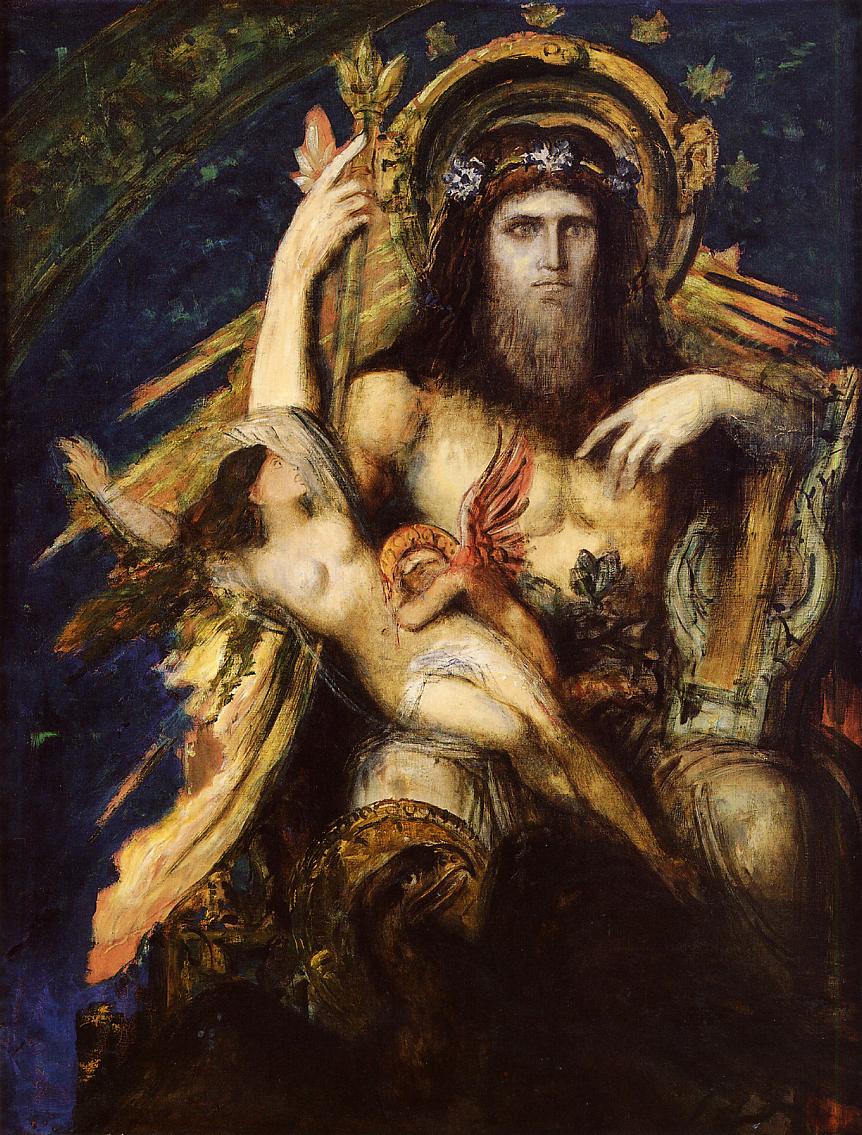
moreaujupitersemelesm
Gustave Moreau (1826–1898), Jupiter and Semele (1889-95), oil, dimensions and location not known. Wikimedia Commons.

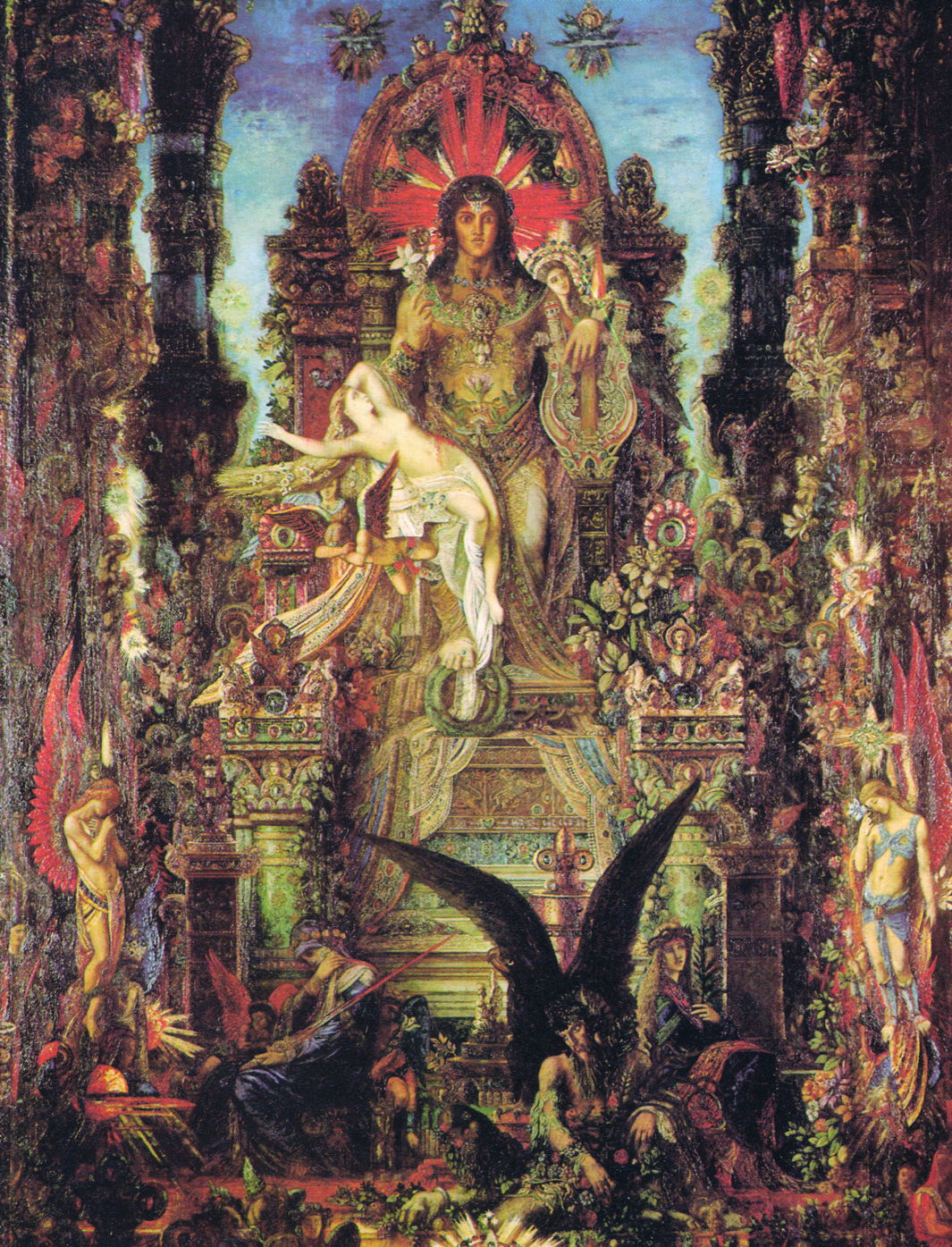
Moreau seems to have worked first on an oil painting showing just Jupiter and Semele in 1889-95. This contains a curious composite of the story, where Semele hasn’t yet been harmed by thunderbolts, but the foetal Bacchus appears to be resting against her, and Jupiter has assumed his divine form. At the foot of the painting is his attribute of an eagle.
moreaujupitersemelelg
Gustave Moreau (1826–1898), Jupiter and Semele (1895), oil on canvas, 212 x 118 cm, Musée Gustave Moreau, Paris. Wikimedia Commons.

That composition then formed the centre of his large masterpiece, also titled Jupiter and Semele, from 1895. Jupiter now sits on a massive throne, with Semele draped over his right thigh. All around them is phantasmagoric detail, drawn from many different myths and cultures, as seen better in the following details.

moreaujupitersemelelgd1
Gustave Moreau (1826–1898), Jupiter and Semele (detail) (1895), oil on canvas, 212 x 118 cm, Musée Gustave Moreau, Paris. Wikimedia Commons.

Jupiter rests his left forearm on Apollo’s lyre. His right hand holds a lotus flower, and his body or clothing is extensively decorated with further floral and botanical images. He looks, eyes wide open, straight ahead. Behind his left shoulder is a woman deity, perhaps his wife Juno.

Semele is statuesque, her arms cast back in shock. Her left side is covered in blood, presumably from where the foetus has been extracted. Her hair flows off in a long, thick tress, decorated like a peacock’s feathers. Below her is a winged Cupid, its face buried in its forearms, in grief at Semele’s imminent doom.

moreaujupitersemelelgd2
Gustave Moreau (1826–1898), Jupiter and Semele (detail) (1895), oil on canvas, 212 x 118 cm, Musée Gustave Moreau, Paris. Wikimedia Commons.

At the lower left of the painting are two prominent figures: a standing winged angel or deity whose identity is obscure, and a seated woman, who is resting her chin in her right hand. She could, by her modest blue robes, be the Virgin Mary, but her left hand holds a long sword covered with blood.

There are many other smaller figures, putti, and other embellishments scattered around.

moreaujupitersemelelgd3
Gustave Moreau (1826–1898), Jupiter and Semele (detail) (1895), oil on canvas, 212 x 118 cm, Musée Gustave Moreau, Paris. Wikimedia Commons.

At the lower right of the painting are three prominent figures: a bearded man covered with flowers and fruit who has small horns on his head, a seated woman who appears to have come from mediaeval legend but is wearing a crown of thorns, and another winged angel at the right edge. The male has a goat’s leg to the left, indicating he is Pan, half human and half goat, according to Moreau’s notes the ‘symbol of the earth’. The black wings behind him belong to a large bird, probably an eagle, Jupiter’s attribute.

The seated woman is harder to interpret. The crown of thorns suggests the figure is Jesus Christ, but he should have a prominent halo and wouldn’t have long, golden tresses of hair. She is also holding a large white lily in her left hand.

Below them is the world of Hecate, ‘the sombre army of the monsters of Erebus’.

moreaujupitersemelelgd4
Gustave Moreau (1826–1898), Jupiter and Semele (detail) (1895), oil on canvas, 212 x 118 cm, Musée Gustave Moreau, Paris. Wikimedia Commons.

Moreau has placed a dazzling array of other images from many different cultures and beliefs at the left side of Jupiter’s throne, some of which can be made out in this detail.

moreaujupitersemelelgd5
Gustave Moreau (1826–1898), Jupiter and Semele (detail) (1895), oil on canvas, 212 x 118 cm, Musée Gustave Moreau, Paris. Wikimedia Commons.

There are even more on the right, with many faces shown in halos, flowers, and more.

In the autumn of 1896, Moreau’s health declined markedly. Although he continued to teach for over a year, until early in 1898, his painting slowed, and from 1897 he worked less frequently, and with the aid of his students. He drew up more detailed plans for his museum, for after his death, ensuring it was left to an appropriate custodian in his will.

Moreau now had advanced cancer of the stomach, and died of that on 18 April 1898, at his home. His museum was officially inaugurated in 1903, and remains open today, the bicentenary of his birth.

References

Hesiod’s Brush, the paintings of Gustave Moreau: 14 Overview and index

Cooke P (2014) Gustave Moreau, History Painting, Spirituality and Symbolism, Yale UP. ISBN 978 0 300 20433 9.
Mathieu P-L (1998, 2010) Gustave Moreau, the Assembler of Dreams, PocheCouleur. ISBN 978 2 867 70194 8.

The bicentenary of Gustave Moreau: 1872-78

By: hoakley
2 April 2026 at 19:30

Once Gustave Moreau had recovered from the trauma of the Franco-Prussian War, he started on his next major works. He had been invited to join the select group of artists who were engaged to paint murals in major public buildings, but declined. Despite that, in 1875 he was made a member of the Legion of Honour, which pleased him and his mother deeply. All he needed now was another success at the Salon.

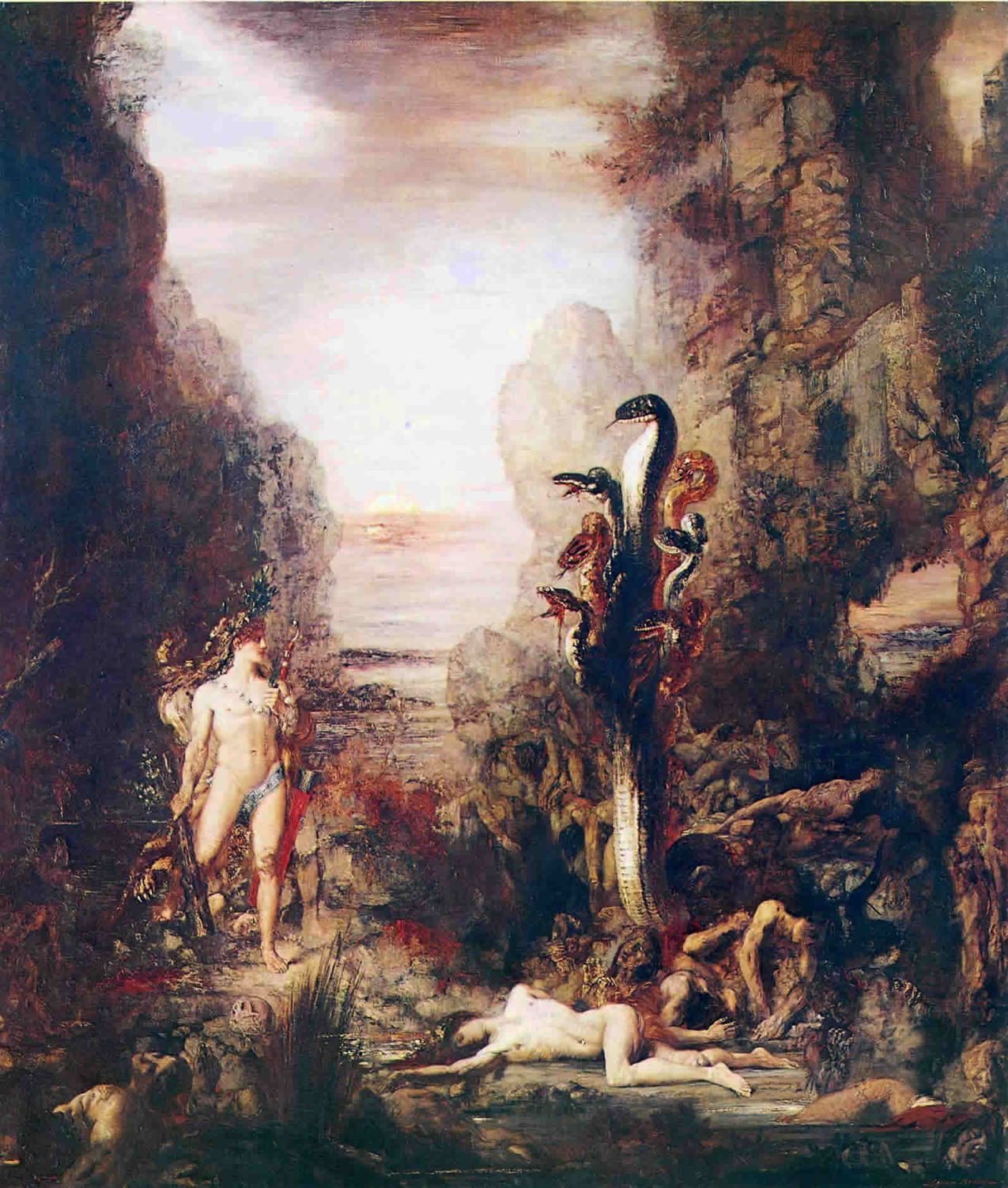
One of his four paintings exhibited at the Salon of 1876 told the second of Hercules’ twelve labours, his battle with the Lernean Hydra.

moreauherculeslerneanhydra
Gustave Moreau (1826–1898), Hercules and the Lernean Hydra (1876), oil on canvas, 175 × 153 cm, The Art Institute of Chicago, Chicago, IL. Wikimedia Commons.

The Hydra was a poisonous monster with the body of a dog and multiple serpent heads, whose breath alone could kill. According to surviving written accounts, Hercules covered his mouth and nose with a cloth for protection from the deadly fumes, fired flaming arrows into the Hydra’s lair to awaken it, then set about trying to kill it.

When he discovered that cutting off its heads with a sickle or sword only resulted in two more growing back, Hercules enlisted the help of his nephew Iolaus, who cauterised the wounds with a firebrand to prevent regrowth. Hercules then cut off the one immortal head using a golden sword given to him by Athena. He also took some of the Hydra’s blood, which was the poison used on the arrow with which he later killed Nessus.

Moreau puts his canvas into its portrait orientation to emphasise the Hydra towering over Hercules, who is fully armed, with club, bow and arrows, and more. The moment chosen is the initial confrontation, with Hercules staring steely-faced at the Hydra. This is consistent with Moreau’s aversion to a more theatrical treatment.

This was well-received and extensively debated, even generating a long-standing controversy over its possible political connotations. It was suggested at the time that the Hydra represented the forces of anarchy behind the insurgency of the Commune in 1871. Others preferred instead that the Hydra represented Bismarck and the German princes behind the Franco-Prussian War of 1870.

Two of his other paintings shown in 1876 were based on the story of Salome and the execution of Saint John the Baptist. Their underlying narrative is biblical, and straightforward. The unnamed daughter of Herodias (subsequently named as Salome) performed a dance at a birthday feast thrown by King Herod. The dance so pleased Herod that he offered her anything that she wanted, up to half his kingdom. She asked not for riches, but for the head of Saint John the Baptist, the earthly messenger sent to announce the birth and ministry of Jesus Christ. Reluctantly, Herod agreed, John was beheaded in prison, and his head brought to her on a plate; the dancer gave the head to her mother.

This has been a popular story for religious paintings, and by far the most common scene involves John’s head being brought on a plate, or variations around that. Moreau was clearly interested in other parts of the story, and in Salome herself. Moreau’s apparently sudden interest in Salome was sparked by the story, probably mythical, of a woman Communard known as the pétroleuse, who seemingly took delight in setting buildings alight. That suggests it wasn’t until the summer of 1871 that he started work on his paintings of Salome.

moreausalome
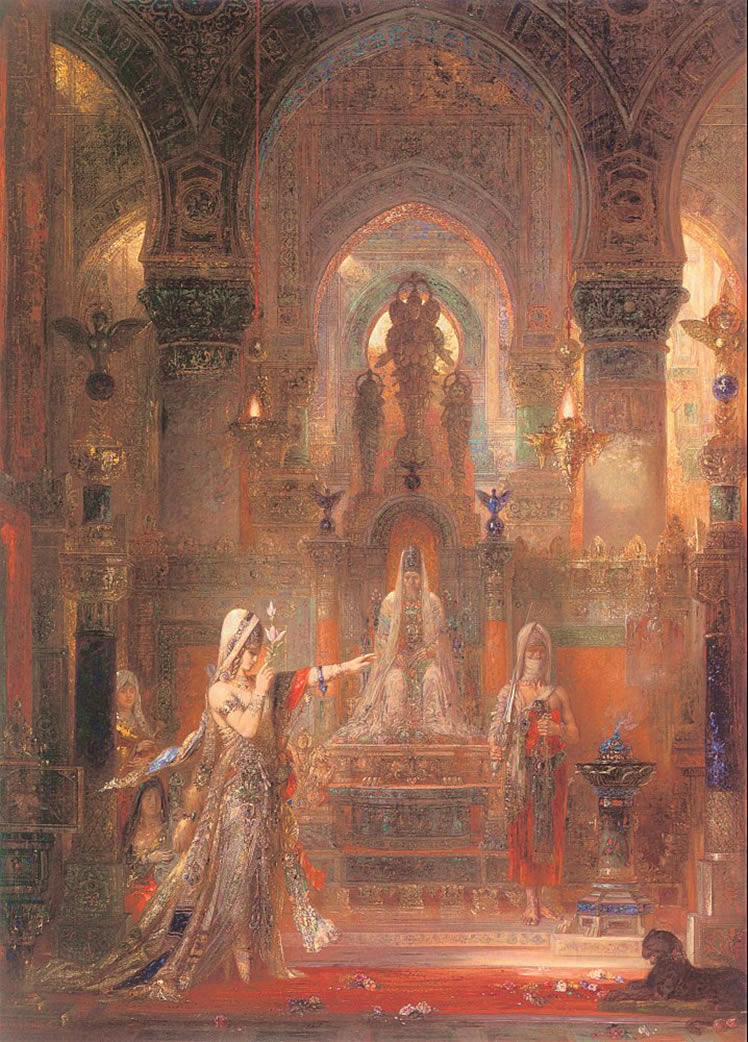
Gustave Moreau (1826–1898), Salome (1876), oil on wood, 144 x 103.5 cm, Armand Hammer Museum of Art, Los Angeles, CA. Wikimedia Commons.

The culmination of Moreau’s quest for the right scene to show the story of Salome the dancer is this extraordinary oil painting shown at the 1876 Salon.

The cadaveric King Herod sits on this throne while Salome is almost static on her points, and pointing towards the right. The executioner stands at the foot of the throne, and a couple of other women (including, perhaps, Salome’s mother) are at the left. Salome holds a lotus flower in her right hand, and other flowers are strewn on the floor. John’s head is nowhere to be seen, so we must presume that the moment selected by Moreau is when Salome chooses to receive that as her reward.

The rest of the painting consists of an unprecedented fusion of images, icons, and objects drawn from a diverse range of cultures. Detailed examination has shown these to be associated with the Hagia Sophia in Istanbul, the Alhambra in Granada, the Great Mosque of Cordoba, and several mediaeval cathedrals. Motifs have been identified from Etruscan, Roman, Egyptian, Indian, and Chinese art and culture.

But Moreau wasn’t content to show only that scene from the story. The other painting was to consider Salome with the head of John the Baptist as an apparition, and is now represented in three different versions.

moreauapparitionmgm
Gustave Moreau (1826–1898), The Apparition (1875), oil on canvas, 142 × 103 cm , Musée National Gustave-Moreau, Paris. Wikimedia Commons.

The Apparition (1875) in the Musée National Gustave-Moreau is one of Moreau’s earliest attempts to express this. It takes the central part of Salome and adds the floating, severed head of John. Salome has now been transformed into the provocative, under-dressed femme fatale shown by subsequent artists. King Herod’s throne has been moved to the left of the painting, and he now looks in the direction of the apparition.

moreauapparitiondorsay
Gustave Moreau (1826–1898), The Apparition (c 1876), watercolour on paper, 106 x 72 cm, Musée d’Orsay, Paris. Wikimedia Commons.

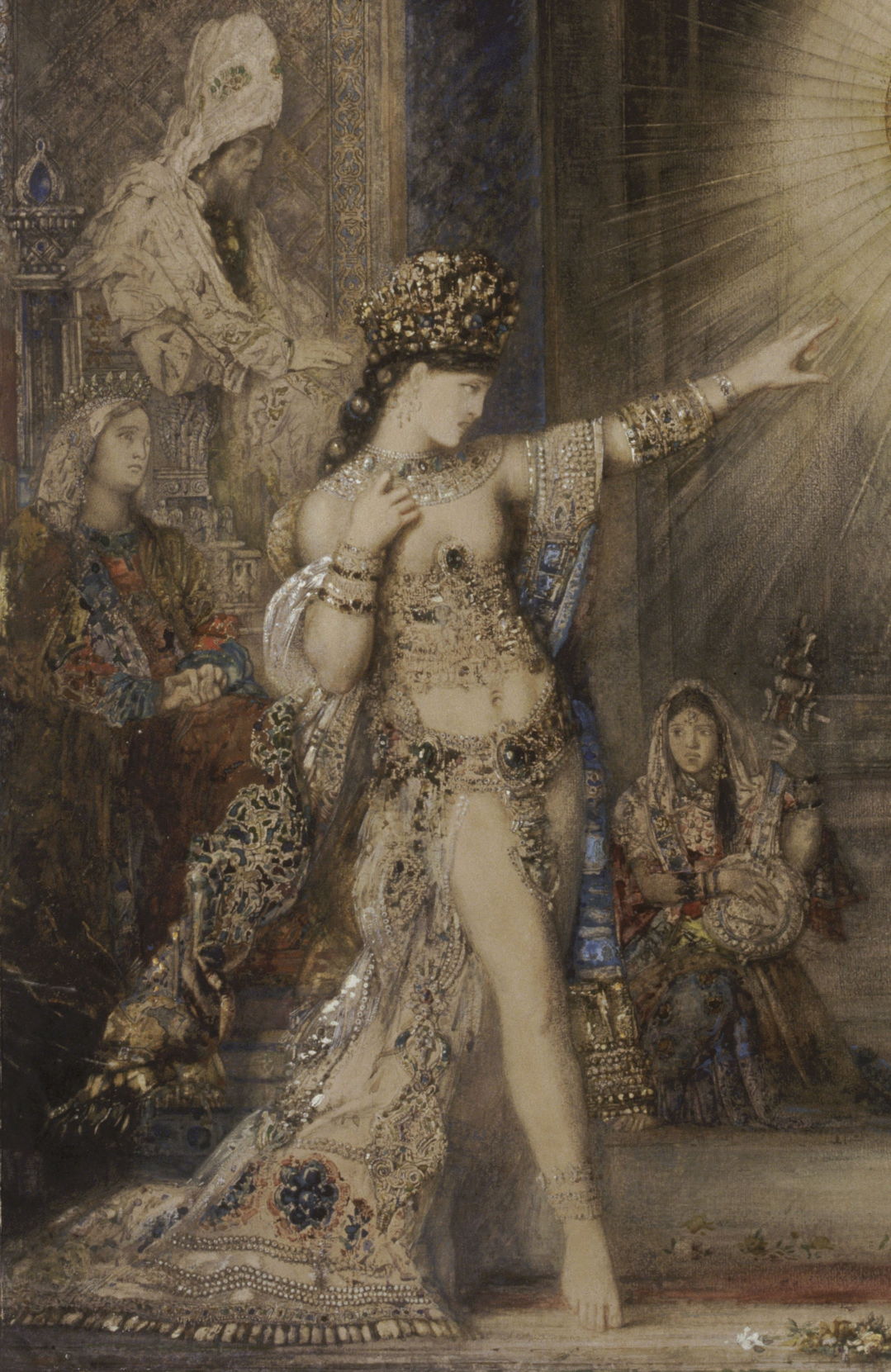
This watercolour painting of The Apparition (c 1876), now in the Musée d’Orsay, was that shown at the Salon, although its colours are far weaker than when it was first exhibited. The cadaveric King Herod sit on his throne, overseeing the scene from the left edge. Herodias, presumably, sits by his feet, and a musician for Salome’s dance is shown further back. At the right edge is the executioner, John’s blood still on his sword.

Salome is now nearly nude, her body decorated with an abundance of strategically-placed jewellery and adornments. She points at the apparition with her left hand, trying to stare it out, her face as blank as everyone else’s. She stands on her points, but there is no sign of movement. The floor isn’t just strewn with flowers, but is now stained with the dripping blood from the severed head.

moreauapparitiondorsayd1
Gustave Moreau (1826–1898), The Apparition (detail) (c 1876), watercolour on paper, 106 x 72 cm, Musée d’Orsay, Paris. Wikimedia Commons.

Facial expressions are not theatrical as might have been expected in the work of a more conventional history painter of the day.

moreauapparitionfogg
Gustave Moreau (1826–1898), The Apparition (1876-77), oil on canvas, 55.9 x 46.7 cm, Harvard Art Museums/Fogg Museum (Bequest of Grenville L. Winthrop), Cambridge, MA. Courtesy of Harvard Art Museums.

This slightly later oil version of The Apparition (1876-77), now in the Fogg Museum, gives a better idea of the original effect of Moreau’s watercolour, although the panther has moved across to replace the musician, and the background is quite different.

Moreau hadn’t painted Salome and The Apparition as a pair. Their compositions are individual, and mutually conflicting in details of the palace, the position of Herod’s throne, and more. Salome is one of the most iconographically rich paintings ever made, and it’s not surprising that some critics found it phantasmagoric. The Apparition is dominated by the same eye-to-eye contact that made Moreau’s Oedipus and the Sphinx so compelling, but here it’s between a notorious dancer and the severed head of the holiest man after Christ himself.

In 1877, the year after that Salon, Gustave Flaubert published three short stories, including an extended account of the traditional biblical narrative with Herodias at its centre. The British writer Oscar Wilde was introduced to that by Walter Pater (philosophical leader of Aestheticism), and in 1884 Joris-Karl Huysmans’ À rebours was published, a novel including a description of Moreau’s Salome paintings.

Wilde’s one-act play Salome was first published in French in 1891, and was soon translated into English and German. Banned from public performance in Britain, it received its premier in Paris in 1896, but wasn’t performed in public in England until 1931. At the centre of Wilde’s play is the perversion of lust and desire in Salome, best summarised in her words at the end of the play (he calls John the Baptist Jokanaan):
But, wherefore dost thou not look at me Jokanaan? Thine eyes that were so terrible, so full of rage and scorn, are shut now. Wherefore are they shut? Open thine eyes! Lift up thine eyelids, Jokanaan! Wherefore dost thou not look at me? Art thou afraid of me, Jokanaan, that thou wilt not look at me?
If thou hadst looked at me thou hadst loved me. Well I know that thou wouldst have loved me, and the mystery of love is greater that the mystery of death.

After seeing Wilde’s play performed in Berlin in 1902, Richard Strauss resolved to turn it into an opera. He started work on that in the summer of the following year, and Salome was completed and premiered in 1905. A year later, the dancer and choreographer Maud Allan produced a show called Vision of Salomé in Vienna, featuring a notorious version of the Dance of the Seven Veils, Wilde’s title for the dance of Salome before Herod, included in Strauss’s opera. The name quickly became a euphemism for a striptease, and the growing popularity of Salome as an erotic figurehead was named Salomania.

In around fifty years, from the appearance of Moreau’s The Apparition at the Salon in Paris, the traditional story of Herodias obtaining her vengeance by exploiting her daughter’s dance before Herod has been all but forgotten. The martyrdom of the second holiest figure in the gospels has been transformed into a perverse confusion of sex and death. The anonymous daughter of a woman who married her divorced husband’s brother has become the ultimate femme fatale: beautiful, sexy, and dangerous to know. Most unusually this change in story was largely triggered and driven by a painting: Moreau’s The Apparition.

Moreau was then concerned with the preparation of other paintings for the Exposition Universelle of 1878 in Paris.

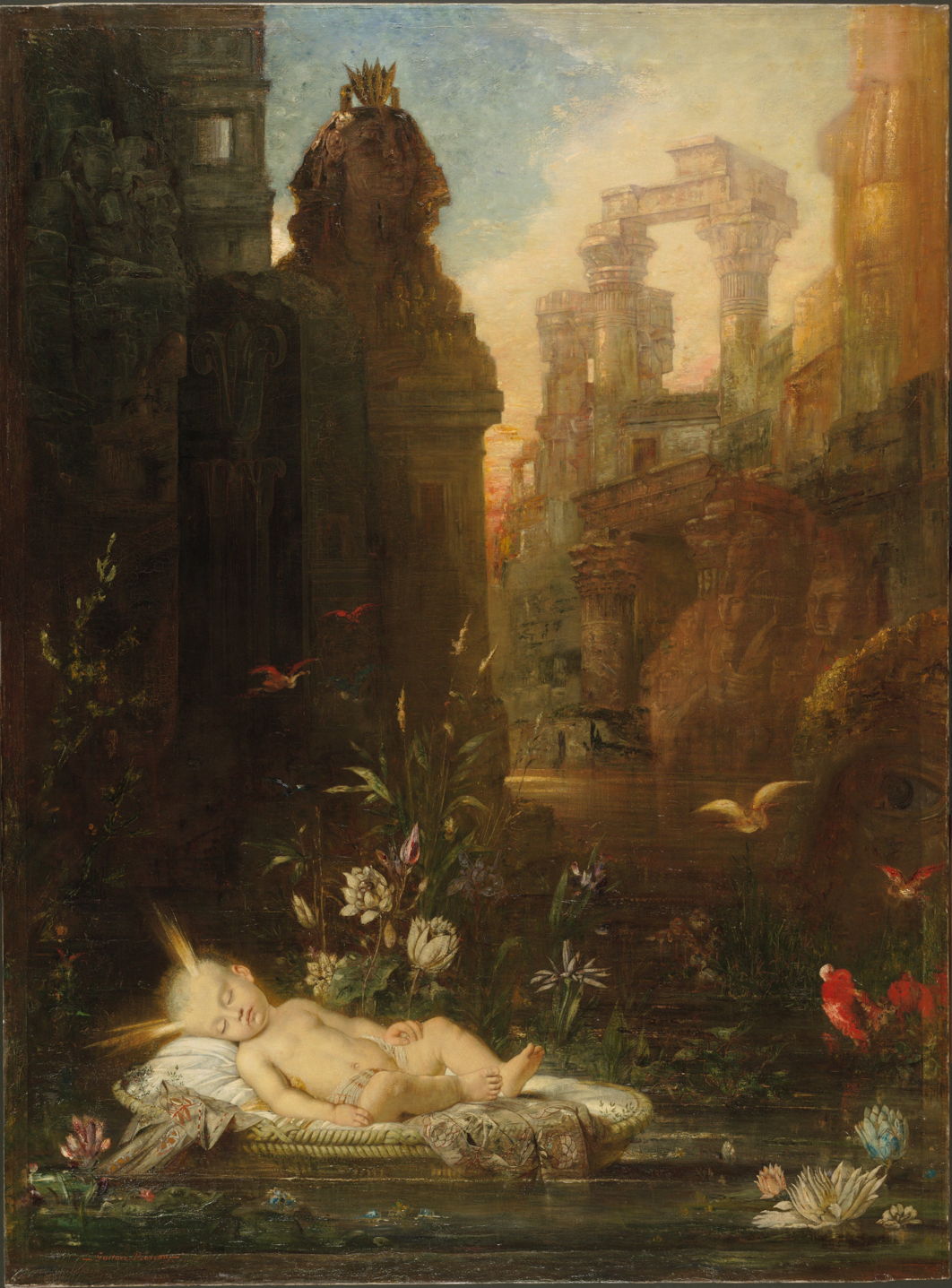
moreauinfantmoses
Gustave Moreau (1826–1898), Moïse Exposé sur le Nil (The Infant Moses) (c 1876-78), oil on canvas, 185 x 136.2 cm, Harvard Art Museums/Fogg Museum (Bequest of Grenville L. Winthrop), Cambridge, MA. Courtesy of Harvard Art Museums, via Wikimedia Commons.

Infancy and dawn are themes in Moïse Exposé sur le Nil (The Infant Moses) (c 1876-78), a radiantly beautiful depiction of the infant Moses asleep, prior to his discovery in the bullrushes. Moses is new life, new Judaeo-Christian beliefs, new law, and the new regime. Set against a background derived from photographs of Egyptian ruins symbolising the ancient, pre-Jewish, and decaying, it laid out Moreau’s hope for the French nation.

The baby Moses is marked out as being holy by the rays emanating from his temples, and surrounded by exotic flowers and birds. Most unusually, Moreau doesn’t show the traditional and popular moment of discovery of the infant in the bullrushes, but a static scene beforehand.

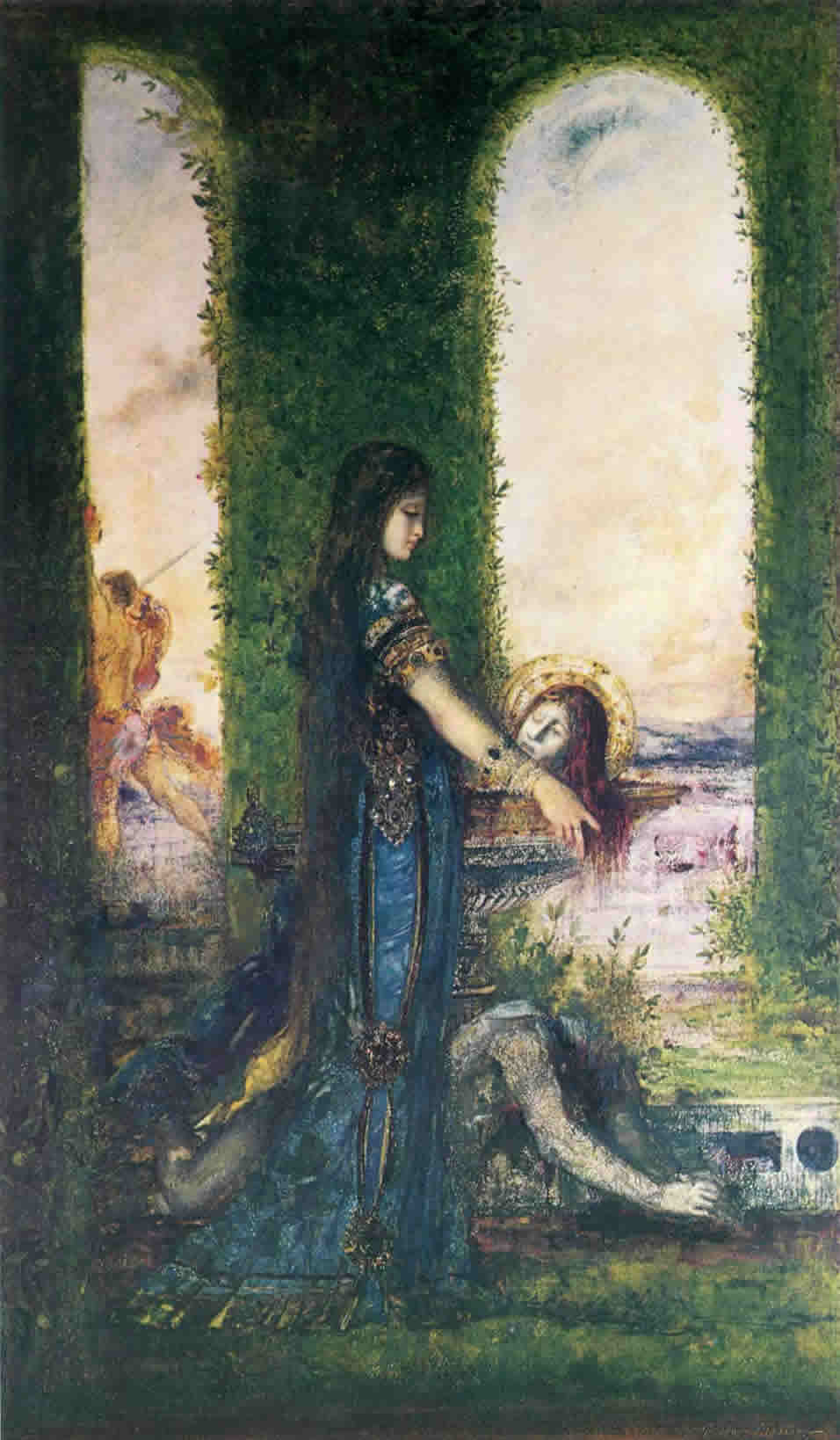
moreausalomeinthegarden
Gustave Moreau (1826–1898), Salome in the Garden (1878), watercolour on paper, dimensions not known, Private collection. Wikimedia Commons.

Moreau revisited his new myth of Salome and John the Baptist, in his strange watercolour of Salome in the Garden (1878). A beautiful and decorated figure of Salome is walking in an overgrown garden, carrying the severed head of John the Baptist on a large platter. Her eyes are closed, or perhaps looking down at the head, and John’s eyes are closed. Beside her is a headless statue of a man crawling, which could perhaps be the body of John, and outside is a man, possibly the executioner waving his sword.

References

Cooke P (2014) Gustave Moreau, History Painting, Spirituality and Symbolism, Yale UP. ISBN 978 0 300 20433 9.
Mathieu P-L (1998, 2010) Gustave Moreau, the Assembler of Dreams, PocheCouleur. ISBN 978 2 867 70194 8.
The bicentenary of Gustave Moreau: 1852-1871

By: hoakley
27 March 2026 at 20:30

The great Symbolist painter Gustave Moreau was born almost two centuries ago, on 6 April 1826. To mark his bicentenary early next month, this short series outlines his career in a small selection of his more important paintings. They are at once history, symbolic explorations, as phantasmagoric as the most radical of William Blake or Odilon Redon, and torrents of figures and forms drawn from all human cultures. They’re elaborate, complex, and appear to defy reading.

Moreau was a precocious artist who started copying in the Louvre, in his native Paris, when he was only seventeen. A year later he started attending a private studio run by François-Édouard Picot, to prepare him for the entrance exam for the École des Beaux-Arts. In Picot’s studio, he learned the methods to which he adhered for the rest of his career: each painting started with a series of drawings, which developed both composition and details. The final drawing was squared up on a grid, to enable its transfer to canvas, where he painted conventionally in oils, using layers.

He was admitted to the École des Beaux-Arts in 1846, and decided to be a history painter. He competed twice for the Prix de Rome, which would have taken him to continue his studies in Rome, but was unsuccessful on both occasions. He therefore left the École in 1849, and started making a precarious living with small commissioned works including favourite scenes from the plays of Shakespeare. His work changed markedly in 1851, the year that JMW Turner died, when he befriended Théodore Chassériau, a former pupil of JAD Ingres; Moreau set up his first studio near Chassériau’s, and started painting more ambitious works to submit to the Salon.

moreaujudgementofparis
Gustave Moreau (1826–1898), The Judgement of Paris (1852), watercolor on paper, 40.7 × 48.3 cm, Private collection. Wikimedia Commons.

The Judgement of Paris (1852) is one of his early watercolours, showing great promise of things to come. At its heart is a fairly faithful representation of this classical myth, in which Paris (right of centre) is deciding which of Hera, Athena, and Aphrodite is the most fair, and should be awarded the golden apple given by Eris from the Garden of the Hesperides.

moreauapolloninemuses
Gustave Moreau (1826–1898), Apollo and the Nine Muses (1856), oil on canvas, dimensions not known, Private collection. The Athenaeum.

Apollo and the Nine Muses (1856) is another significant step towards his mature work. Apollo, a young and surprisingly androgynous figure, sits in the foreground, his distinctive lyre part-hidden under his right foot. To the right of him is a wild rose, with both white flowers and red hips. The muses cluster on a small mound behind that, equipped for and engaged in their respective arts.

That year, his friend and mentor Chassériau died at the age of only 37. Moreau was devastated, and decided to travel to Italy to complete his education as a painter and resolve his future. From October 1857 to June 1858, he copied Renaissance paintings in Rome, then moved on to Florence, Milan, and Venice. He finally returned to Paris in September 1859, having made about a thousand copies in less than two years. He had also met and made friends with several other artists, including Edgar Degas and James Tissot.

moreauhesiodandmuses
Gustave Moreau (1826–1898), Hesiod and the Muses (1860), oil on canvas, 155 × 236 cm, Musée National Gustave-Moreau, Paris. Wikimedia Commons.

Hesiod and the Muses (1860) is probably the first of Moreau’s novel history paintings, and the first of a series of works showing Hesiod, generally considered to be the first written poet in the Western tradition to exist as a real person, and to play an active role in his poetry. Hesiod is the young man holding a laurel staff in his right hand, to the left of centre.

There are four swans on the ground, and one in flight above Hesiod, a winged Cupid sat on the left wing of Pegasus, and a brilliant white star directly above the winged horse. However, the Cupid and Pegasus were only added in about 1883, when the canvas was extended.

Moreau met his mistress and muse Alexandrine Dureux (whom he never married, both remaining single) that year, and set her up in a nearby flat, where she lived until her death in 1890.

By 1864, he had abandoned three attempts to produce a radical work for the Salon. However, he had been working on something different, that he completed during the winter of 1863-4: Oedipus and the Sphinx (1864)

moreauoedipussphinx
Gustave Moreau (1826–1898), Oedipus and the Sphinx (1864), oil on canvas, 206.4 x 104.8 cm, The Metropolitan Museum of Art (Bequest of William H. Herriman, 1920), New York, NY. Courtesy of The Metropolitan Museum of Art, via Wikimedia Commons.

This was a bold move. Not only was this painting startlingly original and different, but it visited a motif that had recently resulted in Ingres’ success at the Salon, in 1827. Just as Oedipus is seen to be staring out the fearsome sphinx, so Moreau was visibly challenging his seniors.

This shows a key scene from Sophocles’ tragedy Oedipus the King. The sphinx had effectively put the ancient Greek city of Thebes under siege, by sitting outside and refusing to let anyone pass unless they answered a riddle correctly. Those who failed to do that it killed by strangulation. When Oedipus arrived, intending to enter Thebes, the sphinx asked him “Which creature has one voice and yet becomes four-footed, two-footed, and three-footed?” Oedipus solved this in his answer of humans, who crawl when a baby, walk on two feet as an adult, then walk with a stick when old. The defeated sphinx then threw itself into the sea below, Oedipus entered Thebes, was awarded the throne of Thebes in return for destroying the sphinx, and married its queen Jocasta, who turned out to be his mother.

moreauoedipussphinxd1
Gustave Moreau (1826–1898), Oedipus and the Sphinx (detail) (1864), oil on canvas, 206.4 x 104.8 cm, The Metropolitan Museum of Art (Bequest of William H. Herriman, 1920), New York, NY. Courtesy of The Metropolitan Museum of Art, via Wikimedia Commons.

The apparently emotionless faces of Oedipus and the sphinx are not an attempt to reject facial expression as a narrative tool. In fact, they confirm its value. The pair are engaged in staring intently into one another’s eyes, in the way that poker players might, almost eyeball to eyeball. The most plausible moment to be shown here is the brief interval between the sphinx asking its riddle, and Oedipus answering it.

The sphinx has already latched onto the front of what it comfortably assumes is going to be another, rather delectable victim. Its forelegs are ready to reach up and strangle him once he guesses the wrong answer, and its hindlegs are ready to unsheath claws and walk up, burying them in his flesh. The sphinx is ready to prove itself a femme fatale for Oedipus.

Oedipus knows that he cannot falter. A false guess, even a slight quaver in his voice, and this beautiful but lethal beast will be at his throat. His left hand clenches his javelin, knowing that what he is about to say should save his life, and spare the Thebans. He will then no longer be pinned with his back to the rock, and the threat of the sphinx will be gone.

moreauoedipussphinxd2
Gustave Moreau (1826–1898), Oedipus and the Sphinx (detail) (1864), oil on canvas, 206.4 x 104.8 cm, The Metropolitan Museum of Art (Bequest of William H. Herriman, 1920), New York, NY. Courtesy of The Metropolitan Museum of Art, via Wikimedia Commons.

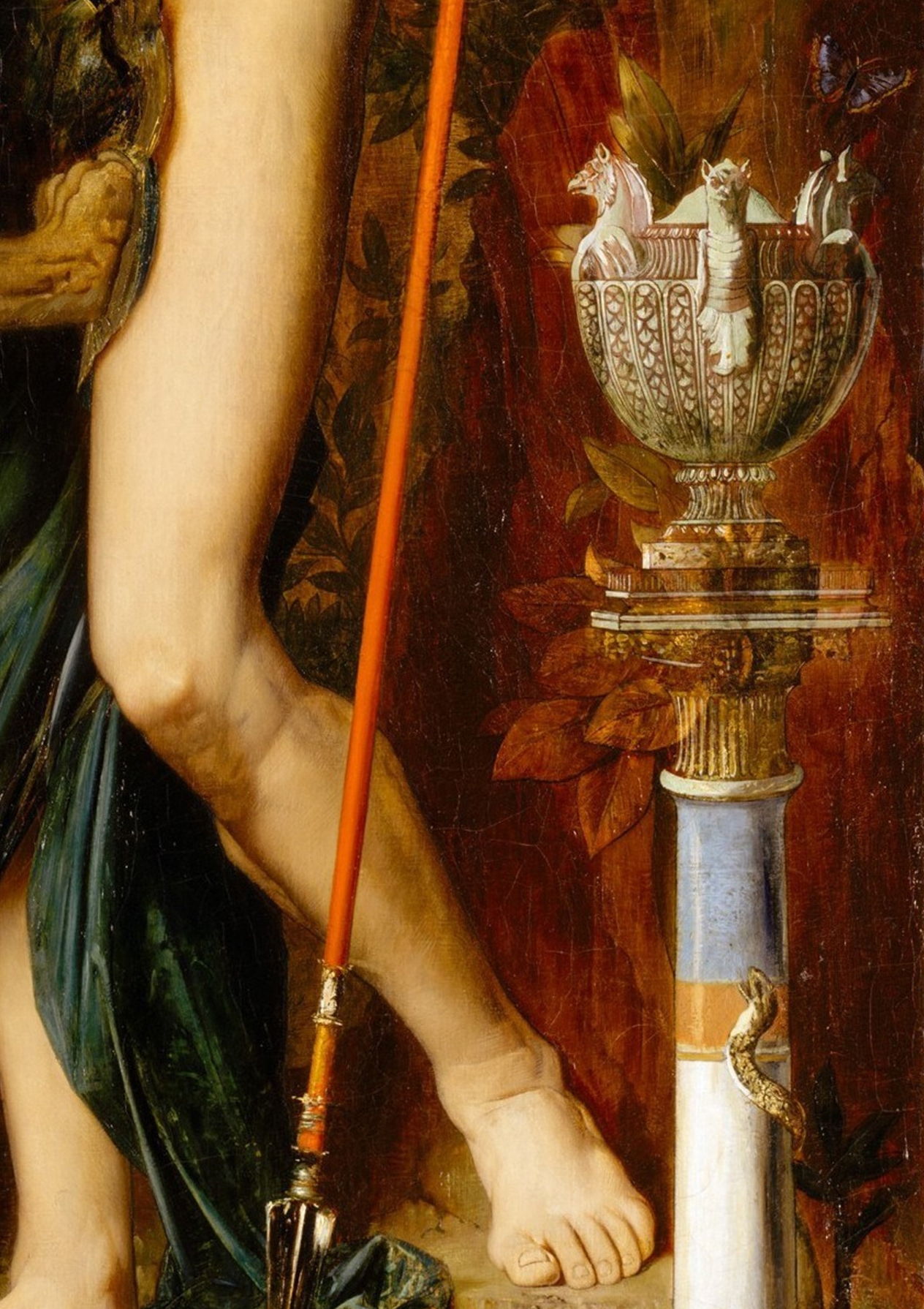
Around this central narrative core, Moreau feeds us symbolic morsels to supplement that main course without supplanting it. Behind Oedipus is a bay tree, sacred to Apollo, representing man’s highest achievements; behind the sphinx is a fig tree, a traditional symbol of sin. The small polychrome column at the right is topped by a cinerary urn, symbolising death, and above it is a butterfly, representing the soul. Ascending the column is a snake, again associated with death, and through the biblical serpent, with sin.

Moreau’s bold move worked, as Oedipus and the Sphinx took the Salon of 1864 by storm, winning him a medal. The following year, he tried to consolidate that success with Jason.

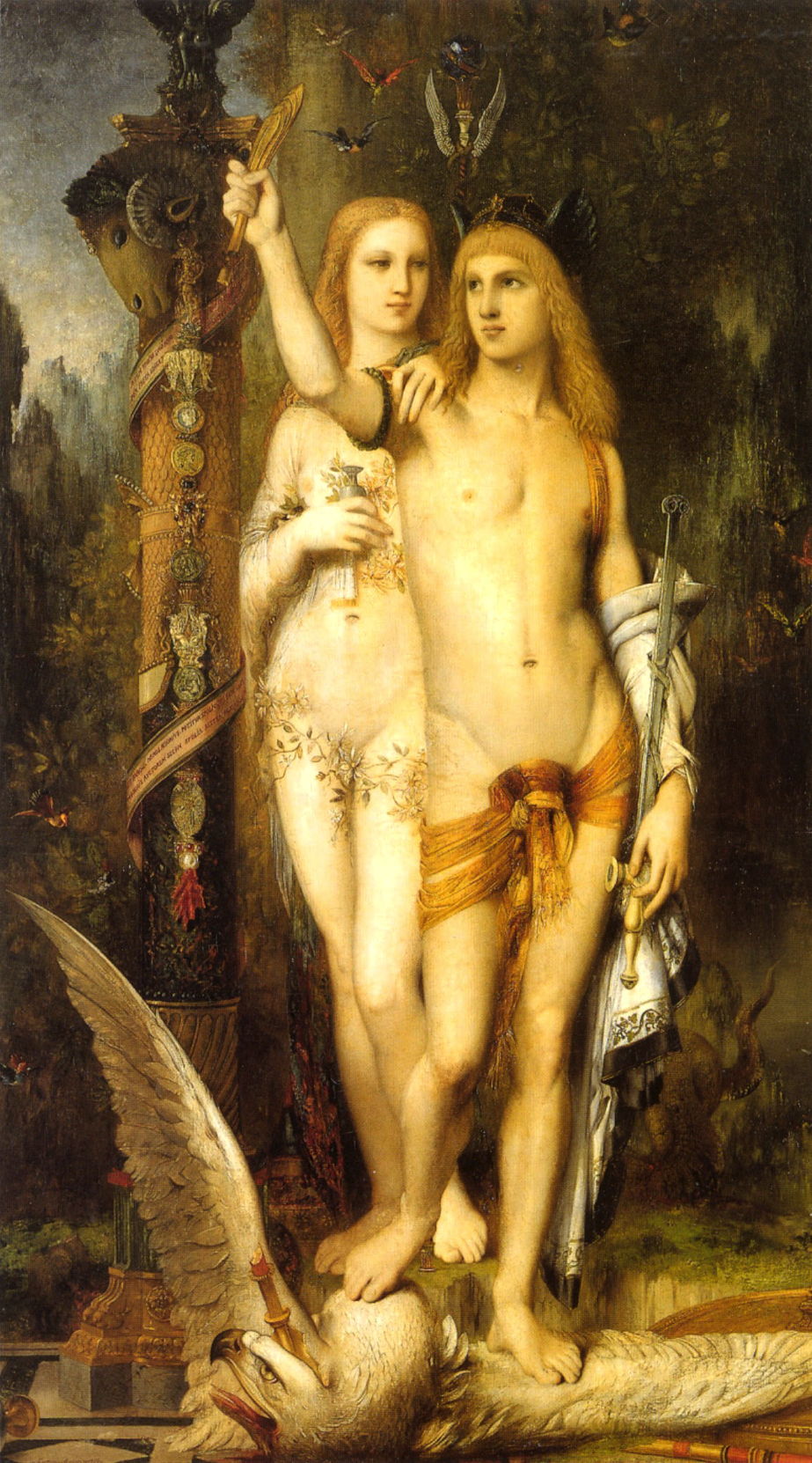
moreaujason
Gustave Moreau (1826–1898), Jason (1865), oil on canvas, 204 × 115 cm, Musée d’Orsay, Paris. Wikimedia Commons.

The name Jason refers, of course, to Jason of Golden Fleece and Argonauts fame, a series of swashbuckling adventures offering ample opportunities for theatrical narrative painting. Moreau avoids them all, and shows us a static Jason, with Medea stood behind him, not a Golden Fleece in sight. Instead of providing narrative, the artist offers us symbols as clues to what might be going on.

The broad outline of Jason’s story is simple. When he reached Colchis, he underwent a series of trials imposed by King Aeëtes, culminating in his victory over the dragon guarding the Golden Fleece. These were accomplished with the help of Medea, the King’s daughter, in return for a promise of marriage.

The almost naked woman behind Jason is Medea, the sorceress who has fallen in love with the hero. The ram’s head at the top of the pillar on the left signifies the Golden Fleece, and the dragon which guarded it is shown as the eagle on which Jason is standing, with the broken tip of his javelin embedded in it. This is the more confusing, as in the original story the dragon was put to sleep by one of Medea’s potions, rather than being killed with a javelin.

Yet Medea holds a vial in her right hand, and her body is swathed with the poisonous hellebore plant, a standard tool of witchcraft. These may allude to Jason’s future rejection of Medea and her poisoning of his replacement bride, but there is a lot of story between this moment and that later episode, so that is speculative and hardly clarified by the painting.

Moreau provided some clues to his intentions in this painting, in the almost illegible inscriptions on the two phylacteries wound around the column. These bear the Latin:
nempe tenens quod amo gremioque in Iasonis haerens
per freta longa ferar; nihil illum amplexa timebo

(Nay, holding that which I love, and resting in Jason’s arms, I shall travel over the long reaches of the sea; in his safe embrace I will fear nothing)
et auro heros Aesonius potitur spolioque superbus
muneris auctorem secum spolia altera portans

(And the heroic son of Aeson [i.e. Jason] gained the Golden Fleece. Proud of this spoil and bearing with him the giver of his prize, another spoil)
(Cooke, pp 55-56.)

These could be interpreted as suggesting that the painting should be read in terms of the conflict between Jason and Medea: Medea expresses her subjugate trust in him, while Jason considers her to be just another spoil won alongside the Golden Fleece. More puzzling is the spattering of other details, of hummingbirds, the sphinx on top of the pillar, medals decorating the shaft of that pillar, and more. Some appear merely to be decorative, but drawing the line between the decorative and the symbolic is impossible.

The end result in Jason is almost the opposite of Oedipus and the Sphinx: the latter consists of a clear narrative lightly embellished with symbols, the former relies on the interpretation of symbols to construct any narrative; as those symbols conflict with the original narrative, the viewer can readily become bewildered.

The 1865 Salon didn’t provide the consolidation for which Moreau had hoped, although much of that was the result of an accident of history: dominating all discussion that year was another painting, Manet’s Olympia. He needed to do better in 1866 if he wasn’t going to slip back into obscurity.

moreauorpheus
Gustave Moreau (1826–1898), Orpheus (1865), oil on panel, 154 × 99.5 cm, Musée d’Orsay, Paris. Wikimedia Commons.

In Moreau’s Orpheus (1865) a sombrely-dressed Thracian woman holds Orpheus’ lyre, on which rests his head, blanched in death, as if affixed to the lyre like the head of a hunting trophy. Her eyes are closed in reverie.

One version of the legend of Orpheus’ death holds that his head and lyre were borne by the river Hebrus, which is shown in the background landscape to the right. Again, though, Moreau pursues his own adjusted version of the written narrative, as according to that account (in Ovid’s Metamorphoses, book 11), the head and lyre were washed up on the coast of Lesbos.

Orpheus adopts a unified tonality, colour, form, character, and style that could be viewed as a ‘mode’, as conceived by Nicolas Poussin. The gentle and natural beauty of the Thracian woman, her ornate clothes, flowers, and the strange beauty of Orpheus’ head on the lyre contrast with a harsh and barren landscape, which might have been more appropriate in a Renaissance painting, perhaps by Leonardo da Vinci.

Moreau has carefully avoided elaborate symbols and decoration, although he has left us two further puzzles at the painting’s corners: the three figures, apparently shepherds, on the rocks at the upper left, and a pair of tortoises at the lower right. The figures refer to music, which seems in keeping with Orpheus and his lyre, but the significance of the tortoises is open to speculation.

moreauorpheusd1
Gustave Moreau (1826–1898), Orpheus (detail) (1865), oil on panel, 154 × 99.5 cm, Musée d’Orsay, Paris. Wikimedia Commons.

What Moreau lost in the absence of narrative, this painting gained in its remarkable tranquillity. Two faces, eyes closed, (don’t) look at one another. The intricate decoration of the lyre seems unified with the Thracian woman’s clothing, even the coiled braids of her hair. Although one of his most profoundly beautiful and moving paintings, this failed to impress the Salon.

In 1868-9 he turned to one of the most frequently painted stories from Greek mythology, that of the abduction and rape of Europa. She was the mother of King Minos of Crete, and the story of Cretan origin; the bull was the main sacred animal in Crete. Zeus (Jupiter to the Romans), a notorious ravisher of women, lusted after the beautiful Europa. He therefore metamorphosed himself into a white bull, and hid among Europa’s father’s herd in Phoenicia. When Europa and other maidens came to gather flowers near this herd, she saw the white bull, caressed it, and climbed onto its back.

Zeus then ran to the sea and swam with Europa on his back until they reached the shores of Crete. There he revealed himself, and Europa became the first queen of the island. He gave her in return a necklace, Talos (a giant bronze automaton who protected Crete by circling its shores), Laelaps (an unfailing hunting dog), and a javelin that always struck its target.

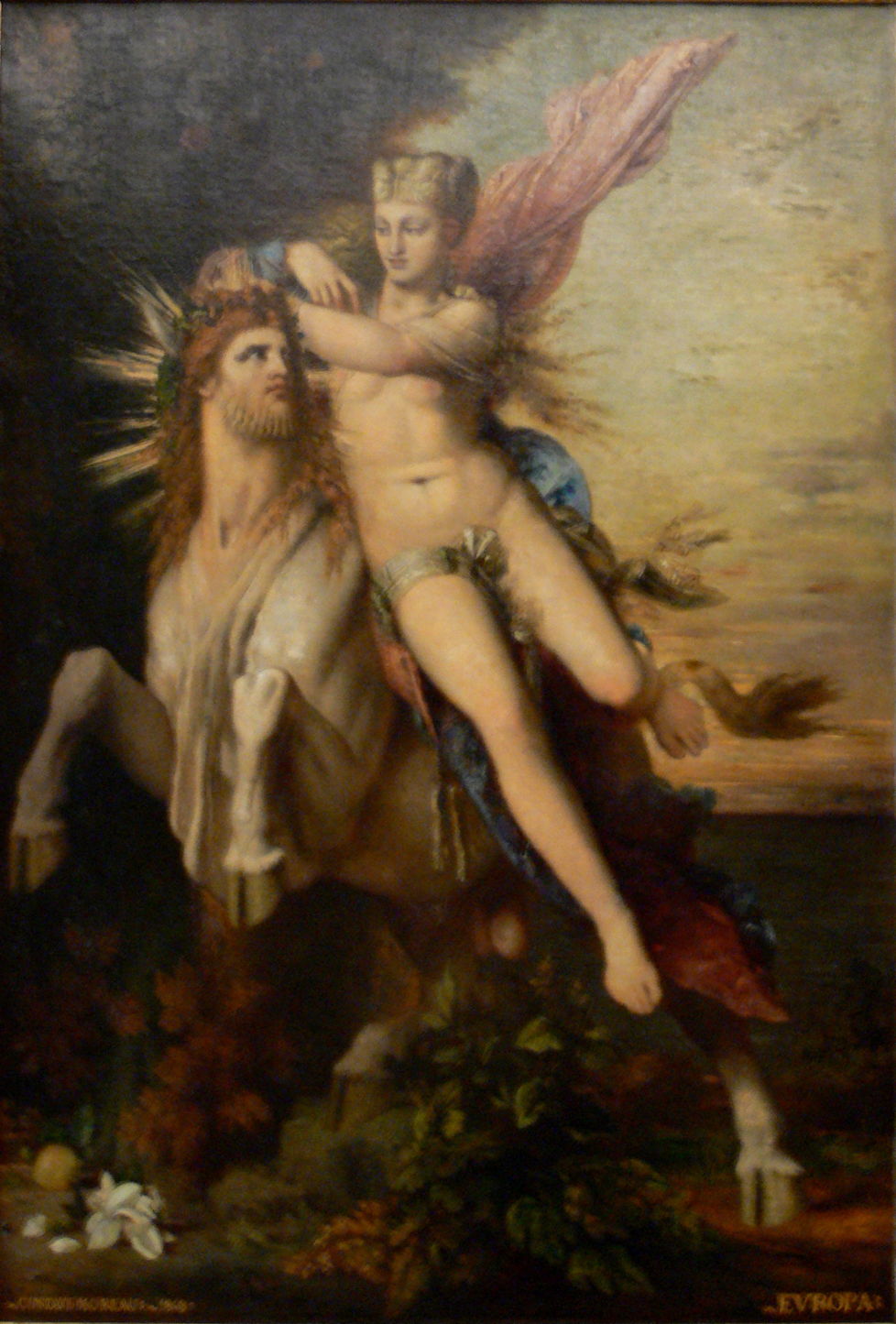
Almost universally, previous depictions of this myth have shown the start of the abduction, from the pastures of Phoenicia to the bull heading off to sea. Moreau’s white bull, with Europa riding a precarious side-saddle, has just emerged from the sea, so is presumably now on the island of Crete.

moreaujupitereuropa
Gustave Moreau (1826–1898), Jupiter and Europa (1868-9), oil on canvas, 175 x 130 cm, Musée National Gustave-Moreau, Paris. Wikimedia Commons.

The finished work, known as Jupiter and Europa (1868-9) (I apologise for the lack of sharpness in this image) but titled Europa, shows the bull with a human head, presumably as Zeus has revealed himself to Europa. The head of Zeus recalls those of sculptures of Assyrian kings.

It’s hard to see what Moreau brought in terms of originality to this well-worn motif, and the critics drew comparison with Veronese rather than Titian. Either way, this seems to be a painting in search of a reason, and the Salon agreed. As there was now a small but dedicated group of collectors who were prepared to purchase his paintings, Moreau decided to withdraw from exhibiting at the annual Salon.

In the Franco-Prussian War, Moreau joined the National Guard, and served in the defence of Paris in the autumn of 1870, besieged there with his mother. Over the winter his left shoulder and arm became immobile because of ‘rheumatism’, but he remained in the city. Finally, during the Commune in the spring of 1871, he defended the paintings he had amassed in his home, and watched his late friend Chassériau’s murals in the Cour des Comptes being destroyed by fire. He spent that summer recovering in the spa at Néris-les-Bains in the Auvergne.

References

Cooke P (2014) Gustave Moreau, History Painting, Spirituality and Symbolism, Yale UP. ISBN 978 0 300 20433 9.
Mathieu P-L (1998, 2010) Gustave Moreau, the Assembler of Dreams, PocheCouleur. ISBN 978 2 867 70194 8.
❌
❌