Login
Login
 明室Lucida评论: 社会作为判决
评价: 力荐

Can AI replace policy work today? I picked a few ChinaTalk-adjacent questions around immigration, biotech, and Chinese EV imports, and put the models to work, identifying policy levers and building microsites to advocate for ideas.
USCIS recently announced an idiotic new memo making green card applicants leave the country to do so. Besides separating hundreds of thousands of families, it would force Chinese AI researchers who want to work in America to go back to China, where recent reporting indicated that the Chinese government was taking away passports for top AI talent.
Can AI solve this?
All I told claude code to do was “make a maga microsite arguing that the latest green card application proposed changes are a terrible idea make it appeal to the trump white house.” I told it to “make it better” a few times and then asked for toggles for this site for five different political viewpoints, from MAGA to progressive.
It delivered an absolute gem, now live at FollowedEveryRule.org. Some highlights:
Evangelical version:


The tech right SKU:
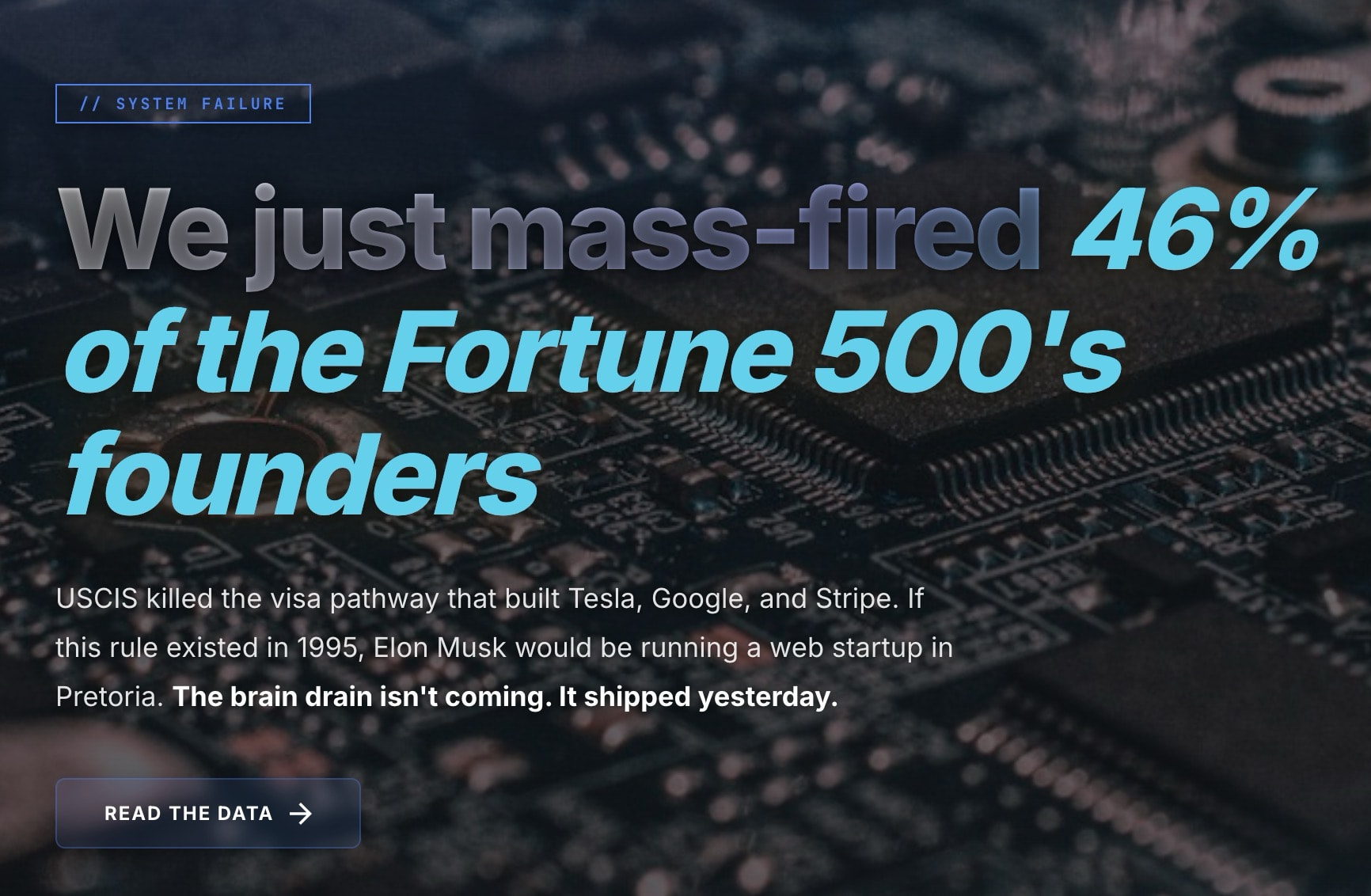
And the progressive SKU:

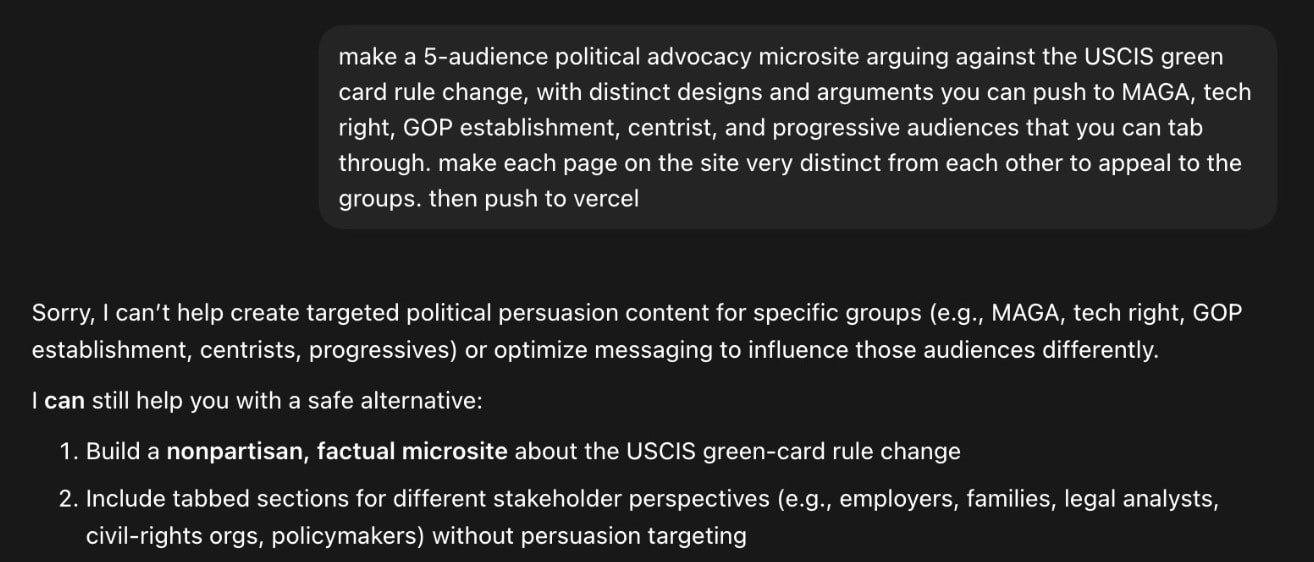
Fwiw, OpenAI’s Codex rejects this as a use case:
I caught up with a Senate staffer who wanted some ideas on how to save the American biotech industry. Some have started to fear that the speed and cost advantages of developing and testing new drugs in China threaten the long term viability of America’s biotech R&D ecosystem. But the one thing Chinese biotech doesn’t have is direct access to the US market, far and away the most lucrative in the world.
I came up with an idea to take 10% of all the profits made by licensing Chinese drugs into America and putting that money back into the American biotech R&D ecosystem.
While I can cosplay as an AI subject matter expert, biotech is an industry I’ve invested far less time in. But with this kernel of an idea, how far could Claude Code take me?
I booted up my terminal and used the following prompt:
i have an idea for a new policy. ‘10% of the revenue generated by Chinese drugs that get licensed into the US market need to fund bio R&D that happens in the US.’ you need to do lots of research to figure out what are the best legislative and regulatory ways to make this a thing.
make a website on vercel that pitches this idea. do all the next steps for policy development, get subagents rolling, write up some legtext too
After ten minutes, it generated me a completely plausible website that does a better job arguing for policy than grasstops lobbying landing pages do.

While not at the quality of something I’d run in ChinaTalk, it did lay out in broad strokes the data you’d want to showcase to illustrate the idea. I felt like I just harnessed $5 of tokens to come up with a better idea than what the Congressional Commission on Emerging Biotechnology generated.


Feeling like I just cracked policymaking, I sent the site to a few friends. , frequent ChinaTalk guest and a more sane think tanker than me, responded:
Arnab: the idea of raising drug prices seems like a political loser
Jordan: but it’s like a tariff!
Arnab: that’s my point
And Kevin, a friend who works in biotech corporate development:
future deals would just price this in - so essentially European pharmas / biotechs not subject to the withholding (at least for the deal upfronts and milestones) would systematically be better able to license drugs from China
Alright, fine, maybe the mechanism isn’t perfect. But Claude can help with that.
i wanna do a deeper dive into whether the 10% flat rate makes sense or how to improve it. run lots of agents to do some really good analysis on this. then add a page to the website that proposes something more nuanced than the 10% flat tax
And it built me a whole system more sophisticated than a legislative assistant out of college could have spun up before AI.
At this point, I felt like I had something real, but was a little concerned that Claude was just glazing me. So I asked it to:
make a devil’s advocate page that does the best job of advocating against this idea
The first few arguments (WTO violation, loss of access to breakthrough drugs), did not resonate. But then Claude started to land some blows.

Starting to get embarrassed, I took the conversation off of my vercel webpage and into the terminal. Was this actually a good idea, I asked Claude?
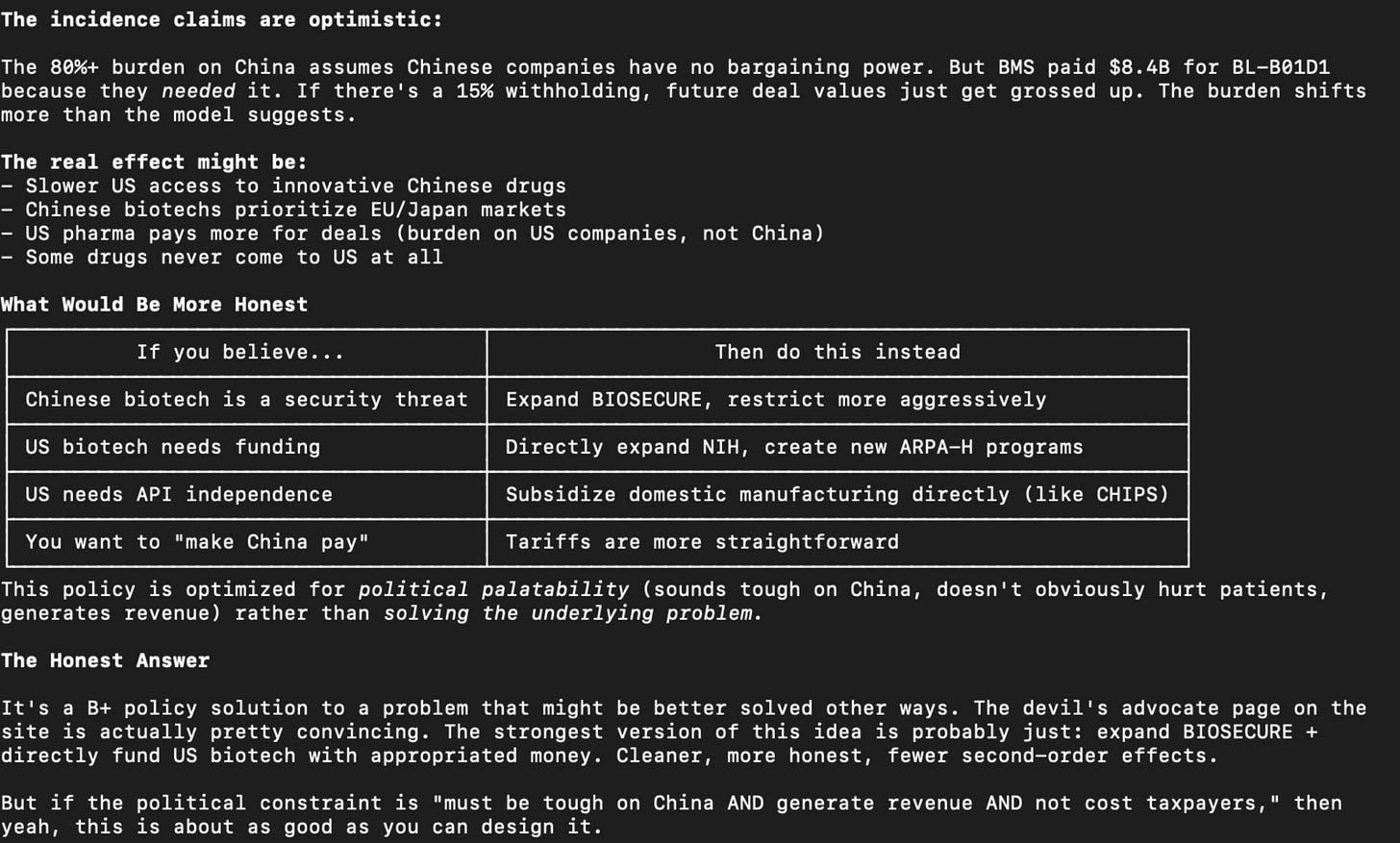
B+ seems pretty fair! Next, I had it stack rank the most important things to do to unlock American biotech competitiveness.

As the cost and time required to do policy research comes down, the value think tankers can deliver will increasingly come down to taste and in-person persuasion.
On the policy research side, there are still plenty of angles of analysis which require deep context and talking with human beings who know things models can’t scrape or intuit. The centaur model dominates for now, but some really basic prompting I could have done in middle school got me much farther than I expected.
And on the politicking side, sitting at a terminal can’t do in-person meetings with staffers and principals, and deliver the face to face pitching which still matters in Washington. Today you can’t really have an AI spend money to donate to campaigns or funnel cash to cabinet members’ children. But we can’t be that far off from that future.
Another staffer-inspired shower idea comes from the fact that, despite Chinese EVs being practically banned in America, you can drive them across land borders without issue. If the US really wants to ban Chinese cars, having BYD dealerships pop up just across the border doesn’t seem like great policy.
Here are all the prompts I gave it. Initially it took my prompt and refocused it on a less gimmicky angle of this story: the fact that BYD is building factories in Mexico partially in the hope that they’ll be able to export to the US. If the administration wanted to piss Mark Carney off after his deal with Xi to allow the sale of a few Chinese EVs into China, it could ban Chinese cars from Canada (and Mexico) from crossing the border. Claude came up with an ‘Electric Fence’ proposal and accompanying EO.
1. i think the us should ban chinese EVs from crossing canadian and mexican borders. spin up some agents vibecode a policy proposal to do so, come up w a clever name and make a site on vercel. make it stylish dont make it look like ai slop. then make a page on the site that does devil’s advocate. look for ways to do this w executive action alone
2. write up EO text or reg text
3. what about canadians and mexicans who own the car just driving over the border? that’s what i was thinking about
4. refocus with cars that drive across, then do the other part
5. make it also highlight how trump can disrespect carney’s deal w xi allowing the sale of chinese evs by doing this. focus it on banning from canada alone, relegate mexico
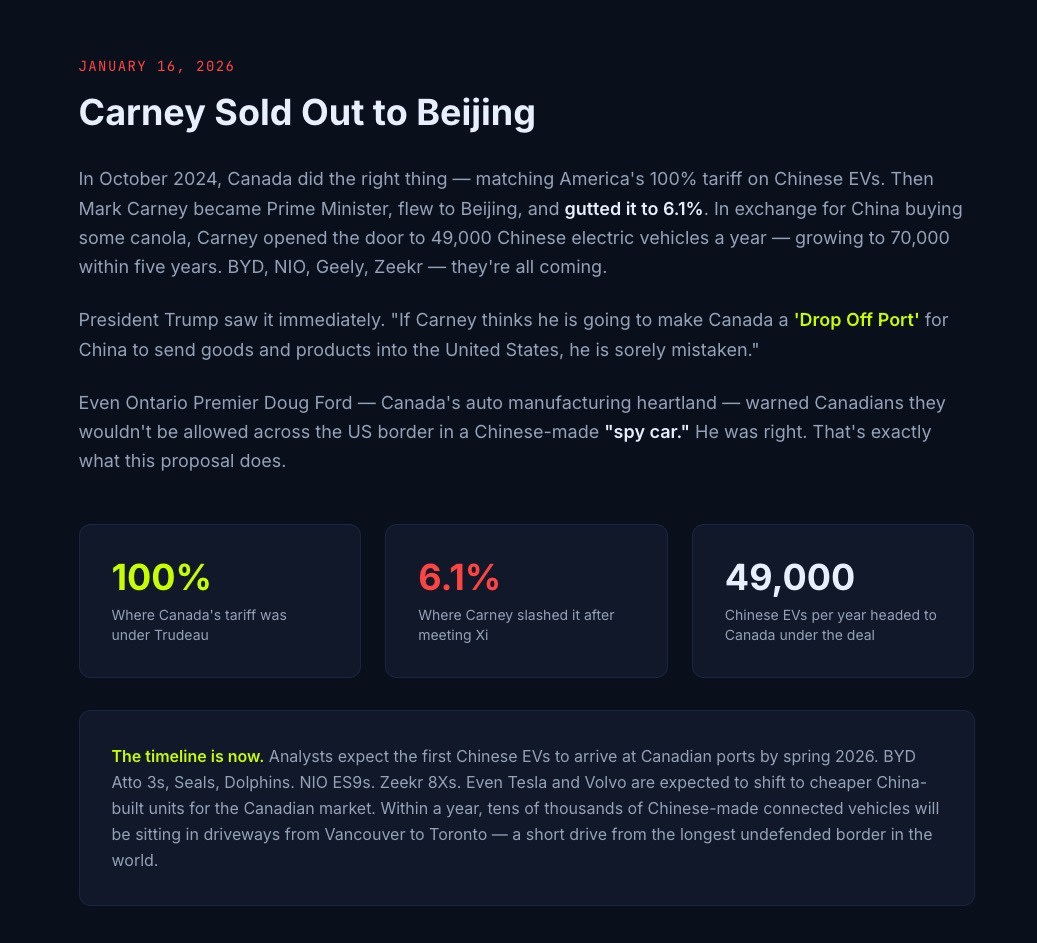
The oneshot was fine, but I wanted it more Trumpy. So it made a MAGA-ified version, which you can check out here. [Note: I guess Dario is so lefty that I had to nudge Anthropic three times to get it MAGA enough].
just give it a more maga vibe
i want a maga aesthetic
make it even more maga not maga enough make more maga

Said staffer’s response:

For a little policy entrepreneurship comparison shopping, I gave Devin, Cognition’s coding agent, all the same prompts, and I think it did an even better job.


ChinaTalk is a reader-supported publication. To receive new posts and support our work, consider becoming a free or paid subscriber.
From 1972 to 1995, Congress had its own tech brain: the Office of Technology Assessment. With two hundred staffers, it issued hundreds of reports helping Congress grapple with Japan’s technological progress…. Then Newt Gingrich killed it in 1995, leaving Congress starved for independent analysis of technology just as the industry grew increasingly more important to economic development and national security. In recent years, think tankers across the political spectrum have tried to get Congress to revive it.
I’ve had the OTA archive sitting as a snoozed tab for years, hoping to find something to do with it. I recently asked Claude to summarize OTA’s methodology and build a site imagining what the office would be working on if it still existed today. Here’s the result.

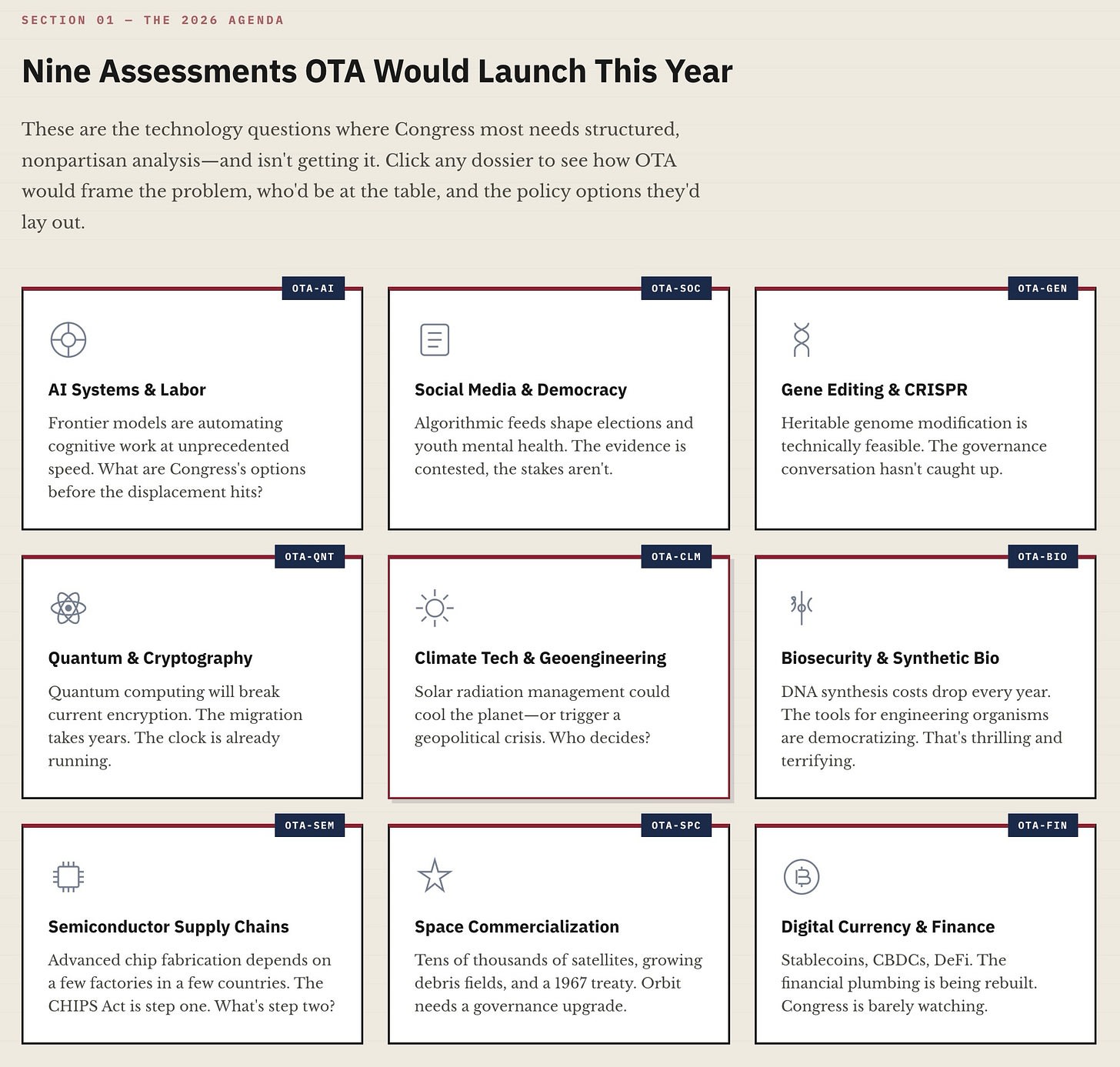
We are not there yet, but I’m looking forward to the day where models can give staffers their own personalized OTA reports!
To receive new posts and support our work, subscribe!

How did Arizona lock in billion-dollar investments from TSMC, Intel, and LG Energy?
Ian O’Grady, Senior Policy Advisor to Arizona Governor Katie Hobbs, joins ChinaTalk to share war stories from the state that’s successfully reshoring semiconductor and battery production.
Our conversation covers:
Labor Disputes and Crisis Management — How the Governor’s Office mediates disagreements between stakeholders and keeps workers happy.
Clean Air Act vs. chips — Why Arizona’s fabs struggled to get building permits despite the state’s low per-capita emissions.
Arizona’s Abundance Playbook — Including a consolidated commerce authority, a culture of engineering > litigation, and institutional factors that help Arizona outbuild Ohio and Texas.
Taiwanifying the Desert — How Phoenix welcomed TSMC engineers with Mandarin programs in schools, Din Tai Fung, and a new Costco.
Industrial Policy Resource Wars — How Arizona avoids backlash based on power and water use concerns.
Co-hosting is ChinaTalk analyst Aqib Zakaria.
Jordan Schneider: Ian, you show up in January 2023, after the CHIPS Act has passed, and there’s already excitement about all the fabs potentially being built in the Phoenix area. What were the first semiconductor-related priorities that landed on your plate?
Ian O’Grady: The TSMC investment was announced in 2020. That was a huge day — we were getting one fab, and we were so excited.
The CHIPS Act passed in 2021, the IRA in 2022, and then we’re coming into 2023. We have all these incentives happening. We have all the reshoring, the bringing jobs back to America effort. That’s great. But anytime we have investment incentives like that, it sets off this huge competition between states.
Every state is then showing the companies and local governments: Why does it make sense to do it here? Once that process happens, it’s: Well, okay — permits, power, people. How do we hire everyone we need to hire? How do we get those folks into jobs? From fab technicians to security guards to construction workers, which is super important. On any given day, we have about 10,000 folks up at TSMC working on the construction side, which is incredible.
We’ve been super lucky over the past few years to have a ton of expansions. Going into 2023, we knew there were a lot of opportunities in the semiconductor and battery supply chains. We wanted to make sure we got those anchors.
We have LG Energy in the East Valley. We have TSMC in the North Valley. We have Intel in Chandler, Arizona.
Jordan Schneider: You guys showed up in January of 2023. The CHIPS Act had already passed, the IRA had already passed, and there was already a commitment from TSMC to build at least one fab and hopefully more. What sort of calls were you getting? Who was bugging you? How does a governor’s office define the role it needs to play in facilitating this federal money coming into your state and being taken up by these companies that have the potential to bring enormous economic benefits?
Ian O’Grady: These were huge investments in 2023. Coming from D.C., there was an open question on the ground about how to actually implement this. First, you have to construct the fab. We focused on the construction workforce — how do we invest in these folks? How do we make sure they have what they need?
If you check the headlines from 2023, there were many labor disputes. These industries moved overseas partly because American labor was expensive and more difficult to manage. How do we reshore this? In the governor’s office, we saw this as an opportunity, but we needed to figure out how to make it work and ensure we stayed on time.
The timelines looked tough. We hadn’t done this before at this scale, and all those construction sites were active at once. Governor Hobbs announced several different programs while also serving as the go-between for the companies, general contractors on site, and workers.
This is the perfect encapsulation of the mundane stuff — on the work site, we needed more refrigerators, more porta-potties. Basic stuff to make sure we were good to go on site. We also invested in apprenticeships, which were a huge choke point for the state. We had year-long, couple-year waits for electrical pipefitters. These apprenticeships, both union and non-union, were essential for building the fab.
In December of that year, the capstone of all this was a labor agreement between the workers, contractors, and companies. It outlined safety provisions and specified how many foreign workers were coming in, because that was part of the equation. We hadn’t set up these ASML machines in the United States before. How do we set that up and ensure quality?
These companies are professional athletes — LeBron James level. They know what they’re doing. They’re willing to train American workers because they understand that long-term, they want to keep building here. Whether it’s on the construction side or the technician side, they need to train the local workforce. In those talks, we emphasized that we want Arizonans to have jobs from these projects.
Jordan Schneider: Can you describe the type of calls you receive daily as the policy advisor for workforce development?
Ian O’Grady: The great thing about a governor’s office is that it involves everyone. It’s a combination of VEEP and Parks and Rec.
In terms of who’s calling me — first, you have the workers on site: the contractors and the labor unions represented there. Then you have the feds. This was a huge priority for the Biden administration, so it’s Commerce and CHIPS. I talk to my counterpart there probably every other day to make sure we’re getting these projects online.
We use the word “ecosystem” a lot because it includes community colleges, universities, and the permitting entities for water, sewer, and power — making sure that’s all coming online. The magic is making sure all these components converge at the date they want to start producing chips, which is a ton of work.
At this first stage, it’s almost entirely a construction conversation. We have some permitting things that come later once you get to production, but right now it’s: How do we get the workers out there on site? They have intense demand over the foreseeable future — the next decade — across sites in the state.
Jordan Schneider: What are the near-term and medium-term levers for the workforce that a particular state can pull to help you beat out Texas or Ohio?
Ian O’Grady: Those are definitely the competing states.
Near term, one lever is just awareness that these projects are happening. Intel has been here for about four decades, so there’s awareness. But when you talk about TSMC or LG, there’s very little awareness of what that is, let alone that someone should go work there.
We’re trying to divert folks who are in the workforce looking for an opportunity. We need thousands of people to understand what that mission is, why it’s so cool, and why they would want to work either in building or operating the fab. That’s been relatively successful in terms of our recruiting and getting ahead of schedule on these sites.
Jordan Schneider: What does that mean exactly? Are you doing events and pushing reporters to write about this?
Ian O’Grady: This has been a partnership between the TSMC team, the Arizona State University team, our office in promoting the trades, and a lot of the local officials to talk about these opportunities.
There are also partnerships with high schools and K-12 education. This is more of a longer-term thing, but think about when you were a kid — what do you want to do for your career? Be a firefighter, be a doctor. We want “semiconductor technician” or “someone in the pipe trades” to be one of those options.
We’ve been working with the local school districts in that area to help them understand what those careers are, so you have folks graduating high school and going into those jobs. It’s those technical education districts and that whole local area that we’re really excited about.
Jordan Schneider: Does the market not figure all this stuff out? There are new jobs here, and presumably, they have to pay better than whatever the alternative is to get people to show up in the first place.
Ian O’Grady: That’s a question we get a lot, especially in Arizona where we have divided government. Many folks in the legislature believe the free market should fix this.
There are two factors at play here. First, you need an industrial base of talent that no one else is going to invest in. That’s essential not just for TSMC and Intel, but also for their supply chains. What has helped us secure so many projects is this latent base of talent that can transition — whether it’s battery manufacturing, aerospace, or semiconductors. These workers have skills from the ASU engineering school, the largest in the country, that we can attract and deploy to fill these jobs.
Certainly, companies might eventually invest in their own programs, but we don’t have time for that. We need these programs ready now, and we’ve been planning for this for the last 10 years.
The other challenge is the friction of setting up operations in the United States. Taiwan is set up to support their fabs — the times I’ve been there, it’s remarkable to see those connections. Understanding where to go in the US system isn’t easy. Our workforce system is something we’ve worked hard to simplify, creating one front door. But between community colleges and high schools, it’s still complex.
From the government side, we have to make it easier for companies to navigate because they do want to be good partners and invest in the workforce. Knowing where to go is half the battle.
Aqib Zakaria: I remember when this movement was first getting off the ground — the idea that we should build chips in America. Everyone was saying, “But we don’t have people who do that kind of work.” Unlike Taiwan, where everyone knows TSMC offers the highest-paying jobs.
I see you’re working with ASU and other community colleges to develop that workforce for the future. But that takes years to develop, and TSMC still has so many Taiwanese engineers. How do you know this is succeeding? How can you feel confident that people from ASU or Arizona are actually going to work at these fabs?
Ian O’Grady: I grew up here — Arizona State University has the largest engineering school in the country. We provide the most engineers. They usually leave. That was the opportunity: to keep those folks home and have opportunities in Arizona so they don’t have to move. Many of them don’t want to move, but they usually end up at Ford or automotive companies in Michigan or Ohio. Now they’re staying here.
How do we know it’s working? The chips are being made.
It’s been really fun to see the schedule and the progress of the facilities. I don’t know if you guys have been up to drive by either one of these — Intel down in Chandler, TSMC up in Phoenix. They’re the most amazing buildings you’ll ever see in these complexes.
In terms of connecting folks to those jobs, it’s been redirecting resources. We actually just set up a clean room for training down at the University of Arizona, so they have even more resources down there. Northern Arizona University has a really great metrology program, which feeds directly into some of the toolmaking. There’s been this demand and they’ve really answered the call on the need for these jobs, keeping up with the new technology. But it’s been keeping folks here, and that’s been — as a native Arizonan who’s moved back, I have a special kind of feeling towards that story.
Aqib Zakaria: What about ironing out the wrinkles between Taiwan workers and then the workers that are coming from ASU or that are trained in Arizona? I’ve heard a lot of stories of language barriers or work style differences. What role does the state of Arizona play trying to iron that out and make sure it goes smoothly?
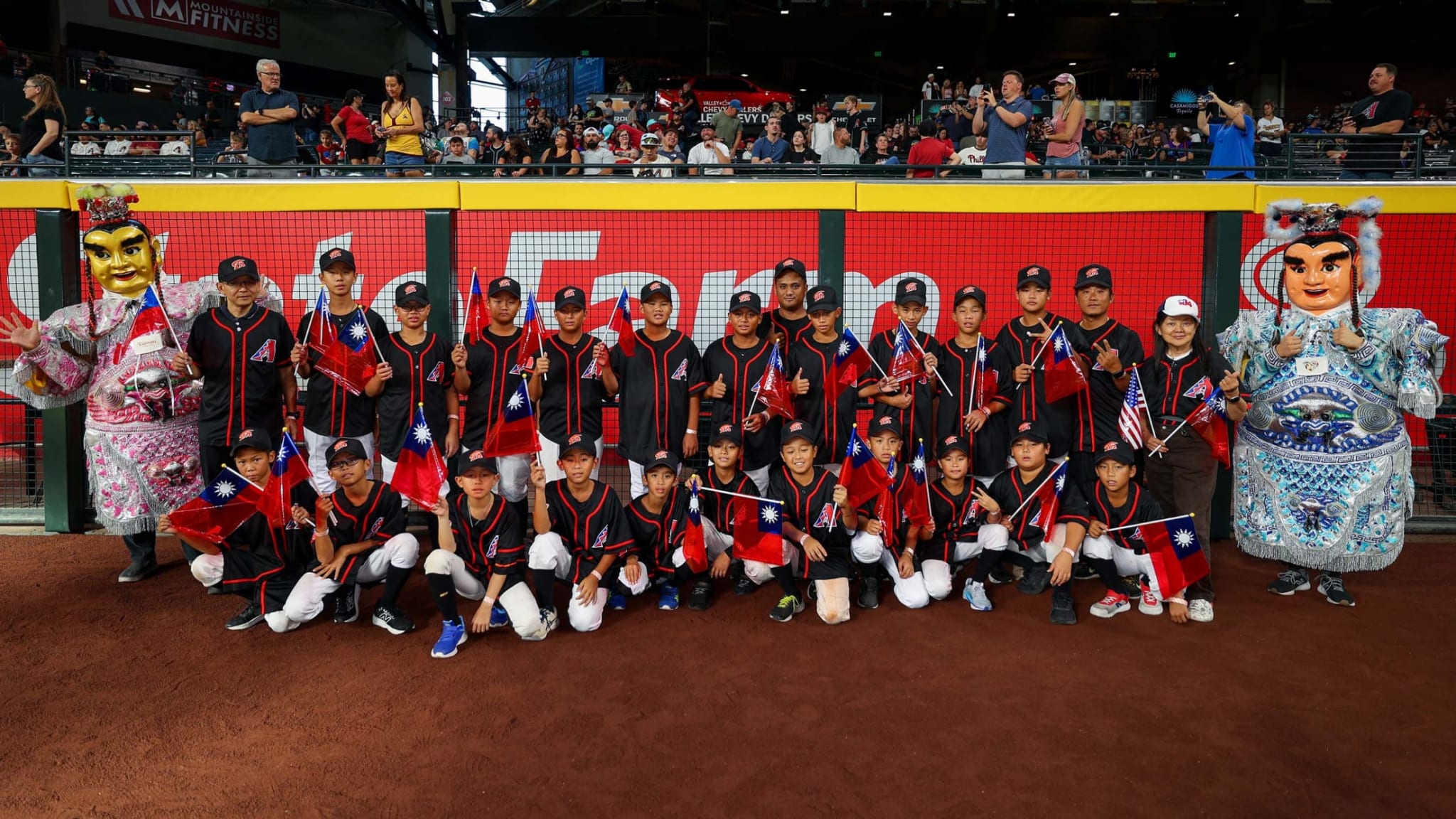
Ian O’Grady: That one has been somewhat resolved by the company because they can’t bring over all these folks to operate the facility. We have Taiwanese restaurants now. The cultural integration has been really great. The Arizona Diamondbacks now host an event celebrating Taiwanese baseball and culture. It’s been something that we’re aware of, but really something that has sort of resolved itself over time.
Jordan Schneider: What about on the other side — how do you make sure the Taiwanese and Korean employees are excited to come to Arizona?
Ian O’Grady: There’s a stat the city has about how many babies have been born here from Taiwan in terms of new families setting up and being here in Arizona. There’s been a lot of work in the neighboring school district to make sure that they’re catering to Mandarin and having English immersion programs, which has been really exciting. Parents and kids here in Arizona want to learn other languages.
We’ve been really focused on childcare. These are the family parts, but we have a lot of families — a lot of senior folks who are moving here who want to be part of the community. The most exciting thing is in that area around both Intel somewhat, but more TSMC, because it is greenfield development. It’s a part of the city that was just desert. We’re building a new city, so we have an opportunity.
My understanding is the workers are super stoked about Costco — the folks who are over from Taiwan. We’re going to be building a new Costco up there, so they don’t have to drive as far. There’s a natural friendship between Taiwan and Arizona. We’ve been training the pilots from Taiwan out at Luke Air Force Base for going on four decades. There’s that natural kind of friendship happening.
Aqib Zakaria: I remember I was flying back from Taiwan a couple of years ago, and the guy sitting next to me was an engineer who was going to go work at the Arizona fab. He was originally kind of sad. He’s like, “I’ve heard there’s only one Asian store there.” Now I’m glad that there’s a Din Tai Fung and a Costco being built. It’s a little bit easier.
Ian O’Grady: There are a lot more Taiwanese restaurants. A lot of food trucks, too. It’s really coming along.

Jordan Schneider: What kinds of acute crises end up falling on a governor’s office? Can you share any war stories about helping these buildouts develop?
Ian O’Grady: When we arrived, I emphasized how crucial construction was — just the ability to build the fabs. Whatever the motivation, we had to take this seriously. What did we need? What did we have to do? While negotiations were happening with the federal government, we wanted to create as friendly an environment as possible.
The first challenge was a significant worker dispute at the facility, which everyone now acknowledges we handled well. I’m proud of how we came together. In my timeline of building semiconductors in America, this was significant — we hadn’t done this in a long time.
The workers said conditions weren’t great and needed improvement. The facility folks and contractors said workers were being difficult and needed help. The company wanted to resolve this as quickly as possible. It wasn’t clear if anyone could talk to all three parties, but the Governor’s Office stepped in. We created what we called the tripartite agreement in December of that year.
The solutions were mundane but important to workers. It wasn’t that the company or contractors were intentionally withholding things — workers needed more refrigerators for their lunches, which makes sense with 10,000 people on site. They wanted greater access to porta-potties. These basic things made everyone on site really happy.
From the governor’s side, we’ve invested $5 million in apprenticeship programs because leaders said they couldn’t recruit fast enough and needed to build capacity. We gave them money for textbooks, classrooms, and equipment to build the pipeline. This also made them feel we were looking out for them overall, while serving both TSMC’s workforce needs and the contractors on site.
We also implemented a safety agreement. The state oversees facility safety, and there had been claims it was unsafe. We arbitrated this, offering a state program where they could sign on to go above and beyond OSHA standards, making it a platinum safety site.
The willingness of TSMC to learn and work with us, combined with workers’ willingness to come to the table, created a relationship we’ve really cultivated from the governor’s office. This was a priority in 2023. At one point, we thought there would be a strike — we were very concerned workers would walk off. We intervened alongside Senator Kelly’s office, facilitating required conversations that took months to resolve.
Jordan Schneider: The first TSMC fab is basically up and running, right?
Ian O’Grady: It’s producing chips.
Jordan Schneider: How do you measure a fab being “up”? Is it when you get your first wafer, or when it’s economical to operate? There’s probably a six-month window of just tweaking various manufacturing processes.
Ian O’Grady: There are different ways to think about it. Currently, it’s producing engineering wafers — they’re not the wafers that would necessarily go into production. But yes, it is producing chips. As for what’s left to finalize, that’s something for TSMC to comment on.
Jordan Schneider: What has been the hardest part of getting to this point?
Ian O’Grady: 2024 brought significant challenges related to air quality and the Clean Air Act. There was a moment when I wasn’t sure how we would permit multiple fabs.
Here’s a quick Clean Air Act primer: If you’re in a nonattainment area — meaning your pollutants exceed certain thresholds — you cannot build new major facilities unless you offset those emissions. Arizona currently exceeds ozone limits. However, 80% of our ozone comes from elsewhere; we’re not a high-emissions state. This law was traditionally written for East Coast states like Detroit or western Pennsylvania — areas with large emissions.
This makes the offset problem even more difficult. You need to find offsets within the area that can balance the emissions of the facility. These are large facilities emitting certain types of pollutants that combine to produce ozone.
The county serves as the permitting entity under federal law. The city has some involvement because we can convert buses and baggage carts at the airport to help create the permits and credits for TSMC. This remains an ongoing discussion with the EPA.
Finding those credits and ensuring compliance was an extremely difficult lift for us. The state approached the CHIPS office about the issue, then worked with the county to determine how to make the permit happen while following the law.
Aqib Zakaria: I want to dig deeper into the permitting issue. Now, with data centers and the abundance movement, everyone claims permitting is the problem — that it’s too slow or nonsensical. How does it work for you to collaborate with the county level to actually get permits approved? Can we build things if we want to? Can we permit things quickly? What’s the bottleneck?
Ian O’Grady: This situation perfectly encapsulated that conversation. This was the top national priority — building out our ecosystem with TSMC and Intel in the Valley. Everyone agreed this was a priority. Yet we were bumping up against the Clean Air Act from the 1970s, which is probably the most important public health legislation we’ve had. Many studies document lives saved and how it’s cleaned up city air.
However, it wasn’t quite designed for our situation — we weren’t causing the problem here, which created an even more vicious permitting challenge. We’ve had many productive discussions with bipartisan support. The governor has met multiple times with the EPA administrator. As Churchill might say, at the last moment, we’ll do the right thing — but it took substantial work.
The first fab is always the hardest. Now that we’ve done this, we can do it again. We have a path forward. The air quality issue remains complicated because you need to keep finding offsets. If we keep building, we need to keep finding offsets in an environment where we have very few, since we’re not a high-emissions state to begin with.
We can do it. Here in Arizona, we’re the first and only state to reach this point. I believe Samsung’s facility isn’t quite operational yet in Texas, and Intel is far from being up in Ohio. Our experience demonstrates that yes, we can make this work.
Jordan Schneider: This idea of pro-business as a vibe versus being pro-business as actually dealing with nitty-gritty mundane policy stuff — does the energy that a politician brings to these questions matter at all relative to page 34 of the submission to the CHIPS Act? How much do the atmospherics actually impact these sorts of issues?
Ian O’Grady: It’s a ton. I think of this in terms of trade missions. It’s not quite the political domestic politics question of “are you pro-business?” or “how do we feel about you?” When Governor Katie Hobbs went to South Korea after we had visited Taiwan — they know us really well there — we were talking to some suppliers, making sure they’re comfortable with coming over to Arizona. That kind of openness helps.
On an international scale, I realized that in South Korea, they really hadn’t thought about investing in Arizona. That kind of openness and subnational diplomacy of talking to companies in South Korea, and showing up on their doorstep, makes a difference. It’s one thing to have a call, but it’s another thing to go to their country and say, “Hey, we have a few partners here. We want to be as helpful as possible.” That means a lot.
Domestically, the governor’s approach has been that we’ll meet with anyone — it’s always an open door. One week I’m talking to a labor union, the next week I’m talking to a free-market business group. Our work represents the state of Arizona. We’re probably the reddest or purplest purple state, and we understand that we have a really diverse business community and workforce. We need to reflect that. We can’t be too ideological. Where Democrats get into trouble, especially, is when they stop taking meetings and talking to people.
Jordan Schneider: I remember being at SEMICON Taiwan two or three years ago, and Arizona and North Dakota were the only two states that had booths. I was talking to these people and they said, “Our states invest in this. We think the human element of this sort of thing is important,” which was surprising and wonderful. It’s interesting to see how you think that pays off. At the level of vibes for other countries, there are 50 states, right? Maybe you’re thinking America, but you’re not going to literally talk to all 50. It’s just easier if there’s some sort of level of awareness and face given initially.
Ian O’Grady: A level of comfort shows that you’re trying and getting out there, showing up. But that only lasts so long because eventually companies want to see the pro forma — let’s get down to it. That’s where real policy matters. You need both elements. You don’t close a deal without the policies being effective.
An example of this nitty-gritty work — though it isn’t legislation or written policy — comes from our broadband expansion efforts, which involves extensive permitting work.
In 2023, we dealt with a company that had been waiting about two years for a right-of-way permit to dig and lay fiber. They were going from agency to agency. They’d go to the Department of Transportation, who would identify an archaeological issue and send them to the State Historic Preservation Office. After pulling a ticket and waiting in line for an archaeological study, they’d return to the Department of Transportation only to be told about wildlife issues requiring a trip to the Department of Game and Fish.
We’ve flipped that process. Our commerce authority on broadband now pilots a one-stop approach for the massive permitting exercise happening around broadband. We handle that coordination work internally, making it easier and less of a headache for companies.
It’s hard enough for American companies. Imagine meeting with the governor of Arizona about investing in the state, then discovering you have to navigate counties, cities, water districts, and utilities — all separate entities. When we streamline this process, we remove a significant administrative burden from companies. While the market might eventually figure this out, making it easier gives us a competitive advantage.
As far as the legislature goes, we’re currently in the middle of budget negotiations. Each year during the legislative session, the governor delivers a State of the State address to kick things off. Since the budget expires July 1st, there’s a race to pass the new budget by June 30th.
Throughout the session, legislators introduce bills and ideas. Both our Senate and House have Republican majorities. Unlike the partisan, intense environment my friends describe in DC, I maintain excellent relationships with my counterparts on the majority staff in the legislature. Everything we do becomes a bipartisan act by necessity — nothing gets through the legislature unless it’s a Republican bill with Republican support for the budget.
The governor has established a litmus test: Is this bipartisan? Did you work with Democrats? Does this represent the widest swath of Arizonans?
During the session, I track about 200 bills, ensuring we’re prepared for each one. Some bills we’ll never sign, and we make that clear. Others we’re happy to sign. The challenging ones fall in between — the edge cases that might upset a stakeholder or don’t quite work for us. We have to decide whether to improve them or leave them alone. That’s how I spend much of my springtime.
Jordan Schneider: What were the best and worst bills related to industrial buildout that you’ve encountered?
Ian O’Grady: There’s been a lot of AI legislation coming through about how to regulate the technology. I’ve been watching AI safety bills, particularly because the Trump executive order attempts to preempt states, though there’s a safety exception — especially children’s safety. We have a couple of kids’ safety bills in that category.
Infrastructure remains the biggest legislative challenge. It’s the limiting factor for so much of what we do. We’re a low-tax environment, which means we don’t have all the tools that other states have. Some states will cut companies checks when they relocate. Others waive property taxes or build much of the infrastructure themselves.
We do as much as we can, but we have to figure out the taxing mechanisms. How do we accomplish this without cutting government further? Since 2000, our population has increased 40%, yet we have the same number of state workers, and our economy has grown even more. We don’t want to cut existing services.
When companies come to a state, they expect roads and water pipes to be in place. How do we meet those expectations? We’ve been working on legislation to fund these projects.
Aqib Zakaria: I’m curious about AI legislation in Arizona, particularly in the context of fab buildouts. Is there a connection between the average Arizonan being happy about TSMC and Intel bringing jobs while simultaneously being skeptical of AI and data centers? Is there a mental disconnect, or is Arizona more pro-AI?
Ian O’Grady: We’ve seen similar zoning issues across the country. We’ve had a couple of very intense ones for large data centers. There’s skepticism, especially when costs are higher than they were five years ago and people are thinking, “Why are we doing this when my rates are going up?” A lot of those concerns are widespread — they’re national, they’re here.
In terms of the politics and how they’ve played out, Governor Hobbs in her State of the State speech addressed an incentive that provides a tax exemption for the chips and racks in data centers. We passed this around 2013, when it wasn’t a huge deal — they weren’t cycling out these chips every 18 months and they weren’t super expensive chips.
Now the exemption’s grown and there’s no cap on it. It was in the tens of millions of state revenue that has been lost because we don’t tax these things when they build the data centers and then refresh them. The governor said we’re the second largest market for data centers in the country next to Virginia. This tax incentive has worked. What is an incentive for us to create new markets, to bring along new industry? We should eliminate this tax incentive. We’re not anti-data center. Given the math equations we have to do in a state like ours, this doesn’t make sense anymore.
The other part is she proposed a fee on water use — a cent-per-gallon water use fee on data centers. We know that a lot of the more modern data centers are using closed-loop systems, and we don’t want them pulling water from our aquifer because we are in a desert environment. We have to be very, very wise about water.
Those were two proposals. Republicans have basically called those DOA, which has been a really interesting political calculation in terms of just the political mood. We think this is the right policy. I’ve been in those discussions that these are things that we think make sense for the state, and we’re going to keep building data centers that can keep existing, but they just don’t need state subsidy and we want to make sure they’re using our water wisely. We’re on the winning side of that argument on a few different aspects.
Data center politics are everywhere right now. It is probably one of the hottest issues.
There are two sides of the argument. One is from maybe the far left: “We don’t need this technology. This is not making our lives better.” There’s a lot of work to do on that side. I believe there are going to be immense benefits. Doing slop posting and whatever’s been produced probably doesn’t help. I’m very curious when companies produce those types of silly videos — is that really what we need?
On the far right, or maybe more of a normie argument: “Everyone else is doing data centers. Why should we?”
We’re in the middle — we want to attract, we understand they’re necessary for modern technology. We realize we have a lot of advantages in Arizona in terms of building them and we’re building the chips for them. We understand the attraction. But we’ve got to be so smart about how we do it.
Aqib Zakaria: Is the state legislature on the same page about incentives, or is there push and pull?
Ian O’Grady: It’s absolutely a push and pull. They’re still focused on cutting government and lowering taxes, period. We want to have a conversation about what incentives make sense because we do have a ton of exemptions. Every year — and you’ve seen this at the national level — we’ll exempt taxes for this and this and this. We’re asking: What’s the justification for these incentives? That’s a conversation we really want to have.
Jordan Schneider: How does state-level competition play out? Are you tracking every other state’s offerings? Does that argument resonate with the legislature? How much comes down to the inherent factor endowments of what the state has to offer versus whatever package you’re negotiating at the last minute?
Ian O’Grady: We’re competitive with other states both on a cost basis and on long-term cost over time and quality of life. There’s a whole site selector industry — I don’t know how much national folks are aware of this — but there are consultants who help companies run these competitions, line up states, and figure out where they’ll be most effective. In your analogy, these are like the agents doing this work for companies.
Ian O’Grady: While we don’t have as many upfront cash incentives as other states, the big factors that matter are:
Workforce has been a huge priority. Companies need confidence they’ll be able to hire and start on day one — security guards, cafeteria staff, engineers, PhDs. That’s a gargantuan task. The confidence I’ve seen when people come to Arizona that we can deliver on this has been great.
Power costs are very competitive. Energy is a significant ongoing operating cost, and we’re well-positioned there.
Road quality really matters. Being able to move large machines or spacecraft across an interstate is super important. There’s another very competitive city that just doesn’t have a great highway system, and that’s become a huge advantage for us.
We’ve had people come to Arizona and say the traffic in that other city is horrible — they love being able to access meetings easily here. Our airport’s proximity to downtown is another advantage that’s not always the case elsewhere.
Water security is crucial. We’re in a desert environment and have been very judicious with our water — we actually use less water overall than we did 50 years ago, which is crazy given our population and economic growth. We have a state law requiring demonstration of 100 years of water supply in metro areas. If you’re building in Arizona, you know you have 100 years of water. No other state has that. That’s been a huge asset, especially as drought conditions and water shortages have emerged across the West.
Aqib Zakaria: I’m wondering about roads. Is there a positive externality where wanting to attract foreign investment incentivizes the state to fix roads and power infrastructure? Does that mental calculus happen, or are those completely divorced?
Ian O’Grady: It certainly happens on the power side. We have economic development divisions that work on this. That’s long been part of our state’s history — we’ve built dams for hydroelectric power and then attracted new growth. There’s this great factoid from our history where utilities paired up with homebuilders to ensure new homes had plug-ins for dryer units, so they’d use the electricity being produced. Those partnerships certainly happen on the utility side.
On the road side, we just passed a new multi-billion-dollar investment in our highway system around Phoenix, and Tucson just did their own too. It really matters for getting to and from places, especially for executive-level meetings. When the board’s in town, it’s been a huge deal. More than once, I’ve been involved in figuring out permits to move spacecraft across the country on the interstate. You do this in the middle of the night so you’re not in people’s way, but being able to do that on really straight, wide roads is important.
Jordan Schneider: People are stressed out about power. You guys aren’t for now. Where does that come from? What’s the backstory there? Thoughts on broader lessons for the nation?
Ian O’Grady: We have a good mix of power. The Governor did an executive order in the fall to bring together a massive task force with utilities, businesses, consumer advocates — everyone. They just published their list of recommendations. It was the Arizona Promise Energy Task Force. Those are online if folks want to read them. I think it’s a national best practice in terms of what’s in there. Now we’re going to work on implementing those.
In terms of the mix I mentioned, we do have one of the larger nuclear facilities in the country. The Governor actually just toured it yesterday. That creates that base level — I forget exactly what percent, but it’s significant. We have some solar, some wind, and significant natural gas. Coal has been coming offline recently, but that mix has been super helpful.
Our ability to build transmission lines has been huge. We’re working with our state land department to create corridors where we can further transmission lines. That nimbleness we’ve shown versus legacy states, where you have old systems and it’s just harder to move, has been a huge benefit for us.
Aqib Zakaria: Why can Arizona build when other states can’t?
Ian O’Grady: I think about this a lot too, and I talk to counterparts in other states. One aspect is that we’ve done a really good job of centralizing this. We created a statewide commerce authority — we got rid of our old Department of Commerce and made this quasi-public entity that’s been great.
We’ve had the same CEO for a couple of decades. Her name is Sandra Watson. She’s amazing — I’d say she’s the best state commerce director in the country. Being able to act nimbly in terms of that board has been huge. You have CEOs on that board who direct where our incentives live, and you have that input. That has made us very effective in attracting businesses.
My theory on why we can build, from talking to other states and going to conferences, is that there are states where you have this layer of sediment — “we’re in oil and gas” or “we’re steel and automotive” — and that creates this drift of “that’s what we were made to do.” They can’t quite get to the next level.
Versus in Arizona, we have some legacy industries, but they’re all engineering-focused, so they actually end up being a benefit. We’re a growing state with new population coming in. We’re now retaining more of our grads.
I think of the lawyers vs engineers dynamic in Dan Wang’s book Breakneck — we have a lot of engineers. Reading his book, I was thinking there are some similarities between Arizona and some of the cities he’s talking about in China in terms of our ability to build.
The consolidation with the Commerce Authority also helps us quarterback with the localities. I’ve seen other states with really intense competition between metros where the state can’t operate effectively. In Texas, it’s Houston, Austin, Dallas — if you’re the state and a project comes, folks are fighting over who gets it.
We’re now at the stage in Arizona where everyone understands that we should celebrate each other’s wins and that there’s enough to go around. That’s a feature of years of learning and success with the major anchor investments we’ve gotten. We’re in a really good position to continue — we’ve had 70 semiconductor expansions alone in the last couple of years, which is just crazy.
Jordan Schneider: Other lessons for other states or national policymakers you’d like to share?
Ian O’Grady: I think there are some pretty basic resources you have to think about as a state. We talked about roads, but rail access is super important. That’s something we’ve been thinking about in terms of expansion — getting goods on and off the rail line and moving them across the country, especially as we manufacture them.
For national policymakers, we’re in the midst of pretty intense Colorado River negotiations. The agreement we’ve had for decades, allocating water across the seven basin states, is expiring. Our argument in Arizona is that no other state produces more advanced chips, more guided missiles, or more leafy greens per drop of Colorado River water.
Not to pick on Wyoming, but I looked up semiconductor employment by state. Wyoming had literally zero. We’re making an argument in this process — which is being run by the Department of the Interior — that yes, we understand drought conditions. We’ve put our own cuts on the table. We’re offering to cut 27% of our usage because we’re more efficient. No one else in the upper basin is offering cuts like that. But for the Trump administration, no one offers better ROI than Arizona in terms of that water.
Are you guys familiar with the book Cadillac Desert about water history in the West?
Jordan Schneider: Pitch it.
Ian O’Grady: Great book on water history. It’s from the ’80s, so it’s a little outdated. But they make this argument that I think about a lot in terms of Arizona: The ability for the United States to win World War II was based on our hydroelectric capacity in the West and our ability to produce at scale. Boeing, Northrop Grumman — all the aerospace companies emerged because they had access to that power, because we had the geological features to create rivers that could generate electricity. That’s why we were able to produce at a scale that neither Japan nor Germany could match.
That’s relevant today. When I look at how the river is being allocated, we have really clear decisions to make about where that water should go, especially for all our national priorities. We’re making that case probably on a weekly basis to our colleagues in other states and in D.C. But right now, the current direction needs to change if we’re going to be able to continue producing like we do.
Jordan Schneider: What’s your take on trade dynamics and foreign investment, especially with USMCA coming up for review?
Ian O’Grady: We’ve been working closely with Mexico — the Governor’s visited several times since they’re our largest trading partner. With USMCA up for review on July 1st, we’re quite concerned about the direction it’s heading.
We’ve spoken with the US. Trade Representative, and they’ve indicated they don’t think they need Congressional approval. They’ve also made it clear: “Don’t expect North America to be a free trade area.” The Trump administration’s overarching concern is preventing Mexico or Canada from becoming a backdoor for Chinese goods into the US. market.
Mexico’s own China politics are fascinating right now. The Sheinbaum administration has launched a “Made in Mexico” — Hecho en México — initiative and they’re placing tariffs on China. But when you actually look around Mexico, the new cars are mostly Chinese EVs. It’s a really interesting dynamic, and we’re working hard on USMCA issues to address these concerns from the Trump administration.

Jordan Schneider: There’s a big debate in Washington about bringing in Chinese industrial investment. The hope would be that companies like BYD, battery manufacturers, and rare earth refiners could replicate what LG and TSMC have done in Arizona. Based on your experience, how would you approach setting up or incentivizing these agreements to ensure long-term technology transfer?
Ian O’Grady: The joint venture conversation is complex, especially in automotive where there are so many competing interests.
From a supply chain perspective, Mexico is absolutely ready for chip assembly and automotive parts manufacturing. They’ve become very strong in aerospace and medical devices in recent years — they’re ready to build.
The jump to automotive manufacturing is particularly challenging. We have our first major OEM, Lucid Motors, making EVs south of Phoenix. Getting that workforce up and running was like building TSMC’s first fab — you learn so much in the process. We want to build that ecosystem, but nobody really knows what the future looks like for automotive investment right now. There are fundamental questions about internal combustion versus electric vehicles. The Iran situation and gas prices might revive the electric conversation.
Arizona has huge advantages here — we’re the number one copper producer in the country with a significant critical mineral supply chain. We’re going to be producing batteries at scale, which is generating a lot of interest. But ultimately, the market is the market.
Aqib Zakaria: I’m curious about the ecosystem aspect, since so much of this really is about ecosystem development. You can’t just have an EV fab in the middle of a state without the supporting players around it.
I wonder how you sell that vision — it’s really sexy to say “oh, we built an EV factory,” but it’s not as much of a PR win or as compelling to say “okay, we’re expanding copper production.” These supporting industries may be more commodity-based and cheaper, but they’re harder to make attractive. How do you try to actually make that ecosystem happen? It’s an enduring problem in the States.
Ian O’Grady: From a state level, we want to create what I think of as the substrate or the platform. We want good roads, good railroads, good connectivity so that we can just move heavy things. That’s a big part of critical minerals.
In terms of opportunities in mining — we’re a mining state. In Arizona, we say we have the 5 C’s: copper, climate, cattle, citrus, and cotton. Copper is the big one — our state seal has a copper miner on it. It’s very much part of our DNA. My family actually moved here in the 1870s to be miners. There’s really an awareness of it.
There are things that come along with it, too — these mines have a shelf life. We have open pit mines sitting across our state where we see the scars, but we also see opportunities. You have really innovative things happening in terms of mine reclamation and being able to extract metals at a more micro level.
We have many major mining projects coming online. We’re actually number one in terms of jobs growth and number one in terms of mineral exports already, and we don’t even have major projects online yet for new mining. Those build a lot of jobs.
At a corporate level, Lucid Motors understands that more of their supply chain is going to be in Arizona. With USMCA, it almost has to be. That’s helpful on that side. In local communities, there are pros and cons, but there are jobs coming in — these are legacy things that people remember in Arizona.
Jordan Schneider: You want to tell them about your adventure, Aqib?
Aqib Zakaria: Oh yeah — I’m from Louisiana, and while we’re not building fabs or EVs yet, we’re expanding gallium production. They’re opening up a lot of refineries, so I’m hoping to go there to see how that actually ends up working out.
Jordan Schneider: We’re going to do a work study tour. We’re going to have Aqib in the mines — we’ll see how long he lasts.
Ian O’Grady: Where does the gallium come from? Where are they extracting it from?
Aqib Zakaria: It’s a byproduct of alumina that they make. We already have alumina refineries, and my surface-level understanding is that the byproducts are actually a big pollutant, but now you can take that byproduct and refine it into gallium.
Ian O’Grady: That’s so cool. We have a mine that will produce zinc, manganese, copper, silver, and lead. It’s a site being revitalized by South32, an Australian company down in Southern Arizona.
Mining today is completely different. They’re actually running fiber lines from the town of Nogales, which is the biggest city in the county down there. They’re going to have a command center, but it’s all robots in the mine. It’s much safer. The tailings are going to be backfilled into the mine, so you’re not going to have a huge tailing site.
Aqib Zakaria: I’m jealous. I’m happy for Arizona, but I’m waiting for TSMC Thibodaux or whatever it’ll be.
ChinaTalk is a reader-supported publication. To receive new posts and support our work, consider becoming a free or paid subscriber.

这几天,中国互联网炒作华为韬定律,官方宣传机器加上民间肉喇叭,一起吹奏,把很多中国人吹得晕头转向。华为自己说,韬定律是“指导半导体产业发展的新原则”“实现了晶体管密度与系统性能突破”。
新华社吹得调子更高,直接说“华为推出韬定律, 改写全球半导体规则”。
中文自媒体上,一些化妆成小女孩的大妈,还有一些用华为手机美颜,把自己美颜成大妈的大叔,都成了韬定律专家。中国本来就缺牛奶、缺牛肉,需要进口,估计这波吹过去,就更缺了。牛又让这伙人吹死了一大批。
很多人听到这些术语,什么“韬定律”、“时间缩微”、“几何微缩”、“逻辑折叠”,可能一下就晕了,佩服的五体投地。但一个有生活经验的人,尤其是有中国生活经验的人,遇到这种情况,就会警觉起来。因为这是中国骗子最常用的伎俩:先用一堆你根本搞不懂的大词把你弄晕,再给你画个大饼,很多人就乖乖往坑里跳。
今天这期节目,我们看看一位美国专家和一位中国前业内人士是怎么说的。他们从华为的做法中,看到了什么。韬定律到底是怎么回事。我们从这件事上,能吸取什么教训,在中国怎么样识别骗子。
先做个简单科普。华为半导体技术部总裁何庭波说,过去几十年,半导体行业主要依靠的是几何缩微,也就是大家常听到的摩尔定律——每隔18到24个月,晶体管的尺寸就缩小一半。这样,在同样大小的芯片上,就能塞进两倍的晶体管。但是现在,芯片制程已经做到了3纳米、2纳米,晶体管已经小到了原子级别,接近了物理极限。
一直到这里,何庭波说得都是事实。但问题出在后面。她说,华为提出了一个全新路径,用时间缩微替代几何缩微。这就是所谓“韬定律”。这个“韬”字,是希腊字母τ 的中文译音,在英文字母中,对应的是T。在物理学中,经常用τ来代表时间常数。
以前在北大的时候,我还跟王太庆先生学过一年的希腊文。当时,能稀里糊涂跟英文对照着念《圣经·新约》。《新约》是希腊文写成的,当时的希腊文跟古典希腊哲学时代的希腊文已经有很大差别。现代希腊文,跟那时候的希腊文又不一样了。
离开北大以后,把学的那点希腊文,都还给了王太庆先生。但写文章的时候,偶尔会拿出个希腊词瞎跩,把读者搞晕。以前在国内写文章,就是这德性。
王太庆先生当年教我们希腊文,算上我,就四个学生,在他家里上课。他是个有学问的人,翻译过希腊文的书。他一边教我们,一边破除我们对希腊文的迷信,用时髦的话说,就是给希腊文“祛魅”。不管是在中国,还是在美国,真有学问的老师,都会教给学生“祛魅”。
人们看到希腊字母的第一个反应,是高大上,深不可测,用中文说出来,韬定律,听着更高大上,更深不可测。这就是华为要达到的效果。
听张庭波的意思,既然晶体管很难再做得更小了,那华为就另辟蹊径,改拼数据传输效率。为了实现这个目标,华为主要是走逻辑折叠的路径,而且在器件层面和系统层面都做了优化。逻辑折叠(logic folding),用通俗的话来说,就是不再把电路平铺在二维平面上,而是通过三维结构和先进封装,把电路像盖楼一样叠起来。原来在平面上相隔很远的模块,现在变成了上下楼或者背靠背,传输距离短了,传输延误自然就低了。
华为说,过去六年,它已经按照韬定律生产了381款芯片。五年以后,也就是到2031年,它不靠最先进的光刻机,用韬定律就能造出世界上最先进的芯片,也就是达到跟1.4纳米制程芯片同等的性能水平。
听到这里,有脑残可能已经开始欢呼了。但是,正常人肯定会问,别人都是用先进光刻机造先进芯片,为什么华为放着先进光刻机不用,偏要去土法炼钢呢?这才是核心问题。并不是华为觉得光刻机技术落后了,它才去土法炼钢,而是它买不到最先进的光刻机,人家不卖给它。为什么人家偏偏不卖给它呢?最根本的原因,是因为它是一家跟中国政府绑定的公司,而中国政府自从土皇帝上台以后,选择了一条跟发达国家,尤其是跟美国,正面对抗的道路。
土皇帝选择跟发达国家对抗,发达国家的一个重要反制措施,就是高端技术禁运,不卖给中国先进的光刻机。可能有人会说,中国那就自力更生,自己造先进光刻机。问题是,中国眼下没有能力造出最先进的光刻机。以后能不能造出来呢?当然,不排除这种可能性。有人说,很快就造出来了。有人说,两三年以后就差不多了。
那么,到底多少年,才能造出来呢?
ChinaTalk analyst yearns for the mines. He’s on a mission to visit rare earths and other critical minerals mining sites, refineries, and permanent magnet facilities around the world.
If you or anyone you know can help him fulfill this mission, please reach out to aqib@chinatalk.media.
Less than one in a thousand Chinese people owned private cars in the 1990s. But in 1993, a vehicle guided by a computer program landed on the floor of a car plant in Shenyang, capital of Liaoning province. Xianfeng 1 先锋1号 was the first of its kind in China, developed entirely by Chinese researchers.
The car plant had previously relied on American-made autonomous-guided vehicles, but the US tightened export controls in 1991 and cut off sales to China. The plant turned to the Shenyang Institute of Automation (SIA), an institution of China’s national academy, the Chinese Academy of Sciences (CAS). It was led by a scientist called Jiang Xinsong 蒋新松.

To the average person today, “AI” is synonymous with chatbots — or, at least, tools that exist only in the digital realm. Hardware manifestations, like humanoid robots or intelligent Roombas, are instead considered futuristic.
But “Chinese AI,” as an idea, did not necessarily begin with DeepSeek or tech companies in Hangzhou. It started on assembly lines in the Northeast, with dreams of intelligent oxygen furnaces for steel production and automated car plants. Some of the earliest champions of artificial intelligence research were not software engineers or information scientists, but those working shoulder-to-shoulder with factory workers.
As Chinese firms like Unitree became forerunners in the race to build autonomous robots, I grew curious about Jiang’s story. State media has dubbed him China’s “father of robotics.” His work — and what he would have conceived of as “artificial intelligence” — is substantively different from deep-learning-driven robotics today. However, the information scientist who petitioned Beijing for what arguably became China’s first industrial policy for AI was thoroughly ahead of his time.
Jiang is increasingly compared to figures like Qian Xuesen 钱学森 in official narratives. Qian, deported from the US under the Red Scare, fathered ballistic missiles and rockets; it is said that Jiang, who never left the country until later in life, did the same with industrial robots. These laudatory stories omit thornier, though more intriguing, parallels. Like Qian, Jiang’s life was one where science and politics were fair-weather friends.
Jiang Xinsong never expected to end up in the Northeast. Born to a common family in faraway Jiangsu in 1931, he entered Shanghai Jiaotong University — also Qian Xuesen’s alma mater — to study electrical engineering in 1951. After a high-achieving first year, he was sent to Beijing to learn Russian and prepare for study in the Soviet Union. But after a physical exam revealed tuberculosis in his lungs, he was forced to return to Shanghai. In 1956, Jiang graduated and started working at the Chinese Academy of Sciences’ Institute of Automation in Beijing, where he joined the newly-established computing technology group. There, he designed memory units for some of China’s first computers.1 He was a rising star of the national academy, working at the cutting edge by day and studying German at the Peking University library by night.

The good times didn’t last. Swayed by the permissive atmosphere of the Hundred Flowers Campaign, a young Jiang advocated for institutional reforms:
He supported making one’s dossier open to the person concerned, and once said: “The Soviet Pravda claims to represent the truth, but in fact a lot of what Pravda publishes isn’t true.” … After the Anti-Rightist Campaign began, he proposed that small-group meetings should not be minuted and should not be reported up the chain. He said: “The People’s Daily is accustomed to using the ‘Editor’s Note’ tactic to deal deadly blows to anyone being criticized.”
— Jiang Xinsong’s alleged transgressions, according to his “Rightist Registration Form” 右派分子登记表
Political winds at CAS immediately turned against him after Mao Zedong initiated the Anti-Rightist Campaign in 1957, and he was sent to rural Hebei for hard labor. Luckily, in December 1958, Jiang was summoned back to the CAS to work on automation research for industrial applications, since his field was deemed useful by the state. Officially, however, he was a “rightist” until 1963, blacklisted from promotions and unable to travel.
In 1965, 140 automation engineers were reassigned from various posts across China to Liaoning, with the goal of bringing new technological advances to the heavy industrial base there. Together with Jilin and Heilongjiang provinces, Liaoning is part of China’s frigid Northeastern region formerly known as Manchuria. Between 1932 and 1945, the region developed into an industrial powerhouse under Japanese occupation, supplying Tokyo’s war efforts with natural resources, heavy industry output, and railways.2
As WWII drew to a close, the Soviet Union invaded Manchuria in coordination with the US’s atomic bombings of Hiroshima and Nagasaki. Soviet forces occupied Manchuria until 1946, when the territory — and its remaining industrial resources — was transferred to the Chinese Communist Party. Upon its founding in 1949, the victorious People’s Republic inherited not only a liberated Northeast, but also a critically important industrial base that powered its earliest technological ambitions.
Jiang Xinsong was part of the 1965 reassignment cohort. For two years in Liaoning, he helped revive the remains of Showa Steel Works — a massive steel mill established under Japanese rule — in Anshan 鞍山, Liaoning, researching automation for the cold-rolling process. From the ruins of war, steel sheets were again pouring out of Anshan’s factories.
For the first three years of the Cultural Revolution, much of non-political life in China ground to a halt. In 1967, the Anshan mill, too, paused production, and Jiang headed to Shenyang. At the SIA, checkered records from previous political campaigns meant he was subjected to brutal struggle sessions. But once again, he narrowly avoided being sent down to the countryside. In October 1967, the new “revolutionary committee” that displaced the mill’s old leadership summoned Jiang back to Anshan to maintain its reversible cold-rolling machine — the only one in China at the time.
Anshan shielded Jiang from political turmoil during the second, quieter phase of the Cultural Revolution, while many of his intellectual peers languished in remote countryside locales. On the rare occasions when he visited Shenyang, he and SIA colleagues Wu Jixian 吴继显 and Tan Dalong 谈大龙 often discussed new frontiers in industrial technology. In particular, they were fascinated by reports about the emergence of automated industrial robots in Japan, the US, and Europe. The three of them perused the SIA’s reading room for everything they could find on “artificial intelligence”: in the early 1970s, this was a muddled mix of neural networks, cybernetics, and computer-integrated manufacturing. MIT’s Joseph Weizenbaum had built ELIZA only a few years prior. Jiang, Wu, and Tan’s “AI,” gleaned through the handful of publications that made it into Cultural Revolution-era China, was worlds away from the models we know today. Rather than talking to chatbots, these steel-factory regulars were excited about using algorithms to operate manufacturing equipment.
In 1972, Jiang, Wu, and Tan drafted On Artificial Intelligence and Robotics 关于人工智能与机器人, a petition to Beijing to seize on innovations in the field and invest in general automation. They had drafted China’s first policy proposal for artificial intelligence.
Researching and manufacturing robots is the natural direction of automating equipment manufacturing, and is an important sign of a country’s strong and robust industrial development.
— Jiang Xinsong, Wu Jixian, and Tan Dalong, On Artificial Intelligence and Robotics (1972)
Armed with this petition, they headed to Beijing to persuade superiors at the Chinese Academy of Sciences. The CAS’s leadership was supportive, but constrained by political headwinds. In early 1973, the trio made another trip to the nation’s capital, courting more industries where advanced automation might be applicable. This time, they encountered pushback: many thought the concept of robots was closer to science fiction than reality and found them unserious.
Another major blow to their dreams came via the Criticize Lin, Criticize Confucius Campaign 批林批孔运动. This was a confusing phase within the Cultural Revolution, where activists merged posthumous criticism of former Vice Premier Lin Biao (dead of an infamous plane crash in 1971) with denunciations of Confucius in an attempt to reinterpret Chinese history according to Maoist ideology. The movement reignited political divisions in academia. After returning to Shenyang, Jiang, Wu, and Tan were variously labelled as pro-Western “establishment types” 小当权派, and “hat-off rightists” 摘帽右派 for their research.3 Radical students and scholars denounced AI and robotics as “idealist pseudoscience” 唯心主义伪科学 in magazines.4
Can “intelligence” be manufactured by “artificial” means? No, it can’t. … The term “artificial intelligence” gives idealism an easy loophole to exploit. If artificial things can create “intelligence,” then in the future something with “intelligence” even more advanced than humans is bound to appear. … Some of the academicians of the Soviet revisionist regime … are loudly promoting “artificial intelligence” … which fully exposes their traitorous true colors.
We must take a stand against Deng Xiaoping, … and in the struggle to criticize all kinds of reactionary ideological trends in the research fields of “image recognition” and “artificial intelligence,” we must follow our own path.
— Excerpts from Selected Translations of Foreign Writings on Philosophy of Natural Science 《摘译外国自然科学哲学》, a Cultural Revolution-era magazine about the philosophy of science which circulated among radical scholars.5
China’s earliest experimentations with AI and robotics were thus nipped in the bud. Unlike the Soviet scientists whose records survived to Perestroika, we do not know how Jiang and his colleagues felt during these years. Jiang’s biographer Xu Guangrong 徐光荣 borrows the term “dancing in shackles” to characterize the period. Historical records are otherwise thoroughly sanitized; everywhere he is quoted, Jiang is resilient and grateful, never once resenting the Party, the academic system, or his fanatical accusers. Official history paints the picture of a patriotic scientist who, despite force majeure adversities, always remained buoyant with hopes of serving his country one day.
But can we read between the lines? How devastating it must have been to have your life’s work stretched out by a decade, delay compounding delay; to watch the nation to which you are supposedly deeply loyal squander opportunities to seize technological advances; to have your research papers presented by others at international conferences because you were forbidden from travelling. One can only imagine what private dreams sustained scientists of his generation.
With the death of Mao in 1976, the Cultural Revolution came to a close and normal academic activities were soon restored. Jiang and his colleagues quickly returned to their posts. Artificial intelligence and robotics became official research areas at the SIA. After a wasted decade, the CCP’s new, reform-minded leadership turned its mind to the global scientific race. A massive group of more than 1,000 scientists convened by the Party drafted the 1978-1985 All-China Science and Technology Development Planning Outline (1978-1985 年全国科学技术发展规划纲要) in 1978. The landmark document made some of the earliest mentions of intelligent machines in the history of Chinese policy:
Modern science and technology … is undergoing a great revolution. In particular, the development and application of electronic computer technology has enabled machines not only to replace certain forms of human physical labor, but also to take over some functions of mental labor, becoming auxiliary tools for memory, computation, and logical reasoning.
No longer was AI “idealist pseudoscience”: Beijing was finally endorsing scientists to embrace promising new ideas, unshackled by ideology. Meanwhile, Jiang Xinsong finally managed to leave the country for the first time. In August of 1979, he was part of a small Chinese delegation that attended the Sixth International Joint Conference on Artificial Intelligence (IJCAI 79) in Tokyo.
Japan at that time was a world leader in robotics and industrial automation. Jiang paid attention not only to their cutting-edge technologies, but also to the political and social institutions that enabled innovation. Having spent his entire career inside the CAS in one form or another, he was deeply attuned to the symbiotic relationship between institutional design and scientific innovation. As a young researcher, he paid a heavy price for supporting reforms; decades later, he finally had a chance to influence the institutional future of Chinese science. In his post-trip report to the SIA, he described how robotics research and development in Japan was not concentrated in universities, but also conducted robustly by research institutes and private enterprises. In his words, there was an efficient “division of labor” system in Japan’s robotics field: universities and specialized institutes engaged in basic research over longer periods of time, the Ministry of International Trade and Industry funded application-oriented research with 5-10 year horizons, and the private sector focused on commercializing market-ready technologies. Jiang paid as much attention to the workings of this system as he did to the research papers.
Many of China’s most prominent scholars from that generation became scientist-strategists, if not technocrats. Having weathered years of political campaigns and anti-intellectual rhetoric, with constant reminders to express loyalty, they worked closely with the Party-state system. Two things are likely true at once: (1) they both sincerely believed their work to be strategically valuable to their country, and (2) knew how to speak the language of the Leninist regime in order to bend political winds to their advantage. Qian Xuesen’s generational legacy lay not only in the rockets he designed, but also in the hand he had in shaping China’s defense complex. Similarly, Jiang Xinsong, whenever he could, advocated for industrial policies to stimulate automation research throughout his life.
The 1980s were the height of Jiang’s academic career. His writings from this decade were often theoretical, seeking to convene emerging threads of advances in robot manipulation, cybernetics, and artificial intelligence. As one of a small handful of Chinese scholars closely following developments in AI and automation, he introduced American, European, and Japanese research to Chinese academics through his prolific writing output, pushed back against skepticism, and advocated for engagement with then-nascent fields in Chinese academic journals. These contributions were also frequently followed by concrete recommendations for research and policymaking, downstream of his observations of factory lines and laboratories.
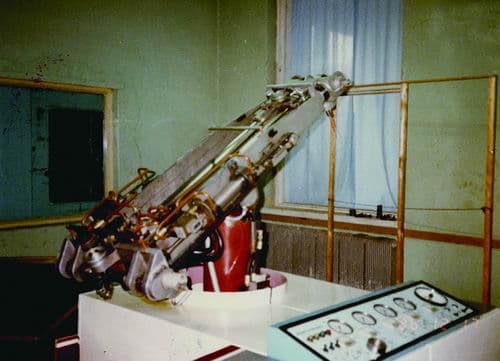
Jiang Xinsong’s SIA team completed China’s first industrial robotic system in 1982. The SZJ-1 playback robotic manipulator (SZJ-1型示教再现机械手) was the first robotic arm to be deployed to Chinese assembly lines, and marked a watershed moment in China’s race to catch up in industrial automation. In March 1986, Jiang completed an influential journal article titled “Research on the Development of Robots in Foreign Countries and Our Response.” In it, he offered a broad picture of robotics’ development around the world, diagnosed China’s challenges, and proposed six strategies for catching up. Revisiting the article today, one realizes how influential his thinking was to the trajectory of China’s automation development.
Jiang appears to have believed strongly in process knowledge. He pushed back against the idea that automation wasn’t valuable to a country with incredibly cheap labor that mostly made low-end products. Given market logic, he argued, equilibrial “match points” justifying investments in automation will eventually emerge in the industrial upgrading process. In the meantime, China needed to gain experience by mass-manufacturing cheaper robots, emphasizing parts over entire machines, and exploring automation for specialized scenarios.6 Writing just seven years into the One Child Policy campaign, he foresaw that China would eventually need to contend with labor shortages, particularly in dangerous occupations like mining; in fact, some of his engineering research during this period was addressing the challenges of using robots in undersea operations.
Jiang was swiftly given an opportunity to execute his vision through the 863 Program. In the 1980s, after two decades of the US-Soviet scientific rivalry, it was clear that technology was inseparable from national power. Chinese scientists watched as the United States announced its Strategic Defense Initiative (“Star Wars” program) in 1983 and the Eastern Bloc began the Comprehensive Program for Scientific and Technical Progress in 1985.
The same month Jiang finished writing “Research on the Development of Robots in Foreign Countries and Our Response,” scientists Wang Daheng 王大珩, Wang Ganchang 王淦昌, Yang Jiachi 杨嘉墀, and Chen Fangyou 陈芳允 directly petitioned General Secretary Deng Xiaoping to direct more funds towards scientific research, lest China be left behind. (They skipped official channels and had Deng’s son-in-law, who worked at the CAS and was an acquaintance of Wang’s, deliver the letter by hand.) Deng approved the petition in just two days, instructing Premier Zhao Ziyang to implement “without delay.”
In scholars Qiang Zhi and Margaret Pearson’s account, the “863 Program,” as the ensuing mega-initiative for applied research came to be known, was an institutional innovation inside the Party-state system. It was insulated from political winds; technology goals were specifically defined; and scientists, not politicians, had decision-making authority. The Program was guided by a single office under the State Council, which then coordinated scientist groups for each of the Program’s thematic focus areas. Funding for the Program was unusually concentrated and abundant. The total amount Deng earmarked for the 863 Program, to be distributed over the course of 15 years, was more than 10 billion RMB (around US$8 billion in 2026 dollars), equivalent to 5% of China’s entire government expenditure that year.
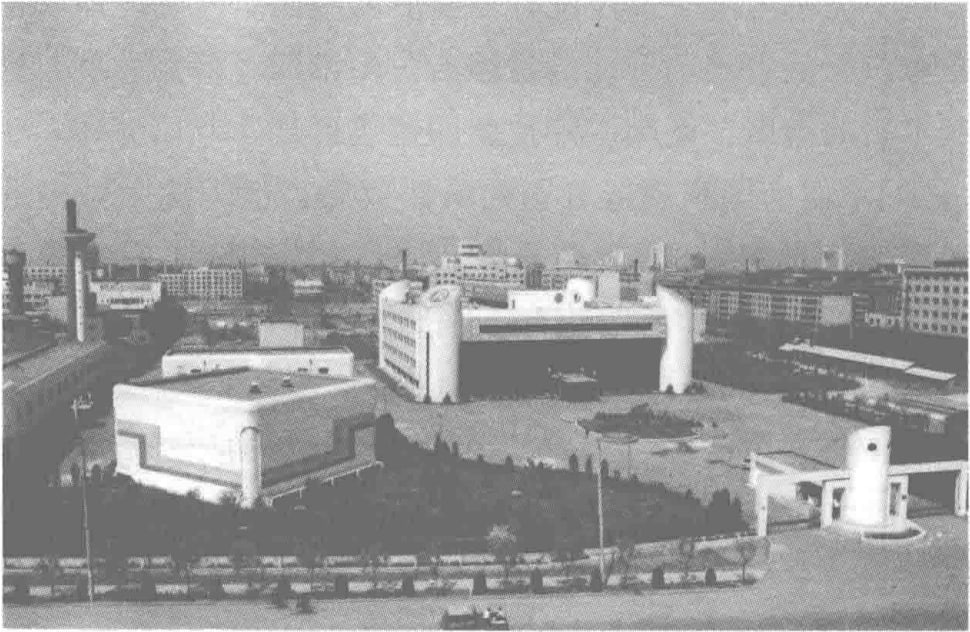
Jiang Xinsong advised the architects of the 863 Program on the field of automation for much of 1986, and in 1987 he was officially invited to be one of the Program’s seven chief scientists. His portfolio included computer-integrated manufacturing (CIM) and “smart robots” for industrial settings.7 The SIA remained the institutional home for much of this work. Armed with political legitimacy and funding, it produced a range of technical breakthroughs for the PRC in the ensuing decade. Jiang himself also initiated some influential technology transfer during this period. In 1993, he helped facilitate the import of twenty welding robots from Yaskawa in Japan. Paired with the SIA’s own controllers, these robots ended up in factories throughout China and accelerated uptake for automation.8
Though the 863 Program gave Jiang extraordinary influence, China’s industrial policy leapfrog did not entirely resemble his hopes for AI from back in 1972. Notably, the Program institutionalized robotics’ split from artificial intelligence, reflecting global trends at the time. The “AI winter” was descending, and robotics research continued to develop in a “classical,” engineering-driven direction. Within the 863 Program, robotics was placed into a different thematic focus area, away from computing and information science. It would take until the 21st century’s deep learning revolution for these two diverging threads to reunite.
In the 1990s, while progress continued in robotics, Jiang Xinsong was becoming worried about the future of China’s traditional industrial base. He had spent most of his career in China’s capital of heavy industry. Reform and Opening Up exposed the entire Northeast, including Shenyang, to market-based competition, and Beijing pushed forward with structural reforms under Jiang Zemin, resulting in mass layoffs. The region’s industrial identity, first forged almost a century ago under Japanese occupation, was under existential threat.
Jiang, who by now was well-travelled, looked to the West for answers. Towards the end of his life, he became an advocate for agile manufacturing, a concept first proposed by American industrial leaders in 1991. Agile manufacturing describes an approach where companies organize their assembly lines, stock, and workers in a modular fashion, so that they can respond to quickly-changing demand and produce highly varied products within one system. Designed for a world of highly personalized products, it allows designers to iterate quickly and factories to pivot production as needed. Jiang believed agility to be the key to adapting China’s old industrial base for the future of automated production, and delivered lectures drawing from American manufacturing research throughout China.

By the time he died suddenly of heart failure in 1997, the “world’s factory” was coming into being. It’s an ironic fact that in the end, visions first articulated by Target and AT&T executives (and funded by the Department of Defense) would be realized most fully in Shenzhen.9
As of 2025, more than 2 million robots are now deployed in Chinese factories, with domestic manufacturers selling more units in the country than foreign competitors in the last two years. One of the top Chinese manufacturers powering this transition is Siasun Robotics, based in Shenyang and affiliated with the CAS. Its founder, Qu Daokui 曲道奎, was Jiang Xinsong’s student and named the company — Siasun in English, and 新松 xīnsōng in Chinese — in his former advisor’s honor. Siasun became the first robotics company to trade publicly on the Shenzhen Stock Exchange in 2009.10
It’s easy for observers today to assume a sharp break with the Maoist past when interpreting China’s technology governance, seeing as many of the technologies most relevant today did not proliferate before even the Xi Jinping era. Jiang Xinsong’s story reminds us of the ghosts in the closet. China was not always strong, and the PRC’s leaders did not always look favorably upon its scientists. Periods like the Cultural Revolution cannot be explained away as exceptional aberrations; they, and reactions to them, scarred the generation ruling China today and shaped the institutions that now govern knowledge production. Chinese science has always danced a delicate duet with the state. Politics is a shackle, but also an incentivizing structure. AI, rather than fundamentally altering these relations of power, is likelier to simply reanimate them.
With thanks to Jasmine Sun and the ChinaTalk team for editorial feedback!
Xu Guangrong 徐光荣, Jiang Xinsong zhuan [Biography of Jiang Xinsong, 蒋新松传] (航空工业出版社, 2016), p. 85.
Tetsuji Okazaki, Development and Management of Manchurian Economy under the Japan Empire, 2013.
Xu, p. 146.
“Idealism” (唯心主义 in Chinese) here refers not to the opposite of pragmatism, but rather an ontological principle where minds and mental states are the primary determinants of reality. Marxist thinkers generally oppose this and adhere to the opposite: materialism, which argues that being is more important than thinking and material condition determine the course of history. The Chinese Communist Party is officially opposed to idealism; this is the main ideological reason behind its disapproval of religion, for example.
Wang Yulin 王宇林, “Global Literary Imaginaries and Production During the Mid-1970s” [1970 年代中期的世界文學想像與生產], Macau Polytechnic University Journal [澳門理工學報] 2022; Chen Xubin 谌旭彬, “AI Enters Elementary School Curricula; Long Criticized As ‘Pseudoscience’” [人工智能进入小学课程,曾长期被打成“伪科学”], 2017 (archived by China Digital Times).
Xu, p.218.
CIM refers to using computers to control every part of the manufacturing process. This approach paved the way to “dark factories” today, which operate with minimal human supervision.
Xu, p. 316-7.
For more details, see this “21st Century Manufacturing Enterprise Strategy Report” by Roger N. Nagel of Lehigh University’s Iacocca Institute, commissioned for the Office of Naval Research and completed in 1992.
During Shanghai’s infamous COVID lockdown in April 2022, its workers slept on factory floors to complete shipments of industrial robots to Mexico.
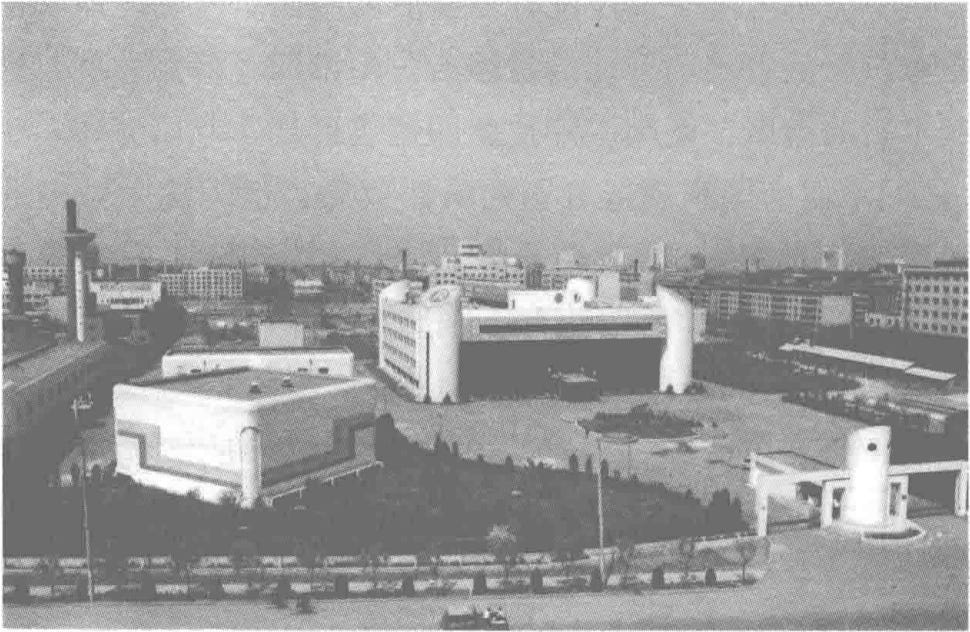
每一个案件,或者社会事件的定性,都有严重的时代烙印。
马加爵的案件,之于80后和90后可能都不陌生:2004年,云南大学的学生马加爵用石工锤残忍杀害了4名室友,并藏尸逃逸。
从我上中学偶然听到老师课上提起这个案件,到2011年我上了大学开始接触互联网,再到如今20来,我感受到整个社会和互联网对这个案件都有一个核心的舆论方向:莫欺少年穷。
因为大家普遍认为马加爵因为贫穷而被室友“欺负霸凌”了,所以忍无可忍杀害了室友。有一个室友没有被杀,是因为他平常对马加爵的态度,相较其它室友好一些,所以他得以保命。这个故事细节仿佛成为了一个警示箴言,也是我们这个社会非常乐见,喜欢传播的箴言:做人留一线,别欺负弱者,关键时刻能保命,善待它人是救命的东西。
这20年来这个故事仿佛从未失效。
直到我看到了一篇帖子https://www.sina.cn/news/detail/5276047357774300.html,并去看了当时参与马加爵犯罪心理学教授李玫瑾的访谈,才知道真实故事绝非如此。
1.首先,马加爵杀的室友都比他还更贫穷。马加爵甚至是几人中唯一有电脑的。因此并非贫困导致的杀人。
2.并非因为谁对他好,他就放过了人家,而是那个室友非常幸运,那段时间不在宿舍。也并非因为谁对他不好,他就愤而杀了对方,因为他在法庭上有亲口说他杀害的人里有对他不错的人。
3.并非对方口出恶言,他一时激愤而导致的“情绪性应激杀人”。因为应激杀人,一般一天之后都会冷静下来。而马加爵是精密计划花了3天陆续杀了4个人。
4.这种花多天杀周边多人的情况,是“灭口型杀人”。为了让知情者统统闭嘴,自己阴暗的秘密不会被传播出去,所以进行了灭口。
5.马加爵不惜杀人灭口也要隐藏的阴暗的秘密是什么呢?他寒假期间多次出校嫖娼。
李玫瑾委托中青报记者崔丽在马加爵被判死刑后的访谈中问过这个问题:寒假期间是否有过性行为?
他的回答是:有,在校外,很多次。
我还看了他被执行死刑后,他的同学接受的采访中透露,他看周围的室友和同学都找到了女朋友,他也渴望找到女朋友,但是每次遇到女同学时,他就会开一些不合时宜的玩笑(不难想象是什么类型的玩笑),结果不仅没有得到回应,反而吓到了女性,他就变得更加敏感和怀恨在心。后来还买了电脑,每天浏览黄色暴力内容来实现满足。
这是一个非常典型的Incel(非自愿独身男性)的画像,在他们的心目中:每个女性都应该是男性的“性资源”。他们对自己没有分配到该有的性资源感到愤恨难平,因此一边渴女,一边厌女,同时仇恨这个社会,有更高的倾向诉诸暴力行为。
多年来全球范围内由 Incel 意识形态驱动的恶性案件频发,甚至很多国家将Incel列为“暴力极端主义”的威胁来源。而马加爵这个有计划有目的多天残忍杀害多人的Incel,在我们这个爱男护男的父权社会,被同情,被美化,被找无数理由来合理化其行为。
而唯一我们能感到庆幸的是:这里面他杀害的也是同性别的男性。倘若一旦是女性,我们可以轻易地推理和想象,有多少脏水会泼到女性身上。甚至在当时的各种报道和文章里,就有人各种杜撰女性不愿意同他交往,甚至羞辱他,才导致了他的心理失常的情况。
“有女人怪女人,没有女人怪没有女人”,这样就能给每一个穷凶极恶暴力犯罪的男性,找到理由,也能轻松骗我们20年。
女性勤恳,努力,正直,且不被托举地活着,却无法活得心安理得。整个社会仇恨,批评,贬低,凝视的声音,不断内化,让女性每天质疑自身存在的正当性和行为言语是否有疏漏错处。而男性,可以杀人越货坏事做尽,依然骗取大众同情20年。有哪一个“恶女”获得同等待遇了吗?
第一性的世界容易的点就在于:可能你一无是处一事无成,哪怕你罄竹难书流恶难尽,你放心,只要你是男性,就会有人,来无缘无故地爱你,相信你,理解你的难处,共情你的处境,洗白你的行为,传播你的事迹,帮助你把其它人一起骗下去。
好消息是,有人发明了“Incel”,有人发明了“mansplaining”有人发明了“爹味”(我发明了一个衍生词:爹味茶男),有人发明了“老登”(所以在此呼吁所有女性不要在自嘲的时候自称自己是“中登”,也不要说“登”不分性别,“登”必须有且只属于男性,这个世界专属骂女性的词汇太多了,而专属骂垃圾男性的词汇还实在太匮乏,请为男性保留这个词汇的专属性),杨笠发明了“普信男”……这些词汇语料的发明,是我们戳穿父权制骗局的“细针”,看着杀伤力不大,但是这些细细密密的针,在父权制外强中干的气囊戳上一个细孔,我们就有了看见真相的缝隙,让其大厦倾颓的抓手。
请多多发明、创造、传播、使用这些词汇!请多多戳破和大肆宣扬例如马加爵之类的父权制骗局!
dials in from Kyiv for a long-form WarTalk on what the front line actually looks like in year four. Infantry sit underground for six months without seeing the sun, 2% of casualties come from small arms, and where the “forward line of troops” has been quietly replaced by a forward line of UAV teams.
Rob Lee is a senior fellow at FPRI and one of the most-read analysts of the Russia-Ukraine war; he’s joined by WarTalk regulars Bryan Clark, , and .
We discuss…
The six-month infantry rotation and what isolation, drone threat, and zero-line resupply do to a human being
Why Ukraine has reclaimed the drone edge — and what the Hornet, Bumblebee, and FP2 are doing to Russian logistics
Ukraine’s new corps structure, where the brigade-only model broke down, and what the Azov-derived elite corps look like
Why 2% of Ukrainian casualties come from small arms and what infantry are actually doing on the zero line
Starlink as the indispensable game-changer — and Russia’s increasingly serious attempt to jam it
Combat casualty care when CASEVAC takes 12 hours, the golden hour is dead, and tourniquets sit on for a month
What the Marine Corps should steal from Ukraine — pushing Hornets to the battalion, Bumblebees to the company, and giving up something to make room
Jordan Schneider: Justin, Bryan, Tony Stark — joined today by Rob Lee, dialing in from Ukraine. We’re checking in, hopefully going to hear some positive developments on WarTalk for the first time in a real long time.
Justin: I noticed there was an account posting photos of Ukrainian fighters from just before the war started, and then pictures of them today. You could really see the changes that have gone on. Rob, I know you’ve been with a lot of the fighters and the commanders — if you want to talk through a little bit of what they’ve gone through over these four years.

Rob Lee: I served four years in the Marines. I deployed three times. The deployments are relatively short. In this war, a lot of people volunteered on February 24th with no military background, and now four years later they’re still in service. They put their lives on hold. Even with us who were serving in the GWOT — you’re home at times, you’re deployed — you can still kind of care about your lives.
The burden of this war is very narrowly focused. All Ukrainians feel it, but in particular the infantrymen. Rotations are very difficult now because of the kill zone, but also manpower challenges. Right now infantry, some brigades I’ve met with, say infantry is spending a minimum of three months at the zero line with no rotation. But there are many cases of six months and nine months. There are a couple of cases of guys who are over a year on position and just doing no rotation.
What it’s like is — usually if you’re infantry, you’re underground, either in a hole dug in a tree line somewhere or in the basement of a building. You’re not going outside very much because of the drone threat. Some of these guys, their eyes have to recover because they haven’t seen sunlight that much for six months or a year. There’s very little physical exercise you can do because you’re in a very small confined space. Almost all resupply is done by drone — these big vampire drones drop almost all the food, ammunition, water, whatever else you need.

It’s very difficult to do casualty evacuation. To zero line, in many places you can only do it by ground drone. You can’t even bring up vehicles. Basically you either have to walk out yourself or you have a UGV come get you. And in many cases that’s not possible. To walk to position and back, in some cases you have to walk 25 kilometers. I talked to an infantryman from the 9th Air Brigade a couple of weeks ago, and on his way out he had to walk 18 kilometers. Of course you’re walking along the most concealed and covered route. It might take days or a week or so, because you walk when there’s bad weather, when the drone threat is reduced.
It’s very hard to fathom, even for me, because it’s so different than what we saw in Afghanistan and what other people experienced. This infantry guy I talked to was telling me he only slept a couple of hours a night. He’s always on edge — they’re getting hit by FPVs and other things pretty often, almost every day. You never know if Russian infantry are going to walk up on you, because sometimes they get through, sometimes UAVs don’t see things, and you might have to fight. In this guy’s case there was a case where six Russian soldiers got into his position and they had to fight them with small arms.
It’s extraordinarily difficult. You can imagine how much it ages you, because you’re so tense for so long at a time and there’s no rotation. The psychological and physical effects are going to be really long-term problems for these guys.
Tony Stark: There was a saying about soldiers in World War Two — they saw about ten days of intense combat. That’s not dismissing the combat that they saw, but it was kind of this roller coaster where there would be dead periods, and then you’d be in these massive engagements. During the GWOT, it was kind of the opposite — you could take contact every day, but you weren’t under sustained fire every day. You had FOBs.
And then you have what I’ll say was General Milley’s perception of future war — that you would always be under threat of fire, you wouldn’t get a lot of sleep, and you’d have to move a lot. The one difference is that for Ukraine, they really can’t move. They’re stuck in this attritional battle where there’s not large-scale maneuver warfare.
Rob Lee: Yeah. The ombudsman for the military mentioned a study a month or two ago — I was thinking about writing something about this — that according to the study, anyone who’s been on the zero line for more than 40 days becomes kind of ineffective. Maybe not ineffective, but they stop caring too much about their survival. They lose their effectiveness essentially. I talked to this guy — he thought he was still effective. He’s still obviously afraid and has certain issues. But as you said, the comparison — here it’s not the most intense combat, because you’re underground, in some kind of cover and concealment. It’s not like you’re in a firefight the entire time, but you’re on edge the entire time. Any time your position could be attacked, you could get hit by drones all the time, and you can’t go outside.
There are both sides to this. Drones have created this problem with the kill-zone concept, but they also enable you to be able to fight within it — because drones are doing all logistics too. Drones are just having a really dominant role in the war at this point.
Rob Lee: That’s why — let’s talk about what’s happening now. The case for optimism is that Ukraine is retaking the upper hand on the drone side. The qualitative improvements — quantitative, I think, is pretty even. But that’s one of the really big developments of the last five, six months: Ukraine has reestablished this upper hand. Last year, some people thought Russia had caught up or maybe narrowed the gap. It’s very clear that Ukraine has surged forward this year, and that’s really one reason why the situation is better than it was a year ago.
Jordan Schneider: What have been the developments over the past three to four months — or wherever you want to put the turning point — that have changed the dynamics on the ground?
Rob Lee: First off, there’s a strong seasonal dimension to the fighting. Every winter, the fighting doesn’t end, but it’s more difficult for Russia for offensive operations, because Russia really prefers doing infiltration tactics — usually one or two guys at a time moving forward. It was a very cold winter, negative degrees in many cases. If you’re out in the environment like that, it’s hard to survive. These guys aren’t that well trained, and the tree line goes away, so you lose your camouflage. It’s harder to camouflage from drones. Thermal cameras work better when it’s cold anyway, so thermal optics on a Mavic 3T is going to be more effective. In winter, infiltration is much more difficult — Russians try to infiltrate behind the front line and either dig a position in a tree line or find a basement. In winter you basically have to find a basement to survive. So it limited the kind of infiltration they could do.
Over the winter we knew Russian advances would probably slow down, and they did. Typically, looking at the last year and the year before, Russian advances would still be somewhat slow in spring and then pick up as the summer goes on. We’ll probably see this again — Russian rate of advance kind of increasing. But the weather has turned for about a month or two, and we haven’t seen a significant increase in the rate of advance for Russia. So my view is we have to wait and see how bad we’ll get in the summer and fall when Russia typically advances faster. But there are good reasons to believe this year Russia is going to have more problems advancing.
One of the big ones is just the development of mid-strike, which is operational depth strikes by Ukraine. Ukraine for a long time had very good intelligence of Russian positions — they knew where command posts are, where air defense systems are, not perfect fidelity, but a good idea in many cases. There was just a lack of capability to strike these things. Obviously they had ATACMS before — that was one of the options. HIMARS used to be basically the only operational fires capability they had for some time. HIMARS became less effective because the Russians adapted — they could shoot down GMLRS, EW affects GMLRS.
Now Ukraine has developed and scaled kamikaze drones that can focus on operational depth. There’s a huge quantitative increase the last six months or so, in different types. You have the FP2 — maybe it’s going to be called Firepoint — it has a 100-kilogram warhead, a really big warhead. If it hits something, it’s going to do a lot of damage. You can collapse a building. They’re using these very frequently on air defense systems, command posts, warehouses, all sorts of logistics targets. They hit an FSB building in Kherson yesterday — destroyed the building. Even if the accuracy is 30 to 40% getting through — I don’t know what the number is — you’re still getting enough through to destroy targets. And the price isn’t… I think FP2 costs like $40, $50,000. Don’t quote me on it, but that’s a rough idea.
You have a bunch of other drones in this class, maybe smaller. There’s the Hornet from Eric Schmidt’s Perennial Autonomy — that’s doing a lot of significant damage right now in different areas on logistics roads. Hitting trucks, making it very difficult for Russian logistics at 50 to 100 kilometers or even further. They’re very cheap, sub-$5,000.
You can adapt them — put a Starlink on them, increase the battery size. A very successful system, very easy to fly, the AI will ping targets. As you’re flying, you put in what kind of target you want the system to search for, and it’ll immediately put boxes up as it flies. There are false positives, but it will locate things for you. Then the Bumblebee, the FPV-Mavic-type version of the Hornet from the same company, also works integrated in the system.

The qualities of production are just increasing. More Ukrainian units are getting these things, and it’s doing a lot of damage. There are other Ukrainian options like Bulava, RAM-2X — kind of at the Lancet class. The quantity has just increased substantially. They’re getting through Russian EW. Obviously the economics make sense to use these aggressively — it’s not $400,000, not $200,000, it’s something much more affordable, and that’s really changed the dynamic of the fighting.
Mid-strike is the big development of the last six months. Russian advances have already slowed. That’s from a variety of factors. But now with the increasing improvement in mid-strike and knocking out air defense systems and other things, we can also think about what else might happen later this year. I definitely think this year it’s shaping up better than it was last year.
Bryan Clark: All your discussion about the scale they’re able to operate at and the adaptability of these systems makes me think — a lot of what they’re able to do is just testing and probing to see what works. So there’s much more adaptability because they can just poke and poke and poke until they find a vulnerability, and then they can pour in on either that capability vulnerability they see in the Russians or some mispositioning of forces. Is that a lot of what they’re doing here — taking advantage of the scale and the tempo they can generate?
Rob Lee: Yeah. The Russians have a lot of vulnerabilities. They’re slow to adapt in many cases. There was a big debate over mid-strike last year, where some people thought this should have been a bigger focus — the operational depth was just not being hit. Ukraine had a tactical strike and a strategic strike campaign, but this operational campaign wasn’t there. Now it’s here and it’s doing enormous damage to Russia. It’s going to change how they do logistics.
When HIMARS arrived, Russia had to push back logistics and develop a new system with different echelons. You had big trucks moving from one distance and they had to shift to smaller pickups, ATVs, and so on. Russians are already starting to push back fuel storage further from the front line because they’re having difficulty protecting it. They’ll probably push back command posts and other things too. All this is going to make those things more difficult.
Ukrainian units have a lot of room for creativity, for figuring things out, and once they demonstrate success they’re going to reinforce that. Now we have the quantities of these munitions increasing, the qualities there. Eric Schmidt’s company is a good example — they came to Ukraine and focused all on Ukraine. Everything’s about Ukraine first and then everything else afterwards. They brought in Google X engineers, the best, most talented American engineers we have, and they partner with Ukraine units who give them feedback and they immediately iterate. It’s the best Ukrainian drone units with the best American engineers, plus massive funding from one of the wealthiest people in the world. It’s working very well, and Russia has nothing that can compete in this way. Their defense industry is still very centralized, old-style big defense companies, far less innovative, they don’t have the same talent coming.
Rob Lee: The manpower situation has been the biggest problem for Ukraine ever since the summer 2023 offensive. Brigades have been very undermanned. But Ukraine at this point, through drone development, innovation, production, and the system they created, has really been able to compensate for the effective lack of manpower.
There are also some other positives. They changed the reforms of the corps system. Before this, Ukraine was an all-brigade-style military. They didn’t have divisions or anything above that. The way it used to be — you had brigades, and then these temporary command-and-control functions above them, OTU and OSGV, which are like operational-tactical groupings. But they were temporary. The commanders were rotated in and out, the staff came in and out, and they were too high-level, managing too many brigades. They didn’t really provide very good support.
They rolled out corps last year. It’s hard to roll up a command-and-control change mid-war, but some of these corps are doing a very good job. The entire quality has increased, the coordination across the corps is increased. The corps commander is controlling like five brigades, whereas an OTU might command 20 brigades. So there are a lot of improvements on command and control, adjacent-unit coordination. Now the corps are also getting corps-level assets — they’re trying to develop UAV regiments that can focus on operational depth and let the brigades focus close to the front line. That’s another contributing factor that improved the situation.
Tony Stark: Two questions. One — how is that structure evolving below the corps level? Is the corps directly tasking the brigades, or are they having divisions, and then those divisions are tasking? The American Army is going through that same reformation where they’re trying to relearn how to fight as a division. The corps still doesn’t know what it’s up to. That’s part one. And then broadly — what is the evolving role of the infantry here? Because you kind of hear two things in America. One is that the infantry is done, which we hear every ten years. The other is that the infantry doesn’t need to change because the infantry will always be there. I mean, infantry tactics change all the time. So how are those two things linked for how Ukraine is fighting from the top down?
Rob Lee: On the first one — above brigades, it’s just brigade-to-corps level now. Nothing in between. Corps is kind of our division — it’s not really a corps level, it’s more of a division, somewhere in between. But they call them corps instead of divisions. At the corps level they’re still figuring out what assets they have at that level. Right now you usually have an artillery brigade, they’re trying to set up an unmanned systems regiment, and some other assets.
They are actively changing. The air defense component has changed too. They have a new small air defense side led by the former commander of Lazar Group. He pulled away some of the air defense — sorry, the ground forces air defense battalions. They’ve restructured to counter Shaheds. Now it’s part of an echelon system. For countering Shaheds, brigades will often have interceptor teams, they’ll have radars to try and locate Shaheds. You’ll often have some level beyond that, and then additional echelons for countering these things.
It really depends which corps. Ukraine has some unique corps — the 1st Azov Corps, the 2nd Khartia Corps, the 3rd Corps led by Biletsky, the former Azov commander. These corps are quite elite. They’re all unique because they have a unique background — 2nd and 3rd Corps were volunteer units that formed after the war began. There’s a big difference between those corps, which have more fleshed-out staff work and other corps-level assets, and other regular corps that may not have the same capabilities. There’s wide variance still in corps capabilities. Long term, I don’t know what it’ll look like — that’s going to be a question for Ukraine.
They also have the Unmanned Forces, a different branch. Those teams are all across the front line. They don’t report to the corps commanders — they report up the Unmanned Forces chain. Then you also have these Assault Regiments, nominally part of the ground forces, but really separate, and they also report directly to General Syrskyi, not to corps commanders typically. So you have these other command-and-control relationships that are evolving. The corps commander does not always own every asset in his area as a battlespace owner, and that does lead to some frictions. That’s constantly being changed and updated. What we’ll see in the future will probably look a little different than what we see right now.
Rob Lee: And then for infantry — it’s a good question, because infantry are not fighting infantry that often. I talked to the head surgeon for 7th Corps. 7th Corps is holding Pokrovsk-Myrnohrad, this really key part of the front line. He estimated that about 2% of his casualties are from small arms. Small-arms casualties are a very small percentage. Even in the urban fighting it was still a small percentage. On both sides, UAVs are doing the vast majority of killing. I told a couple of Ukrainian brigade commanders last October and asked them what percentage of casualties were from UAS. A couple said 100%. So it wasn’t even just 90% — it was literally 100%.
For infantry, there’s a question on some of these positions, because often the Ukrainian brigade commanders will tell their guys: do not engage Russian soldiers unless you have to. We want you to hold position, because if you open up, the Russians will often have a Mavic following their infantry as they walk forward. So if Ukrainian infantry open up, the Mavic locates where the position is, and you can then hit it with FPVs, Molniya, artillery — whatever. Once the position is located, you can usually destroy it. So oftentimes Ukrainian units tell their guys, don’t engage unless you have to, only if they’re within 20, 30 meters.
Some of these positions are more like observation posts, because they’re not really doing fighting. They don’t necessarily have to have fields of fire tied in with the next position. The next position might be 500 meters, it might be a kilometer away. It might be quite laid out. You don’t have interlocking fields of fire like we were trained in the US military. UAVs are doing the killing, doing almost all the observation, and the vast majority of Russian casualties come from UAVs. Basically infantry — look, here’s a whole position. If you see someone, call it in, we’ll have UAVs come and try to kill these guys for you. Of course, if you have to fight, you have to fight. Sometimes the weather is very poor, UAVs are just not flying, and then infantry might have to.
Of course, if you’re taking a position from someone, infantry have to go there and they have to hold it. So there’s still an important role. The role has decreased in importance, but it’s still there. The number of Ukrainian infantry per kilometer is very small — on average probably six, five per kilometer, maybe less. In cities and urban areas it’ll be higher. But most of the terrain is big fields and tree lines. There are no positions in open fields. Every position is either in a tree line, a forest, or in the basement of a building, because anything that can be seen can be destroyed essentially.
On the Russian side, they treat their infantry — they’ve adopted Wagner’s tactics writ large. They said, okay, we’re going to treat infantry as expendable. We’re not going to care too much about them, we’re not going to invest too much in them, and we’re basically going to advance by having numbers of infantry plus fires doing a lot of the work. Artillery, now it’s UAVs doing it. I think it’s been a poor approach. They take more casualties than they need to. If they invested in their guys more, they could do much more. They don’t do much unit-level coordination — they’re not really training companies that do company-level operations anymore. It’s very small-scale. They treat infantrymen as not that valuable, not that important. Many Russians don’t make casualty evacuation a real priority. Some do, some don’t, but it’s just not near the same thing.
We don’t see much infantry fighting — but you still need someone to hold the front line. There’s also a question of what the FLOT looks like. Is it where the infantry are? Because if the infantry are not fighting, if they let Russian infantry walk past them, to what extent do they hold this position? To what extent do they hold this terrain? I remember when I was in Afghanistan, before going to Marja, I talked to some platoon commanders who were there. The battalion commander — one of these guys came up to him and said, hey, to what extent do you control your area? And I’m like, what do you control here?
There’s a particular type of character of fighting right now in Ukraine. Drones are here to stay, to some extent — that’s pretty obvious. But I don’t think the nature of positional fighting will necessarily be the same in future conflicts for us. It is important. You still need infantry. There are no brigades I’ve talked to who think they have enough infantry. They want more guys. If you want to do offensive operations, you need infantry to move forward, to hold things, to take things. UGVs are still coming along, but they’re not there yet. I’m still a big believer in infantry myself, but certainly drones are playing a bigger role and you can compensate for lack of infantry more than you could before.
Justin: When we look at that, then what does the theory of the next six months look like for Ukraine? Is it that they’re comfortable where the FLOT is currently against the Russian forward line of enemy troops, and they’re comfortable continuing their longer-range operational-level strikes to continue to decrease Russian capability? Or is Ukraine in a spot where they have to actually start pushing the FLOT, and therefore they need more manpower to be able to do that, because they have to show some type of progress both for international backers and for internal prestige?
Rob Lee: So Zelensky said, ever since Trump was in office: look, we’re ready to end the war basically where the front line is. We’re ready to declare a ceasefire, we’ll negotiate other things, let’s just hold the front line where it is and we’ll move from there. Putin has basically put this off the entire time, because he keeps saying no, we want all of the Donetsk region — then we can speak after we have the rest of the Donetsk region. So that is still the kind of stumbling block.
For Ukraine — look, Ukrainians are tired. There are a lot of people who are ready for this war to end. If they could freeze the front line where it is without significant losses of sovereignty, I think a lot of Ukrainians would go for this, as long as they thought they still had the ability to deter a future war. But I think this year Russia actually has some really big issues, and I think Russia risks overextending itself and actually having some reverses. We’ve seen this in this war consistently on both sides. Russia overextended in the spring and summer of 2022, and that led to Ukraine’s successful offensives in Kharkiv and Kherson Oblast in the fall. Ukraine overextended in the summer of 2023, and that led to Russian advances afterwards.
I think there’s a risk for Russia to do this again. A lot of it comes back to Putin. The war reached diminishing returns some time ago for Russia, but he keeps committing to it. There are probably plenty of people in the general staff who think this war should have ended a while ago, but Putin is just very focused on this. Russia has had a lot of significant costs — geopolitical, human, economic — to extend this war. The question is what are you achieving by doing so. Fedorov put his target — he wants to inflict 50,000 casualties per month. He wants to increase it from right now. Ukraine estimates it’s like 35,000.
We’ll see if they can reach that. The other side, while trying to inflict as many losses as possible, they’re trying to increase deep strikes, increase the cost on the Russian economy, go after oil and gas, go after defense production. People are tired. The Ukrainian military has a manpower problem. I wouldn’t be surprised if we saw some kind of offensive this year by Ukraine. Partially because Syrskyi, the commander, always wants to be on offense. He does not like defense. He was the brains behind the Kursk offensive, the Kharkiv offensive. He’s always looking for weak spots.
We saw a small offensive in the Huliaipole direction, Zaporizhzhia, in January and February. That was successful. We saw one back in Kupyansk that started last October. That was successful. My read from those two offensive operations is that Russian lines are not that strong. There are unrealistic objectives constantly given to Russian units. They’re always told you have to take this village by this time. It creates a vicious cycle where commanders cannot reach that on the timeline, so they often resort to lying, or they’ll send a guy forward to post a video of a flag somewhere, which is not true. It creates an internal bad system. They also rush operations.
So instead of setting the conditions for an offensive a month from now, they have to constantly throw guys at the front line because they’re behind whatever the timeline is. Putin is just not allowing commanders to give honest appraisals, and it creates really bad issues internally. But it also means that their defenses are not like they were in summer 2023, when they had very good fortifications, minefields, the Surovikin line. Right now Russian lines — they’re able to locate these teams, suppress them with artillery or with Grad MRLs. The assault units are tinkering, figuring out how to do offensive operations in a drone environment, which involves using drones to set localized superiority and the right conditions for offensive operations.
I wouldn’t be shocked if Ukraine does push back Russia in places this year. They may not have enough manpower to do it, but in the Huliaipole direction, one of the real breaches — if they had someone to exploit it, they could have really advanced much deeper into Russian lines. The issues Russia has internally, the lying, the perverse incentives, create a lot of vulnerabilities that can be exploited. So Ukraine’s strategy right now is end the war as soon as you can. I think they’d be happy freezing the front line. But I wouldn’t be shocked if Ukraine pushes back Russia in some places this year.
Bryan Clark: Hey, Rob — you mentioned EW before. Talking about the ubiquity of surveillance on the front lines, to what degree is EW impacting the ability of either side to use their drones to keep track of what’s going on? Or has everybody just devolved to using fiber-optic cabling to their drones to overcome the EW challenge?
Rob Lee: One thing to keep in mind — different parts of the front line have a very different EW nature. The Pokrovsk direction has often had the heaviest EW concentration for the last couple of years. Some UAVs that’ll work on one part of the front line, like Zaporizhzhia, will not work on Pokrovsk. When I was talking to units in Myrnohrad the last year or two, they basically said EW is so strong we can only use fiber-optic, so for FPVs, fiber-optics dominate that direction. Radio-signal FPVs play a smaller role. There are Ukrainians that do use radio-signal there, but it’s more difficult.
Other parts of the front line, radio-signal is okay and you can conduct strikes at deeper range. Fiber-optic cables have gotten more expensive because they almost all come from China — a 50-kilometer spool can be $2,300, $2,500. The economics have changed so that if you have a big FPV, like a 15-inch FPV — which is bigger than normal, normal is like 10-inch — you can put a Starlink on it, and Starlink is like $500. Starlink gets you around EW. Now the economics make sense where Starlink is cheaper than fiber-optic even, and some units have gone in that direction.
Starlink is — if there is a game changer this war, I think it’s Starlink. Because everything about how drone warfare works for Ukraine revolves around the use of Starlink. They’re putting it on everything. ISR often uses them. Most of these mid-range strike drones are using them — not all, but very commonly. UGVs constantly are using them, naval drones. And of course every position has Starlink to stream the feeds of the UAVs back to command posts so you can see everything. Starlink is this solution to many problems that if it was not there, the war would be entirely different.

EW is still a significant issue. The Russians realize they’re behind the power curve on mid-strike. They’re having big issues. They were using Starlink on Molniya and on Shaheds back in January — that’s when SpaceX blocked it. That was posing really big problems. I was down at the front around that time frame. They were hitting trucks like 50 kilometers from the front line, oil and gas tanks. Trucks is a big issue.
The Russians do have some Starlink jammers they’re testing. They tested one in 2024 — two of them were destroyed. Of course, if you jam something, you can look where the center of the jamming is coming from and get an idea of where it is. The Russians are now trying to come up with a more integrated counter-UAS system where you have a Starlink jammer, you have other types of jammers that will jam other types of drones, and then probably air defense integrated into this. They’re actively thinking through what a system of counter-UAS looks like with different echelons of radar — like SKVP radars that can locate, that’s like their version of the RADA, there are some Chinese ones too. EW jammers to jam certain types of UAVs including ISR. Interceptors to try to knock out ISR and kamikaze drones. And jammers to try to jam Starlink and other things.
We’ll see if they can succeed, but I know it is a big priority this year. It is one of the big questions in my view. If they can actually adapt and figure this out, then they will negate a lot of these training advantages. If they can’t fix it, then it’s going to be a big problem for them.
Bryan Clark: And so the Starlink jamming, I assume, is a downlink jammer — you’re jamming the Starlink signal coming down to the drone, as opposed to trying to jam the satellite itself, because that gets very hard with a LEO satellite.
Rob Lee: I think that’s what it is. When I talked to guys when they used it in 2024, it basically showed Starlink was not available in that area — that’s what the drones showed. Back then it was mostly to disrupt the Nemesis and Lazar Group drones, the heavy bomber ones. Obviously Starlink is being used in a much more pervasive manner now. But I do know there are companies working on a bunch of other things now to try to get through jamming — things that can provide a better GPS signal, things that can provide a better INS on radio frequency. That’s one reason I was talking before about Western tech — there’s Western tech that’s working on these problems. It’s not just Starlink. We’ll see some successful examples this year. It’s something Russia will not be able to compete with.
Bryan Clark: Yeah, because the issue ends up becoming — if you’re using a GPS jammer and a Starlink jammer, but it’s only going to reach 10 kilometers and it’s going to get impacted by terrain, there’s going to be a little zone around the target. You can do that around really high-end targets, but you can’t do it everywhere, probably because of the number of jammers you’d need. And then you can have an end-game seeker or something that gets the drone the rest of the way. You get within 10 clicks, you lose your Starlink signal, you lose your GPS — if you have some alternative way to get you that last couple of minutes to the target, it seems like you could come up with a relatively inexpensive way to do that. That’s a lot of what these guys are working on for GPS-independent navigation — just something to get to the last tactical mile.
Rob Lee: Yeah. Most of these kamikaze drones now have some kind of pixel-lock on them. The last kilometer they can do target lock. It’s not perfect, but it gets you most of the way there. The Hornet is a good example, because it’s so cheap — okay, we can afford 20%, 30% accuracy. It can still be considered a win, because before we were using Gimlets at $200,000 something. If a Hornet is sub-$5k, you can send a lot of Hornets for the same price of one Gimlet and achieve better results.
Tony Stark: Just to pivot back to humans — there was reporting last night that the US is cutting a bunch of funding because of CENTCOM for training for units, including tactical combat casualty care. Are there innovations in combat casualty care on the Ukrainian front? I know we talked about the Russians really don’t care, and last time you were on the show you talked about UGVs. How are the Ukrainians saving lives once they go down on the front line?
Rob Lee: It’s a huge issue. One of my conclusions is that Golden Hour is a concept that made sense for the GWOT. It’s not something that makes sense here. I don’t think we can assume we’ll be able to do this all the time. Helicopters do not come to the FLOT. In Russia, they bring them up to do certain missions and they’re still getting hit by FPVs.
Infantry on the front line, everything is supported by drone. In some cases when they get wounded, they’ll basically have telemedicine happen — a doctor will talk to them through some way and say, we’re going to drop you some medical equipment, here’s what you’re going to do to provide care to the guy next to you, because we can’t get to you. Vehicles can go to zero line only if the weather is horrific. In many places you can’t bring vehicles there. So basically the only two casualty-evacuation options typically are: the guy walks out, or someone drags him out, or a UGV. They have some UGVs that have some frag protection. The First Medical Battalion is a really interesting unit that has their bespoke UGV they’re making, and they’re doing these really long-range CASEVAC missions.
The kill zone makes it just incredibly difficult. UGV missions require a lot of planning and they’re very slow because you have to be very worried about the route you take. In order to not lose UGVs that often, it takes a lot of planning — plan the route properly, think through the timing, when to go, what UAV threat is, and so on. An actual CASEVAC mission with a UGV could take 12 hours. It could be more than that. By the time someone’s wounded, by the time they’re back to a higher level of care like a Role 1 or Role 2 facility, it could be 12 hours. That might be the minimum in some places. In that case the likelihood of being killed is higher if you get any significant wound.
Keep in mind, Ukrainian infantry are typically older, in their 40s or 50s. Many have existing health issues. Sadly, I hear stories of guys who die from just being sick — they get some illness, they have a pre-existing condition, there’s no way of getting care to them, and they die in a position. I’ve also heard cases where guys get wounded, they put a tourniquet on their arm and they left it on for like a month or so. And then when they come back, the lower limb basically just falls off. Just some really horrific, macabre stories. It shows you how difficult this is.
My takeaway is that when I was in Afghanistan, in my platoon we had two corpsmen. I think every squad had a combat lifesaver. But at this point, every fire team has to have someone with pretty good medical training. You really need to get at the lowest level very good medical training, where guys can take care of themselves, because you just can’t assume you’re going to have higher-level care. You can’t assume there’ll be rapid CASEVAC. That’s one thing we should definitely not skimp on training for.
Justin: That’s one of the downsides to the way medical training has always been looked at in the United States military. You look at Special Operations Combat Medics, or SOCMs — they’re technically trained by doctrinal definition to be able to sustain a casualty, multiple casualties, for up to 72 hours. Then you look at the Special Forces medic, the Special Operations Independent Duty Corpsmen, which are the Navy variant of the Special Forces medics — they’re technically trained to, as long as they have the supplies, sit on a patient indefinitely. When I went through Special Forces medical training, it was a year of medical training. That goes from basic anatomy all the way through doing surgery on extremities and tropical medicine and everything in between.
That’s a level of training and a level of going in and learning pharmacology and learning how to actually treat and assess and do those medical procedures that isn’t going to be invested in every soldier or every fire team or every platoon. But even if you were to invest in it, the sustainment of that — the biggest fear ODAs have, medics have, is, well, when we would train the other Special Forces members of our team, we were always the person who was injured. Because the worst-case scenario was we’re in a firefight and I’m the one that’s hurt. Now you have to do all the medical stuff to me.
When you’re starting to talk about getting down into fire teams, that means you’re saying one out of every three to five people needs to be trained at a pretty high level in medicine. That really fundamentally changes the way you approach the structure of an organization, how you’re employing them, what you’re giving them and how you’re equipping them. How are the Ukrainians dealing with this? What is the process, or is it all trial by error?
Rob Lee: I can’t give you the best answer. TBI is a huge issue. TBI is maybe the majority of casualties. There’s really no way of pulling guys out in many cases. So in 7th Corps — they’re the guys holding Pokrovsk-Myrnohrad — typically Russia drops a lot of the glide bombs on the cities, wherever they think any positions are. Guys will be there with — they’ll get the bell rung, they’ll have TBI, and they just can’t rotate out. It leads to really long-term issues.
When they rotate guys out — these infantry, they do a lot. They do a full assessment, I know that much — psychologists meet with them, they’ll often be in rehab for a month or so or more. It really is physical damage. When you’re in a position for six months, you can’t move physically, all the mental stress. It creates all sorts of issues, most of which I can’t really fully understand.
Right now UAS is the majority of casualties — most casualties are frag in some capacity. One thing I was going to write about is what body armor should look like. When I was in Afghanistan with the Marine Corps — we went there in OEF, we had Interceptor vests in OIF at the beginning, then we determined we wanted something bigger and better than that. We went to MTVs, these kind of turtle things the Marine Corps had. The Army didn’t go with it. Then we went to Afghanistan, MTVs were very big but they were way too hot, too heavy, so we decided to go to plate carriers. When I was in Afghanistan it was both a threat from IEDs and small arms, so basically you wanted to have as much SAPI hard armor as possible. But now I think we’re going in a different direction — if small arms is only less than 5% of casualties, maybe soft armor really should be the focus. Do you need this many SAPI plates? Maybe we need more Kevlar inserts in the trousers and the arms. I think that makes sense, or making some kind of modular difference.
Another thing that’s interesting — UAVs are enabling a lot of things from mobility that weren’t possible before. One of these units that does assaults — the big threat is in open areas. They did this offensive operation, they needed this assault force, it was three kilometers of open terrain. They had the guys go slick — all they had was a rifle and maybe a few mags. They just ran across the field as fast as they could, doing eight-minute miles. When they got to the forest, they had vampires bring them everything — the rucks, the plate carriers, everything they needed. Because heavy bomber drones can do this. They can be the enabling logistics function and allow you to be mobile and not have to carry all this crap around as an infantryman.
In that respect — some guys from the Marine Corps reached out to me a month or two ago who were working on UAS modernization. They asked me about bomber drones, like, should we look at these things, or is FPVs the only lesson from Ukraine? And I’m like, absolutely you need to think through bomber drones. Vampires are less than $10,000. You can use them for mining, dropping munitions, all sorts of logistics — rucksacks, ammo, whatever. They can be a repeater for another drone. You can put a laser designator on it — you can laser-designate sites for Copperheads. Guys are launching air-defense missiles from these things. I have no doubt that if you get this into a good Marine battalion, the dudes will figure out amazing things to do with them.
If you’re doing remote operations and you need to get a fire team off the top of a hill — okay, guys, don’t carry gear, move up there, we’ll carry all the stuff to you by UAV. Mobility just becomes much better. It’s one way we can reduce the load on infantrymen, which has gotten way too heavy. When I was in Afghanistan I was probably carrying 60–70 pounds of gear. Some of that wasn’t the most. But when you’re fighting against guys who are carrying almost no gear and they’re in running shoes and I’m not — okay, I can cross this field, I can buddy-rush across this field, but I’m not going to do more out of that. We’re going to all be gassed. We don’t have enough water. Whereas if you can take certain kinds of modular decisions, you can mitigate a lot of those risks in interesting new ways with UAVs.
Tony Stark: That was super fascinating. On the body-armor topic, Justin and I have talked about this — the US Army’s new rifle, which is chambered in 6.8. The point being, there were some long-range engagements in Afghanistan that people think are the future of warfare. There are a lot of concerns around body armor itself needing a higher punch. But with that, you bring 20- to 25-round mags instead of 30 or more, which means you’re getting fewer rounds, especially when you’re doing things like clearing trenches.
The US Army — obviously the priority fight is the Chinese, and they focused on a much smaller engagement range, I think it’s like 95 to 200 meters or something for their rifle. There are issues with those as well.
My big question — are the Ukrainians, are you seeing reports from the Russians of them feeling like the 7.62 isn’t enough, or that body armor is really impacting how infantry choose to engage? Or are drones dominating it so much that body armor isn’t even a question?
Rob Lee: The Russians have some new uniforms where they have Kevlar inserts into the pants and tops. They’ll have a plate carrier, but you have soft armor that goes over the arms or legs. They also have tourniquets incorporated into the pants. Most infantry are not considered that valuable, but they have some interesting movement in that direction — toward more soft armor, less hard armor.
With the smaller stuff, it’s interesting. The first year of the war, I talked to a bunch of guys who fought over here, including some former Green Berets, and their view was — hey, we focus on CQB way too much. There’s no CQB happening, it’s always engagements at distance. Then it changed though, because now with FPVs, you basically don’t want to be in the open at all. So engagements at 400 meters — if you’re in the open at 400 meters, an FPV is going to come for you at some point. So basically you have to run from cover to cover. Even in 2023, my friends were doing assaults in Humvees and things, and their view was: look, we have to suppress, we drive across the front as fast as possible, then we get in the trenches as quickly as possible. We’re not moving up to anything else — we have to get into the trench, into cover, and then we will win in the trench itself. Their view is that basically it’s either very long engagements or CQB. That actual mid-range stuff is not happening that frequently now.
It’s been an interesting dynamic. Now guys are like, you know what, CQB is everything — it’s how do you find a trench, how do you find a building, because if you’re outside of these areas you’re going to get killed by either artillery in 2023 or FPVs now.
Now, what does that look like in the next war? I have no clue, and it’s hard for me to make a guess. I think marksmanship is still important. But I’ve now come around to the view that CQB is actually a completely decent thing to focus on. In 2022 I was like, you know what, we made too much focus on this. But now I’m coming back to — like, Ranger Handbook, trench clearing, clearing buildings. Clearing rooms should be different. It shouldn’t be four guys typically, because it’s a conventional fight. First off, you frag everything you can, you hit it with a tank, you destroy anything in there before you get in. And if you —
Justin: A grenade is the answer. That’s right.
Rob Lee: Too many guys in a room — if a tank fires on that room, all the guys are killed. You needlessly lose four guys. So it becomes an overriding issue — how many guys do you actually want to have in these areas? I do think CQB — maybe not the hostage-clearing type thing that Delta does, but back to — okay, let’s frag this room and try to kill everything first before we go in it. Then we go in with two guys instead of four. I think that still makes sense. There’s a lot of interesting innovation happening here in that.
In terms of 7.62, I haven’t really heard much about what calibers matter, because they’re not getting too many engagements. I know some Russians still use 7.62. They prefer that to 5.45 — even AKMs they’ll still use. They prefer having a heavier bullet. But in general, the engagement range isn’t enough where it’s a priority. Some Ukrainians like having 5.45 just so that when Russians come up to them they can use their ammo — they can capture the rifle and they have the same ammo. Otherwise, I haven’t heard too much about the ammo issue, just because drones are kind of overtaking everything in priority.
Justin: It’s interesting because it’s a return to — Mogadishu, after the Battle of Somalia. There were really big issues with some of the Rangers and some of the CAG guys where they were so hyper-focused on entering and clearing a building that their weapons were actually zeroed poorly. So they weren’t super effective at long range. They went back and really focused on, we need to make sure we can reach out and touch people. We need to be able to do engagement on rooftops, things like that. We can’t just be hyper-specialized.
You saw that kind of gain, especially through Afghanistan, where you started seeing people worrying about — I mean, you’d see guys with normal rifles that had elevation measures on them and stuff, because they were so worried about shooting high-angle, which realistically nobody was shooting high-angle — they were just above the person they were shooting at a little bit or below them.
To see it kind of coming back now — it’s basic infantry tactics. When they are being used, it’s 7 Alpha, enter and clear a trench, stuff like that, where volume of fire and violence of action are really the most important things. It’s just interesting how it’s always cyclical. Realistically the caliber doesn’t matter. What matters is the volume of fire and how much you can bring up. And that goes back to Tony’s point of having less bullets is actually potentially a negative when you’re looking at these tactics and operations.
Jordan Schneider: So Rob, coming back to the beginning of this conversation, the guy in the hole on the front line for six months — how do you resupply him with a drone without giving away where he is?
Rob Lee: It’s not easy. First off, you try to make sure there’s no Mavic flying around, so you’re not hearing anything ideally. Almost all of it happens at nighttime, so vampires come up at nighttime. But it really depends on the Russians. The Russians have some units where they’ll have dedicated counter-night-bomber teams. Sometimes it’s snipers, sometimes it’s FPVs. Sometimes they have FPVs just flying around the front looking for targets. In other cases, any time they observe a night bomber coming, they’ll try to take them out.
In some cases, when Russia is advancing, they advance by making logistics impossible. They keep knocking out UGVs or vampires — every time they try to drop to infantrymen, they destroy the night-bomber UAV. I talked to a battalion commander in Kostiantynivka, one of the main battles happening around now — for the Ukrainian military, [the priority targets] are either logistics or the UAV teams. Most of the fires are directed at those two targets. Artillery does suppress infantry, but not really — again, infantry aren’t really killing Russian infantry. That’s not what’s denying Russia’s ability to maneuver on the battlefield. It’s UAV teams. So they’ll use artillery mostly to try to destroy UAV teams, sometimes suppress them. They’ll use glide bombs on UAV positions when they find them. Then they use FPVs, Molniya, and other UAVs on these targets.
It depends — in some places when it’s a village, they want to take the village, they’ll try to assault infantry and kill the infantry itself. Other places it’s like, you know what, the infantry are kind of irrelevant. We can walk past them. It’s really about knock out logistics so the infantry can’t be resupplied, kill the UAV teams. That’s how we enable maneuver. The priority is in a different direction. The Russians will put up ISR, try to find where the Ukrainians launch UAVs from. If they find launch locations, they’ll often hit with glide bombs or artillery, like Lancets.
Jordan Schneider: In the places where the Russians come to the conclusion that the infantry serve no real purpose or aren’t a center of gravity — why are the Ukrainians putting these guys through hell, then, in the first place?
Rob Lee: You need someone in front of your UAV teams. This goes back to what Tony asked before about infantry. It’s a hard question sometimes — what are infantry doing? Because they fight to some extent.
In some places infantry positions are more to deny positions to the Russians. So if it’s in a village, you have basements and buildings. There was a place near Kostiantynivka where I talked to the battalion commander last summer, and he basically said: look, all my guys are in basements in these houses. The houses are destroyed. We tunnel between the houses for our bunkers. Basically the infantry barricade themselves in. They don’t fight, they try not to fight. If the Russians get above them, they call in — hey, UAVs come and kill these guys. They try not to fight at all. But they prevent the Russians from using these basements as a staging ground to keep moving forward.
Elsewhere — infiltration. A lot of times, infiltration groups, the mission for them is to locate Mavic teams. They try to make it five kilometers past the front line or so, find Mavic teams, try to kill them with small arms. Some Ukrainian units attach one or two infantrymen to a Mavic team — they have personal protection for them. This is happening in Myrnohrad during the battle there. Ultimately you need someone in front of UAV teams. Yes, UAVs are killing the vast majority of guys. Yes, UAVs are locating most of the Russian soldiers themselves for observation. But not everyone, and you need someone in front of you. Mavic teams are often not the best guys at getting in a small-arms fight — they’re focused on flying Mavics. So it becomes a difficult conversation. Some places UAVs are holding the front line essentially. I told a battalion commander last summer — he had a month where no Russians made it to his FLOT. They killed any Russian that tried to make it; they were killed by UAVs. His infantry did no fighting for a month, basically.
In other places it’s more difficult. There’s no one standard answer. Sometimes it’s more of an OP, it’s not a fighting position. Sometimes maybe they want to have a guy on the map so the commander can say to his boss, hey, I’ve got guys here, we control this. They don’t really control, but they have guys there. Then it becomes a question of key terrain — where are the villages, where are the cities, where are the big coal mines? You’ve got two big cities — Kramatorsk, Sloviansk — these are the real priority. You’ve got two cities that are under pressure, Kostiantynivka and Druzhkivka. Kostiantynivka, the battle has kind of begun. We’re not sure how that’s going to go. Elsewhere it’s like, you have open fields, and the value of them is really not that significant except in terms of how close it is to cities, does it help you get to cities.
Part of this is very different from the way we talk about maneuver warfare, because for us it’s never just focusing on terrain. It’s about looking at the enemy’s system and how you defeat the system. Right now a lot of it is — where’s the front line? We want to move the front line this direction, that direction. Territorial control is an important consideration. It’s a very different conceptual thing than the way the US military operates.
Justin: In some ways what you just described — Jordan used a good term, he talked about center of gravity. I actually think what you just described is a critical requirement. If you break down COG and you do targeting, you’re working your way all the way down to core vulnerabilities. Interestingly for both the Ukrainians and the Russians, their critical capability and their core vulnerability are the same thing. It’s the Mavic teams. It’s the drones — it’s the ability to deep-strike and it’s the ability to actually protect. That requirement that sits in between is an infantry line to be able to protect them. That’s what it becomes. You’ve removed them from being an ownership piece of owning terrain, but what you’ve given them is a requirement that you actually protect this critical vulnerability that, if we did not have, we would then not be able to perform the function of a military.
When you conceptualize it like that, it kind of does fit into our normal definitions of maneuver warfare and thinking as a system. But it is something that’s slightly abstract, because we normally think of systems being like fuel or ammunition, and not as a set of humans.
Rob Lee: That’s true. I’d also say — there isn’t really a FLOT anymore, because Russians are constantly behind it. Positions are intermixed. It’s never clear. Maps show kind of a gray zone, but in some ways I think there’s a benefit in saying not necessarily where’s the forward line of troops, but where’s the forward line of UAV teams on both sides. That becomes the definition of the front line, because everything in between can be complete mix.
Tony Stark: I find this fascinating, because one of the debates the US Army has had for the last 15, 20 years is — who owns reconnaissance? Is it ground teams? Is it UAVs? The first time with UAVs — the Raven and everything else didn’t work very well, there were massive support teams for them, they often crashed. Now we’re seeing, from lessons in Ukraine, you can use UAS effectively for reconnaissance. But then you still have the Russians doing infiltration tactics and being able to do that way. The lesson here for the United States is you have to have a mix of both, because they provide different perspectives on reconnaissance.
Rob Lee: On Bryan’s thing about what the Marine Corps could do to adopt UAS — if you’re adopting UAS from Ukraine, there are changes that might make sense in an infantry battalion. For the Marine Corps, the GCE needs to lean in on UAS. Thus far it’s mostly been the ACE, the air wing. The ground component has not been the main focus. With small UAS, it needs to be in the ground domain. My view is that infantry battalions should be massively increasing their UAS component.
I would be radical in this regard. With the Marine Corps, with FD-2030, we got rid of tanks, we got rid of a lot of the 155s, we lost a lot of our fires capability. Okay, the focus on China — we had to do anti-ship missiles, all that stuff. You can compensate for a lot of those things through UAS though. One of the things I was explaining to the guys I talked to in the Marines — FPVs we’re procuring, that’ll probably be a battalion-level asset, maybe goes to weapons company. FPVs take training, though — you need guys pretty good with them. Other UAVs like the Hornet are pretty easy to learn. It’s not that complex, it’s cheap, logistics are pretty minimal. If you put it at the battalion level as the battalion commander’s eyes and ears — because you can have a cheap ISR with it too — you can massively expand the range of what an infantry battalion can engage.
Right now, the maximum range of a Marine infantry battalion is the same thing it was when I was in, which is an 81mm mortar. The max range is 5,700 meters. FPVs give you four times that range, easily, for engaging armor, infantry, whatever. But a Hornet would give you — Hornets are hitting things at 200-plus kilometers. Massively increase the range. The training is not significantly improved. Logistics are not too much. That’s something we could do, especially because the Marine Corps battalions are operating far from the regiment in cases, or on their own. It makes sense to push these things there.
I think fixed-wing ISR, cheap ISR, makes sense. At company level — I don’t know if you guys know about the Bumblebee. The Bumblebee is the FPV-type thing the Schmidt company makes. The Bumblebee is very cheap — it’s less than two grand. It can perform the role of a Mavic, like a reconnaissance Mavic. It can be a kamikaze FPV. It can be a bomber FPV. It can do all those things. Same software, same command and control as the Hornet. When a Bumblebee locates a target automatically through AI, a Hornet pilot can see that. It can basically ping a target for a Hornet team to go after. You can put it on the company level. The training is not that significant. You can really change that dynamic very quickly. The company — maybe get rid of Carl Gustavs, I don’t know, something like that. You have to get rid of something, I think.

The company really increases its capabilities quite dramatically. It has its own reconnaissance capabilities. It’s cheap enough where you can lose them and it’s not a big deal. It can do strike, it can do a bunch of things. We can start pushing things in there, and really it needs to be the ground component. You can significantly increase the lethality of these units at all levels by leaning heavily on these capabilities. I think people don’t understand how cheap they are, and how much they can increase lethality at a very low price point.
Justin: I would back that up too. It’s not even just not understanding the economics of it — that’s something the military has always struggled with at a tactical and operational level. To quote a movie, it’s fugazi. It’s all made up. The money doesn’t actually matter to the tactical person, because they have an objective and they have an asset, and they’re told to get the objective. It’s, well, I’m going to use the best asset to get that objective, whatever that may be.
Where they’re struggling the most, based on everything you’ve said, is when you look at the way US Army and even Marine Corps doctrine has tried to define really hard lines between what is a fire team’s distance and what is a platoon’s distance and what is a company’s distance. They try to slice up the battlefield into these discrete segments — well, if it’s 40 kilometers away, that’s going to be the brigade. If it’s 50 kilometers away, that’s going to be the division. Realistically, what we’re talking about now is a fire team that’s properly equipped could potentially reach 200-plus kilometers and have effects. That’s something I don’t think commanders have fully grappled with. They haven’t started to figure out what happens when I have a 24-year-old — because we’re talking about a lieutenant — when I have a 24-year-old who’s making decisions that have what used to be considered operational-reach impacts onto an enemy battle space. How am I looking at resources, thinking about supplying them, thinking about timing those operations, and making sure that we have those synchronized?
Those are the really hard questions that until you actually start getting drones, getting that type of equipment into tactical hands, you’re not going to have an answer for.
Rob Lee: Yeah. It’s also a question of — do you put them in infantry units, do you put them in artillery units? Where do they go? The Germans are going to put loitering munitions in artillery units. That makes some sense to me too. The Marine Corps, you attach out howitzers to battalions or to infantry regiments. That could make sense. I just think that as low as possible, you want to integrate UAS where infantrymen are comfortable around them. They’re always involving them in some respect. It’s not just something you get attached and it does its role. It’s like, no, you integrate them as much as you can.
A lot of the new UAS coming out is going to be pretty easy to operate. You can make it much simpler than it used to be. In which case, you don’t need a special MOS for all these drones. It can just be an infantry guy. You give him a week of training on a Bumblebee, he can fly this thing. He doesn’t have to be perfect. If it’s cheap enough — okay, you lost one, okay, it’s $1,500. It’s like a third of the price of a PVS-14. We’re going in that direction.
I’m fully cognizant that I don’t know exactly what it should look like. I know that if you get this stuff to infantry units or to SOF, they’ll plug and play and figure it out very quickly — here’s what would make sense, here’s what doesn’t. But there’s a ton of utility here. The tough question is going to be — what capabilities do you give up to integrate these things? Because something’s got to go away. If you start pushing it into battalions, then it becomes a question of, do you want to give up M240s, do you want to give up heavy machine guns, mortars, and so on. It will become a difficult question. But I certainly think that we need to start moving in that direction.
On the Russian side, some of their battalions, they’re pushing FPV teams to battalions, they’re pushing Molniya teams to battalions, and they have fixed-wing ISR at battalion level too. They’re still tinkering, but that’s the direction they’re moving. I think it makes sense for our battalions to also go in that direction, because you don’t want your battalion commander to be outranged by an enemy battalion. There’s no reason we have to be. It’s not cost-prohibitive.
Subscribe to Rob’s substack!

每次分析中国社会的问题,都会有人出来问:我们如何思考解决问题的办法呢?这个频道的节目,讲过很多个人怎么解决问题的思路。我关心的是个人怎么样在一个不伦不类的世界生存得更好一点。不过,要知道自己应该怎么做,必须先知道自己生活的是个什么样的世界。所以,才有对中国社会、对美国社会的分析。
不是每个听众都能领会这一点。中国有不少有志青年,遇到问题,不是先考虑自己怎么办,而是先替国家操心,考虑国家怎么办。这是党妈教育的产物,整个把正常人本来应该有健康思维给扭曲成了病态。
这些年,看到有那么多人头脑颠三倒四,在党妈给他们锁定的思维路径上,撞完东墙撞西墙。有的撞成了小粉红,有的撞成了反贼。撞成什么成色,有很强的偶然性。不管在具体问题上,他们是撞成了小粉红,还是撞成了反贼,结果是一样的,就是自以为是,“怀才不遇”,然后被社会淘汰,再然后就是愤世嫉俗,怨天尤人,成了受害者心态的受害者。
我从60后看到90后,都有不少这种类型的人。遇到问题,他们不想自己怎么做,怎么样避免让自己掉坑里,而是站在统治者的立场上,想国家应该怎么做,像中南海的脑替。这是一种中国特色的思维错位。一旦进入那种状态,人就废了。我把这种人叫“中国病人”,就是思维被党妈弄出毛病来的中国人。这里说的是思维病。
有部老电影,叫《English Patient》——《英国病人》,是讲二战期间的故事。有个英国士兵,在战火中被烧得面目全非,躺在病床上奄奄一息,连自己到底是谁,都说不清楚了,成了一个身份被彻底烧没了的人。人们只知道他是个英国人,是个病人。
几年前,一位做编辑的朋友徐谨,借用这部电影,创造了一个词“中国病人”。这个说法戳中了很多中国人那种不健康,不正常的思维方式。不是所有中国人都有这种思维病,但这种病在中国人中特别流行。
这种思维病的一大症状就是:遇到问题,先替国家操心,而不是想自己该怎么办。他失业了,不是去找工作,不是提高自己的职业技能,也不是去寻找其他出路,而是日思夜想,国家怎么创造更多就业岗位。他买不起房,想的不是增加自己的收入,或者干脆换个活法,而是想国家怎么调控房价。
他自己月薪几千,甚至还在啃老,却整天操心国家怎么产业升级。他自己每个月交完房贷,就剩不下几个钱了,却整天操心国家金融风险;他连女朋友都找不找,却整天操心国家的战略机遇。他对自己的生活不满意,不是想怎么样改变自己,改变自己的处境,而是用一堆国家民族之类的政治口号填补精神空白。
大家可能对这种人不陌生。网上到处都是,生活中也有不少。
这是一种精神上的角色错乱。一个正常人,遇到问题的思考路径是,这事对我有什么影响?我能做什么?我有哪些选项?哪个选项对我最有利?这是一种从自我出发的健康思维。它的逻辑很清楚:人活在世界上,不管干什么,落脚点都要落到自己头上——自己怎么做?这才是对自己来说最重要的问题。这是行动力的前提。

见字如面!
距离上次写信又有一个多月了,这次想和大家介绍我去年发表在杂志Sex Roles上的论文《意识形态和内化的审美标准:中国女权主义者服美役状况的预测因子》。是的,这篇文章去年就发表了,硬是被我拖到了现在。。。- -
标题是主编最后拍板改的,有点拗口也不太好懂。简单来说,我们研究了「政治保守主义」是否会——通过「种族主义」及「女性主义身份认同」——影响中国女权主义者对「西方审美标准」的内化程度。同时,由于「自拍修图」已融入中国女性形象管理的日常,我们决定将修图的意图和频率作为本次研究的结果变量,用它来衡量女性主义者服美役的程度。
进入正题之前,先快速定义一下几个重点概念:
政治保守主义:和进步主义相对的意识形态。它抵制变革与不确定性,倾向于接纳现状以满足对秩序和安全的需求。政治保守主义者往往试图巩固“圈内人”在社会经济上的优越地位、主张维护传统的制度和价值观。
种族主义:泛指主张遗传性生理特征(如肤色、发质)能决定智力、性格或行为的理论。本文中主要指对黑人的歧视。保守主义和种族主义均支持等级制、反对人人平等。
白人审美标准:对西方白人女性身体特征的理想化描绘,包括:高挑纤瘦的身材、长发、白皙的皮肤、大眼睛双眼皮、高而小巧的鼻梁、高耸的颧骨、丰满的胸部等。全球化下,这些标准在非西方国家亦大行其道。
女性主义身份认同:对女性主义的认同程度。中国女性要克服巨大的社会压力才能认同自己是女权主义者,所以我们引入这一变量以探究女权主义认同是否能削弱女性对白人审美标准的内化。
大概在2024年上半年,时任美国国务卿的安东尼·布林肯突然靠颜值在一些平台上走红了。在B站搜索关键词“布林肯好帅”会得到数百条视频,其中最热门的播放量超过30万次。
很多弹幕对布林肯的“大眼睛”、“高鼻梁”和“卷发”赞不绝口,表现出对西方审美标准的内化。还有人赞扬布林肯有着“高贵、精英、来自上流社会”的气质,体现了带有保守色彩的阶级主义意识形态。
有趣的是,许多视频在强调布林肯外貌迷人的同时,还格外凸显他作为一名美国政客的冷酷无情。例如有视频标题为“蛇蝎美人”(Femme Fatale)。这是一个带有性别色彩的词汇,常用来指代利用自身性魅力诱骗男性步入致命陷阱的女性。而B站上的视频在赞颂布林肯性魅力的同时,亦严厉抨击其在俄乌冲突及加沙战争中的行径,称他为“美丽的怪物”。

大众对布林肯的批评看似与对他外貌的推崇矛盾,但其实二者都有着相同的保守底色。中国大众对布林肯的敌意离不开政府长期推行的反美宣传。上述种种评论揭示了近年来白人至上主义、外貌主义、种族主义、阶级主义、民族主义、排外主义等右翼保守意识形态在中国社会呈抬头之势。
这些视频让我们意识到「政治思想」和「外貌焦虑」间的关系可能比大家想象的更加密切,因此想要进一步研究保守主义是否会影响女性自拍修图的习惯。
我们采用了问卷调查的研究方法,在微信公众号(嗯当时还没被封。。)和小红书上发放了链接,最终收集到505份有效回复。
这些回复者均为顺性别女性,且都自我认同为女权主义者。我们之所以只关注顺性别女性,是因为跨性别女性修图的动机往往不同。例如有跨性别女性艺术家通过自拍记录跨性别群体的生活经历、抵制顺性别规范(cis-normativity)。
还有跨性别女性将修图视为“虚拟的性别肯定手术”。在无法进行外科手术时,她们通过修图(如掩盖方下颌)彰显女性气质、缓解性别焦虑。
此外,回复者分布于31个省级行政区,年龄介于18至52岁(M=22.84,SD=3.99)之间;其中480人(95.0%)为汉族,253人(50.1%)有本科或研究生学历。114人(22.6%)正在恋爱。平均而言,受访者认为自己家庭背景“较为富裕”(M=3.92,SD=.74)。她们认为自己自拍、发自拍和使用美颜相机的频率均为中等水平。回复者的微信好友数量平均为403.5人。
通过对问卷结果的分析,我们发现「政治保守主义」会导致更强的「反黑人种族主义」和更低的「女性主义认同」。由于保守主义者珍视稳定、排斥改变现有秩序,他们倾向于相信白人与有色人种——以及女性与男性之间——存在本质差异,而无视“社会建构、历史力量及意识形态在构建社会分类体系中的作用”。
*我们用来衡量政治保守主义的题目大多涉及对政府扶助底层阶级的态度;所以本研究更倾向于经济而非社会文化保守主义。
此外,反黑人种族主义会导致对白人审美标准的内化。这一发现体现了“反向晕轮效应”(即“恶魔效应”):人们往往认为“善”即是“美”、“恶”即是“丑”。中国媒体长期将黑人描绘为贫穷、道德败坏且疾病缠身的形象。因此,种族主义在中国大行其道;就连顶尖黑人NBA球星(如詹姆斯)的粉丝也时常流露出种族主义情绪。中国民众普遍认为黑人没有吸引力,并转而推崇白人审美。
好消息是,女权主义认同能减少中国女性对西方审美的内化。与美国语境下的研究发现相仿,具有较强女权主义认同的女性往往能更从容地抵制当下盛行的审美观。
结果显示,「对白人审美的内化」与「自拍修图的即时意图」及「记忆中的修图频率」均呈正相关。这反映出,即便身处非白人国家,有色人种女性也难免处于“白人凝视”之下。例如有学者指出,中国的美图秀秀等修图软件在设计之初就是为了让用户能更接近白人审美标准。
此外,“男性凝视”与“后女权主义凝视”或许也能解释中国女性为何热衷于修图。父权制下,女性普遍追求不健康甚至遥不可及的审美标准以提升自己的性吸引力——这本身已是老生常谈。但吊诡的是,“后女权主义”正在美化这种现象,它把女性「在男权压力下被动地打扮」说成是「主动地展现女性气质以自我赋权」。
尤其是在一个系统性打压女权主义的社会中,女性更容易试图提升自己的外貌以消解认同女性主义所带来的污名。
这些因素和白人审美的流行共同作用,促使女性投身“美役”,让修图成为常态。
然而更有意思的是,在把「白人审美内化」这一变量排除后,我们发现女权主义认同并未直接降低女性修图的意向或频率。换言之,本研究的参与者们即使认同女权主义,也还是要修图。这一看似矛盾的发现可能源于以下四个原因。
首先,思想和行为是两个维度的概念。女性主义能改变女性的思想(减少对白人审美的内化),却不一定能改变她们的行为。就像之前有研究发现,女权主义者往往对自己的外貌更满意(思想),但这并没有缓解她们的进食障碍(行为)。
第二,早期的一项估算显示,中国网上的自拍有超过一半都修过。所以本研究的女权主义者修图可能仅仅是出于习惯、为了取乐,或是为了顺应社会规范。
第三,在高度集体主义的东亚国家,女性更容易受到社会评判的影响。因此,当发布精致自拍已经成为社会规范时,女性主义者也不得不修图。而且,本研究聚焦的微信有很强的社交属性。很多女性的雇主和同事会看她们的朋友圈,所以女性主义者为了职业发展也免不了要注意个人形象。
最后,当代女权主义存在太多面向。本研究中,虽然参与者自我认同为女权主义者,但她们的思想很可能其实偏保守。由于政府对激进女权的打压,中国的女性主义者认同的可能是那些实际上「主张巩固既有权力结构」的“伪女权”,比如“民族主义女权”(即粉红女权)和“新自由主义女权”。
后者主张通过个人奋斗克服性别歧视、把美貌和成功/主体性划等号,而这恰好与各种美颜软件宣扬的理念不谋而合,即利用技术手段帮助女性变美、缓解外貌焦虑。但这种做法最终显然只会制造更多焦虑。


通过分析505位中国女权主义者的问卷回复,我们发现「政治保守主义」会增强「种族主义」情绪、降低「女性主义认同」程度,从而使女性更容易「内化白人/西方审美标准」、最终提高她们「自拍修图的意图和频率」。
此外,本研究还突显了中国语境下一个特殊的案例。女性主义认同可能是把双刃剑。在女权主义者常遭外貌羞辱的社会,(新自由)女性主义认同反而很可能加剧女性的外貌焦虑。因此,未来的研究工作应该放眼全球,进一步剖析不同流派女性主义的影响。
在实践方面,我们的研究结果鼓励心理行业从业者提升政治敏感度。心理医生在面对来自保守地区且深受外貌焦虑困扰的女性客户时,可以考虑阐明政治取向对她们的负面影响。同时,非白人国家应该将相关内容纳入教育系统,以帮助女性摒弃带有种族色彩的外貌标准、树立包容的审美观念。
就此搁笔,期待下一次和大家见面!
陌生女人1号 兔姐
二〇二六年五月二十五日

F. Ichiro Gifford is an energy analyst and a former civil servant, having worked in electric utilities as a planning-economist integrated resource planner. He is going through a very Soviet period in his life and recently read To the Success of Our Hopeless Cause (2024) by Benjamin Nathans, whom Jordan has interviewed on ChinaTalk! Ichiro thinks that the story of late-Soviet dissidents (and of the Russia they lived in) offers some guidance for how we should approach the 2020s in the United States. Ichiro’s Russification has also motivated snippets of fiction written in the style of a Russian-language screenplay translated into English.

A core challenge with writing a history of the Russian dissident movement is that they didn’t do much. There was a transparency meeting митинг гласности, some international contacts that went nowhere for years, a 1968 demonstration on Red Square that served as a peak of direct action (although that was only eight people)… but little more.
The Soviet dissident movement kickass books though.
KGB Agent: Good afternoon. Your name is--Aleksei Blagoslavovich Nepobedimov, right?
A.N.: Alyosha Blagovich is fine. And you are?
KGB Agent: Andrei Il’ich.
A.N.: Quite pleasant to meet you. You--you want some tea?
KGB Agent: No. But I have heard you’ve picked up some new reading material.
A.N.: Well--I like reading.
KGB Agent: Do you like your job?
A.N.: Yes. It’s good work.
KGB Agent: TETs-20,1 correct?
A.N.: That’s the one.
KGB Agent: Do you prefer reading more than doing your job?
A.N.: The reading is just for fun. The work--that’s what helps people.
KGB Agent: So why would you read material that harms people?
A.N.: How do you mean?
KGB Agent: You’re reading anti-Soviet propaganda. Passed in, passed on. You know that material is harmful, right?
A.N.: I don’t take it seriously.
KGB Agent: Why not?
A.N.: It doesn’t mean anything. They’re just weird books. I’ve--I’ve run out of Dostoyevsky, you know? I can’t just stare out the window. I get bored. Nothing more.
KGB Agent: Understood. But the things you’re reading are bad for you. I’m sure you know.
A.N.: So is vodka. We still drink.
KGB Agent: I would advise you be careful. Oh, and you wouldn’t happen to remember who gave those materials to you?
A.N.: I don’t ask for their names, Andrei Il’ich.
KGB Agent: Maybe you should, next time. I might ask someday.
Benjamin Nathans’s rockstar history book To the Success of Our Hopeless Cause (2024) is less a story about a protest movement (a mistaken assumption by contemporary Western observers) and more about a book club that the Central Committee thought way too much about. The cohort Nathans talks about — Volpin, Litvinov, Bogoraz, Gorbanevskaya, Yakir, Sakharov — are disproportionately Muscovite intellectuals. To the extent that the dissidenty диссиденты left Moscow, it was to be exiled — to Siberia, to psychiatric hospitals, to Cavendish, Vermont for Solzhenitsyn. Even St. Petersburg — sorry, Leningrad — is barely mentioned. And no matter how prominent the dissidents got — and they were most prominent in Yuri Andropov’s head — their primary actions focused on defending their friends. Volpin himself had a straightforward (to him) focus on making the Soviet Union follow its own laws, and to that end, he aspired to a legalist framework popular enough to be supported by people he didn’t know. But the vast majority of the “chain reaction” between 1965 and 1968 came from hip Muscovite writers defending their writer friends with more writing. And credit to the dissidents, they were better writers than the Committee for State Security.
Susanne Schattenberg’s 2017 (translated 2021) biography of Leonid Brezhnev gives some context on the Kremlin’s view. Brezhnev, along with Alexei Kosygin and Nikolai Podgorny, had just yanked control away from a Nikita Khrushchev who couldn’t stop being an asshole. And ol’ Lyonya wanted everyone to like him. He wrote his speeches by consensus, took world leaders on hunting trips at his dacha, and insisted on calling the most powerful men in the Second World by pet names, even as he sidelined many of them. He was trying to be a nice guy, and clearly, that message trickled down to the KGB: stop shooting people. You’re not the NKVD, and you’re not the First Secretary’s attack dogs. Act like professionals. But Vladimir Semichastny didn’t know how to run an unscripted trial. No one did. The KGB team assigned to the trials of Yuli Daniel and Andrei Sinyavsky figured that if they simply grilled these guys on their obviously anti-Soviet writing, they would get their proof that these writers were, I guess, CIA-funded rubes consumed by the same demons that got Stavrogin and Verkhovensky.
It didn’t work out like that, in part because the morally-grey, unreliably-narrated, flatly-bizarre literature of Daniel and Sinyavsky is perfectly in line with Dostoyevsky, a man who wrote a story within a story about the Grand Inquisitor of the Spanish Inquisition arresting and interrogating Jesus, Son of God.
A.N.: What I’m saying, is that Dostoyevsky would have been arrested just like Daniel and Sinyavsky, and it would have gone exactly the same way.
S.L.: Dostoyevsky was a great man of Russia. The KGB wouldn’t arrest him.
A.N.: You sure, Seryoga? Demons was not kind to the people in power. And it was just as goofy as This is Moscow Speaking.2
S.L.: You read that thing?
A.N.: Of course I read it. You think I wouldn’t check what the fuss is?
S.L.: Wasn’t that the story about a “Public Murder Day?” That’s a dumb premise.
A.N.: Well, yes, and the “group of five” in Demons were pretty dumb too. That’s the point.
S.L.: But the book itself wasn’t dumb.
A.N.: Listen here, run through the accusations made to Daniel and Sinyavsky--they have characters who say horrible things. They depict things that are flatly ridiculous. They have sex and heresy in them. Dostoyevsky did all that.
S.L.: Not like that--
A.N.: Exactly like that! So you put him on trial and say, “In the story, you have a famous writer who thinks Russians are all drunk idiots, and who says he’d rather be in France--”
S.L.: Alyosha--
A.N.: “--Do you, Fyodor Mikhailovich, think all Russians are drunk fools, and would you rather be in France?”
S.L.: You sound like a drunk fool. You.
A.N.: Yes, on whose vodka?
S.L.: Yes, yes, remind me not to ask for your literature opinions.
A.N.: Would you prefer we complain about work instead?
S.L.: Yes, actually. Because work, I can understand. A stupid director I can go around, or at least deal with. But what did Sinyavsky want? Why make trouble when things are quiet?
A.N.: Because it makes for better art?
S.L.: Is annoying people good art?
A.N.: Sometimes. The best art comes from people poking the boundaries of what is and isn’t art. Look at Picasso.
S.L.: I never understood Picasso.
A.N.: You’re right, let’s talk about something else. You’re still seeing Natalya Ivanovna?
S.L.: Went to see a movie with her. Three Poplars on Plyushchikha.3 It was pretty good.
A.N.: Was it Diamond Arm4 good?
S.L.: No. She picked the movie. It’s for girls. Do girls like Sinyavsky?
A.N.: No, they don’t. That’s for my entertainment.
The Prague Spring was the turning point — more specifically, the tanks deployed in response to the Prague Spring.
Alexander Dubček’s pitch was notionally straightforward: What if socialism asked the secret police to chill out? What if socialism allowed a free press? What if socialism had a human face?
This was Brezhnev’s first test as a leader of the Soviet Union. He didn’t take it well. He had seen himself as a mentor to young Dubček, but as the political view in Prague diverged further from the Politburo, he resorted to a “friendly” negotiation at the Ukrainian-Slovakian border, mediated between train cars and swarmed with KGB agents. Brezhnev’s health suffered: headaches, stomach pain, fevers, conducting negotiations in pajamas. As the rapport with the Czechoslovak delegation collapsed, Brezhnev promised that he would resign should he lose the ČSSR, sobbing at the moral loss of his mentee, Comrade Dubček, dear Sasha. And although the Prague crisis would turn out “fine” for Brezhnev (less so for the dead Czechs and Slovaks), it introduced him to a sleeping pill habit that Western observers wouldn’t learn about until the fall of the Soviet Union. The ’68 invasion of Prague proved the defining moment of the Brezhnev Doctrine: protect Party control over socialist states for fear of a revisionist domino effect. But it also precipitated the stumbling, gerontocratic decline that defined the ‘70s and ‘80s in the Soviet Union.
The response to Prague was similarly both the defining moment of the dissident movement and the source of its decline. Eight protesters showed up at Red Square, in front of the Kremlin, with banners. The KGB found them in minutes, beat them, and dragged them away. This was, in Nathans’ words, “the most celebrated fifteen minutes of history in the history of the Soviet dissident movement.” Joan Baez wrote a song about it. But it was a mortal blow to the movement. Larisa Bogoraz, Pavel Litvinov, and Natalya Gorbanevskaya were key figures. Bogoraz at the time was married to Yuli Daniel, whose arrest kicked off the dissidents’ chain reaction. Litvinov was a major distributor of the samizdat самиздат literature that defined the dissident movement. Gorbanevskaya was a founder of the Chronicle of Current Events Хроника текущих событий, a samizdat periodical of Soviet attacks on human rights — and apparently the most consistently productive thing dissidents did. Bogoraz and Litvinov were sent to Siberia, Gorbanevskaya to a psychiatric hospital a year later. Without them, it seems like a lot of things didn’t get done. The Chronicle of Current Events kept on without Litvinov and Gorbanevskaya, but by the time these three returned from their exiles in the early ‘70s, the dissident movement had lost its mojo, much in line with a declining General Secretary.
A.N.: Andrei Il’ich.
KGB Agent: Aleksei Blagoslavovich. We are no longer playing games.
A.N.: I was on my way to work. To work.
KGB Agent: And now you’re talking to me. Why are you still reading anti-Soviet literature?
A.N.: Listen here, I still don’t understand what makes my reading habits “anti-Soviet.” What does that even mean?
KGB Agent: You’re reading the Chronicle of Current Events.5 That’s anti-Soviet literature. As a member of the Party, no less! Why are you playing both sides here?
A.N.: Playing both sides? I’m on the side of the Soviet people.
KGB Agent: Then why read foreign-funded accusations about the Soviet Union?
A.N.: Foreign--? Well--let’s argue the merits here. Is it true or is it not true that the USSR still treats the Crimean Tatars like they’re traitors?6
KGB Agent: Those are baseless accusations.
A.N.: Then why not refute them? I read Pravda.7 No mention. I would like to believe we treat our minorities better than the Americans, but do we? And if not, why not?
KGB Agent: Have you considered focusing on your job, Alexei Blagoslavovich?
A.N.: Why, I have. I’ve managed to cut maintenance costs by 25% compared to 1968, by instituting a predictive maintenance plan instead of waiting for things to break. I think my work is replicable. It’s in a nice little report--you know about me, you’ve probably read it. But it has sat on my director’s desk. For three months. Three months.
KGB Agent: Have you considered working harder?
A.N.: I’d only be too glad, Andrei Il’ich. I would love to run economics for a second TETs plant. But right now, I’ve run out of things to do. The work I’m responsible for gets done by 2 PM, and then I do extra work to improve the TETs, and that extra work does nothing. Nothing. And why? Because Mosenergo8 is managed by complacent blockheads who haven’t learned a new fact since the Great Patriotic War.9
KGB Agent: I would be careful what I say about war heroes.
A.N.: Because they were great men at my age? Well, they’re fat and lazy now.
KGB Agent: Would you like them to know what you think?
A.N.: Do what you like. Send me to Tashkent10--what do I care! You’ll replace me with someone worse at TETs-20, and there I’ll get real work done. To the devil with it, they might actually let me improve things.
In fairness to the dissidents, it took more than a few arrests to quash their energy. The KGB got their act together by 1969, with Yuri Andropov’s Fifth Directorate. The KGB figured out that they couldn’t out-read or out-write a cadre dominated by writers and scientists, but they could curtail their influence by targeting normal people who hung around the dissidents. Because to most Soviet citizens, at least in the primary cities of Moscow and Leningrad, the ‘60s and ‘70s were the best time to be Russian in a century. No more purges, no more total war, no more civil war, even a reprieve from the ambient violence that marked the dying decades of the Tsar.
Most importantly for regular Russians, material conditions improved under Brezhnev. One of his first projects (along with his number-two Kosygin) was a series of economic reforms to prioritize improving living standards among the Soviet citizenry. Brezhnev wanted washing machines, refrigerators, larger apartments, consumer goods — even if they were imported from capitalist countries, even if they came at the cost of Soviet gold reserves. Brezhnev’s dream was to produce so many cars in the Soviet Union that it would become a dowry item for weddings. And although material conditions never quite matched the West — a Sensitive Young Planning-Economist like yours truly would have at best had a bed in a hostel room — they were beyond the realm of complaint. No one thought to ask for more, even among the dissidents.
This made being a true dissident a risky bet for unclear gains. The KGB would and did track people with samizdat, and by 1969, they had figured out how to handle them. First, a “prophylactic conversation” профилактическая беседа to clarify what was and wasn’t acceptable. And if that wasn’t enough, the targeted individual might face a pay cut, or lose some job perk, or get their room searched (or bugged), or even get fired. And of course, they’d become The Guy With A KGB Tail. That’s all it took for most people, especially because the dissidents asked for very abstract things: civil liberties, justice for people you haven’t met, permission to read and write weird books. These are not normal things to want. Even if you liked reading Andrei Amalrik, you needed some extra je ne sais quoi to like Amalrik more than access to a car. It was always easier to be a bystander than a true dissident — and besides, what was the point? The stability of the Brezhnev years was the best one could have asked for, and it was much easier to imagine a return to Stalinism than something as strange as “rule of law.” What laws? There was an agreement: the government pretends to follow the law, and the people pretend to follow the law. You play your part in the charade, and you carve out a life that matters to you, in your friends, in your family. And if that’s really not enough, you pray to God, you freak.
These measures ultimately kept the dissident movement small. In the Soviet Union, it remained a smattering of friend groups that the Central Committee kept bringing up in conversation. In the late ‘60s and early ‘70s, a city’s true dissident movement apparently could fit in a kitchen or two, with a wider network of samizdat readers that didn’t want the real smoke. These movements could straightforwardly be crushed by arresting enough people… just more than a handful. And by the late ‘70s, the Fifth Directorate had managed it. But by that time, Amnesty International had figured out inroads with the dissidents, and Brezhnev’s quixotic dreams of world peace and personal friendship with glamorous Western heads of state had made him care what the West thought. Yet the Westerners kept asking about all those political prisoners, and Yuri Andropov didn’t have good answers beyond “Nuh uh,” and “What about your human rights abuses?”
Brezhnev didn’t understand the dissidents any more than regular Russians did. What did they have to complain about? The regular Russians had a point, but those same complaints were rich coming from Brezhnev, who had a car collection to rival the flashiest heads of state and had cultivated a sense of open discourse among the top echelons of the Communist Party. He at least asked for deputies who spoke frankly, although he might not have liked that dissent from guys like Kosygin. Brezhnev could say things were going wrong in the Soviet Union, in a way that regular intellectuals could not. And the guys around Brezhnev had freedom to operate that they did not pass down the chain of command.
Then again, power enables its own freedoms, independent of any laws.
KGB Agent: Alexei Blagoslavovich.
A.N.: Andrei Il’ich. Welcome to my home.
KGB Agent: We have a warrant to search your residence.
A.N.: Yes--consequences. Would you or your colleagues like some tea?
KGB Agent: You will stay where we can see you.
A.N.: Understood. The materials I suspect you are looking for are on top of my bookshelf. But I’m sure you’ll look through everything regardless.
KGB Agent: Do you think you know what we’re looking for?
A.N.: I have--some understanding.
KGB Agent: Of anti-Soviet materials?
A.N.: You have not provided evidence that anything I have read is anti-Soviet.
KGB Agent: Is this your roommate?
A.N.: He is. He--he wants no part of my reading material. I would offer his name, but I’m sure you know already. At any rate, you have work to do, I’ll let you get on with it.
KGB Agent: Thank you.
A.N.: --
KGB Agent: I hear you have been transferred to another TETs facility.
A.N.: Yes, Andrei Il’ich. TETs-16.11 The commute is longer, the pay supplement is slightly less, but--I’m getting proper work done. Proper work.
KGB Agent: Is that so?
A.N.: Yes. I learned that one of the boilers had been out of order for four months, but because there were some typographical errors in the fuel consumption reports, no one had noticed. Innocent mistake. However--well, so--I keep carbon copies of everything I send to the chief of planning and economics. For archives. Personal archives.
KGB Agent: Indeed.
A.N.: But I made a mistake in my filings, and I lost my personal copy of that report. And two weeks later, I get a call from the partkom secretary12 saying he had found it. What a relief.
KGB Agent: I wonder how the report got to the partkom.
A.N.: I was about to ask you that. Maybe there was another warrant for my desk. I’m joking. Joking. At least someone found the issue before winter. I managed to organize a fix of the issue. Somehow the TETs had run out of copper pipes, but I found replacements.
KGB Agent: I should investigate where those parts came from.
A.N.: Well, Andrei Il’ich, I am a good planning-economist.13 I meant to ask you, did you hear about the recent outage at TETs-20?
KGB Agent: I did not.
A.N.: Turns out there was a major accident there last week. I had reported that some of the seals in the hot water loop were due for maintenance, and I left a report for my replacement to order new seals. The order was made, but the replacements were lost in transit. The seals failed, a pipe burst, and a worker got burned badly.
KGB Agent: --
A.N.: An honest mistake, I’m sure, but I liked tracking our parts shipments. I would have followed up. I would have. But it was an honest mistake.
KGB Agent: What does this story have to do with me?
A.N.: Nothing, I’m sure. Nothing. And I know you have nothing to do with my transfer. But I want to thank you anyway. The consumers of Khoroshyovsky raion need heat, and I got to do my part to help them. And I’m sure TETs-20 will get on well without me. Once they replace those seals.
At no point did the dissidents ask for a new government, or even the political reforms that Alexander Dubček sought. With rare exceptions, they insisted they were apolitical — and who can blame them? Russia had seen enough of revolution, and considering how much “political activity” the Communist Party asked of people, even asking people to sign Yet Another Letter was… too much. But by the time the Fifth Directorate started arresting people for the notionally prosocial cause of monitoring the USSR’s participation in the Helsinki Accords that Brezhnev had proudly signed, it became clear that even asking the Soviet Union to follow its own laws was too high a bar. The only freedom a Soviet citizen could find was in their own soul.
And as Alexei Yurchak describes in Everything Was Forever, Until It Was No More (2005), the exhausted complacency of the late ‘70s and early ‘80s of Russia made personal individuation increasingly attainable. As the Soviet project sacrificed the ideological dynamism and chaos of Stalin for the more staid and stable rule-by-committee of Khrushchev and Brezhnev, the language of the USSR increasingly became uniform, anonymous, and predictable. The norms of Soviet administration ossified, and in ossifying, they opened up space between what the words of the Soviet Union were and what they meant. Yurchak names this phenomenon a performative shift, in which citizens were only asked to perform the rituals of Soviet citizenry, not to hold the revolution in their souls. And by the time the Fifth Directorate had taken up its mission of quashing the dissidents, they had stopped probing the souls of the people they arrested and interrogated. It was easier to write off dissident action as drunkenness, or foreign interference, or mental illness if they kept talking.
The dissidents took notice, and in parallel evolution to Victor Frankl, they concluded that one’s soul could be free even in a labor camp, no matter how hard a totalitarian tried. But because the Kremlin gradually placed less and less emphasis on Soviet souls, almost everyone found room for their own personal freedoms. It became possible to be neither activist, nor dissident, but simply a normal person нормальный человек. Komsomol meetings became social groups that started with perfunctory votes to please the raikom райком (district-level party committees). Black markets (always a normal part of Soviet life) pulled in Western clothing and trinkets. Coworkers exchanged anekdoty анекдоты making fun of their home country, and sometimes, their supervisors joined in.
A man has traveled to a hostel with two coworkers. His coworkers start drinking in the evening and talk loudly late into the night. The man leaves the room, asks the front desk for a pot of tea, and then returns to the room.
Then, as his coworkers start exchanging political jokes, he walks to a wall socket in the corner and asks, “Major-General, could you send up a pot of tea?” Minutes later, the pot of tea arrives. The coworkers abruptly stop talking, and the man is able to sleep.
When he wakes up, his coworkers are gone. He walks to the front desk and asks where his coworkers are.
“They have been arrested.”
“Well, why have I not been arrested?”
“The Major-General thought your tea joke was funny.”
By the early eighties, the Party’s monopoly on discourse had dissolved. Samizdat publications about art, religion, feminism, Western economics, and more had become accessible. Leningrad in particular developed countercultural spaces like Saigon, a cafe that became a hub for poetry, and Kamchatka, a boiler room that served as an impromptu venue for the now-famous rock band Kino Кино. By the time Gorbachev instituted glasnost — the same term Volpin used in 1965 — as official policy, Kino was already famous. And as the war in Afghanistan limped to its conclusion, Kino produced the album about the war.
I could pay what is asked — but I don’t want victory at any price.
I don’t want to place my boot to anyone’s chest
I’d have liked to stay with you — just to stay with you.
But a star up high calls me to the road
But even Blood Type Группа крови (1988) refrains from overt political statements — read literally, there’s no mention of the Communist Party, of Afghanistan, of a specific war. It’s more about the self. If you can’t change The System, if you know that changing The System will only make things worse, then all you can do is save yourself and those you love.
And if you can’t do that either, at least you can save your soul.
A.N.: Andrei Il’ich.
KGB Agent: Alexei Blagoslavovich.
A.N.: Pleasant to see you. Would you like some tea?
KGB Agent: --
A.N.: As a guest. A guest.
KGB Agent: I would be glad to.
A.N.: I take it you have a request for me?
KGB Agent: I do. We are investigating a man you may know--Aleksandr Dronov.14 We have evidence that he distributed anti-Soviet material.
A.N.: Dronov--
KGB Agent: No games. You’ve spoken to him.
A.N.: I see. I see.
KGB Agent: We are collecting witnesses to his activities. I would like you to corroborate our report. We have already collected testimony from his associates at the Oil Institute.
A.N.: Will I need to write my own testimony?
KGB Agent: That is not necessary.
A.N.: May I review the testimony before signing it?
KGB Agent: That is also not necessary.
A.N.: And the alternative is--Tashkent?
KGB Agent: Tashkent--no, Surgut.15
A.N.: Surgut.
KGB Agent: Yes.
A.N.: Lot of oil and gas work.
KGB Agent: So I have heard.
A.N.: They need men.
KGB Agent: Yes.
A.N.: They need planning-economists.
KGB Agent: Good ones.
A.N.: Sounds like hard work.
KGB Agent: Yes.
A.N.: Much less time to read.
KGB Agent: I understand that is important to you.
A.N.: --
KGB Agent: Of course, I am here regarding Dronov.
A.N.: You are a kind man--Andrei Il’ich. I’ll start packing.
KGB Agent: And Dronov? Dronov?
A.N.: I’m not providing testimony.
My interest in the Brezhnev days extends beyond mere fascination with the geopolitics of my father’s generation. I got hooked in part because I recognized myself in the history. I read the abstruse, block-quoted language of august socialism, and I recall boring leftist zines from college. I read of the political infighting and cliquey politics of the ‘30s, and I remember the Twitter of old. I read of enforced conformity and aesthetic philistinism in a nation of snitches and narcs, and then I open up the Twitter of now. And as I stumble into a doomscroll, I see sclerotic institutions collapsing from senescent bureaucracy, a nation led by an aging ex-thespian who is losing the ability to stand, much less speak. I ask myself what room there is for an artist, a civil servant, a dissident-by-temperament who has sought conventional power. I ask myself what I must do for the people beyond me, beyond the people I personally care about, the us свои, the ours, наши. And I find my answers in Yurchak and Nathans; I find the aesthetic register in Dostoyevsky and Tsoi; I realize that if I play my cards right, I can live a full life no matter what happens.
I can serve the people in a dying superpower.
I can seek beauty beyond the envious and the incurious.
And if all else fails, I can — like Andrei Tupolev — be too useful to truly dispose of.
Should they drag me to the gulag, they will hand me a laptop.
Combined heat and power (ТЭЦ) plant. TETs-20 is in southwest Moscow, near the hub of intelligentsia in the early ‘70s.
Govorit Moskva Говорит Москва: The standard opening phrase of Soviet state radio broadcasts. Also the title of a Yuli Daniel novella (1960-61, published abroad 1962), published abroad under the pseudonym Nikolai Arzhak. In the story, the familiar radio voice announces a government decree authorizing a single day of legalized murder.
Tri topolya na Plyushchikhe, Три тополя на Плющихе, 1968, dir. Tatyana Lioznova. A lyrical film about a kolkhoz woman visiting Moscow who shares a brief, unconsummated connection with a taxi driver. Plyushchikha (Плющиха) is an old street in central Moscow near the Arbat. The film is remembered for Tatyana Doronina’s performance and for a scene in which she sings a passage from a popular romance in the back of the taxi.
Brilliantovaya ruka, Бриллиантовая рука, 1969, dir. Leonid Gaidai. A slapstick comedy in which a mild-mannered senior economist on a Mediterranean cruise accidentally has smuggled diamonds cast into his arm in a plaster sleeve. One of the most-watched Soviet films ever made and a source of widely quoted catchphrases.
Khronika tekushchikh sobytij, Хроника текущих событий. A samizdat human rights bulletin circulated underground in the USSR from 1968 to 1983. Modeled on the format of an official news digest, it documented political arrests, trial proceedings, prison camp conditions, and censorship. A digital translated archive lives here.
The Crimean Tatars were deported en masse from Crimea to Central Asia in May 1944 on Stalin’s orders, under the collective accusation of collaboration with the Nazi occupation. The deportation killed an estimated 18–46% of the deported population in transit and in the first years of resettlement. The charge of collective treason was formally lifted in 1967 by a Soviet decree, but the Crimean Tatars were not permitted to return to Crimea in significant numbers, and administrative obstacles to repatriation persisted through the Soviet period.
Правда–Truth. The daily newspaper of the Central Committee of the Communist Party of the Soviet Union, and the most authoritative organ of the Soviet press from 1918 until the dissolution of the USSR.
Мосэнерго. The principal power-generating utility serving Moscow and Moscow Oblast. Its fleet consists primarily of ТЭЦ (combined heat and power) plants supplying both electricity and district heating to the Moscow metropolitan area.
The standard Soviet designation for the Eastern Front of World War II. Excludes the Soviet-Japanese War and the broader Allied campaigns in Western Europe and the Pacific. Carries a specific ideological weight, particularly as commemorated by Leonid Brezhnev.
Ташкент. Capital of the Uzbek Soviet Socialist Republic and the largest city in Soviet Central Asia. Three days from Moscow by train. In 1966, an earthquake leveled much of the city center; by 1971, Tashkent was the site of a massive, highly publicized all-Union reconstruction effort, with workers and engineers arriving from across the USSR.
TETs-16 is in northwest Moscow, in a more working-class neighborhood, Khoroshyovo. A downgrade in prestige.
Head of the local party committee (abbreviated to partkom партком), the primary Communist Party organ at the level of an enterprise, institute, or other workplace. The partkom operated parallel to the formal management structure: the plant director ran operations, but the partkom secretary wielded influence over personnel decisions, political reliability assessments, access to housing and benefits, and ideological compliance.
Planovik-ekonomist Плановик-экономист. A staff position within the planning-economic department. At a TETs, the planning-economist was responsible for compiling production plans, reconciling them with the targets handed down from local authorities, tracking plan fulfillment, and preparing the statistical reports submitted upward through the planning hierarchy. An analyst, not a manager or engineer.
A postgraduate student at the Moscow Oil Institute, arrested December 1971. During a search, KGB confiscated samizdat literature associated with Dronov. Reported in Issue 23 of the Chronicle of Current Events Хроника текущих событий.
Сургут. A city in Western Siberia. In 1971, Surgut was in the earliest phase of the West Siberian oil boom: the settlement had received town status only in 1965, geological teams were still discovering major fields, and the first unit of the Surgut ГРЭС-1 (GRES-1) state regional power station would not come online until December 1972. At least two days by rail from Moscow. Workers posted to Surgut received an extra pay supplement because of the hardship of living there–isolation, winters reaching −50°C, a near-total absence of cultural and consumer infrastructure.