Login
Login
 Vyrielle评论: 主人公
评价: 很差

The full Second Breakfast cohort of Eric Robinson, Tony Stark, and Justin Mc join today.
We cover:
• A downed F-15 in Iran — Why Combat Search and Rescue missions have suddenly become America’s most dangerous operation, and what happens when Iran captures U.S. aircrews.
• Ukraine lessons ignored — From exposed aircraft on Saudi runways to artillery units refusing to use drones for fire adjustment, CENTCOM is operating like it’s still 2003 while cheap drones turn warfare upside down.
• Pete Hegseth’s purges — Three generals relieved, Black and female officers targeted, and Apache pilots doing flyovers for Kid Rock while the Secretary of Defense rewrites what “readiness” means.
• The War of 1812 parallels — How America’s current military hubris mirrors both sides’ catastrophic miscalculations in our first major military blunder.
Plus, double-tap strikes on civilian bridges, the death of the Asymmetric Warfare Group, and why having a “peace disease” might not be unique to the PLA after all.
Listen now on your favorite podcast app.
Eric Robinson: Good morning. It’s April 3rd, 2026. As we record this week’s Second Breakfast, we understand that United States Air Force combat search and rescue assets are in southern Iran looking for a downed F-15E pilot. We’re trying to scrape together information just like everybody else, but we figured this is an interesting opportunity to talk about what is CSAR — what does that mean, how is it done, how do you plan for it? And just how grim are the fortunes of this Eagle driver?
Tony Stark: We should probably go back and talk about when the United States last did combat search and rescue, which off the top of my head was Libya in 2011.
Eric Robinson: It’s something that happens not often, but enough that the Air Force, Marines, and segments of the Army rehearse and train for it. When an aircraft goes down in a dangerous area, if a pilot is separated from the aircraft, they’re dedicated to immediately get the air crews out. In gentler circumstances, like in the war in Afghanistan, you’d try to get the aircraft out too.
Justin Mc: The good news is it’s in a relatively uninhabited part of Iran. The bad news is it’s in a relatively uninhabited part of Iran, which means if you’re a pilot, it’s desert, hot, not a lot of water potentially, and obviously you don’t want to be near the wreckage or the crew.
This is a big thing. A lot of pilots go through SERE training for exactly this reason if you’re down behind enemy lines, you’re in a position where you’re having to evade, you’re in a position where you’re having to get somewhere where you can be recovered, and then hopeful that the recovery package gets there before the bad guys, who obviously have a big signal to follow to where you are. It’s tough. That’s one of the hardest missions the US Air Force undertakes the recovery of downed pilots.
Eric Robinson: This is a relatively new part of warfare that you needed aviation in order to strand pilots or individual soldiers behind enemy lines. If you look back to 1914, 1915 on the Western Front, a German pilot would often land and the French would come out and shake his hand and treat him as a fellow gentleman. It was very prim and proper.
In the Second World War, that started to erode pretty rapidly. If you were a Soviet aviator captured by the Germans, there was no particular kindness extended. In East Asia, the same principle was upheld. There are jarring moments in American history with aviators, both Navy and Air Force, captured in North Vietnam who were subjected to extraordinary stress, torture, and psychological abuse during their captivity.
The Air Force and Navy treat this exceptionally seriously, and it’s an extraordinarily dangerous mission. Some of the most well-trained special operations forces the United States has are Pararescue in Air Force special operations, and they’re designed to get aviators out of these difficult environments.
Tony Stark: The impact depends on how the F-15s went down. F-15s are old aircraft if it was mechanical failure, that’s one thing (which might explain why there’s no video of pilot ejection). The F-15s have been handling a lot of drone intercepts under high mission tempo.
If the Iranians did shoot them down, we need to know the method. A SAM system would mean Iranian air defenses aren’t completely destroyed as claimed. A lucky SHORAD or MANPADS shot would highlight that you’re never truly safe in the air due to the proliferation of man-portable air defense systems (shoulder-fired missiles).
Statistically, if MANPADS are proliferating in a conflict, something will eventually go down. We’re a month into this war if this is the Air Force’s first aircraft loss, that’s actually a fair success rate.
Eric Robinson: Regardless of how the aircraft went down, if the Iranians have this pilot in custody, the chance of a special operations mission to recover that pilot is exceptionally high. CSAR (Combat Search and Rescue) turns into hostage rescue quite rapidly.
If special operations can locate and maintain visibility on the pilot, the powers that be will send Rangers, SEALs, or Army Special Missions units to pull that pilot out. That means “boots on the ground” — the threshold we’ve been dancing around since the war began a month ago — will almost certainly be crossed.
Eric Robinson: Towards the end of the Obama presidency when there was a Navy patrol boat that drifted into Iranian waters and the Iranian Navy picked them up and captured the sailors, made them all take off their boots, made them look like goofballs, and then repatriated them? Is it going to be that gentle? I don’t think it would be.
It’s going to probably be something closer to the coalition aviators in the 1991 Gulf War, where the Iraqis put them on TV and showed that these guys had had the shit kicked out of them. It’s going to be grim.
Jordan Schneider: On the special forces retrieving the pilot thing, we had Israel running around Gaza for two years, unable to find hostages. I, for one, am pretty skeptical that if they can’t find this person in the next 12 hours, Iran wouldn’t be able to make that sort of thing near impossible.
Which leaves you in a really tricky situation. We have a president who gave a speech two days ago, which was fascinating because on the one hand, it’s clear he wants this war to end. He’s over it. He’s sick of it. He started to fire people. He’s cranky. He even acknowledged that gas prices were going up. His polls have been as low as they’ve ever been in both of his two presidencies.
But this is war, right? Shit happens and you get stuck, and it’s easy to start them and very hard to end them. We’re just in this the pack up your bags and go home play, which we’ve talked about in prior episodes. Even leaving Iran with the Strait of Hormuz is a whole lot trickier when there’s a hostage.
Eric Robinson: He wants to do Fourth of July parties. He is gearing up to be the center of attention around the 250th anniversary. That is supposed to be the capstone. And now he doesn’t get to have his parties. No treats. He is frustrated.
Tony Stark: I don’t think there’s a world where they just walk away from it. People got mad at me when I said this online, but you can’t just throw your tantrum and leave. There are actual security consequences to that.
If there’s a hostage or hostages, it’s even more. I will also say that capture is not necessarily the automatic result. You can look at the Bravo Two Zero escape in ’91. You have several other cases where aviators and special operations forces are able to find or fight their way out.
Justin Mc: Let’s just caveat that real quick. Some people in the SAS have some very different opinions of what happened in Bravo Two Zero.
Tony Stark: The narrative fights everything they’ve put out. You don’t get your happy highlight reels of bridges blowing up. From an operations standpoint not that we have a national security infrastructure anymore I’d have some questions if they said, “There’s no targets left. Let’s go after the civilian bridges.” And then that happens.
Justin Mc: You have to weigh this with the fact that Kharazi was wounded and his wife was killed in a strike a day or two ago either US or Israeli, we’re unsure. Kharazi was supposedly one of the Iranians dealing through Pakistan for the negotiations. While trying to bring this to a close, we’re also striking potentially...
Eric Robinson: Shooting the messengers.
Tony Stark: Do they really think that’s a negotiating tactic you should take? I mean the United States government that you should kill your negotiators? Or are the Israelis killing the negotiators? I’m very curious about that, because I don’t think Israel is particularly interested in this conflict ending right now based upon what Netanyahu said publicly, which is that you have to do more.
Justin Mc: For all we know his wife was a teacher.
Jordan Schneider: Maybe they lived near a girls school.
Eric Robinson: Was he in an ambulance racing to help people on a bridge and they were killed in a double tap strike?
Tony Stark: Can we talk about that first? That’s horrific if that’s what we’re doing now, waiting for aid workers to show up.
Eric Robinson: There’s a somewhat famous civilian bridge in Greater Tehran that was struck by the United States. Bridges aren’t necessarily protected in war. Sometimes you go after bridges, but you have to have a reason for it. There has to be military necessity. You don’t just go after infrastructure because it’s on your target deck. That would make it a criminal action.
Reporting in the aftermath of the strike this happened Thursday morning indicates there was an initial strike that dropped the span. Then Iranian sources indicate there was a second strike that hit first responders who were helping people who were stranded on the bridge or otherwise injured or incapacitated. That would be objectively a criminal action if the reporting is correct.
If the United States is doing that right now, then up through Adm. Cooper and down, you have people with criminal culpability.
Tony Stark: I really hope that’s bullshit. Beyond everything else that has happened so far, most military commands could find one way or another to justify the strikes that have happened. That stuff is crossing a line that’s hard for the United States military to culturally walk back if it becomes real.
Eric Robinson The secretary of defense likes war crimes. He thinks they’re necessary conditions to battlefield victory. If we want to hover for a moment over international law, international law or law of armed conflict typically breaks into two phases. There’s jus ad bellum the question of when can countries use military force. Can you defend yourselves? Are there authorized reasons to do it? This has been developed for ten centuries of human experience. It’s been codified in the UN Charter, which is reflected in the American Constitution. You go to war for certain reasons and countries can defend themselves, and there’s a large body of law over when that happens.
Then there’s jus in bello over how do you conduct yourself during the war itself. There are few sober forms of analysis to say the United States and Israel’s war in this case is justified. It’s probably a war of aggression that there’s no international law sheen over that. But once you breach that threshold, then there’s: are you conducting yourselves responsibly during the fighting?
To Tony’s point, if we are hitting aid workers, it is prima facie evidence of violations of laws of armed conflict. We also know, based on decades of public advocacy, writing, legal activity, and behavior on the podium, that the Secretary of Defense likes war crimes. He thinks they are necessary conditions to battlefield victory.
For people in a position of analysis like ours, who are observers after the fact, it is a responsible set of assumptions to say that the chain of command is effectively pro-war crime, and that they see war crimes and the willingness to conduct this kind of violence as necessary conditions of their version of victory. It is criminal, top to bottom.
It’s quite clear that Pete wants to reshape the Pentagon and the military in his image in addition to making Dan Driscoll’s life hell. This will have a long-standing impact on the officer corps if they believe that certain behaviors, certain politics get rewarded and others get punished.
Eric Robinson: In Pete Hegseth’s vision, it is an overtly partisan act to exist as a Black woman. It is overtly partisan act to be a Black officer. He does not see those identities as being part of the America that he respects, and he behaves accordingly.
One of the more interesting reveals from the ongoing purge and whether or not it’s accurate is difficult to determine is that General George, who was the Army Chief of Staff and the Secretary of the Army, Dan Driscoll, were fighting to keep two women and two Black men on a promotion list from Colonel to Brigadier General. The Secretary of Defense was trying to get them off the list for reasons that he doesn’t care to articulate, but we can operate under a fair assumption.
To Tony’s original summary, Secretary Driscoll is well-liked. He is a close friend of the vice president. His military experience is vastly more impressive than that of the Secretary of Defense. He was in a cavalry squadron in the 10th Mountain Division, but went to Ranger school, did all the junior officer stuff, then went to Yale Law. He went after hard targets. He committed himself to being a decent junior officer, and that’s to be commended. Pete did none of that. Pete literally tattooed a regimental crest of a unit in which he did not technically serve on his body to borrow somebody else’s valor. Everybody knows it.
When he walks the halls, people know this about him. Beyond the stink of gin, it’s the stink of desperation.
Justin Mc: This also goes towards the very beginning of this version of Trump’s desire to strip away bureaucracy. Jordan, you had a good interview with Kevin where you guys talked about how the military bureaucracy, the profession of arms is a bureaucracy, kind of laid the groundwork for what a professional civil bureaucracy actually looks like and the capabilities.
In some ways, there is a leveling out effect of capabilities as officers rise up through the ranks of the military, and we can make fun of it. It’s like you don’t actually get the best of the best. You get the best of the ones who stayed or the best of the rest is kind of the way people pejoratively talk about officers. But really what you get is the solid 70 percenters the people who score in the 70 to 80 percent that don’t necessarily want to go out and get involved in business or really love being in the military, and it’s part of their family tradition.
I think about the Van Antwerps. Two men who could probably do anything who decided to stay and serve in the military, and both of them are going to end up reaching echelons of power within the military. They grew up in the bureaucracy that exists where there are certain things that you do and you don’t do. There are certain things that you say and you don’t say because no matter what your personal beliefs are, there’s a non-partisanship that’s expected of a military commander.
You start throwing cold water on that when you start making decisions that are reflective of the decisions we’ve seen Secretary Hegseth make over the last few months.
When you’ve got a flight of Apaches violating FAA rules to go salute Kid Rock, and then the Army has to discipline these pilots the Squadron Commander of the 217th, a beloved unit in my personal history that has pulled me out of gunfights multiple times their Squadron Commander goes and celebrates this overtly partisan actor. They tell him it’s coming, we can have his camera put up as an express violation of the Hatch Act. It’s dangerous, it wastes jet fuel, wastes maintenance time. The commander should have been relieved immediately.
Then Pete’s like, “Actually, no, this is awesome.” It’s a direct attack on order and discipline. It’s permitting certain unethical behaviors and penalizing people based on their demographics outside of whether or not they’re performing to expectations. It’s a deliberate partisan reshaping of the military top to bottom and the Senate’s allowing it to happen.
Justin Mc: There’s zero chance that the inverse of that Kid Rock’s post directly made fun of Gavin Newsom and talked about the amount of respect... He knew it was coming because the camera was set up, but he also basically said these Apache pilots are showing him an amount of respect they would never show Gavin Newsom. That’s potentially problematic.
It goes back to Eisenhower and potentially even before then there were officers in past centuries who held to the belief (and I was raised on this tradition in my own family) where officers actually didn’t vote. Not because they couldn’t vote they didn’t vote because if you were the kind of person who would vote for someone who didn’t win the presidency, you’ve already had to separate your personal self from your professional self. To not even have that dichotomy and conflict of interest, they just removed themselves from it. They never took the step of actually voting because they never wanted to have that personal conflict of interest with the elected official.
That becomes really hard. Now you’re seeing in the span of a couple generations going from that being a norm to being as openly partisan as it can be.
Tony Stark: In addition to what seems to be an F-15 shot down at some point this morning, we lost an AWACS last week on the ground in Saudi Arabia. Why is that significant? One, because it seems to be in the same place where the Iranians had previously hit targets. Two, there’s only 16 E-3s in the US fleet. Now the Saudis and some NATO members have others, so we’re down to 15.

The DOD said it was only damaged, and if you look at it, it’s only two-thirds remaining. E-3s are critical to sensing and early warning they are early warning aircraft. The maintenance rate on them is pretty high from what I understand because they’re mostly old.
Justin Mc: The damaged bit was the important bit.
Eric Robinson: It’ll buff out. Just need a fresh coat of paint.
Tony Stark: Their replacement, the E-7 Wedgetail, is so expensive that the budget only allows replacing two of them. The Air Force is caught between having to modernize seven different things at once.
This is significant if you don’t have that plane and have to deploy to other theaters, you’re down one aircraft. That has a substantial impact. I wrote an article about this last week: CENTCOM didn’t learn anything from the last 10 years. They still think it’s 2003. There’s that meme about “it’s forever CENTCOM,” but there are plenty of lessons learned from Ukraine. Even within the DOD, the way they train for the Pacific is significantly different from how CENTCOM is behaving operationally. That’s terrifying.
Eric Robinson: According to their chief innovation officer, they were using AI to defeat the Houthis. Who are we to question MacDill or CENTCOM Forward? It’s ridiculous. They’ve got this entire disposition of “we were appointed to lead, not to read.”
Justin Mc: When you go to Qatar or Saudi Arabia and spend time on those bases, there are these massive buildups they’re of a bygone era. I remember landing in a small plane and seeing lines of refuelers, C-17s, and all manner of aircraft just lined up on tarmac.
I posted that photo that Al-Monitor published in June when they noticed through OSINT that CENTCOM was clearly getting ready to do something. We had gone from having 40 exposed aircraft to three exposed aircraft at any time.
The lessons learned from Operation Spiderweb show how vulnerable your bases will be. In an actual shooting war where the enemy can range you, you have to invest more in security and hardening targets. It makes everything more expensive. The logistics tail gets longer. The forward edge has to be able to operate further away from their logistics base, and you have to bring supplies forward. That’s one of the things we’ve lost.
Tony Stark: In the last 10 years, INDOPACOM has spent time building new expeditionary airfields, lengthening runways, and rebuilding islands. That probably should have been one of the first things CENTCOM was doing building expeditionary airfields to distribute their forces, knowing they would have more capacity than they could handle in theater for a sustained ground campaign.
Jordan Schneider: Even if you want to give them the benefit of the doubt and start the clock in 2023 which is pretty late for all of this you get to see a year of Ukraine and drones really becoming a big deal. How much would you have expected the US. performance in March 2026 to be different?
Justin Mc: We suffer from the exact same American exceptionalism as the Europeans. I wrote a little bit about this. Look at the Russo-Japanese War, even if you set aside the Civil War. The Europeans watched a European power, the Russians (the least modernized, but still the Russians), take on an emerging Japan, which obviously bested them at sea.
But then they watched the Japanese get absolutely chewed up running into barbed wire and machine guns. Pre-World War I, they looked at the Russo-Japanese War and said, “Well, that won’t happen to us. We’ll be fine. We got it.”
Tony Stark: I believe their exact framing was, “the Russians are lesser whites.”
Justin Mc: Yes, “the Russians are lesser whites and we’re better than the Japanese. Our élan will overcome the machine guns.” I think that’s a direct quote from one of the French leaders. This is absolutely the type of hubris that people write books about. “We’re different. Yes, the Russians got hit by Ukraine, and yes, drones have been terrible to their stuff. But obviously, it’s not gonna happen to us.”
You can only say that because as a base commander, if you have a highly vulnerable and highly important aircraft sitting out on a runway not about to take off, not taxiing to take off, just sitting there where a Lancet or Shahed can strike it you’ve made a deliberate choice to deny reality.
Tony Stark: I go back to this New York Times article from 2023-24 that basically says Americans were training Ukrainian forces in Western Europe. You can complain all you want about the Ukrainians not understanding why we can’t use DJI drones.
But largely the arrogance of American trainers is on display. The Ukrainians were saying, “Half of what you’re teaching us is not relevant to our fight. You guys have no idea how to handle drones.” It’s still largely true.
There were questions about how true that was, and it’s quite clear that for the DOD supposedly a learning institution with all these lessons learned manuals nobody reads them, apparently. Or it’s down to commander by commander. Clearly there are no standards set for how to train against these threats, because we’re still doing this.
I get it commanders and soldiers will behave based on convenience if not enforced through discipline. Clearly there is no enforcement of how to handle these sorts of threats.
Justin Mc: Last week there was an interview — I can’t remember the commander’s name but he was discussing Ukraine’s use of the air defense systems we’ve provided them. He said, “You know, at first I really thought the Ukrainians wouldn’t be able to master it, but they’re kind of better than us now.” Well, no shit. They’ve been using it for two years in actual combat. Of course they’re better than you. That’s how this works.
Jordan Schneider: It’s like you’re going home at 4:30 every day.
Justin Mc: They’re doing this all the time. They’ve figured it out. The ones that are still alive are really, really good. You should be bringing them over here to train you.
We saw the exact same resistance when Special Forces and SOCOM pushed through Syria. We were already using drones both MQ-9s, Ravens, Pumas, all the drones the US Army had in supply. We used them to do forward observation, call for fire, identify targets, and spot rounds from mortars and indirect fire to walk them onto targets.
The US Army did not care.
We tried to tell them, “This is how you should be operating. You all need to be using ATAK. You need to be marrying these systems together and training like this.” This was 2016, 2017 basically a version of what you have now in Ukraine where drones serve as spotters for indirect fire, plus armed drones flying overhead.
Nobody even wanted to learn from our own lessons because it wasn’t a threat to them. They could keep doing things the way they’d always done them, and everything was cool. We have the inertia of the way things have always been, and that’s very hard to overcome.
Eric Robinson: Can I make that worse?
Justin Mc: Yeah, please.
Eric Robinson: Recently, here in my humble office you can see books, but the other wall is my game collection, almost exclusively military issues I had an active-duty brigade commander visit to discuss the ebb and flow of contemporary war. Sharp person who’s spent substantial time focused on Ukraine issues.
He recently took his brigade to a training rotation at one of the major centers and told me he had to spend an inordinate amount of time coaching the artillerymen embedded with his infantry to accept the fact that UAS could spot and adjust fire.
He said there was a baseline cultural rejection if it wasn’t a 13-series soldier embedded looking through their own binoculars, using their own optics, using their own laser designators, it didn’t count. If they had Air Force aircraft or Army embedded UAS, or their own workshop stuff floating over the unit that could spot, assess, and adjust fire, the artillerymen wouldn’t do it.
This is 2024, and the Army has had these tools at its immediate disposal for two decades.
Tony Stark: One of the fundamental problems here and I say this because this is all in China policy is there’s peace disease among the PLA. They haven’t fought since ’79. Let’s go through by branch of just the US Army. We won’t even get to the Navy.
The Army hasn’t had an armor-on-armor engagement since 2003, and that certainly wasn’t against a peer threat. If you look at aviation, they haven’t dealt with heavily contested airspace in a very long time. If you look at the infantry, counterinsurgency is not the same as living in a trench 24 hours a day or living under constant threat of drone attack on maneuver.
It’s significantly different. Every GWOT veteran who has gone to Ukraine has said, “My experience is irrelevant.” Yet the US Army still says, “Well, we’re the most combat experienced force on the planet.” No, you’re not. You might still be very good at logistics I have some questions about that. But combat experience? No, it’s the Ukrainians and the Russians. You can choose to learn their lessons, and it’s clear that we’re just not.
Eric Robinson: There’s another layer I want to add. I recommend everybody in the military read The Smartest Guys in the Room if you’re interested in risk management. It’s the classic history of Enron. Fundamentally, it’s a story of hubris in business in Houston.
At Enron, they had this robust risk management division. They hired extraordinarily well-regarded financial planners, geopolitical risk analysis experts, people who did oil and gas. They really went out of their way to hire expert risk management and advertised it. Ron went out for fundraising, and when they went into definitive agreements, they would say, “Hey, we’ve got this risk management division. We know what we’re doing. Trust us.”
That risk management division, in terms of the investment committees that were making decisions to enter into these agreements or making these investments or deciding which accounting principles to employ, was never consulted. They had this ornamental risk management division that did not exist inside the core decision-making cycle of Enron’s management. What they had was like an expensive, great-looking bauble that shifted responsibility for thinking about risk to an institution that then could not prevent bad choices. They got the worst of both worlds — an extraordinarily expensive program that they were not able to actually rely upon.
That model has me thinking about a bugaboo of mine, something that I bring up in our broadcasts or writing or in advocacy. We’re talking through this problem of identifying lessons from Ukraine or from previous military conflicts in the Middle East and applying it and learning from it and adapting. That is what innovation is supposed to be. Innovation is bottom-up refinement. It is learning lessons that are immediately available. It’s discarding lessons that aren’t necessarily applicable and adjusting your behavior accordingly.
We are in a Department of Defense, a military structure right now that has created innovation as its own separate vertical. That separate vertical is the Defense Innovation Unit. It’s the Marine Corps Innovation Unit. It is AFWERX, SOFWERX, SpaceWERX, or Navy Rapid Capabilities Office — this host of external organizations whose job it is to figure it out and then come back to us with a solution.
That innovation often devolves to, “Well, we’re going to buy a product from Silicon Valley. Innovation is a product we buy and we’re going to then integrate it. We’re just going to go out to the true disruptors, buy it, and bring it into the slow Department of Defense.”
What I’m afraid of is beyond bringing in shit copters into the Department of Defense that don’t work or embedding yourself with tech fascists, which is another challenge is that falling back on the anecdote that I elevated 15 minutes ago, if you are an artillery commander and you are responding to a brigade commander and you are in some sort of a training exercise, innovation is somebody else’s job. Just like at Enron “Hey, we’ve got this risk management division. We don’t have to think about risk. They’re going to catch the ball.”
I’m curious, and I think I know the answer, and I really want to be wrong, that the concept of observing what’s happening in the world and applying it internally has been brushed off as somebody else’s mission. That’s why we’re seeing a reluctance to adapt to cold realities.
Jordan Schneider: How do you respond to that concern?
Tony Stark: Well, there’s a couple things here, one of which is just for fun trivia for everyone. When was the last time US artillery took counter battery fire? I don’t know the answer to that. I’m pretty sure it was 1973.
Eric Robinson: In Iraq, we would take indirect fire, like counter battery.
Justin Mc: I’d imagine it had to have happened.
Tony Stark: More like directed counter battery from large artillery.
Jordan Schneider: Grenada couldn’t pull this off? Did FARC have mortars, Justin?
Eric Robinson: It’s a good question.
Justin Mc: Korea, obviously, and the North I’m sure they had mortars, but with all that triple canopy jungle they’re trying to shoot through, it’s not super conducive to firing mortars.
Tony Stark: You’ve got to clear the hole first.
Jordan Schneider: If you do it from your tree house...
Justin Mc: You fire it, it falls through. Counter battery, where you have to fire and then move — that’s the other thing. Lessons of shoot and scoot. Korea, Vietnam.
Tony Stark: Shoot and scoot is really what I’m talking about.
Eric Robinson: That would have had to have been Korea.
Tony Stark: Something I’ve seen in my day-to-day I forget if I brought this up on another episode on the government side, there’s all this new technology. How do you innovate? The government is not developing TTPs fast enough for the new technology it’s buying.
This is a fundamental problem because it means that knowledge is not being shared. You’re not sharing the lessons learned that other people have. You’re not sharing the knowledge on new systems. If you don’t get that back to companies, if you don’t get that back to the acquisitions folks, they can’t fire and adjust on what they should be doing.
Our cycle for learning is not as fast as we need it to be. I understand that it takes time to learn, but we also have all these case studies from Ukraine on which we can start to build. Every time I have meetings, I hear people talk about things as if it’s still 2010. It’s not. There are a lot of people who’ve really adapted, but they haven’t kicked those voices out of the room. That is the fundamental problem.
Let’s put politics aside for a second being objectively right about what’s happening on battlefields is not something that is being solidified in the US Army. That is scary to me.
Justin Mc: I had a commander, Joe Wortham, who used to always say, “The person closest to the problem is best suited to solve it.” A lot of times he was right. What he’s literally saying is exactly what you’re saying. He’s not saying they should be the one coding the software. He’s saying they’re going to be the ones who can actually tell you what the problem is and define what needs to be solved.
The problem Eric has highlighted is that when you create these units of action that are stratospherically removed from the warfighter no matter what they say, no matter how much they talk about it if you’re wearing a $2,000 suit to briefings with industry, you are not a warfighter. You’re not. It has ended at some point in your career. You have elevated yourself to the point that you’re no longer there. I’m a retiree; I’m no longer there. I’m far enough removed now that I can’t say that I am.
Eric Robinson: One early point of genius that Palantir embraced beyond selling software to the government was embedding their engineers at the unit level. They’d have their technicians operate alongside intelligence analysts for immediate customer feedback. They were at that exact point Justin described: articulating the problem with precision and sending it back into larger organizations who could solve it.
I’d be much more of a booster of the Defense Innovation Unit if it operated like the late great Asymmetric Warfare Group, which embedded subject matter experts in teams of one and two at the front. They’d observe operations, collect lessons learned, conduct on-the-spot interviews with soldiers, review equipment, and send information back to the larger Army for problem solving. Instead, DIU has become this interface with Silicon Valley. They’re not sending individuals to the front in the Iran war — they’re sending people to CES, and that’s misplaced.
Jordan Schneider: I guess we’ll have to save our discussion of the biggest blunders in American military history and my War of 1812 comparisons to the Iran war for next time. Any other closing remarks?
Blunders and the War of 1812
Eric Robinson: We should talk about what a blunder is. A blunder is an unforced error. Pearl Harbor was not necessarily a blunder, because it was inflicted on the United States. There was some stupidity around it. But a blunder is something that you enter into with eyes wide open. You step on a rake, and then you back up. You step on a second rake, and then it becomes the meme of Sideshow Bob walking around with his giant floppy shoes. The case study is the War of 1812.
Eric Robinson: Regrettably, it is not limited to that. Jordan, why don’t you close us out with a study of the war in the Great Lakes.
Jordan Schneider: I’ve got two quotes for us here. One from Henry Clay talking about how cool it was to have won in January 1816: “Let any man look at the degraded condition of this country before the war, the scorn of the universe, the contempt of ourselves, and tell me if we have gained nothing by the war. What is our present situation? Respectability and character, broad security and confidence at home.”
Then we have a letter to the Naval Chronicle, which is a British newspaper talking about how they’re feeling after losing in New Orleans and the whole thing wrapping up: “...has ended in defeat all our attempts on the American coast and thus have the measures and inadequate force provided by our government brought disgrace for assuredly we have now done the worst against this infant enemy. Lamenting the fallen fortunes of my country and the availing loss of so many brave men, I now take leave of the American Contest. It is to all appearance over, but history will record our defeats and posterity will see and appreciate their consequences. Sic transit gloria mundi.” I don’t think it’s gonna be that bad, but...
Tony Stark: The reason we are talking about the War of 1812 is that there was this hubris before it. There was a lot of discontent for the American government as it was trying to figure itself out. We got too big for our britches and thought that we could liberate Canada again, because we didn’t learn that the first time. There were rightful grievances, just as there were rightful grievances against the Iranian regime.
Yet we did not properly assess how we should conduct that war, if we could conduct that war, if we had the wherewithal to do it. You end up with this world in which the War of 1812 ends after like two and a half years. It’s basically a stalemate. The British are distracted with fighting what you might consider one of the earlier world wars against Napoleon. The White House burned down.
Somehow, the United States government and the American people were ecstatic after we supposedly fought this great empire and won. It was like, no, I mean, we basically, nothing was resolved.
Jordan Schneider: Oh, Tony, I think the analogy is the inverse. This is the British not recognizing that, oh, these Americans, they can make frigates too, and they know how to shoot cannons. Maybe if we rush their trenches in New Orleans, they have a lawn as well. I see that side. Yes, the War of 1812 could have ended the American Republic for literally no good fucking reason. But
Jordan Schneider: I see a lot more parallels with America picking on Iran today than with the UK who already had Napoleon to deal with deciding to teach the Americans a lesson because they were being difficult about impressment.
Tony Stark: I’ll grant that point 100%.
Justin Mc: The Economist cover this week shows Xi with Trump in the foreground, slightly blurry, with a Napoleon quote about never interrupting an enemy when he’s making a mistake. Even Jefferson, who was famously pro-French and anti-British, characterized 1812 as “an unprofitable contest of two sides trying to do each other the most harm.” That’s somebody who was pro-war describing it that way.
Eric Robinson: It did give the United States an industrial base. If you want to put a W on the board, especially around upstate New York the combat around the Great Lakes was oriented around Sackets Harbor. There was an arms foundry outside of Albany, the Watervliet Arsenal, and the cornerstone of that armory that was building cannons for the United States Army at the time is still in place at that arsenal that makes howitzer tubes.
The concept of the American industrial base dates back to that. It was a panic to arm the forces to fight that war, just like it will be a panic to rearm our Air Force and Navy to fight a future war after our recent escapades in Iran.
Tony Stark: To close out on lessons learned it wasn’t until Teddy Roosevelt wrote his Harvard thesis in the late 1800s, his undergraduate thesis, which became The Naval War of 1812, still considered one of the preeminent texts on the war today, that you get actual analysis of the battles.
The British historian who came before him was more interested in spreading British propaganda than taking the United States seriously. There’s no mechanism by which you automatically learn lessons. You have to actively pursue it.
Justin Mc: That’s the perfect closeout because it’s exactly what happened with every unit that rotated through CENTCOM during the Global War on Terror they repeated the errors of their prior unit because they came in ready to change the world. There wasn’t a strong mechanism to ensure learning.
Units deploying in nine months need to be reading everything the current unit is saying today. They need to be in on every conversation so when they arrive, they actually know what’s been happening. Instead, they’d do their left seat, right seat, and when the other unit left, they’d say, “Well, those guys were obviously screwed up. We’re gonna do this the right way.”
Eric Robinson: Same as it ever was.

Pilot schools in China are already using AI to grade children’s artwork, monitor their facial expressions during lectures, and screen them for psychological problems — and the Ministry of Education (MOE) wants schools across the country to follow suit.1
Integrating AI into the education system has rapidly become a top priority of the Chinese central government, which is betting that AI tools can eliminate China’s vast educational inequities and make the next generation of workers more productive. The State Council highlighted education as a key area of focus in the “AI+” plan, it received a shout-out in the 15th Five-Year Plan, and in May 2025, the Ministry of Education (MOE) released a white paper on AI for education.2 This MOE document proclaims that 2025 marks the dawn of an era (“智慧教育元年”), the beginning of a system-wide effort to “intelligentize” 智能化 education using AI tools. The MOE’s goal: universalize basic AI access in primary and secondary schools by 2030. Industry received that signal and responded rapidly, with Alibaba Cloud releasing its own AI+education white paper the following month.3 But the gap between Beijing’s (and Hangzhou’s) techno-optimism and rural China’s reality is enormous.
This report explores why the Party wants to integrate AI into education, what applications the MOE is most optimistic about, and where the barriers to successful rollout lie. We’ll limit our analysis to K-12 education today, but university AI initiatives will be the focus of our next report in this series!
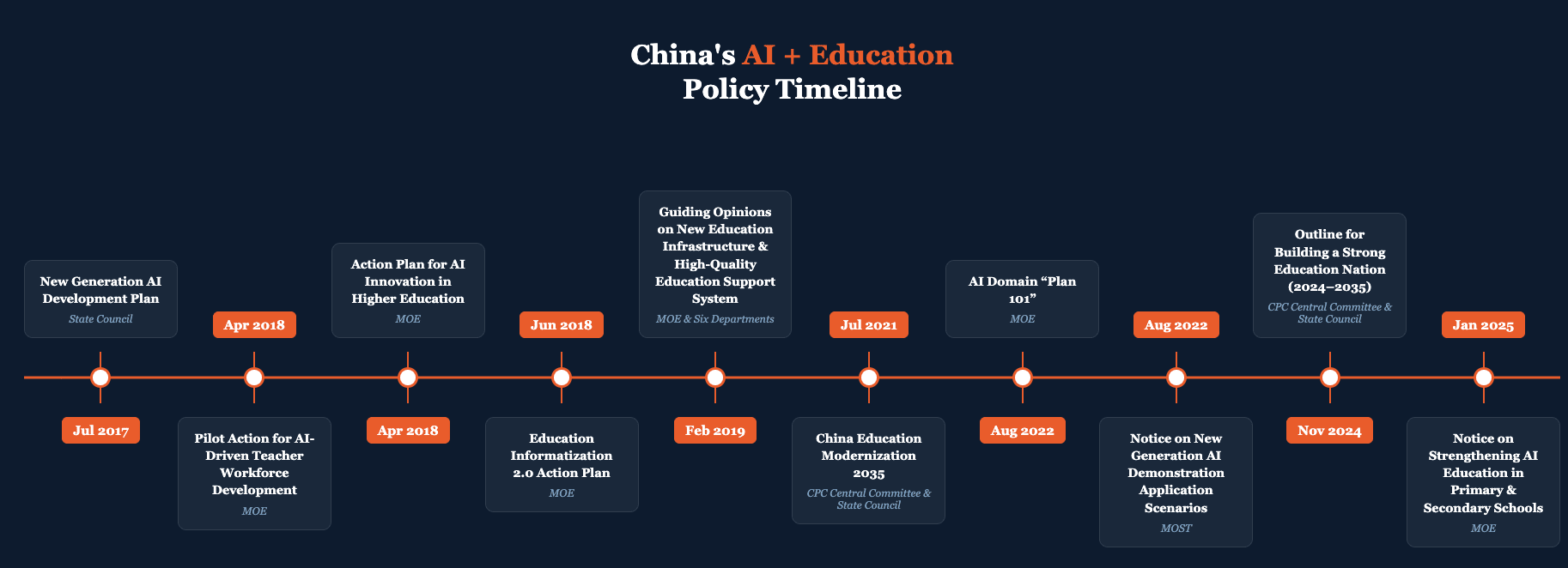
In official discourse, China is said to have entered a “post-equity era” 后均衡时代 since the MOE announced that all counties had met the baseline quality level for compulsory schooling in 2021. Now, the focus is shifting from access to education to improving the quality of that education. The 14th 5-year plan (2021-2025) prioritized expanding infrastructure in rural schools through the “county-level high school revitalization initiative” (县中振兴), part of which involved equipping classrooms with ‘smart hardware’ such as digitized blackboards. During this period, the party spent significant resources to provide nearly every school with an internet connection.
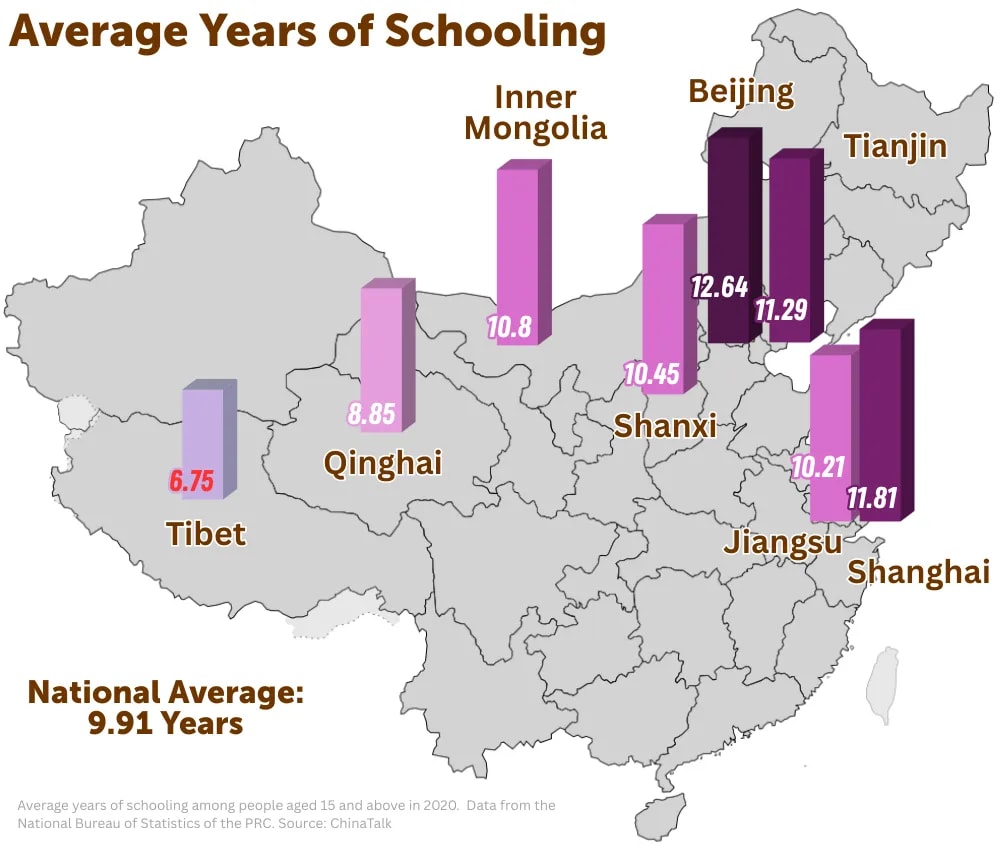
Still, rural education in China faces serious structural challenges. I spoke with Leo He — a research fellow at the Hoover Institution who did NGO work in rural China from 2019 to 2023 — for a firsthand account of the situation. Every locality, he explained, has designated “elite” schools that talented students from surrounding areas compete to transfer into. The result is a system where “educational resources are systematically sucked up to the center from the periphery, leaving rural areas incredibly depleted.” While this arguably gives academically gifted students opportunities to develop their talents, it deprives most students of educational resources.
According to China’s 2020 census, only 30.6% of the population has ever attended high school (including non-academic vocational secondary school), which Stanford professor Scott Rozelle notes, “is lower than South Africa, lower than Turkey and lower than Mexico.” In 2022, roughly 40% of China’s middle school graduates didn’t go on to attend high school of any kind, and among the students that do continue their education, national policy stipulates that roughly half (“五五分流”) are funneled into non-academic vocational high schools with no path to enter college.
To understand how AI could fit into this picture, we first need to understand the political and economic factors that incentivize Beijing to care about students in the countryside. It’s not clear that more investment in education will translate to high economic growth at this point in China’s development path — the real youth unemployment rate is probably still around 20%, and there are fewer entry-level positions available just as a record number of new graduates enter the workforce. Rather, this is a priority for the Party because improving the education system is so popular.
When Rozelle’s team surveyed 1,800 rural mothers and asked what they wanted their children to aspire to, over 95% said, “I want my child to go to college.” In China, a degree from an elite college doesn’t just translate to higher earnings — it unlocks better healthcare via the hukou system, cushy “iron rice bowl” 铁饭碗 jobs, and above all, social prestige. In 2023, researchers at Stanford found that Chinese families spent an average of 17.1% of their annual household income on education, which amounts to 7.9% of annual household expenditures. (Households in the US and Japan, by comparison, dedicate just 1-2% of annual expenditures to education.) The poorest quartile of families in China devotes a staggering 56.8% of income to education, and education spending is inelastic — that is, it’s prioritized as a necessary expense — across all income levels.
As Andrew Kipnis, the anthropologist who wrote Governing Educational Desire, explained to ChinaTalk, educational reform is a priority for the party “because it’s a way of keeping people happy. If they think there’s some hope their child will attend university, that gives them some investment in the system.” But not every child can become part of the elite: “People who have gone to university won’t work in factories,” as Kipnis put it. No matter how popular it would be, Beijing is not interested in building a system where a college education is available to anyone who wants one. But within this zero-sum system, where anyone who receives an advantage is inherently disadvantaging someone else, the party still needs to make parents feel like their child is getting ahead. Infrastructure is pretty much the perfect tool for this. It makes schools feel luxurious on the ground without changing the fundamentals that make the system so unfair. Shiny new facilities deliver popularity gains immediately, and if your child doesn’t get into university years later, it’s their own damn fault.
Those incentives are shaping the world’s largest AI education experiment. China is not the only country betting that AI will transform education, but the scale and style of China’s ambitions are unmatched globally. While China started with pilot programs, South Korea’s government led with inflexible national-level implementation, spending US$850 million on an ambitious AI textbook initiative that collapsed after just 4 months. India’s edtech ecosystem is private-sector-led with little top-down guidance or regulation, which resulted in the high-profile implosion of Byju’s and a proliferation of predatory practices targeting low-income families. Japan, unlike China, pledged to make sure every student had a device before implementing AI teaching tools.
Ultimately, China stands out globally for the sheer scale of its AI education ambitions — and the scope of applications its edtech industry is targeting for AI integration.
We’ll start by analyzing the MOE’s new white paper on AI for education before discussing what rollout looks like in practice. White papers serve as authoritative records of government positions, in this case signaling to schools nationwide that the party wants them to use AI tools. The MOE’s guidance highlights four main buckets of AI desirable use cases: (1) teacher task reduction, (2) improving rural schools, (3) analyzing student biometrics, and (4) helping students with disabilities.
“鼓励学校将人工智能融 入课前、课中、课后等教育教学全过程。”
“Schools are encouraged to integrate AI into the entire teaching process — before, during, and after class.”
~MOE’s white paper, pg. 23
Teacher task reduction, such as AI-assisted grading, lesson planning, and academic advising, is the most highly anticipated use case by primary and secondary school teachers, according to Ali Cloud’s white paper.
Using AI to grade art might sound bad, but this is how some prospective art majors are currently evaluated:
As we mentioned in our last AI education report, China has fewer teachers per student than the US, and as such, class sizes in China are often quite large. The government has declared that 45 students is supposed to be the standard primary school class size, but “super-size” (“超大班”) classrooms of 56+ students are still common.
Oversized classrooms are especially prominent in rural areas, which have struggled with persistent teacher shortages and the poaching of high-quality and experienced teachers by urban schools. To put the shortage in perspective, senior teachers “⾼级教师” only accounted for 6.8% of teachers across China as of 2023. By comparison, 26% of US public school teachers have 20+ years of experience, according to statistics from the 2020-2021 school year.
Beijing’s most recent initiative to tackle this problem is the “County-managed, school-hired” 县管校聘 system, in which teachers belong to a common pool and are assigned to a school by a county-wide authority. Teachers work on three-year contracts and must accept transfers (including urban-to-rural reallocations) that they have little control over. Teachers, unsurprisingly, seem to resent this system. Theoretically, teachers are supposed to retain their salaries and benefits packages when they are transferred to hardship posts, but rural schools have struggled to honor those commitments. Teachers are expected to stay in the same county for their entire career, since their bianzhi 编制 (personnel quota) is county-bound and non-portable, and counties accused of “poaching” teachers from other localities face administrative penalties.
“开展数字支教试点,推动高校师生利用国家智慧教育平台的优质资源,帮助乡村学校开齐、开足、开好国家规定课程。目前,活动已在全国10个省份、95个区县落地,为252所乡村学校6万余名送去1万多小时优质课程,有效缓解乡村学校师资结构性短缺问题。”
“[The MOE] launched digital education support pilots, promoting the use of quality resources from the National Smart Education Platform to help rural schools fully offer all state-mandated courses. Currently, the program has been implemented in 10 provinces and 95 districts/counties, delivering over 10,000 hours of quality courses to over 60,000 students at 252 rural schools, effectively alleviating the structural teacher shortage in rural schools.”
~ MOE’s white paper, pg. 12
Narrowing the rural education gap is perhaps the biggest priority shaping how AI gets deployed. Rural prosperity matters for CCP legitimacy for reasons we’ve discussed above. Still, students from rural areas face a massive resource gap that is reflected starkly in their gaokao scores.
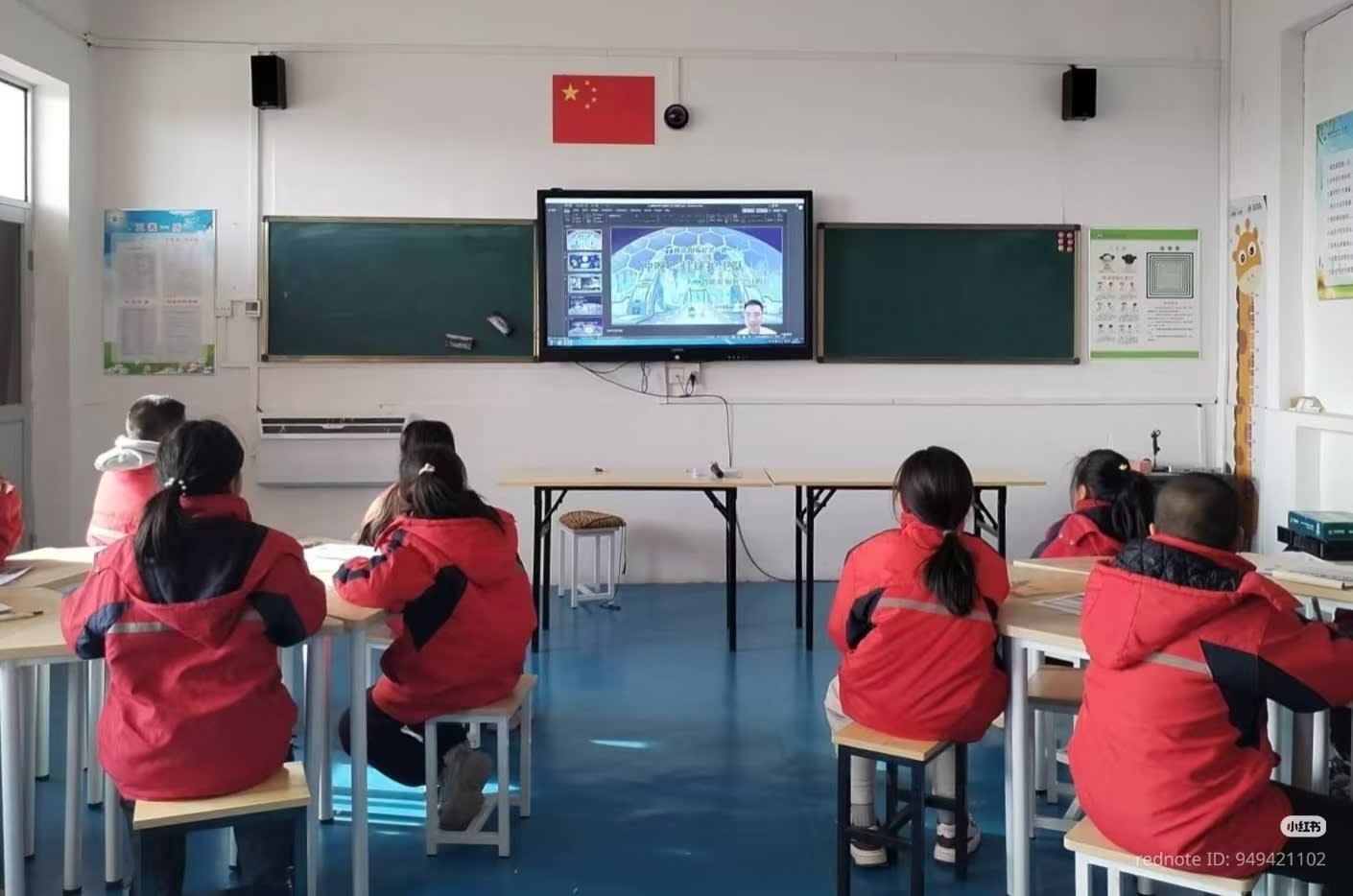
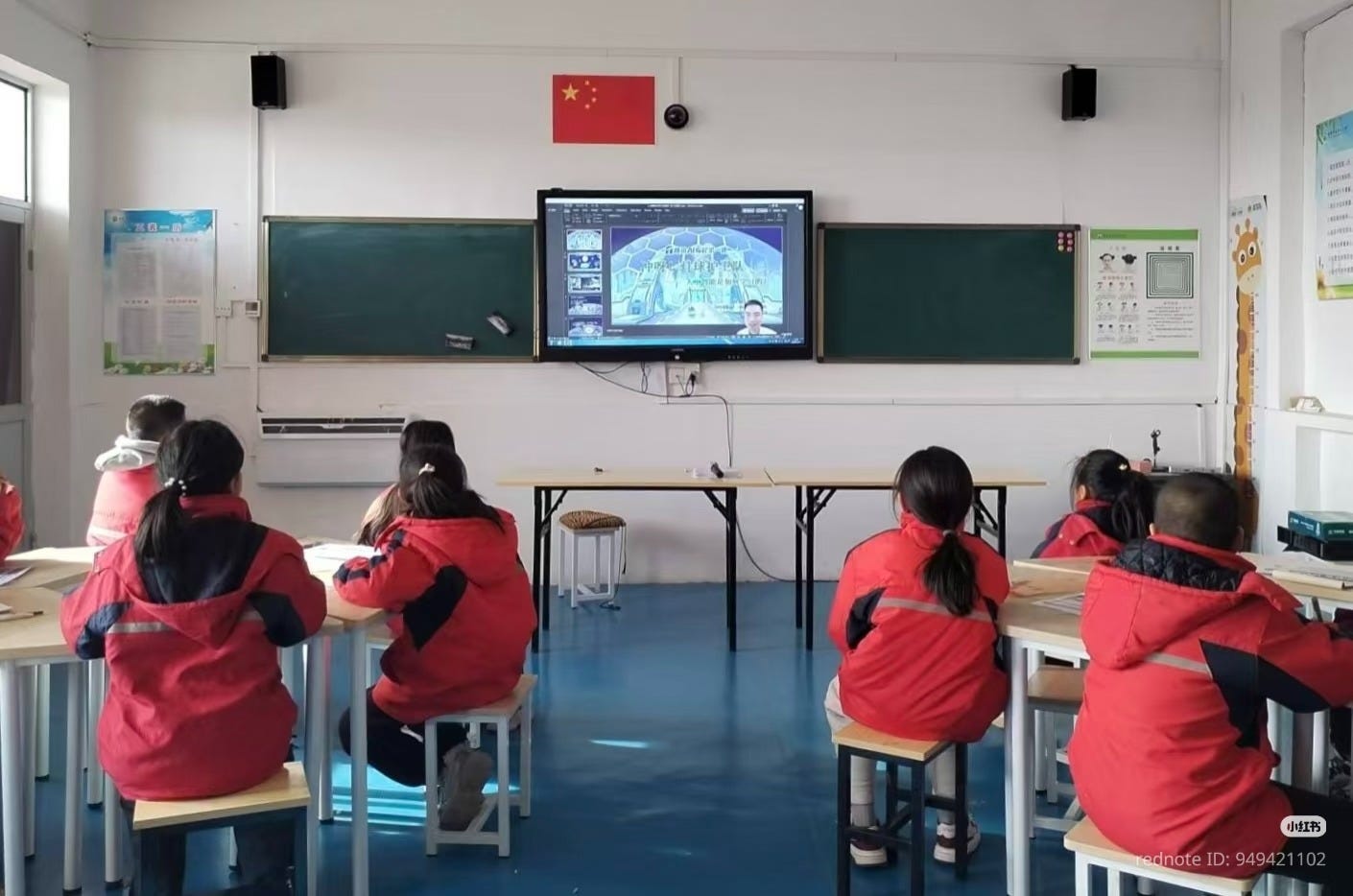
The most immediate implication for rural schools has been ad-hoc, one-off lessons on how to use AI, taught by volunteer college students who lecture from cities via video conferencing. A social media post from one such volunteer was full of dismay over what they saw as outdated pedagogy in rural schools:
Before the lesson, I asked the local teacher if there was anything I should pay attention to. The teacher said, “Nothing, the students in this class are quite obedient.”... Rural areas already lag behind developed areas in educational infrastructure and philosophy by more than 10 years. For example, the word “obedient 听话” has faded from the conversations of teachers and parents in developed areas. … How will children raised using the old model cope with a rapidly changing society in the future? Twenty years is unpredictable, and the impact of a single lesson is negligible.

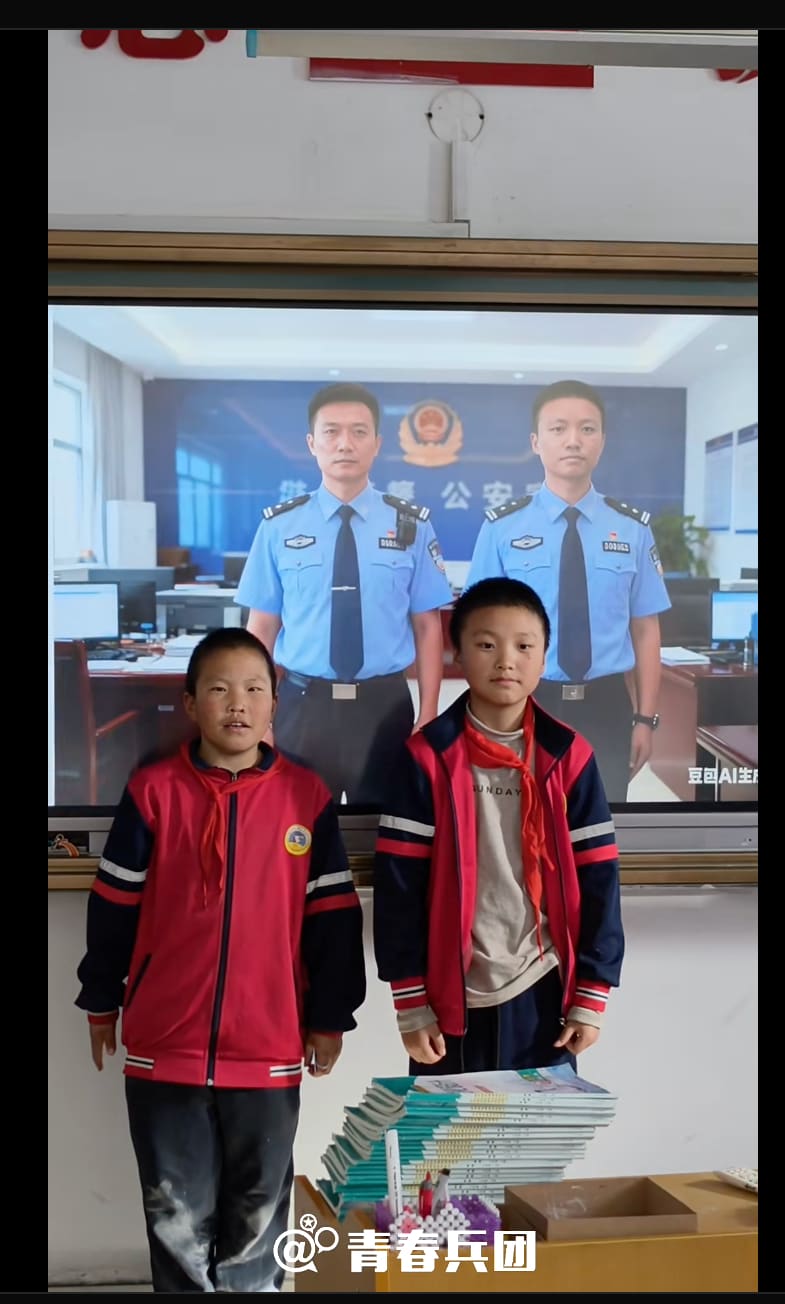
“通过大数据技术全面掌握学生的学 习、实践、生活情况,建立用户画像,制定个性化培养 方案,使大规模因材施教成为可能”
“By leveraging big data technologies to comprehensively monitor students’ learning, practical activities, and daily lives—thereby creating user profiles and formulating personalized development plans—it becomes possible to implement large-scale, individualized instruction tailored to each student’s specific needs.”
~ MOE’s white paper, pg. 31
The third goal is the collection and analysis of student data. This includes smart campuses that monitor when students arrive at school, as well as behavioral biometrics. Here are some examples praised by Ali’s white paper (though the MOE document contains similar examples):
Guanggu No. 9 Primary School in Wuhan: Hubei Second Normal University introduced AI-based psychological assessment services into the school. In total, more than 800 students were evaluated. The assessments identified 15 students with unhealthy emotional fluctuations and 3 students with serious psychological problems. Through high-precision AI psychological assessment services, the school can conduct regular mental health screenings, promptly identify potential psychological issues such as anxiety and depression, and carry out early intervention and guidance. …
Zhongguancun No. 3 Primary School in Beijing: … [The school] uses intelligent systems to record students’ learning data and behavioral records. Through multidimensional analysis of students’ classroom performance, homework completion, and exam results, the school constructs comprehensive student profiles, providing a foundation for personalized instruction and assessment. At the same time… the school uses relevant technologies and tools to monitor and analyze students’ emotional states[.]
Shuanglin Primary School in Chengdu… uses smart cameras and other devices to record students’ in-class behaviors and expressions, analyzing their levels of attention and participation to provide data support for evaluating teaching quality.
There’s quite a bit of propagandizing going on in these descriptions. The hardware on the ground hasn’t yet reached panopticon levels, but the fact that the white papers posit this kind of surveillance as a desired outcome is telling.4
Finally, both white papers outline how AI could be used to help students with disabilities. But it’s clear that these are the least developed use cases — and the highlighted rollout examples in Ali Cloud’s list of case studies are things like text-to-speech and storybook generation products, all of which were developed for mass market adoption, not specifically with disabled students in mind.
Helping disadvantaged students is a noble goal — and current evidence indicates computer-assisted learning has some benefits for Chinese students — but China’s AI education experiment faces serious challenges.
To start, there are fundamental barriers to improving rural educational outcomes that AI cannot address:
Universities in China reserve a certain portion of their seats for local students, and since universities are overwhelmingly located in urban areas, that puts rural students at a disadvantage. In 2025, 85% of Shanghai students who took the gaokao were admitted to 4-year universities, compared to 32% in Anhui. 65% of China’s children have two parents with household registrations (hukou 户口) in rural areas, but less than 5% of students at elite universities come from such families.
A hukou is a kind of internal passport that ties access to public services to one’s place of birth. People with a rural hukou often migrate to cities for work, but they do not have the right to live permanently, access healthcare, or send their children to school in the city where they work. Instead, the children of migrants are usually left in the countryside with their grandparents
School funding is tied to local economic performance, leaving village schools chronically short of resources. Students from farming communities — especially talented students — were incentivized to transfer to distant schools in wealthier parts of their counties. And since those county schools are also in depopulating areas, they readily accepted these transfers. The central government’s push to improve the infrastructure of rural schools strengthened this trend toward centralization — it’s far easier and far cheaper to expand facilities at a few large schools than for many small schools. This is why rural areas still have huge class sizes even with collapsing birthrates — when a school’s student body drops below a certain threshold, the local government decides that keeping it open is an inefficient use of funds, and the remaining students get shipped off to ever more distant schools. Rural students are left to choose between commuting long distances to school every day or being sent to boarding school.
This combination of large class sizes and long stints of time away from home means the amount of one-on-one attention these students receive has fallen off a cliff. Research on China’s boarding schools by Stanford’s Rural Education Action Program (REAP) found that “47.3 percent of [boarding school] children surveyed suffered from acute “pessimism,” 63.8 percent said that they felt “lonely,” 17.6 percent suffered from depression and 8.4 percent exhibited suicidal tendencies… boarding school students have higher levels of anxiety and demonstrate poorer social skills than students who live at home.” And now, AI tools are being deployed to monitor mental health in schools where the structure of schooling itself is a major source of psychological harm.
A 2025 study in BMC Psychology surveyed 760 children in rural China aged 6-36 months, and found that 82% had at least one developmental delay, and only 31% of families read to their children. It’s important to keep in mind that no AI tool can compensate for cognitive delays that set in before a child ever enters a classroom.
AI education tools are mostly commercially developed, and companies are hesitant to invest in creating highly customizable tool sets or specialty platforms tailored to specific disabilities or counties that can’t pay up. The market isn’t small (about half of China’s children are educated in rural areas), but rural schools are not easily generalized due to huge variance in infrastructure, staff quality, and curricula.
The price of commercially developed software products could also be a barrier to implementation. iFlytek’s (科大讯飞) flagship Changyan Smart Classroom (畅言智慧课堂) products cover the full teaching cycle from lesson prep to grading, but government procurement records show that iFlytek charged a single school ¥1,744,000 (about US$254,000 ) for the full suite of software in 2022. iFlytek’s massive Bengbu city contract — ¥1.586 billion covering 875 schools and 400,000 students — works out to roughly ¥800 per student per year. Squirrel AI (松鼠AI) offers schools free access for 1.5-2 years before subscription fees kick in, which may attract cash-strapped administrators but raises questions about long-term sustainability.
And few tools are built with rural infrastructure constraints in mind. Schools are supposed to have one computer for every 15 students according to the baseline set by the government, but a 2024 literature review found that rural areas still face a shortfall of 8.5 million computers. Students would also need devices at home to access AI homework tools — smartphones are pretty prevalent in the countryside, but asking parents to either loan their phones to their children for hours every day or buy them their own device is a tough sell.
Unless, of course, the schools issue their own devices. This should be easy in theory: hardware buildout is where China excels, and hardware-minded organizations are highly involved in promoting education digitization.5 So why has China not made universal device access a priority?
The answer is a tangle of policy, politics, and paranoia. There’s some concern about excessive screen time: a 2018 joint directive from the MOE and seven other departments mandates that electronic device use should not exceed 30% of total teaching time in order to combat myopia. An April 2025 nine-department opinion on educational digitization explicitly flags “dependency and addiction” (依赖成瘾) as a potential problem to manage.
Then there’s the cost problem: the April 2025 opinion instructs schools to “strengthen the overall planning of funds to ensure expenditures on digital education” (学校加强经费统筹,保障教育数字化支出), but budgets are already stretched thin. One school in Gansu province (官鹅沟小学) reportedly devoted two-thirds of its budget to internet fees in order to meet the basic connectivity requirement, which left no money for maintenance. The government has been burned before by the disease of “emphasizing construction while neglecting application” (“重建设、轻应用”) and is thus hesitant to shell out its own funds this time. In the early 2000s, China’s central and local governments spent nearly 2 billion RMB altogether buying DVD players, satellite receivers, and internet infrastructure for rural pilot schools — but left teacher training, maintenance, and operational costs up to the schools. Officials fulfilled their KPIs, but the equipment often fell into disuse once they left.
Finally, there’s the problem of scandals. A pattern of schools forcing families to buy overpriced tablets has poisoned the well for device distribution programs. For example, a middle school in Anhui’s Wuhe County charged students ¥5,800 (~US$841) per tablet; the principal was removed in response. CCTV warned administrators, “Do not use ‘educational informatization’ as a pretext to turn students into profit-making tools,” and the MOE issued a 2022 directive explicitly prohibiting schools from forcing tablet purchases in response.
And even if students did have devices, the software problem isn’t solved either. AI curriculum tools are largely built on teaching materials used by elite schools, in the hopes that access to elite curricula will help under-resourced areas catch up.6 But as we saw in the previous section, there are structural barriers that will make it difficult for rural schools to implement elite curricula. As Leo He described it to me: “In a properly rural place, a school is where there are 20 students from 10 different grades who are taking the same class from the same teacher — who covers maths, English, Chinese, history, geography, PE, everything. And that teacher is probably not properly qualified anyway and getting paid 1,000 to 2,000 yuan a month.”
Some rural teachers have undoubtedly begun using DeepSeek to grade assignments (which is important for improving their quality of life!), but this pales in comparison to students in urban areas who have access to a full suite of AI tools developed by China’s former private tutoring giants, which have pivoted to AI tutoring to circumvent the 2021 restrictions on human tutors.
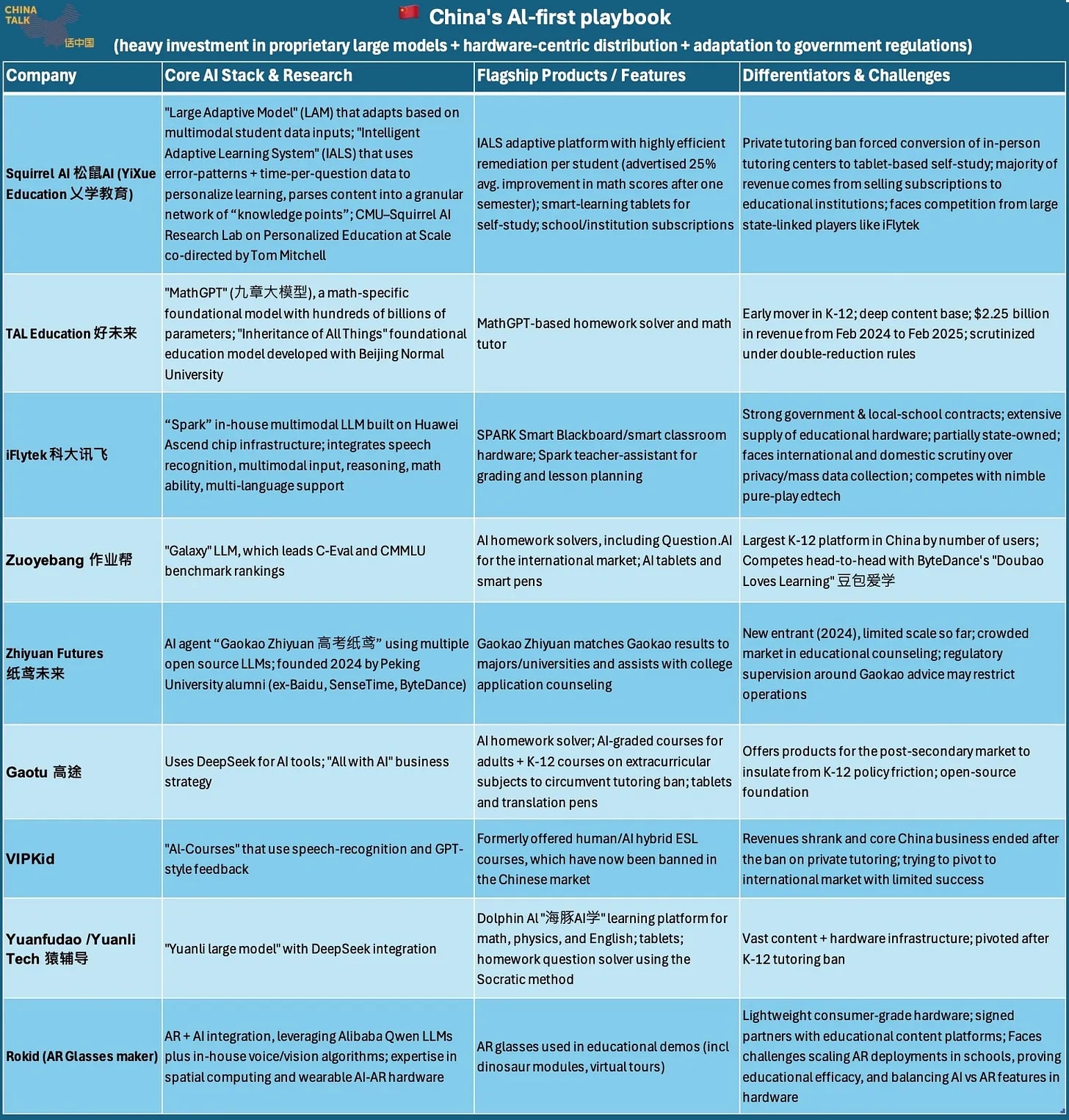
Even if AI allows rural teachers to do their jobs more efficiently, I have doubts about whether that will result in a narrower resource gap. Wealthy students are already enjoying AI-guided museum scavenger hunts, VR-boosted science lessons, and tablets that give instant feedback on math problems. It’s clearly a good thing to improve the quality of basic education regardless of where various schools are starting from, but since colleges essentially admit students based on percentile-informed cutoffs that change yearly, it’s not obvious to me that social mobility will improve.
MOE white papers signal priorities — they do not regulate, they do not impose legal requirements, and they do not define the metrics for success. They also don’t provide funding for anything.
To understand the MOE’s penchant for unfunded mandates, we need to understand how Chinese schools are funded. Local governments bear approximately 85% of public education spending; the central government’s ~15% share is delivered primarily through transfer payments such as grants. But poorer rural counties, even when they devote a larger share of their budgets to education, simply have less to spend — and AI tools, unlike textbooks, require ongoing subscriptions and technical support that local budgets were never designed to cover.
As explained by Scott Rozelle:
“The tax base in rural China is much lower than that in the urban areas. In addition, individuals that do make it successfully through the education system in poor rural counties, almost always leave the county for higher education opportunities and work outside their rural hometown, never to return. This means there is ultimately no incentive for local government to invest more in schooling.
It’s because of this funding gap that China’s high-profile urban students and invisible rural students likely have one of the greatest education divides in the world.”
Instead, the effect of the white paper will be to reveal how responsive schools will be to the whims of Beijing. Administrators and teachers have been told that AI integration would please the party, but in what kind of environments is that a salient incentive? It’s salient to promotion-seeking officials, who could perhaps influence promotion-seeking educators — but localities are strapped for cash. That dynamic is ripe for all kinds of distorted incentives:
Schools could prematurely cut teaching assistants, substitute teachers, and other support staff to free up funds for pet AI projects designed to replace teachers and classroom assistants. (Full-time teachers are bianzhi 编制 employees and thus cannot be laid off outright, but schools could reduce their quotas for bianzhi staff.)
Administrators are likely to misrepresent outcomes by cherry-picking evaluation metrics that make the results look good, but are not actually analytically useful.7 By failing to define success, the white paper encourages localities to design their own rubrics to evaluate project implementation after implementation has already happened.
Rural teachers could be less captivated by promotions, since their postings are already determined by black box negotiations between administrators and local officials, while educators in urban areas could reliably climb the career ladder by digging in at one institution. Remember, rural teachers’ careers are already centrally managed. They have been told to expect regular transfers — but why put extra effort toward integrating AI into an institution where you have no roots?
Then there’s the problem of student privacy and data leaks. The 2024 issue of China Educational Information Technology 中国教育信息化, a journal supervised by the Ministry of Education, reported that at least 63% of primary and secondary school students have dealt with spam phone calls as a result of data leaks — some of these students were even harassed by scammers armed with their precise location data.
Data privacy is legislated at the national level by a non-mandatory list of recommendations called GB/T 35273个人信息保护, which was last updated in 2020. For student data specifically, there is a related list of non-mandatory recommendations called JY/T 0643, which was released in 2025 (I’ve written a detailed footnote on how wimpy these recommendations are.8)
But the reality is that Chinese public school students have basically no expectation of information privacy. Schools routinely expect (and pressure) parents to sign agreements granting the school expansive powers over student data, and tons of personal information is shared via WeChat as opposed to a secure portal. Adding AI-powered smart classrooms to this environment is a recipe for dystopian scandals — collecting and analyzing student biometrics is an explicitly advertised functionality of this hardware. I don’t just mean faces or fingerprints either — these systems are being designed to film classrooms and analyze student body language/facial expressions to determine which students aren’t paying attention. What happens when administrators decide to sell that data to the private sector?
I worry about the fact that the MOE is so heavily emphasizing mental health interventions as a use case. The white paper greenlights using AI to decide if a student needs psychological help, but it doesn’t provide guidance on what that help should look like.9 Imagine how humiliating it would be to be pulled out of class to be questioned about your emotions because an administrator needed to fulfill a KPI.
China’s AI education experiment is still in its early days, but we should expect wide variation in results between localities due to the decentralized nature of implementation. That is seemingly by design.
The best-case scenario is that localities learn from one another’s successes and failures, and institutionalize that knowledge to help underresourced schools catch up. The unfortunate reality is that it will be very difficult to know if that is happening. Every academic I interviewed lamented how hard it has become to do fieldwork at schools in rural China, and the only teacher who was willing to speak with me works at a prestigious international school. The system is already stacked against the children of the Chinese countryside, and I can only hope that local officials will prioritize AI tools that genuinely aid learning over systems that feel high tech and make for heartwarming photoshoots.
Unfortunately, the structural incentives that undermined past educational reforms remain unchanged. There are precious few seats available in China’s universities, so local officials learned to measure success in bells and whistles instead of genuine improvements to student learning.
To close, here’s the final aspiration of Ali Cloud’s white paper:
“May AI become a wise companion for every learner and educator, helping humanity achieve more comprehensive and profoundly balanced development. With reverence for education and unwavering confidence in the future, let us jointly compose the magnificent chapter of AI empowering education, striving tirelessly for the inheritance and elevation of human wisdom.”
ChinaTalk is a reader-supported publication. To receive new posts and support our work, consider becoming a free or paid subscriber.
These specific examples come from Shenzhen Bao’an Foreign Languages School 深圳宝安外国语学校, Shuanglin Primary School in Chengdu 成都市双林小学, and Beijing Zhongguancun No. 3 Primary School 北京市中关村第三小学 respectively.
The name of this document is《中国智慧教育白皮书》“China Intelligent Education White Paper.” The paper is not exclusively about AI — there are sections about long-standing education digitization and intelligentization initiatives — but the AI-related content is what makes this document truly novel and is the core reason it was published. Two months before publication, Minister of Education Huai Jinpeng 怀进鹏 teased the release of the document, calling it “a white paper on AI+education in China” (“中国人工智能教育白皮书”).
A previous version of this article conflated the two white papers as being part of the same research project. While the Alibaba white paper does not directly represent the views of the MOE, analyzing it is still worthwhile for a couple of reasons:
Alibaba is deeply embedded in government education infrastructure and digitization initiatives. Notably, Ali Cloud is a partner in the MOE’s Industry-Academia Cooperative Education Program (产学合作协同育人项目) and builds university classroom infrastructure under the guidance of the MOE; it has built 300+ AI-enabled smart classrooms in rural areas across China as part of its “Cloud for Youth” program, which won the UNESCO Global Smart Education Innovation Prize in 2025; and it has secured government contracts for educational infrastructure.
The Ali Cloud white paper explicitly references and builds on MOE policy, citing government guidance documents that go back nearly a decade. It provides details about more than two dozen pilot programs and early AI adopters, including schools using technology developed by competitors of Alibaba (i.e., iFlytek).
Ali’s white paper was produced as part of a partnership with CCTV for a documentary series called “Winning with AI+” (“赢在 AI+”), co-organized by CCTV and the Hangzhou Municipal Government.
Example 1: Guanggu No. 9 Primary School in Wuhan.
Students appear to be screened irregularly (not constantly) by standing in front of a machine that analyzes their facial expressions. This MOE write-up has all the makings of a publicity stunt by the university that owns the hardware (e.g., it includes a handwritten thank-you note from a student who was flagged as having mental problems).
Example 2: Zhongguancun No. 3 Primary School in Beijing.
This school is a genuine testbed for AI tools, but outside of the white paper, news coverage of the school doesn’t mention comprehensive student profiles built on biometrics. (Although at least one other Beijing school is using AI for psychological evaluations, according to the Beijing city government)
Example 3: Shuanglin Primary School in Chengdu/
I couldn’t find other sources to corroborate the white paper’s claim, although this school does use AI in some lessons.
A key platform facilitating education digitization is the China Education and Research Network (CERNET) 中国教育和科研计算机网 — a government-funded, MOE-managed organization that cut its teeth building an internet infrastructure network across China in the 1990s. Today, their website is plastered with headlines about digitizing education — invitations to attend seminars and conferences, official guidance based on Xi Jinping Thought, profiles of new AI tools and the model schools rolling them out, and press conferences with the MOE’s head of teacher affairs. In November of 2025, they published the official teachers’ guide to using AI, which is full of creative ways to use AI to instill the “correct morals” in children, such as “building a moral situation case library, intelligently pushing resources such as moral education stories and current events, generating ethical situations close to students’ lives, and assisting in value analysis and behavioral guidance.”
From Ali’s white paper: “Breaking geographical barriers through intelligent distribution of resources — for instance, the National Smart Education Platform has aggregated 29,000 high-quality courses. AI recommendation algorithms synchronize premium courses from elite schools in Guangzhou, Shenzhen, and Beijing to underdeveloped regions like Yunnan’s Shuijiang and Gansu’s Linhe, enabling remote students to access top-tier classrooms in real time.”
There have been several high-profile cases of corrupt administrators massaging data like this — for example, Hengshui High School 衡水中学 (a public institution) misrepresented its elite college admission statistics by bundling its numbers with private satellite campuses under the Hengshui brand. As a side note, the principal’s son fraudulently took the gaokao in Tibet instead of his native Hebei because the score cutoff was lower there, and students report that the school uses corporal punishment liberally.
According to the JY/T 0643:
“Personal Information Processors” (PIPs) should have a terms of service that a guardian must accept before collecting student data. Guardians should be able to revoke consent and request that their student’s data be deleted.
The data should be collected with a legitimate purpose stated in the TOS. Shouldn’t collect data excessively (but no word on what kind of data crosses the line… and the mass collection and analysis of behavior/attention/mental health data is an explicitly stated goal of the AI+Education plan)
The TOS should state what security measures are in place to protect student data. There’s no requirement to use any security measure (eg, encryption) specifically; the law only recommends having a security policy that covers “platform intrusion prevention, data leakage prevention, misuse prevention, destruction prevention, and data backup/recovery capabilities.”
The TOS should state a retention period for students’ personal data (but there’s no limit to how long that retention period can be), and either delete the data at the end of that period or anonymize it so that you can keep storing it. Also, the document notes that you might be legally required to hand over the data at some point, so you probably shouldn’t delete anything that might be useful to law enforcement at some point.
PIPs shouldn’t use the data for advertising purposes, unless the advertising is “in the public interest” (公益性广告) and the guardian agreed to it in the terms of service.
If PIPs want to transfer data to a third party, they should exercise “due diligence” 尽职调查 and check that the third party will store the data securely.
Chinese schools are not exactly known for their progressive approaches to mental health. For example, a Henan institution for “problem children” called Yashengsi Quality Education Base 河南雅圣思素质教育基 was exposed in 2023 for beating students.
In 2017, Hangzhou-based robotics firm Unitree 宇树科技 launched its first quadruped, Laikago. Laika was the name of the Soviet space dog onboard Sputnik 2, and the American English pronunciation of “go” is similar to that of the Chinese word for dogs, 狗 gǒu. Unitree’s battery-powered tribute to Laika wasn’t fuzzy, but walked on four feet and navigated through basic obstacles.
Unitree founder Wang Xingxing 王兴兴 has long held faith in the potential of robotic canines. Since 2020, when Unitree started gaining media attention, he has insisted in multiple interviews that humans are drawn to four-legged creatures and will have a natural fondness for their artificial counterparts.

Fast forward to 2026, and Unitree has just filed for a $610-million IPO on the Shanghai Stock Exchange. The company is a household name in China after its humanoid robots performed dances at the CCTV Spring Festival Gala for two consecutive years and counting. Through their IPO disclosures (investor prospectus and response letter to the Shanghai Stock Exchange’s inquiries), we get some answers to important questions about the development of embodied AI.
How is Unitree profitable?
Where is diffusion happening inside China, aside from dancing on TV?
Are Chinese robotics companies content to lead in hardware and applications, or do they also see themselves as pursuing some kind of generalized “frontier”?
And finally, what does this all mean for US-China dynamics in robotics?
One of the most notable things about Unitree is the fact that it actually makes money. Unprofitability is a near-universal challenge because AI robotics, despite massive advances in the past few years, is still an early-stage technology. Mass adoption has not yet arrived; pathways out of bottlenecks like data are uncertain; and important safety standards have not caught up. Even shipping products consistently can be a challenge for some companies in the space, let alone manufacturing at scale and booking reliable customers.
This context is why observers have found Unitree’s ability to turn a profit remarkable. Not only has the company’s net profit been positive since 2024, but from 2024 to 2025, its net profit grew by 204.29%. A look at its growth, broken down by product category, reveals the most significant source of this revenue explosion: humanoids.
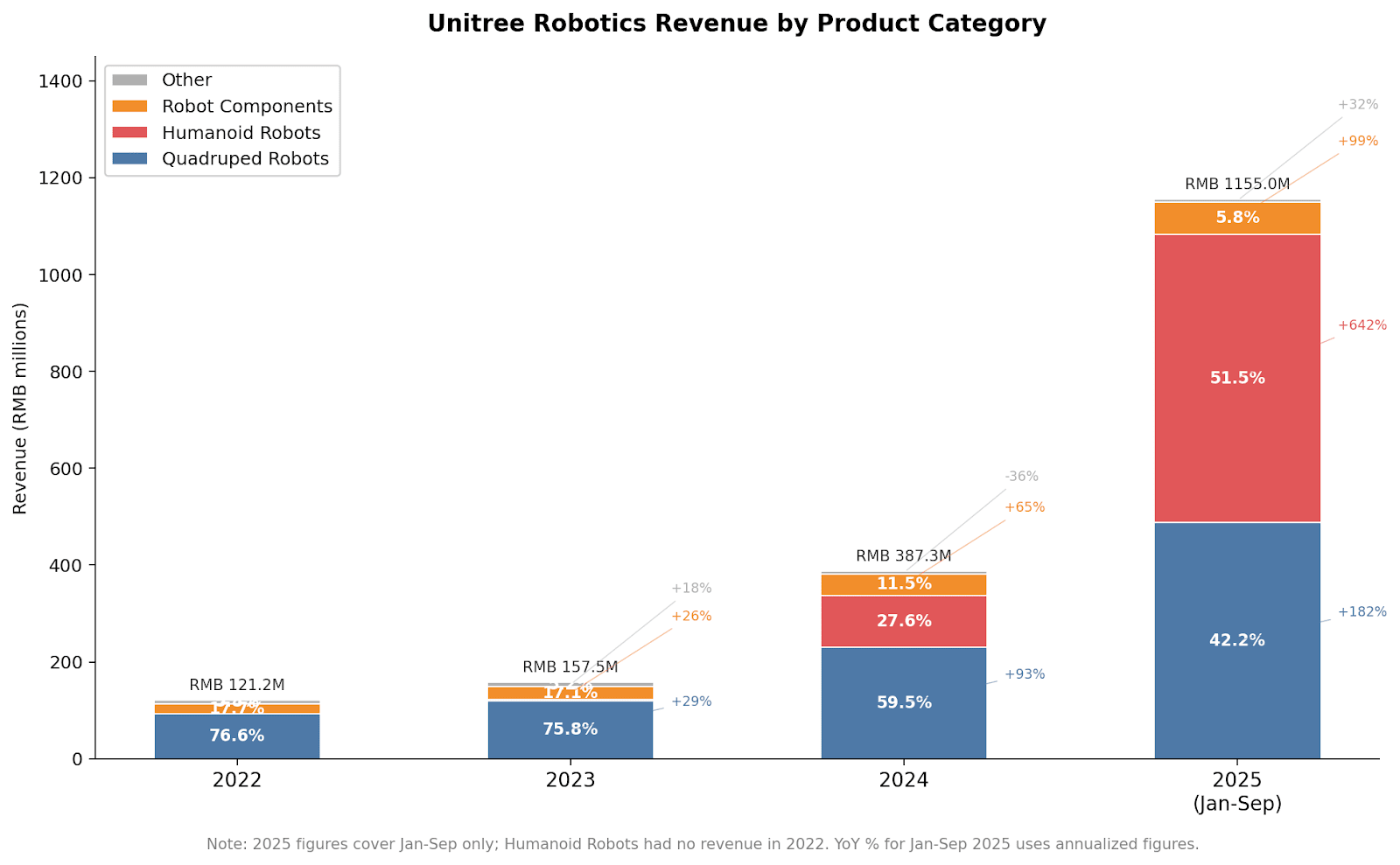
It’s perhaps ironic that, despite the company’s longstanding work in quadrupeds, it is humanoids that have catapulted its business model to success. By meeting genuine demand in academia — and staging an especially strong marketing campaign in front of the Chinese public — Unitree has transformed itself into a humanoid frontrunner. Some analyses trace their potent commercialization drive back to Unitree’s origins. Wang Xingxing’s cofounder Chen Li 陈立, who was Wang’s classmate throughout both their undergraduate and Master’s programs, worked in international sales for the Hangzhou-based, partly state-owned surveillance tech giant Hikvision (海康威视) before joining Unitree. Hikvision has been extremely successful at expanding internationally (including in the US before it was added to the Entity List over its involvement in human rights abuses against ethnic and religious minorities in China). Investors have told Chinese media that Chen’s experience is an important asset for Unitree’s global commercialization, driving sales to governments and businesses in particular.
Unitree has earned name recognition in the West, but it is far from the only Chinese robotics company meaningfully shaping the future of embodied AI. In fact, it is part of an increasingly competitive market for AI-powered robots. Among listed peers, UBTECH and Dobot are major competitors named in Unitree’s prospectus. A fellow member of the “Hangzhou Six Dragons,” DEEP Robotics, is betting big on scenario-adapted applications, while AgiBot, by some estimates, shipped even more humanoid units last year than Unitree did.
In their response to the Shanghai Stock Exchange’s inquiry letter, Unitree emphasized in-house development of hardware parts as its key strategy for cutting costs. Unitree designs, builds, and assembles most components (other than commodity components like battery cells, flash storage, and the core computing board) in-house. It does offer outsourced alternatives for add-ons like LiDAR, cameras, and dextrous hands, but has also developed in-house options for all of these.
Unitree’s most reliable customers are universities, research institutions, and other companies conducting research into robotics. Its hold on academic customers worldwide is so firm that it’s caused alarm among DC policymakers. In May 2025, the China Select Committee called for Unitree to be designated as a “Chinese military company” and to be added to the Entity List.
The data Unitree disclosed about its revenue sources, however, paints a more complex picture. For quadrupeds, the research and education sector has been the company’s most reliable source of revenue since at least 2022 (IPOs generally do not require companies to disclose audited financial statements from more than three years ago). But starting in 2024, revenue from both commercial and industry customers more than doubled. Consumer sales revenue nearly quadrupled year-on-year in only the first nine months of 2025.
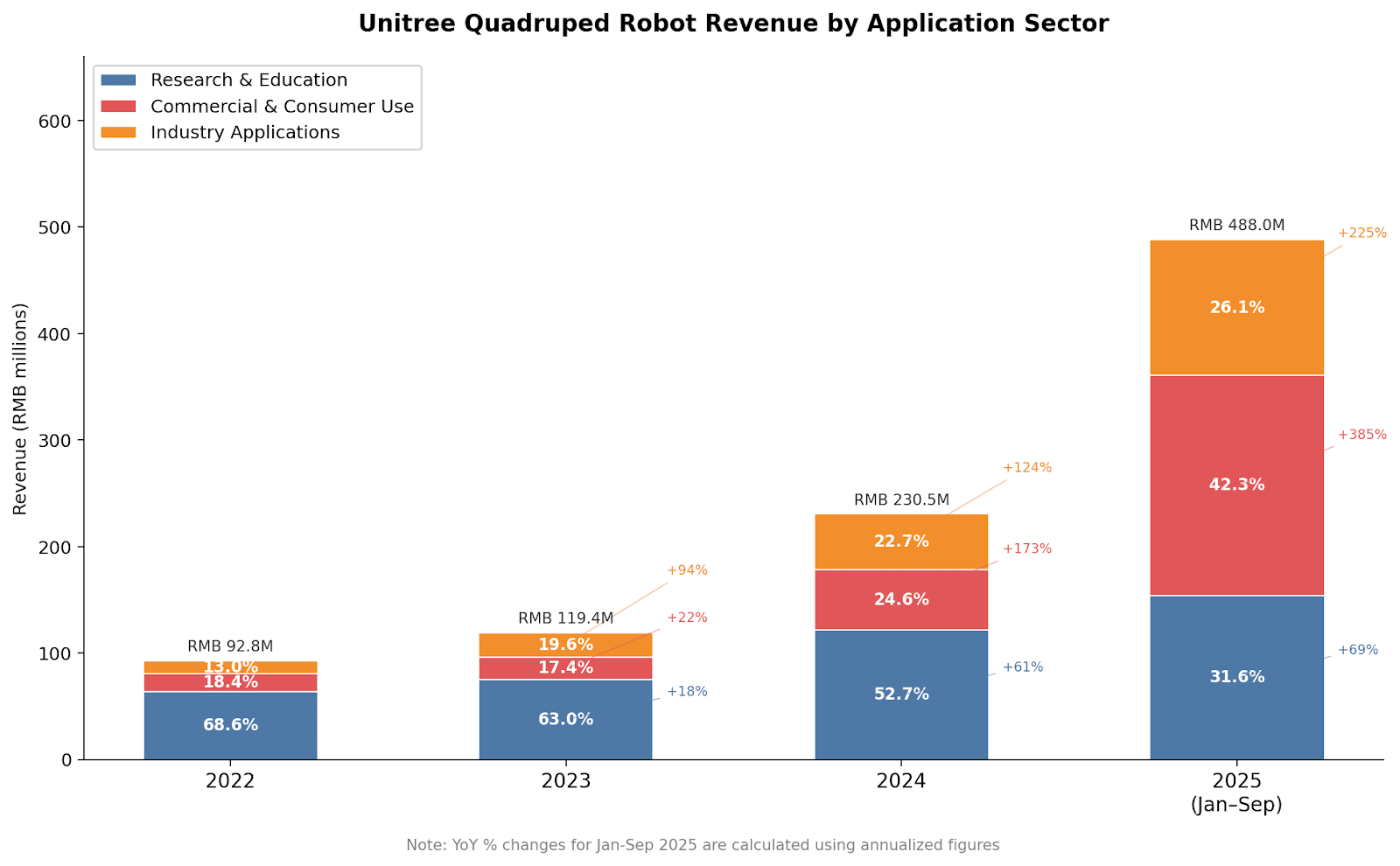
A similar, if more compact, story emerges for humanoids as well. Demand still largely comes from researchers and educational institutions, but commercial and industrial demand has grown from a near-zero starting point on a seemingly exponential trajectory since 2024. Consumers are especially excited about humanoids due to Unitree’s successful marketing of the concept. Industrial applications of humanoids are more limited compared to those of quadrupeds, but are also appearing.
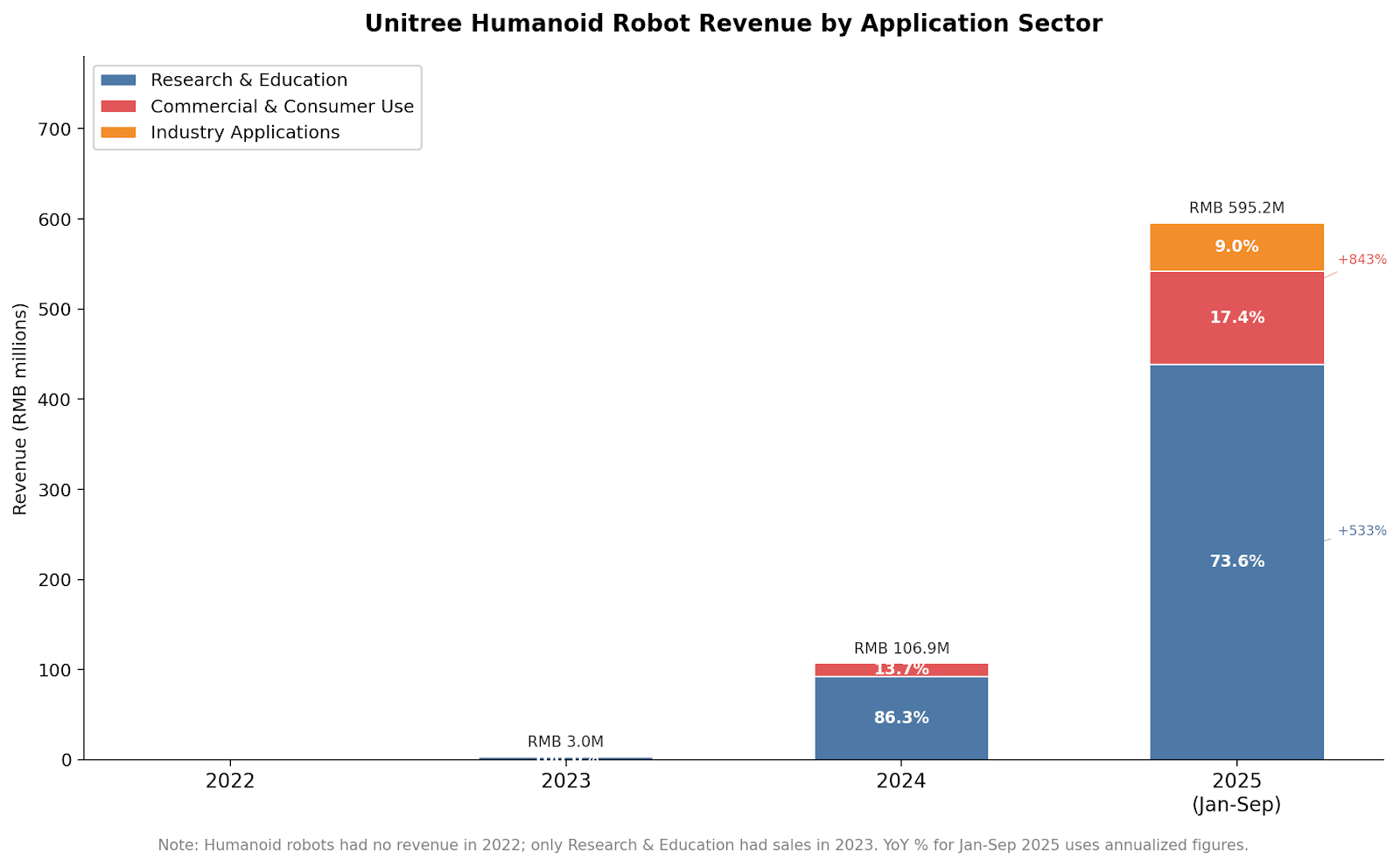
What, exactly, are people doing with these robots? “Research & Education” encompasses sales to researchers, who use Unitree hardware and platforms to conduct their own experiments. The “Commercial & Consumer Use” and “Industry Applications” categories roughly map onto B2C and B2B sales, respectively. According to Unitree, non-academic consumers who buy their robots mostly do so “for show”: they’re deploying these robots as attractive promoters in retail settings, at tourist sites, and in performances and exhibitions. Some use them as novelty companions.
Applications in industry are more interesting. Quadrupeds are deployed as “smart inspectors” in power grids, subway tunnels, and gas pipelines. They can also assist in harsh settings like emergency response and outdoor surveys, and complete manufacturing and logistical tasks. E-commerce firm JD.com is Unitree’s biggest corporate customer. Humanoids, according to Unitree, are being used for inspections and manufacturing as well, though in a more limited capacity because the technology is less mature. Unitree expects consumer demand for humanoids to grow in the medium term, but we will have to wait a while longer for genuinely useful humanoids on the factory floor.
Received wisdom in robotics has it that the US leads in software-related research, while China’s strength is in hardware. The implication is that the US is likely to reach “generalized” machine intelligence in the physical world faster than China, but — in the meantime — Chinese companies could get to practical applications faster through quick iterations inside an unparalleled manufacturing ecosystem.
Unitree’s business model is often quoted as direct evidence of this dynamic, and it is indeed true that hardware is the crux of Unitree’s success. But does that mean Unitree, and the Chinese robotics industry writ large, has less interest in generalizability or the intelligence frontier? The IPO disclosures indicate otherwise.
Unitree called on incoming investors to “realize humanity’s ultimate dream — AGI” 实现人类最终极的梦想—AGI with them. Their lawyer-drafted definition of AGI is “a form of intelligence that possesses general cognitive capabilities comparable to those of humans, capable of understanding, learning, and executing intellectual tasks across any domain, and autonomously reasoning, planning, making decisions, and continuously learning in unknown environments.”
The financial reality tells us that most of Unitree’s R&D budget has gone to hardware. This is clearly downstream of their aforementioned focus on developing as many components in-house as possible to cut costs.
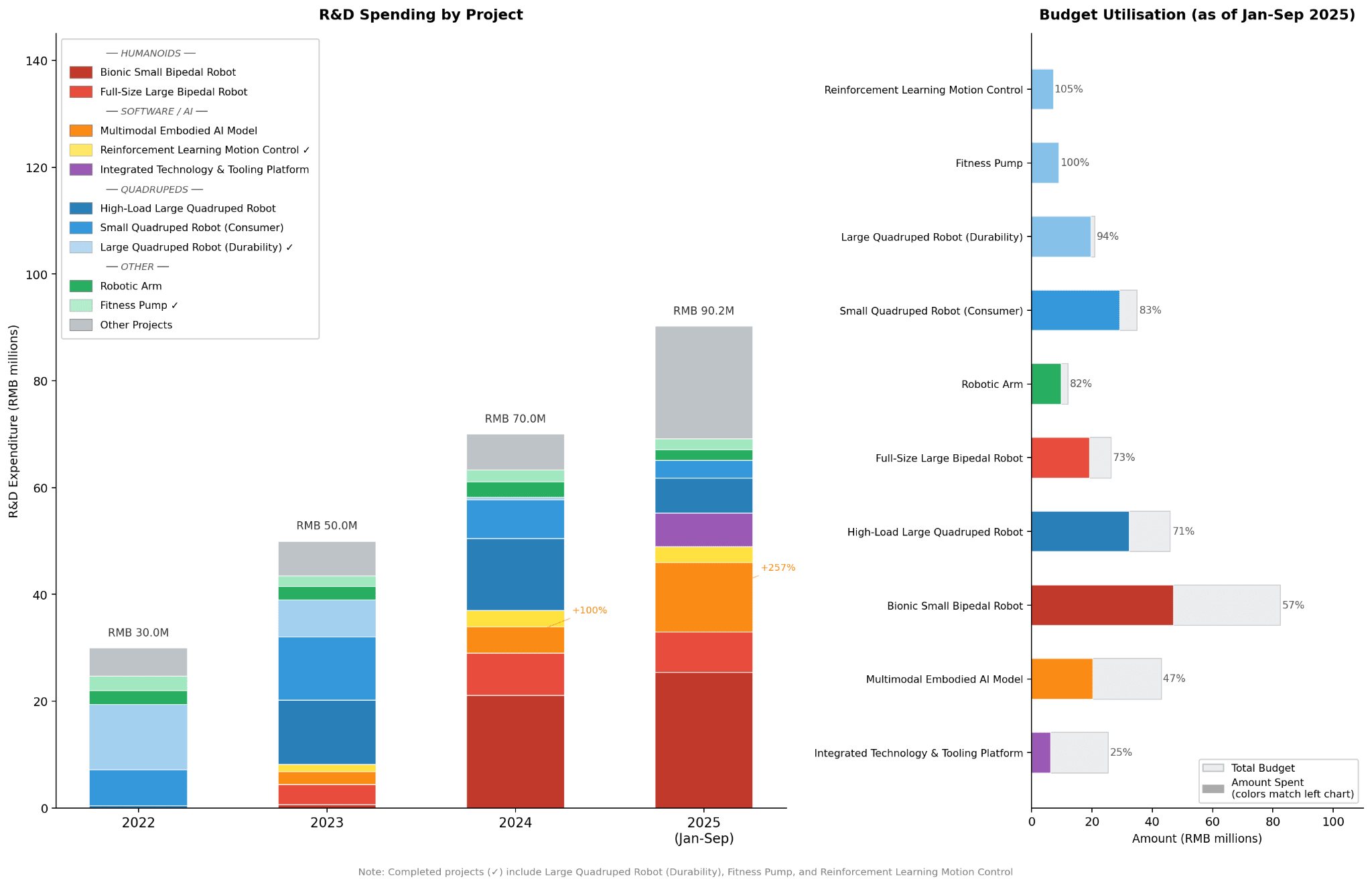
However, it’s important to notice in the chart above that Unitree’s R&D expenditure on “Multimodal Embodied AI Model” — the “big brain” of its robots — increased exponentially between 2024 and 2025, while other areas of R&D have grown at a steadier pace. Unitree is clearly ambitious about developing its models, even if it is known mostly for its hardware business.
This becomes clearer when we look at Unitree’s plan for using the 4.2 billion RMB (around 607.7 million USD) raised through the IPO. Unitree’s stakeholders approved the following distribution in early 2026:
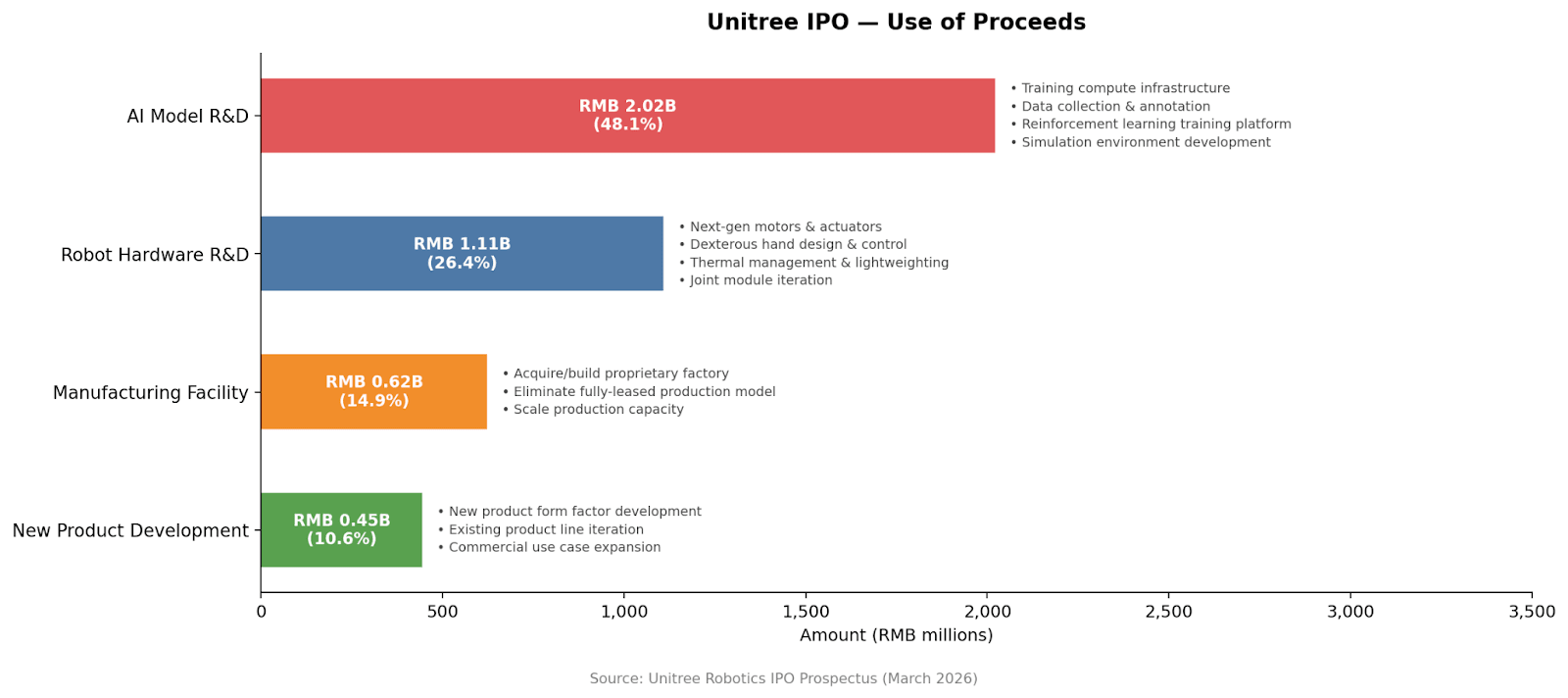
Nearly half of the IPO’s proceeds will be spent on training AI models over the next three years. That’s around 673 million RMB per year, which is not quite comparable to more well-known model makers (MiniMax, for example, spent around 1.75 billion RMB on R&D last year) but still a significant amount that signals long-term software ambitions.
Unitree currently owns no real estate, but plans to build its own factory with IPO proceeds. Per its disclosures, it has already secured a nod of approval from Hangzhou’s Binjiang District 滨江区 and plans to build there. Transitioning from an all-leased manufacturing model to proprietary manufacturing facilities is in line with their emphasis on in-house development and increasing production efficiency.
These disclosures answer many factual questions about Unitree’s business model, but raise more fundamental questions about the future of automation, US-China competitive dynamics, and both countries’ big bet on AI.
Question one: What will come of Unitree’s “AGI” ambitions? A public company is required to either use proceeds as stated in official disclosures, or publicly justify any changes. (Shareholders can vote to reappropriate funds, but unauthorized deviations could invoke China’s securities law and trigger scrutiny from the Stock Exchange.) Barring major issues, we should expect Unitree to spend handsomely on model training and development for the next three years. The biggest challenge will be making sure that these investments produce consequential returns. This uncertainty is not exclusive to Unitree; no one knows what the next three years will bring. But Unitree has now put itself on a path away from hardware-first and towards a more diversified strategy. This is, of course, risky, but relying on academia’s demand for hardware is no longer secure.
Question two: Will America turn against Unitree? A “Chinese military company” designation, which places companies into the annually-updated 1260H list, would merely exclude Unitree from contracting with the Department of Defense, but being placed on the Entity List would subject it to US export controls. Neither designation would prevent Unitree from selling to American customers outright, but they would hobble the company’s growth. As Unitree’s own prospectus describes:
Throughout the reporting period, revenue from overseas markets consistently exceeded 35% of total revenue. Should the United States continue to intensify trade and tariff policies that materially disadvantage Chinese exporters, or place the company on restricted lists governing procurement partnerships or technology export controls, the company faces the risk of being unable to sustain high growth in overseas sales — and potentially suffering an overall decline in performance. … Given uncertainty in industrial trade policy and the international political environment, any adverse shifts in external supply chain conditions or overseas market controls — compounded by further escalation of US trade restrictions and export control measures — could negatively affect the company’s ability to procure imported materials and maintain technology partnerships.
Policymakers eager to run “Trojan horse tech” out of America have to reckon with the dilemma that, for academic researchers at the forefront of embodied AI, there are few alternatives to Chinese-made hardware and platforms; Unitree is simply the most successful of the lot. Affordability and reliability are the most important factors for nonprofit academic labs. Robotics research is also a rough-and-tumble affair: there is wear and tear, and I’ve had researchers and students show me bruises they’ve sustained on the job from handling heavy humanoids. Unitree’s scale, consistency, and pricing meets academics where they are. Moreover, Unitree has been cultivating its relationships with international researchers long before the reporting periods of these IPO disclosures. The company started shipping internationally in 2018, and some of the earliest buyers of its quadrupeds were university research labs.
Imagine writing code for a dishwasher without dishwashers to test the code on. That’s a massively oversimplified comparison, but it is the same proposition in spirit. If Washington severs this symbiotic relationship, it will almost certainly make it harder for American researchers to maintain their lead in the software side of embodied AI.
Finally, question three: Can Unitree keep its lead inside China? As mentioned earlier, the company has formidable challengers in its own backyard, and has had to continuously trim costs to stay competitive. DEEP Robotics also joined the leagues of profitable companies in 2025. AgiBot’s CEO said at the end of last year that the company’s total sales revenue in 2025 likely exceeded 1 billion RMB. Up until now, Unitree’s success is arguably a case of first-mover advantage. Many more companies are taking up the Unitree playbook, and the future of robotics in China is far from determined.
If you aren’t yet ready to open your home to a robot dog, the company also sells fitness equipment inspired by robotics technology…

转眼就四月了。从二月末走到四月初,从冲绳走到九州,已经满满一个月时间。
南九州这地方,山连山,很少有平地。骑行在山路上,曲曲折折,上上下下,你会有一种持续的压迫感:视野被环绕的群山压缩,被峭壁和树木阻断,你很少能看到远处。山中只有一条路,绕过一座山,是另一座山。在你觉得山后面永远是山的时候,眼前突然呈现出一个宽阔无边的世界,那就是大海。
从鹿儿岛北上,到熊本,是历史上萨摩藩的土地。中间500里山路,隔着两座活火山。一座是樱岛火山,一座是阿苏火山,都是常年冒着烟,像一种压抑的存在,安静、隐忍,却随时可能喷发。
这种地理,会塑造人。压抑,但又渴望突破。隐忍,但又随时会走向极端。萨摩藩走出来的人,很多都带着这种气质。
山中季节晚一拍。白居易有句诗,“人间四月芳菲尽,山寺桃花始盛开”。骑车穿越九洲群山的时候,这里的春天比白居易诗中的春天还晚一步。山外樱花已经盛开,山中的樱树还在含苞待放。
春暖花开,万物复苏,知更鸟在枝头鸣叫,会给人带来欢快的新生感。那是大自然一年一度的馈赠。但骑行在九州大海环绕的群山中,却常常觉得那种新生的感觉,轻飘飘的,就像早晨的雾气,太阳升起来,越过了枝头,雾气就消散了。
整个三月都在路上。三月的最后一天,我走在长崎的街上,想起一句很有名的话:“四月是最残忍的月份”。这是T.S. Elliot《荒原》中的第一句。“April is the cruelest month”。这句话突然把我在九州的感觉连在了一起,也把九州的两个人物和他们呈现给我们命运连在了一起。
在世界上,长崎最有名的人物是蝴蝶夫人,Madama Butterfly,蝶々。那不是个历史人物。最早,她是小说中的人物,后来成了歌剧中的人物。那篇小说写得并不高明,普契尼改编成歌剧以后,才把它点石成金。
蝴蝶夫人的名字,叫蝶々,是末代武士的女儿。任何曾经辉煌过的阶层到了末代,都免不了落魄的命运。末代武士的女儿,蝶々,十几岁做了艺伎。
那时候,日本已经开关,长崎是脱亚入欧的前沿。一位美国海军的军官,名叫Pinkerton,随军舰来到长崎,跟蝶々相遇。两人相爱结婚,在俯瞰港口的山坡上租了一栋房子。不久,Pinkerton要随军舰回美国。离开前,蝶々问他何时能回来。他说,等春天知更鸟筑巢的时候,他就会回来。
然后,就是漫长的等待。一年,两年,三年。知更鸟年年春天来筑巢,却不见Pinkerton回来。他在美国娶了太太,托美国驻长崎的领事转告蝶々,让她不要再等了。那位领事去找蝶々传信,看她一片痴情,就不忍心把实情告诉她。蝶々托领事给Pinkerton捎信,说他们的孩子已经快三岁了。
当初,她为了跟Pinkerton结婚,背着家里人偷偷信了基督教。亲戚知道后,到婚礼上大闹。她跟亲戚断绝了来往。周围的人都说,她的美国丈夫不会回来了。整座城市,只有蝶々自己相信,Pinkerton会回来,跟她团聚。
终于有一天,蝶々在家门口看到,那艘美国大船出现在海面上,由远而近,缓缓进了港口。她把家收拾得整整齐齐,换上最好的衣服,等待Pinkerton到来。她等了一夜。第二天,Pinkerton来了。但不是跟蝶々团圆,而是要带走他们的孩子。蝶々给孩子蒙上眼睛,让他走出门外。她自己回到房间,拿出父亲留给她的短剑,结束了自己的生命。前面交待过,她的父亲是末代武士。
第一次读这篇小说的时候,读到这个情节,不知不觉就想到了九州最著名的末代武士——西乡隆盛。
“Stephen G.” is a UPenn graduate who studied East Asian Languages and Civilizations. He was also a Reischauer Scholar through SPICE, Stanford University.

“Humans will be completely freed from work in the end, which might sound good but will actually shake society to its core… you could even say the mark of success for this AI revolution is that it replaces the vast majority of human jobs.” This is the warning given by a DeepSeek spokesperson at the World Internet Conference in Wuzhen 乌镇 in November 2025. He called on AI companies to alert the public regarding which jobs could be eliminated first. While the risk of job loss looms large around the world, China faces unique challenges due to domestic economic headwinds coupled with high expectations for AI.
The Chinese State Council published its ambitious “AI+” initiative in August, aiming to have AI devices, agents, and applications reach a penetration rate above 70 percent across society by 2027 and 90 percent by 2030. Beijing wants AI to serve as a new engine of economic growth and productivity increases. But how will China navigate the challenges of adopting AI while softening its impact on the job market? As China marches toward an AI-powered future, what strategies could policymakers develop to uphold the social contract between the party and the people?
Since the pandemic, China’s youth unemployment rate has stayed high; in mid-2023, it reached a historical high point of 21.3%, nearly double the pre-pandemic rate in 2019, prompting the National Bureau of Statistics to suspend publication of the data. Reporting only resumed several months later using different metrics. However, joblessness data under the new metrics reached another record of 18.9% in August 2025 for “unemployed youth aged 16-24 who are not in school ” — and many believe the true figure to be much higher.
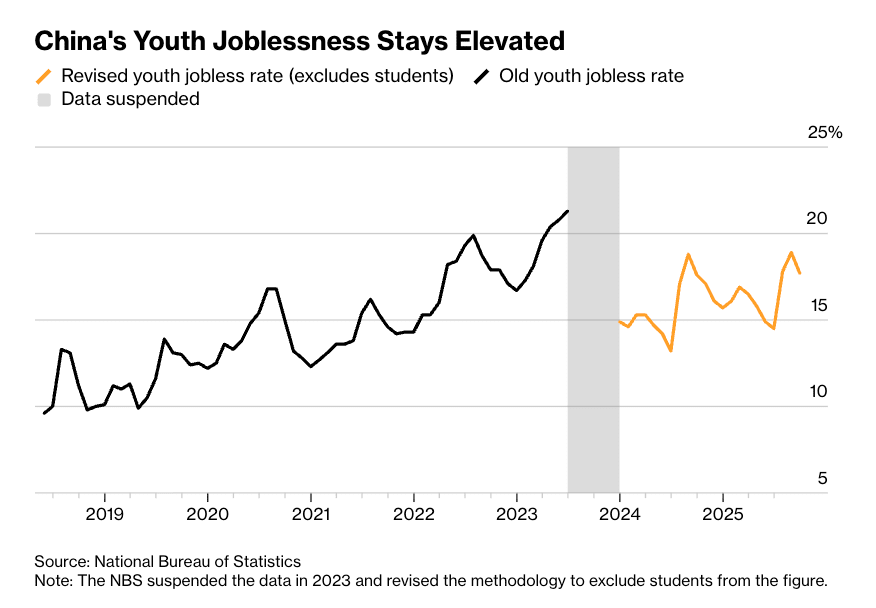
Besides, a vast number of low-skilled workers have lost stable sources of income and now rely on the gig economy. According to RAND, hundreds of millions of rural workers have become unemployed due to the housing-market collapse and the contraction of low-skilled manufacturing. Many of them now drive for ride-hailing or delivery apps, which offer little financial security or potential for upward mobility.
While US coverage of AI-displacement often tends toward pessimism rather than workable solutions, the Chinese government has taken action on the issue — to an extent. In a December 2025 employment arbitration case, the Beijing Municipal Bureau of Human Resources and Social Security 北京市人力资源和社会保障局 stated that “AI replacing the job function” is not a legally valid reason for employee termination. The case involves a tech company that eliminated an employee’s position due to AI, framing automation as “a material change in the objective circumstances since the labor contract was signed 劳动合同订立时所依据的客观情况发生重大变化”. Nonetheless, the arbitrator ruled the termination unlawful, noting that a “material change” must be unforeseeable and caused by force majeure events such as natural disasters and policy changes. In contrast, the company’s adoption of AI technology was a voluntary business decision. As a result, the company was ordered to pay ¥791,815 ($113,956) in compensation for unlawful termination.
In China, employment arbitration cases typically reference precedents set by the local high court, the labor arbitration committee, and the Bureau of Human Resources and Social Security. According to a Beijing-based lawyer, this arbitration case will serve as a reference locally and could influence arbitration decisions in other provinces, especially in northern regions.
The Beijing arbitration authority further noted that under such circumstances, employers should first consider contract modifications, retraining programs, or internal transfers to accommodate affected employees. Multiple state media outlets covered the case, describing it as “setting a new benchmark 具有标杆意义” and “giving workers peace of mind 给广大劳动者吃了一颗定心丸.” Against a backdrop of heightened public anxiety over unemployment, Beijing is signaling to private-sector employers that they cannot use AI adoption as a legal justification for layoffs. But even with restrictions on layoffs, firms often circumvent statutory protections through attrition, short-term contracts, and labor dispatch arrangements. The ruling’s practical impact therefore remains uncertain, given the historically questionable enforcement of labor laws in China.
Online commentaries also raised doubts on whether the ruling will meaningfully protect workers going forward. On Zhihu, many users argue that the case is yet another example of companies pursuing layoffs without paying severance. Since most employees would not pursue the tedious arbitration process, in part due to the fear of harming future job prospects once they have an arbitration record, employers face little risk — the worst case would be paying the severances that the employee deserves initially. Multiple follow-up comments lament the absence of more punitive measures for employers in Chinese labor law.
While their implementation may fall short, more laws and regulations on AI automation can be expected. On Jan 27th, 2026, the Ministry of Human Resources and Social Security has announced that China will issue official documents to respond to the impact of AI on employment. The November 2025 issue of Study Times 学习时报, an official newspaper of The Central Party School 中共中央党校 (where elite CCP cadres get trained), also discussed legislation to manage job displacement. It recognizes that the trend of AI automation eliminating jobs has been accelerating, and that China’s current laws and regulations need to catch up.
One can look at previous evidence to gauge how such legislative efforts may unfold. Public opinion on matters regarding labor conditions has swayed the Chinese government’s regulatory response before: In September 2020, an investigative article by Renwu 人物 sparked public outrage for the plight of delivery drivers, which prompted state media to criticize the delivery platforms. Policy response came during the summer of 2021 with two new regulations on algorithms. The first required the platforms to adopt a “moderate algorithm 算法取中” that loosens up time limits on delivery, instead of the “strictest algorithm” that had forced drivers to break traffic rules in order to be “on time”. It also emphasized that drivers’ earnings must not fall below the minimum wage. The second, issued as part of a broader regulation governing internet platforms’ recommendation algorithms, mandated that companies file detailed algorithm disclosures.
The process through which China produced regulations on AI-systems themselves — including recommendation algorithms, deepfakes, and generative AI-outputs — could also help us predict how the state might respond to AI-led job displacement. Matt Sheehan of the Carnegie Endowment for International Peace reverse-engineers China’s AI regulatory development and outlines a four-layered policy process: real-world conditions; Xi Jinping and CCP ideological framing; the “world of ideas”, consisting of think tank scholars, AI scientists, and corporate lobbyists, etc.; and finally, the party and state bureaucracies. To date, much of the regulatory design has occurred within the latter two layers.
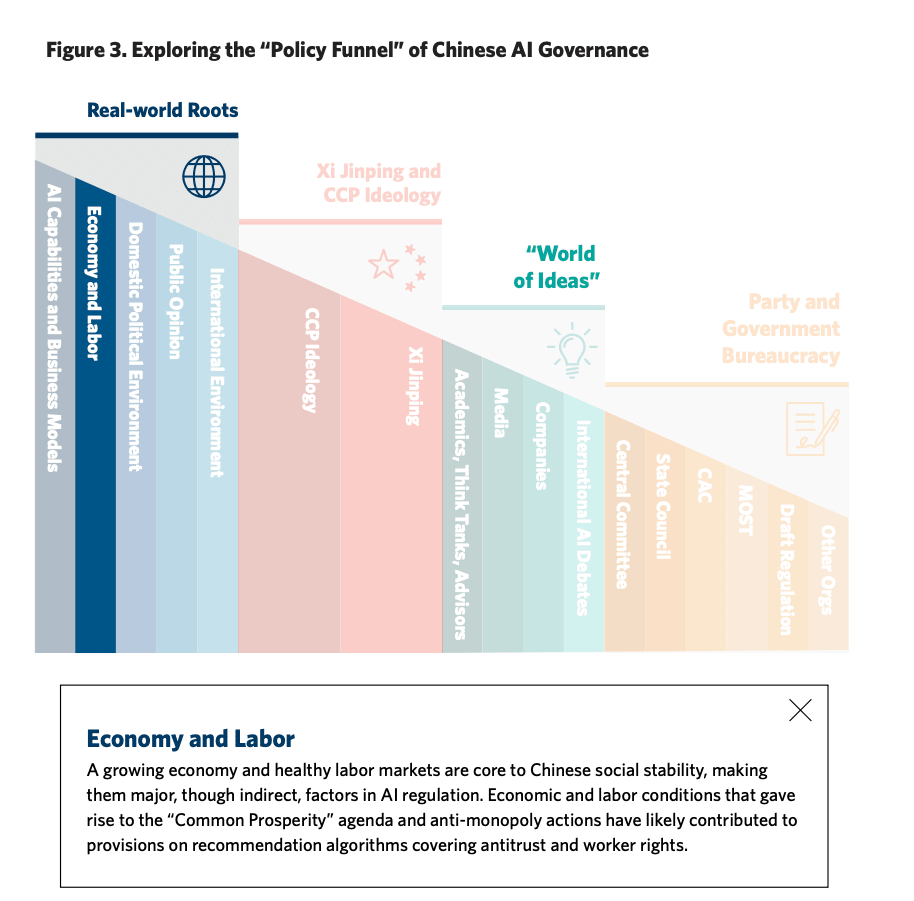
Applying this framework to workforce disruption, expect that labor-market shifts will be framed as a priority issue since they are core to Chinese social stability and common prosperity. Then the issue would command policy debate: journalists may spotlight the plight of workers displaced by automation, while corporate actors emphasize productivity gains and global competitiveness. Sheehan observes that AI-system governance currently allows relatively wide space for policy debates, in part because the field is new and competition among bureaucracies has yet to solidify.
A similar dynamic could shape regulatory responses to AI-induced displacement, allowing for more input from think tanks, media, and businesses. Although China has extensive experience managing unemployment, AI-related disruption may differ in its pace, scale, and breadth of sectors affected. This distinction may prompt policymakers to treat AI-driven job loss not merely as cyclical unemployment, but as a structural governance challenge.
Potential upcoming policy initiatives highlight the state’s plans to protect people’s livelihoods while technology rapidly advances. Study Times emphasizes that industries should adopt new technology in “human-machine coordination 人机协同” and “scientifically adjust the level of automation to materially improve employment stability 科学调节制造业自动化程度.” In the AI+ plan, the term “human-machine coordination人机协同” also appears in the first paragraph. The term has been defined as “the process of humans and intelligent systems (including algorithms, artificial intelligence and robots) completing tasks together”.
This concept has been further interpreted and is being put into practice. Cai Fang 蔡昉, a prominent Chinese economist and president of the Labor Economics Society 劳动经济学会会长, argues that AI should be guided by policies that prioritize human-machine collaboration over efficiency gains from automation alone. Some current AI applications in China reflect this awareness. For example, robots from Unitree have become “AI Physician Assistants”, making clinical rounds as part of a “human-machine-coordination multidisciplinary team (MDT) 人机协同MDT” at Fuzhou University Affiliated Provincial Hospital 福州大学附属省立医院. Unlike Silicon Valley companies bragging about being “fully AI native”, official directives in China often prominently display human involvement and show a clear intention to manage AI’s threat to the workforce.
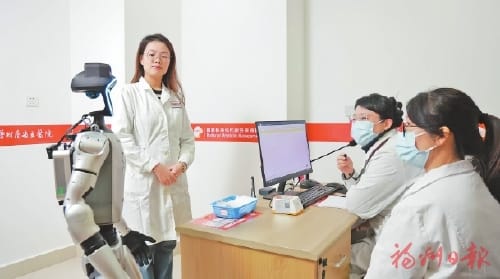
Proposals addressing AI-driven labor concerns are abundant in China. During the 2025 Two Sessions meeting, Liu Qingfeng 刘庆峰, the CEO of iFLYTEK 科大讯飞 and an NPC (National People’s Congress, which generally rubber-stamps decisions already made at the highest levels of the CCP) deputy, suggested “AI-specific unemployment insurance AI失业保障专项保险”, a 6-12-month grace period for layoffs, and more job-oriented curriculum at universities and trade schools. For low-income communities, he emphasized that the state should provide free upskilling. He also recommended building a “‘monitor, alert and respond’ system that dynamically tracks employment status 就业监测-预警-响应”全链条监测机制”, with pilot rollouts in the Yangtze and Pearl River Deltas. The platform would require businesses with extensive AI-usage to provide data on job replacement to predict unemployment risks.
During the Two Sessions, Guoquan Lü 吕国泉, the All-China Federation of Trade Unions chief of staff, also highlighted practices in Spain, Korea, and Japan that China could adopt, such as limiting enterprises from replacing more than 30% of workers in a single position, requiring a portion of automation-driven cost savings to be allocated to employee upskilling, and levying additional taxes ranging from 0.5% to 3% to fund unemployment benefits. Chinese authorities could take similar measures in the near future, which would put more pressure on companies already navigating brutal competition, tariff wars, and domestic deflation.
Besides policy proposals, several structural conditions in China may soften the impact of AI-led displacement. First, the relatively low cost of labor reduces firms’ incentives to replace workers, particularly when the technology is immature. A Chinese manufacturer interviewed by Nikkei Asia states that his automated production line equipment is sitting idle due to the high start-up cost of operating them. Instead, he continues to rely on the experienced workers who can “make better clothes than what machines can do now.” Such dynamics create a buffer against rapid job loss that many Western economies do not share.
Some believe that SOEs could absorb both new graduates and workers displaced by technological changes. In China, “employment within the system 体制内工作“ — which includes positions in government agencies, public institutions such as schools and hospitals, and centrally or locally-affiliated SOEs — has long been considered an “iron rice bowl 铁饭碗” that offers exceptional job stability for both employees and society at large. Helen Qiao, a managing director and chief economist for Greater China at Bank of America, told Nikkei in December 2025 that Chinese graduates may face less AI-led disruption than their American counterparts since “SOEs will continue to shoulder some social responsibility, cushioning the impact.”
Indeed, SOEs have helped stabilize employment to an extent. Regarding youth unemployment, many localities have issued policies encouraging SOEs to recruit more college graduates, with some regions requiring that at least half of new hires in SOEs be recent graduates.
Nonetheless, “employment within the system” is unlikely to serve as an effective employment buffer under China’s current fiscal environment. Local governments are under significant financial strain — in China’s fiscal system, they bear primary responsibility for funding government agencies, public services, and local infrastructure. Yet while a large share of China’s tax revenue flows to the central government, local governments have become significantly indebted and are under huge financial pressure. Local civil servants, whose salaries come directly from the local government budget, have seen their wage promises deteriorate from “guarantee six (months of wages annually), try for eight 保六争八” to “ guarantee three, try for six 保三争六”. Similar wage arrears have affected workers ranging from SOE employees to doctors and teachers.
The policy tools for potential AI-driven displacement may no longer be viable in 2026 due to fiscal constraints by analyzing previous reforms that supported displaced coal workers. During 2016-2020, the central government committed ¥100 billion (approximately $14 billion) to support an estimated 1.3 million displaced coal workers through benefits and compensation. In the example of Wuhai 乌海, Inner Mongolia, the central government issued funds to SOEs to provide early-retirement benefits, severance packages, delayed salary payments, and other forms of support.
Local governments were expected to contribute similar sums and also took various measures to help the former coal workers find jobs. In Wuhai, the combined efforts from the central government, the city government, and the SOEs helped prevent social instability, and no petitions were reported. Local authorities also created non-coal-mining jobs by attracting new businesses, including in chemical supply chains like coke and chlor-alkali. As a result, employment in the chemical industry surpassed that in the coal-mining industry by 2020.
Compared to the Wuhai case, the government’s capacity to address AI-driven displacement today is far more constrained. With their coffers already depleted, local governments can provide few incentives to attract industries capable of bringing in new jobs, and in a world of AI disruption, it’s not totally clear what those industries would even be. (Sectors such as manufacturing, digital media, and AI development have reportedly seen the emergence of new job categories leveraging AI, but it’s an open question which positions could provide durable employment at scale.)
Therefore, many of the ambitious proposals for managing AI-led displacement may need to incorporate self-financing mechanisms rather than relying on direct government support. As deputy Lü Guoquan 吕国泉 has suggested, one potential approach would be requiring firms to reinvest a share of automation-driven cost savings into worker upskilling.
Public discourse further reflects concerns about unemployment and the administration’s capability to address it. When I spoke by phone with Wu Hong 吴宏, an advisor to the Neuroscience and Intelligent Media Institute at the Communication University of China 中国传媒大学脑科学与智能媒体研究院顾问, he told me he thinks that “macro-level pressures, rather than isolated technological advances, are stressing the economy and employment today”.
At the implementation level, online discussions expose how labor policies unfold in practice. On Zhihu, one user wrote:
“My company has to hire hundreds of new grads every year, but the business doesn’t need these people at all. Easy peasy — after a year, most either quit on their own or are laid off, and only a small fraction stay.”
Such anecdotal observations align with empirical findings. Research by a group of economists in 2023 found that government subsidies were linked with gains in employment at the time of subsidy receipt, but that these gains reversed one year later. In Ching Kwan Lee’s seminal work on Chinese labor politics, Against the Law: Labor Protests in China’s Rustbelt and Sunbelt, she argues that the violation of labor rights is a structural problem due to the national strategy of decentralized accumulation and legal authoritarianism: While local governments are responsible for developing a pro-business local political economy, the same local officials are also expected to implement labor laws issued by the central government, who sees stability as a legitimation strategy. Such tensions could weaken local government’s effort in managing AI-led job disruption since they are simultaneously incentivized to promote business efficiency.
AI-driven workforce disruption carries broader implications for China’s future. The pattern of displacement may differ from that in the West. In China, low-wage workers could be the most vulnerable as robots are already serving food in restaurants, delivering room service in hotels, and guiding shoppers in malls. The country’s 200 million gig workers also face mounting threats from robotaxis and delivery drones.
In contrast, in the US and other developed economies, anxiety about automation has largely centered on white-collar professionals. Major tech firms like Amazon, Microsoft, Salesforce, and IBM have dominated headlines with AI-related layoffs. Meanwhile, growing numbers of young people in the US and UK are opting for skilled trades over college, citing fears of AI replacing knowledge work. Wu Hong told me he thinks that China’s long-standing advantage of having a large pool of skilled manufacturing workers could be challenged if Western economies use AI and robotics to reshore production. He also suggests that with automation, the West may be able to replicate China’s advantage of having a robust talent base of highly skilled tech workers.
These possible trajectories add more complexity to China’s AI transition. Managing workforce adjustment is central to China’s social stability and national prosperity, and China’s proactive stance on the matter may allow it to build a concerted response system to cushion the impact of job loss. Expect stopgap measures such as new legislation and financial incentives to be introduced. Nevertheless, the harsh fiscal reality could stall many initiatives, forcing policymakers to confront difficult trade-offs between employment protection and AI-led efficiency gains.
ChinaTalk is a reader-supported publication. To receive new posts and support my work, consider becoming a free or paid subscriber.

为全球华人游荡者提供解决方案的平台:游荡者(www.youdangzhe.com或www.youdangzhewander.com均可使用)这世界的辽阔和美好,游荡者知道。使用过程中遇到问题,欢迎联系客服邮箱wanderservice2024@outlook.com.

【和放学以后永不失联】订阅放学以后Newsletter,每周三收到我们发出的信号:afterschool2021.substack.com 点击链接输入自己的邮箱即可(订阅后如果收不到注意查看垃圾或广告邮箱)。如需查看往期内容,打开任一期你收到的邮件,选择右上角open online,就可以回溯放学以后之前发的所有邮件,或谷歌搜索afterschool2021substack查看。

截至目前,放学以后Newsletter专题系列如下:“在世界游荡的女性”系列、“女性解放指南”系列、“女性浪漫,往复信笺”系列、莫不谷游荡口袋书《做一个蓄意的游荡者》系列、“莫胡说”系列”《创作者手册:从播客开始说起》,播客系列和日常更新等。本期放学以后信号塔由金钟罩轮值,好久不见朋友们。
天赋如果被荒废,是会被收走的,更何况还没啥天赋。去年停止了写作,一停就是大半年。写作天赋无从被收走,因为我没有这个天赋;但懒惰会被放大,让我逃避一次就会逃避第二次。
今年决心重新启动写作了!不仅是写作,我还决心开启很多其他的事情,在2026年创造更多美好的事情。
我从来不会后悔自己去游荡的每一个国家,不会后悔当时的每一天。也从来不会后悔自己吃到过的美食,不会后悔看过的每一本书、录过的每一期播客。不会后悔跑步,不会后悔创作的文章(也许有一点羞耻)。
但会后悔什么呢?
后悔无止尽地刷社交媒体,后悔熬过的空虚的夜。后悔没及时斩断有毒的关系,后悔浪费时间的社交。后悔没有做太多纵容个性的事情,后悔太多清醒克制的时刻。后悔过于追求完美和优绩,让自己像个乏味的假人,也无法坦然面对和探索自己的guilty pleasure。
洗心革面,痛改前非?都不是的。这些词过于沉重了,沉重的让人得深呼吸好几口气都还不敢拿起这样的承诺。就像之前在播客里的讨论的,天赋就是做自己启动起来不费劲的事情。所谓的重新开始,不是必须ready什么骇人的宏大人生规划,少做一些让自己后悔的事情,把时间拿去做一些自己不会后悔的事情。
现在已不是什么新年了,但我仍然决心在2026年启动一些事情,让自己不后悔。
去年我放弃了半年,有几个原因,1)不想强行热烈去写一些违心的话,2)太过于忙碌想给自己放个假,3)觉得自己写的太差以至于多次提笔都无法完成。
现在这三个心魔基本都已经解除,就简单把写作当成一次一次地自我叙述吧。如果你都不讲自己的故事,谁来帮你讲呢。希望今年在写作中,少一些讨好,少一些对完美的刻意,少一些过度渲染的情绪,尽量简洁一些,准确一些。
首先是春节期间的澳大利亚之行,我必须去温暖的地方,去晒晒太阳,去吹吹海风,还要奔跑跳跃,去野餐,去发呆,去走走。
然后是七月与莫不谷、霸王花和游荡者网站的产品经理粽子,也许还有很多其他朋友,相约荷兰的奈梅亨,与老朋友红尘做伴,从诗词歌赋谈到人生哲学,一起参加徒步者盛会,穿梭在古老的村庄集市中。
还有,想去一趟云南孟连或者贵州贵阳,云贵美食这两年在国内红红火火,我好想去源头看看这些本地的美食到底长啥样。想创造一个短期的、两眼一睁就是吃的假期。
要可以流利地参加一些临时开始的会议,要能够在会议上充分表达自己的态度,在会议上就拿到结论,而不再是开完会后又花更多的时间去琢磨大家说了什么。最起码在自己常用的英语场景中,做到用词准确,工作高效,这样就能节省更多时间,早点下班去健身,或者跟朋友约饭。
去年达到了巅峰的87kg,今年1月因为连续在美国出差,加上家里糟事频发,一个月内瘦了7kg。我觉得很好,身体轻盈了很多,接下来要增加有氧的比例,在今年把体重维持在82kg以内,并且体脂肪迈进18%!(不好意思,现在22%)
无论如何,多看书,少看短视频,一定不会让我后悔。之前睡前看书的习惯,不知道什么时候变成了睡前看美妆视频。今年Q1首先把《红楼梦》完整读完,然后把之前加入书架的书都启动阅读,像之前那样,做好笔记和摘录。
不好意思,我还没想到如何能做到酷一点,但我觉得可以酷一点,我应该可以做到。也想听听你们说说怎么可以做到酷一点。
前阵子跟同事团建唱歌,发现自己怎么唱的还是十几年前的老歌,我必须拓展曲库了,学一些新歌,不一定是新发布的,是说自己以前不会唱的。当然,也要学习新的英语歌,去充分背会歌词,大大方方的唱起来。
好简单!写下这些美好的开始,虽然还没开始,我好像已经获得了新的开始。
这篇其实是2月初就已经写好的文章,想着既然启动news letter写作,最好多准备几篇,以备随时更新。现在看来仍然不觉得过时,因为年初暗暗立下的flag没想到自己居然已经实现了好几条!
首先是学新歌!已经学会了《还有什么更好的》《simon》《走走》并且已经在KTV倾情演唱,虽然唱的很糟糕,但是每天走路的时候终于能哼哼新歌,心情还是不错的!
然后是拓展游荡地图。已经在春节游荡了墨尔本和悉尼,找到了目前第一个愿意将来定居的城市——悉尼。这里多元友好,从来没有大半夜光着膀子淋着小雨在城市散歩过,没有身材羞耻。听着好听的音乐,在喜欢的城市里,每一首BGM都是对的,都是准确的,所有的心情都是好心情。并且还组织了一场研究生同学聚会,大家从各自的城市相约广西,这也非常值得再写一篇文章。
还有,控制体重。已经惊人的从87kg顺利降落到81kg,并且体脂肪已经从22%降到18.8%。感觉身体轻盈了很多,并且能穿一些漂亮的衣服了,偶尔穿上适合的衬衫,没有那种紧绷的感觉真是不错。
当然红楼梦还没读完(Q1目标100%,现在80%),英语还在学习中,自己还没能酷一点。
但很多时候,“清爽”已经成为了我今年的关键词。自从某一起播客跟莫不谷聊到“很多事情都应该被清爽地解决”。“清爽”就成了我现在做很多事情的宗旨,更清爽地做决定,更清爽地了解工作中的todo,更清爽地去拒绝不想做的事情,更清爽地起床。
写下这些美好的开始吧,正是春和景明,马上就是明媚初夏,什么时候开始都是最好的开始。
成为放学以后Newsletter月度会员,可以解锁既往所有付费内容,解锁完记得在权益期及时查看所有付费内容,以最大化享受权益。如下月不再继续付费订阅,也记得及时解除,以防发生计划外扣费;爱发电支持购买单期付费播客或文章。大家可根据自身情况选择最适合的方式,苹果用户请不要下载appstore的爱发电app,是诈骗。
放学以后爱发电“电铺”:https://afdian.com/a/afterschool?tab=shop
《创作者手册:从播客开始说起》(小册子)系列https://afdian.com/item/ffcd59481b9411ee882652540025c377
run&rebel系列1《朋友们,Run and Rebel:快逃以及反抗!》https://afdian.com/item/2b3a33acfd3311ecb4d852540025c377
run&rebel系列2《在这个时代,做个反派》https://afdian.com/item/b9c74240bcff11ed86fe5254001e7c00
run&rebel系列3《爹和爹味,吐槽大会》https://afdian.com/item/6529d622092011ee8a1352540025c377
run&rebel系列4《活在历史的垃圾时间,我们如何度过时代的乱纪元?》https://afdian.com/item/90682ea4c68611ef8e645254001e7c00
run&rebel系列5《让我们不吐不快:各行各业,各个工种,各色牛马,吐槽齐发》https://afdian.com/item/87b95f1ac32111f0b10552540025c377
放学以后《莫路狂花今夜不设防:人如何不糊弄和痛恨自己,并找到自己的渴望呢?》https://afdian.com/item/e4b68686a67911ef8f2f5254001e7c00
放学以后《莫路狂花2:如何对自己充满爱意和敬意,免于混乱逃避低活力?》https://afdian.com/item/3572eaba3a6d11f0ac9052540025c377
放学以后《终身学习1:学会面对真问题,不逃避,下决心和谈分离》https://afdian.com/item/e96a78d4619c11f09e8552540025c377
游荡者平台:www.youdangzhe.com 或者www.youdangzhewander.com
Anon contributor “Soon Kueh” occasionally writes about China and delights in bureaucracy. You can read more of her guest posts here and here.
China’s renewable energy sector is booming. The Guardian recently reported that in 2025, clean energy industries contributed to 90% of the country’s investment growth, “making the sectors bigger than all but seven of the world’s economies.” Currently, many policies are issued based on the overarching 14th Five-Year Plan on Renewable Energy Development “十四五”可再生能源发展规划 that was released in 2022. In this plan, China ambitiously pledged to increase its renewable energy consumption to 25% by 2035. China now leads the world in the production of wind and solar energy, but these technologies are fundamentally intermittent. Energy storage can help, but there’s another obvious way to add green, non-intermittent power to the grid: geothermal. Given the country’s ambitious renewable energy goals and vast geothermal capacity, why is the potential of geothermal power production still untapped in China?
Today, we’ll explore the history of geothermal energy in China and the factors that make it unviable for the time being. China began exploring geothermal technology relatively late compared to other countries, and geothermal site exploration is technically challenging — but these are not insurmountable barriers compared with the power of the Chinese state. The short version of the story is that solar and wind are so dominant (and their supply chains so involuted) that they are crowding out investment at basically every level. But what does that mean for China’s climate goals, and what does this dynamic reveal about the role of entrenched interests in shaping Beijing’s decision-making?
Before we answer those questions, we have to look at the geothermal projects that emerged against all odds.
While China is currently the top country that produces geothermal energy directly for heating and cooling purposes, it lags far behind in geothermal electricity production. China has abundant hot dry rock (HDR) resources which it could ideally harness to generate electricity, but its research into HDR development is mainly still in the experimental stage. In fact, China’s research in HDR development for geothermal electricity production started relatively late compared to the US, Germany, France, and Japan. Although renewable energy production in China ramped up during the 2000s to combat China’s worsening pollution crises and also fix its international reputation as the top greenhouse gas emitter, geothermal was left out of this development. Geothermal has been historically sidelined despite its potential for substituting hydropower, which is now severely at risk because of extreme droughts. A 2007 report by the NDRC revealed that areas such as Yunnan and Tibet with abundant hydropower resources are also most favourable for geothermal development. Even then, China still preferred to invest its resources on ramping up wind and solar capacity, resulting in its well-established dominance in wind and solar manufacturing, lower costs of production, and domestic overcapacity. Realistically, wind turbines and solar panels are easier to mass produce and transport logistically, unlike geothermal which requires site-specific engineering and custom-made equipment. The limited export potential of geothermal considerably reduces its competitiveness as well.
Apart from higher costs, geothermal power development lacks unified policy support compared to wind and solar. Since 2021, China has stopped setting clear targets for geothermal development. The 14th 5-Year Plan merely stated to “promote geothermal energy development in an orderly manner 有序推动地热能发电发展.” In reality, places where geothermal energy development is most feasible have already been dominated by wind and solar, suppressing local demand for geothermal energy. There is currently insufficient policy support for geothermal development and a lack of financial subsidies, unlike the generous feed-in tariffs for wind and solar. Subsidies of geothermal plants are negotiated on a case-by-case basis, which increases the financial risks for private developers. Moreover, since the Resource Tax Law 资源税法 was revised in 2020, geothermal energy has been reclassified and is now subject to higher taxation, making it less financially viable.
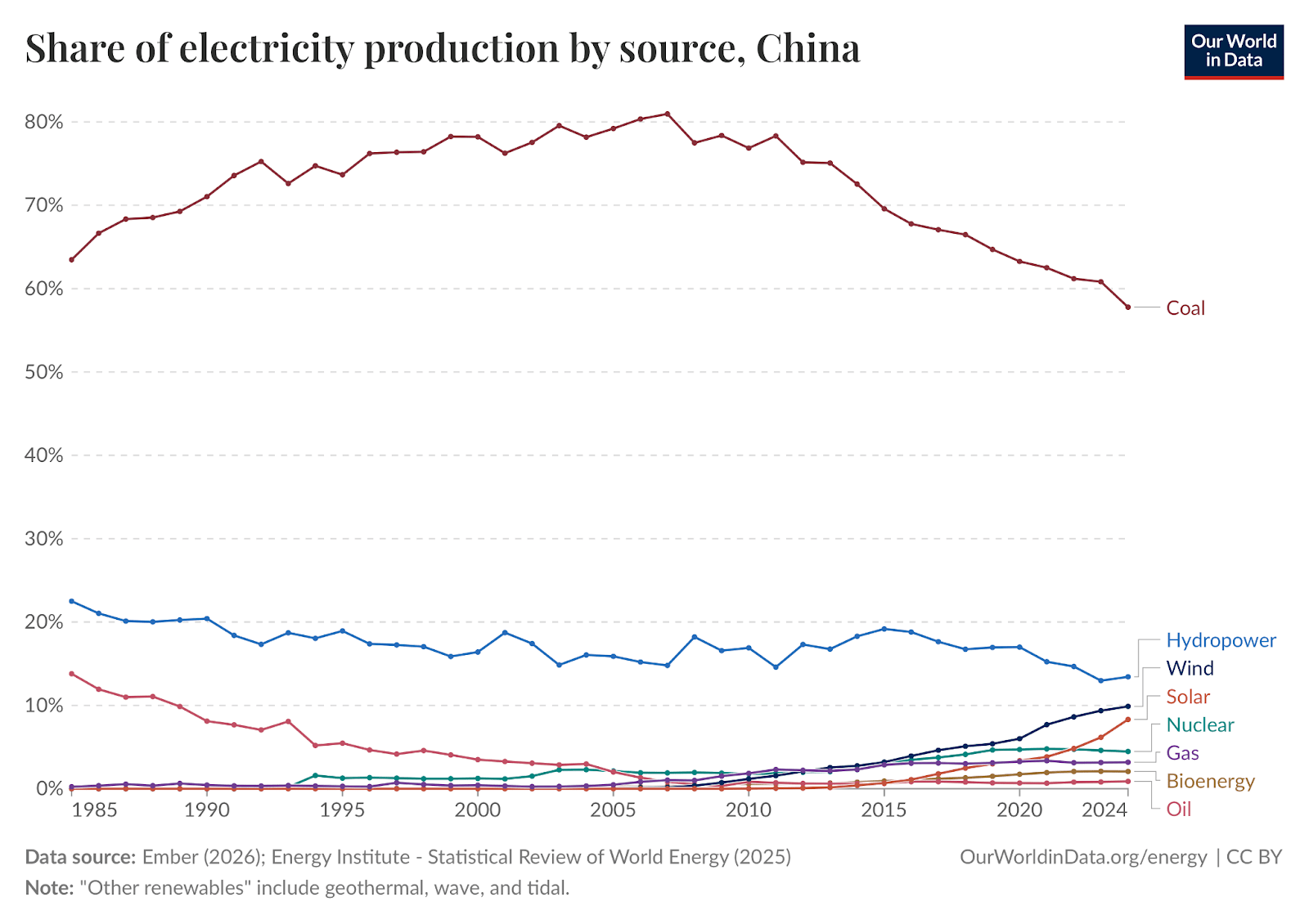
China still relies primarily on coal (57.77%) as its main electricity source. This disproportionate reliance is clear given that hydropower — the second-largest source at 13.43% — still generates roughly four times less electricity than coal. The numbers only get worse from there. Hydropower (13.43%), wind (9.88%), and solar (8.32%) unsurprisingly remain the most preferred renewable energy sources given the country’s historically robust dam infrastructure and intensive push into solar and wind development over the past two decades. China’s domestic wind and solar PV capacity significantly increased because wind projects were made financially viable after the 2006 Renewable Energy Law and generous subsidies were provided in 2010. The price of wind turbines also significantly fell since 2003, lowering the cost of production even further. The costs of manufacturing solar PV parts also dramatically dropped between 2010 and 2024.
Hydropower has always been a preferred option for the past few decades, coinciding with the CCP’s rise to power. Arunabh Ghosh writes that while Soviet influence encouraged large-scale dam projects, small hydropower plants ended up being the preferred method of power generation because they aligned with the party’s goal of water conservancy and were also more cost-efficient. Large-scale dam projects advised by the Soviets were also “poorly managed” then, contributing to the shift. Environmental historian Robert B. Marks attributes the explosion of mega dam projects in the late 1990s to early 2000s to poor regulations and the privatization of the State Power Company of China in 2002. When the company was “privatized and broken into five profit-making enterprises” that were mostly led by people well-connected to the CCP, these companies eagerly sought to divide the rivers, resulting in a “scramble for hydropower” and contributing to its present dominance.
The government’s intense focus on those three types of renewables has left geothermal energy significantly underdeveloped. The Our World in Data project estimates that only 1.34% of China’s energy consumption is sourced from “other renewables” in 2024, while the International Energy Agency estimates that in 2023, China generated a measly 195 GWh of electricity from geothermal sources, compared to 1,285,850 GWh from hydropower, 885,870 GWh from wind, and 584,150 GWh from solar PV. Despite recent policy initiatives to ramp up geothermal energy development, it is unlikely that this vast gap can be bridged in the near future.
While geothermal energy is theoretically a viable option to achieve China’s clean energy goals faster, it is currently an unattractive one because of competing interests. Wind and solar remain dominant because of their competitive costs and long-term industry support. Coal still remains popular among local governments and corporations because they are “sources of employment, investment and revenue.” The reality that geothermal power generation is significantly riskier and more expensive to develop makes it an even less compelling option.
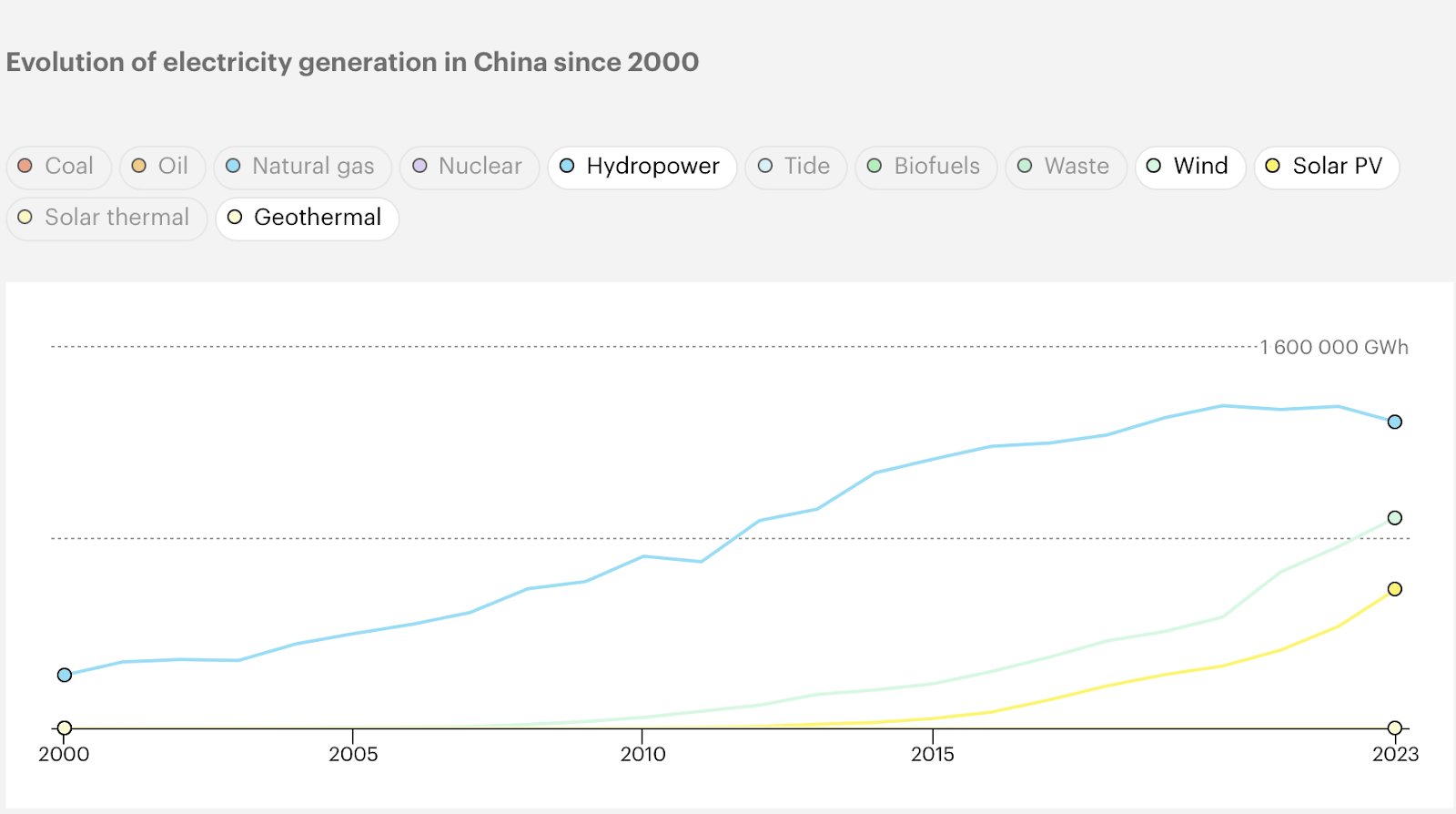
Harnessing geothermal energy for electricity production is historically complicated and enormously expensive. Building a geothermal power plant involves a few hefty steps: 1) site exploration; 2) drilling underground to create a geothermal well; 3) establishing the power plant, and finally; 4) electrical transmission.1 The difficulty of the first step — site exploration — is usually sufficient to deter prospectors. It is extremely difficult to accurately identify a geothermal site suitable for electricity production, and drilling in unproductive sites can be very wasteful. In fact, the early parts of geothermal exploration contribute to most of its costs. The Colorado School of Mines estimates that “over 80% of the Levelized Cost of Electricity (LCOE)2 is driven by capital costs, and exploration accounts for around 5%.” These costs usually add up to 54% of the total cost of preparation and drilling. Currently, remote sensing techniques are employed to analyse potential sites. However, they remain extremely expensive because the analysis of one geothermal site exploration may not replicate well at other sites.
Because of these inherent risks, it is unsurprising that China has not tapped much into its rich geothermal capacity. In 2023, the National Energy Administration revealed findings by China Geological Survey under the former Ministry of Land and Resources 原国土资源部中国地质调查局组织 that the country possesses vast hydrothermal resources 水热型地热资源 (a subset of geothermal power), which is equivalent to 1.25 trillion tonnes of standard coal 标准煤.3 It is further estimated that the annual recoverable resource — the amount of power that could be extracted with existing technology — is equivalent to 1.865 billion tons of standard coal, which was 34% of the country’s electricity consumption as of 2022. The country also purportedly boasts of rich hot dry rock (HDR) geothermal resources that can amount to 856 trillion tonnes of standard coal.
HDR geothermal systems employ similar technology to oil and gas fracking, where a geothermal power plant is built by creating a geothermal reservoir by drilling deep wells into hot rocks. Drilling fractures the rocks and helps to create a system to facilitate heat transfer that generates electricity. Once the rocks are fractured, injection and production wells are established so that water pumped down through the injection well can circulate through the fracture network, absorb heat from the surrounding hot dry rock, and return to the surface via the production well. At that point, a heat exchanger is used to transfer the heat from the hot water to a working fluid. This fluid then changes into “high-temperature and high-pressure [vapor] in the evaporator, and then enters the turbine to expand and do work,” generating electricity in the process (Figures 3 and 4).
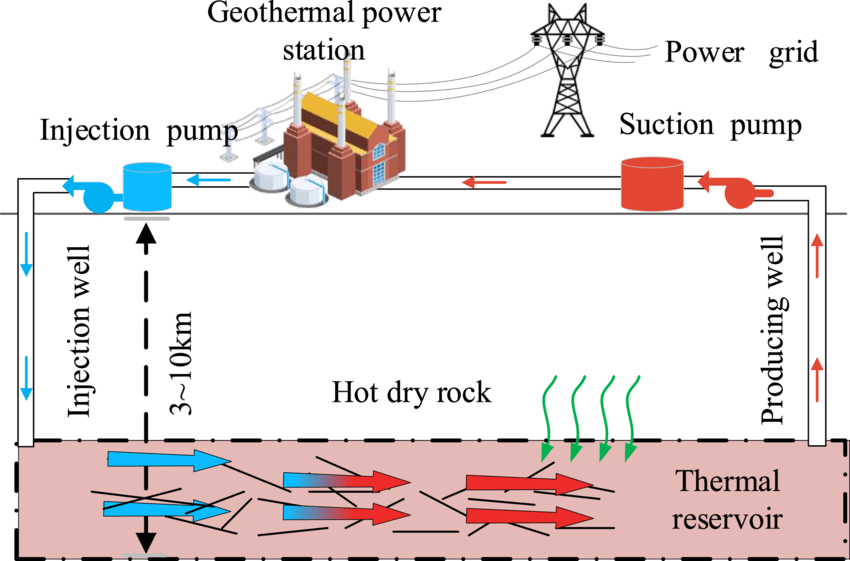
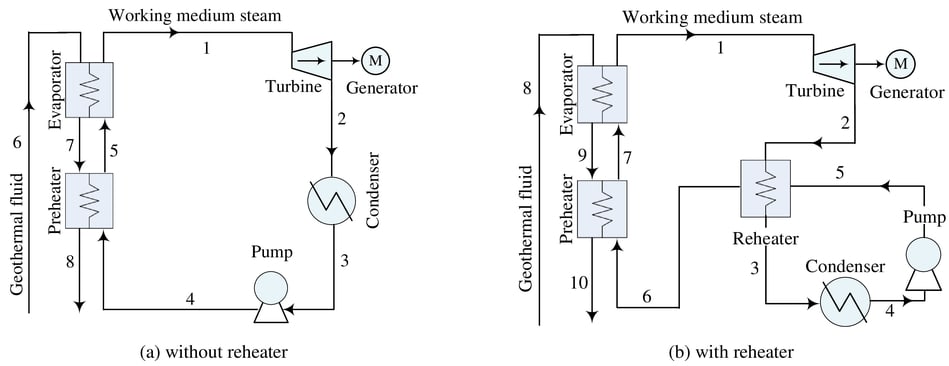
While the NEA acknowledges the tremendous potential of HDR resources, infrastructure is currently lacking to harness them on a large scale. When this finding was published in 2023, obtaining accurate drilling data was also difficult because the latest geological data was published six years prior, in 2017.
The production chain of geothermal development can be broadly classified into three categories: upstream, midstream, and downstream. Upstream companies generally consist of manufacturing and engineering firms that provide materials, survey equipment, and necessary expertise for midstream companies. Research institutes such as the Chinese Academy of Sciences also assist in geological site exploration. Midstream companies such as Sinopec operate and maintain the services once the geothermal wells have been established, while downstream companies directly benefit from these services.
To further illustrate the lack of support for geothermal energy projects, there is currently only one significant geothermal power plant operating commercially in China — the Yangyi Geothermal Power Station 羊易地热电站 in Tibet. This station has replaced China’s previously largest geothermal plant — the Yangbajain Geothermal Field 羊八井地热田 —which was decommissioned a few years ago because of “low electricity prices and aging equipment.” Yangyi is located approximately 50 kilometres from Yangbajing.
Development of the Yangyi Geothermal Power Station stalled for a good 20 years from 1991 to 2001 because of low local government interest. The key reason was that project funding was “designated for national use and would not have passed through local government channels” in a likely effort to reduce corruption. As local governments would not have been able to personally profit from these projects, they were not interested in spending their time on such thankless endeavours. Geothermal funding in China remains unstandardised, but recent projects seem to favour mutual partnerships between the state and state-owned enterprises (SOEs) such as Sinopec.
Even when a private developer from Zhejiang Province 浙江 expressed interest in developing Yangyi and local geological survey authorities offered to relinquish their equity stakes and share their prior exploration results, Yangyi’s development remained stalled by uncertain electricity prices. Because the National Development and Reform Commission (NDRC) insisted that electricity tariffs could only be confirmed upon the project’s completion, developers were wary of the financial risk and eventually abandoned the project. It was only in 2011 when the Jiangxi Huadian Power Company 江西华电 expressed interest in restarting Yangyi’s development.
Thereafter, Yangyi’s operations finally commenced in 2018, and it now generates 16 MW of electricity and “operates continuously for more than 8300 hours annually.” Nonetheless, profitability still remains an issue because feed-in tariffs in Tibet are still much lower than in the mainland. Proper waste disposal of geothermal fluid is also a problem. Previously, the Yangbajing Geothermal Power Station discharged more than 50% of its geothermal wastewater directly into the river, contributing to severe water pollution.
With the updated 2020 Resource Tax Law 资源税法, geothermal energy has been classified as an energy mineral and is now subject to taxation at a rate of 1%–20% of the raw mineral value, or 1–30 yuan per cubic meter of the water consumed in geothermal projects. As a result, nearly half of the electricity revenue collected goes toward paying geothermal resource taxes and water resource fees, further reducing the financial viability of geothermal projects for private developers. The President of the Tibet Geothermal Industry Association commented that this law was “completely unreasonable” because unlike coal, petroleum, and natural gas, geothermal is a “renewable energy resource that generates heat and power without consuming water” and should not be taxed based on the volume of water consumed. Prominent geothermal expert Zhao Fengnian 赵丰年 also emphasizes the need to distinguish between using geothermal resources for commercial purposes and power generation. Taxing commercial hot springs and baths is justified because these enterprises profit from the consumption of geothermal resources, whereas generating renewable energy from geothermal resources should be exempted because no resources are consumed.
There are several non-commercially operating medium-low temperature geothermal plants scattered in Ruili 瑞丽, Yunnan province 云南, Xian County 献县, Hebei province 河北 and Datong 大同, Shanxi province 山西. However, these geothermal plants are mainly used for experimental research and demonstration pilots 示范性质. Seven medium-low temperature geothermal plants were built in the 1970s, but all of them have since been decommissioned. This is unsurprising because the use of medium-low temperature geothermal energy for electricity production is still not very widespread, even in the US (which ranks first in geothermal power production).
Considering that up until now, only the Yangyi geothermal plant — which took a good 20-30 years to build — is in full commercial operation, China’s intensified geothermal development efforts in 10 provinces and two directly-administered municipalities (Shanghai and Beijing) in 2024 signal the state’s renewed interest in capacity-building for geothermal energy development.
Figure 7 shows that geothermal development in China is currently concentrated in Northeastern China and Eastern coastal provinces. Comparing Figures 7 and 8 reveals that current geothermal developments do not exactly strategically mirror areas where geothermal conditions are most favourable. For instance, the most favourable areas are in Southwestern China (Tibet, Sichuan, Yunnan) and Southern China (Guangzhou, Fujian, Jiangsu). This strategic misalignment is because provinces where geothermal power is most feasible are already dominated by wind and solar.
The map does not perfectly encompass all of China’s current geothermal developments because it fails to include capacity-building efforts. For instance, while provinces such as Yunnan are not mentioned in Figure 7, they are also actively engaging in capacity-building efforts to pave the way for future development. In February 2022, the Geothermal Energy Science and Technology Research Institute was established in Dali 地热能科学技术(大理)研究院. The institute has 45 staff members and currently receives technical support from universities, state-owned enterprises, and private companies. Similarly, in 2020, the state-owned Shanghai Geological and Mineral Engineering Investigation company 上海市地矿工程勘察(集团)有限公司 established a geothermal research institute to further assist Shanghai’s geothermal developments. These capacity-building efforts highlight that part of China’s geothermal development efforts involves building research centers that are strategically located near potential geothermal hotspots (i.e. Dali and Shanghai).
In late 2025, there was a significant breakthrough in China’s geothermal site exploration capabilities. Fuzhou University, in collaboration with the China National Administration of Coal Geology 中国煤炭地质总局, released a groundbreaking map titled “China’s Unified Geothermal Map Platform” 中国地热一张图 that integrates 3D spatial modelling, massive datasets, AI modelling, and “key core technologies” 关键核心技术. This collaboration started in 2023 and aimed to create the foundational repository to analyze China’s geothermal resources and assist in geological site surveys. As of now, the platform has catalogued 2407 hot springs and 2057 geothermal wells, but press releases thus far have not shed much light on the datasets and AI modelling involved. This new map potentially lays the foundation for replicable geothermal site analysis and significantly reduces the costs of geological site exploration, hence addressing the shortcomings that have historically contributed to geothermal energy’s underdevelopment.
There has not been any documented opposition to geothermal development from civil society in China on the basis of earthquake risk or pollution. While seismic risks depend on the geographical location, current risk assessments for geothermal exploitation in Xi’an 西安 and the HDR development of Gonghe Basin in Qinghai province show that seismic activity remains low. However, this risk might change as “the probability of a large earthquake event increases as the total injected fluid volume [into the HDR well] increases.” More research is needed to create a comprehensive risk assessment for geothermal HDR development in China.
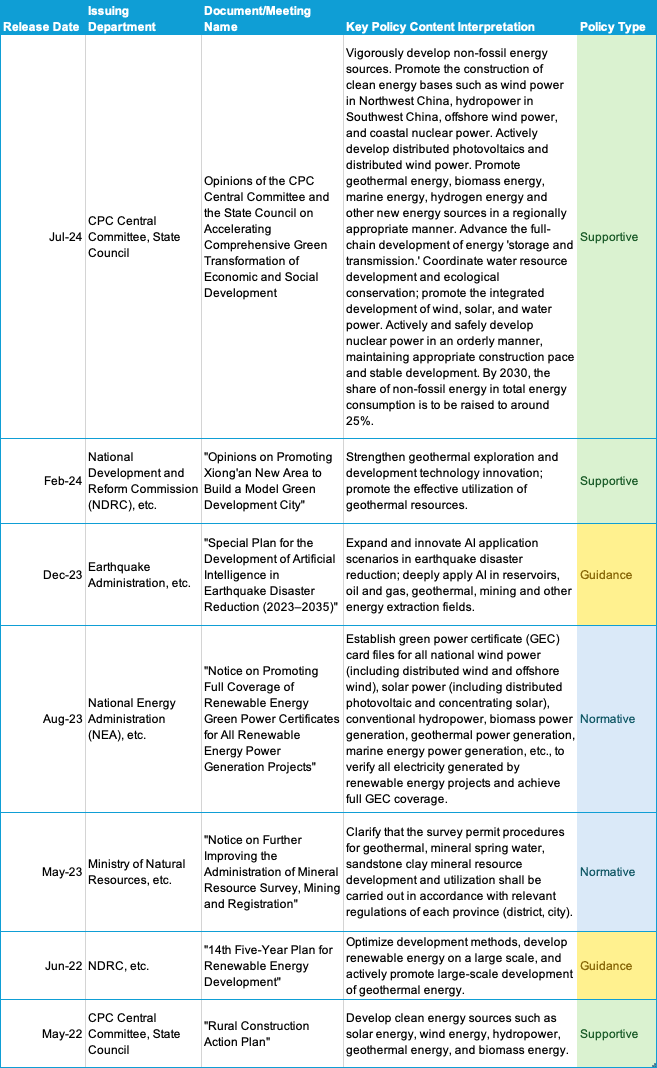
These initiatives did not appear out of thin air but were instead guided by policy directives in recent years. Qianzhan Research Institute highlighted a few key policies that have been instrumental to renewing geothermal development efforts (Figure 9). In general, the Central Committee, the State Council, and the National Development and Reform Commission (NDRC) are responsible for issuing broad, general policy directives in speeding up renewable energy development. It is clear that geothermal energy lacks a clear target and is instead lumped with other, much more popular and scalable forms of renewable energy.
Moreover, while state agencies such as the China Earthquake Administration, National Energy Administration, and the Ministry of Natural Resources have issued more specialized directives in response to the 14th Five-Year Plan, there is no clear unified policy that specifically targets geothermal energy development. Figure 9 shows that geothermal development regulation is often lumped with mining and oil and gas regulation in the realm of administration. The recently released 15th Five-Year Plan also barely mentions geothermal energy and lacks concrete initiatives compared to wind and solar.
The trajectory of these policy developments suggests that while there is progress in China’s geothermal capacity-building efforts, local governments remain strategically conservative. To avoid channeling too many resources into geothermal energy development, which is evidently not as prioritised compared to wind and solar, local governments prefer less risky capacity-building initiatives such as building research institutes and enhancing their current surveying technologies instead of outright investing in new geothermal developmental efforts. Such efforts can be interpreted as strategic hedging, where local governments try to align with national policy directives while minimising resource mobilisation efforts.
For now, geothermal energy remains unattractive in China and is sidelined by wind and solar. This is a result of multiple factors including the high cost of production, lack of policy coordination, and entrenched industrial and national interests. Current geothermal development projects are still in the capacity-building process of establishing research institutions and acquiring more mining data. These are strategic, low-risk endeavours that allow local governments to show that they are funneling resources into geothermal developments without suffering from severe financial losses. Nonetheless, given that geothermal energy development, especially HDR technology, is still in its infancy in China, any form of research and capacity-building initiative should be welcomed.
The deprioritization of geothermal energy development in China suggests that decarbonization and pollution reduction are not Beijing’s top priorities, especially when new green energy risks threatening local champions (i.e. wind and solar manufacturers). The Economist also reports that coal remains expensive to phase out, because China currently “lacks a flexible, nationwide power market” that efficiently dispatches clean power when needed. Reforms have been slow, making coal a still preferred source of electricity and a key source of maintaining energy security. Thus, renewable energy development is only prioritized if it strategically aligns with national and industrial interests.
On the bright side, geothermal development may receive more overall international support in the upcoming years. Because of the similarities between fracking and harnessing geothermal energy, the IEA predicts that advances in fracking technology would greatly assist geothermal development. However, it is unlikely that this will have any substantial impact on geothermal energy development in China anytime soon, unless there is a unified geothermal policy to assist research and development efforts to harness this technology. Until Beijing reconsiders its heavy taxation on geothermal power projects and makes geothermal eligible for feed-in tariffs, geothermal will continue to struggle to compete with wind and solar.
ChinaTalk is a reader-supported publication. To receive new posts and support our work, consider becoming a free or paid subscriber.
This is a good and quick introduction to geothermal energy:
The levelized cost of electricity (LCOE) is a measure of the average net present cost of electricity generation for a generator over its lifetime.
Standard coal here 标准煤 refers to the standard coal equivalent, which is a standard unit of measurement that compares the calorific value of different energy carriers against a reference coal with a calorific value of 7,000 kcal/kg.
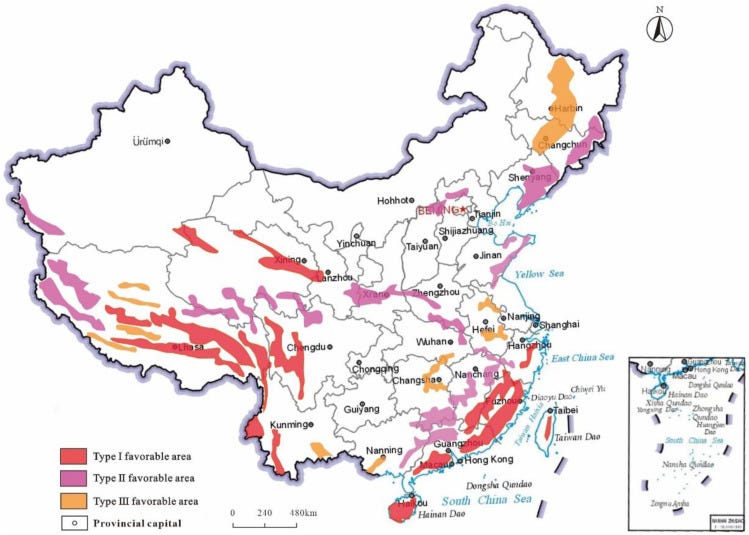
What can we learn from its past glories and failures, and where should we take this next? We have of the Foundation for American Innovation to discuss:
The Pendleton Act myth — Why civil service reform didn’t begin or end with Pendleton, and why starting the story there misses what actually made the system work.
The rise of the subject-matter state — How early 20th-century agencies staffed with real experts — entomologists, engineers, agronomists — made the U.S. bureaucracy arguably the most capable in the world.
From expertise to org charts — How mid-century functional reorganization hollowed out mission-driven agencies and replaced subject knowledge with process management.
What competence delivered — From agricultural breakthroughs to infrastructure build-out, what a serious, technically grounded civil service was able to accomplish.
Whether we can rebuild — DOGE, the abundance movement, state capacity, and why this might be the best time in decades to make the government work again.
Listen now on your favorite podcast app.
Jordan Schneider: Where do we start the clock? Everyone always wants to start with the Pendleton Act, but I hear you have a contrarian take on this.
Kevin Hawickhorst: The history of the U.S. civil service is defined by the people who were hired to do jobs for the government, whether they did well or poorly, and whether they had training. The civil service existed before the Pendleton Act and long after it. The real question is, how good were the people at different points in time? Did Congress think agencies were trustworthy?
We should start the clock at the major inflection points of the federal bureaucracy — where agencies became competent and managed to set up recruitment pipelines of civil servants who could actually do the job and command respect across the country. Questions like the Pendleton Act, merit exams, and removal protections are important, but they are secondary to the actual question of who was working for the federal government, and whether they knew what they were talking about.
Jordan Schneider: How did we go from being John Adams’s son or just a hack who got a job in the Postal Service to actually having real experts who knew what was up?
Kevin Hawickhorst: It’s a story in two acts. Under the Federalists and the Jeffersonians, we had a very “gentlemanly” conception of civil service — any well-brought-up person of quality could do basically any job. The Jacksonians expanded that to the idea that anyone who volunteered for the campaign could do any job. That was the low point.
By the middle of the 1800s, the country was completely awash in patronage. Tens of thousands of people were fired after each presidential election. At the height of the system, there were about 70,000 patronage positions in the Post Office alone. There were tens of thousands of hacks at the Post Office. We are talking about an unpromising foundation.
However, that was also an opportunity. The starting point was so bad that only truly excellent bureaucrats could overcome it and set up agencies and recruit the right people. In other countries, the civil service was a non-controversial, gentlemanly pursuit. In the U.S., only outstandingly well-run agencies could rise above the patronage morass, creating pressure to build excellence.
How did they do that? There were early experiments that didn’t take, but served as a playbook. The first worth looking at is the Topographical Corps in the U.S. Army. These were professional engineers and surveyors who mapped roads and bridges. It was an elite group that commanded respect from Congress, especially in the Western states where most of the surveys were done. The playbook was simple — recruit people from technical societies and put them at the disposal of Congress. It didn’t last due to the politics leading to the Civil War, but the idea remained and was foundational.


The real start of the upswing, where the civil service started clearly getting better, I’d peg it at about the 1870s or 1880s — right around the time of Pendleton, but starting a little before it. The first agency where professionalization was a really big story was the U.S. Public Health Service. Originally a loose federation of doctors who provided care for people in and around the military, it was revamped in the 1870s when the director decided to get serious. He restructured it as almost a paramilitary corps of surgeons — military-style uniforms, military ranks, recruited from medical schools around the country, and partnered with state hospitals.
Then, a lot of the bureaus of the Department of Agriculture were extremely good, professionalizing in the 1890s and the first decade of the 1900s. Agencies like the Bureau of Entomology, the Forest Service (around 1905), and the Bureau of Soils punched well above their weight in recruiting high-quality talent.
Jordan Schneider: The other professional thing we have from the start of the republic is the profession of arms. West Point goes back a pretty long time. To what extent was that a model for some of this much more domestic-focused, expertise-generating stuff?
Kevin Hawickhorst: 100% it’s the model. In most of the United States, people would work their civil service jobs for a couple of years at most and then get kicked out after the next election. But in the military, there were a few heads of bureaus who were almost all-powerful, serving for literal decades — 10 to 35 years. That would be unimaginable even today. In particular, the Quartermaster Bureau under General Meigs was outstandingly good. Provisioning the entire far-flung United States was a very difficult job, and they had to be excellent at it.
When you talk about military inspiration, the idea of professionalizing through uniforms, ranks, and standard training is part of it. But it’s actually the more civilian and logistical side of the military that was the bigger inspiration. The Quartermaster Bureau — people don’t talk about how outstandingly good it was, but it was world-class. It’s an underrated story.
Jordan Schneider: Alright, let’s continue the narrative, Kevin.
Kevin Hawickhorst: I’ve set the stage for the late 1800s and said that these details about these agencies matter more than the Pendleton Act. Why do I think that? First, for your listeners — what was the Pendleton Act? In short, it was passed after President Garfield was assassinated by a man who thought Garfield had promised him a federal job. Reformers who wanted to get rid of patronage had basically the perfect story, and they muscled through Congress a bill saying you could only recruit people through merit tests — you had to test people and give the job to the most competent person. It was meant to get rid of patronage and graft.
Jordan Schneider: Wait, do we think Guiteau is a plant?
Kevin Hawickhorst: When I was doing my research, I was sworn to secrecy on this point.
Jordan Schneider: He was actually in favor of big meritocracy. It was the AI safety lobby of the late 1800s.
Kevin Hawickhorst: Guiteau’s secret double life aside — he was the one who shot Garfield, of course.
Jordan Schneider: Now a Netflix star.
Kevin Hawickhorst: My real goal is to get General Meigs at the Quartermaster Bureau a Netflix show. Or the leaders of the U.S. Public Health Service.


People say the Pendleton Act is when we decided to get rid of politics and recruit real experts. Here’s the thing — first, it was just a law, and it was not implemented very quickly. It applied to only a very small number of positions for decades. More than that, it was still just a law. The civil service is a bunch of people who work for the government and do stuff, and laws only matter if they make you recruit different people who do different stuff. The fundamental question is when did the government start recruiting better people who started doing better stuff? The Pendleton Act helped change the trajectory — it’s a major factor — but it is not directly the answer to that question. One has to look at different agencies and ask when they started recruiting much better people and how they managed to do it. The history of civil service law is not the history of the civil service.
Having made my anti-Pendleton screed, we reach these bureaus I love so much — the U.S. Public Health Service, the Bureau of Entomology, the Bureau of Soils, the Forest Service, and all the rest. Why were they good? My theory from reading all of this history is that agencies were organized differently and had a different relationship to Congress and civil society than we have today.
This struck me when I was reading about the Department of Agriculture and thinking about the different agencies — Bureau of Entomology, Bureau of Plant Industry, Bureau of Animal Industry, and Bureau of Soils. These are such charmingly old-fashioned names. The concrete, old-fashioned names reflected something real about what they did and the vision they embodied about what government is and does.
Take my favorite example — the Bureau of Entomology at USDA. It brought together all the different facets of entomology. Employees would do research, usually working with state land-grant colleges. They would regulate diseased crops, usually working with state regulators. And they would administer grant programs to help farmers insect-proof their crops. They combined every function of government, all related to a single subject, and were then able to draw on technical vocations.
If the government were making a pitch to entomologists, they’d say, sure, the private sector can pay you more, but this is going to be literally the most interesting job in the world for an entomologist. You’re going to see every corner of it in your career — from research to enforcement to helping people on the ground. That was a very attractive proposition for technical people.
When the agency was filled to the brim with people with a slightly autistic fixation on their subjects, it commanded real respect because it clearly had expertise that most people just didn’t have. If you’re a Bureau of Entomology filled with hard-charging experts going around putting a stop to outbreaks of weevils, that’s clearly impressive. During the patronage era, people would look at jobs in the post office and say, “I could do that.” They’d look at jobs in the Treasury Department processing paperwork and say, “I could do that.” But then you look at a Bureau of Entomology filled with uniformed entomologists with PhDs — in an era when nobody had PhDs — going around ending outbreaks of infestations, and people would not say, “I could do that.” They would say, “I’m glad that there are people who can do that.” That’s basically the attitude that lets some agencies rise above the morass of patronage in the late 1800s.

Jordan Schneider: How far did we get with this trend? Give us some of the highlights of the accomplishments this setup ended up unlocking.
Kevin Hawickhorst: They recruited people with the strength of their pitch, and then for the actual doing, they paired heavily with state regulators, state universities, and similar institutions to make themselves known throughout the entire country and build up congressional support. It wasn’t just “they could do the thing” — it was “they can do the thing, and everyone knows they can do the thing because they are doing the thing throughout the U.S.”
The Progressive Era playbook of these technical agencies was first to organize around a single subject that corresponds to some vocational community — engineers, doctors, whatever. Second, offer this technical resourcing to institutions throughout the country — state universities, state regulators, ordinary people through grant aid — to make it known that you have this expertise and are putting it at their disposal. Get the right people in and then get them out to show them to the world.
Jordan Schneider: We have all these really smart specialists doing research and counting up insects and whatnot. What does that end up unlocking for the American people — economic development, governance that didn’t exist when you were stuck with hacks getting their Postal Service gig?
Kevin Hawickhorst: Just at the level of vibes, people don’t appreciate how good it was. At the USDA in 1910, if you look at the top appointees who ran the agencies — formally political appointees, even though the president normally appointed career experts — two-thirds of them had graduate degrees in their subject. That would be almost unimaginable today, and it was astounding back then when basically nobody had a graduate degree.
The agencies had very good leadership, and outcomes were much better than is customarily remembered. European bureaucrats went on trips to visit the USDA headquarters in the 1900s and 1910s because they considered it possibly the best-run bureaucracy on the planet. It really did manage to do some big things.
The growth of productivity for American farmers was not quite the laissez-faire rugged individualism we remember. The USDA spent lavishly on research, and there was enormous outreach to bring information to U.S. farmers and boost productivity. It was a significant factor in helping the agrarian sector, which was the great majority of the United States, well into the 1900s.
A lot of the infrastructure connecting the United States was also laid during that era — not physical infrastructure, but the basic setups. The U.S. Bureau of Public Roads started the earliest programs of federal supervision of road building and was extremely elite. The head of it in the early 1900s had studied at the French École des Ponts et Chaussées, one of the most prestigious civil engineering schools in the world. It set technical standards, and much of the planning about road layout eventually evolved through the New Deal and ultimately into the Interstate Highway System. People remember the actual building of the Interstate Highway System, but the Bureau of Public Roads started raising standards for state and local roads, writing plans, and getting politicians aligned on plans that bore fruit much later. Their vision had great staying power — it was very path-dependent.
Then there was a fundamental boost to the U.S. economy through the Postal Service. Toward the end of the 1800s, there was a backlash against the fact that the post office was incredibly expensive and worked poorly. The Post Office tried to professionalize, and as it did, it said, we’ve become much more competent, we’ve got our costs under control, we’re hiring professional people and kicking out the corrupt ones. We want to do more. They proposed setting up a delivery network for parcels and magazines throughout the entire United States — before that, the post office basically just handled letters.
They convinced Congress, rolled it out nationwide, and it was transformative, especially for rural areas. You’ve probably heard stories about people in rural communities reading their Sears and Roebuck catalog deciding what to buy. It was once transformative that you could even do that. Where did the delivery service come from? How did Sears and Roebuck send you the stuff you ordered, or even the catalog? The post office set up a highly subsidized delivery network for magazines and parcels, which enabled big manufacturers to sell throughout the entire United States. You got a mass market for goods on one hand, the rural areas connected to the modern economy on the other, and the post office was at the center of it.

It also broke up the personalistic power relations in certain rural communities, where the person who owned the general store was the king of the castle — everyone had to buy goods from him. Now you could buy from anyone who would deliver to you. You could just get their catalog and order it.
The actual stakes of civil service were much higher than just whether we had too many people getting fired. It was about whether we were building the infrastructure of the United States, bringing modernity to rural areas through delivery networks, agricultural research, and more. The accomplishments are foundational, and they’re forgotten because people over-index on asking what the laws were like instead of asking what the bureaucracy was like—what they were doing and whether they were good at it.
Jordan Schneider: Let’s take a detour to talk about the literature around these questions. A year or two ago, I tweeted asking who’s got good books on the history of federal bureaucracy, and you responded with a book from 1957 — a good book, but also kind of the only book. There’s one Italian professor who has written a contemporary thing about the history of the primarily post-World War II American civil service. But Kevin, you’ve put together an annotated bibliography about this. Give the audience a sense of the scholarship that’s out there for you to be able to make these claims.
Kevin Hawickhorst: First, a horror story for your listeners — a book from 1957 is one of the more comparatively recent books on my bibliography. Many of them are from the 1920s and ’30s.
For why that’s the case, it’s useful to ask, how did I get interested in this, and how did I find these books? I got interested in grad school while studying economics and wanting to know more about the politics and implementation of programs. I had this question — was the government more competent in the past? Lots of people have asked that, but I got frustrated at the level of generality the debate often stayed at. To exaggerate, people would say, “Well, in the past we hired real experts and gave them real authority but had real accountability,” or some similarly meaningless thing. That’s just a platitude.
There’s a prima facie case — we won World War II, built the Interstate Highway System, and put a man on the moon, and now we don’t do much of any of those things. Given that we pulled this off, there must have been concrete nuts-and-bolts things we did differently. I wanted to know how we wrote job descriptions for the Tennessee Valley Authority’s engineers. How did they hire them? How did they do budgetary oversight for New Deal infrastructure? How did they train managers for the Interstate Highway System program?
There’s just very little written about this. There’s a lot of discussion of high politics, but it treats the stopping point as a law being passed or a consensus brought about. The real question is what bureaucracies were doing — how they budgeted, hired, and trained people. At the end of the day, the civil service is a bunch of people who work for the government and do stuff. The question of public administration is — who were those people, and how did they do what they did?
It turned out, first, that there’s almost nothing written about this. But second, it’s not actually that difficult to find out. Most of this stuff is public domain government office manuals that have been digitized on Google Books. You could look up the answers without getting up from your desk.
A whole lot of my sources are just primary sources — agencies explaining what worked well and why and how they did it. I find that vastly more interesting and actionable than the secondary literature, which is often quite vague and sands away almost all the technical details of how agencies budgeted for projects, classified jobs, and so on. Primary sources are way better because they’re the words of the bureaucracy talking about itself — how it thought, what people thought they were doing and why. You don’t get that except by reading primary sources.
Then you get to the old-fashioned books about civil service history, written probably from the 1920s to the early 1960s. Why do I recommend those rather than more modern books? Here’s an anecdote — in my early days studying public administration, I saw a monograph about the Canadian budget system written around 1915. I have a friend who worked for the Budget Office of Canada, so I sent it to him and asked if it was accurate. He said he’d read it for a laugh — Americans writing about the Canadian budget system more than 100 years ago, he’d be surprised if they got one thing right. A month or two later, he texted me, “Not only was it good, but it’s probably better than anything that’s been written since then, and it answered several questions I’ve always had at the back of my mind about why my job worked the way that it does.”
These old-fashioned books have something to be said for them. The culture of academic work was very different. To briefly lapse into the register of one of those annoying Roman statue accounts on Twitter — we were a serious country back then. Research was focused on collecting the raw mass of facts, taxonomizing it, and saying “here is everything there is to know about the subject,” with not much big-picture interpretation but utterly comprehensive in its collection of facts. Today, that isn’t the fashion for academic or think-tank policy research. There’s much more focus on having the right big-picture idea, a vision, an interesting narrative. But in the past, studies were content to collect everything known about the subject, organize it logically, and say, “Here’s how it looks, but we’re telling you everything we know — come up with your own conclusions.”
The good thing is you can come up with your own conclusions, and these books teach you things you’d never have thought to ask about — the fairly bizarre experiments tried at different times, which sometimes worked brilliantly, sometimes were astounding failures, sometimes you’re surprised anyone even attempted. Policy was like stamp-collecting for the people who wrote these books. They wanted to collect all of it and arrange it carefully, and they believed you’d be just as fascinated by the different ways to do budgeting as they were.
Jordan Schneider: Let’s come back to our timeline. How does it all fall apart, Kevin?
Kevin Hawickhorst: I’ve given you paradise, and now it’s time for Paradise Lost. Let’s recap the scene in the 1910s and 1920s. We’ve got entomologists spending their entire day thinking about ants. We’ve got civil engineers who look at roads more often than they look at human faces. We’ve got all of these people in the bureaucracy, and then in civil society, researchers spending their days writing 400-page books comparing the U.S. budgetary system to the Canadian and British ones. A beautiful time to be a bureaucrat. What happened?

I mentioned earlier that the agency names for the Department of Agriculture were old-fashioned — Bureau of Entomology, Bureau of Plant Industry, Bureau of Soils, and Forest Service. They sound old-fashioned because we don’t have agencies like that anymore. Why?
From about the 1930s to the 1950s, there was a movement called functional reorganization. The viewpoint was that the government was organized in an unscientific way — just a random collection of entomologists and soil scientists and whatever, a grab bag of vocations that had managed to plant their flagpole in the federal government. Reformers said what we really need is a very clean, tidy org chart that can expand or contract to do anything the government wants to do. Specifically, they said the government should be reorganized to separate by function rather than subject matter.
In practice, here’s what that meant — I’ll use the Department of Agriculture. The Bureau of Entomology researched insects, regulated insects, and ran grant programs about insect-proofing crops. The Bureau of Soils researched soil, ran grant programs to help farmers prevent erosion, and regulated things that cause erosion. And so on.
Functional reorganization grabbed each function from the different agencies. They created a Bureau of Agricultural Research and pulled in the soil research, insect research, and all other types. Then, a Bureau of Grant Programs pulling all the grant work from each subject bureau. Finally, a Bureau of Agricultural Regulation pulling all the regulatory work. Now there was nothing left in the Bureau of Entomology or the Bureau of Soils — they were reorganized out of existence.
The new org chart was organized around functions — all research here, all grant programs there, all regulation over there. It was no longer organized around topics like entomology, soil or roads. That’s why the names of the old bureaus sound old-fashioned. They’re very concrete. Today, we have pretty vague names about functions rather than things you can look at and touch.
Jordan Schneider: And why is this the worst thing to happen since the invention of the forward pass?
Kevin Hawickhorst: What made these agencies so good in the first place? It was the fact that they said, we have a really unified mission that ought to be appealing to any technical person. If you want to do entomology, at the Bureau of Entomology you’re going to do grants about bugs, research about bugs, and regulate the bugs. If you’re just wild about bugs, this is the place to be. And entomologists loved it. They went bananas.
What happens when you completely undo that and organize according to the opposite principle? First, you no longer have that pitch. You’re a really good entomologist considering Monsanto versus the Department of Agriculture. Agriculture says, would you like to work in the Bureau of Agricultural Regulation? Maybe. The Bureau of Agricultural Research, where you’ll be one of many priorities? Maybe. Doing aid and processing paperwork? Probably not. And then Monsanto says, would you like us to pay you 10 times more and fly you around to industry conferences? Sold to the highest bidder. The government just didn’t have a pitch to recruit technical people because it didn’t really have a place to put them anymore.
On top of that, the new agencies had much more pathological cultures. In the old subject-matter system, the Bureau of Entomology had a balanced mission — they gave aid to farmers, but that was never all they cared about, because they wanted to get back to research. They regulated farmers, but that wasn’t all they cared about either. No one element was dominant.
Under the functional system, there was much more of a monoculture. If you’re the Bureau of Regulation, there’s a lot more incentive to be harsher to the entities you regulate, because you don’t work with them and see the consequences. If you’re the bureau of just research, it rapidly became very academic and not very applied, because they weren’t working with real people, with farmers and state regulators. Then, probably the worst behavior was in bureaus devoted to grant programs. If you’re an agency that distributes grants, the only way to get more prestige, funding, and personnel is to open up the spigots further. Agencies devoted to grant writing are completely identified with their interest groups, which decreased the autonomy agencies had and the independent technical judgment they used to embody.
The functional reorganization from about the 1940s and 1950s — that is my original sin. That’s what takes us from paradise to paradise lost.
Jordan Schneider: What’s the path back, Kevin?
Kevin Hawickhorst: The first implicit premise is, is there a path back? It would be nice, since that’s ostensibly what I talk about for my day job. It would be a problem for me if the answer were “no, we’re screwed.”
Luckily, there is a path, at least, to point us more in the right direction. Today, you see a lot more interest in rethinking the ossified and outdated bureaucratic processes we used to just put up with. Dysfunctional processes around permitting, federal hiring — the opposite of a technical viewpoint focused on achieving actual results. For a long time, there was learned helplessness. People in the policy world would say that maybe things could be 5% more one way or the other, but they could never be all that different.
Today, we live in the era of Trump round two and DOGE, and whatever else can be said, it cannot be said that they are limited to making things 5% one way or the other. There has been a real expansion of people’s conception of what is possible. I’ve even heard this from Democrat friends, who’ve said things along the lines of — what fools we were in the Biden administration to care so much about doing things the way they’ve always been done. When the Trump administration is just going out and doing stuff, they say, we should have too — we’re going to care about the law a lot more, but we won’t care about anything else besides that.
The Trump round two experience of shaking things up has changed the conception of what’s possible, what can be done. You could make a good case that the results will be a lot worse than we thought possible. You could make a good case that they’ll be a lot better. But the range of outcomes is much wider.
There’s also a lot going on that doesn’t make the news as much but is shaking things up in a probably more lasting way. For example, the administration is revamping federal hiring. It used to be the case that federal resumes were 10 to 15 pages long — absolutely insane by any private-sector standard. People have talked about improving this for years or decades. The administration hit on a simple solution. They changed USAJobs so it rejects anything more than two pages long.
There’s excitement in civil society about the idea of just trying to be more competent, making things run better, and caring if they do. The abundance movement is all the rage — people saying we have to promise our firstborn child for debt peonage to buy a house, and wouldn’t it be nicer if that weren’t the case? They’ve organized to make it easier to build houses and roads and have a better, more abundant future. That’s a very American thing — the belief that you really can make things better if you get together and argue and fight hard enough to change the rules of the game.
There’s a lot of excitement around what people call state capacity. The government should be able to do stuff. It can’t, but it should. Why can’t it? Because it can’t hire people, it can’t update its IT systems. But there’s excitement about diving into these gory details and trying to fix things. At the Foundation for American Innovation, I’m constantly struck by the fact that this is actually a great time to be in policy. There are other think tanks — the Institute for Progress, the Niskanen Center — hiring younger, harder-charging people who want to argue that things could be much better, not just 5% better or worse. There’s a lot of movement in philanthropy, too — the Recoding America Fund raised about $100 million to improve IT and hiring processes.
The path back requires a foundation. Things have been shaken up politically, culturally, socially, and institutionally. People realize things have to change and they’re putting resources toward it. I said earlier, somewhat jokingly, that we were a serious society back then. I see evidence that we’re at least interested in becoming a serious society again. That’s one step removed from bringing the bug scientists back to the government. But it’s the foundation for any big change.
Jordan Schneider: Anything else we should close on, Kevin?
Kevin Hawickhorst: The biggest thing would be to make a pitch. I enjoy ranting about the history of bureaucracy, but it would be nice to go from “I talk about bureaucracy” to “we become a serious country again.” If there’s anyone out there who thinks it does sound cool to read 400 pages about the budgetary system of the United Kingdom in 1910 and talk about what that means for IT procurement today, please get in touch. Message me on LinkedIn, Substack, wherever. There are just a few enough people who care about making things work well, and I’m hoping that some of your listeners do. In any event, it’s been a real pleasure to talk about this.
Jordan Schneider: For what it’s worth, I’ve really been enjoying Kevin’s scholarship and activism around this stuff. His writing and deep dives into this space are fascinating. The world needs more young, hungry historians and policy entrepreneurs trying to make the civil service a more exciting and vibrant place. Hats off to you, Kevin. Do reach out if you thought this stuff was cool. Keep digging.
Kevin Hawickhorst: We need more entomology stories from the 1910s. There will be more bugs to come.
ChinaTalk is a reader-supported publication. To receive new posts and support our work, consider becoming a free or paid subscriber.

Today’s guest post is from Zilan Qian, a programme associate at the Oxford China Policy Lab and a Season Fellow at the Centre for the Governance of AI.
“Thank god right now the PRC……doesn’t strike me as being that AGI-pilled. But if they get AGI-pilled… Especially, you know, the later you are to a thing, the higher the cost you have to pay. Dangerous outcomes are very possible.”
— , 80,000 hours podcast, Dec 2025
“Encourage technological innovation in multimodal AI, agentic AI, embodied AI, swarm intelligence, and related fields, and explore pathways toward the development of Artificial General Intelligence (通用人工智能). Promote the parallel advancement of general-purpose large models (通用大模型) and industry-specific models, leveraging high-value application scenarios to drive model deployment and iterative improvement.”
— China’s 15th Five-Year Plan, March 2026
Many people tracking the US-China AI competition used to share a “thank god” instinct. Reading high-level AI policy or watching Chinese big tech fiercely compete for markets, they concluded that China mainly saw AI as a powerful economic engine, rather than an unprecedented, civilization-altering technology for humanity. And for many, this was a blessing: it bought time for the US to press its frontier advantage, or for AI safety to catch up with AI’s accelerating risks.
However, that reading is becoming increasingly harder to sustain. While in 2017 the term “通用人工智能” used by Beijing could safely be interpreted as general-purpose AI rather than AGI, the same cannot be asserted now that the term has resurfaced in 2026. The Five-Year Plan quote explicitly distinguishes AGI from general-purpose large models, treating them as separate tracks. What’s more, like their Silicon Valley counterparts, more and more AI scientists in China see AI self-improvement as a promising pathway to AGI.
However, Chinese scientists’ vision of AGI and self-improvement looks quite different from that of Silicon Valley. Rather than a rapid software-driven intelligence explosion — AI building AI in a recursive loop — Chinese thinking converges on something more embodied: human-level intelligence that requires physical-world interactions. In contrast to a top-down Manhattan Project, this vision of AGI appears to be a bottom-up movement driven by constraint in compute, gradually gaining influence in Beijing’s top policy circle.
The differences in perceiving AGI result in two distortions. On one hand, in the future, when Beijing decides to “race” towards AGI rather than “explore” it, it will not rush to build the software machine god that the U.S. frontier labs have in mind. On the other hand, even if Chinese labs are already doing things that Silicon Valley would recognize as precursors to AGI, they may not frame the activities as AGI, as they understand the word differently.
Today in the U.S., especially among the frontier AI labs, Recursive Self-Improvement (RSI)— AI being able to improve itself without human assistance — has become the dominant working theory of how AGI gets built. In January 2026, Dario Amodei described that when AI is good enough at coding and research, it would be used to produce the next generation of models, creating a self-accelerating cycle. He added that AI could do most, if not all, of what software engineers currently do within six to twelve months — at which point, he noted, progress could move faster than most expect. Similarly, OpenAI also sees RSI as a viable path towards AGI, with Sam Altman targeting fully automated AI to build the next generation of itself in 2028. While some argue that the messier, coordination-heavy aspects of AI development — such as organizational and project management — are harder to automate, there is a broad consensus among frontier lab researchers that AI agents will increasingly take over significant portions of AI R&D work. Agentic coding is widely seen as the most critical capability to be automated first — and by most accounts, the process has already begun inside leading labs.
This narrative of RSI shapes how the “racing against China” discourse is framed in SF and DC: if automating AI research is the decisive lever, then whoever initiates RSI first wins. China, on current assessments, is not close. Against that backdrop, what the broader Chinese AI ecosystem is doing seems largely irrelevant to the question that matters, whether it is investing in embodied AI, supporting open-source, or promoting AI deployment. Some argue that Chinese AI, now characterized by open-source and low-cost, only iterates rather than innovates, catching up on the commodity layer while losing the battle of the real capability. So even as China appears to lead the AI diffusion race that yields more immediate economic benefits, with the prospect of RSI, which promises rapid self-compounding gains through automated AI research, the US is still ahead, and the gap will soon increase rapidly.
This seems to be a reasonable prediction–except that not all developments in China solely focus on near-term social and economic benefits. After all, the concept of machine self-improvement leading to human-level intelligence is not uniquely American. What differs is the underlying theory of how intelligence works and what it would take to achieve it.
“First, you build a brain. This brain has all kinds of capabilities — language ability, image understanding, the ability to judge and recognize the physical world. Then you equip it with hands and feet so it can call upon the world model to solve problems, predict what will happen in the world, and interact with the world. The results of that interaction are fed back as a reinforcement signal. I immediately receive this signal, learn again, and modify my model. This forms a closed loop.”
— Zhang Peng (张鹏), Z.ai CEO; translated by Kyle Chan
Z.ai is far from the only voice in China discussing AGI. Western observers tend to treat DeepSeek as the lone AGI-focused lab in China, or reach a generalized argument that China is not interested in AGI. But that framing misses a growing number of important actors — from other frontier AI startups to academicians from the Chinese Academy of Science — who have named AGI as their explicit goal.
Skeptics may dismiss Zhang’s statement as business-motivated hype, given that it came from an interview just before Z.ai went for IPO, and he is far from the only one with an agenda. As in the US, Chinese AI actors speak about AGI for mixed reasons: commercial positioning, alignment with state rhetoric, or intellectual differentiation. However, the convergence of a similar architecture across company founders, academic researchers, and state-adjacent scientists suggests something more than coordinated messaging. Below, I trace how each component of Zhang’s loop recurs across Chinese AI discourse.
Multimodality enables more dynamic real-world engagement by expanding the range of inputs a system can process and act on. The argument is that language alone cannot provide the perceptual grounding necessary for genuine environmental interaction. MiniMax’s CEO Yan Junjie (闫俊杰) states that AGI is inherently multimodal. In 2025, DeepSeek’s Liang Wenfeng (梁文峰) acknowledged that the lab has internally bet on three paths towards AGI, with multimodality being one besides math/coding and natural language.
But richer inputs are only part of the problem. To act intelligently in the world, many anticipate a system knowing how the world responds to its actions. Unlike the inference-time planning in reasoning models, which searches over reasoning steps in language space, world models plan in state space, simulating the physical consequences of actions before acting. One of China’s key state-affiliated AI labs, Beijing Academy of Artificial Intelligence (BAAI, 智源研究院), predicts that world models will emerge as the primary pathway to AGI in 2026. The lab argues that the industry starts to move from “predict the next word” to “predict the next state of the world,” marking AI beginning to grasp spatial-temporal continuity and causality. ByteDance identifies the world model as one pathway to AGI, viewing it as a key way to “explore the frontier of AI’s cognitive ability.”
Multimodality has become the common practice, and the U.S. labs like Google DeepMind and World Labs are also building world models. But for many Chinese researchers, these two are not standalone paths towards AGI but the brain that makes the next step possible.
If world models provide a simulated interface for environmental feedback, embodied AI, or AI-empowered robotics, provides a physical one. What makes the physical world especially appealing is the abundance of data. Although a virtual world can provide rich synthetic data, the physical world is irreducibly more complex, and interacting with it generates training signals that simulations can hardly match. Many prestigious Chinese scientists see embodied AI as crucial to achieving AGI. Turing award winner Andrew Yao (姚期智) states that the development of embodied AI is crucial for AI to acquire the capacity to comprehend the physical world. BAAI director Wang Zhongyuan (王仲远) claims that embodied AI’s interaction with humans in the real physical world is the key ability for AGI. Shanghai AI Lab director Zhou Bowen (周伯文) places embodied interaction at the final stage of AGI development, where AI can actively learn from and simulate the world through physical presence.
Among these scientists is academician Zhang Bo (张钹), the Director of the Institute for Artificial Intelligence at Tsinghua University, who pioneered embodied AI studies in China in the 1980s. He describes the road to AGI as passing through three successive stages of interaction: between language models and humans, between AI agents and the virtual world, and finally between embodied AI and the physical world. In his view, most approaches to AI have treated thinking as separable from the body and its environment, modeling reasoning or perception in isolation without connecting them to physical action. Embodied AI breaks from this by insisting that genuine intelligence only emerges when an agent can perceive the world, act upon it, and integrate the results back into its own cognition.
Some researchers push the claim further, extending the scope of what AI can potentially learn. Zhu Song-chun (朱松纯), dean of the Beijing Institute for General Artificial Intelligence, argues that natural abilities such as emotions and languages are the true embodiment of human intelligence. The institute actively works on embodied AI to facilitate learning and interaction with human societies in the physical world, allowing the AI to build intrinsic value systems from human examples.
With embodied AI, the loop can finally be closed. A unified multimodal brain perceives the world across modalities. A world model builds predictive representations of how the environment responds to actions. Embodied presence generates the physical feedback that neither language interaction nor simulation can fully replicate.
Alibaba CEO Wu Yongming (吴泳铭) argues that AI’s self-improvement loop cannot close on static data alone, which, however vast, is ultimately bounded by what humans have already expressed. As AI penetrates more physical world scenarios, it gains the opportunity to build its own training infrastructure, optimize its data pipelines, and upgrade its own model architectures. Each physical interaction becomes a fine-tuning, each feedback a parameter optimization — and through enough cycles of that loop, Wu argues, AI will iterate itself toward intelligence that surpasses its own training.
Although Wu’s vision has yet to be realized, the components of the closed-loop are being assembled at speed. Across China, a growing number of companies are racing to build what the industry calls the ‘brain’ for robots: Alibaba launched RynnBrain, Ant Group open-sourced LingBot-VLA as a ‘universal brain’ for physical AI — explicitly framing it as a step toward AGI — while startups like Spirit AI and X Square Robot are developing VLA models that learn through physical reinforcement learning rather than static data. Local governments have funded robot boot camps where hundreds of robots practice real-world tasks via human teleoperation and autonomous collection, generating the kind of physical interaction data that no static corpus can provide. Moreover, researchers from Tsinghua University envision a “self-evolving embodied AI” paradigm — unlike AI that improves by rewriting its own code, this proposed system closes the loop through its physical body, continuously updating its memory, goals, physical capabilities, and underlying model based on what it learns from acting in the real world.
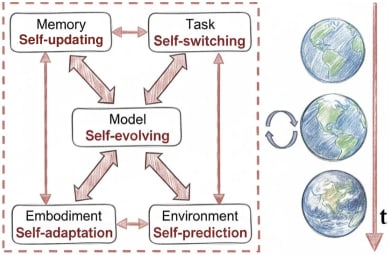
Unlike the RSI discourse at the U.S. frontier lab, which increasingly coalesced around agentic coding as the primary lever, the Chinese ecosystem has no single consensus path. DeepSeek focuses on multimodality without a clear interest in embodiment. Z.ai treats coding agents as central while starting to invest in multimodality-enabled physical AI. MiniMax has long emphasized multimodal architectures. ByteDance and Tencent have invested more heavily in world models. Among leading scientists, Zhang Bo and Zhou Bowen see embodied AI as the final stage of AGI development; Ya-qing Zhang (张亚勤), the founding Dean of the Tsinghua Institute for AI Industry Research, adds a biological layer beyond that; Andrew Yao maintains that large models will remain the core foundation to support all subsequent advances, including embodied AI.
What is nonetheless striking is how rarely coding is presented as a silver bullet, and how consistently Chinese researchers reach for paradigms that go beyond language models — emphasizing the full complexity of human intelligence rather than one slice of it. Rather than a superbrain built from code as perceived by many in Silicon Valley, Chinese AI actors increasingly narrate a different endpoint of AI: something closer to building a human from the ground up. Compared with the months-long timelines offered by many U.S. AI executives, the Chinese self-improvement loop is larger, more integrated with physical reality, and far slower to close—by design.
Beijing is AGI-curious, not AGI-pilled. The embodied closed-loop approach to AGI emerging in China is not a secretive Manhattan Project but a bottom-up movement shaped by existing constraints and competitive pressures, that is gradually finding its way into the top-level vision.
Despite its aim to “explore AGI,” the top policymakers have many other near-term issues they want AI to solve. AGI does not make its way into the executive summary of the new Five-Year Plan. Poe Zhao points out that the government’s 2026 AI agenda still prioritizes “concrete deployment targets” over “general AI ambitions.” Similarly, many AI governance researchers in China still believe that DeepSeek, and maybe now Z.ai, are the only labs in China that are chasing AGI, while the rest of the companies are more practically focused on deployment. They are less concerned with replicating human intelligence and more focused on addressing the immediate development challenges. Gong Ke, the dean of the Chinese Institute of New Generation AI Development Strategies, states that, compared to chasing the grand narrative of AGI, practically diffusing and delivering AI to everyone is more important to China. Huawei’s Ren Zhengfei holds a similar view, arguing that China’s focus is on deploying AI to tackle practical development issues, in contrast to the US pursuit of AGI to answer philosophical questions about human and superhuman existence. Informed by these perspectives, when the state says it supports embodied AI, it probably has in mind addressing economic and societal gaps resulting from China’s low birth rate and contraction of the future workforce, rather than self-improving humanoid robots running loose on the street.
Meanwhile, the scientists who want those self-improving robots are initiating bottom-up discourse wrapped in the framework of that top-down rhetoric. State-backed labs are creatively interpreting the AI+ initiative to justify their AGI-oriented research, including in areas like AI agents development and AI+science. Academics from elite universities and institutions are publishing reports theorizing how AGI can contribute to key areas like the manufacturing industry, public data governance, and scientific research, thereby seeking to align the presumed benefits of human-level intelligence with the state’s objectives. The official message can be interpreted in various ways, depending on individual focus, thus justifying the societal and economic utility of general, or even super, intelligence.
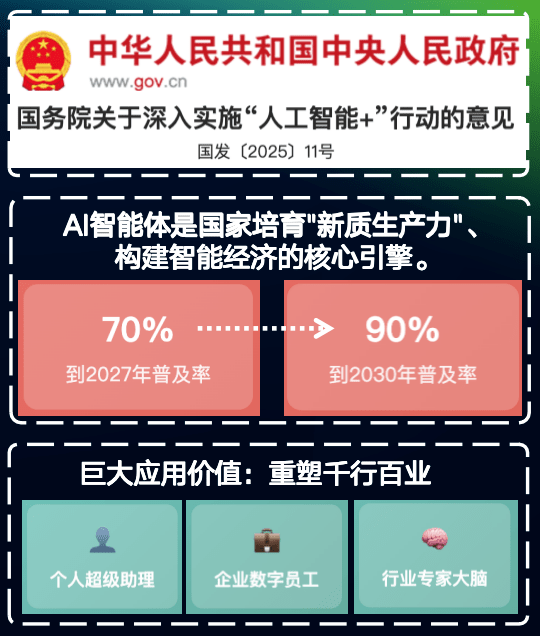
The emphasis on embodied closed-loop AGI is also driven by resource constraints. Chinese AI companies face real compute ceilings, and if RSI-through-coding-automation were the primary pathway to AGI, those constraints would represent a central bottleneck. Rather than treating compute as an existential gap to close at all costs, there might be strong incentives to develop theories of AGI where it isn’t the decisive near-term variable — where physical-world interaction, robotics infrastructure, and embodied data pipelines matter more than raw model capability, and where the timeline is long enough for China’s chip position to improve. Within this paradigm, embodied AI is not a consolation prize but a potential leapfrog: a path to AGI where China’s manufacturing base and deployment scale become structural advantages. In this case, constraint-driven diversification, top-down focus on deployment, and genuine ideological beliefs have probably coevolved into something coherent — an embodied closed-loop to AGI.
Although bottom-up, these AGI-minded voices are gradually gaining more influence at the top. The new Five-Year Plan’s emphasis on “multimodal AI (多模态), agentic AI (智能体), embodied AI (具身智能), swarm intelligence (群体智能)” as ways to explore intelligence, as well as “the parallel advancement of general-purpose large models and industry-specific models,” tracks closely with how Chinese AI scientists had already been framing the path to AGI. Ya-qing Zhang highlighted how “agent swarm” (智能体群) creates “collective intelligence” (群体智能) in a speech on AGI in 2025, while the idea of fusing general-purpose and industry-specific models exactly mirrored Zhou Bowen’s thinking of “the fusion of generalist and expert (通专融合)” as the pathway to AGI expressed in 2024.
The most direct example of this influence came in April 2025, when Zheng Nanning 郑南宁, a professor at Xi’an Jiaotong University, briefed China’s Politburo study session (with Xi Jinping in the chair). Zheng sees AGI as machines that can perceive, act in, and adapt to the physical and social world, not merely process data. In July 2025, at China’s most important AI conference, he further touched on the idea of self-improvement loops, arguing that AI systems should be intent-driven by linking information processing to goal-directedness — given a high-level objective, the system decomposes it into tasks, acts, and feeds results back to refine its own behavior continuously.
China’s belief that AGI needs physical embodiment may seem reassuring to US labs that believe software capabilities will become the decisive advantage in AI. After all, with the advantage in chips, US labs can scale compute much faster than their Chinese counterparts. Even though China may catch up on chips in the future, RSI may kick off quickly enough to compound US software capabilities to a point no Chinese lab could match. From this view, Chinese scientists are pursuing a theory of AGI that will matter far less than the one American labs are betting on.
But this thinking misses an important point: what matters is not only what Chinese AI researchers and Beijing believe AGI is, but also what happens quietly beneath those beliefs. Capabilities that don’t fit the official vision, including those that look a lot like the US version of RSI, will be built without the accompanying proclamations.
Shanghai Innovation Institute (SII), a state-backed research lab, published research on its “agentic cognitive intelligence” research in September 2025. It claims to have the scaffold automatically capture real-world agent-tool interaction trajectories and feeds them directly back into model training — what the lab itself calls a “self-evolving closed loop” (自进化闭环). Moreover, the system autonomously discovered over 100 new neural network architectures in two days. Meanwhile, in February 2026, MiniMax — a company widely seen by its Chinese peers as purely commercially-oriented with no AGI ambition — claimed that AI was already generating 80% of its newly committed code. More broadly, almost all frontier AI companies–Z.ai, MiniMax, Moonshot–are doubling down on AI coding agents.
By most technical readings, SII and MiniMax are trying to do RSI. However, neither of them mentioned anything about RSI, or its Chinese equivalent (递归自我改进). SII phrased the whole research around the idea of “能动性” (agentic capability) and the state’s AI+ adoption targets, while MiniMax only briefly mentioned it was near “infinite agent scaling.”
Are Chinese labs deliberately obscuring their ambitions? Not really. Like their American peers, Chinese AI companies are maximizing their software engineering capabilities. Automating the coding process and using AI to empower research is instrumentally useful regardless of what you believe about AGI. One does not need to cite RSI as a theory or publicly announce the coming of AGI to pursue a very similar process in practice.
This means that it is wrong to treat instances where RSI or AGI appear in top policy documents or corporate speeches as signaling how determined China is to push for frontier AI capabilities. There is a conceptual gap in the frontier of AI across the Pacific. The gap distorts near-term strategic signals relying on surface reading, as Western analysts are listening for language that Chinese researchers have no incentive to use. Rather than filtering Chinese AI through a Silicon Valley lens, Chinawatching in AI needs to understand architectural divergence and track real capability signals.
Meanwhile, the lens Silicon Valley or DC uses to envision AGI is also motivated by its own constraints and competitive position. Just as China sees the future of AI through its manufacturing strength and chip shortage, the U.S., with abundant chips and less manufacturing capabilities, sees a different version. The U.S. and China’s roads to AGI appear to be different, and perhaps the destinations do too. But if each side’s vision of AGI is shaped by what it already controls, then neither is well-positioned enough to recognize what the other is actually building.
Acknowledgement:
Zilan is grateful to Anton Leicht and Scott Singer for their mentorship on this project during the GovAI fellowship period. Zilan also wants to thank Suchet Mittal, Jason Zhou, Kayla Blomquist, and Zac Richardson for their feedback on early drafts.
ChinaTalk is a reader-supported publication. To receive new posts and support our work, consider becoming a free or paid subscriber.