An investigation by The Times found the administration’s change in enforcement benefited the industry, including companies that had ties to the president.
A portrait array in the lobby of the Securities and Exchange Commission showing President Trump and Vice President JD Vance; its chairman, Paul S. Atkins; and Commissioners Hester M. Peirce, Caroline A. Crenshaw and Mark T. Uyeda.
The Treasury Department unveiled new coins celebrating America’s 250th anniversary. They failed to include planned designs featuring abolition, women’s suffrage and the civil rights movement.
Actors surrounded Brandon Beach, the U.S. treasurer, and Kristie McNally, the Mint’s acting secretary, at a coin unveiling this month at the National Constitution Center in Philadelphia.
For more than a century, this Black soldier from Virginia was remembered by nearly no one. Then this year, someone at the Pentagon found a use for him.
After heavy rains swelled rivers and flooded neighborhoods in northern Washington, residents returned to soggy homes caked in mud. Many tried to salvage what they could.
The attacks further complicate President Ahmed al-Sharaa’s efforts to unify the country and rebuild relationships with the international community, analysts say.
The killing of three Americans during what was said to be a counterterrorism operation in central Syria served as a reminder that U.S. troops are still operating in the country.
Jimmy Lai, the publisher of a popular tabloid, has spent years fighting the landmark national security case brought over his support of the city’s now vanquished pro-democracy movement.
Watch: BBC captures celebrations as Belarus frees political prisoners
Rumours of a major prisoner release from Belarus had been swirling for a couple of days.
But no one would reveal the names on the list, or the exact number, until everyone was safely out, finally free.
In total,123 political prisoners have been released, including some of the best-known names among Belarusian opposition politicians, human rights activists and journalists.
Maria Kolesnikova, the protest leader with a famous red-lipsticked smile, was on the release list.
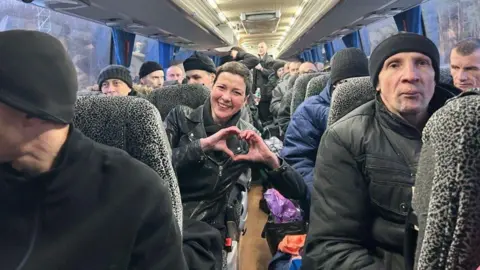
A video of her jumping for joy and hugging other former prisoners, overjoyed to be reunited, was soon flying around social media. Then came another, on a bus out of Belarus, where she thanked everyone who'd helped bring this moment about.
"It's a feeling of incredible happiness to see those who are dear to me, to hug them and realise we are all free," Masha, as she's best known, told the camera, her lips already painted red again.
The first sunset of her freedom was a thing of great beauty, she said.
"But I also think of those who are not yet free and I await the moment when we can all embrace, when all are free."
Reuters
Maria Kolesnikova (centre) was among more than 100 prisoners handed over to Ukraine
Out too is Viktor Babaryka, a banker who tried to run for president in 2020 but was locked up before the elections even began.
The Nobel Peace prize winner Ales Bialiatski has also been released from a 10-year sentence.
All were locked up for their opposition to the authoritarian rule of Alexander Lukashenko, whose security forces crushed the mass protests of 2020 with brutal force. They were the biggest challenge to his rule that he has ever faced.
The prisoners' release now is the result of long and complex negotiations led by the US that culminated in a two-day visit to Minsk this week by Donald Trump's new special envoy, John Coale.
For Lukashenko, that engagement itself is a win: after years as a political pariah in the West he is clearly happy to be back on talking terms with the US.
But he also got US sanctions dropped on a key export for his country, potash, as a further, more tangible reward. EU penalties - and tougher policies - are still in place.
It's not entirely clear what Trump has to gain from this. But Belarus is a close ally of Russia, including in its war on Ukraine, and the move comes as the US has been re-engaging with Moscow too, seeking a peace deal.
EPA/Shutterstock
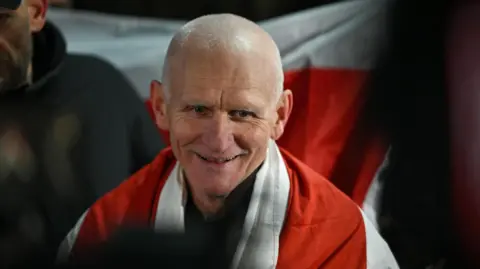
Nobel Peace Prize winner Ales Bialiatski was one of the prisoners released
The dozens of prisoners Lukashenko agreed to let go were always expected to come here to Vilnius, Lithuania, where a crowd of friends, relatives and fellow activists gathered outside the US embassy in the freezing cold to greet them.
Some came wrapped in the red and white opposition flag of Belarus.
Tatsiana Khomich, Masha Kolesnikova's sister who had campaigned for over five years for her release, couldn't stop smiling. "I've just spoken to Masha," she told me after a video call.
A professional flautist before the disputed 2020 elections, Kolesnikova spent much of her more than five-year sentence in total isolation, denied even letters and phone calls to her family.
"She's fine, she's good. I just want to hug her. I still can't quite believe it," her sister said.
Suddenly, there was a commotion in the crowd: a police car, blue lights flashing, was heading towards the US embassy gates, leading a small convoy of other vehicles.
But there was no way all 123 ex-prisoners were inside. Instead, we learned, just seven foreign nationals had been brought to Lithuania and only Ales Bialiatski of the Belarusians.
'Optimism and activism'
The others, including Kolesnikova, had been taken out of Belarus to Ukraine: from prison, into a war zone.
Staying in their own country is not usually an option on offer.
"Lukashenko's idea, who else?" was how one of opposition leader Svetlana Tikhanovskaya's team interpreted the surprise diversion to Ukraine. It seems he'd decided to play one final power game, so the family reunions, so long awaited, would be delayed.
But what of the price paid for that moment? Tikhanovskaya is a friend and political ally of Masha Kolesnikova, but she always calls for maximum pressure on Lukashenko by the West.
So has the US gone too far, I wondered.
"This is a process of negotiation. Of course, it would be good for us if nothing is given to Lukashenko, because all those people are hostages of his regime. They are innocent.
"But this is how negotiation goes," she replied, before noting that sanctions can always be reapplied if necessary.
"President Trump now uses carrots. He also can use sticks."
A few steps away, a man waving a giant flag worried that Lukashenko would just take more prisoners. This is not a sign of sudden humanity, he said.
After a short time inside the US embassy, Ales Bialiatski emerged onto the street to ecstatic cheers from the crowd.
Gaunt, head shaven and still in his padded blue prison jacket, he admitted his head was spinning from all the sensations after four years in jail.
"I was driven across Belarus in a blindfold, from east to west, so I still can't get my head round it. This is so emotional," he shared, describing being woken at 04:00 and told by his prison guard to pack.
When I asked what he wanted now most of all he didn't hesitate: "I want to see my wife!"
She's on her way, I was told.
Bialiatski's own organisation, Viasna, monitors political detentions in Belarus and the activist reminded everyone that many people like him - only less well known - have been left behind bars.
"It is very important for everyone to continue to work for those political prisoners who are still in Belarusian prisons, to strive for the complete release of all of them."
Then, lifting the red and white flag from his shoulders, he had a message for Belarusians everywhere.
"Optimism and activism," Ales Bialiatski told them, with a sudden smile. "Never give up!"
Five men have been arrested in Germany suspected of being involved in a plot to drive a vehicle into people at a Christmas market.
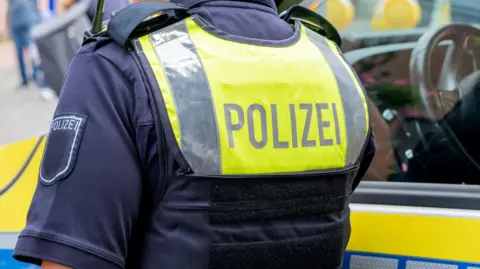
Three Moroccans, an Egyptian and a Syrian were detained on Friday over the plan to target a market in the southern Bavarian state. Authorities said they suspected an "Islamist motive".
Prosecutors said the Egyptian - a 56-year-old - was alleged to have "called for a vehicle attack... with the aim of killing or injuring as many people as possible". The Moroccans allegedly agreed to carry out the attack.
Officials in Germany have been on high alert after previous attacks at Christmas markets, including in Magdeburg last December that killed six people.
Authorities did not say when the planned attack was supposed to take place or which market was the target, though said they believed it to be one in the Dingolfing-Landau area, north east of Munich.
German newspaper Bild reported the Egyptian man was an imam at a mosque in the area.
Police said the Moroccan men - aged 30, 28 and 22 - were arrested accused of having agreed to commit murder, while the Syrian man, a 37-year-old, was accused of encouraging the suspects "in their decision to commit the crime".
The five suspects appeared before a magistrate on Saturday and remain in custody.
Joachim Herrmann, Bavaria's state interior minister, told Bild the "excellent cooperation between our security services" had helped to prevent "a potentially Islamist-motivated attack".
Christmas markets are popular festive attractions throughout Germany, frequently attracting large crowds and significant tourism.
Security at events has been increased in recent years, since an attack in Berlin in 2016 when a man drove a lorry into a market crowd, killing 12 people.
Watch: Police issue video of suspect in Brown University shooting
A manhunt is under way after two students were killed and nine other people were injured in a mass shooting at Brown University in Providence, Rhode Island.
The gunman opened fire in a classroom at around 16:00 local time (21:00 GMT) on Saturday, in a building where exams were taking place.
The university, one of the oldest and most prestigious in the US, was placed into lockdown as police searched for the gunman, who remains at large.
Students in parts of the campus are continuing to be told to shelter in place until police can escort them out of the area.
Officials from Rhode Island Hospital said most of the injured are in a "critical but stable" condition.
The identities of those killed or injured have not yet been released by officials.
"This is a day that we hoped never would come to our community. It is deeply devastating for all of us," said Brown University President Christina Paxson in a statement.
Police have released limited information about the male suspect, including an identity or motive. It is not known if he has links to the university.
CCTV footage showed the suspect walking out of the building after the attack but the his face can not be seen.
Providence Deputy Police Chief Tim O'Hara said the suspect was dressed all in black and may have been wearing a mask. It is not known what type of firearm he used and it has not been recovered.
"We're utilising every resource possible to find this suspect," he added, with extra armed police resources drafted into to search the area.
The shooting happened at the Barus and Holley building, part of Brown University's engineering school. The attack happened in a large classroom on the first floor.
An economics professor told local public media outlet Ocean State Radio that the shooting took place during a review session for her course, which was led by her teaching assistant.
"He said that the shooter came in the doors, yelled something - he couldn't remember what he yelled - and started shooting," Rachel Friedberg said.
"Students started to scramble to try to get away from the shooter, trying to get lower down in the stadium seating, and people got shot," she added.
Officials cleared the building on Saturday afternoon but found neither the suspect nor a weapon.
Watch: Aerial footage of Brown University shows huge police presence
Residents in the greater Brown University area have been told to stay inside, or to stay away until the shelter-in-place order is lifted.
In a statement, the university said police would enter non-residential buildings to escort people to safe locations.
Steph Machado, a reporter for the Boston Globe, told BBC News that restaurants around the campus have locked their doors with staff and customers waiting inside until the emergency order is lifted.
"There are flashing lights everywhere," she said.
In the immediate aftermath of the shooting, it was reported that a suspect had been taken into custody but it was quickly confirmed the man held had no involvement in the attack.
Mari Camara, 20, a Brown University student from New York City, told the Associated Press that she was coming out of the library and rushed inside a restaurant to seek shelter during the shooting. She spent the next three hours hiding there.
"Everyone is the same as me, shocked and terrified that something like this happened," Camara said.
Reuters
University exams scheduled for Saturday have been cancelled, provost Frank Doyle said.
President Donald Trump, speaking to reporters as he returned to the White House from attending the annual Army and Navy football game, described the shooting as "a terrible thing".
"All we can do right now is pray for the victims and for those that were very badly hurt," he said.
Rhode Island Governor Dan McKee said in a statement: "Our capital city experienced an unthinkable tragedy today. Our hearts are with the people of Providence and all those impacted."
Brown University, one of the one of the oldest higher education institutions in the US, is part of the Ivy League, a group of elite universities in the northeast of the country.
The university, which has more than 11,000 students, is located in Providence, Rhode Island's capital city, located about 50 miles (80km) from Boston and 180 miles (290km) from New York City.
The attack on the campus brings the number of mass shootings in the US to 389 for this year, according to the independent analysis website Gun Violence Archive (GVA).
It defines mass shootings as having four or more victims killed or injured, not including the attacker.
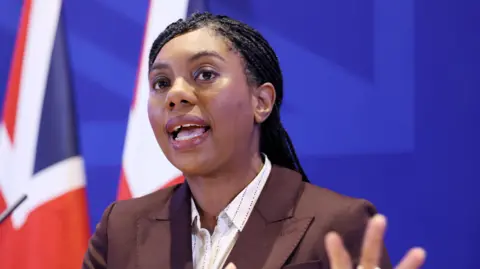
Conservative leader Kemi Badenoch described electric vehicle quotas as "economic self-harm"
Kemi Badenoch says the Conservatives will scrap the ban on petrol and diesel vehicles due to come into force in the UK if they win the next election.
Writing in the Sunday Telegraph, the Conservative Party leader said the Zero Emission Vehicle mandate (ZEV) was a "well-meaning but ultimately destructive piece of legislation".
From 2030, all new cars will have to be electric or hybrid as part of government efforts to meet a legally binding aim of achieving "net zero" by 2050.
The Conservative leader's comments come after her meeting with Italian Prime Minister Giorgia Meloni, who has lobbied the EU to water down its own plans for a ban.
Net zero refers to the balance between the amount of greenhouse gas produced and the amount removed from the atmosphere.
Six EU countries, including Italy, have recently called on other member states to rethink plans to phase out new petrol and diesel cars by 2035, saying it could hurt industrial competitiveness.
Badenoch suggested the EU had signalled it would drop a full ban, adding: "The reality is that the EU's change of heart on EVs will leave Labour even more isolated, and by pressing ahead alone, we are placing our domestic industry at a disadvantage while giving others the opportunity to dominate global supply chains."
She said the only "winners in this economic self-harm are China".
The Conservative leader added that her government would still move towards a "transition to cleaner transport" but one driven by "affordability, practicality and technological progress" rather than "unrealistic mandates that weaken domestic manufacturing and empower foreign competitors".
She said scrapping the mandate would give "space" to rebuild the UK's car industry.
In its latest Budget, the government announced an extra £1.3 billion investment into the UK's Electric Car Grant scheme to encourage drivers to make the switch to EVs.
Chancellor Rachel Reeves also announced that drivers of battery electric cars, which includes plug-in hybrids, will be charged 3p per mile for the Electric Vehicle Excise Duty from April 2028, with some arguing the move could make electric cars less appealing.
The ban on the sale of petrol and diesel cars was originally introduced in 2020 by then Prime Minister, Conservative Boris Johnson - Badenoch, a cabinet member at the time, opposed the plans.
It was later pushed back to 2035 by Rishi Sunak, with Labour pledging to bring it forward in its 2024 election manifesto.
A spokesperson for the Department for Transport said the government remained "committed to phasing out all new non-zero emission car and van sales".
They said: "More drivers than ever are choosing electric".
The next UK general election must be held by 15 August 2029, but the prime minister can opt to call an election at any point before this.
Watch: BBC captures celebrations as Belarus frees political prisoners
Rumours of a major prisoner release from Belarus had been swirling for a couple of days.
But no one would reveal the names on the list, or the exact number, until everyone was safely out, finally free.
In total,123 political prisoners have been released, including some of the best-known names among Belarusian opposition politicians, human rights activists and journalists.
Maria Kolesnikova, the protest leader with a famous red-lipsticked smile, was on the release list.
A video of her jumping for joy and hugging other former prisoners, overjoyed to be reunited, was soon flying around social media. Then came another, on a bus out of Belarus, where she thanked everyone who'd helped bring this moment about.
"It's a feeling of incredible happiness to see those who are dear to me, to hug them and realise we are all free," Masha, as she's best known, told the camera, her lips already painted red again.
The first sunset of her freedom was a thing of great beauty, she said.
"But I also think of those who are not yet free and I await the moment when we can all embrace, when all are free."
Reuters
Maria Kolesnikova (centre) was among more than 100 prisoners handed over to Ukraine
Out too is Viktor Babaryka, a banker who tried to run for president in 2020 but was locked up before the elections even began.
The Nobel Peace prize winner Ales Bialiatski has also been released from a 10-year sentence.
All were locked up for their opposition to the authoritarian rule of Alexander Lukashenko, whose security forces crushed the mass protests of 2020 with brutal force. They were the biggest challenge to his rule that he has ever faced.
The prisoners' release now is the result of long and complex negotiations led by the US that culminated in a two-day visit to Minsk this week by Donald Trump's new special envoy, John Coale.
For Lukashenko, that engagement itself is a win: after years as a political pariah in the West he is clearly happy to be back on talking terms with the US.
But he also got US sanctions dropped on a key export for his country, potash, as a further, more tangible reward. EU penalties - and tougher policies - are still in place.
It's not entirely clear what Trump has to gain from this. But Belarus is a close ally of Russia, including in its war on Ukraine, and the move comes as the US has been re-engaging with Moscow too, seeking a peace deal.
EPA/Shutterstock
Nobel Peace Prize winner Ales Bialiatski was one of the prisoners released
The dozens of prisoners Lukashenko agreed to let go were always expected to come here to Vilnius, Lithuania, where a crowd of friends, relatives and fellow activists gathered outside the US embassy in the freezing cold to greet them.
Some came wrapped in the red and white opposition flag of Belarus.
Tatsiana Khomich, Masha Kolesnikova's sister who had campaigned for over five years for her release, couldn't stop smiling. "I've just spoken to Masha," she told me after a video call.
A professional flautist before the disputed 2020 elections, Kolesnikova spent much of her more than five-year sentence in total isolation, denied even letters and phone calls to her family.
"She's fine, she's good. I just want to hug her. I still can't quite believe it," her sister said.
Suddenly, there was a commotion in the crowd: a police car, blue lights flashing, was heading towards the US embassy gates, leading a small convoy of other vehicles.
But there was no way all 123 ex-prisoners were inside. Instead, we learned, just seven foreign nationals had been brought to Lithuania and only Ales Bialiatski of the Belarusians.
'Optimism and activism'
The others, including Kolesnikova, had been taken out of Belarus to Ukraine: from prison, into a war zone.
Staying in their own country is not usually an option on offer.
"Lukashenko's idea, who else?" was how one of opposition leader Svetlana Tikhanovskaya's team interpreted the surprise diversion to Ukraine. It seems he'd decided to play one final power game, so the family reunions, so long awaited, would be delayed.
But what of the price paid for that moment? Tikhanovskaya is a friend and political ally of Masha Kolesnikova, but she always calls for maximum pressure on Lukashenko by the West.
So has the US gone too far, I wondered.
"This is a process of negotiation. Of course, it would be good for us if nothing is given to Lukashenko, because all those people are hostages of his regime. They are innocent.
"But this is how negotiation goes," she replied, before noting that sanctions can always be reapplied if necessary.
"President Trump now uses carrots. He also can use sticks."
A few steps away, a man waving a giant flag worried that Lukashenko would just take more prisoners. This is not a sign of sudden humanity, he said.
After a short time inside the US embassy, Ales Bialiatski emerged onto the street to ecstatic cheers from the crowd.
Gaunt, head shaven and still in his padded blue prison jacket, he admitted his head was spinning from all the sensations after four years in jail.
"I was driven across Belarus in a blindfold, from east to west, so I still can't get my head round it. This is so emotional," he shared, describing being woken at 04:00 and told by his prison guard to pack.
When I asked what he wanted now most of all he didn't hesitate: "I want to see my wife!"
She's on her way, I was told.
Bialiatski's own organisation, Viasna, monitors political detentions in Belarus and the activist reminded everyone that many people like him - only less well known - have been left behind bars.
"It is very important for everyone to continue to work for those political prisoners who are still in Belarusian prisons, to strive for the complete release of all of them."
Then, lifting the red and white flag from his shoulders, he had a message for Belarusians everywhere.
"Optimism and activism," Ales Bialiatski told them, with a sudden smile. "Never give up!"
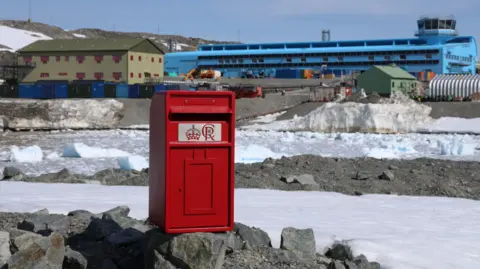
The post box will replace a handmade one currently used at the remote station
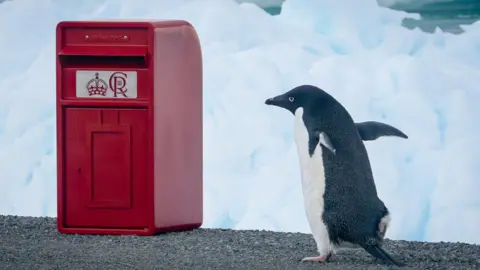
A shiny new red post box has been given as a gift from King Charles III to staff at a remote Antarctic research station.
The Royal Mail red lamp post box was sent to staff at the Cambridge-based British Antarctic Survey station at Rothera.
The box, featuring the King Charles III cypher, was delivered after Kirsten Shaw, a station support assistant who runs the British Antarctic Territory Post Office for staff, requested an upgrade to their handmade box.
"Being in Antarctica is incredible, but it's full of extremes, so I think it's a special thing to send post back home, to communicate your experiences. It's a moment of your life that you put down on paper and give to someone else," she said.
The Rothera research station, which opened in 1975, is the largest British Antarctic Survey (BAS) facility, and a renowned global hub for climatic research.
It is situated 1,860km (1,155 miles) south of the Falkland Islands.
Staff work and live at the station for months at a time.
Ms Shaw said: "Getting post is really special for the team at Rothera.
"If you're doing fieldwork for many months, the feeling of receiving a letter — an actual tangible, piece of paper with handwriting from friends and family — is such a lift.
"It's a wonderful way to connect people that goes beyond what an email or text message can do."
BAS/Jake Martin
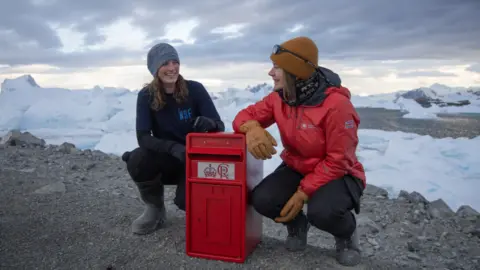
Kirsten Shaw and Aurelia Reichardt, station leader at Rothera, are pictured with the new post box
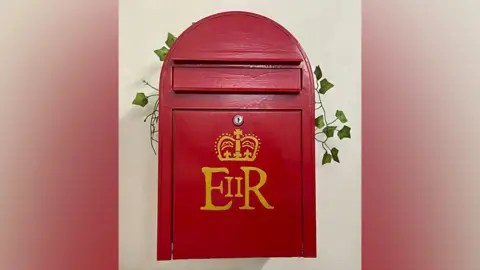
The box will replace the handmade and painted one currently used at the station.
The BAS said "the Royal Household worked with Royal Mail to arrange this particularly special delivery".
It was delivered to Rothera by the UK's polar research vessel RRS Sir David Attenborough, along with the first major drop of supplies to the station following the long Antarctic winter.
The post box will be installed in the Discovery Building, a new scientific support and operations hub.
BAS/Aurelia Reichardt
The handmade box will now be replaced by the official one from the Royal Mail
Postal logistics in such a remote area are understandably not straightforward.
Ms Shaw's job is to oversee the formal Post Office logistics of getting mail in and out of Antarctica from Rothera, as well as getting post out to staff to other BAS stations and science field camps.
Post has to be gathered and put on board the RRS Sir David Attenborough or on BAS aircraft to the Falkland Islands, where BAS maintains an office in Stanley.
The final leg involves transport to RAF Brize Norton in Oxfordshire, where letters enter the Royal Mail postal network for onward delivery.
BAS/Jake Martin
The box will be placed in a new building at the station
Jane Rumble, HM Commissioner for the British Antarctic Territory said: "Maintaining a postal service in the British Antarctic Territory is far more than a symbolic gesture.
"It reinforces Britain's presence and heritage in Antarctica and provides a vital link to the wider world."
Five men have been arrested in Germany suspected of being involved in a plot to drive a vehicle into people at a Christmas market.
Three Moroccans, an Egyptian and a Syrian were detained on Friday over the plan to target a market in the southern Bavarian state. Authorities said they suspected an "Islamist motive".
Prosecutors said the Egyptian - a 56-year-old - was alleged to have "called for a vehicle attack... with the aim of killing or injuring as many people as possible". The Moroccans allegedly agreed to carry out the attack.
Officials in Germany have been on high alert after previous attacks at Christmas markets, including in Magdeburg last December that killed six people.
Authorities did not say when the planned attack was supposed to take place or which market was the target, though said they believed it to be one in the Dingolfing-Landau area, north east of Munich.
German newspaper Bild reported the Egyptian man was an imam at a mosque in the area.
Police said the Moroccan men - aged 30, 28 and 22 - were arrested accused of having agreed to commit murder, while the Syrian man, a 37-year-old, was accused of encouraging the suspects "in their decision to commit the crime".
The five suspects appeared before a magistrate on Saturday and remain in custody.
Joachim Herrmann, Bavaria's state interior minister, told Bild the "excellent cooperation between our security services" had helped to prevent "a potentially Islamist-motivated attack".
Christmas markets are popular festive attractions throughout Germany, frequently attracting large crowds and significant tourism.
Security at events has been increased in recent years, since an attack in Berlin in 2016 when a man drove a lorry into a market crowd, killing 12 people.

 Login
Login

 创办人黎智英:《苹果日报》1995年由富商黎智英创办。少年时从广东偷渡至香港的黎智英曾公开支持89民运,并因此受到大陆官方的制裁。他于1990年创办壹传媒有限公司后,旗下出版《壹周刊》等报刊杂志,之后扩展到电视、网络等媒体,并于2003年创设台湾《苹果日报》。黎智英曾在电视广告中咬着苹果说「每日一苹果,没人骗到我!」
 颠覆香港报界:为吸引读者,《苹果日报》采用彩色印刷、新潮排版及口语化大标题,内容上也包罗万有。该报创刊短短几个月内,便彻底颠覆了香港报业的游戏规则。不过该报为了销量不惜哗众取宠,因狗仔队文化丶卖弄色情暴力等,被指过分煽情和娱乐化,并不时陷入道德指责以及司法纠纷。但其调查性报导也得到读者的认可。香港中文大学2019年的传媒公信力调查显示,《苹果日报》在香港收费报纸中排名第三。
 拒绝被“染红”:该报立场鲜明,有多个时事评论专栏批评中共高层和港府,并经常报导内地维权人士如刘晓波等状况,同时高调支持香港民主运动,多次在社会运动中表态,甚至呼吁读者上街。1997年香港主权移交後,《南华早报》丶《明报》等多家本地报章相继被中资入主丶收购,《苹果日报》被视为香港唯一未被「染红」的主流媒体。
 国安法紧箍咒:从2014年的雨伞运动到2019年的返修例运动中,《苹果日报》可谓立场鲜明。2020年8月10日,该报创办人黎智英涉《香港国安法》 被捕,《苹果日报》总部被警方搜查。次日该报头条标题为"苹果一定撑落去",印量由两星期前的7万多份涨到55万份,市民们排长队购买。
 台湾停刊:2021年5月15日,发行18年的《台湾苹果日报》宣布停刊。公告称,“《台湾苹果日报》在新闻战场并没有输”,而是“输在香港局势恶化,造成我们无法再长期支撑亏损”,因此 “忍痛割捨纸本”,集中资源发展《苹果新闻网》。同一天,其母公司香港壹传媒创办人黎智英的财产被冻结,香港保安局的依据是“香港国安法”。
 逮捕高层 冻结资产:2021年6月17日,警方以涉嫌违反国安法为由第二次搜查《苹果日报》,拘捕5名报社高管。该报被指刊文呼吁外国制裁香港及中国,涉嫌“串谋勾结外国势力危害国家安全”。 当局还冻结《苹果日报》三家关联公司资产共1800万港元,造成报社无法继续运营。
 民众排队购买最后一份报:6月23日,壹传媒宣布,《苹果日报》24日出版最后一期印刷版后,即日停刊,网络版也同时终止运作。最终版的头版标题是“港人雨中痛别,我哋撑苹果”,印刷了创纪录的100万份。香港街头再次出现市民排长队买《苹果》的景象。