The House Oversight Committee has released a batch of around 70 photos from the estate of late convicted sex offender Jeffrey Epstein.
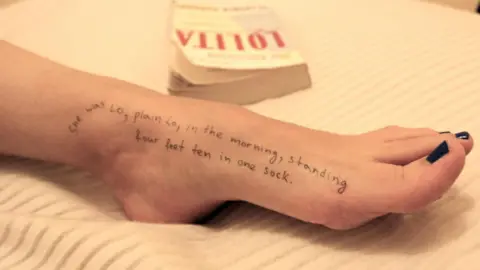
It's the third such release from a tranche of over 95,000 photos the committee has acquired from Epstein's estate. It includes images of quotes from the book Lolita written across a woman's body, and redacted images of women's foreign passports.
It comes hours before the 19 December deadline for the Department of Justice to release all files related to its investigation into Epstein.
"These new images raise more questions about what exactly the Department of Justice has in its possession," said ranking member of the committee, Robert Garcia.
What's in the images released
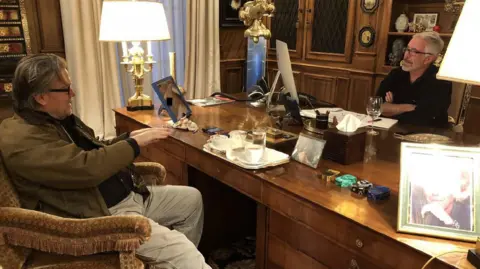
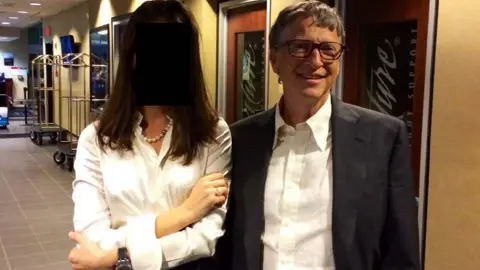
Some of the photos released on Thursday show Epstein speaking with professor and activist Noam Chomsky aboard a private plane; Bill Gates standing beside a woman whose face is redacted; Steve Bannon sitting at a desk across from Epstein, and former Alphabet president Sergey Brin at a dinner event.
These are the latest wealthy, powerful men to be seen in Epstein estate photos released by the House Oversight Committee - previously released photos also show US President Donald Trump and former president Bill Clinton, as well as film director Woody Allen, former US treasury secretary Larry Summers, attorney Alan Dershowitz, Andrew Mountbatton-Windsor, and others.
Appearing in the photos is not evidence of any wrongdoing, and many of the pictured men have said they were never involved in Epstein's illegal activity.
House Oversight Committee
In a statement accompanying the photo release, Democrats on the US House Oversight Committee said the Epstein estate did not provide context or timings for the pictures.
"Photos were selected to provide the public with transparency into a representative sample of the photos received from the estate, and to provide insights into Epstein's network and his extremely disturbing activities," the statement says.
The release also includes several photos of quotes from the Vladimir Nabokov novel Lolita written in black ink across different parts of a woman's body, like her chest, foot, hipbone, and back. Lolita tells the story of a young girl who was groomed by a middle-aged literature professor.
One quote from the book written across a woman's chest reads, "Lo-lee-ta: the tip of the tongue taking a trip of three steps down the palate to tap, at three, on the teeth".
House Oversight Committee
There are also a number of photos of female passports and identification documents from countries around the world, including Lithuania, Russia, the Czech Republic, and Ukraine.
Most of the information on the documents, like names and birth dates, is redacted but the House Oversight Committee said in a press release that the passports belong to "women whom Jeffrey Epstein and his conspirators were engaging".
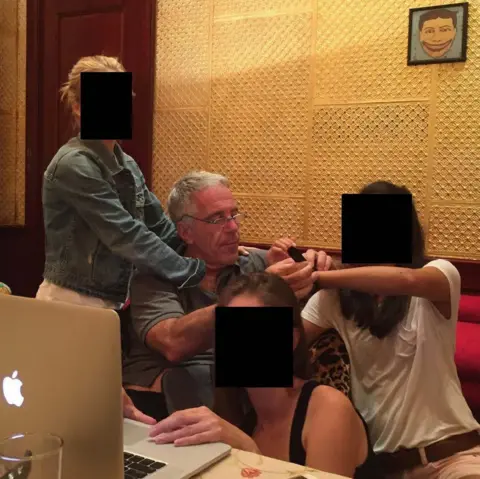
Another photo shows Epstein sitting at a desk closely surrounded by three female figures whose faces have been redacted - one has her hand on Epstein's chest under his shirt, and another is crouching to look at a nearby laptop. Epstein appears to be helping the third put on a bracelet.
House Oversight Committee
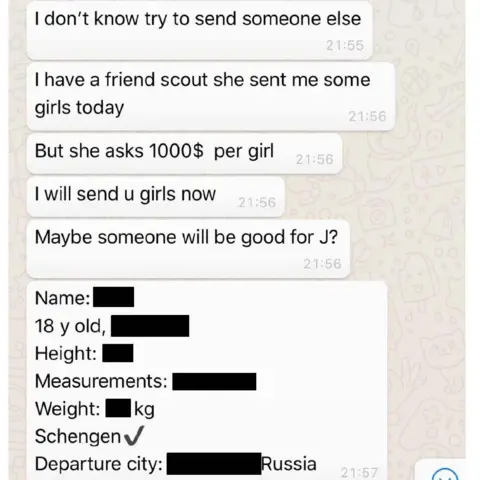
Another image released is a screenshot of text messages from an unknown person who says they have been sent "some girls" and are asking for "$1000 per girl".
House Oversight Committee
Photo release comes ahead of DOJ deadline
The committee has thousands of images in its possession from the Epstein estate, which are "both graphic and mundane", its statement on Thursday explained.
The House Oversight Committee first subpoenaed the estate of Epstein, who died in a New York prison in 2019 while awaiting trial on allegations of sex trafficking, in August.
The photos and files the Epstein estate gave to the committee are separate from what is largely referred to as "the Epstein files". Those are documents within the justice department's possession related to its own investigation into Epstein.
Under the Epstein Files Transparency Act, which President Trump signed into law last month, the DOJ has until 19 December to release its files. The extent of what's contained in the DOJ's files is unknown, and it's likely that much of the content will be heavily redacted, similar to House Oversight Committee materials.
The UK has named Christian Turner as its new ambassador to the US, Downing Street has confirmed.
Turner has spent a nearly 30-year career working across Whitehall and the Foreign Office.
He will now become the man tasked by Prime Minister Sir Keir Starmer with building links to the Trump administration.
The previous ambassador Peter Mandelson was sacked by Starmer after evidence, including emails and photos emerged, showing his continued association with the paedophile Jeffery Epstein.
Lord Mandelson has repeatedly said he regrets his relationship with Epstein, who died in jail in 2019 while awaiting trial on sex trafficking offences.
Turner said he was "honoured" to be nominated for the role.
"At a pivotal time for the transatlantic relationship, I look forward to working with President Trump's administration, and leaders in Congress, business and society to strengthen that bond in the years ahead," he added.
In a statement released by the Foreign Office, Starmer said: "The United Kingdom and United States have a very special relationship, and Christian's extensive experience as an outstanding diplomat will support this uniquely close bond and ensure it continues to flourish."
Turner's previous roles include political director at the Foreign Office, and British High Commissioner to Pakistan. He also previously worked in 10 Downing Street as Private Secretary to the Prime Minister.
Before entering government, he worked in television documentaries.
Awkward moment for couple on screen at Coldplay gig
An HR executive caught on the big screen at a Coldplay concert embracing her boss has described how "the harassment has never ended" following the viral moment.
Kristin Cabot has spoken publicly for the first time about the video in which she was seen hugging Andy Byron, then-CEO of tech company Astronomer, at the show in July, before they abruptly ducked and hid from the camera.
Ms Cabot, 53, who was the company's chief people officer, stepped down following Mr Byron's resignation after the firm announced he would be placed on leave and investigated.
Speaking to the Times, Ms Cabot said she has been looking for another job but been told she is "unemployable".
The video, which showed the pair swaying to music at the concert in Boston, Massachusetts, before trying to hide, quickly went viral, after Coldplay's lead singer Chris Martin said to the crowd: "Either they're having an affair, or they're just very shy."
It was watched millions of times, shared widely across platforms, and the pair became the butt of many jokes. Within a few days, the internet had moved on, but for Ms Cabot, her ordeal had only just begun.
"I became a meme, I was the most maligned HR manager in HR history," Ms Cabot told The Times.
Ms Cabot was separated from her husband, who was also at the concert.
In a separate interview with the New York Times, she explained she was not in a sexual relationship with Mr Byron and the pair had never kissed before that night - although she admits to having had a "crush" on her boss.
"I made a bad decision and had a couple of High Noons and danced and acted inappropriately with my boss," she said, adding she "took accountability and I gave up my career for that".
As to why she chose to speak out now, Ms Cabot told the Times "...it's not over for me, and it's not over for my kids. The harassment never ended".
Her two children are too embarrassed to be picked up from school by their mother, she said, or to go to sports games.
"They're mad at me. And they can be mad at me for the rest of their lives - I have to take that."
Ms Cabot wondered whether Mr Byron had received the same level of abuse throughout the ordeal, the Times reported.
"I think as a woman, as women always do, I took the bulk of the abuse. People would say things like I was a 'gold-digger' or I 'slept my way to the top', which just couldn't be further from reality," she said.
"I worked so hard to dispel that all my life and here I was being accused of it."
At the peak of the scandal, her appearance, body, face and clothes were scrutinised and picked apart, with many high-profile celebrities including Whoopi Golderg piling on. Gwyneth Paltrow, who was once married to Chris Martin, even took part in a tongue-in-cheek promotional video for Astronomer.
Ms Cabot told the New York Times she received threatening messages after the incident, including from a person who said they knew where she shopped and wrote: "I'm coming for you".
She said "my kids were afraid that I was going to die and they were going to die", and that her family began to dread public spaces and social events.
Women were the cruellest critics, she told the New York Times, with all of the in-person bullying, plus most of the phone calls and messages from women.
Her private details were put online (known as doxxing) and for weeks she was bombarded with up to 600 calls a day, the New York Times reported. The paparazzi outside her house was like a "parade" and there were 50 or 60 death threats, she said.
Things are starting to improve, though. Ms Cabot has found therapists for her children and she has started leaving the house to play tennis, she said.
She said that while she and Mr Byron kept in touch for a short while, exchanging "crisis management advice", they decided "speaking with each other was going to make it too hard for everyone to move on and heal," and have not spoken since.
For his part, Mr Byron has not spoken publicly.
A fake statement purporting to be from him, complete with Coldplay lyrics, went viral after the concert and Astronomer had to release its own to say that he had not made any comment.
"Astronomer is committed to the values and culture that have guided us since our founding," the statement read. "Our leaders are expected to set the standard in both conduct and accountability."
It later said: "Andy Byron has tendered his resignation, and the Board of Directors has accepted."
The BBC has tried to contact Andy Byron, via his former employer Astronomer, for comment.
The NHS remains on high alert over flu, health bosses say, but there are clear signs the surge in the virus has come to an end for now at least.
Community spread appears to have stabilised, the UK Health Security Agency says.
Meanwhile, the rise in hospital cases has slowed. And with just over 3,000 patients in hospital in England with the virus, the dire prediction by NHS chief executive Sir Jim Mackay of "between 5,000 and 8,000" cases has not materialised.
How serious then is this flu season so far, and how does it really compare to previous outbreaks of the virus?
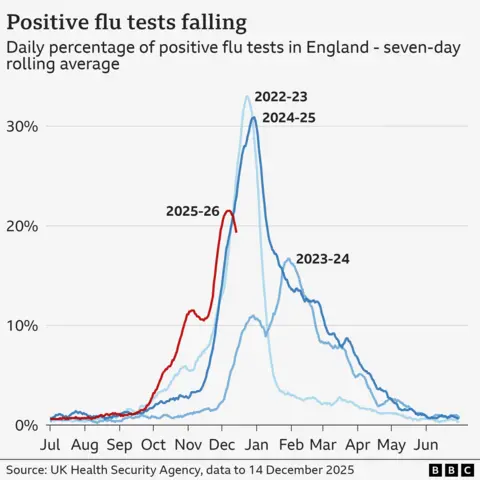
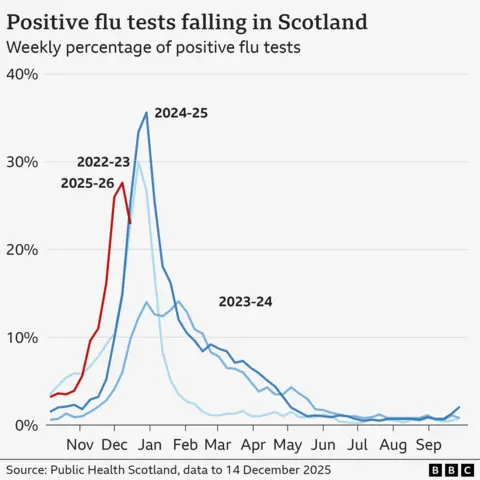
The major difference between the 2025 flu season and the last three years is that the virus started spreading a few weeks earlier than normal.
When someone goes to their GP or hospital with flu-like symptoms, they can be swabbed and tested for influenza, Covid, RSV and other viruses.
UKHSA then records the percentage of those tests that come back positive for flu.
Figures had been rising quickly over the autumn and at the start of winter.
But last week the spread of the virus appears to have stabilised at a medium level, UKHSA says.
It is too early to say whether this marks the start of the peak. Flu is unpredictable, a lull can be followed by another surge.
The picture across the four nations of the UK is similar.
Some virologists have linked the earlier flu season this year to the type of virus that is circulating - known as H3N2.
Historically, seasons dominated by that strain tend to be more severe, with larger numbers of hospitalisations in older people, in particular.
H3N2 has not been the main form of flu detected in the UK for three years, which may mean that less immunity has been built up in the population.
Scientists also spotted a further shift in the genetic makeup of the virus over the summer.
This seems to have given the virus a head-start in the autumn.
Can we call it super-flu?
The name 'super-flu' has been used by the NHS to describe this latest outbreak.
But that is not a medical term, and it does not mean the virus itself has suddenly become more dangerous or harder to treat.
"It is misleading and a bit frightening to call it super flu; it's just a flu variant that is clearly a little bit more infectious than normal," says Prof Lawrence Young, professor of molecular oncology at the University of Warwick.
"What we're seeing is a flu season that's perhaps two to three weeks earlier than normal."
Separately, the NHS also records the number of the sickest patients in hospital with flu over the winter. Trends in hospital data tends to lag behind community spread as it takes some time for people to get ill enough to seek hospital care.
Figures for last week showed the number hit 3,140, an 18% rise on the week before. But that was after a 55% jump in the week before that.
Although the national figure masks what is happening across different regions with some areas seeing numbers fall and others still seeing steep rises.
Those over 85-years-old are five times more likely to be hospitalised than the general population.
Comparing outbreaks over the decades is difficult because testing has improved in recent years, so a rise in hospital admissions over time might also reflect better detection.
But estimated figures on flu deaths shows that some winters have been particularly serious over the past 20 years.
In 2017-18, for example, it's thought 25,000 people died from the virus in England, with care homes and older adults most affected.
That year an unusual form of the influenza B virus started circulating and the 'beast from the east' cold snap bought freezing temperatures to the UK, creating the ideal environment for the disease to spread.
Just three years before that, in 2014-15, modelling by scientists at UKHSA estimated that 35,000 had died, making it one of the most lethal flu seasons in decades.
Again, that was blamed on an outbreak of the H3N2 form of the virus and a seasonal vaccine that was not well matched to the exact form of the disease circulating.
There is nothing in the data so far which suggests anything comparable in 2025, but we won't know for sure until the first estimates for this season's influenza deaths are published in the new year.
The message coming from doctors and the NHS is for millions of people to continue to come forward for a flu vaccine.
Even though the genetic make-up of the virus has shifted, the main jab is still thought to offer an effective level of protection, particularly against ending up in hospital with severe disease.
The flu vaccine is free on the NHS for those over 65-years-old, young children, pregnant women, those with certain health conditions, carers, and front-line health and social care workers.
All other adults can get the same vaccine for between £15 and £25 from high street pharmacists.
The latest data shows that more than 70% of older people and care home residents had taken up the offer of a free jab by 14 December.
But vaccination rates in some other groups are much lower.
Only 39% of all front-line NHS workers in England have been vaccinated so far this year.
Waiting times for adult gender clinics are "unacceptably long" with patients waiting an average of five years and seven months for a first appointment, according to a review of services.
Dr David Levy, a cancer specialist and former medical director, visited all nine gender clinics in England as part of his inquiry.
He said services for adults seeking gender care were "falling down" with long waits, inconsistent assessments caused by a lack of shared policies across the clinics, and a lack of data about the results of the care people received.
His report, published by NHS England, said unless improvements were made some patients would end up waiting 15 years for a first appointment.
The nine Gender Dysphoria Clinics (GDCs) offer ongoing assessments and treatment for adults who are distressed about a mismatch between their biological sex and the gender they identify with. They can provide medication to patients, including hormones, but they do not carry out surgery.
Dr Levy described the waiting times for patients to be seen at these clinics as "shocking" and said the "distress some patients experience" is often "exacerbated by unclear waiting times and a lack of communication".
He found that the number of referrals to the clinics had more than doubled from 4,331 in 2021/22 to 9,985 in 2024/25, with around 40,000 people waiting for a first appointment by March 2025.
However, the review said it was impossible to get an accurate picture of the numbers waiting as each clinic had its own list, and some people would have been referred to more than one service, either by themselves or by GPs.
The clinics reported that "there have been significant changes" in the age of people referred to them. Previously patients tended to be older, but the "majority of referrals are now 18 to 25 years old".
The review said the clinics found "the new, younger cohort of patients has a higher proportion of additional neurodevelopmental conditions", such as autism spectrum disorder and a range of other conditions, including mental health issues and trauma and abuse during childhood.
The review said about a quarter of referrals were for 17 to 19 years-olds. Some had transferred from children's services, including many who had "aged out" because long waits meant they would not be seen before their 18th birthday.
The changes followed recommendations made by the Cass review into children's gender care. Its final report, published in April 2024, also called for a review of adult gender services.
Dr Levy who began his review in July 2024, described carrying it out as a "minefield you have to walk through," but said the clinics had been "very good" and that they "talked about this as an improvement journey."
"This is about getting things better for the patients, getting things better for the staff," he said.
The report found a wide variation in services across the country and said while more money had been put in to help them recruit extra staff, that was not always reflected in an increase in the workforce.
It also said some clinics did "little or no improvement work or knowledge-sharing".
Health and Social Care Secretary Wes Streeting welcomed the report, and said that further services would be commissioned, self-referrals would be stopped and existing services would be improved.
Trans rights organisation, TransActual, welcomed recommendations "for a more streamlined, patient-centred care pathway", but raised concerns about ending self-referrals and said requiring a first assessment to be done by a senior clinician "risks unnecessarily hampering efforts to reduce waiting times".
Translucent, a transgender advocacy group, said the report makes clear that "trans healthcare is in crisis" and called for more trained trans-people to be involved in designing and running gender care services.
Sex Matters, a gender critical human rights organisation, said the review failed to consider whether the treatments offered by the clinics were effective. CEO Maya Forstater said: "It is a wasted opportunity to rethink a failed treatment model."
Dr Levy will now chair a new national improvement programme for adult gender services, starting in 2026.
A Romanian court has sentenced Wiz Khalifa to nine months in prison for smoking cannabis on stage.
The American rapper, real name Thomaz Cameron Jibril, admitted to smoking a joint during his performance at the Beach, Please! festival last year in Costinesti.
A Romanian appeals court overturned an earlier fine of 3,600 Romanian lei (£619; $829) for drug possession and ruled the rapper must serve the sentence in custody.
However he was sentenced in abstentia, and it is unclear if Jibril is even in Romania - he was last seen on Tuesday, performing with Gunna in California.
The BBC has approached the ten-time Grammy-nominated artist for comment.
Police briefly held and questioned Jibril after the concert on 13 July 2024, and prosecutors later charged him with possession of "risk drugs" for personal use.
Romanian investigators said he was in possession of more than 18 grams of cannabis and consumed an additional amount on stage.
In a written decision, the Constanța Court of Appeal judges said they overturned the original fine because the artist had sent "a message of normalisation of illegal conduct" and thereby encouraged "drug use among young people".
Calling it an "ostentatious act", the judges said the rapper was "a music performer, on the stage of a music festival well known among young people" who "possessed and consumed, in front of a large audience predominantly made up of very young people, an artisanal cigarette".
"They [the authorities] were very respectful and let me go. I'll be back soon. But without a big ass joint next time."
Romanian criminologist Vlad Zaha told BBC News that there was little-to-no chance of the US extraditing Jibril, and described the sentence as "unusually harsh".
"Given the defendant's wealth and connections, Romania's lack of real negotiating power on extradition, and the legal and political status of cannabis in the US, it is highly unlikely that Wiz Khalifa will be sent to serve a prison sentence in Constanța, even though a formal judicial request will be submitted to the United States," Mr Zaha said.
The artist, known for songs like Black and Yellow, See You Again and Young, Wild & Free, is often pictured smoking on his social media and founded his own marijuana brand in 2016.
Cannabis is legal recreational and medical use in some US states, but remains illegal under federal law.
The top Democrat on the Oversight Committee, Representative Robert Garcia has brought aggressive tactics and reality-show flair to investigating Trump.
Mr. Garcia, 48, is a former mayor of Long Beach, Calif., who has been in Congress fewer than three years. He has been leading Democrats on the Oversight Committee, the House’s top investigative panel, for almost six months.
The remains of a woman and her child were found near Gilgo Beach on Long Island. Prosecutors accused Andrew Dykes, the father of the child, who had worked in Army clinics, in the woman’s murder.
A merger between Truth Social’s parent company and the fusion venture TAE Technologies is the latest big-money bet on an energy source that may be decades from delivering results.
Europe has some of the world’s most ambitious climate goals, but in recent months it has backtracked on rules governing automobile emissions and deforestation.
The performing arts center is by law designated the John F. Kennedy Center for the Performing Arts, and it has been generally understood that the power to change the center’s name lies with Congress.
与名字直接相关的“皮肤”里,有网民取“xi jin ping”三个字的韵母,发明了“i in ing”的写法;又因为这三个字母组合呈现递增顺序,该“皮肤”还被称为“123”。也有人干脆采用英文发音的谐音梗,延展出“she dripping”“shejumping”“skipping”等一串新说法。拆字派则用“羽哥”代指习近平——因为“羽”由两个“习”字组成。
The UK has named Christian Turner as its new ambassador to the US, Downing Street has confirmed.
Turner has spent a nearly 30-year career working across Whitehall and the Foreign Office.
He will now become the man tasked by Prime Minister Sir Keir Starmer with building links to the Trump administration.
The previous ambassador Peter Mandelson was sacked by Starmer after evidence, including emails and photos emerged, showing his continued association with the paedophile Jeffery Epstein.
Lord Mandelson has repeatedly said he regrets his relationship with Epstein, who died in jail in 2019 while awaiting trial on sex trafficking offences.
Turner said he was "honoured" to be nominated for the role.
"At a pivotal time for the transatlantic relationship, I look forward to working with President Trump's administration, and leaders in Congress, business and society to strengthen that bond in the years ahead," he added.
In a statement released by the Foreign Office, Starmer said: "The United Kingdom and United States have a very special relationship, and Christian's extensive experience as an outstanding diplomat will support this uniquely close bond and ensure it continues to flourish."
Turner's previous roles include political director at the Foreign Office, and British High Commissioner to Pakistan. He also previously worked in 10 Downing Street as Private Secretary to the Prime Minister.
Before entering government, he worked in television documentaries.
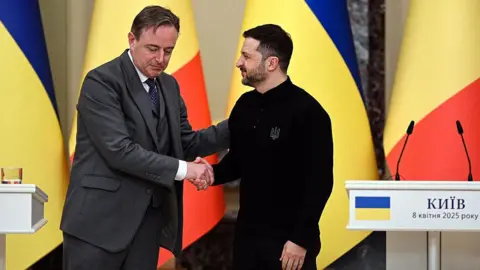
Belgian Prime Minister Bart De Wever is yet to be convinced that the money held in Belgium should be loaned to Ukraine (file pic)
European Union leaders begin two days of talks in Brussels with a momentous decision to be taken on whether to loan tens of billions of euros in frozen Russian assets to Ukraine to fund its military and economic needs.
Most of Russia's €210bn (£185bn; $245bn) worth of assets in the EU are held by Belgium-based organisation Euroclear, and so far Belgium and some other members of the bloc have said they are opposed to using the cash.
Without a boost in funding, Ukraine's finances are set to run dry in a matter of months.
One European government official described being "cautiously optimistic, not overly optimistic" that a deal would be agreed. Russia has warned the EU against using its money.
It has filed a lawsuit against Euroclear in a Moscow court in a bid to get its money back.
The Brussels summit comes at a pivotal moment.
US President Donald Trump has said a deal to end the war - which began with Russia's full-scale invasion of Ukraine in February 2022 - is "closer now than we have been ever".
Although Russia has not responded to the latest peace proposals, the Kremlin has stressed that plans for a European-led multinational force for Ukraine supported by the US would not be acceptable.
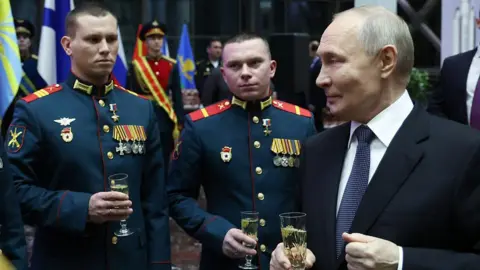
President Vladimir Putin made his feelings towards Europe clear on Wednesday, when he said the continent was in a state of "total degradation" and "European piglets" - a derogatory description of Ukraine's European allies - were hoping to profit from Russia's collapse.
Alexander KAZAKOV/POOL/AFP
Those in favour of loaning Ukraine the money believe it will help deter Putin from continuing the war
The European Commission - the EU's executive arm - has proposed loaning Kyiv about €90bn (£79bn) over the next two years - out of the €210bn of Russian assets sitting in Europe.
That is about two-thirds of the €137bn that Kyiv is thought to need to get through 2026 and 2027.
Until now the EU has handed Ukraine the interest generated by the cash but not the cash itself.
"This is a crunch time for Ukraine to keep fighting for the next year," a Finnish government official told the BBC. "There are of course peace negotiations but this gives Ukraine leverage to say 'we're not desperate and we have the funds to continue fighting'."
Commission chief Ursula von der Leyen says it will also ramp up the cost of war for Russia.
Russia's frozen assets are not the only option on the table for EU leaders. Another idea, backed by Belgium, is based on the EU borrowing the money on the international markets.
However, that would require a unanimous vote and Hungary's Viktor Orban has made it clear he will not allow any more EU money to help Ukraine.
For Ukraine, the hours ahead are significant and President Volodymyr Zelensky is expected to attend the EU summit.
Ahead of the Brussels meeting, EU leaders were keen to stress the momentous nature of the decision.
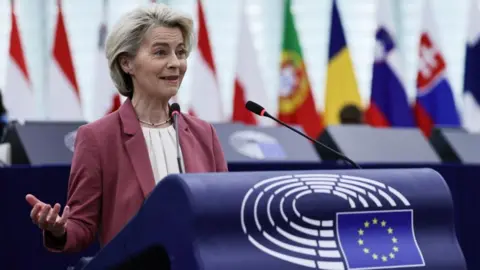
"We know the urgency. It is acute. We all feel it. We all see it," von der Leyen told the European Parliament.
EPA
Ursula von der Leyen told the European Parliament that two choices were on the table for EU leaders
German Chancellor Friedrich Merz has played a leading role in pushing for the Russian assets to be used, telling the Bundestag on the eve of the summit it was about sending a "clear signal" to Moscow that continuing the war was pointless.
EU officials are confident they have a sound legal basis to use the frozen Russian assets, but so far Belgian Prime Minister Bart De Wever remains unconvinced.
His Defence Minister Theo Francken warned ahead of the talks that it would be a big mistake to loan the Euroclear cash.
Hungary is seen as the biggest opponent of the move and, ahead of the summit, Prime Minister Orban and his entourage even suggested that the frozen assets plan had been removed from the summit agenda. A European Commission official stressed that was not the case and it would be a matter for the 27 member states at the summit.
Slovakia's Robert Fico has also opposed using the Russian assets, if it means the money being used to procure weapons rather than for reconstruction needs.
When the pivotal vote does finally take place, it will require a majority of about two-thirds of member states to go through. Whatever happens, European Council President António Costa has promised not to go over the heads of the Belgians.
"We're not going to vote against Belgium," he told Belgian public broadcaster RTBF. "We'll continue to work very intensively with the Belgian government because we don't want to approve something that might not be acceptable for Belgium."
Belgium will also be aware that ratings agency Fitch has placed Euroclear on a negative watch, partly because of "low" legal risks to its balance sheet from the European Commission's plans to use the Russian assets. Euroclear's chief executive has also warned against the plan.
"There are many hiccups and obstacles of course still on the way. We have to find a way to respond to Belgium's worries," the Finnish official added. "We are on the same side as Belgium. We will find a solution together to make sure all the risks are checked as much as they can be checked."
However, Belgium is not the only country to have doubts, and a majority is not guaranteed.
Italian Prime Minister Giorgia Meloni has told Italian MPs she will endorse the deal "if the legal basis is solid".
"If the legal basis for this initiative were not solid, we would be handing Russia its first real victory since the beginning of this conflict."
Malta, Bulgaria and the Czech Republic are also said to be unconvinced by the controversial proposals.
If the deal is passed and the Russian assets are given to Ukraine, the worst-case scenario for Belgium would be one in which a court would order it to hand the money back to Russia.
Some countries have said they would be prepared to provide billions of euros in financial guarantees, but Belgium will want to see the numbers add up.
At any rate, Commission officials are confident that the only way for Russia to get it back would be by paying reparations to Ukraine - at which point Ukraine would hand its "reparations loan" back to the EU.
Bank of England governor 'encouraged' by falling inflation
The future of the economy can sometimes be seen in minor gestures of a Bank of England governor, such as the arch of his eyebrows. So what to make of Andrew Bailey sporting a rather exuberant festive tie full of Christmas trees at the moment he delivered his so-called "Santa cut"?
It probably means nothing. Just maybe it is a sign that the timing and messaging behind this cut is designed to pump life into a "subdued" economy.
It was a narrow decision, with the governor as the swing voter after he said the UK had "passed the peak of inflation", and the target of 2% now in sight in April rather than early 2027.
Mr Bailey was at pains to say the direction of travel next year remained cuts, but that decisions would now be a closer call.
"We're going to come back to target sooner than we thought. So that's encouraging. All of this is very encouraging, and for me certainly, you know, it was a strong basis to cut today," he said.
"Looking forwards, I do think we'll continue to have something of a gradual downward path... the calls do get closer."
There has been a debate on the Monetary Policy Committee about what a normal level of interest would be, with some members seeing that as low as 3%. Markets interpreted the deliberations of the committee as meaning just two further cuts next year.
Much is up in the air, however, about what the committee said was a "lacklustre" economy, that they forecast is not growing in the current quarter.
The uncertainty around the Budget has now lifted, but businesses told the Bank there had been no rebound yet. The Leader of the Opposition, Kemi Badenoch, said that the cuts showed the economy was on "life support" and rate cuts were "CPR".
Governor Bailey said the Budget measures aimed at containing inflation had helped the Bank's decision to lower interest rates.
"It's part of the reason I can be more confident inflation is going to come down sooner," he said.
The governor has also identified an unusually high rate of savings as holding back the economy, driven by a lack of consumer confidence among older savers in particular. Rate cuts mechanically lower the incentive to save, and help spending.
He said he didn't want to be "judgemental" about how much people save, but that it was true "how confident and cautious" people feel about the global and local economy does affect savings.
More economic policy stability, lower inflation and lower interest rates should help the economy gain some new momentum in the new year. It certainly needs it.
But it might take a lot more for the much-needed jolt of confidence and festive spirit to spread across the economy.
A public inquiry into the bombing found chances to stop the attack had been missed
Almost £20m is to be paid out to children injured in the Manchester Arena bombing, a judge has ruled.
Amounts ranging from £11.4m to £2,770 were agreed at a hearing at the Manchester Civil Courts of Justice for 16 people, who were all aged under 16 at the time of the attack.
Some suffered "catastrophic" and life changing injuries while others suffered severe psychological damage after suicide bomber Salman Abedi detonated a homemade bomb after a concert at the venue on 22 May 2017, the court heard.
The damages will be paid by venue manager SMG Europe Holdings, Showsec International Ltd, who provided crowd management, Greater Manchester Police (GMP) and British Transport Police (BTP).
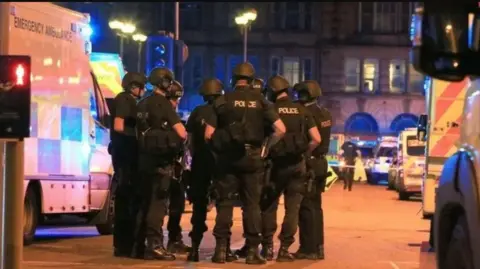
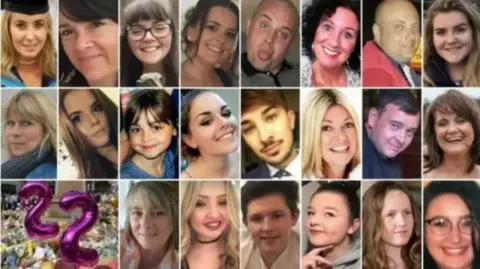
Twenty two people died and hundreds more were injured in the blast after an Ariana Grande concert.
A public inquiry into the bombing, led by Sir John Saunders, later found that chances to stop the attack had been missed along with "serious shortcomings" in security and individual failings.
Judge Nigel Bird approved the 16 claims, agreed between their lawyers and the defendants, as they all involved children or those without mental capacity. A court order bans identifying any of the 16 or their families.
It is understood following the hearing, claims by another 352 people, all adults deemed to have capacity, including the families of the 22 who lost loved ones, will now be agreed between lawyers for the defendants and the claimants.
As those agreements have been made out-of-court, no details of any public money to be paid out by the public bodies - BTP and GMP - will be made public.
Each of the four organisations has apologised to the bereaved families and to the survivors, lawyers for the claimants said, and have acknowledged their failures.
PA Media
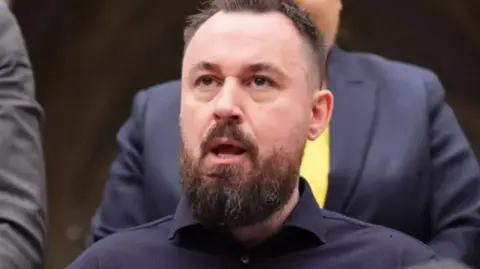
Survivor Martin Hibbert has been a prominent advocate for the victims of the attack
Judge Bird told the hearing: "Each of these cases has a common link, that is injuries and loss suffered, arising out of a single and unimaginable act of terrorism committed on the evening of May 22 2017 at the end of a concert attended by very many young people and their families.
"Twenty-two innocent lives were lost and and the lives of countless others impacted.
"The love and care a parent gives to an injured child is beyond monetary value."
The judge paid tribute to the "courage, dedication and fortitude" of the families involved in each case.
He added: "Each, through their quiet determination, has brought about promises of change in the hope that in the future, other families need not go through what they have been through."
After the hearing, a joint statement was issued from the legal teams at Hudgell Solicitors, Slater & Gordon and Broudie Jackson Canter, the three lead firms representing the claimants.
Family handouts
Twenty-two people were killed in the 2017 bombing
The statement said: "This is not a day of celebration. It is a moment to acknowledge the mistakes that were made and the unimaginable suffering our clients have endured over the past eight-and-a-half years.
"Their strength and resilience have been extraordinary, and without that, we would not have reached this settlement.
"We now expect all parties to honour their commitment to do what they can to prevent those same mistakes from happening again.
"It has been a privilege to work on behalf of our courageous clients. We wish them only peace and strength as they look to the future."
Family handout
Martyn's Law is named after Martyn Hett, who was among 22 people killed
Martyn's Law, named in memory of victim Martyn Hett, 29, has since been brought in to better protect public place from terror attacks - stipulating a range of extra safety measures large venues must undertake.
The public inquiry found a series of "missed opportunities" to spot and stop Abedi.
It heard he should have been identified as a threat and action taken sooner after he was reported as suspicious by a member of the public, who was "fobbed off".
The arena area also had a CCTV "blind spot", patrols of the area by security staff were not adequate and BTP officers took a two-hour lunch break to get a kebab before the attack.
The new offences would build on existing rules around sexually explicit deepfakes and intimate image abuse, the government said.
"Women and girls deserve to be safe online as well as offline," said Technology Secretary Liz Kendall.
"We will not stand by while technology is weaponised to abuse, humiliate and exploit them through the creation of non-consensual sexually explicit deepfakes."
Creating deepfake explicit images of someone without their consent is already a criminal offence under the Online Safety Act.
Ms Kendall said the new offence - which makes it illegal to create or distribute nudifying apps - would mean "those who profit from them or enable their use will feel the full force of the law".
Nudification or "de-clothing" apps use generative AI to realistically make it look like a person has been stripped of their clothing in an image or video.
Experts have issued warnings about the rise of such apps and the potential for fake nude imagery to inflict serious harm on victims - particularly when used to create child sexual abuse material (CSAM).
"The act of making such an image is rightly illegal – the technology enabling it should also be," she said in a report.
The government said on Thursday it would "join forces with tech companies" to develop methods to combat intimate image abuse.
This would include continuing its work with UK safety tech firm SafeToNet, it said.
The UK company developed AI software it claimed could identify and block sexual content, as well as block cameras when they detect sexual content is being captured.
Such tech builds on existing filters implemented by platforms such as Meta to detect and flag potential nudity in imagery, often with the aim of stopping children taking or sharing intimate images of themselves.
'No reason to exist'
Plans to ban nudifying apps come after previous calls from child protection charities for the government to crack down on the tech.
The Internet Watch Foundation (IWF) - whose Report Remove helpline allows under-18s to confidentially report explicit images of themselves online - said 19% of confirmed reporters had said some or all of their imagery had been manipulated.
Its chief executive Kerry Smith welcomed the measures.
"We are also glad to see concrete steps to ban these so-called nudification apps which have no reason to exist as a product," she said.
"Apps like this put real children at even greater risk of harm, and we see the imagery produced being harvested in some of the darkest corners of the internet."
However while children's charity the NSPCC welcomed the news, its director of strategy Dr Maria Neophytou said it was "disappointed" to not see similar "ambition" to introduce mandatory device-level protections.
The charity is among organisations calling on the government to make tech firms find easier ways to identify and prevent spread of CSAM on their services, such as in private messages.
The government said on Thursday it would make it "impossible" for children to take, share or view a nude image on their phones.
The board of the Kennedy Center has voted to rename the performing arts centre the Trump-Kennedy Center, according to the White House.
Press secretary Karoline Leavitt said on social media the board's vote was unanimous and due to "the unbelievable work President Trump has done over the last year in saving the building".
Leavitt also congratulated President John F. Kennedy and said "this will be a truly great team long into the future! The building will no doubt attain new levels of success and grandeur".
The move would be highly controversial, particularly in Washington DC where the centre has been an iconic landmark since constructed and named for Kennedy.
Shorty after taking office, President Donald Trump fired all the centre's board members, and replaced them with allies, who then voted to make Trump chairman of the board.
The president secured about $257 million in congressional funding to pay for major renovations and other costs at the venue.
The idea for a national performing arts centre began in the 1950s and when Kennedy, the 35th president, was assassinated in 1963, the venue was named in his honour.
This breaking news story is being updated and more details will be published shortly. Please refresh the page for the fullest version.
You can receive Breaking News on a smartphone or tablet via the BBC News App. You can also follow @BBCBreaking on X to get the latest alerts.

 Login
Login