Login
LoginFrom Iran to China to Venezuela - how tanker seized by US hid true location

 BBC
BBCThe oil tanker seized by US forces on Wednesday had a track record of faking or concealing its location information, apparently to hide its activities, ship tracking data shows.
On Wednesday evening, the US confirmed that its forces seized a vessel during a helicopter-launched raid near the coast of Venezuela. BBC Verify confirmed the ship was the Skipper by matching a sign seen in footage released by the US to a reference photo supplied by TankerTrackers.com, a site which monitors oil shipments.
Data held by publicly accessible tracking sites paints an incomplete picture of the vessel's movements, and before its seizure it hadn't declared its position since 7 November. Maritime analytics firm Kpler also suggested that the vessel had engaged in a ship-to-ship transfer.
US Attorney General Pam Bondi described the vessel as a "crude oil tanker used to transport sanctioned oil from Venezuela and Iran".
The US Treasury department first sanctioned the ship in 2022, when it was sailing under the name Adisa, and was accused of being part of an "international oil smuggling network".
The Skipper has sailed under the flag of Guyana, but the government was quick to release a statement saying that the 20-year-old tanker was "falsely flying the Guyana Flag as it is not registered in Guyana".
Experts told BBC Verify that the Skipper was likely a part of the so-called "dark fleet" - a global network of oil tankers that seek to evade oil sanctions by obscuring their ownership, identities and travel histories.
Hiding its position
Under a UN treaty, all ships above a certain tonnage must have an onboard tracker called an Automatic Identification System (AIS). These trackers broadcast information about the ships, including their location, and can be followed on websites like MarineTraffic.
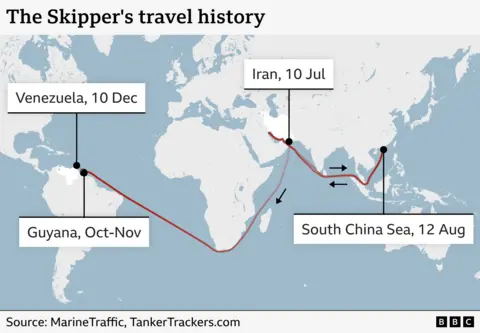
But there is an incomplete and misleading public record of the Skipper's movements. According to MarineTraffic, the Skipper's last known port call was at Soroosh in Iran on 9 July, where it arrived after stopping in Iraq and the UAE.
But Kpler suggests that this is part of a pattern of misleading entries by the Skipper. Analysts at the firm said the ship had previously loaded crude oil from Venezuela and Iran, while falsifying its position via its onboard tracker, a process known as spoofing.
Venezuela has some of the world's largest reserves of oil, but exports were placed under sanctions in 2019 by the US in a bid to force the transition of power from President Nicholas Maduro's administration, which has been widely accused of election rigging.
The firm noted that while its AIS showed the ship at Iraq's Basrah Oil Terminal on 7 and 8 July, terminal reports showed no record of the vessel there. Instead, the Skipper loaded crude oil at Kharg Island in Iran, Kpler said.
The Skipper then sailed east, tracking data shows, where Kpler suggested it conducted a ship-to-ship transfer between 11 and 13 August. The cargo was later unloaded in China, where Kpler said it was "falsely declared".
It returned via Iran and sailed towards the Caribbean. The Skipper last declared its position on 7 November, several miles off the coast of Guyana. Its onboard only reappeared on 10 December, after the US raid.
In the interim period, satellite images identified byTankerTrackers.com and confirmed by BBC Verify show that the Skipper was present in the Port of Jose in Venezuela on 18 November and not appearing on tracking sites at the time.
Since the imposition of sanctions, analysts say it has become common for ships to spoof or conceal their positions while loading oil in Venezuela.
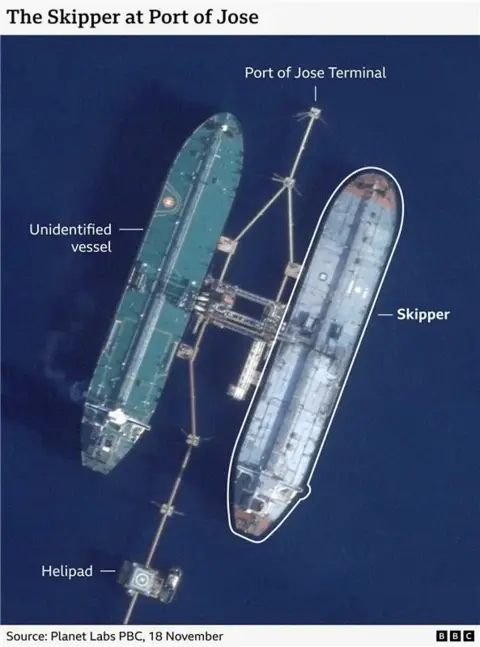
Kpler analysts said the ship loaded "at least 1.1 million barrels of Merey crude" by 16 November at the terminal and listed Cuba as the destination.
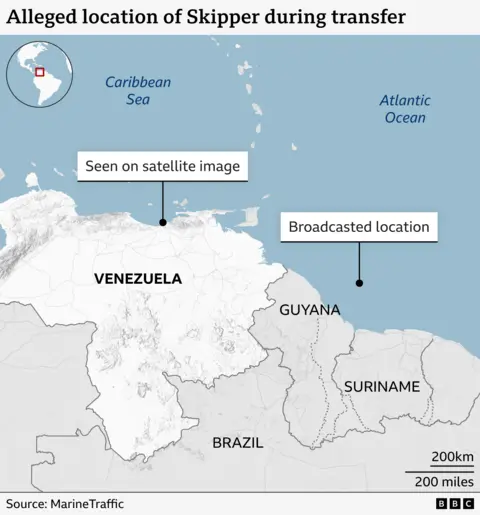
There is also evidence that the Skipper was involved in a ship-to-ship transfer with another vessel on 7 December, just days before it was boarded by US troops. Satellite images seen by Kpler appeared to show the exchange, with one of the vessels identified by Kpler as the Skipper.
The transfer took place just off the coast of Venezuela, near the city of Barcelona. According to MarineTraffic, the Skipper had last appeared off the coast of Guyana weeks earlier.
Such sanction evading activity is not unusual for Venezuelan oil exports, Kpler said. The company said that tankers often transfer their cargo off the coast of Malaysia, before the oil is imported into China.
Former Belgian naval lieutenant and analyst Frederik Van Lokeren told BBC Verify that while such ship-to-ship transfers are not illegal or wrong, they are "extremely uncommon". He said such activities were normally a sign of vessels trying to evade sanctions, transferring oil to ships not publicly associated with smuggling.
Mr Van Lokeren said that Venezuela's refining capacity has been significantly degraded in recent years and is "dependent" on its allies in Iran and Russia to convert its crude oil into more commercially lucrative products.
Who owns the Skipper?
MarineTraffic lists the beneficial owner and operator as Nigeria-based Thomarose Global Ventures Ltd and it lists the registered owner as Marshall Islands-based Triton Navigation Corp.
In 2022, the US Treasury said that Triton was being used by a sanctioned Russian oil magnate - Viktor Artemov - to facilitate a global "oil smuggling network".
At the time, US officials said Mr Artemov used an expansive network of ships often registered obscurely to transport Iranian oil.
In its statement, the US Treasury said that Triton had "materially assisted, sponsored, or provided financial, material, or technological support for, or goods or services to or in support of, Artemov".
BBC Verify is attempting to contact both companies for comment.
















 头巾下面:居勒斯(Nilbar Güres)称,把头发遮盖起来的穆斯林女性并非其信仰的木偶。她制作于2006年的一个视频取名“Soyunma/Undressing”(解开)。这里是其中的4个画面。艺术家在这里一边揭开一层又一层面纱,一边轻声念出家人中那些女性的名字。
 假发:在这个名为“遮盖”(Covered,2009)的自肖像中,施泰恩施莱伊格尔(Anna Shteynshleyger)戴了两个头套。它们是这位虔诚的犹太女性的日常发套。直到17世纪末叶,犹太女性都用叫做提谢尔(Tichel)的头巾遮盖头发。后来,假发套时兴,成为传统头盖的完美替代品,取名“沙伊特尔”(Scheitel)。
 一种信仰,众多头巾:短头巾、长头巾、固定插入式的或围在脖子上的,—各种各样的穆斯林头盖各有何意义?这一展览作了解释,并向观者展示,何种头巾属于何种文化圈、何种宗教,以及涵有何种意义。对很多虔诚的穆斯林女性来说,戴头巾是伊斯兰基本责任之一。
 做礼拜时将头发遮起来:德国少数族群的日常宗教生活:女摄影家米哈伊洛娃(Marija Mihailova)记录了柏林的俄罗斯—东正教教堂的习俗。为做礼拜,妇女们用头巾把头发遮盖起来。这可是一种在天主教和新教教堂里基本上不再会看到的习俗。
 头发太密惹麻烦:在阿拉伯国家,有一头黑长发是一种理想美。在这一塑像里,美发难以遮盖。伊朗女艺术家莫格哈达姆(Mandana Moghaddam)在取名为“Chelgis I”(2001)的雕塑中虽展示了美发,同时却做出一层遮纱,掩饰了这位少女的身份。它影射讲述一个有40根辫子的一名被囚少女故事的波斯童话。
 头发只给丈夫看:提谢尔是犹太语说法,是虔诚犹太女性头盖的一种称呼。在摄于2001年的这幅照片中,拉奥尔(Leora Laor)记录了耶路撒冷原教旨犹太教地区Mea Schearim的日常画面。根据犹太教义,婚后,只有丈夫才能看到妻子的头发。因此,从此时起,不管是用普通的头巾,还是用繁复的头饰或假发套,头发都得遮盖起来。
 自由空间:纽约康尼岛(Coney Island)海滩上的犹太女性,瓦拉布雷加(Federica Valabrega)摄于2011年。她们都有头盖,但缕缕发丝仍从下面露出。宗教习俗多种多样,对付手段及其解释亦多种多样,并极富创意。
 遮盖严实的海滩客:在海洋里戏水,同时又忠实于信仰?对笃信的穆斯林女性来说,布基尼(Burkini)再合适不过。布基尼只露出头和身体上被允许外露的部分。不过,一些西方人又因此感觉受到了挑衅。