Watch: King Charles issues update on his cancer treatment
King Charles has shared "good news" about his cancer, saying in a personal message that early diagnosis and "effective intervention" means his treatment can be reduced in the new year.
In a recorded video message broadcast on Channel 4 for the Stand Up To Cancer campaign, the King said: "This milestone is both a personal blessing and a testimony to the remarkable advances that have been made in cancer care."
According to Buckingham Palace, the King's recovery has reached a very positive stage and he has "responded exceptionally well to treatment", so much so that doctors will now move his treatment "into a precautionary phase".
The regularity of treatment is going to be significantly reduced - but the King, 77, is not described as being in remission or "cured".
"Today I am able to share with you the good news that thanks to early diagnosis, effective intervention and adherence to 'doctors' orders', my own schedule of cancer treatment can be reduced in the new year," the King said in his speech.
The video message, recorded in Clarence House two weeks ago, was played in the Stand Up To Cancer show on Channel 4 on Friday evening, in a fundraising project run with Cancer Research UK.
The campaign encourages more people to get tested for cancer and to take advantage of national screening schemes - and the King's message emphasised the importance of checks to catch cancer at an early stage.
"I know from my own experience that a cancer diagnosis can feel overwhelming. Yet I also know that early detection is the key that can transform treatment journeys, giving invaluable time to medical teams," said the King.
Early detection could be a lifesaver, he said: "Your life, or the life of someone you love, may depend upon it."
PA Media
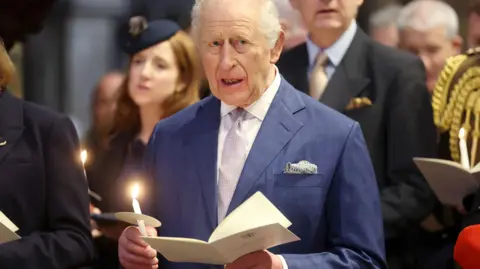
King Charles had a message of "hope" at an Advent service this week
The King also spoke of how much he had been "profoundly moved by what I can only call the 'community of care' that surrounds every cancer patient - the specialists, the nurses, researchers and volunteers who work tirelessly to save and improve lives".
Until now the King has said little publicly about his illness.
He didn't seem to want to be defined by the disease and his approach has been to keep working, with a busy schedule including overseas trips and hosting state visits, including last week's by the German president.
A couple of days ago he was sending a message of optimism and seasonal "hope", when he attended an atmospheric, candle-lit Advent service at Westminster Abbey.
The Stand Up To Cancer show, presented by celebrities including Davina McCall, Adam Hills and Clare Balding, has urged people not to be frightened of getting cancer checks.
In particular, the show has appealed to the estimated nine million people in the UK who Cancer Research UK says are not up to date with NHS screening schemes, offering an online checker to let people see if they are eligible for tests for breast, bowel and cervical cancer.
The King said it "troubles me deeply" that this represents nine million missed opportunities to catch cancer early - and he urged people to use the screening checker online tool.
"The statistics speak with stark clarity. To take just one example: When bowel cancer is caught at the earliest stage, around nine in 10 people survive for at least five years. When diagnosed late, that falls to just one in 10," he said.
According to royal sources, the King's reference to bowel cancer should not be seen as linked to his own condition, and prostate cancer has previously been ruled out.
In an attempt to demystify cancer checks and show the value of early diagnosis the Stand Up To Cancer show had a live broadcast from cancer clinics at Addenbrooke's and Royal Papworth hospitals in Cambridge.
"I want to take the fear out of cancer screening and show everyone that they are not on their own in this," said McCall, 58, who recently said she was recovering from breast cancer surgery.
Reuters
The King has talked about the shock of receiving a cancer diagnosis
Currently in the UK, there are three NHS cancer screening programmes - for bowel, breast and cervical cancer - available to certain age groups.
A new lung cancer screening programme is also being slowly rolled out for anyone at high risk of developing the disease, specifically targeting people aged 55-74 years old, who currently or used to smoke.
Men may enquire about prostate cancer checks, but there is no national programme in place.
The Stand Up to Cancer project, which has raised £113m since 2012, is funding 73 clinical trials involving 13,000 cancer patients.
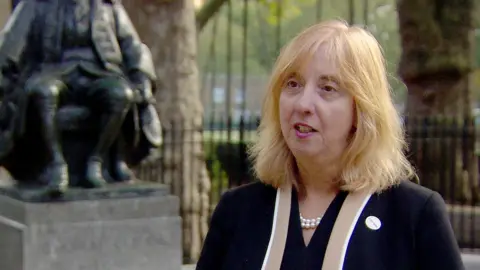
Michelle Mitchell, chief executive of Cancer Research UK, said public figures speaking openly about cancer can encourage others to have a check up.
"Spotting cancer early can make a real difference and provides the best chance for successful treatment," she said.
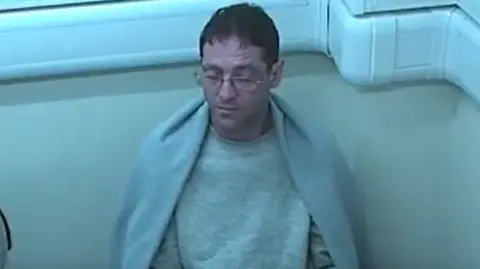
Robert Rhodes, pictured in a police interview in 2016, orchestrated a plot to kill Dawn Rhodes and claim he did so in self-defence
On a bank holiday evening in 2016, Robert Rhodes turned to his child and said: "Do you want to get rid of Mum?"
Those words, the child recalled years later, were the start of a plot for Rhodes to kill his wife, Dawn, in their Surrey home and cover up her death as an act of defence - of himself and his child.
For years, Rhodes painted himself as a victim of an attack in the killing he planned and covered up.
Described as swift and protective, jurors heard accounts of a father who moved to protect his child from their knife-wielding mother, who lost her life in the skirmish that ensued.
Instead, a new trial revealed a complex tale of abuse, control and a murder plot with the coercion of a child at its heart.
On 2 June 2016, the child, who cannot be named for legal reasons, went to their mother and said: "I drew a picture for you, close your eyes and hold out your hands."
Then, with the child leaving the room and locking themselves in the bathroom, Rhodes cut his wife's throat with a kitchen knife.
To cover up the killing, Rhodes once again turned to his child, telling them he "needed a favour".
The favour, the child told police in 2022, was to stab their father in the back of the shoulder, with the same knife used to kill Dawn, and then let him cut their arm.
Surrey Police
Dawn Rhodes was killed in her kitchen in Wimborne Avenue, Earlswood, Surrey
"I didn't want to do any of it. I just felt guilty but I did what I was told," the child said during the police interview.
Despite the child crying and objecting at the time, Rhodes reportedly said: "We've done this now. There's no going back."
The child also told their therapist in 2021 that Rhodes had stabbed himself in the back of the head, causing himself another wound he would claim was caused by his wife.
As they were under 10 years old at the time of the murder, the child bears no criminal responsibility for aiding the attack.
Life insurance
The death of Dawn Rhodes followed the end of a marriage in turmoil, with the couple in the process of separating after revelations of infidelity.
The pair had known each other for more than 20 years, having met when Rhodes was 21 and Mrs Rhodes was 18, the court heard.
Having married in 2003, the couple lived in Epsom and across Surrey, before settling in Wimborne Avenue in Earlswood, near Redhill.
But on Christmas Eve in 2015, Robert Rhodes found out about an affair that Mrs Rhodes had been having with a co-worker.
From that point, Mrs Rhodes would claim to family members that Rhodes would self-harm in front of her and threaten to kill himself.
Internet searches made by Rhodes show him researching methods of suicide, as well as about life insurance.
He told the court: "I didn't see a future in our marriage."
Rhodes also admitted to creating a fake Facebook profile and contacting the wife of Mrs Rhodes' new partner to tell her about the affair.
Later, he would message his wife's partner: "Thank you for screwing my life and wife."
'Like the Hulk'
The child continued in their second set of police interviews: "There was a plan and we went through with it. I was told to lie and I did."
But shortly after the killing, the child originally told police how, after another argument between Rhodes and his wife, they had tried to intervene.
As part of the cover-up of their father's attack, the child said their mother picked up a knife and swung it at their arm, delivering the cut to their arm which was, in fact, administered by Rhodes.
The child described Dawn's "rage" and "anger" in a police interview in May 2017, before being told to run upstairs and "lock yourself in the bathroom".
In his own police interview, an emotional Rhodes told officers how he "grabbed the blade" of the knife and "held it as tight as I could".
Weaving his story together, he told officers: "I was scared, and it takes a lot to scare me.
"It's like one minute she [Dawn] is fine and the next minute she's like the Hulk," he added, referring to the comic book superhero.
Despite the façade put up by the child, witnesses in the trial pointed to signs that the truth lay beneath.
In a conversation while together in a car, when asked about their scar from the incident, the child would tell one adult: "It was the sharp bit [of the knife], that's how dad did it."
The child would later allege that, while on supervised visits, their father would attempt to speak to them, telling them to "stick to the plan".
They would later suggest their father would message them on a phone he had secretly given them, again urging them to continue backing his version of events.
In an unrelated conversation years later, other witnesses revealed how they heard Rhodes tell the child: "Snitches get stitches."
Surrey Police
Robert Rhodes, 52, coerced his child into helping to kill their mother, Dawn Rhodes, in 2016
Years passed, and the child continued at school and made new friends, while the truth of what happened continued to eat at them inside.
In November 2021, the child confided the truth in a close friend, who recalled: "I asked if they felt guilty, they said yes - like this guilt had been bothering them. They were distraught."
The following day, the child would then tell their therapist, who alerted police.
Double jeopardy
Following an appeal to the Court of Appeal in November 2024, Rhodes was retried under the double jeopardy rules.
It meant that, due to the compelling new evidence brought forward by the child, he could be reexamined for the crime he was acquitted of in 2017, as well as charges of child cruelty, perverting the course of justice and perjury.
At his new trial, Rhodes would often sit staring ahead, his eyes occasionally darting over to the 12 people hearing his case.
While the court listened to more gruesome details of the murder, Rhodes would hunch over and stare at the floor and, on one occasion when evidence was being read out, he sat shaking his head and mouthing "nope" out into the courtroom.
As jurors convicted him, he stood silently in the dock.
'Motherhood brought her joy'
Following the trial, Mrs Rhodes' family - mother Liz Spencer, sister Kirsty Spencer and brother Darren Spencer, paid tribute.
Her mother said: "Dawn was a loving daughter, sister and mother. Being a mother was what brought joy to Dawn.
"During her life, Dawn was looking for someone to build a life with. She was looking for someone to love and be loved by someone to trust and be trusted by and someone to respect and be respected by."
Kirsty added: "Dawn was my sister and I loved her dearly.
"I know my sister would want us to find freedom, a freedom that she was deprived of."
Her brother Darren added: "Dawn was a very capable woman, but unfortunately went through hell in the last few years of her life.
"The pressures on her at the time meant that she wasn't the Dawn we all knew, and the last few times we saw her before she was taken from us, she was at the end of her tether."
Rhodes will be sentenced at Inner London Crown Court on January 16.
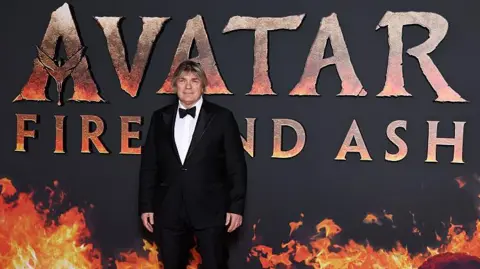
Avatar: Fire and Ash is predicted to be one of the year's highest-grossing movies
It's no secret the Avatar films are a gigantic technical feat - pushing the boundaries of cinematography, animation and performance capture.
But you may not be aware that the same applies to the music.
Composer Simon Franglen says work on the third instalment, Avatar: Fire and Ash, took an epic seven years to complete.
Along the way, he wrote 1,907 pages of orchestral score; and even invented new instruments for the residents of the alien planet Pandora to play.
And, with director James Cameron tinkering with the edit until the very last minute, the British musician only finished his final musical cue five days before the film was printed and delivered.
In total, Avatar contains "four times as much" music as a standard Hollywood film, says Franglen, with almost the entirety of its 195-minute running time requiring music.
"But I got 10 minutes off for good behaviour," he laughs.
20th Century Studios
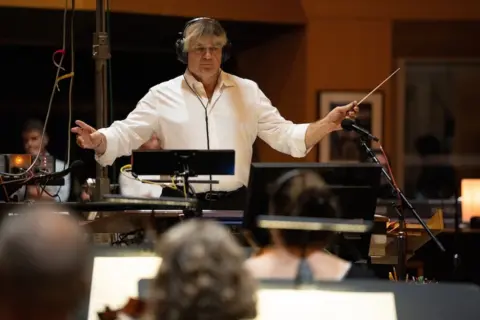
Simon Franglen spent seven years working on the score, with the bulk of the work taking place from 2023-25
Fire and Ash is the third instalment in the record-breaking series, continuing the saga of the blue Na'vi population, who are protecting their planet from human invaders, intent on stripping its natural resources.
The new film, released on 19 December, takes audiences back to the astonishingly vivid landscapes of Pandora, but it also sends them on a visceral emotional journey.
At the start of the film, the two main characters Jake Sully (Sam Worthington) and Neytiri (Zoe Saldana) are mourning the death of their teenage son, Neteyam.
Unable to see eye-to-eye, the grief threatens to tear the couple apart.
Franglen was tasked with creating a score that could reflect the depth of their despair.
"I wanted to make sure that you felt that sense of distance that was growing between them," he says.
"So what I would do is, I would take two lines [of music] and I'd have them moving apart, or I would make them go wrong, so that they felt austere and cold and disconnected."
"Grief is not something that is ever addressed in these sorts of films," he continues, "but for any family, the loss of a child is the worst thing you can go through.
"Musically, the important stuff is often the quiet moments."
A hoedown on a galleon
By contrast, when Franglen composed the music for the Wind Traders - a nomadic clan of salesmen, who travel by airship - he could let his imagination run wild.
Their swashbuckling themes are inspired by the action movies of the 1930s and 40s, but they also feature brand new instruments, unique to Pandora.
"When we meet the wind traders [they're having] a hoedown on their enormous Galleon," says Franglen.
"The problem was that, if you are having a Pandoran party, what do they play? I can't give them guitar, bass and drums. I can't give them a banjo.
"You have to have a real instrument that would be designed for three metre-tall, blue people with four fingers.
"And because Avatar is not animation, when there are instruments on screen, you have to have the real thing," he says, referring to Cameron's rule that everything on screen has to be rooted in reality, even though the film's imagery is largely computer-generated.
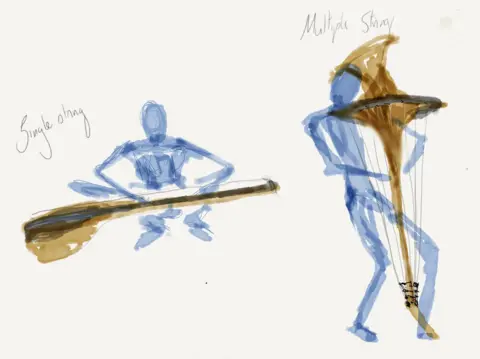
"So I sketched out some instruments, and gave them to the art department, who made these beautiful designs."
20th Century Studios
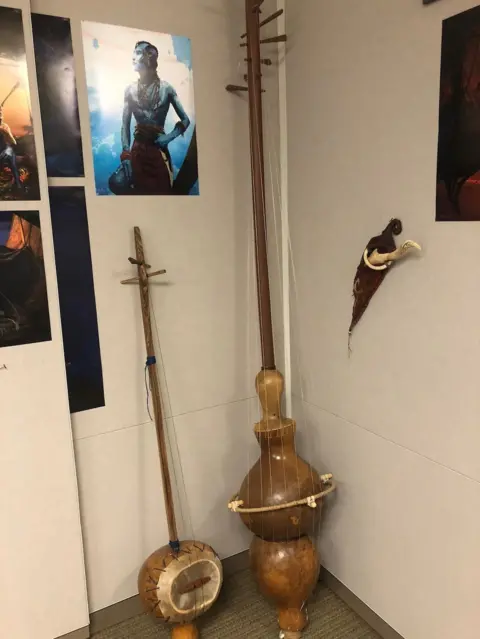
Franglen sketches were turned into actual, playable instruments
Franglen's creations included a long-necked lute, similar to a Turkish saz, with strings that represent the rigging of the Wind Traders' ship.
A percussion instrument was also designed, with the drum head using the same material as the vessel's sails.
The art department's renders were then given to prop master Brad Elliott, who built the instruments on a 3D printers, and the actors played them for real on set.
For now, however, these inventions have no official name.
"They are currently called 'the stringy things' and 'the drummy things'," laughs Franglen.
"I'm sure there's a better name. Somebody said we should have a competition."
20th Century Studios
Franglen says his new instruments could be produced commercially if there is enough demand from fans
Franglen's musical career started when he was just 13 years old- he wrote a letter to the BBC asking how someone would go about becoming a record producer.
Mistakenly assuming he was asking about radio production, the corporation advised him to study electronics - leading him to a course at Manchester University in the early 1980s.
He arrived just as the Hacienda Club opened ("I was member 347") and spent his free time booking bands for the college's concert venue.
"I remember booking Tears for Fears and 11 people came," he says.
After graduating, he was hired to work as a synth programmer, and was introduced to Trevor Horn - who set him to work on pivotal 80s albums by Yes and Frankie Goes To Hollywood.
Eventually, he decided to try his luck in America where, "after six months of doing almost nothing", he became an in-demand session musician and programmer.
Credits started to rack up on hits like Toni Braxton's Unbreak My Heart, All 4 One's I Swear and Whitney Houston's I Have Nothing; and he eventually found himself programming drums for Michael Jackson's HIStory album.
"The pressure was to make it great," he says. "To have that sense of groove, what we call, 'the pocket'.
"And a big part of my career is that I had a good pocket. I understood where things should feel and how they should hit. And that is as important with film scores as it is when you're making a Michael Jackson record."
Franglen's first experience of film scoring came when Bond composer John Barry asked him to assist on Kevin Costner's Oscar-winning Dances With Wolves. He was later hired to do the "dark and nasty stuff" on David Fincher's Se7en.
"My job was to provide the dystopian edge that that score has. So I would take squealing brakes, make samples of them, and then play all the violin lines with squealing brakes underneath.
"There was a lot of experimental stuff, which was incredibly fun."
Getty Images
Franglen says he'll work on some smaller projects before returning to the Avatar universe
Franglen first met Avatar director James Cameron after being hired by legendary film composer James Horner, to work "on a film he had no money for".
The film was Titanic - a notorious white elephant, dismissed as a vanity project, and predicted to bring about the collapse of film studios Fox and Paramount.
The composer had seen the headlines, but when Cameron showed him the scene where the Titanic broke in half and started to sink, he realised the press had got it wrong.
"It was just astonishing, in comparison to anything you'd seen before. I knew it was special."
Even so, there was no budget left for the music, Franglen had to borrow equipment and instruments from the manufacturers, and the majority of the score was recorded on synthesizers in a rented apartment.
"Part of the reason that Titanic sounds the way that it does, is because there wasn't enough money for [an] orchestra everywhere," he says.
Getty Images
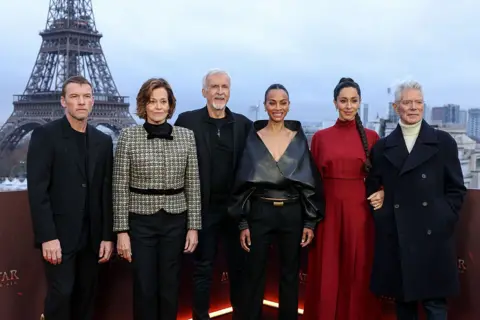
The cast posed with director James Cameron ahead of Avatar's European premiere earlier this week (L-R): Sam Worthington, Sigourney Weaver, James Cameron, Zoe Saldana, Oona Castilla Chaplin and Stephen Lang
The opposite is true on Avatar.
"Jim [Cameron] still believes that the good things take time. And as a composer, having that ability to refine and to make something special is something that is rare these days."
The director also went to great lengths to ensure his latest film is free from artificial intelligence.
"He very specifically asked me, 'So, we're not using any AI? We're not putting any real musicians out of work'," Franglen recalls.
"It's fair to say that if you gave a lot of film producers the option to save money, they would take that option.
"Jim is in a situation where he will not compromise, and that's as important when it comes to the music as it is to the live performances of the actors."
As the film prepares to open, Franglen is celebrating a Golden Globe nomination for the theme song, Dream As One, sung by Miley Cyrus.
But he's also thinking about what comes next. Cameron has already completed the scripts for Avatar Four and Five; scheduled to come out in 2029 and 2031.
"Four is… I think it's astonishing," says Franglen. "It goes into whole new territories, and I love it."
Initial footage has already been shot, but Cameron says completing the film will depend on the box office performance of Fire and Ash.
"I really hope that we break even, so that we can make it," says Franglen.
"I think they said after Avatar Two that the break even point was $1.4 billion (£1 billion).
"I have no way of knowing, but I presume that it's a similar number for this one.
"So if the audience tells us that they want an Avatar Four, I'm very much looking forward to doing that."
Critics say gaming platforms should be included in Australia's ban on social media for under-16s
Wednesday afternoons have become a ritual for 15-year-old Sadmir Perviz. It's a circuitous route from home in Perth to the Fiona Stanley Hospital - but it's worth it, he says, to sit down for a game of Dungeons & Dragons with people he may not know but with whom he shares a great deal in common.
Sadmir and his board game companions are just some of the 300 patients at the gaming disorder clinic, Australia's only publicly-run institution of its type, helping patients wean themselves off excessive online gaming habits.
The room where they meet is a simple space in a faceless hospital but in the corner, there's a pile of boardgames on a chair. Jenga, Uno and Sushi Go are also popular choices at the informal group which is attended by both patients and clinicians.
It's a bit of a departure for the 15-year-old who until a couple of months ago preferred to play games with friends online for 10 hours a day.
"It feels completely different," says Sadmir. "You get to roll the dice instead of clicking a button. You can interact with people, so you actually know who's there rather than just being on a call with random people."
Dr Daniela Vecchio, the psychiatrist who set up the clinic, says that while gaming isn't bad in itself, it can become a problem - an addiction even.
Gaming platforms and social media pose similar risks for children: excessive time spent online, and potential exposure to predators, harmful content or bullying.
So she wonders why gaming platforms have not been included in Australia's "world-first" social media ban for under-16s.
The ban, which came into force on Wednesday, is supposed to prevent teens from having accounts on 10 social media platforms including Instagram, Snapchat and X. Children will still be able to access platforms like YouTube and TikTok, but without accounts.
For Vecchio, the omission of gaming platforms is odd.
"It doesn't make much sense," she says.
"Gaming and social media are so interconnected, it's very difficult to separate.
"The individual who plays games for excessive amounts of time also spends excessive amounts of time on social media platforms where they can see other gamers or can live stream gaming, so it's a way to connect."
Dr Daniela Vecchio runs Australia's only publicly funded clinic for gaming disorder clinic
Sadmir, for example, spent much of his time on the gaming platform Steam, as well as YouTube. Dr Vecchio singles out the platforms Discord and Roblox as particular worries - a concern echoed by many experts and parents the BBC has spoken to in covering the ban and its impact.
Both Roblox and Discord have been dogged by claims that some children are being exposed to explicit or harmful content through them and are facing lawsuits relating to child safety in the US.
Roblox introduced new age assurance features in Australia and two other countries weeks before the social media ban kicked in, with the checks due to be rolled out to the rest of the world in January. The checks will "help us provide positive, age-appropriate experiences for all users on Roblox", the company said.
Discord also introduced age checks on some features earlier this year and on Wednesday said it was introducing a new "teen-by-default" setting for all Australian users.
Former gaming clinic patient Kevin Koo, 35, wonders whether a social media ban could have influenced the access he got at a younger age.
"I was growing up in the wild west of internet usage so, there weren't any restrictions," he says. "I got free rein on the internet basically. So I think that for me, the damage has already been done."
A former quantum finance intern interested in AI, Mr Koo lost his job just before the pandemic. Living in Sydney, he had no family nearby and no regular work. He says he lost confidence and ended up consumed by online gaming, likening his experience to substance abuse.
Dr Vecchio agrees with the comparison - if she had her way, she'd be tempted not just to expand the social media ban to gaming but to raise the age to 18.
Gaming disorder is also now recognised by the World Health Organisation as an official diagnosis and, according to a 2022 Macquarie University study, around 2.8% of Australian children are affected by it. Vecchio thinks the number at risk is higher.
Kevin Koo, 35, wonders whether he might have benefited from a social media ban
The Australian government says its ban is about protecting kids from harmful content, cyberbullying, online grooming and "predatory algorithms" among other things – some or all of which could arguably be said to exist with gaming platforms.
The Australia Federal Police are among those who have warned chatrooms on these sites are hotbeds for radicalisation and child exploitation.
But, as the eSafety Commissioner said last month, the legislation enforcing the ban means platforms were not selected according to "safety, a harms or risk-based assessment".
Instead, platforms have been selected according to three criteria: whether the platform's sole or "significant purpose" is to enable online social interaction between two or more users; whether it allows users to interact with some or all other users; and whether it allows users to post.
Exceptions were made for gaming, for example, because its primary purpose is not social-media style interaction.
The law, say some experts, makes no sense.
"It's incompetence, it's reactionary," says Marcus Carter, professor of human-computer interaction at the University of Sydney.
"Social interaction is not a bad thing… There are a bunch of probably legitimate concerns about these big tech platforms and what they are affording children and what they are exposing them to so as a result we've said we are banning social media.
"I just wish the government was trying to figure out how to help rather than put a band-aid on a bullet wound," he says.
Watch: Australia's social media ban explained... in 60 seconds
Tama Leaver, professor of internet studies at Curtin University and chief investigator at the ARC Centre of Excellence for the Digital Child, also says the ban on social media is too blunt a tool – instead a more nuanced approach is needed, including towards gaming platforms.
"There is such a wide spectrum of gaming from incredibly positive, nurturing, fun, creative, expressive spaces - something like Minecraft comes to mind where it's had so many positive uses." However, platforms like Roblox are at the other end of the spectrum, he says.
"Roblox isn't a game. It's a series of enabling tools for other people to make games. And we know that some of the games that have been made that clearly feel like they're meant for adults have been accessed by very young people."
On Professor Leaver's desk at the university are three plushies with inbuilt ChatGPT inside them. On the box, it says they are suitable for three and above. This, he says, has also gone too far.
"I do think there needs to be age-appropriate regulation," he says, referring to young people going online. "I do think we're at a moment, and it's not just Australia, you look across the EU, there is huge appetite for all sorts of regulation."
A treatment plan, not a cure
In Mr Koo's case, for example, his vice wasn't just gaming. It was AI chatbots, another feature of online life that has come under scrutiny for everything from making things up to allegedly encouraging children to kill themselves.
There is evidence they are designed to manipulate users into prolonging interactions and their use has even given rise to a new phenomenon called AI psychosis, in which people increasingly rely on AI chatbots and then become convinced that something imaginary has become real.
Mr Koo also started googling his mental health issues and relying on AI to help confirm his diagnoses.
"You're Googling stuff that you think you already know and then you kind of tick the box after that saying, oh, I've already done my work for today, my therapy work with ChatGPT," he says. Mr Koo suffered a psychotic episode and after extensive therapy with a professional, he now takes a different approach.
"I might Google or ChatGPT something and then I'll check it with my therapist in person," he says. "I do think being able to read human emotions and having that face-to-face conversation with someone is completely different."
The government has said it will continually review the list of banned platforms and at the end of November added Twitch, a streaming platform where people typically play video games while chatting to viewers.
Communications Minister Anika Wells also told the BBC last week that the eSafety Commissioner "definitely has her eye on Roblox". And, she said, the social media ban "isn't a cure, it's a treatment plan" that will "always evolve".
The demand for platforms to do better is growing. So too are the queues of families waiting to get help at the gaming disorder clinic, but Vecchio has to turn them away.
"[The legislation] is excluding platforms where children interact with many others and some of them can be people who harm them," says Vecchio. "Children need to be protected, they need to be safeguarded."
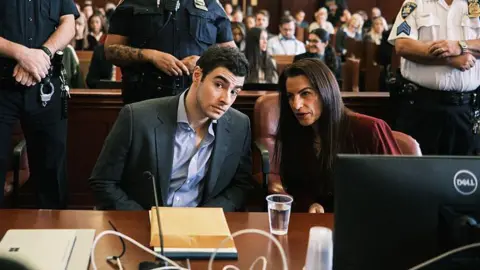
Mr Mangione has watched as the court plays body camera footage from the day of his arrest
Luigi Mangione, the man accused of fatally shooting United Healthcare CEO Brian Thompson in a case that sparked national attention, watched as new testimony and never-before-seen footage from the day of his arrest in a McDonald's was unveiled during a hearing this week.
Mr Mangione has pleaded not guilty to state charges related to the 2024 murder of Mr Thompson, a father of two, as well as federal counts that carry the possibility of the death penalty.
The pre-trial hearing is focused on the defence's attempts to keep certain evidence out of the trial, which has not been scheduled yet, including items found in his backpack during his arrest and statements he made to officers.
During the first two weeks of the hearing, supporters of Mr Mangione - the scion of a prominent Maryland family and Ivy League graduate - filled the back rows of the Manhattan criminal courtroom, some wearing a pin portraying him as a saint-like figure.
Prosecutors and Mr Mangione's legal team are expected to question over a dozen witnesses from the day of his arrest, including the employees who spotted him and the police who arrested him.
Here is a look at some of the key pieces of evidence discussed that offer a window into Mr Mangione's trial.
An eyebrow giveaway
The pre-trial hearing has centred on the small-town McDonald's in Altoona, Pennsylvania, where officers were shocked to find the high-profile suspect days after Mr Thompson was fatally shot - and hours from the busy Midtown Manhattan crime scene.
Witnesses suggested the arrest may never have occurred there if not for one of Mr Mangione's key features: his eyebrows.
During the first day of the hearing, prosecutors played a call to police from a McDonald's employee about a tip from a customer in the restaurant.
The employee said the customer thought a patron looked like the suspect in the United Healthcare CEO shooting. The patron was well covered, wearing a black hoodie, a medical mask and a tan beanie. But one key detail stuck out.
"The only thing you can see is his eyebrows," the employee told police.
It was not the only time Mr Mangione's distinguished eyebrows have come up.
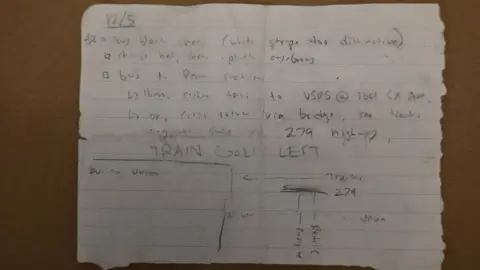
Prosecutors also entered into evidence notecards they say Mr Mangione had, which appeared to be to-do lists for the days after the high-profile shooting.
One card reads: "Keep momentum, FBI slower overnight," while another said: "Change hat, shoes, pluck eyebrows".
New York County District Attorney's Office
Prosecutors said Mr Mangione was carrying a note that appeared to be a to-do list, with instructions to "change hat, shoes, pluck eyebrows"
'Proposterous': An unexpected day at McDonald's
Dozens of videos released by prosecutors show Mr Mangione's encounter with police and his eventual arrest in the McDonald's as other customers watched.
Officers who responded narrated the footage this week, telling the court what was going through their minds as they realised the 27-year-old appeared similar to the suspect in photos.
On Thursday, Altoona Lieutenant William Hanelly said a fellow officer responded sarcastically that he would "get right on it" when he heard the tip about the suspect.
Mr Hanelly told the court that he understood the sarcasm, because it seemed "preposterous" that a shooter from "New York City had found his way to a McDonald's in Altoona, Pennsylvania".
But at the scene, officers said they quickly saw the resemblance to New York Police Department pictures circulated to the public after days without any leads.
"It's him. I'm not kidding. He's real nervous. It's him," one officer can be heard telling Mr Hanelly in a phone call played for the court.
In one video, Mr Mangione eats a McDonald's meal as officers stand guard around him in the restaurant waiting for more officers to arrive.
At the hearing, Mr Mangione watched the videos quietly from the defence table, seated next to his lawyers - wife and husband Karen Friedman Agnifilo and Marc Agnifilo. The latter defended Sean "Diddy" Combs, who was acquitted of sex trafficking and racketeering charges just months earlier.
Wearing a grey suit and button-down shirt most days, Mr Mangione frequently took notes on a legal pad, and occasionally smiled and laughed with his lawyers.
A fake name leads to an arrest
Watch: "What's your name?" - Moment police confront Luigi Mangione at McDonald's
In the series of police body camera videos played for the court, Mr Mangione's interactions with officers eventually lead to his arrest on 9 December as Christmas music plays loudly in the background of the McDonald's.
When officers first speak to Mr Mangione, they ask him to pull his mask down. He listens, and is heard telling officers his name is "Mark Rosario", handing them a New Jersey identification that police later said was false.
That identification gave officers enough cause to arrest Mr Mangione, Mr Hanelly told the court, and in the video, Mr Mangione tells officers his real name is Luigi.
In another body camera video, an officer tells the 27-year-old he is under police investigation for giving a fake identification and Mr Mangione is seen putting his hands on the wall as officers arrest him.
They then take a photo of Mr Mangione with his hands behind his back, an image widely circulated on social media after his arrest.
Bullets, a journal and cash: a peak into Mr Mangione's backpack
The pre-trial hearing also shed light on the items Mr Mangione was carrying when he was arrested.
Mr Mangione's lawyers have argued that a 9mm handgun as well as a notebook should be excluded from trial because officers did not have a warrant to search his backpack. Prosecutors allege that Mr Mangione wrote in his notebook about "the deadly, greed-fuelled health insurance cartel".
During the hearing on Thursday, Mr Hanelly argued that there were exceptions for warrants.
Earlier in the week, Ms Friedman Agnifilo questioned the officer who searched Mr Mangione's backpack, arguing they were searching the bag "because you thought he was the New York City shooter".
"No, we search everyone," said the officer, Christy Wasser.
New York County District Attorney's Office
Evidence found during Mr Mangione's arrest
Video played in court shows a police officer pulling a series of items from the backpack, including a handgun magazine that Mr Hanelly said contained 9 mm bullets - all as Holly Jolly Christmas plays over the speaker.
One law enforcement official comes across a journal in the backpack, and can be heard saying it reads like a "manifesto".
Ms Agnifilo objected after the "manifesto" part of the video was played repeatedly in court, arguing the prosecutor wanted to emphasise the line.
Eventually, Mr Hanelly testified, the officers decided to stop searching the backpack and take it to the police station because "it was going to be a mess".
Prosecutors this week entered into evidence images of other items Mr Mangione had with him, including a gun, a silencer, dozens of $100 bills, face masks, a hair trimmer and a passport.
The hearing is expected to continue into next week.
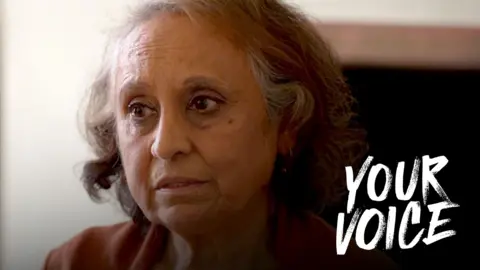
Mina, whose son died last year, says she felt she had to battle the system
Hundreds of parents have contacted the BBC about their struggles with getting support for adopted children - as charities call for a government review.
Mina, who contacted BBC Your Voice about her son who died last year from alcoholism, said: "You're just a lone person battling, trying to battle the system."
The charity Adoption UK said it had raised the issue with England's children's minister this week, calling for permanent funding for therapy and a wider review of the support available.
Mina was one of 700 people who contacted the BBC in response to the story, many of whom said they were adoptive parents who had struggled to get help for their children or had been blamed for their emotional and behavioural difficulties.
She and her husband adopted their son Leighton at the age of three, after he was removed from his birth mother when he was 18 months old. He struggled all his life with his mental health and addiction, she says.
"He turned all this pain inside, like I'm not worthy, I'm not lovable," says Mina. She believes his distress over his adoption led to his heavy drinking and death from liver failure at the age of 26. "He couldn't understand why."
Even as a four-year-old, Leighton would have periods of "deep depression" but his parents' concerns were brushed off by social workers, Mina says. When he was older, she adds, he would self-harm and began taking drugs and abusing alcohol.
She says social workers blamed her and her husband for Leighton's struggles, insisting "it must be something happening at home".
"There's a perception that once a child's adopted, they'll live happily ever after, and there is no platform to complain or to even have your voice," Mina says.
Mina's local authority did not respond to a request for comment.
Children's charity Coram - one of several organisations to call for greater support for adoptive families or to raise concerns about the blaming of parents in response to our story - says the adoption system is "under exceptional strain".
"It's shocking to discover again that adoptive parents, are experiencing blame as the first response when they seek help. That should never be the case," said CEO Dr Carol Homden.
She says "adoption remains an extremely important part of our care system and highly successful for the majority of children" but when children have been removed from their birth families for their own protection, "we need to recognise that they will need potential support for life and ensure that our services are there in a timely and sufficient way".
The adoption system is "under exceptional strain" says Dr Carol Homden from Coram
Coram also runs the largest body representing children's social workers, CoramBAAF, which has joined the call for a review of adoption support, saying: "We must get this right for the children at the heart of this."
James - not his real name - told us he was reassured to learn he was not the only parent to have gone through something like this and now feels he "owes it to our adopted son" to speak out himself.
He says he adopted a child who had severe foetal alcohol spectrum disorder (FASD) - a condition caused by drinking in pregnancy that can lead to physical and mental problems.
As he grew older, James says, his adopted son's behaviour was sometimes violent because of his condition.
'Heavily blamed'
One social worker suggested they should live in separate homes, says James, with one parent living with their adopted son and their other children staying with the other parent in the family home. A social worker also admitted, he adds, that social services staff had not been trained to deal with FASD.
"We took on a child knowing there'd be issues. We didn't expect everything to go perfectly because it doesn't. But when you ask for help, they need to help," he says.
Eventually, he felt his adopted son was no longer safe to live with the other children - James told us - and he arranged for him to be accommodated in care again.
James says they struggled to remain in contact with him.
"It was almost like, me and my children, that we weren't to exist anymore because we'd been heavily blamed," James says. "We were literally removed from from his life. They were more bothered on him seeing family pets than step-siblings."
His local authority said it could not comment on individual cases, but pointed to research which it says shows that outcomes for adopted children are "overwhelmingly successful".
The government says adoptive parents do "an incredible job providing a loving and supportive home" to vulnerable children, and while those arrangements do sometimes break down, support is in place to keep them together where possible.
We also heard from some parents who did receive good support and who say it made a huge difference.
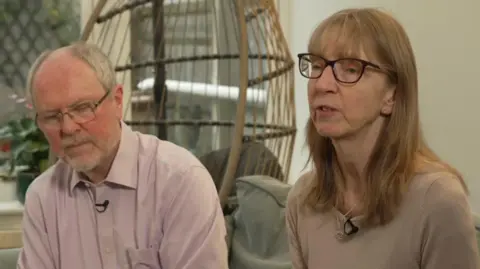
Emma and her husband Geoff says they adopted their daughter, who needed extensive help, when she was nearly six. The local authority had an established relationship with a family therapy provider which specialises in adoption, Family Futures.
Emma and Geoff said specialist family therapy was a huge help to their daughter
"They understood that adoption and therapy need to go together," she says. "When we asked for some help they were very keen to give it. They realised if they don't do it now, things get worse, children go back to care and it all falls apart."
Adopted children who have been moved first into foster care, and then into an adoptive family, struggle to feel safe, says Emma, and the family therapy was aimed at addressing that.
"If you imagine being a small child and being put from pillar to post with different people and then you arrive virtually into a stranger's house, you are going to be very scared," she adds.
Geoff said it took about 10 years of seeing a therapist, on and off, before their daughter trusted them.
Without that support, he says he can't see how she would have been able to achieve as much as she has now that she is 21, having moved into supported living accommodation and still keeping in touch with her parents.
"We used to think that we couldn't imagine how she could ever leave home," says Geoff. "Now she's able to live away from us. She's got a place where she feels she belongs."
Klarisse Smith went on to study social work after being in the care system
When Klarisse Smith started living in a homeless hostel in Birmingham at the age of 16, she had been in the care system for two years.
She had spent that time moving between her foster carer, her aunt and her partner's family.
"I felt like my social worker just kind of washed her hands of me when I went to my auntie's," she said.
"I didn't really have much contact with anyone. They just left me to my own devices and at the time I just thought this was pretty normal."
New government data shows the number of households in England with at least one young care leaver facing homelessness has risen by 37% in the past five years – more than double the increase for the general population.
The care charity Become said the figures showed "a complete failure in support for care leavers".
A government spokesperson said the risk of homelessness faced by care leavers was "unacceptable" and it was making "record investment" in social and affordable housing.
Klarisse, now 24, said: "Being homeless kind of strips your confidence away. It eats at your self worth and has you feeling like it's never gonna change."
She remembers her social worker being on leave a lot and only visiting her at the hostel when she was waiting on her Universal Credit claim.
"I had nothing to sustain me within the six weeks, so she gave me £50 a week and she'd drop it round in cash," she said.
Klarisse Smith
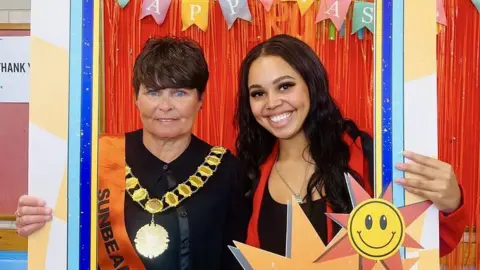
Klarisse Smith (right) with the Lord Mayor of Nottingham at the Sunbeam Fostering Agency's Children's awards ceremony earlier this year
It was difficult to ask for support during those years, Klarisse said.
"If you're not the type of person to want to constantly be nagging someone, then you just kind of get left under the system," she said. "You have to constantly be making the calls and the emails."
While Birmingham City Council said it could not comment on individual cases, it acknowledged the "significant challenges" young care leavers like Klarisse faced when transitioning to independent living.
A spokesperson said cover arrangements were "always in place" to ensure continuity of support when a social worker was unavailable and it was committed to ensuring care leavers had safe accommodation and the support they needed.
They said Birmingham had commissioned a Care Leaver Pathway since January 2025 to support 16 to 17-year-olds who were homeless or in care, focusing on life skills, youth engagement, education and training.
Klarisse sat her A levels while at another hostel. She then did a social work degree and this summer completed a scholarship programme for clinical medicine at the University of Oxford.
She said: "I studied social work because I got an understanding of the social care system. I'm a care leaver myself, and I feel that I can relate to a lot of people, especially foster kids. I can instill some confidence into them."
It took a "special kind of person" to be a social worker, she said, because things that might not seem significant to others could mean "literally everything" to a child in the care system.
She said: "When you're a child, you're a lot more sensitive. So, putting their clothes in bin bags, for example, might just be a form of transporting them. But to a child, it feels like there's something they've done wrong to be treated like this. They treat people the same when they come out of jail."
New figures from the Department of Housing, Communities and Local Government (DCLG) show there were 4,610 18 to 20-year-old care leaver households facing homelessness in 2024-25, up 37% from 2019-20.
The number in the general population has risen 14.5% since 2019-20, to 330,410 in 2024-25.
The data tracks those who have been assessed by their local authority as homeless or threatened with homelessness, and so have received a relief or prevention duty.
Clare Bracey, director of policy, campaigns and communication at Become, warned not all cases show up in official statistics.
"Part of the problem is that young people aren't reaching out for support," she said.
A DCLG spokesperson said: "Our Homelessness Strategy will set out bold steps to prevent homelessness and deliver lasting solutions, and our landmark Children's Wellbeing and Schools Bill will require public bodies to consider the support young people need when leaving care."
Ms Bracey said the government was "taking forward really positive developments" with the bill.
It would require local authorities to support care leavers up to the age of 25 to help them transition into independent living.
"We want to make sure that it is really clear who that support applies to, that there is a broader definition of that support and that young people have a say in what support they should get," Ms Bracey added.
A Local Government Association spokesperson said: "In order to effectively reduce homelessness and tackle housing waiting lists, councils need the powers and resources to build or acquire more of the genuinely affordable homes our communities desperately need."
They added there were currently 132,410 households living in temporary accommodation, costing councils £2.8bn a year.
Kim Jong-un, North Korea’s leader, hugs a soldier in Pyongyang during a ceremony welcoming troops home from a deployment in Russia’s Kursk region, in a photograph released by state media.
US special envoy Steve Witkoff will hold talks with European leaders in Berlin at the weekend
US President Donald Trump's overseas envoy will travel to Germany this weekend to meet Ukrainian President Volodymyr Zelensky and European leaders for the latest round of high-level talks on ending the war.
Steve Witkoff, who has been leading White House attempts to mediate between Ukraine and Russia, will discuss the latest version of the proposed peace agreement in Berlin.
The Trump administration is pushing for a deal to be in place by Christmas and has held several rounds of talks with Ukrainian and Russian representatives in recent weeks, though there has been little sign a breakthrough is imminent.
It has not yet been confirmed which European leaders will attend the Berlin talks.
The Wall Street Journal, which first reported details of the meeting, said UK Prime Minister Sir Keir Starmer, French President Emmanuel Macron and German Chancellor Friedrich Merz would all take part.
The Witkoff-Zelensky meeting comes days after Ukraine gave the US its revised version of a 20-point peace plan, the latest iteration of a proposal which first emerged in late November and has triggered a flurry of diplomatic activity.
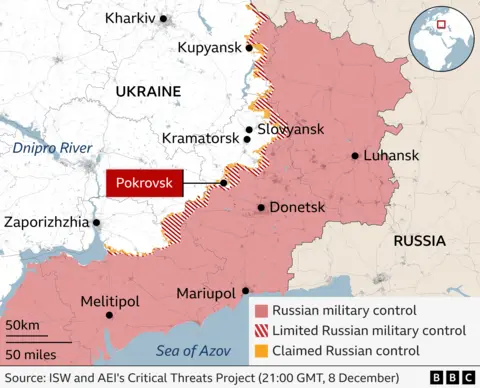
The fate of territory in eastern Ukraine remains one of the most intractable topics in the negotiations, with Kyiv refusing to cede land which has been illegally occupied, and Moscow repeating its intention to take the Donbas region in full by force unless Ukraine withdraws.
The Ukrainian president told reporters that under the US-proposed terms, the Kremlin would undertake not to advance into the areas vacated by Ukraine's forces, with the land between Russian-controlled parts of the Donbas and Ukraine's defensive lines effectively turned into a demilitarised zone.
The proposal, seemingly an attempt to resolve the question of legal ownership by creating a new status for the land, has been publicly questioned by Zelensky, who said: "What will restrain [Russia] from advancing? Or from infiltrating disguised as civilians?"
Ukraine and allies in Europe have said publicly that the US-led talks have been fruitful, and have hailed progress on securing amendments to a plan which was widely viewed as favouring Russia when it first emerged.
But there have been signs in recent weeks that Trump is losing patience with Zelensky and his backers on the continent.
Zelensky said elections could be held within 90 days if the US and Europe provided the necessary security. Elections have been suspended since martial law was declared when Russia launched its full-scale invasion in February 2022.
As the White House's diplomatic push continues, attention in Europe is focused on how to support Ukraine in the event of a peace deal, with talks ongoing over security guarantees and funding.
The Ukrainian government faces a stark financial situation: it needs to find an extra €135.7bn (£119bn; $159bn) over the next two years.
It is hoped that agreement paves the way for the funds to be loaned back to Ukraine if a deal can be reached at an EU summit next week, providing Kyiv with financial help for its military and efforts to rebuild parts of the country left devastated after nearly four years of all-out war.
That move has been condemned as theft by the Kremlin, and Russia's central bank has said it will sue Euroclear, a Belgian bank where the vast majority of Russian assets frozen after the invasion are held.
Officials were still negotiating the exact structure of a deal to repurpose the Russian assets on behalf of Ukraine, with the Belgian government being particularly sceptical due to its particular legal exposure as the main holder.
Elsewhere, it was reported that the latest version of the peace plan being circulated envisions Ukraine rapidly joining the European Union.
The Financial Times said Brussels backed Ukraine's swift accession to the bloc, an idea proposed by Ukraine in the latest draft it has given to Washington.
Ukraine formally applied to join the EU days after the 2022 invasion but despite promises of an accelerated process is still several years away from becoming a member.
Under the plan, Ukraine would become a member as soon as January 2027, AFP reported, citing an unnamed senior official. It was unclear whether Washington had approved that element of the draft.
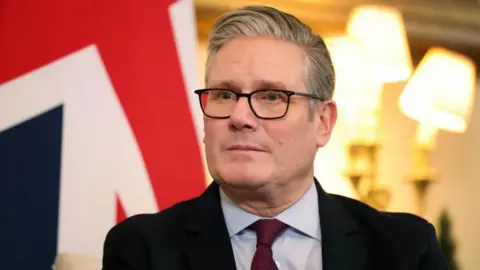
Sir Keir Starmer has urged resident doctors not to go ahead with "reckless" strikes planned for next week, saying it is "beyond belief" they could take place during a flu outbreak.
The prime minister said the NHS is in its "most precarious moment" since the coronavirus pandemic due to soaring flu cases across the UK, and that strikes would put the healthcare system and its patients in "grave danger".
The doctors' union, the British Medical Association (BMA), is polling its members to see if they are willing to call off the walkout, with the results to be released on Monday.
But if they vote against it, a five-day strike by resident doctorswill begin two days later on Wednesday 17 December.
A BMA spokesperson said the government could stop the strike by tackling pay, conditions and trust with a credible offer.
Flu has come early this winter, and it looks to be a particularly nasty season because of a new mutated version of the virus which is circulating, say experts.
Many are now calling it "super flu", but it is not more severe nor harder to treat.
An average of 2,660 patients per day were in hospital with flu in England last week – the highest ever for this time of year and up 55% on the week before, NHS England said.
Flu cases are also rising in Scotland, Wales and Northern Ireland, figures show.
Children and young people are particularly affected by the outbreak, health officials said.
Writing in the Guardian, Sir Keir said the strikes "should not happen" and said resident doctors, formerly known as junior doctors, should accept a deal to avert industrial action.
Sir Keir said as well as the government's new offer, they had also given the BMA the chance to reschedule the strikes until after Christmas.
"Don't get me wrong – of course I would rather they were cancelled... But under the circumstances, I wanted to be sure we have left no stone unturned in our efforts to protect the NHS," he said.
The BMA said it will ask its members whether the government's offer will be enough to call off Wednesday's strikes.
If members indicate yes, then they will be given time to consider the offer in more detail and a formal follow-up referendum would be held on ending the dispute completely.
The offer aims to address problems for some doctors trying to find work and to provide more training places for newly qualified medics to progress in their careers.
However, the medical director for the NHS in London, Chris Streather, said the flu situation was "well within the boundaries" of what the NHS could cope with and that hospitals were better prepared for large disease outbreaks since the Covid pandemic.

 Login
Login