Reading view

There are new articles available, click to refresh the page.

From Iran to China to Venezuela - how tanker seized by US hid true location

BBC An image showing the seized tanker refuelling. It is imposed over the BBC Verify branding and colours. BBC

The oil tanker seized by US forces on Wednesday had a track record of faking or concealing its location information, apparently to hide its activities, ship tracking data shows.

On Wednesday evening, the US confirmed that its forces seized a vessel during a helicopter-launched raid near the coast of Venezuela. BBC Verify confirmed the ship was the Skipper by matching a sign seen in footage released by the US to a reference photo supplied by TankerTrackers.com, a site which monitors oil shipments.

Data held by publicly accessible tracking sites paints an incomplete picture of the vessel's movements, and before its seizure it hadn't declared its position since 7 November. Maritime analytics firm Kpler also suggested that the vessel had engaged in a ship-to-ship transfer.

US Attorney General Pam Bondi described the vessel as a "crude oil tanker used to transport sanctioned oil from Venezuela and Iran".

The US Treasury department first sanctioned the ship in 2022, when it was sailing under the name Adisa, and was accused of being part of an "international oil smuggling network".

The Skipper has sailed under the flag of Guyana, but the government was quick to release a statement saying that the 20-year-old tanker was "falsely flying the Guyana Flag as it is not registered in Guyana".

Experts told BBC Verify that the Skipper was likely a part of the so-called "dark fleet" - a global network of oil tankers that seek to evade oil sanctions by obscuring their ownership, identities and travel histories.

Hiding its position

Under a UN treaty, all ships above a certain tonnage must have an onboard tracker called an Automatic Identification System (AIS). These trackers broadcast information about the ships, including their location, and can be followed on websites like MarineTraffic.

But there is an incomplete and misleading public record of the Skipper's movements. According to MarineTraffic, the Skipper's last known port call was at Soroosh in Iran on 9 July, where it arrived after stopping in Iraq and the UAE.

But Kpler suggests that this is part of a pattern of misleading entries by the Skipper. Analysts at the firm said the ship had previously loaded crude oil from Venezuela and Iran, while falsifying its position via its onboard tracker, a process known as spoofing.

Venezuela has some of the world's largest reserves of oil, but exports were placed under sanctions in 2019 by the US in a bid to force the transition of power from President Nicholas Maduro's administration, which has been widely accused of election rigging.

The firm noted that while its AIS showed the ship at Iraq's Basrah Oil Terminal on 7 and 8 July, terminal reports showed no record of the vessel there. Instead, the Skipper loaded crude oil at Kharg Island in Iran, Kpler said.

The Skipper then sailed east, tracking data shows, where Kpler suggested it conducted a ship-to-ship transfer between 11 and 13 August. The cargo was later unloaded in China, where Kpler said it was "falsely declared".

It returned via Iran and sailed towards the Caribbean. The Skipper last declared its position on 7 November, several miles off the coast of Guyana. Its onboard only reappeared on 10 December, after the US raid.

A graphic showing the ship's journey.

In the interim period, satellite images identified byTankerTrackers.com and confirmed by BBC Verify show that the Skipper was present in the Port of Jose in Venezuela on 18 November and not appearing on tracking sites at the time.

Since the imposition of sanctions, analysts say it has become common for ships to spoof or conceal their positions while loading oil in Venezuela.

A BBC graphic showing the Skipper taking on cargo.

Kpler analysts said the ship loaded "at least 1.1 million barrels of Merey crude" by 16 November at the terminal and listed Cuba as the destination.

There is also evidence that the Skipper was involved in a ship-to-ship transfer with another vessel on 7 December, just days before it was boarded by US troops. Satellite images seen by Kpler appeared to show the exchange, with one of the vessels identified by Kpler as the Skipper.

The transfer took place just off the coast of Venezuela, near the city of Barcelona. According to MarineTraffic, the Skipper had last appeared off the coast of Guyana weeks earlier.

Such sanction evading activity is not unusual for Venezuelan oil exports, Kpler said. The company said that tankers often transfer their cargo off the coast of Malaysia, before the oil is imported into China.

A graphic showing where the ship was seen on satellite images and where it had previously broadcasted its location.

Former Belgian naval lieutenant and analyst Frederik Van Lokeren told BBC Verify that while such ship-to-ship transfers are not illegal or wrong, they are "extremely uncommon". He said such activities were normally a sign of vessels trying to evade sanctions, transferring oil to ships not publicly associated with smuggling.

Mr Van Lokeren said that Venezuela's refining capacity has been significantly degraded in recent years and is "dependent" on its allies in Iran and Russia to convert its crude oil into more commercially lucrative products.

Who owns the Skipper?

MarineTraffic lists the beneficial owner and operator as Nigeria-based Thomarose Global Ventures Ltd and it lists the registered owner as Marshall Islands-based Triton Navigation Corp.

In 2022, the US Treasury said that Triton was being used by a sanctioned Russian oil magnate - Viktor Artemov - to facilitate a global "oil smuggling network".

At the time, US officials said Mr Artemov used an expansive network of ships often registered obscurely to transport Iranian oil.

In its statement, the US Treasury said that Triton had "materially assisted, sponsored, or provided financial, material, or technological support for, or goods or services to or in support of, Artemov".

BBC Verify is attempting to contact both companies for comment.

The BBC Verify banner.

Residents' anger as illegal waste dumps appear near homes

Peopleton Community A field that is completely covered in rubble and mixed waste, including broken bricks, stones and bits of plastic. Bushes and fields line the sides. Peopleton Community
The local authority has said it has identified "potential issues" at this site in Evesham, Worcestershire

"Angry" residents have spoken out over mountains of dumped waste appearing near homes, with one of the spots described as an "environmental horror".

Inquiries are under way into two suspected illegal waste sites emerging in Worcestershire.

A photo of one of the scenes in Evesham appears to show masses of rubbish dumped in a large trench.

Further complaint centres on a farm in the village of Peopleton where estate agents have reportedly told residents not to sell their homes, as property prices were falling due to the issue.

With regard to the scene on Haselor Lane in Evesham, Wychavon District Council (WDC) said it was first made aware in October, adding it had identified "potential issues" at the site, and "waste crime" across the district.

The Environment Agency (EA) said the second site, on Stone Arrow Farm, Peopleton, had seen "illegal waste-dumping activity".

Two residents of Peopleton, which has a population of 640, have spoken to the BBC on condition of anonymity.

One said: "There is a level of anger, and you can feel that on a daily basis."

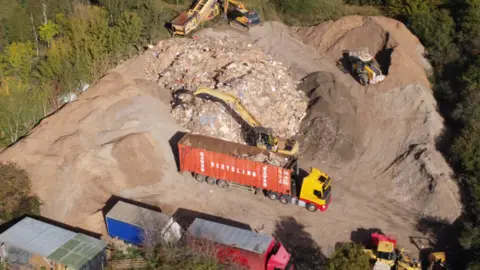
Peopleton Community An aerial view of large piles of earth and mixed debris. Lorries are pictured moving rubble with several other excavator-type vehicles around the area, all surrounded by trees.Peopleton Community
The Environment Agency has said it is aware of "illegal waste dumping activity" on land in Peopleton (above)

The resident said: "I moved here six years ago from another village in the area and I moved because I didn't want my children growing up in the rat race.

"I wanted to give them a nice safe environment and to be able to look out their window and look out over green fields.

"You develop a sense of anger because you get to a point where we don't actually like living where we live."

The second resident added some people in the village - where the waste was described as an "environmental horror" - now felt "trapped".

"One of the villagers went to go to an estate agent and when they gave their postcode they were told to be realistic because there were doubts it would sell and they were also told they'd have to take a huge drop in price.

"They advised them not to sell at the moment."

A woman stands on a village street wearing a pink hat and matching pink scarf, along with glasses and a dark coat. Behind her are brick houses, a grassy verge.
Councillor Linda Robinson said Peopleton residents "would actually quite like to leave"

Councillor Linda Robinson, who sits on Worcestershire County Council, and WDC for Peopleton and the surrounding area, described the village as a "very sleepy, rural" place "with a very proactive community".

She said they had a "very close knit community" who had endured "noise, disturbance and dust" for the last 18 months.

"I think many of them are at the end of their tether and would actually quite like to leave Peopleton and are actually now trapped," Ms Robinson said.

"The effect of this is lowering the value of their properties or making them impossible to sell, so it's an untenable position for them and something I would like to help them do something about."

An EA spokesperson told the BBC waste "scars our communities".

"[It] is something we're committed to tackling together with local councils and the police," they said.

"Together we're pulling every lever available to us to disrupt those who profit from the harm illegal waste sites cause."

WDC said that while its powers were limited, staff were working "proactively with partners", including the EA.

"We are currently following the required legal process and will take further enforcement action if necessary," the authority explained.

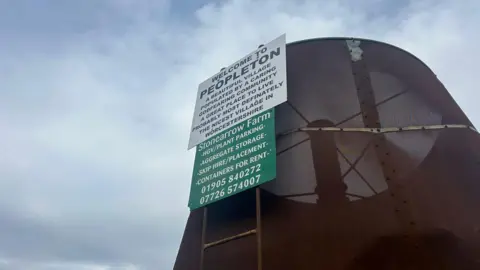
A white sign reads "Welcome to Peopleton. A beautiful village populated by a caring Godfearing community a great place to live probably most definately the nicest village in Worcestershire (sic)." A green sign beneath it reads "Stonearrow Farm" along with some contact numbers.
A Peopleton resident described the dumping as an "environmental horror"

The MP for Droitwich and Evesham, Nigel Huddlestone, said he was "very concerned by the ongoing activities at Stone Arrow Farm".

"Having met local residents on several occasions about this matter, I know how damaging these activities are for the local community," he said.

"Since the problems first arose in autumn last year, I have been engaging with district and county councils, the Environment Agency, West Mercia Police and external stakeholders such as HMRC, the Health and Safety Executive and the DVSA.

"I have also raised written questions in parliament and attended last month's debate in the House of Commons on illegal waste activity.

"I remain absolutely committed to working with all stakeholders and to do whatever I can to help bring this situation to an end, for the benefit of my constituents."

Follow BBC Hereford & Worcester on BBC Sounds, Facebook, X and Instagram.

Related internet links

Sandie Peggie tribunal judgement amended after 'made up' quote row

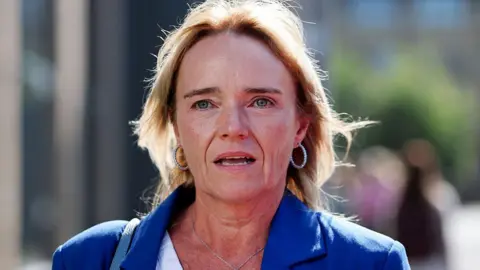
Getty Images A woman with shoulder-length blonde hair is wearing a blue jacket over a white T-shirtGetty Images
Sandie Peggie was suspended by NHS Fife after she complained about trans women using single-sex changing rooms

The judgement in the tribunal of a nurse suspended from her job in a row over trans women using single-sex changing rooms has been amended following complaints a quote used in it was "made up".

On Monday, an employment tribunal outlined four ways in which NHS Fife harassed Sandie Peggie, but dismissed all her other claims.

Ms Peggie had brought the case after she was suspended following a disagreement between her and Dr Beth Upton - who is a trans woman.

Campaigners claimed that the 312-page judgement in the Peggie case contained a "made up" quote from another legal case.

The tribunal has now issued a "certificate of correction" stating there had been "clerical mistake(s), error(s)or omissions(s)". This does not change the overall verdict.

The case has attracted international interest as it concerned whether transgender women – biological males who identify as women – could use female-only changing rooms.

Following the tribunal ruling, one of Ms Peggie's most high-profile supporters, campaigner Maya Forstater, said a reference in the judgement to her own case against the Centre for Global Development Europe was "completely made up".

The Peggie ruling originally stated the verdict in Ms Forstater's case emphasised that the Equality Act does not create "a hierarchy of protected characteristics."

On the social media platform X, Ms Forstater posted a screenshot of the text from the tribunal and said: "One of the many things wrong with the Sandie Peggie judgment.

"This 'quote' from my judgment doesn't come from my judgment. It is completely made up."

A new quote from the Forstater case has now been added.

The revised version of the Peggie judgement then states: "We consider that quotation provides support for the proposition that the Equality Act 2010 does not create a hierarchy of protected characteristics."

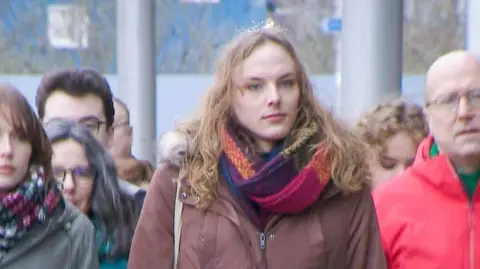
Dr Beth Upton walking outside a court building, dressed in a dark tan coat and wearing a multi coloured scarf. Several supporters are walking alongside.
Sandie Peggie refused to change with Dr Beth Upton

Under employment law, a judge may "at any time correct any clerical mistake or other accidental slip or omission" and an amended version issued.

Ms Forstater said she was astonished how the error happened and that she wanted an explanation.

She added other mistakes had been spotted in the verdict and that they "severely undermine people's confidence in the legal process."

The employment tribunal, which was held over several weeks earlier this year, was high-profile and controversial.

It was brought by Ms Peggie, a nurse who has worked for the NHS for 30 years.

She refused to share a women's changing room with Dr Upton - a biological male who identifies as a woman - at Victoria Hospital, in Kirkcaldy, and was suspended from work at the beginning of 2024.

This followed an encounter between the due in the changing facilities on Christmas Eve 2023, where Ms Peggie told Dr Upton she did not feel comfortable about the doctor's presence there.

She also referenced Isla Bryson - a rapist who changed gender while awaiting trial.

Bryson was initially remanded to a women's jail after being found guilty, but was then moved to a men's facility.

The rapist was later jailed for eight years.

Ms Peggie claimed her own experiences amounted to harassment and took legal action against the health board and Dr Upton, citing the Equality Act 2010.

On Monday, the 312-page judgement found in her favour on four counts, but dismissed her other claims against both the health board and Dr Upton.

It found that some of Ms Peggie's comments towards Dr Upton "amounted to an incident of harassment" and breached the health board's bullying and harassment policy.

A separate hearing will take place at a later date to decide on the "remedy" for Ms Peggie, which could result in her being awarded compensation.

However the verdict was criticised by some campaigners, including Sex Matters - the group Ms Forstater is chief executive of.

'Monumental betrayal' - cheapest World Cup final ticket to cost £3,119

World Cup ticket prices 'monumental betrayal' - FSE

Fifa president Gianni Infantino holding the World CupImage source, Getty Images
Image caption,

Supporters following their team at the 2026 World Cup will find that ticket prices have rocketed

Supporters hoping to attend next year's World Cup final face paying vast prices, with tickets in the 'supporter value tier' starting at £3,119 ($4,185).

Fans' group Football Supporters Europe has said it is "astonished" by Fifa's "extortionate" pricing strategy.

The high prices for group games and the final have been leaking out on Thursday as Fifa informs national associations of their allocations.

It means the price of the cheapest ticket for Fifa's showpiece event has increased almost sevenfold compared with the 2022 World Cup. The lowest-priced tickets on open sale in Qatar were £450.

BBC Sport understands tickets for the 'supporters standard tier' are £4,162 ($5,560), compared with £747 in 2022.

'Supporters premium tier' is £6,615 ($8,860), with the same band £1,197 at the Lusail Stadium three years ago.

FSE has demanded that ticket sales should be halted immediately, adding that tickets not being available in the cheapest category is "a monumental betrayal of the tradition of the World Cup, ignoring the contribution of supporters to the spectacle it is".

The third ticket ballot begins on Thursday afternoon. On Monday, members of national supporters' clubs will get the chance to enter a random draw for individual games, or to follow their team through to the final.

There are about 4,000 tickets for each game available through the official supporters' groups. All other tickets are allocated through the random ballot process, other than those held back by Fifa for corporate partners.

Capacities at the venues range from 94,000 at the Dallas Stadium, where England play Croatia, to 45,000 at the Toronto Stadium.

In a departure from recent tournaments, group stage games are being priced based on their attractiveness, rather than at a flat rate.

In Qatar, group stage fixtures had set prices of £68.50, £164.50 and £219.

Yet for England's match against Croatia on 17 June, tickets cost £198, £373 or £523.

Scotland's first two group games are cheaper. Against Haiti the prices will be £134, £298 or £372, with Morocco set as £163, £320 and £447. The final group game is priced the same as England v Croatia.

There are no category four tickets available to fans, though this was also the case in 2022 when they were reserved exclusively for residents of Qatar.

FSE demands talks over 'extortionate' ticket prices

FSE has called on Fifa to stop the ticket sale process, believing it needs to rethink the pricing policy.

It said Fifa should "immediately halt PMA [Participating Member Association allocation] ticket sales, engage in a consultation with all impacted parties, and review ticket prices and category distribution until a solution that respects the tradition, universality, and cultural significance of the World Cup is found".

It continued: "In the price tables gradually and confidentially released by Fifa, tickets allocated to National Associations, which typically distribute them via official supporters' groups or loyalty programmes to their most devoted fans, are reaching astronomical levels.

"National team supporters are expected to pay this full amount in early 2026 to have the opportunity to follow their team up to the final.

"Adding insult to injury, the lowest price category will not be available to the most dedicated supporters through their National Associations, as Fifa chose to reserve the scarce number of category four tickets to the general sales, subject to dynamic ticket pricing.

"For the first time in World Cup history, no consistent price will be offered across all group stage games. Instead, Fifa is introducing a variable pricing policy dependent on vague criteria such as the perceived attractiveness of the fixture. Fans of different national teams will therefore have to pay different prices for the same category at the same stage of the tournament, without any transparency on the pricing structure enforced by Fifa.

"The bid document released in 2018 promised tickets priced as low as $21. Where are these tickets now? The full way to the final, according to the same bid book, was supposed to cost $2,242 in the cheapest category. This promise is long gone."

Ukraine hands US revised peace plan proposal, Germany says

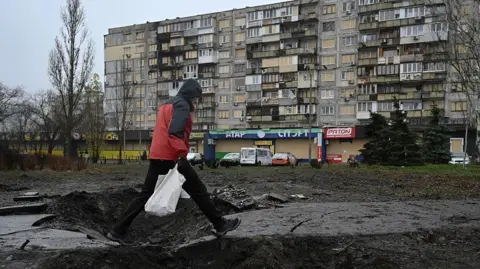
Getty Images A man walking over an explosion siteGetty Images

German Chancellor Friedrich Merz said the latest peace plan draft for Ukraine has been presented to US President Donald Trump - including a proposal on territorial concessions Kyiv may be prepared to make.

But Merz highlighted the territorial issue was "a question that must be answered primarily by the Ukrainian president, and the Ukrainian people."

"We also made this clear to President Trump," Merz pointed out.

In recent weeks European leaders have worked closely with Ukraine to come up with a new iteration of a peace plan that addresses Kyiv's interests and concerns.

Trump appears to have grown frustrated with the intricacies of the question of sovereignty over Russian-occupied Ukrainian territories.

Because his negotiating team has previously worked closely with Moscow, Kyiv's European allies fear the US president might eventually seek to impose a Russian-led solution on Ukraine.

"It would be a mistake to force the Ukrainian president into a peace that his people will not accept after four years of suffering and death," Merz said in a joint news conference with Nato chief Mark Rutte.

He added that in Wednesday's "constructive" phone call with Trump, he, France's Emmanuel Macron and UK Prime Minister Sir Keir Starmer had "made it clear" that Europeans needed to have their interests heard too.

For his part, Trump said the participants had "discussed Ukraine in pretty strong words" and added that he was yet to decide whether to attend a meeting in Europe. "We don't want to be wasting time," he said.

Ukraine's President Volodymyr Zelensky has long signalled he would be prepared to talk to Trump directly to discuss the sticking points of a deal, but the US president has suggested all issues had to be ironed out before such a meeting could take place.

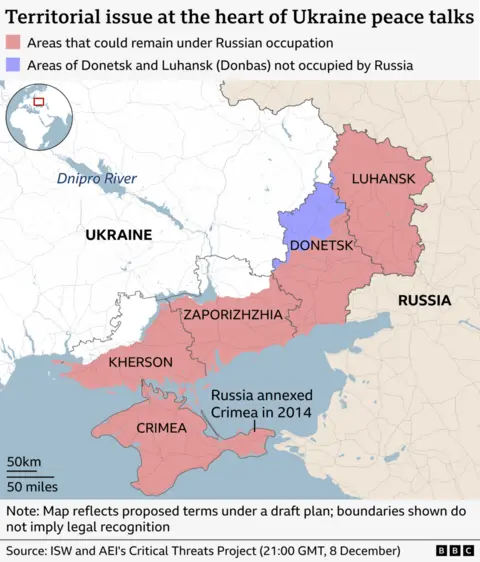
The territorial question is one of the thorniest. Russia demands that Ukraine withdraws entirely from the parts of the eastern Luhansk and Donetsk regions which it still holds - something Kyiv refuses to do, both on principle and because it fears it would allow Moscow a foothold for future invasions.

"We have no legal right to [cede territory], under Ukrainian law, our constitution and international law," Zelensky said earlier this week. "And we don't have any moral right either."

Zelensky is set to hold more talks with his allies today as he co-chairs a coalition of the willing call alongside Merz, Macron and Starmer.

As high-level, frantic diplomatic activity of the last few weeks has taken place among US, European and Ukrainian officials, with frequent statements from all sides, Moscow has remained remarkably tight-lipped.

Any comments from Russia have sought to cement the impression that Moscow and Washington are aligned on their hopes for the terms of a peace deal.

On Thursday Foreign Minister Sergei Lavrov praised Trump for trying to broker a deal and said the recent meeting between Vladimir Putin and US envoy Steve Witkoff at the Kremlin had "eliminated" the "misunderstandings" which had arisen since last summer's Trump-Putin summit in Alaska.

At the time, Russia and the US agreed Ukraine should return to a non-aligned, neutral, and nuclear-free status, Lavrov stated.

A map of Ukraine's south-eastern territories under Russian occupation

The foreign minister also batted off suggestions that Kyiv could be given security guarantees in the form of foreign troops stationed in Ukraine.

"This is yet another return to the sad logic of Zelensky's so-called peace formula," Lavrov said, adding that Moscow had handed the US "additional" proposals on collective security and that Russia was ready to give legal guarantees not to attack Nato or EU countries.

Yet Kyiv and its European allies believe that without security guarantees any peace settlement could be rendered meaningless.

But because Russia has previously violated ceasefire and truce deals, neither Ukraine nor Europe are likely to take any promise by Moscow at face value. In recent weeks European and Ukrainian officials have pushed for the US to be involved in guaranteeing that Kyiv doesn't become the target of renewed attacks.

Earlier this week Zelensky said he was ready to hold elections if the US and European countries could guarantee Ukraine's security during the vote. His five-year term as president was due to end in May 2024, but elections have been suspended in Ukraine since martial law was declared after Russia's full-scale invasion in February 2022.

Not for the first time, Nato chief Mark Rutte said on Thursday that too many of the alliance's allies did not feel the urgency of Russia's threat in Europe.

"We are Russia's next target," he warned, adding that Nato had to make all efforts to prevent a war that could be "on the scale of war our grandparents and great-grandparents endured".

From Iran to China to Venezuela - how tanker seized by US hid true location
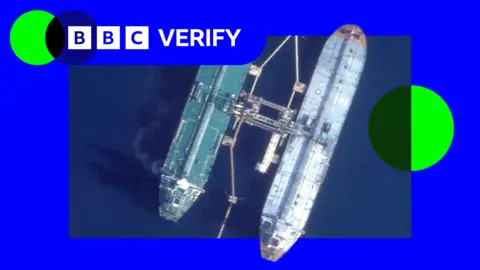
BBC An image showing the seized tanker refuelling. It is imposed over the BBC Verify branding and colours. BBC

The oil tanker seized by US forces on Wednesday had a track record of faking or concealing its location information, apparently to hide its activities, ship tracking data shows.

On Wednesday evening, the US confirmed that its forces seized a vessel during a helicopter-launched raid near the coast of Venezuela. BBC Verify confirmed the ship was the Skipper by matching a sign seen in footage released by the US to a reference photo supplied by TankerTrackers.com, a site which monitors oil shipments.

Data held by publicly accessible tracking sites paints an incomplete picture of the vessel's movements, and before its seizure it hadn't declared its position since 7 November. Maritime analytics firm Kpler also suggested that the vessel had engaged in a ship-to-ship transfer.

US Attorney General Pam Bondi described the vessel as a "crude oil tanker used to transport sanctioned oil from Venezuela and Iran".

The US Treasury department first sanctioned the ship in 2022, when it was sailing under the name Adisa, and was accused of being part of an "international oil smuggling network".

The Skipper has sailed under the flag of Guyana, but the government was quick to release a statement saying that the 20-year-old tanker was "falsely flying the Guyana Flag as it is not registered in Guyana".

Experts told BBC Verify that the Skipper was likely a part of the so-called "dark fleet" - a global network of oil tankers that seek to evade oil sanctions by obscuring their ownership, identities and travel histories.

Hiding its position

Under a UN treaty, all ships above a certain tonnage must have an onboard tracker called an Automatic Identification System (AIS). These trackers broadcast information about the ships, including their location, and can be followed on websites like MarineTraffic.

But there is an incomplete and misleading public record of the Skipper's movements. According to MarineTraffic, the Skipper's last known port call was at Soroosh in Iran on 9 July, where it arrived after stopping in Iraq and the UAE.

But Kpler suggests that this is part of a pattern of misleading entries by the Skipper. Analysts at the firm said the ship had previously loaded crude oil from Venezuela and Iran, while falsifying its position via its onboard tracker, a process known as spoofing.

Venezuela has some of the world's largest reserves of oil, but exports were placed under sanctions in 2019 by the US in a bid to force the transition of power from President Nicholas Maduro's administration, which has been widely accused of election rigging.

The firm noted that while its AIS showed the ship at Iraq's Basrah Oil Terminal on 7 and 8 July, terminal reports showed no record of the vessel there. Instead, the Skipper loaded crude oil at Kharg Island in Iran, Kpler said.

The Skipper then sailed east, tracking data shows, where Kpler suggested it conducted a ship-to-ship transfer between 11 and 13 August. The cargo was later unloaded in China, where Kpler said it was "falsely declared".

It returned via Iran and sailed towards the Caribbean. The Skipper last declared its position on 7 November, several miles off the coast of Guyana. Its onboard only reappeared on 10 December, after the US raid.
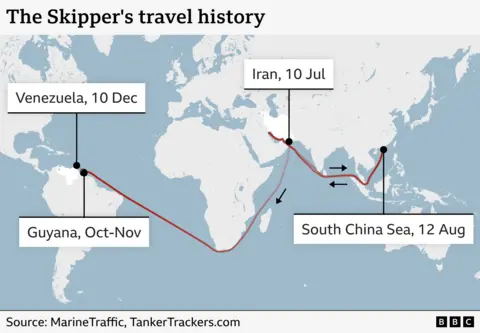
A graphic showing the ship's journey.

In the interim period, satellite images identified byTankerTrackers.com and confirmed by BBC Verify show that the Skipper was present in the Port of Jose in Venezuela on 18 November and not appearing on tracking sites at the time.

Since the imposition of sanctions, analysts say it has become common for ships to spoof or conceal their positions while loading oil in Venezuela.
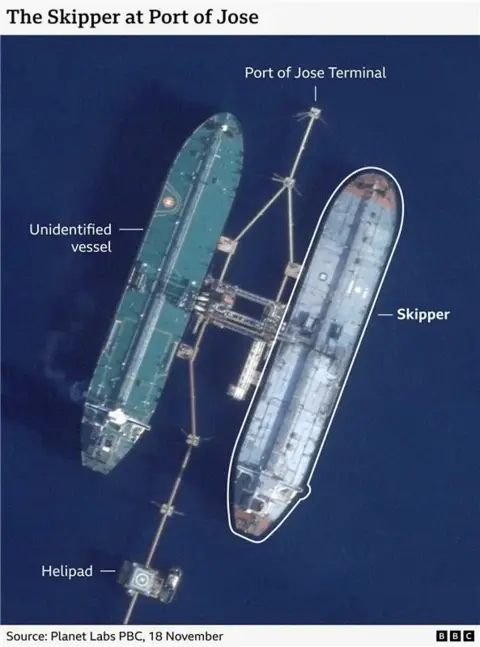
A BBC graphic showing the Skipper taking on cargo.

Kpler analysts said the ship loaded "at least 1.1 million barrels of Merey crude" by 16 November at the terminal and listed Cuba as the destination.

There is also evidence that the Skipper was involved in a ship-to-ship transfer with another vessel on 7 December, just days before it was boarded by US troops. Satellite images seen by Kpler appeared to show the exchange, with one of the vessels identified by Kpler as the Skipper.

The transfer took place just off the coast of Venezuela, near the city of Barcelona. According to MarineTraffic, the Skipper had last appeared off the coast of Guyana weeks earlier.

Such sanction evading activity is not unusual for Venezuelan oil exports, Kpler said. The company said that tankers often transfer their cargo off the coast of Malaysia, before the oil is imported into China.
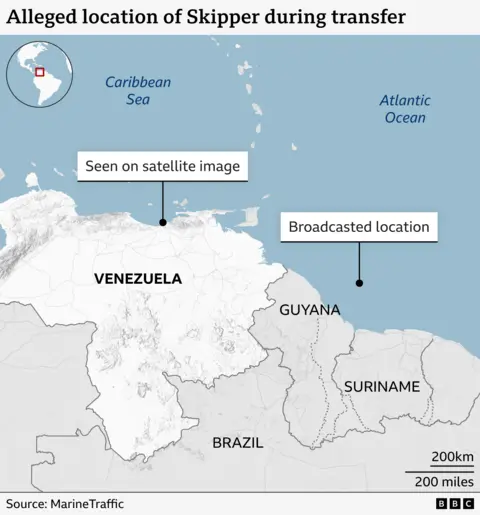
A graphic showing where the ship was seen on satellite images and where it had previously broadcasted its location.

Former Belgian naval lieutenant and analyst Frederik Van Lokeren told BBC Verify that while such ship-to-ship transfers are not illegal or wrong, they are "extremely uncommon". He said such activities were normally a sign of vessels trying to evade sanctions, transferring oil to ships not publicly associated with smuggling.

Mr Van Lokeren said that Venezuela's refining capacity has been significantly degraded in recent years and is "dependent" on its allies in Iran and Russia to convert its crude oil into more commercially lucrative products.

Who owns the Skipper?

MarineTraffic lists the beneficial owner and operator as Nigeria-based Thomarose Global Ventures Ltd and it lists the registered owner as Marshall Islands-based Triton Navigation Corp.

In 2022, the US Treasury said that Triton was being used by a sanctioned Russian oil magnate - Viktor Artemov - to facilitate a global "oil smuggling network".

At the time, US officials said Mr Artemov used an expansive network of ships often registered obscurely to transport Iranian oil.

In its statement, the US Treasury said that Triton had "materially assisted, sponsored, or provided financial, material, or technological support for, or goods or services to or in support of, Artemov".

BBC Verify is attempting to contact both companies for comment.

The BBC Verify banner.

Bulgarian PM and government resign after mass protests

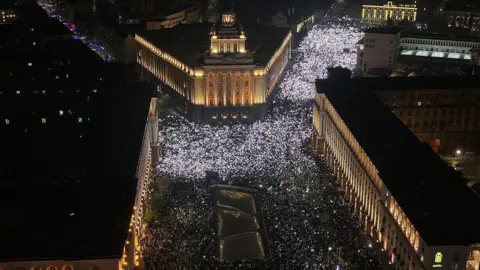
AFP via Getty Images Tens of thousands of protesters gather in central Sofia to demonstrate against the Buglarian government, in Sofia on December 10, 2025AFP via Getty Images
The centre of Sofia filled with tens of thousands of protesters on Wednesday night calling for the government to go

The government of Bulgarian Prime Minister Rosen Zhelyazkov has resigned after protesters took to the streets in cities across the country and filled the centre of the capital Sofia on Wednesday night.

Zhelyazkov's dramatic move came ahead of a vote of no confidence in parliament, and 20 days before Bulgaria joins the euro.

Protesters had accused his minority centre-right government, in power since January, of widespread corruption. The government had already scrapped a controversial budget plan for next year in response to the demonstrations last week.

"We hear the voice of citizens protesting against the government," Zhelyazkov said in a TV address.

"Both young and old have raised their voices for [our resignation]," he added. "This civic energy must be supported and encouraged." A statement on the government website said ministers would continue in their roles until a new cabinet was elected.

Between 50,000 and 100,000 people turned out in Sofia's central Triangle of Power and Independence Square on Wednesday evening calling for the government to go. The words "Resignation" and "Mafia Out" were projected onto the parliament building.

They were backed last week by President Rumen Radev who had also called on the government to stand down.

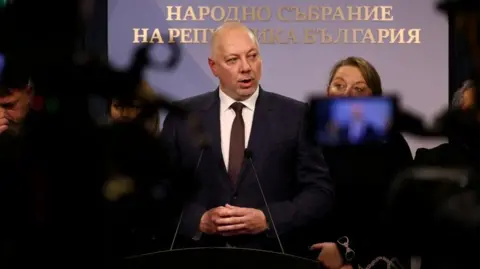
Reuters Bulgarian Prime Minister Rosen Zhelyazkov speaks to the media before announcing the resignation of his governmentReuters
Rosen Zhelyazkov has been in office for less than a year

Zhelyazkov's government had already survived five votes of no confidence and was expected to get through a sixth on Thursday.

Many of the protesters have been angered by the roles of two figures, oligarch Delyan Peevski and ex-prime minister Boyko Borissov, and Wednesday's rally was organised under the slogan "Resignation! Peevski and Borissov Out of Power", Bulgaria's BTA news agency reported.

Peevski has been sanctioned by the US and UK for alleged corruption and his party has helped prop up the government.

Borissov is part of Zhelyazkov's Gerb party, which came first in October 2024 elections, and he was reported to have said on Wednesday that the coalition parties had agreed to remain in power until Bulgaria joined the eurozone on 1 January.

Borissov was prime minister when anti-corruption protests brought down his government in 2020 and there have been seven elections since.

Despite the political drama in Sofia, Bulgaria's move to join the euro is not seen as under threat.

In his resignation statement, the outgoing prime minister said Bulgaria faced a major challenge and its citizens would need to produce "authentic proposals" on what the next government should look like.

Bulgaria ranks among the lowest in Europe in Transparency International's index for public sector corruption, between Hungary and Romania.

Ukraine hands US revised peace plan proposal, Germany says

Getty Images A man walking over an explosion siteGetty Images

German Chancellor Friedrich Merz said the latest peace plan draft for Ukraine has been presented to US President Donald Trump - including a proposal on territorial concessions Kyiv may be prepared to make.

But Merz highlighted the territorial issue was "a question that must be answered primarily by the Ukrainian president, and the Ukrainian people."

"We also made this clear to President Trump," Merz pointed out.

In recent weeks European leaders have worked closely with Ukraine to come up with a new iteration of a peace plan that addresses Kyiv's interests and concerns.

Trump appears to have grown frustrated with the intricacies of the question of sovereignty over Russian-occupied Ukrainian territories.

Because his negotiating team has previously worked closely with Moscow, Kyiv's European allies fear the US president might eventually seek to impose a Russian-led solution on Ukraine.

"It would be a mistake to force the Ukrainian president into a peace that his people will not accept after four years of suffering and death," Merz said in a joint news conference with Nato chief Mark Rutte.

He added that in Wednesday's "constructive" phone call with Trump, he, France's Emmanuel Macron and UK Prime Minister Sir Keir Starmer had "made it clear" that Europeans needed to have their interests heard too.

For his part, Trump said the participants had "discussed Ukraine in pretty strong words" and added that he was yet to decide whether to attend a meeting in Europe. "We don't want to be wasting time," he said.

Ukraine's President Volodymyr Zelensky has long signalled he would be prepared to talk to Trump directly to discuss the sticking points of a deal, but the US president has suggested all issues had to be ironed out before such a meeting could take place.

The territorial question is one of the thorniest. Russia demands that Ukraine withdraws entirely from the parts of the eastern Luhansk and Donetsk regions which it still holds - something Kyiv refuses to do, both on principle and because it fears it would allow Moscow a foothold for future invasions.

"We have no legal right to [cede territory], under Ukrainian law, our constitution and international law," Zelensky said earlier this week. "And we don't have any moral right either."

Zelensky is set to hold more talks with his allies today as he co-chairs a coalition of the willing call alongside Merz, Macron and Starmer.

As high-level, frantic diplomatic activity of the last few weeks has taken place among US, European and Ukrainian officials, with frequent statements from all sides, Moscow has remained remarkably tight-lipped.

Any comments from Russia have sought to cement the impression that Moscow and Washington are aligned on their hopes for the terms of a peace deal.

On Thursday Foreign Minister Sergei Lavrov praised Trump for trying to broker a deal and said the recent meeting between Vladimir Putin and US envoy Steve Witkoff at the Kremlin had "eliminated" the "misunderstandings" which had arisen since last summer's Trump-Putin summit in Alaska.

At the time, Russia and the US agreed Ukraine should return to a non-aligned, neutral, and nuclear-free status, Lavrov stated.

A map of Ukraine's south-eastern territories under Russian occupation

The foreign minister also batted off suggestions that Kyiv could be given security guarantees in the form of foreign troops stationed in Ukraine.

"This is yet another return to the sad logic of Zelensky's so-called peace formula," Lavrov said, adding that Moscow had handed the US "additional" proposals on collective security and that Russia was ready to give legal guarantees not to attack Nato or EU countries.

Yet Kyiv and its European allies believe that without security guarantees any peace settlement could be rendered meaningless.

But because Russia has previously violated ceasefire and truce deals, neither Ukraine nor Europe are likely to take any promise by Moscow at face value. In recent weeks European and Ukrainian officials have pushed for the US to be involved in guaranteeing that Kyiv doesn't become the target of renewed attacks.

Earlier this week Zelensky said he was ready to hold elections if the US and European countries could guarantee Ukraine's security during the vote. His five-year term as president was due to end in May 2024, but elections have been suspended in Ukraine since martial law was declared after Russia's full-scale invasion in February 2022.

Not for the first time, Nato chief Mark Rutte said on Thursday that too many of the alliance's allies did not feel the urgency of Russia's threat in Europe.

"We are Russia's next target," he warned, adding that Nato had to make all efforts to prevent a war that could be "on the scale of war our grandparents and great-grandparents endured".

US judge orders Kilmar Abrego Garcia's release from ICE custody

Getty Images Image of Kilmar Abrego Garcia speaking into a microphone at a rally on August 25, 2025 in Baltimore, Maryland. Getty Images

A judge has ordered the immediate release of Kilmar Abrego Garcia, who was mistakenly deported in March and brought back to the US to face criminal charges, from immigration custody.

"Since Abrego Garcia's return from wrongful detention in El Salvador, he has been re-detained, again without lawful authority," Judge Paula Xinis wrote in her order.

Mr Abrego Garcia was sent to a prison in El Salvador earlier this year, which the US government later admitted was in error. He was returned to the US to face human smuggling charges and has been held since then.

Judge Xinis also wrote that the government did not have a removal order, which blocks it from deporting Mr Abrego Garcia "at this juncture".

The Trump administration contends Mr Abrego Garcia is a member of the violent criminal MS-13 gang, which he denies. This spring, the administration flew a large group of migrants it alleged were in the gang to El Salvador's CECOT prison. But a previous court order had barred the US from sending Mr Abrego Garcia to the country.

Mr Abrego Garcia also has pleaded not guilty to the smuggling charges, which are part of a trial in Tennessee.

Judge Xinis, who was hearing his challenge to deportation in a federal court in Maryland, said he must now follow the conditions of his release from jail in Tennessee.

Thousands ready to evacuate as flooding hits Pacific Northwest

Watch: Record-setting floods hit the United States’ Pacific Northwest

Residents in the Pacific Northwest of the US and Canada are bracing for what could be record setting floods as an atmospheric river dumps heavy rain on already swollen rivers.

The US National Weather Service warns that catastrophic flooding is possible in the states of Oregon and Washington along the Skagit and Snohomish rivers.

In Canada, major highways to Vancouver have been closed because of flooding, debris and the risk of avalanches.

There are evacuation orders in place for thousands of people in the US and Canada, and authorities have that warned more rain is on the way on Thursday.

In the US, the governor of Washington state, Bob Ferguson, declared a statewide emergency on Wednesday and estimated 100,000 residents could soon face evacuation orders.

The emergency declaration warned that continued rain and snow at mountain elevations would exacerbate flooding conditions. Supply chains and transportation could be severely impacted, the declaration added.

Skagit County, a major agricultural area north of Seattle, has issued an immediate evacuation order to residents who live on the floodplain.

Some 75,000 people would be evacuated from low-lying areas on Skagit River, the director of the Washington Military Department's Emergency Management Division, Robert Ezelle, told reporters on Wednesday.

Snohomish County Sheriff's Office said in an overnight social media post that they had rescued "multiple" people by helicopter after they became trapped in their homes in Sultan, Washington, a community roughly 40 miles (65km) northeast of Seattle.

The sheriff's office warned residents on Thursday morning that the eastern region of the county is most affected after the Skykomish River crested above 24ft (7m) overnight - just shy of a record.

They said the Snohomish River is also experiencing major flooding and "dancing with records" as water laps against a local flood wall.

King county and Snohomish county officials have said there are multiple closures on state and local roads, with more likely on Thursday.

The Pierce County Sheriff's office in an video post on Wednesday said their swiftwater team had to rescue three people from an RV park on Orting, a community about 42 miles south of Seattle. Multiple roads are also closed in that county.

Reuters Deputy Sheriff Kalani Apilado helps Brandon Phasith carry belongings while evacuating amidst rising floodwater, as an atmospheric river brings rain and flooding to the Pacific Northwest, in Sultan, WashingtonReuters
Evacuation efforts were under way in Sultan, Washington, on Wednesday

Across the border in Canada's British Columbia, there are evacuation orders in place for the communities of Tulameen and Eastgate, and several other areas.

The City of Abbotsford ordered urgent evacuations for 371 properties at 23:00 local time on Wednesday (07:00 GMT on Thursday).

City officials said the Nooksack River is expected to overflow its banks early on Thursday, and said they anticipate flooding though not as severe as in the province in 2021, when it caused significant damage and five deaths.

All major highways to the Lower Mainland are now closed, according to the travel information website Drive BC.

The US-Canada Sumas Border crossing is also closed in both directions.

The entire region, spanning parts of both the US and Canada, has received torrential rain from an atmospheric river, which is a phenomenon where water evaporates into the air and is carried by the wind and forms long currents that surge through the sky like rivers flow on land.

The heaviest rainfall is expected to subside by Thursday afternoon, but the water will continue to work its way into rivers.

Another storm is expected on Sunday.

美国扣押委内瑞拉“超大型”油轮原因曝光 可能吓跑中国买家 - RFI - 法国国际广播电台

11/12/2025 - 17:09

特朗普周三宣布,美国在委内瑞拉近海扣押了一艘“超大型”油轮。法新社说,此举进一步加剧了华盛顿与加拉加斯的紧张关系,委内瑞拉谴责这是“国际海盗行为”。

美国总统在白宫告诉记者:“我们刚刚在委内瑞拉近海扣押了一艘油轮,一艘大型油轮,非常大,是迄今为止扣押过的最大一艘”。

据专业网站MarineTraffic报道,被美国扣押的油轮名为“Skipper”(船长号),属于“超大型原油运输船”(VLCC)。据MarineTraffic称,该船载有110万桶受制裁的原油。

伊朗和真主党

“船长号”长333米,因涉嫌与伊朗伊斯兰革命卫队和真主党有联系,于2022年受到美国财政部的制裁。

当年,这艘船以“阿迪萨”(Adisa)号之名航行。

美国司法部长帕姆·邦迪在其X账号上发布的一段45秒的视频显示,美军武装士兵从直升机降落船上突袭。在视频中,除美军士兵外未见其他人。

帕姆·邦迪说,这次行动主要是联邦调查局在国防部支持下进行的。

她在X上表示:“多年来,这艘油轮因参与支持外国恐怖组织的非法石油运输网络而受到美国制裁。”

驶往古巴

她称,这艘被扣押的船所运载的是来自委内瑞拉和伊朗的受制裁石油。

这位司法部长说,扣押这艘船的行动发生在“委内瑞拉海岸附近”,而且“过程很安全”。

据《华盛顿邮报》报道,这艘油轮当时正驶往古巴运送石油。

美国政府正采取一系列经济和军事措施,对委内瑞拉社会主义领导人尼古拉斯·马杜罗施加更大压力。

唐纳德·特朗普在最近接受Politico网站采访时表示,马杜罗的统治已经“时日无多”了。

自今年夏天以来,华盛顿在加勒比地区部署了大量军事力量。但扣押油轮在此次危机中尚属首次,而石油是委内瑞拉的主要收入来源。

委内瑞拉外交部在一份声明中“强烈谴责美国总统公开宣布的这一无耻盗窃和国际海盗行为”。

该部还认为,通过这一“犯罪行为”,美国总统表明“其目标始终是无偿掠夺委内瑞拉石油,这清楚地显示其对我国的侵略政策,是蓄意掠夺我国能源财富的计划”。

“窃贼,海盗”  

委内瑞拉内政部长迪奥斯达多·卡韦略在每周电视节目中补充说,"他们是杀人犯、“窃贼、海盗"。他说,那部电影叫什么来着,《加勒比海盗》?杰克·斯派罗是个英雄,而这些人却是海上罪犯、海盗,他们一直都这么干。

法新社说,这次扣船行动发生在委内瑞拉反对派玛丽亚·科里娜·马查多获诺贝尔和平奖颁奖典礼当天,她将这个奖项献给了唐纳德·特朗普。

周三,在加拉加斯的一次集会上,尼古拉斯·马杜罗要求结束“美国政府在委内瑞拉和拉丁美洲的非法和粗暴干涉”,不过他并未明确提及扣押油轮一事。

禁运

华盛顿指控委内瑞拉当局是向美国倾销毒品的幕后黑手,因此对涉嫌运毒的船只发动了多次打击,尤其是在加勒比海地区。

美国轰炸了大约二十艘船,造成87人死亡。

加拉加斯认为,这是旨在将马杜罗赶下台并夺取该国庞大石油储备的行动。自2019年以来,该国一直处于禁运状态。

主要销往中国

2023年,禁运政策有所放松,允许在该国开展业务,但唐纳德·特朗普重返白宫后已撤销了这些许可。

这迫使委内瑞拉以明显较低的价格将石油产品销往黑市,特别是销往中国。

而这次油轮被扣押,可能会影响这些出口,吓跑潜在的买家。

据分析师称,委内瑞拉每天供应110万桶原油,主要销往中国。

据欧盟驻委内瑞拉贸易代表海梅·路易斯·索卡斯估计,今年委内瑞拉的原油采购量将下降75%,将从2024年的15.35亿欧元降至2025年的3.83亿欧元。


奥地利议会通过法令禁止14岁以下女孩佩戴穆斯林头巾

德正
2025-12-11T15:11:35.216Z
戴头巾上学:禁,还是不能禁?

(德国之声中文网)奥地利融合与家庭部长普拉科尔姆(Claudia Plakolm)表示,这是保护女孩的一项历史性举措。她指出,头巾并非一块无害的布料,“它是压迫的象征”。这位来自人民党(ÖVP)的保守派政治家强调,奥地利的任何女孩都不应该在成长过程中被迫遮掩自己的身体。

根据法律文本,该禁令适用于“按照伊斯兰传统遮盖头部的头巾”,将于2026/2027学年开始生效。学校将于明年2月开始进行宣传教育,为新规做好准备。

如违反禁令,学校管理部门首先应与涉事女生及其家长会面。如果女生继续佩戴头巾,家长必须与学校主管部门沟通。作为最终手段,可处以150至800欧元的罚款。

奥地利绿党表示,并非原则上反对头巾禁令,但在此次投票中投出反对票,理由是认为该法律不符合宪法。

2019年,奥地利人民党-自由党联盟通过了一项针对10岁以下女童的头巾禁令,但被宪法法院推翻。当时宪法法院认为,该规定歧视穆斯林妇女,违反了国家宗教中立原则。

人权组织也表达了担忧。国际特赦组织表示,该禁令将“进一步加剧当前针对穆斯林的种族主义氛围”。伊斯兰宗教团体则称,这是一种对基本权利的干预。

相关图集:展示你们的头巾!

头巾下面:居勒斯(Nilbar Güres)称,把头发遮盖起来的穆斯林女性并非其信仰的木偶。她制作于2006年的一个视频取名“Soyunma/Undressing”(解开)。这里是其中的4个画面。艺术家在这里一边揭开一层又一层面纱,一边轻声念出家人中那些女性的名字。
假发:在这个名为“遮盖”(Covered,2009)的自肖像中,施泰恩施莱伊格尔(Anna Shteynshleyger)戴了两个头套。它们是这位虔诚的犹太女性的日常发套。直到17世纪末叶,犹太女性都用叫做提谢尔(Tichel)的头巾遮盖头发。后来,假发套时兴,成为传统头盖的完美替代品,取名“沙伊特尔”(Scheitel)。
一种信仰,众多头巾:短头巾、长头巾、固定插入式的或围在脖子上的,—各种各样的穆斯林头盖各有何意义?这一展览作了解释,并向观者展示,何种头巾属于何种文化圈、何种宗教,以及涵有何种意义。对很多虔诚的穆斯林女性来说,戴头巾是伊斯兰基本责任之一。
做礼拜时将头发遮起来:德国少数族群的日常宗教生活:女摄影家米哈伊洛娃(Marija Mihailova)记录了柏林的俄罗斯—东正教教堂的习俗。为做礼拜,妇女们用头巾把头发遮盖起来。这可是一种在天主教和新教教堂里基本上不再会看到的习俗。
头发太密惹麻烦:在阿拉伯国家,有一头黑长发是一种理想美。在这一塑像里,美发难以遮盖。伊朗女艺术家莫格哈达姆(Mandana Moghaddam)在取名为“Chelgis I”(2001)的雕塑中虽展示了美发,同时却做出一层遮纱,掩饰了这位少女的身份。它影射讲述一个有40根辫子的一名被囚少女故事的波斯童话。
头发只给丈夫看:提谢尔是犹太语说法,是虔诚犹太女性头盖的一种称呼。在摄于2001年的这幅照片中,拉奥尔(Leora Laor)记录了耶路撒冷原教旨犹太教地区Mea Schearim的日常画面。根据犹太教义,婚后,只有丈夫才能看到妻子的头发。因此,从此时起,不管是用普通的头巾,还是用繁复的头饰或假发套,头发都得遮盖起来。
自由空间:纽约康尼岛(Coney Island)海滩上的犹太女性,瓦拉布雷加(Federica Valabrega)摄于2011年。她们都有头盖,但缕缕发丝仍从下面露出。宗教习俗多种多样,对付手段及其解释亦多种多样,并极富创意。
遮盖严实的海滩客:在海洋里戏水,同时又忠实于信仰?对笃信的穆斯林女性来说,布基尼(Burkini)再合适不过。布基尼只露出头和身体上被允许外露的部分。不过,一些西方人又因此感觉受到了挑衅。

DW中文有Instagram!欢迎搜寻dw.chinese,看更多深入浅出的图文与影音报道。

© 2025年德国之声版权声明:本文所有内容受到著作权法保护,如无德国之声特别授权,不得擅自使用。任何不当行为都将导致追偿,并受到刑事追究。

Why Oracle Is Worrying Investors About the A.I. Boom

Shares in the technology company are down as investors grow anxious that its bet on artificial intelligence, and OpenAI in particular, may not pay off.

© Haiyun Jiang for The New York Times

Investors are increasingly linking the futures of Oracle, led by Larry Ellison, center, and SoftBank, helmed by Masa Son, left, with OpenAI, Sam Altman’s A.I. giant.

美国启动“特朗普金卡”签证项目

德闻
2025-12-11T14:31:00.347Z
特朗普:“基本上,它就是一张绿卡”

(德国之声中文网)特朗普政府12月10日推出了一项新的快速签证审批计划,面向愿意支付100万美元“捐款”以获得美国永久居留权的外国人。特朗普金卡被宣传为升级版“绿卡”。

特朗普在白宫告诉记者:“基本上,它就是一张绿卡,但更好,更强大,更可靠。申请人必须是优秀的人。”

特朗普还在其“真相社交”(Truth Social)平台上发帖称,金卡将为“所有合格且经过审查的人提供一条直接获得公民身份的途径”。“我们伟大的美国公司终于可以留住他们宝贵的人才了,”特朗普补充道。

申请人可通过网站trumpcard.gov访问这个项目,还可以向国土安全部支付1.5万美元以加快审批流程。

该网站写道:“只需支付15000美元的国土安全部处理费,并在背景调查通过后捐款100 万美元,即可凭借特朗普金卡以创纪录的速度获得美国永久居留权。”

商务部长卢特尼克说,在预注册期间,已有约1万人注册黄金卡,他预计会有更多人注册。

企业可以申请价值200万美元的“企业金卡”来担保员工。

trumpcard.gov网站称,售价500万美元的“特朗普白金卡”将允许持卡人在美国停留长达270天而无需缴纳海外收入税。

此举正值特朗普政府持续打击移民之际,数万人被拘留,非法滞留者被驱逐出境。此外,美国政府还暂停了来自十几个国家(主要来自非洲和中东)的移民申请,并敦促一些大学减少国际学生的招生。

DW中文有Instagram!欢迎搜寻dw.chinese,看更多深入浅出的图文与影音报道。

© 2025年德国之声版权声明:本文所有内容受到著作权法保护,如无德国之声特别授权,不得擅自使用。任何不当行为都将导致追偿,并受到刑事追究。

中国石油需求峰值预计延后至2040年

中石油经济技术研究院预计,中国石油需求峰值预计出现在2040年,比去年预测的2030年延后10年。

金融界AI电报星期四(12月11日)报道,中石油经研院称,到2035年,中国化石能源需求将达到127亿吨标准油当量,较2025年增加4亿吨。

石油需求峰值预计将出现在2040年,而去年预测为2030年,且峰值水平将高于此前预测。

经研院预计,到2030年,全球液化天然气总产能将超过每年7亿吨。全球天然气需求将于2040至2045年达到峰值,为5万亿立方米,较2024年展望水平增长11%。

Hundreds of items taken in 'high value' Bristol Museum archive raid

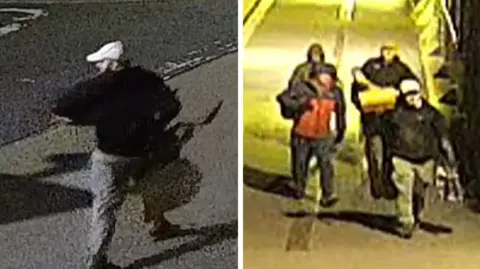
Avon and Somerset Police A blurry CCTV image of four men wearing jackets and baseball caps in a street at night time. Avon and Somerset Police
Police want to speak to these four men after more than 600 artefacts were stolen

More than 600 artefacts "of significant cultural value" have been stolen from Bristol Museum's archive in a "high-value" raid, police say.

Four men gained entry to a building in the Cumberland Basin area of the city in the early hours of 25 September, Avon and Somerset Police said.

Items from the museum's British Empire and Commonwealth collection were stolen and detectives are now trying to trace four males captured in the area on CCTV.

"The theft of many items which carry a significant cultural value is a significant loss for the city," Det Con Dan Burgan said.

Avon and Somerset Police Two CCTV images places side by side. One is a man in a dark jacket, grey trousers and white hat and carrying a bag. The second is a group of all four males in the street, they all have hats or their hoods up. All are carrying bags. Avon and Somerset Police
The men are described as being white and were all wearing jackets and baseball caps

"These items, many of which were donations, form part of a collection that provides insight into a multi-layered part of British history, and we are hoping that members of the public can help us to bring those responsible to justice," he added.

"So far, our enquiries have included significant CCTV enquiries as well as forensic investigations and speaking liaising with the victims."

Police are keen to speak to anyone who recognises the men captured on CCTV, or who may have seen possible stolen items being sold online.

All of the men are thought to be white. The first was described as of medium to stocky build and was wearing a white cap, black jacket, light-coloured trousers and black trainers.

The second was described as being of slim build and was wearing a grey, hooded jacket, black trousers and black trainers.

The third was wearing a green cap, black jacket, light-coloured shorts and white trainers. Police said he appeared to walk with a slight limp in his right leg.

The fourth was described as being of large build and was wearing a two-toned orange and navy or black puffy jacket, black trousers and black and white trainers.

Follow BBC Bristol on Facebook, X and Instagram. Send your story ideas to us on email or via WhatsApp on 0800 313 4630.

'Architects of AI' named Time Magazine's Person of the Year

Getty Images Nvidia boss Jensen Huang in side-profileGetty Images
Nvidia boss Jensen Huang is among the tech bosses the magazine has put on its biggest cover of the year

Time Magazine's Person of the Year for 2025 is not a single person.

Instead, the magazine has given its annual award recognising the year's most influential figure to "the architects" of artificial intelligence (AI).

Nvidia boss Jensen Huang, Meta head Mark Zuckerberg, X owner Elon Musk and AI "godmother" Fei-Fei Li are among those depicted on one of the magazine's two covers.

Experts say it highlights how quickly AI, and the firms behind it, are reshaping society.

It comes as a boom in the technology, ushered in by OpenAI's launch of ChatGPT in late 2022, continues at pace.

The firm said in September its chatbot is used by around 700 million people every week.

Big tech firms are pouring billions of dollars into AI and the infrastructure behind it in a bid to stay ahead of rivals.

There are two covers this year - one a piece of art depicting the letters AI surrounded by workers, and another a painting focused on the tech leaders themselves.

Time Eight people in suits sitting on a girder with a cityscape behind them. Time
The cover references the classic New York photograph "Lunch atop a Skyscraper" - but with tech figures in place of ironworkers

At Meta, Zuckerberg has reportedly focused the firm around the tech, including its AI chatbot, which it has embedded in its popular apps.

He, along with Huang, Musk and Li, appeared on the cover alongside Lisa Su, boss of chipmaker AMD, OpenAI head Sam Altman, Anthropic chief Dario Amodei, and Google's AI lab lead Sir Demis Hassabis.

"This year, the debate about how to wield AI responsibly gave way to a sprint to deploy it as fast as possible," Time said as it announced its new covers.

"But the risk-averse are no longer in the driver's seat.

"Thanks to Huang, Son, Altman, and other AI titans, humanity is now flying down the highway, all gas no brakes, toward a highly automated and highly uncertain future."

And the magazine's editor-in-chief Sam Jacobs said "no one" had as great an impact in 2025 than "the individuals who imagined, designed, and built AI".

"Humanity will determine AI's path forward, and each of us can play a role in determining AI's structure and future," he said.

Time The other Time cover shows the letters AI, with construction workers surrounding it. It is as if they are building a giant statue of the letters out of computer parts.Time

Forrester analyst Thomas Husson said 2025 could be seen as a "tipping point" for how frequently AI is now used in our day-to-day lives.

"Most consumers use it without even being aware of it," he told the BBC.

He said AI is now being crammed into hardware, software and services - meaning it its uptake is "much faster than during the Internet or mobile revolutions".

Some people now choose chatbots over search engines and social media to plan holidays, find Christmas gifts and discover recipes.

Others, such as those worried about its energy use, training data and impact on their livelihoods, are opting-out entirely.

Nik Kairinos, founder and chief executive of lab Fountech AI, said the honour was "an honest assessment" of the tech's influence, but he felt "recognition should not be confused with readiness".

"At this moment, AI can still be a saviour or scourge to humanity," he said.

"We are still in the early stages of building AI systems that are dependable, accountable, and aligned with human values.

"For those of us developing the technology and bringing AI tools to market, there is huge responsibility."

A green promotional banner with black squares and rectangles forming pixels, moving in from the right. The text says: “Tech Decoded: The world’s biggest tech news in your inbox every Monday.”

Sign up for our Tech Decoded newsletter to follow the world's top tech stories and trends. Outside the UK? Sign up here.

Austria bans headscarves in schools for under-14s

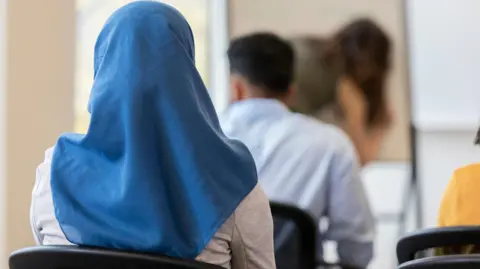
Getty Images A woman wearing a blue headscarf seen from behind as she sits in a chair in a classroomGetty Images

Austria has passed a law banning headscarves in schools for girls under the age of 14.

The conservative-led coalition of three centrist parties, the ÖVP, the SPÖ and the Neos, says the law is a "clear commitment to gender equality", but critics say it will fuel anti-Muslim feeling in the country and could be unconstitutional.

The measure will apply to girls in both public and private schools.

In 2020, a similar headscarf ban for girls under 10 was struck down by the Constitutional Court, because it specifically targeted Muslims.

The terms of the new law mean girls under 14 will be forbidden from wearing "traditional Muslim" head coverings such as hijabs or burkas.

If a student violates the ban, they must have a series of discussions with school authorities and their legal guardians. If there are repeated violations, the child and youth welfare agency must be notified.

As a last resort, families or guardians could be fined up to €800 (£700).

Members of the government say this is about empowering young girls, arguing it is to protect them "from oppression".

Speaking ahead of the vote, the parliamentary leader of the liberal Neos party, Yannick Shetty said it was "not a measure against a religion. It is a measure to protect the freedom of girls in this country," and added that the ban would affect about 12,000 children.

The opposition far-right Freedom Party of Austria, the FPÖ, which voted in favour of the ban, said it did not go far enough.

It described the ban as "a first step", which should be widened to include all pupils and school staff.

"There needs to be a general ban on headscarves in schools; political Islam has no place here", the FPÖ's spokesperson on families Ricarda Berger said.

Sigrid Maurer from the opposition Greens called the new law "clearly unconstitutional".

The official Islamic Community in Austria, the IGGÖ, said the ban violated fundamental rights and would split society.

In a statement on its website, it said "instead of empowering children, they will be stigmatised and marginalised."

The IGGÖ said it would review "the constitutionality of the law and take all necessary steps."

"The Constitutional Court already ruled unequivocally in 2020 that such a ban is unconstitutional, as it specifically targets a religious minority and violates the principle of equality," the IGGÖ said.

The government says it has tried to avoid that.

"Will it pass muster with the Constitutional Court? I don't know. We have done our best," Shetty said.

An awareness-raising trial period will start in February 2026, with the ban fully going into force next September - the beginning of the new school year.

Hunger Games fans thrilled by return of Jennifer Lawrence

Lionsgate Still from Hunger Games: Mockingjay Part 2 shows Jennifer Lawrence and Josh Hutcherson in costume, being addressed by a third character just off-screen.Lionsgate
Jennifer Lawrence and Josh Hutcherson were last seen in 2015's Mockingjay Part 2

Jennifer Lawrence and Josh Hutcherson are reportedly set to return to the Hunger Games in next year's highly anticipated prequel.

The pair last starred together in Mockingjay - Part 2, the climactic installment of the original film series.

US magazines The Hollywood Reporter and Deadline reported that Jennifer, 35, return as Katniss Everdeen while Josh, 33, will reprise his role of Peeta Mellark in The Hunger Games: Sunrise on the Reaping.

They suggest the actors will appear in a flash-forward sequence which features in the novel the new film's based on.

BBC Newsbeat's approached production company Lionsgate for comment.

Lawrence, who became a household name playing Katniss, previously said she'd be "totally" up for coming back as the character.

And last month Josh Hutcherson told US magazine Variety he'd "be there in a heartbeat" if he was asked to come back.

"It would not take any convincing at all," he said.

Hunger Games fans were ecstatic at news the beloved characters would be making a new appearance.

One wrote: "For non-Hunger Games fans this is like Rihanna returning to music."

Another added: "It's basically Jesus returning to Earth."

But there were some who weren't happy to see the information revealed, saying it could have been kept an "emotional" surprise.

Getty Images A shelf in a bookshop loaded with Hunger Games books and stationery bearing the series logo of a golden bird inside a burning ring, and magazines bearing portraits of Jennifer Lawrence.Getty Images
The Hunger Games is a global best-selling franchise which still lasts in popular culture today

The Hunger Games: Sunrise on the Reaping also stars McKenna Grace, Maya Hawke and Ralph Fiennes and is due to hit cinemas in November 2026.

Author Suzanne Collins' book of the same name sold more than 1.5 million copies worldwide during its release week earlier this year - the biggest debut for one of her books.

The Hunger Games series has reportedly made $3.3bn since the release of the first movie in 2012, and a theatre version recently launched.

A footer logo for BBC Newsbeat. It has the BBC logo and the word Newsbeat in white over a colorful background of violet, purple and orange shapes. At the bottom a black square reading "Listen on Sounds" is visible.

Listen to Newsbeat live at 12:45 and 17:45 weekdays - or listen back here.

Venezuelan Nobel winner tells BBC she knows 'risks' of Oslo trip after months in hiding

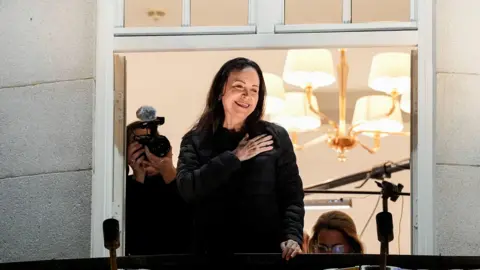
EPA/Shutterstock Nobel Peace Prize laureate Maria Corina Machado stands on a balcony with photographers and a hanging light fixture in a hotel room behind her. It is nighttime and she has her hand over her heart. She is smiling and wearing dark clothing.EPA/Shutterstock

Venezuelan opposition leader María Corina Machado appeared in Oslo, Norway after winning the Nobel Peace Prize, waving from the balcony of the Grand Hotel after months in hiding.

Machado made the covert journey despite a travel ban, and has mostly laid low since Venezuela's disputed presidential election in 2024. She last appeared in public in January.

From a balcony on Wednesday with a crowd cheering below, Machado placed her hand on her heart and sang with her supporters, before walking outside to greet them in person.

Her daughter, Ana Corina Sosa, accepted the award on her mother's behalf earlier in the day.

The Nobel Institute awarded Machado the Peace Prize this year for "her struggle to achieve a just and peaceful transition from dictatorship to democracy" in Venezuela.

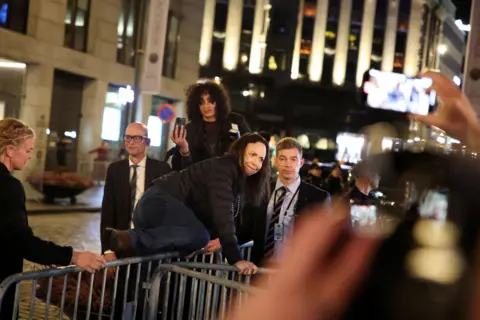
Afterwards, Machado went the outside to greet her supporters, who waited behind metal barricades on the street.

"Maria!" "Maria, here!" they shouted in Spanish, as many held their phones aloft to record the historic moment.

At one point, Machado climbed over the barriers to join them.

Reuters Maria Corina Machado jumps over barricades outside the Grand Hotel in Oslo to greet cheering supporters as security looks on.Reuters
Maria Corina Machado jumps over barricades outside the Grand Hotel in Oslo to greet cheering supporters.

Her appearance was preceded by speculation that she would travel to Norway for the award ceremony.

The Nobel committee shared audio of Machado declaring, "I will be in Oslo, I am on my way."

After her Peace Prize win, Machado made a point to praise US President Donald Trump, who is open about his own ambitions for the Peace Prize and is locked in ongoing military tension with Venezuela.

On Wednesday, Trump announced the US military had seized an oil tanker off the coast of Venezuela. His administration alleges the vessel was under sanction and was involved in an "illicit oil shipping network supporting foreign terrorist organisations".

The Venezuelan government accused the US of theft and piracy.

Venezuelan Nobel winner tells BBC she knows 'risks' of Oslo trip after months in hiding

EPA/Shutterstock Nobel Peace Prize laureate Maria Corina Machado stands on a balcony with photographers and a hanging light fixture in a hotel room behind her. It is nighttime and she has her hand over her heart. She is smiling and wearing dark clothing.EPA/Shutterstock

Venezuelan opposition leader María Corina Machado appeared in Oslo, Norway after winning the Nobel Peace Prize, waving from the balcony of the Grand Hotel after months in hiding.

Machado made the covert journey despite a travel ban, and has mostly laid low since Venezuela's disputed presidential election in 2024. She last appeared in public in January.

From a balcony on Wednesday with a crowd cheering below, Machado placed her hand on her heart and sang with her supporters, before walking outside to greet them in person.

Her daughter, Ana Corina Sosa, accepted the award on her mother's behalf earlier in the day.

The Nobel Institute awarded Machado the Peace Prize this year for "her struggle to achieve a just and peaceful transition from dictatorship to democracy" in Venezuela.

Afterwards, Machado went the outside to greet her supporters, who waited behind metal barricades on the street.

"Maria!" "Maria, here!" they shouted in Spanish, as many held their phones aloft to record the historic moment.

At one point, Machado climbed over the barriers to join them.

Reuters Maria Corina Machado jumps over barricades outside the Grand Hotel in Oslo to greet cheering supporters as security looks on.Reuters
Maria Corina Machado jumps over barricades outside the Grand Hotel in Oslo to greet cheering supporters.

Her appearance was preceded by speculation that she would travel to Norway for the award ceremony.

The Nobel committee shared audio of Machado declaring, "I will be in Oslo, I am on my way."

After her Peace Prize win, Machado made a point to praise US President Donald Trump, who is open about his own ambitions for the Peace Prize and is locked in ongoing military tension with Venezuela.

On Wednesday, Trump announced the US military had seized an oil tanker off the coast of Venezuela. His administration alleges the vessel was under sanction and was involved in an "illicit oil shipping network supporting foreign terrorist organisations".

The Venezuelan government accused the US of theft and piracy.

Poland arrests Russian archaeologist wanted in Ukraine

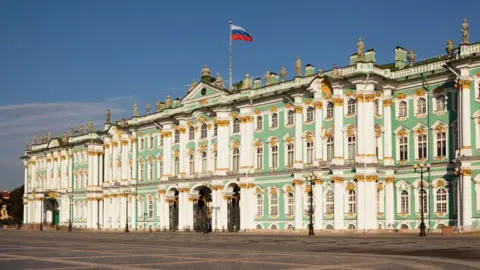
Universal Images Group via Getty Images Hermitage Museum photograph showing the entire building. It is mint green and white with gold detailing. There is a pole with a Russian flag raised from the front centre of the roofUniversal Images Group via Getty Images
Alexander Butyagin works at the world famous Hermitage Museum in St Petersburg.

Polish authorities have arrested a prominent Russian academic from St Petersburg's world-famous Hermitage Museum who is sought by Ukraine for allegedly conducting illegal excavations and partially destroying the ancient city of Myrmekion in Crimea.

The suspect, identified under Polish law as Aleksandr B, is the head of the Ancient Archaeology of the Northern Black Sea region at the museum, according to Ukrainian prosecutors.

Ukrainian prosecutors accuse him of conducting illegal excavations at the site in Kerch between February 2014 and November 2025.

"As a result of these excavations, from 2014-2019, he illegally partially destroyed the 'Ancient City of Myrmekion' archaeological complex," Prosecutor Piotr Skiba, a spokesman for the Warsaw District Prosecutor's Office told the BBC, citing information from Ukrainian prosecutors.

Ukraine estimates the damage at UAH 201.6 million ($4.77 million).

Russia invaded Crimea in February 2014 and annexed it. Russia's foreign ministry identified the man as Alexander Butyagin, an employee of the State Hermitage Museum and condemned his detention.

"This is absolute legal tyranny. We will of course demand through diplomatic channels the right to protect the interests of our citizen," Kremlin spokesman Dmitry Peskov said.

Myrmekion was an Ancient Greek colony founded by the Ionians in the first half of the Sixth Century BCE located in contemporary Crimea.

Prosecutor Skiba said the man was detained in Poland on 4 December and was later questioned by prosecutors in Warsaw, "where he refused to provide explanations".

The Ukrainian Prosecutor's Office issued an extradition request for Aleksandr B in November, Skiba said.

According to the request: "He searched for movable objects on cultural heritage sites without the appropriate permit to conduct excavations at the 'Ancient City of Myrmekion' archaeological complex in Kerch….and conducted illegal excavations at this cultural heritage site from the beginning of the temporary occupation of the territory of Crimea".

Russia's foreign ministry said Butyagin had been invited to deliver lectures on Pompeii in Warsaw and several other European cities.

Warsaw District Court has agreed to remand Aleksandr B in custody at the Warsaw-Białołęka detention centre for 40 days until 13 January whilst the extradition process goes ahead.

The Russian embassy in Warsaw has been informed of his arrest and pre-trial detention and are providing him with consular assistance, Prosecutor Skiba said.

Severe disruption hits Portugal in first general strike for 12 years

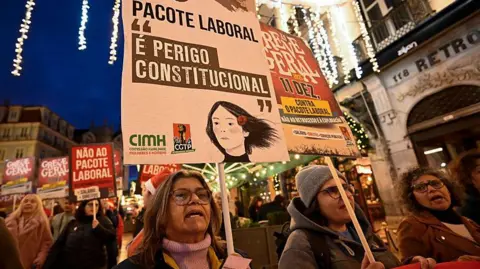
Corbis via Getty Images Women march in Lisbon against the government's labour packageCorbis via Getty Images
The two big union federations are staging the strike, which will disrupt much of the country's services

Portugal is facing severe disruption to transport, flights, hospitals, schools and other public services on Thursday, as the two main union federations stage a general strike over unprecedented labour reforms.

The last time the CGTP and the generally less militant UGT joined forces was during the eurozone debt crisis in 2013, when a "troika" of international institutions demanded cuts in salaries and pensions as part of Portugal's bailout.

Twelve years later, Portugal's economy has become the fastest growing in the eurozone in recent months, but Prime Minister Luís Montenegro says it is still necessary to tackle "rigidities" in the labour market "so companies can be more profitable and workers have better salaries" as a result.

"I will not give up on having a country with the ambition to be at the forefront, to be at the vanguard of Europe," he said on the eve of the strike.

However, Montenegro appears to have been taken aback by the strength of feeling against his minority right-of-centre government's plans: one of his Social Democrat MPs is on the UGT executive and even he voted for a strike.

The prime minister tweaked some proposals after calling the federation in for talks late last month, but it was clearly not enough.

Among the most controversial of the more than 100 proposals are:

  • letting employers roll over temporary contracts for years on end
  • lifting a ban on sacking workers then immediately rehiring them indirectly via outsourcing
  • removing a requirement to reinstate employees who were unfairly dismissed.

It is Portuguese in their 20s who are likely to be most affected by the changes - and opinion is rather mixed.

Diogo Brito, who works as an air steward but has friends who do casual work in tourism, supports the right to strike but backs the package: "It has to be done. We have to catch up with richer countries and with these measures I think we can evolve more."

But self-employed photographer Eduardo Ferreira says he knows many people who already cannot find secure jobs and is pleased to see the unions unite at a "critical moment" for Portugal: "Things have been tough ever since the troika, and workers haven't reacted until now."

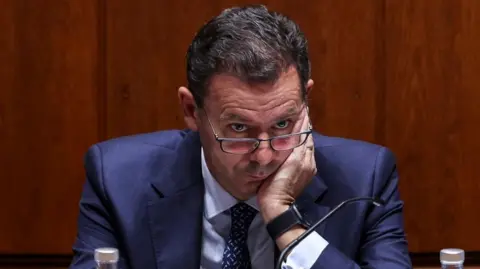
EPA A man in a blue jacket and tie peers over his glasses while sitting against a wooden backgroundEPA
Prime Minister Luís Montenegro appears to have been taken aback by the scale of opposition to his reforms

The CGTP has condemned the package as "an assault on the rights of all workers, particularly women and young people", while the UGT calls it "so out of step, in a context of economic growth, financial stability and a strong labour market, that… it reflects a clear bias in favour of employers".

The UGT also complains that formal talks between unions, government and business were "unbalanced, restrictive and detrimental to workers".

Montenegro's governing coalition lacks a majority in parliament, and is seeking support for the bill not only from the small, free-market Liberal Initiative (IL) but from hard-right Chega, which since May's general election has been the second-largest party.

Its leader, André Ventura, has expressed reservations about the way some measures might affect family life, but looks open to negotiations.

Before the election, Montenegro had ruled out deals with Chega, and the unions and the third-biggest party, the Socialists, say the prime minister's mask has slipped.

They also warn that politicians on the right want to amend Portugal's 1976 constitution to loosen employment safeguards considered among Europe's strongest.

The issue has also become caught up in the campaign for January's presidential election, with several candidates arguing that the labour reform bill flouts Portugal's 1976 constitution.

Under Portugal's "semi-presidential" system, the head of state can decline to sign bills approved by parliament. Bills can instead be sent to the Constitutional Court for review or the president can exercise a veto that, while it can be overturned by a majority of elected MPs, delays the process, ensuring further discussion.

With the government seeking to overhaul so much of the labour code, such scrutiny might stoke voter unease about its radicalism, particularly since the plans were not in the coalition's election manifesto.

Unlike many strikes here, Thursday's day of action is not limited to the public sector.

At Portugal's largest factory, VW-owned Autoeuropa, south of Lisbon, almost 1,000 employees voted unanimously last week to back it.

"I believe there is no worker in this country unaffected by the negative measures in this reform," said UGT secretary-general Mário Mourão, after the Autoeuropa gathering. "It must be responded to appropriately."

Austria bans headscarves in schools for under-14s

Getty Images A woman wearing a blue headscarf seen from behind as she sits in a chair in a classroomGetty Images

Austria has passed a law banning headscarves in schools for girls under the age of 14.

The conservative-led coalition of three centrist parties, the ÖVP, the SPÖ and the Neos, says the law is a "clear commitment to gender equality", but critics say it will fuel anti-Muslim feeling in the country and could be unconstitutional.

The measure will apply to girls in both public and private schools.

In 2020, a similar headscarf ban for girls under 10 was struck down by the Constitutional Court, because it specifically targeted Muslims.

The terms of the new law mean girls under 14 will be forbidden from wearing "traditional Muslim" head coverings such as hijabs or burkas.

If a student violates the ban, they must have a series of discussions with school authorities and their legal guardians. If there are repeated violations, the child and youth welfare agency must be notified.

As a last resort, families or guardians could be fined up to €800 (£700).

Members of the government say this is about empowering young girls, arguing it is to protect them "from oppression".

Speaking ahead of the vote, the parliamentary leader of the liberal Neos party, Yannick Shetty said it was "not a measure against a religion. It is a measure to protect the freedom of girls in this country," and added that the ban would affect about 12,000 children.

The opposition far-right Freedom Party of Austria, the FPÖ, which voted in favour of the ban, said it did not go far enough.

It described the ban as "a first step", which should be widened to include all pupils and school staff.

"There needs to be a general ban on headscarves in schools; political Islam has no place here", the FPÖ's spokesperson on families Ricarda Berger said.

Sigrid Maurer from the opposition Greens called the new law "clearly unconstitutional".

The official Islamic Community in Austria, the IGGÖ, said the ban violated fundamental rights and would split society.

In a statement on its website, it said "instead of empowering children, they will be stigmatised and marginalised."

The IGGÖ said it would review "the constitutionality of the law and take all necessary steps."

"The Constitutional Court already ruled unequivocally in 2020 that such a ban is unconstitutional, as it specifically targets a religious minority and violates the principle of equality," the IGGÖ said.

The government says it has tried to avoid that.

"Will it pass muster with the Constitutional Court? I don't know. We have done our best," Shetty said.

An awareness-raising trial period will start in February 2026, with the ban fully going into force next September - the beginning of the new school year.

Pakistan's military sentences its former spy chief to 14 years in jail

Pakistan Military An image of Faiz Hameed wearing military fatigues. Pakistan Military

Pakistan's former spy chief has been sentenced to 14 years in prison by a military court, on charges including violation of state secrets and interfering in politics.

Faiz Hameed led Pakistan's Inter-Services Intelligence (ISI) agency from 2019 to 2021, during the tenure of now-jailed former prime minister Imran Khan.

He was known to be a staunch supporter of Khan, and took early retirement shortly after Khan was ousted in a no-confidence vote in 2022.

It is the first time that an ISI chief in Pakistan has been court martialled. His lawyer said he plans to appeal against the verdict.

The ISI chief is seen as the second most powerful position in Pakistan's military.

According to a press release issued by the public relations arm of Pakistani military (ISPR), the 15-month-long court martial proceeding began on August 12, 2024, under the Pakistan Army Act.

Hameed was tried on four charges, including "involvement in political activities, violation of the Official Secrets Act which harmed the interest of the state, misuse of his powers and government resources, and causing harm to citizens".

The ISPR statement added that Hameed had been given "the right to have a defence team of his choice" and that he has the right to appeal the decision in the "appropriate forum", which would be the Supreme Court of Pakistan.

The exact details of the case are not public as the hearing was held behind closed doors in a military court.

The statement says that Hameed's alleged involvement in fomenting political agitation and instability is being dealt with separately.

This is assumed to be regarding allegations that Hameed was tied to protests against Imran Khan's arrest on 9 May 2023.

Hameed's lawyer, Mian Ali Ashfaq, said his client was "1,000% innocent, but this is the court's decision".

"We were unaware of the judgement and only found out through the ISPR's press release. We are now applying to the relevant forum for a copy of the decision," he told the BBC.

"As soon as we receive it, we will review it and immediately file a petition to appeal. Right now, the first forum for appeal is the army chief, so that is what we will do. We are hopeful that at the next forum we will present our case and obtain justice."

Additional reporting by Farhat Javed

❌