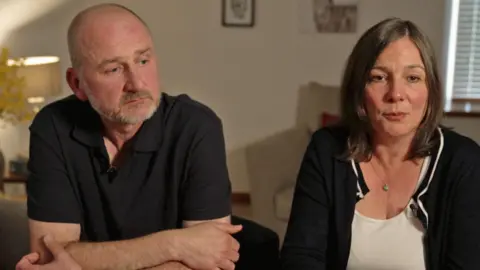
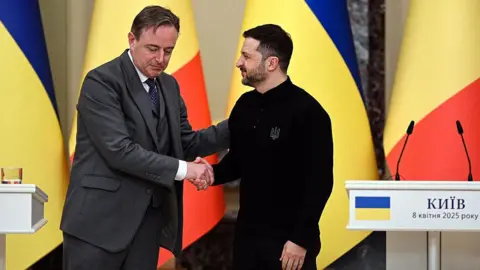
Belgian Prime Minister Bart De Wever is yet to be convinced that the money held in Belgium should be loaned to Ukraine (file pic)
European Union leaders begin two days of talks in Brussels with a momentous decision to be taken on whether to loan tens of billions of euros in frozen Russian assets to Ukraine to fund its military and economic needs.
Most of Russia's €210bn (£185bn; $245bn) worth of assets in the EU are held by Belgium-based organisation Euroclear, and so far Belgium and some other members of the bloc have said they are opposed to using the cash.
Without a boost in funding, Ukraine's finances are set to run dry in a matter of months.
One European government official described being "cautiously optimistic, not overly optimistic" that a deal would be agreed. Russia has warned the EU against using its money.
It has filed a lawsuit against Euroclear in a Moscow court in a bid to get its money back.
The Brussels summit comes at a pivotal moment.
US President Donald Trump has said a deal to end the war - which began with Russia's full-scale invasion of Ukraine in February 2022 - is "closer now than we have been ever".
Although Russia has not responded to the latest peace proposals, the Kremlin has stressed that plans for a European-led multinational force for Ukraine supported by the US would not be acceptable.
President Vladimir Putin made his feelings towards Europe clear on Wednesday, when he said the continent was in a state of "total degradation" and "European piglets" - a derogatory description of Ukraine's European allies - were hoping to profit from Russia's collapse.
Alexander KAZAKOV/POOL/AFP
Those in favour of loaning Ukraine the money believe it will help deter Putin from continuing the war
The European Commission - the EU's executive arm - has proposed loaning Kyiv about €90bn (£79bn) over the next two years - out of the €210bn of Russian assets sitting in Europe.
That is about two-thirds of the €137bn that Kyiv is thought to need to get through 2026 and 2027.
Until now the EU has handed Ukraine the interest generated by the cash but not the cash itself.
"This is a crunch time for Ukraine to keep fighting for the next year," a Finnish government official told the BBC. "There are of course peace negotiations but this gives Ukraine leverage to say 'we're not desperate and we have the funds to continue fighting'."
Commission chief Ursula von der Leyen says it will also ramp up the cost of war for Russia.
Russia's frozen assets are not the only option on the table for EU leaders. Another idea, backed by Belgium, is based on the EU borrowing the money on the international markets.
However, that would require a unanimous vote and Hungary's Viktor Orban has made it clear he will not allow any more EU money to help Ukraine.
For Ukraine, the hours ahead are significant and President Volodymyr Zelensky is expected to attend the EU summit.
Ahead of the Brussels meeting, EU leaders were keen to stress the momentous nature of the decision.
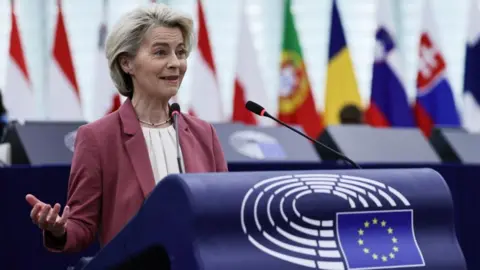
"We know the urgency. It is acute. We all feel it. We all see it," von der Leyen told the European Parliament.
EPA
Ursula von der Leyen told the European Parliament that two choices were on the table for EU leaders
German Chancellor Friedrich Merz has played a leading role in pushing for the Russian assets to be used, telling the Bundestag on the eve of the summit it was about sending a "clear signal" to Moscow that continuing the war was pointless.
EU officials are confident they have a sound legal basis to use the frozen Russian assets, but so far Belgian Prime Minister Bart De Wever remains unconvinced.
His Defence Minister Theo Francken warned ahead of the talks that it would be a big mistake to loan the Euroclear cash.
Hungary is seen as the biggest opponent of the move and, ahead of the summit, Prime Minister Orban and his entourage even suggested that the frozen assets plan had been removed from the summit agenda. A European Commission official stressed that was not the case and it would be a matter for the 27 member states at the summit.
Slovakia's Robert Fico has also opposed using the Russian assets, if it means the money being used to procure weapons rather than for reconstruction needs.
When the pivotal vote does finally take place, it will require a majority of about two-thirds of member states to go through. Whatever happens, European Council President António Costa has promised not to go over the heads of the Belgians.
"We're not going to vote against Belgium," he told Belgian public broadcaster RTBF. "We'll continue to work very intensively with the Belgian government because we don't want to approve something that might not be acceptable for Belgium."
Belgium will also be aware that ratings agency Fitch has placed Euroclear on a negative watch, partly because of "low" legal risks to its balance sheet from the European Commission's plans to use the Russian assets. Euroclear's chief executive has also warned against the plan.
"There are many hiccups and obstacles of course still on the way. We have to find a way to respond to Belgium's worries," the Finnish official added. "We are on the same side as Belgium. We will find a solution together to make sure all the risks are checked as much as they can be checked."
However, Belgium is not the only country to have doubts, and a majority is not guaranteed.
Italian Prime Minister Giorgia Meloni has told Italian MPs she will endorse the deal "if the legal basis is solid".
"If the legal basis for this initiative were not solid, we would be handing Russia its first real victory since the beginning of this conflict."
Malta, Bulgaria and the Czech Republic are also said to be unconvinced by the controversial proposals.
If the deal is passed and the Russian assets are given to Ukraine, the worst-case scenario for Belgium would be one in which a court would order it to hand the money back to Russia.
Some countries have said they would be prepared to provide billions of euros in financial guarantees, but Belgium will want to see the numbers add up.
At any rate, Commission officials are confident that the only way for Russia to get it back would be by paying reparations to Ukraine - at which point Ukraine would hand its "reparations loan" back to the EU.
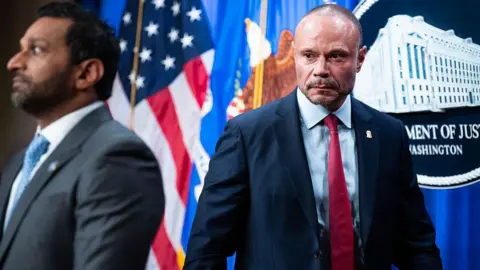
Dan Bongino has said he will leave his role as the FBI's deputy director in January.
In a post on X, he thanked President Donald Trump, as well as the director of the FBI and the attorney general "for the opportunity to serve with purpose".
It comes after Trump said earlier on Wednesday that the former podcast host "did a great job" in office, and "wants to go back to his show".
Bongino, who was appointed to the role by Trump in February, was previously a New York City police officer and a US Secret Service agent assigned to protect Barack Obama. In recent years, he built a large following through his podcast and other media appearances.
Bongino, a staunch Trump ally, was considered a surprise pick for the role – which had previously been held by career agents – because he had no prior experience with the agency.
The FBI Agents Association, which represents around 14,000 current and former agents, had opposed his appointment to the position.
Announcing his decision in a social media post on Wednesday, he said: "I will be leaving my position with the FBI in January. I want to thank President Trump, AG [Pam] Bondi, and Director [Kash] Patel for the opportunity to serve with purpose.
"Most importantly, I want to thank you, my fellow Americans, for the privilege to serve you. God bless America, and all those who defend Her."
Before joining the agency, Bongino had echoed disinformation and conspiracy theories about Trump's false claim that he won the 2020 election, and about the 6 January 2021 pipe bomb investigation.
Bongino had also questioned whether sex offender Jeffrey Epstein had taken his own life in a New York prison cell in 2019 as he awaited trial.
In July, the US justice department and FBI released a memo that said Epstein did take his own life.
The memo frustrated many of Trump's supporters, who echoed the Epstein conspiracy theories and rejected the justice department's findings.
This breaking news story is being updated and more details will be published shortly. Please refresh the page for the fullest version.
You can receive Breaking News on a smartphone or tablet via the BBC News App. You can also follow @BBCBreaking on X to get the latest alerts.
A federal court filing says the Army crew piloting a Black Hawk helicopter could have avoided the nighttime accident in January if it had been able to see and avoid a commercial jet.
During much of the 12.5-minute call, President Trump reiterated his claims that he had won Georgia, a state he lost by more than 11,000 votes that year.
In some ways, Trump’s broader flexing of power has achieved what he set out to do. But his attempts to push prosecutions of rivals have been far less successful.
The Pentagon has released plenty of video clips that show American missiles blowing boats suspected of carrying drugs out of the water. But the “double tap” strike on Sept. 2 is being kept under wraps.
President Trump said the United States wanted to reclaim expropriated oil assets, setting off a nationalist reaction in a country where the resource holds a mythical status.
Derricks in the Maracaibo oil fields of Venezuela in the early 20th century. American oil companies invested millions of dollars in the region, generating profits that flowed to the United States, rather than Venezuela.
The White House unveiled plaques near the Oval Office that describe U.S. presidents with varying levels of accuracy, depending on President Trump’s opinion of them.
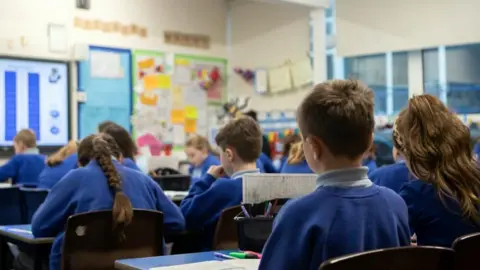
Teachers will be given training to spot the signs of misogyny and tackle it in the classroom as part of the government's long-awaited strategy to halve violence against women and girls within the next decade.
Pupils will be taught about issues such as consent, the dangers of sharing intimate images, how to identify positive role models and to challenge unhealthy myths about women and relationships.
The £20m package will also include a new helpline for teenagers to get support for concerns about abuse in their own relationships.
The government hopes that by tackling the early roots of misogyny, it will prevent young men from becoming violent abusers.
Under the new plans, schools will send high-risk students to get extra care and support, including behavioural courses to tackle their prejudice against women and girls.
"Every parent should be able to trust that their daughter is safe at school, online and in her relationships, but too often, toxic ideas are taking hold early and going unchallenged," Prime Minister Sir Keir Starmer said about the new measures.
"This government is stepping in sooner - backing teachers, calling out misogyny, and intervening when warning signs appear to stop harm before it starts."
The taxpayer will foot £16m of the bill, while the government says it is working closely with philanthropists and other partners on an innovation fund for the remaining £4m.
Nearly 40% of teenagers in relationships are victims of abuse, domestic abuse charity Reducing the Risk has said.
Online influencers are partly blamed for feeding this, with nearly one in five boys aged 13 to 15 said to hold a positive view of the self-proclaimed misogynist Andrew Tate, according to a YouGov poll.
In response to the government plans, some teachers said schools are already doing the kind of work the measures outline.
"While we welcome any initiative that prioritises healthy relationships and consent education, it's important to recognise that schools like Beacon Hill Academy in Dudley have been delivering this work effectively for years," Principal Sukhjot Dhami said.
"The challenge isn't starting from scratch: it's ensuring that this £20m pounds is spent wisely and in partnership with schools already leading the way."
Paul Whiteman, general secretary of school leaders' union NAHT, said it was positive the government was recognising the importance of training and support for school staff.
Whiteman said "schools are just part of the solution", with government, health, social care, police and parents all having a "significant contribution to make too".
Pepe Di'Iasio, general secretary of the Association of School and College Leaders, welcomed the government's focus, but added it was also essential that the government "introduces effective measures to prevent at source the spread of online misogynistic content which is served up to young people by social media algorithms".
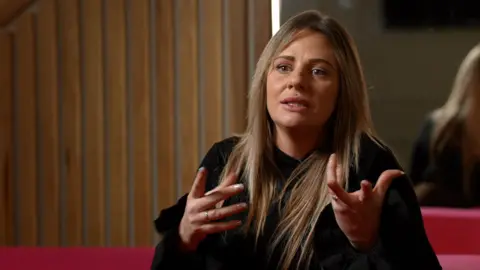
Nicola Mclafferty, a domestic abuse survivor, is calling for more people to talk to children about their experiences
Nicola Mclafferty, 42, is a victim of domestic violence and said more needs to be done to teach children about abuse.
"Survivors of domestic abuse, men or women, should go into assemblies and speak to the children about it, tell them a bit of your lived experience, enough that it's not going to scare them but be quite factual.
"There needs to be more people talking and they need to know."
The government has already announced a raft of measures in its strategy, including the introduction of specialist investigators to every police force to oversee rape and sexual offence cases.
It says staff will have the right training to understand the mindset of abusers and victims.
Also announced is a roll-out of domestic abuse protection orders, which have been trialled across England and Wales over the past year.
The court-issued orders mean individuals can be banned from contacting a victim, visiting their home or posting harmful content online, and can also be used in cases involving coercive or controlling behaviour. Breaching an order is a criminal offence.
Other measures include better NHS support for child and adult survivors of abuse, and a funding boost for councils to provide safe housing for domestic abuse survivors.
Two television adverts will also be launched on Saturday featuring a string of sports personalities and celebrities calling for the end of violence against women and girls.
Domestic abuse commissioner for England and Wales, Dame Nicole Jacobs, said the commitments "do not go far enough" to see the number of people experiencing abuse start to fall.
She added: "Today's strategy rightly recognises the scale of this challenge and the need to address the misogynistic attitudes that underpin it, but the level of investment to achieve this falls seriously short."
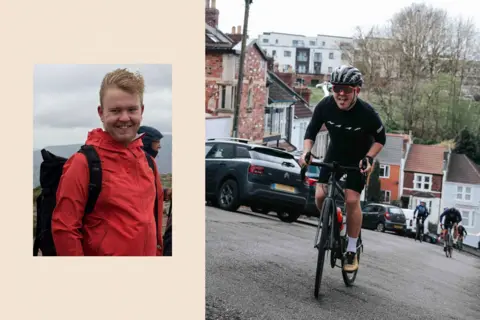
It is a chilly October evening in 2021 that Adam Becket remembers most sharply. He was 26, and had moved to Bristol a year earlier to start a "dream job" in the race cycling industry. So far, he had struggled to make friends.
"I wasn't alone all the time, but […] I was a bit of an outsider," he remembers.
As he headed home, the streets were full of Halloween partygoers in monster and cat costumes. "I walked past people turning up to friend's houses, people running into shops to buy beer.
"All the pubs were full. It just [felt] like a different world that you're not part of. And you feel like you can never be part of it."
That night, he felt like the only person experiencing serious loneliness. In fact, it is becoming a defining feature of his generation.
Conversations around social isolation tend to focus on the elderly, especially around Christmas. But by some measures, people in their 20s are the loneliest group in Britain.
Adam Becket
'I wasn't alone all the time, but… I was a bit of an outsider,' says Adam - his loneliness eased after he joined running and cycling clubs
According to Office for National Statistics (ONS) research published last month, 33% of Britons aged 16 to 29 reported feeling lonely "often, always or some of the time" - the highest of all age groups (17% of over-70s said the same thing).
This year, the World Health Organization reviewed various studies published across the world and found that young adults and adolescents report the highest levels of loneliness too.
The data is complex, and there are indications that, in some countries, among the very oldest group (over-85s), loneliness shoots up and could match that of 18-to-30s. But analysts say that in most research, young adults shine through as a particularly isolated group.
"Adults between 18 and 24 are the most lonely - followed by older people," says Prof Andrea Wigfield, director of the Centre for Loneliness Studies at Sheffield Hallam University. "It's a growing problem."
But why has this happened - and is there a solution?
The problem of 'scattering'
Increasingly, experts say the modern world is to blame. Many twenty-somethings live in house-shares where they do not know or like their housemates. Work increasingly is done from home and friends are often spoken to on social media.
It is not all bleak. Thanks to the internet, young adults enjoy access to friendships from all over the world. But broadly speaking, experts say, the image of gregarious twenty-something life presented in sitcoms like Friends needs urgent correction.
NBC Universal via Getty Images
The 1990s sitcom 'Friends' paints a sociable picture of life for twenty-somethings - but according to young adults who have spoken to the BBC, along with academics, charity bosses and doctors, the 20s is a primary decade of loneliness
"We tend to romanticise young adulthood as a carefree time - when it's usually the most miserable time in people's lives," says Prof Richard Weissbourd, a lecturer in education at Harvard University.
In some ways, early adulthood has always been a time of instability. Young adults tend to leave their childhood home and move around. Friends depart, and family ties weaken. These transitory life events can, for some, lead to intense loneliness.
"A big problem is the scattering - everybody you ever knew now lives in a million different places," says Dr Meg Jay, a clinical psychologist and author of The Twenty-Something Treatment.
This "scattering" proved difficult for Adam Becket. He had a rich social life when he lived in London in his early 20s - but after moving to Bristol, he had to make friends from scratch.
"Not only did I not know anyone, I didn't know where to start meeting people either. You can't just go up to someone and be like, 'Can I join in this fun?' It's easy to spiral into self-doubt and self-flagellation - 'I'm clearly not interesting or cool, or the right kind of person.'"
Things improved when he joined running and cycling clubs and met people that he "clicked with" - though he says his loneliness still comes and goes.
The Bowling Alone thesis
Today, there is also a set of new, distinctly modern factors that could be making the problem worse.
In many parts of the world, people are getting married and having children later (or not at all).
The average age of first marriage in the UK is now 31, according to the ONS, up from 1970 when it was 23 for men and 21 for women. Young adults tend to be more reliant on friends for emotional connection - and if those friends don't deliver, loneliness can follow.
Prof Weissbourd points to a broader fragmenting of communities too. In rich countries, membership of civic institutions - like churches, community groups, or trade unions - has dropped since the 1970s.
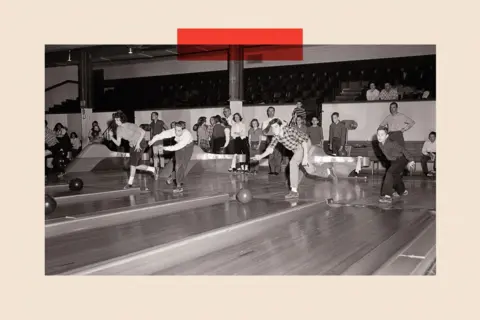
This is sometimes known as the Bowling Alone thesis, named after an influential 1995 essay by political scientist Robert Putnam, who observed that more young Americans were bowling on their own rather than in teams, a symbol of a wider collapse of social relations.
Twenty-somethings - who might have left their childhood home but not yet started their own family - can feel that decline of community most sharply, says Prof Weissbourd.
"We live in an increasingly individualistic society. I think loneliness is a symptom of our failure to care for each other."
Getty Images
In the 1950s young Americans mostly bowled in teams; by the 1990s, more people bowled alone - a trend highlighted by Robert Putnam's famous essay
This resonates with Zeyneb, 23, who lives alone in Cheltenham. Her own feelings of loneliness peaked last year during her master's degree. With only a few hours of teaching each week, she struggled to find meaningful connections with her classmates. And with her family far away in Romania, she now spends much of her time alone while she looks for a job.
"It does feel cripplingly lonely when everyone has their own thing to do."
She craves what psychologists call a "third place": a social setting like a park or library that is different from your "first place" (home) or your "second place" (work or university). "We don't really have that space to meet people," she says.
The closest thing she can think of is her gym - but virtually everyone there wears headphones, she tells me, and few make eye contact.
The urban houseshare paradox
Then there is the post-pandemic rise in working from home. Though young adults in the UK don't work from home as often as older generations - 28% of 16-to-29-year-olds worked from home at least some of the time in the first quarter of 2025, compared with 54% of 30-to-49-year-olds, one study suggests - remote work can hit people in their 20s particularly hard.
"Work from home has been, in my opinion, a nightmare for twenty-somethings," says Dr Jay. "It's really hard to make friends when you don't leave the house."
Nor do shared living situations always help. There is something of a paradox here, as young adults are the most likely to live with other people. (In England and Wales only 5% of people in their early 20s live alone, versus 49% of over-85s, suggests the ONS.) But living under the same roof as others doesn't always seem to make young adults any less lonely.
"Some of my most pitiful memories of my 20s were being stuck living with people that I didn't like," recalls Dr Jay. "If I was having a hard time, they didn't care, they were too wrapped up in themselves."
Of course this isn't the case for all house-shares - but she thinks having an emotionally distant flatmate can make people "even more lonely" than if they lived alone.
'Compare and despair' on smartphones
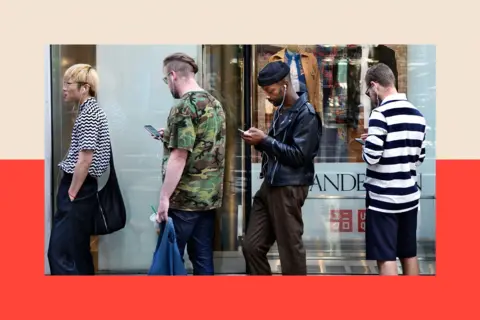
All of this is complicated by smartphones and social media. This year, the average British 18-to-24-year-old spent six hours and 20 minutes online every day, according to the media regulator Ofcom, higher than other adult age groups.
Some might assume that apps like Instagram and Snapchat contribute to feelings of loneliness because they encourage people to speak online rather than in person - but the data doesn't cleanly support this.
What is certainly true, say some experts, is that social media amplifies pre-existing feelings of loneliness because of what Dr Jay calls the "compare and despair" factor.
"You feel like, 'Everybody seems to have best friends and they're all skydiving in Dubai - what's wrong with me, I didn't see anyone all weekend.'"
Getty Images
The average young adult in the UK spends 6 hours and 20 minutes online every day, according to media regulator Ofcom
Yet it is also possible that reporting biases are playing a role.
Studies about loneliness are mostly based on self-report surveys (meaning people are simply asked whether they feel lonely). And Prof Weissbourd says it is plausible that young adults, who tend to be more fluent in the language of mental health and therapy, are more likely than older people to describe themselves as lonely in surveys.
He thinks reporting biases may explain a "piece" of the puzzle - but certainly not all of it.
Prof Wigfield also thinks the high level of young-adult loneliness is a real phenomenon, not a statistical mirage.
The 'lottery' of social prescribing
At first, David Gradon's story was fairly typical. In his late 20s, his friends moved away from London. "My social circle really shrunk," he remembers - and he developed symptoms of depression. It was an NHS counsellor who suggested this could be loneliness.
He tried meeting people over dating apps (a "terrible" idea) and joined a tag rugby club, but injured his leg in the first session. Increasingly despondent, he organised a park walk on social media.
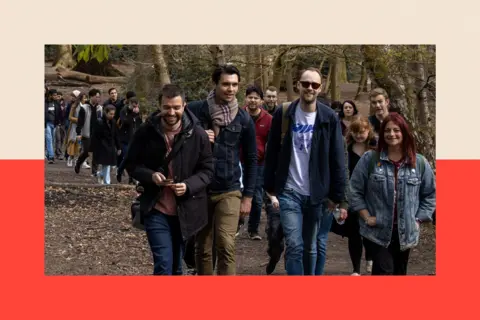
One autumn day in 2021, Mr Gradon and 11 strangers met at Hampstead Heath in north London. He organised more walks and in time this became his full-time job. He now runs The Great Friendship Project, a non-profit group to combat young adult loneliness, which runs social events for under-35s across London.
"Everyone's in that same boat. And actually, that brings down barriers. Because you know you're not going to be judged," he explains.
The Great Friendship Project
David Gradon's non-profit group organises park walks and other events for under-35s in London
Council-funded youth clubs operate around the country. Most are currently aimed at teenagers and children, but Laura Cunliffe-Hall, head of policy at charity UK Youth, wants to see more clubs for people in their early 20s. She argues that youth work should serve everyone up to the age of 25.
Funding, she says, is the barrier. Local authority spending on youth services in England fell by 73% between 2010/11 and 2023/24, according to the charity YMCA.
Some argue that spending money on friendship services can save money over the long term, because the health consequences of long-term loneliness can be severe. Prof Wigfield says that chronic loneliness is linked to inflammation, and can increase the risk of cardiovascular disease and dementia in later life.
In recent years the NHS has invested in "social prescribing", where GPs connect patients with certain mental health problems to charity-run services in their area - like art classes or gardening.
More than one million people (of all ages) were referred to NHS social prescribing services in 2023, a recent study found.
But Prof Wigfield says infrastructure remains patchy. "It really is a lottery in terms of where you live [and] whether the GP has knowledge of local services."
The Great Friendship Project
Virtually all attendees come alone, meaning everyone's "in the same boat", says David Gradon of The Great Friendship Project
Looking ahead to the next decade, Dr Jay sees signs of hope. For one, she thinks working from home has "lost some of its lustre" among twenty-somethings. (Several large employers - including Barclays and WPP - asked staff to spend longer in the office this year.)
Dr Jay also notes that some high-profile people are turning against social media - though she says there is not yet much evidence of a significant fall in usage among young adults.
"I'd love to see more of a backlash against [social media], but it's just so in our pockets," she adds.
Then there are those who find their solution to loneliness in unexpected places. For Zeyneb, the best antidote to social isolation was adopting a black cat, Olive.
"She's quite cuddly," says Zeyneb. "She knows when I need time with her.
"Without her, I would have been much lonelier."
Top picture credit: Getty.
BBC InDepth is the home on the website and app for the best analysis, with fresh perspectives that challenge assumptions and deep reporting on the biggest issues of the day. You can now sign up for notifications that will alert you whenever an InDepth story is published - click here to find out how.
A Scottish couple whose teenage son took his own life after being blackmailed on Instagram are suing the platform's owner Meta, in what's thought to be the first UK case of its kind.
Murray Dowey, from Dunblane, was 16 when he became a victim of sextortion in December 2023.
His parents have now launched legal action against Meta in a US court seeking punitive damages claiming that Instagram was not safe.
Meta, which also owns Facebook, has been contacted for comment. It previously said it had made changes to the platform to protect children.
Murray died in his home in Dunblane in December 2023 after he was targeted by scammers posing as a young girl.
He was tricked into sending intimate images of himself and told they would be exposed to his family if he did not pay.
Lawyers for his parents are now claiming Meta "knew of safety features that would prevent sextortion" prior to his death and instead "prioritised profit".
Previously the company has said it had made real changes to Instagram, such as introducing teen accounts with built-in protections and giving parents the power to control their children's online experiences.
Speaking to BBC news, his Murray's mother Ros said: "The worst thing that could possibly happen to us has happened. There's nothing that Meta can do that is worse than what's happened so we're up for the fight.
"We'll take it as far as we can."
The lawsuit, filed by the Social Media Victims Law Center (SMVLC) on behalf of Mark and Ros Dowey, is believed to be the first UK case of its kind.
Murray's parents, Mark and Ros Dowey, are taking the legal action
Murray's parents are named alongside a woman, Tricia Maciejewski, from Pennsylvania. Her son, Levi Maciejewski, took his own life at 13 years old.
Sextortion has become big business in Nigeria involving thousands of young men nicknamed "yahoo boys".
Guides on how to get involved in the crime are openly for sale online, as a BBC News investigation revealed earlier this year.
It might be a neighbour's car blocking your driveway, music vibrating through the walls, or a flashing inflatable Santa lighting up your bedroom at 3am.
Whatever the issue, you're unlikely to be alone. Neighbourly tensions often rise during the festive season and, while raising concerns can feel awkward, there are practical and legal ways to deal with disputes.
Here's how to deal with festive fallouts and keep the peace this Christmas.
Use a light timer
There's no law that specifies when Christmas lights must be turned off. However, artificial light can be classed as a statutory nuisance if it "interferes with the use or enjoyment of a home" or is likely to "injure health".
"Speaking to neighbours in advance or using a timer to switch lights off at unsociable hours can help avoid problems," lawyer Denise Nurse told the BBC's Morning Live.
Some lights are more disruptive than others. Sleep specialist Dr Nerina Ramlakhan says bright, flashing or blue-toned lights are particularly problematic.
"These wavelengths trigger photoreceptors in the eyes that suppress melatonin and shift our sleep-wake cycles," she says.
If you're affected, she recommends starting with a polite conversation. "They may not realise their lights are causing disruption and would be happy to make adjustments once they know," she says.
If that fails, you can complain to your local council, who are obliged to investigate. If the council agrees the lights amount to a statutory nuisance, it can issue an abatement notice which if ignored could result in a fine.
Warn them there will be noise
Even if you're only planning a one-off celebration, Nurse advises letting neighbours know in advance that they can expect some extra noise.
Jon from east London, who enjoys hosting parties with his wife Sharon, says he always does this.
"It's polite to let them know and apologise in advance if it disturbs them. We'll normally turn the music down by 11 or midnight - or sometimes just invite them to join us."
If you're affected by noise, Nurse recommends asking them to turn it down in the first instance. If that doesn't work you can contact your local council under the Environmental Protection Act to report excessive noise.
Parking can also be a point of contention over the festive period.
Doug, who lives in Windsor says neighbours and their visitors often block his driveway or access path. "It really winds me up," he says, explaining how his family have to walk across the garden or struggle to get out.
"I don't approach my neighbours because I always hope they'll realise how inconsiderate it is," he adds. "But it keeps happening."
"Public roads are public roads, but parking on your driveway is trespassing," Nurse says, suggesting putting up signs to help deter the behaviour.
If the problem continues, she suggsts contacting your local council.
Dumping your Christmas tree is fly-tipping
Getty Images
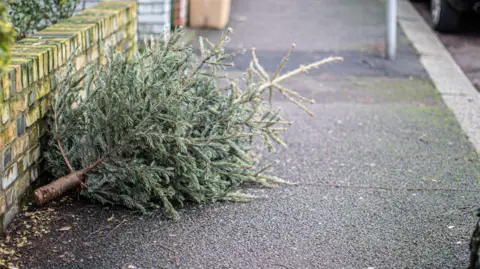
Lobbing a Christmas tree into a park or over a fence might feel tempting once the festivities are over, but it counts as fly-tipping which is illegal and can result in fines, says Nurse.
Not all councils offer a scheme for recycling your Christmas tree but most in the UK do through drop off points or collections.
You can find your local scheme using websites like Recycle now, by entering your post code and finding your local drop-off or collection point or by checking your local council's website.
Alternatively, some charities offer collection for a donation or local garden centres may chip up your old trees for mulch.
It's not just trees that cause problems. Nurse says that households generate around a third more waste during the festive period which can often means bins spill over.
"Talk to your neighbours, and ask them to move anything that's causing an issue," she advises.
If you still can't resolve it
If you've tried talking and things still aren't improving or last beyond the festive period, Nurse recommends seeking help from Citizens Advice.
Each nation has a service that connects neighbours with trained, neutral mediators who help both sides reach a resolution.
Your local council may also be able to help you find a mediator, even if you're not a council tenant.
Citizens Advice advises keeping a detailed record of incidents, noting what happened, how long it lasted and how it affected you. When you report it let them know what steps you've taken to try and resolve it. Ask when you can expect a response and what to do if the problem gets worse.
Nick Reiner's lawyer says the case involves "complex and serious issues"
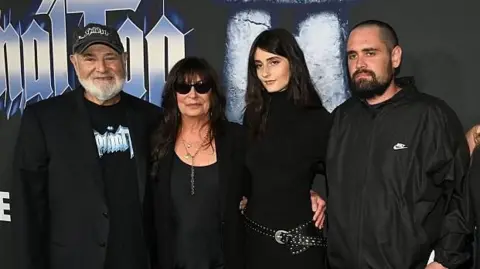
Nick Reiner, the son of celebrated Hollywood director Rob Reiner, has appeared in court for the first time charged with murdering his parents.
The 32-year-old waived his right to enter a plea to two charges of first-degree murder at the hearing, as all sides agreed to delay his arraignment until 7 January when he will once again have the opportunity to enter a plea.
His lawyer, Alan Jackson, told reporters outside court that there were "complex and serious issues" in the case that needed to be worked through in the coming weeks.
Rob Reiner and Michele Singer Reiner were found stabbed to death in their Brentwood home on Sunday. Nick Reiner was charged with their murder on Tuesday.
As he appeared in court in downtown Los Angeles, Mr Reiner only said "yes, your honour" when asked by Judge Theresa McGonigle if he understood that he has the right to a speedy trial.
The judge earlier ordered the assembled media - who gathered outside the courthouse hours prior to the hearing - not to film the defendant, who wore what appeared to be a suicide prevention vest.
Media inside the courtroom could not see Mr Reiner throughout the brief hearing because he was sitting in a corner out of sight.
He was initially slated to make a court appearance on Tuesday but had not been medically cleared to do so, his lawyer and prosecutors said.
"We ask that during this process, you allow the system to move forward in the way that it was designed to move forward," Mr Reiner's lawyer, Alan Jackson, told reporters.
"Not with a rush to judgement, not with jumping to conclusions, but with restraint and with dignity, and with the respect that this system and this process deserves, and that the family deserves," he said.
The delay in Mr Reiner entering a plea could be designed to allow time for a psychiatric evaluation, one criminal defence lawyer told the BBC after the hearing.
"The psychiatric evaluation is generally done before arraignment to see if he is even fit to stand trial," Seth Zuckerman said.
Getty Images
Nick Reiner (right) is accused of killing his parents
Until the next hearing on 7 January, Mr Reiner will remain in custody at the Twin Towers Correctional Facility in Los Angeles.
If he pleads not guilty, he could be sentenced to life without the possibility of parole or the death penalty if convicted. Prosecutors have said no decision has been made yet about whether the death penalty will be pursued.
Rob Reiner directed a handful of iconic films in a variety of genres, including This is Spinal Tap, Misery and A Few Good Men.
Michele Singer Reiner was an actress, photographer and producer, and the founder of Reiner Light, a photography agency and production company.
"This case is heartbreaking and deeply personal, not only for the Reiner family and their loved ones, but for the entire city," LA Police Department chief Jim McDonnell said on Tuesday.
Judge Jia M. Cobb wrote that two policies announced in June appeared to unlawfully bar members of Congress from making unannounced visits at immigration detention facilities.
Federal agents outside Delaney Hall Detention Facility in Newark in June. Immigration and Customs Enforcement has curbed access to its detention centers and required seven days’ notice for lawmakers seeking entry.
Officials said that they were working with physical evidence, including DNA, and that they were seeking a second man who appeared to have crossed paths with the possible suspect.
After finding the slain couple, investigators focused on their younger son, Nick, as a suspect. He was formally charged with murder on Tuesday and appeared in court on Wednesday.
The government has greatly restricted the number of work and study permits issued to foreigners following an unpopular immigration boom during the pandemic.

 Login
Login
 Ukrinform/NurPhoto
 Alexander KAZAKOV/POOL/AFP
 EPA
EPA