Reading view

There are new articles available, click to refresh the page.

Zelensky gives stark warning as EU leaders hold crunch talks on Russia's frozen assets

Ukrinform/NurPhoto Two men - one in a three-piece suit in grey, the other in black stand in front of colourful flagsUkrinform/NurPhoto
Belgian Prime Minister Bart De Wever is yet to be convinced that the money held in Belgium should be loaned to Ukraine (file pic)

European Union leaders begin two days of talks in Brussels with a momentous decision to be taken on whether to loan tens of billions of euros in frozen Russian assets to Ukraine to fund its military and economic needs.

Most of Russia's €210bn (£185bn; $245bn) worth of assets in the EU are held by Belgium-based organisation Euroclear, and so far Belgium and some other members of the bloc have said they are opposed to using the cash.

Without a boost in funding, Ukraine's finances are set to run dry in a matter of months.

One European government official described being "cautiously optimistic, not overly optimistic" that a deal would be agreed. Russia has warned the EU against using its money.

It has filed a lawsuit against Euroclear in a Moscow court in a bid to get its money back.

The Brussels summit comes at a pivotal moment.

US President Donald Trump has said a deal to end the war - which began with Russia's full-scale invasion of Ukraine in February 2022 - is "closer now than we have been ever".

Although Russia has not responded to the latest peace proposals, the Kremlin has stressed that plans for a European-led multinational force for Ukraine supported by the US would not be acceptable.

President Vladimir Putin made his feelings towards Europe clear on Wednesday, when he said the continent was in a state of "total degradation" and "European piglets" - a derogatory description of Ukraine's European allies - were hoping to profit from Russia's collapse.

Alexander KAZAKOV/POOL/AFP A man with a glass stands on the right of two men in uniformAlexander KAZAKOV/POOL/AFP
Those in favour of loaning Ukraine the money believe it will help deter Putin from continuing the war

The European Commission - the EU's executive arm - has proposed loaning Kyiv about €90bn (£79bn) over the next two years - out of the €210bn of Russian assets sitting in Europe.

That is about two-thirds of the €137bn that Kyiv is thought to need to get through 2026 and 2027.

Until now the EU has handed Ukraine the interest generated by the cash but not the cash itself.

"This is a crunch time for Ukraine to keep fighting for the next year," a Finnish government official told the BBC. "There are of course peace negotiations but this gives Ukraine leverage to say 'we're not desperate and we have the funds to continue fighting'."

Commission chief Ursula von der Leyen says it will also ramp up the cost of war for Russia.

Russia's frozen assets are not the only option on the table for EU leaders. Another idea, backed by Belgium, is based on the EU borrowing the money on the international markets.

However, that would require a unanimous vote and Hungary's Viktor Orban has made it clear he will not allow any more EU money to help Ukraine.

For Ukraine, the hours ahead are significant and President Volodymyr Zelensky is expected to attend the EU summit.

Ahead of the Brussels meeting, EU leaders were keen to stress the momentous nature of the decision.

"We know the urgency. It is acute. We all feel it. We all see it," von der Leyen told the European Parliament.

EPA European Commission President Ursula von der Leyen speaks during a debate on 'Preparation of the European Council meeting of 18-19 DecemberEPA
Ursula von der Leyen told the European Parliament that two choices were on the table for EU leaders

German Chancellor Friedrich Merz has played a leading role in pushing for the Russian assets to be used, telling the Bundestag on the eve of the summit it was about sending a "clear signal" to Moscow that continuing the war was pointless.

EU officials are confident they have a sound legal basis to use the frozen Russian assets, but so far Belgian Prime Minister Bart De Wever remains unconvinced.

His Defence Minister Theo Francken warned ahead of the talks that it would be a big mistake to loan the Euroclear cash.

Hungary is seen as the biggest opponent of the move and, ahead of the summit, Prime Minister Orban and his entourage even suggested that the frozen assets plan had been removed from the summit agenda. A European Commission official stressed that was not the case and it would be a matter for the 27 member states at the summit.

Slovakia's Robert Fico has also opposed using the Russian assets, if it means the money being used to procure weapons rather than for reconstruction needs.

When the pivotal vote does finally take place, it will require a majority of about two-thirds of member states to go through. Whatever happens, European Council President António Costa has promised not to go over the heads of the Belgians.

"We're not going to vote against Belgium," he told Belgian public broadcaster RTBF. "We'll continue to work very intensively with the Belgian government because we don't want to approve something that might not be acceptable for Belgium."

Belgium will also be aware that ratings agency Fitch has placed Euroclear on a negative watch, partly because of "low" legal risks to its balance sheet from the European Commission's plans to use the Russian assets. Euroclear's chief executive has also warned against the plan.

"There are many hiccups and obstacles of course still on the way. We have to find a way to respond to Belgium's worries," the Finnish official added. "We are on the same side as Belgium. We will find a solution together to make sure all the risks are checked as much as they can be checked."

However, Belgium is not the only country to have doubts, and a majority is not guaranteed.

Italian Prime Minister Giorgia Meloni has told Italian MPs she will endorse the deal "if the legal basis is solid".

"If the legal basis for this initiative were not solid, we would be handing Russia its first real victory since the beginning of this conflict."

Malta, Bulgaria and the Czech Republic are also said to be unconvinced by the controversial proposals.

If the deal is passed and the Russian assets are given to Ukraine, the worst-case scenario for Belgium would be one in which a court would order it to hand the money back to Russia.

Some countries have said they would be prepared to provide billions of euros in financial guarantees, but Belgium will want to see the numbers add up.

At any rate, Commission officials are confident that the only way for Russia to get it back would be by paying reparations to Ukraine - at which point Ukraine would hand its "reparations loan" back to the EU.

French 'Doctor Death' who poisoned patients jailed for life

ARNAUD FINISTRE/AFP French former anaesthetist Frederic Pechier arrives at Besancon's courthouse on the day his lawyer is due to present from today onwards the defense's closing arguments in Besancon, eastern France, on December 15, 2025ARNAUD FINISTRE/AFP
Frédéric Péchier faces a minimum of 22 years behind bars

A former anaesthetist has been jailed for life for intentionally poisoning 30 patients, including 12 who died.

A court in the city of Besançon in eastern France found Frédéric Péchier guilty of contaminating infusion bags with substances that caused cardiac arrest or hemorrhaging.

Péchier was first placed under investigation eight years ago, when he was suspected of poisoning patients at two clinics in Besançon between 2008 and 2017.

"You are Doctor Death, a poisoner, a murderer. You bring shame on all doctors," said prosecutors last week. "You have turned this clinic into a graveyard."

Péchier, who has always denied any wrongdoing, now has 10 days to lodge an appeal.

This breaking news story is being updated and more details will be published shortly. Please refresh the page for the fullest version.

You can receive Breaking News on a smartphone or tablet via the BBC News App. You can also follow @BBCBreaking on X to get the latest alerts.

Trump Media to merge with nuclear fusion firm in $6bn deal

Reuters Donald Trump has thin grey-blonde hair and is talking into a mic at a press conference with the US flag behind him.Reuters

The firm behind President Donald Trump's Truth Social platform is merging with a Google-backed energy company in a deal valued at more than $6bn (£4.4bn).

Trump Media & Technology Group (TMTG) and TAE Technologies announced the plans on Thursday in a joint statement, which said the move would "create one of the world's first publicly traded fusion companies".

Fusion power is a method of generating energy from heat released by nuclear fusion reactions. It could release vast amounts of energy with little associated radioactivity.

The statement said the combined company planned to begin constructing the "world's first utility-scale fusion power plant" next year, with further plants to follow.

Under the merger both firms will have an equal 50% share in ownership after the deal is completed, which is expected by mid-2026 pending regulatory and shareholder approvals.

TAE Technologies provides technology for energy storage and power delivery systems for batteries and electric vehicles. Its umbrella organisation, TAE Life Sciences, develops technologies and drugs for treating cancer patients.

The tie-up with the firm signals a bold and surprising shift for Trump Media, as it moves from social media and financial offerings into the energy sector.

Devin Nunes, chairman and chief executive of TMTG, said his firm was "taking a big step forward toward a revolutionary technology that will cement America's global energy dominance for generations".

Calling fusion power the "most dramatic energy breakthrough" since the 1950s, he said his firm would bring "the capital and public market access" to help make TAE's technology commercial viable.

Surging electricity demand for AI data centers has revived interest in cleaner and reliable nuclear power, including restarting shuttered reactors, expanding existing ones and signing contracts for future small modular reactors.

The joint statement said TAE Technologies had raised more than $1.3bn of funding from other investors including Google and Goldman Sachs.

Don't let Matilda's death fuel anger, say family of Bondi victim, 10, at funeral

EPA A man holds a balloon reading 'Matilda' during the funeral for 10-year-old Matilda a Bondi Beach shooting victim, at Chevra Kadisha Memorial Hall in SydneyEPA
Lina Chernykh tells the BBC her niece Matilda was a joyous child who spread love everywhere she went

The family of the Bondi shooting's youngest victim Matilda urged the community to not let her death fuel anger, as they said a final goodbye to the 10-year-old on Thursday.

Matilda was among 15 people who were shot dead when two gunmen opened fire on an event marking the start of Hannukah at Sydney's Bondi Beach on Sunday.

Speaking to the BBC at Matilda's funeral, her aunt Lina Chernykh said the Jewish community is right to want more action to stamp out antisemitism – she does too.

But she said Matilda was a joyous child who spread love everywhere she went, and urged the community to do the same in her honour.

"Take your anger and… just spread happiness and love and memory for my lovely niece," Ms Chernykh said.

"I hope maybe she's an angel now. Maybe she [will] send some good vibes to the world."

Jewish community leaders have in recent days suggested the tragedy was an inevitable result of Australia struggling to address rising antisemitism.

The attack on Sunday, which targeted the Jewish community at an event celebrating the first night of Hanukkah, was the country's deadliest incident since 1996, when a gunman killed 35 people during the Port Arthur massacre.

Ahead of Matilda's funeral on Thursday, Ms Chernykh said the family was devastated.

"I look at their faces [and] I don't know if they will be ever happy again," she said of Matilda's parents.

Matilda's younger sister, from whom she was "inseparable", is shattered and confused, she said.

"She doesn't have enough tears to cry."

At a flower memorial on Tuesday, Matilda's mother Valentyna told mourners that the family came to Australia from Ukraine more than a decade ago, thinking it would be a safe place for them.

"I couldn't imagine I'd lose my daughter here... It's just a nightmare," she said.

Ms Chernykh told the BBC she too has struggled to make sense of what is happening.

She was gardening at her home on the Gold Coast when Matilda's mother called on Sunday.

"Truly, I was thinking something happened to my father because he's 84 years old... and she says Matilda was shot," she recalled.

"How [could] someone in Australia understand, if someone tells you your kid was shot… I couldn't understand it. I was thinking I have bad reception. I asked a few times what I'm [hearing]."

Police have designated the attack a terrorist incident, with Australian Prime Minister Anthony Albanese saying it appears to have been "motivated by Islamic State" group ideology.

Police allege that the two gunmen were a father and son. Sajid Akram, 50, was shot dead at the scene, while his son Naveed, 24, has been charged with 59 offences, including 15 counts of murder and one of committing a terrorist act.

Australia on Thursday announced it would strengthen laws to crack down on hate - including by introducing powers to cancel or refuse visas on grounds of antisemitism.

Australian PM announces crackdown on hate speech after Bondi shooting

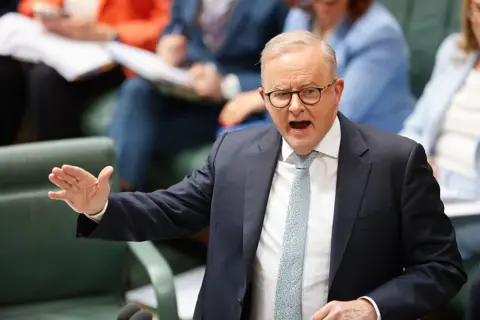
Getty A middle aged man with thinning grey hair and glasses, wearing a suit and tie, gestures as he addresses parliamentGetty
Anthony Albanese has announced new laws that will target 'those who spread hate'

Australian Prime Minister Anthony Albanese says his government will crack down on hate speech following Sunday's deadly shooting at Bondi Beach that targeted a Jewish festival.

Fifteen people were killed when two gunmen opened fire at an event to mark the first day of Hanukkah.

New laws will target "those who spread hate, division and radicalisation", Albanese told reporters in Canberra.

The home affairs minister will also be given new powers to cancel or refuse visas for those who spread hate and a new taskforce will be set up to ensure the education system "prevents, tackles and properly responds to antisemitism".

The new laws will also include penalties for preachers and leaders who promote violence, a new federal offence of "aggravated hate speech", and the introduction of "hate" as an aggravating factor in sentencing crimes for online threats and harassment.

"Every Jewish Australian has the right to feel safe, valued and respected for the contribution that they make to our great nation," Albanese said.

"The terrorists, inspired by ISIS... sought to turn Australians against each other. Australians have responded to that act of hatred with love and sympathy for those in mourning."

Albanese added that his government would be "fully supporting and adopting" the recommendations put forward in July in a report by antisemitism envoy Jillian Segal, who also spoke at the press conference.

She said the country was "at a very important moment not only for our community, but for fighting antisemitism around the world."

Her report was criticised by some upon its release in July due to its implications for free speech, including plans to monitor universities and arts organisations and withhold funding if they were deemed to have failed to act against antisemitism. There were concerns for instance, that the funding could be used to silence pro-Palestinian protests.

Home Affairs Minister Tony Burke said the government was "shifting the threshold".

"There have been individuals who have managed to exploit a nation that had different principles of freedom of speech and have gone right to the limits of language that is clearly dehumanising, unacceptable, having no place in Australia, but have not quite crossed the threshold to violence," he said.

Meanwhile, Albanese acknowledged accusations from the Jewish community that his government had not done enough to prevent antisemitism since the 7 October attack on Israel by Hamas, and said more could have been done.

"I accept my responsibility for the part in that as prime minister of Australia," he said. "But what I also do is accept my responsibility to lead the nation and unite the nation. Because what people are looking for at this time isn't more division."

Trump announces 'warriors dividend' for troops as he defends economic record

Watch: Trump says service members will receive $1,776 "warrior dividend"

US President Donald Trump has announced a "warrior dividend" payment to US service members, in a speech in which he also defended his track record on the economy after 11 months back in office.

In a televised address to the nation on Wednesday, Trump said cheques for $1,776 (£1,329) for 1.45 million US service members were already on the way" and should arrive before Christmas. He said they would be paid for, in part, by his tariffs.

In the combative address, Trump also touted his achievements on immigration while railing against opposition Democrats.

Speaking loudly and quickly, he seemed determined to convince Americans that the US was doing well - and things would only get better.

He claimed prices were falling, at a time when polls show that many Americans are unhappy about the cost of housing, childcare and healthcare.

Democrats were critical of the speech. Senate Minority Leader Chuck Schumer said the president's words "showed he lives in a bubble completely disconnected from the reality everyday Americans are seeing and feeling".

Schumer added: "People are feeling squeezed harder and harder every day and tonight Donald Trump took a victory lap."

In the brief, 18-minute address, Trump said the "warrior dividend", which totals $2.57bn (£1.9bn), would be distributed "in honour of our nation's founding in 1776".

Trump added that the funds were drawn from his sweeping tariffs, as well as the "One Big, Beautiful Bill" that he signed into law on 4 July.

"Nobody deserves it more than our military," he said.

The president offered little new information in the speech, and some of his assertions were either exaggerated or unfounded.

Much of Trump's address focused on his economic record and the administration's efforts to bring down prices - which he blamed on former US President Joe Biden and the Democrats. Trump mentioned the former president seven times.

"Now, under our leadership, they [prices] are all coming down and coming down fast," he said. "Democrat politicians also sent the cost of groceries soaring, but we are solving that too."

While fuel and egg prices have indeed fallen, many other food items are more expensive.

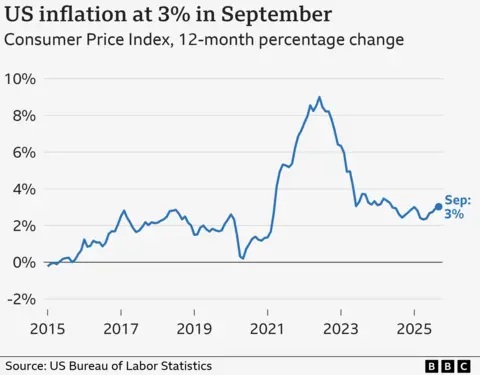
Economic data from September shows the US inflation rate hit 3% for the first time since January, while consumer confidence fell to its lowest level since April due to concerns over the cost of living, jobs and the wider economy.

A line chart titled “US inflation at 3% in September”, showing US inflation as measured by the Consumer Price Index, from January 2015 to September 2025. In the year to January 2015, prices fell by 0.2% on average. The annual rate then rose gradually to a peak of 2.9% in mid-2018, before starting to gradually fall again, hitting 0.2% in May 2020. From there, it rose sharply over the next two years, hitting 9.0% in the year to June 2022, before falling sharply back to 3.1% by June 2023. The latest figures show prices rose by 3.0% in the year to September 2025, up from 2.9% the previous month. The source is the US Bureau of Labor Statistics

Trump has previously acknowledged that concerns over rising prices have contributed to a lacklustre performance for candidates from his Republican Party during elections held in November - with the Democrats having success in Virginia, New Jersey and New York City, as well as more recently in Miami and Georgia.

He has also acknowledged that incumbent presidents and their parties often fare poorly in mid-term elections, which will take place next year.

The White House has since been wrestling with how to address voter concerns about the economy, while at the same time pushing back on repeated Democratic criticism over rising prices.

The political dilemma faced by the Trump administration has been highlighted by recent polling.

One poll, from Politico, showed that about half of overall voters - and 4 in 10 people who voted for Trump in 2024 - felt the cost of living was the worst it has been in their lives.

Another poll, released in November by CBS News/YouGov, suggested that Trump's approval on economic issues had dropped 15 points since March - with 36% of Americans approving his handling of the issue.

More broadly, other polls show that Trump is at or near the lowest approval ratings of his second term, with concerns about the economy playing a significant role.

While the president offered little in the way of empathy over prices, he did point to Republican efforts - such as tax reform legislation passed earlier this year - that he said would benefit many Americans in the coming year.

When he ran for re-election last year, Trump promised immediate results. And after 11 months in office, many Americans say they still haven't seen substantive change, and the president's speech might be unlikely to change their minds.

Trump, in part, focused his remarks on the promise of improvements during 250th birthday celebrations for American's founding next year.

"When the world looks at us next year, let them see a nation that is loyal to its citizens, faithful to its workers, confident to its identity, certain to its destiny, and the envy of the entire globe," he said.

"We are respected again, like we have never been respected before," he added.

Thailand bombs near Cambodia's Poipet border crossing

Getty Images Thai and Cambodian workers ride motorcycles outside the Poipet Border Crossing, which is suspended due to the ongoing border conflict, in Poipet, Banteay Meanchey, Cambodia, on December 18, 2025.Getty Images
Poipet is known for being a major casino hub and the biggest land crossing between the two countries

Thailand says it has bombed a "logistics centre" near the Cambodian town of Poipet, known for being a major casino hub and the biggest land crossing between the two countries.

The bombings comes as renewed border clashes show no sign of abating.

Cambodia's defence ministry said Thai forces dropped two bombs, while the Thai side said that they targeted a facility storing rocket systems.

The renewed fighting this month has killed at least 21 people in Thailand and 17 in Cambodia, while displacing around 800,000, officials say.

In a statement, the Cambodian defence ministry said Thai forces dropped two bombs in the area of Poipet municipality at around 11:00 am (0400 GMT) Thursday.

Shortly after, Thai Air Force spokesman Air Marshal Jackkrit Thammavichai said that the Thai military had attacked the centre outside Poipet that had been used to store BM-21 rockets and that no civilians were harmed.

BM-21 rockets are weapons that are typically fired in volleys from the back of an armoured vehicle.

The bombings appear to be the first on Poipet, which is known for casinos popular with Thai gamblers and its international border checkpoint.

On Tuesday, Thailand said Tuesday that between 5,000 and 6,000 Thai nationals remained stranded in Poipet after Cambodia closed its land border crossings between the two countries.

Cambodia's interior ministry said the border closures were a "necessary measure" to reduce risks to civilians, adding that air travel remained an option for those seeking to leave.

The century-old border dispute between the South East Asian neighbours dramatically escalated on 24 July with a Cambodian rocket barrage into Thailand, followed by Thai air strikes. That set off five days of intense fighting, which left dozens of soldiers and civilians dead.

The two countries later agreed to an "immediate and unconditional ceasefire" brokered by Malaysian Prime Minister Anwar Ibrahim and US President Donald Trump - who at the time threatened to stop tariff negotiations until the hostilities stopped.

But that ceasefire fell apart again last week, with both sides blaming each other for re-igniting the fighting, which has seen air strikes and exchanges of artillery fire.

Trump claimed last week that he could stop the fighting between Thai and Cambodian forces that broke out by just picking up the phone, but it has continued.

Earlier this week, Cambodia accused Thai forces of bombing Siem Reap province, home to the ancient Angkor temples - the country's top tourist draw - for the first time in the latest round of clashes.

Peter Arnett, Pulitzer-winning war reporter, dies aged 91

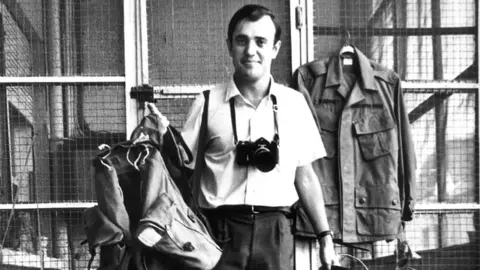
AP Photo/File Peter Arnett stands with gear that he carries out in field while covering the Vietnamese army 1963, in Saigon, VietnamAP Photo/File
Arnett reported on the Vietnam and Gulf Wars during his career (pictured here in Saigon, Vietnam, in 1963)

Pulitzer Prize-winning journalist and war correspondent Peter Arnett has died at the age of 91, US media has reported.

Arnett won the international reporting prize in 1996 for his Vietnam War coverage at the Associated Press (AP). But he was also well known for his work at CNN, having become a household name while reporting on the first Gulf War.

His career spanned decades and covered several conflicts in countries including Iraq, Vietnam and El Salvador.

The New Zealand-born journalist died on Wednesday surrounded by family and friends in California, his son told reporters. He was receiving hospice care for prostate cancer.

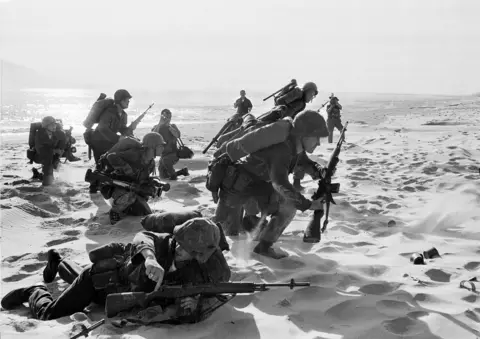
AP Photo/Peter Arnett/File Newly-landed U.S. Marines make their way through the sands of Red Beach at Da Nang, Vietnam, on their way to reinforce the air base as South Vietnamese Rangers battled guerrillas several miles south of the beach, April 10, 1965.AP Photo/Peter Arnett/File
Arnett also took photographs while on assignment with troops - like this one from Vietnam in 1965

Arnett first worked for AP as a wire-service correspondent in Vietnam, from 1962 until the war's end in 1975, often accompanying troops on missions.

At a talk in 2013, he recalled the moment he witnessed a soldier being shot in Vietnam as he paused to read a map.

"As the colonel peered at it, I heard four loud shots as bullets tore through the map and into his chest, a few inches from my face," Arnett told the American Library Association.

"He sank to the ground at my feet."

AP Photo/Peter Arnett/File North Vietnamese bicycle through the streets of Hanoi, past a bulletin board with a Ho Chi Minh, Oct. 2, 1972.AP Photo/Peter Arnett/File
His reporting and photographs, including this one of workers in Ho Chi Minh City in 1972, showed the reality on the ground

The journalist left AP in 1981 to join US outlet CNN, where he later became known for his work on the first Gulf War.

He was one of the few Western reporters to stay in Baghdad, according to AP, with one of his first broadcasts from the city being interrupted by the sounds of missiles and air-raid sirens.

"There was an explosion right near me, you may have heard," he once exclaimed live on-air.

While in Iraq, he interviewed then-president Saddam Hussein. Writing about the experience in the Roanoke Times, Arnett said he had decided to be "as tough in my questioning as the situation would allow".

He continued: "I was not intimidated by the prospect of encountering the man many had called 'The Butcher of Baghdad'. I figured he could do no worse to me than the constant bombing of Baghdad was threatening to do."

AP Photo/Peter Arnett/File North Korean youngsters sing and play accordions to entertain foreign visitors including United Nations Secretary General Kurt Waldheim, who visited Pyongyang, May 4, 1979.AP Photo/Peter Arnett/File
Arnett visited Pyongyang, North Korea, in 1979, taking this photograph of children performing for then-UN Secretary General Kurt Waldheim

In 1997, Arnett became the first Western journalist to interview Osama Bin Laden at a secret hideout in Afghanistan, a few years before the 11 September 2001 attacks on the US.

According to several US media reports, when asked about his plans, Bin Laden told Arnett: "You'll see them and hear about them in the media, God willing."

Arnett later worked for NBC and was famously sacked by the broadcaster after giving an interview on Iraqi state television, in which he was seen as critical of US military strategy.

He was hired by the Daily Mirror hours later and said he was "in shock" at his dismissal.

"I report the truth of what is happening here in Baghdad and will not apologise for it," he wrote in the UK paper.

AP Photo/Peter Arnett/File U.S. Army helicopters take off after dropping South Vietnamese rangers on parched rice paddy for an assault on red positions south of Vi Thanh, March 27, 1965AP Photo/Peter Arnett/File
Arnett provided an inside-look of what was happening in Vietnam throughout his career

Born in 1934 in Riverton, New Zealand, Arnett later naturalised as an American citizen and had lived in southern California since 2014.

Edith Lederer, a former colleague who still works at AP, told the agency: "Peter Arnett was one of the greatest war correspondents of his generation - intrepid, fearless, and a beautiful writer and storyteller.

"His reporting in print and on camera will remain a legacy for aspiring journalists and historians for generations to come."

Meanwhile, Nick Ut, a retired photographer who worked with Arnett in Vietnam, said he was "like a brother".

"His death will leave a big hole in my life," he told AP.

Arnett is survived by his wife Nina Nguyen and their children, Andrew and Elsa.

Rob Reiner's family breaks silence as son Nick faces judge on murder charges

Nick Reiner's lawyer says the case involves "complex and serious issues"

Nick Reiner, the son of celebrated Hollywood director Rob Reiner, has appeared in court for the first time charged with murdering his parents.

The 32-year-old waived his right to enter a plea to two charges of first-degree murder at the hearing, as all sides agreed to delay his arraignment until 7 January when he will once again have the opportunity to enter a plea.

His lawyer, Alan Jackson, told reporters outside court that there were "complex and serious issues" in the case that needed to be worked through in the coming weeks.

Rob Reiner and Michele Singer Reiner were found stabbed to death in their Brentwood home on Sunday. Nick Reiner was charged with their murder on Tuesday.

As he appeared in court in downtown Los Angeles, Mr Reiner only said "yes, your honour" when asked by Judge Theresa McGonigle if he understood that he has the right to a speedy trial.

The judge earlier ordered the assembled media - who gathered outside the courthouse hours prior to the hearing - not to film the defendant, who wore what appeared to be a suicide prevention vest.

Media inside the courtroom could not see Mr Reiner throughout the brief hearing because he was sitting in a corner out of sight.

He was initially slated to make a court appearance on Tuesday but had not been medically cleared to do so, his lawyer and prosecutors said.

"We ask that during this process, you allow the system to move forward in the way that it was designed to move forward," Mr Reiner's lawyer, Alan Jackson, told reporters.

"Not with a rush to judgement, not with jumping to conclusions, but with restraint and with dignity, and with the respect that this system and this process deserves, and that the family deserves," he said.

The delay in Mr Reiner entering a plea could be designed to allow time for a psychiatric evaluation, one criminal defence lawyer told the BBC after the hearing.

"The psychiatric evaluation is generally done before arraignment to see if he is even fit to stand trial," Seth Zuckerman said.

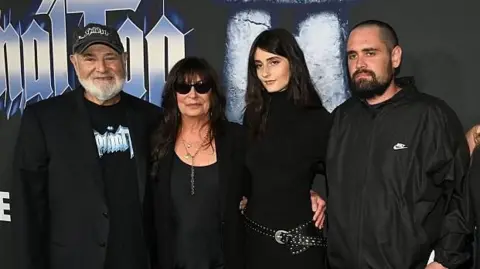
Getty Images Rob Reiner, Michele Singer, Romy Reiner, Nick Reiner, Maria Gilfillan and Jake Reiner at "Spinal Tap II: The End Continues" Los Angeles Premiere held at The Egyptian Theatre on September 09, 2025 in Los Angeles, California.Getty Images
Nick Reiner (right) is accused of killing his parents

Until the next hearing on 7 January, Mr Reiner will remain in custody at the Twin Towers Correctional Facility in Los Angeles.

If he pleads not guilty, he could be sentenced to life without the possibility of parole or the death penalty if convicted. Prosecutors have said no decision has been made yet about whether the death penalty will be pursued.

Rob Reiner directed a handful of iconic films in a variety of genres, including This is Spinal Tap, Misery and A Few Good Men.

Michele Singer Reiner was an actress, photographer and producer, and the founder of Reiner Light, a photography agency and production company.

"This case is heartbreaking and deeply personal, not only for the Reiner family and their loved ones, but for the entire city," LA Police Department chief Jim McDonnell said on Tuesday.

With additional reporting from Sakshi Venkatraman

Dan Bongino stepping down as FBI deputy director

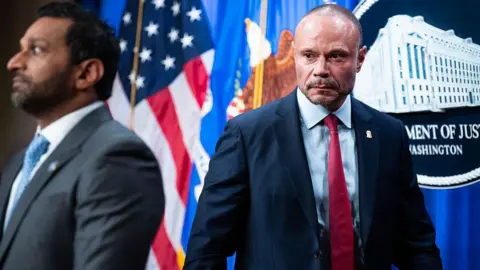
Getty Images FBI Director Kash Patel, left, and Dan Bongino, deputy director of the FBI, conduct a news conference at the Department of Justice on Thursday, December 4, 2025Getty Images

Dan Bongino has said he will leave his role as the FBI's deputy director in January.

In a post on X, he thanked President Donald Trump, as well as the director of the FBI and the attorney general "for the opportunity to serve with purpose".

It comes after Trump said earlier on Wednesday that the former podcast host "did a great job" in office, and "wants to go back to his show".

Bongino, who was appointed to the role by Trump in February, was previously a New York City police officer and a US Secret Service agent assigned to protect Barack Obama. In recent years, he built a large following through his podcast and other media appearances.

Bongino, a staunch Trump ally, was considered a surprise pick for the role – which had previously been held by career agents – because he had no prior experience with the agency.

The FBI Agents Association, which represents around 14,000 current and former agents, had opposed his appointment to the position.

Announcing his decision in a social media post on Wednesday, he said: "I will be leaving my position with the FBI in January. I want to thank President Trump, AG [Pam] Bondi, and Director [Kash] Patel for the opportunity to serve with purpose.

"Most importantly, I want to thank you, my fellow Americans, for the privilege to serve you. God bless America, and all those who defend Her."

Before joining the agency, Bongino had echoed disinformation and conspiracy theories about Trump's false claim that he won the 2020 election, and about the 6 January 2021 pipe bomb investigation.

Bongino had also questioned whether sex offender Jeffrey Epstein had taken his own life in a New York prison cell in 2019 as he awaited trial.

In July, the US justice department and FBI released a memo that said Epstein did take his own life.

The memo frustrated many of Trump's supporters, who echoed the Epstein conspiracy theories and rejected the justice department's findings.

This breaking news story is being updated and more details will be published shortly. Please refresh the page for the fullest version.

You can receive Breaking News on a smartphone or tablet via the BBC News App. You can also follow @BBCBreaking on X to get the latest alerts.

Nigeria apologises over Burkina Faso military flight that saw 11 servicemen detained

Nigeria’s foreign affairs ministry Nigeria’s foreign affairs minister dressed in traditional kaftan with 11 uniformed officers of his country Air force detained in Burkina FasoNigeria’s foreign affairs ministry
Nigeria’s Foreign Minister Yusuf Tuggar with the now released servicemen

Nigeria's Foreign Minister Yusuf Tuggar has formally apologised to Burkina Faso for the unauthorised entry of a Nigerian military jet into Burkinabè airspace, an incident that led to the detention of 11 Nigerian servicemen.

Tuggar's spokesperson told the BBC that the detained personnel had been released and were due to return to Nigeria, without saying when.

The plane was flying to Portugal when it developed a technical problem and had to land in Burkina Faso, according to the Nigerian Air Force.

The unauthorised landing sparked a diplomatic row with the Alliance of Sahel States (AES) made up of Burkina Faso and its neighbours, Mali, and Niger.

In a statement, AES characterised it as an "unfriendly act" and said member states‘ respective air forces had been put on maximum alert and authorised to "neutralise any aircraft" found to violate the confederation's airspace.

The three AES states, all run by the military, have withdrawn from the West African regional bloc, Ecowas, and moved closer to Russia, while most Ecowas members remain allied to the West.

Tuggar led a delegation to the Burkinabè capital, Ouagadougou, on Wednesday, to discuss the incident with military leader Captain Ibrahim Traoré.

"There were irregularities concerning the overflight authorisations, which was regrettable, and we apologise for this unfortunate incident," Tuggar said on national TV.

It remains unclear when the military personnel, said to be in "high spirits", and the aircraft will return to Nigeria.

According to Nigeria's foreign ministry, both sides agreed to "sustain regular consultations and pursue practical measures to deepen bilateral cooperation and regional integration".

Getty Images/BBC A woman looking at her mobile phone and the graphic BBC News AfricaGetty Images/BBC

Go to BBCAfrica.com for more news from the African continent.

Follow us on Twitter @BBCAfrica, on Facebook at BBC Africa or on Instagram at bbcafrica

BBC Africa podcasts

Venezuela denounces Trump's order for ship blockade as 'warmongering threats'

BBC Breaking NewsBBC

US President Donald Trump has said he is ordering a "a total and complete" blockade of all sanctioned oil tankers going into and out of Venezuela.

In a post on Truth Social, he accused Venezuela of stealing US assets, such as oil and land, and of "Terrorism, Drug Smuggling, and Human Trafficking".

"Therefore, today, I am ordering A TOTAL AND COMPLETE BLOCKADE OF ALL SANCTIONED OIL TANKERS going into, and out of, Venezuela," he added.

His post came a week after the US seized an oil tanker off the coast of Venezuela – a move that marked a sharp escalation Washington's pressure campaign against Venezuelan leader Nicolás Maduro's government.

In the post, the US president said Venezuela was "completely surrounded by the largest Armada ever assembled in the History of South America".

He added that it will "only get bigger" and "be like nothing they have ever seen before".

Trump also accused Maduro's government of using stolen oil to "finance themselves, Drug Terrorism, Human Trafficking, Murder, and Kidnapping".

Venezuela has not yet responded to Trump's latest remarks.

The Trump administration has repeatedly accused Venezuela of drug smuggling and since September the US military has killed at least 90 people in strikes on boats it has alleged were carrying fentanyl and other illegal drugs to the US.

In recent months, the US has also moved warships into the region.

Venezuela - home to some of the world's largest proven oil reserves - has, in turn, accused Washington of seeking to steal its resources.

This breaking news story is being updated and more details will be published shortly. Please refresh the page for the fullest version.

You can receive Breaking News on a smartphone or tablet via the BBC News App. You can also follow @BBCBreaking on X to get the latest alerts.

Ecuador defender Pineida killed in shooting

Ecuador defender Pineida killed in shooting

Mario Pineida playing for Barcelona SCImage source, Getty Images
Image caption,

Mario Pineida played for Barcelona SC for nine years

  • Published

Ecuador defender Mario Pineida has died at the age of 33 after being shot in Guayaquil.

Local media reported that Pineida was shot on Wednesday by two people on motorbikes who opened fire on him, his mother and another woman outside a shop in the north of the city.

Ecuador's interior ministry said it has sent a special police unit to investigate.

Guayaquil has become a hotspot for gang violence and drug trafficking, with 1,900 murders recorded between January and September - the highest in Ecuador.

Three second-tier footballers were killed in September and a local player was wounded in a shooting in October.

Pineida won nine caps for Ecuador between 2014 and 2021.

He began his club career at Independiente DV before moving to Barcelona SC in Guayaquil in 2016.

He also spent time on loan at Fluminese and El Nacional.

Independiente and Fluminese paid tribute to Pineida on social media, while Barcelona SC said "this unfortunate news makes all of us who are part of this institution deeply dismayed".

In a statement, the Ecuadorian Football Federation condemned the violence and passed on condolences to Pineida's family.

Related topics

More on this story

Rebels start to withdraw from key DR Congo city, leaders say

Getty Images M23 rebel soldiers in military uniform holding rifles in Bukavu, eastern DR Congo in February 2025Getty Images
The US accuses Rwanda of backing the M23 rebels - which it denies

The rebel group which last week seized the Democratic Republic of Congo city of Uvira say they have begun withdrawing, promising to complete the pullout on Thursday, following pressure from the US.

The M23 group captured the strategic city near the border with Burundi, days after a "historic" US-brokered peace deal between Congolese and Rwandan governments aimed at ending the long-running conflict in eastern DR Congo.

However, DR Congo's government says the reported withdrawal is a "diversion" and needs verification.

On Thursday morning some Uvira residents told the BBC it was not clear if the M23 were leaving, with some of their trucks still moving around the city.

The capture of Uvira sparked US condemnation and warning of sanctions against Rwanda. The US accuses Rwanda of backing the rebels, which it denies.

M23 leader Bertrand Bisimwa said on Wednesday that the withdrawal was "under way," with spokesman Willy Ngoma adding that this was "for the sake of peace".

In a post on X, Bisimwa urged mediators and international partners to ensure the city was protected from "reprisals, violence and remilitarisation".

A local civil society member, who did not want to be named for his own safety, told the BBC that some M23 troops had started withdrawing. However, he said police officers from the same group were still moving in.

Another resident expressed doubts about the withdrawal.

"It seems they are still here. In fact, yesterday I saw them bringing in the police trucks," the resident told the BBC on Thursday morning.

DR Congo government spokesman Patrick Muyaya told the BBC Newsday programme that the M23's announcement was meant "to distract the American mediation team, which is preparing to take measures against Rwanda".

Muyaya described the M23's decision to leave Uvira as a "positive sign" but said the government needed to confirm the situation on the ground.

Earlier he had called for "vigilance" in response to the "alleged withdrawal".

"Who can verify it? Where are they going? How many were there? What are they leaving behind in the city? Mass graves? Soldiers disguised as civilians?" he said in a post on X.

The Uvira offensive left dozens dead, at least 100 wounded and more than 200,000 displaced, according to the UN. At least 30,000 civilians fled into Burundi.

It came despite the 4 December peace deal signed in Washington between Rwandan President Paul Kagame and his DR Congo counterpart, Felix Tshisekedi, at a ceremony in Washington hosted by President Donald Trump.

The rebels were not signatories to that peace deal but they have been part of a parallel peace process led by Qatar, a US ally that has strong ties with Rwanda.

You may also be interested in:

Getty Images/BBC A woman looking at her mobile phone and the graphic BBC News AfricaGetty Images/BBC

Go to BBCAfrica.com for more news from the African continent.

Follow us on Twitter @BBCAfrica, on Facebook at BBC Africa or on Instagram at bbcafrica

The D.N.C. Is Killing Its Autopsy of What Went Wrong in 2024

Ken Martin, the Democratic National Committee chairman, ordered the report months ago but is now said to believe that its release would be counterproductive for the party.

© Annie Mulligan for The New York Times

“Here’s our North Star: Does this help us win?” Ken Martin, the Democratic National Committee chairman, said in a statement about the 2024 audit. “If the answer is no, it’s a distraction from the core mission.”

Democratic National Committee blocks release of its 2024 election autopsy

The Democratic National Committee is refusing to release its autopsy of the party’s major 2024 losses it announced on Wednesday, breaking Chair Ken Martin’s public pledge to do so. The decision underscores the party’s challenges in grappling with its electoral setbacks as it heads into what is expected to be a stronger midterm year.

The DNC’s completed post-election review of the party’s melodramatic and botched campaign cycle is based on hundreds of interviews with operatives in all 50 states. During that process, some Democrats raised concerns about releasing the findings, according to a DNC official granted anonymity to describe the sensitive process.

The DNC wanted to avoid another public debate over how the party lost the White House to Donald Trump, and instead, turn its focus on its recent successes, according to this official. Democrats have overperformed in special elections across the country this year, and won handily in New Jersey and Virginia last month. The committee previewed some initial findings from the autopsy to top donors and other Democratic stakeholders in October.

Former President Joe Biden's decision to run for reelection, despite his advanced age — and his disastrous debate performance — were not mentioned in the some excerpts of the report's findings, which were shared with POLITICO. Democrats are still divided over what contributed to Kamala Harris' loss.

In a statement, Martin said the committee had “completed a comprehensive review of what happened in 2024” and they are “putting our learnings into motion,” noting the party’s off-year victories.

“In our conversations with stakeholders from across the Democratic ecosystem, we are aligned on what’s important, and that’s learning from the past and winning the future,” Martin continued. “Here’s our North Star: does this help us win? If the answer is no, it’s a distraction from the core mission.”

The decision marks an about-face for a coalition that’s at odds over what went wrong last year, and still registering record-low approval ratings even among its own voters. Several outside groups, from the progressive Way to Win to the center-left Welcome nonprofit, released their own in-depth audits of the party’s missteps with differing diagnoses for how to fix its problems. Just last week, some DNC members called on the committee to provide more answers.

The DNC official described some examples of the report’s findings, including the party’s organizing strategies, necessary technological upgrades and its youth voter problem — though the details shared with POLITICO were sparse and incomplete. Excerpts from the review broadly described Democrats as defensive on immigration and public safety — issues that generally favor Republicans — but didn’t name-check a campaign, candidate or entity for its role in this posture, at least not publicly.

On the party’s organizing efforts, the DNC’s review urged campaigns to incentivize engaging conversations with voters over just the number of doors knocked and phones called. It called for investing more into relational organizing and year-round field infrastructure, efforts Martin championed during his chair’s race last year. Of the party’s data infrastructure, the DNC’s report issued warnings that it was out-of-date and overwhelmed at key moments during the campaign and called for it to be modernized.

It described the party’s much-reported losses among young voters, citing Republicans’ advantages in communicating through the influencer ecosystem and pressing Democrats to do engage with non-traditional media sources. Back in February, Democrats conceded the GOP was “running circles” around them online, but in describing its findings, the DNC doesn’t go much further in clarifying its own public recommendations.

This fall, the DNC held briefings with donors and other Democratic stakeholders on its initial findings. At the time, one Democrat who attended an October donor event confirmed that Biden’s initial decision to run in spite of his advanced age was not mentioned by DNC officials as a part of the review. It’s not clear whether his decision to run for reelection is discussed in the private review.

Biden’s age was not mentioned in the excerpts of the review shared with POLITICO on Thursday, nor was it raised in other briefings on the report’s initial findings. Most Democrats cite the last-minute candidate switch as a core reason for the party’s sweeping losses.

Martin’s decision to withhold the report doubles back on a pledge he made just hours after he was elected to be the DNC’s chair in February. In comments to reporters, Martin committed to the public release of the 2024 report.

At the time, he also questioned why the DNC hadn’t released its 2016 autopsy, when he questioned, “what happened with that … was there any utility in doing that?”

“Of course it will be released,” Martin said in February, referring to a future review on the 2024 election. “There has to be some lessons that we glean on that so we can operationalize it, not just here in DC, but through all of the 57 state parties, and, of course, the county parties, so people have a sense of what we need to do.”

© Erin Hooley/AP

泽连斯基:本周五-六新一轮美乌会谈, 俄罗斯想占整个顿巴斯 - RFI - 法国国际广播电台

18/12/2025 - 17:01

泽连斯基表示,“我们都知道俄罗斯的立场:它想占领整个顿巴斯地区”。“我们不准备采取相应的(割地)措施”。

乌克兰总统泽连斯基周四宣布,乌克兰和美国将于本周五和周六在美国举行新一轮会谈,作为结束与俄罗斯战争计划的一部分。

乌克兰总统泽连斯基说,“周五和周六,我们的团队将在美国;他们已经在路上了,美国人正在等待他们的到来。我不知道还有哪些人会出席——也许会有一些欧洲人”。

他没有透露乌克兰代表团的人员组成。据一位白宫官员称,此次新一轮美乌会谈将在俄美两国特使就乌克兰战争问题举行会晤之前举行,该会晤定于本周末在佛罗里达州举行。

美国白宫尚未公布俄美代表团的具体组成。据Politico报道,特朗普的特使维特科夫和女婿库什纳将参与会谈,俄罗斯预计将派出克里姆林宫经济事务特使德米特里耶夫。

泽连斯基周四表示“我们都知道俄罗斯的立场:它想占领整个顿巴斯地区,现在它想让我们离开顿巴斯——这就是它的立场”。

泽连斯基补充道:“我们的立场也很明确:我们不准备采取相应的(割地)措施。美国正在寻求达成妥协”。

顿巴斯是乌克兰的工业中心地带,包括几乎完全由莫斯科控制的卢甘斯克州和由乌克兰军队控制近20%的顿涅茨克州。

俄罗斯总统普京周三表示,他在乌克兰的军事行动目标将毫无疑问地实现。

美国在柏林与乌克兰方面重新调整计划后的具体细节尚未公布,但基辅方面表示该计划涉及乌克兰在领土上的让步。

基辅和欧洲认为华盛顿最初的文件在很大程度上有利于克里姆林宫的立场。


使用被冻结俄罗斯资产为乌克兰提供赔偿贷款?欧盟峰会即将做出决定

德正
2025-12-18T14:38:23.038Z
波兰总理图斯克表示,欧盟领导人周四在布鲁塞尔举行的峰会上同意,将研究在2026年和2027年期间,利用冻结的俄罗斯资产为乌克兰提供融资的方案。

(德国之声中文网)欧盟委员会提议向乌克兰提供在欧盟境内高达2100亿欧元的被冻结的俄罗斯资产作为赔偿贷款。其中900亿欧元将用于满足乌克兰2026年和2027年的财政和军事需求。

按照欧盟的设想,基辅只有在俄罗斯战后进行赔偿的情况下才需要偿还这笔贷款。不过很少有人认为俄罗斯总统普京会同意这一条件。

比利时对这一计划持反对意见,理由是存在法律和金融风险。这些资产的大部分存放在比利时,其中约1850亿欧元由总部位于布鲁塞尔的欧洲清算银行(Euroclear)持有。

比利时首相德韦弗(Bart De Wever)周四上午在比利时议会发言时再度重申了他的担忧。

比利时政府担心莫斯科可能会对欧洲公民和企业进行报复,例如在俄罗斯对欧洲资产强行征用。

比利时首相德韦弗一直要求其他欧盟国家提供具有法律约束力的无条件担保,涵盖贷款的全部金额,并保护比利时免受任何潜在的损害赔偿。

拉脱维亚总理西利尼亚(Evika Siliņa)表示,“任何政治决策都离不开法律层面。但我们是政治家,规则也是我们制定的。”

德新社分析指出,理论上,即使没有比利时的支持,这笔贷款也可以获得批准,因为它只需要获得多数成员国的同意即可通过,即欧盟27个成员国中至少15个成员国,且这些成员国的人口占欧盟总人口的65%。尽管人们普遍认为其他欧盟国家不太可能推翻比利时的决定,但一些领导人的不耐烦情绪正在加剧。

拉脱维亚总理西利尼亚(Evika Siliņa)表示,比利时“处境非常敏感”,“但这不仅是法律问题,也是政治意愿的问题。”她说:“任何政治决策都离不开法律层面。但我们是政治家,规则也是我们制定的。”

作为替代选项的欧盟联合举债计划缺乏广泛支持

德韦弗一直倡导欧盟共同举债为乌克兰提供资金。但根据欧盟规则,此举需要所有27个成员国一致同意。

德国总理梅尔茨是赔偿贷款的积极倡导者。他不支持欧盟共同举债的想法。

“我们实际上面临着两个选择:要么欧洲举债,要么用俄罗斯资产来援助乌克兰。我的立场很明确:我们必须使用俄罗斯资产,”梅尔茨说,“我认为没有比这更好的选择了。我理解一些成员国,特别是比利时政府的担忧,但我希望我们能够共同解决这些问题。”

匈牙利总理欧尔班表示,他反对向乌克兰提供任何形式的财政援助。

预计谈判将持续很长时间

关于向乌克兰提供财政援助的谈判预计将持续到深夜,欧盟领导人可能在布鲁塞尔停留至周五。

欧盟委员会主席冯德莱恩和欧洲理事会主席科斯塔坚持要在布鲁塞尔峰会上找到解决方案。

冯德莱恩表示:“我们必须找到解决方案。”

冯德莱恩表示:“我们必须找到解决方案。”

担任峰会主席的科斯塔表示,此次会议“只有在最终决定确保乌克兰2026年和2027年的财政需求得到满足后才会结束”。

波兰总理图斯克表示,欧盟领导人周四在布鲁塞尔举行的峰会上同意,将研究在2026年和2027年期间,利用冻结的俄罗斯资产为乌克兰提供融资的方案。

他对路透社记者说:“我们当然希望取得突破,而突破意味着所有人都同意值得一试,并且认为利用俄罗斯资产为乌克兰提供融资是合理的,对欧洲也有好处,但有些国家会斗争到最后一刻,以最大限度地为自己争取保障。”

他在欧盟峰会休会期间说:“我们都希望使用俄罗斯资产援助乌克兰,这一声明已经做出,我认为没有人会反悔。”

俄罗斯中央银行周四表示,将就欧洲试图利用冻结的俄罗斯资产为乌克兰提供融资一事,在俄罗斯法院提起诉讼。

DW中文有Instagram!欢迎搜寻dw.chinese,看更多深入浅出的图文与影音报道。

© 2025年德国之声版权声明:本文所有内容受到著作权法保护,如无德国之声特别授权,不得擅自使用。任何不当行为都将导致追偿,并受到刑事追究。

乌克兰高官赴北京与中方外交官举行会谈 - RFI - 法国国际广播电台

18/12/2025 - 16:32

乌克兰高官周四罕见访北京之际,欧盟正在布鲁塞尔就未来两年援乌资金举行峰会,美乌本周4-5将在美举行新一轮会谈。目前尚无乌克兰高官与中方会谈的内容披露出来。

乌克兰第一副外长周四抵达北京。法新社说,基辅和北京的代表举行这样的会晤实属罕见,尤其是在中国被指帮助俄罗斯在2022年2月对乌克兰发动大规模攻势的情况下。

乌克兰第一副外长谢尔盖·基斯利察(Serguiï Kyslytsia)周四在社交平台上写道:在“北京迎来忙碌的一天”,他补充说,已同美国驻华大使戴维·珀杜(David Perdue)会了面。

乌克兰外交部发言人向法新社证实,基斯利察将与中国外交官进行会谈。

法新社说,作为俄罗斯的主要贸易伙伴之一,中国声称在乌克兰冲突中保持中立的立场,但未谴责俄罗斯的侵略行为。

北京方面定期呼吁进行和平谈判,并表示尊重所有国家的领土完整。

但西方各国政府指责中国为俄罗斯的战争努力提供了关键经济支持,特别是提供了军事部件。

They Thought They Had ‘Made It.’ Now They Can’t Afford Food.

New Yorkers in the so-called “missing middle,” who may make too much for food benefits, say it’s still hard to find enough money for groceries.

© Jackie Molloy for The New York Times

Jessica Fuentes with her children at the Community Kitchen in West Harlem in December. Ms. Fuentes said she was struggling to keep up with the costs of all of her necessities, like food.

Zelensky gives stark warning as EU leaders start crunch talks on Russia's frozen assets
Ukrinform/NurPhoto Two men - one in a three-piece suit in grey, the other in black stand in front of colourful flagsUkrinform/NurPhoto
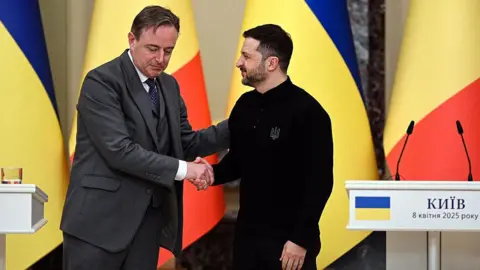
Belgian Prime Minister Bart De Wever is yet to be convinced that the money held in Belgium should be loaned to Ukraine (file pic)

European Union leaders begin two days of talks in Brussels with a momentous decision to be taken on whether to loan tens of billions of euros in frozen Russian assets to Ukraine to fund its military and economic needs.

Most of Russia's €210bn (£185bn; $245bn) worth of assets in the EU are held by Belgium-based organisation Euroclear, and so far Belgium and some other members of the bloc have said they are opposed to using the cash.

Without a boost in funding, Ukraine's finances are set to run dry in a matter of months.

One European government official described being "cautiously optimistic, not overly optimistic" that a deal would be agreed. Russia has warned the EU against using its money.

It has filed a lawsuit against Euroclear in a Moscow court in a bid to get its money back.

The Brussels summit comes at a pivotal moment.

US President Donald Trump has said a deal to end the war - which began with Russia's full-scale invasion of Ukraine in February 2022 - is "closer now than we have been ever".

Although Russia has not responded to the latest peace proposals, the Kremlin has stressed that plans for a European-led multinational force for Ukraine supported by the US would not be acceptable.

President Vladimir Putin made his feelings towards Europe clear on Wednesday, when he said the continent was in a state of "total degradation" and "European piglets" - a derogatory description of Ukraine's European allies - were hoping to profit from Russia's collapse.
Alexander KAZAKOV/POOL/AFP A man with a glass stands on the right of two men in uniformAlexander KAZAKOV/POOL/AFP
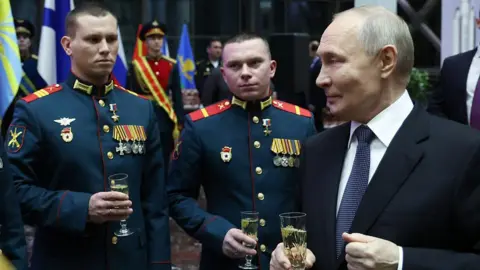
Those in favour of loaning Ukraine the money believe it will help deter Putin from continuing the war

The European Commission - the EU's executive arm - has proposed loaning Kyiv about €90bn (£79bn) over the next two years - out of the €210bn of Russian assets sitting in Europe.

That is about two-thirds of the €137bn that Kyiv is thought to need to get through 2026 and 2027.

Until now the EU has handed Ukraine the interest generated by the cash but not the cash itself.

"This is a crunch time for Ukraine to keep fighting for the next year," a Finnish government official told the BBC. "There are of course peace negotiations but this gives Ukraine leverage to say 'we're not desperate and we have the funds to continue fighting'."

Commission chief Ursula von der Leyen says it will also ramp up the cost of war for Russia.

Russia's frozen assets are not the only option on the table for EU leaders. Another idea, backed by Belgium, is based on the EU borrowing the money on the international markets.

However, that would require a unanimous vote and Hungary's Viktor Orban has made it clear he will not allow any more EU money to help Ukraine.

For Ukraine, the hours ahead are significant and President Volodymyr Zelensky is expected to attend the EU summit.

Ahead of the Brussels meeting, EU leaders were keen to stress the momentous nature of the decision.

"We know the urgency. It is acute. We all feel it. We all see it," von der Leyen told the European Parliament.
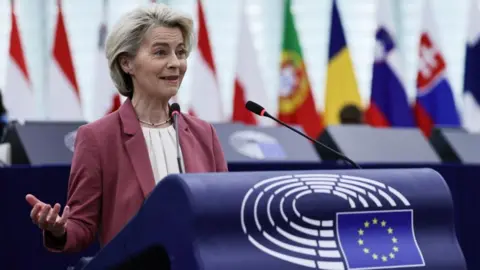
EPA European Commission President Ursula von der Leyen speaks during a debate on 'Preparation of the European Council meeting of 18-19 DecemberEPA
Ursula von der Leyen told the European Parliament that two choices were on the table for EU leaders

German Chancellor Friedrich Merz has played a leading role in pushing for the Russian assets to be used, telling the Bundestag on the eve of the summit it was about sending a "clear signal" to Moscow that continuing the war was pointless.

EU officials are confident they have a sound legal basis to use the frozen Russian assets, but so far Belgian Prime Minister Bart De Wever remains unconvinced.

His Defence Minister Theo Francken warned ahead of the talks that it would be a big mistake to loan the Euroclear cash.

Hungary is seen as the biggest opponent of the move and, ahead of the summit, Prime Minister Orban and his entourage even suggested that the frozen assets plan had been removed from the summit agenda. A European Commission official stressed that was not the case and it would be a matter for the 27 member states at the summit.

Slovakia's Robert Fico has also opposed using the Russian assets, if it means the money being used to procure weapons rather than for reconstruction needs.

When the pivotal vote does finally take place, it will require a majority of about two-thirds of member states to go through. Whatever happens, European Council President António Costa has promised not to go over the heads of the Belgians.

"We're not going to vote against Belgium," he told Belgian public broadcaster RTBF. "We'll continue to work very intensively with the Belgian government because we don't want to approve something that might not be acceptable for Belgium."

Belgium will also be aware that ratings agency Fitch has placed Euroclear on a negative watch, partly because of "low" legal risks to its balance sheet from the European Commission's plans to use the Russian assets. Euroclear's chief executive has also warned against the plan.

"There are many hiccups and obstacles of course still on the way. We have to find a way to respond to Belgium's worries," the Finnish official added. "We are on the same side as Belgium. We will find a solution together to make sure all the risks are checked as much as they can be checked."

However, Belgium is not the only country to have doubts, and a majority is not guaranteed.

Italian Prime Minister Giorgia Meloni has told Italian MPs she will endorse the deal "if the legal basis is solid".

"If the legal basis for this initiative were not solid, we would be handing Russia its first real victory since the beginning of this conflict."

Malta, Bulgaria and the Czech Republic are also said to be unconvinced by the controversial proposals.

If the deal is passed and the Russian assets are given to Ukraine, the worst-case scenario for Belgium would be one in which a court would order it to hand the money back to Russia.

Some countries have said they would be prepared to provide billions of euros in financial guarantees, but Belgium will want to see the numbers add up.

At any rate, Commission officials are confident that the only way for Russia to get it back would be by paying reparations to Ukraine - at which point Ukraine would hand its "reparations loan" back to the EU.
How many flu cases are there in your local hospital? Use our tool to check

PA Media A general view of staff on a NHS hospital ward.PA Media

Hospitals across the UK are seeing high levels of flu cases this winter.
The NHS in England has said it is on "on high alert" after seeing the highest ever number of flu cases in hospital for this time of year, in the week ending 14 December.

You can use our tool below to find out how many flu patients there are in hospitals near you.

About the data

Figures relating to flu cases in hospitals are collected in different ways in each UK nation.

In England it is the weekly number of beds occupied by patients with a laboratory confirmed flu case.

This data is provided at NHS Trust level. Trusts are organisations which include hospitals, community services and providers of other forms of patient care. You can find which trust your local hospital belongs to on the NHS England website.

In Scotland the figures relate to the number of patients admitted to hospital with a laboratory confirmed flu case taken between 14 days before the admission date and 48 hours after the admission date.

In Wales it is the weekly number of patients in hospital with a laboratory confirmed flu case taken from 28 days before the admission date if tested outside of hospital, or within two days after admission.

Figures for Scotland and Wales are provided at NHS Health Board level. Health boards are responsible for all frontline healthcare services. You can find which Health Board your local services belong to on the NHS Scotland or NHS Wales websites.

In Northern Ireland the figures show the number of new flu cases admitted to hospital that were acquired outside of hospital.

This data is provided at Health and Social Care Trust level. Trusts are responsible for providing local and regional health services. You can find which trust your local hospital belongs to on the NI direct website.

Farmers 'bewildered and frightened' over inheritance tax, report finds

Getty Images A green and red tractor is pulling a cultivator and drill across a muddy field. On the hills in the background lie solar panels. A light mist sits in the sky.Getty Images

Farmers are "bewildered and frightened" with many questioning the future of their businesses because of the government's proposed changes to inheritance tax, an independent review of farm profitability has found.

The long-awaited government-commissioned report was published on Thursday with 57 recommendations designed to improve productivity, investment and resilience in agriculture.

But author Baroness Minette Batters, former president of the National Farmers' Union (NFU), warned there was "no silver bullet" to making farms in England profitable.

Environment secretary Emma Reynolds said the government and the farming and food industries would work much more closely together in the future.

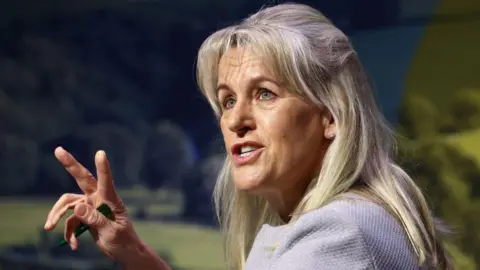
Getty Images A close-up head-and-shoulders shot of Baroness Batters as she raise two fingers to illustrate a point while making a speech. The background is a soft-focus shot of the countrysideGetty Images
Baroness Batters said that farmers "don't want handouts from the state"

That would be done through a newly created farming and food partnership board made up of senior industry and government leaders that would "drive growth, productivity and long-term profitability across the sector", she explained.

"When farming thrives, the whole country benefits. British farmers are central to our food security, our rural economy and the stewardship of our countryside," the secretary of state added.

"This is about serious action to remove barriers, unlock investment and make the food system work better, so farm businesses can grow, invest and plan for the future with confidence."

Baroness Batters' review called for a "new deal for profitable farming" that would recognise the true cost of producing food and delivering for the environment.

The report did not look in detail at the government's proposed changes to inheritance tax, which are set to apply to farm businesses worth more than £1 million at a rate of 20% from April 2026.

But Baroness Batters said it was raised as the single biggest concern by almost everyone in the farming sector she talked to as part of the review.

'Questioning viability'

She said the sector had faced a sharp rise in costs and increasingly extreme weather, with severe drought this year.

Uncertainty surrounding the closure of applications to the sustainable farming incentive scheme - the post-Brexit agricultural payments scheme - and proposed changes to inheritance tax had created "significant" ongoing concern, with some farmers "questioning viability let alone profitability".

In the review, she said: "The farming sector is bewildered and frightened of what might lie ahead."

The report added that costs would be 30% higher in 2026 than they were in 2020, while the £2.4bn farming budget for England had been almost the same since 2007 - even as farmers and growers are asked to do more to comply with environmental legislation, with less funding and no certainty.

Baroness Batters added: "Farmers don't want handouts from the state, they want nothing more than to run thriving, profitable farming businesses, by earning a fair return for what they produce."

The NFU said it was "a thorough and complex report" which was "right to recognise reform is needed".

President Tom Bradshaw said that of the issues raised, fairness in the supply chain was a "top priority" alongside planning reforms and focus on growing exports.

"But alongside this, there are other immediate actions that are needed to boost British farming like providing much-needed clarity and certainty on the future of the sustainable farming incentive and doing the right thing on the pernicious inheritance tax changes," he added.

Gavin Lane, president of the Country Land and Business Association, which represents rural businesses and landowners, welcomed the review and said it was now time for "urgent action".

"As this report highlights, profitability across the sector is perilously slim, with farmers battling high input costs, low commodity prices and volatile weather conditions.

"Many farm businesses are marginal or loss-making, yet will soon be hit with unaffordable inheritance tax bills, which in many cases will dwarf their annual profit," he explained.

In response to the review, the government said it was also taking action on planning reform to make food production a clearer priority, speed up on-farm reservoirs, polytunnels and farm shops, and make it easier for farmers to invest.

The government is also stepping up action on supply chain fairness, tackling barriers to private finance and supporting exports and new markets, a spokesman for the Department for Environment, Food and Rural Affairs (Defra) said.

How will the interest rate cut affect my mortgage and savings?

Getty Images A woman wearing a bright red coat walks over a bridge with other commuters during a snow storm in Manchester. Getty Images

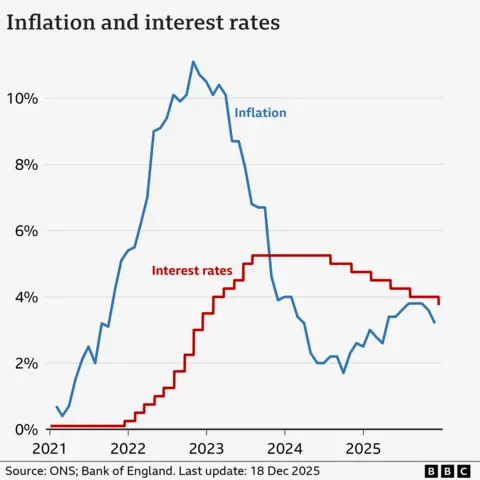
The Bank of England has cut interest rates from 4% to 3.75%, the lowest level since February 2023.

Analysts are divided about whether further cuts will follow in 2026.

Interest rates affect mortgage, credit card and savings rates for millions of people.

What are interest rates and why do they change?

An interest rate tells you how much it costs to borrow money, or the reward for saving it.

The Bank of England's base rate is what it charges other banks and building societies to borrow money, which influences what they charge their own customers for mortgages as well as the interest rate they pay on savings.

The Bank moves interest rates up and down in order to keep UK inflation - the rate at which prices are increasing - at or near 2%.

When inflation is above that target, the Bank can decide to put rates up. The idea is that this encourages people to spend less, reducing demand for goods and services and limiting price rises.

How will the interest rate cut affect mortgages, loans and savings rates?

Mortgages

Just under a third of households have a mortgage, according to the government's English Housing Survey.

About 500,000 homeowners have a mortgage that "tracks" the Bank of England's rate. A 0.25 percentage point cut is likely to mean a reduction of £29 in the monthly repayments for the average outstanding loan.

For the additional 500,000 homeowners on standard variable (SVR) rates - assuming their lender passed on the benchmark rate cut - there would typically be a £14 a month fall in monthly payments for the average outstanding loan.

But the vast majority of mortgage customers have fixed-rate deals. While their monthly payments aren't immediately affected by a rate change, future deals are.

Mortgage rates have been falling recently, partly owing to the expectation the Bank would cut rates in December.

As of 18 December, the average two-year fixed residential mortgage rate was 4.82%, according to financial information company Moneyfacts. A five-year rate was 4.90%.

The average two-year tracker rate was 4.66%.

About 800,000 fixed-rate mortgages with an interest rate of 3% or below are expected to expire every year, on average, until the end of 2027. Borrowing costs for customers coming off those deals are expected to rise sharply.

You can see how your mortgage may be affected by future interest rate changes by using our calculator:

Credit cards and loans

Bank of England interest rates also influence the amount charged on credit cards, bank loans and car loans.

Lenders can decide to reduce their own interest rates if Bank cuts make borrowing costs cheaper.

However, this tends to happen very slowly.

Getty Images A woman in a leather jacket paying for her drinks by tapping a card machine with her phoneGetty Images

Savings

The Bank base rate also affects how much savers earn on their money.

A falling base rate is likely to mean a reduction in the returns offered to savers by banks and building societies.

The current average rate for an easy access savings account is 2.55%, according to Moneyfacts.

Any further cut in rates could particularly affect those who rely on the interest from their savings to top up their income.

Will interest rates fall further?

Most analysts had expected the December cut, but the vote among members of the nine-member monetary policy committee (MPC) was divided. Five were in favour of a cut.

The Bank said rates were likely to continue dropping in the future, but warned decisions on further cuts in 2026 would be contested.

"We still think rates are on a gradual path downward but with every cut we make, how much further we go becomes a closer call," said the Bank's governor Andrew Bailey.

The latest inflation data for November, published the day before the MPC meeting, showed a larger than expected drop to 3.2%.

Mr Bailey has also repeatedly warned about the unpredictable impact of US tariffs, and uncertainty around the world.

How have interest rates and inflation changed?

The Bank of England's base rate reached a recent high of 5.25% in 2023. It remained at that level until August 2024, when the Bank started cutting.

Five cuts brought rates down to 4%, before the Bank held rates at its meetings in September and November 2025 before the December cut.

A line chart showing interest rates and CPI inflation in the UK, from January 2021 to December 2025. Interest rates were at 0.1% in January 2021. They were increased from late-2021, reaching a peak of 5.25% in August 2023. They were then lowered slightly to 5% in August 2024, to 4.75% in November, to 4.5% on 6 February 2025, to 4.25% on 8 May 2025, and to 4% on 7 August. At the Bank of England's latest meeting on 18 December, rates were cut to 3.75%. The inflation rate was 0.7% in the year to January 2021. It then rose to a peak of 11.1% in October 2022, before falling again to a low of 1.7% in September 2024 and then starting to rise again. In the year to November 2025, it was 3.2%, down from 3.6% the previous month.

The main inflation measure, CPI, has dropped significantly since the high of 11.1% recorded in October 2022.

The 3.2% figure recorded for the year to November 2025 was down from the 3.6% rate recorded in October.

That means prices are still rising, but by less than seen in the summer.

What is happening to interest rates in other countries?

In recent years, the UK has had one of the highest interest rates in the G7 - the group representing the world's seven largest so-called "advanced" economies.

In June 2024, the European Central Bank (ECB) started to cut its main interest rate for the eurozone from an all-time high of 4%.

At its meeting in June 2025 the ECB cut rates by 0.25 percentage points to 2% where they have remained.

The US central bank - the Federal Reserve - has cut interest rates three times since September 2025, taking them to the current range of 3.5% to 3.75%, the lowest since 2022.

President Trump had repeatedly attacked the Fed for not cutting earlier.

79,600 criminal cases are still outstanding in England and Wales. How did we get here?

Getty Images BBC Verify-branded image showing five barristers, both male and female, facing away from the camera wearing wigs and black robes.Getty Images

More than 79,600 criminal cases are now caught in the courts backlog in England and Wales, new figures show.

The Crown Court backlog has been at a record high since early 2023 and is projected to hit 100,000 by 2028, according to the Ministry of Justice (MoJ). The delays mean that for some serious crimes charged today the victims and suspects could be left waiting years for justice as they are unlikely to see the case come to trial before 2030.

This crisis has prompted the government to announce radical reforms to the criminal courts, including removing juries - a fundamental part of our criminal justice system - from a number of trials in England and Wales in an attempt to speed up justice and slash the backlog.

The latest MoJ figures show there has been a huge growth in cases taking two years or more to conclude, something that was a rarity before 2010 budget cuts began to bite, and which was later exacerbated by the pandemic and other factors.

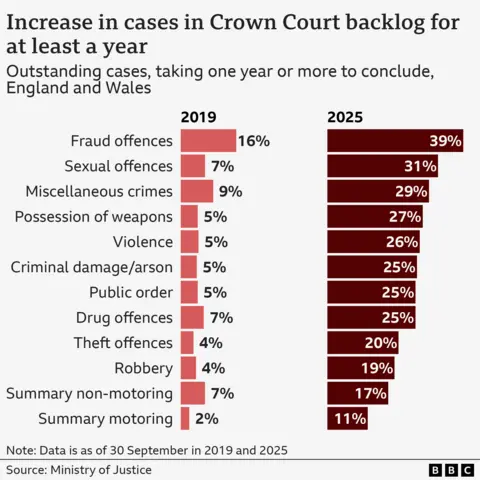
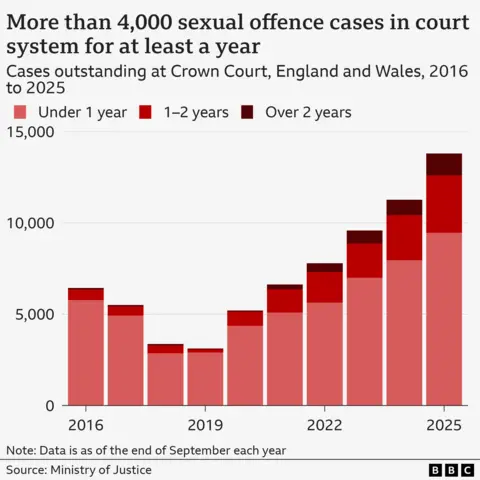
About a quarter of violence and drug offences, many of which do not require the defendant to be detained pre-trial, have been in the backlog for at least a year. More than 30% of sexual offences have been in the system for at least that long. For context, in 2019 there were around 200 sexual offences that had been open for more than a year. Now there are more than 4,000.

It means the situation has become significantly worse for victims, defendants, witnesses and everyone else who works in the system, and shows the scale of the problem the government is now grappling with.

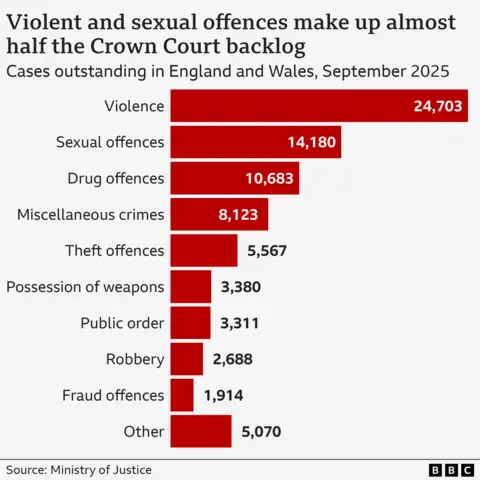
Violent and sexual offences make up almost half the crown court backlog
Cases outstanding in England and Wales September 2025
Violence: 24,703
Sexual offences: 14,180
Drug offences: 10,683
Miscellaneous crimes: 8,123
Theft offences: 5,567
Possession of weapons: 3,380
Public order: 3,311
Robbery: 2,688
Fraud offences: 1,914
Other: 5,070
Source: Ministry of Justice

So how did we get here? At the heart of this story is funding - and the lack of it - which started in 2010.

Back then the coalition government pledged to slash spending to balance the books - and the MoJ took a huge cut to its £9bn budget. It means its total spending today is £13bn, which is £4.5bn lower in real terms than it would have been had it kept pace with the average government department, according to the Institute of Fiscal Studies.

Why did that cut happen?

When the coalition government began making austerity cuts, the MoJ took a bigger hit than some other departments such as health and defence. It delivered some of its cuts by shutting court rooms, and by 2022, eight crown court centres and more than 160 magistrates courts were gone, according to ministerial answers to parliamentary questions.

Ministers also introduced a cap on the number of days judges are paid to sit in court and hear cases, to help reduce spending.

In 2016-17 there were 107,863 of these "sitting days" recorded, but that had fallen to 81,899 by the eve of the pandemic. If there's no judge, there's no hearing, which meant individual courtrooms were left idle even if the rest of a court complex was still hearing cases.

Then the Covid pandemic happened, which left all Crown Courts closed for two months during the first lockdown other than for urgent and essential work. When they reopened, many individual courtrooms could not be used for trials because they were too small to comply with social distancing requirements. Everything slowed to a snail's pace and the backlog exploded.

This is when the unintended consequences of earlier closures began to bite harder. Take for example Blackfriars Crown Court in London. Its nine court rooms were once an important centre for serious organised crime cases, but ministers decided to close it in 2019 and hoped to sell the land.

Many of its cases were shifted to Snaresbrook in east London, but since the pandemic it has been overwhelmed. At the end of September 2019 it had 1,500 cases on its books, official figures show, but as of September this year it was juggling more than 4,200.

Before the pandemic, only 5% of outstanding cases for violence across England and Wales had been in the system for more than a year - now a quarter of cases have taken that long. There have been similar increases in the length of time taken for criminal damage, possession of weapons and drug offence cases.

Increase in cases in crown court backlog for at least a year
Outstanding cases, taking one year or more to conclude, England and Wales
Fraud offences: 2019: 16%, 2025: 39%
Sexual offences: 2019: 7%, 2025: 31%
Miscellaneous crimes: 2019: 9%, 2025: 29%
Possession of weapons: 2019: 5%, 2025: 27%
Drug offences: 2019: 7%, 2025: 25%
Criminal damage/arson: 2019:5 %, 2025: 25%
Violence: 2019: 5%, 2025: 25%
Public order: 2019: 5%, 2025: 24%
Theft offences: 2019: 4%, 2025: 20%
Robbery: 2019: 4%, 2025: 19%
Summary non-motoring: 2019: 7%, 2025: 17%
Summary motoring: 2019: 2%, 2025: 11%
Source: Ministry of Justice

During the Covid pandemic, temporary "Nightingale courts" were introduced to help alleviate pressure on the court system by keeping some cases moving, sitting for 10,000 days between July 2020 and 2024.

But they could not deal with serious crime involving custody because they were often in conference centres or hotels with no cells or appropriate security. Today there are still five Nightingale courts operating, all of which are due to close by March 2026.

Sometimes the MoJ re-opened a court it had closed. Chichester's Crown Court was shut down, despite local opposition, in 2018. It was temporarily re-opened to help deal with the overflow of cases from Guildford 40 miles away - and its future remains uncertain, despite the backlogs.

Getty Images David Lammy standing in front of a black van and smiling. He is holding a royal blue folder. Getty Images
David Lammy has announced radical reforms to the courts system

But there is another element that has made everything much harder to fix.

The national legal aid system pays for barristers and solicitors to act for a defendant who cannot afford to pay for their own lawyer. It both helps ensure a fair trial and keeps cases moving through the courts, but the funding for this system has been repeatedly cut or frozen over the past 25 years, which in turn has led to a fall in barristers taking criminal cases.

The National Audit Office found there has been a real term reduction in legal aid spending by the MoJ of £728m between 2012-13 and 2022-23.

And there has also been a 12% fall in the number of barristers doing criminal work between 2018-19 and 2024-25, according to the Criminal Bar Association.

In 2021, the government was advised to inject £135m extra funding into legal aid but it did not go far enough for many in the profession and triggered months-long strike action from defence barristers the following year. This created a second wave of chaos in the courts because, just like in the pandemic, cases could not progress through the system.

The shortages in judges and lawyers contrast sharply with what happened to policing. In 2019 former prime minister Boris Johnson promised to hire 20,000 extra police officers across England and Wales, reversing the fall that began during austerity cuts. That meant more suspects charged and sent to trial - but critics said there was no corresponding planning for how this would impact the courts.

Prosecutions can also take longer because of changes to how evidence is gathered by police, particularly involving our digital lives. Many cases today, especially those involving serious sexual offences, involve a huge amount of evidence taken from digital sources such as mobile phone chats, which can take months to comb through ahead of a trial and more time going through it with a jury.

More than 4,000 sexual offences in court system for at least a year
Cases outstanding at crown courts, England and Wales, 2016 to 2025 as of 30 September
A bar chart shows 5,783 outstanding under one year in 2016 with 569 at 1-2 years and 80 over two years.
This decreases until 2019 when there were 2,900 under one year, 163 1-2 years and 52 two years or more.
It then climbs year on year to 9,460 under one year in 2025, 3,151 1-2-years and 1,191 two years or more.

The backlog also has a knock-on effect on prisons. There are nearly 17,700 people on remand in England and Wales, almost double the number in 2019 . This includes people who have been convicted of a crime but have not yet been sentenced, and nearly 12,000 people who are waiting for a trial.

People held on remand accounts for around 20% of the prison population. The number of prisoners in England and Wales is already projected to top 100,000 by 2030 according to the MoJ.

Line chart showing prision population projected to rise to more than 100,000 by 2030. 
The chart has historical data from 2024 and 2025 sitting between 85-90,000 and a projection showing numbers rising steadily to 103,000

That crisis led Sir Keir Starmer's governent to introduce an early release scheme for some offenders last year and pledge wider justice reforms.

If people on remand don't have their cases completed then they can't be released or sent to serve a sentence, which means prisons will quickly fill up again. But while the courts try to prioritise remand cases at the expense of everyone else entering the system, the growing queue of cases has become ever longer.

❌