After Rob Reiner’s ‘North’ Flopped, He Proved He Could Take Criticism With Humor

© Andy Schwartz/Fotos International, Getty Images

© Andy Schwartz/Fotos International, Getty Images

© Victor Adewale for The New York Times

© Melissa Lyttle for The New York Times

法新社18日发自布鲁塞尔的报道说,燃烧的轮胎、飞溅的土豆和投掷物,警方则以水炮和催泪瓦斯予以回应:周四,数千名欧洲农民在布鲁塞尔表达了他们对欧盟与南方共同市场(Mercosur)达成贸易协定草案的愤怒。
欧盟委员会与担任南方共同市场主席国的巴西,坚持要在本周末之前签署一项谈判长达四分之一世纪的贸易协定,该协定将建立世界上最大的自由贸易区。
但由于欧盟和南美共同市场有关农产品的安全环保等标准的不同,如果双方签署自贸协议可能对欧盟农民构成不公平竞争,因此激怒了欧洲农民。
在欧盟各国元首和政府首脑峰会于周四在布鲁塞尔开幕之际,警方部署了大量警力保护欧洲机构。在欧洲议会前的卢森堡广场,气氛尤为紧张。
根据布鲁塞尔警方发布的统计数据,约7300人参加了在比利时首都举行的获准游行,约50辆拖拉机参与其中,游行基本保持平静。
此外,据同一消息来源称,950辆拖拉机聚集在欧洲区,导致多条街道拥堵。
从上午开始,警方就使用水炮驱散部分示威者,轮胎和垃圾桶被点燃,浓烟滚滚,弥漫整个示威现场。
法新社记者注意到,蒙面人员还砸碎了欧洲议会大楼的多扇窗户。
多位接受法新社采访的示威者指出,民众不满的问题不胜枚举:欧盟-南方共同市场协议、化肥税、欧洲共同农业政策(CAP)改革...。
47岁的弗洛伦斯·佩利西耶是来自法国塞纳-马恩省的农作物种植者(甜菜、玉米、油菜籽)。她认为,欧盟与南方共同市场签署自贸协议是“不公平竞争。她说,他们可以使用我们无权使用的物质处理过的农产品(...)然后把劣质鸡肉运给我们,却要求我们实行高标准农业!”
比利时奶农马克西姆·马比尔抗议道:“我们在此反对南共市,主要是因为我们感觉乌尔苏拉今天想强行通过,她想强加她的法律”。这位比利时农民痛批欧盟委员会主席乌尔苏拉·冯德莱恩一顿。
法新社说,冯德莱恩于今天上午与欧洲主要农业组织Copa-Cogeca的农民代表团举行了会议。会后她通过X平台向愤怒的农民发出承诺:“欧洲将永远支持你们。”
我们的完结=你们的饥饿
代表欧洲农民的主要团体Copa-Cogeca表示,预计有来自多个国家的至少10,000名示威者参加,其中包括许多法国农民。
示威者抬出一个黑色棺材涂着标语:“我们的完结=你们的饥饿”(法文完结(Fin)与饥饿(faim)同音。
法国北部青年农民组织负责人之一安托万·德勒福特里谴责道:“人们已经受够了各种标准和限制”,他同时指出了南美洲南方共同市场国家可能带来的“不公平竞争”风险。
马克龙:这账算的不对
不过,冯德莱恩女士需要事先获得欧盟成员国合格多数的支持,而其中多个国家要求推迟该协议,包括法国和波兰,还有周三也加入这一行列的意大利。这令西班牙和德国深感不满,它们是该文本的坚定支持者。
法国总统马克龙周四在布鲁塞尔表示:“我们还没准备好,这帐算得不对,签署该协议的条件尚未成熟。”
该协议将使欧盟能够向拉丁美洲出口更多汽车、机械、葡萄酒和烈酒,同时促进南美牛肉、 糖、大米、蜂蜜和大豆进入欧洲,这引起了相关行业的担忧。
许多欧洲农民指责这些南美国家不遵守欧洲农民必须遵守的环境和社会法规,从而获得销售更便宜产品的机会。
除了这些担忧之外,还有对欧州共同农业政策(PAC)补贴改革的担忧,欧盟委员会被指控试图在欧洲预算中“稀释”补贴。

© Kent J. Edwards for The New York Times

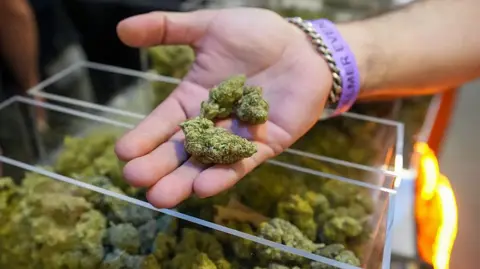
Getty ImagesPresident Donald Trump is expected to sign an executive order that would expand access to cannabis, a long anticipated move that would mark the most significant shift in US drug policy in decades.
The order is expected to reclassify cannabis from a Schedule I narcotic, to a Schedule III drug - placing it under the same category as Tylenol with codeine, US media reports suggest.
Even if recategorised, cannabis will remain illegal at the federal level. But classifying it as a Schedule III narcotic would allow expanded research to be conducted into its potential benefits.
Several Republican lawmakers have cautioned against the move, with some arguing it could normalise cannabis use.
The US Drug Enforcement Agency notes that Schedule III narcotics - which also include ketamine and anabolic steroids - have only a "moderate to low potential for physical and psychological dependence".
The executive order could come as early as Thursday, although the timing could shift, CBS, the BBC's US partner, has reported.
The new classification could also have tax implications for state-authorised cannabis dispensaries, as current regulations bar them from some tax deductions if they sell Schedule I products.
Various US news outlets have reported that the announcement may also include a pilot programme that would see some older Americans reimbursed for cannabidiol, commonly known as CBD, for conditions including cancer treatments.
In recent years, a majority of US states have approved cannabis for some medical use, and nearly half - 24 - have legalised recreational use. But since 1971, cannabis has been a Schedule I narcotic, which means it has no accepted medical use and a high potential to be abused.
Earlier this week, Trump said that he was "considering" the re-classification because of "tremendous amounts of research that can't be done unless you reclassify".
The Biden administration proposed a similar reclassification, and in April 2024 the DEA proposed a rule change, but got bogged down under administrative and legal issues.
Trump has long expressed a desire to change US drug policy regarding cannabis.
"I believe it is time to end endless arrests and incarcerations of adults for small amounts of marijuana for personal use," he wrote on Truth Social last year while running for president.
"We must also implement smart regulations, while providing access for adults, to safe, tested products," he said.
The reclassification proposal has met some resistance from Republican lawmakers.
On Wednesday, a group of 22 Republican Senators sent an open letter to the president, arguing that marijuana use would mean that "we cannot re-industrialise America".
The Senators pointed to lingering concerns over the health impact of cannabis, as well as research suggesting that cannabis can be linked to "impaired judgement" and "lack of concentration".
"In light of the documented dangers of marijuana, facilitating the growth of the marijuana industry is at odds with growing our economy and encouraging healthy lifestyles for Americans."
In a separate letter sent to Attorney General Pam Bondi in August, nine Republican representatives argued that "no adequate science or data" exists to support the change.
"Marijuana, while different than heroin, still has the potential for abuse and has no scientifically proven medical value," the letter said. "Therefore, rescheduling marijuana would not only be objectively wrong, but it would also imply to our children that marijuana is safe. That couldn't be further from the truth."
More broadly, polls show that a majority of Americans support efforts to legalise marijuana.
One Gallup poll released in November found that 64% of Americans believe that it should be legalised, although support had drifted slightly from previous years because of a 13-point drop among Republicans.

© Mikayla Whitmore for The New York Times

© JJ Geiger for The New York Times

© JJ Geiger for The New York Times

© Eric Lee for The New York Times

© Arnaud Finistre/Agence France-Presse — Getty Images

© Illustration by The New York Times; photograph by Andrew Caballero-Reynolds/Getty

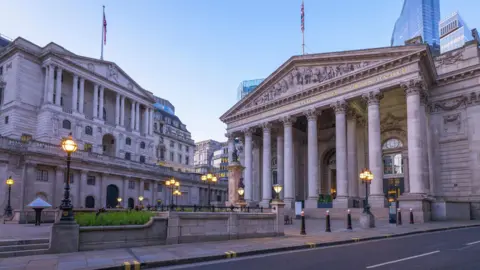
Getty ImagesPolicymakers at the Bank of England are expected to cut interest rates - bringing the Bank rate down to its lowest level since February 2023.
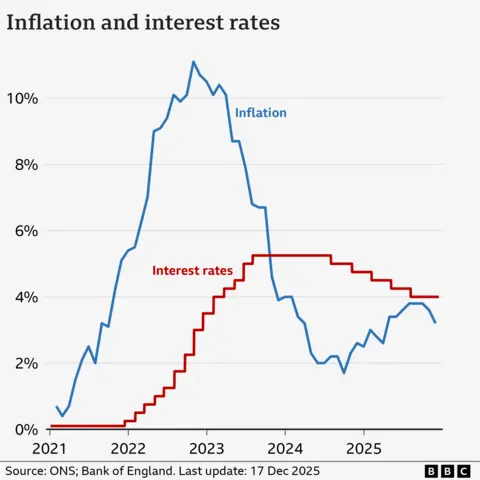
Analysts are widely predicting a fall from 4% to 3.75%, although they do not expect a unanimous decision among the nine-member Monetary Policy Committee (MPC).
This would be the sixth cut in interest rates from August last year.
The Bank rate heavily influences the cost of borrowing by consumers, but also the returns given to savers.
The MPC has a target to keep inflation - which charts the rising cost of living - to 2%. The Bank rate is the committee's primary tool for achieving its ambition.
The latest inflation data, published on Wednesday, showed a bigger drop to Consumer Prices Index (CPI) inflation than analysts had been expecting.
The rate of CPI fell to 3.2% in November, from 3.6% in October, the Office for National Statistics (ONS) said.


While inflation remains above the Bank's target, the latest fall in the rate and signs of rising unemployment and a relatively stagnant economy are likely to push the committee towards an interest rate cut.
At the previous meeting in November, the four members of the MPC who voted for a cut were only just outvoted by the five who wanted to keep rates on hold.
At the time, the Bank's governor, Andrew Bailey, said he would "prefer to wait and see" whether inflation continued to drop back.
James Smith, developed market economist for ING, said the sharp drop in the November rate of inflation "green lights" a rate cut.
He said the "latest drop in inflation fits into a broader body of evidence suggesting that price pressures are cooling".
He is forecasting another two cuts to interest rates in February and April next year, although not all analysts agree with this suggestion.
About 500,000 homeowners have a mortgage that "tracks" the Bank of England's rate. If a 0.25 percentage point cut does come, it is likely to mean a typical reduction of £29 in their monthly repayments.
For the additional 500,000 homeowners on standard variable rates, there would typically be a £14 a month fall, assuming there is a cut in the Bank rate and lenders pass on the cut to their customers.
The vast majority of mortgage customers have fixed-rate deals. Rates on these deals have been falling recently, owing to the expectation among lenders of a Bank rate cut in December.
As of 17 December, the average two-year fixed residential mortgage rate was 4.82%, according to financial information company Moneyfacts. A five-year rate was 4.90%.
Mortgage rate cuts should also reduce some financial pressure on landlords, and perhaps ease the likelihood of rent rises for tenants.
However, savers are likely to see a further fall in returns as a result of any Bank rate falls.
The current average rate on an easy-access savings account is 2.56%, according to Moneyfacts.

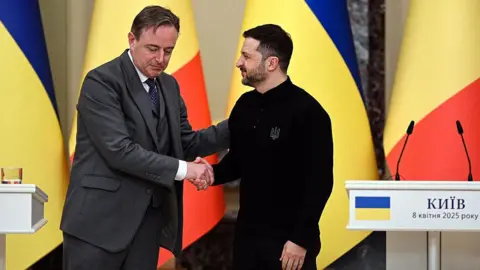
Ukrinform/NurPhotoEuropean Union leaders begin two days of talks in Brussels with a momentous decision to be taken on whether to loan tens of billions of euros in frozen Russian assets to Ukraine to fund its military and economic needs.
Most of Russia's €210bn (£185bn; $245bn) worth of assets in the EU are held by Belgium-based organisation Euroclear, and so far Belgium and some other members of the bloc have said they are opposed to using the cash.
Without a boost in funding, Ukraine's finances are set to run dry in a matter of months.
One European government official described being "cautiously optimistic, not overly optimistic" that a deal would be agreed. Russia has warned the EU against using its money.
It has filed a lawsuit against Euroclear in a Moscow court in a bid to get its money back.
The Brussels summit comes at a pivotal moment.
US President Donald Trump has said a deal to end the war - which began with Russia's full-scale invasion of Ukraine in February 2022 - is "closer now than we have been ever".
Although Russia has not responded to the latest peace proposals, the Kremlin has stressed that plans for a European-led multinational force for Ukraine supported by the US would not be acceptable.
President Vladimir Putin made his feelings towards Europe clear on Wednesday, when he said the continent was in a state of "total degradation" and "European piglets" - a derogatory description of Ukraine's European allies - were hoping to profit from Russia's collapse.

Alexander KAZAKOV/POOL/AFPThe European Commission - the EU's executive arm - has proposed loaning Kyiv about €90bn (£79bn) over the next two years - out of the €210bn of Russian assets sitting in Europe.
That is about two-thirds of the €137bn that Kyiv is thought to need to get through 2026 and 2027.
Until now the EU has handed Ukraine the interest generated by the cash but not the cash itself.
"This is a crunch time for Ukraine to keep fighting for the next year," a Finnish government official told the BBC. "There are of course peace negotiations but this gives Ukraine leverage to say 'we're not desperate and we have the funds to continue fighting'."
Commission chief Ursula von der Leyen says it will also ramp up the cost of war for Russia.
Russia's frozen assets are not the only option on the table for EU leaders. Another idea, backed by Belgium, is based on the EU borrowing the money on the international markets.
However, that would require a unanimous vote and Hungary's Viktor Orban has made it clear he will not allow any more EU money to help Ukraine.
For Ukraine, the hours ahead are significant and President Volodymyr Zelensky is expected to attend the EU summit.
Ahead of the Brussels meeting, EU leaders were keen to stress the momentous nature of the decision.
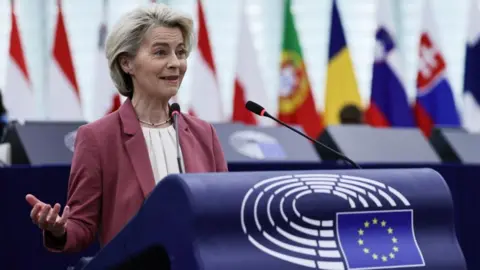
"We know the urgency. It is acute. We all feel it. We all see it," von der Leyen told the European Parliament.

EPAGerman Chancellor Friedrich Merz has played a leading role in pushing for the Russian assets to be used, telling the Bundestag on the eve of the summit it was about sending a "clear signal" to Moscow that continuing the war was pointless.
EU officials are confident they have a sound legal basis to use the frozen Russian assets, but so far Belgian Prime Minister Bart De Wever remains unconvinced.
His Defence Minister Theo Francken warned ahead of the talks that it would be a big mistake to loan the Euroclear cash.
Hungary is seen as the biggest opponent of the move and, ahead of the summit, Prime Minister Orban and his entourage even suggested that the frozen assets plan had been removed from the summit agenda. A European Commission official stressed that was not the case and it would be a matter for the 27 member states at the summit.
Slovakia's Robert Fico has also opposed using the Russian assets, if it means the money being used to procure weapons rather than for reconstruction needs.
When the pivotal vote does finally take place, it will require a majority of about two-thirds of member states to go through. Whatever happens, European Council President António Costa has promised not to go over the heads of the Belgians.
"We're not going to vote against Belgium," he told Belgian public broadcaster RTBF. "We'll continue to work very intensively with the Belgian government because we don't want to approve something that might not be acceptable for Belgium."
Belgium will also be aware that ratings agency Fitch has placed Euroclear on a negative watch, partly because of "low" legal risks to its balance sheet from the European Commission's plans to use the Russian assets. Euroclear's chief executive has also warned against the plan.
"There are many hiccups and obstacles of course still on the way. We have to find a way to respond to Belgium's worries," the Finnish official added. "We are on the same side as Belgium. We will find a solution together to make sure all the risks are checked as much as they can be checked."
However, Belgium is not the only country to have doubts, and a majority is not guaranteed.
Italian Prime Minister Giorgia Meloni has told Italian MPs she will endorse the deal "if the legal basis is solid".
"If the legal basis for this initiative were not solid, we would be handing Russia its first real victory since the beginning of this conflict."
Malta, Bulgaria and the Czech Republic are also said to be unconvinced by the controversial proposals.
If the deal is passed and the Russian assets are given to Ukraine, the worst-case scenario for Belgium would be one in which a court would order it to hand the money back to Russia.
Some countries have said they would be prepared to provide billions of euros in financial guarantees, but Belgium will want to see the numbers add up.
At any rate, Commission officials are confident that the only way for Russia to get it back would be by paying reparations to Ukraine - at which point Ukraine would hand its "reparations loan" back to the EU.

Getty ImagesThe NHS remains on high alert over flu, health bosses say, but there are clear signs the surge in the virus has come to an end for now at least.
Community spread appears to have stabilised, the UK Health Security Agency says.
Meanwhile, the rise in hospital cases has slowed. And with just over 3,000 patients in hospital in England with the virus, the dire prediction by NHS chief executive Sir Jim Mackay of "between 5,000 and 8,000" cases has not materialised.
How serious then is this flu season so far, and how does it really compare to previous outbreaks of the virus?


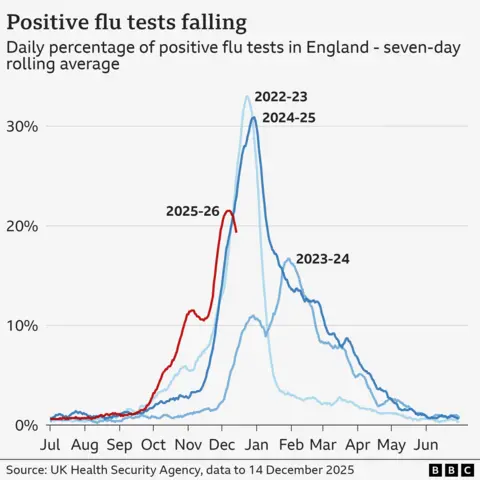
The major difference between the 2025 flu season and the last three years is that the virus started spreading a few weeks earlier than normal.
When someone goes to their GP or hospital with flu-like symptoms, they can be swabbed and tested for influenza, Covid, RSV and other viruses.
UKHSA then records the percentage of those tests that come back positive for flu.
Figures had been rising quickly over the autumn and at the start of winter.
But last week the spread of the virus appears to have stabilised at a medium level, UKHSA says.
It is too early to say whether this marks the start of the peak. Flu is unpredictable, a lull can be followed by another surge.


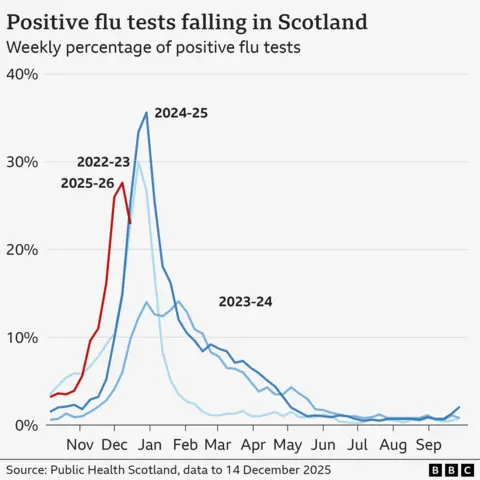
The picture across the four nations of the UK is similar.
Some virologists have linked the earlier flu season this year to the type of virus that is circulating - known as H3N2.
Historically, seasons dominated by that strain tend to be more severe, with larger numbers of hospitalisations in older people, in particular.
H3N2 has not been the main form of flu detected in the UK for three years, which may mean that less immunity has been built up in the population.
Scientists also spotted a further shift in the genetic makeup of the virus over the summer.
This seems to have given the virus a head-start in the autumn.
The name 'super-flu' has been used by the NHS to describe this latest outbreak.
But that is not a medical term, and it does not mean the virus itself has suddenly become more dangerous or harder to treat.
"It is misleading and a bit frightening to call it super flu; it's just a flu variant that is clearly a little bit more infectious than normal," says Prof Lawrence Young, professor of molecular oncology at the University of Warwick.
"What we're seeing is a flu season that's perhaps two to three weeks earlier than normal."
Separately, the NHS also records the number of the sickest patients in hospital with flu over the winter. Trends in hospital data tends to lag behind community spread as it takes some time for people to get ill enough to seek hospital care.
Figures for last week showed the number hit 3,140, an 18% rise on the week before. But that was after a 55% jump in the week before that.
Although the national figure masks what is happening across different regions with some areas seeing numbers fall and others still seeing steep rises.
Those over 85-years-old are five times more likely to be hospitalised than the general population.
Comparing outbreaks over the decades is difficult because testing has improved in recent years, so a rise in hospital admissions over time might also reflect better detection.
But estimated figures on flu deaths shows that some winters have been particularly serious over the past 20 years.
In 2017-18, for example, it's thought 25,000 people died from the virus in England, with care homes and older adults most affected.
That year an unusual form of the influenza B virus started circulating and the 'beast from the east' cold snap bought freezing temperatures to the UK, creating the ideal environment for the disease to spread.
Just three years before that, in 2014-15, modelling by scientists at UKHSA estimated that 35,000 had died, making it one of the most lethal flu seasons in decades.
Again, that was blamed on an outbreak of the H3N2 form of the virus and a seasonal vaccine that was not well matched to the exact form of the disease circulating.
There is nothing in the data so far which suggests anything comparable in 2025, but we won't know for sure until the first estimates for this season's influenza deaths are published in the new year.
The message coming from doctors and the NHS is for millions of people to continue to come forward for a flu vaccine.
Even though the genetic make-up of the virus has shifted, the main jab is still thought to offer an effective level of protection, particularly against ending up in hospital with severe disease.
The flu vaccine is free on the NHS for those over 65-years-old, young children, pregnant women, those with certain health conditions, carers, and front-line health and social care workers.
All other adults can get the same vaccine for between £15 and £25 from high street pharmacists.
The latest data shows that more than 70% of older people and care home residents had taken up the offer of a free jab by 14 December.
But vaccination rates in some other groups are much lower.
Only 39% of all front-line NHS workers in England have been vaccinated so far this year.
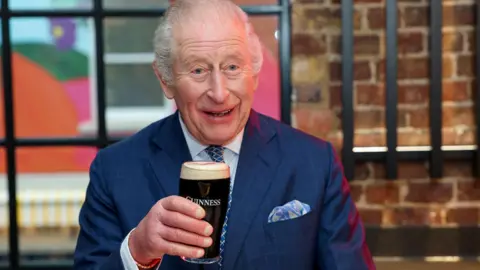
King Charles successfully poured a "perfect" pint of Guinness on a Christmas visit to a new brewery in London's Covent Garden, where he tasted his pint-pulling efforts.
This was his first public visit since the King's video message revealing "good news" about the positive progress of his cancer treatment - and he seemed to be really enjoying the moment.
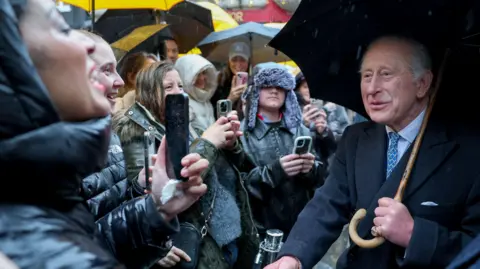
The King surprised some shoppers outside the event, wishing them a "Merry Christmas" and shaking hands in an impromptu walkabout in the rain.
The King, who seemed in festive form, joked with carol singers that they must be "moonlighting from the Royal Opera House" and teased reporters that they were not getting to test the drinks on display.

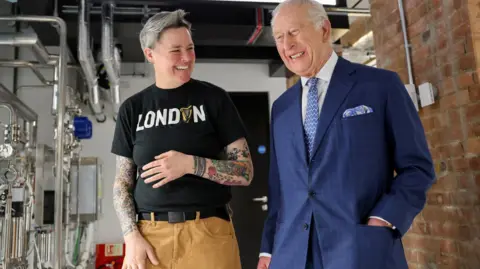
ReutersThe King was opening the Guinness Open Gate Brewery, a £73m investment which will be a new London visitor attraction as well as producing a range of beers.
There was a lesson in how to pour a pint, with the King shown how to tilt the glass to 45 degrees, and then to leave it to settle for between 60 to 70 seconds, which he was told allowed 300 million bubbles to rise inside the glass.
It was not clear who had ever counted them, but the King was ready to raise a glass to Christmas and perhaps, he might have been thinking about "good health" in a more personal way.
His pint-pulling trainer, Leo Ravina, said he had poured a "perfect pint".
"If you say so," replied the King, who wiped away a foamy Guinness moustache.
The King seemed less convinced by another piece of hi-tech boozing, where he was shown how an image could be printed, using beetroot or carrot juice, on to the beer's surface.
Although as monarch, he had to avoid sharing his point (or in this case pint) of view.
There was also no mention of the social media fad of "splitting the G", where drinkers try to reach a certain point on a pint glass.
But the King seemed to enjoy some of the less usual beers on offer, including one with an apricot flavour.
This tasting session was in the 232 Bar, named after the temperature at which the barley is roasted to get the distinctive flavour.

ReutersGuinness also gave the King a tour of the inner workings of the beer-making process.
Despite the rain, the King seemed determined to go outside, where crowds appeared taken aback to see this unexpected visitor and held up their phones in the drizzle. He chatted to a couple about keeping their baby warm in the downpour.

PA MediaThere was also a tour of a Christmas-themed food market.
And among the guests was movie director Gurinder Chadha, who made Bend It Like Beckham and has now launched a modern version of A Christmas Carol, called Christmas Karma.
It has a message about compassion and multicultural communities, and Ms Chadha said the King had asked for a copy of the film to watch at Christmas in Sandringham.
The King was also introduced to young people who were being trained for the hospitality industry.
Nik Jhangiani of Guinness's parent company Diageo welcomed the seasonal royal visit: "Pubs and restaurants are the heartbeat of the hospitality sector and this is a wonderful show of support for the industry."


Sign up here to get the latest royal stories and analysis every week with our Royal Watch newsletter. Those outside the UK can sign up here.

Getty ImagesWaterloo Road actor William Rush has died aged 31, his family has announced.
Rush played schoolboy Josh Stevenson in the BBC One drama, appearing in 168 episodes between 2009 and 2013.
As a child actor, he also appeared in Grange Hill and Shameless, and later went on to roles in Casualty and Vera.
His mother, ex-Coronation Street actress Debbie Rush, announced on Instagram that William had died on Wednesday, adding: "As a family, our hearts are completely broken." His cause of death has not been announced.
Rush also auditioned for ITV talent show The X Factor in 2016, and made it as far as the "six-chair challenge", the stage between boot camp and judges' houses.
Debbie Rush, an actress herself who played Anna Windass in Coronation Street for a decade, described William as "our beautiful baby boy", said: "There are no words that can truly capture the depth of our loss."
She also paid tribute to her son's decision to become an organ donor before he died.
"Even in our darkest moment, William gave the most precious gift of all," she said.
"Through being an organ donor, he has given hope and life to other families, thinking of others right to the very end. His kindness and love will forever be part of his legacy.
"We kindly ask that our privacy be respected as we navigate this unimaginable grief. William will always be loved, always missed, and forever in our hearts."
Fellow Coronation Street stars left supportive messages on her post, with Sally Dynevor saying she was "so shocked to hear this news" and describing William as a "beautiful boy".
Actress and former Strictly contestant Katie McGlynn said he "brought a smile to everyone's face and was a very kind soul", and fellow Corrie star Brooke Vincent wrote: "I am so sorry for your loss, sending you so much love."

Getty ImagesPresident Donald Trump is expected to sign an executive order that would expand access to cannabis, a long anticipated move that would mark the most significant shift in US drug policy in decades.
The order is expected to reclassify cannabis from a Schedule I narcotic, to a Schedule III drug - placing it under the same category as Tylenol with codeine, US media reports suggest.
Even if recategorised, cannabis will remain illegal at the federal level. But classifying it as a Schedule III narcotic would allow expanded research to be conducted into its potential benefits.
Several Republican lawmakers have cautioned against the move, with some arguing it could normalise cannabis use.
The US Drug Enforcement Agency notes that Schedule III narcotics - which also include ketamine and anabolic steroids - have only a "moderate to low potential for physical and psychological dependence".
The executive order could come as early as Thursday, although the timing could shift, CBS, the BBC's US partner, has reported.
The new classification could also have tax implications for state-authorised cannabis dispensaries, as current regulations bar them from some tax deductions if they sell Schedule I products.
Various US news outlets have reported that the announcement may also include a pilot programme that would see some older Americans reimbursed for cannabidiol, commonly known as CBD, for conditions including cancer treatments.
In recent years, a majority of US states have approved cannabis for some medical use, and nearly half - 24 - have legalised recreational use. But since 1971, cannabis has been a Schedule I narcotic, which means it has no accepted medical use and a high potential to be abused.
Earlier this week, Trump said that he was "considering" the re-classification because of "tremendous amounts of research that can't be done unless you reclassify".
The Biden administration proposed a similar reclassification, and in April 2024 the DEA proposed a rule change, but got bogged down under administrative and legal issues.
Trump has long expressed a desire to change US drug policy regarding cannabis.
"I believe it is time to end endless arrests and incarcerations of adults for small amounts of marijuana for personal use," he wrote on Truth Social last year while running for president.
"We must also implement smart regulations, while providing access for adults, to safe, tested products," he said.
The reclassification proposal has met some resistance from Republican lawmakers.
On Wednesday, a group of 22 Republican Senators sent an open letter to the president, arguing that marijuana use would mean that "we cannot re-industrialise America".
The Senators pointed to lingering concerns over the health impact of cannabis, as well as research suggesting that cannabis can be linked to "impaired judgement" and "lack of concentration".
"In light of the documented dangers of marijuana, facilitating the growth of the marijuana industry is at odds with growing our economy and encouraging healthy lifestyles for Americans."
In a separate letter sent to Attorney General Pam Bondi in August, nine Republican representatives argued that "no adequate science or data" exists to support the change.
"Marijuana, while different than heroin, still has the potential for abuse and has no scientifically proven medical value," the letter said. "Therefore, rescheduling marijuana would not only be objectively wrong, but it would also imply to our children that marijuana is safe. That couldn't be further from the truth."
More broadly, polls show that a majority of Americans support efforts to legalise marijuana.
One Gallup poll released in November found that 64% of Americans believe that it should be legalised, although support had drifted slightly from previous years because of a 13-point drop among Republicans.
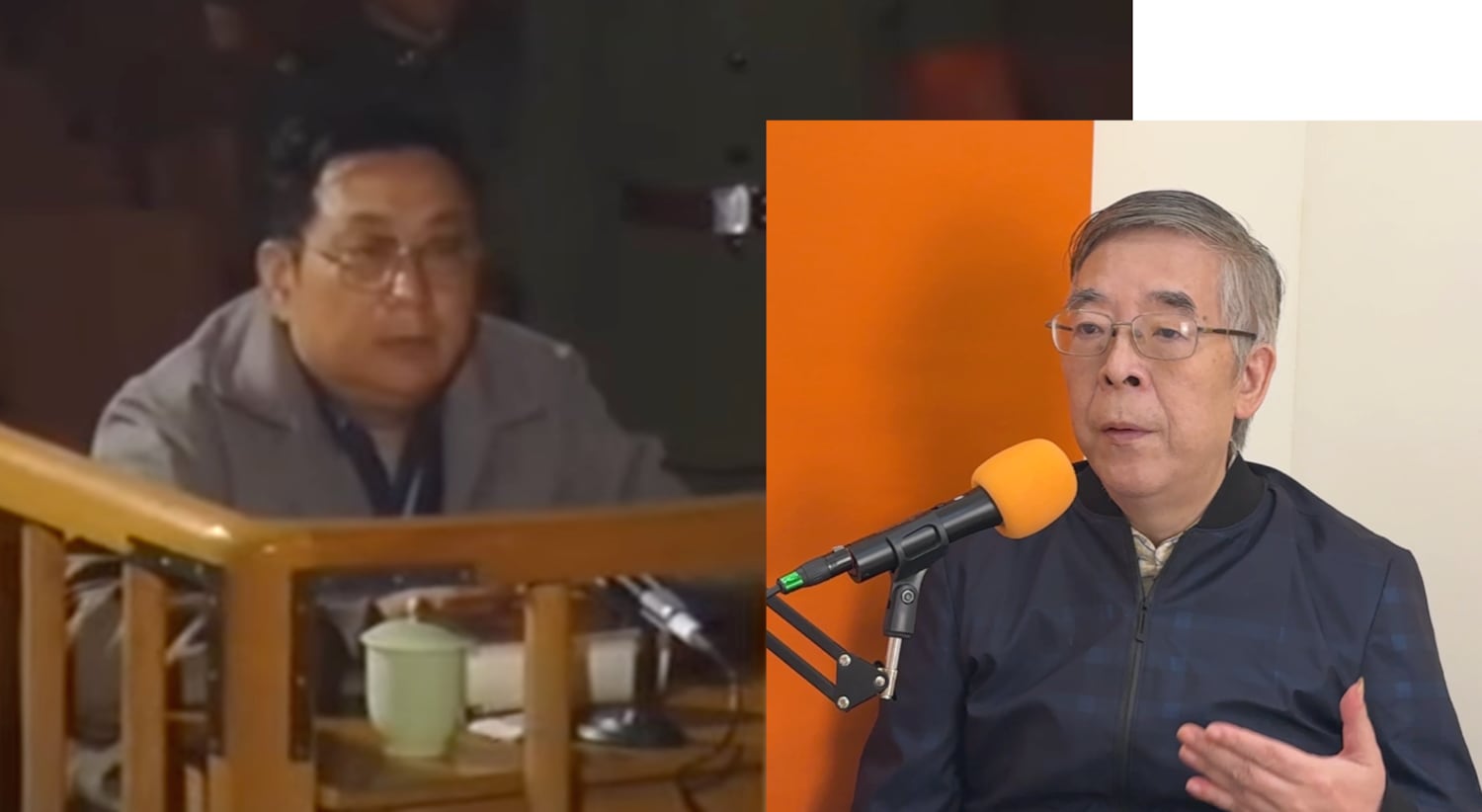
长期研究六四历史的学者吴仁华,11月25日公开了首见天日的北京军事法院开庭审判六四抗命将军徐勤先视频完整录像,时长超过6小时。吴仁华近日首次面对镜头接受自由亚洲电台采访,谈到他披露这份档案的心情、顾虑和得到的启发。
记者:您得到这份影像时的情况为何?有什么考虑?
吴仁华:它是非常珍贵的,对于中国官方来讲也是最高的机密,所以我当时得到完整的录像的时候,我也是挺震惊的。我30多年在收集六四屠杀的资料,这是我得到的最重要的一份资料。当时一直犹豫着要不要公布,用什么方式来公布。因为首先要考虑到相关人员的人身安全。因为这种资料的流出,一旦公布,中国官方一定会严厉的去追查。如果追查有了结果,相关的人士如果逮捕的话,那判处的刑期是非常重的,最高可以判处死刑。
我知道有好多人就是因为所谓的泄露国家机密罪,都被判处10年到20年不等的刑期。徐勤先将军的庭审录像,后来是到今年11月25号,用一种链接的方式放到网络上,然后我在社交媒体推特上做了转发。
记者:公布之后引发社会热烈的讨论,在您的预料之中吗?
吴仁华:我知道这个资料很重要。但是那个轰动的情况还是有点出乎我的预料。这说明,尽管六四屠杀事件过去了36年,但是很多人还是对这个事件念念不忘。
因为中共官方一直把它作为最大的禁区,到现在不让大家去讨论,更不让大家去挖掘真相。这反而有一种逆反的心理。不仅是当年参与过天安门民主运动的这些人牢记着这件事,包括后来的八九以后各个世代中国出生的人,也在记着这件事。因为你越是封杀,人家就越好奇。所以我觉得这个录像引起这么的轰动,说明今天还有许许多多的人没有忘记六四屠杀事件。
记者:大家讨论的焦点在于徐勤先将军作为一个军人,可以拒绝接受党的不合理命令,您如何看徐勤先?
吴仁华:徐勤先将军当年是第38集团军的军长,38集团军是中国军队里头,最精锐的一个部队,是名列第一的一支部队,他有御林军、万岁军的称号。
作为一个中国第一主力军的军长,能够抗拒镇压民众的命令,宁可付出自己个人的代价,这一点从当年到现在,许许多多人还是很尊重他。
他实际上已经具有了军队国家化的这种初步的观念。因为他在庭审当中明确提出来,北京戒严军队全副武装进入北京,不应该是由党来下命令,应该是由全国人大来做决定。因为按照中国的法律规定,全国人大是最高的权力机构,就类似于民主国家的议会,所以不能由党来决定。
记者:影片公布后,有各种不同的解读,甚至牵涉到现在中共的政治,您有何看法?
吴仁华:这个录像的流出,包括这个时候放到网络上 ,没有任何的政治背景。跟中共党内高层的权力斗争,或者是跟中共军队高层的权力斗争没有任何关系。
我为了保护相关的人身安全,我不能具体的说这个庭审录像是怎么流出的。怎么到了我的手,提供者他是出于对我的信任跟支持,把这个庭审的录像给了我。他说吴老师,你可以随便的去用这个庭审的录像,但是我就是一个要求,你不能透露这个庭审录像的来源。
因为造成轰动,而说我是被中共党内的某派,或者中共军内的某派利用了,他们想用这个录像去打击对方。这些解读都是过分的解读。
记者:您认为这个录像的出现,会对解放军造成示范效应吗?
吴仁华:徐勤先将军这种观念,在军队里头是有一定的、潜在的支持者跟赞同者。
实际上在六四镇压当中,抗命的将领,并不只有徐勤先将军一个人,只是他那支部队知名度高。
后来我在写作《六四事件中的戒严部队》这本专著的时候,我其中还有专门一个章节就写到,同样是属于北京军区的第28集团军的军长何燕然,跟政治委员张明春,也是因为抗命,不向民众开枪,导致没有按时抵达天安门广场参加清场,所以事后也受到了处分。只是他们知名度不够,所以外界不太知道。
所以说徐勤先将军这个庭审资料出来以后,如果说有中国军方的人,他能够看到的话,我相信也会在他们内心里头会有所震动。
记者:如果中国再次发生大型群众示威抗议,军队会做不同的选择吗?
吴仁华:军队如果再次被调到街头要去镇压的话,我也相信即使那些将领、各级军官会做利益的选择,不能像徐将军那样非常明确的拒绝。但是他在执行任务的过程当中,他会把枪口抬高一寸,然后会以各种各样的原因理由来拖延这个任务的执行。
经过这么几十年过去以后,军队如果再次面对这种民主运动的话,它的选择会怎么样。我个人认为,可能会有更多的军人,会像徐将军那样做那种良知的选择,因为时代不一样了。
中国以后的变化的途径,一定是先是民变。所谓的民变就是说像天安门民主运动那样,大规模的民众上街抗议。然后第二步就是兵变,就是军队一定会被调上街的,一定要让军队去镇压的。那这时候军队可能选择跟当年89年的选择不一样。 因为时代不一样。
军队军人从各级的军官到士兵,因为他们也可能对现代的社会也是不满,因为全面腐败,他们的家人,特别是农村的,或者是城镇底层的弱势群体家庭出来的,他们对这个社会也非常不满。所以当他们有机会面对大规模的群众示威的活动的时候,跟群众接触的过程当中,他们觉得可能是机会来了,他们可能会站在民众的一边,然后兵变。当然最后第三步就是导致政变,就是政治变化。

© RFA制图

泰国王后今天周四在东南亚运动会帆船比赛中获得金牌。这项国际体育赛事在泰国举行,将持续到12月20日。
法新社报道:47岁的苏提达王后参加了SSL47级帆船比赛,她驾驶一艘14米长的帆船,身兼战术指挥和舵手,带领十名泰国队船员,在芭堤雅海面,战胜了马来西亚和缅甸,最终夺得冠军。
泰国前国王拉玛九世也曾在1967年东南亚半岛运动会上与女儿乌汶叻公主一同获得帆船金牌。
苏提达王后的金牌由73岁的泰国国王玛哈·哇集拉隆功颁发,他们于2019年结婚。
这位王后是运动爱好者,她于12月1日在曼谷与肯尼亚长跑传奇人物埃利乌德·基普乔格共同完成了半程马拉松,成绩为2小时13分40秒。她还擅长冰球运动。
苏提达王后拥有传播学学位,曾在泰国航空公司担任空乘人员,后投身军旅生涯。
12月9日,这位女王在首都举行的第33届东南亚运动会开幕式上率领泰国代表团入场。
距离比赛结束还有两天,东道主泰国在奖牌榜上遥遥领先,印度尼西亚和越南紧随其后。
最初有11个国家计划参加比赛,但柬埔寨出于安全考虑,因与主办国边境冲突仍在持续,已撤回所有运动员。

© Greta Rybus for The New York Times

© John Thys/Agence France-Presse — Getty Images

美国总统特朗普16日晚间宣布把全面或部分限制旅行国家名单扩大,已停止向包括马里、尼日尔和南苏丹在内的19个国家的公民发放签证。这项最新限制生效日期从2026年1月1日开始执行,请看的马里恩·洛里和奥拉·古拉视频报道。
“保护美国公民”,这是特朗普周二晚间签署的行政命令中明确提出的目标。
这位美国总统已将入境限制扩大到七个新的国家,主要集中在非洲。
美国政府必须确保获准进入其领土的外国公民没有威胁美国公民的意图,
或破坏或动摇其文化、政府、机构或立国原则,或宣扬、援助或支持指定的外国恐怖分子或任何其他危害国家安全的威胁。
布基纳法索、南苏丹、马里、尼日尔和叙利亚的国民被全面禁止入境,塞拉利昂和老挝的国民也受到全面禁止入境,而此前只受到部分限制。
同样持有巴勒斯坦权力机构签发旅行证件的巴勒斯坦人也成为攻击目标。
美国政府以这些国家的核查程序严重不足为由,为这些新措施辩护。这一决定与特朗普此前对叙利亚的支持承诺形成鲜明对比。
去年11月特朗普与叙利亚临时总统沙拉举行会谈,会晤期间,特朗普表示暂停对叙利亚的制裁,并希望尽一切可能帮助叙利亚重建。
但周六叙利亚中部发生一起针对美国公民的袭击事件,造成三人死亡。随后美国总统表示将采取严厉回应。
这些新增国家加入了去年六月实施的旅行禁令所影响的十二个国家的名单。

周四,泰柬边境冲突进入第12天。两国主要过境点之一,柬埔寨的边境赌城波贝市遭轰炸,而中国特使正准备前往当地进行调解。
据法新社报道,中国外交部特使预计将前往柬埔寨,斡旋泰柬两国领导人之间的冲突。
中国外交部在网上发表的声明表示:“作为柬埔寨和泰国的近邻和朋友,中国密切关注两国持续的边境冲突,并一直在双方之间奔走,促进和平。中国正以自己的方式积极致力于缓和局势。”
柬埔寨国防部称,一架“泰军F-16战机在波贝市地区投下了两枚炸弹”。柬埔寨内政部本周初表示,自12月7日冲突重启以来,已有四家赌场遭到泰国空袭破坏。
据法新社报道,柬埔寨的波贝市拥有许多赌场,平时深受来自泰国的赌客欢迎。柬埔寨周六暂停了所有边境通关。
据网传消息称,泰国空军最近炸毁了多个柬埔寨边境的电诈中心。
但据泰国空军称,根据情报,他们袭击的目标是“用于储存火箭弹”的建筑。泰国发言人塔马威猜在新闻发布会上表示:“我可以保证,没有平民伤亡和附带损害。”
据法新社周四引述“当局最新统计”,冲突已造成至少39人死亡:泰方21人,柬方18人。此外边境数十万人被迫撤离。
据该报道说,北京曾在7月份与美国总统特朗普一起介入过此前的柬埔寨泰国边境冲突。
美国总统上周五宣布,在他致电后,泰柬两国领导人已同意停火,但曼谷方面否认了这一说法,冲突仍在继续。
马来西亚总理安瓦尔·易卜拉欣周三晚间呼吁“立即停火”。马来西亚目前担任东盟轮值主席国。
东盟外长特别会议原定于本周在吉隆坡举行,但已被推迟至下周一。安瓦尔·易卜拉欣表示,泰国和柬埔寨总理认为现在举行会议“为时尚早”,并补充说,他本人对谈判成功的可能性“谨慎乐观”。
欧盟外交政策负责人卡娅·卡拉斯周三表示,她已与泰国和柬埔寨的同行进行了沟通,试图“打破局势升级的恶性循环”。
她在X网站上写道:“我们不能允许泰国和柬埔寨之间的冲突进一步恶化。”