The alleged gunmen in the shooting, Sajid Akram, 50 and his son, Naveed Akram, 24, were from Bonnyrigg, a diverse, multilingual suburb miles from Sydney’s Bondi Beach.
A pedestrian overpass spanning a main road on Friday in Bonnyrigg, a multicultural suburb of Sydney.
Many of the Justice Department documents were heavily redacted, and President Trump’s name was rarely mentioned. The White House also sought to make political hay of the release of photos of Bill Clinton.
Newly released files show how Maria Farmer, who worked for Mr. Epstein in the 1990s, had urged the F.B.I. to investigate him. The case went nowhere for years.
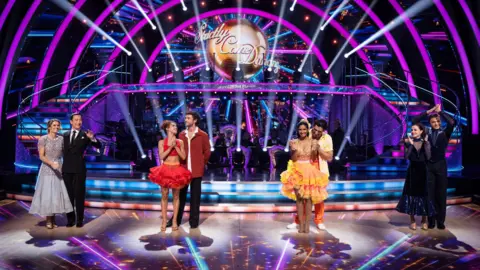
After weeks of intense competition, the Strictly Come Dancing finalists are primed to take to the dance floor one last time.
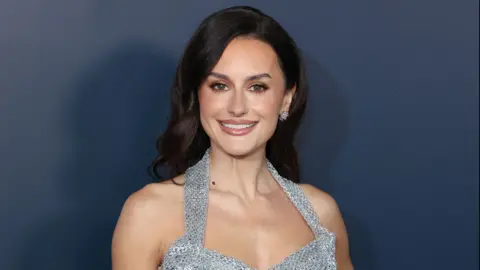
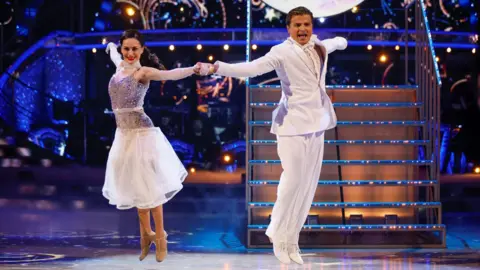
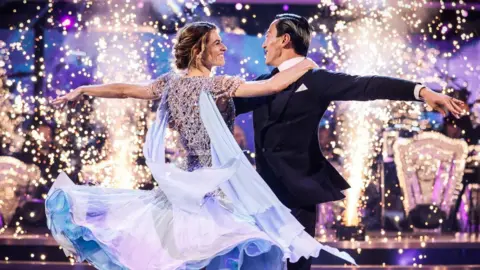
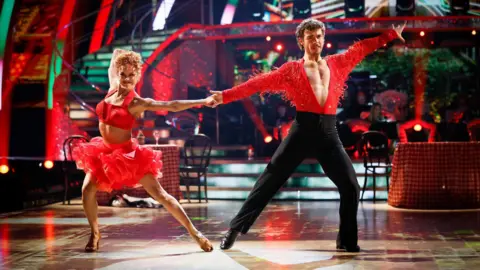
Just three couples remain of the 15 at the start of the series, with celebrities Amber Davies, George Clarke and Karen Carney vying to get their hands on the glitterball trophy.
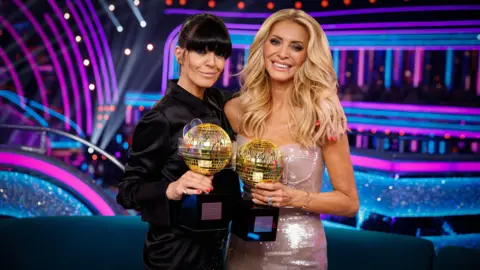
It's also the last time Tess Daly and Claudia Winkleman will present a Strictly final. The pair announced they would be stepping down at the end of the current series.
The grand final will be broadcast on Saturday from 19:00 GMT on BBC One and iPlayer.
Amber Davies says she's earned her place in final
One of the main talking points leading into the final has been whether Amber Davies' performing background has given her an unfair advantage.
The Love Island star has faced a backlash online with people pointing out she's had roles in West End musicals Pretty Woman, 9 to 5: The Musical, and The Great Gatsby, as well as competing in the 16th series of Dancing on Ice.
This week, she told BBC News and other reporters at a Strictly press conference that she could "appreciate" where the comments are coming from.
"I have experience compared to these two," she said, gesturing at the other finalists. "I'm not shying away from that. However, I would say that the love actually does outshine the hate."
When asked whether she deserves to win, the actress, who is paired with Nikita Kuzmin, said: "I feel like I have worked just as hard as these guys going into the final, because I had to fight to get into the final."
The backlash is perhaps a symptom of a wider theme on Strictly, where over the years some viewers have appeared to form their own judgements on contestants, regardless of what the judges think or what the overall audience vote says.
Earlier this series Lewis Cope received criticism for having been a child actor in Billy Elliot, for example, and last year JB Gill came under fire for having danced before in the boyband JLS.
'I can't believe a footballer is in the final'
And it seems many viewers value an element of surprise or beating the odds, as with Strictly's first blind contestant Chris McCausland winning last year.
For Karen Carney, becoming the first footballer to reach the Strictly Come Dancing final feels "weird" but she's also "really, really proud".
"I can't believe a footballer is in the final," she said in the press conference.
The former Lioness, who is partnered with Carlos Gu, said she had struggled with her confidence in recent years, but added: "I always knew in my heart Strictly would be the thing that would fix me... It's by far the happiest I've ever been."
Crown for the social stars?
For social media star George Clarke, reaching this point in the contest is "mental".
"It's a completely different world to what I'm used to," he said.
Another online star, AngryGinge, was recently crowned king of the jungle in this year's I'm A Celebrity... Get Me Out of Here! It opens up the possibility of two social media stars winning two of the biggest shows on television.
"I feel like it's a whole demographic that hasn't really been touched massively in mainstream TV," said Clarke, who is partnered with Alexis Warr.
Who is dancing to what this week?
The finalists will perform three routines: they will revisit a previous routine, perform a show dance and then take to the floor with their favourite dance from the series.
This is what they'll be dancing to:
Amber and Nikita
Showdance to Rain On Me by Lady Gaga and Ariana Grande
Judges' Pick - Paso Doble to Dream On by Aerosmith
Favourite Dance - Jive to Proud Mary
George and Alexis
Showdance to Human by The Killers
Judges' Choice - Viennese Waltz to Somebody to Love by Queen
Favourite Dance - Paso Doble to Game of Survival by Ruelle
Karen and Carlos
Showdance to Inner Smile by Texas
Judges' Pick - Argentine Tango to Red Right Hand by Nick Cave & The Bad Seeds
Favourite Dance - Jive to One Way Or Another by Blondie
Other highlights from the show will include a group routine from the professional dancers and this year's finalists.
The cast of 2025 will return to the dance floor one last time for a group number, although BBC News understands that Apprentice contestant Thomas Skinner will not join.
What time does the Strictly final start?
Strictly Come Dancing 2025's grand final is at 19:00 GMT this Saturday on BBC One and iPlayer.
It will also be available to watch on the live page on the BBC News website.
The live page will also have plenty of build up ahead of the show - plus extra insight on the dances, the outfits, the judges' comments, and much more.
How can I vote for my favourites?
This year, Strictly has moved to online-only voting.
When the vote is open, shimmy over to this website to make your decision!
As with every final, all of us at home have the full power to decide the winner.
The judges will give their scores, but these will just be for guidance and don't get combined with the viewers' votes.
What happened last weekend?
Warning: The section below includes spoilers from last week's Strictly
The semi-finalists had their fate revealed last week
Standards were incredibly high last week, as you would expect for a semi-final.
Amber Davies and Nikita Kuzmin kept up with their perfect score for a third consecutive week, while Karen Carney's Waltz had judge Anton Du Beke "a bit emotional" and George Clarke captivated the judges with his hip movement.
Daly has presented since the first series 21 years ago. Winkleman joined in 2014, having hosted Strictly's sister show It Takes Two since 2004.
This Saturday will be their last time presenting a Strictly final. Speaking on Strictly's sister show It Takes Two last week, the pair admitted they might feel "emotional" after the show.
Their last ever appearance on the show will be the Christmas special, which airs on 25 December.
There have been plenty of twists and turns in the show's 21st year.
But the show has also been embroiled in controversy.
In November, it emerged that an unnamed star from Strictly has been arrested on suspicion of rape. It comes after another man involved with the hit BBC dance show was also arrested on suspicion of rape in August.
It is understood that neither developments were related to the current series of Strictly.
It came after a difficult few years for the show, with a number of former celebrity contestants speaking up about their negative experiences on Strictly.
Last year, the corporation introduced new duty of care measures, including putting chaperones in rehearsals.
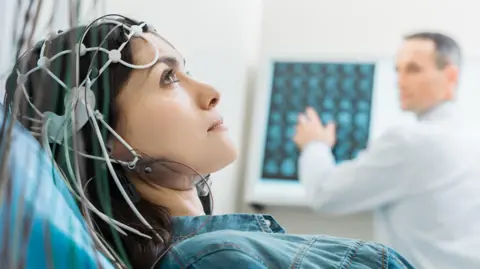
MIT researchers used electroencephalography to record brain activity while people used generative AI
What was the last thing you asked an AI chatbot to do for you?
Maybe you asked it for an essay structure to help answer a tricky question, provide an insightful analysis of a chunky data set, or to check if your cover letter matches the job description.
Some experts worry that outsourcing these kinds of tasks means your brain is working less - and could even be harming your critical thinking and problem-solving skills.
Earlier this year, the Massachusetts Institute of Technology (MIT) published a study showing that people who used ChatGPT to write essays showed less activity in brain networks associated with cognitive processing while undertaking the exercise.
These people also couldn't quote from their essays as easily as those in the study who didn't use an AI chatbot.
The researchers said their study demonstrated "the pressing matter of exploring a possible decrease in learning skills".
All 54 participants were recruited from MIT and nearby universities. Their brain activity was recorded using electroencephalography (EEG), which involves electrodes being placed on the scalp.
Some of the prompts used by the participants included asking AI to summarise essay questions, track down sources as well as refine grammar and style.
It was also used to generate and articulate ideas - but some users felt AI wasn't very good at this.
'AI makes it too easy to find answers'
Separately, Carnegie Mellon University and Microsoft, which operates Copilot, found people's problem-solving skills could diminish if they became too reliant on AI.
They surveyed 319 white-collar workers who used AI tools for their jobs at least once per week about how they apply critical thinking when using them.
They looked at 900 examples of tasks given to AI, ranging from analysing data for new insights to checking whether a piece of work satisfies particular rules.
The study found that higher confidence in the tool's ability to perform a task was related to "less critical thinking effort".
"While GenAI can improve worker efficiency, it can inhibit critical engagement with work and can potentially lead to long-term overreliance on the tool and diminished skill for independent problem-solving."
It found six in 10 felt AI had negatively impacted their skills in relation to schoolwork.
So, with the massive explosion of AI use, are our cognitive skills at risk of decline?
Klaus Vedfelt/Getty
A survey by OUP found six in 10 schoolchildren felt AI had negatively impacted their skills
Not necessarily, says Dr Alexandra Tomescu, a generative AI specialist at OUP who worked on the school survey.
"Our research tells us that nine in 10 students say AI has helped them develop at least one skill related to schoolwork - be it problem-solving, creativity or revision.
"But at the same time, about a quarter state that AI use made it too easy to do work for them… So [it's] quite a nuanced picture."
She adds that many pupils want more guidance on how to use AI.
ChatGPT, which has more than 800 million weekly active users according to boss Sam Altman, has published a set of 100 prompts for students designed to help them get the most out of the technology.
But Prof Wayne Holmes, who researches critical studies of artificial intelligence and education at University College London (UCL), says this isn't enough.
He wants much more academic research to be done about the effects of AI tools on learning before pupils and students are encouraged to use them.
He tells us: "Today there is no independent evidence at scale for the effectiveness of these tools in education, or for their safety, or even for the idea they have a positive impact."
Better results but worse learning?
Prof Holmes points to research about cognitive atrophy, where someone's abilities and skills become worse after using AI.
He says this has been a problem for radiologists who use AI tools to help them interpret X-rays before they diagnose patients.
A study by Harvard Medical School published last year found AI assistance did improve the performance of some clinicians but damaged others for reasons researchers don't fully understand.
The authors called for more work to be done on how humans interact with AI so we can figure out ways of using AI tools that "boost human performance rather than hurt it".
Prof Holmes fears that students, whether in school or university, could become too reliant on AI to do their work for them and not develop the fundamental skills an education provides.
A student's essay might receive better marks thanks to help from AI but the issue is whether they end up understanding less.
As Prof Holmes puts it: "Their outputs are better but actually their learning is worse."
Jayna Devani, who leads international education at OpenAI - the company that owns ChatGPT - and helped secure a deal with the University of Oxford, says the firm are "very aware of this debate right now".
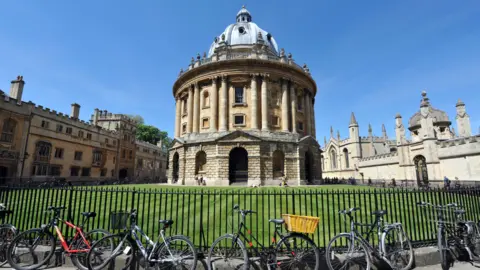
The University of Oxford began providing students and staff with ChatGPT for free in September
She tells the BBC: "We definitely don't think students should be using ChatGPT to outsource work".
In her view, it's best used as a tutor rather than just a provider of answers.
The example she gives is of a student having a back and forth with ChatGPT using the study mode setting.
You enter the question you're having difficulty answering and the chatbot can break down its components and help you understand it.
The example she gives is of a student doing an assignment late at night about a topic they don't quite understand.
"[If] you have an upcoming presentation to give and… it's midnight, you're not going to email your [university] tutor and ask for help," she says.
"I think the potential is truly there for ChatGPT to accelerate learning when it's used in a targeted way."
"It is not just the latest iteration of the calculator," he says, describing AI's far-reaching capabilities and implications.
"I never say to my students, you shouldn't use AI… But what I do try to say is look, we need to understand all these different things about it so that you can make informed decisions."
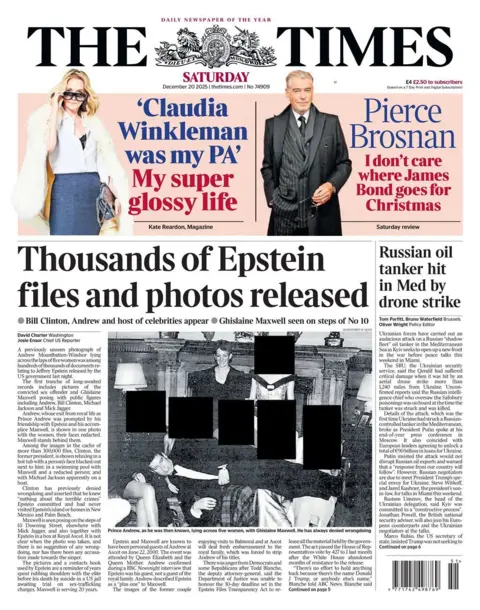
The Times leads with a new tranche of documents released by the US Department of Justice, including "a previously unseen photograph of Andrew Mountbatten-Windsor lying across the laps of five women". The photo appears to show the former prince, Ghislaine Maxwell, and redacted faces of six people. Andrew has repeatedly denied all wrongdoing, and says he did not "see, witness or suspect any behaviour of the sort that subsequently led to his arrest and conviction". Being named or pictured in the files is not an indication of wrongdoing.
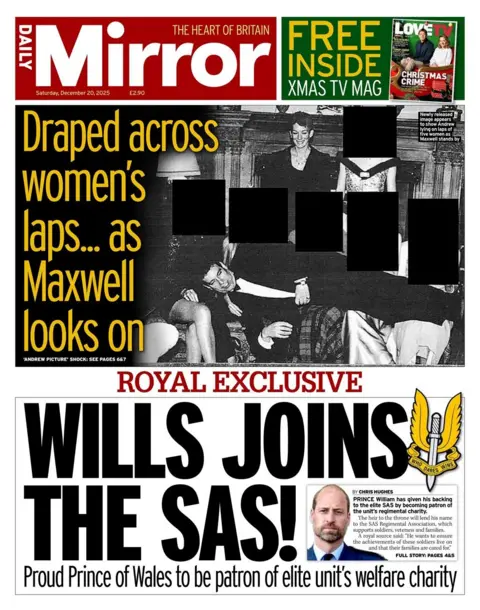
The Prince of Wales "joins the SAS" as a "patron of [the] elite unit's charity", which "supports soldiers, veterans and families", reports the Daily Mirror citing an unnamed royal source. Also featured on the front page is the black-and-white photo of Andrew "draped across women's laps... as Maxwell looks on", according to the paper.
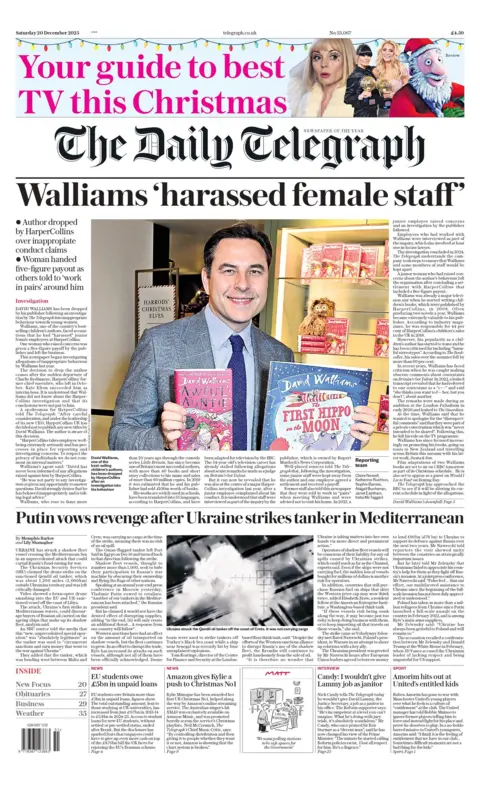
The Daily Telegraph leads with publisher HarperCollins UK dropping best-selling author and comedian David Walliams. The paper says it investigated allegations of inappropriate behaviour towards young women. The publisher does not specify the reason for dismissing Walliams. A spokesperson for Walliams says he has "never been informed of any allegations raised against him" by his publisher. "He was not party to any investigation or given any opportunity to answer questions. David strongly denies that he has behaved inappropriately and is taking legal advice," the spokesperson adds.
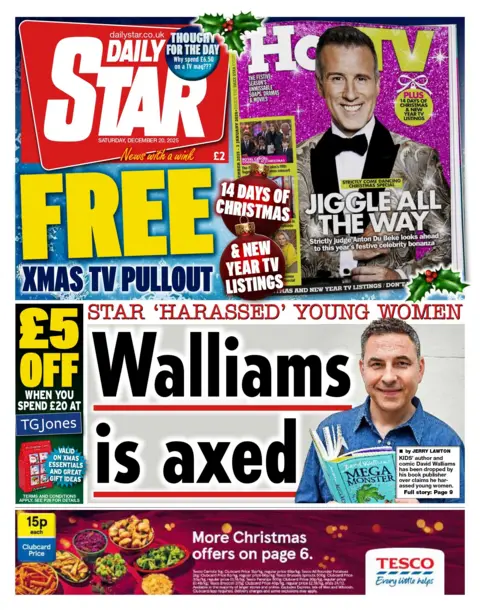
The Walliams story also leads the Daily Star's front page. A spokesperson for HarperCollins says it has decided not to release any new titles by Walliams "after careful consideration, and under the leadership of its new CEO".
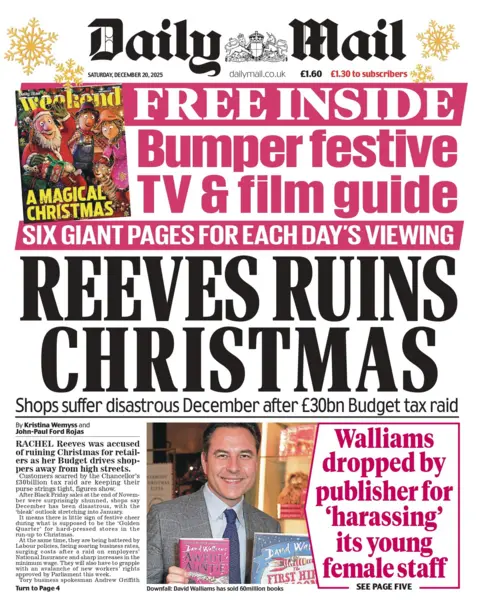
Chancellor Rachel Reeves is accused of ruining Christmas for retailers, reports the Daily Mail. It says customers "surprisingly shunned" Black Friday sales, as retailers say "December has been disastrous, with the 'bleak' outlook stretching into January". Critics cited by the paper blame the government's "£30bn Budget tax raid".
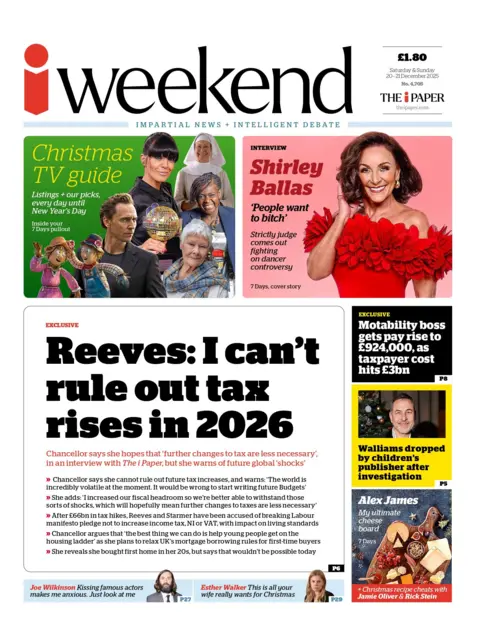
The i Paper leads with its interview of Reeves, who does not "rule out tax rises in 2026". The paper quotes the chancellor saying she hopes "further changes to tax are less necessary", while noting "the world is incredibly volatile at the moment". Her remarks follow the government's "£66bn in tax hikes" laid out in the November Budget, which the paper reports led to accusations of "breaking the Labour manifesto pledge not to increase income tax, NI (national insurance), or VAT (value-added tax)".
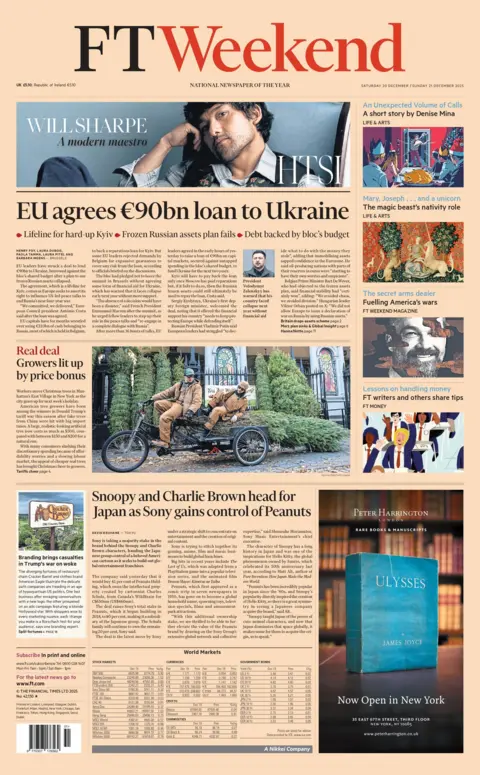
The Financial Times leads with the EU's €90bn (£79bn) loan to Ukraine, calling it a "lifeline for hard-up Kyiv". It notes the bloc's "plan to use frozen Russian assets collapsed" following objections from Belgium, warning it would be legally and financial liable.
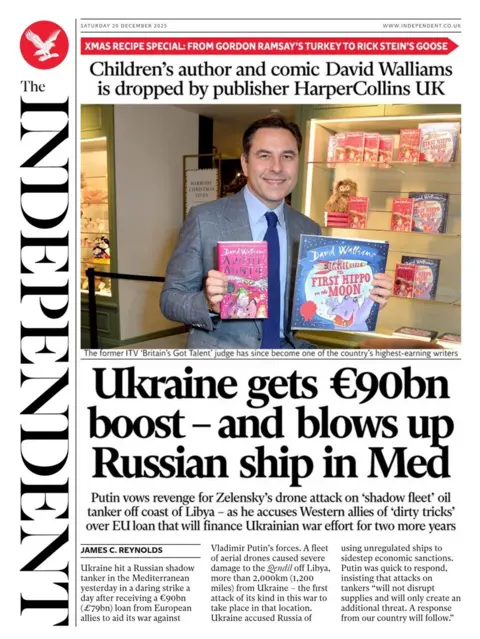
The Independent leads with the latest in Ukraine, combining the EU's €90bn (£79bn) loan and strike on a Russian oil tanker in the Mediterranean Sea in its headline. Russian President Vladimir Putin's response is also included, "as he accuses Western allies of 'dirty tricks'" over the European loan and "vows revenge for (Ukrainian President Volodymyr) Zelensky's drone attack".
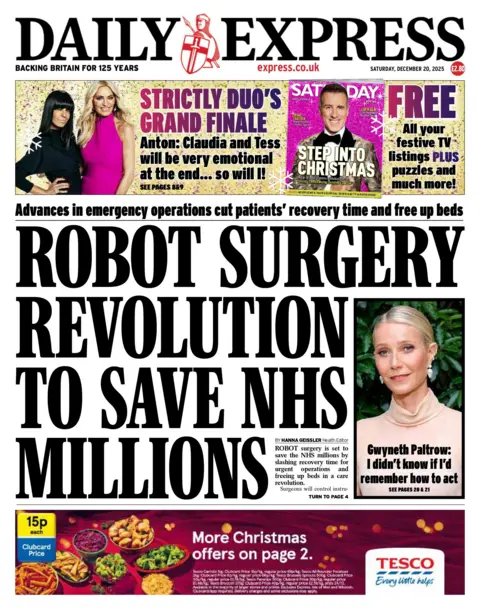
A "robot surgery revolution" is splashed on the Daily Express's front page. It says the new technology could "cut patients' recovery time and free up beds".
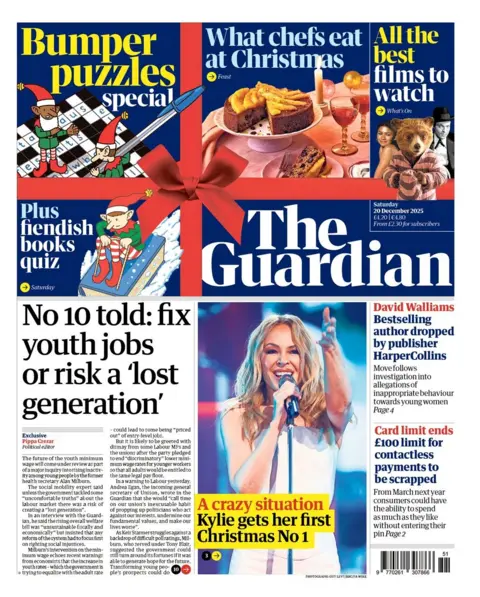
Warnings to the government that it could "risk a 'lost generation'" due to "rising inactivity among young people" leads the Guardian. Former health secretary Alan Milburn tells the paper the government must tackle some "uncomfortable truths" about the labour market, as he leads an inquiry that will include a review into the "future of the youth minimum wage".
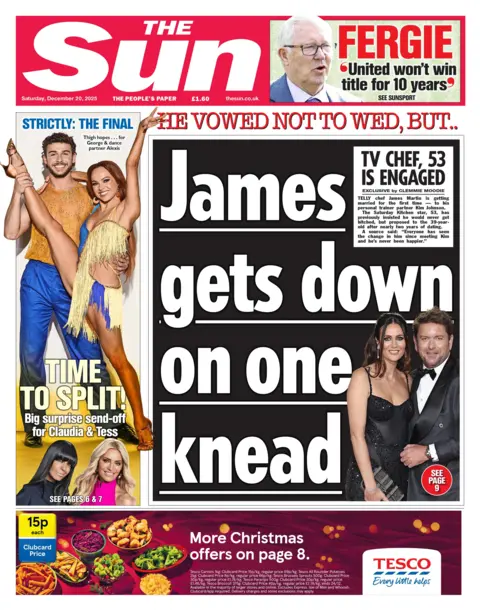
And finally, the Sun reports TV chef James Martin has announced he is engaged to his personal trainer partner Kim Johnson. The paper writes he got "down on one knead".
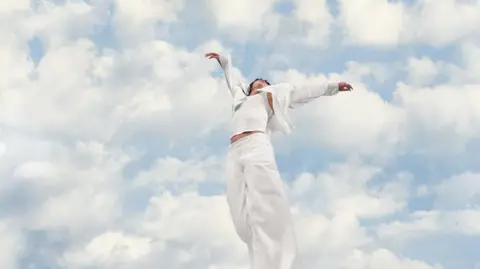
Cloud Dancer has been named Pantone's Colour of the Year
For anyone who has spent years renting, staring at the same landlord-approved magnolia walls and dreaming of one day adding some actual personality to their home, Pantone's 2026 Colour of the Year might feel like a personal attack.
This year, Pantone has chosen white as its colour of the year.
More specifically, Cloud Dancer - a white described as "lofty" and "billowy" which "serves as a symbol of calming influence in a society rediscovering the value of quiet reflection".
It is the first time white has been chosen as the colour of the year, and it has raised more than a few eyebrows.
According to Pantone, Cloud Dancer "is not just a colour, it's a mindset" and reflects a collective desire to slow down, reset and find calm after years of visual overload.
Pantone
An all-white take on Pantone's Cloud Dancer – soothing in theory, stressful if you drink red wine or coffee
But some critics have labelled the decision as "Pantonedeaf", arguing that elevating minimalist and pristine white spaces can feel far removed from the smaller, messier homes most people inhabit.
Others argue that positioning white as aspirational risks racial undertones, landing uncomfortably amid ongoing political and cultural conversations about race and representation.
Clinical or calm?
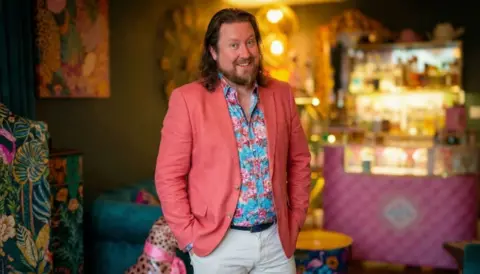
Designer Chris Beaumont says the backlash goes beyond aesthetics, arguing that white carries cultural undertones and is rarely a neutral choice.
"White is a signal," he says, shaped by a decade of minimalist celebrity interiors – most notably Kim Kardashian's stripped-back home – that came to represent "wealth, order and distance from chaos".
He explains that white is "not about inspiration but being careful not to offend", with Cloud Dancer embodying "austerity, moral minimalism and the idea that neutrality signifies virtue".
Chris Beaumont
Chris believes Pantone's choice for 2026 is "tone-deaf"
Beaumont points to the pandemic as a turning point in how people relate to their homes.
"Overnight they became our offices, sanctuaries and emotional anchors," he says, adding that against this backdrop, pushing the Colour of the Year towards "further visual emptiness feels rather tone-deaf".
Rather than offering calm, he believes white now risks amplifying "a sense of bleakness", particularly when paired with cool, clinical lighting.
'Hospital vibes'
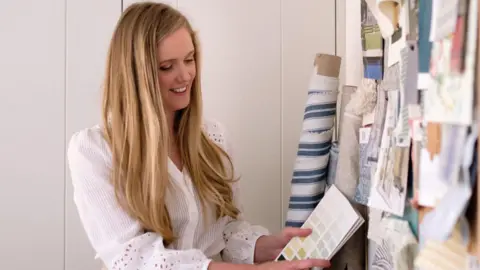
Lara Clark, a Surrey based interior designer, agrees and says Cloud Dancer "doesn't really read as a colour" and is "firmly in the bin for me".
While it may suit highly minimal or architectural spaces, she says bright whites rarely create calm in real homes.
"What looks serene in a styled shoot can easily feel clinical at home," she explains.
"White can feel stark and unforgiving and you don't want your home to give hospital vibes."
Lara Clark
Lara believes using white in real homes can create a clinical vibe
She adds that "homes should spark joy and feel warm and lived-in, and this shade feels quite removed from that."
Beaumont hopes that homeowners will reject the Pantone Colour of the Year in favour of "full-scale dopamine décor", using colour to express personality.
Laurie Pressman, VP of the Pantone Colour Institute, told the BBC that people "bring different feelings" to the meaning of the colour, but it was chosen as it "works seamlessly with everything around it, offering a refined neutrality that feels intentional and adaptable".
Since its launch in 2000, Pantone's Colour of the Year has become a powerful industry signal.
Past choices have included the optimism of Living Coral, the calm confidence of Classic Blue, the vibrancy of Viva Magenta, and most recently softer, emotionally driven tones like Peach Fuzz.
These colours don't just live on trend forecasts - they show up in fashion collections, beauty launches, interiors, packaging and even technology, shaping how products are marketed and how consumers imagine the year ahead.
Carlos Avila Gonzalez/The San Francisco Chronicle via Getty Images
Sephora cosmetics previously released a collection based on Pantone's 2015 Colour of the Year - Marsala - described as a "full-bodied red-brown"
Victoria Robinson, a style and trend expert, says Cloud Dancer is a "beautiful choice" and while it may seem simple, "this particular shade feels soft and elegant rather than stark".
In contrast to those who say the colour is boring, Robinson sees it as "adaptable" and says it's best used in "bedrooms and living areas where you want a serene, restful atmosphere".
"Even if you don't want to repaint, you can introduce the colour into a room with cushions, throws and curtains."
Pantone
Pantone's Colour of the Year for 2025 was Mocha Mousse - a soft brown which "promotes a pure and organic approach to luxury"
Interior designer James Mellan-Matulewicz says although he was surprised that Pantone's pick this year was "essentially the absence of colour", it is a bit like vanilla ice cream, in that "everyone likes it but it's nobody's favourite".
He can see its merits, explaining that white can work particularly well as a backdrop for architectural details like panelling and arched doorways which is a "growing trend in modern homes".
In fashion, white has long been a staple rather than a statement and as a Colour of the Year it presents a different challenge to designers more accustomed to bold shades.
Luxury stylist Oriona Robb says elevating white feels "less about novelty and more about intention", reflecting a shift towards refinement after years of trend overloads.
Oriona Robb
Oriona says white is a hard colour to pull off in fashion
"White forces designers and wearers alike to focus on form, proportion and quality, there's really nowhere to hide," she explains.
But she adds that it also carries assumptions around body confidence, lifestyle and privilege, saying: "When white is treated as something only a narrow group of people can pull off, it becomes exclusionary."
She says industry is already aware of the uncomfortable undertones tied to celebrating white as an ideal, particularly amid ongoing conversations about representation and accessibility, and the real test will be whether "brands engage with that nuance honestly, or simply aestheticise the colour".
A cultural mood, not a trend
Stylist Katie Malik admits the choice initially surprised her, given Pantone's history of bold colours, but says it reflects a genuine shift and fits within a wider mood of "quiet luxury", burnout and a rejection of excess.
She says feedback from her clients has been largely positive, with many craving calmer, more restorative spaces.
"Many people are actively seeking tranquillity and serenity in their homes and aren't always ready to commit to more daring colours," she explains.
Whether white feels calming or sterile, Malik argues, depends on how it is used and far from being "Pantonedeaf", she sees it as one of Pantone's most usable picks.
Cloud Dancer is described as a blank canvas that allows "all colours to shine", a view Malik shares.
"A blank canvas isn't an empty space, it's a space filled with potential," she says.
Adding that its success "won't be in its universal adoption, but in how it anchors a larger conversation about what we want from our homes".
For those tempted to embrace Cloud Dancer in all its pristine glory, one thing may be essential: a very good stain remover, kept firmly within reach.
Starting on Feb. 1, Rome will charge tourists a fee to go down into the basin of the famed 18th-century fountain. Not every one is happy (except Romans, who won’t have to pay).
林定国续称:“我向所有同事强调,政府必须坚守两大原则配合独立委员会的调查工作。一是,主动性。所有政府部门均有责任主动协助调查,向独立委员会提交职权范围相关的材料,而非被动等待查询;二是,全面及坦诚的资料提供(full and frank disclosure)。只要与调查范围相关,即使资料可能对部门或个人构成负面影响,也必须如实提供。任何欺骗、隐瞒或误导行为将面临严肃的法律后果。”
The leading Republican candidate for Ohio governor is calling out his party for rising intolerance, including against Indian American immigrants and their children, like him.
Watch: Putin tells BBC Western leaders deceived Russia
Reporters ask world leaders questions all the time.
No big deal. Right?
But what's it like putting a question to Vladimir Putin - the president who ordered the full-scale invasion of Ukraine, the leader whose country was accused this week by the head of MI6 of "the export of chaos"?
And imagine asking that question live on TV while millions of Russians are watching.
It's a big responsibility. You don't want to mess up.
"My question is about Russia's future. What kind of future are you planning for your country and your people?" I ask President Putin.
"Will the future be like the present, with any public objection to the official line punishable by law? Will the hunt for enemies at home and abroad be accelerated? Will mobile internet outages become even more common? Will there be new 'special military operations'?"
While I'm speaking, Vladimir Putin is making notes. And then replies.
He defends Russia's repressive foreign agent law. Hundreds of Russians who are critical of the authorities have been designated "foreign agents".
"We didn't invent it," Putin tells me.
"This [foreign agent] law was adopted in a string of Western countries, including in America in the 1930s. And all these laws, including the US one, are much tougher…"
In reality, the Russian law is draconian. It excludes "foreign agents" from many aspects of public life, including teaching, the civil service, elections and public events. It imposes financial and property restrictions. Criminal prosecution can follow a single administrative fine.
However, I'm unable to point this out to President Putin. The microphone was taken away from me after I'd finished my question.
Suddenly the moderator intervenes to change the subject.
"There's another question here: 'What's going to happen to the BBC? It's facing a multi-billion lawsuit from the US president?'," says anchor Pavel Zarubin.
"I think President Trump is right," President Putin confirms.
The Kremlin and the White House seeing eye to eye… on the BBC.
Putin returns to my question.
"Will there be new special military operations? There won't be, if you treat us with respect, and respect our interests, just as we've always tried to do with you. Unless you cheat us, like you did with Nato's eastward expansion."
Visible for all to see is what is driving Vladimir Putin - a deep-seated resentment of the West.
He argues that, for years, Western leaders have disrespected, deceived and lied to Russia - and that they're lying still by claiming that Moscow intends to attack Europe. "What kind of rubbish is that?" declares the Kremlin leader.
But many European leaders simply don't trust Moscow.
In the run-up to the full-scale Russian invasion of Ukraine, Russian officials denied they had plans for a mass attack.
More recently Russia has been accused of violating European air space with fighter jets and drones, as well as of carrying out cyber-attacks and acts of sabotage.
But as he finished answering my question, was this an olive branch to Europe from Russia's president?
"We're ready to cease hostilities immediately provided that Russia's medium- and long-term security is ensured, and we are ready to co-operate with you."
However, if Moscow continues to connect its long-term security to its maximalist demands over Ukraine, European leaders will remain sceptical.
Flu should always be taken seriously. It is a virus that kills thousands of people every winter and puts intense strain on hospitals.
However, I can't remember a flu season that has played out quite like this. There have been claims it is both a "superflu" and "unprecedented" across the media and even from NHS England - while experts say this year's flu is not out of the ordinary with accusations of "crying wolf".
So what's really going on and is anything truly different this year?
Scientists who track the multitude of flu viruses around the world noticed seven fresh mutations appear in a strain of influenza – a type called H3N2 – in June.
This newly mutated virus rapidly became the dominant form of H3N2 and was named subclade-K.
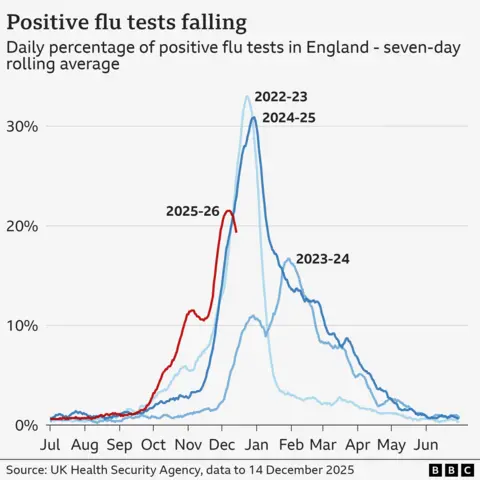
The flu season took off a month early in the UK hinting the virus may have the potential to spread more widely than normal and it was too late to adjust this year's flu vaccine to match the new mutations.
That was the concern, but the reality has been more in line with a normal flu than a super flu.
Getty Images
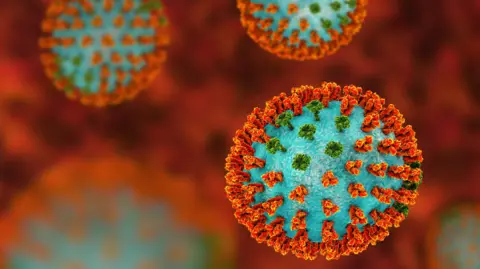
H3N2 strain of influenza
The K-flu virus has not gained a dramatic ability to rip through the population.
"It was basically spreading at a very similar speed to previous years, it was towards the upper end, but it wasn't an outlier," says Prof Christophe Fraser, who is analysing the spread of the virus at the Pandemic Sciences Institute at the University of Oxford.
His team's latest analyses, still to be published, suggest the mutations did give the virus a slight edge at slipping past our immunity – in the region of 5-10% more than usual. It is not clear if that applies to everyone or is concentrated just in children and young adults who have caught less flu in the past and who have been most affected so far.
H3N2 viruses always tend to be more severe for the elderly and there is no clear evidence the virus is worse than expected this year. A rapid analysis of the seasonal flu vaccine also suggested it was performing in line with previous years despite fears of a mismatch.
Dr Jamie Lopez Bernal, a consultant epidemiologist at the UKHSA, said: "The things that we saw that were unusual this season are the early start to the season, we also saw this change to the virus, with more evolution than we typically see.
"But overall, in terms of the impact on the NHS and the impact on people's health, we're seeing a broadly typical flu season."
There are suggestions that flu may already be peaking, although this comes with significant uncertainty. There are questions about what happens over Christmas when everyone meets up and it's easier for the virus to infect older people who are more at risk. There are also signs a different strain of flu - H1N1 - is picking up in Europe and may lead to an increase in cases here too.
But a "broadly typical flu season" is probably not the sense you'd get from watching or reading the news.
Statistical artistry was used to compare an early flu season to one that started much later allowing claims of flu cases being "an incredible 10 times higher" than in 2023.
It was technically true, but is like saying your train to Glasgow got you there in record time… but the journey time was identical, you just booked an earlier train.
NHS England was not the first organisation to start calling it superflu, but Prof Meghana Pandit, national medical director at NHS England, did label it an "unprecedented wave of super flu".
It has been suggested by the British Medical Association that flu has been used to scaremonger while resident doctors were deciding whether to continue their strike action.
Superflu isn't a scientific description and the BBC Health Team has not found any expert who thinks it is an accurate one.
"I don't think it's a helpful term, there isn't a particularly unusual set of symptoms, there's no indication of it being associated with exceptional severity, exceptionally rapid spread or exceptional health impact," says Prof Fraser.
One of the UK's top flu scientists, Prof Nicola Lewis, the director of the World Influenza Centre at the Francis Crick Institute, said the virus was "not particularly unusual" and that she saw "no evidence" the virus was "particularly different" and superflu "wouldn't be my description".
The former deputy chief medical officer for England through the pandemic, Prof Jonathan Van-Tam, posted: "I'm very unclear what is meant by the rather silly term of 'superflu'."
Crying wolf?
Persuading people to get the flu vaccine saves lives and last winter the jabs were estimated to have kept around 100,000 people out of hospital.
However, experts have started to question whether the escalation in language used since the Covid pandemic could harm trust in official health advice. Previous winters came with warnings of a tripledemic of flu, Covid and RSV; then it was upgraded to a quademic adding in norovirus; this year it's superflu.
Dr Simon Williams, who researches psychology and public health at Swansea University, says there are issues with the "current language around every winter being 'the worst' in some way or another" and risks a "cry wolf" effect that damages trust and means people become "numb" to the advice.
He said there was a danger of "over-using the narrative that viruses will overwhelm the NHS" when "ultimately the NHS hasn't got overwhelmed to the point of not being able to carry out emergency and basic functions".
Instead he argues a "fine balance" is needed between raising awareness and "not falling into the trap of fear-messaging or being overly alarmist, which can backfire".
Prof Jonathan Ball, a virologist at Nottingham University, agrees saying: "I think it is a concern to use words like super flu, when we may one day experience a real super flu.
"We have to be very, very careful about how we communicate these things to the public, because there is a risk that we can cry wolf."
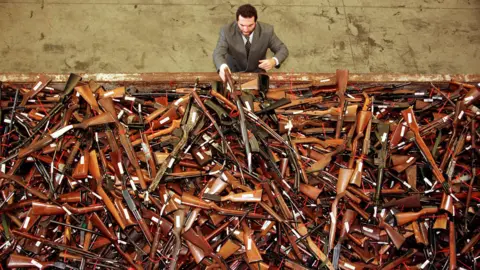
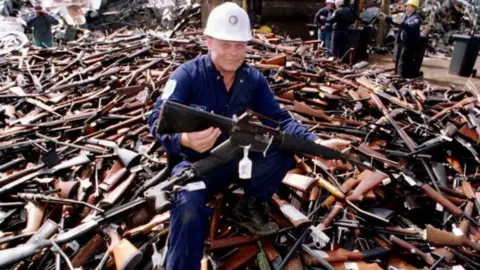
Hundreds of thousands of guns were handed in across Australia during the last major government buyback scheme
It was a Sunday afternoon in April 1996 when a lone gunman armed with semi-automatic rifles killed 35 people in the Australian tourist town of Port Arthur.
The massacre almost 30 years ago, which ushered in some of the strictest gun laws in the world, feels like a bygone age for many Australians.
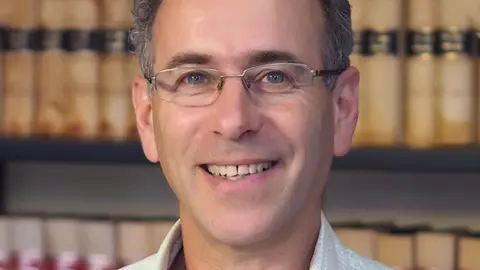
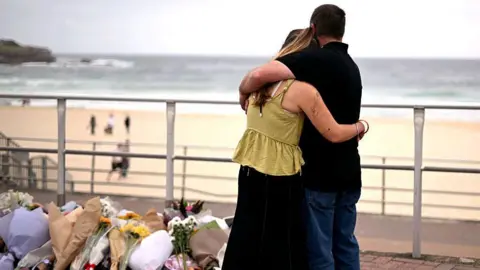
But the Bondi Beach attack on Sunday, which left 15 dead, rekindled memories of the Tasmanian tragedy - none more so than for leading gun control advocate Roland Browne.
As the country's deadliest modern-day mass shooting was unfolding an hour's drive away, Mr Browne was meeting fellow gun control advocates at his home, ahead of a government meeting, to lobby for a ban on the exact type of firearm the Port Arthur gunman was using.
Mr Browne, 66, was again at home in Hobart on Sunday when he received news of the shooting at Bondi, targeting a Jewish event celebrating the first night of Hanukkah.
"There's just a lot of similarities," Mr Browne, who spent childhood summers in Bondi and still has family there, told the BBC.
"They're both very public places frequented by tourists from around the nation and around the world."
"It's sickening and I'm bitterly disappointed in our political system whereby the voices for tighter gun laws and public health aren't listened to until there's a major event like this," he added.
For decades, Australia has stood as a beacon on the world stage for its strict gun laws, he says, taking a similar path to the UK which experienced its own mass shooting in Dunblane, just one month before Port Arthur.
Even now, Mr Browne remains friends with relatives of some of the 17 victims - mostly children aged five and six - killed at a primary school in Scotland.
But despite being praised for its stringent gun laws, the reality in Australia is not clear-cut.
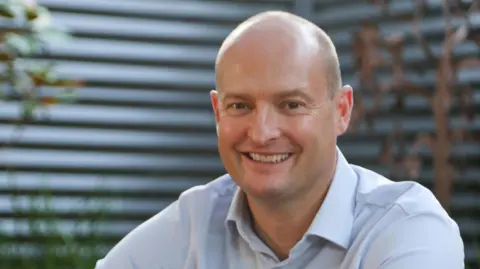
Roland Browne
Roland Browne has called for tighter gun laws in Australia
Gun ownership at record high
A report by the Australia Institute earlier this year revealed that there are more than four million privately-owned firearms across the country - almost double the amount from about 20 years ago.
That equates to one gun for every seven Australians, the report says.
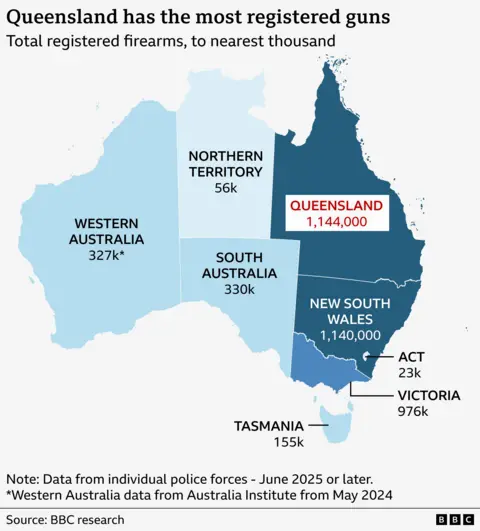
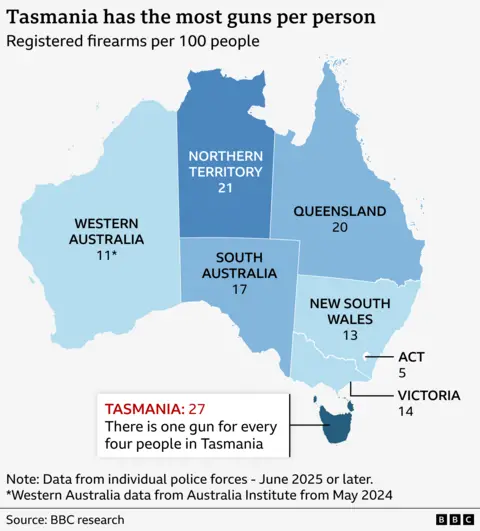
Queensland has the most registered guns, followed by New South Wales (NSW) and Victoria while Tasmania and the Northern Territory have the most guns per person.
The report also dispels a common view that guns are mainly owned by rural residents.
Guns are widespread in metropolitan and suburban areas, with one in three firearms in NSW located in major cities, the report said.
The total figure has risen at a lower rate than population increases, but there are now more guns in fewer hands, with every licence holder owning an average of more than four firearms.
And that's one of the key issues that Mr Browne wants the government to address.
Queensland has more guns overall even than Australia's most populous state, New South Wales
Currently, only one jurisdiction - Western Australia - has a cap on the number of legal firearms that a licence holder can have. Under new laws introduced in March this year, gun owners can have between five and ten firearms, depending on the type of licence and model of firearm.
Authorities have confirmed that one of the alleged gunmen, Sajid Akram who was killed at the scene of the Bondi attack, owned six registered guns.
Mr Browne wants a cap of one to three guns, depending on the licence category, to be introduced across Australia.
But Tom Kenyon, chief executive of the Sporting Shooters Association of Australia, argues that a cap would be meaningless.
"Limiting the number of guns wouldn't have made a difference on Sunday," he says.
"And it wouldn't have changed the fact that an attack occurred because those two individuals had been radicalised."
Mr Kenyon argues that people intent on harm, without access to guns, will use other weapons, referencing the 2016 Bastille Day massacre in the French city of Nice where 86 people were killed after a man drove a truck into crowds during fireworks celebrations. The attack was claimed by Islamic State (IS).
The other alleged Bondi gunman, 24-year-old Naveed Akram, was previously investigated over links to IS, according to comments made by Prime Minister Anthony Albanese.
Mr Kenyon also says that more guns are found in cities because most people in Australia live in metropolitan areas and travel to other areas to hunt.
Tasmania has the most guns per person in Australia
What are Australia's current gun laws?
Gun control laws in Australia are not uniform across the country, with inconsistent implementation of the rules across states and territories.
But generally, to apply for a gun licence, you must be over 18, a "fit and proper person", pass a training and safety course and give a "genuine reason" for having a firearm.
The eight accepted reasons include recreational hunting or pest control, target or sport shooting, for work (such as security guards and prison officers), for use in farming or animal welfare and firearms collectors.
But there are loopholes.
For example, anyone under 18 was meant to be barred from owning a firearm under the 1996 gun control reforms, but minors in various jurisdictions can have access to a firearm while under supervision, ranging from age 10 in the Northern Territory to 12 in other states.
Another situation is where a particular type of gun is banned in one state but legal elsewhere.
In the days after the Port Arthur massacre, then-Australian prime ministerJohn Howard galvanised every state and territory to overhaul the country's gun laws.
More than 650,000 firearms were voluntarily handed in to authorities and destroyed, as part of a buyback programme. And background checks and a mandatory cooling-off period for gun sales were introduced. Automatic and semi-automatic rifles and shotguns were banned.
Part of Howard's reforms included scrapping self-defence as a reason for owning a firearm - a contrast to gun laws in the United States where personal protection is often the main reason for citizens to own guns.
Gun ownership in the US is much higher compared to Australia as is gun violence. The country saw 488 mass shootings - defined as where four or more people are killed or injured - last year.
Recent polling by the Australia Institute showed that seven out of ten Australians think gun laws should make it harder to access a gun and 64% agreed that current gun laws need to be strengthened.
Getty Images
An estimated 650,000 firearms were handed in and destroyed after the Port Arthur massacre
Fresh reform for gun laws
In the hours after the Bondi shooting, the NSW Premier Chris Minns was unequivocal about the need to tighten the state's gun laws.
"If you're not a farmer, you're not involved in agriculture, why do you need these massive weapons?" he asked.
And less than 24 hours after the shooting, Australia's Prime Minister Anthony Albanese hosted an emergency meeting where leaders from across the country pledged to tighten gun laws. On Friday he announced a national gun buyback scheme "to help get guns off our streets", the first scheme of its size since 1996.
Other proposals include:
limiting the number of guns someone can legally own
limiting "open-ended" licensing
making Australian citizenship a condition of owning a firearm
improving intelligence sharing when licence applications are being assessed
Albanese said there should also be regular reviews of licence holders.
"People's circumstances can change," he said. "People can be radicalised over a period of time."
Getty
Fifteen people were killed when two gunmen opened fire at Bondi Beach on Sunday
The swift action prompted Howard – the architect of the 1996 gun laws – to weigh in.
While he supported stricter gun laws, Howard said the move was an "attempted diversion" from the real cause of the tragedy, which he said was a rise in antisemitism in recent years.
Mr Kenyon believes the moves to tighten gun laws are a waste of resources.
"All that time and effort and political capital could be spent combating radicalisation of individuals," he says.
The only thing that might have prevented Sunday's attack was better intelligence-sharing that would have flagged the gunmen's links to extremist ideology to the NSW firearms' registry, he says.
Elsewhere, one of the headline reforms proposed in 1996 - a national firearms register - is yet to be created, with authorities saying the database is "expected to be operational by mid-2028".
The Bondi shooting has now propelled the government to list the creation of the register as a priority.
Recreational hunting under spotlight
Mr Browne believes the application process for a gun licence is too easy and that licences for recreational hunting should be abolished as its definition is ambiguous.
Sajid Akram owned a recreational hunting licence.
But recreational hunting contributes a "valuable social good" to Australia, argues Mr Kenyon, saying that hunters remove millions of feral animals such as rabbits, foxes and cats.
He was just 10 when he picked up his first gun. Now 53, he goes on regular hunting trips - often shooting deer in Victoria's high country - and competes in pistol shooting events six times a year.
Hunting isn't just a pastime for him, it's about family and community connections. He taught his three children - all adults now - how to shoot when they were teens.
"All my life I've had the opportunity to do it and I've enjoyed it," Mr Kenyon, a former Labour politician in South Australia, says, "so I want my kids to have the same opportunity".
Supplied
Pro-gun advocate Tom Kenyon says tightening gun laws is a waste of resources
In the wake of the Port Arthur massacre, self-loading firearms were banned, resulting in a drop in gun-related deaths, but the risk to public safety has now shifted to high-powered fast-loading rifles with magazines that can shoot up to five rounds, of the kind believed to have been used by the gunmen.
"If you watch the video, you'll see him firing rapidly with his rifle," Mr Browne says, referring to footage of one of the gunmen shooting from a footbridge leading to Bondi Beach.
"If he didn't have a magazine in that rifle, he would have had to manually reload each time," which would dramatically reduce - but not eliminate - the threat of a mass shooting.
For Mr Browne, Australia is a safe country but incidents involving firearms are not uncommon, ranging from neighbourhood disputes to gang shootings.
"This is a reflection on guns being in the wrong hands, a legacy of poor storage allowing guns to be stolen and sold - and thus move into black markets."
But the issue of gun control isn't just about the physical firearm.
"It's like a plane crash, it's never just one thing. It's a culmination of a lot of factors," he says. Australia needs better assessment of whether a licence holder is a suitable candidate and more stringent rules on the types of guns that can be legally owned, he says.
Tragedy is a wake-up call
In the aftermath of the Port Arthur massacre, Mr Browne met with many of the survivors and families of the victims including Walter Mikac, whose wife Nanette and two young daughters were among the 35 people killed.
Mr Mikac, who founded the Alannah and Madeline Foundation charity to honour his children, said the Bondi shooting was a "horrific reminder" of ensuring Australia's gun laws protect everyone.
"After Port Arthur, Australia made a collective commitment to put community safety first, and that commitment remains as important today as ever," he said in a statement.
Mr Browne echoed those sentiments.
Gun laws need to be reformed to "keep up-to-date with changing community attitudes, technological advances and to rectify identified deficiencies," Mr Browne says.
"It's sad that it takes such a tragedy to get people to wake up and listen."
There can be a lot to think about at Christmas, from whether public transport is running to when shops and services are open.
With UK bank holidays on Christmas Day, Boxing Day and New Year's Day, and a fourth holiday in Scotland on 2 January, here are some tips to help you win the festive period.
When are roads likely to be busiest?
Motoring organisations the RAC and AA predict that 2025 could see the busiest festive getaway on record.
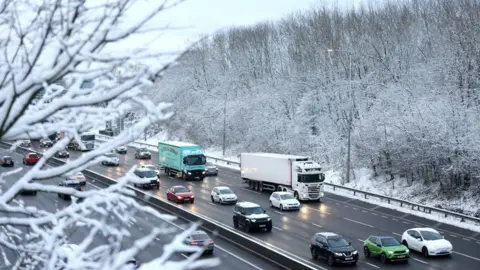
The RAC expects 37.5 million trips to take place in the week running up to Christmas Day. It thinks roads are likely to be especially busy after lunchtime on Saturday 20 December, and during the afternoon and evening on Christmas Eve.
Make sure you have plenty of fuel, that your tyres are properly inflated and your lights are working. Prepare for bad weather by carrying a charged phone, food, drinks and warm clothes. Top up your screen wash and de-icer supplies.
Many BP and Shell petrol stations will be open as usual, but some garages may have shorter hours. All Tesco petrol stations will be closed on Christmas Day. On other days, opening hours could be different to those of the linked store.
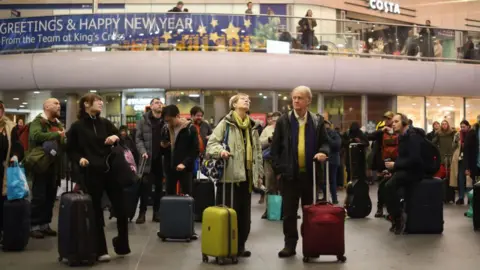
Some National Rail services will finish early on Christmas Eve, and no trains will run on Christmas Day.
Most train operators won't run any services on Boxing Day either. However, a small number of firms (Chiltern Railways, London Overground, Merseyrail, ScotRail, Southern and Stansted Express) will have a very limited service.
There are no Eurostar services on Christmas Day, but trains are running every other day.
Buses and coaches
Most local bus services will not run on Christmas Day, but check individual websites for detailed schedule information.
National Express is running extra coaches on a number of UK routes between 20 December and 4 January.
On Christmas Day itself, 355 services will operate from 96 locations. This includes routes between Edinburgh, Glasgow and London, as well as some to and from Heathrow, Gatwick and Luton airports.
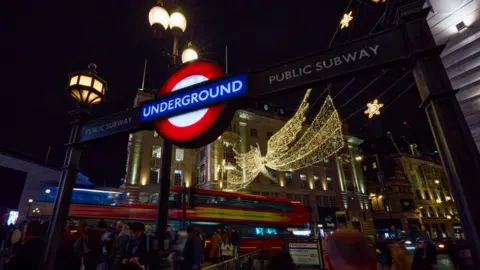
There is no Elizabeth line service on Boxing Day, and a number of overground lines are also shut. Some Tube lines have restricted service. No night Tube or night overground services will operate.
Tfl services will run through the night on New Year's Eve.
Some black taxis and private cab firms may operate throughout the period, including Christmas Day. Hire bikes and electric scooters will be available.
Blackwall and Silvertown tunnels charges do not apply on Christmas Day.
Ferries
The Port of Dover will close at 15:30 GMT on Christmas Eve and reopen at 07:30 on Boxing Day.
The final departures on 24 December are:
DFDS (Dunkerque route): 12:00
DFDS (Calais route): 13:15
Irish Ferries:14:25
P&O: 16:05
There are no sailings to or from Holyhead or Portsmouth ports on Christmas Day either, but services will run on Christmas Eve and Boxing Day.
What if I'm flying over Christmas?
Most UK airports are open on Christmas Day, although they may have a reduced schedule. All Heathrow and Gatwick terminals will be open as normal.
The UK Civil Aviation Authority (CAA) expects Friday 19 December to be the busiest travel day, with around 460,000 passengers. Around 160,000 people are due to fly on Christmas Day itself, a 13% increase on 2024.
All air passengers are advised to check the status of their flights before setting off. Experts also recommend confirming any return journey.
As usual, passengers should arrive at the airport three hours before long-haul flights and two hours before short-haul flights.
You may need to make alternative travel arrangements to get to the airport if public transport is not running. If you plan to drive, consider booking parking in advance.
GP surgeries are generally closed on Christmas Day, Boxing Day and New Year's Day.
Some practices offer out-of-hours services which you can access via the NHS 111 helpline, which operates 24 hours a day, 365 days a year. Calls are free from landlines and mobile phones.
Most pharmacies will be closed on Christmas Day and New Year's Day.
However, one or more should be open near you under out-of-hours arrangements. Your local pharmacy should display details of the rota, or you can find details online.
You can find open pharmacies near you via the relevant NHS website:
Boots will open more than 60 pharmacies on Christmas Day and more than 460 on New Year's Day.
All Superdrug pharmacies will be closed on Christmas Day and New Year's Day. Most branches in Scotland will remain shut on 2 January.
What about supermarkets and food delivery services?
Getty Images
You should check your local store's opening hours, but in general you should assume:
early closing on Christmas Eve
almost all stores will be shut on Christmas Day
Aldi, Lidl, M&S and most Waitrose shops will also close on Boxing Day. Other chains have reduced hours
early closing on New Year's Eve
Aldi, Lidl, M&S and most Waitrose shops are closed on New Year's Day
Smaller local shops are more likely to be open earlier and later than the large superstores. Many petrol station forecourt shops will be open too.
The Deliveroo, Just Eat and Uber Eats apps and websites will be running throughout the festive period, but restaurants will set their own operating hours.
Watch: Putin tells BBC Western leaders deceived Russia
Reporters ask world leaders questions all the time.
No big deal. Right?
But what's it like putting a question to Vladimir Putin - the president who ordered the full-scale invasion of Ukraine, the leader whose country was accused this week by the head of MI6 of "the export of chaos"?
And imagine asking that question live on TV while millions of Russians are watching.
It's a big responsibility. You don't want to mess up.
"My question is about Russia's future. What kind of future are you planning for your country and your people?" I ask President Putin.
"Will the future be like the present, with any public objection to the official line punishable by law? Will the hunt for enemies at home and abroad be accelerated? Will mobile internet outages become even more common? Will there be new 'special military operations'?"
While I'm speaking, Vladimir Putin is making notes. And then replies.
He defends Russia's repressive foreign agent law. Hundreds of Russians who are critical of the authorities have been designated "foreign agents".
"We didn't invent it," Putin tells me.
"This [foreign agent] law was adopted in a string of Western countries, including in America in the 1930s. And all these laws, including the US one, are much tougher…"
In reality, the Russian law is draconian. It excludes "foreign agents" from many aspects of public life, including teaching, the civil service, elections and public events. It imposes financial and property restrictions. Criminal prosecution can follow a single administrative fine.
However, I'm unable to point this out to President Putin. The microphone was taken away from me after I'd finished my question.
Suddenly the moderator intervenes to change the subject.
"There's another question here: 'What's going to happen to the BBC? It's facing a multi-billion lawsuit from the US president?'," says anchor Pavel Zarubin.
"I think President Trump is right," President Putin confirms.
The Kremlin and the White House seeing eye to eye… on the BBC.
Putin returns to my question.
"Will there be new special military operations? There won't be, if you treat us with respect, and respect our interests, just as we've always tried to do with you. Unless you cheat us, like you did with Nato's eastward expansion."
Visible for all to see is what is driving Vladimir Putin - a deep-seated resentment of the West.
He argues that, for years, Western leaders have disrespected, deceived and lied to Russia - and that they're lying still by claiming that Moscow intends to attack Europe. "What kind of rubbish is that?" declares the Kremlin leader.
But many European leaders simply don't trust Moscow.
In the run-up to the full-scale Russian invasion of Ukraine, Russian officials denied they had plans for a mass attack.
More recently Russia has been accused of violating European air space with fighter jets and drones, as well as of carrying out cyber-attacks and acts of sabotage.
But as he finished answering my question, was this an olive branch to Europe from Russia's president?
"We're ready to cease hostilities immediately provided that Russia's medium- and long-term security is ensured, and we are ready to co-operate with you."
However, if Moscow continues to connect its long-term security to its maximalist demands over Ukraine, European leaders will remain sceptical.
The US says its military has carried out a "massive strike" against the Islamic State group (IS) in Syria, in response to a deadly attack on American forces in the country.
Defence Secretary Pete Hegseth said Operation Hawkeye Strike was aimed at eliminating IS "fighters, infrastructure, and weapons sites".
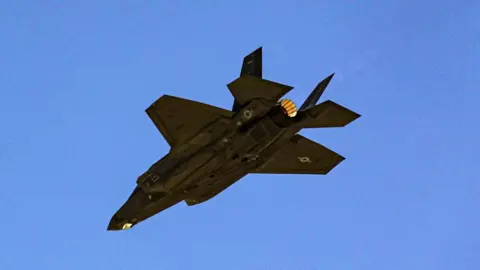
Fighter jets, attack helicopters and artillery hit multiple targets in central Syria, US officials told CBS, the BBC's media partner in the US. Aircraft from Jordan were also involved.
In a post on X late on Friday, Hegseth wrote: "This is not the beginning of a war - it is a declaration of vengeance. The United States of America, under President Trump's leadership, will never hesitate and never relent to defend our people.
"If you target Americans - anywhere in the world - you will spend the rest of your brief, anxious life knowing the United States will hunt you, find you, and ruthlessly kill you.
"Today, we hunted and we killed our enemies. Lots of them. And we will continue," the US defence secretary added.
Meanwhile, the US Central Command (Centcom) said that "US forces have commenced a large-scale strike" against IS, adding that more information would be provided soon.
Posting on Truth Social later on, President Trump said the US "is inflicting very serious retaliation, just as I promised, on the murderous terrorists responsible".
He said the Syrian government was "fully in support".
Meanwhile, the UK-based Syrian Observatory for Human Rights (OBHR) said IS positions near the cities of Raqqa and Deir ez Zor were targeted.
It said that a prominent IS leader and a number of fighters were killed.
IS has not publicly commented. The BBC was unable to verify the targets immediately.
Centcom, which directs American military operations in Europe, Africa and the Indo-Pacific, earlier said that the deadly attack in Palmyra was carried out by an IS gunman, who was "engaged and killed".
Another three US soldiers were injured in the ambush, with a Pentagon official saying that it happened "in an area where the Syrian president does not have control."
At the same time, the SOHR said the attacker was a member of the Syrian security forces.
No group has claimed responsibility for the attack, and the identity of the gunman has not been released.
The secretary of state held a marathon news conference, offering little news but more respect for reporters than most others in the Trump administration.

 Login
Login