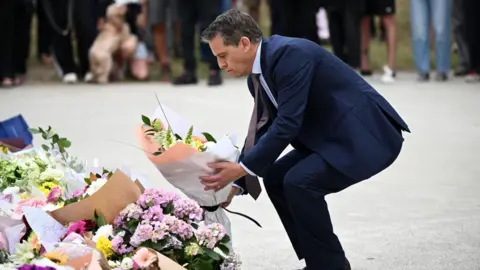
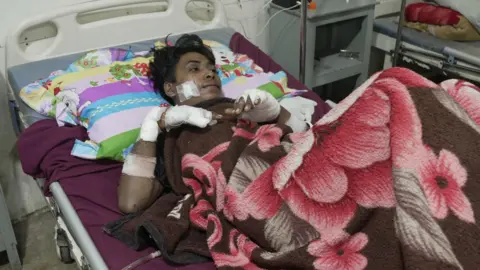
这是本月内第二宗涉及大学学生组织自发悼念活动遭校方阻止的事件。早前一宗发生于本月2日,即火灾发生后约七天,浸会大学学生会在校内学生会告示板张贴「沉痛哀悼宏福苑大火死者」丶「WE ARE HONGKONGERS」(我们是香港人)及「公义得到伸张」等字句,校方随即以红色水马及白色围板封锁告示板位置,并阻止传媒拍摄被围封范围。其后更于事发三日后,以学生会会员人数过少丶缺乏认受性为由,单方面勒令学生会停运,并要求学生会干事于翌日(即本月6日)清空存放在学生会办公室内的个人财物。
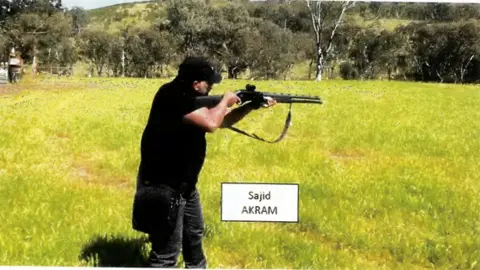
A screenshot from a video found on Naveed Akram's phone shows his father conducting firearms training, police allege
The gunmen who allegedly carried out a deadly attack on a Jewish festival at Bondi Beach last week threw four undetonated explosives at the start of the attack, including a "tennis ball bomb", according to newly released documents.
Naveed Akram, 24, has been charged with dozens of offences including 15 counts of murder over the attack at a Hanukkah celebration on 14 December. Akram, who was shot by police during the attack, was released from hospital on Monday and transferred to a prison.
The second alleged gunman, his father Sajid Akram, was shot dead.
The pair recorded a video manifesto in October in which they sit in front of the Islamic State group flag, according to police documents.
Supplied
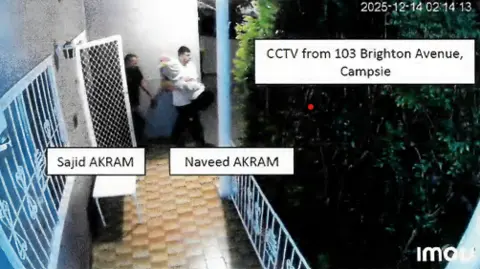
A screenshot from CCTV shows the Akrams carrying 'bulky items' hours before the attacks, police allege
The Akrams "meticulously planned this terrorist attack for many months", police alleged. Videos found on Naveed's phone showed the pair were motivated by "violent extremist ideology" linked to the Islamic State group.
They include one video in which the pair sit in front of an Islamic State flag and detail their motivation for the Bondi attack and condemn "the acts of 'Zionists'", police alleged. Naveed also appears to recite a passage from the Quran in Arabic in the video, police alleged.
Another video allegedly showed the pair conducting firearms training in what police believe to be rural New South Wales in October. "The Accused and his father are seen throughout the video firing shotguns and moving in a tactical manner," police alleged.
A temporary suppression order had been made on the fact sheet last week to protect the identities of the survivors of the attack. The order was revoked on Monday after an application to the New South Wales Local Court by media companies although the names of most survivors were redacted.
Supplied
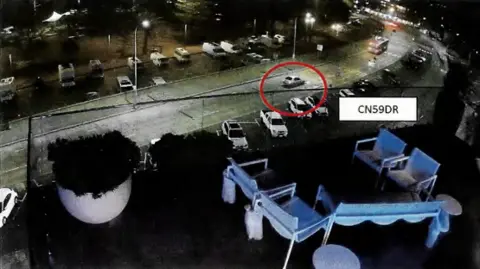
CCTV shows the Akrams carrying out reconnaissance two days ahead of the Bondi Beach attack, police allege
CCTV recorded at Bondi beach two days ahead of the attack also showed the Akrams driving to the area and carrying out reconnaissance, police alleged.
"The Accused and his father, S Akram, are seen to exit the vehicle and walk along the footbridge, being the same position where they attended two days later and shot at members of the public," police wrote.
CCTV also captured the pair leaving rented accommodation in the Sydney suburb of Campsie hours before the attack "carrying long and bulky items wrapped in blankets", police alleged.
Police said the items, which were placed in a car, were three firearms, home-made improvised explosive devices including the "tennis ball bomb" and two Islamic State flags.
They later drove to Bondi where they parked and placed the flags on the inside of the front and rear windows, police alleged. After removing the firearms and homemade bombs from the car, they walked towards the footbridge from where they carried out their attack, police alleged.
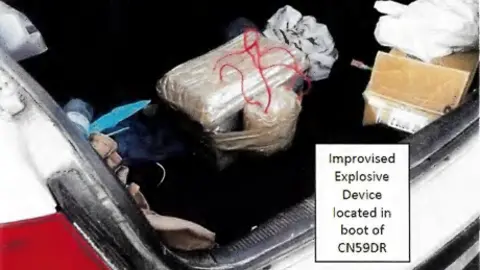
Three homemade pipe bombs and the tennis ball bomb were thrown as they approached the bridge, police alleged, but did not explode although they were assessed as "viable". A fifth explosive device was later found in their vehicle, police had previously said.
Naveed Akram, who was shot in the abdomen and critically injured by police, did not appear at Monday's court appearing.
Supplied
Police allege a homemade bomb was found in the boot of the Akrams' vehicle
The government has vowed to end puppy farming as part of a wide-ranging animal welfare strategy
An end to puppy farming and a possible ban on the use of electric shock dog collars are promised as part of a new animal welfare strategy being launched by the government on Monday.
The RSPCA has welcomed the plans to outlaw puppy farming but the Countryside Alliance has condemned the ban on trail hunting as "another attack on the countryside".
Environment Secretary Emma Reynolds told the BBC there would be consultation on the trail-hunting ban, which was "sometimes used as a smokescreen" for illegal fox hunting.
Getty Images
The Countryside Alliance said a ban on trail hunting was "completely unnecessary"
Puppy farming is the term used when breeders prioritise profit over animal health and welfare, often keeping large numbers of dogs in small pens and using them to produce multiple litters a year.
Current dog breeding practices will be reformed to tackle puppy farming as part of what the government calls "the biggest animal welfare reforms in a generation".
However, the whole strategy will not be delivered until the end of 2030.
David Bowles, head of public affairs at the RSPCA, said the animal welfare charity was "delighted" at the strategy and added that the plans to ban puppy farming "could be a real game-changer".
"Puppy farming is one of the most insidious problems that the RSPCA faces.
"The government will need to write the legislation on that in this coming year and the RSPCA will work with them to make sure that there are no loopholes," he said.
The government is also looking to ban the use of snare traps in the countryside and on Sunday confirmed it is to carry out a consultation on the proposed ban on trail hunting in the New Year.
Trail hunting involves using a rag with a natural scent on to lay a trail ahead of a hunt, which is then followed by the hounds but live animal scents could be picked up by the pack instead.
The secretary of state told the BBC that while Labour had previously banned fox hunting in 2004 "we have seen that people are trying to get around that ban by using trail hunting in some cases".
"Obviously that's also a problem of enforcement, it's not just the legislation, but we are determined to go further, which is why banning trail hunting is in the animal welfare strategy," she said.
"We know sometimes it is used as a smokescreen for fox hunting."
'Divisive issue'
But Tim Bonner, chief executive of the Countryside Alliance, said it was "unbelievable" that the government would be spending more parliamentary time on hunting.
He said: "Revisiting this pointless and divisive issue is completely unnecessary.
"People across the countryside will be shocked that after Labour's attack on family farms and its neglect of rural communities it thinks banning trail hunting and snares used for fox control are a political priority."
Conservative chairman Kevin Hollinrake called the ban an "attack on rural Britain and British culture", accusing the government of "punishing the law-abiding majority who support legal trail hunting".
The government is also looking at ending the use of "confinement systems" in farming including caged hens and pig farrowing crates, which are used to contain sows during birth and nursing.
The use of slow-growing chickens will be promoted over the use of controversial so-called "Frankenchickens", a term used by animal welfare campaigners to describe fast-growing breeds.
Anthony Field, head of Compassion in World Farming UK, said the government was "raising the bar for farmed animal welfare".
The National Pig Association said it would be "following the next steps closely" on farrowing crates and was itself looking towards more flexible systems.
The British Poultry Council have been approached by the BBC for comment.
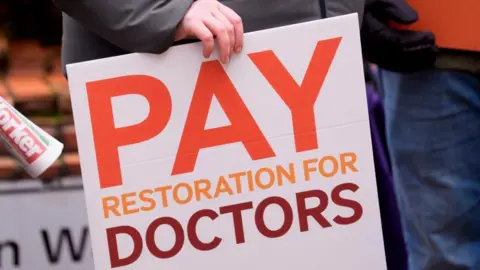
Doctors in England will return to work on Monday after a planned five-day walkout over ongoing pay disputes.
The strike went ahead amid surging flu cases, and despite last-minute talks between the British Medical Association (BMA) and the government. BMA members rejected a new government offer that aimed to tackle issues with training and job security.
Speaking to the British Medical Journal on Friday, BMA resident doctor leader DR Jack Fletcher said doctors were being lost to other countries because "they will essentially pay me more and also treat me better."
Health Secretary Wes Streeting said he would like to see an end to the dispute by the new year.
Resident doctors, the new name for junior doctors, called for the government to provide a "genuinely long-term plan" to increase pay, and for more training places created for qualified doctors to specialise and progress their careers.
The doctors' union said 65% of its members had participated in what was the 14th strike since March 2023.
The doctors' union has argued that resident doctors' pay is still a fifth lower than it was in 2008, due to inflation. This year, they received an average pay rise of 5.4%.
During a visit to an ambulance station in London last week, Streeting said: "I do want to end this dispute.
"I don't want us to be locked in a bitter dispute, and I'm never going to shut the door to talks, and I will do my best to see if we can start 2026 off on a better foot."
But, Streeting said, the BMA is "demanding an extra 26% on top of what we've already given".
"That is not a figure that we can afford but we will get around the table with them again in the new year," he added.
Health experts have warned that the impact of the strike will be felt into the new year "and beyond".
Last week, Prime Minister Sir Keir Starmer called the walkout "dangerous and utterly irresponsible" particularly during a record flu season for the start of winter.
During the walkout, the BMA said they would work with NHS bosses to ensure safety in hospitals and other parts of the health service.
While the NHS remains on high alert over flu, the surge in the virus is slowing for now at least. The BBC reported on Friday just over 3,000 patients were in hospital in England with the virus.
Meanwhile in Scotland, residential doctors are set to strike from 13 January to 17 January. It will be the first time NHS workers have staged a national walkout.
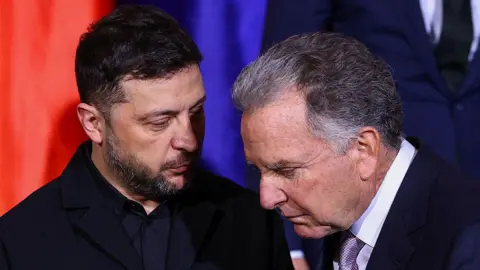
Steve Witkoff, right, seen here with Ukrainian President Volodymyr Zelensky earlier this month, said negotiations were "productive and constructive"
US and Ukrainian envoys say "productive and constructive" talks have taken place in Miami, but there still appears to be no major breakthrough in efforts to end Ukraine's war with Russia.
Donald Trump's special envoy, Steve Witkoff, issued a joint statement with the top Ukrainian negotiator, Rustem Umerov, after three days of meetings with European allies.
The pair said the meeting focused on aligning positions on a 20-point plan, a "multilateral security guarantee framework", a "US Security guarantee framework for Ukraine" and an "economic & prosperity plan".
Separate talks have been taking place in Miami between the US and the Russian envoy, Kirill Dmitriev.
"Our shared priority is to stop the killing, ensure guaranteed security, and create conditions for Ukraine's recovery, stability, and long-term prosperity," Witkoff and Umerov said in a statement.
The meetings are the latest step in weeks of diplomatic activity, sparked by the leaking of a 28-point US peace plan which shocked Ukraine and its European allies for appearing to favour Russia, which launched a full-scale invasion of Ukraine nearly four years ago.
Witkoff said representatives from Russia had met himself and other US officials in southern Florida, including Trump's son-in-law Jared Kushner.
Witkoff said the meetings with Russian envoy Dmitriev were also "productive and constructive" and that "Russia remains fully committed to achieving peace in Ukraine".
Trump has been pushing Ukraine and Russia to come to an agreement on ending the war, but so far the two countries have been unable to agree on major issues, including Moscow's demand to keep land it has already seized.
US intelligence reports continue to warn that Russian President Vladimir Putin still wants to capture all of Ukraine and reclaim parts of Europe that belonged to the former Soviet empire, six sources familiar with US intelligence told the Reuters news agency.
There's been an outpouring of support from the community - but tension remains
As helicopters circled overhead, sirens descended on her suburb, and people ran screaming down her street on 14 December, Mary felt a grim sense of deja vu.
"That was when I knew there was something seriously wrong – again," she says, her eyes brimming with tears.
Mary - who did not want to give her real name - was at the Westfield Bondi Junction shopping centre last April when six people were stabbed to death by a man in psychosis, a tragedy still fresh in the minds of many.
Findings from a coronial inquest into the incident were due to be delivered this week, but were delayed after two gunmen unleashed a hail of bullets on an event marking the start of the Jewish festival of Hanukkah eight days ago.
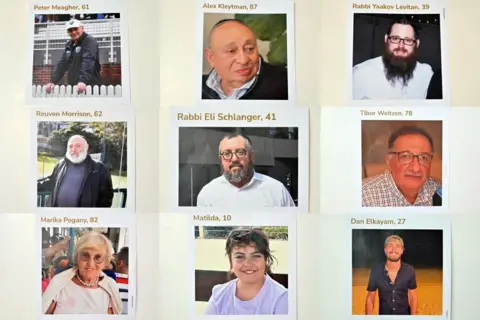
Declared a terror attack by police, 15 people were shot and killed, including a 10-year-old girl who still had face paint curling around her eyes.
The first paramedic to confront the bloody scenes at the Chanukah by the Sea event was also the first paramedic on the scene at the Westfield stabbings.
"You just wouldn't even fathom that something like this would happen," 31-year-old Mary, who is originally from the UK, tells the BBC. "I say constantly to my family at home how safe it is here."
This was the overarching sentiment in the days following the shooting. This kind of thing, mass murder, just doesn't happen in Australia.
But it can and it has – twice, in the same community, within 18 months.
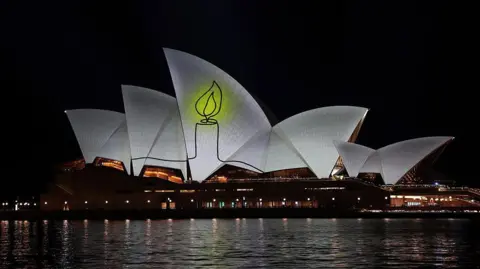
A sea of flowers left by shocked and grieving people at Bondi is being packed up. A national day of reflection is over. On Sunday night, Jewish Australians lit candles for the last time this Hannukah.
But the two tragedies have left scores physically scarred and traumatised, and the nation's sense of safety shattered.
'Everyone knows someone affected'
EPA
Funerals for the victims have drawn thousands of mourners this week
Bondi is Australia's most famous beach - a globally recognised symbol of its way of life.
It's also a quintessential slice of Australian community. There's a bit of "everyone knows everyone" - and that means everyone knows someone affected by the 14 December tragedy, mayor Will Nemesh told the BBC.
"One of the first people I texted was [Rabbi] Eli Schlanger. And I said, 'I hope you're OK. Call me if you need anything'," he said.
But the British-born father of five, also known as the "Bondi Rabbi", was among the dead.
The first responders, police and paramedics would have been working on members of their own community. Others had the task of having to treat the shooters who had taken aim at their colleagues.
"[Westfield Bondi Junction] was horrendous, something we're certainly not used to. And then this again was massive, catastrophic injuries," Ryan Park, health minister for New South Wales, told the BBC.
"They've seen things that are like you would see in a war zone… You don't get those images out of your head," Park added.
Mayor Nemesh fears this will forever be a stain on Bondi, and Australia.
"If this can happen here at Bondi Beach, it really could happen anywhere… the impact has reverberated around Australia."
EPA
Ryan Park says healthcare workers will take time to recover from what they've seen
'Warnings ignored'
No one is feeling this more than the Jewish community, for whom Bondi has become a sanctuary.
"I swam here every day for years on end, rain or shine. And this week… I couldn't get in the water. It didn't feel right. It felt sacrilegious in some way," Zac Seidler, a local clinical psychologist, told the BBC.
Many of the victims of the attack moved here over many decades for safety from persecution, including 89-year-old Holocaust survivor Alex Kleytman. Instead, his life was bookended by violent acts of antisemitic hate.
Mr Seidler has spent the past two years trying to convince his grandparents, who are also Holocaust survivors, to hold on to their faltering belief in the good of humanity.
"[My grandmother] kept saying, 'These are the signs. I've seen this before'. And I just kept saying, 'Not in Australia, not here. You're safe', just trying to soothe her.
"But now I kind of feel like the fool."
No community is a monolith, but one thing many Jewish Australians believe is that warnings about a rise of antisemitism in the months preceding this attack were ignored.
The year started with a spate of vandalism and arson incidents on Jewish marks in the suburbs surrounding Bondi. It has ended with mass murder targeting their community.
Watch: Jewish Australians on why Bondi is a 'sanctuary' for them
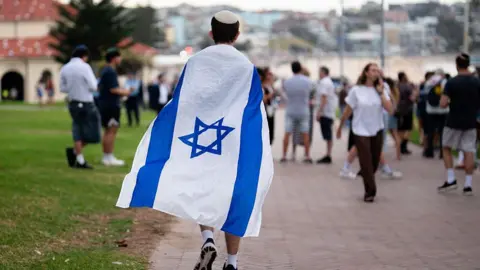
There has been resistance in the face of fear - some leaders urging Jewish Australians to double down, be more publicly Jewish and display their religious symbols with pride.
One woman perusing the flowers outside the Bondi Pavilion on Sunday admits she is too scared to do that. It took her all week to even work up the courage to visit this site, which is just metres from where many of the victims died.
"I've never felt my Jewishness before. I've never experienced antisemitism in my whole life until now," MaryAnne says. "And now, I don't want to wear my Star of David."
Community, anger and sadness
The shooting triggered a massive outpouring of support from around the nation.
When the news broke, many in the community rallied to help.
Lifeguards - volunteer and paid - put their lives on the line. Restaurants opened their doors and hid people in their store rooms and freezers, and locals ushered lost children into their apartments.
Even the New South Wales opposition leader Kellie Sloane - also the local state member - was at the scene, helping pack bullet wounds.
In the days after the shooting, thousands of ordinary Australians lined up - many for hours on end - to donate blood desperately needed to treat those injured.
Each day, a carpet of petals, handwritten notes, commemorative stones and candles grew out from the gates of the Bondi Pavilion.
Bee motifs - stickers, balloons, even pavement art - are all over the suburb, in remembrance of Matilda, the terror attack's youngest victim.
Surfers and swimmers on Friday paddled out beyond Bondi's iconic breaks to honour those who died.
A day later, surf livesavers and lifeguards stood shoulder to shoulder on the beach in solidarity with the Jewish community.
But amid the platitudes, sadness and shock is calcifying into anger and tension.
Surfers and swimmers pay tribute to victims of Bondi shooting
Last year's Bondi Junction stabbings were devastating for the community - but a shared resolution united it.
Experts say the attacker, who had schizophrenia, was in psychosis at the time of the stabbings, and his family have previously said he was frustrated at being unable to find a girlfriend. The question of whether he targeted women will likely forever go unanswered. But clear failures in the mental health system have been identified.
Last month, families of the victims asked the coroner to refer the doctor who weaned him off medication with limited supervision to regulators for investigation, and they have also argued for a massive boost to mental health service funding.
But last Sunday's events raise more uncomfortable feelings and questions.
There is palpable fury at the government, over a perceived – and admitted – failure to do more to stop antisemitism. Prime Minister Anthony Albanese has been booed during public appearances this week, and talking to people visiting the site of the attack in Bondi, it isn't uncommon to hear them demand his resignation.
Many people the BBC spoke to pointed to his government's decision to recognise Palestinian statehood, alongside countries including the UK and Canada, and regular protests in Australia by members of the pro-Palestinian movement, which though largely peaceful but have been peppered with antisemitic chants and placards.
The state of New South Wales - which has in recent years tightened protest rules - has already announced it will introduce more legislation cracking down on "hateful" chants and give police more powers to investigate demonstrators. The federal government has promised similar.
The blame apportioned to these protests does not sit right with many, even some sections of the Jewish community.
"We need to hold multiple truths," Mr Seidler says. "We can be afraid, we can feel that there is deep antisemitic rhetoric going on in certain circles within Australia… while also understanding that there is a right of people in this country – especially Muslim Australians – to be concerned about what is taking place in Gaza.
"We need to get better at finding that line and calling out when that line has been crossed."
Getty
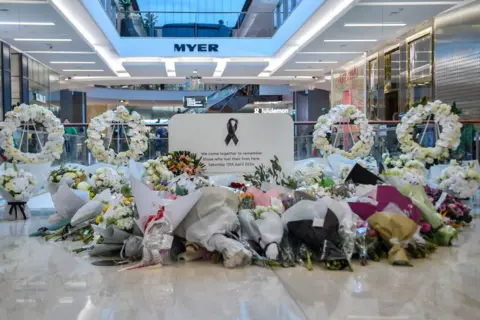
A memorial inside the Bondi Junction Westfield shopping centre where six people were stabbed to death in April last year
For others, there is anger at what they feel is the politicisation of a tragedy.
"It's a bloody photo op," one woman tells me on Sunday, as a prominent Australian businesswoman arrives and begins posing with the floral tributes outside the Bondi Pavilion.
Some - including the local federal MP Allegra Spender - worry the attack is being used to fuel anti-immigration sentiment.
"We would not have had the man who saved so many Australians if we had cut off, for instance, Muslim immigration," she said.
Mr Seidler says these arguments fail to recognise that antisemitic views - and other forms of bigotry - are formed here too.
"I heard someone say the other day that Australia thinks it's on a holiday from history, that we're somehow immune to this stuff, that it's not bred here, it's imported," Mr Seidler says.
With the anger, there is also fear: for the Jewish community of other attacks, for the Muslim community of retaliation for an act of terror they have loudly condemned.
There are questions over how Australia's security agency fumbled an alleged terrorist who at one point was on their watch list, prompting a review into federal police and intelligence agencies that was announced on Sunday.
There is frustration at NSW Police, who have for years been warned by the Muslim community of hate preachers poaching their young men.
There is animosity towards the media, driven by hurt among both Jewish and Arab Australians over a belief they and their communities have been misrepresented, and frustration at what some feel is incitement against them.
But there is also a queasiness at the treatment of traumatised victims throughout this week, some of whom were interviewed live on television while the blood of their friends still stained their hands.
Through it all, is an undercurrent of suspicion of institutions and each other.
There are varying opinions on how those rifts can heal – or even if they can. But there is a shared determination to try.
Getty Images
Many Jewish Australians are angry at the government
One UK expat who was at the beach at the time of the shooting says everyone he speaks to is adamant this will not change Bondi, or Australia.
"It's seriously unique what you have as a nation… there's a magic about it," Henry Jamieson tells the BBC.
"I'm traumatised… and I'm going to have to deal with that for the rest of my life, I know I am… even people who weren't there were traumatised.
"But I'm not gonna let it shake me and we will not let it shake this community.
"You can't let them win," he says of the alleged terrorists.
At an emotional memorial on Sunday night, seven days since the attack, the same sense of defiance was on show. It ended with the lighting of the menorah, something the crowds gathered for Hannukah last week never got to do.
The shamash, the centre candle, was lit by the father of Ahmed al Ahmed, in honour of his bravery in wrestling a gun off one of the attackers. The children of the two rabbis who were killed lit another. Others were lit by a representative of surf lifesavers and a Jewish community medic who rushed to the scene and began treating the injured before the shots had even stopped. The final candle was lit by Michael, the father of Matilda, who has been described a fountain of joy to all who knew her.
After the parade of diverse Australians had sparked flames on each arm of the menorah, Rabbi Yehoram Ulman of Bondi Chabad made a plea for more love and more unity.
"Returning to normal is not enough," he said.
"Sydney can and must become a beacon of goodness. A city where people look out for one another, where kindness is louder than hate, where decency is stronger than fear, and we can make it happen," he said, stopping for a moment as the crowd applauded.
"But only if we take the feelings we have right now and turn them into action, into continuous action."
Steve Witkoff, right, seen here with Ukrainian President Volodymyr Zelensky earlier this month, said negotiations were "productive and constructive"
US and Ukrainian envoys say "productive and constructive" talks have taken place in Miami, but there still appears to be no major breakthrough in efforts to end Ukraine's war with Russia.
Donald Trump's special envoy, Steve Witkoff, issued a joint statement with the top Ukrainian negotiator, Rustem Umerov, after three days of meetings with European allies.
The pair said the meeting focused on aligning positions on a 20-point plan, a "multilateral security guarantee framework", a "US Security guarantee framework for Ukraine" and an "economic & prosperity plan".
Separate talks have been taking place in Miami between the US and the Russian envoy, Kirill Dmitriev.
"Our shared priority is to stop the killing, ensure guaranteed security, and create conditions for Ukraine's recovery, stability, and long-term prosperity," Witkoff and Umerov said in a statement.
The meetings are the latest step in weeks of diplomatic activity, sparked by the leaking of a 28-point US peace plan which shocked Ukraine and its European allies for appearing to favour Russia, which launched a full-scale invasion of Ukraine nearly four years ago.
Witkoff said representatives from Russia had met himself and other US officials in southern Florida, including Trump's son-in-law Jared Kushner.
Witkoff said the meetings with Russian envoy Dmitriev were also "productive and constructive" and that "Russia remains fully committed to achieving peace in Ukraine".
Trump has been pushing Ukraine and Russia to come to an agreement on ending the war, but so far the two countries have been unable to agree on major issues, including Moscow's demand to keep land it has already seized.
US intelligence reports continue to warn that Russian President Vladimir Putin still wants to capture all of Ukraine and reclaim parts of Europe that belonged to the former Soviet empire, six sources familiar with US intelligence told the Reuters news agency.
The renewed fighting this month has displacing around 900,000 on both sides, officials say
South East Asia's top diplomats are meeting on Monday in Malaysia in a bid to end deadly border clashes between Thailand and Cambodia that have killed at least 41 people and displaced close to one million others.
They will seek to revive a ceasefire that was brokered in July by Malaysia as chair of the Association of Southeast Asian Nations (Asean) and US President Donald Trump in July.
This is the first meeting between officials of Thailand and Cambodia since fighting resumed on 8 December. Both countries have blamed each other for the fresh hostilities.
The conflict dates back more than a century, when the borders of the two nations were drawn after the French occupation of Cambodia.
Malaysian Prime Minister Anwar Ibrahim, who presided over the signing of the July ceasefire alongsideTrump, said he was "cautiously optimistic" about Monday's meeting in Kuala Lumpur.
"Our duty is to present the facts, but more importantly, to press upon them that it is imperative for them to secure peace," he said last week.
Cambodia has said that the talks aim to restore "peace, stability and good neighbourly relations", adding that it would reaffirm its position that the disputes should be resolved through peaceful means.
Thailand, while calling the meeting an important opportunity, reiterated its conditions for negotiations, including a declaration of ceasefire from Cambodia first and a "genuine and sustained" ceasefire.
The US and China have also been attempting to mediate a new ceasefire.
US Secretary of State Marco Rubio, who had a phone call with his Thai counterpart on Thursday, said that he hoped a new ceasefire could be reached by Monday or Tuesday.
China's special envoy for Asian affairs, Deng Xijun, visited Phnom Penh last week. A statement from Beijing said he reaffirmed that China would continue to play a constructive role in facilitating dialogue between Cambodia and Thailand.
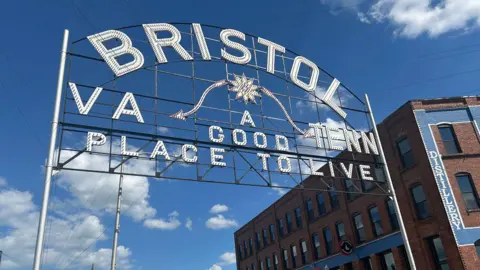
The US town of Bristol, population around 44,000, is a divided community.
Split between Virginia and Tennessee, the state line runs literally down main street. While both sides have much in common, there is one major difference - abortion is illegal in Tennessee. This has been the case since the 2022 Supreme Court ruling which gave individual states, rather than the federal government, the power to legislate abortion, triggering 12 states to pass near-total bans.
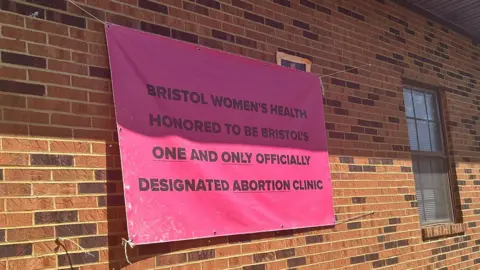
So the city's only abortion clinic, Bristol Women's Health, moved less than a mile down the road to continue practising legally in Virginia.
But just because abortion is legal in Virginia it doesn't mean the battle for abortion access is over.
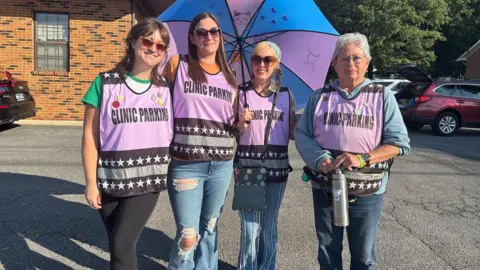
"It's like whack-a-mole," said Barbara Schwartz, the co-founder of SLAAP, the State Line Abortion Access Partnership. They assist people travelling into Virginia to get an abortion at Bristol Women's Health Clinic.
"As soon as one approach doesn't work, the anti-abortion crowd pops up in Bristol and tries another."
Barbara Schwartz (on right) with other volunteers at the clinic
On 22 December, Bristol's Circuit Court will hear the clinic's case against an eviction notice served by their landlords, brothers Chase and Chadwick King in April 2024.
Lawyers for the clinic argue it has the right to renew its lease for a total of six more years. But if the judge rules in favour of the building's owners, the clinic will be forced to find a new home.
This is not the landlords' first attempt to remove the clinic from their property. The brothers claimed that the clinic fraudulently concealed that they perform abortions, to which they maintain to be "adamantly opposed". The case was dismissed in September last year, with Judge Sage Johnson ruling:
"If [the landlords] had conducted a simple internet search on their tenants, as any reasonably prudent landlord likely would, they would have discovered that the clinic did, in fact, provide abortion services as is plainly stated on their website."
Clinic owner Diana Derzis, who declined to comment on the hearing, previously stated that she hopes to keep the clinic in the city, even if they are evicted. However, she noted there are few other suitable facilities in Bristol, Virginia.
The clinic leaving Bristol would be a "blow" to abortion access, according to Barbara Schwartz, the co-founder of SLAAP, the State Line Abortion Access Partnership.
Since Roe v Wade was overturned, states where abortions are legal have become destinations for out-of-state abortion seekers, with 155,000 people crossing state lines last year, according to the Guttmacher Institute (GI).
The organisation also found that over 9,200 people travelled to Virginia alone to have the procedure done last year.
"Bristol's position means the clinic is the closest place by several hours to get a safe and legal abortion for millions of southerners."
Victoria Cobb, the director of anti-abortion lobbyist the Family Foundation, also notes that Bristol's location places it at the "epicentre of the debate".
Ms Cobb launched the first of several efforts to restrict abortion in Bristol by making use of local bylaws. The tactic is being used by anti-abortion campaigners in states which permit abortion. The logic is simple: If you can't win at Capitol Hill, why not fight at City Hall?
"Locals don't want to see their town turn into an abortion destination location," Ms Cobb states. "We're happy to help them."
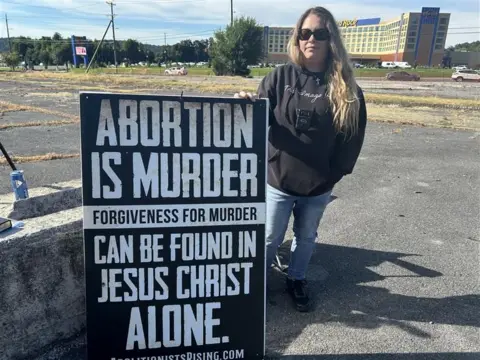
Sammi Cooper is opposed to abortion and protests against the clinic
The Family Foundation has argued in the past that the existence of the clinic goes against zoning regulation, which prohibits buildings from being used in a way that could endanger life.
"Why would this not extend to unborn life?" asked Ms Cobb.
Their ordinance said no new clinics should be allowed to open in Bristol, and expansion of the existing clinic should be blocked.
Similar rules have been used in other parts of the US to restrict abortion, including nearby Washington and Russell counties. But Prof Laura Hermer, an expert on abortion regulations in the US, says these efforts are largely "virtue signalling".
"I'd be surprised if many of these towns have any healthcare, let alone abortion, providers," she said.
The debate became heated in Bristol, as the council agreed to look into the matter.
"It has been more stressful than dealing with a parking lot. It's not something that has really come to the local level before," Jay Detrick, the city's planning director told the BBC.
Ultimately, the city's attorney found that imposing restrictions on a medical facility was not in their remit.
Soon after the city decided not to intervene, another group decided to try and shut the clinic down - this one spearheaded by Texas pastor Mark Lee Dickson.
The pastor has lobbied councils across the US to enforce the Comstock Act, a 152-year-old federal law that prohibits sending or receiving material via post which might induce an abortion.
Ninety-three local authorities have passed ordinances to enforce the Comstock Act, even closing a Planned Parenthood clinic in Lubbock, Texas.
Pastor Dickson is hopeful his ordinance filed in Bristol will have the same result. It has not yet been considered by the Council, but he remains optimistic.
"A local government's tabling or rejecting of such a measure doesn't by any means mean the initiative is dead," he told the BBC.
Kimberly Smith, SLAAP's co-founder, anticipates further campaigns. She says anti-abortion activists target Bristol due to its unusual political make-up:
"They come here because we were a red part of a blue state. If they chip away here, then that weakens the entire framework of a state's rights."
Indeed, even if the clinic wins its case this week and can remain in place, its opponents are undeterred, Pastor Dickson tells the BBC.
"As long as the cries of unborn babies are silenced in Bristol there will be an effort to push the City Council to fulfil their obligation to protect unborn Bristolians."
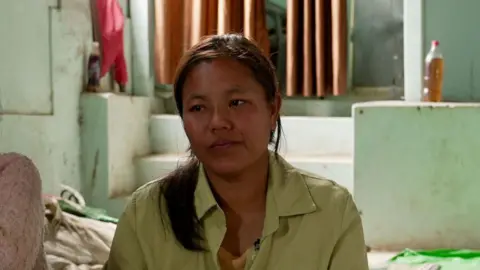
Iang Za Kim had to flee her home after the junta launched air strikes nearby
Late one night last month Iang Za Kim heard explosions in a neighbouring village, then fighter jets flying overhead. She ran out of her home to see smoke rising from a distance.
"We were terrified. We thought the junta's planes would bomb us too. So we grabbed what we could – some food and clothes and ran into the jungles surrounding our village."
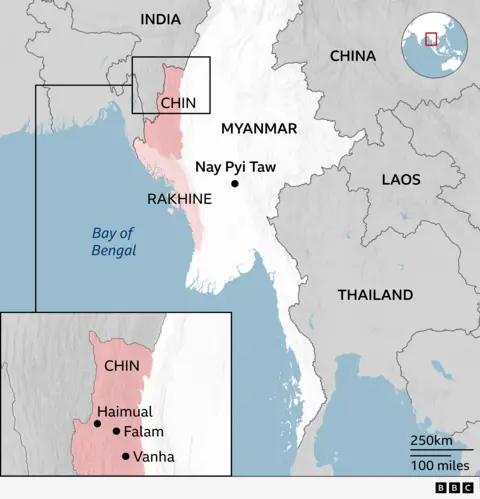
Iang's face quivers as she recounts the story of what happened on 26 November in K-Haimual, her village in Myanmar's western Chin State, and then she breaks down.
She's among thousands of civilians who've fled their homes in recent weeks after the Burmese military launched a fierce campaign of air strikes, and a ground offensive in rebel-held areas across the country, to recapture territory ahead of elections starting on 28 December.
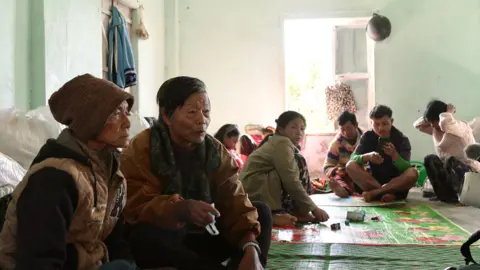
Four other women sitting around her on straw mats also start crying. The trauma of what they've gone through to make it to safety is clearly visible.
While the air strikes were the immediate cause for Iang to flee, she also doesn't want to be forced to participate in the election.
"If we are caught and refuse to vote, they will put us in jail and torture us. We've run away so that we don't have to vote," she says.
Many civilians have crossed into India to escape the violence in Myanmar
Some from Chin state have described the junta's latest offensive as the fiercest it has launched in more than three years.
Many of the displaced have sought refuge in other parts of the state. Iang is among a group that crossed the border into India's Mizoram state. Currently sheltered in a rundown badminton court in Vaphai village, the group's few belongings they were able to carry are packed in plastic sacks.
Indian villagers have given them food and basic supplies.
Ral Uk Thang has had to flee his home at the age of 80, living in makeshift shelters in jungles for days, before finally making it to safety.
"We're afraid of our own government. They are extremely cruel. Their military has come into our and other villages in the past, they've arrested people, tortured them, and burned down homes," he says.
It isn't easy to speak to Burmese civilians freely. Myanmar's military government does not allow free access in the country for foreign journalists. It took over the country in a coup in February 2021, shortly after the last election, and has since been widely condemned for running a repressive regime that has indiscriminately targeted civilians as it looks to crush the armed uprising against it across Myanmar.
During its latest offensive, the junta last week targeted a hospital in Rakhine State, just south of Chin State. Rebel groups in Rakhine say at least 30 people were killed and more than 70 injured.
The Chin Human Rights Organisation says that since mid-September at least three schools and six churches in Chin State have been targeted by junta airstrikes, killing 12 people including six children.
The BBC has independently verified the bombing of a school in Vanha village on 13 October. Two students –Johan Phun Lian Cung, who was seven, and Zing Cer Mawi, 12 - were killed as they were attending lessons. The bombs ripped through their classrooms injuring more than a dozen other students.
Myanmar's military government did not respond to the BBC's questions about the allegations.
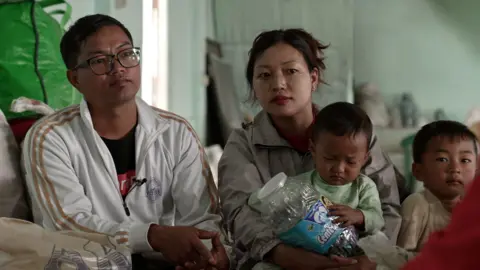
This is the second time Bawi Nei Lian and his young family – a wife and two young children - have been displaced. Back in 2021, soon after the coup, their home in Falam town was burnt down in an air strike. They rebuilt their lives in K-Haimual village. Now they're homeless again.
"I can't find the words to explain how painful and hard it is and what a difficult decision it was to make to leave. But we had to do it to stay alive," he says.
"I want the world to know that what the military is claiming – that this election is free and fair – this is absolutely false. When the main political party is not being allowed to contest the election, how can there be genuine democracy?"
Bawi Nei Lian (left) says the scheduled elections are a sham
The National League for Democracy party, led by Aung San Suu Kyi, which won landslides in the two elections prior to the coup, will not be contesting as most of its senior leaders including Suu Kyi are in jail.
"We don't want the election. Because the military does not know how to govern our country. They only work for the benefit of their high-ranking leaders. When Daw Aung San Suu Kyi's party was in power, we experienced a bit of democracy. But now all we do is cry and shed tears," says Ral Uk Thang.
Iang Za Kim believes the election will be rigged. "If we voted for a party not allied with the military, I believe they will steal our votes and claim we voted for them."
The election will take place in phases, with a result expected around the end of January. Rebel groups have called it a sham.
At the base of the Chin National Front in Myanmar, the most prominent rebel group operating in the state, the group's Vice Chairman Sui Khar says: "This election is only being held to prolong military dictatorship. It's not about the people's choice. And in Chin State, they hardly control much area, so how can they hold an election?"
He points out the areas where the most intense fighting is ongoing on a map and tells us nearly 50 rebel fighters have been injured in just the past month. There have been deaths too, but so far the groups have not released a number.
"There are columns of hundreds of soldiers trying to advance into the northern part of Chin state from four directions," Sui Khar says. "The soldiers are being supported by air strikes, artillery fire and by drone units."
Abel lost his right left and his hands were severely wounded fighting against the junta
Access to the base is extremely rare. Set amid thickly forested mountains, it is the heart of the resistance against the junta in Chin state.
Sui Khar takes us to the hospital at the base. We see a group of injured fighters who were brought in overnight and had to undergo hours of surgery. Some of them have had to undergo amputations.
Many of them were just schoolboys when the coup occurred in 2021. Just about adults now, they've let go of their dreams to fight on the frontline against the junta.
Abel, 18, is in too much pain to speak. He was with a group of fighters trying to take back territory the junta captured a week ago. They won the battle, but Abel lost his right leg and has serious injuries to his hands as well.
In a bed next to him is Si Si Maung, 19, who's also had a leg amputated.
"As the enemy was retreating we ran forward and I stepped on a landmine. We were injured in the explosion. Then we were attacked from the air. The airstrikes make things very difficult for us," he says. "I've lost a leg, but even if I've to give up my life I'm happy to make the sacrifice so that future generations have a better life."
The impact of the ferocity of the latest offensive is visible in room after room at the hospital.
Yet, it's the support and grit of tens of thousands of youngsters like Si Si Maung, who picked up arms to fight against the junta, that have helped the rebels make rapid advances against a much more powerful rival in the past four-and-a-half years.
Some like 80-year-old Ral Uk Thang hope that after the election, the junta will retreat, and he will be able to go back home.
"But I don't think I will live to see democracy restored in Myanmar," he says. "I hope my children and grandchildren can witness it some day."
Additional reporting by Aamir Peerzada, Sanjay Ganguly and Aakriti Thapar
Sir Keir Starmer does not have a "coherent approach to social mobility", the government's social mobility commissioner has said.
Alun Francis, a top adviser to the government, told the Guardian that there was no "overarching narrative" to pull various policy strands together and called on the prime minister to set out a clearer strategy.
A report by the commission released last week warned that "extreme regional disparities exist" in the UK, with many former industrial and mining areas worst affected.
"We have a government that talks quite a lot about social mobility, but mainly about individuals – often about [the] social mobility of themselves or their colleagues," Francis said.
"But what we don't have is a coherent approach to social mobility as a useful concept that you can build a strategy around."
While praising individual policies on housing and skills, he said other proposals had been "stop-start", while almost one million young people are now outside education, work or training.
"We've got other policies like growth, educational improvement where we're just not sure where we're going," Francis said.
Without an overall strategy, he said, the government would "struggle to address some of those issues and have a clear-headed view about what we might do to improve things".
Among the conclusions of week's report were that a child's family background still heavily shapes their education level and future life chances in the UK. It also said there were "extreme regional disparities" within the country.
A government spokesperson called the number of young people outside education, work or training a crisis that couldn't be ignored and said a review by Alan Milburn would help build a system that ensured every young person had an opportunity to make something of their lives.
The report listed North East of England, Yorkshire and the Humber, and the West Midlands as facing "enduring disadvantages", while former mining areas in Wales and Scotland are also "notably disadvantaged".
However, new areas outside London with "favourable conditions for innovation and growth" include Aberdeen, Brighton, Bristol, Chester, Edinburgh, Oxfordshire, Reading and West Berkshire, the report said.
It also noted that almost half of young people aged 25 to 29 years were in professional occupations between 2022 and 2024 - up from 36% between 2014 and 2016.
But people from lower socioeconomic backgrounds "don't benefit as much from these opportunities as their peers", it said.
The US town of Bristol, population around 44,000, is a divided community.
Split between Virginia and Tennessee, the state line runs literally down main street. While both sides have much in common, there is one major difference - abortion is illegal in Tennessee. This has been the case since the 2022 Supreme Court ruling which gave individual states, rather than the federal government, the power to legislate abortion, triggering 12 states to pass near-total bans.
So the city's only abortion clinic, Bristol Women's Health, moved less than a mile down the road to continue practising legally in Virginia.
But just because abortion is legal in Virginia it doesn't mean the battle for abortion access is over.
"It's like whack-a-mole," said Barbara Schwartz, the co-founder of SLAAP, the State Line Abortion Access Partnership. They assist people travelling into Virginia to get an abortion at Bristol Women's Health Clinic.
"As soon as one approach doesn't work, the anti-abortion crowd pops up in Bristol and tries another."
Barbara Schwartz (on right) with other volunteers at the clinic
On 22 December, Bristol's Circuit Court will hear the clinic's case against an eviction notice served by their landlords, brothers Chase and Chadwick King in April 2024.
Lawyers for the clinic argue it has the right to renew its lease for a total of six more years. But if the judge rules in favour of the building's owners, the clinic will be forced to find a new home.
This is not the landlords' first attempt to remove the clinic from their property. The brothers claimed that the clinic fraudulently concealed that they perform abortions, to which they maintain to be "adamantly opposed". The case was dismissed in September last year, with Judge Sage Johnson ruling:
"If [the landlords] had conducted a simple internet search on their tenants, as any reasonably prudent landlord likely would, they would have discovered that the clinic did, in fact, provide abortion services as is plainly stated on their website."
Clinic owner Diana Derzis, who declined to comment on the hearing, previously stated that she hopes to keep the clinic in the city, even if they are evicted. However, she noted there are few other suitable facilities in Bristol, Virginia.
The clinic leaving Bristol would be a "blow" to abortion access, according to Barbara Schwartz, the co-founder of SLAAP, the State Line Abortion Access Partnership.
Since Roe v Wade was overturned, states where abortions are legal have become destinations for out-of-state abortion seekers, with 155,000 people crossing state lines last year, according to the Guttmacher Institute (GI).
The organisation also found that over 9,200 people travelled to Virginia alone to have the procedure done last year.
"Bristol's position means the clinic is the closest place by several hours to get a safe and legal abortion for millions of southerners."
Victoria Cobb, the director of anti-abortion lobbyist the Family Foundation, also notes that Bristol's location places it at the "epicentre of the debate".
Ms Cobb launched the first of several efforts to restrict abortion in Bristol by making use of local bylaws. The tactic is being used by anti-abortion campaigners in states which permit abortion. The logic is simple: If you can't win at Capitol Hill, why not fight at City Hall?
"Locals don't want to see their town turn into an abortion destination location," Ms Cobb states. "We're happy to help them."
Sammi Cooper is opposed to abortion and protests against the clinic
The Family Foundation has argued in the past that the existence of the clinic goes against zoning regulation, which prohibits buildings from being used in a way that could endanger life.
"Why would this not extend to unborn life?" asked Ms Cobb.
Their ordinance said no new clinics should be allowed to open in Bristol, and expansion of the existing clinic should be blocked.
Similar rules have been used in other parts of the US to restrict abortion, including nearby Washington and Russell counties. But Prof Laura Hermer, an expert on abortion regulations in the US, says these efforts are largely "virtue signalling".
"I'd be surprised if many of these towns have any healthcare, let alone abortion, providers," she said.
The debate became heated in Bristol, as the council agreed to look into the matter.
"It has been more stressful than dealing with a parking lot. It's not something that has really come to the local level before," Jay Detrick, the city's planning director told the BBC.
Ultimately, the city's attorney found that imposing restrictions on a medical facility was not in their remit.
Soon after the city decided not to intervene, another group decided to try and shut the clinic down - this one spearheaded by Texas pastor Mark Lee Dickson.
The pastor has lobbied councils across the US to enforce the Comstock Act, a 152-year-old federal law that prohibits sending or receiving material via post which might induce an abortion.
Ninety-three local authorities have passed ordinances to enforce the Comstock Act, even closing a Planned Parenthood clinic in Lubbock, Texas.
Pastor Dickson is hopeful his ordinance filed in Bristol will have the same result. It has not yet been considered by the Council, but he remains optimistic.
"A local government's tabling or rejecting of such a measure doesn't by any means mean the initiative is dead," he told the BBC.
Kimberly Smith, SLAAP's co-founder, anticipates further campaigns. She says anti-abortion activists target Bristol due to its unusual political make-up:
"They come here because we were a red part of a blue state. If they chip away here, then that weakens the entire framework of a state's rights."
Indeed, even if the clinic wins its case this week and can remain in place, its opponents are undeterred, Pastor Dickson tells the BBC.
"As long as the cries of unborn babies are silenced in Bristol there will be an effort to push the City Council to fulfil their obligation to protect unborn Bristolians."
The entrance to the Élysée Palace in Paris. The objects that disappeared from its collection were returned after the investigation, according to prosecutors.
Floodwaters swept Shasta County on Sunday, killing at least one person. Forecasters warned that Central California would receive heavy rain later in the week.

 Login
Login