Reading view

There are new articles available, click to refresh the page.

Trump declares victory in Iran war after rescue, but threats to US operation still loom

Getty Images US President Donald Trump speaks while wearing a dark suit, white shirt and red tie. He stands indoors front of flag with a the US presidential seal on it.Getty Images

US President Donald Trump was swift to declare victory after the second crew member of an F-15 downed over Iran was recovered, claiming on Sunday that the successful rescue "proves, once again, that we have achieved overwhelming air dominance and superiority".

Observers, however, paint a more complicated picture of what this means for the US in Iran.

While the mission was successful, the events of the last few days - in which two aircraft were downed and at least one helicopter hit by gunfire - highlight that threats to US aircraft and personnel remain.

Several Washington sources who spoke to the BBC speculated that the loss of aircraft and the complexity of the operation to recover the pilots could potentially dissuade Trump from any ground operation to take Kharg Island and sites in the Persian Gulf, or to seize highly enriched uranium in Iran.

These operations could be complicated, and risk exposing US forces to lingering Iranian capabilities, including difficult-to-find man portable air defence systems, known as Manpads, which are shoulder-launched weapons most effective against low flying aircraft.

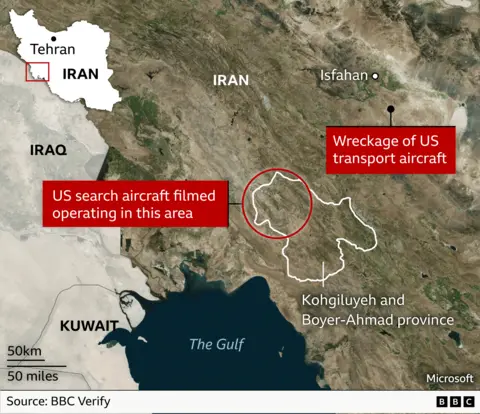
A map showing western and southern Iran, the Gulf, and neighbouring countries. A red label near the city of Isfahan marks the “Wreckage of US transport aircraft”. Another red label further south marks the area where “US search aircraft filmed operating” pointing to a location around the Kohgiluyeh and Boyer‑Ahmad province and Khuzestan province. Surrounding countries labelled include Iraq to the west, Saudi Arabia to the southwest, and Qatar, the UAE and Oman to the south of Iran.

On the other hand, the fact that US troops were able to enter a contested environment, and set up a forward airfield and refueling point under the nose of the Iranians - then hold it for hours while two stuck aircraft were destroyed and replacements sent - might embolden him.

It could convince the administration that an airborne or amphibious operation against targets in Iran stands a good chance of success.

Trump also has sent mixed messages about the path forward, telling reporters in a series of phone calls that he believes a "deal" with Iran could be just around the corner.

If that fails, he has said repeatedly on Truth Social, that the clock is ticking on a self-imposed deadline to begin striking Iranian power plants and bridges, leaving Iran "living in hell". In a brief phone interview with Fox, Trump also suggested he might move to "take" Iran's oil, without providing further details.

Getty Images  Wreckage is seen from what Iranian authorities say is a US military helicopter that crashed during a mission to rescue the missing American pilot of an F-15E that was downed earlier this week, in a handout image provided on April 5, 2026 in an unspecified location in Iran.Getty Images
Wreckage is seen from what Iranian authorities say is a US military helicopter that crashed during a mission to rescue the missing American pilot of an F-15 that was downed earlier this week.

An expanded campaign against Iranian infrastructure and energy targets would represent an escalation, and detractors are likely to take it as a sign of frustration that the US has been unable to secure freedom of navigation in the Strait of Hormuz.

Trump's comments over the weekend stand in contrast to several he made last week, including a televised address on 1 April, in which he suggested that the US already has created the conditions necessary for other countries to engage in the Strait.

Also, Trump has suggested that he was willing to "leave" Iran even if a deal eluded him. But he now appears to have shifted course in the hopes that the threat of devastating attacks on a new set of Iranian targets can prompt Tehran's leadership to come to the table.

How rescue of US airman in remote part of Iran unfolded

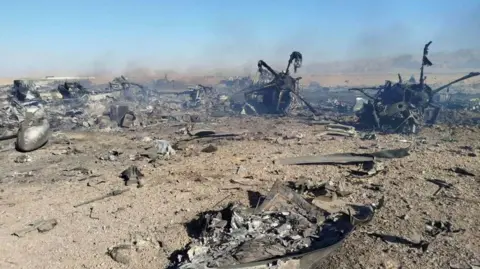
Reuters A still image purporting to show the burned wreckage of aircraft destroyed during the US mission to find a stranded airman in Iran. What appears to be two propellers can be seen among scraps of metal and smoke on a sandy ground.Reuters
Parts of an aircraft, which Iran claims was destroyed in the US rescue mission, were shown on Iranian state TV

The US military has rescued a missing crew member in a dramatic night-time mission after his fighter jet was shot down in a remote part of Iran.

The exact circumstances remain unclear, but the operation to extract him from the ground in hostile territory was hugely complex.

Hundreds of special forces, as well as dozens of US fighter jets and helicopters, were involved in the plan, along with the CIA.

On Sunday, US President Donald Trump said on social media: "We have rescued the seriously wounded, and really brave, F-15 Crew Member/Officer, from deep inside the mountains of Iran."

But the airman's ordeal began on Friday with reports that an F-15 jet, which was carrying a weapons systems officer and a pilot, had been shot down over southern Iran.

The incident was the first US fighter jet to be shot down by enemy fire in more than 20 years.

The two US military personnel on board the F-15E Strike Eagle managed to eject from the aircraft, and the pilot was rescued the same day, but the second crew member was missing.

The US then began a race against time to locate him.

Iran made it clear they wished to capture him alive and offered a bounty of £50,000 ($66,100).

Videos shared on social media, which have not been verified by the BBC, appeared to show armed civilians searching for him.

Once the officer was on the ground, he had only a handgun to defend himself, US officials told the BBC's US partner CBS News.

The airman would have received training for a situation like this, and it would have involved turning his beacon signal on, getting to high ground, concealing himself and establishing communications.

According to reports in US media, the airman hid himself in a mountain crevice and restricted the use of his beacon - concerned the signal could be picked up by Iran.

He then waited for his rescuers to arrive.

Video appears to show a US plane and helicopters over southern Iran on Friday

The CIA played a crucial role in the rescue operation, according to a senior Trump administration official who spoke to US media.

According to CBS News, it was the US intelligence agency that tracked the airman's exact location to the mountain crevice and passed the information along to the Pentagon.

Trump said his location was monitored "24 hours a day" by senior US officials who were planning the rescue operation.

The officer was "being hunted down by our enemies, who were getting closer and closer by the hour," the president added.

The CIA also ran a deception campaign, according to reports, spreading word inside Iran that US forces had already found the second airman.

The president said in his Truth Social post that the US military "sent dozens of aircraft, armed with the most lethal weapons in the World, to retrieve him".

As US special forces made their way towards the location of the stranded officer, bombs and weapons fire were used to keep Iranian troops away from his location, CBS reported.

There were varied reports from Iranian state media and the US media about how the operation was carried out, which the BBC has been unable to verify.

Iranian state media said on Sunday that troops from the Islamic Revolutionary Guard Corps (IRGC) shot down a US drone over Isfahan while it was searching for the missing airman.

CBS News also reported that two US transport planes tasked with flying out rescue crews were unable to take off from an Iranian airport, and were destroyed to stop them from falling into the hands of Iranian forces.

Special forces then flew out on three extra aircraft to collect the crews, US media said.

Footage and photos confirmed by BBC Verify appeared to show a smouldering aircraft wreckage in a mountainous area of central Iran, about 50km (31 miles) southeast of the city of Isfahan.

Iran's military said two US C-130 military transport planes and two Black Hawk helicopters were destroyed during the operation - and that "a deception and escape mission at an abandoned airport in southern Isfahan…was completely foiled".

The BBC has not been able to confirm either statement or report.

Satellite map showing southwestern Iran and the northern tip of the Gulf, along with Kuwait and eastern Iraq. It shows Kohgiluyeh and Boyer-Ahmad province, area in the province where US search aircraft were filmed operating, also place where wreckage of US transport aircraft was found and the city of Isfahan.

Before midnight US time the rescue was complete, and the airman was flown to Kuwait for medical treatment, officials told CBS.

Trump said the officer was "seriously wounded", but "he will be just fine".

US authorities have not disclosed any information about the airman's exact location when he was rescued, or his identity.

Former US military official William Fallon - a retired US Navy admiral - told the BBC that "time of day" probably worked in the rescue mission's favour. "Darkness is better for our people because they're used to operating at night."

Fallon says that when flying over hostile territory, "you have to be prepared to be the person that's hit".

Just before 00:00 EDT (04:00 GMT) on Sunday US media broke the news that the second pilot had been found.

Trump wrote on social media that the US would "NEVER LEAVE AN AMERICAN WARFIGHTER BEHIND!"

红十字会:蓄意攻击民用基础设施可构成战争罪 - RFI - 法国国际广播电台

05/04/2026 - 22:33

红十字国际委员会主席米里亚娜·斯波利亚里茨·埃格(Mirjana Spoljaric Egger)5日表示,“蓄意攻击基本服务和民用基础设施可能构成战争罪”。她补充道:“数百万平民,无论身处前线附近还是远离前线,都已遭受了对基本基础设施的攻击。这种趋势,再加上无视国际人道主义法限制的好战言论,使一种剥夺我们共同人性的战争方式正常化。”

1949年《日内瓦战时人道主义行为公约》禁止攻击被视为对平民至关重要的场所:“在任何情况下,都不得对可能剥夺平民(……)充足食物或水的物体采取任何行动。”

《日内瓦战时人道主义行为公约》明确禁止攻击“对平民生存不可或缺的目标,例如食品、用于生产食品的农业用地、农作物、牲畜、饮用水设施和供应品以及灌溉工程……”

《公约》及其附加议定书规定,武装冲突各方必须区分“民用目标和军事目标”,并禁止攻击民用目标。

这一禁令也被编入《国际刑事法院罗马规约》。该规约是125个国家的终审法院,但不包括俄罗斯、美国和中国等主要大国,因为它们尚未批准该规约。

《日内瓦公约》规定,某些由平民拥有和使用的基础设施可以被视为军事目标,但仅限于“因其性质、位置、用途或使用方式而对军事行动做出有效贡献的目标”,并且摧毁或占领这些目标“能够带来明确的军事优势”。

与当前中东冲突相关的案件近期不太可能提交战争罪法庭审理。海湾国家、以色列和伊朗都不是国际刑事法院的成员国。该地区也没有其他机构对涉嫌战争罪行拥有明确的管辖权。

比警方寻查在云南失踪的雨果 (Hugo Huyghebaert) - RFI - 法国国际广播电台

05/04/2026 - 22:37

在中国云南香格里拉附近失踪的比利时人是28岁的雨果·休格巴特(Hugo Huyghebaert)。自3月26日以来便杳无音讯。根据比利时联邦警察发布的寻人启事,最新消息显示,他当时在中国,具体地点是云南省香格里拉区附近的三坝乡。

比利时警方表示,3月26日,雨果·休格巴特离开他下榻的“哈巴西营阁”客栈,他准备徒步前往虎跳峡,此后失去音讯。他的家人和朋友再也没有他的消息。

比利时联邦警察告诉比利时通讯社(Belga):“外交部已获悉此事,并与驻广州总领事馆密切关注此案。”

在寻人启事中,警方提供了雨果的详细体貌特征描述。他身高1.80米,身材偏瘦,留着棕色短卷发和胡须。他身穿灰色登山服,背着一个带有绿色防雨罩的背包。

警方呼吁所有见过他、 可提供任何线索的人尽快报案。联系比利时警方可通过邮箱,邮箱地址为 avisderecherche@police.belgium.eu,或拨打免费电话0800/30300。


欧佩克:修复能源设施“成本高昂”且“耗时漫长” - RFI - 法国国际广播电台

05/04/2026 - 22:40

根据一份声明,欧佩克成员国(包括几个曾遭受伊朗空袭的海湾国家)连续第二个月同意从5月起“调整产量”,每日增产20.6万桶。

3月1日,阿尔及利亚、沙特阿拉伯、阿拉伯联合酋长国、伊拉克、哈萨克斯坦、科威特、阿曼和俄罗斯8个国家——已经将4月份的石油产量配额提高了每日20.6万桶。但欧佩克警告称,修复战争破坏的能源设施“成本高昂”,而且“耗时漫长”,这可能会加剧全球石油供应困难。

该组织还强调“保护国际航道对于确保能源畅通无阻至关重要”。声明并未直接提及与伊朗的战争,但这场冲突扰乱了全球能源市场并导致价格飙升,显然影响了该组织的决定。

冲突爆发前,全球约五分之一的石油和液化天然气(LNG)经由霍尔木兹海峡运输。

就在美国总统特朗普发出重新开放霍尔木兹海峡的最后通牒即将到期之际,他以脏话来威胁要攻击伊朗的基础设施。

石油输出国组织(欧佩克+)此前在一份声明中警告称,“任何危及能源供应安全的行为,无论是袭击基础设施还是扰乱国际航道,都会加剧市场波动”,并使欧佩克+管理全球油价的任务更加复杂。这八个国家赞扬了那些成功找到替代出口路线的成员国,他们认为这些路线有助于“降低市场波动”。

这八个国家赞扬了那些成功找到替代出口航线的成员国,他们认为这些路线有助于“降低市场波动”。周四,也就是复活节长周末前的最后一天,美国总统特朗普威胁伊朗将“倒退回石器时代”,受此影响,原油价格再次飙升。

美国基准原油西德克萨斯中质原油(WTI)5月交割价格上涨11.41%,至每桶111.54美元。北海布伦特原油6月交割价格上涨7.78%,至每桶109.03美元。 2 月 27 日,就在以色列和美国联合军事行动开始之前,这些价格分别为 67.02 美元和 72.48 美元。当时,由于担心发生冲突,这些价格已经达到了七个月来的最高水平。


伊一枚导弹击中以色列北部一层住宅楼 - RFI - 法国国际广播电台

05/04/2026 - 22:50

一名军方官员告诉法新社,该建筑“遭到导弹直接袭击”。当被问及是否是伊朗导弹时,他回答“是的”。

以色列红十字会报告称,一名八旬老人被从废墟中救出,伤势严重;另有三人受轻伤,其中包括一名婴儿。

救援人员之一谢瓦赫·罗滕什特里奇 (Shevach Rothenshtrych) 说:“当我们到达现场时,看到一栋多层建筑遭到袭击,损毁严重。居民告诉我们,一些伤者被困在较低楼层的废墟下,”。

他还补充说,“我们徒手搬开了大块混凝土,从废墟中救出了一名82岁的老人。他伤势严重,但意识清醒”,并指出该老人已被送往医院。

以色列红十字会表示,两名分别为77岁和38岁的妇女以及一名10个月大的婴儿被弹片和冲击波轻微击伤。

教宗主持复活弥撒 呼吁选择和平 - RFI - 法国国际广播电台

05/04/2026 - 22:52

教宗哀叹道:“我们正在习惯暴力,我们已经习以为常,并且变得冷漠。对成千上万人的死亡漠不关心。”他还表示,“对冲突播下的仇恨和分裂的后果及其经济和社会影响漠不关心。”

他还宣布将于4月11日在罗马圣伯多禄广场举行和平祈祷守夜活动。

随后,他站在圣伯多禄大殿的中央阳台上,用包括阿拉伯语和汉语在内的十种语言向信徒们致以“复活节快乐”的祝福——这一传统已被他的前任方济各教宗废除。之后,他乘坐教宗座驾,沿着通往广场的主干道巡游,接受人群的欢呼。

整个圣周期间,战争的阴影始终笼罩着庆祝活动。周六晚间,在复活节守夜礼中,天主教教宗谴责了战争造成的“分裂”、“不公正”以及“民族和国家之间的孤立”。近日,这位出生于芝加哥的教宗多次发出外交呼吁,甚至直接向特朗普喊话,敦促他“找到解决”冲突的办法。

在耶路撒冷,根据传统,建于耶稣复活地上的圣墓教堂的礼拜仪式因自2月28日伊朗战争爆发以来实施的集会限制而闭门举行。

周日上午,以色列警方以安全为由,在检查站对少数获准进入教堂的信徒进行筛选。

对许多人来说,这些措施使庆祝活动失去了意义。“这对我们所有人来说都非常艰难,因为这是我们的节日……想要祈祷,来到这里却什么也看不到,这真的很难受。”“一切都……” “这里已经关闭了,”44岁的克里斯蒂娜·托德拉斯(Christina Toderas)哀叹道,她来自罗马尼亚,眼中噙满了泪水。

“这里几乎一片寂静,只有远处传来战争持续肆虐这片神圣而饱受蹂躏的土地的破坏声,”耶路撒冷拉丁礼宗主教皮埃尔巴蒂斯塔·皮扎巴拉枢机主教周六宣布。他本人上周日被以色列警方阻止进入耶路撒冷,这一事件引发了国际社会的强烈愤慨。

在黎巴嫩,南部以基督教徒为主的城镇被以色列和伊朗支持的什叶派运动真主党之间长达一个月的冲突所困,尽管如此,信徒们仍然希望保持希望,大多数人拒绝逃离。

在靠近以色列边境的德贝尔,居民们一直在准备复活节,而无情的炮火声却在村庄周围回荡。如今,这个村庄几乎与世隔绝,只能依靠人道主义援助。

一位名叫约瑟夫·阿提耶的市政官员告诉法新社:“情况很悲惨”。“人们都吓坏了。”

尽管如此,“我们仍然信仰上帝,”阿提耶先生坚定地说,因为“这是我们唯一不会放弃的希望”。据他透露,一支援助车队预计将于周日抵达德贝尔,教廷大使——圣座大使——也将随行。

在阿拉伯联合酋长国迪拜,自周五起,所有弥撒均已取消,并将“根据政府指示”无限期暂停。在叙利亚中部基督教城市大马士革,由于当地局势紧张,弥撒活动仅限于教堂内进行。

在罗马,复活节也唤起了人们对教宗方济各的缅怀:2025年,这位阿根廷籍耶稣会士在复活节当天于圣伯多禄广场进行了最后一次公开弥撒,几个小时后便与世长辞。

拉夫罗夫:不要把“最后通牒”挂在嘴边 - RFI - 法国国际广播电台

05/04/2026 - 23:02

俄罗斯外交部在一份关于拉夫罗夫和阿拉格奇通话的声明中表示:“俄方表示希望一些国家为缓和围绕伊朗的紧张局势所做的努力能够取得成功,(……)而美国放弃最后通牒的措辞并恢复谈判将有助于这一努力的实现。”

两位外长还呼吁停止“对民用基础设施的鲁莽和非法袭击”,其中包括俄罗斯雇员工作的布什尔核电站。

特朗普4月4日在社媒发文,要求伊朗在48小时内达成协议或开放霍尔木兹海峡。

他写道:“还记得我曾给伊朗10天的期限,要么达成协议、要么开放霍尔木兹海峡吗?时间所剩无几——距离地狱降临在他们头上仅剩48小时了。”伊朗中央军方驳斥称,特朗普的威胁是“无助、紧张、失衡和愚蠢的行为”。

美反对派对特朗普爆粗口极大不满 - RFI - 法国国际广播电台

05/04/2026 - 22:45

参议院少数党领袖查克·舒默(Chuck Schumer)表示:“美国,复活节快乐。当你们前往教堂与亲朋好友欢庆时,美国总统却在社交媒体上像个疯子一样咆哮”。舒默补充说,“他有可能犯下战争罪,并疏远我们的盟友。他就是这样的人,但这并不代表我们。我们的国家远不是这样的”。

——“趾高气扬”——

民主党参议员克里斯·墨菲(Chris Murphy)认为,总统的态度“完全是疯狂的”。

这位来自康涅狄格州的国会议员是伊朗核协议的坚定批评者,他宣称:“如果我身处特朗普政府,我会在复活节期间打电话给宪法律师,咨询宪法第二十五修正案。”该修正案规定,如果总统无法履行职责(例如生病),权力必须移交。同样是民主党参议员的蒂姆·凯恩( Tim Kaine)指出,自战争爆发以来,唐纳德·特朗普并非首次发表此类言论。

这位来自弗吉尼亚州的参议员在接受NBC采访时说道:“炸他们,‘把他们赶回石器时代’,侮辱他们,国防部长赫格塞斯说,‘从天而降的死亡,毫不留情,我们要无视那些愚蠢的作战规则。’所有这些言辞都令人尴尬且幼稚,这些人试图装腔作势,而我们在这场战争中看到的却是政府缺乏清晰的逻辑,”。

谴责之声并非仅限于民主党人。玛乔丽·泰勒·格林(Marjorie Taylor Greene)曾是国会中特朗普的支持者,但近几个月来却成为特朗普的激烈批评者。她周日谴责了总统的言论。

这位极右翼人士在X网站上表示:“复活节的早晨,特朗普总统发布了这样的信息。他政府中所有自称基督徒的人都应该跪下来,向上帝祈求宽恕,停止崇拜总统,并站出来反对特朗普的疯狂行径。”。

“总统不是基督徒,基督徒不会支持特朗普的言辞。”这位反对美国海外军事干预的人士补充道。

然而,也有人对特朗普的言论表示欢迎,例如劳拉·卢默(Laura Loomer),这位保守派意见领袖经常与总统通话。劳拉·卢默(Laura Loomer),总统说让伊朗回答石器时代,因伊朗人的思维就停留在那个时代。

美国总统特朗普(Donald Trump)周日在其社媒平台“真相社交”上发文称,“周二在伊朗将是‘电厂日’和‘大桥日’,两者合二为一!绝对将是前所未有的!!!赶紧打开他妈的海峡,你们这些疯杂种们,否则就等着下地狱吧——等着瞧!赞美真主。” 


“最后通牒”又被延后 - RFI - 法国国际广播电台

05/04/2026 - 23:06

特朗普随后在社交媒体上发帖,没有提及伊朗或其他任何细节,仅有“周二晚8点(美国东部时间)!”美国Axios网站、彭博社等主流媒体对此解读为“特朗普将对伊朗的最后期限延长了24小时”。

3月27日,美国总统曾要求伊朗重新开放霍尔木兹海峡等,由此将原定于周一到期的最后通牒推迟了10天。

周日上午,特朗普通过电话连线多家美国媒体,并在接受《华尔街日报》采访时再次敦促德黑兰重新开放霍尔木兹海峡。特朗普表示,“如果他们想继续关闭海峡,他们将会失去国内所有的发电厂和其他设施”。

当被问及他预计冲突何时结束时,特朗普回答说:“我会尽快告诉你们。”特朗普补充说:“但我们处于非常有利的地位,这个国家需要20年才能重建,如果他们幸运的话,如果他们还能保住这个国家的话”。

在接受美国广播公司(ABC)采访时,这位美国总统还表示,战争结束只是几天的问题,而不是几周的问题,但如果无法达成协议,他将发动大规模轰炸行动。


专家描绘最坏情景:“台湾海峡也可能决定德国的未来” - RFI - 法国国际广播电台

05/04/2026 - 22:35

如果中国对台湾动武,会发生什么?据慕尼黑《墨丘利报》报道:政治学家安德烈亚斯·富尔达(AndreasFulda)表示:台湾会迅速失守。但“如果台湾真的沦陷,这不仅对台湾人民来说是一场灾难,也将改变整个世界。”

他在自己的书作《如果中国发动进攻》中,描绘了中国攻击台湾时可能发生的情况。在接受n-tv电视台采访时,他明确表示:“台湾海峡也可能决定德国的未来。”如果中国将台湾纳入版图,该地区将形成在中国共产党统治下的区域性霸权。“这对德国乃至世界都不是好事。”

安德烈亚斯·富尔达曾在中国和台湾生活,目前是英国诺丁汉大学的政治学教授。在他的书中,他运用“红队推演”(Red-Teaming)方法,分析台湾及其盟友的弱点,并推演中国可能如何加以利用。“这种方法我们在军事、金融行业以及IT安全领域都很熟悉,其目的在于通过模拟攻击一个软件、系统或组织,来识别其薄弱环节。”

台湾是位于中国大陆沿海的一座岛屿,自1949年以来事实上独立运作。根据德国联邦政治教育中心的资料,台湾是一个稳定的民主社会,技术高度发达。然而,中国共产党一直对台湾提出主权要求,这既有意识形态原因,也有军事战略考量。该岛为中国提供了通往开放海域的通道。正如慕尼黑联邦国防大学的亚洲军事专家迈-布里特·施通鲍姆所解释的那样,中国沿海水域较浅,潜艇一旦出海就容易被发现。此外,日本、美国或其他对手还可能通过“第一岛链”封锁中国通向外海的通道。

在富尔达看来,中国共产党将“领土主张与一种近乎神圣的统治权诉求结合在一起”。他说,在中共的思维中,总是涉及支配与从属关系。“因此,在我看来,中国与台湾之间实现和平共存几乎是不可能的。”他指出,过去中共缺乏通过军事手段实现其长期领土主张的能力,但“在过去10到20年中,这种情况已经发生了变化”。

与此同时,富尔达在采访中指出,“人们越来越怀疑,美国是否仍有意愿和能力维持东亚和东南亚的安全架构。”伊朗战争正体现了这一点。例如,美国从韩国撤出了“萨德”(THAAD)导弹防御系统,以应对伊朗战事。他认为,美国正面临军事上的过度扩张。这也与他在书中描绘的台湾情景一致:“我展示了美国这一超级大国如何变得更加犹豫、分身乏术,并引发外界对其是否能在台湾冲突中迅速介入的质疑。”

此外,唐纳德·特朗普这一因素也不容忽视。乔·拜登曾“多次明确表示,美国将在台湾海峡冲突中出手干预”。而在特朗普时期,白宫的相关表态则反复被修正,这对台湾来说并非好消息。富尔达认为,在伊朗战争中,中国可以“实时观察战争是如何展开的”。“所有这些因素都使得未来发生军事冲突的可能性更高。”

他还指出,自习近平上台以来,已经提拔了大量对其高度忠诚的军队指挥官。“如果他在2027或2028年决定发动战争,可以依赖这些人。”富尔达认为,习近平在涉及党的权力和明确的意识形态目标时,“愿意承受巨大的代价”。

德国政府在冲突中能扮演什么角色?在富尔达看来,德国政府提出的所谓“去风险”(De-Risking)战略实际上已被颠倒。该战略原本旨在减少德国经济对中国的依赖,例如在原材料或工业产品方面。但他说,德国在这方面进展甚微。“相反,依赖反而有所增加,对中国的投资仍在大幅增长。”

“德国总理弗里德里希·默茨率领大型经济代表团访问北京,这让我有一种似曾相识的感觉——仿佛回到了施罗德和默克尔时代。这正是去风险战略的反面。”富尔达还批评说,默茨关于与中国建立“战略伙伴关系”的表态体现出一种战略上的盲点。他指出,北京在俄罗斯对乌克兰的战争中支持普京,“没有中国的支持,普京不可能将战争持续这么久。而现在德国总理府却说中国是战略伙伴,这显然自相矛盾。”

富尔达表示,他的书是以最坏情景为基础写成的,目的是唤醒德国公众,“因为他们长期以来把希望当成战略”。在他的设想中,台湾可能会迅速失守。不过他也强调,现实情况未必如此。“我们也不应高估中国的军事实力。”

How rescue of US airman in remote part of Iran unfolded

Reuters A still image purporting to show the burned wreckage of aircraft destroyed during the US mission to find a stranded airman in Iran. What appears to be two propellers can be seen among scraps of metal and smoke on a sandy ground.Reuters
Parts of an aircraft, which Iran claims was destroyed in the US rescue mission, were shown on Iranian state TV

The US military has rescued a missing crew member in a dramatic night-time mission after his fighter jet was shot down in a remote part of Iran.

The exact circumstances remain unclear, but the operation to extract him from the ground in hostile territory was hugely complex.

Hundreds of special forces, as well as dozens of US fighter jets and helicopters, were involved in the plan, along with the CIA.

On Sunday, US President Donald Trump said on social media: "We have rescued the seriously wounded, and really brave, F-15 Crew Member/Officer, from deep inside the mountains of Iran."

But the airman's ordeal began on Friday with reports that an F-15 jet, which was carrying a weapons systems officer and a pilot, had been shot down over southern Iran.

The incident was the first US fighter jet to be shot down by enemy fire in more than 20 years.

The two US military personnel on board the F-15E Strike Eagle managed to eject from the aircraft, and the pilot was rescued the same day, but the second crew member was missing.

The US then began a race against time to locate him.

Iran made it clear they wished to capture him alive and offered a bounty of £50,000 ($66,100).

Videos shared on social media, which have not been verified by the BBC, appeared to show armed civilians searching for him.

Once the officer was on the ground, he had only a handgun to defend himself, US officials told the BBC's US partner CBS News.

The airman would have received training for a situation like this, and it would have involved turning his beacon signal on, getting to high ground, concealing himself and establishing communications.

According to reports in US media, the airman hid himself in a mountain crevice and restricted the use of his beacon - concerned the signal could be picked up by Iran.

He then waited for his rescuers to arrive.

Video appears to show a US plane and helicopters over southern Iran on Friday

The CIA played a crucial role in the rescue operation, according to a senior Trump administration official who spoke to US media.

According to CBS News, it was the US intelligence agency that tracked the airman's exact location to the mountain crevice and passed the information along to the Pentagon.

Trump said his location was monitored "24 hours a day" by senior US officials who were planning the rescue operation.

The officer was "being hunted down by our enemies, who were getting closer and closer by the hour," the president added.

The CIA also ran a deception campaign, according to reports, spreading word inside Iran that US forces had already found the second airman.

The president said in his Truth Social post that the US military "sent dozens of aircraft, armed with the most lethal weapons in the World, to retrieve him".

As US special forces made their way towards the location of the stranded officer, bombs and weapons fire were used to keep Iranian troops away from his location, CBS reported.

There were varied reports from Iranian state media and the US media about how the operation was carried out, which the BBC has been unable to verify.

Iranian state media said on Sunday that troops from the Islamic Revolutionary Guard Corps (IRGC) shot down a US drone over Isfahan while it was searching for the missing airman.

CBS News also reported that two US transport planes tasked with flying out rescue crews were unable to take off from an Iranian airport, and were destroyed to stop them from falling into the hands of Iranian forces.

Special forces then flew out on three extra aircraft to collect the crews, US media said.

Footage and photos confirmed by BBC Verify appeared to show a smouldering aircraft wreckage in a mountainous area of central Iran, about 50km (31 miles) southeast of the city of Isfahan.

Iran's military said two US C-130 military transport planes and two Black Hawk helicopters were destroyed during the operation - and that "a deception and escape mission at an abandoned airport in southern Isfahan…was completely foiled".

The BBC has not been able to confirm either statement or report.

Satellite map showing southwestern Iran and the northern tip of the Gulf, along with Kuwait and eastern Iraq. It shows Kohgiluyeh and Boyer-Ahmad province, area in the province where US search aircraft were filmed operating, also place where wreckage of US transport aircraft was found and the city of Isfahan.

Before midnight US time the rescue was complete, and the airman was flown to Kuwait for medical treatment, officials told CBS.

Trump said the officer was "seriously wounded", but "he will be just fine".

US authorities have not disclosed any information about the airman's exact location when he was rescued, or his identity.

Former US military official William Fallon - a retired US Navy admiral - told the BBC that "time of day" probably worked in the rescue mission's favour. "Darkness is better for our people because they're used to operating at night."

Fallon says that when flying over hostile territory, "you have to be prepared to be the person that's hit".

Just before 00:00 EDT (04:00 GMT) on Sunday US media broke the news that the second pilot had been found.

Trump wrote on social media that the US would "NEVER LEAVE AN AMERICAN WARFIGHTER BEHIND!"

Analysis: Trump declares victory in Iran war after rescue, but threats to US operation still loom
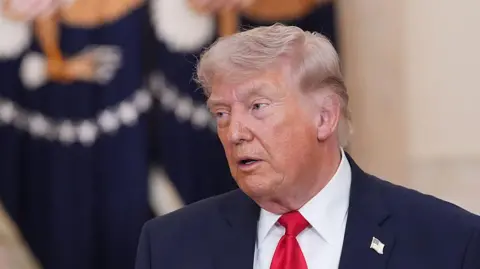
Getty Images US President Donald Trump speaks while wearing a dark suit, white shirt and red tie. He stands indoors front of flag with a the US presidential seal on it.Getty Images

US President Donald Trump was swift to declare victory after the second crew member of an F-15 downed over Iran was recovered, claiming on Sunday that the successful rescue "proves, once again, that we have achieved overwhelming air dominance and superiority".

Observers, however, paint a more complicated picture of what this means for the US in Iran.

While the mission was successful, the events of the last few days - in which two aircraft were downed and at least one helicopter hit by gunfire - highlight that threats to US aircraft and personnel remain.

Several Washington sources who spoke to the BBC speculated that the loss of aircraft and the complexity of the operation to recover the pilots could potentially dissuade Trump from any ground operation to take Kharg Island and sites in the Persian Gulf, or to seize highly enriched uranium in Iran.

These operations could be complicated, and risk exposing US forces to lingering Iranian capabilities, including difficult-to-find man portable air defence systems, known as Manpads, which are shoulder-launched weapons most effective against low flying aircraft.
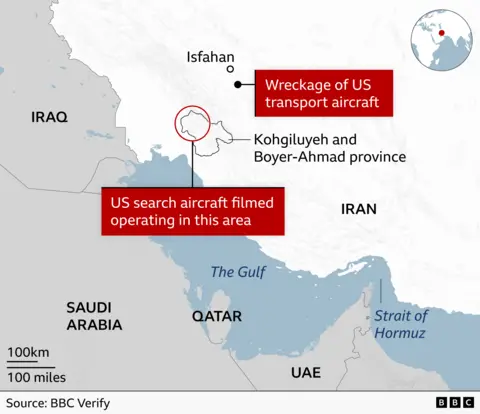
A map showing western and southern Iran, the Gulf, and neighbouring countries. A red label near the city of Isfahan marks the “Wreckage of US transport aircraft”. Another red label further south marks the area where “US search aircraft filmed operating” pointing to a location around the Kohgiluyeh and Boyer‑Ahmad province and Khuzestan province. Surrounding countries labelled include Iraq to the west, Saudi Arabia to the southwest, and Qatar, the UAE and Oman to the south of Iran.

On the other hand, the fact that US troops were able to enter a contested environment, and set up a forward airfield and refueling point under the nose of the Iranians - then hold it for hours while two stuck aircraft were destroyed and replacements sent - might embolden him.

It could convince the administration that an airborne or amphibious operation against targets in Iran stands a good chance of success.

Trump also has sent mixed messages about the path forward, telling reporters in a series of phone calls that he believes a "deal" with Iran could be just around the corner.

If that fails, he has said repeatedly on Truth Social, that the clock is ticking on a self-imposed deadline to begin striking Iranian power plants and bridges, leaving Iran "living in hell". In a brief phone interview with Fox, Trump also suggested he might move to "take" Iran's oil, without providing further details.
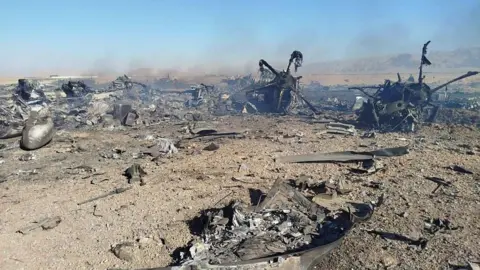
Getty Images  Wreckage is seen from what Iranian authorities say is a US military helicopter that crashed during a mission to rescue the missing American pilot of an F-15E that was downed earlier this week, in a handout image provided on April 5, 2026 in an unspecified location in Iran.Getty Images
Wreckage is seen from what Iranian authorities say is a US military helicopter that crashed during a mission to rescue the missing American pilot of an F-15 that was downed earlier this week.

An expanded campaign against Iranian infrastructure and energy targets would represent an escalation, and detractors are likely to take it as a sign of frustration that the US has been unable to secure freedom of navigation in the Strait of Hormuz.

Trump's comments over the weekend stand in contrast to several he made last week, including a televised address on 1 April, in which he suggested that the US already has created the conditions necessary for other countries to engage in the Strait.

Also, Trump has suggested that he was willing to "leave" Iran even if a deal eluded him. But he now appears to have shifted course in the hopes that the threat of devastating attacks on a new set of Iranian targets can prompt Tehran's leadership to come to the table.
A Harrowing Race Against Time to Find a Downed U.S. Airman in Iran

For the Iranians, the Air Force colonel whose fighter jet had been shot down was possible leverage. For the U.S. military, finding him was a moral imperative.

© Social Media/UGC, via Reuters

An image shared by Iranian state television on social media purported to show the site of the U.S. aircraft destroyed during the mission to find a stranded airman in Iran.

Family 'utterly devastated' after boy, 13, killed in crash as two charged

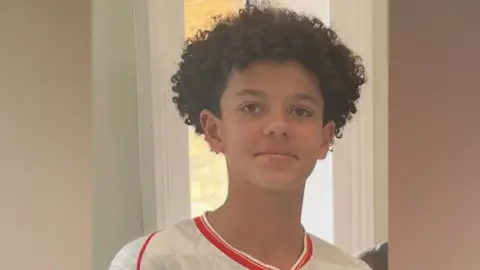
Submitted Noah smiling at the camera. He is wearing a white football shirt with red edging and has short curly hair.Submitted
Noah's family said he had loved going to Liverpool and Luton Town matches with his dad

The family of a 13-year-old who died in a crash have paid tribute to a "fun, bright, handsome, athletic" boy who was "incredibly well-liked".

Noah Campbell died in a collision between a car, a bike and a scooter in Flitwick, Bedfordshire, at 23:50 BST on Friday.

Two other teenage boys were taken to hospital with serious injuries.

In a statement issued by police, Noah's family said they were "utterly devastated". Two people have been charged in connection with the crash.

Submitted Noah stands side-on with a golf club in his hand at a golf simulator. Skyscrapers can be seen in the distance. He wears a white T-shirt, joggers and trainers. The picture has been taken at night.Submitted
Noah's family described him as "a talented and versatile sportsman"

The family statement said: "Above all else, he cherished spending time with his friends and family; they were the heart of his world.

"While football was his favourite sport—playing for many local teams—he was a gifted all-rounder who excelled in rugby, cricket, and athletics.

"Outside of organised sports, Noah stayed active and adventurous; he loved challenging himself at the gym and spending time at the bike park."

It added: "Noah's death has left a hole in our lives that will remain forever."

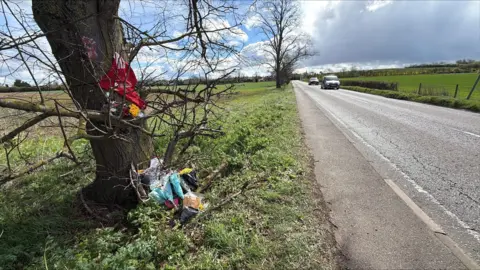
Richard Knights/BBC A tree on the side of a road. By the tree there are flowers and a red football shirt Richard Knights/BBC
Flowers and tributes have been placed at the crash site

The tribute came on Sunday as police confirmed a 24-year-old man and a 23-year-old woman had been charged in connection with the collision in Greenfield Road.

Jamie Fountain, of Fir Tree Close, Flitwick, was charged with causing death by careless driving and causing death by careless driving while over the legal limit for alcohol and drugs.

He was also charged with two counts of causing serious injury by careless driving in relation to two other boys who were injured.

Fountain was further charged with failing to stop at the scene of an accident, failing to report an accident and conspiracy to pervert the course of justice.

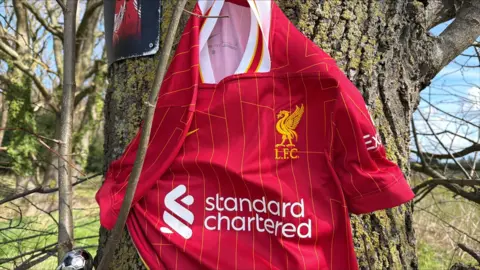
Richard Knights/BBC A red Liverpool football shirt propped up on a tree.Richard Knights/BBC
A Liverpool football shirt, one of the clubs Noah loved going to see, was among the tributes at the scene

Ellie Ireland, of Wingate Drive, Ampthill, has been charged with conspiracy to pervert the course of justice.

They have both been remanded in custody to appear before Luton Magistrates' Court on Monday.

Of the two boys taken to hospital, one remains in hospital in a serious condition.

The other has been treated for serious injuries and has been discharged, police confirmed.

Follow Beds, Herts and Bucks news on BBC Sounds, Facebook, Instagram and X.

Related Internet Links

Seven arrested at RAF base demo accused of supporting Palestine Action

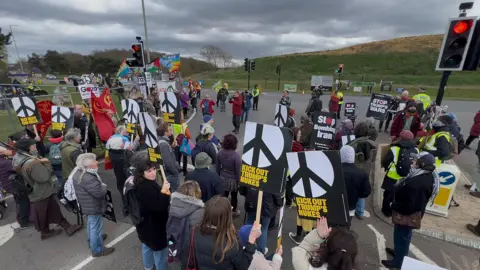
PA Media A group of protestors seen mostly from behind as they face a grassy bank. They stand in the road between traffic lights holding black and white CND signs saying Kick out Trump's Nukes and No War on Iran.PA Media
Sunday's arrests took place during a six-day peace camp outside RAF Lakenheath in Suffolk

Seven people have been arrested on suspicion of supporting the banned group Palestine Action during peace protests at an RAF base.

Five men and two women were arrested on Sunday outside the main gate of Lakenheath airbase during a peace encampment against the Iran war, Suffolk Police said.

The protest followed reports from some media outlets that a US fighter jet shot down in Iran on Friday had been based at Lakenheath.

A spokesperson for Suffolk Police said those arrested had been held on "suspicion of supporting a proscribed organisation".

"They have been taken to Bury St Edmunds Police Investigation Centre for questioning", they added.

"Suffolk Police has a duty to enforce the law without fear or favour and as it currently stands, not as it might be in the future.

"As such, where offences are believed to have occurred appropriate action will be taken."

The High Court ruled the proscription of Palestine Action was unlawful in February, but also granted the Home Office leave to appeal against the decision, leaving the proscription in place pending the outcome of the appeal.

Sunday's action was part of a six-day peace camp involving an around-the-clock vigil outside the base, set to end on Monday.

In a statement, Lakenheath Alliance For Peace said the arrests happened after retired colonel Chris Romberg had made a speech to protesters.

Suffolk Police also confirmed two people had been charged with wilful obstruction of the highway over a blockade at the base on Saturday.

Do you have a story suggestion for Suffolk? Contact us below.

Follow Suffolk news on BBC Sounds, Facebook, Instagram and X.

Related internet links

Who is Viktor Orban, Hungarian PM fighting to stay in power after 16 years?

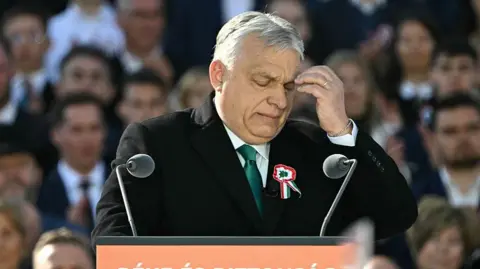
AFP via Getty Images A man puts his hand to his face wearing a black coat and green tie with an audience behind himAFP via Getty Images

No serving leader in the European Union has led their country for as long as Viktor Orbán. But after 16 years he faces his strongest challenge yet in 12 April elections, where most opinion polls suggest he is heading for defeat at the hands of former party insider, Péter Magyar.

Since 2010, Orbán has transformed Hungary into what the European Parliament has denounced as a "hybrid regime of electoral autocracy". He appears uncertain how to describe his own invention. He has tried both "illiberal democracy", and "Christian liberty". His allies in the US Maga movement call it "national conservatism".

Orbán has repeatedly clashed with European Union colleagues on the war in Ukraine, blocking vital funding for Kyiv, which he accuses of trying to force Hungary into war with Russia.

And yet he has powerful international allies.

He is considered Vladimir Putin's strongest partner in the EU, and he has been endorsed by US President Donald Trump in his bid for a fifth consecutive term in office. His closest allies within the EU come from the radical and hard right.

His antagonism towards Brussels still pays off with many Hungarians, but Orbán has cut an increasingly lonely figure among EU leaders looking for European unity in response to the war in Ukraine.

His Foreign Minister, Péter Szijjártó, recently admitted personally sharing details of EU meetings with his Russian counterpart Sergei Lavrov, but called those conversations "everyday diplomacy".

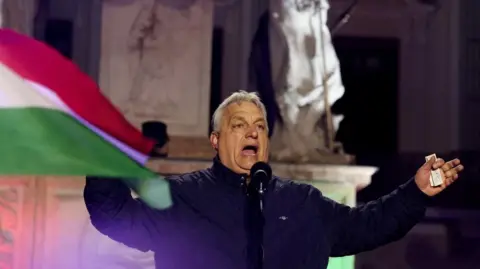
Reuters A man speaks with a red white and green flag on his leftReuters
Orbán rounded on opponents who booed a recent campaign speech in the north-western town of Győr

"Orbán and his foreign minister left Europe long ago," Poland's Prime Minister Donald Tusk observed.

His personal charisma has been an unquestionable ingredient of his success, but polls suggest many of his supporters have tired of him and the corruption allegations that have swirled around his party.

Orbán appeared rattled when he was booed during a March campaign speech in the north-western town of Győr.

This was a very different Orbán from the man whose ex-football trainer once highlighted his ability to "think on the ball".

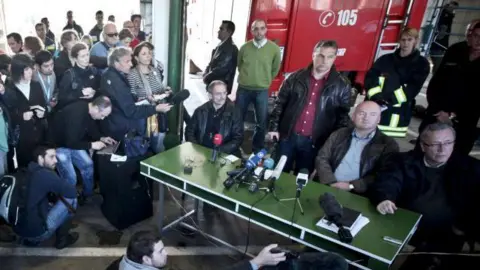
This was a leader who rolled up his sleeves and stacked sandbags alongside firemen and volunteers, when toxic red sludge from a bauxite mine engulfed a Hungarian valley and threatened the Danube shore in 2010.

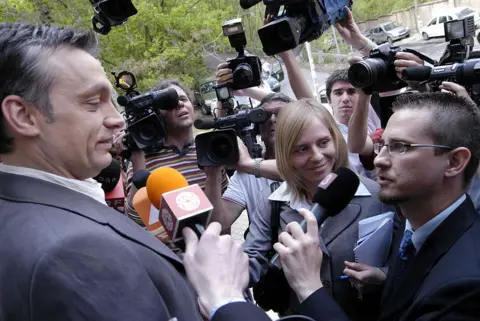
BALINT PORNECZI/AFP Hungarian Prime Minister Viktor Orban (standing 3R) listens to a journalist's question at the fire station headquarters in Ajka, 140kms west of Budapest on October 9, 2010BALINT PORNECZI/AFP
Orbán (3rd from R) joined firefighters in 2010 when a reservoir of toxic sludge burst

Now 62, Orbán first made his mark while still a law student in Budapest in the late 1980s as the Soviet Union began to fall apart, setting up a political movement called Fidesz, or Alliance of Young Democrats.

"If we believe in our own power, we are able to finish the communist dictatorship," he told an estimated quarter of a million Hungarians during an audacious seven-minute speech. They were gathered in the city's Heroes' Square for the reburial of the man behind Hungary's failed uprising in 1956, Imre Nagy.

Reflecting on his words 10 years later, he said he had "exposed everyone's silent desire for free elections, and an independent and democratic Hungary".

The democracy that replaced authoritarian Soviet rule has changed dramatically under Orbán, who according to Hungarian-born journalist Paul Lendvai has moved "from one of the most promising defenders of Hungarian democracy into the chief author of its demise".

Prof Andras Bozoki, a former culture minister, describes Hungary since 2010 as being "the only one former consolidated liberal democracy in the EU that has reached the level of a non-democratic system as a hybrid regime".

Viktor Orbán was born in 1963 an hour to the west of Budapest, the eldest of three sons whose father was an agricultural engineer and Communist Party member and whose mother was a special needs teacher.

They had no running water at the family home in Felcsut, a village of about 2,000 people where he still owns a house.

In an 1989 interview, he recalled being beaten twice a year by his father, Gyozo, whom he described as a violent man: "When he beat me, he also shouted. I remember all this as a bad experience."

Nothing about his childhood suggested that he would go on to challenge the communist regime. He attended a grammar school and was involved in the Young Communist League.

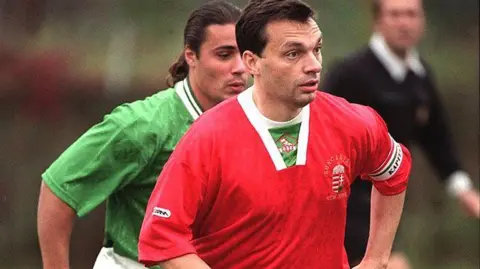
AFP via Getty Images A man plays football in a red shirtAFP via Getty Images
The Hungarian leader has long been a football enthusiast - he is seen here playing in 1998

His main interest was football, playing for his local club, FC Felcsut, and he remains highly enthusiastic about his childhood sport. In 2014 he inaugurated a controversial new stadium there called the Pancho Arena, where top-flight team Puskás Akadémia plays to small crowds.

In the months before he went to university, he carried out his military service, where he says he turned down an approach from the communist secret services to become an informer.

He was 23 when he married fellow student Anikó Lévai, whom he met at university. They have five children, four daughters and a son, Gáspár, who was trained by the British Army at Sandhurst and served as an officer in the Hungarian army in Chad.

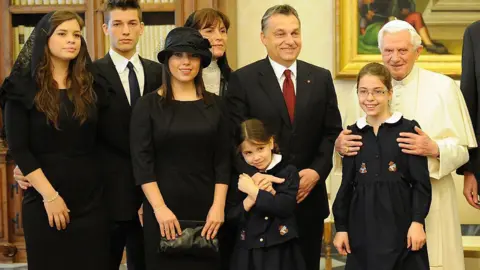
ALBERTO PIZZOLI/AFP via Getty Images Pope Benedict XVI (R) poses with Hungary's Prime Minister Viktor Orban (2D-L), his wife Aniko Levai (3D-L), and their five children during a private audience at The Vatican on December 6, 2010ALBERTO PIZZOLI/AFP via Getty Images

After his 1989 speech to a large crowd in Heroes' Square, he went on to study liberal political philosophy briefly at Oxford. His scholarship was funded by Hungarian-born billionaire philanthropist George Soros, a benefactor he would turn against years later.

Within months he had abandoned his studies early to campaign in 1990 elections, when Fidesz won 22 seats, with Viktor Orbán top of the party list.

Friends from his student days became key members of Fidesz, and his college director Istvan Stumpf went on to take up the role of his chief of staff during the first Orban premiership from 1998-2002.

As a young MP, Viktor Orbán and his party joined the global Liberal International movement in 1992.

Political scientist Zoltan Lakner believes he shifted ideology during the second half of the 1990s. As Hungary was governed by a liberal-socialist coalition, he realised "to gain political success he had to turn his back on liberalism and transform his party into a nationalist, anti-liberal political force".

TIBOR ILLYES/MTI/AFP A black and white picture of a man in a white suitTIBOR ILLYES/MTI/AFP
Viktor Orban led Fidesz from 1993 and his first election as leader in 1994 was not a success

Perhaps the seeds of his reversal were already sown at Oxford. In his few months at Pembroke College, he befriended the conservative philosopher Roger Scruton.

Or perhaps it was more political opportunism.

Orbán became Fidesz leader in 1993, and was already pushing it to the centre right by the time the conservative MDF lost power in 1994. Fidesz filled the gap left by the weakened conservatives.

Peter Rona, an Oxford-based economist and former candidate for president of Hungary, describes a meeting in the early 1990s, at which Orbán said he wanted to create a "modern conservative party".

When Peter Rona warned him that earlier politicians who had attempted the same thing had quickly dropped the "modern" when circumstances demanded, Orbán replied: "Then so be it."

In 1998, Orbán led Fidesz to election victory, and at 35 became Europe's youngest prime minister, taking Hungary into Nato in 1999.

He then suffered two defeats at the ballot box, in 2002 and 2006, and on both occasions the Fidesz leader learned his lessons.

The defeat in 2002 changed him. "The nation cannot be defeated," he told his supporters, as he tried to digest what had just happened.

AFP via Getty Images Viktor Orban (L) answers questions after casting his vote in Budapest, 23 April 2006AFP via Getty Images
Orbán last tasted electoral defeat in 2006

After 2002, Orbán befriended Árpád Habony, a martial arts instructor and businessman, as his personal guru. Habony became a trusted ally and component in the business empire that underpinned Fidesz.

Orbán was swept back into office in the turbulence of the global economic crisis in 2010 and has not lost since.

He has since transformed Hungary with a host of changes to its laws and constitution, winning four consecutive elections with four straight "super-majorities", controlling two-thirds of parliament.

In an attempt to secure his legacy, more than 40 "cardinal laws" were passed, reshaping state institutions, the economy, election laws and the media.

The economy was stabilised, public finances were secured and EU funds came in.

However, expensive state projects were placed in the hands of Orbán's inner circle, including a childhood friend and a son-in-law.

Fidesz and its supporters gradually took control of Hungary's media landscape, replacing foreign investors, says Hungarian media monitor Mertek.

In 2018, almost all "Orban-friendly media" transferred ownership rights to a foundation called Kesma, whose board was made up of Fidesz MPs and the head of a Fidesz-friendly think tank, according to Mertek.

For several years, Hungary has been labelled the EU's most corrupt country by Transparency International.

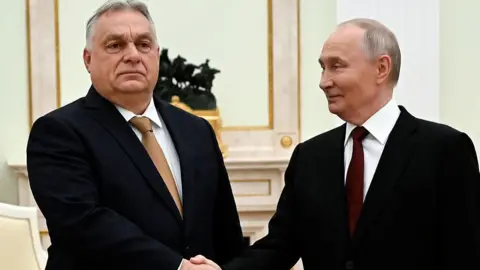
POOL/AFP via Getty Images Two men in black suits shake handsPOOL/AFP via Getty Images
Orbán's close partnership with Russia's Vladimir Putin has been widely criticised by his EU partners

The European Parliament, both in 2018 and 2025, has warned of persistent threats to rule of law. Billions of euros in EU funds for Hungary has since been frozen.

The EU is one of several targets that Orbán has set his sights on in recent years.

His latest stand-off with EU leaders means €90bn in funds for Ukraine has been put on hold because of a Hungarian veto.

Sandor Csintalan, both a former ally and critic of Orbán, has spoken of "a constant need to radicalise himself", which places him apart from other European conservatives.

Ukraine has become another core issue for the long-time Hungarian leader, while for years he focused on George Soros and migrants.

In 2013 political consultants George Birnbaum and Arthur Finkelstein gave him the idea of creating Soros as an enemy.

"Soros was a good target," Birnbaum explained, "because enough people in Hungary didn't like the idea of this billionaire… like the Wizard of Oz, controlling politics and policy, from behind the curtain".

Orbán accused George Soros's civil society groups of "trying secretly and with foreign money to influence Hungarian politics". A poster-campaign condemned by critics as antisemitic targeted the philanthropist, although Orbán has been able to point to his support for Israel and Prime Minister Benjamin Netanyahu to reject the accusations.

The Soros-founded Central European University, set up in 1991 as Hungary embraced democracy, was forced to move most of its activity to Vienna in 2019.

In July 2015, as refugees and irregular migrants entered the EU over Hungary's borders in increasing numbers, Orbán drew a "clear link between illegal immigrants coming to Europe and the spread of terrorism".

The solution was clear, he said: "We would like to keep Europe for Europeans... also we want... to preserve Hungary for Hungarians."

A fence was built on the Serbian border and new laws were introduced criminalising migrants. A "Stop Soros" law in 2018 criminalised those who helped irregular migrants, and the EU's top court ruled that Budapest had failed to fulfil its obligations under EU law.

Going into the 12 April vote, Ukraine has become Orbán's main campaign focus, as he accuses Volodymyr Zelensky of blocking Hungary's oil supply and his opponents of wanting to hand Hungarian money to Kyiv.

Although he has been able to rely on Trump and Putin for political support, his claim to be protecting Hungary from leaders who wage war has become increasingly shaky.

He has not experienced electoral defeat since 2006. Despite the support of both Vladimir Putin and Donald Trump, he is now facing the biggest test of his political career.

佩洛西:特朗普无权单方面退北约 - RFI - 法国国际广播电台

05/04/2026 - 20:33

美国前众议院议长佩洛西(Nancy Pelosi)近日强烈批评美国总统特朗普(Donald Trump)多次威胁退出北大西洋公约组织(NATO),直言相关言论“目光短浅”,并警告这样的说法形同“送给俄罗斯总统普京(Vladimir Putin)的一份礼物”。她同时强调,美国法律已明确规定,总统无权在未经国会批准下单方面退出北约,使得特朗普的相关表态在制度上难以实现。

佩洛西5日透过社群平台X发文指出,北约自1949年成立以来,已走过77年历史,是由美国与盟友共同建立、以维护和平与民主为核心价值的跨大西洋军事同盟。她表示:“特朗普的退出威胁不仅目光短浅,还是送给普京的一份礼物。”此番言论直接点出她对俄罗斯可能从中获利的担忧。

她进一步强调法律层面的限制:“法律非常清楚:没有任何一位总统可以在未经国会批准的情况下退出北约。”佩洛西的说法呼应美国国会于2023年通过的相关立法,该法明定总统若欲退出北约,须取得参议院三分之二同意或经国会立法通过,借此限制行政权单方面改变重大国际承诺。

佩洛西曾于2007年至2011年以及2019年至2023年两度担任众议院议长,在民主党内具高度影响力。她此次发言,被视为对特朗普近期一连串批评北约言论的直接回应,也反映出华盛顿政治圈对美国对外安全承诺可能动摇的忧虑。

北约秘书长吕特(Mark Rutte)预计将于本周访问华盛顿,并与特朗普举行会谈。根据北约方面公布的消息,吕特此行除与特朗普会面外,也将与美国国务卿卢比奥(Marco Rubio)及国防部长赫格塞斯(Pete Hegseth)会谈。外界普遍认为,这场会晤可能气氛紧张,重点将围绕伊朗战争与跨大西洋关系裂痕。

近期,特朗普对北约的不满持续升高。他不仅批评北约在霍尔木兹海峡危机中的表现,甚至在周三与英国《每日电讯报》(The Telegraph)的采访中,将北约形容为“纸老虎”,并指责部分盟国在美国与以色列对伊朗的军事行动中,未提供足够支持,称其为“懦夫”。他更公开表示,退出北约的想法“已不在考虑范围之外”,引发国际社会高度关注。

特朗普对北约的不满与近期伊朗战争局势密切相关。自冲突爆发以来,伊朗实质封锁霍尔木兹海峡,导致全球能源运输受到严重冲击,美方则希望盟友提供军事与后勤支援。然而,多个欧洲国家选择保持距离,拒绝直接参与军事行动,引发特朗普政府强烈不满。

特朗普日前接受媒体访问时表示,他对北约“从未被说服”,并称早已认定该组织实力有限。他还说:“我不在乎北约,我对他们感到失望。”这些言论被解读为进一步削弱美国对北约承诺的讯号。

尽管如此,美国与欧洲多位官员指出,现阶段华盛顿并未实际启动退出北约的程序。专家普遍认为,美国短期内正式退出北约的可能性不高,但特朗普持续释放的负面讯号,已对联盟内部信任造成冲击。

欧洲政策分析中心高级研究员卡特勒(David Cattler)向美国《国会山报》(The Hill)指出,北约的核心并不仅在于条约本身,更在于成员国之间的政治互信。一旦美国这一关键支柱的承诺出现动摇,即使未正式退出,联盟运作也可能受到严重影响。有学者直言,真正的问题不在于美国是否离开,而是盟友是否仍相信美国会履行集体防卫义务。

根据北约第五条款,任何成员国遭受攻击,将被视为对全体成员的攻击。然而,特朗普近期多次暗示,若盟国未在美国主导的军事行动中提供支持,美国未必会在其遭攻击时伸出援手。此种“有条件承诺”的说法,被认为动摇了北约长期以来的安全基础。

欧洲多国领袖已开始重新评估安全战略。有观点认为,若美国持续减少承诺,欧洲可能需要建立更具自主性的防卫体系,以降低对美国的依赖。不过前美国驻北约大使达尔德(Ivo Daalder)向美国媒体Axios表示,即使欧洲国家坚持新近大幅增加的支出承诺,也需要数年时间才能“保卫并威慑俄罗斯”,而要完全取代美国,或许需要10年时间。

另一方面,俄罗斯被认为是当前局势的潜在受益者。随着西方因伊朗战事分心,加上能源价格上涨,俄方在经济与战略上均获得一定优势。俄罗斯官方与媒体亦频繁利用特朗普批评北约的言论,强调西方阵营内部分裂,借此扩大政治宣传效果。

Seriously wounded US airman rescued from Iran, Trump says

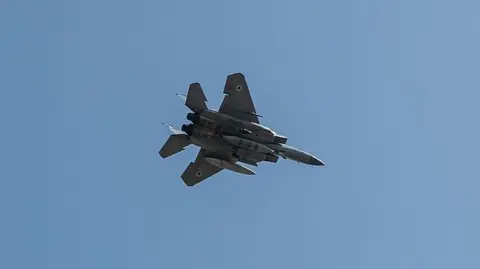
Getty Images An Israeli F-15 fighter jet seen from below - two crew members from a similar plane were rescued from inside Iran over the weekend Getty Images

A second US crew member who was missing in Iran after an American F-15 fighter jet was shot down has been rescued.

Posting to social media, US President Donald Trump said the rescued weapons systems officer had "sustained injuries" but would be "just fine", describing the rescue as "one of the most daring search and rescue operations in US history".

Following the downing of the aircraft on Friday, both the pilot and crew member ejected - with the pilot recovered shortly afterwards.

Following this, both the US and Iran scrambled to locate the missing crew member in a mountainous region of southwestern Iran.

The search presented a serious test for the US, with the possibility of a prisoner of war situation if Iran found the missing airman - something which would have likely involved him being used as part of propaganda material.

Iran's Islamic Revolutionary Guard Corps (IRGC) was said to have launched its own search for the missing American, reportedly using troops and locals, and offering them a reward of about $66,000 (£50,000) to capture him alive.

Videos on social media appeared to show hundreds of people heading to a mountainous area in south-western Iran to search for the missing US airman.

Details of the second airman being rescued emerged in US media late on Saturday night.

A short time later, Trump confirmed the successful mission on Truth Social, writing "WE GOT HIM!", adding the crew member was a "respected colonel".

The US rescue operation was described to the BBC as "huge" by one person familiar with the details.

The BBC understands that there was an engagement between the US and Iranian forces during the rescue, and that the pilot may have been injured during his initial ejection from the aircraft.

Tasnim, the semi-official news agency associated with the IRGC, said five Iranians were killed during the operation.

Trump said dozens of aircraft had been involved in the operation, with the White House not giving an update after the pilot was recovered on Friday to protect the ongoing rescue.

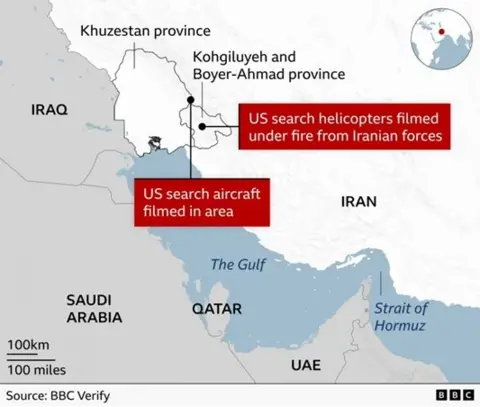
Earlier reports suggested the missing crew member might be in the mountainous area of Kohgiluyeh and Boyer-Ahmad province, in the southwestern regions of Iran.

Officials told the BBC's US partner CBS News that the crew member spent more than 24 hours on his own, hiding in the mountains with a handgun.

A senior official also told CBS that the CIA played a crucial in the rescue mission by tracking the airman in a mountain crevice and passing his exact location to the Pentagon.

The agency engaged in a deception campaign inside Iran, reports said. While the rescue attempt was taking place, the agency spread word the airman had already been found and was being extracted from Iran.

Meanwhile, Iran's IRGC previously said that nomadic tribes living in the country's mountains shot two Black Hawk helicopters that were part of the US rescue mission.

BBC Verify has confirmed a video from Friday showing what appears to be three armed individuals firing towards at least two Black Hawk helicopters.

The rescue operation reportedly included an A-10 Warthog aircraft which was hit over the Gulf, with its pilot ejecting before being rescued.

The recovery of the F-15 crew member comes as intense fighting continues in the region.

On Sunday morning, authorities in Abu Dhabi said they were battling fires at a Borouge petrochemical facility caused by falling debris from an Iranian missile. There were also report of attacks on Kuwait and Israel overnight into Sunday.

Hungary alleges plot to blow up gas pipeline ahead of election

AFP via Getty Images File picture of Viktor Orban speaking to journalistsAFP via Getty Images
Viktor Orban has run Hungary for 16 years

Hungarian Prime Minister Viktor Orban has convened an emergency meeting of the National Defence Council after explosives were found near a pipeline that transports Russian gas to Hungary.

The discovery in a border area of neighbouring Serbia comes as Orban's party is badly trailing in opinion polls ahead of crucial elections next Sunday.

Opposition leader Peter Magyar accused him of "panic-mongering" orchestrated by "Russian advisers", days after security experts warned of a possible "false flag" operation that could be blamed on Ukraine.

Orban, an ally of Russian President Vladimir Putin, has resisted EU calls to abandon Russian energy imports since the full-scale invasion of Ukraine.
In recent weeks Hungarian security experts have raised the possibility of a staged operation, either on Hungarian or Serbian territory, intended to arouse enough sympathy for Orban to help his Fidesz party win the election - or to give Orban an excuse to declare an emergency and postpone or cancel the vote.

Serbian President Alexander Vucic, a close ally of Orban, informed the Hungarian leader of the discovery on Sunday morning.

Two rucksacks full of explosives and detonators were found by the Serbian army near the village of Tresnjevac in the Kanjiza district, about 20km (12 miles) from the point where the TurkStream pipeline crosses into Hungary.

"Our units found an explosive of devastating power," Vucic said in a post on Instagram. "I told PM Orban that we would keep him updated on the investigation."

Hungary receives between five and eight billion cubic metres of Russian gas a year through the TurkStream pipeline, which both Hungary and Slovakia depend on for Russian gas.

Balint Pasztor, president of the Vojvodina Hungarian Association, and another key Orban ally, posted on Facebook: "If the investigation proves that we were not the primary target after all, but rather Hungary's supply lines, then this makes it even clearer: the terrorist attack was planned with the aim of bringing down Viktor Orban."

Fidesz has made hostility to Ukraine a cornerstone of its election campaign.

At election rallies Orban has told supporters that low heating and fuel prices in Hungary are only possible thanks to cheap Russian oil and gas, both of which arrive in Hungary by pipeline - oil through Ukraine, and gas through the Balkans.

Orban alleges that a "Kyiv-Brussels-Berlin" axis is conspiring to stop Hungary getting cheap Russian fuel, to impose their "puppet" prime minister Magyar in the upcoming election. A Tisza government, Orban says, would also drag Hungary into a European war against Russia.

Orban has already accused Ukrainian president Volodymyr Zelensky of imposing "an oil blockade" on Hungary, because no Russian oil has arrived through the Druzhba pipeline, which crosses Ukrainian territory, since the end of January.

Ukraine says the pipeline was damaged in a Russian attack, and should be functional again in-mid April.

There have been no official allegations of Ukrainian involvement in the pipeline incident so far. But one well-informed Serbian source told the BBC this could happen as early as Monday, when Serbian authorities are expected to release the first results of their investigation.

On 2 April, Hungarian security expert Andras Racz warned on Facebook that a "fake attack" on the TurkStream pipeline could be staged inside Serbia.

Racz also predicted that the explosives would be identified as Ukrainian, allowing Orban to once again point the finger of blame at Kyiv.

"We had some solid preliminary information about this operation, including details about the place and possible timing," former senior Hungarian counter-intelligence officer, Peter Buda, told the BBC.

"It's clear that Ukraine's interests aren't at stake here. An operation like this would help Orban before the election by influencing public opinion in his favour.''

The Hungarian government insists the threat is real. "In the past few days and weeks, we've seen it all," Hungarian Foreign Minister Peter Szijjarto wrote on Facebook.

"The Ukrainians organised an oil blockade against us. Then they tried to impose a total energy blockade on us by firing dozens of drones at the TurkStream pipeline while it was still on Russian territory.

"And now we have today's incident, in which Serbian colleagues found explosives capable of blowing up the pipeline."

Opposition leader Peter Magyar accused Orban, in cahoots with the Serbian president, of staging the latest incident.

"He will not be able to prevent next Sunday's election. He will not be able to prevent millions of Hungarians from ending the most corrupt two decades in our country's history."

Trump Revels in Threats to Commit War Crimes in Iran

The president said he would bomb Iran “back to the Stone Ages.” Until this administration, American leaders had insisted they were trying to follow international law in war.

© Tierney L. Cross/The New York Times

President Trump wrote on social media that “all Hell will reign down” on Iran unless it opens the Strait of Hormuz.

How downed F-15 US airman was rescued inside Iran

Watch: What we know so far about the search for missing US airman in Iran

A search is underway for a missing crew member after a US F-15E fighter jet flying over southern Iran was shot down on Friday, US media has reported.

A pilot who was on board was reportedly rescued by US forces, but the search for the second crew member, a weapons system officer, is ongoing, reports say.

Seperately, a US A-10 Warthog aircraft that was part of the search and rescue mission for the downed jet was also shot and damaged, however its pilot was safely rescued, according to the BBC's US partner CBS News.

Iranian officials said the the warplane was shot down by its air defence system, according to state media. The US Central Command is yet to comment.

Where and when was the jet shot down?

Iranian state media first claimed on Friday that the country's forces shot down a US jet over its southern region.

White House Press Secretary Karoline Leavitt then said that US President Donald Trump had been briefed on the incident.

US Central Command has not confirmed the details surrounding the reported downing of the aircraft.

A search and rescue mission successfully recovered the pilot of the jet, but what happened to the jet's second crew member, a weapons systems officer, remains unknown, CBS News has reported.

The rescue operation included an A-10 Warthog plane that was hit over the Gulf, with its pilot ejecting before being rescued, according to CBS.

One helicopter carrying the rescued pilot from the F-15E jet was hit by small arms fire, injuring crew members on board - but it landed safely, CBS reports.

Iran's Islamic Revolutionary Guard Corps (IRGC) has claimed that nomadic tribes living in the country's mountains shot two Black Hawk helicopters that were part of the US rescue mission.

The BBC has requested comment from the US military regarding Iran's claim.

BBC Verify has confirmed a video from Friday showing what appears to be three armed individuals firing towards at least two Black Hawk helicopters.

Iran's top joint military command has credited new Iranian air defence systems with the downing of both US warplanes, according to Iran's state-affiliated IRNA news agency.

A map showing where US aircraft have been filmed in the search for a crew of a plane downed in Iran. It shows locations in the Khuzestan province and the Hohgiluyeh and Boyer-Ahmad province.

What do we know about the jet's purpose?

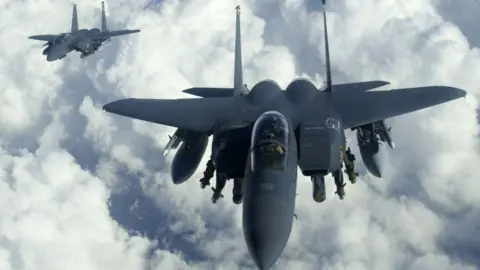
US Air Force via Getty Images Two F-15E Strike Eagle jets soaring through a cloudy skyUS Air Force via Getty Images
A file photo of two F-15E Strike Eagle jets

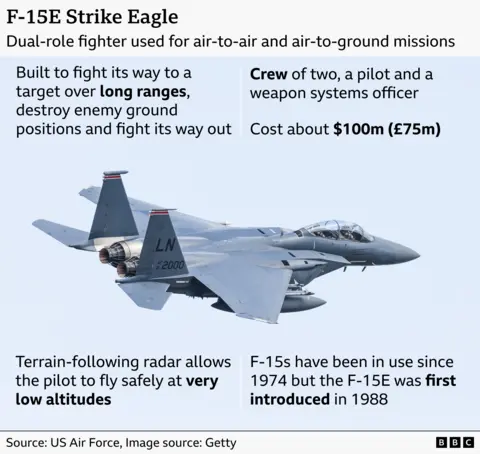
The F-15E is a dual-role fighter jet designed for both air-to-ground and air-to-air missions. In Iran, they are most likely to have been involved in Defensive Counter Air roles to shoot down Iranian drones and cruise missiles.

In its air-to-ground strike role, the jet is a weapons platform capable of dropping laser and GPS guided precision munitions, as well as other bombs.

The aircraft has two crew: the pilot in the front who flies the jet and a weapons systems officer in the back seat. The weapons officer, known as a "Wizzo", has four screens in front of them and is responsible for selecting targets and making sure the weapons are properly programmed for the appropriate attack.

This two-crew system allows the workload to be divided up, particularly in a congested air environment where the pilot is trying to evade threats.

We do not know what specifically brought down this US jet, but if it was taken down by the Iranians then the most likely reason is a surface-to-air missile (SAM).

Infographic about the US F‑15E Strike Eagle fighter jet with a photo of the aircraft in flight and text explaining its features: designed for long‑range missions to attack ground targets and fight its way out; has a two‑person crew of a pilot and a weapon systems officer; uses terrain‑following radar to fly safely at very low altitudes. Notes that F‑15s have been in service since 1974, with the F‑15E introduced in 1988. States an approximate cost of $100m (£75m). Source: the US Air Force.

What is happening with the rescue effort?

The rescue of crew members of a downed jet is one of the most complex and time-sensitive operations - known as combat search and rescue (CSAR) missions - that the US military and its allies prepare for.

The elite air force units behind CSAR missions include some of the most highly trained and specialised members of the military.

"It's the most dangerous military mission that I know of," James Jeffrey, a military strategist and top US diplomat for the Middle East, told the BBC.

"These are Air Force special operations people who are trained almost to the level of Delta Force and Navy SEAL Team Six, but they also have medical capabilities," Jeffrey said. "They will not give up until they can find a pilot if they think there's any chance."

CSAR missions are often conducted by helicopters, which fly low over enemy territory, alongside other military aircraft that conduct strikes and patrol the area.

A former commander of a pararescue jumpers squadron told CBS News that a rescue operation like the reported one in Iran would involve at least 24 pararescue jumpers scouring the area in Black Hawk helicopters.

They added the team would be prepared to jump from planes if needed, and once on the ground their priority would be to contact the missing crew member.

The crew of the downed jet are also highly trained for such situations.

"Their number one priority is to stay alive and to avoid capture," Jennifer Kavanagh, a senior fellow and the director of military analysis at think tank Defense Priorities, told the BBC.

"And so they're trained to - assuming that they're physically capable, and not so injured that they can't move - to try to get away from the ejection site as quickly as possible, and to conceal themselves so that they are safe."

They're also trained on survival techniques so that they can go without food or water, or find resources from the local terrain, for as long as possible, Kavanagh said.

Iran is offering rewards of about £50,000 ($66,100) to citizens who help capture the missing airman, state media has reported.

Artemis's stunning Moon pictures - science or holiday photos?

'That is something we have never seen before': Artemis II crew describe far side of Moon

Nasa is releasing a steady stream of stunning pictures of the Moon and Earth taken by the astronauts on its Artemis II Moon mission.

Attracting millions of likes on social media, the images show the two bodies from unusual angles in glorious high definition.

There is no denying the drama: four astronauts are embarking on a mission that will take them further from Earth than any human has ventured since 1972.

But is there unique scientific value in these images, or are these simply the equivalent of holiday photos?

NASA Astronaut Christina Koch watching Earth from the Orion spacecraftNASA
Astronaut Christina Koch watching Earth from the Orion spacecraft (image taken with iPhone 17 Pro Max)

Nasa wants the American public behind them to support the mission. They are live-streaming the 10-day journey, and the four astronauts are doing regular video updates, describing their progress in triumphant tones.

The crew have been so excited to watch the world and Moon go by, Nasa has said, that the window inside the Orion spacecraft got dirty and the astronauts were sent instructions on how to clean it.

This is the first time that digital cameras have been taken this far into space.

Orion has 32 cameras and devices - 15 mounted onto the spacecraft and 17 handheld by the crew.

According to Nasa, the astronauts are using standard 10-year-old cameras, including the Nikon D5, as well as GoPros and smartphones.

Nasa's photostream on flickr even tells you the device used to take each of the published photos.

On Friday we saw the first results of their intense observations.

"Hello, World" was taken by Commander Reid Wiseman when the mission was about equidistant from the Moon and Earth - 142,000 miles (228,500 km) from Earth, and 132,000 miles from the Moon.

It shows two auroras as the Earth eclipses the Sun, and the planet Venus glowing at the bottom of the image.

NASA/Reid Wiseman NASA astronaut and Artemis II Commander Reid Wiseman took this picture of Earth from the Orion spacecraft's window on April 2, 2026, after completing the translunar injection burn.NASA/Reid Wiseman

Our planet appears upside down, with the Sahara desert and the Iberian peninsula visible to the left and the eastern portion of South America to the right.

It's a lovely picture, but nothing new when it comes to science.

In fact, Nasa has a satellite with its Deep Space Climate Observatory with a camera called Earth Polychromatic Imaging Camera (Epic). Launched in 2015, it frequently takes pictures of Earth from close to a million miles away - much further than Artemis II.

Then on Saturday, Nasa released another photo, with the tagline "history in the making".

It shows the Orientale basin, a huge crater on the far side of the Moon, which has a thicker crust and many more impact craters.

It's been released ahead of the lunar fly-by on Monday when the crew will fly around this mysterious far side, passing within 4,066 miles of the surface.

NASA A picture taken on day 4 of Artemis mission showing the Orientale basin on the right edge of the lunar diskNASA
A picture taken on day 4 of Artemis mission showing the Orientale basin on the right edge of the lunar disk

Nasa said its image marked "the first time the entire basin has been seen with human eyes". Even Apollo astronauts didn't see the Orientale basin completely because of their orbit and illumination conditions.

Nasa is emphasising the significance of human eyes rather than robotic explorers.

"Human eyes and brains are highly sensitive to subtle changes in colour, texture, and other surface characteristics," it says.

It says this could "uncover new discoveries and a more nuanced appreciation for the features on the surface of the Moon."

I asked Chris Lintott, Professor of Astrophysics at the University of Oxford and co-host of BBC's series The Sky at Night for his opinion.

"The value of the images coming back from Artemis and its crew is artistic, not scientific," he said.

He explained that since the Apollo program in the 1960s and 1970s, robotic explorers have mapped the far side of the Moon.

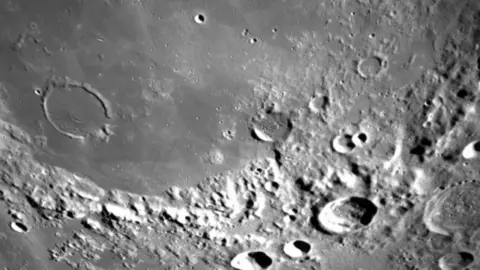
In 2023, India sent the probe Chandrayaan-3 and captured detailed images of the same terrain.

ISRO A photo of the moon's far side captured in 2023 by a camera on India's Chandrayaan-3 probe ISRO
A photo of the moon's far side captured in 2023 by a camera on India's Chandrayaan-3 probe

And in 2024, China's Chang'e-6 mission collected the first-ever samples from the far side. It followed China landing the first ever probe in the region, in 2019.

"Unless something very unusual happens, there will be nothing for the [Artemis] astronauts to discover," Lintott says.

"There's a possibility they might see an impact flash if a meteor hits the dark side but it would have to be a pretty big one," he said.

"For science they would need to do a systematic count [of it], best done with a video camera, not looking out the window," he explained.

"The [images] we already have back are beautiful, stunning and iconic - taking by astronauts not by robots. This is a voyage of exploration, not lunar science and that's fine!" he said.

When releasing these images, Nasa is pushing the scientific importance of this mission, but as journalists, we are asked to look at all the facts around a story.

America is locked in a space race with other nations - notably China, with both nations vying to be the first to return humans to the Moon. A successful Artemis II mission would signal that the US has taken a decisive lead, for now

And this is a huge moment for Nasa to shine in the eyes of President Donald Trump, who has gutted the funding of many scientific institutions.

The agency is also under pressure to prove its worth at a time when private operators such as SpaceX are raising the bar.

Science is driven by inquiry and evidence, but it is never immune to politics.

Getty Images The iconic Earthrise photo taken in 1968Getty Images
The iconic Earthrise photo taken in 1968

In 1968 astronaut Bill Anders made history when he took the now-famous picture Earthrise.

Taken from close to the lunar surface, it showed our planet rising in the distance.

It made Earth look vulnerable, and at a time of global division and tension during the Cold War, it reminded many viewers that we share this one planet.

It also demonstrated how a powerful image can write history, and Nasa will be hoping that Artemis II delivers a moment of comparable resonance.

In the meantime, let's enjoy the astronauts' ride and their beautiful pictures.

Pepsi withdraws as UK festival sponsor after Kanye West backlash

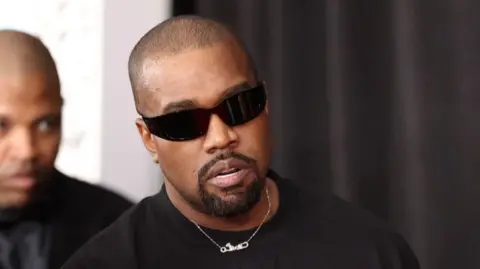
Getty Images Headshot of West who wears a silver chain and sunglasses. There is a man behind him who is blurred Getty Images

Prime Minister Sir Keir Starmer has said it is "deeply concerning" that Kanye West is set to headline Wireless Festival in London this summer.

West, now known as Ye, has drawn widespread criticism for antisemitic comments he has made in recent years, for which he issued an apology in January.

The American rapper, 48, was announced as the headliner for all three days of the rap and R&B festival in north London earlier this week.

In response Sir Keir said, in comments first reported by the Sun on Sunday, that West has been booked "despite his previous antisemitic remarks and celebration of Nazism".

"Antisemitism in any form is abhorrent and must be confronted firmly wherever it appears," Sir Keir said.

"Everyone has a responsibility to ensure Britain is a place where Jewish people feel safe."

Liberal Democrat leader Ed Davey said on Thursday that the government should ban West from entering the UK, arguing "we need to get tougher on antisemitism" and describing West's planned appearance as "extremely serious".

Last year West was blocked from entering Australia after releasing a song titled "Heil Hitler", glorifying the Nazi leader.

He also declared himself a Nazi earlier in the year, retracting an earlier apology he issued over antisemitic comments, and sold T-shirts featuring a swastika on his clothing website.

In November 2025, West held a meeting with Rabbi Yoshiyahu Yosef Pinto where he reportedly apologised for his past antisemitic comments.

In January, West took out a full-page advertisement in the Wall Street Journal, apologising for his antisemitic behaviour.

"I am not a Nazi or an antisemite," he wrote. He said bipolar disorder means when "you're manic, you don't think you're sick" and that he "lost touch with reality".

"I regret and am deeply mortified by my actions in that state," he added.

West's X account was banned multiple times in 2022 due to posts that violated the platform's rules.

It came after he posted a series of offensive tweets, including an image appearing to show a symbol combining a swastika and the Star of David and saying he would go "death con 3 On Jewish people".

In the same year, he drew criticism after wearing a "white lives matter" T-shirt during Paris fashion week.

His actions saw clothing brand Adidas part ways with the rapper, which said at the time it does "not tolerate antisemitism and any other sort of hate speech".

He has not performed in the UK since 2015 when he headlined Glastonbury.

Three songs from his latest album Bully, released in March, are in the UK's top 100 singles chart.

Wireless has described the event, running from 10-12 July, as a "three night journey through his most iconic records".

Earlier this week, the leader of the largest body representing Jews in the UK, the Board of Deputies of British Jews, told BBC Newsnight that West should be blocked from entering the country.

A spokesperson for London Mayor Sir Sadiq Khan said: "We are clear that the past comments and actions of this artist are offensive and wrong, and are simply not reflective of London's values. This was a decision taken by the festival organisers and not one that City Hall is involved in."

Wireless organisers Festival Republic have been approached for comment.

Hungary alleges plot to blow up gas pipeline ahead of election

AFP via Getty Images File picture of Viktor Orban speaking to journalistsAFP via Getty Images
Viktor Orban has run Hungary for 16 years

Hungarian Prime Minister Viktor Orban has convened an emergency meeting of the National Defence Council after explosives were found near a pipeline that transports Russian gas to Hungary.

The discovery in a border area of neighbouring Serbia comes as Orban's party is badly trailing in opinion polls ahead of crucial elections next Sunday.

Opposition leader Peter Magyar accused him of "panic-mongering" orchestrated by "Russian advisers", days after security experts warned of a possible "false flag" operation that could be blamed on Ukraine.

Orban, an ally of Russian President Vladimir Putin, has resisted EU calls to abandon Russian energy imports since the full-scale invasion of Ukraine.

In recent weeks Hungarian security experts have raised the possibility of a staged operation, either on Hungarian or Serbian territory, intended to arouse enough sympathy for Orban to help his Fidesz party win the election - or to give Orban an excuse to declare an emergency and postpone or cancel the vote.

Serbian President Alexander Vucic, a close ally of Orban, informed the Hungarian leader of the discovery on Sunday morning.

Two rucksacks full of explosives and detonators were found by the Serbian army near the village of Tresnjevac in the Kanjiza district, about 20km (12 miles) from the point where the TurkStream pipeline crosses into Hungary.

"Our units found an explosive of devastating power," Vucic said in a post on Instagram. "I told PM Orban that we would keep him updated on the investigation."

Hungary receives between five and eight billion cubic metres of Russian gas a year through the TurkStream pipeline, which both Hungary and Slovakia depend on for Russian gas.

Balint Pasztor, president of the Vojvodina Hungarian Association, and another key Orban ally, posted on Facebook: "If the investigation proves that we were not the primary target after all, but rather Hungary's supply lines, then this makes it even clearer: the terrorist attack was planned with the aim of bringing down Viktor Orban."

Fidesz has made hostility to Ukraine a cornerstone of its election campaign.

At election rallies Orban has told supporters that low heating and fuel prices in Hungary are only possible thanks to cheap Russian oil and gas, both of which arrive in Hungary by pipeline - oil through Ukraine, and gas through the Balkans.

Orban alleges that a "Kyiv-Brussels-Berlin" axis is conspiring to stop Hungary getting cheap Russian fuel, to impose their "puppet" prime minister Magyar in the upcoming election. A Tisza government, Orban says, would also drag Hungary into a European war against Russia.

Orban has already accused Ukrainian president Volodymyr Zelensky of imposing "an oil blockade" on Hungary, because no Russian oil has arrived through the Druzhba pipeline, which crosses Ukrainian territory, since the end of January.

Ukraine says the pipeline was damaged in a Russian attack, and should be functional again in-mid April.

There have been no official allegations of Ukrainian involvement in the pipeline incident so far. But one well-informed Serbian source told the BBC this could happen as early as Monday, when Serbian authorities are expected to release the first results of their investigation.

On 2 April, Hungarian security expert Andras Racz warned on Facebook that a "fake attack" on the TurkStream pipeline could be staged inside Serbia.

Racz also predicted that the explosives would be identified as Ukrainian, allowing Orban to once again point the finger of blame at Kyiv.

"We had some solid preliminary information about this operation, including details about the place and possible timing," former senior Hungarian counter-intelligence officer, Peter Buda, told the BBC.

"It's clear that Ukraine's interests aren't at stake here. An operation like this would help Orban before the election by influencing public opinion in his favour.''

The Hungarian government insists the threat is real. "In the past few days and weeks, we've seen it all," Hungarian Foreign Minister Peter Szijjarto wrote on Facebook.

"The Ukrainians organised an oil blockade against us. Then they tried to impose a total energy blockade on us by firing dozens of drones at the TurkStream pipeline while it was still on Russian territory.

"And now we have today's incident, in which Serbian colleagues found explosives capable of blowing up the pipeline."

Opposition leader Peter Magyar accused Orban, in cahoots with the Serbian president, of staging the latest incident.

"He will not be able to prevent next Sunday's election. He will not be able to prevent millions of Hungarians from ending the most corrupt two decades in our country's history."

❌