Far-right Finance Minister Bezalel Smotrich, a West Bank settler himself, proposed the move
Israel's security cabinet has approved the recognition of 19 new settlements in the occupied West Bank as the government continues its settlement expansion push.
Far-right Finance Minister Bezalel Smotrich, a settler who proposed the move alongside Defence Minister Israel Katz, said the decision was about blocking the establishment of a Palestinian state.
Israeli settlements in the occupied West Bank are considered illegal under international law.
Saudi Arabia condemned the move. UN Secretary-General Antonio Guterres has said Israel's "relentless" settlement expansion fuels tensions, restricts Palestinian access to land, and threatens the viability of a sovereign Palestinian state.
Violence in the occupied West Bank has surged since the war in Gaza began in October 2023, further heightening fears that settlement expansion could entrench Israel's occupation and undermine a two-state solution.
The two-state solution refers to the creation of a Palestinian state in the West Bank and Gaza Strip, with East Jerusalem as its capital, broadly along the lines that existed prior to the 1967 Arab-Israeli war.
Since taking office in 2022, the current Israeli government has significantly increased the approval of new settlements and begun the legalisation process for unauthorised outposts, recognising them as "neighbourhoods" of existing settlements.
The most recent decision brings the total number of settlements approved over the past three years to 69, according to Smotrich.
The approvals come just days after the United Nations said settlement expansion had reached its highest level since 2017.
The latest approvals include the re-establishment of two settlements — Ganim and Kadim — which were dismantled nearly 20 years ago.
In May, Israel approved 22 new settlements in the occupied West Bank - the biggest expansion in decades.
The Israeli government also approved plans in August to build more than 3,000 homes in the so-called E1 project between Jerusalem and the Maale Adumim settlement, which had been frozen for decades amid fierce opposition internationally.
Smotrich at the time said the plan would "bury the idea of a Palestinian state".
About 700,000 settlers live in approximately 160 settlements in the West Bank and East Jerusalem, according to Israeli anti-settlement group Peace Now. It is land Palestinians seek for a future independent state.
Settlement expansion has angered Arab nations who have consistently said it undermines prospects for a two-state solution.
It has also raised concerns about the possible annexing of the occupied West Bank.
US President Donald Trump had warned Israel about such a move, telling TIME magazine that Israel would lose all its support from the US if it happened.
In September, the UK - along with other countries including Australia and Canada - recognised a Palestinian state, a significant although symbolic change in government policy.
Israel opposed the move, with Israeli Prime Minister Benjamin Netanyahu saying a Palestinian state "will not happen".
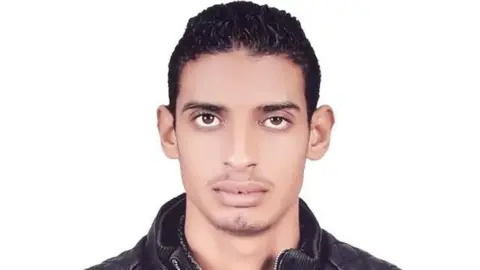
Egyptian fisherman Issam al-Shazly was executed on Tuesday after being convicted of drug-related charges
Saudi Arabia has surpassed its record for the number of executions carried out annually for a second year in a row.
At least 347 people have now been put to death this year, up from a total of 345 in 2024, according to the UK-based campaign group Reprieve, which tracks executions in Saudi Arabia and has clients on death row.
It said this was the "bloodiest year of executions in the kingdom since monitoring began".
The latest prisoners to be executed were two Pakistani nationals convicted of drug-related offences.
Others put death this year include a journalist and two young men who were children at the time of their alleged protest-related crimes. Five were women.
But, according to Reprieve, most - around two thirds - were convicted of non-lethal drug-related offences, which the UN says is "incompatible with international norms and standards".
More than half of them were foreign nationals who appear to have been put to death as part of a "war on drugs" in the kingdom.
The Saudi authorities have not responded to the BBC's request for comment on the rise in executions.
"Saudi Arabia is operating with complete impunity now," said Jeed Basyouni, Reprieve's head of death penalty for the Middle East and North Africa. "It's almost making a mockery of the human rights system."
She described torture and forced confessions as "endemic" within the Saudi criminal justice system.
Ms Basyouni called it a "brutal and arbitrary crackdown" in which innocent people and those on the margins of society have been caught up.
Tuesday saw the execution of a young Egyptian fisherman, Issam al-Shazly, who was arrested in 2021 in Saudi territorial waters and said he had been coerced into smuggling drugs.
Reprieve says that 96 of the executions were solely linked to hashish.
"It almost seems that it doesn't matter to them who they execute, as long as they send a message to society that there's a zero-tolerance policy on whatever issue they're talking about - whether it's protests, freedom of expression, or drugs," said Ms Basyouni.
There has been a surge of drug-related executions since the Saudi authorities ended an unofficial moratorium in late 2022 - a step described as "deeply regrettable" by the UN human rights office.
Speaking anonymously to the BBC, relatives of men on death row on drugs charges have spoken of the "terror" they're now living in.
One told the BBC: "The only time of the week that I sleep is on Friday and Saturday because there are no executions on those days."
Cellmates witness people they have shared prison life with for years being dragged kicking and screaming to their death, according to Reprieve.
Reuters
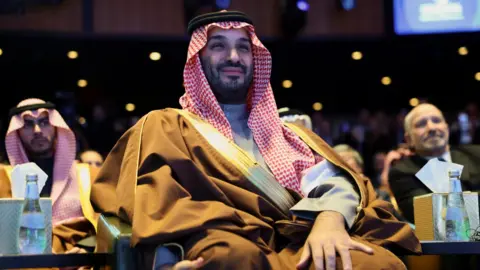
Prince Mohammed bin Salman has loosened social restrictions while simultaneously silencing criticism
The de facto ruler of Saudi Arabia, Mohammed bin Salman - who became crown prince in 2017 - has changed the country profoundly over the past few years, loosening social restrictions while simultaneously silencing criticism.
In a bid to diversify its economy away from oil, he has opened Saudi Arabia up to the outside world, taken the religious police off the streets, and allowed women to drive.
But the kingdom's human rights record remains "abysmal", according to the US-based campaign group Human Rights Watch, with the high level of executions a major concern. In recent years, only China and Iran have put more people to death, according to human rights activists.
"There's been no cost for Mohammed bin Salman and his authorities for going ahead with these executions," said Joey Shea, who researches Saudi Arabia for Human Rights Watch. "The entertainment events, the sporting events, all of it is continuing to happen with no repercussions, really."
According to Reprieve, the families of those executed are usually not informed in advance, or given the body, or informed where they have been buried.
The Saudi authorities do not reveal the method of execution, although it is believed to be either beheading or firing squad.
In a statement sent to the BBC, the UN's special rapporteur on extrajudicial, summary or arbitrary executions, Dr Morris Tidball-Binz, called for an immediate moratorium on executions in Saudi Arabia with a view to abolition, as well as "full compliance with international safeguards (including effective legal assistance and consular access for foreign nationals), prompt notification of families, the return of remains without delay and the publication of comprehensive execution data to enable independent scrutiny".
Amnesty International
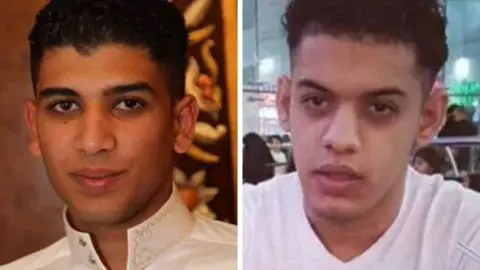
Abdullah al-Derazi and Jalal al-Labbad were executed in October and August respectively after being convicted of crimes they allegedly committed as minors
Among the Saudi nationals executed this year were Abdullah al-Derazi and Jalal al-Labbad, who were both minors at the time of their arrest.
They had protested against the government's treatment of the Shia Muslim minority in 2011 and 2012, and participated in the funerals of people killed by security forces. They were convicted of terrorism-related charges and sentenced to death after what Amnesty International said were grossly unfair trials that relied on torture-tainted "confessions". UN human rights experts had called for their release.
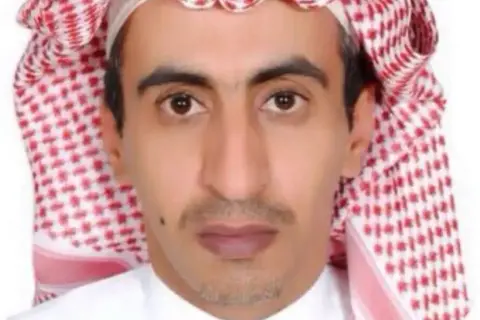
The UN also condemned the execution in June of the journalist, Turki al-Jasser, who had been arrested in 2018 and sentenced to death on charges of terrorism and high treason based on writings he was accused of authoring.
"Capital punishment against journalists is a chilling attack on freedom of expression and press freedom," said Unesco's Director-General, Audrey Azoulay.
Reporters Without Borders said he was the first journalist to be executed in Saudi Arabia since Mohammed bin Salman came to power, although another journalist, Jamal Khashoggi, was murdered by Saudi agents at the Saudi consulate in Istanbul in 2018.
Human Rights Watch
Journalist Turki al-Jasser was executed in June after seven years in detention
Last December, UN experts wrote to the Saudi authorities to express concern over a group of 32 Egyptians and one Jordanian national who had been sentenced to death on drugs charges, and their "alleged absence of legal representation". Since then, most of the group have been executed.
A relative of one man put to death earlier this year said that he had told her that people were being "taken like goats" to be killed.
The BBC has approached the Saudi authorities for a response to the allegations but has not received one.
But in a letter dated January 2025 - in reply to concerns raised by UN special rapporteurs - they said that Saudi Arabia "protects and upholds" human rights and that its laws "prohibit and punish torture".
"The death penalty is imposed only for the most serious crimes and in extremely limited circumstances," the letter stated. "It is not handed down or carried out until judicial proceedings in courts of all levels have been completed."
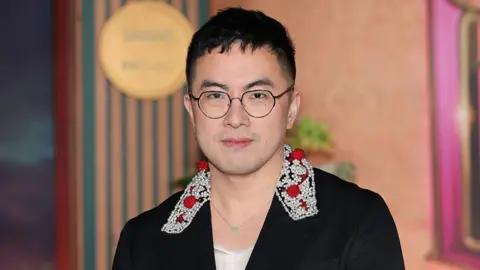
Comedian Bowen Yang is leaving the cast of Saturday Night Live, and will no longer be part of the long-running sketch programme after the latest episode airs.
In a post on Instagram, Yang declined the share the reason for his departure, which comes in the middle of the season, but said he is "grateful for every minute of my time there".
"I loved working at SNL, and most of all I loved the people," wrote Yang, who started in 2018 as a writer for the NBC programme before joining the acting cast.
Yang, 35, is the first Chinese-American staff actor in SNL's history, and has become one of SNL's most prominent cast members in recent years.
In his Instagram post, Yang described the lessons he's learned while working at SNL.
"i learned about myself (bad with wigs). i learned about others (generous, vulnerable, hot)," he wrote.
"i learned that human error can be nothing but correct. i learned that comedy is mostly logistics and that it will usually fail until it doesn't, which is the besssst."
He also thanked other cast members, as well as Lorne Michaels, the long-time producer of the programme.
Yang was behind some of the programme's most memorable characters and parodies, including as the iceberg that sank the Titanic and as disgraced ex-Congressman George Santos.
Yang's final episode, airing on Saturday night, will be hosted by Ariana Grande, one of the stars of the film Wicked: For Good.
Yang also had a role in the film, and has starred in previous films including The Wedding Banquet, Fire Island, Bros and the first Wicked film.
For his work on SNL, he has been nominated for five Emmy Awards. He also co-hosts podcast Las Culturistas and is expected to voice a character in the Cat in the Hat animated film due to be released next year.
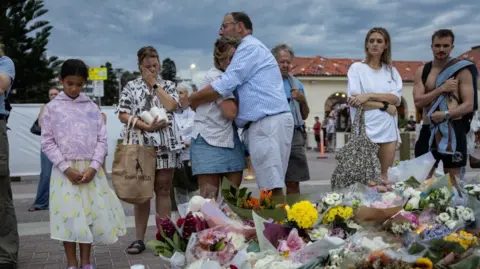
Mourners in Australia have fallen silent in honour of the victims of the Bondi beach attack.
The memorial was part of a national day of reflection to mark a week since the shooting in which two gunmen opened fire on an event celebrating the Jewish festival of Hannukah.
A 10-year-old girl, a British-born rabbi and a Holocaust survivor were among the 15 people killed during the attack.
Prime Minister Anthony Albanese was booed when he arrived at the memorial event - an expression of anger by Australia's Jewish community against his government after a rise of antisemitic attacks over the past few months.
As the sun set over Sydney on Sunday evening, a minute's silence was observed at 18:47 (07:47 GMT) - exactly one week since the first reports of gunfire at the famous beach.
There was heavy security at the memorial event. Some cordoned-off areas were guarded by armed riot squad officers who had their faces covered, while a police patrol boat was visible off the coast of Bondi beach.
For many Australians, this level of security is an unfamiliar sight.
A large crowd - many wearing kippas [the Jewish skullcap] or draped in Australian flags - gathered to listen to speeches after the observing the silence.
Bee balloons floated in the wind in honour of the youngest victim of the attack, Matilda - a reference to her nickname, "Matilda Bee".
And later in the ceremony, the crowd sang Waltzing Matilda, the song for which the 10-year-old was named.
Soon, they were chanting the name of another child - Chaya, a 14-year-old who put herself in the firing line to protect a stranger's children. Shot in the leg, she used crutches to take to the stage and urge the nation to be brave and kind.
"If you guys get inspired by one thing, one thing on all this, be the light in that field of darkness," she said.
The event ended with the lighting of the menorah - something the crowds gathered for Hannukah last week couldn't do.
Sunday's memorial was not limited to Bondi beach - or the state of New South Wales. In a nation-wide gesture of "light over darkness", the windowsills of countless homes were lined with candles.
Watch: Moment Australian PM Anthony Albanese booed at Bondi memorial
As Albanese arrived for the ceremony, one person in the crowd shouted: "Blood on your hands."
The prime minister looked startled at the hostility, his wife Jodie Haydon grasping his arm in support.
At least one member of the crowd was tackled by police after moving towards the prime minister.
The Jewish community in Australia has repeatedly said this attack was a shock, not a surprise after a rise in antisemitic attacks in Australia since the 7 October 2023 Hamas attack on Israel and the subsequent military retaliation war launched by Israel in the Gaza Strip.
The overwhelming view is that more could and should have been done to prevent the Sydney attack from happening.
Albanese has acknowledged the criticism, saying "I accept my responsibility for the part in that as prime minister of Australia."
More widely, Albanese has been accused by some of siding with the Palestinians over supporting Israel and the relationship worsened when he moved to recognise the state of Palestine earlier this year.
Israeli Prime Minister Benjamin Netanyahu has accused him - as well as the leaders of other countries that have recognised a Palestinian state - of rewarding Hamas.
After the Bondi beach attack last Sunday, Netanyahu said Albanese's government "did nothing to stop the spread of antisemitism in Australia".
In contrast to the reception for the Australian prime minister, Chris Minns, the Premier of New South Wales, was praised at the Sydney memorial service as an exemplary leader, partly for the speed with which he admitted government errors in the lead-up to the attack.
He also attended the funerals of several victims this week. Albanese was not invited to some.
"We are deeply sorry." Minns said at the event. "We grieve with you, and with humility, I acknowledge that the government's highest duty is to protect its citizens. And we did not do that one week ago."
The shooting had "highlighted a deep vein of antisemitic hate in our community", Minns said, adding: "This must be confronted."
The president of the New South Wales Jewish Board of Deputies, David Ossip, was hailed with loud cheers as he called for a "Royal Commission which goes beyond New South Wales, to get to the bottom of how this catastrophe took place".
Naveed Akram, 24, has been charged with 59 offences, including 15 counts of murder and one of committing a terrorist act. His father Sajid was killed during the attack.
Days after the attack, Prime Minister Albanese announced a raft of measures to crack down on hate speech and incitement to violence.
Before Sunday's ceremonu, he announced a review into the police and national intelligence agencies.
"The ISIS-inspired atrocity last Sunday reinforces the rapidly changing security environment in our nation," Albanese said, using an acronym for the Islamic State group.
He has also said he will reform gun laws and the government has launched a gun buyback scheme - the largest since the Port Arthur massacre in 1996, which left 35 people dead and prompted Australia to introduce world-leading gun control measures.
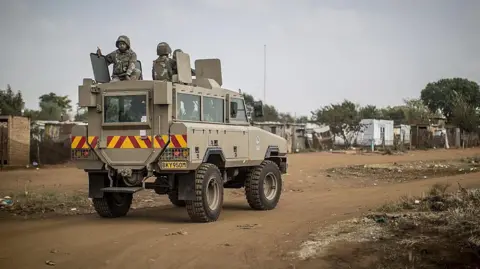
An army patrol in Bekkersdal township - file photo
South African police say a manhunt is under way after a shooting at a tavern left nine people dead and another 10 injured in a township near Johannesburg.
They say about 12 unidentified gunmen arrived in two cars in Bekkersdal, "opened fire at tavern patrons and continued to shoot randomly as they fled the scene".
The shooting happened at about 01:00 local time on Sunday (23:00 GMT Saturday). The police added that the tavern was licensed.
South Africa has one of the highest murder rates in the world, at 45 people per 100,000 according to 2023-24 figures from the United Nations Office on Drugs and Crime.
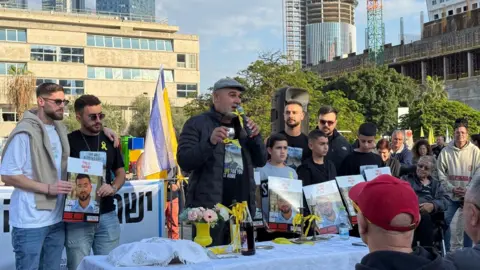
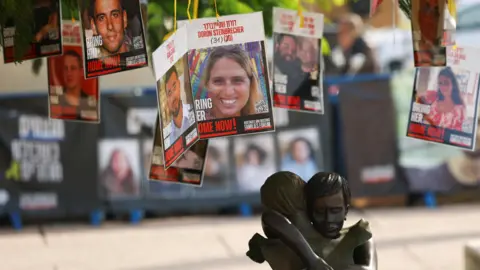
Itzik Gvili demands the return of his son Ran, the last dead hostage in Gaza, in Tel Aviv's Hostages Square
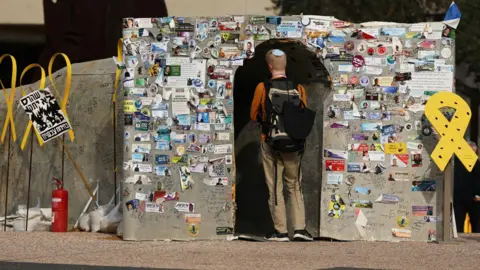
In central Tel Aviv, the main stage has now been dismantled in Hostages Square, the focal point for the campaign over the past two years to bring back Israelis held in Gaza.
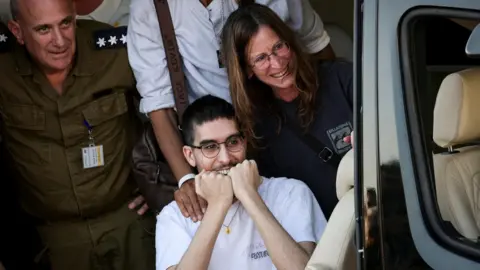
Nearby, signs and posters have been taken down, and the Hostages and Missing Families Forum has vacated the offices that served as its nerve centre. Of the 251 hostages seized by Hamas and other Palestinian armed groups in the 7 October 2023 attacks, 168 have been brought back alive from Gaza, eight have been rescued. Only one deceased hostage, Ran Gvili, remains.
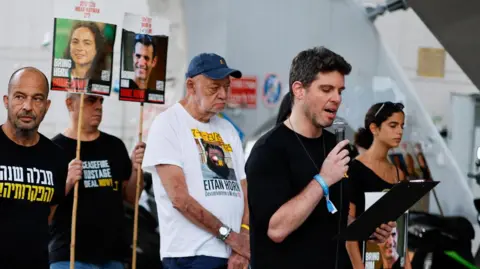
With songs and prayers instead of mass rallies, the Gvili family and a small crowd of supporters assemble in Hostages Square each Friday to mark the start of the Jewish Sabbath; this week, a candle for the Hanukkah holiday was also lit.
They are determined to bring back the young police officer who was killed by Hamas fighters after he rushed to help people being attacked in Kibbutz Alumim in southern Israel in October 2023.
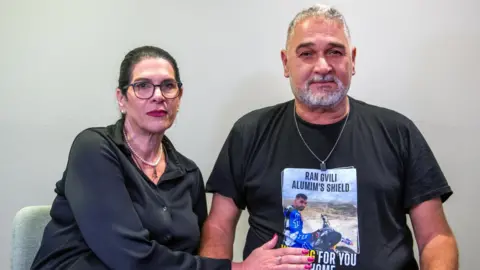
"I feel every day is still the 7 October. We didn't pass the 7 October, but we are strong, and we're waiting for him. We do whatever we need," says Itzik Gvili, Ran's father. "This gives us hope: the support of the people."
Reuters
The Hostages and Missing Families Forum's slogan is: "Bring them home now"
From the start, people power has been key to the hostage families. As its operations wind down, members of the Hostages Families Forum have been reflecting on its extraordinary evolution which turned the grassroots group into a powerful international lobbying force.
In the terrible aftermath of the 2023 Hamas-led assault on southern Israel, which also killed some 1,200 people, a huge group of distraught relatives gathered for the first time in Tel Aviv desperately seeking answers about their missing loved ones. Because of the incoming rocket fire from Gaza, they met in an underground car park.
"We were together, shocked, and it fell on me that this is actually real, that now we are going to face this unbelievable challenge of understanding where all these people are, getting them home," recalls Gil Dickmann, whose cousin Carmel Gat had been snatched from Kibbutz Be'eri.
"And the second thing is that we're going to do this together. I'm not going to stand alone."
Reuters
Gil Dickmann (2nd R) said the public support gave him hope after kidnapping of his cousin, Carmel Gat
The formation of the new forum, with its slogan: "Bring them home now", gave the hostages' families a much-needed sense of regaining control.
"It was very, very powerful to feel that when the government and Israeli state, in a way collapsed in those very first few days after 7 October, it felt like nothing was working, what was working was Israeli society," Mr Dickmann says. "So many wonderful people came to help. That brought me a lot of hope."
Dividing its efforts between supporting the families - many of whom were bereaved and displaced from their homes following the attacks - and campaigning in Israel and around the world, the Hostages Families Forum worked with more than 10,000 volunteers. They included former Israeli diplomats, lawyers and security officials.
Funded entirely by donations, it began to pay some staff, and a high-tech company loaned its central Tel Aviv office space.
Reuters
A makeshift tunnel symbolizing Hamas's tunnel network in Gaza was constructed at Hostages Square
In November 2023 - more than six weeks into the brutal war in Gaza, which had by then killed more than 14,000 Palestinians according to the Hamas-run health ministry - Israel and Hamas agreed to a Qatar-mediated truce.
This saw most women and children hostages returned in exchange for Israel releasing more than 240 Palestinian prisoners, all women and children. Hamas also freed some foreign nationals.
But after a week, the fighting resumed with ferocity. About half of the hostages were left in Gaza. In December, three Israeli hostages were killed by Israeli soldiers in Gaza despite the fact they were shirtless, waving a makeshift white flag, and calling out in Hebrew.
Israeli Prime Minister's Office/handout via Reuters
Itay Regev and his sister Maya were released during the November 2023 ceasefire
Those were difficult days for the Hostages Families Forum and in early 2024, with polls suggesting more Israelis prioritised eliminating Hamas over the return of those still held captive, it brought in political strategist, Lior Chorev, as campaign manager.
"We were in deep war in Gaza, deep war in Lebanon, there was the Iranian threat, and it appeared that everything was stuck, and public opinion was against us," Mr Chorev explains.
"As a civil society organisation, we could not impact whether or not there's going to be a deal, but we could work hard on the Israeli public opinion to ensure that if a deal came into place, it would have a sound civilian majority within the country."
Reuters
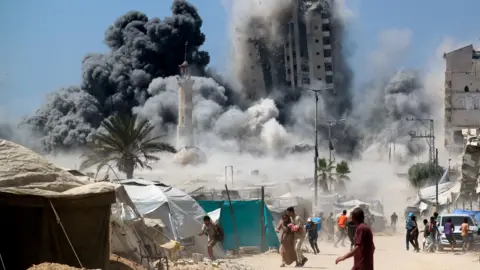
Gaza has been devastated by the two-year war sparked by 7 October 2023 Hamas-led attacks on Israel
As well as Saturday evening demonstrations in the plaza in front of the Tel Aviv Museum of Art, now renamed Hostages Square, there were near-daily actions by the Hostages Families Forum ranging from concerts and art installations to civil disruption. Media and diplomatic teams helped keep the hostages at the centre of attention.
"They kept going 24/7 for two years," comments Times of Israel political correspondent Tal Schneider who, like visiting foreign officials, often went to the forum's HQ.
"This place became like a foreign ministry for the country, for the families of 250 people."
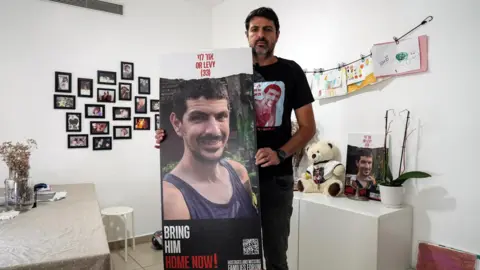
Looking back, Michael Levy says his intensive campaigning helped him deal with the "emotional rollercoaster" after his sister-in-law, Einav, was killed at the Nova Festival and his younger brother, Or, was taken hostage alive.
"The only thing that helped me was becoming active. I was interviewed all the time. I went with 15 different delegations to over 12 countries. I spoke to whoever was willing to listen and didn't want to stop and think," Mr Levy says.
"You need to stay optimistic all the time. You need to tell yourself every morning that today is going to be the day that he's going to be released, even though you know you are lying to yourself."
Reuters
Michael Levy's brother, Or, was released during the ceasefire that lasted from January to March 2025
Although a hostage-prisoner exchange deal to end the war laid out in mid-2024 was described by then-US President Joe Biden as an Israeli proposal, Israel's Prime Minister Benjamin Netanyahu was widely seen as dragging out hostilities to aid his own political survival – a claim he rejected.
Tensions rose between the Hostages Families Forum and Israel's government; there was open animosity from some government supporters.
The situation worsened after a Netanyahu aide was accused of deliberately acquiring and illegally leaking a top-secret document to a German newspaper to influence how Israel's public viewed negotiations on a ceasefire and hostage deal.
The document was misleadingly cast as suggesting that pressure on the prime minister played into the hands of Hamas.
Reuters
Hundreds of people were killed or taken hostage at the Nova music festival during the 7 October 2023 attacks
For Mr Dickmann and Mr Levy, there was a low point when they headed to Washington for Netanyahu's address to a joint meeting of US Congress in July 2024 with other forum members.
They showed off T-shirts saying "Seal the deal" during an ovation for the Israeli leader and were arrested for an unlawful demonstration. "That was one of the moments in which I felt most alone," Mr Dickmann says. "It was one of the most frightening things and it was while Carmel was still alive in captivity."
The worst news came a month later when Carmel and five other hostages were killed by their Hamas captors, as the Israeli military closed in nearby.
Mr Dickmann says it was only an "unbelievable support group" of younger forum members that helped him get through the ordeal.
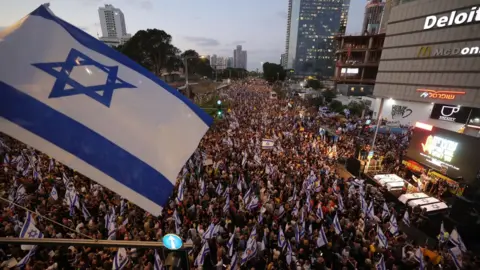
After the Israeli deaths were confirmed, angry protesters flooded the streets of Israeli cities. The forum puts the total number at 600,000.
In Tel Aviv, a crowd of hostage families and their supporters marched with six prop coffins. A crowd gathered outside Israel's military headquarters and clashed with police on a major road.
EPA
The killing of Carmel Gat and five other hostages by their Hamas captors sparked a huge protest in Tel Aviv
By the start of 2025, international opposition to the devastating Gaza war had reached new heights as the number of Palestinians killed approached 48,000, according to Gaza's health ministry.
In Israel, polls indicated a clear shift in Israeli public opinion, with a growing majority backing a hostage deal to end the war. With the election of a new US president, the Hostages Families Forum was increasingly directing its efforts stateside.
"They needed to bypass their own government," comments Ms Schneider. "The most important person for the job was obviously [US] President [Donald] Trump. There were signs written in English carried by the people and they would pack all their messages into a one-minute video, and they'd send it to him."
Working with regional mediators, the US secured a new Gaza deal between Israel and Hamas in January 2025, just as Trump took office. The first stage brought back 33 hostages – eight of whom were dead – in exchange for nearly 2,000 Palestinian prisoners and detainees. Five Thai hostages were also released.
But in mid-March, Israel ended the ceasefire, resuming its heavy bombing of Gaza, without starting talks on the deal's second stage, which involved a full end to fighting and the return of the remaining hostages.
The White House
Released hostages travelled to Washington to ask President Donald Trump to ensure the return of those left behind in Gaza
Frail and emaciated following his release in February under the ceasefire deal, Or Levy was emotionally reunited with his three-year-old son, his parents and brother Michael. However, Michael's joy was short-lived. He quickly resumed his campaigning with others in the Hostages Families Forum.
"I got what I wanted, I got my brother back, but I couldn't just stop," he says, "I couldn't be happy because in those 491 days, they became my family. I almost felt I knew all the other hostages, that every hostage still there was part of my family."
Newly freed hostages gave TV interviews saying they had been starved and beaten in captivity, sometimes in response to the ill-treatment of Palestinian prisoners held by Israel.
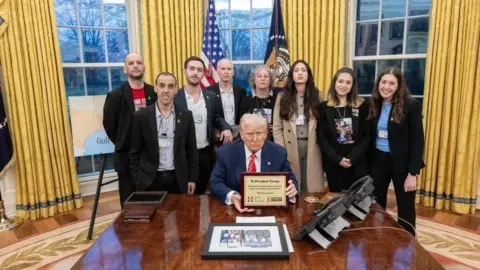
Despite their trauma and fragile health, a few of the former hostages travelled to the White House urging President Trump to use his influence to bring back all the living and dead Israelis they had left behind in Gaza.
Reuters
Evyatar David was among the last 20 living hostages freed shortly after the current ceasefire began in October
There were more dramatic moments.
In September, an Israeli air strike unsuccessfully targeted the exiled Hamas leadership as it met in Qatar, a regional mediator, to discuss a new ceasefire proposal presented by the US.
However, the ultimate effect was to push the Trump administration - backed up by its Arab allies – towards a new plan to end the war, which had by then killed more than 67,000 people in Gaza, according to the territory's health ministry.
Israel and Hamas agreed a ceasefire deal, under which all 20 living and 28 dead hostages still in Gaza would be handed over in return for almost 2,000 Palestinian detainees and prisoners in Israeli jails, as well as a surge in humanitarian aid and a partial Israeli withdrawal.
Reuters
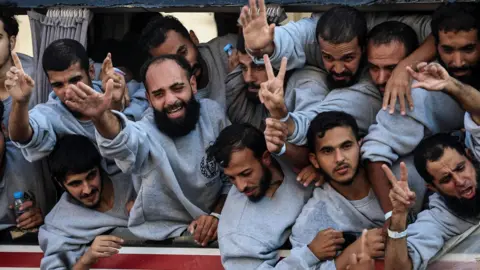
Israel released about 250 Palestinian prisoners and 1,700 detainees from Gaza in exchange for the living hostages
When Trump's Middle East envoy, Steve Witkoff, and the president's son-in-law, Jared Kushner, arrived in Israel just after the latest ceasefire started on 10 October, they were greeted by rapturous applause on stage in Hostages Square.
On 13 October, the remaining living hostages came back.
"I'll never have a happier day in my life," says Mr Dickmann, remembering seeing his best friends reunited with their loved ones.
Mr Chorev, the Hostage Families Forum's chief strategist, considers that long-held Jewish and Israeli traditions won through.
"This basic value of the Israeli theme that you don't leave anyone behind, that you're responsible for each and every Israeli held by the enemy, this was something that was unclear to certain elements in the Israeli government," he says. "But it was very clear to the Israeli public."
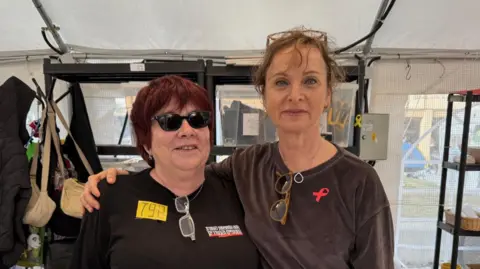
Tali (L) has been helping out hostages' families since the beginning of the war
Slowly, 27 of the dead hostages' bodies have been returned to Israel over the past two months.
Amid the ruins of Gaza, where health ministry officials say the number of Palestinians killed has risen to more than 70,000, Hamas operatives and the Red Cross have been searching for Ran Gvili's body east of Gaza City.
Now, the last funds of the Hostages Families Forum are being used to support the Gvilis and a few dozen volunteers continue to head to Hostages Square on Fridays.
"We have been here in the rain and in nearly 50-degree [Celsius] heat, from winter to summer," says Tali, from Tel Aviv. "Now that this is nearly over, I have mixed emotions. There is still one hostage who hasn't come back. I told myself I would stay until the last one."
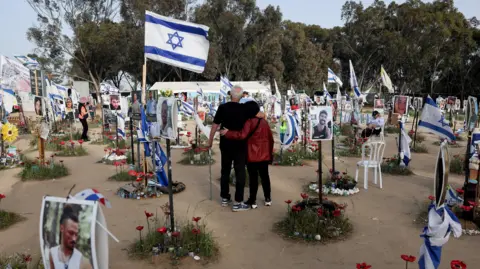
A symbolic tunnel, a large "Hope" sign and a piano put in the square in honour of now released hostage, Alon Ohel - a musician - have not yet been removed, nor has the giant countdown board which marks the days since 7 October 2023. A final mass rally is promised for when Ran Gvili's body is returned for burial.
Itzik and Talik Gvili are determined to bring their son Ran home for a proper burial
Israel's prime minister has never appeared in Hostages Square, but he has met with released hostages and hostage families, including those from a small, alternative group to the Hostages Families Forum, the Tikva Forum. The Gvilis belong to both.
The family joined a candle-lighting ceremony on the first night of Hanukkah with Netanyahu.
"We will bring Ran back, just as we brought back 254 out of our 255 abductees," the prime minister said. "Some did not believe. I believe. My friends in the government believed. They said: 'It will be a miracle.' I said: 'This nation performs miracles.'"
But in Israel, painful questions linger over why more hostages' lives were not saved.
The Hostages Families Forum recently released harrowing Hamas videos recovered in Gaza which show the six hostages who were later murdered, including Carmel Gat, celebrating Hanukkah in a tunnel in 2023.
The hostage crisis continues to cast a long shadow over Israeli society; even as many take heart from the families' message of endurance and solidarity.
Additional reporting by Davide Ghiglione and Gidi Kleiman
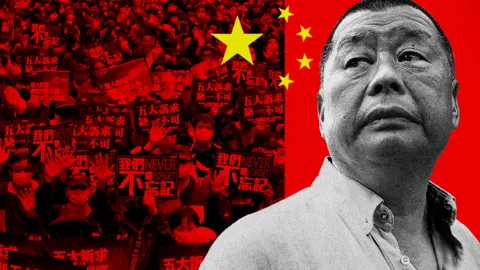
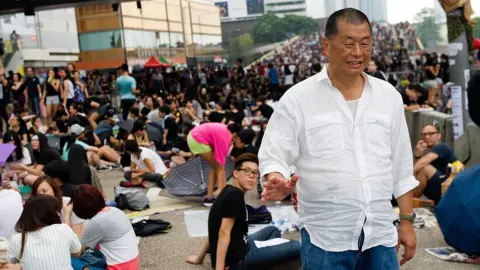
Jimmy Lai, 78, faces life in prison for national security offences
On a winter morning in 2022 Raphael Wong and Figo Chan walked into Hong Kong's Stanley prison to meet Jimmy Lai, the media billionaire who had been arrested two years before and was awaiting trial charged with national security offences.
They had all been part of the turbulent protests that had rocked Hong Kong in 2019, when hundreds of thousands took to the streets demanding democracy and more freedom in the Chinese territory.
They would also often meet for dinner, sometimes lavish meals, gossiping and bantering over dim sum, pizza or claypot rice.
In prison, he "loved eating rice with pickled ginger," Chan said. "No-one could have imagined Jimmy Lai would eat something like that!"
But neither had they imagined a reunion at a maximum security prison, the protests crushed, friends and fellow activists jailed, Hong Kong just as boisterous and yet, changed. And gone was the owner of the irreverent nickname "Fatty Lai": he had lost considerable weight.
Decades apart - Lai in his 70s, Wong and Chan about 40 years younger - they had still dreamed of a different Hong Kong. Lai was a key figure in the protests, wielding his most influential asset, the hugely popular newspaper, Apple Daily, in the hope of shaping Hong Kong into a liberal democracy.
That proved risky under a contentious national security law imposed in 2020 by China's Communist Party rulers in Beijing.
Lai always said he owed Hong Kong. Although he is a UK citizen, he refused to leave.
"I got everything I have because of this place," he told the BBC hours before he was arrested in 2020. "This is my redemption," he said, choking up.
He wanted the city to continue to have the freedom it had given him. That's what drove his politics - fiercely critical of the Communist Party and avowedly supportive of Hong Kong's pro-democracy movement. It cost him his own freedom.
Watch: Jimmy Lai's last interview as a free man in 2020
Lai harboured "a rabid hatred" of the Chinese Communist Party and "an obsession to change the Party's values to those of the Western world", the High Court ruled on Monday as it delivered the verdict in his trial.
It said that Lai had hoped the party would be ousted - or, at the very least, that its leader Xi Jinping would be removed.
Lai was found guilty on all counts of charges he had always denied. The most serious one - colluding with foreign forces - carries a maximum sentence of life in prison.
"Never," Lai had said to that charge when he testified, arguing that he had only advocated for what he believed were Hong Kong's values: "rule of law, freedom, pursuit of democracy, freedom of speech, freedom of religion, freedom of assembly".
Monday's verdict was welcomed by Hong Kong's chief executive John Lee, who said Lai had used his newspaper to "wantonly create social conflicts" and "glorify violence". The law, he added, never allows anyone to harm the country "under the guise of human rights, democracy and freedom".
Getty Images
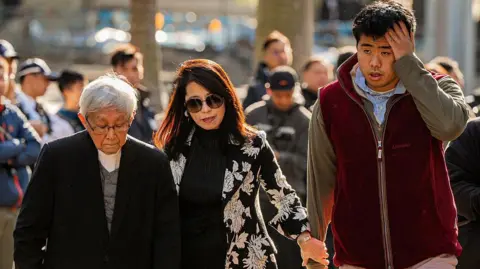
Lai's wife Teresa and son Shun-yan at court for Lai's verdict, along with Cardinal Joseph Zen, former bishop of Hong Kong who baptised Lai in 1997
Back in 2022, before Wong and Chan left the prison, Lai asked them to pray with him, to Wong's surprise.
Lai's Catholic faith had deepened in solitary confinement - an arrangement he had requested, according to authorities. He prayed six hours a day and he made drawings of Christ, which he sent in the mail to friends. "Even though he was suffering," Wong said, "he didn't complain nor was he afraid. He was at peace."
Peace was not what Jimmy Lai had pursued for much of his life - not when he fled China as a 12-year-old, not while he worked his way up the gruelling factory chain, not even after he became a famous Hong Kong tycoon, and certainly not as his media empire took on Beijing.
For Lai, Hong Kong was everything that China was not - deeply capitalist, a land of opportunity and limitless wealth, and free. In the city, which was still a British colony when he arrived in 1959, he found success - and then a voice.
Apple Daily became one of the top-selling papers almost instantly after its debut in 1995. Modelled on USA Today, it revolutionised the aesthetics and layout of newspapers, and kicked off a cut-throat price war.
From a guide to hiring prostitutes in the "adult section" to investigative reports, to columns by economists and novelists, it was a "buffet" targeting "a full range of readers", said Francis Lee, a journalism professor at the Chinese University of Hong Kong.
Former editors and employees spoke of Lai's encouragement - "If you dared to do it, he would dare to let you do it" - and his temper. One said he often swore.
They describe him as unconventional, and as a visionary who wasn't afraid to bet on experiments. "Even before the iPhone was launched, he kept saying mobile phones would be the future," recalled one of the paper's editors, adding that he was full of ideas. "It was as if he asked us to create a new website every day."
It had been the same when he owned a clothing label. "He was not afraid of disrupting the industry, and he was not afraid of making enemies," said Herbert Chow, a former marketing director at a rival brand.
That was both his making and undoing, Chow said: "Otherwise, there would have been no Apple Daily. Of course, he wouldn't have ended up like this either."
An early TV commercial for Apple Daily featured the then 48-year-old Lai biting the forbidden fruit while dozens of arrows took aim at him.
It became a self-fulfilling prophecy.
Jimmylai.substack.com
The Apple Daily commercial when it launched in 1995
Escape from China
It was his first taste of chocolate that beckoned Lai to Hong Kong as a boy.
After carrying a passenger's luggage at a railway station in China, Lai was given a tip, and a bar of chocolate. He took a bite. "I asked him where he's from. He said Hong Kong. I said, 'Hong Kong must be heaven' because I had never tasted anything like that," Lai said of the encounter in a 2007 documentary, The Call of the Entrepreneur.
Life in Mao Zedong's China was punctuated by waves of oppressive campaigns - to industrialise China overnight, to weed out capitalist "class enemies". The Lais, once a family of business people, were blacklisted. His father fled to Hong Kong, leaving them behind. His mother was sent to a labour camp.
Decades later, Lai wrote of how of he and his sisters would be dragged out of their homes to watch a crowd forcing their mother to kneel while she was shoved and taunted - cruel public shaming that soon became the norm. The first time, Lai wrote, was terrifying: "My tears flowed freely and wet my shirt. I dared not make a move. My body was burning with humiliation."
Uncowed, his grandmother finished every story with the same message: "You have to become a businessman even if you only sell seasoned peanuts!"
And so, at the age of 12, he set off for Hong Kong, among millions who fled the mainland - and Mao's devastating rule - over the years.
The day he arrived, on the bottom of a fishing boat, along with about 80 seasick travellers, he was hired by a mitten factory. He described the long working hours as a "very happy time, a time that I knew I had a future". It was there that one of his co-workers helped him learn English. Years later, he would give interviews and even testify at court in fluent English.
By his early 20s, he was managing a textile factory and after making money on the stock market, he started his own, Comitex Knitters. He was 27.
Getty Images
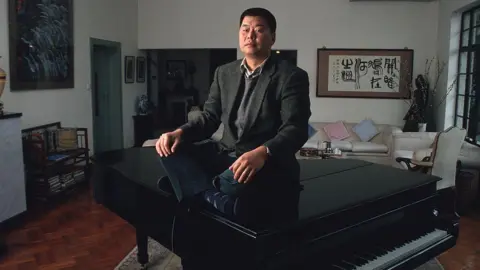
Jimmy Lai at his home in Hong Kong in 1993
Business often took Lai to New York, and on one of those trips, he was lent a book that came to define his worldview: The Road to Serfdom by Nobel Prize-winning economist Friedrich Hayek, a champion of free-market capitalism. "People's spontaneous reaction" and "the exchange of information" have created the best in the world, was his takeaway. To him, that was Hong Kong's strength.
The book spurred a voracious reading habit. He would read the same book multiple times, and read every book by authors he admired. "I want to turn the author's thoughts into my backyard garden. I want to buy a garden, not cut flowers," he said in a 2009 interview.
After a decade in manufacturing, he was "bored" and founded the clothing chain Giordano in 1981, which became a fast-fashion pioneer. It was so successful that Tadashi Yanai sought advice from Lai when his Japanese label Uniqlo opened shops.
Lai launched stores in China, which had begun to open up after Mao died. He was "excited", China "was going to be changed, like a Western country", he said in the 2007 documentary.
Then in 1989, Beijing crushed pro-democracy protests in Tiananmen Square: a rude awakening for Lai and Hong Kong, which was set to return to Chinese rule in 1997 under a recent agreement by China and the UK.
Giordano sold tees with photos of Tiananmen protest leaders and anti-Beijing slogans, and put up pro-democracy banners in stores across Hong Kong.
A million people marched in Hong Kong in solidarity with student protesters in Beijing. Until 2020, Hong Kong held the largest vigil that mourned the massacre.
Lai said later that he "didn't feel anything about China" until then. He had always wanted to forget that part of his life but "all of a sudden, it was like my mother was calling in the darkness of the night".
Getty Images
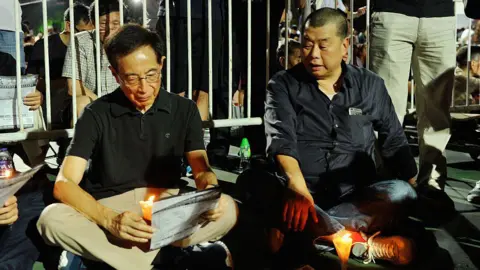
Lai was a frequent attendee at Hong Kong 's annual vigils in memory of those who died at Tiananmen Square in 1989
'Choice is freedom'
The following year Lai launched a magazine called Next, and in 1994 published an open letter to Li Peng, "the Butcher of Beijing" who played a key role in the Tiananmen massacre. He called him "the son of a turtle egg with zero intelligence".
Beijing was furious. Between 1994 and 1996, Giordano's flagship store in Beijing and 11 franchises in Shanghai closed. Lai sold his shares and stepped down as chairman.
"If I just go on making money, it doesn't mean anything to me. But if I go into the media business, then I deliver information, which is choice, and choice is freedom," Lai said in the 2007 documentary.
He soon became a "very active participant" in Hong Kong's pro-democracy movement, meeting leaders to discuss strategy, said Lee Wing Tat, a former lawmaker from the Democratic Party.
He became an outspoken critic of the CCP, writing in 1994: "I entirely oppose the Communist Party because I hate everything that restrains personal liberties." He also started to voice concerns about the looming handover of Hong Kong, from Britain to China, in 1997.
"After more than a century of colonial rule, Hong Kongers feel proud to return to the embrace of the motherland," he wrote. "But should we love the motherland even if it doesn't have freedom?"
During the handover, however, China's then-leader Jiang Zemin promised that Hongkongers would govern Hong Kong and the city would have a high degree of autonomy for the next 50 years.
Getty Images
Lai at an "Occupy Central" protest in Admiralty in October 2014
The 2014 Umbrella Movement sparked by Beijing's refusal to allow completely free elections in Hong Kong became another turning point for Lai.
Protesters occupied the city's main commercial districts for 79 days. Lai turned up from 9am to 5pm every day, undeterred after a man threw animal entrails at him. "When the police started firing tear gas, I was with Fatty," the former lawmaker Lee recalled.
The movement ended when the court ordered protest sites to be cleared, but the government did not budge. Five years later, in 2019, Hong Kong erupted again, this time because of a controversial plan that would have allowed extradition to mainland China.
What began as peaceful marches became increasingly violent, turning the city into a battleground for six months. Black-clad protesters threw bricks and Molotov cocktails, stormed parliament and started fires; riot police fired tear gas, rubber bullets, water cannons and live rounds.
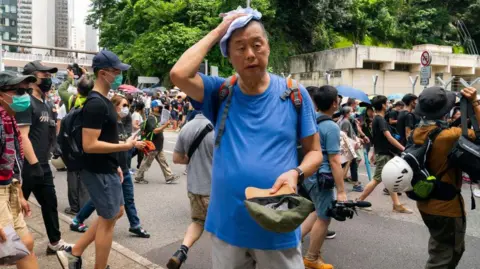
Lai was at the forefront of the protests and served 20 months for participating in four unauthorised assemblies. A protester told the BBC he was surprised to see Lai: "To me, he's a busy businessman, but he showed up."
Getty Images
Lai at a pro-democracy march in 2019
Apple Daily provided blanket coverage or, as critics would argue, a sounding board for an anti-government movement.
Government adviser Ronny Tong said Lai was "instrumental" in the protests because Apple Daily carried a "totally false" slogan – anti-extradition to China – which "caught the imagination of people who wanted to cause havoc in Hong Kong".
Whether Apple Daily played a seditious role, and how much control Lai exerted over its stance was at the centre of his 156-day national security trial.
Lai instructed the editorial team to "urge people to take to the streets", according to Cheung Kim-hung, former chief executive of Apple Daily's parent company Next Digital, and a defendant-turned-prosecution witness. After the National Security Law took effect, the newspaper was raided twice and eventually shut down in 2021.
During the height of the protests, Lai flew to the US where he met then Vice-President Mike Pence to discuss the situation in Hong Kong. A month before the National Security Law was imposed, Lai launched a controversial campaign, despite internal pushback, urging Apple Daily readers to send letters to then US President Donald Trump to "save Hong Kong".
All of this, the court ruled, amounted to a public appeal for a foreign government to interfere in Hong Kong's internal affairs.
"Nobody in their right mind should think that Hong Kong can undergo any kind of political reform without at least tacit acceptance from Beijing," Tong said. The protests in 2014 and 2019 "are totally against common sense".
Getty Images
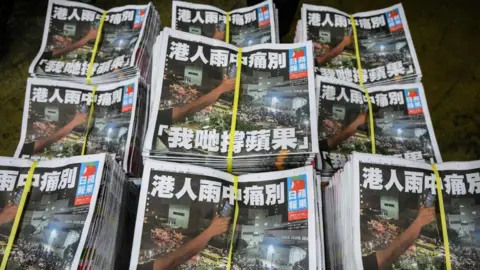
Copies of the last Apple Daily newspaper early on June 24, 2021
Beijing says Hong Kong has now moved from "chaos to governance" and onto "greater prosperity" because of the national security law and a "patriot-only" parliament. But critics, including hundreds of thousands of Hongkongers who have since left, say dissent has been stifled, and the city's freedoms severely curbed.
Lee, the lawmaker, is among them: "When I first came to the UK, I had nightmares. I felt very guilty. Why could we live in other places freely, while our good friends were jailed?"
Lai's family has been calling for his release for years, citing concerns for his health because he is diabetic, but their calls have been rejected so far. The government and Lai's Hong Kong legal team have said that his medical needs are being met.
Carmen Tsang, Lai's daughter-in-law who lives in Hong Kong with her family, says her children miss grandpa - and the big family dinners he hosted every two weeks. His loud voice scared her daughter when she was younger, but "they loved going to grandpa's place… They think he's a funny guy".
She is not sure today's Hong Kong has a place for Lai.
"If there's a speck of dust in your eye, you just get rid of it, right?"
Watch: What does the Jimmy Lai verdict mean for democracy in Hong Kong?
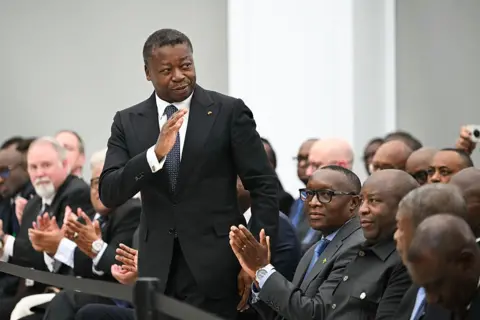
Faure Gnassingbé is cultivating a range of sometimes opposing alliances
While some West African nations are choosing to cement old ties with France and others cultivate a new relationship with Russia, one country is trying to have the best of both worlds.
As the 7 December attempted military coup in Benin collapsed, the rebels' leader, Lt Col Pascal Tigri, made his discreet escape, apparently over the border into neighbouring Togo. From this temporary refuge, it seems he was then able to travel on to a more secure offer of asylum elsewhere - probably in the Burkina Faso capital Ouagadougou, or Niamey in Niger.
The opacity surrounding Togo's rumoured role in this affair is typical of a country that, under the leadership of Faure Gnassingbé, knows how to extract the maximum diplomatic leverage by defying convention and cultivating relations with a variety of often competing international partners.
The Lomé regime is far too shrewd to be caught out openly supporting a challenge to Benin's President Patrice Talon – with whom its relations are guarded at best – or officially confirming the Béninois belief that it secured coup-leader Tigri's passage to safety. Both governments are members of the beleaguered Economic Community of West African States (Ecowas).
Yet Gnassingbé makes no secret of cultivating affable and supportive relations with Burkina Faso and the fellow Sahelian military governments in Niger and Mali – all three of whom walked out of Ecowas last January.
Nor is he afraid of reminding France, Togo's traditional main international partner, that he has other options.
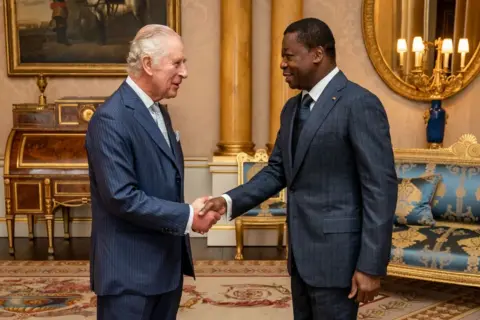
On 30 October President Emmanuel Macron welcomed Gnassingbé to the Élysée Palace for talks aimed at strengthening bilateral relations.
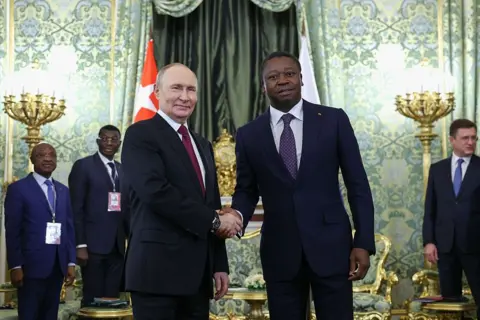
But less than three weeks later, the Togolese leader was in Moscow for a notably warm encounter with Russian President Vladimir Putin. They formally approved a defence partnership allowing Russian vessels to use Lomé port, one of the best-equipped deepwater harbours on the western coast of Africa and a key supply gateway for the landlocked Sahelian states that, following the military coups of 2020 to 2023, have become key Kremlin protégés.
While Gnassingbé's trip to Paris was fairly low-key, his Moscow excursion was high-profile and wide-ranging.
The bilateral military accord provides for intelligence and joint military exercises (although Lomé has no plans to provide a base for the Africa Corps, the Kremlin-controlled successor to the now disbanded Wagner mercenary outfit). All this was supplemented with plans for economic cooperation and an announcement of the reopening of their respective embassies, both closed back in the 1990s.
Anadolu via Getty Images
Most people in Togo have only ever known life under the Gnassingbé family
Inevitably all this has unsettled France, for whom Togo was once regarded as among the most devoted of allies.
When Lt Col Tigri launched his coup attempt in Benin, Macron was quick to show other Ecowas governments that it was France that could rapidly provide emergency specialist military support for their intervention to protect constitutional order.
The Togolese insist that their move to strengthen ties with Russia is not a conscious move to break ties with the West. Instead, Lomé presents the move as a natural diversification of relationships.
And there is some coherence to this argument.
Three years ago Togo and Gabon opted to complement their longstanding participation in the grouping of French-speaking countries, the International Francophonie Organisation (IOF), with membership of the Commonwealth too. Meanwhile, last year English-speaking Ghana, a Commonwealth stalwart, joined the Francophonie.
Indeed, these days many West African governments become exasperated with the outside world's tendency to view such connections as a choice between a new Cold War alignment or taking sides in a parochial anglophone-francophone competition between former colonial powers.
They say they want to be friends with a wide range of international partners and see no reason why such relationships should be exclusive.
Togo's premier, perhaps more than any other leader in West Africa, has sought to extend this diversified approach to his regional dealings.
Lomé is a major freight and travel hub whose port can accommodate the largest ocean-going container ships, with feeder vessels distributing transhipped cargo to a range of other smaller or shallower ports that could not do so. From Lomé's airport, local flights fan out across western and central Africa. The city is also home to banks and other regional financial entities.
These connections have helped to diversify the economic foundations of a country whose rural areas remain relatively poor.
AFP via Getty Images
French-speaking Togo recently joined the Commonwealth - a club of mainly former British colonies
Togo needs to remain at the heart of the Ecowas regional grouping and, in fact, sits astride the key Lagos-Abidjan transport corridor, a major development priority for the bloc.
But Gnassingbé has concluded that he also needs to maintain strong relations with the breakaway military-run regimes, now grouped in their own Alliance of Sahelian States (AES) – which Togo's Foreign Minister, Prof Robert Dussey has even speculated about joining.
But this is about more than economic or diplomatic diversification. It also connects to Gnassingbé's domestic political strategy.
A constitutional change announced in 2024 and implemented this year transformed the presidency – which carries a term limit – into a purely ceremonial role and shifted all executive authority into the post of prime minister, now dubbed "president of the council" in a borrowing of Spanish and Italian terminology. This latter post is subject to no term limit.
That allowed Gnassingbé to hand over the presidency to a low-profile regime stalwart and take on the new strong premier role, with little prospect of an end limit on his rule, given the longstanding dominance of his political party, Union for the Republic (UNIR) in successive parliamentary elections.
This was hugely controversial. But protest was rapidly snuffed out.
AFP via Getty Images
Togo lies at the heart of some of West Africa's major trade routes
Individuals even peripherally connected to demonstrations are in custody. High-profile critics such as the rapper Aamron (real name Narcisse Essiwé Tchalla) or the former defence minister Marguerite Gnakadè – who was married to Gnassingbé's late elder brother – have been threatened with prosecution. Journalists say they have been intimidated.
Members of the government have accused protesters of violence. They have warned of "fake news" on social media, argued that human rights arguments are being used to destabilise the situation, accusing elements of civil society of fabricating allegations against the security forces.
In the words of one minister: "Effectively it's terrorism when you encourage people to commit unprovoked violence."
In September, the European Parliament approved a resolution demanding the unconditional release of political prisoners, including the Irish-Togolese dual national Abdoul Aziz Goma, who has been in detention since 2018.
Togo's government responded by calling in the EU ambassador to tell him that the country's justice system operated with total independence.
Through his diverse international strategy, Gnassingbé is seeking to warn off Western critics, signalling that he has choices and options and does not need to cede to Europe, or anyone else.
However, Togo has a history of sudden eruptions of protest or unrest.
And despite his bullish tone, the new "president of the council" may quietly have concluded that it would be wise to afford a gesture of magnanimity, to salve the resentments that still bubble under the surface.
In a state of the nation address earlier this month, he said he would instruct the justice minister to look at possible prisoner releases.
This hint of retreat from the earlier crackdown shows that even Gnassingbé's nimble international networking cannot defuse the underlying political discontent at home.
AFP via Getty Images
Russia now has access to the landlocked Sahel juntas it backs, through Togo's deepwater port
Watch: 'You can't let fear win' - Bondi beachgoers return after fatal attack
Katy Watson,Australia Correspondent at Bondi Beachand
Harry Sekulich
Australia's Prime Minister Anthony Albanese has announced a review into the police and national intelligence agencies after last weekend's Bondi Beach attack.
"The ISIS-inspired atrocity last Sunday reinforces the rapidly changing security environment in our nation," Albanese said, using an acronym for the Islamic State group. "Our security agencies must be in the best position to respond."
A national day of reflection was being held on Sunday to mourn the 15 people killed after two gunmen opened fire at a Jewish festival at the Sydney beach.
Amid tight security, a minute of silence will be observed at 18:47pm local time (07:47 GMT), marking exactly a week since the shooting began.
Police allege the attack on December 14, which they have declared a terrorist incident, was committed by a father-son duo, inspired by "Islamic State ideology".
Naveed Akram, 24, has been charged with 59 offences, including 15 counts of murder and one of committing a terrorist act. His father Sajid was killed during the attack.
Albanese said the intelligence review, due by April 2026, would focus on ensuring authorities were equipped to tackle extremism.
He said: "The Department of Prime Minister and Cabinet will examine whether federal law enforcement and intelligence agencies have the right powers, structures, processes and sharing arrangements in place to keep Australians safe in the wake of the horrific antisemitic Bondi Beach terrorist attack."
In the wake of Australia's deadliest mass shooting in almost three decades, the government has announced plans to tighten gun controls, while the New South Wales is pushing to crack down on hate speech.
Surfers and swimmers pay tribute to victims of Bondi shooting on Friday
As part of a national day of reflection, Bondi was to host a memorial later on Sunday, exactly one week after the tragedy.
Earlier in the day, Governor-General Samantha Mostyn addressed a vigil held in Bondi, hosted by the National Council of Jewish Women Australia, where attendees largely wore white to symbolise peace.
"The entire Jewish community, whether it's here in Bondi or across our nation, you are part of the belonging story and the success of this country," she said.
Australians across the country are still reeling and there's a sense of shock and disbelief that something like this could have happened.
But this weekend, normality returned in some ways. Bondi promenade was once again filled with surfers, runners and dog-walkers returning to their regular routine.
While a sombre mood lingers, children's surf club activities – known locally as 'nippers' – resumed on Sunday as a sign of the community showing resilience.
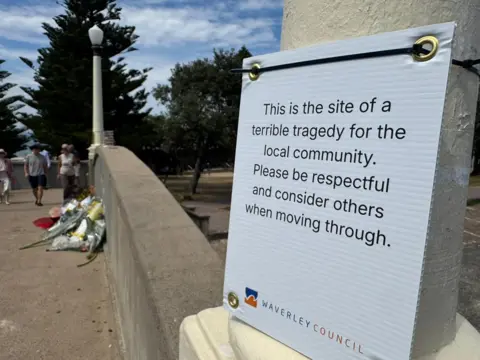
The bridge where two gunmen opened fire on a crowd of people at a Jewish festival at Bondi beach on Sunday, 14 December.
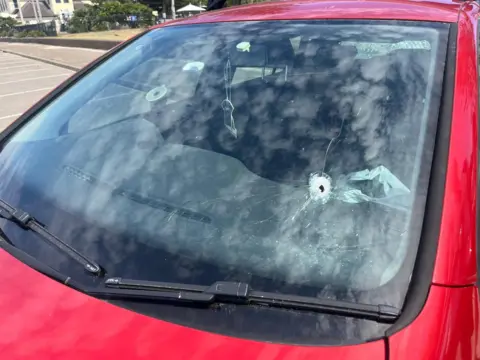
Bullet holes in a car's windshield parked at Bondi a harrowing reminder of the violent attack
North Bondi's Surf Life Saving president Steve Larnach told the BBC they had considered cancelling the regular nippers events.
"We were also aware of the sensitivity towards our Jewish community," Larnach said. "We did ask their opinion, they were very supportive of us going ahead but also extremely grateful for what we did."
Lifeguard volunteers were among the first on the scene at the shooting last week providing first aid, Larnach said.
Some surf lifesavers have been hailed as heroes, including one who was photographed sprinting from a neighbouring beach with a red first aid kit slung over his shoulder.
Geraldine Nordfelft, who brought her daughter to nippers, said "it was really important to return to whatever this new normal is as soon as we could".
"You have to return, you can't stay away, you can't let fear win. The beach is the Australian way of life and we all love it," she told the BBC.
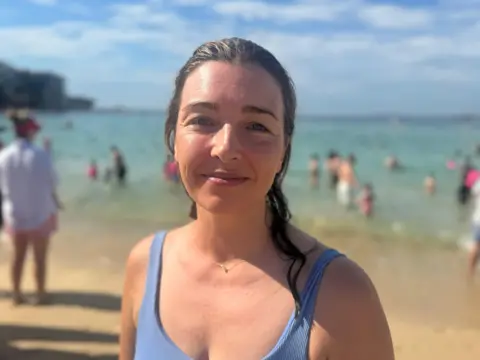
Geraldine Nordfelft brought her daughter to 'nippers' on Sunday
A covered elephant's body lies by the track in Hojai district, Assam state, as police and railway officials examine the scene
Seven wild Asian elephants, including calves, were killed when a high-speed train collided with a herd crossing the tracks in north-eastern India, local officials say.
They say another calf was injured in the incident early on Saturday in Hojai district, Assam state.
The Northeast Frontier Railway says the train driver spotted dozens of elephants and used the emergency brakes - but some animals were still hit.
Five carriages derailed after the collision, but no injuries were reported among passengers and staff on the Delhi-bound express. Train cancellations and diversions were reported in the area during the day.
The killed elephants were later examined by veterinarians and buried.
Assam has one of the biggest elephant populations in India, with nearly 6,000 animals recorded in the state.
Local railway tracks are often crossed by elephant herds - but Saturday's incident happened at a location that was not a designated elephant corridor, the Northeast Frontier Railway says.
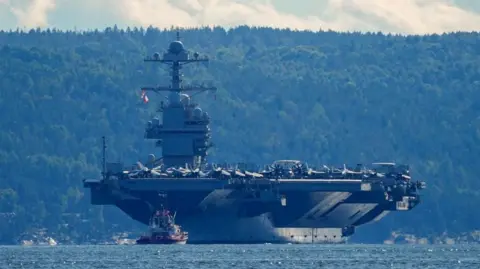
USS Gerald Ford is stationed in the Carribean after it was ordered to the region by the US president amid rising tensions with Venezuela
The US has seized a vessel in international waters off the coast of Venezuela, US officials have told BBC News partner CBS.
It is the second time this month that the US has seized a ship off the country's coast.
The move comes after US President Donald Trump on Tuesday said he was ordering a "blockade" of sanctioned oil tankers entering and leaving Venezuela.
Venezuela has not yet responded to the latest US seizure, but has previously accused Washington of seeking to steal its oil resources.
The BBC has contacted the White House for comment.
The operation was led by the US Coast Guard, similar to the operation earlier this month, CBS reports. The ship was boarded by a specialised tactical team.
In recent weeks, the US has been building up its military presence in the Caribbean Sea and has carried out deadly strikes on alleged Venezuelan drug-smuggling boats, killing around 100 people.
The US has provided no public evidence that these vessels were carrying drugs, and the military has come under increasing scrutiny from Congress over the strikes.
The US has accused Venezuela President Nicolás Maduro of leading a designated-terrorist organisation called Cartel de los Soles, which he denies.
The Trump administration accuses him of and the group of using "stolen" oil to "finance themselves, Drug Terrorism, Human Trafficking, Murder, and Kidnapping".
Venezuela - which is home to the world's largest proven oil reserves - is highly dependent on revenues from its oil exports to finance its government spending.
Trump's announcement of a "blockade" came less than a week after the US seized an oil tanker believed to be part of the "ghost fleet" off the coast of Venezuela, which allegedly used various strategies to conceal its work.
The White House said the vessel in question, called the Skipper, had been involved in "illicit oil shipping" and would be taken to a US port.
Watch: Images, cassettes and high-profile figures - What's in the latest Epstein files?
The release of thousands of pages of documents related to the late sex offender Jeffrey Epstein's abuse has left some who were anxiously awaiting the files disappointed.
The documents' release was prompted by an act of Congress that directed the US Justice Department (DOJ) to make materials related to Epstein's crimes public. But some documents have numerous redactions, and others have not been shared publicly at all.
The lawmakers who pushed for these documents to see the light of day have said the release is incomplete and described the Justice Department's efforts as insincere.
Some legal experts also warned that the breadth of redaction may only fuel ongoing conspiracy theories.
But Deputy US Attorney Todd Blanche said on Friday - the day the materials were released - that the department identified more than 1,200 Epstein victims or their relatives, and withheld material that could identify them.
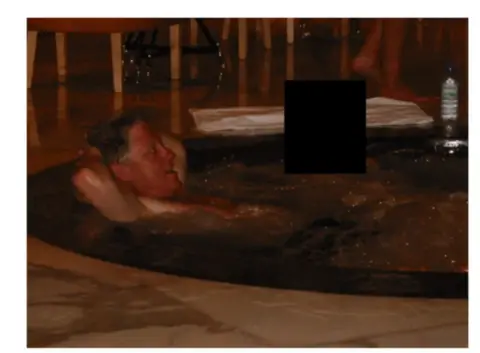
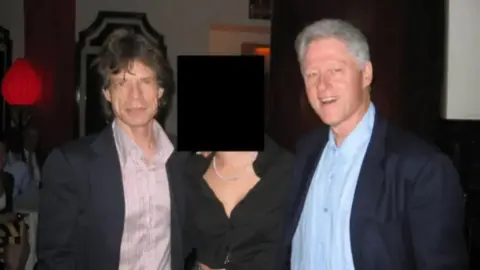
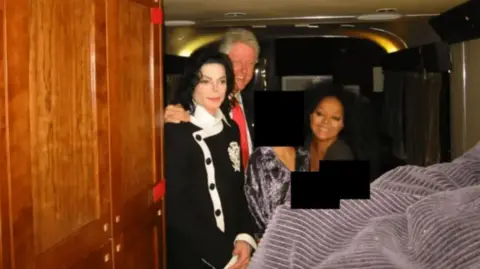
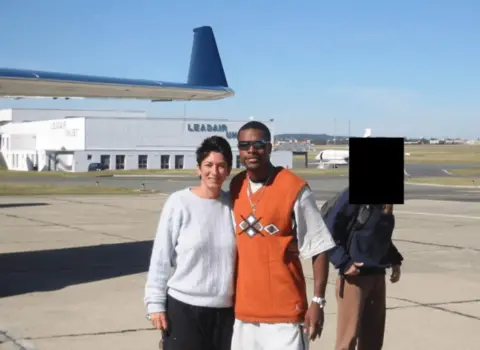
Among the latest released information is a photo of Epstein confidante Ghislane Maxwell outside Downing Street, a document that claims Epstein introduced a 14-year-old girl to US President Donald Trump at Mar-a-Lago, and multiple images of former President Bill Clinton.
Trump has consistently denied any wrongdoing in relation to Epstein and has not been accused of any crimes by Epstein's victims. Clinton has never been accused of wrongdoing by survivors of Epstein's abuse, and has denied knowledge of his sex offending.
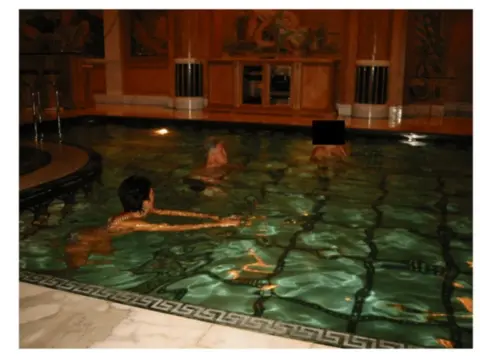
Other released photos show the interiors of Epstein's homes, his overseas travels, as well as celebrities, including Andrew Mountbatten-Windsor, Mick Jagger, Michael Jackson, Diana Ross and Peter Mandelson.
Being named or pictured in the files is not an indication of wrongdoing. Many of those identified in the files or in previous releases related to Epstein have denied any wrongdoing.
US Department of Justice
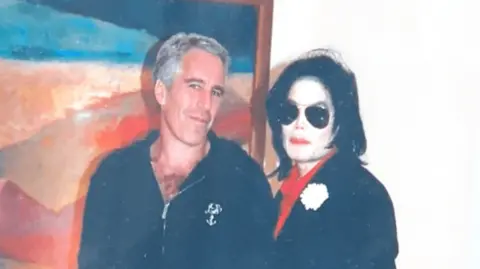
Epstein poses with Michael Jackson
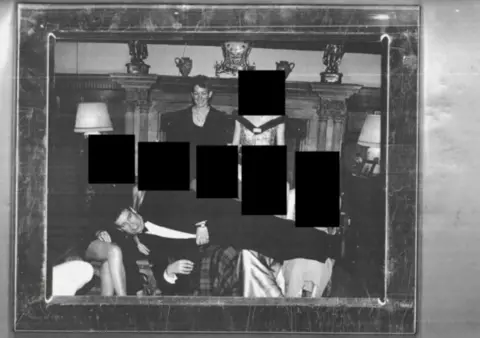
But many of the documents are also heavily redacted.
The Justice Department said it would comply with the congressional request to release documents, with some stipulations.
It redacted personally identifiable information about Epstein's victims, materials depicting child sexual abuse, materials depicting physical abuse, any records that "would jeopardize an active federal investigation" or any classified documents that must stay secret to protect "national defense or foreign policy".
In a post on X, the DOJ said it was "not redacting the names of any politicians", and added a quote they attributed to Blanche, saying: "The only redactions being applied to the documents are those required by law - full stop.
"Consistent with the statute and applicable laws, we are not redacting the names of individuals or politicians unless they are a victim."
John Day, a criminal defence attorney, told the BBC he was surprised by the amount of information that was redacted.
"This is just going to feed the fire if you are a conspiracy theorist," he said. "I don't think anyone anticipated there would be this many redactions. It certainly raises questions about how faithfully the DOJ is following the law."
Mr Day also noted that the justice department is required to provide a log of what was being redacted to Congress within 15 days of the files' release.
"Until you know what's being redacted you don't know what's being withheld," he said.
In a letter to the judges overseeing the Epstein and Maxwell cases, US attorney for the Southern District of New York Jay Clayton, said: "Victim privacy interests counsel in favour of redacting the faces of women in photographs with Epstein even where not all the women are known to be victims because it is not practicable for the department to identify every person in a photo."
Clayton added that "this approach to photographs could be viewed by some as an over-redaction" - but that "the department believes it should, in the compressed time frame, err on the side of redacting to protect victims."
Reuters
Epstein survivor Liz Stein has called for all of the files to be released
Survivors of Epstein's abuses, are among those most frustrated by the release.
Epstein survivor Liz Stein told BBC Radio 4's Today programme that she thinks the Justice Department is "really brazenly going against the Epstein Files Transparency Act", which is the law that requires all the documents to be released.
Survivors are really worried about the possibility of a "slow roll-out of incomplete information without any context", she noted.
"We just want all of the evidence of these crimes out there."
Baroness Helena Kennedy, a human rights lawyer and Labour peer in the House of Lords in the UK, said she was told the redactions in the documents were there to protect the victims.
"Authorities always have a worry" about "exposing people to yet further denigration in the public mind", she told the BBC's Today programme.
Many Epstein survivors seem "very keen" to have the material exposed, she said, but added that they "might not be so keen if they knew exactly what was in there".
Democrat Congressman Ro Khanna, who led the charge along with Republican CongressmanThomas Massie to release the files, said the release was "incomplete" and added that he is looking at options like impeachment, contempt or referral to prosecution.
"Our law requires them to explain redactions," Khanna said. "There is not a single explanation."
Massie seconded Khanna's statement and posted on social media that Attorney General Pam Bondi and other justice department officials could be prosecuted by future justice departments for not complying with the document requirements.
He said the document release "grossly fails to comply with both the spirit and the letter of the law" of the Epstein Files Transparency Act.
After the release, the White House called the Trump Administration the most "transparent in history", adding that it has "done more for the victims than Democrats ever have".
Blanche was asked in an interview with ABC News whether all documents mentioning Trump in the so-called Epstein files will be released in the coming weeks.
"Assuming it's consistent with the law, yes," Blanche said. "So there's no effort to hold anything back because there's the name Donald J Trump or anybody else's name, Bill Clinton's name, Reid Hoffman's name.
"There's no effort to hold back or not hold back because of that."
"We're not redacting the names of famous men and women that are associated with Epstein," he added.
USS Gerald Ford is stationed in the Carribean after it was ordered to the region by the US president amid rising tensions with Venezuela
The US has seized a vessel in international waters off the coast of Venezuela, US officials have told BBC News partner CBS.
It is the second time this month that the US has seized a ship off the country's coast.
The move comes after US President Donald Trump on Tuesday said he was ordering a "blockade" of sanctioned oil tankers entering and leaving Venezuela.
Venezuela has not yet responded to the latest US seizure, but has previously accused Washington of seeking to steal its oil resources.
The BBC has contacted the White House for comment.
The operation was led by the US Coast Guard, similar to the operation earlier this month, CBS reports. The ship was boarded by a specialised tactical team.
In recent weeks, the US has been building up its military presence in the Caribbean Sea and has carried out deadly strikes on alleged Venezuelan drug-smuggling boats, killing around 100 people.
The US has provided no public evidence that these vessels were carrying drugs, and the military has come under increasing scrutiny from Congress over the strikes.
The US has accused Venezuela President Nicolás Maduro of leading a designated-terrorist organisation called Cartel de los Soles, which he denies.
The Trump administration accuses him of and the group of using "stolen" oil to "finance themselves, Drug Terrorism, Human Trafficking, Murder, and Kidnapping".
Venezuela - which is home to the world's largest proven oil reserves - is highly dependent on revenues from its oil exports to finance its government spending.
Trump's announcement of a "blockade" came less than a week after the US seized an oil tanker believed to be part of the "ghost fleet" off the coast of Venezuela, which allegedly used various strategies to conceal its work.
The White House said the vessel in question, called the Skipper, had been involved in "illicit oil shipping" and would be taken to a US port.
Watch: Moment German engineer becomes world's first wheelchair user to go into space
An engineer from Germany has become the world's first wheelchair user to go into space.
Michaela Benthaus, who suffered a spinal cord injury in a mountain bike accident seven years ago, had reached out to a retired space engineer online to see if her dream of being an astronaut was still possible.
He then helped organise the historic 10-minute flight with Blue Origin, the space tourism company founded by Jeff Bezos.
Ms Benthaus and five others blasted off from Texas on Saturday and reached a point just above the so-called "boundary" of space, known as the Kármán line.
"It was the coolest experience!" she said after landing in a video shared by Blue Origin.
"I didn't only like the view and the micro-gravity, but I also liked going up. That was so cool, every stage of going up."
New Shepard, Blue Origin's reusable sub-orbital launch vehicle, took off from the company's Texas launch pad at 14:15 GMT.
Ms Benthaus, who works at the European Space Agency, said she had "really, really figured out how inaccessible our world still is" for people with disabilities following her accident.
She made her own way from her wheelchair into the capsule, using a bench extending from the hatch.
Hans Koenigsmann, the retired SpaceX manager who helped organise the trip, was strapped in nearby to offer assistance during the flight if needed.
"I met Hans the first time online," Ms Benthaus said. "I just asked him, like, you know, you worked for so long for SpaceX, do you think that people like me can be astronauts?"
Koenigsmann said Ms Benthaus "basically inspired me to do this. "It's her drive that kind of convinced me I should do that, too, and to just experience something that I've seen from the outside for a long time," he said.
Blue Origin said ground support equipment was added to help Ms Benthaus enter and exit the capsule.
"Michi's flight is particularly meaningful, demonstrating that space is for everyone, and we are proud to help her achieve this dream," Phil Joyce, senior vice-president of New Shepard, said.
The cost of the mission, which is the 16th suborbital space tourism launch carried out by Blue Origin, has not been revealed.
The company has taken dozens of tourists to space. In April, pop star Katy Perry, Bezos's fiancée Lauren Sánchez and CBS presenter Gayle King were among six women blasted into space aboard a Blue Origin rocket for a flight that lasted about 11 minutes.
The high-profile flights come at a time when private space companies are fiercely competing for dominance in space tourism.
Watch: Former US President Bill Clinton featured in new Epstein photos
The US justice department has released an initial tranche of documents related to Jeffrey Epstein.
The documents, which include photos, videos and investigative documents, were highly anticipated after Congress passed a law mandating the files be released in their entirety by Friday. The Department of Justice (DOJ), however, acknowledged it would not be able to release all of the documents by the deadline.
A number of famous faces are included in the first batch of files - including former US President Bill Clinton, Andrew Mountbatten-Windsor, and musicians Mick Jagger and Michael Jackson.
Being named or pictured in the files is not an indication of wrongdoing. Many of those identified in the files or in previous releases related to Epstein have denied any wrongdoing.
Several hundred thousand pages still have not been released
Among the documents released on Friday are many that are redacted, including police statements, investigative reports and photos.
More than 100 pages in one file related to a grand jury investigation are entirely blacked out.
Officials, as outlined in the law, were allowed to redact materials to protect the identity of victims, or anything related to an active criminal investigation, but they were required by law to explain such redactions, which has not yet been done.
The thousands of pages released on Friday are only a share of what is to come, according to the justice department.
Deputy Attorney General Todd Blanche said the department was releasing "several hundred thousand pages" on Friday and that he expected "several hundred thousand more" to be released over the coming weeks.
He told Fox & Friends that the department was heavily vetting each page of material to ensure "every victim - their name, their identity, their story, to the extent that it needs to be protected - is completely protected". That is a process, he argued, that takes time.
The timing of when additional materials will be released is unclear, and lawmakers on both sides of the aisle have expressed frustration.
Democrats including Congressman Ro Khanna have threatened action against members of the justice department, including impeachment or possible prosecution over the delay.
Khanna led with Republican Congressman Thomas Massie to force a vote on the Epstein Files Transparency Act, defying US President Donald Trump who at first urged his party to vote against the measure.
"The DOJ's document dump of hundreds of thousands of pages failed to comply with the law," he said on social media, saying in a video that all options were on the table and being mulled over by him and Massie.
Bill Clinton pictured in pool and hot tub
US Department of Justice
Several of the images released include former US President Bill Clinton.
One picture shows him swimming in a pool, and another shows him lying on his back with his hands behind his head in what appears to be a hot tub.
Clinton was photographed with Epstein several times over the 1990s and early 2000s, before the disgraced financier was first arrested. He has never been accused of wrongdoing by survivors of Epstein's abuse, and has denied knowledge of his sex offending.
A spokesperson for Clinton commented on the new photos, saying they were decades old.
"They can release as many grainy 20-plus-year-old photos as they want, but this isn't about Bill Clinton. Never has, never will be," Angel Ureña wrote on social media.
"There are two types of people here. The first group knew nothing and cut Epstein off before his crimes came to light. The second group continued relationships with him after. We're in the first. No amount of stalling by people in the second group will change that," he continued.
"Everyone, especially MAGA, expects answers, not scapegoats."
US Department of Justice
Epstein allegedly introduced Trump to 14-year-old girl
In the tranche of files released by the justice department are court documents that mention the US president.
The court documents detail that Epstein allegedly introduced a 14-year-old girl to Trump at his Mar-a-Lago resort in Florida.
During the alleged encounter in the 1990s, Epstein elbowed Trump and "playfully asked him", in reference to the girl, "This is a good one, right?", the document says.
Trump smiled and nodded in agreement, according to the lawsuit filed against Epstein's estate and Ghislaine Maxwell in 2020.
The document says that "they both chuckled" and she felt uncomfortable, but "at the time, was too young to understand why".
The victim alleges she was groomed and abused by Epstein over many years.
In the court filing she makes no accusations against Trump, and Epstein's victims have not made any allegations against him.
The BBC has contacted the White House for comment.
The alleged episode is one of very few mentions of the president in the thousands of files released on Friday. He can be seen in several photos but his inclusion is minimal at best.
The Trump War Room, the official X account for the president's political operation, instead was posting photographs of Clinton. Trump's press secretary, too, re-posted images of Clinton, saying "Oh my!"
However, there are still pages to be released.
Deputy Attorney General Todd Blanche has said that "several hundred thousand" pages of documents are still being reviewed and have yet to be made public.
The US president has previously said he was a friend of Epstein's for years, but said they fell out in about 2004, years before Epstein was first arrested. Trump has consistently denied any wrongdoing in relation to Epstein.
Photo appears to show Andrew laying across laps
US Department of Justice
A photo in the released files appears to show Andrew Mountbatten-Windsor laying across five people, whose faces are redacted. Epstein's convicted co-conspirator Ghislaine Maxwell is seen in the image standing behind them.
Andrew has faced years of scrutiny over his past friendship with Epstein, who does not appear in the photo.
He has repeatedly denied all wrongdoing in relation to Epstein, and said he did not "see, witness or suspect any behaviour of the sort that subsequently led to his arrest and conviction".
Michael Jackson, Diana Ross, Chris Tucker and Mick Jagger
US Department of Justice
Epstein poses with Michael Jackson
The newly released documents include the widest assortment of celebrities we've seen in an Epstein file release so far.
The former financer was known for having connections across entertainment, politics and business. Some images released by the DOJ show him with stars that include Michael Jackson, Mick Jagger and Diana Ross.
It's unclear where or when any of the photos were taken or in what context. It's also unclear if Epstein was associated with all of these figures or whether he attended these events. Previously released photos from Epstein's estate have included photos that he did not take from events where he was not in attendence.
In one of the newly released photos, Epstein is photographed with Michael Jackson. The pop idol is wearing a suit and Epstein is seen in a zip-up hoodie.
US Department of Justice
Rolling Stones legend Mick Jagger is seen here posing with Clinton
Another image of Jackson shows him with former US President Bill Clinton and Diana Ross. They are posing together in a small area and multiple other faces are redacted from the image.
Another photo in the thousands of files shows Rolling Stones legend Jagger posing for a photo with Clinton and a woman whose face is redacted. They are all in cocktail attire.
Several photos include the actor Chris Tucker. One shows him posing and seated next to Clinton at a dining table. Another shows him on an airplane tarmac with Ghislaine Maxwell, the convicted associate of Epstein.
The BBC has contacted Jagger, Tucker and Ross for comment. Clinton has previously denied knowledge of Epstein's sex offending and a spokesperson on Friday said they were decades-old photos.
"This isn't about Bill Clinton. Never has, never will be," the spokesperson said.
US Department of Justice
Michael Jackson and Diana Ross are photographed with Clinton
US Department of Justice
Actor Chris Tucker seen posing with convicted Epstein associate Ghislaine Maxwell
Epstein threatened to burn down house, accuser says
One of the first people to report Epstein is included in the files. Maria Farmer, an artist who had been working for Epstein, told the FBI in a 1996 report that he had stolen personal photos she took of her 12-year-old and 16-year-old sisters.
She said in a complaint that she believed he sold the photos to potential buyers, and said he threatened to burn her house down if she told anyone about it. Her name is redacted in the files but Farmer confirmed the account was hers.
She notes in the report that Epstein had allegedly asked her to take pictures for him of young girls at swimming pools.
"Epstein is now threatening [redacted] that if she tells anyone about the photos he will burn her house down", the report states.
Farmer said she feels vindicated after nearly 30 years.
Former Pakistan Prime Minister Imran Khan and his wife Bushra Bibi have been sentenced to further jail terms following a fraud case involving state gifts.
They were convicted of breaking Pakistan's rules on gifts after Bibi was given a luxury jewellery set by Saudi Arabia's Mohammed bin Salman during a 2021 state visit.
The pair are already serving time in prison for earlier convictions, and the new sentences - 10 years for criminal breach of trust and seven years for criminal misconduct, and a fine - will reportedly run concurrently to their earlier terms.
Khan has described the charges as politically motivated and his lawyer told BBC News his team plan to challenge the verdict.
Speaking to the BBC after the sentencing, the former prime minister's lawyer, Salman Safdar, said Khan and his wife had not been present for the hearing.
Mr Safdar said their legal team had only been informed about the sentencing late on Friday night, after normal court hours.
They planned to mount a challenge to the verdict in the high court, Mr Safdar said.
He has faced charges inmore than 100 cases, ranging from leaking state secrets to selling state gifts. The BBC has been unable to confirm the exact number brought against him.
The jewellery case, referred to as Toshakhana 2 in Pakistan, concerns a Bulgari jewellery set given to Bushra Bibi by Saudi Arabia's Crown Prince Mohammed bin Salman during a state visit in 2021, according to court documents.
Under Pakistan's rules on state gifts, these items go to Pakistan's Toshakana department (state treasury), but politicians are able to purchase the items back.
Khan is alleged to have asked a private firm to undervalue the jewellery set, before purchasing it back at a significantly reduced price.
In addition to their jail terms, the pair were handed a fine of over 16 million Pakistani rupees (£42,600).
Khan has previously been acquitted in a separate Toshakhana case.
The former leader still has other cases outstanding against him.
These include terrorism charges relating to violent protests that took place on 9 May 2023, when he was previously arrested.
Khan was Pakistan's prime minister until April 2022 when he was ousted in a vote of no confidence.
Although he has not been seen in public, his social media accounts have continued to operate with messages attributed to him on X often appearing after jail visits.
These have been highly critical of Pakistan's current government and its politically powerful army Chief Field Marshall Asim Munir, including posts calling him a tyrannical dictator.
In November, he was denied any visitors for nearly a month.
After campaigning by his family and party, his sister was allowed to visit in early December; a few hours after she saw him, his account posted a comment credited to Khan calling the Field Marshall Asim Munir a "mentally unstable person".
Khan has not been allowed any family visits since.
According to an official at the jail, Khan and his wife were present when the verdict was announced but no journalists were allowed to observe.
The judgement states the judge was lenient in sentencing because of Khan's "old age".
Chris Minns, Premier of New South Wales, has pushed for tougher hate speech laws following the Bondi attacks
The Australian state where the Bondi shooting occurred plans to ban the phrase "globalise the intifada" as part of a crackdown on "hateful" slogans.
New South Wales (NSW) premier Chris Minns has also called for a Royal Commission into the Bondi attack, marking the deadliest shooting in Australia in nearly 30 years.
Fifteen people were killed and dozens injured last Sunday when two gunmen, believed to have been motivated by "Islamic State ideology", opened fire on a Jewish festival at the country's most iconic beach.
Australia's state and federal governments have announced a raft of measures to counter extremism since the attack.
Minns plans to recall the state parliament next week to pass through stricter hate speech and gun restrictions. Earlier this week, he also suggested he would tighten protest laws to scale back mass demonstrations to encourage "a summer of calm".
The premier confirmed he would seek to classify the chant "globalise the intifada" as hate speech.
Two pro-Palestinian protesters were arrested on Wednesday for allegedly shouting slogans involving intifada at a demonstration in central London.
The term intifada came into popular use during the Palestinian uprising against Israeli occupation of the West Bank and Gaza Strip in 1987.
Some have described the term as a call for violence against Jewish people. Others have said it is a call for peaceful resistance to Israel's occupation of the West Bank and actions in Gaza.
Earlier this week, Minns, along with the NSW Opposition Leader Kellie Sloane, attended the funeral Matilda, 10, who was the youngest victim of the Bondi shooting. He read out a poem dedicated to the young girl at the event.
Prime minister Anthony Albanese has announced a new gun buyback scheme to purchase surplus, newly banned and illegal firearms. Hundreds of thousands of guns will be collected and destroyed, the government predicts.
Around 1,000 lifeguards staged a tribute on Saturday, lining up arm-to-arm facing the ocean, on the shorelines of Bondi beach. Surf lifesaving teams at other beaches around Australia were photographed performing a similar memorial.
Through the week, Bondi's surf volunteers have been commemorated as some of the heroes of the shooting. Lifeguard Jackson Doolan was photographed sprinting over from a neighbouring beach during the attack carrying a red medical supply bag.
Hundreds of swimmers and surfers paddled out at Bondi beach yesterday to create a giant circle to pay tribute to the victims of the attack.
On Sunday, Australia will hold a national day of reflection with the theme "light over darkness" marking precisely one week after the attack started with a minute's silence at 6:47 pm (0747 GMT).
Flags will fly at half-mast and Australians are being asked to light a candle in their windows to honour the victims.
"Sixty seconds carved out from the noise of daily life, dedicated to 15 Australians who should be with us today," prime minister Albanese told reporters Saturday.
"It will be a moment of pause to reflect and affirm that hatred and violence will never define us as Australians."
Bondi's attack was Australia's worst mass shooting since Port Arthur in 1996, where 35 people were killed and prompted then-prime minister John Howard to introduce strict gun control measures.
Watch: Putin tells BBC Western leaders deceived Russia
Reporters ask world leaders questions all the time.
No big deal. Right?
But what's it like putting a question to Vladimir Putin - the president who ordered the full-scale invasion of Ukraine, the leader whose country was accused this week by the head of MI6 of "the export of chaos"?
And imagine asking that question live on TV while millions of Russians are watching.
It's a big responsibility. You don't want to mess up.
"My question is about Russia's future. What kind of future are you planning for your country and your people?" I ask President Putin.
"Will the future be like the present, with any public objection to the official line punishable by law? Will the hunt for enemies at home and abroad be accelerated? Will mobile internet outages become even more common? Will there be new 'special military operations'?"
While I'm speaking, Vladimir Putin is making notes. And then replies.
He defends Russia's repressive foreign agent law. Hundreds of Russians who are critical of the authorities have been designated "foreign agents".
"We didn't invent it," Putin tells me.
"This [foreign agent] law was adopted in a string of Western countries, including in America in the 1930s. And all these laws, including the US one, are much tougher…"
In reality, the Russian law is draconian. It excludes "foreign agents" from many aspects of public life, including teaching, the civil service, elections and public events. It imposes financial and property restrictions. Criminal prosecution can follow a single administrative fine.
However, I'm unable to point this out to President Putin. The microphone was taken away from me after I'd finished my question.
Suddenly the moderator intervenes to change the subject.
"There's another question here: 'What's going to happen to the BBC? It's facing a multi-billion lawsuit from the US president?'," says anchor Pavel Zarubin.
"I think President Trump is right," President Putin confirms.
The Kremlin and the White House seeing eye to eye… on the BBC.
Putin returns to my question.
"Will there be new special military operations? There won't be, if you treat us with respect, and respect our interests, just as we've always tried to do with you. Unless you cheat us, like you did with Nato's eastward expansion."
Visible for all to see is what is driving Vladimir Putin - a deep-seated resentment of the West.
He argues that, for years, Western leaders have disrespected, deceived and lied to Russia - and that they're lying still by claiming that Moscow intends to attack Europe. "What kind of rubbish is that?" declares the Kremlin leader.
But many European leaders simply don't trust Moscow.
In the run-up to the full-scale Russian invasion of Ukraine, Russian officials denied they had plans for a mass attack.
More recently Russia has been accused of violating European air space with fighter jets and drones, as well as of carrying out cyber-attacks and acts of sabotage.
But as he finished answering my question, was this an olive branch to Europe from Russia's president?
"We're ready to cease hostilities immediately provided that Russia's medium- and long-term security is ensured, and we are ready to co-operate with you."
However, if Moscow continues to connect its long-term security to its maximalist demands over Ukraine, European leaders will remain sceptical.
The US says its military has carried out a "massive strike" against the Islamic State group (IS) in Syria, in response to a deadly attack on American forces in the country.
Defence Secretary Pete Hegseth said Operation Hawkeye Strike was aimed at eliminating IS "fighters, infrastructure, and weapons sites".
Fighter jets, attack helicopters and artillery hit multiple targets in central Syria, US officials told CBS, the BBC's media partner in the US. Aircraft from Jordan were also involved.
In a post on X late on Friday, Hegseth wrote: "This is not the beginning of a war - it is a declaration of vengeance. The United States of America, under President Trump's leadership, will never hesitate and never relent to defend our people.
"If you target Americans - anywhere in the world - you will spend the rest of your brief, anxious life knowing the United States will hunt you, find you, and ruthlessly kill you.
"Today, we hunted and we killed our enemies. Lots of them. And we will continue," the US defence secretary added.
Meanwhile, the US Central Command (Centcom) said that "US forces have commenced a large-scale strike" against IS, adding that more information would be provided soon.
Posting on Truth Social later on, President Trump said the US "is inflicting very serious retaliation, just as I promised, on the murderous terrorists responsible".
He said the Syrian government was "fully in support".
Meanwhile, the UK-based Syrian Observatory for Human Rights (OBHR) said IS positions near the cities of Raqqa and Deir ez Zor were targeted.
It said that a prominent IS leader and a number of fighters were killed.
IS has not publicly commented. The BBC was unable to verify the targets immediately.
Centcom, which directs American military operations in Europe, Africa and the Indo-Pacific, earlier said that the deadly attack in Palmyra was carried out by an IS gunman, who was "engaged and killed".
Another three US soldiers were injured in the ambush, with a Pentagon official saying that it happened "in an area where the Syrian president does not have control."
At the same time, the SOHR said the attacker was a member of the Syrian security forces.
No group has claimed responsibility for the attack, and the identity of the gunman has not been released.
Sami al-Saei alleges that he was sexually abused by prison guards while being detained without charge
This article contains descriptions of sexual abuse and violence which some readers may find distressing.
Two Palestinian men have told the BBC they personally experienced the kind of beatings and sexual abuse highlighted in recent reports into the treatment of prisoners in Israeli detention.
The United Nations Committee against Torture said last month that it was deeply concerned about reports indicating "a de facto state policy of organised and widespread torture and ill treatment" of Palestinian detainees in Israeli jails. It said the allegations had "gravely intensified" after the Hamas-led attacks on Israel on 7 October 2023.
Other reports by Israeli and Palestinian rights groups have detailed what they say is "systematic" abuse.
Israel has denied all the allegations, but rights groups say the fury in the country over the 7 October attacks and the treatment of Israeli hostages in Gaza has created a culture of impunity within the prison services, especially towards detainees who have expressed support for Hamas and its attacks.
Last year, leaked CCTV footage from inside an Israeli military prison showed a Palestinian man from Gaza allegedly being sexually abused by prison guards. That led to a resignation and recriminations at the top of Israel's military and political establishment.
Sami al-Saei, 46, now works in a furniture shop, but he used to be a freelance journalist in the town of Tulkarm, in the north of the occupied West Bank.
He was arrested by Israeli soldiers in January 2024 after working with reporters to arrange interviews with members of Hamas and other armed groups.
He was detained without being charged for 16 months, under a controversial Israeli system known as administrative detention, before being released this summer.
While he was being held in Megiddo prison in northern Israel, he said, the guards partially stripped him and raped him with a baton on or around 13 March 2024.
He said he had decided to speak to the BBC about his allegations of sexual abuse, despite the risk of being ostracised in the often conservative Palestinian society in the West Bank.
"There were five or six of them," he said.
"They were laughing and enjoying it. The guard asked me: 'Are you enjoying this? We want to play with you, and bring your wife, your sister, your mother, and friends here too,'" Mr al-Saei continued.
"I was hoping to die and be done from that, as the pain was not only caused by the rape, but also from the severe and painful beating."
He said the assault lasted around 15 to 20 minutes, during which time the guards also squeezed his genitals, causing extreme pain.
He said the beatings happened on an almost daily basis, but he was only sexually abused once.
The BBC asked the Israel Prison Service (IPS) for a response to Mr al-Saei's allegations. It sent a statement, which said: "We operate in full accordance with the law, while ensuring the safety, welfare, and rights of all inmates under its custody.
"We are not aware of the claims described, and to the best of our knowledge, no such incidents have occurred under IPS responsibility."
We also asked the IPS whether an investigation had been launched into the alleged sexual assault and whether any medical records existed. It did not comment.
IDF handout
Former Military Advocate General Yifat Tomer-Yerushalmi resigned after admitting her role in leaking a video of alleged abuse by Israeli soldiers
Allegations of abuse of Palestinians in Israeli prisons have been made for decades, but one recent case has shaken the country's establishment and deepened a growing divide in Israeli society over the treatment of prisoners and detainees accused of supporting Hamas.
In August 2024, leaked CCTV from inside Sde Teiman military prison in southern Israel showed a Palestinian detainee from Gaza allegedly being abused with a sharp object by soldiers, leaving the man with a pierced rectum. The assault allegedly happened in July 2024.
Five Israeli reservist soldiers were charged with aggravated abuse and causing serious bodily harm to the detainee.
Last month, they convened a press conference on Israeli television, four of them appearing in black balaclavas to hide their identities.
In an interview with Channel 14 News, a fifth soldier pulled off his mask to reveal his face, saying he had nothing to hide.
All five have denied the charges.
The reservists held the press conference after it emerged that the CCTV footage was leaked by the Israeli military's top lawyer, Military Advocate General Major General Yifat Tomer-Yerushalmi.
She resigned in October, saying that she took full responsibility for the leak. She explained that she had wanted to "counter false propaganda against the army's law enforcement authorities" – a reference to claims from some right-wing politicians that the allegations were fabricated.
Supporters of the far right have held protests in support of the five accused reservists outside Sde Teiman prison.
In July, before her resignation, at a fiery committee hearing at Israel's parliament, Hanoch Milwidsky, a politician from Israeli Prime Minister Benjamin Netanyahu's right-wing Likud party, was challenged over whether raping a detainee was acceptable.
"Shut up, shut up," he shouted. "Yes, everything is legitimate if they are Nukhba [elite Hamas fighters who took part in the 7 October attacks]. Everything."
A recent opinion poll by the widely respected Israel Democracy Institute indicated that the majority of the Israeli public oppose investigating soldiers when they are suspected of having abused Palestinians from Gaza.
"Ahmed" alleges he was abused in an Israeli prison after being found guilty of incitement to terrorism
Ahmed, not his real name, lives in the West Bank with his wife and 11 children.
He was arrested by soldiers in January 2024 and was found guilty of incitement to terrorism, after making social media posts praising the 7 October Hamas-led attacks, in which around 1,200 people, mostly Israelis, were killed and a further 251 were taken hostage.
He was sentenced to one year in prison and fined 3,000 shekels ($935, £700).
He alleges serious sexual abuse while in Israeli detention.
"The prison guards, three of them, took me into a bathroom and stripped me completely naked before forcing me to the ground," Ahmed said in an interview at his home.
"They put my head in the toilet bowl and a massive man, maybe 150kg (330lb), stood on my head, so I was bent over. Then, I heard the voice of someone talking to the prison dog. The dog was named Messi, like the footballer."
He then detailed how he said the dog was used to sexually humiliate him. He said his trousers and underwear were removed and the dog mounted his back.
"I could feel its breath... then it jumped on me... I started to scream. The more I screamed, the more they beat me until I almost lost consciousness."
During his time in detention, Ahmed also said the guards would beat him on a regular basis, including on his genitals.
He said he was released 12 days after the alleged sexual abuse, after serving his full sentence.
We asked Ahmed if there were any medical documents regarding his claims, but he said he did not have any.
We contacted the IPS to ask for a response to Ahmed's allegations, and if an investigation had been launched into his alleged abuse, but we did not receive a reply.
There are over 9,000 Palestinian security detainees held in Israeli jails, nearly double the number before the 7 October attacks. Many have never been charged.
The recent report by the UN Committee against Torture unequivocally condemned the 7 October attacks, and also expressed deep concern over Israel's response and the huge loss of human life in Gaza.
Some of the hostages abducted on 7 October and survivors of the attacks have also made allegations of sexual abuse, rape and torture by Hamas and its allies.
Hamas has also publicly executed Palestinians in Gaza accused of collaborating with Israel.
There are also claims of abuse within prisons run by the Palestinian Authority (PA), which is in charge in parts of the West Bank not under Israeli control and is a political and military rival of Hamas.
The BBC has spoken to a former detainee who said PA security officers beat him and used electric shocks on him.
The BBC has contacted the PA for comment but received no reply. It has previously denied allegations of systematic abuse.
Getty Images
File picture of Megiddo prison, where Sami al-Saei says he was detained
In a report submitted in October to the UN Committee against Torture, five Israeli human rights groups said there had been "a dramatic escalation in torture and cruel, inhuman and degrading treatment across all detention facilities, carried out with near total impunity and implemented as state policy targeting Palestinians".
Adalah, the Public Committee Against Torture in Israel, Parents Against Child Detention, HaMoked, and Physicians for Human Rights–Israel presented evidence that they said showed Israel had "dismantled existing safeguards and now employs torture throughout the entire detention process - from arrest to imprisonment - targeting Palestinians under occupation and Palestinian citizens, with senior officials sanctioning these abuses while judicial and administrative mechanisms fail to intervene".
The report said such practices had resulted in a surge of Palestinian deaths in custody, with at least 94 deaths in Israeli custody documented between the start of the Gaza war and the end of August 2025.
Israel's ambassador to the UN in Geneva rejected the allegations made before the UN Committee against Torture as "disinformation".
Daniel Meron told the expert panel last month that Israel was "committed to upholding its obligations in line with our moral values and principles, even in the face of the challenges posed by a terrorist organisation".
He said the relevant Israeli agencies complied fully with the prohibition against torture and that Israel rejected allegations of systematic use of sexual and gender-based violence.
The ousted chair of Ben & Jerry's has accused the company which owns the brand of threatening to launch a public smear campaign against her.
Anuradha Mittal, who chaired Ben & Jerry's independent board for seven years, told the BBC that Magnum had threatened to publish "defamatory statements" about her if she did not step down from her role.
It relates to an increasingly bitter dispute between the Vermont-based activist ice cream maker and its owner over the independence of the board and its freedom to pursue its social missions.
Magnum said in its view Mittal "no longer met the criteria to serve" on the board, following an investigation it had commissioned by external advisors.
In a statement on Monday, Magnum outlined changes to the way the board operates including a nine-year limit for people serving on it.
As well as Mittal, who said she had received a letter telling her she had been removed from the board, two other board members will be required to leave as a result.
It also said that an audit of the Ben & Jerry's Foundation, a charitable organisation, had "identified a series of material deficiencies in financial controls, governance and other compliance policies, including conflicts of interest".
Speaking to the BBC's World Business Report, Mittal said there had been an escalation of the friction between Ben & Jerry's board and its owner, over the brand's independence, social mission and integrity.
"For several years now, we have been resisting their overreach, including their efforts to muzzle us from speaking out for human rights, for peace," she said.
The brand, which is also known for the playful puns in its flavour names, was owned by Unilever until earlier this month, when the household goods giant spun off its ice cream unit to create, Magnum Ice Cream Company.
Ben & Jerry's was sold to Unilever in 2000 in a deal which allowed it to retain an independent board and the right to make decisions about its social mission.
This was a frequent source of friction while owned by Unilever.
This row has now been inherited by Magnum, culminating in this week's stand-off, and Mittal's removal.
"This October, Unilever-Magnum executives threatened me with defamatory statements in their forthcoming prospectus if I did not resign," Mittal said.
"At the same time, they offered me a prominent role in a multimillion dollar Unilever-funded non-profit if I gave in," she added.
She said she had turned down that "inappropriate" offer.
Magnum is now the world's largest ice cream maker, with its brands include Cornetto, Wall's and Carte D'Or.
Mittal, founder of the Oakland Institute, a human rights and development focused think tank in California, described Magnum's approach as a "public smear campaign" and said the allegations were unfounded.
One of the firm's original founders Jerry Greenfield left the firm in September saying he felt its social mission was being stifled. The other, Ben Cohen, has also hit out at Magnum saying it was "not fit" to own the firm.
In a statement a spokesperson for Magnum said the steps it had taken were aimed at strengthening corporate governance and to "reaffirm the responsibilities of the Board of Ben & Jerry's".
"These actions aim to preserve and enhance the brand's historical social mission and safeguard its essential integrity," a spokesperson said.
When Ben & Jerry's was created in 1978 it made its mark selling flavours such as Cherry Garcia named after the guitarist from rock band Grateful Dead, Bohemian Raspberry, a play on the Queen track, and the now discontinued Vermonty Python.
Magnum said in its statement: "We remain unequivocally committed to Ben & Jerry's three-part mission – product, economic and social – and its progressive, non-partisan values.
"Ben & Jerry's continues to advocate for a range of causes and be a bold voice for social justice, as a glance at its social media channels demonstrates."
A photo released by US Immigration and Customs Enforcement showing Kemal Mrndzic (right) on 2 November 1992
The US justice department has launched a civil legal case against a man accused of being a Bosnian war criminal to revoke his citizenship.
Kemal Mrndzic did not disclose during his US immigration process that he served as a guard at Bosnia's notorious Celebici prison camp, where atrocities were committed, the department said.
A UN war crimes tribunal found that people held in the camp during the Bosnian war were killed, tortured, sexually assaulted, beaten and subjected to cruel and inhuman treatment.
US President Donald Trump's administration would not allow people who "persecute others" to "reap the benefits of refuge in the US", justice department official Brett Shumate said.
The assistant attorney general added that the legal case showed the value that the US government placed on "the integrity of its naturalisation process".
Mrndzic was found guilty by a jury in October 2024 on several counts of criminal fraud and misrepresentation in relation to his successful application for a US passport and naturalisation certificate.
He failed to disclose to immigration authorities the nature and timing of his military service, or that "he persecuted Bosnian-Serb inmates as a prison guard", the justice department said.
Mrndzic was sentenced in January 2025 to more than five years in prison.
US Immigration and Customs Enforcement
A set of photos that appear to show Kemal Mrndzic through the years, from 1992 to 2019, released by US officials
The Bosnian war followed the break-up of Soviet Yugoslavia in the early 1990s and led to the Srebrenica massacre in July 1995.
Srebrenica, recognised by the UN as a genocide, became known as Europe's worst mass atrocity since World War Two, after Bosnian-Serb forces systematically murdered more than 8,000 Bosniak Muslim men and boys.
The Celebici prison camp was operated by Bosniak and Bosnian-Croat forces, who were also responsible for widespread killings in areas they controlled.
Serbian leader Slobodan Milosevic was tried for war crimes and genocide, and the massacre led to the US-brokered Dayton Peace Agreement on 14 December 1995.
The Trevi Fountain is one of Rome's key attractions with around nine million visitors this year
Tourists in Italy's capital Rome will soon have to pay a €2 (£1.75; $2.34) entrance fee if they want to see its famed Trevi Fountain up close.
The new barrier for visitors to view the Baroque monument will come into force from 1 February 2026.
While the coins tossed into the fountain are donated to charity, the fees collected will go to the city authority to pay for upkeep and managing visitors. The city expects to raise €6.5m a year from the fountain alone.
Announcing the move on Friday, Rome's Mayor Roberto Gualtieri was quote by news agency Reuters as saying that "two euros isn't very much ... and it will lead to less chaotic tourist flows".
The Trevi levy is part of a new tariff system for certain museums and monuments in the Italian capital.
Access to a number of sites that currently charge for entry will become free for Rome's residents, such as the Sacred Area of Largo Argentina.
At the same time, tourists and non-residents will have to pay to see the Trevi fountain and five other attractions including the Napoleonic Museum.
Children under the age of five, and those with disabilities and an accompanying person, will be exempt from the fees.
Tourists will still be able to view the Trevi Fountain - built by Italian architect Nicola Salvi in the 18th Century - for free from a distance.
The site currently sees an average of 30,000 visitors per day, according to the City of Rome.
Putin has offered little sign of compromise to end the war, although talks are set to continue in the US
Russia's President Vladimir Putin has said there will be no more wars after Ukraine if Russia is treated with respect - and claims that Moscow is planning to attack European countries are "nonsense".
In a marathon televised event lasting almost four and a half hours, he was asked by the BBC's Steve Rosenberg whether there would be new "special military operations" - Putin's term for the full-scale war.
"There won't be any operations if you treat us with respect, if you respect our interests just as we've always tried to respect yours," he asserted.
His remarks were in line with a recent comment in which he said Russia was not planning to go to war, but was ready "right now" if Europe wanted to.
He also added the condition,"if you don't cheat us like you cheated us with Nato's eastward expansion".
He has long accused Nato of going back on an alleged 1990 Western promise before the fall of the Soviet Union. It was denied years afterwards by late Soviet leader Mikhail Gorbachev.
The "Direct Line" marathon combined questions from the public at large and journalists from across Russia in a Moscow hall, with Putin sitting beneath an enormous map of Russia that encompassed occupied areas of Ukraine, including Crimea.
Russian state TV claimed more than three million questions had been submitted.
EPA
Organisers of the event said three million questions had been submitted to Putin
Although it was largely choreographed, some critical comments from the public appeared on a big screen, including one that referred to the event as a "circus", another bemoaning internet outages and one that highlighted poor-quality tap water. Mobile internet outages have been blamed by authorities on Ukrainian drone attacks.
Putin also addressed Russia's faltering economy, with prices rising, growth on the slide and VAT going up from 20 to 22% on 1 January. One message to the president read: "Stop the crazy rise in prices on everything!"
The Kremlin regularly uses the end-of-year event to highlight the resilience of the economy and, as Putin spoke, Russia's central bank announced it was lowering interest rates to 16%.
Foreign policy issues were mixed with musings about the motherland, praise for local businesses, fish prices and the importance of looking after veterans.
But the issue of almost four years of full-scale war in Ukraine was never far away and it was often in the background of many of the questions.
Putin again claimed to be "ready and willing" to end the war in Ukraine "peacefully" but offered little sign of compromise.
He repeated his insistence on principles he had outlined in a June 2024 speech, when he demanded that Ukrainian forces leave four regions Russia partially occupies and that Kyiv gives up its efforts to join Nato.
Chief among Russia's demands is full control of Ukraine's eastern Donbas, including about 23% of Donetsk region which Russia has not been able to occupy.
Putin argued Russian forces were making advances across the front line in Ukraine and he ridiculed Volodymyr Zelensky's visit to the front line at Kupiansk last week, when the Ukrainian leader was able to refute Russia claims that it had captured the town.
Putin has also demanded new elections in Ukraine to be included in the peace proposals that US President Donald Trump has submitted as part of his efforts to bring the conflict to an end. At his news conference, Putin offered to stop bombing Ukraine when voting took place.
Ukraine's SBU security service said on Friday it had for the first time hit an oil tanker operating as part of Russia's "shadow fleet" in the Mediterranean. Putin said it would not lead to the result that Kyiv wanted and would not disrupt Russian exports.
Most of the questions from Russian media or from the public made little attempt to challenge Putin, but two were allowed from Western correspondents, Keir Simmons of US network NBC and the BBC's Steve Rosenberg.
When Simmons asked if Putin would feel responsible for the deaths of Ukrainians and Russians if he rejected the Trump peace plan, Putin praised the US president's "sincere" efforts to end the war, but said it was the West not Russia that was blocking a deal.
"The ball is in the hands of our Western opponents," he said, "primarily the leaders of the Kyiv regime, and in this case, first and foremost, their European sponsors."
Trump has said a peace deal is closer than ever and, despite Putin's apparent refusal to compromise, the US president has said he hopes "Ukraine moves quickly because Russia is there".
A Ukrainian delegation is holding talks in Miami on Friday with Trump envoy Steve Witkoff and Trump's son-in-law Jared Kushner. German, French and British officials are also there, days after they met the US officials in Berlin.
Kremlin envoy Kirill Dmitriev is also expected in Miami over the weekend, according to reports.
Putin told the BBC's Russia Editor: "We are ready to work with you - with the UK and with Europe in general and with the United States, but as equals, with mutual respect to each other.
"We are ready to cease these hostilities immediately, provided that Russia's medium- and long-term security is ensured, and we are ready to cooperate with you."
He accused the West of creating an enemy out of Russia. Skating over his decision to mount a full-scale invasion in February 2022, he said: "You are waging a war against us with the hands of Ukrainian neo-Nazis," he added, repeating his regular diatribe against Ukraine's democratically elected leaders.
European intelligence agencies have warned that Russia is only a few years away from attacking Nato. The Western defensive alliance's chief Mark Rutte said this month that Russia was already escalating a covert campaign and the West had to be prepared for war.
While many of the questions were benign, including several from children, from a one reporter from Yakutia in north-eastern Siberia highlighted a tenfold increase in energy prices in the past four years. Putin told her that his team would look into alternative sources of energy and "keep Yakutia in mind".
Towards the end of the TV marathon, Putin was asked a series of quickfire questions, touching on his views on friendship, religion, the motherland and love at first sight. He said he believed in love at first sight - then added that he himself was in love, without divulging any more details.
At least three people have been killed and five others injured as a knife-wielding attacker went on a rampage in the Taiwanese capital Taipei.
The 27-year-old suspect set off smoke bombs at Taipei's main metro station on Friday, before running to another station in a busy shopping district, stabbing people along the way, Taiwanese Premier Cho Jung-tai said.
The suspect later died after falling from a building, Cho added. His motive remains unclear.
Attacks of this kind are rare in Taiwan, which has low rates of violent crime. The last time a similar incident struck Taipei was more than a decade ago in 2014.
Friday's attack took place during the city's evening rush hour. Videos shared on social media show people fleeing the scene in panic.
Cho said the suspect had detonated smoke bombs and Molotov cocktails at Taipei's Main Station, which is connected to a busy underground shopping street.
A man reportedly tried to stop the attacker but was struck with a blunt object and later died in hospital.
The suspect then went to another subway station about 800m away, where he set off more smoke bombs and stabbed more people.
Cho said he had ordered increased security at metro and railway stations, as well as airports, in response to the attack.
"We will investigate [the suspect's] background and associated relationships to understand his motives and determine if there are other connected factors," Cho was quoted by news agency Reuters as saying.
Taiwan's President William Lai also promised a swift investigation.
The last major incident of this kind, in 2014, saw a man kill four people on an underground train in Taipei, shocking people in Taiwan. The perpetrator of that attack was executed two years later.
The widow of conservative activist Charlie Kirk has said the Turning Point USA organisation he founded will help elect JD Vance as president in 2028, despite the current US vice-president having yet to announce he is running.
Erika Kirk's endorsement on Thursday came on the opening day of Turning Point's annual America Fest conference, the organisation's largest gathering since her husband was shot dead in September.
"We are going to get my husband's friend, JD Vance, elected for 48 in the most resounding way possible," Kirk said, referring to the 48th president. Trump is the 47th.
Vance, meanwhile, is scheduled to speak at the event on Sunday.
Turning Point has been credited with helping Republican President Donald Trump expand his coalition of support, leading to his 2024 presidential election victory.
Her announcement ahead of Trump's one-year mark in office signals early jockeying to be his successor ahead of the 2028 election.
After Kirk gave her opening remarks, the stage at the Phoenix Convention Center in Arizona turned into a political mudslinging contest as tensions within the conservative movement were laid bare.
Podcaster Ben Shapiro lobbed attacks at media rivals Candace Owens, Tucker Carlson, Megyn Kelly and Steve Bannon, calling them "fraudsters and grifters".
"The people who refused to condemn Candace's truly vicious attacks - and some of them are speaking here tonight - are guilty of cowardice," Shapiro said.
Owens, a former Turning Point employee who hosts a popular podcast, has been a thorn in Republicans' side and pushed various conspiracy theories, including baseless suggestions about Charlie Kirk's murder.
It comes at a time when there has been growing speculation about Trump's hold on the Republican party and infighting among factions of the president's supporters about the future of the Maga movement.
Shapiro also criticised former Fox News host Carlson for interviewing Nick Fuentes, a far-right political commentator and Holocaust denier, on his podcast in late October, drawing widespread condemnation.
After Shapiro, Carlson took the stage and shot back at Shapiro.
"That guy is pompous," Carlson said. "Calls to deplatform at a Charlie Kirk event? That's hilarious."
Charlie Kirk's Turning Point events were known for addressing controversial and divisive topics. Supporters saw it as necessary for free speech. Critics saw it as hate-mongering.
Authorities said Charlie Kirk's alleged assassin - Tyler Robinson - told his romantic partner that he killed Kirk because he "had enough of his hatred".
Erika Kirk told the Turning Point conference: "You won't agree with everyone on this stage this weekend. And that's okay. Welcome to America."
Since the assassination, she said, "we've seen fractures, we've seen bridges being burned that shouldn't be burnt".
Trump has recently encountered a series of setbacks within his Republican party, including a public falling out with his former ally Marjorie Taylor Greene and the impending release of the Epstein files, which a majority of Republicans voted for despite Trump's initial discouragement.
The four-day America Fest conference was scheduled to continue through the weekend, with Vance and Donald Trump Jr scheduled as guest speakers on Sunday.
A Paris court has rejected an effort by the French government to suspend the website of fast-fashion giant Shein in response to it selling childlike sex dolls on its platform.
The court said the request for a three-month suspension was "disproportionate" - but did order age verification for the sale of adult products.
The action against Shein was taken after France's consumer watchdog last month reported it to authorities for selling "sex dolls with a childlike appearance" and weapons.
Shein said its priority remained protecting French consumers and ensuring compliance.
In its judgement, the court acknowledged the seriousness of selling the childlike sex dolls and weapons, but said these had been isolated incidents.
It noted that the Chinese company had taken action to remove the offending items once they were made aware of them, and that the issues related to a small number of the hundreds of thousands of products on sale on its site.
A request by the French government for Shein to be forced to suspend the sale of third-party items on its website - the source of the initial offending items - was also rejected.
In ordering age verification measures to be put in place for the sale of adult items, the court said the fine for each breach would be €10,000 (£8,700; $11,700).
Its launch drew both shoppers and protesters, with opposition related to the sale of childlike sex dolls, and also its profile as a fast fashion retailer.
In a statement, Shein said: "We remain committed to continuously improving our control processes, in close collaboration with the French authorities, with the aim of establishing some of the most stringent standards in the industry.
"Our priority remains protecting French consumers and ensuring compliance with local laws and regulations."
Fernando P being escorted into the regional court in Aachen, western Germany
A court in the German city of Aachen has sentenced a man to eight-and-a-half years in prison for repeatedly drugging and raping his wife, filming the acts and then posting them online.
The man, named only as Fernando P in line with German privacy laws, was found guilty of aggravated rape, grievous bodily harm and violation of personal privacy.
The court found the 61-year-old, who is originally from Spain, guilty of sedating and raping his wife at their home for a period of several years from 2018 to 2024.
A spokesperson for the court, Katharina Effert, said the man also filmed the abuse and shared it online.
"He uploaded videos of these acts to chat groups and internet platforms, making them available to other users," she said.
Much of the trial was held behind closed doors to protect the identity of his wife.
Her lawyer, Nicole Servaty, told journalists that she "really had a voice in this proceeding", adding: "She was able to testify, to express her feelings and everything that has burdened her."
She said the ruling could not make up for what happened. "But it might help a bit to cope with things and process them."
The verdict is still subject to appeal.
Getty Images
Fernando P was seen with his hoodie obscuring his face as he awaited the verdict in court
Norway's Crown Princess Mette-Marit will likely need a lung transplant as her health has worsened in recent months, the country's royal household has said.
The princess, 52, was diagnosed with pulmonary fibrosis in 2018. The degenerative disease creates scar tissue that stiffens the lungs making it difficult to breathe and for oxygen to enter the bloodstream.
Tests in autumn showed "a clear worsening" of her health, the palace said on Friday. "We are reaching the point where a lung transplant will be necessary," Are Martin Holm, head of respiratory medicine at Oslo University Hospital, said.
Princess Mette-Marit told public broadcaster NRK that her illness had developed "faster than I'd hoped".
No decision has been taken yet on whether she will be placed on the transplant waiting list, Dr Holm said. The palace said her doctors had started the process towards an evaluation for lung transplant surgery.
In Norway, there are usually between 20 and 40 patients on the waiting list for a lung transplant and Princess Mette-Marit will not be given preferential treatment if she is placed on the list, local media reports.
Although she is not yet on a donor list, Dr Holm said her heathcare team was "undertaking the necessary preparations to ensure that [a transplant] will be possible when the time comes".
The palace said Princess Mette-Marit had "an increasing need" for rest and a targeted exercise regimen.
However, she had "expressed a strong interest in continuing to carry out her duties", it added in a statement on Friday. Her royal duties and engagements will adapted to her ongoing health issues.
Holm described pulmonary fibrosis to reporters as a "dangerous disease" that often could not be seen because it depended on how sick an individual was.
At rest, they might be able to breathe normally, Holm explained, but when they exert themselves - through exercise, for example - their lungs "can no longer keep up".
Reuters
Hiking or skiing - activities Princess Mette-Marit enjoys with her husband, Crown Prince Haakon (left) - are no longer possible
Princess Mette-Marit's husband, Prince Haakon, Norway's future king, sat beside her for an interview with NRK, in which he explained that she may appear "perfectly fine" when sitting still, but said he had noticed her struggling more with breathing.
He also said she had less energy and was getting ill more often.
Hiking or skiing together - activities the pair enjoy - were no longer possible, the crown prince added.
The thought of the transplant alone had been demanding, Mette-Marit said, as she knew it will involve risks.
A successful transplant hinges on several factors, including finding the right match and ensuring the body does not reject the new organ.
Transplant is seen as a last resort, Dr Holm explained, telling reporters that individuals must be significantly ill and have a limited life expectancy before a lung transplant can be deemed appropriate.
Marius Borg Høiby, 28, denies the most serious accusations against him, but plans to plead guilty to some lesser charges when the trial begins, his lawyer Petar Sekulic told news agency Reuters in August.
Mr Høiby is the stepson of the heir to the Norwegian throne, but does not have any royal title or official duties.

 Login
Login
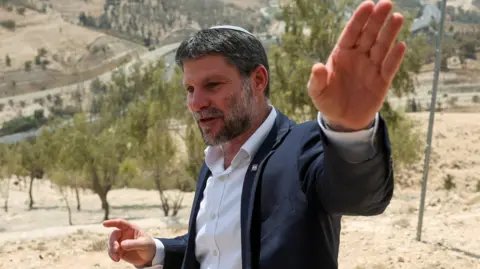 Reuters