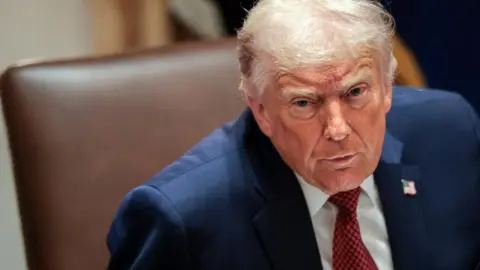
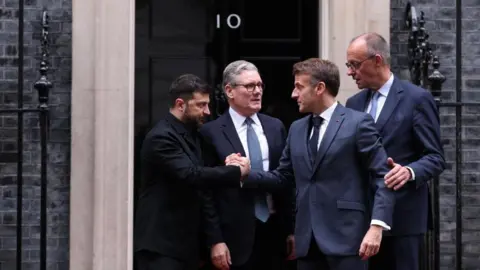
Ukraine is "ready for elections", President Volodymyr Zelensky has said, after US President Donald Trump repeated claims Kyiv was "using war" to avoid holding them.
Zelensky's five-year term as president was due to end in May 2024, but elections have been suspended in Ukraine since martial law was declared after Russia's invasion.
Speaking to reporters following Trump's comments in a wide-raging Politico interview, Zelensky said he would ask for proposals to be drawn up which could change the law.
Elections could be held in the next 60 to 90 days if security for the vote was guaranteed with the help of the US and other allies, he said.
"I'm asking now, and I'm stating this openly, for the US to help me, perhaps together with our European colleagues, to ensure security for the elections," he told reporters.
"The issue of elections in Ukraine, I believe, depends first and foremost on our people, and this is a question for the people of Ukraine, not the people of other countries. With all due respect to our partners," he said.
"I've heard hints that we're clinging to power, or that I personally am clinging to the presidency" and "that's why the war isn't ending", which he called "frankly, a completely unreasonable narrative".
Russia has consistently claimed Zelensky is an illegitimate leader and demanded new elections as a condition of a ceasefire deal – a talking point which has been repeated by Trump.
"They talk about a democracy, but it gets to a point where it's not a democracy anymore," the US president told Politico. He has suggested without evidence that Zelensky is the main obstacle to peace as US-led efforts to broker a peace deal to end the war in Ukraine continue.
Such a vote would only be fair if all Ukrainians could participate, including soldiers fighting on the front line, a Ukrainian opposition MP told the BBC.
"In order for these elections to be fair all of the People of Ukraine would need to be allowed to vote," Lesia Vasylenko told the BBC World Service's Newsday programme.
She said that "elections are never possible in wartime", alluding to the suspension of elections in the UK during World War Two.
Discussions around holding elections have made headlines since Russia's full-scale invasion of Ukraine in 2022. They have been routinely dismissed by Ukraine's government, opposition and public alike, arguing unity in the war effort must come first.
A poll by the Kyiv International Institute of Sociology (KIIS) in March found about 78% of people opposed holding elections even after a complete settlement of the war.
"Even a year ago, Zelensky said that he was ready for elections as soon as the conditions allow" in the face of previous pressure, Hanna Shelest, a foreign policy analyst with the think tank Ukrainian Prism, told the BBC.
The question was, however, how to create the conditions Zelensky outlined, Shelest told the Newsroom programme on the BBC World Service, given there were around one million soldiers and four million refugees who would be voting - as well as unsecured areas in the country and ongoing strikes.
"You cannot guarantee the security of the polling stations," she said.
Trump says he will "make a phone call" to stop the fighting
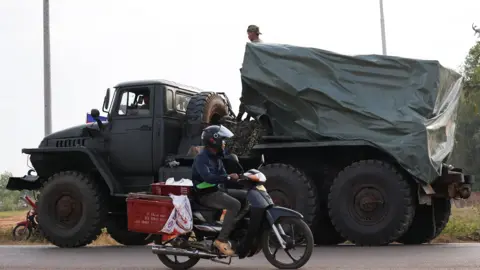
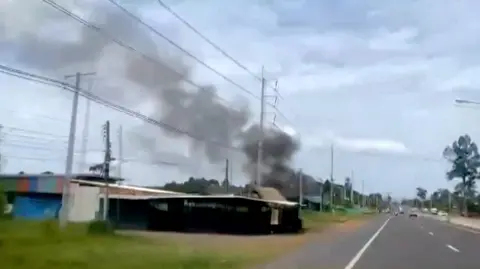
The US has asked Thailand and Cambodia to "cease hostilities immediately" as border clashes extended for a third day, killing at least 10 people and displacing hundreds of thousands.
The two nations must follow de-escalatory measures outlined in a peace accord brokered by US President Donald Trump in October, Secretary of State Marco Rubio said.
Trump has also said that he would "make a phone call" to stop the fighting, which is the most serious escalation since clashes in July killed dozens of people.
Both countries have blamed each other for re-igniting the fighting, which has seen air strikes and exchanges of artillery fire.
The death toll over three days of hostilities stands at 10 - seven from Cambodia and three from Thailand. Thai officials said they evacuated more than 400,000 people, while Phnom Penh said 100,000 on the Cambodian side have been moved to shelters.
Thailand's defence ministry said Wednesday military actions were "limited in scope and employed as a last option".
"Peace must come with the safety and security of our citizens, full stop," the ministry's spokesman said.
Cambodia on the other hand accused Thailand of launching "aggressive military attacks" that targeted civilian institutions and "sacred cultural sites", including historic temples along the disputed border.
Also on Wednesday, Cambodia announced it was pulling out from the South East Asian Games that is being hosted in Thailand.
The Cambodian National Olympic Committee cited "serious concerns and requests" from the families of its athletes for the withdrawal. It added that the decision was "not made lightly".
United Nations' Secretary-General António Guterres urged both sides to "exercise restraint and avoid further escalation", noting how their dispute has led to "significant civilian casualties, damage to civilian infrastructure, and displacement on both sides".
The century-old border dispute between the South East Asian neighbours dramatically escalated on 24 July with a Cambodian rocket barrage into Thailand, followed by Thai air strikes.
That set off five days of intense fighting, which left dozens of soldiers and civilians dead. Later that month, Bangkok and Phnom Penh agreed to an "immediate and unconditional ceasefire" brokered by Malaysian Prime Minister Anwar Ibrahim and Trump - who at the time threatened to stop tariff negotiations until the hostilities stopped.
In October, Trump claimed a historic achievement in ending the border conflict after both sides signed a ceasefire agreement, but tensions have continued to simmer.
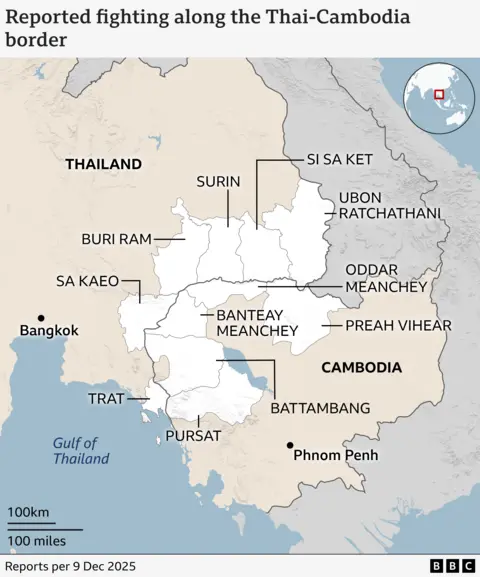
Violence this week has expanded into at least six provinces in north-eastern Thailand and five provinces in Cambodia's north and north-west.
Thailand and Cambodia have been contesting territorial sovereignty along their 800km land border for more than a century, since the borders of the two nations were drawn after the French occupation of Cambodia.
This week, several countries, including the UK, US and Japan, have issued warnings against travelling to the border areas citing the renewed fighting.
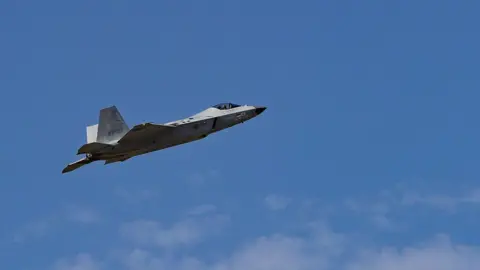
File photo of a South Korea's KF-21 fighter jet during a test flight
South Korea has lodged a complaint with the Chinese and Russian defence attaches based in the country, a day after their warplanes entered its air defence zone.
Seoul said it sent up fighter jets to "take tactical measures in preparation for any emergencies" after seven Russian and two Chinese military aircraft "briefly entered" the zone on Tuesday, but noted they "did not violate" South Korea's airspace.
Some countries delineate air identification defence zones, wherein they require foreign planes to identify themselves. These are not part of sovereign airspaces under international law.
In March this year, Seoul also deployed fighter jets after several Russian warplanes flew into the zone.
The Russian aircraft entered Korea's Air Defense Identification Zone (Kadiz) near Ulleung Island and Dokdo, while the Chinese aircraft entered near Ieodo, a Joint Chiefs of Staff official said, according to South Korean media.
Both sides' aircraft then regrouped in the airspace near Japan's Tsushima Island, the official said.
"Our military will actively respond to aircraft activities from neighbouring countries in the Kadiz in compliance with international law," South Korea's defence ministry said on Wednesday when lodging the complaint.
Both Japan and South Korea have laid claims to the Dokdo island grouping, as has North Korea.
Ieodo - a submerged rock above the South Korean island of Jeju - is a point of dispute between Seoul and Beijing, each of whom have included it in their air defence zones.
China on Wednesday confirmed that its air force had conducted a joint patrol with Russia in the East China Sea and Western Pacific airspace.
The exercise was part of an "annual cooperation plan" between Beijing and Moscow to "address regional challenges and maintain regional peace and stability", said a national defence spokesman.
China and Russia have entered South Korea's air defence zone without notification on several occasions since 2019, often during similar exercises.
Russia does not recognise South Korea's air defence zone, describing it as "unilaterally" established and saying it should therefore not create any legal obligations for other countries.
The donor's sperm was used in clinics across Europe (stock image)
A sperm donor who unknowingly harboured a genetic mutation that dramatically raises the risk of cancer has fathered at least 197 children across Europe, a major investigation has revealed.
Some children have already died and only a minority who inherit the mutation will escape cancer in their lifetimes.
The sperm was not sold to UK clinics, but the BBC can confirm a "very small" number of British families, who have been informed, used the donor's sperm while having fertility treatment in Denmark.
Denmark's European Sperm Bank, which sold the sperm, said families affected had their "deepest sympathy" and admitted the sperm was used to make too many babies in some countries.
Getty Images
Up to 20% of the donor's sperm contains the dangerous mutation that increases the risk of cancer (stock image)
The investigation has been conducted by 14 public service broadcasters, including the BBC, as part of the European Broadcasting Union's Investigative Journalism Network.
The sperm came from an anonymous man who was paid to donate as a student, starting in 2005. His sperm was then used by women for around 17 years.
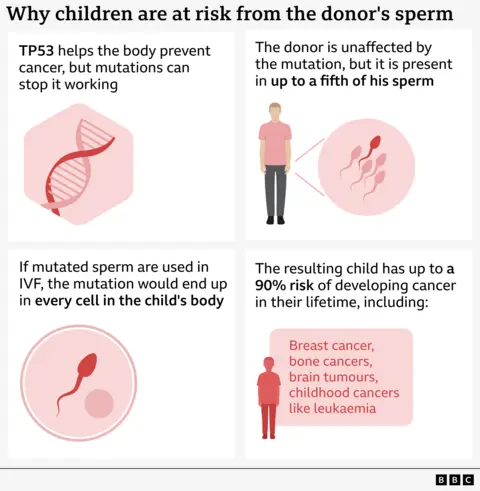
He is healthy and passed the donor screening checks. However, the DNA in some of his cells mutated before he was born.
It damaged the TP53 gene – which has the crucial role of preventing the body's cells turning cancerous.
Most of the donor's body does not contain the dangerous form of TP53, but up to 20% of his sperm do.
However, any children made from affected sperm will have the mutation in every cell of their body.
This is known as Li Fraumeni syndrome and comes with an up to 90% chance of developing cancer, particularly during childhood as well as breast cancer later in life.
"It is a dreadful diagnosis," Prof Clare Turnbull, a cancer geneticist at the Institute of Cancer Research in London, told the BBC. "It's a very challenging diagnosis to land on a family, there is a lifelong burden of living with that risk, it's clearly devastating."
MRI scans of the body and the brain are needed every year, as well as abdominal ultrasounds, to try to spot tumours. Women often choose to have their breasts removed to lower their risk of cancer.
The European Sperm Bank said the "donor himself and his family members are not ill" and such a mutation is "not detected preventatively by genetic screening". They said they "immediately blocked" the donor once the problem with his sperm was discovered.
Children have died
Doctors who were seeing children with cancer linked to sperm donation raised concerns at the European Society of Human Genetics this year.
They reported they had found 23 with the variant out of 67 children known at the time. Ten had already been diagnosed with cancer.
Through Freedom of Information requests and interviews with doctors and patients we can reveal substantially more children were born to the donor.
The figure is at least 197 children, but that may not be the final number as data has not been obtained from all countries.
It is also unknown how many of these children inherited the dangerous variant.
Dr Kasper has been helping some of the families affected
Dr Edwige Kasper, a cancer geneticist at Rouen University Hospital, in France, who presented the initial data, told the investigation: "We have many children that have already developed a cancer.
"We have some children that have developed already two different cancers and some of them have already died at a very early age."
Céline, not her real name, is a single-mother in France whose child was conceived with the donor's sperm 14 years ago and has the mutation.
She got a call from the fertility clinic she used in Belgium urging her to get her daughter screened.
She says she has "absolutely no hard feelings" towards the donor but says it was unacceptable she was given sperm that "wasn't clean, that wasn't safe, that carried a risk".
And she knows cancer will be looming over them for the rest of their lives.
"We don't know when, we don't know which one, and we don't know how many," she says.
"I understand that there's a high chance it's going to happen and when it does, we'll fight and if there are several, we'll fight several times."
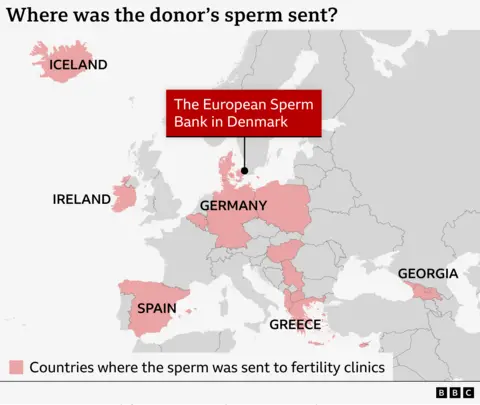
The donor's sperm was used by 67 fertility clinics in 14 countries.
The sperm was not sold to UK clinics.
However, as a result of this investigation the authorities in Denmark notified the UK's Human Fertilisation and Embryology Authority (HFEA) on Tuesday that British women had travelled to the country to receive fertility treatment using the donor's sperm.
Those women have been informed.
Peter Thompson, the chief executive of the HFEA, said a "very small number" of women were affected and "they have been told about the donor by the Danish clinic at which they were treated".
We do not know if any British women had treatment in other countries where the donor's sperm was distributed.
Concerned parents are advised to contact the clinic they used and the fertility authority in that country.
The BBC is choosing not to release the donor's identification number because he donated in good faith and the known cases in the UK have been contacted.
There is no law on how many times a donor's sperm can be used worldwide. However, individual countries do set their own limits.
The European Sperm Bank accepted these limits had "unfortunately" been breached in some countries and it was "in dialogue with the authorities in Denmark and Belgium".
In Belgium, a single sperm donor is only supposed to be used by six families. Instead 38 different women produced 53 children to the donor.
The UK limit is 10 families per donor.
'You can't screen for everything'
Prof Allan Pacey, who used to run the Sheffield Sperm Bank and is now the deputy vice president of the Faculty of Biology Medicine and Health at the University of Manchester, said countries had become dependent on big international sperm banks and half the UK's sperm was now imported.
He told the BBC: "We have to import from big international sperm banks who are also selling it to other countries, because that's how they make their money, and that is where the problem begins, because there's no international law about how often you can use the sperm."
He said the case was "awful" for everybody involved, but it would be impossible to make sperm completely safe.
"You can't screen for everything, we only accept 1% or 2% of all men that apply to be a sperm donor in the current screening arrangement so if we make it even tighter, we wouldn't have any sperm donors – that's where the balance lies."
This case, alongside that of a man who was ordered to stop after fathering 550 children through sperm donation, has again raised questions over whether there should be tougher limits.
The European Society of Human Reproduction and Embryology has recently suggested a limit of 50 families per donor.
However, it said this would not reduce the risk of inheriting rare genetic diseases.
Rather, it would be better for the wellbeing of children who discover they are one of hundreds of half-siblings.
"More needs to be done to reduce the number of families that are born globally from the same donors," said Sarah Norcross, the director of the Progress Educational Trust, an independent charity for people affected by infertility and genetic conditions.
"We don't fully understand what the social and psychological implications will be of having these hundreds of half siblings. It can potentially be traumatic," she told BBC News.
The European Sperm Bank said: "It is important, especially in light of this case, to remember that thousands of women and couples do not have the opportunity to have a child without the help of donor sperm.
"It is generally safer to have a child with the help of donor sperm if the sperm donors are screened according to medical guidelines."
What if you are considering using a sperm donor?
Sarah Norcross said these cases were "vanishingly rare" when you consider the number of children born to a sperm donor.
All of the experts we spoke to said using a licensed clinic meant the sperm would be screened for more diseases than most fathers-to-be are.
Prof Pacey said he would ask "is this a UK donor or is this a donor from somewhere else?"
"If it's a donor from somewhere else I think it's legitimate to ask questions about has that donor been used before? Or how many times will this donor be used?"
If you or someone you know has been affected by the issues raised, details of help and support are available at BBC Action Line.
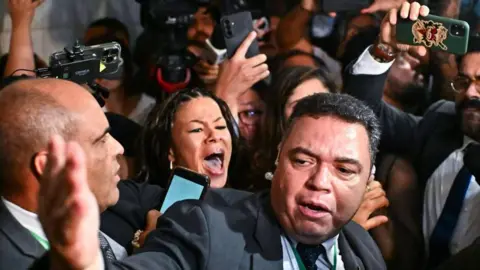
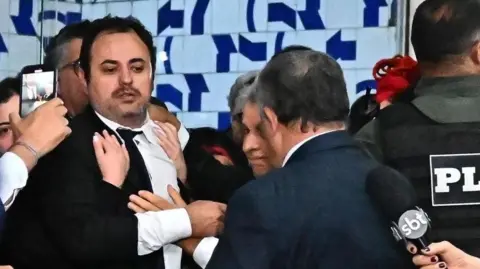
Brazil's parliament descended into chaos on Tuesday as conservative lawmakers continued to push a law which would reduce the prison sentence of former president Jair Bolsonaro.
One left-wing lawmaker was forcibly removed by police after trying to disrupt proceedings, while footage showed scuffles breaking out as security tried to restore order.
His conservative allies in Congress have proposed a law which would reduce sentences for coup-related offences, as well as free dozens of Bolsonaro supporters who stormed government buildings shortly after he left office.
Meanwhile, court documents showed that Bolsonaro's legal team filed an official request asking a court to grant him permission to leave prison for surgery.
The fate of Jair Bolsonaro, a right-wing populist who was narrowly beaten by leftist Luiz Inácio Lula da Silva three years ago, continues to be a divisive issue in Brazil, where his allies have explored several avenues to exonerate him.
The latest attempt to cut the 70-year-old's sentence has been to propose a law overhauling punishments for people in elected office, including significantly reducing sentences for the offences that Bolsonaro, and those convicted alongside him, were found guilty of.
One of the lawmakers behind the effort told AFP news agency it would see Bolsonaro's sentence cut to two years and four months in prison.
During Tuesday's heated debate on the proposal, leftist politician Glauber Braga briefly occupied the Speaker's chair, which he said was a protest against a "coup offensive".
The chamber had been due to vote on Braga's expulsion for his role in a previous altercation in Congress, one of a handful of removals proposed as part of a wider package of disciplinary reforms, including the changes to coup-related offences.
Police forcibly removed Braga amid a skirmish in the chamber. The TV feed was cut and reporters were removed from the chamber, a move condemned as censorship by a group representing journalists.
Braga later said he would not "accept as a done deal an amnesty for a group of coup plotters", AFP reported.
As of late Tuesday night, the law cutting Bolsonaro's sentence - which would require ratification by the legislature's second house - had not passed.
EPA
Bolsonaro was given a lengthy prison sentence in September after Supreme Court judges found he had proposed a coup to military leaders, and said that he knew of a plot to assassinate his rival Lula.
Several senior military figures, two former defence ministers and an ex-intelligence chief were also convicted as part of the coup investigation.
Bolsonaro and his supporters have long dubbed the investigation a "witch hunt".
His Liberal Party remains the largest in Congress, where conservative parties outnumber groupings sympathetic to Lula.
Lawmakers loyal to Bolsonaro previously launched an attempt to secure an amnesty, though that floundered in the face of national protests, with a significant cut to sentences now proposed as a compromise.
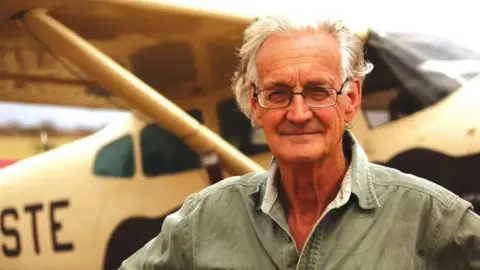
The Prince of Wales has paid tribute to pioneering elephant conservationist Iain Douglas-Hamilton, who died aged 83 at his home in Nairobi on Monday.
Douglas-Hamilton spent his life studying and campaigning to protect African elephants, becoming a world-leading expert on their behaviour in the wild.
His groundbreaking research exposed the devastating effects of poaching - often at great risk to his own safety - and was instrumental in the banning of the international ivory trade.
Prince William praised the zoologist as "a man who dedicated his life to conservation and whose life's work leaves lasting impact on our appreciation for, and understanding of, elephants".
"The memories of spending time in Africa with him will remain with me forever," added Prince William, who is a royal patron for the African wildlife conservation charity, Tusk, of which Douglas-Hamilton was an ambassador.
"The world has lost a true conservation legend today, but his extraordinary legacy will continue," the charity's founder Charles Mayhew said in a statement.
Oria Douglas-Hamilton
Born in 1942 to an aristocratic British family in Dorset, England, Douglas-Hamilton studied biology and zoology in Scotland and Oxford before moving to Tanzania to research elephant social behaviour.
It was there at Lake Manyara National Park that he began documenting every elephant he encountered, eventually becoming so familiar with the herds he could recognise them by the unique shapes of their ears and wrinkles on their skin.
"The thing about elephants is that they have a lot in common with human beings," he said in a 2024 documentary about his work, A Life Among Elephants.
Friend and fellow conservationist Jane Goodall, who died in October, was featured in the documentary, and said he had shown the world that elephants are capable of feeling just like humans.
"I think his legacy will be one of a man who did so much to help people understand how majestic, how wonderful elephants are, and to learn more about their way of life," Goodall said.
Oria Douglas-Hamilton
But that work did not always come easy: he was charged at by elephants, almost killed by a swarm of bees and shot at by poachers. In 2010, a flood destroyed his research facility in Kenya and years of work was lost.
Despite the hardships, Douglas-Hamilton remained steadfast in his mission to raise awareness of the plight of African elephants, becoming one of the leading voices to alert the world of the ivory poaching crisis, which he described as "an elephant holocaust".
He later campaigned for an international ban on the commercial trade in ivory, and in 1989 the Convention on International Trade in Endangered Species was signed, an international agreement between governments.
After the agreement failed to wipe out the trade completely, Douglas-Hamilton turned his attention to China and the US, the two main markets for ivory. Chinese President Xi Jinping and then-US President Barack Obama agreed to a near-total ban on its import and export in 2015.
Douglas-Hamilton established Save the Elephants in 1993, a charity dedicated to safeguarding the animals and deepening human understanding of their behaviour.
The organisation's CEO Frank Pope, who is also his son-in-law, said: "Iain changed the future not just for elephants, but for huge numbers of people across the globe. His courage, determination and rigour inspired everyone he met."
In his own words, Douglas-Hamilton expressed optimism for the future of his life's work.
"I think my greatest hope for the future is that there will be an ethic developed of human-elephant coexistence," he once said.
Iain Douglas-Hamilton is survived by his wife Oria, children Saba and Dudu, and six grandchildren.
Lady Gaga is in Australia for her Mayhem World Tour
An Australian man who was jailed in Singapore and deported for charging at pop star Ariana Grande has been ejected from a Lady Gaga concert in his home country.
Johnson Wen said on Instagram that he was "kicked out" of the Suncorp Stadium in Brisbane on Tuesday night before the Lady Gaga show had started.
The 26-year-old, who has a history of disrupting concerts and celebrity events, was sentenced to nine days in jail by a Singapore court last month for grabbing Grande during the Asian premiere of Wicked: For Good.
Wen, who told the Singaporean judge in mitigation that he would "not do it again", had not disrupted the performance in Brisbane, but was removed because of his history of public nuisance.
Videos on social media showed security guards holding Wen by the arm and leading him out of the venue as the crowd both cheered and booed. The BBC has contacted Suncorp Stadium for comment.
In a statement to the Sydney Morning Herald, the venue said it was made aware that "a known serial offender may attempt to attend and disrupt" the concert by Lady Gaga, who is around halfway through her Mayhem World Tour.
"In the interest of the artist's safety, this individual was deemed a person of interest and not to be allowed to attend," it said.
Wen has gained notoriety since grabbing Grande at the Wicked: For Good premiere in the South East Asian city state, which is known for its strict laws, including on public behaviour.
"You seem to be attention-seeking, thinking only of yourself and not the safety of others when committing these acts," Singaporean judge Christopher Goh reportedly told Wen.
Other videos on Wen's social media accounts show him jumping on stage and disrupting performances by global stars like Katy Perry and The Weeknd.
The incident with Grande sparked outrage in Singapore. Fans accused Wen of "re-traumatising" the pop star and actress.
Grande has spoken of experiencing post-traumatic stress disorder after a suicide bomb attack at her May 2017 concert in Manchester, killing 22 people and injuring hundreds.
Watch: Trump claims "prices are coming down" as he rallies on affordability
President Donald Trump has told a campaign-style rally that consumer prices are falling "tremendously" as he sought to allay voter anxiety about the US cost of living.
In a speech at a casino in the battleground state of Pennsylvania, the president told supporters he had "no higher priority than making America affordable again".
But while gas and egg prices have fallen, other food is more expensive and Americans remain unhappy about the cost of housing, childcare and healthcare.
Democrats have capitalised on Trump's political vulnerability on the economy in recent off-cycle votes, leaving many Republicans uneasy about next year's midterms elections.
Tuesday's event in a swing district of Pennsylvania was the first of what the White House says will be a series of campaign-like rallies aimed at bringing its economic message to voters.
But at one point in his remarks, the Republican president again portrayed concerns about affordability as a Democratic "hoax".
In recent weeks, his administration has removed tariffs from dozens of food products and touted its rollback of fuel efficiency standards and Trump-branded retirement accounts for children as cost-of-living fixes.
In an excerpt from an interview with Politico released on Tuesday, Trump was asked what grade he would give the economy.
"A plus-plus-plus-plus-plus," he said.
In a sign the policy pivot might be cutting through, Trump's approval rating rose three points to 41% in a new Reuters/Ipsos poll.
Charlie Neuenschwander
Alaina Hunt was laid in off in April
But many Americans remain downbeat on the economy.
Alaina Hunt, 37, who lost her job as a designer at a construction company in Oklahoma City, told the BBC her position was in part a casualty of Trump's tariffs on steel and aluminium.
The construction sector "really took a hard hit very early on", she said. Ms Hunt says she has applied for at least 75 jobs in web design and development since April, to no avail, amid a broader slowdown in hiring.
She says rising grocery bills - about $25 extra per week - have added to the strain.
"I was able to scrape by a lot easier in years before," said Ms Hunt, who voted for Kamala Harris. "I don't think that the federal government is listening at all."
Economic data paints a mixed picture.
US consumer confidence fell in November to its lowest level since the spring.
But the stock market continues to hover near record highs. And forecasters expect the economy to expand by 1.9% this year, slower than last year's 2.8% but still better than expected.
Some recent data also indicate the job market may be picking up, after a significant hiring slowdown earlier this year.
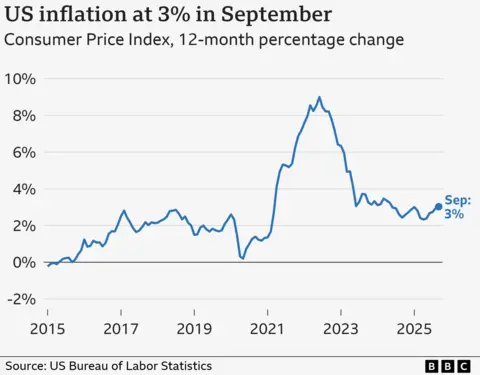
As of September, inflation stood at 3%, the same rate as in January when the president took office and stubbornly above the Federal Reserve's 2% target.
It is still way below a peak of 9.1% under former President Joe Biden when the US faced its worst inflation in four decades.
Overall prices have surged 25% over the last five years, generating widespread frustration, despite wage growth over that period.
Beth Richardson
Beth Richardson, a 45-year-old from Kansas, said she had been floored by some of the prices at the grocery store near her, recalling a pack of Mentos gum she picked up recently that rang up to almost $5 with tax.
"I'm like, I'm just going to go die now because this cannot be," she said.
Ms Richardson was laid off from her job in sales support at a tech-related company in late 2023, after the firm shifted jobs overseas. She voted for Kamala Harris last year.
She said while she knew presidents were often blamed for economic forces over which they had little control, she felt in this case Trump and his policies, like tariffs, were "shooting ourselves in the foot".
On Tuesday night, Trump called tariffs his "favourite word", pointing to hundreds of billions of dollars of US revenue from import taxes.
The White House blames Biden and the Fed, arguing high interest rates are hurting the economy.
The US central bank has twice reduced rates to about 3.9% and may cut them again on Wednesday.
Many Trump supporters have said they still back the president, despite feeling the pinch themselves.
John Mohring, 60, of Kenosha, Wisconsin, has backed Trump since 2016, though rising prices worry him.
Mr Mohring, who works in construction and has lived alone since his wife died three years ago, said grocery prices started rising before Trump returned to the White House "and it doesn't seem like it's going down".
He now typically spends $100 on groceries just for himself, even when avoiding buying meat and sticking with cheaper items.
Still, Mr Mohring said he backed the Trump administration's sweeping tariffs on imported goods and his border policies.
"I'm giving him the benefit of the doubt," Mr Mohring added.
Brad Smith, a corn and soybean farmer in north-western Illinois, was hurt earlier this year when China, previously a major buyer of US soybeans, froze its purchases amid a trade war with Washington.
But the market, he said, had been gradually recovering since late October, when the two countries reached a trade agreement and China resumed some purchases.
Trump on Monday also announced a $12bn aid package for US farmers.
Mr Smith said he still believed in Trump's plans for the economy, despite being getting caught in the crossfire.
"There's probably bigger things at play other than just the soybean and corn market," Mr Smith said.
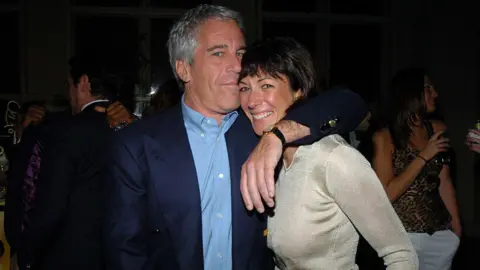
Maxwell is serving a 20-year sentence for her role in luring underage girls for Epstein to exploit
A federal judge in New York has ruled the US Department of Justice can publicly release grand jury materials from Ghislaine Maxwell's sex trafficking investigation.
US District Judge Paul Engelmayer said he was ordering the release of material because of a recent law passed by Congress, which requires the justice department to publish files related to disgraced financier Jeffrey Epstein by the end of next week.
In his ruling, he said the court would put in place mechanisms to protect victims from the release of materials that would "identify them or otherwise invade their privacy".
Maxwell was convicted in 2021 for her role in luring underage girls for Epstein, her former boyfriend, to exploit. Epstein died in prison in 2019.
Prosecutors argued Maxwell recruited and groomed girls, some as young as 14, between 1994 and 2004, before they were abused by Epstein.
Maxwell, who is serving a 20-year prison sentence, was moved from a Florida prison to a new minimum-security facility in Texas in August, after she was interviewed by Deputy US Attorney General Todd Blanche about Epstein.
In a letter to Judge Engelmayer, Maxwell's legal team said she did not take a position on the justice department's motion to release the grand jury material.
Representative Robert Garcia, the top Democrat on the House Oversight Committee, which has released thousands of files and messages it subpoenaed from Epstein's estate, said the unsealing was a "victory for transparency".
"These files are now part of the Epstein files held by the Department of Justice, and must be turned over to the Oversight Committee in response to our subpoena," he said.
The order to publish the records followed a similar ruling from a judge in Florida on Friday, which allowed for the unsealing of documents related to the state's investigation against Epstein that began in 2005.
Congress passed the Epstein Files Transparency Act, which President Donald Trump signed into law in November after previously rejecting calls to release the files.
The law "applies to unclassified records, documents, communications, and investigative materials" that relate to Epstein and Maxwell, a court order said.
The justice department has until 19 December to publicly release all the information from federal investigations into Epstein, though the law also allows the department to withhold files that involve active criminal investigations or raise privacy concerns.
Florida and New York judges had previously refused to unseal grand jury materials related to Epstein, citing federal rules that require grand jury processes to be kept secret.
But after Congress passed the bill to release the Epstein material, the justice department made the same request, arguing the legislation's "clear mandate" should "override" those secrecy rules.
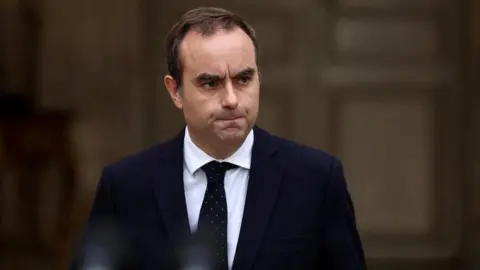
French Prime Minister Sebastien Lecornu faces a crucial test on Tuesday as the country's divided parliament prepares to vote on a 2026 budget bill.
If Lecornu fails to win a majority in the National Assembly for his social security budget, it bodes ill for the main budget bill which follows and which needs to be voted through by the end of the year.
It could also pose awkward questions over his authority to lead the government, though for the moment there is little expectation he will resign.
Appointed in September by President Emmanuel Macron, Lecornu has devoted himself exclusively to the uphill task of guiding 2026 budget legislation through the two chambers of parliament.
Since snap elections called by Macron in June 2024, the more powerful chamber, the National Assembly, has been split into three roughly equal blocs – centre, left, and far-right -- none of which is capable of commanding a majority.
Lecornu is Macron's fourth prime minister since then – the two previous incumbents Michel Barnier and François Bayrou having both been forced to resign after trying to rein in France's burgeoning debt. Barnier stepped down exactly a year ago after failing to push through the 2025 social security budget.
In the French system, there are two budgetary laws – one that raises and allocates money in the social security system, including hospitals and pensions; and the principal one that covers everything else, from defence to education. For years both have run on massive deficits.
Widely acknowledged for his discretion and diligence, Lecornu needs to convince enough deputies from the 11 different parliamentary groups that failure to vote the budgets through will plunge the country into even deeper financial gloom.
His main target has been the Socialist Party (PS) with around 70 MPs, many of whom are uncomfortable in their erstwhile electoral alliance with the far-left France Unbowed party.
In major concessions to the PS, Lecornu promised to suspend Macron's key second-term reform increasing to 64 the statutory age of retirement, and also to refrain from using a government power (known as 49-3) to force through the budget laws without a vote.
Socialist leaders Olivier Faure and Boris Vallaud have praised Lecornu's sense of compromise and are urging their deputies to support the social security budget.
But by giving ground to the centre-left, Lecornu has potentially lost support in his own camp on the centre-right, where important figures such as former Prime Minister Edouard Philippe say the bill will do little to redress the country's fast deteriorating public accounts.
Tuesday's vote was set to be very close, with the far-right National Rally and its allies (140 or so deputies) and the far-left France Unbowed (71) both set to vote no, along with the Ecologists and Communists (55 altogether). A majority in a full chamber is 288 MPs.
Lecornu is hoping to win over some individuals on the left with promises of more spending on hospitals. And he hopes opposition from within his own camp will be limited to abstentions rather than votes against.
If the social security budget fails to pass, it would almost certainly mean that the main budget for 2026 would also fail. As a result the government would probably introduce a special law to allow the state administration to continue functioning from 1 January using 2025 allocations.
Though a personal blow to Lecornu and his low-key political methods, few expect that he would immediately step down in such a scenario.
By voluntarily abandoning the use of the 49-3, the prime minister in effect gave MPs the chance to amend the government's budget text to their hearts' content. If the text then fails, he calculates, the blame will fall primarily on heads in parliament.
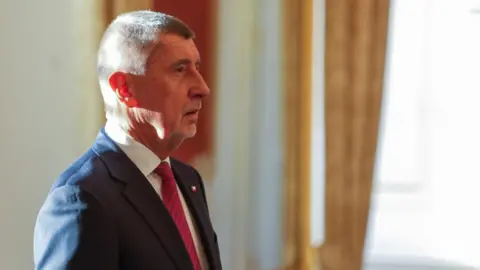
Andrej Babis's government will be very different from its strongly pro-Ukrainian predecesssor
Billionaire Andrej Babis has been appointed as the Czech Republic's new prime minister, with his full cabinet expected to take office within days.
His appointment followed a key demand from President Petr Pavel - a public pledge by Babis to relinquish control over his vast food-processing, agriculture and chemicals conglomerate Agrofert.
"I promise to be a prime minister who defends the interests of all our citizens, at home and abroad," Babis said after the ceremony at Prague Castle.
"A prime minister who will work to make the Czech Republic the best place to live on the entire planet."
These are lofty ambitions, but Babis, 71, is used to thinking big.
Agrofert is so deeply embedded in the Czech commercial ecosystem that there is even an app to help shoppers avoid buying products made by the group's more than than 200 subsidiaries.
If a product - say Viennese-style sausages from Kostelecké uzeniny or sliced bread from Penam - belongs to an Agrofert company, a thumbs-down symbol appears.
Babis, who was prime minister for four years until 2021, has shifted to the right in recent years and his cabinet will include members of the far-right SPD and the Eurosceptic "Motorists for Themselves" party.
If he honours his pledge to divest from the company he built from scratch, he will no longer benefit from the sale of any Agrofert product – from frankfurters to fertiliser.
As prime minister he will have no knowledge of the conglomerate's financial health, nor any ability to influence its fortunes, he says.
Sean Gallup/Getty Images
Government decisions on public tenders or subsidies - Czech or European - will be taken without regard to a company he will no longer own or profit from, he adds.
Instead, he says that Agrofert, worth an estimated $4.3bn (£3.3bn), will be placed in a trust managed by an independent administrator, where it will remain until his death. At that point it will pass to his children.
This, he said in a Facebook video, went "far beyond" the demands of Czech law.
What kind of trust remains unclear - a Czech trust, or one based abroad? The concept of a "blind trust" does not exist in Czech legislation, and an army of lawyers will be required to design an arrangement that works.
Critics, including Transparency International, remain unconvinced.
"A blind trust is not a solution," the head of Transparency International's Czech branch, David Kotora, told news site Seznam Zpravy.
"There's no separation. [Babis] obviously knows the managers. He knows Agrofert's portfolio. From an executive position, even at a European level, he could theoretically intervene in matters that would affect the sector in which Agrofert operates," Kotora warned.
But it's not just food - and it's not just Agrofert.
In the eastern suburbs of Prague, a private health clinic towers over the O2 arena. While it is owned by a company called FutureLife a.s, that company is majority-owned by Hartenberg Holding, and Hartenberg Holding is majority-owned by Babis.
Hartenberg also runs a network of reproductive clinics, as well as a florist chain, Flamengo, and an underwear retailer, Astratex.
The reach of Babis into all corners of Czech life is broad. And as prime minister, for the second time, it is about to get broader.
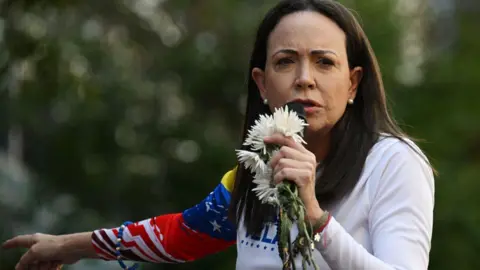
A press conference by María Corina Machado - the Nobel Peace Prize laureate, who is currently in-hiding - was cancelled on Tuesday, with the Nobel Institute saying they are "in the dark" about her whereabouts.
Machado is Venezuela's opposition leader and has been in hiding since the country's disputed 2024 election, which she and her supporters say was stolen.
She was awarded the Nobel Peace Prize for efforts to bring democracy to Venezuela, and was expected to formally collect it in a ceremony on Wednesday.
Although Machado regularly gives social media video updates, usually against a neutral white wall, her current whereabouts are unknown.
The Nobel Institute said in a statement: "María Corina Machado has herself stated in interviews how challenging the journey to Oslo, Norway will be. We therefore cannot at this point provide any further information about when and how she will arrive for the Nobel peace prize ceremony."
The institute had previously said she would attend the ceremony in person. Earlier on Tuesday, a spokesman said "everything suggests" the press conference would be able to take place on Tuesday despite the delay.
Venezuela's government has said that if Machado left Venezuela she would be considered a "fugitive" by the authorities. Her family are already in Oslo.
Venezuela's attorney general, Tarek William Saab, told AFP last month: "By being outside Venezuela and having numerous criminal investigations, she is considered a fugitive". He said she is accused of "acts of conspiracy, incitement of hatred, terrorism".
Machado had earlier told her followers that she would return to Venezuela after collecting the prize.
If she attends, it would be her first public appearance since January 2025. She last appeared in public at a protest in Caracas on 9 January against the inauguration of Venezuelan President Nicolás Maduro.
After Venezuela's 2024 election, the opposition published tallies after the election suggesting it won, despite Maduro claiming victory, and some nations including the US have recognised its candidate - Edmundo Gonzalez - as the president-elect. Ms Machado was banned from running in the election.
Thousands of cigarettes smuggled from Belarus have been intercepted in recent months and Lithuania calls it a "hybrid attack"
The Lithuanian government has declared a "nationwide emergency situation" in response to a series of incursions from neighbouring Belarus by weather balloons carrying smuggled cigarettes.
Prime Minister Inga Ruginiene condemned the balloon incursions as a "hybrid attack" by Belarus that posed a real risk to national security and civil aviation.
This year alone, officials say about 600 balloons linked to smuggling and almost 200 drones have entered Lithuanian airspace, leading to the repeated closure of Vilnius airport.
Belarusian leader Alexander Lukashenko denies being behind the incursions, alleging the issue has been "politicised" by Lithuania, which is a member of both the EU and Nato.
Lithuania's decision to impose an "emergency situation" is a step below a state of emergency, which was last imposed in 2022 after Russia's full-scale invasion of Ukraine. It grants the armed forces additional powers to respond faster and more effectively.
Belarus's long-time leader is a close ally of Russia's Vladimir Putin and Lithuania's President, Gitanas Nauseda, has said there is a lot of evidence that the balloon threat is a "deliberate action aimed at destabilising the situation in Lithuania".
A number of European countries have faced a range of threats from Russia, which the EU has condemned as a "hybrid campaign" that includes sabotage, disruption to critical infrastructure and most recently drone flights near sensitive sites.
Last month, the head of Nato's military committee, Adml Giuseppe Cavo Dragone, said the Western military alliance was considering a more "aggressive" or "pro-active" stance to Russia's hybrid warfare.
Lithuania has accused Belarus of this kind of provocation before. Four years ago, thousands of irregular migrants mostly from the Middle East crossed the Belarusian border.
Responding to the latest threat, Lithuania closed two border checkpoints with Belarus for three weeks from the end of October. Belarus then barred Lithuanian trucks from driving on its roads and hundreds of Lithuanian vehicles are still understood to be stranded there.
"We are talking about aviation security and international law, and about the fact that such actions could be recognised as terrorism," Ruginiene said last week, in reference to both the balloons and the blocked trucks.
The weather balloons can fly to a height of 10km (6 miles) and Lithuania's interior ministry says they have led to Vilnius airport being closed for more than 60 hours since October.
Lukashenko told Belarusian TV on Tuesday that what the Lithuanians were accusing Belarus of was impossible: "It is unrealistic. Even if balloons flew into there, even if they did, I have spoken to pilots and they say that they pose no problem."
"The question arises why," he added. "Do they want to fight us? We do not need war. I am convinced that the Lithuanian people do not need war either. Neither do Poles, Latvians and Estonians."
Although flights into and out of Vilnius airport were disrupted for only a short period, it meant that 1,000 passengers were affected. Authorities said they had intercepted 11 smuggling balloons and seized almost 40,000 packets of cigarettes.
On one night last week, the airport had to suspend operations three times and Finnish airline Finnair has cancelled all evening flights to Vilnius until the end of February because of the balloons.
US President Donald Trump has criticised European leaders as "weak" and suggested the US could scale back support for Ukraine.
In a wide-ranging interview with Politico, he said "decaying" European countries had failed to control migration or take decisive action to end Ukraine's war with Russia, accusing them of letting Kyiv fight "until they drop".
He argued that Russia held the "upper hand" and urged Ukraine's president Volodymyr Zelensky to "play ball" by ceding territory to Moscow.
In the UK, Downing Street rejected Trump's claim that Europe had failed to act, citing the UK's leadership on sanctions and reiterating support for the US-led peace process.
The president's remarks came shortly after his administration released a 33-page National Security Strategy warning of Europe's potential "civilisational erasure" and questioning whether some nations could remain reliable allies.
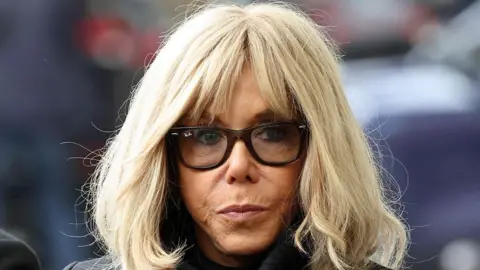
The French president's wife Brigitte Macron in a file photograph
French celebrities and feminists have voiced their outrage at first lady Brigitte Macron's language about activists who had protested at a comedian's show.
Activists wearing masks of Ary Abittan interrupted his stand-up show on Saturday shouting "Abittan rapist". Abittan was accused of rape in 2021, but investigators later dropped the case, citing lack of evidence.
Mrs Macron met Abittan before his performance on Sunday. In a video, he says he feels "scared", to which Mrs Macron responds "if there are any stupid bitches we'll kick them out", before smiling and laughing.
Mrs Macron's team told AFP news agency her words intended to "critique the radical method" of the protest.
"Brigitte Macron does not approve of this radical method," a member of her team added.
The words used by Macron, "sales connes" (which translates to "stupid bitches"), have since been adopted by celebrities and feminists online who denounced the first lady's actions and violence towards women.
The demonstration was organised by Nous Toutes, a French organisation that fights against violence towards women.
The majority of those using "#salesconnes" on social media are doing so to voice their support for the feminist group.
Actor Judith Godrèche - who herself has accused a film director of historical rape, which he denies - added her support.
"I too am a stupid bitch," she wrote on social media, with Belgian comedian Florence Mendez also saying she was "proud" to be one.
Actor and singer Nadège Beausson-Diagne also adopted the term, writing on Instagram: "I too am a stupid bitch in summer, winter, spring and autumn."
She went on to voice her support for the "courageous" woman who had accused Abittan of rape and for Nous Toutes, adding that the group will "come back stronger to fight together against sexual violence".
Actor Rachida Brakni also thanked the "bitches" and tagged Nous Toutes in her post.
Stand-up comedian Marine Leonardi, meanwhile, wrote on Instagram: "Feminists are never stupid bitches".
Mrs Macron had attended Abittan's show with her daughter.
US lawmakers are trying to pressure the Trump administration to release video of a controversial "double-tap" military strike by limiting Defence Secretary Pete Hegseth's travel budget.
The incident on 2 September, in which the US carried out a second deadly strike on a boat in the Caribbean, has raised fresh questions about the legality of Trump's campaign targeting alleged drug-carrying vessels.
A provision buried in a lengthy defence spending policy would restrict travel funds for Hegseth's office until the Pentagon hands over unedited footage. The bill is expected to pass with support from both parties.
US President Donald Trump says release of the video is something for Hegseth to decide.
Trump denied that he had previously said he would have "no problem" with the footage being made public - despite that comment being made on camera as recently as Wednesday.
The threat from Congress to withhold money from Hegseth's travel budget has emerged amid a clamour for information from lawmakers on both sides of the political aisle.
It is buried within a 3,000-page draft bill that is focused on approving next year's defence spending. The annual bill authorises nearly $901bn in funding (£687m).
The bill's final wording, which was first reported by Politico, states that Hegseth's office may spend no more than three-quarters of the funds made available for travel for the year 2026 until it meets certain requirements.
These include an obligation to give the House and Senate armed service committees all "unedited video of strikes conducted against designated terrorist organizations in the area of responsibility of the United States Southern Command".
The wording nods to the way Trump has characterised his strikes on boats in the Caribbean and Pacific. He says they are a matter of targeting designated terrorist organisations.
Trump calls US reporter's company "fake news" over question about alleged drug boat strike video
In his comments to reporters on Monday, Trump said each of the alleged drugs boats that had been sunk had saved 25,000 American lives, and claimed that drugs trafficking to the US by sea had all but stopped.
His administration has sought to justify its actions by saying it is in a non-international armed conflict with the alleged traffickers. Dozens of people have been killed in the months-long campaign, but the administration has not publicly provided evidence for its assertions of criminality in each case.
Experts have raised questions about the legality of the strikes, prompting concern from Republicans and Democrats alike.
Regarding the "double-tap" attack on 2 September specifically, the experts point out that the so-called laws of war decree that the parties in an armed conflict are obliged to pick up wounded survivors of a strike rather than attack them again.
Nine people died in the first strike on the vessel and two survivors were left clinging to the burning wreckage when it was struck again, killing them, according to the Washington Post.
The White House has repeatedly said it is working within the laws of armed conflict.
It says the second strike was ordered by a navy admiral, and not by Hegseth, who has become a focal point for scrutiny of both the strike and the White House narrative surrounding it.
Senior members of Congress who were shown the video in a briefing last week by that admiral, Frank Bradley, emerged with differing views.
Jim Himes of Connecticut, the senior Democrat on the House intelligence committee, said he found the video of the second attack "deeply, deeply troubling".
But Republican Senator Tom Cotton of Arkansas disagreed, calling the strikes "entirely lawful and needful".
Watch: Lawmakers react to boat strike video showed in classified briefing
Trump has previously posted video of the first strike from 2 September, and continues to be asked whether he will release video of the second.
Last Wednesday, the president responded to an on-camera question about the video from an ABC News reporter by saying: "I don't know what they have, but whatever they have, we'd certainly release, no problem."
Five days later, he responded to a question from the same network by saying: "I didn't say that. That's - you said that, I didn't say that."
He went on to clarify: "Whatever Pete Hegseth wants to do is OK with me."
In his most recent remarks on the subject, Hegseth was noncommittal on the subject, saying: "We're reviewing the process, and we'll see."
Hegseth, along with Secretary of State Marco Rubio and Dan Caine, the chairman of the Join Chiefs of Staff, is due to brief top congressional lawmakers on Tuesday afternoon, two sources told CBS.
The plaintiffs said adopting a gesture used by protesters helped to defuse tensions during the Washington DC protest
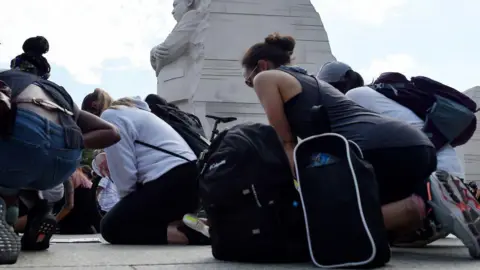
Twelve fired FBI agents are alleging that they were unlawfully sacked because they knelt during a racial justice protest in Washington DC five years ago.
In a recently filed lawsuit, the former agents argue that their decision to kneel - adopting a gesture used by demonstrators - helped to deescalate a tense protest situation in the wake of the police killing of George Floyd.
The agents believe they were fired on the orders of FBI boss Kash Patel, who is named as a defendant.
Their termination letters accused them of "a lack of impartiality" in their duties, they say. The FBI has declined to comment on the case.
The dozen sacked agents - nine women and three men - say they had been "confronted by a mob" when deployed in the US capital city on 4 June 2020, and were responding to a "dangerous situation" for which they were ill-prepared.
The killing of Floyd, a black man, by a white police officer in Minneapolis had sparked protests across the US and in cities around the world just days earlier.
Amid a febrile atmosphere during the protest in the US capital city, the plaintiffs made what was a "considered tactical decision" to take a knee, the group said in their legal filing, which gave their account of events.
They said they "avoided triggering violence by assuming a kneeling posture" which had been used to lessen tensions "between law enforcement officers and their communities during this period of national unrest".
They say their actions were reviewed at the time by both the FBI and the Department of Justice, of which the FBI is a part. They highlighted that their dismissal letters came more than five years after the incident.
The agents are seeking reinstatement in their positions and back pay.
In their complaint, the ex-agents said they had been "targeted" because their choice of tactics on that day had led to a "perceived lack of affiliation" with President Donald Trump, who was in office during the protests.
During his tenure leading the FBI, Patel has been accused of a wider crackdown on personnel perceived to be disloyal to his ally Trump. He has previously denied accusations that his sackings at the agency have been politically motivated.
Amid recent speculation regarding his future at the top of the agency, the White House said Patel was "a critical member of the president's team and he is working tirelessly to restore integrity to the FBI."
The civil case from the 12 former agents, which was filed in the District of Columbia, comes after former FBI acting director Brian Driscoll and others filed a lawsuit of their own, alleging that they too had been terminated in an act of political retribution.
The EU has opened an investigation into Google over its artificial intelligence (AI) summaries which appear above search results.
The European Commission said it would examine whether the firm used data from websites to provide this service - and if it failed to offer "appropriate compensation" to publishers.
It is also investigating how YouTube videos may have been used to improve its broader AI systems, and whether content creators were able to opt-out.
A Google spokesperson said the probe "risks stifling innovation in a market that is more competitive than ever".
"Europeans deserve to benefit from the latest technologies and we will continue to work closely with the news and creative industries as they transition to the AI era," they said.
The EU's investigation will also cover Google's AI Mode, which gives people an answer in a conversational style with some links to other pages.
It is in addition to the tech giant's existing search platform - providing an experience similar to its rivals such as ChatGPT.
Without people clicking on web pages, sites generate less money from advertising.
The Daily Mail previously claimed the number of people who clicked its links from Google search results fell by around 50% since Google introduced its AI Overview feature.
The Commission said it was concerned both web publishers and YouTube video creators were not being compensated or given the opportunity to opt-out of their content being used to train the company's AI models.
Ed Newton-Rex from AI fairness campaigners Fairly Trained said it was "career suicide" for people to not publish their work on YouTube or online.
He told the BBC Google "essentially makes it a condition" of online publishing that the firm can "use your work to build AI that competes with you".
"This investigation could not come at a more critical time for creators around the world," he said.
AI training
The Commission's investigation comes down to whether Google has used the work of other people published online to build its own AI tools which it can profit from.
Its generative AI systems are capable of producing text, images and video in seconds, in response to simple text prompts.
Many firms can now do this - and they have used huge volumes of online web content to train their underlying systems.
But creatives have voiced concern their work may have formed the basis for big tech's AI products and outputs, at the expense of their own rights or livelihoods.
"A free and democratic society depends on diverse media, open access to information, and a vibrant creative landscape," said Commission executive vice-president Teresa Ribera.
She said AI was ushering in "remarkable innovation" and "many benefits for people and businesses" - but its growth should not come at the cost of the EU's values.
But the Commission's recent enforcement of its tough digital rules - which can see tech companies face huge fines if they found to be breaching them - has been met with outrage from US lawmakers.
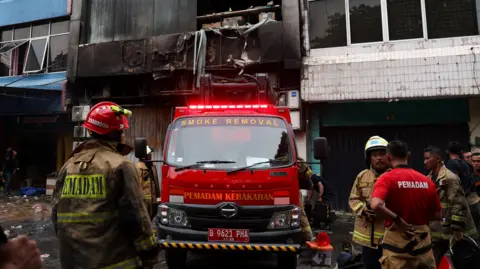
A fire at an office building in Jakarta has killed at least 22people as authorities continue to search for casualties.
The blaze at the seven-storey site in the Indonesian capital started on Tuesday afternoon, according to city police chief Susatyo Purnomo Condro, who said some workers were having lunch at the time.
Police believe the fire began after a battery exploded on the first floor before the flames spread upwards. A company which makes drones is based in the building.
Susatyo said most of the victims who perished were women, one of whom was pregnant,and it was likely that they had died of asphyxiation from smoke rather than burns.
Thick smoke poured from the upper floors as firefighters deployed 28 engines and about 100 personnel, with dramatic footage showing trapped employees being rescued by aerial ladders.
The fire has been extinguished and rescue teams are focusing on the upper levels of the building after conducting a sweep of the lower floors.
Susatyo said that access to the sixth floor was "particularly challenging, according to the firefighters on site", the Jakarta Globe newspaper reports.
"We are still collecting data," he told the Associated Press news agency. "But for now, we are focusing on identifying the victims who have been found."
The company provides drone services for industrial clients, from aerial surveying and mapping to inspection and agriculture.
With many staying at home the atmosphere is quiet but tense
Security has been tightened across Tanzania with police and military seen patrolling major cities ahead of anticipated anti-government protests called to coincide with independence day.
By midday local time (09:00 GMT), however, no demonstrations had begun.
Residents in Dar es Salaam, Arusha, Mbeya, Mwanza and several other urban centres reported an unusually slow start to the day, with many people choosing to remain indoors amid uncertainty over whether protests would happen.
The demonstrations were called to demand political reforms in the wake of October's post-election unrest which left an unknown number of people dead.
The authorities have admitted using force against protesters, claiming that some groups were attempting to overthrow the regime.
On Tuesday, BBC reporters observed nearly empty streets in the commercial capital, Dar es Salaam. This was a stark contrast to the city's usual weekday bustle.
Although quiet, the atmosphere remained tense.
In a statement, police spokesperson David Misime assured the public of their safety and the protection of their property, saying the situation remained calm nationwide.
He also urged citizens to dismiss old photos and video clips circulating on social media that falsely suggest protests are taking place.
Security vehicles were seen driving along major roads and intersections, while officers took up positions at strategic locations, including around key public infrastructure.
On social media, activists and campaigners urged supporters to stay alert, suggesting any demonstrations were unlikely to begin until the afternoon. The messaging echoed previous protest calls in Tanzania, when turnout increased later in the day.
"We will move out, it is our right to protest... I know police are everywhere in the town and even in the street where I live... we have plans so wait, you will see what will happen," a resident of Arusha told the BBC.
"I am scared for my children, if these protests happen, it will create a bad atmosphere. Like now my husband is hospitalised, how am I going to attend to him? I feel protesters should call off plans to move to the streets, we need to live in peace," said a resident of Mwanza in northern Tanzania.
Motorists who ventured out reported frequent checks at roadblocks, where officers questioned drivers about their destinations.
The government has not issued detailed comments on the heightened security measures or on the planned protests.
Tanzanian authorities have banned the planned protests and cancelled independence day celebrations, urging citizens to stay indoors.
Meanwhile, in neighbouring Kenya several activists were arrested on Tuesday as they were holding a solidarity protest outside the Tanzanian high commission in the capital, Nairobi.
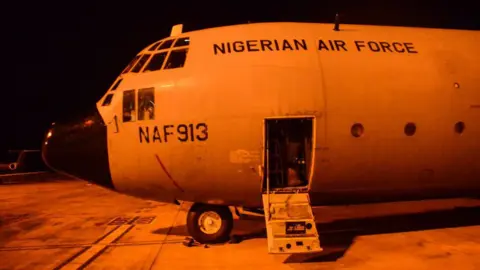
The aircraft was en route to Portugal when it had to land in Burkina Faso, the Nigerian authorities have said (file photo)
Eleven Nigerian military officers were detained in Burkina Faso after their aircraft made an emergency landing in the country, Burkinabè security sources told the BBC.
The Air Force C-130 aircraft entered Burkina Faso's airspace on Monday without authorisation, according to the country's Territorial Administration Minister Emile Zerbo.
In a joint statement, the military governments of Burkina Faso, Mali and Niger said their prompt investigation confirmed the "violation of its airspace and the sovereignty of its member states".
But the Nigerian Air Force (NAF) said a technical problem meant the plane, which was en route to Portugal, had to land in accordance with safety procedures.
The statement added that the crew was "safe and have received cordial treatment from the host authorities". It did not mention whether they had been detained.
The aircraft landed in Bobo-Dioulasso, in the west of Burkina Faso and its second-largest city. The NAF said it was the site of the nearest airfield when the plane had to make an emergency stop.
But the Nigerian account of the incident contradicts the position of the trio of Sahel countries, formally known as Alliance of Sahel States (AES), which said that the aircraft entered Burkinabè airspace without prior authorisation and was forced to land.
"An investigation was immediately opened by the competent Burkinabè services and highlighted the lack of authorisation to fly over Burkinabè territory for this military apparatus," the AES said in a joint statement.
It called the landing an "unfriendly act" and said the countries' respective air forces had been put on maximum alert and authorised to "neutralise any aircraft" found to violate the confederation's airspace.
On board were two crew members and nine passengers, all military officers, according to the AES.
The NAF did not clarify whether the soldiers had been detained.
It added that plans were under way to resume the mission to Portugal as scheduled, assuring the public that the NAF remained committed to operational aviation procedures and safety standards.
Political analysts have linked the incident to the deployment of troops from West Africa's regional bloc, Ecowas, to Benin following an attempted coup on Sunday.
Nigeria led the regional mission with the deployment of jets and troops to suppress the mutiny in Benin.
Earlier this year, all the three military-led countries - Burkina Faso, Mali and Niger - withdrew from Ecowas, citing a mix of political and security grievances.
They had rejected Ecowas' demands for them to restore democratic rule.
The three Sahel countries have also distanced themselves from Western countries, notably from former colonial ruler France, while drawing closer to Russia.
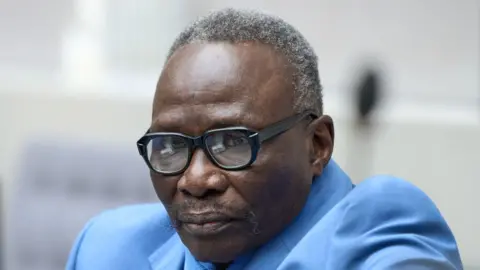
The International Criminal Court (ICC) has sentenced a Sudanese militia leader to 20 years in prison for atrocities committed during a civil war more than two decades ago.
Ali Muhammad Ali Abd-Al-Rahman had been convicted in October on 27 counts of war crimes and crimes against humanity in the Darfur region.
Known as Ali Kushayb, he was one of the leaders of the Janjaweed, a government-backed group that terrorised Darfur, killing hundreds of thousands of people.
Kushayb, aged 76, is the first person to be tried by the ICC for atrocities committed during the civil war. He had argued the charges were a case of mistaken identity.
Dressed in a light blue suit and tie, Kushayb stood quietly as presiding judge Joanna Korner delivered his sentence on Tuesday.
"Abdal Raman not only gave the orders which led directly to the crimes but... also personally perpetrated some of them," Judge Korner told the court.
The conflict in question lasted from 2003 to 2020 and was one of the world's gravest humanitarian disasters, with allegations of ethnic cleansing and genocide against the region's non-Arabic population.
Five years after the end of that crisis, Darfur is a key battleground in another civil war, this time between Sudan's army and the paramilitary Rapid Support Forces (RSF), whose origins lie in the Janjaweed.
During Kushayb's trial, survivors described how their villages were burned down, men and boys slaughtered and women forced into sex slavery.
Judge Korner said Kushayb had given orders to "wipe out and sweep away" non-Arab tribes and told soldiers "don't leave anyone behind. Bring no one alive."
The charges against Kushayb centred on attacks committed between 2003 and 2004.
The Darfur war began after the Arab-dominated government at the time armed the Janjaweed, in an attempt to suppress an uprising by rebels from black African ethnic groups.
The Janjaweed systematically attacked non-Arab villagers accused of supporting the rebels, leading to accusations of genocide.
That same systematic violence is still happening in Darfur as part of Sudan's current civil war.
Many of the Janjaweed fighters went on to join the RSF.
The UK, US and rights groups have accused the RSF of carrying out ethnic cleansing against non-Arab communities in Darfur since the conflict began in 2023. The RSF has denied the accusations.
When passing Kushayb's sentence, Judge Korner said the ICC wanted to ensure both "retribution and deterrence".
"Deterrence is particularly apposite in this case given the current state of affairs in Sudan," she said.
Throughout the two conflicts, there has been a "long hiring out of militias, suppressing of rebellion, and sexual violence used as a tool of war", Dr Matthew Benson-Strohmayer, Sudan Research Director at the London School of Economics, told the BBC.
"I think the way that the war is being fought in Darfur in particular is really a war of terror," he told the BBC.
At the time of the verdict, Dr Benson-Strohmayer said he hoped the conviction would impact the current conflict, but "sincerely" doubted it will.
Most victims of the first Darfur crisis remain displaced, and although the ICC has managed to prosecute Kushayb, there are still outstanding arrest warrants against Sudanese officials, including one accusing former President Omar al-Bashir of genocide, which he denies.
Bashir is reportedly in military custody in north Sudan after he was ousted in a coup in 2019.
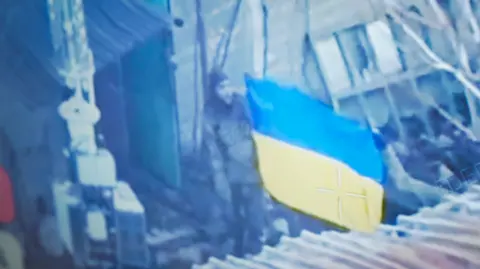
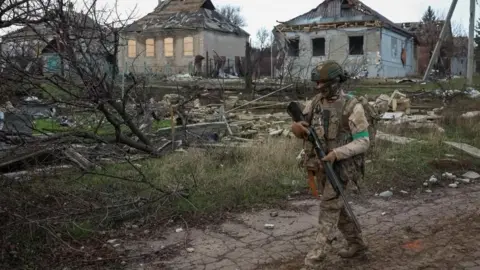
Ukrainian soldiers in Pokrovsk show a Ukrainian flag to prove the city has not yet fallen
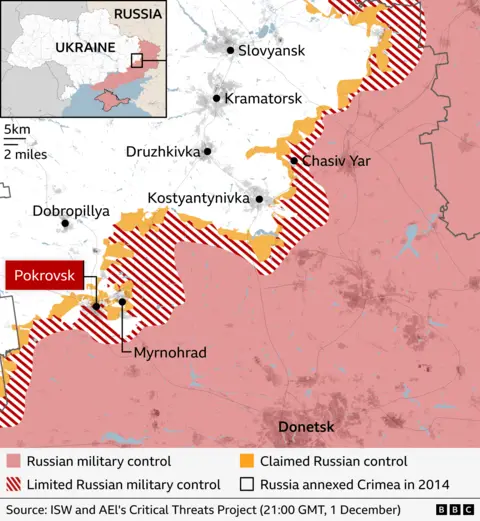
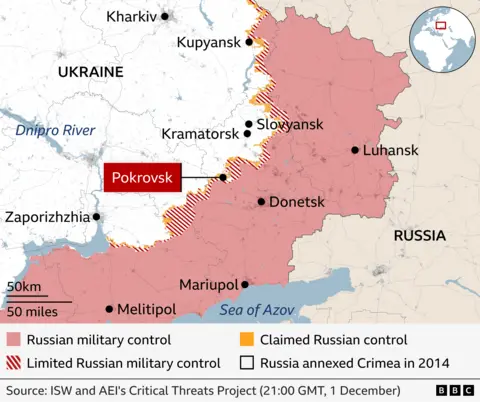
Pokrovsk has not fallen yet. That is despite President Vladimir Putin's recent claim that Russian forces have taken the city.
There is no doubt Ukraine has been losing ground in this key city in the east. For Russia, Pokrovsk is another stepping stone towards its goal of taking control of all of the Donbas. But Ukraine needs to prove it is still capable of resisting.
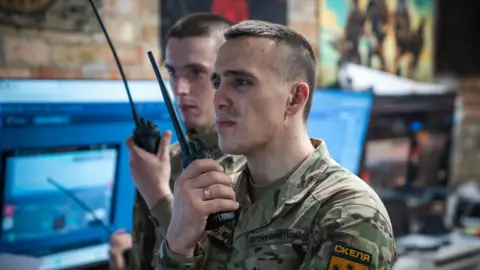
At a Ukrainian command post, well behind the front line, orders are relayed by radio in rapid and quick succession. Soldiers watch dozens of live drone feeds. They are coordinating strikes on Russian positions inside the city.
The commander of the Skala Assault Regiment, Yuri, is keen to prove to us that Ukraine still controls the north of the city - to show that the Kremlin's claim that it has taken Pokrovsk is a lie.
Over the radio, they ask two of their soldiers to break cover from a building to display a Ukrainian flag. They move quickly to avoid being spotted. The drone feed shows the moment they briefly wave their yellow and blue flag, before quickly returning to cover.
BBC/Matthew Goddard
Battalion commanders are adamant they still have a foothold in Pokrovsk
Yuri tells me: "You've now seen it with your own eyes."
"I think the whole world should know we will not just give up our territory," he says. "If we do not show this, everyone will lose faith and stop helping Ukraine."
The battle for Pokrovsk, once a key logistics hub for Ukraine's military, has been grinding on for nearly 18 months. The city is already in ruins.
The question now is how much longer can Ukraine hold on.
Those tracking the Russian advances suggest Ukrainian forces barely have a hold on the city.
Russian forces have slowly been advancing from the south. Ukraine is losing ground, but says it still holds the north, up to the railway line that bisects the city.
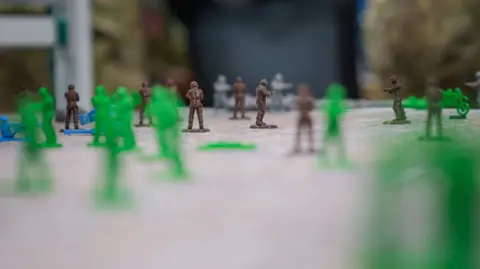
Sasha, a 25-year-old battalion commander, shows me a map. On top he has placed green plastic soldiers to represent where Ukrainian troops are still defending. Brown plastic soldiers show where their enemy has advanced.
The Russians have been using small teams of two to four soldiers to sneak past Ukrainian positions, sometimes dressed as civilians.
"It's a good tactic to get behind enemy lines, to gain a foothold," Sasha says. But he adds: "The enemy who gets into our rear is quickly identified – it takes 15 to 20 minutes between detection and destruction."
BBC/Matthew Goddard
Green and brown plastic soldiers on Sasha's Ukrainian map show the two armies still fighting in Pokrovsk
Russia has suffered heavy casualties, but still has more troops. A Ukrainian soldier with the call sign Rabbit shows me passports and documents retrieved from their dead. I asked him if he thinks they have killed a lot of Russians.
"Not enough," he replies.
Rabbit described the situation as "hard, but under control". He shows me a Russian machine gun captured by one of his comrades who spent 70 straight days fighting in Pokrovsk. "All he wanted was cigarettes and ammunition," says Rabbit.
The fighting is clearly taking its toll on Ukrainian forces, but there is no sign of them giving up. Nor does Rabbit agree with any suggestion that Ukraine should give up more land for peace.
He says too much blood has already been spilt: "We are part of this land. If we give it up Russia will want more."
Another soldier - call sign "Ghost" - fighting in another unit in Pokrovsk describes the situation as "tense, but not critical". He dismisses reports of its capture as "Russian propaganda", saying reports that "Pokrovsk is surrounded is fake information", but adds that "everyone is exhausted – both Russia and Ukraine".
For Ukraine, holding ground is also proving costly. The Skala Regiment shares recent videos taken by their troops on the front line - often having to take cover in buildings from Russian drones. The buzz of an approaching drone is often accompanied by heavy automatic fire as they try to bring it down.
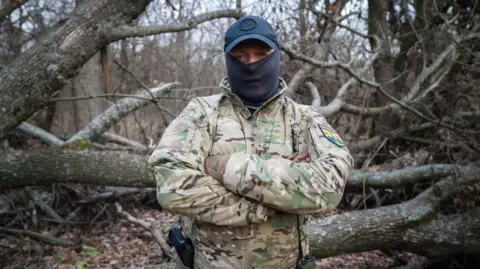
"Khotabych", who recently spent a month fighting in the city, says it is scary when the drones spot you: "There are lots and they fly round the clock."
The Russians have more drones with thermal imaging cameras, which can see at night. Khotabych said he and his men always hope for "good weather" – by which he means fog, rain and grey sky. In other words, anything that makes it more difficult to fly.
BBC/Matthew Goddard
The Skala Regiment's deputy commander, "Godfather", warns that Putin will not stop after Ukraine
In Pokrovsk, Ukrainian soldiers are focused on the fighting, not peace talks. Most say they want to avoid "political questions".
But a volunteer from Latvia – the Skala Regiment's deputy commander – is more willing to give an opinion. He says Latvians "understand that if Ukraine loses the war, it's going to be our country next".
His call sign is "Godfather" and he has a tough message for Europe and the US. He describes President Donald Trump as a "charismatic and strong leader", but he says if Trump's peace envoy Steve Witkoff "stands with Putin, then it makes America and Trump look weak".
As for Europe, he says "there's a lot of talking, a lot of bureaucracy and not enough doing".
The message from the troops we talked to is that the situation in Pokrovsk is not so bleak. But Ukraine needs proof of its resolve at this critical time.
Additional reporting by Mariana Matveichuk and Kyla Herrmannsen.
Simmering tensions between Thailand and Cambodia have once again exploded along the border - derailing a fragile ceasefire backed by US President Donald Trump.
At least three Thai soldiers and seven Cambodian civilians have been killed since Monday, with both sides accusing each other of starting the violence.
The clashes - which have seen Thailand launch airstrikes along the border - are the most serious since a ceasefire was first agreed in July.
On that occasion, at least 48 people were killed, and thousands were displaced following five days of fighting.
Trump then intervened and, with the help of Malaysia, negotiated a ceasefire.
The US president later oversaw the signing of what he dubbed "the Kuala Lumpar peace accord" in October. Thailand refused to call it that - instead referring to it as "Joint Declaration by the prime ministers of Thailand and Cambodia on the outcomes of their meeting in Kuala Lumpur".
Just two weeks later, Thailand suspended the deal. Then, in December, fighting broke out once again.
So, how did we get here - and where is it going?
What's behind the tensions?
This is not a recent dispute. In fact, the argument between Thailand and Cambodia dates back more than a century, when the borders of the two nations were drawn after the French occupation of Cambodia.
Things officially became hostile in 2008, when Cambodia tried to register an 11th Century temple located in the disputed area as a Unesco World Heritage Site - a move that was met with heated protest from Thailand.
Over the years there have been sporadic clashes that have seen soldiers and civilians killed on both sides.
The latest tensions ramped up in May after a Cambodian soldier was killed in a clash. This plunged bilateral ties to their lowest point in more than a decade.
In the run up to the first bout of fighting in July, both countries had imposed border restrictions on one another. Cambodia banned imports such as fruits and vegetables from Thailand, and also stopped importing power and internet services.
Both countries had also strengthened troop presence along the border in recent weeks.
The two sides have given differing versions of what happened.
On Monday, 8 December, the Thai army said its troops had responded to Cambodian fire in Thailand's Ubon Ratchathani Province, that it said had killed a hai soldier.
It added that it had launched air strikes on military targets along the disputed border.
Phnom Penh's defence ministry said it was the Thai forces that attacked first, in Cambodia's Preah Vihear province. Cambodia also insisted that it did not retaliate.
The next day, Thailand's military accused Cambodia of using multiple-launch rocket systems, bomb-dropping drones and kamikaze drones against Thai soldiers, with some rockets reportedly hitting civilian areas.
It later confirmed it had carried out more airstrikes.
Cambodia has also accused Thailand of firing indiscriminately into civilian areas in its border Pursat Province.
What exactly happened in July?
Again, both sides gave different versions of what happened.
Thailand's National Security Council (NSC) claimed that just after 07:30 local time (00:30GMT) on 24 July, Cambodia's military deployed drones to conduct surveillance of Thai troops near the border.
Shortly afterwards, it said, Cambodian military personnel carrying rocket-propelled grenades gathered near the border. Soldiers on the Thai side attempted negotiations by shouting, but were unsuccessful, the NSC spokesman claimed, adding that Cambodian soldiers opened fire at around 08:20, forcing the Thai side to retaliate.
Thailand also accused Cambodia of deploying heavy weapons, including BM-21 rocket launchers and artillery, causing damage to homes and public facilities including a hospital and a petrol station along the Thai side of the border.
Meanwhile, Cambodia alleged that Thai soldiers initiated the conflict at around 06:30, when they violated a prior agreement by advancing on a Khmer-Hindu temple near the border and placing barbed wire around its base.
Thai soldiers then deployed a drone just after 07:00, and fired shots "into the air" at around 08:30, according to Maly Socheata, a spokesperson from Cambodia's Ministry of National Defence.
At 08:46, Thai soldiers "pre-emptively" opened fire on Cambodian troops, leaving them no choice but to exercise their right to self-defence, according to the Phnom Penh Post newspaper quoting Socheata.
Socheata further accused Thailand of deploying excessive troops, using heavy weapons and carrying out air strikes on Cambodian territory.
Thailand had already paused the agreement back in November, with Thai Prime Minister Anutin Charnvirakul saying the "security threat.... has not actually decreased".
At the time, Cambodia said it remained committed to the terms of the deal.
After fighting broke out again in December, Bangkok's foreign minister Sihasak Phuangketkeow told the BBC the ceasefire was "not working" - adding "the ball is in Cambodia's court".
However, Cambodia's former prime minister Hun Sen said they had only returned fire late on Monday, in order to "respect the ceasefire".
Trump, meanwhile, is reported to have called on both sides to respect the agreement, news agency Reuters said.
Under the terms of the agreement signed in October, the two countries agreed to withdraw their heavy weapons from the disputed region, and to establish an interim observer team to monitor it.
The next step was supposed to include the release of 18 Cambodian soldiers held in Thailand.
Where this leads next is unclear.
While there have been serious exchanges of fire in the past, they de-escalated relatively quickly.
Back in July, that was the path our correspondent Jonathan Head thought would be followed again.
However, he warned, there's a lack of leadership with the strength and confidence to pull back from this confrontation in both countries at the moment.
For those travelling to Thailand, the British Foreign Office currently advises against all but essential travel to border areas within 50km of the whole border with Cambodia.
While for those in Cambodia, it advises against all but essential travel to border areas within 50km of the whole border with Thailand.
While peace talks continue, so does fighting along the front line in eastern Ukraine
Ukraine is preparing to present a revised peace plan to the White House, as it seeks to avoid making territorial concessions to Russia.
Kyiv is set propose alternatives to the US after President Volodymyr Zelensky again ruled out surrendering land, saying he had "no right" to do so under Ukrainian or international law.
He made the comments as he met European and Nato leaders on Monday, part of a collective push to deter the US from backing a peace deal which includes major concessions for Ukraine, and which allies fear would leave it vulnerable to a future invasion.
Meanwhile, the city of Sumy in north-western Ukraine was left without power overnight after a Russian drone attack.
The region's governor said more than a dozen drones had hit power infrastructure, the latest in Russia's nightly attacks. No deaths were reported.
Zelensky's ongoing diplomatic tour of Europe comes after days of intensive talks between US and Ukrainian negotiators over the weekend, that failed to produce a deal Kyiv could agree to.
Zelensky was due to be briefed on that private summit on Monday by his chief aide Rustem Umerov, who wrote on Telegram that he would feed back details of direct talks between the US and Russian President Vladimir Putin.
The Ukrainian president told a news conference that his team could send a new proposal to the Americans as soon as Tuesday, AFP news agency reported.
On the subject of surrendering land, Zelensky said: "Russia is insisting that we give up territories, but we don't want to cede anything."
He continued: "We have no legal right to do so, under Ukrainian law, our constitution and international law. And we don't have any moral right either."
Zelensky has long maintained that any changes to Ukraine's borders would need to be authorised by a public referendum.
Elsewhere, he told reporters that the initial 28-point plan proposed by the US - and rejected by Kyiv and European leaders as being too favourable to Russia - had been cut down to 20 points, according to Interfax-Ukraine news agency.
He said no "pro-Ukrainian" points had been removed from the draft, though there had also been no "compromise" on the subject of territory.
Zelensky singled out control of the eastern Donbas region and the Zaporizhzhia nuclear power plant as being among the "most sensitive" issues.
The original leaked version of the US-backed plan proposed that Ukraine hand over total control of the Donbas to Russia, despite the fact that Kremlin forces have been unable to capture it in full after almost four years of war.
Energy produced at Zaporizhzhia, the largest nuclear power plant in Europe, would be split between Russia and Ukraine, the draft plan said.
Leaders in Kyiv and across Europe have indicated there has been progress in refining that draft in recent weeks, and have praised the Trump administration for seeking to mediate an end to the fighting.
But Monday's hastily arranged Downing Street summit - attended by Zelensky, UK Prime Minister Sir Keir Starmer, French President Emmanuel Macron and German Chancellor Friedrich Merz - was widely viewed as a show of support for Ukraine as it seeks to resist White House pressure.
No 10 said there had been an agreement that the US-led talks represented a "critical moment" to ramp up support for Ukraine, and repeated calls for a "just and lasting peace... which includes robust security guarantees".
EPA
The nature of those future security guarantees are another open question in the negotiations.
Efforts continue to assemble an international coalition prepared to offer ongoing military support to Kyiv in the event of a peace deal, though it is not yet clear what form that would take.
While the UK and France have proposed deploying international troops in Ukraine, several key defence players in Europe, including Germany and Italy, have expressed scepticism about that idea.
It is also not clear to what extent the US would be willing to underpin any future defence arrangements for Ukraine.
Following talks in London, Zelensky flew to Brussels to meet Nato chief Mark Rutte and EU chief Ursula von der Leyen, and will meet Prime Minister Georgia Meloni in Italy on Tuesday.
Moscow has also claimed talks with the White House have been constructive, despite little public indication it has moved on any of the goals set out by the Kremlin when it launched its full-scale invasion in February 2022.
On Sunday, Trump indicated that he viewed Zelensky as the main obstacle to securing a peace deal, something he has made a key foreign policy goal and which the president claimed he would be able to achieve rapidly during the 2024 presidential election campaign.
He told reporters that Russia was "fine" with the peace plan outlined to both sides by the US, but that he was a "little disappointed that President Zelensky hasn't read it". It was unclear whether that was the case.
A key UN report on the state of the global environment has been "hijacked" by the United States and other countries who were unwilling to go along with the scientific findings, the co-chair has told the BBC.
The Global Environment Outlook, the result of six years' work, connects climate change, nature loss and pollution to unsustainable consumption by people living in wealthy and emerging economies.
It warns of a "dire future" for millions unless there's a rapid move away from coal, oil and gas and fossil fuel subsidies.
But at a meeting with government representatives to agree the findings, the US and allies said they could not go along with a summary of the report's conclusions.
As the scientists were unwilling to water down or change their findings, the report has now been published without the summary and without the support of governments, weakening its impact.
Researchers say the objections to this new report reflect similar concerns expressed by countries at the recent COP30 talks.
The BBC has approached the relevant US government departments for comment.
Issued every six or seven years, the Global Environment Outlook is a significant scientific analysis of the major threats to the planet.
Developed under the auspices of the UN, the normal practice for studies like this is to have the key conclusions and recommendations agreed word by word with governments and published as a "summary for policymakers".
These summaries are seen as critical because they show that governments agree with the science and are prepared to put the findings into action.
But this new version of the Global Environment Outlook does not have this type of summary, as the authors and the political representatives of around 70 countries could not agree one at a "stormy" meeting in Nairobi in October.
Compiled by nearly 300 scientists worldwide, the report argues that the food we eat, the clothes we wear, and the energy we consume all involve the extraction of resources in a highly unsustainable manner.
To solve the connected issues of climate change, pollution, nature and biodiversity loss, the report has many recommendations including a rapid move away from coal, oil and gas and a massive reduction in subsidies for farming and fossil fuels.
The authors acknowledge this type of action will drive-up prices for consumers.
But that short term pain will bring long term economic benefits for the whole world, the report says.
These strong measures, especially on fossil fuels and plastics, were too much for the United States, Saudi Arabia and Russia among others at the approval meeting, which usually work by consensus.
Getty Images
Sir Robert Watson is co-chair of the report
"A small number of countries basically just hijacked the process, to be quite honest," Prof Sir Robert Watson told BBC News.
"The US decided not to attend the meeting at all. At the very end they joined by teleconference and basically made a statement that they could not agree with most of the report, which means they didn't agree with anything we said on climate change, biodiversity, fossil fuels, plastics and subsidies."
Sir Robert is one of the world's most respected scientific voices. He's a former chief scientist for the UK's department of the environment and has also been chair of the Intergovernmental Panel on Climate Change (IPCC), as well as working for the World Bank and Nasa.
However he has had rows with the US in the past, criticising their decision to leave an earlier climate treaty, the Kyoto Protocol, when he was head of the IPCC.
He was ousted from that role in 2002 after lobbying by the administration of President George W. Bush.
Others present at the meeting agreed that the actions of the US and other countries "derailed" the process.
"I thought we had gone beyond the point of recognizing that when you burn oil, this big, thick black stuff comes up, and it probably isn't good, especially when you try and breathe it in," said Dr David Broadstock, with the Lantau Group, and one of the report's lead authors.
"It's kind of pretty obvious, and yet we're still seeing parties wanting to pursue the increasing scale of production of such things," he told BBC News.
Since taking office President Trump has sought to boost fossil fuel production and roll back US commitments to fight climate change, calling for the country to be a global energy superpower with cheap and reliable resources.
He has also sought to get the US courts to overturn the idea that carbon dioxide is a danger to public health. His government has also followed up with efforts to restrict or limit the efforts of international bodies that set out to tackle warming.
The disagreement over the Global Environment Outlook report will raise concerns about future negotiations for the Intergovernmental Panel on Climate Change reports as these studies are seen as the bedrock of global efforts to limit global warming.
The owners of a nightclub in Goa, India, where a devastating fire killed 25 people on Sunday, fled the country hours after the tragedy, police have said.
Indian authorities confirmed the two brothers, Saurabh and Gaurav Luthra, boarded a flight to Phuket in Thailand shortly after the incident.
Investigators believe the fierce blaze was triggered by fireworks being set off inside the venue, Birch By Romeo Lane, which is located in a busy nightlife area of Goa, a coastal state popular with domestic and international tourists.
The majority of the victims were staff members, while four were holidaymakers visiting from Delhi. Five people are still being treated in hospital.
Police have appealed to Interpol for help to find and arrest the Luthra brothers.
Police said they travelled to Delhi to carry out a raid on the mens' home, but discovered they had left the country.
"It shows their intent to avoid police investigation," Goa police said in a statement.
Saurabh Luthra, whose social media identifies him as the chairman of the company which operates the club, posted a statement on social media expressing "profound grief", but did not reference his whereabouts.
"In this hour the irreparable sorrow and overwhelming distress, the management stands in unwavering solidarity with the families of the deceased as well as those injured, and conveys its heartfelt condolences with utmost sincerity," Monday's post said.
It added that "management" would provide "assistance, support and cooperation to the bereaved".
His brother Gaurav Luthra has not commented publicly.
At least four people were arrested in the immediate aftermath of the fire, including the venue's manager.
The Birch nightclub in Arpora, an area with several high-end nightlife businesses, was packed with customers who had come to hear a Bollywood DJ when the fire broke out in the early hours of the morning.
Eye witnesses have described scenes of total panic to the BBC, as people tried to flee.
The main section of the venue is built on an island in the middle of a lake, which visitors accessed via narrow walkways - a layout which made it difficult for firefighters to tackle the blaze.
Part of the venue was entirely destroyed. Police initially said an exploding gas canister was the cause, but now believe it was due to pyrotechnics igniting wooden ceiling beams.
Several of the victims were migrant workers who had travelled to Goa to find employment, including four Nepalese nationals.
Among those who died were two brothers who were both engaged to be married next year, and four members of the same Delhi family.
The police said the bodies of all the victims had been returned to their families.
While peace talks continue, so does fighting along the front line in eastern Ukraine
Ukraine is preparing to present a revised peace plan to the White House, as it seeks to avoid making territorial concessions to Russia.
Kyiv is set propose alternatives to the US after President Volodymyr Zelensky again ruled out surrendering land, saying he had "no right" to do so under Ukrainian or international law.
He made the comments as he met European and Nato leaders on Monday, part of a collective push to deter the US from backing a peace deal which includes major concessions for Ukraine, and which allies fear would leave it vulnerable to a future invasion.
Meanwhile, the city of Sumy in north-western Ukraine was left without power overnight after a Russian drone attack.
The region's governor said more than a dozen drones had hit power infrastructure, the latest in Russia's nightly attacks. No deaths were reported.
Zelensky's ongoing diplomatic tour of Europe comes after days of intensive talks between US and Ukrainian negotiators over the weekend, that failed to produce a deal Kyiv could agree to.
Zelensky was due to be briefed on that private summit on Monday by his chief aide Rustem Umerov, who wrote on Telegram that he would feed back details of direct talks between the US and Russian President Vladimir Putin.
The Ukrainian president told a news conference that his team could send a new proposal to the Americans as soon as Tuesday, AFP news agency reported.
On the subject of surrendering land, Zelensky said: "Russia is insisting that we give up territories, but we don't want to cede anything."
He continued: "We have no legal right to do so, under Ukrainian law, our constitution and international law. And we don't have any moral right either."
Zelensky has long maintained that any changes to Ukraine's borders would need to be authorised by a public referendum.
Elsewhere, he told reporters that the initial 28-point plan proposed by the US - and rejected by Kyiv and European leaders as being too favourable to Russia - had been cut down to 20 points, according to Interfax-Ukraine news agency.
He said no "pro-Ukrainian" points had been removed from the draft, though there had also been no "compromise" on the subject of territory.
Zelensky singled out control of the eastern Donbas region and the Zaporizhzhia nuclear power plant as being among the "most sensitive" issues.
The original leaked version of the US-backed plan proposed that Ukraine hand over total control of the Donbas to Russia, despite the fact that Kremlin forces have been unable to capture it in full after almost four years of war.
Energy produced at Zaporizhzhia, the largest nuclear power plant in Europe, would be split between Russia and Ukraine, the draft plan said.
Leaders in Kyiv and across Europe have indicated there has been progress in refining that draft in recent weeks, and have praised the Trump administration for seeking to mediate an end to the fighting.
But Monday's hastily arranged Downing Street summit - attended by Zelensky, UK Prime Minister Sir Keir Starmer, French President Emmanuel Macron and German Chancellor Friedrich Merz - was widely viewed as a show of support for Ukraine as it seeks to resist White House pressure.
No 10 said there had been an agreement that the US-led talks represented a "critical moment" to ramp up support for Ukraine, and repeated calls for a "just and lasting peace... which includes robust security guarantees".
EPA
The nature of those future security guarantees are another open question in the negotiations.
Efforts continue to assemble an international coalition prepared to offer ongoing military support to Kyiv in the event of a peace deal, though it is not yet clear what form that would take.
While the UK and France have proposed deploying international troops in Ukraine, several key defence players in Europe, including Germany and Italy, have expressed scepticism about that idea.
It is also not clear to what extent the US would be willing to underpin any future defence arrangements for Ukraine.
Following talks in London, Zelensky flew to Brussels to meet Nato chief Mark Rutte and EU chief Ursula von der Leyen, and will meet Prime Minister Georgia Meloni in Italy on Tuesday.
Moscow has also claimed talks with the White House have been constructive, despite little public indication it has moved on any of the goals set out by the Kremlin when it launched its full-scale invasion in February 2022.
On Sunday, Trump indicated that he viewed Zelensky as the main obstacle to securing a peace deal, something he has made a key foreign policy goal and which the president claimed he would be able to achieve rapidly during the 2024 presidential election campaign.
He told reporters that Russia was "fine" with the peace plan outlined to both sides by the US, but that he was a "little disappointed that President Zelensky hasn't read it". It was unclear whether that was the case.
Japanese TV broadcast mesages which said "Tsunami! Run!" and "Tsunami warning issued for central Hokkaido's Pacific Coast"
A major earthquake of 7.6 magnitude has hit Japan's north-eastern region, prompting tsunami warnings and orders to evacuate residents.
The quake occurred at 23:15 (14:15 GMT) at a depth of 50km (31 miles), about 80km off the coast of the Aomori region, the Japan Meteorological Agency said, while waves of 40cm (16in) were seen in some places.
Local media reports that some people in the region have been injured, while trains have been suspended as a precaution.
Japan is one of the world's most earthquake-prone countries, with a tremor occurring at least every five minutes.
Orders were issued for about 90,000 residents to evacuate, according to Reuters news agency.
Japanese public broadcaster NHK quoted a hotel employee in Hachinohe as saying a number of people had been injured.
No irregularities were reported at the Higashidori and Onagawa nuclear power plants as a result of the quake, Tohoku Electric Power said.

 Login
Login
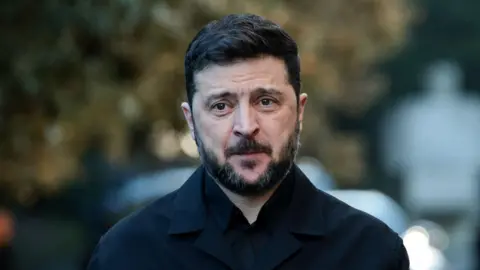 Reuters