Ukraine's president says it is right for Russia's frozen assets to be used to rebuild his country
Ukraine is running out of cash to keep its military and its economy going, after almost four years of Russia's full-scale war.
For Europe, the solution to plugging Kyiv's budget hole of €135.7bn (£119bn; $159bn) for the next two years lies in frozen Russian assets sitting in Belgian bank Euroclear and EU leaders hope to sign that off at their Brussels summit next week.
Russian officials warn the EU plan would be an act of theft and Russia's central bank announced on Friday it was suing Euroclear in a Moscow court even before a final decision is made.
'Only fair' to use Russia's assets
In total, Russia has about €210bn of its assets frozen in the EU, and €185bn of that is held by Euroclear.
The EU and Ukraine argue that money should be used to rebuild what Russia has destroyed: Brussels calls it a "reparations loan" and has come up with a plan to prop up Ukraine's economy to the tune of €90bn.
"It's only fair that Russia's frozen assets should be used to rebuild what Russia has destroyed – and that money then becomes ours," says Ukraine's Volodymyr Zelensky.
German Chancellor Friedrich Merz says the assets will "enable Ukraine to protect itself effectively against future Russian attacks".
Russia's court action was expected in Brussels. But it is not just Moscow that is unhappy.
Belgium is worried it will be saddled with an enormous bill if it all goes wrong and Euroclear chief executive Valérie Urbain says using it could "destabilise the international financial system".
Euroclear also has an estimated €16-17bn immobilised in Russia.
Belgian Prime Minister Bart de Wever has set the EU a series of "rational, reasonable, and justified conditions" before he will accept the reparations plan, and he has refused to rule out legal action if it "poses significant risks" for his country.
What is the EU's plan?
Thierry Monasse/Getty Images
The German chancellor (L) says the EU's plan will enable Ukraine to defend itself
The EU is working to the wire ahead of next Thursday's summit to come up with a solution that Belgium can accept.
Until now the EU has held off touching the assets themselves directly but since last year has paid the "windfall profits" from them to Ukraine. In 2024 that was €3.7bn. Legally using the interest is seen as safe as Russia is under sanction and the proceeds are not Russian sovereign property.
But international military aid for Ukraine has slipped dramatically in 2025, and Europe has struggled to make up the shortfall left by the US decision to all but stop funding Ukraine under President Donald Trump.
There are currently two EU proposals aimed at providing Ukraine with €90bn, to cover two-thirds of its funding needs.
One is to raise the money on capital markets, backed by the EU budget as a guarantee. This is Belgium's preferred option but it requires a unanimous vote by EU leaders and that would be difficult when Hungary and Slovakia object to funding Ukraine's military.
That leaves loaning Ukraine cash from the Russian assets, which were originally held in securities but have now largely matured into cash. That money is Euroclear property held in the European Central Bank.
The EU's executive, the European Commission, accepts Belgium has legitimate concerns and says it is confident it has dealt with them.
The plan is for Belgium to be protected with a guarantee covering all the €210bn of Russian assets in the EU.
Should Euroclear suffer a loss of its own assets in Russia, a Commission source explained that would be offset from assets belonging to Russia's own clearing house which are in the EU.
If Russia went after Belgium itself, any ruling by a Russian court would not be recognised in the EU.
In a key development, EU ambassadors are expected to agree on Friday to immobilise Russia's central bank assets held in Europe indefinitely.
Until now they have had to vote unanimously every six months to renew the freeze, which could have meant a repeated risk to Belgium.
The EU ambassadors are set to use an emergency clause under Article 122 of the EU Treaties so the assets remain frozen as long as an "immediate threat to the economic interests of the union" continues.
Why Belgium is not yet satisfied
Belgium is adamant it remains a staunch ally of Ukraine, but sees legal risks in the plan and fears being left to handle the repercussions if things go wrong.
A usually divided political landscape in this case has rallied behind Prime Minister Bart de Wever, who is under pressure from European colleagues and having talks with UK Prime Minister Sir Keir Starmer in London on Friday.
"Belgium is a small economy. Belgian GDP is about €565bn – imagine if it would need to shoulder a €185bn bill," says Veerle Colaert, professor of financial law at KU Leuven University.
While the EU might be able to secure sufficient guarantees for the loan itself, Belgium fears an added risk of being exposed to extra damages or penalties.
Prof Colaert also believes the requirement for Euroclear to grant a loan to the EU would violate EU banking regulations.
"Banks need to comply with capital and liquidity requirements and shouldn't put all their eggs in one basket. Now the EU is telling Euroclear to do just that.
"Why do we have these bank rules? It's because we want banks to be stable. And if things go wrong it would fall to Belgium to bail out Euroclear. That's another reason why it's so important for Belgium to secure water-tight guarantees for Euroclear."
Europe under pressure from every direction
There is no time to lose, warn seven EU member states including those closest to Russia such as the Baltics, Finland and Poland. They believe the frozen assets plan is "the most financially feasible and politically realistic solution".
"It's a matter of destiny for us," warns leading German conservative MP Norbert Röttgen. "If we fail, I don't know what we'll do afterwards. That's why we have to succeed in a week's time".
While Russia is adamant its money should not be touched, there are added concerns among European figures that the US may want to use Russia's frozen billions differently, as part of its own peace plan.
Zelensky has said Ukraine is working with Europe and the US on a reconstruction fund, but he is also aware the US has been talking to Russia about future co-operation.
An early draft of the US peace plan referred to $100bn of Russia's frozen assets being used by the US for reconstruction, with the US taking 50% of the profits and Europe adding another $100bn. The remaining assets would then be used in some kind of US-Russia joint investment project.
An EU source said the added advantage of Friday's expected vote to immobilise Russia's assets indefinitely made it harder for anyone to take the money away. Implicit is that the US would then have to win over a majority of EU member states to vote for a plan that would financially cost them an enormous sum.
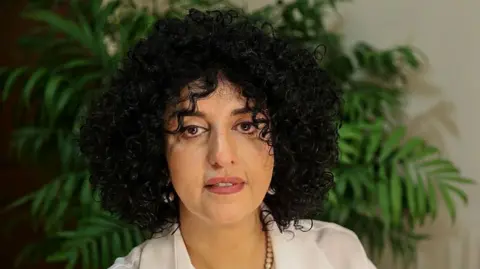
Iranian security forces have "violently arrested" Nobel Peace Prize winner and women's rights activist Narges Mohammadi, her foundation has said.
The Narges Foundation said her brother confirmed Ms Mohammadi was detained in the eastern city of Mashhad, along with other activists.
It has called for the immediate release of the 53-year-old and the activists detained alongside her. Iran does not appear to have commented.
Ms Mohammadi was awarded the 2023 Nobel Peace Prize for her activism against female oppression in Iran and promoting human rights.
In December 2024, she was given a temporary release from jail for three weeks on medical grounds, after being held in Tehran's notorious Evin prison since 2021.
She was expected to return to prison soon after, where she was serving multiple sentences.
Her latest arrest reportedly came as she attended a memorial ceremony for Khosrow Alikordi, a lawyer found dead in his office last week.
Norway-based group Iran Human Rights had called for an independent inquiry to establish how he died, saying the circumstances around his death were "suspicious".
Several other activists were detained at the ceremony, where it's reported they shouted slogans, including "death to the dictator" and "long live Iran".
Taghi Rahmani, Ms Mohammadi's husband, told BBC Persian: "They arrested Narges violently. The brother of the lawyer witnessed her arrest at the memorial.
"This act is against human rights laws, and amounts to some kind of revenge.
"This happened in Mashhad today and is concerning because the establishment's crackdown has intensified recently."
"The threats conveyed to Ms Mohammadi make it clear that her security is at stake, unless she commits to end all public engagement within Iran, as well as any international advocacy or media appearances in support of democracy, human rights, and freedom of expression," the Nobel committee's statement added.
Over the past year, she has continued to remain defiant, refusing to wear the mandatory headscarf and meeting fellow activists across the country.
Across her lifetime, Mohammadi has been arrested 13 times and been sentenced to more 36 years imprisonment and 154 lashes, according to her foundation.
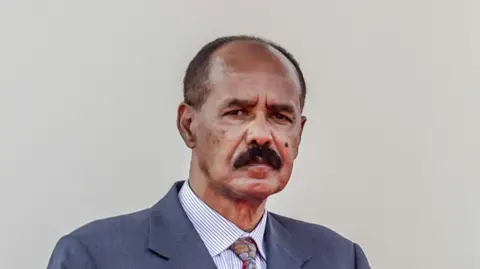
Eritrea, under its President Isaias Afwerki, has had a turbulent relationship with its Horn of Africa neighbours
Eritrea has withdrawn from East African regional bloc Igad, accusing the organisation of "becoming a tool against" countries like itself.
In a statement on Friday, Eritrea's foreign ministry said Igad had strayed from its founding principles and failed to contribute to regional stability.
The withdrawal comes amid a fierce war of words between Eritrea and neighbouring Ethiopia, leading to fears of renewed armed conflict.
In response to Eritrea's statement, Igad (Intergovernmental Authority on Development) said the country had not made any "tangible proposals" or engaged with reforms.
Igad was established to promote regional stability and food security in East Africa, and also includes Ethiopia, Kenya, Sudan, South Sudan, Uganda, and Djibouti.
The government in Eritrea's capital, Asmara, has long accused Igad of siding with Ethiopia in regional disputes.
Eritrea previously left the bloc in 2007, during its border dispute with Ethiopia. It only rejoined in 2023.
"Eritrea finds itself compelled to withdraw its membership from an organisation that has forfeited its legal mandate and authority; offering no discernible strategic benefit to all its constituencies," Eritrea's foreign ministry said on Friday.
In its response, Igad said that since the country returned to the bloc it had not "participated in IGAD meetings, programmes, or activities".
The withdrawal comes as tensions have been increasing between Eritrea and Ethiopia, two countries that have a long history of deadly conflict.
After a decades-long battle for independence, Eritrea officially seceded from Ethiopia in 1993, leaving the latter landlocked.
In calling for sea access, Abiy and other senior Ethiopian officials have gone as far as questioning Addis Abba's recognition of Eritrean independence.
Abiy won a Nobel Peace Prize in 2019 for making peace with Eritrea's strongman President Isaias Afewerki, after a two-decade long border dispute that sparked a war in which more than 100,000 people died.
During this conflict, Eritrea was accused of destabilising the region by interfering in the internal affairs of Igad member countries, an allegation Asmara always denied.
Instead, Eritrea accused its neighbours of siding with Western powers to destabilise it.
At the instigation of Addis Ababa, Igad demanded the African Union and UN Security Council impose sanctions on Eritrea.
Eritrea cut diplomatic ties with Djibouti, which hosts the Igad headquarters, following a 2009 border dispute between the two countries.
Former Ethiopian Foreign Minister Workneh Gebyehu is currently the head of Igad, adding to Asmara's suspicion of the organisation.
Igad has been criticised by many for failing to bring stability and regional integration to the Horn of Africa, a region beset by civil wars, terrorism and intra-state confrontations.
Germany has accused Russia of a cyber-attack on air traffic control and attempted electoral interference, and summoned the Russian ambassador.
A foreign ministry spokesman said Russian military intelligence was behind a "cyber-attack against German air traffic control in August 2024".
The spokesman also accused Russia of seeking to influence and destabilise the country's federal election in February this year.
The spokesman said that Germany, in close co-ordination with its European partners, would respond with counter-measures to make Russia "pay a price for its hybrid actions".
There was no immediate response from Russia.
This breaking news story is being updated and more details will be published shortly. Please refresh the page for the fullest version.
You can receive Breaking News on a smartphone or tablet via the BBC News App. You can also follow @BBCBreaking on X to get the latest alerts.
Ukraine's president says it is right for Russia's frozen assets to be used to rebuild his country
Ukraine is running out of cash to keep its military and its economy going, after almost four years of Russia's full-scale war.
For Europe, the solution to plugging Kyiv's budget hole of €135.7bn (£119bn; $159bn) for the next two years lies in frozen Russian assets sitting in Belgian bank Euroclear and EU leaders hope to sign that off at their Brussels summit next week.
Russian officials warn the EU plan would be an act of theft and Russia's central bank announced on Friday it was suing Euroclear in a Moscow court even before a final decision is made.
'Only fair' to use Russia's assets
In total, Russia has about €210bn of its assets frozen in the EU, and €185bn of that is held by Euroclear.
The EU and Ukraine argue that money should be used to rebuild what Russia has destroyed: Brussels calls it a "reparations loan" and has come up with a plan to prop up Ukraine's economy to the tune of €90bn.
"It's only fair that Russia's frozen assets should be used to rebuild what Russia has destroyed – and that money then becomes ours," says Ukraine's Volodymyr Zelensky.
German Chancellor Friedrich Merz says the assets will "enable Ukraine to protect itself effectively against future Russian attacks".
Russia's court action was expected in Brussels. But it is not just Moscow that is unhappy.
Belgium is worried it will be saddled with an enormous bill if it all goes wrong and Euroclear chief executive Valérie Urbain says using it could "destabilise the international financial system".
Euroclear also has an estimated €16-17bn immobilised in Russia.
Belgian Prime Minister Bart de Wever has set the EU a series of "rational, reasonable, and justified conditions" before he will accept the reparations plan, and he has refused to rule out legal action if it "poses significant risks" for his country.
What is the EU's plan?
Thierry Monasse/Getty Images
The German chancellor (L) says the EU's plan will enable Ukraine to defend itself
The EU is working to the wire ahead of next Thursday's summit to come up with a solution that Belgium can accept.
Until now the EU has held off touching the assets themselves directly but since last year has paid the "windfall profits" from them to Ukraine. In 2024 that was €3.7bn. Legally using the interest is seen as safe as Russia is under sanction and the proceeds are not Russian sovereign property.
But international military aid for Ukraine has slipped dramatically in 2025, and Europe has struggled to make up the shortfall left by the US decision to all but stop funding Ukraine under President Donald Trump.
There are currently two EU proposals aimed at providing Ukraine with €90bn, to cover two-thirds of its funding needs.
One is to raise the money on capital markets, backed by the EU budget as a guarantee. This is Belgium's preferred option but it requires a unanimous vote by EU leaders and that would be difficult when Hungary and Slovakia object to funding Ukraine's military.
That leaves loaning Ukraine cash from the Russian assets, which were originally held in securities but have now largely matured into cash. That money is Euroclear property held in the European Central Bank.
The EU's executive, the European Commission, accepts Belgium has legitimate concerns and says it is confident it has dealt with them.
The plan is for Belgium to be protected with a guarantee covering all the €210bn of Russian assets in the EU.
Should Euroclear suffer a loss of its own assets in Russia, a Commission source explained that would be offset from assets belonging to Russia's own clearing house which are in the EU.
If Russia went after Belgium itself, any ruling by a Russian court would not be recognised in the EU.
In a key development, EU ambassadors are expected to agree on Friday to immobilise Russia's central bank assets held in Europe indefinitely.
Until now they have had to vote unanimously every six months to renew the freeze, which could have meant a repeated risk to Belgium.
The EU ambassadors are set to use an emergency clause under Article 122 of the EU Treaties so the assets remain frozen as long as an "immediate threat to the economic interests of the union" continues.
Why Belgium is not yet satisfied
Belgium is adamant it remains a staunch ally of Ukraine, but sees legal risks in the plan and fears being left to handle the repercussions if things go wrong.
A usually divided political landscape in this case has rallied behind Prime Minister Bart de Wever, who is under pressure from European colleagues and having talks with UK Prime Minister Sir Keir Starmer in London on Friday.
"Belgium is a small economy. Belgian GDP is about €565bn – imagine if it would need to shoulder a €185bn bill," says Veerle Colaert, professor of financial law at KU Leuven University.
While the EU might be able to secure sufficient guarantees for the loan itself, Belgium fears an added risk of being exposed to extra damages or penalties.
Prof Colaert also believes the requirement for Euroclear to grant a loan to the EU would violate EU banking regulations.
"Banks need to comply with capital and liquidity requirements and shouldn't put all their eggs in one basket. Now the EU is telling Euroclear to do just that.
"Why do we have these bank rules? It's because we want banks to be stable. And if things go wrong it would fall to Belgium to bail out Euroclear. That's another reason why it's so important for Belgium to secure water-tight guarantees for Euroclear."
Europe under pressure from every direction
There is no time to lose, warn seven EU member states including those closest to Russia such as the Baltics, Finland and Poland. They believe the frozen assets plan is "the most financially feasible and politically realistic solution".
"It's a matter of destiny for us," warns leading German conservative MP Norbert Röttgen. "If we fail, I don't know what we'll do afterwards. That's why we have to succeed in a week's time".
While Russia is adamant its money should not be touched, there are added concerns among European figures that the US may want to use Russia's frozen billions differently, as part of its own peace plan.
Zelensky has said Ukraine is working with Europe and the US on a reconstruction fund, but he is also aware the US has been talking to Russia about future co-operation.
An early draft of the US peace plan referred to $100bn of Russia's frozen assets being used by the US for reconstruction, with the US taking 50% of the profits and Europe adding another $100bn. The remaining assets would then be used in some kind of US-Russia joint investment project.
An EU source said the added advantage of Friday's expected vote to immobilise Russia's assets indefinitely made it harder for anyone to take the money away. Implicit is that the US would then have to win over a majority of EU member states to vote for a plan that would financially cost them an enormous sum.
Abu Trica raised suspicions after flaunting cars, cash and luxury properties online
A popular Ghanaian social media influencer known as Abu Trica, whose real name is Frederick Kumi, has been arrested over allegations he orchestrated a romance scam that defrauded elderly Americans of over $8m (£5.9m).
Prosecutors said he used AI tools to create fake online identities, targeting victims through social media and dating sites, earning their trust then extorting their money.
Kumi faces charges in the US of conspiracy to commit wire fraud and a money laundering conspiracy and faces up to 20 years in prison if found guilty.
The 31-year-old was arrested in Ghana following a joint operation between the two countries and the US will now seek to extradite him.
He has not yet commented on the allegations.
Kumi, who is also known as Emmanuel Kojo Baah Obeng, flaunted luxury items online to his more than 100,000 Instagram followers.
This raised suspicions about the sources of his income.
''The perpetrators built trust through frequent, intimate conversations by phone, email, and messaging platforms" with victims, said prosecutors.
"They then requested money or valuables under false pretences, such as urgent medical needs, travel expenses, or investment opportunities.''
The monies, or valuables, were then directed to co-conspirators posing as third parties. Kumi allegedly distributed the money to his associates in US and in Ghana.
The case is being prosecuted under the US Elder Abuse Prevention and Prosecution law.
US authorities have in recent months stepped up their crackdown on criminal networks operating in the US and West Africa who seek to defraud elderly Americans.
In July this year, an alleged Ghanaian fraudster, popularly known as Dada Joe Remix, was extradited to the US for using romance and inheritance schemes to defraud Americans.
Earlier this month, a court in the US also sentenced Oluwaseun Adekoya, a Nigerian ringleader of nationwide bank fraud and money laundering conspiracies, to 20 years in prison for laundering over $2m.
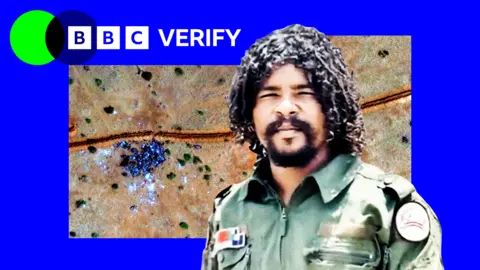
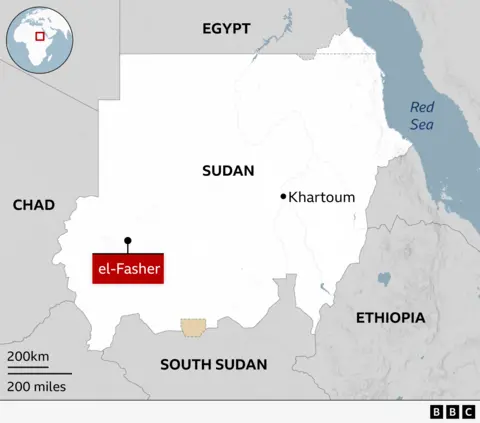
A Sudanese paramilitary commander, whose role in the el-Fasher massacre was revealed by BBC Verify, has been sanctioned by the UK government.
Brig Gen Al-Fateh Abdullah Idris, also known as Abu Lulu, was filmed shooting dead at least 10 unarmed captives after the Rapid Support Forces (RSF) seized the city in late October.
Thousands of people are believed to have been killed by the RSF after the army withdrew from el-Fasher. UK Foreign Secretary Yvette Cooper said the atrocities taking place in Sudan were "a scar on the conscience of the world" which "cannot, and will not, go unpunished."
The UK has also sanctioned three other RSF commanders, including deputy head Abdul Rahim Hamdan Dagalo.
Dagalo, who was also placed under EU sanctions in November, was shown in verified footage touring an army base in the city in the hours after el-Fasher fell. He is the brother of RSF chief Mohamed "Hemedti" Dagalo.
Sudan's civil war - sparked after the RSF and the military's fragile ruling coalition collapsed - has now raged for more than two years, killing hundreds of thousands of people and displacing millions more.
El-Fasher was the army's last major stronghold in Darfur, the traditional stronghold of the RSF paramilitary.
An investigation by BBC Verify revealed the brutal tactics used by the RSF during the protracted siege, which included detaining and torturing people trying to smuggle supplies into the city and building a massive sand barrier around it to prevent civilians and army troops from escaping.
In its statement announcing the sanctions, the UK foreign office said it believed that Abu Lulu was "responsible for violence against individuals based on ethnicity and religion, and the deliberate targeting of civilians".
Footage confirmed by BBC Verify in October showed Abu Lulu executing several unarmed captives with an AK-style rifle in a sandy, dusty area north-west of the city. RSF troops who witnessed the incidents were later seen celebrating their commander's actions.
UK officials accused Abu Lulu, Dagalo, Gedo Hamdan Ahmed and Tijani Ibrahim Moussa Mohamed of carrying out "heinous" acts of violence, including mass killings, systematic sexual violence and deliberate attacks on civilians. The men have been placed under travel bans and any assets they hold will be frozen.
"Today's sanctions against RSF commanders strike directly at those with blood on their hands, while our strengthened aid package will deliver lifesaving support to those suffering," Cooper said.
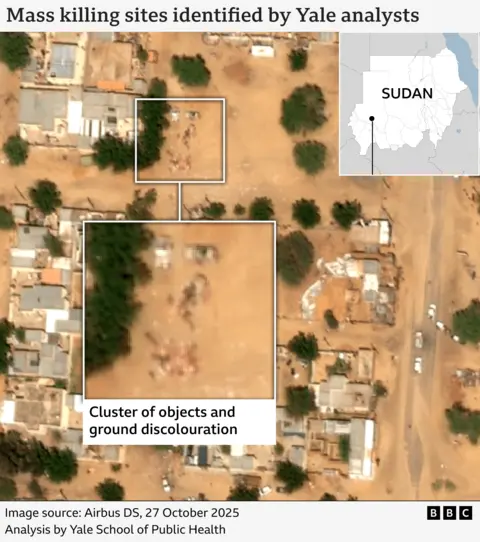
Citing satellite images - previously published by Yale University's Humanitarian Research Lab - the foreign office said piles of bodies and mass graves could be seen in el-Fasher after the massacre.
Cooper also pledged an additional £21m to provide food, shelter and health services for civilians impacted by fighting in remote areas.
In the days that followed the el-Fasher massacre, RSF leader Gen Mohamed "Hemedti" Dagalo admitted that his troops had committed "violations" and said the incidents would be investigated.
Among those arrested was Abu Lulu. In a carefully choreographed and edited video posted on the RSF's official Telegram account he is shown being led into a cell at a prison, which was geolocated by BBC Verify to the outskirts of el-Fasher.
The commander, who previously featured heavily in propaganda videos posted online, has not been seen since his arrest. A TikTok account that documented his activities was removed by the company in October after BBC Verify approached the tech giant for comment.
The UK's move comes just two days after the US announced its own set of sanctions against a network of companies and individuals it accused of recruiting former Colombian soldiers and training individuals to fight in Sudan's civil war.
The US Treasury Department said that hundreds of Colombian mercenaries have travelled to Sudan since 2024, including to serve as infantry and drone pilots for the RSF.
Last month, US President Donald Trump pledged to "start working on Sudan" alongside Egypt, Saudi Arabia and the UAE, posting on social media that "tremendous atrocities" were taking place.
Germany has accused Russia of a cyber-attack on air traffic control and attempted electoral interference, and summoned the Russian ambassador.
A foreign ministry spokesman said Russian military intelligence was behind a "cyber-attack against German air traffic control in August 2024".
The spokesman also accused Russia of seeking to influence and destabilise the country's federal election in February this year.
The spokesman said that Germany, in close co-ordination with its European partners, would respond with counter-measures to make Russia "pay a price for its hybrid actions".
There was no immediate response from Russia.
This breaking news story is being updated and more details will be published shortly. Please refresh the page for the fullest version.
You can receive Breaking News on a smartphone or tablet via the BBC News App. You can also follow @BBCBreaking on X to get the latest alerts.
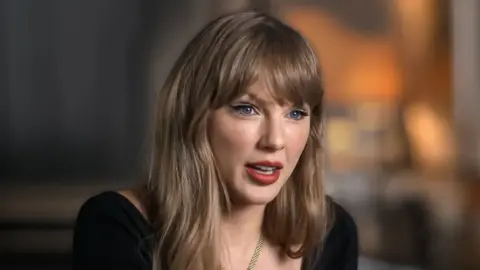
Taylor Swift said she felt compelled to protect fans after the Southport tragedy
Taylor Swift broke down in tears after meeting survivors and families of the victims of the Southport stabbing attack, backstage footage from her Eras tour reveals.
The star met privately with some of those affected by the attack in July 2024, which took place at a Taylor Swift-themed dance workshop, and claimed the lives of three young girls.
She then had to pick herself up and perform for three and a half hours at London's Wembley Stadium.
Speaking to select members of the media, including the BBC, at the New York premiere of her new six-part Disney+ documentary, Swift revealed she had felt compelled to "create some form of escape" for her fans.
"From a mental standpoint, I do live in a reality that's unreal a lot of the time," the star says in the first episode. "But I need to be able to handle all the feelings and then perk up and perform."
Adding to the emotional burden, the Wembley show also marked Swift's return to the stage after cancelling three concerts in Vienna, Austria, due to a terrorist threat.
In her own words, the tour narrowly "dodged a massacre situation" when the CIA identified a plot to explode a bomb at the concert.
Swift said that, after performing for 20 years, "being afraid that something is going to happen to your fans is new".
Getty Images
Taylor Swift's Eras Tour lasted nearly two years, with 149 shows spanning five continents
Thankfully, the rest of the tour proceeded without incident, and the documentary shows her relief after playing Wembley. On a phone call afterwards to her fiance, Travis Kelce, the star says: "I was so happy - I thought I was going to forget how to play guitar and sing."
The insights are shared in the six-part series, titled The End of an Era, which debuts on Disney this weekend, alongside a concert film, shot on the final night of the star's record-breaking tour, which ended a year ago.
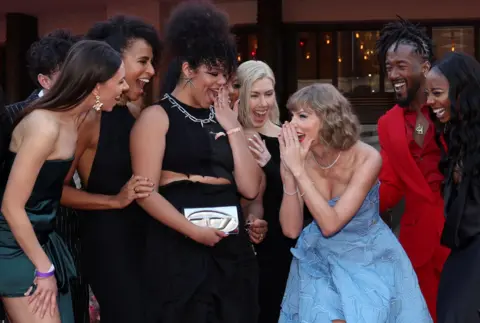
Before taking her seat at the New York City screening, which was also attended by her mother, Andrea, Swift said the tour had been "a lifetime within my life".
"Everything that went into this was all of the lessons that we've learned [throughout] all of our lives."
From the first moment the docuseries played, there was no doubt that one of those lessons was that joy can be palpable, if you let it.
Here are five others:
Disney
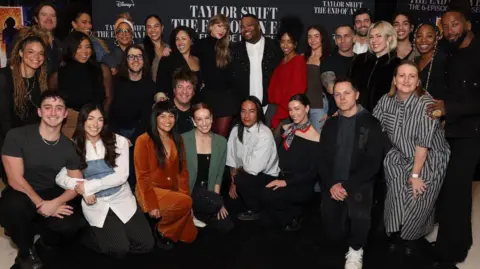
Swift was reunited with her touring crew at a private screening in New York this week
1) The magic is no accident
Disney
The documentary exposes the exhausting process of putting together a tour of this scale
Episode one drives home the amount of work it takes to make art appear effortless.
Viewers are taken behind the scenes of the exhaustive planning, choreograhy, rehearsals, set building, and collaboration it takes to put on a show of such magnitude.
Swift says the goal of the Eras tour was to "over-serve" in terms of the number of songs performed, the extravagance of the costuming, and the details of each set design.
"Every person is the best one in the entire industry," she says. Their job is to make all the effort "look accidental."
That said, speaking to the audience in New York, Swift confessed there was also "some kind of magic, destiny, and stuff we can't explain… when something goes as well as this [tour] did".
2) It's not all fun and games
Getty Images
The star performed for three and a half hours every night
While everyone on the tour is clearly working at maximum capacity, there's only one person at the front of it all - and what's the old cliche... with great power comes great responsibility?
The series examines Swift's existence as a larger-than-life pop star and, more specifically, the emotional toll of putting on a happy face to perform, night after night after night.
During Swift's introduction, she explained she was "obsessed" with perfecting the art of entertaining a huge audience, by making "the world go away for a little while".
At one point, she even compares herself to a "pilot flying a plane", needing to project an air of steady confidence in order to distract the passengers from focusing on any potential dangers that may be lurking unseen.
3) 'Woodstock without the drugs'
Getty Images
More than 10 million tickets were sold for the tour, with box office receipts exceeding $2 billion
Like it or not, Swifties are a global force. More than 10 million people across five continents danced, laughed, and cried their way through three and a half hours of each sold-out Eras Tour show.
The noise of the crowd is overwhelming from a cinema seat, even after it's piped down and sound mixed for a documentary. One can only imagine what it's like from the stage.
"I see the mass quantities of joy that everyone's feeling," Swift says. An audience member even compares the atmosphere to "Woodstock without the drugs".
Fans aren't just obsessed with the music. They hear themselves in her lyrics and see themselves in her public persona, as she navigates love, heartbreak, illness, treachery and finding your place in the world. She's a best friend, or an older sister, or a combination of the two.
So when Swift takes a phone call in the documentary and says, "Baby", the whole theatre erupts - knowing through pop culture osmosis exactly who is on the other end of the line.
4) Community matters
Getty Images
The bond that formed between the performers is a key takeaway from the documentary's first two episodes
Throughout the series, friendship bracelets are traded, strangers become fast friends, crew members form family bonds, and surprise guests punctuate intimate backstage moments.
Watching the opening episodes in New York, the Eras Tour performers were equally energetic - laughing boisterously at on-screen jokes, marking the choreography through aggressive chair dancing, and cheering for each other as they rotated into scenes and through plot lines.
Swift is both comfortable and content to let this diverse cast "pull focus" and steal scenes, both on and off the stage.
During one particularly moving segment, dancer Kameron Saunders - one of the tour's breakout stars - talks about his struggle to get hired because of his size and look.
Later, when his mum attends the tour, he tells her how much her love and support meant as he waited for his opportunity.
As those scenes played in New York, Swift affectionately turned to Saunders and yelled, "YES!" as he giggled and covered his face in feigned shyness.
It's easy to feel how life-changing the tour was for everyone involved.
5) We're happy, free, confused and lonely at the same time
Reuters
Emotions ran high throughout the world tour
As any Swiftie who has endlessly shout-sung the bridge to their favorite break-up can tell you, there is no shortage of weeping in the Taylor-verse.
Truly, there is So. Much. Crying.
The docuseries is no exception. It even opens with Swift shedding some heartfelt tears during the first tour rehearsal.
So, why all the big feelings? The simplest answer is that they're a rite of passage.
Putting the show together, Swift says she was "thinking of all the girls I was before this one," while re-recording her albums and "surgically tweaking" songs to make them fit the show.
It would seem the tears are a manifestation of feeling fully seen through her lyrics - of not feeling like you're being "too much," or "too dramatic," or "too sensitive," or as Swift broadly puts it - and having the freedom to express femininity with no shame.
As you watch, it becomes clear that these record-breaking shows were intended as a place safe to explore a wide spectrum of emotions and, in that, they truly succeeded.
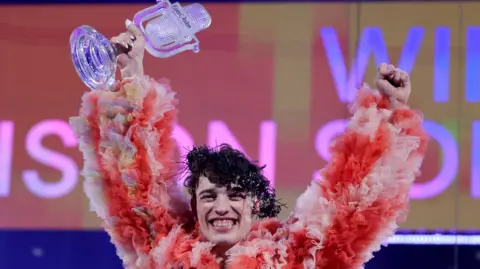
Nemo made history by becoming the first non-binary performer to win Eurovision in 2024
The winner of last year's Eurovision Song Contest, Nemo, has said they are returning their trophy in protest over Israel's continued participation in the event.
The 26-year-old Swiss singer said there is a "clear conflict" between Israel's involvement in the competition and the ideals of "unity, inclusion and dignity" the contest says it stands for.
Israel's presence at Eurovision has been an increasing source of tension, because of the war in Gaza and a voting controversy during this year's event.
Five countries - Iceland, Spain, Ireland, Slovenia and the Netherlands - have announced they will boycott next year's event because Israel has been allowed to compete.
Israel has previously called the decision to keep it in the contest a "victory" over critics who had tried to silence it and spread hatred.
Nemo became the first non-binary performer to lift the Eurovision trophy with their song The Code, which is about the path to realising they were non-binary.
After the win, Nemo told the BBC about the challenges they faced during the contest and their feeling that organisers didn't do enough to support participants who were caught up in the row over Israel's inclusion in 2024.
"I felt very alone. I really hope they have things in place for the next year," Nemo said at the time. It prompted a series of new measures to be introduced to protect the mental well-being of Eurovision's artists and staff.
In a statement posted to Instagram on Thursday, Nemo said they felt the European Broadcasting Union's (EBU) decision to allow Israel to still take part in the event no longer aligned with its core values.
"Israel's continued participation, during what the UN's Independent International Commission of Inquiry has concluded to be a genocide, shows a clear conflict between those ideals and the decision made by the EBU," they said, referring to a report released in September.
"Even though I am immensely grateful for the community around this contest and everything this experience has taught me both as a person and artist, today I no longer feel this trophy belongs on my shelf."
Nemo also posted a video of them placing the trophy in a cardboard box, saying it will be sent back to the EBU's headquarters in Geneva.
EPA-EFE/REX/Shutterstock
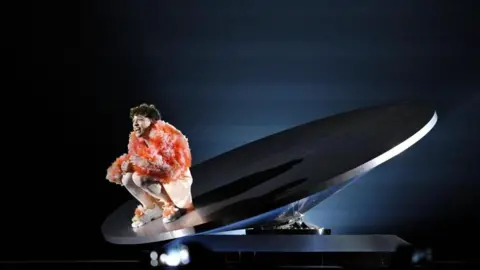
Nemo performing at the 2024 Eurovision in Malmo, Sweden
The boycotts and protests over Israel's inclusion has been the biggest crisis Eurovision has ever seen.
This year's competition also had a voting controversy and allegations that Israel's government tried to influence the public vote.
This prompted some competition rules to be changed and tightened, after which a "large majority" of members agreed there was no need for a further vote on participation and that Eurovision 2026 could proceed as planned, the EBU has said.
Israel's President Isaac Herzog has praised the decision to allow the country to compete, calling it "an appreciated gesture of solidarity, brotherhood, and co-operation".
Addressing the boycotts, Nemo insisted that their decision to hand back the trophy was not about "individuals or artists", but rather what they believed was the use of Eurovision to "soften the image of a state accused of severe wrongdoing".
"When entire countries withdraw, it should be clear that something is deeply wrong," they added.
"If the values we celebrate on stage aren't lived off stage then even the most beautiful songs become meaningless."
The war in Gaza was triggered by the Hamas-led attack on southern Israel on 7 October 2023, in which about 1,200 people were killed and 251 others were taken hostage.
More than 70,370 people have been killed in Israeli attacks in Gaza since then, according to the territory's Hamas-run health ministry.
Next year's Eurovision is due to take place in Vienna, for what is supposed to be a celebratory 70th anniversary edition of the contest.
Many were complacent, but conflict was next door, the Nato chief warned
Russia could attack a Nato country within the next five years, the Western military alliance's chief has said in a stark new warning.
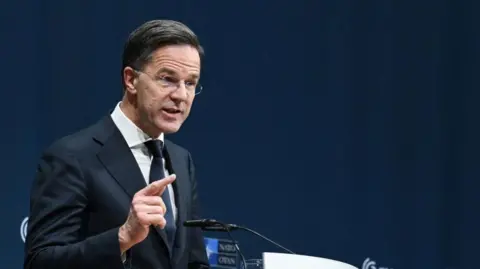
"Russia is already escalating its covert campaign against our societies," Mark Rutte said in a speech in Germany. "We must be prepared for the scale of war our grandparents or great-grandparents endured."
He echoed similar statements about Russia's intentions made by Western intelligence agencies, which Moscow dismisses as hysteria.
Rutte's warning comes as US President Donald Trump tries to bring an end to Russia's full-scale invasion of Ukraine, launched in February 2022.
Earlier this month, Russia's President Vladimir Putin said his country was not planning to go to war with Europe, but it was ready "right now" if Europe wanted to - or started a war.
But similar reassurances were given by Moscow in 2022, just before 200,000 Russian troops crossed the border and invaded Ukraine.
Putin has accused European countries of hindering US efforts to bring peace in Ukraine - a reference to the role Ukraine's European allies have recently played in trying to change a US peace plan to end the war, whose initial draft was seen as favouring Russia.
But Putin was not sincere, Nato's secretary-general said in the German capital, Berlin.
Supporting Ukraine, he added, was a guarantee for European security.
"Just imagine if Putin got his way; Ukraine under the boot of Russian occupation, his forces pressing against a longer border with Nato, and the significantly increased risk of an armed attack against us."
Russia's economy has been on a war footing for more than three years now - its factories churn out ever more supplies of drones, missiles and artillery shells.
According to a recent report by the Kiel Institute for the World Economy, Russia has been producing each month around 150 tanks, 550 infantry fighting vehicles, 120 Lancet drones and more than 50 artillery pieces.
The UK, and most of its Western allies, are simply not anywhere near this point.
Analysts say it would take years for Western Europe's factories to come close to matching Russia's mass-production of weapons.
France and Germany have both recently moved to revive a system of voluntary military service for 18-year-olds.
So-called "hybrid" or "grey-zone" warfare, which includes events that are often deniable, such as cyber-attacks, disinformation and the alleged launching of drones close to airports and military bases in Nato countries, have been ramping up this year.
But worrying as these are, they pale compared to the crisis that would be triggered by a Russian military attack on a Nato country, especially if it involved seizing territory and people being killed.
Nato includes 30 European countries - as well as Canada and the US, the alliance's most-powerful military member.
Under pressure from Trump, its members have pledged to increase military spending.
"Nato's own defences can hold for now," Rutte warned in Berlin, but conflict was "next door" to Europe and he feared "too many are quietly complacent, and too many don't feel the urgency, too many believe that time is on our side.
"Allied defence spending and production must rise rapidly, our armed forces must have what they need to keep us safe," the Nato chief said.
Reuters
"Listen to the sirens across Ukraine, look at the bodies pulled from the rubble," Rutte warned in his speech
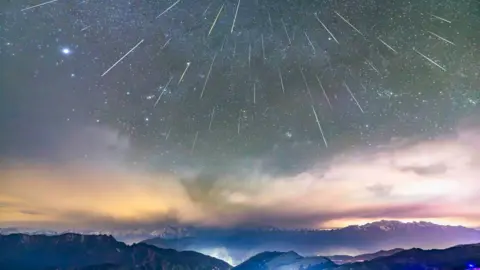
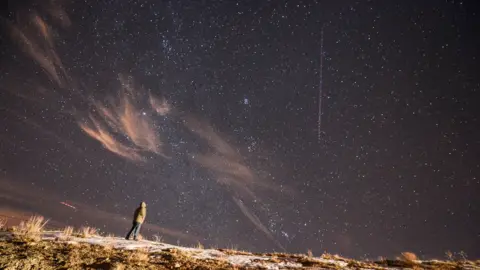
The Geminid meteor shower - one of the most spectacular in the celestial calendar - is set to peak this weekend and astronomers say conditions could make for an especially striking show if weather permits.
The meteors are visible all over the world, though people in the Northern Hemisphere will get the best views.
In the UK, if the skies are clear, a waning crescent Moon will only rise after midnight which should mean several hours of dark skies to see the meteors more clearly.
Here's the science behind the Geminids and how to get the best chance of seeing them.
What is the Geminid meteor shower?
Arecibo/NASA/NSF
Multiple views of asteroid 3200 Phaethon - the source of the Geminids meteor shower
We get treated to meteor showers when Earth passes through the trails of comets - icy objects which Nasa calls 'cosmic snowballs' - or in rarer cases, including the Geminids, asteroids, which are rocky.
When dust and gases from these objects enter our atmosphere, they burn up and create the bright streaks we know as shooting stars.
While most meteors appear white, some can glow green, yellow, red, or blue, depending on the elements in the material as it burns up in Earth's atmosphere.
Metals such as sodium, magnesium, and calcium produce colours similar to those seen in fireworks.
The Geminids shower comes from the remnants of an asteroid called 3200 Phaethon.
Until recently, scientists thought the Geminids were a result of dust escaping from 3200 Phaethon. But two years ago scientists revealed that Phaethon's tail is actually made of glowing sodium gas. So there is still some uncertainty about how and when the Geminids dust was formed.
The Geminids offer one of the year's best chances, weather-permitting, of seeing a shower, due to the volume and frequency of its 'shooting stars'.
"What you'd be looking at in a nice dark sky without clouds would be, say, 100 an hour, which is amazing, said Dr Robert Massey of the Royal Astronomical Society.
"It's pretty much the strongest meteor shower of the year."
Will moonlight spoil the show this year?
Getty Images
Bright moonlight can make it more difficult to see meteors and other objects in the night sky. But weather-permitting, we could have close to ideal viewing conditions as the Geminids peak.
The crescent Moon is in its final waning phases, with the bulk of it in shadow, and in the UK it also won't rise until the early hours of the morning, potentially giving us a nice dark sky in which to watch the spectacle.
Do keep in mind that visibility is still heavily influenced by weather conditions, so check your local forecast for the clearest possible window.
Finding somewhere without light pollution and with an open view of the sky will give you the best chance of seeing something.
Tips for night-sky enthusiasts
The Geminids are a naked-eye event, best enjoyed under dark, open skies, so you won't need a telescope or binoculars.
"There aren't that many entirely free natural treats. And this is one of them. So go out and enjoy it. You know, it's a way of connecting with the sky, taking a moment to sort of forget our more earthly or more worldly concerns," said Dr Massey.
The meteors appear to radiate from the constellation of Gemini, but looking slightly away from that point often provides a wider field of view.
Dress warmly and take a blanket or reclining chair to get comfortable, and let your eyesight adapt to the dark.
"You just basically need to have reasonable eyesight to see this and I think that is incredible."
What will the weather be like for the Geminids peak?
The Geminids meteor shower peaks on Sunday 14 December.
Unfortunately, the weather in the UK isn't looking ideal for viewing. Both Saturday and Sunday are expected to be windy and cloudy, with outbreaks of rain during the day and night.
On Sunday night, there may be a few drier, clearer spells. Northern Scotland and the Northern Isles, as well as parts of East Anglia and southeast England, are likely to have the best chances of catching a glimpse of the night sky.
But keep on checking in as there may be gaps in the gloom. A good place to keep track of the potential for a good viewing in your area is The Met Office's UK Cloud Cover Map.
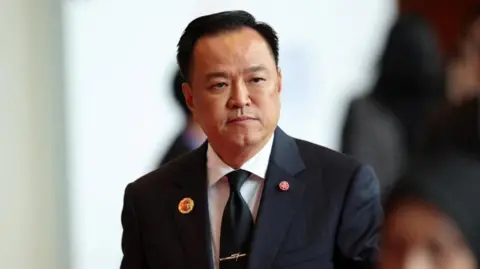
In a royal decree published on Friday, Prime Minister Anutin Charnvirakul cited the deadly border dispute among other challenges his minority government has struggled to contain since it took office three months ago.
"The appropriate solution is to dissolve parliament… which is a way to return political power to the people," he said.
Anutin, a business tycoon, is Thailand's third prime minister since August 2023. When he took power in September, he said he would dissolve parliament by the end of January.
However, now facing an imminent vote of no confidence, Anutin brought the election forward.
Anutin and his Bhumjaithai party were heavily criticised for their handling of serious flooding in southern Thailand last month, which left at least 176 people dead.
The house's dissolution comes during renewed fighting with Cambodia, which has killed at least 20 people and displaced hundreds of thousands.
"The government had executed every means in public administration to quickly resolve the urgent issues overwhelming the country… but running the country requires stability," Anutin wrote in the decree endorsed by Thailand's King Maha Vajiralongkorn.
"As a minority government, together with troubling domestic political circumstances, it has been unable to carry out public administration continuously, effectively and with stability," he wrote.
The dissolution order comes after the prime minister lost the support of the youthful, progressive People's Party - also the largest party in parliament - which had previously backed his premiership.
The People's Party and the pragmatic, conservative Bhumjaithai are ideological opposites.
The opposition bloc's support, however, came with strings attached. It wanted Anutin to start reforms of Thailand's military-drafted constitution and to dissolve the house within four months, among other things.
The People's Party has now accused Bhumjaithai of failing to honour that deal. It had planned to submit a no-confidence motion against the government on Friday, according to Thai media - having already called on the prime minister on Thursday to disband parliament to "show responsibility towards the people".
"See you at the polling stations," the party said in statement on Facebook.
Thailand has been in political turmoil over the past year, with two prime ministers dismissed by the courts.
Anutin's predecessor Paetongtarn Shinawatra was removed for violating ethics, after she was heard calling Cambodia's former leader Hun Sen "uncle" and criticising the Thai army in a leaked phone call.
Srettha Thavisin, the leader before her, was also dismissed for violating ethics, by appointing to his cabinet a former lawyer who was once jailed.
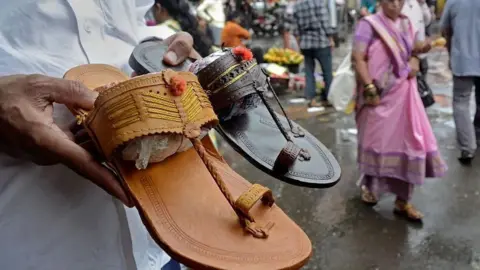
Kolhapuri chappals came under the spotlight after Prada replicated their design
Global fashion brand Prada has announced a line of limited-edition footwear inspired by Indian-made Kolhapuri sandals, months after it faced backlash for allegedly appropriating the sandal's design.
The Italian luxury brand will make 2,000 pairs of sandals in India's Maharashtra and Karnataka states, under a deal with two state-backed entities, Reuters news agency reports.
"We'll mix the original manufacturer's standard capabilities with our manufacturing techniques", Lorenzo Bertelli, Prada's head of Corporate Social Responsibility, said.
The collection is set to go on sale in February 2026, online and in 40 Prada stores across the world.
A pair of sandals are reportedly set to be sold for $939, which amounts to around £800 and 84,000 rupees.
The agreement was signed on Thursday during the Italy-India Business Forum 2025.
In June, Prada courted controversy after it showcased sandals that had an open-toe braided pattern that closely resembled the traditional Kolhapuri sandals made in Maharashtra and Karnataka.
Prada described the sandals as "leather footwear" but did not mention its Indian origins, prompting backlash and allegations of cultural appropriation in India.
A Prada spokesperson at that time told the BBC that the company has "always celebrated craftsmanship, heritage and design traditions", adding that it was "in contact with the Maharashtra Chamber of Commerce, Industry & Agriculture on this topic". This is a prominent industry trade body in the state.
On Friday, Maharashtra's Social Justice Minister Sanjay Shirsat told BBC Marathi that the new initiative will be called 'Prada Made in India – Inspired by Kolhapuri Chappals [sandals]'.
"Keeping in mind Prada's requirements and demand, some artisans will receive special training from Prada and LIDCOM [a state-backed entity supporting the leather industry in Maharashtra]. Additionally, around 200 Kolhapuri chappal artisans will be given three years of training in Italy," he said.
Mr Shirsat said the agreement had been signed for five years, but expressed confidence that it would be extended further.
"The state government will also provide financial assistance to the artisans for this purpose," he added.
Named after a city in Maharashtra where they are made, Kolhapuri sandals trace their roots back to the 12th Century.
Made from leather and sometimes dyed in natural colours, the traditional handcrafted sandals are sturdy and well-suited to India's hot climate.
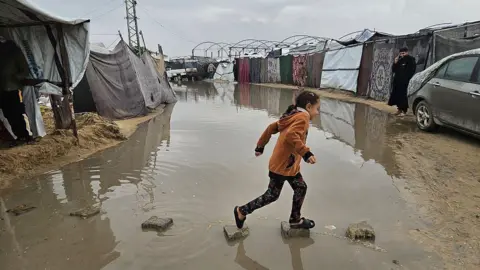
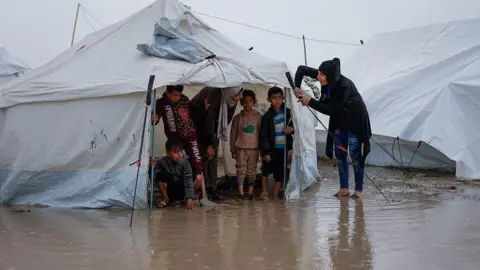
More than 800,000 Gazans are at risk from flooding, the UN says, as a powerful winter storm sweeps through the Strip.
The heavy rain has already deluged camps, and led several buildings to collapse.
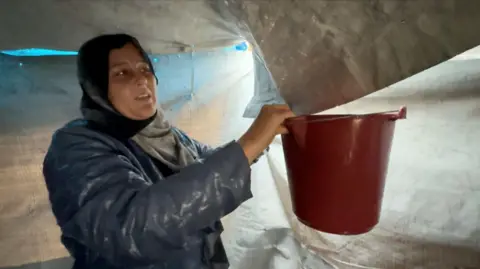
A steady stream of water trickles through openings in the tent Ghadir al-Adham shares with her husband and six children in Gaza City. Her family is still displaced after the war, and waiting for reconstruction to begin.
"Here we are, living a life of humiliation," she told the BBC. "We want caravans. We want our homes rebuilt. We long for concrete to keep us warm. Every day I sit and cry for my children."
Two months into an American-imposed ceasefire, Gaza is stuck in the first phase of Donald Trump's peace plan - its territory divided between the warring parties, its people still displaced and surrounded by rubble.
Ghadir al-Adham is longing to move her children into a solid home
Sticking point
Plans for new homes - and new government - lie frozen in the next stage of Donald Trump's peace deal, as the search continues for Israel's last remaining hostage, Ran Gvili.
Israel's prime minister, Benjamin Netanyahu, has insisted Hamas must return all Israel's hostages – living and dead – before the two sides move on to the next, more difficult, stage of the peace deal.
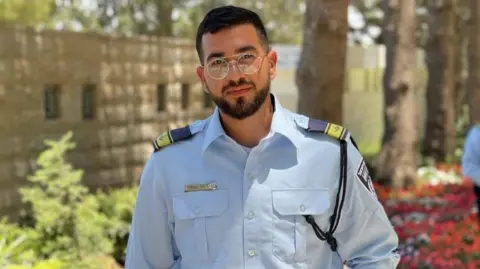
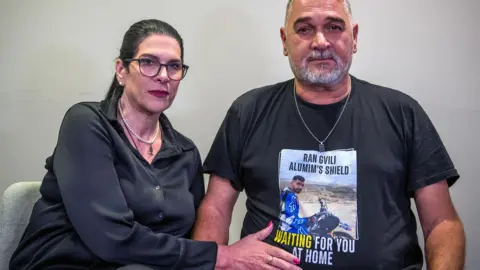
But several searches of Gaza's rubble have so far shown no sign of him. Gvili was captured during the 7 October Hamas attacks - a police officer, recovering from a broken shoulder, who went to defend nearby kibbutz Alumim.
Handout
Yellow flags have been hung for Ran Gvili near his home in southern Israel
His parents, Talik and Itzik, were told last year he had not survived.
Their road to their home in Meitar, in southern Israel, is lined with banners paying tribute to him, the yellow flags of remembrance for Israel's hostages fluttering alongside.
"They stole our kid, they stole him," his mother Talik told me.
"They know where he is," Itzik said. "They just try to hide or keep him. They're play[ing] with us."
They believe Hamas wants to keep their son as an insurance policy against future negotiations, after returning all the other hostages, both living and dead.
Itzik Gvili (right) accuses Hamas of trying to hide hi
In response, a Hamas official told the BBC their allegations were untrue, and that Israel was trying to avoid implementing the agreement.
But with no sign of Gvili's body, and pressure from Washington growing, his parents say they are counting on Israel's leaders not to move forward before their son is found.
"Everyone in Israel['s] government says to us, 'No, we don't move to the second level until Ran comes back.' This is their promise," Talik said.
Many in Israel believe it would be politically difficult for Netanyahu to carry out the next steps in the deal, including withdrawing Israeli forces further back towards Gaza's perimeter, if even one hostage is still missing in Gaza.
Time 'running out'
Both Israel and Hamas face difficult concessions in the next stage of the deal. For Hamas, it means handing over weapons and power. For Israel, handing over security to an international stabilisation force.
And this is also why leaders on both sides may be hesitating, says retired General Israel Ziv, a former head of Israel's military Operations Directorate.
"Israel and Hamas are sharing the same interests not to move so fast into the second stage," he told me. "Hamas doesn't want to lose control, and the Israeli side for political reasons also prefer to stay in Gaza, as nobody wants to explain to their base that they have to withdraw."
He says Trump is the only one who can force the two sides forward, and that time is running out.
"By waiting I think we might miss the opportunity because Hamas is reorganising and [its] strength is coming back," he explained. "We have to take a deep breath and go forward with that plan, because staying in the situation as it is, it's the worst-case scenario."
Disarming Hamas – in a way both sides will accept – is seen as the first major hurdle. Without that, no foreign countries are likely to commit troops to secure the Strip, and no reconstruction is likely to begin in Hamas-controlled areas.
Earlier this week, Netanyahu suggested he was sceptical that foreign nations could complete the task in place of Israel.
"Our friends in America want to try to establish an international force that will do the job," he said. "We know that there are certain tasks that this force can do. I don't want to go into detail, they can't do everything, and maybe they can't do the main thing, but we'll see."
Trump eager to move fast
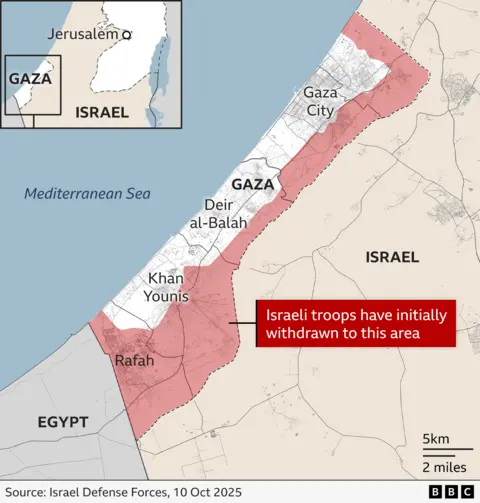
Gaza is currently divided in two by the so-called yellow line, marking the limits of Israeli forces under the first stage of the ceasefire deal.
Israel's military chief of staff recently referred to it as a "new border line", sparking accusations that Israel was signalling an intention to remain there long term.
Key issues, including how to disarm Hamas, are due to be discussed at a meeting between Israel's prime minister and Donald Trump in Florida later this month.
The US president – who has already brokered a ceasefire in Gaza and pushed his peace plan through the UN Security Council – has been outspoken about his desire to move the process forward.
He told journalists this week that he would announce the membership of a newly created Board of Peace for Gaza early next year. "It will be one of the most legendary boards ever… Everybody wants to be on it," he said.
Getty Images
The floods make it hard for Gazans to keep children dry
There are also widespread reports that, under pressure from Washington, Israel is beginning work to clear rubble, in preparation for a new temporary housing project in the Israeli-held area of Rafah, in the south of the Strip.
The new housing could reportedly provide shelter for tens of thousands of Gazans, on condition that they are willing to cross into Israeli-held areas, and submit to checks for any links to Hamas.
Some see it as part of a plan to draw Gazans across into Israeli-held areas, in order to isolate Hamas. A small number of people have already crossed into these areas, to camps set up by armed groups supported by Israel there.
But many Gazans – even those who want to replace Hamas – say they refuse to live under Israeli control.
It's a glimpse of an alternative future for Gaza, if this second stage of Trump's plan fails; a future where Gaza, already divided, becomes more divided still.
Benin says it requested Nigeria's military intervention to avert civilian casualties
Some 200 West African soldiers, mainly from Nigeria and Ivory Coast, are in Benin to support the government following Sunday's failed coup, Benin's foreign minister says.
The attempt was foiled after Nigeria deployed fighter jets to drive the mutineers out of a military base and state TV headquarters, where they had declared a takeover.
This is the first time that officials have said how many foreign soldiers were deployed to the country, although it is not clear if some have been withdrawn since Sunday.
Benin's Foreign Affairs Minister Olushegun Adjadi Bakari on Thursday said some of the regional troops sent to help had remained in the country "as part of the sweep and clean-up operation".
The rebel soldiers justified their actions by criticising President Patrice Talon's management of the country, complaining first about his handling of the "continuing deterioration of the security situation in northern Benin".
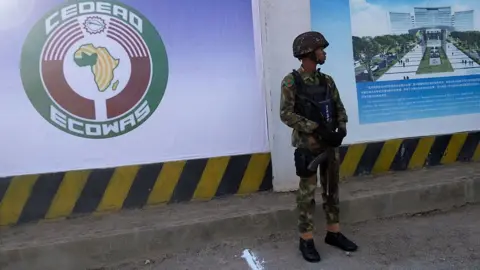
The West African regional bloc, Ecowas, deployed troops from Nigeria, Ghana, Sierra Leone, and Ivory Coast to secure key installations and prevent any resurgence of the violence.
Nigeria, Benin's large neighbour to the east, said its soldiers had reached there on Sunday, describing the coup attempt as a "direct assault on democracy".
An Ivory Coast security source told AFP news agency that 50 soldiers from the country had been sent as part of the regional deployment.
"There are currently around 200 soldiers present, who came to lend a hand at the end of the day to the Beninese defence and security forces as part of the sweep and clean-up operation," said Bakari, while addressing journalists in Nigeria's capital, Abuja, on Thursday.
Bakari, who was speaking alongside Nigeria's Foreign Affairs Minister Yusuf Maitama Tuggar, said that by the time the Beninese forces called for help, the coup "was already a failure".
"When we started discussions for the intervention of Nigeria and the others, under Ecowas protocol, our military had already pushed them back," he added.
According to Bakari, what was required was "precise aerial back-up to carry out a surgical operation that targeted the enemy's key positions without risking civilian casualties".
Tuggar said that fast diplomatic, military, and intelligence actions between Nigeria and Benin had helped to foil the coup.
Discussions are continuing over how long the regional forces would remain, but Bakari said any decision "will be taken in close collaboration with Benin's defence and security forces, who have demonstrated their bravery".
It is not clear if the French special forces who also reportedly helped loyalist troops thwart the coup are still in Benin.
Under intense pressure after a string of successful coups in the region, Ecowas is signalling that it is no longer willing to watch democratically elected governments be toppled by the military.
Bakari praised Ecowas as "an important tool that allows us to defend democracy and the values of democracy in our regional space".
Talon, who is regarded as a close ally of the West, is due to step down next year after completing his second term in office, with elections scheduled for April.
Clair Obscur: Expedition 33's director Guillaume Broche accepted the game of the year prize
Clair Obscur: Expedition 33 has been named game of the year at this year's Game Awards.
The French-developed role-playing game (RPG) cleaned up in 9 of the 10 categories it was up for, with further wins in best narrative, best music and best performance.
It fended off competition from Death Stranding 2, Nintendo platformer Donkey Kong Bananza, indie games Hollow Knight: Silksong and Hades 2, and medieval adventure Kingdom Come: Deliverance 2 to claim the top prize.
During the ceremony in Los Angeles, players also got their first glimpses of two new Tomb Raider games, sequel Control Resonant and a new Star Wars role-playing game.
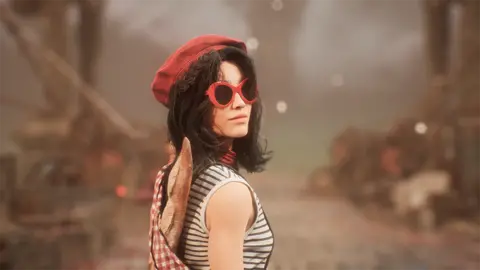
Clair Obscur is set in a world where a supernatural being known as The Paintress prevents the population from growing past a certain age.
The game, which tells the story of a group of adventurers on a quest to destroy The Paintress, was praised for its emotional narrative and use of old-school turn-based battles.
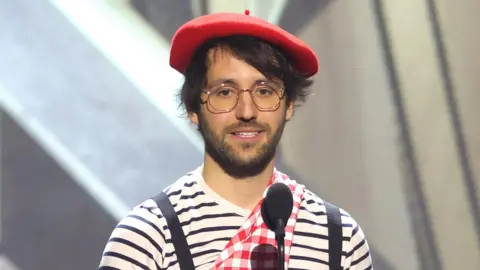
Accepting the game of the year award, director Guillaume Broche - wearing a red beret and striped t-shirt - said the year had been a "weird timeline" for the studio as he thanked his team.
He also extended thanks to the "unsung heroes" of the industry - "the people who make tutorials on YouTube on how to make a game, because we had no idea how to make one before".
Sandfall Interactive
Clair Obscur: Expedition 33 was one of the year's most talked-about video games
Clair Obscur was the hot favourite going into the awards, and the most-nominated game in the ceremony's history with a total of 12 nods.
Its composer Lorien Testard won the award for best score and music.
It was the debut project for the musician, who was discovered after he posted a collection of homemade video game music to his SoundCloud account.
Clair Obscur also romped to victory in the best role-playing game, best independent game and best debut indie game categories.
Three of its nominations were in a single category - best performance - and actress Jennifer English claimed the prize over co-stars Charlie Cox and Ben Starr for her role as Maelle.
The actress, who has often spoken about having ADHD, dedicated the award "to every neurodivergent person watching".
Clair Obscur only missed out on two awards it was up for.
Battlefield 6 won best audio design, while open-world action RPG Wuthering Waves was a surprising winner in the fan-voted Player's Voice category.
Best Game rival Donkey Kong Bananza won the family game award, and online shooter Arc Raiders won the best multiplayer prize.
Sequel Hollow Knight: Silksong was named best action-adventure, while anime-inspired horse racing game Umamusume: Pretty Derby was named best mobile game.
Team Cherry
Hollow Knight: Silksong, one of the year's most anticipated games, was named best action-adventure
Despite being referred to as the "Oscars of gaming", the Game Awards, hosted by its founder Geoff Keighley, is a mixture of traditional ceremony and trailer showcase.
Some of the games industry's biggest developers will give the first look at upcoming major titles during the show, and it's thought that this is one of the main reasons many fans tune in.
One of the night's biggest announcements was RPG Divinity from Larian Studios, the maker of 2023 game of the year Baldur's Gate 3.
The developer had teased the reveal with a mysterious statue which first appeared in the Californian desert.
A remake of the original Tomb Raider game had also been leaked, but the announcement of a second, brand new entry starring Lara Croft came as a surprise.
The cast of the new Street Fighter movie adaptation, with the exception of rapper 50 Cent, introduced its first trailer.
And fans also saw new footage from the upcoming Resident Evil 9, confirming the appearance of fan-favourite character Leon Kennedy, and PS5 shooter Saros.
Nintendo
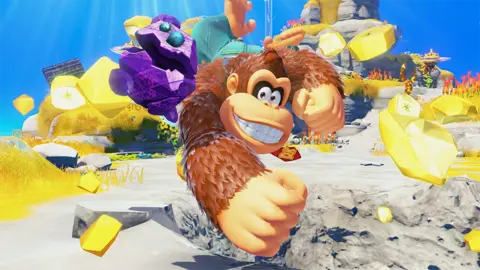
Oh, banana! Donkey Kong Bananza was named best Family Game
The Game Awards has been criticised in the past for prioritising advertising over awards, with winning speeches being cut short and on-stage presentations being absent in some categories.
There was praise of 2024's show for going some way to address criticisms, but developers have continued to call on organiser Geoff Keighley to better acknowledge problems in the industry, such as the high number of job losses in recent years.
This year, there have been complaints about the awards abandoning its Future Class scheme - an initiative founded in 2020 to highlight "rising stars" in video games.
It was last run in 2023, when current and former members of the group signed an open letter urging the awards to address the Israel-Gaza war.
In the run-up to this year's nominations, after it was confirmed Future Class would not return, alumni accused the scheme of tokenism and not doing enough to help them build contacts.
Last year, the ceremony gave out a new game changer award to Amir Satvat, for his work to help laid-off developers find jobs.
BBC Newsbeat has approached organisers for comment.
Nemo made history by becoming the first non-binary performer to win Eurovision in 2024
The winner of last year's Eurovision Song Contest, Nemo, has said they are returning their trophy in protest over Israel's continued participation in the event.
The 26-year-old Swiss singer said there is a "clear conflict" between Israel's involvement in the competition and the ideals of "unity, inclusion and dignity" the contest says it stands for.
Israel's presence at Eurovision has been an increasing source of tension, because of the war in Gaza and a voting controversy during this year's event.
Five countries - Iceland, Spain, Ireland, Slovenia and the Netherlands - have announced they will boycott next year's event because Israel has been allowed to compete.
Israel has previously called the decision to keep it in the contest a "victory" over critics who had tried to silence it and spread hatred.
Nemo became the first non-binary performer to lift the Eurovision trophy with their song The Code, which is about the path to realising they were non-binary.
After the win, Nemo told the BBC about the challenges they faced during the contest and their feeling that organisers didn't do enough to support participants who were caught up in the row over Israel's inclusion in 2024.
"I felt very alone. I really hope they have things in place for the next year," Nemo said at the time. It prompted a series of new measures to be introduced to protect the mental well-being of Eurovision's artists and staff.
In a statement posted to Instagram on Thursday, Nemo said they felt the European Broadcasting Union's (EBU) decision to allow Israel to still take part in the event no longer aligned with its core values.
"Israel's continued participation, during what the UN's Independent International Commission of Inquiry has concluded to be a genocide, shows a clear conflict between those ideals and the decision made by the EBU," they said, referring to a report released in September.
"Even though I am immensely grateful for the community around this contest and everything this experience has taught me both as a person and artist, today I no longer feel this trophy belongs on my shelf."
Nemo also posted a video of them placing the trophy in a cardboard box, saying it will be sent back to the EBU's headquarters in Geneva.
EPA-EFE/REX/Shutterstock
Nemo performing at the 2024 Eurovision in Malmo, Sweden
The boycotts and protests over Israel's inclusion has been the biggest crisis Eurovision has ever seen.
This year's competition also had a voting controversy and allegations that Israel's government tried to influence the public vote.
This prompted some competition rules to be changed and tightened, after which a "large majority" of members agreed there was no need for a further vote on participation and that Eurovision 2026 could proceed as planned, the EBU has said.
Israel's President Isaac Herzog has praised the decision to allow the country to compete, calling it "an appreciated gesture of solidarity, brotherhood, and co-operation".
Addressing the boycotts, Nemo insisted that their decision to hand back the trophy was not about "individuals or artists", but rather what they believed was the use of Eurovision to "soften the image of a state accused of severe wrongdoing".
"When entire countries withdraw, it should be clear that something is deeply wrong," they added.
"If the values we celebrate on stage aren't lived off stage then even the most beautiful songs become meaningless."
The war in Gaza was triggered by the Hamas-led attack on southern Israel on 7 October 2023, in which about 1,200 people were killed and 251 others were taken hostage.
More than 70,370 people have been killed in Israeli attacks in Gaza since then, according to the territory's Hamas-run health ministry.
Next year's Eurovision is due to take place in Vienna, for what is supposed to be a celebratory 70th anniversary edition of the contest.
Matt Wright's lawyers say he intends to appeal the verdicts
Celebrity crocodile wrangler Matt Wright will spend five months in prison fortampering with evidence after a helicopter crash that killed his co-star and left the pilot a paraplegic.
In August, the former Netflix star was found guilty of lying to police and pressuring a hospitalised witness after the 2022 crash in the Northern Territory (NT).
On Friday, Acting Justice Alan Blow handed Wright a 10-month prison term, which will be suspended after he has served half of it. He was also fined A$5,000 ($3,300; £2,500).
Justice Blow said Wright had "shown no remorse" but was "very unlikely to reoffend in any significant way in the future."
The maximum sentence for his charges was 15 years in prison.
The jury could not agree on a verdict for a third charge that alleged Wright asked someone to "torch" evidence.
Wright's lawyers indicated previously that they plannedto appeal the guilty verdicts.
The judge pointed to mitigating factors in deciding the length of his jail term, like his contribution to the community and character references that were the "most impressive I've ever seen".
The NT Supreme Court case centred around a helicopter crash in February 2022 in Arnhem Land, about 500km (310 miles) east of Darwin.
Wright's friend and Outback Wrangler co-star Chris "Willow" Wilson - suspended from the chopper in a sling during a crocodile egg harvesting trip - was killed.
The pilot Sebastian Robinson was seriously injured, suffering punctured lungs and a severe brain injury.
Wright, who was not in the helicopter, was one of the first people to arrive at the crash site.
During the month-long trial, prosecutors told the court that Wright had lied to police about how much fuel was in the helicopter's tank when it plummeted to the ground.
The evidence included secret recordings of Wright's conversations which, the prosecution said, contradicted his claims that the fuel tank was half full when asked in police interviews.
Wright was also accused of going to the hospital bedside of Mr Robinson - who had been told by doctors he may never walk again - and asking him to change flight records that showed how many hours the aircraft had flown.
Prosecutors argued this was because Wright was worried that investigators would find out he regularly changed the official flying hours of a chopper to avoid costly maintenance.
The jury delivered unanimous verdicts for both the charges.
A third charge related to Wright asking a friend to "torch" the helicopter's maintenance record.
The jury was deadlocked on the third charge and unable to return a verdict. It remains under consideration by the courts.
The case does not relate to the cause of the crash, the death of Mr Wilson and Mr Robinson's injuries.
CareFlight
The site of the 2022 crash in Arnhem Land, about 500km (310 miles) east of Darwin.
False flight records was the norm
The trial exposed the inner workings of the NT's helicopter community with revelations that it was common practice to "pop the clock" by disconnecting a meter that records flight hours in order to delay maintenance requirements.
The prosecution argued that falsifying flight records was rampant across the industry and Wright was worried his involvement in this practice would be blamed for the crash.
Wright's defence lawyer accepted that under reporting of flight hours was "widespread throughout the NT's helicopter community," but argued Wright had not perverted the course of justice when he tried to cover up the doctored records.
During the trial, the jury heard how Wright visited Mr Robinson several times while he was in hospital.
Wright, the prosecution claimed, was there to put "the hard word" on the injured pilot, asking Mr Robinson to transfer flight hours from the crashed aircraft to another helicopter.
During cross-examination, Mr Robinson denied being a "raging cocaine junkie" after another witness - a fellow helicopter pilot - described him as a "party animal".
The court heard that a blood sample from Mr Robinson showed traces of cocaine but below the "prescribed amount for enforcement" under aviation rules, according to the Australian Broadcasting Corporation (ABC).
Mr Robinson also told the court he had no memory of the crash but conceded that he "must have intentionally disconnected" Wilson's sling as it was best practice in an emergency to release the collector. Investigators concluded that Wilson died after falling 25m to the ground.
'Everyone looked at Matt as an idol'
Wright is best known globally as the star of National Geographic's Outback Wrangler and Netflix's Wild Croc Territory reality shows.
He also owns several local tourism businesses and has been a tourism ambassador for Australia.
During the trial, Mr Robinson told the court how people who worked for Wright revered him.
"Absolutely, everyone looked at Matt as an idol and if he said 'jump' they'd say 'how high'," Mr Robinson said, adding "everyone wanted to be around him, work for him".
"We were young men, we looked up to him and we wanted to do our best to make ourselves look good in front of him and do whatever he said."
Before the sentencing was handed down, prosecutor Jason Gullaci SC said Wright should serve a term of "actual immediate imprisonment" to reflect the "seriousness" of his crimes.
He described Wright's repeated visits to Mr Robinson in hospital to request records be manipulated as significantly more serious than lying about the fuel as it was "considered, planned and all directed at achieving the result of obstructing the course of justice".
Wright's lawyer David Edwardson KC requested that the judge not sentence his client based on his "celebrity status" and that Wright's estimation about the chopper's fuel level was "done to protect a mate".
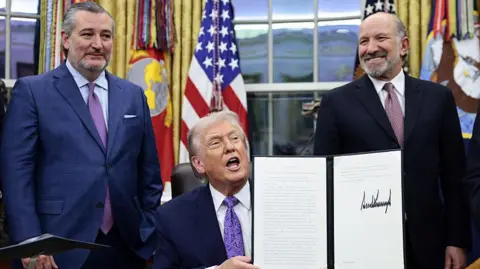
President Trump signed the order in the Oval Office, surrounded by some of his top advisers
Lily JamaliNorth America technology correspondent
US President Donald Trump has signed an executive order aimed at blocking states from enforcing their own artificial intelligence (AI) regulations.
"We want to have one central source of approval," Trump told reporters in the Oval Office on Thursday.
It will give the Trump administration tools to push back on the most "onerous" state rules, said White House AI adviser David Sacks. The government will not oppose AI regulations around children's safety, he added.
The move marks a win for technology giants who have called for US-wide AI legislation as it could have a major impact on America's goal of leading the fast-developing industry.
AI company bosses have argued that state-level regulations could slow innovation and hinder the US in its race against China to dominate the industry, with firms pouring billions of dollars into the technology.
The BBC has contacted AI firms OpenAI, Google, Meta,and Anthropic for comment.
But the announcement has been met with opposition.
The state of California, which is the home to many of the world's biggest technology companies, already has its own AI regulations.
"President Trump is attempting to limit the ability of states - red states and blue states alike - to implement common sense protections for our residents," the office of California's Attorney General Rob Bonta said in a statement.
Earlier this year, California's Governor Gavin Newsom signed a bill requiring the largest AI developers to lay out plans to limit risks stemming from their AI models.
States including Colorado and New York have also passed laws regulating the development of the technology.
Newsom has said the law sets a standard that US lawmakers could follow.
Other critics of Trump's executive order argue that state laws are necessary in the absence of meaningful guardrails at the federal level.
"Stripping states from enacting their own AI safeguards undermines states' basic rights to establish sufficient guardrails to protect their residents," said Julie Scelfo, from advocacy group Mothers Against Media Addiction in a statement.
More than 800,000 Gazans are at risk from flooding, the UN says, as a powerful winter storm sweeps through the Strip.
The heavy rain has already deluged camps, and led several buildings to collapse.
A steady stream of water trickles through openings in the tent Ghadir al-Adham shares with her husband and six children in Gaza City. Her family is still displaced after the war, and waiting for reconstruction to begin.
"Here we are, living a life of humiliation," she told the BBC. "We want caravans. We want our homes rebuilt. We long for concrete to keep us warm. Every day I sit and cry for my children."
Two months into an American-imposed ceasefire, Gaza is stuck in the first phase of Donald Trump's peace plan - its territory divided between the warring parties, its people still displaced and surrounded by rubble.
Ghadir al-Adham is longing to move her children into a solid home
Sticking point
Plans for new homes - and new government - lie frozen in the next stage of Donald Trump's peace deal, as the search continues for Israel's last remaining hostage, Ran Gvili.
Israel's prime minister, Benjamin Netanyahu, has insisted Hamas must return all Israel's hostages – living and dead – before the two sides move on to the next, more difficult, stage of the peace deal.
But several searches of Gaza's rubble have so far shown no sign of him. Gvili was captured during the 7 October Hamas attacks - a police officer, recovering from a broken shoulder, who went to defend nearby kibbutz Alumim.
Handout
Yellow flags have been hung for Ran Gvili near his home in southern Israel
His parents, Talik and Itzik, were told last year he had not survived.
Their road to their home in Meitar, in southern Israel, is lined with banners paying tribute to him, the yellow flags of remembrance for Israel's hostages fluttering alongside.
"They stole our kid, they stole him," his mother Talik told me.
"They know where he is," Itzik said. "They just try to hide or keep him. They're play[ing] with us."
They believe Hamas wants to keep their son as an insurance policy against future negotiations, after returning all the other hostages, both living and dead.
Itzik Gvili (right) accuses Hamas of trying to hide hi
In response, a Hamas official told the BBC their allegations were untrue, and that Israel was trying to avoid implementing the agreement.
But with no sign of Gvili's body, and pressure from Washington growing, his parents say they are counting on Israel's leaders not to move forward before their son is found.
"Everyone in Israel['s] government says to us, 'No, we don't move to the second level until Ran comes back.' This is their promise," Talik said.
Many in Israel believe it would be politically difficult for Netanyahu to carry out the next steps in the deal, including withdrawing Israeli forces further back towards Gaza's perimeter, if even one hostage is still missing in Gaza.
Time 'running out'
Both Israel and Hamas face difficult concessions in the next stage of the deal. For Hamas, it means handing over weapons and power. For Israel, handing over security to an international stabilisation force.
And this is also why leaders on both sides may be hesitating, says retired General Israel Ziv, a former head of Israel's military Operations Directorate.
"Israel and Hamas are sharing the same interests not to move so fast into the second stage," he told me. "Hamas doesn't want to lose control, and the Israeli side for political reasons also prefer to stay in Gaza, as nobody wants to explain to their base that they have to withdraw."
He says Trump is the only one who can force the two sides forward, and that time is running out.
"By waiting I think we might miss the opportunity because Hamas is reorganising and [its] strength is coming back," he explained. "We have to take a deep breath and go forward with that plan, because staying in the situation as it is, it's the worst-case scenario."
Disarming Hamas – in a way both sides will accept – is seen as the first major hurdle. Without that, no foreign countries are likely to commit troops to secure the Strip, and no reconstruction is likely to begin in Hamas-controlled areas.
Earlier this week, Netanyahu suggested he was sceptical that foreign nations could complete the task in place of Israel.
"Our friends in America want to try to establish an international force that will do the job," he said. "We know that there are certain tasks that this force can do. I don't want to go into detail, they can't do everything, and maybe they can't do the main thing, but we'll see."
Trump eager to move fast
Gaza is currently divided in two by the so-called yellow line, marking the limits of Israeli forces under the first stage of the ceasefire deal.
Israel's military chief of staff recently referred to it as a "new border line", sparking accusations that Israel was signalling an intention to remain there long term.
Key issues, including how to disarm Hamas, are due to be discussed at a meeting between Israel's prime minister and Donald Trump in Florida later this month.
The US president – who has already brokered a ceasefire in Gaza and pushed his peace plan through the UN Security Council – has been outspoken about his desire to move the process forward.
He told journalists this week that he would announce the membership of a newly created Board of Peace for Gaza early next year. "It will be one of the most legendary boards ever… Everybody wants to be on it," he said.
Getty Images
The floods make it hard for Gazans to keep children dry
There are also widespread reports that, under pressure from Washington, Israel is beginning work to clear rubble, in preparation for a new temporary housing project in the Israeli-held area of Rafah, in the south of the Strip.
The new housing could reportedly provide shelter for tens of thousands of Gazans, on condition that they are willing to cross into Israeli-held areas, and submit to checks for any links to Hamas.
Some see it as part of a plan to draw Gazans across into Israeli-held areas, in order to isolate Hamas. A small number of people have already crossed into these areas, to camps set up by armed groups supported by Israel there.
But many Gazans – even those who want to replace Hamas – say they refuse to live under Israeli control.
It's a glimpse of an alternative future for Gaza, if this second stage of Trump's plan fails; a future where Gaza, already divided, becomes more divided still.
Senator Mike Gaskill argued in support of the redistricting bill
Indiana Republicans have defied intense pressure from President Donald Trump by rejecting his demands that they pass a voting map meant to favour their party in next year's midterm elections.
In one of the most conservative states in the US, 21 Republicans in the Senate joined all 10 Democrats to torpedo the redistricting plan by a vote of 31-19. The new map passed the House last week.
If it had cleared the legislature, Republicans could have flipped the only two Democratic-held congressional seats in the state.
Trump's call for Republican state leaders to redraw maps and help the party keep its congressional majority in Washington next year has triggered gerrymandering battles nationwide.
Republican-led Texas and Democratic-led California, two of the country's largest states, have led the charge.
Other states where redistricting efforts have been initiated or passed include Utah, Ohio, New Hampshire, Missouri and Illinois.
Republican state Senator Spencer Deery said ahead of Thursday's vote: "My opposition to mid-cycle gerrymandering is not in contrast to my conservative principles, my opposition is driven by them.
"As long as I have breath, I will use my voice to resist a federal government that attempts to bully, direct, and control this state or any state. Giving the federal government more power is not conservative."
Indiana Governor Mike Braun, a Republican, said he was "very disappointed" in the outcome.
"I will be working with the President to challenge these people who do not represent the best interests of Hoosiers," he said on X, using a popular nickname for people from the Midwestern state.
Reuters
Demonstrators protested at the Indiana statehouse during the sessions
The revolt of Indiana Republicans came after direct months of lobbying from the White House.
On Wednesday, Trump warned on his social media platform Truth Social that Republicans who did not support the initiative could risk losing their seats.
He directly addressed the Republican leader of the state Senate, Rodric Bray, calling him "the only person in the United States of America who is against Republicans picking up extra seats".
To liberals, it was a moment of celebration. Keith "Wildstyle" Paschall described the mood on Thursday as "jubilant".
"There's a lot of relief," the Indianapolis-based activist told the BBC. "People had thought that we would have to move on to a legal strategy and didn't believe we could defeat it directly at the statehouse."
The new map would have redistricted parts of Indianapolis and potentially led to the ouster of Indiana's lone black House representative, André Carson.
In the weeks before Thursday's vote, Trump hosted Indiana lawmakers at the White House to win over holdouts.
He also dispatched Vice-President JD Vance down to Indiana twice to shore up support.
Nearly a dozen Indiana Republican lawmakers have said they were targeted with death threats and swatting attacks over the planned vote.
Ultimately, this redistricting plan fell flat in another setback for Trump following a string of recent Democratic wins in off-year elections.
The defeat appears to have added to Republican concerns.
"We have a huge problem," said former White House chief strategist Steve Bannon during his podcast, The War Room.
"People have to realise that we only have a couple opportunities," he said.
"If we don't get a net 10 pickup in the redistricting wars, it's going to be enormously hard, if not impossible, to hold the House."
Texas was the first state to respond to Trump's redistricting request.
After a lower court blocked the maps for being drawn illegally based on race, the Supreme Court allowed Texas Republicans to go ahead.
The decision was a major win for Republicans, with the new maps expected to add five seats in their favour.
California's map is also expected to add five seats for Democrats.
Nemo made history by becoming the first non-binary performer to win Eurovision in 2024
The winner of last year's Eurovision Song Contest, Nemo, has said they are returning their trophy in protest over Israel's continued participation in the event.
The 26-year-old Swiss singer said there is a "clear conflict" between Israel's involvement in the competition and the ideals of "unity, inclusion and dignity" the contest says it stands for.
Israel's presence at Eurovision has been an increasing source of tension, because of the war in Gaza and a voting controversy during this year's event.
Five countries - Iceland, Spain, Ireland, Slovenia and the Netherlands - have announced they will boycott next year's event because Israel has been allowed to compete.
Israel has previously called the decision to keep it in the contest a "victory" over critics who had tried to silence it and spread hatred.
Nemo became the first non-binary performer to lift the Eurovision trophy with their song The Code, which is about the path to realising they were non-binary.
After the win, Nemo told the BBC about the challenges they faced during the contest and their feeling that organisers didn't do enough to support participants who were caught up in the row over Israel's inclusion in 2024.
"I felt very alone. I really hope they have things in place for the next year," Nemo said at the time. It prompted a series of new measures to be introduced to protect the mental well-being of Eurovision's artists and staff.
In a statement posted to Instagram on Thursday, Nemo said they felt the European Broadcasting Union's (EBU) decision to allow Israel to still take part in the event no longer aligned with its core values.
"Israel's continued participation, during what the UN's Independent International Commission of Inquiry has concluded to be a genocide, shows a clear conflict between those ideals and the decision made by the EBU," they said, referring to a report released in September.
"Even though I am immensely grateful for the community around this contest and everything this experience has taught me both as a person and artist, today I no longer feel this trophy belongs on my shelf."
Nemo also posted a video of them placing the trophy in a cardboard box, saying it will be sent back to the EBU's headquarters in Geneva.
EPA-EFE/REX/Shutterstock
Nemo performing at the 2024 Eurovision in Malmo, Sweden
The boycotts and protests over Israel's inclusion has been the biggest crisis Eurovision has ever seen.
This year's competition also had a voting controversy and allegations that Israel's government tried to influence the public vote.
This prompted some competition rules to be changed and tightened, after which a "large majority" of members agreed there was no need for a further vote on participation and that Eurovision 2026 could proceed as planned, the EBU has said.
Israel's President Isaac Herzog has praised the decision to allow the country to compete, calling it "an appreciated gesture of solidarity, brotherhood, and co-operation".
Addressing the boycotts, Nemo insisted that their decision to hand back the trophy was not about "individuals or artists", but rather what they believed was the use of Eurovision to "soften the image of a state accused of severe wrongdoing".
"When entire countries withdraw, it should be clear that something is deeply wrong," they added.
"If the values we celebrate on stage aren't lived off stage then even the most beautiful songs become meaningless."
The war in Gaza was triggered by the Hamas-led attack on southern Israel on 7 October 2023, in which about 1,200 people were killed and 251 others were taken hostage.
More than 70,370 people have been killed in Israeli attacks in Gaza since then, according to the territory's Hamas-run health ministry.
Next year's Eurovision is due to take place in Vienna, for what is supposed to be a celebratory 70th anniversary edition of the contest.
Warning: This report contains details of physical and sexual abuse and discussion of suicide.
Baobao's heart still races when she smells soil after morning rain.
It takes her back to early military drills behind locked gates - and the constant fear that marked every one of her days at Lizheng Quality Education School.
For six months, aged 14, she barely left the red and white building in a remote Chinese village where instructors tried to "fix" young people whose families considered them rebellious or problematic.
Students who failed to comply were beaten so severely they could not sleep on their backs or sit down for days, she says.
"Every single moment was agonising," says Baobao, now 19 and speaking under a pseudonym for fear of retribution.
She says she considered suicide, and knows other students who attempted it.
'Raped and beaten'
A BBC Eye investigation has uncovered multiple allegations of physical abuse in the school and others in the same network, and cases of young people being abducted and taken to the institutions.
Corporal punishment has been banned in China for decades, but we have collated testimony from 23 former students who say they were beaten or forced to do extreme amounts of exercise. One says she was raped, and two others, including Baobao, say they were sexually assaulted or harassed, all by instructors.
Undercover filming has exposed how staff pose as authorities to forcibly transfer young people to their institutions.
Thirteen students say they were abducted, with parental consent, by employees pretending to be police or officials.
The accounts - from interviews by the BBC World Service, statements gathered by activists, police reports and state media - relate to five schools. These are part of a network of at least 10 schools, all of which have been run by - or have close links to - a military veteran called Li Zheng.
Baobao says every single moment at the school was "agonising"
The centres are part of a booming industry promising anxious parents that military-style discipline will resolve concerns over young people's disobedience, internet addiction, teenage dating and depression, as well as gender and sexual identity. Some parents even send over-18s, who are legally adults.
A series of abuse allegations have made headlines in China in recent years, in both Li Zheng schools and others.
In a few cases, arrests have been made or institutions shut down, but schools can be quick to reopen with different names or in different locations because the sector has been difficult to regulate. The BBC understands that Mr Li was arrested earlier this year, but we have discovered his associates have recently opened a new school.
Companies and individuals involved in the network could either not be reached or declined to comment. The Chinese embassy in the UK told the BBC all educational institutions are required to comply with regulations.
'Deeply offensive' body search
Baobao says her mother took her to the Lizheng Quality Education School in Hunan province when she began skipping classes, triggering rows which made their already difficult relationship worse.
Her mother left while she was being shown around the school, she says, and she then realised she was not allowed to leave: "They said if I behaved well, I might be able to get out."
Baobao initially tried to kick and punch the instructors, she says, but decided to comply when they tried to restrain her with her own shoelaces. Later, she was searched. She describes the way this was done as sexual assault. "I found it deeply offensive… she touched all my sensitive areas."
She says her mother paid about 40,000 yuan ($5,700; £4,300) for six months at the institution, and she was not given any academic lessons. Few disciplinary schools offer these, and some that do charge extra for them.
The school is still operating, now known as Quality Education for Teenagers, with around 300 students, aged eight to 18.
Undercover footage was filmed there earlier this year by a woman posing as a parent considering enrolling her fictional 15-year-old son. She said he was smoking, dating and driving her car.
She was shown locked gates on staircases, metal grilles along open-air corridors and CCTV monitoring dormitories where children rest, get changed and shower.
Filmed undercover, a staff member says Quality Education for Teenagers uses a "white lie" when it takes students to the school
A staff member told her it would take at least six months to improve the teenager's behaviour, but under a "three-year warranty" she could send him back paying for just food and accommodation if he reverted to his old ways.
She was told not to tell him about the new school. "When we arrange pick-ups, we tell a white lie," the staff member said.
She explained instructors impersonating officials from the "internet regulator" would say they needed him to help with an investigation, and take him to the centre. "If this fails, several instructors will simply restrain him and carry him to the vehicle," she said.
Another former student, Zhang Enxu, now aged 20, says she had a similar experience when she was taken to a different school in the network.
Then 19, she had left home, frustrated with her parents' refusal to accept her transgender identity and her decision to live as a woman - she was registered male at birth. She says she had returned for a family visit to her grandmother's grave, when three men claiming to be police appeared, saying her details had been used in fraud.
"They forcibly dragged me into the car. My parents stood by as I was taken away," she says.
Enxu says she was beaten and raped at the disciplinary school she was taken to at the age of 19
She was taken to Shengbo Youth Psychological Growth Training School in Hunan where she says she was beaten, leaving her with hearing loss in one ear, and later raped.
In the undercover footage from the school Baobao attended, a staff member says there are no beatings: "We change the behaviour of youngsters with military training and counselling."
But Baobao and Enxu describe a very different experience.
"Corporal punishment is ever-present," says Baobao. "If your dance routines or military boxing lack precision, or are poorly executed, you will be punished."
She said the instructors would use a pipe, raising it overhead before "bringing it down with force" on her classmates. "Where they hit you would turn black. You get severe bruising."
Videos obtained and verified by the BBC, that were filmed at another of Li Zheng's schools, show instructors raising a rod high and striking students' hands.
Enxu says the students were forced to do "enormous" amounts of physical training. She said instructions to carry out exercises like push-ups "might start at a thousand repetitions".
She also says she was attacked in her dormitory by an instructor on night duty: "He grabbed me by the hair and dragged me to the floor, then he sexually assaulted me."
Enxu's parents were sent videos of her at the school taking part in drills and counselling sessions
Baobao says she considered trying to kill herself, but realised she would be caught in the hours it would take her to die.
She says one of her classmates did attempt to take her own life, but instead of taking her to hospital, the instructors tried to flush her stomach themselves.
Both Baobao and Enxu describe counselling sessions where little understanding was shown.
Enxu's sessions were videoed for her parents, who she says had paid 65,800 yuan ($9,300, £7,000) for six months. "Be a happy, healthy, positive boy. All right?" she is urged. "You're a boy, do what boys do… just be happy."
Baobao says that when she told the counsellor she wanted to end her life, the response was: "If you were going to die, you wouldn't be sitting here in front of me."
"Is that something a caring person would say? Are they even human?" she asks.
Both students wondered how their parents could have decided to subject them to the experience.
Enxu's mother wept as she told the BBC the family had been "deceived" by the school's promises: "Not only did you swindle someone out of their money, but you also tore their family apart, causing a breakdown in their relationship."
Footage obtained by the BBC that was filmed at one of Li Zheng's schools shows an instructor hitting a student on the hand
Social pressure to have academically successful children plays a major role in parents' decisions - particularly among urban middle-class families - to send their children to disciplinary schools, says Dr Yichen Rao, an anthropologist at Utrecht University in the Netherlands.
He has studied internet addiction centres for young people in China, and says lack of support in the school system, anxiety, and conflict within the family can combine to make parents "feel that they have no other choices".
Baobao's mother declined to comment. Her daughter says she can now "understand both sides": "I think she was brainwashed by the slogans used to sell the school. She was desperate for me to become more obedient… to be the daughter she always wanted."
Baobao managed to leave after feigning an eye problem. Her mother simply said "let's turn the page", leaving her angry and confused, she recalls.
Viral letters
Enxu's ordeal ended after a month. Her friends realised she was missing and contacted the police, who then located her and shared a video of her at the school. Her friend Wang Yuhang identified the school by asking in online groups about the green uniform she was wearing.
Enxu discreetly documented her experience in letters that were smuggled out and posted online. They went viral and as public pressure grew, the police intervened and she was allowed to leave.
Twelve days later, authorities announced Shengbo school was closing, but made no reference to the abuse Enxu alleged, saying, however, that the school had violated administrative regulations.
She says the police later told her Li Zheng had been arrested, accused of involvement in organised crime. The police did not respond to BBC requests for information about Enxu's case and Mr Li. The local education department have also not responded.
Secret filming
Undercover footage shows students doing military-style drills at a new school set up by former employees of Li Zheng schools
Mr Li keeps a relatively low public profile. The BBC has analysed his network and found it operates disciplinary schools across four provinces through a complex set of companies registered to him or his close associates.
He founded his first centre in 2006 and has owned four different education companies at different times.
The website of one of his organisations says he is a graduate of a Chinese Air Force academy in southern China, and worked as a "director of training" and "senior psychological counsellor" at several schools from 2007.
On local television in Hunan province, he once spoke about nurturing young people with "love and patience".
Chinese authorities have intervened before, following allegations about schools in the network.
An instructor at a different Li Zheng school was detained by police in 2019 after allegations he had beaten students with water pipes.
Also, according to Chinese media reports, the school Baobao attended was ordered to stop admissions after a student suicide in 2020. She was there at the time and says it continued to operate over that period. It changed its name soon afterwards.
Mu Zhou, an Australia-based volunteer who has been helping document allegations of abuse, says "whenever there's public outcry, he [Li Zheng] would alter the name or change the legal representative". He also says students are bussed between different sites to avoid inspections.
'Huge profits'
Two undercover researchers recently visited what may be the latest addition to the Li Zheng network.
Posing as investors in the Hong Kong education sector, the researchers set up a meeting with three former employees of Li Zheng schools, in a new school they have set up in Fujian.
"The profits in this industry are huge," Li Yunfeng, the director of counselling at the new school, told them. He outlined how the business model could work in Hong Kong, suggesting fees of at least $25,000 (£19,000) per student annually.
He declined to disclose the name of their boss, but said he was "a veteran".
He appeared to distance himself from the network, however, telling the undercover researchers: "There were some incidents. The parents lodged a complaint. The group... though not formally dissolved yet, it's teetering on the brink of collapse. That's why I stepped out."
Secret filming
Li Yunfeng told undercover researchers the previous group was "on the brink of collapse" but he is helping open a new school
The BBC was not able to reach Li Zheng, Li Yunfeng and other schools and companies linked to Li Zheng and his associates for comment, despite multiple attempts.
The staff member who provided a tour of the Quality Education for Teenagers school declined to comment. The education department which oversees the school could not be reached, despite multiple attempts.
Regulating these disciplinary centres is difficult. Some are not registered as schools. The responsibility is split between local education, civil affairs and market regulation authorities, a Chinese lawyer familiar with lawsuits against such institutions, who did not wish to be named, told the BBC.
Dr Rao says that with no centralised regulation over the disciplinary schools, the responsibility tends to fall to local government.
He describes it as a "shadowy industry that the state just tolerates", adding that the state may not wish to give it legitimacy by providing regulation or guidelines.
But, he adds, there is a "spectrum" of schools, with some incorporating psychotherapy for students and training for parents, or disciplining staff who carry out corporal punishment.
The Chinese embassy in London said the government "attaches great importance to the lawful operation of educational institutions and the protection of minors". It says all educational institutions "are required to comply with relevant laws and regulations".
'Terribly sad'
Enxu and her friend Wang want to see all disciplinary schools shut down. They work to gather video evidence of abuse and abduction, believing this is crucial to get the police to investigate, sometimes posting it online.
Wang often receives requests from students. He has helped with the logistics of escape attempts and by pressuring schools to allow students to leave.
Baobao never returned to education, which she says makes her feel "terribly sad". She now makes a living through online streaming and gaming, but believes she might have gone to university if she had not been sent to the Lizheng Quality Education School.
"These schools are essentially scams," she says.
"The prevailing educational ethos is one of violence begetting violence… the very concept is fundamentally flawed," she says, adding that they "simply shouldn't exist".
Details of organisations offering information and support with mental health, distress or despair, or sexual abuse or violence, are available at BBC ActionLine.
Additional reporting by Alex Mattholie and Shanshan Chen
A former crypto entrepreneur who was behind two digital currencies that collapsed and lost an estimated $40bn ($29.9bn) has been sentenced by a New York judge to 15 years in prison for an "epic" fraud.
Do Kwon, a South Korean national, was co-founder of Singapore-based Terraform Labs, which developed the TerraUSD and Luna digital coins.
Kwon had admitted misleading investors about TerraUSD, a so-called stablecoin that was supposed to maintain its value against the US dollar.
He was one of a number of crypto bosses to face charges in the US after digital tokens slumped in 2022, triggering the failure of several companies.
US District Judge Paul A Engelmayer, who handed down the sentence, said the Stanford graduate had repeatedly lied to investors who trusted him with their money.
"This was a fraud on an epic, generational scale," he said during Thursday's court hearing in Manhattan.
"In the history of federal prosecutions, there are few frauds that have caused as much harm as you have."
Kwon - who pleaded guilty in August to conspiracy to defraud and wire fraud - expressed remorse to the judge.
"I have spent almost every waking moment of the last few years thinking of what I could have done different and what I can do now to make things right," he said.
Prosecutors alleged that when TerraUSD fell below its $1 peg in May 2021, Kwon told investors that a computer algorithm had restored its value.
Instead, Kwon had arranged for a trading firm to secretly buy millions of dollars of the coin to artificially boost its value, according to court documents.
Watch: Video shows US military seizing oil tanker off Venezuela coast
The US has imposed fresh sanctions on six more ships said to be carrying Venezuelan oil, a day after seizing a tanker off the country's coast.
Sanctions have also been placed on some of Venezuelan President Nicolás Maduro's relatives and businesses associated with what Washington calls his illegitimate regime.
White House Press Secretary Karoline Leavitt told reporters that the seized vessel, called the Skipper, had been involved in "illicit oil shipping" and would be taken to an American port.
Caracas has described it as an act of "international piracy".
It marks a sharp escalation in the US pressure campaign against Maduro, which has seen dozens killed in strikes on boats alleged to have been carrying drugs from Venezuela, and US warships moved within striking distance of the South American country.
The Trump administration has accused Venezuela of funnelling narcotics into the US. Venezuela - home to some of the world's largest proven oil reserves - has, in turn, accused Washington of seeking to steal its resources. Maduro had previously said that Venezuela would never become an "oil colony".
But defending the US military action, Leavitt told reporters at the White House on Thursday that the US was committed to both "stopping the flow of illegal drugs" into the country and enforcing sanctions.
She would not be drawn on whether the White House planned to seize more ships transporting Venezuelan oil.
"We're not going to stand by and watch sanctioned vessels sail the seas with black market oil, the proceeds of which will fuel narco-terrorism of rogue and illegitimate regimes around the world," Leavitt said.
She added that the US planned to seize the oil on board the Skipper, after the necessary legal process.
Leavitt also said Trump would not be concerned "at all" to hear Russian President Vladimir Putin had called Maduro earlier in the day to offer Moscow's support "in the face of growing external pressure".
US Treasury Secretary Scott Bessent later said that imposing sanctions on three of Maduro's nephews, alongside a number of businesses and ships, would tackle the leader's "dictatorial and brutal control".
In a post on X, he said the Trump administration was "holding the regime and its circle of cronies and companies accountable for its continued crimes".
Reuters
Nicolás Maduro attended a march on Wednesday, where he brandished a historic sword that belonged to Venezuelan soldier Ezequiel Zamora
On Wednesday, the White House released dramatic video footage of the raid that showed camouflaged soldiers dropping down onto the vessel from a helicopter, and walking its deck, weapons drawn.
The Venezuelan government strongly denounced the seizure of the Skipper, with Interior Minister Diosdado Cabello calling the US "murderers, thieves, pirates". This was how the country had "started wars all over the world", he added.
The US Treasury department sanctioned the Skipper vessel in 2022, CBS reported, for alleged involvement in oil smuggling that generated revenue for Hezbollah and the Islamic Revolutionary Guard Corps-Quds Force.
The US had ramped up its military presence in the Caribbean Sea, which borders Venezuela to the north, in the days prior to the raid.
It involved thousands of troops and USS Gerald Ford - the world's largest aircraft carrier - being positioned within striking distance of Venezuela, BBC Verify reported.
Reddit has launched a High Court challenge to Australia's social media ban
Reddit has launched a challenge in Australia's highest court against the nation's landmark social media ban for children.
The online forum is among 10 social media platforms which must bar Australians aged under 16 from having accounts, under a new law which began on Wednesday.
The ban, which is being watched closely around the world, was justified by campaigners and the government as necessary to protect children from harmful content and algorithms.
Reddit is complying with the ban, but in its case will argue that the policy has serious implications for privacy and political rights. It is the second such legal challenge, with two Australian teens also awaiting a High Court hearing.
"There are more effective ways for the Australian government to accomplish our shared goal of protecting youth," Reddit said in an update on its website.
Australia's Communications Minister Anika Wells has previously said the government will not be swayed by legal threats.
"We will not be intimidated by big tech. On behalf of Australian parents, we will stand firm," she told parliament after news of the first legal challenge broke last month.
In that case, which the High Court has agreed to consider at an as-yet undecided date next year, two 15-year-olds from New South Wales are claiming the social media ban is unconstitutional as it infringes "the implied freedom of communication on governmental and political matters".
"Democracy doesn't start at 16 as this law says it will," Macey Newland told the BBC after their case was filed.
The ban, which has excited global leaders and worried tech companies, has also been criticised by some who argued blanket prohibition is neither practical nor wise.
Experts fear kids are going to circumvent the ban with relative ease - either by tricking the technology that's performing the age checks, or by finding other, potentially less safe, places on the net to gather.
And backed by some mental health advocates, many children have argued it robs young people of connection - particularly those from LGBTQ+, neurodivergent or rural communities - and will leave them less equipped to tackle the realities of life on the web.
Various governments, from the US state of Florida to the European Union, have been experimenting with limiting children's use of social media. But, along with a higher age limit of 16, Australia is the first jurisdiction to deny an exemption for parental approval in a policy like this - making its laws the world's strictest.
This breaking news story is being updated and more details will be published shortly. Please refresh the page for the fullest version.
You can receive Breaking News on a smartphone or tablet via the BBC News App. You can also follow @BBCBreaking on X to get the latest alerts.
South Korea's Suneung is an infamous eight-hour marathon of back-to-back exams
The English section of South Korea's gruelling college entrance exam, or Suneung, is notoriously difficult, with some students comparing it to deciphering an ancient script, and others calling it "insane".
So intense was the criticism around this year's test that the top official in charge of administering it resigned to take responsibility for the "chaos" it caused.
"We sincerely accept the criticism that the difficulty of questions... was inappropriate," said Suneung chief Oh Seung-geol, adding that the test "fell short" despite having gone through several rounds of editing.
Among the most daunting questions are one on Immanuel Kant's philosophy of law and another involving gaming jargon.
The latter, worth three points, asks students to pick where a sentence should fit in a given paragraph. Here's the sentence in bold, followed by the paragraph:
The difference is that the action in the game world can only be explored through the virtual bodily space of the avatar.
A video game has its own model of reality, internal to itself and separate from the player's external reality, the player's bodily space and the avatar's bodily space.
(1) The avatar's bodily space, the potential actions of the avatar in the game world, is the only way in which the reality of the external reality of the game world can be perceived. (2) As in the real world, perception requires action. (3) Players extend their perceptual field into the game, encompassing the available actions of the avatar. (4) The feedback loop of perception and action that enables you to navigate the world around you is now one step removed: instead of perceiving primarily through interaction of your own body with the external world, you're perceiving the game world through interaction of the avatar. (5) The entire perceptual system has been extended into the game world.
The correct answer is 3.
Many have criticised the way the question and several others were worded. One user on Reddit called it "fancy smart talking" while another said it was "awful writing [that] doesn't convey a concept or idea well".
Students are given 70 minutes to attempt 45 questions. Just over 3% of this year's test-takers scored the highest grade for the English section, compared to 6% last year.
"It took me a long time to figure out [several questions] and understanding the texts themselves was tricky... [Some] answers looked similar to each other. So I was unsure until the last minute," said Im Na-hye, a senior in Hanyeong High School.
But English language professor Jung Chae-kwan says it is a misnomer to call the English test tough.
"The texts aren't necessarily impossible, but... maddeningly confusing. It's a pain because it makes the material useless for actual education, " says Prof Jung, who previously worked at the institution that administers the Suneung, and now teaches at Incheon National University.
"Teachers end up drilling test-taking hacks rather than teaching English.
"You don't even really need to read the full text to get the points if you know the tricks."
Some pointed out that several passages used in the questions are excerpts from books that have been taken out of context, making them hard to comprehend. The above passage, for example, comes from Game Feel, a game design guide written by Steve Swink.
Others, however, believe the difficulty of the test reflects its intended purpose.
"It measures students' reading comprehension and whether they can handle the level of material they'll encounter in university," says Kim Soo-yeon, an English literature professor at Hankuk University of Foreign Studies in Seoul.
The passages chosen have "some degree of specialisation", which allows the test to assess such comprehension skills, he told The Korea Times.
Reuters
Parents light up candles at a Buddhist temple in Seoul as they pray for their children, who are taking the high-stakes Suneung exam on 13 November
South Korea's Suneung, held every November, is an infamous eight-hour marathon of back-to-back exams that not only dictates whether people will be able to go to university, but can also affect their job prospects, income and future relationships.
Students attempt about 200 questions across various subjects, which include Korean, maths, English, social and natural sciences, among others.
Many teenagers spend all their lives preparing for these exams - some of them sent to private tuition centres known as "cram schools" from as young as four.
The Suneung is a monumental event for the rest of South Korea too, as it brings much of the country to a standstill for a single day.
Construction work halts, planes are grounded and military training gets suspended to facilitate an optimal testing environment.
Only four of the 12 Suneung chiefs since the exam debuted in 1993 have served out their full three-year terms. While most stepped down because of errors in test questions, Mr Oh is the first to resign over a test's difficulty.
Additional reporting by Hyojung Kim and Jake Kwon in Seoul
A judge has ordered the immediate release of Kilmar Abrego Garcia, who was mistakenly deported in March and brought back to the US to face criminal charges, from immigration custody.
"Since Abrego Garcia's return from wrongful detention in El Salvador, he has been re-detained, again without lawful authority," Judge Paula Xinis wrote in her order.
Mr Abrego Garcia was sent to a prison in El Salvador earlier this year, which the US government later admitted was in error. He was returned to the US to face human smuggling charges and has been held since then.
Judge Xinis also wrote that the government did not have a removal order, which blocks it from deporting Mr Abrego Garcia "at this juncture".
The Trump administration contends Mr Abrego Garcia is a member of the violent criminal MS-13 gang, which he denies. This spring, the administration flew a large group of migrants it alleged were in the gang to El Salvador's CECOT prison. But a previous court order had barred the US from sending Mr Abrego Garcia to the country.
Mr Abrego Garcia also has pleaded not guilty to the smuggling charges, which are part of a trial in Tennessee.
Judge Xinis, who was hearing his challenge to deportation in a federal court in Maryland, said he must now follow the conditions of his release from jail in Tennessee.

 Login
Login
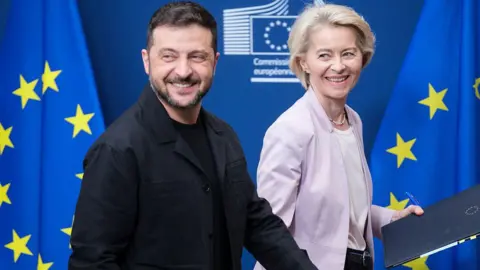 Thierry Monasse/Getty Images
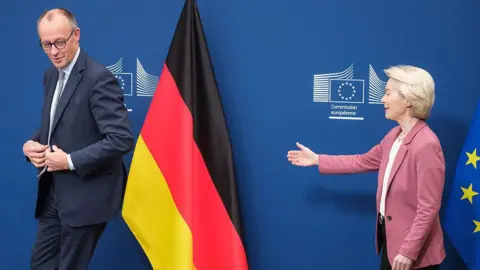 Thierry Monasse/Getty Images