Reading view

There are new articles available, click to refresh the page.

Japanese chess player calls out association's pregnancy bias

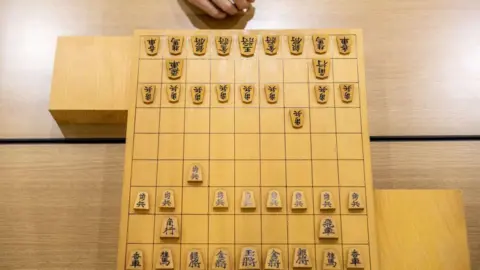
Getty Images Shogi chess pieces arranged on a shogi board at the start of a gameGetty Images
A prominent shogi player says the league's rule forces players to choose between their children and careers

A Japanese chess association has apologised to a prominent 'shogi' player who criticised a rule that bars pregnant players from title matches around their expected due dates.

Under the current rules of shogi - a game similar to chess - such players are replaced, meaning they forfeit all competitions and potential titles during that time.

Kana Fukuma, one of Japan's most decorated shogi players, says this forces players to choose between having a child and developing their careers, and "significantly restricts reproductive rights".

"I hope the body will consider allowing female players to take time off before their due dates without suffering demotion," she told a news conference on Wednesday.

Current rules stipulate that a pregnant women cannot compete within a 14-week period - from six weeks before they give birth, to eight weeks after.

"I hesitated to have a child while pursuing my career in shogi, which is everything to me," Ms Fukuma said, according to Japan's Kyodo News.

The 33-year-old has been playing the popular Japanese board game professionally since 2003. Before giving birth to her first child in December 2024, however, Ms Fukuma was forced to withdraw from several tournaments due to health issues related to her pregnancy.

In a written request submitted on Tuesday, Ms Fukuma urged the association to adjust match dates or venues to accommodate pregnant players, allow competition during pregnancy if the woman's condition allows for it, and ensure women are not stripped of titles during their maternity leave, Kyodo News reported.

The association said it could revise the rules after "discussions with experts while considering the safety of the mother and the fairness of title matches".

This exchange between Ms Fukuma and the shogi association drew mixed responses on social media, with some calling the current rules "misogynistic" and others drawing comparisons to professional sports tournaments.

On Reddit, one user pointed out that tennis players are sometimes given "protected rankings", which allow those returning from long injuries or maternity leave to use their previous rankings to enter major tournaments, including the Grand Slam.

Mexico approves up to 50% tariffs on China and other countries

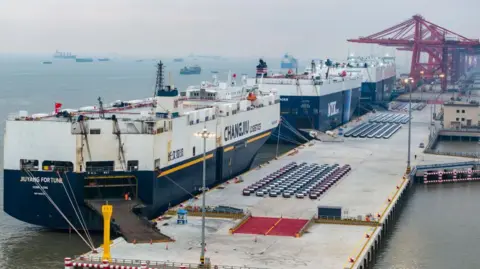
Getty Images A wide-shot of large ships loading vehicles for export at a port in China Getty Images

Mexican lawmakers have approved a package of new tariffs, impacting hundreds of products, many of which come from China.

The measures, which President Claudia Sheinbaum has said are needed to boost domestic production, were passed by the Mexican Senate on Wednesday.

The levies are set to take effect on 1 January 2026 and will apply to goods like metals, cars, clothing and appliances. Dozens of countries that do not have a free trade agreement with Mexico will be affected, including Thailand, India and Indonesia.

The move comes as Mexico is in negotiations with the US over steep import taxes that President Donald Trump has threatened to impose on the country.

The BBC has contacted the embassies in Mexico of China, Thailand, India and Indonesia for comment.

The measures will impose tariffs of up to 50% on more than 1,400 products.

Sheinbaum's government is in talks with the Trump administration as it tries to reduce tariffs that the White House has threatened to impose on the country. They include potential 50% duties on Mexican steel and aluminium.

Trump has also threatened to impose extra tariffs on Mexico for various reasons, including a 25% levy as part of Washington's measures to pressure countries to do more to stop the flow of the synthetic opioid fentanyl into America.

On Monday, Trump threatened to impose a new 5% tariff on Mexico, accusing it of violating an agreement that gives American farmers access to water.

"It is very unfair to our US Farmers who deserve this much needed water," he posted on social media.

Trump was referring to a more than 80-year-old treaty that grants the US water from Rio Grande tributaries.

For decades the US has accused Mexico of not meeting the terms of the agreement.

The US is Mexico's largest trading partner.

Beijing previously warned Mexico to "think carefully" before imposing tariffs.

Venezuelan opposition leader makes first public appearance after months in hiding

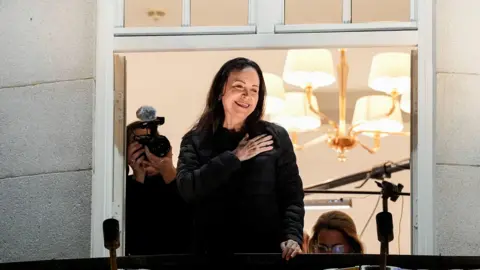
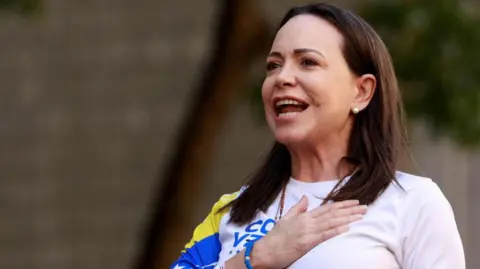
EPA/Shutterstock Nobel Peace Prize laureate Maria Corina Machado stands on a balcony with photographers and a hanging light fixture in a hotel room behind her. It is nighttime and she has her hand over her heart. She is smiling and wearing dark clothing.EPA/Shutterstock

Venezuelan opposition leader María Corina Machado appeared in Oslo, Norway after winning the Nobel Peace Prize, waving from the balcony of the Grand Hotel after months in hiding.

Machado made the covert journey despite a travel ban, and has mostly laid low since Venezuela's disputed presidential election in 2024. She last appeared in public in January.

From a balcony on Wednesday with a crowd cheering below, Machado placed her hand on her heart and sang with her supporters, before walking outside to greet them in person.

Her daughter, Ana Corina Sosa, accepted the award on her mother's behalf earlier in the day.

The Nobel Institute awarded Machado the Peace Prize this year for "her struggle to achieve a just and peaceful transition from dictatorship to democracy" in Venezuela.

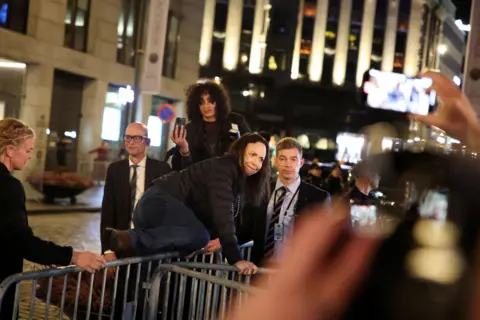
Afterwards, Machado went the outside to greet her supporters, who waited behind metal barricades on the street.

"Maria!" "Maria, here!" they shouted in Spanish, as many held their phones aloft to record the historic moment.

At one point, Machado climbed over the barriers to join them.

Reuters Maria Corina Machado jumps over barricades outside the Grand Hotel in Oslo to greet cheering supporters as security looks on.Reuters
Maria Corina Machado jumps over barricades outside the Grand Hotel in Oslo to greet cheering supporters.

Her appearance was preceded by speculation that she would travel to Norway for the award ceremony.

The Nobel committee shared audio of Machado declaring, "I will be in Oslo, I am on my way."

After her Peace Prize win, Machado made a point to praise US President Donald Trump, who is open about his own ambitions for the Peace Prize and is locked in ongoing military tension with Venezuela.

On Wednesday, Trump announced the US military had seized an oil tanker off the coast of Venezuela. His administration alleges the vessel was under sanction and was involved in an "illicit oil shipping network supporting foreign terrorist organisations".

The Venezuelan government accused the US of theft and piracy.

US seizes oil tanker off the coast of Venezuela, Trump says

Watch: Video shows US military seizing oil tanker off Venezuela coast

US forces have seized an oil tanker off the coast of Venezuela, President Donald Trump said, marking a sharp escalation in Washington's pressure campaign against Nicolás Maduro's government.

"We have just seized a tanker on the coast of Venezuela - a large tanker, very large, the largest one ever seized actually," Trump told reporters at the White House.

Releasing a video of the seizure, Attorney General Pam Bondi described the vessel as a "crude oil tanker used to transport sanctioned oil from Venezuela and Iran".

Caracas swiftly denounced the action, calling it an act of "international piracy". Earlier, President Maduro declared that Venezuela would never become an "oil colony".

The Trump administration accuses Venezuela of funnelling narcotics into the US and has intensified its efforts to pressure President Maduro in recent months.

Venezuela - home to some of the world's largest proven oil reserves - has, in turn, accused Washington of seeking to take its oil.

Oil prices inched higher on Wednesday as news of the seizure stoked short-term supply concerns. Analysts warn the move could threaten shippers and further disrupt Venezuela's oil exports.

US Attorney General Pam Bondi, who leads the US Department of Justice, said the Federal Bureau of Investigation, Department of Defense, Department of Homeland Security, and the US Coast Guard co-ordinated the seizure.

"For multiple years, the oil tanker has been sanctioned by the United States due to its involvement in an illicit oil shipping network supporting foreign terrorist organizations," the nation's top prosecutor wrote on X.

Footage shared by Bondi showed a military helicopter hovering over a large ship, and troops descending on to the deck using ropes. Uniformed men were seen in the clip moving about the ship with guns drawn.

A senior military official told CBS News, the BBC's US partner, that the mission to seize the tanker was launched from a Department of War vessel.

It involved two helicopters, 10 Coast Guard members and 10 Marines, as well as special forces.

Defence Secretary Pete Hegseth was aware of the operation, and the Trump administration was considering more actions like this, the source said.

When asked by reporters what the US would do with the oil on the tanker, Trump said: "We keep it, I guess... I assume we're going to keep the oil."

Maritime risk company Vanguard Tech has identified the oil tanker as Skipper.

"The vessel is reported to be part of the dark fleet, and was sanctioned by the United States for carrying Venezuelan oil exports," it says.

BBC Verify has located this tanker on MarineTraffic, which shows it was sailing under the flag of Guyana when its position was last updated two days ago.

Watch: Venezuela’s Maduro sings "Don't worry, be happy" as he calls for peace with the US

The Venezuelan government issued a statement denouncing the seizure as a "grave international crime".

"Venezuela will not allow any foreign power to attempt to deprive the Venezuelan people of what belongs to them by historical and constitutional right," it said.

It said the prolonged aggression against Venezuela has always been about "our natural resources, our oil, our energy, the resources that belong exclusively to the Venezuelan people".

Speaking at a rally earlier on Wednesday, Maduro had a message for Americans opposed to war with Venezuela. It came in the form of a 1988 hit song.

"To American citizens who are against the war, I respond with a very famous song: Don't worry, be happy," Maduro said in Spanish before singing along to the lyrics of the 1988 hit.

"Not war, be happy. Not, not crazy war, not, be happy."

It's unclear if Maduro knew about the seizure of the tanker before this rally.

After American forces boarded the vessel, Venezuelan Interior Minister Diosdado Cabello called the US "murderers, thieves, pirates".

He referred to Pirates of the Caribbean, but said that while that film's lead character Jack Sparrow was a "hero", he believed "these guys are high seas criminals, buccaneers".

Cabello said this was how the US had "started wars all over the world".

In recent days, the US has ramped up its military presence in the Caribbean Sea, which borders Venezuela to the north.

The build-up involves thousands of troops and the world's largest warship, the aircraft carrier USS Gerald Ford, being positioned within striking distance of Venezuela, BBC Verify reported.

The move has sparked speculation about the potential for some kind of military action.

Since September, the US has conducted at least 22 strikes on boats in the region that the Trump administration says are smuggling drugs. At least 80 people have died in these attacks.

Ione Wells contributed to this report.

Watch: Trump says US has seized "large tanker" off Venezuela coast

Indigenous deaths in custody in Australia hit highest level since 1980

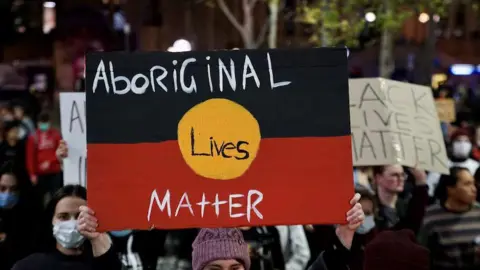
ABC/Jack Fisher A protestor holding up a sign that says Aboriginal Lives Matter painted on an Aboriginal flag, with another placard nearby with the partial words for Black Lives MatterABC/Jack Fisher
Indigenous prisoners account for more than a third of Australia's total population

The number of Indigenous people who have died in custody in Australia has hit the highest level since records began in 1980.

New data from the Australian Institute of Criminology showed 33 of the 113 people who died in custody in the 12 months to June this year were Indigenous, up from 24 compared to the previous corresponding period.

Aboriginal and Torres Strait Islander people are disproportionately represented in the criminal justice system, making up more than one-third of all prisoners, despite being less than four per cent of the country's population.

The figures come more than three decades after a landmark inquiry into Indigenous deaths in custody which made hundreds of recommendations.

Of the 33 Indigenous deaths in custody between last July and this June, 26 died while in prison custody, an increase from 18 in the previous 12-month period.

One died in youth detention and all except one were male.

The remaining six Indigenous deaths in custody happened in police custody, where someone has died while police were detaining or attempting to detain them.

The main cause of Indigenous deaths was categorised as "self-inflicted" followed by "natural causes," the report found. Hanging was found to be the cause in eight of the deaths.

The Australian state of New South Wales recorded the highest number of Indigenous deaths in prison custody with nine, followed by Western Australia with six. Queensland, South Australia and the Australian Capital Territory each had three deaths.

The NSW state coroner recently described the rising number of Indigenous deaths in custody in her state as a "profoundly distressing milestone".

In October, Magistrate Teresa O'Sullivan said the upward trend was not "mere statistics" and the deaths needed "independent and careful scrutiny, respect and accountability".

The average age of Indigenous deaths in custody was 45 years, and 11 of those who died were awaiting a sentence.

University of Melbourne associate professor of criminal law Amanda Porter told the Australian Broadcasting Corporation (ABC) that the figures reflected a "national crisis" that required "leadership and political action".

Ms Porter, who has attended several coronial inquests with families of those that have died, said little had changed since the royal commission in 1991 that aimed to address the crisis.

"It's maddening to see the number of inquests that I attend, the number of funerals that families have to attend, and the fact that we are 30 years after the royal commission, and the situation is getting increasingly worse," she told the ABC.

Since the royal commission, 600 Indigenous people have died in custody which includes six in youth detention, the report said.

Trump launches $1m 'gold card' immigration visas

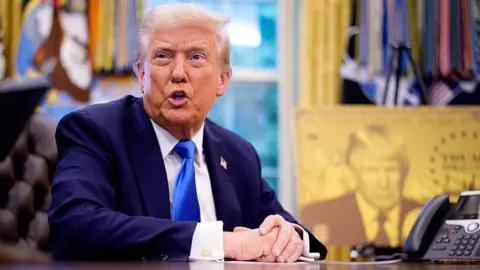
Getty Images President Donald Trump takes a question from a reporter before signing an executive order in the Oval Office at the White House establishing the "Trump Gold Card"
Getty Images
Trump unveiling the Gold Card at the White House

President Donald Trump has launched a scheme offering fast-tracked US visas to wealthy foreigners who can pay at least $1m (£750,000).

The card will give buyers a "direct path to Citizenship for all qualified and vetted people. SO EXCITING! Our Great American Companies can finally keep their invaluable Talent," Trump said on social media on Wednesday.

The Trump Gold Card, which was first announced earlier this year, is a US visa awarded to those who can demonstrate they will provide a "substantial benefit" to the country, according to the scheme's official website.

It comes as Washington intensifies its immigration crackdown, including raising work visa fees and deporting undocumented migrants.

The Gold Card scheme promises US residency in "record time" and will require a $1m fee which is "evidence that the individual will substantially benefit the United States", the programme's website said.

Businesses sponsoring employees are required to pay $2m, along with additional fees. A "platinum" version of the card that offers special tax breaks will also be available soon for $5m, the website said.

Extra fees to the government may be charged depending on each applicant's circumstances, the site said. Individuals are also required to pay a non-refundable $15,000 processing fee before their application is reviewed.

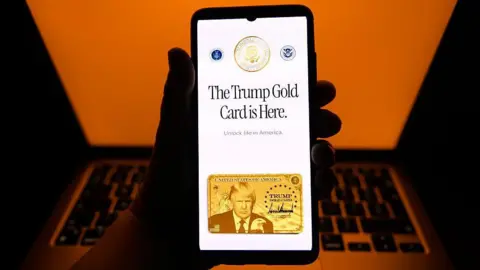
Getty Images The Trump Gold Card website is displayed on a mobile phone screen posed in front of a laptop with an orange background. The Gold Card webpage says "The Trump Gold Card is Here" with the subtitle, "Unlock life in America" and an image of the card, with Trump's imageGetty Images

The gold card scheme has faced criticism since it was first announced in February, with some Democrats saying that it would unfairly favour wealthy individuals.

When Trump first unveiled the plan he described the visas as similar to green cards, which allow immigrants of various income levels to live and work permanently in the US. Green card holders typically become eligible for citizenship after five years.

But the Gold Card is aimed specifically at "high-level" professionals, Trump said, emphasising, "we want people that are productive".

"The people that can pay $5m, they're going to create jobs," Trump said. "It's going to sell like crazy. It's a bargain."

The scheme comes as the Trump administration has devoted significant resources to deporting immigrants.

The US has also paused immigration applications by individuals from the 19 countries, mostly in Africa and in the Middle East, which are subject to the president's travel ban.

The government has also halted all decisions on asylum applications and said it would review thousands of cases that were approved under the administration of President Joe Biden.

In September, Trump also signed an order to charge a $100,000 fee for applicants of the H-1B visa programme for skilled foreign workers.

The decision caused panic among overseas student in the US and technology firms. The White House later clarified that the fee would apply only to new applicants who are currently abroad.

Portugal braced for mass disruption in first general strike for 12 years

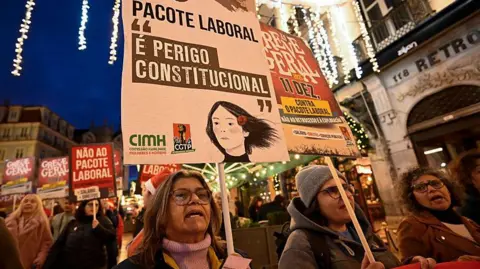
Corbis via Getty Images Women march in Lisbon against the government's labour packageCorbis via Getty Images
The two big union federations are staging the strike, which will disrupt much of the country's services

Portugal is facing severe disruption to transport, flights, hospitals, schools and other public services on Thursday, as the two main union federations stage a general strike over unprecedented labour reforms.

The last time the CGTP and the generally less militant UGT joined forces was during the eurozone debt crisis in 2013, when a "troika" of international institutions demanded cuts in salaries and pensions as part of Portugal's bailout.

Twelve years later, Portugal's economy has become the fastest growing in the eurozone in recent months, but Prime Minister Luís Montenegro says it is still necessary to tackle "rigidities" in the labour market "so companies can be more profitable and workers have better salaries" as a result.

"I will not give up on having a country with the ambition to be at the forefront, to be at the vanguard of Europe," he said on the eve of the strike.

However, Montenegro appears to have been taken aback by the strength of feeling against his minority right-of-centre government's plans: one of his Social Democrat MPs is on the UGT executive and even he voted for a strike.

The prime minister tweaked some proposals after calling the federation in for talks late last month, but it was clearly not enough.

Among the most controversial of the more than 100 proposals are:

  • letting employers roll over temporary contracts for years on end
  • lifting a ban on sacking workers then immediately rehiring them indirectly via outsourcing
  • removing a requirement to reinstate employees who were unfairly dismissed.

It is Portuguese in their 20s who are likely to be most affected by the changes - and opinion is rather mixed.

Diogo Brito, who works as an air steward but has friends who do casual work in tourism, supports the right to strike but backs the package: "It has to be done. We have to catch up with richer countries and with these measures I think we can evolve more."

But self-employed photographer Eduardo Ferreira says he knows many people who already cannot find secure jobs and is pleased to see the unions unite at a "critical moment" for Portugal: "Things have been tough ever since the troika, and workers haven't reacted until now."

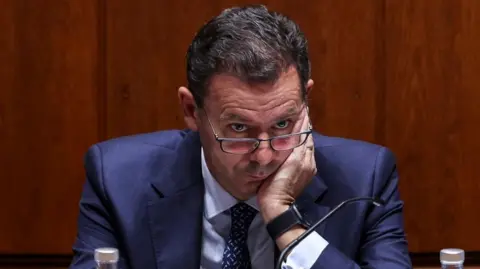
EPA A man in a blue jacket and tie peers over his glasses while sitting against a wooden backgroundEPA
Prime Minister Luís Montenegro appears to have been taken aback by the scale of opposition to his reforms

The CGTP has condemned the package as "an assault on the rights of all workers, particularly women and young people", while the UGT calls it "so out of step, in a context of economic growth, financial stability and a strong labour market, that… it reflects a clear bias in favour of employers".

The UGT also complains that formal talks between unions, government and business were "unbalanced, restrictive and detrimental to workers".

Montenegro's governing coalition lacks a majority in parliament, and is seeking support for the bill not only from the small, free-market Liberal Initiative (IL) but from hard-right Chega, which since May's general election has been the second-largest party.

Its leader, André Ventura, has expressed reservations about the way some measures might affect family life, but looks open to negotiations.

Before the election, Montenegro had ruled out deals with Chega, and the unions and the third-biggest party, the Socialists, say the prime minister's mask has slipped.

They also warn that politicians on the right want to amend Portugal's 1976 constitution to loosen employment safeguards considered among Europe's strongest.

The issue has also become caught up in the campaign for January's presidential election, with several candidates arguing that the labour reform bill flouts Portugal's 1976 constitution.

Under Portugal's "semi-presidential" system, the head of state can decline to sign bills approved by parliament. Bills can instead be sent to the Constitutional Court for review or the president can exercise a veto that, while it can be overturned by a majority of elected MPs, delays the process, ensuring further discussion.

With the government seeking to overhaul so much of the labour code, such scrutiny might stoke voter unease about its radicalism, particularly since the plans were not in the coalition's election manifesto.

Unlike many strikes here, Thursday's day of action is not limited to the public sector.

At Portugal's largest factory, VW-owned Autoeuropa, south of Lisbon, almost 1,000 employees voted unanimously last week to back it.

"I believe there is no worker in this country unaffected by the negative measures in this reform," said UGT secretary-general Mário Mourão, after the Autoeuropa gathering. "It must be responded to appropriately."

String of celebrity scandals renews debate on South Korea's 'cancel culture'

Getty Images South Korean comedian Park Na-Rae with a short black bob and a black dress waving against a blue background at a press eventGetty Images
Park Na-rae, one of the country's most successful female comedians, has now left her popular variety shows amid allegations of workplace bullying

In a matter of days, three big names in South Korea's entertainment industry have made headlines in separate scandals that could derail their careers.

The allegations that have embroiled comedians Park Na-rae and Cho Sae-ho, as well as veteran actor Cho Jin-woong, are all different - ranging from workplace abuse to previous teenage detention to associations with a gang member.

But the results have been the same: departures from the television screens where they had worked their way up to become household names.

The scandals have also raised questions about the standards to which South Korea's public figures are held - especially in the entertainment industry.

What are the scandals about?

Park Na-rae, one of the country's most successful female comedians, made headlines last week when two of her former managers lodged criminal complaints claiming she had verbally abused and physically assaulted them.

The 40-year-old had also made them do her personal chores, they alleged.

Park has denied these allegations and sued the former managers for blackmail, her agency said over the weekend.

She is separately being accused of receiving IV drips illegally at home, which violates the local medical law, local media reported - prompting a police investigation.

On Monday, Park Na-rae announced on social media that she had talked things through with her accusers, but would halt all broadcasting activities until things were "clearly resolved".

"As a comedian whose job is to bring laughter and joy, I cannot continue to be a burden to my programmes and colleagues," she wrote on social media.

Getty Images Cho Sae-ho smiling as he wears a white denim jacket and black-rimmed glassesGetty Images
Cho Sae-ho came under fire for his alleged links to a local gang member

Another comedian who has come under scrutiny over the past week is Cho Sae-ho.

Rumours started swirling last week that the 43-year-old was friends with a prominent local gang member and had received money to promote the latter's business.

Backlash came swiftly, as social media users demanded that Cho Sae-ho be removed from the popular variety shows he hosted, You Quiz on the Block and Two Days and One Night.

On Tuesday, Cho Sae-ho's agency announced that he would leave the shows - though it denied his links to the gang's business activities.

In a social media statement, Cho Sae-ho said he "should have been more careful" with the people he met at events.

He added that he had decided to step down from the shows because he did not want to "burden" the programmes and their production teams.

The downfall that has generated the most debate comes from veteran actor Cho Jin-woong, who said over the weekend that he would quit acting.

Getty Images  Cho Jin-woong in a black suit and bow tie poses on a red carpetGetty Images
Cho Jin-woong announced his retirement from acting amid allegations of robbery and sexual assault as a teen

The abrupt announcement came after a viral news report that said Cho Jin-woong, as a teenager in the 1990s, had been sent to a juvenile detention centre on allegations of robbery and sexual assault. As an adult, he also assaulted a person in his theatre troupe and had his driving licence suspended for drink driving, the report said.

The 49-year-old's agency said that Cho Jin-woong had confirmed wrongdoing in his youth, but denied sexually assaulting anyone.

Broadcasters have scrambled to erase Cho Jin-woong from their platforms. A documentary series he narrated has now had the narration re-recorded, while the fate of Second Signal, the sequel to his hit TV series, remains unclear.

A debate over cancel culture

The allegations Cho Jin-woong faces have stirred heated debate about how much public figures should be forgiven for past mistakes.

"Why does Cho Jin-woong need to retire?" reads one social media comment. "Why should a flawed past remain the standard by which a person is judged decades later?"

Others, however, have argued that seeing him on screen could retraumatise his past victims.

"There are people who defend [Cho Jin-woong] by saying everyone makes mistakes when they're young, but not everyone commits this level of crime," wrote one social media user.

More broadly, the recent string of celebrity scandals has raised bigger questions about the standards to which South Koreans hold their celebrities. It's a system that has sent rising stars into hiatus for being school bullies, and squeezed apologies out of them for simply dating other celebrities.

Culture critic Kim Sung-soo tells the BBC that in South Korea, audiences want to correct behaviour that they deem unacceptable - which, in the case of celebrities, often means disappearing from the screens.

"Celebrities are easy targets because their careers depend on reputation and popularity - things that are granted by the public," culture critic Kim Sung-soo tells the BBC.

Now, just as Park, Cho Sae-ho and Cho Jin-woong promised to "reflect deeply" on their actions, it appears some among their audiences are also reflecting on how celebrities are treated.

"It's absurd that people mistake this recurring pattern of targeting celebrities online - digging for flaws and pushing them out - as a moral issue," one person wrote on X.

"I'm tired of this cancel-culture cycle, and I think it's time for our society to seriously rethink online communities."

Shares in AI giant Oracle fall after revenue results ramp up bubble fears

EPA Oracle's red logo is visible outside its offices in Redwood City, CaliforniaEPA

Shares of cloud computing giant Oracle plunged more than 10% in after-hours trading on Wednesday after the company's revenue results fell short of Wall Street expectations.

The company reported revenue of $16.06bn (£11.99bn) for the three months that ended in November, compared with the $16.21bn projected by analysts.

Revenue growth was up 14%, with a 68% surge in sales at its AI business, Oracle Cloud Infrastructure (OCI), the company said.

OCI services major AI technology developers whose demand for Oracle's AI infrastructure helped the company's shares reach new highs this fall but Wednesday's results failed to quell fears about a potential AI bubble.

In September, Oracle inked a highly sought-after contract with ChatGPT-maker OpenAI which agreed to purchase $300bn (£224bn) in computing power from Oracle over five years.

Oracle chairman and chief technology officer Larry Ellison briefly became the world's richest man.

Oracle stock has lost forty percent of its value since peaking three months ago. Still, shares are up more than 30% since the start of the year.

In a statement issued Wednesday, Mr Ellison struck a cautious tone.

"There are going to be a lot of changes in AI technology over the next few years and we must remain agile in response to those changes," Mr Ellison wrote.

Mr Ellison also appeared to snub Nvidia, the designer of highly-sophisticated AI chips, saying Oracle would buy chips from any maker in order to serve clients.

"We will continue to buy the latest GPUs from Nvidia, but we need to be prepared and able to deploy whatever chips our customers want to buy," Mr Ellison declared in a policy he called "chip neutrality".

Oracle is involved in multiple AI infrastructure arrangements that have raised the prospect that major players in the sector are participating in 'circular financing' deals whereby companies finance purchases of their own products and services.

"Oracle's earnings arrive as investors weigh whether its massive OpenAI partnership might mean overexposure with a customer currently in the spotlight over profitability concerns," said Emarketer analyst Jacob Bourne following the release of the company's quarterly report.

Bourne said Oracle faced mounting scrutiny over the increased debt the company has amassed to fund its buildout of data centres.

Oracle raised a record $18bn (£13.4) in a massive bond sale in September, one of the largest debt issuances ever in the tech sector.

"Although Oracle's shares are buoyed by its September surge, this revenue miss will likely exacerbate concerns among already cautious investors about its OpenAI deal and its aggressive AI spending," Mr Bourne said.

The Ellison family, supporters of US President Donald Trump, also recently purchased Paramount and have spearheaded a failed bid to take over another major Hollywood studio, Warner Brothers Discovery.

A green promotional banner with black squares and rectangles forming pixels, moving in from the right. The text says: “Tech Decoded: The world’s biggest tech news in your inbox every Monday.”

Sign up for our Tech Decoded newsletter to follow the world's top tech stories and trends. Outside the UK? Sign up here.

Intensive work continuing on Ukraine plan, European leaders say after Trump call

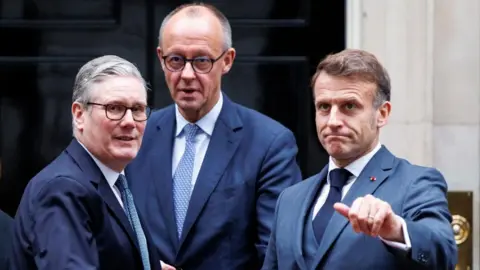
EPA/Shutterstock British Prime Minister Keir Starmer, German Chancellor Friedrich Merz and French President Emmanuel Macron in London. Photo: 8 December 2025EPA/Shutterstock

European leaders say "intensive work" will continue in the coming days on a US-led plan to end the Russia-Ukraine war, after a joint phone call with President Donald Trump.

UK Prime Minister Sir Keir Starmer, French President Emmanuel Macron and German Chancellor Friedrich Merz said they "agreed that this was a critical moment - for Ukraine, its people and for shared security across the Euro-Atlantic region".

A White House official confirmed the call took place but did not give details.

It comes the day after Trump called European leaders "weak", suggesting the US could scale back support for Ukraine.

In the wide-ranging Politico interview published on Tuesday, Trump also claimed Ukraine was "using war" to avoid holding elections, prompting President Volodymyr Zelensky to reply he was "ready" for them.

Russian President Vladimir Putin launched a full-scale invasion of Ukraine in February 2022, and Moscow currently controls about 20% of Ukrainian territory.

The three European leaders issued identical statements shortly after their call with Trump on Wednesday.

They read: "The leaders discussed the latest on the ongoing US-led peace talks, welcoming their efforts to achieve a just and lasting peace for Ukraine, and to see an end to the killing.

"Intensive work on the peace plan is continuing and will continue in the coming days."

Earlier on Wednesday, Zelensky wrote on social media that a 20-point document on how to end the war would be handed over to the US in "the near future" after "our joint work with President Trump's team and partners in Europe".

The Ukrainian leader provided no further details.

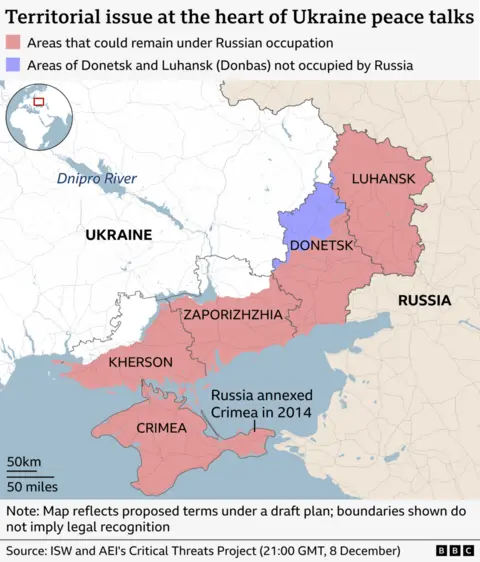
The original US draft peace plan - widely leaked to media last month - had 28 points, and was seen as favouring Russia. Ukraine has since held separate talks with US and European negotiators, seeking to change some key clauses such as territorial issues and security guarantees.

A map of Ukraine's south-eastern territories under Russian occupation

Zelensky is under increasing pressure from Trump to agree to a peace deal to end the war, with the US president urging Kyiv to "play ball" by ceding territory to Moscow.

Zelensky has repeatedly refused to do so, seeking instead an immediate ceasefire on the vast front line and iron-clad security guarantees for Kyiv in any future settlement.

The Ukrainian leader is on a diplomatic tour of Europe following intensive talks between US and Ukrainian negotiators over the weekend which failed to produce a deal to which Kyiv could agree.

Zelensky has been pressing his European allies to help deter the US from backing an agreement that could leave Ukraine exposed to future attacks by Russia.

Meanwhile, the Kremlin said Trump's "very important" statements on Ukraine, including saying Moscow would win the war and that Kyiv would need to hand over land, align with Russia's view.

"In many ways, on the subject of Nato membership, on the subject of territories, on the subjects of how Ukraine is losing land, it is in tune with our understanding," Putin's spokesman Dmitry Peskov said.

Last week, Putin repeated his warning that Ukrainian troops must completely withdraw from Ukraine's eastern Donbas region or Russia will seize it, rejecting any compromise over how to end the war.

Italian cooking awarded Unesco cultural heritage status

Getty Images A woman eats a slice of pizza on the street in Rome. She has short hair. Getty Images

Italian cooking has been awarded special cultural heritage status by the United Nations' cultural agency Unesco.

National favourites including pizza are already on Unesco's list of "intangible cultural heritage", but now Italian cooking traditions and the way they are practiced and transmitted have been awarded.

Prime Minister Giorgia Meloni, who has been pushing for her country's cuisine to be recognised since her election, said: "For us Italians, cuisine is not just food or a collection of recipes. It is so much more: it is culture, tradition, work, wealth."

For millions of fans the news confirms what they already believed - from Sicilian Cannoli to Calabrian 'Nduja - Italian is the best.

The announcement was made during a Unesco assembly meeting in the Indian capital Delhi on Wednesday.

The cultural agency described Italian cuisine as a "means of connecting with family and the community, whether at home, in schools, or through festivals, ceremonies and social gatherings".

Koshary, the spicy dish of lentils, rice, and pasta available at countless Egyptian food stalls, was also added to the list of intangible cultural heritage.

Other countries have had their "practices, skills, traditions and social practices related to foodways" recognised by Unesco, a spokesperson from the agency told the BBC.

Previous examples include "Washoku, traditional dietary cultures of the Japanese, notably for the celebration of New Year, Breakfast culture in Malaysia: dining experience in a multi-ethnic society, or the Gastronomic meal of the French," the spokesperson added.

Speaking to La Repubblica, the Rome-based daily newspaper, chef Michelangelo Mammoliti said the news filled him with a great sense of pride both personally as an Italian, as well as professionally as a chef.

"Italy is one of the nations where regional cuisine has a very big impact on culture and traditions," said the chef, whose restaurant La Rei Natura in Piedmont is the only new three-star restaurant in the 2026 Michelin Guide.

Italy's industry leaders and government ministers will be hoping that the move further boosts tourism to the country, which already welcomes 80 million international visitors annually.

Luigi Scordamaglia, CEO of Filiera Italia, which represents all the food and wine companies in the production chain, told Ansa news agency that the move from Unesco marked a success "for the entire Made in Italy supply chain".

Mr Scordamaglia also spoke about the role of the Mediterranean diet in promoting good health.

He added: "When we talk about the Mediterranean diet, we're talking about our wonderful Italian cuisine, which shares its principles, first and foremost those of balance and variety."

Swimming pool culture in Iceland; the practice of Cuban Son music and dance; and the art of playing, singing and making the lahuta from Albania also entered Unesco's list of intangible cultural heritage.

Ukraine at critical moment, European leaders say after Trump call

EPA/Shutterstock British Prime Minister Keir Starmer, German Chancellor Friedrich Merz and French President Emmanuel Macron in London. Photo: 8 December 2025EPA/Shutterstock

European leaders say "intensive work" will continue in the coming days on a US-led plan to end the Russia-Ukraine war, after a joint phone call with President Donald Trump.

UK Prime Minister Sir Keir Starmer, French President Emmanuel Macron and German Chancellor Friedrich Merz said they "agreed that this was a critical moment - for Ukraine, its people and for shared security across the Euro-Atlantic region".

A White House official confirmed the call took place but did not give details.

It comes the day after Trump called European leaders "weak", suggesting the US could scale back support for Ukraine.

In the wide-ranging Politico interview published on Tuesday, Trump also claimed Ukraine was "using war" to avoid holding elections, prompting President Volodymyr Zelensky to reply he was "ready" for them.

Russian President Vladimir Putin launched a full-scale invasion of Ukraine in February 2022, and Moscow currently controls about 20% of Ukrainian territory.

The three European leaders issued identical statements shortly after their call with Trump on Wednesday.

They read: "The leaders discussed the latest on the ongoing US-led peace talks, welcoming their efforts to achieve a just and lasting peace for Ukraine, and to see an end to the killing.

"Intensive work on the peace plan is continuing and will continue in the coming days."

Earlier on Wednesday, Zelensky wrote on social media that a 20-point document on how to end the war would be handed over to the US in "the near future" after "our joint work with President Trump's team and partners in Europe".

The Ukrainian leader provided no further details.

The original US draft peace plan - widely leaked to media last month - had 28 points, and was seen as favouring Russia. Ukraine has since held separate talks with US and European negotiators, seeking to change some key clauses such as territorial issues and security guarantees.

A map of Ukraine's south-eastern territories under Russian occupation

Zelensky is under increasing pressure from Trump to agree to a peace deal to end the war, with the US president urging Kyiv to "play ball" by ceding territory to Moscow.

Zelensky has repeatedly refused to do so, seeking instead an immediate ceasefire on the vast front line and iron-clad security guarantees for Kyiv in any future settlement.

The Ukrainian leader is on a diplomatic tour of Europe following intensive talks between US and Ukrainian negotiators over the weekend which failed to produce a deal to which Kyiv could agree.

Zelensky has been pressing his European allies to help deter the US from backing an agreement that could leave Ukraine exposed to future attacks by Russia.

Meanwhile, the Kremlin said Trump's "very important" statements on Ukraine, including saying Moscow would win the war and that Kyiv would need to hand over land, align with Russia's view.

"In many ways, on the subject of Nato membership, on the subject of territories, on the subjects of how Ukraine is losing land, it is in tune with our understanding," Putin's spokesman Dmitry Peskov said.

Last week, Putin repeated his warning that Ukrainian troops must completely withdraw from Ukraine's eastern Donbas region or Russia will seize it, rejecting any compromise over how to end the war.

Benin coup plot leader hiding in Togo, official tells BBC

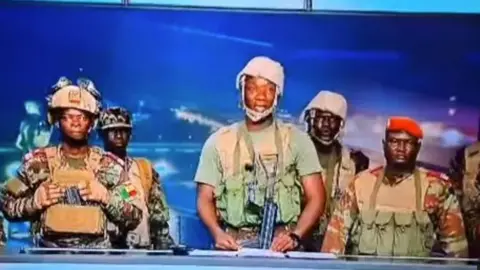
BTV Benin soldiers dressed in army uniform appearing on national tv to announce suspension of the country’s constitution.BTV
Most of the soldiers who appeared on state TV early on Sunday morning are on the run

A senior government official in Benin has told the BBC that the leader of Sunday's failed coup is taking refuge in neighbouring Togo.

Speaking on condition of anonymity, the official said that the government would request Lt Col Pascal Tigri's extradition. Togo's government has not yet commented.

The failed coup came after a series of military takeovers in West Africa, raising concern that democracy is increasingly under threat in the region.

It was thwarted after regional power Nigeria sent fighter jets to dislodge the mutineers from a military base and the offices of state TV following a request from President Patrice Talon's government.

A group of soldiers appeared on state TV early on Sunday to announce they had seized power, and gunfire was heard near the presidential residence.

The Beninese government official said the authorities knew that Lt Col Pascal Tigri was in Togo's capital, Lomé, in the same area where President Faure Gnassingbé lives.

"We don't know how to explain this but we will make an official extradition request and see how the Togolese authorities will react," the official added.

There is no independent confirmation of the claim.

French special forces also helped loyalist troops to thwart the coup, the head of the Benin's republican guard, which is in charge of protecting the president, told AFP news agency.

Dieudonne Djimon Tevoedjre said Benin's troops were "truly valiant and faced the enemy all day" on Sunday.

"French special forces were sent from [Ivory Coast's main city] Abidjan, used for mopping up operations after the Beninese army had done the job," he was quoted as saying.

Benin's government spokesman Wilfried Léandre Houngbédji could not confirm the deployment of French forces.

He told the BBC that as far as he knew, France had mainly provided intelligence support.

Togo is part of the West African regional bloc, Ecowas, which condemned the coup attempt.

Ecowas has deployed troops from Nigeria, Ghana, Sierra Leone, and Ivory Coast to secure key installations in Benin.

The deployment signals that Ecowas is no longer willing to watch civilian governments fall without resistance.

Benin, a former French colony, has been regarded as one of Africa's more stable democracies.

The nation is one of the continent's largest cotton producers, but ranks among the world's poorest countries.

Nigeria described the coup attempt as a "direct assault on democracy".

Houngbédji told the BBC that a small number of soldiers from the National Guard were behind the coup attempt.

"The National Guard is a recent creation within our army, initiated by President Talon as part of our fight against terrorism. It is a land forces unit equipped with significant resources, following major investments in recent years, and its personnel are well trained," he said.

Houngbédji added that Talon asked Ecowas to carry out airstrikes to neutralise the mutineers following indications that they had planned to attack the main airport in Cotonou, Benin's largest city, putting at risk the lives of civilians living in the area.

"This led to the strategy of carrying out targeted airstrikes to immobilise their equipment, including the armored vehicles they threatened to use," he said.

The rebel soldiers justified their actions by criticising Talon's management of the country, complaining first about his handling of the "continuing deterioration of the security situation in northern Benin".

Benin's army has suffered losses near its northern border with insurgency-hit Niger and Burkina Faso in recent years, as jihadist militants linked to Islamic State and al-Qaeda spread southwards.

The soldiers' statement cited "the ignorance and neglect of the situation of our brothers in arms who have fallen at the front and, above all, that of their families, abandoned to their sad fate by Mr Patrice Talon's policies".

The rebels also hit out at cuts in health care, including the cancellation of state-funded kidney dialysis, and taxes rises, as well as curbs on political activities.

Watch: People in Benin felt 'total fear' at attempted coup

Talon, who is regarded as a close ally of the West, is due to step down next year after completing his second term in office, with elections scheduled for April.

A businessman known as the "king of cotton", he first came to power in 2016. He has endorsed Finance Minister Romuald Wadagni as his successor.

Talon has been praised by his supporters for overseeing economic development, but his government has also been criticised for suppressing dissenting voices.

In October, Benin's electoral commission barred the main opposition candidate from contesting the election.

The attempted coup came just over a week after Guinea-Bissau's President Umaro Sissoco Embaló was overthrown - though some regional figures have questioned whether this was staged.

In recent years, West Africa has also seen coups in Burkina Faso, Guinea, Mali and Niger, prompting concerns about the region's stability.

Russia has strengthened its ties with these Sahel countries over recent years - and Burkina Faso, Mali and Niger have left the West African regional bloc Ecowas to form their own group, the Alliance of Sahel States.

News of the attempted takeover in Benin was hailed by several pro-Russian social media accounts, according to BBC Monitoring.

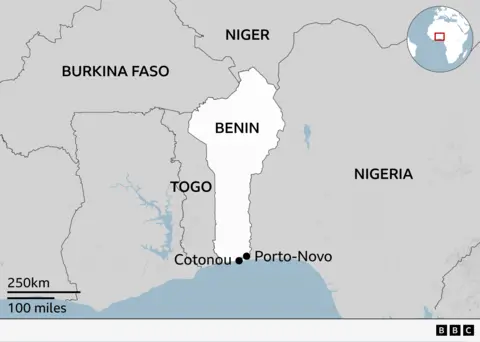
A map showing Benin, including the location of the capital Porto-Novo and main city Cotonou, and its neighbours Togo, Nigeria, Niger and Burkina Faso

You may also be interested in:

Getty Images/BBC A woman looking at her mobile phone and the graphic BBC News AfricaGetty Images/BBC

Go to BBCAfrica.com for more news from the African continent.

Follow us on Twitter @BBCAfrica, on Facebook at BBC Africa or on Instagram at bbcafrica

BBC Africa podcasts

Iceland becomes fifth country to boycott Eurovision

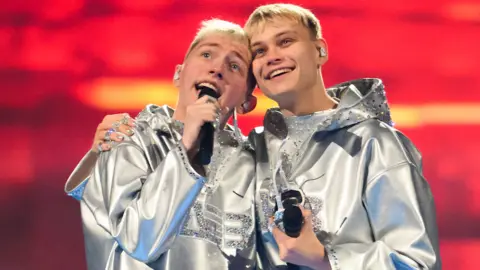
Getty Images The pop band VÆB represented Iceland at the 2025 Eurovision Song ContestGetty Images
The pop band VÆB represented Iceland at the 2025 Eurovision Song Contest

Iceland has joined Spain, Ireland, Slovenia and the Netherlands in saying it will boycott the 2026 Eurovision Song Contest.

All five countries have withdrawn after Israel's participation in the competition was officially confirmed last week.

"Participation of Israeli national broadcaster, KAN, in the contest has created disunity among both members of the European Broadcasting Union (EBU) and the general public," Icelandic broadcaster RÚV said in a statement.

Iceland had previously indicated it intended to skip the 2026 contest, but wanted to wait until the issue could be discussed by its board of directors on Wednesday.

Judge rules Epstein grand jury records from 2019 case can be released

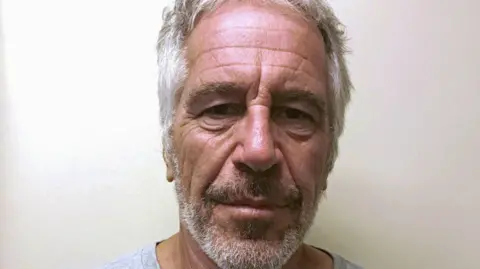
Reuters U.S. financier Jeffrey Epstein appears in a photograph taken for the New York State Division of Criminal Justice Services' sex offender registry March 28, 2017Reuters

A federal judge in New York has ruled the US Department of Justice can publicly release grand jury records from Jeffrey Epstein's 2019 sex trafficking case.

US District Judge Richard Berman's ruling reverses his previous decision to keep the material sealed. He cited a new law passed by Congress requiring the justice department to release files about Epstein by the end of next week.

Esptein was charged with sex trafficking in July 2019. He died in a New York prison cell a month later while awaiting trail.

The latest ruling comes a day after another judge made a similar ruling in the case of Ghislaine Maxwell, who was convicted in 2021 for her role in facilitating Epstein's abuse.

In his ruling, Judge Berman said the victims have the right to "have their identity and privacy protected", adding that their "safety and privacy are paramount".

The Epstein Files Transparency Act was signed into law by US President Donald Trump last month. It requires the justice department to release investigative material related to Epstein by 19 December, including unclassified records, documents and communications.

The law also allows the department to withhold files that involve active criminal investigations or raise privacy concerns.

US judge blocks Trump's National Guard deployment in Los Angeles

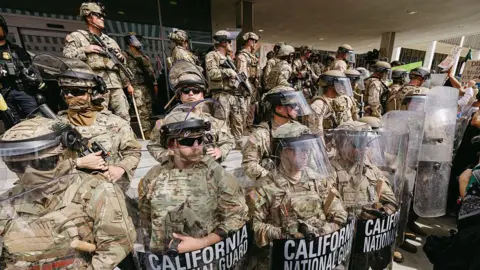
Getty Images National Guard troops in Los AngelesGetty Images
Trump ordered thousands of National Guard troops to Los Angeles in June

A federal judge on Wednesday blocked President Donald Trump's deployment of National Guard troops in Los Angeles and ordered the troops be returned to the state governor's control.

In June, Trump sent thousands of National Guard troops to the California city in the wake of protests over his administration ramping up immigration raids in Los Angeles.

US District Judge Charles Breyer said the Trump administration had not proven that that the city's protests against immigration justified taking federal control of the state's National Guard.

The Trump administration still has control over 300 troops in Los Angeles six months after they were federalised, Judge Breyer said.

Breyer also denied the Trump administration's argument that the courts should not weigh in on a president taking control of state National Guard troops during an emergency.

"The Founders designed our government to be a system of checks and balances," Judge Breyer wrote in his ruling. "Defendants, however, make clear that the only check they want is a blank one."

Judge Breyer said his order would not go into effect until 15 December, giving the Trump administration time to make its expected appeal to a higher court.

The BBC has contacted the White House requesting comment.

This year, Trump has sent National Guard troops to several cities, including Portland, Oregon, and Washington DC, where the deployments have also been contested in courts and. in some cases, blocked by judges.

California Governor Gavin Newsom sued soon after Trump first deployed thousands of troops in June, but a court of appeals sided with the administration, saying the protests in Los Angeles justified Trump's federalisation of the National Guard.

Newsom filed a new legal challenge in November, arguing the protests in the city had largely subsided and therefore the troops were no longer necessary.

In a hearing in the case on Friday, lawyers for the Trump administration said the troops should stay in LA because federal immigration agents there were still being targeted.

But Judge Breyer seemed to question the need for troops to remain in the city months later.

"I think experience teaches us that crises come and crises go," he said, according to the Associated Press.

In his ruling, Judge Breyer said the Trump administration was "effectively creating a national police force made up of state troops" by sending California's National Guard troops to other states as well.

Judge Breyer previously ruled that the way Trump deployed the National Guard to Los Angeles this summer was illegal.

All 50 US states, the District of Columbia, and several territories have their own contingent of National Guard troops.

President Donald Trump's deployment of the National Guard to several US cities has drawn a round of legal challenges by state and local officials.

Trump has argued that his use of the troops is necessary to quell violence in Democratic-controlled cities, crack down on crime and support his deportation initiatives.

Nobel Peace Prize winner's daughter accepts award on her behalf

REUTERS/Leonardo Fernandez Viloria Venezuelan opposition leader Maria Corina Machado gestures at a protest ahead of the Friday inauguration of President Nicolas Maduro for his third term, in Caracas, Venezuela January 9, 2025REUTERS/Leonardo Fernandez Viloria
María Corina Machado was last seen in public at a protest on 9 January

María Corina Machado, the winner of this year's Nobel Peace Prize, is "safe" and will come to Oslo, but will not be able to make the awards ceremony scheduled for 12:00 GMT on Wednesday, the Nobel Institute has said.

The Nobel Institute awarded the Venezuelan opposition leader the prize for "her struggle to achieve a just and peaceful transition from dictatorship to democracy" in her home country.

There has been much speculation about whether Machado, who has been living in hiding, would be able to defy a travel ban to attend the ceremony in Norway's capital.

Organisers said her daughter would accept the award in her stead.

In an audio recording shared by the Nobel Institute, Machado said "I will be in Oslo, I am on my way."

However, the director of the Nobel Institute, Kristian Berg Harpviken, said that Machado was expected to arrive "sometime between this evening and tomorrow morning" - too late for the ceremony.

In her mother's absence, Ana Corina Sosa is expected to give the speech Machado had prepared.

Earlier on Wednesday, the Nobel Institute had said they were in the dark about Machado's whereabouts, triggering concern among her supporters.

Two of her children and her mother are in Oslo, hoping to be reunited with Machado after being separated for more than a year.

Machado went into hiding shortly after Venezuela's disputed presidential election in July 2024.

The last time she was seen in public was on 9 January when she spoke to her supporters at a rally protesting against the swearing-in of Nicolás Maduro to a third term as president.

The elections were widely dismissed both by the opposition in Venezuela and on the international stage as rigged, and sparked protests across the country.

Around 2,000 people were arrested in the crackdown which followed, among them many members of Machado's opposition coalition.

Machado, who had managed to unite the bitterly divided opposition ahead of the election, went into hiding for fear of arrest.

She continued to give interviews and uploaded videos onto social media urging her followers not to give up.

The announcement that she had been chosen as this year's Nobel Peace Prize winner galvanised her supporters and triggered immediate speculation as to whether she would be able to travel to Oslo.

Total secrecy has surrounded her travel plans and it is not know how she managed to leave her place of hiding or by what means she has reached Europe.

Rebels reportedly enter key DR Congo city despite Trump peace deal

AFP via Getty Images A woman balances a sack of on her head as she crosses a road in UviraAFP via Getty Images
More than 200,000 residents have fled the fighting, the UN says

Sporadic gunfire and explosions have been reported as M23 rebels advance towards a key city in eastern Democratic Republic of Congo, in an offensive that has forced thousands to flee across the border into Burundi.

Residents and military sources said soldiers were fleeing the assault on Uvira, the last government-held city in the mineral-rich region.

US President Donald Trump brokered a peace deal last week between DR Congo's President Félix Tshisekedi and Rwanda's Paul Kagame to end the long-running conflict.

Shops and schools have closed, with terrified residents staying indoors amid fears that rebels had taken control of some government buildings.

But South Kivu Governor Jean-Jacques Purusi dismissed reports that the rebels were in the city as "completely unfounded rumours".

Residents told local media that the rebels were patrolling central Uvira under the cover of darkness on Tuesday night, while the city remained deserted early on Wednesday.

A local rights official told AP news agency that there was a "risk of a massacre" if the remaining soldiers mounted strong resistance.

"It's chaotic, nobody's in charge. Uvira is done for," a Burundian officer told AFP news agency.

"Three bombs have just exploded in the hills. It's every man for himself," a resident told AFP, while another added: "We are all under the beds in Uvira - that's the reality."

Military and security sources said the rebel fighters advanced from the north, near the Burundian border.

In an interview with UN-backed Radio Okapi, Purusi denied Uvira had fallen to the M23, saying the city remained under the control of government forces.

The US, European Union, and eight European nations have accused Rwanda of supporting the rebel offensive, and have called for an immediate halt to the fighting

In a joint statement, they voiced "profound concern" about the violence, and said it had a "destabilising potential for the whole region".

Rwanda has denied any involvement in the fighting, accusing DR Congo's government and its ally, Burundi, of violating a ceasefire.

UN experts say Rwanda's army is in "de facto control of M23 operations".

About 200,000 people have fled their homes in eastern DR Congo since the latest round of fighting started early this month, the UN says.

It said at least 74 people had been killed, mostly civilians, and 83 admitted to hospital with wounds.

A Burundian administrative source told AFP that he had recorded more than 8,000 daily arrivals over the past two days, and 30,000 arrivals in one week.

The latest offensive comes nearly a year after the M23 rebels seized control of Goma and Bukavu, the other two main cities in eastern DR Congo.

The M23 is not part of the US-brokered peace deal, and is in separate talks with DR Congo's government in mediation efforts led by Qatar.

In a national address on Monday, Tshisekedi accused Rwanda of "deliberate violations" of the peace accord.

"This is a proxy war aimed at challenging our sovereignty over a highly strategic area, rich in critical minerals and economic potential that is crucial to the future of our nation," Tshisekedi said.

For its part, Rwanda accused the armies of DR Congo and Burundi of bombing villages near its border, forcing more than 1,000 civilians to flee into its territory.

Eastern DR Congo has been wracked by conflict for more than 30 years, since the 1994 Rwandan genocide. Several peace deals going back to the 1990s have collapsed.

Numerous armed groups have competed with the central authorities for power and control of the potential fortune in this vast nation.

More about the DR Congo conflict:

Getty Images/BBC A woman looking at her mobile phone and the graphic BBC News AfricaGetty Images/BBC

Go to BBCAfrica.com for more news from the African continent.

Follow us on Twitter @BBCAfrica, on Facebook at BBC Africa or on Instagram at bbcafrica

US jets tracked circling Gulf of Venezuela as tensions mount

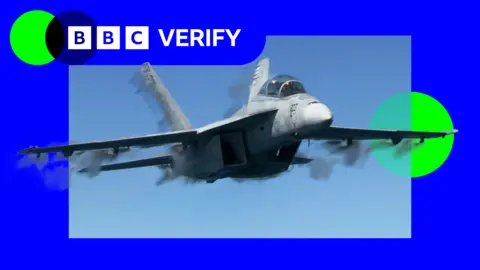
Getty Images A US F-18 Super Hornet in flight. It is imposed over the BBC Verify branding and colours. Getty Images

Two US fighter jets were tracked circling the Gulf of Venezuela on Tuesday as tensions continue to escalate between the two countries.

The F/A-18 Super Hornets appeared on flight tracking sites near Maracaibo, Venezuela's second-largest city, at around 13:00 (17:00 GMT), before circling the gulf for about 40 minutes.

A US defence official told the Associated Press the F/A-18 jets had conducted a "routine training flight" in the area.

The incident comes amid a wave of US strikes against boats in the Caribbean Sea, which the White House said were trafficking drugs to the US from Venezuela. Experts have raised questions over the legality of the strikes, which have killed more than 80 people.

Venezuelan President Nicolás Maduro has accused the US of using the strikes to destabilise the country and oust him from power.

In an interview conducted with Politico the day before the jets approached Venezuela's coastline, Trump declared that Maduro's days in power were "numbered", and declined to comment on whether US troops could be deployed to the country.

A separate jet, an EA-18G Growler, also appeared just before the F/A-18s on the tracking site FlightRadar24. Data shows the jet flew loops just north of Venezuela's coast.

They are the latest in a number of unusual US air force activities that have been tracked since September. B-52 Stratofortress and B-1 Lancer bombers previously flew up to and along the Venezuelan coast.

But the F/A-18s, which are capable of engaging targets both on the ground and in the air, appear to be the first to approach the Venezuelan coastline so publicly in recent months. The F/A-18s came within 20 nautical miles of the coastline, flight tracking data showed.

Neither the F/A-18s or the Growler showed a point of origin or a destination on FlightRadar24, and all three aircraft only turned on their transponders when they arrived near the Venezuelan coastline. Justin Crump, head of the risk consultancy Sibylline, suggested the move was intended to "support the administration's signalling and put pressure on the [Venezuelan] leadership".

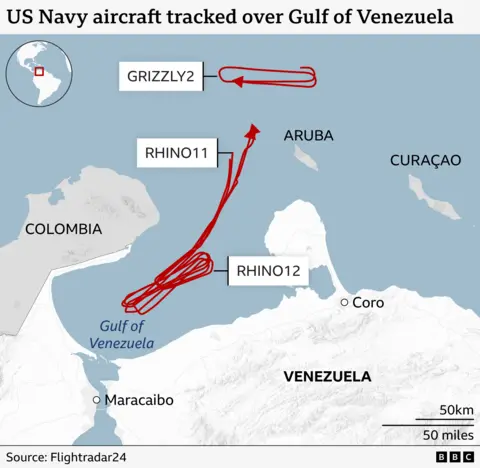
The F/A-18s - which operated under the callsigns RHINO11 and RHINO12 - flew six loops up and down the Gulf of Venezuela. Meanwhile, the Growler jet - flying under the codename GRIZZLY2 - also flew circles along the coast.

A BBC graphic showing the flight path of the F/A-18s and the Growler off the coast of Venezuela. The graphic shows the F/A-18s were marked as RHINO11 and RHINO12, which flew loops in the Gulf of Venezuela. It also shows the Growler as GRIZZLY2 moving further out.

Greg Bagwell, a former RAF air marshall and president of the Air and Space Power Association, told BBC Verify that the flights appeared to be "probing" Venezuelan defence and trying to check for responses such as radio traffic and encrypted signals related to defence systems.

"The Growlers would have been listening for [signals intelligence], whilst the Super Hornets would have been providing air defence cover for the Growlers," Baswell said. He said the Growlers would also detect "active missile sites".

"It could be construed as the early gathering of intelligence for subsequent operations, or just a warning of such," he added.

Crump said the jets also had the capacity to test out "jamming capabilities", adding: "This also helps send a message, when successful, potentially indicating to Venezuela's leadership that these systems cannot or should not be relied upon," he said.

The US has deployed troops, ships and jets to the Caribbean in recent months, which officials have said is to combat drug trafficking in the area.

On Tuesday the US Southern Command published photos of an F/A-18 operating from the USS Gerald Ford, the world's largest aircraft carrier, which has been sent to the Caribbean.

Analysis of satellite images and ship tracking websites by BBC Verify has made it possible to identify at least nine military vessels that have been deployed to the region over recent weeks.

Satellite images also show that an airbase in Puerto Rico, which was closed in 2004 by the Pentagon, has been re-activated. Repairs have been carried out to the runway at Roosevelt Roads base and F-35s - America's most advanced fighter - have been sent to the base.

The BBC Verify banner

Taliban warn Afghans who wore 'un-Islamic' Peaky Blinders outfits

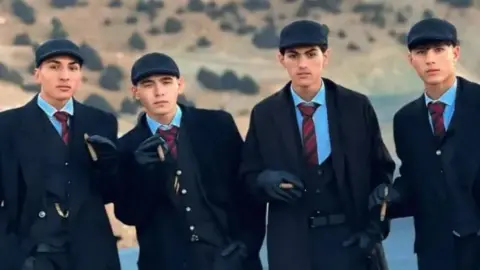
@tomasshelby.0093 Four Afghan men in three piece suits and flat caps hold cigars @tomasshelby.0093

Four Afghan men were ordered to report to the Taliban government's department of vice and virtue for dressing in costumes inspired by the TV series Peaky Blinders.

The friends were told that their clothing was "in conflict with Afghan and Islamic values", a Taliban spokesman told the BBC, adding the values in Peaky Blinders went against Afghan culture.

In videos posted online, the men, who have been released, can be seen posing in flat caps and three-piece suits similar to those worn in the series set in England soon after World War One.

Since the Taliban seized power in 2021, they have imposed a number of restrictions on daily life in accordance with their interpretation of Islamic Sharia law.

"Even jeans would have been acceptable, but the values in the Peaky Blinders series are against Afghan culture," Saiful Islam Khyber, a spokesman for the Taliban government's provincial department of Vice and Virtue in Herat city told the BBC.

The men, all in their early twenties, come from the town of Jibrail in Herat province. They were ordered to report to the Taliban's "morality police" on Sunday, and presented themselves for questioning in Herat the following day.

"They were promoting foreign culture and imitating film actors in Herat," Khyber wrote on social media, adding that they had undergone a "rehabilitation programme".

The were not formally arrested, "only summoned and advised and released", Khyber told the BBC's US partner CBS News.

"We have our own religious and cultural values, and especially for clothing we have specific traditional styles," he said.

"The clothing they wore has no Afghan identity at all and does not match our culture. Secondly, their actions were an imitation of actors from a British movie. Our society is Muslim; if we are to follow or imitate someone, we should follow our righteous religious predecessors in good and lawful matters."

The men could be seen thanking officials for their advice and saying they were unaware they had violated any laws in a video released by the ministry after they were questioned - though it is unclear under what circumstances the interview was recorded.

"I have innocently been sharing content that was against Sharia which had many viewers," one said in the recording.

He said he had been "summoned and advised", and would no longer do "anything like this".

In an interview with YouTube channel Herat-Mic uploaded at the end of November, before they were summoned, the friends said they admired the fashion displayed in the series, adding that they had received positive reactions from locals.

"At first we were hesitant, but once we went outside, people liked our style, stopped us in the streets, and wanted to take photos with us," one of the men said, according to a translation by CBS News.

US sanctions network it says recruits Colombian fighters for Sudan civil war

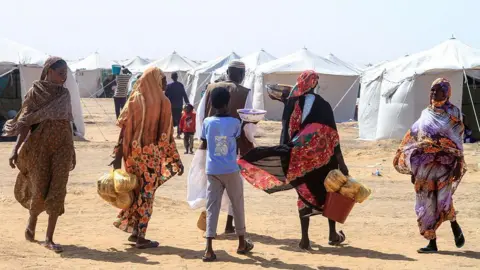
AFP via Getty Images Four women, a boy and a man walking on sandy ground carrying food. In the background are white aid tents.AFP via Getty Images
Refugees from el-Fasher - which fell to the paramilitary RSF in recent weeks - have settled in a camp in the north

The US has imposed sanctions on a network it says is recruiting former Colombian soldiers and training individuals to fight in Sudan's civil war.

Eight entities and individuals - primarily of Colombian nationality - have been aiding the Sudanese paramilitary Rapid Support Forces (RSF), the US Treasury's Office of Foreign Assets Control (OFAC) said on Tuesday.

Its statement added that hundreds of Colombian mercenaries have travelled to Sudan since 2024, including to serve as infantry and drone pilots for the RSF.

Last year, Colombian President Gustavo Petro said those who "spill young blood for money in foreign countries must be punished criminally".

The participation of soldiers - both former and active - in foreign conflicts dates back decades to the US wars in Afghanistan and Iraq, in exchange for American military aid in Colombia's war on drugs and armed groups.

"This created an even greater number of Colombian soldiers who, two decades later, are beginning to retire without a sufficient source of income," a retired military officer turned academic told BBC Mundo.

Alfonso Manzur explained that as a result, "we see more Colombian ex-soldiers on missions abroad".

Retired Colombian soldiers are commonly recruited under false promises of low-risk work, before appearing on the frontlines, such as in the current conflict between Russia and Ukraine, and in Sudan.

In 2024, the Colombian foreign ministry said it was aware of citizens being deceived by what it called "sophisticated human trafficking networks", and becoming mercenaries in international conflicts.

On Tuesday, the US Treasury's OFAC said it was targeting a network for recruiting fighters for the RSF, which has been battling the Sudanese army since April 2023.

"The RSF has shown again and again that it is willing to target civilians - including infants and young children," said John Hurley, the Treasury's under-secretary for terrorism and financial intelligence.

"Its brutality has deepened the conflict and destabilized the region, creating the conditions for terrorist groups to grow."

The State Department has said the group and its allied militias have attacked civilians, systematically killed men and boys and deliberately targeted and raped women and girls.

Earlier this year, it determined that RSF members had committed genocide, although both the paramilitary group and the army have repeatedly been accused of war crimes.

The transnational network accused of aiding the group consists of four entities and four individuals, including a dual Colombian-Italian national who is a former military officer, now based in the United Arab Emirates, a country repeatedly accused of arming the RSF. It denies the allegations.

"All property and interests in property of the designated or blocked persons... or in the possession or control of U.S. persons are blocked and must be reported", the Treasury said.

The US has accused the primarily Colombian network of recruiting mercenaries to serve with the RSF, providing "tactical and technical expertise", and even training children to fight.

According to its statement, Colombian fighters were involved in "numerous battles across Sudan" including in the capital Khartoum, Omdurman, Kordofan, and el-Fasher.

On the ground, the RSF has been making gains, most notably seizing the city of el-Fasher in October, after a 500-day starvation siege.

It is estimated that more than 5,000 people were killed as the paramilitary rampaged through the army's last stronghold in Darfur.

The three states that make up Kordofan, home to almost eight million people, and situated between Khartoum and Darfur, has recently become a major frontline.

On Monday, at least 114 people, including 63 children, were killed in strikes on a kindergarten and hospital in South Kordofan, the World Health Organisation said.

WHO director-general Tedros Adhanom Ghebreyesus described the attack as "senseless" as he repeated calls for a ceasefire.

The RSF also claimed control of Sudan's largest oil field, Heglig, in what the paramilitary group hailed as "a turning point for the liberation" of the country.

Last month, US President Donald Trump pledged to "start working on Sudan" with Egypt, Saudi Arabia and the UAE, posting on social media that "tremendous atrocities" were taking place.

Nearly 12 million people have been driven from their homes with famine conditions in parts of the country.

Additional reporting by BBC News Mundo correspondent José Carlos Cueto.

Ex-president's daughter sworn in as South African MP after half-sister quits

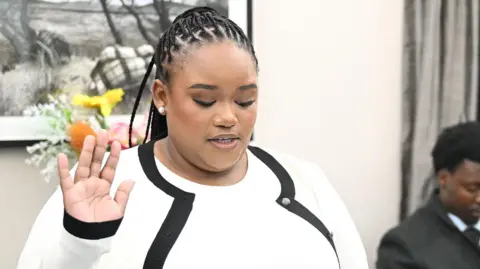
Phando Jikelo / Parliament of South Africa Brumelda Zuma, dressed in white, takes the oath in parliament, with her right hand raised.Phando Jikelo / Parliament of South Africa
Brumelda Zuma said she would focus mostly on ensuring that South Africans had "good public services"

A daughter of South Africa's former President Jacob Zuma has been sworn into parliament, less than a fortnight after her half-sister was forced to step down.

Brumelda Zuma became one of South Africa's newest MPs on Wednesday, representing uMkhonto weSizwe (MK), the opposition party led by her father.

Her half-sister, Duduzile Zuma-Sambudla, resigned from parliament following allegations that she had tricked 17 men into fighting for Russia as mercenaries in Ukraine. Zuma-Sambudla has denied these accusations.

Brumelda Zuma's appointment suggests the former president intends to ensure his family is represented in parliament.

She was sworn in alongside three other MK members, who, the party said, "bring a wealth of experience and dedication" to parliament.

She said she would focus mostly on ensuring that South Africans had "good public services" because "that is what I studied".

MK said Brumelda Zuma had a degree in public administration.

Brumelda Zuma has not previously had a national profile, unlike her half-sister who had represented South Africa in the Pan-African Parliament.

MK previously said it was Zuma-Sambudla's decision to resign as she wanted to focus her efforts on ensuring the return of those trapped in Ukraine's war-torn Donbas region.

She was implicated in the Russia recruitment scheme after South Africa's government revealed it had received distress calls from more than a dozen citizens who had joined mercenary forces.

The men are aged between 20 and 39 and are trapped in Donbas.

One of Zuma-Sambudla's most prominent accusers is another half-sister, Nkosazana Zuma-Mncube.

Zuma-Mncube filed a criminal complaint against Zuma-Sambudla and two other people, accusing them of luring the men to Russia "under false pretences" and then handing them to a Russian mercenary group "without their knowledge or consent".

She said that eight of them were her relatives.

Police have confirmed they are carrying out an investigation.

Working as a mercenary or fighting for another army is illegal under South African law, unless the government authorises it.

Zuma-Sambudla has said in an affidavit that she thought the men were going to Russia for "lawful" training.

She is currently also on trial on terrorism-related charges over social media messages she posted during deadly protests in 2021. She has denied the charges.

Jacob Zuma formed MK in 2023 after a massive fall-out with current President Cyril Ramaphosa.

The MK party came in third place in South Africa's general election last year, and became the main opposition party in parliament after the second-biggest party joined a coalition government led by Ramaphosa.

Getty Images/BBC A woman looking at her mobile phone and the graphic BBC News AfricaGetty Images/BBC

Go to BBCAfrica.com for more news from the African continent.

Follow us on Twitter @BBCAfrica, on Facebook at BBC Africa or on Instagram at bbcafrica

South Korea protests at Chinese and Russian warplanes in its airspace

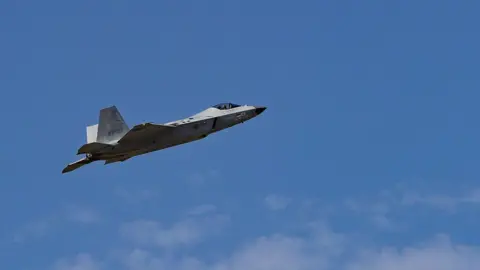
Getty Images File photo of a South Korea's KF-21 fighter jet during a test flightGetty Images
File photo of a South Korea's KF-21 fighter jet during a test flight

South Korea has lodged a complaint with the Chinese and Russian defence attaches based in the country, a day after their warplanes entered its air defence zone.

Seoul said it sent up fighter jets to "take tactical measures in preparation for any emergencies" after seven Russian and two Chinese military aircraft "briefly entered" the zone on Tuesday, but noted they "did not violate" South Korea's airspace.

Some countries delineate air identification defence zones, wherein they require foreign planes to identify themselves. These are not part of sovereign airspaces under international law.

In March this year, Seoul also deployed fighter jets after several Russian warplanes flew into the zone.

The Russian aircraft entered Korea's Air Defense Identification Zone (Kadiz) near Ulleung Island and Dokdo, while the Chinese aircraft entered near Ieodo, a Joint Chiefs of Staff official said, according to South Korean media.

Both sides' aircraft then regrouped in the airspace near Japan's Tsushima Island, the official said.

"Our military will actively respond to aircraft activities from neighbouring countries in the Kadiz in compliance with international law," South Korea's defence ministry said on Wednesday when lodging the complaint.

Both Japan and South Korea have laid claims to the Dokdo island grouping, as has North Korea.

Ieodo - a submerged rock above the South Korean island of Jeju - is a point of dispute between Seoul and Beijing, each of whom have included it in their air defence zones.

China on Wednesday confirmed that its air force had conducted a joint patrol with Russia in the East China Sea and Western Pacific airspace.

The exercise was part of an "annual cooperation plan" between Beijing and Moscow to "address regional challenges and maintain regional peace and stability", said a national defence spokesman.

China and Russia have entered South Korea's air defence zone without notification on several occasions since 2019, often during similar exercises.

Russia does not recognise South Korea's air defence zone, describing it as "unilaterally" established and saying it should therefore not create any legal obligations for other countries.

US could ask foreign tourists for five-year social media history before entry

Getty Images A plane flying above the Statue of Liberty with a full moon in the backgroundGetty Images

Tourists from dozens of countries including the UK could be asked to provide a five-year social media history as a condition of entry to the United States, under a new proposal unveiled by American officials.

The new condition would affect people from dozens of countries who are eligible to visit the US for 90 days without a visa, as long as they have filled out an Electronic System for Travel Authorization (ESTA) form.

Since returning to the White House in January, President Donald Trump has moved to toughen US borders more generally - citing national security as a key reason.

Analysts say the new plan could pose an obstacle to potential visitors, or harm their digital rights.

The US expects a major influx of foreign tourists next year, as it hosts the men's football World Cup alongside Canada and Mexico, and for the 2028 Olympics in Los Angeles.

The proposal document was filed by Customs and Border Protection (CBP) and the Department of Homeland Security (DHS), of which the agency is part.

US media reported that it appeared in the Federal Register, which is the official journal of the US government. The BBC has asked DHS for comment.

It says "the data element will require ESTA applicants to provide their social media from the last 5 years", without giving further details of which specific information will be required.

The existing ESTA requires a comparatively limited amount of information from travellers, as well as a one-off payment of $40 (£30). It is accessible to citizens of about 40 countries - including the UK, Ireland, France, Australia and Japan - and allows them to visit the US multiple times during a two-year period.

As well as the collection of social media information, the new document proposes the gathering of an applicant's telephone numbers and email addresses used over the last five and 10 years respectively, and more information about their family members.

The text cites an executive order from Trump in January, titled "Protecting the United States From Foreign Terrorists and Other National Security and Public Safety Threats".

Getty Images A pen laid atop a paper form labelled Electronic System for Travel Authorization (ESTA)Getty Images
The plan would affect people from countries including the UK, which can fill out an ESTA form in lieu of a visa

The Trump administration has previously required foreign nationals to make their social media accounts public if they are applying for student visas or H1B visas for skilled workers - the latter of which now also entail a much higher fee.

A senior state department official said of the student visa policy: "It is an expectation from American citizens that their government will make every effort to make our country safer, and that is exactly what the Trump Administration is doing every single day."

Officers were instructed to screen for those "who advocate for, aid, or support designated foreign terrorists and other threats to national security; or who perpetrate unlawful anti-Semitic harassment or violence".

As part of the administration's broader effort to toughen borders, officials recently said an existing travel ban - affecting 19 countries in Africa, the Middle East and the Caribbean - could soon be expanded.

That move was announced in the wake of a shooting attack on two National Guard members in Washington DC, in which an Afghan man has been named as the suspect.

The new proposal regarding ESTA data collection for tourists invites views from the public for 60 days.

Sophia Cope, of digital rights organisation the Electronic Frontier Foundation, criticised the plan, telling the New York Times that it could "exacerbate civil liberties harms".

Meanwhile, immigration law practice Fragomen suggested there could be practical impacts as applicants could face longer waits for ESTA approvals.

Experts have previously suggested that the changes to travel policies introduced under Trump have had an impact on the American tourism industry.

Earlier this year, the World Travel & Tourism Council said the US was the only one of 184 economies that it analysed that was expected to see a decline in international visitor spending in 2025.

Other Trump administration policies have also appeared to impact tourism to the country, such as many Canadians boycotting US travel as a form of protest against Trump's tariffs.

October marked the 10th straight month of decline in the number of Canadian travellers to the US. In the past, Canadians have made up about a quarter of all international visitors to the US, spending more than $20bn (£15.1bn) a year, according to the US Travel Association.

Nobel Peace Prize winner will be in Oslo but won't make awards ceremony

REUTERS/Leonardo Fernandez Viloria Venezuelan opposition leader Maria Corina Machado gestures at a protest ahead of the Friday inauguration of President Nicolas Maduro for his third term, in Caracas, Venezuela January 9, 2025REUTERS/Leonardo Fernandez Viloria
María Corina Machado was last seen in public at a protest on 9 January

María Corina Machado, the winner of this year's Nobel Peace Prize, is "safe" and will come to Oslo, but will not be able to make the awards ceremony scheduled for 12:00 GMT on Wednesday, the Nobel Institute has said.

The Nobel Institute awarded the Venezuelan opposition leader the prize for "her struggle to achieve a just and peaceful transition from dictatorship to democracy" in her home country.

There has been much speculation about whether Machado, who has been living in hiding, would be able to defy a travel ban to attend the ceremony in Norway's capital.

Organisers said her daughter would accept the award in her stead.

In an audio recording shared by the Nobel Institute, Machado said "I will be in Oslo, I am on my way."

However, the director of the Nobel Institute, Kristian Berg Harpviken, said that Machado was expected to arrive "sometime between this evening and tomorrow morning" - too late for the ceremony.

In her mother's absence, Ana Corina Sosa is expected to give the speech Machado had prepared.

Earlier on Wednesday, the Nobel Institute had said they were in the dark about Machado's whereabouts, triggering concern among her supporters.

Two of her children and her mother are in Oslo, hoping to be reunited with Machado after being separated for more than a year.

Machado went into hiding shortly after Venezuela's disputed presidential election in July 2024.

The last time she was seen in public was on 9 January when she spoke to her supporters at a rally protesting against the swearing-in of Nicolás Maduro to a third term as president.

The elections were widely dismissed both by the opposition in Venezuela and on the international stage as rigged, and sparked protests across the country.

Around 2,000 people were arrested in the crackdown which followed, among them many members of Machado's opposition coalition.

Machado, who had managed to unite the bitterly divided opposition ahead of the election, went into hiding for fear of arrest.

She continued to give interviews and uploaded videos onto social media urging her followers not to give up.

The announcement that she had been chosen as this year's Nobel Peace Prize winner galvanised her supporters and triggered immediate speculation as to whether she would be able to travel to Oslo.

Total secrecy has surrounded her travel plans and it is not know how she managed to leave her place of hiding or by what means she has reached Europe.

At least 22 killed in building collapse in Morocco

EPA A man swings an axe as emergency responders dig through the rubble of a building collapse in Fez.EPA

At least 19 people have been killed and a further 16 injured after two buildings collapsed in the Moroccan city of Fez.

The two four-storey residential buildings that came down early on Wednesday morning contained eight families, state media report, citing local officials.

Several Moroccan news outlets report that the buildings - located in the south-westerly Al Massira suburb of the new part of the city - had shown signs of deterioration for several years.

Fez, in north-eastern Morocco, is one of the North African nation's oldest cities, with parts dating back to the 8th Century, as well as being its third-most populous.

A search and rescue operation is ongoing to find anyone who may still be trapped under the rubble. Footage from the scene shows people and diggers sifting through the debris under the cover of darkness.

In one clip, published by news site Akhbarona, a body can be seen being carried away on a stretcher by emergency services.

Residents of nearby buildings have been evacuated as a preventative measure, state media report.

Those taken to hospital suffered varying injuries.

Nine were killed when a condemned building collapsed in a different neighbourhood of Fez in May.

Prior to that, five people were killed when a house in the old city crumbled in February 2024, following heavy rain and strong winds.

Elon Musk says Doge was 'somewhat successful' but he would not do it again

Reuters Elon Musk holds up a chainsaw onstage during the Conservative Political Action Conference (CPAC) in National Harbor, Maryland, on 20 February 2025 Reuters
Elon Musk wielded a chainsaw to symbolise government cost-cutting at the Conservative Political Action Conference in February

Elon Musk says he would not lead the Department of Government Efficiency (Doge) if he had his time again, but has maintained that its tumultuous efforts to shrink the size of the US government under President Donald Trump was "a little bit successful".

The billionaire boss of Tesla and SpaceX gave his reflections during a nearly-hour long interview on The Katie Miller Podcast on Tuesday.

Musk left Doge in May after initially promising to save as much as $2tn (£1.5bn) a year by slashing federal jobs and shuttering government programmes, among other cost-cutting measures.

Doge's website, which was last updated on 4 October, claims to have saved an estimated $214bn so far this year.

Conservative podcast host Miller, a former White House adviser herself who worked as a spokesperson for Doge, asked Musk whether he would do his work for the organisation again if he could rewind to the start of the year.

"I mean no, I don't think so," Musk replied.

Instead, he said he would have "worked in my companies, essentially", explaining that "they wouldn't have been burning the cars".

His comments reference a series of vandalism attacks on Tesla showrooms and vehicles earlier this year, which came in response to the highly visible political role in the Trump administration for the world's richest man.

Musk's involvement in US politics sparked global protests and boycotts against Tesla, and led to a spike in vandalism of Tesla's Cybertruck vehicles. In April, the firm said sales had fallen to their lowest level in three years and warned investors that "changing political sentiment" could continue to hurt demand.

But Musk said he believed Doge had been "a little bit successful, we were somewhat successful".

"You really want the least amount done by government as possible," he explained, adding that Doge had "stopped a lot of funding that really just made no sense".

Musk told Miller that Doge, which was created by an executive order on Trump's first day back in the White House, was a "made-up" name "based on internet suggestions".

The advisory group, which is not an official government department, tackled Musk's vision at a fierce pace. It pushed for massive reductions in the federal workforce, as well as the shuttering of programmes and even agencies such as the US Agency for International Development (USAID).

Some of Doge's moves were met with legal fights, or were reversed. When the group's cost-cutting resulted in bird flu officials at the US Department of Agriculture being fired, the Trump administration looked to re-hire them days later.

Reuters Katie and Stephen Miller pose during a red-carpet eventReuters
Musk spoke to podcast host Katie Miller, a former Trump adviser herself who is also married to White House Deputy Chief of Staff Stephen Miller

Musk's time at the helm of Doge not only appeared to cause issues for his business empire - it also led to an explosive falling-out with the president himself.

Musk donated millions of dollars to the Trump campaign during the election and was a fixture at the White House for months, speaking at cabinet meetings and standing behind the president at events in the Oval Office.

But that relationship came to a grinding halt in June when Musk broke with the White House narrative and criticised a Trump-backed spending bill.

It led to a war of words on social media, with Trump at one point threatening to order Doge to look into Musk's own business dealings with the US government.

The pair's relationship now seems to be mended. Musk was spotted at a White House dinner with Saudi Crown Prince Mohammad bin Salman in November.

And Musk spoke positively of Trump in his interview with Miller, saying the president was the funniest person he knows and has "great sense of humour".

Kids locked out of social media apps after Australia's world-first ban

Watch: Australian teens test out social media as ban takes effect

Australia's world-first social media ban for children has taken effect, with throngs of teenagers waking up to find their accounts have gone dark.

Others tell BBC they have already snuck past barriers and will continue scrolling and posting freely until they are caught.

The new law means social media firms - including Meta, TikTok and YouTube - must take "reasonable steps" to ensure Australians aged under 16 don't hold accounts on their platforms.

The ban, eyed with excitement by global leaders and trepidation by tech companies, was justified as necessary to protect children from harmful content and algorithms - though critics have argued blanket prohibition is neither practical nor wise.

This landmark policy has been one of Prime Minister Anthony Albanese's pet projects, and speaking to media on Wednesday he said he believed it has the power to change lives around the world.

"This is a day in which my pride to be prime minister of Australia has never been greater," he said, flanked by parents and media figures who had pushed for the ban.

"This is Australia showing enough is enough."

"I think it will go [down] with the other great reforms that Australia has led the world on."

Various governments, from the US state of Florida to the European Union, have been experimenting with limiting children's use of social media. But, along with a higher age limit of 16, Australia is the first jurisdiction to deny an exemption for parental approval in a policy like this - making its laws the world's strictest.

Countries like Denmark, Malaysia, Singapore, Greece and Brazil are among those who have said they're looking at Australia as a test case.

The Australian government has named 10 social media platforms as a start, including all of the most popular ones, but has also warned others it's coming for them next.

Online safety regulator, Julie Inman Grant, said her agency will start checking compliance from Thursday. Parents and children won't be liable under this law, only social media firms, which face fines of up to A$49.5m ($33m, £24.5m) for serious breaches.

"Tomorrow, I will issue information notices to the 10 major platforms and we will provide information to the public before Christmas on how these age restrictions are being implemented and whether, preliminarily, we see them working," she said.

There is broad agreement in Australia that social media companies are failing to shield users, particularly children, from harm on their platforms.

Tasmanian student Florence Brodribb - known as Flossie - told the press she believed the ban would help kids like her grow up "healthier, safer, kinder, and more connected".

"Our brains are going through one of the biggest rewiring periods of our lives... Social media is designed to take advantage of that," the 12-year-old said.

"Young people deserve better than that."

BBC/Simon Atkinson A teenage girl in a pink denim top smilesBBC/Simon Atkinson
Flossie is a big supporter of the ban

Polling shows the ban is wildly popular with parents, who hope it will also help reduce cyber bullying and child exploitation. But it is far less popular with children.

Backed by some mental health advocates, many have argued it robs young people of connection - particularly those from LGBTQ+, neurodivergent or rural communities - and will leave them less equipped to tackle the realities of life on the web.

"My closest friend would be 30km (18.6 miles) away from me... and my next closest friend is probably over 100km," 15-year-old Breanna told the BBC.

"When our Snapchat is taken away, so is our communication."

Experts are also worried kids are going to circumvent the ban with relative ease - either by tricking the technology that's performing the age checks, or by finding other, potentially less safe, places on the net to gather.

Many critics have been advocating instead for better education and more moderation, with Sydney father-of-two Ian among them.

"There's a good idea behind [the policy], but is it the right way to go about it? I'm not sure," he told the BBC.

Tech firms, which are desperate to stop other countries from implementing similar bans, have argued the government is overreaching, and pointed to recently strengthened parental controls on many of their platforms as a solution.

While the government has insisted the social media companies have the money and the technology to make this ban happen, it has also sought to manage expectations.

"I've been asked... what will success look like? Success is the fact that it's happening. Success is the fact that we're having this discussion," Albanese said on Wednesday.

"We do acknowledge it won't be perfect and we'll work through it."

Ms Inman Grant said Australia is playing the long game, and while stories of kids getting round the ban will make headlines, regulators will not be deterred.

"The world will follow, like nations once followed our lead on plane tobacco packaging, gun reform, water, and sun safety," she said.

French far-right leader tells BBC he shares US warnings on Europe 'for most part'

BBC Jordan BardellaBBC
'If tomorrow I am the head of government, France will no longer be the target of mass immigration,' Bardella told the BBC's Nick Robinson

The leader of France's far-right National Rally (RN) Jordan Bardella has welcomed "for the most part" concerns raised about Europe in US President Donald Trump's new National Security Strategy.

Last week, the White House published a document which outlined Trump's vision of the world and the state of the European continent, which many have characterised as harshly critical of Europe.

Speaking to the BBC's Nick Robinson for his Political Thinking podcast, Bardella praised what he said was Trump's "appeal to American pride" - but he made clear he did not want Europe to be "subservient to any major power".

He said there was a "wind of freedom, of national pride blowing all over Western democracies".

In a wide-ranging interview, the 30-year-old, who opinion polls suggest leads in the race to be France's next president, was also challenged on the RN's political history and his stance on immigration.

Bardella said he shared the majority of the concerns outlined by the Trump administration about Europe facing "civilisational erasure", which the White House said is being fuelled by a range of policies, including on migration.

"Mass immigration and the laxity of our governments in the last 30 years with regards to migration policy are shaking the balance of European countries, of Western societies, and namely French society," Bardella said.

Snap parliamentary elections in June 2024 made the RN the largest single force in parliament, although an alliance of left-wing parties clinched victory.

The next French presidential election is due to be held in 2027. A recent poll for Le Figaro suggests Bardella would win with 44% of the vote - just ahead of Marine Le Pen, the RN figurehead whose candidacy is in doubt after she was found guilty of embezzling EU funds and barred from standing in an election for five years.

An appeal due early next year will determine whether Le Pen can run - otherwise, the expectation is that Bardella will step in.

Bardella batted away suggestions this was sparking tensions between them, stating they were united by "trust and friendship".

"I will fight by her side so she can win the appeal. Until the appeal we will campaign together, as we will after, hand-in-hand," he said in his interview.

The RN was founded by Le Pen's father Jean-Marie in 1972. Known then as the National Front (FN), it has since become a decisive force in French politics. Jean-Marie Le Pen was convicted several times for Holocaust denial and was an unrepentant extremist on race.

In his interview with Nick Robinson, Bardella distanced himself from Jean-Marie Le Pen's comments, as have many other RN politicians in recent years.

Reuters Marine le Pen and Jordan Bardella walking together outside while being followed by journalists Reuters
It remains to be seen who leads the RN into the next election: Le Pen or Bardella

"I am fighting against the caricature of my political movement, of my ideas," he said, adding his responsibility was to bring together the French people and present the country with "a project of national recovery".

"My people's expectations for a break with the past are numerous," Bardella added.

Challenged on the racist and antisemitic history of the RN's precursor, Bardella rejected accusations that the National Front had ever put forward arguments that could "offend" some sections of the population

"A lot of Jewish people vote for us and consider us a bulwark against extremism," he said.

The RN is primarily known as an anti-immigration party and has long pushed for France to have stricter immigration rules, including limiting social spending to French citizens.

"If tomorrow I am the head of government, France will no longer be the target of mass immigration," he said, adding that if elected his first provision would be to trigger a referendum on immigration. "It will allow us to take back control of our borders."

However, according to the French constitution, a referendum can only be held on certain subjects which do not include immigration, so the constitution would have to be amended first. In order to do so, the RN would have to clinch the presidency and have either an absolute majority in Parliament or enough allies.

Bardella - who grew up in the Paris region but himself has parents of immigrant origin - drew a clear distinction between people who he said were born in France but "reject republican institutions like the police or values like secularism", and others who "do everything to become French - espouse the language, culture and national patrimony".

When pressed on what it means to be French if being born in the country is not sufficient, Bardella said he felt being French was an "honour" that transcended bureaucracy.

"Being French is adhering to some values and lifestyles, believing in equality between men and women," he argued.

"I defend secularism and I feel that Islamism has today become a separate political project... which wants to impose its rules on French society," Bardella added, before promising to close down radical mosques and banning "hate preachers" from the country if elected.

Although he did not expand on France's frequent and longstanding financial woes - the country's debt is more than €3 trillion, or around 114% of Gross Domestic Product (GDP) - Bardella said the French economy was "sick".

"We face two ailments – excessive taxation and excessive regulation," he said, promising to free the country from the "shackles" that limit growth. The RN has repeatedly voted down the yearly budgets put forward by governments since last year, and has promised to similarly vote down this year's.

Bardella's position on Ukraine also bears some differences with that of the current centrist government. While he stated Russia represented a "multidimensional threat to French and European interests", and that Kyiv will need security guarantees even in the event of a peace deal, he also said that he was "firmly opposed" to sending soldiers to Ukraine.

Emmanuel Macron's government, on the other hand, has proposed deploying a steady military presence, albeit far from the front line.

But such a decision "would contribute to an escalation," Bardella said, "especially given that we have nuclear weapons and that President Putin has intentions whose limits are unclear".

If Bardella does stand at the next presidential election and wins, he will be 31.

Macron was 39 when he became France's youngest ever president in 2017. While Macron was finance minister for two years under François Hollande, Bardella, in comparison, has never been in government.

"It's true I am 30 years old. Unfortunately I can't do anything about that," he argued.

"I recognise the existential questions facing our country... And I'd rather be told that today is 'too soon' rather than tomorrow is 'too late'."

❌