The region of Odesa has suffered hundreds of strike over the last week, Ukraine has said
Russia has intensified its strikes on the southern Ukrainian region of Odesa, causing widespread power cuts and threatening the region's maritime infrastructure.
Ukrainian Deputy Prime Minister Oleksiy Kuleba said Moscow was carrying out "systematic" attacks on the region. Last week, he warned that the focus of the war "may have shifted towards Odesa".
President Volodymyr Zelensky said the repeated attacks were an attempt by Moscow to block Ukraine's access to maritime logistics.
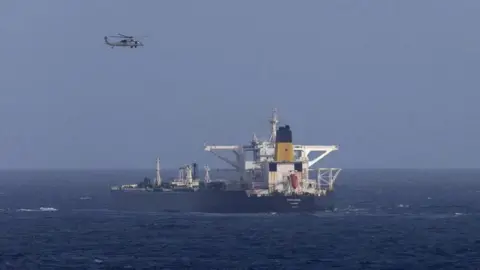
Earlier in December, Russian President Vladimir Putin threatened to sever Ukraine's access to the sea as retaliation for drone attacks on tankers of Russia's "shadow fleet" in the Black Sea.
"Shadow fleet" is a term that refers to hundreds of tankers used by Russia to bypass Western sanctions imposed after its full-scale invasion of Ukraine in 2022.
On Sunday night in the Odesa region, strikes cut off electricity for 120,000 people and sparked a fire at a major port which destroyed dozens of containers of flour and vegetable oil.
It was the latest in a series of hundreds of strikes which have disrupted power supplies in the region for days on end and caused several casualties.
Last week, a ballistic missile strike on the Pivdenniy port east of Odesa killed eight people and injured at least 30.
Another attack earlier in the week killed a woman who was travelling in a car with her three children and temporarily cut off the Odesa region's only bridge linking Ukraine and Moldova.
Zelensky indicated a new commander of the air force for the region would be selected soon following the dismissal of Dmytro Karpenko over the weekend.
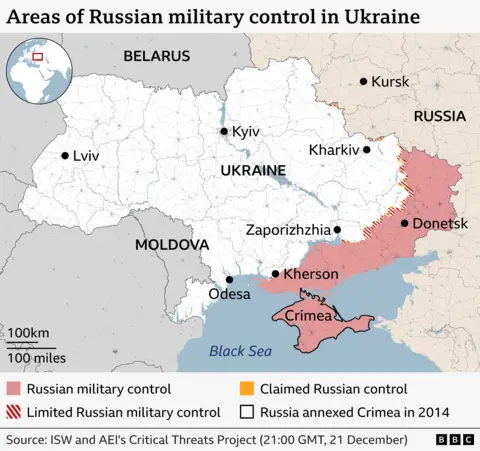
Odesa's port has always been key for the country's economy. The city is Ukraine's third largest after Kyiv and Kharkiv. It now occupies strategic importance as other ports in the Zaporizhzhia, Kherson and Mykolayiv regions are inaccessible to Ukraine due to Russian occupation.
Despite the war, Ukraine remains one of the world's top exporters of wheat and corn.
Since August 2023, Odesa has been the starting point of a crucial corridor that allows it to export grain out of the country, following the coastlines of Romania and Bulgaria before reaching Turkey.
Zelensky, who has previously accused Russia of "sowing chaos" on the people of Odesa, said that "everyone must see that without pressure on Russia, they have no intention of genuinely ending their aggression".
His comments came as the latest round of US-led diplomatic efforts wrapped up in Miami. The US separately met the Ukrainian and Russian delegations, with the meetings yielding optimistic statements but no clear progress to bring the end of Moscow's nearly four-year war on Ukraine any closer.
US President Donald Trump's special envoy Steve Witkoff said he and his Ukrainian counterpart Rustem Umerov had worked on "aligning positions" on a 20-point draft peace plan put forward by Ukraine earlier this month. The plan is an alternative to a proposal presented by the US in November, which was seen as favourable to Moscow.
Before Russian envoy Kirill Dmitriev even returned to Moscow from Florida, Kremlin foreign policy aide Yuri Ushakov told reporters that the European and Ukrainian changes to the peace proposal would not improve the chances of peace being achieved.
On Monday, Russian Deputy Foreign Minister Sergei Ryabkov accused EU countries of having a "firm aspiration" to derail potential Russia-US agreements on Ukraine and to "in general prevent Russia-American relations getting healthier".
He also said European countries were "possessed by a maniacal" fear of a Russian attack. Russia was ready to confirm in a legal agreement that it had no intention of attacking either the EU or Nato, Ryabkov added, echoing previous comments from Putin.
"We've never planned to [attack Europe], but if they want to hear it from us, well, let's do it, we'll put it in writing," Putin said in November.
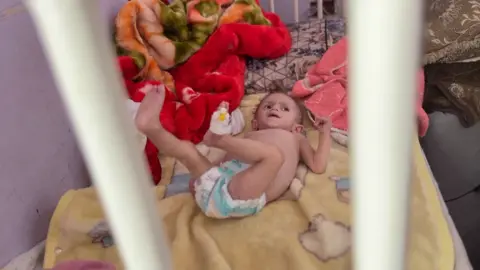
Siwar Ashour spent six months in hospital in Jordan after being evacuated from Gaza
A one-year-old Palestinian girl evacuated from Gaza with severe nutritional problems is back in hospital in the territory after being returned there from Jordan. Siwar Ashour, whose story the BBC has followed for several months, was repatriated to Gaza on 3 December after completing her medical treatment in Amman.
She'd spent six months in hospital there under a medical evacuation programme run by the Kingdom of Jordan. Her grandmother, Sahar Ashour, said she became ill three days after coming back.
"She started having diarrhoea and vomiting and her situation keeps getting worse. The diarrhoea won't go away," she told a freelance journalist working for the BBC in Gaza. International journalists have been banned by Israel from entering Gaza independently since the start of the war nearly two years ago.
Siwar is being treated at al-Aqsa Martyrs Hospital in the central Gaza Strip where Dr Khalil al-Daqran told the BBC she is "receiving the necessary treatment, but the situation is still bad for her". The doctor said Siwar was suffering from a gastro-intestinal infection. She has an immune system deficiency which makes it hard for her to fight bacteria. She also struggles to absorb nutrition, meaning she requires specialised baby formula.
Dr Khalil al-Daqran said poor hygiene conditions had disease to spread
Dr Daqran said that hospitals in Gaza - many of which were badly damaged by Israeli bombing and fighting nearby with Hamas before a ceasefire took effect in October - were seeing an increase in child admissions. Poor hygiene conditions caused by the destruction of vital infrastructure have led to the spread of infections and disease.
"Since the ceasefire was announced, the number of child patients arriving at Gaza Strip hospitals is three times the capacity… The situation at al-Aqsa Martyrs Hospital is no different from other hospitals in the Gaza Strip.
"It suffers from a severe shortage of medicines and medical supplies, and a major shortage regarding electric generators, which are the main artery to keep a hospital going."
The World Health Organization (WHO) described humanitarian needs in Gaza as "staggering, with current assistance addressing only the most basic survival requirements".
Siwar was evacuated to Jordan in June after the BBC reported on her case and raised it directly with the Jordanian authorities.
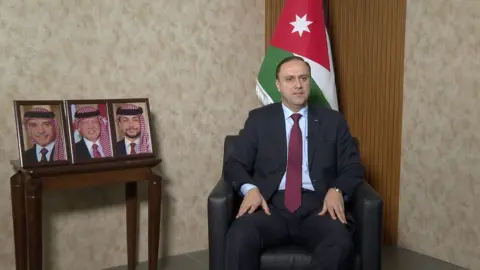
Jordan's Minister of Communications, Dr Mohammed al-Momani, told us that Siwar was among 45 children returned to Gaza after completing their treatment. Under the evacuation scheme all patients are sent back after medical attention.
I put it to Dr al-Momani that people might find it hard to accept that a child in such a vulnerable condition could be sent back to Gaza in the current conditions.
"No patient is sent back before they finish their medical treatment… the first reason [why they are returned] is that this will allow us to bring more patients from Gaza. We cannot take all of them at once. We have to take them in batches. So far we have taken 18 batches.
"The second reason is that we don't want to contribute in any shape or form to the displacement of Palestinians from their land and all patients are told… after treatment you are sent back so other patients and other children can be brought in for treatment."
Dr Mohammed al-Momani says patients are sent back from Jordan after medical treatment to allow authorities to bring in new patients from Gaza
Jordan also treats war wounded at its field hospital in Gaza and has supplied aid via air drops and road convoys. The kingdom hosts more than 2 million Palestinian refugees, who fled conflicts with Israel since 1948, and 500,000 refugees from other countries, mostly Syrians.
Since last March some 300 sick and wounded children and 730 parents and guardians have been brought to Jordan out of 2000 scheduled for treatment. Other countries in the region like the United Arab Emirates and Turkey have treated thousands of sick civilians from Gaza.
The specialised formula milk Siwar needs was either not available or in very short supply during the ongoing conflict. In March, Israel imposed a total blockade on aid into Gaza that was lifted partially after 11 weeks. Since the ceasefire there has been a surge in aid deliveries, although the UN and aid agencies say not enough humanitarian supplies are flowing.
Siwar's family are trying to get her evacuated once more due to her condition
The Jordanian authorities gave Siwar's family a supply of 12 cans of the hypoallergenic Neocate formula on their departure for Gaza. However her mother Najwa told us that Israeli officials confiscated much of what they'd been given - nine of their 12 cans were taken.
"They told us, 'It is forbidden to take more than these cans,'" said Siwar's mother, Najwa Ashour. "Even though it is therapeutic milk and they said that treatment is allowed, yet they took them."
She also said that extra clothing the family had been given in Jordan was taken. "They searched us from top to bottom. When they saw us wearing clothes over each other [layered] they refused to let us out, and told us, 'You must take off all the clothes, down to one outfit.'"
I asked the Israeli government why the milk formula and clothing were confiscated? They replied that limits were placed on what could be taken back for "security considerations."
They said only minimal luggage was allowed and this had been conveyed to the Jordanian authorities and the returning families. "In cases where the luggage exceeded the approved scope, its entry was denied."
The WHO has appealed for more countries to offer medical evacuation to patients who cannot get the necessary treatment in Gaza.
It has also called on the Israeli government to allow patients to be treated in occupied East Jerusalem and the West Bank "which is the most time and cost effective route." Israel stopped allowing such evacuations after the Hamas-led 7 October attacks on Israel in which about 1,200 people were killed and 251 abducted into Gaza.
Siwar's family has been given Neocate milk formula since returning to Gaza. There have also been donations of money, including funds raised from online appeals. Jordanian representatives in Gaza have also visited the family to provide assistance.
The Ashours are trying to have Siwar evacuated once more - a process that has begun with the issuing of a permit by Palestinian health officials. It will be managed by the WHO which deals with all evacuation requests from a place the UN calls "a wasteland".
With additional reporting by Malak Hassouneh, Suha Kawar and Alice Doyard.
Party-goers descend on Ghana each December for a packed calendar of parties, festivals and concerts
Detty December, a popular term for Ghana and Nigeria's end-of-year party season, can have "negative connotations", Ghana's official for diaspora affairs has said, adding that he does not want the label linked with his country.
"On a personal level I don't want the word 'detty' to be associated with anything Ghana... that's something I'm not very comfortable with," Kofi Okyere-Darko said.
"Detty", West African Pidgin for "dirty", is used to express unrestricted fun when it comes to seeing the year out.
The celebrations are thought to be a huge boost to Ghana's economy. Last December more than 125,000 international visitors, many of whom were diasporans, flocked to Ghana.
It was a notable increase from the number of people arriving during any other month - and the same can be said for the three years before that.
Government branding avoids the term Detty December instead choosing to push a tourism initiative named December in Ghana, Mr Okyere-Darko, who oversees his country's relationship with its sizeable diaspora, told the BBC at the Ghana Diaspora Summit in capital city, Accra.
"The young people somehow prefer 'Detty December', but officially, that's not the name," he said.
"I don't think December is what attracts people to Ghana. People started coming to Ghana a long time ago. I remember December in Ghana at the turn of the millennium, with initiatives like Akwaaba UK.
Mr Okyere-Darko responded positively to suggestions that the season could be rebranded in a way that still appeals to younger audiences, saying that December in Ghana could be shortened to the initials "D.I.G.. Let's dig it!"
The phrase Detty December gained popularity roughly eight years ago, after Nigerian musician Mr Eazi launched his Detty Rave festival in Accra.
This December, festivals, parties and concerts have Accra teeming with diasporans and other tourists. They are mostly from the US and Europe, with ages ranging from early 20s and mid-40s, and are out socialising seven days a week.
US hip-hop legend Busta Rhymes performed in Accra as part of the Rhythm and Brunch concert on Saturday, while popular UK rapper Giggs is playing at the Afro Paradise festival on 31 December.
Local stars such as Samini - considered to be the "godfather" of Ghanaian dancehall - and Reggie Rockstone will also play at major events later this month.
Ghana in recent years has been promoting itself as a destination for people from the continent and the African diaspora to visit. In 2019, the government launched the Year of Return - an initiative encouraging those with African roots to invest in the country.
The influx of foreign visitors in December is seen as a positive by many, but some locals complain of price gouging, overcrowding and intense traffic during this period.
This year has proven that December in Ghana no longer revolves around non-stop partying.
Alongside the expected concerts and festivals, there is a growing calendar of investment seminars, networking sessions and cultural showcases, offering the diaspora routes into property, minerals, fashion and textiles.
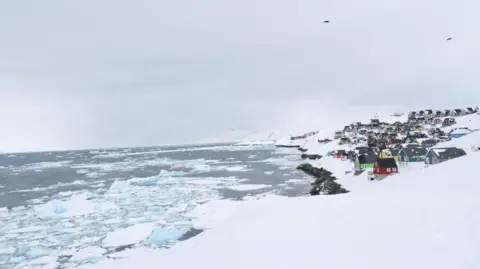
Donald Trump has sparked a renewed disagreement with Denmark after appointing a special envoy to Greenland, the Arctic island he has said he would like to annex.
Trump announced on Sunday that Jeff Landry, the Republican governor of Louisiana, would become the US's special envoy to Greenland, a semi-autonomous part of the Kingdom of Denmark.
Writing on social media, the US president said Landry understood how "essential Greenland is to our national security" and would advance US interests.
Greenland's prime minister said the island must "decide our own future" and its "territorial integrity must be respected".
The move angered Copenhagen, which will call the US ambassador for "an explanation".
Governor Landry said in a post on X it was an honour to serve in a "volunteer position to make Greenland a part of the United States", saying the role would not affect his duties as Louisiana governor.
Denmark's foreign minister, Lars Lokke Rasmussen, described the appointment as "deeply upsetting" and warned Washington to respect Danish sovereignty.
He told Danish broadcaster TV2: "As long as we have a kingdom consisting of Denmark, the Faroe Islands and Greenland, we cannot accept actions that undermine our territorial integrity."
Greenland's Prime Minister, Jens-Frederik Nielsen, said the territory was willing to cooperate with the United States and other countries, but only on the basis of mutual respect.
He said: "The appointment of a special envoy does not change anything for us. We decide our own future. Greenland belongs to Greenlanders, and territorial integrity must be respected."
Since returning to the White House in January, Trump has revived his long-standing interest with Greenland, citing its strategic location and mineral wealth.
He has refused to rule out using force to secure control of the island, a stance that has shocked Denmark, a Nato ally that has traditionally enjoyed close relations with Washington.
Greenland, home to about 57,000 people, has had extensive self-government since 1979, though defence and foreign policy remain in Danish hands. While most Greenlanders favour eventual independence from Denmark, opinion polls show overwhelming opposition to becoming part of the US.
The dispute comes as strategic competition in the Arctic grows, with melting ice opening new shipping routes and increasing access to valuable mineral resources.
Greenland's location between North America and Europe also makes it central to US and Nato security planning and puts it on the shortest route for missiles between Russia and the United States.
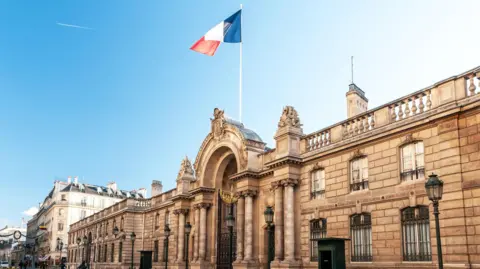
A senior staff member at France's presidential palace will stand trial over the alleged theft of precious tableware, including Baccarat Champagne glasses and Sèvres porcelain plates.
Around 100 objects that were reported missing from the presidential collection were allegedly later found in the locker, car and home of Thomas M, who is reported to be the Élysée Palace's chief butler. He will stand trial alongside two others.
Investigators say they found some of the items - thought to be worth between €15,000 and €40,000 (£13,000 and £35,000) - on his Vinted account.
It comes just months after the Louvre Museum in Paris suffered a brazen heist in which jewels worth €88m (£76m) were taken.
French media reported that Thomas M's role as head butler and keeper of precious silver involved setting the tables at state dinners and other prestigious events.
He is accused of siphoning off the items over several months and falsifying the records to cover his tracks.
Also among the alleged stolen goods are solid silver cutlery and a René Lalique figurine.
The inventory kept by Thomas M suggested he was planning to steal more goods, prosecutors say.
The Élysée has already posted a job advertisement to find his replacement, according to French media outlet TF1 Info.
Officials at Sèvres - France's state-owned porcelain factory - also identified some of their items on online auction sites, including a plate embossed with an air force stamp and ashtrays.
Thomas M was arrested on Tuesday 16 December on suspicion of theft, alongside his partner Damien G - a collector and manager of an online auction company.
A third man, Ghislain M, was arrested a day later, accused of receiving stolen goods. His "passion" for rare antiques has been put forward by his lawyer as being behind his alleged involvement.
According to Le Parisen - which first reported on the case - he was working as a guard at the Louvre at the time and has been barred from returning until the trial is completed.
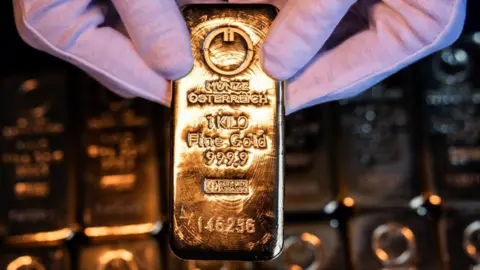
The gold price has hit another record high, trading above $4,400 an ounce for the first time.
The price of the precious metal has risen on expectations the US central bank will cut interest rates further next year, analysts said.
Gold started the year worth $2,600 an ounce, but geopolitical tensions, the Trump tariffs and expectations of rate cuts have added to investor demand for safe haven assets, such as gold and other commodities.
The prices of other precious metals, such as silver and platinum, have also risen.
The spot price of gold hit a high of $4,420 on Monday before slipping back.
The gold price has risen more than 68% this year, the highest increase since 1979, according to Adrian Ash, director of research at gold bullion marketplace BullionVault.
2025 has seen "slow-burning trends around interest rates, around war and trade tensions", Mr Ash said, which have helped to push up the price of gold.
"The precious metals market says that President Trump has really triggered something – and gold has gone crazy this year.
"You've got the trade war, the attacks on the US Federal Reserve and you've got geopolitical tensions, all of those provocations come from Trump," he said.
Lower interest rate expectations typically mean lower returns for investments such as bonds, so investors look to commodities such as gold and silver to get a return, but also diversify their portfolios.
A weaker US dollar has also helped push gold prices higher by making the metal cheaper for overseas buyers,
Other precious metals have also had record years. The price of silver also hit a record of $69.44 an ounce on Monday.
For 2025 so far, silver is up 138% year-to-date and platinum is at a 17-year high, vastly outperforming gold, underpinned by strong and supply constraints, according to analysts.
Unlike gold, the other precious metals are also used widely in industrial manufacturing which helps stoke demand.
Donald Trump has sparked a renewed disagreement with Denmark after appointing a special envoy to Greenland, the Arctic island he has said he would like to annex.
Trump announced on Sunday that Jeff Landry, the Republican governor of Louisiana, would become the US's special envoy to Greenland, a semi-autonomous part of the Kingdom of Denmark.
Writing on social media, the US president said Landry understood how "essential Greenland is to our national security" and would advance US interests.
Greenland's prime minister said the island must "decide our own future" and its "territorial integrity must be respected".
The move angered Copenhagen, which will call the US ambassador for "an explanation".
Governor Landry said in a post on X it was an honour to serve in a "volunteer position to make Greenland a part of the United States", saying the role would not affect his duties as Louisiana governor.
Denmark's foreign minister, Lars Lokke Rasmussen, described the appointment as "deeply upsetting" and warned Washington to respect Danish sovereignty.
He told Danish broadcaster TV2: "As long as we have a kingdom consisting of Denmark, the Faroe Islands and Greenland, we cannot accept actions that undermine our territorial integrity."
Greenland's Prime Minister, Jens-Frederik Nielsen, said the territory was willing to cooperate with the United States and other countries, but only on the basis of mutual respect.
He said: "The appointment of a special envoy does not change anything for us. We decide our own future. Greenland belongs to Greenlanders, and territorial integrity must be respected."
Since returning to the White House in January, Trump has revived his long-standing interest with Greenland, citing its strategic location and mineral wealth.
He has refused to rule out using force to secure control of the island, a stance that has shocked Denmark, a Nato ally that has traditionally enjoyed close relations with Washington.
Greenland, home to about 57,000 people, has had extensive self-government since 1979, though defence and foreign policy remain in Danish hands. While most Greenlanders favour eventual independence from Denmark, opinion polls show overwhelming opposition to becoming part of the US.
The dispute comes as strategic competition in the Arctic grows, with melting ice opening new shipping routes and increasing access to valuable mineral resources.
Greenland's location between North America and Europe also makes it central to US and Nato security planning and puts it on the shortest route for missiles between Russia and the United States.
Watch: Images, cassettes and high-profile figures - What's in the latest Epstein files?
A pair of US lawmakers have threatened legal action against US Attorney General Pam Bondi, after her deadline to release all government files related to the late convicted sex offender Jeffrey Epstein was met only in part.
The release of the Department of Justice (DoJ) documents was highly anticipated but in the end, only a portion of the available material was made public.
A leading campaigner on the issue, Republican congressman Thomas Massie, said he could try to bring contempt proceedings against the attorney general as a result.
The DoJ insists it is complying with its legal obligations, and Bondi herself has said she is part of "the most transparent administration in American history".
The phrase "Epstein files" refer to the trove of information that was amassed by the US justice department during its two criminal investigations into Epstein.
A law that compelled the release of the full trove was signed by US President Donald Trump in November, after pressure from his supporters and members of his own Republican Party. Friday was the deadline for the release of the material.
Although some material was released, there were many redactions and other information was withheld - which angered Massie and his allies, as well as survivors of Epstein's abuse. Trump himself is yet to comment.
The DoJ has said that more material will follow in the coming weeks.
But speaking to CBS programme Face the Nation on Sunday, Massie suggested that the justice department was "flouting the spirit and the letter of the law".
He went on to say: "The quickest way, and I think most expeditious way, to get justice for these victims is to bring inherent contempt against Pam Bondi, and that doesn't require going through the courts."
Inherent contempt is a little-used legal recourse that can be used by either the Senate or House - the upper and lower chambers of Congress respectively - which has not been invoked for nearly a century, according to the American Bar Association.
Massie added that "Ro Khanna and I are talking about and drafting that right now", referring to a Democratic congressman who has also been prominent in the campaign for the release of the full Epstein files.
Speaking to the same programme, Khanna gave further detail on how the contempt proceedings could work. "We're building a bipartisan coalition, and it would fine Pam Bondi for every day that she's not releasing these documents," he said.
Unlike an impeachment effort - another option that would be theoretically available to critics of Bondi - the contempt move would only require support from the House of Representatives, Massie pointed out.
Bondi's deputy Todd Blanche was defiant during an interview with another broadcaster on Sunday.
Asked by the Meet the Press programme on NBC News whether he took threats from Congress members seriously, the deputy attorney general said: "Not even a little bit. Bring it on. We are doing everything we're supposed to be doing to comply with the statute."
Blanche pointed to the magnitude of the task. "You're talking about a million or so pages of documents," he said. "Virtually all of them contain victim information."
He continued: "And if by complying with the statute we don't produce everything on Friday, we produce things next week and the week after, that's still compliance with the statute."
Speaking to the same programme, another member of Khanna's party, Democratic Senator Tim Kaine, said contempt or impeachment efforts would be "premature".
"We have tools in appropriations bills and other tools to force compliance if somebody is dragging their feet and I'd rather focus on those tools," Kaine said.
Blanche said elsewhere on Sunday that certain Epstein-related files that were originally released on Friday were later removed by the DoJ from its website because of concerns raised by victims.
One of those files - an image featuring Trump - was later reinstated after review, said Blanche.
The renewed fighting this month has displacing around 900,000 on both sides, officials say
South East Asia's top diplomats are meeting on Monday in Malaysia in a bid to end deadly border clashes between Thailand and Cambodia that have killed at least 41 people and displaced close to one million others.
They will seek to revive a ceasefire that was brokered in July by Malaysia as chair of the Association of Southeast Asian Nations (Asean) and US President Donald Trump in July.
This is the first meeting between officials of Thailand and Cambodia since fighting resumed on 8 December. Both countries have blamed each other for the fresh hostilities.
The conflict dates back more than a century, when the borders of the two nations were drawn after the French occupation of Cambodia.
Malaysian Prime Minister Anwar Ibrahim, who presided over the signing of the July ceasefire alongsideTrump, said he was "cautiously optimistic" about Monday's meeting in Kuala Lumpur.
"Our duty is to present the facts, but more importantly, to press upon them that it is imperative for them to secure peace," he said last week.
Cambodia has said that the talks aim to restore "peace, stability and good neighbourly relations", adding that it would reaffirm its position that the disputes should be resolved through peaceful means.
Thailand, while calling the meeting an important opportunity, reiterated its conditions for negotiations, including a declaration of ceasefire from Cambodia first and a "genuine and sustained" ceasefire.
The US and China have also been attempting to mediate a new ceasefire.
US Secretary of State Marco Rubio, who had a phone call with his Thai counterpart on Thursday, said that he hoped a new ceasefire could be reached by Monday or Tuesday.
China's special envoy for Asian affairs, Deng Xijun, visited Phnom Penh last week. A statement from Beijing said he reaffirmed that China would continue to play a constructive role in facilitating dialogue between Cambodia and Thailand.
The gold price has hit another record high, trading above $4,400 an ounce for the first time.
The price of the precious metal has risen on expectations the US central bank will cut interest rates further next year, analysts said.
Gold started the year worth $2,600 an ounce, but geopolitical tensions, the Trump tariffs and expectations of rate cuts have added to investor demand for safe haven assets, such as gold and other commodities.
The prices of other precious metals, such as silver and platinum, have also risen.
The spot price of gold hit a high of $4,420 on Monday before slipping back.
The gold price has risen more than 68% this year, the highest increase since 1979, according to Adrian Ash, director of research at gold bullion marketplace BullionVault.
2025 has seen "slow-burning trends around interest rates, around war and trade tensions", Mr Ash said, which have helped to push up the price of gold.
"The precious metals market says that President Trump has really triggered something – and gold has gone crazy this year.
"You've got the trade war, the attacks on the US Federal Reserve and you've got geopolitical tensions, all of those provocations come from Trump," he said.
Lower interest rate expectations typically mean lower returns for investments such as bonds, so investors look to commodities such as gold and silver to get a return, but also diversify their portfolios.
A weaker US dollar has also helped push gold prices higher by making the metal cheaper for overseas buyers,
Other precious metals have also had record years. The price of silver also hit a record of $69.44 an ounce on Monday.
For 2025 so far, silver is up 138% year-to-date and platinum is at a 17-year high, vastly outperforming gold, underpinned by strong and supply constraints, according to analysts.
Unlike gold, the other precious metals are also used widely in industrial manufacturing which helps stoke demand.
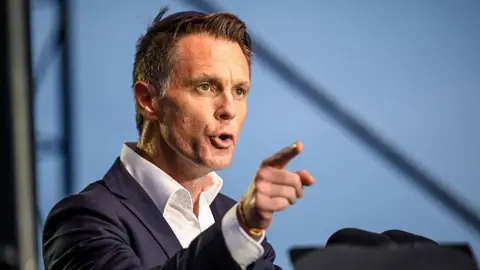
NSW Premier Chris Minns says the new laws will protect the community
Civil rights groups and pro-gun advocates in Australia have raised concerns that new fast-tracked laws will place undue restrictions on firearms and protests in the wake of the Bondi shootings.
On Monday, the Australian state of New South Wales (NSW) recalled its parliament to debate a raft of new laws such as banning the phrase "globalise the intifada", limiting the number of guns one person can own, and greater police powers for protests.
NSW Premier Chris Minns said some may feel the changes had "gone too far" but they were needed to keep the community safe.
A pro-gun politician said the laws unfairly target law-abiding gun owners while civil libertarians said restrictions on protests were an affront to democracy.
On banning the "intifada" phrase, Minns said its use at protests in Australia and around the world "are a call to a global intifada. That is what it means. Not in the Middle East, not in Israel or Gaza but here in Sydney".
"I do believe it leads to a culture and environment of heightened disunity," he said, and "an invitation to violence".
The term intifada came into popular use during the Palestinian uprising against Israeli occupation of the West Bank and Gaza Strip in 1987.
Some have described the term as a call for violence against Jewish people. Others have said it is a call for peaceful resistance to Israel's occupation of the West Bank and actions in Gaza.
In the aftermath of the Bondi attacks, in which 15 people were killed, the Jewish community accused the government of not doing enough to protect it from rising antisemitism.
The new protest laws will also allow police to restrict demonstrations at places of worship, with stronger penalties for breaches.
Timothy Roberts, president of the NSW Council for Civil Liberties, said the new law ignores a recent decision by the state's supreme court which found the so-called "move-on power" at religious locations went against Australia's implied constitutional freedom of political communication.
Religious institutions exercise significant and overt political power in Australian politics and this makes them a legitimate site of protest in a democratic society, Mr Roberts said.
"The laws introduced today are an affront to our right to assemble and communicate with each other," he said, adding they "damage our democracy".
He said Minns wants social cohesion but he does not know the meaning of the term.
"He thinks silence is peace, and does not seem to realise it can also reflect oppression. Passing laws that oppress some parts of our community in the wake of an attack like we saw, does not bring us closer - it drives us further apart and stops us from healing well in this time of grief."
Police will also be able to remove face coverings from protesters who are suspected of committing an offence - including low-level offences - during a protest.
Previously, police could only do so if someone is arrested or suspected of committing an indictable offence.
On gun reform, the new laws will mean licence holders in NSW cannot own more than four firearms with exceptions for farmers and sport shooters who can have up to ten.
The move follows similar laws introduced in Western Australia earlier this year to cap gun ownership. Elsewhere across the country, there are no limits.
One of the gunmen in the Bondi shooting, Sajid Akram, had six registered firearms.
Other gun law changes include more regular renewals for gun licence holders from every five years to every two years, and a review of the types of firearms available to most gun owners.
Mark Banasiak from the Shooters, Fishers and Farmers party - which lobbies for more relaxed gun laws - said the state's 260,000 gun licence holders were being "punished" and "made a scapegoat for agency failings".
"We're diverting away from what the real problem is," he said, referring to "a climate of hate and division that's been allowed to fester for two and a half years because government haven't done enough to stop that."
Walter Mikac, whose wife and two young daughters were among the 35 people shot dead in Tasmania by a lone gunman in 1996 in what is Australia's deadliest mass shooting, welcomed the reforms.
The changes will "close critical gaps in our gun laws" and put community safety first, he said.
The government also aims to crackdown on hate speech and symbols, as well as enabling police to ban protests for up to three months after a terrorist attack.
Palestine Action Group spokesperson Josh Lees said the new laws were "incredibly draconian".
"Australia is seen as a safe country," he said, "where freedom of speech is very important" but the Bondi shooting was "perhaps changing the dynamics of that democracy and that freedom".
David Ossip, president of the NSW Jewish Board of Deputies, said moves to ban "intifada" chants was a "watershed moment" in confronting hate and incitement.
He also welcomed greater police powers during protests.
"The right to protest is a core Australian value and a fundamental tenet of a democratic society," he said.
"But it has never included the right to hide your face and shout slogans calling for violence against one's fellow Australians or waving the flags of groups devoted to murder and destruction."
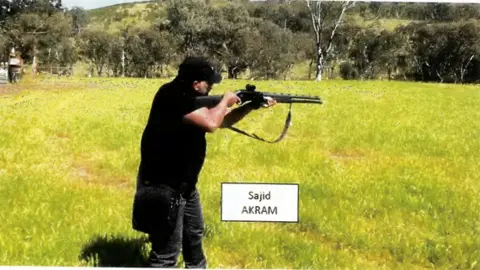
A screenshot from a video found on Naveed Akram's phone shows his father conducting firearms training, police allege
The gunmen who allegedly carried out a deadly attack on a Jewish festival at Bondi Beach last week threw four undetonated explosives at the start of the attack, including a "tennis ball bomb", according to newly released documents.
Naveed Akram, 24, has been charged with dozens of offences including 15 counts of murder over the attack at a Hanukkah celebration on 14 December. Akram, who was shot by police during the attack, was released from hospital on Monday and transferred to a prison.
The second alleged gunman, his father Sajid Akram, was shot dead.
The pair recorded a video manifesto in October in which they sit in front of the Islamic State group flag, according to police documents.
Supplied
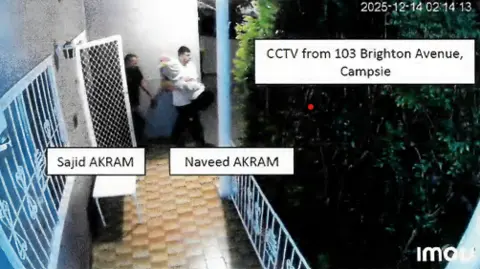
A screenshot from CCTV shows the Akrams carrying 'bulky items' hours before the attacks, police allege
The Akrams "meticulously planned this terrorist attack for many months", police alleged. Videos found on Naveed's phone showed the pair were motivated by "violent extremist ideology" linked to the Islamic State group.
They include one video in which the pair sit in front of an Islamic State flag and detail their motivation for the Bondi attack and condemn "the acts of 'Zionists'", police alleged. Naveed also appears to recite a passage from the Quran in Arabic in the video, police alleged.
Another video allegedly showed the pair conducting firearms training in what police believe to be rural New South Wales in October. "The Accused and his father are seen throughout the video firing shotguns and moving in a tactical manner," police alleged.
A temporary suppression order had been made on the fact sheet last week to protect the identities of the survivors of the attack. The order was revoked on Monday after an application to the New South Wales Local Court by media companies although the names of most survivors were redacted.
Supplied
CCTV shows the Akrams carrying out reconnaissance two days ahead of the Bondi Beach attack, police allege
CCTV recorded at Bondi beach two days ahead of the attack also showed the Akrams driving to the area and carrying out reconnaissance, police alleged.
"The Accused and his father, S Akram, are seen to exit the vehicle and walk along the footbridge, being the same position where they attended two days later and shot at members of the public," police wrote.
CCTV also captured the pair leaving rented accommodation in the Sydney suburb of Campsie hours before the attack "carrying long and bulky items wrapped in blankets", police alleged.
Police said the items, which were placed in a car, were three firearms, home-made improvised explosive devices including the "tennis ball bomb" and two Islamic State flags.
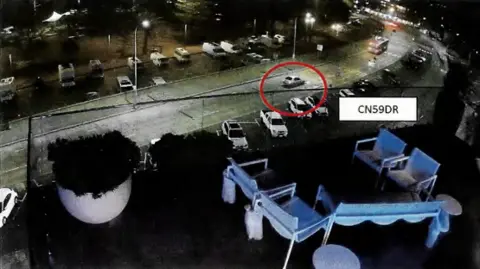
They later drove to Bondi where they parked and placed the flags on the inside of the front and rear windows, police alleged. After removing the firearms and homemade bombs from the car, they walked towards the footbridge from where they carried out their attack, police alleged.
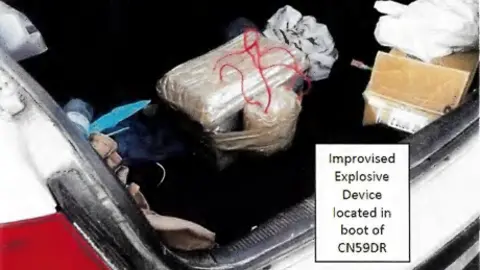
Three homemade pipe bombs and the tennis ball bomb were thrown as they approached the bridge, police alleged, but did not explode although they were assessed as "viable". A fifth explosive device was later found in their vehicle, police had previously said.
Naveed Akram, who was shot in the abdomen and critically injured by police, did not appear at Monday's court appearing.
Supplied
Police allege a homemade bomb was found in the boot of the Akrams' vehicle
A Ukrainian source later told the BBC that Kirillov was killed by Ukraine's security service, though this was never confirmed on the record. As a matter of policy, Ukraine never officially admits or claims responsibility for targeted attacks.
This breaking news story is being updated and more details will be published shortly. Please refresh the page for the fullest version.
You can receive Breaking News on a smartphone or tablet via the BBC News App. You can also follow @BBCBreaking on X to get the latest alerts.
Watch: Images, cassettes and high-profile figures - What's in the latest Epstein files?
A batch of files, which includes a photo of US President Donald Trump, were removed by the justice department because of concerns raised by victims, the deputy attorney general said on Sunday.
Todd Blanche said the photo that included Trump also showed unredacted images of women, and rejected criticisms that the removal was related to the president.
At least 13 files from the thousands made public on the justice department's website on Friday had disappeared without explanation by Saturday.
Democrats on the House Oversight Committee questioned the images' removal. In a social media post, they asked Attorney General Pam Bondi: "What else is being covered up?"
The US Department of Justice (DOJ) said in a post on X on Sunday that the image of Trump was flagged by the Southern District of New York "for potential further action to protect victims".
They added that they had temporarily removed the image for further review "out of an abundance of caution".
"After the review, it was determined there is no evidence that any Epstein victims are depicted in the photograph, and it has been reposted without any alteration or redaction," the DOJ said.
Blanche said that the suggestion that the photo was removed due to Trump was "laughable". "It has nothing to do with President Trump," he told NBC News.
"There are dozens of photos of President Trump already released to the public seeing him with Mr Epstein."
He added: "So the absurdity of us pulling down a photo, a single photo, because President Trump was in it, is laughable."
Blanche cited a judge in New York who "has ordered us to listen to any victim or victims' rights group if they have concerns" as a reason behind removing some of the previously posted files.
"There were a number of photographs that were pulled down after being released on Friday," he said.
Trump has consistently denied any wrongdoing in relation to Epstein and has not been accused of any crimes by Epstein's victims. There is no suggestion that these pictures imply any wrongdoing.
US Department of Justice
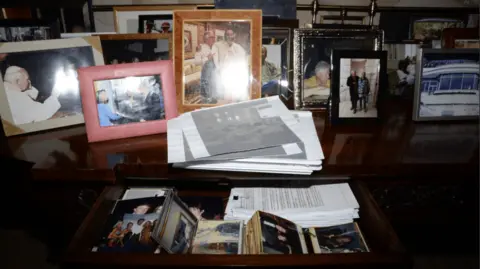
An image of framed photos was removed from the DOJ website and later reappeared
Congressman Thomas Massie, a Kentucky Republican who led the charge to release the files, said he was frustrated with the Trump administration's response and his focus is to get justice for the victims.
He said he is drafting inherent contempt charges for Attorney General Pam Bondi.
"They are flouting the spirit and the letter of the law," he told CBS News on Sunday. "It's very troubling the posture that they have taken. I won't be satisfied until the survivors are satisfied."
The image that was included in the removed files showed a credenza desk in Epstein's home with an open drawer filled with other photos, one of which showed the president with Trump, Epstein, first lady Melania Trump and Epstein's convicted associate Ghislane Maxwell. Framed photos also can be seen on top of the credenza desk.
That image has since been restored by early Sunday, available through a link to the website. The other files had not been restored to the site as of Sunday afternoon.
Ten of the missing files include images which appear to show the same room - a small massage parlour with clouds painted on the ceiling, and brown patterned wallpaper studded with multiple nude pictures. Some appear to be photos, others are artwork.
Most of the women pictured on the wall have had their faces redacted. However, one face is redacted in one file but plainly visible in three of the others. Another face remains unredacted in all of the files while a painted image of the same person is visible.
On Saturday, Democrats on the House Oversight Committee questioned the files' removal.
They posted the missing photo of Trump on social media and asked Attorney General Pam Bondi if it was true that the image had been removed.
"What else is being covered up? We need transparency for the American public," the committee wrote.
The files' removal comes at time of increased suspicion surrounding the US government and the so-called Epstein files.
The documents released on Friday came to light as the result of an act of Congress that forced the DOJ to release them.
The DOJ said it would comply with the congressional request to release documents, with some stipulations.
It redacted personally identifiable information about Epstein's victims, materials depicting child sexual abuse, materials depicting physical abuse, any records that "would jeopardise an active federal investigation" or any classified documents that must stay secret to protect "national defence or foreign policy".
But many of the documents that were released were heavily redacted.
There was limited new information about Epstein's crimes and things like internal DOJ memos on charging decisions were not included in the files that were released.
Additional reporting by Alison Benjamin and Benedict Garman.
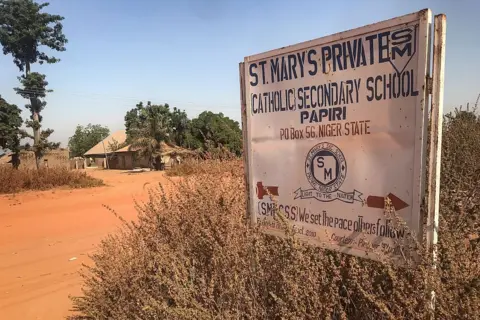
St Mary's Catholic school in central Nigeria where schoolchildren were abducted
Nigerian authorities say they have secured the release of the remaining 130 schoolchildren kidnapped from a Catholic boarding school in the country's central Niger state.
Nigeria's federal government described the latest release as a "moment of triumph and relief", after one of the country's worst mass kidnappings.
More than 250 children and staff were abducted from St Mary's Catholic school in Papiri on 21 November. Earlier this month about 100 of the children were released.
The authorities confirmed "the rescue of the remaining 130 children and staff" in a statement, saying "not a single pupil is left in captivity".
Presidential spokesperson Bayo Onanuga said on Sunday the total of freed students was now 230.
Since the kidnapping, the exact number of people taken and how many have remained in captivity has been unclear.
It has not been formally made public how the government secured the latest release - or whether any ransom was paid.
The announcement by Onanuga included pictures of children smiling and waving. The students are expected to arrive in the Niger state capital, Minna, on Monday.
When the earlier release happened the governor of neighbouring Nasarawa state, Abdullahi Sule, told local media that the federal government had played a key role, adding that the behind-the-scenes efforts could not be disclosed for security reasons.
The Christian Association of Nigeria reported that 50 students managed to escape at the time of the kidnapping.
November's abduction was the latest incident in a growing number of targeted attacks on schools and places of worship in north and central Nigeria.
The attack on St Mary's in November was preceded by mass kidnappings just days earlier.
On 18 November, two people were killed and 38 abducted in an attack on the Christ Apostolic Church in Kwara state, and a day before that, two were killed and 25 Muslim students abducted from Government Girls' Secondary School in Kebbi state.
All those taken in the Kwara and Kebbi attacks have since been freed.
It is not clear who is behind these kidnappings - most analysts believe they are carried out by criminal gangs seeking ransom payments.
On 9 December Nigerian President Bola Ahmed Tinubu said his government would continue to work with Niger and other states "to secure our schools and make the learning environment safer and more conducive for our younger ones".
The renewed fighting this month has displacing around 900,000 on both sides, officials say
South East Asia's top diplomats are meeting on Monday in Malaysia in a bid to end deadly border clashes between Thailand and Cambodia that have killed at least 41 people and displaced close to one million others.
They will seek to revive a ceasefire that was brokered in July by Malaysia as chair of the Association of Southeast Asian Nations (Asean) and US President Donald Trump in July.
This is the first meeting between officials of Thailand and Cambodia since fighting resumed on 8 December. Both countries have blamed each other for the fresh hostilities.
The conflict dates back more than a century, when the borders of the two nations were drawn after the French occupation of Cambodia.
Malaysian Prime Minister Anwar Ibrahim, who presided over the signing of the July ceasefire alongsideTrump, said he was "cautiously optimistic" about Monday's meeting in Kuala Lumpur.
"Our duty is to present the facts, but more importantly, to press upon them that it is imperative for them to secure peace," he said last week.
Cambodia has said that the talks aim to restore "peace, stability and good neighbourly relations", adding that it would reaffirm its position that the disputes should be resolved through peaceful means.
Thailand, while calling the meeting an important opportunity, reiterated its conditions for negotiations, including a declaration of ceasefire from Cambodia first and a "genuine and sustained" ceasefire.
The US and China have also been attempting to mediate a new ceasefire.
US Secretary of State Marco Rubio, who had a phone call with his Thai counterpart on Thursday, said that he hoped a new ceasefire could be reached by Monday or Tuesday.
China's special envoy for Asian affairs, Deng Xijun, visited Phnom Penh last week. A statement from Beijing said he reaffirmed that China would continue to play a constructive role in facilitating dialogue between Cambodia and Thailand.
A screenshot from a video found on Naveed Akram's phone shows his father conducting firearms training, police allege
The gunmen who allegedly carried out a deadly attack on a Jewish festival at Bondi Beach last week threw four undetonated explosives at the start of the attack, including a "tennis ball bomb", according to newly released documents.
Naveed Akram, 24, has been charged with dozens of offences including 15 counts of murder over the attack at a Hanukkah celebration on 14 December. Akram, who was shot by police during the attack, was released from hospital on Monday and transferred to a prison.
The second alleged gunman, his father Sajid Akram, was shot dead.
The pair recorded a video manifesto in October in which they sit in front of the Islamic State group flag, according to police documents.
Supplied
A screenshot from CCTV shows the Akrams carrying 'bulky items' hours before the attacks, police allege
The Akrams "meticulously planned this terrorist attack for many months", police alleged. Videos found on Naveed's phone showed the pair were motivated by "violent extremist ideology" linked to the Islamic State group.
They include one video in which the pair sit in front of an Islamic State flag and detail their motivation for the Bondi attack and condemn "the acts of 'Zionists'", police alleged. Naveed also appears to recite a passage from the Quran in Arabic in the video, police alleged.
Another video allegedly showed the pair conducting firearms training in what police believe to be rural New South Wales in October. "The Accused and his father are seen throughout the video firing shotguns and moving in a tactical manner," police alleged.
A temporary suppression order had been made on the fact sheet last week to protect the identities of the survivors of the attack. The order was revoked on Monday after an application to the New South Wales Local Court by media companies although the names of most survivors were redacted.
Supplied
CCTV shows the Akrams carrying out reconnaissance two days ahead of the Bondi Beach attack, police allege
CCTV recorded at Bondi beach two days ahead of the attack also showed the Akrams driving to the area and carrying out reconnaissance, police alleged.
"The Accused and his father, S Akram, are seen to exit the vehicle and walk along the footbridge, being the same position where they attended two days later and shot at members of the public," police wrote.
CCTV also captured the pair leaving rented accommodation in the Sydney suburb of Campsie hours before the attack "carrying long and bulky items wrapped in blankets", police alleged.
Police said the items, which were placed in a car, were three firearms, home-made improvised explosive devices including the "tennis ball bomb" and two Islamic State flags.
They later drove to Bondi where they parked and placed the flags on the inside of the front and rear windows, police alleged. After removing the firearms and homemade bombs from the car, they walked towards the footbridge from where they carried out their attack, police alleged.
Three homemade pipe bombs and the tennis ball bomb were thrown as they approached the bridge, police alleged, but did not explode although they were assessed as "viable". A fifth explosive device was later found in their vehicle, police had previously said.
Naveed Akram, who was shot in the abdomen and critically injured by police, did not appear at Monday's court appearing.
Supplied
Police allege a homemade bomb was found in the boot of the Akrams' vehicle
There's been an outpouring of support from the community - but tension remains
As helicopters circled overhead, sirens descended on her suburb, and people ran screaming down her street on 14 December, Mary felt a grim sense of deja vu.
"That was when I knew there was something seriously wrong – again," she says, her eyes brimming with tears.
Mary - who did not want to give her real name - was at the Westfield Bondi Junction shopping centre last April when six people were stabbed to death by a man in psychosis, a tragedy still fresh in the minds of many.
Findings from a coronial inquest into the incident were due to be delivered this week, but were delayed after two gunmen unleashed a hail of bullets on an event marking the start of the Jewish festival of Hanukkah eight days ago.
Declared a terror attack by police, 15 people were shot and killed, including a 10-year-old girl who still had face paint curling around her eyes.
The first paramedic to confront the bloody scenes at the Chanukah by the Sea event was also the first paramedic on the scene at the Westfield stabbings.
"You just wouldn't even fathom that something like this would happen," 31-year-old Mary, who is originally from the UK, tells the BBC. "I say constantly to my family at home how safe it is here."
This was the overarching sentiment in the days following the shooting. This kind of thing, mass murder, just doesn't happen in Australia.
But it can and it has – twice, in the same community, within 18 months.
A sea of flowers left by shocked and grieving people at Bondi is being packed up. A national day of reflection is over. On Sunday night, Jewish Australians lit candles for the last time this Hannukah.
But the two tragedies have left scores physically scarred and traumatised, and the nation's sense of safety shattered.
'Everyone knows someone affected'
EPA
Funerals for the victims have drawn thousands of mourners this week
Bondi is Australia's most famous beach - a globally recognised symbol of its way of life.
It's also a quintessential slice of Australian community. There's a bit of "everyone knows everyone" - and that means everyone knows someone affected by the 14 December tragedy, mayor Will Nemesh told the BBC.
"One of the first people I texted was [Rabbi] Eli Schlanger. And I said, 'I hope you're OK. Call me if you need anything'," he said.
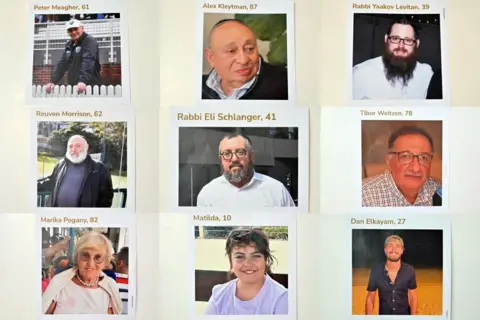
But the British-born father of five, also known as the "Bondi Rabbi", was among the dead.
The first responders, police and paramedics would have been working on members of their own community. Others had the task of having to treat the shooters who had taken aim at their colleagues.
"[Westfield Bondi Junction] was horrendous, something we're certainly not used to. And then this again was massive, catastrophic injuries," Ryan Park, health minister for New South Wales, told the BBC.
"They've seen things that are like you would see in a war zone… You don't get those images out of your head," Park added.
Mayor Nemesh fears this will forever be a stain on Bondi, and Australia.
"If this can happen here at Bondi Beach, it really could happen anywhere… the impact has reverberated around Australia."
EPA
Ryan Park says healthcare workers will take time to recover from what they've seen
'Warnings ignored'
No one is feeling this more than the Jewish community, for whom Bondi has become a sanctuary.
"I swam here every day for years on end, rain or shine. And this week… I couldn't get in the water. It didn't feel right. It felt sacrilegious in some way," Zac Seidler, a local clinical psychologist, told the BBC.
Many of the victims of the attack moved here over many decades for safety from persecution, including 89-year-old Holocaust survivor Alex Kleytman. Instead, his life was bookended by violent acts of antisemitic hate.
Mr Seidler has spent the past two years trying to convince his grandparents, who are also Holocaust survivors, to hold on to their faltering belief in the good of humanity.
"[My grandmother] kept saying, 'These are the signs. I've seen this before'. And I just kept saying, 'Not in Australia, not here. You're safe', just trying to soothe her.
"But now I kind of feel like the fool."
No community is a monolith, but one thing many Jewish Australians believe is that warnings about a rise of antisemitism in the months preceding this attack were ignored.
The year started with a spate of vandalism and arson incidents on Jewish marks in the suburbs surrounding Bondi. It has ended with mass murder targeting their community.
Watch: Jewish Australians on why Bondi is a 'sanctuary' for them
There has been resistance in the face of fear - some leaders urging Jewish Australians to double down, be more publicly Jewish and display their religious symbols with pride.
One woman perusing the flowers outside the Bondi Pavilion on Sunday admits she is too scared to do that. It took her all week to even work up the courage to visit this site, which is just metres from where many of the victims died.
"I've never felt my Jewishness before. I've never experienced antisemitism in my whole life until now," MaryAnne says. "And now, I don't want to wear my Star of David."
Community, anger and sadness
The shooting triggered a massive outpouring of support from around the nation.
When the news broke, many in the community rallied to help.
Lifeguards - volunteer and paid - put their lives on the line. Restaurants opened their doors and hid people in their store rooms and freezers, and locals ushered lost children into their apartments.
Even the New South Wales opposition leader Kellie Sloane - also the local state member - was at the scene, helping pack bullet wounds.
In the days after the shooting, thousands of ordinary Australians lined up - many for hours on end - to donate blood desperately needed to treat those injured.
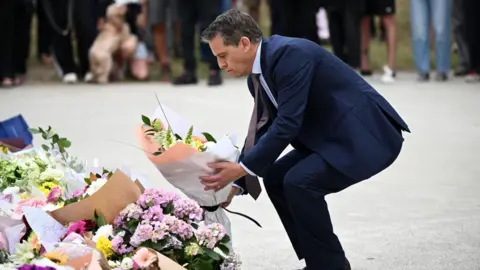
Each day, a carpet of petals, handwritten notes, commemorative stones and candles grew out from the gates of the Bondi Pavilion.
Bee motifs - stickers, balloons, even pavement art - are all over the suburb, in remembrance of Matilda, the terror attack's youngest victim.
Surfers and swimmers on Friday paddled out beyond Bondi's iconic breaks to honour those who died.
A day later, surf livesavers and lifeguards stood shoulder to shoulder on the beach in solidarity with the Jewish community.
But amid the platitudes, sadness and shock is calcifying into anger and tension.
Surfers and swimmers pay tribute to victims of Bondi shooting
Last year's Bondi Junction stabbings were devastating for the community - but a shared resolution united it.
Experts say the attacker, who had schizophrenia, was in psychosis at the time of the stabbings, and his family have previously said he was frustrated at being unable to find a girlfriend. The question of whether he targeted women will likely forever go unanswered. But clear failures in the mental health system have been identified.
Last month, families of the victims asked the coroner to refer the doctor who weaned him off medication with limited supervision to regulators for investigation, and they have also argued for a massive boost to mental health service funding.
But last Sunday's events raise more uncomfortable feelings and questions.
There is palpable fury at the government, over a perceived – and admitted – failure to do more to stop antisemitism. Prime Minister Anthony Albanese has been booed during public appearances this week, and talking to people visiting the site of the attack in Bondi, it isn't uncommon to hear them demand his resignation.
Many people the BBC spoke to pointed to his government's decision to recognise Palestinian statehood, alongside countries including the UK and Canada, and regular protests in Australia by members of the pro-Palestinian movement, which though largely peaceful but have been peppered with antisemitic chants and placards.
The state of New South Wales - which has in recent years tightened protest rules - has already announced it will introduce more legislation cracking down on "hateful" chants and give police more powers to investigate demonstrators. The federal government has promised similar.
The blame apportioned to these protests does not sit right with many, even some sections of the Jewish community.
"We need to hold multiple truths," Mr Seidler says. "We can be afraid, we can feel that there is deep antisemitic rhetoric going on in certain circles within Australia… while also understanding that there is a right of people in this country – especially Muslim Australians – to be concerned about what is taking place in Gaza.
"We need to get better at finding that line and calling out when that line has been crossed."
Getty
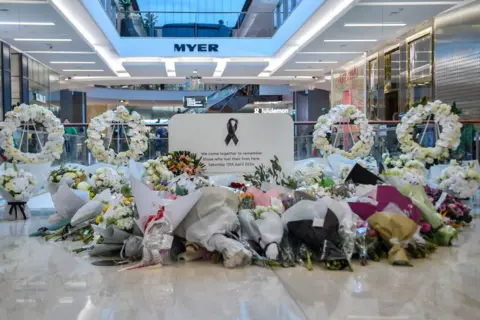
A memorial inside the Bondi Junction Westfield shopping centre where six people were stabbed to death in April last year
For others, there is anger at what they feel is the politicisation of a tragedy.
"It's a bloody photo op," one woman tells me on Sunday, as a prominent Australian businesswoman arrives and begins posing with the floral tributes outside the Bondi Pavilion.
Some - including the local federal MP Allegra Spender - worry the attack is being used to fuel anti-immigration sentiment.
"We would not have had the man who saved so many Australians if we had cut off, for instance, Muslim immigration," she said.
Mr Seidler says these arguments fail to recognise that antisemitic views - and other forms of bigotry - are formed here too.
"I heard someone say the other day that Australia thinks it's on a holiday from history, that we're somehow immune to this stuff, that it's not bred here, it's imported," Mr Seidler says.
With the anger, there is also fear: for the Jewish community of other attacks, for the Muslim community of retaliation for an act of terror they have loudly condemned.
There are questions over how Australia's security agency fumbled an alleged terrorist who at one point was on their watch list, prompting a review into federal police and intelligence agencies that was announced on Sunday.
There is frustration at NSW Police, who have for years been warned by the Muslim community of hate preachers poaching their young men.
There is animosity towards the media, driven by hurt among both Jewish and Arab Australians over a belief they and their communities have been misrepresented, and frustration at what some feel is incitement against them.
But there is also a queasiness at the treatment of traumatised victims throughout this week, some of whom were interviewed live on television while the blood of their friends still stained their hands.
Through it all, is an undercurrent of suspicion of institutions and each other.
There are varying opinions on how those rifts can heal – or even if they can. But there is a shared determination to try.
Getty Images
Many Jewish Australians are angry at the government
One UK expat who was at the beach at the time of the shooting says everyone he speaks to is adamant this will not change Bondi, or Australia.
"It's seriously unique what you have as a nation… there's a magic about it," Henry Jamieson tells the BBC.
"I'm traumatised… and I'm going to have to deal with that for the rest of my life, I know I am… even people who weren't there were traumatised.
"But I'm not gonna let it shake me and we will not let it shake this community.
"You can't let them win," he says of the alleged terrorists.
At an emotional memorial on Sunday night, seven days since the attack, the same sense of defiance was on show. It ended with the lighting of the menorah, something the crowds gathered for Hannukah last week never got to do.
The shamash, the centre candle, was lit by the father of Ahmed al Ahmed, in honour of his bravery in wrestling a gun off one of the attackers. The children of the two rabbis who were killed lit another. Others were lit by a representative of surf lifesavers and a Jewish community medic who rushed to the scene and began treating the injured before the shots had even stopped. The final candle was lit by Michael, the father of Matilda, who has been described a fountain of joy to all who knew her.
After the parade of diverse Australians had sparked flames on each arm of the menorah, Rabbi Yehoram Ulman of Bondi Chabad made a plea for more love and more unity.
"Returning to normal is not enough," he said.
"Sydney can and must become a beacon of goodness. A city where people look out for one another, where kindness is louder than hate, where decency is stronger than fear, and we can make it happen," he said, stopping for a moment as the crowd applauded.
"But only if we take the feelings we have right now and turn them into action, into continuous action."
The renewed fighting this month has displacing around 900,000 on both sides, officials say
South East Asia's top diplomats are meeting on Monday in Malaysia in a bid to end deadly border clashes between Thailand and Cambodia that have killed at least 41 people and displaced close to one million others.
They will seek to revive a ceasefire that was brokered in July by Malaysia as chair of the Association of Southeast Asian Nations (Asean) and US President Donald Trump in July.
This is the first meeting between officials of Thailand and Cambodia since fighting resumed on 8 December. Both countries have blamed each other for the fresh hostilities.
The conflict dates back more than a century, when the borders of the two nations were drawn after the French occupation of Cambodia.
Malaysian Prime Minister Anwar Ibrahim, who presided over the signing of the July ceasefire alongsideTrump, said he was "cautiously optimistic" about Monday's meeting in Kuala Lumpur.
"Our duty is to present the facts, but more importantly, to press upon them that it is imperative for them to secure peace," he said last week.
Cambodia has said that the talks aim to restore "peace, stability and good neighbourly relations", adding that it would reaffirm its position that the disputes should be resolved through peaceful means.
Thailand, while calling the meeting an important opportunity, reiterated its conditions for negotiations, including a declaration of ceasefire from Cambodia first and a "genuine and sustained" ceasefire.
The US and China have also been attempting to mediate a new ceasefire.
US Secretary of State Marco Rubio, who had a phone call with his Thai counterpart on Thursday, said that he hoped a new ceasefire could be reached by Monday or Tuesday.
China's special envoy for Asian affairs, Deng Xijun, visited Phnom Penh last week. A statement from Beijing said he reaffirmed that China would continue to play a constructive role in facilitating dialogue between Cambodia and Thailand.
Steve Witkoff, right, seen here with Ukrainian President Volodymyr Zelensky earlier this month, said negotiations were "productive and constructive"
US and Ukrainian envoys say "productive and constructive" talks have taken place in Miami, but there still appears to be no major breakthrough in efforts to end Ukraine's war with Russia.
Donald Trump's special envoy, Steve Witkoff, issued a joint statement with the top Ukrainian negotiator, Rustem Umerov, after three days of meetings with European allies.
The pair said the meeting focused on aligning positions on a 20-point plan, a "multilateral security guarantee framework", a "US Security guarantee framework for Ukraine" and an "economic & prosperity plan".
Separate talks have been taking place in Miami between the US and the Russian envoy, Kirill Dmitriev.
"Our shared priority is to stop the killing, ensure guaranteed security, and create conditions for Ukraine's recovery, stability, and long-term prosperity," Witkoff and Umerov said in a statement.
The meetings are the latest step in weeks of diplomatic activity, sparked by the leaking of a 28-point US peace plan which shocked Ukraine and its European allies for appearing to favour Russia, which launched a full-scale invasion of Ukraine nearly four years ago.
Witkoff said representatives from Russia had met himself and other US officials in southern Florida, including Trump's son-in-law Jared Kushner.
Witkoff said the meetings with Russian envoy Dmitriev were also "productive and constructive" and that "Russia remains fully committed to achieving peace in Ukraine".
Trump has been pushing Ukraine and Russia to come to an agreement on ending the war, but so far the two countries have been unable to agree on major issues, including Moscow's demand to keep land it has already seized.
US intelligence reports continue to warn that Russian President Vladimir Putin still wants to capture all of Ukraine and reclaim parts of Europe that belonged to the former Soviet empire, six sources familiar with US intelligence told the Reuters news agency.
The renewed fighting this month has displacing around 900,000 on both sides, officials say
South East Asia's top diplomats are meeting on Monday in Malaysia in a bid to end deadly border clashes between Thailand and Cambodia that have killed at least 41 people and displaced close to one million others.
They will seek to revive a ceasefire that was brokered in July by Malaysia as chair of the Association of Southeast Asian Nations (Asean) and US President Donald Trump in July.
This is the first meeting between officials of Thailand and Cambodia since fighting resumed on 8 December. Both countries have blamed each other for the fresh hostilities.
The conflict dates back more than a century, when the borders of the two nations were drawn after the French occupation of Cambodia.
Malaysian Prime Minister Anwar Ibrahim, who presided over the signing of the July ceasefire alongsideTrump, said he was "cautiously optimistic" about Monday's meeting in Kuala Lumpur.
"Our duty is to present the facts, but more importantly, to press upon them that it is imperative for them to secure peace," he said last week.
Cambodia has said that the talks aim to restore "peace, stability and good neighbourly relations", adding that it would reaffirm its position that the disputes should be resolved through peaceful means.
Thailand, while calling the meeting an important opportunity, reiterated its conditions for negotiations, including a declaration of ceasefire from Cambodia first and a "genuine and sustained" ceasefire.
The US and China have also been attempting to mediate a new ceasefire.
US Secretary of State Marco Rubio, who had a phone call with his Thai counterpart on Thursday, said that he hoped a new ceasefire could be reached by Monday or Tuesday.
China's special envoy for Asian affairs, Deng Xijun, visited Phnom Penh last week. A statement from Beijing said he reaffirmed that China would continue to play a constructive role in facilitating dialogue between Cambodia and Thailand.
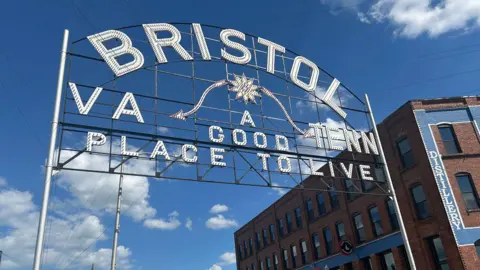
The US town of Bristol, population around 44,000, is a divided community.
Split between Virginia and Tennessee, the state line runs literally down main street. While both sides have much in common, there is one major difference - abortion is illegal in Tennessee. This has been the case since the 2022 Supreme Court ruling which gave individual states, rather than the federal government, the power to legislate abortion, triggering 12 states to pass near-total bans.
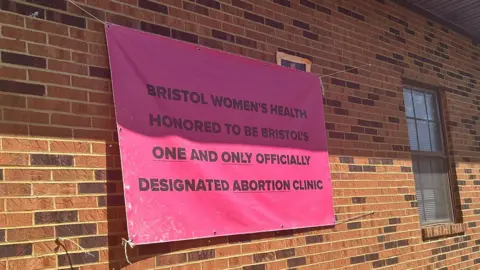
So the city's only abortion clinic, Bristol Women's Health, moved less than a mile down the road to continue practising legally in Virginia.
But just because abortion is legal in Virginia it doesn't mean the battle for abortion access is over.
"It's like whack-a-mole," said Barbara Schwartz, the co-founder of SLAAP, the State Line Abortion Access Partnership. They assist people travelling into Virginia to get an abortion at Bristol Women's Health Clinic.
"As soon as one approach doesn't work, the anti-abortion crowd pops up in Bristol and tries another."
Barbara Schwartz (on right) with other volunteers at the clinic
On 22 December, Bristol's Circuit Court will hear the clinic's case against an eviction notice served by their landlords, brothers Chase and Chadwick King in April 2024.
Lawyers for the clinic argue it has the right to renew its lease for a total of six more years. But if the judge rules in favour of the building's owners, the clinic will be forced to find a new home.
This is not the landlords' first attempt to remove the clinic from their property. The brothers claimed that the clinic fraudulently concealed that they perform abortions, to which they maintain to be "adamantly opposed". The case was dismissed in September last year, with Judge Sage Johnson ruling:
"If [the landlords] had conducted a simple internet search on their tenants, as any reasonably prudent landlord likely would, they would have discovered that the clinic did, in fact, provide abortion services as is plainly stated on their website."
Clinic owner Diana Derzis, who declined to comment on the hearing, previously stated that she hopes to keep the clinic in the city, even if they are evicted. However, she noted there are few other suitable facilities in Bristol, Virginia.
The clinic leaving Bristol would be a "blow" to abortion access, according to Barbara Schwartz, the co-founder of SLAAP, the State Line Abortion Access Partnership.
Since Roe v Wade was overturned, states where abortions are legal have become destinations for out-of-state abortion seekers, with 155,000 people crossing state lines last year, according to the Guttmacher Institute (GI).
The organisation also found that over 9,200 people travelled to Virginia alone to have the procedure done last year.
"Bristol's position means the clinic is the closest place by several hours to get a safe and legal abortion for millions of southerners."
Victoria Cobb, the director of anti-abortion lobbyist the Family Foundation, also notes that Bristol's location places it at the "epicentre of the debate".
Ms Cobb launched the first of several efforts to restrict abortion in Bristol by making use of local bylaws. The tactic is being used by anti-abortion campaigners in states which permit abortion. The logic is simple: If you can't win at Capitol Hill, why not fight at City Hall?
"Locals don't want to see their town turn into an abortion destination location," Ms Cobb states. "We're happy to help them."
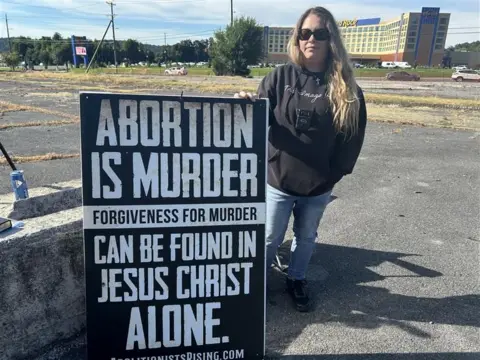
Sammi Cooper is opposed to abortion and protests against the clinic
The Family Foundation has argued in the past that the existence of the clinic goes against zoning regulation, which prohibits buildings from being used in a way that could endanger life.
"Why would this not extend to unborn life?" asked Ms Cobb.
Their ordinance said no new clinics should be allowed to open in Bristol, and expansion of the existing clinic should be blocked.
Similar rules have been used in other parts of the US to restrict abortion, including nearby Washington and Russell counties. But Prof Laura Hermer, an expert on abortion regulations in the US, says these efforts are largely "virtue signalling".
"I'd be surprised if many of these towns have any healthcare, let alone abortion, providers," she said.
The debate became heated in Bristol, as the council agreed to look into the matter.
"It has been more stressful than dealing with a parking lot. It's not something that has really come to the local level before," Jay Detrick, the city's planning director told the BBC.
Ultimately, the city's attorney found that imposing restrictions on a medical facility was not in their remit.
Soon after the city decided not to intervene, another group decided to try and shut the clinic down - this one spearheaded by Texas pastor Mark Lee Dickson.
The pastor has lobbied councils across the US to enforce the Comstock Act, a 152-year-old federal law that prohibits sending or receiving material via post which might induce an abortion.
Ninety-three local authorities have passed ordinances to enforce the Comstock Act, even closing a Planned Parenthood clinic in Lubbock, Texas.
Pastor Dickson is hopeful his ordinance filed in Bristol will have the same result. It has not yet been considered by the Council, but he remains optimistic.
"A local government's tabling or rejecting of such a measure doesn't by any means mean the initiative is dead," he told the BBC.
Kimberly Smith, SLAAP's co-founder, anticipates further campaigns. She says anti-abortion activists target Bristol due to its unusual political make-up:
"They come here because we were a red part of a blue state. If they chip away here, then that weakens the entire framework of a state's rights."
Indeed, even if the clinic wins its case this week and can remain in place, its opponents are undeterred, Pastor Dickson tells the BBC.
"As long as the cries of unborn babies are silenced in Bristol there will be an effort to push the City Council to fulfil their obligation to protect unborn Bristolians."
St Mary's Catholic school in central Nigeria where schoolchildren were abducted
Nigerian authorities say they have secured the release of the remaining 130 schoolchildren kidnapped from a Catholic boarding school in the country's central Niger state.
Nigeria's federal government described the latest release as a "moment of triumph and relief", after one of the country's worst mass kidnappings.
More than 250 children and staff were abducted from St Mary's Catholic school in Papiri on 21 November. Earlier this month about 100 of the children were released.
The authorities confirmed "the rescue of the remaining 130 children and staff" in a statement, saying "not a single pupil is left in captivity".
Presidential spokesperson Bayo Onanuga said on Sunday the total of freed students was now 230.
Since the kidnapping, the exact number of people taken and how many have remained in captivity has been unclear.
It has not been formally made public how the government secured the latest release - or whether any ransom was paid.
The announcement by Onanuga included pictures of children smiling and waving. The students are expected to arrive in the Niger state capital, Minna, on Monday.
When the earlier release happened the governor of neighbouring Nasarawa state, Abdullahi Sule, told local media that the federal government had played a key role, adding that the behind-the-scenes efforts could not be disclosed for security reasons.
The Christian Association of Nigeria reported that 50 students managed to escape at the time of the kidnapping.
November's abduction was the latest incident in a growing number of targeted attacks on schools and places of worship in north and central Nigeria.
The attack on St Mary's in November was preceded by mass kidnappings just days earlier.
On 18 November, two people were killed and 38 abducted in an attack on the Christ Apostolic Church in Kwara state, and a day before that, two were killed and 25 Muslim students abducted from Government Girls' Secondary School in Kebbi state.
All those taken in the Kwara and Kebbi attacks have since been freed.
It is not clear who is behind these kidnappings - most analysts believe they are carried out by criminal gangs seeking ransom payments.
On 9 December Nigerian President Bola Ahmed Tinubu said his government would continue to work with Niger and other states "to secure our schools and make the learning environment safer and more conducive for our younger ones".
Zagreb's Christmas market was voted the best in Europe three years in a row
Christmas markets are not just tradition across Europe, they are big businesses that give cities a huge economic boost every December. For Zagreb, the capital of Croatia, it is an effective way of attracting tourists outside of the country's main summer season.
The words "tourism" and "Croatia" are likely to conjure visons of sparkling Adriatic vistas during the hottest months of the year.
Tourism accounts for more than a fifth of the economy of this Balkan country, and it is keen to encourage more visitors to arrive outside of the height of summer. Yuletide frolics are a key part of that strategy.
"We're making a transformation," says Croatia's Tourism Minister, Tonci Glavina.
"We are developing as a year-round tourism destination – we are not a summer destination anymore. Croatia has really made a significant development. At some point way back it was just sun and sea, but now Croatia offers many tourism products all across the country."
Zagreb Advent, as the capital's Christmas markets and events are collectively known, is the poster child for this approach, with billboards in neighbouring countries urging people to attend. In fact, this year the campaign has spread as far as London's tube stations and Milan's buses.
There are even special trains to bring visitors from Slovenia and Hungary. All of it is part of Zagreb's push, in a very crowded field, to become one of Europe's most popular Christmas markets.
While some cities might limit their offering to a single location, Zagreb Advent is a multi-venue spectacular that takes over large chunks of the centre.
"The entire city has become a festive ground for celebrating Christmas throughout the whole of December," says Slavica Olujic Klapcic, who manages one of the Christmas market areas.
"What's really special around here is that each of the locations has its own theme, and it's a little bit different in decoration, and in the content that it offers. So for a visitor, I think it's a good deal, because by taking a walk through Zagreb, you can see many different spots."
Like other Christmas markets across Europe there are no shortages of the usual seasonal staples, such as sausages and mulled wine. But there are also multiple music stages, craft stalls, vendors offering traditional Croatian food, art installations, and an enormous ice rink.
Slavica Olujic Klapcic, who manages one of the market areas, says that Zagreb offers festive variety
"It brings life to Zagreb," reckons Zrinka Farina, who is involved with putting on Christmas market events outside the city's historic Hotel Esplanade, as well as a food and music market at nearby Strossmayer Square called Fuliranje – which roughly translates as "fooling around".
But she says that Croatians are deadly serious about trying to offer Europe's best Christmas market. "We are such a sporty nation, we love to compete – and when we do something, we really want to be the best in the world in it."
Such has been the effort that the city has put into Zagreb Advent since it was first held in 2014 that it was voted the best Christmas market in Europe for three years in a row, from 2015 to 2017.
The competition is organised by travel website European Best Destinations, and Zagreb's success has helped to drive visitor numbers to the city every December.
Back in 2014, the city saw 100,198 people stay for at least one night during the last month of the year. By 2024 this had more than doubled to 245,352, which the tourist board says gave the city a €100m ($117m; £88m) economic boost.
The Zagreb Advent event is spread across the centre of the city
However, Zagreb has a long way to go if it wishes to catch up with Europe's Christmas market heavyweights.
The one held in the German city of Cologne is widely reported to be the most popular. It is expected to attract four million visitors this year, with an economic impact of €229m.
Zagreb's event also has a limited history – it is only in its 11th year. By contrast, Dresden's Christmas market, widely considered to be the world's oldest, was first held in 1434. Strasbourg's began in 1570, Vienna in 1764 and Cologne in 1820.
Despite its infancy, Zagreb Advent is said to be attracting visitors from across Europe. "They come here from Italy, Spain, Bosnia, Slovenia and even the UK," says Lucija Vrkljan, who is working as a steward at the ice rink.
"It's a great place to be," says Dario Kozul, the founder of BioMania, a bistro with a stall offering vegan and gluten-free food at the Hotel Esplanade Christmas market. "We have a cross-marketing situation all the time," he adds.
"People walk into this event and test our food – they're really very pleased with it. Then we talk about our restaurant, and within the next couple of days, we see them there."
AFP via Getty Images
Dresden's Christmas market was first held in 1434
Marko Peric, dean of the Faculty of Tourism at Croatia's University of Rijeka, agrees that Zagreb Advent brings "unusually high" numbers of arrivals and overnight stays in December.
But he cautions that the rest of Croatia's heavy reliance on the summer season is a weakness that still needs to be addressed. "We need to work and develop our tourist offer in other parts of the year, including the winter," he says.
"We don't have snow, but we can offer a lot. We should rely on our gastronomy, which is well known, with many tourists arriving just because of that. And we could use other types of events like carnival in February, or sporting events."
Tourism Minister Tonci Glavina insists that Croatia is making moves in the right direction. He points out that visitor numbers over July and August were actually slightly down on the same period in 2024.
But the country is still on course for a record-breaking year, thanks to significant growth either side of the summer peak, with around 5% more arrivals in June and September. This, says the minister, is "just perfect", as is the 10% year-on-year rise over the first week of December.
"We are transforming Croatia to be a sustainable tourism destination, meaning about the same number of guests in peak season, developing the shoulder seasons, and of course developing other parts of the country to be main tourism destinations."
Zagreb Advent has already shown the benefits. Although that may not be the first thing that springs to a visitor's mind with all the traditional Croatian treats on offer.
After all, what could be better than a post-skate fritule doughnut, except perhaps a fritule with chocolate sauce.
The US seized another oil tanker off the coast of Venezuela on Saturday
The US Coast Guard is in "active pursuit" of another vessel in international waters near Venezuela, an official has told the BBC's US partner CBS News, as tensions in the region continue to escalate.
US authorities have already seized two oil tankers this month - one of them on Saturday.
Sunday's pursuit related to a "sanctioned dark fleet vessel that is part of Venezuela's illegal sanctions evasion", a US official said. "It is flying a false flag and under a judicial seizure order."
Washington has accused Venezuela of using oil money to fund drug-related crime, while Venezuela has described the tanker seizures as "theft and kidnapping".
US President Donald Trump last week ordered a "blockade" of sanctioned oil tankers entering and leaving the country.
Venezuela - home to the world largest proven oil reserves - has accused the Trump administration of trying to steal its resources.
US authorities have not yet officially confirmed Sunday's pursuit, and the exact location and name of the tanker involved is not yet known.
As of last week, more than 30 of the 80 ships in Venezuelan waters or approaching the country were under US sanctions, according to data compiled by TankerTrackers.com.
Saturday's seizure saw a Panamanian-flagged tanker boarded by a specialised tactical team in international waters.
That ship is not on the US Treasury's list of sanctioned vessels, but the US has said it was carrying "sanctioned PDVSA oil". In the past five years the ship also sailed under the flags of Greece and Liberia, according to records seen by BBC Verify.
"These acts will not go unpunished," the Venezuelan government said in response to Saturday's incident. It added that it intended to file a complaint with the UN Security Council and "other multilateral agencies and the governments of the world".
Venezuela is highly dependent on revenues from its oil exports to finance its government spending.
In recent weeks, the US has built up its military presence in the Caribbean Sea and has carried out deadly strikes on alleged Venezuelan drug-smuggling boats, killing around 100 people.
It has provided no public evidence that these vessels were carrying drugs, and the military has come under increasing scrutiny from Congress over the strikes.
The Trump administration has accused Venezuelan President Nicolás Maduro of leading a designated-terrorist organisation called Cartel de los Soles, which he denies.
Iang Za Kim had to flee her home after the junta launched air strikes nearby
Late one night last month Iang Za Kim heard explosions in a neighbouring village, then fighter jets flying overhead. She ran out of her home to see smoke rising from a distance.
"We were terrified. We thought the junta's planes would bomb us too. So we grabbed what we could – some food and clothes and ran into the jungles surrounding our village."
Iang's face quivers as she recounts the story of what happened on 26 November in K-Haimual, her village in Myanmar's western Chin State, and then she breaks down.
She's among thousands of civilians who've fled their homes in recent weeks after the Burmese military launched a fierce campaign of air strikes, and a ground offensive in rebel-held areas across the country, to recapture territory ahead of elections starting on 28 December.
Four other women sitting around her on straw mats also start crying. The trauma of what they've gone through to make it to safety is clearly visible.
While the air strikes were the immediate cause for Iang to flee, she also doesn't want to be forced to participate in the election.
"If we are caught and refuse to vote, they will put us in jail and torture us. We've run away so that we don't have to vote," she says.
Many civilians have crossed into India to escape the violence in Myanmar
Some from Chin state have described the junta's latest offensive as the fiercest it has launched in more than three years.
Many of the displaced have sought refuge in other parts of the state. Iang is among a group that crossed the border into India's Mizoram state. Currently sheltered in a rundown badminton court in Vaphai village, the group's few belongings they were able to carry are packed in plastic sacks.
Indian villagers have given them food and basic supplies.
Ral Uk Thang has had to flee his home at the age of 80, living in makeshift shelters in jungles for days, before finally making it to safety.
"We're afraid of our own government. They are extremely cruel. Their military has come into our and other villages in the past, they've arrested people, tortured them, and burned down homes," he says.
It isn't easy to speak to Burmese civilians freely. Myanmar's military government does not allow free access in the country for foreign journalists. It took over the country in a coup in February 2021, shortly after the last election, and has since been widely condemned for running a repressive regime that has indiscriminately targeted civilians as it looks to crush the armed uprising against it across Myanmar.
During its latest offensive, the junta last week targeted a hospital in Rakhine State, just south of Chin State. Rebel groups in Rakhine say at least 30 people were killed and more than 70 injured.
The Chin Human Rights Organisation says that since mid-September at least three schools and six churches in Chin State have been targeted by junta airstrikes, killing 12 people including six children.
The BBC has independently verified the bombing of a school in Vanha village on 13 October. Two students –Johan Phun Lian Cung, who was seven, and Zing Cer Mawi, 12 - were killed as they were attending lessons. The bombs ripped through their classrooms injuring more than a dozen other students.
Myanmar's military government did not respond to the BBC's questions about the allegations.
This is the second time Bawi Nei Lian and his young family – a wife and two young children - have been displaced. Back in 2021, soon after the coup, their home in Falam town was burnt down in an air strike. They rebuilt their lives in K-Haimual village. Now they're homeless again.
"I can't find the words to explain how painful and hard it is and what a difficult decision it was to make to leave. But we had to do it to stay alive," he says.
"I want the world to know that what the military is claiming – that this election is free and fair – this is absolutely false. When the main political party is not being allowed to contest the election, how can there be genuine democracy?"
Bawi Nei Lian (left) says the scheduled elections are a sham
The National League for Democracy party, led by Aung San Suu Kyi, which won landslides in the two elections prior to the coup, will not be contesting as most of its senior leaders including Suu Kyi are in jail.
"We don't want the election. Because the military does not know how to govern our country. They only work for the benefit of their high-ranking leaders. When Daw Aung San Suu Kyi's party was in power, we experienced a bit of democracy. But now all we do is cry and shed tears," says Ral Uk Thang.
Iang Za Kim believes the election will be rigged. "If we voted for a party not allied with the military, I believe they will steal our votes and claim we voted for them."
The election will take place in phases, with a result expected around the end of January. Rebel groups have called it a sham.
At the base of the Chin National Front in Myanmar, the most prominent rebel group operating in the state, the group's Vice Chairman Sui Khar says: "This election is only being held to prolong military dictatorship. It's not about the people's choice. And in Chin State, they hardly control much area, so how can they hold an election?"
He points out the areas where the most intense fighting is ongoing on a map and tells us nearly 50 rebel fighters have been injured in just the past month. There have been deaths too, but so far the groups have not released a number.
"There are columns of hundreds of soldiers trying to advance into the northern part of Chin state from four directions," Sui Khar says. "The soldiers are being supported by air strikes, artillery fire and by drone units."
Abel lost his right left and his hands were severely wounded fighting against the junta
Access to the base is extremely rare. Set amid thickly forested mountains, it is the heart of the resistance against the junta in Chin state.
Sui Khar takes us to the hospital at the base. We see a group of injured fighters who were brought in overnight and had to undergo hours of surgery. Some of them have had to undergo amputations.
Many of them were just schoolboys when the coup occurred in 2021. Just about adults now, they've let go of their dreams to fight on the frontline against the junta.
Abel, 18, is in too much pain to speak. He was with a group of fighters trying to take back territory the junta captured a week ago. They won the battle, but Abel lost his right leg and has serious injuries to his hands as well.
In a bed next to him is Si Si Maung, 19, who's also had a leg amputated.
"As the enemy was retreating we ran forward and I stepped on a landmine. We were injured in the explosion. Then we were attacked from the air. The airstrikes make things very difficult for us," he says. "I've lost a leg, but even if I've to give up my life I'm happy to make the sacrifice so that future generations have a better life."
The impact of the ferocity of the latest offensive is visible in room after room at the hospital.
Yet, it's the support and grit of tens of thousands of youngsters like Si Si Maung, who picked up arms to fight against the junta, that have helped the rebels make rapid advances against a much more powerful rival in the past four-and-a-half years.
Some like 80-year-old Ral Uk Thang hope that after the election, the junta will retreat, and he will be able to go back home.
"But I don't think I will live to see democracy restored in Myanmar," he says. "I hope my children and grandchildren can witness it some day."
Additional reporting by Aamir Peerzada, Sanjay Ganguly and Aakriti Thapar
There's been an outpouring of support from the community - but tension remains
As helicopters circled overhead, sirens descended on her suburb, and people ran screaming down her street on 14 December, Mary felt a grim sense of deja vu.
"That was when I knew there was something seriously wrong – again," she says, her eyes brimming with tears.
Mary - who did not want to give her real name - was at the Westfield Bondi Junction shopping centre last April when six people were stabbed to death by a man in psychosis, a tragedy still fresh in the minds of many.
Findings from a coronial inquest into the incident were due to be delivered this week, but were delayed after two gunmen unleashed a hail of bullets on an event marking the start of the Jewish festival of Hanukkah eight days ago.
Declared a terror attack by police, 15 people were shot and killed, including a 10-year-old girl who still had face paint curling around her eyes.
The first paramedic to confront the bloody scenes at the Chanukah by the Sea event was also the first paramedic on the scene at the Westfield stabbings.
"You just wouldn't even fathom that something like this would happen," 31-year-old Mary, who is originally from the UK, tells the BBC. "I say constantly to my family at home how safe it is here."
This was the overarching sentiment in the days following the shooting. This kind of thing, mass murder, just doesn't happen in Australia.
But it can and it has – twice, in the same community, within 18 months.
A sea of flowers left by shocked and grieving people at Bondi is being packed up. A national day of reflection is over. On Sunday night, Jewish Australians lit candles for the last time this Hannukah.
But the two tragedies have left scores physically scarred and traumatised, and the nation's sense of safety shattered.
'Everyone knows someone affected'
EPA
Funerals for the victims have drawn thousands of mourners this week
Bondi is Australia's most famous beach - a globally recognised symbol of its way of life.
It's also a quintessential slice of Australian community. There's a bit of "everyone knows everyone" - and that means everyone knows someone affected by the 14 December tragedy, mayor Will Nemesh told the BBC.
"One of the first people I texted was [Rabbi] Eli Schlanger. And I said, 'I hope you're OK. Call me if you need anything'," he said.
But the British-born father of five, also known as the "Bondi Rabbi", was among the dead.
The first responders, police and paramedics would have been working on members of their own community. Others had the task of having to treat the shooters who had taken aim at their colleagues.
"[Westfield Bondi Junction] was horrendous, something we're certainly not used to. And then this again was massive, catastrophic injuries," Ryan Park, health minister for New South Wales, told the BBC.
"They've seen things that are like you would see in a war zone… You don't get those images out of your head," Park added.
Mayor Nemesh fears this will forever be a stain on Bondi, and Australia.
"If this can happen here at Bondi Beach, it really could happen anywhere… the impact has reverberated around Australia."
EPA
Ryan Park says healthcare workers will take time to recover from what they've seen
'Warnings ignored'
No one is feeling this more than the Jewish community, for whom Bondi has become a sanctuary.
"I swam here every day for years on end, rain or shine. And this week… I couldn't get in the water. It didn't feel right. It felt sacrilegious in some way," Zac Seidler, a local clinical psychologist, told the BBC.
Many of the victims of the attack moved here over many decades for safety from persecution, including 89-year-old Holocaust survivor Alex Kleytman. Instead, his life was bookended by violent acts of antisemitic hate.
Mr Seidler has spent the past two years trying to convince his grandparents, who are also Holocaust survivors, to hold on to their faltering belief in the good of humanity.
"[My grandmother] kept saying, 'These are the signs. I've seen this before'. And I just kept saying, 'Not in Australia, not here. You're safe', just trying to soothe her.
"But now I kind of feel like the fool."
No community is a monolith, but one thing many Jewish Australians believe is that warnings about a rise of antisemitism in the months preceding this attack were ignored.
The year started with a spate of vandalism and arson incidents on Jewish marks in the suburbs surrounding Bondi. It has ended with mass murder targeting their community.
Watch: Jewish Australians on why Bondi is a 'sanctuary' for them
There has been resistance in the face of fear - some leaders urging Jewish Australians to double down, be more publicly Jewish and display their religious symbols with pride.
One woman perusing the flowers outside the Bondi Pavilion on Sunday admits she is too scared to do that. It took her all week to even work up the courage to visit this site, which is just metres from where many of the victims died.
"I've never felt my Jewishness before. I've never experienced antisemitism in my whole life until now," MaryAnne says. "And now, I don't want to wear my Star of David."
Community, anger and sadness
The shooting triggered a massive outpouring of support from around the nation.
When the news broke, many in the community rallied to help.
Lifeguards - volunteer and paid - put their lives on the line. Restaurants opened their doors and hid people in their store rooms and freezers, and locals ushered lost children into their apartments.
Even the New South Wales opposition leader Kellie Sloane - also the local state member - was at the scene, helping pack bullet wounds.
In the days after the shooting, thousands of ordinary Australians lined up - many for hours on end - to donate blood desperately needed to treat those injured.
Each day, a carpet of petals, handwritten notes, commemorative stones and candles grew out from the gates of the Bondi Pavilion.
Bee motifs - stickers, balloons, even pavement art - are all over the suburb, in remembrance of Matilda, the terror attack's youngest victim.
Surfers and swimmers on Friday paddled out beyond Bondi's iconic breaks to honour those who died.
A day later, surf livesavers and lifeguards stood shoulder to shoulder on the beach in solidarity with the Jewish community.
But amid the platitudes, sadness and shock is calcifying into anger and tension.
Surfers and swimmers pay tribute to victims of Bondi shooting
Last year's Bondi Junction stabbings were devastating for the community - but a shared resolution united it.
Experts say the attacker, who had schizophrenia, was in psychosis at the time of the stabbings, and his family have previously said he was frustrated at being unable to find a girlfriend. The question of whether he targeted women will likely forever go unanswered. But clear failures in the mental health system have been identified.
Last month, families of the victims asked the coroner to refer the doctor who weaned him off medication with limited supervision to regulators for investigation, and they have also argued for a massive boost to mental health service funding.
But last Sunday's events raise more uncomfortable feelings and questions.
There is palpable fury at the government, over a perceived – and admitted – failure to do more to stop antisemitism. Prime Minister Anthony Albanese has been booed during public appearances this week, and talking to people visiting the site of the attack in Bondi, it isn't uncommon to hear them demand his resignation.
Many people the BBC spoke to pointed to his government's decision to recognise Palestinian statehood, alongside countries including the UK and Canada, and regular protests in Australia by members of the pro-Palestinian movement, which though largely peaceful but have been peppered with antisemitic chants and placards.
The state of New South Wales - which has in recent years tightened protest rules - has already announced it will introduce more legislation cracking down on "hateful" chants and give police more powers to investigate demonstrators. The federal government has promised similar.
The blame apportioned to these protests does not sit right with many, even some sections of the Jewish community.
"We need to hold multiple truths," Mr Seidler says. "We can be afraid, we can feel that there is deep antisemitic rhetoric going on in certain circles within Australia… while also understanding that there is a right of people in this country – especially Muslim Australians – to be concerned about what is taking place in Gaza.
"We need to get better at finding that line and calling out when that line has been crossed."
Getty
A memorial inside the Bondi Junction Westfield shopping centre where six people were stabbed to death in April last year
For others, there is anger at what they feel is the politicisation of a tragedy.
"It's a bloody photo op," one woman tells me on Sunday, as a prominent Australian businesswoman arrives and begins posing with the floral tributes outside the Bondi Pavilion.
Some - including the local federal MP Allegra Spender - worry the attack is being used to fuel anti-immigration sentiment.
"We would not have had the man who saved so many Australians if we had cut off, for instance, Muslim immigration," she said.
Mr Seidler says these arguments fail to recognise that antisemitic views - and other forms of bigotry - are formed here too.
"I heard someone say the other day that Australia thinks it's on a holiday from history, that we're somehow immune to this stuff, that it's not bred here, it's imported," Mr Seidler says.
With the anger, there is also fear: for the Jewish community of other attacks, for the Muslim community of retaliation for an act of terror they have loudly condemned.
There are questions over how Australia's security agency fumbled an alleged terrorist who at one point was on their watch list, prompting a review into federal police and intelligence agencies that was announced on Sunday.
There is frustration at NSW Police, who have for years been warned by the Muslim community of hate preachers poaching their young men.
There is animosity towards the media, driven by hurt among both Jewish and Arab Australians over a belief they and their communities have been misrepresented, and frustration at what some feel is incitement against them.
But there is also a queasiness at the treatment of traumatised victims throughout this week, some of whom were interviewed live on television while the blood of their friends still stained their hands.
Through it all, is an undercurrent of suspicion of institutions and each other.
There are varying opinions on how those rifts can heal – or even if they can. But there is a shared determination to try.
Getty Images
Many Jewish Australians are angry at the government
One UK expat who was at the beach at the time of the shooting says everyone he speaks to is adamant this will not change Bondi, or Australia.
"It's seriously unique what you have as a nation… there's a magic about it," Henry Jamieson tells the BBC.
"I'm traumatised… and I'm going to have to deal with that for the rest of my life, I know I am… even people who weren't there were traumatised.
"But I'm not gonna let it shake me and we will not let it shake this community.
"You can't let them win," he says of the alleged terrorists.
At an emotional memorial on Sunday night, seven days since the attack, the same sense of defiance was on show. It ended with the lighting of the menorah, something the crowds gathered for Hannukah last week never got to do.
The shamash, the centre candle, was lit by the father of Ahmed al Ahmed, in honour of his bravery in wrestling a gun off one of the attackers. The children of the two rabbis who were killed lit another. Others were lit by a representative of surf lifesavers and a Jewish community medic who rushed to the scene and began treating the injured before the shots had even stopped. The final candle was lit by Michael, the father of Matilda, who has been described a fountain of joy to all who knew her.
After the parade of diverse Australians had sparked flames on each arm of the menorah, Rabbi Yehoram Ulman of Bondi Chabad made a plea for more love and more unity.
"Returning to normal is not enough," he said.
"Sydney can and must become a beacon of goodness. A city where people look out for one another, where kindness is louder than hate, where decency is stronger than fear, and we can make it happen," he said, stopping for a moment as the crowd applauded.
"But only if we take the feelings we have right now and turn them into action, into continuous action."
Far-right Finance Minister Bezalel Smotrich, a West Bank settler himself, proposed the move
Israel's security cabinet has approved the recognition of 19 new settlements in the occupied West Bank as the government continues its settlement expansion push.
Far-right Finance Minister Bezalel Smotrich, a settler who proposed the move alongside Defence Minister Israel Katz, said the decision was about blocking the establishment of a Palestinian state.
Israeli settlements in the occupied West Bank are considered illegal under international law.
Saudi Arabia condemned the move. UN Secretary-General Antonio Guterres has said Israel's "relentless" settlement expansion fuels tensions, restricts Palestinian access to land, and threatens the viability of a sovereign Palestinian state.
Violence in the occupied West Bank has surged since the war in Gaza began in October 2023, further heightening fears that settlement expansion could entrench Israel's occupation and undermine a two-state solution.
The two-state solution refers to the creation of a Palestinian state in the West Bank and Gaza Strip, with East Jerusalem as its capital, broadly along the lines that existed prior to the 1967 Arab-Israeli war.
Since taking office in 2022, the current Israeli government has significantly increased the approval of new settlements and begun the legalisation process for unauthorised outposts, recognising them as "neighbourhoods" of existing settlements.
The most recent decision brings the total number of settlements approved over the past three years to 69, according to Smotrich.
The approvals come just days after the United Nations said settlement expansion had reached its highest level since 2017.
The latest approvals include the re-establishment of two settlements — Ganim and Kadim — which were dismantled nearly 20 years ago.
In May, Israel approved 22 new settlements in the occupied West Bank - the biggest expansion in decades.
The Israeli government also approved plans in August to build more than 3,000 homes in the so-called E1 project between Jerusalem and the Maale Adumim settlement, which had been frozen for decades amid fierce opposition internationally.
Smotrich at the time said the plan would "bury the idea of a Palestinian state".
About 700,000 settlers live in approximately 160 settlements in the West Bank and East Jerusalem, according to Israeli anti-settlement group Peace Now. It is land Palestinians seek for a future independent state.
Settlement expansion has angered Arab nations who have consistently said it undermines prospects for a two-state solution.
It has also raised concerns about the possible annexing of the occupied West Bank.
US President Donald Trump had warned Israel about such a move, telling TIME magazine that Israel would lose all its support from the US if it happened.
In September, the UK - along with other countries including Australia and Canada - recognised a Palestinian state, a significant although symbolic change in government policy.
Israel opposed the move, with Israeli Prime Minister Benjamin Netanyahu saying a Palestinian state "will not happen".
Egyptian fisherman Issam al-Shazly was executed on Tuesday after being convicted of drug-related charges
Saudi Arabia has surpassed its record for the number of executions carried out annually for a second year in a row.
At least 347 people have now been put to death this year, up from a total of 345 in 2024, according to the UK-based campaign group Reprieve, which tracks executions in Saudi Arabia and has clients on death row.
It said this was the "bloodiest year of executions in the kingdom since monitoring began".
The latest prisoners to be executed were two Pakistani nationals convicted of drug-related offences.
Others put death this year include a journalist and two young men who were children at the time of their alleged protest-related crimes. Five were women.
But, according to Reprieve, most - around two thirds - were convicted of non-lethal drug-related offences, which the UN says is "incompatible with international norms and standards".
More than half of them were foreign nationals who appear to have been put to death as part of a "war on drugs" in the kingdom.
The Saudi authorities have not responded to the BBC's request for comment on the rise in executions.
"Saudi Arabia is operating with complete impunity now," said Jeed Basyouni, Reprieve's head of death penalty for the Middle East and North Africa. "It's almost making a mockery of the human rights system."
She described torture and forced confessions as "endemic" within the Saudi criminal justice system.
Ms Basyouni called it a "brutal and arbitrary crackdown" in which innocent people and those on the margins of society have been caught up.
Tuesday saw the execution of a young Egyptian fisherman, Issam al-Shazly, who was arrested in 2021 in Saudi territorial waters and said he had been coerced into smuggling drugs.
Reprieve says that 96 of the executions were solely linked to hashish.
"It almost seems that it doesn't matter to them who they execute, as long as they send a message to society that there's a zero-tolerance policy on whatever issue they're talking about - whether it's protests, freedom of expression, or drugs," said Ms Basyouni.
There has been a surge of drug-related executions since the Saudi authorities ended an unofficial moratorium in late 2022 - a step described as "deeply regrettable" by the UN human rights office.
Speaking anonymously to the BBC, relatives of men on death row on drugs charges have spoken of the "terror" they're now living in.
One told the BBC: "The only time of the week that I sleep is on Friday and Saturday because there are no executions on those days."
Cellmates witness people they have shared prison life with for years being dragged kicking and screaming to their death, according to Reprieve.
Reuters
Prince Mohammed bin Salman has loosened social restrictions while simultaneously silencing criticism
The de facto ruler of Saudi Arabia, Mohammed bin Salman - who became crown prince in 2017 - has changed the country profoundly over the past few years, loosening social restrictions while simultaneously silencing criticism.
In a bid to diversify its economy away from oil, he has opened Saudi Arabia up to the outside world, taken the religious police off the streets, and allowed women to drive.
But the kingdom's human rights record remains "abysmal", according to the US-based campaign group Human Rights Watch, with the high level of executions a major concern. In recent years, only China and Iran have put more people to death, according to human rights activists.
"There's been no cost for Mohammed bin Salman and his authorities for going ahead with these executions," said Joey Shea, who researches Saudi Arabia for Human Rights Watch. "The entertainment events, the sporting events, all of it is continuing to happen with no repercussions, really."
According to Reprieve, the families of those executed are usually not informed in advance, or given the body, or informed where they have been buried.
The Saudi authorities do not reveal the method of execution, although it is believed to be either beheading or firing squad.
In a statement sent to the BBC, the UN's special rapporteur on extrajudicial, summary or arbitrary executions, Dr Morris Tidball-Binz, called for an immediate moratorium on executions in Saudi Arabia with a view to abolition, as well as "full compliance with international safeguards (including effective legal assistance and consular access for foreign nationals), prompt notification of families, the return of remains without delay and the publication of comprehensive execution data to enable independent scrutiny".
Amnesty International
Abdullah al-Derazi and Jalal al-Labbad were executed in October and August respectively after being convicted of crimes they allegedly committed as minors
Among the Saudi nationals executed this year were Abdullah al-Derazi and Jalal al-Labbad, who were both minors at the time of their arrest.
They had protested against the government's treatment of the Shia Muslim minority in 2011 and 2012, and participated in the funerals of people killed by security forces. They were convicted of terrorism-related charges and sentenced to death after what Amnesty International said were grossly unfair trials that relied on torture-tainted "confessions". UN human rights experts had called for their release.
The UN also condemned the execution in June of the journalist, Turki al-Jasser, who had been arrested in 2018 and sentenced to death on charges of terrorism and high treason based on writings he was accused of authoring.
"Capital punishment against journalists is a chilling attack on freedom of expression and press freedom," said Unesco's Director-General, Audrey Azoulay.
Reporters Without Borders said he was the first journalist to be executed in Saudi Arabia since Mohammed bin Salman came to power, although another journalist, Jamal Khashoggi, was murdered by Saudi agents at the Saudi consulate in Istanbul in 2018.
Human Rights Watch
Journalist Turki al-Jasser was executed in June after seven years in detention
Last December, UN experts wrote to the Saudi authorities to express concern over a group of 32 Egyptians and one Jordanian national who had been sentenced to death on drugs charges, and their "alleged absence of legal representation". Since then, most of the group have been executed.
A relative of one man put to death earlier this year said that he had told her that people were being "taken like goats" to be killed.
The BBC has approached the Saudi authorities for a response to the allegations but has not received one.
But in a letter dated January 2025 - in reply to concerns raised by UN special rapporteurs - they said that Saudi Arabia "protects and upholds" human rights and that its laws "prohibit and punish torture".
"The death penalty is imposed only for the most serious crimes and in extremely limited circumstances," the letter stated. "It is not handed down or carried out until judicial proceedings in courts of all levels have been completed."

 Login
Login
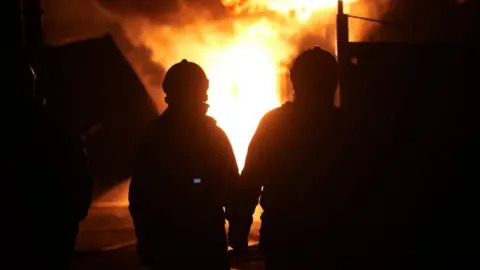 DSNS Odesa