Zelensky said the 20 points agreed with the Americans offered Ukraine security guarantees that mirrored Nato membership
Ukraine's President Volodymyr Zelensky has given details of an updated peace plan that offers Russia the potential withdrawal of Ukrainian troops from the east that Moscow has demanded.
Giving details of the 20-point plan agreed by US and Ukrainian negotiators in Florida at the weekend, Zelensky said the Russians would give their response once the Americans had spoken to them.
Describing the plan as "the main framework for ending the war" Zelensky said it proposed security guarantees from the US, Nato and Europeans for a co-ordinated military response if Russia invaded Ukraine again.
On the key question of Ukraine's eastern Donbas, Zelensky said a "free economic zone" was a potential option.
The 20-point plan is seen as an update of an original 28-point document, agreed by US envoy Steve Witkoff with the Russians several weeks ago, which was widely seen as heavily geared towards the Kremlin's demands.
The Russians have insisted that Ukraine pulls out of almost a quarter of its own territory in the eastern Donetsk region in return for a peace deal. The rest is already under Russian occupation.
Zelensky told journalists that as Ukraine was against withdrawal, US negotiators were looking to establish a demilitarised zone or a free economic zone.
He said: "There are two options: either the war continues, or something will have to be decided regarding all potential economic zones."
He emphasised that an economic zone would also have to be set up around the Zaporizhzhia nuclear power plant currently occupied by Russia, and that Russian troops would have to pull out of four other Ukrainian regions - Dnipropetrovsk, Mykolaiv, Sumy, and Kharkiv.
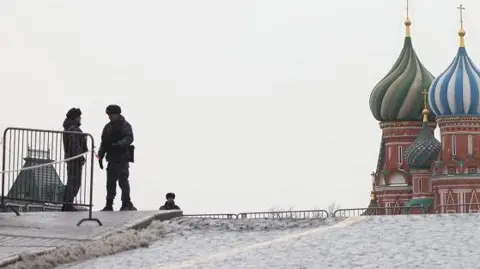
Police officers standing guard in Moscow (file photo)
Three people - including two police officers - have been killed in an explosion in Moscow, Russian authorities have said.
Two traffic police officers saw a "suspicious individual" near a police car on the city's Yeletskaya Street, and when they approached the suspect to detain him, an explosive device was detonated, Russia's Investigative Committee has said.
The two police officers died from their injuries, along with another individual who was standing nearby.
The attack comes two days after a senior Russian general was killed in a car bombing in the capital on Monday.
Lt Gen Fanil Sarvarov died after an explosive device - which had been planted under a car - was detonated.
Investigate Committee spokesperson Svetlana Petrenko said in a statement on Telegram that a criminal case was being investigated in Moscow "regarding an attempt on the lives of traffic police officers".
This breaking news story is being updated and more details will be published shortly. Please refresh the page for the fullest version.
You can receive Breaking News on a smartphone or tablet via the BBC News App. You can also follow @BBCBreaking on X to get the latest alerts.
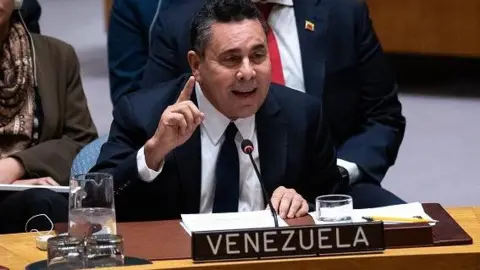
Venezuela has accused the United States of the "greatest extortion" at an emergency session of the UN Security Council in New York.
Washington's seizure of two Venezuelan oil tankers was "worse than piracy," the Venezuelan ambassador to the UN said.
The emergency meeting of the Security Council was called to discuss the seizure of the tankers, which took place off the coast of Venezuela earlier this month.
The US has also said it was pursuing a third Venezuelan oil tanker.
President Trump has accused Venezuela's President Nicolas Maduro of leading a drugs cartel and said gangs had operated with impunity for too long.
On 16 December, Trump ordered a naval blockade of all sanctioned oil tankers entering and leaving Venezuela. The US president has said the US will keep or sell the crude oil contained on tankers it has seized, as well as the vessels themselves.
The US has deployed 15,000 troops and a range of aircraft carriers, guided-missile destroyers, and amphibious assault ships to the Caribbean.
The stated aim of the deployment - the largest to the region since the US invaded Panama in 1989 - is to stop the flow of fentanyl and cocaine to the US.
The US has also targeted more than 20 vessels in the Pacific and the Caribbean in recent months, killing at least 90 people, as part of President Trump's campaign against gangs he accuses of transporting drugs in the region.
Some experts say the strikes could violate laws governing armed conflict.
Venezuela's envoy to the UN said the US was subjecting his country to the "greatest extortion" in its history.
Speaking at the UN Security Council meeting on Tuesday, Samuel Moncada said "we are in the presence of a power that acts outside of international law, demanding that Venezuelans vacate our country and hand it over."
Regarding the US seizure of Venezuelan oil, he added: "We are talking about pillaging, looting and recolonisation of Venezuela.
"The government of the United States does not have jurisdiction in the Caribbean."
Referring to the Venezuelan oil industry, he said: "What does that have to do with drugs?"
In response, the US Ambassador to the UN, Michael Waltz, told the Security Council the US does not recognise Mr Maduro as the legitimate leader of Venezuela.
"Maduro's ability to sell Venezuela's oil enables his fraudulent claims to power and his narco-terrorist activities," Mr Waltz said.
On a visit to a trade fair in Caracas, President Maduro said "the Security Council is giving overwhelming support to Venezuela."
Russia and China accused the US of bullying and aggression.
The US was "illegally destroying" civilian vessels in the Caribbean Sea, the Russian ambassador to the UN, Vassily Nebenzia, told the UN meeting.
He warned that other countries could be next.
The US actions against Venezuelan vessels, he said, were "a template for future acts of force against Latin American states."
Meanwhile, China's envoy to the UN, Sun Lei, called on the US to "immediately halt relevant actions and avoid further escalation of tensions."
Several people are feared to have been killed and injured in Nigeria after a suspected suicide bomber carried out an attack on a mosque in Borno state.
Eyewitnesses said the blast happened during evening prayers. One report suggests seven people were killed, but there has been no official confirmation of any casualties.
Unverified footage on social media appears to show the aftermath of the explosion, with people stood in a market area with dust particles in the air.
No group has admitted carrying out the explosion in Maiduguri - the state's capital - but militants have previously targeted mosques and crowded places in the area with suicide and improvised explosive device (IED) attacks.
This breaking news story is being updated and more details will be published shortly. Please refresh the page for the fullest version.
You can receive Breaking News on a smartphone or tablet via the BBC News App. You can also follow @BBCBreaking on X to get the latest alerts.
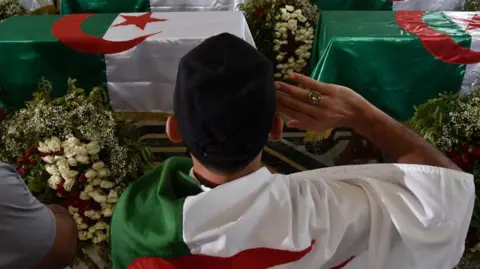
France returned the remains of 24 Algerian resistance fighters in 2020
Algeria's parliament has unanimously passed a law declaring France's colonisation of the North African state a crime, and demanding an apology and reparations.
The law also criminalises the glorification of colonialism, state-run TV reports.
The vote is the latest sign of increasingly strained diplomatic relations between the two countries, with some observers saying they are at their lowest since Algeria gained independence 63 years ago.
France's colonialisation of Algeria between 1830 and 1962 was marked by mass killings, large-scale deportations and ended in a bloody war of independence. Algeria says the war killed 1.5 million people, while French historians put the death toll much lower.
France's President Emmanuel Macron has previously acknowledged the colonisation of Algeria was a "crime against humanity" but has not offered an apology.
Lawmakers wore scarves in the colours of the national flag and chanted "long live Algeria" as they applauded the bill's passage through parliament, AFP news agency reports.
It says the legislation states that France has "legal responsibility" for the "tragedies it caused", and "full and fair" compensation was an "inalienable right of the Algerian state and people".
France has not yet commented on the vote.
It comes at a time of growing pressure on Western powers to offer reparations for slavery and colonialism, and to return looted artefacts still kept in their museums.
Algerian lawmakers have been demanding that France return a 16th Century bronze canon, known as Baba Merzoug, meaning "Blessed Father", that was regarded as the protector of Algiers, now Algeria's capital.
French forces captured the city in 1830, on their third attempt, and removed the cannon - which is now in the port city of Brest in north-western France.
In 2020, France returned the remains of 24 Algerian fighters who were killed resisting French colonial forces in the 19th Century.
Last month, Algeria hosted a conference of African states to push for justice and reparations.
Algeria's Foreign Minister Ahmed Attaf said that a legal framework would ensure that restitution was neither regarded as "a gift nor a favour".
Diplomatic relations between between Algeria and France soured last year, when Macron announced France was recognising Moroccan sovereignty of Western Sahara and backed a plan for limited autonomy for the disputed territory.
Algeria backs the pro-independence Polisario Front in Western Sahara and is seen as its main ally.
French-Algerian novelist Boualem Sansal was then arrested at Algiers airport in and jailed for five years, before being pardoned by Algeria's President Abdelmadjid Tebboune last month.
Prosecutors said he had undermined national security for making remarks that questioned Algeria's borders.
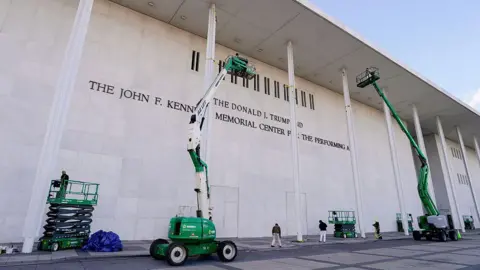
Watch: President Trump's name added to facade of Kennedy Center
Democratic US Representative Joyce Beatty has filed a lawsuit seeking to remove President Donald Trump's name from the John F. Kennedy Center for the Performing Arts.
Last week, the board of the Kennedy Center - which Trump filled with allies - voted to rename the performing arts centre the Trump-Kennedy Center.
Beatty is one of several Democratic lawmakers designated as members of the board by US law. She claimed in her lawsuit that the renaming was illegal because changing the name requires "an act of Congress".
The suit says Beatty had called into the meeting about the name change but was muted when she tried to voice her opposition.
Beatty argues that Congress intended for the centre to be a "living memorial" to former President Kennedy.
"[I]n scenes more reminiscent of authoritarian regimes than the American republic – the sitting President and his handpicked loyalists renamed this storied center after President Trump," the lawsuit states.
In a statement provided to the BBC, the White House said Trump had "stepped up" and saved the Kennedy Center "by strengthening its finances, modernizing the building, and ending divisive woke programming".
"As a result, the Board of the Kennedy Center voted unanimously to rename it the Trump-Kennedy Center — a historic move that marks a new era of success, prestige, and restored grandeur for one of America's most iconic cultural institutions," White House spokesperson Liz Huston said.
On Friday, the president's name was added to the exterior of the building, and the centre's website logo now reads "The Trump Kennedy Center".
The name change has been met with harsh criticism, particularly in Washington DC where the centre has been an iconic landmark since it was built and named for Kennedy.
Bloomberg via Getty Images
Construction began on a performing arts centre in the 1950s and after Kennedy was assassinated in 1963, Congress decided to name it after him.
Shortly after taking office, Trump fired a slew of the centre's board members and replaced them with allies, who then voted to make him chairman of the board. His close adviser Richard Grenell became board president.
The centre's board of trustees currently has 34 members appointed by Trump and 23 others designated as members by US law, according to the centre's website.
Trump also secured about $257m (£190m) in congressional funding to pay for major renovations and other costs at the venue, saying it was in "bad shape".
Several members of the Kennedy family took to social media to criticise the name change.
Joe Kennedy III, a former House member and grandnephew of the late president, said that "the Kennedy Center is a living memorial to a fallen president and named for President Kennedy by federal law".
"It can no sooner be renamed than can someone rename the Lincoln Memorial, no matter what anyone says," he added.
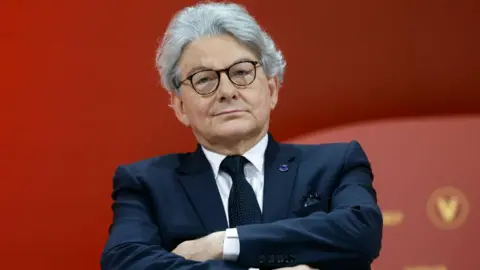
Thierry Breton, the former top tech regulator at the European Commission, has clashed with Elon Musk in the past
The US State Department said it would deny visas to five people, including a former EU commissioner, for seeking to "coerce" American social media platforms into suppressing viewpoints they oppose.
"These radical activists and weaponized NGOs have advanced censorship crackdowns by foreign states - in each case targeting American speakers and American companies," Secretary of State Marco Rubio said in a statement.
Thierry Breton, the former top tech regulator at the European Commission, suggested that a "witch hunt" was taking place.
Breton was described by the State Department as the "mastermind" of the EU's Digital Services Act (DSA), which imposes content moderation on social media companies.
However, it has angered some US conservatives who see it as seeking to censor right-wing opinions. Brussels denies this.
Breton has clashed with Elon Musk, the world's richest man and owner of X, over obligations to follow EU rules.
The European Commission recently fined X €120m (£105m) over its blue tick badges - the first fine under the DSA. It said the platform's blue tick system was "deceptive" because the firm was not "meaningfully verifying users".
In response, Musk's site blocked the Commission from making adverts on its platform.
Reacting to the visa ban, Breton posted on X: "To our American friends: Censorship isn't where you think it is."
Clare Melford, who leads the UK-based Global Disinformation Index (GDI), was also listed.
US Undersecretary of State Sarah B Rogers accused the GDI of using US taxpayer money "to exhort censorship and blacklisting of American speech and press".
A GDI spokesperson told the BBC that "the visa sanctions announced today are an authoritarian attack on free speech and an egregious act of government censorship".
"The Trump Administration is, once again, using the full weight of the federal government to intimidate, censor, and silence voices they disagree with. Their actions today are immoral, unlawful, and un-American."
Imran Ahmed of the Center for Countering Digital Hate (CCDH), a nonprofit that fights online hate and misinformation, was also handed a ban.
Rogers called Mr Ahmed a "key collaborator with the Biden Administration's effort to weaponize the government against US citizens".
Also subject to bans were Anna-Lena von Hodenberg and Josephine Ballon of HateAid, a German organisation that the State Department said helped enforce the DSA.
The BBC has reached out to the CCDH and HateAid for comment.
Rubio said that steps had been taken to impose visa restrictions on "agents of the global censorship-industrial complex who, as a result, will be generally barred from entering the United States".
"President Trump has been clear that his America First foreign policy rejects violations of American sovereignty. Extraterritorial overreach by foreign censors targeting American speech is no exception," he added.
Watch: First responders at scene of Pennsylvania nursing home explosion
Multiple people are reported to be injured following an explosion and fire at a nursing home in Bristol, Pennsylvania, officials say.
Emergency crews were called to the Silver Lake Nursing Home at about 14:00 local time (19:00GMT) on Tuesday. Firefighters believe some people may still be trapped inside the building.
An emergency management official told CBS, the BBC's US partner, that the fire remains active and part of the structure has collapsed. It's not clear how many people are injured, and the cause of explosion is still under investigation.
Images and videos posted on social platforms by local media outlets show a partially collapsed building with massive flames billowing out of it.
Local utility provider PECO said its crews had responded to reports of a gas odour at the facility in Bristol Township in the afternoon.
While they were on site, an explosion occurred, a company spokesperson said. Natural gas and electric service to the building were subsequently shut off.
Pennsylvania Governor Josh Shapiro offered his prayers for the community and said he was in contact with local officials and first responders on the scene.
Congressman Brian Fitzpatrick urged people to avoid the area.
"My team and I are in direct communication with local officials and emergency responders, and we are closely monitoring developments as authorities work to secure the scene," he wrote on X.
This is a developing story. Please check back for updates.
Turkey says signal has been lost with a jet carrying the Libyan army chief and four other people.
In a post on X, Turkish Interior Minister Ali Yerlikaya says this happened at 20:52 local time (17:52 GMT) - about 42 minutes after the Falcon 50 business jet took off from Ankara's airport.
The minister says Libya's chief of staff Gen Mohammed Ali Ahmed al-Haddad was on board the Tripoli-bound aircraft.
The jet issued an emergency landing request before contact was lost.
This breaking news story is being updated and more details will be published shortly. Please refresh the page for the fullest version.
You can receive Breaking News on a smartphone or tablet via the BBC News App. You can also follow @BBCBreaking on X to get the latest alerts.
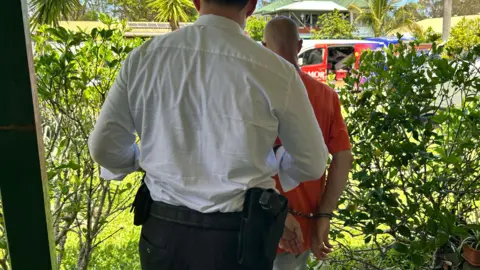
Police arrested and charged the British man, 43, earlier this month
A British national in Australia has had his visa cancelled and faces deportation for allegedly displaying Nazi symbols.
The 43-year-old man living in Queensland was arrested and charged earlier this month, after allegedly using a social media account to post the Nazi swastika, promote pro-Nazi ideology and call for violence towards the Jewish community.
The man was taken into immigration detention this week in Brisbane and is due to face court in January. Police have been cracking down on the use of prohibited symbols amid a recent rise in antisemitism and right-wing extremism.
Home Affairs Minister Tony Burke said: "He came here to hate - he doesn't get to stay."
"If you come to Australia on a visa, you are here as a guest," Burke told the Australian Broadcasting Corporation (ABC) on Wednesday.
Last month, Burke also revoked the visa of Matthew Gruter, a South African national who had been living in Australia since 2022, after he was seen attending a neo-Nazi rally in front of the New South Wales parliament.
Like Gruter, the British man can appeal his visa being revoked. He can leave Australia voluntarily or wait to be deported to his home country.
It is understood police are assessing whether to delay deporting the man so he can face court next month.
Police began investigating the British man in October over alleged posts on X. The social media platform blocked his account, prompting him to create a new one with a similar name where he continued posting offensive and harmful content, police said.
Australian Federal Police
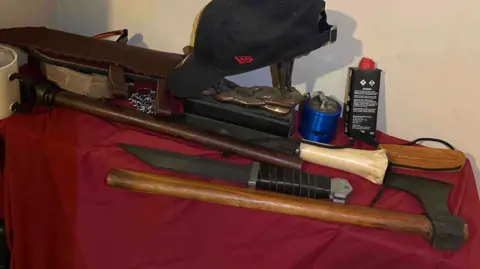
Police seized weapons including axes and knives from the British man's home
Authorities searched the man's home in Caboolture, on the outskirts of Brisbane, in late November and seized phones, weapons and several swords with swastika symbols.
He was charged with three counts of displaying banned Nazi symbols and one count of using the internet to cause offense.
"We want to ensure these symbols are not being used to fracture social cohesion," Australian Federal Police Assistant Commissioner Stephen Nutt said earlier this month.
"If we identify instances where this is happening, we will act swiftly to disrupt the behaviour, prosecute those involved and protect the dignity, safety and cohesion of our diverse community."
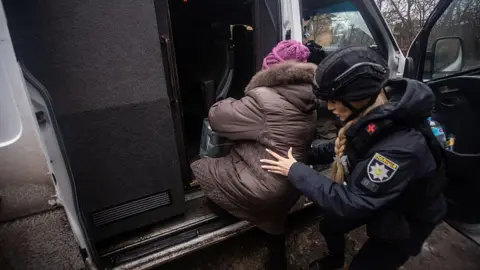
Ukraine's police evacuation group White Angels evacuates civilians from the village of Krasnopillya in Sumy region
Fifty-two residents of a Ukrainian village have been taken to Russia by invading forces in a cross-border raid on the village of Hrabovske, authorities in Kyiv say. Thirteen Ukrainian soldiers were also captured in the border village in the northeastern Sumy region.
The attack occurred at night on Saturday, when about 100 Russian troops attacked the village, said Viktor Trehubov, a spokesman for Ukraine's military Joint Forces Task Force.
The civilians were first rounded up in a church and then taken across the border to Russia, he told the BBC.
It was unusual for invading forces to take civilians to Russia before establishing a firm presence in occupied territory, he added.
Russia has so far not commented on the fate of civilians from Hrabovske, but reports from Ukraine indicate they may have been taken to Belgorod, a major regional centre about 50 miles (80 km) inside Russia.
"My friends' mother has been taken there. There is no way of contacting her even though they tried," said Volodymyr Bitsak, a member of the Sumy regional council. "As far as I know, they've been taken to the city of Belgorod and are being held at an unknown location."
Lt-Col Trehubov told the BBC on Tuesday evening that fighting was still ongoing in the southern part of Hrabovske, but Deep State, a Ukrainian website monitoring the battlefield situation, said later that the village had been captured by Russian forces.
The defence ministry in Moscow said on Tuesday that Ukrainian forces had been "hit" at Hrabovske and several other villages in Sumy region.
Meanwhile, in the eastern region of Donetsk, the Ukrainian military said it had withdrawn troops from the embattled town of Siversk "to preserve the lives of our soldiers".
Russia's capture of the town brings its forces closer to the Donetsk "fortress belt cities" of Sloviansk and Kramatorsk, about 35km (21 miles) to the west.
Ukrainian authorities have been working to move civilians away from parts of the Sumy region bordering Russia. But Viktor Babych, a deputy head of the Sumy regional administration, says 56% of residents in border areas are refusing to be leave, and 32,000 civilians including 604 children remain there.
Most of the 52 civilians captured in the cross-border raid on Hrabovske were elderly people who had refused official evacuation orders.
"It was a smash and grab," said Lt-Col Trehubov. "They quickly rounded everyone up and quickly removed them. This had never happened before. We had never had such raids before."
However, Ukrainian President Volodymyr Zelensky said children had been captured too.
"I'm surprised there were children. I'm simply surprised that parents treated their children like that," Zelensky told reporters. "I think they simply did not expect to be taken [to Russia] by Russian military."
The vast majority of civilians had already been evacuated from the village, whose pre-war population is reported to be about 700 people.
Ukraine's ombudsman Dmytro Lubinets says the civilians "were held incommunicado and in improper conditions" by Russian troops invading Hrabovske before being taken out of Ukraine.
"Such actions are a serious violation of international humanitarian law. They violate the laws and customs of war by unlawfully detaining and forcefully deporting civilians," he says.
Watch: The BBC reports on the latest Epstein file release
The US Department of Justice released its latest - and largest - tranche of Jeffrey Epstein files on Tuesday.
The 11,000-plus documents continue a stream of released information that began on Friday, the deadline mandated in a new law that required the department to publicly release all of its investigative files into the deceased paedophile and financier.
Many of the documents released on Tuesday are redacted with names and information blacked out, including names of people who the FBI appears to cite as possible co-conspirators in the Epstein case.
The justice department is facing criticism from lawmakers on both sides of the political aisle over the amount of redactions, which the law specifically states can only be done to protect the identity of victims or active criminal investigations.
President Donald Trump's name appeared more in these new documents than in previous releases. Many were media clippings that mention him, but one notable email from a federal prosecutor indicated Trump flew on Epstein's jet.
The justice department said some files "contain untrue and sensationalist claims" about Trump.
Being mentioned in the Epstein files does not indicate wrongdoing. BBC has requested comment from individuals named in our reporting.
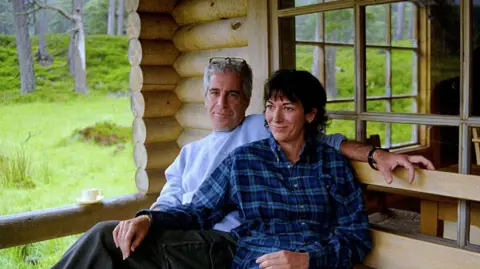
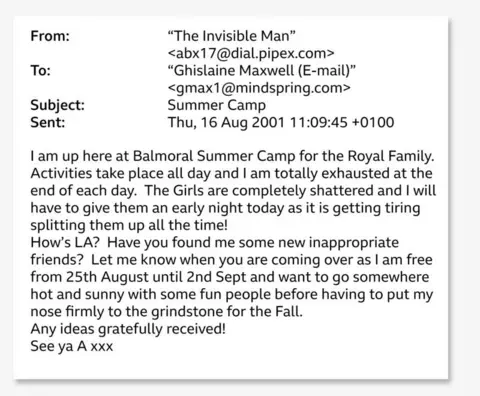
Email exchange between 'A' and Ghislaine Maxwell about 'girls'
Of the thousands of pages included in this latest release, one 2001 email sent by a person identified as "A" stands out.
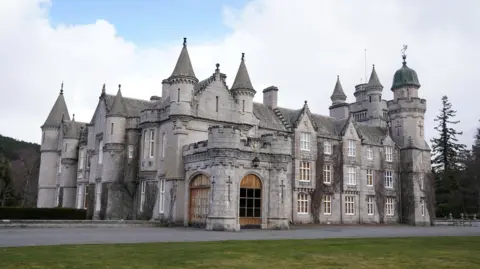
The message, to Epstein's accomplice and close associate Ghislaine Maxwell, says that "A" is at "Balmoral Summer Camp for the Royal Family".
"A" then asks Maxwell, who was sentenced to 20 years in prison in 2022 for sex trafficking of minors and other offences: "Have you found me some new inappropriate friends?"
In another email sent later that day, Maxwell writes back: "So sorry to dissapoint you, however the truth must be told. I have only been able to find appropriate friends."
The "A" email was sent from the address abx17@dial.pipex.com, with the sender's name shown as "The Invisible Man".
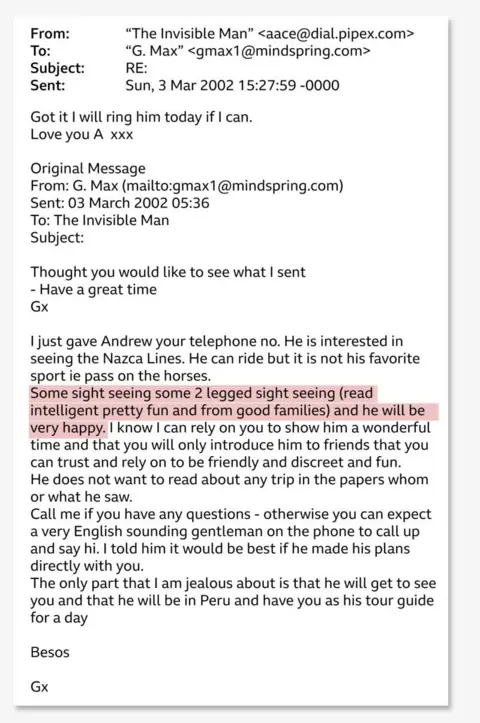
An image from a prior Epstein files release showed a different, but similar email - aace@dial.pipex.com - listed in Epstein's phone book under a contact titled "Duke of York".
Another exchange in the new files between Maxwell and "The Invisible Man" discusses a trip to Peru.
In October, Andrew Mountbatten-Windsor lost use of his Duke of York title following scrutiny over his links with Epstein.
He has repeatedly denied all wrongdoing, and said he did not "see, witness or suspect any behaviour of the sort that subsequently led to his [Epstein's] arrest and conviction".
The BBC has contacted Andrew Mountbatten-Windsor's team for a response.
FBI email lists out 10 alleged co-conspirators to Epstein
US Department of Justice
Among the documents released are emails appearing to be sent between FBI personnel in 2019 that mention 10 possible "co-conspirators" of Epstein.
The emails said six of the 10 co-conspirators had been served with subpoenas. This included three in Florida, one in Boston, one in New York City, and one in Connecticut.
Four subpoenas were yet to be served when the emails were sent, including to one "wealthy businessman in Ohio".
Another email sent to FBI New York gives an update on the co-conspirators. This time it appears to mention multiple names. Most are redacted from the file.
Two names were not redacted – (Ghislaine) Maxwell and Wexner.
An email says, "I do not know about Ohio contacting Wexner".
The email is presumably referring to Former Victoria's Secret CEO Les Wexner, who had a public friendship with Epstein. In 2019, Wexner said he was "embarrassed" by his ties to the financier.
Lawyers for Wexner told BBC News that "the assistant U.S. attorney in charge of the Epstein investigation stated at the time that Mr. Wexner was neither a co-conspirator nor target".
"Mr. Wexner cooperated fully by providing background information on Epstein and was never contacted again," they said.
Possible co-conspirators in Epstein's crimes are a major focus for his victims, and for several lawmakers who have demanded more transparency from the DOJ.
"There's 10 co-conspirators potentially that we knew nothing about that the DOJ had been investigating," Democrat Congressman Suhas Subramanyam told BBC News on Tuesday.
Subramanyam, who sits on the House Oversight Committee, added that he was also "concerned" over the level of redactions that protect names of lawyers and people who are not victims. Lawmakers in both parties have said they are examining legal options to force more transparency.
The law passed by Congress and signed by President Trump states names and information that might be embarrassing or cause "reputational harm" are not allowed to be redacted and specifically asks the justice department for internal communications and memos detailing who was investigated and decisions concerning "to charge, not charge, investigate, or decline to investigate Epstein or his associates".
Justice Department says Epstein letter to Larry Nassar is a fake
Getty Images
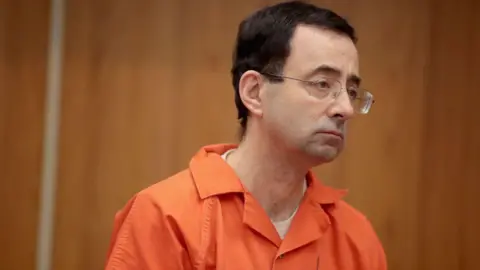
Larry Nassar
A letter included in the released batch of documents got a lot of attention online. But, according to the justice department, it is fake.
The handwritten letter and envelope at first appeared to show Epstein writing to Larry Nassar, the former USA Gymnastics doctor who is serving decades in prison for sexually abusing young female athletes.
"As you know by now I have taken the 'short route' home. Good luck!" the faux letter states. "We shared one thing…our love & caring for young ladies and the hope they'd reach their full potential."
The writer signs it, "Life is unfair, Yours, J. Epstein."
The letter had been deemed undeliverable, and was sent back to a Manhattan jail where Epstein was detained before his death.
The FBI was alerted to the returned letter and requested an analysis of it. That request was also included in the releases batch of documents.
The justice department on Tuesday called the letter a fake, noting several irregularities with the note and the envelope that held it.
"The writing does not appear to match Jeffrey Epstein's," the justice department wrote on X.
"The return address did not list the jail where Epstein was held and did not include his inmate number, which is required for outgoing mail," they added.
Officials pointed out the envelope bore a postmark from northern Virginia - noting that Epstein was detained in New York. It was also postmarked on 13 August 2019, three days after Epstein died.
Even before the justice department's announcement of it being fake, the documents raised immediate questions.
The return sender was listed as "J. Epstein" at "Manhattan Correctional" - but the correct name for the now-shuttered jail was "Metropolitan Correctional Center".
The documents released on Tuesday also show the analysis request by the FBI.
A FBI laboratory request stated that in August 2019, a sender listed as "J. Epstein" at "Manhattan Correctional" tried to send a letter to "Larry Nassar at 9300 S. Wilmot Road, Tucson, Arizona, 85756", the address of a federal prison.
Nassar is currently incarcerated in Pennsylvania, according to the Bureau of Prisons.
Trump's travels aboard Epstein's private jet
Getty Images
Trump's name appears more in these files than in other batches of documents released by the justice department.
Notably, in a January 2020 email, a federal prosecutor in New York wrote that newly received flight records "reflect that Donald Trump traveled on Epstein's private jet many more times than previously has been reported (or that we were aware)".
The recipient of the email was redacted.
Trump was listed as a passenger on "at least eight flights between 1993 and 1996", and Ghislaine Maxwell was present on at least four of those flights, the prosecutor wrote. Trump was also "listed as having traveled with, among others and at various times, Marla Maples, his daughter Tiffany, and his son Eric".
Trump was previously married to Marla Maples, Tiffany's mother, from 1993 to 1999.
The prosecutor also wrote that "on one flight in 1993, he and Epstein are the only two listed passengers; on another, the only three passengers are Epstein, Trump, and then-20-year-old", with the third passenger's name redacted.
"On two other flights, two of the passengers, respectively, were women who would be possible witnesses in a Maxwell case."
The timing of the trips coincide with years in which federal prosecutors were examining Maxwell's conduct and travels as part of the criminal case they brought against her. She was ultimately found guilty of conspiring with Epstein to recruit and sexually abuse minors.
But throughout the files released on Tuesday, many of the other mentions of Trump's name are simply in press clippings mentioning him, his campaigns, and other news moments.
Trump has repeatedly denied wrongdoing in regards to Epstein.
In a statement accompanying Tuesday's release, the Department of Justice said the new files "contain untrue and sensationalist claims made against President Trump that were submitted to the FBI right before the 2020 election".
"To be clear: the claims are unfounded and false, and if they had a shred of credibility, they certainly would have been weaponized against President Trump already," the justice department said.
Fake video of Epstein included
Among one of the odder entries in Tuesday's document drop was a fake video showing an Epstein-like figure in a prison cell, which raised questions of how it had appeared in the department's official files.
Other documents showed that a man from Florida sent an email to federal investigators in March 2021 with a link to the video. He asked if it was real, but it is not.
BBC Verify used a reverse image search to find a copy of the video had been uploaded to YouTube in October 2020. The user who posted it said the clip had been created using 3D graphics.
According to a 2023 report by the Bureau of Prisons, no video recording from inside Epstein's cell on the day of his death exists.
The fake video's inclusion in this release gives a glimpse of the questions that federal authorities have received from the general public, many of whom, having heard conspiracy theories or harboured doubts for years, want answers about Epstein's life and death.
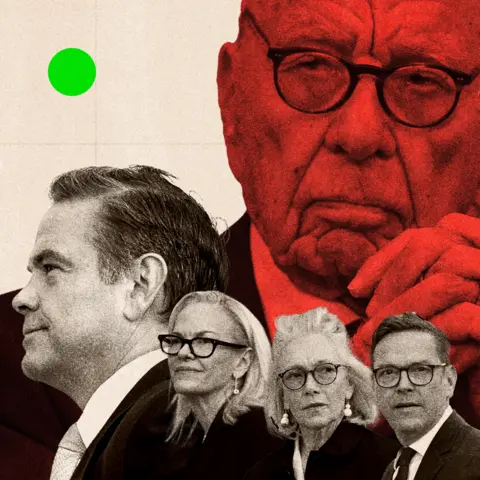
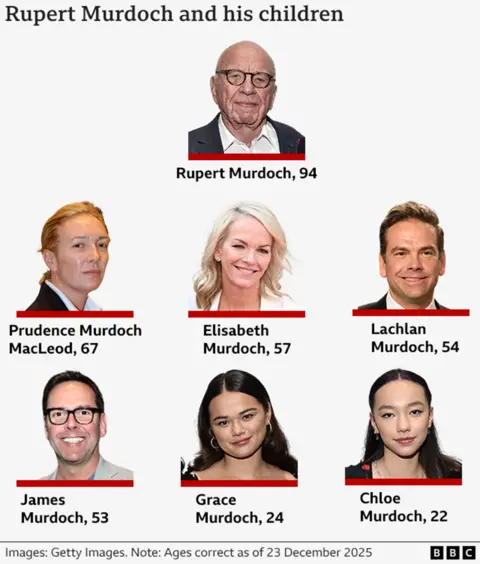
Christmas is a time when families get together if they can - and, until this year, the Murdochs were no different. With members of the media dynasty spread across the globe, full family gatherings were rare, although in 2008, according to biographer Michael Wolff, the Murdochs spent the festive season together on a flotilla of private yachts.
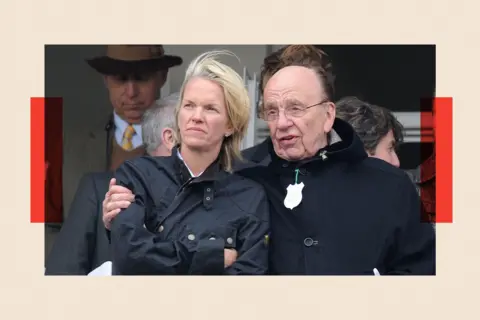
But more often in recent years it was Rupert - for many decades the most influential media titan in the world - and his daughter Elisabeth who would make time for each other.
She would certainly have room this year to host her father at the luxurious home she has renovated on the edge of the Cotswolds. But after a bruising closed-court battle in Nevada that became public and an eventual agreement that shut Elisabeth and two of her siblings out of the family firm for good, relations are likely still too strained for even the Murdoch family peacemaker to suggest communal tree-decorating.
WireImage
Elisabeth Murdoch and two of her siblings, James and Prudence, have been cut out of the family firm
Rupert's eldest child by his second wife, Elisabeth is the co-founder and executive chairman of the production company, Sister, which is behind hit television series, including Black Doves, The Split and This is Going To Hurt. In my experience, she is generous, intelligent and hard-working.
Friends are fiercely loyal and protective of her privacy. Nobody I have spoken to has a bad word to say about her. Many acknowledge, though, that it has been an incredibly testing year on the family front - even if Elisabeth, her younger brother, James, and elder half-sister, Prudence, are each around a billion dollars richer.
Money doesn't compensate for a father who, in his mid-90s, decided to rip his family apart because he believed it was in the interests of his business. The Murdochs have never been a traditional family - one reason why their story is said to have inspired the power struggles and backstabbing in the acclaimed TV drama, Succession. But this time, the schism feels more permanent. And as one person put it to me, the TV show concluded too early by killing off Logan Roy: there was more drama to come.
'James and Rupert will never patch up differences'
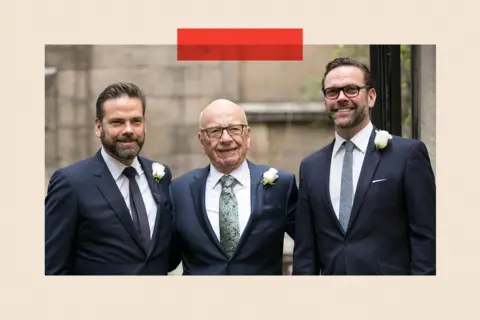
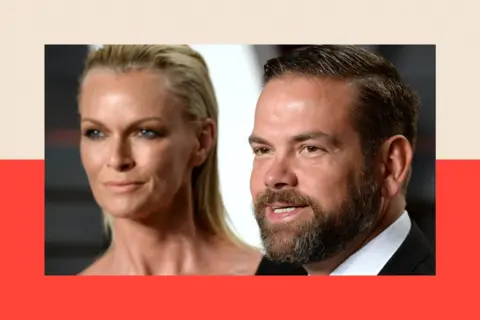
James Murdoch's relationship with his father and older brother Lachlan appears irreconcilable. Earlier this year, he described his dad as a "misogynist" in an interview in US magazine The Atlantic, and referred to some of Rupert's behaviour in the courtroom fight as "twisted".
He is known to feel betrayed and angered by Rupert's decision to force him, Elisabeth and Prudence formally to cut ties with Fox Corp and News Corp. Driven by fears over the more liberal direction they might want the companies to take after his death, the media mogul tried to change the terms of a trust that gave his four oldest children equal control when he dies.
Ron Galella Collection via Getty Images
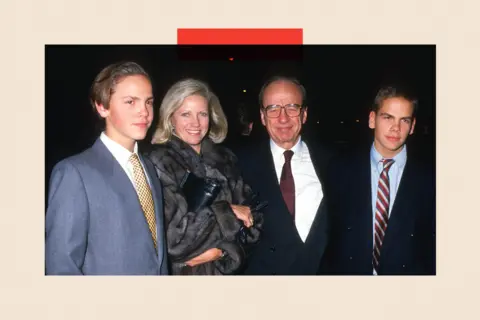
James Murdoch's relationship with his father Rupert and older brother Lachlan now appears irreconcilable (L-R, James Murdoch, Anna Murdoch, Rupert Murdoch and Lachlan Murdoch)
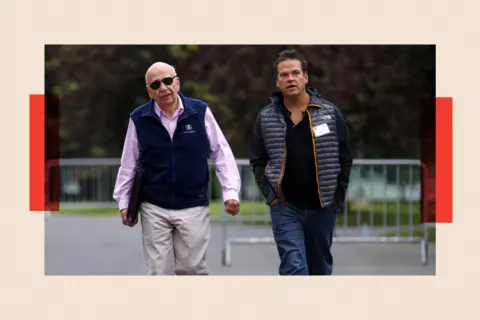
Lachlan, who Rupert had already chosen to run the business, is now - definitively - the only one who will take the reins after his father's demise.
Lachlan and Rupert Murdoch actually lost the first round of their court fight. The trust had been set up in 1999, when Rupert divorced Anna, the mother of Lachlan, Elisabeth and James.
The judge ruled that changing it was in bad faith. But behind the scenes, the warring sides eventually came to an agreement. James, Elisabeth and Prudence agreed to sell their shares. They have accepted terms that include not being allowed to buy any equity in the family company in future.
"It's a sad ending," Claire Atkinson, whose biography of Rupert Murdoch will come out next year, told us on The Media Show.
"These kids worked in the business, they grew up in the business, and the press release said, 'You can't buy shares in this company,' and effectively said, 'Don't let the door hit you on the way out.'"
She also told me: "This break is extremely permanent. It feels like James and Rupert will never patch up their differences."
Lachlan Murdoch has been quoted as saying that the resolution is "good news for investors" and "gives us clarity about our strategy going forward".
Ironically, his successful leadership of Fox Corp, where he's been CEO since 2019 (he became chairman of Fox and also News Corp in 2023 when his father became chairman emeritus), made the deal more costly.
Getty Images
Media journalist Claire Atkinson says the family rift involving Lachlan (left), Rupert (centre) and James (right) feels "permanent"
Fox Corp has seen its share price double under Lachlan and the Trump presidency has brought a ratings bonanza. It raised the amount he had to pay his siblings to get them out - a presumably unwelcome side effect.
Despite the payout, Atkinson says, "There is a fracture in the company and a fracture in the family."
So where do the Murdochs go from here, privately and corporately?
Court battles, rifts and an ageing patriarch
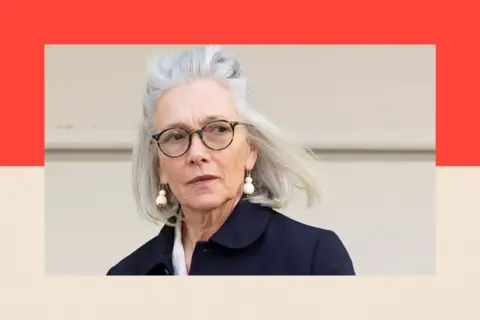
Elisabeth and her half-sister Prudence are said to be concentrating on moving on.
Their father turned 94 in March, with the court battle in full swing. The sisters are mindful that he won't be around forever and I am told they are hoping at some point to repair the rift.
Reuters
Prudence Murdoch and her half-sister Elisabeth are said to be focused on moving on from the dispute
However much they have felt betrayed by him (and there is no doubt, they have felt it, very painfully), there's an understanding of the dwindling number of years he has left.
But Christmas may still be too soon for reconciliation. Lachlan hosted his annual party for the Australian elite at his harbour-side Sydney home earlier this month. Fox Corp may operate out of the US, but he is said to prefer the laid-back nature of Australian life, even if the trade-off is business calls in the middle of the night because of the time difference, as well as a lot of flights.
Atkinson says he is popular and well-liked within the business. "The difficulty that Lachlan has is that he's been in charge for years, but everybody is always going to project that every decision is Rupert's. He's never going to want to say, 'Hey, that's me,' and so I think it's a little hard to come out from Dad's shadow."
At the same time, Rodney Benson, professor of media, culture, and communication at New York University, says that while Rupert remains a presence in the company "what's really unique about Lachlan's approach, or what will be unique about his approach, won't fully emerge".
Lachlan's 'business over politics' strategy
Fox News is the financial cash cow, which may explain Rupert Murdoch's concerns that his children might have wanted to change its political affiliations.
Under Lachlan, there's been a successful strategy to expand into digital and streaming, most notably the ad-supported video-on-demand service, Tubi.
In September, US President Donald Trump said Rupert and Lachlan Murdoch were expected to be part of a group of investors trying to buy TikTok in the US. On Thursday, TikTok parent company ByteDance announced to staff that it had signed an agreement to sell a portion of TikTok to a group of mostly US based investors. Lachlan and Rupert were not named as part of the deal.
Reuters
Under Lachlan Murdoch's leadership, the company has pursued a strategy centred on digital and streaming growth
Presenting the Fox Corporation's results for July to September, Lachlan said Tubi had achieved rapid revenue growth and growth in view time, confirming its position as the top premium advertising-based video-on-demand platform in the US.
"And I'm happy to say Tubi reached profitability this past quarter," he added. "It's a great milestone."
He also said Fox News had maintained strong ratings throughout the quarter, cementing its status as the most-watched cable network in prime time, and leading to the highest advertising revenue for July-September quarter in Fox's history.
Rupert Murdoch's 70-year career saw him as "both an interventionist editor-in-chief figure and a political kingmaker", according to Paddy Manning, an investigative journalist who wrote The Successor: The High-Stakes Life of Lachlan Murdoch. But he adds, "Lachlan is less of the journalist and powerbroker than his father, and more of a businessman.
Getty Images
Author Paddy Manning says Lachlan is "less of a journalist and powerbroker than his father, and more of a businessman"
"If you look at the signature deals that Lachlan has made over his career, they have not been designed to increase his political influence. From digital real estate to sports betting to commercial radio to Tubi, Lachlan's investment decisions are focused on the bottom line, not burnishing his political credentials."
But Prof Benson suggests the significant debt the Murdoch businesses have taken on as part of the settlement with Lachlan's siblings increases pressure to make profit, and therefore to pursue "politically sensationalistic… outrage journalism".
"The proven way to be profitable in cable/streaming news is not by becoming more centrist and civil, it's by becoming more extreme, more polarising, and more willing to stir outrage," he says.
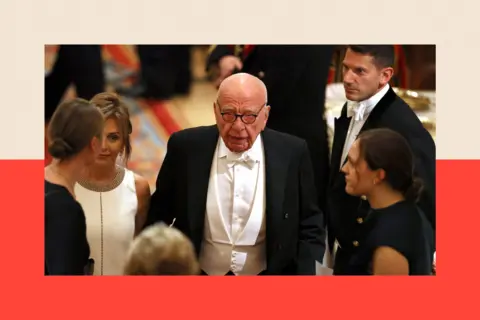
Rupert has had a hotline to major political figures for decades. In September he was on President Trump's guestlist for the state banquet at Windsor Castle. I'm told he spent nearly two weeks in London and was in the News UK office most days.
While Lachlan now runs the company, his father is still very much involved. Rupert's been described to me, at 94, as still "the sharpest person in the room" and a "phenomenon who loves papers and has ink in his veins". His voice may be a little softer, but he is mentally as strong and influential as ever, I'm told.
AFP via Getty Images
Rupert Murdoch recently attended a state banquet at Windsor Castle as a guest of US President Donald Trump
At one point the editor of the Times introduced Rupert to a slightly startled young journalist on the newsdesk and asked him to show the boss the paper's recently launched Live app and what it showed around reader engagement on specific stories.
Rupert also spoke to Fraser Nelson, the former Spectator editor now Times columnist, who usually sits at the open plan table in the office. They discussed the company's pivot to video and the work Nelson had been trialling around short form video. Rupert also wanted to talk to his paper's new star about whether Nigel Farage would end up in government.
A family 'deeply divided'
Three months on from the family trust dispute settlement, Mr Manning claims that the Murdochs are "deeply divided".
"While Lachlan works closely with his father, I understand he remains estranged from his elder siblings," he alleges.
Rupert Murdoch and his children Lachlan, James, Elisabeth and Prudence were all approached for comment.
Presciently, Anna Murdoch - Lachlan, James and Elisabeth's mother - predicted much of the fallout back in the 1980s.
In her novel Family Business, Anna, a journalist and author, wrote about the rise of a fictional newspaper dynasty and explored sibling rivalry, jealousy and how parental power can negatively impact family relationships. The plot of the book, published while her children were in their teens, follows how a newspaper owner's children are shaped by a parent who turns them into competitors in a power struggle.
Getty Images
Anna Murdoch, the mother of Lachlan, James and Elisabeth, warned that family divisions could emerge (L - R, Lachlan, James, Rupert, Elisabeth and Anna)
A decade after it was published - by which time the pair had divorced and Rupert had married third wife Wendy Deng - Anna gave an interview to an Australian women's magazine, during which she was asked which of her children would be best suited to take over from her ex-husband.
"Actually I'd like none of them to," she said. "I think they're all so good that they could do whatever they wanted really. But I think there's going to be a lot of heartbreak and hardship with this [succession]. There's been such a lot of pressure that they needn't have had at their age."
The family trust, agreed between Rupert and Anna as part of their divorce settlement, was her way of safeguarding her children's futures, by ensuring they had equality after Rupert's death. But that blew up - through a court fight in Nevada and a settlement.
And with that, relations with three of his six children may have blown up too - perhaps for good.
Top picture credits: Getty Images and Reuters
BBC InDepth is the home on the website and app for the best analysis, with fresh perspectives that challenge assumptions and deep reporting on the biggest issues of the day. You can now sign up for notifications that will alert you whenever an InDepth story is published - click here to find out how.
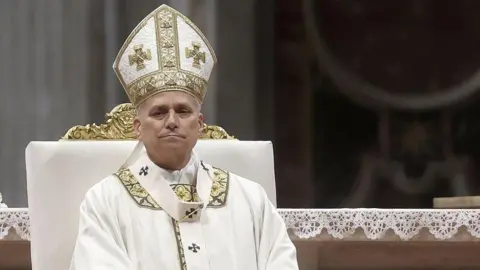
Pope Leo has criticised the Trump administration's immigration policy
Jesse Romero, a conservative Catholic podcaster, has some choice words for Pope Leo XIV.
"The Pope should tell us how to get to heaven," says Romero. "He has no authority over the government; he has to stay in his lane."
As a Donald Trump supporter, he is angry about criticism made by the American-born Pope and US bishops about his mass deportation policy.
With one in five Americans identifying as Catholic, the Church plays an important role in American life - and politics.
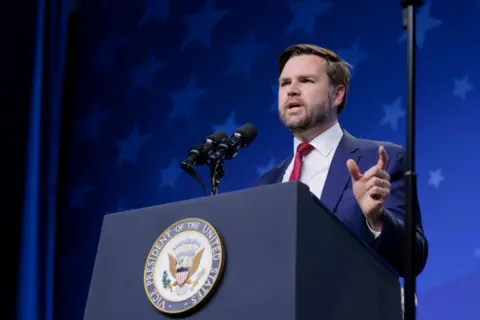
Catholics like Vice President JD Vance, and influential legal activist Leonard Leo, were an important part of Donald Trump's electoral success. They are at the heart of the cabinet too, with Secretary of State Marco Rubio, and Education Secretary Linda McMahon holding key offices.
But the issue of immigration has become a faultline between Church leadership and the government, as well as amongst parishioners themselves.
When cardinals gathered at the papal conclave in May, Romero had hoped for a "Trump-like Pope," with a similar outlook to the president.
Instead, Pope Leo XIV has spoken repeatedly about his concerns over how migrants are treated in the US, calling for "deep reflection" on the matter in November. The pontiff evoked the gospel of Matthew, adding that "Jesus says very clearly, at the end of the world, we're going to be asked, 'How did you receive the foreigner?"
A week later the United States Conference of Catholic Bishops (USCCB), issued a rare "Special Message" voicing their "concern for the evolving situation impacting immigrants in the United States".
The bishops said they were "disturbed" at what they called "a climate of fear and anxiety". They added that they "oppose the indiscriminate mass deportation of people" and "pray for an end to dehumanizing rhetoric and violence".
It was a significant intervention, the first time the USCCB had used such a communique in a dozen years. It was backed by the Pope, who called the statement "very important" and urged all Catholics and "people of goodwill, to listen carefully" to it.
Getty Images
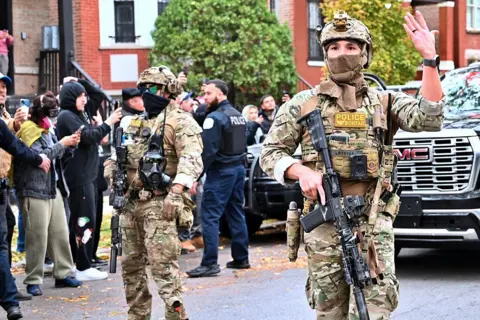
Chicago has been a focus of the Trump administration's immigration enforcement
Picking a fight with the Pope
"I think the relationship is quite tense," says David Gibson, director of Fordham University's Center on Religion and Culture.
Conservatives had hoped that Pope Leo would bring a change from his predecessor Pope Francis's focus on issues of social justice and migration, according to Gibson.
"Many of them are angry. They want to tell the church to shut up," and to confine itself to issues such as abortion, Mr Gibson says.
White House border czar, Tom Homan - himself a Catholic - has said that the Church "is wrong", and that its leaders "need to spend time fixing the Catholic Church". And in October, the White House Press Secretary Karoline Leavitt rejected the Chicago born Pope's suggestion that US treatment of immigrants was "inhuman" and not in line with "pro-life" beliefs.
Gibson argues that the government's calculation "is that there are enough American Catholics, especially white American Catholics, who support the Republican Party and Donald Trump, that it's politically beneficial at the end of the day to pick a fight with the Pope. That's an unprecedented calculus."
Nearly 60% of white Catholics approve of how Trump is handling immigration, according to a new study by the think tank the Public Religion Research Institute. That figure is around 30% for Hispanics, who are 37% of the US Catholic population.
Getty Images
US Vice President JD Vance has been vocal about how his Catholic faith has influenced his politics
The growing power and prominence of right-wing Catholics in the political sphere is exemplified by JD Vance, a convert to the religion who says his politics are shaped by his faith. Although he has argued that current policy is not at odds with Church teaching, he has also said that there is a responsibility to remember the humanity of people who are in the country illegally.
But some Catholics say that is not what is currently happening. Jeanne Rattenbury is a parishioner at St Gertrude Catholic Church in Chicago. The city has been a focus of the Trump administration's immigration enforcement.
In November, Ms Rattenbury took part in a 2,000 strong celebration of Mass outside an ICE detention centre in the Broadview neighbourhood of Chicago. The "People's Mass" was one of a series of actions by the Coalition for Spiritual and Public Leadership (CSPL). The goal, she says, "was to bring Communion to people inside, to minister to them, which is something that used to be allowed and is not being allowed".
The CSPL has now filed a federal lawsuit alleging it was blocked from providing religious ministry.
"I am proud to be a Catholic when the Catholic Church, from the Pope to the bishops, are saying immigrants have a right to be treated with respect. They have a right to have their inherent human dignity respected", Ms Rattenbury says.
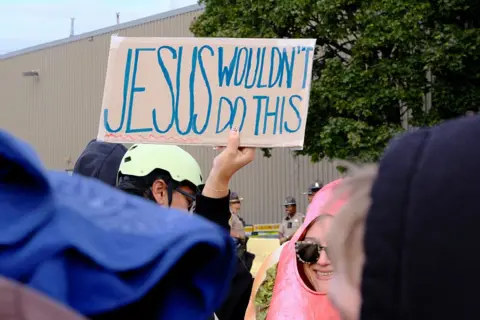
Such is the strength of feeling that a church near Boston has used its Christmas nativity scene to make the point that Jesus was a refugee.
St Susanna Parish in Dedham, Massachusetts, replaced baby Jesus with a hand-painted notice saying "ICE was here".
Some in the community have complained, and the Catholic Archdiocese of Boston ordered that the display be removed, saying it was divisive and contravened rules on sacred objects. So far, the church has not done so.
While many US Catholics maintain conservative positions on issues such as abortion, in line with that of the Church, they are also more likely to see themselves as progressive than white evangelical Christians, who overwhelmingly voted Republican in the last three elections. Around a third of white Catholics on the other hand have consistently voted for the Democratic Party.
And nearly a third of Catholics in the US were born in other countries. "This is a church that was built on immigration," says David Gibson. "The Catholic brand in the United States is an immigrant church."
Getty Images
Clergy say they have been blocked from giving Eucharist to migrants at an Illinois detention facility
'Inconsistent with the Gospel'
Bishop Joseph Tyson of Yakima, Washington State, was one of the 216 who supported the USCCB's Special Message. Just five bishops voted against it and three abstained.
"There's a fundamental disagreement of how the church sees immigrants in our parishes, from how the current administration views immigrants.
"We see a lot more positives in those immigrants."
He says he is not arguing for open borders, a point that Pope Leo has also made, but is against "indiscriminate deportation".
"The deportations we are seeing of our parishioners and of our people in the United States [are] not surgical, [or] targeted to criminals," the bishop says.
He estimates that around half of the families in his predominantly Hispanic diocese have someone in their household facing some sort of issue with their immigration status. Priests too are often immigrants themselves, putting the Church in an increasingly tenuous position.
Bishop Tyson says that more than a third of clergy he has ordained have at some point been on a temporary visa before gaining a green card, a process that in the current climate can feel precarious.
"I have a seminarian in the Chicago area. He's on a T-visa, but [ICE] showed up, and he was afraid that he was going to be picked up," he said.
"Anybody can have their paperwork revoked, [so] we have our men carrying their papers with them at all times."
Bishop Tyson argues that current US policy goes against Catholic teaching.
"It should weigh heavily on the consciences of Catholics in public life who support indiscriminate deportation. It is inconsistent with the Gospel of Life."
For Jesse Romero though, it is US bishops and the Pope who are going against Catholic doctrine. He argues the Catechism is clear that immigrants should keep to all laws, including those about whether they should be in the country.
"We have a large swath of bishops in the Catholic Church of America that have a more modernist, liberal, progressive view of Scripture and theology."
Romero says he prays for their conversion. While he accepts the Pope and the bishops as leaders of the faith, "it doesn't mean that in their private opinions, they're going to get everything right. They're men".
"The only person that is sinless is Jesus. He's perfect. Everybody else, we've got to pray for each other."
Police officers standing guard in Moscow (file photo)
Three people - including two police officers - have been killed in an explosion in Moscow, Russian authorities have said.
Two traffic police officers saw a "suspicious individual" near a police car on the city's Yeletskaya Street, and when they approached the suspect to detain him, an explosive device was detonated, Russia's Investigative Committee has said.
The two police officers died from their injuries, along with another individual who was standing nearby.
The attack comes two days after a senior Russian general was killed in a car bombing in the capital on Monday.
Lt Gen Fanil Sarvarov died after an explosive device - which had been planted under a car - was detonated.
Investigate Committee spokesperson Svetlana Petrenko said in a statement on Telegram that a criminal case was being investigated in Moscow "regarding an attempt on the lives of traffic police officers".
This breaking news story is being updated and more details will be published shortly. Please refresh the page for the fullest version.
You can receive Breaking News on a smartphone or tablet via the BBC News App. You can also follow @BBCBreaking on X to get the latest alerts.
Zelensky said the 20 points agreed with the Americans offered Ukraine security guarantees that mirrored Nato membership
Ukraine's President Volodymyr Zelensky has given details of an updated peace plan that offers Russia the potential withdrawal of Ukrainian troops from the east that Moscow has demanded.
Giving details of the 20-point plan agreed by US and Ukrainian negotiators in Florida at the weekend, Zelensky said the Russians would give their response once the Americans had spoken to them.
Describing the plan as "the main framework for ending the war" Zelensky said it proposed security guarantees from the US, Nato and Europeans for a co-ordinated military response if Russia invaded Ukraine again.
On the key question of Ukraine's eastern Donbas, Zelensky said a "free economic zone" was a potential option.
The 20-point plan is seen as an update of an original 28-point document, agreed by US envoy Steve Witkoff with the Russians several weeks ago, which was widely seen as heavily geared towards the Kremlin's demands.
The Russians have insisted that Ukraine pulls out of almost a quarter of its own territory in the eastern Donetsk region in return for a peace deal. The rest is already under Russian occupation.
Zelensky told journalists that as Ukraine was against withdrawal, US negotiators were looking to establish a demilitarised zone or a free economic zone.
He said: "There are two options: either the war continues, or something will have to be decided regarding all potential economic zones."
He emphasised that an economic zone would also have to be set up around the Zaporizhzhia nuclear power plant currently occupied by Russia, and that Russian troops would have to pull out of four other Ukrainian regions - Dnipropetrovsk, Mykolaiv, Sumy, and Kharkiv.
Watch: The BBC reports on the latest Epstein file release
The US Department of Justice released its latest - and largest - tranche of Jeffrey Epstein files on Tuesday.
The 11,000-plus documents continue a stream of released information that began on Friday, the deadline mandated in a new law that required the department to publicly release all of its investigative files into the deceased paedophile and financier.
Many of the documents released on Tuesday are redacted with names and information blacked out, including names of people who the FBI appears to cite as possible co-conspirators in the Epstein case.
The justice department is facing criticism from lawmakers on both sides of the political aisle over the amount of redactions, which the law specifically states can only be done to protect the identity of victims or active criminal investigations.
President Donald Trump's name appeared more in these new documents than in previous releases. Many were media clippings that mention him, but one notable email from a federal prosecutor indicated Trump flew on Epstein's jet.
The justice department said some files "contain untrue and sensationalist claims" about Trump.
Being mentioned in the Epstein files does not indicate wrongdoing. BBC has requested comment from individuals named in our reporting.
Email exchange between 'A' and Ghislaine Maxwell about 'girls'
Of the thousands of pages included in this latest release, one 2001 email sent by a person identified as "A" stands out.
The message, to Epstein's accomplice and close associate Ghislaine Maxwell, says that "A" is at "Balmoral Summer Camp for the Royal Family".
"A" then asks Maxwell, who was sentenced to 20 years in prison in 2022 for sex trafficking of minors and other offences: "Have you found me some new inappropriate friends?"
In another email sent later that day, Maxwell writes back: "So sorry to dissapoint you, however the truth must be told. I have only been able to find appropriate friends."
The "A" email was sent from the address abx17@dial.pipex.com, with the sender's name shown as "The Invisible Man".
An image from a prior Epstein files release showed a different, but similar email - aace@dial.pipex.com - listed in Epstein's phone book under a contact titled "Duke of York".
Another exchange in the new files between Maxwell and "The Invisible Man" discusses a trip to Peru.
In October, Andrew Mountbatten-Windsor lost use of his Duke of York title following scrutiny over his links with Epstein.
He has repeatedly denied all wrongdoing, and said he did not "see, witness or suspect any behaviour of the sort that subsequently led to his [Epstein's] arrest and conviction".
The BBC has contacted Andrew Mountbatten-Windsor's team for a response.
FBI email lists out 10 alleged co-conspirators to Epstein
US Department of Justice
Among the documents released are emails appearing to be sent between FBI personnel in 2019 that mention 10 possible "co-conspirators" of Epstein.
The emails said six of the 10 co-conspirators had been served with subpoenas. This included three in Florida, one in Boston, one in New York City, and one in Connecticut.
Four subpoenas were yet to be served when the emails were sent, including to one "wealthy businessman in Ohio".
Another email sent to FBI New York gives an update on the co-conspirators. This time it appears to mention multiple names. Most are redacted from the file.
Two names were not redacted – (Ghislaine) Maxwell and Wexner.
An email says, "I do not know about Ohio contacting Wexner".
The email is presumably referring to Former Victoria's Secret CEO Les Wexner, who had a public friendship with Epstein. In 2019, Wexner said he was "embarrassed" by his ties to the financier.
Lawyers for Wexner told BBC News that "the assistant U.S. attorney in charge of the Epstein investigation stated at the time that Mr. Wexner was neither a co-conspirator nor target".
"Mr. Wexner cooperated fully by providing background information on Epstein and was never contacted again," they said.
Possible co-conspirators in Epstein's crimes are a major focus for his victims, and for several lawmakers who have demanded more transparency from the DOJ.
"There's 10 co-conspirators potentially that we knew nothing about that the DOJ had been investigating," Democrat Congressman Suhas Subramanyam told BBC News on Tuesday.
Subramanyam, who sits on the House Oversight Committee, added that he was also "concerned" over the level of redactions that protect names of lawyers and people who are not victims. Lawmakers in both parties have said they are examining legal options to force more transparency.
The law passed by Congress and signed by President Trump states names and information that might be embarrassing or cause "reputational harm" are not allowed to be redacted and specifically asks the justice department for internal communications and memos detailing who was investigated and decisions concerning "to charge, not charge, investigate, or decline to investigate Epstein or his associates".
Justice Department says Epstein letter to Larry Nassar is a fake
Getty Images
Larry Nassar
A letter included in the released batch of documents got a lot of attention online. But, according to the justice department, it is fake.
The handwritten letter and envelope at first appeared to show Epstein writing to Larry Nassar, the former USA Gymnastics doctor who is serving decades in prison for sexually abusing young female athletes.
"As you know by now I have taken the 'short route' home. Good luck!" the faux letter states. "We shared one thing…our love & caring for young ladies and the hope they'd reach their full potential."
The writer signs it, "Life is unfair, Yours, J. Epstein."
The letter had been deemed undeliverable, and was sent back to a Manhattan jail where Epstein was detained before his death.
The FBI was alerted to the returned letter and requested an analysis of it. That request was also included in the releases batch of documents.
The justice department on Tuesday called the letter a fake, noting several irregularities with the note and the envelope that held it.
"The writing does not appear to match Jeffrey Epstein's," the justice department wrote on X.
"The return address did not list the jail where Epstein was held and did not include his inmate number, which is required for outgoing mail," they added.
Officials pointed out the envelope bore a postmark from northern Virginia - noting that Epstein was detained in New York. It was also postmarked on 13 August 2019, three days after Epstein died.
Even before the justice department's announcement of it being fake, the documents raised immediate questions.
The return sender was listed as "J. Epstein" at "Manhattan Correctional" - but the correct name for the now-shuttered jail was "Metropolitan Correctional Center".
The documents released on Tuesday also show the analysis request by the FBI.
A FBI laboratory request stated that in August 2019, a sender listed as "J. Epstein" at "Manhattan Correctional" tried to send a letter to "Larry Nassar at 9300 S. Wilmot Road, Tucson, Arizona, 85756", the address of a federal prison.
Nassar is currently incarcerated in Pennsylvania, according to the Bureau of Prisons.
Trump's travels aboard Epstein's private jet
Getty Images
Trump's name appears more in these files than in other batches of documents released by the justice department.
Notably, in a January 2020 email, a federal prosecutor in New York wrote that newly received flight records "reflect that Donald Trump traveled on Epstein's private jet many more times than previously has been reported (or that we were aware)".
The recipient of the email was redacted.
Trump was listed as a passenger on "at least eight flights between 1993 and 1996", and Ghislaine Maxwell was present on at least four of those flights, the prosecutor wrote. Trump was also "listed as having traveled with, among others and at various times, Marla Maples, his daughter Tiffany, and his son Eric".
Trump was previously married to Marla Maples, Tiffany's mother, from 1993 to 1999.
The prosecutor also wrote that "on one flight in 1993, he and Epstein are the only two listed passengers; on another, the only three passengers are Epstein, Trump, and then-20-year-old", with the third passenger's name redacted.
"On two other flights, two of the passengers, respectively, were women who would be possible witnesses in a Maxwell case."
The timing of the trips coincide with years in which federal prosecutors were examining Maxwell's conduct and travels as part of the criminal case they brought against her. She was ultimately found guilty of conspiring with Epstein to recruit and sexually abuse minors.
But throughout the files released on Tuesday, many of the other mentions of Trump's name are simply in press clippings mentioning him, his campaigns, and other news moments.
Trump has repeatedly denied wrongdoing in regards to Epstein.
In a statement accompanying Tuesday's release, the Department of Justice said the new files "contain untrue and sensationalist claims made against President Trump that were submitted to the FBI right before the 2020 election".
"To be clear: the claims are unfounded and false, and if they had a shred of credibility, they certainly would have been weaponized against President Trump already," the justice department said.
Fake video of Epstein included
Among one of the odder entries in Tuesday's document drop was a fake video showing an Epstein-like figure in a prison cell, which raised questions of how it had appeared in the department's official files.
Other documents showed that a man from Florida sent an email to federal investigators in March 2021 with a link to the video. He asked if it was real, but it is not.
BBC Verify used a reverse image search to find a copy of the video had been uploaded to YouTube in October 2020. The user who posted it said the clip had been created using 3D graphics.
According to a 2023 report by the Bureau of Prisons, no video recording from inside Epstein's cell on the day of his death exists.
The fake video's inclusion in this release gives a glimpse of the questions that federal authorities have received from the general public, many of whom, having heard conspiracy theories or harboured doubts for years, want answers about Epstein's life and death.
Thierry Breton, the former top tech regulator at the European Commission, has clashed with Elon Musk in the past
The US State Department said it would deny visas to five people, including a former EU commissioner, for seeking to "coerce" American social media platforms into suppressing viewpoints they oppose.
"These radical activists and weaponized NGOs have advanced censorship crackdowns by foreign states - in each case targeting American speakers and American companies," Secretary of State Marco Rubio said in a statement.
Thierry Breton, the former top tech regulator at the European Commission, suggested that a "witch hunt" was taking place.
Breton was described by the State Department as the "mastermind" of the EU's Digital Services Act (DSA), which imposes content moderation on social media companies.
However, it has angered some US conservatives who see it as seeking to censor right-wing opinions. Brussels denies this.
Breton has clashed with Elon Musk, the world's richest man and owner of X, over obligations to follow EU rules.
The European Commission recently fined X €120m (£105m) over its blue tick badges - the first fine under the DSA. It said the platform's blue tick system was "deceptive" because the firm was not "meaningfully verifying users".
In response, Musk's site blocked the Commission from making adverts on its platform.
Reacting to the visa ban, Breton posted on X: "To our American friends: Censorship isn't where you think it is."
Clare Melford, who leads the UK-based Global Disinformation Index (GDI), was also listed.
US Undersecretary of State Sarah B Rogers accused the GDI of using US taxpayer money "to exhort censorship and blacklisting of American speech and press".
A GDI spokesperson told the BBC that "the visa sanctions announced today are an authoritarian attack on free speech and an egregious act of government censorship".
"The Trump Administration is, once again, using the full weight of the federal government to intimidate, censor, and silence voices they disagree with. Their actions today are immoral, unlawful, and un-American."
Imran Ahmed of the Center for Countering Digital Hate (CCDH), a nonprofit that fights online hate and misinformation, was also handed a ban.
Rogers called Mr Ahmed a "key collaborator with the Biden Administration's effort to weaponize the government against US citizens".
Also subject to bans were Anna-Lena von Hodenberg and Josephine Ballon of HateAid, a German organisation that the State Department said helped enforce the DSA.
The BBC has reached out to the CCDH and HateAid for comment.
Rubio said that steps had been taken to impose visa restrictions on "agents of the global censorship-industrial complex who, as a result, will be generally barred from entering the United States".
"President Trump has been clear that his America First foreign policy rejects violations of American sovereignty. Extraterritorial overreach by foreign censors targeting American speech is no exception," he added.
Watch: First responders at scene of Pennsylvania nursing home explosion
Multiple people are reported to be injured following an explosion and fire at a nursing home in Bristol, Pennsylvania, officials say.
Emergency crews were called to the Silver Lake Nursing Home at about 14:00 local time (19:00GMT) on Tuesday. Firefighters believe some people may still be trapped inside the building.
An emergency management official told CBS, the BBC's US partner, that the fire remains active and part of the structure has collapsed. It's not clear how many people are injured, and the cause of explosion is still under investigation.
Images and videos posted on social platforms by local media outlets show a partially collapsed building with massive flames billowing out of it.
Local utility provider PECO said its crews had responded to reports of a gas odour at the facility in Bristol Township in the afternoon.
While they were on site, an explosion occurred, a company spokesperson said. Natural gas and electric service to the building were subsequently shut off.
Pennsylvania Governor Josh Shapiro offered his prayers for the community and said he was in contact with local officials and first responders on the scene.
Congressman Brian Fitzpatrick urged people to avoid the area.
"My team and I are in direct communication with local officials and emergency responders, and we are closely monitoring developments as authorities work to secure the scene," he wrote on X.
This is a developing story. Please check back for updates.
Zelensky said the 20 points agreed with the Americans offered Ukraine security guarantees that mirrored Nato membership
Ukraine's President Volodymyr Zelensky has given details of an updated peace plan that offers Russia the potential withdrawal of Ukrainian troops from the east that Moscow has demanded.
Giving details of the 20-point plan agreed by US and Ukrainian negotiators in Florida at the weekend, Zelensky said the Russians would give their response once the Americans had spoken to them.
Describing the plan as "the main framework for ending the war" Zelensky said it proposed security guarantees from the US, Nato and Europeans for a co-ordinated military response if Russia invaded Ukraine again.
On the key question of Ukraine's eastern Donbas, Zelensky said a "free economic zone" was a potential option.
The 20-point plan is seen as an update of an original 28-point document, agreed by US envoy Steve Witkoff with the Russians several weeks ago, which was widely seen as heavily geared towards the Kremlin's demands.
The Russians have insisted that Ukraine pulls out of almost a quarter of its own territory in the eastern Donetsk region in return for a peace deal. The rest is already under Russian occupation.
Zelensky told journalists that as Ukraine was against withdrawal, US negotiators were looking to establish a demilitarised zone or a free economic zone.
He said: "There are two options: either the war continues, or something will have to be decided regarding all potential economic zones."
He emphasised that an economic zone would also have to be set up around the Zaporizhzhia nuclear power plant currently occupied by Russia, and that Russian troops would have to pull out of four other Ukrainian regions - Dnipropetrovsk, Mykolaiv, Sumy, and Kharkiv.
Venezuela has accused the United States of the "greatest extortion" at an emergency session of the UN Security Council in New York.
Washington's seizure of two Venezuelan oil tankers was "worse than piracy," the Venezuelan ambassador to the UN said.
The emergency meeting of the Security Council was called to discuss the seizure of the tankers, which took place off the coast of Venezuela earlier this month.
The US has also said it was pursuing a third Venezuelan oil tanker.
President Trump has accused Venezuela's President Nicolas Maduro of leading a drugs cartel and said gangs had operated with impunity for too long.
On 16 December, Trump ordered a naval blockade of all sanctioned oil tankers entering and leaving Venezuela. The US president has said the US will keep or sell the crude oil contained on tankers it has seized, as well as the vessels themselves.
The US has deployed 15,000 troops and a range of aircraft carriers, guided-missile destroyers, and amphibious assault ships to the Caribbean.
The stated aim of the deployment - the largest to the region since the US invaded Panama in 1989 - is to stop the flow of fentanyl and cocaine to the US.
The US has also targeted more than 20 vessels in the Pacific and the Caribbean in recent months, killing at least 90 people, as part of President Trump's campaign against gangs he accuses of transporting drugs in the region.
Some experts say the strikes could violate laws governing armed conflict.
Venezuela's envoy to the UN said the US was subjecting his country to the "greatest extortion" in its history.
Speaking at the UN Security Council meeting on Tuesday, Samuel Moncada said "we are in the presence of a power that acts outside of international law, demanding that Venezuelans vacate our country and hand it over."
Regarding the US seizure of Venezuelan oil, he added: "We are talking about pillaging, looting and recolonisation of Venezuela.
"The government of the United States does not have jurisdiction in the Caribbean."
Referring to the Venezuelan oil industry, he said: "What does that have to do with drugs?"
In response, the US Ambassador to the UN, Michael Waltz, told the Security Council the US does not recognise Mr Maduro as the legitimate leader of Venezuela.
"Maduro's ability to sell Venezuela's oil enables his fraudulent claims to power and his narco-terrorist activities," Mr Waltz said.
On a visit to a trade fair in Caracas, President Maduro said "the Security Council is giving overwhelming support to Venezuela."
Russia and China accused the US of bullying and aggression.
The US was "illegally destroying" civilian vessels in the Caribbean Sea, the Russian ambassador to the UN, Vassily Nebenzia, told the UN meeting.
He warned that other countries could be next.
The US actions against Venezuelan vessels, he said, were "a template for future acts of force against Latin American states."
Meanwhile, China's envoy to the UN, Sun Lei, called on the US to "immediately halt relevant actions and avoid further escalation of tensions."
Ukraine's police evacuation group White Angels evacuates civilians from the village of Krasnopillya in Sumy region
Fifty-two residents of a Ukrainian village have been taken to Russia by invading forces in a cross-border raid on the village of Hrabovske, authorities in Kyiv say. Thirteen Ukrainian soldiers were also captured in the border village in the northeastern Sumy region.
The attack occurred at night on Saturday, when about 100 Russian troops attacked the village, said Viktor Trehubov, a spokesman for Ukraine's military Joint Forces Task Force.
The civilians were first rounded up in a church and then taken across the border to Russia, he told the BBC.
It was unusual for invading forces to take civilians to Russia before establishing a firm presence in occupied territory, he added.
Russia has so far not commented on the fate of civilians from Hrabovske, but reports from Ukraine indicate they may have been taken to Belgorod, a major regional centre about 50 miles (80 km) inside Russia.
"My friends' mother has been taken there. There is no way of contacting her even though they tried," said Volodymyr Bitsak, a member of the Sumy regional council. "As far as I know, they've been taken to the city of Belgorod and are being held at an unknown location."
Lt-Col Trehubov told the BBC on Tuesday evening that fighting was still ongoing in the southern part of Hrabovske, but Deep State, a Ukrainian website monitoring the battlefield situation, said later that the village had been captured by Russian forces.
The defence ministry in Moscow said on Tuesday that Ukrainian forces had been "hit" at Hrabovske and several other villages in Sumy region.
Meanwhile, in the eastern region of Donetsk, the Ukrainian military said it had withdrawn troops from the embattled town of Siversk "to preserve the lives of our soldiers".
Russia's capture of the town brings its forces closer to the Donetsk "fortress belt cities" of Sloviansk and Kramatorsk, about 35km (21 miles) to the west.
Ukrainian authorities have been working to move civilians away from parts of the Sumy region bordering Russia. But Viktor Babych, a deputy head of the Sumy regional administration, says 56% of residents in border areas are refusing to be leave, and 32,000 civilians including 604 children remain there.
Most of the 52 civilians captured in the cross-border raid on Hrabovske were elderly people who had refused official evacuation orders.
"It was a smash and grab," said Lt-Col Trehubov. "They quickly rounded everyone up and quickly removed them. This had never happened before. We had never had such raids before."
However, Ukrainian President Volodymyr Zelensky said children had been captured too.
"I'm surprised there were children. I'm simply surprised that parents treated their children like that," Zelensky told reporters. "I think they simply did not expect to be taken [to Russia] by Russian military."
The vast majority of civilians had already been evacuated from the village, whose pre-war population is reported to be about 700 people.
Ukraine's ombudsman Dmytro Lubinets says the civilians "were held incommunicado and in improper conditions" by Russian troops invading Hrabovske before being taken out of Ukraine.
"Such actions are a serious violation of international humanitarian law. They violate the laws and customs of war by unlawfully detaining and forcefully deporting civilians," he says.
Watch: First responders at scene of Pennsylvania nursing home explosion
Multiple people are reported to be injured following an explosion and fire at a nursing home in Bristol, Pennsylvania, officials say.
Emergency crews were called to the Silver Lake Nursing Home at about 14:00 local time (19:00GMT) on Tuesday. Firefighters believe some people may still be trapped inside the building.
An emergency management official told CBS, the BBC's US partner, that the fire remains active and part of the structure has collapsed. It's not clear how many people are injured, and the cause of explosion is still under investigation.
Images and videos posted on social platforms by local media outlets show a partially collapsed building with massive flames billowing out of it.
Local utility provider PECO said its crews had responded to reports of a gas odour at the facility in Bristol Township in the afternoon.
While they were on site, an explosion occurred, a company spokesperson said. Natural gas and electric service to the building were subsequently shut off.
Pennsylvania Governor Josh Shapiro offered his prayers for the community and said he was in contact with local officials and first responders on the scene.
Congressman Brian Fitzpatrick urged people to avoid the area.
"My team and I are in direct communication with local officials and emergency responders, and we are closely monitoring developments as authorities work to secure the scene," he wrote on X.
This is a developing story. Please check back for updates.
Christmas is a time when families get together if they can - and, until this year, the Murdochs were no different. With members of the media dynasty spread across the globe, full family gatherings were rare, although in 2008, according to biographer Michael Wolff, the Murdochs spent the festive season together on a flotilla of private yachts.
But more often in recent years it was Rupert - for many decades the most influential media titan in the world - and his daughter Elisabeth who would make time for each other.
She would certainly have room this year to host her father at the luxurious home she has renovated on the edge of the Cotswolds. But after a bruising closed-court battle in Nevada that became public and an eventual agreement that shut Elisabeth and two of her siblings out of the family firm for good, relations are likely still too strained for even the Murdoch family peacemaker to suggest communal tree-decorating.
WireImage
Elisabeth Murdoch and two of her siblings, James and Prudence, have been cut out of the family firm
Rupert's eldest child by his second wife, Elisabeth is the co-founder and executive chairman of the production company, Sister, which is behind hit television series, including Black Doves, The Split and This is Going To Hurt. In my experience, she is generous, intelligent and hard-working.
Friends are fiercely loyal and protective of her privacy. Nobody I have spoken to has a bad word to say about her. Many acknowledge, though, that it has been an incredibly testing year on the family front - even if Elisabeth, her younger brother, James, and elder half-sister, Prudence, are each around a billion dollars richer.
Money doesn't compensate for a father who, in his mid-90s, decided to rip his family apart because he believed it was in the interests of his business. The Murdochs have never been a traditional family - one reason why their story is said to have inspired the power struggles and backstabbing in the acclaimed TV drama, Succession. But this time, the schism feels more permanent. And as one person put it to me, the TV show concluded too early by killing off Logan Roy: there was more drama to come.
'James and Rupert will never patch up differences'
James Murdoch's relationship with his father and older brother Lachlan appears irreconcilable. Earlier this year, he described his dad as a "misogynist" in an interview in US magazine The Atlantic, and referred to some of Rupert's behaviour in the courtroom fight as "twisted".
He is known to feel betrayed and angered by Rupert's decision to force him, Elisabeth and Prudence formally to cut ties with Fox Corp and News Corp. Driven by fears over the more liberal direction they might want the companies to take after his death, the media mogul tried to change the terms of a trust that gave his four oldest children equal control when he dies.
Ron Galella Collection via Getty Images
James Murdoch's relationship with his father Rupert and older brother Lachlan now appears irreconcilable (L-R, James Murdoch, Anna Murdoch, Rupert Murdoch and Lachlan Murdoch)
Lachlan, who Rupert had already chosen to run the business, is now - definitively - the only one who will take the reins after his father's demise.
Lachlan and Rupert Murdoch actually lost the first round of their court fight. The trust had been set up in 1999, when Rupert divorced Anna, the mother of Lachlan, Elisabeth and James.
The judge ruled that changing it was in bad faith. But behind the scenes, the warring sides eventually came to an agreement. James, Elisabeth and Prudence agreed to sell their shares. They have accepted terms that include not being allowed to buy any equity in the family company in future.
"It's a sad ending," Claire Atkinson, whose biography of Rupert Murdoch will come out next year, told us on The Media Show.
"These kids worked in the business, they grew up in the business, and the press release said, 'You can't buy shares in this company,' and effectively said, 'Don't let the door hit you on the way out.'"
She also told me: "This break is extremely permanent. It feels like James and Rupert will never patch up their differences."
Lachlan Murdoch has been quoted as saying that the resolution is "good news for investors" and "gives us clarity about our strategy going forward".
Ironically, his successful leadership of Fox Corp, where he's been CEO since 2019 (he became chairman of Fox and also News Corp in 2023 when his father became chairman emeritus), made the deal more costly.
Getty Images
Media journalist Claire Atkinson says the family rift involving Lachlan (left), Rupert (centre) and James (right) feels "permanent"
Fox Corp has seen its share price double under Lachlan and the Trump presidency has brought a ratings bonanza. It raised the amount he had to pay his siblings to get them out - a presumably unwelcome side effect.
Despite the payout, Atkinson says, "There is a fracture in the company and a fracture in the family."
So where do the Murdochs go from here, privately and corporately?
Court battles, rifts and an ageing patriarch
Elisabeth and her half-sister Prudence are said to be concentrating on moving on.
Their father turned 94 in March, with the court battle in full swing. The sisters are mindful that he won't be around forever and I am told they are hoping at some point to repair the rift.
Reuters
Prudence Murdoch and her half-sister Elisabeth are said to be focused on moving on from the dispute
However much they have felt betrayed by him (and there is no doubt, they have felt it, very painfully), there's an understanding of the dwindling number of years he has left.
But Christmas may still be too soon for reconciliation. Lachlan hosted his annual party for the Australian elite at his harbour-side Sydney home earlier this month. Fox Corp may operate out of the US, but he is said to prefer the laid-back nature of Australian life, even if the trade-off is business calls in the middle of the night because of the time difference, as well as a lot of flights.
Atkinson says he is popular and well-liked within the business. "The difficulty that Lachlan has is that he's been in charge for years, but everybody is always going to project that every decision is Rupert's. He's never going to want to say, 'Hey, that's me,' and so I think it's a little hard to come out from Dad's shadow."
At the same time, Rodney Benson, professor of media, culture, and communication at New York University, says that while Rupert remains a presence in the company "what's really unique about Lachlan's approach, or what will be unique about his approach, won't fully emerge".
Lachlan's 'business over politics' strategy
Fox News is the financial cash cow, which may explain Rupert Murdoch's concerns that his children might have wanted to change its political affiliations.
Under Lachlan, there's been a successful strategy to expand into digital and streaming, most notably the ad-supported video-on-demand service, Tubi.
In September, US President Donald Trump said Rupert and Lachlan Murdoch were expected to be part of a group of investors trying to buy TikTok in the US. On Thursday, TikTok parent company ByteDance announced to staff that it had signed an agreement to sell a portion of TikTok to a group of mostly US based investors. Lachlan and Rupert were not named as part of the deal.
Reuters
Under Lachlan Murdoch's leadership, the company has pursued a strategy centred on digital and streaming growth
Presenting the Fox Corporation's results for July to September, Lachlan said Tubi had achieved rapid revenue growth and growth in view time, confirming its position as the top premium advertising-based video-on-demand platform in the US.
"And I'm happy to say Tubi reached profitability this past quarter," he added. "It's a great milestone."
He also said Fox News had maintained strong ratings throughout the quarter, cementing its status as the most-watched cable network in prime time, and leading to the highest advertising revenue for July-September quarter in Fox's history.
Rupert Murdoch's 70-year career saw him as "both an interventionist editor-in-chief figure and a political kingmaker", according to Paddy Manning, an investigative journalist who wrote The Successor: The High-Stakes Life of Lachlan Murdoch. But he adds, "Lachlan is less of the journalist and powerbroker than his father, and more of a businessman.
Getty Images
Author Paddy Manning says Lachlan is "less of a journalist and powerbroker than his father, and more of a businessman"
"If you look at the signature deals that Lachlan has made over his career, they have not been designed to increase his political influence. From digital real estate to sports betting to commercial radio to Tubi, Lachlan's investment decisions are focused on the bottom line, not burnishing his political credentials."
But Prof Benson suggests the significant debt the Murdoch businesses have taken on as part of the settlement with Lachlan's siblings increases pressure to make profit, and therefore to pursue "politically sensationalistic… outrage journalism".
"The proven way to be profitable in cable/streaming news is not by becoming more centrist and civil, it's by becoming more extreme, more polarising, and more willing to stir outrage," he says.
Rupert has had a hotline to major political figures for decades. In September he was on President Trump's guestlist for the state banquet at Windsor Castle. I'm told he spent nearly two weeks in London and was in the News UK office most days.
While Lachlan now runs the company, his father is still very much involved. Rupert's been described to me, at 94, as still "the sharpest person in the room" and a "phenomenon who loves papers and has ink in his veins". His voice may be a little softer, but he is mentally as strong and influential as ever, I'm told.
AFP via Getty Images
Rupert Murdoch recently attended a state banquet at Windsor Castle as a guest of US President Donald Trump
At one point the editor of the Times introduced Rupert to a slightly startled young journalist on the newsdesk and asked him to show the boss the paper's recently launched Live app and what it showed around reader engagement on specific stories.
Rupert also spoke to Fraser Nelson, the former Spectator editor now Times columnist, who usually sits at the open plan table in the office. They discussed the company's pivot to video and the work Nelson had been trialling around short form video. Rupert also wanted to talk to his paper's new star about whether Nigel Farage would end up in government.
A family 'deeply divided'
Three months on from the family trust dispute settlement, Mr Manning claims that the Murdochs are "deeply divided".
"While Lachlan works closely with his father, I understand he remains estranged from his elder siblings," he alleges.
Rupert Murdoch and his children Lachlan, James, Elisabeth and Prudence were all approached for comment.
Presciently, Anna Murdoch - Lachlan, James and Elisabeth's mother - predicted much of the fallout back in the 1980s.
In her novel Family Business, Anna, a journalist and author, wrote about the rise of a fictional newspaper dynasty and explored sibling rivalry, jealousy and how parental power can negatively impact family relationships. The plot of the book, published while her children were in their teens, follows how a newspaper owner's children are shaped by a parent who turns them into competitors in a power struggle.
Getty Images
Anna Murdoch, the mother of Lachlan, James and Elisabeth, warned that family divisions could emerge (L - R, Lachlan, James, Rupert, Elisabeth and Anna)
A decade after it was published - by which time the pair had divorced and Rupert had married third wife Wendy Deng - Anna gave an interview to an Australian women's magazine, during which she was asked which of her children would be best suited to take over from her ex-husband.
"Actually I'd like none of them to," she said. "I think they're all so good that they could do whatever they wanted really. But I think there's going to be a lot of heartbreak and hardship with this [succession]. There's been such a lot of pressure that they needn't have had at their age."
The family trust, agreed between Rupert and Anna as part of their divorce settlement, was her way of safeguarding her children's futures, by ensuring they had equality after Rupert's death. But that blew up - through a court fight in Nevada and a settlement.
And with that, relations with three of his six children may have blown up too - perhaps for good.
Top picture credits: Getty Images and Reuters
BBC InDepth is the home on the website and app for the best analysis, with fresh perspectives that challenge assumptions and deep reporting on the biggest issues of the day. You can now sign up for notifications that will alert you whenever an InDepth story is published - click here to find out how.
An email sent from an individual named "A", saying they are at Balmoral and asking Ghislaine Maxwell for "inappropriate friends", is among the latest tranche of Epstein files released on Tuesday.
The message, sent to Maxwell on 16 August 2001, begins: "I am up here at Balmoral Summer Camp for the Royal Family." Later in the email, the sender asks: "How's LA? Have you found me some new inappropriate friends?" before signing off "see ya A xxx".
Balmoral Castle is a royal residence.
The emails do not indicate any wrongdoing. The BBC has contacted Andrew Mountbatten-Windsor's team for a response. The former prince has previously denied all wrongdoing.
He has also previously said he did not "see, witness or suspect any behaviour of the sort that subsequently led to his [Epstein's] arrest and conviction".
The message was sent from email address "abx17@dial.pipex.com"entitled "The Invisible Man" and forms part of the more than 11,000 files published on Tuesday.
In an email sent back to this address on the same day, Maxwell wrote: "So sorry to dissapoint [sic] you, however the truth must be told. I have only been able to find appropriate friends."
US Department of Justice
A different email address - aace@dial.pipex.com - is listed in Epstein's phone book under a contact labelled "Duke of York", a previously released image showed.
A further exchange between Maxwell and "The Invisible Man" also published on Tuesday's shows the alias attached to both of the email addresses.
The messages, sent in February 2002, discuss a trip to Peru.
Maxwell initially forwarded an email to "The Invisible Man" at abx17@dial.pipex.com with details of plans for a visit to the South American country asking "What do you think [?]".
The forwarded email comes from an address labelled "Juanesteban Ganoza" and makes suggestions on possible activities including a small lunch and horse riding.
It also said: "About the girls... how old is he? I doubt it that he will find someone here, but we can try,"
A reply from "The Invisible Man" is sent to Maxwell via the other address "aace@dial.pipex.com" with comments including: "As far as food is concerned I am very easy and will fit in with whatever he plans […] As for girls well I leave that entirely to you and Juan Estoban!"
The sender signs off "Masses of love A xxx".
In a later exchange, in March 2002, Maxwell forwards an email to aace@dial.pipex.com, which begins: "Thought you would like to see what I sent."
The email then appears to copy in a note sent to someone else beginning: "I just gave Andrew your telephone no [sic].
"Some sight seeing some 2 legged sight seeing (read intelligent pretty fun and from good families) and he will be very happy."
US Department of Justice
In October, Andrew Mountbatten-Windsor lost use of his prince and Duke of York titles following scrutiny over his links with Epstein.
The US Department of Justice has been releasing documents, known as the Epstein files, relating to two criminal investigations into the convicted sex offender during his lifetime.
Congress passed a law mandating the files be released in their entirety by 19 December.
Not all the files have yet been released.
Andrew has been referenced in previous documents. Simply appearing in the photos or documents is not itself evidence of wrongdoing.
Also among the newly released documents is a formal request from the US Department of Justice (DOJ) dating to April 2020 asking for assistance from the British authorities "to interview H.R.H Prince Andrew Albert Christian Edward" relating to two criminal investigations.
One of the two related to Epstein.
On the Epstein investigation, the DOJ's note reads "the investigation to date has revealed that Prince Andrew may have been a witness to and/or participant in certain events of relevance to the ongoing investigation".
The document also underlined that Andrew was not a "target" of the investigation and no evidence had been gathered that he had committed any crime under US law.
Attached to the document is a list of areas the US authorities had sought to cover in an interview - it included names and identifying features of any females Prince Andrew met through Epstein and/or Maxwell as well as the history of his relationship with both.
US President Donald Trump has also featured in documents within this latest release including a reference in a 2020 email from an assistant US attorney which suggested he had travelled on Epstein's private jet "many more times than previously has been reported (or that we were aware)".
In 2024, Trump wrote: "I was never on Epstein's Plane". He has denied any wrongdoing in relation to Epstein.
The DOJ has also said some files released on Tuesday "contain untrue and sensationalist claims" against Trump.
Watch: The BBC reports on the latest Epstein file release
The US Department of Justice released its latest - and largest - tranche of Jeffrey Epstein files on Tuesday.
The 11,000-plus documents continue a stream of released information that began on Friday, the deadline mandated in a new law that required the department to publicly release all of its investigative files into the deceased paedophile and financier.
Many of the documents released on Tuesday are redacted with names and information blacked out, including names of people who the FBI appears to cite as possible co-conspirators in the Epstein case.
The justice department is facing criticism from lawmakers on both sides of the political aisle over the amount of redactions, which the law specifically states can only be done to protect the identity of victims or active criminal investigations.
President Donald Trump's name appeared more in these new documents than in previous releases. Many were media clippings that mention him, but one notable email from a federal prosecutor indicated Trump flew on Epstein's jet.
The justice department said some files "contain untrue and sensationalist claims" about Trump.
Being mentioned in the Epstein files does not indicate wrongdoing. BBC has requested comment from individuals named in our reporting.
Email exchange between 'A' and Ghislaine Maxwell about 'girls'
Of the thousands of pages included in this latest release, one 2001 email sent by a person identified as "A" stands out.
The message, to Epstein's accomplice and close associate Ghislaine Maxwell, says that "A" is at "Balmoral Summer Camp for the Royal Family".
"A" then asks Maxwell, who was sentenced to 20 years in prison in 2022 for sex trafficking of minors and other offences: "Have you found me some new inappropriate friends?"
In another email sent later that day, Maxwell writes back: "So sorry to dissapoint you, however the truth must be told. I have only been able to find appropriate friends."
The "A" email was sent from the address abx17@dial.pipex.com, with the sender's name shown as "The Invisible Man".
An image from a prior Epstein files release showed a different, but similar email - aace@dial.pipex.com - listed in Epstein's phone book under a contact titled "Duke of York".
Another exchange in the new files between Maxwell and "The Invisible Man" discusses a trip to Peru.
In October, Andrew Mountbatten-Windsor lost use of his Duke of York title following scrutiny over his links with Epstein.
He has repeatedly denied all wrongdoing, and said he did not "see, witness or suspect any behaviour of the sort that subsequently led to his [Epstein's] arrest and conviction".
The BBC has contacted Andrew Mountbatten-Windsor's team for a response.
FBI email lists out 10 alleged co-conspirators to Epstein
US Department of Justice
Among the documents released are emails appearing to be sent between FBI personnel in 2019 that mention 10 possible "co-conspirators" of Epstein.
The emails said six of the 10 co-conspirators had been served with subpoenas. This included three in Florida, one in Boston, one in New York City, and one in Connecticut.
Four subpoenas were yet to be served when the emails were sent, including to one "wealthy businessman in Ohio".
Another email sent to FBI New York gives an update on the co-conspirators. This time it appears to mention multiple names. Most are redacted from the file.
Two names were not redacted – (Ghislaine) Maxwell and Wexner.
An email says, "I do not know about Ohio contacting Wexner".
The email is presumably referring to Former Victoria's Secret CEO Les Wexner, who had a public friendship with Epstein. In 2019, Wexner said he was "embarrassed" by his ties to the financier.
Lawyers for Wexner told BBC News that "the assistant U.S. attorney in charge of the Epstein investigation stated at the time that Mr. Wexner was neither a co-conspirator nor target".
"Mr. Wexner cooperated fully by providing background information on Epstein and was never contacted again," they said.
Possible co-conspirators in Epstein's crimes are a major focus for his victims, and for several lawmakers who have demanded more transparency from the DOJ.
"There's 10 co-conspirators potentially that we knew nothing about that the DOJ had been investigating," Democrat Congressman Suhas Subramanyam told BBC News on Tuesday.
Subramanyam, who sits on the House Oversight Committee, added that he was also "concerned" over the level of redactions that protect names of lawyers and people who are not victims. Lawmakers in both parties have said they are examining legal options to force more transparency.
The law passed by Congress and signed by President Trump states names and information that might be embarrassing or cause "reputational harm" are not allowed to be redacted and specifically asks the justice department for internal communications and memos detailing who was investigated and decisions concerning "to charge, not charge, investigate, or decline to investigate Epstein or his associates".
Justice Department says Epstein letter to Larry Nassar is a fake
Getty Images
Larry Nassar
A letter included in the released batch of documents got a lot of attention online. But, according to the justice department, it is fake.
The handwritten letter and envelope at first appeared to show Epstein writing to Larry Nassar, the former USA Gymnastics doctor who is serving decades in prison for sexually abusing young female athletes.
"As you know by now I have taken the 'short route' home. Good luck!" the faux letter states. "We shared one thing…our love & caring for young ladies and the hope they'd reach their full potential."
The writer signs it, "Life is unfair, Yours, J. Epstein."
The letter had been deemed undeliverable, and was sent back to a Manhattan jail where Epstein was detained before his death.
The FBI was alerted to the returned letter and requested an analysis of it. That request was also included in the releases batch of documents.
The justice department on Tuesday called the letter a fake, noting several irregularities with the note and the envelope that held it.
"The writing does not appear to match Jeffrey Epstein's," the justice department wrote on X.
"The return address did not list the jail where Epstein was held and did not include his inmate number, which is required for outgoing mail," they added.
Officials pointed out the envelope bore a postmark from northern Virginia - noting that Epstein was detained in New York. It was also postmarked on 13 August 2019, three days after Epstein died.
Even before the justice department's announcement of it being fake, the documents raised immediate questions.
The return sender was listed as "J. Epstein" at "Manhattan Correctional" - but the correct name for the now-shuttered jail was "Metropolitan Correctional Center".
The documents released on Tuesday also show the analysis request by the FBI.
A FBI laboratory request stated that in August 2019, a sender listed as "J. Epstein" at "Manhattan Correctional" tried to send a letter to "Larry Nassar at 9300 S. Wilmot Road, Tucson, Arizona, 85756", the address of a federal prison.
Nassar is currently incarcerated in Pennsylvania, according to the Bureau of Prisons.
Trump's travels aboard Epstein's private jet
Getty Images
Trump's name appears more in these files than in other batches of documents released by the justice department.
Notably, in a January 2020 email, a federal prosecutor in New York wrote that newly received flight records "reflect that Donald Trump traveled on Epstein's private jet many more times than previously has been reported (or that we were aware)".
The recipient of the email was redacted.
Trump was listed as a passenger on "at least eight flights between 1993 and 1996", and Ghislaine Maxwell was present on at least four of those flights, the prosecutor wrote. Trump was also "listed as having traveled with, among others and at various times, Marla Maples, his daughter Tiffany, and his son Eric".
Trump was previously married to Marla Maples, Tiffany's mother, from 1993 to 1999.
The prosecutor also wrote that "on one flight in 1993, he and Epstein are the only two listed passengers; on another, the only three passengers are Epstein, Trump, and then-20-year-old", with the third passenger's name redacted.
"On two other flights, two of the passengers, respectively, were women who would be possible witnesses in a Maxwell case."
The timing of the trips coincide with years in which federal prosecutors were examining Maxwell's conduct and travels as part of the criminal case they brought against her. She was ultimately found guilty of conspiring with Epstein to recruit and sexually abuse minors.
But throughout the files released on Tuesday, many of the other mentions of Trump's name are simply in press clippings mentioning him, his campaigns, and other news moments.
Trump has repeatedly denied wrongdoing in regards to Epstein.
In a statement accompanying Tuesday's release, the Department of Justice said the new files "contain untrue and sensationalist claims made against President Trump that were submitted to the FBI right before the 2020 election".
"To be clear: the claims are unfounded and false, and if they had a shred of credibility, they certainly would have been weaponized against President Trump already," the justice department said.
Fake video of Epstein included
Among one of the odder entries in Tuesday's document drop was a fake video showing an Epstein-like figure in a prison cell, which raised questions of how it had appeared in the department's official files.
Other documents showed that a man from Florida sent an email to federal investigators in March 2021 with a link to the video. He asked if it was real, but it is not.
BBC Verify used a reverse image search to find a copy of the video had been uploaded to YouTube in October 2020. The user who posted it said the clip had been created using 3D graphics.
According to a 2023 report by the Bureau of Prisons, no video recording from inside Epstein's cell on the day of his death exists.
The fake video's inclusion in this release gives a glimpse of the questions that federal authorities have received from the general public, many of whom, having heard conspiracy theories or harboured doubts for years, want answers about Epstein's life and death.
Police arrested and charged the British man, 43, earlier this month
A British national in Australia has had his visa cancelled and faces deportation for allegedly displaying Nazi symbols.
The 43-year-old man living in Queensland was arrested and charged earlier this month, after allegedly using a social media account to post the Nazi swastika, promote pro-Nazi ideology and call for violence towards the Jewish community.
The man was taken into immigration detention this week in Brisbane and is due to face court in January. Police have been cracking down on the use of prohibited symbols amid a recent rise in antisemitism and right-wing extremism.
Home Affairs Minister Tony Burke said: "He came here to hate - he doesn't get to stay."
"If you come to Australia on a visa, you are here as a guest," Burke told the Australian Broadcasting Corporation (ABC) on Wednesday.
Last month, Burke also revoked the visa of Matthew Gruter, a South African national who had been living in Australia since 2022, after he was seen attending a neo-Nazi rally in front of the New South Wales parliament.
Like Gruter, the British man can appeal his visa being revoked. He can leave Australia voluntarily or wait to be deported to his home country.
It is understood police are assessing whether to delay deporting the man so he can face court next month.
Police began investigating the British man in October over alleged posts on X. The social media platform blocked his account, prompting him to create a new one with a similar name where he continued posting offensive and harmful content, police said.
Australian Federal Police
Police seized weapons including axes and knives from the British man's home
Authorities searched the man's home in Caboolture, on the outskirts of Brisbane, in late November and seized phones, weapons and several swords with swastika symbols.
He was charged with three counts of displaying banned Nazi symbols and one count of using the internet to cause offense.
"We want to ensure these symbols are not being used to fracture social cohesion," Australian Federal Police Assistant Commissioner Stephen Nutt said earlier this month.
"If we identify instances where this is happening, we will act swiftly to disrupt the behaviour, prosecute those involved and protect the dignity, safety and cohesion of our diverse community."
Thierry Breton, the former top tech regulator at the European Commission, has clashed with Elon Musk in the past
The US State Department said it would deny visas to five people, including a former EU commissioner, for seeking to "coerce" American social media platforms into suppressing viewpoints they oppose.
"These radical activists and weaponized NGOs have advanced censorship crackdowns by foreign states - in each case targeting American speakers and American companies," Secretary of State Marco Rubio said in a statement.
Thierry Breton, the former top tech regulator at the European Commission, suggested that a "witch hunt" was taking place.
Breton was described by the State Department as the "mastermind" of the EU's Digital Services Act (DSA), which imposes content moderation on social media companies.
However, it has angered some US conservatives who see it as seeking to censor right-wing opinions. Brussels denies this.
Breton has clashed with Elon Musk, the world's richest man and owner of X, over obligations to follow EU rules.
The European Commission recently fined X €120m (£105m) over its blue tick badges - the first fine under the DSA. It said the platform's blue tick system was "deceptive" because the firm was not "meaningfully verifying users".
In response, Musk's site blocked the Commission from making adverts on its platform.
Reacting to the visa ban, Breton posted on X: "To our American friends: Censorship isn't where you think it is."
Clare Melford, who leads the UK-based Global Disinformation Index (GDI), was also listed.
US Undersecretary of State Sarah B Rogers accused the GDI of using US taxpayer money "to exhort censorship and blacklisting of American speech and press".
A GDI spokesperson told the BBC that "the visa sanctions announced today are an authoritarian attack on free speech and an egregious act of government censorship".
"The Trump Administration is, once again, using the full weight of the federal government to intimidate, censor, and silence voices they disagree with. Their actions today are immoral, unlawful, and un-American."
Imran Ahmed of the Center for Countering Digital Hate (CCDH), a nonprofit that fights online hate and misinformation, was also handed a ban.
Rogers called Mr Ahmed a "key collaborator with the Biden Administration's effort to weaponize the government against US citizens".
Also subject to bans were Anna-Lena von Hodenberg and Josephine Ballon of HateAid, a German organisation that the State Department said helped enforce the DSA.
The BBC has reached out to the CCDH and HateAid for comment.
Rubio said that steps had been taken to impose visa restrictions on "agents of the global censorship-industrial complex who, as a result, will be generally barred from entering the United States".
"President Trump has been clear that his America First foreign policy rejects violations of American sovereignty. Extraterritorial overreach by foreign censors targeting American speech is no exception," he added.
Watch: First responders at scene of Pennsylvania nursing home explosion
Multiple people are reported to be injured following an explosion and fire at a nursing home in Bristol, Pennsylvania, officials say.
Emergency crews were called to the Silver Lake Nursing Home at about 14:00 local time (19:00GMT) on Tuesday. Firefighters believe some people may still be trapped inside the building.
An emergency management official told CBS, the BBC's US partner, that the fire remains active and part of the structure has collapsed. It's not clear how many people are injured, and the cause of explosion is still under investigation.
Images and videos posted on social platforms by local media outlets show a partially collapsed building with massive flames billowing out of it.
Local utility provider PECO said its crews had responded to reports of a gas odour at the facility in Bristol Township in the afternoon.
While they were on site, an explosion occurred, a company spokesperson said. Natural gas and electric service to the building were subsequently shut off.
Pennsylvania Governor Josh Shapiro offered his prayers for the community and said he was in contact with local officials and first responders on the scene.
Congressman Brian Fitzpatrick urged people to avoid the area.
"My team and I are in direct communication with local officials and emergency responders, and we are closely monitoring developments as authorities work to secure the scene," he wrote on X.
This is a developing story. Please check back for updates.

 Login
Login
 Getty Images