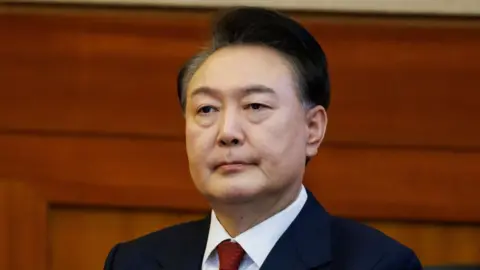
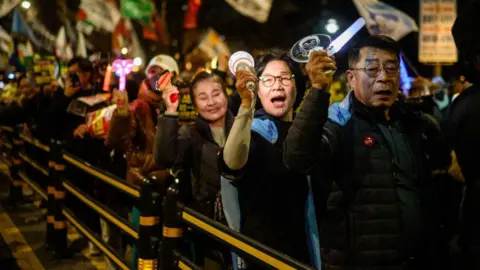
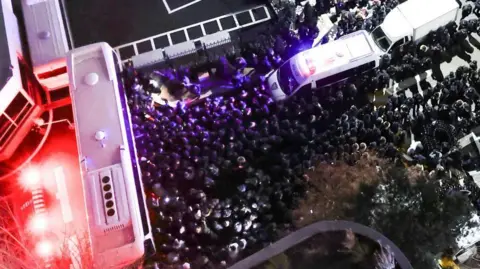
Mayor Yamanaka has been accused by officials of workplace harassment
The mayor of Yokohama has apologised for insulting colleagues after an official publicly accused him of making offensive remarks.
At a news conference, the Japanese city's human resource chief, Jun Kubota, alleged that Mayor Takeharu Yamanaka had used terms such as "idiot" and "human scum" to disparage staff.
It is highly unusual in Japan for a serving city official to openly accuse a sitting mayor and demand an apology.
Yamanaka initially denied the allegations, but later admitted to some of them. "I want to frankly apologise for placing a psychological burden on the personnel director," he said.
At a news conference on Thursday, Kubota accused Mayor Yamanaka of repeatedly making remarks towards officials - including himself - that could amount to workplace harassment.
The mayor was accused of calling officials "useless", "silly" and "low-spec", as well as making comments about colleagues' appearance and likening them to animals.
He is also accused of threatening Kubota, saying he would have to "commit seppuku" - a Japanese ritual suicide by disembowelment - if he failed to secure an international conference bid.
Kubota demanded an apology from Yamanaka and called for an investigation.
Yamanaka initially published a statement on his personal website, denying the allegations.
But on Friday, he publicly acknowledged some remarks - such as using words like "idiot" and "human scum" - and apologised.
"I am reflecting on this. I will be more careful with my words and behaviour," Yamanaka said.
He said those comments were made during discussions over personnel evaluations.
However, the mayor denied other accusations, including insulting colleagues' appearance.
Yamanaka said an investigation was being considered under the supervision of the deputy mayor, adding that he would co-operate "sincerely" if an investigation takes place.
In response, Kubota insisted Yamanaka had made the comments he has not admitted to, saying: "The mayor doesn't understand anything. I cannot accept that as an apology. I want him to change."
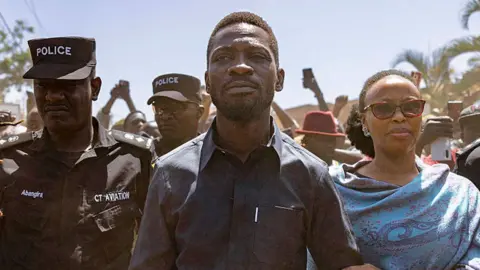
Bobi Wine, President Museveni's main rival, has questioned the credibility of the results
Police in Uganda have denied allegations that presidential candidate Bobi Wine was abducted on Friday evening as vote counting continues in the East African nation amid an internet blackout.
Wine's party said a helicopter landed in the grounds of his house in the capital, Kampala, and forcibly took him to an unknown location.
Initially Wine's son, Solomon Kampala, said both his parents had been seized, but later claimed his father "escaped" and his mother was still under house arrest, leading to confusion over the whereabouts of the opposition leader.
The latest electoral figures from Thursday's vote give Museveni 72% of the vote, with Wine on 24%, based on returns from 94% of polling stations.
Speaking at a press conference on Saturday morning, police spokesman Kituuma Rusoke said the National Unity Platform (NUP) party leader was still in his home in Kampala and that it was Wine's family members who were spreading "untrue" and "unfounded" claims.
He said Wine's movements were restricted because his home was an area of "security interest".
"We have controlled access to areas which are security hotspots," Uganda's Daily Monitor paper quoted him as saying.
"We cannot allow people to use some places to gather and cause chaos. All our actions are intended to prevent anybody from creating violence or destabilising our security," he said.
On Friday, Wine had told his supporters to ignore the "fake results" that have been announced, saying the authorities have been "stealing the vote". He did not provide any evidence to back up his claim and the authorities have not responded to his allegations.
Wine's son Solomon Kampala, who has been posting updates on social media, admitted overnight he was getting conflicting reports about the security situation at his parents' home.
"Amidst the raid my father was able to escape, my mother is still currently under [house] arrest, still nobody is allowed to enter the house," he posted on X on Saturday morning.
Difficulty accessing the internet in the country has made it hard for people to verify information.
News that at least seven opposition supporters were killed in disputed circumstances in Butambala, about 55km (35 miles) south-west of the capital, on Thursday only emerged later on Friday.
The US embassy then issued an alert to its citizens because of reports the security forces were "using tear gas and firing into the air to disperse gatherings".
During Thursday's vote, voting was delayed by up to four hours in many polling stations around the country as ballot boxes were slow to arrive and biometric machines, used to verify voters' identity, did not work properly.
Some have linked the problems to the network outage.
Electoral chief Simon Byabakama said on Friday that the vote counting had not been affected by the internet blackout and the final results would be out before 17:00 local time (14:00 GMT] on Saturday.
Thursday's election followed an often violent campaign, with President Museveni, 81, seeking a seventh term in office. He first took power as a rebel leader in 1986.
Wine, a 43-year-old pop star-turned-politician, who says he represents the youth in a country where most of the population is aged under 30, has promised to tackle corruption and impose sweeping reforms, while Museveni argues he is the sole guarantor of stability and progress in Uganda.
Although there are six other candidates, the presidential poll is a two-horse race between Museveni and Wine.
The campaign period was marred by the disruption of opposition activities - security forces have been accused of assaulting and detaining Wine's supporters.
Rusoke, the police spokesperson, dismissed these complaints, accusing opposition supporters of being disruptive.
Internet access was suspended on Tuesday, with Uganda's Communications Commission saying the blackout was necessary to prevent misinformation, fraud and the incitement of violence - a move condemned by the UN human rights office as "deeply worrying".
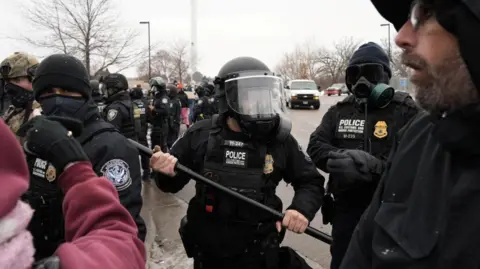
Customs and Border Patrol agents gather as protests continue outside Minneapolis' Whipple Federal Building, which has become a de-facto ICE headquarters
The US justice department is investigating two prominent Minnesota officials over alleged attempts to impede federal immigration agents, in an escalation of the Trump's administration's clash with Democrats.
Governor Tim Walz and Minneapolis Mayor Jacob Frey are facing an inquiry over statements they have made about Immigration and Customs Enforcement (ICE), reports the BBC's US partner CBS.
It comes as fresh details emerged in the death of a Minneapolis woman shot last week by an ICE agent in the city, sparking nationwide protests.
Renee Good, 37, was found with at least three gunshot wounds and possibly a fourth to the head, according to official reports viewed by CBS.
Governor Walz responded on Friday to news of the inquiry against him by posting on X: "Weaponizing the justice system against your opponents is an authoritarian tactic.
"The only person not being investigated for the shooting of Renee Good is the federal agent who shot her."
The governor has urged Minnesotans to protest peacefully, although he has previously been accused by the Trump administration of inflammatory rhetoric for describing ICE as a "modern-day Gestapo". Frey has demanded that immigration agents get out of Minneapolis.
The Washington Post reports that the justice department has issued subpoenas to Walz and Frey.
The inquiry is focused on a federal statute, 18 U.S.C. § 372, which makes it a crime for two or more people to conspire to prevent federal officers from carrying out their official duties through "force, intimidation or threats", a US official told CBS.
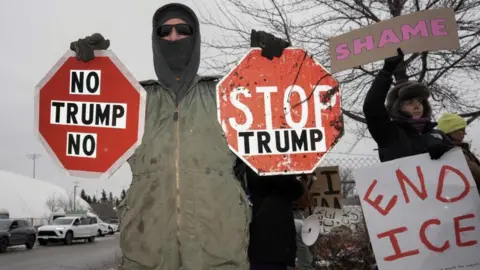
Protests continued in Minneapolis on Friday after new details emerged about the death of Good, and local officials appealed for calm on the streets over this public holiday weekend.
An incident report from the Minneapolis Fire Department said when they responded to the shooting scene last week, it appeared Good had been shot twice in the chest, once in her left forearm and a fourth wound, possibly from a gunshot, was seen "on the left side of the patient's head".
Paramedics found Good unresponsive with an irregular pulse, and she was pronounced dead in the ambulance on the way to hospital, according to the report seen by CBS.
The Trump administration has said that Good was impeding federal law enforcement and tried to run the agent over. Local officials say Good was a legal observer who posed no danger.
Video of the incident show ICE agents approaching a car, which is blocking traffic and parked in the middle of the street. An officer instructs her to get out of the car.
As Good turns her wheel apparently trying to drive away, her Honda Pilot SUV pulls forward with one of the agents standing near the front of the vehicle. He pulls his gun and fires.
Reuters
Footage from the scene shows the agent walking off afterwards.
But Department of Homeland Security (DHS) officials have told CBS the officer suffered internal bleeding to the torso following the incident. No further details have been disclosed.
The FBI is investigating the incident, although there is no federal civil rights inquiry into the agent who opened fire.
Meanwhile, President Donald Trump blasted demonstrators and local leaders on Friday.
On Truth Social, he accused protesters of being "highly paid professionals", adding that Walz and Frey had "totally lost control".
Later, the Republican president told reporters at the White House that he did not plan to invoke the Insurrection Act and send in troops to quell unrest in Minnesota, after earlier this week suggesting he might do so.
"If I needed it, I'd use it. I don't think there's any reason right now to use it," he said. "It's very powerful," he added.
Bloomberg via Getty Images
Democratic lawmakers held a hearing and press conference in Minnesota on Friday, led by Washington Rep. Pramila Jayapal (center)
Thousands of ICE officers remain deployed in the state.
Democratic lawmakers travelled to the city and spent Friday condemning federal immigration operations in the state, accusing ICE of reckless and lawless actions.
Ilhan Omar, a congresswoman from Minnesota who has long feuded with Trump, claimed that ICE was trying to "provoke chaos and fear".
Adriano Espaillat, a congressman from New York, said ICE had become a "deadly weapon".
Washington congressman Pramila Jayapal said ICE agents should not be allowed to wear masks, or make arrests without warrants, and should be required to have body cameras and name tags.
The Democratic lawmakers also interviewed several residents who alleged they had been shackled and detained by ICE for hours until they could prove they were US citizens.
The BBC has contacted the DHS and ICE for comment.
DHS spokeswoman Tricia McLaughlin told CNN on Friday that if there was "reasonable suspicion" of someone who is "in the vicinity" of a person being detained by a DHS operation, they might be asked to confirm their identity.
She rejected suggestions such tactics could be discriminatory, saying "racial animus has no place in DHS".
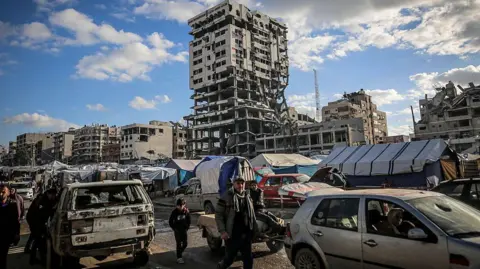
The Trump administration has named US Secretary of State Marco Rubio and former UK prime minister Sir Tony Blair as two of the founding members of its "Board of Peace" for Gaza.
Trump's Middle East envoy Steve Witkoff and the president's son-in-law Jared Kushner will also sit on the "founding executive board", the White House said in a statement on Friday.
Trump will act as chairman of the board, which forms part of his 20-point plan to end the war between Israel and Hamas.
It is expected to temporarily oversee the running of Gaza and manage its reconstruction.
Also on the founding executive board are Marc Rowan, the head of a private equity firm, World Bank chief Ajay Banga and a US national security adviser, Robert Gabriel.
Each member would have a portfolio "critical to Gaza's stabilisation and long-term success", the White House statement said.
Trump had said on Thursday that the board had been formed, calling it the "Greatest and Most Prestigious Board ever assembled at any time, any place".
Further members of the board would be named in the coming weeks, the White House said.
Sir Tony was UK prime minister from 1997 to 2007 and took the UK into the Iraq War in 2003. After leaving office, he served as Middle East envoy for the Quartet of international powers (the US, EU, Russia and the UN).
It comes after the announcement of a separate 15-member Palestinian technocratic committee, the National Committee for the Administration of Gaza (NCAG), charged with managing the day-to-day governance of post-war Gaza.
Ali Shaath, a former deputy minister in the Palestinian Authority (PA) which governs parts of the occupied West Bank not under Israeli control, will head that new committee.
The statement also said that Nickolay Mladenov, a Bulgarian politician and former UN Middle East envoy, would be the board's representative on the ground in Gaza working with the NCAG.
Trump's plan says an International Stabilisation Force (ISF) will also be deployed to Gaza to train and support vetted Palestinian police forces and the White House statement said that US Major General Jasper Jeffers would head this force to "establish security, preserve peace, and establish a durable terror-free environment".
The White House said that a separate "Gaza executive board" was being formed that would help support governance and includes some of the same names as the founding executive board as well as further appointees.
The US peace plan came into force in October and has since entered its second phase, but there remains a lack of clarity about the future of Gaza and the 2.1 million Palestinians who live there.
Under phase one, Hamas and Israel agreed a ceasefire in October, as well as a hostage-prisoner exchange, a partial Israeli withdrawal, and an aid surge.
Earlier this week Witkoff said phase two would see the reconstruction and full demilitarisation of Gaza, including the disarmament of Hamas and other Palestinian groups.
"The US expects Hamas to comply fully with its obligations," he warned, noting these include the return of the body of the last dead Israeli hostage. "Failure to do so will bring serious consequences."
However the ceasefire is fragile, with both sides accusing each other of repeated violations.
Almost 450 Palestinians have been killed in Israeli strikes since it came into force, according to Gaza's Hamas-run health ministry, while the Israeli military says three of its soldiers have been killed in attacks by Palestinian groups during the same period.
And humanitarian conditions in the territory remain dire, according to the UN, which has stressed the need for the unrestricted flow of critical supplies.
Customs and Border Patrol agents gather as protests continue outside Minneapolis' Whipple Federal Building, which has become a de-facto ICE headquarters
The US justice department is investigating two prominent Minnesota officials over alleged attempts to impede federal immigration agents, in an escalation of the Trump's administration's clash with Democrats.
Governor Tim Walz and Minneapolis Mayor Jacob Frey are facing an inquiry over statements they have made about Immigration and Customs Enforcement (ICE), reports the BBC's US partner CBS.
It comes as fresh details emerged in the death of a Minneapolis woman shot last week by an ICE agent in the city, sparking nationwide protests.
Renee Good, 37, was found with at least three gunshot wounds and possibly a fourth to the head, according to official reports viewed by CBS.
Governor Walz responded on Friday to news of the inquiry against him by posting on X: "Weaponizing the justice system against your opponents is an authoritarian tactic.
"The only person not being investigated for the shooting of Renee Good is the federal agent who shot her."
The governor has urged Minnesotans to protest peacefully, although he has previously been accused by the Trump administration of inflammatory rhetoric for describing ICE as a "modern-day Gestapo". Frey has demanded that immigration agents get out of Minneapolis.
The Washington Post reports that the justice department has issued subpoenas to Walz and Frey.
The inquiry is focused on a federal statute, 18 U.S.C. § 372, which makes it a crime for two or more people to conspire to prevent federal officers from carrying out their official duties through "force, intimidation or threats", a US official told CBS.
Protests continued in Minneapolis on Friday after new details emerged about the death of Good, and local officials appealed for calm on the streets over this public holiday weekend.
An incident report from the Minneapolis Fire Department said when they responded to the shooting scene last week, it appeared Good had been shot twice in the chest, once in her left forearm and a fourth wound, possibly from a gunshot, was seen "on the left side of the patient's head".
Paramedics found Good unresponsive with an irregular pulse, and she was pronounced dead in the ambulance on the way to hospital, according to the report seen by CBS.
The Trump administration has said that Good was impeding federal law enforcement and tried to run the agent over. Local officials say Good was a legal observer who posed no danger.
Video of the incident show ICE agents approaching a car, which is blocking traffic and parked in the middle of the street. An officer instructs her to get out of the car.
As Good turns her wheel apparently trying to drive away, her Honda Pilot SUV pulls forward with one of the agents standing near the front of the vehicle. He pulls his gun and fires.
Reuters
Footage from the scene shows the agent walking off afterwards.
But Department of Homeland Security (DHS) officials have told CBS the officer suffered internal bleeding to the torso following the incident. No further details have been disclosed.
The FBI is investigating the incident, although there is no federal civil rights inquiry into the agent who opened fire.
Meanwhile, President Donald Trump blasted demonstrators and local leaders on Friday.
On Truth Social, he accused protesters of being "highly paid professionals", adding that Walz and Frey had "totally lost control".
Later, the Republican president told reporters at the White House that he did not plan to invoke the Insurrection Act and send in troops to quell unrest in Minnesota, after earlier this week suggesting he might do so.
"If I needed it, I'd use it. I don't think there's any reason right now to use it," he said. "It's very powerful," he added.
Bloomberg via Getty Images
Democratic lawmakers held a hearing and press conference in Minnesota on Friday, led by Washington Rep. Pramila Jayapal (center)
Thousands of ICE officers remain deployed in the state.
Democratic lawmakers travelled to the city and spent Friday condemning federal immigration operations in the state, accusing ICE of reckless and lawless actions.
Ilhan Omar, a congresswoman from Minnesota who has long feuded with Trump, claimed that ICE was trying to "provoke chaos and fear".
Adriano Espaillat, a congressman from New York, said ICE had become a "deadly weapon".
Washington congressman Pramila Jayapal said ICE agents should not be allowed to wear masks, or make arrests without warrants, and should be required to have body cameras and name tags.
The Democratic lawmakers also interviewed several residents who alleged they had been shackled and detained by ICE for hours until they could prove they were US citizens.
The BBC has contacted the DHS and ICE for comment.
DHS spokeswoman Tricia McLaughlin told CNN on Friday that if there was "reasonable suspicion" of someone who is "in the vicinity" of a person being detained by a DHS operation, they might be asked to confirm their identity.
She rejected suggestions such tactics could be discriminatory, saying "racial animus has no place in DHS".
Taking paracetamol while pregnant is safe and there's no evidence it raises the risk of autism, ADHD and developmental issues in children, say experts behind a major new review.
Pregnant women "should feel reassured" by the findings, they say, which contradict controversial claims from US President Donald Trump last year that paracetamol "is no good" and pregnant women should "fight like hell" not to take it.
His views were criticised at the time by medical organisations worldwide. Experts say this latest review, in a Lancet journal, is rigorous and should end the debate over its safety.
But US health officials maintain that "many experts" have expressed concern over its use during pregnancy.
The US President shocked many doctors worldwide when he and his administration claimed paracetamol or a branded version called Tylenol - which is seen as the go-to painkiller for pregnant women - could be linked to autism in children, if taken during pregnancy.
Those claims led to confusion among women and concern among health experts, and prompted this new research.
Published in The Lancet Obstetrics, Gynaecology & Women's Health, it looked at 43 of the most robust studies into paracetamol use during pregnancy, involving hundreds of thousands of women, particularly those comparing pregnancies where the mother had taken the drug to pregnancies where she hadn't.
The researchers say using these high-quality studies of siblings means they can dismiss other factors such as different genes and family environments, which makes their review "gold-standard".
The research also looked at studies with a low risk of bias and those that followed children for more than five years to check for any link.
"When we did this analysis, we found no links, there was no association, there's no evidence that paracetamol increases the risk of autism," lead study author and consultant obstetrician Professor Asma Khalil, told the BBC.
"The message is clear – paracetamol remains a safe option during pregnancy when taken as guided," she added.
This reinforces guidance from major medical organisations in the UK, US and Europe on the safety of the common painkiller.
Any previously-reported links between the drug and an increased risk of autism are likely to be explained by other factors, rather than a direct effect of the paracetamol itself, the review says.
"This is important as paracetamol is the first-line medication we recommend for pregnant women in pain or with a fever," said Prof Khalil, professor of maternal fetal medicine at City St George's, University of London.
Health advice warns that women can run the risk of harming their baby if they don't take paracetamol to bring down a high temperature or relieve pain when pregnant. This can increase the risk of miscarriage, premature birth or developmental problems in babies.
Medical experts not involved in the research have welcomed the study's findings, saying it will help reduce worry among women.
Prof Grainne McAlonnan, from King's College London, said expectant mothers "do not need the stress of questioning whether medicine most commonly used for a headache could have far reaching effects on their child's health".
"I hope the findings of this study bring the matter to a close," she said.
Prof Ian Douglas, from the London School of Hygiene and Tropical Medicine, said the review was "well-conducted" because it excluded studies of lower quality, where no account was taken of important differences between mothers who use or don't use paracetamol during pregnancy, such as underlying illnesses.
According to Prof Jan Haavik, molecular neuroscientist and clinical psychiatrist at the University of Bergen, the study provides "strong evidence" that use of paracetamol during pregnancy does not increase the risk of autism, ADHD or intellectual disability and "should effectively put this question to rest".
It is widely believed by scientists working in this field that autism is the result of a complex mix of factors, including genetic and environmental ones.
Getty Images
In a speech in September 2025, President Trump said his administration was linking paracetamol (or acetaminophen) to autism and urging pregnant women to largely avoid the pain reliever
A spokesman from the US Department of Health and Human Services said "many experts" had expressed concern over the use of acetaminophen - the US name for paracetamol - during pregnancy.
For example, a review in August 2025 led by Dr Andrew Baccarelli, dean of the Harvard T.H. Chan School of Public Health, found that using acetaminophen during pregnancy may increase children's autism and ADHD risk, and urged caution over "especially heavy or prolonged use".
Months earlier, Health Secretary Robert F Kennedy Jr had pledged to find out the cause of a steep rise in reported autism cases.
In a controversial speech in the Oval Office in September, the US president said doctors would be advised not to prescribe the pain reliever to pregnant women.
The US Food and Drug Administration (FDA) then issued a letter to clinicians urging them to be cautious about the use of acetaminophen in pregnancy, while also saying it was still the only drug approved for treating fevers during pregnancy.
On its website, the FDA says "a causal relationship" between the drug and neurological conditions "has not been established".
Health officials in the UK have stressed that paracetamol remains the safest painkiller available to pregnant women.
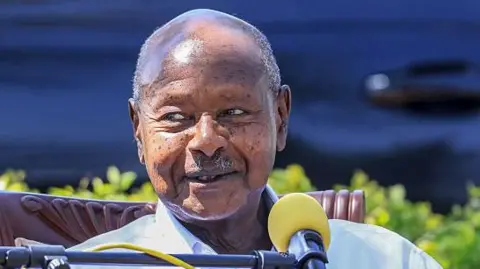
Yoweri Museveni, in power since 1986, is seeking a seventh successive victory
Uganda's President Yoweri Museveni has taken a strong lead in provisional results from Thursday's presidential election, the electoral agency says.
The results announced on Friday morning put Museveni in the lead with 76% of the votes, based on results from 45% of the country's polling stations.
He is followed by opposition leader Bobi Wine with about 20%.
Ugandans voted in a tense national election on Thursday after an often violent campaign, with President Museveni, 81, seeking a seventh term in office.
Wine, a pop star-turned-politician, has alleged "massive" fraud during the election, which was held under an internet blackout. He did not provide documentary proof and the authorities have not responded to his allegations.
Late on Thursday, Wine's National Unity Platform (NUP) party said that the military and police had surrounded his house in the capital, Kampala, "effectively placing him and his wife under house arrest".
"Security officers have unlawfully jumped over the perimeter fence and are now erecting tents within his compound," the party posted on X. The authorities are yet to comment.
Following the 2021 election, in which he garnered 35% of the vote, Wine was confined to his home for several days by security forces.
During Thursday's vote, voting was delayed by up to four hours in many polling stations around the country as ballot boxes were slow to arrive and biometric machines, used to verify voters' identity, did not work properly.
Some have linked the problems to the network outage.
Getty Images/BBC
Go to BBCAfrica.com for more news from the African continent.
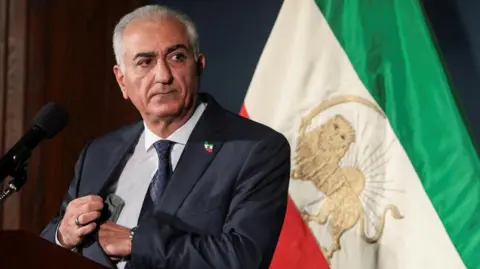
The exiled son of the last Iranian shah (king) has called on the world to help protesters topple Iran's government, saying he is confident "the Islamic Republic will fall - not if, but when".
Reza Pahlavi, an opposition leader based in the US, called for "surgical" strikes on Iran's Revolutionary Guards which he said "will facilitate our task and prevent more loss of life".
More than 2,000 protesters have been killed, according to human rights groups, in demonstrations that started over the economy on 28 December and turned into calls for the end of the rule of Iran's Supreme Leader Ali Hosseini Khamenei.
The Iranian government has called the protests "riots" backed by Iran's enemies.
Pahlavi has emerged as a prominent figure in Iran's fragmented opposition and has previously urged Iranians to escalate their protests.
However protesters have been met with deadly force by authorities, masked by a near total shutdown of the internet and communication services.
Speaking at a news conference in Washington, Pahlavi vowed to return to Iran and laid out a plan for creating a new constitution in the country.
He claimed that sections of Iran's security apparatus had refused to take part in the crackdown and that the Iranian authorities had brought in fighters from foreign militias to quell the protests.
Asked about future leadership in Iran, Pahlavi said: "It's for the Iranian people to decide."
"I am trying to help them liberate themselves."
He said he supported a governing programme based on the principles of Iran's territorial integrity, a separation of religion and state, individual liberties and the right of the Iranian people to decide on the form of democratic government they want.
The current wave of protests began after shopkeepers in Tehran went on strike over the rising cost of living and the depreciating value of the currency.
They quickly spread across the country and turned against Iran's clerical establishment, particularly the Supreme Leader, Ayatollah Ali Khamenei. The slogans chanted by demonstrators have included "Death to the dictator" and "Seyyed Ali [Khamenei] will be toppled this year".
According to the US-based Human Rights Activists News Agency (HRANA), at least 2,453 protesters have been killed since the unrest began, as well as 14 children, 156 people affiliated with the security forces or government, and 14 uninvolved civilians.
It reports that another 18,470 protesters have been arrested.
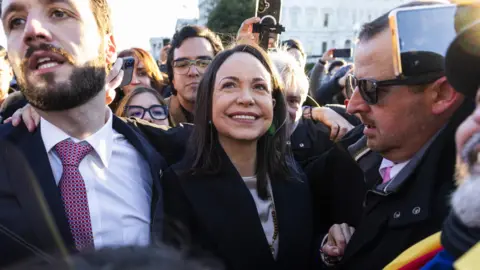
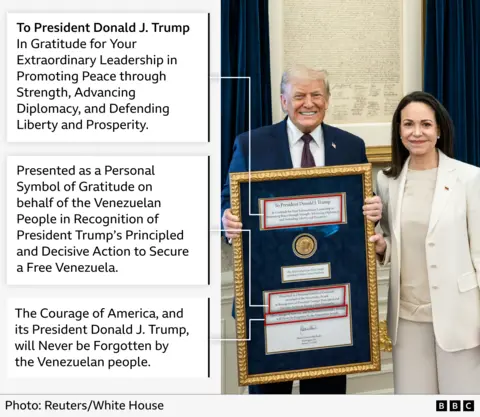
Machado gave her Nobel Peace Prize medal to Donald Trump in Washington on Thursday
Venezuelan opposition leader María Corina Machado has vowed she will lead the country "when the right time comes".
"There's a mission, and we are going to turn Venezuela into that land of grace, and I believe I will be elected when the right time comes as president of Venezuela, the first woman president," she told Fox News.
The US seized Venezuela's President Nicolás Maduro in Caracas on 3 January and removed him to New York to face various drugs and weapons charges.
However Trump has declined to endorse Machado as Venezuela's new leader, saying she did not have enough domestic support - despite her opposition movement claiming victory in 2024's widely contested elections.
He has instead been dealing with the country's interim president Delcy Rodríguez, who had been Maduro's vice-president.
"I want to serve my country where I am more useful. I got a mandate, and I have that mandate," Machado added.
She also visited Congress to meet US senators during her visit to Washington, where her remarks to reporters were drowned out by supporters chanting "María, presidente" and waving Venezuelan flags.
"Director Ratcliffe discussed potential opportunities for economic collaboration and that Venezuela can no longer be a safe haven for America's adversaries," the official said.
The same day, Rodríguez said she was not afraid to face the US "diplomatically, through political dialogue" during her first state of the union address since becoming interim president.
She also said Venezuela needed to defend its "dignity and honour" and announced oil industry reforms to allow more foreign investment, in a step away from Maduro's policies.
Trump called Rodríguez a "terrific person" on Wednesday after the pair spoke on the phone, a conversation the Venezuelan leader called "productive and courteous".
Machado presented Trump with her Nobel Peace Prize medal on Thursday
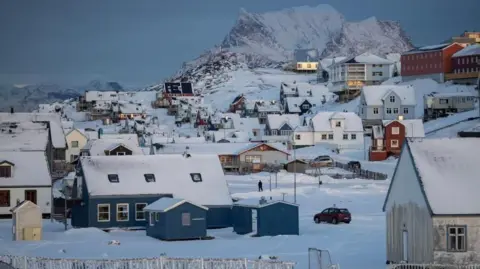
Most Greenlanders are opposed to Trump's bid to buy their island or to seize it by force
A bipartisan group of members of the US Congress is visiting Denmark in what is seen as a show of support in the face of increasing pressure from President Donald Trump for the US to annex Greenland - a semi-autonomous region of Denmark in the Arctic.
The 11-member delegation is due to meet MPs as well as Danish Prime Minister Mette Frederiksen and her Greenlandic counterpart Jens-Frederik Nielsen.
The visit comes days after high-level talks in Washington failed to dissuade Trump from his plans.
He insists Greenland is vital for US security - and that Denmark cannot defend it against possible Russian or Chinese attacks. Both Denmark and Greenland say they are opposed to a US takeover.
Greenland is sparsely-populated but resource-rich and its location between North America and the Arctic makes it well placed for early warning systems in the event of missile attacks and for monitoring vessels in the region.
The US already has more than 100 military personnel permanently stationed at its Pituffik base - a facility that has been operated by the US since World War Two.
Under existing agreements with Denmark, the US has the power to bring as many troops as it wants to Greenland.
But Trump has said the US needs to "own" it to defend it properly.
He has consistently offered to buy it off - an offer rejected by Denmark and Greenland - whilst mooting the possibility of seizing it by force.
Denmark has warned that military action would spell the end of Nato - the trans-Atlantic defence alliance where the US is the most influential partner.
Nato works on the principle that allies have to aid each other in case of attack from outside - it has never faced an option where one member would use force against another.
European allies have rallied to Denmark's support.
They have also said the Arctic region is equally important to them and that its security should be a joint Nato responsibility - with the US involved.
To this end, several countries including France, Germany, Sweden, Norway, Finland, the Netherlands and the UK have sent a limited number of troops to Greenland in a so-called reconnaissance mission.
French President Emmanuel Macron said "land, air, and sea assets" would soon be sent.
Watch: Troops and vessels from European Nato allies arrive in Greenland
The US Congressional delegation includes senators and members of the US House of Representatives who are fervent supporters of Nato.
It is led by Senator Chris Coons who said earlier this week that "we need to draw closer to our allies, not drive them away".
Though Coons and the majority of the delegation are Democratic opponents of Trump, the group includes Republican Senators Thom Tillis and Lisa Murkowski, too.
Democratic and Republican lawmakers have introduced legislation to stop Trump seizing Greenland by force.
A Republican congressman has also introduced a rival bill in support of the plan to annex the island.
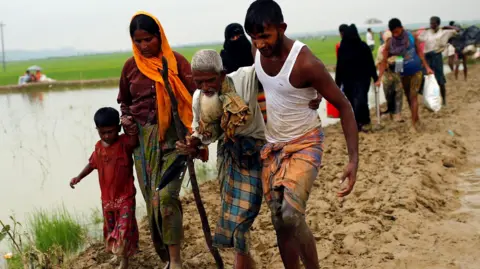
Hundreds of thousands of Rohingya people fled Myanmar during an army crackdown in 2017
Myanmar has denied committing genocide against the Ronhingya people, saying The Gambia has failed to provide enough proof, as it begun its defence at the UN's top court.
Ko Ko Hlaing, a Myanmar government representative, told judges at the International Court of Justice (ICJ) that the allegation was "unsubstantiated".
Earlier this week, The Gambia's foreign minister Dawda Jallow told the court Myanmar wanted to erase the minority Muslim population through its use of "genocidal policies".
Thousands of Rohingya were killed and more than 700,000 fled to neighbouring Bangladesh during an army crackdown in Myanmar in 2017.
A damning report issued by the UN the following year said top military figures in Myanmar must be investigated for genocide in Rakhine state and crimes against humanity in other areas.
Myanmar - which has been under military control since it overthrew the civilian government in 2021 - rejected the report and has consistently said its operations targeted militant or insurgent threats.
On Friday, Hlaning told the ICJ that "Myanmar was not obliged to remain idle and allow terrorists to have free reign of northern Rakhine states", where the majority of Rohingya lived.
"These attacks were the reasons for the clearance operations, which is a military term referring to counter-insurgency or counter-terrorism operations," Hlaing said.
The Gambia launched its case against Myanmar in 2019, with Jallow telling the ICJ it did so out of a "sense of responsibility" following its own experience with a military government.
Jallow told the court on Monday that the Rohingya "had suffered decades of appalling persecution and years of dehumanising propaganda", which was followed by the military crackdown and "continual genocidal policies meant to erase their existence in Myanmar".
Lawyers for the Muslim-majority West African country also argued that the killing of women, children and the elderly, along with the destruction of their villages, was hard to justify under combatting terrorism.
"When the court considers... all of the evidence taken together, the only reasonable conclusion to reach is that a genocidal intent permeated and informed Myanmar's myriad of state-led actions against the Rohingya," said Philippe Sands, arguing for The Gambia, which has the backing of 57-nation Organisation of Islamic Cooperation in its action.
More than a million Rohingya refugees now live across the border in Bangladesh's Cox's Bazar region alone - some of the largest and most densely populated camps in the world, according to the UN's refugee agency.
Hlaing - the Myanmar government representative - said on Friday that it was committed to "achieving the repatriation to Myanmar of persons from Rakhine State currently living in camps in Bangladesh". But he also said external forces, such as Covid-19, had hampered those efforts.
"Myanmar's commitment and constant efforts since 2017 contradict Gambia's narrative that Myanmar's intention is to destroy or forcibly deport this population," Hlaing told the court.
He added that "a finding of genocide would place an indelible stain on my country and its people", so the outcome was of "fundamental importance for my country's reputation and future".
The court has also set aside three days to hear from witnesses, including Rohingya survivors, but these sessions will be closed to the public and media.
A final ruling is expected towards the end of 2026, Reuters news agency reported.
It is expected to set a precedent in other genocide cases, including one brought by South Africa against Israel over the war in Gaza, as it is the first to be heard in more than a decade - and is being seen as an opportunity for ICJ judges to refine rules around the definition of genocide.
The 1948 UN Genocide Convention, which The Gambia accuses Myanmar of breaching in its treatment of the Rohingya, was adopted following the mass murder of Jews by Nazi Germany during the Second World War. It defines genocide as crimes committed "with intent to destroy, in whole or in part, a national, ethnical, racial or religious group".
Most Greenlanders are opposed to Trump's bid to buy their island or to seize it by force
A bipartisan group of members of the US Congress is visiting Denmark in what is seen as a show of support in the face of increasing pressure from President Donald Trump for the US to annex Greenland - a semi-autonomous region of Denmark in the Arctic.
The 11-member delegation is due to meet MPs as well as Danish Prime Minister Mette Frederiksen and her Greenlandic counterpart Jens-Frederik Nielsen.
The visit comes days after high-level talks in Washington failed to dissuade Trump from his plans.
He insists Greenland is vital for US security - and that Denmark cannot defend it against possible Russian or Chinese attacks. Both Denmark and Greenland say they are opposed to a US takeover.
Greenland is sparsely-populated but resource-rich and its location between North America and the Arctic makes it well placed for early warning systems in the event of missile attacks and for monitoring vessels in the region.
The US already has more than 100 military personnel permanently stationed at its Pituffik base - a facility that has been operated by the US since World War Two.
Under existing agreements with Denmark, the US has the power to bring as many troops as it wants to Greenland.
But Trump has said the US needs to "own" it to defend it properly.
He has consistently offered to buy it off - an offer rejected by Denmark and Greenland - whilst mooting the possibility of seizing it by force.
Denmark has warned that military action would spell the end of Nato - the trans-Atlantic defence alliance where the US is the most influential partner.
Nato works on the principle that allies have to aid each other in case of attack from outside - it has never faced an option where one member would use force against another.
European allies have rallied to Denmark's support.
They have also said the Arctic region is equally important to them and that its security should be a joint Nato responsibility - with the US involved.
To this end, several countries including France, Germany, Sweden, Norway, Finland, the Netherlands and the UK have sent a limited number of troops to Greenland in a so-called reconnaissance mission.
French President Emmanuel Macron said "land, air, and sea assets" would soon be sent.
Watch: Troops and vessels from European Nato allies arrive in Greenland
The US Congressional delegation includes senators and members of the US House of Representatives who are fervent supporters of Nato.
It is led by Senator Chris Coons who said earlier this week that "we need to draw closer to our allies, not drive them away".
Though Coons and the majority of the delegation are Democratic opponents of Trump, the group includes Republican Senators Thom Tillis and Lisa Murkowski, too.
Democratic and Republican lawmakers have introduced legislation to stop Trump seizing Greenland by force.
A Republican congressman has also introduced a rival bill in support of the plan to annex the island.
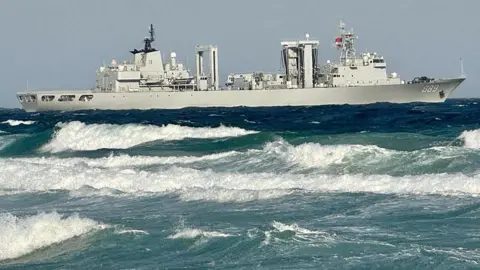
Warships from Iran and other Brics+ nations are conducting drills off the coast of South Africa
The US has accused South Africa's defence ministry of refusing to obey orders from its own government to send home Iranian warships that have been conducting naval exercises in the African country's waters.
"South Africa can't lecture the world on 'justice' while cozying up to Iran," it said in a statement.
In response, South Africa's defence ministry said it was launching an inquiry to get to the root of these "serious allegations".
Washington has criticised South Africa for inviting Iran at a time when a brutal crackdown against protests was happening in the Middle Eastern country.
It said the South African military's actions did not amount to "non-alignment" but were instead a "choice to stand with Iran".
"This is absolutely no surprise. Protests against the Iranian regime are happening right now, human rights organisations here in SA have been calling for support for the protesters," William Gumede, an associate professor at the University of Witwatersrand, told the BBC.
"These are all democratic violations and human rights abuses and we have not heard a whimper from the ANC. That is the irony and hypocrisy, it's been criticising other regimes but it's been silent on what's happening in Iran."
In the strongly worded statement posted on its social media accounts, the US embassy in South Africa said it noted with "concern and alarm" reports that the country's defence minister and its defence forces had defied government orders to ask Iran to leave.
The US embassy said Iran's participation "undermined maritime security and regional stability" and was "unconscionable" as it suppressed protests back home, comparing them to "peaceful political activity South Africans fought so hard to gain for themselves".
On Friday the office of Defence Minister Angie Motshekga said she "would like to place it on record" that President Cyril Ramaphosa's instructions had been "clearly communicated to all parties concerned, agreed upon and to be implemented and adhered to as such".
Dubbed "Peace Resolve", the week-long naval drill got under way last Friday. It is being led by China - and involves other members from an alliance of major developing countries, including Russia, which when it was launched in 2006 was known as Bric.
It took its acronym from its founding members Brazil, Russia, India and China - and when South Africa joined four years later an "s" was added to its name.
With the recent addition of Egypt, Ethiopia, Indonesia, Iran and the United Arab Emirates (UAE) the alliance is now called Brics+ - and its aim is to challenge the political and economic power of the wealthier Western nations.
Iranian warships had already arrived in Cape Town when the order to turn them around reportedly came through.
People and traffic still regularly cross the Iran-Iraq border
At the border crossing from Iran into Iraqi Kurdistan, the stern face of Iran's former supreme leader, Ayatollah Khomeini, peers down at the trickle of Iranians leaving the territory.
Thick snowflakes confetti the lorries and pedestrians arriving at this remote mountain pass.
Metres away, just beyond the border post, an Iranian flag flutters in the snow.
Iran has shut down the internet and blocked phone calls into the country, but its borders are still open.
Inside the arrivals hall, we find dozens of men, women and children – many arriving to visit family on the Iraqi side of the border.
No-one we met said they were fleeing Iran because of the recent protests and government crackdown, but one man – who asked us to hide his identity – told us security forces had shot him during a protest in central Iran last Friday.
"I was hit in the face by seven pellet rounds," he said, pointing out several weals and bruises on his face. "They struck above my eyelid, on my forehead, my cheek, my lip, under my ear and along my jaw. I had to use a razor blade to cut one of the pellets out."
He told us he was too afraid of being arrested to get medical help, and that others injured during the government crackdown on protestors were also avoiding treatment, out of fear that security forces would arrive and arrest them.
"One of my friends told me he was hit by a pellet round," he told us. "His son, who is around 12 or 13 years old, was struck twice in the leg by live ammunition. One of the bullets is lodged in the shin bone. They're terrified of going to hospital to have it removed."
Iran's regime has treated these protests as an existential threat. Its crackdown seems to be working, and protesters are now thought to be largely staying at home, for fear of being shot or arrested. Rights groups say at least around 2,500 people have been killed.
But several people here told us that demonstrations had continued, at least into this week. The protester we spoke to said security forces had crushed protests in his own town last Friday, but that they had continued elsewhere.
"Demonstrations were still going on in Fardis and Malard, and some areas of Tehran," he said. "My friends were there. We were constantly on the phone. On Tuesday night, the protests were still going on, but I haven't had any updates since then."
Iranians don't need a visa to cross here, and officials say there is regular traffic back and forth.
Another man we spoke to at the border said he had been in Tehran on Wednesday, and seen protesters on the street. It's not clear what form of protest that was, or how many were taking part.
The BBC has seen no hard evidence that street protests are still continuing. Very little footage at all is trickling out, and the reports we heard today are impossible to confirm. The BBC, along with other international media, is barred from reporting inside Iran.
The Iranian authorities imposed an internet blackout more than a week ago
The government's repression largely seems to be working. But the economic problems that sparked this crisis haven't gone away.
A teacher from a town close to the border told us she didn't care who the leader was, she just wanted the economic situation to improve.
"We don't want anything more than our basic rights," she told me. "To own a house, to own a car, to have a normal life. My salary lasts 10 days, and I have to borrow money to cover the rest of the month. It's very bad."
I ask about US President Donald Trump, and his threat of military strikes if the regime kept killing protesters.
"We're waiting to see what Trump does," he told me. "In the meantime, civilians are getting killed."
The force with which Iran's leaders have crushed this protest signals their weakness. The regional proxy groups they once used as defences against attack have been weakened by Israel's war with Hamas and Hezbollah, and by the fall of the former Syrian President, Bashar al-Assad.
And the Israeli-US war with Iran last year has depleted its military capabilities, and left it vulnerable to attack.
Hidden behind this mountainous border, Iran's regime is re-imposing its control.
But hidden behind that repressive control is the growing fear of the Islamic Republic, unable to meet its people's most basic demands: protection from foreign attacks, and prosperity at home.
Most Greenlanders are opposed to Trump's bid to buy their island or to seize it by force
A bipartisan group of members of the US Congress is visiting Denmark in what is seen as a show of support in the face of increasing pressure from President Donald Trump for the US to annex Greenland - a semi-autonomous region of Denmark in the Arctic.
The 11-member delegation is due to meet MPs as well as Danish Prime Minister Mette Frederiksen and her Greenlandic counterpart Jens-Frederik Nielsen.
The visit comes days after high-level talks in Washington failed to dissuade Trump from his plans.
He insists Greenland is vital for US security - and that Denmark cannot defend it against possible Russian or Chinese attacks. Both Denmark and Greenland say they are opposed to a US takeover.
Greenland is sparsely-populated but resource-rich and its location between North America and the Arctic makes it well placed for early warning systems in the event of missile attacks and for monitoring vessels in the region.
The US already has more than 100 military personnel permanently stationed at its Pituffik base - a facility that has been operated by the US since World War Two.
Under existing agreements with Denmark, the US has the power to bring as many troops as it wants to Greenland.
But Trump has said the US needs to "own" it to defend it properly.
He has consistently offered to buy it off - an offer rejected by Denmark and Greenland - whilst mooting the possibility of seizing it by force.
Denmark has warned that military action would spell the end of Nato - the trans-Atlantic defence alliance where the US is the most influential partner.
Nato works on the principle that allies have to aid each other in case of attack from outside - it has never faced an option where one member would use force against another.
European allies have rallied to Denmark's support.
They have also said the Arctic region is equally important to them and that its security should be a joint Nato responsibility - with the US involved.
To this end, several countries including France, Germany, Sweden, Norway, Finland, the Netherlands and the UK have sent a limited number of troops to Greenland in a so-called reconnaissance mission.
French President Emmanuel Macron said "land, air, and sea assets" would soon be sent.
Watch: Troops and vessels from European Nato allies arrive in Greenland
The US Congressional delegation includes senators and members of the US House of Representatives who are fervent supporters of Nato.
It is led by Senator Chris Coons who said earlier this week that "we need to draw closer to our allies, not drive them away".
Though Coons and the majority of the delegation are Democratic opponents of Trump, the group includes Republican Senators Thom Tillis and Lisa Murkowski, too.
Democratic and Republican lawmakers have introduced legislation to stop Trump seizing Greenland by force.
A Republican congressman has also introduced a rival bill in support of the plan to annex the island.
Venezuela's interim president Delcy Rodríguez has proposed new oil reforms in her first state of the union address since former president Nicolás Maduro was seized by the US.
Rodríguez said she wanted to reform the law that limits foreign involvement in the country's oil industry - a move away from Maduro's policies.
She said she was not afraid to face the US "diplomatically through political dialogue," adding Venezuela had to defend its "dignity and honour".
President Donald Trump has said US oil companies would move into Venezuela and make money that would go to people there and to the US, with a top official saying the US would control sales of sanctioned Venezuelan oil "indefinitely".
Trump has asked oil companies to invest at least $100bn (£75bn) in Venezuela, but one executive said last week the country is currently "uninvestable".
Rodríguez, the former vice-president, was sworn in on 5 January after US forces seized Maduro and his wife Cilia Flores in an operation in Caracas. They are now detained in New York, where they have pleaded not guilty to drug trafficking and other charges.
Rodríguez told Venezuelans it was "very difficult" to deliver Maduro's annual report, saying that the two were working on the speech together until six hours before his seizure on 3 January.
Noting the US is a nuclear power, the interim president said she was not afraid to engage in diplomacy, saying "we have to go together as Venezuelans to defend sovereignty, independence, territorial integrity and also defend our dignity and our honour".
She continued that if she needed to travel to Washington DC to meet with Trump, she would do so "walking on her feet, not dragged there".
She added that "all of Venezuela is threatened", and called for national unity to "wage the diplomatic battle".
In her address, Rodríguez announced the proposal to reform the country's hydrocarbon law, saying she had asked the legislative body to approve it.
Until now, Venezuela's hydrocarbon law has stated foreign partners must work with the country's state-owned oil and gas company, PDVSA - which must hold a majority stake.
The reforms, Rodríguez said, would allow investment to flow to new fields.
She said she had instructed her government to create two sovereign funds - one for social protection so that "foreign currency goes directly to hospitals, schools, food, housing" and the second for infrastructure and social development to invest in water, electricity and roads.
"We're more worried about food. Venezuela is in bad shape. Inflation is eating us alive," one man said.
Rodríguez's reforms come as Trump and American investors eye opportunity in Venezuela, which holds the world's largest proven oil reserves.
Bosses of the biggest US oil firms who attended a meeting at the White House last week acknowledged that Venezuela represented an enticing opportunity.
But they said significant changes would be needed to make the region an attractive investment.
Trump said his administration would decide which firms would be allowed to operate.
"You're dealing with us directly. You're not dealing with Venezuela at all. We don't want you to deal with Venezuela," he said.
Trump also said that "one of the things the United States gets out of this will be even lower energy prices".
Venezuela has had a complicated relationship with international oil firms since crude oil was discovered in its territory more than 100 years ago.
Chevron is the last remaining major American oil company still operating in the country.
Watch: BBC Verify examines claims Venezuela "stole" US oil
Yoweri Museveni, in power since 1986, is seeking a seventh successive victory
Uganda's President Yoweri Museveni has taken a strong lead in provisional results from Thursday's presidential election, the electoral agency says.
The results announced on Friday morning put Museveni in the lead with 76% of the votes, based on results from 45% of the country's polling stations.
He is followed by opposition leader Bobi Wine with about 20%.
Ugandans voted in a tense national election on Thursday after an often violent campaign, with President Museveni, 81, seeking a seventh term in office.
Wine, a pop star-turned-politician, has alleged "massive" fraud during the election, which was held under an internet blackout. He did not provide documentary proof and the authorities have not responded to his allegations.
Late on Thursday, Wine's National Unity Platform (NUP) party said that the military and police had surrounded his house in the capital, Kampala, "effectively placing him and his wife under house arrest".
"Security officers have unlawfully jumped over the perimeter fence and are now erecting tents within his compound," the party posted on X. The authorities are yet to comment.
Following the 2021 election, in which he garnered 35% of the vote, Wine was confined to his home for several days by security forces.
During Thursday's vote, voting was delayed by up to four hours in many polling stations around the country as ballot boxes were slow to arrive and biometric machines, used to verify voters' identity, did not work properly.
Some have linked the problems to the network outage.
Getty Images/BBC
Go to BBCAfrica.com for more news from the African continent.
The man on trial, Afghan national Farhad N, arrived in Germany in 2016
A man has gone on trial in Germany charged with driving his car into a crowd of people in the city of Munich last year, killing two people.
The 25-year-old man, named only as Farhad N, in line with German privacy laws, is an Afghan national.
Prosecutors say that on the morning of 13 February 2025, he deliberately drove his BMW Mini into a trade union demonstration in the centre of Munich. About 1,400 people were taking part in the street rally.
A 37-year-old woman called Amel and her two-year-old daughter Hafsa died in hospital of their injuries shortly afterwards.
Among the 44 others who were hurt, a number suffered critical injuries.
Those taking part in the union rally included city workers such as hospital and daycare staff calling for better wages. Amel herself had been working as an engineer and had come to Germany from Algeria at the age of four.
Farhad N went on trial on Friday only a few hundred metres from the scene of the attack.
Federal prosecutors say they believe he "committed the crime out of excessive religious motivation.
"He believed he was obliged to attack and kill randomly selected people in Germany in response to the suffering of Muslims in Islamic countries," they say.
According to investigators, the man shouted "Allahu Akbar" and prayed after committing the act.
He is also accused of watching extremist preachers online. However, officials do not believe he was part of any jihadist movement such as Islamic State.
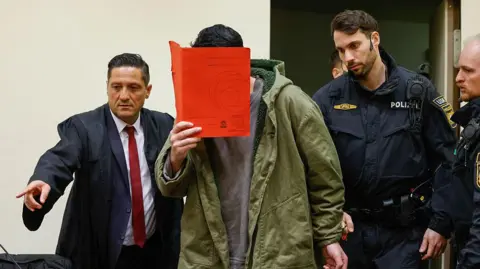
At the start of the trial the defendant hid his face behind a red folder and raised his right index finger – a common gesture among Muslims worldwide, symbolising belief in one God.
His lawyer said his client would not comment on either the attack or his personal circumstances.
Officials say he arrived in Germany in 2016 as a teenager.
Germany took in more than a million asylum seekers in 2015-2016 at the height of Europe's migrant crisis - an influx that has proved deeply divisive and fuelled the rise of the far-right AfD.
Farhad N came alone, without his family and, although his asylum request was rejected, he was not deported and had been given temporary residency in Munich.
German authorities said he was legally resident in Germany, had a work permit and had jobs working as a shop security guard and for security companies.
Farhad N had no previous convictions. He was active on Instagram, where he posted about bodybuilding and religious themes.
He was arrested on the day of the Munich attack. The trial is expected to continue until June.
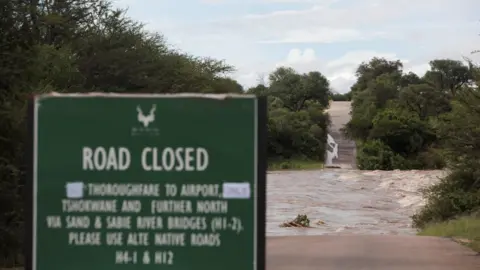
Flooding in South Africa's northern provinces of Limpopo and Mpumalanga has forced the famed Kruger National Park to suspend visits and evacuate some guests and staff by helicopter.
At least 19 people are now believed to have died in recent weeks in South Africa due to floods caused by torrential rain.
Among those killed was a five-year-old boy in the town of Giyani, in Limpopo. President Cyril Ramaphosa met the child's family to offer his condolences while visiting the region to assess the damage.
A red level 10 warning has been issued by the South African Weather Service, forecasting yet more rain in affected areas and warning communities to remain alert.
"If possible stay indoors and off the roads," it advises. "Never drive on a road covered by water. If the vehicle stalls, leave it immediately and seek higher ground."
Residents are also advised to move their valuables to a "safe place above the expected flood level", switch off their electricity at the source, and to move livestock to higher ground.
In recent days helicopters and the military have been deployed to rescue people in some of the worst-affected areas.
The Reuters news agency reports that flooding in south-eastern Africa has become more frequent and severe as climate change makes storms in the adjacent Indian Ocean more powerful.
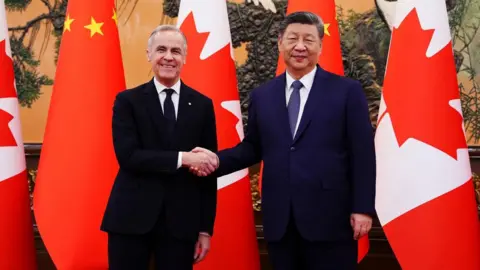
Mark Carney's visit to Chins is the first by a Canadian leader in nearly a decade
Chinese leader Xi Jinping and Canadian PM Mark Carney have announced lower tariffs, signalling a reset in their countries' relationship after a key meeting in Beijing.
China is expected to lower levies on Canadian canola oil from 85% to 15% by 1 March, while Ottawa has agreed to tax Chinese electric vehicles at the most-favoured-nation rate, 6.1%, Carney told reporters.
The deal is a breakthrough after years of strained ties and tit-for-tat levies. Xi hailed the "turnaround" in their relationship but it is also a win for Carney, the first Canadian leader to visit China in nearly a decade.
He has been trying to diversify Canadian trade away from the US, his country's biggest trading partner, following the uncertainty caused by Trump's on-again-off-again tariffs.
The deal could also see more Chinese investments in Canada, right on America's doorstep.
Carney himself seemed to allude to the fact that this was a result of Trump's tariffs, which have now pushed one of the US's key allies towards its biggest rival.
He told reporters that Canada's relationship with China had been more "predictable" in recent month and that he found talks with Beijing "realistic and respectful".
He also made clear Ottawa does not agree with Beijing on everything, adding that in his discussions with Xi he made clear Canada's "red lines", including human rights, concerns over election interference and the need for "guardrails".
Observers believe Carney's visit could set an example for other countries across the world who are also feeling the pain from Washington's tariffs.
In contrast, Xi has been trying to show that China is a stable global partner and has been urging more pragmatic ties - in the words of Beijing, "a win-win" for all.
And it seems to be working. The South Korean president and the Irish prime minister have both visited Beijing in recent weeks. The UK prime minister is expected to visit soon and so is the German Chancellor.
Carney said the "world has changed dramatically" and how Canada positions itself "will shape our future for decades to come," he added.
Earlier in his three-day visit, he had said that the Canada-China partnership sets the two countries up for a "new world order". He later added that the multilateral system had been "eroded, to use a polite term, or undercut".
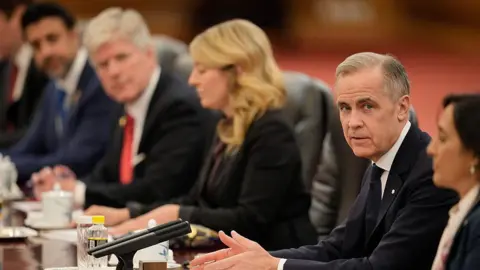
As the Chinese and Canadian delegations sat down in the Great Hall of the People on Friday, Xi said: "The healthy and stable development of China-Canada relations is conducive to world peace, stability, development, and prosperity."
Getty Images
Carney in the Great Hall of the People during the meeting with Xi
A trade reset
Tariffs have been a key sticking point between the two sides.
In 2024, Canada imposed 100% tariffs on Chinese electric vehicles, following similar US curbs.
Last year, Beijing retaliated with tariffs on more than $2bn (£1.5bn) of Canadian farm and food products like canola seed and oil. As a result Chinese imports of Canadian goods fell by 10% in 2025.
China is Canada's second-largest trading partner, recording more than C$118bn ($85bn; £63bn) in two-way merchandise trade in 2024.
That's a long way behind the US, Canada's closest ally, which traded more than $761bn (£568bn) worth of goods with Ottawa in 2024.
But economic ties with China are increasingly important for Carney, who said ahead of his visit that Canada was focused on building a "more competitive, sustainable and independent economy" in the face of "global trade disruption".
Carney, who arrived in Beijing on Wednesday, met senior executives from prominent Chinese businesses, including an electric vehicle battery maker and an energy giant.
On Thursday the two countries signed several agreements on energy and trade cooperation.
The visit is a "reset of a relationship" that may be "modest in ambition" but "much more realistic about what we can reasonably obtain", said Colin Robertson, a former Canadian diplomat and vice-president at the Canadian Global Affairs Institute.
A frosty history
The last Canadian PM to visit China was Justin Trudeau, who met Xi in Beijing in 2017.
That visit took place before the relationship soured in 2018, following Canada's arrest of Meng Wanzhou, the chief financial officer at the Chinese tech giant Huawai, at the request of the US.
Days later, China detained Canadian citizens Michael Kovrig and Michael Spavor on espionage charges - a move critics saw as retaliation for Meng's arrest, which China denied.
Meng and both Michaels were released in 2021.
Ahead of the Carney-Xi meeting, Michael Kovrig wrote on X that the visit should not just be about warming ties but also "managing leverage".
Kovrig described Chinese negotiators as "extremely adroit, calculating, and always looking for leverage".
"That's why engagement has to be handled with discipline," he wrote, adding that Carney should also advocate for Canadians imprisoned in China. There are about 100 of them, according to Canadian media.
Speaking to reporters, Carney was clear that with countries that do not share the same values, Ottawa will engage on a "narrower, more specific" manner.
"We're very clear about where we cooperate, where we differ," he said, adding that Chinese claims over self-governed Taiwan and Hong Kong's jailed pro-democracy figure Jimmy Lai came up in "broad discussions".
Canada and China have "different systems", he said, which limits the breadth of their cooperation.
"But to have an effective relationship, we have direct conversations. We don't grab a megaphone and have the conversations that way."
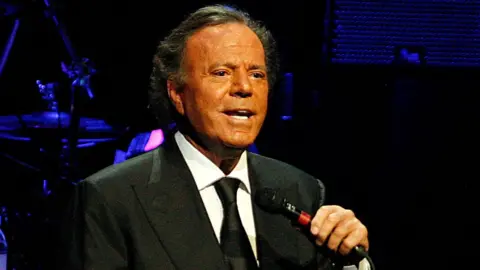
Iglesias said he wanted "to let people know the whole truth and defend my dignity"
Singer Julio Iglesias has denied allegations of sexual assault made by two female former employees.
The women allege that the 82-year-old Spanish superstar "normalised abuse" in a coercive, threatening and violent environment while they were working at his properties in the Bahamas and Dominican Republic.
Responding on Instagram, Iglesias said: "I deny having abused, coerced, or disrespected any woman. These accusations are absolutely false and deeply sadden me."
The allegations, which were first reported earlier this week, are being investigated by Spain's judiciary.
The reports said they worked in his Caribbean residences for 10 months in 2021, which is when they allege the sexual assaults took place.
On 5 January, the women filed a legal complaint for sexual assault and human trafficking with the national court, which investigates crimes allegedly committed beyond Spain's borders.
Advocacy groups Women's Link Worldwide and Amnesty International said the acts alleged in the complaint could be considered "a crime of human trafficking for the purpose of forced labour" and "crimes against sexual freedom".
According to testimony collected by the two groups, Iglesias subjected the women to "sexual harassment, regularly checked their mobile phones, restricted their ability to leave the home where they worked, and required them to work up to 16 hours a day without days off".
Women's Link described the complainants as young Latin American women "in vulnerable situations who were heavily dependent on their wages due to their economic and social conditions".
'Defend my dignity'
In his Instagram statement, Iglesias wrote: "It is with profound sadness that I respond to the accusations made by two people who previously worked for me.
He added: "I have never felt such malice, but I still have the strength to let people know the whole truth and defend my dignity against such a serious accusation."
The singer also thanked the "so many dear people who have sent me messages of affection and loyalty", adding: "I have found great comfort in them."
According to by Spanish news site elDiario.es and US outlet Univision, which investigated the claims over three years, the women's allegations are backed up by documentary evidence including photographs, phone records, text messages and medical reports.
Their reports cite other former employees who describe a threatening, highly stressful atmosphere for those working for Iglesias.
But an old friend of the singer, Jaime Peñafiel, labelled the accusations "absolute lies", while another ally, journalist Miguel Ángel Pastor, said he had never heard "any suggestion that he might have committed this kind of act".
Iglesias is one of the most successful Latin artists of all time, having sold more than 300 million records in a career spanning decades.
He is also the father of fellow music superstar Enrique Iglesias.
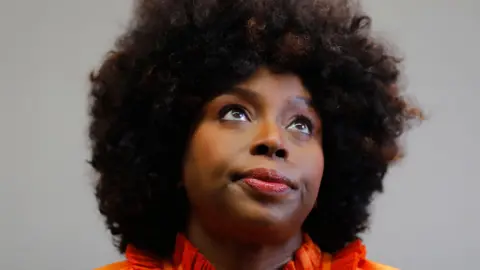
Popular author Chimamanda Ngozi Adichie alleges her toddler was denied oxygen and excessively sedated, leading to cardiac arrest
A series of harrowing cases of allegations of medical negligence, including the death of novelist Chimamanda Ngozi Adichie's 21-month-old son, has ignited a fierce debate about patient safety and systemic failures within Nigeria's healthcare system.
The family of the internationally acclaimed author says her young son, Nkanu Nnamdi, died last week at a private hospital in the main city, Lagos, following a short illness.
They allege the child was denied oxygen and excessively sedated, leading to cardiac arrest.
The hospital extended its "deepest sympathies" but in a statement denied any wrongdoing, stating its treatment met international standards.
The Lagos State Government has ordered an investigation into the death, as public outrage spread over the state of healthcare in Africa's most populous country.
Just days later, anger surged once more after the death of Aisha Umar, a mother of five who ran a business from home, selling incense and fish in the northern city of Kano.
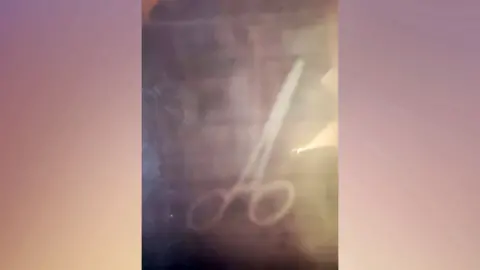
Her family alleges a pair of surgical scissors was left inside her abdomen during an operation in September at the state-run Abubakar Imam Urology Centre, leading to four months of severe pain and her eventual death.
"For four months, they only gave her pain relievers," her brother-in-law, Abubakar Mohammed, told the BBC.
"Scans finally showed the scissors were inside her," he said.
The family says they plan to sue the facility for negligence.
The Kano State Hospitals Management Board said it had "suspended three personnel directly involved in the case from clinical activities with immediate effect", and has referred the case for further investigation and disciplinary action.
"The Board reassures the public that it will not condone negligence in any form and will continue to take decisive actions to safeguard the lives, dignity, and trust of patients across all state health facilities," a spokesman added in a statement issued on 13 January.
Abubakar Mohammed
Aisha Umar's family alleges that surgical scissors were left in her abdomen
These high-profile cases have given voice to widespread grievances that often go unheard.
Lagos-basedproducts manager Josephine Obi, 29, recounted how her father died in 2021 at the state-run Lagos University Teaching Hospital after what she says was a surgical error during a routine procedure for a goitre - a lump or swelling at the front of the neck caused by a swollen thyroid.
"They cut a major artery... it was a very minor surgery," Obi told the BBC.
She said a supervising doctor apologised, admitting a mistake had been made.
The family chose not to sue to avoid a potentially costly and protracted legal battle.
"You will just waste money and the case will linger... we just let it go," Obi said.
The BBC sent an email to the hospital seeking comment, but has not yet received a response. The BBC also phoned the numbers listed on the hospital's website, but they failed to go through.
In Kano, prison facility officer Abdullahi Umar is still mourning his wife, Ummu Kulthum Tukur, who died three years ago at the age of 27 after giving birth to twins at the state-run Aminu Kano Teaching Hospital.
He believes a timely Caesarean section would have saved her life.
"She was in labour for over 24 hours... she lost a lot of blood and died," he said, adding that the hospital still refuses to provide a death certificate.
Efforts to get the hospital to respond were unsuccessful as the spokesperson Hauwa Inuwa told the BBC she was on leave, instead sending the number of another member of staff, which did not work.
Joe Abah, a former boss of Nigeria's Bureau of Public Service Reforms, claimed on social media platform X how a private hospital in the capital, Abuja, urged him to undergo immediate surgery for an ailment. Unconvinced, he sought further opinions, including consultations abroad, which concluded no surgery was necessary, he said.
Complaints about treatment in Nigeria's private hospitals are rare, although that is where Adichie's son was treated. They generally have a better reputation than government-owned hospitals, but only a minority can afford to go to them.
"Private hospitals are out of the reach of many Nigerians because they are expensive but without doubt offer better care compared to government-owned hospitals which carry more load and have manpower and equipment issues," Dr Fatima Gaya, who works at a public hospital, told the BBC.
Many wealthy Nigerians also go abroad for treatment, including President Bola Tinubu and his predecessor, Muhammadu Buhari, who died in a clinic in London in 2025 after he stepped down from office.
NurPhoto via Getty Images
Most Nigerians are forced to rely on state health care
Dr Mohammad Usman Suleiman, president of the Nigerian Association of Resident Doctors (Nard), told the BBC that the issues were "systemic" and that blaming individuals without addressing the wider problems, such as a lack of doctors and equipment, was futile.
"Clinical governance needs to be stepped up. In Nigeria, what we have is individuals being blamed for a systemic problem," Suleiman told the BBC.
"If you take six to seven surgeries... eventually, you are exhausted. No doctor wakes up wanting to harm someone."
These concerns are supported by data.
Two separate surveys last year - from the African Research Journal of Medical Sciences and NOIPolls - found that around 43% of Nigerians had personally experienced or witnessed a medical error or near-miss. About a third of patients experienced additional injuries from treatment.
Medics and analysts say Nigeria has a very low doctor-patient ratio, worsened by a massive "brain drain" as health professionals emigrate after being enticed by better working conditions abroad.
Remaining health workers sometimes juggle multiple jobs and often go on strike to demand higher salaries, and improved conditions.
The Nigerian Medical Association (NMA) says about 15,000 doctors have left the country in the past five years.
"An imbalance of over 8,000 patients to one doctor increases overload and stress, which leads to mistakes," public affairs analyst Ibrahim Saidu told the BBC.
Nigeria's health system is buckling under these pressures, Saidu added.
Chronic underfunding sees the federal government allocate only about 5% of its budget to health, far below the 15% target set in 2001 by the African Union to improve medical services across the continent.
The recent cases have only amplified calls for urgent reform of Nigeria's health sector to prevent other patients from becoming tragic symbols of a national crisis.
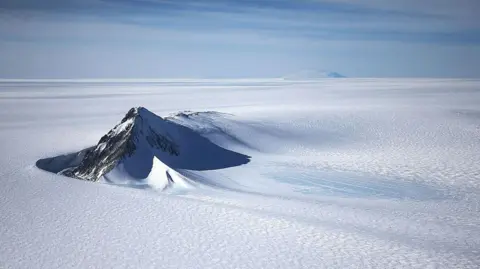
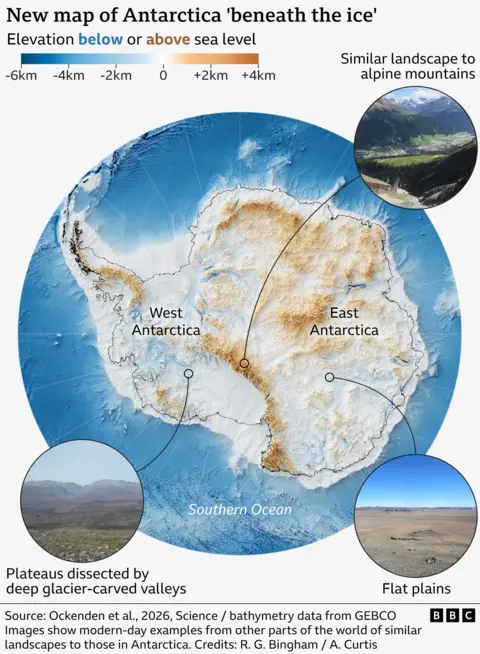
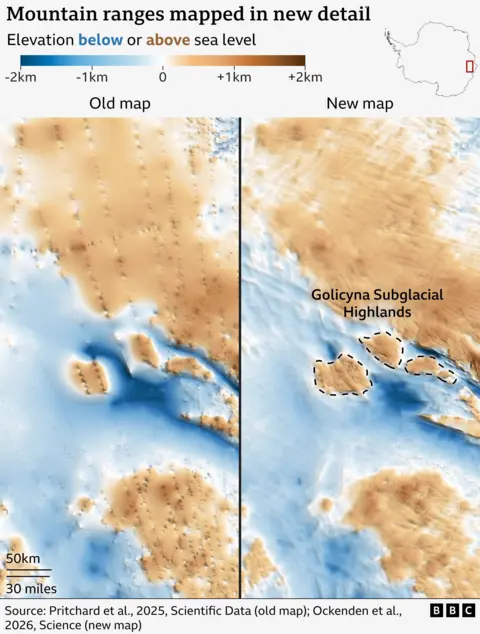
A new map has unmasked the landscape beneath Antarctica's ice in unprecedented detail, something scientists say could greatly enhance our understanding of the frozen white continent.
Researchers used satellite data and the physics of how Antarctica's glaciers move to work out what the continent might look like beneath the ice.
They found evidence of thousands of previously undiscovered hills and ridges, and say their maps of some of Antarctica's hidden mountain ranges are clearer than ever before.
While the maps are subject to uncertainties, the researchers believe the new details could shed light on how Antarctica will respond to climate change - and what that means for sea-level rise.
"It's like before you had a grainy pixel film camera, and now you've got a properly zoomed-in digital image of what's really going on," lead author Dr Helen Ockenden, a researcher at the University of Grenoble-Alpes, told BBC News.
Thanks to satellites, scientists have a good understanding of Antarctica's icy surface – but what lies beneath has remained more of a mystery.
In fact, more is known about the surface of some planets in our Solar System than much of Antarctica's "underbelly" – the topography beneath the ice sheet.
But researchers now have what they believe to be the most complete, detailed map of that underbelly ever made.
"I'm just so excited to look at that and just see the whole bed of Antarctica at once," said Prof Robert Bingham, a glaciologist at the University of Edinburgh who co-authored the study. "I think that's amazing."
Traditional measurements from the ground or air have used radar to "see" beneath the ice - which is up to three miles (4.8km) thick in places - often along individual survey lines or tracks.
But these tracks could be tens of kilometres apart - leaving scientists to fill in the gaps.
“If you imagined the Scottish Highlands or the European Alps were covered by ice and the only way to understand their shape was the occasional flight several kilometres apart, there's no way that you would see all these sharp mountains and valleys that we know to be there,” said Bingham.
So the researchers used a new approach, combining their knowledge of the ice surface from satellites and their understanding of how the ice moves from physics - and checking them against those previous tracks.
“It’s a little bit like if you're kayaking in a river, and there's rocks underneath the water, sometimes there's eddies in the surface, which can tell you about the rocks under the water,” explained Ockenden.
“And ice obviously flows very differently to water, but still, when the ice is flowing over a ridge or a hill in the bedrock […] that manifests in the topography of the surface, but also in the velocity as well.”
While we knew about Antarctica's major mountain ranges, the scientists' new approach has revealed tens of thousands of previously undiscovered hills and ridges, as well as greater details around some of those mountains and canyons buried under the ice.
"I think it's just really super interesting to look at all these new landscapes and see what's there," said Ockenden.
"It's like when you see a map of topography on Mars for the first time, and you're like, 'whoa, this is so interesting, this looks a bit like Scotland,' or 'this looks like nothing I've ever seen before'."
One intriguing discovery is a deep channel incised in Antarctica's bed in an area called the Maud Subglacial Basin.
The channel is on average 50m deep, 6km wide and runs for nearly 400km (about 250 miles) - roughly the distance from London to Newcastle as the crow flies.
The researchers’ new map is unlikely to be the final one. It relies on assumptions about exactly how ice flows which, like any method, comes with uncertainties.
And much remains to be discovered about the rocks and sediments that lie beneath the ice.
But other researchers agree that, combined with further surveys from the ground, air and space, the maps are a valuable step forward.
"This is a really useful product," said Dr Peter Fretwell, senior scientist at the British Antarctic Survey in Cambridge, who was not involved in the new study but has been extensively involved in previous mapping.
"It gives us an opportunity to fill in the gaps between those surveys," he added.
A more detailed understanding of all of the ridges, hills, mountains and channels could improve computer models of how Antarctica might change in future, the researchers say.
That is because these landforms and features ultimately shape how fast the glaciers above move, and how quickly they can retreat in a warming climate.
And that is important because the future speed of melting in Antarctica is widely considered to be one of the biggest unknowns in climate science.
“[This study gives] us a better picture of what's going to happen in the future and how quickly ice in Antarctica will contribute to global sea-level rise,” agreed Fretwell.
The study is published in the academic journal, Science.
Actor Timothy Busfield has made his first court appearance after turning himself in on criminal charges that he allegedly sexually abused two boys on the set of a TV series filming New Mexico, prosecutors say.
The Emmy-winning actor, who starred in Thirtysomething and The West Wing, was taken into custody in Albuquerque on two counts of criminal sexual contact of a minor and one count of child abuse that police allege happened on the set of Fox's crime drama The Cleaning Lady.
Busfield, 68, strenuously denied the allegations through his lawyer.
"The claims being made against Tim are completely false, and we will fight this to the end until the truth prevails," the lawyer, Stanton "Larry" Stein, said.
Stein said the actor, who is also known for his roles in the baseball film Field of Dreams and the comedy thriller Revenge of the Nerds, was being accused as an act of revenge after the children had been terminated from the series, which angered their mother.
During a media conference on Thursday, Bernalillo County District Attorney Sam Bregman said that Busfield made an initial court appearance on Wednesday and a judge ordered that he remain in custody.
The case is now being transferred to district court and a hearing has been set for 20 January to determine whether Busfield should be released on bail pending trial.
"Our priority is to protect the rights of everyone involved," Bregman said at the news conference, urging anyone with information to contact law enforcement.
In a warrant for Busfield's arrest, prosecutors say the parents of boys allege that Busfield groomed and sexually abused the youngsters while working on set for The Cleaning Lady, which Busfield both directs and executive produces. It airs on Fox in the US.
In an affidavit supporting his arrest warrant, authorities claim the boys referred to Busfield as "Uncle Tim" and alleged that he "would tickle them on the stomach and legs". Both boys told authorities they were touched inappropriately for years, the arrest affidavit states.
One of the boys alleged that Busfield touched his private areas, according to court documents. The boy told authorities that the alleged inappropriate touching started when he was 7 years old and he was scared to speak out because he "feared" that Busfield would "get mad at him".
The documents state that the boy had suffered nightmares and was having troubles wetting the bed since the alleged encounters. He has been diagnosed with post-traumatic stress disorder (PTSD) and anxiety, authorities say in the court documents.
Getty Images
Before he turned himself in, Busfield appeared in a video provided to TMZ saying that he was contacted on Friday night about getting a lawyer. The next day he drove 2,000 miles (3,200 km) to Albuquerque, New Mexico, to surrender to authorities.
"They're all lies and I did not do anything to those little boys and I'm gonna fight it. I'm gonna fight it with a great team, and I'm gonna be exonerated, I know I am, because this is all so wrong and all lies," he said in the video.
His lawyer says the case stems from wanting revenge. Busfield told authorities that the boys' mother had threatened revenge when they were replaced on the series, the arrest affidavit states.
"As reflected in the criminal complaint, after her son was terminated from the show, the boy's mother vowed to 'get her revenge against Timothy Busfield.' What followed appears to be a calculated effort to construct a case, driven by animus not fact, despite prior investigations finding no evidence of wrongdoing," Stein said.
Stein added that an investigation opened by Warner Bros about the allegations was closed after they could not find "corroborating evidence that Mr Busfield engaged in inappropriate conduct or that he was ever alone" with the boys.
Court documents show that after authorities got a warrant for his arrest, another accusation surfaced alleging Busfield kissed and groped a 16-year-old girl.
Prosecutors noted the new allegation in a motion asking that a judge keep Busfield from being released from jail immediately, alleging the actor has a "documented pattern of sexual misconduct, abuse of authority and grooming behavior".
In that court document, prosecutors said the girl's father had come forward on Tuesday with allegations that the teen had been sexually abused by Busfield in California "several years ago" at the B-Street Theatre, which the actor co-founded in Sacramento.
The father alleged to authorities that the encounter happened when the girl was auditioning at the theatre and the actor allegedly kissed her and touched her sexually, the court document states.
Court documents state that the father alleged that the actor "begged the family to not report to law enforcement" and agreed to go to therapy.
Busfield's lawyer told the BBC that the actor denies all the allegations and "maintains that they are completely false". When asked about the additional accusation surfacing, Stein said Busfield had volunteered to do a polygraph test and had passed it. The lawyer did not provide further details on the test.
Busfield has previously been accused of sexual assault by two women in the 1990s and in 2012, which prosecutors pointed to in court documents.
The Cleaning Lady producer Warner Bros Television and Fox said that they were aware of the charges against Busfield and would work with law enforcement. They told the Los Angeles Times that they prioritise the health and safety of their cast and crew.
A spokesperson for Busfield's wife Melissa Gilbert, who starred in the series Little House on the Prairie, told the BBC that she would not make public statements and pushed back against fake comments circulating online that claim to have come from her.
"She is honoring the request of Tim's lawyers not to speak publicly while the legal process unfolds," her publicist Ame Van Iden said.
"During this period, her focus is on supporting and caring for their very large family, as they navigate this moment. Melissa stands with and supports her husband and will address the public at an appropriate time. We ask that their privacy be respected."
Yoweri Museveni, in power since 1986, is seeking a seventh successive victory
Uganda's President Yoweri Museveni has taken a strong lead in provisional results from Thursday's presidential election, the electoral agency says.
The results announced on Friday morning put Museveni in the lead with 76% of the votes, based on results from 45% of the country's polling stations.
He is followed by opposition leader Bobi Wine with about 20%.
Ugandans voted in a tense national election on Thursday after an often violent campaign, with President Museveni, 81, seeking a seventh term in office.
Wine, a pop star-turned-politician, has alleged "massive" fraud during the election, which was held under an internet blackout. He did not provide documentary proof and the authorities have not responded to his allegations.
Late on Thursday, Wine's National Unity Platform (NUP) party said that the military and police had surrounded his house in the capital, Kampala, "effectively placing him and his wife under house arrest".
"Security officers have unlawfully jumped over the perimeter fence and are now erecting tents within his compound," the party posted on X. The authorities are yet to comment.
Following the 2021 election, in which he garnered 35% of the vote, Wine was confined to his home for several days by security forces.
During Thursday's vote, voting was delayed by up to four hours in many polling stations around the country as ballot boxes were slow to arrive and biometric machines, used to verify voters' identity, did not work properly.
Some have linked the problems to the network outage.
Getty Images/BBC
Go to BBCAfrica.com for more news from the African continent.
Flooding in South Africa's northern provinces of Limpopo and Mpumalanga has forced the famed Kruger National Park to suspend visits and evacuate some guests and staff by helicopter.
At least 19 people are now believed to have died in recent weeks in South Africa due to floods caused by torrential rain.
Among those killed was a five-year-old boy in the town of Giyani, in Limpopo. President Cyril Ramaphosa met the child's family to offer his condolences while visiting the region to assess the damage.
A red level 10 warning has been issued by the South African Weather Service, forecasting yet more rain in affected areas and warning communities to remain alert.
"If possible stay indoors and off the roads," it advises. "Never drive on a road covered by water. If the vehicle stalls, leave it immediately and seek higher ground."
Residents are also advised to move their valuables to a "safe place above the expected flood level", switch off their electricity at the source, and to move livestock to higher ground.
In recent days helicopters and the military have been deployed to rescue people in some of the worst-affected areas.
The Reuters news agency reports that flooding in south-eastern Africa has become more frequent and severe as climate change makes storms in the adjacent Indian Ocean more powerful.
Photographs of brothers Alon, Oren, and Tal Alexander displayed at a news conference in New York
The first woman to publicly accuse high-profile twins Oren and Alon Alexander of sexual assault was found dead in Australia late last year, according to new reports.
Kate Whiteman sued the men in March 2024, alleging they sexually assaulted her in the state of New York in 2012. Months later they were arrested alongside their older brother and charged with sex trafficking offences.
An investigation into the death of Whiteman, 45, by the New South Wales coroner's office has now concluded, finding her death was not suspicious.
The Alexander brothers - who deny wrongdoing and have pleaded not guilty to the criminal charges - will face trial at the end of this month.
The coroner's office said they could not provide any further information about Whiteman's death, out of consideration for bereaved family members.
It is unclear what role, if any, Whiteman was due to play in the prosecution case. The BBC has contacted prosecutors for comment.
A PR representative for the Alexander brothers said they were unaware of Whiteman's death.
"The decision to release this information publicly on the eve of trial invites obvious questions," they said.
Older brother, Tal, and Oren Alexander have worked for real estate giant Douglas Elliman, listing properties for celebrities including Liam Gallagher, Lindsay Lohan, Kim Kardashian and Kanye West. In 2022, they founded their own New York-based firm called Official. Alon worked at the family's private security firm, Kent Security.
A day after Whiteman made her accusations, a second woman, Rebecca Mandel, also brought a lawsuit against Oren and Alon, alleging that the pair drugged and assaulted her at a party in 2010.
In the following months, a series of other women came forward to news publications with accusations of sexual assault against all three brothers. Many also claimed they were drugged.
As of February 2025, the New York Times said that at least 17 women had filed civil lawsuits against one or more of the brothers, with accusations of assault in Miami, Manhattan and even Moscow.
All allegations have been denied by all three Alexander brothers.
In their initial indictment, prosecutors alleged that from at least 2010, the three brothers "worked together and with others to engage in sex trafficking, including by repeatedly drugging, sexually assaulting, and raping dozens of female victims".
At their arraignment in February 2025, prosecutors told the judge they intended to update their case with additional alleged victims, saying they had interviewed more than 60 women who say at least one of the brothers raped them.
An attorney for one of the brothers told BBC partner CBS the charges were an "overreach" by the government and "in no way" amounted to sex trafficking.
"We have no doubt the evidence will prove that these are all false allegations and the Alexanders are innocent," they said.
They have been held without bail in Brooklyn's Metropolitan Detention Centre for the past 13 months, with their trial is set to begin on 26 January.
US President Donald Trump and Federal Reserve chair Jerome Powell
A political leader demanding questionable policy from the central bank and testing the legal limits to get it - to Martin Redrado, sitting in Argentina, Donald Trump's stand-off with the Federal Reserve feels surprisingly familiar.
Redrado was fired as head of Argentina's central bank in 2010, after he resisted orders by then-President Cristina Kirchner to hand over reserves to help pay off national debts.
He fought the decision successfully in court, but eventually resigned in the face of what he told the BBC was "intolerable" pressure.
Today, the clash is remembered as one of the early warnings of the economic turmoil that later engulfed Argentina, exposing it to high inflation and a currency plunge from which the country is still recovering.
Trump's fight with the Fed has sparked debate about whether the US might be heading in a similar direction.
Since his return to office last year, Trump has accused the chair of the US central bank, Jerome Powell, of mishandling the economy and driving up debt costs for the government by keeping interest rates too high.
But his interventions at the bank have not been limited to social media complaints.
Market reaction to the drama has remained muted, which analysts said was a sign that investors expect the bank to be able to continue operating freely.
But that faith will be tested in the coming weeks, when the Supreme Court is due to hear arguments about Cook's firing and the president is expected to announce his pick to replace Powell, whose term as Fed chair ends in May.
Redrado said he has been surprised to see echoes of his own battle happening in the US, long held up as a global model.
"This seems more like an emerging market story," he said.
He is not alone in making the comparison.
"This is what you do in banana republics, not what should happen in the United States of America," economist Jason Furman, who led former President Barack Obama's Council of Economic Advisers, told the BBC, using a derogatory term often used to describe countries with unstable politics and economies subject to the whims of a ruling class.
In an interview with CNBC, former Fed chair Janet Yellen, who served as Treasury Secretary under Joe Biden, raised a similar spectre as she warned against the way Trump wants the Fed to conduct policy. "It is the road to a banana republic," she said.
Inflationary risks
Trump has remained defiant in the face of calls to limit his interference with the bank, a powerful economicplayer,which has access to vast financial reserves and the ability to influence borrowing costs across an economy.
He has denied involvement in the criminal probe, which he said had nothing to do with interest rates, while maintaining he has a right to express his views.
"I think it's fine what I'm doing," he said.
But economists say Trump keeps up his attacks at the risk of the economy, arguing that hard-won evidence shows central banks deliver the best results when they operate without political pressure.
AFP via Getty Images
Argentina's former central bank boss Martin Redrado stood up to the government
That consensus emerged from painful run-ins with inflation in the 1970s, including in the US, leading to a wave of global reforms.
Extensive academic research has since linked central bank independence to lower inflation over time.
Experts say elected officials have too many incentives to try to use bank power to secure an immediate economic boost or satisfy particular constituencies, even if it might hurt the economy over the long run.
But though Trump's pressure on the Fed is unprecedented for the US, the president is hardly the only head of state to disregard advice to leave central bankers alone.
In the UK, former Prime Minister Liz Truss has attacked the Bank of England, criticising its independence and accusing it of having too much power.
A study of central banks in 118 countries between 2010 and 2018 found roughly 10% of central banks each year faced pressure from political leaders, like Trump, wanting lower interest rates, which make borrowing less expensive and can deliver a short-term economic boost.
Pressure on central bankers was most likely to emerge in countries with nationalist or populist leaders and was typically followed by higher inflation, says economist Carola Binder, a professor at the University of Texas at Austin who conducted the review.
In Turkey, for example, President Recep Tayyip Erdogan cycled through three central bank leaders in three years between 2019 and 2021, as he looked for someone who would execute on his unorthodox view that high interest rates fed inflation.
Inflation soared past 50%, as the bank bowed to his demands, before he agreed to appoint leaders with more moderate views.
Even in countries where central banks resisted the interference, Binder's research found that inflation tended to rise, albeit to a lesser degree, suggesting pressure alone could cause damage.
Getty Images
Erdogan's interference with Turkey's central bank was accompanied by high inflation
Binder says she thinks the pressure led people to doubt central banks' ability to manage inflation effectively, causing them to expect higher prices in the future - a view that is often self-fulfilling.
For now, polls suggest inflation expectations in the US remain contained, making the likely significance of the current fight more political than economic, Binder says.
Still, she warned: "That is a possibility for the US - that this could be inflationary."
US fallout
Even if the Fed became a tool of the president, analysts believe the US economy was unlikely to face as severe a fallout as smaller nations like Argentina and Turkey.
But some say there are already signs the fight is having consequences, pointing to an 8% fall in the value of the dollar against a basket of currencies over the last year.
Over the long term, it can be hard to identify the driver of economic damage - whether it is the loss of central bank independence or other, often related issues, like the erosion of democracy or rule of law, says Carolina Garriga, professor of political science at the University of Essex.
But she says immediate market moves, like a dip in the dollar that followed the announcement of the Fed criminal probe, show investors consider central bank independence an important piece of the puzzle.
"It's hard to disentangle but it is not hard to disentangle when it's market reaction to an announcement."
Since the criminal probe became public, key Wall Street leaders and members of Congress, including some Republicans, have spoken up forcefully in defence of the Fed.
At the Supreme Court, justices have also indicated that they see the bank as different from other arms of government, where they have let Trump's firings proceed.
Analysts say they think the Fed will be able to maintain confidence in its policies, noting that it sets interest rates via a committee with 12 members, of whom the president appoints only seven and who each have long, staggered terms.
"There is slight concern," says Jennifer McKeown, chief global economist at Capital Economics. "But there's not a switch here that says faith in US institutions has been lost and therefore we're in a downward spiral."
But much of the Fed's reputation for independence is rooted in convention, rather than legal design. In global comparisons of central bank independence, as measured by legal features, the Fed ranks in the bottom third.
Redrado said he remained hopeful that the strength of US institutions would prevail, unlike in Argentina, while warning that Trump was running unnecessary risk.
"President Trump is really defeating himself by having this kind of fight," he said. "He should know better."
This verdict comes more than a year after Yoon's short-lived martial law decree
South Korea's beleaguered ex-president Yoon Suk Yeol has been found guilty of abuse of power, falsifying documents and obstructing justice when he tried and failed to impose martial law in the country in 2024. He has also been sentenced to five years in jail.
Yoon is facing three other trials for charges ranging from insurrection to violating campaign law.
Here's what to know about the key charges laid against Yoon.
Obstruction of justice
On Friday, Yoon was found guilty of obstruction of justice by evading arrest; abuse of power by not convening a cabinet meeting before his martial law declaration; and falsifying official documents.
Prosecutors accused him of using state institutions "for personal purposes" to conceal wrongdoing and undermine constitutional checks and balances.
In January last year, it took some 3,000 police officers, over two attempts, to finally take Yoon into custody for questioning over the insurrection charge.
Yoon had mobilised a large group of security officers who formed a human wall inside his residence to block the arrest - a move that a special prosecutor investigating the charge said was unprecedented.
Yoon, meanwhile, argued the Corruption Investigation Office that attempted to arrest him lacked jurisdiction to investigate insurrection charges.
The chaos surrounding the arrest, and the earlier failed attempt, "demonstrated apparent lawlessness by Yoon, [his] conservative party, and South Korea's domestic security institutions", said Mason Richey, an associate professor at Seoul's Hankuk University of Foreign Studies.
"The obstruction of justice trial is a way to ensure accountability for these," he said.
Insurrection
Under South Korea's constitution, sitting presidents are immune from criminal persecution, except for on charges of insurrection and treason.
Yoon was charged on 26 January 2025. By then, parliament had voted to impeach him, but he was not yet removed from office.
Prosecutors allege that Yoon attempted to subvert the constitution by declaring martial law in the absence of war or any national emergency.
In particular, he's been charged over how he mobilised troops and police to seal off the National Assembly compound to prevent lawmakers from blocking his decree, and how he ordered the arrests of the National Assembly speaker and then-leaders of the main political parties.
Yoon had earlier claimed he declared martial law to protect the country from "anti-state" forces that sympathised with North Korea - but it soon became clear he was spurred by his own political troubles.
Prosecutors have sought the death penalty, describing Yoon as "unrepentant".
South Korea has not executed anyone since December 1997.
AFP via Getty Images
Yoon's decree and the subsequent legal proceedings have prompted scores, both supporters and opponents, to take to the streets
Former president Chun Doo-hwan, who ruled South Korea in the 1980s as a military dictator, was sentenced to death for leading an insurrection, though this was later reduced to life imprisonment. His ally and successor Roh Tae-woo was handed a lengthy jail term for his part in the insurrection. Both were eventually pardoned.
Prosecutors have argued, however, that Yoon's 2024 martial law attempt "tarnished the nation's dignity far more severely" than the military coup Chun and Roh staged in 1979.
"We all saw how he disrespected the courtroom, smirking and laughing amongst his lawyers during witness testimonies. That did not help his case at all," said law professor Lim Ji-bong.
Lim believes the judge will hand down a life sentence, though, so as to "avoid making Yoon a martyr". A death sentence carries political risk as it may further alienate Yoon's supporters and deepen chaos in the country, he said.
US-based lawyer and Korea expert Christopher Jumin Lee believes Yoon will ultimately be pardoned no matter what sentence he receives, as Chun and Roh were.
"It's a customary thing about Korean politics," Lee said. "Whatever the sentence, it's a symbolic acknowledgement of how severe the crime is."
Reuters
It took some 3,000 police officers to finally arrest Yoon in January last year
Aiding an enemy state
Prosecutors have also alleged that Yoon tried to provoke North Korea into attacking the South so as to justify his martial law declaration.
In putting forward this charge, the prosecution relied on evidence found on former military intelligence chief Yeo In-hyung's phone that contained words suggesting potential provocations. They also cited a memo which appeared to push for a move to "create an unstable situation or seize an arising opportunity".
This trial, which opened on Monday, will look at whether Yoon ordered drone flights into the North to induce military conflict between the Koreas, among other things.
Yeo and Yoon's former defence minister Kim Yong-hyun have also been indicted on the same charge.
Other charges
Yoon has also been accused of perjury, for when he testified during former prime minister Han Duck-soo's trial last year on charges of aiding the insurrection.
Prosecutors allege that Yoon falsely testified by claiming he had long planned to hold a cabinet meeting before declaring martial law. Investigators said Yoon had no such plan and only convened a meeting at Han's urging.
Apart from charges related to his martial law attempt, Yoon has also been indicted in a series of other cases.
He is among 33 people charged for allegedly obstructing an investigation into the death of a young marine officer in 2023, and for aiding the suspect in this case.
He has also been charged for meddling in the 2022 presidential elections and making false statements during his campaign.

 Login
Login
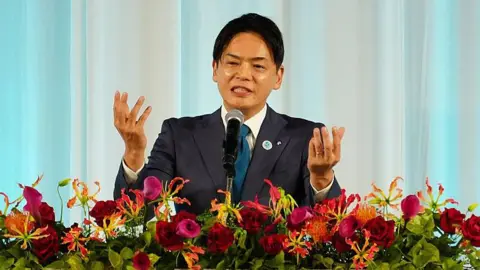 Anadolu via Getty Images