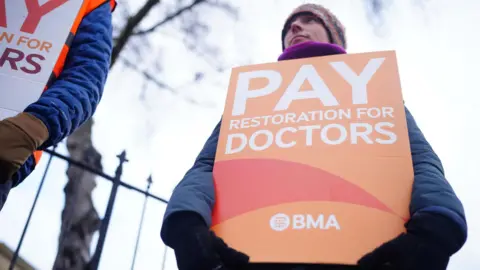
Patients are being told to expect disruption as doctors start their five-day strike in England, with NHS bosses saying they are struggling to keep as many services going as they have done in recent walkouts.
NHS England said with a wave of flu placing pressure on hospitals, non-urgent services would be affected by the strike which begins at 07:00 Wednesday.
This is the 14th walkout by resident doctors, the new name for junior doctors, in the long-running pay dispute.
Health Secretary Wes Streeting said the strike had been timed to inflict most damage on the NHS and put patients at risk, but the British Medical Association said it would work with NHS bosses to ensure patient safety.
The strike is being held after the two sides held last-minute talks on Tuesday afternoon.
The talks were described as "constructive" by the government, but not enough progress had been made to call off the strike.
Resident doctors represent nearly half of the doctors working in the NHS. They will walk out of both emergency and non-urgent care with senior doctors drafted in to provide cover.
In the two most recent strikes – in July and November – NHS England said it was able to keep the majority of non-urgent operations and treatments, such as hip and knee replacements, going.
But NHS England said it expected more disruption this time. Concern has also been expressed that hospitals may struggle to discharge patients in time for Christmas as the doctors who are working concentrate on providing strike cover.
Medical director Prof Meghana Pandit said: "These strikes come at an immensely challenging time for the NHS, with record numbers of patients in hospital with flu for this time of year.
"Staff will come together as they always do, going above and beyond to provide safe care for patients and limit disruption.
"But sadly more patients are likely to feel the impact of this round of strikes than in the previous two – and staff who are covering will not get the Christmas break they deserve with their families."
Streeting added: "We have been working right up to today to try and avert these strike actions.
"Everyone knows the period leading up to Christmas and into the New Year are always the busiest for the NHS. With super flu, this year is harder.
"And that double whammy of flu plus strikes means that there is an additional burden now on other NHS staff."
NHS England said GP practices will continue to be open and urgent and emergency care services will be available for those who need them.
But even then there is likely to be some disruption. Cheltenham General Hospital's emergency department is closing for emergencies during the strike - it will remain open for minor injuries - with patients advised to use nearby Gloucestershire Royal Hospital.
NHS England said the public should use 111 online as the first port of call for urgent, but not life-threatening issues during the strike.
Patients who need emergency medical care should continue to use 999 or come forward to A&E as normal, it added.
The strike is going ahead despite a new offer from the government being made last week, which included increasing the number of speciality training posts and covering out-of-pocket expenses like exam fees.
Getting job is 'nightmare'
The speciality training jobs, which resident doctors start in year three of their training after completing medical school, have become highly competitive.
This year 30,000 applicants went for 10,000 jobs – although some of the applicants were doctors from abroad.
Dr Tom Twentyman is one of those who lost out after trying to secure an emergency medicine post. He says finding a job is an "absolute nightmare".
Since then he has been struggling to find work, juggling a handful of locum shifts each month at the same time as applying for more than 40 short-term contracts at hospitals across the country – one of which he now secured.
But this will not count towards his training, so he will now look to reapply next year.
"Some of the job adverts were coming down within two hours of going up after they received 650 applications, which is clearly an enormous number to shortlist," he says.
On Monday the BMA announced its members had voted to continue with the strike – effectively rejecting the offer in the process – after the union agreed to hold an online poll of members.
BMA resident doctor leader Dr Jack Fletcher described it as a "resounding response" and said the government needed to go further on jobs as well as pay.
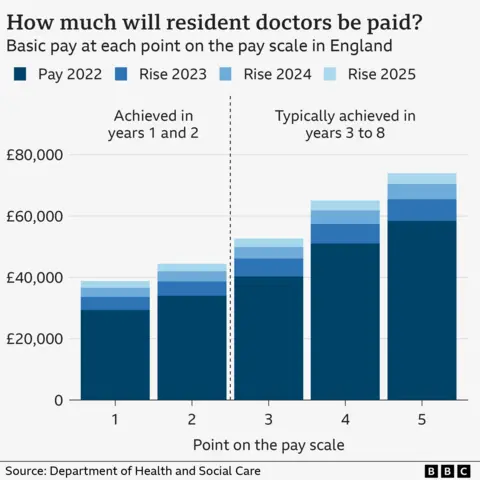
Streeting has maintained he will not discuss pay as doctors have received pay rises totalling nearly 30% over the past three years.
The BMA argues that, despite the pay rises, resident doctors' pay is still a fifth lower than it was in 2008, once inflation is taken into account.
Dr Fletcher added: "It is well past the time for ministers to come up with a genuinely long-term plan.
"If they can simply provide a clear route to responsibly raise pay over a number of years and enough genuinely new jobs instead of recycled ones, then there need not be any more strikes for the remainder of this government."
But the BMA said it was committed to ensuring patient safety.
"We will be in close contact with NHS England throughout the strikes to address safety concerns if they arise," the union added.
Andrea Egan was expelled from the Labour Party three years ago
Left-wing candidate Andrea Egan has been elected as the new leader of Unison, the UK's biggest trade union, in a blow to Sir Keir Starmer.
Ms Egan, who was expelled from the Labour Party three years ago, beat the union's current general secretary Christina McAnea, an ally of the prime minister.
Following her election, Ms Egan promised to "stand up to any employer, politician or cabinet minister who acts against our interests".
During her campaign, she had pledged to hold Labour's "feet to the fire" and refuse to write the party "blank cheques".
Congratulating Ms Egan on her victory, Sir Keir said he looked forward to working with her.
The PM also praised Ms McAnea's "outstanding contribution to the Labour and trade union movement".
"She played an important role in securing the landmark Employment Rights Bill and her work has ensured this Labour government will bring in a fair pay agreement to boost the wages of social care workers," he added.
With more than 1.3 million members working in sectors providing public services, including education, local government, the NHS and the police, Unison is the UK's biggest trade union.
Ms Egan won just under 60% of the vote, although turnout was low, with fewer than 100,000 of the union's members taking part.
She will begin her five-year term in January.
In a statement following her victory, Ms Egan said: "This result means ordinary Unison members are at long last taking charge of our union.
"We will put faith in members' decisions and stand up to any employer, politician or cabinet minister who acts against our interests."
Ms Egan's election was welcomed by former Labour leader Jeremy Corbyn and his new left-wing group, Your Party.
A Your Party spokesperson said: "Andrea's victory on an anti-austerity ticket shows that working-class people won't take more cuts and more decline.
"Unison members have said no to Starmer's crumbs off the table, no to chronic low pay, no to underfunding and no to privatisation."
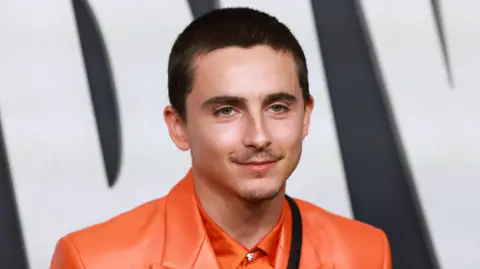
Chalamet is known for his roles in films such as Dune, Wonka and Call Me By Your Name
Hollywood star Timothée Chalamet is compiling his list of five Brits who he considers to be all-time greats.
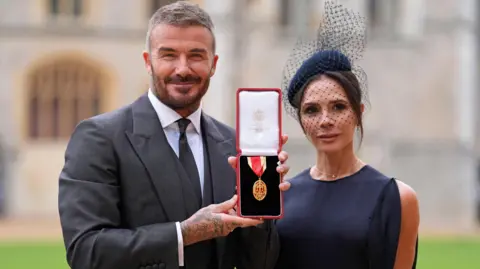
"Lewis Hamilton, David and Victoria," he begins, referring to the seven-time Formula One champion and the Beckhams.
"Fakemink," he continues, naming the underground London rapper who recently teamed up with EsDeeKid, the anonymous Liverpool drill artist who many have linked to Chalamet.
("No comment," is his reply when pressed on this. "All will be revealed.")
But Chalamet's final pick of someone who demonstrated British greatness comes totally out of left field.
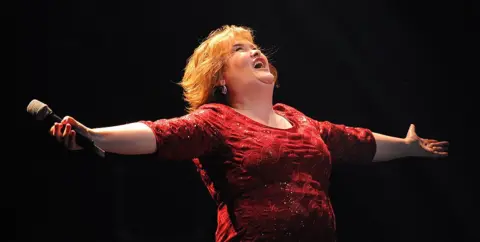
After a long pause and some deep thought, he reveals his answer: "Susan Boyle."
Yes, it turns out that one of the biggest movie stars on the planet is an admirer of the 64-year-old former Britain's Got Talent star, who went on to have two US number one albums.
"She dreamt bigger than all of us," he explains, without any hint of irony.
"Who wasn't moved by that?" he says about the 2009 viral clip of the Scottish singer performing I Dreamed A Dream from Les Misérables on the talent show.
"I remember that like it was yesterday," the actor says. "That was like the advent of YouTube, you know."
Getty Images
Chalamet names the newly knighted Sir David and Victoria Beckham as two of his five great Britons
Chalamet, 29, knows a lot about using social media to advance a career.
The reason he is selecting great Britons, is due to one of the many ways he has found to promote his new 1950s table tennis film, Marty Supreme.
For the last month, he has been presenting jackets bearing the film's title to people he deems as being a great.
Honourees so far include swimmer Michael Phelps, NFL legend Tom Brady and Barcelona's Spanish wonder kid Lamine Yamal.
Now his promotional tour has taken him to London, where he opened a pop-up store and is now sitting in a hotel bar looking out over Hyde Park.
I had asked him which Brits would be worth of receiving a jacket, resulting in the SuBo surprise.
Andrew Yates/AFP via Getty Images
Susan Boyle "dreamt bigger than all of us", says Chalamet
Chalamet's frenetically entertaining performance in Marty Supreme has already landed him best actor nominations at both the Golden Globes and the Critics Choice Awards, and the Oscar race is currently seen as a head-to-head between him and Leonardo DiCaprio.
The film is based on real life post-war table tennis star, Marty Reisman. The semi-fictionalised film version Marty Mauser, however, has some dubious morals, getting involved in a heist and trying to destroy the marriage of his biggest sponsor, who he resents.
Despite his questionable on-screen actions, Chalamet is a big fan of his character.
"You know, when you're in your early twenties, you're an idiot," he laughs. "And this movie, in large part, is about being an idiot in your early twenties.
"And if on top of that, you have a passion that you're singular about, you risk looking foolish in addition to being an idiot."
A24
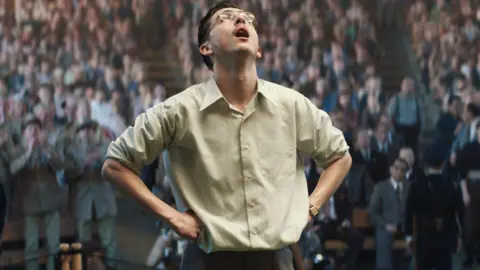
Chalamet stars as table tennis player Marty Mauser in his latest film Marty Supreme
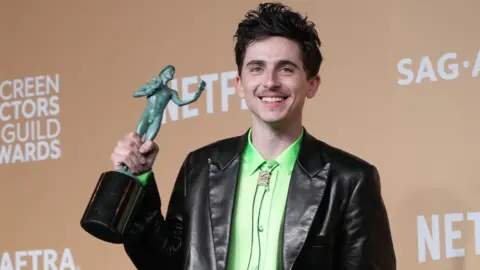
During his acceptance speech he pontificated: "I'm really in pursuit of greatness. I know people don't usually talk like that, but I want to be one of the greats," before listing Daniel Day Lewis, Marlon Brando, Viola Davis and Michael Jordan, as actors who inspired him.
I ask where his confidence comes from.
"You know, it ebbs and flows. And I feel like that's kind of what keeps me on my toes," he says, in a far more humble way that he demonstrated on stage at the SAGs, wearing a bright green suit.
"It's my New York mentality insofar as if I'm on a movie or in a social situation, if things are going well, you feel great. And if not, the world's falling apart," he says, becoming far more introspective than I had expected.
"And I think increasingly in my life, like as I approach 30 here in a couple weeks, you want to be more on your feet. You want to grow into yourself. But that is a constant learning process. And it's a huge learning curve. And I try not to be too hard on myself or those around me who are also growing."
Getty Images
At the SAG Awards in February, Chalamet said he wanted to be "one of the greats"
The actor's landmark birthday presents the perfect chance to ask him how he looks back at his twenties, a decade in which he has twice been nominated for best actor at the Oscars, and starred in huge box office hits including Dune and Wonka.
A huge smile comes over his face as he says: "It's been great. You know, it's been awesome.
"I feel like I'm living in a dream. I'm on top of a fancy hotel in London and talking about a film I'm deeply passionate about.
"And, you know, I got to offend somebody from Scotland the second they walked in with my English shirt," he jokes, referencing my barely disguised displeasure at his choice of interview garb.
Chalamet's dedication to roles is part of his success. He spent five years learning to play the guitar to play Bob Dylan; for Marty Supreme he embarked on seven years of table tennis lessons.
"I got approached with this project in 2018. So that basically gave me six, seven years to prepare on and off. In all my downtime, I would train as much as possible," he enthuses.
"I think the responsibility in this movie, like in the Bob Dylan movie, if you were a Dylan fan or a guitar player, that that looks real to you on screen. Similarly here, if you're a ping-pong aficionado, that that looks believable to you."
His dedication included taking his table tennis table into the desert during Dune and it was oompah-loompah ping-pong between takes on Wonka.
And he's already learning skills for film roles way in the future.
"I can't give anything away, but I do have a couple of white rabbits up my sleeve."
Getty Images
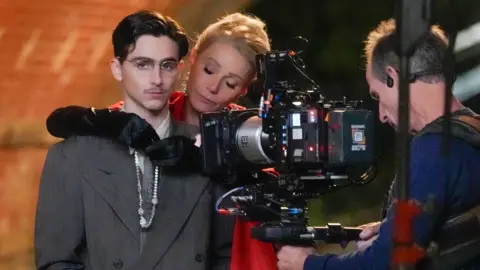
Marty Supreme also marks Gwyneth Paltrow's first film role for seven years
One thing that is totally clear, is his love of the big screen.
In the same month that Netflix has announced its intention to buy one of the major film studios, Warner Bros, Marty Supreme is a film which will have a wide cinema release and has not been made for any streaming service.
It has been produced by A24, the independent film company behind recent Oscar favourites Moonlight, Past Lives and The Brutalist.
"That is an intense question," Chalamet muses after I ask him if he thinks cinemas will actually survive the length of his career.
"I do think with streaming stuff, there's less incentive for these streaming companies to try to put things in theatres, which is dangerous.
"But equally, I do think cinemas will survive and thrive. And that's not to be a false optimist."
And he wants to play his part.
"I feel like my responsibility as a young actor especially, is less to go, 'Hey, how do we get people to revisit this traditional form?' And rather to go, "Hey, how do we take this traditional form and bring it to people?"
Chalamet sincerely believes that Marty Supreme will, in its own way, help cinemas be saved.
"This is an original film at a time where a lot of original films aren't made.
"And there's no part of me that's a salesman that's saying this, but I've never been more confident in saying, "Hey, if you bring yourself to see this movie, you won't be let down. It's really like a slingshot."
Timothée Chalamet – about to turn 30 and more than ready to channel his inner Susan Boyle and dream his dream.
Miss Finland Sarah Dzafce said in the viral photo that she was "eating with a Chinese".
Finland's delegate to last month's Miss Universe pageant held in Thailand has sparked a racism firestorm over a viral photo that showed her pulling the corners of her eyes.
Sarah Dzafce, who has been dethroned, uploaded the photo with the caption "eating with a Chinese". The slanted-eyes pose is often seen as disrespectful to East Asians.
The post drew backlash in Japan, South Korea and China against the 22-year-old and even against her country's flag carrier, Finnair.
Back home in Finland, the prime minister said on Monday making such gestures was "thoughtless and stupid" and that the controversy that ensued was "damaging" to the country.
Ms Dzafce claimed the gesture was her reaction to a headache during dinner. She said a friend added the offensive caption to the 11 December post without her consent, according to local tabloid Ilta-Sanomat.
Ms Dzafce has apologised for the photo, noting it has "caused ill will in many people".
"That was not my intention in any way... One of the most important things for me is respect for people, their backgrounds and differences," she wrote on an Instagram post.
The apology still drew criticism, with some calling it "insincere" given it was written in Finnish.
"Not sure Chinese outside of Finland would understand it. Such considerate and sincere apology," one wrote in a comment on her post.
Another wrote: "That was uncalled for, Asian people didn't do anything to you... We [are] still disappointed in you."
Two right-wing MPs in Finland, Juho Eerola and Kaisa Garedew, posted photos of themselves mimicking Ms Dzafce's gesture to show their support for the beauty queen.
The posts were taken down after backlash. Eerola apologised adding he felt Ms Dzafce was given "disproportionately harsh punishment".
Finnish Prime Minister Petteri Orpo condemned the MPs' actions as "childish", adding that lawmakers should set an example of proper conduct.
The Finns Party is deliberating whether the MPs should face any sanctions for their actions, local media reported.
Finland's flag carrier Finnair told public broadcaster Yle that the controversy had affected the company, and that there had been calls for tourists to boycott Finland.
"The statements or posts mentioned by some Finnish members of parliament do not represent the values of Finnair," the airline wrote on its Japanese X account on Tuesday.
"As an airline supported by employees from diverse backgrounds and customers around the world, we promise to welcome everyone with respect," it wrote.
The debacle has also drawn attention in Japan, South Korea and China, among other East Asian countries.
A Japanese man living in Finland launched an petition calling for an investigation into anti-Asian discrimination, which had gathered more than 7,000 signatures as of Sunday evening, the Asahi Shimbun reported.
The Finnish embassy in Japan said it had received "numerous opinions and questions" on Finland's efforts to address racism.
"Racism remains a challenge in Finnish society, and its resolution requires continuous and resolute efforts," it acknowledged in an X post early this week.
The Miss Finland Organisation said dethroning Ms Dzafce was a "difficult but necessary" move.
"Miss Finland holds a position of role-model status, which requires respecting all people regardless of their origin, background, or appearance," the organisation said in a statement.
"We are deeply sorry for the harm these events have caused. Especially to the Asian community, but also to everyone affected. Racism is never acceptable in any form," it wrote.
England battled hard to stay in the Ashes as Alex Carey's century led Australia to 326-8 on the first day of the third Test.
On a dramatic, poignant and emotional day in Adelaide, Carey's composed 106 ensured Australia did not waste the opportunity to bat first on a slow pitch in baking temperatures.
Carey's knock was not without controversy. On 72 England failed with a review for caught behind off Josh Tongue, which Carey later admitted to edging.
Australia's effort means England, who must win to keep their hopes of regaining the Ashes alive, will be batting under pressure on the second day.
Even before the Adelaide Oval paid tribute to the victims of the shooting at Bondi Beach, Steve Smith was ruled out of the Test with symptoms of dizziness and nausea.
Smith's replacement Usman Khawaja took his unexpected opportunity with 82 after being dropped by Harry Brook on five. Khawaja steadied the home side amid some loose Australian shots against some mixed England bowling.
Jofra Archer was outstanding for his 3-29 from 16 overs, including taking two wickets in the first over after lunch.
Khawaja and Carey added 91 for the fifth wicket, yet when Australia were reduced to 271-7 England had a real opportunity.
Once again, Mitchell Starc found a way to contribute, adding 50 for the eighth wicket with Carey.
England will return on Thursday with a second new ball only three overs old. They have the chance to dismiss Australia for a par total, then could potentially bat themselves back into the series.
To play this video you need to enable JavaScript in your browser.
This video can not be played
Media caption,
'Terrific' Carey brings up first Test century against England
To play this video you need to enable JavaScript in your browser.
This video can not be played
Media caption,
Australia and England players unite in minute's silence for Bondi shooting victims
For all the talk of England errors in the first two Tests, the wisdom of their holiday in Noosa and a change of approach in this match, the tourists cannot be faulted for their effort or attitude in the 34-degree heat.
There were times when the bowling was ragged and part-time off-spinner Will Jacks struggled to contain.
But Archer stepped up as the attack leader and, bar the Brook drop, England's fielding was largely blemish-free.
They were helped by the wastefulness of the Australians, who had to deal with the loss of Smith. The hosts' premier batter is expected to be fit for the fourth Test on Boxing Day.
The mood at the Adelaide Oval - one of the most beautiful grounds in world cricket – was initially sombre as the victims of Bondi were mourned. A moment's silence was observed and Australian singer John Williamson performed 'True Blue'.
From then on the cricket was nip-and-tuck, an arm-wrestle for supremacy. Both sides mixed moments of quality with self-inflicted errors.
Even in such good conditions for batting, there was a suspicion this was a good toss for England to lose. They are a good chasing team and Thursday is forecast to be even hotter. Still, there is the extra heat of batting to stay in the Ashes.
Khawaja and Carey stand up for Australia
To play this video you need to enable JavaScript in your browser.
This video can not be played
Media caption,
Khawaja reaches half-century on return to Australia side
Their respective innings would have carried plenty of meaning for both Khawaja and Carey.
A day short of his 39th birthday, Khawaja may have thought his Test career was over until Smith's illness. For Carey, a South Australian, this was a first Test on his home ground since the passing of his father in September.
Both men arrived after two wickets fell in quick succession. Khawaja looked nervous at first and a flashing drive at Tongue should have been held by Brook diving to his left at second slip.
From there, left-hander Khawaja waited for England to drift straight and tucked off his pads – barely a run came in front of square on the off side. He eventually fell sweeping Jacks into the hands of deep square leg.
Carey is proving a thorn in England's side and a third Test century came with crisp drives and aggression against Jacks.
He was almost caught on 52, only for Carse to put down an extremely difficult chance, then came the huge moment of the review.
With Australia 245-6, Carey aimed a cut at Tongue that ended in the gloves of Jamie Smith. Denied the decision on field, the tourists called for a review.
Carey even appeared to nod towards the England players, suggesting he hit the ball. Despite evidence of sound on the technology, TV umpire Chris Gaffaney did not overturn the decision of Ahsan Raza.
Carey drove Ben Stokes through the covers to reach three figures, celebrating with a look to the sky. His crucial knock was ended when he miscued Jacks into the hands of wicketkeeper Smith.
England improve, but face defining day
To play this video you need to enable JavaScript in your browser.
This video can not be played
Media caption,
'What a stunner' - Crawley takes brilliant one-handed catch to dismiss Head for 10
Stokes has said his dressing room is "no place for weak men" and called this the most important Test of his captaincy. His words certainly drew a show of character from his team.
Archer was a constant threat, bowling with high pace and miserly economy. He bounced out Jake Weatherald in the first hour, then produced leg-side pokes from both Marnus Labuschagne and Cameron Green in the over after lunch.
Carse typified England's ups and downs. He was far too short with the new ball, yet still took the wicket of Travis Head thanks to Zak Crawley's stunning one-handed catch at short cover.
The Durham paceman leaked runs at more than five an over and bowled six no-balls, though still took two catches, almost held Carey and had returning Australia captain Pat Cummins caught at short leg.
Tongue deserved more on his recall to the England side, especially as the victim of Brook's drop. The most obvious issue for the tourists was part-time spinner Jacks' inability to hold an end – he returned 2-105 from his 20 overs.
But even when the day looked like it could get away from England when Carey and Starc were together, Stokes' men stuck at it. They are in this Test and now face a day of reckoning with the bat.
Ella Purnell returns as Lucy in season two of Fallout
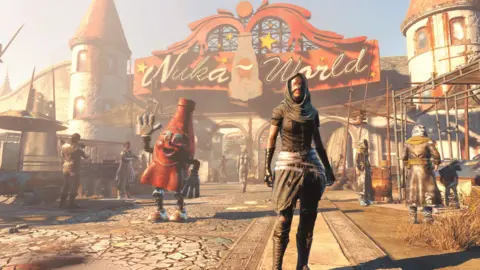
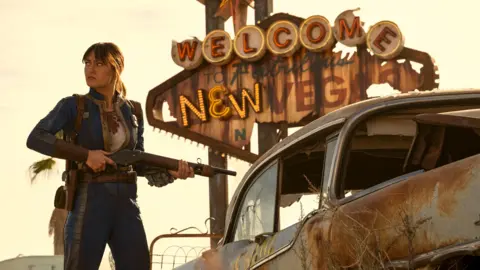
The second season of Fallout - Prime Video's mega-hit based on the popular video game series - has landed.
Set in a post-apocalyptic future where Earth has been ravaged by nuclear war, the first series was a commercial and critical hit, impressing long-time fans and viewers who'd never played before.
Its surprising success had a huge impact on Bethesda Softworks, the developer of its source material, bringing back lapsed players and creating new ones along the way.
Key creatives from the company have told BBC Newsbeat about working with the show's producers, and what the success of the programme means for the future of the games.
The first season of Fallout arrived at a turning point for Hollywood video game adaptations.
Often far-removed from their source material, and often just a bit rubbish, they'd gained a reputation as low-quality cash grabs.
Then The Last of Us came along.
The 2023 adaptation of the PlayStation blockbuster, released ten years earlier, was a smash hit.
It impressed fans of the games, as well as winning over critics and viewers who'd never picked up a controller.
But there were those who argued the show's creators were running on easy mode.
Because the post-apocalyptic story of bounty hunter Joel and his adoptive daughter Ellie drew heavy influences from prestige TV shows, there was an obvious road map for bringing it to the screen.
The drama's story closely followed the game's, with a few deviations, and fans pointed out shot-for-shot comparisons where sequences were almost identical to their pixelated inspiration.
While The Last of Us was wowing audiences, the producers of Fallout were putting the finishing touches to the first season of their adaptation, one which took a different approach to its source material.
Bethesda
Fallout takes place in a post-nuclear world full of hostile factions and a sprinkling of satire
Unlike The Last of Us, which guides the player through a linear story experience, the Fallout games drop them into a more freeform world.
The branching narratives, full of side quests and incidental characters, offer plenty of material to draw from, but deciding what to bring to the screen is a mammoth task.
Todd Howard, director of developer Bethesda Game Studios, tells Newsbeat he was first approached about a filmed version of the game in 2009.
He was agreeable to the idea, he says, but didn't push ahead until meeting executive producer Jonathan Nolan.
Todd says he was a fan of the Briton's work on HBO's Westworld, and impressed by his co-writer credits on films such as The Dark Knight and Interstellar directed by his brother, Christopher Nolan.
The feeling was mutual.
"It turned out he was a huge fan of Fallout," says Todd.
He says the two have become "very close friends" while working on the show together, and he believes it's helped to create trust between the TV and gaming side.
"Everyone involved is on the same page with how they want to treat it with authenticity," he says.
'TV's an entirely different medium'
One of the people in charge of keeping the TV show authentic was studio design director Emil Pagliarulo, a Bethesda veteran who's been closely involved with the Fallout series since its breakout third instalment, released in 2008.
He tells Newsbeat there was an early decision to keep the TV show "canon" - that would become a guiding principle.
That meant "everything that happens in the show happened in the games, or will happen in the games," says Emil.
Fallout, first launched in 1997, has a deep well of established lore the series' biggest fans know well and feel protective of.
Emil admits there was some "back-and-forth" between the TV and gaming sides, especially earlier on.
"It's difficult because TV's an entirely different medium," he says.
"It's really about getting the tone right, but they were very respectful of where we wanted to take it."
He says the strict adherence to the video games' timeline did result in the "occasional late-night text" from the TV show's set.
"Hey, we're filming tomorrow, we had this question," recalls Emil.
"Is this… canonically right?"
"It was always a back-and-forth. It's really fun."
Bethesda
Bethesda developers Emil Pagliarulo, Jon Rush and Bill Lacoste were wowed by the popularity of the TV adaptation
For all the thrill of seeing world you dreamed up realised in another medium, there's a less romantic reason for TV and game studios to get behind adaptations.
As the first season of Fallout was released, prices on most of the games in the series were slashed, appealing to curious new players, and content updates and upgrades aimed at enticing lapsed players were also launched.
It had the desired effect - Fallout 4, the most recent big title, topped sales charts nine years after its original release.
But one of the most significant bumps came to Fallout 76, an online multiplayer spin-off launched in 2018.
The game was poorly received when it first came out, with players complaining of technical issues and a lack of activities in the world.
Bethesda's spent time since addressing those complaints, and managed to attract a healthy number of regular players.
When the first season of Fallout dropped, those numbers skyrocketed to an all-time high.
"We always knew that players would come in after seeing the show," production director Bill Lacoste tells Newsbeat.
But, creative director Jon Rush says "it's safe to say the amount of players that we saw come in, that was… a fun surprise."
Prime Video
The second season of Fallout heads to fan-favourite location New Vegas
With game-makers becoming more directly involved in adaptation work, fans often wonder what impact it has on future game instalments.
Jon says some new Fallout 76 players have stuck around, and it would be "impossible" for them to not have influenced the decisions developers make about regular updates and tweaks.
"Exactly which ways that is, I can't really say. It's kind of an organic process," says Jon.
"We don't make the game in a vacuum. We make it hand-in-hand with the folks that are playing it."
The big question for fans awaiting Fallout 5 - which is likely to still be years away from release - is whether the TV show will have an impact on the game.
"In short, yes," says Todd.
"Fallout 5 will be existing in a world where the stories and events of the show happened or are happening.
"We are taking that into account."
As for whether he's expecting a similar surge in new players in the wake of season two, Todd's not so sure.
"There's still so many people that won't play a game - I think that's getting better but there's still people who are intimidated," he says.
"They still get to experience Fallout and I think that's really important because they're now equal fans of the world."
Listen to Newsbeat live at 12:45 and 17:45 weekdays - or listen back here.
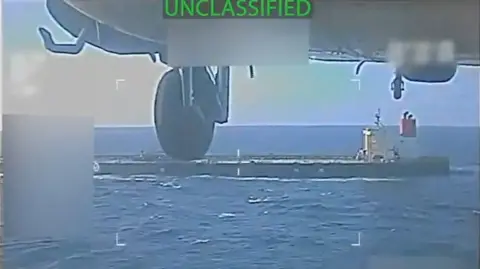
The US seized an oil tanker off the coast of Venezuela on 10 December
In a further escalation of tension between the United States and Venezuela, President Donald Trump has ordered a naval blockade to stop sanctioned oil tankers from entering and leaving the South American country.
Venezuela - which has the world's largest proven oil reserves - is highly dependent on revenues from its oil exports to finance its government spending.
But US sanctions targeting Venezuela's state-run oil company PDVSA have made exporting oil difficult for the Venezuelan government, leading them to resort to a fleet of "ghost ships".
So what do we know about these vessels and how they operate?
'Total and complete blockade'
As of last week, more than 30 of the 80 ships in Venezuelan waters or approaching the country were under US sanctions, according to data compiled by TankerTrackers.com.
Trump imposed sanctions on Venezuela's oil industry as far back as 2019, during his first term as president.
That year, Venezuelan crude exports fell by more than half from roughly 1.1 million barrels per day in January to about 495,000 by the end of 2019, according to the US Energy Information Administration.
Six years later, the sanctions remain in place but Venezuela's oil exports have grown again to around 920,000 barrels per day as of November, according to the news agency Reuters.
While this falls far short of the country's peak level of oil exports of 3 million barrels per day in 1998, this partial recovery indicates that the sanctions against Venezuela are not working as the US hoped.
It indicates that the government of Nicolás Maduro has found new ways to sell Venezuelan oil with the "ghost fleet" at their centre.
Not unique to Venezuela
Ghost fleets are a growing phenomenon, used not just by Venezuela but also by two other oil-producing countries under Western sanctions - Russia and Iran.
Financial intelligence firm S&P Global estimates that one in five oil tankers worldwide are used to smuggle oil from sanctioned countries.
Of these, 10% carry only Venezuelan oil, 20% carry Iranian oil, while 50% are exclusively dedicated to Russian oil. The remaining 20% are not tied to any particular country and can transport oil from more than one of these nations.
Oil sanctions aim to discourage countries or companies from buying or dealing with crude oil from sanctioned nations.
Companies and nations caught buying oil from sanctioned countries like Venezuela risk being sanctioned themselves by the US.
Sanctioned countries offer their oil at steep discounts so that companies or nations are willing to take the risk of buying it whilst applying tricks to disguise its origin.
One of the most common strategies ghost tankers use is to frequently change their name or flag - sometimes several times in a month.
For example, the tanker seized this Wednesday is called The Skipper, according to CBS News, the BBC's US partner.
The ship has been sanctioned by the US Treasury since 2022 for its alleged role in an oil-smuggling network that helps finance Iran's Revolutionary Guard and the Lebanese militia Hezbollah, according to CBS.
At that time, the tanker was named Adisa, but it was originally called Toyo. It was one of the vessels linked to Russian oil tycoon Viktor Artemov, who is also under sanctions.
The Skipper is a 20-year-old vessel - another common trait among ghost fleet tankers. Major shipping companies usually dispose of ships after 15 years of service, and after 25 years they are typically scrapped.
Watch: Video shows US military seizing oil tanker off Venezuela coast
'Zombie ships'
Another trick these ships use is to steal the identity of scrapped vessels by using their unique registration numbers assigned by the International Maritime Organization – similar to criminals using the identity of a dead person.
These are known as "zombie ships".
Last April, a ship called Varada arrived in Malaysian waters after a two-month journey from Venezuela.
It raised suspicions because it was a 32-year-old boat and flew the flag of the Comoros, an island nation off east Africa, which is a popular choice among ships that want to avoid detection.
According to a Bloomberg investigation, it was a zombie ship, as the real Varada had been scrapped in Bangladesh in 2017.
The news agency compared satellite images with historical photos to detect four zombie ships carrying Venezuelan crude oil.
Other common tactics include disguising the origin of crude oil by transferring it in international waters to legally compliant tankers with other flags.
These then deliver the oil to its destination, presenting it as coming from a country that is not sanctioned.
This happened with Venezuelan oil exports to China during Trump's first term when sanctions were tightened.
Another common trick among these tankers is disabling the Automatic Identification System, which transmits data including the vessel's name, flag, position, speed or route.
This allows ships to hide their identity and location.
Maritime risk company Vanguard Tech says it believes The Skipper was "spoofing its position for a long time" - that is, transmitting a false signal, making it appear to be in a different location.
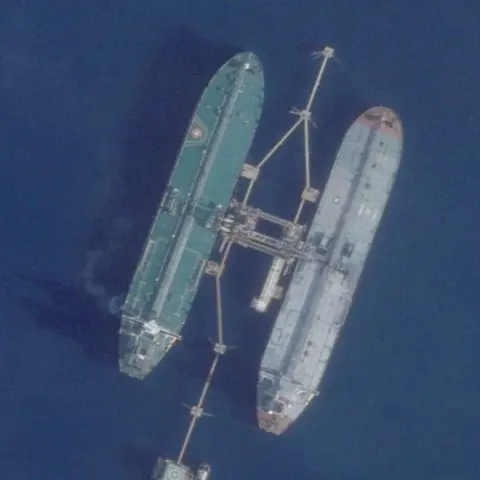
Planet Labs PBC / Reuters
A satellite image taken on 18 November off Venezuelan waters shows The Skipper, on the right, alongside another vessel
According to a report in October by the anti-corruption NGO Transparencia Venezuela, there were 71 foreign tankers at the ports of Venezuelan state oil company PDVSA - of which 15 are under sanctions and nine are linked to ghost fleets.
It found that 24 tankers were operating under stealth, with their mandatory location signals deactivated.
The NGO says it detected six ship-to-ship cargo transfers in waters off western Venezuela.
Most of the ships flew flags of countries considered regulatory havens with lax oversight of sanctions, including Panama, Comoros and Malta.
Many spent more than 20 days without docking at an oil terminal, unlike the Chevron-operated ships that the US has authorised in Venezuela, which load and leave within six days.
"The extended stay in port areas without directly reaching oil terminals raises serious doubts about the type of operations these vessels are conducting," said Transparencia Venezuela in its report.
Given that the operation to seize the ship on 10 December came from the USS Gerald Ford aircraft carrier - the largest in the world - which is now part of the massive US military deployment in Caribbean waters, Maduro's ability to rely on the ghost fleet is likely to be significantly curtailed.
Nativity play nerves, Santa's grotto queues and Christmas lights crowds can make the festive season a sensory overload for children even before the big day arrives.
And their mini-meltdowns only add to the stresses of parents dashing between school plays, present shopping and masterminding the family feast.
Comedian and dad-of-three George Lewis tells CBeebies Parenting Download that while his children "love the thought of Christmas", the disruption in routine can make December "a real inner conflict" for them.
Parenting and child behaviour specialist San Mehra explains the mismatch of high excitement layered with unpredictability is the perfect recipe for "Christmas overwhelm". George and San share four ways to create a calmer Christmas for your children.
1. Stick to some routine
George Lewis
George says his children enjoy Christmas more when events are spaced out as they feel less overwhelmed
Christmas disrupts normal routines, but San stresses that keeping anchor points like wake-ups, mealtimes and bedtimes the same helps children feel grounded.
"Chaos all day is hard for kids to cope with," she says. "If one part of the routine changes, it's manageable but if everything changes, overwhelm builds quickly."
She recommends putting up a calendar and marking on events like relatives arriving or a trip to see Santa so children can see what's coming up and ask questions.
"If you've got a child who's got anxiety around change you can have conversations around that and talk about any worries," she says.
And crucially, she adds, parents should schedule downtime as deliberately as activities as it will help you anticipate if you do or don't have time for certain events.
2. Build your own traditions
Getty Images
George once clung to an idealised, movie-style Christmas - perfectly wrapped presents, big meals and a bustling house.
But two of his children have autism and the unpredictability and crowds quickly became overwhelming.
"I always had this version of the perfect Christmas in my head," he says. "But when my son spent an entire family gathering standing alone at the end of the garden, I thought: if this isn't for him, then who is it for?"
Now he builds Christmas around comfort and predictability: staying at home, keeping numbers low and spreading activities out.
One major change was the meal itself.
"We've stopped having Christmas dinner on Christmas Day," he explains and instead they cook it on Christmas Eve or Boxing Day.
"Then on the day itself we're not stressing about a big project and we just play with the kids and order a curry in the evening."
3. Acknowledge their overwhelm
Getty Images
Even with careful planning, festive outings can tip into overload quickly.
And when a meltdown hits, often after a long queue or an overstimulating attraction, San says the first step for parents is to check in with yourself.
"Your first instinct is panic and you might feel embarrassed or stressed and that's okay," she says. But it's important to first make yourself calm.
Then she recommends getting down to the child's level and helping them feel understood.
A simple acknowledgement like: "You've been waiting for ages, haven't you? You're probably fed up right now" can ease the tension.
"If you can name what they are feeling, like frustration or boredom, it will reduce the intensity by 50%," she says.
George adds that his family often chooses SEND-friendly sessions with reduced noise and fewer people to help keep outings enjoyable rather than overwhelming.
4. . Teach children to navigate conflict
Getty Images
With routines off-kilter and excitement running high squabbles can break out between siblings as well as cousins or friends they may not see regularly.
When kids clash, San says parents don't always need to dive in immediately. But if things look like they're escalating she suggests guiding them through these stages:
Separate the children and ask: "Do you want my help, or do you want to sort it out yourselves?"
Set the rules: "They have to be quiet while the other person is speaking and they have to listen and empathise."
Let each child explain what happened, then briefly clarify the sequence.
Brainstorm solutions together and agree on one
Check back later to see how it's working.
After a while San says that children will "start to sort it out themselves" using the same method.
Lower prices for clothing, food and alcohol helped the UK inflation rate ease last month
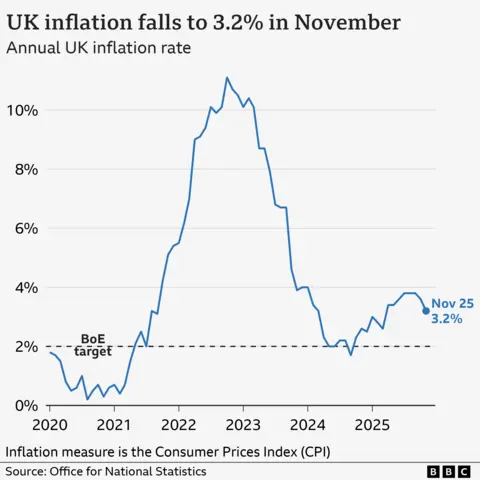
Falls in food, alcohol, and clothing prices last month helped drive inflation to its lowest level in eight months in November.
The inflation rate fell to 3.2% from 3.6%, a larger fall than analysts expected.
Lower food prices were the main driver of the fall, "with decreases seen particularly for cakes, biscuits, and breakfast cereals", according to Office for National Statistics chief economist Grant Fitzner.
It comes ahead of the Bank of England's decision on interest rates on Thursday, with a cut widely expected.
The fall in inflation will foster hope that inflation has peaked, with this possibly paving the way for further interest rate cuts next year.
Other items which also pushed down inflation were the cost of tobacco, restaurant meals and hotel stays, furniture, and transport.
Prices are still rising on average across the economy, but there were decreases in some items between October and November.
Food prices, which were the biggest driver of the lower inflation figure, fell month on month - bucking a trend for normally rising at this time of the year.
Chancellor Rachel Reeves said she knew that families across Britain "will welcome this fall in inflation".
"Getting bills down is my top priority. That is why I froze rail fares and prescription fees and cut £150 off average energy bills at the Budget this year," she said.
Reacting to the inflation figure, chief UK economist with Capital Economics Paul Dales said it was "particularly good news" that the rate of price rises had been "dragged down by the fun things that we all want to indulge in around this time of year".
He added that clothing and footwear prices could also rebound after Black Friday discounts drop away, but that the overall picture "shows that disinflation is happening faster than expected".
Patients are being told to expect disruption as doctors start their five-day strike in England, with NHS bosses saying they are struggling to keep as many services going as they have done in recent walkouts.
NHS England said with a wave of flu placing pressure on hospitals, non-urgent services would be affected by the strike which begins at 07:00 Wednesday.
This is the 14th walkout by resident doctors, the new name for junior doctors, in the long-running pay dispute.
Health Secretary Wes Streeting said the strike had been timed to inflict most damage on the NHS and put patients at risk, but the British Medical Association said it would work with NHS bosses to ensure patient safety.
The strike is being held after the two sides held last-minute talks on Tuesday afternoon.
The talks were described as "constructive" by the government, but not enough progress had been made to call off the strike.
Resident doctors represent nearly half of the doctors working in the NHS. They will walk out of both emergency and non-urgent care with senior doctors drafted in to provide cover.
In the two most recent strikes – in July and November – NHS England said it was able to keep the majority of non-urgent operations and treatments, such as hip and knee replacements, going.
But NHS England said it expected more disruption this time. Concern has also been expressed that hospitals may struggle to discharge patients in time for Christmas as the doctors who are working concentrate on providing strike cover.
Medical director Prof Meghana Pandit said: "These strikes come at an immensely challenging time for the NHS, with record numbers of patients in hospital with flu for this time of year.
"Staff will come together as they always do, going above and beyond to provide safe care for patients and limit disruption.
"But sadly more patients are likely to feel the impact of this round of strikes than in the previous two – and staff who are covering will not get the Christmas break they deserve with their families."
Streeting added: "We have been working right up to today to try and avert these strike actions.
"Everyone knows the period leading up to Christmas and into the New Year are always the busiest for the NHS. With super flu, this year is harder.
"And that double whammy of flu plus strikes means that there is an additional burden now on other NHS staff."
NHS England said GP practices will continue to be open and urgent and emergency care services will be available for those who need them.
But even then there is likely to be some disruption. Cheltenham General Hospital's emergency department is closing for emergencies during the strike - it will remain open for minor injuries - with patients advised to use nearby Gloucestershire Royal Hospital.
NHS England said the public should use 111 online as the first port of call for urgent, but not life-threatening issues during the strike.
Patients who need emergency medical care should continue to use 999 or come forward to A&E as normal, it added.
The strike is going ahead despite a new offer from the government being made last week, which included increasing the number of speciality training posts and covering out-of-pocket expenses like exam fees.
Getting job is 'nightmare'
The speciality training jobs, which resident doctors start in year three of their training after completing medical school, have become highly competitive.
This year 30,000 applicants went for 10,000 jobs – although some of the applicants were doctors from abroad.
Dr Tom Twentyman is one of those who lost out after trying to secure an emergency medicine post. He says finding a job is an "absolute nightmare".
Since then he has been struggling to find work, juggling a handful of locum shifts each month at the same time as applying for more than 40 short-term contracts at hospitals across the country – one of which he now secured.
But this will not count towards his training, so he will now look to reapply next year.
"Some of the job adverts were coming down within two hours of going up after they received 650 applications, which is clearly an enormous number to shortlist," he says.
On Monday the BMA announced its members had voted to continue with the strike – effectively rejecting the offer in the process – after the union agreed to hold an online poll of members.
BMA resident doctor leader Dr Jack Fletcher described it as a "resounding response" and said the government needed to go further on jobs as well as pay.
Streeting has maintained he will not discuss pay as doctors have received pay rises totalling nearly 30% over the past three years.
The BMA argues that, despite the pay rises, resident doctors' pay is still a fifth lower than it was in 2008, once inflation is taken into account.
Dr Fletcher added: "It is well past the time for ministers to come up with a genuinely long-term plan.
"If they can simply provide a clear route to responsibly raise pay over a number of years and enough genuinely new jobs instead of recycled ones, then there need not be any more strikes for the remainder of this government."
But the BMA said it was committed to ensuring patient safety.
"We will be in close contact with NHS England throughout the strikes to address safety concerns if they arise," the union added.
Chalamet is known for his roles in films such as Dune, Wonka and Call Me By Your Name
Hollywood star Timothée Chalamet is compiling his list of five Brits who he considers to be all-time greats.
"Lewis Hamilton, David and Victoria," he begins, referring to the seven-time Formula One champion and the Beckhams.
"Fakemink," he continues, naming the underground London rapper who recently teamed up with EsDeeKid, the anonymous Liverpool drill artist who many have linked to Chalamet.
("No comment," is his reply when pressed on this. "All will be revealed.")
But Chalamet's final pick of someone who demonstrated British greatness comes totally out of left field.
After a long pause and some deep thought, he reveals his answer: "Susan Boyle."
Yes, it turns out that one of the biggest movie stars on the planet is an admirer of the 64-year-old former Britain's Got Talent star, who went on to have two US number one albums.
"She dreamt bigger than all of us," he explains, without any hint of irony.
"Who wasn't moved by that?" he says about the 2009 viral clip of the Scottish singer performing I Dreamed A Dream from Les Misérables on the talent show.
"I remember that like it was yesterday," the actor says. "That was like the advent of YouTube, you know."
Getty Images
Chalamet names the newly knighted Sir David and Victoria Beckham as two of his five great Britons
Chalamet, 29, knows a lot about using social media to advance a career.
The reason he is selecting great Britons, is due to one of the many ways he has found to promote his new 1950s table tennis film, Marty Supreme.
For the last month, he has been presenting jackets bearing the film's title to people he deems as being a great.
Honourees so far include swimmer Michael Phelps, NFL legend Tom Brady and Barcelona's Spanish wonder kid Lamine Yamal.
Now his promotional tour has taken him to London, where he opened a pop-up store and is now sitting in a hotel bar looking out over Hyde Park.
I had asked him which Brits would be worth of receiving a jacket, resulting in the SuBo surprise.
Andrew Yates/AFP via Getty Images
Susan Boyle "dreamt bigger than all of us", says Chalamet
Chalamet's frenetically entertaining performance in Marty Supreme has already landed him best actor nominations at both the Golden Globes and the Critics Choice Awards, and the Oscar race is currently seen as a head-to-head between him and Leonardo DiCaprio.
The film is based on real life post-war table tennis star, Marty Reisman. The semi-fictionalised film version Marty Mauser, however, has some dubious morals, getting involved in a heist and trying to destroy the marriage of his biggest sponsor, who he resents.
Despite his questionable on-screen actions, Chalamet is a big fan of his character.
"You know, when you're in your early twenties, you're an idiot," he laughs. "And this movie, in large part, is about being an idiot in your early twenties.
"And if on top of that, you have a passion that you're singular about, you risk looking foolish in addition to being an idiot."
A24
Chalamet stars as table tennis player Marty Mauser in his latest film Marty Supreme
During his acceptance speech he pontificated: "I'm really in pursuit of greatness. I know people don't usually talk like that, but I want to be one of the greats," before listing Daniel Day Lewis, Marlon Brando, Viola Davis and Michael Jordan, as actors who inspired him.
I ask where his confidence comes from.
"You know, it ebbs and flows. And I feel like that's kind of what keeps me on my toes," he says, in a far more humble way that he demonstrated on stage at the SAGs, wearing a bright green suit.
"It's my New York mentality insofar as if I'm on a movie or in a social situation, if things are going well, you feel great. And if not, the world's falling apart," he says, becoming far more introspective than I had expected.
"And I think increasingly in my life, like as I approach 30 here in a couple weeks, you want to be more on your feet. You want to grow into yourself. But that is a constant learning process. And it's a huge learning curve. And I try not to be too hard on myself or those around me who are also growing."
Getty Images
At the SAG Awards in February, Chalamet said he wanted to be "one of the greats"
The actor's landmark birthday presents the perfect chance to ask him how he looks back at his twenties, a decade in which he has twice been nominated for best actor at the Oscars, and starred in huge box office hits including Dune and Wonka.
A huge smile comes over his face as he says: "It's been great. You know, it's been awesome.
"I feel like I'm living in a dream. I'm on top of a fancy hotel in London and talking about a film I'm deeply passionate about.
"And, you know, I got to offend somebody from Scotland the second they walked in with my English shirt," he jokes, referencing my barely disguised displeasure at his choice of interview garb.
Chalamet's dedication to roles is part of his success. He spent five years learning to play the guitar to play Bob Dylan; for Marty Supreme he embarked on seven years of table tennis lessons.
"I got approached with this project in 2018. So that basically gave me six, seven years to prepare on and off. In all my downtime, I would train as much as possible," he enthuses.
"I think the responsibility in this movie, like in the Bob Dylan movie, if you were a Dylan fan or a guitar player, that that looks real to you on screen. Similarly here, if you're a ping-pong aficionado, that that looks believable to you."
His dedication included taking his table tennis table into the desert during Dune and it was oompah-loompah ping-pong between takes on Wonka.
And he's already learning skills for film roles way in the future.
"I can't give anything away, but I do have a couple of white rabbits up my sleeve."
Getty Images
Marty Supreme also marks Gwyneth Paltrow's first film role for seven years
One thing that is totally clear, is his love of the big screen.
In the same month that Netflix has announced its intention to buy one of the major film studios, Warner Bros, Marty Supreme is a film which will have a wide cinema release and has not been made for any streaming service.
It has been produced by A24, the independent film company behind recent Oscar favourites Moonlight, Past Lives and The Brutalist.
"That is an intense question," Chalamet muses after I ask him if he thinks cinemas will actually survive the length of his career.
"I do think with streaming stuff, there's less incentive for these streaming companies to try to put things in theatres, which is dangerous.
"But equally, I do think cinemas will survive and thrive. And that's not to be a false optimist."
And he wants to play his part.
"I feel like my responsibility as a young actor especially, is less to go, 'Hey, how do we get people to revisit this traditional form?' And rather to go, "Hey, how do we take this traditional form and bring it to people?"
Chalamet sincerely believes that Marty Supreme will, in its own way, help cinemas be saved.
"This is an original film at a time where a lot of original films aren't made.
"And there's no part of me that's a salesman that's saying this, but I've never been more confident in saying, "Hey, if you bring yourself to see this movie, you won't be let down. It's really like a slingshot."
Timothée Chalamet – about to turn 30 and more than ready to channel his inner Susan Boyle and dream his dream.
Nativity play nerves, Santa's grotto queues and Christmas lights crowds can make the festive season a sensory overload for children even before the big day arrives.
And their mini-meltdowns only add to the stresses of parents dashing between school plays, present shopping and masterminding the family feast.
Comedian and dad-of-three George Lewis tells CBeebies Parenting Download that while his children "love the thought of Christmas", the disruption in routine can make December "a real inner conflict" for them.
Parenting and child behaviour specialist San Mehra explains the mismatch of high excitement layered with unpredictability is the perfect recipe for "Christmas overwhelm". George and San share four ways to create a calmer Christmas for your children.
1. Stick to some routine
George Lewis
George says his children enjoy Christmas more when events are spaced out as they feel less overwhelmed
Christmas disrupts normal routines, but San stresses that keeping anchor points like wake-ups, mealtimes and bedtimes the same helps children feel grounded.
"Chaos all day is hard for kids to cope with," she says. "If one part of the routine changes, it's manageable but if everything changes, overwhelm builds quickly."
She recommends putting up a calendar and marking on events like relatives arriving or a trip to see Santa so children can see what's coming up and ask questions.
"If you've got a child who's got anxiety around change you can have conversations around that and talk about any worries," she says.
And crucially, she adds, parents should schedule downtime as deliberately as activities as it will help you anticipate if you do or don't have time for certain events.
2. Build your own traditions
Getty Images
George once clung to an idealised, movie-style Christmas - perfectly wrapped presents, big meals and a bustling house.
But two of his children have autism and the unpredictability and crowds quickly became overwhelming.
"I always had this version of the perfect Christmas in my head," he says. "But when my son spent an entire family gathering standing alone at the end of the garden, I thought: if this isn't for him, then who is it for?"
Now he builds Christmas around comfort and predictability: staying at home, keeping numbers low and spreading activities out.
One major change was the meal itself.
"We've stopped having Christmas dinner on Christmas Day," he explains and instead they cook it on Christmas Eve or Boxing Day.
"Then on the day itself we're not stressing about a big project and we just play with the kids and order a curry in the evening."
3. Acknowledge their overwhelm
Getty Images
Even with careful planning, festive outings can tip into overload quickly.
And when a meltdown hits, often after a long queue or an overstimulating attraction, San says the first step for parents is to check in with yourself.
"Your first instinct is panic and you might feel embarrassed or stressed and that's okay," she says. But it's important to first make yourself calm.
Then she recommends getting down to the child's level and helping them feel understood.
A simple acknowledgement like: "You've been waiting for ages, haven't you? You're probably fed up right now" can ease the tension.
"If you can name what they are feeling, like frustration or boredom, it will reduce the intensity by 50%," she says.
George adds that his family often chooses SEND-friendly sessions with reduced noise and fewer people to help keep outings enjoyable rather than overwhelming.
4. . Teach children to navigate conflict
Getty Images
With routines off-kilter and excitement running high squabbles can break out between siblings as well as cousins or friends they may not see regularly.
When kids clash, San says parents don't always need to dive in immediately. But if things look like they're escalating she suggests guiding them through these stages:
Separate the children and ask: "Do you want my help, or do you want to sort it out yourselves?"
Set the rules: "They have to be quiet while the other person is speaking and they have to listen and empathise."
Let each child explain what happened, then briefly clarify the sequence.
Brainstorm solutions together and agree on one
Check back later to see how it's working.
After a while San says that children will "start to sort it out themselves" using the same method.
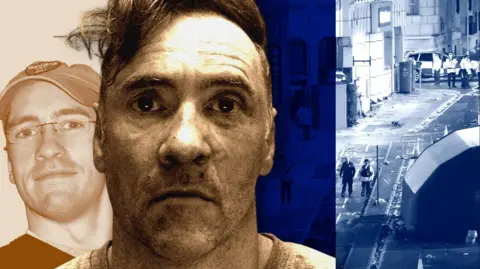
Footage shows Paul Doyle's journey to Liverpool parade
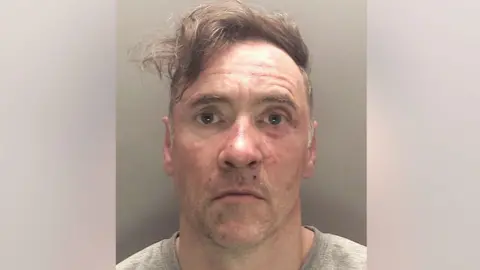
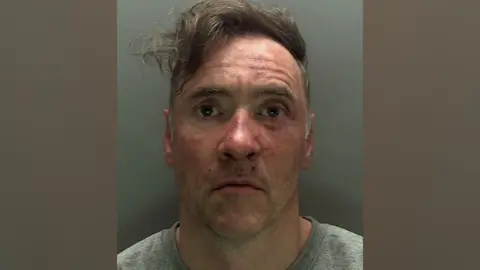
Paul Doyle's loss of temper on the day of the Liverpool parade attack, described by the sentencing judge as "incomprehensible", may never be fully explained.
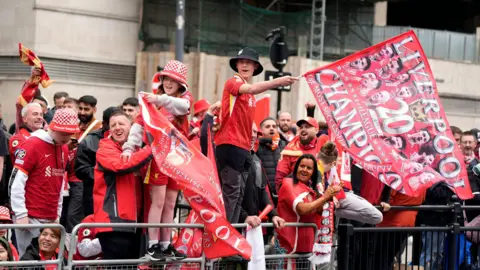
There seemed little cause for the 54-year-old to feel so aggrieved by the crowds blocking the roads as they celebrated at Liverpool FC's Premier League victory parade on 26 May.
Whatever the reason, he is now serving a sentence of 21 years and six months after pleading guilty to 31 offences including dangerous driving, affray and causing grievous bodily harm with intent.
This is how Doyle's increasing aggression on the roads developed into catastrophe over one afternoon, starting at 12:34 BST when a friend who he had agreed to drive to the parade arrived at his home.
PA Media
Liverpool fans lined the city's streets to cheer on the players during the team's victory parade
12:34 – Paul Doyle's friend Dave Clark and his family arrive at his home in Croxteth, Liverpool. The Clark family are Liverpool fans and Doyle, an Everton fan, has agreed to drive them into the city centre to watch the parade.
12:41 – Doyle leaves home with Mr Clark and his family. On the "mundane" journey into the city, they speak about house prices, schools, football, cars, their common work in IT and family matters.
He then drops them off on Exchange Street East, where footage showed him driving calmly and following the traffic measures on Dale Street.
CPS
Paul Doyle could be heard on his car's own camera swearing and shouting as he mowed down supporters later that afternoon
13:35 – Doyle arrives home after dropping his friends off on Exchange Street East. The court heard that while it did not form part of the dangerous driving charge, he "drove in a markedly more aggressive way" on his way home, jumping lanes and undertaking other vehicles.
14:30 – The victory parade starts at Allerton Maze, in the the south of Liverpool.
17:24 – Doyle sends Mr Clark a message asking "how's it going?" and is told his friend is on Castle Street, close to Dale Street and Water Street.
MerseysidePolice
People could be seen on the bonnet of his car and falling underneath as Doyle accelerated into Water Street
17:29 – Doyle sets off from his house to return to the city centre. He instructs the sat-nav system in his Ford Galaxy car to take him to Castle Street. On the way, he undertakes several cars and runs a red light.
17:40 – The Liverpool FC parade finishes when the buses arrive outside the Liver Building on the waterfront.
17:48 – Mr Clark sends Doyle a message telling him signal is poor. Doyle says he will be at Castle Street in about 10 minutes but does not reply when Mr Clark asks if he wants them to walk anywhere. Mr Clark also tells him he might find the area of Castle Street blocked.
PA Media
Statements from 78 of Doyle's victims were read to the court during the course of his sentencing
17:54 – Doyle arrives on Dale Street from Byrom Street, having undertaken a series of other vehicles at traffic lights and gone around a roundabout in the wrong lane, coming close to pedestrians who are crossing the road.
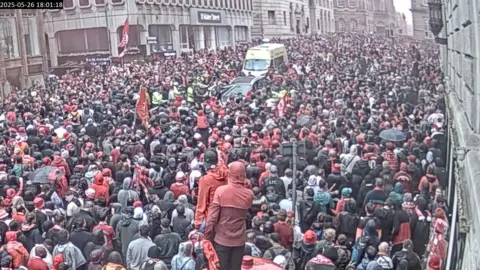
He uses his horn and presses on down the road, despite a dense crowd of fans heading back from the waterfront. He drives through a red light at the junction with Stanley Street.
17:58 – A man walking with his child, who has not been identified, becomes concerned about Doyle's driving and places his foot on the bumper of the Ford Galaxy as he moves his child out of the way. He points at Doyle, who responds by shouting: "It's a [expletive] road."
After this interaction, Doyle continues to drive in the direction of the increasingly worried crowd, some of whom bang on his car roof.
He blasts his car horn and shouts further obscenities. Adults jump out of his way and children are pulled from his path.
Reuters
Doyle hit more than 100 people that day in the space of a few minutes
He initially stops ahead of traffic cones put in place to divert traffic away from Water Street, which is full of fans, but then steers into the left lane.
The first person he hits is Jack Trotter, 23, who attempts to get out of the way but suffers an injury to his leg. He then drives into a group of people who are thrown onto his bonnet. He hits another group of people and then drives into a 10-year-old girl, before shouting "[Expletive] move".
He carries on down Water Street, striking more people, including Jacqueline McClaren, 60, and paramedic Jay Vernon, 34. He reverses and collides with an ambulance.
Doyle stops for a short time and fans surround his vehicle. One, ex soldier Dan Barr, opens the rear passenger door and gets into the car.
Paul Doyle told police his actions "ruined so many people's lives" as he was arrested
Doyle then accelerates again, hitting Simon Nash, who is thrown into the air. Driving sharply to the right, he hits Sheree Aldridge and the pram she is pushing, carrying six-month-old baby Teddy Eveson.
The pram, with Teddy in, is thrown into the air but the baby is uninjured. Ms Aldridge suffers a serious injury to her left thigh.
From the back of the car, Mr Barr leans forward and holds the automatic gear selector in park mode. Doyle continues to try and accelerate but eventually the car, with four people underneath it, comes to a stop.
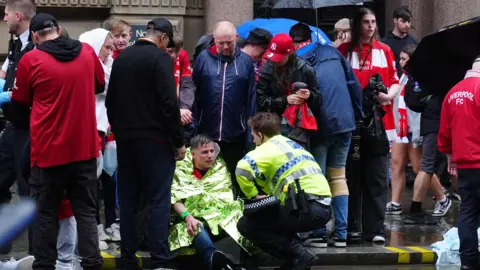
18:01 – Doyle is dragged from his vehicle and quickly shielded from the crowd by police officers. In the two minutes since he drove into the crowd, 134 people have been hit.
Doyle pleaded not guilty to 31 charges when he appeared at Liverpool Crown Court on 4 September, with a trial scheduled for November.
Jurors were sworn in on 25 November but he changed his pleas the following day as the prosecution prepared to open its case.
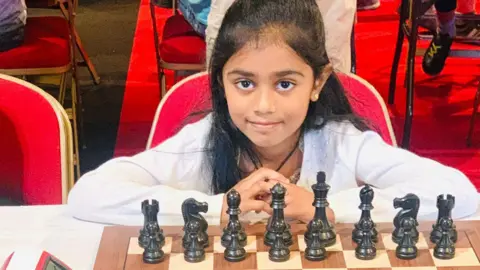
Tara says she hopes to become a psychiatrist one day so she can read her "opponent's next move"
"People are a bit annoyed when I beat them and maybe a bit sad because they lost to a child."
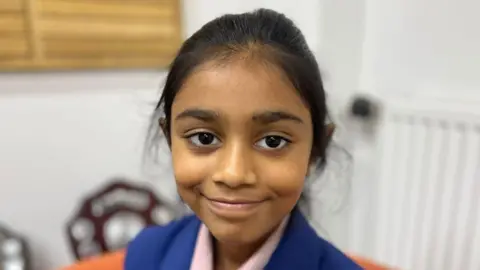
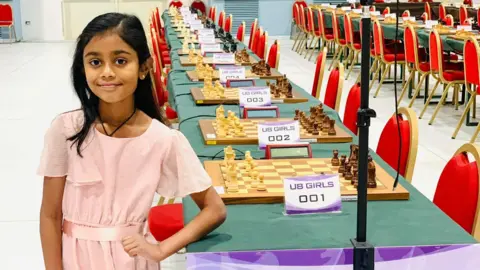
At just 4ft 2in (130cm), nine-year-old Tara keeps cool as a cucumber when she faces seasoned chess players in tournaments.
She recently competed in the 2025 UK Open Blitz Championship qualifier, where she finished as the top performing girl in the tournament and made it to the Women's Final.
The prodigy from Leicester says she is hoping to become the best chess player in the world in her age category.
Tara says she started falling in love with the game at the age of four and her first opponents were her parents, who are both software engineers.
"When I was playing them I was jumping up and down because I was getting excited about what they will do," she says.
"I saw a piece - a knight - which can go in an L shape and I thought they all could go like they're in an army."
Tara started going to chess clubs in Year 2 but is now privately tutored.
Shalini Sathiyaseelan
Tara, who made the women's final, hopes to become the best in the world at her age category
"I play much older people - they get a bit nervous. In big tournaments, when we play very fast, they ask 'how can this girl play like this?'
"And I just keep playing my game and don't worry about others," she says.
Tara shows no sign of stopping anytime soon, and is constantly training or playing opponents online.
She admits she does get nervous sometimes.
"When I played online games against a Master I was getting nervous. But then I started playing and I stopped being nervous.
"Sometimes emotion comes into it. Especially when you make a big move, it can feel emotional.
"Or when you miscalculate something, it can feel a bit sad. But if you keep playing confidently, you can win. Chess is like a mind game," Tara adds.
She says she will never stop playing, however she would like to become a psychiatrist one day.
"I want to be a psychiatrist. I want to be able to read people's minds so I can find out my opponent's next move," she says.
Shalini Sathiyaseelan
Tara says chess has helped her with her studies
Tara's mum Shalini Sathiyaseelan says she did not think her daughter was going to become a chess prodigy straight away.
But as the young girl kept on playing, she said she could see something "grow inside her".
"We thought we could support her, get her a coach and get her to the next level," Mrs Sathiyaseelan adds.
"She is very quiet and calm. Whenever she goes to tournaments, she prepares for them because every game is different.
"She is really enjoying it. She would sit with her dad and talk about tricks and tactics."
Head of Fairfield Prep School in Loughborough, Andrew Earnshaw, says watching Tara's development in chess has been "truly amazing".
"To qualify for the Women's Final at such a young age is extraordinary, and to hold her own against some of the strongest female players in the country speaks volumes about her talent, determination and composure."
Naveed Akram, the surviving alleged suspect in Sunday's mass shooting at Bondi Beach in Sydney, has been charged with 59 offences, including 15 counts of murder and one of committing a terrorist act, according to the New South Wales Police.
The other gunman, his father Sajid Akram, 50, was killed in an exchange of fire with police at the scene.
Fifteen people were killed and dozens of others were injured in the attack, which targeted Australia's Jewish community at an event celebrating the first night of Hanukkah.
It was the country's deadliest shooting since 1996.
Akram also faces 40 charges of causing grievous bodily harm with intent to murder, as well as one charge of causing a public display of a prohibited terrorist organisation symbol.
He was critically injured during the incident on Sunday, and had his first hearing from his hospital bedside, the local New South Wales court said.
The case has been adjourned until April 2026, the court added.
Earlier on Wednesday, New South Wales Police Commissioner Mal Lanyon said they were waiting for medication to wear off before formally questioning Akram.
"For his fairness, we need him to understand what is exactly happening," Lanyon said.
Twenty people injured in the attack remain in hospitals across Sydney, with one person still in a critical condition.
Earlier, New South Wales Police Commissioner Mal Lanyon said they were waiting for medication to wear off before formally questioning Akram.
"For his fairness, we need him to understand what is exactly happening," Lanyon said.
Police have designated the attack a terrorist incident, with Australian Prime Minister Anthony Albanese saying it appears to have been "motivated by Islamic State" group ideology.
Police said "homemade" Islamic State group flags and improvised explosive devices (IEDs) have been found in the vehicle used by the gunmen.
This breaking news story is being updated and more details will be published shortly. Please refresh the page for the fullest version.
You can receive Breaking News on a smartphone or tablet via the BBC News App. You can also follow @BBCBreaking on X to get the latest alerts.
Patients are being told to expect disruption as doctors start their five-day strike in England, with NHS bosses saying they are struggling to keep as many services going as they have done in recent walkouts.
NHS England said with a wave of flu placing pressure on hospitals, non-urgent services would be affected by the strike which begins at 07:00 Wednesday.
This is the 14th walkout by resident doctors, the new name for junior doctors, in the long-running pay dispute.
Health Secretary Wes Streeting said the strike had been timed to inflict most damage on the NHS and put patients at risk, but the British Medical Association said it would work with NHS bosses to ensure patient safety.
The strike is being held after the two sides held last-minute talks on Tuesday afternoon.
The talks were described as "constructive" by the government, but not enough progress had been made to call off the strike.
Resident doctors represent nearly half of the doctors working in the NHS. They will walk out of both emergency and non-urgent care with senior doctors drafted in to provide cover.
In the two most recent strikes – in July and November – NHS England said it was able to keep the majority of non-urgent operations and treatments, such as hip and knee replacements, going.
But NHS England said it expected more disruption this time. Concern has also been expressed that hospitals may struggle to discharge patients in time for Christmas as the doctors who are working concentrate on providing strike cover.
Medical director Prof Meghana Pandit said: "These strikes come at an immensely challenging time for the NHS, with record numbers of patients in hospital with flu for this time of year.
"Staff will come together as they always do, going above and beyond to provide safe care for patients and limit disruption.
"But sadly more patients are likely to feel the impact of this round of strikes than in the previous two – and staff who are covering will not get the Christmas break they deserve with their families."
Streeting added: "We have been working right up to today to try and avert these strike actions.
"Everyone knows the period leading up to Christmas and into the New Year are always the busiest for the NHS. With super flu, this year is harder.
"And that double whammy of flu plus strikes means that there is an additional burden now on other NHS staff."
NHS England said GP practices will continue to be open and urgent and emergency care services will be available for those who need them.
But even then there is likely to be some disruption. Cheltenham General Hospital's emergency department is closing for emergencies during the strike - it will remain open for minor injuries - with patients advised to use nearby Gloucestershire Royal Hospital.
NHS England said the public should use 111 online as the first port of call for urgent, but not life-threatening issues during the strike.
Patients who need emergency medical care should continue to use 999 or come forward to A&E as normal, it added.
The strike is going ahead despite a new offer from the government being made last week, which included increasing the number of speciality training posts and covering out-of-pocket expenses like exam fees.
Getting job is 'nightmare'
The speciality training jobs, which resident doctors start in year three of their training after completing medical school, have become highly competitive.
This year 30,000 applicants went for 10,000 jobs – although some of the applicants were doctors from abroad.
Dr Tom Twentyman is one of those who lost out after trying to secure an emergency medicine post. He says finding a job is an "absolute nightmare".
Since then he has been struggling to find work, juggling a handful of locum shifts each month at the same time as applying for more than 40 short-term contracts at hospitals across the country – one of which he now secured.
But this will not count towards his training, so he will now look to reapply next year.
"Some of the job adverts were coming down within two hours of going up after they received 650 applications, which is clearly an enormous number to shortlist," he says.
On Monday the BMA announced its members had voted to continue with the strike – effectively rejecting the offer in the process – after the union agreed to hold an online poll of members.
BMA resident doctor leader Dr Jack Fletcher described it as a "resounding response" and said the government needed to go further on jobs as well as pay.
Streeting has maintained he will not discuss pay as doctors have received pay rises totalling nearly 30% over the past three years.
The BMA argues that, despite the pay rises, resident doctors' pay is still a fifth lower than it was in 2008, once inflation is taken into account.
Dr Fletcher added: "It is well past the time for ministers to come up with a genuinely long-term plan.
"If they can simply provide a clear route to responsibly raise pay over a number of years and enough genuinely new jobs instead of recycled ones, then there need not be any more strikes for the remainder of this government."
But the BMA said it was committed to ensuring patient safety.
"We will be in close contact with NHS England throughout the strikes to address safety concerns if they arise," the union added.
The UK is set to rejoin the Erasmus scheme, the BBC understands, five years after announcing that it would end its participation as part of the Brexit deal with the European Union.
The EU provides funding through the scheme for people to study, train or volunteer in other European countries for up to a year.
The UK replaced it with its own Turing scheme in 2021, which funds similar placements worldwide.
The government said it would not comment on ongoing talks.
The Erasmus scheme was scrapped in the UK in December 2020, when the government announced its post-Brexit trade deal with the EU.
Boris Johnson, prime minister at the time, said it was a "tough decision", but the scheme had become "extremely expensive".
He said it would be replaced by the Turing scheme, which has operated since then.
Both schemes are open not just to university students, but also to people doing vocational courses, as well as apprentices and people training at college or school.
The UK sent out 9,900 students and trainees to other countries as part of the scheme that year, while 16,100 came the other way.
Glasgow, Bristol and Edinburgh were the three universities to send the most students, and Spain, France and Germany were the most popular countries which UK students went to.
In the 2024/25 academic year, the Turing scheme had £105m of funding, which paid for 43,200 placements, with 24,000 of those being in higher education, 12,100 in further education and 7,000 in schools.
The majority (38,000) were from England, with 2,900 from Scotland, 1,000 from Wales and 1,200 from Northern Ireland.
Footage shows Paul Doyle's journey to Liverpool parade
Paul Doyle's loss of temper on the day of the Liverpool parade attack, described by the sentencing judge as "incomprehensible", may never be fully explained.
There seemed little cause for the 54-year-old to feel so aggrieved by the crowds blocking the roads as they celebrated at Liverpool FC's Premier League victory parade on 26 May.
Whatever the reason, he is now serving a sentence of 21 years and six months after pleading guilty to 31 offences including dangerous driving, affray and causing grievous bodily harm with intent.
This is how Doyle's increasing aggression on the roads developed into catastrophe over one afternoon, starting at 12:34 BST when a friend who he had agreed to drive to the parade arrived at his home.
PA Media
Liverpool fans lined the city's streets to cheer on the players during the team's victory parade
12:34 – Paul Doyle's friend Dave Clark and his family arrive at his home in Croxteth, Liverpool. The Clark family are Liverpool fans and Doyle, an Everton fan, has agreed to drive them into the city centre to watch the parade.
12:41 – Doyle leaves home with Mr Clark and his family. On the "mundane" journey into the city, they speak about house prices, schools, football, cars, their common work in IT and family matters.
He then drops them off on Exchange Street East, where footage showed him driving calmly and following the traffic measures on Dale Street.
CPS
Paul Doyle could be heard on his car's own camera swearing and shouting as he mowed down supporters later that afternoon
13:35 – Doyle arrives home after dropping his friends off on Exchange Street East. The court heard that while it did not form part of the dangerous driving charge, he "drove in a markedly more aggressive way" on his way home, jumping lanes and undertaking other vehicles.
14:30 – The victory parade starts at Allerton Maze, in the the south of Liverpool.
17:24 – Doyle sends Mr Clark a message asking "how's it going?" and is told his friend is on Castle Street, close to Dale Street and Water Street.
MerseysidePolice
People could be seen on the bonnet of his car and falling underneath as Doyle accelerated into Water Street
17:29 – Doyle sets off from his house to return to the city centre. He instructs the sat-nav system in his Ford Galaxy car to take him to Castle Street. On the way, he undertakes several cars and runs a red light.
17:40 – The Liverpool FC parade finishes when the buses arrive outside the Liver Building on the waterfront.
17:48 – Mr Clark sends Doyle a message telling him signal is poor. Doyle says he will be at Castle Street in about 10 minutes but does not reply when Mr Clark asks if he wants them to walk anywhere. Mr Clark also tells him he might find the area of Castle Street blocked.
PA Media
Statements from 78 of Doyle's victims were read to the court during the course of his sentencing
17:54 – Doyle arrives on Dale Street from Byrom Street, having undertaken a series of other vehicles at traffic lights and gone around a roundabout in the wrong lane, coming close to pedestrians who are crossing the road.
He uses his horn and presses on down the road, despite a dense crowd of fans heading back from the waterfront. He drives through a red light at the junction with Stanley Street.
17:58 – A man walking with his child, who has not been identified, becomes concerned about Doyle's driving and places his foot on the bumper of the Ford Galaxy as he moves his child out of the way. He points at Doyle, who responds by shouting: "It's a [expletive] road."
After this interaction, Doyle continues to drive in the direction of the increasingly worried crowd, some of whom bang on his car roof.
He blasts his car horn and shouts further obscenities. Adults jump out of his way and children are pulled from his path.
Reuters
Doyle hit more than 100 people that day in the space of a few minutes
He initially stops ahead of traffic cones put in place to divert traffic away from Water Street, which is full of fans, but then steers into the left lane.
The first person he hits is Jack Trotter, 23, who attempts to get out of the way but suffers an injury to his leg. He then drives into a group of people who are thrown onto his bonnet. He hits another group of people and then drives into a 10-year-old girl, before shouting "[Expletive] move".
He carries on down Water Street, striking more people, including Jacqueline McClaren, 60, and paramedic Jay Vernon, 34. He reverses and collides with an ambulance.
Doyle stops for a short time and fans surround his vehicle. One, ex soldier Dan Barr, opens the rear passenger door and gets into the car.
Paul Doyle told police his actions "ruined so many people's lives" as he was arrested
Doyle then accelerates again, hitting Simon Nash, who is thrown into the air. Driving sharply to the right, he hits Sheree Aldridge and the pram she is pushing, carrying six-month-old baby Teddy Eveson.
The pram, with Teddy in, is thrown into the air but the baby is uninjured. Ms Aldridge suffers a serious injury to her left thigh.
From the back of the car, Mr Barr leans forward and holds the automatic gear selector in park mode. Doyle continues to try and accelerate but eventually the car, with four people underneath it, comes to a stop.
18:01 – Doyle is dragged from his vehicle and quickly shielded from the crowd by police officers. In the two minutes since he drove into the crowd, 134 people have been hit.
Doyle pleaded not guilty to 31 charges when he appeared at Liverpool Crown Court on 4 September, with a trial scheduled for November.
Jurors were sworn in on 25 November but he changed his pleas the following day as the prosecution prepared to open its case.
The backlog of driving tests grew after the covid-19 lockdown
Learner drivers face months of delays booking practical tests because a backlog will not be cleared until November 2027, a watchdog has warned.
The National Audit Office (NAO) said there was a backlog of 1.1 million tests that were not carried out in the 2020/21 financial year because of the Covid-19 pandemic, and around 360,000 of these had still not been booked.
The average waiting time was 22 weeks in September, but at 70% of test centres the wait has hit 24 weeks – the maximum allowed.
The Driver and Vehicle Standards Agency (DVSA) had planned to cut waiting times to seven weeks by the end of 2025.
The NAO's inquiry found delays have led to people paying third parties to secure tests, some of whom were "paying significantly inflated prices of up to £500" - nearly eight times the official DVSA fee of £62 for a weekday slot.
It said the DVSA struggled to "understand the real demand for tests" because third party websites quickly book available slots using automated programmes known as bots.
"These delays can have a serious impact on learner drivers' income and the economy, with 30% of respondents to a DVSA survey saying they need to be able to drive for their jobs," the watchdog said.
The NAO also reported a lack of examiners and found many were leaving "due to uncompetitive pay and safety concerns". Despite running 19 recruitment campaigns since 2021, DVSA has only hired 83 extra examiners, far short of its 400 target.
In the 2023/24 financial year, DVSA had a total of 220 staff at its 240 test centres who were qualified examiners.
Shiromi Gaughan urged the government to "do something about this because it's totally unacceptable"
Learner driver Shiromi Gaughan, a small business owner in London, says she has been trying to book a test for the past eight months since she passed her theory exam two years ago, and felt "sick" when she found out it would cost her £350 for a slot from a third party seller.
She told the BBC: "It's really unfair and I'm extremely frustrated. As a small business owner from London, I've been really struggling over time.
"People like us are just so desperate."
Normally learners must take their practical test within two years of passing the theory test.
She urged the government to "do something about this because it's totally unacceptable".
She added: "I think the government need to review the whole system as they're actually aware of what is happening with the scammers or the third party agencies.
"Now I'm having to retake my theory test and spend more money so I'm extremely disappointed."
Martha Machiek fears she will not get a test slot before her theory certifcate expires at the end of the month
Learner driver Martha Machiek, a single parent from Stockport, said she is "very stressed" trying to book a driving test slot.
She needs a licence to save time and money taking her children to and from school and football practice.
Ms Machiek says her theory test certificate expires at the end of the month, and if she cannot book a practical test in time, she will have to start over, which she cannot afford.
"The system is not being fair on people like us," she said.
"I don't have money to book another one."
The NAO urged DVSA and the DfT to assess whether there was enough support for learners booking tests and to investigate how to boost the examiner workforce.
Gareth Davies, the head of the NAO, said "decisive action" needed to be taken to fix the delays and improve service.
"The current system for providing driving tests in England, Scotland and Wales is not working satisfactorily, with long waiting times and exploitation of learner drivers by resellers of test slots."
The DfT said it had inherited a system which was "frustrating" and open to abuse, leaving learners waiting weeks for a test.
A spokesperson said the government was "seeing improvement" with the measures it had been taking.
From spring, only learner drivers will be able to book tests and limits will be placed on the number of times they can move or swap a test.
The government said it hopes this will stop third-party companies "exploiting vulnerable learners and make the whole process more transparent".
"The DVSA has already carried out 74,847 extra tests between June and November this year compared to 2024, and these new measures will deliver thousands more extra tests over the next year," the spokesperson added.
Watch: Prosecutor announces charges against Nick Reiner in parents' deaths
Prosecutors in Los Angeles have filed murder charges against a son of Rob and Michele Reiner, the Hollywood couple who were found dead in their home with multiple stab wounds on Sunday.
Nick Reiner, 32, is facing two counts of first-degree murder and could be sentenced to life in prison if found guilty. He will be brought to court to formally face charges after he is "medically-cleared" by prison officials, District Attorney Nathan Hochman said.
During a news conference on Tuesday, Mr Hochman also said no decision had yet been made about whether to seek the death penalty.
Rob Reiner directed several iconic films in a variety of genres, including This is Spinal Tap, Misery and A Few Good Men.
Michele Singer Reiner was an actress, photographer and producer, and the founder of Reiner Light, a photography agency and production company.
Their son Nick Reiner is facing two counts of first degree murder, "with a special circumstance of multiple murders," according to Hochman. That enhancement could lead to a stiffer sentence if he is later found guilty.
District Attorney Hochman said he also is accused of using a "dangerous and deadly weapon, that being a knife".
The suspect is currently undergoing medical testing to ensure that he can attend court. He is expected to appear before a judge later on Tuesday for an arraignment hearing, where he will be able to enter a plea of guilty or not guilty.
LA Police Department Chief Jim McDonnell also spoke during the news conference, describing how the case has reverberated throughout the city.
"This case is heartbreaking and deeply personal, not only for the Reiner family and their loved ones, but for the entire city," he said.
"We extend our deepest condolences to everyone affected by this tragedy."
Getty Images
Nick Reiner (right) is accused of killing his two parents
During the news conference, officials declined to say how the suspect was located, attributing his arrest to "good, solid police work".
District Attorney Hochman added that it is too early to say whether any "mental illness" played a role in the crime, and speculated that it could come up at trial.
"If there is evidence of mental illness, it will appear in court, in whatever details the defence seeks to present," he said.
Paul Doyle stayed out of trouble for 30 years but his criminal record hinted at an explosive and violent temper
To his close friends and family, Paul Doyle was a "diamond". A dependable, generous and successful father-of-three.
To his 134 victims - the babies, children and adults mown down at the Liverpool FC victory parade on 26 May - he represents sheer terror.
That is the paradox of Paul Doyle: Why did a man who served in the Royal Marines and then built a successful and stable life plough a 1.9 tonne Ford Galaxy Titanium into a joyous crowd of Liverpool FC fans?
The 54-year-old, from Croxteth in Liverpool, was jailed for 21 years and six months at Liverpool Crown Court earlier after admitting 31 offences - including dangerous driving, affray and multiple counts of causing grievous bodily harm with intent.
Paul Doyle shouted "move" and swore in his car as he ploughed into a crowd during the celebrations
Over two days of extraordinary proceedings, the court heard and saw how IT networking engineer Doyle's car knocked prams aside and dragged children and an elderly woman under the wheels on Liverpool's packed Water Street.
Those victims included Ukrainian war refugee Anna Bilonozhenko and Manchester Arena bombing survivor Francesca Massey, who surely thought they had experienced more than their share of trauma before 26 May.
And yet, Doyle is still a man with friends.
"It's quite hard for some people to understand but from my perspective, he's still Paul to me," said one, who did not wish to be named.
"Obviously the harm he's caused to the victims isn't great, but I'm still grateful he's in my life."
CCTV captures Paul Doyle narrowly missing pram before attack
That loyalty was a result of 32 blameless years of education and hard work.
He was a man who avoided drugs and alcohol and who loved the outdoors. His hobbies included triathlons and hiking with his close circle of friends in Eryri National Park or the Lake District.
One friend said Doyle would "drop anything to help you".
He highlighted how the 54-year-old had agreed to drop off and pick up his wife's friends in the city centre on the day of the parade amid crowds of around a million.
"If someone had asked me to do that, I probably would have told them to [expletive] off, but that was Paul," he said.
CPS
Paul Doyle pleaded guilty to 31 charges including causing GBH with intent on what was supposed to be the first day of his trial
Those who worked with him in various companies across the UK, including fellow ex-soldier Mike Hern, told the BBC he was a well-liked colleague.
Mr Hern described him as a "mentor" with a "good sense of humour".
His neighbours in the smart, quiet Croxteth cul-de-sac on Burghill Road, where Doyle lived with his wife and three sons for around 10 years, saw the family as "lovely people".
Catherine Tremarco, who used to live next door to Doyle and his wife at a previous address before he moved to Burghill Road, echoed those sentiments.
She said: "They were lovely neighbours. When they moved in they were getting married and they invited the whole close to the wedding.
"My husband and I couldn't go because we had a pre-booked holiday, but I couldn't do them any injustice, they were lovely."
One man, who serviced the car that Doyle "used as a weapon" in the words of prosecutors, told the BBC: "To me he seemed like a sensible, family man.
"He gave no indication of being capable of something like that. I'm very surprised something like this happened."
Doyle 'bit sailor's ear off'
The news that Doyle was responsible for injuring and maiming helpless pedestrians was met by his friends and family with astonishment.
When he got the message to say Doyle was responsible for the carnage being broadcast on every national news network, his friend said: "I just went blank."
But deeper in his past, and unknown to even some of his closest friends, was evidence of a dangerous, explosive temper.
We now know that between the ages of 18 and 22, Doyle's life seemed likely to be heading down a troubling path.
Despite making it into the Royal Marines, he had racked up a series of convictions including for serious violence and was forced out of the military.
Most alarmingly, on 2 July 1993, a drunken fight in a Lancashire pub ended with Doyle biting the ear off a sailor, leading to a 12-month prison sentence for causing grievous bodily harm (GBH) without intent.
Footage of the incident was circulated on social media
That offence was not out of the blue. While in the army he had military convictions for common assault, criminal damage, and using "violence against a superior officer".
He had also been convicted of another GBH offence over a drunken nightclub brawl.
That side of Paul Doyle appears to fit more with the man depicted in dashboard camera footage from inside his vehicle on 26 May, screaming obscenities at his innocent victims as they thud against the bonnet.
But after his release from prison in 1994, Doyle underwent a remarkable transformation.
He enrolled at the University of Liverpool where he studied maths and psychology. A successful career in IT followed.
One friend who met Doyle in the early 2000s told the BBC: "I don't suffer fools gladly, but he was just really competent.
"If he could help you he would, and if he didn't know he would say 'let me find that out for you'."
Companies House records indicate Doyle started a business selling baseball caps.
But his friends said that was a venture started to show his three sons how business worked and was never intended as a real source of income.
In the words of prosecutor Paul Greaney KC: "Those efforts to rehabilitate himself after a difficult early adulthood only serve to make more shocking, and tragic, what he did in Liverpool that day this May."
The court heard Doyle himself had taken months to get to grips with the reality of what he had done before pleading guilty.
His barrister, Simon Csoka KC, said: "The defendant wasn't able immediately to reconcile the man that he has been for the last 30 years with the way he behaved on 26 May.
"In the same way that nobody who knows him well could believe it; neither could he for some time."
'The fans were not to blame'
Whether Doyle has truly accepted responsibility for his atrocious decisions on 26 May is in dispute.
The court heard how his police interviews were peppered with false claims and outright lies, blaming the fans for making him fear for his life.
He claimed he had seen someone with a knife, he claimed a bottle had been thrown, he claimed he stopped as soon as he realised he had struck someone.
It was all untrue.
"The position should be stated clearly," said Judge Andrew Menary KC, as he passed sentence.
"The crowd did not cause this incident; they reacted to it... The chaos that unfolded was caused solely by your driving, and any attempt to place responsibility on the public or the Liverpool supporters present would be unfair and wholly unfounded."
Listen to the best of BBC Radio Merseyside on BBC Sounds and follow BBC Merseyside on Facebook, X, and Instagram, and watch BBC North West Tonight on BBC iPlayer.
BBC outside Rabbi Schlanger's funeral as mourners pay tribute
The first funeral for one of the victims of the Bondi Beach shooting has taken place in Sydney, with thousands gathering to mourn Rabbi Eli Schlanger.
He was among 15 people killed when two gunmen, alleged to have been motivated by Islamic State ideology, opened fire on a festival marking the first day of Hanukkah.
Rabbi Schlanger, who was known as the "Bondi Rabbi" and had helped organise Sunday's event, was born in the UK. His wife gave birth to their fifth child just two months ago.
Rabbi Levi Wolff, who opened the service, said his death as an "unspeakable loss" for the community, the Chabad of Bondi and "the entire Jewish nation".
Associated Press
The family of Rabbi Eli Schlanger mourn over his coffin during his funeral
"Eli was ripped away from us, doing what he loved best," he said.
"Spreading love and joy and caring for his people with endless self-sacrifice in his life and in his death, he towered above as one of the highest and holiest souls."
He was mourned by his father-in-law as a person beloved by the community. The 41-year-old was "my son, my friend, my confidant," Rabbi Yehoram Ulman told the congregation at the Chabad of Bondi.
"My biggest regret was, apart from the obvious, to tell Eli more often how much we love him, how much I love him, how much we appreciate everything that he does and how proud we are of him," Rabbi Ulman said.
"I hope he knew that but I think it should have been said more often."
Ulman also urged Jewish people not to hide in the aftermath of the attack and said that on Sunday night - the final night of Hanukkah - they would continue a 31-year-old tradition, and light the final candle on Bondi Beach.
"All the rabbis together, under the banner of our Chabat house of Bondi, to which Eli dedicated his life, we are going to gather in Bondi Beach," he said.
The funeral of Rabbi Yaakov Levitan is also expected to take place on Wednesday afternoon, while the funeral of 10-year-old Matilda, the youngest victim, is to take place on Thursday.
Speaking to reporters in Bondi on Wednesday, Matilda's father praised lifesavers, bystanders and police officers who came to their assistance as they struggled to save their daughter's life, and a woman who helped their younger daughter, Summer.
"I must say the biggest thank you to the lady that saved Summer," he said. "I don't know who she was but she literally hugged her for the whole ten minutes of shooting."
Watch: 10-year-old victim's parents speak at Bondi flower tribute
Opposition leader Sussan Ley, New South Wales Premier Chris Minns, former prime minister Scott Morrison and Israeli Ambassador Amir Maimon were among those attending Schlanger's funeral.
Anthony Albanese was not present. Asked on ABC NewsRadio about his absence, the prime minister said, "I would attend anything that I'm invited to. These are funerals that are taking place to farewell people's loved ones."
The Jewish community has criticised Albanese for not taking enough action on antisemitism.
The prime minister defended himself against those accusations on Wednesday, telling ABC NewsRadio he had taken a series of measures including appointing the country's first antisemitism envoy, toughening hate speech laws and increasing funding for social cohesion projects and Jewish institutions.
He also said that one of the two men accused of carrying out Sunday's attack would be charged later on Wednesday, although NSW Police Commissioner Mal Lanyon later said this may depend on his medical condition.
"It's important he has appropriate cognitive ability. For his fairness, we need him to understand what is exactly happening," he told reporters in Sydney.
Naveed Akram reportedly woke from a coma on Tuesday afternoon after being shot and critically injured by police in Sunday's attack. His father, 50-year-old Sajid Akram was shot dead.
The pair, who allegedly fired on people attending the Hanukkah festival for around 10 minutes, reportedly travelled to the Philippines in November and police are investigating whether they met with Islamic extremists.
Two police officers were critically injured in the shooting and police on Wednesday confirmed that one of them had lost the sight in one eye as a result.
Jack Hibbert, 22, had only been in the police force for four months when he was shot, police said in a statement. During the attack he had "responded with courage, instinct, and selflessness, continuing to protect and help others whilst injured, until he was physically no longer able to."
The second officer, constable Scott Dyson, underwent further surgery this morning and is in a critical but stable condition, Lanyon added.
The Met Office has announced that 2025 has been the sunniest year in the UK since records began in 1910.
With two weeks of the year still to go, provisional data shows that 1622 hours of sunshine have been recorded, beating the previous record set back in 2003.
All months this year excluding February and October recorded above average sunshine hours.
The record-breaking sunny year was bolstered by an exceptional spring, which was not only the sunniest and warmest on record, but also the driest in more than 50 years.
Where were the sunniest spots?
Whilst the UK as a whole has seen well above average sunshine hours this year, there have been some big regional differences.
Looking at the data for the four nations separately, only England has broken its record for the sunniest year, whilst 2025 is currently the second sunniest year in Scotland and the sixth sunniest in Wales.
In Northern Ireland, although sunshine has been above average in 2025, it is currently not in the top 10 sunny years on record - but may come close by the end of December.
The most notably high sunshine amounts, compared to average, were recorded in eastern England and northern Scotland.
Image caption,
Frequent high pressure in 2025 blocked areas of cloud and rain from reaching the UK
Why has there been so much sunshine this year?
High pressure has been a frequent feature of 2025's weather.
Areas of high pressure form as air descends in the atmosphere, leading to largely dry and settled weather. Depending on the exact location of the high, and the time of year, this can bring sunny skies that last several days.
The behaviour of the jet stream influences where high and low pressure systems form. During 2025 the jet stream has often been positioned well to the north of the UK, allowing higher pressure to build to the south, across the UK, blocking rain-bearing weather fronts from reaching our shores.
How is sunshine measured?
Sunshine hours are measured and recorded, external at nearly 300 Met Office observing sites across the UK. Two types of instrument are used: either a Campbell-Stokes sunshine recorder or a modern sunshine duration detector.
"Sunshine" is recorded when the strength of the Sun is at least 120 watts per square metre. When passing clouds obscure the Sun, the strength typically dips below this threshold.
Image caption,
Sunshine amounts compared to average in 2025 (left) and in 2024 (right)
Is climate change bringing more sunshine?
Whilst we know that climate change is influencing our weather in several ways - higher temperatures, wetter winters and drier summers - the link between climate change and sunshine is still unclear.
The Met Office says, "The UK has generally become sunnier since the 1980s.The cause of this trend is uncertain and it may simply be down to natural variability, though reduced aerosols could be a factor."
The past few years have seen huge variability in sunshine amounts, with 2024 being the dullest year since 1998, followed by 2025, which will go down as the sunniest year on record.
Will the sunny theme continue into the start of 2026?
Although 2025 has been an exceptionally sunny year overall, it is worth noting that recent months haven't been quite so bright. In fact autumn was actually slightly duller than average and December has seen around average sunshine so far.
As we head towards the new year, there are signals of a return to the influence of high pressure, which could bring with it sunny skies at times, although during the winter months, high pressure can trap cloud and moisture - something called anticyclonic gloom.
Keep up to date with our latest thoughts on the longer-range forecast in our monthly outlook or by downloading the BBC Weather app.
Patients are being told to expect disruption as doctors start their five-day strike in England, with NHS bosses saying they are struggling to keep as many services going as they have done in recent walkouts.
NHS England said with a wave of flu placing pressure on hospitals, non-urgent services would be affected by the strike which begins at 07:00 Wednesday.
This is the 14th walkout by resident doctors, the new name for junior doctors, in the long-running pay dispute.
Health Secretary Wes Streeting said the strike had been timed to inflict most damage on the NHS and put patients at risk, but the British Medical Association said it would work with NHS bosses to ensure patient safety.
The strike is being held after the two sides held last-minute talks on Tuesday afternoon.
The talks were described as "constructive" by the government, but not enough progress had been made to call off the strike.
Resident doctors represent nearly half of the doctors working in the NHS. They will walk out of both emergency and non-urgent care with senior doctors drafted in to provide cover.
In the two most recent strikes – in July and November – NHS England said it was able to keep the majority of non-urgent operations and treatments, such as hip and knee replacements, going.
But NHS England said it expected more disruption this time. Concern has also been expressed that hospitals may struggle to discharge patients in time for Christmas as the doctors who are working concentrate on providing strike cover.
Medical director Prof Meghana Pandit said: "These strikes come at an immensely challenging time for the NHS, with record numbers of patients in hospital with flu for this time of year.
"Staff will come together as they always do, going above and beyond to provide safe care for patients and limit disruption.
"But sadly more patients are likely to feel the impact of this round of strikes than in the previous two – and staff who are covering will not get the Christmas break they deserve with their families."
Streeting added: "We have been working right up to today to try and avert these strike actions.
"Everyone knows the period leading up to Christmas and into the New Year are always the busiest for the NHS. With super flu, this year is harder.
"And that double whammy of flu plus strikes means that there is an additional burden now on other NHS staff."
NHS England said GP practices will continue to be open and urgent and emergency care services will be available for those who need them.
But even then there is likely to be some disruption. Cheltenham General Hospital's emergency department is closing for emergencies during the strike - it will remain open for minor injuries - with patients advised to use nearby Gloucestershire Royal Hospital.
NHS England said the public should use 111 online as the first port of call for urgent, but not life-threatening issues during the strike.
Patients who need emergency medical care should continue to use 999 or come forward to A&E as normal, it added.
The strike is going ahead despite a new offer from the government being made last week, which included increasing the number of speciality training posts and covering out-of-pocket expenses like exam fees.
Getting job is 'nightmare'
The speciality training jobs, which resident doctors start in year three of their training after completing medical school, have become highly competitive.
This year 30,000 applicants went for 10,000 jobs – although some of the applicants were doctors from abroad.
Dr Tom Twentyman is one of those who lost out after trying to secure an emergency medicine post. He says finding a job is an "absolute nightmare".
Since then he has been struggling to find work, juggling a handful of locum shifts each month at the same time as applying for more than 40 short-term contracts at hospitals across the country – one of which he now secured.
But this will not count towards his training, so he will now look to reapply next year.
"Some of the job adverts were coming down within two hours of going up after they received 650 applications, which is clearly an enormous number to shortlist," he says.
On Monday the BMA announced its members had voted to continue with the strike – effectively rejecting the offer in the process – after the union agreed to hold an online poll of members.
BMA resident doctor leader Dr Jack Fletcher described it as a "resounding response" and said the government needed to go further on jobs as well as pay.
Streeting has maintained he will not discuss pay as doctors have received pay rises totalling nearly 30% over the past three years.
The BMA argues that, despite the pay rises, resident doctors' pay is still a fifth lower than it was in 2008, once inflation is taken into account.
Dr Fletcher added: "It is well past the time for ministers to come up with a genuinely long-term plan.
"If they can simply provide a clear route to responsibly raise pay over a number of years and enough genuinely new jobs instead of recycled ones, then there need not be any more strikes for the remainder of this government."
But the BMA said it was committed to ensuring patient safety.
"We will be in close contact with NHS England throughout the strikes to address safety concerns if they arise," the union added.
Footage shows Paul Doyle's journey to Liverpool parade
Paul Doyle's loss of temper on the day of the Liverpool parade attack, described by the sentencing judge as "incomprehensible", may never be fully explained.
There seemed little cause for the 54-year-old to feel so aggrieved by the crowds blocking the roads as they celebrated at Liverpool FC's Premier League victory parade on 26 May.
Whatever the reason, he is now serving a sentence of 21 years and six months after pleading guilty to 31 offences including dangerous driving, affray and causing grievous bodily harm with intent.
This is how Doyle's increasing aggression on the roads developed into catastrophe over one afternoon, starting at 12:34 BST when a friend who he had agreed to drive to the parade arrived at his home.
PA Media
Liverpool fans lined the city's streets to cheer on the players during the team's victory parade
12:34 – Paul Doyle's friend Dave Clark and his family arrive at his home in Croxteth, Liverpool. The Clark family are Liverpool fans and Doyle, an Everton fan, has agreed to drive them into the city centre to watch the parade.
12:41 – Doyle leaves home with Mr Clark and his family. On the "mundane" journey into the city, they speak about house prices, schools, football, cars, their common work in IT and family matters.
He then drops them off on Exchange Street East, where footage showed him driving calmly and following the traffic measures on Dale Street.
CPS
Paul Doyle could be heard on his car's own camera swearing and shouting as he mowed down supporters later that afternoon
13:35 – Doyle arrives home after dropping his friends off on Exchange Street East. The court heard that while it did not form part of the dangerous driving charge, he "drove in a markedly more aggressive way" on his way home, jumping lanes and undertaking other vehicles.
14:30 – The victory parade starts at Allerton Maze, in the the south of Liverpool.
17:24 – Doyle sends Mr Clark a message asking "how's it going?" and is told his friend is on Castle Street, close to Dale Street and Water Street.
MerseysidePolice
People could be seen on the bonnet of his car and falling underneath as Doyle accelerated into Water Street
17:29 – Doyle sets off from his house to return to the city centre. He instructs the sat-nav system in his Ford Galaxy car to take him to Castle Street. On the way, he undertakes several cars and runs a red light.
17:40 – The Liverpool FC parade finishes when the buses arrive outside the Liver Building on the waterfront.
17:48 – Mr Clark sends Doyle a message telling him signal is poor. Doyle says he will be at Castle Street in about 10 minutes but does not reply when Mr Clark asks if he wants them to walk anywhere. Mr Clark also tells him he might find the area of Castle Street blocked.
PA Media
Statements from 78 of Doyle's victims were read to the court during the course of his sentencing
17:54 – Doyle arrives on Dale Street from Byrom Street, having undertaken a series of other vehicles at traffic lights and gone around a roundabout in the wrong lane, coming close to pedestrians who are crossing the road.
He uses his horn and presses on down the road, despite a dense crowd of fans heading back from the waterfront. He drives through a red light at the junction with Stanley Street.
17:58 – A man walking with his child, who has not been identified, becomes concerned about Doyle's driving and places his foot on the bumper of the Ford Galaxy as he moves his child out of the way. He points at Doyle, who responds by shouting: "It's a [expletive] road."
After this interaction, Doyle continues to drive in the direction of the increasingly worried crowd, some of whom bang on his car roof.
He blasts his car horn and shouts further obscenities. Adults jump out of his way and children are pulled from his path.
Reuters
Doyle hit more than 100 people that day in the space of a few minutes
He initially stops ahead of traffic cones put in place to divert traffic away from Water Street, which is full of fans, but then steers into the left lane.
The first person he hits is Jack Trotter, 23, who attempts to get out of the way but suffers an injury to his leg. He then drives into a group of people who are thrown onto his bonnet. He hits another group of people and then drives into a 10-year-old girl, before shouting "[Expletive] move".
He carries on down Water Street, striking more people, including Jacqueline McClaren, 60, and paramedic Jay Vernon, 34. He reverses and collides with an ambulance.
Doyle stops for a short time and fans surround his vehicle. One, ex soldier Dan Barr, opens the rear passenger door and gets into the car.
Paul Doyle told police his actions "ruined so many people's lives" as he was arrested
Doyle then accelerates again, hitting Simon Nash, who is thrown into the air. Driving sharply to the right, he hits Sheree Aldridge and the pram she is pushing, carrying six-month-old baby Teddy Eveson.
The pram, with Teddy in, is thrown into the air but the baby is uninjured. Ms Aldridge suffers a serious injury to her left thigh.
From the back of the car, Mr Barr leans forward and holds the automatic gear selector in park mode. Doyle continues to try and accelerate but eventually the car, with four people underneath it, comes to a stop.
18:01 – Doyle is dragged from his vehicle and quickly shielded from the crowd by police officers. In the two minutes since he drove into the crowd, 134 people have been hit.
Doyle pleaded not guilty to 31 charges when he appeared at Liverpool Crown Court on 4 September, with a trial scheduled for November.
Jurors were sworn in on 25 November but he changed his pleas the following day as the prosecution prepared to open its case.
US President Donald Trump has said he is ordering a "a total and complete" blockade of all sanctioned oil tankers going into and out of Venezuela.
In a post on Truth Social, he accused Venezuela of stealing US assets, such as oil and land, and of "Terrorism, Drug Smuggling, and Human Trafficking".
"Therefore, today, I am ordering A TOTAL AND COMPLETE BLOCKADE OF ALL SANCTIONED OIL TANKERS going into, and out of, Venezuela," he added.
His post came a week after the US seized an oil tanker off the coast of Venezuela – a move that marked a sharp escalation Washington's pressure campaign against Venezuelan leader Nicolás Maduro's government.
In the post, the US president said Venezuela was "completely surrounded by the largest Armada ever assembled in the History of South America".
He added that it will "only get bigger" and "be like nothing they have ever seen before".
Trump also accused Maduro's government of using stolen oil to "finance themselves, Drug Terrorism, Human Trafficking, Murder, and Kidnapping".
Venezuela has not yet responded to Trump's latest remarks.
The Trump administration has repeatedly accused Venezuela of drug smuggling and since September the US military has killed at least 90 people in strikes on boats it has alleged were carrying fentanyl and other illegal drugs to the US.
In recent months, the US has also moved warships into the region.
Venezuela - home to some of the world's largest proven oil reserves - has, in turn, accused Washington of seeking to steal its resources.
This breaking news story is being updated and more details will be published shortly. Please refresh the page for the fullest version.
You can receive Breaking News on a smartphone or tablet via the BBC News App. You can also follow @BBCBreaking on X to get the latest alerts.

 Login
Login
 BBC
BBC