International talks to revolutionise how the European Court of Human Rights handles migration cases will begin on Wednesday.
The British government is urging partners to modernise the way states tackle the continent-wide illegal migration crisis.
The talks are the most significant sign yet that international human rights law could be reinterpreted to make it easier for states to target people smuggling and set up 'returns hubs' to hold people with no right to be in Europe.
Writing ahead of the major meeting in Strasbourg, Sir Keir Starmer and Danish Prime Minister Mette Frederiksen said other nations should rethink human rights laws to make protecting borders easier.
Critics say the ECHR is getting in the way of removing more illegal migrants, while supporters say claims about the ECHR's role in migration are exaggerated.
The BBC understands that the aim is for member states to reach a political declaration by the spring which would set how the European Convention on Human Rights is applied in migration cases.
If such an agreement was achieved, it could be one of the most important reforms to how human rights law is applied in the 75-year history of the convention.
The meeting at the Council of Europe, the political body that agrees the human rights laws which are then applied by the court, comes after months of pressure over migration.
Nine members of the human rights body, led by Italy and Denmark, called earlier this year for reforms.
The UK did not sign that open letter - but it has been lobbying behind the scenes for talks on reforms.
Membership of the convention has become increasingly contentious in the UK in recent years.
Both the Conservatives and Reform UK have said they would leave it if they won the next election.
Kemi Badenoch has said leaving would not be a "silver bullet" but was a necessary step to "protect our borders, our veterans and our citizens".
Liberal Democrat leader Sir Ed Davey said he would oppose such a move saying the convention "upholds our freedom" and would "do nothing to stop the boats or fix our broken immigration system".
EPA
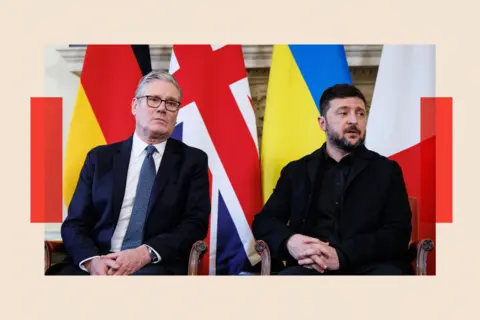
Danish Prime Minister Mette Frederiksen and British Prime Minister Keir Starmer meeting in London earlier this year
Writing in the Guardian newspaper ahead of the talks, Sir Keir and his Danish counterpart Mette Frederiksen said that the member states meeting on Wednesday must "go further in tackling" the "shared challenges" of "uncontrolled migration" that they said were undermining public confidence in governments.
"Europe has faced big tests before and we have overcome them by acting together. Now we must do so again," said the leaders.
"Otherwise, the forces that seek to divide us will grow stronger.
"So our message is this: as responsible, progressive governments we will deliver the change that people are crying out for.
"We will control our borders to protect our democracies – and make our nations stronger than ever in the years to come."
The UK delegation to the talks will be led by Deputy Prime Minister David Lammy.
He is expected to tell the meeting that the UK remains committed to the ECHR - but its interpretation must not stand in the way of combating people smuggling.
The BBC understands that if the meeting in Strasbourg is a success, officials will begin working with the member states on a political declaration to clarify how human rights laws should be applied to migration challenges - with a deadline of next May for the final wording.
The talks are expected to cover some of the most difficult issues including combating migrant smuggling and how to create human rights compliant 'returns hubs' - centres outside of Europe where migrants could be forcibly housed if they can not be returned to dangerous countries.
The talks are also expected to cover the complex rules of Article 8, the right to family life, and Article 3, the ban on inhumane treatment which features in many migration cases.
That olive branch to member states came after months of diplomatic talks paving the way for Wednesday's meeting.
"The European Convention on Human Rights provides the framework we need to address these issues effectively and responsibly," said Berset ahead of the meeting.
"Our task is not to weaken the Convention, but to keep it strong and relevant — to ensure that liberty and security, justice and responsibility, are held in balance."
The donor's sperm was used in clinics across Europe (stock image)
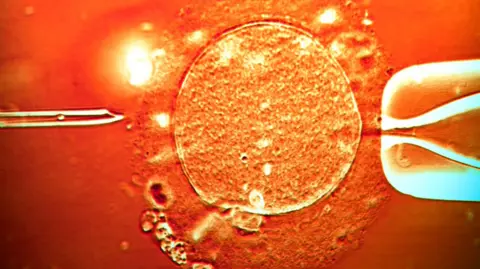
A sperm donor who unknowingly harboured a genetic mutation that dramatically raises the risk of cancer has fathered at least 197 children across Europe, a major investigation has revealed.
Some children have already died and only a minority who inherit the mutation will escape cancer in their lifetimes.
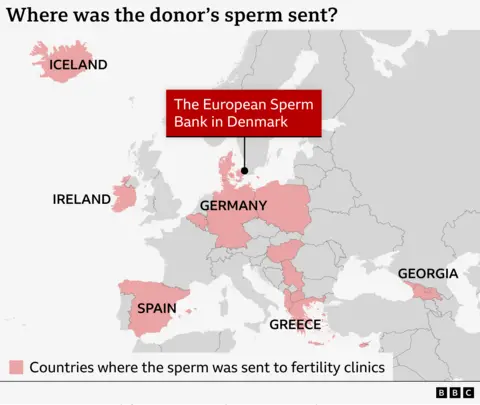
The sperm was not sold to UK clinics, but the BBC can confirm a "very small" number of British families, who have been informed, used the donor's sperm while having fertility treatment in Denmark.
Denmark's European Sperm Bank, which sold the sperm, said families affected had their "deepest sympathy" and admitted the sperm was used to make too many babies in some countries.
Getty Images
Up to 20% of the donor's sperm contains the dangerous mutation that increases the risk of cancer (stock image)
The investigation has been conducted by 14 public service broadcasters, including the BBC, as part of the European Broadcasting Union's Investigative Journalism Network.
The sperm came from an anonymous man who was paid to donate as a student, starting in 2005. His sperm was then used by women for around 17 years.
He is healthy and passed the donor screening checks. However, the DNA in some of his cells mutated before he was born.
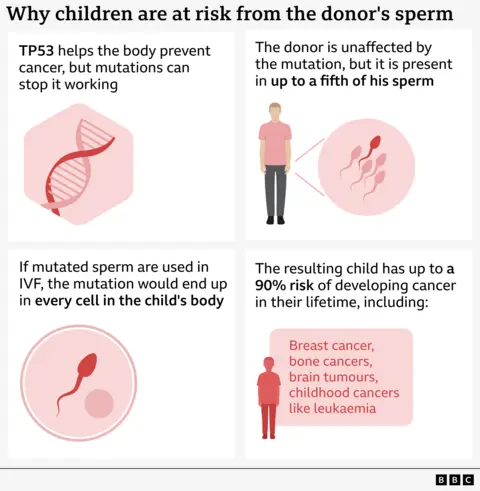
It damaged the TP53 gene – which has the crucial role of preventing the body's cells turning cancerous.
Most of the donor's body does not contain the dangerous form of TP53, but up to 20% of his sperm do.
However, any children made from affected sperm will have the mutation in every cell of their body.
This is known as Li Fraumeni syndrome and comes with an up to 90% chance of developing cancer, particularly during childhood as well as breast cancer later in life.
"It is a dreadful diagnosis," Prof Clare Turnbull, a cancer geneticist at the Institute of Cancer Research in London, told the BBC. "It's a very challenging diagnosis to land on a family, there is a lifelong burden of living with that risk, it's clearly devastating."
MRI scans of the body and the brain are needed every year, as well as abdominal ultrasounds, to try to spot tumours. Women often choose to have their breasts removed to lower their risk of cancer.
The European Sperm Bank said the "donor himself and his family members are not ill" and such a mutation is "not detected preventatively by genetic screening". They said they "immediately blocked" the donor once the problem with his sperm was discovered.
Children have died
Doctors who were seeing children with cancer linked to sperm donation raised concerns at the European Society of Human Genetics this year.
They reported they had found 23 with the variant out of 67 children known at the time. Ten had already been diagnosed with cancer.
Through Freedom of Information requests and interviews with doctors and patients we can reveal substantially more children were born to the donor.
The figure is at least 197 children, but that may not be the final number as data has not been obtained from all countries.
It is also unknown how many of these children inherited the dangerous variant.
Dr Kasper has been helping some of the families affected
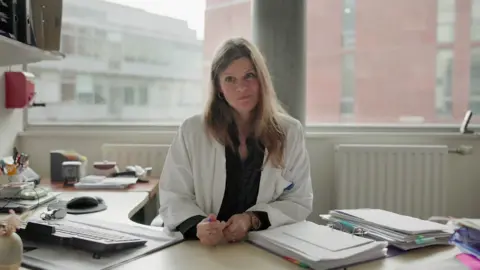
Dr Edwige Kasper, a cancer geneticist at Rouen University Hospital, in France, who presented the initial data, told the investigation: "We have many children that have already developed a cancer.
"We have some children that have developed already two different cancers and some of them have already died at a very early age."
Céline, not her real name, is a single-mother in France whose child was conceived with the donor's sperm 14 years ago and has the mutation.
She got a call from the fertility clinic she used in Belgium urging her to get her daughter screened.
She says she has "absolutely no hard feelings" towards the donor but says it was unacceptable she was given sperm that "wasn't clean, that wasn't safe, that carried a risk".
And she knows cancer will be looming over them for the rest of their lives.
"We don't know when, we don't know which one, and we don't know how many," she says.
"I understand that there's a high chance it's going to happen and when it does, we'll fight and if there are several, we'll fight several times."
The donor's sperm was used by 67 fertility clinics in 14 countries.
The sperm was not sold to UK clinics.
However, as a result of this investigation the authorities in Denmark notified the UK's Human Fertilisation and Embryology Authority (HFEA) on Tuesday that British women had travelled to the country to receive fertility treatment using the donor's sperm.
Those women have been informed.
Peter Thompson, the chief executive of the HFEA, said a "very small number" of women were affected and "they have been told about the donor by the Danish clinic at which they were treated".
We do not know if any British women had treatment in other countries where the donor's sperm was distributed.
Concerned parents are advised to contact the clinic they used and the fertility authority in that country.
The BBC is choosing not to release the donor's identification number because he donated in good faith and the known cases in the UK have been contacted.
There is no law on how many times a donor's sperm can be used worldwide. However, individual countries do set their own limits.
The European Sperm Bank accepted these limits had "unfortunately" been breached in some countries and it was "in dialogue with the authorities in Denmark and Belgium".
In Belgium, a single sperm donor is only supposed to be used by six families. Instead 38 different women produced 53 children to the donor.
The UK limit is 10 families per donor.
'You can't screen for everything'
Prof Allan Pacey, who used to run the Sheffield Sperm Bank and is now the deputy vice president of the Faculty of Biology Medicine and Health at the University of Manchester, said countries had become dependent on big international sperm banks and half the UK's sperm was now imported.
He told the BBC: "We have to import from big international sperm banks who are also selling it to other countries, because that's how they make their money, and that is where the problem begins, because there's no international law about how often you can use the sperm."
He said the case was "awful" for everybody involved, but it would be impossible to make sperm completely safe.
"You can't screen for everything, we only accept 1% or 2% of all men that apply to be a sperm donor in the current screening arrangement so if we make it even tighter, we wouldn't have any sperm donors – that's where the balance lies."
This case, alongside that of a man who was ordered to stop after fathering 550 children through sperm donation, has again raised questions over whether there should be tougher limits.
The European Society of Human Reproduction and Embryology has recently suggested a limit of 50 families per donor.
However, it said this would not reduce the risk of inheriting rare genetic diseases.
Rather, it would be better for the wellbeing of children who discover they are one of hundreds of half-siblings.
"More needs to be done to reduce the number of families that are born globally from the same donors," said Sarah Norcross, the director of the Progress Educational Trust, an independent charity for people affected by infertility and genetic conditions.
"We don't fully understand what the social and psychological implications will be of having these hundreds of half siblings. It can potentially be traumatic," she told BBC News.
The European Sperm Bank said: "It is important, especially in light of this case, to remember that thousands of women and couples do not have the opportunity to have a child without the help of donor sperm.
"It is generally safer to have a child with the help of donor sperm if the sperm donors are screened according to medical guidelines."
What if you are considering using a sperm donor?
Sarah Norcross said these cases were "vanishingly rare" when you consider the number of children born to a sperm donor.
All of the experts we spoke to said using a licensed clinic meant the sperm would be screened for more diseases than most fathers-to-be are.
Prof Pacey said he would ask "is this a UK donor or is this a donor from somewhere else?"
"If it's a donor from somewhere else I think it's legitimate to ask questions about has that donor been used before? Or how many times will this donor be used?"
If you or someone you know has been affected by the issues raised, details of help and support are available at BBC Action Line.
Gerry McCann says hounding by press took 'huge toll' on family
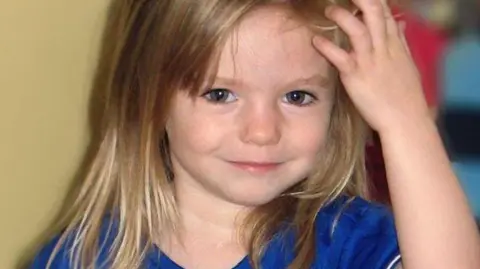
Madeleine McCann's father is calling for greater scrutiny of the UK's media, complaining that his family was subjected to "monstering" by sections of the press.
He said the media "repeatedly interfered with the investigation" into his daughter's disappearance in 2007 and believes this has hindered the search for her.
Gerry McCann told BBC Radio 4's Today programme that more than a year on from Labour coming into power, "press regulation is no longer a priority".
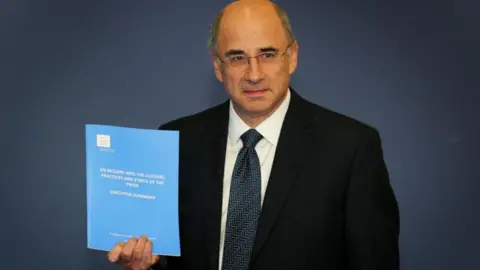
He wants a resumption of the cancelled second phase of the Lord Leveson Inquiry, which would have examined unlawful action by the media, plus journalists' relationships with politicians and police. It was scrapped by the Tories in 2018.
Madeleine's disappearance during a family holiday in Portugal has never been solved.
In a rare interview, Mr McCann said that for months after her disappearance his family had "journalists coming to the house, photographers literally ramming their cameras against our car window when we had two-year-old twins in the back who were terrified".
"We are lucky we survived. We had tremendous support - but I can promise you, there were times where I felt like I was drowning. And it was the media, primarily," he told the BBC.
"It was what was happening and the way things were being portrayed, where you were being suffocated and buried, and it felt like there wasn't a way out."
Mr McCann and his wife, Kate McCann, are among more than 30 people to have signed a letter being sent to Prime Minister Sir Keir Starmer and calling on him to reverse the decision not to hold the second phase of the Leveson Inquiry.
Madeleine McCann disappeared in 2007, then aged three
The letter, seen by the BBC, requests a meeting with the prime minister, saying: "We understand that you recently had time to meet News Corp chairman Lachlan Murdoch.
"We hope you will now meet with some of the British citizens whose lives have been upended by the illegal practices and abuses associated with his company."
Mr McCann told the Today programme: "It's quite obvious that press barons can meet the prime minister, but the people who have suffered at the hands of them can't."
News UK, the UK branch of News Corp, declined to comment.
The first part of the Leveson Inquiry was held from 2011 to 2012, in the wake of the phone-hacking scandal.
Its findings were published in 2012, and led to the creation of the industry-funded press regulator Ipso.
Mr McCann told the BBC that the inquiry's second phase had "almost certainly" not happened because he believes that politicians in the UK are fearful of the press.
PA Media
Lord Leveson's report in 2012 recommended a self-regulation body for the press
He said that in the run-up to last year's general election, Labour politicians had committed to implementing the recommendations made in the first part of the Leveson Inquiry, and that he was "extremely disappointed" that they hadn't done so.
"We're over a year into the government, and there haven't been any changes," he said.
"It's not acceptable to me now, more than a year on, that Leveson and press regulation is no longer a priority."
A DCMS spokesperson told the BBC it "recognises that for victims and their families, incidents of harassment and intrusion from the media cause significant distress".
"The Culture Secretary has met with individuals and families who have experienced this intrusion in the past and the government is committed to ensuring that these failings are never repeated," they said.
'We put our morals aside'
Mr McCann added that he and his wife had "supped with the Devil" by working with the Sun in 2011, in order to have the investigation into Madeleine's disappearance reviewed - illustrating the newspaper's influence.
"There was a front page letter published in The Sun, and [then-prime minister] David Cameron ordered the review," he said.
"That's the power they had. So we put our morals aside to work with them to achieve what we wanted."
Criticising media coverage of the investigation, he said: "Published material which should have been confidential, should be passed on to the police, witness statements, many other things that have gone out," he said.
"So if you were the perpetrator, you knew a lot more than you should have done - and as a victim, as a parent, it's absolutely dismaying."
'Making stories up'
Mr McCann gave a witness statement at the Leveson Inquiry on behalf of himself and his wife in November 2011.
In it, he described news outlets "making stories up" about them, as well as a "sustained, inaccurate and malicious series of headlines in a number of papers which gave the impression that we were in some way responsible for or involved in Madeleine's disappearance".
He also said around the time their daughter disappeared, the now-closed News of the World newspaper had published complete transcripts from Kate McCann's personal diary.
That diary had been seized by police in Portugal as part of their investigation into Madeleine's disappearance, and the couple were "unsure as to how the [News of the World] obtained a copy", the inquiry heard.
In his interview with the Today programme, Mr McCann said: "Madeleine's been missing for 18 years, and the bottom line is, we still don't know what's happened to her."
He added that there is "no evidence".
"I don't even mean 'convincing' evidence - there is no evidence to say she's dead," he said.
"Now we fully understand she may be dead, it may even be probable, but we don't know that."
A spokesperson for press regulator Ipso told the BBC that it can intervene directly in cases of press harassment.
"We encourage anyone with concerns about press behaviour to contact us for help," it said.
'Broken bus windows, threatened with a knife - all in a day’s work'
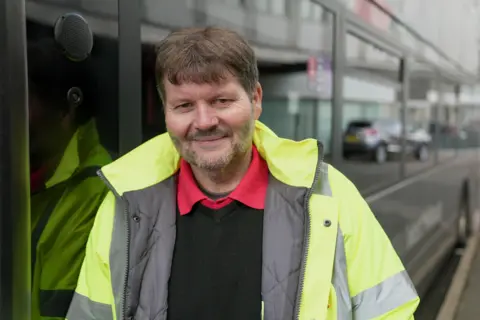
"Would I catch a bus? No, not out of choice now," says Andy Collett. "I feel much happier using my own car."
His sentiment isn't unusual among passengers. But Mr Collett is a bus driver.
"It can be very intimidating," he says. "I've been assaulted twice, spat at numerous times, and I've had incidents of broken windows – it's just part and parcel of the job, unfortunately."
He describes a "lawlessness" among some of the travelling public - mostly younger people - which he believes has got worse in 38 years of driving Birmingham's bus routes.
The BBC has spoken to passengers, transport staff and other bus drivers in the West Midlands about what they say is a growing national trend of antisocial behaviour on public transport.
Buses are the most commonly used form of public transport but they're also where passengers feel least safe, according to a recent Transport for the North survey.
BBC/Andy Alcroft
Andy Collett has driven Birmingham's bus routes for 38 years and says there's a "lawlessness" among some of the travelling public
One incident gives Mr Collett flashbacks.
"I was attacked by about 30 schoolkids," he says. "I had cuts, bruises. They actually bent the fingers back on my hand when I was trying to hold [the door] to stop them getting on the vehicle."
Mr Collett now mostly trains other drivers, warning them of the dangers. When he does get shifts behind the wheel, he tries to avoid routes known for antisocial behaviour.
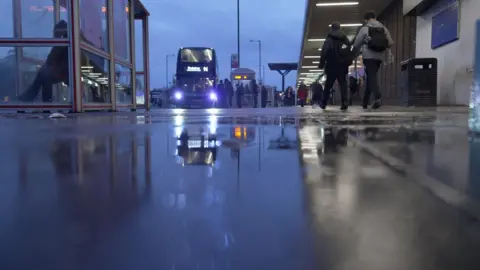
Antisocial behaviour hotspot Chelmsley Wood in the West Midlands is a snapshot of this national problem. Its interchange has suffered vandalism and graffiti, while drivers have been threatened and buses damaged.
Security camera footage shows masked teenagers aiming barrages of fireworks at buses over Halloween and Bonfire Night.
Passenger Emma Banks, 52, says she has witnessed a similar incident.
"They [were] hitting the bus. I've got learning difficulties and sometimes it does scare you," she tells me on a cold evening, waiting in the interchange.
Ms Banks says she regularly sees overcrowding and people smoking on buses.
She can't drive so relies on public transport but, tonight, Ms Banks doesn't feel confident enough to catch the bus.
"I'll be getting a taxi because I know that I'll get home safely."
A Public Space Protection Order has been imposed at Chelmsley Wood to stop gatherings of young people and to require the removal of masks and hoods. But 17-year-old Elle Furlong says she's still afraid.
"They smash windows, purposely pull the fire alarm, light their lighters on the chairs. It's just horrendous."
The probability of becoming a victim of crime on public transport is very low - Transport for West Midlands estimates one crime for every 50,000 bus journeys. But perceptions can outweigh statistics and drive people like Ms Furlong away.
"If I can walk it, I'll walk it. If it's far enough, I'll get an Uber. If it's really far, I'll get my dad to drop me off. I avoid buses at all costs," Ms Furlong says.
BBC/Andy Alcroft
Chelmsley Wood bus station is a hotspot for antisocial behaviour
The drivers have no choice but to carry on with their jobs, although many are afraid to speak openly about the risks. Even trade union officials have refused to go on the record.
"You come to work not knowing what you're going to face," says a driver who asks to remain anonymous. "It can cause a lot of anxiety and stress. I go home sometimes and just want to break down and cry because it's a horrible job."
They describe the daily grind of disrespectful teenagers, aggressive drug addicts, even passengers defecating on the bus. Then there's the racial abuse.
"You have to hold back. I've known a few drivers who have kicked off, but then they've lost their job because of it."
I saw for myself what drivers and passengers are facing when I sat on the top deck of the 94 from Chelmsley Wood, shortly after the school bell. A group of kids soon boarded without paying.
"I've been driving buses for 33 years and it's changed," driver Neil Evans says through the screen protecting his cab. "Society has changed. No one cares anymore. They just walk onto the bus and do what they want, when they want, how they want, and nothing's done about it."
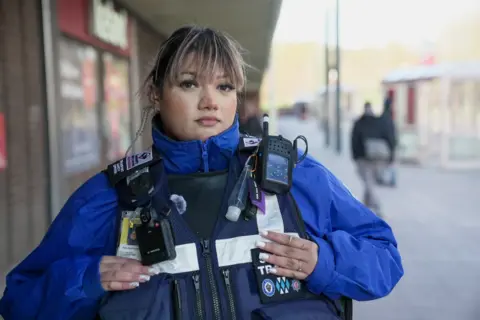
Today, Mr Evans has backup. Esha Sheemar is one of 13 Transport Safety Officers (TSOs) patrolling the West Midlands. She warns the kids if they don't behave they'll be thrown off the bus.
TSO roles were introduced in 2019. They are not police officers, but they have limited powers to tackle issues on public transport.
BBC/Andy Alcroft
Esha Sheemar is one of 13 Transport Safety Officers (TSOs) patrolling the West Midlands
Across the bus station, Ms Sheemar's colleague Lee Clarke has spotted a face from their most-wanted list: a 13-year-old accused of vandalising a bus shelter. The boy's details are taken but he is allowed to get on the bus, as Mr Clarke's limited powers mean he'll need to pass the case to police officers.
TSOs are funded by the Combined Authority and belong to the West Midlands Safer Travel Partnership, which includes West Midlands Police, British Transport Police, as well as bus and train companies.
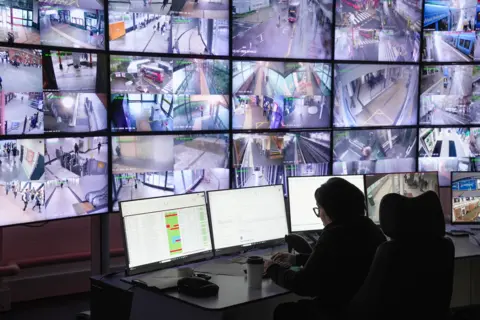
At its control room in the city centre, hundreds of screens flicker with security camera images from stations and interchanges across the region's roads and rail lines; they can even get live pictures from most of the buses.
Kerry Blakeman is head of security for the West Midlands Safer Travel Partnership and says they have access to more than 5,000 fixed cameras. He says his staff capture about 30 incidents each day, although he is keen to stress millions of journeys are safe and uneventful.
"We are trying to do our best to keep the travelling public safe. Behind each camera is an operator looking out for your safety whilst you travel around the bus, train and tram network."
Last summer, a teenager was filmed threatening people at Chelmsley Wood bus station with a machete. He was identified and sentenced to six months in juvenile custody.
The footage of the firework attacks has been handed over to West Midlands Police - and efforts to trace the hooded youths are ongoing.
BBC/Andy Alcroft
'Behind each camera is an operator looking out for your safety whilst you travel,' says Kerry Blakeman, head of security at West Midlands Safer Travel Partnership
Bus driver Bryan Cook recently called police after being threatened with a weapon while working. It was one of four times in the past three months that he's phoned for assistance while driving the 72 bus to Chelmsley Wood.
On this chilly evening, he takes his chance to tell the TSOs how their timetable fails to match that of the vandals. "Where are you on the weekends? Where are you on school holidays?" he asks.
TSO Mr Clarke starts to reply, but the driver has more to say.
"We're the ones getting threatened, we're the ones getting stuff thrown at us, broken windows. Where are you lot?"
Mr Clarke emphasises the importance of reporting incidents so patrols can be targeted in problem areas.
"We keep telling everyone. No one does anything," says Mr Cook, in exasperation.
It outlines the challenge for a small team covering such a large area. The number of TSOs doubled a year ago and is set to rise to 25 across the West Midlands. Some areas have similar teams - and others have piloted them - but many places are uncovered, relying on the police. Bus routes can be especially vulnerable.
The anonymous bus driver questions the effectiveness of Transport Safety Officers and urges more support from their employer.
"They [management] know what goes on. Do they care? I don't know. Doesn't feel like it, to be fair."
National Express West Midlands told the BBC that all reports of antisocial behaviour or crime are "fully investigated to ensure perpetrators are held accountable, to identify any learnings, and to provide support for those affected".
It added that antisocial behaviour "will always be a subject we need to keep challenging and working on".
The UK government's recent Bus Services Act allows local authorities to apply for extra powers to deal with issues such as smoking, vaping and fare evasion, the sort of problems TSOs can tackle already on trains.
The legislation also requires bus drivers to receive training in dealing with antisocial behaviour and spotting the signs of harassment and abuse faced by women and girls.
The Department for Transport told the BBC that abuse of passengers and staff is "unacceptable" and pointed to the new powers the Bus Services Act will give to help tackle antisocial behaviour.
Transport for West Midlands promises greater use of drone cameras and AI technology, capable of recognising known troublemakers and even identifying concealed weapons. It recently launched a campaign prioritising the safety of women and girls.
Mr Blakeman insists his team is having a positive impact but says he recognises passenger confidence is fragile.
"I respect why some members of the public wouldn't feel comfortable travelling, but I want them to know that we're actually doing everything we can behind the scenes."
Back on the 72 bus, Mr Clarke is trying to restore Mr Cook's faith. He promises someone will make contact to explain their role and discusses the most efficient way to flag issues.
The West Midlands Safer Travel Partnership is regarded as a model of good practice. And yet, this frosty exchange reveals a clash of perspectives – one that speaks of "intelligence-led tasking" and "visible reassurance"; the other of lone working under the stark reality of sustained abuse and the risk of attack.
Mr Cook sums it up like this: "Two weeks ago I had two windows broken on my bus, I got threatened with a knife - and that's all in a day's work".
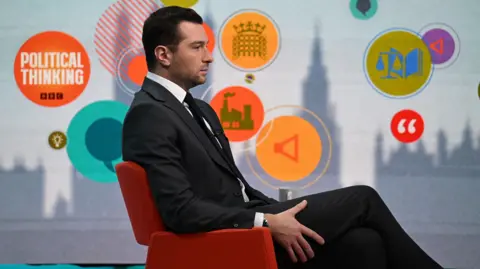
'If tomorrow I am the head of government, France will no longer be the target of mass immigration,' Bardella told the BBC's Nick Robinson
The leader of France's far-right National Rally (RN) Jordan Bardella has welcomed "for the most part" concerns raised about Europe in US President Donald Trump's new National Security Strategy.
Speaking to the BBC's Nick Robinson for his Political Thinking podcast, Bardella praised what he said was Trump's "appeal to American pride" - but he made clear he did not want Europe to be "subservient to any major power".
He said there was a "wind of freedom, of national pride blowing all over Western democracies".
In a wide-ranging interview, the 30-year-old, who opinion polls suggest leads in the race to be France's next president, was also challenged on the RN's political history and his stance on immigration.
Bardella said he shared the majority of the concerns outlined by the Trump administration about Europe facing "civilisational erasure", which the White House said is being fuelled by a range of policies, including on migration.
"Mass immigration and the laxity of our governments in the last 30 years with regards to migration policy are shaking the balance of European countries, of Western societies, and namely French society," Bardella said.
Snap parliamentary elections in June 2024 made the RN the largest single force in parliament, although an alliance of left-wing parties clinched victory.
The next French presidential election is due to be held in 2027. A recent poll for Le Figaro suggests Bardella would win with 44% of the vote - just ahead of Marine Le Pen, the RN figurehead whose candidacy is in doubt after she was found guilty of embezzling EU funds and barred from standing in an election for five years.
An appeal due early next year will determine whether Le Pen can run - otherwise, the expectation is that Bardella will step in.
Bardella batted away suggestions this was sparking tensions between them, stating they were united by "trust and friendship".
"I will fight by her side so she can win the appeal. Until the appeal we will campaign together, as we will after, hand-in-hand," he said in his interview.
The RN was founded by Le Pen's father Jean-Marie in 1972. Known then as the National Front (FN), it has since become a decisive force in French politics. Jean-Marie Le Pen was convicted several times for Holocaust denial and was an unrepentant extremist on race.
In his interview with Nick Robinson, Bardella distanced himself from Jean-Marie Le Pen's comments, as have many other RN politicians in recent years.
Reuters
It remains to be seen who leads the RN into the next election: Le Pen or Bardella
"I am fighting against the caricature of my political movement, of my ideas," he said, adding his responsibility was to bring together the French people and present the country with "a project of national recovery".
"My people's expectations for a break with the past are numerous," Bardella added.
Challenged on the racist and antisemitic history of the RN's precursor, Bardella rejected accusations that the National Front had ever put forward arguments that could "offend" some sections of the population
"A lot of Jewish people vote for us and consider us a bulwark against extremism," he said.
The RN is primarily known as an anti-immigration party and has long pushed for France to have stricter immigration rules, including limiting social spending to French citizens.
"If tomorrow I am the head of government, France will no longer be the target of mass immigration," he said, adding that if elected his first provision would be to trigger a referendum on immigration. "It will allow us to take back control of our borders."
However, according to the French constitution, a referendum can only be held on certain subjects which do not include immigration, so the constitution would have to be amended first. In order to do so, the RN would have to clinch the presidency and have either an absolute majority in Parliament or enough allies.
Bardella - who grew up in the Paris region but himself has parents of immigrant origin - drew a clear distinction between people who he said were born in France but "reject republican institutions like the police or values like secularism", and others who "do everything to become French - espouse the language, culture and national patrimony".
When pressed on what it means to be French if being born in the country is not sufficient, Bardella said he felt being French was an "honour" that transcended bureaucracy.
"Being French is adhering to some values and lifestyles, believing in equality between men and women," he argued.
"I defend secularism and I feel that Islamism has today become a separate political project... which wants to impose its rules on French society," Bardella added, before promising to close down radical mosques and banning "hate preachers" from the country if elected.
Although he did not expand on France's frequent and longstanding financial woes - the country's debt is more than €3 trillion, or around 114% of Gross Domestic Product (GDP) - Bardella said the French economy was "sick".
"We face two ailments – excessive taxation and excessive regulation," he said, promising to free the country from the "shackles" that limit growth. The RN has repeatedly voted down the yearly budgets put forward by governments since last year, and has promised to similarly vote down this year's.
Bardella's position on Ukraine also bears some differences with that of the current centrist government. While he stated Russia represented a "multidimensional threat to French and European interests", and that Kyiv will need security guarantees even in the event of a peace deal, he also said that he was "firmly opposed" to sending soldiers to Ukraine.
Emmanuel Macron's government, on the other hand, has proposed deploying a steady military presence, albeit far from the front line.
But such a decision "would contribute to an escalation," Bardella said, "especially given that we have nuclear weapons and that President Putin has intentions whose limits are unclear".
If Bardella does stand at the next presidential election and wins, he will be 31.
Macron was 39 when he became France's youngest ever president in 2017. While Macron was finance minister for two years under François Hollande, Bardella, in comparison, has never been in government.
"It's true I am 30 years old. Unfortunately I can't do anything about that," he argued.
"I recognise the existential questions facing our country... And I'd rather be told that today is 'too soon' rather than tomorrow is 'too late'."
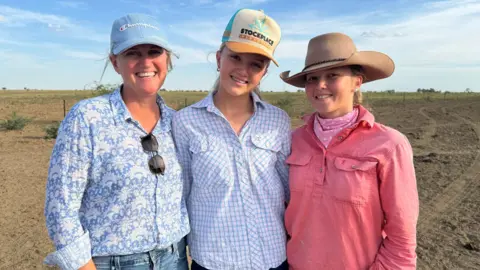
Breanna Easton, 15, now finds herself cut off from social media because of Australia's ban on under-16s
School is out for the year, but the summer holidays aren't exactly a break for 15-year-old Breanna Easton - that is when she's hard at work mustering cattle on the family's station.
"It's the freedom, the space you have to move," Breanna says, listing all the things she loves about her life, 1,600km north-east of Brisbane in Australia's sparsely-populated outback.
With grazier parents and grandparents, the industry runs in her blood. The vast hinterland is her own backyard.
And yet, like most teenagers, she's also attached to her smartphone.
The all-terrain buggy she uses to herd cattle is fitted with an internet extender, enabling her to message friends on Snapchat while working. On days she gets a little bored, she likes to make funny TikTok videos with her siblings.
With nearly all her friends living at least 100km away, social media is a lifeline. But not anymore, now that Australia's social media ban for children has taken effect.
"Taking away our socials is just taking away how we talk to each other," Breanna says.
While she can still text her friends, it's not the same as a quick "snap" or a "like" on a photo that allows her to play a part in their lives even when she is far away.
Throughout, supporters have argued it's for the wellbeing of children who they say are spending too much time online and risk being exposed to uncontrollable pressures, bullying and predators.
Opponents say restricting children's access to the internet runs the risk of pushing them to even less regulated corners of it - and they question the effectiveness of the age-verification tech the ban relies on.
The debate is far from settled but Australia's experiment has now begun, and Breanna is among millions of children under the age of 16 who are no longer allowed to use social media.
And among them are children who are seen as both winning - saved from the potential dangers of social media - and losing out - no longer having the community and connections that may have been harder to forge offline.
Megan Easton with her daughters, Breanna and Olivia - Megan worries the government is overstepping with the ban
For Breanna's mum Megan Easton, the ban is a mixed blessing. While she agrees kids need to be protected, she remembers her own childhood on a cattle station was far more isolating.
"We did feel very behind the other children at school because we had a somewhat sheltered life."
Breanna, her older sister Olivia and younger brother Jacob all did remote classes for children in the outback who are unable to attend a physical school.
For senior grades though, boarding school is the only option for a good education. So from the age of 11 or 12, the siblings have lived six hours away from home during term-time.
"We might be incredibly geographically isolated but we're not digitally illiterate and we have taken great measures in our family to make sure that we educate our children appropriately for the world ahead of them," Ms Easton says. "I do think that it is a bit of government overstepping."
One of her concerns is that delaying access to social media to 16 takes away power from parents to educate their children.
"Usually around 12 is when they start looking for their peers to be more influential than their parents," she says. "Even though it's young to get them on social media, we've staged their experiences with it and it's a great opportunity for us to let them have a few mistakes and then talk them through the processes of self-correcting."
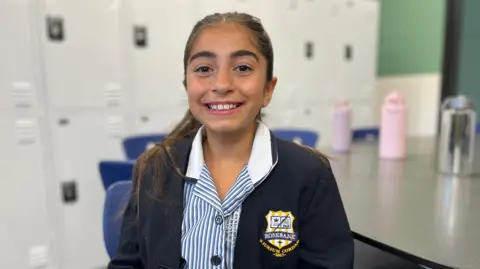
Jacinta Hickey, 14, says she is old enough to know right from wrong
More than 2,000km away, teens in Sydney lead very different, far more connected lives. But they share similar worries.
"It's a bit insulting that they think we can't handle it," says 14-year-old Jacinta Hickey who attends Rosebank College in Sydney's inner west. "I'm definitely mature enough to distinguish right from wrong and to know what's good and bad for me."
Her teachers though couldn't be happier. "I feel really passionate that as long as we can, we should preserve the innocence that comes through childhood," says Iris Nastasi, the principal at Rosebank.
When smartphones started becoming popular in the early 2000s, she thought it would be an opportunity to teach children about technology. She embraced the change. Twenty years later, Ms Nastasi thinks very differently.
"It's two in the morning, he or she does something that they wouldn't normally do and the fallout happens here. Relationships are damaged and we have to look into it."
At 12, Lola Farrugia isn't on social media yet - and with the new law, she now won't be for another four years. But that doesn't faze her. She's happy enough with a flip phone.
"They're my school friends so I see them at school, I see them in sport - they're everywhere," says Lola, who's had coaching from her parents about the ills of social media.
"My mom explained to me that social media is junk food for the brain," she says.
"If you have a pantry and you clear [it], you're not craving anything, you know what I mean?"
Lola, 12, is in favour of the ban
Peter Malinauskas, the Premier of South Australia, is the man credited – or blamed, depending on your age - for clearing out the pantry.
After his wife read The Anxious Generation by Jonathan Haidt, an American psychologist who sets out the ills of the smartphone and how it is rewiring childhood, Malinauskas set out to introduce state-level legislation hoping it could win federal support too.
"She put the book down on her lap and turned to me and said you've really got to do something about this," he told the BBC. "And then I stopped and thought about it and thought maybe we actually can."
Not even Malinauskas expected the speed at which it happened though. The Anxious Generation was published in March 2024. By late November, a federal law banning social media for under-16s was passed.
There's still a High Court challenge brought by two teens pending, possible battles with tech firms and a warning from US President Donald Trump about targeting American companies.
"Of course you think through the potential repercussions of any move like this," Malinauskas says. "But when you are talking about protecting young people, all other considerations become secondary."
But one of the biggest criticisms of the law is that a blanket restriction could do the opposite for minority groups.
According to a survey of nearly 1,000 young people carried out by Minus18, a group that supports under-18 LGBTQ+ communities, 96% of respondents said social media was important to access friends and support, and 82% believed a ban would leave them disconnected.
Brisbane schoolgirl Sadie Angus is one of them. She turned 13 just a few weeks ago and opening an Instagram account was a rite of passage for her. But it was a short-lived one - the law means she's now being kicked off it and she's frustrated.
"I can admit more things on there than I can in real life," says Sadie who often prefers to keep her anonymity online.
"I use it as a safe space to share what I've had to go through and since nobody knows who I am, they can't come to me in real life and talk about it and that feels kind of comforting."
Sadie's mother Kath felt it was an important step in her daughter - the youngest in their family - growing up and now that has been taken away from her.
"She's being exposed to some really amazing role models through social media, particularly in the queer community which I think is really healthy for young adolescents," Ms Angus says.
Other minority groups have also voiced concern over the ban.
"I am quite nervous about what this is going to mean for autistic young people," says Sharon Fraser, the CEO of Reframing Autism.
"We communicate and socialise differently," says Sharon who also has an autistic son. "Online can be a very beneficial place for autistic people and there are ways to connect online that are just not accessible to them in real life."
Watch: 'I don't need laws to teach my kids to be responsible', says Kath Angus
For every young person who feels like they're losing out, campaigner Emma Mason thinks there will be far more winners.
Nearly four years ago, her daughter Tilly killed herself. She was 15.
Emma blames the rise of social media for Tilly's death. Face-to-face bullying started when Tilly was just eight. It moved to messaging and then to platforms including Tiktok, Snapchat and Instagram. But it got worse after a fake image of Tilly was spread by children at her school.
Emma recalls how hysterical Tilly was when she found out: "She was subject to something she had no control over, a harm that was instant, a harm that she could not stop. It was one of those moments in her life where she just lost it, she just thought I can't do this anymore, I can't keep fighting the demons."
Ms Mason doesn't want this to happen to other children, which is why she's been standing alongside Prime Minister Anthony Albanese to support this law.
"These are agents of harm that are unregulated and I think our children have been the social experiment," Emma says. "It's a government's job to protect the vulnerable of our society and to provide guardrails for how things need to go."
She admits though, for those who are already teenagers, they might not be clear winners.
"I don't know that we can save the children that have had access to it already," she says. "But those children that are 13 and below that aren't supposed to be on it now, they won't have to grow up in a world where it's acceptable that you just get on social media and you can say what you want, how you want, to whoever you want."
Additional reporting by Simon Atkinson
Watch: What do teenagers think about Australia's social media ban?
Russia's full-scale war on Ukraine will soon enter its fifth year. Mysterious incidents of so-called "hybrid warfare" are mounting in Europe, increasing tensions. And in the UK, military chiefs have warned we must prepare for war if we want to avoid it. But if the unthinkable happened, and war with Russia broke out, could the UK fight for more than just a few weeks?
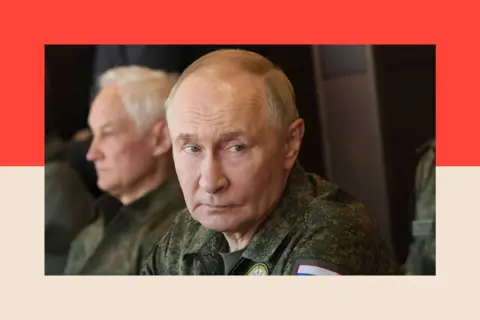
"We are not planning to go to war with Europe. But if Europe wants to, and starts, we are ready right now." So said Russian President Vladimir Putin on 2 December, accusing European countries of hindering US efforts to bring peace in Ukraine.
To be clear, it is extremely unlikely that the UK would ever find itself in a war with Russia on its own, unsupported by Nato allies.
But Putin's words were an uncomfortable reminder that a war between Russia and Nato countries, including the UK, was not as remote as people hoped.
How war could look in the tech-age
"Well that's odd. I've got no signal on my phone." "Me neither. I'm offline. What's going on?" That scenario, hypothetically, is just one way we could know that a war with Russia had begun, or was about to. (I should add that there can also be other, perfectly benign, reasons for a loss of signal.)
That signal interruption could be followed by an inability to make bank payments for essentials like food and fuel.
Food distribution would be disrupted, electricity supplies compromised.
AFP via Getty Images
'We are not planning to go to war with Europe. But if Europe wants to, and starts, we are ready right now,' Putin has said
There are many ways of fighting a war, and not just the physically destructive wave of drones, bombs and missiles so tragically familiar to the citizens of Ukraine.
Our modern, tech-driven society is highly dependent on the network of undersea cables and pipelines that connect the UK to the rest of the world, carrying data, financial transactions and energy.
Covert activity by Russian spy vessels, such as the Yantar, is widely believed to have scoped out these cables for potential sabotage in a time of war, which is why the Royal Navy has recently invested in a fleet of underwater drones equipped with integrated sensors.
In a war, these hidden, unseen actions, combined with an almost inevitable attempt to "blind" Western satellites in space, would seriously hamper the UK's ability to fight, as well as potentially wreaking havoc on civil society.
Getty Images
In the UK, military chiefs have warned we must prepare for war if we want to avoid it
At a recent conference in London entitled Fighting the Long War, organised by the Royal United Services Institute (Rusi), a Whitehall think tank, military and political figures came together to discuss whether the UK's current armed forces would be in a position to sustain a protracted conflict before they ran out of everything from troops, to ammunition to spare parts.
"There remains little evidence that the UK has a plan to fight a war lasting more than a few weeks," argues Rusi's Hamish Mundell. "Medical capacity is limited. Reserve regeneration pipelines are slow… The British plan for mass casualty outcomes appears to be based on not taking casualties."
With classic British understatement, he says: "This could be considered an optimistic planning assumption."
He adds that to fight a long war you need proper back-up. "It demands a second and even third echelon; personnel, platforms and logistics chains that can absorb losses and continue the fight. Yet this depth is notably absent from current British force design."
Russia's 'low quality' army
"There are shortfalls in ammunition, artillery, vehicles, air defence, and people, with limited to no ability to regenerate units or casualties," says Justin Crump, CEO of Sibylline, a private intelligence company.
Two of the biggest military lessons to come out of the Ukraine war are firstly, that drones are now integral to modern warfare, at every level, and secondly, that "mass", or sheer volume of personnel and military hardware, matters.
Getty Images
'There are shortfalls in ammunition, artillery, vehicles, air defence, and people, with limited to no ability to regenerate units or casualties,' says Justin Crump
Russia's army is generally of a very low quality. Its soldiers are poorly equipped, poorly led and poorly fed. Their life expectancy in the deadly "drone zone" of eastern Ukraine is short.
UK Defence Intelligence estimates that since the start of the full-scale invasion in February 2022 Russia's army has suffered more than 1.1 million casualties – that is killed, wounded, captured or missing.
Even conservative estimates put the number of Russians killed at 150,000. Ukraine has also suffered catastrophic casualties but numbers are hard to ascertain.
But Russia has been able to draw on such a massive pool of manpower that it has so far been able to replace its estimated 30,000 monthly battlefield casualties with fresh blood.
Russia's economy has also been on a war footing for more than three years now: an economist has been placed in charge of the Defence Ministry, while its factories churn out ever more supplies of drones, missiles and artillery shells.
According to a recent report by the Kiel Institute for the World Economy, Russia has been producing each month around 150 tanks, 550 infantry fighting vehicles, 120 Lancet drones and more than 50 artillery pieces.
The UK, and most of its Western allies, are simply not anywhere near this point.
EPA/Shutterstock
Ukraine has suffered catastrophic casualties but numbers are hard to ascertain
Analysts say it would take years for Western Europe's factories to come close to matching Russia's mass-production of weapons.
"The land war in Ukraine has shown beyond doubt that mass is absolutely vital for anybody that is going to face Russia on land," says Keir Giles, a Russia expert at Chatham House think tank.
"And having deep reserves vastly greater in number than the standing regular armed forces has been shown to be essential."
How national service conversations backfired
France and Germany have both recently moved to revive a system of voluntary military service for 18-year-olds.
The UK's former Head of the Army, Gen Sir Patrick Sanders, suggested in 2024, the year he retired, that the UK should train what he called "a citizen army" to fight a land war in the future. The idea was shot down by No. 10.
"I think it's a cultural thing within the UK," says Ed Arnold, senior research fellow at Rusi.
"So if you look at the states that are now looking towards [military service] - like Sweden, Germany and France - they are states who culturally still have an institutional memory of when they had that system.
"We haven't had national service since the 1960s and attempts to have that national conversation around it have pretty much backfired."
AFP via Getty Images
France has recently moved to revive a system of voluntary military service for 18-year olds
"The reality is, our armed forces cannot survive on a diet of government spin, over-the-horizon spending commitments and hollow rhetoric," Sir Ben Wallace, who was Defence Secretary in the Conservative government from 2019 to 2023, told the BBC.
Responding to this, a spokesperson for the current Labour Defence Secretary, John Healey, told me: "This characterisation is baseless.
"We increased defence spending by £5bn this year alone, signed 1,000 major contracts since the election and increased MOD spending with British businesses by 6% above inflation in the last year."
He points to a new defence agreement with Norway, a £300m new investment in the Royal Navy's laser weapon and a £9bn investment into armed forces housing, adding: "We're a government investing in the transformation of our forces, investing in our British service personnel... to create jobs and growth in Britain's communities."
Getty Images
Germany has also introduced voluntary military service for 18 year-olds
But this is not about party politics. It's about whether UK defence has been under-funded for so long that it has now reached the point where the country is dangerously vulnerable in several areas, notably air defence.
There are also problems of timing and inefficiency.
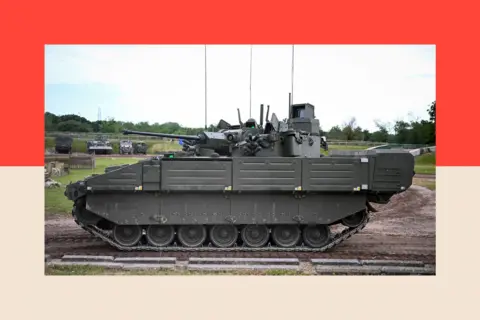
Defence contracts often take years to come to fruition. Billions of pounds have been spent on Ajax, an overdue armoured vehicle project still beset with problems. Meanwhile, Nato officers have been warning Russia could be in a position to launch an attack on a Nato country within three to five years.
At the end of the Cold War (between Nato and the Soviet Union) in 1990, when I was a young infantry Captain in the Army Reserves, the UK was spending 4.1% of GDP on defence.
The following year it deployed over 45,000 troops to help evict Iraq President Saddam Hussein's invading army from Kuwait in operation Desert Storm.
Today, with multiple pressures on the economy, the government is striving to meet a target of 2.5% of GDP by 2027, while Russia spends close to 7%.
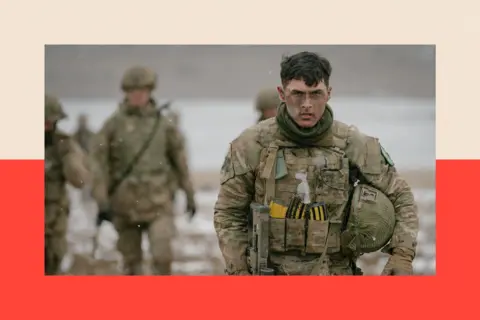
On paper, the British Army numbers around 74,000 but Rusi's Ed Arnold points out that once you subtract medically non-deployable soldiers, defence attaches around the world and others not part of formed units, then its actual deployable strength is only 54,000. That is less than the average number of casualties Russia takes in two months in Ukraine.
In the event of a war, says Justin Crump of Sibylline, on land the (British) Army would most likely be degraded – incapable of fighting effectively - within weeks, once committed, though he adds "much depends on the form of the conflict".
Suggestions the UK is already 'at war'
Some commentators have suggested that the UK is already "at war" with Russia. They are referring to what is known as "hybrid" or "grey-zone" warfare, which includes events that are often deniable, such as cyber-attacks, disinformation and the alleged launching of drones close to airports and military bases in Nato countries.
But worrying as these are, they pale compared to the crisis that would be triggered by a Russian military attack on a Nato country, especially if it involved seizing territory and people being killed.
Getty Images
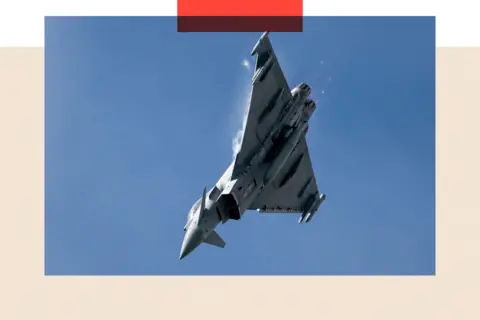
A Eurofighter Typhoon
There are several potential flashpoints here, where Nato military chiefs fear that Putin, if he were allowed to achieve his aims in Ukraine, could eventually move on to seek new targets for aggression.
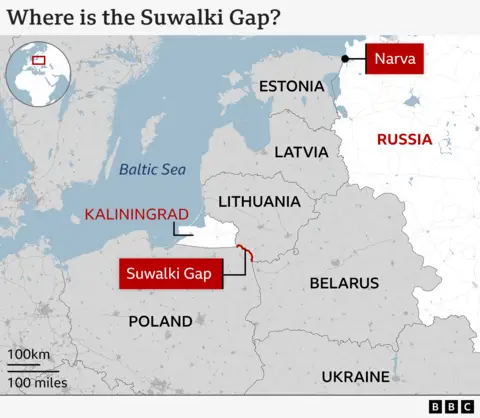
One potential target is the Suwalki Gap, a 60-mile (100km) stretch of border between Poland and Lithuania, both Nato countries. This is all that separates Russian ally Belarus from the Russian exclave of Kaliningrad on the Baltic coast.
Seizing that border and opening up a route along it would, in theory, give Moscow direct access to its strategic base on the Baltic.
The Baltic states themselves are other potential flashpoints. Estonia, Latvia and Lithuania were all once part of the Soviet Union and were ruled from Moscow.
They all voted for independence and have since joined Nato, but all have Russian-speaking minorities and hence there is a risk that Mr Putin could be tempted to send his troops across the border "to protect them from persecution".
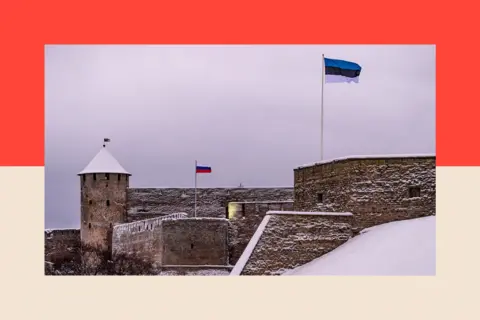
The eastern Estonian town of Narva, for example, is an obvious potential target here, as the majority of its population speak Russian and it sits just across the river from the giant Russian fortress of Ivangorod.
A UK battle group comprising some 900 British military personnel has been stationed in Estonia, about 80 miles west of Narva, since 2017.
AFP via Gettty Images
The eastern Estonian town of Narva sits just across the river from the giant Russian fortress of Ivangorod
In the event of war, the plan goes, it would be hurriedly reinforced to brigade strength of around 3,000 or more.
Another possible flashpoint is the Arctic archipelago of Svalbard, which is administered by Norway but where Moscow already has a toehold in the coal mining town of Barentsburg.
Litvinenko, Skripal and hostile acts on UK soil
The UK may well be Putin's enemy number one, having been one of Ukraine's staunchest allies, and having pushed for more powerful weapons to be delivered to help its defence.
Hostile acts on UK soil that have been linked to President Putin include the murder with radioactive Polonium-210 of former KGB officer Alexander Litvinenko in London in 2006 - a public inquiry concluded that Putin "probably" approved his assassination - and the attempted murder of former Russian military intelligence officer turned MI6 agent Sergei Skripal in Salisbury in 2018, using the nerve agent, Novichok.
Dawn Sturgess, a mother-of-three, later died after she sprayed the Novichok, disguised as perfume, on her wrists. Putin was "morally responsible" for her death, an inquiry concluded last week.
Lord Anthony Hughes, the inquiry chair, said: "I have concluded that the operation to assassinate Sergei Skripal must have been authorised at the highest level, by President Putin."
Russia, which has always denied involvement in the attacks and suggested more than 20 different possible explanations for Ms Sturgess's death, described the report's findings as "tasteless fairy tales".
Sputnik/ AFP via Getty Images
Putin accused European countries of hindering US efforts to bring peace in Ukraine
But the UK is also a core member of the Nato alliance. While questions are certainly raised in private over the reliability of the current US administration in the White House, it is hard to envisage the UK ever having to fight Russia on its own.
"A pure UK-Russia conflict is not likely and can be disregarded, practically," says Mr Crump. "We would definitely fight with allies, although Russia would most likely only launch a conflict if it felt Nato would break."
The wild card here is US President Donald Trump.
While the chairman of Nato's Military Committee, Adm Cavo Dragone recently assured me that the US president was absolutely committed to defending the Nato alliance, others are not so sure.
Would Trump, for example, go to war to defend the Estonian town of Narva?
Getty Images
It is extremely unlikely that the UK would ever find itself in a war with Russia on its own, unsupported by Nato allies
"There is no one-size-fits-all answer to what the United Kingdom is actually capable of," concludes Keir Giles of Chatham House, "because there are so many different situations under which it could be challenged by Russia."
As a society, the UK – unlike Poland, Finland and the Baltic States – is unquestionably not ready for war. Even serious preparations for such an eventuality would be both expensive, unpopular and politically risky.
But Mr Giles of Chatham House offers some sobering advice to the British public: "Recognise that the rights and freedoms and prosperity that they take for granted are in fact under threat and that freedom does not come for free."
"And understand that lives will have to change. And this is not the fault of the current government or even its predecessors — it's their fault that it is so expensive, but the root cause of the problem is in Moscow."
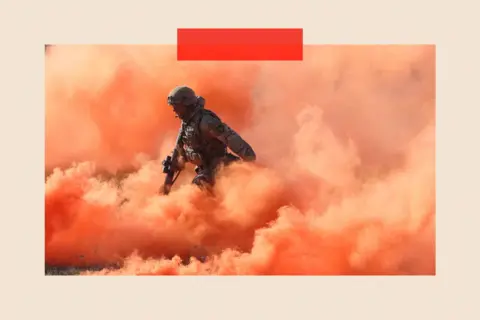
Top image credit: Ministry of Defence /PA Wire/ Getty Images. Picture shows soldier in non-combat scenario
BBC InDepth is the home on the website and app for the best analysis, with fresh perspectives that challenge assumptions and deep reporting on the biggest issues of the day. You can now sign up for notifications that will alert you whenever an InDepth story is published - click here to find out how.
The UK's asylum system is affected by inefficiencies, "wasted public funds" and a succession of "short-term, reactive" government policies that have moved problems elsewhere, the National Audit Office (NAO) has said.
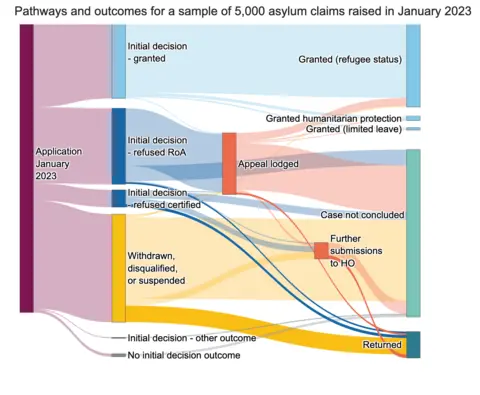
As part of its analysis, the spending watchdog looked at a sample of 5,000 asylum claims lodged almost three years ago, in January 2023.
Since then, 35% (1,619) of those asylum seekers had been given some sort of protection such as refugee status, and 9% (452) had been removed from the country. But 56% (2,812) still did not have a final outcome in their case.
The Home Office welcomed the analysis, which it said supported "the case for fundamental reform of the asylum system".
Most of the cases in the remaining group (2,021 out of the 2,812) remained in a sort of "limbo", with no appeal lodged.
The NAO's chief analyst, Ruth Kelly, told reporters: "They've had their claim refused, but they're staying in the system with their case unresolved, and that's because of the difficulties in removal."
A shortage of other types of accommodation means that large numbers of asylum seekers whose cases are not closed are being housed in hotels. The cost of accommodation in 2024-25 was £2.7bn.
Enver Solomon, the chief executive of Refugee Council, said of the January 2023 analysis: "The NAO's finding that more than half of people who applied for asylum almost three years ago still don't have an outcome is shocking."
He said the report mirrors what the Refugee Council's front-line services see every day, "an asylum system that is simply not functioning, where people wait months or even years for a decision… and costs keep rising".
The NAO's report criticises how successive governments have dealt with the current surge in small boats crossings that began in 2018.
"Interventions have tended to be reactive and focused on fixing an urgent problem in one part of the system only, such as intake or initial decisions, without a clear view of the effects on other parts," the report says.
"Increases in speed of processing have sometimes come at the expense of the quality of decisions, and improvements in one area have shunted problems elsewhere."
The NAO gave the example of former prime minister Rishi Sunak's drive to clear the legacy asylum backlog in 2023, which then shifted pressure onto the appeals stage, simply creating another backlog in the courts.
Shortage of judges
Ruth Kelly said one of the most critical factors now was a shortage of specialist immigration judges to hear appeals.
"There's a severe capacity shortage with judges," she said. "And judges told us there are poor incentives for working in the immigration and asylum tribunals… because of the taxing and the complex nature of the work, and also because of negative media attention, which makes it harder to recruit judges."
The NAO said it would be looking for evidence that the government was now moving away from "short-term, reactive fixes" towards a "sustainable whole-system approach".
The NAO found 56% (2,812) of asylum cases raised in January 2023 still did not have a final outcome in their case
It said the current lengthy delays in the system "erode public confidence in the system's fairness and effectiveness".
The NAO also found that it was impossible to track individual cases through the whole asylum process because there is no "unique asylum case identifier" shared by Home Office, court service and local authority computer systems.
The report says that because the asylum applications are subject to fluctuating demand with significant peaks, it was important to build a flexible and resilient system that can respond to increases and decreases in demand.
Ruth Kelly, the NAO analyst, said the government needed to avoid reverting to "that pattern of counter-productive quick fixes that we have seen in the past".
A Home Office spokesperson said: "The home secretary recently announced the most sweeping changes to the asylum system in a generation to deal with the problems outlined in this report.
"We are already making progress – with nearly 50,000 people with no right to be here removed, a 63% rise in illegal working arrests and over 21,000 small boat crossing attempts prevented so far this year.
"Our new reforms will restore order and control, remove the incentives which draw people to come to the UK illegally and increase removals of those with no right to be here."
UK adults spent over half an hour longer online every day in 2025 than they did during the pandemic, according to an annual survey of internet habits by the regulator Ofcom.
The Online Nation report found on average, people in the UK spent four hours and 30 minutes online every day in 2025 - 31 minutes longer than in 2021.
Psychologist Dr Aric Sigman told the BBC this was not a problem in itself, but what mattered was "what this time is displacing and how this may harm mental health".
He added the "good news" was society was "beginning to question online time more critically".
In a year where the major UK Netflix drama Adolescence won praise and politicial attention for shining a light on misogynistic online content, the survey found adults were feeling less positive about the impact of the internet overall.
Only a third (33%) said they felt it was "good for society" – down from 40% in 2024.
However, nearly two thirds of people still believed the benefits of being online outweighed the risks.
And many adults said they found the internet to be a source of creativity, with roughly three quarters agreeing being online helped them to broaden their understanding of the world.
Children wary of 'brain rot'
The report also explored children's experiences of being online.
While more than eight in ten aged 8-17 said they were happy with the amount of time they spent on the internet, they also recognised there were negative impacts of endlessly scrolling on smartphones.
The term "brain rot" was used by some children surveyed to describe the feeling they were left with after spending too long on their devices.
It has become a popular phrase to describe overconsuming online posts and videos considered to be the opposite of mentally challenging.
And Ofcom found across four of the main services used by children - YouTube, Snapchat, TikTok and WhatsApp – up to a quarter of the time 8 to 14-year-olds spent online was between 2100 and 0500.
VPN use more than doubles
From 25 July, Ofcom required websites operating in the UK with pornographic content to "robustly" age-check users, under the Online Safety Act.
Some people began using a virtual private network (VPN) at this time - tools which can disguise your location online to allow you to use the internet as though you are in another country.
The increase indicates people are likely using them to bypass requirements of the Act.
After the age checks became mandatory, the survey said VPN use more than doubled, rising from roughly 650,000 daily users before July and peaking at over 1.4 million in mid-August
But it also found the number had since declined to around 900,000 in November.
ASMR 'relaxing'
The report also found 69% of children aged 13 to 17 said they used online services to help with their wellbeing, either to relax or improve their mood.
More than half named ASMR as a tool they had used in particular to help them relax.
These videos became an online phenomenon more than a decade ago - which some people claim causes them to feel a tingling sensation.
It has led to an entire industry of online creators making special content viewed on platforms such as YouTube.
But children were not solely positive about their online experiences.
Seventy percent said they had issues with self-improvement media - involving toxic messaging or body shaming.
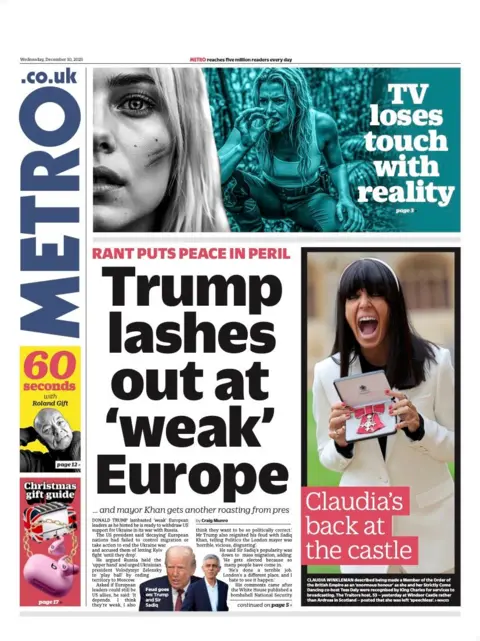
US President Donald Trump has declared European leaders "weak", with his comments splashed on a number of Wednesday's front pages. According to the Metro, the president "lambasted 'decaying' European nations" for their failure to take action to end the Ukraine war, in a rant that the paper says "puts peace in peril".
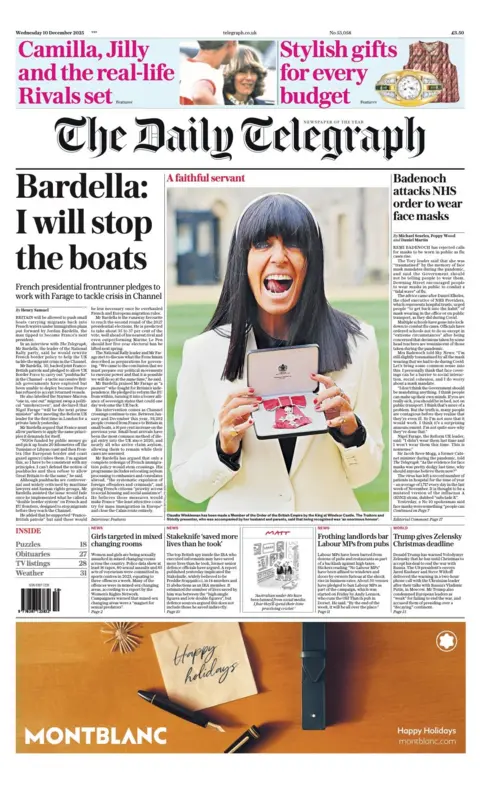
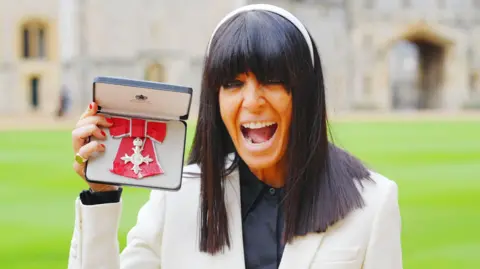
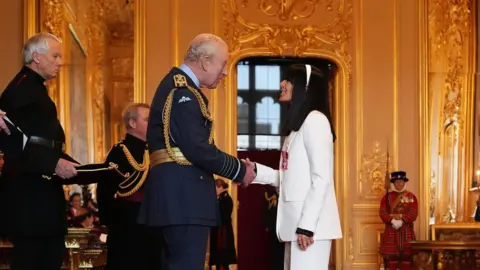
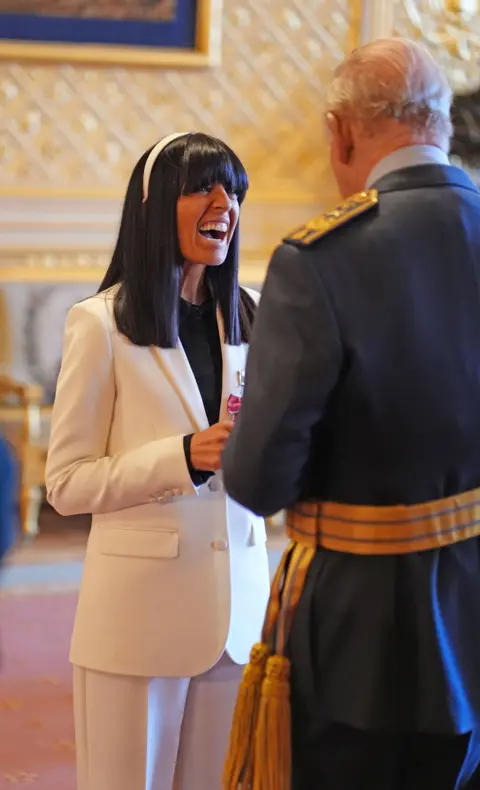
Claudia Winkleman beams on the front page of the Telegraph, after she was made an MBE by King Charles III for her services to broadcasting. The paper leads with quotes from its interview with the leader of France's National Rally party, Jordan Bardella, who said he would rewrite border policy to help the UK push small boats carrying migrants back into French waters.
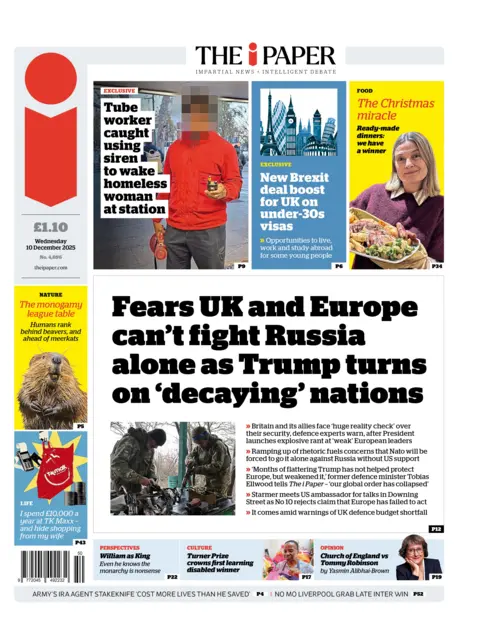
The i Paper says the UK and Europe are facing a "huge reality check" over their security, following Trump's condemnation of "weak" European leaders. The paper reports that No 10 has rejected the president's claims, but notes that the prime minister is meeting with the US ambassador at Downing Street.
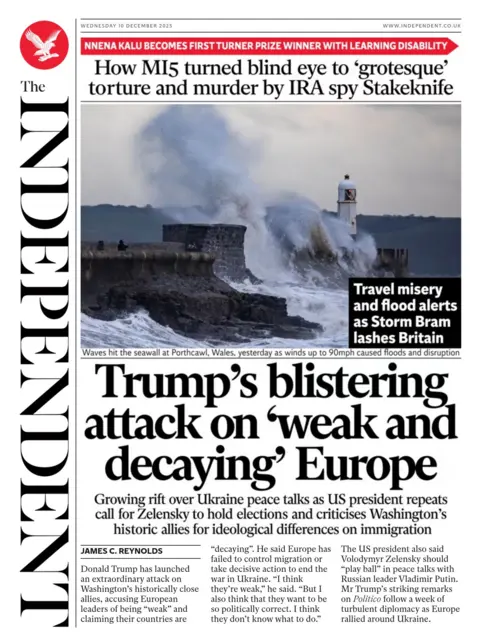
Trump's "blistering attack" on Europe leads the Independent's front page. Also featured on the front is Storm Bram, which led to "travel misery" and "flood alerts" across Britain.
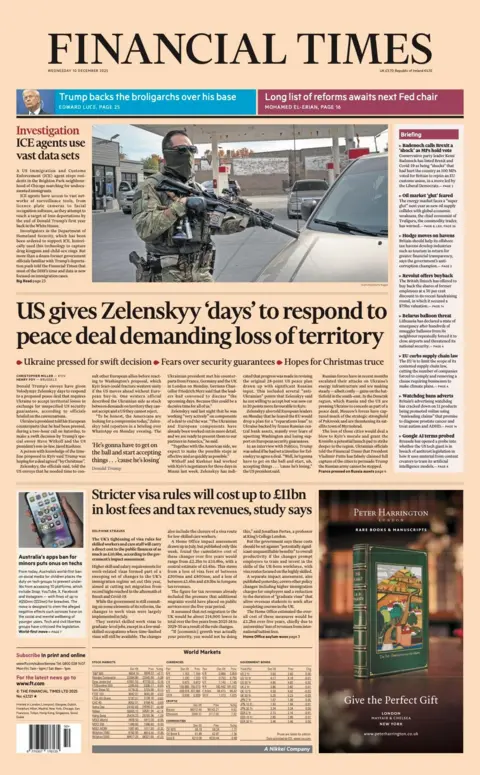
There are hopes that Kyiv will agree to the US-brokered peace deal "by Christmas", according to the Financial Times. It reports that the US has given Ukrainian leader Volodymyr Zelensky "days" to respond to their proposition, which will require Ukraine to accept territorial losses in exchange for "unspecified US security guarantees".
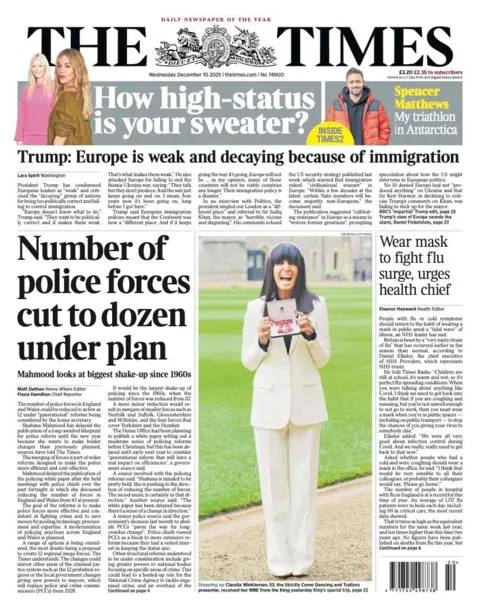
"Number of police forces cut to dozen under plan", reads the headline on the front page of the Times, which reports that Home Secretary Shabana Mahmood is considering reducing police forces in England and Wales to just 12. Sources have told the paper that the home secretary has delayed the publication of a "long-awaited" blueprint for police reform until 2026, as she wants to make "bolder changes than previously planned".
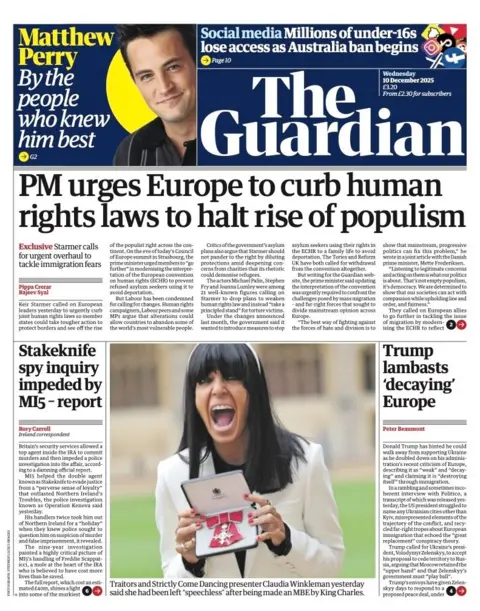
The Guardian reports that Sir Keir Starmer has called on European leaders to "urgently curb" joint human rights laws, in order to allow states to take "tougher action to protect borders". The paper says Labour has been "condemned" for calling for changes, with critics arguing that the alterations could allow countries to abandon some of the world's most vulnerable people.
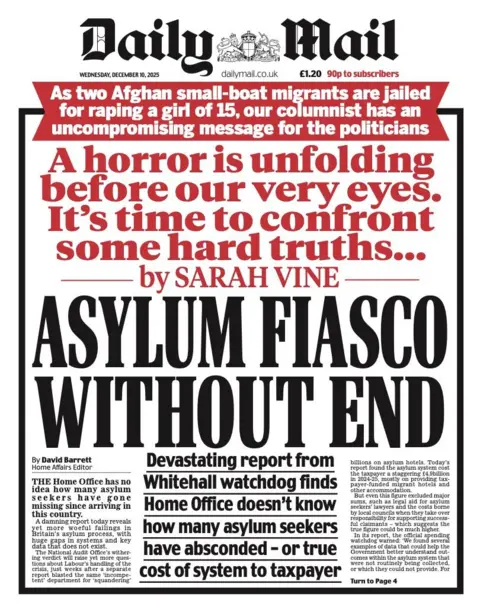
The front page of the Mail doesn't feature a single image, leading with the headline "Asylum fiasco without end". It says that a "damning report" from the National Audit Office has revealed "huge gaps in systems" and missing data, including on how many asylum seekers have gone missing since arriving in the UK.
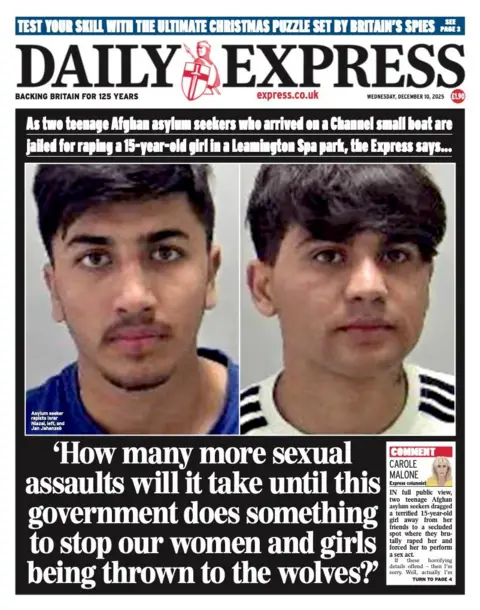
Photographs of teen Afghan nationals Israr Niazal and Jan Jahanzeb lead the Express, after they were sentenced on Tuesday for the rape of a 15-year-old girl in Leamington Spa. In her comment piece for the paper, Carole Malone asks "How many more sexual assaults will it take?"
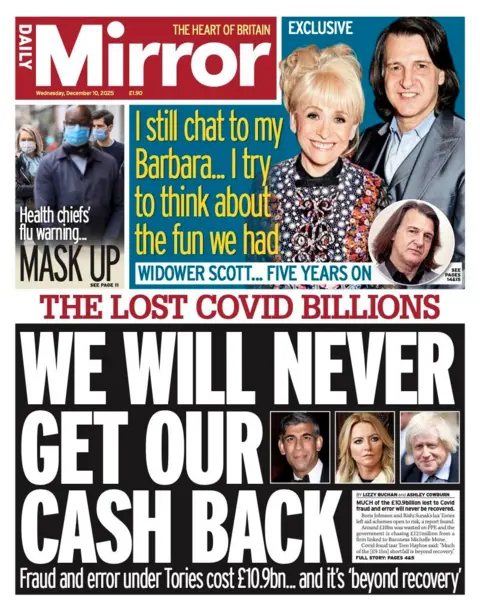
"The lost Covid billions" is the main story for the Mirror, after a report found that aid schemes were left open to risk during the pandemic. The paper says that fraud and error under the Tories cost £10.9bn, with much of the shortfall "beyond recovery".
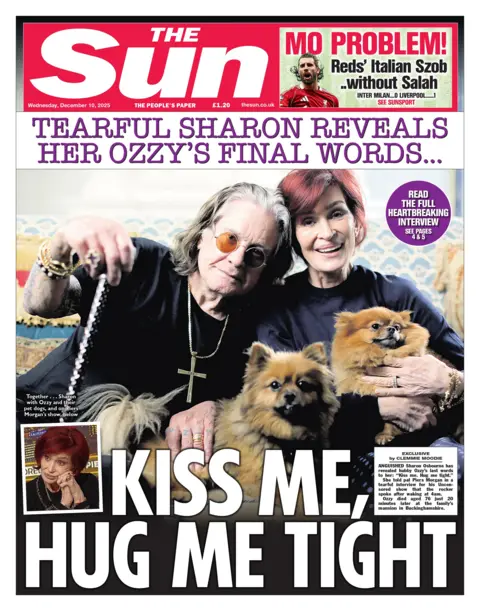
A photograph of the late Ozzy Osbourne alongside his wife Sharon is splashed across the front page of the Sun, after she revealed his final words to her before his death in July this year.
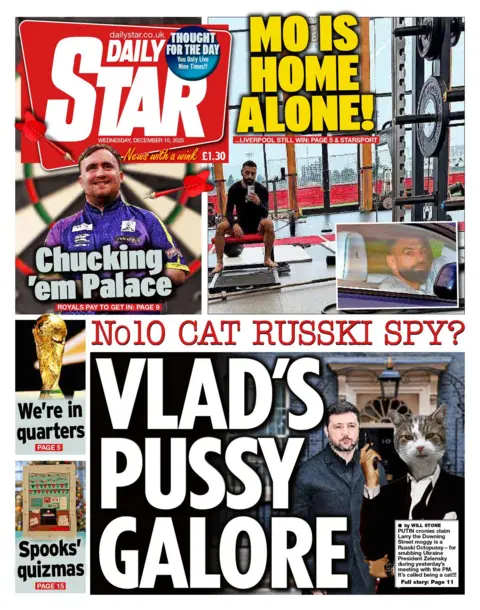
"Vlad's pussy galore", reads the Daily Star's main headline, alleging that Larry the Cat "snubbed" the Ukrainian president during his visit to No 10 earlier this week.
International talks to revolutionise how the European Court of Human Rights handles migration cases will begin on Wednesday.
The British government is urging partners to modernise the way states tackle the continent-wide illegal migration crisis.
The talks are the most significant sign yet that international human rights law could be reinterpreted to make it easier for states to target people smuggling and set up 'returns hubs' to hold people with no right to be in Europe.
Writing ahead of the major meeting in Strasbourg, Sir Keir Starmer and Danish Prime Minister Mette Frederiksen said other nations should rethink human rights laws to make protecting borders easier.
Critics say the ECHR is getting in the way of removing more illegal migrants, while supporters say claims about the ECHR's role in migration are exaggerated.
The BBC understands that the aim is for member states to reach a political declaration by the spring which would set how the European Convention on Human Rights is applied in migration cases.
If such an agreement was achieved, it could be one of the most important reforms to how human rights law is applied in the 75-year history of the convention.
The meeting at the Council of Europe, the political body that agrees the human rights laws which are then applied by the court, comes after months of pressure over migration.
Nine members of the human rights body, led by Italy and Denmark, called earlier this year for reforms.
The UK did not sign that open letter - but it has been lobbying behind the scenes for talks on reforms.
Membership of the convention has become increasingly contentious in the UK in recent years.
Both the Conservatives and Reform UK have said they would leave it if they won the next election.
Kemi Badenoch has said leaving would not be a "silver bullet" but was a necessary step to "protect our borders, our veterans and our citizens".
Liberal Democrat leader Sir Ed Davey said he would oppose such a move saying the convention "upholds our freedom" and would "do nothing to stop the boats or fix our broken immigration system".
EPA
Danish Prime Minister Mette Frederiksen and British Prime Minister Keir Starmer meeting in London earlier this year
Writing in the Guardian newspaper ahead of the talks, Sir Keir and his Danish counterpart Mette Frederiksen said that the member states meeting on Wednesday must "go further in tackling" the "shared challenges" of "uncontrolled migration" that they said were undermining public confidence in governments.
"Europe has faced big tests before and we have overcome them by acting together. Now we must do so again," said the leaders.
"Otherwise, the forces that seek to divide us will grow stronger.
"So our message is this: as responsible, progressive governments we will deliver the change that people are crying out for.
"We will control our borders to protect our democracies – and make our nations stronger than ever in the years to come."
The UK delegation to the talks will be led by Deputy Prime Minister David Lammy.
He is expected to tell the meeting that the UK remains committed to the ECHR - but its interpretation must not stand in the way of combating people smuggling.
The BBC understands that if the meeting in Strasbourg is a success, officials will begin working with the member states on a political declaration to clarify how human rights laws should be applied to migration challenges - with a deadline of next May for the final wording.
The talks are expected to cover some of the most difficult issues including combating migrant smuggling and how to create human rights compliant 'returns hubs' - centres outside of Europe where migrants could be forcibly housed if they can not be returned to dangerous countries.
The talks are also expected to cover the complex rules of Article 8, the right to family life, and Article 3, the ban on inhumane treatment which features in many migration cases.
That olive branch to member states came after months of diplomatic talks paving the way for Wednesday's meeting.
"The European Convention on Human Rights provides the framework we need to address these issues effectively and responsibly," said Berset ahead of the meeting.
"Our task is not to weaken the Convention, but to keep it strong and relevant — to ensure that liberty and security, justice and responsibility, are held in balance."
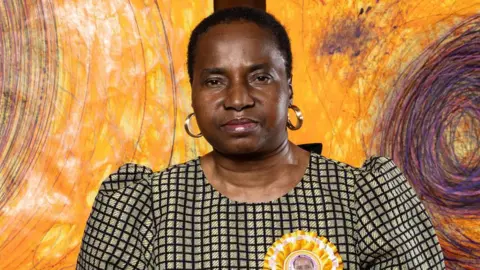
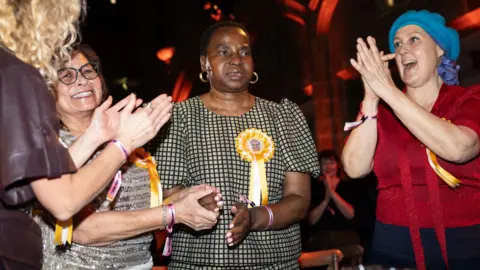
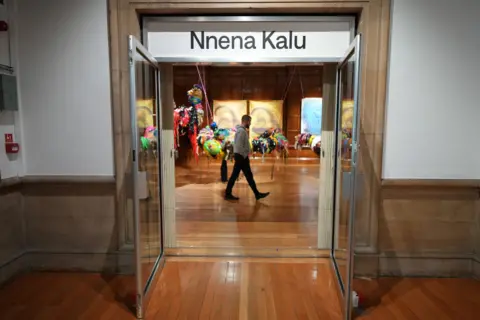
Nnena Kalu has been gaining recognition in the art world in recent years
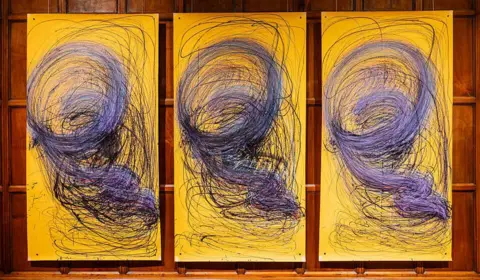
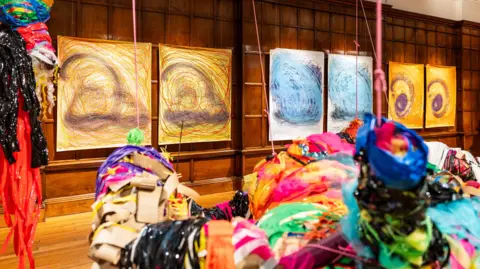
Nnena Kalu has won this year's Turner Prize, the UK's most high-profile art award, for her "bold and compelling" sculptures and drawings - and has made history as the first artist with a learning disability to win.
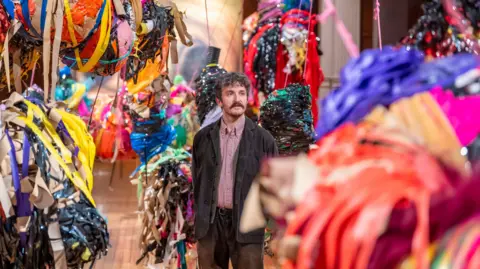
The judges praised Kalu's brightly-coloured sculptures - which are haphazardly wrapped in layers of ribbon, string, card and shiny VHS tape - and her drawings of swirling, tornado-like shapes.
Kalu, 59, is an autistic, learning disabled artist with limited verbal communication.
Charlotte Hollinshead, who has worked with her for 25 years, said on stage at the ceremony: "This is a major, major moment for a lot of people. It's seismic. It's broken a very stubborn glass ceiling."
'Idol, legend, winner'
In a moving speech delivered alongside Kalu, she said: "This amazing lady has worked so hard for such a long time.
"It's wonderful she's finally getting the recognition she rightly, rightly deserves."
PA Media
Kalu and her supporters wore rosettes saying "Idol, legend, winner, whatever"
Glasgow-born, London-based Kalu was announced as the winner of the award - and its £25,000 prize money - at a ceremony in Bradford, the UK's current city of culture, on Tuesday.
She accepted the honour while wearing a rosette bearing her photo and the words: "Idol, legend, winner, whatever."
Kalu has been gradually gaining recognition in the art world in recent years after working as a resident artist with Action Space, which supports artists with learning disabilities, since 1999.
Ms Hollinshead, her studio manager and artistic facilitator, said: "We are so happy that Nnena's talent and beautiful work is now out in the world for you all to see this complex artist who creates gorgeous, complex forms - all while listening to disco music, often as loud as possible.
"Nnena's career reflects the long, often very frustrating journey we've been on together... to challenge people's preconceptions about differently abled artists, but especially learning disabled artists, an important creative community so undervalued.
"When Nnena first began working with Action Space in 1999, the art world was not interested.
"Her work wasn't respected, not seen, and certainly wasn't regarded as cool.
"Nnena has faced an incredible amount of discrimination, which continues to this day, so hopefully this award smashes that prejudice away.
"Nnena Kalu, you've made history!"
'Beautiful intricacy'
PA Media
Tape, ribbons, string and cardboard are among the materials used to make Nnena Kalu's sculptures
Kalu's work has divided opinion among art critics, but the Turner Prize judges were impressed by the "really compelling sculptures and drawings that could only be made by Nnena", according to the jury chairman, Tate Britain director Alex Farquharson.
Her drawings, which come in sets of two or three near-identical shapes, have "a beautiful intricacy to them" and "look like swirling vortexes", he said.
Getty Images
Her sculptures, meanwhile, are hanging shapes covered in reams of re-purposed materials including fabric, rope, parcel tape, cling film and paper.
They resemble three-dimensional versions of abstract expressionist paintings, Mr Farquharson said.
"But they're not paintings, they're not flat on the wall. They're suspended in the space that you're in, like brightly coloured rocks or creatures.
"They're at almost your eye level. Although there are no figurative features at all, they appear to be communing among themselves and with you.
"The use of materials is highly unusual, including video tape that gets wrapped round and round.
"The colours and the lines the materials make are very like brush marks translated into three dimensions. They're very gestural, they're very expressive, they're very compelling."
Getty Images
'Quality and uniqueness'
The judges deliberated for two or three hours, Mr Farquharson said, and stressed that their choice of winner was based purely on merit.
"The result wasn't about wanting, first and foremost, to give the prize to Nnena as the first neurodiverse artist. That wasn't a driving factor," he said.
"It was an interest in, and a real belief in, the quality and uniqueness of her practice, which is inseparable from who she is."
It is a historic moment, though, he told BBC News.
"It breaks down walls between, if you like, neurotypical and neurodiverse artists. It becomes really about the power and quality of the work itself, whatever the artist's identity is.
"So maybe what's historic about it is it's one more move to include really great neurodiverse artists in the picture we present of art today."
Getty Images
All of the shortlisted artists' works are on show at thye Cartwright Hall gallery in Bradford
The result was announced at a ceremony at Bradford Grammar School, the former school of artist David Hockney.
Works by all four shortlisted artists are currently on show at the Turner Prize exhibition at the nearby Cartwright Hall gallery, which will run until 22 February 2026.
The other nominees were Rene Matić, Zadie Xa and Mohammed Sami, who will receive £10,000 each.
The Turner Prize has been the UK's most coveted and controversial art award since it was founded in 1984. Past winners include Lubaina Himid, Jeremy Deller, Grayson Perry, Steve McQueen and Damien Hirst.
Storm Bram: Drone footage shows streets submerged by floodwater
Trains, flights and ferries have been cancelled and thousands left without power as Storm Bram brought heavy rain, strong winds and unseasonably mild temperatures to large parts of the UK.
Amber warnings for wind, which mean a possible danger to life, are in place in part of Northern Ireland and northern Scotland, where forecasters say gusts could reach speeds of 90mph (145 km/h).
Yellow warnings for wind are in place across Northern Ireland, Scotland and Wales, as well as northern and south-west England.
As of 17:25 GMT, there were 90 flood warnings in place across the UK, with 37 flood warnings in England, 20 in Wales and 33 in Scotland.
The storm has brought exceptionally mild air to the country, with some regions registering temperatures as high as 16C (60F) - significantly higher than the December average of 5-9C.
In Scotland, several ferry routes on the west coast were cancelled or face disruption, ferry operator CalMac has warned.
ScotRail announced that some trains in the north west would finish early and said there would be speed restrictions and delays in other parts of the country.
The Met Office issued an amber warning for very strong and disruptive winds in northwest Scotland between 16:00 and 23:59 on Tuesday.
Some Scottish schools closed early due to the forecast.
An amber wind warning in Northern Ireland is due to last until 20:00.
Ulster University in Northern Ireland closed some of its campuses, while the country's Education Authority asked schools to monitor and assess the weather warnings in their areas.
In Wales, a yellow warning covers the whole of the country until 19:00.
South Wales and south-west England saw heavy rain overnight, with both regions covered by amber warnings that expired at 10:00 on Tuesday.
BBC South West's senior broadcast meteorologist David Braine said Dartmoor in Devon saw almost a month's worth of rainfall over the past 48 hours.
Many houses in Totnes were flooded as the River Dart - which carries water from Dartmoor - grew swollen with rainwater.
Rail services, including some services to London, have been disrupted in both areas because of the rain.
In the west of England, Great Western Railway is reporting cancellations due to flooding between:
Par and Newquay
Totnes and Plymouth
Swindon and Bristol Parkway
In Wales, various Transport for Wales services are experiencing disruptions: Flooding has led to the closure of all lines between Aberdare and Abercynon. Some rail replacement coaches are operating.
National Rail has warned some Avanti West Coast, CrossCountry, East Midlands Railway and TransPennine Express services are affected - with the full details available on its website.
Thousands in England and Wales have been left without power. As of 16:30, just over 4,000 properties had no electricity, according to National Grid.
Some roads were closed in Wales following heavy rain
Storm Bram follows Storm Amy in October, which caused travel disruption, power cuts and storm damage to thousands of homes across the UK.
Named by Ireland's national weather service, Met Éireann, Storm Bram is expected to cause ongoing disruption throughout Tuesday before clearing on Wednesday.
Why does Storm Bram follow Storm Claudia?
Storm Bram is the fourth named storm to hit the UK this season, after Amy, Benjamin and Claudia - so why did forecasters go back to the letter B?
It comes down to how storms are named and who actually names them, BBC lead weather presenter Matt Taylor says.
The UK's Met Office, Ireland's Met Éireann and KNMI in the Netherlands group together to track major storms. Storms are named when they are expected to have a significant impact in at least one of the countries in the group, and are not based on any rainfall or wind speed thresholds.
The alphabetic storm name list is decided jointly by the group every year, following submissions from the public. Storm Bram is only the second storm to be named by the group this season, with the Irish weather service announcing Bram's naming.
Benjamin was named by the French weather service, and Claudia by the Spanish service because of the impacts the low pressure systems would have in those nations first.
IRA spy Stakeknife was revealed to be west Belfast man Freddie Scappaticci, who died in 2023.
The major investigation into the state agent in the IRA known as Stakeknife has revealed MI5 had a bigger role in his handling than previously claimed.
The final report of Operation Kenova also said the belated discovery and disclosure of documents by MI5 to the investigation last year was "a serious organisational failure".
Stakeknife was Freddie Scappaticci, who died in 2023, but the Kenova remains gagged by the government from officially naming him.
He worked as a British agent from the late 1970s until the 1990s, and has been linked to 14 murders and 15 abductions. MI5 and the Army knew about his role in the IRA's feared internal security unit, and his involvement in torturing and killing people accused of being informers.
Operation Kenova's stark conclusions on MI5's candour is just the latest severe criticism of the security service by the courts and official inquiries in the past two years.
In 2023, the public inquiry into the Manchester Arena bombing – which killed 22 people – found that MI5's senior corporate witness had given inaccurate evidence about the key intelligence it held on the bomber before the attack.
Jon Boutcher, Police Service of Northern Ireland chief constable, says he thinks that MI5 has an issue with its approach to legacy cases in Northern Ireland and that things must change.
But there is also wider question about whether MI5 can be trusted to provide truthful and full evidence to courts and investigations.
This poses a profound challenge to the government, which acts on behalf of MI5 in the courts and relies on its intelligence assessments to make big decisions.
MI5's evidence really matters. As with Operation Kenova, that evidence frequently relates to matters of life and death, but also cases concerning people whose British citizenship has been stripped or people whose liberties have been removed.
There are calls for MI5 to be subjected to increased scrutiny and be held more accountable under the law.
The law will create a new legal duty on public bodies and servants to act truthfully and fully support investigations into the state, ensuring wrongdoing is not concealed.
However, as things stand, the duty will not apply in the same way to MI5 and intelligence agencies, with individual MI5 officers not subjected to the duty, unlike people who work for organisations like the police.
Given Kenova's conclusions, how will ministers and lawmakers now react?
Another big issue for the government and MI5 is the refusal to allow Kenova to name the agent Stakeknife, despite repeated requests to do so, with the consequence that much of what was uncovered cannot be publicly described in case it identifies the agent.
As everyone knows, Stakeknife was Freddie Scappaticci, and Jon Boutcher on Tuesday said the ban on identifying Stakeknife was a "pantomime".
MI5 justifies the ban with reference to its core 'neither confirm nor deny' (NCND) secrecy policy, which has long been presented in a public as a monolithic principle that cannot be deviated from.
But in the neo-Nazi Agent X case, MI5 was forced to abandon NCND and confirm the man at the centre of the case was a state informant, after the BBC proved it had told me the man was an agent when it was trying to cover for him.
MI5 was also forced to accept it had misled a court by not revealing the existence of policies relating to departures from NCND – policies it had kept secret.
Last year, Kenova recommended that the government should review, codify and define the proper limits of the NCND policy as it relates to the identification of agents and its application in the context of Northern Ireland legacy cases.
On Tuesday, Kenova said no substantive progress has yet been made on the recommendation, and it is unclear whether and when this may change.
But the Stakeknife "pantomime", and MI5's lack of candour in other major cases, is now placing pressure on the government to act.
If you have information about this story or a similar one that you would like to share with the BBC News Investigations team please get in touch. Please include a contact number if you are willing to speak to a BBC journalist. You can contact us in the following ways:
Email: security.investigations@bbc.co.uk
Signal: @danields39.63
Click here to learn how to use SecureDrop, an anonymous whistleblowing tool that works only in the Tor browser and follow the advice to stay secure.
Google plans to launch smart glasses powered by artificial intelligence (AI) in 2026, after its previous high-profile attempt to enter the market ended in failure.
The tech giant set expectations high in 2013 when it unveiled Google Glass, billed by some as the future of technology despite its odd appearance with a bulky screen positioned above the right eye.
Google pulled the product in 2015 less than seven months after its UK release, but is now planning on re-entering the market with smart glasses with a cleaner look.
But it comes after Meta has already made waves with its smart specs, which have sold two million pairs as of February.
Google's new tech will let users interact with its own AI products, such as its chatbot Gemini.
It plans to launch two different varieties - one designed to be provide assistance without any kind of screen, and another which has a display on the glasses themselves.
While saying the first of the two types of AI glasses it is working on would come in 2026, Google has not given more information on what form it will take.
Technology analyst Paolo Pescatore told the BBC the tech firm "must avoid the pitfalls of its previous failed attempt".
"Arguably, the move was ahead of its time, poorly conceived and executed," he said.
"Now represents an opportune moment, thanks to the success of Gemini."
Bloomberg via Getty Images
Google co-founder Sergey Brin demonstrated Google Glass on-stage at an event in 2012.
Google will also have to contend with Meta, which unveiled its own AI-powered glasses earlier this year, having built on its existing collaborations with luxury eyewear brands Ray-Ban and Oakley.
According to market research firm Counterpoint Research, the sector saw a surge in the first half of 2025, driven by demand for Meta's devices and the launch of similar products by smaller brands.
It said sales of AI glasses had grown by more than 250% compared to the previous year.
What went wrong with Google Glass?
Google Glass was launched in 2013 as a pair of thin, wireframe glasses with a chunky right arm to accommodate a camera built into the corner of the right lens.
Wearers could use the camera to take images and record their surroundings, while simultaneously interact with a digital display
The device created a lot of excitement when it first appeared at a Google event in June 2012.
But after its launch the following year, concerns about its impact on privacy, potential for abuse and questions about its style and usefulness arose - and grew until Google Google said it would stop making them in that form in 2015.
Former BBC Technology Correspondent Rory Cellan-Jones was among those who had deemed Google's device in its initial form to be "a failure".
The success of so-called wearable computers, he wrote, would likely depend on having the tech to bring their potential to life and them being "both attractive to wear and so easy to use that you forget that you have them on".
Today, tech giants have tried to make AI and smart glasses more wearable by partnering with designer eyewear brands - and can pack more power and features into smaller, sleeker frames.
But there remain concerns about privacy and usability.
Arc Raiders has been a smash hit, but its use of AI has sparked debate
A video game at the centre of a debate over artificial intelligence (AI) is in the running for the top prize at next year's Bafta Game Awards.
Arc Raiders, from Swedish developer Embark Studios, has been a smash-hit since its October launch, selling more than four million copies.
But the multiplayer shooter has been criticised for using text-to-speech tools to create additional lines, based on dialogue previously recorded by the game's actors.
It is one of 10 titles longlisted for the prestigious best game award, with a shortlist to be announced in the run-up to April's annual ceremony.
Other games up for the top prize include blockbusters Ghost of Yōtei and Death Stranding 2, indie games Hollow Knight: Silksong and Hades II, and indie adventure Blue Prince.
Bafta's video game awards are often seen as a less commercial alternative to the US-based show, with categories dedicated to British studios and big awards going to small studios.
How does Arc Raiders use AI?
Embark Studios
Arc Raiders has won praise for its gameplay, visuals and sound
Arc Raiders is an extraction shooter game set on a futuristic Earth that has been overrun by hostile machines and the human race run underground.
Teams of players compete to gather materials on the surface, avoiding each other and killer robots, with the aim of getting back to base in one piece.
The game was generally well-received by critics and praised for its gameplay, level design and immersive audio.
A disclosure on PC games store Steam said the game "may useprocedural and AI-based tools to assist with content creation" during development sparked a debate among players.
While the game contains traditional recorded performances, the actors involved also gave permission for their voices to be used as training data for text-to-speech models.
These are used outside of scripted scenes, and Embark has said this allows them to add updates to the game without needing to repeatedly call performers into a studio.
Sandfall Interactive
Role-playing game Clair Obscur is also nominated for Bafta's big prize
The use of AI-based tools in game development is not new, but it has become a bigger topic since generative AI (GenAI) - the technology behind products such as ChatGPT - became more prominent.
As in other industries, it has prompted fears of job losses, and accusations of stealing artists' work without permission to train models.
In the video game industry, which has seen record numbers of layoffs in recent years, those worries are heightened.
Players and reviewers complained that Arc Raiders' generated voice lines were lower quality than those delivered by human actors, and also expressed worries over performers losing out on work.
A year-long strike over AI protections for video game actors ended in July this year, with fears over replicating performances without consent being the main sticking point.
Embark Studios has insisted it has not used GenAI in Arc Raiders, and that it does not wish to eliminate humans from its development process.
Its co-founder, Stefan Strandberg, told website GamesRadar+ AI techniques have allowed the studio to work more efficiently while keeping its core team size small.
Other games in the longlist have also been criticised by fans for using AI in development.
The Alters, which appears in the performance and narrative categories, was found to have used AI translation, while early versions of Clair Obscur contained generated textures.
In both cases, developers said the resulting text and images were placeholders never intended to appear in the final releases.
Raw Fury
Adventure game Blue Prince was one of the best-reviewed games of 2025
Bafta has 1,700 games industry members who are eligible to vote in its annual awards and decide what gets nominated.
It does not currently have an official position on AI usage in game development, but Newsbeat understands it is in regular discussion with its members on the topic.
Its technical achievement award, which Arc Raiders is up for, lists AI as one of the elements of engineering and programming that jurors can take into account.
The awards do have strict eligibility rules around remakes and remasters of previously released games, and downloadable content, or DLC, which expands on an existing title.
In a statement released with the longlist, Bafta Games committee chair Tara Saunders said the awards were "a fantastic opportunity to spotlight the creativity and craft shaping this year's games".
"This list showcases a wide range of games to dive into... honours the teams behind these standout titles, and shines a light on the incredible skill across our whole industry," she added.
The official Bafta Games 2026 longlist can be found here.
Listen to Newsbeat live at 12:45 and 17:45 weekdays - or listen back here.
US President Donald Trump has criticised European leaders as "weak" and suggested the US could scale back support for Ukraine.
In a wide-ranging interview with Politico, he said "decaying" European countries had failed to control migration or take decisive action to end Ukraine's war with Russia, accusing them of letting Kyiv fight "until they drop".
He argued that Russia held the "upper hand" and urged Ukraine's president Volodymyr Zelensky to "play ball" by ceding territory to Moscow.
In the UK, Downing Street rejected Trump's claim that Europe had failed to act, citing the UK's leadership on sanctions and reiterating support for the US-led peace process.
The president's remarks came shortly after his administration released a 33-page National Security Strategy warning of Europe's potential "civilisational erasure" and questioning whether some nations could remain reliable allies.
A member of the UK Armed Forces has died in an accident in Ukraine on Tuesday morning, the Ministry of Defence (MoD) has announced.
"He was injured in a tragic accident whilst observing Ukrainian forces test a new defensive capability, away from the front lines," it said in a statement.
The individual's family has been informed, it added.
The MoD has been approached for further comment.
This breaking news story is being updated and more details will be published shortly. Please refresh the page for the fullest version.
You can receive Breaking News on a smartphone or tablet via the BBC News App. You can also follow @BBCBreaking on X to get the latest alerts.
Some schools have had to bring back Covid-like measures to prevent the spread of flu, as rates of reported illnesses in schools and other educational settings are higher than this time last year.
One primary school in Leeds said last week it had to cut back on singing in assemblies and introduce sanitisation stations, while another in Caerphilly had to close temporarily.
Flu season has come early this year and some hospitals have asked staff, patients and visitors to wear face masks.
The Association of School and College Leaders said they were aware of winter illnesses causing disruption in "several schools across the UK".
The Department for Education (DfE) in England said school closures "should only happen in extreme circumstances".
The most recent data from the UK Health Security Agency (UKHSA), which monitors the spread of winter viruses, found there were 107 acute respiratory incidents in educational settings in England between 24 and 30 November.
An "acute respiratory incident" is defined for a school as two or more cases occurring among pupils within a five-day period. It could apply to a range of respiratory illnesses like influenza, RSV, covid or the common cold.
Of the 107 incidents reported in education settings for the last week of November, 17 identified influenza as the virus involved, with two more schools reporting Covid as the cause. In 76 cases the school didn't know which respiratory infection was affecting them.
In comparison, during the same week last year there were only 15 respiratory incidents in educational settings overall, with only one due to influenza.
Flu is on the rise in the UK, according to the UKHSA - with a weekly average positivity rate of 17.1% among reported test results as of 2 December, up from 11.6% the week before.
A new strain of the virus, the H3N2 "subclade K" variant, is circulating. It is a mutated strain of the seasonal influenza A virus and people have not encountered much of it in recent years. That means there is less built-up immunity against it.
In Leeds, a primary school has reduced singing in assemblies to reduce the spread of flu. Wigton Moor Primary School said 70 children, or one in six pupils, were off sick or sent home on one day last week with high temperatures and coughs.
Head teacher Elaine Bown called it the "worst year" for sickness since she started teaching almost 14 years ago. The school has also introduced Covid-style measures like opening windows and implementing sanitisation stations.
And in Northern Ireland the headteacher of a primary school in County Londonderry compared levels of sickness to "being back in Covid times" after 170 of his pupils were off sick on the same day.
DfE guidance published in October asks schools in England to open windows and doors whenever possible to make sure classrooms are ventilated, and to use carbon dioxide monitors, if they have them, to "identify poorly ventilated areas".
"Explain why you are opening the window, even on a chilly day, even just for 10 minutes can make a big difference, and the benefits of bringing fresh air into the classroom," it says.
It also advises on reminding children of the importance of handwashing and vaccinations.
Pupils from reception to Year 11 in England are eligible for a flu vaccination nasal spray at their school.
Parents with younger children aged two and three can book their children flu vaccinations at a GP practice.
The guidance stresses the importance of attendance and says most mild illnesses, like runny noses and sore throats, do not mean children need to be off school.
But it adds that "parents know their child best" and that schools can put measures in place to reassure them.
Education is devolved between the nations of the UK so nations issue their own advice on how to stop the spread of flu.
In Scotland officials recommend regular handwashing and advise people with symptoms of respiratory illness to stay off work or school until they are feeling better.
The Welsh government emphasises the importance of handwashing for staff in educational settings.
Pepe Di'Iasio, general secretary of the Association of School and College Leaders, said: "We're aware that flu and other winter illnesses are causing disruption in several schools across the UK and that this can be an extremely difficult situation to manage."
He said schools would communicate any steps they were taking to parents and students and it "may necessitate the closure or partial closure of a site where the situation is particularly severe".
"Schools always endeavour to avoid any disruption to learning and will have in place support for students who are affected", he added.
In a statement, a DfE spokesperson confirmed that flu cases are at very high levels this year and acknowledged that it would be a "tough winter" for the NHS.
"School attendance is critical for children's life chances, and while it's clear cases of flu are going to have an impact on attendance levels, we are clear school closures should only happen in extreme circumstances," they said.
"We provide clear guidance to help parents know exactly when to keep children home, and to help schools both manage children's wellbeing and keep disruption to a minimum."
Thousands of cigarettes smuggled from Belarus have been intercepted in recent months and Lithuania calls it a "hybrid attack"
The Lithuanian government has declared a "nationwide emergency situation" in response to a series of incursions from neighbouring Belarus by weather balloons carrying smuggled cigarettes.
Prime Minister Inga Ruginiene condemned the balloon incursions as a "hybrid attack" by Belarus that posed a real risk to national security and civil aviation.
This year alone, officials say about 600 balloons linked to smuggling and almost 200 drones have entered Lithuanian airspace, leading to the repeated closure of Vilnius airport.
Belarusian leader Alexander Lukashenko denies being behind the incursions, alleging the issue has been "politicised" by Lithuania, which is a member of both the EU and Nato.
Lithuania's decision to impose an "emergency situation" is a step below a state of emergency, which was last imposed in 2022 after Russia's full-scale invasion of Ukraine. It grants the armed forces additional powers to respond faster and more effectively.
Belarus's long-time leader is a close ally of Russia's Vladimir Putin and Lithuania's President, Gitanas Nauseda, has said there is a lot of evidence that the balloon threat is a "deliberate action aimed at destabilising the situation in Lithuania".
A number of European countries have faced a range of threats from Russia, which the EU has condemned as a "hybrid campaign" that includes sabotage, disruption to critical infrastructure and most recently drone flights near sensitive sites.
Last month, the head of Nato's military committee, Adml Giuseppe Cavo Dragone, said the Western military alliance was considering a more "aggressive" or "pro-active" stance to Russia's hybrid warfare.
Lithuania has accused Belarus of this kind of provocation before. Four years ago, thousands of irregular migrants mostly from the Middle East crossed the Belarusian border.
Responding to the latest threat, Lithuania closed two border checkpoints with Belarus for three weeks from the end of October. Belarus then barred Lithuanian trucks from driving on its roads and hundreds of Lithuanian vehicles are still understood to be stranded there.
"We are talking about aviation security and international law, and about the fact that such actions could be recognised as terrorism," Ruginiene said last week, in reference to both the balloons and the blocked trucks.
The weather balloons can fly to a height of 10km (6 miles) and Lithuania's interior ministry says they have led to Vilnius airport being closed for more than 60 hours since October.
Lukashenko told Belarusian TV on Tuesday that what the Lithuanians were accusing Belarus of was impossible: "It is unrealistic. Even if balloons flew into there, even if they did, I have spoken to pilots and they say that they pose no problem."
"The question arises why," he added. "Do they want to fight us? We do not need war. I am convinced that the Lithuanian people do not need war either. Neither do Poles, Latvians and Estonians."
Although flights into and out of Vilnius airport were disrupted for only a short period, it meant that 1,000 passengers were affected. Authorities said they had intercepted 11 smuggling balloons and seized almost 40,000 packets of cigarettes.
On one night last week, the airport had to suspend operations three times and Finnish airline Finnair has cancelled all evening flights to Vilnius until the end of February because of the balloons.
Watch: French far-right leader tips Nigel Farage to be next UK PM
Nigel Farage has met Jordan Bardella, the leader of France's far-right National Rally (NR) party, in London.
Speaking ahead of the meeting, Bardella told the BBC's Nick Robinson he believed the "extremely resilient" Reform UK leader would become the UK's next prime minister.
The 30-year-old French MEP is leading in opinion polls to win the first round of the next presidential election due in 2027.
A Reform source said the two politicians discussed small boat crossings and energy policy, particularly nuclear energy.
Farage has in the past kept his distance from NR, the successor party to the National Front (FN), formerly led by Marine Le Pen.
Le Pen was banned from public office for five years in March after a conviction for embezzling EU funds, barring her from standing in the 2027 presidential race.
She has condemned the verdict as a "political decision" and plans to appeal, with a court due to rule next year.
Farage has previously said that as leader of Ukip, he wanted to keep the party out of an alliance with the FN in the European Parliament.
His Brexit Party did not rule out entering the same group after the European Parliament elections in 2019, but ultimately decided not to join the group ahead of the ejection of the party's MEPs in 2020 in the wake of Brexit.
Farage backed Le Pen ahead of the 2017 French presidential election, although last year said the party's economic policies would be a "disaster" for France.
'That's politics'
Speaking to the Political Thinking with Nick Robinson podcast, Bardella acknowledged Farage "may have been harsh in the past" towards his party.
"But that's politics - you're allowed to evolve," he added. "My political party has also evolved, even in its name."
He added that if the NR takes power, it would seek to implement a more restrictive immigration policy and look again at the country's migration agreements.
He said he believed in police co-operation between France and the UK on small boats, but with the intention of returning migrants to their "countries of origin" rather than the French coast.
He said: "If I am head of the French government tomorrow, France will no longer be a country of mass immigration.
"Therefore, by implementing measures designed to drastically reduce immigration to France, this will inevitably have consequences for the departure of migrants from Calais, in northern France, to Great Britain."
Flu has come early this year and experts predict it could be a particularly nasty season because a new strain of the virus is circulating.
The NHS has already sent out a "flu jab SOS" to vulnerable people.
How bad might this winter be, and should you buy a flu jab even if you are generally fit, even if you have to pay for it?
Who needs a flu jab?
The NHS offers a free flu vaccine to people who need it most, including:
anyone aged 65 or over
those have certain long-term health conditions
pregnant women
care home residents
carers for older or disabled people, or those who receive a carer's allowance
people who live with someone who has a weakened immune system
Frontline health and social care workers can also get a flu vaccine through their employer.
A nasal spray version of the flu vaccine is also offered to children aged 2 to 3 years as well as school-aged children (reception to year 11).
Children can catch and spread flu easily. Vaccinating them also helps protect others who are at higher risk of getting seriously ill from flu.
Everyone else has to buy one.
Should I buy a flu shot?
Even if you are healthy, you might still want to buy a flu vaccine this winter.
Vaccines still work against the drifted influenza A(H3N2) strain that some are calling "super flu".
High street chemists sell the vaccine for around £20.
It's best to get vaccinated sooner to protect yourself during winter.
How long does it take for the vaccine to work?
The vaccine usually takes up to 14 days to work.
During this period, you're still vulnerable to catching the virus.
Some people mistakenly think the vaccine has given them flu, but the vaccine does not cause flu - instead, it gives your body the instructions it needs to fight off an infection should you catch it.
There's still a chance you might get flu after getting vaccinated, but it's likely to be milder and not last as long.
Protection decreases over time which is why a vaccine is offered every year.
The vaccine is frequently updated to best match the strain or version of flu that experts expect will be circulating.
Is it a cold, 'super flu' or Covid?
There are lots of coughs and colds doing the rounds. So how do you know if you have flu rather than something else? Your symptoms can give a clue.
Colds
Symptoms appear gradually
Mostly affect nose and throat
Early sign - pressure in your ears
Chestier, mucus cough
Flu
Comes on suddenly
Feel wiped out
Fever, muscle aches, exhaustion
Need bed rest
Dry cough
Covid
Typical flu symptoms
Loss of taste or smell
Diarrhoea or tummy upset
What else can I do to protect myself?
If you're meeting people indoors, open a window for fresh air.
Practise good hygiene:
cough into your bent elbow, or use a tissue and dispose of it afterwards in the nearest bin
wash your hands frequently with warm water and soap
clean your surroundings often, especially areas that are touched frequently such as door handles
If you are unwell but must go out, consider wearing a face mask to help protect others.
US President Donald Trump has criticised European leaders as "weak" and suggested the US could scale back support for Ukraine.
In a wide-ranging interview with Politico, he said "decaying" European countries had failed to control migration or take decisive action to end Ukraine's war with Russia, accusing them of letting Kyiv fight "until they drop".
He argued that Russia held the "upper hand" and urged Ukraine's president Volodymyr Zelensky to "play ball" by ceding territory to Moscow.
In the UK, Downing Street rejected Trump's claim that Europe had failed to act, citing the UK's leadership on sanctions and reiterating support for the US-led peace process.
The president's remarks came shortly after his administration released a 33-page National Security Strategy warning of Europe's potential "civilisational erasure" and questioning whether some nations could remain reliable allies.
Stakeknife was west Belfast man Freddie Scappaticci, who died in 2023
MI5 had a bigger role in the handling of a spy who murdered at least 14 people while working at the heart of the IRA during the Troubles in Northern Ireland than it had previously claimed.
It follows a £40m police investigation into the Army agent known as Stakeknife, which has published its final report.
The 160-page report stated MI5 was "closely involved", was regularly briefed and had sight of all Stakeknife intelligence. The security service had previously said its role was "peripheral".
MI5 director general Sir Ken McCallum has offered sympathies "to the victims and families of those who were tortured or killed by the Provisional IRA's internal security unit during the Troubles".
The report, authored by former Police Scotland chief constable Sir Iain Livingstone, found: "MI5 was involved in briefing and tasking Stakeknife via the (Army) throughout his operation as an agent."
It said the belated discovery and disclosure of documents by MI5 to the investigation last year was "a serious organisational failure".
He operated as a British agent from the late 1970s until the 1990s, and has been linked to 14 murders and 15 abductions.
He operated within the IRA's ruthless internal security unit throughout the 1980s. Known as the "nutting squad" the unit was responsible for torturing and killing people it accused of being informers.
However, he is not identified as Stakeknife in the Operation Kenova report because of the existing government and security policy of not naming agents.
The report states MI5 had "automatic sight" of Stakeknife's intelligence and "was aware of his involvement in serious criminality".
They were found after the Public Prosecution Service (PPS) for Northern Ireland decided not to charge any ex-IRA members or security forces personnel.
The report states: "The revelation of the MI5 material was the culmination of several incidents capable of being negatively construed as attempts by MI5 to restrict the investigation, run down the clock, avoid any prosecutions relating to Stakeknife and conceal the truth."
It adds the PPS's view is that the material "would not have altered prosecution decisions", but "investigative opportunities were undoubtedly lost".
The documents reveal Stakeknife's army handlers twice took him out of Northern Ireland for a holiday "when they knew he was wanted by the [police] for conspiracy to murder and false imprisonment".
The agent was flown out by military aircraft and given military identification.
MI5 was aware at the time.
Had Operation Kenova investigators known about this earlier, it could have been raised with relevant army personnel during interviews.
The report goes on: "The previous unavailability of this material is deeply regrettable because it contains information that could have been put to witnesses, generated new lines of inquiry and enriched Kenova's understanding of the factual background.
"Accordingly, the unavailability of this material to Kenova represents a lost opportunity whose impact can never be fully known."
'Stakeknife should be named'
In the report's preface, Sir Iain states Stakeknife should be named "in the public interest".
It is generally routine practice not to identify agents, a principle known as NCND, an acronym for Neither Confirm Nor Deny.
Speaking in the House of Commons, Northern Ireland Secretary Hilary Benn said due to ongoing litigation surrounding NCND, it was not possible to name Stakeknife at this time.
However, he added: "The government's first duty is to protect national security and identifying agents risks jeopardising this."
Police Service of Northern Ireland (PSNI) Chief Constable Jon Boutcher, who led Kenova until his appointment in 2023, said naming Stakeknife "would not put anyone at risk, affect the recruitment or retention of agents or the flow of secret intelligence or damage national security".
"I believe the government's claims to the contrary are untenable and bordering on farce," Boutcher added.
Pacemaker
Scappaticci (left of picture) pictured at the 1988 funeral of IRA man Brendan Davison
KRW Law, which represents families of some of those murdered by the IRA, said it was "insulting to the families" that Stakeknife had not been named in the Kenova report.
"It's a slap in the face by the state at a time when their ought to be the most fulsome of apologies over what was a state-sponsored murder operation lasting from 1979 to 1994," it said.
Paul Wilson, whose father Thomas Emmanuel Wilson was killed by the IRA in 1987, said failing to name Stakeknife goes against the objective of the report.
"How can you say we are getting any truth if that key detail is missing?" he told reporters.
Kenova discovered 3,517 intelligence reports from Stakeknife.
"However, it found that 'time and again' the reports were not acted upon, with the protection of the agent apparently more important that protecting those who could and should have been saved."
Pacemaker
Sir Iain Livingston and PSNI Chief Constable Jon Boutcher speaking to reporters after report was published
Investigators found that a special Army unit known as the "Rat Hole" was set up solely to assist the management of Stakeknife.
The agent was given a dedicated phone line he could call at any time.
The report also reveals how he came to be recruited by the Army in the late 1970s.
"The motivation for him first wanting to become an agent appears to have been linked either to a risk that he was facing criminal prosecution or a desire for financial gain," it added.
Operation Kenova was "unable to ascertain" how much money he was paid in total.
It adds the Army "was willing to ensure he was very well rewarded financially".
The report goes on: "Kenova understands a number of financial incentives were offered both during and beyond the period of time Stakeknife was operationally active.
"These ranged in value from roughly the equivalent of an average wage to lump sums of tens of thousands of pounds, including to assist with the purchase of property."
MI5 director apologises
In a statement, the MI5 director said the organisation retrieved and provided a "very large volume of historical records" to the Kenova investigation.
"Regrettably, after this extensive disclosure process was complete, we discovered additional relevant information," Sir Ken said.
"MI5 informed Kenova and shared the material without delay.
He said he apologised to Sir Iain, and that an independent review conducted by a former assistant commissioner of the Metropolitan Police Helen Ball found no material was deliberately withheld.
"MI5 is now implementing all of ex-AC Ball's recommendations," he added: "I repeat today my apology for the late discoveries."
1972 killing investigated
Family
Jean Smyth-Campbell was fatally wounded in 1972
The report also covers a re-investigation of the killing of Jean Smyth-Campbell, a 24-year-old woman who was shot as she sat in a parked car on the Glen Road in west Belfast in 1972.
There were shooting incidents involving the Army and the IRA around the time.
The investigation, which involved new ballistic tests, found she was "most likely" killed by "an unknown member" of the IRA.
Ms Campbell-Smyth's family do not accept the conclusions.
"Jean's family believe that the evidence supports the theory that it is more likely to have been a member of the British Army who killed Jean, rather than a member of (P)IRA."
Claudia Winkleman was all smiles on Tuesday after being made an MBE by King Charles III at an investiture ceremony at Windsor Castle.
The Traitors and Strictly Come Dancing presenter was recognised in the King's Birthday Honours this summer alongside her Strictly co-host, Tess Daly, for services to broadcasting.
Winkleman, who wore a white suit with matching headband and a black shirt for the occasion, was joined by family - including her mother, journalist Eve Pollard - at the royal residence.
Following the event, the star posted on Instagram: "An incredible morning and an enormous honour. I'm speechless."
PA
Winkleman was honoured by King Charles III at the event
Winkleman won a Bafta award in 2023 for her deadpan work on The Traitors, which returns in the New Year.
Alan Carr won the recent celebrity version, with the final episode being watched by a peak audience of 12 million, according to the BBC.
Until the success of the show, Winkleman was best known for co-presenting BBC One's flagship celebrity dance contest, which she has been bringing her warmth and wit to in one form or another since 2004.
She first presented its spin-off show, It Takes Two, then began co-presenting the Sunday night results show alongside Daly in 2010.
It was 2014 when the pair first presented the main Saturday night show together, with Winkleman filling the big shoes of Bruce Forsyth.
"We have loved working as a duo and hosting Strictly has been an absolute dream. We were always going to leave together and now feels like the right time," they wrote in a joint statement on Instagram.
Winkleman's sister, Sophie, became a member of the Royal family herself after marrying Lord Frederick Windsor.
PA
Alongside It Takes Two, Winkleman began hosting various reality shows including BBC Three's The House of Tiny Tearaways and ITV's Hell's Kitchen, before she took the helm as one of the co-presenters of BBC One's the Film programme, following the departure of Jonathan Ross.
She also hosted The Great British Sewing Bee and The Piano talent show on Channel 4, as well as a raft of shows on BBC Radio 2.
Earlier this year she was given the Royal Television Society's outstanding achievement award.
After being named on the honours list in June, Winkleman said she was "incredibly grateful to receive this honour".
"It's a real privilege to work with extraordinarily talented people and I have only got this because of them. So this is for the BBC, the Traitors and the Faithful, for pianos and for the cha cha," she added.
Meanwhile on Tuesday, Sir Antony Gormley was also recognised by King Charles at the same ceremony.
The Angel of the North sculptor joined the elite Companions of Honour, an exclusive group limited to only 65 recipients at any one time.
Striking Starbucks workers picket outside a Starbucks before Mayor-elect Zohran Mamdani and Senator Bernie Sanders arrive to join them in the Brooklyn borough of New York, New York, US, 01 December 2025.
Starbucks workers and union members in England, Scotland and eight other countries are set to protest on Wednesday in support of striking US employees, the company's US union told the BBC.
Starbucks Workers United last month launched a strike, which the union said has expanded to 3,000 baristas in more than 100 US cities. Workers are pushing for better pay and staffing, and for the coffee chain to resolve hundreds of unfair labour practice claims.
Starbucks has said the strike affects a fraction of its thousands of shops, and service continues as usual at the majority of branches.
The international action will involve hundreds of workers and union supporters, Starbucks Workers United said.
The BBC has contacted Starbucks for comment on the action.
The coordinated global action is unlikely to directly affect the company financially. It comes as the US union tries to ramp up pressure on the chain after negotiations stalled.
In the UK, rallies organised by the union Unite are set to take place in London, Norwich and Glasgow, the union said. Workers in Glasgow will join a work stoppage.
Coordinated demonstrations are also planned at Starbucks stores and offices in cities across Australia, Brazil, Canada, Italy, the Netherlands, Germany, Switzerland and Turkey. Also on Wednesday, baristas are gearing up to protest at the largest Starbucks in the world, in Chicago.
"Starbucks executives need to know: wherever Starbucks is, our picket lines will be there too," Diego Franco, a barista from Chicago, said in a statement.
The company maintains that its pay and benefits are industry-leading, and that baristas continue to get more hours of work per week on average.
Starbucks has in recent years faced consumer boycotts, a wave of new competitors and a customer backlash over high prices, as well as turmoil in its leadership ranks.
The chain, under chief executive Brian Niccol, has been working to bring back customers, promising faster service and a return to its coffeehouse roots, with ceramic mugs and hand-written notes.
It has also outlined plans to invest more than $500m to improve staffing and training.
In October, Starbucks reported 1% growth in sales at global stores open at least one year - its first quarterly increase in almost two years. But in the US, sales were flat.
Despite some recent progress in boosting sales, the company is still wrestling with a years-long labour fight that threatens to hamper its turnaround by bringing unwanted scrutiny.
The Starbucks Workers United union, which launched four years ago, said it had won elections at more than 600 stores - roughly 5% of the chain's company-owned US locations.
Union leaders say relations improved last year, but that contract discussions stalled when Mr Niccol - who was in charge of Chipotle when it faced complaints of labour rights violations - took the helm of the company last September.
Even after the two sides agreed to bring in a mediator in January, they remained at odds over pay, staffing and unresolved charges of unfair labour practices.
After a magnitude 7.5 earthquake struck north-eastern Japan on Monday, authorities again warned of the possibility of a future megaquake.
It means that thoughts in Japan are turning to the "big one" - a once-in-a-century quake.
In September, Japan's earthquake investigation panel said there was a 60-90% chance that a megaquake would occur in the Nankai Trough - an area of seismic activity which stretches along Japan's Pacific coast - within the next 30 years.
In April authorities had warned that a megaquake had the potential to trigger a tsunami of more than 20m (66ft) which could hit parts of Tokyo and other prefectures. They predicted that there would be around 300,000 deaths and trillions of dollars in economic damage.
So, what is the "big one", can it be predicted - and is it likely to strike any time soon?
What did the latest warning say?
Officials urged residents in seven prefectures from Hokkaido in the north to Chiba in central Japan to stay on high alert for a potential megaquake.
This is a vast area with millions of people.
A government official said there was a possibility that "a large-scale earthquake with a magnitude of 8 or higher could occur as a follow-up earthquake" in the region.
Authorities also told people to check evacuation routes, secure furniture, and prepare emergency kits, including food, water and portable toilets.
However, an evacuation order was not issued.
Japan's director for disaster management said at a news conference that global earthquake data suggests there's a possibility, not a prediction, of a larger tremor to come.
Officials said the possibility of a larger quake occurring is about one in 100.
What is a megaquake?
AP
The last megaquake occured along the Nankai Trough almost 80 years ago
Japan is a country used to earthquakes. It sits on the Ring of Fire and, as a result, experiences about 1,500 earthquakes a year.
The vast majority do little damage, but there are some - like the one which struck in 2011 measuring magnitude 9.0, sending a tsunami into the north-east coast and killing more than 18,000 people.
But the one that authorities fear may strike in this more densely populated region to the south could - in the absolute worst-case scenario - be even more deadly.
Earthquakes along the Nankai Trough have already been responsible for thousands of deaths.
In 1707, a rupture along its entire 600km length caused the second-biggest earthquake ever recorded in Japan and was followed by the eruption of Mount Fuji.
The Nankai Trough sits between Suruga Bay, in central Japan, and the Hyuganada Sea in Kyushu to the south
These so-called "megathrust" earthquakes tend to strike every hundred years or so, often in pairs: the last ones were in 1944 and 1946.
And this long-anticipated event is, according to geologists Kyle Bradley and Judith A Hubbard, "the original definition of the 'Big One'”.
"The history of great earthquakes at Nankai is convincingly scary" so as to be concerning, the pair acknowledged in their Earthquake Insights newsletter last year.
But can earthquakes actually be predicted?
Not according to Robert Geller, professor emeritus of seismology at the University of Tokyo.
When authorities issued a megaquake warning last year, after a 7.1 quake struck southern Japan, Prof Geller told the BBC that the warning had "almost nothing to do with science".
The advisory was "not a useful piece of information", he said.
This, he argued, is because while earthquakes are known to be a "clustered phenomenon", it is "not possible to tell in advance whether a quake is a foreshock or an aftershock”.
Indeed, only about 5% of earthquakes are "foreshocks", said Bradley and Hubbard.
However, the 2011 earthquake was preceded by a 7.2 magnitude foreshock, they note - one which was largely ignored.
The warning system was drawn up after 2011 in an attempt to prevent a disaster of this scale again. August 2024 was the first time the Japan Meteorological Agency (JMA) used it.
Getty Images
A massive earthquake in 2011 killed more than 18,000 people
But, crucially, while it told people to be prepared, it did not tell anyone to evacuate. Indeed, they were keen to play down any massive imminent risk.
"The likelihood of a new major earthquake is higher than normal, but this is not an indication that a major earthquake will definitely occur," the JMA said at the time.
Additional reporting by Chika Nakayama and Jake Lapham
French Prime Minister Sebastien Lecornu faces a crucial test on Tuesday as the country's divided parliament prepares to vote on a 2026 budget bill.
If Lecornu fails to win a majority in the National Assembly for his social security budget, it bodes ill for the main budget bill which follows and which needs to be voted through by the end of the year.
It could also pose awkward questions over his authority to lead the government, though for the moment there is little expectation he will resign.
Appointed in September by President Emmanuel Macron, Lecornu has devoted himself exclusively to the uphill task of guiding 2026 budget legislation through the two chambers of parliament.
Since snap elections called by Macron in June 2024, the more powerful chamber, the National Assembly, has been split into three roughly equal blocs – centre, left, and far-right -- none of which is capable of commanding a majority.
Lecornu is Macron's fourth prime minister since then – the two previous incumbents Michel Barnier and François Bayrou having both been forced to resign after trying to rein in France's burgeoning debt. Barnier stepped down exactly a year ago after failing to push through the 2025 social security budget.
In the French system, there are two budgetary laws – one that raises and allocates money in the social security system, including hospitals and pensions; and the principal one that covers everything else, from defence to education. For years both have run on massive deficits.
Widely acknowledged for his discretion and diligence, Lecornu needs to convince enough deputies from the 11 different parliamentary groups that failure to vote the budgets through will plunge the country into even deeper financial gloom.
His main target has been the Socialist Party (PS) with around 70 MPs, many of whom are uncomfortable in their erstwhile electoral alliance with the far-left France Unbowed party.
In major concessions to the PS, Lecornu promised to suspend Macron's key second-term reform increasing to 64 the statutory age of retirement, and also to refrain from using a government power (known as 49-3) to force through the budget laws without a vote.
Socialist leaders Olivier Faure and Boris Vallaud have praised Lecornu's sense of compromise and are urging their deputies to support the social security budget.
But by giving ground to the centre-left, Lecornu has potentially lost support in his own camp on the centre-right, where important figures such as former Prime Minister Edouard Philippe say the bill will do little to redress the country's fast deteriorating public accounts.
Tuesday's vote was set to be very close, with the far-right National Rally and its allies (140 or so deputies) and the far-left France Unbowed (71) both set to vote no, along with the Ecologists and Communists (55 altogether). A majority in a full chamber is 288 MPs.
Lecornu is hoping to win over some individuals on the left with promises of more spending on hospitals. And he hopes opposition from within his own camp will be limited to abstentions rather than votes against.
If the social security budget fails to pass, it would almost certainly mean that the main budget for 2026 would also fail. As a result the government would probably introduce a special law to allow the state administration to continue functioning from 1 January using 2025 allocations.
Though a personal blow to Lecornu and his low-key political methods, few expect that he would immediately step down in such a scenario.
By voluntarily abandoning the use of the 49-3, the prime minister in effect gave MPs the chance to amend the government's budget text to their hearts' content. If the text then fails, he calculates, the blame will fall primarily on heads in parliament.
A former children's commissioner will chair the government's inquiry into grooming gangs.
Baroness Anne Longfield will lead the inquiry, which was derailed in October when four women resigned from its survivors panel, and two leading candidates to chair the investigation pulled out.
Home Secretary Shabana Mahmood said Longfield had "devoted her life to children's rights", while announcing the appointment in the House of Commons.
The prime minister announced the national inquiry in June, accepting the recommendation of an audit into the evidence on the nature and scale of group-based child sexual abuse by Baroness Louise Casey.
Longfield will be joined by panellists Zoe Billingham CBE, a former inspector at HM Constabulary, and Eleanor Kelly CBE, former chief executive of Southwark Council, to lead the inquiry.
Mahmood said Longfield and the two panellists had been recommended by Casey following "recent engagement with victims" and would meet survivors later this week.
On her appointment, Longfield said the inquiry "owes it to the victims, survivors and the wider public to identify the truth, address past failings and ensure that children and young people today are protected in a way that others were not".

 Login
Login
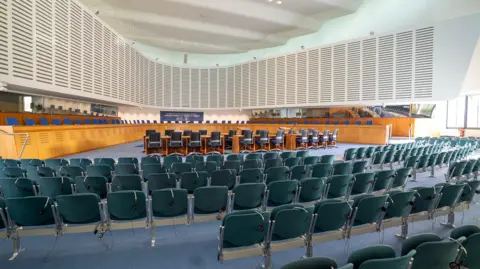 BBC
BBC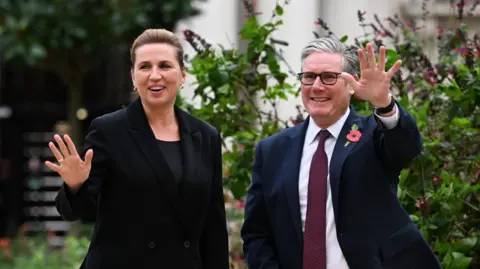 EPA
EPA