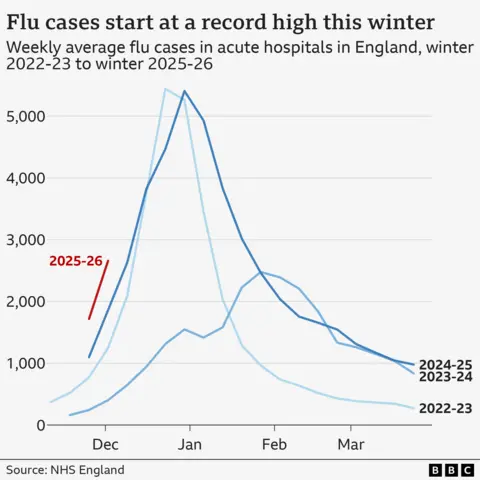
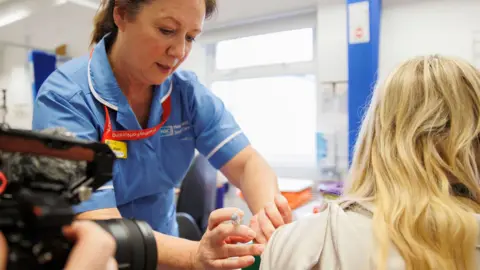
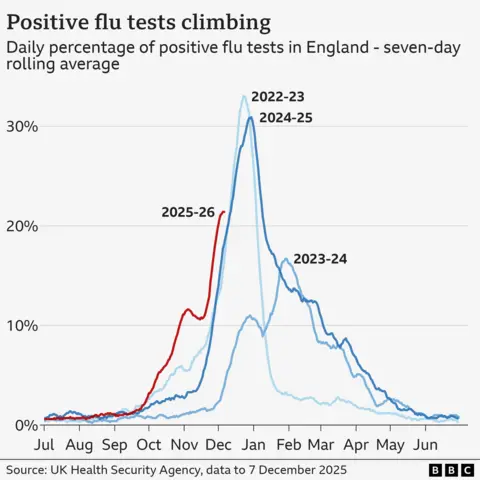
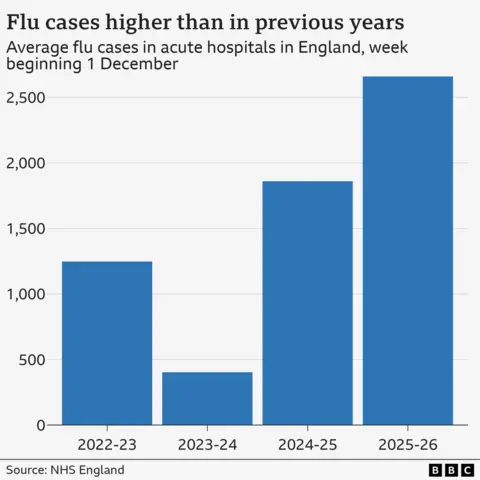
The number of patients in hospital in England with influenza has risen by more than 50% in the past week, with NHS bosses warning there is no sign of "super flu" peaking yet.
In the week up to Sunday there were 2,660 flu cases a day on average in hospital – and NHS England said the numbers had continued rising this week.
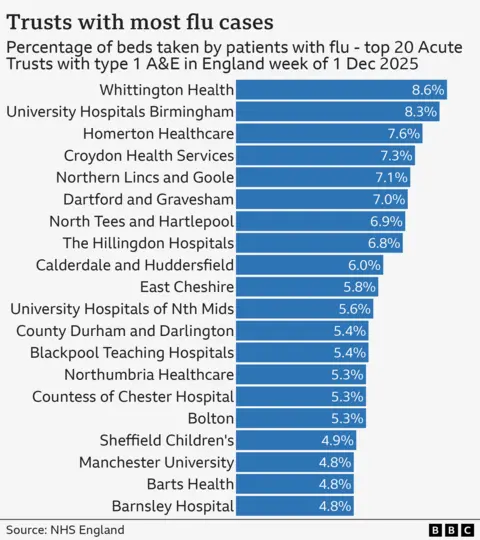
NHS England said it was the equivalent of having three hospitals full of flu patients, with some reporting nearly one in 10 beds occupied by patients with the virus.
Officials said the numbers had continued rising this week with fears it may top 5,000 by the weekend. Increases are also being reported in other parts of the UK.
Super flu circulating
NHS England medical director Prof Meghana Pandit said: "This unprecedented wave of super flu is leaving the NHS facing a worst-case scenario for this time of year – with staff being pushed to the limit to keep providing the best possible care for patients."
The numbers in hospital with flu is at its highest level at this time of year since records began - although they only date back to 2021 and so do not capture the two worst flu seasons of the past 15 years which were seen in 2014-15 and 2017-18.
Flu rates began rising a month earlier than normal this year driven by a mutated strain of the virus. The dominant strain is H3N2, but it has some genetic changes this year.
It means the general public has not encountered this exact version of flu before, which means there is maybe less immunity.
NHS England said the number of patients in hospital with the vomiting bug norovirus was also on the rise, with more than 350 beds occupied by people with that virus.
It comes ahead of a strike by resident doctors, the new name for junior doctors, which is due to start next week.
There are hopes it may be called off after a fresh offer from Health Secretary Wes Streeting prompted the British Medical Association to agree to poll their members to see if they were willing to call off the five-day walkout that is due to begin on Wednesday. The results of that poll will be be announced on Monday.
Daniel Elkeles, of NHS Providers, which represents hospitals, said: "The NHS is in the thick of a storm come early. Flu is hitting hard and other winter bugs are surging.
"Now more than ever, the NHS needs all hands on deck.
"We have to hope that BMA resident doctors will step back from next week's strike, take up the government's sensible offer and end their damaging dispute."
Buckling system
Data from the UK Health Security Agency (UKHSA), which takes into account levels of infection in the community as well as hospitals, shows infection rates are continuing to rise, but not as sharply as they were in the previous week.
But officials stressed it was too early to take that as a sign that flu could be peaking.
They said the virus was unpredictable and a lull could be followed by another surge.
Dr Conall Watson, an infectious diseases expert at the UKHSA, urged people who are eligible for a free flu vaccine on the NHS, which includes the over 65s, those with certain health conditions and pregnant women, to still come forward if they had not yet got one.
"There is still plenty of flu vaccine available to protect those who need it – what's running out is time to be protected ahead of Christmas.
"If you are eligible this is the last chance to get protected as we head into Christmas – so make an appointment with the NHS today."
It can take up to two weeks following vaccination to develop the fullest protection from the jab, Dr Watson added.
Dr Vicky Price, president of the Society for Acute Medicine, said winter viruses were placing further strain on an "already buckling system".
She said patients were facing long waits in A&E as hospital staff were being overloaded with patients.
But she accused NHS England and the government of using it as a "convenient scapegoat" for the "predictable breakdown" in NHS capacity caused by workforce shortages.
"The situation in emergency departments has become so dire that what was once considered a critical incident is now seen as normal and routine. What is happening is not an isolated emergency, but the culmination of systemic failure."
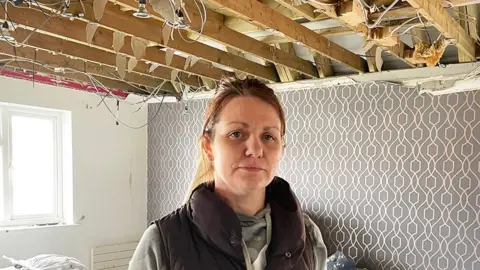
"It's been devastating": Kate's ceiling was destroyed during building works
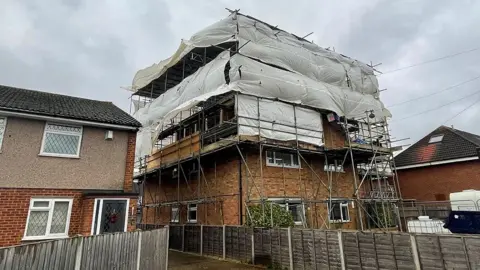
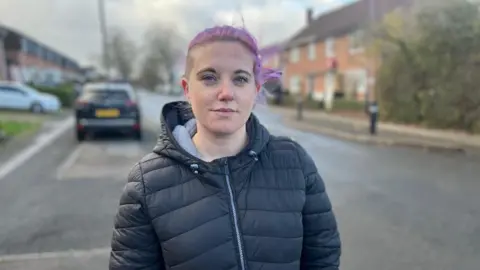
A mother and her teenage son are facing a fourth Christmas of homelessness after building contractors, working for the freeholder at their block of flats, left their home uninhabitable.
A botched roof extension caused the ceiling to collapse at Kate Morris's top-floor flat in Ashford, Surrey. A pigeon infestation followed, leaving every room covered in bird droppings.
"It's been devastating, it's completely ruined our lives," she says.
Kate is one of more than 1,000 leaseholders who have contacted the BBC in the past year about disputes and concerns involving the leasehold system.
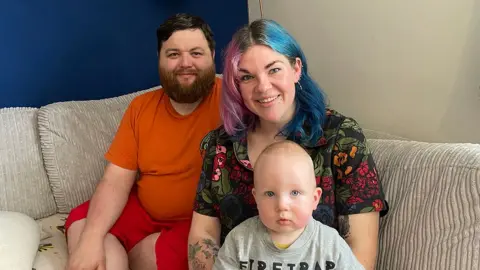
Another flat on the top floor was also damaged by the works. The owners, Laura and Tom, still live in the block, although they have no idea how safe it is.
They have a small child, George, and say they hate the fact their "happy smiley baby" has to live there.
Work was stopped by the Health and Safety Executive (HSE) after a number of safety breaches. The building remains unfinished and the surrounding land is littered with debris.
Kate, Laura, Tom and another leaseholder have tried to pursue the matter in the courts, but so far, they say they have had little to show for their efforts.
Earlier this year, the leaseholders were even ordered to pay £7,000 legal costs to the businessman they blamed for the works.
'Raining inside'
In 2021, Kate had been about to sell her two-bedroom flat. It was one of six properties in a two-storey block.
Weeks before the sale went through, she received what she describes as a "forthright" letter to say the building's freehold had been sold, with planning permission to build two more flats on the existing roof - in other words, directly above the flats owned by Kate, Laura and Tom.
As the law currently stands, the freeholder of a property generally owns the building and the land beneath it, outright and forever. Leaseholders effectively buy the right to live in the property for a fixed period of time.
The system has its origins in the Middle Ages, when rich landowners granted tenants the right to work an area of land.
Kate told us she wrote back to the new freeholder, Magnitude Developments Ltd, and its owner Ameen Raza, asking for clarity about the proposed works. She did not get any answers, she says, and her buyer consequently pulled out of the sale.
Work on the roof extension began in spring 2022. There were problems with the contractors from the start, says Laura: "Every time they were on site, something happened."
Laura (pictured with her husband Tom and their son, George) says she was worried about the standard of work
Workers were "throwing things off the roof" and putting the residents at risk, she adds. "I woke up one morning, they dropped something on our bedroom ceiling, and a piece of our ceiling fell down."
Holes started to appear in Kate's ceiling too. A temporary cover was put in place, but by summer 2022, this had begun to leak.
Kate feared her home was going to collapse and warned the freeholder.
"It was raining inside the building at that point," she says.
In August 2022, her ceiling fell in.
"My furniture, TV, sentimental belongings, photos and books were just absolutely destroyed," she says.
"Everything is ruined": Watch the moment when Kate's flat became uninhabitable
Kate says her home insurance company wouldn't pay out because the property had not been watertight.
Legal documents suggest that, as a "goodwill gesture", Magnitude offered to repair the damage if all claims against it were waived - an offer it said the leaseholders had "unreasonably" refused.
However, the leaseholders say they turned the offer down because the building work would have been carried out by the same contractors, without proof of warranty or insurance.
Safety breaches
After the damage, most of the block's residents had to move out.
Magnitude later claimed in court that it had offered alternative accommodation while works continued, but the offer had not been taken up. Kate and Laura told us they dispute this.
Kate says she was forced to sleep on the floor at her parents' house. Tom and Laura moved in with friends in Coventry, 100 miles from Laura's place of work and the couple's home.
"My mental health plummeted," Laura says. "It was awful… it had such an impact that I just wasn't quite prepared for."
By January 2023, the top of the block of flats was without a proper roof
During that period, Laura became pregnant. She and Tom decided to return to their own flat even though works were still ongoing.
"We had a brand-new baby with bad lungs, and we wake up to a generator running above our heads and the absolutely stinking of petrol," says Laura.
Work on the block was halted by an HSE "prohibition notice" in March 2024.
In liquidation
There is a tribunal court system for leaseholder disputes, but the case brought by Kate, Laura and another leaseholder was heard in a civil court.
When the case started in April this year, the judge said he had received a letter informing him that the freeholder, Magnitude Developments Ltd, had commenced liquidation proceedings.
There is no suggestion that the insolvency process was in any way improper.
Court documents submitted before the hearing indicate that Magnitude sought to join its contractors to the legal action, alleging that they had failed to properly protect the structure from the elements while the works took place.
Magnitude was not represented in court, and the judge ordered it to pay more than £100,000 in damages to the leaseholders.
Since the company was in liquidation, the leaseholders tried to join Ameen Raza, its former director, to their legal complaint. Their barrister argued that although Magnitude was the legal freeholder, Mr Raza had exercised significant financial control.
A second judge in a later hearing accepted there were "serious concerns" in the case, but he denied the application to make Mr Raza personally liable.
Since the leaseholders' application had failed, he ordered them to pay Mr Raza's legal fees, amounting to £7,000.
'Anyone can buy a freehold'
Land Registry documents show that, by the time of the court case, Magnitude had already sold the building's freehold for £300,000.
It was bought in May 2024 by a company called Imperial Prime Properties Ltd, which had been in business since January that year.
Imperial Prime Properties Ltd was registered to a virtual office in central London. The BBC has not been able to find a website or phone number, and the company declined to comment in writing.
"Anybody can buy a freehold," says Katie Kendrick, founder of the National Leasehold Campaign, a group campaigning for changes to the law. "They are often sold at auctions."
The system needs overhauling, she believes, because it is too easy for freeholders to avoid being held to account if problems arise.
The leaseholders say they feel completely "powerless" and frustrated that individual directors or shareholders of freehold companies are not liable.
Tom says he feels the system has worked in favour of the former freehold company and Mr Raza personally. "He's hiding behind that corporate veil," he says.
Katie Kendrick believes "leaseholders cannot defend themselves in the same way that rich, deep-pocketed freeholders can".
The BBC has found almost £6.5m worth of property registered to Mr Raza's family. Almost £4m worth was sold in 2023 and 2024 to companies of which Ameen Raza was a director.
Public records also show Mr Raza's companies have earned at least £90,000 in the past five years from a local authority. His firms have provided accommodation to people subject to immigration control with no recourse to public funds, as well as a number of other social services.
Meanwhile, the leaseholders feel there is no protection for people like them.
"There's no-one. We're completely on our own," Kate says.
The Leasehold and Freehold Reform Act (Lafra), which aims to "strengthen" leaseholder rights in England and Wales, was fast-tracked through Parliament before the 2024 General Election but most of its measures haven't yet come into force.
We asked Housing Secretary Steve Reed when reforms would start protecting leaseholders like Kate, Laura and Tom.
He said he recognised that leasehold had been "a running sore" for years, and the government wanted to eliminate it within the term of this parliament. He added that announcements on further legislation were likely to be published before the end of 2025.
'Angry and frustrated'
Kate and her son continue to live with her parents. She and the other leaseholders are still in litigation with the companies.
She says she is "incredibly angry and frustrated" that someone can "completely destroy someone's home and walk away".
We contacted Magnitude, Imperial Prime Properties Ltd and - via his barrister - Ameen Raza. All declined to comment.
The leaseholders' local authority, Spelthorne Borough Council, told the BBC it has removed the pigeons and carried out "pest-proofing" in the block, and said it would try to reclaim the cost from the freeholder.
However, the building is still incomplete, with gaps where windows should be, and the leaseholders are concerned the pigeons will return.
Only three out of the six flats in the block are now occupied. None of the leaseholders can sell their properties.
Laura and Tom remain, but say they feel trapped, and hate having to raise their son in a building that most people think is "derelict".
"We try and make the insides nice and liveable and colourful and exciting, but everything else is awful," says Laura.
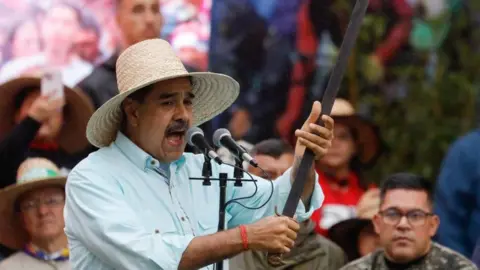
Venezuelan leader Nicolás Maduro says escalating pressure from the US comes down to one thing: Washington wants to grab the South American nation's vast oil reserves.
This week the American military seized an oil tanker, which was allegedly carrying Venezuelan oil being shipped in violation of US sanctions, and threatened action against other ships.
The move followed a series of military strikes on Venezuelan boats, which the US alleges are drug-trafficking vessels. President Donald Trump has called on Maduro to leave office, accusing him of sending narcotics and murderers to the US.
So is it Venezuela's oil that Trump really wants? And would it actually be worth it?
How much oil does Venezuela have?
It is true that with an estimated 303 billion barrels, Venezuela is home to the world's largest proven oil reserves.
But the amount of oil the country actually produces today is tiny by comparison.
Output has dropped off sharply since the early 2000s, as former President Hugo Chavez and then the Maduro administration tightened control over the state-run oil company, PDVSA, leading to an exodus of more experienced staff.
Though some Western oil firms, including the US company Chevron, are still active in the country, their operations have shrunk significantly as the US has widened sanctions and targeted oil exports, aiming to curb Maduro's access to a key economic lifeline.
Sanctions - which the US first put in place in 2015 during President Barack Obama's administration over alleged human rights violations - have also left the country largely cut off from the investment and the parts it needs.
"The real challenge they've got is their infrastructure," says Callum McPherson, head of commodities at Investec.
In November, Venezuela produced an estimated 860,000 barrels per day, according to the latest oil market report from the International Energy Agency.
That is barely a third of what it was 10 years ago and accounts for less than 1% of world oil consumption.
Does Trump want Venezuela's oil?
Some in the US have made the case for intervention in Venezuela by pointing to the opportunities for American businesses to revive the oil industry.
"Venezuela, for the American oil companies, will be a field day," Florida Republican congresswoman María Elvira Salazar said in a recent interview on Fox Business.
"American companies can go in and fix all the oil pipes, the whole oil rigs and everything that has to do with... oil and the derivatives."
Trump might seem open to such arguments.
He campaigned on the slogan "drill, baby, drill" and has generally called for expanding oil production, which he has tied to lower prices for Americans.
But when it comes to Venezuela, the White House has said it is concerned about drug trafficking and what it sees as Maduro's illegitimacy.
Watch: Video shows US military seizing oil tanker off Venezuela coast
Asked on Thursday whether the US campaign in the region was about drugs or oil, White House press secretary Karoline Leavitt said the administration was focused on "many things".
She called stopping the flow of illegal drugs to the US its "number one" priority.
Clayton Siegle, a senior fellow for energy security at the think tank the Center for Strategic and International Studies, says he takes such pronouncements "largely at face value".
He pointed to the longstanding interest in the region of key players like Secretary of State Marco Rubio.
"I just have not seen the supporting evidence that oil is at the centre of its ambitions," he says.
What interests does US have in Venezuela?
That's not to say that US companies would not be interested.
At the moment, Chevron is the only American oil producer still active in Venezuela, after receiving a licence under former President Joe Biden in 2022 to operate, despite US sanctions.
The Trump administration extended the firm another waiver this year, though it has revoked exemptions for other firms, such as Spain's Repsol, in a bid to curb the flow of funds to the Maduro regime.
Today, Chevron accounts for about a fifth of Venezuela's oil production.
Analysts say Chevron would be among those best-placed to benefit, should the US start to lift its barriers against dealing with Venezuela.
Refiners in the US, particularly those around the Gulf Coast, are also hungry for the "heavier" type of crude that Venezuela produces, which tends to be less expensive and therefore more profitable to process.
"It has been problematic for US Gulf Coast refiners in recent years that Venezuela has been under sanctions and been reducing production, because it means there's less of that heavy crude available," says Matt Smith, oil analyst at Kpler.
"Even if they weren't getting involved in the production side of things, they would be a keen buyer of it."
What are the challenges?
While any expansion of oil exports from Venezuela could help bring down prices in the US, analysts say that would take time, with its current output too limited to make a significant impact.
And restoring Venezuela's oil industry to its former glory would be a heavy lift.
According to a recent Wood Mackenzie report, improved management and some modest investments could help boost oil production in Venezuela to about two million barrels per day over the next two years.
But analysts warned it would take tens of billions of dollars - and potentially a decade - to raise output more significantly.
They also said companies could be put off by potential complications like its membership in the Organization of the Petroleum Exporting Countries (Opec).
AFP via Getty Images
Venezuela's President Nicolás Maduro says the US wants his country's oil
Another risk is the outlook for oil demand, as it becomes relatively less important as an energy source, says David Oxley, chief climate and commodities economist at Capital Economics.
"Oil demand is not going to fall off a cliff but it is no longer growing as it was. We see it as subdued and will start falling in the late 2030s," he says.
"Anyone investing in the Venezuelan oil sector would have to think, is it worth it?"
Even if Maduro were ousted or US barriers were to lift, Mr Oxley says it is not clear how willing companies would be to commit the time and money it would take to bring Venezuela's oil back online.
"On the oil side, you'd need to see lots and lots of investment. Certainly in the billions," he says, "'Drill, baby, drill' - that's fine but private companies are only going to come in and do it if it's profitable."
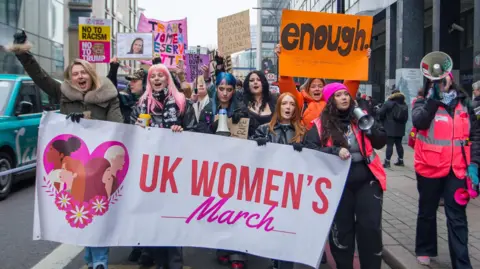
Changing attitudes among boys and young men will be at the centre of the government's strategy to tackle violence against women and girls, the BBC has been told.
Next Thursday, Home Secretary Shabana Mahmood will unveil the long-delayed plan about how to combat what ministers call a "national emergency".
It comes after the publication of the strategy has been delayed three times over the last year.
The Labour government has pledged to halve the rate of violence against women and girls over the next decade - but critics have questioned its commitment to combating the problem.
There are also likely to be concerns as to why the strategy is being published on the day Parliament breaks up for its Christmas holiday.
BBC News has been told the violence against women and girls (VAWG) strategy will be built around three goals: preventing radicalisation of young men, stopping abusers, and supporting victims.
Over the coming week, the government will announce a policy blitz to tackle what government sources have called "the scourge of violence that has left the lives of women and girls shattered".
As part of the strategy, ministers will focus on prevention and tackling the root causes of radicalisation of young men in their schools, homes and online. They will work with teachers to challenge misogyny and promote healthy relationships.
Government sources say more support will be provided to parents so they can intervene early.
They say that is because violence against women and girls is happening at younger ages. Nearly 40% of teenagers in relationships are victims of abuse, according to domestic abuse charity Reducing the Risk.
Critics have questioned the Labour government after delays to the strategy
Online influencers are partly blamed for fuelling this. It's been reported more than one in five young men hold a positive view of the self-proclaimed misogynist Andrew Tate.
Over the last year alone, one in every eight women was a victim of domestic abuse, sexual assault or stalking, according to Home Office figures.
The statistics also show that every day about 200 rapes are recorded by the police, and many more go unreported. Hundreds of thousands of children are estimated to be sexually abused every year.
The letter was signed by the committee's chair, Andy Slaughter MP, who said: "Repeated delays in publications sends the message that tackling VAWG is not a government priority, despite the ambition to halve VAWG within the next decade."
The strategy will have a cross-government approach including collaboration between the Home Office, Department of Health and Social Care, Ministry of Justice, Department for Education, and Department for Science, Innovation and Technology, the BBC was told.
"There will also be a raft of new measures, so rapists and sex offenders have nowhere to hide. We will track down abusers, empower police forces with the tools they need to do so and put abusers on a course to stop their offending", a government source said.
But it is not yet clear what these tools will be.
'Proof in the pudding'
Hayley Johns is a survivor of domestic abuse and said the "proof will be in the pudding".
"If you're going to be saying all these words, make sure it works. We're in absolute crisis when it comes to domestic violence. The actions must match your words otherwise it's pointless.
"There needs to be proof and statistics to show this strategy is working and in a year's time there needs to be a difference otherwise it's just rubbish."
The government also wants to support victims who say failures by police and delays in court are worse than the offences themselves. More than half of rape and stalking cases collapse because victims drop out of the process.
Many victims feel intimidated in their own homes and by economic abuse and coercive controlling behaviour, including stalking.
The strategy will aim to better support them, while justice is done.
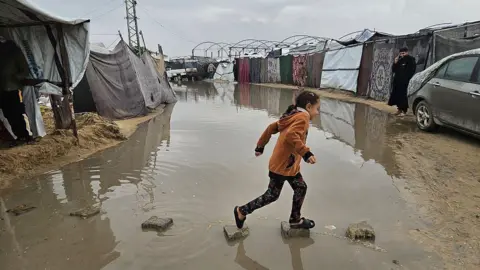
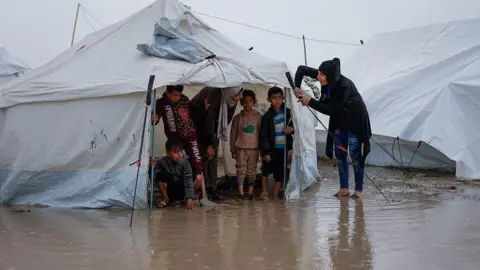
More than 800,000 Gazans are at risk from flooding, the UN says, as a powerful winter storm sweeps through the Strip.
The heavy rain has already deluged camps, and led several buildings to collapse.
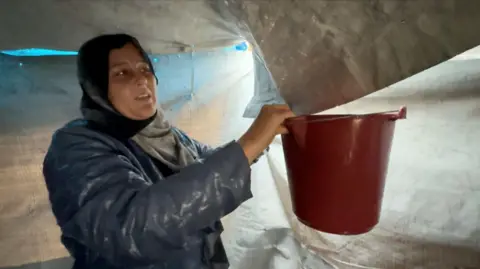
A steady stream of water trickles through openings in the tent Ghadir al-Adham shares with her husband and six children in Gaza City. Her family is still displaced after the war, and waiting for reconstruction to begin.
"Here we are, living a life of humiliation," she told the BBC. "We want caravans. We want our homes rebuilt. We long for concrete to keep us warm. Every day I sit and cry for my children."
Two months into an American-imposed ceasefire, Gaza is stuck in the first phase of Donald Trump's peace plan - its territory divided between the warring parties, its people still displaced and surrounded by rubble.
Ghadir al-Adham is longing to move her children into a solid home
Sticking point
Plans for new homes - and new government - lie frozen in the next stage of Donald Trump's peace deal, as the search continues for Israel's last remaining hostage, Ran Gvili.
Israel's prime minister, Benjamin Netanyahu, has insisted Hamas must return all Israel's hostages – living and dead – before the two sides move on to the next, more difficult, stage of the peace deal.
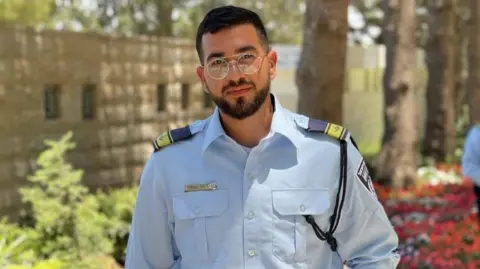
But several searches of Gaza's rubble have so far shown no sign of him. Gvili was captured during the 7 October Hamas attacks - a police officer, recovering from a broken shoulder, who went to defend nearby kibbutz Alumim.
Handout
Yellow flags have been hung for Ran Gvili near his home in southern Israel
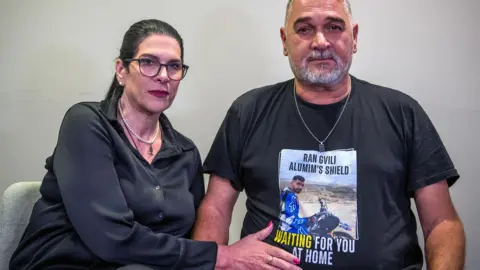
His parents, Talik and Itzik, were told last year he had not survived.
Their road to their home in Meitar, in southern Israel, is lined with banners paying tribute to him, the yellow flags of remembrance for Israel's hostages fluttering alongside.
"They stole our kid, they stole him," his mother Talik told me.
"They know where he is," Itzik said. "They just try to hide or keep him. They're play[ing] with us."
They believe Hamas wants to keep their son as an insurance policy against future negotiations, after returning all the other hostages, both living and dead.
Itzik Gvili (right) accuses Hamas of trying to hide hi
In response, a Hamas official told the BBC their allegations were untrue, and that Israel was trying to avoid implementing the agreement.
But with no sign of Gvili's body, and pressure from Washington growing, his parents say they are counting on Israel's leaders not to move forward before their son is found.
"Everyone in Israel['s] government says to us, 'No, we don't move to the second level until Ran comes back.' This is their promise," Talik said.
Many in Israel believe it would be politically difficult for Netanyahu to carry out the next steps in the deal, including withdrawing Israeli forces further back towards Gaza's perimeter, if even one hostage is still missing in Gaza.
Time 'running out'
Both Israel and Hamas face difficult concessions in the next stage of the deal. For Hamas, it means handing over weapons and power. For Israel, handing over security to an international stabilisation force.
And this is also why leaders on both sides may be hesitating, says retired General Israel Ziv, a former head of Israel's military Operations Directorate.
"Israel and Hamas are sharing the same interests not to move so fast into the second stage," he told me. "Hamas doesn't want to lose control, and the Israeli side for political reasons also prefer to stay in Gaza, as nobody wants to explain to their base that they have to withdraw."
He says Trump is the only one who can force the two sides forward, and that time is running out.
"By waiting I think we might miss the opportunity because Hamas is reorganising and [its] strength is coming back," he explained. "We have to take a deep breath and go forward with that plan, because staying in the situation as it is, it's the worst-case scenario."
Disarming Hamas – in a way both sides will accept – is seen as the first major hurdle. Without that, no foreign countries are likely to commit troops to secure the Strip, and no reconstruction is likely to begin in Hamas-controlled areas.
Earlier this week, Netanyahu suggested he was sceptical that foreign nations could complete the task in place of Israel.
"Our friends in America want to try to establish an international force that will do the job," he said. "We know that there are certain tasks that this force can do. I don't want to go into detail, they can't do everything, and maybe they can't do the main thing, but we'll see."
Trump eager to move fast
Gaza is currently divided in two by the so-called yellow line, marking the limits of Israeli forces under the first stage of the ceasefire deal.
Israel's military chief of staff recently referred to it as a "new border line", sparking accusations that Israel was signalling an intention to remain there long term.
Key issues, including how to disarm Hamas, are due to be discussed at a meeting between Israel's prime minister and Donald Trump in Florida later this month.
The US president – who has already brokered a ceasefire in Gaza and pushed his peace plan through the UN Security Council – has been outspoken about his desire to move the process forward.
He told journalists this week that he would announce the membership of a newly created Board of Peace for Gaza early next year. "It will be one of the most legendary boards ever… Everybody wants to be on it," he said.
Getty Images
The floods make it hard for Gazans to keep children dry
There are also widespread reports that, under pressure from Washington, Israel is beginning work to clear rubble, in preparation for a new temporary housing project in the Israeli-held area of Rafah, in the south of the Strip.
The new housing could reportedly provide shelter for tens of thousands of Gazans, on condition that they are willing to cross into Israeli-held areas, and submit to checks for any links to Hamas.
Some see it as part of a plan to draw Gazans across into Israeli-held areas, in order to isolate Hamas. A small number of people have already crossed into these areas, to camps set up by armed groups supported by Israel there.
But many Gazans – even those who want to replace Hamas – say they refuse to live under Israeli control.
It's a glimpse of an alternative future for Gaza, if this second stage of Trump's plan fails; a future where Gaza, already divided, becomes more divided still.
The Ministry of Defence (MoD) will unify all of its intelligence services under a single organisation, as part of its strategy to combat "escalating threats" from adversaries of the UK.
Units from the Royal Navy, British Army, Royal Air Force, UK Space Command, and Permanent Joint Headquarters will join to form the Military Intelligence Services (MIS).
The reform will speed up how information is "gathered, analysed and shared" across the military, after hostile intelligence activity against the MoD rose more than 50% in the past year, the ministry said.
The launch of the MIS follows recommendations from the Strategic Defence Review, a major review of the armed forces that was published in June.
The MIS will be established alongside a new Defence Counter-Intelligence Unit, consolidating counter-intelligence professionals in one unit to "disrupt and deter hostile activity more effectively".
Their work will be supported by a new Defence Intelligence Academy, offering specialised training in key intelligence disciplines.
Defence Secretary John Healey said the overhaul will put Britain at the "leading edge of military innovation".
"This gives us sharper insights into what our adversaries might do next, so we protect our forces, safeguard critical infrastructure, and deter changing threats," he said.
Speaking at the launch event of the MIS, Alistair Carns, Minister for Armed Forces, said that the "shadow of war is knocking on Europe's door", and warned that the continent no longer faces "wars of choice", but "wars of necessity".
In an interview with the Telegraph, Carns also urged Nato nations to spend more on defence to "increase our lethality", and reduce dependence on the US.
The announcement comes a week after the publication of the Dawn Sturgess Inquiry, which the MoD said made clear that foreign intelligence services are now "operating far beyond traditional espionage norms".
Russia's main military intelligence agency, the GRU, was sanctioned in its entirety by the UK government following the release of the inquiry.
UK Prime Minister Sir Keir Starmer said the findings were "a grave reminder of the Kremlin's disregard for innocent lives".
The UK is currently committed to increase defence spending to 2.6% of GDP by 2027, which the MoD says is the largest "sustained" rise since the end of the Cold War.
The government says there has been a 30% increase in Russian vessels threatening UK waters in the past two years - though Russia says the UK is the one being provocative.
Kemp, 25, was in Australia on a working holiday visa
A British backpacker who struck and killed a man while riding an e-scooter drunk has been jailed for four years in Australia.
Alicia Kemp, 25 - from Redditch, Worcestershire - was driving at speeds of 20 to 25km/h (12 to 15mph) when she hit 51-year-old Thanh Phan from behind on a Perth sidewalk in May.
She had been drinking with a friend all afternoon, the court heard, and had an alcohol level more than three times the legal limit.
Phan, a father-of-two, hit his head on the pavement and died in hospital from a brain bleed two days later.
A friend of Kemp, who was a passenger on the scooter, was also hurt in the crash - sustaining a fractured skull and broken nose - but her injuries were not life-threatening.
Kemp, who was in Australia on a working holiday visa, pleaded guilty to dangerous driving causing death in the Perth Magistrates Court in August.
"You, Miss Kemp, are the cautionary tale," Judge Wendy Hughes said in her sentencing on Friday.
"E-scooters are not toys."
Kemp's sentence will be backdated to 1 June, and she'll be eligible for parole after serving two years of her sentence. Her driver's licence was also disqualified for two years.
The drug-driver "hit my dad from behind as he was walking", says Charlie Ward
Families whose relatives were killed by drug-drivers are demanding police are given new powers to revoke licences at the roadside if they suspect a motorist is over the limit.
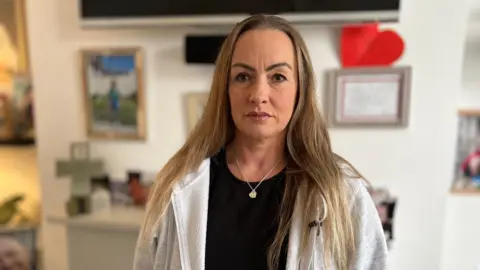
Charlie Ward, whose father Steven was killed by a drug-driver, said it was "heartbreaking" he would never walk her down the aisle.
The National Police Chiefs' Council (NPCC) wants the power to impose an immediate ban when a driver has provided a positive roadside saliva drug test, while a further blood test is analysed.
The government said those caught faced tough penalties, including fines and prison sentences.
Steven Ward, 62, died from head injuries in 2024 after being struck by a car just yards from his home in Englefield Green, Surrey.
The driver, Samuel Russell, 37, from Sutton, was more than 10 times over the drug-drive limit and nearly three times over the drink-drive limit.
Ms Ward, 31, said it had been "an accident waiting to happen" after discovering in court that Russell had used drugs and alcohol to self-medicate for mental health problems - and that he had a previous drink-drive conviction.
"The man who did it was going too fast and he crossed on to the other side of the road, mounted the pavement and hit my dad from behind as he was walking," Ms Ward said.
"My mum remembers hearing a big bang, because her house was just a few doors down, then she heard the ambulances and saw the helicopter."
Charlie Ward
Charlie said it was "heartbreaking" her dad would never walk her down the aisle
Ms Ward, who lives in Leamington Spa, said: "I do believe police officers should be able to take licences if people are testing positive at the roadside.
"It would give families who have something like this happen to them feel there's an immediate support there."
The motorist still held a licence despite having been arrested after a crash just days before. He was eventually jailed for 12 years.
"He shouldn't have been on the road," said Linzi Stewart
Ms Stewart is campaigning for a change in the law that would see dangerous drivers, and those under the influence of drink or drugs, having their licences revoked, pending trial and sentencing.
"To know he was killed by someone who shouldn't have been on the road, that's what's shocking and the government needs to look at those laws," she said.
Her petition, which has 195,000 signatures, also calls for repeat drink and drug drivers to be remanded in custody until they appear before a magistrate for sentence or committal to crown court.
"I think first offence we need to look at licence revocation, bail conditions, possible curfew and tag, something as a deterrent," she added.
"People think they can just do it and get away with it."
Reporter Ben Moore undergoes a field impairment test to see what suspected drug-drivers face
Government figures show a 78% increase in driver fatalities where drugs were present between 2014 and 2023.
Under the current system, motorists suspected of drug driving can be given a field impairment test, a type of co-ordination test at the roadside, to assess their fitness to drive.
They can also be asked to give a preliminary saliva sample. If that proves positive, a confirmatory blood test is required - but that can take laboratories weeks to analyse.
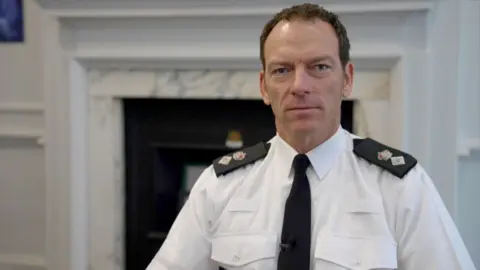
Ch Supt Marc Clothier, from the NPCC, is calling for the power to stop someone driving while that analysis is carried out.
"We're seeing approximately an eight-week time for most tests to be turned around and come back to us," he said.
"One of the things we have been pushing for is around some sort of road risk prevention notice, or interim disqualification."
"That would allow us to take people off the road and stop them driving if they've provided a positive test at the roadside, whilst we await for that formal analysis and appropriate justice to take place."
"One of the things we have been pushing for is around some sort of road risk prevention notice, or interim disqualification," said Mark Clothier
Last year, Sussex Chief Constable and NPCC lead for road policing Jo Shiner, whose father was killed in a crash when she was a teenager, called for stronger, more effective legislation "which enables policing and other agencies to [revoke] the licence of those who offend more quickly".
The Department for Transport said it was working closely with policing partners to improve efficiency while ensuring the integrity of results that support prosecutions.
It said providers were currently reporting results into policing within the six-month statutory time limit and there were no road traffic backlogs in force.
David Barton, a motoring lawyer in Kent, believes there could be more use of existing powers the DVLA already has to sanction a driver with a history of drug taking.
"If they've got a prior record and are a repeat offender, many people would say that is something the police ought to be liaising with the DVLA over," he said.
"If they are a habitual drug abuser, then the DVLA as the regulator has the power to step in and revoke a licence."
Det Sgt Chris Wade, who investigates fatal and serious crashes in Kent and is an impairment instructor, said he had seen a "significant increase" in the number of drug drivers.
"Now we're in a position where vehicles are driving past us and they're taking drugs at the wheel," he said.
"If you'd have told the 19-year-old me when I joined the organisation that was going to happen I wouldn't have believed you.
"The attitudes around drug driving have certainly not caught up to where they were with alcohol."
Det Sgt Chris Wade said he had seen a "significant increase" in the number of drug drivers
Ministry of Justice data shows there were 28,179 convictions for selected drug-driving offences in the year ending June 2025.
That is up 14% from the year before, and almost double the 14,889 convictions in the year ending June 2020.
A government spokesperson said: "We are committed to making our roads safer.
"Our new Road Safety Strategy, the first in over a decade, will introduce more measures to keep people safe and our latest THINK! campaign sends a strong warning about the dangers and consequences of drug driving."
Warning: This report contains details of physical and sexual abuse and discussion of suicide.
Baobao's heart still races when she smells soil after morning rain.
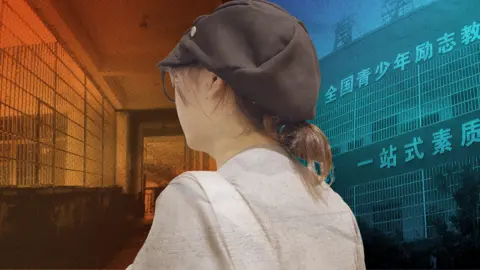
It takes her back to early military drills behind locked gates - and the constant fear that marked every one of her days at Lizheng Quality Education School.
For six months, aged 14, she barely left the red and white building in a remote Chinese village where instructors tried to "fix" young people whose families considered them rebellious or problematic.
Students who failed to comply were beaten so severely they could not sleep on their backs or sit down for days, she says.
"Every single moment was agonising," says Baobao, now 19 and speaking under a pseudonym for fear of retribution.
She says she considered suicide, and knows other students who attempted it.
'Raped and beaten'
A BBC Eye investigation has uncovered multiple allegations of physical abuse in the school and others in the same network, and cases of young people being abducted and taken to the institutions.
Corporal punishment has been banned in China for decades, but we have collated testimony from 23 former students who say they were beaten or forced to do extreme amounts of exercise. One says she was raped, and two others, including Baobao, say they were sexually assaulted or harassed, all by instructors.
Undercover filming has exposed how staff pose as authorities to forcibly transfer young people to their institutions.
Thirteen students say they were abducted, with parental consent, by employees pretending to be police or officials.
The accounts - from interviews by the BBC World Service, statements gathered by activists, police reports and state media - relate to five schools. These are part of a network of at least 10 schools, all of which have been run by - or have close links to - a military veteran called Li Zheng.
Baobao says every single moment at the school was "agonising"
The centres are part of a booming industry promising anxious parents that military-style discipline will resolve concerns over young people's disobedience, internet addiction, teenage dating and depression, as well as gender and sexual identity. Some parents even send over-18s, who are legally adults.
A series of abuse allegations have made headlines in China in recent years, in both Li Zheng schools and others.
In a few cases, arrests have been made or institutions shut down, but schools can be quick to reopen with different names or in different locations because the sector has been difficult to regulate. The BBC understands that Mr Li was arrested earlier this year, but we have discovered his associates have recently opened a new school.
Companies and individuals involved in the network could either not be reached or declined to comment. The Chinese embassy in the UK told the BBC all educational institutions are required to comply with regulations.
'Deeply offensive' body search
Baobao says her mother took her to the Lizheng Quality Education School in Hunan province when she began skipping classes, triggering rows which made their already difficult relationship worse.
Her mother left while she was being shown around the school, she says, and she then realised she was not allowed to leave: "They said if I behaved well, I might be able to get out."
Baobao initially tried to kick and punch the instructors, she says, but decided to comply when they tried to restrain her with her own shoelaces. Later, she was searched. She describes the way this was done as sexual assault. "I found it deeply offensive… she touched all my sensitive areas."
She says her mother paid about 40,000 yuan ($5,700; £4,300) for six months at the institution, and she was not given any academic lessons. Few disciplinary schools offer these, and some that do charge extra for them.
The school is still operating, now known as Quality Education for Teenagers, with around 300 students, aged eight to 18.
Undercover footage was filmed there earlier this year by a woman posing as a parent considering enrolling her fictional 15-year-old son. She said he was smoking, dating and driving her car.
She was shown locked gates on staircases, metal grilles along open-air corridors and CCTV monitoring dormitories where children rest, get changed and shower.
Filmed undercover, a staff member says Quality Education for Teenagers uses a "white lie" when it takes students to the school
A staff member told her it would take at least six months to improve the teenager's behaviour, but under a "three-year warranty" she could send him back paying for just food and accommodation if he reverted to his old ways.
She was told not to tell him about the new school. "When we arrange pick-ups, we tell a white lie," the staff member said.
She explained instructors impersonating officials from the "internet regulator" would say they needed him to help with an investigation, and take him to the centre. "If this fails, several instructors will simply restrain him and carry him to the vehicle," she said.
Another former student, Zhang Enxu, now aged 20, says she had a similar experience when she was taken to a different school in the network.
Then 19, she had left home, frustrated with her parents' refusal to accept her transgender identity and her decision to live as a woman - she was registered male at birth. She says she had returned for a family visit to her grandmother's grave, when three men claiming to be police appeared, saying her details had been used in fraud.
"They forcibly dragged me into the car. My parents stood by as I was taken away," she says.
Enxu says she was beaten and raped at the disciplinary school she was taken to at the age of 19
She was taken to Shengbo Youth Psychological Growth Training School in Hunan where she says she was beaten, leaving her with hearing loss in one ear, and later raped.
In the undercover footage from the school Baobao attended, a staff member says there are no beatings: "We change the behaviour of youngsters with military training and counselling."
But Baobao and Enxu describe a very different experience.
"Corporal punishment is ever-present," says Baobao. "If your dance routines or military boxing lack precision, or are poorly executed, you will be punished."
She said the instructors would use a pipe, raising it overhead before "bringing it down with force" on her classmates. "Where they hit you would turn black. You get severe bruising."
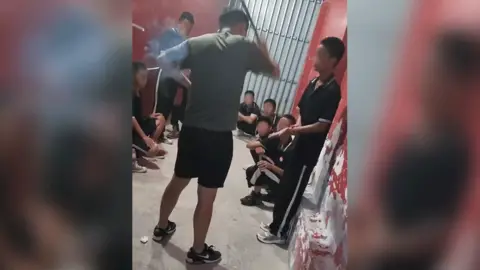
Videos obtained and verified by the BBC, that were filmed at another of Li Zheng's schools, show instructors raising a rod high and striking students' hands.
Enxu says the students were forced to do "enormous" amounts of physical training. She said instructions to carry out exercises like push-ups "might start at a thousand repetitions".
She also says she was attacked in her dormitory by an instructor on night duty: "He grabbed me by the hair and dragged me to the floor, then he sexually assaulted me."
Enxu's parents were sent videos of her at the school taking part in drills and counselling sessions
Baobao says she considered trying to kill herself, but realised she would be caught in the hours it would take her to die.
She says one of her classmates did attempt to take her own life, but instead of taking her to hospital, the instructors tried to flush her stomach themselves.
Both Baobao and Enxu describe counselling sessions where little understanding was shown.
Enxu's sessions were videoed for her parents, who she says had paid 65,800 yuan ($9,300, £7,000) for six months. "Be a happy, healthy, positive boy. All right?" she is urged. "You're a boy, do what boys do… just be happy."
Baobao says that when she told the counsellor she wanted to end her life, the response was: "If you were going to die, you wouldn't be sitting here in front of me."
"Is that something a caring person would say? Are they even human?" she asks.
Both students wondered how their parents could have decided to subject them to the experience.
Enxu's mother wept as she told the BBC the family had been "deceived" by the school's promises: "Not only did you swindle someone out of their money, but you also tore their family apart, causing a breakdown in their relationship."
Footage obtained by the BBC that was filmed at one of Li Zheng's schools shows an instructor hitting a student on the hand
Social pressure to have academically successful children plays a major role in parents' decisions - particularly among urban middle-class families - to send their children to disciplinary schools, says Dr Yichen Rao, an anthropologist at Utrecht University in the Netherlands.
He has studied internet addiction centres for young people in China, and says lack of support in the school system, anxiety, and conflict within the family can combine to make parents "feel that they have no other choices".
Baobao's mother declined to comment. Her daughter says she can now "understand both sides": "I think she was brainwashed by the slogans used to sell the school. She was desperate for me to become more obedient… to be the daughter she always wanted."
Baobao managed to leave after feigning an eye problem. Her mother simply said "let's turn the page", leaving her angry and confused, she recalls.
Viral letters
Enxu's ordeal ended after a month. Her friends realised she was missing and contacted the police, who then located her and shared a video of her at the school. Her friend Wang Yuhang identified the school by asking in online groups about the green uniform she was wearing.
Enxu discreetly documented her experience in letters that were smuggled out and posted online. They went viral and as public pressure grew, the police intervened and she was allowed to leave.
Twelve days later, authorities announced Shengbo school was closing, but made no reference to the abuse Enxu alleged, saying, however, that the school had violated administrative regulations.
She says the police later told her Li Zheng had been arrested, accused of involvement in organised crime. The police did not respond to BBC requests for information about Enxu's case and Mr Li. The local education department have also not responded.
Secret filming
Undercover footage shows students doing military-style drills at a new school set up by former employees of Li Zheng schools
Mr Li keeps a relatively low public profile. The BBC has analysed his network and found it operates disciplinary schools across four provinces through a complex set of companies registered to him or his close associates.
He founded his first centre in 2006 and has owned four different education companies at different times.
The website of one of his organisations says he is a graduate of a Chinese Air Force academy in southern China, and worked as a "director of training" and "senior psychological counsellor" at several schools from 2007.
On local television in Hunan province, he once spoke about nurturing young people with "love and patience".
Chinese authorities have intervened before, following allegations about schools in the network.
An instructor at a different Li Zheng school was detained by police in 2019 after allegations he had beaten students with water pipes.
Also, according to Chinese media reports, the school Baobao attended was ordered to stop admissions after a student suicide in 2020. She was there at the time and says it continued to operate over that period. It changed its name soon afterwards.
Mu Zhou, an Australia-based volunteer who has been helping document allegations of abuse, says "whenever there's public outcry, he [Li Zheng] would alter the name or change the legal representative". He also says students are bussed between different sites to avoid inspections.
'Huge profits'
Two undercover researchers recently visited what may be the latest addition to the Li Zheng network.
Posing as investors in the Hong Kong education sector, the researchers set up a meeting with three former employees of Li Zheng schools, in a new school they have set up in Fujian.
"The profits in this industry are huge," Li Yunfeng, the director of counselling at the new school, told them. He outlined how the business model could work in Hong Kong, suggesting fees of at least $25,000 (£19,000) per student annually.
He declined to disclose the name of their boss, but said he was "a veteran".
He appeared to distance himself from the network, however, telling the undercover researchers: "There were some incidents. The parents lodged a complaint. The group... though not formally dissolved yet, it's teetering on the brink of collapse. That's why I stepped out."
Secret filming
Li Yunfeng told undercover researchers the previous group was "on the brink of collapse" but he is helping open a new school
The BBC was not able to reach Li Zheng, Li Yunfeng and other schools and companies linked to Li Zheng and his associates for comment, despite multiple attempts.
The staff member who provided a tour of the Quality Education for Teenagers school declined to comment. The education department which oversees the school could not be reached, despite multiple attempts.
Regulating these disciplinary centres is difficult. Some are not registered as schools. The responsibility is split between local education, civil affairs and market regulation authorities, a Chinese lawyer familiar with lawsuits against such institutions, who did not wish to be named, told the BBC.
Dr Rao says that with no centralised regulation over the disciplinary schools, the responsibility tends to fall to local government.
He describes it as a "shadowy industry that the state just tolerates", adding that the state may not wish to give it legitimacy by providing regulation or guidelines.
But, he adds, there is a "spectrum" of schools, with some incorporating psychotherapy for students and training for parents, or disciplining staff who carry out corporal punishment.
The Chinese embassy in London said the government "attaches great importance to the lawful operation of educational institutions and the protection of minors". It says all educational institutions "are required to comply with relevant laws and regulations".
'Terribly sad'
Enxu and her friend Wang want to see all disciplinary schools shut down. They work to gather video evidence of abuse and abduction, believing this is crucial to get the police to investigate, sometimes posting it online.
Wang often receives requests from students. He has helped with the logistics of escape attempts and by pressuring schools to allow students to leave.
Baobao never returned to education, which she says makes her feel "terribly sad". She now makes a living through online streaming and gaming, but believes she might have gone to university if she had not been sent to the Lizheng Quality Education School.
"These schools are essentially scams," she says.
"The prevailing educational ethos is one of violence begetting violence… the very concept is fundamentally flawed," she says, adding that they "simply shouldn't exist".
Details of organisations offering information and support with mental health, distress or despair, or sexual abuse or violence, are available at BBC ActionLine.
Additional reporting by Alex Mattholie and Shanshan Chen
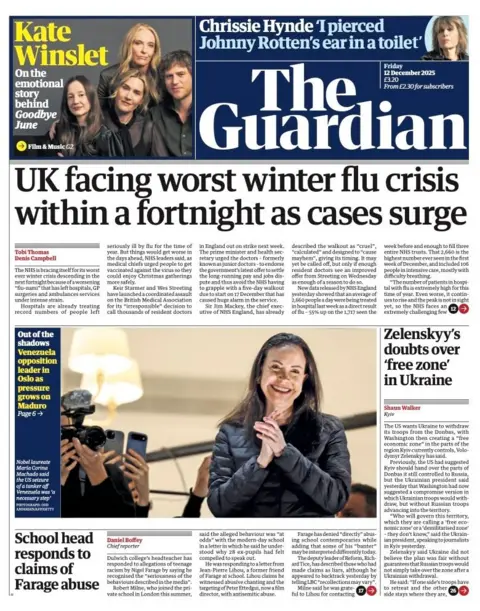
A grim flu forecast for the UK in the lead up to Christmas is dominating the papers on Friday, with the Guardian describing it as the "worst ever winter crisis" as serious cases reach record levels. The NHS has warned that the outbreak is yet to peak and things will get worse in the days ahead, with GPs, hospitals and ambulance services already under "intense strain".
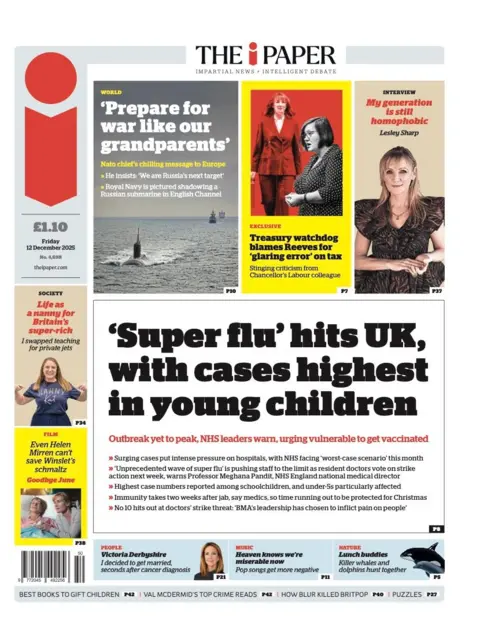
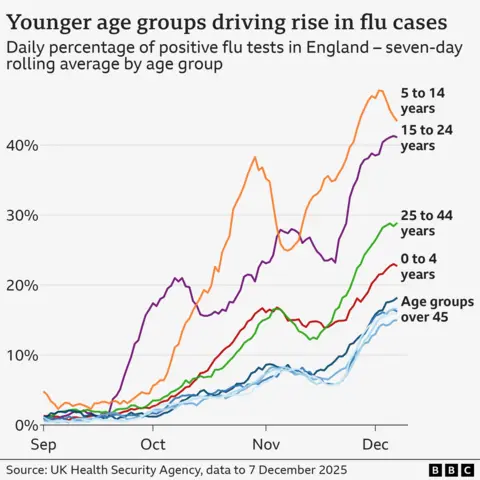
The highest flu case numbers are being reported in children at school, according to the i Paper, with children under five particularly affected. The NHS is urging vulnerable people to get vaccinated, with the caveat that it takes two weeks following the jab to reach full immunity.
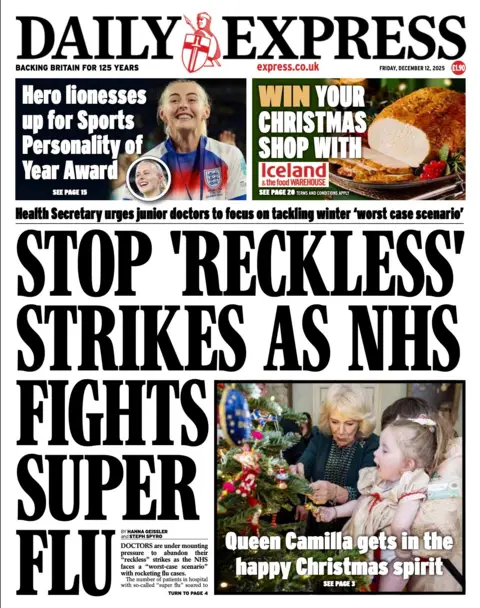
The Express is condemning the "reckless" planned strike by resident doctors next week, and writes that Health Secretary Wes Streeting has urged medical professionals to focus on tackling "rocketing" flu cases.
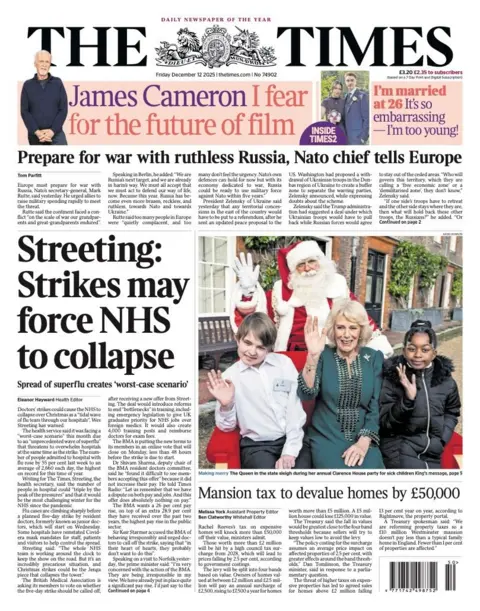
"Strikes may force NHS to collapse" warns the health secretary in the Times. In an article for the paper, Streeting says that it will be the most challenging winter for the NHS since the pandemic. A fresh offer has been put before the British Medical Association, which has agreed to poll their members to see if they are willing to call off the five-day walkout. The results of the vote will be announced on Monday.
Ticket prices for the World Cup 2026 have been announced, prompting "fan outrage, the Daily Mirror reports. Its headline reads "World Cup of greed", emblazoned over a photo of US President Donald Trump and FIFA chief Gianni Infantino grinning at the White House.
The Financial Times leads with objections from China, and a number of European Union nations, to the planned exemptions for US multinationals from global tax obligations. According to the paper, this raises the risk of the Trump administration issuing a "revenge tax" on backers of the OECD's proposed tax regime.
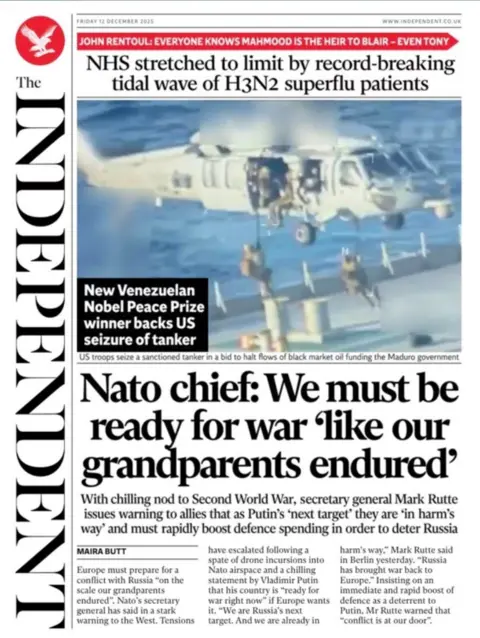
Nato Secretary General Mark Rutte is quoted on the front page of the Independent, after he warned that Europe must prepare for a conflict with Russia "on the scale our grandparents endured". Speaking in Berlin on Thursday, Rutte urged European nations to rapidly boost defence spending as a deterrent to Russian President Vladimir Putin.
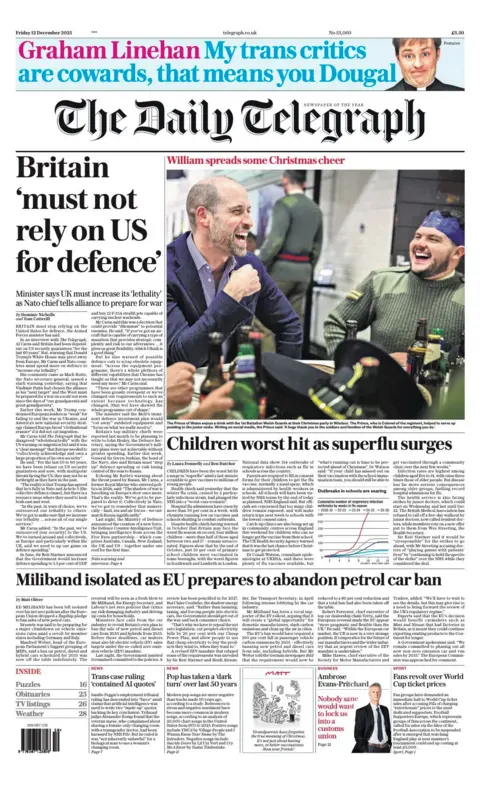
The Telegraph also focuses on defence spending, following its interview with Minister for Armed Forces Alistair Carns. He told the paper that Nato countries, including the UK, must increase their "lethality", and stop relying on US security guarantees.
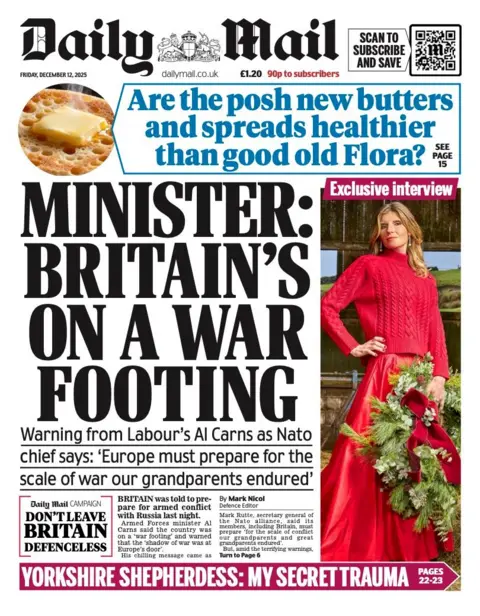
Comments from Carns are also cited in the Daily Mail's headline, which reads: "Britain is on a war footing". Echoing the remarks made by Mark Rutte, the minister said that the "shadow of war was at Europe's door".
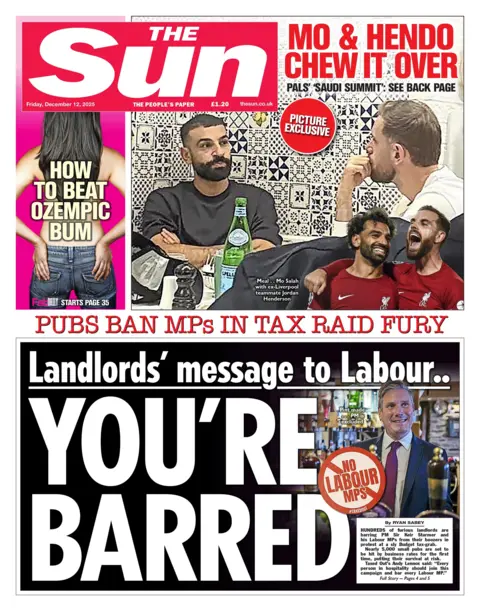
"Pubs ban MPs in tax raid fury" says the Sun, reporting on a campaign lead by Taxed Out, which is encouraging hospitality businesses to bar Labour ministers in protest against higher tax bills.
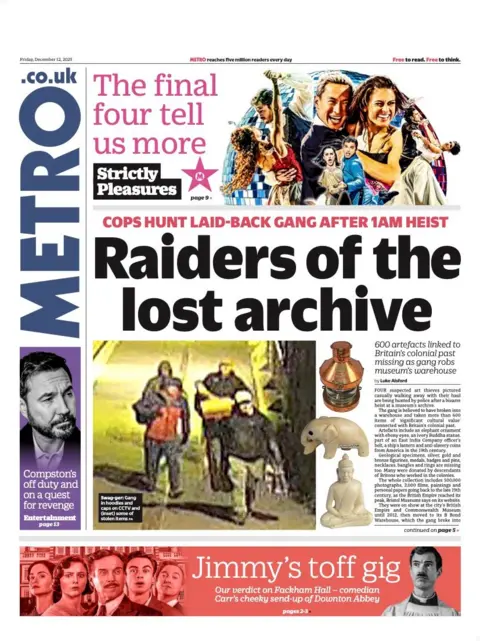
Four alleged art thieves have been captured on CCTV and splashed across the front page of Metro, after 600 objects of "significant cultural value" were stolen from the Bristol Museum's warehouse in September this year. The items had been housed in the warehouse since 2012, and included artefacts "linked to Britain's colonial past".
The Star's headline reads "Runaway in a manger", following reports of a man on the run found hiding in an Italian nativity scene.
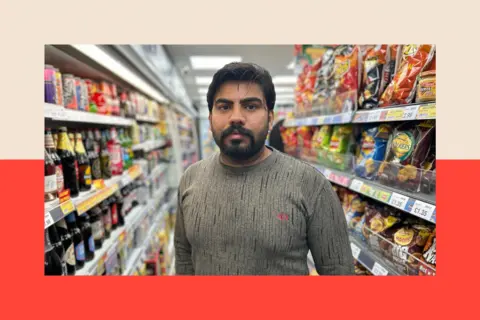
Behind the counter of his convenience store, surrounded by rows of crisps, sandwiches and spirits, Muhammed Rabani glances at a bank of CCTV screens, anticipating a shoplifter coming at any moment.
Muhammed has grown wearily used to the crime. "It's every day," he says. He estimates it is costing the family business in Stockton-on-Tees, County Durham, around £900 every month.
When asked if thieves ever get violent, he holds his hand up to show a cut covered by a plaster. The previous day, he confronted a shoplifter who tried to steal a full box of chocolates: "I told him to stop... and he hit me."
Shoplifting offences recorded by police in England and Wales were up 13% in the year to June 2025, with 529,994 instances recorded according to the Office for National Statistics (ONS). The ONS said there have been "sharp rises" in shop theft since the coronavirus pandemic.
It's a similar story in Scotland. The Scottish Government's police recorded crime statistics for the year ending September 2025 showed a 15% increase, from 42,271 to 48,564 shoplifting offences.
Muhammed Rabani says he has grown used to shoplifting in his store
Northern Ireland saw a 3.9% reduction in police recorded shoplifting offences in the year to November 2025, but shoplifting offences there have risen sharply since Covid, too.
Cleveland - which covers Stockton-on-Tees as well as areas such as Middlesbrough and Redcar - appears to be England and Wales's shoplifting capital. Figures show its police force recorded the highest number of shop theft offences - with 13.6 offences per 1,000 population.
And with the festive shopping season in full swing, retailers are braced for a shoplifting surge.
"We always see a spike in the run-up to Christmas - there's a huge demand for stolen goods," says criminologist Prof Emmeline Taylor from City St George's, University of London.
Experts say that the nature of shoplifting itself is changing, with a greater range of offenders targeting a more diverse range of goods. So who are the modern day shoplifters and what can be done to tackle them?
'There appears to be no consequence'
The statistics around shoplifting are notoriously tricky to analyse because retail experts and shops alike agree they don't reflect the true scale of the crime.
A study this year by the British Retail Consortium (BRC) "put it at 20 million incidents [annually], which would suggest that fewer than 3% of shop thefts are even reported," Prof Taylor points out.
According to the ONS, the latest statistics show the increases in shoplifting appear to be slowing down. But for shops in Stockton, it doesn't feel that way.
And there is evidence to back this up. Almost 290,000 shoplifting investigations out of around 520,000 were closed with no suspect identified in 2024-25, according to House of Commons Library research revealed by the Liberal Democrats.
Meanwhile, figures obtained by the BBC show the average time it takes for a shoplifting case to be dealt with from offence to completion in a magistrates' court in England and Wales has risen from 32 days in 2014 to 59 days in 2024.
Prof Taylor says these figures reveal the "crux" of the problem: "There appears to be no consequence if you steal and if you're violent, and if you're a prolific offender it takes a long time for any action to actually be taken."
Former Det Ch Insp David Spencer, who now works for the right-leaning think tank Policy Exchange, says the consequences of shoplifting are felt much more widely: "This type of crime has the potential to completely knock out the economic viability of small towns," he says.
How shops are fighting back
Many of those working in the retail sector point to the fact that shoplifting has evolved in recent years - with different categories of shoplifters emerging.
One of the biggest developments, experts and retail staff agree, has been the rise of organised criminal gangs.
"We get groups of three or four that come in and use distraction techniques," says the a supermarket worker from Teesside who contacted Your Voice, Your BBC News. The worker described it as "really bad", adding "it's got worse".
In 2024, the National Business Crime Solution (NBCS) - an organisation which works with 100 businesses to tackle retail crime - said it was tracking 63 organised criminal groups across the UK who have stolen at least £2.4m of goods in five years. Of these, it told us, 26 groups originate from the UK and Ireland and the rest predominantly from Eastern European countries.
Lucy Whing, a crime policy adviser for retail trade body, the BRC, says this is a huge concern for its members: "You hear of these gangs systemically hitting stores one after another all over the country."
Abigail Donaldson believes the higher-value items in her shop have made it a target for organised thieves
This trend appears to have become an issue in more affluent areas of Cleveland, like Yarm, a pretty market town a short drive from Stockton.
When I visit, the high street is full Christmas shoppers enjoying its pubs, restaurants and independent shops.
Abigail Donaldson, who owns high-end streetwear shop, Triad, believes the relatively expensive items she sells has made her shop a target for organised criminals travelling from out of town to steal.
"We don't get as many young kids coming and stealing here, it's all middle-aged men that know what they're doing," she says. "They are very prepared" - in that they know what they want and are organised.
David Spencer believes organised criminals have moved into the shoplifting market because it is highly lucrative. "They can literally take huge amounts of stock out pretty quickly."
New breed of 'shoplifting entrepreneurs'
In an age where online resale sites have allowed so many people to dabble in entrepreneurialism, it's perhaps little surprise that among them are also a new breed of what Prof Taylor calls "shoplifting entrepreneurs".
She says: "They might not have really dabbled in criminality before but for some reason, they've latched on to a particular product that they know is easy to steal, it's high value and they can resell it quickly," she said.
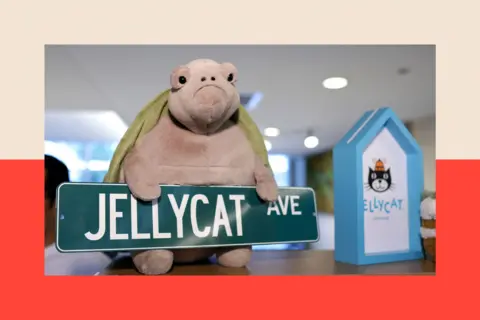
One popular item which shops have said is regularly stolen to sell online is the collectable soft toys Jellycats. Other items high on the shoplifters' wish-list for resale include perfume and designer clothes.
Getty Images for Nordstrom
Jellycats have become a common target, with shops reporting they're often stolen and resold online
Ruth Lund, manager of Cherry Hill Garden Centre in nearby Middlesbrough, says this type of shoplifter has become a problem for her business, which has just installed new anti-shoplifting barriers to tackle the problem.
She said they know "exactly what they're going for" - including garden furniture and Christmas decorations. Perhaps more surprisingly, bags of gravel and even cans of soft drinks are also targets - and "they will be out the door before we're even aware that they're in the shop".
Shoplifting-to-order is also being used to sell on stolen goods by what a 2018 report by the Centre for Social Justice (CSJ) think tank identified as a traditional shoplifter - somebody funding a Class-A drug addiction. Even before the rise in shoplifting since the pandemic, the CSJ said 70% of shoplifting incidents were committed by these people.
Ruth Lund installed anti-shoplifting barriers
One reformed shoplifter, Keeley Knowles from Telford, Shropshire, says she only stole from shops to feed her habit - focusing on shops in Birmingham's Bullring.
"I went straight for designer handbags, designer belts, sunglasses, you know, the stupidly priced stuff," says Keeley, who has now been clean for two years and carries out outreach work with drug users. "And obviously, my income went up and up and with it, my habit went up and up."
In Stockton, shop workers pointed to drug and alcohol addiction as fuelling the crime and one street is mentioned above all as the epicentre of the problem - Hartington Road, a row of large terraced houses, many divided up into flats, where lots of people with addiction problems congregate.
Keeley Knowles says she used to steal from shops to fund an addiction
A nearby shop manager told us when people come into their store under the effects of drugs "they don't know what they're doing" and just grab things and walk out.
"It's very scary, because you don't know if they have needles or what else they may carry," he added.
Cleveland Police says its charge and detection rate is above the national average and that it takes a "proactive" approach to combating shoplifting.
Ch Insp Jamie Bell, the force's operational lead on retail crime, said: "While there is still work to do in tackling retail crime, our officers work tirelessly to address the issue and, despite the high volume of offences, continue to deliver strong results."
'[I] didn't think anything would be done'
One of the big issues with tackling shoplifting is there is no quick-fix solution and a wide range of opinions on how to combat the problem.
A 2024 report by the House of Lords Justice and Home Affairs Committee made 15 recommendations on how to combat the issue - which included improving reporting systems, more regulations on the online resale market and more funding for rehabilitation.
Former shoplifter Keeley believes sending shoplifters with addictions to jail is a "waste of resources" as it does not treat the root cause of the offending.
She believes there needs to be more targeted recovery programmes for offenders. Prof Taylor says sentences of less than 12 months are "really ineffective and most people come out worse than they went in".
Getty Images
Prof Taylor believes prison sentences under 12 months are "really ineffective"
David Spencer feels that the police need to be responding more quickly and putting offenders through the criminal justice system.
He said that organised criminals who commit thousands of pounds worth of shoplifting should not be handed suspended or community sentences and instead should be sent to jail for "lengthy periods of time".
Steps have been taken to try and combat the issue and there are indications they are having some success.
In October 2023 police and government launched the Retail Crime Action Plan, which committed police to prioritise turning up urgently where violence has been used, where a repeat or prolific offender has been detained or where evidence needs to be promptly secured.
The same year, a group of major retailers agreed to pay around £600,000 to a police operation called Project Pegasus, which used CCTV and data shared by the shops and police to understand shoplifters' tactics.
The operation has seen offenders who were responsible for £8m of theft brought to justice in its first year, according to the National Police Chiefs Council.
Retailers have also stepped up their investment in measures such as CCTV and security guards with a record £1.8bn spent on crime prevention in the year to June 2024, according to the BRC. Lucy Whing of the trade body says it is "hearing anecdotally that for some some members, things are looking a bit better and perhaps this is off the back of these major investments".
The Home Office says shop theft "is completely unacceptable and is blighting our high streets". A spokesperson says it has announced a "Winter of Action" to crack down on crime and its Neighbourhood Policing Guarantee will see 3,000 additional officers in neighbourhood roles by spring 2026.
Last year the government said it was bringing in a new crime bill to target people who steal goods worth less than £200. The policy would be a reversal of 2014 legislation that meant "low-value" thefts worth under £200 were subject to less serious punishment. The government has also pledged to bring in a specific offence of assaulting a retail worker. Both moves have been welcomed by the BRC.
Despite this, there is little confidence from some retailers that anything will change soon.
Back in Stockton, Muhammed says he didn't report the shoplifters assault against him because he "didn't think anything would be done".
For all the talk of action, he feels the crime is still not treated seriously. Confronting shoplifters, he says, is "just a part of working there".
Additional reporting by Florence Freeman
Top image credits: In Pictures/Getty Images
BBC InDepth is the home on the website and app for the best analysis, with fresh perspectives that challenge assumptions and deep reporting on the biggest issues of the day. You can now sign up for notifications that will alert you whenever an InDepth story is published - click here to find out how.
OBR chairman Richard Hughes resigned after a key Budget document was published early
An inquiry into the role of the UK government's economic forecaster is being launched by a group of MPs, after the body came under intense scrutiny in the run-up to the Budget.
The Treasury Committee will examine the Office for Budget Responsibility's (OBR) first 15 years and consider potential reforms, including any improvements or changes to its remit.
The inquiry comes after questions over the OBR's influence were raised ahead of the Budget and after its head, Richard Hughes, resigned following an error which saw its key economic forecast published an hour before Rachel Reeves delivered her speech.
But committee chair Dame Meg Hillier said the inquiry "is not a stick to beat the OBR with".
The OBR's role is to produce forecasts, examine the cost of government policies and see whether the chancellor is on track to meet her self-imposed rules on managing the economy.
The OBR was in the spotlight before the Budget when it lowered its forecast for productivity, which Chancellor Rachel Reeves argued would make it harder to meet her spending rules.
However, it later emerged the productivity downgrade alone was offset by higher tax receipts and the economic picture was better than widely thought, prompting claims that Reeves had misled the public over the state of public finances, which the chancellor has denied.
Dame Meg said the OBR had an important role, but it was often criticised by "frustrated economists who feel they should be in charge because they shout the loudest".
"And we need only remember Liz Truss' mini-Budget to remind ourselves of what happens when the OBR is sidelined," she added.
"What my Committee intends to do is have an honest conversation about what the watchdog does well and where it needs to do better."
The inquiry also comes after the OBR published a key document early on Budget day, effectively confirming a number of new measures before they were announced by Reeves.
The OBR was created in 2010 to provide independent analysis of the government's finances, and on Budget day it publishes its report on the health of the British economy alongside the chancellor's statement.
The Treasury Committee will look at how well the OBR has communicated its forecasts and analysis, and how that has improved over time, whether it has improved Treasury's forecasting processes, and whether it has performed its role with impartiality and transparency.
MPs will also consider what changes could be needed to improve the organisation and its communications, resources, and broader role and remit.
Dame Meg said she hoped the inquiry would be useful for the new chair when they are appointed.
Access to hospital treatments is being restricted in many areas of England as the NHS struggles to balance its books, the BBC has learnt.
Regional health boards have ordered some hospitals to cut back on the number of patients they are seeing, meaning hundreds of thousands of patients could have to wait longer for treatment.
The rationing measures are being applied mainly to private firms doing NHS work, but multiple NHS hospitals are understood to be affected too.
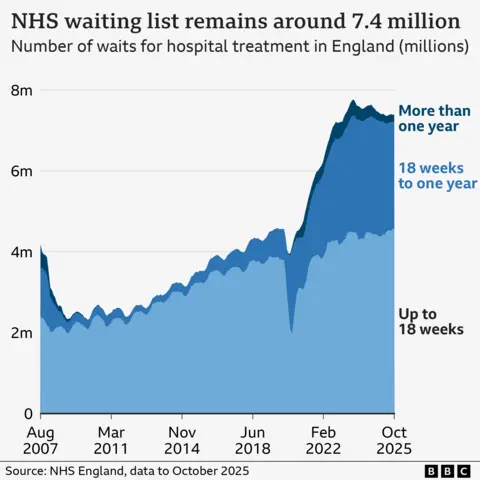
NHS managers said they were between a "rock and a hard place" trying to juggle balancing the books with tackling the hospital backlog, which currently stands at 7.4 million.
Reducing waits for things like hip and knee operations and hitting the 18-week waiting time target is the government's number one priority for the health service.
But documents seen by the BBC show integrated care boards, which are in charge of spending on behalf of NHS England, asking hospitals to make patients wait longer and reduce the numbers they treat until the end of the financial year.
One asked a private provider to reduce activity by nearly 30% and to make patients wait eight weeks longer, on average, while stopping taking on new referrals for a period as a way to cut back on the amount being done.
Surgery cancelled
A surgeon at a private hospital said they had had to cancel all their scheduled NHS operations for the coming weeks, with some patients only given a few days' notice.
They told the BBC: "I had a full day of joint surgery planned this week and patients were just told a few weeks before that their life-changing operations would not be taking place.
"Many of them had been waiting over 40 weeks for treatment. It's devastating for them."
A letter by Circle, one of the biggest private hospital providers in the country, to its doctors said at some sites they may have to stop seeing NHS patients altogether.
Daniel Elkeles, of NHS Providers, which represents NHS hospitals, said restrictions were also being placed on some NHS hospitals, calling it a "real concern".
"If the government really wants them to deliver the 18-week target they would have to go flat out and use all available capacity and that will mean needing additional funding."
Regional health boards are using what are known as activity management plans to push individual hospitals into reducing the number of patients they see.
They are predominantly being used when hospitals are treating more patients than expected.
They can also be used to push hospitals into treating more when activity levels are below expected.
The BBC has seen evidence or had confirmation from a host of health boards that restrictions have been put in places in parts of the north west, north east, south west, Yorkshire, the East Midlands and East Anglia.
A number of health boards refused to provide the BBC with information – and senior NHS sources said they expected many of England's 42 regional boards were now placing restrictions on individual hospitals in their areas.
They said they expected the number of hospitals affected would almost certainly grow before the end of the financial year, adding strike action by resident doctors had not helped with the NHS estimating the walkouts this year have cost hospitals more than £500m.
It is estimated the orders in place against the private hospitals that have reported so far could lead to 140,000 fewer patients starting treatment by the end of March. But given some NHS hospitals are affected and not all the restrictions placed on private hospitals are thought to have been been declared that could be an underestimate.
David Hare, of the Independent Healthcare Providers Network, said: "Given it is patient choice driving demand for treatment in the independent sector - and the scale of the challenge in getting NHS waiting lists down - we‘ve been surprised by the extent of the proposed slowdown, which will leave significant amounts of available capacity going unused across both the independent sector and the NHS.”
Rachel Power, chief executive of the Patients Association, said: "These reports are deeply alarming and poses a serious risk to patients' ability to access the treatment they urgently need.
"Calling it 'activity management plans' distracts from what this really is, another barrier standing between patients and timely care.
"It won't just delay treatment - it will worsen conditions, reduce quality of life and lead to harm that could harm that could have been prevented."
Sarah Walter, of the NHS Confederation, which represents regional health boards, said her members were having to make some "difficult decisions".
"The NHS faces an unprecedented financial challenge which has resulted in system leaders having to make some very tough decisions over how limited funding and tight budgets should be spent.
"Leaders are caught between a rock and a hard place of being tasked with balancing their books and hitting the elective care target."
The King's TV recording follows a message of "hope" at an Advent service this week
King Charles has recorded a personal message about his experience of cancer, which will be broadcast in this year's Stand Up To Cancer campaign, run by Cancer Research UK and Channel 4.
Buckingham Palace said the King would talk about his "recovery journey" as a cancer patient, in a video message on Friday at 20:00 GMT.
The message, recorded at Clarence House two weeks ago, will emphasise the importance of cancer screening checks to ensure more people catch the disease at an early stage.
This will be a rare update on the health of King, who has been undergoing regular treatment since revealing his diagnosis in February 2024. But it is thought unlikely the King will identify his type of cancer.
The Stand Up To Cancer campaign each year raises funds for medical research and treatment and encourages people to get check-ups to increase the chances of an early diagnosis.
The King's relative openness about his illness, and living with cancer, has been intended to raise awareness and to get more people to get tested - and this will be taken a step further with this unusual personal contribution.
So far the King's main approach to his cancer has been to keep working, maintaining a busy schedule despite his regular rounds of treatment, and he seems not to have wanted to be defined by his illness.
This year has seen the King, 77, taking several overseas trips, including to Italy and Canada, and hosting the biggest number of inward state visits to the UK for almost 40 years, including the German president last week.
Before the announcement of this special broadcast, the King earlier this week enjoyed an atmospheric and meditative Advent service in Westminster Abbey, with a message from the King highlighting that this was a season of optimism and "hope".
PA Media
King Charles hosted the German state visit at Windsor Castle last week
Friday evening's Stand Up to Cancer show on Channel 4, presented by celebrities including Davina McCall, Adam Hills and Clare Balding, will urge people not to be frightened of getting cancer checks.
All three have been affected by cancer - McCall said last month she had undergone surgery for breast cancer, while Balding was treated for thyroid cancer more than 15 years ago. Comedian Hills has previously spoken about his late father, who had stomach cancer and then later leukaemia.
The show will appeal to the estimated nine million people in the UK who Cancer Research UK says are not up to date with NHS screening schemes, with an online checker to let people see if they are eligible for tests for breast, bowel and cervical cancer.
In an attempt to demystify cancer checks and show the value of early diagnosis there will be a live broadcast from cancer clinics at Addenbrooke's and Royal Papworth hospitals in Cambridge.
"I want to take the fear out of cancer screening and show everyone that they are not on their own in this," said Davina McCall.
Davina McCall will be presenting Channel 4's Stand Up To Cancer show
The Stand Up to Cancer project, which has raised £113m since 2012, is funding 73 clinical trials involving 13,000 patients.
King Charles, in a message for guests at a reception for cancer charities in April, had spoken of recognising the "daunting and at times frightening experience" for cancer sufferers and their loved ones.
But he said his experience of living with cancer had shown him that "the darkest moments of illness can be illuminated by the greatest compassion," as he praised those who cared for cancer patients.
The Palace has not revealed what kind of cancer the King has, or what treatment he has received. The King's cancer was discovered after he had undergone a prostate procedure.
Google's quantum chip which the firm dubbed Willow
Google has announced plans to team up with the UK to invite researchers to come up with uses for the tech giant's state-of-the-art quantum chip Willow.
It is one of several firms competing to develop a powerful quantum computer - which is seen as an exciting new frontier in the future of computing.
Researchers hope they will be able to crack problems in fields such as chemistry and medicine which are impossible for current computers to solve.
Professor Paul Stevenson of the University of Surrey - who had no involvement with the agreement - told the BBC it was "great news for UK researchers".
The collaboration between Google and the UK's national lab for quantum computing means more researchers will get access to the technology.
"The new ability to access Google's Willow processor, through open competition, puts UK researchers in an enviable position," said Prof Stevenson.
"It is good news for Google, too, who will benefit from the skills of UK academics."
Quantum devices work in a fundamentally different way to the computers powering our smartphones and laptops, solving problems using technologies based on the science of particle physics
But the full potential of the technology has yet to be realised and the machines that currently exist have few practical applications and most are experimental.
It is hoped giving UK researchers access to Willow would help "uncover new real world applications".
Scientists will be able to submit proposals describing how they intend to use the chip, and they will work with experts from Google and the UK quantum lab to design and conduct experiments.
Quantum competition
When it was unveiled in 2024, Google's Willow chip was seen as a significant step forward in the field.
Rival firms including Amazon and IBM are also developing their own tech.
The UK has a significant quantum industry. Quantinuum, which has headquarters in Cambridge and Colorado, US, reached a $10bn (£7.45bn) valuation in September.
Announcements of new developments from firms throughout 2025 have led some experts to believe powerful machines capable of having real-world impact will be developed within a decade.
Dr Michael Cuthbert, Director at the National Quantum Computing Centre (NQCC) said the partnership would "accelerate discovery".
He said the cutting edge science it would support could ultimately lead to quantum computing being used in areas such as "life science, materials, chemistry, and fundamental physics".
The NQCC already hosts seven quantum computers from British-based firms such as Quantum Motion, ORCA and Oxford Ionics.
The government says it is committing £670m to support the tech, which is a priority area in the UK's Industrial Strategy.
Officials believe quantum could contribute £11 billion to the UK economy by 2045.
Watch: Video shows US military seizing oil tanker off Venezuela coast
The US has imposed fresh sanctions on six more ships said to be carrying Venezuelan oil, a day after seizing a tanker off the country's coast.
Sanctions have also been placed on some of Venezuelan President Nicolás Maduro's relatives and businesses associated with what Washington calls his illegitimate regime.
White House Press Secretary Karoline Leavitt told reporters that the seized vessel, called the Skipper, had been involved in "illicit oil shipping" and would be taken to an American port.
Caracas has described it as an act of "international piracy".
It marks a sharp escalation in the US pressure campaign against Maduro, which has seen dozens killed in strikes on boats alleged to have been carrying drugs from Venezuela, and US warships moved within striking distance of the South American country.
The Trump administration has accused Venezuela of funnelling narcotics into the US. Venezuela - home to some of the world's largest proven oil reserves - has, in turn, accused Washington of seeking to steal its resources. Maduro had previously said that Venezuela would never become an "oil colony".
But defending the US military action, Leavitt told reporters at the White House on Thursday that the US was committed to both "stopping the flow of illegal drugs" into the country and enforcing sanctions.
She would not be drawn on whether the White House planned to seize more ships transporting Venezuelan oil.
"We're not going to stand by and watch sanctioned vessels sail the seas with black market oil, the proceeds of which will fuel narco-terrorism of rogue and illegitimate regimes around the world," Leavitt said.
She added that the US planned to seize the oil on board the Skipper, after the necessary legal process.
Leavitt also said Trump would not be concerned "at all" to hear Russian President Vladimir Putin had called Maduro earlier in the day to offer Moscow's support "in the face of growing external pressure".
US Treasury Secretary Scott Bessent later said that imposing sanctions on three of Maduro's nephews, alongside a number of businesses and ships, would tackle the leader's "dictatorial and brutal control".
In a post on X, he said the Trump administration was "holding the regime and its circle of cronies and companies accountable for its continued crimes".
Reuters
Nicolás Maduro attended a march on Wednesday, where he brandished a historic sword that belonged to Venezuelan soldier Ezequiel Zamora
On Wednesday, the White House released dramatic video footage of the raid that showed camouflaged soldiers dropping down onto the vessel from a helicopter, and walking its deck, weapons drawn.
The Venezuelan government strongly denounced the seizure of the Skipper, with Interior Minister Diosdado Cabello calling the US "murderers, thieves, pirates". This was how the country had "started wars all over the world", he added.
The US Treasury department sanctioned the Skipper vessel in 2022, CBS reported, for alleged involvement in oil smuggling that generated revenue for Hezbollah and the Islamic Revolutionary Guard Corps-Quds Force.
The US had ramped up its military presence in the Caribbean Sea, which borders Venezuela to the north, in the days prior to the raid.
It involved thousands of troops and USS Gerald Ford - the world's largest aircraft carrier - being positioned within striking distance of Venezuela, BBC Verify reported.
The government has promised to create 50,000 more places for children with special educational needs (Send) in mainstream schools in England.
It plans to invest £3bn over the next three years, partly funded by cancelling the building of some planned free schools.
Councils - who will receive the funding - have argued the money needs to be diverted to the right areas and to the people who know what is needed in their local communities.
Nearly 1.7 million pupils receive support for special educational needs in schools in England, with the number rising every year.
Education Secretary Bridget Phillipson said the investment would lay the groundwork for the Send reforms announced in the schools White Paper early next year. The White Paper had been due to be published in the autumn, but was delayed.
The government says it plans to cancel the building of 28 new mainstream free schools following a consultation and that it is reviewing a further 16 sites.
"We have made the decision not to go ahead with some schools where we've seen falling rolls because of pupil numbers and investing that money into provision for children with Send", Ms Phillipson told the BBC.
Councils will be able to use the money from the cancelled projects to adapt existing school buildings and create more specialist spaces, so pupils are less likely to have to travel far for their education.
For example, they could create areas like breakout spaces for children who may need more support, or rooms to support children with autism or ADHD who may feel overstimulated in the classroom.
There are also 77 proposed special free schools which local authorities can decide to build, or similarly, use the funding to create the equivalent number of specialist places elsewhere.
Councillor Amanda Hopgood from the Local Government Association says the Send places needed to be in the right location.
"If we build a big school in the middle of nowhere that we have to transport everyone to, then that's money that isn't used on education".
"And those children are not being educated in their local communities where they live with their friends".
However, the school leaders' union NAHT says investment in buildings is only one part of the picture, and that there would need to be sufficient teachers and leaders "with the right level of specialist training".
At Ninestiles, an academy in Birmingham, just under 50 students with an education, health and care plan (EHCP) - a legal document outlining the support that a young person is entitled to - spend around 70% of their time in mainstream lessons.
The rest of the time, they take part in bespoke lessons to support their needs, where they get access to specially-trained staff and a tailored curriculum.
Demand for these places is high and the government says the extra investment means councils would be able to meet local need faster.
But Principal Alex Hughes says "the devil will be in the detail" and in "what it translates to" for individual schools.
Student Brendan, 14, who attends Ninestiles has access to the full curriculum but also can attend the resource hub, where he is supported by teachers.
He has the "best of both worlds", according to his mum Laura Jerram who says the pastoral support he has received has been "the key to keeping him in the school".
But Brendan's journey to get to this point has been "really difficult".
He missed a lot of primary school before he came to Ninestiles and the process of getting an EHCP was "a horrible journey", Ms Jerram explains.
"It's a bit of a bun fight [to get an EHCP] and the most resourced families tend to come out on top, unfortunately.
"I feel that for Brendan, if he'd had support much earlier on, he may not have fallen out of education the way he did."
Gemma Laister/BBC
Mum Laura Jerram says trying to get an EHCP for her son was a horrible journey and families need help much earlier on
Many parents are unhappy and frustrated with the way the system is currently working with the National Audit Office (NAO) warning that despite increased investment, outcomes for students have not improved.
The number of parents taking councils to court over issues with Send provision reached a record high in 2024-2025, figures by the Ministry of Justice revealed on Thursday.
There were 25,000 Send appeals, up 18% from the previous year, with most disagreements over the content of EHCPs.
The free schools which will not go ahead will now go through a consultation period.
Plans by Eton College to open selective sixth-form centres in Dudley and Oldham have been approved, but its Middlesbrough proposal is earmarked for cancellation.
Free schools are publicly funded but are privately run by academy trusts, universities, charities, or faith groups.
Additional reporting by Kate McGough and Hazel Shearing
The four pairs of contestants had to make their way more than 3,500 miles through Central America
Spoiler warning: This article reveals the winners of Celebrity Race Across the World.
Broadcaster Roman Kemp and his sister, singer-songwriter Harleymoon, have triumphed in the latest series of the BBC's Race Across the World.
They reached the final checkpoint ahead of the three other pairs of contestants after a 33-day, 5,900km (3,600 mile) quest through Central America.
The pair reached the finish line two minutes before EastEnders actress Molly Rainford and her fiancé, TV and radio host Tyler West, with broadcaster Anita Rani and her dad Bal finishing six hours later.
Derry Girls actor Dylan Llewellyn and his mum Jackie came fourth - having decided to leave the race earlier in the episode because of limited funds.
Wednesday's final episode covered the last stage, a 1,000km route from Medellín to the Guajira Peninsula in Colombia.
In previous stages, the teams had to make their ways through countries including Mexico, Guatemala, El Salvador, Honduras, Costa Rica and Panama.
They did so without using phones or air travel, and with a budget of £950 per person - the equivalent cost of flying the route.
This was the BBC's third celebrity series of Race Across the World and has been attracting about six million viewers.
Roman and Harleymoon Kemp are the children of Spandau Ballet's Martin Kemp and wife Shirlie.
Roman is know as co-host of BBC One's The One Show and Capital's former breakfast show DJ, while Harleymoon is a country singer who has been releasing music for five years.
The final journey saw them take a 4x4, boat ride and race by foot up a cliffside, with Ronan describing it as "the most adrenaline, most emotion that I've had ever".
Harleymoon added: "I've never run like that in my whole life."
Rainford, 25, is known for playing Anna Knight in EastEnders since 2023 and reaching the final of Strictly Come Dancing in 2022.
She met Kiss radio host West when he was also a contestant on the same series of Strictly, and they announced their engagement earlier this year.
Rani is known as co-host of BBC Radio 4's Woman's Hour and BBC One's Countryfile, and was racing with her dad Balvinder Singh Nazran, a semi-retired businessman.
Dylan Llewellyn, who has been racing with mum Jackie, is known for playing James in hit sitcom Derry Girls, as well as for roles in Big Boys and Beyond Paradise.
Many were complacent, but conflict was next door, the Nato chief warned
Russia could attack a Nato country within the next five years, the Western military alliance's chief has said in a stark new warning.
"Russia is already escalating its covert campaign against our societies," Mark Rutte said in a speech in Germany. "We must be prepared for the scale of war our grandparents or great-grandparents endured."
He echoed similar statements about Russia's intentions made by Western intelligence agencies, which Moscow dismisses as hysteria.
Rutte's warning comes as US President Donald Trump tries to bring an end to Russia's full-scale invasion of Ukraine, launched in February 2022.
Earlier this month, Russia's President Vladimir Putin said his country was not planning to go to war with Europe, but it was ready "right now" if Europe wanted to - or started a war.
But similar reassurances were given by Moscow in 2022, just before 200,000 Russian troops crossed the border and invaded Ukraine.
Putin has accused European countries of hindering US efforts to bring peace in Ukraine - a reference to the role Ukraine's European allies have recently played in trying to change a US peace plan to end the war, whose initial draft was seen as favouring Russia.
But Putin was not sincere, Nato's secretary-general said in the German capital, Berlin.
Supporting Ukraine, he added, was a guarantee for European security.
"Just imagine if Putin got his way; Ukraine under the boot of Russian occupation, his forces pressing against a longer border with Nato, and the significantly increased risk of an armed attack against us."
Russia's economy has been on a war footing for more than three years now - its factories churn out ever more supplies of drones, missiles and artillery shells.
According to a recent report by the Kiel Institute for the World Economy, Russia has been producing each month around 150 tanks, 550 infantry fighting vehicles, 120 Lancet drones and more than 50 artillery pieces.
The UK, and most of its Western allies, are simply not anywhere near this point.
Analysts say it would take years for Western Europe's factories to come close to matching Russia's mass-production of weapons.
France and Germany have both recently moved to revive a system of voluntary military service for 18-year-olds.
So-called "hybrid" or "grey-zone" warfare, which includes events that are often deniable, such as cyber-attacks, disinformation and the alleged launching of drones close to airports and military bases in Nato countries, have been ramping up this year.
But worrying as these are, they pale compared to the crisis that would be triggered by a Russian military attack on a Nato country, especially if it involved seizing territory and people being killed.
Nato includes 30 European countries - as well as Canada and the US, the alliance's most-powerful military member.
Under pressure from Trump, its members have pledged to increase military spending.
"Nato's own defences can hold for now," Rutte warned in Berlin, but conflict was "next door" to Europe and he feared "too many are quietly complacent, and too many don't feel the urgency, too many believe that time is on our side.
"Allied defence spending and production must rise rapidly, our armed forces must have what they need to keep us safe," the Nato chief said.
Reuters
"Listen to the sirens across Ukraine, look at the bodies pulled from the rubble," Rutte warned in his speech
Oscar-winning actor Catherine Zeta-Jones faced criticism over her looks at Netflix's Wednesday FYC event in November
Women are rallying behind Oscar-winning actor Catherine Zeta-Jones after she faced criticism on social media over her looks at a recent red carpet event.
Zeta-Jones attended a Netflix event in Los Angeles on 9 November where a TikTok interview about her role in the latest Wednesday series was overshadowed by comments about her appearance.
Laura White, 58, and this year's winner of Miss Great Britain Classic, called the backlash "complete nonsense", adding that "men don't have this sell-by/use-by date that women do".
Beauty journalist Sali Hughes, 50, said unlike men, women were unfairly judged for aging and Zeta-Jones should be free to look however she liked.
Allow TikTok content?
This article contains content provided by TikTok. We ask for your permission before anything is loaded, as they may be using cookies and other technologies. You may want to read
before accepting. To view this content choose ‘accept and continue’.
In the video, which was also posted on Facebook and had more than 2.5m views, Zeta-Jones, who is from Mumbles, Swansea, talked about how much she enjoyed exploring her character, Morticia Addams, in season two.
But many of the hundreds of comments focused on her age and were disparaging about her appearance.
The online backlash sparked widespread defence of Zeta-Jones, including a viral video from one Facebook user which said: "You bully women when they get too much work done and bully them when they don't have enough."
Commenters also came to her defence, with one writing: "It's called ageing naturally and she looks beautiful."
Others described her as "gorgeous" and "so pretty", while someone else said that "she looks her age - that's called reality."
Laura White
Laura White said "men don't have this sell-by/use-by date that women do"
Ms White arrived for her interview at BBC Radio Wales Breakfast earlier makeup-free to "prove a point" and to show there was no set "template" for what a woman in her 50s should look like.
Like many women her age, she said she "takes care of herself" not to look younger but to feel "better" and look "healthy".
"Aging is a privilege and if we can do it the best we can, that's what really matters," she added.
She argued that men were not held to the same beauty standards, adding "no-one questions how old Tom Cruise, George Clooney or Tom Jones are - they just look 'great'."
She said it was one of the reasons she entered Miss Great Britain's category for over-45s, to "show that midlife women are still here" and "still have it".
Dora Paphides
Welsh beauty writer Sali Hughes says women were frequently and unfairly judged for aging
Hughes, an author and presenter from Wales, said that while Zeta-Jones was "gorgeous" it was "not the point", adding she should be free to look however she liked without her age being scrutinised.
She said the online abuse showed no woman was "immune" and that women do not deserve the "constant narrative" that they are not good enough or young enough - a problem that is "galling, regardless of who the victim is".
Asked if men face the same scrutiny, she said "no, never", noting women were attacked simply for having the "audacity" to exist online as they age.
Despite the beauty industry promoting "longevity", Hughes said women were still criticised whether they aged naturally or underwent treatments like plastic surgery or injectables.
"If you age naturally, people say you should do more; if you get work done, you're accused of not aging gracefully enough," she added.
German Chancellor Friedrich Merz said the latest peace plan draft for Ukraine has been presented to US President Donald Trump - including a proposal on territorial concessions Kyiv may be prepared to make.
But Merz highlighted the territorial issue was "a question that must be answered primarily by the Ukrainian president, and the Ukrainian people."
"We also made this clear to President Trump," Merz pointed out.
In recent weeks European leaders have worked closely with Ukraine to come up with a new iteration of a peace plan that addresses Kyiv's interests and concerns.
Trump appears to have grown frustrated with the intricacies of the question of sovereignty over Russian-occupied Ukrainian territories.
Because his negotiating team has previously worked closely with Moscow, Kyiv's European allies fear the US president might eventually seek to impose a Russian-led solution on Ukraine.
"It would be a mistake to force the Ukrainian president into a peace that his people will not accept after four years of suffering and death," Merz said in a joint news conference with Nato chief Mark Rutte.
He added that in Wednesday's "constructive" phone call with Trump, he, France's Emmanuel Macron and UK Prime Minister Sir Keir Starmer had "made it clear" that Europeans needed to have their interests heard too.
For his part, Trump said the participants had "discussed Ukraine in pretty strong words" and added that he was yet to decide whether to attend a meeting in Europe. "We don't want to be wasting time," he said.
Ukraine's President Volodymyr Zelensky has long signalled he would be prepared to talk to Trump directly to discuss the sticking points of a deal, but the US president has suggested all issues had to be ironed out before such a meeting could take place.
The territorial question is one of the thorniest. Russia demands that Ukraine withdraws entirely from the parts of the eastern Luhansk and Donetsk regions which it still holds - something Kyiv refuses to do, both on principle and because it fears it would allow Moscow a foothold for future invasions.
"We have no legal right to [cede territory], under Ukrainian law, our constitution and international law," Zelensky said earlier this week. "And we don't have any moral right either."
Zelensky is set to hold more talks with his allies today as he co-chairs a coalition of the willing call alongside Merz, Macron and Starmer.
As high-level, frantic diplomatic activity of the last few weeks has taken place among US, European and Ukrainian officials, with frequent statements from all sides, Moscow has remained remarkably tight-lipped.
Any comments from Russia have sought to cement the impression that Moscow and Washington are aligned on their hopes for the terms of a peace deal.
On Thursday Foreign Minister Sergei Lavrov praised Trump for trying to broker a deal and said the recent meeting between Vladimir Putin and US envoy Steve Witkoff at the Kremlin had "eliminated" the "misunderstandings" which had arisen since last summer's Trump-Putin summit in Alaska.
At the time, Russia and the US agreed Ukraine should return to a non-aligned, neutral, and nuclear-free status, Lavrov stated.
The foreign minister also batted off suggestions that Kyiv could be given security guarantees in the form of foreign troops stationed in Ukraine.
"This is yet another return to the sad logic of Zelensky's so-called peace formula," Lavrov said, adding that Moscow had handed the US "additional" proposals on collective security and that Russia was ready to give legal guarantees not to attack Nato or EU countries.
Yet Kyiv and its European allies believe that without security guarantees any peace settlement could be rendered meaningless.
But because Russia has previously violated ceasefire and truce deals, neither Ukraine nor Europe are likely to take any promise by Moscow at face value. In recent weeks European and Ukrainian officials have pushed for the US to be involved in guaranteeing that Kyiv doesn't become the target of renewed attacks.
Earlier this week Zelensky said he was ready to hold elections if the US and European countries could guarantee Ukraine's security during the vote. His five-year term as president was due to end in May 2024, but elections have been suspended in Ukraine since martial law was declared after Russia's full-scale invasion in February 2022.
Not for the first time, Nato chief Mark Rutte said on Thursday that too many of the alliance's allies did not feel the urgency of Russia's threat in Europe.
"We are Russia's next target," he warned, adding that Nato had to make all efforts to prevent a war that could be "on the scale of war our grandparents and great-grandparents endured".
The Russian submarine was tracked by a Royal Navy tanker
The Royal Navy says it has tracked a Russian submarine through the English Channel to "safeguard" UK waters.
A tanker shadowed the Russian Kilo-class submarine Krasnodar as it sailed on the surface from the North Sea, through the Strait of Dover and into the English Channel, it said.
The Royal Navy added that it had been prepared to "pivot to anti-submarine operations" if Krasnodar had dived below the surface.
The incident is the latest in a series of instances of Russian naval activity in UK waters. The government says there has been a 30% increase in Russian vessels threatening UK waters in the past two years - though Russia says the UK is the one being provocative.
The Russian submarine and its tugboat Altay were tracked by Royal Fleet Auxiliary (RFA) tanker Tidesurge carrying a specialist Merlin helicopter aboard, as part of a three-day operation.
It said this was part of the government's commitment to "safeguard the integrity of UK waters and protect national security", the Royal Navy said.
Capt James Allen, commanding officer of RFA Tidesurge, said the vessel had provided "a show of presence and deterrence as we transited from the North Sea to the English Channel".
The navy continued to shadow the Russian submarine and its tugboat until it approached the north-west of France, at which point tracking of it was handed over to a Nato ally.
The UK said the ship was being used for gathering intelligence and mapping undersea cables.
"We see you. We know what you are doing. And we are ready," Healey said in a message to Russian President Vladimir Putin.
The Russian embassy has previously said it was "not interested in British underwater communications" and urged the UK to "hold off taking any destructive steps which might aggravate the crisis situation on the European continent".
Labour's flagship law on workers' rights faces continuing deadlock after the House of Lords inflicted another defeat on the government.
The setback comes just two weeks after ministers said they had reached a compromise between businesses and unions on the right to claim unfair dismissal.
The government had argued the agreement would unblock the passage of the Employment Rights Bill and allow it to become law.
But peers have now backed a Conservative proposal to force a review of a Labour plan to abolish a cap on compensation in unfair dismissal cases.
The proposal to abolish the cap - which emerged from talks between unions and business groups two weeks ago - did not feature in Labour's manifesto, and is being added to the bill at an unusually late stage.
The bill is now due to return to the Commons on Monday, as the parliamentary process known as "ping-pong" continues until the two Houses agree.
Unions have accused peers of "defying the will of the British public" by holding up the bill, but Downing Street has insisted the government was still committed to passing the bill before Christmas.
The bill - which applies to England, Scotland and Wales, but not Northern Ireland where employment law is devolved - has been described by the government as the "biggest upgrade to rights at work for a generation".
It includes measures such as giving workers the right to sick pay and parental leave from their first day in a job, banning "exploitative" zero-hour contracts and strengthening the right to request flexible working.
However, some businesses have expressed concerns over the plans, warning they will increase costs for employers.
Instead, ministers now plan to introduce this right after six months.
Following talks between major industry bodies and unions, the government also committed to scrapping limits on compensation for financial loss in ordinary unfair dismissal cases.
Currently, awards to former employees who successfully bring a claim are limited to either their annual salary or £118,223, whichever is lower.
This would bring the process more into line with "automatic" unfair dismissal cases - where workers have been sacked for reasons such as discrimination and whistleblowing - where financial loss awards are uncapped.
'Recipe for the rich'
On Wednesday evening, peers voted by 244 votes to 220 for a Tory proposal which would require the government to review compensation limits before scrapping them.
During the debate, Tory shadow business minister Lord Sharpe argued uncapped compensation would benefit higher-paid workers, adding: "This policy is a recipe for the rich and a wrecking of justice for working people."
While he welcomed changes on rights to unfair dismissal, the peer said the government's new proposals on compensation limits had been brought forward "at the 11th hour" without any consultation.
Lord Sharpe insisted calling for a review was "not obstruction" but "the bare minimum that a competent administration should undertake".
Independent crossbench peer and entrepreneur Lord Londesborough said his email inbox was "awash with anger and indignation" from businesses over the government "sneaking in this clause on uncapped compensation".
"It is anti-entrepreneurial, anti-enterprise and, I fear, a job destroyer," he added.
'Undemocratic'
Defending the move, Business Minister Baroness Lloyd said the current system incentivised claimants to allege discrimination, as this allowed uncapped compensation.
"These types of claims are more complex and take longer for the tribunal to handle," she said.
"Therefore, by our removing the compensation cap for ordinary unfair dismissal claims, this incentive will be lessened, making it easier for tribunals to reach a judgement more quickly and decreasing burdens on the system."
She said the government had "worked collaboratively with employers and trade unions to find a compromise" and called on peers to allow the bill to progress so workers could benefit from the reforms without any further delay.
However, the Federation of Small Businesses has expressed reservations about the plan, warning that unlimited settlements "would be difficult and further gum up tribunals".
"That was not a concession discussed with us or agreed by us in the negotiations," added executive director Craig Beaumont.
TUC general secretary Paul Nowak said: "Continuing to vote down the Employment Rights Bill, a clear manifesto commitment, is undemocratic.
"This bill has been debated and scrutinised for months. Tory peers are actively defying the will of the British public and their own supporters who overwhelmingly support measures in this bill."
Sign up for our Politics Essential newsletter to read top political analysis, gain insight from across the UK and stay up to speed with the big moments. It'll be delivered straight to your inbox every weekday.
The number of patients in hospital in England with influenza has risen by more than 50% in the past week, with NHS bosses warning there is no sign of "super flu" peaking yet.
In the week up to Sunday there were 2,660 flu cases a day on average in hospital – and NHS England said the numbers had continued rising this week.
NHS England said it was the equivalent of having three hospitals full of flu patients, with some reporting nearly one in 10 beds occupied by patients with the virus.
Officials said the numbers had continued rising this week with fears it may top 5,000 by the weekend. Increases are also being reported in other parts of the UK.
Super flu circulating
NHS England medical director Prof Meghana Pandit said: "This unprecedented wave of super flu is leaving the NHS facing a worst-case scenario for this time of year – with staff being pushed to the limit to keep providing the best possible care for patients."
The numbers in hospital with flu is at its highest level at this time of year since records began - although they only date back to 2021 and so do not capture the two worst flu seasons of the past 15 years which were seen in 2014-15 and 2017-18.
Flu rates began rising a month earlier than normal this year driven by a mutated strain of the virus. The dominant strain is H3N2, but it has some genetic changes this year.
It means the general public has not encountered this exact version of flu before, which means there is maybe less immunity.
NHS England said the number of patients in hospital with the vomiting bug norovirus was also on the rise, with more than 350 beds occupied by people with that virus.
It comes ahead of a strike by resident doctors, the new name for junior doctors, which is due to start next week.
There are hopes it may be called off after a fresh offer from Health Secretary Wes Streeting prompted the British Medical Association to agree to poll their members to see if they were willing to call off the five-day walkout that is due to begin on Wednesday. The results of that poll will be be announced on Monday.
Daniel Elkeles, of NHS Providers, which represents hospitals, said: "The NHS is in the thick of a storm come early. Flu is hitting hard and other winter bugs are surging.
"Now more than ever, the NHS needs all hands on deck.
"We have to hope that BMA resident doctors will step back from next week's strike, take up the government's sensible offer and end their damaging dispute."
Buckling system
Data from the UK Health Security Agency (UKHSA), which takes into account levels of infection in the community as well as hospitals, shows infection rates are continuing to rise, but not as sharply as they were in the previous week.
But officials stressed it was too early to take that as a sign that flu could be peaking.
They said the virus was unpredictable and a lull could be followed by another surge.
Dr Conall Watson, an infectious diseases expert at the UKHSA, urged people who are eligible for a free flu vaccine on the NHS, which includes the over 65s, those with certain health conditions and pregnant women, to still come forward if they had not yet got one.
"There is still plenty of flu vaccine available to protect those who need it – what's running out is time to be protected ahead of Christmas.
"If you are eligible this is the last chance to get protected as we head into Christmas – so make an appointment with the NHS today."
It can take up to two weeks following vaccination to develop the fullest protection from the jab, Dr Watson added.
Dr Vicky Price, president of the Society for Acute Medicine, said winter viruses were placing further strain on an "already buckling system".
She said patients were facing long waits in A&E as hospital staff were being overloaded with patients.
But she accused NHS England and the government of using it as a "convenient scapegoat" for the "predictable breakdown" in NHS capacity caused by workforce shortages.
"The situation in emergency departments has become so dire that what was once considered a critical incident is now seen as normal and routine. What is happening is not an isolated emergency, but the culmination of systemic failure."
The NHS has urged those eligible to get vaccinated against flu to help limit the severity of symptoms
The NHS says it's facing its "worst-case scenario" after the number of people in hospital with flu jumped by 55% in a week.
NHS England chief executive Sir Jim Mackey has warned that between 5,000 and 8,000 hospital beds could be filled with flu patients by the weekend.
Health experts at the King's Fund think tank have said talk of an "unrelenting flu wave" has become worrying familiar over recent years.
How then is winter 2025 really any different and which patients have been affected most by what the NHS is now describing as "super flu"?
An earlier start for flu
The major difference between 2025's flu season and the previous three years is that the virus started spreading around a month earlier.
The first sign of this was in October in data published by the UK Health Security Agency (UKHSA).
When someone goes to their GP or hospital with flu-like symptoms they can be tested for a number of viruses including influenza, Covid and RSV.
UKHSA records the percentage of those tests that come back positive for flu, which can then give a strong indication that rates in the community are either rising or falling.
Virologists have linked the earlier flu season this year to a subtle shift in the genetic makeup of the main flu virus that is circulating - called H3N2.
So-called 'super-flu' is not a medical term and it does not mean the virus is more severe or harder to treat.
But the general public has not encountered this exact version of flu before, which means there may be less immunity built up in society, allowing it to spread more easily.
Children and young people most affected
Children tend to be more susceptible to flu than older adults, partly because their immune systems are still developing and because they tend to spread viruses more quickly through close contact.
The latest breakdown of UKHSA data shows that the proportion of positive tests is currently much higher in children and young people still at school or university.
Some schools have had to bring back Covid-like measures to prevent the spread of the virus, such as cutting back on singing in assemblies and introducing sanitisation stations, while one site in Caerphilly had to close temporarily.
Each year thousands of otherwise healthy children end up in A&E with complications after catching influenza.
But there is another concern: that younger people will go home and then spread the disease to elderly relatives who tend to be more vulnerable.
Flu adds to winter pressure
The NHS records the number of patients in hospital each week with influenza and other types of respiratory illness.
The number has been rising sharply in England with an average of 2,660 flu patients taking up a hospital bed last week, up from 1,717 in the previous week.
Those over 85-years-old are five times more likely to be hospitalised than the general population.
But the patients being admitted now would have been infected with the virus a week or so ago when infection rates were lower.
The greater concern for the health service is what happens over the coming weeks as new cases appear in A&E.
The NHS has roughly 105,000 available hospital beds in England and tends to "run hot" over the winter with 95% of those taken up at any one time.
If the number of flu patients needing overnight treatment jumps to 5,000 or higher, as Sir Jim Mackey predicts, then it could put the whole hospital system under more pressure.
What about vaccine protection?
The message coming from doctors and the NHS is for people in vulnerable groups to continue to come forward for a flu vaccine.
Even though the genetic make-up of the virus has shifted this winter, the main jab is still thought to offer effective protection, particularly against severe disease.
The flu vaccine is free on the NHS for those over 65-years-old, young children, pregnant women, those with certain health conditions, carers, and front line health and social care workers.
People in other groups can get the same vaccine for between £15 and £25 from high street pharmacists.
As of 30 November, just over 40% of people in an at-risk group had taken up the offer of a free flu jab this year.
Flu vaccination rates among NHS workers in England, which have fallen back since the Covid pandemic, appear to have stabilised this year at about the same level - around 42%.
French marine archaeologists have discovered a massive undersea wall off the coast of Brittany, dating from around 5,000 BC.
They think it could be from a stone age society whose disappearance under rising seas was the origin of a local sunken city myth.
The 120-metre (394ft) wall – the biggest underwater construction ever found in France – was either a fish-trap or a dyke for protection against rising sea-levels, the archaeologists believe.
When it was built on the Ile de Sein at Brittany's western tip, the wall would have been on the shore-line – between the high and low tide marks. Today it is under nine metres of water as the island has shrunk to a fraction of its former size.
The wall is on average 20 metres wide and two metres high. At regular intervals divers found large granite standing stones – or monoliths – protruding above the wall in two parallel lines.
It is believed these were originally placed on the bedrock and then the wall built around them out of slabs and smaller stones. If the fish-trap hypothesis is the right one, then the lines of protruding monoliths would have also supported a "net" made of sticks and branches to catch fish as the tide retreated.
With an overall mass of 3,300 tonnes, the wall must have been the work of a substantial settled community. And to have lasted 7,000 years, it was clearly an extremely solid structure.
"It was built by a very structured society of hunter-gatherers, of a kind that became sedentary when resources permitted. That or it was made by one of the Neolithic populations that arrived here around 5,000 BC," said archaeologist Yvan Pailler.
The monoliths that form the basis of the wall are similar to - but predate - the famous menhirs that dot the Brittany countryside and are associated with the Neolithic culture.
According to Pailler, there could have been a transmission of know-how on extracting, cutting and transporting the stones between older Mesolithic hunter-gatherers and incoming Neolithic agriculturists.
The wall was discovered after local geologist Yves Fouquet studied undersea depth charts drawn up using the latest radar technology. "Just off Sein I saw this 120-metre line blocking off an undersea valley. It couldn't be natural," he told Le Monde newspaper.
Archaeologists made their first exploration in summer 2022, but had to wait till the following winter – when the seaweed had died back – before they could map the wall properly.
In a paper in the International Journal of Nautical Archaeology, the writers conjecture that sites such as this may lie at the origin of local Breton legends of sunken cities. One such lost city – Ys – was believed to lie in the Bay of Douarnenez, just a few kilometres to the east.
"It is likely that the abandonment of a territory developed by a highly structured society has become deeply rooted in people's memories," the paper says.
"The submersion caused by the rapid rise in sea level, followed by the abandonment of fishing structures, protective works, and habitation sites, must have left a lasting impression."
Sandie Peggie was suspended by NHS Fife after she complained about trans women using single-sex changing rooms
The judgement in the tribunal of a nurse suspended from her job in a row over trans women using single-sex changing rooms has been amended following complaints a quote used in it was "made up".
On Monday, an employment tribunal outlined four ways in which NHS Fife harassed Sandie Peggie, but dismissed all her other claims.
Ms Peggie had brought the case after she was suspended following a disagreement between her and Dr Beth Upton - who is a trans woman.
Campaigners claimed that the 312-page judgement in the Peggie case contained a "made up" quote from another legal case.
The tribunal has now issued a "certificate of correction" stating there had been "clerical mistake(s), error(s)or omissions(s)". This does not change the overall verdict.
The case has attracted international interest as it concerned whether transgender women – biological males who identify as women – could use female-only changing rooms.
Following the tribunal ruling, one of Ms Peggie's most high-profile supporters, campaigner Maya Forstater, said a reference in the judgement to her own case against the Centre for Global Development Europe was "completely made up".
The Peggie ruling originally stated the verdict in Ms Forstater's case emphasised that the Equality Act does not create "a hierarchy of protected characteristics."
On the social media platform X, Ms Forstater posted a screenshot of the text from the tribunal and said: "One of the many things wrong with the Sandie Peggie judgment.
"This 'quote' from my judgment doesn't come from my judgment. It is completely made up."
A new quote from the Forstater case has now been added.
The revised version of the Peggie judgement then states: "We consider that quotation provides support for the proposition that the Equality Act 2010 does not create a hierarchy of protected characteristics."
Sandie Peggie refused to change with Dr Beth Upton
Under employment law, a judge may "at any time correct any clerical mistake or other accidental slip or omission" and an amended version issued.
Ms Forstater said she was astonished how the error happened and that she wanted an explanation.
She added other mistakes had been spotted in the verdict and that they "severely undermine people's confidence in the legal process."
It was brought by Ms Peggie, a nurse who has worked for the NHS for 30 years.
She refused to share a women's changing room with Dr Upton - a biological male who identifies as a woman - at Victoria Hospital, in Kirkcaldy, and was suspended from work at the beginning of 2024.
This followed an encounter between the due in the changing facilities on Christmas Eve 2023, where Ms Peggie told Dr Upton she did not feel comfortable about the doctor's presence there.
She also referenced Isla Bryson - a rapist who changed gender while awaiting trial.
Bryson was initially remanded to a women's jail after being found guilty, but was then moved to a men's facility.
Ms Peggie claimed her own experiences amounted to harassment and took legal action against the health board and Dr Upton, citing the Equality Act 2010.
On Monday, the 312-page judgement found in her favour on four counts, but dismissed her other claims against both the health board and Dr Upton.
It found that some of Ms Peggie's comments towards Dr Upton "amounted to an incident of harassment" and breached the health board's bullying and harassment policy.
A separate hearing will take place at a later date to decide on the "remedy" for Ms Peggie, which could result in her being awarded compensation.
However the verdict was criticised by some campaigners, including Sex Matters - the group Ms Forstater is chief executive of.
The oil tanker seized by US forces on Wednesday had a track record of faking or concealing its location information, apparently to hide its activities, ship tracking data shows.
On Wednesday evening, the US confirmed that its forces seized a vessel during a helicopter-launched raid near the coast of Venezuela. BBC Verify confirmed the ship was the Skipper by matching a sign seen in footage released by the US to a reference photo supplied by TankerTrackers.com, a site which monitors oil shipments.
Data held by publicly accessible tracking sites paints an incomplete picture of the vessel's movements, and before its seizure it hadn't declared its position since 7 November. Maritime analytics firm Kpler also suggested that the vessel had engaged in a ship-to-ship transfer.
The US Treasury department first sanctioned the ship in 2022, when it was sailing under the name Adisa, and was accused of being part of an "international oil smuggling network".
The Skipper has sailed under the flag of Guyana, but the government was quick to release a statement saying that the 20-year-old tanker was "falsely flying the Guyana Flag as it is not registered in Guyana".
Experts told BBC Verify that the Skipper was likely a part of the so-called "dark fleet" - a global network of oil tankers that seek to evade oil sanctions by obscuring their ownership, identities and travel histories.
Hiding its position
Under a UN treaty, all ships above a certain tonnage must have an onboard tracker called an Automatic Identification System (AIS). These trackers broadcast information about the ships, including their location, and can be followed on websites like MarineTraffic.
But there is an incomplete and misleading public record of the Skipper's movements. According to MarineTraffic, the Skipper's last known port call was at Soroosh in Iran on 9 July, where it arrived after stopping in Iraq and the UAE.
But Kpler suggests that this is part of a pattern of misleading entries by the Skipper. Analysts at the firm said the ship had previously loaded crude oil from Venezuela and Iran, while falsifying its position via its onboard tracker, a process known as spoofing.
Venezuela has some of the world's largest reserves of oil, but exports were placed under sanctions in 2019 by the US in a bid to force the transition of power from President Nicholas Maduro's administration, which has been widely accused of election rigging.
The firm noted that while its AIS showed the ship at Iraq's Basrah Oil Terminal on 7 and 8 July, terminal reports showed no record of the vessel there. Instead, the Skipper loaded crude oil at Kharg Island in Iran, Kpler said.
The Skipper then sailed east, tracking data shows, where Kpler suggested it conducted a ship-to-ship transfer between 11 and 13 August. The cargo was later unloaded in China, where Kpler said it was "falsely declared".
It returned via Iran and sailed towards the Caribbean. The Skipper last declared its position on 7 November, several miles off the coast of Guyana. Its onboard only reappeared on 10 December, after the US raid.
In the interim period, satellite images identified byTankerTrackers.com and confirmed by BBC Verify show that the Skipper was present in the Port of Jose in Venezuela on 18 November and not appearing on tracking sites at the time.
Since the imposition of sanctions, analysts say it has become common for ships to spoof or conceal their positions while loading oil in Venezuela.
Kpler analysts said the ship loaded "at least 1.1 million barrels of Merey crude" by 16 November at the terminal and listed Cuba as the destination.
There is also evidence that the Skipper was involved in a ship-to-ship transfer with another vessel on 7 December, just days before it was boarded by US troops. Satellite images seen by Kpler appeared to show the exchange, with one of the vessels identified by Kpler as the Skipper.
The transfer took place just off the coast of Venezuela, near the city of Barcelona. According to MarineTraffic, the Skipper had last appeared off the coast of Guyana weeks earlier.
Such sanction evading activity is not unusual for Venezuelan oil exports, Kpler said. The company said that tankers often transfer their cargo off the coast of Malaysia, before the oil is imported into China.
Former Belgian naval lieutenant and analyst Frederik Van Lokeren told BBC Verify that while such ship-to-ship transfers are not illegal or wrong, they are "extremely uncommon". He said such activities were normally a sign of vessels trying to evade sanctions, transferring oil to ships not publicly associated with smuggling.
Mr Van Lokeren said that Venezuela's refining capacity has been significantly degraded in recent years and is "dependent" on its allies in Iran and Russia to convert its crude oil into more commercially lucrative products.
Who owns the Skipper?
MarineTraffic lists the beneficial owner and operator as Nigeria-based Thomarose Global Ventures Ltd and it lists the registered owner as Marshall Islands-based Triton Navigation Corp.
In 2022, the US Treasury said that Triton was being used by a sanctioned Russian oil magnate - Viktor Artemov - to facilitate a global "oil smuggling network".
At the time, US officials said Mr Artemov used an expansive network of ships often registered obscurely to transport Iranian oil.
In its statement, the US Treasury said that Triton had "materially assisted, sponsored, or provided financial, material, or technological support for, or goods or services to or in support of, Artemov".
BBC Verify is attempting to contact both companies for comment.
The local authority has said it has identified "potential issues" at this site in Evesham, Worcestershire
"Angry" residents have spoken out over mountains of dumped waste appearing near homes, with one of the spots described as an "environmental horror".
Inquiries are under way into two suspected illegal waste sites emerging in Worcestershire.
A photo of one of the scenes in Evesham appears to show masses of rubbish dumped in a large trench.
Further complaint centres on a farm in the village of Peopleton where estate agents have reportedly told residents not to sell their homes, as property prices were falling due to the issue.
With regard to the scene on Haselor Lane in Evesham, Wychavon District Council (WDC) said it was first made aware in October, adding it had identified "potential issues" at the site, and "waste crime" across the district.
The Environment Agency (EA) said the second site, on Stone Arrow Farm, Peopleton, had seen "illegal waste-dumping activity".
Two residents of Peopleton, which has a population of 640, have spoken to the BBC on condition of anonymity.
One said: "There is a level of anger, and you can feel that on a daily basis."
Peopleton Community
The Environment Agency has said it is aware of "illegal waste dumping activity" on land in Peopleton (above)
The resident said: "I moved here six years ago from another village in the area and I moved because I didn't want my children growing up in the rat race.
"I wanted to give them a nice safe environment and to be able to look out their window and look out over green fields.
"You develop a sense of anger because you get to a point where we don't actually like living where we live."
The second resident added some people in the village - where the waste was described as an "environmental horror" - now felt "trapped".
"One of the villagers went to go to an estate agent and when they gave their postcode they were told to be realistic because there were doubts it would sell and they were also told they'd have to take a huge drop in price.
"They advised them not to sell at the moment."
Councillor Linda Robinson said Peopleton residents "would actually quite like to leave"
Councillor Linda Robinson, who sits on Worcestershire County Council, and WDC for Peopleton and the surrounding area, described the village as a "very sleepy, rural" place "with a very proactive community".
She said they had a "very close knit community" who had endured "noise, disturbance and dust" for the last 18 months.
"I think many of them are at the end of their tether and would actually quite like to leave Peopleton and are actually now trapped," Ms Robinson said.
"The effect of this is lowering the value of their properties or making them impossible to sell, so it's an untenable position for them and something I would like to help them do something about."
An EA spokesperson told the BBC waste "scars our communities".
"[It] is something we're committed to tackling together with local councils and the police," they said.
"Together we're pulling every lever available to us to disrupt those who profit from the harm illegal waste sites cause."
WDC said that while its powers were limited, staff were working "proactively with partners", including the EA.
"We are currently following the required legal process and will take further enforcement action if necessary," the authority explained.
A Peopleton resident described the dumping as an "environmental horror"
The MP for Droitwich and Evesham, Nigel Huddlestone, said he was "very concerned by the ongoing activities at Stone Arrow Farm".
"Having met local residents on several occasions about this matter, I know how damaging these activities are for the local community," he said.
"Since the problems first arose in autumn last year, I have been engaging with district and county councils, the Environment Agency, West Mercia Police and external stakeholders such as HMRC, the Health and Safety Executive and the DVSA.
"I have also raised written questions in parliament and attended last month's debate in the House of Commons on illegal waste activity.
"I remain absolutely committed to working with all stakeholders and to do whatever I can to help bring this situation to an end, for the benefit of my constituents."

 Login
Login
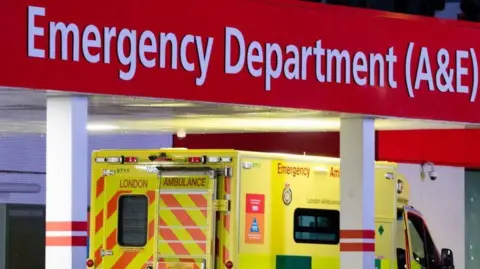 Getty Images