Reading view

There are new articles available, click to refresh the page.

Robert Rhodes plotted and killed his wife - years later, his child's evidence convicted him

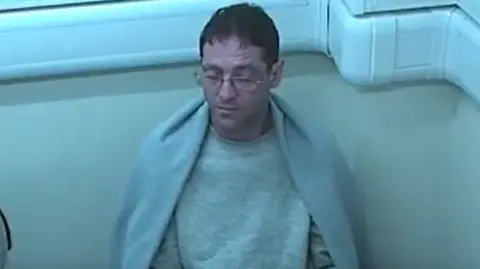
Surrey Police A man with a jumper draped over his shoulders.Surrey Police
Robert Rhodes, pictured in a police interview in 2016, orchestrated a plot to kill Dawn Rhodes and claim he did so in self-defence

On a bank holiday evening in 2016, Robert Rhodes turned to his child and said: "Do you want to get rid of Mum?"

Those words, the child recalled years later, were the start of a plot for Rhodes to kill his wife, Dawn, in their Surrey home and cover up her death as an act of defence - of himself and his child.

For years, Rhodes painted himself as a victim of an attack in the killing he planned and covered up.

Described as swift and protective, jurors heard accounts of a father who moved to protect his child from their knife-wielding mother, who lost her life in the skirmish that ensued.

'Web of lies'

But now, that account has fallen apart, revealed to be a web of lies created and maintained by Rhodes over more than nine years.

Instead, a new trial revealed a complex tale of abuse, control and a murder plot with the coercion of a child at its heart.

On 2 June 2016, the child, who cannot be named for legal reasons, went to their mother and said: "I drew a picture for you, close your eyes and hold out your hands."

Then, with the child leaving the room and locking themselves in the bathroom, Rhodes cut his wife's throat with a kitchen knife.

To cover up the killing, Rhodes once again turned to his child, telling them he "needed a favour".

The favour, the child told police in 2022, was to stab their father in the back of the shoulder, with the same knife used to kill Dawn, and then let him cut their arm.

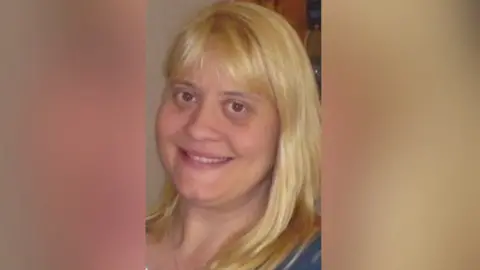
Surrey Police A picture of a woman with blonde hair.Surrey Police
Dawn Rhodes was killed in her kitchen in Wimborne Avenue, Earlswood, Surrey

"I didn't want to do any of it. I just felt guilty but I did what I was told," the child said during the police interview.

Despite the child crying and objecting at the time, Rhodes reportedly said: "We've done this now. There's no going back."

The child also told their therapist in 2021 that Rhodes had stabbed himself in the back of the head, causing himself another wound he would claim was caused by his wife.

As they were under 10 years old at the time of the murder, the child bears no criminal responsibility for aiding the attack.

Life insurance

The death of Dawn Rhodes followed the end of a marriage in turmoil, with the couple in the process of separating after revelations of infidelity.

The pair had known each other for more than 20 years, having met when Rhodes was 21 and Mrs Rhodes was 18, the court heard.

Having married in 2003, the couple lived in Epsom and across Surrey, before settling in Wimborne Avenue in Earlswood, near Redhill.

But on Christmas Eve in 2015, Robert Rhodes found out about an affair that Mrs Rhodes had been having with a co-worker.

From that point, Mrs Rhodes would claim to family members that Rhodes would self-harm in front of her and threaten to kill himself.

Internet searches made by Rhodes show him researching methods of suicide, as well as about life insurance.

He told the court: "I didn't see a future in our marriage."

Rhodes also admitted to creating a fake Facebook profile and contacting the wife of Mrs Rhodes' new partner to tell her about the affair.

Later, he would message his wife's partner: "Thank you for screwing my life and wife."

'Like the Hulk'

The child continued in their second set of police interviews: "There was a plan and we went through with it. I was told to lie and I did."

But shortly after the killing, the child originally told police how, after another argument between Rhodes and his wife, they had tried to intervene.

As part of the cover-up of their father's attack, the child said their mother picked up a knife and swung it at their arm, delivering the cut to their arm which was, in fact, administered by Rhodes.

The child described Dawn's "rage" and "anger" in a police interview in May 2017, before being told to run upstairs and "lock yourself in the bathroom".

In his own police interview, an emotional Rhodes told officers how he "grabbed the blade" of the knife and "held it as tight as I could".

Weaving his story together, he told officers: "I was scared, and it takes a lot to scare me.

"It's like one minute she [Dawn] is fine and the next minute she's like the Hulk," he added, referring to the comic book superhero.

Rhodes was previously acquitted of murder during a trial at the Old Bailey in May 2017.

'Snitches get stitches'

Despite the façade put up by the child, witnesses in the trial pointed to signs that the truth lay beneath.

In a conversation while together in a car, when asked about their scar from the incident, the child would tell one adult: "It was the sharp bit [of the knife], that's how dad did it."

The child would later allege that, while on supervised visits, their father would attempt to speak to them, telling them to "stick to the plan".

They would later suggest their father would message them on a phone he had secretly given them, again urging them to continue backing his version of events.

In an unrelated conversation years later, other witnesses revealed how they heard Rhodes tell the child: "Snitches get stitches."
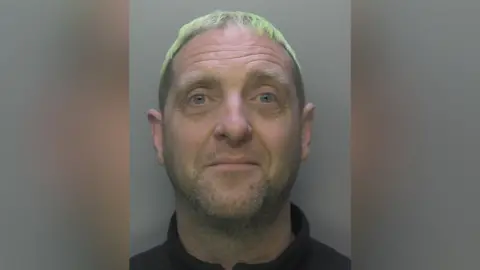
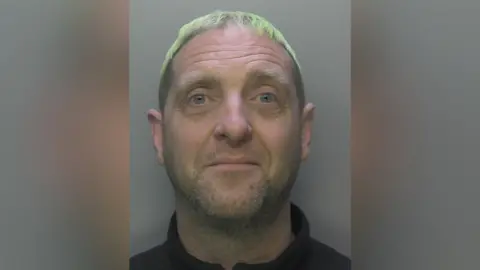
Surrey Police A mugshot of a man with short white hair.Surrey Police
Robert Rhodes, 52, coerced his child into helping to kill their mother, Dawn Rhodes, in 2016

Years passed, and the child continued at school and made new friends, while the truth of what happened continued to eat at them inside.

In November 2021, the child confided the truth in a close friend, who recalled: "I asked if they felt guilty, they said yes - like this guilt had been bothering them. They were distraught."

The following day, the child would then tell their therapist, who alerted police.

Double jeopardy

Following an appeal to the Court of Appeal in November 2024, Rhodes was retried under the double jeopardy rules.

It meant that, due to the compelling new evidence brought forward by the child, he could be reexamined for the crime he was acquitted of in 2017, as well as charges of child cruelty, perverting the course of justice and perjury.

At his new trial, Rhodes would often sit staring ahead, his eyes occasionally darting over to the 12 people hearing his case.

While the court listened to more gruesome details of the murder, Rhodes would hunch over and stare at the floor and, on one occasion when evidence was being read out, he sat shaking his head and mouthing "nope" out into the courtroom.

As jurors convicted him, he stood silently in the dock.

'Motherhood brought her joy'

Following the trial, Mrs Rhodes' family - mother Liz Spencer, sister Kirsty Spencer and brother Darren Spencer, paid tribute.

Her mother said: "Dawn was a loving daughter, sister and mother. Being a mother was what brought joy to Dawn.

"During her life, Dawn was looking for someone to build a life with. She was looking for someone to love and be loved by someone to trust and be trusted by and someone to respect and be respected by."

Kirsty added: "Dawn was my sister and I loved her dearly.

"I know my sister would want us to find freedom, a freedom that she was deprived of."

Her brother Darren added: "Dawn was a very capable woman, but unfortunately went through hell in the last few years of her life.

"The pressures on her at the time meant that she wasn't the Dawn we all knew, and the last few times we saw her before she was taken from us, she was at the end of her tether."

Rhodes will be sentenced at Inner London Crown Court on January 16.

Follow BBC Surrey on Facebook, on X, and on Instagram. Send your story ideas to southeasttoday@bbc.co.uk or WhatsApp us on 08081 002250.
Related internet links

Best-selling author Joanna Trollope dies aged 82

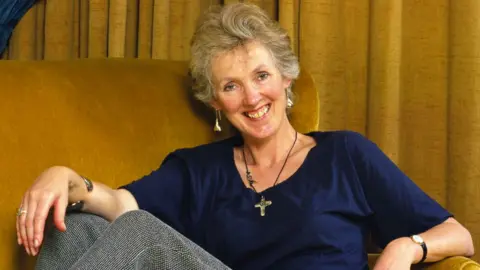
Getty Images Joanna Trollope, English novelist, portrait, Suzzara, Italy, 4th April 2007.Getty Images

Author Joanna Trollope has died aged 82, her family has announced.

The writer was affectionately known as the "queen of the Aga saga" because her novels often focused on romance and intrigue in middle England.

In a statement, her daughters Louise and Antonia said their "beloved and inspirational mother" had died "peacefully at her Oxfordshire home" on Thursday.

Trollope's novels include The Rector's Wife, Marrying The Mistress and Daughters in Law.

Trollope's literary agent James Gill said in a statement: It is with great sadness that we learn of the passing of Joanna Trollope, one of our most cherished, acclaimed and widely enjoyed novelists.

"Joanna will be mourned by her children, grandchildren, family, her countless friends and - of course - her readers."

This is a breaking news story, further updates to follow.

Getty Images Writer Joanna Trollope poses in London, England on June 10, 1993Getty Images

Reform claims to now have more members than Labour

EPA Nigel Farage gives a speech from behind a turquoise Reform UK podium at the party's annual conference in Birmingham in September.EPA

Reform UK claims it is now the largest political party in Britain, following reports Labour has lost more members.

According to the Times newspaper, internal figures show Labour's membership has fallen below 250,000.

Reform said it had more than 268,000 paid-up members, which would mean it has overtaken Labour to become the biggest party by membership in the UK.

Labour refused to comment on the accuracy of the membership figures in the Times, with a spokesperson saying they would be published in the party's annual report.

There is no legal obligation for political parties to publish their membership figures, which are not verified by outside bodies.

Reform tracks its membership figures using a live online counter, which the party said only included people who had paid an annual fee of £25 or £10 for under-25s.

Reform UK leader Nigel Farage said: "As we have suspected for some time, Reform has overtaken Labour to become the largest political party in British politics - a huge milestone on our journey to win the next election.

"The age of two-party politics is dead."

The party has consistently been leading in national opinion polls since the spring.

Labour's membership has been steadily falling since Sir Keir Starmer became leader in April 2020, according to the latest publicly available figures.

The party's annual accounts published in August put the party's membership at 333,235 at the end of last year, down from a peak of more than 530,000 under Jeremy Corbyn.

Despite the party's landslide election victory, it shed 37,000 members over the course of 2024 and reports suggest this trend has continued.

In February, the LabourList website reported the party's membership had fallen to around 309,000 and the Times says the figure has now dropped below 250,000.

A Labour Party spokesperson said: "Our membership figures are published in our annual report. We do not give a running a commentary on them throughout the year."

The party's standard membership fee is £70.50 a year, with reduced rates of £35.50 or £12 available for certain groups.

Meanwhile, the Green Party says it has seen a surge in membership since Zack Polanski took over as the party's new leader in September, rising from around 70,000 to more than 180,000.

The Conservatives do not routinely publish their membership figures.

Some 131,680 members were eligible to vote in last year's Tory leadership election but reports suggest the party's membership has fallen to around 123,000 since then.

The number of Liberal Democrat members has also dropped, almost having over the last five years to around 60,000.

Your Party - the new left-wing outfit founded by Jeremy Corbyn and Zarah Sultana - says it has 55,000 paid-up members.

Thin, red banner promoting the Politics Essential newsletter with text saying, “Top political analysis in your inbox every day”. There is also an image of the Houses of Parliament.

Sign up for our Politics Essential newsletter to keep up with the inner workings of Westminster and beyond.

Funeral directors guilty of neglecting bodies

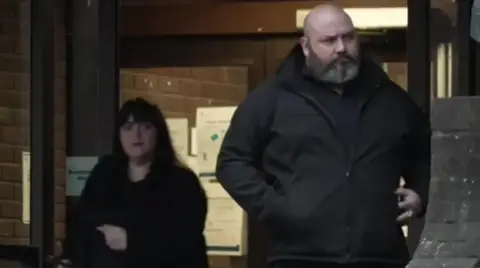
BBC A picture of Hayley Bell, on the left, and Richard Elkin, on the right, coming out of Portsmouth Crown Court. Hayley Bell is wearing a black coat and has long, dark hair. Richard Elkin is bald and has a white and grey beard. BBC
Hayley Bell and Richard Elkin were convicted at Portsmouth Crown Court

Two funeral directors who kept bodies in an unrefrigerated room for more than a month have been found guilty of preventing lawful burial.

Richard Elkin, 49, and Hayley Bell, 42, were also convicted at Portsmouth Crown Court of intentionally causing a public nuisance and fraud.

Prosecutors said 46 bodies were kept in the uncooled mortuary at Elkin and Bell Funerals in Gosport, Hampshire, in 2022 and 2023.

The pair will be sentenced on 19 February.

Warning: The following report contains distressing details and images

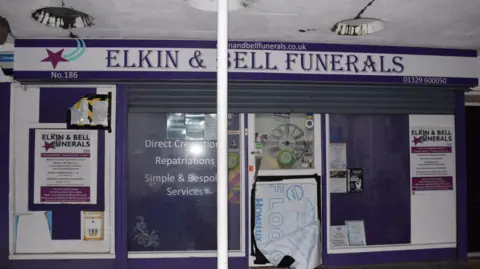
CPS The front of Elkin and Bell Funerals, with purple logos and letteringCPS
Elkin and Bell Funerals traded despite being insolvent, prosecutors said

Lesley Bates KC, prosecuting, previously said the bodies of two elderly men were found by court agents who were repossessing the premises because of debts including more than £13,000 in unpaid rent.

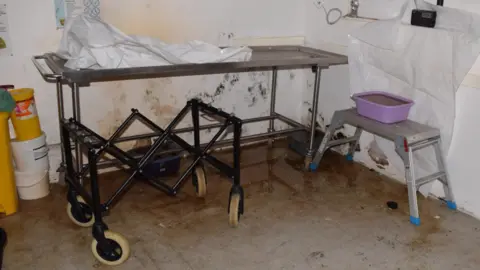
Ms Bates said: "Water was coming in through a leak in the roof of the mortuary room, it was running down the walls.

"The room was not refrigerated. The temperature within the mortuary room was no different to elsewhere in the premises."

Ms Bates said one body, of William Mitchell, 87, "showed obvious signs of decomposition" after remaining in the room for 36 days.

She said Mr Mitchell's family were "incredulous" when they learned his body had not been cremated.

CPS A trolley in a mortuary. There is mould on the walls and the floor appears to be shiny with fluid.CPS
Bodies were left for weeks in a leaky and uncooled mortuary, prosecutors said

Prosecutors said the firm continued to trade despite being insolvent and unable to meet its obligations.

Elkin was additionally convicted of making and using a false instrument by displaying a forged certificate from the National Association of Funeral Directors, they added.

Rachel Robertson from the Crown Prosecution Service (CPS) said the pair, of Nobes Avenue, "showed a grave disregard for the dignity owed to the deceased in their care and the trust placed in them by grieving families".

The CPS said the mortuary was left unrefrigerated between June 2022 and December 2023 and many of the bodies were left there for more than 30 days.

Assistant Chief Constable Paul Bartolomeo said: "Our officers turned over every stone to bring Elkin & Bell to justice using legislation that is hundreds of years old.

"Sadly we are aware of other similar cases across the country

"We need new legislation rather than relying on common law.  We also need better regulation.

"This can help ensure that all funeral directors act, as the majority do, with professionalism and compassion."

Nobel laureate Narges Mohammadi arrested in Iran, supporters say

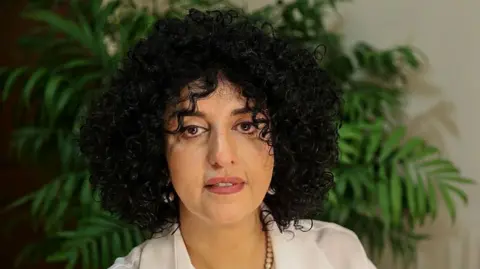
AFP via Getty Images Narges Mohammadi sits in her apartment in Tehran on January 23, 2025AFP via Getty Images

Iranian security forces have "violently arrested" Nobel Peace Prize winner and women's rights activist Narges Mohammadi, her foundation has said.

The Narges Foundation said her brother confirmed Ms Mohammadi was detained in the eastern city of Mashhad, along with other activists.

It has called for the immediate release of the 53-year-old and the activists detained alongside her. Iran does not appear to have commented.

Ms Mohammadi was awarded the 2023 Nobel Peace Prize for her activism against female oppression in Iran and promoting human rights.

In December 2024, she was given a temporary release from jail for three weeks on medical grounds, after being held in Tehran's notorious Evin prison since 2021.

She was expected to return to prison soon after, where she was serving multiple sentences.

Her latest arrest reportedly came as she attended a memorial ceremony for Khosrow Alikordi, a lawyer found dead in his office last week.

Norway-based group Iran Human Rights had called for an independent inquiry to establish how he died, saying the circumstances around his death were "suspicious".

Several other activists were detained at the ceremony, where it's reported they shouted slogans, including "death to the dictator" and "long live Iran".

Taghi Rahmani, Ms Mohammadi's husband, told BBC Persian: "They arrested Narges violently. The brother of the lawyer witnessed her arrest at the memorial.

"This act is against human rights laws, and amounts to some kind of revenge.

"This happened in Mashhad today and is concerning because the establishment's crackdown has intensified recently."

Ms Mohammadi had recently accused the Iranian authorities of intensifying repression since the June ceasefire with Israel.

Last week she wrote an article for Time magazine about the Iranian state controlling all aspects of personal or public life.

"Their peace is disrupted by surveillance, censorship, arbitrary arrest, torture, and the constant threat of violence," she said.

She had also told the Nobel Committee she had received warnings from "agents of the regime" through indirect channels and her lawyers.

"The threats conveyed to Ms Mohammadi make it clear that her security is at stake, unless she commits to end all public engagement within Iran, as well as any international advocacy or media appearances in support of democracy, human rights, and freedom of expression," the Nobel committee's statement added.

Over the past year, she has continued to remain defiant, refusing to wear the mandatory headscarf and meeting fellow activists across the country.

Across her lifetime, Mohammadi has been arrested 13 times and been sentenced to more 36 years imprisonment and 154 lashes, according to her foundation.

Stanley Baxter: Scottish comedian with a gift for sketches, mimicry and song

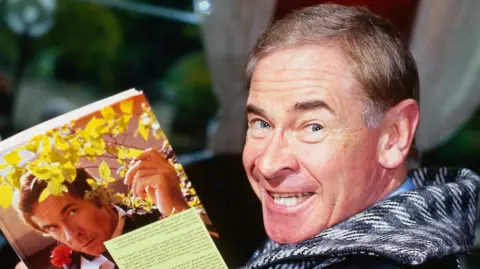
Mirrorpix via Getty Images A man smiles at the camera, looking back over his shoulder while holding a book with his photo on the coverMirrorpix via Getty Images

Stanley Baxter was for decades one of the biggest stars on British television.

His huge talent for comic sketches, mimicry and song was awarded with similarly huge budgets by grateful commissioners.

His lavish productions for ITV and the BBC brought in enormous audiences and were a staple of the schedules throughout the 1970s and 80s.

But times changed, and after twice being axed from his prime slots he retired from the medium which had made him a star.

His longevity - he has died at the age of 99 - was such that few under the age of 40 will remember who he was.

But for those who knew his work he was a much-loved reminder of a different age - when more than 20 million people would tune into a show and collectively understand and enjoy its references, jokes and songs.

He was born in 1926 in Glasgow and grew up in the city's west end.

His father, Fred, was a quiet insurance executive but the young Stanley inherited a love of all things theatrical from his mother, who encouraged his early attempts at impressions and songs.

A look back at the career of Stanley Baxter

Baxter's younger sister, Alice Dale, became an actor and writer based in Australia and it is clear Bessie was a big influence on both.

"I probably became an entertainer to please mother," he once said. "She was forthright, while father was a retiring man. I was more like him in nature but to please her I pushed myself forward."

She took him round church halls and family gatherings before he made his professional debut on the Scottish edition of the BBC's Children's Hour aged just 14.

The young performer from Glasgow was hooked but world events intervened.

During World War Two he was a "Bevin Boy", conscripted to work in the Lanarkshire coal mines.

He moved from there to National Service in Malaya, where he took to the stage with the Combined Services Entertainments Unit, putting on shows to boost troop morale.

It was during this period that he met Kenneth Williams.

He became a life-long friend of the future Carry On star, though Williams's published diaries reveal their relationship constantly veered between the confessional, supportive and rivalrous.

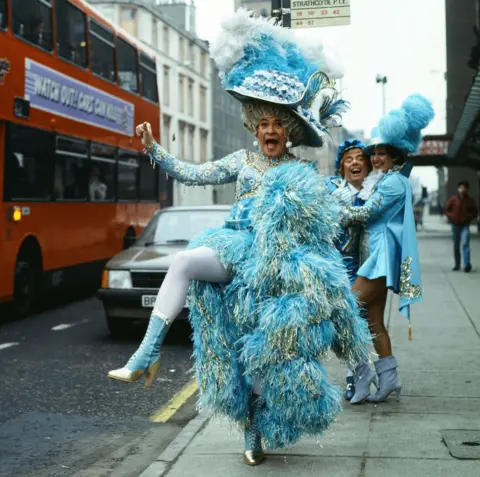
A man dressed up in a lavish blue costume dancing on the pavement with a bus in the background
In the 1970s and 1980s, Baxter's shows became flamboyant and expensive

Back in Glasgow in the late 1940s, Baxter worked at the Citizens Theatre as assistant stage manager, and appeared in Macbeth and in Tyrone Guthrie's 1948 Edinburgh Festival production of The Thrie Estaites.

But he really found his feet and fame in variety theatre.

Over the coming decade he appeared with Jimmy Logan, Rikki Fulton and Jack Milroy on stage at Glasgow's Alhambra Theatre and on the radio show It's All Yours. Early on in his career, Baxter also became a notable panto dame.

Inevitably, London called.

He was cast in On The Bright Side, a comedy sketch show where he first performed what would become one of his most popular sketches.

'Parliamo Glasgow' was a spoof language programme where, instead of teaching Italian, Baxter's earnest presenter tutors the rest of the world in the language of his home city.

Altering words and adding the odd slang term, a typical example was: "Zarra marra onna barra, Clara?"

Baxter would say the phrase in a thick Glasgow accent before providing the translation:

"Is that a marrow on your barrow, Clara?"

That Baxter could pull this off without causing offence or appearing to patronise his Scottish roots for a wider audience was a testament to his brilliance as a performer.

The 1960s saw his TV career bloom.

The Stanley Baxter Show was a huge success on the BBC in 1963 and ran for eight years.

There were films too, such as The Fast Lady and Crooks Anonymous. But cinema comedies, with their need for proper stories and well-rounded, believable characters, never really suited Baxter's talents.

He was best at broader caricatures, impressions and sketch comedy and as his reputation and audiences grew, so did his ambition and control over his programmes.

Getty Images Stanley Baxter dressed as a nun smiling at camera. He has a huge wimple on.Getty Images
Baxter delighted in dressing up and drag was a regular feature of his act
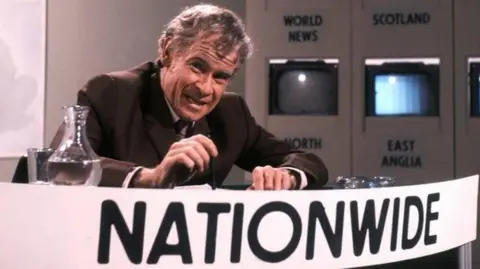
Baxter pretending to be a Nationwide presenter for a sketch. He is sitting at a desk with a huge sign that says Nationwide in front of him.
Baxter's programmes sometimes contained parodies of the television of the time

He moved to London Weekend Television (LWT) in 1973 with the Stanley Baxter Picture Show. In this series and the Moving Picture Show that followed, his speciality was parodying film and television favourites.

Baxter played most of the parts, bolstered by a riot of colour, fabulous sets, costuming and sharp scripts. He was an exacting performer who insisted on high production values.

That meant relatively few episodes were made, though they won multiple Baftas for Baxter. His portrayal of the Queen (always billed as The Duchess of Brendagh) was perhaps his most lauded impression.

After nine years of specials, he moved to a weekly slot with The Stanley Baxter Series in 1981, although a greater number of programmes per year did not equate to a drop in production values.

And while the high cost of his work was undoubtedly a factor in his subsequent sacking from LWT, his friend Kenneth Williams made a good point in a diary entry in 1981.

He wrote: "We watched the Stanley Baxter show on ITV and again I was struck by Stanley's obsession with the past; it was all about old films, film directors, film stories re-jigged, film personalities (Jimmy Durante etc.) & so was fine for the middle-aged but had nothing for the young."

The show was cancelled and he returned to the BBC with Stanley Baxter's Christmas Hamper in 1985 and Stanley Baxter's Picture Annual the following year.

Getty Images Baxter as Mr Majeika.  He is wearing a checked suit and huge glasses and is looking into camera.Getty Images
His final TV role was as the magician Mr Majeika
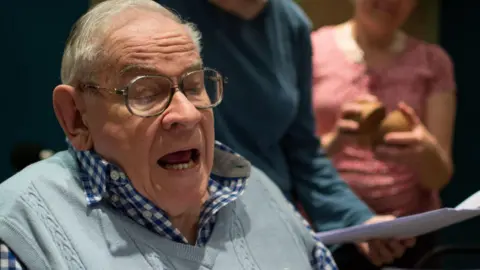
Alamy Baxter reading from a script in the foreground while actors watch from behind. He is seated, wearing a blue jumperAlamy
Fifty years on, he returned to BBC radio for a series of programmes

The big budgets and long production schedules were still a part of his process but times had changed and he was followed to the BBC by the man he blamed for his sacking from LWT - John Birt.

According to Baxter it was Birt who once again ended his contract.

He appeared in the children's show Mr Majeika before retiring from television in 1990, gracing the stage in Scotland as a panto dame for a few more years before finally hanging up his wig.

There were occasional specials for BBC Radio 4 and he appeared in a Christmas show on ITV in 2008, in which he introduced archive of his work and performed with guests who had been influenced by him.

Despite his ability to make people laugh, he always considered himself a character actor rather than a comedian.

Off-screen and stage he was something of a reluctant celebrity, giving few interviews and declining to appear on chat shows.

In 1993, he took legal action to ensure nothing about his private life would be revealed by the publication of his late friend Kenneth Williams's diaries.

Baxter had helped Scottish journalist Brian Beacom write a book about his life. He had intended that it would be published posthumously but appeared to change his mind in 2020.

Getty Images Stanley and Moira Baxter outside court in 1962. This is a news photo in black and white and he has his arm around her.Getty Images
Moira stood by her husband when he was arrested in a public lavatory in 1962

The Real Stanley Baxter described his long struggle with his sexuality. At the age of 94, he confirmed that he had always been gay but had initially hidden the truth to avoid arrest in the years before decriminalisation.

In fact, he had been arrested in 1962 and contemplated suicide rather than see his career in ruins. The charges were subsequently dropped.

He insisted that Moira - his wife of more than 45 years - had been fully aware of the situation. She had even given her blessing to Baxter bringing boyfriends home.

The couple married in 1951 but by the 1970s were living apart. They never divorced and lunched together almost daily.

Moira died in 1997 and Baxter's long-term partner, Marcus, died in 2016.

Baxter never came to terms with his sexuality. He told Brian Beacom: "I never wanted to be gay and I still don't. The truth is, I don't really want to be me."

And he once spoke of his feelings about fame and the work of the actor, telling a journalist:

"All this rubbish about the man behind the mask. I've had it again and again and again. The mask is what's important."

Russia hits back at Europe's plan to loan Ukraine €90bn of Moscow's frozen assets

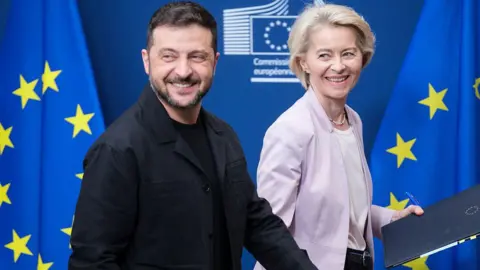
Thierry Monasse/Getty Images President of Ukraine Volodymyr Zelenskyy (L) and the EU Commission President Ursula von der Leyen (R) walk in front of blue and yellow-starred European Union flagsThierry Monasse/Getty Images
Ukraine's president says it is right for Russia's frozen assets to be used to rebuild his country

Ukraine is running out of cash to keep its military and its economy going, after almost four years of Russia's full-scale war.

For Europe, the solution to plugging Kyiv's budget hole of €135.7bn (£119bn; $159bn) for the next two years lies in frozen Russian assets sitting in Belgian bank Euroclear and EU leaders hope to sign that off at their Brussels summit next week.

Russian officials warn the EU plan would be an act of theft and Russia's central bank announced on Friday it was suing Euroclear in a Moscow court even before a final decision is made.

'Only fair' to use Russia's assets

In total, Russia has about €210bn of its assets frozen in the EU, and €185bn of that is held by Euroclear.

The EU and Ukraine argue that money should be used to rebuild what Russia has destroyed: Brussels calls it a "reparations loan" and has come up with a plan to prop up Ukraine's economy to the tune of €90bn.

"It's only fair that Russia's frozen assets should be used to rebuild what Russia has destroyed – and that money then becomes ours," says Ukraine's Volodymyr Zelensky.

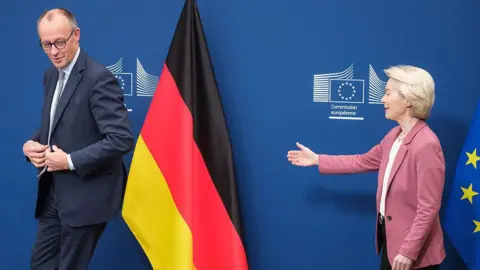
German Chancellor Friedrich Merz says the assets will "enable Ukraine to protect itself effectively against future Russian attacks".

Russia's court action was expected in Brussels. But it is not just Moscow that is unhappy.

Belgium is worried it will be saddled with an enormous bill if it all goes wrong and Euroclear chief executive Valérie Urbain says using it could "destabilise the international financial system".

Euroclear also has an estimated €16-17bn immobilised in Russia.

Belgian Prime Minister Bart de Wever has set the EU a series of "rational, reasonable, and justified conditions" before he will accept the reparations plan, and he has refused to rule out legal action if it "poses significant risks" for his country.

What is the EU's plan?

Thierry Monasse/Getty Images German Chancellor Friedrich Merz (L) is welcomed by the President of the European Commission, Ursula von der Leyen (R)Thierry Monasse/Getty Images
The German chancellor (L) says the EU's plan will enable Ukraine to defend itself

The EU is working to the wire ahead of next Thursday's summit to come up with a solution that Belgium can accept.

Until now the EU has held off touching the assets themselves directly but since last year has paid the "windfall profits" from them to Ukraine. In 2024 that was €3.7bn. Legally using the interest is seen as safe as Russia is under sanction and the proceeds are not Russian sovereign property.

But international military aid for Ukraine has slipped dramatically in 2025, and Europe has struggled to make up the shortfall left by the US decision to all but stop funding Ukraine under President Donald Trump.

There are currently two EU proposals aimed at providing Ukraine with €90bn, to cover two-thirds of its funding needs.

One is to raise the money on capital markets, backed by the EU budget as a guarantee. This is Belgium's preferred option but it requires a unanimous vote by EU leaders and that would be difficult when Hungary and Slovakia object to funding Ukraine's military.

That leaves loaning Ukraine cash from the Russian assets, which were originally held in securities but have now largely matured into cash. That money is Euroclear property held in the European Central Bank.

The EU's executive, the European Commission, accepts Belgium has legitimate concerns and says it is confident it has dealt with them.

The plan is for Belgium to be protected with a guarantee covering all the €210bn of Russian assets in the EU.

Should Euroclear suffer a loss of its own assets in Russia, a Commission source explained that would be offset from assets belonging to Russia's own clearing house which are in the EU.

If Russia went after Belgium itself, any ruling by a Russian court would not be recognised in the EU.

In a key development, EU ambassadors are expected to agree on Friday to immobilise Russia's central bank assets held in Europe indefinitely.

Until now they have had to vote unanimously every six months to renew the freeze, which could have meant a repeated risk to Belgium.

The EU ambassadors are set to use an emergency clause under Article 122 of the EU Treaties so the assets remain frozen as long as an "immediate threat to the economic interests of the union" continues.

Why Belgium is not yet satisfied

Belgium is adamant it remains a staunch ally of Ukraine, but sees legal risks in the plan and fears being left to handle the repercussions if things go wrong.

A usually divided political landscape in this case has rallied behind Prime Minister Bart de Wever, who is under pressure from European colleagues and having talks with UK Prime Minister Sir Keir Starmer in London on Friday.

"Belgium is a small economy. Belgian GDP is about €565bn – imagine if it would need to shoulder a €185bn bill," says Veerle Colaert, professor of financial law at KU Leuven University.

While the EU might be able to secure sufficient guarantees for the loan itself, Belgium fears an added risk of being exposed to extra damages or penalties.

Prof Colaert also believes the requirement for Euroclear to grant a loan to the EU would violate EU banking regulations.

"Banks need to comply with capital and liquidity requirements and shouldn't put all their eggs in one basket. Now the EU is telling Euroclear to do just that.

"Why do we have these bank rules? It's because we want banks to be stable. And if things go wrong it would fall to Belgium to bail out Euroclear. That's another reason why it's so important for Belgium to secure water-tight guarantees for Euroclear."

Europe under pressure from every direction

There is no time to lose, warn seven EU member states including those closest to Russia such as the Baltics, Finland and Poland. They believe the frozen assets plan is "the most financially feasible and politically realistic solution".

"It's a matter of destiny for us," warns leading German conservative MP Norbert Röttgen. "If we fail, I don't know what we'll do afterwards. That's why we have to succeed in a week's time".

While Russia is adamant its money should not be touched, there are added concerns among European figures that the US may want to use Russia's frozen billions differently, as part of its own peace plan.

Zelensky has said Ukraine is working with Europe and the US on a reconstruction fund, but he is also aware the US has been talking to Russia about future co-operation.

An early draft of the US peace plan referred to $100bn of Russia's frozen assets being used by the US for reconstruction, with the US taking 50% of the profits and Europe adding another $100bn. The remaining assets would then be used in some kind of US-Russia joint investment project.

An EU source said the added advantage of Friday's expected vote to immobilise Russia's assets indefinitely made it harder for anyone to take the money away. Implicit is that the US would then have to win over a majority of EU member states to vote for a plan that would financially cost them an enormous sum.

Joanna Trollope, best-selling author of romance and intrigue novels, dies aged 82

Getty Images Joanna Trollope, English novelist, portrait, Suzzara, Italy, 4th April 2007.Getty Images

Author Joanna Trollope has died aged 82, her family has announced.

The writer was affectionately known as the "queen of the Aga saga" because her novels often focused on romance and intrigue in middle England.

In a statement, her daughters Louise and Antonia said their "beloved and inspirational mother" had died "peacefully at her Oxfordshire home" on Thursday.

Trollope's novels include The Rector's Wife, Marrying The Mistress and Daughters in Law.

Trollope's literary agent James Gill said in a statement: It is with great sadness that we learn of the passing of Joanna Trollope, one of our most cherished, acclaimed and widely enjoyed novelists.

"Joanna will be mourned by her children, grandchildren, family, her countless friends and - of course - her readers."

This is a breaking news story, further updates to follow.

Getty Images Writer Joanna Trollope poses in London, England on June 10, 1993Getty Images

Fans' group urges FA to lobby Fifa over 'scandalous' World Cup ticket prices

FA urged to press Fifa over World Cup ticket prices

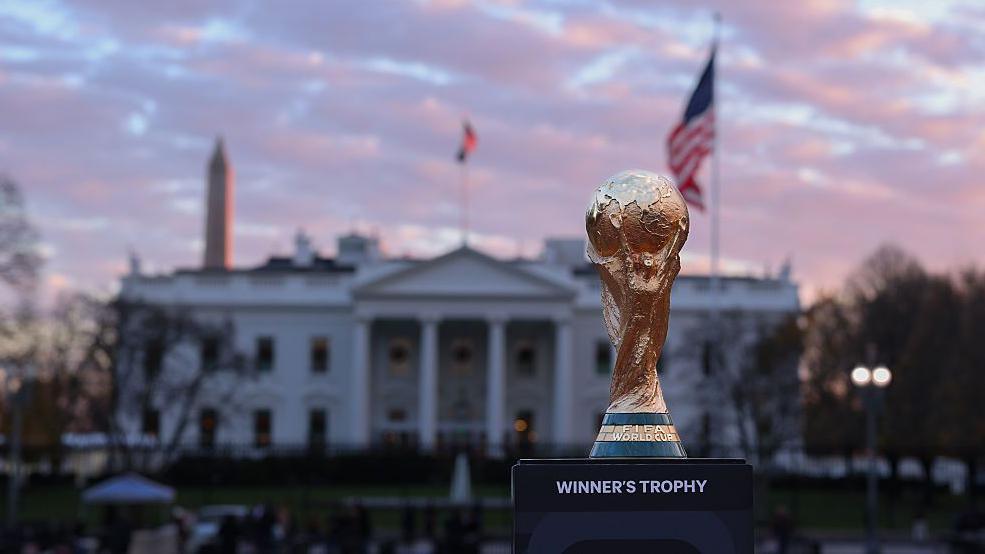
The World Cup trophy in Washington D.C.Image source, Getty Images
Image caption,

The cost of tickets to the World Cup final in 2026 will be seven times higher than in Qatar

  • Published

The Football Association has been asked to lobby Fifa to lower the price of World Cup tickets by a leading supporters' group.

The Football Supporters' Association (FSA) says the pricing structure for next year's tournament in the United States, Canada and Mexico is "scandalous".

It has joined Football Supporters Europe (FSE) in demanding that the sales process is stopped so fans' groups can hold talks with world governing body Fifa over its pricing policy.

"We back Football Supporters Europe in calling for a halt in ticket sales and we are calling on the Football Association to work with fellow FAs to directly challenge these disgraceful prices," the FSA said in a statement.

"We call on all national associations to stand up for your supporters, without whom there would be no professional game."

BBC Sport has contacted Fifa, the FA and the Scottish FA but they are yet to comment.

The huge increase in the price of tickets was revealed on Thursday when Fifa released allocation details for the official supporters' groups of each country.

At the 2022 World Cup in Qatar, group stage fixtures all had set prices of £68.50, £164.50 or £219.

But for England v Croatia and Scotland v Brazil next year, tickets cost around £198, £373 or £523.

The cost ramps up considerably in the latter stages.

Quarter-finals for all teams are £507, £757 and £1,073, with the semi-finals £686, £1,819 and £2,363.

The cheapest tickets for the final are £3,119, seven times more expensive than in Qatar.

There are no concessions across any of its tickets for children or other groups.

Ticket prices a 'laughable insult' to supporters

The cheapest tickets are in the 'supporter value' category, which the FSA called "a laughable insult to your average fan".

The FSA added that supporters felt they had been "stabbed in the back" and that the loyal fans will now likely be missing in the US, Mexico and Canada because the matches will be "unaffordable" to most.

"This is a tournament that is supposed to be celebrated by the world, where fans of all nations come together for the love of football," the FSA said. "Fifa has decided to make it all about the money and the elite who can afford it.

"For Fifa, loyalty is not the hard-working fan travelling thousands of miles in support of their team at qualifiers around the continent. A game that should be for all is now only for those who can afford it.

"Who needs to follow England away for disappointment when Fifa can deliver that six months before a ball is kicked? The life has been sucked out of this tournament before it starts."

It will cost about £5,225 for a supporter to follow their team through to the final if they were to attend all eight matches in the cheapest ticket category.

That rises to about £8,850 in the mid-price range, or £12,357 for the top tier.

In 2022, it would have cost £1,466, £2,645 or £3,914, though that was for seven games rather than eight.

FSE demands talks over 'extortionate' ticket prices

Donald Trump and Gianni InfantinoImage source, Getty Images
Image caption,

Each household can request up to four tickets per match and a maximum of 40 across the tournament

FSE has called on Fifa to stop the ticket sale process, believing it needs to rethink the pricing policy.

"In the price tables gradually and confidentially released by Fifa, tickets allocated to national associations...are reaching astronomical levels," it said in a statement.

"Adding insult to injury, the lowest price category will not be available to the most dedicated supporters through their national associations [because] Fifa chose to reserve the scarce number of category four tickets to the general sales, subject to dynamic ticket pricing.

"For the first time in World Cup history, no consistent price will be offered across all group stage games. Instead, Fifa is introducing a variable pricing policy dependent on vague criteria such as the perceived attractiveness of the fixture.

"Fans of different national teams will therefore have to pay different prices for the same category at the same stage of the tournament, without any transparency on the pricing structure enforced by Fifa."

The Football Supporters' Association's England Fans' Embassy said: "These prices are a slap in the face to supporters who support their team outside of the flagship tournament that appears every four years.

"A game for supporters, loyalty has been thrown out of the window and supporters of the participating nations have been completely let down."

Sudan militia fighter linked by BBC Verify to massacre sanctioned in UK

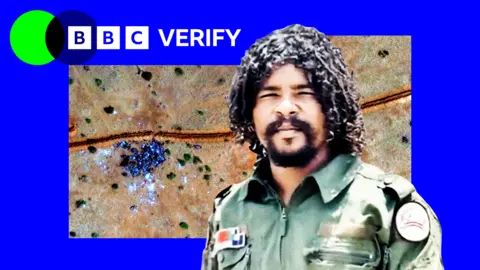
BBC Abu Lulu imposed over a scene from the massacre near el-Fasher. BBC

A Sudanese paramilitary commander, whose role in the el-Fasher massacre was revealed by BBC Verify, has been sanctioned by the UK government.

Brig Gen Al-Fateh Abdullah Idris, also known as Abu Lulu, was filmed shooting dead at least 10 unarmed captives after the Rapid Support Forces (RSF) seized the city in late October.

Thousands of people are believed to have been killed by the RSF after the army withdrew from el-Fasher. UK Foreign Secretary Yvette Cooper said the atrocities taking place in Sudan were "a scar on the conscience of the world" which "cannot, and will not, go unpunished."

The UK has also sanctioned three other RSF commanders, including deputy head Abdul Rahim Hamdan Dagalo.

Dagalo, who was also placed under EU sanctions in November, was shown in verified footage touring an army base in the city in the hours after el-Fasher fell. He is the brother of RSF chief Mohamed "Hemedti" Dagalo.

Sudan's civil war - sparked after the RSF and the military's fragile ruling coalition collapsed - has now raged for more than two years, killing hundreds of thousands of people and displacing millions more.

El-Fasher was the army's last major stronghold in Darfur, the traditional stronghold of the RSF paramilitary.

An investigation by BBC Verify revealed the brutal tactics used by the RSF during the protracted siege, which included detaining and torturing people trying to smuggle supplies into the city and building a massive sand barrier around it to prevent civilians and army troops from escaping.

In its statement announcing the sanctions, the UK foreign office said it believed that Abu Lulu was "responsible for violence against individuals based on ethnicity and religion, and the deliberate targeting of civilians".

Footage confirmed by BBC Verify in October showed Abu Lulu executing several unarmed captives with an AK-style rifle in a sandy, dusty area north-west of the city. RSF troops who witnessed the incidents were later seen celebrating their commander's actions.

A map showing the location of el-Fasher.

UK officials accused Abu Lulu, Dagalo, Gedo Hamdan Ahmed and Tijani Ibrahim Moussa Mohamed of carrying out "heinous" acts of violence, including mass killings, systematic sexual violence and deliberate attacks on civilians. The men have been placed under travel bans and any assets they hold will be frozen.

"Today's sanctions against RSF commanders strike directly at those with blood on their hands, while our strengthened aid package will deliver lifesaving support to those suffering," Cooper said.

Citing satellite images - previously published by Yale University's Humanitarian Research Lab - the foreign office said piles of bodies and mass graves could be seen in el-Fasher after the massacre.

Cooper also pledged an additional £21m to provide food, shelter and health services for civilians impacted by fighting in remote areas.

A satellite image showing a cluster of objects in el-Fasher. Analysts believe they show bodies.

In the days that followed the el-Fasher massacre, RSF leader Gen Mohamed "Hemedti" Dagalo admitted that his troops had committed "violations" and said the incidents would be investigated.

Among those arrested was Abu Lulu. In a carefully choreographed and edited video posted on the RSF's official Telegram account he is shown being led into a cell at a prison, which was geolocated by BBC Verify to the outskirts of el-Fasher.

The commander, who previously featured heavily in propaganda videos posted online, has not been seen since his arrest. A TikTok account that documented his activities was removed by the company in October after BBC Verify approached the tech giant for comment.

The UK's move comes just two days after the US announced its own set of sanctions against a network of companies and individuals it accused of recruiting former Colombian soldiers and training individuals to fight in Sudan's civil war.

The US Treasury Department said that hundreds of Colombian mercenaries have travelled to Sudan since 2024, including to serve as infantry and drone pilots for the RSF.

Last month, US President Donald Trump pledged to "start working on Sudan" alongside Egypt, Saudi Arabia and the UAE, posting on social media that "tremendous atrocities" were taking place.

The BBC Verify banner

Five charts that show how flu outbreak is different this winter

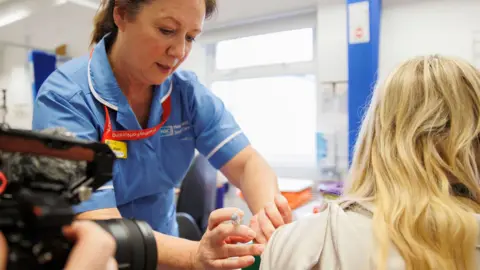
PA Media A healthcare worker administers a flu jab to another person in a healthcare environment at Ulster hospital in Belfast on 4 December.PA Media
The NHS has urged those eligible to get vaccinated against flu to help limit the severity of symptoms

The NHS says it's facing its "worst-case scenario" after the number of people in hospital with flu jumped by 55% in a week.

NHS England chief executive Sir Jim Mackey has warned that between 5,000 and 8,000 hospital beds could be filled with flu patients by the weekend.

Health experts at the King's Fund think tank have said talk of an "unrelenting flu wave" has become worrying familiar over recent years.

How then is winter 2025 really any different and which patients have been affected most by what the NHS is now describing as "super flu"?

An earlier start for flu

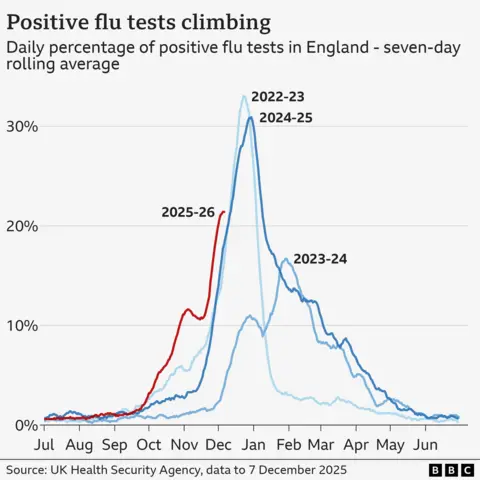
A chart showing the percentage of daily positive tests for flu from July to June each year from 2023-4 onwards. The graph for 2025-26 shows a sharp rise over the past few months up to around 20% of cases. That is still below the 30%+ of cases which were positive in previous years.

The major difference between 2025's flu season and the previous three years is that the virus started spreading around a month earlier.

The first sign of this was in October in data published by the UK Health Security Agency (UKHSA).

When someone goes to their GP or hospital with flu-like symptoms they can be tested for a number of viruses including influenza, Covid and RSV.

UKHSA records the percentage of those tests that come back positive for flu, which can then give a strong indication that rates in the community are either rising or falling.

Virologists have linked the earlier flu season this year to a subtle shift in the genetic makeup of the main flu virus that is circulating - called H3N2.

So-called 'super-flu' is not a medical term and it does not mean the virus is more severe or harder to treat.

But the general public has not encountered this exact version of flu before, which means there may be less immunity built up in society, allowing it to spread more easily.

Children and young people most affected

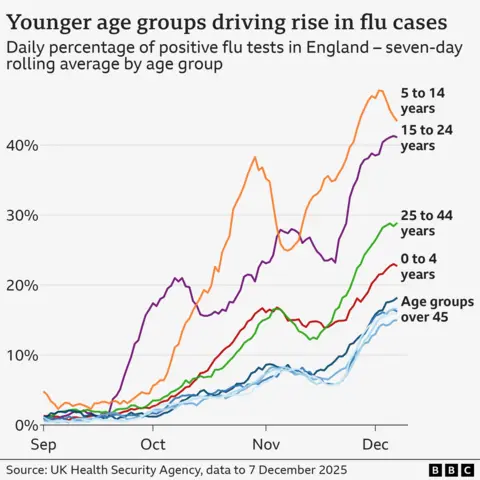
A line graph showing a rise in positive flu cases since September by age group. It shows the groups recording the highest percentage positive tests are the 5-14 year old group, followed by the 15-24 age group. Older age groups over 45 years old have a much power percentage of positive cases.

Children tend to be more susceptible to flu than older adults, partly because their immune systems are still developing and because they tend to spread viruses more quickly through close contact.

The latest breakdown of UKHSA data shows that the proportion of positive tests is currently much higher in children and young people still at school or university.

Some schools have had to bring back Covid-like measures to prevent the spread of the virus, such as cutting back on singing in assemblies and introducing sanitisation stations, while one site in Caerphilly had to close temporarily.

Each year thousands of otherwise healthy children end up in A&E with complications after catching influenza.

But there is another concern: that younger people will go home and then spread the disease to elderly relatives who tend to be more vulnerable.

Flu adds to winter pressure

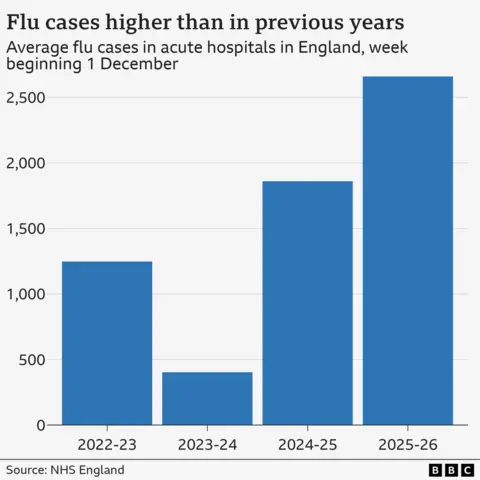
A bar graph showing the number of people in a hospital bed with flu in the week starting 1 December for each year from 2022/3 onwards. It shows a big increase for that week in 2025/26 to around 2,500 beds from around 1900 beds in 2024/25.

The NHS records the number of patients in hospital each week with influenza and other types of respiratory illness.

The number has been rising sharply in England with an average of 2,660 flu patients taking up a hospital bed last week, up from 1,717 in the previous week.

Those over 85-years-old are five times more likely to be hospitalised than the general population.

But the patients being admitted now would have been infected with the virus a week or so ago when infection rates were lower.

The greater concern for the health service is what happens over the coming weeks as new cases appear in A&E.

The NHS has roughly 105,000 available hospital beds in England and tends to "run hot" over the winter with 95% of those taken up at any one time.

If the number of flu patients needing overnight treatment jumps to 5,000 or higher, as Sir Jim Mackey predicts, then it could put the whole hospital system under more pressure.

What about vaccine protection?

The message coming from doctors and the NHS is for people in vulnerable groups to continue to come forward for a flu vaccine.

Even though the genetic make-up of the virus has shifted this winter, the main jab is still thought to offer effective protection, particularly against severe disease.

The flu vaccine is free on the NHS for those over 65-years-old, young children, pregnant women, those with certain health conditions, carers, and front line health and social care workers.

People in other groups can get the same vaccine for between £15 and £25 from high street pharmacists.

As of 30 November, just over 40% of people in an at-risk group had taken up the offer of a free flu jab this year.

Flu vaccination rates among NHS workers in England, which have fallen back since the Covid pandemic, appear to have stabilised this year at about the same level - around 42%.

Disguises, freezing waves, and a special forces veteran: Inside mission to sneak Nobel winner out of Venezuela

Watch: María Corina Machado on her ' very dangerous' escape from Venezuela

The rescue operation to get Venezuelan opposition leader and Nobel laureate María Corina Machado out of Venezuela involved disguises, two boats through choppy seas and a flight, the man who says he led it told the BBC.

Dubbed Operation Golden Dynamite, the dangerous journey was cold, wet and long - but the "formidable" Machado didn't complain once, said Bryan Stern, a US special forces veteran and founder of the Grey Bull Rescue Foundation.

"The seas are very rough. It's pitch black. We're using flashlights to communicate. This is very scary, lots of things can go wrong."

Despite the risks, they didn't. Machado arrived safely in Oslo, Norway to collect her Nobel Peace Prize just before midnight on Wednesday.

Machado had been living in hiding in her own country since Venezuela's widely disputed elections last year, and hadn't been seen in public since January. Her grown-up children, who she hadn't seen in two years, were in Oslo to greet her.

Grey Bull specialises in rescue missions and evacuations, especially from conflict and disaster zones. A representative from Machado's team confirmed to CBS News, the BBC's US media partner, that the organisation was behind her rescue operation.

Mr Stern said that Grey Bull had been building up a presence in the Caribbean, including inside Venezuela and the neighbouring island of Aruba, for months to get ready for potential operations in Venezuela.

"We've been building infrastructure on the ground in Venezuela designed to get Americans, allies and Brits and other people out should the war in Venezuela start," he told the BBC.

Speculation has been mounting over possible US military action against Venezuela, after US President Donald Trump called on President Maduro to leave office, accusing him of sending narcotics and murderers to the US.

Mr Stern said the challenge in this case was getting somebody out who is as well-known as María Corina Machado - a household name in Venezuela for the opposition.

None of the infrastructure his firm had built up in the country, he said, was "designed for the second most popular person in the damn country with a target on her back."

Grey Bull Rescue/Handout Bryan Stern holding a small child in a flooded area in Tampa, Florida during Hurricane Milton in 2024. Water is up to his knees and cars can be seen submerged in the background.Grey Bull Rescue/Handout
Bryan Stern's Grey Bull Rescue held missions during Hurricanes Helene and Milton in the US (he is pictured here in Tampa, 2024)

When he was first put in contact with Machado's team, they did not initially disclose her identity, but Mr Stern said he was able to guess.

When they got in touch with him in early December, though a contact who knew Machado's team, it was apparently the second attempt to get her out of Venezuela, after an initial plan "didn't go well," Mr Stern said.

The operation was dubbed "Golden Dynamite" because "Nobel invented dynamite" and Machado was trying to get to Oslo to accept the Nobel Peace Prize award.

Matters moved quickly. Mr Stern said he spoke with the team on a Friday, they deployed on the Sunday, and by Tuesday, their mission was complete.

His team had explored various possibilities to get Machado out of the country, and settled on a plan that involved a tumultuous sea journey.

To protect his future work in Venezuela, Mr Stern can only reveal so much about the trip.

By land, they moved Machado from a house where she was in hiding, to a pick-up spot for a small boat, which took her off the coast to a slightly bigger boat where she met up with him.

The voyage was in "very rough seas" with waves of up to 10ft (3m) in "pitch-black darkness," he said.

"The journey was not fun. It was cold, it was very wet, we were all soaked, the waves were very rough, and we used that to our advantage. We got her to land and to where her plane was, and she flew to Norway."

Amanda Pedersen Giske/NTB via Reuters A red and white plane where Machado can be seen at the last window, with a graphic red circle superimposed around itAmanda Pedersen Giske/NTB via Reuters
Machado was finally pictured landing in Oslo in the early hours of Thursday

Throughout the journey, he added that various steps were taken to mask and disguise Machado's face, as well as her digital profile because she is so well-known.

"The biometric threat is so real," he noted, adding steps were taken to make sure she could not be traced via her phone.

He said that Machado was "formidable" despite the conditions, accepting a jumper for warmth, but not asking for anything else.

"She was soaking wet and freezing cold and didn't complain once," he laughed, acknowledging the operation was very dangerous because water is "unforgiving".

"If I am driving a boat and blow an engine, I'm swimming to Venezuela."

When asked how he could guarantee the safety of Venezuelans who helped with the operation, Mr Stern said they kept their identities secret and "we [Grey Bull] do a lot of deception operations".

Many of those who helped didn't even realise they were working for him, Mr Stern said, while others think they "know the whole story", but they really don't.

"There are people who did things that were benign from their perspective - but mission-critical from our perspective."

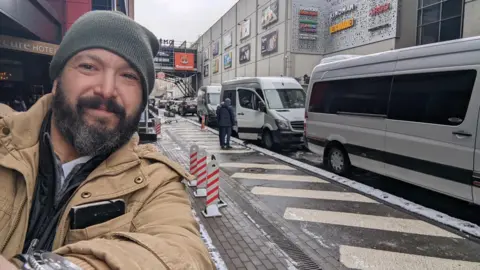
Grey Bull Rescue/Handout Bryan Stern, a man with a brown and grey beard wearing a khaki wool hat and tan-coloured jacket, takes a selfie in front of three vans and a shopping centreGrey Bull Rescue/Handout
Grey Bull Rescue have carried out a number of international missions - including in Ukraine. (Pictured in 2022)

He said the operation was financed by donors, and not by the US government: "We've never had a thank-you note from the US government, let alone a dollar."

Mr Stern said he did coordinate with some nation states, and with intelligence and diplomatic services of several countries. This included alerting the US in an "informal" manner.

Machado has said she intends to return to Venezuela, but Mr Stern said he advised her not to do that.

"I told her, 'don't go back. You're a Mum. We need you.' She's going to do what she's going to do... I understand why she wants to go back because she's a hero to her people.

"I wish she wouldn't go back; I have a feeling she will."

Watch: BBC speaks to Nobel Peace Prize winner María Corina Machado

What's happening with the assisted dying bill?

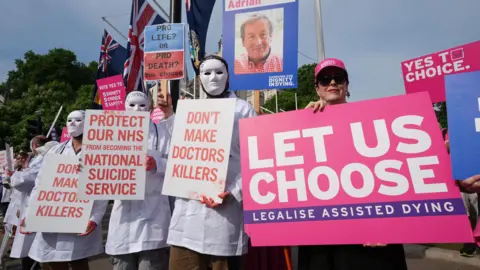
PA Media Campaigners from both sides of the debate protest outside Parliament in June 2025, while MPs debate the bill in the House of Commons. One woman holds a pink placard reading: "Let us choose. Legalise assisted dying". Three people wearing white masks and medical gowns holds placards reading: "Don't make doctors killers" and "Protect our NHS from becoming the national suicide service". PA Media

It was more than a year ago that MPs first gave their backing to proposed legislation which would introduce assisted dying in England and Wales, in an historic House of Commons vote.

In its current form, the Terminally Ill Adults (End of Life) Bill would allow people over the age of 18, who are expected to die within six months, to be given help to end their own life, subject to certain safeguards.

But the legislation continues to generate huge controversy, with passionate arguments for and against.

The House of Lords is on its fourth of 14 days allocated for detailed scrutiny of the bill and it's still some way off becoming law.

So what is causing the hold-up? And is there a chance that it might never come into force?

What's happened so far

The bill was introduced to Parliament by Labour MP Kim Leadbeater back in October 2024.

It is known as a private member's bill because it was put forward by a backbench MP rather than the government.

MPs spent many days debating the draft legislation in the House of Commons and first voted in favour of the principle of the bill in November last year, by a majority of 55.

A smaller committee of MPs from both sides of the debate then spent months considering more than 500 proposed changes.

Further debate and votes on amendments followed in the Commons before MPs voted by a majority of 23 in June for the bill to progress to the House of Lords.

Peers are now carrying out line-by-line scrutiny of the legislation and proposing their own changes.

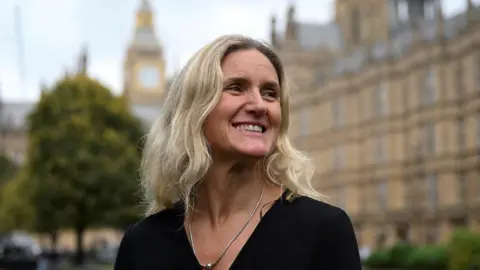
Reuters Labour MP Kim Leadbeater smiles standing outside Parliament.Reuters
Kim Leadbeater is the MP behind the bill

What needs to happen before the bill can become law?

The bill can only become law if both Houses of Parliament agree on its final wording.

This must happen before next spring, when the current session of Parliament is expected to end.

Are Lords trying to block the bill?

Members of the House of Lords have proposed more than 1,000 changes to the bill - known as amendments - which experts believe is a record number for a bill proposed by a backbench MP.

Supporters of assisted dying have raised concerns that the number of amendments, as well as the slow progress debating them, is a delaying tactic by opponents aimed at blocking the bill from becoming law.

They argue it would be undemocratic for unelected peers to frustrate a bill which has already been approved by elected MPs.

Leadbeater, the MP behind the bill, told the BBC she welcomes scrutiny by the Lords but claimed many of these amendments are unnecessary and even "cruel".

She pointed to examples such as proposals that someone seeking an assisted death should not have left the country within the last 12 months and that any assisted death should be filmed.

Opponents insist they are not obstructing the bill but say significant changes are needed to make it safe and ensure vulnerable people are protected.

Independent crossbench peer and former Paralympian Baroness Tanni Grey-Thompson told the BBC the bill was "badly written" and had significant gaps, with many of the amendments aimed at preventing coercion.

She pointed out MPs had also put forward large numbers of amendments and peers were simply doing their job by scrutinising the legislation.

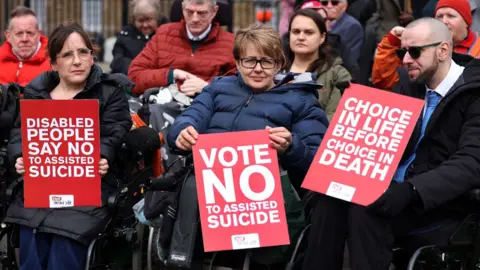
EPA Baroness Tanni Grey-Thompson holds a red placard reading: "Vote no to assisted suicide". She is in a wheelchair and wearing glasses with a blue coat. Two other campaigners are alongside her, holding placards reading "Disabled people say no to assisted suicide" and "Choice in life before choice in death". EPA
Baroness Tanni Grey-Thompson (centre) has campaigned against assisted dying

What is the government's position?

Before he became prime minister, Sir Keir Starmer had publicly supported the idea of assisted dying and during last year's general election campaign he said he would provide parliamentary time for a vote if a backbench MP proposed changing the law.

However, the government has said it is neutral on the bill and it is being treated by parties as a matter of conscience, meaning they will not instruct their MPs or peers how to vote.

Ministers have ruled out using time set aside for debating government legislation.

But the government's chief whip in the Lords has given peers an extra 10 Friday sessions to debate it. Fridays are traditionally used for non-government business.

Could the bill fail?

Despite the additional days allocated, there is still a real risk the bill could run out time to become law.

There is a possibility even more time could be granted - but if the bill is not passed by both Houses by the end of the current session of Parliament in spring, it will fall.

Unlike government bills, those put forward by backbench MPs cannot be carried over into the next session.

This means any bill to introduce assisted dying would have to start the parliamentary process again from scratch.

Some MPs in favour of assisted dying have raised using the Parliament Act - a rarely-used piece of legislation invoked when MPs and peers cannot agree - as a potential option to allow the bill to be carried over.

However, experts say this would be unprecedented for a private member's bill and challenging to implement.

The Parliament Act was last used in 2004 to push through a ban on fox hunting.

By convention, the House of Lords does not block bills which were included in a government's election manifesto from becoming law but this would not apply in this case.

Given MPs have already backed the bill, it would still be controversial for unelected peers to obstruct its passage - but not impossible.

Thin, red banner promoting the Politics Essential newsletter with text saying, “Top political analysis in your inbox every day”. There is also an image of the Houses of Parliament.

Sign up for our Politics Essential newsletter to keep up with the inner workings of Westminster and beyond.

'Double whammy' of flu and strikes a risk to patients, Streeting says

Getty Images A&E departmentGetty Images

The number of patients in hospital in England with influenza has risen by more than 50% in the past week, with NHS bosses warning there is no sign of "super flu" peaking yet.

In the week up to Sunday there were 2,660 flu cases a day on average in hospital – and NHS England said the numbers had continued rising this week.

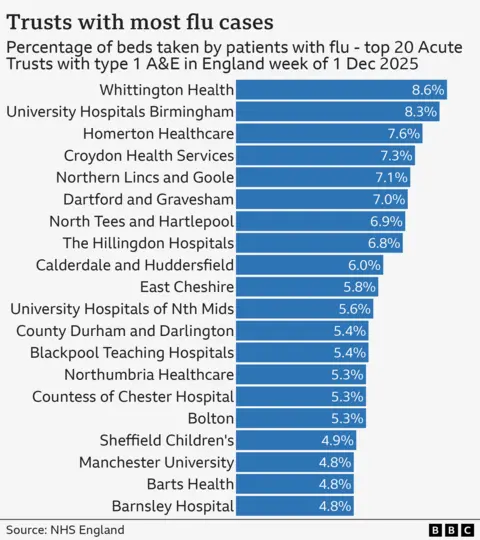
NHS England said it was the equivalent of having three hospitals full of flu patients, with some reporting nearly one in 10 beds occupied by patients with the virus.

Officials said the numbers had continued rising this week with fears it may top 5,000 by the weekend. Increases are also being reported in other parts of the UK.

Super flu circulating

NHS England medical director Prof Meghana Pandit said: "This unprecedented wave of super flu is leaving the NHS facing a worst-case scenario for this time of year – with staff being pushed to the limit to keep providing the best possible care for patients."

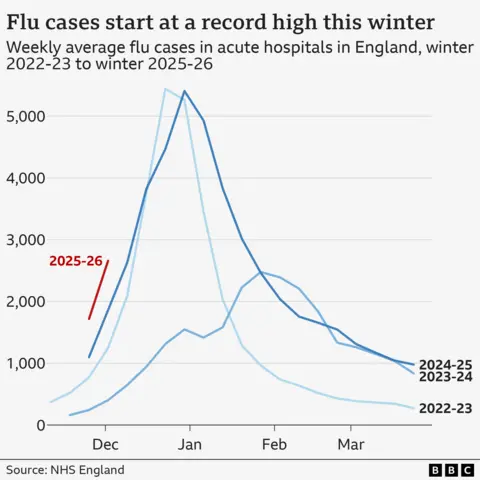
The numbers in hospital with flu is at its highest level at this time of year since records began - although they only date back to 2021 and so do not capture the two worst flu seasons of the past 15 years which were seen in 2014-15 and 2017-18.

Chart showing flu rates in hospital

Flu rates began rising a month earlier than normal this year driven by a mutated strain of the virus. The dominant strain is H3N2, but it has some genetic changes this year.

It means the general public has not encountered this exact version of flu before, which means there is maybe less immunity.

NHS England said the number of patients in hospital with the vomiting bug norovirus was also on the rise, with more than 350 beds occupied by people with that virus.

Chart showing hospitals with most flu cases

It comes ahead of a strike by resident doctors, the new name for junior doctors, which is due to start next week.

There are hopes it may be called off after a fresh offer from Health Secretary Wes Streeting prompted the British Medical Association to agree to poll their members to see if they were willing to call off the five-day walkout that is due to begin on Wednesday. The results of that poll will be be announced on Monday.

Daniel Elkeles, of NHS Providers, which represents hospitals, said: "The NHS is in the thick of a storm come early. Flu is hitting hard and other winter bugs are surging.

"Now more than ever, the NHS needs all hands on deck.

"We have to hope that BMA resident doctors will step back from next week's strike, take up the government's sensible offer and end their damaging dispute."

Buckling system

Data from the UK Health Security Agency (UKHSA), which takes into account levels of infection in the community as well as hospitals, shows infection rates are continuing to rise, but not as sharply as they were in the previous week.

But officials stressed it was too early to take that as a sign that flu could be peaking.

They said the virus was unpredictable and a lull could be followed by another surge.

Dr Conall Watson, an infectious diseases expert at the UKHSA, urged people who are eligible for a free flu vaccine on the NHS, which includes the over 65s, those with certain health conditions and pregnant women, to still come forward if they had not yet got one.

"There is still plenty of flu vaccine available to protect those who need it – what's running out is time to be protected ahead of Christmas.

"If you are eligible this is the last chance to get protected as we head into Christmas – so make an appointment with the NHS today."

It can take up to two weeks following vaccination to develop the fullest protection from the jab, Dr Watson added.

Dr Vicky Price, president of the Society for Acute Medicine, said winter viruses were placing further strain on an "already buckling system".

She said patients were facing long waits in A&E as hospital staff were being overloaded with patients.

But she accused NHS England and the government of using it as a "convenient scapegoat" for the "predictable breakdown" in NHS capacity caused by workforce shortages.

"The situation in emergency departments has become so dire that what was once considered a critical incident is now seen as normal and routine. What is happening is not an isolated emergency, but the culmination of systemic failure."

Author Joanna Trollope dies aged 82

Getty Images Joanna Trollope, English novelist, portrait, Suzzara, Italy, 4th April 2007.Getty Images

Author Joanna Trollope has died aged 82, her family has announced.

The writer was affectionately known as the "queen of the Aga saga" because her novels often focused on romance and intrigue in middle England.

In a statement, her daughters Louise and Antonia said their "beloved and inspirational mother" had died "peacefully at her Oxfordshire home" on Thursday.

Trollope's novels include The Rector's Wife, Marrying The Mistress and Daughters in Law.

Trollope's literary agent James Gill said in a statement: It is with great sadness that we learn of the passing of Joanna Trollope, one of our most cherished, acclaimed and widely enjoyed novelists.

"Joanna will be mourned by her children, grandchildren, family, her countless friends and - of course - her readers."

This is a breaking news story, further updates to follow.

Getty Images Writer Joanna Trollope poses in London, England on June 10, 1993Getty Images

Taylor Swift shown in tears over meeting Southport attack families

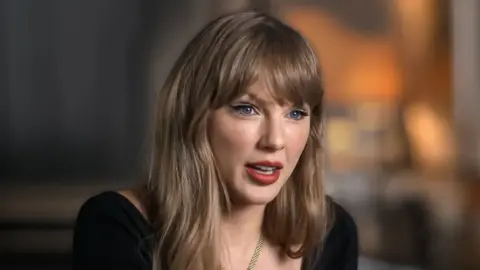
Disney Taylor Swift speaks in a still image from her Disney+ documentary, The End of an EraDisney
Taylor Swift said she felt compelled to protect fans after the Southport tragedy

Taylor Swift broke down in tears after meeting survivors and families of the victims of the Southport stabbing attack, backstage footage from her Eras tour reveals.

The star met privately with some of those affected by the attack in July 2024, which took place at a Taylor Swift-themed dance workshop, and claimed the lives of three young girls.

She then had to pick herself up and perform for three and a half hours at London's Wembley Stadium.

Speaking to select members of the media, including the BBC, at the New York premiere of her new six-part Disney+ documentary, Swift revealed she had felt compelled to "create some form of escape" for her fans.

"From a mental standpoint, I do live in a reality that's unreal a lot of the time," the star says in the first episode. "But I need to be able to handle all the feelings and then perk up and perform."

Adding to the emotional burden, the Wembley show also marked Swift's return to the stage after cancelling three concerts in Vienna, Austria, due to a terrorist threat.

In her own words, the tour narrowly "dodged a massacre situation" when the CIA identified a plot to explode a bomb at the concert.

Swift said that, after performing for 20 years, "being afraid that something is going to happen to your fans is new".

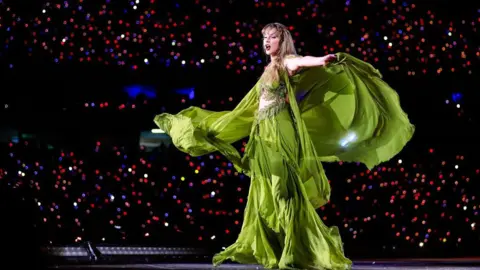
Getty Images Taylor Swift in a flowing green dress during her Eras Tour on stageGetty Images
Taylor Swift's Eras Tour lasted nearly two years, with 149 shows spanning five continents

Thankfully, the rest of the tour proceeded without incident, and the documentary shows her relief after playing Wembley. On a phone call afterwards to her fiance, Travis Kelce, the star says: "I was so happy - I thought I was going to forget how to play guitar and sing."

The insights are shared in the six-part series, titled The End of an Era, which debuts on Disney this weekend, alongside a concert film, shot on the final night of the star's record-breaking tour, which ended a year ago.

Before taking her seat at the New York City screening, which was also attended by her mother, Andrea, Swift said the tour had been "a lifetime within my life".

"Everything that went into this was all of the lessons that we've learned [throughout] all of our lives."

From the first moment the docuseries played, there was no doubt that one of those lessons was that joy can be palpable, if you let it.

Here are five others:

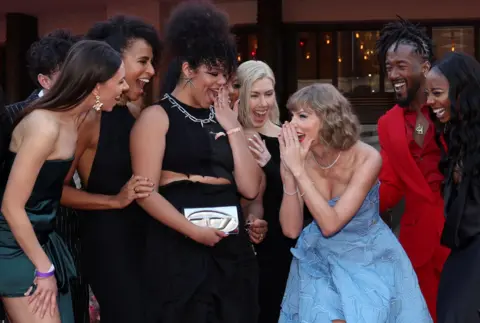
Disney Taylor Swift poses with the crew and dancers from her Eras tourDisney
Swift was reunited with her touring crew at a private screening in New York this week

1) The magic is no accident

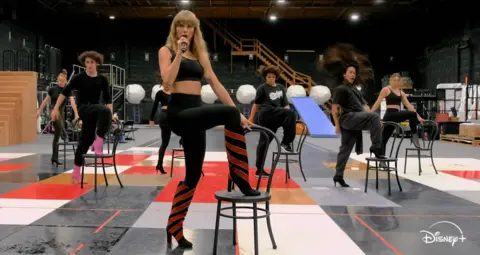
Disney Taylor Swift practices in a rehearsal studio with her dancersDisney
The documentary exposes the exhausting process of putting together a tour of this scale

Episode one drives home the amount of work it takes to make art appear effortless.

Viewers are taken behind the scenes of the exhaustive planning, choreograhy, rehearsals, set building, and collaboration it takes to put on a show of such magnitude.

Swift says the goal of the Eras tour was to "over-serve" in terms of the number of songs performed, the extravagance of the costuming, and the details of each set design.

"Every person is the best one in the entire industry," she says. Their job is to make all the effort "look accidental."

That said, speaking to the audience in New York, Swift confessed there was also "some kind of magic, destiny, and stuff we can't explain… when something goes as well as this [tour] did".

2) It's not all fun and games

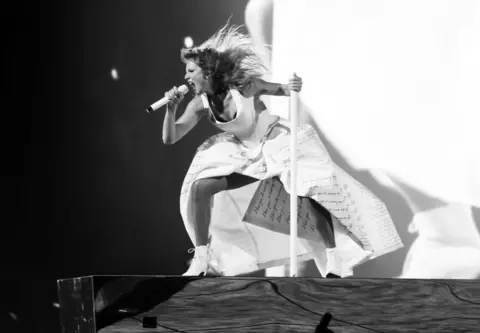
Getty Images Taylor Swift on stageGetty Images
The star performed for three and a half hours every night

While everyone on the tour is clearly working at maximum capacity, there's only one person at the front of it all - and what's the old cliche... with great power comes great responsibility?

The series examines Swift's existence as a larger-than-life pop star and, more specifically, the emotional toll of putting on a happy face to perform, night after night after night.

During Swift's introduction, she explained she was "obsessed" with perfecting the art of entertaining a huge audience, by making "the world go away for a little while".

At one point, she even compares herself to a "pilot flying a plane", needing to project an air of steady confidence in order to distract the passengers from focusing on any potential dangers that may be lurking unseen.

3) 'Woodstock without the drugs'

Getty Images Taylor Swift fans watch the Eras tourGetty Images
More than 10 million tickets were sold for the tour, with box office receipts exceeding $2 billion

Like it or not, Swifties are a global force. More than 10 million people across five continents danced, laughed, and cried their way through three and a half hours of each sold-out Eras Tour show.

The noise of the crowd is overwhelming from a cinema seat, even after it's piped down and sound mixed for a documentary. One can only imagine what it's like from the stage.

"I see the mass quantities of joy that everyone's feeling," Swift says. An audience member even compares the atmosphere to "Woodstock without the drugs".

Fans aren't just obsessed with the music. They hear themselves in her lyrics and see themselves in her public persona, as she navigates love, heartbreak, illness, treachery and finding your place in the world. She's a best friend, or an older sister, or a combination of the two.

So when Swift takes a phone call in the documentary and says, "Baby", the whole theatre erupts - knowing through pop culture osmosis exactly who is on the other end of the line.

4) Community matters

Getty Images Taylor Swift holds hands with her backing singers during a performance on her Eras tourGetty Images
The bond that formed between the performers is a key takeaway from the documentary's first two episodes

Throughout the series, friendship bracelets are traded, strangers become fast friends, crew members form family bonds, and surprise guests punctuate intimate backstage moments.

Watching the opening episodes in New York, the Eras Tour performers were equally energetic - laughing boisterously at on-screen jokes, marking the choreography through aggressive chair dancing, and cheering for each other as they rotated into scenes and through plot lines.

Swift is both comfortable and content to let this diverse cast "pull focus" and steal scenes, both on and off the stage.

During one particularly moving segment, dancer Kameron Saunders - one of the tour's breakout stars - talks about his struggle to get hired because of his size and look.

Later, when his mum attends the tour, he tells her how much her love and support meant as he waited for his opportunity.

As those scenes played in New York, Swift affectionately turned to Saunders and yelled, "YES!" as he giggled and covered his face in feigned shyness.

It's easy to feel how life-changing the tour was for everyone involved.

5) We're happy, free, confused and lonely at the same time

Reuters Taylor Swift with her crew at the premiere of the Eras tour movie in 2023Reuters
Emotions ran high throughout the world tour

As any Swiftie who has endlessly shout-sung the bridge to their favorite break-up can tell you, there is no shortage of weeping in the Taylor-verse.

Truly, there is So. Much. Crying.

The docuseries is no exception. It even opens with Swift shedding some heartfelt tears during the first tour rehearsal.

So, why all the big feelings? The simplest answer is that they're a rite of passage.

Putting the show together, Swift says she was "thinking of all the girls I was before this one," while re-recording her albums and "surgically tweaking" songs to make them fit the show.

It would seem the tears are a manifestation of feeling fully seen through her lyrics - of not feeling like you're being "too much," or "too dramatic," or "too sensitive," or as Swift broadly puts it - and having the freedom to express femininity with no shame.

As you watch, it becomes clear that these record-breaking shows were intended as a place safe to explore a wide spectrum of emotions and, in that, they truly succeeded.

Germany accuses Russia of 2024 cyber-attack and disinformation

BBC 'Breaking' graphicBBC

Germany has accused Russia of a cyber-attack on air traffic control and attempted electoral interference, and summoned the Russian ambassador.

A foreign ministry spokesman said Russian military intelligence was behind a "cyber-attack against German air traffic control in August 2024".

The spokesman also accused Russia of seeking to influence and destabilise the country's federal election in February this year.

The spokesman said that Germany, in close co-ordination with its European partners, would respond with counter-measures to make Russia "pay a price for its hybrid actions".

There was no immediate response from Russia.

This breaking news story is being updated and more details will be published shortly. Please refresh the page for the fullest version.

You can receive Breaking News on a smartphone or tablet via the BBC News App. You can also follow @BBCBreaking on X to get the latest alerts.

Trump signs order to block US states from enforcing own AI rules

EPA/Bloomberg via Getty Images Senator Ted Cruz, a Republican from Texas, from left, US President Donald Trump, and Howard Lutnick, US commerce secretary, in the Oval Office of the White House in Washington, DC, US, on Thursday, Dec. 11, 2025.EPA/Bloomberg via Getty Images
President Trump signed the order in the Oval Office, surrounded by some of his top advisers
Lily JamaliNorth America technology correspondent

US President Donald Trump has signed an executive order aimed at blocking states from enforcing their own artificial intelligence (AI) regulations.

"We want to have one central source of approval," Trump told reporters in the Oval Office on Thursday.

It will give the Trump administration tools to push back on the most "onerous" state rules, said White House AI adviser David Sacks. The government will not oppose AI regulations around children's safety, he added.

The move marks a win for technology giants who have called for US-wide AI legislation as it could have a major impact on America's goal of leading the fast-developing industry.

AI company bosses have argued that state-level regulations could slow innovation and hinder the US in its race against China to dominate the industry, with firms pouring billions of dollars into the technology.

The BBC has contacted AI firms OpenAI, Google, Meta, and Anthropic for comment.

But the announcement has been met with opposition.

The state of California, which is the home to many of the world's biggest technology companies, already has its own AI regulations.

"President Trump is attempting to limit the ability of states - red states and blue states alike - to implement common sense protections for our residents," the office of California's Attorney General Rob Bonta said in a statement.

Earlier this year, California's Governor Gavin Newsom signed a bill requiring the largest AI developers to lay out plans to limit risks stemming from their AI models.

States including Colorado and New York have also passed laws regulating the development of the technology.

Newsom has said the law sets a standard that US lawmakers could follow.

Other critics of Trump's executive order argue that state laws are necessary in the absence of meaningful guardrails at the federal level.

"Stripping states from enacting their own AI safeguards undermines states' basic rights to establish sufficient guardrails to protect their residents," said Julie Scelfo, from advocacy group Mothers Against Media Addiction in a statement.

Adult content creator Bonnie Blue to be deported from Bali

EPA British adult content creator Tia Billinger, known as Bonnie Blue, arrives at Bali's immigration office for questioning in Badung, Bali, Indonesia, on 10 December 2025.EPA
Tia Billinger, better known as Bonnie Blue, will be deported for an immigration violation

Adult content creator Tia Billinger, better known as Bonnie Blue, will be deported from Indonesia after being cleared of breaking the country's strict anti-pornography laws.

She was found guilty of a minor traffic offence, but was deported for an immigration violation due to working on a tourist visa.

The 26-year-old was one of 34 people detained when police raided a production studio in Bali, prompting a police investigation.

Bali - which is predominantly Hindu and visited by millions of tourists every year - is part of Muslim-majority Indonesia, which strictly forbids the production of pornographic material.

Those found guilty of violating these laws face up to 12 years in prison and a fine of around $360,000 (£270,000).

Ms Billinger was ordered to pay a fine of Rp 200,000 (about $12/£9) and will leave Indonesia on a flight set to depart just after midnight local time.

Immigration officials said they would issue a statement on whether their request to blacklist the social media star, preventing her from re-entering the country, had been put into effect.

Earlier this week, Badung Police reported that 16 foreign and 14 Indonesian witnesses said they had been in a studio in the Pererenan area, Mengwi, to take part in the production of an "entertainment-themed reality show", but they claimed "no indecent material was produced".

Ms Billinger was among four other individuals who were identified as having "dominant roles" in the production.

Badung police also said investigators looked into the purchase of a pickup truck which had "Bonnie Blue" and "Bang Bus" branded on it.

Police said the four individuals confirmed they were aware of Indonesia's ban on producing pornographic content.

Investigators also looked at videos recorded at a hotel in the Berawa area of the country, but "found no elements of pornography or any unlawful distribution".

However, the four foreign nationals are suspected of "misusing their stay permits" to work on commercial content.

Badung police chief M Arif Batubara said they are ensuring "all processes are carried out based on legal facts" and are working with prosecutors and immigration authorities to "determine the next legal steps".

Ms Billinger is known to film controversial videos which have seen her tour universities looking for "barely legal" teenagers in a bus with the same name.

The content creator, originally from Nottingham, had been driving around Bali during 'schoolies week', which is a tradition in Australia where high school graduates go on a holiday after their exams.

Last year, she had planned to produce 'schoolies' porn, but her Australian tourist visa was cancelled.

A footer logo for BBC Newsbeat. It has the BBC logo and the word Newsbeat in white over a colorful background of violet, purple and orange shapes. At the bottom a black square reading "Listen on Sounds" is visible.

Listen to Newsbeat live at 12:45 and 17:45 weekdays - or listen back here.

Man previously cleared of killing wife convicted after child gives new evidence

Surrey Police A picture of a woman with blonde hair.Surrey Police
Robert Rhodes, 52, has been convicted of murdering his wife, Dawn Rhodes, in a trial at Inner London Crown Court

A man has been found guilty of murdering his wife following a retrial under double jeopardy rules, eight years after being cleared.

Robert Rhodes stabbed his wife Dawn in the neck and was acquitted of murder in 2017 after claiming she had tried to attack him.

The retrial came after new evidence from Rhodes' child – disclosed during therapy – revealed how he coerced them into helping with a plan to kill his wife and injure himself to make it look like self-defence.

Rhodes, 52, who denied ever planning to kill his wife, was also found guilty of child cruelty, perverting the course of justice, and two counts of perjury and will be sentenced in the new year.

Rhodes was found guilty after 22 hours of deliberations in what Judge Mrs Justice Naomi Ellenbogen called a "difficult and upsetting case".

The new trial at Inner London Crown Court heard how, days before the attack, Rhodes asked the child, who cannot be named for legal reasons, to go to Mrs Rhodes and say they had drawn a picture for her.

Mrs Rhodes was then told to "close your eyes and hold out your hands", at which point the child left the room.

Rhodes then stabbed his wife in the neck and killed her in their kitchen at their home near Redhill in Surrey, on 2 June 2016.

Surrey Police A mugshot of a man with short white hair.Surrey Police
Robert Rhodes, 52, was arrested again in 2024

During the original trial, Rhodes, now living in Withleigh in Devon, claimed he had killed his wife in self-defence.

He said she "flipped like the hulk" during an argument at the home in Wimborne Avenue in Earlswood.

Paying tribute to their daughter and sister, Mrs Rhodes' mother Liz Spencer and sister Kirsty Spencer said: "We grieved for Dawn in the shadows with the support of only a few who saw through his [Rhodes'] deceit.

"She was everything to us and he is nothing, she will be celebrated and he will be forgotten."

'Groomed and manipulated'

Later, Rhodes asked the child to stab him in the back of the shoulder before cutting the child himself on the arm.

In police interviews, the pair claimed Mrs Rhodes had swung a knife at the child and attacked her husband.

Rhodes claimed he fatally injured his wife while defending himself in the fight that ensued.

The child was under 10-years-old at the time, and therefore bears no criminal responsibility for the attack.

They revealed the truth of the attacks to their therapist in 2021, who reported this to the police.

Surrey Police Det Ch Insp Kimbal Edy, told BBC South East: "Dawn's character was essentially dragged through the mud.

"Dawn Rhodes was a victim of murder and the child is a victim who was groomed and manipulated to do the things they have told us that they did.

"He has shown a high level of malevolence, manipulation, and I would go so far as to say evil."

'Immense bravery'

Double jeopardy rules allow for cases where a person has already been acquitted to be re-tried in exceptional circumstances where new and compelling evidence has come to light.

Libby Clark, of the Crown Prosecution Service (CPS), said: "The new evidence that came from the child witness was profoundly shocking and showed just how much careful planning Robert Rhodes had put into murdering his wife.

"It is thanks to the immense bravery of the child in coming forward to explain exactly what happened that night that Robert Rhodes has finally been brought to justice for the murder of Dawn, something he mistakenly thought he could get away with.

"None of us can even begin to imagine what Rhodes has put the child through over a period of many years.

"Now though, as a result of their evidence, Dawn can now be remembered by everyone in the right way – as a victim of her violent partner."

Follow BBC Surrey on Facebook, on X, and on Instagram. Send your story ideas to southeasttoday@bbc.co.uk or WhatsApp us on 08081 002250.
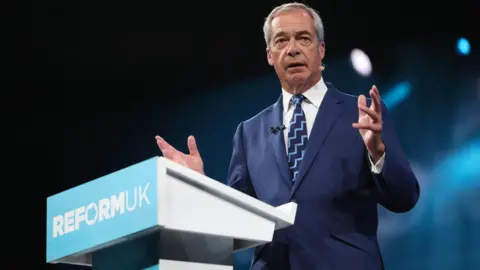
Related internet links

Venue apologises after alleged antisemitic imagery shown at Primal Scream gig

BBC Bobby Gillespie has shoulder length dark hair and wears a colourful jacket of blue, white, yellow and pink. He sings into a microphone.BBC
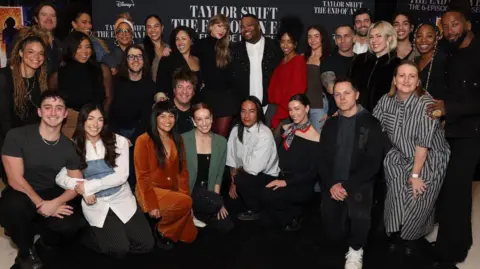
Primal Scream lead singer Bobby Gillespie pictured performing at Glastonbury in 2022

The Roundhouse music venue has apologised to fans after alleged antisemitic imagery was shown on stage during a Primal Scream concert in north London.

Managers of the venue in Camden said they "deeply regret" that the "highly offensive" graphics were displayed, adding that it was done entirely without their knowledge.

The rock band from Glasgow was reported to the police by the Community Security Trust (CST) after a video was screened on stage on Monday evening that appeared to show the Star of David entwined with a swastika.

Primal Scream and the Metropolitan Police have been approached for comment.

'Against our values'

As the group performed their 2000 song Swastika Eyes during the one-off gig, pictures of political figures played in the backdrop.

An image of Israeli Prime Minister Benjamin Netanyahu appeared to show the Star of David combined with a swastika in his eyes.

In a statement, a spokesperson for Roundhouse said they were "appalled" by the display.

"We deeply regret that these highly offensive images were presented on our stage and unequivocally apologise to anyone who attended the gig, and to the wider Jewish community.

"The content, which was used entirely without our knowledge, stands against all of our values."

The spokesperson went on to say the Roundhouse "condemns antisemitism in every form".

"Acts of hatred, discrimination or prejudice of any kind are entirely unacceptable and have no place in our community or spaces.

"We stand in solidarity with the Jewish community and remain committed to ensuring that our spaces are places where everyone feels secure, respected and valued."

Getty Images An external image of the Roundhouse. A cylindrical building with a glass extension.Getty Images
The Roundhouse has been hosting live music since the 1960s

Primal Scream, founded by frontman Bobby Gillespie in 1982, were performing a 25-year anniversary show for their album XTRMNTR.

The Community Security Trust (CST), which provides protection for Jewish communities in the UK, said it had reported the group to police and called on the venue to carry out an "urgent investigation".

In a statement, a CST spokesperson said: "Entwining a Star of David with a swastika implies that Jews are Nazis and risks encouraging hatred of Jews."

The CST added someone at the gig contacted them to complain and had also sent them video footage of the images shown on stage.

'Unadulterated hatred'

The charity Campaign Against Antisemitism said: "The Nazi swastika represents the ideology that inspired people to industrially slaughter six million innocent Jewish men, women and children by bullet, gas and any other means available.

"To visually combine that with the Star of David - the pre-eminent symbol of Judaism - is absolutely sickening and totally inexcusable."

The group said it believed the images were neither art or a political statement but "unadulterated hatred" and said its legal team was examining the footage to consider further steps.

Listen to the best of BBC Radio London on Sounds and follow BBC London on Facebook, X and Instagram. Send your story ideas to hello.bbclondon@bbc.co.uk

Related internet links

Taylor Swift shown in tears after she met Southport attack families

Disney Taylor Swift speaks in a still image from her Disney+ documentary, The End of an EraDisney
Taylor Swift said she felt compelled to protect fans after the Southport tragedy

Taylor Swift broke down in tears after meeting survivors and families of the victims of the Southport stabbing attack, backstage footage from her Eras tour reveals.

The star met privately with some of those affected by the attack in July 2024, which took place at a Taylor Swift-themed dance workshop, and claimed the lives of three young girls.

She then had to pick herself up and perform for three and a half hours at London's Wembley Stadium.

Speaking to select members of the media, including the BBC, at the New York premiere of her new six-part Disney+ documentary, Swift revealed she had felt compelled to "create some form of escape" for her fans.

"From a mental standpoint, I do live in a reality that's unreal a lot of the time," the star says in the first episode. "But I need to be able to handle all the feelings and then perk up and perform."

Adding to the emotional burden, the Wembley show also marked Swift's return to the stage after cancelling three concerts in Vienna, Austria, due to a terrorist threat.

In her own words, the tour narrowly "dodged a massacre situation" when the CIA identified a plot to explode a bomb at the concert.

Swift said that, after performing for 20 years, "being afraid that something is going to happen to your fans is new".

Getty Images Taylor Swift in a flowing green dress during her Eras Tour on stageGetty Images
Taylor Swift's Eras Tour lasted nearly two years, with 149 shows spanning five continents

Thankfully, the rest of the tour proceeded without incident, and the documentary shows her relief after playing Wembley. On a phone call afterwards to her fiance, Travis Kelce, the star says: "I was so happy - I thought I was going to forget how to play guitar and sing."

The insights are shared in the six-part series, titled The End of an Era, which debuts on Disney this weekend, alongside a concert film, shot on the final night of the star's record-breaking tour, which ended a year ago.

Before taking her seat at the New York City screening, which was also attended by her mother, Andrea, Swift said the tour had been "a lifetime within my life".

"Everything that went into this was all of the lessons that we've learned [throughout] all of our lives."

From the first moment the docuseries played, there was no doubt that one of those lessons was that joy can be palpable, if you let it.

Here are five others:

Disney Taylor Swift poses with the crew and dancers from her Eras tourDisney
Swift was reunited with her touring crew at a private screening in New York this week

1) The magic is no accident

Disney Taylor Swift practices in a rehearsal studio with her dancersDisney
The documentary exposes the exhausting process of putting together a tour of this scale

Episode one drives home the amount of work it takes to make art appear effortless.

Viewers are taken behind the scenes of the exhaustive planning, choreograhy, rehearsals, set building, and collaboration it takes to put on a show of such magnitude.

Swift says the goal of the Eras tour was to "over-serve" in terms of the number of songs performed, the extravagance of the costuming, and the details of each set design.

"Every person is the best one in the entire industry," she says. Their job is to make all the effort "look accidental."

That said, speaking to the audience in New York, Swift confessed there was also "some kind of magic, destiny, and stuff we can't explain… when something goes as well as this [tour] did".

2) It's not all fun and games

Getty Images Taylor Swift on stageGetty Images
The star performed for three and a half hours every night

While everyone on the tour is clearly working at maximum capacity, there's only one person at the front of it all - and what's the old cliche... with great power comes great responsibility?

The series examines Swift's existence as a larger-than-life pop star and, more specifically, the emotional toll of putting on a happy face to perform, night after night after night.

During Swift's introduction, she explained she was "obsessed" with perfecting the art of entertaining a huge audience, by making "the world go away for a little while".

At one point, she even compares herself to a "pilot flying a plane", needing to project an air of steady confidence in order to distract the passengers from focusing on any potential dangers that may be lurking unseen.

3) 'Woodstock without the drugs'

Getty Images Taylor Swift fans watch the Eras tourGetty Images
More than 10 million tickets were sold for the tour, with box office receipts exceeding $2 billion

Like it or not, Swifties are a global force. More than 10 million people across five continents danced, laughed, and cried their way through three and a half hours of each sold-out Eras Tour show.

The noise of the crowd is overwhelming from a cinema seat, even after it's piped down and sound mixed for a documentary. One can only imagine what it's like from the stage.

"I see the mass quantities of joy that everyone's feeling," Swift says. An audience member even compares the atmosphere to "Woodstock without the drugs".

Fans aren't just obsessed with the music. They hear themselves in her lyrics and see themselves in her public persona, as she navigates love, heartbreak, illness, treachery and finding your place in the world. She's a best friend, or an older sister, or a combination of the two.

So when Swift takes a phone call in the documentary and says, "Baby", the whole theatre erupts - knowing through pop culture osmosis exactly who is on the other end of the line.

4) Community matters

Getty Images Taylor Swift holds hands with her backing singers during a performance on her Eras tourGetty Images
The bond that formed between the performers is a key takeaway from the documentary's first two episodes

Throughout the series, friendship bracelets are traded, strangers become fast friends, crew members form family bonds, and surprise guests punctuate intimate backstage moments.

Watching the opening episodes in New York, the Eras Tour performers were equally energetic - laughing boisterously at on-screen jokes, marking the choreography through aggressive chair dancing, and cheering for each other as they rotated into scenes and through plot lines.

Swift is both comfortable and content to let this diverse cast "pull focus" and steal scenes, both on and off the stage.

During one particularly moving segment, dancer Kameron Saunders - one of the tour's breakout stars - talks about his struggle to get hired because of his size and look.

Later, when his mum attends the tour, he tells her how much her love and support meant as he waited for his opportunity.

As those scenes played in New York, Swift affectionately turned to Saunders and yelled, "YES!" as he giggled and covered his face in feigned shyness.

It's easy to feel how life-changing the tour was for everyone involved.

5) We're happy, free, confused and lonely at the same time

Reuters Taylor Swift with her crew at the premiere of the Eras tour movie in 2023Reuters
Emotions ran high throughout the world tour

As any Swiftie who has endlessly shout-sung the bridge to their favorite break-up can tell you, there is no shortage of weeping in the Taylor-verse.

Truly, there is So. Much. Crying.

The docuseries is no exception. It even opens with Swift shedding some heartfelt tears during the first tour rehearsal.

So, why all the big feelings? The simplest answer is that they're a rite of passage.

Putting the show together, Swift says she was "thinking of all the girls I was before this one," while re-recording her albums and "surgically tweaking" songs to make them fit the show.

It would seem the tears are a manifestation of feeling fully seen through her lyrics - of not feeling like you're being "too much," or "too dramatic," or "too sensitive," or as Swift broadly puts it - and having the freedom to express femininity with no shame.

As you watch, it becomes clear that these record-breaking shows were intended as a place safe to explore a wide spectrum of emotions and, in that, they truly succeeded.

Stop treating so many patients, NHS managers tell hospitals

Getty Images Chart showing surgeonsGetty Images

Access to hospital treatments is being restricted in many areas of England as the NHS struggles to balance its books, the BBC has learnt.

Regional health boards have ordered some hospitals to cut back on the number of patients they are seeing, meaning hundreds of thousands of patients could have to wait longer for treatment.

The rationing measures are being applied mainly to private firms doing NHS work, but multiple NHS hospitals are understood to be affected too.

NHS managers said they were between a "rock and a hard place" trying to juggle balancing the books with tackling the hospital backlog, which currently stands at 7.4 million.

Reducing waits for things like hip and knee operations and hitting the 18-week waiting time target is the government's number one priority for the health service.

But documents seen by the BBC show integrated care boards, which are in charge of spending on behalf of NHS England, asking hospitals to make patients wait longer and reduce the numbers they treat until the end of the financial year.

One asked a private provider to reduce activity by nearly 30% and to make patients wait eight weeks longer, on average, while stopping taking on new referrals for a period as a way to cut back on the amount being done.

Surgery cancelled

A surgeon at a private hospital said they had had to cancel all their scheduled NHS operations for the coming weeks, with some patients only given a few days' notice.

They told the BBC: "I had a full day of joint surgery planned this week and patients were just told a few weeks before that their life-changing operations would not be taking place.

"Many of them had been waiting over 40 weeks for treatment. It's devastating for them."

A letter by Circle, one of the biggest private hospital providers in the country, to its doctors said at some sites they may have to stop seeing NHS patients altogether.

Daniel Elkeles, of NHS Providers, which represents NHS hospitals, said restrictions were also being placed on some NHS hospitals, calling it a "real concern".

"If the government really wants them to deliver the 18-week target they would have to go flat out and use all available capacity and that will mean needing additional funding."

Chart showing waiting list

Regional health boards are using what are known as activity management plans to push individual hospitals into reducing the number of patients they see.

They are predominantly being used when hospitals are treating more patients than expected.

They can also be used to push hospitals into treating more when activity levels are below expected.

The BBC has seen evidence or had confirmation from a host of health boards that restrictions have been put in places in parts of the north west, north east, south west, Yorkshire, the East Midlands and East Anglia.

A number of health boards refused to provide the BBC with information – and senior NHS sources said they expected many of England's 42 regional boards were now placing restrictions on individual hospitals in their areas.

They said they expected the number of hospitals affected would almost certainly grow before the end of the financial year, adding strike action by resident doctors had not helped with the NHS estimating the walkouts this year have cost hospitals more than £500m.

It is estimated the orders in place against the private hospitals that have reported so far could lead to 140,000 fewer patients starting treatment by the end of March. But given some NHS hospitals are affected and not all the restrictions placed on private hospitals are thought to have been been declared that could be an underestimate.

David Hare, of the Independent Healthcare Providers Network, said: "Given it is patient choice driving demand for treatment in the independent sector - and the scale of the challenge in getting NHS waiting lists down - we‘ve been surprised by the extent of the proposed slowdown, which will leave significant amounts of available capacity going unused across both the independent sector and the NHS.”

Rachel Power, chief executive of the Patients Association, said: "These reports are deeply alarming and poses a serious risk to patients' ability to access the treatment they urgently need.

"Calling it 'activity management plans' distracts from what this really is, another barrier standing between patients and timely care.

"It won't just delay treatment - it will worsen conditions, reduce quality of life and lead to harm that could harm that could have been prevented."

Sarah Walter, of the NHS Confederation, which represents regional health boards, said her members were having to make some "difficult decisions".

"The NHS faces an unprecedented financial challenge which has resulted in system leaders having to make some very tough decisions over how limited funding and tight budgets should be spent.

"Leaders are caught between a rock and a hard place of being tasked with balancing their books and hitting the elective care target."

Chief of South Korea's high-stakes exam quits over 'insane' English test

EPA Students wait for the start of the annual college entrance examinations, also known as Suneung, at an exam hall in SeoulEPA
South Korea's Suneung is an infamous eight-hour marathon of back-to-back exams

The English section of South Korea's gruelling college entrance exam, or Suneung, is notoriously difficult, with some students comparing it to deciphering an ancient script, and others calling it "insane".

So intense was the criticism around this year's test that the top official in charge of administering it resigned to take responsibility for the "chaos" it caused.

"We sincerely accept the criticism that the difficulty of questions... was inappropriate," said Suneung chief Oh Seung-geol, adding that the test "fell short" despite having gone through several rounds of editing.

Among the most daunting questions are one on Immanuel Kant's philosophy of law and another involving gaming jargon.

The latter, worth three points, asks students to pick where a sentence should fit in a given paragraph. Here's the sentence in bold, followed by the paragraph:

The difference is that the action in the game world can only be explored through the virtual bodily space of the avatar.

A video game has its own model of reality, internal to itself and separate from the player's external reality, the player's bodily space and the avatar's bodily space.

(1) The avatar's bodily space, the potential actions of the avatar in the game world, is the only way in which the reality of the external reality of the game world can be perceived. (2) As in the real world, perception requires action. (3) Players extend their perceptual field into the game, encompassing the available actions of the avatar. (4) The feedback loop of perception and action that enables you to navigate the world around you is now one step removed: instead of perceiving primarily through interaction of your own body with the external world, you're perceiving the game world through interaction of the avatar. (5) The entire perceptual system has been extended into the game world.

The correct answer is 3.

Many have criticised the way the question and several others were worded. One user on Reddit called it "fancy smart talking" while another said it was "awful writing [that] doesn't convey a concept or idea well".

Students are given 70 minutes to attempt 45 questions. Just over 3% of this year's test-takers scored the highest grade for the English section, compared to 6% last year.

"It took me a long time to figure out [several questions] and understanding the texts themselves was tricky... [Some] answers looked similar to each other. So I was unsure until the last minute," said Im Na-hye, a senior in Hanyeong High School.

But English language professor Jung Chae-kwan says it is a misnomer to call the English test tough.

"The texts aren't necessarily impossible, but... maddeningly confusing. It's a pain because it makes the material useless for actual education, " says Prof Jung, who previously worked at the institution that administers the Suneung, and now teaches at Incheon National University.

"Teachers end up drilling test-taking hacks rather than teaching English.

"You don't even really need to read the full text to get the points if you know the tricks."

Some pointed out that several passages used in the questions are excerpts from books that have been taken out of context, making them hard to comprehend. The above passage, for example, comes from Game Feel, a game design guide written by Steve Swink.

Others, however, believe the difficulty of the test reflects its intended purpose.

"It measures students' reading comprehension and whether they can handle the level of material they'll encounter in university," says Kim Soo-yeon, an English literature professor at Hankuk University of Foreign Studies in Seoul.

The passages chosen have "some degree of specialisation", which allows the test to assess such comprehension skills, he told The Korea Times.

Reuters Parents light up candles at a Buddhist temple in Seoul as they pray for their children, who are taking the high-stakes Suneung exam on 13 NovemberReuters
Parents light up candles at a Buddhist temple in Seoul as they pray for their children, who are taking the high-stakes Suneung exam on 13 November

South Korea's Suneung, held every November, is an infamous eight-hour marathon of back-to-back exams that not only dictates whether people will be able to go to university, but can also affect their job prospects, income and future relationships.

Students attempt about 200 questions across various subjects, which include Korean, maths, English, social and natural sciences, among others.

Many teenagers spend all their lives preparing for these exams - some of them sent to private tuition centres known as "cram schools" from as young as four.

The Suneung is a monumental event for the rest of South Korea too, as it brings much of the country to a standstill for a single day.

Construction work halts, planes are grounded and military training gets suspended to facilitate an optimal testing environment.

Only four of the 12 Suneung chiefs since the exam debuted in 1993 have served out their full three-year terms. While most stepped down because of errors in test questions, Mr Oh is the first to resign over a test's difficulty.

Additional reporting by Hyojung Kim and Jake Kwon in Seoul

Eurovision winner Nemo to return trophy in protest at Israel

Reuters Swiss singer Nemo holds up the 2024 Eurovision trophy on stage wearing a fluffy, pink ruffled jacket.Reuters
Nemo made history by becoming the first non-binary performer to win Eurovision in 2024

The winner of last year's Eurovision Song Contest, Nemo, has said they are returning their trophy in protest over Israel's continued participation in the event.

The 26-year-old Swiss singer said there is a "clear conflict" between Israel's involvement in the competition and the ideals of "unity, inclusion and dignity" the contest says it stands for.

Israel's presence at Eurovision has been an increasing source of tension, because of the war in Gaza and a voting controversy during this year's event.

Five countries - Iceland, Spain, Ireland, Slovenia and the Netherlands - have announced they will boycott next year's event because Israel has been allowed to compete.

Israel has previously called the decision to keep it in the contest a "victory" over critics who had tried to silence it and spread hatred.

Nemo became the first non-binary performer to lift the Eurovision trophy with their song The Code, which is about the path to realising they were non-binary.

After the win, Nemo told the BBC about the challenges they faced during the contest and their feeling that organisers didn't do enough to support participants who were caught up in the row over Israel's inclusion in 2024.

"I felt very alone. I really hope they have things in place for the next year," Nemo said at the time. It prompted a series of new measures to be introduced to protect the mental well-being of Eurovision's artists and staff.

In a statement posted to Instagram on Thursday, Nemo said they felt the European Broadcasting Union's (EBU) decision to allow Israel to still take part in the event no longer aligned with its core values.

"Israel's continued participation, during what the UN's Independent International Commission of Inquiry has concluded to be a genocide, shows a clear conflict between those ideals and the decision made by the EBU," they said, referring to a report released in September.

"Even though I am immensely grateful for the community around this contest and everything this experience has taught me both as a person and artist, today I no longer feel this trophy belongs on my shelf."

Nemo also posted a video of them placing the trophy in a cardboard box, saying it will be sent back to the EBU's headquarters in Geneva.

EPA-EFE/REX/Shutterstock Nemo is sitting on the stage, which has a lifted platform, wearing a bright pink, fluffy coat.EPA-EFE/REX/Shutterstock
Nemo performing at the 2024 Eurovision in Malmo, Sweden

The boycotts and protests over Israel's inclusion has been the biggest crisis Eurovision has ever seen.

This year's competition also had a voting controversy and allegations that Israel's government tried to influence the public vote.

This prompted some competition rules to be changed and tightened, after which a "large majority" of members agreed there was no need for a further vote on participation and that Eurovision 2026 could proceed as planned, the EBU has said.

Israel's President Isaac Herzog has praised the decision to allow the country to compete, calling it "an appreciated gesture of solidarity, brotherhood, and co-operation".

Addressing the boycotts, Nemo insisted that their decision to hand back the trophy was not about "individuals or artists", but rather what they believed was the use of Eurovision to "soften the image of a state accused of severe wrongdoing".

"When entire countries withdraw, it should be clear that something is deeply wrong," they added.

"If the values we celebrate on stage aren't lived off stage then even the most beautiful songs become meaningless."

The war in Gaza was triggered by the Hamas-led attack on southern Israel on 7 October 2023, in which about 1,200 people were killed and 251 others were taken hostage.

More than 70,370 people have been killed in Israeli attacks in Gaza since then, according to the territory's Hamas-run health ministry.

Next year's Eurovision is due to take place in Vienna, for what is supposed to be a celebratory 70th anniversary edition of the contest.

The BBC has contacted Eurovision for comment.

Trump's Gaza peace plan struggles to progress as Israel and Hamas face tough choices

Anadolu via Getty Images A child crosses a flooded track in Khan Younis between makeshift tents used by displaced PalestiniansAnadolu via Getty Images

More than 800,000 Gazans are at risk from flooding, the UN says, as a powerful winter storm sweeps through the Strip.

The heavy rain has already deluged camps, and led several buildings to collapse.

A steady stream of water trickles through openings in the tent Ghadir al-Adham shares with her husband and six children in Gaza City. Her family is still displaced after the war, and waiting for reconstruction to begin.

"Here we are, living a life of humiliation," she told the BBC. "We want caravans. We want our homes rebuilt. We long for concrete to keep us warm. Every day I sit and cry for my children."

Two months into an American-imposed ceasefire, Gaza is stuck in the first phase of Donald Trump's peace plan - its territory divided between the warring parties, its people still displaced and surrounded by rubble.

Ghadir al-Adham collects rain from the roof of the family's leaky makeshift shelter
Ghadir al-Adham is longing to move her children into a solid home

Sticking point

Plans for new homes - and new government - lie frozen in the next stage of Donald Trump's peace deal, as the search continues for Israel's last remaining hostage, Ran Gvili.

Israel's prime minister, Benjamin Netanyahu, has insisted Hamas must return all Israel's hostages – living and dead – before the two sides move on to the next, more difficult, stage of the peace deal.

But several searches of Gaza's rubble have so far shown no sign of him. Gvili was captured during the 7 October Hamas attacks - a police officer, recovering from a broken shoulder, who went to defend nearby kibbutz Alumim.

Handout Ran Gvili in his police officer's uniform - he was 24 at the time of the Hamas attack, on 7 October 2023Handout
Yellow flags have been hung for Ran Gvili near his home in southern Israel

His parents, Talik and Itzik, were told last year he had not survived.

Their road to their home in Meitar, in southern Israel, is lined with banners paying tribute to him, the yellow flags of remembrance for Israel's hostages fluttering alongside.

"They stole our kid, they stole him," his mother Talik told me.

"They know where he is," Itzik said. "They just try to hide or keep him. They're play[ing] with us."

They believe Hamas wants to keep their son as an insurance policy against future negotiations, after returning all the other hostages, both living and dead.

Talik, who has black hair in a ponytail and wears black-rimmed glasses, poses for a photo with her husband Itzik, who has grey short hair and a beard and wears a silver chain. They both have neutral expressions.
Itzik Gvili (right) accuses Hamas of trying to hide hi

In response, a Hamas official told the BBC their allegations were untrue, and that Israel was trying to avoid implementing the agreement.

But with no sign of Gvili's body, and pressure from Washington growing, his parents say they are counting on Israel's leaders not to move forward before their son is found.

"Everyone in Israel['s] government says to us, 'No, we don't move to the second level until Ran comes back.' This is their promise," Talik said.

Many in Israel believe it would be politically difficult for Netanyahu to carry out the next steps in the deal, including withdrawing Israeli forces further back towards Gaza's perimeter, if even one hostage is still missing in Gaza.

Time 'running out'

Both Israel and Hamas face difficult concessions in the next stage of the deal. For Hamas, it means handing over weapons and power. For Israel, handing over security to an international stabilisation force.

And this is also why leaders on both sides may be hesitating, says retired General Israel Ziv, a former head of Israel's military Operations Directorate.

"Israel and Hamas are sharing the same interests not to move so fast into the second stage," he told me. "Hamas doesn't want to lose control, and the Israeli side for political reasons also prefer to stay in Gaza, as nobody wants to explain to their base that they have to withdraw."

He says Trump is the only one who can force the two sides forward, and that time is running out.

A map of Gaza showing the yellow line, behind which Israeli forces have withdrawn

"By waiting I think we might miss the opportunity because Hamas is reorganising and [its] strength is coming back," he explained. "We have to take a deep breath and go forward with that plan, because staying in the situation as it is, it's the worst-case scenario."

Disarming Hamas – in a way both sides will accept – is seen as the first major hurdle. Without that, no foreign countries are likely to commit troops to secure the Strip, and no reconstruction is likely to begin in Hamas-controlled areas.

Earlier this week, Netanyahu suggested he was sceptical that foreign nations could complete the task in place of Israel.

"Our friends in America want to try to establish an international force that will do the job," he said. "We know that there are certain tasks that this force can do. I don't want to go into detail, they can't do everything, and maybe they can't do the main thing, but we'll see."

Trump eager to move fast

Gaza is currently divided in two by the so-called yellow line, marking the limits of Israeli forces under the first stage of the ceasefire deal.

Israel's military chief of staff recently referred to it as a "new border line", sparking accusations that Israel was signalling an intention to remain there long term.

Key issues, including how to disarm Hamas, are due to be discussed at a meeting between Israel's prime minister and Donald Trump in Florida later this month.

The US president – who has already brokered a ceasefire in Gaza and pushed his peace plan through the UN Security Council – has been outspoken about his desire to move the process forward.

He told journalists this week that he would announce the membership of a newly created Board of Peace for Gaza early next year. "It will be one of the most legendary boards ever… Everybody wants to be on it," he said.

Getty Images A woman fixes her tent as children stand inside at a makeshift camp sheltering displaced Palestinians after heavy rains in the Zeitoun neighbourhood of Gaza City on December 11, 2025Getty Images
The floods make it hard for Gazans to keep children dry

There are also widespread reports that, under pressure from Washington, Israel is beginning work to clear rubble, in preparation for a new temporary housing project in the Israeli-held area of Rafah, in the south of the Strip.

The new housing could reportedly provide shelter for tens of thousands of Gazans, on condition that they are willing to cross into Israeli-held areas, and submit to checks for any links to Hamas.

Some see it as part of a plan to draw Gazans across into Israeli-held areas, in order to isolate Hamas. A small number of people have already crossed into these areas, to camps set up by armed groups supported by Israel there.

But many Gazans – even those who want to replace Hamas – say they refuse to live under Israeli control.

It's a glimpse of an alternative future for Gaza, if this second stage of Trump's plan fails; a future where Gaza, already divided, becomes more divided still.

Cold, 'super flu' or Covid - how to tell the difference

Getty Images Woman and child o a sofa. The woman is on the phone while touching the forehead of the child, who looks illGetty Images

Chances are you know someone coughing and spluttering - hopefully not directly on you - right now.

There are lots of coughs and colds doing the rounds as autumn draws in.

But why now, how do you know if it's a cold, covid or so called "'super flu" - not an official virus, but a term referring to a flu that lasts longer or hits harder than expected.

Medical doctor Dr Oscar Duke, who is also a regular TV presenter including on the BBC's Morning Live, shares his top tips to spot the difference and avoid the worst:

Does colder weather cause colds?

Getty Images A little girl sneezing into a tissue at nursery, while another child looks onGetty Images

Research on the extent to which cold weather impacts our immune systems remains unclear.

But darker days mean we typically make a beeline for warm, cosy, indoor spaces.

And this environment is perfect for viruses.

It's also when young children get back together at school after the summer holidays.

School and nursery can be like a petri dish with lots of viruses circulating and they may well bring these germs home with them.

The same applies to freshers in university halls - where mixing together spreads germs, while heavy drinking and partying further weaken the immune system.

What is 'super flu'?

NHS leaders are already warning that the UK is facing an unprecedented flu season.

Flu has hit a month earlier than normal, with a more severe strain of the virus circulating.

Vaccines still work against this drifted influenza A(H3N2) strain that some are calling "super flu".

Is it a cold, flu or Covid?

Colds

  • Symptoms appear gradually
  • Mostly affect nose and throat
  • Early sign - pressure in your ears
  • Chestier, mucus cough

Flu

  • Comes on suddenly
  • Feel wiped out
  • Fever, muscle aches, exhaustion
  • Need bed rest
  • Dry cough

Covid

  • Typical flu symptoms
  • Loss of taste or smell
  • Diarrhoea or tummy upset

Many of the symptoms between cold, flu and more serious viruses like Covid, overlap.

But there are some clues that might help you identify the exact culprit.

If a cold's coming on, then it often does so gradually.

It's going to affect your nose and the back of your throat, while some will get a tickling at the back of the mouth.

Another early warning sign can be a build-up of pressure in the ear.

If the virus spreads further, it can reach your lungs and cause a pesky cough.

Mostly however, these symptoms don't stop us from carrying on as normal.

The same can't be said for flu, which typically adds aches, fevers and muscle weakness into the mix.

Flu doesn't mean you have to go to bed, but it might make you feel that way.

Since the pandemic, Covid has complicated things further, with similar symptons to flu.

But one key Covid-specific identifier can be a loss of smell or taste. Another, as new variants Stratus and Nimbus spike this winter, is a "razor-sharp" sore throat. Diarrhoea is also common.

The recommendation is to stay home and rest and recover.

However, if you have underlying conditions, experience breathlessness or find symptoms don't ease after three weeks, then you shouldn't hesitate to seek medical advice.

Can I help make myself better?

Getty Images An array of tablets of varying coloursGetty Images

Our bodies naturally fight viruses and infection, but we can also give it a helping hand with the right medication.

  • Paracetamol: Provided you're okay to take it, this or ibuprofen is the first port of call. Both are really good for helping to bring the fever down and softening any pain that you might have. But remember that lots of cough and cold mixtures include traces of paracetamol, so make sure you're not accidentally taking too much
  • Vitamin C: This is often thought to help defend against colds. But there's not a huge amount of evidence for this. Unless you're deficient, focusing on a healthy, balanced diet is far more important

  • Vitamin D: A top-up of vitamin D in colder months is recommended by the NHS, because let's face it, we don't usually get much sunlight at this time of year in the UK
  • Decongestant spray: Sure, they feel great and provide instant relief, but using sprays too often can cause rebound congestion- when your nose becomes dependent and swells without a fix. I suggest using them for no more than four of five days
  • Chicken soup: There's little evidence of the dish fighting viruses directly, but its heat can help warm the back of your throat and soothe some of those symptoms. It's also a good way to take on extra fluids, with hydration vital as you battle infection.

What about vaccines?

Getty Images A man being given an injectionGetty Images

It's crucial to take the free annual flu jab if you're offered it.

Eligibility is staggered across the population to prioritise those most at risk.

If you have small children who were two or three on 31 August this year, then they are entitled. Older children will be offered theirs at school.

Find out more and book on the NHS website, or visit your GP.

Additonal reporting by health reporter Smitha Mundasad

 Thin, yellow, orange and pink banner promoting the Upbeat newsletter with text saying, “Start your week on a high with uplifting stories in your inbox every Monday”. There is a pattern of shapes and different shades of colour on the right of the text.

Sign up here to receive our weekly newsletter highlighting uplifting stories and remarkable people from around the world.

Doctor wrote off my hair loss and dizziness as 'just being a tired mum'

Rose Stokes A blonde woman with black, square glasses holding a blonde male toddler over her shoulderRose Stokes
Rose Stokes is a freelance journalist and mother of two

After giving birth to her second child, Rose Stokes was exhausted all the time.

"I couldn't really do anything more than the bare minimum in terms of looking after my kids. I'd put them down at seven and have to get straight into bed," the freelance journalist says.

Rose thought it was just what being a mum of two young children was like.

But being tired wasn't the only problem.

"I also had other symptoms, like my hair was falling out.

"I had a funny, metallic taste [in my mouth] all the time. I kept getting tongue ulcers as well and [experienced] breathlessness and dizziness.

"I went to the doctor's a few times and every time was told, 'oh well, you're a mum of small children, what do you expect?' - but the level of exhaustion was just so intense," she told BBC Radio 4's Woman's Hour.

After several visits to her doctor, Rose requested a blood test which showed low levels of the protein ferritin.

While Rose's first doctor initially dismissed her ferritin levels as, in her words, "not being that low", she managed to see another doctor who eventually gave her a diagnosis - iron deficiency.

It's a relatively common problem, especially in women. Around 8% of women have it, according to the National Institute for Health and Care Excellence, while far fewer men are affected – only 3% in the UK.

Pregnancy - like Rose had just experienced - is a common cause.

Rose's symptoms - tiredness, dizziness and tongue ulcers - are just some of the things to look out for.

Other common symptoms can include shortness of breath, heart palpitations, paler than usual skin and headaches, while some people could experience rarer symptoms like tinnitus, restless legs syndrome and hair loss.

For her deficiency, Rose was initially prescribed iron tablets - the most common form of treatment - but, despite trying three different ones, found none of them agreed with her.

Dr Sue Pavord, a consultant haematologist at NHS Hospitals Oxford, says taking iron tablets first thing in the morning on an empty stomach with a glass of water or some Vitamin C is the best approach - otherwise you risk them not working effectively.

After she responded badly to tablets, Rose's doctor referred her for an iron infusion - a way of quickly getting iron into your bloodstream.

This can be "transformative for women with severe deficiency", Dr Pavord says, but she also stresses that tablets can work "extremely well" so it's important to try them first.

But what you eat can also help limit your risk of becoming iron deficient in the first place, according to Dr Pavord.

She suggests foods which contain absorbable iron like red meat, chicken, liver and fish.

Vegetables like spinach, kale and broccoli also contain iron, but the body doesn't absorb it from these sources as effectively as meat.

Two-and-a-half months on from her infusion, Rose says she feels like "a completely different person".

"I can do stuff. Initially it was just like getting to the end of the day and being like, right, we can sit and watch some TV or being able to get up with the kids in the morning and not feeling like I was dying."

UK economy shrank unexpectedly by 0.1% in October

Getty Images A man in a suit rides a bike throught the city in london with tall buildings behind him.Getty Images

The UK's economy shrank unexpectedly in October, according to the latest official figures.

The economy contracted by 0.1%, the Office for National Statistics (ONS) said, whereas economists had been expecting it to grow by 0.1%.

Over the three months to the end of October the economy also shrank by 0.1%, as manufacturing output fell and services growth stalled, the ONS said.

"Within production, there was continued weakness in car manufacturing, with the industry only making a slight recovery in October from the substantial fall in output seen in the previous month," ONS director of economic statistics Liz McKeown said.

❌