Login
LoginEU backs indefinite freeze on Russia's frozen cash ahead of loan plan for Ukraine

 Thierry Monasse/Getty Images
Ukraine is running out of cash to keep its military and its economy going, after almost four years of Russia's full-scale war.
For Europe, the solution to plugging Kyiv's budget hole of €135.7bn (£119bn; $159bn) for the next two years lies in frozen Russian assets sitting in Belgian bank Euroclear and EU leaders hope to sign that off at their Brussels summit next week.
Russian officials warn the EU plan would be an act of theft and Russia's central bank announced on Friday it was suing Euroclear in a Moscow court even before a final decision is made.
'Only fair' to use Russia's assets
In total, Russia has about €210bn of its assets frozen in the EU, and €185bn of that is held by Euroclear.
The EU and Ukraine argue that money should be used to rebuild what Russia has destroyed: Brussels calls it a "reparations loan" and has come up with a plan to prop up Ukraine's economy to the tune of €90bn.
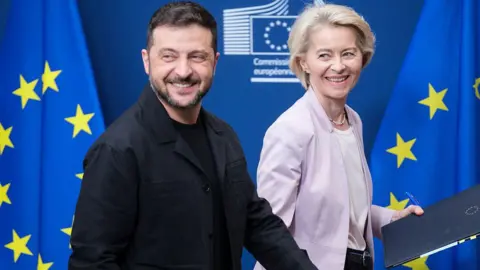
"It's only fair that Russia's frozen assets should be used to rebuild what Russia has destroyed – and that money then becomes ours," says Ukraine's Volodymyr Zelensky.
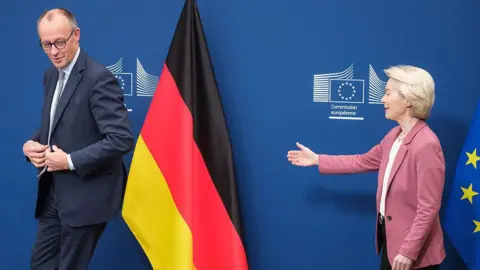
German Chancellor Friedrich Merz says the assets will "enable Ukraine to protect itself effectively against future Russian attacks".
Russia's court action was expected in Brussels. But it is not just Moscow that is unhappy.
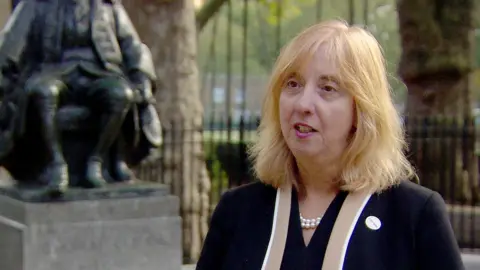
Belgium is worried it will be saddled with an enormous bill if it all goes wrong and Euroclear chief executive Valérie Urbain says using it could "destabilise the international financial system".
Euroclear also has an estimated €16-17bn immobilised in Russia.
Belgian Prime Minister Bart de Wever has set the EU a series of "rational, reasonable, and justified conditions" before he will accept the reparations plan, and he has refused to rule out legal action if it "poses significant risks" for his country.
What is the EU's plan?
 Thierry Monasse/Getty Images
The EU is working to the wire ahead of next Thursday's summit to come up with a solution that Belgium can accept.
Until now the EU has held off touching the assets themselves directly but since last year has paid the "windfall profits" from them to Ukraine. In 2024 that was €3.7bn. Legally using the interest is seen as safe as Russia is under sanction and the proceeds are not Russian sovereign property.
But international military aid for Ukraine has slipped dramatically in 2025, and Europe has struggled to make up the shortfall left by the US decision to all but stop funding Ukraine under President Donald Trump.
There are currently two EU proposals aimed at providing Ukraine with €90bn, to cover two-thirds of its funding needs.
One is to raise the money on capital markets, backed by the EU budget as a guarantee. This is Belgium's preferred option but it requires a unanimous vote by EU leaders and that would be difficult when Hungary and Slovakia object to funding Ukraine's military.
That leaves loaning Ukraine cash from the Russian assets, which were originally held in securities but have now largely matured into cash. That money is Euroclear property held in the European Central Bank.
The EU's executive, the European Commission, accepts Belgium has legitimate concerns and says it is confident it has dealt with them.
The plan is for Belgium to be protected with a guarantee covering all the €210bn of Russian assets in the EU.
Should Euroclear suffer a loss of its own assets in Russia, a Commission source explained that would be offset from assets belonging to Russia's own clearing house which are in the EU.
If Russia went after Belgium itself, any ruling by a Russian court would not be recognised in the EU.
In a key development, EU ambassadors are expected to agree on Friday to immobilise Russia's central bank assets held in Europe indefinitely.
Until now they have had to vote unanimously every six months to renew the freeze, which could have meant a repeated risk to Belgium.
The EU ambassadors are set to use an emergency clause under Article 122 of the EU Treaties so the assets remain frozen as long as an "immediate threat to the economic interests of the union" continues.
Why Belgium is not yet satisfied
Belgium is adamant it remains a staunch ally of Ukraine, but sees legal risks in the plan and fears being left to handle the repercussions if things go wrong.
A usually divided political landscape in this case has rallied behind Prime Minister Bart de Wever, who is under pressure from European colleagues and having talks with UK Prime Minister Sir Keir Starmer in London on Friday.
"Belgium is a small economy. Belgian GDP is about €565bn – imagine if it would need to shoulder a €185bn bill," says Veerle Colaert, professor of financial law at KU Leuven University.
While the EU might be able to secure sufficient guarantees for the loan itself, Belgium fears an added risk of being exposed to extra damages or penalties.
Prof Colaert also believes the requirement for Euroclear to grant a loan to the EU would violate EU banking regulations.
"Banks need to comply with capital and liquidity requirements and shouldn't put all their eggs in one basket. Now the EU is telling Euroclear to do just that.
"Why do we have these bank rules? It's because we want banks to be stable. And if things go wrong it would fall to Belgium to bail out Euroclear. That's another reason why it's so important for Belgium to secure water-tight guarantees for Euroclear."
Europe under pressure from every direction
There is no time to lose, warn seven EU member states including those closest to Russia such as the Baltics, Finland and Poland. They believe the frozen assets plan is "the most financially feasible and politically realistic solution".
"It's a matter of destiny for us," warns leading German conservative MP Norbert Röttgen. "If we fail, I don't know what we'll do afterwards. That's why we have to succeed in a week's time".
While Russia is adamant its money should not be touched, there are added concerns among European figures that the US may want to use Russia's frozen billions differently, as part of its own peace plan.
Zelensky has said Ukraine is working with Europe and the US on a reconstruction fund, but he is also aware the US has been talking to Russia about future co-operation.
An early draft of the US peace plan referred to $100bn of Russia's frozen assets being used by the US for reconstruction, with the US taking 50% of the profits and Europe adding another $100bn. The remaining assets would then be used in some kind of US-Russia joint investment project.
An EU source said the added advantage of Friday's expected vote to immobilise Russia's assets indefinitely made it harder for anyone to take the money away. Implicit is that the US would then have to win over a majority of EU member states to vote for a plan that would financially cost them an enormous sum.