Watch: Dashcam video shows couple fight with attacker
A couple killed in the Bondi Beach shooting tried to stop one of the alleged attackers by grabbing his gun, dramatic dashcam footage shows.
Boris Gurman, 69, and his wife Sofia, 61, courageously stepped in to try and protect others before being shot themselves, their family said in a statement.
Video of the incident shows Mr Gurman, who was retired, wrestling with one of the alleged gunmen and taking the weapon off him, before they both fall onto the road.
Mr Gurman then gets up and appears to hit the suspected attacker with the gun. The attacker is then thought to have got another gun which he used to kill them.
"While nothing can lessen the pain of losing Boris and Sofia, we feel an overwhelming sense of pride in their bravery and selflessness," the family said.
"This encapsulates who Boris and Sofia were - people who instinctively and selflessly tried to help others."
The Gurman couple, who were Jewish, were the first two people killed in Sunday's attack, the Sydney Morning Herald reported.
At least 15 people have been confirmed dead in the shooting, which happened during an event to mark the first day of Hanukkah.
In their statement, the family said the couple had been married for 34 years.
"We are heartbroken by the sudden and senseless loss of our beloved Boris and Sofia Gurman.
"Boris was a retired mechanic, known for his generosity, quiet strength and willingness to lend a hand to anyone in need.
"Sofia worked at Australia Post and was deeply loved by her colleagues and community.
"Bondi locals, together they lived honest, hardworking lives and treated everyone they met with kindness, warmth and respect. Boris and Sofia were devoted to their family and to each other. They were the heart of our family, and their absence has left an immeasurable void."
GoFundMe
The couple were due to celebrate their 35th wedding anniversary in January, their family said
Witnesses have described Mr Gurman as a "hero".
The woman who owns the dashcam footage told Reuters that Mr Gurman "did not run away - instead, he charged straight toward the danger, using all his strength trying to wrestle away the gun and fighting to the death".
"I can see from my camera that the elderly man was ultimately shot and collapsed. That moment broke my heart," she said.
Another person who said they witnessed the incident told 9News: "He was a hero. He tried, he tried. We need to let his family know.
"Everyone needs to know what he tried, because it was right in the beginning. And he put himself in that face of danger. There were bullets flying already, and he put his self in the face of danger."
Police have described the attack as a terrorist incident targeting the Jewish community.
The other victims killed include a 10-year-old girl, a British-born rabbi, a retired police officer, and a Holocaust survivor.
The ages of the victims range from 10 to 87.
A further 22 people remain in hospital, nine of whom are in a critical condition.
Another bystander named Ahmed al Ahmed, 43, was also hailed a "hero" after he wrestled a gun from one of the attackers. He was shot multiple times and has since undergone surgery for his wounds.
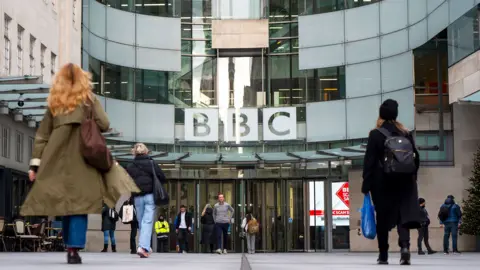
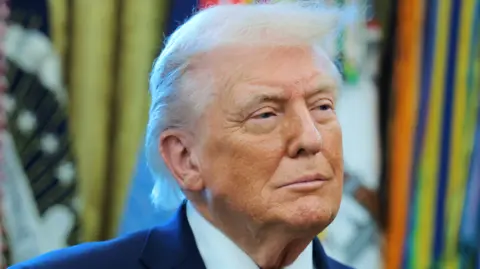
Self-evidently, the BBC has a big decision to make. If it hoped the President might not follow through on his threat to sue, the reality check has arrived.
Now it's about gaming out the options but current indications are it plans to fight.
"We will be defending this case", the BBC repeated after the $5bn (£3.7bn) lawsuit was filed over an edit of Trump's 6 January 2021 speech in a Panorama documentary.
But what are the pros and cons of that stance - and will it change its position?
The positives of the BBC fighting the case
Many, both inside and outside the BBC, have told me the BBC has to fight. It has to defend its journalism against a litigious president who, some claim, has been using legal action against US media companies to cow them into submission.
So one positive - particularly if the BBC is confident it would win - is to take on Trump and show the world it isn't afraid of the president and his multi-billion dollar threats.
Legally, the BBC considers itself on good ground.
Trump's case appears to rely on two main points - jurisdiction and malice.
He is suing from Florida and needs to prove that audiences in the so-called Sunshine State saw the Panorama programme, in order to prove that it impacted him negatively.
One claim in his filing is that viewers watched via virtual private networks (or VPNs). Even if that is correct, did that happen in significant numbers to cause him reputational damage and can the BBC really be held responsible for the behaviour of unlawful users of its services?
Claims about a Canadian company called Blue Ant Media distributing the documentary in the US would be more problematic if true.
The company has since confirmed it had the rights to distribute the programme but "none of Blue Ant's buyers have aired it in the US," a spokesperson said. They added that the international version of the Panorama episode didn't actually contain the clip of the Trump speech in question, as the programme had been cut down in a number of places for time.
If that is correct, that leaves the question of whether audiences viewed the Panorama via a subscription to Britbox, as has also been alleged. We haven't yet heard back from Britbox on that point.
The BBC is adamant the programme wasn't broadcast in the US.
The president's case also relies on a claim of malice; that the BBC intended to do him harm. He's arguing it published the documentary one week before the election with "the express intent of interfering with it and trying to undermine President Trump's odds of winning re-election".
I watched the documentary. I viewed it as an assessment of the approach taken by Trump's most fervent supporters and whether claims about him, including about 6 January, have dented their admiration.
Getty Images
The clip of the speech is 12 seconds, in a 57-minute programme. The BBC admits the edit was an unintentional mistake. The president's filing argues the corporation would not have spliced two parts of his speech together unless it was intentional.
He is also relying on other examples he claims show the BBC has a history of reporting on him in a negative manner. The filing says "the BBC had no regard for the truth about President Trump" and characterises the BBC as making an effort "to craft as one-sided an impression and narrative against President Trump as possible".
The BBC rejects this. Which will make for a fascinating court debate - if it actually gets that far.
Another potential positive of fighting, though the BBC would never acknowledge this, could be how it cements its brand, with a section of US consumers at least. The corporation is making a big play of bundling its content in the US via an app it hopes people will pay for. Would a high profile fight with Trump make some parts of the US more likely to sign up? It's certainly a high risk strategy.
The negatives of the BBC fighting the case
Clearly one downside of fighting is that it will be costly. Chris Ruddy, a friend and ally of Donald Trump and chief executive of the US news network Newsmax, told BBC Radio 4's Today programme that going to court would cost between $50-100 million, whereas he claimed the BBC could settle for $10 million.
Any suggestion of using funds from licence fee payers to pay off President Trump as part of a settlement would be a difficult look for the corporation. Equally, spending millions to fight the case in court would open the BBC up to claims it had squandered precious funds.
The BBC has insurance - but we don't know what that covers. Is it the legal costs or only the settlement, and is that up to a maximum amount?
Another negative is how much it will divert the institution when top executives need to be fully focused on the negotiations with the government over the next BBC Charter, the framework for the BBC's very existence, which is up at the end of 2027.
At a time of leadership vacancies, with the director general and the CEO of news having resigned, instead of fighting for the future of the BBC and its funding model and role here in the UK, it is having to navigate what is arguably the most serious legal moment in its history. It can try to do both - but can it do them both well?
The point about "lawfare", as it's often termed, is that it's less about the outcome and more about the toll it takes to fight.
There is no reason for Donald Trump to back down. It suits him to pick a fight with the BBC - and the BBC has already acknowledged it made an error. He appears to want to demonstrate there is bias and it goes wider than one TV edit.
But how many hours of BBC time will have to be expended to fight the case?
If you look at some of the previous cases the resident has fought, some media companies agreed to settle (including ABC for $15 million and Paramount/CBS for $16 million), even when legal commentators argued they could have won their cases. In the end, they took the view that the negatives outweighed the positives (although the CBS case was made more complicated by Paramount's efforts to take over Skydance Media which needed regulatory approval).
Other US titles are fighting back, including the Wall Street Journal (WSJ) which faces at $10 billion claim over a story about Trump and a note it reported he wrote to Jeffrey Epstein. The WSJ says its stories are factually accurate.
The New York Times faces a $15 billion lawsuit over the President's claims it sought to undermine his 2024 candidacy and disparage his reputation as a businessman. That paper is also fighting back - and characterises what is happening as part of a wider global attack on media freedom.
But the BBC has a different equation to calculate as it has already accepted it made a mistake.
Does the BBC have other options?
Is there a world in which the BBC asks the Prime Minister to intervene and Starmer calls Trump and asks President Trump to be magnanimous?
We know this Labour government backs the BBC. Despite a series of controversies and mistakes including around two Israel/Gaza documentaries and the Panorama edit, when the Culture Secretary launched the green paper into charter renewal on Tuesday, she was fulsome in her praise of the corporation as being vital for the health of democracy and a light on the hill in dark times.
But at a Downing Street briefing, the PM's spokesperson wasn't exactly leaping at the idea that his boss would use up any leverage he might have with Donald Trump to persuade him to back down over the BBC.
Will the case reach court?
The next stage is for the BBC to respond to the filing - not in any detail, but if it doesn't respond, Trump's lawyers can ask a court to make a judgement by default. There is no definitive smoking gun in this lawsuit. But these are perillous times and, whatever it says publicly, the BBC will be weighing up its next steps with a great deal of caution.
Labour's flagship workers' rights bill has passed its last parliamentary hurdle and is set to become law before Christmas.
Lord Sharpe, the shadow business and trade minister, had tabled an amendment to the Employment Rights Bill during its latest stage of parliamentary ping pong in the House of Lords.
But he withdrew the amendment after a short debate, removing the final block on the bill's passage.
Business Secretary Peter Kyle he was "delighted" the bill had made its way through the House of Lords.
"This landmark legislation, now soon to be in law, will drag Britain's outdated employment laws into the 21st century and offer dignity and respect to millions more in the workplace," he said.
Most of the bill's measures will require secondary legislation before coming into force.
The government has described the bill - which applies to England, Scotland and Wales, but not Northern Ireland - as the "biggest upgrade to rights at work for a generation".
It will give workers access to sick pay and paternity leave from the first day on the job and contains new protections for pregnant women and new mothers.
In November, Labour backed down from its plan to give all workers the right to claim unfair dismissal from their first day in a job. But the government will bring in enhanced protections from six months in employment, the bill's most significant measure.
It is expected to gain royal assent this week.
Unite union's general secretary Sharon Graham said the bill must now be implemented "without any further dilution or delay".
"Labour need now to stop being embarrassed by these new laws for workers. The bill had already been watered far too much, not least the failure to ban fire and rehire and zero hours contracts," she said.
The Trades Union Congress's (TUC) general secretary Paul Nowak said it was a "historic day and early Christmas present for working people across the country".
"Finally, working people will enjoy more security, better pay and dignity at work thanks to this bill," he said, echoing Unite's calls for the legislations to be implemented "at speed".
But the Conservatives said it was "ironic Labour's job-destroying unemployment bill passed the very same day official figures confirmed unemployment has risen every month this government has been in office".
The party was referring to figures published on Tuesday showing UK unemployment rose to 5.1% in the three months to October, from 4.3% a year earlier.
Shadow business secretary Andrew Griffith said: "[The bill] will pile costs onto small businesses, freeze hiring, and ultimately leave young people and jobseekers paying the price for Labour's capitulation to their union paymasters."
In a joint statement on Monday, ahead of the deadlock ending, business groups including the British Chambers of Commerce and the Federation of Small Businesses said they remained concerned about some of the bill's changes.
But they said to keep the six-month qualifying period for unfair dismissal the legislation as it currently was should now be passed.
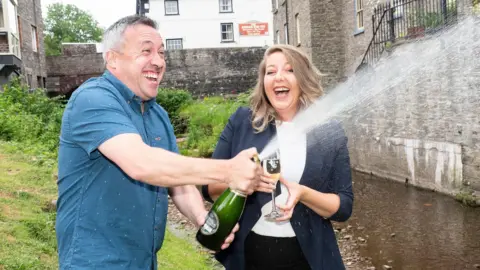
The couple celebrating their first big win in 2018
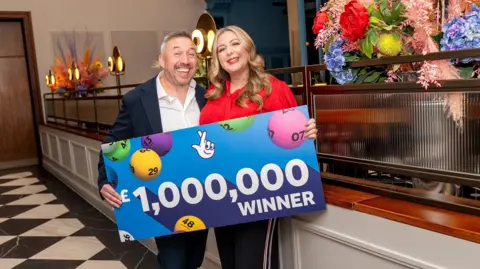
One lucky couple has beaten extraordinary odds to win £1million on the National Lottery - for the second time.
Richard Davies, 49, and Faye Stevenson-Davies, 43, first scooped a seven-figure jackpot playing the EuroMillions Millionaire Maker in June 2018.
And now they have done it again by matching five main numbers and the Bonus Ball in the Lotto draw on 26 November - the chances of which are more than 24-trillion-to-one, say experts.
"We knew the odds of it happening again were outrageous, but we're proof that if you believe anything is possible," said Faye, from mid Wales.
But, as Richard explained, their second win was not a case of simply picking the right numbers.
"It came to us through a series of four consecutive Lotto draws," he said.
"When you match two numbers in the Lotto draw, you automatically win a Lucky Dip for the next game and that's what's happened to us.
"We matched two numbers and won a free Lucky Dip from one draw which put us into the next draw and so on, until the winning draw on 26 November."
However, this latest windfall is unlikely to change the couple's community-minded attitude.
Former hairdresser Richard uses his skills at a shelter for the homeless in Cardiff, a project which received vital National Lottery funding, while also helping out friends by working as a delivery driver.
National Lottery
"We're just going to take our time and enjoy the moment," said Richard and Faye
Meanwhile, ex-nurse Faye is a volunteer cook at Cegin Hedyn community kitchen in Carmarthen, while also providing mental health counselling services to local organisations such as Brecon & District Mind charity.
"The first time we won we gifted people cars, donated a minibus to the local rugby team and did our best to help friends and family," said Faye, who will even be working on Christmas Day.
"It was all new and it was amazing to be able to make a difference.
"This time around, who knows? We're just going to take our time and enjoy the moment."
Andy Carter, senior winners' adviser at Allwyn, operator of The National Lottery, said: "I can still remember the day I met Richard and Faye for the first time, and it's just as special to be with them as they celebrate their second £1m win.
"I saw the positive impact of that first win and know this second one will be just as meaningful."
Initial research was carried out before snow covered the area
Thousands of dinosaur footprints dating back 210 million years have been found in a national park in northern Italy.
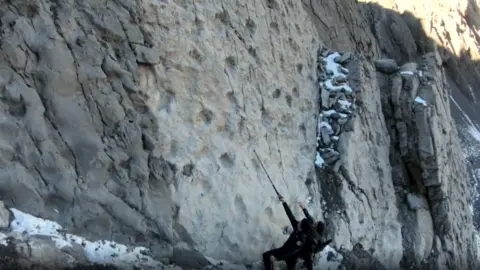
The footprints - some of which are up to 40cm (15in) in diameter - are aligned in parallel rows, and many show clear traces of toes and claws.
It is thought the dinosaurs were prosauropods - herbivores with long necks, small heads and sharp claws.
"I never would have imagined I'd come across such a spectacular discovery in the region where I live," said Milan-based paleontologist Cristiano Dal Sasso.
Illustrazione di Fabio Manucci, Arch. PaleoStelvio
Artist's rendition of a herd of prosauropods walking across a muddy plain during low tide. Smaller footprints suggest the herd also included young specimens
Last September a photographer spotted the footprints stretching hundreds of metres on a vertical mountain wall in the Stelvio national park, north-east of Milan.
In the Triassic period - between about 250 and 201 million years ago - the wall was a tidal flat, which later became part of the Alpine chain.
"This place was full of dinosaurs; it's an immense scientific treasure," Mr Dal Sasso said.
The herds moved in harmony, he added, "and there are also traces of more complex behaviours, like groups of animals gathering in a circle, perhaps for the purposes of defence."
The prosauropods, which could be up to 10m (33ft) long, walked on two legs but in some cases handprints were found in front of footprints, indicating that they probably stopped and rested their forelimbs on the ground.
Elio Della Ferrera, Arch. PaleoStelvio
Photographer Elio Della Ferrera snapped the first picture of the mountain wall showing the footprints
Elio Della Ferrera, the photographer who discovered the site, said he hoped the discovery would "spark reflection in all of us, highlighting how little we know about the places we live in: our home, our planet."
According to a press release from the Italian culture ministry, the area is remote and not accessible by paths, so drones and remote sensing technology will be employed instead.
The Stelvio national park is located in the Fraele valley by Italy's border with Switzerland, near where the Winter Olympics will take place next year.
"It's as if history itself wanted to pay homage to the greatest global sporting event, combining past and present in a symbolic passing of the baton between nature and sport," said the Italian Ministry of Culture.
The European Union has watered down its plans to ban the sale of new petrol and diesel vehicles by 2035.
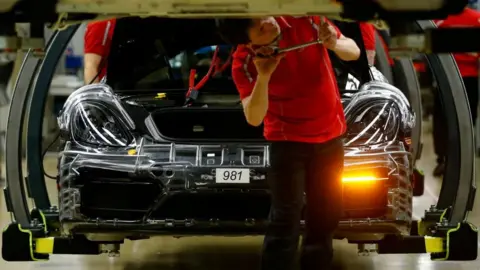
Current rules state that new vehicles sold from that date should be "zero emission", but carmakers, particularly in Germany, have lobbied heavily for concessions.
Under the European Commission's new plan, 90% of new cars sold from 2035 would have to be zero-emission, rather than 100%.
According to the European carmakers association, ACEA, market demand for electric cars is currently too low, and without a change to the rules, manufacturers would risk "multi-billion euro" penalties.
The remaining 10% could be made up of conventional petrol or diesel cars, along with hybrids.
Carmakers will be expected to compensate for the extra emissions created by these vehicles by using biofuels and so-called e-fuels, which are synthesised from captured carbon dioxide.
They will also be expected to use low-carbon steel made in the European Union in the vehicles they produce.
Opponents of the move have warned that it risks undermining the transition towards electric vehicles and leaving Europe exposed in the face of foreign competition.
The green transport group T&E has warned that the UK should not follow the EU's lead by weakening its own plans to phase out the sale of conventional cars under the Zero Emission Vehicles Mandate.
"The UK must stand firm. Our ZEV mandate is already driving jobs, investment and innovation into the UK. As major exporters we cannot compete unless we innovate, and global markets are going electric fast", said T&E UK's director Anna Krajinska.
Dan Barr found himself in an extraordinary situation inside the car with parade attacker Paul Doyle
The man whose instinctive act stopped the car that injured 134 fans at the Liverpool FC victory parade has insisted he was "not a hero".
Dan Barr, 41, managed to get inside the automatic Ford Galaxy and forced its gear selector into 'park' mode as driver Paul Doyle tried to accelerate further into the dense crowd of pedestrians on Liverpool's Water Street.
Mr Barr, a former solider, described the "horrendous" sight of seeing victims pleading in vain for Doyle, 54, to stop, and told the BBC: "I'm not the same since that day."
Despite being hailed for his bravery by police and prosecutors, Mr Barr said being called a hero makes him "cringe" and added: "Every man that I seen was trying to do the same."
Earlier Doyle, from Croxteth in Liverpool, was jailed for 21 years and six months at Liverpool Crown Court after admitting 31 offences including causing grievous bodily harm (GBH) with intent.
The court head Doyle, an IT networking engineer and former Royal Marine, was motivated by nothing other than "blind rage" as he grew frustrated about being unable to get through the crowds while on his way to pick up a friend.
His victims ranged in age from six-month-old Teddy Eveson, whose pram was knocked to the ground, to 77-year-old Susan Passey who was trapped under the wheels of the car.
Liverpool fan Mr Barr, from Birkenhead in Wirral, had watched the parade on the city's waterfront and found himself in the throngs of people heading back to the city centre along Water Street, shortly before 18:00 BST.
The former Royal Engineer said he noticed an ambulance trying to get through the dense crowd and moved to the right of where it was heading.
Dan Barr can be seen in mobile phone footage wearing a chequered jacket and a backpack
Mr Barr said his memory of what happened next is "blurry", but he described seeing the roof of a dark coloured car "snaking through" the crowd, knocking people into the air as it got closer to where he was standing.
"I just remember for some reason, I don't know why, but his vehicle stopped for a bit," he said.
Mr Barr said realised he had a clear path to the rear left hand side door and instinctively ran towards the car.
"There was already other men at different positions around the car trying to get in, desperately trying to punch their way in," he said.
"Just the sheer desperation of the situation, you knew it wasn't over."
CPS
Paul Doyle pleaded guilty to 31 charges including causing GBH with intent on what was supposed to be the first day of his trial
Mr Barr said he assumed the car doors would be locked and braced himself to try and punch the window through.
However at the last moment he tried the door handle, and was able to open it and climb inside.
However as Mr Barr climbed into the back seat Doyle accelerated forwards and the door slammed shut.
"We've gone from total chaos - panic, screaming - to relative silence as he's accelerated off," he said.
"Then you can just hear the people being hit and run over, like ten-pin bowling, pretty horrendous. I could see everything from where I was.
"I could see people's faces, I could see the looks of just, like they were trying to plead but wasting their time.
"That's all that they could do, there was nowhere to go, nowhere to get out of the way for them."
Dan Barr said he believes he only did what "anyone else would have done".
Mr Barr said at that stage he desperately searched for a way to stop the car, and noticed the gearstick in drive mode.
He reached between the front seats and jammed it forwards to park mode.
"Things are fuzzy but I kept my hand on there," he said.
"Nothing would have moved my arm, no way."
With the car not able to accelerate and with injured victims trapped under the wheels, Doyle's rampage was over.
As the vehicle came to a stop other people shattered the windows and tried to drag Doyle out, which they succeeded in doing after Mr Barr reached forward and released the driver's seatbelt.
Detectives viewing dashcam footage from within Doyle's vehicle have said they believe Doyle may not have been aware of Mr Barr's presence in the car.
The labourer said he is unsure.
"I find it a very interesting question," he said.
"He was repeating the same thing over and over, 'why won't they move out my way?'
"Was he asking me? Was that a statement? I don't know."
'I'm not the same'
Although he escaped with a minor cut to his head, Mr Barr said the psychological impact of 26 May is ongoing.
"I don't think I have processed it, to be honest with you," he said.
"It doesn't mean that I don't think I ever will be, but I'm not the same since that day.
"Big things don't bother me, it's little things. Little things are starting to agitate me every day.
"I'm different in work, I struggle to take on instruction, I struggle to watch telly, take things on board. I'll have to keep rewinding it. It's mad.
"I don't really know what I'm saying, I'm just not myself, I'm very forgetful."
PA Media
Prosecutors said Paul Doyle's actions on May 26 were motivated by "blind rage"
Mr Barr said despite having been in the army for eight years, including tours in Iraq where his role was searching for improvised explosive devices (IEDs), he rarely talked about his service.
However he said the impact of what happened on Water Street and concern from his family and friends has led him to seek professional help.
When asked about people describing him as "brave" or "heroic", he said: "It makes my toes curl to be honest with you...
"If they could have, who wouldn't have done what I did?"
The man charged with leading the investigation into the Water Street attack, Det Ch Insp John Fitzgerald, however, had a different view.
"There is no doubt in my mind that Doyle would have continued to drive and cause further injuries had Daniel not acted with such bravery." he said.
Listen to the best of BBC Radio Merseyside on BBC Sounds and follow BBC Merseyside on Facebook, X, and Instagram, and watch BBC North West Tonight on BBC iPlayer.
Emergency services freed an 11-year-old boy from beneath Doyle's car
Liverpool supporters who were injured when Paul Doyle drove his car through crowds at the team's victory parade have spoken about their experiences from that day.
Before Doyle, 54, was jailed for 21 years and six months for charges including dangerous driving and causing grievous bodily harm (GBH) with intent, Liverpool Crown Court heard statements from his victims.
One statement after another, the court heard about the psychological and physical impact of that day.
One of the most shocking was from Ian Passey, 47, who described the moment he saw his 77-year-old mother pinned beneath Doyle's car, her head "in a pool of blood".
Another, the mother of an 11-year-old boy who was trapped beneath the wheels of the car, told the court the collision "didn't just injure his body, it left emotional scars on our entire family".
Footage of the moment he was freed by emergency service personnel was shown to the court on Monday.
'The nightmares are the worst'
Prosecution barrister Philip Astbury read the statement from his mother, which said: "My son is only a young child, with his whole life ahead of him.
"There are good days and bad days. On the good days we try to hold on to hope. But the bad days are heavy – filled with fear, anxiety and sadness."
She said her son has become scared of cars since the attack.
"He's also become self-conscious about the scar on his face," she said.
"He worries what people will think when they see it. He asks me if people will laugh at the bald patch on the left side of his head.
"As a mother it breaks my heart to see him question his appearance and fear being judged or bullied.
"The nightmares are the worst. He wakes up crying, reliving the incident.
One mother told the court how a pram with her six-month-old baby inside was struck by Doyle's Ford Galaxy.
She said: "I relive the moment of the collision repeatedly, especially the terrifying image of my pram being struck and taken by the car with my six-month-old baby inside.
"The horror of not knowing whether he was alive or dead in that instant will haunt me forever."
Doyle was seen to cry as Mr Astbury read the words of one of his victims, a 12-year-old boy, who cannot be named for legal reasons.
The boy said: "I found myself on the floor having been hit by a car I did not see coming, I have never felt so scared before in my life."
The boy's mother said she saw her son motionless on the floor and her heart sank.
She said the incident "caused me much anxiety having to watch my son deal with the pain, the frustration, him feeling down and isolated from his friends in school, the nightmares and the after-effects on him".
'Don't cry for yourself'
As the statements were read to court on Monday and Tuesday, one was from a woman telling Doyle to take responsibility for what he had done.
Susan Farrell, 55, addressed Doyle directly, confronting him about the tears he had been seen to shed during court proceedings.
Speaking on behalf of herself and her 62-year-old husband Colin Farrell, she said: "There are hundreds of people affected by your actions. I want you to think about them all.
"Don't sit in the dock and cry for yourself. Be brave and take accountability for what you did."
Getty Images
Liverpool fans had turned out on the streets to celebrate
The court heard from Anna Bilonozhenko, 43, who came to the UK from Ukraine in 2024, to escape the war.
She said she thought spending the day at the parade with her 22-year-old daughter Sasha would "lift our spirits".
Instead she was left with an injury that required metal plates to be inserted into her leg.
Ms Bilonozhenko said: "We came to this country because of the war in our homeland, hoping to finally feel safe. At first, we did.
"But now that feeling has been taken away.
"Realising that is deeply painful - it feels like losing our safety all over again."
Joy 'taken'
John Davey, 31, said after the events of 26 May, "the joy of football, the joy of family outings, the joy of living freely - all of it has been taken from me."
He said: "The collision left me with spinal fractures in three places. Since then, the pain has been relentless, day and night.
"I cannot work, which means I cannot provide for my family. I have three children, and the weight of responsibility has fallen on my partner.
"That has left me feeling ashamed, embarrassed, and broken - because it is not fair that they must suffer for what happened to me."
He added: "This incident has stolen my independence, my happiness, and my peace of mind.
"It has changed me forever, and it has changed my family's life forever."
Getty Images
The day turned to chaos when Doyle's car ploughed into more than 130 people
A 16-year-old boy described feeling "scared, angry and sad".
The boy said: "I sometimes think that things could have been a lot worse and that frightens me, but equally the incident should never have happened, and that's why I find it hard to accept and move on with my life.
"This is just not fair to have to cope with all this at my age."
I should have been able to protect my younger sister and my niece."
Meanwhile Amanda Gardener, 52, described her feelings of "guilt" after the attack.
"My sister didn't really want to go [to the Liverpool FC victory parade] but I convinced them it would be a good day," she wrote.
"I then saw my sister go flying into the air.
"We lost our sister last year; I thought I was losing another and thought I was going to have tell her family that she had died."
'Feared the worst'
Ian Passey said he got up from the ground after being hit by Doyle's car to realise he had lost sight of his mother.
He said he found her pinned under the car in a pool of blood.
He said in a statement: "Not being able to get close to her, hold her hand and reassure her, I feared the worst.
"I thought my mum had been killed, and called my brother on the telephone to tell him just that."
He said he still had vivid nightmares and was unable to go into large crowds.
He said: "The actions on May 26 of one man will change mine and mum's life forever."
PA Media
The court heard people were sent "flying in the air"
Doyle, of Burghill Road in West Derby, admitted a total of 31 charges last month.
The court heard how he "lost his temper" and drove his car directly into supporters making their way home from the Premier League title celebrations.
Dashcam footage from the vehicle, played in court, showed the shocking moments when fans were thrown onto the bonnet of the car or fell underneath it as he accelerated down Water Street, which had been closed to traffic, at about 18:00 BST on 26 May.
Doyle had denied the charges but changed his plea to guilty at the start of his trial.
The former Royal Marine admitted 31 charges including causing grievous bodily harm (GBH) with intent, dangerous driving and affray, with victims aged between six months and 77 years.
Paul Doyle could be heard on his car's own camera swearing and shouting as he mowed down supporters
A man who used his car as a "weapon" to plough into more than 130 people at Liverpool FC's victory parade has been jailed for 21 years and six months.
Paul Doyle, 54, drove at crowds "in a rage" after his "anger had completely taken hold of him" shortly before 18:00 BST on 26 May, Liverpool Crown Court heard.
Judge Andrew Menary KC said the ex-Royal Marine, who stared straight ahead with no expression as he was sentenced, had generated "fear and panic" and his "disregard for human life defied ordinary understanding".
He admitted 31 charges including causing grievous bodily harm with intent, and dangerous driving and affray, with victims ranging from a six-month-old baby to a 77-year-old woman.
The married father of three was travelling into the city centre to collect friends from the parade when he "lost his temper" and drove his Ford Galaxy directly into supporters making their way home from the Premier League title celebrations.
Dashcam footage from Doyle's vehicle, played in court, showed the moments when fans were thrown onto the bonnet of his car or fell underneath as he accelerated down Water Street, which had been closed to traffic.
In the footage, Doyle can be heard shouting "move" and swearing at the crowd, including after he hit a 10-year-old girl.
Judge Menary told Doyle as he sentenced him: "It is difficult, if not impossible, to convey in words alone the scene of devastation you caused.
"It shows you, quite deliberately, accelerating into groups of fans time and time again.
"You struck people head-on, knocked others onto the bonnet, drove over limbs, crushed prams and forced those nearby to scatter in terror."
Doyle told police his actions "ruined so many people's lives" as he was arrested
Judge Menary continued: "You ploughed on at speed and over a considerable distance, violently knocking people aside or simply driving over them - person, after person, after person.
"You accelerated forwards and backwards repeatedly, several victims became trapped beneath the vehicle as you continued to move it.
"Others were thrown into the air or propelled across the ground."
He added Doyle acted in an "inexplicable and undiluted fury" when he ploughed into the crowds.
Doyle, from Croxteth, Liverpool, spent large portions of the two-day sentencing hearing in tears - with dashcam and CCTV footage of his attack played multiple times to the public gallery.
He gave no reaction as he was taken down from the dock by prison officers.
Footage shows car plough into crowd at Liverpool FC parade
Victims of the rampage on Water Street in the city centre spoke of their terror and injuries during the two-day hearing.
Sheree Aldridge, 37, said she thought her baby son Teddy Eveson had died after his pram was thrown into the air after being hit by Doyle's car, adding that she thought she would "be next".
"I thought my children would grow up without a mother," she said.
A 12-year-old boy, who cannot be named for legal reasons, said: "I found myself on the floor having been hit by a car I did not see coming, I have never felt so scared before in my life."
The boy's mother said her heart sank when she saw her child motionless on the floor.
She said: "The sight of my son lying motionless on the road, not moving for those few seconds, and the sound of the car hitting people will live with me forever."
When interviewed by police, Doyle said he had seen someone with a knife and had driven in panic for fear he would be attacked.
But police found no evidence from CCTV footage or witnesses that anyone in the area had a knife.
No defects were found with the car and Doyle was not under the influence of drink or drugs.
He changed his plea to guilty on the second day of his trial last month, with the judge telling him his sentence reflected the fact he could have admitted the offences "much earlier than you did".
PA Media
Daniel Barr was labelled a "hero" by prosecutors after he "bravely" jumped into the back of Doyle's car to bring it to a halt
Following sentencing, Judge Menary said he wished to formally commend Daniel Barr, who climbed into the back seat of Doyle's car and held the automatic gear stick in park mode to bring the vehicle to a stop.
"His actions on that day were outstandingly brave," the judge said.
"At a moment when many understandably feared for their own safety, he ran towards the danger, entered a moving vehicle and brought it to a halt, thereby preventing further injury and quite possibly saving lives."
Dan Barr found himself in an extraordinary situation inside the car with parade attacker Paul Doyle
The man whose instinctive act stopped the car that injured 134 fans at the Liverpool FC victory parade has insisted he was "not a hero".
Dan Barr, 41, managed to get inside the automatic Ford Galaxy and forced its gear selector into 'park' mode as driver Paul Doyle tried to accelerate further into the dense crowd of pedestrians on Liverpool's Water Street.
Mr Barr, a former solider, described the "horrendous" sight of seeing victims pleading in vain for Doyle, 54, to stop, and told the BBC: "I'm not the same since that day."
Despite being hailed for his bravery by police and prosecutors, Mr Barr said being called a hero makes him "cringe" and added: "Every man that I seen was trying to do the same."
Earlier Doyle, from Croxteth in Liverpool, was jailed for 21 years and six months at Liverpool Crown Court after admitting 31 offences including causing grievous bodily harm (GBH) with intent.
The court head Doyle, an IT networking engineer and former Royal Marine, was motivated by nothing other than "blind rage" as he grew frustrated about being unable to get through the crowds while on his way to pick up a friend.
His victims ranged in age from six-month-old Teddy Eveson, whose pram was knocked to the ground, to 77-year-old Susan Passey who was trapped under the wheels of the car.
Liverpool fan Mr Barr, from Birkenhead in Wirral, had watched the parade on the city's waterfront and found himself in the throngs of people heading back to the city centre along Water Street, shortly before 18:00 BST.
The former Royal Engineer said he noticed an ambulance trying to get through the dense crowd and moved to the right of where it was heading.
Dan Barr can be seen in mobile phone footage wearing a chequered jacket and a backpack
Mr Barr said his memory of what happened next is "blurry", but he described seeing the roof of a dark coloured car "snaking through" the crowd, knocking people into the air as it got closer to where he was standing.
"I just remember for some reason, I don't know why, but his vehicle stopped for a bit," he said.
Mr Barr said realised he had a clear path to the rear left hand side door and instinctively ran towards the car.
"There was already other men at different positions around the car trying to get in, desperately trying to punch their way in," he said.
"Just the sheer desperation of the situation, you knew it wasn't over."
CPS
Paul Doyle pleaded guilty to 31 charges including causing GBH with intent on what was supposed to be the first day of his trial
Mr Barr said he assumed the car doors would be locked and braced himself to try and punch the window through.
However at the last moment he tried the door handle, and was able to open it and climb inside.
However as Mr Barr climbed into the back seat Doyle accelerated forwards and the door slammed shut.
"We've gone from total chaos - panic, screaming - to relative silence as he's accelerated off," he said.
"Then you can just hear the people being hit and run over, like ten-pin bowling, pretty horrendous. I could see everything from where I was.
"I could see people's faces, I could see the looks of just, like they were trying to plead but wasting their time.
"That's all that they could do, there was nowhere to go, nowhere to get out of the way for them."
Dan Barr said he believes he only did what "anyone else would have done".
Mr Barr said at that stage he desperately searched for a way to stop the car, and noticed the gearstick in drive mode.
He reached between the front seats and jammed it forwards to park mode.
"Things are fuzzy but I kept my hand on there," he said.
"Nothing would have moved my arm, no way."
With the car not able to accelerate and with injured victims trapped under the wheels, Doyle's rampage was over.
As the vehicle came to a stop other people shattered the windows and tried to drag Doyle out, which they succeeded in doing after Mr Barr reached forward and released the driver's seatbelt.
Detectives viewing dashcam footage from within Doyle's vehicle have said they believe Doyle may not have been aware of Mr Barr's presence in the car.
The labourer said he is unsure.
"I find it a very interesting question," he said.
"He was repeating the same thing over and over, 'why won't they move out my way?'
"Was he asking me? Was that a statement? I don't know."
'I'm not the same'
Although he escaped with a minor cut to his head, Mr Barr said the psychological impact of 26 May is ongoing.
"I don't think I have processed it, to be honest with you," he said.
"It doesn't mean that I don't think I ever will be, but I'm not the same since that day.
"Big things don't bother me, it's little things. Little things are starting to agitate me every day.
"I'm different in work, I struggle to take on instruction, I struggle to watch telly, take things on board. I'll have to keep rewinding it. It's mad.
"I don't really know what I'm saying, I'm just not myself, I'm very forgetful."
PA Media
Prosecutors said Paul Doyle's actions on May 26 were motivated by "blind rage"
Mr Barr said despite having been in the army for eight years, including tours in Iraq where his role was searching for improvised explosive devices (IEDs), he rarely talked about his service.
However he said the impact of what happened on Water Street and concern from his family and friends has led him to seek professional help.
When asked about people describing him as "brave" or "heroic", he said: "It makes my toes curl to be honest with you...
"If they could have, who wouldn't have done what I did?"
The man charged with leading the investigation into the Water Street attack, Det Ch Insp John Fitzgerald, however, had a different view.
"There is no doubt in my mind that Doyle would have continued to drive and cause further injuries had Daniel not acted with such bravery." he said.
Listen to the best of BBC Radio Merseyside on BBC Sounds and follow BBC Merseyside on Facebook, X, and Instagram, and watch BBC North West Tonight on BBC iPlayer.
The government has ordered an independent review into foreign financial interference in UK politics.
It comes after the former leader of Reform UK in Wales, Nathan Gill, was jailed for 10-and-a-half years after admitting to taking bribes for pro-Russian interviews and speeches.
Announcing the review, Communities Secretary Steve Reed said the government must "learn the lessons" from the case so "this can never happen again".
The review will be led by former senior civil Philip Rycroft and will report back in March.
Speaking in the House of Commons, Reed said: "The facts are clear. A British politician took bribes to further the interests of the Russian regime, a regime which forcefully deported vulnerable Ukrainian children and killed a British citizen on British soil using a deadly nerve agent.
"This conduct is a stain on our democracy. The independent review will work to remove that stain."
The government says the review will conduct an "in-depth assessment of the current financial rules and safeguards and offer recommendations to further mitigate risks from foreign political interference".
This breaking news story is being updated and more details will be published shortly. Please refresh the page for the fullest version.
You can receive Breaking News on a smartphone or tablet via the BBC News App. You can also follow @BBCBreaking on X to get the latest alerts.
Police say a teenage boy has been arrested in Worle, North Somerset
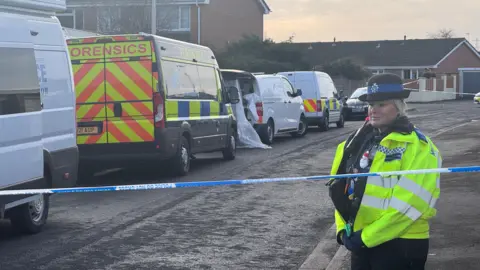
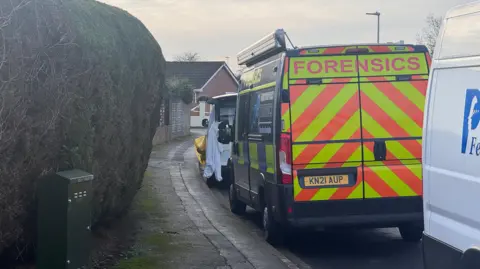
A teenage boy has been arrested on suspicion of murdering a nine-year-old girl.
Police were called to Lime Close in the Mead Vale area of Weston-super-Mare, North Somerset, at 18:09 GMT on Monday, where the girl was pronounced dead at the scene.
The boy was arrested in nearby Worle at 18:19 and is currently in police custody.
House-to-house inquiries are being carried out, with a police cordon in place.
Supt Jen Appleford, of Avon and Somerset Police, said: "We know the whole of Weston-super-Mare will be distraught and shocked to learn of this utterly dreadful news."
She said the girl's family had been informed on Monday evening, adding: "It is impossible for us to adequately put into words the pain and anguish they are feeling right now."
House-to-house inquiries are under way in the area
A criminal investigation is underway, with a post-mortem examination to be carried out.
"Out of respect for the family we'd please ask people not to speculate on the circumstances, or the identities of those involved, because that will only add to their enormous distress," Supt Appleford added.
The community has been asked to remain patient as inquiries are carried out at the house and in the surrounding area.
There will be an increased police presence around the residential close in the coming days, though the force said it was not aware of any increased risk to public safety.
Mike Bell, the leader of North Somerset Council, said he was "shocked and saddened" to hear of the incident.
In a post on social media, he said: "My thoughts are with all those affected, particularly the family and friends of the girl who has lost her life.
"The community will, I am sure, pull together to support each other at this difficult time."
The couple celebrating their first big win in 2018
One lucky couple has beaten extraordinary odds to win £1million on the National Lottery - for the second time.
Richard Davies, 49, and Faye Stevenson-Davies, 43, first scooped a seven-figure jackpot playing the EuroMillions Millionaire Maker in June 2018.
And now they have done it again by matching five main numbers and the Bonus Ball in the Lotto draw on 26 November - the chances of which are more than 24-trillion-to-one, say experts.
"We knew the odds of it happening again were outrageous, but we're proof that if you believe anything is possible," said Faye, from mid Wales.
But, as Richard explained, their second win was not a case of simply picking the right numbers.
"It came to us through a series of four consecutive Lotto draws," he said.
"When you match two numbers in the Lotto draw, you automatically win a Lucky Dip for the next game and that's what's happened to us.
"We matched two numbers and won a free Lucky Dip from one draw which put us into the next draw and so on, until the winning draw on 26 November."
However, this latest windfall is unlikely to change the couple's community-minded attitude.
Former hairdresser Richard uses his skills at a shelter for the homeless in Cardiff, a project which received vital National Lottery funding, while also helping out friends by working as a delivery driver.
National Lottery
"We're just going to take our time and enjoy the moment," said Richard and Faye
Meanwhile, ex-nurse Faye is a volunteer cook at Cegin Hedyn community kitchen in Carmarthen, while also providing mental health counselling services to local organisations such as Brecon & District Mind charity.
"The first time we won we gifted people cars, donated a minibus to the local rugby team and did our best to help friends and family," said Faye, who will even be working on Christmas Day.
"It was all new and it was amazing to be able to make a difference.
"This time around, who knows? We're just going to take our time and enjoy the moment."
Andy Carter, senior winners' adviser at Allwyn, operator of The National Lottery, said: "I can still remember the day I met Richard and Faye for the first time, and it's just as special to be with them as they celebrate their second £1m win.
"I saw the positive impact of that first win and know this second one will be just as meaningful."
The government has formally begun the process which will decide the future of the BBC.
It has published a consultation document - or green paper - laying out plans to future-proof the BBC, put it on a sustainable financial footing and bolster trust.
This begins the renewal of the BBC charter - the corporation's rulebook and licence to exist - which expires in 2027.
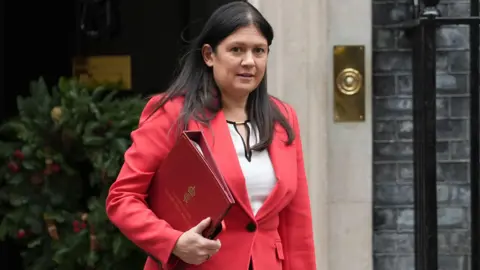
The culture secretary Lisa Nandy said: "The BBC is fundamental to the health of our nation and we want to make sure that we put it on a firm footing for decades to come.
"We're asking everybody to get involved and play their part in helping to shape its future."
Outgoing BBC director general Tim Davie said in a statement: "We welcome the publication of the government's green paper and the start of the public consultation on the future of the BBC. We urge everyone who cares about the success of the UK's world-leading creative industries to have their say.
"At the BBC, we want change, so we can continue to deliver for the UK for generations to come. We want to secure a public service BBC that is independent, sustainably funded for the long term, and meets our audience's needs."
Former BBC controller of editorial policy, Richard Ayre, described the consultation as "the most encouraging start of a charter process in decades, with the government apparently committed to giving the BBC a sustained and financially sustainable future".
The licence fee brought in £3.8 billion last year. Other funding streams - advertising, subscription and fee reform, including charging wealthier people more - are on the table for now, although many media commentators expect the licence fee to remain, with some changes.
Nandy said: "We're keeping all options open. The only option for funding the BBC that we've ruled out is general taxation and that is because it is essential that the BBC can hold governments of any persuasion to account, including ours, without fear or favour and without being heavily reliant on direct funding from government."
She described the BBC as "an institution that matters deeply to the democratic process in this country and to the health of our nation" and said it "has to have sustainable funding in order to thrive".
But she also acknowledged recent issues at the corporation: "There have been serious concerns about developments at the BBC, including editorial standards and about political interference.
"These aren't new challenges for the BBC. Throughout its history it's had to navigate them, but we believe that through this charter we can strengthen the amount of accountability within the BBC."
Former BBC director general Tony Hall suggested there should be careful consideration of a household tax charged in line with council tax bands.
The government rejects that model. It does, however, accept that public funding of the BBC will remain in some form and Lord Hall suggests an independent body, like a pay review body, to "take the politics out of the licence fee debate".
"Give them the task every three years of reviewing whether the money the BBC has got matches our ambitions for the BBC," he said.
He agrees the licence fee needs to be reformed and made "fairer".
The Reform party wants to scrap the licence fee altogether, while Conservative leader, Kemi Badenoch, threatened to withdraw support for it earlier this year.
The Liberal Democrats are supportive of the licence fee up until 2027. The Green Party did not specifically mention the BBC in its 2024 manifesto.
PA Media
Culture Secretary Lisa Nandy has ruled out general taxation but is otherwise keeping "all options open"
There will be a 12-week public consultation and the government is seeking views on how to ensure the BBC commands the public's trust, is accountable to audiences and fully represents communities.
This includes potentially giving the corporation new responsibilities to counter misinformation and disinformation, updating the BBC's mission to put accuracy on the same footing as impartiality and strengthening the BBC's independence, including examining political appointments to the BBC's board.
Labour MPs raised concerns around this issue in Parliament after the recent BBC controversy over the misleading edit of a Donald Trump speech on a Panorama prompted the resignations of the BBC director general and the CEO of News.
Trump is now suing the BBC for defamation over the edit.
Lord Hall told BBC News: "I think trying to take the politics as much as possible out of the organisation would be good. That means really looking carefully at appointments. I don't think there should be any political appointments to the board."
Others argue these appointments (there are five government-appointees on the BBC board including the chairman) ensure accountability and help challenge groupthink.
The BBC has faced a series of controversies in recent months for which it has had to apologise.
Nandy termed the Labour government "unashamedly supporters of the BBC as an institution, even as we've had serious frustrations with some of the decisions and failings that have taken place at the BBC in recent months".
She said the review of the charter was the chance "to make sure that it can not just survive, but thrive. It's an institution that belongs to us all. If it didn't exist, we would have to invent it".
The consultation will also look at how to devolve more commissioning to the regions and whether there should be a new obligation on the BBC to drive economic growth, build skills and support the UK economy.
The BBC is the only organisation operating under a royal charter with an expiry date. In a speech in November 2024, the BBC chairman Samir Shah said "there are more than 1,000 charter bodies, and I am not aware of any other that needs to be renewed like the BBC".
He asked: "Should we consider the BBC also having a permanent charter like the others?"
The government appears to be consulting on this, with some suggesting the threat of a future Reform government is focusing minds on the uncertainty renewal every decade creates and whether it allows too much political interference.
Ayre said: "It's interesting that the government chooses the word 'future-proof' for the BBC. Can that really mean that they're considering not a 10-year charter, which is the norm, but a sort of self-sustaining charter which will see the BBC continuing in its key position as the national broadcaster for what the government calls decades to come?
"Of course future governments can always try to undo that, but actually a royal charter, it's quite difficult to undo because technically it is the will of the monarch rather than of the government of the day".
Hall said "the great thing about the charter review this time is that I believe the government wants to secure the BBC's future for the long term. It could be a great legacy."
Next year, following the consultation, the government will publish its own vision for the BBC.
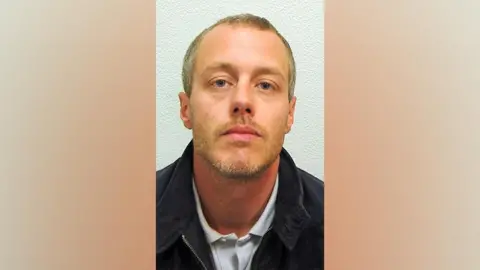
David Norris, who murdered Stephen Lawrence, has been denied parole, the BBC understands.
He sought release during a parole hearing in October, having been jailed in 2012.
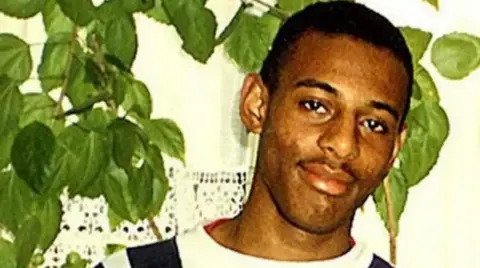
Stephen, 18, was stabbed to death in a racist attack in south London in 1993.
Only two of his killers have been convicted, with police always saying six people were involved.
At the parole hearing, Norris admitted he was part of the attack but refused to name the other killers. He had previously denied involvement.
Norris gave evidence via a video link from prison during the public hearing, in which he was bidding for release on licence.
Stephen's mother, Baroness Doreen Lawrence, said at the hearing that Norris remained a danger to the public and must remain in prison. The justice secretary also opposed Norris's release.
The hearing took place 13 years after Norris was jailed for life, with a minimum sentence of 14 years and three months.
Stephen was stabbed by a gang as he waited at a bus stop in Eltham, south-east London.
Witness evidence in the case records that an extreme racist slur was used towards Stephen just before the gang attacked.
In his evidence to the parole hearing, Norris said he was the last person to punch Stephen. He had tried to hit him two or three times and one of his punches connected.
For decades Norris publicly denied involvement in the murder, giving no-comment interviews to police, and claiming he was innocent during his trial.
However, the hearing heard confirmation that he had admitted involvement since being in prison, but denies stabbing Stephen or using a knife.
It also heard Norris continued to use racist language in prison, with him having been recorded in 2022 using the same racial slur that was hurled at Stephen before he was stabbed.
In a prepared statement that Norris read out, he apologised to the Lawrence family and wider black and ethnic community for the "fear" and "horror" his role in the attack had caused.
In a statement read on her behalf at the hearing, Baroness Lawrence said Norris had "killed my son in the most brutal and callous fashion. In doing so he changed my life and life of my family members forever".
She said she could not forgive Norris because he has not "expressed any acceptance, any contrition and certainly has no humanity".
Stephen's father previously told the BBC that Norris should name the other killers before he could be judged to be safe for release from prison.
Handout
Stephen Lawrence was murdered in a racist attack in 1993, when he was 18
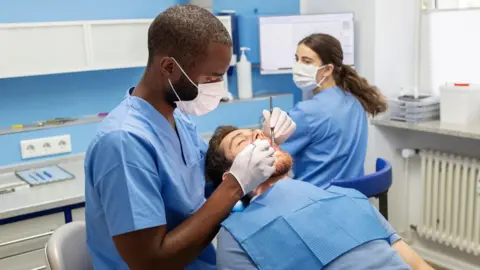
People needing urgent dental treatment and patients requiring complex care will be prioritised under government plans to improve access to NHS dentists in England.
The proposals could mean a saving of £225 for patients requiring numerous appointments for complicated treatments.
For years, many patients have found it increasingly hard to find a dentist, with some towns in England referred to as "dental deserts", with no access to NHS dentists at all.
The British Dental Association (BDA) said that without more funding and real reform, the plans wouldn't solve current issues.
Speaking on Radio 4's Today programme, health minister Stephen Kinnock said the plans were intended to "prioritise" urgent care.
He said there was "a lot of unnecessary routine care going on" in NHS dentistry services at the moment.
If a patient has "good oral health" he said they don't need to see a dentist "more than about once every two years".
He said the current practice of most patients being offered NHS check-ups every six months was "not the right use" of dentists' time, and added that it was "sucking up a lot of money in NHS dentistry".
Under the current system, which dates back to 2006, dentists are paid for what are called Units of Dental Activity, known as UDAs.
Different procedures - fillings, extractions and more complicated work - are assigned a different number of UDAs.
Dentists who provide NHS care have a contract that says how many UDAs they will carry out each year and are paid accordingly.
But this has meant that more money was available to dentists for carrying out simple check-ups, rather than spending longer with patients who needed more complex, time-consuming care.
For years dentists have been complaining that the contract for NHS work fails to cover the costs of what they're being asked to carry out.
As a result many dentists have been walking away from NHS work – meaning it's increasingly hard for people to access care. There are parts of the country where there is simply no access to NHS dentistry.
'Chronic underfunding'
Under the government plans, there would be new incentives for dentists to offer longer-term treatments for major issues such as gum disease and tooth decay through the NHS.
Currently, a patient with tooth decay in several teeth or severe gum disease - both of which require complex treatment - would need to be treated over multiple appointments, which is costly and time consuming.
But under proposed changes to the dental contract for NHS work, dental practices would be able to offer patients a single comprehensive package of treatment over a longer period, tailored to their needs.
And ministers argue that this could save a patient up to £225 in fees.
Shiv Pabary, chair of the BDA's General Dental Practice Committee said "a dental crisis" had come about directly as a result of the contract put in place in 2006.
"The reforms announced today are trying to tweak a system that's broken."
He added that until the "chronic underfunding" and wider systemic problems were addressed, NHS dentistry would continue to fail to work for "dentists and for patients".
"To try and deliver comprehensive care within the same budget that we have at the moment is going to be hugely challenging."
Mr Kinnock said the government had a "massive issue to fix" in dental care and was negotiating with the BDA on a "radical overhaul" of the NHS dentistry contract.
The government has formally begun the process which will decide the future of the BBC.
It has published a consultation document - or green paper - laying out plans to future-proof the BBC, put it on a sustainable financial footing and bolster trust.
This begins the renewal of the BBC charter - the corporation's rulebook and licence to exist - which expires in 2027.
The culture secretary Lisa Nandy said: "The BBC is fundamental to the health of our nation and we want to make sure that we put it on a firm footing for decades to come.
"We're asking everybody to get involved and play their part in helping to shape its future."
Outgoing BBC director general Tim Davie said in a statement: "We welcome the publication of the government's green paper and the start of the public consultation on the future of the BBC. We urge everyone who cares about the success of the UK's world-leading creative industries to have their say.
"At the BBC, we want change, so we can continue to deliver for the UK for generations to come. We want to secure a public service BBC that is independent, sustainably funded for the long term, and meets our audience's needs."
Former BBC controller of editorial policy, Richard Ayre, described the consultation as "the most encouraging start of a charter process in decades, with the government apparently committed to giving the BBC a sustained and financially sustainable future".
The licence fee brought in £3.8 billion last year. Other funding streams - advertising, subscription and fee reform, including charging wealthier people more - are on the table for now, although many media commentators expect the licence fee to remain, with some changes.
Nandy said: "We're keeping all options open. The only option for funding the BBC that we've ruled out is general taxation and that is because it is essential that the BBC can hold governments of any persuasion to account, including ours, without fear or favour and without being heavily reliant on direct funding from government."
She described the BBC as "an institution that matters deeply to the democratic process in this country and to the health of our nation" and said it "has to have sustainable funding in order to thrive".
But she also acknowledged recent issues at the corporation: "There have been serious concerns about developments at the BBC, including editorial standards and about political interference.
"These aren't new challenges for the BBC. Throughout its history it's had to navigate them, but we believe that through this charter we can strengthen the amount of accountability within the BBC."
Former BBC director general Tony Hall suggested there should be careful consideration of a household tax charged in line with council tax bands.
The government rejects that model. It does, however, accept that public funding of the BBC will remain in some form and Lord Hall suggests an independent body, like a pay review body, to "take the politics out of the licence fee debate".
"Give them the task every three years of reviewing whether the money the BBC has got matches our ambitions for the BBC," he said.
He agrees the licence fee needs to be reformed and made "fairer".
The Reform party wants to scrap the licence fee altogether, while Conservative leader, Kemi Badenoch, threatened to withdraw support for it earlier this year.
The Liberal Democrats are supportive of the licence fee up until 2027. The Green Party did not specifically mention the BBC in its 2024 manifesto.
PA Media
Culture Secretary Lisa Nandy has ruled out general taxation but is otherwise keeping "all options open"
There will be a 12-week public consultation and the government is seeking views on how to ensure the BBC commands the public's trust, is accountable to audiences and fully represents communities.
This includes potentially giving the corporation new responsibilities to counter misinformation and disinformation, updating the BBC's mission to put accuracy on the same footing as impartiality and strengthening the BBC's independence, including examining political appointments to the BBC's board.
Labour MPs raised concerns around this issue in Parliament after the recent BBC controversy over the misleading edit of a Donald Trump speech on a Panorama prompted the resignations of the BBC director general and the CEO of News.
Trump is now suing the BBC for defamation over the edit.
Lord Hall told BBC News: "I think trying to take the politics as much as possible out of the organisation would be good. That means really looking carefully at appointments. I don't think there should be any political appointments to the board."
Others argue these appointments (there are five government-appointees on the BBC board including the chairman) ensure accountability and help challenge groupthink.
The BBC has faced a series of controversies in recent months for which it has had to apologise.
Nandy termed the Labour government "unashamedly supporters of the BBC as an institution, even as we've had serious frustrations with some of the decisions and failings that have taken place at the BBC in recent months".
She said the review of the charter was the chance "to make sure that it can not just survive, but thrive. It's an institution that belongs to us all. If it didn't exist, we would have to invent it".
The consultation will also look at how to devolve more commissioning to the regions and whether there should be a new obligation on the BBC to drive economic growth, build skills and support the UK economy.
The BBC is the only organisation operating under a royal charter with an expiry date. In a speech in November 2024, the BBC chairman Samir Shah said "there are more than 1,000 charter bodies, and I am not aware of any other that needs to be renewed like the BBC".
He asked: "Should we consider the BBC also having a permanent charter like the others?"
The government appears to be consulting on this, with some suggesting the threat of a future Reform government is focusing minds on the uncertainty renewal every decade creates and whether it allows too much political interference.
Ayre said: "It's interesting that the government chooses the word 'future-proof' for the BBC. Can that really mean that they're considering not a 10-year charter, which is the norm, but a sort of self-sustaining charter which will see the BBC continuing in its key position as the national broadcaster for what the government calls decades to come?
"Of course future governments can always try to undo that, but actually a royal charter, it's quite difficult to undo because technically it is the will of the monarch rather than of the government of the day".
Hall said "the great thing about the charter review this time is that I believe the government wants to secure the BBC's future for the long term. It could be a great legacy."
Next year, following the consultation, the government will publish its own vision for the BBC.
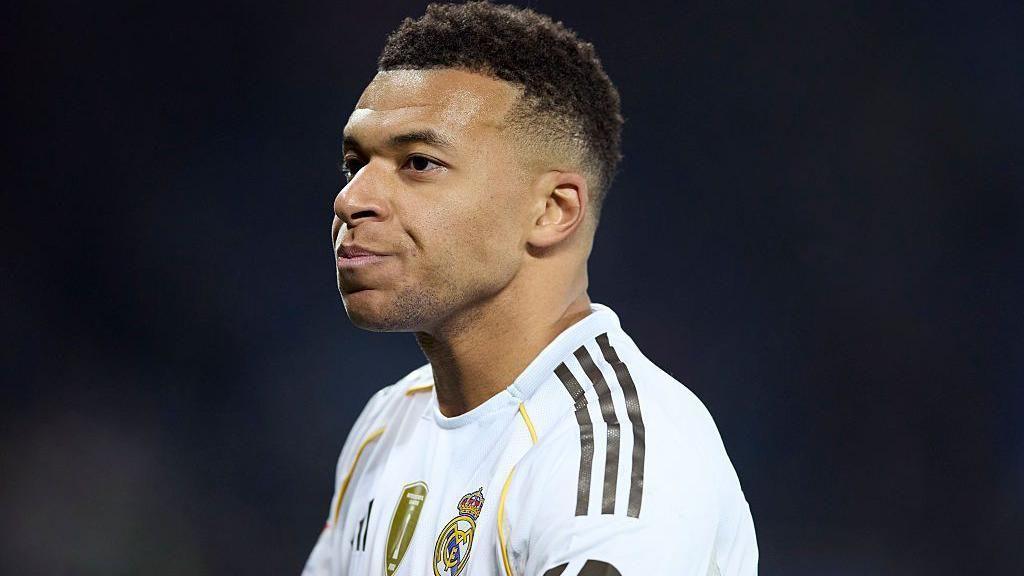
Mbappe spent seven seasons at PSG before moving to La Liga
Published
Paris St-Germain have been ordered to pay former striker Kylian Mbappe 60 million euros (£52.5m) in unpaid salary and bonuses by a French court.
Mbappe had been seeking 263m euros (£231.5m) from his former club after the long-running dispute reached a Paris labour court in November.
The European champions were counter suing the France captain for 240m euros (£211m).
The 26-year-old Real Madrid forward claimed the nine-figure sum, which included 55m euros (£46.3m) in unpaid wages, as damages in response to a contract dispute and ill-treatment by the club.
However, he has only been awarded a fraction of that amount, with the court recognising that PSG had failed to pay three months of his salary between April and June 2024 as well as an ethics bonus and a signing bonus under his contract.
"We are satisfied with this ruling. This is what you could expect when salaries went unpaid," Mbappe's lawyer Frederique Cassereau said.
Police 'put their lives on the line', says New South Wales premier
The New South Wales (NSW) premier has strongly rejected criticism of the police response to the attack on a Jewish festival at Bondi Beach, saying officers acted with "bravery and integrity".
Some witnesses have suggested police were too slow to disarm the two gunmen, who killed 15 people and injured dozens at an event celebrating Hanukkah at Australia's best known beach.
"There are two officers in critical care... at the moment," Chris Minns said after sustained questioning from reporters. "They weren't shot in the back as they were running away. They were shot in the front."
There have also been questions about whether adequate security was provided before the shooting took place.
"They shoot, shoot, change magazine and just shoot," one witness, Shmulik Scuri, told reporters the day of the assault, adding he thought officers "froze".
Asked about these criticisms, Minns said the "rush to conclusions" about the police operation was "disrespectful".
"They didn't take a backward step. They engaged the gunmen on the footbridge with handguns. The offenders had long range rifles," Minns said.
"If there's any suggestion that NSW Police didn't live up to their responsibilities to the people of this state, it should be rejected because it's not consistent with the facts."
NSW Police Commissioner Mal Lanyon avoided questions about how many officers had been deployed to police the event in advance. He told reporters police "regularly patrol that area as we did on that day" and that police presence was based "on the threat that exists at the time".
Australia's security agency has said the younger alleged gunman in the father-son duo, Naveed Akram, had come to their attention in 2019 due to his associations, but that there was nothing to suggest he was a risk of violence.
"Had there been intelligence that there was a particular threat at that location, or to that event, we may have had a different policing response," Commissioner Lanyon said.
NSW Police established Operation Shelter after the 7 October 2023 Hamas attack on Israel to investigate antisemitic hate crimes. As part of the operation, regular patrols are conducted of high-risk locations. The eastern suburbs of Sydney, including Bondi, which has a significant Jewish population, is a key focus.
Another taskforce, Strike Force Pearl, was set up later to investigate hate crimes in Sydney.
Getty
NSW Premier Chris Minns says police responding to the attack at Bondi 'didn't take a backwards step'
Police received reports of gunfire at a park in Bondi Beach at 18:47 (07:47 GMT) on Sunday. The gunmen carried out a shooting spree that lasted around ten minutes before police shot both men, killing one and critically injuring the other.
Dr Vincent Hurley, a former police officer who lectures on policing at Macquarie University, told the BBC it was "unrealistic" to expect police to be able to know how to react to every possible scenario.
"To respond to a mass shooting and mass killing event like that, there's no training that can be done."
He pointed out that police officers would have initially been reliant on calls to emergency operators "and everyone would have given them a different story".
"Then they have to fight through traffic at Bondi Beach which is a nightmare at the best of times."
At the scene, police would have been confronted with "absolute chaos" as thousands of people attempted to flee.
Individual officers would also have been faced with difficult choices such as whether to stop and render assistance to injured individuals or to go and look for the gunmen, decisions for which there is no protocol.
And even once the offenders had been identified, he says the risk of hurting bystanders in the crossfire would have complicated responses.
"There would be no way as a police officer, I would have drawn my firearm because all of the innocent individuals", he added. "It's not what you see on Netflix."
At least 15 civilians have been confirmed dead in Sunday's shooting attack at Bondi beach.
Many were attending an event to mark the first day of the Jewish festival of Hanukkah.
Authorities have confirmed that two rabbis, a Holocaust survivor and a 10-year-old girl were among the victims.
This is what we know about those identified so far:
Matilda, 10
Authorities confirmed that a 10-year-old girl, named by her family to local media as Matilda, was among the dead.
Irina Goodhew, who organised a fundraiser for the girl's mother and said she was the child's former teacher, wrote: " I knew her as a bright, joyful, and spirited child who brought light to everyone around her.'
The Harmony Russian School of Sydney also confirmed that she was one of its students.
"We are deeply saddened to share the news that a former student of our school has passed away in the hospital due to injuries sustained from a gunshot," the school wrote on Facebook.
"Our thoughts and heartfelt condolences go out to her family, friends, and everyone affected by this tragic event … Her memory will remain in our hearts, and we honor her life and the time she spent as part of our school family."
Meanwhile her aunt spoke to ABC news and said that Matilda's sister, who was with her when she was shot, was struggling to come to terms with the loss.
"They were like twins — they've never been separated," she told the ABC.
Rabbi Eli Schlanger
Supplied
Eli Schlanger was known as the Bondi rabbi
Known as the "Bondi Rabbi", Eli Schlanger, 41, was one of the key organisers of Sunday's event. He was head of the local Chabad mission, an international Hasidic Jewish organisation based in Brooklyn.
The death of the British-born father of five was confirmed by his cousin, Rabbi Zalman Lewis.
"My dear cousin, Rabbi Eli Schlanger @bondirabbi was murdered in today's terrorist attack in Sydney," Zalman wrote on Instagram. "He leaves behind his wife & young children, as well as my uncle & aunt & siblings … He was truly an incredible guy".
In a post on its website, Chabad said Schlanger's youngest child was just two months old.
"He was the most godly, humane, kind, gracious human being I think I've ever met," Alex Ryvchin of the Executive Council of Australia Jewry, told reporters at Bondi on Monday morning.
Dan Elkayam
The death of French national Dan Elkayam was confirmed by Frances's Foreign Minister Jean-Noël Barrot.
"It's with immense sadness that we have learnt that our compatriot Dan Elkayam was among the victims of the terrorist attack that hit Jewish families gathered on the beach at Bondi in Sydney," he wrote on social media. "We mourn with his family and loved ones, with the Jewish community and the Australian people."
According to his LinkedIn profile, Elkayam worked as an IT analyst for NBCUniversal and had moved to Australia last year.
He was also a keen footballer, and "an integral member" of our premier league squad, the Rockdale Ilindin Football Club in west Sydney wrote on its Facebook page.
He was "an extremely talented and popular figure amongst team mates. Our deepest and sincerest condolances to Dan's family, friends and all that knew him. He will be missed," the club wrote.
Alexander Kleytman
Alexander Kleytman was a holocaust survivor who came to Australia from Ukraine.
"I have no husband. I don't know where is his body. Nobody can give me any answer," his wife Larisa Kleytman told reporters outside a Sydney hospital late on Sunday.
"We were standing and suddenly came the 'boom boom', and everybody fell down. At this moment he was behind me and at one moment he decided to go close to me. He pushed his body up because he wanted to stay near me," she told the Australian.
Chabad wrote on X that Alexander "died shielding her from the gunman's bullets. In addition to his wife, he leaves behind two children and 11 grandchildren."
The couple shared some of their life story with Jewish Care in 2023.
"As children, both Larisa and Alexander faced the unspeakable terror of the Holocaust," the health organisation wrote in its annual report.
"Alex's memories are particularly harrowing; recalling the dreadful conditions in Siberia where he, along with his mother and younger brother, struggled for survival."
How Bondi Beach shooting unfolded minute by minute
Peter Meagher
Former police officer Peter Meagher was working as a freelance photographer at the Hanukkah event when he was killed, his rugby club confirmed.
"For him it was simply a catastrophic case of being in the wrong place and at the wrong time," Mark Harrison, the general manager of Randwick Rugby Club, wrote on its website.
"'Marzo, as he was universally known, was a much loved figure and absolute legend in our club, with decades of voluntary involvement, he was one of the heart and soul figures of Randwick Rugby."
The club said he had spent almost four decades in the NSW Police Force where he was "hugely respected by colleagues".
"The tragic irony is that he spent so long in the dangerous front line as a Police Officer and was struck down in retirement while taking photos in his passion role is really hard to comprehend," the club said.
Reuven Morrison
Reuven Morrison migrated to Australia from the former Soviet Union in the 1970s as a teenager, according to an interview he gave to the ABC exactly a year ago.
"We came here with the view that Australia is the safest country in the world and the Jews would not be faced with such anti-Semitism in the future, where we can bring up our kids in a safe environment," he told the national broadcaster.
Confirming his death, Chabad said that he was a longtime resident of Melbourne, but that he "discovered his Jewish identity in Sydney".
"A successful businessman whose main goal was to give away his earnings to charities dear to his heart, notably Chabad of Bondi," the organisation wrote on X.
Watch: 'Your courage is inspiring' Australian PM tells Bondi shooting 'hero'
Australia's Prime Minister has visited Bondi hero Ahmed al Ahmed in hospital, after the bystander tried to disarm one of the gunmen in the nation's deadliest gun attack since 1996.
"Your heart is strong", PM Anthony Albanese told the father-of-two, later calling him "the best of our country".
The fruit shop owner, who was born and raised in Syria, was shot several times in the shoulder after tackling one of the alleged gunmen. Albanese said Mr Ahmed would "undergo further surgery" on Wednesday.
At least 15 people have been confirmed dead after Sunday's attack in Sydney during an event to mark the first night of Hanukkah.
Police have declared the attack as a terrorist incident targeting the Jewish community.
"He was trying to get a cup of coffee and found himself at a moment where people were being shot in front of him," Albanese said after the bedside visit.
"He decided to take action, and his bravery is an inspiration for all Australians. He is a very humble man."
"At a moment where we have seen evil perpetrated, he shines out as an example of the strength of humanity," the prime minister added.
"We are a brave country. Ahmed al Ahmed represents the best of our country."
He later added: "Ahmed, you are an Australian hero."
There has been nationwide support for the 43-year-old including from US President Donald Trump who commended his courage, and a US billionaire who donated $99,999 (US$ 65,000; £49,000) to Mr Ahmed, calling him a "brave hero".
Watch: Eyewitness captures moment man tackles and disarms Bondi shooter
In the footage, Mr Ahmed is seen hiding behind a parked car before he leaps out.
He runs at the alleged gunman and seizes his weapon, before turning the gun round on him. The suspected attacker then begins to retreat.
Mr Ahmed then lowers the weapon and raises one hand in the air, appearing to show police he was not one of the attackers.
Watch: Dashcam video shows couple fight with attacker
A couple killed in the Bondi Beach shooting tried to stop one of the alleged attackers by grabbing his gun, dramatic dashcam footage shows.
Boris Gurman, 69, and his wife Sofia, 61, courageously stepped in to try and protect others before being shot themselves, their family said in a statement.
Video of the incident shows Mr Gurman, who was retired, wrestling with one of the alleged gunmen and taking the weapon off him, before they both fall onto the road.
Mr Gurman then gets up and appears to hit the suspected attacker with the gun. The attacker is then thought to have got another gun which he used to kill them.
"While nothing can lessen the pain of losing Boris and Sofia, we feel an overwhelming sense of pride in their bravery and selflessness," the family said.
"This encapsulates who Boris and Sofia were - people who instinctively and selflessly tried to help others."
The Gurman couple, who were Jewish, were the first two people killed in Sunday's attack, the Sydney Morning Herald reported.
At least 15 people have been confirmed dead in the shooting, which happened during an event to mark the first day of Hanukkah.
In their statement, the family said the couple had been married for 34 years.
"We are heartbroken by the sudden and senseless loss of our beloved Boris and Sofia Gurman.
"Boris was a retired mechanic, known for his generosity, quiet strength and willingness to lend a hand to anyone in need.
"Sofia worked at Australia Post and was deeply loved by her colleagues and community.
"Bondi locals, together they lived honest, hardworking lives and treated everyone they met with kindness, warmth and respect. Boris and Sofia were devoted to their family and to each other. They were the heart of our family, and their absence has left an immeasurable void."
GoFundMe
The couple were due to celebrate their 35th wedding anniversary in January, their family said
Witnesses have described Mr Gurman as a "hero".
The woman who owns the dashcam footage told Reuters that Mr Gurman "did not run away - instead, he charged straight toward the danger, using all his strength trying to wrestle away the gun and fighting to the death".
"I can see from my camera that the elderly man was ultimately shot and collapsed. That moment broke my heart," she said.
Another person who said they witnessed the incident told 9News: "He was a hero. He tried, he tried. We need to let his family know.
"Everyone needs to know what he tried, because it was right in the beginning. And he put himself in that face of danger. There were bullets flying already, and he put his self in the face of danger."
Police have described the attack as a terrorist incident targeting the Jewish community.
The other victims killed include a 10-year-old girl, a British-born rabbi, a retired police officer, and a Holocaust survivor.
The ages of the victims range from 10 to 87.
A further 22 people remain in hospital, nine of whom are in a critical condition.
Another bystander named Ahmed al Ahmed, 43, was also hailed a "hero" after he wrestled a gun from one of the attackers. He was shot multiple times and has since undergone surgery for his wounds.
US President Donald Trump has filed a defamation lawsuit against the BBC over an edit of his 6 January 2021 speech in a Panorama documentary.
Trump has requested billions of dollars in damages, according to court documents filed in Florida.
The BBC apologised to Trump in November, but rejected his demands for compensation and disagreed there was any "basis for a defamation claim".
Trump's legal team accused the BBC of defaming him by "intentionally, maliciously, and deceptively doctoring his speech". The BBC has not yet responded to the lawsuit being filed.
This breaking news story is being updated and more details will be published shortly. Please refresh the page for the fullest version.
You can receive Breaking News on a smartphone or tablet via the BBC News App. You can also follow @BBCBreaking on X to get the latest alerts.
Trump provided no evidence or basis for his comments on the deaths of Rob Reiner or his wife Michele
US President Donald Trump has repeated his criticism of Rob Reiner - after his earlier remarks about the killed Hollywood director, a longtime Trump critic, sparked widespread condemnation.
The US president told reporters the director was "very bad for our country", having earlier written on Truth Social that Reiner's death was linked to "Trump derangement syndrome" - a term he often uses to describe his critics.
Reiner and his wife Michele Singer Reiner were found dead at their Los Angeles home on Sunday, and police have arrested their son Nick on suspicion of murder.
They have not suggested any motive in the case, or any evidence that Reiner's politics and criticism of Trump played any role.
In his social media post, which called the couple's deaths "very sad", Trump criticised Reiner, saying: "He was known to have driven people CRAZY by his raging obsession of President Donald J. Trump."
Those comments were widely criticised, including by prominent Republicans.
Kentucky representative Thomas Massie, a Republican who has clashed with Trump since the president returned to the White House in January, wrote on X: "Regardless of how you felt about Rob Reiner, this is inappropriate and disrespectful discourse about a man who was just brutally murdered."
He added: "I guess my elected GOP colleagues, the VP, and White House staff will just ignore it because they're afraid? I challenge anyone to defend it."
Georgia Republican Marjorie Taylor Greene, who was once a staunch supporter of Trump before recently becoming a frequent critic, said that "this is a family tragedy, not about politics or political enemies" and that the murders should be "met with empathy".
Multiple other senior members of Trump's party appeared to distance themselves from the remarks. Senator John Kennedy, a Republican representing Louisiana, said he thought Trump should not have made the comments.
"I think a wise man once said nothing. Why? Because he was a wise man," Kennedy said. "I think President Trump should have said nothing. I think when the president says these sorts of things, it detracts from his policy achievements."
Reiner was a lifelong Democrat and prominent liberal activist, and frequently spoke out against Trump.
In 2017, for example, he called Trump "mentally unfit" for office. And as recently as October, Reiner said he believed Trump was ushering in an age of "full-on autocracy" in the US.
Hours after his social media post, Trump repeated his thoughts on Reiner in comments given in the Oval Office to reporters, describing the director as a "deranged person" who was partly "behind" previous claims of collusion between Russia and Trump's team.
"I was not a fan of Rob Reiner at all, in any way, shape or form," he said.
Trump has in the past criticised political foes after their death.
Following the death of Arizona Senator John McCain - with whom he clashed regularly - in 2019, for example, Trump said he "was never a fan" and "never will be".
In another incident the same year, Trump quipped that the late Democratic lawmaker John Dingell could be "looking up" at him from the grave, a comment which was widely interpreted as a suggestion that Dingell was in hell.
In a statement following the remarks about Dingell, the White House said that the president was "just riffing".
Reiner, who was 78, was known for directing several iconic films in a variety of genres, including This is Spinal Tap, Stand By Me, Misery and A Few Good Men.
He married Michele, an actress, photographer and producer, in 1989, later recalling that they met during the making of one of his best-known films, When Harry Met Sally. The couple had three children together - including Nick, 32.
Michele, 68, owned the Reiner Light photography agency and production house.
Lizzo said the fat-shaming claims had "haunted" her for the last two years
Pop star Lizzo is celebrating a legal victory after a judge dismissed allegations of fat-shaming from a 2023 lawsuit filed by three of her former dancers.
The singer, whose hits include body positive anthems such as Good As Hell and Juice, marked the development with a video statement posted to her Instagram and TikTok feeds.
"There was no evidence that I fired them because they gained weight," Lizzo said. "They were fired for taking a private recording of me without my consent and sending it off to ex-employees."
While those specific allegations have been dropped, the case against Lizzo and her production company will continue, over claims that three dancers were subject to sexual harassment.
Lizzo's team has called the lawsuit a "fabricated sob story," but a Los Angeles judge ruled that the case could move forward last year.
Arianna Davis, Crystal Williams and Noelle Rodriguez say they were pressured into attending sex shows and interacting with nude performers between 2021 and 2023.
The claims against Lizzo - whose real name is Melissa Viviane Jefferson - include that she "pressured Ms Davis to touch the breasts" of a dancer in a nightclub in Amsterdam.
Although she initially resisted, Ms Davis eventually acquiesced, "fearing it may harm her future on the team" if she didn't do so, according to court documents.
Other incidents cited in the case include the claim that dancers were asked to eat fruit from the naked bodies of sex club workers.
Over the summer, Lizzo's lawyers appealed the decision to let those claims got to trial, arguing that group outings were part of the singer's creative process and thus should be shielded by First Amendment free speech protections.
In response, a lawyer for the dancers rejected that claim, saying it was not enough to say the sex shows had inspired Lizzo's own performances.
"Under that standard," wrote Ari Stiller, "Johnny Cash could shoot 'a man in Reno just to watch him die' and claim protection if he hoped it would inspire his performance".
Stiller urged the court to allow the claims to proceed to trial.
Getty Images
Lizzo said she had worked to celebrate people with larger bodies throughout her career (none of the dancers pictured are thought to be part of the current lawsuit)
Lizzo's attorney, Melissa Glass, claimed that Stiller's brief "regurgitates the false accusations from their [original] complaint".
"As was true two years ago, the dancers cannot find a single person to corroborate their meritless claims," she Glass said in a statement to Billboard magazine.
"In contrast, 18 witnesses who worked with Lizzo on the Special tour submitted sworn statements refuting the claims made by Davis, Williams and Rodriguez. We look forward to the Court of Appeals ruling on this matter."
Lizzo has adamantly denied the allegations against her.
"I am very open with my sexuality and expressing myself but I cannot accept or allow people to use that openness to make me out to be something I am not," she said when the claims first emerged in 2023.
In her latest statement, the singer added that the fat-shaming allegations had "haunted" her for the last two years, adding that it had been "devastating to suffer through this in silence".
She also stressed that she has "only encouraged and supported people with bigger bodies and shared my platform with them."
Thanking her lawyers, Lizzo said she intended to keep fighting the lawsuit.
"I am not settling," she said. "I will be fighting every single claim until the truth is out.
Hope Jezzard's phobia of hospitals was so intense that it seemed inconceivable she would ever work in one. Now, Hope is a midwife who helps mothers overcome their fears.
Hospital phobia, or nosocomephobia, is one of a number of recognised anxiety disorders commonly associated with traumatic childhood experiences.
Hope told BBC Radio 5 Live that her mum was in and out of the hospital during her childhood.
"She nearly died twice and was put on life support. I had to leave her behind and although I knew she was being helped, it felt like I was being separated from her."
When Hope entered her teens and early twenties, any routine appointment would set her heart racing, she says.
"It manifested as feeling very anxious, panicky, being very triggered by smells and noises in hospitals," she says.
John Hawker, a psychotherapist who helps people deal with phobias, says a fear of hospitals is "quite common", often begins in childhood and is triggered by sights, smells and sounds.
"Perhaps when somebody was six weeks old, they were given an injection, and the memory of that injection was the smell of surgical spirit," he says.
"A bit of their brain was triggered by the smell of surgical spirit, and it doesn't matter how much logic that you tried to use to overcome that; they still don't want to walk into the hospital," he says.
'The first few shifts were terrifying'
Hope Jezzard
Hope during her training to become a midwife
When Hope, who is from Warwickshire, had to go to hospital appointments during her pregnancies and for the births of her two children, she says the support she received from her midwives inspired her to think about pursuing the same career.
At first her hospital phobia made the idea seem impossible but "over time the desire to try and help people trumped my fear," she says.
She left her job in a coffee shop to study for a degree in Midwifery at Coventry University.
"Going into a hospital was a massive challenge. I had avoided clinical settings for years. The first few shifts were terrifying," she says. "But over time, I became more comfortable."
She credits talking therapy with helping her work through the negative associations she had with hospitals.
"One of the tools I was given was the idea of the compassionate self - treating yourself in the same way you would a friend if they said to you 'I'm terrified to go into a hospital'.
"You might say 'can I come with you, can I hold your hand, would you like to talk beforehand or talk while it's happening?"
She also advised writing down a "stream of consciousness" when feeling overwhelmed by fear.
"Don't try and make sense of it or punctuate it or even make it legible it can be as simple as 'I'm scared I'm going to die'. You can throw it away or keep it and come back to it," she says.
Tips to cope with a fear of hospitals
Write down your fears - putting them on to paper can give you perspective
Take someone with you - a trusted person may help you to relax
Tell hospital staff - They will be better equipped to help you if they know
Tell your GP - They may refer you to an expert in behavioural therapy, such as a psychologist
Talking therapy - You can self-refer to this NHS service
Kim Black
Kim now helps other people dealing with their fear of hospitals.
Kim Black says she was "absolutely frozen" by her fear of hospitals after being diagnosed with hip dysplasia aged four. She says she developed paediatric medical traumatic stress following multiple surgeries.
"I would do anything not to go to the hospital, anything, I would just completely disassociate or avoid it altogether," she says.
"I once went to hospital actually dragging my leg behind me and I couldn't lift it up because that was how long I waited to go."
Kim now helps people to overcome their hospital phobias and build confidence after major surgery.
"Something that I do with my work is actually help prepare people to advocate for themselves and set up good boundaries when they go in," she says.
She says it helps her to "get ahead of spiralling thoughts" by writing them down.
"When I get to the hospital, I speak directly to whoever comes up to me and I tell them straight away, this is what I'm dealing with."
Mr Hawker says it is possible to combat a fear of hospitals through numerous therapies aimed at helping people detach from distressing memories without having to relive trauma.
"Hopefully overcoming that phobic response will allow somebody to feel much more empowered when they walk into a medical situation," he says.
Hope says putting herself in the environment that made her frightened for short periods gradually helped her to get used to hospitals.
"Now I'm a midwife and there are moments when I just want to run out of there but I've turned a very negative experience as a child into a very positive way to help people as an adult."
Watch: "Lucky" to have parents that "care about me", says Nick Reiner in 2015 interview
Celebrated Hollywood filmmaker Rob Reiner and his wife, producer Michele Singer Reiner, were found dead in their Brentwood, California, home on Sunday.
Their son Nick Reiner, 32, was arrested in Los Angeles on Sunday and is being held on suspicion of murder. Police have said the couple were victims of homicide.
Rob Reiner, who was known for directing movies such as This is Spinal Tap and When Harry Met Sally, had two sons and a daughter with his wife of 36 years.
Here's what we know about Nick Reiner, their younger son, and the investigation so far.
What happened?
The couple's youngest child, daughter Romy, found their bodies in their home in Brentwood, a celebrity enclave full of mansions, boutique shops and restaurants on the westside of Los Angeles, multiple sources confirmed to the BBC's US media partner CBS News.
The Reiners had suffered multiple stab wounds, CBS News reported. Their cause of death has not officially been released.
Nick Reiner is currently in custody after being arrested on Sunday, according to Los Angeles County Sheriff's Department records.
He was "booked for murder", Los Angeles Police Department Chief Jim McDonnell said on Monday.
In a Monday statement, police said that after their initial homicide investigation at the Reiners' home, it was "further revealed" that Nick Reiner "was responsible for their deaths".
Theories about a possible motive have bounced around social media, with President Donald Trump linking the death of the late director - an outspoken Democrat - to Trump Derangement Syndrome, which has spurred bipartisan condemnation. The president coined the phrase to describe his most persistent and vocal critics.
However, no alleged motive for the killings has been disclosed.
Nick Reiner was located and arrested on Sunday night, police said. He was booked for murder and remains in custody with no bail. LA Country Sheriff's jail records previously said he was being held with bail set at $4m (£3m).
The case will be presented to the Los Angeles County District Attorney's Office on Tuesday, when prosecutors will decide about filing charges, police said.
Reiner had spoken of his son's struggles
Getty Images
The family openly discussed Nick Reiner's long struggles with substance abuse and an addiction to hard drugs ahead of the release of his semi-autobiographical 2015 film, Being Charlie. The father and son had teamed up to write and direct the movie about a teenager addicted to drugs and his difficult road to recovery.
The Princess Bride director and his wife said that they had felt desperate during their son's struggles, but when he would tell them that a rehab program wasn't working, they didn't always listen and took the word of the professionals treating their son. He was in and out of rehab centres for years and experienced homelessness as a teenager.
"We were so influenced by these people. They would tell us he's a liar, that he was trying to manipulate us. And we believed them," Michele Reiner told the Los Angeles Times in 2015.
Rob Reiner added: "We listened to them when we should have been listening to our son."
The film appeared to provide healing for the family.
Rob Reiner said that by the time they started making the movie their relationship "had gotten so much closer".
Likewise, Nick Reiner told Variety at the time that their relationship grew during the process. Although he loved working with his dad on the film, he added that he wanted to be independent and complete his own projects.
Reiner had four children
Getty Images
Rob Reiner, Michele Singer, Romy Reiner, Nick Reiner, Maria Gilfillan and Jake Reiner at Spinal Tap II: The End Continues premiere in Los Angeles on 9 September 2025.
Rob Reiner was previously married to late filmmaker Penny Marshall and adopted her daughter, Tracy Reiner, 61.
He met Michele Singer on the set of When Harry Met Sally, and a few years later they had their first son, Jake.
In a 1998 interview with the BBC right before his daughter Romy was born, he reflected on parenthood, saying that his approach to child-rearing was changing and through his experiences with his sons - Jake was six and Nick was four - he was "learning about being a parent".
That same year, Reiner helped pass an initiative to use revenue from cigarette taxes for prenatal and early childhood support programme called California First Five.
"Hopefully what I'm doing is I'm trying to improve the fabric of society by making an investment early on with children," Reiner said, "So that we will have a reduction in crime and teen pregnancy and drug abuse and child abuse."
Watch: "I'm learning about being a parent" - Rob Reiner talks to the BBC's Tim Sebastian in 1998
Epstein took dozens more flights to the UK than were previously known
Almost 90 flights linked to Jeffrey Epstein arrived at and departed from UK airports, some with British women on board who say they were abused by the billionaire, a BBC investigation has found.
We have established that three British women who were allegedly trafficked appear in Epstein's records of flights in and out of the UK and other documents related to the convicted sex offender.
US lawyers representing hundreds of Epstein victims told the BBC it was "shocking" that there has never been a "full-scale UK investigation" into his activities on the other side of the Atlantic.
The UK was one of the "centrepieces" of Epstein's operations, one said.
Testimony from one of these British victims helped convict Epstein's accomplice Ghislaine Maxwell of child sex-trafficking in the US in 2021. But the victim has never been contacted by UK police, her Florida-based lawyer Brad Edwards told the BBC.
The woman, given the name Kate in the trial, was listed as having been on more than 10 flights paid for by Epstein in and out of the UK between 1999 and 2006.
The BBC is not publishing further details about the women in the documents because of the risk this might identify them.
US lawyer Sigrid McCawley said the British authorities have "not taken a closer look at those flights, at where he was at, who he was seeing at those moments, and who was with him on those planes, and conducted a full investigation".
US Attorney's Office SDNY
More information has emerged about Epstein, pictured here with Maxwell, and his UK links
Under the Jeffrey Epstein Transparency Act, the deadline to release all US government files on the sex-offender financier is Friday.
But the flight logs were among thousands of documents from court cases and Epstein's estate which have been already made public over the past year, revealing more about his time in the UK, such as trips to royal residences.
The BBC examined these documents as part of an investigation trying to piece together Epstein's activities in the UK.
It revealed that:
The incomplete flight logs and manifests record 87 flights linked to Epstein - dozens more than were previously known - arriving or departing from UK airports between the early 1990s and 2018
Unidentified "females" were listed among the passengers travelling into and out of the UK in the logs
Fifteen of the UK flights took place after Epstein's 2008 conviction for soliciting sex from a minor, which should have raised questions from immigration officials
Although Epstein died in jail in 2019, before his trial on charges of trafficking minors for sex, legal experts have told the BBC a UK investigation could reveal whether British-based people enabled his crimes.
Two months ago the BBC sent the Metropolitan Police, which has previously examined allegations about Epstein's activities in Britain, publicly available information about the UK flights with suspected trafficking victims on board.
Later, we sent the Met a detailed list of questions about whether it would investigate evidence of possible British victims of Epstein trafficked in and out of the UK.
The Met did not respond to our questions. On Saturday, it released a broader statement saying that it had "not received any additional evidence that would support reopening the investigation" into Epstein and Maxwell's trafficking activities in the UK.
"Should new and relevant information be brought to our attention", including any resulting from the release of material in the US, "we will assess it", the Met said.
Sigrid McCawley, who represents hundreds of Epstein victims, criticised the Met for declining to investigate
US lawyer Brad Edwards, who has been representing Epstein victims since 2008, told us "three or four" of his clients are British women "who were abused on British soil both by Jeffrey Epstein and others".
Other victims were recruited in the UK, trafficked to the United States and abused there, he said.
Mr Edwards said he is also representing women of other nationalities who say they were trafficked to the UK for abuse by Epstein and others.
Our analysis shows Epstein used commercial and chartered flights, as well as his private planes, to travel to the UK and to arrange transport for others, including alleged trafficking victims.
More than 50 of the flights involved his private jets, mostly flying to and from Luton Airport, with several flights at Birmingham International Airport, and one arrival and departure each at RAF Marham in west Norfolk and at Edinburgh Airport.
Limited records of commercial and chartered flights taken by Epstein, or paid for by him, show dozens more journeys, mainly via London Heathrow, but also Stansted and Gatwick.
In a number of the logs of Epstein's private planes, including some detailing trips to the UK, women on the flight are identified only as unnamed "females".
"He's absolutely choosing airports where he feels it will be easier for him to get in and out with victims that he's trafficking," said Ms McCawley.
Private aircraft did not have to provide passenger details to UK authorities before departure in the same way as commercial aircraft during the period covered by the documents we examined. The Home Office told us they were "not subject to the same centralised record-keeping".
That loophole was only closed in April last year.
Kate, the British woman who testified against Maxwell, was on some of the commercial flights in the records we examined. She described in court that she had been 17 when Maxwell befriended her and introduced her to Epstein - who then sexually abused her at Maxwell's central London home.
In the 2021 trial, she described how Maxwell gave her a schoolgirl outfit to wear and asked her to find other girls for Epstein. As well as the dozen flights to and from the UK, Kate told the court she had been flown to Epstein's island in the US Virgin Islands, New York and Palm Beach in Florida, where she says the abuse continued into her 30s.
Reuters
Kate, pictured on the right with her face blurred, testified at Maxwell's trial
Mr Edwards, her lawyer, told BBC News that even after that testimony, Kate has "never been asked" by any UK authorities any questions about her experience - "not even a phone call".
He said that if British police were to launch an investigation into Epstein's activities and his enablers, Kate would be happy to help.
Prof Bridgette Carr, a human-trafficking expert at the University of Michigan Law School, said trafficking cases usually require many people working together.
"It's never just one bad person," she said. "You don't think about the accountant and the lawyer and the banker - or all the bankers - and all these people that had to implicitly, and sometimes explicitly, be OK with what was happening for it to continue."
There are also questions about how Epstein was able to travel freely to the UK after his 2008 conviction for soliciting a minor for sex, which meant he had to register as a sex offender in Florida, New York and the US Virgin Islands.
Epstein was released from prison in 2009 after serving 13 months. Documents suggest Epstein took a Virgin Atlantic flight from the US to London Heathrow in September 2010, just two months after he completed his probation on house arrest.
Home Office rules at the time said foreign nationals who received a prison sentence of 12 months or more should, in most cases, have been refused entry.
But immigration lawyer Miglena Ilieva, managing partner at ILEX Law Group, told us that US citizens did not usually require a UK visa for short stays, so there was no application process where they would be asked about criminal convictions.
"It was very much at the discretion of the individual immigration officer who would receive this person at the border," she said.
The Home Office said it does not hold immigration and visa records beyond 10 years and added "it is longstanding government policy that we do not routinely comment on individual cases".
During the 1980s, Epstein also used a foreign passport - issued in Austria with his picture and a false name - to enter the UK as well as France, Spain and Saudi Arabia, according to US authorities.
Epstein also listed London as his place of residence in 1985, when he applied for a replacement passport, ABC News has previously reported.
Brad Edwards says his British client Kate has never been contacted by UK police
In its statement on Saturday, the Met said it had contacted "several other potential victims" when it examined 2015 allegations by Virginia Giuffre that she had been trafficked for sexual exploitation by Epstein and Maxwell.
Ms Giuffre also said she was forced to have sex with Andrew Mountbatten-Windsor on three occasions, including when she was 17 at Maxwell's home in London, in 2001. The former prince has consistently denied the allegations against him.
The Met said its examination of Ms Giuffre's claims "did not result in any allegation of criminal conduct against any UK-based nationals" and it concluded that "other international authorities were best placed to progress these allegations".
That decision was reviewed in August 2019 and again in 2021 and 2022 with the same result, it said.
But for lawyer Sigrid McCawley, the message the Met is sending to victims is "that if you come to law enforcement and this is a powerful person you're reporting on… it will not get investigated."

 Login
Login
 GoFundMe